A bodhisattva is, in the most general Buddhist usage, a being who is on the path to full awakening, a future buddha. The Sanskrit word joins bodhi (“awakening”) with sattva (“being”), and it has been used for more than two thousand years in at least three overlapping senses. In the oldest strata of Buddhist literature it names the Buddha himself during the long career that led up to his awakening. In the Mahayana movement it becomes an ideal open to every practitioner, a person who generates bodhicitta, the aspiration to attain buddhahood for the sake of all beings, and who takes vows to that end. And in devotional Buddhism it names a host of luminous figures such as Avalokiteshvara, Manjushri, Kshitigarbha and Maitreya, who are honored, invoked and visualized in temples from Sri Lanka to Korea to the Himalayas.
Those three senses are related but not identical, and the difference matters for anyone trying to read a Buddhist text, visit a temple or understand a statue. A Theravada monk reciting a story of the Buddha’s former lives and a Tibetan practitioner taking the bodhisattva vow before a teacher are both using the word, yet they stand in different relations to it. Not every Buddhist community understands the term in the same way, and this article tries to keep the traditions distinct. For the wider religion, see the overview of Buddhism: beliefs, teachings, history, and practices; for the movement in which the bodhisattva ideal became central, see Mahayana Buddhism.
The sections below move from the meaning and history of the word to the path itself: bodhicitta, vows, the perfections, and the stages that traditions describe in broad outline. They then turn to the major figures and their regional forms, the symbols that identify them in art, and the way devotion, chanting, visualization and liturgy shape daily practice. The article describes what each tradition teaches, attributes its claims to the schools that hold them, and separates historical evidence from devotional understanding. It does not rank traditions or decide which interpretation is correct.
One further note on method. Many bodhisattvas, especially the celestial ones, are understood in the traditions that honor them as awakened or nearly awakened beings who are active now, not simply as characters in old stories. Historians, for their part, trace how images and devotional practices developed, which texts first mention a figure and where a name travels. Both kinds of statement appear here, and the wording tries to make clear which is which.
Bodhisattva at a Glance: Meaning, Vocabulary, and Core Idea
What the Word Means
The roots of the term: bodhi and sattva
The Sanskrit compound bodhisattva is usually glossed as “awakening being” or “being intent on awakening.” The first element, bodhi, comes from a root meaning to awaken or to understand, and it is the same word found in “Bodhi tree,” the tree under which Siddhartha Gautama is said to have attained awakening. The second element, sattva, means a being, a living creature, and in some contexts a sentient being as opposed to a plant or an inanimate object. Encyclopaedia Britannica gives the definition of a bodhisattva as one who seeks awakening and is therefore an individual on the path to becoming a buddha, and notes the Pali form bodhisatta, “one whose goal is awakening.”
Translators have rendered the compound in several ways, and each choice carries a small interpretation. “Awakening being” and “being of awakening” stay close to the Sanskrit. “Enlightenment being” and “enlightened being” are common in popular writing, though the second is misleading, because in many contexts a bodhisattva is not yet a buddha. The Pali discourses translated by Bhikkhu Sujato on SuttaCentral use the phrase “the being intent on awakening,” which captures a sense of direction instead of attainment. Some Mahayana texts also play on the second syllable: sattva can be read as “courage” or “heroism” in some Sanskrit contexts, and the Tibetan rendering, byang chub sems dpa’, conveys something like “awakening hero.” That nuance has become part of how Tibetan teachers speak about the figure.
How the term is written and said across Asia
As Buddhism moved along trade routes and monastic networks, the word was transliterated or translated into each language. In Chinese it became pusa (菩薩), a shortened transliteration of an earlier fuller form, puti sa duo. In Korean it is bosal, in Japanese bosatsu, in Vietnamese bồ tát, and in Tibetan, as noted, byang chub sems dpa’. In Thai, Burmese and Sinhala, languages whose Buddhism is largely Theravada, the Pali form bodhisatta (or a local adaptation of it) is in use. Each of these words appears in sentences that a reader of English might render as “a bodhisattva,” although the surrounding practice differs. For example, a Chinese temple notice that says Guanshiyin pusa is naming a figure of devotion, whereas a Sri Lankan sermon on the bodhisatta may be about the future Buddha’s earlier births.
The Core Idea in Brief
Aspiration, vow, and practice
Across the traditions that emphasize it, the bodhisattva path begins with an aspiration. The practitioner resolves to attain full buddhahood, not only personal liberation, so as to be able to help every living being out of suffering. That resolution is called bodhicitta, “the mind of awakening,” and it is usually formalized through a vow taken in the presence of a teacher or before an image of the Buddha. The vow is then carried out through training in a set of virtues called the perfections (paramita), generosity, ethical conduct, patience, energy, meditation and wisdom, to which some lists add skillful means, aspiration, strength and knowledge.
The path is described as long, spanning many lifetimes. This is connected to the Buddhist understanding of karma and rebirth, which supplies the framework in which a being can gradually refine compassion and understanding over countless lives. Schools disagree about how literally to take the number of lifetimes or how rapidly progress can occur, and some traditions, such as those that emphasize Pure Land rebirth or tantric methods, offer routes they describe as faster. The shared point is that the bodhisattva’s aim is not a private escape from suffering.
Compassion and wisdom as inseparable partners
Two qualities appear together in nearly every Mahayana description of the bodhisattva: compassion (karuna) and wisdom (prajna). Compassion is the wish that beings be free from suffering and its causes; wisdom is the direct understanding of how things exist, especially the teaching that phenomena lack inherent, independent existence, which Mahayana philosophers call emptiness (shunyata). Teachers often say that compassion without wisdom can become sentimental or exhausting, and that wisdom without compassion can become cold or self-absorbed. In an image that recurs across schools, the two are the wings of a bird or the two hands of a single person.
A well-known passage in the Diamond Sutra, quoted later in this article, expresses their union in a single paradox: the bodhisattva resolves to lead every being to nirvana and yet does not cling to the idea that any being has been led. Whether that passage is read through Madhyamaka philosophy, as a Chan or Zen teaching, or as devotional instruction, it shows why the figure is not reducible to a simple helper or saint.
Key Vocabulary for Reading About Bodhisattvas
A working glossary
Specialized terms recur throughout any discussion of the bodhisattva path. The table below gathers the most common ones in their Sanskrit, Pali, Chinese, Japanese and Tibetan forms where they differ, with a plain-English gloss. Diacritics are omitted in running text for easier searching.
| Term | Language and variants | Plain-English meaning | Where it matters |
|---|---|---|---|
| Bodhisattva | Sanskrit; Pali bodhisatta; Chinese pusa; Japanese bosatsu; Tibetan byang chub sems dpa’ | A being on the path to full buddhahood | Names the Buddha before awakening, any aspirant, and celestial figures |
| Bodhi | Sanskrit and Pali | Awakening; the understanding that ends ignorance | Core goal in all Buddhist schools, with differing definitions |
| Bodhicitta | Sanskrit; Chinese putixin; Japanese bodaishin | The mind or aspiration of awakening for the sake of others | Entry point to the Mahayana path |
| Mahasattva | Sanskrit | “Great being,” an honorific for advanced bodhisattvas | Used in sutras, as in “Bodhisattva Mahasattva Avalokiteshvara” |
| Karuna | Sanskrit and Pali | Compassion; the wish to remove suffering | One of the four immeasurables |
| Prajna | Sanskrit; Pali panna | Wisdom, especially insight into emptiness or dependent arising | The sixth perfection and its crown |
| Upaya | Sanskrit; Chinese fangbian | Skillful means; teaching or acting in ways that fit the hearer | Explains why bodhisattvas appear in many forms |
| Paramita | Sanskrit; Pali parami | Perfection or transcendent virtue | Six or ten, depending on the list |
| Pranidhana | Sanskrit; Pali panidhana | Vow or resolve | The basis of ritual vow ceremonies |
| Bhumi | Sanskrit | Stage or ground of the bodhisattva path | Ten stages are commonly taught |
| Tathagatagarbha | Sanskrit | Buddha-nature; the capacity for awakening in beings | Underlies the claim that every being can become a buddha |
Terms that are easy to confuse
Four neighboring words are often mixed up. A buddha is a fully awakened being who has completed the path and teaches it; the historical Buddha, Siddhartha Gautama, is the one honored by all schools, and the article on the Buddha sets out the evidence for his life. An arhat (Pali arahant) is a person who has attained liberation from rebirth by following a buddha’s teaching, and in early texts this was the ideal for monastic disciples. A pratyekabuddha is a “solitary awakened one” who awakens without a teacher but, in the traditional account, does not found a teaching. A bodhisattva is none of these yet and aspires to the first.
The Mahayana sutras often contrast the bodhisattva’s resolve with the aim of the arhat, a contrast that many modern scholars of Buddhism regard as partly rhetorical and partly a record of real doctrinal debate. The Theravada tradition, for its part, does not treat the arhat’s path as an inferior one, and it recognizes its own bodhisatta path for those who aspire to buddhahood. The sections below return to this point, because it directly affects how the word is used in different communities.

The Word and Its History: From the Buddha’s Former Lives to the Mahayana Ideal
Early Usage: Bodhisatta in the Pali Discourses and Jataka Stories
The Buddha before his awakening
In the earliest Buddhist literature the word does not name a class of saints. It names Siddhartha Gautama in the period before he awakened. In the Pali discourse known as the Noble Search (Majjhima Nikaya 26), the Buddha describes his own history. In Bhikkhu Sujato’s translation he recalls a time “before my awakening—when I was still unawakened but intent on awakening,” and the Pali phrase behind that English wording uses the word bodhisatta for his past self. Another discourse, the Incredible and Amazing (Majjhima Nikaya 123), is a connected set of remarkable events surrounding the future Buddha’s descent from the heaven of the joyful gods and his birth, and it refers to him repeatedly as “the being intent on awakening.”
Mendicants, before my awakening—when I was still unawakened but intent on awakening—I too, being liable to be reborn, sought what is also liable to be reborn.
Majjhima Nikaya 26 (Ariyapariyesana Sutta), section 13, trans. Bhikkhu Sujato, SuttaCentral
In this early sense the word is tied to biography. It says that the awakened teacher had once been unawakened, that he sought, and that his seeking eventually bore fruit. The text does not yet say that anyone else might or should aim for the same thing, and it does not set the bodhisatta over against the arahant, since the discourses present both the Buddha and his awakened disciples as liberated beings who realize the same end of suffering. For a fuller account of the Buddha’s biography as the sources record it, see the article on the Buddha.
The Jataka tales and the idea of long preparation
Once Buddhists accepted rebirth as a fact of experience, they could ask what the Buddha had been doing in earlier lives. The answer was recorded in the Jataka, “birth stories,” a collection of narratives in which the bodhisatta appears as a king, an elephant, a deer, a merchant, a monkey or an ascetic, always demonstrating a quality such as generosity, patience or truthfulness. The Pali collection counts 547 stories in its traditional enumeration, and episodes from them are found in sculpture and painting at the Indian sites of Bharhut and Sanchi, which are commonly dated to the last centuries BCE, as well as in much later temple art from Southeast Asia.
The Jataka stories do three things that matter for the later bodhisattva ideal. They establish that the road to buddhahood is long, extending over many lives. They show that the road is built from acts of self-giving, such as the well-known tale of Prince Vessantara, who gives away his wealth, his children and even his wife in a story that Theravada communities still hear recited as a major festival text. And they present the future Buddha as a being of compassion who acts in animal and human forms alike. Those three features are carried straight into Mahayana literature, where they are no longer only about one being.
The Emergence of the Mahayana Ideal
From one bodhisattva to many
The turning point in the history of the term was the claim that bodhisattvahood was not unique to the Buddha’s biography. In texts associated with the early Mahayana movement, which scholars place from roughly the first century BCE and the first centuries CE, the Buddha’s story is treated as a model for a path anyone might begin. The 8,000-line Perfection of Wisdom sutra and early texts such as the Inquiry of Ugra and the Lotus Sutra describe bodhisattvas as persons who vow to attain buddhahood in order to rescue other beings. The earliest datable witnesses are Chinese translations: the Kushan-era monk Lokaksema worked in Luoyang in the later second century CE and rendered some of the earliest Mahayana texts into Chinese, which gives a reliable lower bound for the existence of these ideas.
Historians still debate how this happened. Older accounts imagined Mahayana as a lay reform movement opposed to the monastic establishment. More recent work, based in part on Indian inscriptions and on the study of early Chinese translations, suggests that the early Mahayana was small, that its authors were often monastic, and that the new ideals were argued out within existing monastic communities, not outside them. The bodhisattva ideal in this picture is not an overnight break. It grows from existing narratives, existing practices of aspiration and merit, and a particular reading of how the Buddha’s long career should be understood.
Why the ideal spread
Several features helped the idea travel. It gave ordinary practitioners, including laypeople, a way to understand their own compassion as part of a recognized path. It supplied a vocabulary, bodhicitta, vows, perfections, stages, for describing moral and spiritual growth in a single arc. It invited devotion to specific advanced bodhisattvas, who were seen as already active in the world, and so supported temple practice, art and pilgrimage. And it offered a language, skillful means, for explaining why the Buddha’s teachings could take different forms for different audiences.
The ideal also entered into philosophical systems. Madhyamaka thinkers associated with Nagarjuna, who is dated by the Stanford Encyclopedia of Philosophy to roughly 150 to 250 CE, analyzed compassion and wisdom in terms of emptiness and the two truths. Yogacara writers developed detailed accounts of the stages of the path. The result was a body of doctrine that later East Asian and Tibetan schools adopted and reshaped. The article on Mahayana Buddhism follows these developments in more detail.
The Bodhisattva Idea Outside the Mahayana
Theravada and the bodhisatta path
The Theravada tradition, the school dominant in Sri Lanka, Myanmar, Thailand, Laos and Cambodia, does not center the bodhisattva ideal, but it does not reject it. Pali commentarial literature describes three kinds of awakening: that of a fully awakened buddha, that of a solitary buddha, and that of a disciple. It also describes the career of the bodhisatta as a rigorous vocation requiring ten perfections: generosity, ethical conduct, renunciation, wisdom, effort, patience, truthfulness, resolve, loving-kindness and equanimity. In this tradition the bodhisatta path is generally regarded as a rare calling that few take up, and that is compatible with the more common goal of becoming an arahant. See Theravada Buddhism for the school’s own account of its aims.
The story of Sumedha is the tradition’s classic example of a vow. In the commentarial account, an ascetic called Sumedha lies down in the mud so that the earlier buddha Dipankara may walk over him without soiling his feet, and in doing so resolves to become a buddha himself; Dipankara then declares that he will become Gautama. Theravada communities remember this story when they speak about the bodhisatta’s aspiration. Meanwhile, individual monks, laypeople and some contemporary teachers in Theravada countries do speak of their own aspiration to buddhahood, and the tradition has long made room for that choice.
Other early schools and the commentarial debate
The Theravada school is only one of the early monastic lineages. Others, now extinct as independent schools, such as the Sarvastivada and the Dharmaguptaka, produced their own scholastic literature that treats the bodhisattva’s career. Their scholastic works discuss, for instance, how long the career of a bodhisattva takes, which acts and perfections belong to which phase of it, and what distinguishes his conduct from that of a disciple. These discussions show that the idea of a long career of preparation was a shared inheritance, not an exclusive possession of the Mahayana, although the Mahayana made it the standard for all practitioners.
The debate between those who regarded the arahant’s goal as sufficient and those who saw it as incomplete is recorded in Mahayana polemical passages, but it is best read as an intra-Buddhist argument about the proper scope of compassion, not as a dispute between rival religions. Modern scholarship generally treats the polemics as one element in a long conversation. In the sections that follow, the focus returns to the Mahayana and Vajrayana understanding of the bodhisattva, where the vocabulary of vows and stages is most developed.
The Bodhisattva Path: Bodhicitta, Vows, Compassion, and Wisdom
Bodhicitta: Generating the Mind of Awakening
Aspiring and engaging bodhicitta
Bodhicitta is the hinge on which the whole path turns. Mahayana writers describe it as a transformation of motive: a person who has previously sought to escape suffering for personal reasons comes to want, with the same urgency, that all beings be free, and sees that the best way to bring this about is to become a fully awakened buddha. The eighth-century Indian monk Shantideva, in his poem the Bodhicaryavatara (“Entering the Conduct of Awakening”), distinguishes two phases that later commentators in Tibet and East Asia repeatedly cite. In the first, called aspiring bodhicitta, a person wishes to attain awakening for the benefit of beings. In the second, engaging bodhicitta, the person actually undertakes the training, and the poem compares the difference to that between wishing to travel and setting out on the road.
In practice the distinction matters because it explains why many communities give the aspiration and the commitment separate ritual forms. A layperson may cultivate the wish in daily prayer for years before taking a vow before a teacher. Shantideva’s poem also supplies one of the best-known verbal expressions of the resolve. In L. D. Barnett’s 1909 translation of the third chapter, the poem reads:
As the earth and other elements are for the various service of the countless creatures dwelling in the whole of space, so may I in various wise support the whole sphere of life lodged in space, until all be at peace.
Shantideva, Bodhicaryavatara (The Path of Light), trans. L. D. Barnett, 1909, chapter III, p. 46
Read within the Mahayana commentarial tradition, the verse expresses the bodhisattva’s vow as an open-ended commitment that is measured by the needs of beings, not by the practitioner’s own convenience. The image of the elements is a deliberate one: earth, water, fire and air serve without asking anything of the beings they support. Teachers in Tibetan, Chinese and Japanese traditions cite verses of this kind as models for the attitude a practitioner is trying to cultivate, and they pair them with specific methods of meditation on compassion. Chan and Zen teachers more often quote such passages as a statement of orientation than as a technique.
Relative and ultimate bodhicitta
Tibetan and some other Mahayana traditions add a further distinction. Relative (or conventional) bodhicitta is the aspiration and the commitment described above, directed at beings who appear to suffer. Ultimate bodhicitta is the direct realization of emptiness, the understanding that the self and phenomena lack inherent existence, which a practitioner is said to attain at a high stage on the path. Teachers in these schools describe the first as the vehicle of compassion and the second as the vehicle of wisdom, and they treat the two as inseparable in the fully developed bodhisattva.
The distinction answers a worry that appears early in Mahayana literature: if all things lack inherent existence, then what does it mean to rescue beings? The answer, developed by Madhyamaka and Yogacara thinkers, is that conventional truth and ultimate truth are both valid in their own domains, and that compassion operates within the conventional while wisdom sees through its apparent solidity. Not all traditions use these exact terms, and Pure Land communities in East Asia, for example, often express the same concern through faith in Amitabha Buddha’s vow, not through a graduated analysis of two truths.
Vows and Precepts
The four great vows
One of the most widely recited formulations is the set of four great vows. In its common Chan and Zen form, a practitioner pledges to save the countless beings, to end the inexhaustible afflictions, to enter the boundless gates of the Dharma, and to attain the unsurpassable way of the Buddha. Versions appear in Tiantai and Chan literature and in the Platform Sutra attributed to the Chan teacher Huineng, and they are recited in many Zen centers and monasteries at the end of formal sitting or services, in Japanese, Korean, Vietnamese, Chinese or English.
The vows are intentionally impossible on their face, since beings are said to be numberless and afflictions inexhaustible, and Zen teachers often call attention to that fact. The point is not to complete a task but to orient a life. Because the vow is stated in the first person and in the present tense, it is understood as something to be renewed every day, and recitation at the close of a retreat or service is a way of turning the fruit of practice outward.
Bodhisattva precepts and vow ceremonies
In many traditions the vow is also taken in a ritual, with a teacher or in front of a community, and with specific commitments attached. In Tibetan Buddhism, teachers describe two lineages of the bodhisattva vow ceremony, one traced to Manjushri and Nagarjuna with an emphasis on the profound view, and one traced to Maitreya and Asanga with an emphasis on vast conduct. The ritual normally includes taking refuge, generating bodhicitta, and receiving a list of root and secondary commitments, and it can be received by laypeople, monastics and tantric practitioners alike. Teachers often stress that the vow is taken with the intention to keep it for all one’s lives, and that a commitment of this kind should be undertaken with reflection, not casually.
In China the main source of bodhisattva precepts is the Brahmajala Sutra, a text whose Chinese version is widely thought by scholars to have been composed in China, which lists ten major and forty-eight minor precepts. Monastics typically receive them in a ceremony that follows novice and full ordination, and lay Buddhists receive a shorter set in a simpler ceremony. In Japan the Soto Zen tradition performs a ceremony called jukai in which lay and ordained practitioners receive precepts framed as bodhisattva precepts, and Tendai, founded by Saicho in the early ninth century, made the bodhisattva precepts the basis of its ordination. For the monastic side of these systems, see Buddhist monastic life and the Vinaya.
The Perfections and Skillful Means
The six perfections
The characteristic training of the bodhisattva is organized around the perfections. Most Mahayana lists name six: generosity (dana), ethical conduct (shila), patience (kshanti), energy or diligence (virya), meditative concentration (dhyana) and wisdom (prajna). Teachers explain that the first five are enacted in the world and are made perfect by the sixth, wisdom, which sees that giver, gift and receiver have no independent existence. The Perfection of Wisdom literature, a group of sutras including the Diamond and Heart sutras, makes that claim its constant theme. Generosity appears first because it is the most accessible and most visible form of compassion, and because the Jataka tradition had already made it central to the Buddha’s earlier lives.
Other lists expand the six to ten by adding skillful means, aspiration, strength and knowledge; these four are tied to the later stages of the path in the Dashabhumika (“Sutra on the Ten Stages”). The Theravada tradition, as noted earlier, keeps its own ten perfections. The table below summarizes the main vow and path concepts and shows where each is emphasized. It is a summary of teaching, not a ranking of traditions.
| Concept | What it names | Where it is especially emphasized | How it is expressed |
|---|---|---|---|
| Aspiring bodhicitta | The wish to become a buddha for the sake of beings | Tibetan and East Asian commentary on Shantideva | Daily prayer and meditation |
| Engaging bodhicitta | The commitment to train in the perfections | Tibetan lineages; Chinese and Japanese precept ceremonies | Formal vow before a teacher or image |
| Four great vows | Saving beings, ending afflictions, entering Dharma gates, attaining the Buddha way | Chan, Seon, Thien and Zen | Chanted at the end of sitting or services |
| Six perfections | Generosity, ethics, patience, energy, meditation, wisdom | Most Mahayana schools | Study, ethical practice, retreat |
| Ten perfections | A Theravada list that adds renunciation, truthfulness, resolve, loving-kindness, equanimity | Theravada commentarial tradition | Jataka reading, aspiration to buddhahood |
| Bodhisattva precepts | Ethical commitments of a bodhisattva | Chinese Brahmajala tradition; Tibetan vows; Japanese Soto and Tendai | Ordination and lay precept ceremonies |
| Dedication of merit | Giving the benefit of practice to all beings | Nearly all Mahayana and Vajrayana liturgy | Verse recited at the end of services |
| Non-abiding nirvana | Not settling in either samsara or personal peace | Madhyamaka and Yogacara philosophy | Teaching on compassion and wisdom |
Skillful means and the dedication of merit
Skillful means (upaya) names the ability to teach or act in the manner that best fits the person encountered. The Lotus Sutra offers its most famous illustrations, including a parable of a father who lures his children out of a burning house with the promise of carts they have longed for, and it uses them to explain why the Buddha taught different paths to different hearers. Within the bodhisattva ideal, skillful means is not manipulation but responsiveness. It also explains one of the notable features of bodhisattva iconography and devotion: the same compassionate being can appear in many forms, male and female, human and divine, because each form meets someone’s need.
Closely related is the practice of dedicating merit (parinamana). At the close of a chanting service, a retreat or a sitting, many communities recite a verse that offers whatever virtue has been gathered to the benefit of all beings. The practice reflects a particular view of how compassion operates in a person’s life. Instead of regarding virtue as private capital, the bodhisattva gives it away as a matter of habit, and the verse is a daily rehearsal of that stance. In Chinese temples it is typically recited in a form that names the aspiration to be reborn in Amitabha’s pure land together with all beings, linking the Pure Land and bodhisattva themes.
Compassion and Wisdom Together
The paradox of the Diamond Sutra
Compassion and wisdom are not two parallel lines but a single movement, and the Diamond Sutra (Vajracchedika Prajnaparamita) states the paradox most sharply. In the third section, the Buddha instructs Subhuti on how a person who has entered the bodhisattva path should frame the thought. In Max Müller’s 1894 translation, which renders the title as Vagrakkhedika, the passage runs:
As many beings as there are in this world of beings, … all these must be delivered by me in the perfect world of Nirvâṇa. And yet, after I have thus delivered immeasurable beings, not one single being has been delivered.
Diamond Sutra (Vagrakkhedika), section III, trans. F. Max Müller, Sacred Books of the East vol. 49, 1894 (ellipsis marks a list of kinds of beings)
The mainstream Mahayana reading of this passage is that the bodhisattva acts with full commitment while recognizing that no fixed “being” or “self” exists to be rescued, and therefore does not become proud of the rescue or attached to its results. Chinese commentators from the Tang dynasty onward, and the Zen tradition after them, read the Diamond Sutra as a teaching on non-attachment in the midst of activity. Tibetan teachers more often interpret it through the Madhyamaka analysis of the two truths. The interpretations differ in method and vocabulary, but they agree that the vow to save all beings is not undermined by emptiness; it is clarified by it.
Not abiding in samsara or in nirvana
This leads to a doctrine often summarized as “non-abiding nirvana” (apratishthita-nirvana), developed in Madhyamaka and Yogacara writing. The idea is that a fully developed bodhisattva or buddha does not remain in samsara, the cycle of rebirth driven by ignorance, because wisdom has removed its causes; nor does such a being settle in a private peace that ignores suffering beings, because compassion keeps the being active. Popular summaries often say that a bodhisattva “postpones” or “refuses” nirvana, which gives a useful picture but flattens the doctrine. For the Mahayana philosophers, the point is that awakening is not an escape and that compassionate activity is not a delay.
For readers following the larger Buddhist argument about liberation, the article on nirvana in Buddhism sets out how different schools describe the goal, including the Theravada account that the bodhisattva ideal does not displace. The Four Noble Truths and the Noble Eightfold Path remain the shared base from which the bodhisattva ideal grows, and Mahayana teachers do not treat them as superseded.
Stages of the Bodhisattva Path in Broad Outline
The Five Paths and Ten Stages
A broad outline of the path
Mahayana literature describes the bodhisattva’s progress in several overlapping schemes. One, especially prominent in Tibetan scholastic teaching, organizes the whole career into five paths: the path of accumulation, in which merit and wisdom are gathered; the path of preparation, in which the understanding of emptiness is brought close; the path of seeing, in which emptiness is directly perceived for the first time; the path of meditation, in which that insight is deepened; and the path of no more learning, which is buddhahood. The first two are considered ordinary stages of practice, while the last three belong to what the texts call “noble” bodhisattvas.
Chinese and East Asian schools draw on a longer scheme of fifty-two stages, built from Chinese Mahayana scriptures and commentaries including those of the Avatamsaka tradition, which spreads the path into ten faiths, ten abodes, ten practices, ten dedications, ten grounds and two final stages. These numerical frameworks are maps, not itineraries that individuals check off, and teachers regularly say so. A practicing Zen monk or a Pure Land layperson may never think of them, while a Tibetan scholar-monk may study them for years. The schemes also differ in detail from text to text, and the table below gives only the best-known version.
The ten stages (bhumis)
The ten bhumis, or “grounds,” are described most fully in the Dashabhumika sutra, which forms part of the Avatamsaka collection. In the standard exposition each stage is named for a quality, and each is associated with the particular perfection that is brought to fullness there. Entering the first stage marks the moment when a bodhisattva is said to have directly realized emptiness and so passed from the ordinary to the noble state; the remaining stages describe how that realization is widened, stabilized and made fully effective for others.
| Stage | Name (Sanskrit, with English gloss) | Associated perfection | Traditional emphasis |
|---|---|---|---|
| 1 | Pramudita, “Joyful” | Generosity | Joy at first realization; vast generosity |
| 2 | Vimala, “Stainless” | Ethical conduct | Purity of conduct |
| 3 | Prabhakari, “Luminous” | Patience | Growing light of wisdom; endurance |
| 4 | Archishmati, “Radiant” | Energy | Burning away of subtle views |
| 5 | Sudurjaya, “Difficult to Conquer” | Meditation | Balancing worldly skill and contemplation |
| 6 | Abhimukhi, “Facing” | Wisdom | Facing the truth of emptiness directly |
| 7 | Duramgama, “Far-Going” | Skillful means | Mastery of method |
| 8 | Achala, “Immovable” | Aspiration (vow) | Irreversibility; effortless activity |
| 9 | Sadhumati, “Good Intelligence” | Strength | Skill in teaching beings of every kind |
| 10 | Dharmamegha, “Cloud of Dharma” | Knowledge | Bringing teaching like rain on all |
Irreversibility, Prediction, and Time
Non-retrogression and the prediction of buddhahood
Two ideas recur in the literature of the path. The first is irreversibility (avaivartika), the state in which a bodhisattva can no longer fall back from the path. Different texts place this point at different stages: some at the eighth, some earlier, and Pure Land texts say that beings reborn in Amitabha’s land become non-retrogressive. The second is the prediction (vyakarana) of future buddhahood, in which a buddha declares that a given bodhisattva will become a buddha in a specified time and place. The Pali tradition remembers the prediction given to Sumedha by Dipankara, and the Lotus Sutra extends predictions to disciples whom earlier texts had treated as bound for arhatship, a development that Mahayana readers see as a widening of the promise.
Both ideas are doctrinal and devotional statements, not historical claims, and they are meant to give practitioners confidence that the effort has a direction. In ritual terms the prediction is echoed in rites of ordination and refuge that tell the new vow-taker that the path can be completed.
Three incalculable eons and the question of speed
The standard teaching in many schools is that a bodhisattva takes three incalculable eons to reach buddhahood. The number is not meant as a measure of calendar time; it signals that the path is vast. Traditions diverge sharply on whether this time can be shortened. Vajrayana schools claim that tantric methods can bring awakening in a single lifetime for suitably prepared practitioners. Some Chan and Zen teachers speak of sudden awakening, though they also insist on long training afterward. Pure Land communities emphasize that rebirth in Amitabha’s land removes obstacles and allows progress to continue under ideal conditions. Theravada teachers, for their part, may present the entire matter as a question of individual vocation, leaving the time frame to the individual’s aspiration.
These disagreements are best read as different strategies for the same goal, each developed in its own historical setting and each supported by its own scriptures. They are not claims to be graded against each other, and the practitioner generally follows the path that his or her teacher recommends.
Major Bodhisattvas and Their Stories
The great bodhisattvas of Mahayana and Vajrayana devotion are not minor attendants. In the traditions that honor them they are understood as beings of immense compassion and power who respond to those who call on them, and most appear in particular sutras that define their character. The sections below treat the best-known figures one at a time, paying attention to what the texts say, what art and ritual add, and where traditions differ. Historians generally cannot identify these figures with specific human individuals, and devotional understanding does not require it. The distinction is spelled out where it matters.
Compassion and Wisdom: Avalokiteshvara and Manjushri
Avalokiteshvara, the one who looks down on the world
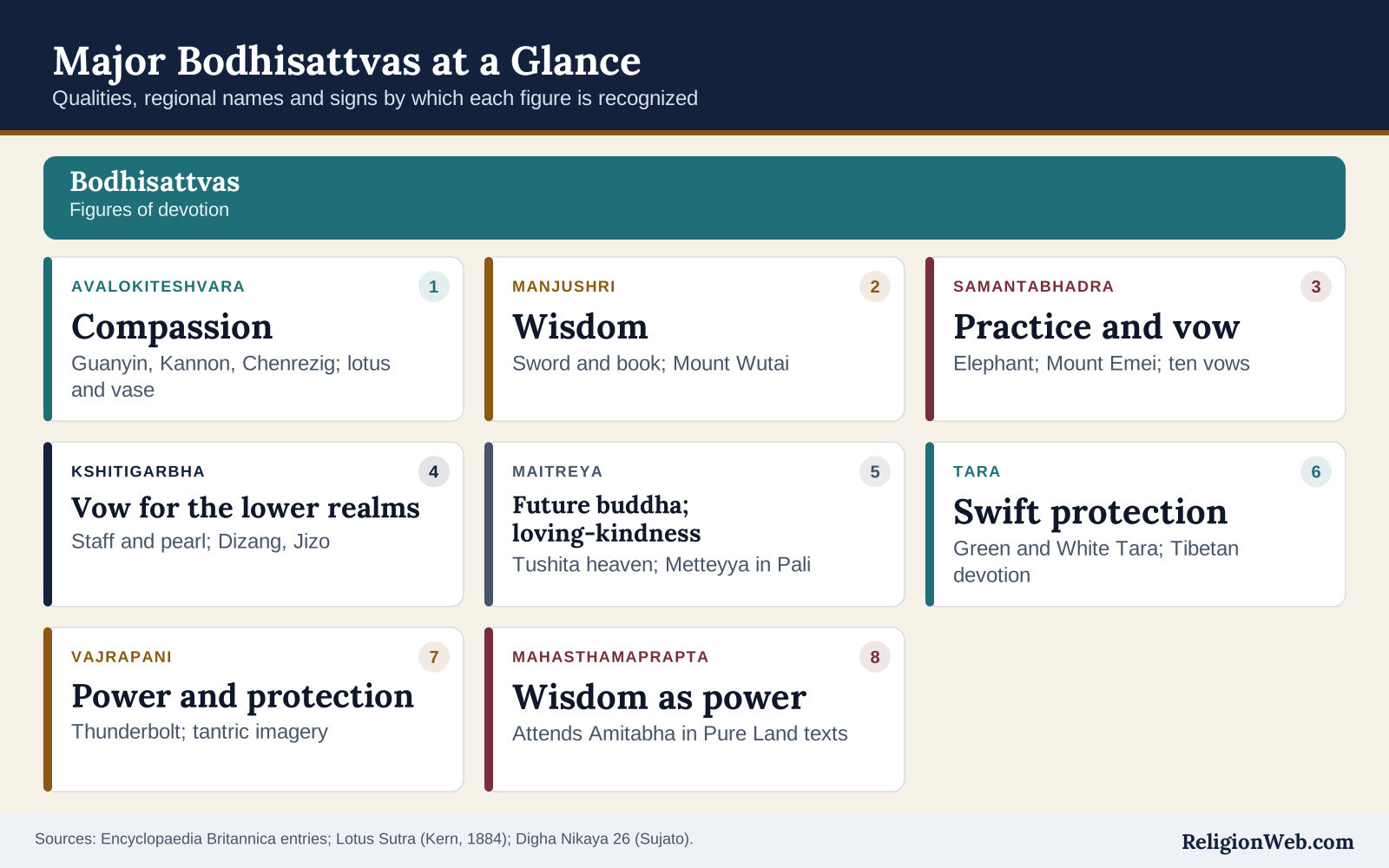
Avalokiteshvara is the bodhisattva of compassion and perhaps the most widely venerated of all. Encyclopaedia Britannica glosses the Sanskrit name as “looking on” (avalokita) plus “lord” (ishvara) and calls the figure “possibly the most popular of all figures in Buddhist legend.” The name appears in the Chinese tradition as Guanyin (also Guanshiyin, “Perceiver of the World’s Sounds”), in Japanese as Kannon, in Korean as Gwaneum, in Vietnamese as Quan Am, and in Tibetan as Chenrezig. Scholars have long discussed the history of the Sanskrit name, since an earlier form, Avalokitasvara, is thought to lie behind the Chinese rendering, and the shift in form is one clue to how the figure developed across the first millennium CE.
The central textual home of the figure is the Lotus Sutra, whose Avalokiteshvara chapter circulates on its own in East Asia as the “Universal Gate” chapter. In H. Kern’s 1884 translation, which numbers it chapter XXIV, the sutra promises protection in a famous sentence:
All the hundred thousands of myriads of kolis of creatures, young man of good family, who in this world are suffering troubles will, if they hear the name of the Bodhisattva Mahâsattva Avalokitesvara, be released from that mass of troubles.
Lotus Sutra (Saddharma-Pundarika), chapter XXIV, trans. H. Kern, Sacred Books of the East vol. 21, 1884
Within the devotional tradition that grew from this chapter, the verse is read as a promise to those who call on the name and as a description of a being whose compassion is always listening. East Asian and Tibetan communities elaborate it in their own ways, and the reading is a matter of faith for those who recite it, not a historical report. The chapter itself lists many forms that the bodhisattva takes to teach beings. Together with the Heart Sutra, in which Avalokiteshvara practices the perfection of wisdom and instructs Shariputra on emptiness, and the Pure Land scriptures, in which the bodhisattva attends Amitabha, it explains why this single figure appears in so many contexts.
Iconography reflects the same breadth. Statues of Avalokiteshvara with eleven heads and many arms are described by Britannica as expressing the awareness of human needs in every direction. In Tibetan Buddhism, Chenrezig is associated with the six-syllable mantra om mani padme hum, and the Dalai Lamas are believed to be manifestations of Avalokiteshvara, as the official site of the Dalai Lama puts it. East Asian temples often feature a mountain home for the bodhisattva, Putuoshan, an island off the coast of Zhejiang, and the figure is an object of pilgrimage across China, Korea and Japan.
Manjushri, the bodhisattva of wisdom
Manjushri personifies wisdom. Britannica gives the Sanskrit name as “gentle, or sweet, glory,” records alternative names such as Manjughosha (“Sweet Voice”) and Vagishvara (“Lord of Speech”), and lists his regional names as Wenshu Shili in China, Monju in Japan and ‘Jam-dpal in Tibet. He is shown with a sword raised in his right hand to “cleave the clouds of ignorance” and a palm-leaf manuscript of the Perfection of Wisdom in his left, and he is often seated on a lion. Britannica notes that sutras honoring him were composed by about 250 CE and that he does not appear in Buddhist art before about 400 CE, which suggests that the textual figure came first and the image later.
In the Mahayana literature Manjushri is a teacher and interlocutor. In the Vimalakirti Sutra he is sent to visit the sick lay bodhisattva Vimalakirti and takes part in a celebrated dialogue on non-duality. He also appears in the Lotus Sutra, where he recalls the previous lives of bodhisattvas, and in the Gandavyuha, where he sends the young pilgrim Sudhana out to learn from teachers. Mount Wutai in Shanxi province is the great Chinese center of his veneration, and Britannica notes that his devotion spread widely in China in the eighth century. Tibetan monastic colleges, especially in the Gelug tradition, chant a short mantra to him before study and debate, and students often invoke him for clarity in learning.
Vow and Practice: Samantabhadra and Kshitigarbha
Samantabhadra, the bodhisattva of vast practice
Samantabhadra, known in Chinese as Puxian and in Japanese as Fugen, is the bodhisattva of practice and vow. Britannica notes that he is often shown in a group of three with Shakyamuni Buddha and Manjushri, riding an elephant that has either three heads or one head and six tusks, and that he is the patron of Mount Emei in Sichuan province. In the Lotus Sutra he appears near the close as a guardian of those who uphold the teaching, but his best-known role comes from the last chapter of the Avatamsaka (Flower Garland) tradition, the Gandavyuha, in which Sudhana meets a long sequence of teachers and finally Samantabhadra himself.
That chapter circulated in East Asia as the “Vows of Samantabhadra.” Its ten great vows are a compact summary of the bodhisattva’s activity: to pay homage to the buddhas, to praise them, to make offerings, to repent of harmful karma, to rejoice in the merit of others, to request that buddhas teach, to ask them to remain in the world, to follow their teaching, to accommodate beings, and to dedicate all merit universally. Chinese and Korean monasteries chant the verses regularly. In the Nyingma school of Tibetan Buddhism a figure with the same name, Kuntuzangpo, is presented as the primordial buddha, a usage that differs from the bodhisattva Samantabhadra of the sutras and that Tibetan scholars explain within their own framework.
Kshitigarbha, the bodhisattva of the hells and of the dead
Kshitigarbha, “Womb of the Earth,” is the bodhisattva of the vow to help those in the lower realms. Britannica says he was known in India by the fourth century CE and became very popular in China as Dicang (often spelled Dizang) and in Japan as Jizo. It describes him as having vowed not to stop until he has saved all the dead condemned to hell. In Chinese tradition he is invoked when someone is dying and in rites for the dead, and in Korea he is Jijang. Several Mahayana sutras are devoted to him, including the Sutra of the Ten Wheels of Kshitigarbha, which is part of the Tibetan canon, is available in an English translation from the 84000 project and is regarded by scholars as of Indian origin, and the Sutra of the Original Vows of Kshitigarbha, which circulates in Chinese and is traditionally attributed to a translator of the Tang dynasty. Many modern scholars regard the second text as composed in China, and that view does not diminish its devotional use.
His iconography is distinctive. He is usually a shaven-headed monk, unlike most bodhisattvas, who wear royal jewelry. He carries a monastic staff with rings, which he uses to open the gates of hell, and a flaming pearl that lights the darkness. In Japan he is often shown in six forms, each tied to one of the six realms of rebirth. Japanese Jizo statues, frequently dressed in small red bibs or caps by families, stand at crossroads and cemeteries, and Jizo is honored in connection with children who have died young and with travelers. The Japanese festival day of Jizo falls on the twenty-fourth day of the seventh month, according to the Encyclopedia of Religion, and the same entry dates the first firm evidence of an enshrined image and offering service to 850. In Japan, Britannica notes, Jizo does not rule hell, a role belonging to Emma-o. Instead the bodhisattva is honored for mercy toward the dead. The vow to enter hell to help beings is a vivid example of the compassion the Mahayana treats as the bodhisattva’s defining quality.
Maitreya, Tara, and Other Figures
Maitreya, the bodhisattva who will become the next buddha
Maitreya is the only bodhisattva honored across nearly every Buddhist tradition, including Theravada. Britannica describes him as the future Buddha who now lives in the Tushita heaven and will come to earth when the Buddha Gautama’s teaching has fully declined; the name derives from Sanskrit maitri, “friendliness,” and Pali Buddhism calls him Metteyya. Britannica adds that he is the earliest bodhisattva around whom devotion developed, mentioned in scriptures from the third century CE, and that his veneration was especially strong between the fourth and seventh centuries.
The early source for the idea is a Pali discourse, the Wheel-Turning Monarch Sutta (Digha Nikaya 26), in which the Buddha describes a distant future when human lifespans have risen to eighty thousand years and a buddha named Metteyya appears:
And the Blessed One named Metteyya will arise in the world—perfected, a fully awakened Buddha, accomplished in knowledge and conduct, holy, knower of the world, supreme guide for those fit for training, teacher of gods and humans, awakened, blessed—just as I have arisen today.
Digha Nikaya 26 (Cakkavatti-Sihanada Sutta), section 25, trans. Bhikkhu Sujato, SuttaCentral
Theravada communities understand this prophecy as a promise that the Dhamma will be taught again, and many lay devotees in Myanmar, Thailand and Sri Lanka make aspirations to be reborn in Metteyya’s time. Mahayana sources add a heaven of residence, Tushita, and a rich iconography. Tibetan tradition holds that Maitreya transmitted a group of teachings to the Indian master Asanga, and the corpus attributed to him is central to Yogacara study; historians attribute those works to Asanga and his circle and treat the story as devotional tradition. In China the later figure of the pot-bellied monk Budai, a monk whom tradition identifies as an incarnation of Maitreya, gave rise to the smiling image familiar in temples and restaurants. Japan’s Miroku statues, such as the 7th-century gilt bronze that Britannica shows from the Asuka period, are among its most prized early sculptures.
Tara, the savior of those in danger
Tara is the principal female figure of Tibetan, Nepalese and Mongolian devotion. Britannica describes her as a Buddhist savior goddess, the female counterpart of Avalokiteshvara, who protects travelers on land and sea and on the spiritual path. A popular story holds that she was born from a tear of Avalokiteshvara, which fell to the ground and formed a lake from which a lotus opened. Tibetan tradition distinguishes Green Tara, shown with a closed blue lotus, from White Tara, shown with a full-blown lotus and a third eye, and Tibetan banners often show a circle of twenty-one Taras. A widely recited liturgical text, the “Homage to the Twenty-One Taras,” is chanted in Tibetan communities.
The question of her status is answered differently in different contexts. Many Tibetan teachers describe Tara as a fully awakened buddha who chose to appear as a bodhisattva, while the texts of other schools treat her as a bodhisattva. The tradition also tells of a princess who vowed to remain in a female body to help beings, a story used to affirm that awakening is not limited by gender. Tara is not a major figure in Theravada devotion, and in East Asian Buddhism her role overlaps with that of Guanyin.
Other well-known bodhisattvas and a summary table
Many more figures fill the Mahayana literature. Vajrapani, “Thunderbolt in Hand,” is a protector who embodies the power of the buddhas and appears in the Lotus Sutra’s list of Avalokiteshvara’s forms. Mahasthamaprapta (“Arrival of Great Strength”) stands with Avalokiteshvara beside Amitabha in Pure Land imagery. Vimalakirti is a lay bodhisattva of the city of Vaishali, a householder who confounds the great monastic disciples and bodhisattvas in debate, and whose Chinese translation by Kumarajiva in the early fifth century became very influential. Sadaparibhuta, “Never Disparaging,” is a bodhisattva in the Lotus Sutra who bows to everyone he meets, saying that they will become buddhas. The summary table gathers these figures with their principal sources and settings.
| Bodhisattva | Name meaning | Chief quality | Principal sources and settings |
|---|---|---|---|
| Avalokiteshvara (Guanyin, Kannon, Chenrezig) | “Lord who looks on [the world]” | Compassion | Lotus Sutra “Universal Gate” chapter; Heart Sutra; Pure Land texts; Karandavyuha |
| Manjushri (Wenshu, Monju) | “Gentle glory” | Wisdom | Perfection of Wisdom, Vimalakirti, Gandavyuha; Mount Wutai |
| Samantabhadra (Puxian, Fugen) | “Universal goodness” | Practice and vow | Avatamsaka and Lotus sutras; Mount Emei |
| Kshitigarbha (Dizang, Jizo, Jijang) | “Womb of the Earth” | Vow to aid beings in lower realms | Ten Wheels sutra; Original Vows sutra; Mount Jiuhua |
| Maitreya (Metteyya, Milefo, Miroku) | “Friendliness” | Loving-kindness; future buddha | Digha Nikaya 26; Maitreya sutras; Tushita heaven |
| Tara | “Savior, star” | Swift protection | Tibetan tantric texts; the Twenty-One Taras |
| Vajrapani | “Thunderbolt in hand” | Power and protection | Tantric and sutra literature; guardian imagery |
| Mahasthamaprapta (Dashizhi) | “Arrival of great strength” | Wisdom as power | Pure Land sutras beside Amitabha |
| Vimalakirti | “Stainless fame” | Lay wisdom and eloquence | Vimalakirti Nirdesha Sutra |
Attributes, Symbols, and Sacred Places of the Bodhisattvas
Reading a Bodhisattva Image
Crowns, jewels, and the bodhisattva’s princely dress
A visitor to a Buddhist temple soon learns to tell buddhas from bodhisattvas by clothing. Buddhas are generally shown in the simple robes of a monastic, with a smooth cranial bump (ushnisha) and no ornament. Bodhisattvas, by contrast, are typically shown in the dress of an Indian prince: a crown or elaborate hair, necklaces, bracelets, earrings and a scarf. Art historians commonly connect this convention with the Buddha’s own life, since the future Buddha was a prince before he left home, and the jewels of a bodhisattva are read as signs that the being is still engaged with the world. Britannica’s description of Manjushri as usually shown in princely ornaments follows this convention.
There are exceptions, and they are instructive. Kshitigarbha is normally shown as a shaven-headed monk, in keeping with his role in the lower realms and his links with monastic communities. Some Chan and Zen paintings of Guanyin show a plain white robe with no jewelry, an image associated with a popular form known as the White-robed Guanyin. These variations show that the iconography answers to local devotional needs, not to a single code, and that the rules a guide might state for one region may not hold in another.
Hand gestures and held objects
The remaining clues are the objects a figure holds and the gestures of the hands. A lotus indicates purity that arises from the mud of the world and is an emblem of Avalokiteshvara and Tara. A vase of pure water and a willow branch are especially associated with Guanyin in China, where the vase holds a nectar of compassion and the branch sprinkles it. A raised sword and a book mark Manjushri, a staff and a pearl mark Kshitigarbha, and an elephant marks Samantabhadra. Hand gestures (mudras) add further meaning: an open palm held out signals giving, a raised hand signals reassurance, and a hand held at the chest with thumb and finger touching often signals teaching. The table collects the commonly encountered attributes.
| Attribute or symbol | Usually associated with | Meaning in the traditions that use it | Notes |
|---|---|---|---|
| Lotus | Avalokiteshvara, Tara, many bodhisattvas | Purity and compassion arising within the world | Closed and open lotuses distinguish the Green and White Tara |
| Vase and willow branch | Guanyin in East Asia | Pure water of compassion and its sprinkling | Frequently seen in Chinese and Japanese painting |
| Eleven heads, many arms and eyes | Avalokiteshvara in several forms | Awareness of and response to suffering in every direction | Britannica’s description of the eleven-headed form |
| Sword and palm-leaf book | Manjushri | Wisdom that cuts ignorance; the Perfection of Wisdom text | Often paired with a lion mount |
| Elephant | Samantabhadra | Strength and steadiness of practice | Three-headed or six-tusked in different images |
| Staff with rings and flaming pearl | Kshitigarbha | Opening the gates of hell; lighting the darkness | Shaven-headed monk form |
| Vajra (thunderbolt scepter) | Vajrapani | Indestructible power and protection | Common in tantric imagery |
| Wish-fulfilling jewel | Kshitigarbha, Avalokiteshvara and others | Fulfillment of beings’ needs | Appears in many regional forms |
| Rosary (mala) | Avalokiteshvara and Tara in several forms | Recitation of a name or mantra | Used in devotional practice as well |
Sacred Mountains and Pilgrimage Places
The four sacred mountains of Chinese Buddhism
Chinese Buddhist tradition assigns four mountains to four great bodhisattvas, and generations of pilgrims have climbed them. Mount Wutai in Shanxi is dedicated to Manjushri, and Britannica notes that his temples cover it. Mount Emei in Sichuan is dedicated to Samantabhadra, the patron deity of that mountain according to the same encyclopedia. Mount Putuo, an island off the coast of Zhejiang, is associated with Guanyin, and Mount Jiuhua in Anhui is associated with Kshitigarbha. Each mountain became a center of monasteries, a destination for pilgrimage, and a place where stories of apparitions circulated. Pilgrims may climb to temples on the summit, make offerings and chant, and some perform repeated prostrations as they ascend.
The number four is itself a teaching device, linking the four bodhisattvas to the four elements and to the qualities of wisdom, practice, compassion and vow. The grouping is a feature of Chinese tradition and does not appear in the Indian sources, a good illustration of how local geography shapes the bodhisattva’s presence. Pilgrimages are devotional journeys that can last days, and travelers today go on foot, by cable car or by tour bus; practice varies by temple and by season.
Potalaka, the Potala, and temples dedicated to one bodhisattva
Avalokiteshvara’s legendary home is a mountain called Potalaka, described in the Gandavyuha as a place where he teaches. The name was adopted for the Potala Palace in Lhasa, the former seat of the Dalai Lamas, in a way that links the political and religious center of Tibet with the bodhisattva said to be reborn in each Dalai Lama. In Japan, Kyoto’s Sanjusangendo is a long hall holding 1,001 statues of the thousand-armed Kannon, and temples such as Kiyomizu-dera are dedicated to the bodhisattva. In Korea, coastal temples such as Naksansa are known for images of Avalokiteshvara gazing over the sea.
These places show how a single bodhisattva can be present as a mountain, a palace, a hall of statues or a seaside shrine. Visitors may offer incense, light candles or lamps, recite the bodhisattva’s name or make a short bow, and they are free to follow only part of the ritual. Local guidance at each temple is the best source for how to behave, and travelers should respect posted rules about photography, shoes and silence.
Regional Names and Forms Across Asia
One Compassion, Many Names: Avalokiteshvara in Asia
Guanyin in China: names, forms and legends
In China the bodhisattva is Guanyin, and the figure’s story there is among the best documented transformations in Buddhist history. The Lotus Sutra chapter circulated as an independent scripture, and by the early medieval centuries Guanyin was invoked in prayer for rescue from danger. Over time Chinese devotion produced a rich array of forms: the White-robed Guanyin, the Water-Moon Guanyin sitting at ease in a relaxed pose in a paradise, the Child-giving Guanyin who is approached by women hoping for a child, and many others. The Metropolitan Museum of Art describes a Liao dynasty Water-Moon sculpture of the eleventh century and a “Bestower of Sons” type in which Guanyin holds a male child.
Legend added further layers. One widely retold story tells of the princess Miaoshan, who refused the marriage her father arranged, entered monastic life against his will, and later offered her own eyes and hands to cure him; the tale was linked with Guanyin and with the Putuo pilgrimage, and scholars such as Chun-fang Yu have traced how it and similar narratives shaped the figure in Chinese religious life. Chinese devotion is not limited to temples. Home altars, small images in shops and on boats, and prayers in times of illness or travel are everyday forms of the same devotion, often mixed with local practices described in the article on Chinese folk religion.
Kannon, Gwaneum, Quan The Am, and Chenrezig
In Japan the bodhisattva is Kannon, and Japanese tradition recognizes several principal forms, often counted as six in the Tendai reckoning: the Sacred Kannon, the Thousand-armed, the Horse-headed, the Eleven-headed, the Cintamani wheel-holding, and the Cundi forms. In Korea the name is Gwaneum, often shown at seaside temples and associated with protection of fishers and travelers. In Vietnam the bodhisattva is Quan The Am, a widely loved figure whose devotion in the Vietnamese tradition includes narratives of a woman wrongly accused who was later honored. In Tibet and Mongolia the name is Chenrezig, and the Dalai Lamas are traditionally regarded as emanations of the same bodhisattva.
Not all of these identifications claim a single historical person. They describe an entity understood in each tradition as a bodhisattva who manifests in many places at once and as many beings. A temple in Hanoi, a hall in Kyoto and a monastery in Dharamsala may all honor “the same” bodhisattva, and visitors will encounter distinct names, prayers and images in each. The differences are not a sign of confusion but of long local development.
Other Bodhisattvas in Different Regions
Jizo, Dizang, and Jijang
Kshitigarbha has a vivid regional identity in each culture. In China, Dizang is associated with the Sutra of the Original Vows and with Mount Jiuhua, where tradition holds that a monk from the Korean kingdom of Silla, known in China as Jin Qiaojue, lived and was revered as an incarnation of the bodhisattva. In Japan, Jizo is often among the most commonly seen figures, a small stone statue wearing a red cloth bib at roadsides and cemeteries. Families offer incense, food and small toys, particularly in memory of children who have died. Summer festivals dedicated to Jizo take place in many Japanese communities. Korean temples have halls dedicated to Jijang as part of rites for the dead, linking the bodhisattva to the memorial services described in Mahayana funeral practice.
Maitreya and Manjushri across the regions
Maitreya is Milefo in China, Mireuk in Korea, Miroku in Japan, Di Lac in Vietnam, Jampa in Tibet and Maidari in Mongolia; Britannica lists the Chinese, Japanese, Tibetan and Mongolian names. In Chinese temples the first image encountered in the entrance hall is often the smiling Budai, understood as Maitreya, while Korean and Japanese temples include early seated Maitreya statues with a pensive pose, one hand raised to the cheek. Manjushri is Wenshu in China, Monju in Japan and Jampelyang in Tibet. A Japanese proverb says that when three people put their heads together they have the wisdom of Monju, linking the bodhisattva to the idea of shared deliberation. The regional names are gathered in the table below.
| Bodhisattva (Sanskrit) | Chinese | Japanese | Korean | Vietnamese | Tibetan |
|---|---|---|---|---|---|
| Avalokiteshvara | Guanyin (Guanshiyin) | Kannon (Kanzeon) | Gwaneum | Quan The Am | Chenrezig |
| Manjushri | Wenshu | Monju | Munsu | Van Thu | Jampelyang (‘Jam-dpal) |
| Samantabhadra | Puxian | Fugen | Bohyeon | Pho Hien | Kunzang (Kuntuzangpo) |
| Kshitigarbha | Dizang | Jizo | Jijang | Dia Tang | Sa’i Nyingpo |
| Maitreya | Mile (Milefo) | Miroku | Mireuk | Di Lac | Jampa |
| Mahasthamaprapta | Dashizhi | Seishi | Daeseji | Dai The Chi | Thu chen thob |
Bodhisattvas in Different Buddhist Traditions
How the Major Traditions Approach the Ideal
In Theravada communities
The Theravada school treats the bodhisatta as a figure of reverence and example, centered on the Buddha’s former lives and on the future Buddha Metteyya. Jataka stories are recited and illustrated, and the Vessantara Jataka in particular is performed in a festival in Thailand and Laos. Historical sources from Sri Lanka and Southeast Asia show that kings were sometimes styled bodhisattas, as a way of presenting themselves as protectors of the Dhamma and rulers whose virtue reflected the long career of the Buddha. Practicing lay Buddhists in these countries usually emphasize the five precepts, giving and meditation rather than a formal bodhisattva vow, but vows to attain buddhahood exist and are respected. See Theravada Buddhism for the school’s own account of its path.
In East Asian Mahayana and in Vajrayana
East Asian Mahayana places the bodhisattva ideal at the center of its formal self-description, and temples dedicate halls to particular bodhisattvas. Practice runs from Chan and Zen sitting, to Pure Land recitation of Amitabha’s name, to the study of Tiantai and Huayan philosophy. Vajrayana, treated in the article on Vajrayana Buddhism, uses the bodhisattva vow as the foundation for tantric practice, in which a practitioner visualizes themselves or a teacher as a deity such as Chenrezig or Tara. The reincarnating teachers known as tulkus belong to this world; the best-known are the Dalai Lamas, regarded in the tradition as emanations of Avalokiteshvara.
People Called Bodhisattvas
Teachers, monks and rulers given the title
The title bodhisattva has often been applied to human beings. Indian masters such as Nagarjuna and Vasubandhu are often called “Bodhisattva” in East Asian sources as an honorific. The Japanese monk Gyoki, who is remembered for organizing bridges, roads and public works in the eighth century, became known in later tradition as Gyoki Bosatsu, “Bodhisattva Gyoki.” The emperor Wu of Liang, who ruled southern China in the early sixth century, is remembered as the “Bodhisattva Emperor,” and in everyday Chinese temple speech laypeople are sometimes addressed as pusa in a gesture of respect. These uses make clear that the word is not reserved for celestial beings.
Why the distinction between celestial and human bodhisattvas matters
Traditions disagree on how to understand the relationship between the two categories. Some teachers treat celestial bodhisattvas as ones who have attained high stages and now act in the world; others stress that anyone who generates bodhicitta is a bodhisattva in the sense that matters for practice. Historians distinguish celestial figures, who are known from texts and images, from named human teachers, who are known from biographies, inscriptions and manuscripts. Careful readers keep both distinctions in mind: a title can be an honorific, an ordination status, a doctrinal description, or a devotional name.
Devotion, Chanting, Visualization, and Liturgy in Bodhisattva Practice
For most practitioners the bodhisattva is encountered less as a doctrine than as a daily activity: a name recited, a mantra counted on a rosary, an image bowed to, a vow repeated at the end of a service. The practices below are described as they are found in several traditions, with attention to who performs them, what texts or objects are involved and why the tradition holds them meaningful. No single form is universal. A Zen temple in Japan, a Pure Land hall in Taiwan and a Tibetan monastery in India may each use different words and gestures to express related aspirations.
Chanting and Recitation
Reciting names: Namo Guanshiyin Pusa and related invocations
The simplest and most widespread practice is the recitation of a bodhisattva’s name. In Chinese-speaking communities, devotees repeat Namo Guanshiyin Pusa, “homage to the Bodhisattva Guanyin,” either silently, aloud, or as part of a group chant, often with a rosary of 108 beads. The practice rests on the Lotus Sutra’s promise that those who call on the name will be released from troubles, and it is often performed in times of illness, fear or loss. In Pure Land practice the corresponding recitation names Amitabha, and the two are frequently combined, since Avalokiteshvara and Mahasthamaprapta are Amitabha’s attendants in the Pure Land texts. Japanese devotees may recite Namu Kanzeon Bosatsu, and Zen communities chant a short text known as the Ten-Phrase Kannon Sutra.
The aim of such recitation, according to the traditions that practice it, is twofold. On the devotional side it expresses trust and brings the reciter into relationship with a compassionate presence. On the contemplative side it concentrates the mind and, in some teachers’ accounts, deepens into a realization of the nature of the one invoked. Teachers vary in how they weight the two, and in how literally they understand the bodhisattva as an agent who answers prayers. Prayers for recovery or protection are understood as spiritual supports that sit alongside, and do not replace, medical care.
Mantras and dharanis: Om mani padme hum and the Great Compassion Dharani
In Tibetan Buddhism the central mantra of Chenrezig is the six-syllable om mani padme hum. It is carved on stones, printed on prayer flags and enclosed in prayer wheels, which are turned by hand or by water, wind or electric motor in the belief that each rotation is equivalent to a recitation. A Sanskrit Mahayana text, the Karandavyuha Sutra, which scholars place in the first millennium CE, is the early source in which the mantra is celebrated. Interpretations of its syllables vary by lineage and teacher, and the mantra is generally learned with a teacher’s explanation, since devotees receive transmission of the practice through a lineage.
In China and elsewhere in East Asia, the longer Great Compassion Dharani (Dabei Zhou), attributed to the thousand-armed form of Guanyin, is recited in the morning liturgy of many monasteries. A related rite, the Great Compassion Repentance, which is associated with the Tiantai tradition, combines recitation with repentance and offerings. Dharanis are long mantras believed in the Mahayana to protect and benefit, and even laypeople who do not understand the Sanskrit-derived syllables will often learn them by ear. Tradition values the recitation in itself, and many monasteries chant at a steady, measured pace that is itself a form of meditation.
Visualization and Meditation
Visualizing Chenrezig and Tara
In Vajrayana, treated more fully in the article on Vajrayana Buddhism, visualization is a central method. In a Chenrezig practice, the practitioner takes refuge, generates bodhicitta, and then visualizes Chenrezig above the head or in front, white and radiant, with four arms. Light radiates from the figure to purify the practitioner and all beings, mantras are recited, and at the end the visualization dissolves into emptiness, a gesture that reminds the practitioner not to cling to the image. Practices to Tara follow a similar pattern, with her own mantra, om tare tuttare ture soha, and the recitation of the Twenty-One Praises.
Many tantric practices require an empowerment or a teacher’s oral transmission before a student undertakes them, and teachers regularly emphasize that these are not casual exercises. A well-known retreat form, Nyungne, associated with the thousand-armed Chenrezig, combines recitation and prostrations with a two-day fast and a vow of silence on alternate days. Practitioners with medical conditions are customarily advised to consult their teacher and a physician before taking part in extended fasting.
Compassion meditations: tonglen and the four immeasurables
Not all bodhisattva meditation involves a deity. Many traditions teach the four immeasurables, loving-kindness, compassion, sympathetic joy and equanimity, as a graduated meditation in which each quality is extended from oneself and loved ones to all beings. The Tibetan practice of tonglen, “giving and taking,” is part of a collection of mind-training slogans compiled by Tibetan teachers in the eleventh and twelfth centuries. On the in-breath the practitioner imagines taking in the suffering of others, and on the out-breath giving away happiness and well-being. Teachers stress that the practice is an exercise in changing attitude and not an exchange of illness, and it is often introduced gradually.
These meditations build on the techniques of calm abiding and insight described in the article on Buddhist meditation, and they sit within the wider framework of the Noble Eightfold Path, which includes right intention and right effort. In Zen, the bodhisattva ideal shows up in the four great vows recited at the end of sitting, in the instruction to sit for the sake of all beings, and in the rite of precept-taking.
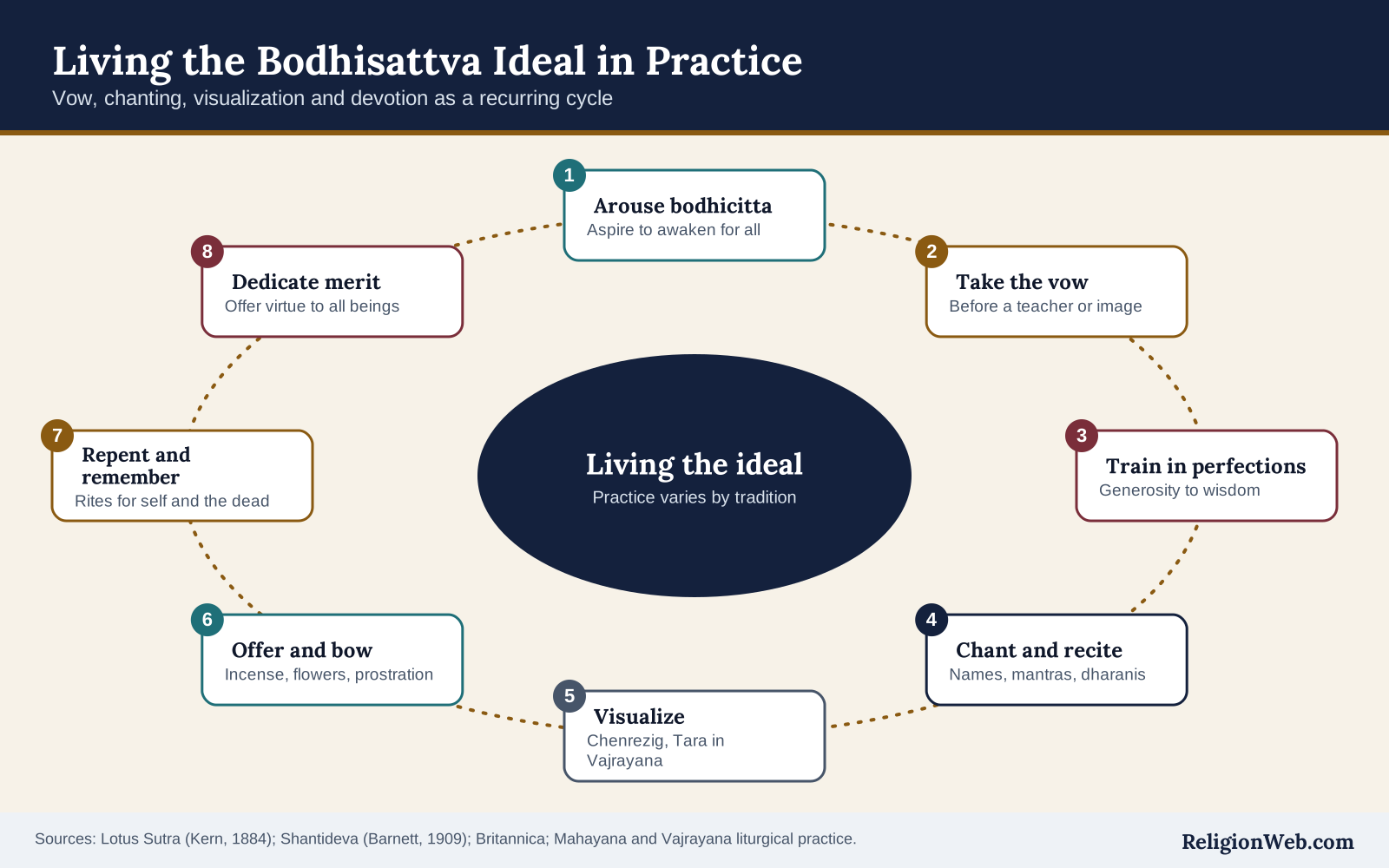
Devotional and Liturgical Practice
Altars, offerings, prostrations, and temple visits
Bodhisattva devotion in everyday life usually begins with a simple altar or a visit to a hall dedicated to a figure. Visitors may light incense, offer flowers, fruit or water, bow with palms joined, and make prostrations, in which the body is lowered to the floor. In Chinese temples, a Guanyin hall is often among the most visited, with devotees asking for health, safe travel or a child. In Japan, Jizo statues are dressed in bibs and offered flowers and small toys by families, and a pilgrimage circuit of thirty-three Kannon temples in western Japan has drawn travelers for centuries.
The offerings themselves have a meaning. Water, flowers, incense, light, perfume, food and music are gifts to a being of high virtue and an exercise in generosity by the giver. Many temples post instructions on how and where to light incense or leave an offering, and visitors are free to participate partly or simply to observe. The motive that tradition stresses is not the amount offered but the intention behind it.
Repentance, merit transfer and memorial services
Liturgies often combine repentance with dedication. Chinese Buddhist repentance ceremonies recite texts such as the Emperor Liang’s Repentance and the Great Compassion Repentance, in which participants confess harmful actions, take refuge and dedicate merit to beings. Memorial services for the dead often invoke Kshitigarbha, and the Ghost Festival or Ullambana, observed in many Mahayana communities in the seventh lunar month, includes offerings, sutra recitation and merit-making for ancestors and for suffering beings. Korean and Japanese temples hold similar rites. For the ancestral dimension of such rituals in China, see Chinese ancestor veneration.
These rites should be understood within the Buddhist teaching of karma. The merit dedicated is understood as arising from the participants’ own virtuous action, and the rite expresses compassion toward the departed, not a mechanical transfer. The article on karma and rebirth in Buddhism describes the underlying doctrine, and its range of interpretations, in more detail.
Observances in the lunar year
Many Mahayana communities mark the days associated with particular bodhisattvas on the lunisolar calendar. In Chinese practice, months begin with the new moon and the calendar inserts a leap month in some years, so the same lunar date falls on a different Gregorian date each year. Temples publish their own calendars, and local custom varies, so the table lists only the dates most commonly named in Chinese tradition. No specific 2026 or 2027 date is given here, because none was verified against a named calendar source. For the Buddha’s own commemoration, see the article on Vesak.
| Bodhisattva | Commonly observed lunar date | What it commemorates | Typical activities |
|---|---|---|---|
| Guanyin | 19th day of the 2nd, 6th and 9th lunar months | Traditionally her birth, attainment and renunciation | Temple visits, name recitation, vegetarian meals |
| Manjushri | 4th day of the 4th lunar month | Birthday in Chinese tradition | Sutra recitation at Wutai and other temples |
| Samantabhadra | 21st day of the 2nd lunar month | Birthday in Chinese tradition | Chanting the Vows of Samantabhadra |
| Kshitigarbha | 30th day of the 7th lunar month | Birthday in Chinese tradition; month of the Ghost Festival | Pilgrimage to Jiuhua; memorial services |
| Maitreya | 1st day of the 1st lunar month | Birthday in Chinese tradition | Temple visits at the lunar new year |
The Bodhisattva Ideal Today: Global Presence and Contemporary Practice
Where Bodhisattva Devotion Is Found Today
Temples and communities across Asia and the diaspora
Devotion to bodhisattvas is most visible in East Asia and the Himalayan region, where Guanyin, Kannon, Gwaneum, Quan The Am, Jizo, Manjushri and others occupy temple halls, roadside shrines and home altars. It is also present in the Buddhist communities of Southeast Asia, where Mahayana temples serve Chinese and Vietnamese populations, and in the diaspora communities of North America, Europe and Australia. Survey data count Buddhists by self-identification and do not record whether a person practices bodhisattva devotion, so there is no reliable figure for how many people venerate these figures. Statements about numbers in this area should be treated with caution.
The bodhisattva ideal also travels through institutions. Chinese-speaking and Vietnamese-speaking temples abroad commonly keep a Guanyin altar, Zen centers recite the four great vows, and Tibetan centers offer teachings on bodhicitta and public ceremonies for taking the bodhisattva vow. Practice differs from place to place, and a newcomer is best served by asking a temple or center about its own customs.
Engaged Buddhism and everyday compassion
In the twentieth and twenty-first centuries many Buddhist teachers have described social action as an expression of the bodhisattva ideal. The Vietnamese Zen teacher Thich Nhat Hanh, who died in 2022, founded the Order of Interbeing in the 1960s and taught practices of mindfulness and service, often framed in terms of the bodhisattva’s compassion. Taiwanese organizations such as Tzu Chi and Fo Guang Shan, and many temples across Asia, run hospitals, schools and disaster-relief programs, and describe their work as bodhisattva practice. Teachers in Tibetan communities, including the Dalai Lama, speak of compassion and the altruistic aspiration as universal values that can be cultivated by anyone.
Scholars of contemporary Buddhism note that the language of the bodhisattva is also borrowed outside religious settings, in secular mindfulness programs, in the arts and in popular culture. These uses can be thoughtful or loose, and they sometimes drop the specifically Buddhist vocabulary of vows, rebirth and awakening. A reader looking for the traditional meaning should look to the teachings of the Buddhist communities themselves.
Cautions and Practical Guidance for Readers
Learning from teachers and lineages
Many bodhisattva practices are taught within lineages, and the commitments they involve are meant to be taken seriously. A vow ceremony is not a casual event, and teachers commonly encourage newcomers to attend teachings, ask questions and take time before making a formal commitment. Visitors to temples are welcome in most traditions to observe, to bow, and to light incense without taking any vows. The guidance of a local teacher or community is the best source for the details of etiquette and practice.
Health, grief and the limits of devotion
People turn to Guanyin, Jizo and other bodhisattvas in illness, danger and grief, and the traditions treat such prayer as meaningful. The sources do not present chanting, vows or offerings as substitutes for medical or mental-health care, and readers who are unwell, in crisis or bereaved should seek qualified professional help alongside any religious practice. Fasting retreats and extended prostration practices carry physical demands, and community teachers usually advise participants to consider their health before taking part.
Common Misconceptions About Bodhisattvas
Misconception 1: A bodhisattva is simply a Buddhist saint
Where the misunderstanding comes from
English-language writing often reaches for the word “saint” when introducing the figure, because both terms describe admired beings who help others. A statue of Guanyin in a museum, labeled as a compassionate holy figure, can reinforce the impression that bodhisattvas are the Buddhist equivalent of a category of revered individuals. Popular usage also applies the word loosely to any selfless person, which adds to the confusion.
The impression is understandable, and it captures part of what devotees feel when they bow before an image. But the equivalence breaks down when the term is examined within Buddhist sources.
Museum labels and travel guides add to this, since they have little room to explain vows, stages or rebirth and so compress the figure into a short phrase about mercy. A short label is useful as an invitation to look more closely, but it cannot carry the full meaning that the term has in the texts and the communities that use it.
What the evidence and tradition actually show
In Buddhist literature a bodhisattva is defined not by holiness or by recognition after death but by direction and commitment: a being who has aroused bodhicitta and taken up the path to full buddhahood. Most Buddhist traditions have no formal process of canonization comparable to a church procedure, and the title can describe an aspirant at the start of the path as well as an advanced being who has reached a high stage. In the Pali tradition the person closest to the idea of a perfected holy person is the arahant, and the Pali discourses distinguish that figure from the bodhisatta.
The celestial bodhisattvas such as Avalokiteshvara and Kshitigarbha are understood in Mahayana devotion as beings who are active now and who respond to those who call on them. That makes them objects of prayer and visualization, not only models of virtue. The term “saint” can therefore serve as a rough pointer for a new reader, but the more accurate picture is of an aspirant to buddhahood, a role that may be filled by an ordinary practitioner, a celestial being or a human teacher honored with the title.
It also helps to notice what the Buddhist sources emphasize about conduct. The Diamond Sutra passage quoted earlier asks the bodhisattva to resolve to lead all beings to nirvana without clinging to the idea of a rescuer or a rescued being, a demand that goes beyond admiration of virtue. Such a requirement is a mark of a path undertaken for a purpose, and it differs from the memory of an exemplary life.
Misconception 2: All bodhisattvas are historical human beings
Where the misunderstanding comes from
The earliest use of the word describes the historical Buddha before his awakening, and that association can lead readers to imagine every bodhisattva as someone who once lived. Biographies of Indian and Chinese teachers who carry the title, and legends that place Avalokiteshvara or Manjushri on actual mountains, add to the impression that the figures were once people.
The reverse assumption can also mislead. Because celestial bodhisattvas appear in sutras and in art, a reader may suppose that the title belongs only to otherworldly beings, when in fact it is also given to teachers and to ordinary aspirants. The confusion is natural, since the same word covers a biography, a status and a devotional presence.
What the evidence and tradition actually show
The figures fall into several categories. Siddhartha Gautama is the one historical person whom all schools identify as a bodhisattva before his awakening. Teachers such as Nagarjuna, Vasubandhu and the monk Gyoki are historical human beings who are called bodhisattvas in later tradition. By contrast, the great celestial bodhisattvas, Avalokiteshvara, Manjushri, Samantabhadra and others, are known from sutras and images, and historians cannot identify them with specific individuals. Maitreya is in a further category, a bodhisattva whose arrival as a buddha lies in the future according to the discourse in Digha Nikaya 26.
Tradition itself does not insist on a single answer. Some Mahayana teachers understand celestial bodhisattvas as awakened beings who appear through skillful means, and for them the question of a historical biography is beside the point. Historians study how the figures emerged in texts and art, noting, for example, that Britannica dates sutras honoring Manjushri to at least about 250 CE and his appearance in art to about 400 CE. Both approaches can be held together by a reader who keeps the vocabulary of belief and the vocabulary of history separate.
The Tibetan tradition adds a further case in the reincarnating teachers known as tulkus. The official site of the Dalai Lama states that the Dalai Lamas are believed to be manifestations of Avalokiteshvara or Chenrezig, and the present Dalai Lama, Tenzin Gyatso, was born on 6 July 1935. In this understanding a celestial bodhisattva acts through a named human life, a view that belongs to Tibetan belief and that scholars describe as a distinctive feature of that tradition.
Misconception 3: Every Buddhist school places the bodhisattva ideal at the center in the same way
Where the misunderstanding comes from
Introductory books sometimes present the bodhisattva ideal as the line that divides one branch of Buddhism from another, with the arahant on one side and the bodhisattva on the other. The picture is easy to remember, and it appears in some old polemical passages and in older Western scholarship. It leaves the impression of two uniform camps.
A related assumption is that bodhisattvas are found only in Mahayana temples and never elsewhere. Visitors to Southeast Asian temples who see Jataka paintings or images of the future Buddha may not realize that they are looking at the same word in another setting. The simple contrast is a convenient starting point but a poor guide to actual practice.
What the evidence and tradition actually show
The picture is considerably more varied. In Theravada tradition the bodhisatta is honored as the Buddha’s earlier self and as a path for those who choose it, while the arahant path remains the common aim; Metteyya is honored as the next buddha. In Mahayana communities the ideal is central in doctrine, but the weight differs: Zen emphasizes the vows and sitting practice, Pure Land communities emphasize reliance on Amitabha and the vows he made, Nichiren communities focus on the Lotus Sutra, and Tibetan schools build tantric practice upon the bodhisattva vow. For the school-level detail, see Mahayana Buddhism and Theravada Buddhism.
The differences reflect history, language and local culture as much as doctrine. Individual practitioners in any tradition may hold the ideal as a personal aspiration, a devotional reality or a background assumption, and the same person may do all three at different times. A careful description therefore names the tradition and the community, and avoids statements about what “Buddhists” believe in general.
Even within a single school, emphases shift over time. East Asian Buddhist reformers in the twentieth century stressed the bodhisattva’s social engagement, while monastic communities in the same countries continued to stress the ordination lineage and the precepts. Such developments are part of a long conversation and not a settled division.
Misconception 4: A bodhisattva refuses or postpones nirvana forever
Where the misunderstanding comes from
Many popular summaries say that a bodhisattva “postpones nirvana” or “refuses to enter nirvana until all beings are saved.” The image is dramatic and easy to remember, and it echoes the vow of Kshitigarbha not to rest until the hells are empty. Read literally, it can suggest that bodhisattvas are trapped in the cycle of rebirth by their own choice.
The phrase also gains force from the way sermons and popular books retell the vow, since a dramatic sentence is easier to remember than a philosophical qualification. Translations from East Asian languages sometimes reinforce the wording, so a reader may meet the image in many places without ever meeting its qualification.
What the evidence and tradition actually show
The Mahayana philosophical traditions teach something subtler. A fully awakened being is not bound by ignorance, so there is no sense in which such a being is stuck in samsara; and compassion keeps the being active, so there is no sense in which such a being has withdrawn into private peace. The doctrine of non-abiding nirvana expresses this: awakening is not an escape, and compassionate activity is not a delay. The language of vows to remain until all are saved is understood by many teachers as an expression of endless commitment, not as a literal refusal. The article on nirvana in Buddhism sets out how different schools describe liberation, and readers will find that the answer depends on the tradition.
The vow of Kshitigarbha is a good test case. Britannica reports that he has vowed not to stop until he has saved all the dead condemned to hell, and devotional literature treats this as a sign of boundless compassion. Mahayana philosophy reads such vows through emptiness: since no fixed self suffers or is saved, the vow can be inexhaustible without being a trap.
Frequently Asked Questions About Bodhisattvas
Questions About Meaning and the Path
What does bodhisattva mean in simple terms?
It means a being who is aiming at full awakening, a future buddha. In the oldest texts the word refers to the Buddha before he awakened. In Mahayana usage it refers to anyone who aspires to buddhahood for the sake of all beings, and to great celestial figures such as Avalokiteshvara who are said to act with limitless compassion.
Is a bodhisattva the same as a buddha?
No. A buddha has completed the path and awakened fully; a bodhisattva is on the way. Some advanced bodhisattvas are described as equal to buddhas in wisdom, and Tara is regarded by many Tibetan teachers as a fully awakened buddha who appears as a bodhisattva, but the two terms are normally distinct.
Can an ordinary person be a bodhisattva?
In Mahayana teaching, yes. Anyone who arouses bodhicitta and commits to the path is called a bodhisattva, whether a monastic or a layperson. Many teachers also say that the ordinary aspirant is at the beginning of a long journey and is not equal to the great celestial figures. Theravada tradition treats the bodhisatta path as a rare calling, though it does not deny it.
Questions About the Major Figures
Are Avalokiteshvara and Guanyin the same bodhisattva?
Buddhist traditions identify them as the same compassionate bodhisattva known by different names in different languages: Guanyin in Chinese, Kannon in Japanese, Chenrezig in Tibetan. Historians note that Guanyin developed distinctive forms and legends in China, so the figure as devotees encounter it carries a local history in addition to the Indian one.
Why is Guanyin often shown as female?
The Metropolitan Museum of Art explains that Avalokiteshvara was originally depicted as male or gender-neutral and that Guanyin became increasingly female in imperial China. Chinese devotion associated the figure with maternal compassion and with helping women who hoped for children, and artists developed new forms such as the White-robed and Child-giving Guanyin. Buddhist teachers commonly add that a bodhisattva has no fixed body and appears in whatever form meets the need.
When will Maitreya appear?
According to the Pali discourse Digha Nikaya 26, Maitreya (Metteyya) will arise in the distant future, when human lifespans have grown to eighty thousand years. Britannica adds that tradition places his coming after the Buddha Gautama’s teaching has fully declined. Buddhist traditions do not give a calendar date, and teachers generally treat the prophecy as a promise of renewal, not a prediction to be calculated. Some historical movements have used Maitreya imagery, but the mainstream understanding is devotional and long-range.
Questions About Practice
How does someone take the bodhisattva vow?
The form depends on the tradition. In Tibetan Buddhism a teacher gives the vow in a ceremony that includes refuge, bodhicitta and a set of commitments. In Chinese Buddhism bodhisattva precepts are conferred at ordination or in lay ceremonies, and in Soto Zen the lay precept ceremony is called jukai. Many practitioners also generate the aspiration privately in daily prayer. Anyone interested should ask a teacher or local temple about their customs and expectations.
What does om mani padme hum mean?
The six syllables are the mantra of Avalokiteshvara, and the words are often rendered as “jewel in the lotus,” though traditional interpretations differ and many teachers say that the mantra cannot be fully captured in translation. Tibetan teachers associate its syllables with the six perfections or six realms of rebirth, and devotees recite it for compassion and protection. It is carved on stones and written on prayer flags and wheels throughout the Himalayan region.
Do Buddhists pray to bodhisattvas?
Many do. Mahayana and Vajrayana practitioners address prayers to Guanyin, Tara and others, recite their names and ask for help, and the traditions explain this through the idea that bodhisattvas are compassionate beings who respond. Other Buddhists, including many in Theravada communities, are more likely to honor the Buddha and make aspirations without addressing bodhisattvas directly. The practice is not uniform, and no single answer applies to all Buddhists.
Conclusion: The Bodhisattva Ideal in Historical Perspective
What the History Shows
From one aspirant to a vast company
The word bodhisattva began as a name for Siddhartha Gautama before his awakening and grew into a description of a path open to every practitioner, then into a roster of great figures who are venerated across Asia. The movement can be traced through the Pali discourses and Jataka stories, the early Mahayana sutras, the philosophical systems of Madhyamaka and Yogacara, and the devotional and ritual life of Chinese, Japanese, Korean, Vietnamese and Tibetan communities. Each stage preserved something of the earlier meaning, which is why the word can still refer to a biography, a vow and a living presence at once.
Compassion and wisdom held together
The most consistent theme across the traditions is the pairing of compassion and wisdom. The bodhisattva is described as someone who acts for others with full commitment and who sees that no fixed self is being helped or helping. Interpretations of that claim differ by school, and so do ritual and devotional forms. Reading the traditions on their own terms shows a family of related understandings, not a single doctrine.
How to Keep Exploring
Texts and teachers
Readers who want to go further can begin with the sutras themselves in reliable translations, including the Lotus, Diamond, Heart and Vimalakirti sutras and the Gandavyuha, together with Shantideva’s Bodhicaryavatara. The 84000 project provides English translations of many texts from the Tibetan canon. University presses, museum catalogues and the teachings of established temples and centers offer further context, and a local teacher can explain practices that cannot be learned from books.
Related topics on this site
Several other articles place the bodhisattva ideal in context. The overview of Buddhism gives the larger picture, while the pages on the Buddha, Four Noble Truths and monastic life describe the foundation on which the bodhisattva path builds.
Sources
The table below lists the principal external sources behind this article. Facts, dates and figures were checked against these and related primary, institutional and academic materials.
| # | Source | Publisher and type | Used for | Link |
|---|---|---|---|---|
| 1 | Long Discourses 26 (Digha Nikaya 26, Wheel-Turning Monarch) and Middle Discourses 26 (Noble Search), trans. Bhikkhu Sujato | SuttaCentral · Primary text | Quoted passages on the bodhisatta before awakening (MN 26) and the future Buddha Metteyya (DN 26) | suttacentral.net |
| 2 | The Saddharma-pundarika, or the Lotus of the True Law, trans. H. Kern (Sacred Books of the East vol. 21, 1884), chapter XXIV | Internet Sacred Text Archive · Primary text | Quoted Avalokitesvara passage; forms taken by the bodhisattva; women who adore him | sacred-texts.com |
| 3 | The Vagrakkhedika (Diamond Sutra), trans. F. Max Muller, in Buddhist Mahayana Texts (Sacred Books of the East vol. 49, 1894) | Internet Sacred Text Archive · Primary text | Quoted Diamond Sutra passage (section III) on delivering beings and non-attachment | sacred-texts.com |
| 4 | The Path of Light (Bodhicharyavatara of Santideva), trans. L. D. Barnett, 1909, chapter III | Internet Sacred Text Archive · Primary text | Quoted bodhisattva resolve of Shantideva (chapter III) | sacred-texts.com |
| 5 | Bodhisattva (encyclopedia entry) | Encyclopaedia Britannica · Encyclopedia | Definition of bodhisattva; Pali bodhisatta; descriptions of Avalokiteshvara images | britannica.com |
| 6 | Avalokiteshvara (encyclopedia entry) | Encyclopaedia Britannica · Encyclopedia | Meaning of the name; regional names; popularity of the bodhisattva | britannica.com |
| 7 | Manjushri (encyclopedia entry) | Encyclopaedia Britannica · Encyclopedia | Manjushri's name, iconography, Mount Wutai and early dating of sutras and art | britannica.com |
| 8 | Maitreya (encyclopedia entry) | Encyclopaedia Britannica · Encyclopedia | Maitreya as future buddha in Tushita; names; early devotion and dating | britannica.com |
| 9 | Kshitigarbha (encyclopedia entry) | Encyclopaedia Britannica · Encyclopedia | Kshitigarbha's vow, iconography and roles in China and Japan | britannica.com |
| 10 | Compassion, Mercy, and Love: Guanyin and the Virgin Mary | The Metropolitan Museum of Art · Institutional | Avalokiteshvara as male or gender-neutral with thirty-three manifestations; female Guanyin in imperial China | metmuseum.org |
Last fact-check date: 2026-10-21.