Chinese folk religion is the name scholars and many speakers give to the everyday religious life of Han Chinese communities: honoring ancestors at household altars and graves, seeking the help of local and regional gods in temples, consulting diviners and spirit mediums, and marking the lunar year with offerings and festivals. It has no founder, no single scripture, no creed, and no central authority. Instead it consists of overlapping practices carried by families, villages, neighborhoods, trade associations, and temple committees, each of which keeps its own gods, its own calendar of celebrations, and its own memory of what works.
The roots of these practices reach back more than three thousand years, to the royal ancestor rituals and divination of the Shang dynasty and the worship of Heaven under the Zhou. The forms most visitors see today, with their incense-filled temples, processions, opera stages, and paper offerings, took shape mainly during the imperial centuries between the Song dynasty (960 to 1279 CE) and the end of the Qing dynasty in 1912. Today the practices are found in mainland China, Taiwan, Hong Kong, Southeast Asia, and Chinese communities around the world, and they change from one valley, harbor, or Chinatown to the next.
The distinction between folk practice and organized religion matters because it affects almost everything said about the subject. A person who burns incense to a sea goddess on the way to work may also visit a Buddhist monastery, hire a Daoist priest for a funeral, and tell a survey interviewer that he has no religion at all. In China itself the common words for this world of practice are not “religion” in the formal sense. People speak of folk belief (minjian xinyang), of custom (xisu), or simply of “worshiping” (bai bai), and the Pew Research Center has noted that Chinese people are more religious in what they do than in how they identify.
This article describes Chinese folk religion on its own terms. It begins with definitions and the main vocabulary, then turns to the worldview behind the practices, the spirits who populate it, the temples and organizations that sustain it, its history from the Shang dynasty to the present, its rituals and festivals, and its regional and overseas forms. It closes with the scholarly debates over what the subject is, a set of common misconceptions, and answers to frequently asked questions. Wherever practice differs by region or period, the differences are named rather than smoothed over.
Chinese Folk Religion at a Glance
What the Term Covers and What It Leaves Out
A working definition
In its widest sense, Chinese folk religion (also called Chinese popular religion) is the set of family and community practices through which Han Chinese people honor ancestors, make offerings to a large number of gods, and manage relations with ghosts and other unseen beings. These practices share a family of assumptions rather than a statement of faith. The world is animated by qi (breath or vital energy); the dead remain connected to the living; gods are powerful beings who respond to sincere requests and proper offerings; and misfortune and good fortune are partly shaped by moral conduct, ritual care, and the timing and placement of one’s actions.
The sociologist C. K. Yang, in Religion in Chinese Society (University of California Press, 1961), described this situation with a distinction that remains influential. He contrasted “institutional” religion, with its own clergy, buildings, and teachings, as in the case of Buddhism and Daoism, with “diffused” religion, in which beliefs and rites are woven into the secular institutions of family, community, and state. Ancestral rites, the worship of local gods, and moral cosmology belonged to the diffused type. In this view, a village temple or a lineage hall is as much social infrastructure as it is a place of prayer, coordinating kin, settling disputes, and teaching ethical norms.
No one is converted into this religion, and no one formally leaves it. A child grows into it by being taken to the family altar, handed incense at the temple, and sent to carry the New Year offerings. Belonging is usually a matter of residence, descent, and trade rather than of personal declaration, which is one reason survey questions about “religious affiliation” capture so little of it.
Names used in China and in scholarship
No single name is accepted everywhere. In the People’s Republic of China the most common neutral term is minjian xinyang (民間信仰), usually translated “folk belief” or “popular belief.” The similar-sounding minjian zongjiao (民間宗教), literally “folk religion,” often refers in Chinese scholarship to something narrower: lay salvationist movements with their own scriptures and congregations. English-language scholars therefore tend to avoid translating it literally and prefer “Chinese popular religion” or “Chinese local religion” for the temple-and-ancestor complex described here. Some writers dislike the word “folk” because it suggests something rural and unlettered, whereas officials, merchants, and scholars have taken part in temple worship throughout Chinese history.
Other proposals include “Chinese religion,” used when the aim is to treat the whole field of ritual life as one tradition, and “Shenism” or “the way of the gods” (shendao), which draws on an old Chinese expression and puts the gods (shen) at the center. In Taiwan, survey researchers speak of “traditional folk religion,” and in Southeast Asia many devotees describe their practice in Hokkien or Cantonese as “worshiping the gods” or “worshiping Buddha,” without a more specific label. Practitioners rarely need a name for what they do, which is itself a finding: the practices are experienced as ordinary life, not as one choice among religions.
Main Characteristics
Practice before doctrine
Chinese folk religion places the weight on doing things properly and at the right time. The anthropologist James L. Watson has described imperial-era Chinese culture as united more by shared ritual forms than by shared beliefs, a pattern often summarized with the term orthopraxy (correct practice) as opposed to orthodoxy (correct belief). A family can disagree about what the dead experience and still agree entirely about when to sweep the grave, what to place on the altar, and who stands in front. The table below sets out the main characteristics together, and later sections take each in turn.
| Feature | How it typically appears | Example |
|---|---|---|
| Organization | Overlapping local units rather than a church: households, lineages, villages, temple committees, trade associations | A village temple managed by a committee of local households |
| Authority | Local custom, the experience of a god’s efficacy, and hired ritual specialists; no central doctrinal body | A temple’s reputation for answering prayers |
| Membership | By birth, residence, descent, or trade; no conversion ceremony | Annual contributions from every household in a ritual district |
| Spiritual beings | Ancestors, many gods, ghosts, and other spirits, each with a different relationship to the living | Household ancestors, a local earth god, a protector of seafarers |
| Core acts | Offering incense, food, and paper goods; bowing; vows; divination; processions | Burning incense at a temple before a journey |
| Specialists | Spirit mediums, Daoist priests, ritual masters, geomancers, diviners, temple managers | A medium who speaks for a god in trance |
| Calendar | Lunisolar year of family, seasonal, and deity-birthday observances | New Year, Qingming, the seventh-month ghost observances |
| Texts | Mostly oral and performed; moral tracts, almanacs, ritual manuals, and popular scrolls used selectively | Fortune-stick poems collected at a temple |
| Variation | Gods, rites, and festival forms differ by region, dialect group, and community | Lineage halls in the southeast, village-temple fairs in the north |
Overlap with the three teachings
Folk practice does not stand apart from China’s textual traditions. Many gods in village temples, such as the bodhisattva Guanyin or the Jade Emperor, have homes in Buddhist or Daoist literature as well as in local worship. Ritual specialists trained in Daoist traditions are hired to conduct community offering festivals, and Buddhist monks or nuns are often invited to chant at funerals. Ideas of filial duty and the ritual care of ancestors are also central to Confucian teaching, and Confucian-trained scholars wrote some of the best-known manuals of household ritual.
The picture becomes more complicated when one asks where one tradition ends and another begins. A temple may display statues of a deified general, a Buddhist bodhisattva, and a Daoist celestial official side by side, and its worshipers may see no problem in addressing all of them in a single visit. Scholars therefore describe the relationship as one of constant exchange: local religion borrows scriptures, priests, and gods from the organized traditions, and the organized traditions adapt to local expectations. That is why this article treats folk religion as a field of practice with its own logic, even though it shares many of its figures with the traditions that have their own pages on this site.
Geography, Numbers, and Vocabulary
Where the practices are found
The core of the tradition lies in the Han Chinese regions of the People’s Republic of China, but the practices travel with their carriers. Taiwan, Hong Kong, and Macau have dense networks of temples. Singapore, Malaysia, Thailand, Indonesia, Vietnam, and the Philippines have Chinese temple traditions that date in many cases to the nineteenth century or earlier, and Chinese migrants carried the same gods to North America, Europe, Australia, and elsewhere. In these settings the temple often served as a mutual-aid center for migrants from a particular county or dialect group, and some deities, such as the sea goddess Mazu, became patron figures for entire diaspora communities.
Counting practitioners
There is no reliable single figure for how many people practice Chinese folk religion, because the standard categories in surveys do not fit it. The Pew Research Center’s 2023 report on measuring religion in China, which analyzed Chinese university surveys rather than conducting its own, found that about 10 percent of adults identified with any religious group in the 2018 Chinese General Social Survey, and 7 percent in the 2021 wave, which covered only 19 provinces and municipalities. Yet the same body of data showed that roughly a quarter of adults (26 percent in the 2016 China Family Panel Studies) burned incense at least a few times a year, that about three-quarters had visited a family member’s grave in the past year (2018), that 47 percent believed in fengshui (2018), and that 24 percent had visited a temple or shrine to pray for wealth or good fortune in the past year (2018). Pew explained that the Chinese word zongjiao, usually translated “religion,” generally refers to organized religion, and that folk beliefs and practices are not typically counted under it.
Taiwan offers a clearer picture, because folk practice is more openly reported. The U.S. Department of State’s 2023 report on religious freedom in Taiwan cited an Academia Sinica survey released in 2021 in which 27.9 percent of respondents identified with traditional folk religions, 19.8 percent with Buddhism, 18.7 percent with Daoism, and 23.9 percent as nonbelievers. The same report said that as many as 80 percent of practitioners combine traditions, and that about 11,800 temples were registered in 2022. Such figures are best read as snapshots of how people answer a particular question in a particular year. They do not draw a boundary around a community, because the same household may appear in more than one category.
The Worldview Behind the Practices: Qi, Fate, Souls, and Efficacy
A Cosmos of Qi, Yin and Yang, and Heaven
Qi, yin and yang, and the five phases
Most people who take part in Chinese folk religion never study cosmology, yet the ideas of Chinese natural philosophy shape what they do. The universe is understood as a field of qi, the breath or vital energy that makes up weather, bodies, landscapes, and spirits alike. Qi moves in complementary phases described as yin (dark, cool, receptive, associated with the dead and with ghosts) and yang (bright, warm, active, associated with the living and with the gods). Another scheme, the five phases (wuxing: wood, fire, earth, metal, and water), classifies directions, seasons, colors, and flavors, and it underlies much of the vocabulary of Chinese medicine, calendar-making, and geomancy.
These ideas are not dogmas that worshipers are required to accept. They function as a shared grammar, which is why a ritual specialist, a physician, and a shopkeeper can all talk about “balance” or “too much fire” and understand one another. When a family chooses a burial site or a day to open a business, or when a temple festival lights lanterns and sets off firecrackers to drive away unwelcome yin influences, they are applying this grammar in practical ways.
Heaven, fate, and fortune
Above the many spirits stands Tian, Heaven, a term that goes back to the Zhou dynasty and refers both to the sky and to a moral order that rewards and withholds. In later popular religion Heaven is often approached through personal figures such as the Jade Emperor (Yuhuang or Yudi), the celestial ruler who presides over a divine administration. Offerings “to Heaven” are made at the New Year in many households, usually from a table set up outdoors or at the doorway,
Closely connected are ideas of fate. A person is said to have a ming, a destiny fixed at birth by the date and hour, and a yun, the luck that changes with time and circumstance. A further concept, yuanfen, names the fated affinity that brings people together as relatives, spouses, or business partners. None of these is purely deterministic. Most people hold that fate sets the outlines while conduct, ritual care, geomancy, and the favor of the gods can improve fortune within them, which is exactly why divination and temple vows are so widespread. They are tools for managing a destiny that is partly given and partly open.
Souls, Death, and the Unseen World
Hun, po, and the dead
Traditional Chinese thought often speaks of two kinds of soul. The hun is the lighter, more mobile, yang aspect, associated with consciousness and with the capacity to ascend; the po is the heavier, yin aspect linked to the body and the grave. In a widely held account, death separates the two, so that the po remains with the body while the hun is attached to the ancestral tablet or travels to the underworld. Local explanations differ, and some communities speak of three hun and seven po. Scholars describe these as a flexible set of images rather than a single doctrine, and few families would insist on one version.
What practitioners do agree on is that the dead continue to exist in some relationship to their descendants. They may need food, money, clothing, and housing, they can offer protection to a household that cares for them, and they can cause trouble if neglected. This conviction underlies the care of graves, the burning of paper offerings, and the seasonal meals in which ancestors are invited to share with the living.
The underworld as a bureaucracy
Chinese tradition imagines the afterlife as an administration much like the imperial government. Medieval Chinese Buddhist and Daoist writers pictured the afterworld as an imperial bureaucracy, and the theme is just as strong in popular religion. The dead are processed by officials, judged by courts, and sentenced according to their deeds. Buddhist and Daoist literature of the medieval period fills out the picture with a ranked series of hells and ten judges, often called the Ten Kings, who review a soul’s record. The city god (chenghuang), the divine magistrate of a town, is commonly cast as a guardian of order who liaises between the living and the dead.
Anthropologists and historians such as Stephan Feuchtwang have called this arrangement an “imperial metaphor,” in which the organization of the gods imitates the organization of the state, with its hierarchies, titles, petitions, and customary gifts to officials. The metaphor helps to explain why ritual money is called currency, why petitions are written on yellow paper and burned like memorials to the throne, and why a god with an official title is thought to carry more authority.
People Between Heaven and Earth
The human role among the Three Powers
Chinese cosmology has long spoken of the Three Powers (sancai): Heaven, Earth, and humanity. Human beings are not placed outside the natural order and are not merely its subjects. They are participants whose moral conduct and ritual care help to keep the other two in balance. Classical texts connected to the Confucian tradition developed the idea at length, and it passed into popular speech in the notion that a harmonious household or village brings good weather, good harvests, and health, while disorder invites calamity.
For ordinary practice, this means that ritual is understood as work that people do for the sake of the whole. Sweeping a grave, feeding a god, or arranging a house in line with the landscape is a way of keeping relationships in good repair. Neglect is not usually seen as a sin against a divine lawgiver but as a failure of upkeep, with consequences that can be repaired by renewed attention.
Ritual as hospitality and exchange
The tone of the relationship between people and the unseen powers is often closer to hospitality, patronage, and negotiation than to submission. A god is greeted as a guest of honor or an official on tour, offered food and entertainment, and asked for help in return. A vow is a contract in which each side has an obligation, and the gifts a temple receives are recorded publicly as signs of a living bond. When a god stops responding, devotion may shift elsewhere, which is one reason temples compete in a quiet way to maintain a reputation for efficacy.
Sincerity (cheng) holds this system together. A large offering without sincerity is considered empty, and a modest offering made with full attention is considered acceptable. That standard connects folk practice to the older Confucian discussions of sacrifice, in which the state of the person who offers matters as much as the offering, and it explains why practitioners often say that what matters is the heart.
Efficacy, Reciprocity, and Moral Accounting
Ling: why a god is worth a temple
The Chinese concept most often mentioned in studies of popular religion is ling, usually translated “efficacy” or “numinous power.” A god is ling if prayers to the god are answered, whether through healing, safe return from a voyage, success in an examination, or a child’s birth. When someone petitions a god, they often make a vow (xuyuan), promising something in return, such as an opera performance, a feast, a new banner, or a donation to the temple; if the wish is granted, they fulfill the vow (huanyuan). Temples display the thanks of grateful petitioners as plaques and banners, and a local saying makes the point that a request will be answered if the heart is sincere (xin cheng ze ling).
The anthropologist Adam Yuet Chau, in a study of a temple to the Black Dragon King in northern Shaanxi, made this “miraculous response” the center of his analysis. As David A. Palmer summarized the book in a review for China Review International (2006), Chau treats a temple as a network of social and political relationships expressed through religious resources, and he proposes five modalities of “doing” religion: discursive and scriptural, personal-cultivational, liturgical or ritual, immediate-practical, and relational. The immediate-practical modality is the one of ordinary petitions, and it explains how a temple can rise or decline on the strength of a reputation for efficacy.
Moral retribution and the household record
Efficacy is not purely transactional, because the gods also watch conduct. The idea of moral reciprocity, often expressed as baoying (retribution or response), holds that good and bad deeds eventually bring matching consequences, sometimes across lifetimes and sometimes through descendants. Popular morality books, circulated from the Song dynasty onward, listed deeds that earned merit or demerit, and temples to city gods and the Kitchen God stressed that the divine administration keeps records. According to widespread tradition, the Kitchen God, who watches over the hearth, goes to Heaven near the end of the year to report on the household to the Jade Emperor, which is why families offer him sweet things to “sweeten his words,” as the Shanghai municipal government describes the custom.
Confucian-trained writers took a more reserved view of dealings with spirits, and they are often quoted on the subject. In the Analects, when a disciple asks how to serve the spirits of the dead, Confucius replies:
While you are not able to serve men, how can you serve their spirits?
Confucian Analects, tr. James Legge, in The Chinese Classics, Vol. 1 (Project Gutenberg eBook #3330), Book XI, Chapter XI
A common Confucian reading of this passage, found in later commentaries, is that moral duty to living people comes first, and that the proper way to approach spirits is through ritual performed with sincerity, not through speculation or bargaining. It does not deny that spirits exist, and the same text elsewhere describes careful sacrificial practice, as later sections show. The saying nonetheless helps to explain why educated Chinese commentators for centuries distinguished between rites for ancestors and recognized gods, which they supported, and some of the more exuberant local practices, which they regarded with caution.
Ancestors, Gods, and Ghosts: The Spiritual Population
Ancestors: Kin Who Remain Part of the Household
What the living owe the dead
Ancestor veneration, sometimes called ancestor worship in older English writing, is the best-known feature of Chinese religion, and its logic is familial before it is theological. A parent is owed care in life, and in the traditional view the obligation continues after death. Descendants provide food, drink, money, and a place in the home, and the ancestors in turn are expected to look after the family’s welfare. The relationship is one of continuing kinship, not of distant adoration, and offerings are often framed as a way of feeding and caring for a senior relative who is no longer visible.
The Analects, the collected sayings of Confucius and his disciples, links ritual care of parents across the boundary of death. Asked about filial piety, Confucius answers:
That parents, when alive, be served according to propriety; that, when dead, they should be buried according to propriety; and that they should be sacrificed to according to propriety.
Confucian Analects, tr. James Legge, in The Chinese Classics, Vol. 1 (Project Gutenberg eBook #3330), Book II, Chapter V, Section 3
In the Confucian tradition, which historically shaped the ritual manuals that families consulted, “propriety” (li) means the proper forms of conduct that express respect, and the passage treats serving, burying, and sacrificing as one continuous duty. This reading has been influential for more than two thousand years, although folk practice does not depend on the text: families who have never read the Analects perform the same sequence of care because that is what their parents did.
Tablets, altars, and graves
Ancestors are located in several places at once. In many households, especially in Taiwan and southeastern China, a wooden tablet (paiwei or shenzhu) inscribed with the name and titles of a deceased relative stands on an altar in the main room, often alongside images of gods. The tablet is treated as a seat to which the spirit is invited at ritual times. Lineage halls (citang or zongci) house the tablets of a wider descent group, and their annual ceremonies bring together members who may live far apart. The grave, usually chosen with attention to fengshui, is the third location, and visits to it at spring and autumn festivals are among the most widely kept obligations. In the 2018 Chinese General Social Survey analyzed by Pew, about three-quarters of adults reported visiting a family member’s grave in the previous year.
Traditional descent rules mattered here. In patrilineal families, tablets were typically made for men in the male line and for their wives, and daughters moved to the household of their husbands. Scholars observe that these conventions have loosened in many places, and that practice at home now often reflects the particular family’s circumstances more than inherited rules.
Why the meanings vary
The anthropologist Arthur P. Wolf, in a chapter titled “Gods, Ghosts, and Ancestors” (1974), argued that people in Taiwanese communities place spiritual beings in three social categories modeled on the human world. Ancestors are senior kin, to be served as one would serve a grandparent; gods are officials, to be approached with petitions and gifts; and ghosts are strangers, to be handled with caution and charity. This scheme has been widely discussed and is useful, though later researchers have pointed out that the lines blur in practice. A founder of a village may become a local god, and a respected ancestor can be treated as a protector.
The meaning of the rites also differs between families and over a lifetime. For some participants, offerings to ancestors express gratitude and memory, much as a graveside visit does elsewhere. For others the dead are active presences who send dreams, warnings, and good fortune, and who must be kept comfortable. Some regard the rites chiefly as a duty to the family, performed regardless of personal belief. No single account does justice to all of these, which is why the table later in this section describes relationships rather than doctrines.
Ancestor rites in cities and online
Urbanization has changed where and how the dead are cared for. In dense cities, many families keep cremated remains in columbaria instead of family graves, and the altar at home may be small or replaced by a framed photograph and a bowl of incense. Offerings made far from the grave site, and memorial services conducted online, have become common in some communities, and families who live in different countries may coordinate a single ceremony by video. Singapore’s National Heritage Board notes that paper offerings now include objects such as phones and gadgets, a sign of how the care of the dead follows changes in everyday life.
These adaptations are generally understood as ways of keeping the relationship going under new conditions, not as departures from it. The older vocabulary of food, incense, and bows remains recognizable even when it is performed in an apartment, at a columbarium niche, or through a screen.
Gods: Local, Regional, and Empire-wide
Earth gods, city gods, and territorial protectors
Many Chinese gods are tied to place. The Earth God (Tudi Gong, also called Fude Zhengshen) is one of the most common, found in tiny shrines at the edge of fields, under trees, beside bridges, and in the corner of shops. Such a god’s authority is limited to a single place, such as a bridge, a temple, or a field, and the residents of that place shape the deity’s identity and functions. In many communities the Earth God’s birthday is traditionally observed on the second day of the second lunar month, and merchants make offerings in the belief that he looks after business as well as soil.
The city god (chenghuang), already mentioned as a magistrate of the unseen administration, protects a walled town or district. Villages often have their own protectors as well, sometimes a deified local person or an object such as a stone or old tree. The principle at work is that a god’s authority matches a human community: the god protects the people who live within a territory and who support the temple, and in turn those people make the god’s festival a collective duty.
Deified humans: Guan Di and Mazu
A large class of Chinese gods began as human beings. Guan Yu, a general of the Three Kingdoms period who died in 219 or 220 CE, became in later centuries the deity Guan Di or Guan Gong, associated with loyalty, righteousness, protection, and prosperity. The historian Prasenjit Duara, in his 1988 article “Superscribing Symbols” in the Journal of Asian Studies, showed how successive groups, from imperial courts to merchants to storytellers, reworked the image of this god in layers, each reflecting the concerns of its own era. Guan Di is therefore a good illustration of how the same figure can mean different things to a scholar, a shopkeeper, and a village.
Mazu, the goddess of seafarers, has become the most widely documented example of a regional devotion spreading from a small origin. UNESCO’s description for its 2009 listing of “Mazu belief and customs” on the Representative List of the Intangible Cultural Heritage of Humanity says that she is believed to have lived in the tenth century on Meizhou Island, off the coast of Fujian, where she devoted herself to helping her townspeople and died trying to rescue shipwreck survivors; residents built a temple to her and began to worship her as a goddess. Hong Kong’s heritage records give her birthday as the twenty-third day of the third lunar month in the first year of the Jianlong reign (960), and note that the Song court granted her titles such as Lady and Royal Concubine, the Yuan court “Heavenly Consort” (Tianfei), and the Qing court in 1684 “Empress of Heaven” (Tianhou), the title that in Cantonese becomes Tin Hau. UNESCO counts about 5,000 Mazu temples around the world, and notes that devotees pray to her for safe voyages and also for pregnancy, peace, and help with problems.
The anthropologist James L. Watson called the process by which the imperial state granted new titles to a goddess like this “standardization,” and argued that it worked less by imposing a single doctrine than by encouraging varied groups to recognize a common figure whose meaning they could still interpret locally. Today Mazu is celebrated in coastal temples in mainland China, Taiwan, Hong Kong, and Southeast Asia, and she is one of the most visible links among overseas Chinese communities.
Gods with Buddhist and Daoist ties
Some of the most beloved figures in village temples have origins in the great textual traditions. Guanyin, the bodhisattva of compassion known in Sanskrit as Avalokiteshvara, is revered across China as a merciful figure to whom people turn for children, healing, and relief from distress. Her place in Chinese devotion is taught in Mahayana Buddhism, but her statues stand in countless homes and local temples, where many worshipers address her without regard to the monastery. The Jade Emperor, a ruler of Heaven developed in Daoist and popular literature, presides over the divine bureaucracy and is honored at the New Year.
The Nine Emperor Gods, who are the focus of a major festival in Singapore, Malaysia, and Thailand, show a similar mixing. Singapore’s National Heritage Board notes that one view ties the festival to the ancient Chinese cosmology of the Northern Dipper, propitiated in Daoism and Buddhism for longevity and protection from disaster, while local accounts also describe the gods as pirates, Ming loyalists, or a last Ming emperor. Other popular specialists include gods of wealth, of examinations, of medicine, and of particular crafts. The pattern is that when a need arises, a deity with the right reputation is found, and the same god may be served by Buddhist, Daoist, or non-clerical ritual styles in different places.
Ghosts and Unplaced Dead
Who becomes a ghost
In the vocabulary of folk religion, a gui (ghost) is a dead person who has no proper place: someone without descendants to feed them, someone who died violently, young, or far from home, or someone whose burial was never completed. Where an ancestor is a known relative, a ghost is a stranger, and strangers are unpredictable. They are thought of as hungry, lonely, and sometimes resentful, and they may cause illness or misfortune when they feel ignored. Not all of them are dangerous, and a large part of ghost-related practice is aimed at turning them from threats into recipients of charity.
Why ghosts are fed rather than ignored
Responsibility toward unclaimed dead is part of community ethics. Small shrines to the unclaimed dead stand in many places, particularly in Taiwan, where they are often called by names that mean “a lord who responds” (youying gong), and communal ceremonies at the Hungry Ghost season include offerings for spirits who have no family to care for them. Singapore’s National Heritage Board explains that people burn paper offerings for the anonymous dead, to ease their suffering in the afterlife. The practices combine compassion with prudence: feeding the stranger is both a good deed and a way of keeping the neighborhood safe.
| Category | Relationship to the living | Typical offerings and settings | Examples |
|---|---|---|---|
| Ancestors | Senior kin who receive care and give protection | Food and drink at the home altar and grave; paper goods at festivals | Parents, grandparents, lineage founders |
| Household gods | Guardians of the hearth, door, and family fortune | Incense and sweets at the kitchen or entrance; annual renewal | Kitchen God, door gods, household Earth God |
| Territorial gods | Officials responsible for a place and its people | Shrines, village temples, annual birthday festivals | Earth God, city god, village protector |
| Deified humans | Historical or legendary persons whose reputation for efficacy spread | Temple worship, processions, pilgrimage | Mazu, Guan Di |
| Buddhist and Daoist deities | Compassionate or celestial figures also worshiped in clerical traditions | Home images, temple halls, vegetarian offerings, New Year rites | Guanyin, Jade Emperor, Nine Emperor Gods |
| Ghosts and unclaimed dead | Strangers who need charity and can cause harm if neglected | Roadside offerings, communal ceremonies in the seventh lunar month | Spirits without descendants; victims of accident or war |
Temples, Altars, and Community Organization
Domestic and Neighborhood Sacred Space
The household altar
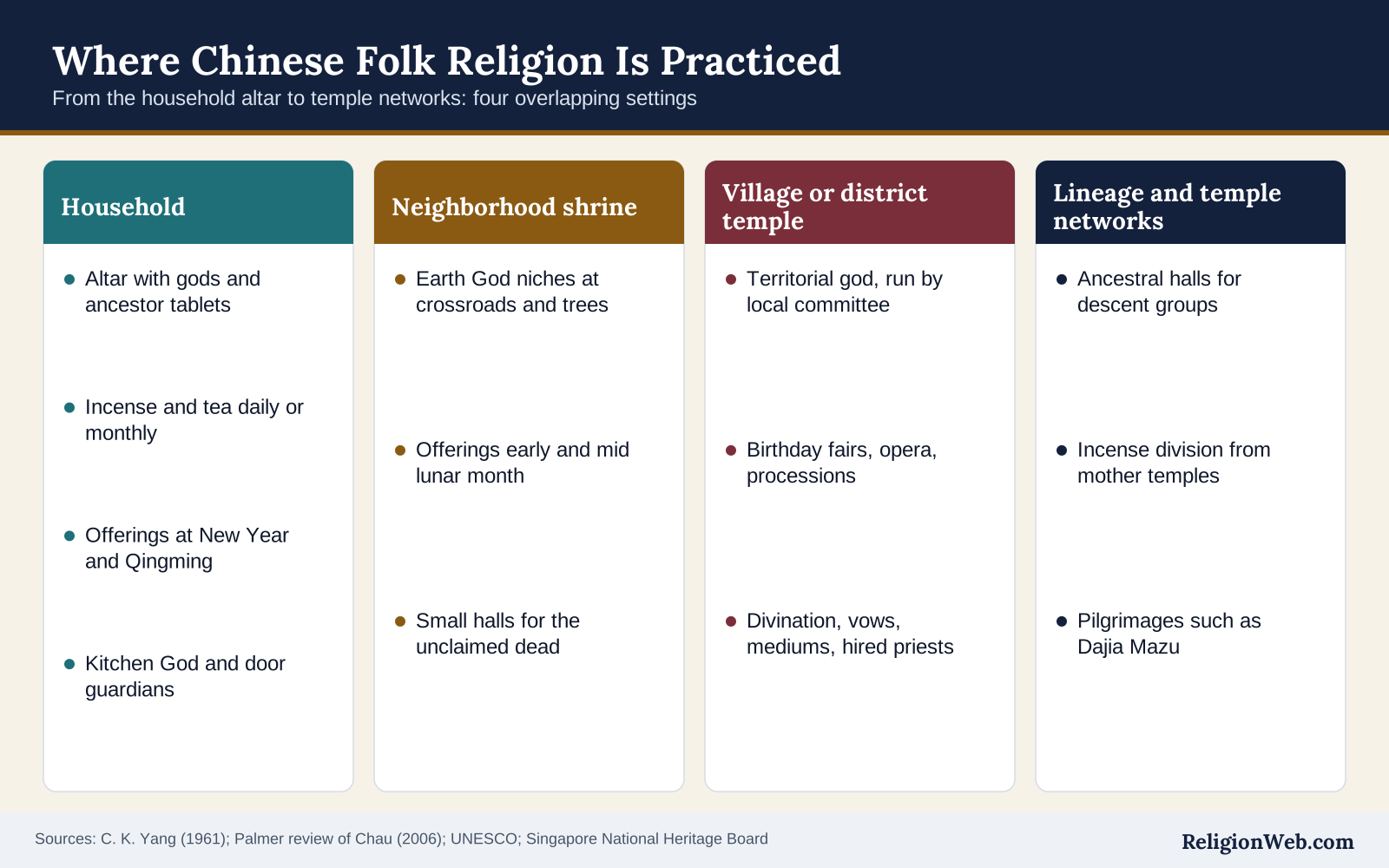
Religious life begins at home. Many households maintain an altar, typically a shelf or cabinet along a wall in the main room, that holds an incense burner, small cups for tea or wine, candles or lamps, fruit offerings, and images or name tablets. In southeastern China, Taiwan, and overseas Chinese communities the arrangement commonly gives pride of place to one or more gods, with the ancestral tablets placed to the side or on a lower level. Many homes also keep a smaller shrine near the entrance for the Earth God or for door guardians, and a paper image of the Kitchen God near the stove. Families tend these places daily, lighting incense in the morning, or on the first and fifteenth days of each lunar month, and more elaborately on festival days.
The home altar matters for understanding the tradition because it shows that most worship is not congregational. It is done by individuals or households, at times of their choosing, with objects they have inherited or bought. It is also where children learn how to hold incense, whom to bow to, and in what order, and where the memory of the dead is physically kept.
Roadside and neighborhood shrines
Beyond the home are the smaller public shrines that anchor neighborhoods: a stone or brick niche for the Earth God at a crossroad, a shrine at the foot of a banyan tree, a small hall dedicated to the unclaimed dead. These are modest places, often tended by a few neighboring families or by a shopkeeper, and they receive offerings at the beginning and middle of each lunar month and at festival times. Their significance lies in their number. A community whose boundaries are marked by such shrines understands itself as living inside a protected territory, whose gods are known and maintained by those within it.
Village, Lineage, and Regional Temples
Temple layout and ritual objects
A larger temple (miao) usually follows a recognizable pattern, though the details change by region and budget. A courtyard in front holds a large incense burner where visitors light sticks before entering. The main hall houses the principal deity, often with attendants and guardian figures, while side halls or rear halls may house subsidiary gods, a hall for ancestors, or a Buddhist or Daoist image. Roofs are often decorated with ceramic or clay figures of dragons, phoenixes, and scenes from stories, and the walls carry couplets, painted door guardians, and carved beams. Red lanterns and banners of thanks from petitioners fill the space, and in many places an opera stage faces the main hall so that the god can enjoy performances on festival days.
Objects have their own significance. Incense ash carried from a founding temple is believed to hold some of its power, statues are “opened to light” in consecration rites before they become sites of the god’s presence, and divination implements (discussed below) lie on the altar table ready for use. Museums and temples alike treat these as living objects rather than artworks, and a statue that has been removed from a temple is generally not treated as an ordinary decorative piece.
Who runs a temple
Temples in Chinese communities are generally managed by local people rather than by priests. A committee of respected households, residents of the ritual district, or a rotating group of leaders handles money, repairs, and festivals. In Taiwan and parts of southeastern China the person who takes charge of the incense burner for the year, often called the luzhu, is chosen by divination before the god, and an annual rotation among households or neighborhoods is a common way to share the cost and honor. In northern Shaanxi, Adam Yuet Chau’s study of the Black Dragon King temple shows another pattern, in which a charismatic temple boss builds up relationships with local officials and neighboring villages, wins official titles, and uses the networks to keep the temple operating.
The financing of a temple is public, often recorded on stone tablets or paper lists naming each donor and the amount. As Palmer summarized Chau’s argument, the inscriptions work as “text acts” that matter for their physical presence, producing awe and legitimation, as much as for what they say. Women frequently take an active role in fundraising and in maintaining the temple, even where men hold formal titles. All of this means that a temple is a local institution first and a religious one second, or rather that the two cannot be separated.
Incense division and networks of temples
Temples are connected through lines of descent, much as families are. When a community founds a new temple for a god, it often carries ash or a statue from an older “mother” temple, a practice known as incense division (fenxiang). The younger temple then sends delegations back to the mother temple at intervals to renew the god’s power by “entering incense” (jinxiang). A network of temples tied to the same source can stretch across counties, provinces, and oceans, and the visits and processions between them are among the great events of the ritual year.
Singapore’s National Heritage Board describes this kind of network in the Nine Emperor Gods festival, in which temples visit one another in processions called yew keng, and notes that two of the oldest temples hosting the festival there, Hougang Dou Mu Gong and Feng Shan Gong, are each more than a century old. These networks give diaspora temples a way to stay connected with temples in the homeland and with each other, even when political borders and dialect differences would otherwise keep them apart.
Temple Fairs, Processions, and Pilgrimage
Temple fairs and the pleasure of crowds
The most visible expression of temple religion is the temple fair (miaohui), held on a god’s birthday or on a date the community has fixed. A fair brings offerings, processions, opera or puppet performances, food stalls, and a large crowd. UNESCO’s account of the Mazu festival at Meizhou describes the two formal temple fairs held there each year, when residents, farmers, and fisherfolk pause their work to offer marine animals, honor statues of the goddess, and watch dances and performances.
Chau coined the phrase “red-hot sociality” for the excitement of such events, a rendering of the Chinese idea of renao, “heat and noise,” which Chinese speakers use approvingly for lively gatherings. In his view, crowds, noise, food, and shared labor generate feelings and relationships that matter as much as any symbolism. Hosting is also work: families that organize meals for guests, perform the opera, or hire the ritual specialists are showing their standing in the community. A temple fair therefore serves religious, social, and political ends all at once, and its success is judged by the god’s pleasure and the people’s.
Processions: the god’s tour of the territory
Many temple festivals include a procession in which the image of the god is carried through the streets or fields of its territory. The image rides in a sedan chair or palanquin, accompanied by musicians, drummers, banner bearers, dance troupes, and young men or women who serve as bearers or guardians, and residents set out tables of offerings and light incense along the route. Sometimes the god is understood to be inspecting the district, driving out harmful influences, and renewing a bond with the households that the god protects. Because the route marks the boundary of a ritual district, a procession is also a way of saying who belongs to the community.
Singapore’s National Heritage Board describes processions in the Nine Emperor Gods Festival, including palanquin processions and the burning of paper dragon ships at sea, and also the inter-temple visits known as yew keng. The sound, color, and crowd are intended and valued. The same sense of heat and noise that Chau analyzed at the Black Dragon King temple surrounds these events, and participants often describe the experience of being close to the god as the point of the whole undertaking.
Pilgrimage routes: the Dajia Mazu example
Pilgrimage in Chinese folk religion often takes the form of a god’s journey, in which devotees accompany the image, carried in a palanquin, along a route through the territories that honor it. The Dajia Mazu pilgrimage in Taiwan is the best-known example. The Taichung city government’s English-language announcement of the 2024 event describes it as a nine-day, eight-night journey on foot from the Dajia temple, which has more than 290 years of history, through Taichung, Changhua, Yunlin, and Chiayi, held in the third month of the traditional Chinese calendar. Ceremonies invite the deity onto palanquins, pilgrims walk alongside, and volunteers set up refreshment stations along the way, with a stay at one temple including a birthday celebration.
People join for many reasons: to fulfill a vow, to ask for protection, to walk with family members, or to take part in a collective event that has become a major cultural occasion. The pilgrimage also shows how the same practice can function as a religious act, a local festival, and a tourism and heritage event at the same time, a combination that is typical for large Chinese temple events.
| Structure | Basis of membership | Main functions | Typical ritual expression |
|---|---|---|---|
| Household altar | Residents of one home | Daily and festival worship of ancestors and household gods | Incense on the first and fifteenth days; New Year and death-anniversary offerings |
| Neighborhood or roadside shrine | Nearby families and shopkeepers | Marking and protecting a small territory; caring for local spirits | Offerings at the start and middle of the lunar month |
| Village or ward temple | Households within a ritual district | Worship of a territorial god; mutual aid; festivals | Birthday fair, procession, opera, annual renewal rite |
| Lineage hall | Descendants of a common ancestor | Honoring founders; managing shared property and genealogy | Spring and autumn ancestral ceremonies |
| Temple network | Temples linked by incense division | Renewing divine power; exchanging visits and support | Return pilgrimages; inter-temple processions |
| Native-place or trade hall | Migrants from one region or members of one trade | Mutual aid and patron deity worship away from home | Patron god’s birthday, annual banquet |
| Management committee | Chosen households or elected leaders | Finance, repairs, festivals, relations with officials | Divination to choose annual leaders; public accounts |
Origins and Historical Development
Ancient Foundations
Shang divination and royal ancestors
The earliest written evidence for Chinese ritual comes from the late Shang dynasty, roughly 1250 to 1046 BCE, at the capital near modern Anyang. Shang diviners heated turtle plastrons and ox shoulder bones until they cracked, read the cracks, and carved the question and sometimes the outcome into the bone. The inscriptions, known as oracle bones, ask about harvests, weather, illness, childbirth, military campaigns, and above all the wishes of royal ancestors and a high power called Di. They show a world in which the dead king was a living participant in affairs of state, and in which regular offerings, scheduled by a ritual calendar, were part of ruling.
Historians caution that the Shang record reflects the practices of the royal court, not of ordinary people, so it cannot simply be read as an early form of village religion. Even so, two features recur in later practice: divination as a way of putting questions to unseen powers, and the care of the dead as a duty with practical consequences.
Zhou Heaven, bronze vessels, and ritual texts
The Zhou dynasty, which replaced the Shang around 1046 BCE, introduced the concept of Tian (Heaven) as the ultimate authority and described its own rule as a Mandate of Heaven that could be withdrawn from unworthy kings. Ancestral temples housed bronze vessels for offerings of food and wine, and elite ritual followed prescribed forms. Later texts compiled in the Warring States and Han periods, including the Book of Rites (Liji), describe sacrifices in detail and explain their purposes. Classical Confucian writers valued sincerity in these offerings, and the Analects says of Confucius:
He sacrificed to the dead, as if they were present. He sacrificed to the spirits, as if the spirits were present.
Confucian Analects, tr. James Legge, in The Chinese Classics, Vol. 1 (Project Gutenberg eBook #3330), Book III, Chapter XII
In Confucian interpretation, the point is the attitude of the person offering: the rite is done with full seriousness, as though the dead were truly there, and the effect of the ritual on the performer’s character is part of its meaning. The passage does not settle whether the dead are in fact present, and later Chinese thinkers, including commentators of different schools, took different views. What mattered across the tradition was that sacrifice be done properly and sincerely, a stance that continues to inform the folk emphasis on correct performance.
Early Empires to the Tang Dynasty
Community altars and the problem of excessive shrines
By the Han dynasty (202 BCE to 220 CE), a pattern was emerging in which the imperial state maintained its own cycle of sacrifices to Heaven, Earth, mountains, and rivers, while communities supported local altars to the soil god (she) and to other spirits. The state came to hold that sacrifices should match a person’s rank and place, and it developed a category of “excessive” or “improper” sacrifices (yinsi) for those it judged out of order. The idea draws on a passage in the Analects:
For a man to sacrifice to a spirit which does not belong to him is flattery.
Confucian Analects, tr. James Legge, in The Chinese Classics, Vol. 1 (Project Gutenberg eBook #3330), Book II, Chapter XXIV, Section 1
Interpreters in the Confucian tradition read this as a warning against seeking favor from powers to which one has no proper relation, and later officials used the category of improper sacrifice as a tool of regulation. In practice the line was drawn inconsistently. Some officials destroyed local shrines they judged improper, while others, and often the same governments, conferred recognition on local gods who had proved their value, which is one reason that official hostility and official patronage can both be documented for the same gods and shrines.
Buddhist and Daoist ritual enters local life
During the centuries after the Han, two organized traditions reshaped the ritual landscape. Buddhism, which entered China from India by the early centuries CE, brought concepts of karma, rebirth, and merit transfer, and these merged with ancestral care. Hong Kong Memory’s collection on the intangible cultural heritage of Hong Kong traces the Hungry Ghost observance to the story of the monk Mulian, who rescued his mother from hell, and say that Emperor Wu of Liang launched the first Ullambana service in the sixth century. Daoist communities, which emerged as organized priesthoods in the second and third centuries CE, developed liturgies for healing, exorcism, and offerings, and in time provided priests for communal rites and for the funerals of local families.
These contacts did not create folk religion from nothing, and they did not absorb it either. Rather they supplied vocabulary, scriptures, specialists, and an elaborate picture of the afterlife that local communities adapted. By the Tang dynasty (618 to 907), Buddhist monasteries and Daoist temples were part of local life, and ordinary families drew on all the available resources when facing illness, death, or misfortune.
Song to Qing: Titles, Lineages, and Temple Networks
Titles for gods and the idea of standardization
From the Song dynasty (960 to 1279) onward, the imperial court regularly granted titles and plaques to local gods whose efficacy had been reported by officials, and this practice drew popular figures into a state-recognized hierarchy. The tenth-century woman later honored as Mazu is the best-known case. Titles that she received in successive dynasties are recorded in Hong Kong’s heritage records, from Lady and Royal Concubine in the Song, to Heavenly Consort in the Yuan, to Empress of Heaven in 1684 under the Qing. The titles themselves were less important to local people than the honor they conveyed, which confirmed that the court acknowledged what the community already believed.
Watson’s concept of standardization describes how this process produced shared symbols without a unified belief system. The state promoted figures such as Mazu and Guan Di; different groups welcomed the recognition for their own reasons; and the result was a wide recognition of certain gods across regions with different dialects and social orders. The gods were increasingly arranged in a bureaucratic metaphor, with titles and ranks resembling those of officials.
Neo-Confucian family ritual and lineages
A second development concerned the family. The philosopher Zhu Xi (1130 to 1200), a leading figure of Song Neo-Confucianism, compiled a guide to household ritual, Family Rituals, which prescribed ancestral shrines in the home and set out simplified rites for capping, marriage, funerals, and offerings. In the Ming (1368 to 1644) and Qing (1644 to 1912) dynasties, many families, especially in the southeast, formed lineages that owned land, built ancestral halls, kept genealogies, and held collective ceremonies. The anthropologist Maurice Freedman, writing in the 1950s and 1960s, called attention to the strength of these corporate lineages in Fujian and Guangdong compared with northern China, a contrast that still helps to explain regional differences in ritual life.
Ancestors were not only private relatives. Lineage halls gave descent groups a place in local politics and property, and temple associations often drew their members from several lineages in the same district, so ritual both expressed and organized local society.
Missionaries, the Rites Controversy, and early Western description
From the seventeenth century, European missionaries began to record and judge Chinese ritual. The best-known dispute, the Chinese Rites Controversy, concerned whether honors paid to Confucius and to ancestors were civil observances or religious acts incompatible with Christian belief. Catholic authorities ruled against participation in the early eighteenth century, and the Holy See changed this position in 1939 by allowing Chinese Catholics to take part in rites regarded as civil. In the nineteenth century, Protestant missionaries such as Justus Doolittle, and scholars such as J. J. M. de Groot, produced extensive descriptions of Chinese ritual, though many of them used terms such as “idolatry” that reflected the authors’ own assumptions. Modern scholars read these works carefully as sources of information and as products of their time.
The Twentieth Century and After
Campaigns against “superstition”
In the late Qing and Republican periods, reformers influenced by new ideas of progress began to classify much of popular religion as “superstition” (mixin), a category that was part of a wider imported vocabulary that also included “religion” (zongjiao). As Mark Meulenbeld described Vincent Goossaert and David Palmer’s history of this period, modernizers confiscated or destroyed many temples in the name of education and progress. A reform edict of 1898 had already ordered the conversion of many temples to schools, though it was reversed within months, and temple property was used for schools in many areas in the following decades. In 1928 the Nationalist government issued standards for retaining or abolishing gods and shrines, which protected only a few approved figures and targeted the rest.
The People’s Republic and Taiwan
After 1949, the new government in mainland China treated popular religion as feudal superstition. Land reform took temple property, local campaigns closed or repurposed temples, and during the Cultural Revolution (1966 to 1976) many temples, statues, and ancestral tablets were destroyed, and public ritual was largely forbidden. Much practice continued quietly inside households. In Taiwan, where the Nationalist government governed from 1949 and martial law lasted until 1987, temples were allowed to operate and grew in size and wealth with the island’s economic development, and the island became a major site of anthropological fieldwork on temple religion.
Revival since the 1980s
From the late 1970s, the policy of reform and opening allowed local communities in the mainland to rebuild temples, restore lineage halls, and revive festivals. Official policy recognizes five religions (Buddhism, Daoism, Islam, Catholicism, and Protestantism), and folk practices fall outside that list; in many rural areas local officials chose to tolerate them, and the rebuilt temples became centers of community life again. Some practices have since gained official standing as cultural heritage: Qingming, the Dragon Boat Festival, and the Mid-Autumn Festival became statutory public holidays in 2008, UNESCO inscribed Mazu belief and customs in 2009, and it inscribed the Spring Festival in 2024. Heritage listing is a recognition of cultural value, though, and not the same as legal recognition as a religion.
| Period | Approximate dates | Developments relevant to folk religion |
|---|---|---|
| Late Shang | c. 1250 to 1046 BCE | Oracle-bone divination; offerings to royal ancestors and a high power called Di |
| Zhou | From c. 1046 BCE | Concept of Heaven (Tian) and the Mandate; ancestral temples; ritual texts later compiled |
| Han | 202 BCE to 220 CE | State sacrifices alongside community altars; category of improper sacrifices; Buddhism and organized Daoism begin to emerge |
| Tang | 618 to 907 | Buddhist and Daoist institutions embedded in local life; elaboration of afterlife bureaucracy |
| Song | 960 to 1279 | Court titles for efficacious local gods; Neo-Confucian household ritual (Zhu Xi) |
| Ming and Qing | 1368 to 1912 | Lineage halls and temple associations spread; Mazu titled Empress of Heaven (1684); Rites Controversy |
| Late Qing and Republic | 1898 to 1949 | Temple property seized for schools; “superstition” campaigns; 1928 standards on gods and shrines |
| People’s Republic and Taiwan | 1949 to 1980s | Campaigns and Cultural Revolution destruction on the mainland; temple growth in Taiwan |
| Revival and heritage | 1978 to present | Temple rebuilding; public holidays 2008; UNESCO Mazu 2009; Spring Festival 2024 |

Rituals and Practices: How They Are Done and Why
Offerings and Worship Step by Step
Incense, bowing, and the order of a temple visit
A visit to a temple follows a rhythm that most regular visitors know from childhood. The worshiper lights sticks of incense, often at the large burner in the courtyard, holds them upright between the palms, and bows toward the main hall, typically three times. The person may then silently state a name, an address, and a request to the god, enter the main hall to place the incense in the burner, and present any food or flowers on the offering table. Visitors commonly continue to side halls to greet other deities and may finish by burning paper in a furnace outside. The whole visit can take five minutes or an afternoon.
Incense plays several roles. Its smoke is understood as a medium that carries the worshiper’s message upward and announces presence, its fragrance is pleasing to the spirits, and the act of lighting it marks the moment when ordinary time gives way to ritual. Pew’s analysis of Chinese survey data found that about a quarter of adults (26 percent in the 2016 China Family Panel Studies) burned incense at least a few times a year, usually to express wishes to a Buddha, a bodhisattva, or other deities. Details such as the number of sticks and the order of the halls vary by temple and region, and temple staff or other visitors usually explain local custom to newcomers.
Food, drink, and the logic of feeding
Gods and ancestors are offered what people themselves enjoy: cooked meat, fruit, rice, cakes, tea, and wine. In many southern households, for example, a standard offering for festival worship includes three kinds of meat, often pork, chicken, and fish, along with rice and fruit, while vegetarian offerings are the rule for deities connected to Buddhist practice, such as Guanyin. The offerings are presented on the altar for a period during which the spirits are understood to take in the essence of the food, and then the family eats it together. In this way the rite is both an act toward the unseen and a meal among the living.
The underlying idea is hospitality and reciprocity. A guest is fed, a patron is thanked, and a senior relative is served first. UNESCO’s description of the Spring Festival, inscribed in 2024, notes that during the festival people make offerings to Heaven, Earth, and ancestors, and the descriptions of Mazu worship mention offerings of marine animals, flowers, candles, incense, and firecrackers. What is placed on the altar tells something about the relationship: more formal food for a god of high rank, favorite dishes for a recently deceased grandparent, and simple dishes for wandering spirits at the roadside.
Paper offerings and burning
The burning of paper goods is among the most characteristic acts of Chinese ritual, and its symbolism explains much about how the unseen world is imagined. Paper offerings come in two forms, according to Singapore’s National Heritage Board. Two-dimensional items include paper money, joss paper, and paper credit cards, and three-dimensional items include paper houses, cars, and servants made on frameworks of bamboo, glue, and paper. They are burned at occasions such as the Hungry Ghost Festival, for the anonymous dead, and as gifts to help in an afterlife that is imagined as an extension of life on earth. The board describes the practice as a physical representation of ancestor worship, and says its origins go back to the Song dynasty.
The logic of burning is transformation. Fire is understood to convert paper into its counterpart in the unseen world, so that a stack of paper notes arrives as spendable currency and a paper house as a real residence. The board explains that burning is a form of filial piety that gives ancestors the means to enjoy the comforts of their earlier life, and that it keeps kinship alive between the living and the dead. In many regions, different papers are used for different recipients: paper marked with gold for gods and silver-colored or specially printed paper for the dead and ghosts, although names and conventions vary.
Burning paper raises practical questions of fire safety and air quality, and some local authorities regulate where it may be done. Practitioners respond in various ways: some use designated furnaces, some switch to symbolic offerings, and some insist that the physical act is essential to the rite. The discussion shows that the practice is alive and adapting.
Asking the Gods: Divination and the Management of Fate
Crescent blocks and fortune sticks
Divination is part of almost every temple visit. The simplest method uses two crescent-shaped wooden or plastic blocks (jiaobei), flat on one side and rounded on the other. The petitioner states a question, usually one that can be answered yes or no, and drops the blocks. In the usual convention, one block landing flat side up and the other rounded side up counts as agreement, two flat sides as a negative answer, and two rounded sides as an unclear one, in which the god is said to be laughing. Conventions differ locally, and the worshiper may repeat the throw until the pattern is clear. Because the god answers directly, the blocks are also used to choose temple officers, decide between dates, and confirm that an offering has been accepted.
A second method is the fortune stick (qiuqian). The petitioner kneels, shakes a container of numbered bamboo sticks until one falls, confirms the choice with the blocks, and takes the matching slip from a cabinet. The slip bears a short poem or verse, written in a literary style that is often ambiguous, which the petitioner may interpret alone, with help from temple staff, or with a professional diviner stationed outside. The ambiguity is part of the method, since it requires the petitioner to apply the god’s words to the situation, and thus to a decision that remains the petitioner’s own.
Almanacs, auspicious dates, geomancy, and birth charts
Beyond the temple lie other techniques for reading and managing fate. Almanacs, printed annually in many versions, list days considered auspicious or inauspicious for weddings, moves, openings of businesses, burials, and journeys. Pew reports that in the 2018 Chinese General Social Survey, 62 percent of respondents said they cared about whether occasions fall on an auspicious day, and 24 percent cared very much. Fengshui (literally “wind and water”) is the art of arranging buildings, rooms, and graves in harmony with landforms and the flow of qi, using a compass and guidelines about orientation. Pew found that 47 percent of adults in the 2018 China Family Panel Studies said they believed in fengshui.
Another system, often called the eight characters (bazi), uses the year, month, day, and hour of birth to analyze personality and fortune, and matchmakers and families still consult it for marriages. Pew noted that in the People’s Republic, fortune-telling and fengshui are officially tolerated, even though the state labels some practices “superstition,” and that the line between custom and superstition is blurry. The hedged tolerance reflects a general feature of Chinese folk religion: whether a practice is called religion, custom, or superstition depends heavily on who is doing the naming.
Ritual Specialists and Life-Cycle Rites
Spirit mediums
Some communities rely on mediums, people through whom a god is believed to speak or act. In Hokkien-speaking communities, the medium is called a tang-ki (also written dang-ki), a term that means a “youth diviner.” According to the University of Cambridge’s Museum of Archaeology and Anthropology, which holds photographs from Alan J. A. Elliott’s 1955 study Chinese Spirit-Medium Cults in Singapore, during an invocation ceremony a deity enters the medium’s body and the medium falls into an involuntary trance. Assistants support the body and guide the proceedings. In the trance, mediums may perform acts such as piercing the cheeks or tongue, rolling on a bed of knives, or climbing a sword ladder, and may let blood fall on charm papers that devotees take home.
Personal consultations are conducted in what is described as the “shen language,” which an assistant interprets. The museum’s account says that mediums commonly embody figures such as the Great Saint Equal with Heaven, often called the Monkey God, and that they are sought for protection, healing, spiritual guidance, and the exorcism of homes. Gemma Ovens, the author of the museum’s account, notes Margaret Chan’s description of the practice as ritual theater, in which costume, make-up, and props let the medium take on a god’s role. Because mediumship concerns illness and distress, it should be said plainly that consulting a medium or taking charm water is not a substitute for qualified medical or mental-health care, and temple healing is better understood as an addition to such care than as a replacement.
Priests, ritual masters, and other specialists
Mediums are one kind of specialist among several. Daoist priests, especially those of the Zhengyi tradition in southeastern China and Taiwan, are hired to lead community offering rites and funerals, using scriptures, hand gestures, and chanting; many are householder priests who marry and pass the role through families. Ritual masters (fashi) work in other styles, often involving exorcism or protective charms, and are not always counted as Daoist by the official Daoist associations. Buddhist monks and nuns chant at funerals and at the Hungry Ghost season. Geomancers choose graves and house sites, diviners read names and birth charts, and opera troupes and puppet teams perform for the gods as part of a festival, since their shows are understood as offerings and not only as entertainment.
In many villages the local temple elders and the temple’s managers also carry ritual duties: they coordinate worship, hold the keys to the incense burner, and announce the rotating tasks of the year. The result is a distributed set of roles. No single person holds religious authority, and the community draws on whichever specialist suits the occasion.
Birth, marriage, and death
Life-cycle rites show how family and spirit world interlock. At birth, many families make offerings to household gods and tell the ancestors of the new child; the first month is often marked by a celebration with gifts of red-dyed eggs. At marriage, the bride and groom bow to Heaven, to the groom’s ancestors, and to his parents in a traditional ceremony, which formally introduces the bride to her husband’s family and its dead. In both cases the ritual moves a person from one social position to another and records the change before the family’s unseen members.
Death produces the most elaborate rites. Families notify relatives, invite specialists to chant, dress the body, and prepare paper offerings for the journey. Mourning follows a structured sequence, with offerings at intervals such as every seven days for the first forty-nine days in many Buddhist-influenced communities, and the burial site is chosen with the advice of a geomancer. In parts of Fujian, Guangdong, and Taiwan a second burial was traditional, in which the bones were exhumed after several years, cleaned, and reburied in a permanent urn or tomb. These rites aim to ease the soul’s passage, to establish the deceased as an ancestor, and to bind the surviving family together. They are among the practices where regional variation is greatest.
| Category | What participants do | Why it is done | Typical setting |
|---|---|---|---|
| Daily and monthly worship | Light incense, offer tea or fruit, bow | To maintain a respectful relationship with household gods and ancestors | Home altar; on the first and fifteenth days, a temple |
| Ancestral offerings | Present food and drink; sweep graves; burn paper | To care for the dead and keep kinship alive | Home altar, lineage hall, grave |
| Vows and petitions | Ask for a favor, promise a return gift, fulfill the promise | To engage a god’s power and show gratitude | Temple |
| Divination | Throw blocks, draw fortune sticks, consult almanacs | To learn a god’s response and choose a course of action | Temple, home, diviner’s stall |
| Paper burning | Burn paper money and goods | To transfer wealth and comforts to the unseen world | Furnace at temple, graveside, street |
| Spirit mediumship | A medium embodies a god; assistants interpret | To obtain guidance, healing, protection | Temple, private home |
| Community offering festival | Priests perform rites; households host guests and perform opera | To renew the community’s relation with its gods | Village or district temple |
| Funerary rites | Chant, mourn, bury or rebury, make seasonal offerings | To ease the dead into the ancestral state | Home, funeral hall, burial ground |
Festivals, the Calendar, and Household Practice
How the Calendar Works
A lunisolar year and the solar terms
Most traditional festivals follow the Chinese lunisolar calendar. Months begin with the new moon, so each month has 29 or 30 days, and a leap month is added every two to three years to keep the calendar aligned with the seasons. Because of this, a festival fixed to a lunar date, such as the first day of the first month or the fifteenth day of the seventh month, moves from year to year against the Gregorian calendar. The Spring Festival falls between late January and the third week of February; in 2027, for example, it falls on February 6, and the date for any year can be checked in a published calendar.
A second set of dates follows the sun. The traditional year is divided into 24 solar terms, such as the Pure Brightness term (Qingming) in early April and the Winter Solstice (Dongzhi) in late December. Observances tied to a solar term keep nearly the same Gregorian date each year, which is why the Qingming grave visit lands around April 4 to 6 every year while the Hungry Ghost season shifts by weeks. Practitioners are used to both systems and often rely on a printed almanac or a temple notice to tell them what is coming.
Obligation, custom, and local choice
The festival year contains different kinds of occasions. Some are widely kept family obligations, above all the New Year reunion and the spring grave visit. Others are community duties, such as the annual birthday festival of the village god, which households in the ritual district are expected to support. Many are optional or local: an individual may go to a temple on the god’s birthday or on any other day when there is a reason to ask for help. The Pew Research Center noted that, outside the Christian and Muslim communities, most people in China engage in religious activity as needs arise, not on a fixed schedule.
This is a useful warning against universal statements. No authority issues a list of required festivals for all Chinese communities, and the distinction between obligation, recommendation, custom, and family tradition depends on place and household. Even the same festival can differ sharply between a village in Fujian and a neighborhood in Singapore. The descriptions below therefore present common forms and name the main variations.
The New Year Cycle
The Kitchen God and the year-end cleaning
The New Year season begins before the New Year itself. The Shanghai municipal government describes the Little New Year as falling on the twenty-third day of the twelfth lunar month in northern China and the twenty-fourth in most southern areas. According to the tradition it relates, the Kitchen God, who watches over the family’s hearth, goes to Heaven on this day to report the household’s deeds to the Jade Emperor. Families offer sticky sweets, such as malt sugar or sesame candy, to “sweeten his words,” along with fruits and pastries as a sign of respect. In many homes the paper image of the god is then burned and a new one is posted at the turn of the year, though practice varies.
The days that follow are used for thorough cleaning, called “sweeping away dust” (sao chen), which the same source says represents clearing away the past year’s troubles to make room for new luck. Families buy food, settle debts, decorate doorways with red paper couplets, and get haircuts and new clothes. Rituals of cleaning and putting things in order mark a transition, and the spiritual and domestic meanings are the same act.
New Year’s Eve to the Lantern Festival
UNESCO’s account of the Spring Festival, which the committee inscribed on the Representative List in 2024, describes the sequence in outline: households clean their homes, stock up, and prepare food in the days before; families eat together on New Year’s Eve and stay up late to welcome the new year; and on the first day people wear new clothes, make offerings to Heaven, Earth, and ancestors, and send greetings to elders, relatives, friends, and neighbors. The celebration is called guonian, “crossing the year.” In many homes the ancestors are invited to the reunion meal, with places set at the altar, and a table is set up outdoors or at the doorway for offerings to Heaven.
Firecrackers and lanterns are associated in popular understanding with driving away evil influences, and the first days of the year are crowded with visits to temples to offer incense and ask for protection, including the “first incense” of the new year at midnight or dawn in some places. Among Hokkien-speaking communities, the ninth day of the first month is commonly observed as the Jade Emperor’s birthday with offerings to Heaven. The season ends on the fifteenth day of the first month with the Lantern Festival, when lanterns are displayed and sweet glutinous rice balls are eaten. By then the year’s ritual calendar is fully open, and temples begin to plan for the deity birthdays that follow.
Spring Through Autumn
Qingming and the care of graves
The Qingming festival, named for the solar term “Clear and Bright,” falls around the fifth of April and is the main spring occasion for visiting the dead. Families travel to ancestral graves, clear weeds, repair the tomb, set out food and wine, burn incense and paper money, and bow before the grave. In lineages with large collective graves, especially in the south, dozens of relatives may attend together, and the occasion functions as a reunion. Pew’s analysis of the 2018 Chinese General Social Survey found that about three-quarters of adults had visited a family member’s gravesite in the previous year, and described this as part of the Confucian tradition of ancestor veneration that often includes incense, spirit money, and offerings.
The meaning is a mixture of duty, memory, and seasonal renewal. Spring is a time for tending the grounds, the family confirms its continuity by returning, and the offerings tell the dead that they have not been forgotten. Qingming became a statutory public holiday in the People’s Republic in 2008, a sign of how widely it is kept. Elements of the festival, such as flying kites and enjoying spring outings, appear in many regions alongside the grave visit, and the mood can range from solemn to cheerful in the same family.
Deity birthdays and temple festivals
Each god has a birthday, which is celebrated at the temple, and dates differ by deity and by region. Hong Kong’s heritage records give the twenty-third day of the third lunar month as the birthday of Tin Hau, the Cantonese name of Mazu, celebrated with community festivities at temples in different districts. The Earth God’s birthday is traditionally observed on the second day of the second month. Other birthdays, such as those of Guan Di or the city god, are marked at other points in the year, and the day on which a particular temple holds its main festival is not always the day found in a general almanac.
The Dragon Boat Festival, on the fifth day of the fifth lunar month, is a community occasion in many places, involving boat races, rice dumplings, and protective charms against summer illness. Tradition connects it with the commemoration of the poet Qu Yuan, and historians note that older customs concerning the summer season also shaped the festival. Each of these occasions follows the pattern seen at larger fairs: offerings for the deity, performances, a shared feast, and a collective effort that renews the temple’s ties to its community.
The seventh month and the Hungry Ghost Festival
The seventh lunar month, called the Ghost Month in many communities, is a season of care for the dead who have no one else to feed them. Singapore’s National Heritage Board describes the observance as mostly kept by Chinese Buddhists and Daoists, who believe that the gates of the underworld open during this period and spirits roam the earth; it is called the Hungry Ghost Festival because spirits without descendants are thought to be hungry, and ancestors may also return to observe the living. People burn joss sticks and paper offerings and make food offerings, and they leave offerings at roadsides and other transitional spots. Large outdoor shows called getai, which began as stages for traditional opera and puppetry and now often feature pop songs, entertain both spirits and the living, and the front row of seats is left empty for the spirits.
The month also brings restrictions. The same account lists common beliefs that people should avoid marriage or moving house, wearing red, and swimming at night, and should not touch roadside offerings or step on incense paper. These precautions show the dual attitude toward ghosts of charity and caution. Buddhist tradition connects the month with the story of the monk Mulian rescuing his mother, and Hong Kong’s records say that the Chiu Chow community there has held a large Yu Lan festival since 1897, run by the Chiu Chow Kung Wo Tong at Moreton Terrace in Causeway Bay. The festival teaches filial piety, almsgiving, and good deeds, as these records note, so that the offerings to the unclaimed dead are also acts of merit for the living.
Mid-Autumn, the Double Ninth, and the Winter Solstice
The Mid-Autumn Festival, on the fifteenth day of the eighth lunar month, is centered on the full moon, family reunion, and the sharing of mooncakes, and some families make offerings to the moon. The Double Ninth (Chongyang), on the ninth day of the ninth month, is traditionally a day for climbing to high places, and in some Cantonese communities, including Hong Kong, it is also a day for visiting ancestral graves. At the Winter Solstice, around December 21 to 22, many southern families make offerings to ancestors and eat glutinous rice balls, and some lineages hold their main annual ceremony at this time. Taken together these occasions form a calendar in which the dead are cared for at the spring and autumn peaks of the year and at its turning points.
| Observance | Date rule | Household practice | Temple and community practice |
|---|---|---|---|
| Little New Year (Kitchen God) | 23rd (north) or 24th (south) day of the 12th lunar month | Sweets offered to the Kitchen God; house cleaned | Local variation; few public events |
| Spring Festival (New Year) | 1st day of the 1st lunar month; between late January and the third week of February | Reunion meal; offerings to Heaven, Earth, and ancestors; greetings; new clothes | Temple visits, incense offerings, lion dances and fairs |
| Jade Emperor’s birthday | 9th day of the 1st lunar month (Hokkien communities) | Offerings to Heaven at a table outdoors | Temple ceremonies in some regions |
| Lantern Festival | 15th day of the 1st lunar month | Glutinous rice balls; lantern viewing | Lantern displays and processions |
| Qingming | Solar term, around April 4 to 6 | Grave sweeping; food, wine, incense, and paper offerings | Lineage gatherings at collective graves |
| Mazu (Tin Hau) birthday | 23rd day of the 3rd lunar month | Offerings to Mazu at home or temple | Temple fairs, processions, and pilgrimage such as the Dajia Mazu journey |
| Dragon Boat Festival | 5th day of the 5th lunar month | Rice dumplings; protective charms | Boat races in many places |
| Hungry Ghost season | 7th lunar month, with the 15th day central in many places | Food and paper offerings at the roadside and home | Communal offerings, getai performances, opera, clergy-led rites |
| Mid-Autumn Festival | 15th day of the 8th lunar month | Family reunion; mooncakes; moon offerings | Lantern and moon events |
| Double Ninth | 9th day of the 9th lunar month | Climbing to high places; grave visits in some Cantonese communities | Local gatherings |
| Winter Solstice | Solar term, around December 21 to 22 | Rice balls; offerings to ancestors | Some lineage ceremonies in the south |

Regional and Diaspora Variation
Regions of China
North China: village temples and pilgrimage
Scholars who study rural northern China, such as the historian Prasenjit Duara, have described village life there as organized around temples, village associations, and networks that cross village boundaries, and less around large corporate lineages than in the southeast. A village temple, often dedicated to an Earth God, a dragon king who brings rain, or a goddess who protects children, may be the focus of an annual fair, and its management is shared among households. Pilgrimages to sacred mountains, including Mount Tai in Shandong with its goddess Bixia Yuanjun, have long drawn travelers from many provinces, and regional temple fairs combine worship with markets and performances.
Adam Yuet Chau’s study of the Longwanggou temple in northern Shaanxi provides a detailed portrait of this kind of religion. Dragon kings are water deities, and farming communities in dry regions have long turned to them for rain. According to David Palmer’s review, the temple became a network of social and political relationships, with a local temple boss, a calendar of fairs, and a close relationship with local officials. It also shows how the revival of temple religion after the Cultural Revolution depended on local energy and local politics as much as on belief.
The southeast: lineages, ports, and sea gods
Fujian and Guangdong have some of the densest temple landscapes in China. The region’s strong lineages built ancestral halls and maintained genealogies, as noted by Freedman, and its ports sent traders and migrants across the sea. Deities of the sea and of the coast, above all Mazu, are central, along with gods of medicine, plague-expelling lords, and protectors of particular towns. Rituals such as processions and community offering festivals often involve entire districts, and each dialect group, whether Hokkien, Teochew, Hakka, or Cantonese, has its own favored gods and customs.
The southeast is also the main source region of overseas Chinese religion. Temples in Taiwan, Singapore, Malaysia, and Thailand often trace their incense to specific villages and temples in Fujian and Guangdong, and many devotees maintain contact with their ancestral places. As a result, practices in the diaspora preserve forms that sometimes differ from those now found in the home region after the twentieth-century disruptions.
The Yangtze region, the interior, and other areas
Other regions have their own characteristics. In the lower Yangtze area, urban city-god temples and large temple fairs were prominent in the imperial period, and many were rebuilt in recent decades. In Sichuan and across the interior, gods of local protection and of scholarship, as well as traveling ritual masters, play important roles. In the southwest and northwest, Han and non-Han communities live side by side, and practices may overlap. This article concerns Han Chinese traditions and the communities that adopted them, and it does not attempt to cover the distinct religious traditions of China’s other ethnic groups. The general point is that no region is typical, and a description that fits Putian may mislead for Shaanxi.
Taiwan, Hong Kong, and Southeast Asia
Taiwan
Taiwan has one of the most open and densely documented systems of Chinese folk religion. The U.S. Department of State’s 2023 report cites an Academia Sinica survey, released in 2021, in which 27.9 percent of respondents said they practiced traditional folk religions, more than the 19.8 percent who identified as Buddhist or the 18.7 percent who identified as Daoist; it also notes that as many as 80 percent of practitioners combine traditions and that roughly 11,800 temples were registered in 2022. Large events include the Dajia Mazu pilgrimage and a calendar of deity birthdays, and some temples run charities and cultural programs. The island’s religious life shows how folk practice can remain central in a modern, highly urbanized society.
Hong Kong
In Hong Kong, devotion to the sea goddess is visible in more than eighty Tin Hau temples across the territory, according to the Hong Kong Memory heritage records, which place the oldest at Joss House Bay in Sai Kung and date it to the Southern Song dynasty, between 1127 and 1279. Her birthday festival draws communities to well-known sites, including Joss House Bay, High Island, Shap Pat Heung, and Po Toi Island. The territory’s Chiu Chow community has held its large Yu Lan Hungry Ghost festival since 1897, and the city’s Cantonese and Hokkien residents each keep their own temples and associations. Hong Kong demonstrates how temple religion can operate in a global commercial city where it meets contemporary law, urban planning, and tourism.
Southeast Asia: the Nine Emperor Gods and the Hungry Ghost season
In Singapore, Malaysia, and Thailand, Chinese migrants founded temples that became centers of mutual aid, and they carried festivals with them. Singapore’s National Heritage Board describes the Nine Emperor Gods Festival as running from the end of the eighth lunar month to the ninth or tenth day of the ninth month, with an invitation ceremony by the sea or a waterway, a strict vegetarian diet, spirit mediums, processions between temples, and the burning of paper dragon ships at sea. It is practiced in Singapore, Malaysia, and Thailand, where the surrounding society includes a large Theravada Buddhist majority in Thailand and other religious communities elsewhere. The oldest festival temples in Singapore are more than a century old.
The festival has distinctive features that show how a local tradition can acquire its own form in a new setting. Participants follow a strict vegetarian diet that excludes meat, eggs, milk, garlic, and onions; nine lamps are raised on poles to mark the start of the festival and are lowered, cleaned, and refilled twice daily; and some temples use one medium for the gods while the Choa Chu Kang Dou Mu Gong uses nine, one for each god. The gods are received and sent off by the sea, or formerly along rivers and canals, usually at night, so the event reenacts a journey from beyond the water.
The board records that the origin of the festival is understood differently by different groups: one view connects it to the Northern Dipper in Daoism and Buddhism, and other accounts describe the gods as pirates, Ming loyalists, or the last Ming emperor. Such variety of origin stories is characteristic of folk religion, in which the same festival can be meaningful for several reasons without any one being official. Singapore also inventories its Hungry Ghost Festival and the making of paper offerings as intangible cultural heritage, which shows how a state with a multi-religious population can recognize Chinese ritual as heritage.
Overseas communities in the West
Chinese migrants carried the same gods to North America, Australia, and Europe, beginning in the nineteenth century in places such as California and Victoria. Early temples were often founded by regional or surname associations, served as community halls, and honored gods of protection, wealth, and the sea. Some of these remain in use, though many communities now worship in newer buildings, in private homes, or in shared temples that serve the Chinese-speaking population of the whole region. Younger generations born overseas often adopt a simplified practice centered on family altars, the New Year, and ancestral graves. Their interest in the temple may be as much about identity and heritage as about specific doctrines.
| Region | Common organizing pattern | Prominent practices and deities | Notes |
|---|---|---|---|
| North China | Village temples, temple fairs, cross-village associations | Earth God, dragon kings, mountain goddess pilgrimage | Lineage structures generally less prominent than in the southeast |
| Southeast coast (Fujian, Guangdong) | Lineages with halls and estates; temple districts | Mazu, plague-expelling lords, medicine gods, community offering festivals | Main source of overseas Chinese practice |
| Taiwan | Temple committees, incense networks, pilgrimages | Mazu, Earth God, mediums, large deity birthdays | About 11,800 registered temples in 2022; 27.9 percent folk religion in a 2021 survey release |
| Hong Kong | Community and district associations, native-place groups | Tin Hau festival, Yu Lan festival | More than eighty Tin Hau temples |
| Singapore and Malaysia | Temple committees, clan and dialect associations | Nine Emperor Gods, Hungry Ghost season, mediums | Festivals inventoried as heritage in Singapore |
| Thailand | Chinese shrines within a Theravada Buddhist majority | Nine Emperor Gods festival, known in Phuket as the Vegetarian Festival; local Chinese deities | Named in the Singapore heritage record as a country where the festival is practiced |
| North America, Europe, Australia | Surname and native-place associations, family altars | Protective and wealth gods, New Year and Qingming rites | Many nineteenth-century temples; new immigrants add practices |
Chinese Folk Religion Today: Legal Status, Heritage, and Scholarly Debates
Legal Status and Heritage Recognition
Five recognized religions and the folk-belief category
In the People’s Republic of China, the word usually translated “religion” is zongjiao, a modern term that, as Pew explains, generally refers to organized religion. The government officially recognizes five: Buddhism, Daoism, Islam, Catholicism, and Protestantism. Pew states that Confucianism, as well as folk beliefs and practices, are not typically considered zongjiao. Many folk practices instead fall under xisu, “customary practice,” such as the worship of Mazu and the veneration of ancestors, while those that the authorities consider superstition fall under mixin. Pew adds that fortune-telling and fengshui are tolerated, that the boundary between custom and superstition is blurry, and that members of the Communist Party are barred from practicing religion.
The practical result is a patchwork. Rules, enforcement, and attitudes differ across provinces, counties, and years, and a temple that is welcomed in one county may be closed in another. Palmer’s review of Chau’s study notes that the local state draws the line between religion and superstition according to shifting policy, and Chau himself describes a zone in which local officials, elites, and temple leaders negotiate. Readers who need current legal details for a particular place should consult the current official regulations and local guidance, because they change and this article cannot substitute for them.
Heritage listing and cultural policy
A second route to public recognition is cultural heritage. Qingming, the Dragon Boat Festival, and the Mid-Autumn Festival became statutory public holidays in the People’s Republic in 2008. UNESCO listed “Mazu belief and customs” in 2009 and the Spring Festival, described as the social practices of the Chinese people in celebration of the traditional new year, in 2024, and Singapore has inventoried the Nine Emperor Gods Festival, the Hungry Ghost Festival, and the making of paper offerings. Local governments in the mainland also support temple fairs as folk culture and tourism events.
The heritage framing has real benefits for communities because it provides a vocabulary in which the practices can be public, funded, and taught. It also raises a question that practitioners and scholars discuss: whether describing a festival as culture captures what participants experience as a relationship with a god. UNESCO’s text for the Spring Festival itself speaks of family values, social cohesion, and peace, and says that knowledge is passed down within families and communities. Both emphases can be true at once, and the same pilgrimage can be a devotional journey for one walker and a cultural spectacle for another.
Debates About What Folk Religion Is
One religion, many religions, or a field of practice?
The central scholarly question is whether Chinese folk religion is a single system or a loose set of local traditions. C. K. Yang’s distinction between institutional and diffused religion suggested that what most Chinese people practiced was a coherent religion embedded in family and community life. The Dutch scholar Kristofer Schipper argued that local temple religion and Daoist liturgy belong to one ancient system, in which Daoist priests act as the ritual specialists for local communities. Stephan Feuchtwang emphasized the “imperial metaphor,” a shared model of gods as officials and rituals as petitions and tribute, which gives the diverse local traditions a recognizable family resemblance.
Others stress variety. They point out that gods, rites, and the meaning of ancestor care differ so much by region, dialect group, and social class that one name risks implying a unity that does not exist. The historian’s approach, as in James Watson’s study of the standardization of gods, shows how unity was partly produced by state recognition and trade networks, not simply inherited. A cautious summary is that there are strong family resemblances without a central structure, and that scholars differ about how much weight to give each.
Orthopraxy, modalities, and “doing” religion
Another line of debate concerns what to look at. Watson argued that the unifying element of late imperial Chinese culture was ritual form, and he used the term orthopraxy to describe the emphasis on correct performance in funerals, weddings, and worship. Chau, in the study that Palmer reviewed, shifted the question from “what do Chinese believe?” to “how do people do religion?” and identified five modalities: discursive or scriptural, personal-cultivational, liturgical or ritual, immediate-practical, and relational. A single person may use several modalities in a week, reading a moral book, asking a god for help, hosting a feast, and attending a funeral.
This approach has the advantage of making room for everything from a lifelong devotion to a one-time visit before an examination. It also explains why a temple’s success is often judged by its community relationships and not only by theology, a conclusion that fits Chau’s observation that hosting guests at funerals and temple fairs matters more to many hosts than the liturgy itself.
Is it a religion? Terms and categories
The question of whether the practices count as “religion” is complicated by the history of the word. Zongjiao entered Chinese in the late nineteenth and early twentieth century as a translation of the European concept, and in China it has meant organized religion with clergy, texts, and membership. Pew notes that the concept of religion is foreign to Chinese culture in this sense, so that survey questions based on formal categories miss many folk practices. Mark Meulenbeld, reviewing Goossaert and Palmer’s history of modern Chinese religious policy, describes “religion” as an imported category that the state and modernizing writers used to reclassify traditions.
The question therefore has no neutral answer. If religion means a creed, a membership, and a clergy, Chinese folk religion falls outside it. If religion means organized relationships with powers beyond ordinary human control, expressed in ritual, then it plainly belongs. This site uses the second, broader sense, while respecting that many practitioners prefer to call what they do custom, tradition, or simply family duty, and that people who take part in these rites may also belong to Buddhist, Daoist, Christian, or other communities, or to none.
Common Misconceptions About Chinese Folk Religion
Misconception 1: Chinese folk religion is one centralized denomination with an organized membership
Where the misunderstanding comes from
The expectation is understandable. Surveys, encyclopedias, and demographic tables list “Chinese folk religion” beside Christianity, Islam, and Buddhism as if it were another member of a list of organized faiths, with a membership that can be counted and a headquarters that can be contacted. The English phrase itself sounds like the name of a denomination. Visitors who see many temples with similar architecture, similar deities, and similar rituals may conclude that a central body must be coordinating them.
The habit of counting is also a product of how research is done. Pew’s report on measuring religion in China explains that it relied on Chinese university surveys because the standard categories do not fit the situation, and that the Chinese word zongjiao, which usually means organized religion, does not typically include folk beliefs and practices. When a category is built for institutional religions, a diffuse set of practices tends to be either squeezed into it or left out.
What the evidence and tradition actually show
No church, council, or head directs Chinese folk religion. Temples are managed by local committees of households or by notable local figures, and authority rests on local custom and on a god’s reputation for efficacy, not on any ordination or hierarchy. C. K. Yang’s description of such religion as “diffused” into family and community life captures this: a temple is part of a village’s social structure, and participation is a matter of residence, descent, or trade, not of joining. The incense-division networks linking temples are relations of descent and visiting, not chains of command.
Organized groups with membership do exist in the wider religious landscape of Chinese-speaking societies, including lay salvationist movements, officially recognized Daoist and Buddhist associations, and temple federations. They interact with folk practice but are not the same thing, and the Chinese term minjian zongjiao is often used for such movements, which is why English-language scholars take care with the translation. The correct picture is of a field of overlapping local organizations, linked by shared ideas and by networks of visiting, with no center at all.
Even the state-recognized religious associations of Daoism and Buddhism, which have national organization, do not govern village temples. A village temple may invite a Daoist priest or a Buddhist group to perform a rite and pay them for the service, but the temple remains under local control, and the invitation can be withdrawn the following year.
Misconception 2: Ancestor rites have one simple meaning everywhere
Where the misunderstanding comes from
For a long time, English-language writers called the rites “ancestor worship,” which suggests that the dead are treated as gods. In reaction, other writers said the rites are nothing more than respectful remembrance, comparable to laying flowers at a grave. Both positions give a single answer to a question that families answer differently. The historical dispute known as the Chinese Rites Controversy, in which missionaries and Chinese converts argued over whether ancestral and Confucian ceremonies were civil or religious, shows how persistently observers looked for one meaning.
The confusion is increased by the fact that the rites look similar from outside. Incense, food, bowing, and paper offerings appear at graves and altars across Chinese societies, which invites the assumption that the same beliefs lie behind every one.
What the evidence and tradition actually show
Anthropologists and historians describe a range of meanings. In Arthur Wolf’s analysis from Taiwan, ancestors are treated as senior kin, served and fed as grandparents would be, and unlike gods they are not approached primarily as officials or patrons. Confucian texts, including the passage in the Analects that calls for serving, burying, and sacrificing to parents according to propriety, frame the rites as an expression of filial duty and sincerity. In many households the dead are also believed to protect their descendants, to need material comfort, and to be able to cause illness or misfortune when neglected. Some participants emphasize memory and family cohesion more than the continued existence of the dead, and others take the presence of the dead for granted.
The Catholic response reflects this ambiguity. In 1939 the Holy See permitted Chinese Catholics to take part in rites regarded as civil expressions of respect, which acknowledged that the same act can be understood differently by different people. The most reliable statement is that ancestor rites are about maintaining a relationship with the dead, and that the character of that relationship is explained differently by region, family, education, gender, and religion.
Gender and descent add further variation. In traditional patrilineal households, a married woman made offerings to her husband’s ancestors and not her own, and lineage records favored the male line, so the same rite could carry different meanings for a son, a daughter-in-law, and a daughter who had married out. Scholars note that these conventions are changing, and that many families now care for the dead of both parents’ lines. The rites are thus an area where social structure and personal feeling meet, and descriptions that omit the family’s own account of why it does what it does are incomplete.
Misconception 3: Practice is uniform across all Chinese regions and communities
Where the misunderstanding comes from
Popular images of “Chinese tradition” are often built from a few well-known symbols: red lanterns, dragon dances, incense coils, a particular style of temple roof. National holidays, tourism promotion, and school curricula emphasize shared festivals such as the Spring Festival and Qingming. These shared occasions are real, and they encourage the sense that one common practice underlies all of them. Language also contributes: the phrase “Chinese religion” implies a unit that can be described in one voice.
What the evidence and tradition actually show
Even the shared festivals differ in detail. The Shanghai municipal government’s account of the Little New Year places it on the twenty-third day of the twelfth lunar month in the north and the twenty-fourth in most southern areas. In Hong Kong, the Double Ninth is a grave-visiting occasion for some Cantonese families, while elsewhere it is mainly an occasion for climbing high places. The Nine Emperor Gods Festival, described by Singapore’s National Heritage Board, belongs to Southeast Asian Chinese communities and is not part of the calendar in many parts of China, and the Chiu Chow Yu Lan festival in Hong Kong has its own organizing body and history.
Differences go deeper than dates. The southeast has strong lineages with halls and estates, while many villages in the north organize around temples; the Hokkien, Hakka, Cantonese, and Teochew regions each favor different gods; and the Taiwan data show 27.9 percent of one survey’s respondents identifying with folk religion, a proportion that has no equivalent measurement for the mainland. Diaspora communities add another layer of local adaptation. A statement about “the Chinese” that is accurate for a particular temple is therefore a statement about that temple and its community, and responsible description names the place and the period.
Local people also use the differences themselves. A family from a Hakka village may regard the way a Hokkien neighbor handles a funeral as unfamiliar, and a migrant moving between provinces often notices that the temple around the corner keeps a different god, a different festival day, or a different way of throwing the divination blocks. Such observations are the ordinary experience of people who live inside the variation, and they are the best evidence against a uniform picture.
Misconception 4: Chinese folk religion is only a loose blend of Buddhism, Daoism, and Confucianism
Where the misunderstanding comes from
The idea has a clear basis in what visitors see. A single temple may hold a Buddhist bodhisattva, a Daoist celestial ruler, and a Confucian-style deified scholar in adjacent halls, and worshipers may address all of them in one visit. The traditional phrase “the three teachings” (sanjiao) also encourages the view that Chinese religious life is made up of the three named traditions, with anything else treated as a diluted mixture. Older Western scholarship, which usually studied the textual traditions first, often described the popular material as a secondary residue.
What the evidence and tradition actually show
Scholars today describe a more reciprocal relationship. Buddhism, Daoism, and Confucian ritual teaching all borrowed from and shaped local religion over many centuries; the study by Terry Kleeman in the Oxford Research Encyclopedia of Asian History (2017) on Daoism and popular religion in imperial China is one example of work that treats their relationship as historical and complex. Many of the central features of folk religion, however, have their own logic. Territorial gods such as the Earth God, deified humans such as Mazu, veneration of lineage ancestors, mediumship, vows, and the temple fair are not drawn from the scriptures of any of the three.
The ritual specialists make the point clearly. Daoist priests and Buddhist clergy are hired to perform specific rites, but they work for communities whose temples are managed by local people and whose gods are not defined by monastic or priestly institutions. The better description is that folk religion is a large field in which the three teachings are active participants and not its sources. That is why this site gives it its own article, while the pages on the other traditions explain their texts, institutions, and teachings in their own right.
Misconception 5: Chinese folk religion has disappeared or survives only as a rural relic
Where the misunderstanding comes from
Two influences feed this impression. The first is the long history of campaigns that treated popular religion as superstition and as an obstacle to modernization, from the late Qing temple confiscations to the Cultural Revolution, which led many observers inside and outside China to assume that the practices were dying. The second is the low level of formal religious identification in official surveys, which makes China look almost entirely secular. If the only question is “Do you belong to a religion?”, a majority of Chinese adults answer no, and the practices that do not fit the question remain invisible.
There is also a tendency to equate modernity with the decline of ritual, so that city life, higher education, and technology are expected to replace temple visits and paper offerings. This expectation is not always borne out.
What the evidence and tradition actually show
The survey evidence shows that practice is more widespread than identity. Pew found that about a quarter of Chinese adults burned incense at least a few times a year (2016), that about three-quarters visited a relative’s grave in the past year (2018), and that 24 percent visited a temple or shrine to pray for wealth or good fortune in the past year (2018). Taiwan, one of the most urbanized and technologically advanced societies in Asia, has roughly 11,800 registered temples and a large annual pilgrimage. Hong Kong and Singapore, also highly urban, maintain active festivals that their governments have recognized as heritage, and paper offerings now include phones and other modern goods.
The picture is not one of simple growth, though. Many temples were lost in the twentieth century and not all have been rebuilt, some local traditions have died with the communities that kept them, and migration to cities has weakened village-based ritual in some areas. Chau argued that popular religion’s embedding in networks of hospitality and social obligation is part of what lets it survive pressure, and Goossaert and Palmer’s history, as Meulenbeld summarizes it, includes a chapter on the late twentieth-century revival of communal temple religion. The best description is that the practices have changed and relocated, which is a different thing from disappearing.
Frequently Asked Questions About Chinese Folk Religion
Questions About Definition and Identity
Is Chinese folk religion the same as Daoism?
No, although the two overlap in important ways. Daoism is a tradition with its own scriptures, ordained priests, ritual lineages, and monastic and temple institutions, and in the People’s Republic it is one of the five officially recognized religions. Chinese folk religion is a wider field of household, village, and temple practice that includes ancestors, local gods, ghosts, and specialists of many kinds. Daoist priests are among those specialists, and some gods have a place in both, but most folk temples are run by local committees and not by Daoist institutions.
The practical consequence is that a person can take part in folk religion without any contact with Daoist teaching, and a Daoist monastery’s concerns, such as scriptural study and cultivation, are not central to most village temples. The relationship is better described as long-standing exchange than as identity.
Do people have to choose between folk practice and another religion?
In everyday practice, usually not. The U.S. Department of State’s 2023 report on Taiwan, citing survey data, said that as many as 80 percent of practitioners combine traditions, such as Buddhism and Daoism, and often incorporate folk elements. Many Buddhists in Chinese societies honor ancestors and visit local temples, and the same household may hire a Daoist priest, a Buddhist chanting group, or both for a funeral.
Some religious communities that also exist among Chinese people, including certain Christian and Muslim communities, have their own guidance about taking part in particular rites, and individuals make their own decisions within those communities. The folk tradition itself has no rule requiring exclusive membership.
Do practitioners believe in one supreme god?
Views vary. Heaven (Tian) is widely respected as the highest moral authority, and the Jade Emperor is often described as the ruler of the divine administration. Many practitioners, however, do not frame their religious life in terms of a single supreme being, and attention is usually directed to the god or ancestor with whom they have a relationship. The structure resembles an administration with different levels, and people approach the level appropriate to their need.
Questions About Practice
Why are there so many gods?
The number follows from how the gods are understood. Each belongs to a place, a trade, a family, or a kind of need, and a new community or occupation can acquire its own. Territorial gods such as the Earth God and city god serve a district, deified humans such as Guan Di and Mazu are associated with particular virtues or dangers, and gods drawn from Buddhist and Daoist literature extend the range. The imperial practice of granting titles to gods whose efficacy was reported also encouraged the growth of the pantheon.
Seen from within, the large number is not a problem, because a person does not need to relate to all the gods. Households and temples keep the figures that matter to them, and the divine administration is imagined as having many offices, much as a government does.
What do people ask the gods for?
Requests are practical and varied: health, safe travel, a child, success in school or business, protection of the household, and peace. UNESCO’s text on Mazu says that her devotees pray for pregnancy, peace, help with problems, and general well-being. In the 2018 Chinese General Social Survey, which Pew analyzed, 24 percent of respondents said they had visited a temple or shrine to pray for wealth or good fortune in the past year.
People often balance requests with gratitude. A vow is made in advance, and when the wish is fulfilled the person returns with a thank-offering, such as a feast or a banner. Many also say that the temple visit is a way of calming the mind and giving a worry a place to go, which is a human motive that does not depend on any particular theory of how the gods work.
What is the meaning of burning paper money?
Paper money and paper goods are burned in the belief that fire transforms them into their counterparts in the unseen world, where ancestors, gods, and ghosts can use them. Singapore’s National Heritage Board describes it as a form of filial piety that gives ancestors the means to enjoy the comforts of their earlier life, and as a way of keeping kinship alive between the living and the dead.
The money does not mean the same to everyone. Some people regard it as a literal payment, others as a symbolic gift, and others as a family custom performed out of respect. Where the practice is restricted for reasons of air quality or fire safety, families may use designated furnaces or choose other offerings.
Can visitors enter a Chinese folk temple?
Most temples welcome respectful visitors, including tourists and people of other religions or none. Common courtesy applies: dress modestly, speak quietly, follow any posted instructions, and do not touch offerings, statues, or divination tools unless invited. If you wish to participate, a temple volunteer or a regular worshiper can usually show how to hold the incense and where to place it. Photography is permitted in many temples but not in all, and it is best to ask, especially during ceremonies, mediumship sessions, and funerals. Visitors should remember that a temple is a place of worship for the people who use it, even when it is also a landmark.
Questions About Festivals and Daily Life
When is the Hungry Ghost Festival?
The Hungry Ghost Festival is observed in the seventh month of the Chinese lunar calendar, which Singapore’s National Heritage Board describes as the period when spirits are believed to roam the earth. In many places, the fifteenth day of the month is the center of the observance, but local communities schedule their own rites and performances across the month. Because the lunar calendar shifts against the Gregorian one, the corresponding dates vary every year and typically fall in August or September; the exact dates for a given year should be checked in a published Chinese calendar.
Why do the dates of Chinese festivals change every year?
The festival calendar combines lunar months with solar terms. Festivals tied to a lunar day, such as the Spring Festival, the Dragon Boat Festival, and the Mid-Autumn Festival, move against the Gregorian calendar, and a leap month is added every two to three years to bring the lunar year back into line with the seasons. Festivals tied to solar terms, such as Qingming and the Winter Solstice, stay near the same Gregorian dates each year. The Spring Festival, for example, falls on February 6 in 2027.
How many people practice Chinese folk religion?
No one knows with precision, because the practices do not form a membership and surveys use different questions. Pew found that about 10 percent of Chinese adults identified with a religion in the 2018 Chinese General Social Survey, while 26 percent burned incense at least a few times a year (2016) and about three-quarters visited a family grave in the past year (2018). In Taiwan, an Academia Sinica survey released in 2021 found that 27.9 percent identified with traditional folk religions. Estimates depend on whether the question asks about identity, belief, or practice, and the answers can differ by several multiples.
Conclusion: Practice, Place, and Continuity
What the History Shows
Continuity through change
Several central practices of Chinese folk religion can be traced across more than three millennia: care for the dead, the consulting of unseen powers through divination, and the maintenance of a calendar of offerings. The details have changed, from Shang oracle bones to Song titles for gods, to Qing lineage halls, to modern temple fairs that are also heritage events. What has persisted is the pairing of family and community with ritual, in which the same people who run a household or a village also keep its altars.
The twentieth-century campaigns against “superstition,” the destruction of the Cultural Revolution, and the later rebuilding of temples show that this religion can be suppressed in public and still survive in homes and memory, and can be revived rapidly when conditions change. Its adaptability, from paper smartphones for the dead to temple events held in cities around the world, is part of what the evidence shows about how it works.
Why local variety remains the rule
No tradition without a central authority can be described in one voice, and Chinese folk religion is a clear case. The Mazu of Meizhou, the Earth God at a northern crossroads, the Nine Emperor Gods of Singapore, and the household ancestors of a family in a Chinatown apartment are all part of the same field, but each has its own history and community. A careful description names the place, the period, and the people involved.
How to Keep Exploring
Related traditions and topics on this site
Readers who want to follow the textual and institutional traditions that exchange so much with folk practice can turn to the pages on Daoism, Buddhism, and Confucianism. Each explains its own scriptures, teachers, institutions, and practice, and each sheds light on a different part of what appears in a Chinese temple.
Reading and visiting with care
For further study, the work of anthropologists and historians such as C. K. Yang, Arthur Wolf, James Watson, Prasenjit Duara, Adam Yuet Chau, Vincent Goossaert, and David Palmer provides detailed accounts, and national and municipal heritage records preserve descriptions of particular festivals. Visitors to temples will learn the most by observing quietly, asking local participants about their own customs, and remembering that the same rite may mean different things to different people. Statistics and legal rules in this field change, so the figures and policies described here should be checked against current sources.
Sources
The table below lists the principal external sources behind this article. Facts, dates and figures were checked against these and related primary, institutional and academic materials.
| # | Source | Publisher and type | Used for | Link |
|---|---|---|---|---|
| 1 | Measuring Religion in China | Pew Research Center (2023) · Demographic data | Survey figures on incense, grave visits, fengshui and affiliation; zongjiao, xisu and mixin categories | pewresearch.org |
| 2 | Mazu belief and customs (Representative List, 2009) | UNESCO Intangible Cultural Heritage · Institutional | Mazu’s tenth-century origin on Meizhou, temple fairs, offerings, about 5,000 temples | ich.unesco.org |
| 3 | The Analects of Confucius (from the Chinese Classics), tr. James Legge | Project Gutenberg eBook #3330 · Primary text | Four quoted Analects passages (II.5, II.24, III.12, XI.11) in Legge’s public-domain translation | gutenberg.org |
| 4 | Making of Chinese Paper Offerings (ICH-059) | National Heritage Board, Singapore · Institutional | Forms, meaning and modern items of paper offerings; Song-dynasty origin claim; Fun Fact | roots.gov.sg |
| 5 | The Nine Emperor Gods Festival (ICH-055) | National Heritage Board, Singapore · Institutional | Festival dates, vegetarian diet, mediums, processions and origin accounts in Southeast Asia | roots.gov.sg |
| 6 | Religion in Chinese Society (C. K. Yang, 1961), publisher’s description | University of California Press · Academic reference | Institutional versus diffused religion; temples and festivals as social infrastructure | ucpress.edu |
| 7 | Review of Adam Yuet Chau, Miraculous Response (Stanford UP, 2006), by David A. Palmer | China Review International 13:2 (2006), via HKU Scholars Hub · Academic reference | Chau’s five modalities, temple networks, text acts, red-hot sociality, local state | repository.hku.hk |
| 8 | Chinese Spirit-Medium Possession in Singapore (Gemma Ovens) | Museum of Archaeology and Anthropology, University of Cambridge · Academic reference | Tang-ki mediumship: trance, assistants, practices, community role | museums.cam.ac.uk |
| 9 | History of the Folk Religion of Tin Hau (Oral Legacies Series II) | Hong Kong Memory, Intangible Cultural Heritage of Hong Kong · Institutional | Mazu’s titles through the Qing (1684), birthday date, Hong Kong’s Tin Hau temples | hkmemory.hk |
| 10 | 2023 Report on International Religious Freedom: Taiwan | U.S. Department of State (via ECOI.net) · Demographic data | Academia Sinica 2021 survey shares; about 11,800 registered temples (2022); combined practice | ecoi.net |
Last fact-check date: 2026-10-21.