Confucianism is the tradition of moral cultivation, learning, ritual, and family and public responsibility that grew out of the teachings of Confucius (Kongzi, or Master Kong, traditionally dated 551–479 BCE) and of the scholars who preserved, interpreted, and reshaped those teachings for more than two thousand years. Confucius lived in the small state of Lu, in what is now Shandong province in northeastern China. He did not claim to found a new religion. He presented himself as a transmitter of the older ritual and moral heritage of the Zhou dynasty, and his students collected his sayings in a short book called the Analects (Lunyu).
Few traditions are as hard to classify. Confucianism has no central church, no clergy who preside over weekly services, and no single creed. Yet it has temples, annual sacrifices, a vocabulary of Heaven (tian), a detailed ritual system for weddings, funerals, and ancestor rites, and a long history in which emperors, scholars, and ordinary families treated Confucius and his tradition with reverence. Scholars therefore disagree, sometimes sharply, about whether Confucianism is best described as a philosophy, an ethical system, a state ideology, a religion, or a religious tradition spread across family, school, and government. That distinction matters, and this article treats the disagreement as part of the subject rather than trying to end it.
What follows is a reference-length account of Confucian teachings, texts, history, ritual, and present-day practice. It begins with a definition and vocabulary, follows the tradition from the Zhou world through the imperial era and the Neo-Confucian revival to the twenty-first century, and then turns to the practices that make the tradition visible: family rites, ancestor veneration, temple sacrifices, schools, and the civil-service examinations. Where Confucians themselves disagree, the schools are named. Where evidence is thin, such as the exact words of Confucius, the article says so.
Confucianism at a Glance: Definition, Geography, and Vocabulary
What Confucianism Is and What It Is Called
A working definition
In the broadest sense, Confucianism is a family of teachings and practices centered on the idea that human beings become fully human through disciplined learning, ritual participation, and the faithful performance of their roles within family and society. Its central questions are practical and moral. How should a child honor a parent, a minister serve a ruler, a friend treat a friend? What kind of education forms a person of character? What makes political authority legitimate? Confucian answers to these questions place heavy weight on cultivated virtue, on shared ritual forms, and on the ongoing study of a body of classic texts.
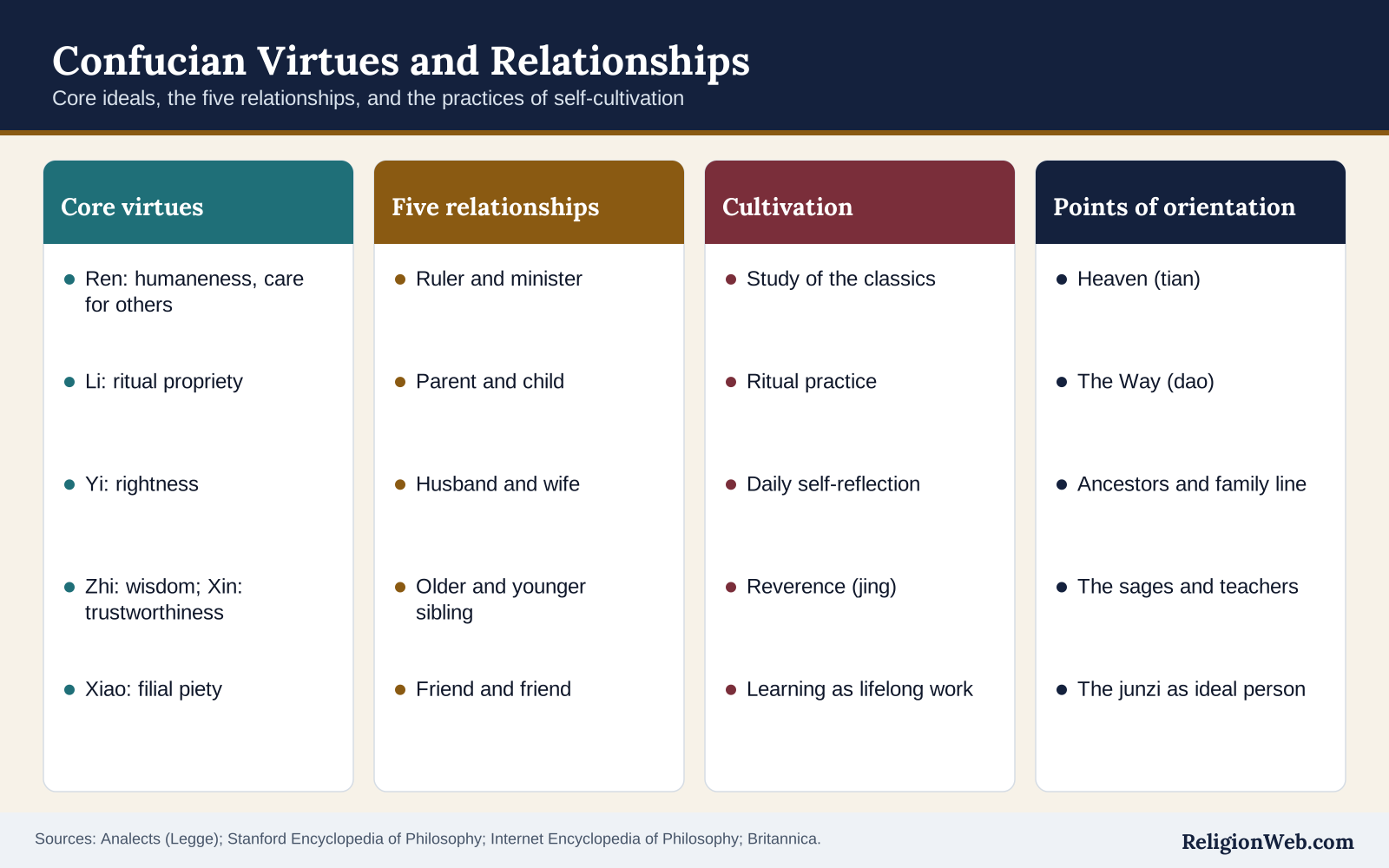
Three features recur across periods and regions. The first is an emphasis on ren (仁), often translated as humaneness or benevolence, the quality of a person who treats others with care and moral seriousness. The second is li (禮), ritual propriety, which covers everything from ancestral sacrifices to ordinary courtesy. The third is the authority of learning: the tradition expects its members to read, reflect, and apply the classics to their own conduct. Different eras emphasized different combinations of these, and the article returns to each in the section on core concepts.
Names: Ru, Rujia, Rujiao, and Kongjiao
The English word “Confucianism” is a European coinage, and it does not correspond neatly to a single Chinese term. Traditional writers spoke of the ru (儒), a word that by the end of the Warring States period (403–221 BCE) meant the scholars or literati who followed Confucius. From it come rujia (the school of the ru), ruxue (learning of the ru), and rujiao (the teaching of the ru), each with slightly different connotations. The Neo-Confucian movement of the Song dynasty called itself daoxue, the “learning of the Way.” A later and more specific term, Kongjiao (the teaching of Confucius), appears in modern efforts to present the tradition in more institutional, religion-like form.
Some scholars therefore prefer “Ru tradition” or “Ruism” to “Confucianism,” arguing that the familiar word suggests a founder-centered church that never quite existed. Others keep the traditional English term because it is what readers and search engines recognize. This article uses “Confucianism” for the whole tradition and “Confucian” for its adherents and institutions, while noting where Chinese, Korean, Japanese, or Vietnamese usage differs.
Where the Tradition Lives
China and the wider Sinitic world
Confucianism took shape in the Yellow River region of northern China, and its most famous sacred site is still the Temple of Confucius in Qufu, Shandong, the old capital of Lu. Over the centuries the tradition became part of statecraft and education across the Chinese empire. It then moved outward to Korea, Japan, and Vietnam, where scholars, rulers, and local communities adapted it to their own languages, institutions, and family systems. Korea’s Joseon kingdom (founded 1392) made a form of Neo-Confucianism the framework of its court, schools, and household ritual. In Japan, Neo-Confucian learning flourished under the Tokugawa shoguns, and in Vietnam a temple dedicated to Confucius, built as a university for the royal family and scholars, was established in Hanoi in 1070, according to Britannica.
Today the places where Confucian practice is most visible are mainland China, Taiwan, Hong Kong, South Korea, Vietnam, Singapore, and Japan, along with Chinese, Korean, and Vietnamese diaspora communities. The picture is uneven. The Pew Research Center’s 2023 surveys of Hong Kong, Japan, South Korea, and Taiwan found that people in those societies almost never name “Confucian” as their religion, yet most take part in ancestor veneration, and 59 percent of South Koreans said they feel connected to the Confucian tradition, a higher share than for any other tradition Pew asked about there.
Diaspora communities and recognition in law
Beyond East Asia, Confucian ideas and practices travel with migrant families, in the form of ancestor altars, funeral customs, education values, and the observance of Confucius’s birthday. In Indonesia, the tradition known locally as Khonghucu has an unusual legal history. It was among the faiths the state recognized in the 1960s, lost that standing in practice during the New Order period, and regained official acceptance after President Abdurrahman Wahid revoked earlier restrictions in 2000. The 2010 census recorded 117,091 Indonesians as Confucian, according to a 2019 analysis from Gadjah Mada University’s Center for Religious and Cross-cultural Studies. Pew’s 2022–23 survey of Asian Americans, discussed later, found that about one in five Americans of East Asian origin say they feel close to Confucianism.
Vocabulary and Quick Facts
The tradition in one table
The table below summarizes the basic facts a reader needs before the longer sections. Dates for Confucius are traditional and are the ones given in standard reference works; the surviving evidence about his life was written down generations after his death, and historians treat many details with caution.
| Topic | Summary |
|---|---|
| Central teacher | Confucius (Kongzi, “Master Kong”), traditionally 551–479 BCE, born in or near the state of Lu in modern Shandong |
| Earliest core text | The Analects (Lunyu), a collection of sayings and conversations compiled by later disciples; the dating of its layers is debated |
| Other foundational texts | The Five Classics (Wujing) and the Four Books (Sishu), the latter grouped by Zhu Xi and published with his commentaries in 1190 |
| Key virtues | Ren (humaneness), li (ritual propriety), yi (rightness), xiao (filial piety), zhi (wisdom), xin (trustworthiness) |
| Ideal person | The junzi (君子), the morally cultivated person, sometimes translated “gentleman” or “exemplary person”; the highest ideal in later teaching is the sage (sheng) |
| Religious dimensions | Heaven (tian), ancestor rites, sacrifices to Confucius and other sages, family and state ritual; no centralized priesthood |
| Main historical phases | Classical period; Han state learning; Tang-Song revival and Neo-Confucianism; Ming-Qing scholarship; modern reinvention and New Confucianism |
| Regions of influence | China, Korea, Japan, Vietnam, and diaspora communities worldwide |
| Self-identification today | Few people name “Confucian” as their religion in surveys, but many practice Confucian-linked customs such as ancestor veneration and tomb visits |
Reading Chinese terms in this article
Chinese terms appear in pinyin, the standard romanization used in mainland China and by most scholars, with Chinese characters added where they help. Korean, Japanese, and Vietnamese forms are given when the discussion concerns those countries; for example, the Korean royal academy’s name is Sungkyunkwan, and the Japanese reading of the Confucian temple at Yushima is Seidō. Older English books use the Wade-Giles system, so “Chu Hsi” and “Zhu Xi” are the same person, and “Mencius” is the Latinized form of Mengzi.
The tradition’s neighbors in East Asia are covered in their own ReligionWeb.com articles, which describe each on its own terms. Readers who want context for the religious landscape in which Confucian practice has usually existed can turn to the entries on Daoism, Buddhism, and Chinese folk religion. In Chinese history, people often took part in the rites and institutions of several of these traditions in the course of one life, which is one reason that “Which religion are you?” has never been an easy question to ask about Confucian practice.
Origins and Historical Development of the Confucian Tradition
The Zhou Background and the Age of Confucius
Zhou ritual, Heaven, and the Mandate
Confucian thought grew from the world of the Zhou dynasty, which, according to traditional accounts, overthrew the Shang around the eleventh century BCE. Zhou rulers justified their conquest through the idea of the Mandate of Heaven (tianming): Heaven grants the right to rule to a virtuous ruler and withdraws it from one who fails. This was a political theory, but it was also a religious one, since it assumed a moral order that responded to human conduct. Zhou society was organized through lineages, ancestral sacrifices, and an elaborate system of ritual and music that marked rank and relationship.
By the time of Confucius, the Zhou kings were politically weak, and the states of the Spring and Autumn period (770–481 BCE) competed for power. Many people felt that the old ritual order was breaking down. Confucius responded not by proposing a new system, but by arguing that the inherited forms had a moral purpose that rulers and elites had forgotten. The Analects presents him as a guardian of Zhou tradition who transmits rather than innovates, a self-description that modern scholars read with some care, because the Confucius of the text clearly reinterprets what he claims only to preserve.
Confucius and the first circle of students
The earliest major biography of Confucius is in Sima Qian’s Records of the Grand Historian, written around 100 BCE, roughly four centuries after Confucius’s death. According to it, Confucius was born into a family of modest standing, became known for his knowledge of Zhou ritual, held office in Lu for a limited time, and then left to travel among neighboring states in search of a ruler who would put his principles into practice. Sources disagree about which offices he held, and historians generally regard the biography as a mixture of record and later tradition. The same biography credits him with a large circle of students; the traditional figure of 3,000 is a round number, and Sima Qian names a smaller group of close disciples.
What can be said with reasonable confidence is that Confucius was a teacher of the knightly or scholar class (shi), that he taught young men who hoped for public careers, and that his teaching combined ritual learning with a demanding account of personal character. Disciples such as Zengzi appear in the Analects by name, and later traditions traced different lines of teaching back to different students. The Analects itself, as the Stanford Encyclopedia of Philosophy summarizes recent scholarship, may have taken its present shape over a long period and is not clearly attested as a finished book before the second century BCE. The Confucius known to history is therefore both a person and a figure continually reconstructed by those who admired him.
From Warring States Debates to Imperial Orthodoxy
Mencius, Xunzi, and the argument over human nature
In the Warring States period (403–221 BCE), followers of Confucius competed with other schools of thought, including Mohists, Daoists, and Legalists, as well as among themselves. Two Confucian thinkers set the terms for much later debate. Mencius (Mengzi, traditionally 372–289 BCE) argued that human nature is good in the sense that every person has innate moral “sprouts,” incipient feelings of compassion, shame, deference, and a sense of right and wrong, that education and good government can nurture into virtue. He also taught that rulers hold power by Heaven’s favor and must secure the livelihood and welfare of the people.
Xunzi (traditionally c. 310–220 BCE) took a different view. For him, human nature in its raw state is disordered by desire, and goodness is the product of conscious effort (wei), shaped by teachers, ritual, and music created by earlier sages. He also treated Heaven as a regular natural process rather than a moral agent that responds to human behavior. Both thinkers regarded themselves as faithful to Confucius, and both remained part of the tradition, though later orthodox writers, including Zhu Xi, favored Mencius and criticized Xunzi. The disagreement shows that Confucianism was a debate from the start rather than a fixed doctrine.
Qin and Han: the classics and the imperial academy
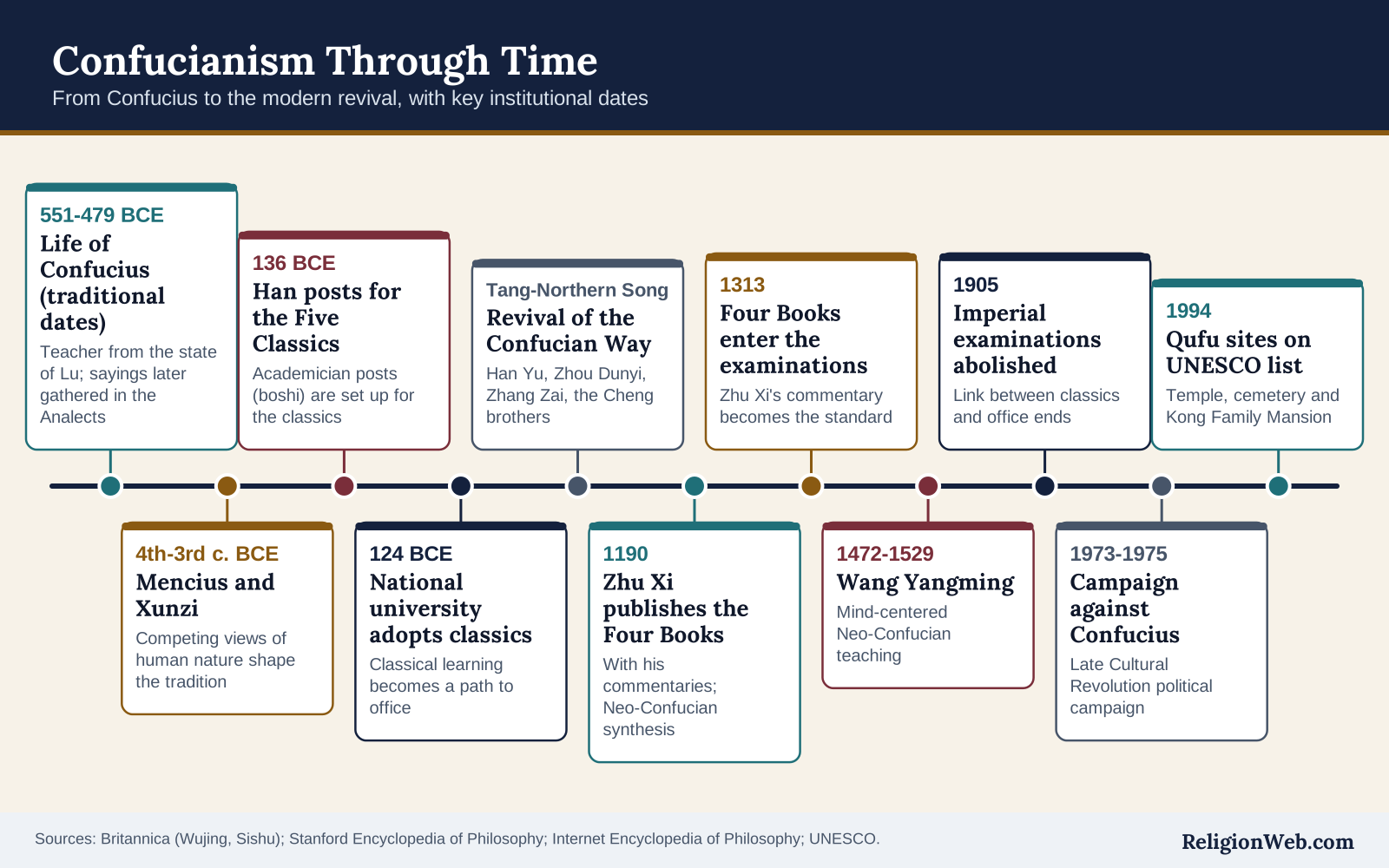
The Qin dynasty unified China in 221 BCE and, according to later historians, suppressed rival learning; the burning of books in 213 BCE is traditionally blamed for the loss of the Classic of Music. The Han dynasty that followed adopted a very different policy toward Confucian learning. Britannica states that in 136 BCE Emperor Wu declared Confucianism the state ideology and set up academician posts (boshi) for the Five Classics, and that in 124 BCE the national university adopted them as its core curriculum. Modern historians caution that the shift was gradual and that Han rule drew on several intellectual traditions, but the institutional result was lasting: knowledge of the classics became a path to office.
The thinker most associated with this development is Dong Zhongshu (c. 179–c. 104 BCE), who proposed that the empire adopt Confucian learning as its unifying ideology and who developed a cosmology in which Heaven, earth, and humanity respond to one another. In that scheme, natural disasters could warn a ruler to examine his conduct, and Confucian scholars, as interpreters of such signs, served as a check on imperial power. The Han period also saw the growth of the commentarial tradition, and Han-era writings began to portray Confucius as an extraordinary, almost superhuman figure, which prepared the way for the state sacrifices to him that are documented from the Tang dynasty onward.
Reconstruction Through Neo-Confucianism and Its Spread
The Tang-Song revival and Zhu Xi
From roughly the third to the ninth centuries CE, Buddhism and Daoism attracted much of China’s religious and intellectual energy. Writers of the Tang dynasty such as Han Yu (768–824) argued for reviving the Confucian Way, and in the eleventh-century Northern Song a group of thinkers, including Zhou Dunyi (1017–1073), Zhang Zai (1020–1077), and the brothers Cheng Hao (1032–1085) and Cheng Yi (1033–1107), developed a new Confucian metaphysics. The Internet Encyclopedia of Philosophy notes that these Neo-Confucians were prompted by Buddhist and Daoist thought but drew their key concepts mainly from the classical Confucian repertoire.
The great systematizer was Zhu Xi (1130–1200). He grouped four texts (the Great Learning, the Analects, the Mencius, and the Doctrine of the Mean) as the Four Books and published them with his commentaries in 1190. He taught that every thing has an underlying pattern or principle (li, a different word and character from ritual li) and is composed of vital stuff (qi), and that people become sages by reverent attention and by investigating things (gewu). A competing current, associated with Lu Xiangshan (1139–1193) and later Wang Yangming (1472–1529), located principle in the mind-heart itself and stressed the unity of knowing and acting.
Ming, Qing, and the transmission to Korea, Japan, and Vietnam
Zhu Xi’s edition of the Four Books became the basis of the civil-service examinations under the Yuan dynasty, and the school of thought known as Cheng-Zhu orthodoxy shaped Chinese education until the early twentieth century. The Ming period (1368–1644) saw Wang Yangming’s influential alternative, and after the Manchu conquest of 1644 the Qing scholars of “evidential research” (kaozheng) turned toward philology and criticized both Zhu and Wang for importing ideas they considered tainted by Buddhism and Daoism.
Neo-Confucianism spread widely. Korea’s Joseon dynasty adopted Zhu Xi’s learning as its orthodoxy and produced its own thinkers, including Yi Hwang (Toegye, 1501–1570) and Yi I (Yulgok, sixteenth century), whose “Four-Seven Debate” explored the relationship between moral feelings and the underlying principle. Japanese scholars of the Tokugawa period (1603–1868) wrote on Zhu Xi and Wang Yangming and applied them to local questions. In Vietnam, Neo-Confucian learning entered court and examination life, though specialists note that the history of its reception remains less studied than the Chinese, Korean, and Japanese cases.
Crisis and Reinvention Since the Nineteenth Century
The end of the examinations and the question of a Confucian church
Defeat in wars with Western powers and Japan in the nineteenth century led many Chinese reformers to question whether Confucian learning could prepare the country for modern challenges. The imperial examination system was abolished in 1905, cutting the formal link between the classics and a career in government. The reformer Kang Youwei (1858–1927) argued in Confucius as a Reformer (1897) that Confucius had been an innovator who favored change, and he called for a reformed Confucian institution that could give people spiritual guidance, an effort associated with the term Kongjiao. Critics said he was using Confucius to advance his own program, and the Qing dynasty ended in 1912 before any such institution could take hold.
In the early twentieth century, intellectuals in the New Culture and May Fourth movements often blamed Confucian family and political norms for China’s weakness, while others sought to reinterpret the tradition for a modern age. The latter effort produced what is called New Confucianism, with thinkers such as Mou Zongsan (1909–1995) and, later, Tu Weiming, who argued that Confucian moral philosophy remained a living resource.
Political campaigns and later revival
The tradition’s fortunes in mainland China were shaped by twentieth-century politics. During the Cultural Revolution, a campaign to “Criticize Lin Biao and Criticize Confucius” ran from 1973 to 1975, presenting Confucian thought as reactionary and praising the Legalists; historians note that the campaign was largely a vehicle for political struggles among party leaders. Since the 1980s, Confucian studies, temple restorations, and public celebrations of Confucius’s birthday have returned in mainland China, Taiwan, and elsewhere. How the state, scholars, religious practitioners, and ordinary families understand this revival differs widely, and a later section takes it up.
| Period | Approximate dates | Key development |
|---|---|---|
| Zhou and Spring and Autumn | c. 1046–481 BCE | Mandate of Heaven, ritual and music, lineage sacrifices; traditional life of Confucius (551–479 BCE) |
| Warring States | 403–221 BCE | Mencius, Xunzi, and the first debates over human nature, ritual, and government |
| Qin and Han | 221 BCE–220 CE | Burning of books (213 BCE); academician posts for the Five Classics (136 BCE); national university (124 BCE); Dong Zhongshu |
| Tang and Northern Song | 618–1127 | Calls to revive the Confucian Way; Zhou Dunyi, Zhang Zai, the Cheng brothers |
| Southern Song | 1127–1279 | Zhu Xi (1130–1200) publishes the Four Books with commentary (1190); rival views of Lu Xiangshan |
| Yuan and Ming | 1271–1644 | Four Books and Zhu Xi’s commentary become the examination syllabus (1313); Wang Yangming (1472–1529) |
| Qing | 1644–1912 | Evidential research; examinations abolished in 1905; Kang Youwei’s reform proposals |
| Modern era | 1912–present | May Fourth critique; New Confucianism; campaign of 1973–75; temple restorations and academic revival |
Core Beliefs and Concepts: Ren, Li, Yi, Filial Piety, and Heaven
The Core Virtues
Ren: humaneness as the root virtue
No concept is more closely tied to Confucius than ren (仁). The word is variously rendered as humaneness, benevolence, goodness, or “authoritative conduct,” and the variety of translations reflects a real feature of the Analects: Confucius never gives one fixed definition. He answers different students differently, depending on their character and circumstances. In one famous reply he says, in effect, that ren is to love people. In others it appears as a demanding condition of the whole person, something a disciple might approach but should not claim to have completed. Scholars summarizing the text describe ren as care for others that is grounded in family and ritual relationships rather than in abstract benevolence toward humanity at large.
The Legge translation of the Analects, which is in the public domain, renders a key passage on ren this way, in a reply to a student who asked about the virtue:
To subdue one’s self and return to propriety, is perfect virtue.
Analects, Book XII, chapter I, trans. James Legge (Standard Ebooks edition)
Here Legge’s “perfect virtue” translates ren, and “propriety” translates li. Interpreters have read the sentence in more than one way. Zhu Xi’s commentary, which shaped Neo-Confucian reading for centuries, takes “self” to mean selfish desires that cloud a person’s original moral nature, so that practicing ren means overcoming them and returning to the pattern of ritual that expresses Heaven’s order. Other commentators and modern readers emphasize instead the discipline of the self through ritual forms, without suggesting that the self itself is the problem. The disagreement is a good example of how an early, compressed saying becomes the starting point for centuries of philosophical argument.
Li: ritual propriety and the shaping of feeling
Li (禮) refers to ritual in the widest sense: sacrifices to ancestors and spirits, court ceremonies, weddings, funerals, coming-of-age rites, and also the manners of everyday life, such as how to greet a teacher or serve a guest. Confucius cared about li because he thought forms of conduct train the emotions and make shared life possible. The Stanford Encyclopedia of Philosophy notes that for Confucius the value of ritual lies in the performer’s inner state, especially reverence (jing), and that the Analects criticizes ritual performed without sincerity. A funeral without grief or a sacrifice without reverence, in this view, is an empty shell.
The relationship between li and ren is a central puzzle of the tradition. Some readings treat ren as the inner quality and li as its outward form. Others stress that ritual is how ren becomes real, since a person cannot be humane in a vacuum. Xunzi gave ritual an especially large role, arguing that the sages created it to regulate desire and shape character. Neo-Confucian writers such as Zhu Xi tied li to the natural pattern of heaven and earth, which gave household and state ritual a cosmic dimension. Because ritual behavior is one of the best-documented parts of living Confucian practice, a later section describes it in detail.
Yi, zhi, xin, and the other virtues
Several further virtues round out the picture. Yi (義), usually translated rightness or righteousness, names the sense of what is fitting and fair, especially the willingness to refuse profit gained by wrongdoing. Zhi (智) is wisdom, the ability to judge people and situations accurately. Xin (信) is trustworthiness, the reliability that lets others depend on one’s word. Zhong (忠) is loyalty or wholehearted devotion, and shu (恕) is reciprocity or considerateness, the habit of treating others as one would want to be treated. Mencius spoke of four innate “sprouts” of virtue (ren, yi, li, and zhi), and later tradition, from the Han period onward, often grouped ren, yi, li, zhi, and xin as the five constant virtues.
The Analects preserves a saying on reciprocity that Confucian teachers have long treated as a practical summary of the moral life. When a student asked whether a single word could guide conduct through a whole life, Confucius offered shu and explained it this way:
What you do not want done to yourself, do not do to others.
Analects, Book XV, chapter XXIII, trans. James Legge (Standard Ebooks edition)
In the tradition’s own reading, shu is not a rule to be applied mechanically. It is an exercise of imagination, in which a person uses their own feelings as a guide to what others might need or fear, within the framework of the roles and rituals that structure relationships. A son, a ruler, and a friend each owe different things, and reciprocity means attending to those differences. Another passage in the Analects has a disciple describe the Master’s way as loyalty and reciprocity, a pairing that later teachers treated as a thread running through all his teaching.
Relationships, Family, and Filial Piety
The five relationships and role-based ethics
Confucian ethics begins with relationships rather than with isolated individuals. The classical formula, found in the Mencius and elaborated in later writings, names five basic relationships: ruler and minister, parent and child, husband and wife, older and younger sibling, and friend and friend. Four of the five are asymmetrical, and each carries paired duties. The text of the Analects illustrates the idea in a conversation in which a ruler asks about government:
There is government, when the prince is prince, and the minister is minister; when the father is father, and the son is son.
Analects, Book XII, chapter XI, trans. James Legge (Standard Ebooks edition)
The saying is connected to a doctrine called the rectification of names (zhengming), the idea that a role-name such as “father” or “prince” carries obligations, and social order depends on people actually living up to their names. It has been read in two directions. Conservative interpreters, especially in imperial times, used it to support hierarchy and deference. Others point out that the obligations run both ways: a father who does not act as a father, or a ruler who does not rule with virtue, fails the standard that gives the title meaning. Mencius is often read as holding that a ruler who loses Heaven’s favor forfeits legitimacy, although scholars caution against overstating how far he supports popular rebellion.
Xiao: filial piety in the Analects and after
Xiao (孝), filial piety, is the virtue of children toward parents and, by extension, of descendants toward ancestors. In the Analects it is not mere obedience to commands. Britannica’s summary of the text points to a saying that even dogs and horses are provided for, so that xiao requires genuine respect and not only material support. Other passages say a child should remonstrate gently when a parent is in error, and they set out the practice of three years of mourning for a parent, a duty that later ritual manuals treated at length. The Classic of Filial Piety (Xiaojing), presented as a conversation between Confucius and a student and thought to date from at least the last years of the Zhou, built the idea into a program that extended from the family to service of the ruler and the state.
Filial piety is also tied to religious practice, since duty to parents continues after death through ancestral offerings. Pew’s analysis of East Asian Social Survey data from 2016 to 2018 found that 88 percent of Chinese respondents agreed children must try to bring honor to their parents, and 84 percent agreed fathers should be respected in all circumstances. Whether this reflects blind deference or a more reflective sense of duty is something Confucian teachers and modern critics both debate, and a later section on misconceptions takes up the question directly.
Heaven, Spirits, and the Question of the Transcendent
Tian, the Way, and the moral order
Heaven (tian, 天) is the most important term for understanding the religious dimension of Confucian thought, and it is also among the most debated. In early Zhou usage, Heaven was a powerful, quasi-personal authority that granted and withdrew the right to rule. In the Analects, Confucius speaks of Heaven as a source of moral meaning: he sometimes expresses confidence that Heaven understands and protects his mission, and at other points cries out that Heaven has abandoned him. The Internet Encyclopedia of Philosophy summarizes the picture as one in which Heaven aligns with moral order but depends on human effort to carry out its aims. A well-known saying offers a restrained, almost naturalistic image of how Heaven acts:
Does Heaven speak? The four seasons pursue their courses, and all things are continually being produced, but does Heaven say anything?
Analects, Book XVII, chapter XIX, trans. James Legge (Standard Ebooks edition)
Interpretations differ. Some readers hear in the passage a Heaven that works silently through the cycles of nature and the unfolding of life, which would suit later Neo-Confucian cosmology, where Heaven and pattern (li) are closely linked. Others emphasize that the saying is about moral example: Heaven teaches without words, so the Master need not either. Xunzi took the most naturalistic route and treated Heaven as a regular natural process unconcerned with human morality, while the Han thinker Dong Zhongshu developed the opposite idea of a Heaven that responds to rulers’ conduct with portents. The Way (dao, 道) is the path of right conduct that the cultivated person follows, a word that Confucians share with Daoist writers but use with a primarily moral and social emphasis.
Ghosts, ancestors, and sacrifice
The Analects also shows Confucius as unusually reserved about the spirit world while continuing to take ritual duties toward spirits seriously. He declines to speculate about death and the afterlife, and he advises that one should respect spirits yet keep a certain distance. This reserve has led some readers to describe the early Confucian tradition as humanist or agnostic, while others point out that he never denied the spirits’ reality and consistently upheld sacrifices to them. The Stanford Encyclopedia suggests that one such passage is better read as advice on the proper stance of a person toward spirits than as a denial of them.
In practice, the tradition developed a distinctive way of thinking about the dead. Ancestors are honored through offerings of food, drink, and incense, and the Confucian classics describe these acts as expressions of gratitude, memory, and continuity of the family line. Whether ancestors continue as conscious beings who receive the offerings, or whether the rites primarily cultivate the descendants’ moral feelings, is a question on which Confucian writers have held a range of views. Xunzi, for instance, treated funeral and sacrificial rites as beautiful expressions of human feeling rather than as dealings with literal spirits. A later section on ritual returns to this variety of interpretation.
Human Nature, Learning, and the Path to Sagehood
Competing views of human nature and Neo-Confucian metaphysics
Confucian writers disagree about what human beings are like at the start, and the disagreement shapes their accounts of education. Mencius held that human nature has a good tendency that must be nourished; Xunzi held that raw desires must be reshaped by teachers and ritual. Neo-Confucians brought the debate into a new metaphysical framework. Zhu Xi taught that every person’s nature is, at root, pattern (li), which is good, but that it is embodied in vital stuff (qi) that can be clear or turbid, which explains why people differ in moral quality. Wang Yangming rejected the idea that one needs to study the pattern in external things first, and he taught that the mind-heart already has an innate, pure knowing (liangzhi) that must be put into action.
These positions are often labeled the Cheng-Zhu school (the teaching of principle) and the Lu-Wang school (the teaching of the mind-heart). Both claimed to be restoring the true teaching of the ancient sages, and both drew on classical Confucian texts. Neither is regarded as heterodox within Confucian history, though at different times the state favored one over the other, as the later section on branches and schools explains.
Learning as lifelong self-cultivation, and a table of key terms
The Analects presents the moral life as a process of study and self-cultivation that lasts a lifetime. In a famous passage, Confucius sketches his own stages: at fifteen his mind was bent on learning, and, according to the Legge translation, by seventy he could follow what his heart desired without transgressing what was right. The ideal is not rule-following but an educated spontaneity in which feeling and ritual form have grown together. For later writers the goal was sagehood (sheng), a condition that Neo-Confucians treated as in principle available to anyone, although most thought it difficult to reach.
The practices of cultivation include reading and reciting the classics, reflection on one’s conduct, attentiveness to ritual detail, and, in Neo-Confucian circles, techniques such as “quiet-sitting” and the cultivation of reverent mindfulness (jing). The table below gathers the principal terms used throughout this article.
| Term | Characters | Common translations | Core idea |
|---|---|---|---|
| Ren | 仁 | Humaneness, benevolence, goodness | Care for others, expressed in the whole person’s conduct |
| Li (ritual) | 禮 | Ritual propriety, etiquette, rites | Forms of conduct that train feeling and structure relationships |
| Yi | 義 | Rightness, righteousness | Doing what is fitting, even at cost to self-interest |
| Xiao | 孝 | Filial piety | Reverence and care for parents and ancestors |
| Junzi | 君子 | Gentleman, exemplary person | The morally cultivated person who pursues the Way |
| De | 德 | Virtue, moral power | The moral authority that influences others, especially in a ruler |
| Tian | 天 | Heaven | The ultimate source of moral order and political legitimacy |
| Dao | 道 | The Way | The path of right living and good government |
| Li (pattern), qi | 理, 氣 | Principle or pattern; vital stuff | Neo-Confucian terms for the structure and the material of all things |
Confucius, His Disciples, and Later Teachers
Confucius as Teacher and Model
The historical figure and the traditional image
Confucius appears in the sources in at least two guises. The first is the teacher of the Analects, who is warm, ironic, sometimes impatient, devoted to learning, and capable of grief. He describes himself as a transmitter rather than an innovator, says he loves the ancients, and is reluctant to accept the title of sage. The second is the figure of later tradition: an uncrowned king, a master editor of the classics, and eventually an object of state sacrifice. Historians distinguish the two. Almost everything known about Confucius derives from texts composed decades to centuries after his death, mostly during the Warring States period, and the traditional claim that he wrote or edited the Five Classics is not supported in this form by modern scholarship.
What the sources agree on is the center of his teaching: moral self-cultivation through learning and ritual, family duty extended into public service, and the conviction that good government depends on the character of rulers rather than on laws and punishments alone. He also admired earlier exemplars, notably the Duke of Zhou, whom tradition credits with shaping Zhou ritual, and the legendary sage-kings Yao and Shun, who figure prominently in Mencius’s writings.
Honors, titles, and the temple tradition
Reverence for Confucius became institutional over time. The Internet Encyclopedia of Philosophy notes that Han-era writings depicted him as a superhuman figure and that state-sponsored sacrifices to him continued from the Tang period onward. The Temple of Confucius in Qufu, whose first structure is traditionally dated to 478 BCE, the year after his death, was repeatedly rebuilt and expanded by emperors. UNESCO, in its description of the Qufu site, which was inscribed in 1994, records that Chinese emperors honored him as the “Sacred Model Teacher for Ten Thousand Generations.” The temple precinct now includes 104 buildings dating from the Jin to the Qing dynasties, while the nearby cemetery holds his tomb and the graves of more than 100,000 of his descendants.
It is worth stressing what the veneration of Confucius is, in the tradition’s own terms. Official honors treated him as a supreme teacher and model for humanity, not as a creator god or a divine savior. In temples he is typically represented by a tablet or an image of a seated scholar, and the offerings are of the kind made to venerated ancestors and teachers. How far ordinary people regard him as a spiritual being who can answer prayers varies by region, as Pew’s findings in Taiwan, discussed later, illustrate.
Disciples and Transmitters
The first generations after Confucius
The Analects mentions many students by name, and a few stand out. Yan Hui, whom Confucius praised above the rest and who died young, is remembered as the model of devoted learning; the Master’s grief at his death is among the most affecting passages in the book. Zengzi is named by Britannica as a principal source for the preservation of the sayings and is credited by later tradition with transmitting the Great Learning. Other disciples are remembered for administrative skill, eloquence, or particular virtues. Together they show that the earliest Confucian community was a circle of learners with different talents, not a uniform school.
The century after Confucius saw competing interpretations by the students of his students. Two lines became most influential. One, which later tradition traced from Confucius’s grandson Zisi to Mencius, emphasized the goodness of human nature; the other is associated with Xunzi. The Mencius survives in seven books, which tradition says were compiled by his disciples, and the text we have was edited by the commentator Zhao Qi in the second century CE. Xunzi’s writings survive through a compilation made by the Han scholar Liu Xiang (79–8 BCE). Their contrasting views on human nature, discussed above, are part of the shared inheritance of the whole tradition.
Song, Ming, and Korean masters
In the Song dynasty a new group of teachers reshaped Confucian thought. Zhu Xi systematized it, Lu Xiangshan challenged him, and Wang Yangming in the Ming took the challenge further. Their teaching spread across East Asia: Yi Hwang (Toegye) and Yi I (Yulgok) in Korea carried the debate about principle and material force into a long tradition of Korean Neo-Confucian scholarship, and Japanese thinkers such as Kaibara Ekken (1630–1714) offered practical guidance for daily life based on revised readings of Zhu Xi. The seowon, Korean Neo-Confucian academies, honored such teachers through rites at their shrines; nine of them were inscribed on the UNESCO World Heritage List in 2019.
The following table lists major figures with their usual dates and the contribution for which each is best known.
| Figure | Dates | Contribution |
|---|---|---|
| Confucius (Kongzi) | Traditionally 551–479 BCE | Teacher whose sayings form the Analects; emphasis on ren, li, learning, and virtuous government |
| Mencius (Mengzi) | Traditionally 372–289 BCE | Argued human nature is good; developed ideas of benevolent government and Heaven’s mandate |
| Xunzi | c. 310–220 BCE | Argued goodness is cultivated through teachers and ritual; naturalistic view of Heaven |
| Dong Zhongshu | c. 179–c. 104 BCE | Advocated Confucian learning as imperial ideology; correlative cosmology of Heaven and humanity |
| Han Yu | 768–824 | Tang writer who urged reviving the Confucian Way |
| Zhu Xi | 1130–1200 | Systematized Neo-Confucianism; edited the Four Books; credited with the Family Rituals manual |
| Wang Yangming | 1472–1529 | Taught the unity of knowing and acting and innate knowing of the good |
| Yi Hwang (Toegye) | 1501–1570 | Korean Neo-Confucian; central figure in the Four-Seven Debate |
| Kang Youwei | 1858–1927 | Reformer who portrayed Confucius as a reformer and proposed a Confucian religious institution |
| Mou Zongsan | 1909–1995 | New Confucian philosopher who regarded Wang Yangming’s line as especially deep |
Sacred Texts, Canon, and Authority: The Analects, Four Books, and Five Classics
The Classical Canon
The Five Classics
The oldest layer of the Confucian canon is the Five Classics (Wujing): the Classic of Changes (Yijing), the Classic of History or Documents (Shujing), the Classic of Poetry (Shijing), the Record of Rites (Liji), and the Spring and Autumn Annals (Chunqiu). They are older than Confucius in their materials, though they reached their present forms over a long period, and tradition associated all five with him as editor, transmitter, or teacher. Modern scholars doubt that he edited them in any literal sense, but the association explains why they became the foundation of Confucian learning. Britannica notes that several Han historians, including Sima Qian and Ban Gu, speak of an original set of six, the sixth being a Classic of Music that was lost, possibly in the Qin burning of books in 213 BCE.
The Five Classics gained official standing under the Han. According to Britannica, doctoral chairs (boshi) were established in 136 BCE to teach them, the national university adopted them as its core curriculum in 124 BCE, and officials seeking government posts had to show skill in interpreting them. For about two thousand years the collection served as a standard for Chinese society, law, government, education, and literature. Each had a different character. The Changes is a divination text with commentaries that became a vehicle for cosmology; the Documents records speeches and announcements of ancient rulers; the Poetry is an anthology of songs; the Rites collects ritual regulations and essays; and the Annals is a terse chronicle of the state of Lu, read for its moral judgments.
The Four Books
In the Song dynasty the center of gravity shifted to a shorter group of texts. Zhu Xi selected the Great Learning (Daxue), the Analects (Lunyu), the Mencius (Mengzi), and the Doctrine of the Mean (Zhongyong) as the Four Books (Sishu) and published them with his commentaries in 1190. Britannica explains that the Great Learning and the Doctrine of the Mean were excerpted from the Record of Rites; the first is a short treatise connecting good government to the personal integrity of rulers, and the second is more abstract, addressing the Way of Heaven, spiritual beings, and sacrifices. Students traditionally began with the Four Books and then moved on to the longer Five Classics.
The Four Books became the core of the civil-service curriculum. Britannica gives 1313 to 1905 as the period when they were official examination subjects, and adds that from 1415 knowledge of Zhu Xi’s commentaries was essential for success. The decision to place a philosopher’s own selection and interpretation at the center of the state curriculum was far-reaching; it meant that for centuries the Neo-Confucian reading of the tradition was the one most educated people in China absorbed first. In Korea and Japan, Zhu Xi’s editions had a comparable influence on learning.
The Analects and Its Formation
Structure and compilation
The Analects is a short book of twenty chapters (often called “books”), made up of brief sayings and conversations that begin with “The Master said” or with a student’s question. It has no continuous argument or narrative. Some chapters are tightly focused on learning, others on ritual, government, or the character of particular students. The traditional view, going back to the Han scholar Ban Gu (39–92 CE), is that Confucius’s first- and second-generation disciples compiled it. In 1986 the historian Zhu Weizheng argued that the text is not clearly attested before the second century BCE, and later researchers have shown that interest in it grew mainly in the late second and first centuries BCE.
Excavated manuscripts have complicated the picture. The Stanford Encyclopedia of Philosophy mentions bamboo-strip texts from Dingzhou (dated to 55 BCE) and other finds that point to a larger body of Confucius-related sayings from which the received Analects may be a selection. If so, the “core” teachings of Confucius are historically underdetermined: readers can say what the Analects presents, and what later tradition made of it, but not always what Confucius himself said. For the purposes of a religious and cultural history, both the book as received and the debate about its layers matter, because it is the received text that Chinese, Korean, Japanese, and Vietnamese readers studied.
Reading with commentary
No traditional student read the Analects alone. Han and later commentators supplied glosses, and from the Song onward Zhu Xi’s commentary framed the book in the light of Neo-Confucian metaphysics. The same sentence could carry different meanings depending on the commentary one followed, as with the saying about subduing the self and returning to ritual quoted earlier. Modern readers often start with translations. The English version by James Legge, first published in 1861 as part of his Chinese Classics, is in the public domain and is the one quoted in this article; later translators have made different choices on key terms, which is why the same passage appears in modern books with different vocabulary.
The Analects is also read devotionally in a limited sense. Students recite it, teachers use it as a moral text, and passages are copied as calligraphy or displayed in classrooms and temples. In traditional schools children memorized the Four Books before they could fully understand them, on the expectation that the text would ripen with experience. This habit of memorization and repeated return, rather than doctrinal assent, is the usual way that the text exercises authority.
Authority, Interpretation, and the Idea of Scripture
Is there a Confucian scripture?
Confucian texts differ from the scriptures of many religious traditions in not being presented as divine revelation. Their authority rests on the wisdom of the ancient sages and on the continuing judgment of learned interpreters. The word for “classic” (jing) marks a text as a standard rather than a revelation. This does not make the texts merely literary. Because rulers sponsored them, schools taught them, and families used them to guide ritual, they functioned as normative texts in a way that resembles scripture in other traditions, and some modern scholars therefore use the word “scripture” with that qualification while others prefer “classics.”
Authority within the tradition has been exercised through several channels at once. The state set the examination syllabus and sponsored official commentaries. Teachers and academies formed lineages that transmitted particular readings, as in the Cheng-Zhu and Lu-Wang schools. Families preserved ritual manuals and genealogies. At no point was there a council or office that could declare doctrine for all Confucians, which helps explain why disagreements, such as those between Mencius and Xunzi, persisted for centuries without schism.
Beyond the canon: ritual manuals and Neo-Confucian anthologies
Several texts that are not part of the canon proper shaped Confucian life as much as the classics did. The Classic of Filial Piety (Xiaojing), a dialogue between Confucius and a student, is thought to date from at least the closing years of the Zhou and was long grouped with the classics in importance. Zhu Xi compiled or edited anthologies such as Reflections on Things at Hand, which distilled the thought of Northern Song masters for students. The ritual manual associated with his name, Family Rituals (Jiali), is described by Patricia Ebrey, who translated it, as a twelfth-century manual for performing cappings, weddings, funerals, and ancestral rites at home. It was quickly accepted as an authority by the state, by the educated elite, and by many ordinary people in China, and it was respected in Vietnam, Korea, and Japan.
The table below summarizes the principal texts, their type, and their role in the tradition.
| Text | Type | Content | Role in the tradition |
|---|---|---|---|
| Analects (Lunyu) | Sayings and conversations | Teachings and conversations of Confucius with students and rulers | First Confucian text most students read; one of the Four Books |
| Mencius (Mengzi) | Dialogues and essays | Human nature, benevolent government, moral cultivation; seven books | One of the Four Books; basis of the Mencian line of interpretation |
| Great Learning (Daxue) | Short treatise | Sequence from self-cultivation to family order and good government | Excerpted from the Record of Rites; one of the Four Books |
| Doctrine of the Mean (Zhongyong) | Short treatise | Sincerity, balance, and the Way of Heaven | Excerpted from the Record of Rites; one of the Four Books |
| Classic of Changes (Yijing) | Divination text with commentaries | Hexagrams and interpretive essays used for cosmology and ethics | First of the Five Classics in many lists |
| Classic of History (Shujing) | Documents | Speeches and announcements attributed to ancient rulers | Source for ideals of kingship and the Mandate of Heaven |
| Classic of Poetry (Shijing) | Anthology of songs | Court hymns, ritual songs, and folk songs | Studied for moral and literary education |
| Record of Rites (Liji) | Collection of ritual essays | Rules, explanations, and ideals of ritual | Major source for later ritual practice and for the Great Learning and Mean |
| Spring and Autumn Annals (Chunqiu) | Chronicle of the state of Lu | Terse annals read for moral judgment | Studied through commentaries; basis for ideas of right and wrong in politics |
| Classic of Filial Piety (Xiaojing) | Dialogue | Filial piety extended from family to state | Elementary text widely used in education |
| Family Rituals (Jiali) | Ritual manual | Cappings, weddings, funerals, and ancestral rites | Standard household ritual guide in China, Korea, Vietnam, and Japan |
Education, the Examination System, and Confucian Governance
Learning as a Moral Project
Teachers, schools, and academies
Confucian tradition treats education as the main instrument of moral change. Confucius himself was above all a teacher, and the early tradition produced a pattern in which a student attaches himself to a teacher, studies the classics, and is held responsible for his own character as well as his knowledge. Over the centuries this pattern grew into formal institutions: local schools, the state university in the capital, private academies founded by famous scholars, and, in Korea, the seowon, Neo-Confucian academies set up near mountains and streams that combined teaching with the veneration of past scholars. UNESCO inscribed nine seowon on the World Heritage List in 2019.
Education in this tradition has an ethical rather than purely vocational aim. The Great Learning describes a sequence beginning with the investigation of things and the extending of knowledge, moving through sincerity of intention and the rectification of the mind, and arriving at the cultivation of the person, the ordering of the family, the governing of the state, and peace in the world. The sequence makes self-cultivation the root of public life, and it is one reason that Confucian moral teaching has always been inseparable from the question of who should hold power.
The family as school
Before any formal school came the household. Confucian writers regarded the family as the first and most important place of moral education, where children learned reverence by serving and caring for parents and elders. Ritual practice in the home, such as greeting ancestors, observing mourning, or setting out offerings, taught children the forms of respect through repetition. This is one reason that Confucian ideas could survive the loss of formal institutions: they were embedded in daily routines that did not depend on a temple or an academy.
The Imperial Examinations
How the civil-service system worked
The institution that most tightly connected Confucian learning to public life was the imperial examination system. Britannica traces its roots to the imperial university established under the Han and notes that it came to dominate education from the Song dynasty (960–1279) onward. Candidates sat competitive examinations at prefectural, provincial, and national levels, and the tests dealt mainly with Confucian texts. Passing the highest examination brought the title jinshi and the prospect of high office; Zhu Xi himself earned that degree at nineteen. Under the Yuan dynasty, the system was officially promulgated in 1313, and the papers were based on the Four Books and answered according to Zhu Xi’s commentary.
Britannica’s summary notes that the examinations tended to reward rote learning and form over original thinking, a criticism made by many Chinese reformers, and also that they produced an elite with shared teachings and lent credibility to claims of meritocracy. In the nineteenth century, officials and reformers concluded that the system was too inflexible for modern needs, and the examinations were abolished in 1905.
What the system meant socially
For Chinese society the examination system had effects that went far beyond schooling. Families invested in sons’ education, lineage organizations established schools and endowments to support candidates, and local communities celebrated the success of their members. It created a class of scholar-officials whose identity was bound up with the classics. It also created sharp tensions. The Yuan quota system, for example, divided candidates into two lists that favored Mongols and Central and West Asian officials over Han and Southern Chinese. The system exerted influence beyond China, too: Korea and Japan adopted versions of Confucian-style education and examinations.
Governance: Virtue, Remonstrance, and the Ruler
Government by virtue
Confucian political thought starts from the conviction that rulers are models and that people follow example. In the Analects Confucius says that one who governs by means of virtue is like the pole star, which keeps its place while the other stars turn toward it, an image that Legge’s translation develops in the first chapters of Book II. In a related passage he contrasts governing by laws and punishments, which may make people avoid wrongdoing without developing a sense of shame, with governing by virtue and ritual, which can lead them to correct themselves. The point is not that laws are unnecessary, but that moral example and ritual form are the stronger foundation of order.
Mencius pressed the point further and argued that rulers must secure the livelihood of the people, with enough food and protection from violence, before they can expect virtue from them. He proposed a “well-field” system of land and taxation and taught that rulers who fail the people lose the Mandate of Heaven. Scholars debate how far Mencius supports a right of rebellion, but the idea that political authority is conditional on benevolent rule has been a lasting part of Confucian thought.
Remonstrance and the scholar-official
The ideal Confucian minister serves loyally but is expected to speak against policies he judges wrong, a duty known as remonstrance. Dong Zhongshu’s Han-era cosmology gave this role a formal basis: Heaven sends portents when a ruler goes astray, and scholars who interpret them serve as a check on the throne. In practice, remonstrance was risky, and some officials were dismissed, punished, or killed for speaking out; the tradition also celebrates those who did so anyway. The record is mixed, as one would expect: Confucian language was used both to restrain emperors and to justify obedience, and historians differ on which function predominated in a given era.
Confucian political ideals also encountered limits. Rulers often used Confucian vocabulary to legitimize authority without accepting the moral constraints that Confucian teachers urged, and scholars sometimes faced real danger when their principles conflicted with imperial interest. Understanding Confucian governance means holding both facts in view: a rich ethical tradition of restraint on power, and a long history of institutional compromise.
Ritual, Ancestor Rites, and Temple Practice: How and Why
Family Ritual: Life Cycle and the Home
Capping, weddings, and the household
Confucian ritual begins at home. Zhu Xi’s Family Rituals, the most influential manual of domestic rites in East Asia, gathers four ceremonies: the capping that marks the passage to adulthood, the wedding, the funeral, and the sacrifices to ancestors. Patricia Ebrey, who translated the manual, notes that Zhu Xi presented it as an openly Confucian program, written to provide an alternative to Buddhist and other non-Confucian practices that families had been using, and that it was quickly accepted as a standard by the state, the educated elite, and many ordinary people. In its pages the participants are family members, ranked by generation and kinship, and the officiant is usually the senior male of the household or lineage branch, although the actual roles of women and of local custom varied widely.
The capping ritual, in classical and Neo-Confucian descriptions, marks a young person’s entry into adult responsibility; the person receives a cap or hairpin, a courtesy name, and instruction from elders about adult obligations. The wedding rite follows a sequence of stages that classical texts describe as moving from the exchange of proposals and betrothal gifts to the bride’s reception in the groom’s home and her formal presentation to his family. The meaning of these steps is social as well as ceremonial: marriage in the Confucian tradition joins two families and creates the possibility of future generations to honor the ancestors. Modern practice varies enormously. Many families in East Asia hold a contemporary wedding with a few traditional elements, such as bowing to parents or setting out offerings, and communities in Indonesia and Taiwan that identify strongly with Confucianism may organize more formal rites.
Mourning and funerals
Funerals are the ritual in which Confucian teaching on filial piety is most clearly on display. The Analects records an extended discussion of the three-year mourning period for a parent, and the classical ritual texts regulate mourning dress, diet, and behavior according to the closeness of the relationship to the deceased. The sequence in the manuals includes preparation of the body, the placing of the deceased’s name on a spirit tablet, the offering of food and drink, the burial, and a series of later sacrifices at set intervals. Ritual experts distinguished different grades of mourning, from the longest and most austere for a parent to shorter periods for more distant kin.
The reasons the tradition gives for these demands are partly ethical. Confucius is portrayed as holding that a child owes parents a period of care at least equal to the years they cared for the child as an infant, and that extended mourning is the natural expression of grief and gratitude. Critics in ancient times, including followers of other schools of thought, objected that the expense and austerity of long mourning were wasteful, and Confucian writers responded by arguing that ritual is how feeling is given form. In modern practice, the three-year period has largely been shortened, and many families observe elements, such as a period of simple dress, a series of memorial offerings on set days after the death, and annual commemoration, rather than the full classical regimen.
Ancestor Veneration
The altar, the tablet, and the offering
Ancestor veneration is probably the most widespread Confucian-linked practice today. In a typical home or lineage hall, the ancestors are represented by spirit tablets (shenzhu) or photographs placed on an altar or shelf. At appointed times, family members present offerings of food, tea or liquor, fruit, and incense, bow or kneel, and sometimes burn paper money, often called spirit money. In households that follow older forms, an elder reads a short announcement to the ancestors informing them of family events, such as a birth, a marriage, or an examination result. Afterwards, the food is often shared among the family, making the meal a communal event that includes the dead.
Pew Research Center’s 2023 surveys found these practices widespread in the societies it studied: in Taiwan, 86 percent of adults had taken part in at least one such activity, such as burning incense, offering food and drink, or burning spirit money, and in Japan, 85 percent. In Vietnam, 96 percent said they had burned incense to care for ancestors in the previous year. Pew describes these acts as understood by participants to fulfill duties to the deceased and to be considered necessary for the ancestors’ comfort in the afterlife, though the survey also notes that very few people describe themselves as Confucian. The practice is thus widely shared, in a Confucian register for some and in Buddhist, Daoist, or folk religious registers for others. The article on Chinese folk religion describes a related set of household and temple customs from that tradition’s own perspective.
The Analects offers a short description of the attitude the rites are meant to embody. Of Confucius’s own practice, the text says:
He sacrificed to the dead, as if they were present. He sacrificed to the spirits, as if the spirits were present.
Analects, Book III, chapter XII, trans. James Legge (Standard Ebooks edition)
The phrase “as if” has been read in two ways. Some interpreters, including many Neo-Confucian commentators, take it to describe the sincere state of mind required of the participant, whose reverence makes the ancestors’ presence real for the duration of the rite. Others, especially modern humanist readers, treat it as a statement that the ritual works through the participant’s imagination and feeling, without any requirement to hold a particular belief about the dead. Many families hold both attitudes in the same ceremony, and nothing in the rites requires choosing one.
Tomb visits, lineage halls, and what the rites mean
Visits to family graves are a second major form of ancestor rite. Participants clear weeds, tidy the grave, present offerings, bow, and in many places burn incense or paper offerings. Pew reports that most people with family gravesites visit at least once a year: 86 percent in Taiwan and 83 percent in Japan in 2023, and, according to a 2018 survey in China, about three-quarters of adults. These visits are often concentrated around particular holidays, which the calendar section describes. In many parts of China, wealthy families and lineages historically maintained ancestral halls with lists of ancestors and endowments to pay for regular sacrifices, creating a durable institution that tied branches of a family together across generations.
The meaning of the rites is plural. Within the tradition, writers emphasize gratitude to those who gave life and a sense of continuity with the past; the rites also teach descendants the habits of reverence, remembrance, and responsibility. Some participants believe the ancestors attend and can help or harm the living; others see the ceremony as commemoration. The Chinese Rites Controversy of the seventeenth and eighteenth centuries, in which Catholic missionaries and Chinese converts debated whether such rites were civil or religious, shows how long these interpretive questions have been alive, and the Catholic tradition’s own later position is treated in its own article.
Temple and State Ritual
Sacrifices to Confucius
The most formal Confucian rituals are the sacrifices offered to Confucius and other honored scholars in temples. The ceremony is known in Chinese as shidian, and Pew describes the Grand Ceremony of the Worship of Confucius as a roughly 2,000-year-old tradition in which participants in costume perform dances and present food and drink offerings, observed each year on Confucius’s birthday, September 28. The Temple of Confucius in Qufu is the best-known site; UNESCO notes that it was repeatedly destroyed and rebuilt and now covers about 14 hectares. Confucius temples also exist in Taiwan, Korea, Vietnam, Japan, and Chinese communities abroad.
The Korean version, the Seokjeon Daeje, is held twice a year at the Daeseongjeon hall of Sungkyunkwan in Seoul, an institution whose site dates to 1398. According to the Korea Culture and Information Service, it involves 64 musicians and 64 dancers, with the numbers set by the eight trigrams. Dancers face the four directions and perform precise gestures; officiants then present food and liquor to Confucius, four sages, ten disciples, and twenty-four men of virtue. Court music accompanies the procession, and participants avoid stepping on a central stone path reserved for honored spirits. The rite is said to have been performed without interruption since Sungkyunkwan was founded, an unusual continuity.
Royal ancestral rites and sacrifices to Heaven
Another form of state ritual honored the ancestors of dynasties. The Jongmyo Jerye in Seoul is a Confucian ritual honoring the ancestors of the Joseon dynasty, with an order that was largely fixed in the fifteenth century. UNESCO, which inscribed it on the Representative List of the Intangible Cultural Heritage of Humanity in 2008, describes a performance held annually on the first Sunday of May, organized by royal descendants, in which priests in ritual costume present food and wine, and sixty-four dancers in eight lines perform two dances that represent yang and yin. The ritual uses traditional instruments such as bells, zithers, and flutes.
In imperial China, emperors also performed sacrifices to Heaven and Earth, which Joseph Adler describes as loosely associated with Confucianism. These were state liturgies of the highest rank, centered on the emperor as the intermediary between Heaven and the people, and they came to an end with the empire. The state rituals show another side of the question of whether Confucianism is a religion: they were public, hierarchical, and tied to political legitimacy, in contrast to the private, family-centered rites of ancestors. The article on Shinto describes a different set of shrine and imperial rituals in Japan on that tradition’s own terms.
| Domain | Practice | Typical participants | Meaning within the tradition |
|---|---|---|---|
| Family | Capping, wedding, funeral (as set out in Family Rituals) | Family and lineage members, ranked by kinship | Marks life stages and binds generations through reverence |
| Ancestors | Offerings of food, drink, incense, and paper money at altar or tablet | Descendants, usually led by an elder | Gratitude, remembrance, and care for the dead |
| Graves | Tomb sweeping and grave offerings | Family groups, often on set holidays | Maintains the continuity of family memory |
| Temples | Sacrifices to Confucius and sages (shidian, Seokjeon Daeje) | Officiants, musicians, dancers, scholars, local communities | Honors the model teacher and the transmission of the Way |
| State | Royal ancestral rites (Jongmyo Jerye); historic sacrifices to Heaven and Earth | Rulers or their descendants, officials | Links political authority to Heaven and to the ancestors |
| Education | Study and recitation of the classics; academy ceremonies | Students, teachers, scholars | Forms moral character and prepares for service |
| Public life | Remonstrance; service as a scholar-official | Officials, advisers, local gentry | Puts cultivated virtue to work for the people |
Holy Days and the Confucian Calendar
Observances Connected to Confucius and the Sages
Confucius’s birthday on September 28
Confucian tradition has no weekly day of worship and no single liturgical calendar. Its most recognized date is Confucius’s birthday, observed on September 28. Pew notes that millions of people across East Asia and beyond celebrate it with ceremonies, and the Qufu temple is the most prominent site. The traditional date of Confucius’s birth is given according to the lunisolar calendar, and the September 28 convention is a modern fixing in the Gregorian calendar; in Taiwan the day is also associated with honoring teachers. A person attending a ceremony will usually see officiants in historical dress, a procession, offerings of food and drink before the tablet or image, the playing of ritual music, and carefully choreographed dances.
The meaning of the day depends on who observes it. For temple officials and scholars, it affirms the transmission of the Way and gratitude to the teacher of teachers. For many families and schoolchildren, it is a cultural holiday associated with education. For a smaller number of devout participants, particularly in temples that also house popular religious activity, it may involve prayers for success in study. Pew found that praying to or venerating Confucius is less common than praying to other figures: in Taiwan, 26 percent said they venerate Confucius, compared with 69 percent who pray to Guanyin and 46 percent who pray to the Buddha.
Seasonal sacrifices in spring and autumn
In Korea, the Seokjeon Daeje takes place twice a year, in spring and autumn, at Sungkyunkwan, as described earlier. Traditional Chinese and East Asian practice also centered temple sacrifices on the spring and autumn seasons, in keeping with the broader pattern of seasonal ritual in the classics. Local temples and academies observed their own schedules, so the exact dates varied by place and period. Visitors who want to attend a ceremony should consult the temple or the national cultural heritage authority, because dates are announced annually.
Family and Seasonal Observances
Tomb-sweeping, New Year, and memorial anniversaries
The year of a Confucian-influenced household is marked by family occasions more than by temple festivals. The best-known is Qingming, the “clear and bright” day in early April, which is fixed by a solar term and so shifts by only a day or two from year to year in the Gregorian calendar. Families visit graves, clear them, and make offerings. The lunar New Year, whose date moves each year because it follows a lunisolar calendar, is another occasion for ancestral offerings and family reunions. In Korea, the major ancestral occasions include Seollal (lunar New Year) and Chuseok, the harvest festival on the fifteenth day of the eighth lunar month, when families perform rites for their ancestors and visit graves.
Many families also hold a memorial on the anniversary of each ancestor’s death, preparing a meal for the dead person, setting it out before the tablet or photograph, and sharing it afterward. Whether a given rite is obligatory depends on one’s family, region, and religious affiliation: classical ritual texts prescribe forms, but today the rites are best described as strong customs maintained by families rather than legal duties. Pew’s findings, noted above, suggest that large majorities in the societies surveyed take part in some form of ancestor rite, but the intensity, frequency, and religious meaning vary widely.
A calendar of Confucian-linked observances
The table gives the calendar rule for each observance rather than a fixed future date, since lunisolar dates move from year to year.
| Observance | Timing rule | Typical practices | Meaning |
|---|---|---|---|
| Confucius’s birthday | September 28 by modern convention | Temple ceremonies with music, dance, and food and drink offerings; education events | Honors the teacher and the transmission of learning |
| Seokjeon Daeje (Korea) | Twice a year, in spring and autumn | Offerings to Confucius, sages, and disciples at Sungkyunkwan, with court music and dance | Continuity of the Confucian temple rite |
| Jongmyo Jerye (Korea) | First Sunday in May | Royal ancestral ritual with offerings, music, and dance of 64 dancers | Honors Joseon royal ancestors |
| Qingming | Early April, a solar term | Grave visits, cleaning, offerings of food and incense | Gratitude and memory toward ancestors |
| Lunar New Year | First new moon of the lunisolar year | Family reunion, ancestral offerings, respects to elders | Renewal of family bonds, including with the dead |
| Chuseok (Korea) | Fifteenth day of the eighth lunar month | Ancestral rites, grave visits, shared food | Thanksgiving for the harvest and remembrance |
| Death anniversaries | Annually, according to each family | Meal offered before tablet or photograph, bowing, sharing the food | Individual remembrance within the family line |
Is Confucianism a Religion? Philosophy, Ethics, and Religious Tradition
Why the Question Is Hard
Terms and categories
The question of whether Confucianism is a religion depends on what one means by “religion,” and the word itself has a history. The modern Chinese term for religion, zongjiao, came into common use in the late nineteenth and early twentieth centuries as Chinese and Japanese writers translated European categories, and many scholars argue that the concept of “religion” as a distinct sphere of life, separate from politics and family, is a relatively modern Western one. Traditional Chinese writers spoke of “teachings” (jiao), including the teaching of the ru, the teaching of Buddhism, and the teaching of Daoism, and the three were often described as complementary rather than mutually exclusive. Whether the word “religion” fits a given tradition therefore depends partly on how broadly the term is defined.
Scholars also point out that definitions of religion built around belief in a creator deity, membership in an exclusive community, or a clerical institution do not fit Confucianism well, while definitions centered on ultimate concerns, ritual practice, and the transformation of the person fit it more easily. Joseph Adler, a scholar of Chinese religion, argues that “Is Confucianism a religion?” is the wrong question, since it implies a church-like entity that never existed, and proposes instead that Confucianism be called a non-theistic, “diffused” religious tradition, one whose practice occurs in families, individual self-cultivation, academies, and the state rather than in clergy-run institutions.
What survey data show
Public self-understanding gives an equally complicated picture. Pew’s 2023 surveys in Hong Kong, Japan, South Korea, and Taiwan found that people almost never identify as Confucian when asked about their religion, and relatively few consider Confucianism a religion in the sense of an organized, hierarchical faith. Praying to or venerating Confucius is much less common than praying to other figures, as the Taiwan figures cited earlier show. Yet in South Korea, 59 percent of adults said they feel connected to the Confucian tradition, more than for any other tradition Pew asked about there, and large majorities in the societies surveyed take part in ancestor veneration.
These findings do not settle the question, but they clarify it. People may practice Confucian-linked customs without calling themselves Confucians, in the same way that someone may follow a family tradition of grave visits without regarding it as a religious commitment. At the same time, Pew notes that some scholars argue Confucianism is a religion because of belief in tian (Heaven) as a divine power controlling human fate and because of rituals such as Confucius memorial ceremonies and ancestor veneration. Both observations are accurate, and they reflect different ways of using the word “religion.”
Positions in the Scholarly and Confucian Debate
Philosophy and ethics
One long-standing position holds that Confucianism is primarily a philosophy or ethical system. Adler traces this view through the Chinese Rites Controversy of the seventeenth and eighteenth centuries, the nineteenth-century missionary scholar James Legge, and the historian of Chinese philosophy Wing-tsit Chan, who in 1953 denied that Confucianism was a religion in the Western sense. Supporting evidence includes the Analects’ focus on conduct, learning, and government, Confucius’s reluctance to speculate about death and spirits, and the absence of a salvation doctrine. The Legge translation records a reply that is often cited in this context. When a student asked about serving spirits, Confucius answered:
While you are not able to serve men, how can you serve their spirits?
Analects, Book XI, chapter XI (Legge’s numbering), trans. James Legge (Standard Ebooks edition)
Advocates of the philosophical reading take the saying as a sign of a this-worldly, human-centered ethic. Other scholars note that the same text records Confucius performing sacrifices as if the spirits were present, and that he does not deny the spirits’ existence; on this reading the saying sets priorities rather than rejecting the spirit world. The Internet Encyclopedia of Philosophy observes that the Analects records Confucius’s silence on the supernatural, yet shows him upholding sacrifices to gods and ghosts. The same passage can thus support either position, depending on which other passages one weighs alongside it.
Religious tradition, diffused and institutional
A second position holds that Confucianism is a religious tradition, even if it does not look like the religions on which the category was first modeled. Its supporters point to Heaven as a source of ultimate meaning, to the goal of sagehood as a form of transformation, to the ritual cycle of sacrifices and ancestor rites, and to the temples where Confucius is honored. Adler, drawing on the definition of religion as “a means to ultimate transformation,” argues that Confucianism qualifies, while stressing that its sacredness is located in ordinary life and relationships rather than in a separate realm. Tu Weiming, Anna Sun, and other scholars have developed related arguments, with Sun’s 2013 book examining how and why Confucianism came to be classified as a religion or not by different parties over the past century.
There is also an institutional form of the religious reading. Kang Youwei in the late Qing proposed a reformed Confucian institution in the form of a church, and in Indonesia, the Highest Council of Confucian Religion (MATAKIN) coordinates Confucian religious education, including textbook publishing and classroom instruction. These cases show that Confucians themselves have, at times, chosen to organize the tradition in a religious pattern, usually in contexts where legal recognition or social standing depended on being counted as a religion.
Law, Recognition, and Identity
How states have classified Confucianism
States have answered the question differently, and the answers have had practical consequences. Indonesia’s experience is the clearest example. According to the Center for Religious and Cross-cultural Studies at Gadjah Mada University, Confucianism was listed among the officially recognized religions in the 1960s, and its public expression was sharply restricted after 1967. It was downgraded in the late 1970s, and in 1995 a Confucian couple whose marriage was not registered sued, drawing public support. In 2000 President Abdurrahman Wahid repealed the earlier restrictions, and in 2006 ministry regulations recognized Confucian marriage registration and religious education. The 2010 census counted 117,091 Confucians.
In mainland China, public policy distinguishes between officially recognized religions and cultural heritage, and Confucianism is generally discussed in the latter category, as a part of national tradition, although temples, ceremonies, and scholarship on Confucian ritual continue. The Confucian heritage is celebrated in state-sponsored cultural events, and scholars and commentators disagree about how far this represents a revival of Confucian practice and how far it is a political use of cultural symbols. Different governments, in short, have classified the same tradition in different ways according to their own legal categories.
Multiple belonging and everyday practice
A further reason for the difficulty is that most people in the Confucian-influenced world have not been required to choose a single tradition. A family may keep an ancestral altar, visit a Buddhist temple for a funeral, consult a Daoist ritual specialist on an auspicious date, and expect its children to study the Confucian classics. Writers on Chinese religion have long described the three “teachings” as a combined repertoire. The pages on Mahayana Buddhism and on Daoism describe those traditions on their own terms, and together with this article they illustrate how overlapping practice looks from each vantage point.
This pattern means that survey questions about “religion” can miss the Confucian element of life. A person who answers “none” may still maintain an altar at home, observe mourning customs, and teach children to honor elders. The resulting picture is not one of religious absence but of religious practice that does not travel under a religious label. Many scholars therefore speak of Confucian practice as embedded or diffused in social life and prefer to describe what people do rather than to assign a single identity.
Schools, Branches, and Internal Diversity
Classical and Imperial Currents
Mencian and Xunzian emphases
Confucianism has always been a family of lines of interpretation rather than a single doctrine. The earliest division, between a Mencian emphasis on inborn moral tendencies and a Xunzian emphasis on shaping through ritual and teachers, ran through the whole tradition. Mencius’s line gained ascendancy in Neo-Confucian orthodoxy: Zhu Xi condemned Xunzi’s philosophy, and later Confucians criticized his teaching on human nature and his perceived links to Legalism, since two of his students, Han Fei and Li Si, became known for Legalist thought. Modern critics sometimes blamed him for later authoritarianism, but in recent decades he has been widely regarded as one of China’s greatest thinkers and is popular across East Asia.
Differences of emphasis also appeared on practical matters. Some thinkers stressed inward moral cultivation and others institutional design; some prized spontaneity and others discipline. These were arguments among people who all regarded themselves as Confucians, and they were rarely treated as grounds for expulsion. A reader who wants to understand the tradition should expect to meet disagreement as a normal feature.
Han learning and the dispute over versions of the classics
In the Han dynasty, scholars of the classics were divided between those who relied on texts written in the contemporary script, known as the New Text school, and those who relied on texts claimed to be older and found in the walls of a house associated with Confucius, the Old Text school. The two schools disagreed about which texts were authentic, how to interpret them, and what status Confucius had: whether he was a sage-king without a throne who had embedded a reform program in the Spring and Autumn Annals, or a historian and transmitter. This dispute shaped Chinese textual scholarship for centuries. Kang Youwei revived the New Text approach in the nineteenth century and argued that parts of the classics had been altered in the Han period, a claim that his critics rejected.
The Han schools also produced the practice of commentary, with lines of transmission from teacher to student identified by name. These lineages gave Confucian learning an institutional shape long before the academies of the Song, and they set a model for the later schools of Neo-Confucianism.
Song to Qing Neo-Confucian Schools
The Cheng-Zhu and Lu-Wang traditions
The best-known internal division in the second millennium is between the Cheng-Zhu school, named for the Cheng brothers and Zhu Xi, and the Lu-Wang school, named for Lu Xiangshan and Wang Yangming. The former is often called the teaching of principle (lixue) and holds that one learns the moral pattern in things through study and reverent attention. The latter is the teaching of the mind-heart (xinxue) and holds that moral knowledge is innate to the mind and requires cultivation rather than outside investigation. Wang’s well-known phrase that “the mind is pattern” expresses the claim, as does his teaching that knowing and acting are a unity: a person who knows but does not act does not yet really know.
The state favored Cheng-Zhu orthodoxy in the examinations, but Wang’s teaching was highly influential in the Ming and after. Its reach extended to Japan, where it is called Ōyōmeigaku and was followed by scholars such as Nakae Tōju (1608–1648) and Kumazawa Banzan (1619–1691), and, in the view of some historians, inspired leaders of the Meiji Restoration. The differences between the schools mattered in practice because they implied different programs of study, but both sought to realize the sage’s ideal.
Evidential research and emotion in the late imperial period
Two later developments broadened the tradition. In the late Ming, followers of Wang Yangming such as Li Zhi (1527–1602) gave a more positive role to emotion (qing) in moral life than Zhu Xi had. After the Manchu conquest of 1644, the Qing school of evidential research (kaozheng), whose major figures include Gu Yanwu (1613–1682) and Dai Zhen (1724–1777), rejected both Zhu and Wang for what it saw as the infiltration of Buddhist and Daoist ideas and turned toward philology, history, and the critical study of the ancient texts. This movement left a lasting mark on how the classics were studied and on later debates about the authenticity of texts.
Regional and Modern Forms
Korea, Japan, and Vietnam
Each region adapted Confucianism to its own history. In Korea, the Joseon kingdom adopted Zhu Xi’s learning as orthodoxy, and its scholars developed a distinctive philosophical tradition, with the Four-Seven Debate between Yi Hwang (Toegye, 1501–1570) and Yi I (Yulgok) as a major example. Korean Confucianism also shaped household ritual so strongly that ancestral rites and a family-centered ethic remain recognizable features of Korean society. In Japan, the Tokugawa period saw schools of Zhu Xi learning, Wang Yangming learning, and others, and scholars such as Kaibara Ekken (1630–1714) wrote practical guidance for daily life. In Vietnam, Neo-Confucian learning entered court and examination life, though specialists note that the history of its reception is less studied than the Chinese, Korean, and Japanese cases.
In each place the tradition interacted with local religious life. In Japan, the relation between Confucian learning and the native tradition of Shinto was the subject of repeated scholarly attention, and in Korea and Vietnam, Confucian ritual coexisted with Buddhist and local practices. These are historical observations about overlapping practice, not rankings.
New Confucianism and contemporary movements
In the twentieth century, a group of philosophers working in Hong Kong, Taiwan, and the United States sought to reinterpret Confucian moral philosophy for a modern audience. Mou Zongsan (1909–1995) argued that the line of Lu Xiangshan and Wang Yangming grasped the tradition more deeply than the Cheng-Zhu line, and Tu Weiming, a Harvard scholar, has written widely on Confucian humanism and its religious dimensions. Other movements revive Confucian academies, classics reading, and ritual practice for families and schools, and the Indonesian MATAKIN represents a religious institutionalization. There is no single authority that unites these efforts, and their relations to government vary by country.
| Current | Period | Key figures | Distinctive emphasis |
|---|---|---|---|
| Mencian line | Warring States onward | Mencius | Innate moral sprouts; benevolent government; Heaven’s mandate |
| Xunzian line | Warring States onward | Xunzi | Goodness through teachers and ritual; naturalistic Heaven |
| Han learning (New Text and Old Text) | Han dynasty | Dong Zhongshu; later Kang Youwei revived New Text ideas | Commentary, correlative cosmology, textual authenticity |
| Cheng-Zhu school (lixue) | Song onward | Cheng Hao, Cheng Yi, Zhu Xi | Principle (li) and vital stuff (qi); investigating things; reverence |
| Lu-Wang school (xinxue) | Song and Ming | Lu Xiangshan, Wang Yangming | Mind-heart as pattern; innate knowing; unity of knowing and acting |
| Evidential research (kaozheng) | Qing dynasty | Gu Yanwu, Dai Zhen | Philology, history, critical study of the classics |
| Korean Neo-Confucianism | Joseon, from 1392 | Yi Hwang, Yi I | Principle and vital force; academies; household ritual |
| New Confucianism | Twentieth century onward | Mou Zongsan, Tu Weiming | Reinterpreting Confucian moral philosophy for modern life |
Sacred Spaces, Symbols, and Material Culture
Temples, Academies, and Ancestral Halls
The Confucius temple and its setting
Confucian sacred space takes several forms. The most famous is the Temple of Confucius in Qufu, the traditional home of the Kong family. UNESCO, which inscribed it in 1994 together with the Kong family cemetery and mansion, records that the temple was built in 478 BCE to commemorate and make offerings to Confucius, and that it has been destroyed and rebuilt many times; it now covers about 14 hectares and has 104 buildings dating from the Jin to the Qing dynasties. About 1,100 meters north of the city lies the cemetery, covering 183 hectares, where Confucius is buried among more than 100,000 graves of his descendants. The Kong family mansion housed the male line of direct descendants.
Confucius temples elsewhere follow a similar plan. A central hall, in Korea called the Daeseongjeon or Hall of Great Achievements, houses the tablets of Confucius and honored disciples and later sages. Courtyards provide space for ritual, and in Korea a central stone path is reserved for the spirits. The orientation, number of buildings, and arrangement of tablets reflect rank and tradition, so each temple is also a diagram of the lineage of the Way as the community understands it.
Academies, libraries, and lineage halls
Education and worship were closely linked in Confucian space. The Temple of Literature in Hanoi, dedicated to Confucius and built in 1070 as a university for the royal family and scholars, is one example; the seowon of Korea, nine of which are on the UNESCO World Heritage List, are another. They were built near mountains and water, with pavilions that connected students to the landscape, and they combined study of the classics with veneration of past scholars. In Japan, the Yushima Seidō in Tokyo originated as the private Confucian hall of the scholar Hayashi Razan and was moved to its present site in 1690 by the shogun Tokugawa Tsunayoshi; it later became an official school for Tokugawa officials.
Lineage halls are the third kind of space. Where a family or clan was prosperous, it built a hall where tablets of ancestors were kept and where the lineage assembled for sacrifices, schooling, and decision-making. Such halls were often central in villages in southern China and remain important in overseas Chinese communities, where they serve as sites of memory and of mutual aid.
Symbols, Objects, and Gestures
Tablets, vessels, and instruments
The material culture of Confucian ritual is distinctive. The spirit tablet, a wooden board inscribed with a name and title, stands in for the person honored in the temple or on the home altar. Offerings are set out in ritual vessels, and the music of the rites is played on bells, stone chimes, zithers, flutes, and drums. UNESCO’s description of the Jongmyo ritual mentions gongs, bells, lutes, zithers, and flutes, and the Korean cultural authorities describe stone and metal chimes in the Seokjeon Daeje. The sound of these instruments, with their long, resonant tones, is an essential part of the experience of the rite, in keeping with the classical view that music and ritual work together to harmonize feeling.
Calligraphy, books, and inscriptions are further material symbols of the tradition. Plaques bearing characters such as those honoring Confucius as teacher, classroom copies of the Analects, and the printed commentaries studied by generations of examination candidates all carry the tradition’s emphasis on written learning. The brush and the book, rather than an image of a deity, are its most characteristic emblems.
Gestures, dress, and the body
Confucian ritual is also a matter of how bodies move. Participants bow, kneel, and prostrate according to rank and occasion; officiants wear historical costume; dancers carry out precise, prescribed movements; and the layout of a temple controls where people may walk. In the Seokjeon Daeje, dancers dressed as ancient scholars and warriors face the four directions in unison. In the Jongmyo ritual, sixty-four dancers in eight lines perform two dances that represent yang and yin. These embodied forms express the tradition’s conviction that moral life requires disciplined, shared forms, and that reverence is learned through repeated practice.
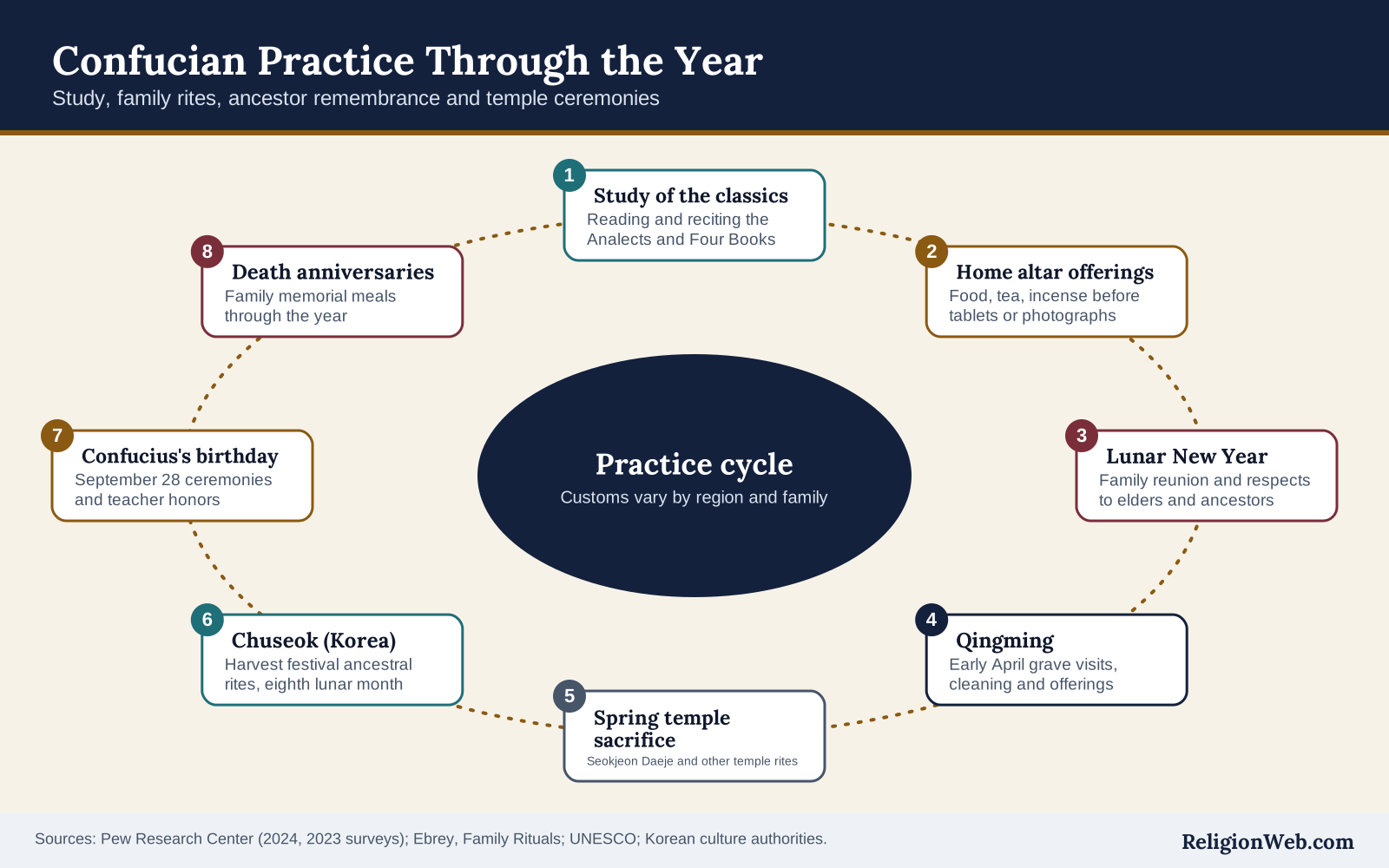
Community, Ethics, and Daily Life
Family, Gender, and Social Roles
The household as a moral community
In Confucian understanding the household is the first community and the model for larger ones. Parents are expected to care for and instruct their children, children to honor and eventually support their parents, and siblings to look after each other, with the same pattern of reciprocal duty extended outward to teachers, neighbors, and fellow citizens. The tradition’s ideal is a family in which respect and affection reinforce one another and in which the generations remain connected by shared ritual, whether the dead are honored at an altar or the living are cared for in old age. Survey evidence suggests that this ideal still has wide resonance: the East Asian Social Survey data analyzed by Pew show large majorities in China, Taiwan, and South Korea holding values centered on respecting and caring for parents.
The ideal is demanding, and it has costs. Caring for aging parents can strain families in societies with low birth rates and high mobility, and young adults sometimes feel that expectations of filial devotion conflict with their own plans. Confucian ethicists and families alike have been rethinking what filial care means in these circumstances, for instance by emphasizing emotional attentiveness and respect over co-residence. Traditional mourning and remembrance practices also offer structured ways of grieving and of staying connected to the dead, but they are not a substitute for professional medical or mental-health care when grief becomes overwhelming or when a family member is unwell.
Women, lineage, and critique
Honest treatment of Confucian family ethics must address gender. The classical household was patrilineal: descent, inheritance, and the main ancestral rites passed through sons, and women entered their husbands’ lineages at marriage. Texts and customs of the imperial period often assigned women a subordinate position, and Confucian ideals of female virtue have been criticized by reformers and scholars, beginning with the May Fourth generation of the early twentieth century. At the same time, historians have shown that women exercised substantial influence within households, as managers of property, educators of children, and ritual participants, and that practice varied by period, class, and region.
Contemporary Confucian thinkers disagree about how to respond. Some argue that the core virtues of care, reciprocity, and ritual propriety can be separated from patriarchal structures and applied equally to men and women. Others hold that the tradition’s hierarchical assumptions are too deeply embedded for such a separation, and that a modern Confucian ethic must be substantially rewritten. Both approaches are active, and ordinary families in East Asia increasingly adapt ritual roles, for example by including daughters in ancestral rites that were once reserved for sons.
Ethics in Public and Working Life
Learning, merit, and the scholar ideal
Confucian ethics places high value on education and on the idea that status should follow demonstrated learning and character. The examination system embodied this in institutional form, and its legacy is widely noted in discussions of East Asian societies’ emphasis on schooling and credentials. Scholars caution against treating this as simple cause and effect, since many factors shape educational attitudes, but the tradition did leave a vocabulary in which teachers command honor, study is a moral obligation, and parents sacrifice for children’s schooling. Teacher-honoring ceremonies on Confucius’s birthday are one visible expression of the same outlook.
The ideal public servant in Confucian thought is the junzi, who pursues the Way, values rightness over profit, and speaks truthfully to power. This ideal has been invoked by reformers, by civil-service reformers of the imperial era, and by contemporary writers on business and public ethics. The risk of any such idealization is that it ignores the many officials in history who fell short, and that rulers have used the language of virtue to defend their own authority. Confucian tradition itself contains the resources for that criticism, since the standard of the junzi applies to rulers first.
Everyday conduct and etiquette
At the level of daily life, Confucian ethics shows up in many small habits: how people greet elders, who is served first at a meal, how gifts are exchanged, how an apology is offered, and how a guest is welcomed. These behaviors fall under li in its broad sense, and they differ by region and household. Many of them are not explicitly identified as Confucian by the people who practice them, which is part of why researchers who ask about religion often miss them. They matter to the tradition because Confucius treated manners as training in reverence: the person who learns to give way to elders at the door is learning something about giving way in moral life.
Confucian etiquette is also adaptable. Rules about seating, dress, and address have been simplified in modern workplaces, and families in the diaspora may keep a few central practices, such as honoring grandparents or observing a memorial day, while letting others lapse. The tradition itself recognizes that forms must fit circumstances so long as the underlying attitude of respect remains.
Confucianism Today: Communities, Data, and Contemporary Life
Numbers and Survey Evidence
Why head counts are difficult
Counting Confucians is harder than counting members of a tradition with formal membership. Censuses in most countries do not list Confucianism as a category, or they list it only for the minority who choose it. Indonesia’s 2010 census, for example, recorded 117,091 Confucians, according to Gadjah Mada University researchers who also note that a Confucian council leader had claimed about three million adherents in 1971. The gap shows how much counts depend on legal climate and on who defines the category. Pew did not survey mainland China because of restrictions on foreign research organizations, so any figure for China relies on academic surveys, such as the Chinese General Social Survey of 2018 and the East Asian Social Survey waves of 2016 to 2018.
A more informative approach asks what people do and how they relate to the tradition. Pew’s 2023 surveys in Hong Kong, Japan, South Korea, Taiwan, and Vietnam, covering 10,390 adults interviewed between June and September 2023, found that no more than 26 percent in any of the five places said religion is very important in their lives, and that roughly half or more offered food, water, or drinks to honor ancestors in the past year. These facts describe a region in which affiliation with organized religions is modest but ritual practices linked to Confucian tradition are common.
Connection, practice, and the diaspora
On the question of personal connection, Pew’s 2023 data show a clear contrast between South Korea and the other societies. In South Korea, 59 percent of adults said they feel connected to the Confucian tradition, a higher share than for any other tradition Pew asked about; in Taiwan, Japan, and Hong Kong, about a third or fewer did, and outside South Korea more people felt a connection to Buddhism than to Confucianism. In the United States, Pew’s 2022–23 survey of Asian American adults found that about one in five Americans of East Asian origin say they feel close to Confucianism: 24 percent of Chinese Americans and 22 percent of Korean Americans, compared with 4 percent of Japanese Americans.
Such numbers need careful reading. “Feeling connected to” a tradition is not a membership claim, and Pew distinguishes it from identification as a Confucian, which almost no one gave as a religion. For readers of this article, the most accurate summary is that Confucian values and ritual customs are widely shared across East Asian societies and their diasporas, while formal identification with Confucianism as a religion is uncommon and varies by country.
Pew’s 2023 East Asia report also sheds light on the wider moral and spiritual outlook of these societies. Majorities in Hong Kong, South Korea, Taiwan, and Vietnam said that religion gives people guidance to do the right thing, while in Japan about half did. In each of the five places most adults believed in god or in unseen beings such as deities or spirits, including at least 40 percent of the religiously unaffiliated, and in Taiwan, Japan, and Vietnam about half or more said that mountains, rivers, or trees have their own spirits. These results describe a landscape in which Confucian ethics and ancestor rites sit alongside many other beliefs and practices, and in which a single survey label captures only part of what people actually do.
Contemporary Institutions and Debates
Mainland China, Taiwan, and Hong Kong
In the People’s Republic of China the tradition has had a turbulent modern history. After the end of the examinations in 1905 and the fall of the empire in 1912, critics associated Confucianism with the old social order, and the campaign to criticize Lin Biao and Confucius from 1973 to 1975 presented Confucian thought as reactionary. Since the 1980s, scholarship on Confucianism has expanded, temples and sites such as Qufu have been restored and promoted, and Confucius’s birthday is again marked publicly. Scholars disagree about how to interpret this: some see a genuine cultural and spiritual revival, others see the state drawing on Confucian symbols for its own purposes, and many see elements of both.
In Taiwan and Hong Kong, Confucian temples and academies operate within a freer religious environment and sit alongside Buddhist, Daoist, Christian, and folk institutions. Taiwanese temples hold annual ceremonies on Confucius’s birthday, and Pew’s Taiwan figures show that a minority of adults, 26 percent, say they venerate Confucius, while far more pray to Guanyin or the Buddha. Taiwan and Hong Kong have also been important centers of New Confucian philosophy and of academies that teach the classics.
The Qufu complex remains the tradition’s best-known heritage site. UNESCO inscribed the Temple and Cemetery of Confucius and the Kong Family Mansion in 1994 under three criteria, one of which (criterion vi) cites Confucius’s influence on philosophical and political thought in East Asia and, later, in Europe. The listing treats the site as a monument to that influence, supported by Chinese emperors over two millennia, and visitors today come as tourists, scholars, students, and participants in commemorative ceremonies, with a wide range of personal motives.
Korea, Southeast Asia, and global scholarship
South Korea has some of the most visible living Confucian institutions. Sungkyunkwan in Seoul holds the Seokjeon Daeje twice a year, and the nine seowon on the UNESCO list preserve Neo-Confucian academies as heritage sites. Household ancestral rites remain widespread, though many families have simplified them. In Vietnam, Pew’s 2023 survey found that 96 percent of adults burned incense to care for ancestors in the previous year, and the Temple of Literature in Hanoi continues to be a prominent cultural site. In Indonesia, Confucianism has regained legal recognition and is taught in schools in communities that identify with it.
Internationally, Confucian studies is an established academic field, and the philosophical tradition is taught alongside other world philosophies. Scholars such as Tu Weiming have argued that Confucian humanism offers resources for contemporary questions about ethics, community, and the environment. Other scholars note that outside East Asia the tradition is more often encountered as a body of ideas than as a lived religion. Readers who want to see how religious life in East Asia looks from other starting points can consult ReligionWeb.com’s articles on Buddhism and on Chinese folk religion, which describe their own communities and practices.
Common Misconceptions About Confucianism
Few traditions are described as often by people who have never studied them as Confucianism. Some of the confusion comes from translation and some from the way European writers first presented Confucius to Western readers. Some comes from twentieth-century political arguments in China itself. The five claims below are common, and each contains something true, which is why they last. The aim here is to separate what the sources support from what they do not.
Misconception 1: Confucianism is only a secular philosophy with no religious dimension
Where the misunderstanding comes from
This view has a long pedigree. Jesuit and Enlightenment writers, including Leibniz, presented Confucius as a rationalist moral philosopher, as the Stanford Encyclopedia of Philosophy notes, partly because that image made his teachings easier to admire in Europe. The Analects supports the impression in some passages: Confucius is reluctant to speak of death and the spirits, and much of the text concerns conduct, learning, and government. In the twentieth century, scholars such as Wing-tsit Chan and many Chinese reformers also stressed the philosophical character of the tradition, partly to distinguish it from what they regarded as popular religion. Survey data add another layer, since people in East Asia almost never name Confucianism as their religion.
The word “religion” itself contributes to the confusion. If the term means a church with clergy, a creed, and exclusive membership, Confucianism does not fit, and the claim that it is not a religion follows almost automatically. A definition built on a Western model produces that answer in advance.
What the evidence and tradition actually show
Confucian tradition includes features that many scholars regard as religious. Heaven (tian) functions as a source of moral order and political legitimacy; the classics describe sacrifices to Heaven, ancestors, and spirits; and the state sponsored temple sacrifices to Confucius from the Tang period onward. Families maintain ancestral altars and graves, and Pew found that large majorities in Taiwan, Japan, and Vietnam had performed ancestor rites in the past year. Scholars such as Joseph Adler argue that the tradition is a non-theistic, diffused religious tradition, whose goal of sagehood is a form of ultimate transformation.
It would be equally wrong to say that Confucianism is simply a religion in the sense of a church. Many Confucians have emphasized humanistic readings, Xunzi treated ritual as a human artifact with social and aesthetic functions, and most modern East Asians who practice ancestor rites do not call themselves Confucian. The fairest summary is that Confucianism has philosophical, ethical, political, and religious dimensions at once, and which word one chooses depends on one’s definition and purpose. The section on the religion debate sets out the main positions.
Misconception 2: Filial piety means blind obedience to parents and rulers
Where the misunderstanding comes from
The English phrase “filial piety” suggests duty and deference, and many translations render xiao as “obedience.” In imperial and later periods, official promotion of filial piety did stress submission, and the classical idea that loyalty to a ruler is an extension of duty to a father was used to defend authority. Twentieth-century critics, including May Fourth intellectuals, attacked the family system on exactly these grounds, and popular depictions of strict Asian parenting have reinforced the image. Some Han and later moral tales, such as stories of children who endure extreme hardships to serve parents, also give a one-sided impression.
Survey figures can seem to confirm the picture. Pew’s analysis found that 84 percent of respondents in China agreed fathers should be respected in all circumstances, and 88 percent agreed that children must try to bring honor to their parents. Those results show strong norms of respect, but they do not by themselves show unreflective obedience.
What the evidence and tradition actually show
The Analects itself distinguishes reverence from mere compliance. Britannica’s summary of the text points to the saying that even dogs and horses are provided for, so that xiao requires genuine respect and not only support. The Legge translation records the same point (Book II, chapter VII), in an answer that grants that “dogs and horses likewise are able to do something in the way of support” and then asks what distinguishes human care from that. Other passages teach that a child who sees a parent in the wrong should remonstrate gently and persistently, without abandoning respect, and the Classic of Filial Piety, according to the tradition, includes a discussion of remonstrance toward fathers and rulers.
Within the tradition there is also a clear sense that duty to parents does not outweigh all other moral claims. Mencius taught that rulers hold power by Heaven’s favor and that they must govern with benevolence, which implies that political loyalty is conditional on virtue. Interpretations differ on how far these ideas permit resistance, and scholars caution against reading modern democratic ideas into them. But the claim that Confucian teaching demands blind obedience is not supported by the classical texts. It reflects one strand of imperial use of those texts, not the whole tradition.
Misconception 3: Confucian tradition has remained unchanged for 2,500 years
Where the misunderstanding comes from
The image of an unchanging Confucian China has several sources. Confucius described himself as a transmitter rather than an innovator, and later writers often claimed that they were merely restoring the original teaching. Emperors presented their dynasties as continuing an ancient order. Western writers, from the eighteenth century onward, sometimes contrasted a supposedly static China with a dynamic West, an idea that modern historians have thoroughly criticized. Even supporters of Confucianism sometimes stress continuity, since a long unbroken lineage is a source of prestige.
What the evidence and tradition actually show
The record shows constant change. In the Warring States period, Mencius and Xunzi disagreed about human nature. In the Han, a state-supported curriculum for the Five Classics emerged, and Dong Zhongshu developed a cosmology linking Heaven and humanity. In the Song, thinkers such as Zhou Dunyi, the Cheng brothers, and Zhu Xi built a new metaphysics of principle and vital stuff in response to Buddhist and Daoist thought, and Zhu Xi’s grouping of the Four Books in 1190 reorganized the canon. The ritual life of families changed too: Zhu Xi’s Family Rituals was a twelfth-century creation that became a standard. The Ming added Wang Yangming’s mind-centered teaching, and the Qing added philology-driven evidential research that criticized both.
The tradition also changed as it moved. Korean scholars produced the Four-Seven Debate, Japanese scholars produced Wang Yangming and Zhu Xi schools adapted to Tokugawa society, and Indonesian Confucians built an institutional religion in the twentieth and twenty-first centuries. The abolition of the examination system in 1905 and the emergence of New Confucianism show that the tradition continues to be reinvented. There is real continuity in texts, vocabulary, and family ritual, but continuity through change is the more accurate description.
Misconception 4: Confucius wrote the classics and founded Confucianism by himself
Where the misunderstanding comes from
Traditional accounts credited Confucius with editing the Five Classics and even composing parts of them, such as the Spring and Autumn Annals, and many popular introductions still describe him as the author of the Analects. European presentations reinforced the impression by treating him as the founder of a religion on the model of founders elsewhere. The Latinized name “Confucius” and the label “Confucianism” suggest a single figure and a system derived from him.
What the evidence and tradition actually show
The Analects is a collection of sayings compiled by later disciples, and its formation was long. The traditional view attributes it to first- and second-generation students, while scholars such as Zhu Weizheng have argued that it is not clearly attested before the second century BCE. Archaeological finds suggest a larger body of Confucius-related sayings from which the received text may be a selection. Modern scholarship also doubts that Confucius edited the Five Classics in any literal sense; their materials are older and took shape over centuries. Even Britannica’s entry on Dong Zhongshu describes the Annals only as purportedly edited by Confucius.
The tradition as a whole was likewise built by many hands. Mencius, Xunzi, Han commentators, Song masters, and Korean, Japanese, and modern thinkers all contributed. Confucius is the central figure, honored as the teacher of ten thousand generations, but the tradition he is credited with founding is better understood as a long conversation in which he is the first great voice rather than the sole author.
Misconception 5: Confucians worship Confucius as a god
Where the misunderstanding comes from
Visitors to a Confucius temple see incense, a tablet or statue, offerings of food and drink, bowing, and music, and these are the same outward elements found at places of devotion around the world. English phrases such as “Confucius worship” and “the Confucian church” were widely used in older books, and the Pew Research Center itself describes the Grand Ceremony of the Worship of Confucius. The Internet Encyclopedia of Philosophy adds that Han-era writings portrayed Confucius as a superhuman figure and that devotion to him took on religious forms, so the impression has some historical basis.
What the evidence and tradition actually show
In the tradition’s own self-understanding, Confucius is honored as the supreme teacher and model, not worshiped as a creator or savior. Imperial titles called him a teacher and model for ten thousand generations, UNESCO notes, and the offerings placed before his tablet, food and drink, are those given to venerated ancestors and teachers. Words such as “venerate” and “honor” therefore describe the official rites more precisely than “worship.” The Korean Seokjeon Daeje, for example, offers food and liquor to Confucius together with four sages, ten disciples, and twenty-four men of virtue, placing him within a community of honored scholars.
Lay practice varies. Some people in temples do pray to Confucius, for instance for success in study, and Pew found that 26 percent of Taiwanese adults say they venerate Confucius, though far more pray to Guanyin (69 percent) or to the Buddha (46 percent). Others regard the ceremonies purely as cultural commemoration. A fair statement is that Confucius is revered as an extraordinary human teacher, that the state and scholars have honored him through ritual, and that individual attitudes range from commemoration to personal devotion.
Frequently Asked Questions About Confucianism
Questions About Origins and Identity
Who was Confucius, and when did he live?
Confucius, known in Chinese as Kongzi or Kong Fuzi, is traditionally dated 551–479 BCE. He was born in or near the state of Lu in what is now Shandong province, was trained in Zhou ritual and learning, and spent his later years teaching a circle of students and, according to tradition, traveling among neighboring states in search of a ruler who would adopt his principles. Almost everything known about his life comes from texts written decades or centuries later, so historians treat the details with caution.
His sayings were gathered by disciples in the Analects, and later generations came to regard him as the supreme teacher of the tradition. He did not claim divine status or revelation, and the honors given to him in temples are honors to a teacher and model.
What is the difference between Confucianism and Neo-Confucianism?
“Confucianism” covers the whole tradition from Confucius onward. “Neo-Confucianism” is the English name for the revival that began in the Tang and Northern Song periods and was systematized by Zhu Xi (1130–1200), in which Confucian thinkers built a more explicit metaphysics, with principle (li) and vital stuff (qi), and gave new importance to the Four Books. The Internet Encyclopedia of Philosophy notes that the Neo-Confucians were prompted by Buddhist and Daoist thought but drew their key concepts mainly from the classical Confucian repertoire. Neo-Confucians themselves saw their work as recovering the original Way, and their schools included the Cheng-Zhu and Lu-Wang traditions.
In practice, many of the features people think of as typically Confucian, including the curriculum of the Four Books, the household ritual of the Family Rituals, and the Korean academies, are products of the Neo-Confucian period.
Questions About Beliefs and Practice
What are the main teachings of Confucianism?
The central teachings concern the cultivation of the person through learning and ritual, the primacy of family and reciprocal relationships, and the responsibility of rulers to govern by example. Key virtues include humaneness (ren), ritual propriety (li), rightness (yi), wisdom (zhi), and trustworthiness (xin), along with filial piety (xiao). The goal is to become a morally cultivated person (junzi) and, in later teaching, a sage.
The details vary by school. Mencius emphasized inborn moral tendencies, Xunzi emphasized training through ritual and teachers, Zhu Xi emphasized investigating principle, and Wang Yangming emphasized the mind’s innate knowing. These are differences within the tradition, and they show why a short summary can never capture all Confucians.
Do Confucians believe in God or an afterlife?
Confucian tradition has no doctrine of a creator God in the sense of a personal deity who issues commandments. It does speak of Heaven (tian), which in early sources acts as a source of moral order and political mandate and in later Neo-Confucian thought is closely linked to principle. Some Confucians understand Heaven in a personal, quasi-theistic way, and others in a more impersonal, naturalistic way, a range that scholars such as Joseph Adler describe as part of the tradition’s non-theistic but ultimately oriented character.
On the afterlife, classical texts say little and Confucius declined to speculate. At the same time, ancestor rites assume that the dead continue to matter, and families often hold beliefs drawn from Buddhist, Daoist, or folk traditions about the fate of the dead. Confucian teachers differ on whether ancestors are conscious recipients of offerings or whether the rites mainly cultivate the living. Individuals and families often hold more than one view.
How do Confucians honor their ancestors?
The usual forms are offerings of food, drink, and incense at a home altar or tablet; visits to family graves with cleaning and offerings; memorial meals on the anniversary of a death; and, in lineages, sacrifices in an ancestral hall. Pew’s 2023 surveys found that most adults in Taiwan, Japan, and Vietnam had taken part in such activities in the past year, though the survey shows that very few of them call themselves Confucian.
The rites are understood as expressions of gratitude, remembrance, and continuity. Their frequency and format differ by family, region, and religious affiliation, and many families have simplified them in modern urban life.
Is there a Confucian holy book?
There is no single book regarded as revealed scripture. The Five Classics and the Four Books are the core canon, and the Analects is the best-known text. Their authority comes from the standing of the sages and from centuries of study, state sponsorship, and commentary rather than from claims of divine revelation. Readers who want to begin should start with the Analects in a good translation with notes, then read the Mencius and the Great Learning.
Questions About Confucianism Today
How many Confucians are there?
No reliable global count exists, because most censuses do not list Confucianism and because many people who practice Confucian customs do not identify as Confucian. Indonesia’s 2010 census recorded 117,091 Confucians. Pew’s surveys in East Asia ask instead about connection and practice: in 2023, 59 percent of South Korean adults said they feel connected to the Confucian tradition, and about a third or fewer in Taiwan, Japan, and Hong Kong said the same.
The answer therefore depends on definition. Counting only those who name Confucianism as their religion yields a small number, while counting those who follow Confucian family and ritual customs yields a very large one.
Can a person follow Confucian practices alongside another tradition?
Historically, yes. In China, Korea, Japan, and Vietnam, people have commonly taken part in Confucian family rites and education while also participating in Buddhist, Daoist, Shinto, folk, or, in recent times, Christian activities, and the tradition has never required exclusive membership. Many modern Christians in East Asia, for instance, have debated and adapted ancestor rites in their own communities, and the pages on Christianity and Islam describe how those traditions understand such questions on their own terms.
Whether a particular practice is compatible with another tradition’s teaching is a question for that tradition’s own authorities, and different communities answer differently.
Where can I see Confucian ceremonies today?
Public ceremonies take place at the Temple of Confucius in Qufu, at Confucius temples in Taiwan and elsewhere on September 28, at Sungkyunkwan in Seoul during the spring and autumn Seokjeon Daeje, and at the Jongmyo shrine in Seoul on the first Sunday in May. Visitors can also see the Temple of Literature in Hanoi and the Yushima Seidō in Tokyo as historic sites. Because dates, access rules, and ceremonial details change, it is best to check with the temple or the relevant cultural authority before traveling.
Visitors are generally welcome as observers, and the usual courtesies apply: dress modestly, follow posted instructions about where to walk and where to photograph, and avoid stepping on paths reserved for ritual use.
Conclusion: What the History of Confucianism Shows
What the History Shows
A tradition built by many hands
Confucianism began with a teacher in the state of Lu who described himself as a transmitter, and it became a tradition that shaped the education, family life, ritual, and statecraft of much of East Asia. Mencius and Xunzi argued about human nature, Han scholars organized the classics, Song thinkers rebuilt its metaphysics, Korean and Japanese scholars carried it into new settings, and modern thinkers continue to reinterpret it. The picture that emerges is one of continuity through repeated reinvention.
Ethics, ritual, and the question of religion
The tradition cannot be reduced to a single category. It contains a demanding ethics of relationships, a theory of learning and government, and a rich ritual life of family rites, temple sacrifices, and state ceremonies, with Heaven and the ancestors as points of ultimate reference. Whether to call all this a religion, a religious tradition, or a philosophy with ritual attached is a question on which informed people disagree, and the disagreement reflects real differences in how Confucianism has been practiced and in what the word “religion” is taken to mean.
How to Keep Exploring
Reading the texts and the scholarship
The best way to understand Confucianism is to read its texts slowly. Begin with the Analects, then the Mencius, the Great Learning, and the Doctrine of the Mean, and use a translation with notes so that key terms are explained. For history, university-press introductions and encyclopedia entries by specialists, such as those in the Stanford Encyclopedia of Philosophy, the Internet Encyclopedia of Philosophy, and Britannica, give reliable overviews and bibliographies.
Seeing the tradition in practice
Confucianism is also a lived practice, and many of its clearest expressions are in homes, schools, and temples rather than in books. Readers interested in neighboring traditions of East Asia can continue with ReligionWeb.com’s articles on Daoism, Buddhism, Shinto, and Chinese folk religion, each of which describes its own beliefs and practices on its own terms.
Sources
The table below lists the principal external sources behind this article. Facts, dates and figures were checked against these and related primary, institutional and academic materials.
| # | Source | Publisher and type | Used for | Link |
|---|---|---|---|---|
| 1 | The Analects (translated by James Legge, Standard Ebooks edition) | Standard Ebooks (text of Legge’s 1861 translation) · Primary text | All six quotations from the Analects (Legge’s book and chapter numbering); edition status | standardebooks.org |
| 2 | 5 facts about Confucianism (Yunping Tong, Sept. 23, 2024) | Pew Research Center · Demographic data | 2023 East Asia surveys, filial piety, ancestor rites, connection to Confucianism, Asian Americans | pewresearch.org |
| 3 | Confucius | Stanford Encyclopedia of Philosophy · Academic reference | Confucius’s life and dates, Analects formation, key concepts, ritual and Heaven | plato.stanford.edu |
| 4 | Neo-Confucianism | Internet Encyclopedia of Philosophy · Academic reference | Neo-Confucian figures, dates, schools, and Korean and Japanese developments | iep.utm.edu |
| 5 | Wujing (Five Classics) | Encyclopaedia Britannica · Encyclopedia | Five Classics, Han posts (136 BCE), national university (124 BCE), lost Classic of Music | britannica.com |
| 6 | Sishu (Four Books) | Encyclopaedia Britannica · Encyclopedia | Four Books, Zhu Xi’s 1190 edition, examination use from 1313 to 1905 | britannica.com |
| 7 | Temple and Cemetery of Confucius and the Kong Family Mansion in Qufu | UNESCO World Heritage Centre · Institutional | Qufu temple, cemetery and mansion: 1994 inscription, dimensions, building history | whc.unesco.org |
| 8 | Confucianism as a Religious Tradition: Linguistic and Methodological Problems (Joseph A. Adler, 2020) | Kenyon College (author’s website) · Academic reference | Terms ru/rujia/rujiao, the religion debate, diffused religious tradition, state sacrifices | www2.kenyon.edu |
| 9 | Chu Hsi’s Family Rituals (trans. Patricia Buckley Ebrey) | Princeton University Press · Academic reference | Zhu Xi’s Family Rituals: cappings, weddings, funerals, ancestral rites, and their spread | press.princeton.edu |
| 10 | The Struggle for State Recognition of Confucian Believers in Indonesia | Center for Religious and Cross-cultural Studies, Universitas Gadjah Mada · Academic reference | Indonesia’s recognition history, MATAKIN, 2010 census count of 117,091 Confucians | crcs.ugm.ac.id |
Last fact-check date: 2026-10-21.