
Daoism (also spelled Taoism) is a Chinese religious and philosophical tradition organized around the Dao (道, “the Way”), the source and pattern of all that exists. The name covers two related things that the Chinese language itself distinguishes. One is a body of early writings, above all the Dao De Jing (Daodejing) attributed to Laozi and the Zhuangzi, that reflect on the Way, on natural spontaneity and on how to live and govern without forcing things. The other is an organized religion with its own scriptures, priests and priestesses, monks and nuns, temples, liturgies and meditation practices, which took visible institutional shape in the second century CE and continues today.
The two strands are traditionally called Daojia (道家, “lineage of the Dao,” often rendered “philosophical Daoism”) and Daojiao (道教, “teaching of the Way,” often rendered “religious Daoism”). Those labels are useful for finding your bearings, yet this article treats them as parts of one tradition rather than two separate ones. Religious Daoists read and recite the Dao De Jing as scripture, while readers who first meet Laozi and Zhuangzi in a philosophy course are reading texts that later priests, hermits and commentators treated as foundational. Scholars have debated for generations how neatly the line can be drawn, and the later sections return to that question in detail.
The tradition did not begin with a single founder or a single moment. The earliest surviving manuscripts of the Dao De Jing come from tombs sealed around 300 BCE and in 168 BCE, the Zhuangzi took its familiar shape centuries later, and the first organized religious community, the Way of the Celestial Masters, is traditionally dated to a revelation in 142 CE. From those roots grew the monastic Quanzhen order, the Zhengyi priesthood, large canons of scripture, alchemical and meditative disciplines, and a calendar of festivals that is shared with Chinese popular religion.
What follows is a reference guide to Daoism on its own terms: its history, ideas, texts, figures, rituals, schools, sacred places and present-day life. Where the evidence is uncertain, such as the dates of Laozi or the origin of the 81-chapter format of the Dao De Jing, the article says so. Where Daoist communities hold something as a matter of faith, such as the revelation to Zhang Daoling, the article attributes it to the tradition rather than stating it as settled history.
Daoism at a Glance: Definition, Geography, Adherents, and Key Terms
Daoism in Brief
Key facts at a glance
The table below gathers the basic orientation facts that the rest of the article develops. Dates marked “traditional” come from Daoist or Chinese historical memory and are not independently confirmed by archaeology or contemporary records.
| Topic | Summary |
|---|---|
| Names and spellings | Daoism (Pinyin) and Taoism (Wade-Giles) refer to the same tradition; Chinese terms are Daojia and Daojiao. |
| Central concept | The Dao (“Way”), the ultimate source and pattern of the cosmos, with de (“virtue” or “potency”) as its power in people and things. |
| Foundational early texts | Dao De Jing (Laozi) and Zhuangzi, both formed in the Warring States period (475-221 BCE), with later editing. |
| First organized religious community | Way of the Celestial Masters (Tianshi dao), traditionally founded in 142 CE by Zhang Daoling. |
| Main living clerical orders | Quanzhen (“Complete Perfection”), a celibate monastic order, and Zhengyi (“Orthodox Unity”), a largely householder priesthood. |
| Canon | The Daozang, organized by tradition into “Three Caverns”; the standard Ming edition was printed in 1445. |
| Principal practices | Liturgy (zhai and jiao), offerings, meditation, inner alchemy (neidan), breath and body cultivation, pilgrimage, ethical precepts. |
| Main regions | Mainland China, Taiwan, Hong Kong, Southeast Asia and Chinese diaspora communities worldwide. |
| Population data | No reliable global count of Daoists exists; Pew Research Center places Daoists inside an “other religions” group of about 172 million people in 2020. |
A definition on its own terms
Daoists describe the Dao as the inexhaustible origin from which heaven, earth and the “ten thousand things” arise and to which they return. It is not a creator in the sense of a personal god who stands outside the world. In the Dao De Jing it is nameless, empty yet endlessly productive, and accessible to human beings through attentiveness, stillness and an unforced way of acting. In religious Daoism the Dao also becomes a field of divine beings, from cosmic deities such as the Three Pure Ones to local gods, spirits of mountains and stars, and deified human beings, all understood as expressions of or intermediaries to the Way.
That double character explains why a single short definition tends to mislead. A reader who encounters the Dao De Jing alone may conclude that Daoism is a contemplative philosophy of simplicity. A visitor to a Daoist temple in Taiwan during a community offering ritual may see priests in embroidered robes presenting written memorials to the heavens. Both are Daoism. The first emphasizes the Way as a guide to conduct and perception, while the second emphasizes the Way as a ritual order that priests maintain on behalf of communities and the dead.
Daojia and Daojiao: two Chinese terms, one tradition
The word Daojia was a bibliographic label coined by Han dynasty (206 BCE-220 CE) historians and librarians. The historian Sima Tan, writing in the second century BCE, used it for a family of teachings on governing and living in accord with the Way, and later Han catalogers applied it to a shelf of earlier texts. As the Stanford Encyclopedia of Philosophy entry by Chad Hansen notes, the figures later grouped under it did not coin the “-ism” themselves; Han scholars created the category.
The word Daojiao means “teaching of the Way.” According to T. H. Barrett’s entry in The Encyclopedia of Taoism, it was used in earlier centuries for the teachings of the sages and sometimes by Buddhists as an elegant parallel to the “teaching of the Buddha,” and it acquired its current sense of a named religion only in the fifth century CE, when communities such as the Celestial Masters needed a common name. Modern scholars often use Daojia for philosophy and Daojiao for religion, but Britannica states that this distinction is no longer considered valid as a description of the tradition, and Isabelle Robinet’s entry on Daojia argues that the usual labels for the “philosophical” side, such as “contemplative,” do not hold up cleanly. This article uses Daojia and Daojiao as handy terms for emphases within one tradition, not as the names of two rival traditions.
Where Daoism Is Practiced
Mainland China, Taiwan and Chinese-speaking communities
Daoism’s historical heartland is China, where its temples, mountains and monasteries stretch from Sichuan, birthplace of the Celestial Masters, to Beijing, home of the White Cloud Temple (Baiyunguan), the headquarters of the Chinese Taoist Association. In the People’s Republic of China, Daoism is one of five officially recognized religions, and its monastic Quanzhen branch is, in the words of Vincent Goossaert’s entry in The Encyclopedia of Taoism, the main official branch of Daoism on the mainland.
Taiwan is the other major center of living Daoist practice. Pew Research Center’s 2025 study of global religious change notes that Taiwan is the only place where the broad “other religions” category forms a majority of the population, a pattern it attributes to large numbers of Daoists and practitioners of Chinese folk religion. Hong Kong, Macau, Singapore, Malaysia and other places with long-established Chinese communities also have Daoist temples, priests and associations. The Taoist Federation of Singapore, for example, describes itself as the national-level organization for Taoists in that country and says it was founded in 1990.
Daoist ideas and practices beyond China
Daoist texts and practices have traveled well beyond Chinese-speaking communities. The Dao De Jing has been translated into English and many other languages again and again, and the English-language tradition of translation includes the 1891 version by James Legge, a Scottish scholar who held the first professorship of Chinese at Oxford. Practices associated with Daoist body cultivation, such as taijiquan (tai chi) and qigong, are taught around the world, often without any religious framework. Some of the people who learn them regard themselves as Daoist practitioners, while many do not, and the line between a health exercise and a religious discipline is drawn differently by different teachers.
Daoist concepts such as yin and yang and the Five Phases also spread across East Asia as part of a shared Chinese cultural inheritance, and they interacted with local traditions in Korea, Japan and Vietnam. The details of those interactions belong to the histories of those regions, including Shinto in Japan, and this article notes them only as context.
How Many People Practice Daoism?
What the demographic data can and cannot say
Readers often want a single number for Daoists, and no trustworthy one exists. Pew Research Center’s report How the Global Religious Landscape Changed From 2010 to 2020, published in 2025, does not give a separate figure for Daoists. It places them among “other religions,” a category that also includes Baha’is, Jains, Shintoists, Sikhs, Wiccans, Zoroastrians and many smaller groups. According to Pew, that category grew from about 154 million people in 2010 to about 172 million in 2020 and held roughly steady at about 2 percent of the world’s population. In China, Pew reports, the category is about 3 percent of the population but accounts for about a quarter of everyone in the category worldwide.
Pew says the category includes some groups commonly described as folk or traditional religions, and that its members do not necessarily share beliefs and practices. That caution applies strongly to Daoism. A figure for “Daoists” would depend on what is being counted: ordained clergy, people who take part in temple festivals, readers of Daoist texts, or those who self-identify as Daoist on a survey.
Why counting Daoists is difficult
Three features of Chinese religious life make a tidy count nearly impossible. First, many people take part in practices that Daoist priests perform, such as funerary rites, community offerings and festival ceremonies, without identifying as Daoist or belonging to any membership body. Second, Chinese religious life has long been multi-layered, with the same household honoring ancestors, visiting a Buddhist monastery and calling on a Daoist priest for a rite, and the question of whether such a person “is” a Daoist often makes little sense to the person involved. Third, official statistics and surveys use different categories, and in the People’s Republic of China the registered clergy of the Chinese Taoist Association form only part of the picture.
For that reason this article gives population information only where a named source and year are available, and it relies on estimates of clergy and temples only with their dates. Readers interested in the wider landscape of Chinese popular practice will find it covered in the companion article on Chinese folk religion, which explains why the boundary between Daoism and folk religion is permeable in both directions.
A Short Vocabulary
Terms used throughout this article
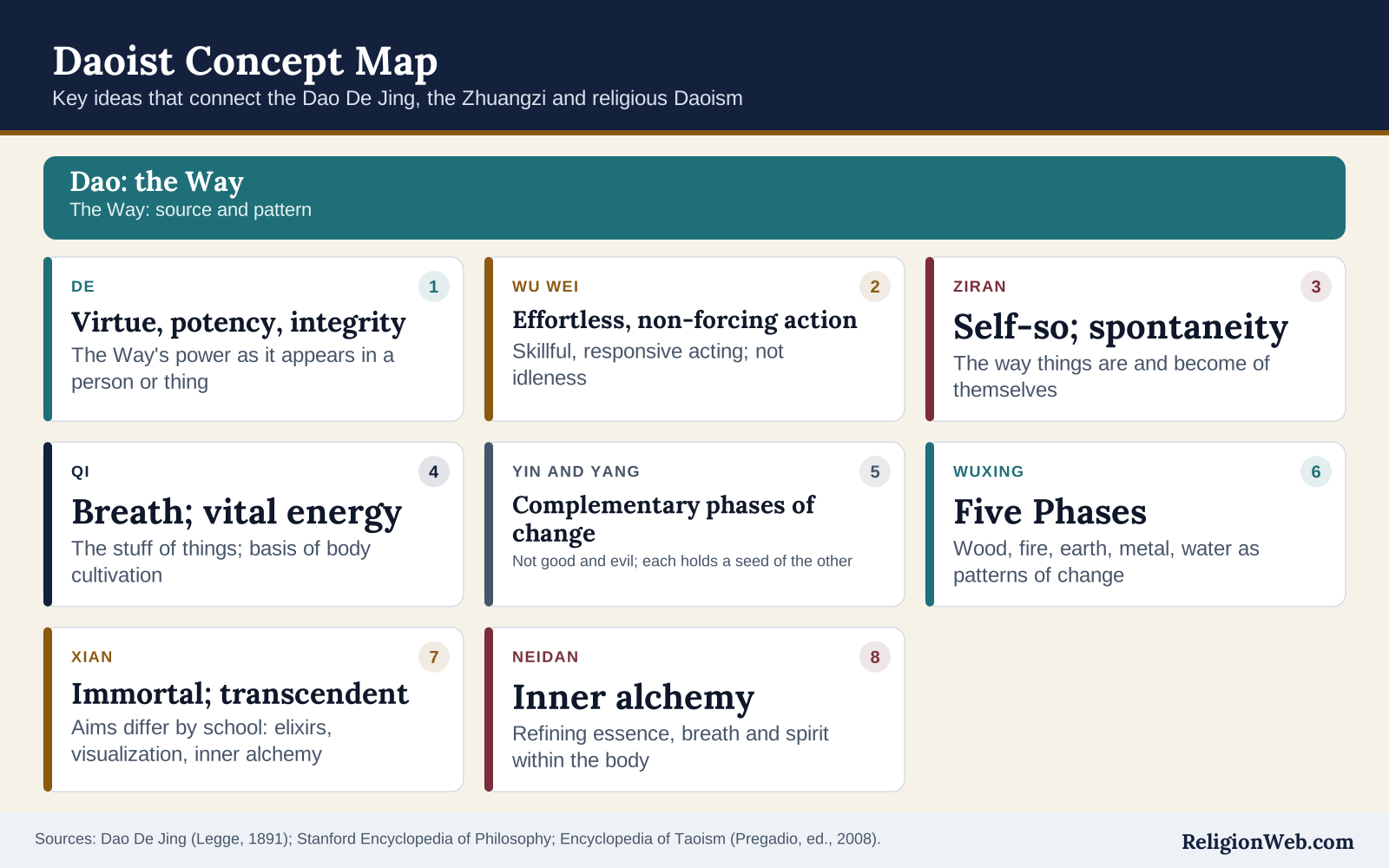
A handful of Chinese terms recur and are worth fixing at the start. Dao (道) means “way,” “path” or “speech,” and in the tradition’s technical sense the ultimate Way. De (德) means “virtue” or “potency,” the power that the Way manifests in a person or thing. Wu wei (無為) is usually rendered “non-action” or “effortless action,” a mode of acting without forcing. Ziran (自然) means “self-so” or “spontaneity,” the way things are of themselves. Qi (氣) is breath, vital energy or the stuff of which things are formed. Xian (仙) is an “immortal” or “transcendent,” and zhenren (真人) a “true person” or “perfected one.” A daoshi (道士) is a Daoist priest or master, and the Daozang (道藏) is the Daoist canon.
Ritual vocabulary adds zhai (齋), a purificatory retreat or fast that later became the term for funerary liturgy; jiao (醮), a communal offering ritual; neidan (內丹), “inner alchemy,” a meditative discipline that treats the body as the laboratory; and waidan (外丹), “external alchemy,” the compounding of elixirs from minerals. These terms are explained in more detail where they appear, and the section on core concepts includes a glossary table for quick reference.
Spelling, pronunciation and transliteration
Two romanization systems account for the spelling confusion. Pinyin, the system standardized in mainland China, renders the word as Dao and the classic as Daodejing, while the older Wade-Giles system, used in much of the English-language literature before the late twentieth century, renders them Tao and Tao Te Ching. Both are correct for their systems, and the two spellings name the same texts and the same tradition. This article uses Pinyin, with the older spellings given where they help readers find related material.
English speakers often pronounce Dao as “dow,” which approximates the Mandarin sound. Many other Chinese terms keep their conventional English forms, so that readers will meet both “Laozi” and “Lao Tzu,” “Zhuangzi” and “Chuang Tzu,” and “qi” and “ch’i.” Chinese names are given with the family name first, as is Chinese custom, so that Zhang Daoling’s family name is Zhang.
Origins and Historical Development of Daoism
Roots Before the Daoist Texts
Shared Chinese ideas of the Way, breath and cosmic order
Daoism did not arise in an empty field. By the time the Dao De Jing and Zhuangzi took shape, educated Chinese already used the word dao for a path, a method or the proper course of conduct, and thinkers of every persuasion argued about which dao a ruler or a person ought to follow. Britannica notes that the term predates Daoism and appears across Chinese philosophical schools. Ideas of qi as the breath or energy that animates things, of yin and yang as complementary phases in change, and of the Five Phases (wuxing) as patterns of transformation also circulated widely, and Daoist writers inherited them rather than inventing them.
What the early Daoist writings did was to give the Way an unusual centrality and an unusual character. In the Dao De Jing the Way is not primarily a human code of conduct but the nameless source behind both nature and society, and the sage’s task is to align with it. That shift from “which way should we follow?” to “what is the Way that underlies all ways?” is one of the tradition’s defining moves, and it is one reason the tradition has remained interesting to readers who are not Chinese.
Self-cultivation, hermit traditions and the question of origins
Scholars have long pointed to self-cultivation practices in the Warring States period (475-221 BCE), including breath regulation, dietary regimens and meditative stillness, as part of the background to Daoist writing and to later religious Daoism. Robinet’s entry on Daojia notes that Zhuangzi and the Daoist sage are neither simply for nor against philosophy, and that early Daoist texts combine a concentration on the Way with techniques of self-cultivation. The precise relationship between such techniques, the hermit tradition of men and women who withdrew from public office, and the surviving texts is debated, and the evidence is thin.
For that reason the question “who founded Daoism?” has no single answer. Chinese tradition names Laozi as the author of the Dao De Jing and Zhang Daoling as the first Celestial Master, and both attributions matter to Daoists. Historians generally describe a gradual process across several centuries in which texts, practices and communities were later identified as Daoist, a process that began long before the word had a settled meaning.
Classical Daoism in the Warring States Period
The formative age of Laozi and Zhuangzi
The Warring States period was an age of political fragmentation and intense debate among teachers, later grouped as the Hundred Schools. Traditional accounts place Laozi in the sixth or early fifth century BCE, but Alan Chan’s Stanford Encyclopedia entry on Laozi judges that dating unlikely if the Dao De Jing had a single author. Chan suggests that sayings attributed to Laozi were probably written down from the second half of the fifth century BCE, consolidated in the fourth century and reached a relatively stable form by the middle of the third century BCE. Scholars such as Liu Xiaogan, who argues for the traditional view, and William Baxter, who places the bulk of the text in the early or mid fourth century BCE, show that the dating question remains open.
Zhuang Zhou, the figure behind the Zhuangzi, flourished in the later fourth century BCE. The extant text was edited by Guo Xiang (died 312 CE), who reduced an earlier fifty-two-chapter collection to thirty-three chapters. Only the Inner chapters (1-7) are generally attributed to Zhuangzi’s own period, and even their direct authorship is treated as a hypothesis, as the Stanford Encyclopedia entry on Zhuangzi explains. The Outer and Miscellaneous chapters preserve voices from later generations, including followers, primitivist writers and syncretists.
Why “Classical Daoism” is a retrospective category
A recurring theme in recent scholarship is that there were no self-identified “Daoists” in the fourth century BCE. The people we now group with the Dao De Jing and Zhuangzi did not know themselves by that name. Han dynasty historians and bibliographers created the category of Daojia, as Hansen notes, and the early Han historian Sima Tan gave the first account of a “Daoist school” without naming any specific text or teacher, an observation developed by the scholar Scott Barnwell in a widely read discussion of the question. Many specialists now treat terms such as “Classical Daoism” with caution.
None of this means that the texts are unimportant. It means that the connection between Laozi, Zhuangzi and the later tradition was made by readers across time, who saw in these books a shared outlook and then built institutions, commentaries and rituals around it. The Daoist tradition is, in that sense, partly a history of reading.
The Han Dynasty: Huang-Lao, Imperial Scholarship and the First Religious Community
Huang-Lao and the politics of non-doing
In the early Han dynasty a current called Huang-Lao, the “Way of the Yellow Emperor and Laozi,” enjoyed some success at court. Fabrizio Pregadio describes it as a name for one part of the Daoist tradition in the second century BCE, with an exact outline that remains unclear. Its central idea was government by wu wei, in which a ruler minimizes interference, cultivates himself and aligns administration with the cycles of the seasons. Huang-Lao influence faded after Emperor Wu (r. 140-87 BCE) made Confucianism the state teaching. Later Daoists merged the two figures into a single deity, Huanglao jun, the “Yellow Old Lord,” which shows how a political label could become a religious one.
The relationship between this courtly current and the religion of later centuries is not a straight line, but it shows that Daoist ideas about rulership were taken seriously by early imperial governments long before there were Daoist temples. Readers interested in the broader intellectual landscape in which these debates took place can find a companion discussion in the article on Confucianism.
The Huainanzi and the early reception of the texts
The Huainanzi, completed in 139 BCE under the patronage of Liu An (180-122 BCE), king of Huainan, is a compendium that shows how Laozi and Zhuangzi were read together in the Han world. Pregadio notes that it quotes more than 800 passages from other texts, including about 100 from the Dao De Jing and over 250 from the Zhuangzi. Li Ruohui, in a 2021 study, argues that the Huainanzi’s quotations preserve an intermediate stage in the way the Dao De Jing was divided into chapters, an observation that bears on the history of the 81-chapter format discussed in the section on sacred texts.
By the first century BCE, then, the Laozi was a canonical text, the Zhuangzi was read alongside it, and a bibliographic category had been created for the shelf that held them. Those three developments prepared the ground for the first movement to claim Laozi as a divine revealer.
The Celestial Masters: the first organized Daoist community
According to Daoist tradition, in 142 CE Zhang Daoling received a revelation on Mount Heming in what is now Sichuan, in which Laozi, in his divine form, is said to have established a new covenant between the Daoist gods and the people. Terry Kleeman’s account in The Encyclopedia of Taoism describes this as the formal founding of the Daoist religion. The movement, called the Way of the Celestial Masters (Tianshi dao), rejected blood sacrifice to the traditional gods in favor of offerings to Daoist deities. Its principle of the “Pure Bond” held, in paraphrase, that the gods do not consume food and drink and that a master does not accept payment for his services.
Zhang Daoling’s successors were his son Zhang Heng and then Zhang Lu, who organized the movement into twenty-four parishes (zhi), each led by a Great Libationer, collected an annual tithe of five pecks of rice, and held three yearly assemblies. A stele dated 173 CE records the initiation of new libationers into the Way of the Celestial Master, which is the earliest firm evidence. Zhang Lu governed a religious state in Hanzhong and northern Sichuan in the 180s until it fell to the warlord Cao Cao in 215, after which followers were relocated and the movement spread. Britannica gives Zhang Daoling’s death as 156, so traditional dates and modern reconstructions are not identical. The movement’s commentary on the Dao De Jing, the Xiang’er, was probably written by Zhang Lu and served as a teaching text for members.
Division and Revelation: The Third to Sixth Centuries
Dark Learning, Wang Bi and Guo Xiang
After the fall of the Han in 220 CE, a movement of philosophical conversation known as Dark Learning (Xuanxue), sometimes called Neo-Daoism, revived the pairing of Laozi and Zhuangzi. Wang Bi (226-249) wrote the commentary on the Dao De Jing that became one of its two most influential forms, and Guo Xiang, who died in 312, edited and commented on the Zhuangzi. Hansen’s account notes that the movement’s slogan was “sage within, king without,” meaning that a person could be inwardly a sage and outwardly a ruler. Dark Learning also mediated the arrival of Buddhism, whose ideas were first explained to Chinese audiences in partly Daoist vocabulary. The article on Buddhism describes that arrival from the Buddhist side.
These commentators were mostly scholars and officials rather than priests, which illustrates why the older scheme that divides Daoism into a philosophy and a religion struggles with this period. They worked on the same texts that the Celestial Masters recited, and their readings shaped how later Daoists understood them.
Ge Hong, Shangqing and Lingbao
The fourth and fifth centuries saw an extraordinary burst of Daoist revelation in the Jiangnan region of southern China. Ge Hong (283-343), a scholar who tried to merge Confucian ethics with the Daoist quest for physical immortality, wrote the Baopuzi, whose twenty Inner Chapters address alchemy, diet and breathing exercises and whose fifty Outer Chapters set out ethical and social views. Between 364 and 370 the visionary Yang Xi (330-86) wrote down revelations from perfected beings addressed to the Xu family, a body of texts that became the Shangqing, or Highest Clarity, tradition. Its emphasis fell on meditation and the visualization of spiritual beings, and Tao Hongjing (456-536) later gathered and edited the revelations.
Around 400 CE the Lingbao, or Numinous Treasure, scriptures appeared. Stephen Bokenkamp observes that they adapted Buddhist ideas, including a cosmology of thirty-two heavens and a Daoist bodhisattva ideal, and that they present communal rites of retreat (zhai) and offering (jiao) as well as a wish for the salvation of all beings. Lu Xiujing (406-77) collected and cataloged the Lingbao texts in 437, creating the first comprehensive list of Daoist texts presented to a throne.
Kou Qianzhi and the Northern Wei
In northern China, a Daoist named Kou Qianzhi reported a vision in 415 in which a spirit told him that the Celestial Masters had been corrupted after the founder’s death and charged him with reform. Britannica reports that the Northern Wei emperor Taiwudi conferred the title of Celestial Master on him by decree in the 420s, that Kou sought to curb ritual excesses and stress hygienic ritual and good works, and that he died in 448. Daoism then became the dynasty’s official religion for a time, and Buddhism was persecuted. Britannica adds that Buddhism returned stronger, and many observers regard Kou’s reforms as short-lived.
The episode shows a pattern that repeats through Chinese history: Daoist leaders gained or lost imperial favor, and state support could elevate a movement or constrain it. It also helped bring about the common name Daojiao, since a self-conscious religious movement needed a title that its members and their rulers could use.
Tang, Song and Yuan: Patronage, Canons and New Orders
The Tang imperial family and Laozi
The Tang dynasty (618-907) was the high point of imperial patronage. The ruling Li family claimed Laozi as an ancestor, and Daoism received official status, though it still competed with Confucianism and Buddhism for patronage and rank. Emperor Xuanzong (685-762) wrote commentaries on texts from all three traditions, and a widely used educational overview credits Tang emperors with placing the Dao De Jing among the classics used for the imperial examinations. In the Tang and the decades after it, scholars such as Sima Chengzhen (647-735) and Du Guangting (850-933) also organized the lists of sacred sites known as grotto-heavens, and Du Guangting is credited with adding the Offering of Thanksgiving to the end of a zhai service.
The “three teachings” scheme of Confucius, Laozi and the Buddha became in Tang times a convenient way to order the interests of educated people, as Barrett notes, even though the teachings were not regarded as interchangeable. The scheme gave Daoism a recognized place in the public order, and it is the context in which Tang rulers sponsored temples, commentaries and ordination.
Song canons and the rise of inner alchemy
The Song dynasty (960-1279) continued the work of gathering scripture. Judith Boltz traces a canon begun in 990 under Song Taizong, another of 1016, and the Zhenghe Wanshou daozang under Emperor Huizong, the first printed Daoist canon, which was completed in Fuzhou in 1119 and required about 70,000 printing blocks. The Jin dynasty compiled its own canon in 1192 and the Mongol-era Yuan one in 1244.
During the same centuries the tradition of neidan, or inner alchemy, matured. Rather than compounding mineral elixirs, practitioners used the vocabulary of alchemy to describe the refinement of the body’s essence (jing), breath (qi) and spirit (shen). Fabrizio Pregadio’s entry on the Golden Elixir tradition names later authorities such as Li Daochun (active 1288-1306), who linked the stages of refinement to chapter 42 of the Dao De Jing, and Liu Yiming (1734-1821), who held that the elixir is each person’s fundamental nature.
Quanzhen and the Mongol period
The Quanzhen order grew from the teaching of Wang Zhe (1113-70), who lived as a hermit in the Zhongnan mountains and whose followers formed the first Daoist monastic order around 1170. Vincent Goossaert lists his seven principal disciples, the Seven Real Men: Ma Yu (1123-84), Sun Bu’er (1119-83), Tan Chuduan (1123-85), Liu Chuxuan (1147-1203), Qiu Chuji (1148-1227), Wang Chuyi (1142-1217) and Hao Datong (1140-1213). Qiu Chuji traveled to meet Chinggis Khan in 1222 and returned with decrees granting the order fiscal and political privileges, a moment of great consequence for its institutional growth.
Quanzhen life was celibate and communal, and Goossaert describes the order as the first Daoist monastic order, with monastic rules that varied from place to place. He adds that its teachings did not differ radically from those of other Daoist schools, but that its way of life, with a novitiate and ordination under the “initial precepts for perfection” (chuzhen jie), made it distinctive.
Ming, Qing and the Modern Era
Ming patronage and the 1445 canon
Under the Ming dynasty (1368-1644) Daoism enjoyed another phase of imperial attention. The Zhengtong Daozang, compiled under the direction of Zhang Yuchu, the 43rd Celestial Master, was published in 1445 and contains some 1,400 titles; a supplement of about fifty titles followed in 1607 under the 50th Celestial Master, Zhang Guoxiang. UNESCO notes that the Wudang Mountains, established as a Daoist center from the early Tang, reached their height under the Ming, when an imperial building campaign created a complex of nine palaces, nine monasteries, thirty-six nunneries and seventy-two temples. The Ming canon remains the foundation for most modern Daoist scholarship.
The Ming also saw the Beijing White Cloud Temple become a major Quanzhen center, though Goossaert notes that it was directed by Zhengyi dignitaries at that time, a reminder that the two orders were not always institutionally separate.
Qing, republic and the twentieth century
In the Qing dynasty (1644-1912) the Longmen lineage of Quanzhen, whose founder Wang Changyue (died 1680) received Manchu support, changed the ordination system and came to control many monasteries across the country. The nineteenth and twentieth centuries brought great disruption: social upheaval, war, political upheaval, and the closure of temples and persecution of clergy during the twentieth century. Goossaert credits Quanzhen with playing a major role in transmitting Daoist texts and practices through those persecutions.
It was also in this period that European and American writing introduced Daoism to a wider audience, often through translations such as Legge’s. Barrett traces part of the modern confusion over what Daoism was to the manipulation of the term by non-Daoists. He notes that the Neo-Confucian scholar Zhu Xi (1130-1200) preferred Daojia and imposed on the whole phenomenon a rhetoric of decline, and that nineteenth-century Protestant missionaries found that framing congenial. Legge himself, whose translation is quoted in this article, was a Protestant missionary who later became a professor at Oxford. The scholarly consensus today, reflected in Britannica and the Stanford Encyclopedia, is that a simple story of a pure philosophy followed by a degraded religion does not fit the evidence.
Revival since 1980
After 1980 Daoism in the People’s Republic entered a period of revival. Lai Chi-Tim’s study “Daoism in China Today, 1980-2002” in The China Quarterly describes the rebuilding of destroyed temples, the return of liturgical activities, training classes for young Daoists, and restored ordinations at the Quanzhen monastery Baiyun guan and at the Halls of the Zhengyi Celestial Master at Longhu shan. Goossaert reports that, according to the Taoist Association, there were 20,000 Quanzhen Daoists in 2002.
Lai also reports that, on the basis of 1996 statistics from the National Daoist Association, about 20,000 Daoist priests lived at home and performed rituals in local communities, despite state policy restricting them. The pattern shows that Daoism has continued to be active in village and city life well outside the walls of the monasteries.
Chronology of Major Developments
Timeline of the tradition
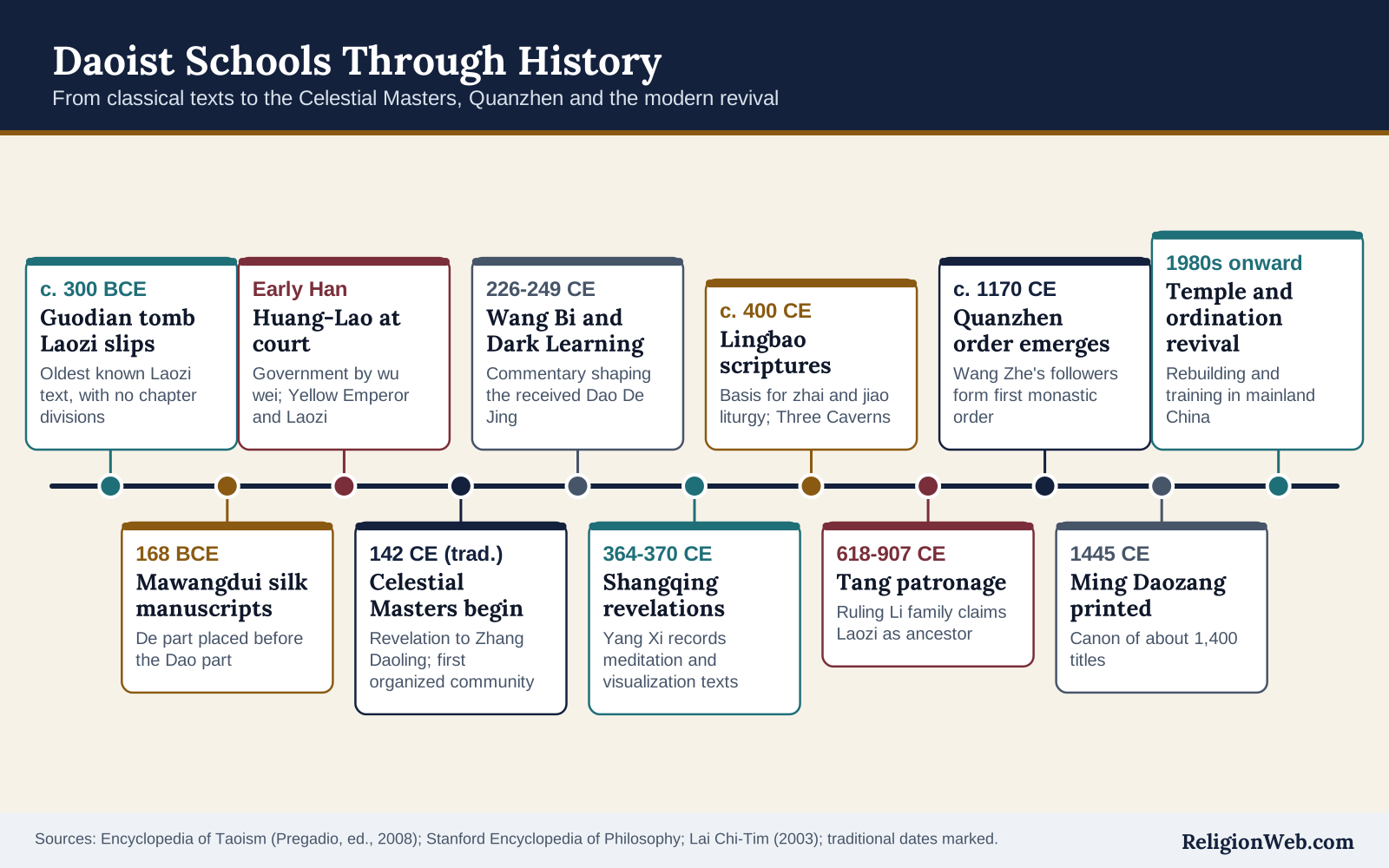
The following table organizes the chronology above. Dates are given as scholars or sources report them, and ranges signal real uncertainty.
| Date | Development | Significance |
|---|---|---|
| c. 400-300 BCE | Guodian tomb manuscripts include passages from the Laozi; Zhuangzi flourishes in the later 4th century BCE | Earliest surviving Laozi text; formative age of the Inner chapters |
| 168 BCE | Mawangdui tomb sealed with two silk Laozi manuscripts | Shows the text in Han times with the De part before the Dao part |
| 139 BCE | Huainanzi completed under Liu An | Quotes the Laozi and Zhuangzi extensively; evidence of their joint reception |
| 2nd century BCE | Huang-Lao current at the Han court | Political use of wu wei; later merged into the deity Huanglao jun |
| 142 CE (traditional) | Revelation to Zhang Daoling; Celestial Masters begin | First organized Daoist religious community |
| 226-249 CE | Wang Bi lives; Dark Learning flourishes | Commentary that shaped the received Dao De Jing |
| 364-370 CE | Yang Xi records Shangqing revelations | Visualization and meditation traditions |
| c. 400 CE | Lingbao scriptures appear in Jiangnan | Basis for later Daoist liturgy and the Three Caverns |
| 415-448 CE | Kou Qianzhi’s reforms in the Northern Wei | Daoism briefly becomes the dynasty’s official religion |
| 618-907 CE | Tang dynasty patronage | Imperial family claims Laozi as ancestor; grotto-heaven lists compiled |
| 1119 CE | Zhenghe Wanshou daozang completed | First printed Daoist canon |
| c. 1170 CE | Quanzhen emerges around Wang Zhe’s followers | First Daoist monastic order |
| 1445 CE | Ming Zhengtong Daozang published | Standard canon of about 1,400 titles |
| 1957 CE | Chinese Taoist Association established in the PRC | Official national body for Daoism, headquartered at White Cloud Temple |
| 1980 CE onward | Temple rebuilding and ordination revival | Reopening of monasteries, training classes and ritual practice |
How to read these dates
Some of the dates in the table are firm, such as the publication of the 1445 canon, while others rest on tradition or on reconstructions that scholars continue to revise. The 142 CE date for the Celestial Masters comes from the movement’s own memory of its founding revelation, whereas the stele of 173 CE is the earliest surviving record. Similarly, the Guodian tomb is dated about 300 BCE, but the manuscripts may have been copied earlier, and Alan Chan notes a proposal that one group of Guodian slips was copied around 400 BCE.
Readers should therefore treat the chronology as a map of the tradition’s major landmarks rather than as a record of precisely dated events, and should look for the qualifiers (“traditional,” “c.”) in the entries.
Core Beliefs and Concepts: The Dao, De, Wu Wei, Qi, and Cosmology
The Dao: Source, Pattern and Way
The Dao as the nameless source
The opening chapter of the Dao De Jing states the tradition’s paradox of naming. Legge’s 1891 translation renders its first two sentences this way:
The Tao that can be trodden is not the enduring and unchanging Tao. The name that can be named is not the enduring and unchanging name.
Tao Te Ching (Dao De Jing), tr. James Legge, Sacred Books of the East, vol. 39 (1891), ch. 1
The word Legge translates as “trodden” is dao itself used as a verb, and the Chinese can also mean “spoken” or “guided,” which is why other translators render the line as “the way that can be spoken of.” The passage is read in Daoist tradition as a statement that the ultimate Way exceeds every description. Commentators in the religious tradition, including those who treated the Dao De Jing as scripture, have taken the lines as pointing to a source before differentiation, from which heaven and earth and the “ten thousand things” emerge. Philosophical readers, by contrast, have often stressed the point about language: that fixed names and rigid distinctions distort our grasp of how things actually go.
Ways of understanding the Dao
Within the tradition the Dao is understood at several levels at once. As cosmic origin, it is the undifferentiated source that precedes and generates the world. As pattern, it is the course along which natural processes unfold, including the cycle of seasons and the rhythm of growth and decay. As a guide for human life, it is the Way a person or ruler can follow by aligning with that pattern. In religious Daoism the Dao is also personified and ritualized, as in the veneration of Laozi as a divine being (Daode Tianzun, the Heavenly Lord of the Way and Its Virtue).
Modern scholars interpret the concept in different ways. Chad Hansen’s Stanford Encyclopedia entry reads the Dao as a metaphor of walking a path, and emphasizes the structure of possible routes along which behavior can proceed, with de as the capacity to follow them. Other scholars place more weight on the Dao as a metaphysical source or as a mystical object of experience. These readings differ in emphasis, and none is the sole accepted meaning; specialists continue to argue over how much of the later religious cosmology can be read back into the earliest texts.
De, Ziran and Wu Wei
De: virtue, potency and integrity
The second term in the title Dao De Jing is de (德), often translated “virtue,” “power” or “potency.” In the early texts it refers less to moral conduct in the narrow sense than to the particular power a thing or a person has when it acts in accord with the Way. Hansen describes de as the internal capacity by which a walker follows the structure of a path, built up through practice. For the Dao De Jing the best rulers and the wisest sages have a de that is real because it is not displayed, and the text often praises the person who seems unremarkable, supple or even foolish while possessing deep integrity.
In Daoist ethics this idea of de also supports the cultivation of qualities such as simplicity, humility and compassion. In the later religious tradition de takes on a more explicitly moral and ritual cast, and merit gathered through good deeds and ritual service becomes a major theme.
Ziran: spontaneity and “self-so”
Ziran (自然) means literally “self-so” and is now the ordinary Chinese word for “nature.” In the Dao De Jing it names the way that things are and become of themselves, without outside compulsion. Chapter 25 describes, in paraphrase, a sequence in which humans model themselves on the earth, the earth on heaven, heaven on the Dao, and the Dao on ziran, which indicates that spontaneity is the deepest character of the Way, not something beyond it. Daoist thinkers treat artificial elaboration, rigid convention and strenuous scheming as departures from this natural spontaneity, though they differ about how far social institutions can be reconciled with it.
The idea runs through the Zhuangzi, where natural talents, craft skills and the flowing of the seasons are praised as expressions of ziran. It also appears in later religious Daoism, where practitioners seek to restore the original condition of the body and mind rather than to create something new.
Wu wei: acting without forcing
Wu wei (無為), usually translated “non-action” or “effortless action,” is the most frequently quoted and the most frequently misunderstood term in the tradition. Legge’s translation of the first sentence of chapter 37 reads:
The Tao in its regular course does nothing (for the sake of doing it), and so there is nothing which it does not do.
Tao Te Ching (Dao De Jing), tr. James Legge, Sacred Books of the East, vol. 39 (1891), ch. 37
Commentators have understood the line in several connected ways. For the Huang-Lao readers of the early Han, wu wei described a style of government in which the ruler refrains from constant intervention and lets officials and natural cycles do their work. For readers in the tradition of self-cultivation, it described an inner condition of stillness from which action arises without strain. In the Zhuangzi, the cook Ding who carves an ox so skillfully that his blade passes through the gaps between joints (in the third Inner chapter) shows wu wei as perfected skill, not as inactivity. Hansen notes that Confucian critics sometimes read the slogan as advising a ruler to “do nothing,” and calls the slogan itself paradoxical. The sections on misconceptions return to this point, since it is one of the most common errors about Daoism. Readers who want the Confucian background to those debates can consult the article on Confucianism.
Cosmology: Qi, Yin and Yang, and the Five Phases
Qi and the unfolding of the world
Daoist cosmology rests on qi (氣), the breath or energy that makes up and animates all things. Hansen notes that classical Daoists leaned more on the ancient concept of qi than on the later division of qi into yin and yang. In the common reading, the Dao gives rise to primordial qi, which differentiates into yin and yang and then into the myriad forms of the world. Chapter 42 of the Dao De Jing, in Legge’s translation, begins:
The Tao produced One; One produced Two; Two produced Three; Three produced All things.
Tao Te Ching (Dao De Jing), tr. James Legge, Sacred Books of the East, vol. 39 (1891), ch. 42
The sequence has been read as a cosmogony, with One as primordial breath, Two as yin and yang, and Three as their harmonized combination. In the inner alchemy tradition, Pregadio notes, Li Daochun linked the stages of the refining process, from essence into breath, from breath into spirit and from spirit into emptiness, to this chapter. So the same four lines serve as a statement of how the world arose and as a map of how a practitioner might retrace the path of return.
Yin and yang, and the Five Phases
Yin and yang name the complementary and mutually transforming aspects of any process: dark and light, receptive and active, cold and warm. They are not moral categories, nor do they stand for good and evil, and neither can exist without the other. The Five Phases, usually called wood, fire, earth, metal and water, describe patterns of generation and restraint, and Chinese thinkers applied them to the seasons, the directions, the organs of the body and the stages of a ritual. Pregadio observes that Daoist alchemy uses this correlative cosmology both to depict the configurations of the cosmos and to link practice with doctrine.
The Yijing (Book of Changes) and its trigrams and hexagrams belong to the same family of ideas. Daoist authors use them as a symbolic language, as in the alchemical Zhouyi cantong qi, which Pregadio describes as the text at the origin of inner alchemy.
The body as a cosmos
A distinctive feature of religious Daoism is the conviction that the human body is a small cosmos that mirrors the large one. It has its own landscapes, palaces and resident spirits in the Shangqing meditation tradition, and its own cycles of breath and essence in the inner alchemy tradition. Robinet describes the interiorization of Shangqing practice as the movement’s major innovation: adepts visualize spiritual entities within themselves and make them present.
The idea has practical consequences. It means that a priest purifying himself before a ritual, a hermit seated in meditation and a practitioner of breathing exercises all work on the same cosmos at different scales. It also explains why Daoist texts on medicine, ritual and meditation share vocabulary.
Deities, Immortals and the Afterlife
The Three Pure Ones and the celestial order
Religious Daoism recognizes a vast pantheon organized much like an imperial bureaucracy. At its summit stand the Three Pure Ones (Sanqing): Yuanshi Tianzun (the Heavenly Lord of Original Beginning), Lingbao Tianzun (the Heavenly Lord of the Numinous Treasure) and Daode Tianzun (the Heavenly Lord of the Way and Its Virtue), the last of whom is identified with Laozi. Below them are the Jade Emperor, the Three Officials of Heaven, Earth and Water, stellar and mountain deities, city gods, the Queen Mother of the West and the Eight Immortals, among countless others. The Singapore Taoist Federation, for instance, lists the Jade Emperor, the Golden Mother of the Jasper Lake and the Celestial Master Zhang Daoling among the deities whose birthdays temples celebrate.
Many of these figures are shared with Chinese popular religion, and temples frequently honor both Daoist and local gods. That overlap is explored in the article on Chinese folk religion. Daoist ritual specialists, however, claim a distinctive role: priests present petitions, memorials and offerings in an ordered liturgical language, and they hold registers and ordination ranks that place them in a hierarchy of service.
Immortality, transcendence and death
The pursuit of immortality (xian) is a major theme, though it is not the only one and it is understood in different ways. Early alchemists such as Ge Hong sought to prolong life and attain transcendence through elixirs, diet and exercise. Later inner alchemists reinterpreted these goals as the refining of essence, breath and spirit within the practitioner, so that the “immortal” could be a person who has realized the Way within an ordinary body. Pregadio notes that Liu Yiming (1734-1821) considered the elixir to be one’s fundamental nature, present in everyone.
Daoist attitudes toward death vary accordingly. The Zhuangzi contains stories in which the sage accepts death as part of natural transformation, while Lingbao scriptures emphasize ritual salvation of the dead and of ancestors. Andersen notes that the term zhai eventually became the technical term for Daoist funeral liturgy, and the festival of the Middle Origin (Zhongyuan) includes offerings for the dead. The result is a tradition with several answers to the question of what happens at death, depending on the school, text and ritual setting.
Glossary of Core Concepts
Key terms in one place
The following table summarizes the main concepts introduced in this section, with the sense each carries in Daoist writing. English glosses are conventional and cannot capture every nuance.
| Term | Characters | Common gloss | Where it matters |
|---|---|---|---|
| Dao | 道 | Way, path, ultimate source | Dao De Jing ch. 1; central to every Daoist current |
| De | 德 | Virtue, potency, integrity | The power of the Way in a person; second half of the Dao De Jing title |
| Wu wei | 無為 | Non-action, effortless action | Government by restraint; skillful action in the Zhuangzi |
| Ziran | 自然 | Self-so, spontaneity, nature | The characteristic way of the Dao and of things |
| Qi | 氣 | Breath, vital energy | Cosmology, medicine, breath cultivation, ritual |
| Yin and yang | 陰陽 | Complementary phases of change | Cosmology, alchemy, ritual structure |
| Wuxing | 五行 | Five Phases | Correlative cosmology applied to body, seasons and rites |
| Xian | 仙 | Immortal, transcendent | Goal of alchemical and meditative disciplines |
| Neidan | 內丹 | Inner alchemy | Refining essence, breath and spirit within the body |
Why translations of these terms vary
The glosses in the table are conventions, and translators defend different choices. Dao may be rendered as “Way,” “Path,” “Course” or left untranslated, and each choice emphasizes a different facet. De is variously “virtue,” “power,” “potency” and “integrity.” Wu wei has been rendered “non-action,” “non-doing,” “actionless action” and “effortless action.” Each of these captures something the others miss, and serious readers often compare several translations of the same chapter.
The variation is not merely a technical matter. It reflects the fact that early Chinese writing is compact and open to several readings, and that different interpretive traditions, from Wang Bi’s philosophical commentary to the religious commentaries of the Celestial Masters and the inner-alchemy authors, have heard different things in the same words. This article therefore tries to name the interpretive frame whenever it offers a reading.
Sacred Texts, Canon, and Authority in Daoism
The Dao De Jing
Structure, length and title
The Dao De Jing (道德經, “Classic of the Way and Its Power”), also known as the Laozi after its traditional author, is a short work of about five thousand Chinese characters, which is why it is sometimes called the “Text in Five Thousand Words” (Wuqian zi wen). In its received form it is divided into two parts, the Daojing (the “Classic of the Way”) and the Dejing (the “Classic of Virtue”), and into 81 short chapters, most written in terse, often rhymed verse. Alan Chan notes that some Dunhuang manuscripts contain 4,999 characters, and that Sima Qian’s biography of Laozi already describes the work as about 5,000 characters in two parts, so the round number is part of the text’s tradition.
The word jing, usually translated “classic” or “scripture,” was applied to the text over time and marks its status as a book of authority. For religious Daoists the work is not simply a text to be studied. Robinet writes that it was treated as a sacred scripture, recited with meditation and ritual, including for exorcist and healing purposes, and the Celestial Masters used a commentary called the Xiang’er as a kind of catechism for members.
The manuscripts: Guodian, Mawangdui and Peking University
Until the late twentieth century the oldest copies of the Dao De Jing were medieval, but three discoveries changed the picture. In late 1993 a tomb at Guodian in Hubei province, dated to around 300 BCE, yielded about 800 bamboo slips, of which about 730 are inscribed, with some 2,000 characters corresponding to passages in the Laozi, according to Alan Chan’s survey. The Guodian passages have no section divisions, and their order differs from the received text. In 1973 two silk manuscripts were found at Mawangdui in Hunan, in a tomb sealed in 168 BCE. Both put the Dejing, beginning with what is chapter 38 in the received order, before the Daojing, and the later copy records the character counts “Virtue, 3,041” and “Dao, 2,426.”
A third find is a set of Western Han bamboo slips donated to Peking University in January 2009 and published in December 2012. Chan reports that they date probably to the second half of Emperor Wu’s reign (141-87 BCE), contain the text in two parts, and divide it into 77 chapters. These discoveries show that the Dao De Jing circulated in different arrangements during the Han, that the version we read is one stage in a long process, and that the core wording is much older than any single edition.
How the text came to have 81 chapters
The 81-chapter form is so familiar that readers often assume it is original. It is not, and scholars date its emergence differently. Li Ruohui, writing in 2021, argues that the 81-chapter edition took shape at the end of a transition from the 77-chapter form seen at Peking University, with an intermediate stage visible in the quotations from the Laozi in the Huainanzi, and that it was complete between the reigns of Emperors Wu and Cheng of the Western Han. Robinet notes that the 81-section division first appears in the version associated with the commentator Heshang gong but was not universally accepted until perhaps the Tang, and that other versions have 64, 66 or 72 sections, or none at all. Chan holds that the chapter division was probably standardized in the Tang period, under Emperor Xuanzong (r. 712-756).
These accounts are not strictly contradictory, since they describe different stages, from the first appearance of an 81-part scheme to its dominance in print, but they leave the exact sequence unsettled. The Wang Bi (226-249) and Heshang gong commentaries are the two most influential lines of transmission for the received text, and Chan notes that more than thirty Heshang gong versions survive.
The Zhuangzi and Other Early Classics
The structure of the Zhuangzi
The Zhuangzi is a larger and more varied book than the Dao De Jing, mixing parables, dialogues, argument, poetry and satire. The extant text has thirty-three chapters, arranged by the editor Guo Xiang (died 312 CE) from an earlier collection of fifty-two. The Stanford Encyclopedia of Philosophy entry explains that the seven Inner chapters (1-7) are generally associated with Zhuangzi’s own period, the Outer chapters (8-22) with later followers, and the Miscellaneous chapters (23-33) with still others. The scholar A. C. Graham grouped much of the later material into strands such as the school of Zhuangzi, individualist writers, primitivists and syncretists.
The Inner chapters carry titles that translators render in various ways, such as “Free and Easy Wandering” for the first. They contain the passages for which the book is best known, including the butterfly dream, the cook who carves an ox and the bird Peng that crosses the sky.
The Liezi, Huainanzi and related works
The Liezi, named for a figure called Master Lie, is the third text commonly grouped with the Laozi and Zhuangzi. The Internet Encyclopedia of Philosophy entry by Steve Coutinho states that the extant eight-chapter version with the commentary of Zhang Zhan dates from the Western Jin, that the text borrows from the Zhuangzi, and that many scholars regard the work as a later compilation. The Huainanzi, completed in 139 BCE, is a synthesizing work that quotes both the Laozi and the Zhuangzi extensively.
Other works from the Han and later periods, including the Xiang’er commentary of the Celestial Masters, the Baopuzi of Ge Hong, and the alchemical Zhouyi cantong qi, are best read as Daoist writings in the broad sense, whether philosophical, devotional, ritual or technical. The table below lists the major titles with their traditions and approximate dates.
| Text | Date or tradition | Content | Role in the tradition |
|---|---|---|---|
| Dao De Jing (Laozi) | Warring States origins; 81-chapter edition by Han or Tang | 81 short chapters on the Dao, de, rulership and self-cultivation | Foundational text for both philosophers and religious Daoists; recited as scripture |
| Zhuangzi | Inner chapters, later 4th century BCE; edited by Guo Xiang, died 312 CE | 33 chapters of parables, dialogues and arguments | Classic of spontaneity, perspective and skill; major source for Daoist literature |
| Huainanzi | Completed 139 BCE under Liu An | Encyclopedic synthesis of cosmology, politics and conduct | Early evidence of how Laozi and Zhuangzi were read together |
| Liezi | Extant eight-chapter version from the Western Jin with Zhang Zhan’s commentary | Stories and sayings attributed to Master Lie | Third text of the classical Daoist trio; date debated |
| Xiang’er commentary | Celestial Masters, probably Zhang Lu | Religious commentary on the Dao De Jing | Catechism and moral guide for members |
| Baopuzi | Ge Hong (283-343) | 20 Inner Chapters on alchemy and immortality; 50 Outer Chapters on ethics | Key source on early alchemy and the aims of transcendence |
| Shangqing scriptures | Revealed to Yang Xi, 364-370 | Meditation, visualization and revelations from perfected beings | Highest rank in the Three Caverns scheme |
| Lingbao scriptures | Late 4th to early 5th century | Liturgy, cosmology and universal salvation | Basis of Daoist ritual (zhai and jiao) |
| Zhouyi cantong qi | Han period alchemical text | Alchemical use of the Yijing and correlative cosmology | Source text for inner alchemy |
| Zhengtong Daozang | Printed in 1445 | About 1,400 titles in the Ming canon | Standard reference canon |
The Daoist Canon (Daozang)
The Three Caverns and the shape of the canon
The Daozang, or “Treasury of the Dao,” is the collective name for the Daoist canon, a vast library of scriptures, ritual manuals, commentaries, alchemical writings, hagiographies and other works. Bokenkamp’s entry on Lingbao explains that the Lingbao scriptures first outlined the division of scriptures into the Three Caverns (sandong), presented as the celestial ordering of texts, and that this became the primary organizing framework for all later canons. In the usual description, the three divisions correspond to the Shangqing tradition, the Lingbao tradition and a third body of older texts, with four supplementary divisions added later to include other collections, including the Zhengyi texts.
The Three Caverns scheme is both a classification and a statement of authority. It gives each stream of revelation a place and a rank, and it allowed a tradition that had grown from many sources to present itself as an ordered whole.
The history of compilation and the Ming canon
Judith Boltz notes that there is no definitive study of the canon’s history and that early canons are hard to document, but that origins are commonly traced to Lu Xiujing in the fifth century. Tang catalogs, including the Kaiyuan daozang compiled between 713 and 741, did not survive the An Lushan rebellion of 755-63. Song canons followed in 990 and 1016, the Zhenghe Wanshou daozang of 1119 was the first printed edition, and the Jin and Yuan dynasties produced canons in 1192 and 1244.
The Ming Zhengtong Daozang of 1445, begun under the direction of Zhang Yuchu, the 43rd Celestial Master, contains some 1,400 titles and the twentieth-century Commercial Press reproduction was made from the copy kept at the White Cloud Temple in Beijing. Different indexes count between 1,473 and 1,527 titles, which reflects differences in how works are divided. Reprints published in Shanghai (1923-26), Taipei and Beijing made the canon accessible to scholars and practitioners.
Authority, Transmission and Reading
Scripture as ritual object and as teaching
Daoist scriptures are understood in more than one way. Some are teachings to be read, memorized and reflected upon. Others are powerful objects received through formal transmission from a master, kept in sacred spaces, and recited in rituals where their words act on the unseen world. The Lingbao texts present themselves as celestial revelations with an authority beyond ordinary writing, and Shangqing texts claim to come from perfected beings who spoke to Yang Xi. Even the Dao De Jing, which began as a philosophical collection, was given a liturgical function when it was recited in ritual contexts.
For this reason, discussions about authority in Daoism cannot be reduced to a single rule such as “scripture alone.” Authority also flows from lineage, ordination, registers that list the spiritual officials a priest may summon, and the experience of the practitioner. Hansen’s observation that the founding figures did not coin the “-ism” applies here as well: the tradition built its own structures of authority gradually, using revelation, transmission and commentary.
How to read Daoist texts today
For readers coming from outside the tradition, a practical approach is to begin with the Dao De Jing and the Inner chapters of the Zhuangzi in a reliable translation, to compare at least two renderings of difficult chapters, and then to explore the religious literature through anthologies and scholarly introductions. Public-domain translations such as Legge’s are freely available, though their English reflects the conventions of the late nineteenth century.
Readers should also bear in mind that a translation encodes an interpretation. A rendering that stresses mysticism, one that stresses political advice and one that stresses alchemical meaning may all be defensible, and each corresponds to a way the text has been read within the tradition. Where this article quotes the Dao De Jing it uses Legge’s wording unchanged and names the chapter so that readers can compare other translations.
Laozi, Zhuangzi, and Other Central Figures in Daoism
Laozi: Author, Archivist and Deity
The traditional biography
The earliest extended account of Laozi comes from the Shiji (Records of the Grand Historian) by Sima Qian (about 145-86 BCE). Alan Chan summarizes it in the Stanford Encyclopedia of Philosophy: Laozi was a native of the southern state of Chu, with the family name Li and the given name Er, also called Dan. He served as a keeper of archival records at the Zhou court and met Confucius. When he decided to leave the kingdom through its western frontier, a border official asked him to write down his teachings, and the result was a book of about 5,000 characters in two parts. Robinet’s entry on the Daode jing names the border guard Yin Xi and records the tradition that Laozi passed the book to him as he left the Middle Kingdom for the west.
For Daoists, the story is more than a literary frame. It identifies Laozi as a teacher who withdrew from a declining court, offered his wisdom to a stranger, and then vanished from the record. Religious Daoism later told many more stories about him, including his birth, his transformations and his reappearances to teach new generations.
Historical questions about Laozi
Chan cautions that the reliability of Sima Qian’s account has been questioned. Scholars dispute Laozi’s birthplace and whether “Lao” is really a surname, and some argue that Sima Qian conflated Lao Dan with Li Er. Others, following A. C. Graham, regard the Laozi story as a combination of several legends. Because the text itself shows signs of accumulation, many scholars treat the Dao De Jing as the work of more than one hand over a period of generations, although Liu Xiaogan and others have defended a single author and an earlier date.
The honest summary is that the historical Laozi, if there was a single historical figure, cannot be reliably reconstructed. Daoists can value the figure of Laozi as the revealer of the Way without that question being settled, and scholars can study the text without needing to settle it either.
Laozi as the divine Lord Lao
Over the centuries Laozi was increasingly venerated as a deity. By the time of the Celestial Masters, tradition held that he had appeared on Mount Heming to Zhang Daoling in 142 CE. In the Han, he was joined with the Yellow Emperor in the figure of Huanglao jun, and later he became Taishang Laojun, the “Supreme Lord Lao.” In the Three Pure Ones scheme he is identified with Daode Tianzun, the Heavenly Lord of the Way and Its Virtue. The Tang imperial family, who shared his surname Li, claimed him as an ancestor, a claim that tied the dynasty’s prestige to his veneration.
His birthday is observed on the fifteenth day of the second lunar month, as the Singapore Taoist Federation records, and temples of many kinds hold services for him. The elevated Laozi and the author of the Dao De Jing are the same figure in Daoist devotion, even though they are approached through different practices.
Zhuangzi: Skeptic, Storyteller and Sage
What can be said about Zhuang Zhou
Zhuangzi (“Master Zhuang”), whose personal name was Zhou, flourished in the later fourth century BCE. According to the Stanford Encyclopedia of Philosophy, Han biographers speculated about his home state, his name and minor official posts, but these details are hard to confirm. His thought is preserved in the Inner chapters of the book that bears his name, where it appears alongside parables, arguments and dialogues with his friend and philosophical rival Hui Shi, known as Huizi.
Unlike the Dao De Jing, which speaks mostly in short authoritative verses, the Zhuangzi speaks in humor, paradox and narrative. The effect is of a thinker who delights in showing the limits of any single point of view, while still insisting that there is a way of living well that is open to those who see the world from many angles.
Stories and ideas that shaped the tradition
Several famous episodes carry the book’s thought. In the first chapter the enormous bird Peng and the small creatures that mock it show how perspective shapes judgment, and the ideal of “free and easy wandering” describes a freedom from the narrow measures of success. In the second chapter, Zhuangzi dreams he is a butterfly and wakes uncertain whether he is a man who dreamed of being a butterfly or a butterfly dreaming of being a man, a passage often read as an exploration of transformation and the limits of knowledge. In the third chapter the skilled cook who carves an ox without dulling his blade offers a picture of action in harmony with the grain of things.
Interpreters disagree about how to read these stories. Hansen reads the Zhuangzi’s skepticism as broad but mild rather than paralyzing, while other scholars have described it as relativism, as epistemic modesty or as a mystical attitude. The entry also observes that elements of Zhuangzi’s naturalism later helped shape Chan (Zen) Buddhism, a connection described from the Buddhist side in the article on Mahayana Buddhism.
Religious Founders, Revealers and Reformers
Zhang Daoling and the Celestial Masters
Daoist tradition honors Zhang Daoling (also called Zhang Ling) as the first Celestial Master and the recipient of Laozi’s covenant. Britannica gives his death as 156 CE. His son Zhang Heng and his grandson Zhang Lu, the likely author of the Xiang’er commentary, extended the movement. The line of Celestial Masters continues, and Kleeman notes that a Celestial Master still claims descent from Zhang Daoling today, with most non-monastic Daoist priests in China and in the diaspora identifying with the Celestial Master tradition.
The Singapore Taoist Federation lists the birthday of the Celestial Master Zhang Daoling on the fifteenth day of the first lunar month, which shows how the founder is remembered within the festival calendar.
Ge Hong, Yang Xi, Tao Hongjing, Lu Xiujing and Kou Qianzhi
Several fourth- and fifth-century figures shaped what later became the standard repertoire of the tradition. Ge Hong (283-343) tried to unite Confucian ethics with the quest for immortality. Yang Xi (330-86) transcribed the Shangqing revelations, and Tao Hongjing (456-536) worked to reassemble and edit them. Ge Chaofu is credited by later records with releasing the Lingbao scriptures around 400, and Lu Xiujing (406-77) collected and cataloged them. Kou Qianzhi, who died in 448, reformed the northern Celestial Masters and secured imperial recognition.
Together they illustrate how Daoism developed through revelation, editing and codification across regions and generations, and how a few individuals could change the shape of the tradition by deciding what counted as authentic scripture.
Wang Zhe, the Seven Real Men and Qiu Chuji
The Quanzhen order traces itself to Wang Zhe (1113-70), also called Wang Chongyang, who practiced as a hermit in the Zhongnan mountains. His seven major disciples, the Seven Real Men, spread the order across northern China. Among them the best known is Qiu Chuji (1148-1227), whose journey to meet Chinggis Khan in 1222 brought favorable decrees. Today the main deity of the White Cloud Temple in Beijing is Qiuzu, that is, Qiu Chuji, according to an interview, apparently from the late 1990s, with Min Zhiting, then head of the Chinese Taoist Association, and Chongyang Palace in Huxian, Shaanxi, is linked with Wang Chongyang.
Sun Bu’er (1119-83) is traditionally counted as the only woman among the Seven, and she is remembered in later writing on the cultivation of women practitioners.
Immortals and Legendary Figures in Daoist Devotion
The Yellow Emperor and the Eight Immortals
Daoist devotion also honors legendary and semi-historical figures. The Yellow Emperor (Huangdi) was honored in the Huang-Lao current as the first ruler to apply the Way to government and later became, in Pregadio’s words, the patron of various arts such as medicine and alchemy. The Eight Immortals, a group of transcendent figures popular in art, theater and temple devotion, include Lu Dongbin, whose birthday a Chinese-festival guide from the Chinese Culture Center of San Francisco gives as the fourteenth day of the fourth lunar month.
These figures are shared with Chinese popular culture, and the line between religious veneration and folklore is not sharp. Temples of the Eight Immortals, stories about their travels and images of them in festival processions form part of the common repertoire discussed in the article on Chinese folk religion.
Major figures at a glance
The table collects the main figures introduced in this section, with the traditional associations that make each important to Daoists.
| Figure | Dates or period | Role | Associated text or institution |
|---|---|---|---|
| Laozi (Lao Dan, Li Er) | Traditionally 6th or early 5th century BCE; historicity debated | Traditional author of the Dao De Jing; later deified as Taishang Laojun | Dao De Jing; Three Pure Ones as Daode Tianzun |
| Zhuangzi (Zhuang Zhou) | Later 4th century BCE | Thinker and storyteller of the Inner chapters | Zhuangzi, edited by Guo Xiang |
| Zhang Daoling | Traditional revelation 142 CE | First Celestial Master | Way of the Celestial Masters; later Zhengyi |
| Zhang Lu | Active 180s-215 CE | Organizer of the Celestial Masters; likely author of the Xiang’er | Hanzhong theocratic state |
| Ge Hong | 283-343 | Alchemist and writer | Baopuzi |
| Yang Xi | 330-86 | Medium of the Shangqing revelations | Shangqing scriptures |
| Lu Xiujing | 406-77 | Cataloger and organizer of scriptures | Lingbao canon; 437 catalog |
| Wang Zhe (Wang Chongyang) | 1113-70 | Founder of Quanzhen | Quanzhen monastic order |
| Qiu Chuji | 1148-1227 | Quanzhen leader who met Chinggis Khan in 1222 | White Cloud Temple tradition |
Women and lay devotees in the tradition
Women appear in Daoist history as visionaries, nuns, priests and patrons. Hansen notes that Daoist institutional religion adopted forms including monks, nuns and monasteries, and the celibate communal life of orders such as Quanzhen has included women who commit themselves to cultivation as well as men. Lay devotees, including householder families who support temples and priests, make up the large majority of those who take part in Daoist ritual in practice.
The picture of the tradition as a set of famous men is therefore incomplete. A reader looking for who has done most to keep Daoist practice alive in ordinary communities would find a much larger cast of local priests, temple committees, mediums, musicians and families.
Worship, Ritual, and Cultivation Practices in Daoism
Daoist Priesthood and Ordination
Zhengyi priests who live among the people
Much of the Daoist ritual a visitor to China, Taiwan or Southeast Asia will actually see is performed by priests of the Zhengyi tradition, the lineage that traces itself to the Celestial Masters. Most of these priests are not monastics. They marry, raise families and live in their communities, and they are called upon by temples, families and neighborhoods to perform rites. Terry Kleeman notes that most non-monastic Daoist priests in China and in the diaspora identify with the Celestial Master tradition, and Poul Andersen notes that classical forms of the major offering ritual are typically led by Zhengyi priests. In some localities, he adds, priests called Red-head (hongtou) perform variants.
Lai Chi-Tim reports that, according to 1996 figures from the National Daoist Association, about 20,000 Daoist priests lived at home and performed rituals in local communities. State policy has restricted such priests, but Lai concludes that the revival of village temple ritual shows that Daoism remains active in Chinese communities. Ordination of Zhengyi priests has resumed at the Halls of the Zhengyi Celestial Master at Longhu shan in Jiangxi.
Quanzhen monks and nuns
Quanzhen offers a different pattern of religious life. Vincent Goossaert describes its monastics as living a celibate, communal life, with a novitiate and ordination under the initial precepts for perfection (chuzhen jie). Monastic rules have varied from place to place. A candidate enters a monastery, undertakes a period of training in discipline, ritual and study, and, if accepted, receives precepts that govern conduct and mark a new status. For Quanzhen, the monastery is a place for self-cultivation, in which meditation and liturgy are typically central.
Where each pattern is strong differs by place. Min Zhiting, then head of the Chinese Taoist Association, said in the late 1990s interview cited above that most Daoists who live in temples are Quanzhen, while Zhengyi Daoists mostly live at home and gather at temples for religious events, with Shanghai, Suzhou and Maoshan as examples of that second pattern.
Training and transmission today
Daoist knowledge passes through transmission from teacher to disciple, and in recent decades also through institutional schools. Lai describes training classes for young Daoists in the 1980s and 1990s, and Min’s interview mentions Daoist colleges at the White Cloud Temple in Beijing, in Shanghai and at Qingcheng in Sichuan. The curriculum combines religious study, liturgy and general education.
Traditional transmission includes the learning of liturgical music, the memorization of scriptures, the use of ritual implements and the study of the written forms of petitions and memorials. Because the ritual is carried out in a formal liturgical language, much of its meaning for lay participants comes through sound, color, movement and the shared knowledge that the priests are acting on their behalf.
Communal Liturgy: Zhai and Jiao
The jiao offering: sequence and purpose
Jiao (醮) means “offering,” and Andersen defines it as a large-scale ceremony by which local communities and associations such as guilds affirm their religious identity and their semicontractual bond with a tutelary deity. A classical jiao may last a week or longer, and communities may hold one every three, five or more years depending on local custom. Two main types are named: the Offering of Thanksgiving and Praying for Peace (xie’en qi’an jiao), which renews the life and blessings of the community, and the Offering for Averting Calamities (rangzai jiao), held in response to problems such as drought or epidemic.
Andersen’s three-day program shows the sequence. On the first day the priests announce the rite and invoke the gods, raise flags, make a noon offering, divide the lamps, seal the altar and perform a nocturnal invocation that establishes, purifies and consecrates the sacred area. On the second day they hold morning, noon and evening audiences with the heavenly powers. On the third day they renew the invocation, present a written memorial, light lamps for beings of the three realms, perform the orthodox offering and finally the rite of universal salvation (pudu), which offers sustenance to wandering and unattended souls. The central liturgy is conducted behind the temple’s closed doors by the priests and their musicians, and only selected community representatives witness it.
Zhai retreats and funerary liturgy
Zhai (齋) originally meant “fast” or “retreat” and was an earlier communal liturgy focused on purification, repentance and expiation of sins. Andersen explains that jiao had a separate origin and that the two were combined in the Tang, when the compound zhaijiao came into use. Du Guangting (850-933) is credited with adding the Offering of Thanksgiving at the end of a zhai service. Over time, jiao became the general term for the combined liturgy for the living, while zhai became the technical term for Daoist funeral liturgy.
Bokenkamp notes that the Lingbao scriptures provide the basis for these rites, presenting communal retreats and offering rites together with burial rites and penitentials. The central wish is the salvation of all beings, and in practice the rites were most often performed for the practitioner’s ancestors. In that sense Daoist funerary liturgy extends concern for the dead into a cosmic frame, within which family duty and universal compassion are joined.
What the community does around the liturgy
Because the inner liturgy is performed by specialists, lay participation takes other forms. In many communities, households prepare offerings, contribute to the costs of the event, burn incense, take part in processions of the gods and attend public performances held at the same time. The ritual strengthens the relationship between a community and its patron deity, and its timing may be set by the temple’s own calendar or by a cycle of years.
These customs vary greatly. A southern Taiwan community offering, a Fujian village festival, a Hong Kong temple event and a monastery’s liturgy in northern China differ in scale, music, local gods and the balance of priestly and lay roles. No single form can be taken as the standard, and the descriptions above should be read as one well-documented pattern.
Household Devotion and Everyday Observance
Incense, offerings and temple visits
Daily devotion in Daoist settings is mostly informal. Practice, as Min Zhiting described it, centers on the burning of incense and prayer for good fortune at festivals and on the first and fifteenth days of each lunar month. Visitors light incense sticks, bow before images of deities, make offerings of fruit, flowers or paper, and sometimes consult the temple’s divination practices. Households may keep small altars to deities, ancestors or the Kitchen God, and many of these customs are shared with the practices described in the article on Chinese folk religion.
The Celestial Masters regarded such offerings differently from the practices they criticized. Kleeman reports that the movement rejected blood sacrifice to traditional gods, and held that the gods do not eat or drink. In Daoist liturgy, accordingly, the incense, lamps and written petitions are understood as means of communication and as expressions of reverence, not as food for the gods.
Petitions, confession and ritual healing
Early Celestial Master practice included written confession and petition. Britannica describes a second-century proposal, attributed to Chang Heng (Zhang Heng, the son of Zhang Daoling in Kleeman’s account), that confessions be written in triplicate, with one copy burned for heaven, one buried in the earth and one sunk in water, a practice linked to the Three Officials of Heaven, Earth and Water. Heavenly Official is associated with bestowing happiness, the Earthly Official with remission of sin and the Water Official with averting misfortune.
Daoist communities have also long used rituals for healing and the removal of harmful influences, and Robinet notes that the Dao De Jing itself was recited for exorcist and healing purposes. It is important to keep the scope of such rites clear. They are religious acts addressed to unseen powers, and Daoist institutions do not present them as replacements for medical, psychological or emergency care. Anyone with a serious health problem should consult a qualified clinician, and the religious rite, if desired, can be an additional form of support.
Cultivation: Meditation, Inner Alchemy, Breath and Body
Stillness, visualization and inner observation
Meditation takes several forms in Daoist history. Robinet describes the Shangqing tradition’s emphasis on meditation and visualization as individual practices through which adepts “actualize” spiritual entities within themselves. Goossaert notes that Quanzhen self-cultivation methods include meditation on alchemical poems (niantou) and a period of meditation in an enclosed cell (huandu). The Dao De Jing, in Legge’s translation, speaks of guarding stillness, and the Zhuangzi describes forms of sitting and forgetting that have inspired later contemplative practice.
These practices have a shared aim: to quiet the ordinary agitation of the mind and body so that the practitioner may sense, and then align with, the underlying order of the Way. They are usually learned from a teacher, because the visualizations, the posture and the timing are said to need correction by someone who has done them.
Neidan: refining essence, breath and spirit
The inner alchemical tradition developed a systematic discipline on this foundation. Pregadio explains that neidan refines the primary constituents of the human being, which are essence (jing), breath (qi) and spirit (shen), in a standard sequence: essence is refined into breath, breath into spirit and spirit back to emptiness. The process is described as an “inversion” and “reversion” of the ordinary flow by which the Way gives rise to the world. Neidan texts use the symbols of the outer alchemists, such as cinnabar, lead and mercury, the crucible and the furnace, as a language for these processes in the body.
Different authors interpret the practice differently. Li Daochun (active 1288-1306) rejected sexual practices and external alchemy, while Chen Zhixu (1289 to after 1335) rejected treating alchemy as a mere technique. Liu Yiming (1734-1821) held that the elixir is another name for one’s fundamental nature, present in everyone. The tradition thus ranges from detailed bodily procedures to the view that the “elixir” is realization of what one already is.
Waidan, diet and the caution about elixirs
Before inner alchemy came waidan, external alchemy, the refining of mineral substances such as cinnabar into elixirs. Pregadio notes that the first identifiable waidan tradition is in the Taiqing sources. Ge Hong’s Baopuzi, in Britannica’s summary, includes an elixir recipe called gold cinnabar along with guidance on special diets, sexual hygiene and breathing and meditation exercises. Dietary regimens have a long history in Daoist practice.
Cinnabar is a mercury compound and mercury is poisonous, so the mineral elixirs of the early alchemists are not safe, and no reader should attempt to prepare or consume them. The shift in later centuries from external to internal alchemy, which Li Daochun’s rejection of waidan reflects, moved the discipline from the laboratory to the body and mind.
Rituals and Observances at a Glance
A summary table of practices
The following table summarizes the main rites and practices described in this section. The column on who takes part clarifies where participation is specialist or open to laypeople.
| Practice | What happens | Who takes part | Meaning |
|---|---|---|---|
| Jiao (offering) | Multi-day rite of invocation, audiences, memorial, offering and universal salvation, often every few years | Zhengyi or similar priests and musicians; community representatives witness | Renews the community’s bond with its tutelary deity; averts calamity |
| Zhai (retreat, funerary liturgy) | Purification, repentance and rites for the dead | Priests with the family | Expiation of sins and salvation of ancestors and all beings |
| Ordination | Reception of precepts, scriptures and registers | Candidates, masters, ordaining institutions | Marks entry into clerical status in Quanzhen or Zhengyi |
| Temple incense and prayer | Burning incense, bowing, offerings, petitions, especially on the 1st and 15th of the lunar month | Laypeople of any background | Seeking blessing, protection and good fortune |
| Meditation and visualization | Seated stillness, inner visualization, enclosed-cell retreat | Monastics and lay practitioners | Aligning with the Dao; “actualizing” inner spirits |
| Neidan (inner alchemy) | Refining essence, breath and spirit | Trained practitioners under a teacher | Return to the source; realization of one’s fundamental nature |
| Pilgrimage to sacred mountains | Ascending to temples and grotto-heavens | Clergy and lay pilgrims | Contact with sacred places and immortals |
Obligation, recommendation and custom
Daoism has no single set of universal obligations comparable to a creed or a prescribed weekly service. For clergy, the precepts they receive at ordination are binding and vary by order: Quanzhen monastics commit to celibacy and communal discipline, while Zhengyi priests live as householders with their own ritual duties. For lay participants, most observances are recommended or customary rather than required. Visiting a temple on the first and fifteenth days, offering incense and joining a community festival are matters of local tradition and personal devotion, and families differ in how much they observe.
Regional practice varies as well. A visitor to Beijing’s White Cloud Temple, a village temple in Fujian, a Taiwanese temple festival and a Singapore Taoist temple would encounter different rites, deities and styles, and each would be Daoist in a legitimate local sense. This diversity is a defining feature of the living tradition, not a departure from it.
Holy Days and the Daoist Calendar
How the Daoist Calendar Works
Lunar months and the shifting Gregorian date
Daoist festivals follow the traditional Chinese lunisolar calendar. Each month begins with a new moon, so that the fifteenth day of a month falls near the full moon, and an extra month is inserted in some years to keep the calendar aligned with the seasons. Because of this, a festival fixed to a lunar date, such as the fifteenth day of the second month, falls on a different Gregorian date each year, always within a range of several weeks. Anyone planning to attend a festival should check a current Chinese calendar or the announcement of the temple concerned, since this article gives the lunar rule rather than a specific date for the coming year.
Dates also vary somewhat by locality. Many deities have birthdays on which local temples hold services, and different regions sometimes assign different days to the same figure or celebrate local gods that the national calendar omits. The dates below are those published by the sources named, and they should be read as widely used dates, not as the single correct dates for all communities.
Solar markers and festival days
A few observances are tied to the solar year. The Qingming festival of tomb sweeping falls on April 4, 5 or 6, according to a festival guide from the Chinese Culture Center of San Francisco. The Singapore Taoist Federation, in its list of deities, assigns the birthday of Yuanshi Tianzun, the first of the Three Pure Ones, to the winter solstice and that of Lingbao Tianzun to the summer solstice, while the Heavenly Lord of the Way and Its Virtue, identified with Laozi, is celebrated on the lunar date described below.
The combination of lunar and solar timing reflects a basic Chinese conviction that human ritual should follow cosmic rhythms. Solstices mark the turning points of yin and yang, and the new and full moons mark the monthly cycle of the same forces.
Major Festivals and Birthdays of the Deities
The Jade Emperor and the first month
The first lunar month is a season of renewal. The Chinese New Year falls on the first day of the first month, and the Lantern Festival on the fifteenth. The Singapore Taoist Federation records the birthday of the Jade Emperor on the ninth day of the first lunar month, when temples hold a “Jade Emperor Assembly,” and the birthday of the Celestial Master Zhang Daoling on the fifteenth day. The Jade Emperor is the sovereign of the celestial bureaucracy in popular and Daoist devotion, and his birthday is observed with offerings and services in temples that honor him.
The fifteenth day of the first month is also, in the usual reckoning, the Upper Origin (Shangyuan), one of three “Origin” days associated with the Three Officials of Heaven, Earth and Water, whose functions Britannica describes as bestowing happiness, remitting sin and averting misfortune. The Middle Origin falls in the seventh month and is discussed below, and the Lower Origin is conventionally placed on the fifteenth day of the tenth month.
Laozi’s birthday and the spring celebrations
Laozi’s birthday, honored in the person of the Heavenly Lord of the Way and Its Virtue, is observed on the fifteenth day of the second lunar month, according to both the Singapore Taoist Federation and the Chinese Culture Center of San Francisco. Daoist temples, and especially those dedicated to him, may hold services on or near that day, and local programs differ. In spring the calendar also marks the birthday of Xuantian Shangdi, a deity described as a god of rain, on the third day of the third month, and the birthday of Lu Dongbin, one of the Eight Immortals, on the fourteenth day of the fourth month.
These observances show the different registers of Daoist devotion. One honors the teacher of the Way, another a deity associated with rain, and another a figure counted among the Eight Immortals.
Zhongyuan: the festival of the Middle Origin
One of the most widely observed Daoist festivals is Zhongyuan, held on the fifteenth day of the seventh lunar month. An online Daoist-culture database explains that this date became the birthday of the Earthly Official of the Middle Origin, who pardons sins and oversees the realm of the dead, examining ghosts and souls. Daoists mark it with offering rites to bless ancestors, pardon their sins and help them ascend to heaven. Other customs include offerings to ancestors and lone souls, universal salvation rituals at Daoist and Buddhist temples, and the visiting of new tombs.
The same day is the Buddhist Yulanpen festival, and the practices of the two traditions have blended in many places, as the same source notes. In the interview with Min Zhiting cited earlier, the Zhongyuan festival drew over 100,000 visitors to the White Cloud Temple in Beijing in the period of the interview, which illustrates how large temple festivals can be. The month in which the festival falls is popularly called the Ghost Month, and the festival is discussed from the perspective of popular custom in the article on Chinese folk religion.
Observances of the Monthly and Household Cycle
The first and fifteenth days of each month
Alongside annual festivals, Daoist temples observe the lunar month. Min Zhiting’s interview describes the burning of incense and prayer for good fortune as taking place at festivals and on the first and fifteenth days of each lunar month. On those days temples are busier than usual, with worshipers lighting incense and making offerings at the new and full moon. For many families this is the main regular contact with a Daoist temple.
The practice follows a pattern found in many Chinese religious settings, in which regular visits express continuing relationship with the gods and not only requests in a crisis. The rhythm of the lunar month therefore gives ordinary life a recurring sacred punctuation.
Shared Chinese festivals with Daoist participation
Daoist temples also take part in festivals that belong to the wider Chinese calendar: the Dragon Boat Festival on the fifth day of the fifth month, Mid-Autumn on the fifteenth of the eighth month, Double Ninth on the ninth of the ninth month, and the report of the Kitchen God to the Jade Emperor on the twenty-third of the twelfth month, according to the festival guide mentioned above. These are not specifically Daoist, and their observance in households is mostly a matter of family and community custom. Priests and temples may offer services, and individual customs differ by region.
For this reason, a description of “Daoist holidays” is necessarily a description of an overlapping calendar. Some days belong specially to Daoist deities and clergy, while others belong to Chinese cultural life as a whole and receive Daoist ritual attention in some places.
Calendar of Major Observances
A summary of dates by the lunar calendar
| Lunar date | Observance | Meaning | Source note |
|---|---|---|---|
| 1st month, day 1 | Chinese New Year | Beginning of the year; renewal | Chinese Culture Center of San Francisco guide |
| 1st month, day 9 | Birthday of the Jade Emperor | Celebration of the celestial sovereign; Jade Emperor Assembly | Singapore Taoist Federation |
| 1st month, day 15 | Lantern Festival; birthday of Celestial Master Zhang Daoling | Close of the New Year season; honoring the first Celestial Master | Chinese Culture Center; Singapore Taoist Federation |
| 2nd month, day 15 | Birthday of Laozi (Daode Tianzun) | Honoring the teacher of the Way | Singapore Taoist Federation; Chinese Culture Center |
| 3rd month, day 3 | Birthday of Xuantian Shangdi | Deity described as god of rain | Chinese Culture Center |
| 4th month, day 14 | Birthday of Lu Dongbin | One of the Eight Immortals | Chinese Culture Center |
| 7th month, day 15 | Zhongyuan (Middle Origin) | Pardon of sins; offerings for ancestors and wandering souls | Online Daoist-culture database; Chinese Culture Center |
| 12th month, day 23 | Kitchen God reports to the Jade Emperor | Household custom | Chinese Culture Center |
| Winter and summer solstices | Birthdays of Yuanshi Tianzun and Lingbao Tianzun | Solar turning points | Singapore Taoist Federation |
Why dates differ among temples
Readers comparing sources will sometimes find that the same deity has different dates. This is normal. Daoist temples draw on their own lineage calendars, local traditions and the historical layering of festivals. A deity such as Xuantian Shangdi may have different stories and dates in different regions, and the same date can be assigned different significance at a Quanzhen monastery and at a village temple.
The practical advice is to rely on the announcements of the temple or association concerned. For readers who want to witness a festival, the best approach is to contact the temple or check its published schedule, since local custom governs what happens, who may enter the inner space and when.
Branches, Schools, and Internal Diversity in Daoism
The Historical Lineages
The Celestial Masters and Zhengyi
The oldest continuing organized lineage is the Way of the Celestial Masters, which later came to be known as Zhengyi, “Orthodox Unity.” As described above, it began with the revelation to Zhang Daoling in 142 CE, expanded under Zhang Lu, and dispersed after 215 CE. Its priests are ordained and, in the tradition’s own account, hold registers that authorize them to perform ritual and call on spirit officials. Today the Zhengyi tradition includes the great majority of non-monastic Daoist priests, and a Celestial Master still claims descent from Zhang Daoling, according to Kleeman.
The Zhengyi tradition is strongly associated with the community liturgies described earlier, and with Longhu shan in Jiangxi, where ordinations have been restored. Its identity rests on lineage and ritual practice. Its priests perform for temples, families and associations, and in Taiwan and Southeast Asia it supplies a large share of the Daoist liturgical life visible to the public.
Shangqing and Lingbao
Shangqing and Lingbao began as revelatory traditions and later became layers within the canon rather than separate organizations. Shangqing, from the 360s, is known for its inward meditation and visualization practices. Lingbao, from about 400, is known for its liturgies, universal salvation and its cosmology of heavens. Both were absorbed into the ordination structures of later Daoism, so that Zhengyi and Quanzhen priests alike draw on Lingbao ritual forms.
The Maoshan mountain in Jiangsu is associated in tradition with Shangqing, and Min Zhiting lists Maoshan as a place where Zhengyi Daoists live at home. The links between a revelatory tradition, a mountain and a modern clergy show how Daoism’s historical strands persist in layers.
Quanzhen and the Longmen lineage
Quanzhen, “Complete Perfection,” arose in the twelfth century and is, in Goossaert’s words, the main official branch of Daoism in continental China today. Its status rests mainly on its celibate, communal way of life rather than on distinct doctrine. Within Quanzhen, the Longmen (Dragon Gate) lineage is the most prestigious, although, Goossaert notes, not a very ancient one. Its founder Wang Changyue (died 1680) received Manchu support, changed the ordination system and brought many monasteries under Longmen control.
Quanzhen’s institutional center today is the White Cloud Temple in Beijing, where the Chinese Taoist Association has its headquarters, and its other major sites include Chongyang Palace in Shaanxi, linked to Wang Chongyang.
Other Currents and Local Traditions
Huang-Lao, Dark Learning and the scholarly traditions
Not every Daoist current produced a lasting organization. Huang-Lao, the early Han court current, and Dark Learning, the third-century philosophical movement, left their mark on texts and commentary but did not survive as institutions. Hansen notes that Dark Learning revived the pairing of Laozi and Zhuangzi after the fall of the Han. These strands are the core of what is usually called philosophical Daoism, and they continue to influence readers, translators and scholars.
The Daoist canon preserves their legacy, and commentaries by Wang Bi and Guo Xiang remain standard references. In this sense the older currents function as a permanent layer in the tradition: they supply the vocabulary that later religious Daoism interprets.
Alchemical lineages and local ritual traditions
Alchemical lineages form another kind of internal diversity. Waidan and neidan have their own texts, teachers and rival interpretations, as the divergent views of Li Daochun, Chen Zhixu and Liu Yiming show. Neidan was taken up within Quanzhen, which, according to Goossaert, read and commented on neidan texts rather than rewriting them, and it also circulates among independent teachers and lay practitioners.
At the local level, priests of Zhengyi and other ritual traditions perform variants of the great liturgies. Andersen notes that in some localities Red-head priests perform variant forms of the offering. Britannica also uses the heading “communal folk Taoism (shenjiao)” for the tradition of local devotion to gods, which shows how scholars organize the boundary between ordained liturgy and community religion.
Daoism and Chinese Popular Religion
Shared temples, deities and festivals
It is often difficult to say where Daoism ends and Chinese popular religion begins. Many temples house Daoist deities such as the Jade Emperor alongside local gods and ancestors, and many festivals involve both Daoist clergy and local organizers. Pew Research Center’s 2025 report lists Daoism and Chinese folk religion together as common religions in China within its “other religions” category, giving the worship of Mazu, the sea goddess, and of Guan Gong as examples of practice in that broader field.
Scholars therefore describe an overlapping field, not two walled communities. The article on Chinese folk religion approaches it from the side of local gods, ancestors and community temples, while this article approaches it from the side of Daoist texts, lineages and clergy.
Where scholars draw the lines
Several criteria are used when scholars distinguish the two. One is the presence of ordained clergy who hold a lineage and a canon, which marks Daoist liturgy, while local mediums and temple committees often organize popular devotion. Another is the claim to a scriptural tradition that goes back to figures such as Laozi and Zhang Daoling. A third is the use of the Three Caverns structure to place a ritual or text in an ordered scheme.
These criteria help but do not solve every case. A Zhengyi priest may officiate at a rite for a local god, and a village may call that rite Daoist even though the god is not in the canon. Barrett also reminds readers that the Three Teachings scheme of Confucius, Laozi and the Buddha shaped how educated Chinese ordered their interests, and readers will find the related Confucian context in the article on Confucianism.
The Major Traditions at a Glance
A comparison of internal traditions
The table below sets out the main internal traditions. It is a descriptive guide to differences within Daoism, and it does not rank the traditions.
| Tradition | Period of origin | Main emphasis | Clergy and centers |
|---|---|---|---|
| Huang-Lao | Early Han, 2nd century BCE | Government by wu wei; cosmic cycles; the Yellow Emperor and Laozi | Court current; no lasting institution |
| Dark Learning (Xuanxue) | 3rd century CE | Philosophical commentary on Laozi and Zhuangzi | Scholars and officials; Wang Bi and Guo Xiang |
| Celestial Masters (Tianshi dao, later Zhengyi) | Traditionally 142 CE | Covenant with Laozi; ritual service; registers and parishes | Householder priests; Longhu shan; Taiwan and diaspora |
| Shangqing | 364-370 CE | Meditation and visualization; revelations to Yang Xi | Textual tradition; Maoshan associations |
| Lingbao | c. 400 CE | Liturgy; universal salvation; Three Caverns | Ritual basis for later priests |
| Quanzhen | c. 1170 CE | Celibate monastic life; inner alchemy; communal discipline | Monks and nuns; White Cloud Temple; Longmen lineage |
How the traditions relate to one another
The traditions in the table are not sealed compartments. Goossaert notes that Quanzhen tenets do not radically differ from those of other Daoist schools, and that during the Ming the White Cloud Temple, a major Quanzhen formation center, was directed by Zhengyi dignitaries. Priests of different orders share scriptures and ritual forms, and a single canon holds them all.
What differs is mainly the form of life and the institutional setting: celibate monastic or householder, temple-based or community-based, textual or ritual. These differences are real and meaningful to those who live them, yet they sit within a common inheritance. Understanding Daoism means keeping both the unity and the diversity in view.
Temples, Sacred Mountains, Symbols, and Material Culture
Temples, Abbeys and Shrines
Kinds of Daoist sites and what they are called
Daoist sacred sites carry a range of names in Chinese. The word guan is usually translated “abbey” or “temple,” as in the Baiyunguan (White Cloud Abbey) in Beijing. Gong means “palace,” as in Chongyang Palace and the Purple Heaven Palace on Mount Wudang, while an designates smaller hermitages and nunneries and miao is the common word for a local temple. UNESCO’s description of the Wudang Mountains lists palaces, monasteries, nunneries and temples as its building types, and the White Cloud Temple is both the seat of the Chinese Taoist Association and, in Goossaert’s account, a major Quanzhen formation center during the Ming.
The variety of names reflects the range of functions. A monastery is a home for resident clergy, a palace is typically a major site associated with an important deity or founder, and a village temple may be maintained by a local committee and served by visiting priests. The distinctions are not always strict, and a single site may be a place of worship, a tourist attraction and a heritage monument at the same time.
Space, altar and liturgy
Inside a temple, spaces are organized around the deities enshrined in different halls, with images of the Three Pure Ones, the Jade Emperor, patron gods and founders. During a major rite, however, the ritual space is created anew. Andersen describes how in a jiao offering the Nocturnal Invocation establishes, purifies and consecrates the sacred area, and how the central liturgy is conducted behind the temple’s closed doors by the priests and their musicians, while only selected community representatives witness it. The altar is therefore both a permanent architectural feature and a temporary ritual construction.
Visitors should note that access to ritual space may be restricted. Many temples welcome visitors to the courtyards and main halls, but inner areas and certain ceremonies are reserved for clergy. Visitors are generally expected to follow the temple’s posted instructions, to ask before photographing, and to leave ritual objects untouched.
Sacred Mountains and Pilgrimage
Wudang and the architecture of devotion
Mountains hold a special place in Daoism as dwellings of immortals and places of retreat. The best documented example in this article is the Wudang Mountains in Hubei, inscribed on the UNESCO World Heritage List in 1994 as the Ancient Building Complex in the Wudang Mountains. UNESCO states that Wudang was established as a Daoist center from the early Tang dynasty, with some buildings dating to the seventh century, and that it reached its apogee in the Ming dynasty, when a building campaign by Emperor Zhu Di created nine palaces, nine monasteries, thirty-six nunneries and seventy-two temples. Fifty-three ancient buildings and nine architectural sites survive, including the Golden Shrine and Ancient Bronze Shrine, bronze buildings cast in 1307.
Visitors today find a working religious landscape as well as a heritage site, with pilgrims, resident clergy and visitors all moving along the same stairways. The mountain’s architecture is designed to blend with the setting, reflecting the Daoist conviction that sacred space and natural form belong together.
Qingcheng, Longhu shan, Maoshan and the grotto-heavens
Other mountains are tied to particular moments in the tradition. UNESCO describes Mount Qingcheng in Sichuan as the birthplace of Daoism and records the tradition that Zhang Daoling founded Daoist doctrine there in 142 CE. Longhu shan in Jiangxi is the seat of the Zhengyi Celestial Master, and Lai Chi-Tim describes the restoration of ordinations at its Halls of the Zhengyi Celestial Master. Maoshan in Jiangsu, mentioned by Min Zhiting as a Zhengyi center, is traditionally associated with the Shangqing revelations. Chongyang Palace in Huxian, Shaanxi, near the Zhongnan mountains, is linked to Wang Chongyang.
Beyond these famous peaks lies a conceptual geography of grotto-heavens (dongtian), which are sacred caves and hidden realms regarded as immortal worlds within mountains. The Tang scholars Sima Chengzhen (647-735) and Du Guangting (850-933) first organized them systematically into ten greater and thirty-six lesser grotto-heavens, according to standard reference summaries. The idea that every community should have access to at least one sacred realm explains why so many local hills and caves carry Daoist associations.
Symbols and Material Culture
The yin-yang diagram, the trigrams and other emblems
The familiar black-and-white circle with an interlocking curve, often called the taiji diagram, is the most recognizable symbol associated with Daoism. The diagram does not appear in the Dao De Jing or the Zhuangzi, and historians trace its familiar forms to diagrams drawn in later centuries. It visualizes the interplay of yin and yang, which are complementary phases of change, with each containing a seed of the other. The eight trigrams (bagua) from the Yijing are another common motif and appear on ritual robes, mirrors and temple decoration.
Other emblems include the cloud, the crane and the peach, associated in popular art with immortality, as well as talismans and written charms, which Daoist priests use as ritual instruments. The meaning of an image depends on context, and an object that is decorative in one setting may be a ritual implement in another.
Ritual objects, music, lamps and written documents
Daoist ritual involves a rich material culture. The program of the jiao described by Andersen includes the raising of flags, the division of lamps, an offering at noon, the sealing of the altar and the presentation of a written memorial, and the lighting of ten thousand sacred lamps of the three realms. Incense is burned throughout, priests wear ritual vestments, and musicians play instruments to accompany the liturgy. The written memorial is a particularly important object: it is a formal communication addressed to the heavenly powers, prepared by the priest in the established language of petition.
These material elements express theology in physical form. Lamps are commonly explained as light brought into the darkness for the benefit of souls, flags as an announcement of the ritual to the spirits, and incense as a means of carrying offerings upward. Because each element has a specific role, a ritual is both a performance and a precisely ordered act.
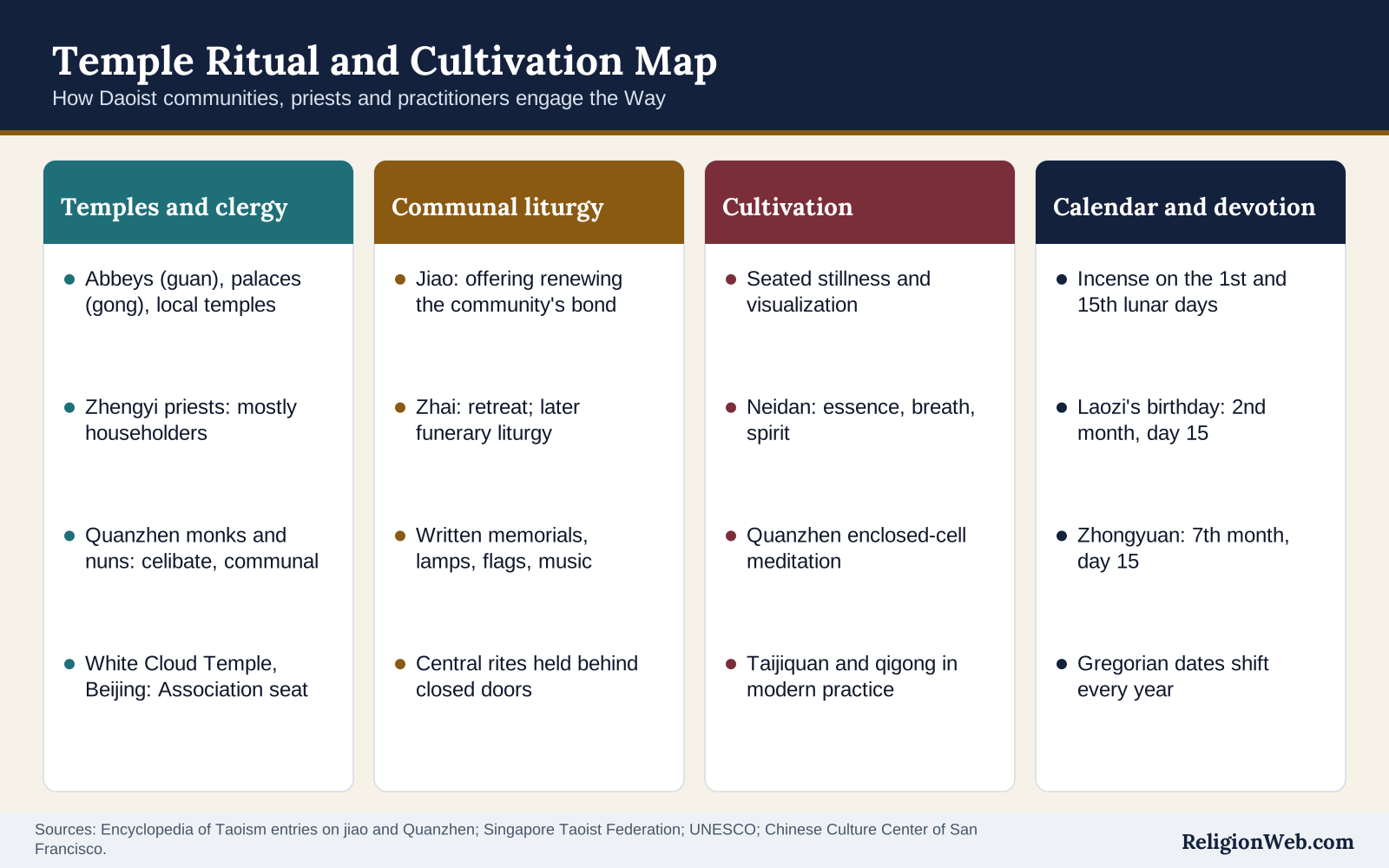
Community, Ethics, and Daily Life in Daoism
Ethical Teachings
Simplicity, humility and restraint in the Dao De Jing
The Dao De Jing offers an ethic of humility and restraint, often expressed through images drawn from nature. Chapter 8 compares the highest goodness to water, which benefits all things without contest. Legge’s translation opens the chapter:
The highest excellence is like (that of) water.
Tao Te Ching (Dao De Jing), tr. James Legge, Sacred Books of the East, vol. 39 (1891), ch. 8
In Daoist commentary the image is usually read as praise of a way of being that yields, nourishes and settles in low places without seeking recognition. In paraphrase, chapter 67 speaks of three treasures that the sage holds fast: compassion, frugality and not presuming to be first. These ideals have been read in different ways, as political advice to rulers who would govern lightly, as personal counsel for living without grasping, and as a description of the sage’s inner condition. They have also been compatible with participation in family and public life, which is part of why Daoist texts have been read by officials and householders as well as by hermits.
Precepts, merit and responsibility in religious Daoism
Religious Daoism adds codes of conduct, vows and an idea of accumulated merit. Kleeman reports the Celestial Masters’ principle of the Pure Bond, which holds that the master does not accept money. The Lingbao scriptures center on the salvation of all beings, from the emperor to the humblest creatures, which makes compassion and ritual service a religious duty. Ordination in Quanzhen involves receiving precepts that govern monastic conduct.
Moral accountability is also tied to the unseen administration of the cosmos. The Three Officials are understood to examine merits and sins, as the Zhongyuan festival expresses. Daoist ethics therefore join personal cultivation with obligations to family, ancestors and community, and they apply to laypeople as well as clergy.
Daoism in Family, Society and the State
Householder priests, temples and neighborhoods
In most places, Daoism is carried by ordinary social institutions: families that support priests, temple committees that organize festivals, neighborhoods that sponsor offerings and associations such as guilds that share a patron deity. Andersen notes that guilds and voluntary associations, as well as territorial communities, hold offering rituals to affirm their religious identity. The priest who lives at home and performs a funeral for a neighbor is part of the community’s fabric.
This embeddedness explains why Daoist life often goes unnoticed in surveys that count only formal membership. Participation is typically framed as taking part in a local temple or festival, not as joining a church, and individuals may support Daoist, Buddhist and local temples at once.
Daoism and the state
Daoism has had a complex relationship with the state throughout its history. Han and later emperors patronized or restrained Daoist movements, Zhang Lu’s religious state ended in 215, the Northern Wei made Daoism the official religion for a time, and Tang rulers claimed Laozi as an ancestor. In the People’s Republic of China, Daoism is one of five officially recognized religions, and the Chinese Taoist Association, established in 1957 and headquartered at the White Cloud Temple, serves as its official national body. Lai Chi-Tim notes that state policy restricts priests who live at home, even as village ritual revives.
In Taiwan, Hong Kong, Singapore and other places the conditions for Daoist temples and associations differ from those on the mainland, and readers should avoid generalizing from one political setting to another.
Health, Body and Daily Cultivation
Diet, breath and exercise in the Daoist tradition
Daoist concern with the body has produced a long tradition of regimens for health and longevity. Ge Hong’s Baopuzi, as Britannica summarizes it, offers guidance on diet, sexual hygiene, and breathing and meditation exercises alongside its alchemy. Later inner alchemy treats the cultivation of essence, breath and spirit as the heart of practice, and monastic life includes disciplines of conduct and attention.
These traditions belong to Daoist religion and to the broader history of Chinese medicine, but they are not medical advice. Anyone considering a change in diet, exercise or breathing practice for health reasons should consult a qualified health professional, particularly if pregnant, ill or recovering from illness.
Taijiquan, qigong and contemporary wellness
Taijiquan (tai chi) and qigong are widely practiced today, in China and around the world, as exercise and relaxation disciplines. They draw on Daoist ideas of qi, yin and yang, and some teachers present them as Daoist cultivation. Many practitioners, however, learn them purely for health, balance or relaxation and do not take part in Daoist religious life. Both descriptions are accurate for different people.
The relationship between modern wellness practice and the religious tradition is therefore a spectrum. At one end are monastics who practice breath and body disciplines as part of a vow-bound life; at the other are community-class participants who have never entered a temple. Each is entitled to describe their practice in their own terms.
Daoism Today: Global Presence and Modern Developments
Daoism in China, Taiwan and Chinese-Speaking Communities
Mainland China: revival and regulation
In the People’s Republic of China, Daoism is organized through the Chinese Taoist Association, which was established in 1957, has its headquarters at the White Cloud Temple in Beijing, and is the official national body for the religion. Since the 1980s, as Lai Chi-Tim documents, destroyed temples have been rebuilt, liturgical activity has returned, training classes for young Daoists have opened, and ordinations have been restored at both the Quanzhen monastery of the White Cloud Temple and the Zhengyi center at Longhu shan. Vincent Goossaert reports that the Association counted 20,000 Quanzhen Daoists in 2002. Registration with the Association gives recognition and protection, and priests who live at home and perform rituals in their communities sit in a more complicated relationship to state policy, which Lai describes as restrictive in intent.
Heritage designation also shapes the present landscape. The Wudang Mountains were inscribed on the UNESCO World Heritage List in 1994 and Mount Qingcheng in 2000. Such listings bring visitors and conservation funding, and they also make temples simultaneously sites of worship, tourism and national heritage.
Taiwan, Hong Kong and Southeast Asia
Taiwan is a major center of living Daoist liturgy, and Pew Research Center reports that it is the only place where “other religions” form a majority, a pattern the report attributes to large numbers of Daoists and practitioners of Chinese folk religion. Community offering rituals of the kind Andersen describes are performed there, including in southern Taiwan, by priests of the Zhengyi tradition. Pew also finds that about 7 percent of the world’s followers of the “other religions” category live in Taiwan.
In Hong Kong, Macau, Singapore, Malaysia and other places with large Chinese populations, Daoist temples and associations coexist with Buddhist, Confucian and local institutions. The Singapore Taoist Federation, founded in 1990, describes itself as the only national-level organization for Taoists in Singapore, which shows how organized Daoism has adapted to diasporic and urban settings.
Data and Demographics
What the figures show, with their dates
The available figures are scattered and differ in what they measure, so each is best read with its date. Pew Research Center’s 2025 report estimates that the broad “other religions” category, which includes Daoists, rose from 154 million people in 2010 to 172 million in 2020 and that it stayed at about 2 percent of the world’s population. In China, Pew finds the category is about 3 percent of the population but a quarter of the category’s global total. Goossaert cites the Association’s figure of 20,000 Quanzhen Daoists for 2002, and Lai cites 1996 statistics for about 20,000 priests living at home. Min Zhiting, in the interview discussed earlier, gave figures in the range of tens of thousands of householder priests and over 1,700 open temples, but the interview gives no year and the numbers should be treated as approximate and dated.
Taken together, these figures describe clergy and institutions, not the number of people who take part in Daoist ritual, which is far larger and cannot be measured with the same precision.
Why no figure can be called definitive
Pew explains that “other religions” are not presented separately because of their relatively small size and the limits of national censuses and other data sources. Daoism’s overlap with Chinese folk religion adds another problem, since many people who attend Daoist rites do not claim a Daoist identity. Estimates also vary with whether they count ordained clergy, temple members or people who tell a survey they believe in the Dao.
For these reasons this article does not offer a global number of Daoists. Readers who encounter a precise figure elsewhere should look for the year, the definition and the method behind it.
Daoism Beyond Asia and in Contemporary Culture
Diaspora communities, translation and study
Outside Asia, Daoism is present through Chinese immigrant communities, temples and associations, through teachers of meditation and martial arts, and through academic study. Translations such as Legge’s 1891 version of the Dao De Jing opened the text to English readers, and today scholars at universities around the world study Daoist ritual, history and philosophy. The Encyclopedia of Taoism, edited by Fabrizio Pregadio and published in 2008, gathers much of this scholarship.
Readers should note that popular books presenting “the Tao” as a self-help philosophy differ widely in quality and often describe the tradition selectively. The best practice is to read a reliable translation of the primary texts, then consult scholarly introductions that explain both the philosophical and religious dimensions.
Nature, ecology and contemporary reinterpretation
Contemporary writers and some Daoist organizations draw on the concepts of ziran and wu wei in discussing human relationships with the natural world. The idea that things should unfold according to their own nature, and that human intervention should be measured, resonates with environmental concerns for many readers. Interpretations of this kind belong to modern reflection on the tradition, and they should be distinguished from the historical meaning of the texts in their original contexts.
The tradition’s own sacred geography, with its mountains, grotto-heavens and temples, gives another reason for engagement with conservation, since many of these places are protected as heritage sites. The balance between preserving them as living religious spaces and managing them as tourist destinations is a continuing discussion in China and among visitors.
Common Misconceptions About Daoism
Misconception 1: Daoism is only a philosophy, not a religion
Where the misunderstanding comes from
Many readers meet Daoism through the Dao De Jing or the Zhuangzi in a philosophy or literature course, where the texts are presented as works of thought. Popular books often reinforce the impression by presenting the Tao as a universal wisdom. The Chinese terms Daojia and Daojiao, which can be rendered “philosophical Daoism” and “religious Daoism,” also seem to support a division, and some twentieth-century accounts treated the religion as a later corruption of an earlier philosophy. T. H. Barrett traces part of this confusion to the way non-Daoists used the terms, noting that Japanese scholars influenced by medieval Buddhist polemics separated Daojia from Daojiao and that nineteenth-century missionary writers found the rhetoric of decline congenial.
The impression is not baseless. The Dao De Jing and Zhuangzi can be read as philosophy, and there are scholars and readers who engage with them only in that way. That is a legitimate use of the texts.
Another source of the impression is the sheer prominence of the Dao De Jing in translation. Dozens of English versions are in print, many of them aimed at general readers looking for spiritual or personal guidance, and few say anything about the priests, temples and liturgies that surround the book in China. A reader who knows the text mainly through such editions can easily conclude that the book is all there is.
What the evidence and tradition actually show
The historical record shows organized religious Daoism from the second century CE, with the Celestial Masters’ parishes, tithes, ritual assemblies and clergy, and then with the Shangqing and Lingbao scriptures, the Three Caverns canon, monastic orders and a living priesthood. The Dao De Jing was recited as scripture and used in ritual, Robinet notes, and the Xiang’er commentary served as a catechism for Celestial Master members. A visitor to a Daoist temple in Taiwan, Beijing or Singapore will see offerings, liturgy and prayer. Britannica states that the older division into a philosophy and a religion is no longer considered valid.
The more accurate statement is that Daoism includes strongly philosophical texts and also a developed religion, and that the two have been connected throughout their history. The philosophical books are part of Daoism, not a separate category.
It also helps to notice what Daoists themselves do with their classics. The Dao De Jing is recited in ritual settings, the Zhuangzi is read and commented on in monasteries and by scholars, and the same priests who perform a community offering may be learned readers of both. Isabelle Robinet’s discussion of Daojia stresses that labels such as “contemplative” or “non-purposive” fail to separate the early texts cleanly from the religious currents, because concentration on the Way and renunciation of social values already imply techniques of self-cultivation, and because the early texts also speak about government.
Misconception 2: Wu wei means doing nothing
Where the misunderstanding comes from
The standard translation of wu wei as “non-action” invites the reading that the Daoist ideal is idleness or passivity. Critics of the tradition in early China sometimes understood it that way, and Hansen notes that Confucians tended to read the slogan as offering “do nothing” as political guidance. Popular presentations in the modern world sometimes treat it as a recommendation to drift or avoid effort.
The word wei in classical Chinese can mean acting, making or doing in a deliberate, contrived or interfering manner, so that “non-doing” is more nuanced than it seems in English. The slogan is also compressed and paradoxical, which Hansen acknowledges, and compressed paradoxes invite literal misreading.
Translation choices matter here as well. Renderings such as “non-action,” “inaction” and “doing nothing” appear in older and in popular books, while some recent translators prefer “effortless action” or “non-contrived action.” A reader who meets only the first group of renderings, without the context of the chapters, may reasonably take the idea to be about passivity.
What the evidence and tradition actually show
The Dao De Jing itself resists the literal reading. In Legge’s translation, chapter 37 says that the Tao “does nothing (for the sake of doing it), and so there is nothing which it does not do.” The sentence says that the Way is endlessly productive, and the qualification in parentheses indicates action without a forcing purpose. In the Zhuangzi, wu wei appears as skill: the cook whose blade follows the natural openings in the ox works constantly, but without strain. In the Huang-Lao tradition, according to Pregadio, it meant government by restraint along with ruler self-cultivation and attention to the seasons.
Within the tradition, wu wei is therefore best understood as effortless, non-coercive and responsive action. It does not mean inactivity, nor does it excuse neglect of duties. Different Daoist writers apply it to rulership, craft, personal conduct and meditation.
Scholars still discuss how best to translate and interpret the term. Hansen, for example, calls Laozi’s slogan paradoxical and unnatural for creatures like us, while commentators in the religious tradition have linked it to stillness in meditation and to the unforced movement of qi. These are different emphases and none cancels the others. What they share is the rejection of the idea that Daoist wisdom is a counsel of laziness.
Misconception 3: All Daoist practice is aimed at physical immortality
Where the misunderstanding comes from
Stories of Daoist alchemists seeking elixirs of immortality, of Eight Immortals and of emperors sending expeditions after life-prolonging drugs have made the quest for deathlessness a leading image of Daoism. Ge Hong’s Baopuzi, which Britannica describes as the work of the best-known alchemist associated with Daoism, includes recipes and regimens aimed at transcendence. Popular fiction and film reinforce the impression.
These stories reflect a real current in the tradition, and the pursuit of xian (immortals) is attested from early centuries. The mistake lies in treating it as the whole.
Part of the reason the theme looms so large is that the surviving literature of alchemy is rich and vivid, and that outside observers, including some critics within China, wrote about the pursuit of elixirs more often than they wrote about the quieter work of community ritual. A tradition’s most dramatic stories are not always its most common practices.
What the evidence and tradition actually show
Daoist ritual life is largely concerned with community renewal, protection and the care of the dead. The jiao offering renews the bond between a community and its patron deity, or averts calamities, and zhai became the funeral liturgy; the Lingbao scriptures stress the salvation of all beings and, in practice, of ancestors. The Zhuangzi contains stories in which the sage accepts death as part of natural transformation. Even among alchemists, the goal changed over time: Pregadio reports that inner alchemy describes refining essence, breath and spirit, and Liu Yiming (1734-1821) identified the elixir with one’s fundamental nature, which shifts the aim from preserving the body to realizing the Way.
The honest summary is that some Daoist traditions have sought long life or transcendence, others have focused on ritual service, ethics or philosophical reflection, and many practitioners have sought blessing, health or peace without aiming at immortality. Readers should also remember that no Daoist teaching offers a proven way to avoid death, and that the elixirs of external alchemy, which could contain mercury, were harmful.
Where immortality does appear, its meaning is not uniform. For Ge Hong it involved concrete regimens and elixirs, for Shangqing authors it involved a union with perfected beings through visualization, and for later inner alchemists it described an inward transformation. Reading all of these as a single goal of avoiding physical death flattens real differences among schools and periods.
Misconception 4: The yin-yang symbol stands for good on one side and evil on the other
Where the misunderstanding comes from
The black-and-white form of the familiar diagram invites readers to map one color to good and the other to evil, an interpretation encouraged by Western dualistic habits of thought and by casual use of the symbol in advertising and decoration. Some popular explanations treat it as a symbol of balance between opposing forces, which is closer to the truth but may still suggest contest.
The confusion is understandable, because the diagram shows two contrasting fields. Yet the contrast it expresses is not a moral one.
The vocabulary of Western moral dualism has also been mapped onto Chinese ideas in some older translations and popular summaries, which can make “yang” sound like a synonym for “good” and “yin” for “bad.” Chinese sources do not use the terms that way. Yang is associated with light, warmth, rising and activity, and yin with shade, coolness, settling and receptivity, and each can be favorable or unfavorable depending on the circumstances.
What the evidence and tradition actually show
In Chinese cosmology yin and yang name complementary phases of change: dark and light, cold and warm, receptive and active, rest and movement. Pregadio describes how Daoist alchemy uses yin and yang, the Five Phases and the Yijing trigrams as a correlative cosmology to depict cosmic configurations and to link practice with doctrine. The diagram’s interlocking form, in which each field contains a small seed of the other, expresses mutual transformation, and each phase gives rise to the other in time.
Neither yin nor yang is evil. Both are necessary, and the Dao De Jing’s sequence from One to Two to Three to the myriad things treats them as stages in the unfolding of a single source. The symbol belongs to a tradition of thought about change and harmony, and it should not be read as a ledger of virtue and vice.
In Daoist practice the aim is usually described as harmony or balanced circulation, as in the inner alchemical image of bringing the complementary forces of the body into union. That is a statement about health and transformation, not about a struggle between right and wrong. Daoist ethics, discussed earlier, is expressed through other concepts, such as de, compassion, restraint and merit, and through the precepts that clergy and laypeople take on.
Frequently Asked Questions About Daoism
Questions About Names, Origins and Identity
Is Daoism the same as Taoism?
Yes. Daoism and Taoism are two spellings of the same word, produced by different systems for writing Chinese in the Latin alphabet. Daoism follows Pinyin, the system now standard in mainland China and in most scholarly writing, while Taoism follows the older Wade-Giles system. The same applies to Dao and Tao, Daodejing and Tao Te Ching, and Zhuangzi and Chuang Tzu.
Both spellings are pronounced much the same in English, usually as “dow.” Search engines, libraries and publishers use both, so readers looking for further material will find it under either form.
Who founded Daoism?
No single founder is recognized by historians, though Daoist tradition names two figures. Laozi is the traditional author of the Dao De Jing, and Zhang Daoling is the traditional founder of the first organized religious community, the Way of the Celestial Masters, in 142 CE. Historians regard Laozi’s biography as uncertain, with Alan Chan noting that the text probably took shape over generations, and they treat the Celestial Masters’ founding as the traditional account of a movement whose earliest firm evidence is a stele of 173 CE.
The more accurate description is of a tradition that developed over several centuries through texts, communities and revelations, and that came to be named Daoism by later readers.
Is Daoism a religion or a philosophy?
It is both, and the two aspects are woven together historically. The Dao De Jing and Zhuangzi contain philosophical reflection, and the same texts have been recited as scripture. The tradition also includes priests, monastic orders, temples, a canon and liturgies. Britannica states that the older division between philosophy and religion is no longer considered valid.
People engage with Daoism in different ways, and a reader who values the texts for their ideas is not wrong to do so. The point is that the tradition as a whole includes more than the texts.
Questions About Belief and Practice
Do Daoists believe in a god?
Daoist traditions do not center on a single personal creator who stands apart from the world. The Dao is the nameless source and pattern of things. Religious Daoism, however, recognizes many deities, from the Three Pure Ones and the Jade Emperor to local gods and deified humans, and priests address them in ritual. Laozi himself is venerated as the Heavenly Lord of the Way and Its Virtue.
Which of these figures an individual honors varies by tradition and place. A Quanzhen monastic, a Zhengyi priest and a lay worshiper at a village temple may each describe their relationship with the divine differently.
What does wu wei mean in practice?
In practice, wu wei describes acting in a way that is responsive and unforced. Examples in the texts include a ruler who governs lightly, a craftsperson whose skill has become effortless and a meditator who acts from stillness. It does not mean doing nothing, as Legge’s translation of chapter 37 indicates when it says there is nothing the Way does not do.
People who apply the idea in modern life often use it to mean working with the situation rather than against it. That is a reasonable extension, though it differs from the specific political and ritual contexts in which the early texts used it.
How do Daoists worship or pray?
The forms vary. Lay worshipers commonly burn incense, bow before images and make offerings at temples, especially on the first and fifteenth days of the lunar month. Priests perform liturgies such as the jiao offering and the zhai retreat, with written memorials, invocations and music. Monastics add meditation and cultivation practices, including inner alchemy.
Daoist liturgy generally treats offerings and petitions as communication and reverence, not as food for the gods. Each temple has its own customs, so a visitor should follow local guidance.
Questions About Community and Learning More
How many Daoists are there?
No reliable global figure exists. Pew Research Center’s 2025 report places Daoists within an “other religions” category of about 172 million people in 2020, about 2 percent of the world’s population, without giving a separate Daoist number. Taiwan is the only place where this category is a majority, according to Pew. Clergy counts are more specific but also dated, such as 20,000 Quanzhen Daoists in 2002.
Part of the difficulty is that many people who take part in Daoist ritual do not describe themselves as Daoists, and Daoism overlaps with Chinese folk religion.
Can anyone visit a Daoist temple?
Most Daoist temples welcome visitors to their public halls and courtyards, and many are also tourist or heritage sites. Inner ritual spaces and certain ceremonies are reserved for clergy, and Andersen notes that the central liturgy of a major offering is conducted behind closed doors with only selected community representatives present. Visitors should follow posted guidance, ask before photographing and be respectful to worshipers.
If you wish to attend a festival, contact the temple beforehand about timing, as dates follow the lunar calendar and differ from year to year.
Where should a beginner start reading?
A good sequence is to read the Dao De Jing in two different translations, then the Inner chapters of the Zhuangzi, and then a scholarly introduction to religious Daoism. Legge’s 1891 translations are in the public domain and free to read, though their language is dated. Fabrizio Pregadio’s Encyclopedia of Taoism is a standard reference, and several of its entries are available online from its editor.
Readers who prefer a first step into the surrounding culture may also read the articles on Chinese folk religion and Confucianism.
Conclusion: Daoism as a Living, Layered Tradition
What the History Shows
Continuity and change across two thousand years
The history surveyed here runs from tomb manuscripts of about 300 BCE to temple festivals and training classes in the twenty-first century. Through that span the tradition kept a few constant reference points: the Dao as nameless source, the Dao De Jing and Zhuangzi as foundational books, and the conviction that human life can be brought into accord with a deeper order. It also changed greatly, acquiring a priesthood, a canon, monastic orders, inner alchemy and a calendar of festivals.
The 81-chapter form of the Dao De Jing, the Celestial Masters’ parishes and the Quanzhen monasteries all show how a living tradition builds institutions out of inherited material, sometimes slowly and sometimes in a few decades.
Unity and diversity within one tradition
The distinction between Daojia and Daojiao remains a useful way to name two emphases, yet this article has tried to show that the emphases belong together. Zhengyi priests, Quanzhen monastics, commentators such as Wang Bi, alchemists, hermits and lay worshipers draw on a shared scriptural and ritual inheritance while living quite different lives.
The best understanding of Daoism keeps both the unity and the diversity in view, and it respects the tradition’s own account of itself while recording where historians disagree.
How to Keep Exploring
Reading and visiting
The primary texts are the best place to begin, supported by reliable reference works. Temples, museums and heritage sites in China, Taiwan and elsewhere offer another window, provided visitors remember that they are places of living worship. A festival visit is particularly informative if arranged with the temple’s cooperation.
Where this article has given dates, numbers or readings, it has attributed them to the scholars and institutions that supplied them. Readers are encouraged to follow those references and to compare interpretations.
Related topics on ReligionWeb
Daoism has been part of a wider Chinese religious landscape for two millennia. The article on Chinese folk religion covers local gods, ancestors and temple life, and the article on Confucianism covers the tradition of ritual and learning with which Daoism has long shared texts, officials and festivals. For the long history of Buddhism’s presence in China, which also shaped Daoist monastic life and ritual, see the article on Buddhism.
Each tradition is best understood on its own terms, and the history of Chinese religion is more fully told by following each of these threads in turn.
Sources
The table below lists the principal external sources behind this article. Facts, dates and figures were checked against these and related primary, institutional and academic materials.
| # | Source | Publisher and type | Used for | Link |
|---|---|---|---|---|
| 1 | Tao Te Ching (Tao Teh King), translated by James Legge, Sacred Books of the East vol. 39 (1891) | Internet Sacred Text Archive (cross-checked with Project Gutenberg #216) · Primary text | All quotations from the Dao De Jing (chs. 1, 8, 37, 42); Legge edition | sacred-texts.com |
| 2 | Daoism (Chad Hansen), Stanford Encyclopedia of Philosophy | Stanford Encyclopedia of Philosophy · Academic reference | Origin of the Daojia category; Wang Bi, Guo Xiang, Dark Learning; dao, de, ziran, wu wei | plato.stanford.edu |
| 3 | Laozi (Alan Chan), Stanford Encyclopedia of Philosophy | Stanford Encyclopedia of Philosophy · Academic reference | Sima Qian's biography; dating debates; Guodian, Mawangdui, Beida manuscripts; 81-chapter text | plato.stanford.edu |
| 4 | Zhuangzi, Stanford Encyclopedia of Philosophy | Stanford Encyclopedia of Philosophy · Academic reference | Zhuangzi's period; Guo Xiang's 33-chapter edition; Inner, Outer, Miscellaneous chapters | plato.stanford.edu |
| 5 | The Encyclopedia of Taoism, ed. Fabrizio Pregadio (Routledge, 2008): sample entries (Daode jing, daojia, daojiao, Daozang, jiao, jindan, Lingbao, Quanzhen, Shangqing, Tianshi dao) | Golden Elixir Press (reproducing Routledge entries) · Academic reference | Celestial Masters, Lingbao, Shangqing, Quanzhen, jiao ritual, Daozang, inner alchemy, Daojia/Daojiao terms | goldenelixir.com |
| 6 | How the Global Religious Landscape Changed From 2010 to 2020 (2025) | Pew Research Center · Demographic data | Daoists within 'other religions' (154 to 172 million, 2010-2020); Taiwan majority; no separate Daoist count | pewresearch.org |
| 7 | The Origin of the 81-Chapter Edition of Laozi (Li Ruohui), Journal of Zhejiang University (Humanities and Social Sciences) 51(6), 2021 | Zhejiang University Journals · Academic reference | Fun Fact and section on the 81-chapter format, Beida 77-chapter text and the Huainanzi | zjujournals.com |
| 8 | Daoism in China Today, 1980-2002 (Lai Chi-Tim), The China Quarterly 174 (2003) | Cambridge University Press · Academic reference | Post-1980 revival; restored ordinations; about 20,000 householder priests in 1996 figures | cambridge.org |
| 9 | Ancient Building Complex in the Wudang Mountains, UNESCO World Heritage List (1994) | UNESCO World Heritage Centre · Institutional | Wudang as Daoist center from the Tang; Ming building campaign; surviving structures | whc.unesco.org |
| 10 | Taoist Gods (deity birthdays and festival dates) | Taoist Federation (Singapore) · Institutional | Birthdays of the Jade Emperor, Laozi and Zhang Daoling; Three Pure Ones; federation founded 1990 | taoistfederation.org.sg |
Last fact-check date: 2026-10-21.

