Shinto, usually translated “the way of the kami,” is the name given to the rites, shrines, festivals, and ways of understanding the world that center on kami: sacred powers and beings that Japanese tradition recognizes in mountains and waterfalls, in the harvest, in ancestral lineages, and in remembered human beings. Its main public setting is the shrine (jinja), where priests present offerings and prayers on a daily and seasonal schedule. Its other settings are the household shelf (kamidana) and the community festival (matsuri), in which a neighborhood or a whole city takes part in the honoring of a local kami.
Shinto has no historical founder, no single scripture, and no creed that a person must profess. Its practices grew out of the rites of farming communities on the Japanese archipelago, and the oldest surviving written accounts of its kami are the Kojiki (presented to the court in 712 CE) and the Nihon Shoki (presented in 720 CE). The word “Shinto” itself came into use to distinguish indigenous practices from Buddhism, which reached Japan from the continent in the sixth century CE, and for most of Japanese history the two traditions shared sites, priests, and ritual vocabulary.
Several distinctions matter before going further. “Shinto” today covers more than one thing: the shrine tradition (Shrine Shinto), a set of organized teaching groups that grew up in the nineteenth century (Sect Shinto), household and village customs, and the court rites of the imperial house. “State Shinto” is a different kind of term altogether, a label for the arrangement under which the Japanese government supervised shrines and promoted shrine rites as a national duty from 1868 until 1945. And because Shinto is carried by practice more than by profession of belief, many people who visit shrines at New Year or for a child’s blessing would not describe themselves as followers of any religion at all.
This article describes Shinto on its own terms: how it defines itself, what the oldest texts say, how shrines and rites work and why, how the calendar of festivals is built, and how the tradition changed through the modern state and the postwar settlement. Where scholars disagree, or where a practice differs from shrine to shrine, the text says so.
Shinto at a Glance: Meaning, Scale, and Vocabulary
A Working Definition of Shinto
The meaning of the word
“Shinto” is the Sino-Japanese reading of two Chinese characters: shin (the same character that is read kami when it stands alone) and do (the “way,” michi). The compound appears in the Nihon Shoki, in the account of Emperor Yomei, who is described as believing in Buddhism and honoring the “way of the kami.” The Encyclopedia of Shinto, published by Kokugakuin University in Tokyo, notes that the term probably derives from a Chinese expression in the Book of Changes and became a Japanese concept because it was written with the character used for kami. The same entry cautions that an early appearance of the word does not show that people of that era thought of Shinto as a distinct, organized religion.
In everyday Japanese the same compound can mean the whole complex of shrine-centered practice, a particular school or teaching, or simply “things having to do with kami.” That flexibility is one reason a short definition always leaves something out.
How Shinto describes itself
The Association of Shinto Shrines (Jinja Honcho), the umbrella body to which most shrines belong, presents Shinto in its English-language introduction as a living tradition rooted in gratitude and respect toward the kami found in all places and things. It states that Shinto has no founder and no fixed dogma. In this self-description, what holds Shinto together is shared practice: the same kinds of shrine buildings, the same purification and offering rites, the same festival rhythm tied to rice cultivation, and a common attitude of reverence for the kami and for the places they inhabit.
Priests and scholars within the tradition also speak of ethical emphases such as sincerity, gratitude, purity, and harmony with neighbors and the natural world. These are described more fully in the sections on belief and daily life below.
How scholars classify it
Historians of Japan have long argued about whether Shinto is best understood as an unbroken indigenous religion or as a category assembled over centuries. The historian Kuroda Toshio argued in an influential 1981 article, “Shinto in the History of Japanese Religion,” that Shinto as a distinct, independent religion did not exist before modern times, because in the medieval period kami worship was woven into Buddhist institutions. Other scholars, including those who contributed to the Encyclopedia of Shinto, stress continuity in ritual forms and in the shrines themselves from ancient times. Most current work accepts something between the two positions: real continuities in shrine practice, together with a self-conscious “Shinto” identity that took firm shape in the early modern and modern periods.
Where Shinto Is Found and Who Takes Part
Geography and scale
Shinto is overwhelmingly a Japanese tradition. Its shrines stand in every prefecture, from a few great complexes with hundreds of buildings to tiny roadside sanctuaries tended by a neighborhood association. The Kokugakuin encyclopedia reports that about 79,000 shrines come under the authority of Jinja Honcho and that about 20,600 priests are registered with it, which means that most shrines have no resident priest of their own and are served by a priest from a larger shrine nearby. Britannica puts the number of shrines belonging to the association at more than 80,000. Small communities of Japanese heritage outside Japan also maintain shrines, but the tradition is tied closely to place, and a shrine is first of all the seat of a local kami.
What the statistics mean
Japan’s Agency for Cultural Affairs publishes an annual religious statistics survey based on reports from religious organizations. As of December 31, 2024, Shinto-system organizations reported 84,137 religious corporations, about 86.4 million adherents, and about 64,500 “teachers,” a category that includes both shrine priests and ministers of Shinto-derived sects. The combined adherent figure for all religious systems in the same survey was about 175 million, far above the population of Japan, which is about 124 million.
The reason is straightforward. Each organization defines “adherent” for itself, shrines often count the residents of their parish, and the same person may be counted by a shrine and by a Buddhist temple. The figures are better read as a measure of institutional reach than as a count of people who say they believe. Surveys that ask individuals about their own religion typically return much lower percentages for Shinto, which reflects how rarely people think of shrine visits as a matter of membership.
| Feature | Summary |
|---|---|
| Name and meaning | Shinto: “the way of the kami” |
| Region | Japan; small shrine communities among people of Japanese heritage abroad |
| Central concept | Kami: sacred powers and beings present in nature, lineages, communities, and revered people |
| Founder | None; practices developed gradually and were first described in writing in the eighth century CE |
| Foundational writings | Kojiki (712 CE), Nihon Shoki (720 CE), and ritual and legal texts such as the Engishiki (completed 927 CE); no single canon |
| Main sites | Shrines (jinja), with sacred natural places and the household kamidana |
| Clergy | Kannushi (shrine priests) and miko (shrine maidens); about 20,600 priests registered with Jinja Honcho |
| Core practices | Purification, offerings, prayer, festivals, rites of passage, home worship |
| Self-reported adherents | About 86.4 million in Shinto-system organizations (Agency for Cultural Affairs, as of December 31, 2024) |
Core Vocabulary for Reading About Shinto
Terms for places and objects
Shinto vocabulary is largely descriptive of what people do and see at a shrine. A jinja is the shrine itself, and its main sanctuary is the honden, the building where the kami is enshrined. The torii is the gate that marks the boundary of sacred ground, and the shimenawa is the twisted straw rope, often hung with zigzag paper streamers (shide), that marks off a sacred object or space. The object in which a kami is understood to dwell is the shintai (“body of the kami”), which at many shrines is a mirror, a sword, or a stone and is never shown to the public.
The table below collects the terms most often met in this article. Spellings follow common English usage, with long vowels simplified.
| Term | Plain-English meaning | Where you meet it |
|---|---|---|
| Kami | A sacred power or being honored in Shinto; not limited to a single category of “god” | Shrines, myths, festivals, household shelves |
| Jinja | Shrine; a sacred space that is the seat of one or more kami | Every town and many neighborhoods |
| Honden | Main sanctuary housing the kami’s object of veneration | Back of the shrine precinct; usually closed to visitors |
| Haiden | Hall of worship in front of the honden | Where visitors pray and priests conduct ceremonies |
| Torii | Gateway marking sacred ground | Entrance and inner approaches of a shrine |
| Shimenawa | Twisted straw rope that marks a sacred boundary | Gates, trees, rocks, shrine halls, New Year doorways |
| Shintai | The object that embodies the kami’s presence | Inner sanctuary; mirrors, swords, stones, mountains |
| Matsuri | Festival or rite honoring a kami | Annual festivals, monthly rites, daily offerings |
| Harae / Misogi | Ritual purification / purification by washing the body | Start of every rite; hand-rinsing basins; seasonal ceremonies |
| Kegare | Pollution or defilement that rites remove | Death, illness, wrongdoing, accumulated misfortune |
| Norito | Ritual prayer or liturgy recited to the kami | Formal shrine ceremonies |
| Kannushi / Miko | Shrine priest / shrine maiden | Ceremonies, amulet counters, sacred dance |
| Ujiko | Parishioner of a local protector shrine | Festival committees, shrine support |
| Ofuda / Omamori | Paper or wooden talisman / protective charm | Home shelves, bags, cars, schools |
Terms for acts and people
The verbs of Shinto are purify, offer, pray, and festively gather. Harae and misogi refer to ritual cleansing, norito are the prayers a priest recites, and naorai is the shared meal of consecrated food and drink that closes many ceremonies. The people involved fall into a few roles: kannushi and miko serve the kami professionally or ceremonially, and the ujiko are the residents of the area a shrine protects, who organize and fund its festivals. Visitors are welcome in a general sense, and Jinja Honcho’s guidance to visitors says that people of any nationality, age, sex, or religion may pay respects at a shrine, provided they follow the shrine’s instructions.
A Shrine in Brief
Walking in: from gate to sanctuary
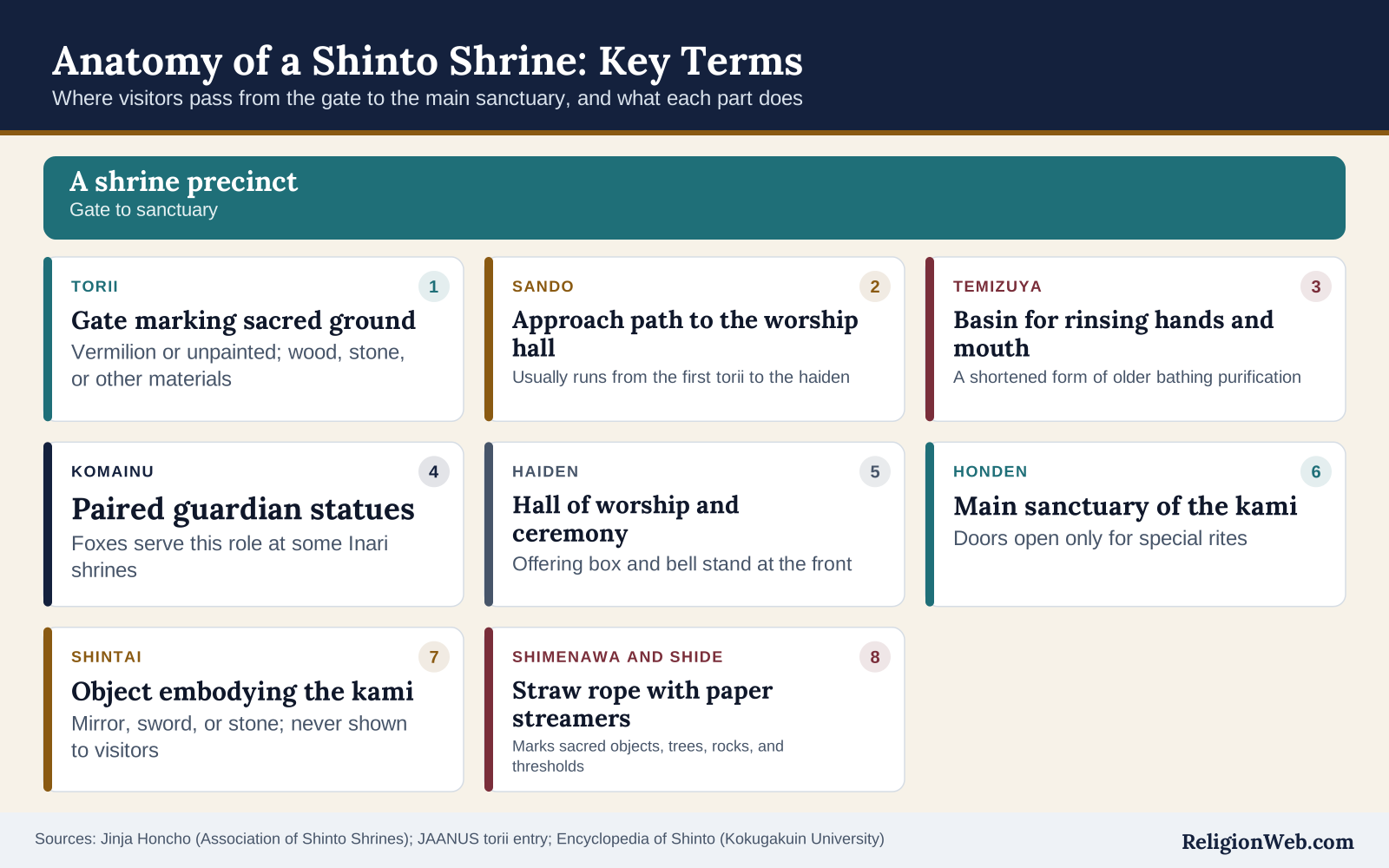
A typical shrine visit follows a recognizable path. The visitor passes through a torii, pausing for a slight bow, then walks along the approach (sando) toward the worship hall. Along the way there is a covered water basin (temizuya) for rinsing the hands and mouth, often a pair of guardian lion-dog statues (komainu), and sometimes a stage for sacred dance. At the haiden the visitor tosses a coin into the offering box, rings the bell if there is one, and offers a short prayer, and behind the haiden stands the honden, which most visitors do not enter.
What the layout expresses
The sequence from gate to sanctuary is a graduated movement into more sacred space: outer boundary, purification, approach to the kami, and finally the place where the kami is enshrined. Not every shrine has all these features. Some sacred places have a torii and nothing else, because the kami is understood to dwell in the mountain, rock, or waterfall itself, and Jinja Honcho cautions that nothing it says holds true of every shrine. The later sections on shrines and worship take each stage in turn and explain the reasons behind it.
Origins and Historical Development of Shinto
Ancient Roots: Rice, Ritual Sites, and the Early State
Farming communities and the first sacred places
No one can date the beginning of Shinto, because it was not founded at a moment. Its roots lie in the religious life of communities on the Japanese islands that, from the first millennium BCE, increasingly depended on wet-rice agriculture. Many features of later Shinto still mirror that setting: the stress on seasonal rites tied to planting and harvest, the importance of water and purity for the fields, and the sense that mountains, springs, large trees, and unusual rocks were places where a powerful presence could be felt.
Jinja Honcho’s introduction to shrines describes the earliest pattern in simple terms. At first, kami were invited to a rite and sent off afterward, with no permanent building. In time the rites came to be held at fixed places, and the kami came to be regarded as always present there, which is how the first shrines arose. Buildings followed later, and the Association notes that they were influenced by Buddhist temple architecture. It adds that the oldest shrines were founded well over a thousand years ago and that new ones are still being established. Archaeologists reconstruct this earlier stage from sites rather than from texts, since continuous written records begin only in the seventh and eighth centuries CE.
The ritual island of Okinoshima
One of the best-documented early ritual sites is Okinoshima, a small island about 60 kilometers off the northwest coast of Kyushu. UNESCO inscribed it in 2017, together with associated sites in the Munakata region, and describes rituals there from the second half of the fourth century CE to the end of the ninth century CE, a span of about five hundred years. Worshipers deposited large quantities of votive objects, many of them of overseas origin, which records the island’s place in exchange with the Korean peninsula and the Asian mainland. Offerings on the island itself ceased in the ninth century, but the island is still regarded as sacred and is part of the Munakata Taisha shrine complex, and UNESCO notes that traditional taboos continue to protect it alongside national law.
Clans, the court, and the kami of rule
By the fifth and sixth centuries CE a court centered in the Yamato region was extending its authority over regional clans. Each clan honored its own tutelary kami (ujigami), and the court’s rites for the sun kami Amaterasu, whom the imperial line claimed as its ancestor, gave the ruling house a ritual foundation. Ise Jingu’s own account says that Amaterasu was first worshiped within the imperial palace and that, in the reign of Emperor Suinin, Princess Yamatohime sought a permanent site and received a revelation to enshrine the kami at Ise. Historians treat the earliest layer of that account with caution, but the Encyclopedia of Shinto records that the practice of rebuilding Ise every twenty years began at the wish of Emperor Tenmu after 672 CE, with the first rebuilding of the Inner Shrine in 690 CE and of the Outer Shrine in 692 CE.
The Written Tradition and the Ritsuryo State
The chronicles
Shinto’s earliest narrative texts were compiled under imperial patronage. The Kojiki was presented to Empress Genmei in 712 CE; its compiler Ō no Yasumaro wrote down material recited from memory by the court attendant Hieda no Are, using Chinese characters for their sounds to render spoken Japanese. The Nihon Shoki followed in 720 CE, written in classical Chinese and organized as a formal dynastic history, with Prince Toneri presenting the finished work. Both set the origins of the islands, the kami, and the imperial line in a single account, and both served to support the ruling house’s claim to divine descent. Their contents and uses are discussed in the section on sacred texts.
The Department of Divinities and the law of the kami
In the late seventh and eighth centuries the court adopted a Chinese-style legal and administrative system, known as the ritsuryo system. Its codes included a chapter on the kami, the Jingiryo. The earlier Taiho code of 702 has not survived, but the Yoro code, promulgated in 757, contains a twenty-article Jingiryo that lists the court’s annual ceremonies by month, regulates periods of abstinence before major rites, and describes the Great Purification held at the end of the sixth and twelfth months. Kokugakuin University’s encyclopedia notes that the articles drew on Tang Chinese ritual law but were substantially altered to incorporate local religious traditions. A Department of Divinities (Jingikan) administered the state rites and arranged them with the Council of State (Dajokan).
The Engishiki and the registry of shrines
The fullest picture of Heian-period shrine ritual comes from the Engishiki, a compendium of regulations whose compilation began in 905 under Emperor Daigo and was completed in 927, although it did not take effect until 967. Its first ten chapters concern the Department of Divinities. Chapters nine and ten, the register of deities’ shrines (Jinmyocho), list 2,861 shrines that received offerings from the court at the spring prayer festival, and these shrines held 3,132 kami. Chapter eight preserves twenty-seven norito, the ritual prayers that make up the oldest surviving body of Shinto liturgy. Shrines listed in the register are still called shikinaisha, and many shrines today cite their appearance in it as proof of antiquity. The register distinguished two kinds of listed shrine according to who supplied the offerings: kampeisha, which received them from the Department of Divinities, and kokuheisha, which received them from the provincial governor.
Shinto and Buddhism in the Middle Ages
Shrine-temples and kami in need of salvation
The introduction of Buddhism to the Japanese court is dated to 552 CE in the Nihon Shoki and to 538 CE in other records. The Encyclopedia of Shinto observes that early Buddhist images were referred to as “foreign kami,” which allowed the new teaching to be received within an existing frame. During the Nara period (710 to 794) temples were built within shrine precincts (jingūji), sutras were read before the kami, and some thinkers taught that kami were themselves beings who needed the Buddha’s salvation or who protected the Buddhist teaching. This combined practice, shinbutsu shūgō, was the normal condition of religious life for roughly a thousand years, and it is why Japan’s older temples and shrines often share a single compound.
Honji suijaku and the medieval Shinto schools
A doctrine called honji suijaku, developed within Tendai Buddhism, taught that the kami were local manifestations (suijaku) of buddhas and bodhisattvas, who were their original forms (honji). Major shrines were matched with particular buddhas; Ise, for example, was linked to the cosmic Buddha Dainichi. Teachers associated with esoteric Buddhism, discussed in the article on Vajrayana Buddhism as a wider family of traditions, developed schools of Shinto teaching such as Ryobu Shinto (connected with Shingon) and Sanno Shinto (connected with Tendai). The Kokugakuin encyclopedia notes that Ise and the imperial court nevertheless kept Buddhist terms and activity away from certain rites, so that separation was practiced in the most sensitive ritual settings even while mixture was normal elsewhere.
Reversing the direction: Ise Shinto and Yoshida Shinto
Beginning in the Kamakura period (1185 to 1333), priests at the Outer Shrine of Ise taught that Japan was a land protected by kami and that kami worship was independent of Buddhist influence. In the Muromachi period, Yoshida Kanetomo built a school, Yoshida Shinto, on early texts, reversed the honji suijaku order by claiming that Buddhism and Confucianism had grown from Shinto, and drew freely on Daoist and divinatory ideas of the kind described in the article on Daoism. The Yoshida house later shaped the licensing of shrines and priests. Kokugakuin University’s encyclopedia also records that the Ise rebuilding cycle lapsed for 124 years after the Inner Shrine rebuilding of 1462 and was revived in 1585, a sign of how far court patronage had fallen in the age of civil war.
Early Modern Thought: Confucian Shinto and National Learning
Shinto in dialogue with Confucian thought
In the Edo period (1603 to 1868) the Tokugawa government supported Confucian learning, and Confucian-influenced schools of Shinto appeared, notably Suika Shinto. Scholars such as Yoshikawa Koretari read the old myths through the Chinese idea of the three powers of heaven, earth, and humanity, and treated the unity of kami and human beings as a central principle. Readers who want the broader background should consult the article on Confucianism, since the Shinto schools borrowed vocabulary and cosmology and used them to describe kami worship.
National Learning and the search for an ancient Shinto
Another movement, National Learning (kokugaku), sought an ancient Japanese way of thought free from what its scholars regarded as foreign influence. Its most famous figure, Motoori Norinaga, produced the monumental commentary on the Kojiki known as the Kojikiden, which presented kami as extraordinary beings and defined them by the awe they inspire rather than by moral goodness. The later scholar Hirata Atsutane developed a more theological program that emphasized the unseen realm governed by the kami. According to the Encyclopedia of Shinto, both Norinaga and Hirata took the mythic narratives to be historical fact. According to Sasaki Kiyoshi, Norinaga treated the Kojiki as a record of true events of the ancient past, put Amaterasu at the center of his scheme, and named the two musubi kami, Takamimusubi and Kamimusubi, as the first ancestors of heaven, earth, and the kami. National Learning prepared ideas that nineteenth-century reformers later used when they gave the emperor and the shrines a new political role.
State Shinto and the Modern Settlement
Separation of kami and buddhas, and a new shrine system
The Meiji government, which took power in 1868, issued orders that year to separate kami from buddhas (shinbutsu hanzenrei). The Encyclopedia of Shinto records that they required shrines to remove Buddhist names, images, and implements; some anti-Buddhist violence followed, and the mountain practice of Shugendo was abolished in 1873. In 1871 the government declared shrines to be “sites for the performance of state ritual,” ended the hereditary control of priestly families, and ranked shrines in a hierarchy. The edict divided official shrines (kansha) into imperial shrines (kanpeisha) and national shrines (kokuheisha), each in major, intermediate, and minor ranks, using terms drawn from the Engishiki; the shrines of the Heian-period court were prominent among the imperial rank. Initially 97 shrines were designated official shrines, and by 1945 more than 220 held that status. Shrine mergers carried out in the early twentieth century reduced the number of local shrines, a measure the Encyclopedia of Shinto describes as destructive to the shrines affected.
Shrine Shinto, Sect Shinto, and the claim that shrines were not a religion
In 1882 the government divided Shinto institutions into two legal categories. Shrines became state institutions whose rites were treated as public ceremonies of the nation, while certain organized teaching groups were recognized as religions. By 1908 thirteen such groups had received recognition, and they are referred to as Sect Shinto. A Shrine Bureau created in 1900 oversaw shrines, while a separate Religions Bureau handled other religious organizations. The 1889 constitution nominally guaranteed freedom of religious belief, but Britannica notes that shrine worship was treated as a patriotic duty for all Japanese and that Shinto moral teaching was compulsory in schools. Britannica adds that Christians, Buddhists, and members of Sect Shinto groups came to accept this view of shrine rites as a civic duty, although whether the rites were civic or religious was contested at the time.
The 1945 directive and the postwar order
The Allied occupation authorities ended state sponsorship on December 15, 1945, with a directive known as the Shinto Directive. It defined its target in these terms:
The term State Shinto within the meaning of this directive will refer to that branch of Shinto (Kokka Shintō or Jinja Shintō) which by official acts of the Japanese Government has been differentiated from the religion of Sect Shinto (Shūha Shintō or Kyōha Shintō) and has been classified a non-religious national cult commonly known as State Shinto, National Shinto, or Shrine Shinto.
Supreme Commander for the Allied Powers, directive of 15 December 1945, section 2.c, as transcribed in the SCAPIN database of Nagoya University
The word “cult” in this text is used in its older administrative sense of a system of ritual observance, not as a term of disparagement. The directive prohibited public funding and official affiliation, and the Constitution of Japan, which took effect in 1947, guarantees freedom of religion, forbids religious organizations from receiving privileges from the state, and bars public money for religious institutions. Shrines reorganized as private religious corporations. Jinja Honcho was founded in 1946 as a voluntary association, and the Religious Corporations Law of 1951 remains the legal framework today. Shrines now live on donations, fees for ceremonies, and the support of their parishioners.
How historians evaluate the category “State Shinto”
Historians treat “State Shinto” as a term that needs care. The occupation used it for a specific set of legal arrangements, and Britannica describes it as the nationalistic official religion of the period. Helen Hardacre, in Shinto and the State, 1868 to 1988 (Princeton University Press, 1989), argues against viewing the system only from the standpoint of the central bureaucracy and shows how popular religious leaders, women, local politicians, and village and parish groups also used Shinto to advance their own interests. Others point out that ordinary shrine life continued in many local forms throughout the period. For readers, the practical point is that “State Shinto” names a historical arrangement that ended in 1945, not the tradition as a whole, which predates and has outlasted it.
| Date | Event | Why it matters |
|---|---|---|
| Second half of 4th to end of 9th century CE | Ritual offerings on Okinoshima | Shows organized ritual and overseas exchange before written records |
| 690 and 692 CE | First rebuildings of the Inner and Outer Shrines at Ise | Start of the twenty-year rebuilding cycle |
| 712 CE | Kojiki presented to the court | Oldest surviving account of the kami and the imperial line |
| 720 CE | Nihon Shoki presented | Court history in classical Chinese with variant versions of the age of the kami |
| 757 CE | Yoro code promulgated, with its Jingiryo | Legal framework for state rites and the Great Purification |
| 927 CE (in force 967) | Engishiki completed | Register of 2,861 shrines; text of 27 norito |
| 1462 to 1585 CE | Ise rebuilding cycle interrupted for 124 years | Reflects the collapse of court patronage |
| 1868 CE | Orders separating kami and buddhas | Ends the long period of combined shrine-temples |
| 1871 to 1900 CE | Shrine ranking, then a Shrine Bureau | Shrines become state-regulated institutions |
| 1882 to 1908 CE | Sect Shinto groups separated and recognized | Thirteen groups legally recognized by 1908 |
| December 15, 1945 | Shinto Directive | Ends state support and official affiliation |
| 1946 to 1951 CE | Jinja Honcho founded; Religious Corporations Law | Shrines organize as private religious bodies |
Kami and Shinto Beliefs: How the Sacred Is Understood
What Is a Kami?
Norinaga’s definition and its limits
The word kami has no single settled meaning, and Japanese scholars have debated it for centuries. A medieval claim that kami means “above” became popular in the Edo period, but linguistic research later showed that the two words have different origins, so etymology alone does not explain the term. The definition that the Encyclopedia of Shinto presents as the most widely accepted is the inductive one given by Motoori Norinaga in the Kojikiden: kami include the deities of heaven and earth named in the ancient texts, the spirits (mitama) enshrined in shrines, and anything that inspires awe by possessing a power beyond the ordinary. Norinaga did not limit the category to what is good or noble, so that terrifying or harmful forces that call for respect also count.
Two further points follow from this. A kami is experienced through concrete things, such as a mountain, a storm, a rice field, a sword, or a person, not as an abstract principle. And a kami is not thought to have one fixed temperament. The Kokugakuin encyclopedia describes gentle (nigimitama) and rough (aramitama) aspects of the same kami, and much of ritual aims to keep the relationship between a community and its kami in balance.
Kami of nature and kami of culture
The same entry offers a useful typology. Nature kami include celestial powers (sun, moon, wind, thunder) and terrestrial ones (mountains, rivers, seas, rocks, trees), and animals such as snakes, deer, foxes, and birds can also be regarded as kami or as their messengers. Kami of human culture include the protective kami of villages, families, and clans; kami with particular functions, such as birth, agriculture, fishing, trade, war, and scholarship; and human beings who became kami after death, including ancestors and individuals whose spirits were feared and then venerated. A single kami can belong to several categories at once. The same entry connects kami with the idea of spirit (tama), with the power of words (kotodama), and with customs of avoiding the direct naming of shrine deities, which shows how closely the concept is tied to ritual language as well as to objects and places.
Jinja Honcho’s English introduction adds that people become kami after death if they made a great contribution to the state or society, that ancestor veneration is an important part of the tradition, and that the kami are often described as numbering eight million, a figure that signals countless rather than a literal count. It also says that there is no clear hierarchy among them and that all kami deserve respect.
Why “god” is only an approximate translation
Kami is often rendered “god” or “deity,” and both words are used throughout this article because they are convenient. They can mislead, however. Jinja Honcho states that Shinto has no single all-powerful Creator and that each kami has its own role in the ordering of the world. Where a problem arises, the narratives picture the kami gathering to deliberate. A kami can also be a landscape feature, a sacred power attached to a place, the founder of a lineage, or a deified scholar, and none of these fits comfortably into an English category defined by omnipotence or by a divine/human boundary. The word is better understood as naming a kind of presence than a rank of being.
The World of the Kami in the Old Narratives
Heaven, earth, and the first kami
The Kojiki and Nihon Shoki begin with the emergence of heaven and earth and the appearance of the first kami. The Nihon Shoki, in W. G. Aston’s 1896 English translation, opens with the sentence “Of old, Heaven and Earth were not yet separated,” and goes on to describe a chaotic mass from which the cosmos gradually separated. In Chamberlain’s translation of the Kojiki, the earth at that stage is described as “young and like unto floating oil,” drifting about. The first kami arise spontaneously and hide themselves, and later generations of kami emerge in pairs. These are accounts of beginnings that explain the world as the outcome of generation (the Japanese word musubi names a productive, binding spirit), not of creation from nothing by a single will. Sasaki Kiyoshi’s study of Edo-period National Learning shows how later scholars sorted this crowded cast: the productive musubi kami, Amaterasu as ruler of the Plain of High Heaven, the parent pair Izanagi and Izanami, Okuninushi as administrator of the unseen realm, and the local tutelary kami (ubusunagami) tied to everyday worship, with a further distinction between kami who are visible and kami who remain hidden. Each of these schemes was an interpretation, and they did not always agree.
Izanagi, Izanami, and the islands
The central pair of the early narratives are Izanagi and Izanami, who, according to the texts, give birth to the islands of Japan and to many kami. When Izanami dies after giving birth to the fire kami, Izanagi follows her to the land of the dead, Yomi. He sees her in a state of decay, flees, and returns to the world of the living, where he purifies himself. Jinja Honcho’s summary adds that Amaterasu was born during this cleansing and calls her the most revered of all kami. The episode is the narrative root of purification in Shinto, and it is taken up again below.
Amaterasu, Susanoo, and the rock cave
Amaterasu, the sun kami, is the ruler of the Plain of High Heaven. In the best-known episode, her younger brother Susanoo’s behavior in heaven so distresses her that she withdraws into a rock cave. In Aston’s translation of the Nihon Shoki:
Therefore constant darkness prevailed on all sides, and the alternation of night and day was unknown.
Nihon Shoki (Nihongi), Book I, tr. W. G. Aston (1896)
The assembled kami respond with a ritual: they hang a mirror and jewels on a sacred tree, recite prayers, and the kami Ame no Uzume performs a dance. Amaterasu looks out and the world is restored. Writers on shrine ritual often cite the episode as a model for festival (matsuri) and sacred dance (kagura), since the kami respond to a withdrawn power with prayer, display, and performance. Jinja Honcho’s page on matsuri observes that many festivals were first understood as offerings to the kami in the form of divine entertainment. Historians add that both chronicles were compiled to support the imperial house’s claim to divine descent, which shaped how the cycle was told.
The descent of the grandson and the mirror
The line of rulers is traced to Amaterasu through her grandson Ninigi, who is sent down to govern the earthly land. In Chamberlain’s Kojiki, the kami give him curved jewels, a mirror, and a sword, and charge him about the mirror in these words:
Regard this mirror exactly as if it were our august spirit, and reverence it as if reverencing us.
Kojiki, tr. Basil Hall Chamberlain (1882; revised 1919), Section XXXIII, “The August Descent from Heaven of His Augustness the August Grandchild”
Ise Jingu’s account connects this passage to its own sacred object: the Holy Mirror, the symbol of Amaterasu, is enshrined inside the main sanctuary of the Inner Shrine. Understood within the tradition, the passage explains why a mirror, a thing that gives back what is placed before it, serves in so many shrines as the vessel of a kami’s presence. The three objects, mirror, jewels, and sword, are known as the imperial regalia.
Purity, Pollution, and Sincerity
Pollution and misfortune, not original sin
Two ideas organize Shinto thinking about what goes wrong in the world: tsumi, a word often translated “offense” or “transgression,” and kegare, defilement. Kokugakuin University’s encyclopedia defines harae, purification, as the cleansing of mind and body from accumulated sins and defilements through washing or through rites and recitations. The concept is not that human beings are born sinful. Defilement is something that can attach to anyone through contact with death, illness, wrongdoing, or the buildup of ordinary misfortune, and it can be removed. For that reason, Jinja Honcho notes, funerals are not normally held at shrines, since death is a source of ritual impurity.
The purification of Izanagi
The narrative source of all later purification rites is Izanagi’s return from Yomi. In Chamberlain’s translation he declares:
Nay! hideous! I have come to a hideous and polluted land,—I have! So I will perform the purification of my august person.
Kojiki, tr. Basil Hall Chamberlain, Section X, “The Purification of the August Person”
According to the text, he then goes to a river mouth in Tsukushi and purifies himself, and kami are born from the garments he sheds and the water he washes in. The Encyclopedia of Shinto presents this as the origin of misogi, bathing the whole body, and notes that misogi and harae are linked in the compound misogiharae. The purification rite at shrines today, with its wand, salt water, and spoken formula, is explained by priests as a ritual reenactment of the same act: the wand and salt water stand for the removal of the garments and the bath in the sea.
Sincerity and gratitude
Britannica’s article, written by Naofusa Hirai of Kokugakuin University, lists truthfulness and purification among the precepts of Shinto. Priests and teachers speak of an attitude of sincerity in approaching the kami and of gratitude for what the kami provide, particularly the harvest and the continuity of the community. Because Shinto has no codified ethical code, moral guidance is transmitted largely through the practices themselves: cleanliness before approaching a shrine, honest speech, care for the shared environment, and cooperation in the festival work of the neighborhood.
Nature, Ancestors, and the Dead
Nature as the dwelling place of kami
Jinja Honcho describes sacred mountains such as Mount Fuji, islands, and waterfalls as dwellings of kami or as kami in themselves. Nearly every shrine has a sacred grove (chinju no mori), which may be a single tree in a city or an old forest left largely undisturbed for centuries, and individual trees called shinboku are often encircled by a shimenawa. In older practice, kami were understood to reside in trees or large rocks, sometimes only for the duration of a festival, before permanent shrine buildings existed. Kami are also seen in fleeting phenomena such as storms and wind, and people call on them to calm the fury of nature and limit the damage to local communities. The Association’s guidance treats people as part of nature, so that a cultivated rice field is as valuable as untouched mountain forest. Some modern writers present this outlook as an environmental ethic, a framing that is more recent than the practices it describes.
Ancestors and the household
Honoring ancestors is described by Jinja Honcho as an important part of the tradition, but one that is rarely practiced at shrines. Families venerate their ancestors at home, where they are understood as protecting kami of the household. The household shelf (kamidana) holds amulets from shrines and receives daily offerings of rice, water, and salt, and the details appear in the section on worship. In practice, most funerals and memorial rites in modern Japan follow Buddhist custom, so that Shinto and Buddhist elements divide the ritual work of a family’s year, with shrines generally associated with birth, blessing, and the seasons, and temples with the dead.
Views of death and the unseen world
The old narratives describe Yomi, the land of the dead, as a polluted place from which the living should flee. Later thinkers elaborated an alternative picture of an unseen realm (kakuriyo) administered by the kami Okuninushi, which the Edo-period National Learning scholars debated at length. There is no single Shinto doctrine of the afterlife on which shrines agree, and individual Japanese ideas about the dead combine Shinto, Buddhist, and household traditions. This is one place where describing a Shinto “belief” requires naming a particular thinker, period, or shrine rather than speaking for the whole tradition.
Sacred Texts, Ritual Records, and Authority in Shinto
The Chronicles and Their Companions
The Kojiki and the Nihon Shoki
Shinto has no single canonical scripture, but two eighth-century works hold a place of special influence. The Kojiki (“Record of Ancient Matters”), written with Chinese characters used for their sounds to render Japanese and furnished with a glossary of how names are pronounced, is in three parts: the age of the kami, the period from the legendary Emperor Jimmu to Emperor Ojin, and events down to Empress Suiko. It mixes mythic narrative, legend, songs, and genealogy. The Nihon Shoki (“Chronicles of Japan”) is a longer work of thirty volumes plus a genealogical chart, of which the first two cover the age of the kami and the remainder run from Jimmu to the abdication of Empress Jito. It offers variant versions of many episodes, introduced by the phrase “in one writing” in Aston’s translation, and historians treat it as more reliable as it approaches its own time.
Both works present divine events as part of the account of the past, and both were produced to support the imperial house’s claim to divine descent and to give noble clans a place in the genealogy of kami. Other early sources include the provincial gazetteers (fudoki), which record local legends and sacred places, and the poetry anthologies and court records that mention the kami. The Kokugakuin encyclopedia notes that because these works were compiled after Buddhism, Confucianism, and Daoism had reached Japan, they already show the influence of continental ideas.
How the texts are used
These works are not recited in shrine services the way a scripture is read in some other settings. Priests study them, shrines cite them in their own origin accounts, and many shrine festivals and kami names derive from them. During the Edo period, Motoori Norinaga’s commentary made the Kojiki the central text for those seeking a distinctly Japanese tradition. In the State Shinto period, Britannica notes, Shinto moral teaching (shushin) was compulsory in schools, and the national narrative drew heavily on the chronicles. After 1945, the texts returned to the status of historical and literary sources and sources of shrine tradition. Today they are read by priests, historians, and the general public in modern Japanese translations and in English editions such as those of Chamberlain (1882) and Aston (1896), which this article quotes because they are in the public domain.
Ritual Law, Liturgy, and Shrine Records
The Engishiki and the norito
For priests, the ritual records matter as much as the narratives. The Engishiki of 927 preserves twenty-seven norito in its eighth chapter, prayers composed in a solemn, formal style of classical Japanese for recitation before the kami. A well-known one is the liturgy of the Great Purification (Oharae), recited at the court at the end of the sixth and twelfth months. According to the Jingiryo as summarized in the Encyclopedia of Shinto, members of the Nakatomi lineage recited the purifying words at the site by the Suzaku Gate while members of the Urabe lineage performed the purification. Versions of the purification formula are still used at shrines today.
Registers, local histories, and protocols
The Jinmyocho, the register of shrines within the Engishiki, is a record of which shrines and kami received official offerings. At the level of the individual shrine, the equivalent texts are origin accounts, genealogies of priestly families, and the shrine’s own ritual manual. In the modern era, Jinja Honcho issues a standard protocol for shrine rites and rituals (Jinja saishiki gyoji saho), which most shrines follow, though the Encyclopedia of Shinto notes that a few retain older practices.
| Text or record | Date | Nature | Use in the tradition |
|---|---|---|---|
| Kojiki | 712 CE | Narrative of the age of the kami and early rulers, in Japanese rendered with Chinese characters | Source of myths, kami names, and shrine origin accounts |
| Nihon Shoki | 720 CE | Court history in classical Chinese with variant accounts | Parallel source for the age of the kami; first appearance of the word Shinto |
| Jingiryo (in the Yoro code) | Promulgated 757 CE | Law governing state rites, abstinence, and purification | Framework for court ritual and later shrine regulation |
| Engishiki, including norito and the Jinmyocho | Completed 927 CE; in force 967 CE | Compendium of regulations; twenty-seven prayers; register of 2,861 shrines | Model for liturgy and proof of a shrine’s antiquity |
| Kojikiden | Edo period (Norinaga) | Commentary on the Kojiki | Foundation of National Learning and modern readings of the kami |
| Protocol for shrine rites | Modern (Jinja Honcho) | Standard ritual procedures for member shrines | Shapes routine ceremonies across Japan |
Authority Without a Single Scripture
Priests, shrines, and the association
Authority in Shinto is dispersed. A shrine’s priests hold responsibility for its rites and its tradition, parishioner associations support and sometimes direct the festival life, and the Association of Shinto Shrines supplies standards, training, and administrative coordination for the shrines that belong to it. Ise Jingu holds a special place as the shrine of Amaterasu, and Jinja Honcho describes it as considered the most sacred site of Shinto. The Association itself cautions readers that nothing it says is true of every shrine. Some shrines stand outside the association, and large ones such as Izumo Taisha and Atsuta Jingu operated their own priest-training institutes, according to the Encyclopedia of Shinto.
Theology as an ongoing project
Systematic Shinto theology has a recognized but incomplete history. Kokugakuin University’s encyclopedia traces it from the medieval priests of the Ise Outer Shrine, through Yoshida Kanetomo and the Edo-period scholars, to postwar writers working under the Association of Shinto Shrines, and it concludes that the discipline’s structure has not been fully established. For a reader, the practical consequence is that statements beginning “Shinto teaches” should be read with care. A more accurate formulation names the shrine, the school, or the period: for example, “Norinaga held,” “Ise priests of the Kamakura period taught,” or “Jinja Honcho’s guidance states.”
Principal Kami and the People Associated With Them
Kami of the Chronicles
Amaterasu Omikami and Ise
Amaterasu Omikami, whose name is often rendered “the great kami who shines in heaven,” is the sun kami and the ancestral kami of the imperial house. Ise Jingu is the center of her worship and consists of 125 shrines, with the Inner Shrine (Naiku, officially Kotai Jingu) dedicated to her and the Outer Shrine (Geku, Toyouke Daijingu) dedicated to Toyouke no Omikami, a kami of food and sacred meals. Ise Jingu’s English guide says that Toyouke was enshrined about 1,500 years ago after a revelation from Amaterasu, and that she is associated with the “three essentials of human life: cloth, food and shelter.” Amaterasu is also enshrined in many other shrines across Japan.
Susanoo, Okuninushi, and Izumo
Susanoo, Amaterasu’s younger brother, appears in the narratives as a kami of storms and disruption who is expelled from heaven and then becomes a hero on earth. Okuninushi, the “Master of the Great Land,” is the central figure of the Izumo cycle: the Kojiki includes a section on his abdication of the earthly realm in favor of Amaterasu’s line. The Encyclopedia of Shinto notes that he came to be regarded in National Learning thought as the administrator of the unseen realm. His shrine, Izumo Oyashiro (Izumo Taisha) in Shimane Prefecture, is the model of the taisha-zukuri style, which Jinja Honcho describes as the oldest architectural style in Japan, derived from the dwellings of village chiefs.
Widely Venerated Kami at Local Shrines
Hachiman, Inari, and Tenjin
Most shrines in Japan do not enshrine the kami of the great myths but ones tied to local life. Jinja Honcho names Hachiman as the kami enshrined at more primary shrines than any other, over 8,000. Hachiman is associated with warriors and with safe childbirth, and was enshrined at Nara in support of the building of the Great Buddha of Todaiji. Inari is the kami of rice, harvest, and prosperity, and later of business success; foxes are the kami’s messengers, and Inari shrines are said to number more than 30,000. Tenjin is the deified scholar and statesman Sugawara no Michizane, who was exiled, died, and was blamed in popular belief for misfortunes after his death, and who today is invoked mainly by students before examinations.
Tutelary and household kami
Alongside these named kami are the protective kami of each district (ubusunagami) and kami of the household, such as Kojin in the kitchen as a guard against fire and Toshigami, the kami of the New Year. Jinja Honcho’s page on household worship names both. Their shrines are often small, and the kami is known to its parishioners by the name of the place.
| Kami | Associations | Notable center or basis |
|---|---|---|
| Amaterasu Omikami | Sun kami; ancestral kami of the imperial house; patron kami of Japan | Naiku (Kotai Jingu), Ise; enshrined at many shrines |
| Toyouke no Omikami | Food, sacred meals, abundant harvest | Geku (Toyouke Daijingu), Ise |
| Okuninushi | Master of the Great Land; administrator of the unseen realm in later thought | Izumo Taisha, Shimane |
| Hachiman | Warriors, safe childbirth, success in difficult tasks | Over 8,000 primary shrines (Jinja Honcho) |
| Inari | Rice, harvest, prosperity, business | Fushimi Inari Taisha, Kyoto, founded 711 CE; tens of thousands of shrines |
| Tenjin (Sugawara no Michizane) | Scholarship; formerly weather and the placation of a wronged spirit | Tenjin shrines across Japan |
People Who Became Kami, and Those Who Interpreted Them
Deified human beings
Shinto has always allowed for human beings to become kami. Besides Sugawara no Michizane, the Edo period saw the deification of the shogun Tokugawa Ieyasu at Nikko, in a shrine built on the teachings of the Tendai monk Tenkai, according to the Encyclopedia of Shinto. Jinja Honcho says that those who made a great contribution to the state or society may be enshrined and revered. In the modern era, this principle extended to the war dead and to emperors, which gave rise to some of the most debated issues in modern Shinto history, discussed in the section on the modern presence of Shinto.
Scholars, priests, and founders
A distinct group of figures shaped how the tradition is understood. Yoshida Kanetomo organized a school and licensing system in the Muromachi period. Motoori Norinaga and Hirata Atsutane defined the intellectual program of National Learning. The founders of the thirteen recognized sects, such as Kurozumi Munetada (the pioneer of the Shinto-derived new religions, according to the Encyclopedia of Shinto), and Nakayama Miki of Tenrikyo, whose movement grew rapidly after her death in 1887, mark another strand: religious teachers who spoke from personal revelation, which Shrine Shinto itself does not claim. Deguchi Nao and Deguchi Onisaburo founded Omoto, which the government repressed in 1921 and 1935.

Shinto Shrines, Priests, and Sacred Places
The Anatomy of a Shrine
Gate, approach, and purification basin
Visitors first meet the torii, which marks the boundary between everyday space and sacred ground. The Japanese Architecture and Art Net Users System (JAANUS), a reference project hosted by Columbia University, describes the basic form as two pillars joined by a top lintel (kasagi), often with a tie beam (nuki) below. Torii stand at the entrances of shrines and also serve as a visual sign that distinguishes a shrine from a Buddhist temple, even where the two share ground. Jinja Honcho advises visitors to pause and bow slightly before passing through. At a sacred mountain or waterfall that has no worship hall, a torii alone may mark the sacred area.
Beyond the gate runs the approach (sando), usually leading from the first torii to the worship hall. Near the entrance stands the temizuya, a covered basin where visitors rinse their hands and mouth, and often a pair of guardian lion-dog statues (komainu), one with mouth open and one closed, believed to protect the shrine from evil. At some shrines, foxes take the place of komainu; Jinja Honcho links them to Inari shrines and describes the fox as a symbol of the kami itself, while its page on representative kami calls foxes the messengers of the kami.
Worship hall, sanctuary, and the sacred object
The main buildings are arranged in sequence. The haiden, the hall of worship, stands in front and is used for priest-led ceremonies and for ordinary prayer, and the honden behind it is the main sanctuary, where the kami is enshrined. According to Jinja Honcho, the honden’s doors are opened only for special rites, and visitors may be barred even from seeing it. Inside is the shintai or goshintai, the “body of the kami,” which is never shown to the public and may be a sword, stone, or mirror. Other common features include a wooden offering box (saisenbako) at the front of the hall, a stage for sacred music and dance (kaguraden), a treasure house for shrine objects, votive lanterns donated by worshipers, and an office where amulets and votive tablets are issued.
Ropes, paper streamers, and the ring of grass
Sacred boundaries within a shrine are drawn with the shimenawa, a twisted straw rope hung with zigzag paper streamers called shide. It is hung across gates and halls, tied around venerated trees and rocks, and displayed at the New Year. In summer, many shrines set up a large ring of kaya grass (chinowa) on purification days, and passing through it is believed to purify visitors and protect them from misfortune in the coming months, according to Jinja Honcho.
| Element | Function | Notes |
|---|---|---|
| Torii | Marks the entrance to sacred ground | Wood, stone, or other materials; painted vermilion in some cases, unpainted in others |
| Sando | Approach path to the worship hall | Often lined with lanterns and trees |
| Temizuya | Basin for rinsing hands and mouth | Symbolic purification before worship |
| Komainu | Paired guardian statues | Foxes serve this role at some Inari shrines |
| Haiden | Hall for worship and ceremonies | Offering box stands at its entrance |
| Honden | Main sanctuary of the kami | Usually closed; the goshintai is never shown |
| Shimenawa and shide | Mark sacred objects and thresholds | Also used on trees and rocks that are themselves sacred |
| Kaguraden | Stage for sacred music and dance | Used at festivals and for requested ceremonies |
| Chinju no mori | Sacred grove around the shrine | May be a single tree at urban shrines or an old forest |
Architecture and Renewal
The Ise model and shinmei-zukuri
Two architectural traditions are often treated as the ancient models. The shinmei-zukuri style, exemplified by the main sanctuary at Ise, is described by Jinja Honcho as linked to raised-floor rice storehouses. The building stands on raised pillars, uses unfinished wood, and has a thatched gabled roof extending past the walls, with round logs (katsuogi) laid across the ridge and crossed beams (chigi) projecting at the gable ends. Simplicity is the style’s appeal. Ise’s own version is called yuiitsu shinmei-zukuri in the Encyclopedia of Shinto, reflecting that the form is unique to it.
Rebuilding every twenty years
Ise Jingu is rebuilt in a cycle called the Shikinen Sengu. According to the shrine’s English-language guide, a new shrine building of the same dimensions is built on the adjacent site every twenty years, with about thirty rituals beginning with the ceremonial felling of the first trees, and the Holy Mirror is moved to the new sanctuary. Sacred garments, furnishings, and treasures are remade at the same time. The Kokugakuin encyclopedia adds that the full process takes about eight years, that more than sixty structures are rebuilt, and that the renewal covers 714 categories and 1,576 articles of treasures and vestments. Ise Jingu comprises 125 shrines spread over an area its guide compares to central Paris, and the cycle extends beyond the two main sanctuaries: the Uji Bridge at the entrance to the Inner Shrine is rebuilt as part of it, and the vacant adjacent site (kodenchi) awaits the next sanctuary. The first rebuilding of the Inner Shrine took place in 690 CE, and the most recent, the 62nd, was in 2013; the 63rd is planned for 2033.
Writers on Ise commonly offer several explanations of the practice, and they are not mutually exclusive. One is renewal: the sanctuary is perpetually fresh because it is perpetually new. Another is transmission of craft: each cycle requires carpenters, thatchers, and other artisans to pass skills to a new generation. A third is continuity of ritual: the building changes, but the site, the form, and the rite persist. The shrine itself states the fact and the schedule, and leaves the interpretation to those who study it.
Izumo and other styles
The taisha-zukuri style, exemplified by Izumo Oyashiro in Shimane Prefecture, is described by Jinja Honcho as developing from the dwellings of village chiefs and as the oldest architectural style in Japan. Many other forms arose as shrines grew more elaborate. Features such as the two-story gate (romon) were adopted from Buddhist temples, a reminder of the centuries when shrine and temple shared sites. The wide variety of buildings means that a single shrine may combine several periods and several styles, and that no one building type defines a Shinto shrine.
Sacred Places in the Landscape
Mountains, forests, and rocks
The landscape itself can be the shrine. Mount Fuji, many islands, and waterfalls are venerated as dwellings of kami. UNESCO’s inscription of the Sacred Sites and Pilgrimage Routes in the Kii Mountain Range in 2004 recognizes three sacred areas, Yoshino and Omine, Kumano Sanzan, and Koyasan, linked by pilgrimage routes totaling 307 kilometers. UNESCO describes the property as reflecting a fusion of Shinto, which grew from ancient nature worship, and Buddhism, together with the mountain practice of Shugendo, and notes that the area attracts up to 15 million visitors a year for ritual purposes and hiking.
Shrines without buildings, and restricted sites
Jinja Honcho explains that some shrines place the kami in a natural feature, such as a hill, mountain, island, waterfall, or wooded area, rather than in a building. Okinoshima shows how far this can go. The island is part of the Munakata Taisha complex and is protected by both national law and traditional taboos, which UNESCO identifies as important to maintaining its sacred character. Access restrictions of this kind are not mere regulation but an expression of the idea that some places are set apart and that the proper relationship to them is respect at a distance.
Priests, Shrine Maidens, and Parishioners
Kannushi: training and duties
A shrine priest is called a kannushi or shinshoku. To serve at a shrine affiliated with Jinja Honcho, a priest must hold qualifications set by the Association, and the Encyclopedia of Shinto reports that advanced training is entrusted to the Shinto studies departments at Kokugakuin University in Tokyo and Kogakkan University in Ise, whose predecessors were founded in the 1880s. Priests prepare for rites by abstaining from certain foods, bathing ritually, and secluding themselves, according to Jinja Honcho. Formal training dates from the Meiji period. In 1882 the Home Ministry required priests of prefectural-level and lower shrines to hold a certificate from the Koten Kokyusho or pass its examinations, a system standardized by legislation in 1902, while the Jingu Kogakkan, founded the same year, trained priests for Ise. Their work includes conducting the daily and seasonal ceremonies, offering prayers requested by visitors, and caring for the buildings and grounds. Priestly service was long passed down within families, and in 1871 the Meiji government abolished the hereditary control of shrines by priestly families, according to the Encyclopedia of Shinto.
Miko and sacred dance
Young women who assist at ceremonies and shrine offices are called miko. They serve at the amulet counters, assist priests in rites, and perform the dances (kagura) that accompany many ceremonies and festivals. Women have a long history of ritual service to the kami, and the Encyclopedia of Shinto’s typology of kami lists miko among the living persons who have been revered as kami. Women also serve as qualified priests in the modern shrine system.
Parishioners and shared priests
Most shrines are tended by their neighbors. Kokugakuin University’s encyclopedia estimates that at least 59,000 of the roughly 79,000 shrines under Jinja Honcho must be served by a priest who also serves other shrines (kenmusha), because a priest often cannot support himself on the income of a single shrine. Day-to-day management falls to parishioner associations of ujiko, residents of the area the shrine protects, and to devotees (sukeisha) who live elsewhere. The word ujiko reflects a historical shift in meaning: it once designated members of a clan and now designates the residents of a district.
Worship, Prayer, and Ritual in Shinto: How and Why
Visiting a Shrine: Steps and Reasons
Entering and purifying
The standard way of paying respects at a shrine is simple, and Jinja Honcho presents it as acceptable at any shrine in Japan. The visitor pauses and bows slightly at the torii, walks the approach, and stops at the temizuya. There the sequence is to take the ladle in the right hand, rinse the left hand, pass the ladle to the left hand and rinse the right, then pour a little water into the left palm to rinse the mouth, taking care not to put the ladle to the lips and to spit at the base of the basin and not into it. The left hand is rinsed once more and the ladle returned.
The reasoning is a compressed form of an older practice. The Encyclopedia of Shinto lists rinsing the hands and mouth (temizu) among the ways purification was done before modern regulation, alongside bathing in a river or the sea (misogi) and seclusion within the shrine. A person approaching the kami is expected to arrive in a state of readiness, and the basin stands in for the full-body washing of the old rite.
Offering, bell, and prayer
At the front of the worship hall, visitors may put coins in the offering box and ring the bell, which Jinja Honcho says is believed to purify the person who rings it. The visitor then stands straight facing the hall, bows deeply twice, places the hands together at the chest, claps twice, offers a quiet prayer if desired, and bows deeply once. The Association adds that visitors should not enter buildings or roped-off areas without an invitation and should not linger on the hall’s steps in a way that disturbs others’ prayers.
Explanations of the bows and claps vary among priests and writers: the bows express respect, and the claps are commonly said to call the kami’s attention or to mark the moment of prayer. The pattern is customary and not a doctrinal requirement, and a few shrines follow different forms, so visitors are encouraged to follow instructions posted at the site. Prayers are usually requests for protection or thanks and need not be in any set words.
Charms, tablets, and fortunes
Shrines issue several kinds of objects for a small offering. Jinja Honcho describes the ofuda (a paper or wooden talisman) and the omamori (a protective charm) as expressions of the kami’s power that are kept close for protection. Votive tablets called ema, on which visitors write a wish or thanks and leave at the shrine, are available at the amulet counter, as are fortune slips (omikuji) at many shrines. These objects are generally treated with respect, and people typically return old ones to a shrine, which disposes of them in a rite instead of discarding them as ordinary trash. They carry hopes for health, safe travel, success at school, or protection of a household. They are understood as supplements to ordinary care, and shrines do not present them as replacing medical treatment.
Purification: Harae, Misogi, and Their Reasons
The purification rite before a ceremony
Almost every formal rite begins with shubatsu, a purification of the participants, the food offerings, and the offering branch (tamagushi). The Kokugakuin encyclopedia describes the standard form followed by most shrines using Jinja Honcho’s protocol. A purification area (haraedo) is made outside the ritual space with bamboo and shimenawa, and the priest who leads the purification (haraenushi) recites a purification prayer. Another priest holding a wand of cut paper streamers (onusa) waves it over those gathered, and a third sprinkles them with salt water. Kokugakuin University’s encyclopedia distinguishes purification to ready mind and body for a rite (yogoto harai) from purification to ward off calamity and invite good fortune (magagoto harai), and it notes that the word harae could also name a penalty imposed on those who brought defilement into festival grounds or the community. The incantation connects the rite to Izanagi’s cleansing, and the wand and salt water are taken to stand for his removal of clothing and bathing in the sea.
Misogi and seasonal purification
Full-body misogi, performed in rivers, the sea, or beneath waterfalls, remains part of Shinto practice, and the Encyclopedia of Shinto notes that it may be performed before a religious service or during a shrine visit. The other major purification is the Great Purification (Oharae), held in late June and late December. Jinja Honcho describes it as a rite that removes impurities built up over the previous six months. In summer, many shrines set up the grass ring (chinowa), and visitors pass through it in a prescribed pattern, which is believed to purify them. The Encyclopedia of Shinto adds that paper figures (hitogata) are among the implements still used in many rites; paper figures of this kind are commonly understood to carry away a person’s impurity.
Why purity is central
Purity in this context concerns readiness to approach the kami, and it should not be confused with moral perfection. Pollution is a condition that comes from contact with death, disease, or wrongdoing and that rites can cleanse, which is why the tradition places such weight on washing and avoids bringing death into shrine grounds. The same logic explains priests’ preparatory abstentions and the Great Purification’s emphasis on a regular reset. Commentators within the shrine tradition often stress the practical side of this: because defilement can be removed again and again, a fault does not have to remain permanently with a person or a community.
The Formal Ceremony: Offerings, Norito, and Shared Meal
The sequence of a shrine rite
Reference works on shrine ritual describe a ceremony in a recognizable order, although details vary by shrine. After purification, the priest presents food and other offerings to the kami, recites the norito, and may call on miko to perform a sacred dance. Participants then come forward in turn to present a sprig of sacred evergreen (sakaki) with paper strips, the tamagushi, which is offered with the bows and claps already described. The offerings are withdrawn, the rite is closed, and in many cases participants share a sip of sacred sake. The central theme of the whole sequence is hospitality: the kami is welcomed, honored with food and words, and sent off.
Food offerings and the shared meal
Offering food is one of the oldest elements in Shinto ritual, and Jinja Honcho notes that matsuri involve prayers to the kami and the offering of sacred food. Typical offerings are rice, sake, salt, water, and seasonal produce and fish. Many shrines offer food to the kami every day: at Ise Jingu, the daily offering is called Higoto Asa-yu Omike-sai, and at the Inner and Outer Shrines the autumn Kanname-sai, held October 15 to 25, presents the year’s first harvested rice, together with rice grown by the emperor. The shared meal at the close of a ceremony, called naorai, lets participants take in the food that has been offered. It is commonly understood as a way of sharing a meal with the kami and strengthening the bond between kami and community.
Requested prayers (gokito)
Individuals and groups may request a special prayer ceremony, called gokito, when they want the kami’s help for a particular matter. Jinja Honcho describes these ceremonies as following a consistent form and etiquette. People ask for them at times such as the birth of a child, the start of a school year, or the opening of a business, and the priest recites a prayer naming the person and the request. Prayers for health or safe childbirth are requests for protection offered alongside, not in place of, medical care.
Home Worship and Life-Cycle Rites
The household shrine shelf
Shinto is also practiced at home. Jinja Honcho says that kami are venerated in ordinary households, some at specific places (Kojin in the kitchen) and some at specific times (Toshigami at New Year). The kamidana is a shelf set aside as a sacred space in the home, ideally clean and bright and slightly above eye level, facing east or south, though the Association says accessibility matters more than orientation. Households place on it the talismans (ofuda) of shrines they are connected to, with the Jingu Taima from Ise holding the highest position and the ofuda of the local protector shrine beside it. With a three-space miyagata (a small replica of a shrine sanctuary), the Jingu Taima stands in the center, the local protector shrine’s ofuda to its right from the household’s view, and ofuda of other shrines to the left. The ideal is for the household to gather each day to offer rice, water, and salt, with prayers of thanks, and Jinja Honcho adds that what matters is that the kami are sincerely revered and not the precise form of the shelf.
Rites of passage
Rites at the shrine mark stages of life. About a month after birth, a baby is taken for a first visit (hatsumiyamairi), to be introduced to the kami. Children aged three, five, and seven visit in formal dress for Shichi-go-san (“seven-five-three”), traditionally held on November 15 and now often held at any time from September to December, to give thanks for their growth and pray for continued protection. Larger shrines conduct weddings, where the couple make vows before the kami and share sacred sake. Many Japanese families take part in several of these rites regardless of whether they consider themselves religious.
Funerals and the dead
Death is regarded in Shinto as a source of ritual impurity, and so shrines do not normally hold funerals. Most funerals in modern Japan follow Buddhist custom, although Shinto-style funerals exist and are conducted away from the shrine itself. This division does not reflect a conflict. It follows the long history, described above, in which shrines presided over the seasons and the life of the community, and temples over the care of the dead.
| Rite | What happens | Meaning given in the tradition | When |
|---|---|---|---|
| Temizu | Rinsing hands and mouth at the basin | Abbreviated purification before approaching the kami | At every visit |
| Shubatsu | Priest purifies participants with wand and salt water | Removes defilement from persons and offerings; echoes Izanagi’s purification | Before formal ceremonies |
| Misogi | Washing the body in a river, the sea, or under a waterfall | Cleanses sin, defilement, and misfortune | Before services and on special occasions |
| Oharae | Great Purification, often with passing through a grass ring | Removes the impurities of the past six months | Late June and late December |
| Shinsen (offerings) | Presentation of rice, sake, salt, water, and produce | Hospitality and gratitude to the kami | Daily, monthly, and at festivals |
| Norito | Priest recites formal prayer | Addresses the kami in ritual language | At every formal rite |
| Tamagushi hairei | Participants offer a sprig of sakaki | Personal act of reverence within the ceremony | Near the close of a formal rite |
| Naorai | Sharing sacred food and drink | Communion of kami and community | After many ceremonies |
| Hatsumiyamairi and Shichi-go-san | Family brings a child to the shrine | Introduction to the kami; thanks for growth | About a month after birth; ages 3, 5, 7 (traditionally November 15) |
Matsuri and the Shinto Ritual Year
What a Matsuri Is
Solemn rite and festive celebration
A matsuri is a rite or festival held to honor the kami. Jinja Honcho describes matsuri as an expression of gratitude for the kami’s benevolence and support and a prayer for the happiness, health, and prosperity of the community. The word covers a very wide range, from a quiet ceremony conducted by one priest before the honden to a multi-day civic event with processions, music, and food stalls. Many matsuri are tied to agriculture and the seasons, and Jinja Honcho stresses that local traditions vary widely between shrines.
The two sides of a festival, solemn and lively, belong together. The Association notes that many matsuri were first understood as offerings to the kami in the form of divine entertainment, and it names rice-planting ceremonies (otaue) and horseback archery (yabusame) as examples. It also says that the blessings the kami give remain the same whether the matsuri is solemn or lighthearted. A typical festival has an inner part, the rite performed by priests in the shrine buildings with purification, offerings, and prayers, and an outer part in which the community carries the kami through its streets and enjoys the day.
Processions, portable shrines, and floats
Many matsuri include a procession in which the enshrined kami is moved into a portable shrine (mikoshi) and carried through the district of the shrine’s parishioners. Jinja Honcho says these processions are believed to bring kami and people together, renew the community, and bring blessings to each household. In earlier times, the same source notes, processions were solemn acts meant to inspire awe, and the mikoshi was carried with dignity and restraint, a style some shrines still keep. At other festivals the bearers shout and sway the mikoshi vigorously, or large decorated floats are pulled through the streets. These differences reflect local custom and not a single prescribed form.
Who takes part, and how it is organized
Behind the public spectacle is an organization of parishioners. The ujiko of the shrine’s district form committees that raise funds, prepare floats and costumes, and assign roles to neighborhood groups, while the priests conduct the rites. In rural areas, the festival may be the main annual event of a hamlet; in cities, it may involve a district association, a guild, or a school. Participation is customary and communal, not a matter of doctrine or membership, and Article 20 of the Constitution of Japan provides that no person may be compelled to take part in any religious act, celebration, rite, or practice.
The Annual Cycle of Rites
New Year and winter
The year begins with rites that welcome the new year and ask for a good harvest. At Ise Jingu, the Saitan-sai on January 1 and the Genshi-sai on January 3 open the calendar, and the shrine’s Kinen-sai, from February 17 to 23, is a prayer for the year’s harvest. Jinja Honcho notes that many shrines hold a Kinensai in February for the same purpose. Many people make a first shrine visit of the year (hatsumode) in the first days of January, which is one of the busiest times at major shrines. The household observes the New Year with kami of its own, such as Toshigami, and with a shimenawa on the doorway. Setsubun, the day before the traditional first day of spring, is observed at many shrines and temples with bean-throwing rites to drive out misfortune.
Planting, growing, and summer purification
Spring and summer follow the rice season. Many shrines hold a rite at planting, often including ceremonial planting (otaue), and another at harvest, and prayers for good weather during the growing season are common because the rice grows during typhoon season, according to Jinja Honcho. The Great Purification at the end of June belongs to this part of the year: it is a ceremony of renewal at the midpoint of the calendar, and many shrines set up the grass ring at that time. At Ise, the Tsukinami-sai is held in June (June 15 to 25) and again in December (December 15 to 25).
Autumn harvest and thanksgiving
The ritual year culminates in the autumn harvest rites. At Ise Jingu, the Kanname-sai, held October 15 to 25, is described as the most important annual ceremony: priests present the year’s first harvested rice and give thanks to Amaterasu, and rice grown by the emperor is offered as well. The Niiname-sai at Ise, from November 23 to 29, completes the sequence. Across the country, Jinja Honcho describes the November thanksgiving for the harvest, the Niinamesai, as a rite that is also a national holiday, Labor Thanksgiving Day. The Encyclopedia of Shinto’s summary of the ancient Jingiryo shows that rites of tasting the new crop (Kannamesai, Ainamesai, and the enthronement rite Daijosai) already stood in the earliest legal calendar of court rites.
| Period | Observance | What it marks | Notes |
|---|---|---|---|
| January 1 to 3 | Saitan-sai, Genshi-sai (Ise); hatsumode | Start of the year; first shrine visit | Hatsumode is a widespread custom and not a required rite |
| February | Kinensai (Ise: February 17 to 23) | Prayer for a good harvest | Held at many shrines |
| Spring and early summer | Planting rites, otaue | Beginning of the rice season | Dates set locally |
| Late June | Oharae, with grass-ring passage | Purification of the first half of the year | Repeated in late December |
| Each shrine’s own date | Grand festival (reisai), often with procession | The shrine’s anniversary or the kami’s day | Highlight of the local year |
| October | Kanname-sai (Ise: October 15 to 25) | Offering of the first rice of the harvest | Rice grown by the emperor is also offered |
| November | Niinamesai (Ise: November 23 to 29); Shichi-go-san | Thanksgiving for the harvest; children’s blessing | November 23 is Labor Thanksgiving Day; Shichi-go-san is traditionally November 15 |
| Late December | Oharae | Purification of the second half of the year | Prepares for the new year |
| 1st and 15th, or daily | Tsukinamisai, daily offerings | Monthly thanks; daily food offering | Priests conduct them even without visitors |
Famous Festivals and Imperial Rites
City festivals and floats
Several urban festivals have become famous beyond their shrines. The Gion Matsuri of Yasaka Shrine in Kyoto, held through the month of July, is traditionally traced to a purification rite performed in the ninth century to appease spirits blamed for an epidemic. Its processions of tall wheeled floats are among the best-known sights in Japan. In 2016, UNESCO inscribed thirty-three float festivals, including Gion, on the Representative List of the Intangible Cultural Heritage of Humanity as “Yama, Hoko, Yatai, float festivals in Japan.” Festivals of this scale illustrate how a shrine rite can become a civic institution, supported by neighborhood associations, craft guilds, and local governments, while the central act of reverence to the kami remains the core of the event.
Imperial household rites
The emperor performs rites of the imperial house that are separate from the shrine system and are not open to the public. Among them are the first-fruit rites of autumn and, once in a reign, the Daijosai following an accession, in which new rice is offered to the kami. The Encyclopedia of Shinto’s entry on the Ise rebuilding records that during the transfer of the kami to the new sanctuary, the emperor performs a ceremony of distant worship facing Ise, and that an imperial envoy attends. Because these rites involve public funds and the imperial family’s status under the postwar constitution, they are periodically discussed in Japan as questions of church and state, and views differ.
Village rites and performing arts
Alongside these great events, thousands of small village festivals continue. Many feature sacred dance (kagura), which is the descendant of the dance in the rock-cave story, and rites such as otaue and yabusame. Depopulation in rural Japan has strained some of these traditions, since a festival needs enough local people to carry the mikoshi and perform the roles. The long-term consequences for rural shrines are discussed in the section on Shinto today.
Calendar Logic and Variation
From the lunisolar court calendar to modern dates
The early court calendar was lunisolar, with months named by number, and the Jingiryo lists the annual rites by month: a prayer for the year (Kinensai) in the second month, a rite to pacify the flowers in the third, the offering of garments and rites for the wind kami in the fourth, a semiannual rite of thanks and the road-blocking rite held at the four corners of the capital in the sixth and twelfth months, the tasting of the first fruits (Kannamesai) in the ninth, and the great tasting (Daijosai) in the eleventh. The Kokugakuin encyclopedia notes that days were named using the twelve zodiac animals. Modern Japan has used the Gregorian calendar since 1873, so shrines today generally observe the great rites on fixed dates in the solar calendar, such as the Great Purification at the end of June and December. Some shrines retain older reckonings for local festivals, and others move a festival to the nearest weekend so that parishioners can attend. For any particular festival, readers should check the shrine’s own announced date.
Obligation, custom, and choice
The rites of the shrine’s priests, such as daily offerings and seasonal ceremonies, are obligations of the shrine to the kami. For parishioners, participation in the festival is a matter of local custom and community membership; in a village it may feel nearly expected, and in a city it is optional. Visiting a shrine at New Year or for a child’s blessing is a widespread custom and not a religious requirement. The Constitution of Japan since 1947 has protected the freedom not to participate, a point that gains meaning against the historical background in which shrine rites were treated as a duty of subjects.
Forms of Shinto: Shrine, Sect, Folk, and State
Shrine Shinto and the Imperial House
Shrine Shinto as the main institutional form
Shrine Shinto (Jinja Shinto) is the form of Shinto centered on worship at public shrines, and it is what most people mean when they speak of Shinto today. Britannica distinguishes it from folk and sectarian forms and notes that, since 1945, the shrines have organized themselves into the Association of Shinto Shrines, that more than 80,000 shrines belong to it, and that they no longer receive government financial support but rely on private contributions to maintain buildings and support priests. The tradition it carries is the one described in the previous sections: shrine ritual, the festival calendar, and the household worship that the shrines supply with talismans.
Court rites and Ise
Separate from the shrine association, the imperial house maintains its own ritual tradition, with Amaterasu as the ancestral kami. Ise Jingu occupies a unique position between the two. It is described by Jinja Honcho as the most sacred site of Shinto, it is the origin of the Jingu Taima talisman placed first on household shrine shelves across the country, and its twenty-year rebuilding is recognized as one of the great rites of the nation. Because it is linked to the imperial line, its rites also have a place in the ritual life of the court: the Encyclopedia of Shinto records that an imperial envoy takes part when the kami is moved to the new sanctuary.
Sect Shinto and Shinto-Derived Movements
The thirteen recognized sects
Sect Shinto (Kyoha Shinto) refers to the thirteen organized teaching groups that the Meiji government recognized separately from state-run shrines. Kokugakuin University’s encyclopedia lists them as Kurozumikyo, Shinto Shuseiha, Izumo Oyashirokyo, Fusokyo, Jikkokyo, Shinshukyo, Shinto Taiseikyo, Ontakekyo, Shinto Taikyo, Misogikyo, Shinrikyo, Konkokyo, and Tenrikyo. The Encyclopedia of Shinto adds that in the early Meiji years founders such as Sano Tsunehiko and Yoshimura Masamochi sought to convert people to Shinto, and that the later separation of state and religion split Shinto between public shrine ritual and sectarian groups focused on moral edification. Britannica groups the thirteen by type: revival Shinto, Confucian-influenced groups, mountain-worship groups, purification groups, and founder-based groups. They differ from shrine tradition in having organized teaching, congregations, and a missionary emphasis, and in several cases a founder who received a revelation. The Kokugakuin encyclopedia traces their roots to National Learning, Restoration Shinto, and the mountain worship centered on sites such as Mount Fuji and Mount Ontake.
New religions and independence after 1945
After the war, the sects were free of the state framework. Kokugakuin University’s encyclopedia observes that most lost their distinct Shinto identity and reconstituted themselves as autonomous churches, and Britannica reports that the original thirteen had grown to seventy-five groups by the end of the war through splintering. Konkokyo and Tenrikyo later argued that they are founder religions, and the Encyclopedia suggests that they fit the category of new religion better. Tenrikyo is the most influential of the group, according to Britannica, and its founder Nakayama Miki is among the best-known religious figures of modern Japan. The Omoto lineage, which includes Seicho-no-Ie and Sekai Kyuseikyo, is another set of Shinto-derived movements. These movements are legally and doctrinally distinct from Shrine Shinto, and the label “Shinto-derived” is a scholarly classification that some of the groups themselves do not use.
Folk Practice, Mountain Worship, and Local Custom
Household and village customs
A great deal of Shinto practice is neither institutional nor sectarian. Scholars use the term folk Shinto for the customs of households and villages: the household shelf, rice-field rites, the kami of the kitchen and the well, and roadside shrines tended by one family. The Encyclopedia of Shinto notes in its typology of kami that a single kami could move between categories, as the folklorist Yanagita Kunio’s theory of ancestral spirits that descend from the mountain to the rice paddy at planting and return in autumn illustrates. Folk practice often runs ahead of or alongside shrine teaching, and shrines have at times adopted local customs into their own ritual calendar.
Mountain practice and Shugendo
Mountains have been central to Shinto-related practice for as long as records exist. Shugendo, a practice of mountain ascetics that blended Buddhist and older elements, flourished in the Heian period and later. The Kokugakuin encyclopedia records that the Meiji government abolished it in 1873 as part of its separation of kami and buddhas, though its sites, including those in the Kii Mountain Range that UNESCO inscribed in 2004, remain places of pilgrimage. Mountain-worship associations centered on Mount Fuji and Mount Ontake, namely Fusokyo, Jikkokyo, and Ontakekyo, continued as Sect Shinto groups.
Historical Forms and Institutions at a Glance
How the forms relate
The forms described above are not rival denominations. They are better seen as overlapping layers produced by different periods: the shrines and household practice come from antiquity, the combined shrine-temples and medieval schools from the era of Buddhist-Shinto mixture, the sects from the nineteenth century, and Shrine Shinto in its present organization from 1946. A single person may visit a shrine, carry out household rites, and belong to a sect, and many Japanese take part in more than one layer without thinking about the labels.
State Shinto as a historical category
State Shinto is the one form on the list that no longer exists as an arrangement. It names the period from 1868 to 1945 in which the government classed shrine rites as national ceremonies outside the category of religion, ranked and funded shrines, and made shrine rites and Shinto-based moral teaching part of national life. Its defining institutions, the Shrine Bureau and the ranked system of shrines, ended with the 1945 directive. The term remains in use in histories, in legal discussion of church and state, and in public debate about how to treat shrines connected with the war dead.
| Form | Period | Defining features | Status today |
|---|---|---|---|
| Early community and clan rites | Before the 7th century CE | Seasonal rites at sacred places; clan tutelary kami; no permanent buildings at first | Survives in the pattern of shrines and festivals |
| Court Shinto under the ritsuryo state | 7th to 10th centuries CE | Department of Divinities; registered shrines; norito; annual state rites | Model for ritual forms |
| Combined shrine-temple practice (shinbutsu shugo) | Nara period to 1868 | Temples in shrine precincts; honji suijaku; Ryobu and Sanno schools | Largely ended by the 1868 orders; traces remain |
| Medieval and early modern Shinto schools | 13th to 19th centuries CE | Ise Shinto, Yoshida Shinto, Suika Shinto, National Learning | Intellectual legacy |
| Sect Shinto | 1882 to present | Thirteen recognized teaching groups; founders, congregations, mission | Active; many are now independent religious bodies |
| State Shinto | 1868 to 1945 | Government-run shrine system; shrine rites classed as national ceremonies | Abolished by the Shinto Directive |
| Shrine Shinto | 1946 to present | Private religious corporations; Jinja Honcho; priest training at Kokugakuin and Kogakkan | Main institutional form |
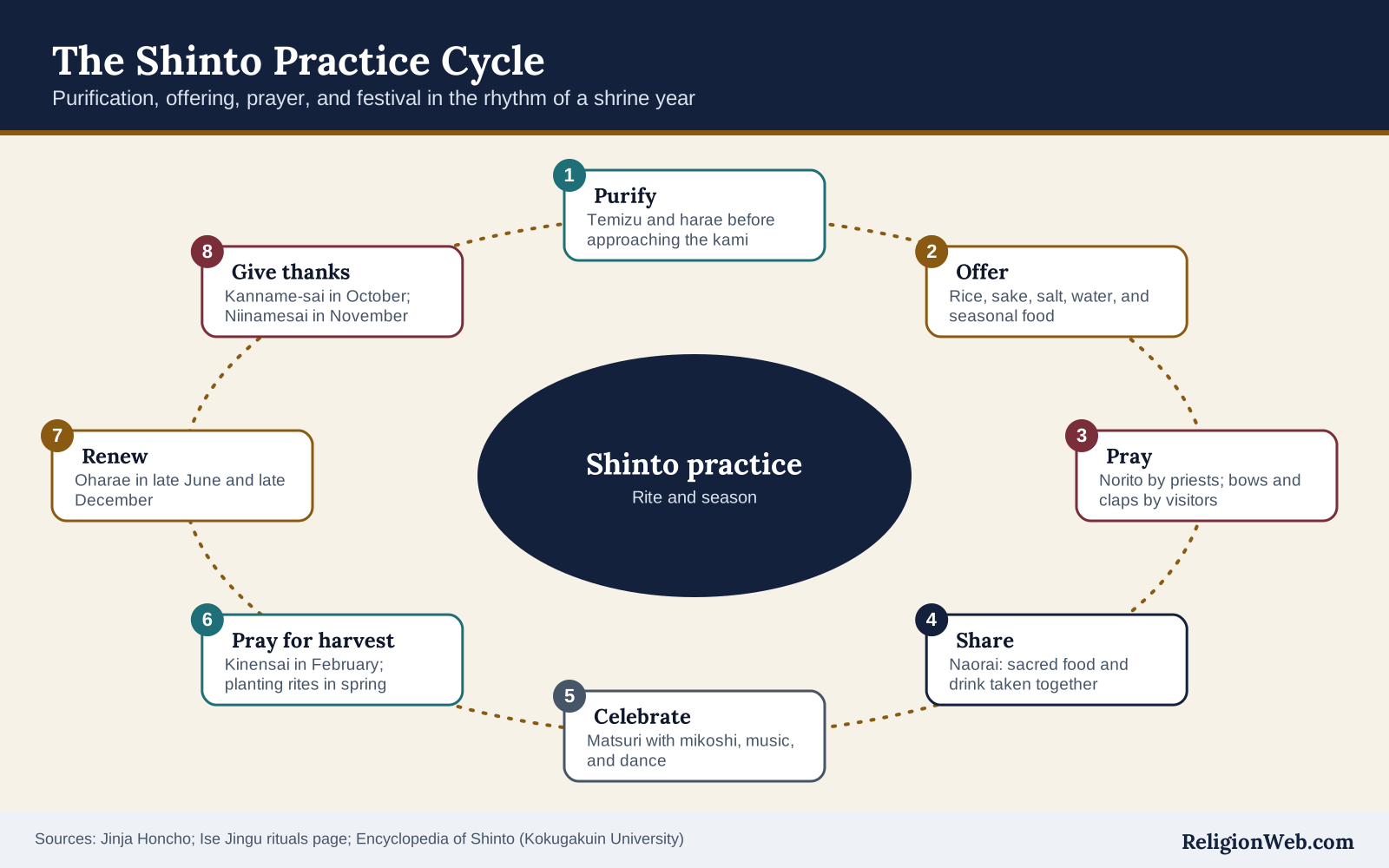
Community, Ethics, and Daily Life
The Shrine and the Neighborhood
Protector shrines and parishioners
For most Japanese, the shrine that matters most is the one nearest home. Jinja Honcho explains that a local kami may protect a district or a clan with ancestral ties to it, and that over time the two ideas merged, so that most shrines now watch over an area and the people who live and work there. Such a shrine is the ujigami shrine of the area, and its community members are its ujiko. Parishioners support the shrine with contributions, take turns with cleaning and festival duties, and hold the shrine’s name as part of the identity of the neighborhood.
Everyday requests and trades
Kami are also associated with the practical concerns of daily life. Jinja Honcho notes that Hachiman is associated with warriors and safe pregnancy, Tenjin with scholarship, and Inari with rice, harvest, and business success. The shrines of these kami draw visitors with matching hopes: students before examinations, merchants at the start of a year, expectant parents. Such requests are made in a spirit of petition and thanks, and they sit comfortably alongside secular means of preparing for exams or business and medical care for health.
Ethics and Attitudes
Gratitude, harmony, and cleanliness
The ethical emphases that Shinto sources name are mostly attitudes cultivated through practice. Jinja Honcho describes a spirit of respect and gratitude toward the kami and links the picture of kami gathering to discuss problems to a social emphasis on harmony and the cooperative use of each person’s strengths. Cleanliness, both physical and ritual, is an everyday virtue: the shrine is kept swept, visitors rinse before approaching, and priests bathe before rites. Britannica adds truthfulness to the list of precepts. These values are not enforced by a code, and Shinto leaves questions of law and public morals to the civil order.
The environment and the sacred grove
The idea that human life belongs inside a living landscape shapes Shinto’s attitude to place. Jinja Honcho says that preserving the sacred grove is very important, that creating a new one is a central task whenever a shrine is moved, and that visitors should stay on marked paths in these woods. Individual trees are honored with shimenawa, and rice fields are valued alongside wild forest. Some contemporary writers draw an environmental message from these practices, although the shrines’ own statements usually describe the grove simply as the kami’s setting.
Moral education and the postwar settlement
Moral instruction was a point of conflict in the State Shinto period, when Britannica notes that Shinto-based moral teaching (shushin) was compulsory in schools. The Constitution of Japan now provides that the state and its organs shall refrain from religious education or any other religious activity. As a result, today’s Shinto ethics are taught by shrines, families, and sects, not in public classrooms, and the details of what is taught differ by shrine and by teacher.
Shinto and Japanese Cultural Life
Dance, music, and craft
Shrines are repositories of performing arts and craft skills. Jinja Honcho notes that many shrines have a stage for court music, court dance, and sacred dance, and the festival calendar keeps the dance traditions in use. The rebuilding of Ise preserves carpentry, thatching, weaving, and metalwork in a living form, since each cycle requires the remaking of buildings, garments, and treasures. The shrine, in other words, functions as a regular patron of skills that might otherwise lapse.
Religion, culture, and identity
Whether Shinto is best described as a religion or as part of Japanese culture is a question that Japanese themselves answer differently. People who do not identify as religious often visit shrines, marry in shrine ceremonies, and keep a household talisman. Historically, the label of “non-religious” was applied to shrine rites by the state between 1882 and 1945, a legal construction that scholars distinguish from the experience of worshipers. In the present, the line between culture and religion remains part of public debate whenever a public official takes part in a shrine rite. Readers will find that sources, including those cited here, vary in how they draw it, and this article describes Shinto as a religious tradition because shrines, priests, and participants speak of rites addressed to the kami.
Shinto Today: Presence, Challenges, and Public Debate
Shinto in Numbers and Places
Shrines, priests, and reported adherents
The most recent official figures come from the Agency for Cultural Affairs’ religious statistics, with data as of December 31, 2024. They list 84,137 religious corporations in the Shinto system, of which 209 are under the Ministry of Education and 83,928 under prefectural governors; about 86.4 million reported adherents; and 64,491 “teachers,” the term the survey uses for clergy of all kinds. Kokugakuin University’s encyclopedia gives about 79,000 shrines as falling under Jinja Honcho, with about 20,600 priests registered, and Britannica reports more than 80,000. The differences between these figures reflect different dates and different definitions of what counts as a shrine, a priest, or a member, and no source in this article should be read as a precise headcount.
Two cautions apply. First, the adherent figure is a report by organizations, and the total across all religious systems in the same survey, about 175 million, is far above the population of Japan, so the numbers should be read as institutional claims. Second, they say little about how often people actually take part in rites. Participation in shrine festivals, New Year visits, and child blessings is far more widespread than self-identification as a Shinto believer. Readers who need a single figure should therefore state which measure they mean: registered shrines, organizational adherent counts, or the number of people who report visiting a shrine in a given year.
Visitors and pilgrimage
Large shrines draw very large numbers. Jinja Honcho’s English introduction says that around 10 million people visit Ise Jingu each year, and that more than a thousand matsuri are celebrated there annually. UNESCO’s description of the Kii Mountain Range sites says they attract up to 15 million visitors a year for ritual purposes and hiking. These numbers include tourists, pilgrims, and local worshipers in proportions that no source cited here separates, which is one reason the question of shrine tourism, taken up in the misconceptions section, needs careful handling.
Contemporary Challenges
Small shrines in a changing society
The most widespread practical difficulty is sustaining small shrines. The Encyclopedia of Shinto estimates that at least 59,000 shrines under Jinja Honcho have no resident priest, and Britannica notes that shrines depend on private contributions for their buildings and for priests’ livelihoods. Rural depopulation and aging reduce the number of parishioners available to carry out festival work and support their shrine, and a priest who serves several shrines has limited time at each. Shrines and their associations respond in various ways, there is no single approach, and the outcomes differ by region.
Church, state, and public ritual
Japan’s postwar constitution guarantees freedom of religion, bars religious organizations from receiving privileges from the state or exercising political authority, forbids the state from religious education or activity, and prohibits the use of public money for religious institutions. Within that framework, questions recur about where ceremonial and customary activity ends and religion begins. Public funding for local shrine-related events, the participation of officials in rites, and visits by political leaders to shrines connected with Japan’s war dead, notably Yasukuni Shrine in Tokyo, have repeatedly been disputed in courts, in public discussion, and between Japan and neighboring countries. This article does not attempt to adjudicate those disputes; it records that they continue because of the history of State Shinto, in which the line between civic ceremony and religion was drawn by the government.
Heritage, tourism, and respect for sacred space
Recognition as heritage has brought both support and pressure. The Munakata sites and Okinoshima were inscribed by UNESCO in 2017, and the Kii Mountain Range sites in 2004. Okinoshima’s example shows how a sacred site can be protected by restricting access, while Ise shows how a shrine can welcome millions. Jinja Honcho’s guidance to visitors is consistent: all are welcome regardless of nationality, age, sex, race, or religion, provided that they follow the shrine’s instructions, avoid roped-off areas, and observe the etiquette of the approach. Respect for the place and its kami, in the Association’s account, is the principal condition of visiting.
Ise Jingu offers the clearest example of a heritage site that remains an active center of ritual. Its guide reports more than 1,500 rituals each year, a daily food offering to the kami, and a rebuilding cycle that was last completed in 2013 and will recur in 2033. The Encyclopedia of Shinto stresses the scale of that undertaking, which takes about eight years, requires the remaking of hundreds of categories of treasures and vestments, and has been carried out, apart from one long interruption, under changing institutional arrangements from the late seventh century to the present. The combination of regular ritual, renewal, and public visiting is one of the ways in which the shrine tradition adapts to the modern world without changing its form.
Shinto and Other Religious Life in Japan
Shinto and Buddhism in daily life
Shinto and Buddhism are not experienced as mutually exclusive in Japan. The agency’s statistics report both systems’ adherents separately, and the combined total shows that many people are counted in both. In ordinary family life, the pattern described earlier continues: weddings, blessings, and seasonal festivals are associated with shrines, and funerals and memorial services with temples. The historical reasons are covered in the sections on origins, and the Buddhist side is described in the articles on Mahayana Buddhism, the family of traditions to which most Japanese Buddhist schools belong.
Continental ideas in the background
Shinto’s vocabulary and ritual forms were shaped in part by contact with continental thought. The calendar, administrative law, and several cosmological concepts came from China through the court, and the article on Chinese folk religion describes a neighboring tradition of local deities, ancestors, and temples that developed in a related East Asian setting. The Encyclopedia of Shinto’s discussion of Chinese influence cautions that shared expressions in early texts do not by themselves show that Japanese and Chinese writers understood them in the same way, and the same caution applies to modern attempts to find simple equivalents.
Common Misconceptions About Shinto
Misconception 1: Shinto was founded by a single historical person
Where the misunderstanding comes from
Many readers meet Shinto after studying religions that trace themselves to a named founder, and they assume that a religion with shrines, priests, and an organized festival calendar must have begun with a teacher or a prophet. The assumption is reinforced by the chronicles, which present the origins of the islands and the imperial line through named kami such as Izanagi and Amaterasu, and by the legendary Emperor Jimmu, whom the chronicles describe as the first sovereign. Because the texts are narratives of origins, they can be mistaken for the founding of a religion. The fact that Shinto has a recognizable organization today, with an association, a training system, and standard ritual protocols, adds to the impression of a designed institution, when most of that machinery dates from the Meiji period and the postwar years.
What the evidence and tradition actually show
Neither Shinto’s own self-description nor the historical record identifies a founder, although particular shrines do have named origins. Ise Jingu’s guide, for example, says that Princess Yamatohime sought a permanent site for Amaterasu in the reign of Emperor Suinin; such an account explains how one shrine began and does not describe the beginning of the tradition as a whole. Jinja Honcho states that Shinto has no founder and no fixed dogma. Historians trace its practices to the ritual life of agricultural communities, evidenced by sites such as Okinoshima, and the earliest written accounts, the Kojiki and Nihon Shoki of 712 and 720 CE, were compiled by court scholars working with older oral and clan traditions, not by a teacher. The sectarian movements of the nineteenth century are different: several, such as Tenrikyo and Konkokyo, do trace themselves to named founders who received revelations. That is one reason scholars distinguish Sect Shinto and Shinto-derived new religions from the shrine tradition.
There is also a scholarly debate about when Shinto became a distinct entity. Kuroda Toshio argued that Shinto in the sense of an independent religion emerged only in modern times, while other historians emphasize earlier continuities in shrines and rites. Both positions agree that no individual founded it.
Misconception 2: Kami are the exact equivalent of “gods”
Where the misunderstanding comes from
Translators commonly render kami as “god,” “deity,” or “spirit,” and the word is used in this article for convenience. A reader who has learned the English word “god” in the sense of a single supreme being or a ruler of a separate heaven will naturally read it into the Japanese term. Popular summaries often reinforce the equation by describing Shinto as having “eight million gods.”
What the evidence and tradition actually show
The Japanese concept is wider and different in shape. Motoori Norinaga’s definition, as summarized by the Encyclopedia of Shinto, includes the deities of the ancient texts, the spirits enshrined at shrines, and anything awe-inspiring with extraordinary power, and it does not require goodness. The typology of nature kami, community kami, functional kami, and human kami shows a range from mountains and storms to ancestors and deified scholars. Jinja Honcho states that there is no single all-powerful Creator and that there is no clear hierarchy among kami. Individual kami may have gentle and rough aspects. Jinja Honcho explains kami of rain, wind, mountains, sea, and thunder as a response to the unpredictability of nature, from drought and storms to crop-destroying locusts, and says that matsuri appease them and ask for further blessings. The relationship is one of appeasement, gratitude, and request, and it is not captured by a simple equation with an English word.
Jinja Honcho’s account of the representative kami shows how little the names map onto single beings. Hachiman, for instance, is described as three kami, Emperor Ojin, his mother Jingu, and a third figure that varies by shrine, and Inari is identified with several different kami and sometimes with a Buddhist figure. At the same time, Shinto texts and priests do speak of kami in ways that fit “deity,” such as when Amaterasu is called the ruling kami of the Plain of High Heaven. The practical approach is to use “kami” as the primary term and to treat “god” as a convenient but incomplete gloss.
Misconception 3: Shinto practice is limited to shrine tourism
Where the misunderstanding comes from
For visitors to Japan, shrines are often the most visible part of Shinto: photogenic gates, festivals, charms for sale. Because visitors rarely see the daily offerings, the household shelf, or the work of parish committees, it is easy to conclude that Shinto consists of sightseeing and souvenirs. Japanese themselves sometimes reinforce this impression when they say they are “not religious” while explaining that they visit shrines at New Year.
What the evidence and tradition actually show
Shrines are active centers of ritual. Ise Jingu alone conducts more than 1,500 rituals a year, according to its English-language guide, including daily food offerings that continue without visitors. Jinja Honcho describes daily and annual matsuri carried out by priests, rites of passage, and household worship in which the family offers rice, water, and salt. The Agency for Cultural Affairs counts more than 84,000 Shinto-system religious corporations, and parish committees organize local festivals that may be the central event of a district’s year.
Tourism and worship are not exclusive. A visitor who follows the etiquette described earlier, purifying at the basin and bowing at the hall, takes part in the same gesture as a resident. Rites of passage add to this picture: Jinja Honcho describes the first visit of a baby about a month after birth, the Shichi-go-san visits of children aged three, five, and seven, and weddings at larger shrines, all of which involve ordinary families rather than tourists. The point is that the visible tourist activity is a small part of a larger ritual life, much of which takes place in the early morning, in private homes, and in neighborhood meetings.
Misconception 4: State Shinto and Shinto are the same thing
Where the misunderstanding comes from
Histories of the Second World War often use “Shinto” to describe the ideology of the wartime state, and the Allied occupation’s directive used the label “State Shinto.” The result is an impression that Shinto is by nature a nationalist creed or that it was always the state religion of Japan.
What the evidence and tradition actually show
“State Shinto,” as the 1945 directive defines it, names the branch of Shinto that the government had differentiated from Sect Shinto and classified as non-religious. It was a modern arrangement, in force from 1868 to 1945, built on top of older shrine practice. Before 1868, shrines were run in many ways, often together with Buddhist temples, and for much of the premodern period shrines and Buddhist temples shared sites and, at times, priests. After 1945, the shrines reorganized as private religious bodies, and the Constitution of Japan keeps them separate from the state. Helen Hardacre’s study shows that the system was shaped by local actors as well as by the central bureaucracy.
None of this removes the controversial parts of the history. The wartime use of shrine rites to promote loyalty to the state is a matter of historical record and continues to shape debate. It does mean that the label does not describe shrine life before or after those years. Britannica notes that during the period shrine worship was treated as a patriotic duty even though the constitution nominally guaranteed religious freedom, and that is the specific feature the 1945 directive set out to end.
Misconception 5: Shinto has no beliefs, teachings, or ethics
Where the misunderstanding comes from
Because Shinto has no founder, scripture, or creed, it is often described as “just ritual” or as “nature worship without doctrine.” Shrine officials themselves say that Shinto has no fixed dogma, a statement that can be heard as meaning that it has no content.
What the evidence and tradition actually show
Absence of dogma is not absence of belief. Shinto carries a developed set of ideas about the kami, the structure of the world as told in the old narratives, the nature of pollution and purification, and the place of human beings within a living landscape, and these are transmitted through ritual, shrine tradition, and scholarship. Britannica lists truthfulness and purification among its precepts, and Jinja Honcho describes gratitude, harmony, and respect. Theological work also exists, from the medieval priests of Ise to Motoori Norinaga and postwar scholars, though the Encyclopedia of Shinto observes that systematic Shinto theology is still developing.
Shinto is also more than nature veneration. It involves ancestors, communities, historical persons, and the court. The accurate statement is that Shinto’s teachings are expressed more through practice and story than through formal creeds, and that they vary by shrine and school. Ritual itself carries a claim: the practice of purification before approaching a kami rests on the account of Izanagi’s cleansing and on the idea that defilement can be removed, and the priests’ preparatory abstentions assume that the kami are present and deserve preparation.
Frequently Asked Questions About Shinto
Questions About Meaning and Belief
What does Shinto mean, and is it a religion?
Shinto means “the way of the kami.” The word combines the characters for kami and for “way,” and it appears as early as the Nihon Shoki of 720 CE, though scholars caution that an early use of the word does not prove that it named an organized religion. Whether Shinto counts as a religion depends on the definition used. It has priests, sacred places, rituals addressed to sacred beings, and an annual cycle of observances, and Japanese law treats shrines as religious corporations. It lacks a founder, a creed, and a requirement of exclusive membership. Many people who take part in its rites do not describe themselves as religious.
For this reason it is more accurate to say that Shinto is a religious tradition carried by practice than to say that it is a belief system to which one subscribes. The next questions show how that works in practice.
How many kami are there, and must a person choose among them?
No one has counted. The phrase “eight million kami,” used by Jinja Honcho, expresses an unlimited number, and the Engishiki register of 927 CE lists 3,132 kami at 2,861 shrines, which was a count of those receiving court offerings and not of all kami. There is no requirement to choose one. People pray to the kami of the shrine they visit, to the protector of their neighborhood, and to the kami of the household shelf, and they may also go to a kami associated with a particular concern, such as Tenjin before an examination. The Association adds that there is no clear hierarchy among kami.
Do people in Japan practice both Shinto and Buddhism?
Yes, and the combination is long established. For roughly a thousand years, shrines and temples shared compounds, priests, and ritual vocabulary, as described in the section on origins. Today the usual pattern is that seasonal festivals, blessings, and weddings are associated with shrines, and funerals and ancestor memorials with temples. The Agency for Cultural Affairs’ figures count both systems’ adherents separately, and the combined total exceeds the population for exactly that reason. The Buddhist side of Japanese religious life is described in the article on Buddhism.
Questions About Shrines and Visiting
Can visitors who are not Japanese or not Shinto go to a shrine and pray?
Yes. Jinja Honcho states that people are welcome at a shrine regardless of nationality, age, sex, race, or religion, and that visitors may take part in rites, make requests, give thanks, or simply pay their respects. The conditions are respect for the place and following the shrine’s instructions. In practice, that means bowing at the torii, rinsing at the basin if there is one, staying out of roped-off areas, and not lingering where others are praying. Priests will usually answer a polite question. At sites such as Okinoshima, access is restricted, and visitors should respect those limits.
How can I tell a shrine from a Buddhist temple?
The simplest sign is the torii. JAANUS notes that torii distinguish Shinto shrines from Buddhist temples, even though both can stand on a single site and some temples contain a small shrine. Shrine names usually end in jinja, jingu, or taisha, and temple names in -ji or -dera. Shrines often have a rope with zigzag paper streamers and a pair of guardian lion-dogs or foxes. Buddhist halls, by contrast, usually hold images of buddhas. This is a practical guide only; historical combination means that exceptions exist.
Why do shrines sell charms, and what should I do with them?
Charms (omamori) and talismans (ofuda) are described by Jinja Honcho as expressions of the kami’s power that are kept close for protection, and they are received with a small offering. Shrines depend on such offerings, because they receive no state funds. A charm is conventionally kept for a year, then returned to a shrine to be disposed of with a rite. Charms for health, travel, or school success are requests for protection and do not replace medical or other professional help.
Questions About History and Organization
What was State Shinto, and does it still exist?
State Shinto refers to the system from 1868 to 1945 in which the government supervised shrines, classed their rites as national ceremonies rather than religion, and taught Shinto-based morals in schools. It was ended by the occupation directive of December 15, 1945, and the Constitution of Japan, in force since 1947, forbids public support for religious institutions. The shrines themselves continue as private religious corporations. The term describes a political and legal arrangement, and historians debate how uniform it was in practice.
Are the Kojiki and Nihon Shoki Shinto scripture?
They are the most important early texts, though not scripture in the sense of a book recited in worship or used to define membership. Both were compiled at the imperial court in the early eighth century CE, the Kojiki in 712 and the Nihon Shoki in 720, and both set the origins of the kami and the imperial house in one account. Shrines draw on them for kami names and origin stories, priests study them, and scholars use them as historical and literary sources.
The ritual texts, such as the norito preserved in the Engishiki, matter as much to priests as the narratives do. Because there is no single canon, a writer who says that “Shinto scripture teaches” something is usually generalizing from one text or from one shrine’s tradition.
Who is in charge of Shinto?
No one is. There is no pope, council, or central head of the tradition. Each shrine has its own priests and parishioners, and about 79,000 to 80,000 shrines belong to Jinja Honcho, which was founded in 1946 and provides standards, training, and coordination. Ise Jingu has a special rank as the shrine of Amaterasu. The imperial house maintains its own rites, and sects have their own leaders. Statements about Shinto “teaching” something are therefore best attributed to a shrine, an association, a school, or an author.
Why is the Ise Shrine rebuilt every twenty years?
The shrine states the fact and the schedule: a new sanctuary of the same dimensions is built on the adjacent site, the Holy Mirror is moved to it, and garments and treasures are remade, in a cycle that began with the Inner Shrine in 690 CE. Reasons offered include renewal, the handing down of craft skills, and continuity of ritual. The cycle lapsed for 124 years after 1462 and was revived in 1585, the most recent rebuilding was the 62nd in 2013, and the 63rd is planned for 2033.
Conclusion: What Shinto’s History and Practice Show
What the History Shows
Continuity in practice, change in framework
Across fifteen centuries of written record, certain things remained constant: the shrine as a fixed place of ritual, the offering of food and prayer to kami, the stress on purification, and the festival calendar tied to the rice year. Around those constants, the framework shifted repeatedly: the court state of the eighth and tenth centuries, the long period of combination with Buddhism, the schools of the Edo period, the government system of 1868 to 1945, and the private shrine association of the postwar order. Reading Shinto well means holding both facts together. It also means resisting two opposite temptations: to treat the tradition as timeless and unchanging, which ignores the repeated reorganizations described above, and to treat it as a modern invention, which ignores the shrine sites, the rites, and the texts that long predate the modern state.
Why precise vocabulary matters
The terms used for Shinto are not interchangeable. “Shrine Shinto,” “Sect Shinto,” “folk Shinto,” and “State Shinto” name different things, and kami, in the sense described by Norinaga, is not the same as the English word god. Careful use of these terms prevents a number of common errors, including the identification of the tradition with the wartime state, and it respects the way shrines and priests describe themselves.
How to Keep Exploring
Related articles on ReligionWeb
Readers interested in the religious setting in which Shinto developed can continue with the articles on Buddhism and Mahayana Buddhism, which describe the tradition with which Shinto shared institutions for centuries, and with the articles on Confucianism, Daoism, and Chinese folk religion, which describe continental traditions that influenced Japanese ritual vocabulary and thought.
Visiting and reading with care
For anyone visiting a shrine, the best guidance is the shrine’s own: follow the posted instructions, move quietly, and treat the grounds as the home of the kami. For anyone reading further, the sources listed below distinguish institutional statements, such as those of Jinja Honcho and Ise Jingu, from scholarly analysis, and from the primary texts themselves. Each of these types has its own purpose, and Shinto is best understood by consulting all three. A reader who keeps the distinctions in view, between a shrine’s own account, a scholar’s reconstruction, and the older text itself, will find that the apparent contradictions in popular summaries usually dissolve: one source is describing the practice of a particular shrine, another a particular century, and a third the claims of a particular school.
Sources
The table below lists the principal external sources behind this article. Facts, dates and figures were checked against these and related primary, institutional and academic materials.
| # | Source | Publisher and type | Used for | Link |
|---|---|---|---|---|
| 1 | The Kojiki, tr. Basil Hall Chamberlain (1882; revised 1919), Section X and Section XXXIII | Internet Sacred Text Archive (sacred-texts.com) · Primary text | Quoted passages: purification of Izanagi (Section X) and the charge about the mirror (Section XXXIII) | sacred-texts.com |
| 2 | Nihongi: Chronicles of Japan from the Earliest Times to A.D. 697, Vol. 1, tr. W. G. Aston (1896) | Open Educational Resource, Maricopa Community Colleges (World Mythology) · Primary text | Quoted Rock-cave passage and opening of the Age of the Gods; Aston translation of 1896 | open.maricopa.edu |
| 3 | Encyclopedia of Shinto (entries on kami, harae, misogi, Shikinensengu, Jingiryo, shrine ranking, and others) | Kokugakuin University Digital Museum · Academic reference | Kami typology, purification, Ise rebuilding, ritsuryo law, Engishiki, Meiji shrine system, Shinto and Buddhism | d-museum.kokugakuin.ac.jp |
| 4 | Shinto (with related entries Shrine Shinto, State Shinto, and Kyoha Shinto) | Encyclopaedia Britannica · Encyclopedia | Definition of Shinto; shrine count; State Shinto 1868 to 1945; Sect Shinto’s thirteen groups | britannica.com |
| 5 | What is Shinto? and related English pages on kami, jinja, matsuri, and worship | Jinja Honcho (Association of Shinto Shrines) · Institutional | Shinto’s self-description, kami, shrine precinct, visiting etiquette, matsuri, household worship, rites of passage | jinjahoncho.or.jp |
| 6 | About Ise Jingu and Rituals and Ceremonies (English site) | Ise Jingu (Jingu Shicho) · Institutional | Amaterasu, Naiku and Geku, 125 shrines, Holy Mirror, Shikinen Sengu, annual rituals and dates | isejingu.or.jp |
| 7 | SCAPIN 448: Abolition of Governmental Sponsorship, Support, Perpetuation, Control and Dissemination of State Shinto (15 December 1945) | Nagoya University Graduate School of Law, SCAPIN-DB · Primary document | Quoted definition of State Shinto; end of government support for shrines | jahis.law.nagoya-u.ac.jp |
| 8 | Religious statistics survey: summary tables, data as of December 31, 2024 | Agency for Cultural Affairs, Government of Japan · Demographic data | Shinto-system religious corporations, reported adherents, and teachers (2024 data) | bunka.go.jp |
| 9 | Torii (Japanese Architecture and Art Net Users System, JAANUS) | Columbia University, Media Center for Art History · Academic reference | Torii types, earliest records, oldest surviving examples, and proposed origins | projects.mcah.columbia.edu |
| 10 | Sacred Island of Okinoshima and Associated Sites in the Munakata Region; Sacred Sites and Pilgrimage Routes in the Kii Mountain Range | UNESCO World Heritage Centre · Institutional | Okinoshima ritual period and protection (2017); Kii Mountain Range sites and visitors (2004) | whc.unesco.org |
Last fact-check date: 2026-10-21.