Zoroastrianism is a religion that arose among Iranian-speaking peoples of Central Asia and the Iranian plateau and is associated with the priest and poet Zarathushtra (also spelled Zarathustra), known in Greek and in English as Zoroaster. Zoroastrians honor Ahura Mazda, the “Wise Lord,” as the creator of a good world, and they understand existence as a field in which truth and cosmic order (asha) stand against falsehood and disorder (druj). Many call their faith Mazdayasna, “the worship of Mazda,” or the behdin, the “good religion.” Its scripture, the Avesta, is preserved in an ancient language that no community speaks today but that Zoroastrians still recite in prayer.
The origins of the religion cannot be dated with precision. Scholars have proposed dates for Zarathushtra that range from the thirteenth century BCE to the years just before the rise of the Achaemenid Empire, and a majority favor a time around 1000 BCE; later Zoroastrian tradition, by contrast, reckons his life as “258 years before Alexander,” a figure that translates to roughly 588 BCE. What is not in doubt is the long historical arc that followed. The religion enjoyed royal patronage under the Achaemenid dynasty and became a state church under the Sasanians (224 to 651 CE), then gradually lost adherents after the Arab conquest of Iran, while a group of Zoroastrians established the Parsi community on the western coast of India.
Today Zoroastrian communities live mainly in India, where they are called Parsis, in Iran, and in diaspora communities in North America, Britain, Australia, and elsewhere. No census counts Zoroastrians worldwide, and published estimates differ widely: a 2015 press report cited about 138,000 people worldwide, whereas older reference works give figures near 300,000. Whatever the precise number, this is a small community whose influence on the history of Iran, India, and the study of religion is far larger than its size would suggest.
Several distinctions matter for understanding Zoroastrianism accurately. The Gathas attributed to Zarathushtra are separate from the later Avestan liturgies and from the medieval Pahlavi books. Zoroastrian dualism is a doctrine about moral choice and the origin of evil, not a belief in two equal gods. Fire is revered as a symbol of divine light and order and as the focus of worship, not as a deity. And Parsi and Irani communities differ in calendar, custom, and sometimes in ritual detail. This article takes each of these in turn, describes Zoroastrianism on its own terms and in historical context, and notes where scholars, priests, and communities disagree.
Zoroastrianism at a Glance: Definition, Origins, Geography, and Vocabulary
What Zoroastrianism Is
The names Zoroastrians use for their faith
The word “Zoroastrianism” is a European coinage built on the Greek form of the prophet’s name, Zōroástrēs. Zoroastrians themselves more often speak of the Zarathushti din, the religion of Zarathushtra, or of Mazdayasna daena, the “Mazda-worshiping religion.” In Persian-speaking communities the lay community is called behdinan, “followers of the good religion,” and the hereditary priestly class is called athornan. The Avestan name Zarathushtra is traditionally explained as meaning “possessor of old camels,” although the etymology is not settled.
These different labels are not rival names for different faiths. They reflect the layers of a long history in which Avestan, Middle Persian (Pahlavi), New Persian, and Gujarati each left vocabulary behind. A reader who meets “Zarathushti,” “Mazdayasni,” “Zoroastrian,” and “behdin” in different books is meeting the same community described from different linguistic angles.
The central claims in brief
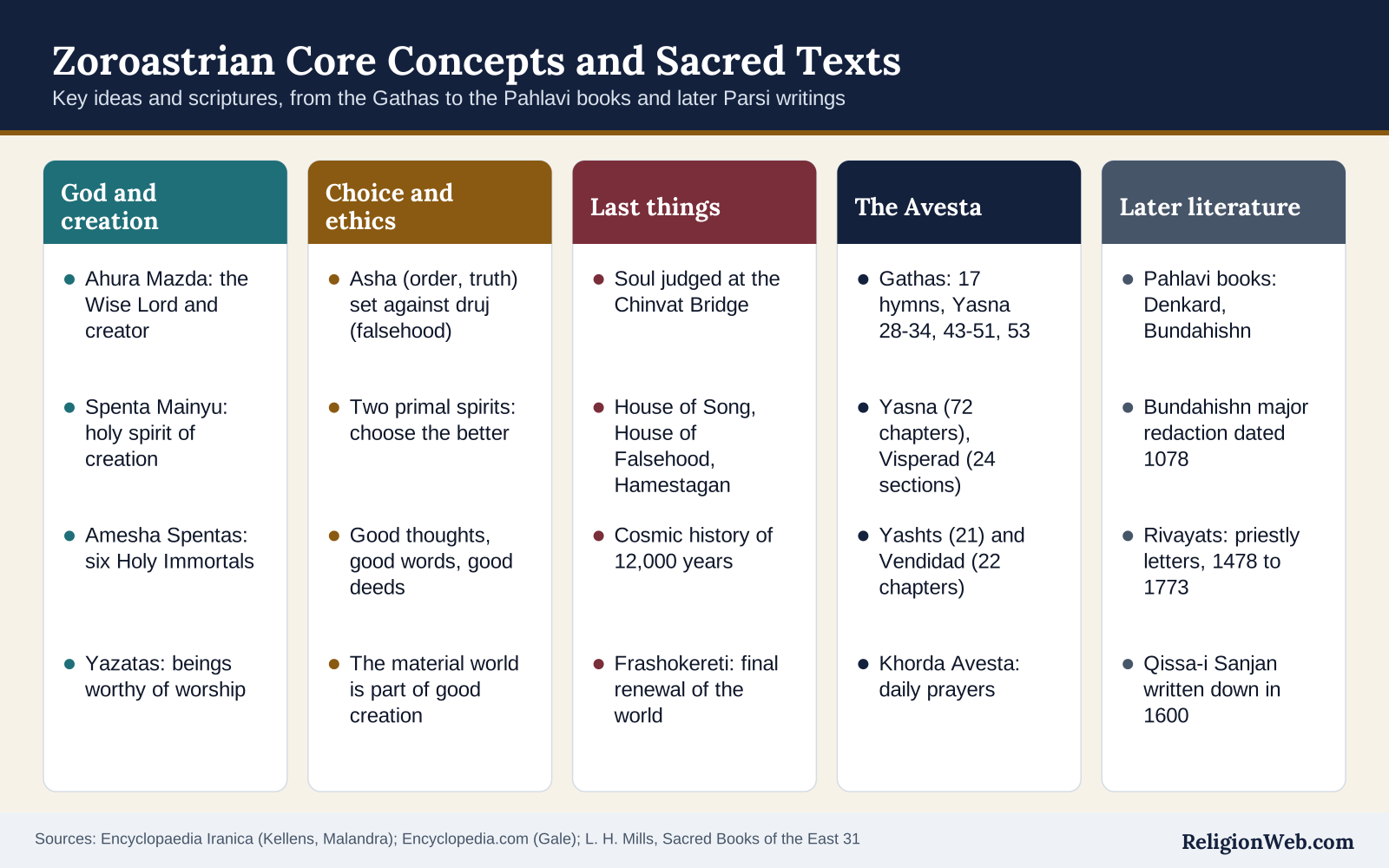
According to Zoroastrian teaching, Ahura Mazda is the wise and good creator, and the material world is part of his good creation rather than a prison or an illusion. The Gathas describe two primal spirits, one that chooses life and truth and one that chooses destruction and falsehood, and they present human beings as moral agents who must choose between them. Later tradition names the destructive spirit Angra Mainyu, the “Angry Spirit,” and develops a sweeping account of cosmic history in which good ultimately prevails and the world is renewed in a final transformation called Frashokereti.
The ethical center of the religion is often summarized in three phrases: good thoughts, good words, and good deeds. Practice is organized around prayer in Avestan, the tending of consecrated fire, the maintenance of ritual purity, the keeping of seasonal festivals, and rites of passage such as the initiation ceremony known as the Navjote. These themes recur throughout this article.
Where and When Zoroastrianism Began
An Iranian religion with Indo-Iranian roots
The oldest Zoroastrian texts, the Gathas, are written in Old Avestan, a language so close to the Vedic Sanskrit of the Rigveda that comparative linguistics places both in the second millennium BCE. Zarathushtra’s society seems to have been one of pastoralists and farmers who valued cattle, ritual, and the patronage of local rulers. Most scholars agree that he did not live in western Iran; eastern Iran and Central Asia are the usual proposals, although the exact location remains tentative.
This background helps explain some features of the tradition. Zoroastrian terms such as haoma, a ritual plant drink, and yazata, a being “worthy of worship,” belong to an older Indo-Iranian vocabulary that the Vedic tradition of India, treated in the article on Hinduism, also reflects. At the same time, the Gathas make distinctive claims about Ahura Mazda and about the moral choice facing every person, and these claims gave the later religion its recognizable shape.
From royal patronage to minority communities
By the sixth century BCE the Achaemenid kings of Persia were honoring Ahura Mazda in their inscriptions, though scholars still debate how closely their religion followed the teaching of Zarathushtra himself. The Parthian period, from roughly the third century BCE to 224 CE, is poorly documented. Under the Sasanians the religion was institutionalized as an imperial church with a hierarchy of priests, a growing number of fire temples, and a written Avesta.
The Arab conquest of the seventh century CE ended Zoroastrian political power. Over the following centuries most Iranians became Muslim (see Islam for that tradition’s own history), and Zoroastrians became a minority living under Islamic rulers. Some Zoroastrians migrated to Gujarat, in western India, where their descendants became the Parsis; others remained in Iran, concentrated in the cities of Yazd and Kerman and their surrounding villages.
Who Practices Zoroastrianism Today
Parsis, Iranis, and diaspora communities
The word “Parsi” means “Persian” and refers to the Zoroastrians of the Indian subcontinent, whose ancestors, according to their own founding narrative, arrived from Iran after the Arab conquest. Their largest concentration is in Mumbai, with historic centers in Gujarat such as Navsari and Udvada. “Irani” has two uses: it can mean the Zoroastrians who remained in Iran, and in India it also names later arrivals from Iran during the nineteenth and twentieth centuries.
Since the nineteenth and twentieth centuries, Zoroastrians from both India and Iran have also settled in Britain, North America, Australia, the Persian Gulf states, and other regions. Diaspora associations, including the Federation of Zoroastrian Associations of North America (FEZANA), organize religious education, priestly services, and community life. These groups often draw members from both Parsi and Irani backgrounds, which gives diaspora practice a hybrid character that this article returns to later.
Estimating the size of the community
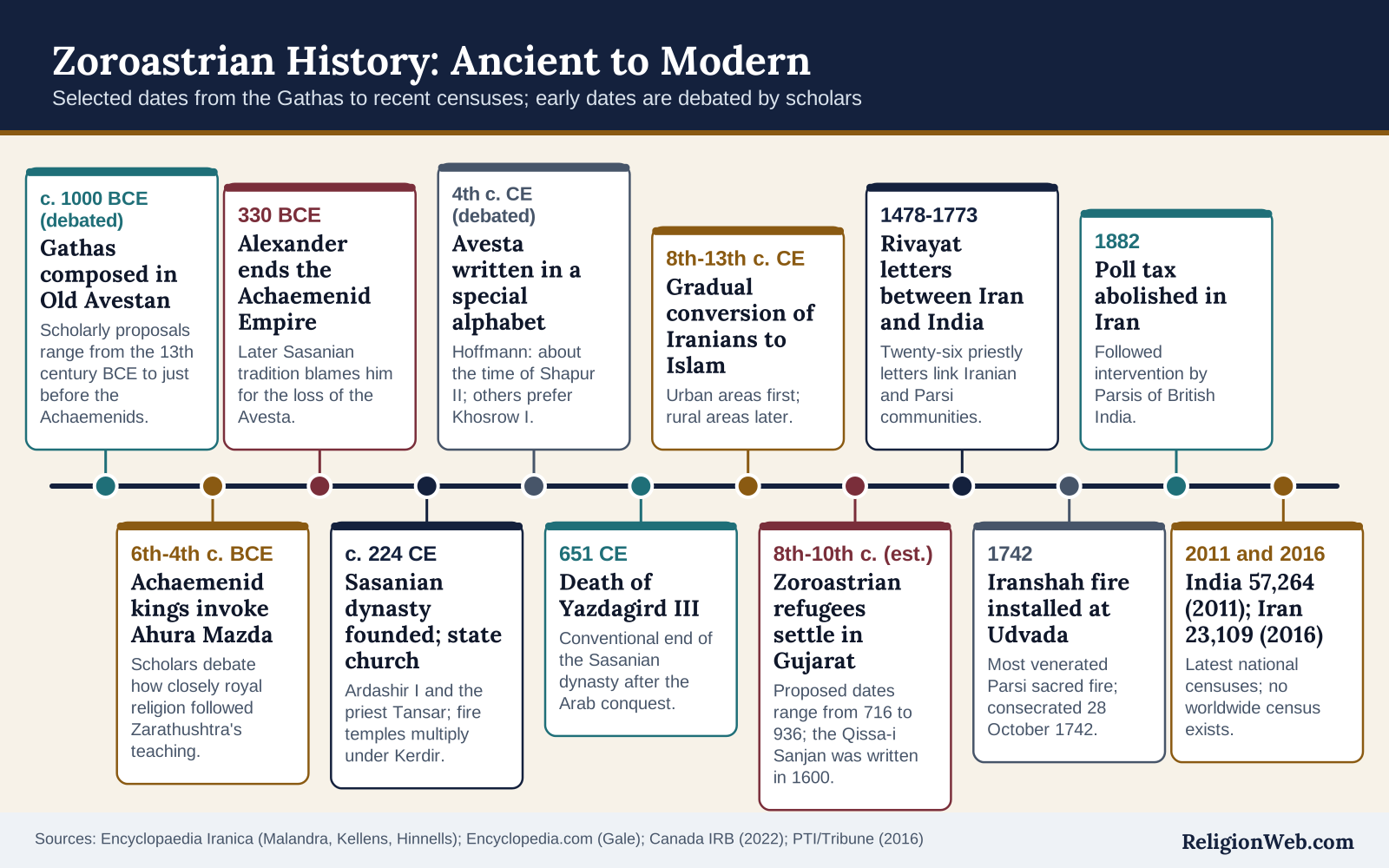
Counting Zoroastrians is difficult because most national censuses do not record them separately, and community estimates rest on varying methods. India’s 2011 census recorded 57,264 Parsis, down from 111,791 in 1951, and Iran’s 2016 census counted 23,109 Zoroastrians, according to figures summarized by Canada’s Immigration and Refugee Board. A press report in 2015 put the world total at about 138,000, with roughly 69,000 in India. These figures come from different years and different methods, so they should be read as indicators of scale, not as a single consistent dataset.
The broad direction is clearer than any single number. The Parsi population in India has declined for decades because of a low birth rate, an aging population, and emigration, while Iran’s Zoroastrian numbers have also fallen, and diaspora communities in North America have grown somewhat. The section on modern global presence below looks at these trends in more detail.
Key Terms and Vocabulary
A short glossary of essential words
Zoroastrian vocabulary comes from several languages, and the same concept may appear under an Avestan, a Pahlavi, and a Persian name. The table below collects the terms a reader will meet most often. The last column points to where each term matters most in the tradition.
| Term | Language | Meaning | Where it appears |
|---|---|---|---|
| Ahura Mazda (Ohrmazd) | Avestan (Pahlavi) | The “Wise Lord,” creator and supreme deity | Gathas, daily prayer, doctrine |
| Asha (Arta) | Avestan | Truth, order, and right ritual and moral conduct | Gathas, ethics, cosmology |
| Druj | Avestan | Falsehood and disorder, the opposite of asha | Gathas, doctrine of choice |
| Angra Mainyu (Ahriman) | Avestan (Pahlavi) | The “Angry Spirit,” source of destruction and falsehood | Later Avesta, Pahlavi books |
| Amesha Spentas | Avestan | “Holy Immortals,” divine beings associated with aspects of creation | Gathas, Yasna, devotion |
| Yazata | Avestan | A being “worthy of worship,” such as Mithra or Sraosha | Yashts, festivals |
| Avesta | Avestan | The collected sacred texts of Zoroastrianism | Liturgy and scripture |
| Gathas | Old Avestan | Seventeen hymns attributed to Zarathushtra | Yasna 28 to 53 |
| Atash Behram | Persian | “Fire of Victory,” the highest grade of consecrated temple fire | Fire temples |
| Dakhma | Avestan and Persian | A raised structure for exposing the dead, popularly “Tower of Silence” | Funerary customs |
| Navjote (Sedreh-pushi) | Gujarati and Persian | Initiation in which a child receives the sacred shirt and cord | Rites of passage |
| Mobed and dastur | Persian | A priest, and a high priest, respectively | Ritual and community authority |
A note on spelling and names
English spellings of Zoroastrian terms vary because they are transliterated from several scripts and languages. The prophet’s name appears as Zarathushtra, Zarathustra, Zartosht, and Zoroaster; the New Year appears as Nowruz, Navroz, Nav Ruz, and Norooz; the community appears as Parsi or Parsee. This article uses Zarathushtra and Zoroaster interchangeably, “Nowruz” for the spring festival in general, and “Navroz” only when a Parsi usage is meant.
Diacritics are kept where they help with pronunciation, as in Frashokereti or Spenta Mainyu, and a simplified spelling is given alongside. Where an Avestan word and a later Pahlavi form differ, such as Ahura Mazda and Ohrmazd, the earlier form is used for the divine being as presented in the Avesta and the later one for the figure as described in Sasanian and medieval texts.
Origins and Historical Development of Zoroastrianism
The Indo-Iranian Background and the Gathic Period
A shared inheritance of Iranian and Indian peoples
Zoroastrianism emerged from a religious world that Iranian-speaking and Indo-Aryan-speaking peoples once shared. The Avestan word ahura, meaning “lord,” corresponds to the Sanskrit asura, and the Avestan daeva, a class of beings rejected in Zoroastrian teaching, corresponds to the Sanskrit deva, a word for gods in the Vedic and later Hindu traditions. The haoma drink of Avestan ritual has a counterpart in the Vedic soma. Such correspondences show common roots; they do not mean the two traditions developed in parallel, and the meanings of the shared words shifted in different directions.
The language of the Gathas, Old Avestan, is the clearest witness to this background. It is close enough to the Vedic Sanskrit of the Rigveda that linguists use the two together to reconstruct a common ancestor. The Avestan language cannot be located precisely: scholars have proposed the northwest, the northeast, Chorasmia, Margiana and Bactria, and Sistan, and it is not the dialect of Pars, the heartland of the later Persian kings.
Dating Zarathushtra: why scholars disagree
Few questions in the study of religion are as unsettled as the date of Zarathushtra. In the Iranica entry on Zoroastrianism, William Malandra summarizes the proposals as ranging from the thirteenth century BCE to just before the rise of the Achaemenid empire, and notes that the majority favor around 1000 BCE. Jean Kellens, writing on the Avesta, likewise reports a recent consensus placing the Gathas around 1000 BCE. Manfred Hutter, following Mary Boyce, favors the last centuries of the second millennium BCE, and he points to the language of the Gathas, which comparison with Vedic places in the second millennium, and to the sedentary society the texts describe.
Zoroastrian tradition offers a different anchor. Later texts place the prophet “258 years before Alexander,” which modern computation turns into a date around 588 BCE, and reference works commonly give the traditional lifetime as roughly 628 to 551 BCE. Specialists have long doubted this figure, because the Old Avestan language was probably no longer spoken by the sixth century BCE and because the number may have been derived from Greek or Babylonian chronological schemes. Greek authors, for their part, gave far more remote dates, in the thousands of years before Xerxes, which no modern historian accepts. The reader should treat the exact century as an open question, not as an unknown that careful scholarship has resolved.
A more radical question concerns whether the Gathas have a single author at all. Most Zoroastrians accept the historical existence of Zarathushtra, and most historians of religion treat him as a real poet and priest. A minority of scholars, including Jean Kellens, argue that the Gathas reflect the ideas of a priestly group and that only a mythologized Zarathushtra is accessible. This is a scholarly debate about evidence, not a claim about Zoroastrian faith, and it is stated here so that readers know where the discussion stands.
Where Zarathushtra lived
Malandra reports that most scholars agree Zarathushtra did not live in western Iran. Proposals for his homeland have included Chorasmia, in what is now Uzbekistan; Bactria; Sistan and Drangiana, favored by Gherardo Gnoli; and a broad northeastern frontier zone across present-day Turkmenistan, Uzbekistan, and Kazakhstan, favored by Hutter. The Vendidad names a land called Airyanem Vaejah, “the Iranian expanse,” as the first of the good lands created by Ahura Mazda, but scholars disagree on whether it describes a real region or a mythical homeland.
Later Zoroastrian tradition associated the prophet with western Iran, naming Media, Azarbaijan, Lake Urmia, or Raga. That tradition grew up in the Sasanian period, when it served the dynasty’s claims to a religious heritage rooted in its own territory. For the historian, the Gathas remain the only reliable biographical source, and they do not give a map.
Medes, Achaemenids, and the Magi
The Magi in Greek and Persian sources
The Greek historian Herodotus, writing in the fifth century BCE, describes the Magi as one of the Median tribes and as ritual specialists who conducted sacrifices and handled the disposal of the dead. Under the Achaemenid kings, Magi served as seers and as tutors, and the word magus is the root of the later Persian term mobed for a Zoroastrian priest. It is also the origin of the English words “magic” and “magician,” a development that reflects Greek and Roman perceptions of Persian priests and not the Zoroastrian understanding of their own ritual.
The relationship between these Magi and the community of Zarathushtra remains a subject of discussion. Some scholars see the Magi as a priestly caste that absorbed Zarathushtra’s teaching; others stress that the religion of the Magi included features that do not appear in the Gathas. What is clear is that by the later Achaemenid period, the Magi were closely associated with the worship of Ahura Mazda, and that their practices included features, such as the exposure of corpses, that are later documented in Zoroastrian law.
Achaemenid kings and Ahura Mazda
The royal inscriptions of Darius I and his successors invoke Ahura Mazda as the god who supports their rule, and they use the contrast between ahura and daiva, vocabulary that recalls the Gathas. Whether this means that the Achaemenids were Zoroastrians in the later sense is disputed. Malandra notes that scholars disagree about whether the kings were influenced by Zarathushtra’s teaching, and that Gathic-style phrases in the inscriptions may simply reflect a shared Indo-Iranian diction. Darius used a Perso-Babylonian calendar for public purposes in his Bisotun inscription, and the Zoroastrian calendar was reserved for devotional use.
Under Artaxerxes II, who reigned from 404 to 359 BCE, the evidence changes. The king promoted the veneration of Anahita and Mithra, introduced a calendar reform that used Zoroastrian divine names, and is linked by Malandra to the first Greek mention of Zoroaster. Malandra describes the resulting religion as eclectic, combining Zarathushtrian elements with a pantheon of deities that is largely absent from the Gathas. The Achaemenid period therefore provides evidence of a Zoroastrian religion in a broad sense, while leaving open how it related to the original teaching.
The Hellenistic and Parthian centuries
Alexander’s conquest of the Persian Empire in 330 BCE opened a period for which sources are very fragmentary. Later Sasanian writers portrayed Alexander as an evil destroyer of the Avesta and the priesthood, but Jean Kellens rejects the idea that an Achaemenid written Avesta was ever destroyed by the Greeks, noting that the early transmission was oral. These stories are better understood as Sasanian reflections on history than as records of events.
The Parthian, or Arsacid, rulers who governed from the third century BCE to 224 CE were generally tolerant, and the ecclesiastical organization attested later under the Sasanians may in part have been inherited from them. A tradition preserved in the Denkard credits an Arsacid king, Vologases I, with trying to gather the dispersed Avesta. In the first century BCE, the king of Commagene, Antiochus I, fused Ahura Mazda with the Greek Zeus in his royal religion, one of the more striking examples of how Zoroastrian divine names traveled beyond Iran.
The Sasanian Era, 224 to 651 CE
Ardashir I and the creation of a state church
The dynasty founded by Ardashir I around 224 CE gave Zoroastrianism an institutional form it had not had before. Malandra reports that Ardashir, working with the chief priest Tansar, established a new canon purged of heterodox material, brought interpretation under royal control, and promoted the veneration of fire. Images of the gods were banned from worship, although depictions of divine figures remained part of royal art. The dynasty cultivated a theology of partnership between throne and altar: kings were depicted in rock reliefs receiving kingship from Ahura Mazda, and religious deviation became a matter of state concern.
This was not a uniform policy. Shapur I, who reigned from about 240 to 272, relaxed some of the earlier strictness and tolerated Mani, the founder of Manichaeism, at his court. The history of the Sasanian church shows alternating periods of openness and enforcement, shaped by individual kings and powerful priests.
Kerdir and the multiplication of fire temples
The most influential priest of the early Sasanian period was Kerdir, whose career extended from Ardashir’s time into the reign of Bahram II (276 to 293). His inscription on the building known as the Kaʿba-ye Zardosht describes how he funded and staffed fire temples, destroyed idols, and acted against communities of Jews, Christians, Manicheans, Buddhists, and Brahmins in the empire. It also contains an account of a journey to the otherworld. The text is Kerdir’s own presentation of his career, and historians treat it with the caution due to any self-portrait, while accepting that fire temples multiplied greatly under Ardashir, Shapur I, and Kerdir.
The Sasanian church’s dealings with the Jewish, Christian, Manichean, and Buddhist communities within and beside the empire were never uniform. Kerdir’s text records suppression, while Shapur I’s tolerance of Mani shows that policy could change from one reign to the next.
Priestly orthodoxy and the question of Zurvanism
One of the open questions about Sasanian Zoroastrianism is what counted as orthodox belief. Some sources describe a theology in which Zurvan, “Time,” was the father of both Ohrmazd and Ahriman, the Pahlavi forms of Ahura Mazda and Angra Mainyu. Malandra notes that Kerdir may himself have been Zurvanite, and that it is unclear whether Zurvanism was ever regarded as a departure from orthodoxy in Sasanian times. Other sources present a firmer dualism in which Ohrmazd is wholly good and eternal.
The Sasanian period also saw intense religious controversy, including the rise of Mazdak, whose movement Kawad I (488 to 531) embraced and Khosrow I (531 to 579) later destroyed. It was in this era, too, that the Avesta and its Pahlavi translation were fixed in writing, probably under Shapur II or Khosrow I; the section on sacred texts below describes that process, because it is essential to understanding what the surviving scriptures are.
From the Arab Conquest to Modern Times
Conquest, conversion, and the poll tax
The Sasanian Empire fell to the Arab armies in the middle of the seventh century, and the death of the last king, Yazdagird III, in 651 is conventionally taken as the end of the dynasty. Malandra describes it as a blow from which Zoroastrianism never recovered, although the religion survived. Conversion to Islam was gradual and varied by place: urban Zoroastrians converted mainly between the eighth and tenth centuries, rural populations between the tenth and thirteenth. By the fourteenth century most Zoroastrian temples had been turned into mosques or madrasas, destroyed, or abandoned. The history of the Muslim conquests and of the Persian converts who shaped later Islamic civilization is told in the article on Islam.
The experience of those who remained varied with the ruler and the century. As a protected non-Muslim minority under Islamic law, Zoroastrians paid the poll tax called the jizya. Conditions worsened during the Mongol and Timurid periods, between 1219 and 1507. Under the Safavid dynasty, which promoted Shia Islam as the state religion, Shah Abbas I (reigned 1587 to 1629) forcibly relocated Zoroastrians to Isfahan. The Qajar period was the lowest point of the community’s fortunes, and the jizya was not abolished until 1882, after the intervention of Parsis from British India.
Migration to India and the rise of the Parsis
The Parsis of India trace their origin to refugees who left Iran for the coast of Gujarat. The date of the migration is unknown: John Hinnells, in the Iranica article on early Parsi history, lists proposals of 716, 775, the 780s, 785, and 936, and explains that the sole narrative source, the Qissa-i Sanjan (“Story of Sanjan”), gives only round figures. The poem, written in Persian verse in 1600 by the priest Bahman Kaikobad Sanjana, tells how the refugees sheltered in the mountains, passed through Hormuz and Diu, and were received at Sanjan by a local ruler, Jadi Rana, who granted them settlement on four conditions.
Scholars such as Michael Stausberg treat the Qissa as a literary and theological work and not as a straightforward chronicle, and Hinnells reports that Eduljee and others argue that some of its provisions give historical authority to existing Parsi practices, such as evening weddings. Whatever the exact course of events, Parsi settlements existed in Gujarat by the eleventh century: Hinnells cites cave inscriptions of 1009 at Kenheri and a dakhma at Broach in 1309. The community kept contact with Iran through letters of religious guidance called Rivayats, of which twenty-six were exchanged between 1478 and 1773. Under British rule Bombay replaced Surat as the community’s center, and the Bombay Parsi Panchayat, the community’s governing body, expanded in 1818.
Reform, emigration, and the modern period
The nineteenth and twentieth centuries brought both new freedoms and new pressures. In Iran, the Pahlavi dynasty (1925 to 1979) followed a policy of secularization that brought relative improvement for Zoroastrians, including a Zoroastrian civil code in the mid-1930s and open access to most fire temples in the 1960s. The Constitution of the Islamic Republic of Iran, adopted in 1979, recognizes Zoroastrians as one of three protected religious minorities and reserves a seat in parliament for their representative, while reports summarized by Canada’s Immigration and Refugee Board describe unequal treatment in employment, inheritance, and other areas of life. The legal position is described further in the modern presence section.
In India, Parsis became prominent in commerce and philanthropy during the colonial and postcolonial periods, a reputation for charity that European visitors had already remarked on in the seventeenth century, while the community’s numbers declined. At the same time, emigration from both Iran and India built diaspora communities across the English-speaking world. The history of the religion is thus a story of changing locations as much as changing doctrines: from the steppe and plateau of the ancient Iranian peoples, to the courts of Persia, to the fire temples of Gujarat and Yazd, to suburban associations in Toronto and London.
| Date | Event | Notes |
|---|---|---|
| Second millennium BCE (disputed) | Composition of the Gathas in Old Avestan | Proposals range from the 13th century BCE to just before the Achaemenids; a majority favor about 1000 BCE |
| 5th century BCE | Herodotus describes the Magi | Magi as Median ritual specialists, including in the disposal of the dead |
| 6th to 4th centuries BCE | Achaemenid kings invoke Ahura Mazda | Scholars debate how closely royal religion followed Zarathushtra’s teaching |
| 404 to 359 BCE | Reign of Artaxerxes II | Calendar reform with Zoroastrian divine names; Anahita and Mithra honored |
| 330 BCE | Alexander ends the Achaemenid Empire | Later Sasanian tradition blames him for the loss of the Avesta |
| c. 224 CE | Ardashir I founds the Sasanian dynasty | Zoroastrianism becomes a state church under royal oversight |
| 3rd century CE | Kerdir’s inscription | Records the founding of fire temples and actions against other communities |
| 4th century CE (debated) | Avesta first written in a purpose-made alphabet | Karl Hoffmann dates the fixing of the canon about the time of Shapur II; others prefer Khosrow I |
| 651 CE | Death of Yazdagird III | Conventional end of the Sasanian dynasty |
| 8th to 13th centuries CE | Gradual conversion of Iranians to Islam | Urban areas first, rural areas later |
| 8th to 10th centuries CE (uncertain) | Zoroastrian refugees settle in Gujarat | Proposed dates range from 716 to 936 |
| 1478 | First Rivayat reply from Iran to Indian Parsis | Beginning of a letter exchange that lasted until 1773 |
| 1600 | Qissa-i Sanjan written down | Parsi narrative of migration and settlement |
| 1742 | Iranshah fire installed at Udvada | Most venerated Parsi sacred fire |
| 1882 | Poll tax on Zoroastrians abolished in Iran | Followed intervention by Parsis of British India |
| 1979 | Constitution of the Islamic Republic | Zoroastrians recognized as a protected minority with one reserved parliamentary seat |
Core Beliefs and Theology: Ahura Mazda, Asha, and the Choice Between Good and Evil
Ahura Mazda and the Order of Creation
Ahura Mazda, the Wise Lord
At the center of Zoroastrian belief stands Ahura Mazda, whose name combines ahura, “lord,” with mazda, “wisdom” or “the wise one.” The Gathas address him as the creator of the good things of the world and as the “father of order,” and they present Zarathushtra as a poet-priest who seeks to know him through vision, ritual, and questioning. In Zoroastrian understanding, Ahura Mazda is wholly good, wise, and the source of everything beneficial; evil does not come from him.
One of the most direct statements of this vision comes in the Gatha in Yasna 31, in which the speaker recalls the moment of recognizing Ahura Mazda as the first and as the source of right thought. The passage below uses the translation of L. H. Mills from the nineteenth century, whose bracketed phrases mark words the translator supplied to make the sense clearer.
Therefore, as the first did I conceive of Thee, O Ahura Mazda! as the one to be adored with the mind in the creation, as the Father of the Good Mind within us, when I beheld Thee with my (enlightened) eyes as the veritable maker of our Righteousness, as the Lord of the actions of life!
Yasna 31.8, translated by L. H. Mills, Sacred Books of the East, vol. 31 (1887)
Within the Zoroastrian tradition, this verse is read as the prophet’s account of grasping Ahura Mazda as first in the order of being and as the origin of Vohu Manah, the Good Mind, and of asha. Philologists have long debated the exact sense of many Gathic lines, and Mills’s version reflects the scholarship of his day; modern translators render several words differently. The broad picture, however, of a creator who is the source of right order and of right thinking, is shared by Zoroastrian commentators and by most academic readers.
Asha and druj: order and falsehood
The second great concept of the Gathas is asha (in later Persian, arta or ashem), a word usually translated as “truth,” “order,” or “righteousness.” It refers at once to the regular course of the cosmos, to correct ritual, and to honest and just conduct. Its opposite is druj, “the Lie,” which stands for deceit, disorder, and the forces that corrupt the world. The Gathas frame all of existence as a contest between these two, and a person’s life is judged by which side he or she serves.
Standard reference summaries of Gathic thought also stress that it does not set matter against spirit. The material world, called gaethya, is understood as an extension of the spiritual world, mainyava, so that human life, work, and ritual take place within the same contest that shapes the unseen. This is one reason Zoroastrianism has traditionally encouraged marriage, family, farming, and the care of animals, and has not valued withdrawal from the world as a path to holiness.
The Amesha Spentas and the yazatas
Around Ahura Mazda the Avesta places a group of divine beings called the Amesha Spentas, the “Holy Immortals.” The usual list names six: Vohu Manah (Good Mind), Asha Vahishta (Best Order), Khshathra Vairya (Desirable Dominion), Spenta Armaiti (Holy Devotion), Haurvatat (Wholeness), and Ameretat (Immortality). In the Gathas they function as aspects of Ahura Mazda’s character and as qualities that human beings are to cultivate, and in later tradition each also came to preside over a part of creation: animals, fire, metals or the sky, the earth, water, and plants.
Beside them stand the yazatas, beings “worthy of worship” who receive hymns in the Younger Avesta. They include Mithra, associated with covenants and justice; Anahita, the yazata of the waters; Verethraghna, the yazata of victory, whose name is connected with the highest grade of temple fire; Sraosha, who attends the soul at death; and Rashnu, who weighs the soul’s deeds. Zoroastrians understand these beings as created, subordinate to Ahura Mazda, and honored within a hierarchy that never displaces him. How prominent the yazatas are in devotion has varied by period and community, a point that bears on the debates over monotheism discussed next.
Good and Evil: Dualism and Choice
The twin spirits of the Gathas
The Gathas describe two primal spirits who are present at the beginning of existence. In Yasna 30 the prophet tells his listeners that the two primeval spirits form a pair whose members differ in thought, word, and deed, one being the better and the other the worse. The ethical consequence is stated as an appeal to the listener. In the same translation the passage continues:
And between these two let the wisely acting choose aright. (Choose ye) not (as) the evil-doers!
Yasna 30.3, translated by L. H. Mills, Sacred Books of the East, vol. 31 (1887)
In the tradition’s reading, this is the foundational statement of human moral freedom: each person must choose between the good spirit and the destructive one, and the choice is made in thought, word, and deed. Another Gatha, Yasna 45, gives the spirits’ opposition a more cosmic expression. Mills renders it as follows:
Yea, I will declare the world’s two first spirits, of whom the more bountiful thus spake to the harmful: Neither our thoughts, nor commands, nor our understandings, nor our beliefs, nor our deeds, nor our consciences, nor our souls, are at one.
Yasna 45.2, translated by L. H. Mills, Sacred Books of the East, vol. 31 (1887)
Later Zoroastrian tradition identifies the “more bountiful” spirit with Spenta Mainyu, the “Holy Spirit” of Ahura Mazda, and the “harmful” one with Angra Mainyu. Some scholars read the Gathic passages as describing two independent beings, others as a contrast within the divine realm, and the precise relation of Spenta Mainyu to Ahura Mazda is itself debated. The text supports a clear moral message while leaving open metaphysical questions that later theologians worked out in different ways.
Monotheism, dualism, and how Zoroastrians discuss the question
Scholars often describe Zoroastrianism as combining monotheistic and dualistic features, and Zoroastrians themselves have at different times emphasized one side or the other. The dualism is the distinction between good and evil as opposed principles. It is not a belief in two gods of equal power: in the standard doctrine of the Pahlavi books, Ahura Mazda, called Ohrmazd, is the all-good, uncreated, and finally victorious creator, while Angra Mainyu, called Ahriman, is limited in knowledge and in time and is destined to be overcome. The misconceptions section returns to this point.
Within the community, the emphasis has shifted. According to a standard reference entry reproduced on Encyclopedia.com, Protestant missionary preaching in Bombay beginning in 1829, together with colonial-era European scholarship, encouraged many Parsis to present their faith as an absolute monotheism in which Angra Mainyu is subordinate or even a figure of speech. From the 1980s, some orthodox Zoroastrians have reasserted dualist teaching while affirming the supremacy of Ahura Mazda. These are internal discussions among Zoroastrians as much as scholarly ones, and a reader will find both emphases in books and sermons today.
A third position belongs to the history of the Sasanian period. Zurvanism, which treated Zurvan, “Time,” as the source from which both Ohrmazd and Ahriman emerged, was a monist response to the problem of evil. Its place in Sasanian orthodoxy is uncertain, and a medieval priest, Zadspram, still seems to have held to it in the late ninth century. Zurvanite thought is discussed again in the section on internal diversity.
Angra Mainyu and the daevas
In the Younger Avesta and the Pahlavi books, Angra Mainyu, the “Angry Spirit,” is the author of everything harmful: death, disease, drought, and moral corruption. He is also the producer of a host of demonic beings, the daevas, such as Aeshma (wrath), Azi (desire), and Aka Manah (Bad Thought). The Gathas themselves already reject the daevas as false objects of worship, and Zoroastrian tradition came to treat them as spirits of disorder in the service of Angra Mainyu.
It is easy to overstate how much of the Zoroastrian imagination is occupied with demons. In practice, devotional life is dominated by the rhythm of prayer, ritual, and charitable work, and the daevas appear mainly as the opponents against whom purity rites and good conduct are directed. Under modern influence, the encyclopedia literature notes, the daevas have often been reinterpreted as minor harmful spirits, or as personifications of vices.
The Human Being, the Soul, and the Last Things
Freedom of choice and the threefold ethic
Because the world is a contest, every person has a role in it. Zoroastrian teaching holds that human beings are created as free agents who help Ahura Mazda by choosing asha, and the practical expression of this choice is the famous triad of humata, hukhta, and hvarshta: good thoughts, good words, and good deeds. These three phrases appear in daily prayer and serve as the standard summary of Zoroastrian ethics.
The doctrine does not isolate virtue from ritual. Keeping the elements pure, tending the fire, and honoring the yazatas are all ways of aligning oneself with asha, so that ethical and ritual action form one field of practice. Encyclopedia sources describe Angra Mainyu as defeated through the combined work of divine beings and devotees using good thoughts, words, and deeds, and in this sense every act of honest labor or charity is understood as a small contribution to the final renewal of the world.
Death, the Chinvat Bridge, and judgment
Zoroastrian tradition holds that after death the soul remains near the head of the body for three days and nights. At dawn on the fourth day it goes to the Chinvat Bridge, often rendered “Bridge of the Compiler,” where it is judged by the yazatas Mithra, Rashnu, and Sraosha; some traditions name Arshtat and Zamyad in place of two of them. Rashnu weighs the soul’s deeds on a scale, and the soul meets its daena, a personification of its conscience and conduct, who appears as a beautiful maiden to the righteous and as a hideous figure to the wicked.
If good deeds outweigh bad, the soul crosses to heaven, known as Garo-nmana, the House of Song; if bad deeds outweigh good, it falls to hell, called Drujo-nmana, the House of Falsehood. A soul whose deeds are evenly balanced goes to an intermediate place, called Hamestagan, until the end of time. These details come largely from Pahlavi texts of the Sasanian and early Islamic periods, which elaborate on shorter references in the Avesta, and different communities hold them with different degrees of literalness.
Frashokereti and the renewal of the world
The tradition’s account of cosmic history is organized around a span of twelve thousand years divided into four periods of three thousand. In the first, creation exists in a spiritual state; in the second, the material world is made; in the third, Angra Mainyu invades and good and evil are mixed; and in the final period, which begins with Zarathushtra’s revelation, evil is gradually driven out. The Pahlavi books place the birth of Zarathushtra in the year 8,970 of this scheme and the final renewal in the year 12,000.
Three future saviors, called Saoshyants, are said to be born at intervals of a thousand years, the last of whom brings about the resurrection of the dead, the final judgment, and the purification of the world. That event is the Frashokereti, “making wonderful,” in which evil is overcome and Ahura Mazda renews the universe. Historians of religion have long discussed the possible relationship of such ideas to eschatological thinking in the wider ancient Near East, including Second Temple Judaism, but as Malandra observes, whether such borrowing occurred at all remains uncertain and is a matter of scholarly debate.
| Concept | Meaning in Zoroastrian teaching | Principal sources |
|---|---|---|
| Ahura Mazda | Wise Lord, creator, all-good and source of order | Gathas, Yasna, Pahlavi books |
| Spenta Mainyu | The “Holy Spirit” through which Ahura Mazda creates; the better of the two spirits | Gathas (Yasna 30, 45) |
| Angra Mainyu | The “Angry Spirit,” source of destruction and falsehood, destined to be defeated | Younger Avesta, Pahlavi books |
| Asha and druj | Order and truth, against falsehood and disorder | Gathas |
| Amesha Spentas | Six “Holy Immortals” associated with qualities and parts of creation | Gathas, Yasna |
| Yazatas | Beings worthy of worship, subordinate to Ahura Mazda | Yashts, Khorda Avesta |
| Fravashi | The immortal spirit paired with each soul and honored in rites for the dead | Farvardin Yasht, festivals |
| Daena | The conscience or personified deeds of the soul that meets it at the bridge | Younger Avesta, Pahlavi books |
| Chinvat Bridge | The place of judgment on the fourth dawn after death | Younger Avesta, funerary rites |
| Frashokereti | The final renewal of the world after the defeat of evil | Pahlavi books, Younger Avesta |
The Avesta, the Gathas, and Zoroastrian Sacred Texts
The Avesta: Structure, Language, and Transmission
Old Avestan and Younger Avestan
The Avesta is the collection of sacred texts of the Zoroastrians. Strictly speaking, the word refers to the texts composed in the Avestan language, while their translation and commentary in Middle Persian (Pahlavi) is called the Zand. Avestan is an Old Iranian language, and the Avesta is the only evidence for it, which is one reason the texts matter so much to linguists as well as to believers. The scholar Jean Kellens, in his survey for the Encyclopaedia Iranica, notes that the name “Avesta” has an uncertain etymology, though a derivation from an Old Iranian word for “praise” is still widely accepted.
The texts fall into two linguistic layers. Old Avestan is the language of the Gathas and of a short prose liturgy, the Yasna Haptanghaiti, and it is the older and more archaic stratum. Younger Avestan is the language of the rest of the corpus, and it differs from Old Avestan in grammar and vocabulary. Kellens reports that the Vendidad appears to be later than the Yashts and the Yasna, and Hutter, summarizing Kellens, estimates about four centuries between the Old and Younger texts. The difference matters for interpretation, because ideas that appear in the Younger Avesta cannot be assumed to belong to the Gathas.
Oral transmission and the Sasanian codification
According to Pahlavi tradition, Ahura Mazda created twenty-one books, called nasks, and Zarathushtra brought them to King Vishtaspa, who had two copies made. Alexander’s conquest was said to have destroyed or scattered them, and later rulers, including Vologases, Ardashir I and his priest Tansar, Shapur I, Shapur II, and Khosrow I, were credited with restoring them. Kellens treats these accounts as partly legendary and not fully reliable. He rejects the idea that a written Achaemenid Avesta was destroyed by the Greeks, and he argues that early transmission was oral, in keeping with Indo-Iranian practice, until at least the beginning of the Common Era.
The known text was written down under the Sasanians in an alphabet invented for the purpose, one that records vowels as the Greek alphabet does and so preserves pronunciation with unusual care. Karl Hoffmann dated the fixing of the canon to the fourth century, approximately under Shapur II, a development Kellens links to the rise of rival revealed religions such as Buddhism, Christianity, and Manichaeism, whereas Malandra thinks Khosrow I somewhat more likely. All surviving manuscripts derive from a single base manuscript that Hoffmann dated to the ninth or tenth century. The oldest dated manuscript belongs to the late thirteenth century, and the key manuscript of the Yashts was copied at Navsari in Gujarat in 1591.
What survives and what does not
Only part of the Sasanian Avesta has survived. Jacques Duchesne-Guillemin estimated that about a quarter of the Avestan quotations found in the Pahlavi commentary appear in the extant text, and other reference works give the proportion as roughly a third. Kellens adds that the oldest texts, the Old Avestan Gathas and the older Yashts, are probably preserved in full. The loss is a reminder that what Zoroastrians recite today is a liturgical selection, shaped by what priests chose to memorize and copy over many centuries.
Zoroastrian authorities and scholars read this situation differently. Priests emphasize the continuity of the oral tradition, in which the words of the liturgy are memorized exactly and recited with careful attention to pronunciation. Historians emphasize the gaps and the long period of oral transmission. Both perspectives are compatible with the observation that the surviving Avesta is a small fragment of what the Sasanian church considered its scripture.
The Gathas: Seventeen Hymns Attributed to Zarathushtra
Five groups of hymns within the Yasna
The Gathas, from an Avestan word meaning “songs,” are seventeen hymns in Old Avestan verse that Zoroastrian tradition attributes to Zarathushtra himself. They are embedded in the Yasna, the main liturgy, at chapters 28 to 34, 43 to 51, and 53. Kellens lists the five groups under the names the tradition gives them: the Ahunavaiti Gatha (Yasna 28 to 34), the Ushtavaiti (43 to 46), the Spentamainyu (47 to 50), the Vohu-khshathra (51), and the Vahishtoishti (53). Between the first and second groups stands the Yasna Haptanghaiti, the “Yasna of seven chapters” (Yasna 35 to 41), a prose text in the same ancient language.
Because the Gathas are recited within a ritual and not read as a separate book, they are experienced differently from how a modern reader meets them in translation. Hutter, in the Iranica entry on Zoroaster in the Avesta, observes that they are ritual compositions and not sermons, and that this shapes their style: dense, allusive, addressed to Ahura Mazda and the Amesha Spentas, and often assuming that the audience knows the situation to which they refer.
Themes and voices of the Gathas
The headings in Mills’s 1887 translation give a sense of the range. Yasna 29 is called “The Wail of the Kine,” in which the Soul of the Kine, representing the herds on which a farming society depends, cries out to Ahura and to Asha, asking why she was made and who will protect her. The divine voice appoints Zarathushtra as protector, and the Soul of the Kine is unimpressed by the prospect of so modest a protector, while Zarathushtra prays for help. Yasna 30 is headed “The Doctrine of Dualism.” Yasna 44 is a series of questions, most of which open with the formula “This I ask Thee, O Ahura,” and which ask about the creator of the sun, moon, and stars, about the moral life, and about the coming conflict with opponents.
Yasna 53, the Vahishtoishti Gatha, is read by Mills as a marriage song connected with the wedding of Zarathushtra’s youngest daughter, although he notes that the identity of the bridegroom is unclear because some verses appear to be lost. The Gathas also speak in the first person plural, as the voice of a community, and mention the prophet’s patron Vishtaspa and the opposition of rival ritual specialists. A reader coming to them for the first time should expect poetry, personal petition, and sharp polemic against opponents, not a systematic creed.
Interpreting the Gathas: translators and open questions
The Gathas are among the hardest texts in the ancient world to translate, because the language is archaic, the vocabulary is limited, and the context is largely lost. Translations by nineteenth-century scholars such as L. H. Mills reflect the philology of their time, and later specialists have proposed many alternative renderings, so a student should compare more than one version. No single translation commands consensus, and the differences are not trivial: the sense of a single word can determine whether a verse seems to speak of ritual, of social conflict, or of cosmic doctrine.
Two larger debates stand behind the translations. One concerns authorship: Hutter’s overview records that Johanna Narten argued the Gathas and the Yasna Haptanghaiti need not have different authors, while Kellens questions whether the texts reflect an individual’s ideas or those of a priestly group. The other concerns the relationship between the Gathas and the later religion, a question treated in the earlier discussion of Zarathushtra’s date. Zoroastrian tradition regards the Gathas as the prophet’s own words and the heart of the faith, and many scholars, without necessarily accepting every traditional claim, agree that they are the oldest and most authoritative layer.
The Younger Avesta, Pahlavi Books, and Later Texts
The Yasna, Visperad, Vendidad, Yashts, and Khorda Avesta
The Yasna (“worship”) has seventy-two chapters and accompanies the central ritual offering. It opens with invocations of the deities, includes the haoma hymn in chapters 9 to 11 and a profession of faith in chapters 12 and 13, and, as noted above, contains the Gathas. The Visperad, with twenty-four sections, supplements the Yasna with invocations to the patrons of the ritual. The Yashts are twenty-one hymns to individual divine beings such as Mithra, Anahita, and Verethraghna, and they preserve much of the older mythology of the Iranian world.
The Vendidad, whose name derives from a phrase meaning “law against the demons,” has twenty-two chapters. James Darmesteter, translating it in 1880 for the Sacred Books of the East, called it a “code of purification” more than a law book, and Kellens describes its contents as rules on purity, dogs, and medicine. It begins with an account of the sixteen good lands created by Ahura Mazda and the story of Yima, and it includes in chapter 19 the temptation of Zarathushtra. The Khorda Avesta, “Little Avesta,” collects the short prayers used by laypeople: the five Niyayishns, the five Gahs for the watches of the day, the Afrinagans, and the Sirozah, which names the thirty days of the month. It is the book most Zoroastrians know best.
Pahlavi literature
A substantial literature in Pahlavi, the Middle Persian of the Sasanian and early Islamic periods, preserves interpretation and doctrine that the Avesta does not state. The Denkard, a ninth- and tenth-century compendium, summarizes the contents of the lost nasks and discusses theology, ritual, and history. The Bundahishn, “Primal Creation,” describes the cosmos from creation to the end of time, and its major redaction is dated 1078. Other works include the Wizidagiha of Zadspram, the Arda Wiraz Namag, an account of a righteous man’s journey through heaven and hell, the Menog i Khrad, which may go back to the sixth century, and the Shayest ne Shayest, a manual on what is and is not proper in ritual.
These books are the primary source for much of what is called Zoroastrian cosmology: the twelve-thousand-year history, the account of the first human couple, Mashya and Mashyana, and the details of the soul’s journey. They were composed when the community was already a minority, and they bear the marks of a priesthood defending and organizing its inheritance in a changed world.
Persian and Parsi writings
After the Arab conquest, Zoroastrian writing continued in Persian, Gujarati, and Sanskrit. The Rivayats, letters between Parsi and Iranian priests exchanged from 1478 to 1773, answer questions about ritual and law. The priest Neryosangh Dhaval, in the late eleventh or early twelfth century, translated Avestan and Pahlavi texts into Sanskrit for Indian Zoroastrians, and the Qissa-i Sanjan of 1600 records the Parsi narrative of migration. Later works such as the Farziyat-nameh of Darab Pahlan (1668 to 1734) and the nineteenth-century Rehbar-e Din-e Jarthushti of Erachji Meherjirana illustrate the continuing development of Parsi theology and practice.
In the nineteenth century, European scholars published editions and translations of the Avesta, among them the volumes of the Sacred Books of the East by Darmesteter and Mills, which many English-language readers still consult because they are in the public domain. Zoroastrian priests and lay scholars have produced their own translations and commentaries since then, and today an English-speaking reader will find both academic and community-published versions.
| Text | Language | Contents | Notes |
|---|---|---|---|
| Gathas | Old Avestan | Seventeen hymns attributed to Zarathushtra | Yasna 28 to 34, 43 to 51, 53; five metrical groups |
| Yasna Haptanghaiti | Old Avestan | Liturgical prose in seven chapters | Yasna 35 to 41 |
| Yasna (whole) | Old and Younger Avestan | Liturgy for the haoma offering, with the Gathas inside | Seventy-two chapters |
| Visperad | Younger Avestan | Supplementary invocations added to the Yasna | Twenty-four sections |
| Yashts | Younger Avestan | Hymns to divine beings such as Mithra and Anahita | Twenty-one hymns |
| Vendidad | Younger Avestan | Rules of purity, creation of good lands, medicine, dogs | Twenty-two chapters |
| Khorda Avesta | Avestan | Daily prayers and short liturgical texts for laity | Niyayishns, Gahs, Afrinagans, Sirozah |
| Denkard and Bundahishn | Pahlavi | Doctrine, history of the faith, cosmology | Ninth to eleventh centuries CE; Bundahishn redaction dated 1078 |
| Rivayats | Persian | Priestly letters answering ritual and legal questions | Twenty-six letters, 1478 to 1773 |
Zarathushtra and Other Central Figures in Zoroastrian Tradition
Zarathushtra: The Poet-Priest and the Prophet of Tradition
What the Gathas reveal about his life
The Gathas are the only reliable biographical source for Zarathushtra, and they say little in the manner of a modern biography. Manfred Hutter, in the Iranica entry on Zoroaster in the Avesta, summarizes what can be gathered: he belonged to the Spitama clan, he calls himself a zaotar, a priest, and he claims a special knowledge from Ahura Mazda. He had few followers at first, among them his cousin Maidyoimanha, and he met opposition from rival religious practitioners called karapans and kavis and from rulers whose interests were threatened. Eventually he won the patronage of a ruler named Vishtaspa.
The conflict that emerges from these hymns has social and economic dimensions as well as theological ones, a point Hutter stresses. The poet speaks for settled herders and farmers and against raiding and the veneration of the daevas. How much of the Gathic situation reflects a single prophet’s biography and how much reflects the voice of a ritual community is the question on which scholars such as Kellens and Hutter differ, and the reader should keep both possibilities in view.
The later biography
The Younger Avesta and the Pahlavi books present a far fuller life, in which Zarathushtra becomes the object of devotion in his own right. Yasht 13 gives him a prominent place among the honored fravashis, and the Pahlavi texts supply a narrative: his father was Pourushaspa and his mother Dughdova, he left home at the age of twenty, and after about a decade of wandering he received a revelation from Vohu Manah, the Good Mind, who led him into the presence of Ahura Mazda. Tradition places the revelation at the age of thirty, the winning of Vishtaspa’s patronage some time afterward, and the prophet’s death, by violence, at the age of seventy-seven.
These accounts, found in works such as the Denkard and the Zardusht-nama, belong to the genre of religious biography and not to history in the modern sense. Reference works observe that the medieval biographies drew on biblical and Islamic motifs, which is typical of how communities elaborate the life of a founding figure. Zoroastrians generally revere this narrative as tradition, while historians treat it as evidence for how later generations understood their prophet.
The name and the images
“Zoroaster” is the form of the name that reached the Greek and Latin world, and it remains common in English; “Zarathushtra” is the Avestan form, and “Zartosht” or “Zardosht” is the usual Persian one. No authentic likeness of the prophet survives. Renaissance artists, including Raphael in a fresco in the Vatican, included a figure identified as Zoroaster, and modern Zoroastrian portraits are modeled on a Sasanian rock relief at Taq-e Bostan, a carving commissioned by Ardashir II, who ruled from 379 to 383.
The prophet’s name also became widely known in modern European culture through literature and philosophy, which often had little to do with the historical Zarathushtra or the beliefs of Zoroastrians. Readers who meet the name in those contexts should not assume a connection to the religion described here.
Kings, Patrons, and Legendary Heroes
Vishtaspa and Jamaspa
Vishtaspa, the patron who accepted Zarathushtra’s teaching, occupies an important place in tradition. The Younger Avesta and the Pahlavi books present him as a king who converted and defended the new faith, and a long epic tradition developed around his court and his wars. Scholars debate whether Vishtaspa and Zarathushtra were real historical persons; Prods Skjaervo, cited by Hutter, has suggested that both may be to some degree mythological figures, while Kellens has even proposed that Vishtaspa, as a “poet,” may have composed some of the Gathas.
Another named companion in tradition is Jamaspa, a close associate of the prophet, and the tradition also records the names of Zarathushtra’s opponents, among them the figure Bendva. These names illustrate how the later community populated the story of its origins with allies and adversaries.
Yima, Jamshid, and the heroes of Iranian tradition
Several of the best-known figures in Zoroastrian tradition belong to the common heritage of Iranian storytelling. Yima, whose story takes up the second chapter of the Vendidad, is the first king and the ruler of a golden age; in later Persian literature, including Firdausi’s Shahnameh, he appears as Jamshid. Later texts credit Jam with founding Nowruz, although Mary Boyce’s Iranica entry on the festival treats such attributions as legend and notes that the festival’s name first appears in Pahlavi texts and is absent from the Avesta.
Gayo Maretan, the first human in the Pahlavi creation narrative, and Mashya and Mashyana, the first couple, are central to the account of how humanity began. These figures are less objects of devotion than characters in the sacred history by which Zoroastrians understand the relationship between creation, evil, and human responsibility.
The Saoshyants and the saviors to come
Tradition names three future saviors, born at intervals of one thousand years: Ukhshyatereta, Ukhshyatnemah, and Astvatereta, the last of whom bears the title Saoshyant, “the one who will bring benefit.” Their role in the renewal of the world was discussed in the doctrine section. They are future figures, awaited in prayer and liturgy and not worshiped, and they remind the community that the work begun by Zarathushtra is understood as unfinished.
Priests, Scholars, and Reformers
Tansar, Kerdir, and Adurbad
The Sasanian priests who shaped the institutional church are central figures in the history of the tradition. Tansar served Ardashir I as chief priest and is credited with a new canon, Kerdir built the network of fire temples and left the most important priestly inscription of the period, and Adurbad i Mahraspandan, the chief priest under Shapur II, is remembered in tradition for winning a religious debate, reportedly by surviving an ordeal of molten metal. Each is described in sources that were written to support the Sasanian church, and historians weigh their reports accordingly.
These priests are remembered as architects of orthodoxy, but their activity also reveals how fluid doctrinal boundaries were. Malandra notes that Kerdir may have favored Zurvanite ideas and that the character of Sasanian orthodoxy was less fixed than later tradition implied.
Neryosangh, Changa Asa, and the Parsi tradition
In India, the priest Neryosangh Dhaval translated Avestan and Pahlavi texts into Sanskrit around the late eleventh or early twelfth century, making the tradition accessible to Indian Zoroastrians who knew Sanskrit and Indian languages. In the fifteenth century, Changa Asa, a leading figure of Navsari, sent a messenger, Nariman Hoshang, to Yazd and Kerman, and the correspondence that followed became the Rivayats, the letters of guidance that bound the Indian and Iranian communities together for three centuries.
In the nineteenth and twentieth centuries, a different group of figures appears: the high priest Erachji Meherjirana (1826 to 1900), the author of a well-known guide to the religion; Behramshah Shroff (1858 to 1927), the founder of the mystical movement Ilm-e Khshnum; and, in the diaspora, Ali Jafarey, who founded the Zarathushtrian Assembly in California in 1990. They represent the range of responses, from orthodox to esoteric to reformist, that the community has produced in modern times.
| Figure | Role | Period |
|---|---|---|
| Zarathushtra (Zoroaster) | Priest-poet to whom the Gathas are attributed; the prophet of tradition | Disputed; proposals from the 13th century BCE to the 6th century BCE |
| Vishtaspa | Ruler who became Zarathushtra’s patron | Time of Zarathushtra |
| Yima (Jamshid) | First king and ruler of a golden age in Vendidad and later epic | Primeval, in sacred narrative |
| Ardashir I and Tansar | Founder of the Sasanian dynasty and his chief priest | Early 3rd century CE |
| Kerdir | High priest who expanded the fire-temple network | Mid to late 3rd century CE |
| Adurbad i Mahraspandan | Chief priest remembered for revising the canon under Shapur II | 4th century CE |
| Neryosangh Dhaval | Priest who translated Avestan and Pahlavi texts into Sanskrit | Late 11th or early 12th century CE |
| Changa Asa | Leading figure of Navsari who opened correspondence with Iranian priests | 15th century CE |
| Behramshah Shroff | Founder of the Ilm-e Khshnum movement | 1858 to 1927 |
Worship, Prayer, and Ritual Purity: How Zoroastrians Practice and Why
Daily Prayer and the Sacred Garments
The sudreh and the kusti
The most visible mark of an initiated Zoroastrian is a pair of garments received at the Navjote: the sudreh, a white cotton undershirt, and the kusti, a cord of lamb’s wool. The sudreh has a small pocket at the throat, called the girehban, in which, according to tradition, one’s good deeds are symbolically collected. The kusti is woven of seventy-two strands, which are said to represent the seventy-two chapters of the Yasna. It is wound three times around the waist and tied with square knots at the front and back, and in the past it was woven by the wives of priests.
The cord is untied and retied several times each day, in a short ritual that follows the padyab, the washing of the hands, face, and feet. Zoroastrians perform this at the times of canonical prayer and also on waking, before sleep, and before bathing. The garments are worn by men and women alike. In the Zoroastrian understanding they are not a form of magical protection but a reminder of the covenant of the wearer with Ahura Mazda, and the repeated tying and untying anchors prayer in the body.
The five gahs and the core prayers
The Zoroastrian day is divided into five watches, called gahs: Havan (from dawn to midday), Rapithwin (midday to mid-afternoon), Uzerin (afternoon to sunset), Aiwisruthrem (evening to midnight), and Ushahin (midnight to dawn). The Khorda Avesta contains a prayer for each. Observant Zoroastrians pray at the start of each gah, and many pray at least on waking and before sleep.
Two short prayers from the Old Avestan period stand at the heart of the daily rite. The Ashem Vohu, whose opening words mean “Order is good,” is the first prayer in the Khorda Avesta, and the Yatha Ahu Vairyo, also called the Ahunavar, is the second. Another prayer, the Kem Na Mazda, is among those a child learns before initiation. In the cosmic story told in the Pahlavi books, Ahura Mazda used these prayers to drive Angra Mainyu back into darkness, which gives their recitation a special weight in Zoroastrian devotion.
Why prayer is recited in Avestan
Zoroastrians recite the main prayers in Avestan, the ancient language of the scripture, even though most worshipers today do not speak it. The reason given within the tradition is that the sound of the words carries a spiritual power, called a manthra in Avestan, and that the precise pronunciation, handed down by priests, preserves it. Prayer books therefore commonly give the Avestan text in Gujarati, Persian, or Roman script alongside a translation in the reader’s own language.
In practice the arrangement allows two kinds of devotion. The ritual recitation honors the authority of the ancient words, while the translations allow worshipers to understand what they say. Many diaspora communities now teach the meaning of the prayers to children before the Navjote, because younger generations in English-speaking countries typically do not read Gujarati or Persian script.
Ritual Worship: The Yasna, Jashan, and Afrinagan
The Yasna and the haoma offering
The central rite of Zoroastrianism is the Yasna, a liturgy performed at dawn by two priests in a state of high ritual purity. The priests recite the seventy-two chapters of the Yasna text in Avestan within a space marked off by furrows traced in the ground, while preparing a libation from the twigs of the haoma plant, which Zoroastrians identify with ephedra. The twigs are pounded and strained, mixed with milk and water, and offered in the ritual, together with fruit and flat unleavened bread called dron. At the end, the priests and the person who sponsored the rite eat the food offerings and pour the liquid into a source of water, such as the temple well.
Animal sacrifice, which the older tradition practiced with oxen, sheep, or goats, has been replaced since the early twentieth century by offerings of fruit, bread, and cooked food. The Visperad extends the Yasna with supplementary invocations. The Vendidad service, performed at midnight, lasts about seven hours and uses forty-nine selected passages. These liturgies are the “inner” rites, performed by priests on behalf of the whole community.
Jashan, Afrinagan, and Baj
Alongside the Yasna there are shorter ceremonies in which laypeople participate more directly. A jashan is a thanksgiving ritual performed on days of celebration, such as festivals, but also to bless a new home or to mark a family event. The afrinagan is a liturgy of praise and blessing, and the baj is a shorter prayer dedicated to a yazata or to the fravashis of the departed. Death-anniversary baj services are commissioned by relatives, with offerings of bread, butter, and fruit dedicated to the yazatas and the fravashis.
The outer rites are an important part of communal life. They provide occasions when the family gathers, when prayers are recited in the presence of the sacred fire, and when food that has been consecrated is shared among participants. For many Zoroastrians, especially in the diaspora, attending a jashan is the most regular form of contact with priestly ritual.
Who performs and who attends the rituals
Priesthood in Zoroastrianism is hereditary, passed from father to son in a priestly class called the athornan, and training begins in childhood. Ranks include the osta, an uninitiated priest, the ervad, a priest who has received the first-level induction, and the dastur, a high priest usually connected with a major fire temple. The inner services must be performed by priests in high purity, and the laity attend the outer rites and participate by their presence and prayer.
Where there are few priests, as in many diaspora and Iranian communities, a role has been created for the mobedyar, a lay assistant authorized by Mobed Councils in Iran and North America to perform basic ceremonies for laypeople. Rules about who may enter fire temples and attend the inner rites are not uniform: in the Indian subcontinent, converts and people with non-Zoroastrian parents are generally denied entrance to religious sites, while practice elsewhere differs. The question of access is one of the live issues discussed in the section on internal diversity.
Ritual Purity and the Care of the Elements
Padyab, the sade nahn, and the barashnum
Ritual purity in Zoroastrianism is graded. The basic act is the padyab, a washing of the hands, face, and feet while facing the light, performed on waking, before prayers and meals, after using the toilet, and before entering a fire temple. A fuller cleansing is the sade nahn, a ritual bath conducted in daylight, used before initiation and, in the past, after childbirth. At the highest level stands the barashnum i no shab, the “nine-night purification,” in which a person is cleansed with consecrated bull’s urine, called gomez, dust, and water, and kept in seclusion for nine days and nights.
The barashnum was traditionally required after contact with a human corpse, and it is undertaken today mainly by priests who perform the central consecratory ceremonies. For ordinary Zoroastrians it is rarely performed, and the padyab and the sade nahn are the forms most often encountered.
Death, pollution, and the gaze of the dog
Zoroastrian purity law is organized around a distinction between life and death. Within the tradition, death is not part of the original good creation but an intrusion of Angra Mainyu, and a corpse is therefore the strongest source of ritual impurity. The Vendidad attributes this to a demon called Drukhsh Nasush, the “corpse demon,” who is said to rush upon the body at the moment of death. James Darmesteter, in the nineteenth century, summarized the system as a theory of physical impurity tied to the demon, and the rules for removing it as a means of driving it out.
Dogs play a distinctive role in this system. In the rite called sagdid, “seen by the dog,” a dog is brought to look at the body so that the corpse demon is driven away, and in the traditional funeral, mourners are led by two priests or by a priest and a dog. Two chapters of the Vendidad, the thirteenth and fourteenth, concern the dog, and Zoroastrian tradition treats dogs as protective animals deserving care.
Purity and the natural world
The same logic governs attitudes toward earth, water, and fire. These are sacred creations of Ahura Mazda, and the traditional rules forbid polluting them with dead matter. The Greek historian Herodotus noted the Magi’s concern not to desecrate nature, and the Vendidad includes chapters on how fields, water, and fire are to be protected and restored after contamination. Fire is not to be fed with refuse or corpses, water is not to be fouled, and the earth is not to be used for burying the dead in the traditional rite.
This is the context in which the traditional funerary customs make sense, as the next section explains. Whether a modern reader finds the logic persuasive or not, it is important to see that purity rules are not arbitrary taboos but an expression of an environmental and moral ideal: the elements are to be preserved from corruption so that the world can be restored. Their observance varies widely in practice, from the daily padyab of many lay Zoroastrians to the strict regimes of the priesthood.
Life-Cycle Rites: Birth, Initiation, Marriage, and Funerary Traditions
Birth, Naming, and Preparation for Initiation
Birth customs and naming
Zoroastrian customs around birth vary by community and family, and many older observances have faded. In traditional practice a lamp was kept burning near the mother and infant for a period that ranged from three to forty days, depending on local custom. Until the eighteenth century, parents or a priest placed a few drops of the consecrated haoma drink, with grains of sugar, on the infant’s tongue while reciting the Yatha Ahu Vairyo prayer.
Naming takes place soon after birth. Many families consult an astrologer, who may suggest an initial syllable based on the day and time of birth. Mothers were once secluded for twelve days in antiquity and forty days in the Middle Ages, ending with a ritual bath, but this custom largely stopped in the early twentieth century and most women now simply bathe. The change illustrates how a purity rule rooted in ancient ideas about blood and childbirth has been quietly relaxed in practice.
Learning the prayers
Before the initiation ceremony, a child learns a set of short prayers by heart. Reference sources list the Ashem Vohu, the Yatha Ahu Vairyo, the Kem Na Mazda, the prayer recited while tying the kusti, the Jasa Me Avanghe Mazda, and the Sraosh Baj. Learning them is a part of religious education in Parsi and Irani families alike and in many diaspora classes, and it gives the child the vocabulary of daily worship before taking on the garments that mark adult responsibility.
In practice the extent of preparation varies by family and community. The emphasis is on correct recitation, because the words of the manthra are understood to carry their effect through sound.
The Navjote or Sedreh-Pushi: Initiation into the Faith
The sequence of the ceremony
The Navjote, the name used by Parsis, or the Sedreh-pushi, “putting on the sudreh,” is the rite by which a child enters the community of Zoroastrians. It is performed by one or more priests, usually when the child is between seven and fifteen years old, though tradition holds that it should take place before puberty. The candidate first takes the ritual bath called the sade nahn. A dadgah fire is kindled on a small altar, candles or oil lamps are lit, and fruits and flowers are offered to Ahura Mazda, the yazatas, and the fravashis.
The priests lead the prayers while the child puts on the white cotton sudreh and the priest ties the kusti around the waist, reciting the appropriate prayers. Several children may be initiated together, boys and girls alike, and the ceremony is followed by a festive meal, gifts, and the congratulations of relatives. Families prefer auspicious days, such as those dedicated to Ahura Mazda and Verethraghna.
What the rite means
Within Zoroastrian understanding the Navjote marks the point at which a child is regarded as able to choose between good and evil and is responsible for doing so. The sudreh and kusti become the visible sign of this responsibility, and the daily untying and retying of the cord renews it. Families see the day as a milestone in the life of the household as well as of the child.
Variation and eligibility
The ceremony varies in detail between Parsi and Irani communities and between families, and diaspora practice often adapts it to a hall or a home. Eligibility is a matter on which Zoroastrians themselves differ. According to a standard reference entry, orthodox Parsi priests initiate only children both of whose parents are Zoroastrian, whereas more liberal priests among Parsis and Iranis initiate children whose fathers are of Zoroastrian descent. Patrilineal admission became the usual rule after Zoroastrians became a minority in the late Middle Ages. Rarely, children of non-Zoroastrian parents are initiated, and in the Indian subcontinent they may still be denied entrance to religious sites.
Marriage in Zoroastrian Communities
Timing, dress, and setting
Zoroastrian weddings are traditionally arranged for auspicious times. Spring, the days of the full and new moon, and Nowruz are favored, and in India the monsoon season is avoided. Parsi weddings are held after nightfall, a custom that the Qissa-i Sanjan presents as one of the conditions the settlers accepted from Jadi Rana, while Irani weddings are held in the early evening. Parsi grooms customarily wear a white dugli and an ornate hat, and brides wear a white sari; Irani grooms wear a white jacket and trousers with a green prayer cap, and Irani brides wear white or green.
The ceremony is conducted by priests in the presence of the families and community. Polygyny, which was accepted in ancient and medieval practice, was phased out among Parsis in the twentieth century and later among Iranis.
The central rites
The central act in the Parsi ceremony is the hathevaro, “hand-fastening.” A white cotton sheet separates the seated couple, and the priest binds their right hands with a white thread, winding it seven times around them clockwise while seven recitations of the Yatha Ahu Vairyo are made. The sheet and thread are then removed, and the couple toss rice at each other. The mothers of the bride and groom perform the achu michu, a rite of Indian origin using eggs, leaves, nuts, sugar, coconut, rose petals, water, and coins as symbols of creation, fertility, and wealth.
After the priest asks for the couple’s consent, the blessing, called the ashirvad, is recited in Pazand and in Sanskrit, and the closing prayer of well-being, the tandarosti, completes the rite before a family meal. The Irani sequence has a similar structure but includes the reading of andarz, a form of advice for married life, a marriage contract called the gava giri, a sermon, and selections from the Sraosh Baj and Yasna 52, ending with a sprinkling of petals and rice.
Death and Funerary Traditions
Dying, preparation, and the funeral service
When death approaches, the dying person, or someone on his or her behalf, recites a prayer of repentance called the Patet Pashemani among Parsis and Patet-e Vidardegan among Iranis, followed by several recitations of the Ashem Vohu. After death the body is washed and dressed in white, with a sudreh and kusti, and covered with a shroud that leaves the face uncovered. Among Parsis the washing is performed by trained attendants or by relatives of the same sex. Prayers continue as a vigil, and the sagdid is performed at the start of each daylight period.
The funeral service, called the Geh Sarna by Parsis, must take place within twenty-four hours and during daylight. The body rests on a metal bier, a rite of last respects called sezdo follows, and the face is then covered. Mourners accompany the body in procession, once led by two priests or by a priest and a dog, and in modern practice often traveling by hearse and procession of cars.
Exposure and the dakhma: the history and logic
The traditional Zoroastrian method of disposal is exposure of the body in a raised structure called a dakhma, popularly known as a “Tower of Silence.” Herodotus already attributes exposure to the Magi in the fifth century BCE, and the Vendidad sets out rules based on the principle that a corpse must not pollute earth, water, or fire. James Darmesteter noted in the introduction to his translation that burying and burning were both forbidden because earth and fire were considered too holy to receive the dead, and that the corpse was to be laid on high ground, away from water and plants, in the sight of the sun.
A typical dakhma is a circular, open-topped structure of stone or brick with a central pit. After the vultures and other birds have stripped the body, the bones dry in the sun and fall into the pit. Zoroastrians who defend the practice describe it as an egalitarian way of returning the body to creation without contaminating the sacred elements, while others within the community have questioned whether it remains workable. Both views are part of the contemporary discussion.
Burial, cremation, and change today
Contemporary communities do not all follow the same method. Exposure ended in Sri Lanka in the late nineteenth century and in Iran in the 1970s, where Zoroastrians now bury their dead in cement-walled graves. In North America, England, Australia, and many other countries, the dead are buried in rows in cemetery plots, called aramgahs in Zoroastrian usage, regardless of gender or age. Parsis in India and Pakistan still use dakhmas where they are available.
Those communities face a practical difficulty. Vultures in India declined sharply from the early 1990s after a veterinary painkiller, diclofenac, was introduced for livestock, which is lethal to them. A 2015 report in Al Jazeera described how ravens and kites now do much of the work, how decomposition in Mumbai’s tower can take weeks, and how the Bombay Parsi Punchayet installed solar concentrators to speed the process and supported an aviary project that stalled amid internal disagreement. In the same report, community members expressed different views: a traditionalist priest defended exposure as the proper rite, while one woman interviewed said she wanted a sky burial but would accept electric cremation if the scavengers did not return. The question remains open in the community.
The four days and the rites that follow
Zoroastrian belief holds that the soul remains beside the head of the body for three days and nights, and that during this time prayers are recited for its welfare, including the Sraosh Baj, dedicated to the yazata who accompanies the soul. At dawn on the fourth day the soul goes to the Chinvat Bridge for judgment. Relatives commission prayers at set intervals after the death, and on each death anniversary a baj service is held with offerings of bread, fruit, and butter dedicated to the yazatas and the fravashis.
The dead are also remembered collectively at the festival of Farvardigan, or Muktad, discussed below. In Zoroastrian understanding, the fravashis of the departed return to their homes at the end of the year, and families prepare their houses and perform rites to welcome them. This continuing relationship between the living and the dead gives funerary customs their emotional and religious meaning.
Holy Days and the Zoroastrian Calendar
How the Zoroastrian Calendar Works
Twelve months of thirty days and the Gatha days
The traditional Zoroastrian year has twelve months of thirty days, a total of 360 days, followed by five additional days called the Gatha days, which bring the year to 365. Mary Boyce reports in the Iranica entry on Nowruz that the earlier calendar kept near the spring equinox by occasionally adding a thirteenth month, and that a reform of the Achaemenid period, adopted under Xerxes, added five days at the end of the year. Without a leap-year rule the calendar slipped against the seasons, and the five extra days became known as the “Stolen Days.”
Each day of the month is dedicated to a divine being, as the Sirozah enumerates, and the months themselves carry divine names, a system associated with the calendar reform of Artaxerxes II. When the name of the day matches the name of the month, many communities mark the occasion with a thanksgiving service, which is one reason a Zoroastrian calendar is dense with small observances.
Three calendars among the Parsis
The Parsis of India use three calendars. The Shahenshahi (or Shenshai) calendar is the most widely followed; it did not consistently apply leap-year adjustments and so has drifted from the seasons, with its New Year now falling in August. The Kadmi, “ancient,” calendar was introduced in the eighteenth century after Iranian priests pointed out a difference of one month between Iranian and Indian practice, and its supporters regarded it as closer to the old Iranian reckoning. The Fasli, “seasonal,” calendar was established in the early twentieth century; it uses leap-year adjustments to keep New Year tied to the spring equinox.
Hinnells dates the start of the calendar controversy to Surat from 1720 onward, and a standard reference entry gives 1746 as the year of the split into Kadmis and Shenshais and 1906 for the founding of the Fasli group. The dates differ because different sources mark different stages of a dispute that unfolded over decades. The result is that communities in the same city may celebrate New Year weeks or months apart, which a visitor should know before planning to attend a festival.
Counting the years
Zoroastrian years are counted in the Yazdegerdi era, abbreviated Y.Z., from the accession of the last Sasanian king, Yazdegerd III, in 632 CE. Zoroastrian tradition also counts a longer religious chronology within the cosmic scheme described earlier, in which Zarathushtra is born in year 8,970. In Iran many Zoroastrians also use the national Solar Hijri calendar for daily life, so a single person may handle several year-counts in the course of a week.
Because the calendars differ, a specific date for a festival depends on which calendar a community follows, and any date given here is a rule and not a universal fixed day. Readers should consult their local association or fire temple for the exact date of an observance.
Nowruz and the New Year
Nowruz in Zoroastrian practice
Boyce describes Nowruz as the holiest and most joyful festival of the Zoroastrian year. The name, “New Day,” is Middle Persian and does not occur in the Avesta. The festival marks early spring, when the sun regains strength over winter, and tradition teaches that Zarathushtra used it as a symbol of the final triumph of good over evil. At noon on Nowruz, Zoroastrians mark the return of Rapithwin, the spirit of the midday watch who, according to tradition, withdraws in winter, with a special liturgy.
In modern Iranian Zoroastrian practice the first day of Fravardin is Lesser Nowruz, and the sixth day, linked with Khordad and with water, is Greater Nowruz, also called Havzoru. The ten days before the New Year are Fravardigan, when the fravashis are honored. On the thirteenth day after Greater Nowruz, called Sizdah Bedar, people spend the day outdoors. Families gather for jashan and shared meals.
Origins and calendar reforms
The history of Nowruz is bound up with the history of the calendar. Boyce reports that the Young Avesta describes six seasonal feasts leading up to Nowruz, and that a Sasanian reform in the early sixth century CE under Kavad I moved the religious Nowruz back to the spring equinox. She gives 507 to 511 CE as the time when the first day of the month of Adar coincided with the equinox, and notes that the five Gatha days were later moved to the end of the last month, around 1006 CE.
Later Persian texts credit the legendary king Jam, or Jamshid, with founding the festival. Boyce treats these as legend. For the historian the relevant point is that the festival has been celebrated across Iranian history by kings and commoners and that its religious interpretation was elaborated within the Zoroastrian priesthood.
Nowruz beyond Zoroastrian communities
Nowruz today is celebrated well beyond Zoroastrian communities. Iranians of all religious backgrounds observe the secular spring festival at the equinox, around 21 March, and it can last about twenty-one days; many Muslims in Iran and in Central and South Asia keep it as a national and family holiday. UNESCO inscribed Nowruz on its Representative List of the Intangible Cultural Heritage of Humanity in 2009, with an extension in 2016, and describes it as marking the first day of spring and the renewal of nature. Boyce regards the Haft Sin table, with its seven symbolic items, as a relatively recent custom of the Persian Muslim celebration; the religious feast of Havzoru, by contrast, features seven kinds of seeds.
Parsis in India keep a “Jamshedi Nowruz” on 21 March, which Boyce says dates only from the nineteenth century, alongside the Shahenshahi New Year in August. The difference illustrates a recurring theme of Zoroastrian life: a single festival may exist in several forms, each with its own history, depending on where and with whom it is celebrated.
Other Observances Through the Year
The six gahanbars
The six seasonal festivals known as the gahanbars are older than the calendar in its present form and were originally agricultural. Their traditional names are Maidhyaozarema (midspring), Maidhyoishema (midsummer), Paitishahya (harvest), Ayathrima (possibly “time of prosperity”), Maidhyairya (midwinter), and Hamaspathmaedaya, the last of which falls on the five Gatha days and is a festival for the dead. Each lasts five days in the traditional scheme, and each includes a jashan and a communal feast in which consecrated fruits, flowers, and foods are shared.
In India the gahanbars largely lapsed in urban Parsi life but have regained popularity in the diaspora. Parsi observance follows two stages: first a series of liturgies, including the Afringan, the Baj, the Yasna, and the Pavi, followed by a solemn meal in which the offerings of the rites are eaten in purity.
Mehregan, Sadeh, and Tirgan
Mehregan, in Persian, or Jashn-e Mehr Ized, honors Mithra and is celebrated at the autumn equinox. Sadeh is a fire festival that Anna Krasnowolska, in the Iranica entry, calls the most important Iranian winter festival. It falls on the tenth day of the month of Bahman, which she gives as about 30 January in the modern Iranian calendar and counts as fifty days before Nowruz. Zoroastrians in Kerman, who call it Sada, and in Yazd, who call it Hiromba, hold a fire festival on the Astad day of the month of Adar, about a hundred days before Nowruz; Zoroastrians in Tehran have observed it since 1938. Zoroastrians in India do not light these fires.
Krasnowolska lists Tirgan, a summer festival, among the other Iranian seasonal celebrations alongside Nowruz and Mehregan. Sadeh also illustrates the ways Zoroastrian and wider Iranian customs overlap: medieval Persian sources describe Muslim rulers lighting great bonfires for Sadeh, and sources attribute the festival’s origin to a range of legendary kings. As with Nowruz, the festival’s history is shared between Zoroastrian communities and the wider culture.
Remembering the dead and the prophet
Farvardigan, called Muktad by Parsis, takes place in the last ten days of the year. Families welcome the souls of the departed, the fravashis, with prayers, flowers, and the recitation of the Gathas. Patet is a day of repentance and confession observed by Parsis at the end of the year, preparing for the New Year in a spirit of renewal.
Two other commemorations concern Zarathushtra himself. Khordad Sal marks his birthday, and Zartosht no Diso, “the day of Zarathushtra,” remembers his death. In the Shahenshahi calendar as commonly reckoned, Khordad Sal falls in the summer, around mid-August, and Zartosht no Diso in late May, although in the other calendars the dates differ. Both are days of prayer, jashan, and communal gathering.
| Observance | How the date is determined | Meaning and practice |
|---|---|---|
| Nowruz (Navroz) | Spring equinox in the Fasli and Iranian reckoning; August in the Shahenshahi calendar | New Year; jashan, noon liturgy, family meals |
| Fravardigan (Muktad) | Last ten days of the year, including the five Gatha days | Fravashis of the departed honored; Gathas recited at home and temple |
| Patet | End of the year | Day of repentance and confession before the New Year |
| Khordad Sal | Sixth day of the first month in the relevant calendar | Birthday of Zarathushtra in tradition; prayer and communal gathering |
| Zartosht no Diso | Fixed day in the tenth month of the Shahenshahi calendar | Commemoration of the prophet’s death |
| Gahanbars | Six seasonal festivals at intervals through the year | Communal feasts with jashan; the last honors the dead |
| Mehregan | Autumn equinox in the Iranian reckoning | Honors Mithra; feasts and thanksgiving |
| Sadeh | Tenth of Bahman, or a fire festival about a hundred days before Nowruz | Winter fire festival kept in Iran; not observed in India |
Sacred Spaces, Symbols, and Material Culture: Fire Temples, Shrines, and Everyday Objects
Fire Temples
Origins of the temple tradition
A Zoroastrian fire temple is a building that houses a consecrated, ever-burning fire. The Persian term atashkada, “house of fire,” is the general name; after the Arab conquest the Persian phrase dar-e mehr, “gate of Mithra,” replaced older terms in Iran, and Parsis in India adopted the Gujarati agiary. Mary Boyce, in her Iranica entry on the subject, finds that the temple tradition appears to date to the late Achaemenid period, in the fourth century BCE, and she observes that the Avesta does not mention it. The oldest identified remains are on Kuh-e Khwaja in Sistan, where a stone fire altar has been tentatively assigned to the Seleucid or early Parthian period.
Many ruins date to the Sasanian era, mostly in southwestern Iran. Their principal feature was a square, domed sanctuary resting on four corner pillars, a form called chahar taq, often with an ambulatory around it, a storeroom, and a room where priests performed rituals. The largest was Adur Gushnasp at Takht-e Solayman in Azarbaijan. Later Zoroastrian tradition associates three great fires with social classes: Adur Farrobay with priests and nobility, Adur Gushnasp with warriors, and Adur Burzenmihr with farmers and herders.
The grades of fire
Fires are classified by grade. The highest is the Atash Behram, the “Fire of Victory,” named after the yazata Verethraghna; the middle grade is the Atash Adaran, “fire of fires”; and the lowest is the dadgah, the hearth fire. The Atash Behram is the only grade kept as a permanent flame in a major temple. Nine Atash Behram fires are generally counted today: eight in India, in Udvada, Navsari, Surat, and Mumbai, and one in Yazd in Iran. The most venerated for Parsis is the Iranshah at Udvada, consecrated on 28 October 1742 after the fire had passed through several locations over the preceding centuries.
The creation of an Atash Behram is a lengthy ritual undertaking. According to Parsi tradition, it requires gathering sixteen different fires from varied sources, such as the homes and workplaces of different trades and fire produced by lightning, and purifying each through prescribed recitations before combining them. The process can take up to a year and requires a large team of priests who have undergone the nine-night purification. Ordinary village or neighborhood fire temples, called agiaries or dar-e mehrs, house the Atash Adaran grade.
Inside a fire temple and who may enter
In a Parsi fire temple the fire stands in a central, square sanctuary, usually with windows on three sides, and only priests enter it. Worshipers approach to pray at the threshold, and offerings such as sandalwood are typically presented through a priest. Priests wear a white mask called a padam over mouth and nose so that breath and saliva do not pollute the fire, the implements, or the offerings, and the chamber is kept scrupulously clean. In Iran, Boyce notes, the fire chamber was often hidden and double-roofed in the centuries after the Arab conquest, and modern temples in both countries commonly use motifs from Persepolis, such as winged figures in discs and bull capitals.
Access differs by place and tradition. At Udvada, entry has been limited to Parsis, meaning people born into the Zoroastrian faith, and cameras and phones are not allowed. In the Indian subcontinent, converts and people with non-Zoroastrian parents are generally excluded from religious sites. In Iran, a reference entry notes, most fire temples were opened to visitors during the 1960s. These differences reflect the debates over membership discussed later in this article, and a visitor should always ask the local community about its rules before attending.
Other Sacred Places
Pirs and shrines in Yazd province
Iran has a different sacred geography from India. Six major shrines, called pirs, stand in Yazd province, including Pir-e Sabz, which is also known as Chak Chak, and Pir-e Banu Pars. They are associated in tradition with Sasanian-era figures and with the flight of the community after the Arab conquest, and they are visited by pilgrims. Parsis from India began visiting Iran’s fire temples and shrines in the late twentieth century.
These shrines also serve as gathering places for the Iranian community. Women in Iran have a distinctive devotional practice of spreading a cloth called a sofres with food offerings, an observance not sanctioned by the priesthood but widely performed by women of all backgrounds, which reflects the way popular and priestly traditions coexist.
Udvada and Indian pilgrimage
In India, the center of pilgrimage is Udvada, a coastal town in Gujarat where the Iranshah fire has burned since 1742. Parsis travel there to worship at the fire they regard as the most venerable. Other historic centers include Navsari, Surat, and Sanjan, the traditional landing place of the first refugees according to the Qissa-i Sanjan.
Visiting these places is a matter of devotion and custom, not obligation. Some Parsis make a point of visiting all eight Indian Atash Behrams, and others simply visit the local agiary on holy days. The choice depends on family tradition, health, distance, and personal conviction.
Cemeteries and funerary sites
Funerary sites form a third category of set-apart ground. The dakhma stands apart from living areas, and the rules of purity that govern contact with the dead apply to it with particular strictness. In places where burial has replaced exposure, the cemetery, called an aramgah, is a dedicated plot in which the dead are buried in rows regardless of gender or age. In both cases the aim, as the purity rules explain, is to keep the dead from contaminating earth, water, and fire.
Symbols and Material Culture
Fire, light, and the sun
Fire is the central symbol of Zoroastrian worship. Zoroastrians pray facing a source of light, such as the sun or a flame, and the ablution before prayer is performed facing the light. Fire is associated with Asha Vahishta, the divine being of order, and stands for the light and purity of Ahura Mazda’s creation. Its prominence in ritual has led some outside observers to misdescribe the religion, and the misconceptions section addresses that directly.
The same symbolism extends to the sun and to lamps. A lamp is kept burning after a birth, and a small fire burns during the Navjote. These practices make light a continuous thread through the life of a Zoroastrian.
The faravahar
The most widely recognized emblem of modern Zoroastrianism is a winged figure rising from a disc, often called the faravahar. A similar winged figure appears in the reliefs of Persepolis, and temples in Iran and India reproduce it. Many Zoroastrians today interpret it as a symbol of the fravashi, the immortal spirit paired with each soul, or as a reminder of the moral choices that govern a life, while historians continue to debate whom the ancient Achaemenid winged figure originally represented.
The emblem therefore carries two histories: an ancient Near Eastern royal image and a modern religious symbol. Zoroastrians may explain it in different ways, and a reader should understand it as an emblem of identity as well as a religious symbol.
Clothing and sacred objects
The sudreh and kusti are the garments of every initiated Zoroastrian, and white is the color of purity and of ritual dress. Priests wear white robes and the padam mask during ceremonies. Other objects associated with ritual include the implements used in the Yasna and the offerings of fruit and bread that accompany it.
These objects are not worshiped. They are tools and signs that mark a space or a person as ritually prepared, and the care taken with them reflects the broader Zoroastrian concern for cleanliness and order in religious life.
Branches, Communities, and Internal Diversity
Parsi and Irani Communities
The Parsis of India and Pakistan
The Parsis form the largest Zoroastrian community. Their institutions include the Bombay Parsi Panchayat, the governing body that manages community property, charities, and funerary sites in Mumbai, and a network of fire temples, schools, and housing colonies. Parsi priests are organized into regional groups, called panths, which developed from earlier priestly districts; Hinnells notes that disputes between two priestly groups, the Sanjana and the Bhagaria, at Navsari led to killings in 1686, and that the sacred fire was moved several times in the following decades before settling at Udvada.
Parsi life is shaped by the minority status of the community in India. Parsis have their own personal law for marriage and succession, long-standing charitable trusts, and a distinctive set of customs that includes the evening wedding. They also face a demographic problem that has drawn the attention of both community leaders and the Indian government, a subject taken up in the section on modern global presence.
Iranian Zoroastrians
The Zoroastrians of Iran, concentrated in Yazd, Kerman, and Tehran, trace their history to the communities that remained after the Arab conquest. They use different induction ceremonies for priests, different funeral customs, and a calendar that is now closer to the seasonal one. Gahanbar celebrations remain especially strong in Iran, as does devotion at the pir shrines, and Mobed Councils in Tehran and elsewhere organize religious life.
Iranian Zoroastrians live under the legal framework of the Islamic Republic, which recognizes them as a protected minority with a reserved seat in parliament while placing limits on certain aspects of public life, a subject addressed below. The community in Iran is also a source of emigration to North America, Europe, and Australia, which makes the line between Irani and diaspora identities increasingly fluid.
Diaspora associations
Zoroastrians outside South Asia and Iran have organized associations that provide priestly services, children’s education, and community centers. In North America, the Federation of Zoroastrian Associations of North America (FEZANA) coordinates local groups, and similar bodies exist in Britain, Australia, and elsewhere. Their members include both Parsis and Iranis, and so these organizations often negotiate differences of calendar, language, and custom.
The diaspora also faces a shortage of priests, which has led Mobed Councils in Iran and North America to create the lay role of the mobedyar. How far such adaptations are acceptable is itself a matter of discussion among priests and lay members.
Calendar and Reform Movements
Shenshai, Kadmi, and Fasli communities
The three calendars described earlier correspond to groups of people as well as to ways of counting days. The Shenshai, or Rasmi, group follows the traditional Parsi calendar and is the largest in India. The Kadmi group adopted the “ancient” Iranian calendar after the dispute of the eighteenth century, and the Fasli group, formed in 1906, uses the seasonal calendar. They share scripture and doctrine, and differ mainly in the timing of observances and in some points of ritual.
The divisions are not a schism of belief. They nevertheless matter in practice because they determine which festival is celebrated when.
Ilm-e Khshnum
Ilm-e Khshnum is an esoteric current founded by Behramshah Shroff (1858 to 1927). Its followers, who include the group known as Pundolites, emphasize a mystical understanding of Zoroastrian ritual and the spiritual power of prayers, and they have advocated vegetarianism.
Other writers in the Parsi tradition, such as the author of the Farziyat-nameh, also promoted vegetarianism, which spread under Indian influence. The practice remains a matter of individual and family choice.
Gathic and reformist currents
Some twentieth-century reformers have emphasized the Gathas as the foundation of the religion. The Zarathushtrian Assembly, founded by Ali Jafarey in Anaheim, California, in 1990, favors unregulated acceptance of new members, a position that mainstream Zoroastrian bodies reject. Other reform voices, including liberal priests among both Parsis and Iranis, address practical questions such as the initiation of children whose fathers are Zoroastrian but whose mothers are not.
The Zoroastrian priesthood and lay organizations treat these questions with seriousness, and the debate is conducted largely within the community through councils, publications, and in some countries the courts. A neutral summary is that the community is divided and that no body has the authority to settle the matter for everyone.
Historical Theological Schools
Zurvanism
Zurvanism is the best known of the historical variations in Zoroastrian theology. It treated Zurvan, “Time,” as the ultimate principle from which both Ohrmazd and Ahriman arose, offering an answer to the question of why evil exists. The reference literature dates its origin to theological speculation as early as the fifth century BCE, and Malandra notes that its status in the Sasanian church is uncertain. A priest named Zadspram still seems to have subscribed to it in the late ninth century.
Zurvanism is not a separate religion in the modern world, but it is important for understanding the diversity of Zoroastrian thought, and for showing that the tradition has long contained more than one way of answering the question of evil.
Gayomartiya and Mazdakism
A group called the Gayomartiyas held that Ahura Mazda is eternal but that Angra Mainyu was produced by a doubt in the divine mind; the sect waned in the ninth century. Mazdakism, a movement of the late fifth and early sixth centuries associated with Mazdak, was embraced for a time by Kawad I and was later violently suppressed under Khosrow I.
These movements illustrate that Sasanian Zoroastrianism was not monolithic. They also show how little direct evidence survives, since most of what is known about them comes from hostile or later sources.
Open Questions Within the Community
Who is considered a Zoroastrian?
The question of membership is the most debated issue in contemporary Zoroastrian communities. Orthodox Parsi priests recognize only the children of two Zoroastrian parents. Liberal priests among Parsis and Iranis accept children of Zoroastrian fathers, and a few have initiated others. Rulings by dasturs on conversion and on marriage outside the community carry mainly moral force, since there is no single binding authority.
The debate involves history, law, and demography. Intermarriage is common: a 2015 press report said that about one in four Parsi marriages in India was mixed. Those who favor a more inclusive approach point to the community’s shrinking numbers, and those who favor the traditional rule point to the importance of preserving a distinct tradition and its sacred sites. This article records the positions without endorsing any of them.
Funerary method and access to sacred sites
Two practical issues cut across the divisions of calendar and school: how the dead are to be treated, and who may enter temples. Both involve matters of purity and identity, and both have been debated in the Bombay Parsi Panchayat and elsewhere. The funerary question has become more pressing as vultures disappeared from Indian cities, and the access question is bound up with intermarriage and demographic decline.
These disputes are best understood as expressions of a community trying to maintain continuity under changed conditions. Participants on every side generally describe themselves as faithful to Zarathushtra’s teaching, and they differ over how it should be applied.
| Group or current | Where found | Distinguishing features |
|---|---|---|
| Shenshai (Rasmi) Parsis | India, Pakistan, diaspora | Traditional Parsi calendar without regular leap-year correction; New Year in August |
| Kadmi Parsis | India, diaspora | Calendar one month earlier than Shenshai, adopted after the eighteenth-century dispute |
| Fasli Parsis | India, diaspora | Seasonal calendar aligned with the equinox; group formed in 1906 |
| Iranian Zoroastrians | Yazd, Kerman, Tehran, diaspora | Distinct priestly induction and funeral customs; strong gahanbar and pir traditions |
| Ilm-e Khshnum | Parsi communities in India | Esoteric emphasis on the power of prayer; founded by Behramshah Shroff |
| Zarathushtrian Assembly | Diaspora, especially North America | Founded 1990 by Ali Jafarey; favors unregulated acceptance of new members; emphasizes the Gathas |
| Zurvanism (historical) | Sasanian Iran and early Islamic period | Time (Zurvan) as the source of both Ohrmazd and Ahriman |
| Gayomartiya (historical) | Early medieval Iran | Ahura Mazda eternal; Angra Mainyu produced by doubt; waned in the ninth century |

Community, Ethics, and Daily Life
Ethics in Practice
Good thoughts, good words, and good deeds in daily life
Zoroastrian ethics are less a code of detailed rules than a stance toward the world. The aim is to align oneself with asha, which in practice means truthfulness in speech, honest work, and the care of what Ahura Mazda has made. The Gathas speak for settled herders and farmers, and the Vendidad, which gives a whole chapter to the earth, treats the tending of land and animals as service to creation. Marriage is encouraged, divorce and abortion are discouraged, and the household is regarded as the basic setting of religious life.
The ethical triad of good thoughts, words, and deeds is learned as a child and recited in prayer, and the moral weight of everyday choices is expressed in the doctrine of judgment at the Chinvat Bridge, where the balance of a person’s deeds decides the soul’s destination. Because the doctrine ties moral conduct to the larger struggle between order and falsehood, even small acts of honesty or generosity are understood to matter.
Charity and community institutions
Charity has been prominent in Zoroastrian life for centuries. European visitors to Gujarat in the seventeenth century remarked on Parsi charity, and pious foundations funded fire temples, seminaries, and shrines in both India and Iran. In Mumbai, the Bombay Parsi Panchayat administers charitable trusts and community property, and in Iran Zoroastrian associations maintain community institutions and temples.
The gahanbar feasts and the jashan are communal meals in which consecrated food is shared among the participants. This pattern of mutual support helps explain how a small community has sustained its institutions over many centuries.
Family, Gender, and Priestly Roles
Marriage, family, and the roles of women and men
Both boys and girls undergo the Navjote, and women take part in daily prayer and in most community rites. Historically, however, the priesthood excluded women from its ranks, on the argument that the blood of menstruation and childbirth could pollute the priest, the rituals, and the sacred spaces. Contemporary Zoroastrians differ in how they assess these rules.
Women have also developed their own devotional practices. The sofres, a cloth spread with food offerings, is performed by women of all classes in Iran and is not a priestly rite, but it is widely practiced and valued. Priests’ wives traditionally weave the kusti, a role that connects domestic craft to ritual necessity.
Education and priestly training
Priestly training begins in childhood and usually takes place in a seminary. A standard reference entry describes two seminaries in Mumbai, the Athornan Boarding Madressa at Dadar and the M. F. Cama Athornan Institute at Andheri, which prepare boys from priestly families to perform the full range of ceremonies. Many priests receive only basic induction and serve part-time or leave for secular work, which contributes to the shortage of priests in India and abroad.
Lay education includes religion classes for children, often organized by local associations and taught in the language of the community, whether Gujarati, Persian, or English. These classes prepare children for the Navjote and teach the meaning of the prayers, the festivals, and the basic story of the religion.
Food and Everyday Customs
Food, shared meals, and vegetarianism
Food has a ritual dimension in Zoroastrianism. Offerings of fruit, flat bread, and cooked foods are consecrated in the Yasna and the jashan and then eaten by participants, and the gahanbar feasts depend on shared consecrated food. Animal sacrifice, which the ancient tradition practiced with oxen, sheep, and goats, was replaced by these offerings, and vegetarianism, which spread under Hindu influence, has been advocated by some currents, notably the Farziyat-nameh and Ilm-e Khshnum.
For most Zoroastrians, however, dietary practice is a matter of family custom and personal choice, and there is no universal prohibition of meat. The tradition’s concern is more with the purity of the processes by which food is prepared and consecrated than with a prescribed list of foods.
Prayer, light, and the rhythm of the day
The daily life of an observant Zoroastrian is organized by the five gahs, the washing before prayer, and the untying and retying of the kusti. Prayer is offered facing the sun or a flame, and some households keep a lamp burning. These practices make religion a regular part of ordinary routine, and they are carried across continents by migrants who may live far from a fire temple.
In the diaspora the rhythm of the day is harder to sustain, and many families adapt: a short prayer on waking, the Navjote for children, attendance at a jashan on festival days, and participation in community gatherings. These forms of practice are a sign of continuity as much as of change.
Modern Global Presence: Population, Law, and Contemporary Communities
Population and Geography
Why counting Zoroastrians is difficult
There is no census of Zoroastrians worldwide. National censuses in India and Iran record them, but most other countries do not, and community surveys use different definitions of who counts. A 2015 press report cited about 138,000 Zoroastrians worldwide, with about 69,000 in India and about 40,000 in Mumbai, whereas older reference works give figures near 300,000. The newer figure reflects the declines recorded in recent censuses, but it too is an estimate. Any figure should therefore be read together with its year and method.
Definitions matter. The Indian census records “Parsi” as a religious category, and some people of Zoroastrian descent may not identify with the religion in practice. In Iran the census counts those who report Zoroastrianism as their religion, and emigration and the reluctance of some people to disclose a minority affiliation may affect the totals. For these reasons, demographers treat the numbers as indicators of scale and direction.
India and Pakistan
India’s census recorded 111,791 Parsis in 1951 and 57,264 in 2011, according to a reply given to the Lok Sabha in December 2016; the 2001 census figure, as reported in 2015, was 69,601. The decline is attributed to a low birth rate, an aging population, emigration, and mixed marriage. The 2015 report quoted figures of 0.8 children per Parsi woman, about one mixed marriage in four, and one birth for every three deaths, with more than half of Parsis over the age of forty. The largest concentration is in Mumbai, with other communities in Gujarat and elsewhere in India.
In response, India’s Ministry of Minority Affairs launched the Jiyo Parsi scheme in 2013 to support fertility treatment and family planning and to stabilize the population; the 2015 report described its results as limited so far. Zoroastrians form a smaller community in Pakistan, where funerary towers are still reported in use.
Iran and the diaspora
Iran’s 2016 census counted 23,109 Zoroastrians, according to figures summarized by Canada’s Immigration and Refugee Board, while Minority Rights Group International estimated 30,000 to 35,000 in 2017. The community is concentrated in Yazd, Kerman, and Tehran. Emigration is widely cited as one factor in the community’s decline, though precise figures are contested.
Diaspora communities in North America, Britain, Australia, and the Gulf are smaller but have been growing through migration. They maintain fire temples or prayer halls, hold regular jashans and festivals, and organize youth programs. The diaspora increasingly mixes Parsi and Irani traditions, and some reports describe a more active exchange with Iran, where Parsis now visit shrines and temples.
Law, Institutions, and Contemporary Challenges
Legal status in Iran and India
The Constitution of the Islamic Republic of Iran names Zoroastrians, Jews, and Christians as the only recognized religious minorities, who may perform their rites within the limits of the law, and Article 64 reserves one parliamentary seat for Zoroastrians. Other communities, such as the Bahá’í Faith, are not among the recognized groups. Reports compiled by Canada’s Immigration and Refugee Board describe a mixed picture: Zoroastrians are generally respected by society, but are reportedly disqualified from senior government and military positions, face discrimination in employment, education, and property matters, and, according to the sources the Board consulted, are entitled to half the “blood money” payable for a Muslim. A 2020 resolution of the UN General Assembly described increasing government restrictions on Zoroastrians’ faith.
In India, Parsis are recognized as one of the officially notified minority communities, alongside Muslims, Christians, Sikhs, Buddhists, and Jains. The community has distinct personal-law provisions for marriage and succession, and it manages many of its institutions through the Bombay Parsi Panchayat and other trusts. A central concern for many Parsi leaders is demographic continuity.
Priests, temples, and continuity
Across all regions, communities face questions of institutional continuity: how to staff temples when few young men train as priests, how to maintain historic properties, and how to pass on Avestan prayers to children who speak other languages. Lay priests, community schools, and diaspora associations are among the responses. The fire temples remain active centers of worship.
The vulture shortage has also forced the Parsi community in India to reconsider how it disposes of its dead, as the earlier discussion of funerary customs showed. The Panchayat’s use of solar concentrators and its stalled aviary project illustrate the difficulty of preserving a traditional rite in an altered environment, and the debate shows no sign of a single resolution.
Scholarship and public awareness
Zoroastrianism has attracted sustained scholarly attention since the eighteenth century, when the French scholar Anquetil-Duperron brought Avestan manuscripts from Surat to Europe and published a translation in 1771. Today, academic centers in Europe, North America, and Asia study the Avesta, Pahlavi literature, and Parsi history, while community organizations publish translations and teaching materials. UNESCO’s recognition of Nowruz as intangible cultural heritage has also brought public attention to the festival that Zoroastrians regard as the holiest of their year.
Readers who wish to learn more should consult both community and academic sources and should be aware that they may differ in emphasis. A priest’s account of ritual, a historian’s account of the Sasanian church, and a demographer’s account of the community each answer different questions.
| Place | Figure | Year | Source and notes |
|---|---|---|---|
| India (Parsi/Zoroastrian) | 111,791 | 1951 | Census of India, as given in a Lok Sabha reply reported in December 2016 |
| India | 69,601 | 2001 | Census figure as reported in a 2015 Al Jazeera article |
| India | 57,264 | 2011 | Census of India, as given in the same Lok Sabha reply |
| Iran | 23,109 | 2016 | Iran’s official 2016 census, as summarized by Canada’s Immigration and Refugee Board (2022) |
| Iran (estimate) | 30,000 to 35,000 | 2017 | Estimate by Minority Rights Group International, cited by the same Board |
| World (estimate) | About 138,000 | 2015 | Press estimate, not a census; older reference works give about 300,000 |
Common Misconceptions About Zoroastrianism
Misconception 1: Zoroastrians worship fire
Where the misunderstanding comes from
The impression is understandable. A Zoroastrian fire temple keeps a flame burning continuously, priests tend it with elaborate care, and worshipers pray in its presence. Visitors who see these features without knowing the theology can easily conclude that the flame itself is the object of devotion, and for many centuries outside observers described Zoroastrians as “fire worshipers.” The label is still common in popular writing and in some older reference works.
The confusion has been reinforced by the vocabulary of the tradition itself. The building is called a “house of fire,” the Avesta contains a hymn addressed to fire, and the highest grade of temple fire is named for the yazata Verethraghna. Statements of this kind are accurate descriptions of ritual, but they leave unanswered the question of what the ritual means. In nineteenth-century Bombay, Protestant missionary preaching, including that of John Wilson from 1829, was one of the influences that led many Parsis to restate their beliefs.
What the evidence and tradition actually show
Zoroastrians direct their prayer to Ahura Mazda, the creator, and not to the fire. In the tradition’s own understanding, fire is the pure and visible emblem of divine light and order: it is associated with Asha Vahishta, the divine being of order, and it is one of the sacred creations that must be kept from pollution. Prayer is offered facing a source of light, which may be the sun or a lamp as well as the temple flame, and the fire serves as a focus and a medium of worship. The priests who tend it recite prayers to Ahura Mazda and the yazatas, not to the flame.
The distinction between reverence and worship is one that Zoroastrians themselves draw. The fire receives honor, and the Avesta includes a prayer addressed to it, the Atash Niyayesh, but it is understood as a created thing, which Zoroastrian writers often describe as the best earthly symbol of divine light, to be treated with respect. Scholars of religion generally describe the ritual use of fire as a focus within a religion centered on Ahura Mazda. The clearest way to put it is that fire is central to Zoroastrian worship without being the object of worship.
Misconception 2: Zoroastrian dualism means two completely equal gods
Where the misunderstanding comes from
The word “dualism” suggests two coequal principles locked in permanent struggle, and nineteenth-century European writers often presented Ormazd and Ahriman, the Pahlavi names of Ahura Mazda and Angra Mainyu, as exactly such a pair. The Gathas themselves speak of two primal spirits who differ in thought, word, and deed, which can easily be read as a statement about two gods.
The history of Zoroastrian theology also contributes to the confusion. Zurvanism, which made Time the father of both spirits, existed alongside other positions in the Sasanian period, and modern Zoroastrians have emphasized different views at different times, as noted earlier. A reader who meets one of these positions without the others may take it for the whole.
What the evidence and tradition actually show
In the standard doctrine of the Pahlavi books, Ahura Mazda, called Ohrmazd, is the uncreated, all-good, and ultimately victorious creator. Angra Mainyu, called Ahriman, is the source of destruction and falsehood, but he is limited in knowledge and in time, and he is destined to be defeated at the Frashokereti, when Ahura Mazda renews the world and hell is sealed. He is not worshiped, and much of Zoroastrian purity ritual is directed against his works. The Gathic contrast between the two spirits is moral and not a rivalry of equals: the better spirit is the one that the wise are urged to choose.
Scholars describe the result as a combination of monotheistic and dualistic elements, and Zoroastrians debate which should be emphasized. Under Protestant and colonial influence many Parsis stressed an absolute monotheism in which Angra Mainyu is subordinate or symbolic, and from the 1980s some orthodox Zoroastrians have reasserted the dualist teaching while affirming the supremacy of Ahura Mazda. Both positions reject the idea of two equal gods, and the more accurate description of Zoroastrian dualism is that of a cosmic and ethical contest in which one side is destined to prevail.
Misconception 3: All Zoroastrian communities use the same funerary practice today
Where the misunderstanding comes from
The Tower of Silence is one of the most widely photographed symbols of Zoroastrianism, and descriptions in textbooks and travel writing often present exposure of the dead as the Zoroastrian rite without qualification. News coverage of the vulture shortage in India has reinforced the impression that the practice is both universal and in crisis, because the reporting naturally focuses on the places where exposure is still carried out.
There is also a tendency to read historical sources as descriptions of the present. The Vendidad, Herodotus, and later observers all describe exposure, and a reader who moves quickly from those accounts to the modern world may assume that nothing has changed.
What the evidence and tradition actually show
Contemporary Zoroastrian communities do not all follow the same method. Exposure in dakhmas ended in Sri Lanka in the late nineteenth century and in Iran in the 1970s, and Iranian Zoroastrians now bury their dead in cement-walled graves. In North America, Britain, Australia, and many other countries, Zoroastrians use cemeteries, in which the dead are buried in rows regardless of gender or age. Parsis in India and Pakistan still use towers, though the disappearance of vultures has forced changes there and has prompted debate within the community.
What persists across these differences is the underlying principle that the dead body must not pollute the earth, water, or fire, together with the rites of prayer, washing, and the sagdid that surround death. Different communities have adapted the means of disposal to law, geography, and ecology, and they continue to discuss which methods are consistent with their tradition. The accurate statement is that there is a common set of funerary rites and a plurality of methods of disposal.
Misconception 4: Zoroastrianism disappeared after the Arab conquest of Iran
Where the misunderstanding comes from
Many histories treat Zoroastrianism as an ancient Persian religion that ended with the fall of the Sasanian Empire. The convention of dating the end of the dynasty to the death of Yazdagird III in 651 CE makes the break seem sharper than it was, and general surveys of world religions often give the faith only a short section in their chapters on antiquity. The small size of today’s community can strengthen the impression that nothing remains.
The English term “Zoroastrianism” and the emphasis on Persia’s imperial past can also obscure the fact that the religion has lived a long history as a minority tradition, in settings far from the royal courts that dominate the written record of the ancient period.
What the evidence and tradition actually show
Conversion to Islam in Iran was gradual and uneven. Urban Zoroastrians converted mainly between the eighth and tenth centuries and rural populations between the tenth and thirteenth, and by the fourteenth century most temples had been converted, destroyed, or abandoned. Communities nevertheless persisted, notably in Yazd and Kerman, and they wrote, copied manuscripts, and maintained fires. The Pahlavi books, which are among the main sources for Zoroastrian doctrine, were composed in the ninth and tenth centuries and later, well after the conquest.
Zoroastrians also established new communities. The Parsis of India preserved the tradition and corresponded with Iranian priests through the Rivayats for three centuries, and in modern times the religion has spread to diaspora communities worldwide. The present community is small, with one 2015 estimate of about 138,000 worldwide, but it maintains an active priesthood, fire temples, schools, and festivals. Zoroastrianism is therefore a living religion with a long and continuous, if reduced, history.
Misconception 5: “Parsi” and “Zoroastrian” mean exactly the same thing
Where the misunderstanding comes from
In India, the two words are often used interchangeably, and official figures report the community under both names. English-language writing about the religion has been shaped for two centuries by the Parsi community of Bombay, whose publications, philanthropy, and scholars supplied much of what outsiders knew about Zoroastrianism. A reader could easily conclude that the religion and the Indian community are one and the same.
The word “Parsi” also has other associations. It means “Persian,” and the closely related word “Farsi” names the Persian language, so that in the Iranian setting it can point to language and nationality as readily as to religion.
What the evidence and tradition actually show
“Zoroastrian” names a religion, while “Parsi” names a specific community: the descendants of the Zoroastrians who settled in Gujarat, with their own history, language, institutions, and customs. Iranian Zoroastrians have a separate history, and the diaspora includes people from both backgrounds as well as members of other origins. In India, the term “Irani” describes later arrivals from Iran, who maintain their own practices, such as the green prayer cap worn by grooms at Irani weddings and distinct priestly induction ceremonies.
The distinction also matters for questions of belief. A person of Parsi descent may be devout or may no longer practice, and a Zoroastrian may or may not be a Parsi. Treating the terms as synonyms hides the variety of the community and the debates about membership that Zoroastrians themselves conduct, as discussed in the section on internal diversity.
Frequently Asked Questions About Zoroastrianism
Questions about origins and scripture
Who was Zarathushtra, and when did he live?
Zarathushtra, known in English as Zoroaster, was the priest and poet to whom Zoroastrian tradition attributes the Gathas and whose teaching it regards as the foundation of the religion. The Gathas are the only reliable source for his life, and they show him as a ritual specialist who sought the patronage of a ruler named Vishtaspa and opposed rival practitioners.
His date is uncertain. Scholars have proposed times from the thirteenth century BCE to just before the Achaemenid Empire, with a majority favoring about 1000 BCE, and a smaller group questions whether the Gathas reflect a single individual. Zoroastrian tradition itself places him 258 years before Alexander, which yields about 588 BCE.
What is the Avesta, and who wrote it?
The Avesta is the collection of Zoroastrian sacred texts in the Avestan language. It includes the Gathas, the Yasna liturgy, the Yashts hymns, the Vendidad purity code, and the Khorda Avesta prayers. The oldest parts were composed orally, probably in the second millennium BCE, and were transmitted by memory for many centuries.
The texts were written down in the Sasanian period in an alphabet invented for the purpose, and only a portion of the Sasanian Avesta survives. No single author wrote it. The Gathas are attributed to Zarathushtra, and the Younger Avesta is the work of later priestly composers.
Are the Gathas the same as the Avesta?
No. The Gathas are seventeen hymns in Old Avestan that form the most ancient part of the Avesta, embedded within the Yasna. The Avesta as a whole is a larger collection that includes texts in a later form of the language and that was assembled over many centuries.
For many Zoroastrians the Gathas hold special authority as the words of the prophet. Other parts of the Avesta, such as the Yashts, are also recited and revered, and the Pahlavi books supply much of the doctrine that explains them.
Questions about belief and practice
What do Zoroastrians believe about God?
Zoroastrians honor Ahura Mazda, the “Wise Lord,” as the good and wise creator and the source of asha, or order. Around him stand the Amesha Spentas and the yazatas, divine beings who are understood to be created and subordinate to him. Evil is attributed to Angra Mainyu, the destructive spirit, not to Ahura Mazda.
Within the tradition, scholars and believers discuss whether this teaching is best described as monotheism, dualism, or a combination, and Zoroastrians have emphasized different aspects at different times. The shared core is that a wholly good creator is destined to prevail and that human beings help by choosing good thoughts, words, and deeds.
What is a fire temple, and can visitors enter?
A fire temple is a building where a consecrated fire is kept burning continuously, tended by priests, and used as the focus of prayer. Fires are graded, with the Atash Behram as the highest, and nine of these are generally counted today, eight in India and one in Yazd. Zoroastrians pray facing the light, and the fire serves as a symbol of divine order.
Access depends on the temple and the community. At the major Indian temples such as Udvada, entry is limited to Parsis, and in the Indian subcontinent converts and people with non-Zoroastrian parents are generally excluded. Temples in Iran were opened to visitors during the 1960s. Anyone planning a visit should contact the local community in advance and follow its rules of dress and conduct.
Is Nowruz a Zoroastrian festival?
Nowruz, “New Day,” is regarded by Zoroastrians as the holiest and most joyful festival of their year, and Zoroastrian rites, including a special noon liturgy, mark it. It is also celebrated far more widely as a spring holiday by Iranians of all faiths and by many other peoples across Central and South Asia, and UNESCO inscribed it as intangible cultural heritage in 2009 and 2016.
Because of this overlap, the festival has both religious and cultural forms. The Haft Sin table, for example, belongs to the wider Persian celebration, whereas the Zoroastrian Havzoru features seven kinds of seeds. Parsis in India keep the Shahenshahi New Year in August in addition to the 21 March Jamshedi Nowruz.
Questions about communities today
What is the difference between Parsis and Iranis?
Parsis are the Zoroastrians of the Indian subcontinent, descended from refugees who settled in Gujarat after the Arab conquest of Iran; Iranis are the Zoroastrians of Iran and their descendants, including later arrivals in India. The two communities share scripture and core doctrine but differ in calendar emphases, priestly induction ceremonies, wedding dress, and funeral customs.
In the diaspora, the two backgrounds increasingly meet in the same associations. Many practical differences, such as which calendar to follow, are resolved locally, and the common faith in Ahura Mazda and the Gathas provides the point of unity.
How many Zoroastrians are there?
No one knows exactly. India’s 2011 census recorded 57,264 Parsis and Iran’s 2016 census counted 23,109 Zoroastrians, and a 2015 press report put the world total at about 138,000. Older reference works give a figure near 300,000, which is generally treated as outdated.
Numbers have declined in India and Iran and have grown in some diaspora countries. Because definitions and methods differ, any figure should be read as an estimate with a year attached.
Can someone convert to Zoroastrianism?
Practice differs among Zoroastrians, and there is no single authority. Orthodox Parsi priests initiate only the children of two Zoroastrian parents. More liberal priests among Parsis and Iranis initiate children whose fathers are Zoroastrian, and rarely children of non-Zoroastrian parents are initiated, although they may still be denied entrance to sacred sites in the Indian subcontinent. Mainstream Zoroastrian bodies reject unregulated proselytism, such as that favored by the Zarathushtrian Assembly in California.
Those interested in the question should speak with priests and community leaders in the relevant tradition. Rulings by dasturs on conversion carry mainly moral force, so answers vary by community and sometimes by individual priest.
Conclusion: Understanding Zoroastrianism on Its Own Terms
What the history shows
A tradition built on choice and order
Zoroastrianism begins, in the Gathas, with a poet’s demand for a decision: between truth and falsehood, between the better spirit and the worse, between order and disorder. Everything that came afterward, from the Achaemenid inscriptions to the Sasanian church, from the Pahlavi books to the daily prayers of a Parsi child, can be read as an effort to answer that demand in thought, word, and deed. The doctrines of Ahura Mazda, the Amesha Spentas, the Chinvat Bridge, and the Frashokereti give that effort its cosmic frame.
The practices described here, from the kusti to the fire temple and the gahanbar, are ways of embodying the same idea. They are not ornaments added to a creed but the means by which the community lives within the contest it believes the world to be.
A tradition shaped by movement and change
The religion has also been shaped by movement. It passed from Central Asian pastoralists to Persian kings and Sasanian priests, from Iran to Gujarat, and from Bombay and Yazd to Toronto and London. Each shift brought new vocabulary, new institutions, and new questions about membership, calendar, and the treatment of the dead. Scholars, priests, and lay people continue to debate the answers.
The picture that emerges is of a small but resilient tradition whose history is documented in unusual depth and whose present is still being written by its communities. Describing it accurately means respecting both the continuity its members affirm and the variety that historians and anthropologists observe.
How to keep exploring
Related topics on ReligionWeb
Readers interested in the religious landscape of Iran may continue with the articles on Islam and Judaism, and with the treatment of Christianity, all of which have long histories in the region. The article on Hinduism and the other religions of South Asia provides the setting for the Parsi community of India.
Each of these articles describes its subject on its own terms, as this one has tried to do for Zoroastrianism.
Reading Zoroastrian sources responsibly
For further study, readers can begin with translations of the Gathas and compare more than one version, since their sense depends heavily on the translator. Reference works such as the Encyclopaedia Iranica offer authoritative articles on nearly every topic mentioned here, and community organizations publish teaching materials that show how the religion is understood from within.
It helps to note the date and perspective of each source. A nineteenth-century translation, a priest’s guide to ritual, and a demographer’s census analysis each answer different questions, and a careful reader will use all three while keeping their differences in view.
Sources
The table below lists the principal external sources behind this article. Facts, dates and figures were checked against these and related primary, institutional and academic materials.
| # | Source | Publisher and type | Used for | Link |
|---|---|---|---|---|
| 1 | The Zend-Avesta, Part III (Sacred Books of the East, vol. 31), translated by L. H. Mills | Internet Sacred Text Archive (sacred-texts.com) · Primary text | Gathas quotations (Yasna 30.3, 31.8, 45.2) and chapter headings for Yasna 29, 30, 44, 53 | sacred-texts.com |
| 2 | Zoroastrianism i. Historical Review up to the Arab Conquest (William W. Malandra) | Encyclopaedia Iranica · Academic reference | Dating debate, Achaemenid and Sasanian history, Kerdir, Zurvanism, Avesta codification | iranicaonline.org |
| 3 | Avesta i. Survey of the History and Contents of the Book (Jean Kellens) | Encyclopaedia Iranica · Academic reference | Structure, transmission, codification, and survival of the Avesta; Gatha groups | iranicaonline.org |
| 4 | Zoroaster iii. Zoroaster in the Avesta (Manfred Hutter) | Encyclopaedia Iranica · Academic reference | Gathic biography, dating and homeland proposals, debate on authorship of the Gathas | iranicaonline.org |
| 5 | Parsi Communities i. Early History (John R. Hinnells) | Encyclopaedia Iranica · Academic reference | Parsi migration dates, Qissa-i Sanjan, Rivayats, Udvada fire, rise of Bombay | iranicaonline.org |
| 6 | Nowruz i. In the Pre-Islamic Period (Mary Boyce) | Encyclopaedia Iranica · Academic reference | Nowruz in Zoroastrian practice, calendar reforms, Fravardigan, Parsi Jamshedi Nowruz | iranicaonline.org |
| 7 | Zoroastrianism (Gale reference entry) | Encyclopedia.com (Gale) · Encyclopedia | Theology, rituals, life-cycle rites, priesthood, fire grades, Iranian history, communities | encyclopedia.com |
| 8 | Iran: Zoroastrianism, situation and treatment of Zoroastrians, religious texts (2020 to February 2022), IRN200943.E | Immigration and Refugee Board of Canada · Institutional | Iran 2016 census count, constitutional status, Article 64 seat, reported discrimination | irb-cisr.gc.ca |
| 9 | Parsi population down by half, Jews now one-sixth of 1951 (PTI) | The Tribune (India) · Demographic data | Indian census Parsi counts: 111,791 (1951) and 57,264 (2011) | tribuneindia.com |
| 10 | Without vultures, fate of Parsi ‘sky burials’ uncertain | Al Jazeera · News report | Vulture decline, Mumbai tower measures, 2001 census count, worldwide estimate, mixed marriage | aljazeera.com |
Last fact-check date: 2026-10-21.