A Zoroastrian fire temple is a consecrated house of prayer in which a sacred fire is kept alight without interruption, tended by priests, and honored as the focus of worship. Zoroastrians, the followers of the religion that looks back to the prophet Zarathustra (Greek Zoroaster), do not describe that fire as a god. They describe it as a visible sign of Ahura Mazda, the Wise Lord, and of the truth, order and light that the religion associates with him. The temple exists so that the fire can be looked after properly and so that people can pray in its presence.
The vocabulary varies by region and period. Iranian Zoroastrians usually say Dar-e Mehr or atashkadeh (both are explained below), while Parsis in India use the Gujarati word agiary. The highest grade of temple fire is the Atash Behram, a name usually translated “Fire of Victory.” A handful of Atash Behrams exist in the world today, most of them in western India and one in Yazd, Iran, and each sits at the top of a ladder of lesser fires that stretches down to small hearth-level flames. Behind these terms lies a long history that runs from open-air altars of the ancient Persian empires to modern buildings in Mumbai, Yazd and the suburbs of Chicago.
Few religious practices have been misdescribed as persistently as this one. For many centuries outsiders called Zoroastrians “fire worshipers,” a label the community rejects. Mary Boyce, the leading Western scholar of Zoroastrianism of her generation, summarized the community’s own position in the Encyclopaedia Iranica: fire is an icon that helps believers concentrate on God and on truth. Correcting the label does not make the fire ordinary, however. Consecrated fire is surrounded by rules about fuel, purity, prayer and priestly training that are as demanding as anything in the religion, and those rules explain why a fire temple is a quieter and more tightly governed place than most visitors expect.
This article explains how a fire temple works and why. It moves from the temple’s names and grades of fire to the history of the institution, the consecration and daily tending of the flame, the architecture, the prayers, the purity rules, the roles of priests and laypeople, and the differing rules of access in India, Iran and the diaspora. For the wider picture of the faith, readers can start with the overview of Zoroastrianism, and for the texts quoted here with the guide to the Avesta and the Gathas.
Zoroastrian Fire Temples at a Glance
What a Fire Temple Is
A consecrated fire in a house of prayer
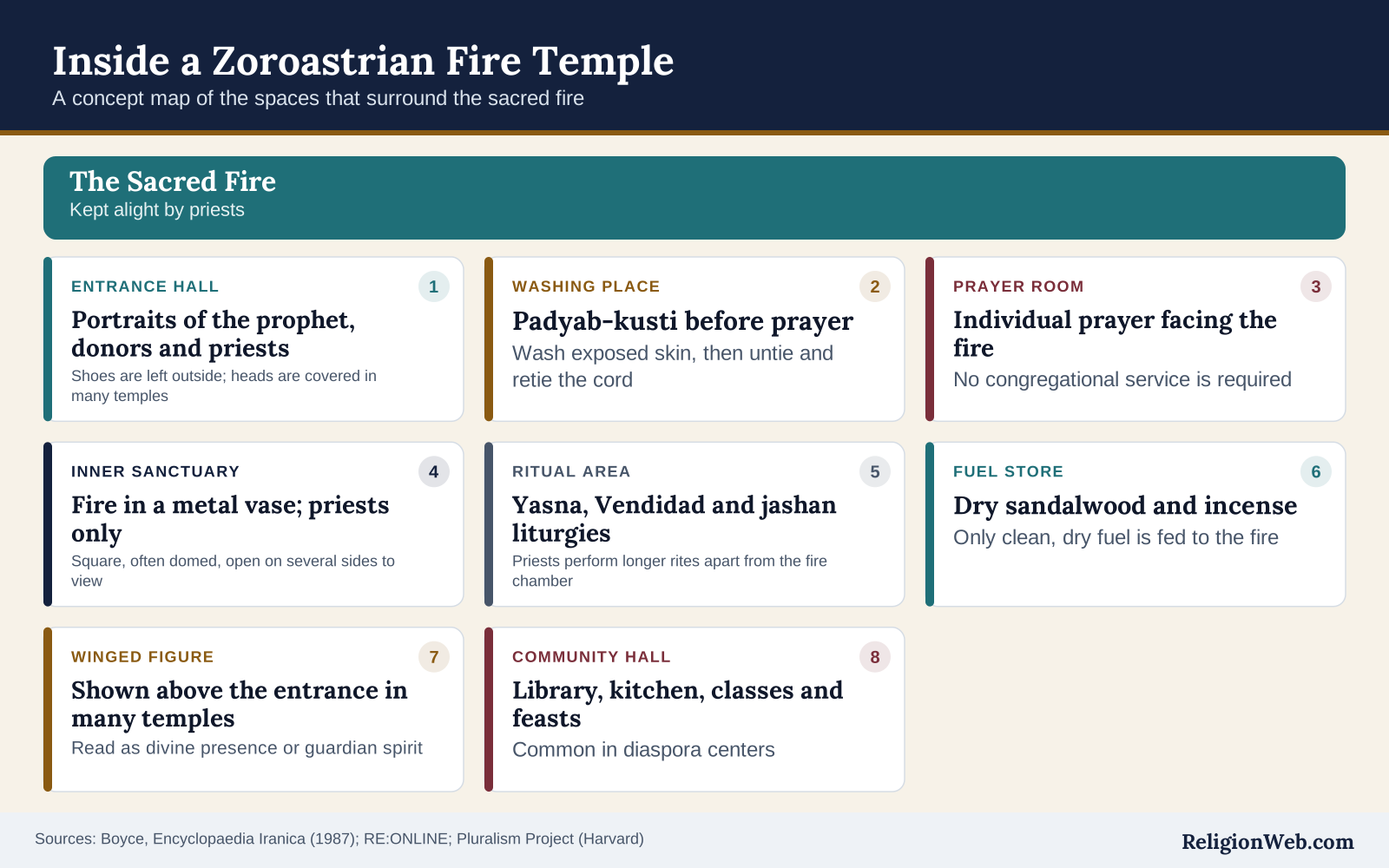
At the center of every fire temple is a fire that has been ritually established and is never allowed to go out in the ordinary course of things. It burns in a metal vessel, often called an afargan (fire vase) in the Pluralism Project’s description of North American practice, and it is fed by priests at fixed times of day with clean, dry wood, most often sandalwood in India, together with fragrant substances such as frankincense. The fire is not hidden. In Parsi temples it sits in a square inner sanctuary that opens on several sides so that worshipers can see it from a prayer room, although only priests may step into the sanctuary itself.
The building around the fire is organized to protect it and to give people a place to pray in front of it. There is usually an entrance area for washing and removing shoes, a prayer hall, a sanctuary with the fire, and a separate space where priests perform longer liturgies. Many temples also contain a hall for community gatherings, a library or a kitchen, depending on the place. The fire is the reason for the building, and everything else is arranged to serve it.
What a fire temple is not
A fire temple is not a home for an image of Ahura Mazda, because the tradition holds that Ahura Mazda has no form. It is also not, strictly speaking, a place where the whole community must assemble each week. Zoroastrian explanatory sources note that there is no obligatory day of the week for temple worship and no requirement to visit at all, and that prayer in the temple is usually individual rather than congregational even when many people are present. Many Parsis in India visit often as part of the daily round, on the way to work or after a family occasion, while others go mainly at festivals or to give thanks.
Nor is a fire temple a symbolic stage set. The fire is consecrated through a sequence of prayers and purifications, and the rules for its upkeep apply whether or not anyone is watching. The distinction between a consecrated temple fire and an ordinary lamp lit at home matters throughout this article, because both play a real role in Zoroastrian life but under very different rules.
Temple Terms and Names
Atashkadeh, Dar-e Mehr and agiary
The scholarly Middle Persian term for a fire temple is atakhsh-kadag, “house of fire” (written ataskada in transliteration), and the plain wording was probably deliberate. Mary Boyce suggested that naming such buildings with ordinary words for a house may reflect a wish to keep the veneration of fire close to the household hearth and to discourage elaborate building. Parthian speakers used a different word, atarosan, which survives in Armenian as atrushan. After the Arab conquest of Iran, Boyce notes, Iranian Zoroastrians came to call their temples Dar-e Mehr, and that term largely replaced the older names. Its exact origin is not settled; one proposal connects it with a “gate” or “court” of Mithra, an ancient divinity of covenant and light.
Parsis in India took a different route and adopted the Gujarati word agiary, a literal rendering of “house of fire.” In the twentieth century some reform-minded Parsis, the Faslis, revived atashkadeh for their temple in Bombay, and Zoroastrians in Tehran use it for their main temple. North American communities generally write Darbe Mehr, following a preference associated with the philanthropist Arbab Rustam Guiv. The result is a family of names for one kind of building, with local habits deciding which one a person says.
Atash Behram, Adaran and Dadgah as grades
Separate from the words for the building are the names for the grade of fire it houses. Atash Behram is the highest, Atash Adaran the second, and Atash Dadgah the hearth-level fire. A temple is sometimes referred to by its grade, so that a Parsi may speak of “the Atash Behram” in a city and mean both the building and the fire inside it. The grades are covered in detail in a later section; the table below simply sets out the main terms.
| Term | Language and background | Basic meaning | Where it is mostly used |
|---|---|---|---|
| Atashkadeh (ataskada) | Persian, from Middle Persian atakhsh-kadag | “House of fire”; the general scholarly word | Iran; Tehran’s main temple; a Fasli temple in Bombay |
| Dar-e Mehr | Persian; first recorded in the Persian Rivayats; etymology debated | Fire temple; possibly “gate” or “court” of Mithra | Iran and, as Darbe Mehr, North America; in India also for the ritual building |
| Agiary (agiari) | Gujarati, a literal translation of “house of fire” | Parsi fire temple, usually of Adaran or Dadgah grade | Western India, Pakistan, Parsi communities abroad |
| Atarosan | Parthian; survives in Armenian | Fire temple in the Parthian period | Historical usage |
| Atash Behram | Persian “Fire of Victory”; linked to the divinity Verethraghna | Highest grade of consecrated fire | Commonly counted as nine worldwide: eight in India, one in Yazd |
| Atash Adaran | Persian, “fire of fires” | Second grade of consecrated fire | India and elsewhere |
| Atash Dadgah | Persian; also the ordinary word for a hearth fire | Hearth-level fire, also a lesser fire inside an Atash Behram precinct | Homes, small temples and larger precincts |
| Afargan (atashdan) | Persian terms for a fire holder | Metal vase or urn in which the fire burns | Temples and ceremonial settings |
Where Fire Temples Are Found Today
Gujarat, Mumbai and the Parsi heartland
The Parsis, descendants of Zoroastrians who settled in Gujarat on the west coast of India, maintain most of the world’s high-grade temples. Mary Boyce wrote in the 1980s that Parsis kept eight Atash Behrams and some 150 lesser fires, and current community summaries still count eight Atash Behrams in India. They stand at Udvada, Navsari, Surat and Mumbai. The most revered is the Iranshah at Udvada, a small coastal town in southern Gujarat that draws Parsis from around the world for pilgrimage. Because the Parsi community has shrunk in recent decades, some of the older fires are now tended for a congregation much smaller than the one that founded them.
Iran
In Iran the best-known temple is the Atash Behram of Yazd, in the central desert city that is still a major center of Zoroastrian life. Writing in 1987, Boyce recorded Atash Behrams that had survived at Sharifabad and Kerman and had been established at Yazd and Tehran, and current community summaries count a single Atash Behram in Iran, the one at Yazd; the difference probably reflects how fires are graded and which remain active, and it is one of the points where sources do not agree. Many smaller temples also exist across the Yazd and Kerman regions. Iran also holds the ruins of great ancient fire sanctuaries such as Takht-e Soleyman in the northwest, which UNESCO inscribed on the World Heritage List in 2003 and which, according to the listing, still serves pilgrims.
The diaspora in North America and elsewhere
Since the second half of the twentieth century Zoroastrians have settled in North America, Britain, Australia and elsewhere, and communities there have built or adapted their own temples. The Pluralism Project at Harvard describes the Arbab Rustam Guiv Darbe Mehr in Hinsdale, Illinois, established in 1983, as the first temple in North America built from the ground up. These centers are usually places of learning and community life as well as worship, and they follow different rules about who may enter than the old Indian temples do. The details appear in a later section.
Fire in Zoroastrian Thought and Scripture
Fire in the Avesta
Atar, the divinity of fire
The Avesta, the collection of Zoroastrian sacred texts, treats fire as a divinity of the second rank named Atar (Atash in later Persian). In the Younger Avesta the title “son of Ahura Mazda” is attached to him repeatedly. In L. H. Mills’s English translation of the Yasna, the worshiper declares in Yasna 17.11, “We worship thee, the Fire, O Ahura Mazda’s son!” The verb behind Mills’s “worship,” yazamaide, covers a range of acts that English renders as “honor,” “offer to” and “venerate,” and the Avestan phrase is part of a long litany that gives similar attention to waters, plants, the sun and the Amesha Spentas, the principal divine beings that surround Ahura Mazda. That surrounding context is a first clue that fire is honored within a larger scheme and not set apart as the highest object of devotion.
The later Pahlavi tradition read the phrase “son of Ahura Mazda” in a specific way. Mary Boyce and Firoze Kotwal report in the Encyclopaedia Iranica that late Sasanian-era commentary on the fire prayer interprets the “Fire, son of Ahura Mazda” as Adur Farnbag, one of the three greatest sacred fires of the time, and that priests accordingly understood certain verses as honoring those three fires. This is a reminder that a text such as the Avesta was read through layers of commentary, and that the same words could be taken liturgically, cosmologically or in reference to particular institutions.
Fire and Asha Vahishta
Zoroastrian cosmology links fire with Asha Vahishta, “Best Truth” or “Best Order,” one of the Amesha Spentas. Boyce explains that Zarathustra saw fire as the creation of Asha Vahishta, and the later scheme of seven creations places fire seventh, as the element that animates and sustains the other six. A lesson plan written by Zoroastrian educators for the Federation of Zoroastrian Associations of North America (FEZANA) states the same connection in plain language: fire is the seventh creation, associated with Best Truth, and it gives energy, light, warmth and life to the rest of creation. In this understanding fire is a physical expression of the order that the religion asks human beings to uphold, which is why truthfulness and purity are the qualities most often invoked in front of it.
What the Gathas say
The Gathas, seventeen hymns attributed to Zarathustra himself, mention fire only sparingly, and they mention it in connection with truth and judgment rather than temples. The best-known example is Yasna 34.4. In the Mills translation, which the editors of the Sacred Books of the East series published in the nineteenth century and which is in the public domain, the verse reads:
And we pray likewise for Thy Fire, O Ahura! strong through Righteousness (as it is), most swift, (most) powerful, to the house with joy receiving it, in many wonderful ways our help, but to the hater, O Mazda! it is a steadfast harm as if with weapons hurled from the hands.
Yasna 34.4, L. H. Mills, The Zend-Avesta, Part III (Sacred Books of the East, vol. 31)
Scholars differ on how to take this verse. Many read the “Fire” as the actual sacrificial or hearth fire, which is welcomed into the house and helps those who live by truth while harming those who oppose it, and Boyce relates the verse and others like it to the use of fire in ordeals, where a person’s truthfulness was tested. Others hear the language as metaphorical, a picture of divine judgment or inner illumination. Both readings agree that the Gathic fire is bound up with asha, and neither pictures it as a freestanding god. The Gathas do not mention fire temples at all, a point that becomes important when the institution’s history is discussed.
Fire as Icon, Not Deity
How Zoroastrian writers explain the fire
Modern Zoroastrian explanations are consistent on one point: the fire is a means of focusing the mind on Ahura Mazda, who has no image. The FEZANA lesson plan says worshipers face light in prayer “as if facing God” and that a temple fire reminds them of God’s presence. A community leader quoted in a 2024 profile of a New Jersey priest put it more directly, saying that because Zoroastrians have no image of Ahura Mazda, a living flame serves as the visible symbol. Another account from the Pluralism Project insists that Zoroastrians are not fire worshipers and that the fire accompanies prayers that are addressed to Ahura Mazda.
The same sources also communicate how seriously the fire is treated. Some presentations of Parsi temple worship describe the consecrated fire as a place where Ahura Mazda is, in a particular sense, present, and the language of reverence in daily temple practice is strong. It would be a mistake to take the “icon” description as a claim that the fire is merely an aid. The more accurate summary is that the fire is revered because of what it signifies and because it has been consecrated, and that this reverence is directed through the fire to God and not away from him.
Why the label “fire worshiper” arose
Outsiders saw a visible, daily ritual centered on a flame and drew a simple conclusion. Boyce observes that the apparent life of a flame may draw veneration more readily than the static icons used in other traditions, which helps explain how the misunderstanding took hold and why it has been so durable. The topic receives a fuller treatment in the section on misconceptions below; for now it is enough to say that the label has a long history, that Zoroastrians themselves reject it, and that the Avestan texts give no support to the idea that fire is the supreme being.
The Older Background of Fire Veneration
An Indo-Iranian hearth tradition
Veneration of fire is older than Zoroastrianism itself. Boyce traces it to an Indo-Iranian household tradition of venerating fire, the shared inheritance of the peoples who spoke the ancestors of the Indian and Iranian languages. The Sanskrit counterpart of Atar is the fire god Agni, who receives the offerings in the Rigveda; readers who want to see that parallel tradition in its own texts can consult the article on the Vedas and Upanishads. The point for this article is historical rather than comparative: the Avestan reverence for the hearth fire grows out of a very old religious setting, and the Zoroastrian tradition reinterpreted it within its own framework of truth and order.
That background helps account for several features of later temple practice. The household hearth was the original place where fire was fed, and the rules about clean fuel, regular attendance and careful speech near the flame look like extensions of domestic courtesy into a more formal setting. The temple fire, in other words, was not invented from nothing. It is the hearth fire made public and surrounded with priestly rules.
Fire, truth and the oath
Fire also had a judicial role. Boyce reports that around thirty kinds of fiery ordeal are mentioned for testing persons accused of lying or breaking contracts, and that a potion containing sulfur, called sogand, was used in oaths, linking fire to truth. Survival of the ordeal was taken as proof of innocence. These practices are a historical layer and not part of present-day temple worship, but they show why fire was thought of as an arbiter of honesty, and why Zoroastrian writers still describe it as an image of truth.
Taken together, the textual evidence presents a consistent picture. Fire is a creation of Ahura Mazda, associated with truth, honored with prayer and offerings, and treated with great care. It is not an independent deity, and the temple is a later, institutional expression of an older reverence for the hearth.
Origins and History of Zoroastrian Fire Temples
Before the Temple: Altars and Early Fire Ritual
What the earliest archaeology shows
The archaeology of fire in ancient Iran is more fragmentary than popular accounts suggest. Mark Garrison, writing in the Encyclopaedia Iranica, notes that “fire altar” is a loose label for stands that held a fire for veneration rather than for sacrifice, and that Boyce’s term “fire-holder” is more exact. The oldest candidates are early: a mud-brick stepped altar at Tepe Nush-e Jan, dated roughly to 750-600 BCE, though its shallow bowl suggests it could not have held a continuously burning fire. In the Achaemenid heartland, two square limestone plinths in the sacred precinct at Pasargadae may relate to fire ritual and have been linked to the time of Cyrus, and a stepped stone pedestal at Persepolis may be an altar base, although its date is debated.
The distinction Garrison draws between altar and temple is important. A free-standing altar in the open air cannot hold an ever-burning fire in all weathers, so the surviving stepped altars do not by themselves prove an institution of temple worship. Whether such altars were Zoroastrian at all is also an open question in the article, because the evidence for the religion of the people who used them is indirect.
When did temples begin?
For many years the standard answer came from Boyce, who concluded that temple worship of fire seems to have been instituted only in the later part of the Achaemenid period, around the fourth century BCE. Her reasoning was partly negative. The Avesta does not mention a fire temple, and no Old Persian word for one is known. She also saw the institution as a response to image temples of Mesopotamian type that had been introduced with royal patronage.
Newer fieldwork has complicated that picture. In a paper on the origins of fire temples, the archaeologist Frantz Grenet points to finds in Central Asia: a monumental stone fire altar at Cheshme Shafa near Balkh, open-air terrace temples of the type described by Herodotus and Strabo at Ai Khanum and Koktepe, and covered Achaemenid-period buildings in southern Sogdiana with a central hall and a large hearth. Some of these have columns that may anticipate the four-pillared design discussed below. Grenet proposes, cautiously, that the fire temple may have developed in the eastern provinces and reached western Iran under the Achaemenids, perhaps in parallel with the spread of the Avesta. He treats the question as open. Others dispute the traditional attribution of the first fire temples to a particular king; Kersey Antia, writing in a Zoroastrian community context, argues that there is no solid evidence that Artaxerxes II built fire temples, though he did build temples to Anahita. The honest summary is that fire temples existed in the Achaemenid centuries, that their earliest form and place of origin are debated, and that the later Sasanian evidence is far richer.
Parthian and Sasanian Fire Temples
Kuh-e Khwaja and the Parthian period
The oldest fire-temple remains identified in Iran lie on Kuh-e Khwaja in Sistan, in the southeast. Boyce describes a stone fire altar there, with a first building tentatively dated to the Seleucid or early Parthian period, rebuilt in the Parthian era and enlarged and remodeled in the Sasanian period. Garrison notes that Herzfeld dated the stepped altar at the site to the first century BCE. Classical authors describe ever-burning fires in Asia Minor and Lydia in the same broad period, and stepped altars with flames appear on coins of the Persis rulers and of Parthian kings. Together these clues suggest a living institution in the centuries after Alexander, even though the textual record is thin.
The great fires of the Sasanian state
Under the Sasanian dynasty (third to seventh centuries CE) fire temples became part of state religion. Garrison reports that the Sasanian kings destroyed many local dynastic fires and established three great fires as unifying centers: Adur Burzen-Mihr, Adur Farnbag and Adur Gushnasp. Encyclopedia.com’s article on Zoroastrianism describes them as the fires of farmers and pastoralists, of clergy and nobility, and of rulers and warriors, respectively. Adur Gushnasp is identified with Takht-e Soleyman in Azerbaijan, the large complex of fire sanctuary, royal architecture and artesian lake that UNESCO describes as a prototype Zoroastrian sanctuary and that was inscribed in 2003. According to Antia’s summary, the Byzantine emperor Heraclius looted the site in 624 CE, a reminder that the great fires were also political symbols.
The priest Kerdir (Kartir) shows how this institution was organized. Prods Oktor Skjaervo’s entry in the Encyclopaedia Iranica reports that under Shapur I he was charged with founding Warahran (Bahram) fires, caring for priests and sealing charters for fires and Magi, and that under later kings he protected the existing fires. By the reign of Bahram II he held the rank of state-wide chief priest. His inscriptions, which date from the later third century CE, are one of the few contemporary Sasanian accounts of how fires and priests were administered.
After the Arab Conquest
Decline and hidden fires
The Arab conquest in the seventh century ended state support for the temples. Boyce records that over about six hundred years of Islamic rule most fires were extinguished, and that most fire temples were demolished or converted into mosques, with traces of the old domed chambers surviving inside some mosques near Yazd. Zoroastrians kept fires in small mud-brick buildings, often with the fire chamber hidden in thick walls, a double roof and angled smoke vents to keep out rain and debris. The ninth-century writer Abu Zayd al-Balkhi, as cited by Boyce, recorded a fire house in nearly every town and village in Fars, which shows that the network was still dense in the early Islamic centuries. Later disruptions were severe: the fire at Karkuy was extinguished during the Mongol invasions of the thirteenth century. For the broader history of the community in this period, see the overview of Zoroastrianism; the relationship of Zoroastrians to the new ruling religion, Islam, was one of gradual conversion and legal subordination that varied by region and century.
Rebuilding in Iran
Boyce notes that Iranian Zoroastrians began rebuilding larger fire temples in the late nineteenth century, sometimes using Parsi plans. The Atash Behram of Yazd, discussed in the table of Atash Behrams in the next section, belongs to this period of reconstruction, and several modern Iranian temples also adopt Achaemenid-style motifs from Persepolis, such as winged figures in discs and bull capitals. These decorative choices are modern, even though they evoke the ancient empire.
The Parsi Fires of India
The journey of Iranshah
The Parsi tradition centers on a single fire, the Iranshah, “King of Iran.” The Encyclopaedia Iranica entry on Parsi communities explains that it was consecrated at Sanjan in Gujarat as an Atash Behram and is called Iranshah in the Qissa-i Sanjan, the Parsi narrative of settlement completed around 1600. According to that tradition, priests hid it in a cave on Mount Bahrot, south of Sanjan, for twelve years, then moved it to Bansda and later to Navsari, where it was installed in the late fifteenth century; precise dates are disputed, and the article says no exact date can be given. In 1733-36 the fire was taken to Surat to escape Maratha raids, and in 1740 it moved to Bulsar. It was consecrated at Udvada in 1742; Outlook India gives the date as 28 October 1742 and reports that the village had been given to the dasturs, the priests who serve the temple.
The earlier part of this story belongs to community tradition, and historians treat the dates of the first Parsi settlement cautiously. The established record begins with the Navsari period and the arrival in Udvada. The rest should be read as the way Parsis remember the fire’s survival through a long period of upheaval, which gives the Iranshah its status as a symbol of continuity for the whole community.
New Atash Behrams and the growth of agiaries
Further Atash Behrams followed once the community was prosperous and settled. The Iranica entry lists a second at Navsari consecrated in 1765, two at Surat in 1823 (the Modi Atash Behram on 19 November and the Vakil Atash Behram on 5 December), and in Bombay the Dadiseth in 1783, the Wadia in 1830, the Banaji in 1845 and the Anjuman in 1897. Boyce adds a useful correction to the idea that the Parsi fire system is as old as the community. She notes that consecrated, continuously burning fires were not installed in ordinary Parsi agiaries until the seventeenth century, and that earlier Parsi settlements had a small ritual building where priests carried embers from their own hearths each day. Antia makes a related point in his account: there were no Atash Adarans in India until Lavji Wadia built one, and his descendants built more later.
Parsi architecture followed. Boyce observes that no Parsi fire is housed in a building older than the late eighteenth century, that Gujarati agiaries remained modest until British rule brought greater security in the nineteenth century, and that most surviving Parsi temples date from the nineteenth and early twentieth centuries. The temples of that era blend local styles, sometimes including Victorian elements, with a central sanctuary at their core.
| Period | Development | Main source |
|---|---|---|
| c. 750-600 BCE | Mud-brick stepped altar at Tepe Nush-e Jan; shallow bowl, probably not for a perpetual fire | Garrison, Encyclopaedia Iranica |
| Achaemenid centuries (6th-4th BCE) | Possible fire plinths at Pasargadae; temple worship of fire “seems to have been instituted” in the later period; Central Asian evidence debated | Boyce; Garrison; Grenet |
| Seleucid to Parthian era | First building on Kuh-e Khwaja in Sistan; stepped altars on coins; altar dated to 1st century BCE by Herzfeld | Boyce; Garrison |
| 3rd century CE | Sasanian unification of fires; Kerdir founds Warahran fires under Shapur I and rises to chief priest | Garrison; Skjaervo |
| 3rd to 7th centuries CE | Takht-e Soleyman (Adur Gushnasp) functions as a major royal sanctuary; reported looting in 624 CE | UNESCO; Antia |
| 7th to 13th centuries CE | Most fires extinguished or hidden; temples converted to mosques; Karkuy fire extinguished in Mongol invasions | Boyce |
| Late 15th century | Iranshah installed at Navsari after the Bahrot and Bansda period (date uncertain) | Encyclopaedia Iranica, Parsi communities |
| 1742 | Iranshah consecrated at Udvada | Encyclopaedia Iranica; Outlook India |
| 1765-1897 | Further Atash Behrams at Navsari, Surat and Bombay | Encyclopaedia Iranica, Parsi communities |
| Late 19th century onward | Rebuilding of larger fire temples in Iran | Boyce |
| 1983 | Hinsdale, Illinois: first North American temple built from the ground up | Pluralism Project |
Categories of Sacred Fire
The Three Grades
Atash Behram, the Fire of Victory
The highest grade is the Atash Behram. The name combines the Persian word for fire with Behram, the later form of the Avestan divinity Verethraghna, associated with victory, and so is usually translated “Fire of Victory.” In Zoroastrian educational materials, including a FEZANA lesson plan, it is described as made by combining sixteen fires drawn from different occupations and sources. The fires named in such lists include fire from a cremation pyre, from a dyer, a king, a potter, a brickmaker, a goldsmith, an ironsmith, an armorer, a baker, a brewer, a soldier, a mint and a shepherd, from a Zoroastrian household, from an ascetic and from lightning. Boyce summarizes the principle in her Iranica entry on fire: an Atash Behram is consecrated from embers of many sources. The details of the list differ between sources, and the lesson plan cited here gives one version.
The logic of the collection is that the fire represents all of society and all of nature at work. The craftsmen’s fires belong to ordinary labor, the fire of a king or a mint to government, the household fire to family life, and lightning to the sky. Gathering them into one flame produces a fire that is, in the tradition’s view, a representative of the whole community. The fire from a cremation pyre is notable because in other Zoroastrian rules fire must not be given the dead; here, the tradition collects it and purifies it ritually, restoring it to its pristine state.
Atash Adaran, the fire of fires
The second grade is the Atash Adaran, called “fire of fires” in the Encyclopedia.com treatment. The FEZANA lesson plan describes it as made by combining four fires, from priests, warriors, herdsmen and traders; Antia’s list names priests, warriors, farmers and artisans, which reflects the traditional fourfold social classification. The same sources note that this is the grade usually found in an agiary, and that the purification of the collected fire is repeated several times before the fire is consecrated and installed on a stone platform.
Atash Dadgah, the hearth fire
The lowest grade is the Atash Dadgah, which the lesson plan calls a house fire. Boyce’s Iranica article on Dar-e Mehr adds that the term also came to denote a lesser fire kept within the precinct of an Atash Behram. Antia describes the consecration of a Dadgah as simple: the site is cleansed, the Yasna and Vendidad are performed for three days, and the fire is installed on the fourth day. A Dadgah does not need its own room, which makes it the grade that a small community can maintain. The number of recitations of the fire prayer, the Atash Niyayesh, also scales with the grade: Boyce and Kotwal write that a single recitation suffices for a Dadgah fire, whereas an Atash Behram calls for different numbers depending on the watch.
| Grade | Meaning of the name | How it is composed | Typical setting |
|---|---|---|---|
| Atash Behram | “Fire of Victory” | Sixteen fires from different occupations and sources, each purified, then combined | Major temples in Udvada, Navsari, Surat, Mumbai and Yazd |
| Atash Adaran | “Fire of fires” | Four fires, usually described as of priests, warriors, herdsmen or farmers, and traders or artisans | Agiaries in Parsi towns and cities |
| Atash Dadgah | Hearth or house fire | A fire consecrated in a simpler three-day sequence | Small temples, home-based fires and precincts of larger temples |
| Ordinary household lamp or candle | Divo in Gujarati | Not consecrated as a temple fire | Homes, for prayer with the sacred cord |
The Five Fires and Other Classifications
The scheme in Yasna 17.11
The Avesta also contains a different kind of classification. Yasna 17.11 names five fires and, in Mills’s translation, glosses them as fires of “the lofty use,” “the good and friendly,” “the most beneficial and most helpful,” “the most supporting” and “the most bountiful.” Boyce reports a Parthian-era scholastic reading that ranks them in ascending order: the first is the fire of the Atash Behrams, the second the life force in human beings, the third the fire in plants, the fourth lightning, and the fifth, the holiest, the fire before Ahura Mazda. The Bundahishn, the later Pahlavi account of creation, assigns the first and last differently, and Boyce calls the scheme “evidently purely scholastic,” meaning that it is a theoretical classification and not a list of grades of temple fire.
The great fires of the Sasanian age
A third classification belongs to history: the three great fires of the Sasanian period, which Encyclopedia.com links to the three social groups of clergy and nobility, warriors and rulers, and farmers and pastoralists. They are not grades in the modern sense but named institutions. They show that fires could have a political and social identity and not only a ritual one, which sets them apart from the three modern grades.
The Atash Behrams of Today
The nine temples in outline
Counts of Atash Behrams in the world vary a little by source, but the usual summary is nine: eight in India and one in Iran. The table below follows the Iranica entry on Parsi communities for the Indian temples and community sources for Yazd.
| Atash Behram | Location | Consecration or establishment | Note |
|---|---|---|---|
| Iranshah | Udvada, Gujarat | Consecrated at Sanjan; consecrated at Udvada in 1742 | The Parsi community’s most revered fire; entry limited to Parsis |
| Navsari Atash Behram | Navsari, Gujarat | 1765 | Second Atash Behram at Navsari, after the Iranshah left for Udvada |
| Dadiseth Atash Behram | Mumbai | 1783 | First of the Bombay Atash Behrams |
| Modi Atash Behram | Surat | 1823 | Consecrated on 19 November |
| Vakil Atash Behram | Surat | 1823 | Consecrated on 5 December |
| Wadia Atash Behram | Mumbai | 1830 | Sanjana priesthood; one of four in the city |
| Banaji Atash Behram | Mumbai | 1845 | Listed in the Iranica entry as the Qadmi Banaji Atash |
| Anjuman Atash Behram | Mumbai | 1897 | First boi ceremony in 1898 |
| Yazd Atash Behram | Yazd, Iran | Community tradition dates the fire to 470 CE; present building from the 1930s | Visitors view the fire through glass; Zoroastrians only in the sanctum |
Cautions about dates and counts
Some of the figures in this table come with qualifications. The Iranica entry itself points out that a traditional claim that Akbar gave permission for the second Navsari consecration does not fit the 1765 date, a reminder that Parsi narrative accounts and documentary dates do not always agree. The date of the Yazd fire rests on community tradition and later written accounts. Tour guides at Yazd describe the flame as having burned for more than 1,500 years, and sources describe it as having been moved several times and installed in the present temple building in the twentieth century with funds from the Parsi community of India; the exact year differs between accounts, and this article gives only the approximate period.
Consecrating and Tending the Sacred Fire
How a Fire Is Consecrated
Collecting and purifying the fires
The consecration of an Atash Behram is among the longest and most elaborate rites in the religion, and published descriptions differ in detail. Community summaries describe the gathering of sixteen fires, each purified before it joins the others, by a large team of priests over a period that can last up to a year. A more detailed account by Kersey Antia, written for the Zoroastrian community in Chicago, describes a much larger initial collection of roughly a thousand fires, which he gives as 1,001 in one place and 1,128 in another. In his account each of these fires receives a Yasna in the morning and a Vendidad liturgy from midnight, and each pair of priests works on one fire per day, so that several pairs must work at once or the task would take more than two years.
Purification relies on the repeated rekindling of the collected fire from itself. Antia states that a fire is gathered without touching its source (a cremation fire, for example, is taken with a perforated ladle) and is then rekindled from the original fire seven or nine times in general. For Iranis the number is nine, and for Parsis it equals the number of fires collected, which gives ninety-one rekindlings for a cremation fire. The logic is that each step removes a layer of ritual impurity from the fire. The tradition understands the aim as restoring fire to the state of purity in which Ahura Mazda created it, which is why the process draws on fires that have been used for many human purposes and does not begin with a new spark.
Uniting and installing the fire
In Antia’s description the collected fires are reduced to sixteen and kept in sixteen separate vases. On the first of the five Gatha days at the end of the year they are combined during a large Afrinagan ceremony, and the Yasna and Vendidad liturgies are then performed over the united fire for thirty-three days. The inner sanctum, in turn, receives three days of Yasna and Vendidad. Finally the fire is installed on a stone platform and surrounded by a pavi, a ritually marked enclosure, and the Atash Niyayesh is recited. The consecration of an Atash Adaran follows a shorter version of the same pattern, with the purification repeated three times and then three days of consecration, and the Dadgah requires a cleansing of the site and three days of liturgy before the fire is installed on the fourth.
These are the rules as one respected writer in the community presents them, and they should be read as a description of the ideal procedure. Practice in a particular temple depends on its priestly lineage, on the number of priests available and on how the community interprets the rules. The Iranica article on fire also mentions a ritual of “exalting the fire,” known in Persian as atash bozorg kardan, although the sources consulted for this article do not describe it in detail.
The Daily Tending of the Flame
The five watches and the Boi ceremony
Once consecrated, the fire is cared for by a daily rhythm that follows the five watches of the Zoroastrian day, called Gehs. These are Hawan (morning), Rapithwin (midday), Uzerin (afternoon), Aiwisruthrem (evening) and Ushahin (the night watch until dawn). At the start of each watch a priest performs the Boi ceremony, which a FEZANA lesson plan and Antia both describe in similar terms: the priest feeds the fire with sandalwood and recites the Atash Niyayesh, the prayer to fire. At each watch the priest also changes clothing and observes the purification rules discussed in a later section.
The prayer itself is the Atash Niyayesh, which the Encyclopaedia Iranica describes as a composite text of seventeen sections drawn partly from the Gathas and partly from Yasna 62. Boyce and Kotwal state that the number of recitations varies by fire grade and by watch, with a single recitation sufficing for a Dadgah, and that a person who cannot recite the text may substitute sixty-five repetitions of the Ahunavar, the central short prayer of the Avesta. The table below gives the figures that Antia reports for the Boi in a major temple, and it should be treated as one account of practice.
| Watch (Geh) | Time of day | Recitations of the Atash Niyayesh |
|---|---|---|
| Hawan | Morning | 11 |
| Rapithwin | Midday | 9 |
| Uzerin | Afternoon | 7 |
| Aiwisruthrem | Evening | 7 |
| Ushahin | Night until dawn | 6 |
Fuel, ash and what is never done
The earliest detailed instruction for feeding the fire is liturgical rather than administrative. In Yasna 62, the Avestan chapter “To the Fire,” the priest addresses the flame directly. In L. H. Mills’s translation the verse reads:
And may’st thou be (ever) fed with wood as the prescription orders. Yea, may’st thou have thy perfume justly, and thy sacred butter without fail, and thine andirons regularly placed. Be of full-age as to thy nourishment, of the canon’s age as to the measure of thy food, O Fire, Ahura Mazda’s son!
Yasna 62.2, L. H. Mills, The Zend-Avesta, Part III (Sacred Books of the East, vol. 31)
Within the liturgy in which the chapter is recited, the verse works as a statement of what the attendants owe the fire: suitable wood, fragrant offerings, a properly set holder and food in due measure. The following verses ask the fire to burn brightly within the house, and the final verse, in Mills’s rendering, pronounces a blessing on the person who brings the fire wood that has been dried and purified. The same concern with clean fuel appears in a modern teaching paper on the Atash Niyayesh by the priest Behram Panthaki, who notes that wet or dirty fuel should never be burned.
The negative rules are as important as the positive ones. Priests wear a white mask over the nose and mouth, called a padam, so that breath and saliva do not touch the fire or the ritual implements. Antia reports that only priests of the rank who have completed a nine-night purification may perform the Boi for an Atash Behram. A profile of a Zoroastrian priest in New Jersey describes a related domestic habit: he lets his candle burn out naturally in the evening so that his saliva will not contaminate the flame. The care taken over such small details shows how seriously the tradition treats the fire as something to be protected from ordinary human pollution.
Moving, Retiring and Re-Consecrating Fires
When a fire is moved
Because a consecrated fire is not easily replaced, moving one is treated as a serious ritual undertaking. The history of the Iranshah, which traveled from Sanjan to the Bahrot cave, Bansda, Navsari, Surat, Bulsar and finally Udvada over several centuries, is the best-known example. A modern case is recorded in Antia’s account: the fire of the Aden agiary (in what is now Yemen) was transferred to Bombay and then to Lonavala on 14 November 1976. The case suggests what happens when a congregation dwindles: the fire is relocated to a place where it can be cared for, not abandoned.
Why continuity carries so much weight
Mary Boyce raises a point about the nature of the institution when she rejects an older theory that sacred fires were normally kept hidden and brought out only for festivals. She argues that such a view contradicts the dignity of an established fire, which should burn permanently in its own sanctuary. The tradition she describes therefore treats continuity as part of what makes a fire sacred. The sanctuary, the priests, the schedule of offerings and the prayers all exist to keep the flame going and to keep it pure, and the reputation of a temple depends on the success of that effort.
This also explains why the loss of a fire in history was felt so sharply. Boyce records that the fire at Karkuy was extinguished in the Mongol invasions of the thirteenth century, and that most fires had been put out or hidden during the long Islamic centuries. The survival of fires such as the Iranshah is therefore valued as an achievement of the priests and the families who protected them, and the name Iranshah, “King of Iran,” carries the memory of that endurance for Parsis.

Architecture and Sacred Space
The Ancient Plan
The four-arched chamber
The architectural form most associated with the Sasanian fire temple is the four-arched domed chamber, called chahar taq in Persian. Boyce describes the defining feature as a square, domed fire sanctuary, gombad, supported by four corner pillars carrying squinches. In Fars, ruined domed buildings with four arches survive in numbers, and Garrison links the twin cubic altars at Naqsh-e Rostam, with their arch reliefs, to the same design. Takht-e Soleyman, the best-known excavated Sasanian sanctuary, added pillared halls, courtyards, a stone altar base and rooms with marble paneling and stucco decoration.
The fire chamber and the ritual hall
A typical small temple in Boyce’s reconstruction had three main parts. The first was the fire sanctuary with a passageway around it for priests and worshipers. The second was a set of storerooms for firewood, incense and utensils. The third was a place for liturgy, the yazishn-gah, where priests performed rituals. Boyce stresses that ritual was never performed inside the domed sanctuary, where veneration was directed only at the fire, and that some sites also had a large hall for congregations at festivals such as the Gahambars. The arrangement is easy to recognize in later Parsi temples, where the sanctuary, the prayer area and the liturgical space remain distinct.
Parsi and Iranian Temples
The Parsi agiary
A typical Parsi temple is entered through a hall, where portraits are often displayed. The RE:ONLINE educational site describes pictures of the Prophet Zarathustra, the benefactor who built the temple and past priests, intended to inspire worshipers. Beyond the entrance area is an oblong prayer room, one wall of which forms the sanctuary, with a doorway through which the officiating priest enters. Boyce adds that the fire sits in a central square sanctuary with openings on three sides, so that worshipers can see it, while only priests may enter. In their ritual cleanliness and ordered spaces the buildings reflect the same logic as the ancient plan, even though the exterior styles are local; Boyce notes that Parsi temples blend regional forms with occasional Victorian features.
Some of these buildings have long histories on their sites. The Iranica entry on Parsi communities records that the Vadi Dar-e Mehr at Navsari was rebuilt in 1588, 1795 and 1851, which shows how buildings have been renewed while the fire inside them is kept continuous. The setting is Gujarat, where Zoroastrians lived for centuries under a succession of regional rulers, from the Hindu kingdoms of the settlement tradition to the Marathas and the British, and where temple style developed alongside surrounding building traditions.
Temples in Iran
In Iran, Boyce reports, Zoroastrians under pressure kept fires in modest mud-brick buildings, and the Persian Rivayats, the letters exchanged between Iranian priests and Parsi correspondents from the fifteenth to the eighteenth century, record an Irani priestly answer that a fire place should have four doors and that the priests’ worship room should be close to the fire house where possible. The modern Iranian temples built from the late nineteenth century use a wider range of designs. Boyce mentions the Sharifabad temple of the early twentieth century and the use of Achaemenid motifs from Persepolis in modern temples. At Yazd, according to reports, the fire sits in a bronze vessel behind a glass partition that visitors can look through, and only priests enter the sanctum.
Symbols and Imagery at the Temple
The winged figure
Many Zoroastrian temples display a winged figure above the entrance, usually called the faravahar or farohar. A guide published by the Pluralism Project explains that in a North American temple it represents the divine presence within all beings and not Ahura Mazda, who has no form. Encyclopedia.com notes that the figure is related to a winged figure in a disc found on Achaemenid reliefs, which some scholars read as the divine glory, khvarenah, while modern Parsis regard it as the farohar, the guardian spirit of a person. The interpretation therefore differs between scholars and between communities, and what is certain is that the winged figure has become a recognizable emblem of Zoroastrian identity on buildings of many kinds.
Portraits, plaques and the memory of benefactors
Temples are also memorials. The entrance hall of many Parsi buildings displays portraits of past benefactors and priests, and the Pluralism Project’s description of the Hinsdale temple mentions a marble plaque dedicating the building to the children who will carry the torch of Zoroastrianism for future generations. These details matter because temples were built and are sustained by donors, many of them families who gave as acts of piety and public service. The commemoration of benefactors, together with the memory of the founding priests, ties each temple to a particular community history.
Worship and Prayer at the Fire Temple
What a Worshiper Does
Before entering
A visit to a fire temple begins with preparation. The RE:ONLINE educational resource describes a Parsi worshiper washing the exposed parts of the body at a place near the entrance and saying the prayers that accompany the untying and retying of the sacred cord, known as the padyab-kusti. The kusti is the woven wool cord that Zoroastrians wear around the waist over a white undershirt, the sudre, from the time of their initiation. Encyclopedia.com explains that it has seventy-two strands, said to represent the chapters of the Yasna, and that it is untied and retied after ritual washing, at the five prayer times and before worship at a fire temple. Shoes are left outside, and in the Pluralism Project’s account of a North American temple visitors also cover their heads before entering the prayer room.
These steps concern the worshiper’s own state of purity and are not a test of identity or belief. They exist so that a person approaches the fire in a state of ritual cleanliness, and they are the same actions a Zoroastrian performs before daily prayer at home. The sense of preparation is part of what makes the visit a ritual act and not a casual stop.
In front of the fire
At the sanctuary, the RE:ONLINE account describes a sequence that is quiet and individual. The worshiper leaves a sandalwood offering in the doorway for the priest to place on the fire, kneels and bows the head before the flame, and takes a pinch of ash from a metal spoon to touch to the forehead, an act the page says unites the worshiper with the fire. The worshiper then stands and recites prayers before the sacred fire, the Atash, and Ahura Mazda is thought of in that account as being, in some way, present there. Prayer is individual even when people are together; there is no congregational service of the kind familiar from some other traditions. People come and go through the day.
The Outlook India reporting on Udvada adds a point about attitude. It notes that Parsis do not traditionally pray for specific wishes at the fire and that people whose wishes have come true may visit to give thanks, offering quiet prayer instead of celebration. The practices of gratitude it lists include the jashan, offerings of sandalwood and loban (frankincense), and the afrin and fareshta ceremonies, each a prayer performed by or with a priest. Behavior around the temple is expected to be subdued, and cell phones and cameras are not allowed in the Udvada temple.
The Prayers Heard at the Fire
The Atash Niyayesh and Yasna 62
The central text of fire worship is the Atash Niyayesh, “the prayer to fire.” Boyce and Kotwal explain that it has seventeen sections, that sections 1 to 3 and 17 come from the Gathas, and that sections 7 to 16 correspond to Yasna 62.1-10. They suggest that the text is a composite, with an older core addressed to the hearth fire. It is part of the Khorda Avesta, the “Little Avesta” of daily prayers, and it is recited by laypeople and priests alike, in private prayer and also while tending a hearth or temple fire. Priests recite it at the Boi ceremony, as described above, and laypeople recite it before the fire and in their homes.
Its source text, Yasna 62, is an address to the fire, and its opening lines ask the fire to burn without fail. In Mills’s translation, verse 3 begins:
Be now aflame within this house; be ever without fail in flame; be all ashine within this house; be on thy growth within this house; …
Yasna 62.3 (opening clauses; the verse continues), L. H. Mills, The Zend-Avesta, Part III (Sacred Books of the East, vol. 31)
The verse goes on to ask that the fire remain so for a long time, until the “good heroic (millennial) time” when the renovation of the world is complete. The reference is to the Zoroastrian expectation of a final renewal of creation, the frashokereti, which is explained in the overview of Zoroastrian beliefs. In this framework the prayer links an everyday act of tending a flame to the largest horizon of the religion, the ultimate triumph of truth over falsehood. The text is therefore an address in the second person to a fire that is treated as a living recipient of care, and that is part of the reason why outsiders have taken it for worship of the flame itself. Within the tradition, the prayer is understood as honoring Atar as a divinity created by Ahura Mazda.
Kusti prayers, the Ahunavar and other texts
The fire is also the setting for prayers that are not specifically about fire. The FEZANA lesson plan mentions the Kem-na-Mazda, a short prayer of protection, Yasna 47.6, the Meher Yasht in honor of Mithra and the Ardibehesht Yasht to Asha Vahishta. The Ahunavar, also called the Yatha Ahu Vairyo, is the most widely recited short prayer in the Avesta; the Iranica entry on the Atash Niyayesh notes that those unable to recite the whole text may substitute sixty-five repetitions of it. The ritual practices that surround these prayers are developed in the article on Zarathustra and the Avesta.
Offerings, Thanksgiving and Higher Liturgies
Sandalwood, loban and other offerings
The offerings brought by laypeople are simple. Outlook India notes a shop near the Udvada temple that sells sandalwood, a substance called sukhad and babool wood for visiting Parsis, and community summaries add frankincense. The Avestan precedent is the “perfume” mentioned in Yasna 62, and the purpose of the offering is to feed the fire with clean, fragrant fuel as an act of honor. Priests put the offering on the fire so that no layperson need enter the sanctuary.
Jashan and the higher liturgies
Priests perform longer ceremonies in the ritual areas of the temple. The Yasna, the main liturgy of the Avesta, and the Vendidad liturgy are performed within the consecrated space, and the Afrinagan is a ceremony of blessing used in consecrations and at other moments. The jashan, a thanksgiving ceremony in which priests recite prayers in front of a fire, is held at weddings, initiations, the opening of a new house and festivals. According to the Pluralism Project, mobeds travel to communities that lack their own priests to perform the jashan and other rites. Such ceremonies show that the fire temple is not only a place for individual prayer but also a base for the ritual life of the community.
| Element | What happens | Who performs it | Notes |
|---|---|---|---|
| Padyab-kusti | Washing the exposed parts of the body, then untying and retying the sacred cord with prayers | Each worshiper | Done before entering the prayer room |
| Offering of sandalwood | Sandalwood or other clean fuel is left at the doorway for the priest to place on the fire | Worshiper gives; priest feeds | Frankincense may also be offered |
| Individual prayer before the fire | Bowing, touching ash to the forehead, reciting the Atash Niyayesh and other prayers | Worshiper | Prayer is individual, not congregational |
| Boi ceremony | Priest feeds the fire and recites the Atash Niyayesh at each of five watches | Priest | For an Atash Behram, only specially purified priests |
| Jashan | Thanksgiving ceremony with fire, prayers and offerings | Priests, with family or community | Held at weddings, initiations and festivals |
| Yasna and Vendidad | Long liturgies performed in the ritual area | Priests | Used in consecration of fires |
| Home lamp prayer | A divo or other light is lit, and the worshiper faces the sun, east in the morning and west in the evening | Laypeople | Done with the kusti prayers |
Purity, Priesthood and Roles in the Temple
Purity Rules around the Fire
Why purity governs the temple
Purity is the organizing principle of life around the fire. In Zoroastrian thought the material world is the arena of a struggle between truth and falsehood in which decay and death are understood as intrusions of the harmful spirit, and the faith attaches rules of ritual cleanliness to the elements it regards as good: fire, water, earth and air. A Zoroastrian community leader quoted in a news profile described fire as the purest element and as unable to be polluted in the way that earth, air and water can be, while the same temple traditions insist that it be protected from contamination. The two statements are consistent in the tradition’s own terms: the fire itself is pure, but a human being who approaches it carelessly can create ritual impurity around it.
Zoroastrian texts apply the same logic to the fire’s fuel and to the handling of dead matter. Boyce cites Vendidad passages (4.46, 5.51 and 8.73 onward) in connection with fire, and Darmesteter’s nineteenth-century introduction to the Vendidad explains that burning and burying the dead are both forbidden because fire and earth are too holy to receive a corpse. That is the logic behind the care that surrounds a temple.
Ritual washing and the Barashnom
Two levels of purification are particularly important for priests. According to Encyclopedia.com, the Barashnom of the nine nights is the most complex: it involves consecrated bull’s urine called nirangdin, repeated cleansings with gomez, dust and water, and nine days and nights of seclusion. It is reserved for cleansing after contact with human corpses and for priests preparing for central services, and it is still performed, though less often, by the priests who conduct the most important consecratory rites. The lighter Sade Nahn bath is used for initiation and marriage. Antia gives a practical consequence: only priests of the rank called Yozdathregar, who have completed a nine-night Barashnom, may perform the Boi at an Atash Behram, and breaking a purity rule requires the Barashnom to be repeated.
Rules for temple visitors
Lay visitors observe a simpler version of the same logic. Besides the padyab-kusti and the removal of shoes, Boyce’s entry on Dar-e Mehr records an older rule, added to the standard list of things to avoid, that a menstruating woman should keep away from a consecrated temple. Encyclopedia.com adds that the traditional priesthood did not admit women, citing pollution connected with menstruation and childbirth, and that after childbirth a mother was once isolated for twelve days in antiquity and for forty days by the Middle Ages before purification. These rules are historical regulations and are observed to varying degrees; they are also among the matters on which present-day Zoroastrians differ, so no single practice can be assumed to apply in every community.
Priests and Laypeople
The priesthood and its ranks
The Zoroastrian priesthood is largely hereditary. Encyclopedia.com explains that the present-day mobeds descend from the medieval Magi, form a class apart from the laity, whom it calls behdinan, and are trained at seminaries. A dastur is a high priest, usually associated with an Atash Behram temple, an ervad is a priest who has completed the first level of induction, and an osta is a priest who has not been initiated. The same source describes a mobedyar, a lay assistant created by Mobed councils in Iran and North America to perform basic rituals where priests are scarce. In the liturgy, the chief officiant is the zot, assisted by the raspi, while the boywalla offers incense.
The conditions of the priesthood vary. The Pluralism Project reports that mobeds in Chicago serve voluntarily while holding full-time jobs, and that the high priest there is a psychologist. The shortage of fully trained priests is the reason Mobed councils in Iran and North America created the mobedyar, and in small diaspora communities such lay assistants and part-time priests carry much of the ritual load.
Laypeople, benefactors and temple governance
Laypeople have defined roles, even though they do not tend the fire. They give the fuel, pay for the temple and keep it alive through donations and bequests, and they attend ceremonies and festivals. At Udvada, the Outlook India reporting notes that temple authorities manage the items needed for rituals and that the Parsi Udvada Anjuman, the local community body, is the point of contact for press and visitor questions. The Iranica record of benefactors such as Bhikhaji Eduljee of Surat, who funded a building for the Iranshah at Udvada, shows how deeply the institution has depended on the lay community.
| Role | Who | Typical duties |
|---|---|---|
| Dastur | High priest, usually of an Atash Behram | Leads the priestly community of a major temple; presides over key rites |
| Mobed or ervad | Initiated priest | Performs the Boi, Yasna, jashan and life-cycle rites |
| Osta | Uninitiated priest | Trainee stage; not yet qualified for the full priestly rites |
| Mobedyar | Lay assistant trained by a Mobed council | Performs basic prayers and rites where priests are few |
| Zot and raspi | Chief officiant and assistant in the Yasna | Conduct the central liturgy |
| Boywalla | Assistant who offers incense | Offers incense in rites |
| Behdin (layperson) | Member of the community | Prays, offers fuel, supports the temple, takes part in festivals |
| Benefactor or community body | Donors and local associations | Fund the temple and handle practical matters such as visitor queries |
Fire at Home, in Festivals and in the Calendar
The Home Lamp and Household Fire
The divo and daily prayer
Zoroastrian devotion does not require a temple. A FEZANA lesson plan describes a daily practice in which, during the kusti prayers at home, a person lights a divo, the Gujarati word for a small oil lamp, or faces another source of light, and prays facing the sun: east in the morning and west in the evening. The five daily prayer times are the same watches that govern the temple, so the household and the sanctuary keep the same rhythm. The lamp is a simple one, and it does not require priestly consecration.
Light also marks moments in the life cycle. Encyclopedia.com records that after conception an oil lamp or light is lit in the house to ward off evil, that after a birth a lamp stays lit for three to forty days depending on the family’s observance, and that lamps and candles are lit at initiation. In each case the flame is a sign of protection and of truth at times of vulnerability or change. It is not described as an object of worship, and nothing in these customs attributes consciousness or power to the lamp itself.
The household fire and the diaspora home
The RE:ONLINE resource on the festival of fire notes that on one day of the year the household fire or ceremonial lamp is honored by reciting the Atash Niyayesh, and that cooking at home is traditionally avoided that day so that the fire can rest. In diaspora homes, where a gas stove or electric heating has replaced the open hearth, the oil lamp or candle carries the symbolism. A 2024 profile of a New Jersey priest describes him lighting a tealight in a glass each day and praying toward the flame, and explains that he has no consecrated temple fire nearby: the local Dar-e Mehr has no permanent sacred fire and opens roughly once a month and at Nowruz, so home prayer matters even more. The example shows both how portable the practice is and how different a household lamp is from a consecrated temple fire.
Fire in the Festival Year
Adar Mah Parab, the “birthday of fire”
One occasion focuses specifically on fire. The RE:ONLINE calendar page describes Adar Mah Parab, a festival of the Shenshai (Parsi) tradition that celebrates the birthday of fire. It falls on the ninth day of the ninth month of the Zoroastrian calendar, both of which are named Adar after the divine being associated with fire. Worshipers go to the fire temple, offer sandalwood or incense and give thanks for the warmth and light that fire has provided through the year. The date in the civil calendar depends on which of the community’s calendars is followed, since the Shahenshahi, Qadmi and Fasli reckonings differ, so a specific day is not given here.
Sadeh, a winter festival of fire
Iran has a different fire festival. Anna Krasnowolska’s entry in the Encyclopaedia Iranica calls Sada “the most important Iranian winter festival, celebrated by kindling fires.” It falls on the tenth day of the month of Bahman, about forty days after the winter solstice and fifty days before Nowruz, and in the modern Iranian solar calendar it corresponds to about 30 January. Zoroastrians in Kerman and Yazd still kindle Sada fires, and Tehran’s Zoroastrians have held celebrations since 1938. The entry adds that the custom of lighting Sada fires is unknown to Zoroastrians in India, so the festival is an example of how practice differs between the two great branches of the community. The origin and name of the festival are debated. Islamic authors usually derive the name from the Persian word for one hundred, and Boyce linked the fires to the divinity Rapithwin, who is associated with midday and the warmth of the year.
Other occasions at the temple
Fire temples are visited on other festivals as well. The RE:ONLINE account of Zartosht no Diso, the day on which Zoroastrians remember the death of the prophet, mentions visits to temples to pray for the prophet and for the departed. The Gahambars, the six seasonal feasts of the Zoroastrian year, are communal occasions, and Boyce records that some ancient temple sites had large halls for just such gatherings. For the festivals themselves, including Nowruz, the calendar and their ritual details, the overview of Zoroastrianism offers further context.

Access, Community Life and Regional Variation
Who May Enter a Fire Temple
India: temples reserved for Zoroastrians
In India the rule is clear and, for many outsiders, surprising. RE:ONLINE states that only Parsis or Iranian Zoroastrians may enter, and the Pluralism Project notes that Indian fire temples are closed to non-Zoroastrians. Outlook India’s report on Udvada says that only people born into the Parsi faith may enter, and that cell phones and cameras are not allowed. Encyclopedia.com explains the reasoning in terms of membership: orthodox Parsi priests initiate only children whose parents are both Zoroastrian, and some more liberal priests accept children with a Zoroastrian father; people initiated through non-Zoroastrian parents are still denied entry to religious sites on the Indian subcontinent. The restriction is a rule of community membership and of ritual purity and not a statement about the worth of other religions.
Iran: a more open arrangement
RE:ONLINE says that in Iran access is more open, and the experience at the Atash Behram of Yazd bears this out. Visitors, including tourists, can watch from behind tinted glass while a priest in white feeds the fire, wearing a face covering so that breath does not touch the flame. Only Zoroastrian priests may enter the sanctum. The temple also hosts an exhibition of religious objects and has guides who explain the practice. The openness is a matter of how the building is arranged and of the community’s choices about hospitality, and it does not change the rules that govern the fire itself.
North America and the wider diaspora
The Pluralism Project reports that, unlike the Indian temples, U.S. Dar-e Mehrs function as both places of worship and learning centers and are open to people of all faiths. Visitors remove their shoes and cover their heads before entering the prayer room, where the fire vase sits on a raised platform and a portrait of Zarathustra hangs on the wall; in the account of the Chicago-area center the vase came from a retired fire temple in Surat. Priests change into white vestments in a room beside the prayer hall. Not all diaspora temples keep a permanent consecrated fire, and some communities rely on home prayer and periodic gatherings, as the New Jersey profile shows.
| Region | Typical setting | Who may enter the prayer areas | What visitors can experience |
|---|---|---|---|
| Western India (Gujarat, Mumbai) | Atash Behrams and agiaries of Parsi trusts | Parsis and Iranian Zoroastrians; non-Zoroastrians excluded | Outer buildings and surrounding town; photography and phones restricted at Udvada |
| Iran (Yazd and other cities) | Atash Behram and Dar-e Mehr buildings | Priests alone enter the sanctum; access to the hall is more open | Fire seen through glass; exhibition of religious objects; guided visits |
| North America | Darbe Mehr community centers such as the Chicago-area temple | People of all faiths, with shoes removed and head covered | Prayer hall, library, classes, festivals, conversation with community members |
| Small diaspora communities | Rented or shared halls, home prayer, a temple that opens monthly | Set by each community | Occasional gatherings such as Nowruz; home lamp prayer |
Community Life around the Temple
Learning, feasts and gathering
Besides worship, a fire temple is a center of community life. The Pluralism Project describes North American centers with libraries, kitchens, assembly halls for classes and events, and a separate prayer hall reached by a quiet corridor. In earlier centuries the plan of the great temples included large halls for festival gatherings, and in modern Iran and India the temple compound, its trust and its neighboring hall continue to serve as places for meals, lessons and celebrations. The community’s cultural practices, such as celebrating Nowruz, studying Avestan prayers and sharing Parsi food, are described by one community leader as central to identity even when worship itself is individual.
Pilgrimage to Udvada
For Parsis the Iranshah at Udvada is a destination of pilgrimage and thanksgiving. Outlook India reports that many visitors arrive from Maharashtra, particularly Mumbai, which has the largest Parsi population, and that the village’s own Parsi population has dwindled: Phiroze Dastur is quoted as saying that about 800 Parsis lived there 25 years earlier and fewer than 100 remain. The picture is of a sacred place that depends on visiting worshipers more than on resident ones, and that remains important to the community’s sense of continuity. Visitors are expected to be quiet, and the temple authorities manage the items needed for rituals.
Debates and Pressures
Questions of membership and access
The rules of entry are among the most discussed issues within the community. Encyclopedia.com notes that orthodox priests and more liberal ones differ over who counts as Zoroastrian, particularly in the case of children of mixed marriages, and that Zoroastrians in Western countries have developed different arrangements, such as allowing non-Zoroastrian spouses to be buried in community cemeteries. The Iranica entry on Parsi communities records earlier disputes within the community over priestly lineages, which shows that disagreement within the community is not new. This article does not take a side. It records that the rules differ by region and by temple and that Zoroastrians themselves hold differing views.
Small congregations and changing centers
The pressures on temples are largely demographic. Parsi numbers in India have fallen; the 2011 census counted 57,264 Parsis, down from 111,791 in 1951, according to a press report of the figures. Iran’s census of 2016 counted roughly 23,000 to 24,000 Zoroastrians, according to a Canadian government research summary and a press report, though community leaders cite higher estimates. No authoritative worldwide count exists. These changes explain why fires are sometimes relocated, why some communities, such as the Chicago association, fund the training of young priests, and why diaspora centers are built as much for teaching as for prayer. They also explain why the question of who may enter has become a matter of community survival as well as ritual law. Readers interested in the broader religious setting in Iran can consult the article on Islam for the majority faith with which Zoroastrians share the country.
Common Misconceptions About the Zoroastrian Fire Temple
Misconception 1: Zoroastrians worship fire
Where the misunderstanding comes from
The belief that Zoroastrians are “fire worshipers” is very old, and it rests on something that anyone can see. A visitor who watches priests feeding a flame five times a day, and worshipers bowing before it, naturally concludes that the flame is the object of devotion. Mary Boyce observed that the apparent life of a flame may draw veneration more readily than the static images used elsewhere, and that outsiders long used the label for a community that rejected it. Translation has also played a part. Older English versions of the Avesta, including Mills’s, render the Avestan verb yazamaide as “we worship,” as in “We worship thee, the Fire, O Ahura Mazda’s son!” in Yasna 17.11, although the same verb is used for honoring waters, plants and the Amesha Spentas.
What the evidence and tradition actually show
The texts themselves place fire below Ahura Mazda. The very verse just quoted calls the fire his son, and in Yasna 34.4 the worshipers pray, addressing Ahura Mazda, for “Thy Fire,” meaning a fire that belongs to him and is strong through Righteousness. Zoroastrian educators say plainly that prayer in the temple is addressed to Ahura Mazda. The Pluralism Project’s description of a North American center states that Zoroastrians are not fire worshipers and that the fire accompanies prayers directed to Ahura Mazda, and the FEZANA lesson plan says that worshipers face light as if facing God. Boyce, for her part, summarized the community’s view as one in which fire is an icon that helps believers concentrate on God and on truth.
The structure of the Yasna supports this reading. The chapter that contains the verse, which Mills titles “To the Fires, Waters, Plants, &c.”, does not single out fire for special rank; it moves through a list of created things and divine beings that are all honored with the same verb, and fire appears in the list as one of them. Earth, water and the sun are also treated with care in Zoroastrian practice, and the rules for protecting each of them from pollution are part of the same moral outlook. A reader who sees only the flame sees only one visible part of a wider reverence for the good creation.
The fair summary has two parts. Zoroastrians do not regard fire as the supreme being or as a rival to Ahura Mazda, and the accusation of fire worship misdescribes the religion’s own theology. But the reverence given to the consecrated fire is also not a thin matter of symbolism, and Zoroastrians themselves describe it in strong terms. The tradition honors Atar as a divinity created by Ahura Mazda and venerates the consecrated fire as a means through which prayer is offered, which is more than a metaphor and less than a deity. Readers who want the doctrinal background can find it in the overview of Zoroastrianism.
Misconception 2: Every fire temple follows identical access rules
Where the misunderstanding comes from
Many news and travel reports describe Zoroastrian temples as “closed to outsiders” because that is true of the best-known Parsi temples in India. A visitor to Udvada is told that only people born into the Parsi faith may enter and that photography is not allowed. Another reader, who has visited a Dar-e Mehr in the United States or watched a priest tend the Yazd fire through a glass wall, may take the opposite impression. Both reports are accurate for their setting, and each is mistaken when generalized. The confusion is increased by the fact that the words “fire temple” cover a Sasanian ruin, a nineteenth-century Parsi agiary and a suburban community center.
What the evidence and tradition actually show
Access rules differ by region, by building and by the community’s understanding of its own purposes. In India, as RE:ONLINE and the Pluralism Project report, only Zoroastrians may enter the temples, and Encyclopedia.com explains that even people initiated through non-Zoroastrian parents are denied entry to religious sites on the subcontinent. In Iran, access is described as more open, although the sanctum itself is reserved to priests. In North America, the Pluralism Project reports, temples function as places of worship and learning and are open to people of all faiths. The table in the earlier section sets out these differences.
What does not vary is the set of purity requirements that apply to anyone who approaches the fire: washing, covering the head, removing shoes and respectful quiet. Even in open temples, the priests and the sanctum remain subject to the same strict rules. It is therefore more accurate to say that Zoroastrian communities apply a shared concern with ritual purity in different ways to the question of who may be present.
Even a single country is not uniform. A pilgrimage town such as Udvada has its own conventions about voices, cameras and dress, while a busy city agiary may be a quiet stop on the way to work for the Parsis who live nearby. The practical advice for any traveler or reader is to treat a general statement about “fire temple rules” with caution and to ask about the particular temple.
Misconception 3: The sacred fire is simply a decorative candle or symbolic prop
Where the misunderstanding comes from
The idea comes partly from Zoroastrians’ own explanations. When community members say that the flame is a symbol of Ahura Mazda, a listener may hear “only a symbol.” It also comes from modern circumstances. Diaspora households use tealights and oil lamps, some temples abroad have no permanent consecrated fire, and visitors who see a small flame in a vase may reasonably wonder what distinguishes it from a candle on a table. In the tradition’s view, though, the difference is not size or fuel. It is consecration and the discipline that follows from it.
What the evidence and tradition actually show
A temple fire of the higher grades is created through a long sequence of purifications and liturgies, described earlier, and sustained by trained priests who must be ritually pure and who follow a schedule of offerings and prayers that continues day and night. The Iranica entry on fire records that Atash Behram fires are consecrated from embers of many sources, and the Atash Niyayesh is recited to the fire at every watch. A household lamp, by contrast, is lit freely by laypeople and is used for the kusti prayers and for protective moments such as the days after a birth. Both have a place, but they belong to different categories. Calling the temple fire a prop misses the amount of ritual labor that the community invests in it.
There is also an honest caveat. Because communities abroad are small and spread out, some have decided to rely on lamps and candles in the absence of a consecrated fire, and priests and laypeople differ on how best to do so. The diversity should not be read as a sign that the tradition regards the consecrated fire as unnecessary. It reflects the practical difficulty of keeping a high-grade fire where there are few priests.
Misconception 4: Fire temples go back to Zarathustra, and each flame has burned unbroken since antiquity
Where the misunderstanding comes from
Visitors are often told that a particular flame has been burning for fifteen hundred years or more, as guides at Yazd say of the Atash Behram there, and the idea of an eternal flame fits a popular image of an unchanging ancient religion. The assumption is then extended backward: if Zoroastrians keep a perpetual fire today, the founder must have built the first fire temple. Neither step follows from the evidence, and the community’s own traditions are more careful than the popular summaries.
What the evidence and tradition actually show
The earliest layer of the tradition contains fire but no temples. The Gathas speak of fire in connection with truth and judgment, and Boyce notes that the Avesta does not mention a fire temple at all. In her reconstruction, temple worship of fire seems to have been instituted in the later Achaemenid period, and later archaeological work such as Grenet’s raises the possibility that its roots lie in the eastern provinces. The question remains open. What can be said confidently is that the great Sasanian fires were established by kings and priests in the third century CE and later, and that the institution passed through severe disruption.
Continuity of particular flames is also more complex than the phrase “unbroken” suggests. Boyce records that most fires were extinguished or hidden during the first centuries of Islamic rule and that the Karkuy fire was extinguished in the Mongol invasions. The Iranshah itself traveled from Sanjan through a cave, Bansda, Navsari, Surat and Bulsar to Udvada, and Boyce adds that continuously burning consecrated fires were not installed in ordinary Parsi agiaries until the seventeenth century. For the Yazd fire, community tradition dates the flame to 470 CE, but the present building is of the twentieth century. These facts do not weaken the community’s sense of continuity. They show that the continuity is one of ritual lineage, priestly care and communal memory, and that the history behind it is full of moves, losses and revivals. The overview of the Avesta and Zarathustra explains the textual side of that story.
Frequently Asked Questions About Zoroastrian Fire Temples
Questions about the fire
Why do Zoroastrians pray facing fire or light?
Zoroastrian teachers explain that light stands for the presence of Ahura Mazda, who has no image. The FEZANA lesson plan says worshipers face light as if facing God, and one community leader said that a living flame is the visible symbol for the unseen. At home this can be a divo or even the sun, which is why the kusti prayers are said facing east in the morning and west in the evening.
In the temple, the practice becomes more formal. The worshiper stands before the consecrated fire, offers sandalwood through the priest, bows and recites prayers. The direction of the prayer is toward God through the fire and not to the fire as an end in itself.
What does “Atash Behram” mean?
The phrase combines the word for fire with Behram, the later form of the Avestan Verethraghna, associated with victory, and is usually translated “Fire of Victory.” It names the highest grade of temple fire, made from sixteen fires and consecrated with extensive liturgy. Not every fire temple is an Atash Behram: most are of the lower grades.
Does the fire ever go out?
The ideal is continuity, and the daily schedule exists to prevent a flame from dying. History shows that fires have been extinguished by force or neglect, as happened at Karkuy, and that fires have been moved, relit and reconsecrated. A priest in New Jersey even lets a home candle burn out on its own so that he does not breathe on it. Details of what a community does when a consecrated fire does go out depend on its priests and are not documented in the sources consulted for this article.
Questions about visiting
Can non-Zoroastrians enter a fire temple?
It depends on where the temple is. The temples of India are reserved to Zoroastrians, as RE:ONLINE and the Pluralism Project report. In Iran, the more open arrangement lets visitors watch the fire through glass. In North America, the Pluralism Project says temples are open to people of all faiths. Anyone planning a visit should contact the temple in advance and follow its instructions.
What should a visitor do and wear?
The Pluralism Project reports that visitors to a North American temple remove their shoes and cover their heads before entering the prayer room. Quiet behavior is expected everywhere, and some places forbid photographs and phones, as Outlook India reports for Udvada. When in doubt, a visitor can follow what the community members around them are doing and ask a volunteer or priest.
May visitors take photographs?
This depends on the temple. Udvada does not allow cameras or phones. Other temples have their own policies, and Iranian temples that receive tourists may have different arrangements. The safest course is to ask before taking out a camera.
Questions about priests and practice
Who tends the fire?
Initiated priests, called mobeds, tend the fire, and for an Atash Behram the Boi ceremony is performed only by priests of high rank who have completed the Barashnom purification, according to Antia. They wear a white mask so that their breath does not touch the flame. Laypeople bring fuel and pray but do not enter the sanctum.
Can women serve as priests?
The traditional priesthood has been male and hereditary. Encyclopedia.com explains that the Magi did not admit women, citing pollution from menstruation and childbirth. Zoroastrian communities today differ in how they view this rule, and lay roles such as the mobedyar have become important in places where priests are few. This article has not verified the current practice of particular communities, and readers should consult community sources for up-to-date details.
Is a candle at home the same as a temple fire?
No. A divo or candle is used for personal prayer and for protective moments in the life cycle, and it needs no priest. A temple fire of the Atash Behram, Adaran or Dadgah grade is consecrated through liturgy and tended by priests under rules of purity. Both honor the same symbol of light and truth, but they are treated as different things in the tradition. For the wider religious setting, see the article on Zoroastrianism.
Conclusion: Fire, Truth and Care
What the history and practice show
A sign of God and truth, not a god
The Zoroastrian fire temple is best understood as a place built around care. The fire is described in the Avesta as a creation of Ahura Mazda, linked to truth and honored with prayer and clean fuel. Zoroastrian writers explain it as an icon that directs the mind to God, and the historical record shows no basis for treating it as a rival deity. The reverence it receives is real, and it is expressed through the discipline of the priests, the preparation of the worshiper and the structure of the building.
A living institution with local forms
The institution has changed repeatedly. It rose in the later Achaemenid and Sasanian centuries, survived hidden and diminished under Islamic rule, was reorganized by the Parsis in Gujarat and rebuilt in Iran, and is now being adapted to small communities in new countries. Rules of entry, the number of fires, the language of the buildings and the role of the lay community all vary. A reader who remembers that variety will avoid most of the mistakes that surround the subject.
How to keep exploring
Related articles on ReligionWeb
To follow the themes of this article further, the overview of Zoroastrianism covers the religion’s beliefs and history, and the article on Zarathustra and the Avesta explains the texts quoted here. Those interested in the older Indo-Iranian background of fire ritual can read about the Vedas and Upanishads.
Reading primary and scholarly sources
The most reliable guides are the entries of the Encyclopaedia Iranica on fire, fire temples and the Atash Niyayesh, the public-domain translations of the Avesta in the Sacred Books of the East, and the educational materials that Zoroastrian federations publish for their own communities. Where this article relies on a single account, such as Antia’s description of the consecration, it says so, and readers should treat such passages as one tradition’s description and not as a universal rule.
Sources
The table below lists the principal external sources behind this article. Facts, dates and figures were checked against these and related primary, institutional and academic materials.
| # | Source | Publisher and type | Used for | Link |
|---|---|---|---|---|
| 1 | The Zend-Avesta, Part III (Sacred Books of the East, vol. 31), translated by L. H. Mills: Yasna 62 and Yasna 34 | Internet Sacred Text Archive (sacred-texts.com) · Primary text | Quotations from Yasna 34.4, 62.2 and 62.3; Yasna 17.11 wording (Mills, listed there as public domain) | sacred-texts.com |
| 2 | Ataskada (fire temple), by Mary Boyce | Encyclopaedia Iranica · Academic reference | Terminology, origins, Sasanian and Parsi architecture, fires in Islamic centuries | iranicaonline.org |
| 3 | Atas (fire), by Mary Boyce | Encyclopaedia Iranica · Academic reference | Fire in Zoroastrian thought, five fires, ordeals, 'fire worship' label, Atash Behram consecration | iranicaonline.org |
| 4 | Atas Niyayisn (the prayer to fire), by Mary Boyce and Firoze M. P. Kotwal | Encyclopaedia Iranica · Academic reference | Structure, use and recitation of the Atash Niyayesh; relation to Yasna 62 | iranicaonline.org |
| 5 | Dar-e Mehr, by Mary Boyce | Encyclopaedia Iranica · Academic reference | Meaning and history of Dar-e Mehr and agiary; Parsi consecrated fires; menstruation rule | iranicaonline.org |
| 6 | Parsi Communities i. Early History | Encyclopaedia Iranica · Academic reference | Journey of the Iranshah to Udvada (1742); later Atash Behrams; priestly lineages | iranicaonline.org |
| 7 | Fire and Fire-temples in Zoroastrianism Through the Ages, by Kersey H. Antia | Avesta.org (Zoroastrian Archives) · Community scholarship | Consecration of fires, Boi ceremony, recitation counts, priestly purity, Aden fire transfer | avesta.org |
| 8 | New Perspectives on the Origins of the Fire Temples, by Frantz Grenet | University of Vienna (CIRDIS conference paper) · Academic paper | Debate on Achaemenid and Central Asian origins of fire temples | cirdis-mig.univie.ac.at |
| 9 | A Visit to a Dar-e Mehr | The Pluralism Project, Harvard University · Educational explainer | North American temples, openness to visitors, fire not worshiped, priests, winged figure | pluralism.org |
| 10 | Zoroastrianism (entry in Encyclopedia of Religion, Gale) | Encyclopedia.com · Encyclopedia | Priestly ranks, padam, Barashnom, kusti, Sasanian great fires, membership and access rules | encyclopedia.com |
Last fact-check date: 2026-10-21.