The Vedas and Upanishads are the oldest and most authoritative body of sacred literature in the Hindu traditions, but they are not one book, and they are not even one kind of text. The Vedas are four collections of hymns, chants and ritual formulas composed in an archaic form of Sanskrit, together with the prose commentaries, “forest” texts and philosophical treatises that were attached to each collection over the centuries. The Upanishads are the last of those attached layers: dialogues, lessons and meditations about the self (atman) and the ultimate reality (Brahman), which later became the foundation of the schools of thought known as Vedanta.
Hindu tradition calls this whole literature shruti, “what is heard,” and treats it as the highest textual authority. Historians, working from language and internal evidence, place the earliest hymns in the second millennium BCE and the oldest Upanishads in the first millennium BCE, and they describe a long, layered process of composition rather than a single act of writing. The texts were memorized and recited for many centuries before manuscripts became common, and in some communities they are still learned by ear from a teacher today. A tradition of Vedic chanting was inscribed by UNESCO on its Representative List of the Intangible Cultural Heritage of Humanity in 2008.
Authority in the Hindu world is not the same thing as daily use. Most Hindus, past and present, have lived by a combination of family custom, the epics and Puranas, temple worship and the teachings of living teachers, while the Veda stands behind them as a source of legitimacy, a store of sacred sound and, for some schools, a source of philosophical truth. For the broader setting, see our overview of Hinduism. This article stays with the texts themselves: what they contain, how they were composed, preserved and recited, how their ideas of Brahman and atman developed, and how different Hindu traditions interpret them.
Two cautions run through everything that follows. First, “the Vedas” and “the Upanishads” are plural and varied, so a statement that fits a hymn to the fire god may not fit a dialogue about the self. Second, Hindu schools disagree, sometimes sharply, about what these texts mean and which parts matter most, so claims are attributed to the school, period or scholar that makes them.
The Vedas and Upanishads at a Glance
Definitions: What the Key Words Mean
Veda: Knowledge and the Four Collections
The Sanskrit word veda comes from the verbal root vid, “to know,” and is usually translated as “knowledge” or “sacred knowledge.” In the narrowest sense it names four collections, called samhitas (“compilations”): the Rigveda (Ṛgveda), the Sama Veda (Sāmaveda), the Yajur Veda (Yajurveda) and the Atharva Veda (Atharvaveda). In a broader sense, which is the one most traditional scholars use, each collection comes with attached works: the Brahmanas, which explain ritual; the Aranyakas, or “forest books”; and the Upanishads. When a Hindu teacher says “the Veda,” then, the phrase can mean four hymn and formula collections, or the entire body of literature that grew around them.
The texts are written in Vedic Sanskrit, an older stage of the language that differs from the classical Sanskrit later codified by the grammarian Pāṇini in grammar, vocabulary and especially in its pitch accent. Anyone who has seen a printed Rigveda has noticed small marks above and below the syllables. Those marks record the accent, and they exist because the sound of the hymns, not only their sense, was considered essential to their use in ritual.
Shruti: The Category of “What Is Heard”
Shruti (śruti) means “that which is heard.” It is the traditional name for the literature regarded as revealed, in contrast to smriti, “that which is remembered,” which covers the epics, Puranas, law books and many other works that are respected but not placed at the same level. The Vedas and Upanishads belong to shruti. Orthodox Brahmanical theology, most fully developed by the Mīmāṃsā school, holds that the Veda has no human author (apaurusheya, “not of a person”) and that the ancient seers, the rishis, “saw” or “heard” it rather than composed it. Historians do not use that category, since they study the texts as human compositions from particular times and places, and they also note that the hymns themselves credit named poets and families. Both descriptions appear in this article, each attributed to the people who hold it.
Upanishad and Vedanta: Sitting Near, Connecting, and “End of the Veda”
The word upanishad is commonly explained as “sitting down near,” that is, near a teacher, and the texts often show exactly that: a student approaches a teacher and receives instruction that is meant to be private and weighty. Modern scholars such as Patrick Olivelle have emphasized another sense, “connection” or “equivalence,” because many Upanishadic passages work by linking things that seem unrelated, such as a part of the body, a part of the cosmos and a part of the ritual. Britannica’s entry, written by Olivelle, glosses the word as “connection.” The Upanishads are also called Vedanta, “the end (or culmination) of the Veda,” a phrase that can mean the last portion of the Veda in sequence, its goal, or both. Later, Vedanta also became the name of the schools of philosophy that build on the Upanishads, a use that is discussed in a later section.
Dates, Language and Geography
A Chronology in Broad Strokes
Exact dates are not available for any Vedic text, so estimates rest on the evolution of the language, on comparisons between texts, and on external evidence. Britannica gives about 1500 BCE for the Rigveda, and the Indologist Michael Witzel proposes roughly 1500 to 1200 BCE for the Rigveda itself and about 1200 to 900 BCE for the other Samhitas, while other specialists propose wider ranges for the Rigveda that begin as early as the eighteenth century BCE. The Brahmanas and early Aranyakas are generally placed in the following centuries, and the oldest Upanishads, the Brihadaranyaka and the Chandogya, are often assigned to the seventh or sixth century BCE, before or around the lifetime of the Buddha. The later Upanishads continue the series for several centuries, and further works called Upanishads were composed well into the medieval and even modern periods. The figures in this article are therefore ranges, and where a scholar or tradition gives a different range it is noted as such.
Vedic Sanskrit and Its Setting
Vedic Sanskrit belongs to the Indo-Aryan branch of the Indo-European language family, and it is closely related to the oldest layer of the Avestan language of Iran, which is one reason linguists speak of a shared Indo-Iranian heritage. How speakers of Indo-Aryan languages came to be in South Asia, and what that implies about the early history of the subcontinent, is debated among archaeologists, linguists and geneticists, and the topic is also politically charged in modern India. The article on Hinduism summarizes that discussion. Here it is enough to say that the Rigveda describes a society of cattle-keeping clans, chariot-driving warriors and poet-priests who gave the fire and the gods offerings of milk, grain, butter and a pressed plant juice called soma, and that horses and chariots matter to its poets far more than anything resembling a city.
From the Land of Seven Rivers to the Ganges Plain
Britannica locates the composition of the Rigveda in the region now divided between the Indian and Pakistani Punjab, and the hymns themselves celebrate rivers, including the Sindhu (Indus) and the Sarasvatī. The later Samhitas and the Brahmanas show a shift eastward to the Kuru and Pañcāla lands of the upper Ganges and Yamuna plain, and the major Upanishads speak of kings and teachers in Videha (north Bihar), Kāśī (Varanasi) and the Kuru-Pañcāla country. The geography matters because it tracks the changing society behind the texts, from mobile clans to settled kingdoms with a growing priestly class, and because it lets historians see the Upanishads as a product of a new kind of world, not simply as a continuation of the hymns.
Who Uses These Texts Today
Numbers and Regions
The Vedas and Upanishads do not have “adherents” in the sense that a church has members. They belong to Hindu traditions generally, and Pew Research Center’s 2025 report How the Global Religious Landscape Changed From 2010 to 2020 counts roughly 1.2 billion Hindus in 2020, about 79 percent of India’s population and around 95 percent of all Hindus worldwide. Outside South Asia, Pew reports sizable communities in the United States (about 3.0 million), the United Kingdom (about 1.1 million) and the United Arab Emirates (about 1.1 million). No survey measures how many people read, recite or study these texts, and the answer would depend heavily on what counts as “using” them, since a bride who hears Rigvedic verses at her wedding is in contact with the Veda without reading it.
Priests, Scholars, Householders and Renouncers
Different groups meet the texts in different ways. Hereditary and trained priests learn to recite parts of a Veda by heart and use them in domestic and public ritual. Scholars of Sanskrit and of the philosophical schools study the Upanishads and their commentaries in the original language. Householders encounter selected verses in weddings, funerals, the sacred-thread ceremony and daily prayer, and they hear Upanishadic teaching through public lectures, translations and the work of teachers in many lineages. Renunciant orders (sannyasa traditions) take the Upanishads as central texts of meditation and study. In modern times there are also lay study groups, university courses and online classes in India and the diaspora, and these have made the texts accessible to people who have never learned to recite them.
Core Vocabulary for Reading the Texts
Twelve Terms You Will Meet Again and Again
The table below collects the basic vocabulary. Each term is explained in more detail where it first matters in the article, and the definitions given here describe mainstream usage in the Sanskrit literature, not the position of any single school.
| Term | Rough meaning | Where it matters |
|---|---|---|
| Veda | “Knowledge”; the four collections and, more broadly, the literature attached to them | Names the whole corpus regarded as shruti |
| Samhita | “Compilation”; the core collection of hymns, chants or formulas of a Veda | The Rigveda, Sama Veda, Yajur Veda and Atharva Veda are each a samhita |
| Mantra | A verse or formula whose sound is used in ritual or meditation | The units of the samhitas; also used in later worship |
| Brahmana | Prose texts explaining the meaning and procedure of ritual | Layer after the samhitas; also the name of the priestly class (brahmin) |
| Aranyaka | “Forest text”; material on ritual symbolism and meditation | Bridges the ritual texts and the Upanishads |
| Upanishad | Teaching on the self and ultimate reality; “sitting near,” “connection” | The last layer of each Veda; basis of Vedanta |
| Shruti and smriti | “What is heard” (revealed) and “what is remembered” | Distinguishes the Veda from epics, Puranas and law books |
| Rishi | Seer or poet to whom a hymn is traditionally attributed | Each Rigvedic hymn has a traditional rishi |
| Yajna | Sacrifice, ritual offering, usually into a fire | Central action of Vedic ritual |
| Brahman | The ultimate reality; also a priestly office and the sacred power of the word | Key term of the Upanishads, read differently by each school |
| Atman | The self; the innermost core of a person | Its relation to Brahman is the great Upanishadic question |
| Moksha | Liberation from the cycle of rebirth (samsara) | Goal of Upanishadic knowledge in most schools |
A Note on Spelling, Diacritics and Capitalization
Sanskrit words appear here in the simplified spellings most readers search for (Rigveda, Brahman, Atman), with the scholarly forms with diacritics supplied on first use where helpful (Ṛgveda, Brahman, Ātman). The same word can have several spellings in English, and “Brahman” (ultimate reality) should not be confused with “brahmin” (a member of the priestly class) or “Brahmana” (a type of ritual text), all of which are connected historically and share a root meaning related to sacred power. Capital letters are used for the names of texts and, in English, for Brahman as the ultimate, but conventions differ among authors and translators.
The Four Vedas: Rigveda, Sama Veda, Yajur Veda, and Atharva Veda
The Rigveda: Hymns of Praise and Inquiry
Ten Books and How They Are Arranged
The Rigveda (Ṛgveda), “the knowledge of verses,” is the oldest of the four and the largest body of early Vedic poetry. Britannica counts 1,028 hymns, arranged in ten “circles” or books called mandalas, and describes them as composed in an ancient form of Sanskrit about 1500 BCE in the Punjab region. The total is usually given as roughly 10,500 verses, though counts differ slightly depending on how borderline verses and later additions are treated. The individual verse is a ric, and a hymn (sukta, “well said”) is a group of such verses, usually between three and a few dozen, addressed to a deity or a theme.
The ten books are not arranged chronologically. Books 2 through 7, often called the “family books,” are each attributed by tradition to a single lineage of poets, and many historians treat them as the oldest core. Book 9 is devoted almost entirely to the pressing and purifying of soma, and the others gather hymns from several families. Britannica notes that it is generally agreed that the first and last books were created later than the middle ones. Hymn order inside the books follows a pattern too: the hymns of each family book are grouped by deity, with Agni first, then Indra, then others, and within each group they run from longer to shorter. That tidy arrangement suggests deliberate editing at some point before the text was fixed.
Agni, Indra, Soma and the Other Gods
Most Rigvedic hymns invoke gods and ask for their help: Agni, the fire and messenger between people and the gods; Indra, the storm-god and warrior who wins cattle, light and rain; Soma, the sacred drink and the plant or deity it represents; Varuna and Mitra, guardians of cosmic order (rita); the Ashvins, healers and divine horsemen; Ushas, the dawn; and others. Hymns to Indra and Agni are the most numerous, with Indra commonly counted at about a quarter of the collection. The collection opens with a hymn to Agni, which in the translation by Ralph T. H. Griffith (1896) begins:
I Laud Agni, the chosen Priest, God, minister of sacrifice,
The hotar, lavishest of wealth.Rigveda 1.1.1, trans. Ralph T. H. Griffith (1896)
The verse sets out in one breath the world of the Rigveda. The speaker is a priest; the god is himself a priest, a hotar (the one who pours or invokes), who carries the offering from the sacrificial ground to the divine realm; and the purpose is material welfare, cattle, children and “wealth.” Readers who expect the hymns to be abstract meditations are often surprised by how practical and how dependent on the ritual setting they are. Even so, the same verses have been read as a deep account of the relationship between fire, speech and the divine, and this double character, the ritual at one level and the cosmic at another, is a recurring feature of the whole Veda.
Questioning Hymns: The Creation Hymn, Dialogues and the Purusha Hymn
A minority of Rigvedic hymns step outside the praise-and-request pattern. The Creation Hymn (10.129), often called the Nasadiya after its first words, imagines a time when there was neither non-being nor being, and its final verses wonder aloud whether even the highest overseer knows how the world came to be. Other hymns are dialogues, such as the exchange between the twins Yama and Yami (10.10), or the conversation between the mortal Pururavas and the divine Urvashi (10.95), and a few have a human, almost secular tone, including a gambler’s lament (10.34) and a hymn that compares chanting priests to frogs after the first rain (7.103). Such pieces remind us that the Rigveda was not composed by a single school or for a single purpose.
The Purusha Hymn (10.90) tells of the offering of a cosmic person, Purusha, from whom the verses and chants, the animals, the sun and moon, and the four social classes (varna) are said to arise. It is the only Rigvedic hymn that names the four varnas, and most historians regard it as one of the later hymns. Hindu commentators have read it as a theology of the universe as a single body, as a ritual charter, and in modern debates about caste both as a source of hierarchy and as a metaphor whose meaning is contested. Its verses are used in many temple liturgies today, and its place in discussions of social order is treated in the article on dharma in Hinduism.
The Sama Veda and the Yajur Veda: Chant and Formula
Sama Veda: Verses Set to Melody
The Sama Veda (Sāmaveda), “the knowledge of melodies,” is the collection of the Vedic chants. Most of its verses are drawn from the Rigveda, especially from the soma book, but they are rearranged and sung to defined melodies (samans) with the syllables lengthened, repeated and interspersed with extra sounds. A figure often given for the standard collection is 1,549 verses, almost all of which also occur in the Rigveda; the figure is higher, around 1,875, when repetitions in the other version of the text are counted. The chants are performed in the soma rituals by the udgatri priest and his assistants, and manuscripts mark the melodies with numerals and signs above the syllables of the text.
Two recensions are still preserved, the Kauthuma (also called Ranayaniya) and the Jaiminiya, with performance traditions in regions such as Kerala, Tamil Nadu and Andhra. Hindu tradition regards sama chanting as a distant source of Indian music, and the Bhagavad Gita has Krishna say that among the Vedas he is the Sama Veda (10.22), a verse discussed in our article on the Bhagavad Gita. Historians are cautious about drawing a straight line from Vedic chant to later classical music, though the shared concern with pitch, interval and sustained sound is clear.
Yajur Veda: Prose Formulas for the Ritual Actor
The Yajur Veda (Yajurveda), “the knowledge of sacrificial formulas,” serves the priest who carries out the manual work of the ritual, the adhvaryu. It contains verses, many of them borrowed from the Rigveda, and a large amount of prose formulas called yajus, which the priest recites or mutters as he measures the ground, prepares the vessels, kindles the fire and makes the offerings. The Yajur Veda is the most clearly ritual of the four, and its text follows the order of the ceremonies.
The Yajur Veda exists in two main divisions. The Black (Krishna) Yajur Veda mixes mantras and the explanatory prose of the Brahmana kind in the same text, and it survives in the Taittiriya, Maitrayani, Kathaka and Kapishthala schools. The White (Shukla) Yajur Veda, known as the Vajasaneyi Samhita and preserved in the Madhyandina and Kanva recensions, separates the formulas from their explanation, which is placed in a distinct Brahmana, the Shatapatha, the “hundred paths.” The famous Shri Rudram, a litany to Rudra that is chanted in many Shaiva temples (see Shaivism), comes from the Taittiriya Samhita of the Black Yajur Veda, while the Isha Upanishad forms the last chapter of the White Yajur Veda.
The Atharva Veda: Spells, Healing and Speculation
A Late Arrival in the Canon
The Atharva Veda (Atharvaveda) is the fourth collection, and many early texts refer only to a “threefold knowledge” (trayi vidya) of Rigveda, Yajur Veda and Sama Veda. The Atharva Veda was accepted into the group of Vedas in due course, though some ritual specialists continued to treat the status of its contents with caution for a long time. Historians suggest that the delay has to do with the kind of material it contains, which concerns the household, the king and the individual body more than the great public sacrifices, and with the fact that its priestly lineage, associated with the legendary Atharvan and Angiras families, had a distinct profile. Witzel places its composition after about 1200 BCE, later than the core of the Rigveda.
Charms, Hymns and Cosmology
Britannica describes the Atharva Veda as a collection of hymns and incantations. Its main recension, the Shaunakiya, has about 730 hymns in twenty books, and a second version, the Paippalada, is preserved in manuscripts from Kashmir and in the living recitation of a small community in Odisha. The collection includes charms against fever and snakebite, spells for love, protection and success in assemblies, prayers for a safe birth or a prosperous house, rites for kings, and a number of speculative hymns on the support of the universe (the Skambha hymns), on time, and on the earth. The Hymn to the Earth (12.1) is among the best-loved pieces and is cited today in environmental discussions in India, though such uses are modern readings and not part of the original context.
In the classical ritual system the Atharva Veda is associated with the brahman priest, who sits to one side of the sacrificial ground and supervises the performance as a whole. The Atharva Veda also supplies the Mundaka, Prashna and Mandukya Upanishads, so that the “most practical” of the Vedas is also the source of some of the most reflective philosophical texts.
Healing Charms and Modern Medicine
Some of the Atharvavedic charms are described in tradition as healing practices, and later Ayurvedic writers drew on this material. The texts reflect a pre-scientific world in which illness, protection and ritual were closely connected. Their religious or cultural value is a separate matter from medical effectiveness, and a charm for fever is not a replacement for a doctor’s care. Contemporary Hindu teachers and Ayurvedic practitioners generally treat the hymns as heritage and prayer, not as a substitute for professional treatment.
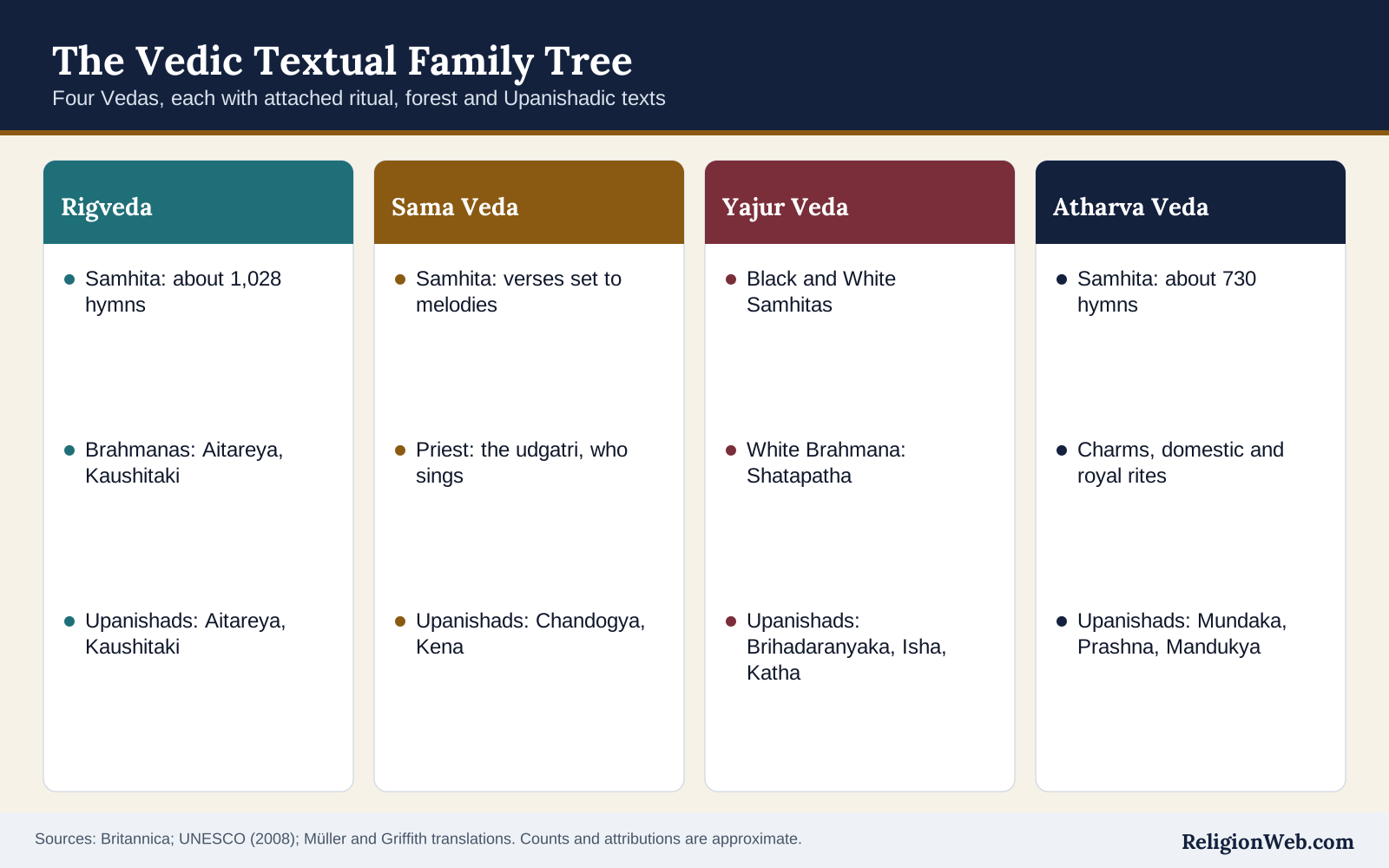
The Four Vedas Side by Side
The Four Vedas in One Table
The table gathers the basic data in one place. Counts of hymns and verses vary by edition and recension, so they are given as approximate.
| Veda | Main content | Priest in the great rituals | Surviving recensions (shakhas) | Principal Upanishads attached |
|---|---|---|---|---|
| Rigveda | About 1,028 hymns in ten books; praise of Agni, Indra, Soma and other deities; some philosophical hymns | Hotar, who recites the verses | One complete recension, the Shakala | Aitareya, Kaushitaki |
| Sama Veda | Verses, mostly from the Rigveda, arranged for chanting to set melodies | Udgatri, who sings the chants | Kauthuma (Ranayaniya) and Jaiminiya | Chandogya, Kena |
| Yajur Veda (Black) | Verses and prose formulas, with explanatory prose in the same text | Adhvaryu, who performs the ritual actions | Taittiriya, Maitrayani, Kathaka, Kapishthala | Taittiriya, Katha, Shvetashvatara, Maitri |
| Yajur Veda (White) | Formulas in the Vajasaneyi Samhita, with a separate Brahmana (Shatapatha) | Adhvaryu | Madhyandina and Kanva | Brihadaranyaka, Isha |
| Atharva Veda | About 730 hymns in twenty books; charms, domestic and royal rites, cosmological hymns | Brahman, the supervising priest | Shaunakiya and Paippalada | Mundaka, Prashna, Mandukya |
Reading the Table: Schools, Not Just Books
The idea of a recension, or shakha (“branch”), is essential to understanding how the Vedas lived. Each Veda was historically carried by several schools of reciters, and each school preserved its own text, with small differences in wording, order and accent, together with its own Brahmana, Aranyaka and ritual manuals. The branches that survive are a small portion of those the tradition remembers. UNESCO’s documentation of Vedic chanting states that only 13 of the more than 1,000 recitation branches have survived, and it identifies four schools, in Maharashtra, Kerala, Karnataka and Odisha, as under imminent threat. A school’s text is thus both a literary object and a social institution, a lineage of families who learn and perform it, and that is why the loss of a branch is described as the loss of a whole way of reciting.
The assignment of Upanishads to Vedas in the table follows the classical association, in which each Upanishad belongs to the Brahmana or Aranyaka of a particular school. Not every Upanishad has a clear home, and some of the later ones were attached to the Atharva Veda mainly because that collection was open to new additions. The next section explains how the layers fit together.
Samhita, Brahmana, Aranyaka, Upanishad: The Textual Layers of the Veda
From Hymn to Ritual Manual
Samhitas: The Core Collections
The earliest layer of every Veda is its samhita, the “putting together” of mantras into one collection. The four samhitas are the texts described in the previous section. They preserve the verses, melodies and formulas themselves with little explanation, as a repertoire that priests could draw on. Many specialists, including Michael Witzel, think of them as the product of the Early and Middle Vedic periods, with the Rigveda first and the others following, and they point out that the process of collecting and arranging the hymns was itself a form of scholarship that shaped the text we now have.
Brahmanas: Explaining the Sacrifice
The Brahmanas are prose works that explain what the ritual is, how it is performed, which verse goes with which action and why. Each school of each Veda had its own, and a handful survive: the Aitareya and Kaushitaki Brahmanas belong to the Rigveda, the Panchavimsha (Tandya) and others to the Sama Veda, and the Shatapatha Brahmana, which is one of the largest, belongs to the White Yajur Veda. They are not easy reading. Their method is to identify things that seem different: the altar is the year, the fire is a person, a particular meter is a part of the cosmos. These “connections” (bandhu) tie the ritual to the structure of the universe and the human body, and they provide the intellectual background for the Upanishads, which push the same habit of identification further.
The Brahmanas also contain stories that explain the origin of rites, including accounts of how the gods and anti-gods (devas and asuras) contended and how sacrifice gave the gods the upper hand. Because they are so intent on ritual detail, they have sometimes been dismissed as dry, but historians value them as evidence for the thought, social order and language of early first-millennium BCE northern India. The Brahmana prose is among the earliest extended prose in any Indo-Aryan language, and it shows how theory about ritual was already a sophisticated enterprise.
Aranyakas: Forest Books and Inner Ritual
The Aranyakas (“forest texts”) stand between the Brahmanas and the Upanishads, and the boundary on either side is often unclear. Their name is commonly explained in two ways in the tradition: that they were studied in the forest, away from the village, because the rituals they describe were considered dangerous or too secret for ordinary settings, or that they were intended for those who had left household life. Their subject matter is ritual that has begun to turn inward. The Aitareya Aranyaka, for example, includes discussion of the Mahavrata, a day of the soma rite, along with speculation on the breath, the self and the cosmos, and the Taittiriya Aranyaka contains both ritual formulas and the text of the Taittiriya Upanishad. The difference from a Brahmana is thus less one of kind than of emphasis: the Aranyaka looks at ritual as a way of understanding who the performer is and how the world works.
The Upanishads as the Final Layer
How the Upanishads Grow Out of Ritual Speculation
The Upanishads are not a break with the earlier layers so much as a continuation and transformation. The Brihadaranyaka Upanishad, among the oldest and the largest, opens with a meditation that turns the Ashvamedha, the great horse sacrifice, into a picture of the cosmos: the dawn is the horse’s head, the sun its eye, the wind its breath, the year its body. The same text then moves, within a few chapters, to the famous dialogues about the self. The Chandogya Upanishad begins with a meditation on the syllable om and on the chanting of the Sama Veda before it arrives at the teaching of Uddalaka Aruni to his son Shvetaketu. The development is real, but a reader who reads the opening lines would see that the vocabulary is still the vocabulary of the sacrifice.
Where an Upanishad Sits Inside the Texts
Each Upanishad is embedded in the literature of a particular school. The Brihadaranyaka Upanishad is the last portion of the Shatapatha Brahmana, and the Chandogya Upanishad forms part of a Brahmana of the Sama Veda. The Aitareya Upanishad is part of the Aitareya Aranyaka, the Taittiriya Upanishad part of the Taittiriya Aranyaka, and the Isha Upanishad is the closing chapter of the Vajasaneyi Samhita itself, which makes it unique as a verse Upanishad inside a samhita. Others, such as the Katha and Shvetashvatara, are linked to schools of the Black Yajur Veda, and the Mundaka, Prashna and Mandukya are associated with the Atharva Veda. As a result, an Upanishad is not a freestanding book but a section of a particular school’s inheritance, and students traditionally met it after learning the earlier layers.
Karma-kanda and Jnana-kanda: Two Parts of the Veda
Later Hindu thought often divides the Veda into two parts: the karma-kanda, the portion on ritual action (samhitas and Brahmanas), and the jnana-kanda, the portion on knowledge (the Upanishads). The division is a theological one and was made explicit by the two classical schools that interpret the Veda, the Purva Mimamsa (“earlier inquiry”) of Jaimini, which concentrates on ritual duty, and the Uttara Mimamsa (“later inquiry”), better known as Vedanta, which concentrates on knowledge of Brahman. Each school claims to be reading the whole Veda correctly and each finds a purpose in the other’s half. The Mundaka Upanishad itself already draws a contrast of this kind, as explored below in the section on the Upanishads, where it distinguishes “lower” and “higher” knowledge.
Vedangas and Sutras: The Supporting Disciplines
The Six Limbs of the Veda
To keep the Vedas intact and usable, six auxiliary fields, the Vedangas (“limbs of the Veda”), developed: shiksha (phonetics), chandas (meter), vyakarana (grammar), nirukta (etymology), kalpa (ritual procedure) and jyotisha (astronomy and the calendar). The list is already stated in the Mundaka Upanishad, which names them among the “lower” forms of knowledge. These were not abstract subjects. Phonetics ensured that each syllable and accent was pronounced correctly, meter made sure that a verse had the right length, grammar and etymology clarified old words, and astronomy fixed the proper day for a rite. Pāṇini’s grammar of Sanskrit, composed around the fourth or fifth century BCE, is the most famous product of this scholarly environment, and Yāska’s Nirukta, a work on the interpretation of difficult Vedic words, is one of the earliest surviving works of explanation of the Vedas.
Shrauta and Grihya Sutras: Ritual Manuals
The ritual limb, kalpa, is represented by short, rule-like works called Sutras. The Shrauta Sutras give the procedures for the great public rites that require several fires and priests, and the Grihya Sutras cover household ceremonies, including the rites of birth, initiation, marriage and death. The Dharma Sutras on law and custom belong to the same family. Though these are classed as smriti and are therefore a step below the Vedas in authority, they are the practical bridge between the Vedic texts and ordinary life, and their instructions are still followed by priests who conduct weddings and funerals in a Vedic idiom today. This is one reason the Vedas have a continuing presence in domestic rites, a topic taken up in the section on Vedic ritual below.
Phonetic Handbooks and Grammarians
Another group of works, the Pratishakhyas, are phonetic handbooks that each describe how a particular school’s text is to be pronounced, including the rules of euphonic combination (sandhi) and accent. They were composed to protect the text. It is hard to overstate how much attention the tradition paid to sound, and this close concern with phonetics is part of the reason the Vedic texts survive in a very consistent form. The next sections discuss how recitation techniques reinforced that fidelity.
The Layers at a Glance
A Table of the Layers
| Layer | Typical form | Main purpose | Examples | Approximate period (scholarly estimates) |
|---|---|---|---|---|
| Samhita | Verse, with some prose formulas | Hymns, chants and formulas for use in ritual | Rigveda, Sama Veda, Vajasaneyi Samhita, Atharva Veda | About 1500 to 900 BCE, with the Rigveda earliest |
| Brahmana | Prose | Explains ritual actions, myths of origin and the meaning of verses | Aitareya, Shatapatha, Panchavimsha | Following the Samhitas, in the early first millennium BCE |
| Aranyaka | Prose and some verse | Inner meaning of rituals; speculation on breath, self and cosmos | Aitareya Aranyaka, Taittiriya Aranyaka | Overlaps the late Brahmanas and early Upanishads |
| Upanishad | Prose, verse or mixed; often dialogue | Teaching on the self, Brahman, rebirth and liberation | Brihadaranyaka, Chandogya, Katha, Mundaka | Oldest often placed in the 7th to 6th centuries BCE; later ones across several centuries |
| Vedanga and Sutra | Short rules and technical treatises | Phonetics, meter, grammar, etymology, ritual procedure, astronomy | Pāṇini’s grammar, Nirukta, Shrauta and Grihya Sutras | Mid-first millennium BCE onward; classed as smriti |
Tradition and Historians on the Boundaries
Two different ways of drawing the boundaries meet in this table. Historians such as Witzel speak of Early, Middle and Late Vedic periods and arrange the layers in a rough time order, noting that the earlier layers continued to be recited and copied while the later ones were composed. Traditional Mimamsa and several ritual manuals define the Veda more narrowly as “mantra and Brahmana,” while in Vedanta the Upanishads are the central part of the Veda. Neither view is a mistake; each answers a different question. A scholar asking when a text was composed uses the first approach, a priest asking what must be recited at an altar uses the second, and a philosopher asking what the Veda ultimately teaches turns to the third.
History: How the Vedic Texts Were Composed, Collected, and Received
The Vedic Period in Outline
Early Vedic Society in the Rigveda
The Rigveda gives a view from the inside of a society of related clans (jana) led by chiefs (rajan), with assemblies called sabha and samiti. Wealth is counted in cattle and horses, the poets are professional composers who are rewarded by their patrons, and conflict among the clans and with neighboring peoples is a constant theme. One famous episode, the Battle of the Ten Kings, is alluded to in several hymns of Book 7 (7.18, 7.33, 7.83) and pits the chief Sudas, whose priest was Vasishtha, against a coalition of rivals. The poets also speak of the “Dasa” and “Dasyu,” groups opposed to the hymn-makers, and the meaning of these terms, whether they refer to ethnic, social or ritual outsiders, is argued by specialists. The Rigveda is a religious text rather than a chronicle, so what it offers is a series of glimpses.
Middle and Late Vedic Periods: Kingdoms and Codified Ritual
By the time the Yajur, Sama and Atharva Veda samhitas and the Brahmanas were put together, the center of gravity had moved east to the Kuru and Pañcāla lands. Historians infer from these texts a more settled society, stronger kings, a more distinct priestly class and a ritual system that had become more elaborate and costly, with the great public sacrifices such as the royal consecration (rajasuya) and the horse sacrifice (ashvamedha). The social vocabulary of the four varnas, which appears once in the Rigveda in the Purusha Hymn, becomes a standard theme in these later texts. In the Late Vedic period, represented by the later Brahmanas, the Aranyakas and the early Upanishads, the center moves again, to Videha in the east and the region around Kashi, where kings such as Janaka of Videha figure as patrons of philosophical debate.
Why Historians Speak of Periods and Not Years
No Vedic text carries a date. Scholars arrive at a relative sequence from the evolution of the language, from the geography mentioned, from the ritual or philosophical developments the text assumes, and from a few external anchors such as the grammar of Pāṇini, which presupposes the existence of the Vedic literature. Absolute dates are estimates, and the margins can be wide: the Rigveda’s period of composition has been placed by different specialists anywhere between about the eighteenth and the twelfth centuries BCE. Some Hindu thinkers prefer much earlier dates, and others deny that the Veda was composed at all. This article gives scholarly ranges for what historians can reconstruct, and it notes the traditional view where it differs.
Debates About Origins and Dating
Language, Treaties and the Outside Evidence
One of the few pieces of outside evidence is a treaty from the fourteenth century BCE between the Hittite king and a ruler of the Mitanni kingdom in northern Syria and Mesopotamia. The treaty calls on gods named Mitra, Varuna, Indra and the Nasatyas as witnesses, names that match Vedic deities, and the Mitanni rulers had personal names of an Indo-Aryan type. Witzel cites this material as the only contemporary inscription that preserves Indo-Aryan words from a period close to the Rigveda. It shows that Indo-Aryan speech and some of its religious vocabulary were in use in West Asia by about 1400 BCE, and it shows that an Indo-Aryan religious vocabulary was already established by then, though it does not settle where that culture arose.
The Indus Cities and the Question of Continuity
The mature phase of the Indus Valley (Harappan) civilization, roughly 2600 to 1900 BCE, precedes any dated Vedic text, and its script has not been deciphered, so no document links the two. Archaeologists, linguists and, more recently, geneticists have proposed different accounts of the movement of Indo-Aryan speakers into South Asia and their relation to the Indus population. The question touches on identity in India today, and scholars on different sides argue about the evidence, which is why careful writers avoid treating any reconstruction as settled. What is not disputed is that the Rigveda describes a society that is not urban, and that the later Vedic literature shows a progressive change from that earlier pastoral world to settled kingdoms.
When Were the Texts Written Down?
Britannica states that the Rigveda was preserved orally and written down about 300 BCE. Other specialists place the earliest writing of Vedic texts in the centuries after 500 BCE and stress that evidence of actual manuscripts is much later. The oldest surviving Rigveda manuscripts are medieval: a few from Nepal are dated to about the eleventh century, a fourteenth-century manuscript is held in Varanasi, and the standard printed text rests on a manuscript tradition that is not older than about the sixteenth century. The lack of early manuscripts does not imply an unreliable text. It reflects the fact that birch bark and palm leaf rot in the climate of the subcontinent, and that the tradition’s primary medium was the human memory, whose accuracy is explored in the section on oral transmission.
The Age of the Upanishads
Renunciation, Rebirth and a Changing World
The earliest Upanishads belong to a period when the eastern Ganges plain was producing towns, trade and larger kingdoms, as well as new movements of wandering ascetics (shramanas) who left household life in search of liberation. In the Upanishads the idea of rebirth, with the consequences of action (karma) shaping the next life, appears as an established theme, as in the Brihadaranyaka’s account of the “two paths” after death and in Yajnavalkya’s teaching to King Janaka. Scholars debate how much of this was a development within the Vedic tradition and how much was absorbed from broader currents of Indian religious life; either way, the doctrine of rebirth and release (moksha) becomes the main frame of later Hindu thought. The theory of karma is discussed in the article on karma in Hinduism.
Kings, Teachers and Who Taught Whom
The Upanishads preserve stories in which the speaker is a king or a woman or someone outside the priestly establishment. In the Chandogya (5.3) and Brihadaranyaka (6.2), the king Pravahana Jaivali instructs a learned Brahmin on the fate of the self after death, saying that this knowledge had not previously been with Brahmins. King Ajatashatru of Kashi teaches the Brahmin Gargya Balaki in the Brihadaranyaka (2.1). Gargi Vachaknavi questions Yajnavalkya in a royal assembly, and Maitreyi asks him for the knowledge that would make her immortal. Historians read these stories in different ways: some see evidence for a competitive intellectual world with participants from several backgrounds, and others stress that the texts are still compiled in priestly lineages and so reflect their view of events. Either reading agrees that the Upanishads capture a stage of lively debate.
Neighboring Movements of the Same Era
The same eastern Gangetic region and the same centuries saw the emergence of other teachers and communities that became the Buddhist and Jain traditions, and historians study how those movements and the Upanishadic teachers shared terms such as karma, rebirth and liberation. The relationship is debated: some scholars see mutual influence, others see parallel developments from a common stock of ideas. For the purposes of this article it is enough to note that the Upanishads are one voice in a larger conversation about the self and release, not the only one.
Commentary, Translation and Reception
Medieval Commentators and the Vijayanagara Tradition
From the first millennium CE onward the Vedic texts were studied through commentary. The most extensive commentary on the Rigveda is the Vedartha Prakasha of Sāyaṇa, a fourteenth-century scholar attached to the Vijayanagara court in South India, who also wrote commentaries on the other Vedas. Sāyaṇa belonged to the Mimamsa tradition and read the Veda mainly as a guide to ritual use, a perspective that shaped how later scholars, including Europeans, understood the hymns. Commentaries on the Upanishads, by contrast, were written by Vedanta teachers beginning with Shankara in the early medieval period, as discussed in the later section on Vedanta.
Persian, Latin and European Translations
The Upanishads reached a wider world through translation. In the seventeenth century the Mughal prince Dara Shikoh, a student of Sufi and Hindu thought, sponsored a Persian translation of about fifty Upanishads, completed in 1657 and known as the Sirr-i Akbar, “the Great Secret.” In 1801 and 1802 the French scholar Abraham Hyacinthe Anquetil-Duperron published a Latin version of that Persian text, which was read by European philosophers, among them Arthur Schopenhauer. Max Müller edited the Rigveda together with Sāyaṇa’s commentary between 1849 and 1874 and introduced the Upanishads to the English-reading public in the first volume of the Sacred Books of the East (1879). Editions and translations by Indian scholars and by Western Indologists have continued since, with Patrick Olivelle’s The Early Upaniṣads (Oxford University Press, 1998) offering a critical text and translation of the oldest group.
Reform, Revival and Contemporary Scholarship
In nineteenth-century India, reformers turned to the Vedas and Upanishads as sources for renewal. Ram Mohan Roy translated several Upanishads and founded a society that became the Brahmo Samaj, which rejected image worship and drew on the Upanishads’ teaching of one Brahman. Dayananda Sarasvati, who founded the Arya Samaj in 1875, argued that the four samhitas alone are the revealed Veda and urged a return to Vedic ritual and ethics, rejecting practices he found absent from them. Swami Vivekananda, who spoke at the World’s Parliament of Religions in Chicago in 1893, presented Vedanta to audiences in the West and in India as a universal philosophy. Each of these movements read the texts selectively and in the light of its own concerns, which is a feature of the long history of Vedic interpretation. More recent scholarship has questioned colonial-era assumptions, including the habit of treating the Vedas as evidence for a single “Aryan” race, and has paid attention to ritual, recitation and the voices of living practitioners.
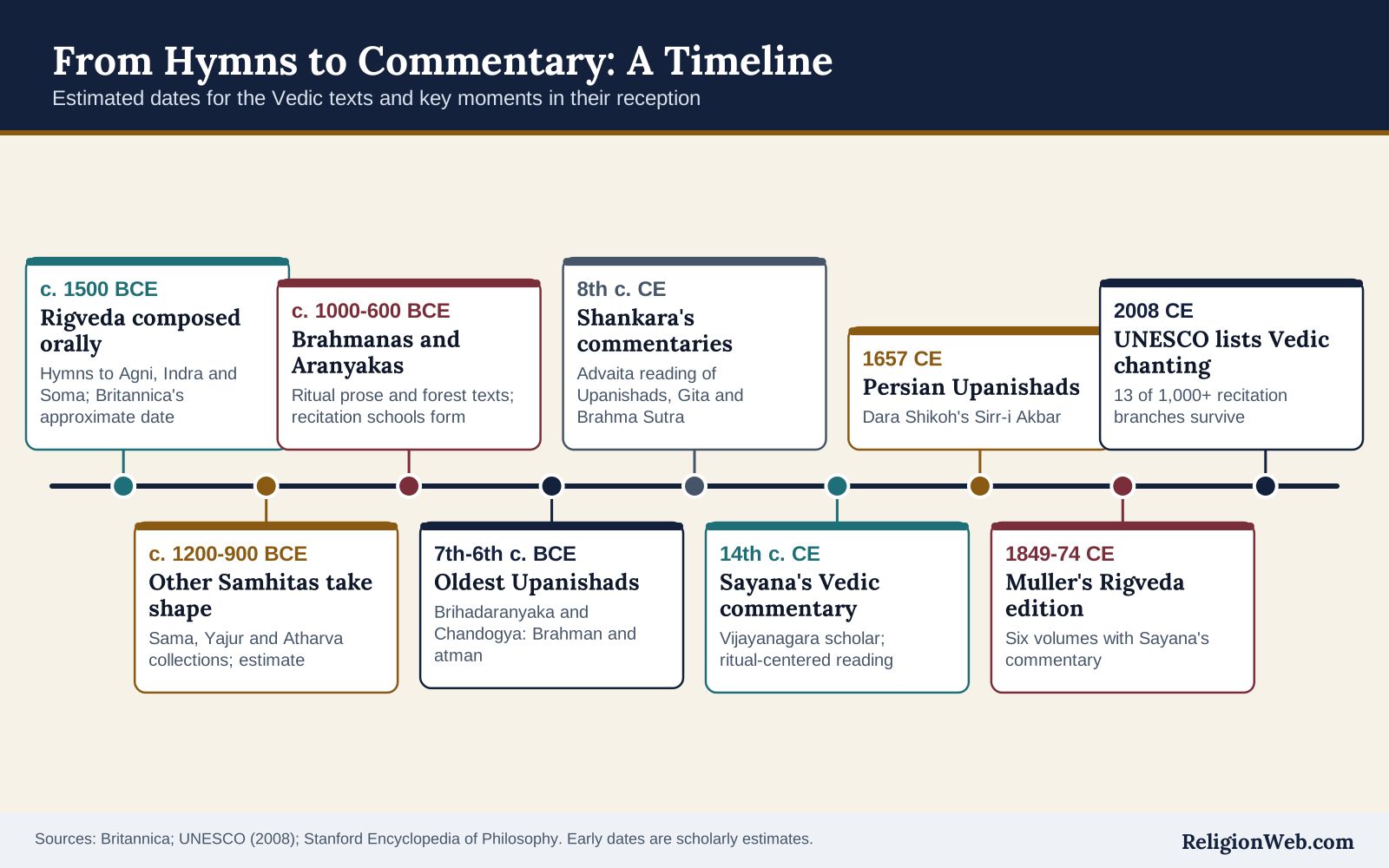
A Selected Chronology
Dates at a Glance
| Date (approximate where noted) | Development | Basis for the date |
|---|---|---|
| About 1500 to 1200 BCE | Composition of the Rigveda | Britannica gives about 1500 BCE; Witzel gives 1500 to 1200 BCE; other scholars give wider ranges |
| About 1200 to 900 BCE | Yajur, Sama and Atharva Veda samhitas take shape | Witzel’s relative chronology; estimate |
| About 1000 to 600 BCE | Brahmanas and Aranyakas composed; Vedic schools (shakhas) form | Estimate from language and content |
| 7th to 6th centuries BCE | Oldest Upanishads, the Brihadaranyaka and Chandogya | Common scholarly estimate; exact dates unknown |
| 4th to 5th centuries BCE | Pāṇini’s grammar of Sanskrit | Common scholarly estimate |
| 14th century CE | Sāyaṇa’s commentary on the Vedas | Vijayanagara court |
| 1657 CE | Dara Shikoh’s Persian translation of the Upanishads | Completion date usually given |
| 1849 to 1874 CE | Max Müller’s edition of the Rigveda with Sāyaṇa | Publication of the six volumes |
| 1875 CE | Arya Samaj founded by Dayananda Sarasvati | Date of founding in Bombay |
| 2008 CE | UNESCO inscribes Vedic chanting | Intangible Cultural Heritage Representative List |
How to Use the Dates
The earliest rows in this table are estimates with wide margins, while the later rows rest on documentary evidence such as a dated edition or inscription. The difference matters for how much weight a reader should place on any single figure. When a source gives a precise year for an ancient text, the figure should be read as a scholarly convention, not as a record.
Shruti and Authority: How Hindu Traditions Treat the Vedas
Revelation Without an Author
Apaurusheya: The Mimamsa Argument
The most fully developed account of Vedic authority comes from Purva Mimamsa, the school that studies the Veda as a guide to ritual duty. Its foundational text, the Mimamsa Sutra attributed to Jaimini, begins with the statement that dharma is what is indicated by a Vedic injunction (codana), and the later commentators Shabara, Kumarila Bhatta and Prabhakara built an elaborate theory around it. In this theory the Veda is apaurusheya, “not of a person,” because it has no author at all, neither human nor divine. The words of the Veda are held to be eternal, and the seers simply discovered them and passed them on, which is why the exact sound matters so much in ritual. The authority of the Veda is taken to be intrinsic: it does not depend on the reliability of a speaker, since there is no speaker whose reliability could be questioned.
The Mimamsakas did not claim that everything in the Veda is a command. They distinguished injunctions from descriptions, praise and stories, and they argued that descriptive passages exist to support the injunctions. The approach produced a detailed science of interpretation, with rules for deciding which verse applies to which ritual, and many of its principles later influenced Hindu law.
Other Views: God as Source, Seers as Discoverers
Not every Hindu school accepts the Mimamsa position. The Nyaya school, which developed logic and epistemology, holds that the Veda is the word of God (Ishvara) and derives its authority from the reliability of its author. Vedanta schools generally regard the Veda as eternal and as the foundation of knowledge about Brahman, and they differ among themselves about how the revelation relates to God. In the devotional traditions, for example, Vaishnava theologians describe the Veda as breathed out by Vishnu or Narayana and as a form of divine speech. A common traditional image is that of the rishis as “seers of mantras” (mantra-drashtara), people who, through discipline and insight, perceived what already existed. The hymns themselves often name their poets, and some ask the gods for the gift of a new song, which is one reason modern historians treat them as compositions even while they respect the tradition’s understanding of them.
What Historians Say and Do Not Say
University scholars study the Vedas as texts composed by human poets in specific times and places, as shown by their evolving language and by their references to political and social events. This approach is a method, not a verdict on the truth of revelation. It describes what can be learned from language, archaeology and comparison, and does not claim to answer theological questions, such as whether the sound of the Veda is eternal. Respectful scholarship therefore distinguishes between “the Veda as understood in the tradition” and “the Vedic texts as historical documents,” and this article keeps the two in view.
Authority in Practice Across Traditions
Veda as the Mark of Orthodoxy: Astika and Nastika
In classical Sanskrit thought, thinkers were sometimes classified as astika, those who accept the authority of the Veda, and nastika, those who do not. In that scheme the six schools of Hindu philosophy (Nyaya, Vaisheshika, Samkhya, Yoga, Mimamsa and Vedanta) are astika, while the Buddhists, Jains and the materialist Charvakas are nastika. These were labels used within Brahmanical doxography, and the traditions they were applied to would not describe themselves this way. The labels are mentioned here because they show how central a stance toward the Veda was to the classification of philosophies in Sanskrit scholarship. Even among the astika schools, acceptance of the Veda could mean very different things: Samkhya and Yoga accept the Veda in principle but develop their own methods of reasoning and practice, while Mimamsa and Vedanta make exegesis of the Veda their whole project.
Agamas, Tantras and Puranas: Parallel Claims
Large parts of Hindu practice are built on texts that are not Vedic. The Shaiva Agamas, the Vaishnava Pancharatra Samhitas, the Tantras of the Goddess traditions and the Puranas all provide detailed instruction for worship, images and temples. Traditions differ in how they relate such texts to the Veda. Some present them as in harmony with the Veda or as its fulfillment, some claim a distinct revelation of equal rank, and some devotional communities place the emphasis on the Puranas and on the poet-saints. The teaching on puja, the central form of Hindu worship, is a good example: its structure comes largely from Puranic and Agamic sources, though Vedic verses are often recited in it. The articles on Vaishnavism and Shaivism show how each stream sees its own scriptures.
The Bhakti Poets and the Idea of a Tamil Veda
Devotional poets writing in regional languages were sometimes honored with titles that echo the Veda. In the Tamil country, the hymns of the Alvars, the poet-saints devoted to Vishnu, are known as the Divya Prabandham, and the Sri Vaishnava community has long called the Tiruvaymoli of Nammalvar the “Tamil Veda” (Dravida Veda), giving it a place of great respect alongside the Sanskrit Veda. Similar statements are made about the Tamil Shaiva hymns of the Nayanars. Such claims are not rejections of the Vedas; they reflect the belief that sacred truth is also found in languages other than Sanskrit, and they illustrate how Hindu traditions create layers of scripture instead of replacing one with another.
Who May Study and Recite the Veda
Classical Restrictions and Their Rationale
In the classical law books (Dharmashastra), the right to undergo the initiation (upanayana) and to study the Veda was limited to men of the three “twice-born” varnas, in practice largely Brahmin men for the memorization of whole recensions, and women and Shudras were excluded from Vedic study, with penalties prescribed for breaking the rules. The rationale given by the tradition was ritual purity and the training needed to recite correctly, but the effect was to confine Vedic learning to a small and mostly male group. Historians point out that the Rigveda itself includes hymns attributed to women seers (rishikas) such as Ghosha, Lopamudra and Apala, and that the Upanishads present women such as Gargi and Maitreyi as serious philosophical participants, so the later restrictions did not describe the whole earlier picture.
Reform, Reinterpretation and Present-Day Access
From the nineteenth century onward, reform movements challenged the restrictions. The Arya Samaj held that all people, regardless of sex or birth, may study the Vedas, and it organized schools and publications on that basis. In recent decades, more teachers and institutions have taught Vedic recitation to women and to people from varied castes, while some traditional schools and priestly families still keep to older norms. Commentators therefore describe the present as a period of change and disagreement. In the world of general readers, the question is much less constrained: translations, critical editions and recordings are widely available in print and online, and a person need not be an initiated reciter to study the content of the texts.
Oral Transmission: How the Vedas Were Memorized, Recited, and Preserved
Learning the Veda by Ear
The Teacher and the Student
For most of their history the Vedas were learned, not read. The traditional method is for a student to sit before a teacher and repeat each phrase exactly as heard, over and over, until it becomes second nature. The process is called adhyayana, “recitation” or “study,” and the daily repetition of what one has learned, svadhyaya, is considered a duty in its own right. A text learned in this way is held in the memory as sound, together with its accent, its rhythm and the movements of the head and hands that mark the pitch in some traditions. Lineage matters because the teacher is the guarantee: a student who learns a recension from a qualified teacher belongs to a chain of transmission that, in the tradition’s understanding, reaches back to the original seers.
Training is demanding. Students traditionally begin in childhood and spend many years learning a single recension, beginning with the opening sections of the samhita and working through the text, sometimes along with its Brahmana and Aranyaka, before moving to the more complex patterns described below. The environment varies: in the past it was the teacher’s household (gurukula), and today it may be a Vedic school (pathashala) supported by a temple, a family endowment or a religious institution.
Sound as the Unit of Authority
The Vedic recitation is not a reading of words but a performance of sound. The text has three principal pitch accents, usually called udatta (raised), anudatta (not raised) and svarita (sounded), and in printed editions these are marked by short strokes above and below the syllables. The phonetic handbooks of each school, the Pratishakhyas, spell out the rules for pronouncing consonants and vowels, for joining words, and for pausing. The result is a degree of attention to pronunciation that is hard to find in any ordinary reading culture. Ritual specialists generally held that the correct sound is part of the rite itself, which helps to explain why an error was seen not as a stylistic slip but as a defect in the performance.
Schools, Regions and Variation in Practice
There is no single Vedic “accent” across India. Reciters of the Rigveda in Maharashtra and in Kerala, of the White Yajur Veda in its Madhyandina and Kanva schools, and of the Jaiminiya Sama Veda in Tamil Nadu and in Kerala all follow the rules of their own school, and the sound can vary noticeably from one to another. The Sanskritist Madhav Deshpande has observed that different regional traditions sound as different to him as regional varieties of English, an observation that corrects the popular idea of one uniform chant. The sameness that matters to the tradition is sameness within a school’s own lineage, the wording, order and accent of its own text, not uniform pronunciation across India.
Techniques of Recitation
Samhita, Pada and Krama: The Basic Forms
Scholars of Vedic chant list up to eleven recitation styles, called pathas. The first three are considered the “natural” ones. The samhita-patha is continuous recitation, in which words flow into one another according to the rules of euphonic combination (sandhi), so that the verse sounds as it does in ritual. The pada-patha breaks the verse into separate words, each pronounced distinctly, which makes it easier to see how the words combine and also stores the text in a second form. The krama-patha recites the words in overlapping pairs, so that a verse whose words are numbered 1, 2, 3, 4 is learned as 1 2, 2 3, 3 4. Each form is a way of holding the same text in the mind from another angle.
Jata, Ghana and the Complex Forms
The remaining eight styles are called “altered” or complex forms (vikriti) because they rearrange the order of the words. They include the jata, mala, shikha, rekha, dhvaja, danda, ratha and ghana. In the jata-patha, each pair of adjacent words is recited forward, backward and forward again. In the ghana-patha, the name of which means “dense” or “compact,” triplets are added to the pattern, and it is usually regarded as the most demanding. The complex forms demand years of additional training, and not every reciter learns all of them. Like the first three forms, the complex ones preserve the same words; what they add is a web of cross-references.
Cross-Checking and the Prevention of Error
The various forms are not merely exercises. In the tradition’s understanding they work together as a check on the text: if the continuous recitation, the word-by-word recitation and the braided forms all agree, the reciter and the teacher can be confident that nothing has slipped. The idea that a text should be stored in several redundant forms has a modern echo in the engineering of error detection, and modern teaching materials on ancient Indian knowledge systems, such as a 2018 slide deck by Amba Kulkarni of the University of Hyderabad, present the recitation modes alongside error-checking ideas. It is worth remembering that the comparison is ours and not the tradition’s, whose own language is that of purity, completeness and correct ritual practice. The technique also explains why a school’s text is so rarely the object of arguments over variant readings in the way a manuscript tradition is.
How Accurate Is the Oral Record?
Claims of Near-Perfect Preservation
Specialists have praised the fidelity of Vedic transmission. Michael Witzel has written that the texts were preserved with an “impeccable” accuracy, “something like a tape-recording” of the period from about 1500 to 500 BCE, as quoted in discussions among Indologists, and the Dutch-American scholar Frits Staal, who studied Vedic recitation and ritual in Kerala beginning in the 1950s, made the preservation of the Vedas a central case in his writing on the fidelity of oral tradition. UNESCO’s description credits the Brahmin priests’ techniques with keeping the texts unchanged for thousands of years. Such statements refer to the preservation of the wording and accent of each school’s recension, and they are made by people who have heard the tradition at first hand.
Limits, Variants and Open Questions
Careful scholars add some qualifications. The tape-recording analogy applies to the text within a school’s tradition. It does not mean that the Rigveda was fixed in the second millennium BCE and then unchanged, because the hymns were edited and arranged at some stage, the pada text itself embodies an analysis of the words that is sometimes debated, and different schools of the same Veda differ in details. Regional pronunciation differs, as noted above, and the claim that every school’s recitation sounds the same is itself questioned. The whole Vedic corpus also survives only through the schools that continued, while many others have been lost; their texts, accents and rituals can only be partly inferred. In short, the oral tradition offers an unusually strong guarantee for the surviving recensions and no guarantee for what has vanished.
Manuscripts, Printing and the Shift to Writing
Writing did not replace recitation but was layered on top of it. Manuscripts of Vedic texts on palm leaf, birch bark and paper were copied for centuries, though the oldest surviving ones are medieval. Printing changed the situation in the nineteenth century: Max Müller’s edition of the Rigveda with Sāyaṇa’s commentary was followed by many Indian editions, and the Vedas became available to readers who had no contact with a reciter. In the tradition itself, the printed book is a helpful aid and not the ultimate authority. Wayne Howard, the author of a study of Veda recitation in Varanasi, argued that the ultimate authority in Vedic matters is not the printed page but the people who keep the tradition alive.
Vedic Chanting Today
UNESCO and the Endangered Branches
UNESCO inscribed the Tradition of Vedic chanting in 2008 on its Representative List of the Intangible Cultural Heritage of Humanity. The inscription describes the chanting as practiced in sacred rituals and daily recitation in Vedic communities, notes that practitioners learn complex techniques based on tonal accent, distinct pronunciation of each letter and specific sound combinations, and states that only 13 of more than 1,000 recitation branches survive. It identifies four schools, in Maharashtra, Kerala, Karnataka and Odisha, as facing imminent threat. The reasons, as often described by teachers and researchers, include a shortage of students who can commit the years that training requires, economic pressures on priestly families, and competition from modern education and careers.
Recordings, Classes and Digital Archives
Recordings now supplement the traditional method, and some institutions use them to document rare recensions. Classes on Vedic recitation are offered in India and in diaspora communities, and online lessons have given students outside traditional centers access to teachers. Practitioners who work with these tools generally emphasize that a recording can preserve a sound but cannot correct a student, which is the role of the teacher. The question of how best to sustain the tradition, and of who should have access, is debated within the communities concerned.
The Table of Oral Methods and Their Uses
| Method or practice | What it involves | Purpose | Typical context |
|---|---|---|---|
| Samhita-patha | Continuous recitation with euphonic combination of words | Preserves the text as it is used in ritual | Sacrifices, weddings, temple chanting, daily recitation |
| Pada-patha | Recitation word by word with pauses | Stores the separate words and shows how they combine | Early stage of learning; second form of the text |
| Krama-patha | Overlapping pairs of words (1 2, 2 3, 3 4) | Links each word to its neighbor and checks order | Intermediate stage of training |
| Jata and ghana patha | Pairs, then triplets, recited forward, backward and forward | Cross-checks the text from several sides | Advanced study and public displays of mastery |
| Accent marking (svara) | Three pitches, marked in print and shown by hand or head movements in some schools | Preserves pronunciation and meaning | All Vedic recitation |
| Daily self-recitation (svadhyaya) | Repeating learned portions each day | Retention and religious discipline | Students, priests and householders in Vedic families |
| Complete recitation (parayana) | Reciting a large portion or the whole of a text in sequence | Merit, completion of study or blessing of an event | Temple festivals and special occasions |
This table shows that the techniques are not abstract: they are matched to stages of training and to occasions of use. The contexts described are typical, not universal, and local practice in different schools may add or omit specific forms.
Vedic Ritual: Fire, Sacrifice, and Household Rites
The Vedic Sacrifice (Yajna)
Fire, Offering and the Idea of Exchange
At the center of Vedic religion is the yajna, a ritual offering made into a consecrated fire. The sacrificer, called the yajamana, engages priests to prepare the ground, kindle the fire and pour oblations of clarified butter (ghee), grain, milk, cakes and, in the large soma rites, the juice of the soma plant. As each offering goes into the flames, the priest calls the name of the deity with the exclamation svaha, usually translated “hail” or “well said,” and in many rites adds a formula such as idam na mama, “this is not mine,” to mark the gift as given up. In the Vedic understanding, Agni receives the offering and carries it to the gods, who in turn support rain, cattle, children and the order of the world. The Brahmanas treat the whole process as an exchange that keeps the cosmos running, and the hymns of the Rigveda are the verbal part of it.
The Priests and Their Vedas
The grand rites required a team of specialists, up to sixteen in the largest, but four principal roles correspond to the four Vedas. The hotar invokes the gods with verses of the Rigveda. The adhvaryu performs the manual actions and recites the formulas of the Yajur Veda. The udgatri sings the chants of the Sama Veda. The brahman supervises the entire proceeding, ready to correct any mistake, and in the later tradition is associated with the Atharva Veda. The division of labor shows why the Vedas were preserved as separate collections: each was the working script of one set of priests, and a rite required all of them together. Payments to the priests (dakshina) were part of the arrangement.
Shrauta Rites and Household Fires
Ritual texts distinguish two classes of Vedic rites. The shrauta rites, based on shruti, use three fires set up on separate hearths, and they include the new and full moon offerings (darsha-purnamasa), seasonal sacrifices, the soma rites and the royal ceremonies. The grihya rites, based on the Grihya Sutras, are performed in the domestic fire and cover the life-cycle ceremonies. The new and full moon rites show how deeply the lunar calendar is built into Vedic practice, a structure which still guides the Hindu festival year as described in the articles on Navaratri and Diwali. Specialists who maintain the three fires are known as ahitagni, “those who have established the fires.”
Major Rites and Where They Survive
Agnihotra: The Daily Fire Offering
The simplest and best-known Vedic rite is the agnihotra, a small offering of milk made into the household fire at sunrise and sunset. In one common form, the householder offers the morning oblation to Surya and Prajapati and the evening oblation to Agni and Prajapati, speaking the mantras and the formula of surrender, then sits briefly in silence. It is performed in a small copper vessel, takes only a few minutes and requires no priest. Households that belong to the shrauta tradition, including some Nambudiri and Tamil, Telugu and Maharashtrian Brahmin families, maintain it as a daily duty. Modern organizations in India and abroad also teach a version of agnihotra, and some present it as a way to purify the environment or improve health. Such claims come from the modern movements and not from the classical texts, and the practice should be understood in the terms of the ritual tradition: as an offering, not a medical or agricultural technology.
Soma Sacrifices and the Agnicayana
The soma rites, from the one-day Agnishtoma to multi-day forms, are the ritual high points of the Vedic system. The soma plant was pressed, filtered and offered, and the verses of the Rigveda’s ninth book and the chants of the Sama Veda accompany the process. What the original soma plant was is unknown, and substitutes have been used for many centuries. The most elaborate example is the agnicayana, the “piling of the fire altar,” in which a large altar of bricks, in the shape of a bird in the classical description, is built in layers over many days and the rite concludes with a night-long offering. In 1975 the philosopher and Indologist Frits Staal and a team of collaborators documented an agnicayana performed by Nambudiri Brahmins at Panjal in Kerala, and the results appeared in the two-volume Agni: The Vedic Ritual of the Fire Altar (1983). Performances of these rites in Kerala and elsewhere in the south have continued at intervals, usually with the support of families and community organizations.
Royal and Public Rites in the Past
The Brahmanas and Shrauta Sutras describe several rites associated with kingship, such as the royal consecration (rajasuya) and the horse sacrifice (ashvamedha), in which a horse was released to wander for a year and the ruler’s claim to authority over the land it crossed was affirmed. Inscriptions and coins record later rulers who performed or claimed to perform such ceremonies, including kings in the Gupta period, but the large royal sacrifices were never routine events, and by the medieval period public devotion to images in temples had become the dominant form of royal and popular religion. The historical relationship between the Vedic fire sacrifice and the later temple worship, taken up under the topic of puja below, is one of continuity in some elements and replacement in others.
Household Rites and the Life Cycle
Upanayana, the Sacred Thread and the Gayatri Mantra
The upanayana, “leading near” a teacher, is the initiation that traditionally marked the beginning of Vedic study. In the law books it is prescribed for boys of the three twice-born varnas at ages from about eight to twelve, depending on the varna, and it involves the giving of a sacred thread, the instruction in a daily duty and the teaching of the Gayatri mantra. The Gayatri is a verse in the Rigveda (3.62.10) addressed to Savitar, the divine impeller of the sun. Griffith’s 1896 translation renders it as a wish to attain “that excellent glory of Savitar the God,” so that he may stimulate “our prayers.” The verse is the core of the daily twilight prayer (sandhya-vandana), recited at dawn, midday and dusk by those who keep the practice. How widely upanayana is performed now, who receives it and at what age, varies greatly by region, community and family. The Arya Samaj and some other movements initiate girls as well as boys, and in some communities the ceremony is reduced to a symbolic act on the wedding day.
Weddings, Funerals and Other Rites of Passage
Vedic verses are heard at many of the most important moments in a Hindu life. Many marriage ceremonies make use of verses from the wedding hymn of the Rigveda (10.85), and the couple’s circling of the sacred fire and taking of seven steps (saptapadi) follow the pattern of the Grihya Sutras, though the details vary by region and community. At funerals, verses from the funerary hymns of the tenth book (10.14 to 10.18) are used in the cremation rites of priests who follow Vedic procedure, to entrust the dead person to Agni. Naming, the first feeding of solid food and the first haircut also have Vedic forms, and the ritual manuals provide for them. In practice, families often combine Vedic mantras recited by a priest with regional customs, women’s songs and other practices that have no Vedic source.
Vedic Hymns in Temples and Festivals
Temple worship in most Hindu traditions follows the Agamas and the Puranas more than the Vedic ritual manuals, but Vedic hymns are woven into it. The Purusha Sukta, the Shri Sukta and the Narayana Sukta are chanted at the bathing of images in many Vaishnava temples, and the Shri Rudram is a regular feature of Shaiva worship. The Devi Sukta of the Rigveda (10.125), spoken in the voice of the Goddess, is recited in some Shakta worship, including during Navaratri, and verses from the Shri Sukta are widely used in Lakshmi worship at Diwali. The structure of daily worship is described in the article on puja, which includes both Vedic and non-Vedic elements. Festival fires, such as the bonfire of Holi, are usually explained through Puranic stories and regional custom, although some writers connect them with older Vedic first-fruits rites; that connection is a matter of interpretation. Taken together, these examples show a pattern in which the Veda provides the sacred sound and a sense of ancient sanction, and other traditions provide much of the form of the rite.
The Upanishads: Form, Number, and Major Texts
What an Upanishad Is
Dialogue, Story and Verse
An Upanishad is rarely a treatise. The older ones are built from dialogues in which a student asks, a teacher answers and a third party sometimes interrupts, and from short narratives, analogies and riddles. A father tells his son to dissolve salt in water and taste it; a king questions a sage about what a person is after death; a boy goes to the house of Death to ask what lies beyond; a wife declines her husband’s property because it cannot make her immortal. The prose of the Brihadaranyaka and Chandogya is archaic and compressed, while later texts such as the Isha, Katha, Shvetashvatara and Mundaka are in verse and are closer to what a modern reader expects from a poem. In all of them the teaching is presented as something to be heard from a qualified teacher, which is one reason many traditions say that the Upanishads are not meant to be understood from the page alone.
How Many Upanishads Are There?
There is no single answer, and the right figure depends on the list one uses. A traditional list, found in the Muktika Upanishad, names 108, in a dialogue in which Rama tells Hanuman which ones lead to liberation. The Advaita teacher Shankara, in the early medieval period, wrote commentaries on ten: the Isha, Kena, Katha, Prashna, Mundaka, Mandukya, Aitareya, Taittiriya, Chandogya and Brihadaranyaka, and these ten are often called the principal Upanishads. The translator Robert Ernest Hume’s well-known 1921 volume added the Shvetashvatara, Kaushitaki and Maitri for a total of thirteen, and later Vedanta teachers drew on some of those additional texts. More than two hundred texts in all have been called Upanishads, because the term continued to be attached to new works for many centuries, including ones devoted to Vishnu, Shiva, the Goddess, yoga and renunciation. Those late works belong to later movements and are sometimes classed separately.
Early, Middle and Late Upanishads
Historians divide the Upanishads into chronological groups. Patrick Olivelle, whose 1998 edition The Early Upaniṣads is a standard reference, has proposed a grouping into a first set of older prose Upanishads thought to precede the rise of Buddhism (including the Brihadaranyaka and Chandogya, and usually the Taittiriya, Aitareya and Kaushitaki), a second set of verse texts from the following centuries (including the Katha, Isha, Mundaka and Shvetashvatara), and a third group of later prose works. Not all scholars would draw the lines in exactly the same places, and the dates can only be estimated. The result is that the Upanishads cannot be treated as one unified body of doctrine composed at one time, and passages that appear to agree may come from centuries apart.
The Principal Upanishads
The Two Great Prose Upanishads
The Brihadaranyaka (“great forest text”) is the longest. It contains the conversation between the sage Yajnavalkya and his wife Maitreyi, in which he explains that a spouse, sons and wealth are dear not for their own sake but for the sake of the self; his debate with the brilliant Gargi in the royal court of Janaka; the “neti neti” (“not this, not this”) teaching that Brahman cannot be captured by any description; and the statement, quoted below, that Brahman in the beginning knew itself as “I am Brahman.” The Chandogya, associated with the Sama Veda, begins with a meditation on the sacred syllable om in the chant, and it contains the instruction of Shvetaketu by his father Uddalaka (chapter 6), the story of the boy Satyakama Jabala, who is accepted as a student because he told the truth about his unknown parentage, and the passage, discussed in the next section, in which all things are said to be Brahman. These two texts are the center of gravity of the early Upanishadic corpus.
Taittiriya, Aitareya, Kaushitaki and Kena
The Taittiriya Upanishad has three parts. The first includes a farewell address to graduating students, which urges them to speak the truth, follow dharma and treat mother, father, teacher and guest as divine, an ethical text that is discussed in the article on dharma in Hinduism. The second describes the self as made up of five layers or sheaths, from the physical body to the layer of bliss, and defines Brahman as truth, knowledge and infinity. The Aitareya Upanishad describes how the self created the worlds and includes the statement that consciousness (prajnanam) is Brahman. The Kaushitaki, belonging to the Rigveda, presents a dialogue in which the god Indra teaches that the vital breath is the self, and another about the journey of the dead. The Kena Upanishad, from the Sama Veda, asks by whom the mind is sent forth to its objects, and answers that Brahman is the hearing of the ear, the thought of the mind and the speech of speech, and it then tells how the gods learned that their power came from beyond themselves.
Isha, Katha, Mundaka, Prashna, Mandukya and Shvetashvatara
The Isha, with only eighteen verses, is the closing chapter of the White Yajur Veda’s Samhita. It begins with the proposal that all this is to be pervaded by the Lord, and it holds that knowledge and action must be balanced. The Katha tells of the boy Nachiketas, who is promised three boons by Yama, the god of death, and chooses to ask what happens after death. The Katha also uses the image of a chariot to describe the self, the body, the intellect, the mind and the senses, and it describes yoga as a steady holding of the senses (2.3.10 to 11), a theme taken up in the article on yoga in Hinduism. The Mundaka distinguishes higher and lower knowledge and contains the image of two birds on one tree. The Prashna answers six questions put to the sage Pippalada. The Mandukya, of only twelve verses, interprets the syllable om as pointing to four states of consciousness: waking, dreaming, deep sleep and a “fourth” (turiya) that is the self itself. The Shvetashvatara is the most explicitly theistic of the group, and it identifies the supreme Lord with Rudra, which made it a source for Shaiva theology.
Reading Two Passages Closely
Higher and Lower Knowledge in the Mundaka
The Mundaka Upanishad gives, near its start, a direct statement of how it sees its own relation to the Vedas. A teacher says that there are two kinds of knowledge, and then lists them. In Max Müller’s translation (1884):
The lower knowledge is the Rig-veda, Yagur-veda, Sâma-veda, Atharva-veda, Sikshâ (phonetics), Kalpa (ceremonial), Vyâkaraṇa (grammar), Nirukta (etymology), … but the higher knowledge is that by which the Indestructible (Brahman) is apprehended.
Mundaka Upanishad 1.1.5, trans. F. Max Müller, Sacred Books of the East, vol. 15 (1884); the ellipsis marks the omission of two items from Müller’s list of six auxiliary disciplines
The passage lists the four Vedas themselves and the six auxiliary disciplines among the “lower” knowledge, and it reserves “higher” for the knowledge of the Indestructible. Advaita Vedanta commentators, following Shankara, take this to mean that ritual and scriptural learning gives results within the cycle of rebirth, while knowledge of Brahman alone brings liberation. Other readings are available. Vedanta teachers who emphasize devotion understand the higher knowledge as a loving and meditative awareness of God, and the Mimamsa tradition, which treats ritual as central, tended to read Upanishadic statements in the light of ritual duty. The word “lower” in the passage does not mean worthless: the same Upanishad is attached to the Atharva Veda and is itself a Vedic text, and its teacher accepts the Vedic corpus as the starting point of learning.
A Prayer Used in Rite and Study
Some Upanishadic passages entered ritual and daily use. One of the best known is a prayer in the Brihadaranyaka Upanishad, spoken by the sacrificer while the Sama chant of the Pavamana verses is sung:
‘Lead me from the unreal to the real! Lead me from darkness to light! Lead me from death to immortality!’
Brihadaranyaka Upanishad I, 2, 27 (Max Müller’s numbering; cited as 1.3.28 in other editions), trans. F. Max Müller, Sacred Books of the East, vol. 15 (1884)
In its original setting the verses belong to a ritual: the text explains that the “unreal” is death and the “real” is immortality, and that the prayer is a request to the divine for a transformation through the rite. Today the verses are widely recited in schools and cultural gatherings in India and the diaspora as a prayer for enlightenment in a general sense, without reference to the sacrifice. Other Upanishadic peace-invocations (shanti mantras), such as the prayers beginning with om saha navavatu in the Katha and Taittiriya traditions, are chanted at the start of study sessions in many schools, which is an example of how the text’s use has widened beyond its first setting.
The Major Upanishads at a Glance
The Principal Upanishads in One Table
| Upanishad | Vedic association | Form | Best-known content |
|---|---|---|---|
| Brihadaranyaka | White Yajur Veda (end of the Shatapatha Brahmana) | Prose, six chapters | Yajnavalkya with Maitreyi and Gargi; “neti neti”; “I am Brahman”; rebirth and the two paths |
| Chandogya | Sama Veda | Prose, eight chapters | Meditation on om; “all this is Brahman”; Uddalaka and Shvetaketu; “that you are” |
| Taittiriya | Black Yajur Veda (Taittiriya Aranyaka) | Prose, three sections | Convocation address on truth and duty; five sheaths of the self |
| Aitareya | Rigveda (Aitareya Aranyaka) | Prose, short | Creation by the self; consciousness is Brahman |
| Kaushitaki | Rigveda | Prose | Indra’s teaching on breath as the self; journey of the dead |
| Kena | Sama Veda | Verse and prose | Brahman as that which makes speech, mind and sight possible |
| Isha | White Yajur Veda (last chapter of the Samhita) | Verse, 18 verses | The world pervaded by the Lord; balance of knowledge and action |
| Katha | Black Yajur Veda | Verse | Nachiketas and Yama; chariot image; yoga as restraint of the senses |
| Mundaka | Atharva Veda | Verse and prose | Higher and lower knowledge; two birds on one tree |
| Prashna | Atharva Veda | Prose, six questions | Questions on breath, creation, sleep and the syllable om |
| Mandukya | Atharva Veda | Prose, 12 verses | Om and the four states of consciousness |
| Shvetashvatara | Black Yajur Veda | Verse | Theistic teaching; the Lord identified with Rudra |
Commentary and Canon: Who Commented on What
The table follows the usual Hindu enumeration, but it should be read with a few cautions. Shankara’s surviving commentaries cover ten of the twelve above, and the Stanford Encyclopedia of Philosophy’s entry on him lists the Isha, Kena, Katha, Prashna, Mundaka, Mandukya, Aitareya, Taittiriya, Chandogya and Brihadaranyaka. Other Vedanta teachers also wrote on Upanishads, including some, such as the Shvetashvatara, that Shankara did not comment on or whose attribution is doubted. Whether a text counts as a “principal” Upanishad is therefore a matter of which commentarial tradition one follows. The Upanishads in this table are those that all or most traditions accept, and they are the ones most often translated into English.
Brahman and Atman: The Central Ideas of the Upanishads
Brahman: Ultimate Reality
From Sacred Utterance to Ground of All Things
The word brahman has a long history. In the Rigveda and the ritual literature it refers to a sacred formulation or the power contained in a priestly utterance, and the related word brahmana names both the priest who commands that power and the type of ritual text. Over time, thinkers asked what it is that gives the ritual word its force, and the answer widened into a principle that underlies the cosmos itself. By the time of the great prose Upanishads, “Brahman” is the name for the ultimate reality from which the world arises, by which it is sustained and into which it returns. The word is grammatically neuter in this sense (brahman), which is why it is often written “Brahman (n.)” in older translations, to distinguish it from the god Brahma, a masculine deity of the later tradition.
“All This Is Brahman”
The Chandogya Upanishad gives one of the clearest statements of the idea in a passage known as the teaching of Shandilya. In Max Müller’s translation, it opens with the declaration “All this is Brahman” and instructs the student to meditate on the visible world as beginning, ending and breathing in Brahman. It then turns inward, and says of the self within the heart:
He is my self within the heart, smaller than a corn of rice, smaller than a corn of barley, smaller than a mustard seed, smaller than a canary seed or the kernel of a canary seed. He also is my self within the heart, greater than the earth, greater than the sky, greater than heaven, greater than all these worlds.
Chandogya Upanishad 3.14.3, trans. F. Max Müller, Sacred Books of the East, vol. 1 (1879)
The passage is a meditation instruction (upasana) and not an argument: it asks the student to hold two thoughts, the smallness of the self in the heart and the vastness of Brahman, and to see them as one. Advaita Vedanta commentators read it as a statement that the innermost self and Brahman are not two. Teachers in the traditions of Ramanuja and Madhva read the same text as describing a relationship between the individual self and the Lord who dwells in the heart, a relationship of dependence and intimacy that does not erase the difference. The Chandogya itself does not decide the dispute, and that is partly why the later commentarial traditions needed so many pages.
Negation and Affirmation: “Not This” and “Truth, Knowledge, Infinity”
The Upanishads speak about Brahman in two ways. One is negative. In the Brihadaranyaka, Yajnavalkya says repeatedly that the self is “not this, not this” (neti neti), meaning that no concept or description exhausts it. The other is positive. The Taittiriya Upanishad (2.1) offers the formula satyam jnanam anantam brahma, which is commonly rendered “Brahman is truth, knowledge, infinity,” and the same text speaks of the highest layer of the self as bliss. Later Advaita writers organized this material by distinguishing Brahman without qualities (nirguna) from Brahman with qualities (saguna), the latter being Brahman as the personal Lord who creates and governs the world. Theistic Vedanta teachers do not accept the distinction in the same form and read the positive descriptions as the real nature of a personal God. Both approaches claim the Upanishads as their source.
Atman: The Self
What the Texts Mean by “Self”
The word atman comes from a root associated with breath and is used in the Rigveda in the sense of one’s own person or life-breath. In the Upanishads it comes to mean the innermost self, the subject that is aware of experience and that cannot itself be turned into an object of experience. Yajnavalkya tells King Janaka that the self is the light by which a person sits, goes about and does his work, and that it is the unseen seer and the unthought thinker within every person. The Taittiriya describes layers or sheaths of the self (kosha), from the body made of food, to the breath, the mind, the intellect and finally bliss, and invites the student to look beyond each layer. The question these texts ask is not “what is the soul?” in an abstract sense but “who is the one who knows?”
The Four States in the Mandukya
The shortest of the principal Upanishads, the Mandukya, offers a compact map of consciousness. It associates the syllable om, with its three sounds a, u and m followed by silence, with four “quarters” of the self: waking life, in which attention is outward; dreaming, in which it is inward; deep sleep, in which there is no content at all; and a “fourth” (turiya), described not as another state alongside the first three but as the background in which they appear and disappear. An early medieval verse commentary (the Karika) by Gaudapada, a teacher in the Advaita line, developed the Mandukya’s argument at length, and Shankara in turn commented on that commentary. The map is used today in Vedanta teaching and in some meditation traditions, though schools that do not follow the Advaita reading understand the “fourth” differently, for example as the self in its natural relation to God.
Rebirth, Karma and Liberation
The Upanishads are among the earliest texts to link action, rebirth and release. Yajnavalkya teaches that a person becomes good by good action and bad by bad action, and that desire shapes the course of one’s next existence; the Brihadaranyaka (6.2) and Chandogya (5.3 to 10) describe two paths after death, one leading to the world of the fathers and a return to earth, and the other leading to Brahman and non-return. Liberation (moksha) is described as knowledge: in the Mundaka (3.2.9), a text of the Atharva Veda, the one who knows the highest Brahman becomes Brahman. The Upanishads do not give one theory of how this happens, and later schools worked out different accounts, as described in the article on karma in Hinduism. What the early texts share is the conviction that bondage is a matter of ignorance about the self, and that knowledge of the self frees the knower from fear, longing and death.
The Great Sayings (Mahavakyas)
“That You Are”: Tat Tvam Asi
The most famous sentence of the Upanishads is tat tvam asi, “that you are,” repeated nine times by Uddalaka Aruni to his son Shvetaketu in the sixth chapter of the Chandogya (6.8.7 to 6.16.3). Each time the father gives an analogy, such as honey gathered from many flowers or rivers flowing into the sea, to show that a subtle essence underlies all things, and then ends with the sentence. Advaita Vedanta takes it as identifying the individual self (the “you”) with Brahman (the “that”), and reads the identity after setting aside the apparent differences of limitation and knowledge. Ramanuja’s Vishishtadvaita reads “that” as Brahman who is the inner controller of all, and “you” as the individual self that is his body, so that the sentence expresses an inseparable unity-in-difference. The Dvaita school of Madhva, which holds that God and the self are eternally distinct, interprets the statement in a different way. One well-known reading attributed to Madhva’s commentary divides the Sanskrit as atat tvam asi, “you are not that,” and other Dvaita readings take the sentence as a statement of closeness and dependence. The sentence thus stands at the center of a three-way debate that has continued for centuries.
“I Am Brahman”: Aham Brahmasmi
A second saying appears in the Brihadaranyaka, in a creation story that begins with Brahman alone:
Verily in the beginning this was Brahman, that Brahman knew (its) Self only, saying, ‘I am Brahman.’ From it all this sprang.
Brihadaranyaka Upanishad I, 4, 10, trans. F. Max Müller, Sacred Books of the East, vol. 15 (1884)
The text continues that whatever god, seer or human awoke to this knowledge became Brahman. In the Advaita reading, aham brahmasmi expresses a realization that the self is not different from Brahman, and it is a statement of knowledge, not of pride, because the “I” referred to is the witness-self, not the personality. A different reading is available in the traditions that stress devotion: they take the passage to be a description of what the divine Self knows of itself, or of the knowledge that the soul gains in union with God, and they warn against taking it as a claim by a human individual to be God. Both readings take the text seriously, and they differ in what they take its subject to be.
Four Sayings for Four Vedas
The later Vedanta tradition lists four “great sayings” (mahavakyas), one for each Veda: prajnanam brahma, “consciousness is Brahman,” from the Aitareya Upanishad of the Rigveda; aham brahmasmi from the Brihadaranyaka of the White Yajur Veda; tat tvam asi from the Chandogya of the Sama Veda; and ayam atma brahma, “this self is Brahman,” from the Mandukya of the Atharva Veda. The list is a later arrangement and was not made by the Upanishads themselves, but it conveys a theological idea: that the same truth is found in all four Vedas. Monastic traditions connected with Shankara, which are organized around four seats (mathas), link each of the four sayings to one of the four Vedas. The sayings are used as objects of reflection in Vedanta study and are the best-known short quotations of the Upanishads in India and beyond.
From the Upanishads to Vedanta: Schools of Interpretation
The Triple Canon of Vedanta
Upanishads, Brahma Sutra and Bhagavad Gita
The Upanishads contain many voices, and they do not state one system. The schools called Vedanta arose to organize their teaching and to show how it fits together. Their work rests on three authorities, known as the prasthanatrayi, the “triple canon”: the Upanishads, the Brahma Sutra (also called the Vedanta Sutra) attributed to Badarayana, and the Bhagavad Gita. The Stanford Encyclopedia of Philosophy describes the three as the “triple canon” of Advaita Vedanta, and the other major Vedanta schools use the same three as their base. The Gita’s place is discussed in the article on the Bhagavad Gita, whose verses are often read as a practical summary of Upanishadic teaching.
The Brahma Sutra and the Need for Commentary
The Brahma Sutra is a collection of very short aphorisms that take up Upanishadic statements and answer objections to them. The sutras are so condensed that on their own they are nearly unintelligible, and the tradition has always read them with a commentary. A school of Vedanta is therefore defined by its commentary on the Brahma Sutra, together with its commentaries on the Upanishads and the Gita. That arrangement turns the history of Vedanta into a history of reading: each major teacher produced a systematic interpretation of the same short list of texts, and each defended it against the others.
Commentary as a Way of Thinking
The commentary (bhashya) is more than an explanation. It is the form in which the Vedanta teachers made their arguments, and it often takes up objections from rivals within the Hindu fold, from the Mimamsa school, and from other philosophical traditions. Students in the traditional system learn by studying the root text with a teacher and then the commentaries, sub-commentaries and debates. For this reason, anyone who reads an Upanishad in a Vedanta setting is reading it in the light of a particular school’s questions, and most printed translations by Indian publishers carry a school’s commentary with them.
The Main Schools of Vedanta
Advaita: Shankara and the Non-Dual Brahman
Advaita (“non-dual”) Vedanta is associated above all with Shankara, who is placed in the eighth century CE by many scholars, though the Stanford Encyclopedia notes that proposals range from the late seventh century to the early ninth. Shankara wrote the earliest complete surviving commentaries on the Brahma Sutra, the Gita and ten principal Upanishads. He held that Brahman is one and without a second, that the self (atman) is not different from Brahman, and that the apparent multiplicity of the world and the sense of being a separate individual come from ignorance (avidya). The status of the world is described as “indeterminable”: neither the same as Brahman nor fully distinct, and not ultimately real in the way that Brahman is. In the entry’s account, Shankara does not claim to prove non-duality by independent reasoning but derives it from the authority of the Upanishads and shows that they agree. Later Advaita writers developed technical accounts of the doctrine of maya, and historians continue to discuss which later ideas can be traced to Shankara himself. Advaita is associated with monastic orders and with a strong tradition of scholarship in Sanskrit.
Vishishtadvaita: Ramanuja and the Qualified Non-Dual
Ramanuja, who lived in the eleventh and twelfth centuries CE and led the Sri Vaishnava community in South India, argued against the Advaita reading. In his school, Vishishtadvaita (“qualified non-dualism”), Brahman is the one reality, but it has attributes and is identified with Narayana or Vishnu, a personal God who is the inner controller of all. Individual selves and the material world are real and are, in the school’s image, the body of God, which means that they depend on him and cannot exist apart from him while remaining distinct. Liberation comes through knowledge that is closely tied to loving devotion (bhakti) and surrender to God’s grace. The school is the philosophical basis of the Sri Vaishnava tradition, whose devotional life is described in the article on Vaishnavism.
Dvaita and the Other Schools
Madhva, of the thirteenth century CE, founded Dvaita (“dualist”) Vedanta, which holds that God (identified with Vishnu), individual souls and matter are eternally distinct and real, that the differences between them are fundamental, and that liberation depends on God’s grace. Several other schools occupy positions between these poles. The Bhedabheda (“difference and non-difference”) teachers, including Bhaskara and Nimbarka, hold that the self is both identical with and different from Brahman. Vallabha (fifteenth to sixteenth century) taught “pure non-dualism” (Shuddhadvaita) with Krishna as the supreme Brahman, and the Gaudiya tradition associated with Chaitanya and his followers speaks of “inconceivable difference and non-difference” (achintya-bhedabheda). All of these traditions claim the Upanishads, the Brahma Sutra and the Gita as their authority, and each presents its reading as the natural meaning of the texts.
| School | Key teacher and approximate date | Relation of self and Brahman | Place of devotion | Associated community |
|---|---|---|---|---|
| Advaita | Shankara, 8th century CE (Gaudapada earlier) | Non-dual: the self is Brahman; plurality arises from ignorance | Valued, but knowledge is the means to liberation | Monastic orders; Smarta tradition |
| Vishishtadvaita | Ramanuja, 11th to 12th centuries CE | Qualified non-dual: selves and world are the body of God | Central: devotion and surrender | Sri Vaishnavas |
| Dvaita | Madhva, 13th century CE | God and selves eternally distinct | Central: God’s grace | Madhva Vaishnavas |
| Bhedabheda | Bhaskara, Nimbarka (dates debated) | Self is both different from and identical with Brahman | Strong in Nimbarka’s tradition | Nimbarka Sampradaya |
| Shuddhadvaita | Vallabha, 15th to 16th centuries CE | Pure non-dual: world and selves are real expressions of Krishna | Central: loving service | Pushtimarga |
| Achintya-bhedabheda | Chaitanya’s followers, such as Jiva Goswami, 16th century CE | Inconceivable difference and non-difference | Central: devotion to Krishna | Gaudiya Vaishnavas |
One Verse, Many Readings
The Two Birds in the Mundaka
A single image shows how the schools work. The Mundaka Upanishad (3.1.1), which repeats an older image from the Rigveda (1.164.20), describes two birds in a tree:
Two birds, inseparable friends, cling to the same tree. One of them eats the sweet fruit, the other looks on without eating.
Mundaka Upanishad 3.1.1, trans. F. Max Müller, Sacred Books of the East, vol. 15 (1884)
Commentators generally identify the two birds as the individual self, which experiences the pleasures and pains of life, and the supreme Self, which witnesses. What they disagree on is the relationship. Advaita teachers hold that the two are ultimately not different: the individual who thinks of himself as the eater is, in truth, the witness, and the appearance of two birds is a product of ignorance. Dvaita teachers hold that they are eternally two, companions in the same body who will always be distinct. Vishishtadvaita teachers regard them as distinct but inseparable, since the individual self depends on God in every way. The same words are used in three theologies, and each can point to features of the verse.
What the Schools Share and Where They Part
The disagreements are real, but they take place within a common frame. All the Vedanta schools hold that the Upanishads are authoritative revelation, that Brahman is the highest reality, that the world of rebirth is a condition from which one can be freed, and that liberation depends on a form of knowledge of Brahman. They differ on what that knowledge is, on the status of the world, on whether the soul retains an identity in liberation, and on the role of devotion and grace. An outsider might wonder how one text can sustain so many readings. Vedanta teachers would answer that each of them is a serious attempt to harmonize the full range of Upanishadic statements, some of which speak of identity and some of difference, and that the debate itself is part of the tradition’s way of keeping the texts alive.
Other Streams and Modern Receptions
Yoga, Samkhya and Devotional Traditions
Vedanta is not the only way the Upanishads have been used. The Katha and Shvetashvatara contain early references to yoga and to ideas that later appear in Samkhya, and the classical yoga tradition is discussed in the article on yoga in Hinduism. Shaiva and Shakta traditions, described in the articles on Shaivism and Shaktism, make use of Upanishadic vocabulary within their own frameworks, and a number of later works titled Upanishads were composed to serve those traditions. Devotional poets in regional languages sometimes paraphrased the Upanishadic message for audiences who did not know Sanskrit.
Neo-Vedanta and the Spread Abroad
In the nineteenth and twentieth centuries the Upanishads became widely known beyond the Sanskrit-trained. Swami Vivekananda and the Ramakrishna Mission presented Advaita in a modern form, stressing service and the potential divinity of every person. Sarvepalli Radhakrishnan, a philosopher who later became President of India, published scholarly translations and interpretations of the principal Upanishads. In Europe and North America, translations from Dara Shikoh’s Persian text onward were read by philosophers and writers such as Schopenhauer and, later, American Transcendentalists. Such receptions were selective and sometimes quite far from the classical commentaries, but they show how the Upanishads have become part of a world conversation about the self.
Scholarship and Dialogue Today
Today the Upanishads are studied in traditional schools, in university departments of religion, philosophy and South Asian studies, and in popular lectures by teachers from many lineages. Scholars compare manuscripts, analyze the layers of composition and the grammar of the texts, while traditional teachers keep alive the methods of oral exposition and commentary. The two kinds of study ask different questions and have sometimes been in tension, but there is a growing practice of conversation between them.
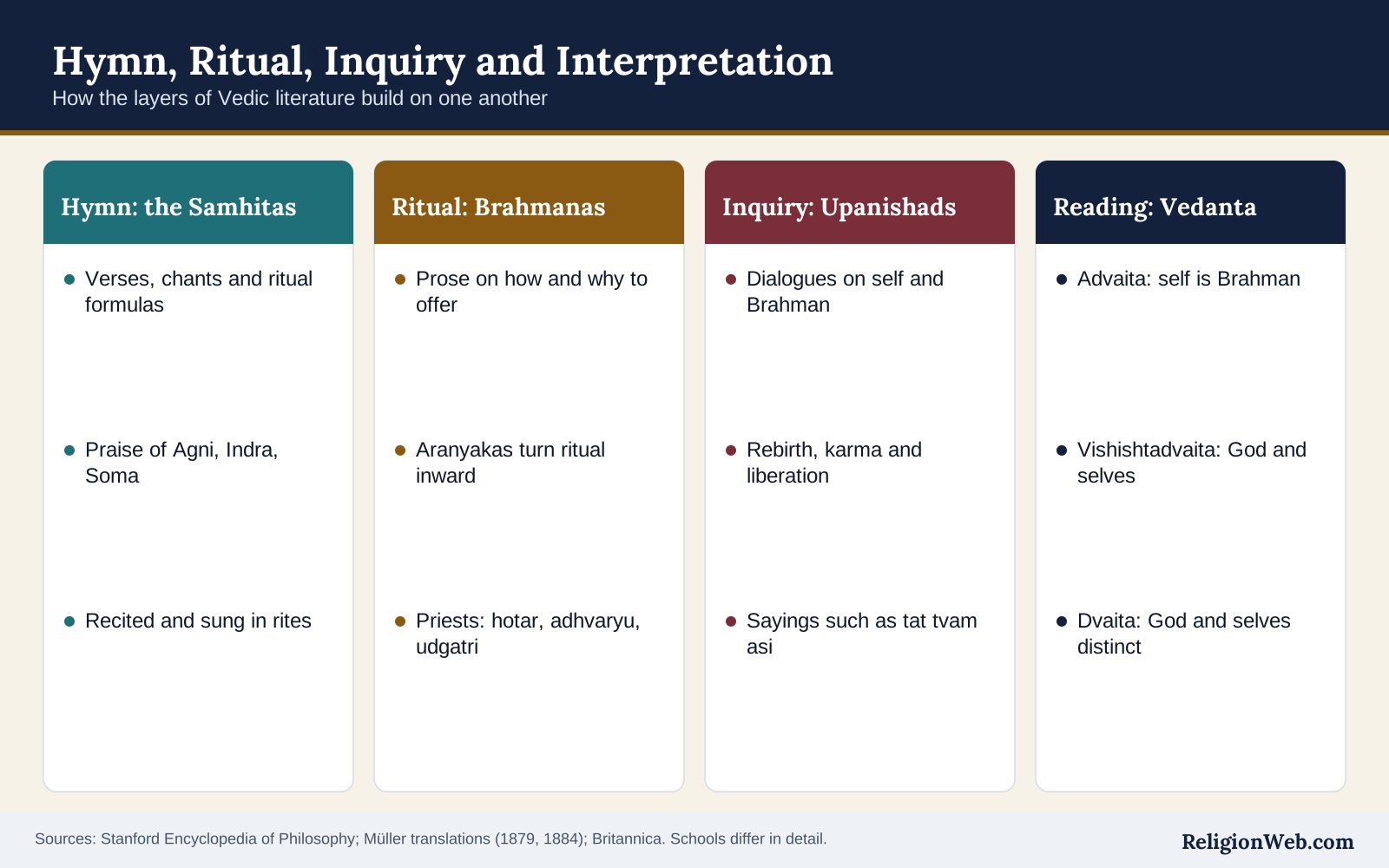
The Vedas and Upanishads in the Modern World
Study, Recitation and Reading
Where Vedic Learning Continues
Vedic learning survives in a number of regions and institutions. UNESCO’s documentation of Vedic chanting names schools in Maharashtra, Kerala, Karnataka and Odisha as the ones at greatest risk, and other centers of recitation exist in Tamil Nadu, Andhra Pradesh, Varanasi and elsewhere. Some training takes place in family households, some in temple-supported schools, and some in modern institutions that combine recitation with general education. The same communities that preserve the recitation also maintain the ritual practices, such as the daily fire offering, for which the texts were composed. Outside India, Vedic recitation is taught in temples and cultural centers in the United Kingdom, the United States and other countries where Pew counts significant Hindu populations, and priests trained in India often serve those communities.
Choosing Translations: A Practical Guide
Readers who want to study the texts in English have a range of options. For the Rigveda, Ralph Griffith’s 1896 verse translation is in the public domain and widely available online, though its style is dated; a more recent scholarly translation by Stephanie Jamison and Joel Brereton (Oxford University Press, 2014) offers a closer rendering with notes. For the Upanishads, Patrick Olivelle’s The Early Upaniṣads (Oxford University Press, 1998) provides a critical Sanskrit text with a modern translation of the oldest group, Max Müller’s two volumes in the Sacred Books of the East (1879 and 1884) are public domain and still widely quoted, and Robert Ernest Hume’s 1921 The Thirteen Principal Upanishads is a compact option. Translations by teachers within a Vedanta tradition generally follow the commentary of that school, which is valuable for understanding the tradition and should be recognized as an interpretation. Whichever edition one chooses, it helps to read the introduction, since the translator’s decisions about terms such as brahman, atman and dharma shape the meaning.
Recordings, Apps and Online Study
Digital tools have made recordings of Vedic chant, searchable texts and online courses easy to find. They give listeners a sense of the sound, but their accuracy varies with the source, and recitation traditions emphasize that learning the accents and pronunciations of a school requires a teacher. Readers who encounter online summaries claiming to give “the” meaning of a verse should remember that classical commentators disagree and that popular summaries often follow just one of them.
Debates and Cautions
Identity, Origins and Politics
Questions about the origin of the Vedic people and their relation to the Indus cities have become entangled with modern politics, in India and abroad. Some nineteenth-century European writers used the Vedas to support racial theories of an “Aryan race,” which most scholars today reject, since “Aryan” in the texts is a term of self-description for a cultural and linguistic group and carries no biological meaning. In India, positions on the question are sometimes tied to ideas about indigenous origins and national identity, and the debate is lively. A responsible reader can separate several issues: the linguistic evidence that Vedic Sanskrit belongs to the Indo-European family, the archaeological record, the genetic studies, and the religious claim, held by many Hindus, that the Veda is eternal and so has no historical point of origin. These are different kinds of question, and each has its own standards of evidence.
Claims About Science and Healing
It is common to read modern claims that the Vedas contain advanced science or technology, or that Vedic rituals can cure illness or purify the environment. The Vedic tradition has a record of real intellectual achievement, including the sophisticated grammar of Pāṇini, the study of astronomy and the calendar in the Vedanga Jyotisha, and a mathematics of ritual altar-building preserved in the Shulba Sutras. These achievements are best understood in their historical context. Claims of a different kind, such as assertions that a specific hymn anticipates a modern theory, tend to rest on selective readings, and claims of healing belong to faith and not to medical evidence. The traditions themselves generally place such matters within ritual and devotion, and people with health concerns are advised to seek qualified medical care alongside any religious practice.
Respecting Restrictions and Living Traditions
Some communities that maintain Vedic recitation or ritual regard certain rites as restricted to initiated practitioners or as requiring a teacher’s permission, and visitors and researchers are expected to follow local norms. Other communities and teachers hold that the Vedas should be openly shared. Readers who simply want to learn about the texts face no such constraint: reading translations, attending public lectures and listening to recitations at open events are all common ways of engaging with the material. The wide range of attitudes is an example of the plurality inside Hindu traditions, and a reference work can reflect it by saying that practice differs from one community to the next.
Common Misconceptions About the Vedas and Upanishads
Misconception 1: The Vedas are one book, like a “Hindu Bible”
Where the misunderstanding comes from
The idea is natural for anyone who has grown up with a single scripture bound in one cover. English-language writing often says “the Veda” in the singular, translators sometimes call it the “Hindu Bible,” and shops sell it in one-volume or boxed sets. The phrase “the Vedas say” also appears in popular speech and online posts as though a single author were speaking. For a reader new to the subject, the simplest picture is a book with chapters, and it is easy to assume that “Vedas and Upanishads” names two volumes of the same set.
A second source of confusion is that the word Veda is itself used in more than one way, as described at the start of this article. In one usage it names a single collection, such as the Rigveda, and in another it names the entire body of attached literature. Hearing both uses without a guide can leave the impression of a fuzzy single entity.
What the evidence and tradition actually show
The Vedas are four collections of different kinds, composed over centuries by different families of poets and priests, each preserved by several schools of reciters. The Rigveda is a body of hymns, the Sama Veda is a set of chants, the Yajur Veda is a ritual handbook of formulas, and the Atharva Veda mixes charms, domestic rites and speculative hymns. Each has attached Brahmanas, Aranyakas and Upanishads, so that the “Veda” in the broad sense is a family of text traditions, not one work. The Hindu tradition does not have a single closed list of books that all schools accept in the way that many Christian churches have a Bible; historically a family or school was bound to its own recension, and the entire Vedic corpus is the sum of what all the schools preserved.
The boundaries are further blurred by the way Hindus speak about other texts. The Chandogya Upanishad (7.1.2) refers to the Itihasa-Purana, the old stories, as a “fifth Veda,” and the Mahabharata describes itself in similar terms. These phrases are honorific and do not make the epics shruti in the strict sense, but they show that the category of Veda has never been a narrow list of titles. UNESCO’s note that only 13 of more than 1,000 recitation branches survive shows how much larger the old Vedic literature was than what remains.
The practical consequence is that a statement such as “the Vedas teach” is almost never precise. A careful sentence names the collection or the text (“a hymn of the Rigveda,” “the Brahmana of the Sama Veda,” “the Chandogya Upanishad”), and it also names the interpreting tradition when the point is about meaning. Hindu teachers themselves usually speak this way, because they learned the texts through a particular school and a particular teacher.
Misconception 2: The Upanishads are separate from Vedic literature in every sense
Where the misunderstanding comes from
The Upanishads sound different from the hymns. A reader moving from a Rigveda hymn to the Brihadaranyaka goes from praise of fire and storm gods to questions such as “what is the self?” and “what happens at death?” The change in tone and subject has led to a familiar story in popular books, in which a “ritual Vedic religion” gives way to a “philosophical Upanishadic religion.” Many modern teachers also present Vedanta as a self-contained philosophy that can be studied without the rest of the Vedic corpus, and the Upanishads are sold and translated separately from the Samhitas.
Differences among Hindu schools add to the impression. The Mimamsa school, which concentrates on ritual, treats the Upanishadic passages in a minor role, while Vedanta reverses the emphasis. A reader encountering one school’s account might infer that the Upanishads stand outside the Veda altogether.
What the evidence and tradition actually show
In the tradition’s own classification the Upanishads are part of shruti and part of each Veda. They are attached to specific schools: the Brihadaranyaka is the end of the Shatapatha Brahmana, the Aitareya belongs to the Aitareya Aranyaka, and the Isha is the last chapter of the White Yajur Veda’s Samhita. The name Vedanta, “end of the Veda,” states the relationship directly. The vocabulary of the sacrifice remains visible in the Upanishads, as in the Brihadaranyaka’s opening meditation on the horse sacrifice, and the Mundaka itself lists the four Vedas as “lower” knowledge within a single scheme of learning.
It is also true that the Upanishads differ from the earlier layers in important ways, and many historians stress those differences: a new interest in rebirth and release, a focus on knowledge more than on ritual performance, and a social setting that includes renouncers and royal courts. So the accurate statement is that the Upanishads are both continuous with the Vedic corpus and distinctive within it. “Separate in every sense” is not supported, though “distinct in genre, concern and later reception” is.
Misconception 3: All Hindu traditions read Brahman, atman and other Vedic philosophical terms in exactly the same way
Where the misunderstanding comes from
English translations often make one reading seem natural. Brahman is rendered “the Absolute,” atman as “the Self,” and the equation of the two is presented as the Hindu doctrine. Popular spirituality adds the slogan that “all is one.” Books on Hinduism for general readers frequently summarize the Upanishads through the Advaita reading, because that reading has been influential in the modern period and in the international presentation of Vedanta, so the result is that a single school’s view stands in for the whole.
Another source of flattening is the vocabulary of other religions. Words such as “God,” “soul” and “salvation” are used to translate Sanskrit terms that do not map neatly onto them, and each choice quietly selects one school’s meaning. Readers who notice a translator’s choice of “Absolute” or “Lord” for the same Sanskrit word are seeing the interpretive disagreement at work.
What the evidence and tradition actually show
Even within Vedanta, the major schools give the key terms different meanings. Advaita holds that the self is Brahman and that the sense of difference arises from ignorance. Vishishtadvaita holds that Brahman is a personal God whose body is the world and the selves, and Dvaita holds that God and the self are eternally distinct. The sentence tat tvam asi and the image of the two birds in the Mundaka are read accordingly, as shown above. The schools also differ about the nature of liberation, whether it is the realization of identity, a participation in God’s life, or loving service in God’s presence.
Outside Vedanta there is further variety. The Nyaya and Vaisheshika schools understand the self as an eternal substance, one among many, distinct from God and from the body. Samkhya speaks of many individual conscious beings (purusha) and does not describe a single Brahman as the world’s source. Devotional communities that do not formally belong to any school of Vedanta often use the terms in the sense given by their own poets and teachers. A careful sentence about Hindu belief therefore names the school, as in “Advaita Vedanta holds that” or “in Ramanuja’s Vishishtadvaita,” and avoids “Hindus believe” unless the point really is shared.
Misconception 4: Hinduism today is simply the religion of the Vedas, and Hindus follow the Vedas as a rulebook
Where the misunderstanding comes from
Hindu traditions regard the Veda as the highest authority, and many Hindus describe their religion as Sanatana Dharma, the “eternal law,” so it is easy to conclude that the Vedic texts are read and applied directly. Older Western scholarship sometimes encouraged the idea by treating the Vedas as the origin of everything in Hinduism, and by calling the religion of the hymns “Vedism” or “Brahmanism” as though it were the same thing under another name. Some modern movements also call for a “return to the Vedas,” which may suggest that the Vedas are the current basis of ordinary practice.
What the evidence and tradition actually show
Historians see substantial change between the Vedic period and present-day Hindu practice. The principal deities of the Rigveda, such as Indra, Agni and Varuna, are not the center of most contemporary worship, which is directed to Vishnu and his avatars, Shiva, the Goddess and other deities, in forms described mainly in the epics, Puranas and Agamas. Image worship in temples, pilgrimage and devotional singing are largely not Vedic in origin, and the daily household ritual described in the article on puja is a mixture of elements. Most Hindus have never read the Samhitas, and for many the practical guides to life are the epics, local custom, family teaching and the words of living teachers.
At the same time, the Vedic inheritance has not disappeared. Vedic verses are recited at weddings, funerals and many temple rites, the Gayatri mantra remains a daily prayer for those who keep the sandhya rite, and the Upanishads provide the foundation of Vedanta philosophy. The accurate picture is that the Veda is a source of authority, sacred sound and philosophical ideas within a much larger and evolving set of traditions, and that Hinduism is better described as a continuing and changing family of traditions than as the religion of the Vedas unchanged.
Frequently Asked Questions About the Vedas and Upanishads
Questions About the Texts
How many Vedas and Upanishads are there?
There are four Vedas: the Rigveda, Sama Veda, Yajur Veda (in Black and White versions) and Atharva Veda. The number of Upanishads depends on the list. Ten are usually called principal because Shankara commented on them, thirteen appear in Hume’s well-known translation, and the traditional Muktika list names 108. More than two hundred texts have carried the title over the centuries, many of them composed long after the early Upanishads.
The numbers should not be taken as a fixed canon. Because each Veda was handed down in several schools, each with its own recension, the total body of Vedic literature is better described as a set of related traditions than as a count of books.
Which Veda is the oldest?
The Rigveda is regarded as the oldest, and Britannica gives about 1500 BCE as its approximate date of composition. The Sama Veda draws most of its verses from the Rigveda, and the Yajur Veda and Atharva Veda were collected later, though each includes material that may be older than its final form. Within the Rigveda itself, scholars generally treat the middle books, 2 through 7, as the earliest core.
Who wrote the Vedas, and when?
There are two kinds of answer. In the tradition, especially in Mimamsa theology, the Veda has no author and was “seen” by the ancient rishis, and the hymns name poets and families such as Vasishtha and Vishvamitra in connection with specific books. University historians treat the texts as human compositions and place the earliest hymns in the second millennium BCE, while noting that no date can be given with certainty. Neither answer is needed to understand the other, and both are widely present in discussions of the subject.
Questions About Meaning
What is the difference between the Vedas and the Upanishads?
The Upanishads are the last layer of the Vedic literature, and so they are part of the Vedas in the broad sense. The earlier layers, the Samhitas and the Brahmanas, are concerned mainly with hymns, chant and ritual. The Upanishads concentrate on the nature of the self, Brahman, rebirth and liberation. In the narrow sense of the word, the four Vedas means the four Samhitas, and in that sense the Upanishads are attached to them but are not among them.
What does Brahman mean, and is it God?
The answer depends on the school. In Advaita Vedanta, Brahman is the one ultimate reality, without qualities and identical with the self. In Vishishtadvaita and Dvaita, Brahman is a personal God, identified with Vishnu or Narayana, and in Shaiva readings of the Shvetashvatara Upanishad the supreme Lord is Rudra. The word should not be confused with Brahma, the creator deity of later tradition, or with brahmin, a member of the priestly class.
How do the Vedas relate to the Bhagavad Gita?
The Bhagavad Gita is classed as smriti, “remembered” literature, because it is part of the Mahabharata, but Vedanta schools treat it as one of the three foundational texts alongside the Upanishads and the Brahma Sutra. It draws on Upanishadic ideas, and a verse traditionally recited before the Gita compares the Upanishads to cows and the Gita to their milk. The Gita also refers to the Vedas directly, at times with respect and at times pointing beyond Vedic ritual, and its treatment is discussed in the article on the Bhagavad Gita.
Questions About Reading and Practice
Can anyone read or recite the Vedas?
Anyone can read translations, which are widely published. Recitation is more complex. Traditionally, formal Vedic study and ritual recitation were restricted by the Dharmashastra to initiated men of the twice-born groups, and in practice mostly to Brahmins. Reform movements such as the Arya Samaj have rejected those restrictions, and today many teachers admit women and students from varied backgrounds, while some traditional schools keep to older norms. Practice therefore differs from one community and institution to another.
Which Upanishad should a beginner read first?
Many teachers suggest starting with a short text such as the Isha, Kena or Katha, and then moving to the Mandukya and to selected chapters of the Chandogya (for example chapter 6) and the Brihadaranyaka (the dialogues of Yajnavalkya). An edition with a clear introduction is more useful than a bare translation, and it helps to remember that a commentary by one school presents that school’s reading. The earlier sections of this article list some of the standard editions.
Are Vedic rituals still performed today?
Yes, in several forms. Households in the shrauta tradition maintain the daily fire offering. Weddings, initiation ceremonies and funerals in many communities include Vedic verses, and temple worship often incorporates Vedic hymns such as the Purusha Sukta and the Shri Rudram. Large soma rites are performed only occasionally, mostly in parts of South India, and they require specialist priests and community support. How much of a ceremony is Vedic and how much is regional or Puranic custom varies by family and place.
Conclusion: What the Vedas and Upanishads Show
What the History Shows
A Layered Literature, Not a Single Book
The Vedas and Upanishads are best understood as a layered literature that grew over a thousand years or more, from the clan hymns of the Rigveda to the ritual science of the Brahmanas and the inward turn of the Upanishads. Each layer kept something of the one before it: the sacrificial fire, the importance of the spoken word, the habit of finding connections between small things and large ones. The same layers explain why Hindu traditions can differ so much in how they read the texts, since there is a hymn tradition, a ritual tradition and a philosophical tradition, and each has its own interpreters.
A Living Oral Tradition
The texts were not only composed and collected but also performed, memorized and handed down in lineages of teachers and students. The recitation methods that kept the wording and accent of each school’s text intact, from word-by-word recitation to the braided forms, are a distinctive cultural achievement, and the fact that only a few recitation branches survive is why UNESCO recognized the tradition in 2008. The Vedas live today in weddings and temples, in the schools that still teach them, and in the study of the Upanishads by people who may never recite a verse.
How to Keep Exploring
Next Steps in Reading
Readers who wish to go further can choose among several paths. One is to read a short Upanishad with a good introduction and compare translations. Another is to read selected Rigvedic hymns, such as the opening hymn to Agni and the creation hymn, with a scholarly commentary. A third is to study how one Vedanta school reads the same passages, which shows how interpretation works in practice. In every case it helps to keep the distinctions made in this article in mind: Veda and Upanishad, ritual and philosophy, tradition and history, and school and school.
Related Topics on ReligionWeb.com
The wider setting is described in the overview of Hinduism. The ideas that developed from the Upanishads are explored in the articles on karma, dharma and yoga, while the dialogue between Krishna and Arjuna is the subject of the article on the Bhagavad Gita. The daily worship in which Vedic verses are used is described in the article on puja, and the devotional traditions that read the Upanishads in their own ways are the subject of the articles on Vaishnavism and Shaivism.
Sources
The table below lists the principal external sources behind this article. Facts, dates and figures were checked against these and related primary, institutional and academic materials.
| # | Source | Publisher and type | Used for | Link |
|---|---|---|---|---|
| 1 | The Rig Veda, trans. Ralph T. H. Griffith (1896): Book 1 Hymn 1 and Book 3 Hymn 62 | Internet Sacred Text Archive · Primary text (public-domain translation) | Quotation of Rigveda 1.1.1; wording of the Gayatri verse 3.62.10 (Griffith) | sacred-texts.com |
| 2 | The Upanishads, Part I (Sacred Books of the East, vol. 1), trans. F. Max Müller (1879) | Internet Sacred Text Archive · Primary text (public-domain translation) | Quotation of Chandogya Upanishad 3.14.3 (page sbe01072); Chandogya structure | sacred-texts.com |
| 3 | The Upanishads, Part II (Sacred Books of the East, vol. 15), trans. F. Max Müller (1884) | Internet Sacred Text Archive · Primary text (public-domain translation) | Quotations of Mundaka 1.1.5 and 3.1.1, Brihadaranyaka I.2.27 and I.4.10 | sacred-texts.com |
| 4 | Tradition of Vedic chanting (Representative List of the Intangible Cultural Heritage, 2008) | UNESCO · Institutional | 13 of 1,000+ recitation branches survive; four schools at risk; 2008 inscription | ich.unesco.org |
| 5 | Rigveda (Hindu text) | Encyclopaedia Britannica · Encyclopedia | 1,028 hymns in ten books; about 1500 BCE; written down about 300 BCE; Punjab | britannica.com |
| 6 | Upanishads (Hindu texts), by Patrick Olivelle | Encyclopaedia Britannica · Encyclopedia | Gloss of upanishad as 'connection'; place of the Upanishads within the Vedas | britannica.com |
| 7 | How the Global Religious Landscape Changed From 2010 to 2020 (Hindu population change) | Pew Research Center (2025) · Demographic data | About 1.2 billion Hindus in 2020; about 95% in India; US, UK and UAE figures | pewresearch.org |
| 8 | Śaṅkara | Stanford Encyclopedia of Philosophy · Academic reference | Shankara's dates, ten commentated Upanishads, prasthanatrayi, Advaita reading of Brahman and atman | plato.stanford.edu |
| 9 | The Early Upaniṣads: Annotated Text and Translation, Patrick Olivelle (1998) | Oxford University Press · Academic reference | Existence and date of the standard critical edition of the early Upanishads | academic.oup.com |
| 10 | Algorithms in Ancient India: Vedas (slides), Amba Kulkarni, 6 February 2018 | Department of Sanskrit Studies, University of Hyderabad · Academic reference | Pada, krama, jata and ghana recitation patterns used in the Fun Fact and oral-transmission table | sanskrit.uohyd.ac.in |
Last fact-check date: 2026-10-21.