
A torii gate is the free-standing gateway that marks the entrance to a Shinto shrine, or jinja, and signals that the ground beyond it is set apart as sacred. In its basic form it is strikingly simple: two upright pillars joined near the top by a horizontal lintel, often with a second beam below. It has no door, no wall, and no roof, so a visitor can see straight through it to the path and the trees on the other side. That openness is part of its meaning. The torii does not shut anything out. It names a threshold, and people cross it on purpose.
For many readers the picture that comes to mind is a bright vermilion gate standing in water or repeating in long tunnels up a wooded hill. Those images are real and justly famous, but they show only one family of torii. Across Japan the gates are also made of plain unpainted wood, bark-covered logs, granite, copper-sheathed timber, steel, and reinforced concrete. Some are only a few feet tall and mark a neighborhood shrine beside a rice field. Others rise more than thirty meters. What they share is not color or size but a job: they stand at the edge of a place where, in the understanding of Shinto, kami are honored and where visitors are asked to behave differently.
This article explains the torii on its own terms and in historical context. It covers what the gate is and how its parts are named, what scholars do and do not know about where it came from, how the main styles differ, why color and material vary, and how the gate fits into the larger arrangement of a shrine precinct, from the approach path to the purification basin and the prayer hall. It also describes what visitors do at the gate today, looks at several well-known examples, sets out the meanings that shrines and reference works give the torii, and corrects some common misunderstandings. Where the evidence is thin, such as the origin of the form and the source of its name, the article says so plainly.
Readers who want the wider picture of Shinto belief and history can begin with the hub article on what Shinto is. The torii is best understood alongside the kami it introduces, which is the subject of the companion article on kami in Shinto, and alongside the practice of washing before worship, which is covered in the article on purification in Shinto. This page concentrates on the gate itself.
The Torii at a Glance: Definition, Name, and Meaning
What a Torii Is
A gate that marks sacred ground
The Encyclopedia of Shinto, published by Kokugakuin University, defines the torii as “a formalized gateway arch signifying entrance to a sacred area.” The Association of Shinto Shrines, known in Japanese as Jinja Honcho, makes the same point in plainer language: the torii marks the border between the sacred space of the jinja and the everyday world outside. Both descriptions treat the gate as a boundary marker rather than as a barrier. Nothing about its construction prevents a person from stepping around it. Its force lies in what it declares and in the custom of walking through it with attention.
The Association of Shinto Shrines goes further and says that the presence of a torii is a clear indication of a jinja. That statement explains why the gate has become the standard visual shorthand for Shinto in Japan and abroad. A visitor who sees one can usually infer that a shrine is near, and that the precinct beyond it is meant to be entered with some care. The inference is a good rule of thumb rather than an absolute law, since torii also appear in a few settings that this article returns to, including the grounds of Buddhist temples that contain a small shrine.
What a torii is not: a door, a wall, or a building
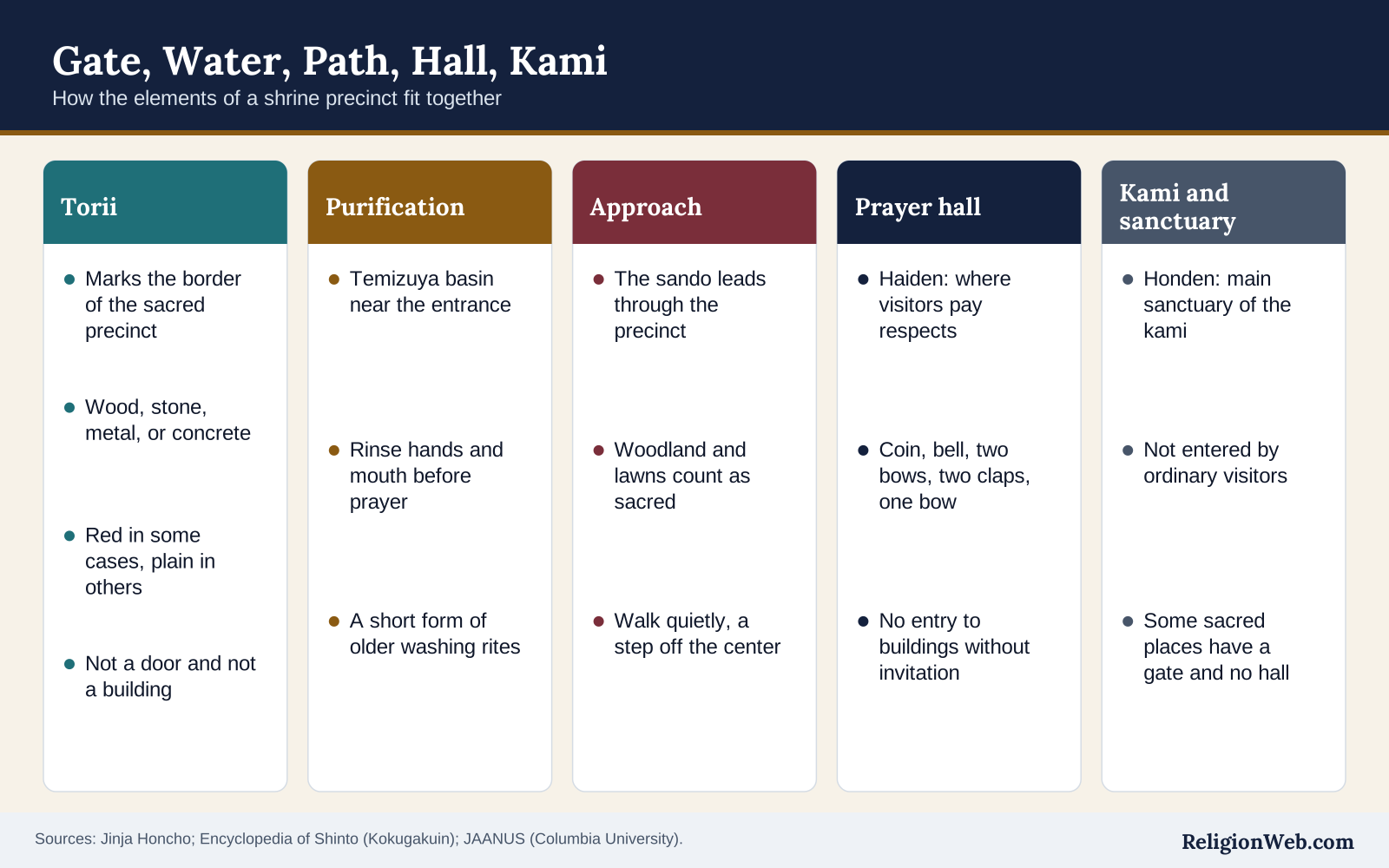
It helps to be exact about what the structure is not. A torii is not a doorway to a room, because there is no interior behind it. It is not a defensive gate, because it has no leaves to close. It is not a shrine building, and passing through it does not mean entering the place where a kami is enshrined. In a typical large shrine the visitor goes through at least one torii, walks a path, rinses at a basin, and only then reaches the hall of worship, behind which the main sanctuary stands. The gate belongs to the outermost layer of that sequence. Later sections show how several torii can be arranged along a single approach, each one marking a further step toward the center.
The Word Torii and Its Possible Origins
Two proposed explanations of the name
The written word for the gate uses two Chinese characters that mean “bird” and “to dwell” or “to perch.” A Japanese reference work on architecture, the Japanese Architecture and Art Net Users System (JAANUS) hosted by Columbia University, accordingly notes that the word is literally rendered as “bird perch.” It also records an earlier name, uefukazu no mikado, which it glosses as “a roofless gate.” The Encyclopedia of Shinto reports that no single account of the word’s origin has been accepted. One proposal connects it with a perch for birds, expressed in a form such as tori-iyasu or tori-ita. Another connects it with the sense of “pass through and enter,” tori-iru.
These are scholarly hypotheses about language, not settled history, and the two do not exclude each other as folk understandings. Many guidebooks repeat the bird-perch reading as though it were established, often tying it to an ancient narrative in which birds are made to sing before the sun kami emerges from a cave. That story is real and is discussed later in the article, but the connection between it and the name of the gate is a popular explanation. The reference works treat it as one proposal among several.
Why the origin of the form remains open
The question of where the form itself came from is open too. According to the Encyclopedia of Shinto, scholars disagree about whether the torii is native to Japan or was introduced from the continent, and no general theory has won acceptance. JAANUS lists the main candidates: a link to the carved gateways of the Great Stupa at Sanchi in India, a link to the Chinese memorial archway called a bairo or to a Korean gate called kosenmon, and a gradual development inside Japan from rope-marked sacred ground. Each of those positions is taken up in the history section below. For now the useful point is that the gate’s character as a boundary marker is much better documented than its ancestry.
Torii in the Wider Landscape of Japanese Religion
Torii and the jinja
Most torii stand at shrines. The Encyclopedia of Shinto describes the largest gate at a shrine’s approach as the ichi no torii, the “first torii,” and notes that smaller torii inside the grounds mark rising degrees of sanctity toward the main sanctuary, called the honden. At a large precinct the visitor may pass under several. At a tiny roadside shrine there may be a single gate of a few timbers. The gate is therefore a repeated, scalable unit, and the same basic form can announce a village shrine or a national one.
The style of a torii may also depend on the kami to whom the shrine is dedicated. The Encyclopedia of Shinto observes that the form chosen is often tied to the character of the enshrined deity, which is one reason that different shrines carry gates with different profiles. This article treats the major styles in its fourth section.
A symbol that travels well
Because the gate is so recognizable, it has become a symbol in its own right. The Encyclopedia of Shinto notes that on maps a torii generally indicates a Shinto shrine, and Jinja Honcho describes the torii as a symbol of shrines throughout Japan. That shorthand is useful, but it can flatten the gate into a logo. Behind the symbol lies a working structure with a long history, a vocabulary of parts, regional variants, and a set of customs for passing through it. The sections that follow begin with the structure, because the names of its parts are the key to reading almost everything written about torii.
Anatomy of a Torii: Parts, Terms, and Proportions
The Basic Structure
Pillars and the upper lintel
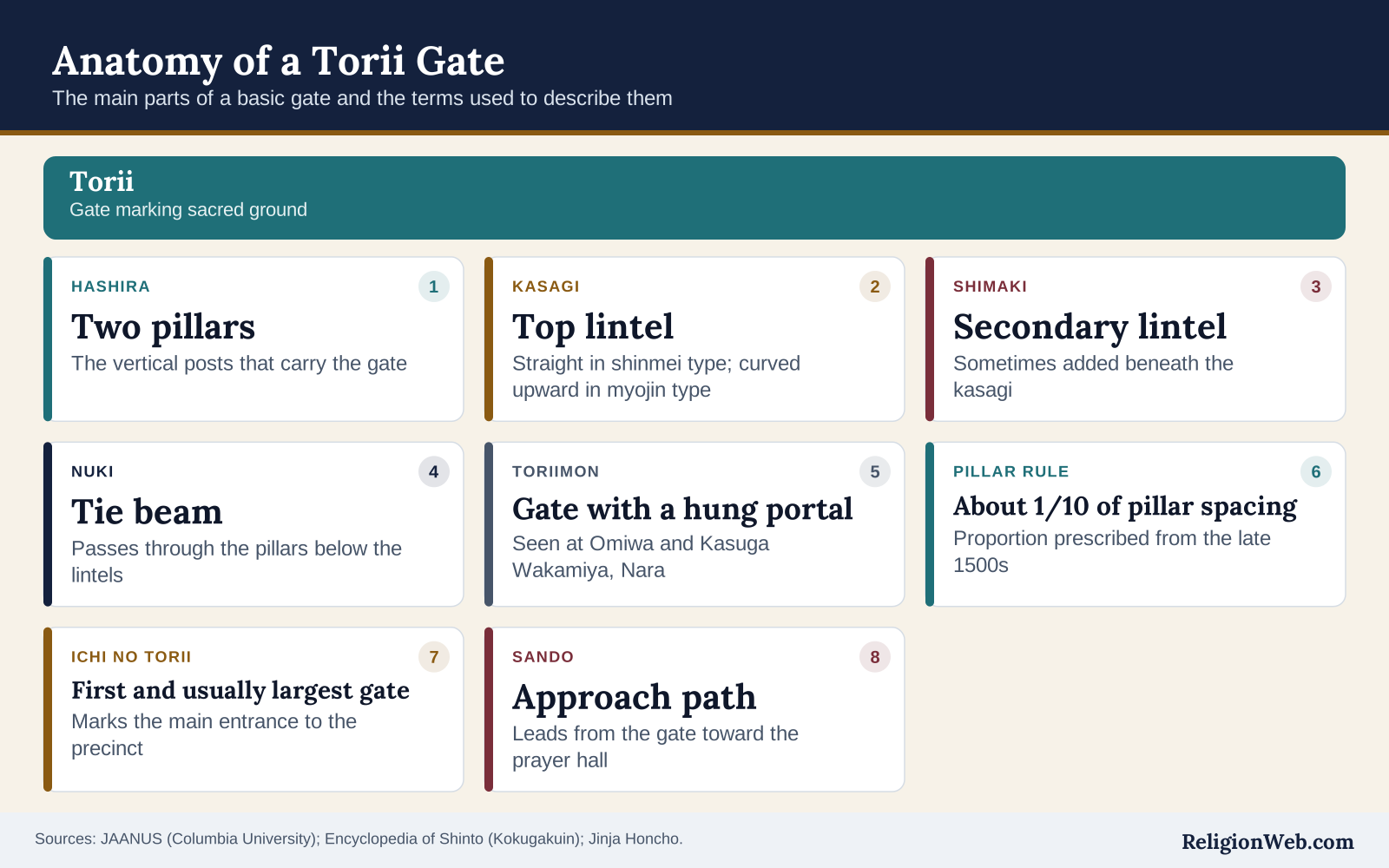
Every torii begins with two vertical posts, the hashira, and a top beam laid across them, the kasagi. JAANUS defines the torii as a gate-like structure of two pillars joined by a top lintel, and the Association of Shinto Shrines describes the same arrangement, adding that the upper lintel extends past the pillars on either side. In the simplest gates the pillars are plain round posts of equal diameter from top to bottom. In some styles the pillars lean inward slightly, while in the simplest ones they stand upright. The kasagi is the feature that most sharply distinguishes one style from another, because it is either straight or curved upward at the ends.
The pillars carry the gate’s visual weight and, in the large wooden examples, are cut from single trees. That detail matters in later sections, because the supply of trees large enough for the biggest gates has shaped where and when such gates could be built. The lintel, by contrast, is where much of the decoration and nearly all of the stylistic variety is found.
The tie beam and the secondary lintel
Below the kasagi runs a horizontal tie beam called the nuki, which passes through the pillars and ties them together. JAANUS notes that the tie beam is placed roughly one pillar diameter away from the lintel in standard proportions, though its spacing varied widely before the seventeenth century. Many gates also have a shimaki, a secondary lintel attached beneath the kasagi for reinforcement. Together these members form the characteristic profile: a heavy top, a second line below it, and two pillars that frame an empty rectangle of sky and path.
The Association of Shinto Shrines describes the basic type as having two vertical pillars and two horizontal lintels, which fits the simplest form that has only the kasagi and the nuki. When a shimaki is added, the gate gains a third horizontal line near the top, which is common on the curved-lintel styles discussed in the fourth section.
Terms Worth Knowing
A working vocabulary
Writing about torii uses a small set of Japanese terms, most of which describe structural members. Learning them makes descriptions of famous gates much easier to follow. The table below gathers the principal terms and what each one names. Where JAANUS notes that a term is used in a particular way, the table follows that usage.
| Term | Meaning | Where it sits | Why it matters |
|---|---|---|---|
| Hashira | The two pillars | Vertical supports at left and right | Carry the structure; large gates use single trees or stone |
| Kasagi | The top lintel | Uppermost horizontal beam | Straight or curved, and the main marker of style |
| Shimaki | A secondary lintel | Attached beneath the kasagi | Reinforces the top beam and adds a second line |
| Nuki | The tie beam | Passes through the pillars below the lintels | Binds the pillars; its spacing varied before the 1600s |
| Toriimon | A torii with a portal hung between the pillars | Gateway with a hung door or screen | Seen at certain Nara shrines, which shows the form can be adapted |
| Ichi no torii | The first and usually largest torii | Outer end of the approach | Marks the main entrance to the precinct |
Cut marks and construction terms
JAANUS also records a few terms that belong to the carpenter’s craft. The slanted cut marks at the ends of the lintels are called tasukizumi, and the line used to locate them is called nagarezumi. These are details of layout rather than religious vocabulary, but they show that the torii is a designed object with an established method of construction, and not an informal arrangement of poles.
The same reference work notes that some gates are variants of the basic form. A toriimon has a portal hung between the pillars, as at the Omiwa shrine and at the Wakamiya of the Kasuga shrine, both in Nara. These cases are useful reminders that the word torii covers a family of structures, not one fixed design.
Proportions and Standardization
Variation before the premodern period
It is tempting to imagine a single ancient blueprint, but the evidence does not support one. JAANUS states that proportions varied greatly before the premodern period. Surviving gates and old drawings show differences in how high the lintel sat, how far the tie beam stood from the top, and how thick the pillars were compared with the span between them. Each shrine, and often each carpenter, made its own choices. That variation is one reason that dating an undated gate on stylistic grounds is difficult and that scholars rely so heavily on documentary records.
Rules set from the late sixteenth century
From the end of the sixteenth century, general dimensions began to be prescribed. JAANUS gives the rule that the pillar diameter should be about one-tenth of the distance between the centers of the two pillars. A carpenter’s manual of 1608 called the Shomei describes a method for fixing the height and the projection of the tie beam using squares and inscribed circles, and it gives a projection of one-third of the beam’s length. The practical effect was to bring gates built in different regions closer to a recognizable shared proportion. This helps explain why so many torii, whatever their size, look as though they belong to the same family. A small gate at a village shrine and a great gate at a famous one can share ratios that were set down centuries ago.
Origins and Historical Development of the Torii
Before the Written Record
From marked ground to a gate
One scholarly reconstruction, summarized by JAANUS, suggests that the torii developed within Japan from the ways in which sacred ground was marked. The sequence it outlines begins with four corner posts joined by rope to mark out a sacred area. A later stage uses two taller posts with a rope strung between them to form an entrance. In the next stage a wooden lintel replaces the rope and a tie beam is added for strength, producing the simplest gate, the shinmei style. The corner posts, in turn, become supports for fences. The reference work cites the rope-linked pillars in front of the worship hall at the Omiwa shrine as a surviving example of the rope stage.
This account has the merit of connecting the torii to a well-documented Shinto practice, the use of ropes and other markers to set off sacred objects and places. It remains a reconstruction, since the early stages left no securely dated physical remains. It is best read as a plausible line of development that fits what is known about the markers used at shrines, not as a documented chain of events.
Imported or native: the scholarly disagreement
Other scholars look abroad. JAANUS lists three proposals of this kind. Some link the torii to the carved gateways, called torana, of the Great Stupa at Sanchi in India. Others connect it to the Chinese bairo, a ceremonial archway, or to the Korean kosenmon. A related Chinese term, kahyo, is sometimes translated as torii, but a work of 1775 called the Shokahitsuyoki says it differs from the Japanese form. The Encyclopedia of Shinto states the result bluntly: scholars are divided on whether the torii is indigenous or imported, and no general theory has been accepted. For a reader, the honest summary is that the origin is unknown, and that confident one-line statements about it, in either direction, go beyond the evidence.
Heian to Edo: From Record to Convention
The earliest reliable record
The first written evidence that can be trusted comes later than many people assume. JAANUS notes that a text of 1320 called the Ruiju jingi hongen is often cited for the use of torii by the late eighth century, but it considers the work’s reliability questionable because it mentions a worship hall, a haiden, that did not exist until the tenth century. The record it treats as accurate is an inventory of the Otori shrine in Izumi province dated 922, which mentions torii. From that document JAANUS concludes that torii were common by the middle of the Heian period.
The conclusion is modest but important. It means the gate was a familiar part of shrine architecture by the tenth century, and it leaves the earlier centuries unlit. Claims that a particular torii is “two thousand years old” should be read as devotional or promotional language. The documentary and physical evidence points to a long convention, not a prehistoric one.
Surviving gates from the medieval period
Physical survivals are sparse. JAANUS reports that the oldest surviving stone torii is at Hachiman Jinja in Yamagata and dates to about the middle of the twelfth century. The oldest surviving wooden example is a ryobu-style gate at Kubohachiman Jinja in Yamanashi, dated 1535. Copper sheeting over a wooden core was used occasionally, and the oldest surviving example, a myojin-style gate at Kinpusenji in Nara, dates to 1455 to 1457. Kinpusenji is a Buddhist temple in the Yoshino mountains, a reminder that torii belonged to the shared religious landscape of the period and not only to institutions that identified as Shinto.
Wood decays, and wooden gates were rebuilt many times, which explains why the oldest wooden example is so much younger than the written record. The stone and copper survivals tell a different story, about the search for more durable materials.
Standardization in the early modern period
By the late sixteenth century and into the Edo period (1603 to 1868), the proportions described in the previous section became customary, and manuals such as the Shomei of 1608 passed them on. The result was a more uniform sense of how a torii should look, even as regional and local variants continued.
Modern Developments
The separation of kami and buddhas
For roughly a thousand years, kami and buddhas were often honored together on shared grounds, a combined practice that Japanese scholars call shinbutsu shugo. In 1868 the new Meiji government issued orders to separate the two, as described in the Encyclopedia of Shinto and discussed in the hub article on Shinto. The orders changed the appearance of many sites, because shrines and temples that had shared a compound were reorganized as distinct institutions. JAANUS notes that torii still mark the entrances of shrines that stand inside Buddhist temple grounds, and that the gate helps distinguish a Shinto shrine from a Buddhist temple. The torii thus became, in many places, a visual sign of the distinction that the 1868 orders had made administrative.
This history is part of why modern visitors are often told that a torii shows where a shrine begins and a temple ends. That is a fair description of present arrangements. It should not be read backward as a rule for earlier centuries, when the boundary was less sharp and a temple of the Buddhist tradition could keep a gate of its own, as the examples at Kinpusenji and Shitennoji show.
Concrete, steel, and replacement
Modern materials have added new chapters. JAANUS notes that many originally wooden gates have since been replaced with stone or reinforced concrete. The Encyclopedia of Shinto adds that no particular restriction is imposed on materials, and that metal, concrete, plastic, and other substances may be used depending on scale and purpose. At the large end, a steel gate completed in 2000 at the old site of Kumano Hongu Taisha stands 33.9 meters tall. At the traditional end, Meiji Jingu in Tokyo replaced its original cypress gate in 1975 with one made from a single large tree imported from Taiwan, after lightning destroyed the first in 1966. These cases appear again in the section on famous torii.
| Date | Landmark | Source type | What it shows |
|---|---|---|---|
| 922 | Inventory of the Otori shrine mentions torii | Document judged accurate by JAANUS | Torii were established by the mid-Heian period |
| Mid-12th century | Stone torii at Hachiman Jinja, Yamagata (oldest surviving stone gate) | JAANUS | Stone was adopted for durability |
| 1455 to 1457 | Copper-sheathed gate at Kinpusenji, Nara (oldest surviving of its kind) | JAANUS | Metal covering protected a wooden core |
| 1535 | Ryobu torii at Kubohachiman Jinja, Yamanashi (oldest surviving wooden gate) | JAANUS | Wooden gates seldom survive for long |
| 1608 | Carpenter’s manual Shomei sets out proportions | JAANUS | Dimensions standardized |
| 1875 | Present great gate at Itsukushima built | Government of Japan | Large wooden gates are rebuilt in cycles |
| 1975 | Present great gate at Meiji Jingu completed | Japan Tourism Agency database | Giant timber was imported when none was found at home |
| 2000 | Steel gate completed at Kumano Hongu Taisha’s old site | Tourism bureau | Modern engineering allowed new scales |
Major Torii Styles: Shinmei, Myojin, and Their Variants
Two Families: Straight and Curved Members
Gates with straight lintels
JAANUS sorts the many named types into two groups according to whether their principal members are straight or curved. The straight group includes the shinmei torii, which it calls the simplest form, along with the Ise, Kasuga, Hachiman, Kashima, and kuroki types. The Association of Shinto Shrines describes the shinmei torii in similar terms: a gate with a straight top lintel, left unpainted. The Encyclopedia of Shinto shows a shinmei gate at the inner shrine of Ise Jingu, which is a fitting example, since Ise is the most famous setting for the plain, unpainted architectural idiom of Shinto.
The straight-lintel gates give an impression of restraint. The members are often round in section, the lines are horizontal and vertical, and nothing is added for display. This does not make them less significant. The Association of Shinto Shrines names the shinmei and the myojin as the two types it describes, which makes the shinmei one of the two reference points for understanding the rest.
Gates with curved lintels
The curved group includes the myojin torii and its relatives: the Inari, Sanno, Miwa, Ryobu, and Mihashira types. The Association of Shinto Shrines describes the myojin torii as the type whose upper lintel curves upward at the ends. This is the silhouette that most people picture when they think of a torii, and it is the form of many of the famous vermilion gates. The upward sweep gives the gate a lighter look and makes the top beam a distinct decorative element. In some examples a secondary lintel sits beneath the curved beam, and the upper lintel projects past the pillars.
JAANUS adds that the names of the types are applied loosely and that the words shinmei and myojin also refer, in other contexts, to specific styles. The result is that a reader will sometimes meet slightly different uses of the labels in different books, a point taken up at the end of this section.
Distinctive Variants
Sanno and Ryobu gates
Two types are tied to particular religious histories. The Encyclopedia of Shinto illustrates the Sanno torii with the entrance to Hie Jinja and the Ryobu torii with a gate at Shirahige Jinja in Shiga Prefecture. The entries cited for this article do not spell out how the two forms are built, but standard architectural descriptions hold that the Sanno gate carries a small gabled form above its lintels and that the Ryobu gate has supporting posts at the sides of the main pillars. The oldest surviving wooden torii, at Kubohachiman Jinja in Yamanashi, is a ryobu type, dated 1535.
The word ryobu means “two parts” and is generally associated with a medieval system, Ryobu Shinto, in which Shinto and Shingon Buddhist thought were combined and the Two Realms mandalas of Shingon provided the framework. That derivation comes from general knowledge of the period and not from the sources cited here. The mandalas themselves are described in the article on the Buddhist mandala. If the derivation is right, the gate’s name preserves a trace of the shared history of kami and buddhas, even though the form is now found at many shrines.
Miwa, Mihashira, and shrine-specific types
JAANUS also lists the Miwa torii and the Mihashira torii among the curved-member types. The first is named for the Omiwa shrine in Nara, and the second for its three pillars. Separately, JAANUS records a toriimon, a variant with a portal hung between the pillars, at Omiwa and at the Wakamiya of Kasuga Taisha. A third group of types is named for individual shrines: the stone torii of Shitennoji, the Usa torii, and the Hakozaki torii, all of which JAANUS describes as myojin-type gates with notable special features. The Shitennoji example is notable for another reason: the Encyclopedia of Shinto cites its stone gate in Osaka as a case of a torii standing at a Buddhist temple.
Taken together, these variants show how local the tradition can be. A shrine with a long history and a distinctive deity may keep a form of gate found nowhere else, and that form becomes part of the shrine’s identity.
Names Are Applied Loosely
Why classifications overlap
A newcomer who tries to assign every gate to a single category will quickly run into overlap. A gate may have a curved lintel like a myojin type and the supports of a ryobu type, or a straight lintel and a slight inward lean like a Kasuga type. JAANUS says plainly that the type names are loosely applied. This is not a defect of the scholarship so much as a reflection of how the gates were built: by local carpenters, for particular shrines, over many centuries, with no central authority imposing a catalog.
Style and the enshrined kami
The Encyclopedia of Shinto observes that the style of a torii depends in part on the character of the central deity, the saijin, enshrined at the site. In practice the link is often historical or regional rather than strict. JAANUS lists Inari and Ise types by name, which reflects an association between certain shrine families and certain forms, and Inari shrines are linked in popular memory with vermilion paint. The pattern is a tendency, not a rule, and the best guide to any single gate is the history of its own shrine.
| Style | Key features | Typical color or finish | Example cited in reference works |
|---|---|---|---|
| Shinmei | Straight top lintel; simplest form | Unpainted wood | Naiku (inner shrine) of Ise Jingu |
| Myojin | Top lintel curves upward at the ends | Often vermilion; also unpainted or stone | Kinpusenji, Nara (copper-sheathed, 1455 to 1457) |
| Ryobu | Curved-member type; standard descriptions mention supporting posts at the sides | Varies | Shirahige Jinja, Shiga; Kubohachiman Jinja, Yamanashi (1535) |
| Sanno | Curved-member type; standard descriptions mention a gabled form above the lintels | Varies | Entrance of Hie Jinja |
| Kuroki | Straight, shinmei-type gate of unstripped, bark-covered logs | Natural dark bark | Nonomiya Jinja, Kyoto |
| Toriimon | Gate with a portal hung between the pillars | Varies | Omiwa Jinja and the Wakamiya of Kasuga Taisha, Nara |
| Shrine-specific types | Myojin-type gates with unique features | Varies | Shitennoji stone gate; Usa; Hakozaki |
Colors and Materials: Why Not Every Torii Is Red
Materials: Wood, Stone, Metal, and Concrete
Wood and its limits
The Association of Shinto Shrines says that torii are generally made of wood or stone, and JAANUS adds that wood remains common for small gates. Wood is the traditional material of Shinto architecture, and wooden structures are built, weather, and are replaced; the rebuilding cycle at Ise is the best-known example. The most extreme case is the kuroki torii, made of logs with the bark still on. JAANUS notes that the best-known example, at Nonomiya Jinja in Kyoto, had to be replaced about every three years because the unstripped wood did not last, and that the gate there was recently rebuilt with synthetic material that imitates tree bark. The case is a small lesson in how a tradition handles a practical problem: the look of the original is kept, and the material is changed.
Stone, copper, steel, and concrete
Stone has been used for torii for a very long time. JAANUS describes it as valued for durability and widely used until recently, and its oldest surviving stone gate dates to about the middle of the twelfth century. Copper sheeting over a wooden core was occasionally used. In the modern period, reinforced concrete and steel have been added. JAANUS notes that many gates that were originally wooden have been replaced with stone or reinforced concrete, and the Encyclopedia of Shinto adds that the choice depends on scale and purpose, with no restriction imposed. A visitor who finds a gray stone gate or a concrete one at a shrine has therefore not found an anomaly. They have found one of the ordinary answers to the problem of keeping a gate standing.
Color: Vermilion, Unpainted, and Black-Bark Forms
Vermilion and the reasons given for it
The vermilion associated with torii is a bright orange-red. The Government of Japan, in a feature on Fushimi Inari Taisha, says that the color is believed to ward off evil forces and that palaces, shrines, and temples have used it since ancient times. A Japanese tourism agency database adds a practical note about the great gate at Itsukushima: vermilion lacquer helps protect the wood. The two explanations are compatible. A color can be understood as protective in a religious sense and also function as a preservative, and the sources do not ask the reader to choose between them.
The Association of Shinto Shrines is careful in its wording. It says that torii are sometimes painted vermilion and that some are unpainted. That cautious phrasing is the clearest statement of the actual situation: red is common and conspicuous, and it is photographed far more than other kinds, but it is not universal and is not required.
Unpainted and natural-finish gates
The shinmei torii is described by the Association of Shinto Shrines as unpainted, with a straight upper lintel. At Ise Jingu, one of the most revered of all shrines, the main sanctuary is built of unfinished wood, according to the Association of Shinto Shrines, and the shinmei gate at the inner shrine is in the same plain idiom. The kuroki torii goes further and keeps the dark bark of the logs. Stone gates are gray. Steel and concrete gates may be painted, left bare, or finished in other ways. Because the vermilion gate is the one that looks best in photographs and travel posters, it has taken on a representative role it does not deserve, and the full range of gates is a good deal more varied.
Reading the Variation
Local custom and the enshrined kami
Why does one shrine choose vermilion and another plain wood? The usual answers are local history, the preferences of the enshrined kami as understood by the shrine, the availability of materials, and the resources of the community. The Encyclopedia of Shinto notes the link between style and the central deity, and the same reasoning applies to color. A shrine that traces its identity to a plain, archaic architectural idiom is likely to keep its gates plain. A shrine that has grown through donations from many people may accumulate bright gates.
Inari and the association of red
The strongest link between red and a particular kind of shrine is with Inari. The Government of Japan reports that Fushimi Inari Taisha, founded in 711 at the foot of Mount Inari in Kyoto, heads a network of Inari shrines said to number more than 30,000, and that about 10,000 large and small torii stand along the paths around the mountain. Many were given by individuals and companies in thanks for answered prayers, and each bears the donor’s name. The enormous visual impact of those gates, repeated in tunnels, helps explain why red and torii are so tightly associated in popular imagination. It is an association worth understanding and a poor basis for a general rule.
| Material or finish | Example | Notes | Source type |
|---|---|---|---|
| Unpainted wood | Shinmei gate at the inner shrine of Ise Jingu | Plain finish; straight top lintel | Jinja Honcho; Encyclopedia of Shinto |
| Vermilion-lacquered wood | Great gate at Itsukushima; gates at Fushimi Inari | Color believed to ward off evil; lacquer also protects wood | Government of Japan; tourism agency database |
| Bark-covered logs | Kuroki torii at Nonomiya Jinja, Kyoto | Replaced about every three years; recently rebuilt with synthetic bark | JAANUS |
| Stone | Hachiman Jinja, Yamagata (mid-12th century); Shitennoji, Osaka | Valued for durability | JAANUS; Encyclopedia of Shinto |
| Copper over wood | Kinpusenji, Nara (1455 to 1457) | Oldest surviving example of this type | JAANUS |
| Cypress timber | Great gate at Meiji Jingu (completed 1975) | About 12 meters tall; a single large tree imported from Taiwan | Japan Tourism Agency database |
| Steel | Gate at the old site of Kumano Hongu Taisha (2000) | 33.9 meters tall, 42 meters wide | Tourism bureau |
| Reinforced concrete | Many replaced gates | Common substitute for wooden originals | JAANUS |
The Torii in Shrine Space: Boundary, Kami, Precinct, and Approach
Boundary Between Everyday and Sacred Ground
What the border means
The Association of Shinto Shrines states that every jinja stands in a sacred area, the precinct, and that its layout differs from place to place even though common structures often follow a similar plan. The torii is the visible edge of that area. Once a visitor passes it, Jinja Honcho says, the entire precinct counts as sacred, including woodland and lawns, so the expectation of respectful behavior applies outdoors as well as inside buildings. The gate therefore does not simply announce a building. It announces a territory, and the territory includes trees, paths, stones, and water as well as halls.
This is a useful corrective to the idea that a shrine is only its main building. In Shinto understanding, as the hub article on Shinto explains, kami are honored in particular places, and the care taken to set those places apart extends to the setting. A grove of old trees at the end of a long approach is as much a part of the shrine as the sanctuary at the end of it. The torii is the first place where that understanding becomes physical.
Gates at places without halls
Not every sacred place has a worship hall. Jinja Honcho notes that at some places, such as a mountain, a rock, or a waterfall, the kami is understood to dwell in the natural feature itself, and a torii alone may mark the area. In such cases the gate does all of the architectural work. It tells the visitor that the place ahead is not ordinary ground, and it does so without any building at all. The pattern appears to be old: JAANUS records that at the Omiwa shrine in Nara, rope-linked pillars stand in front of the worship hall as a surviving example of an early way of marking sacred ground.
These gates also help explain why the torii has no door. If the kami dwell in a mountain, there is nothing to close. The gate marks where respect begins, and the visitor’s own conduct does the rest.
Layers of Gates Along the Approach
First, second, and further torii
At larger shrines the gate is repeated. The Encyclopedia of Shinto calls the largest torii at the approach the ichi no torii, the first torii, and says that smaller gates inside the grounds mark rising degrees of sanctity on the way to the main sanctuary. The numbering is also visible in the names of individual gates: a Japanese tourism agency database describes the great gate at Meiji Jingu in Tokyo as the Ootorii, or “Second Torii,” standing where the north and south approaches meet the main path. Each additional gate adds a step in the progression from the street toward the kami.
The sequence is not identical everywhere. Some shrines have a single gate, some have three or more, and the gates at one precinct may differ in size, material, and age, reflecting the long period over which a shrine grew. The principle is consistent even where the arrangement varies: a journey toward the sanctuary is divided by thresholds, and the torii are the thresholds.
Gates in fences and arcades
The Encyclopedia of Shinto notes that a torii can also form part of the sacred fences, tamagaki, that surround inner areas, or serve as the entrance to the arcades around some shrine buildings. In these roles the gate marks the border of a smaller enclosure instead of the whole precinct. The effect is that the same architectural idea works at several scales: a great gate at the road, a modest gate at a fence, a small gate at the entrance to an inner court. The repetition lends the shrine a nested structure, like rooms within rooms, though without walls.
From Gate to Sanctuary
The approach path and the precinct
Beyond the first torii runs the approach, the sando. A nippon.com guide to shrines describes it as the walkway that leads into the shrine and to its constituent structures, often lined with large trees in older precincts. Those groves, called chinju no mori, are regarded as dwelling places of the kami. Jinja Honcho says the path from the torii leads to the place where respects are paid, normally in front of a building. At a small shrine that building may be the main sanctuary. At a larger one it is usually the prayer hall, with the main sanctuary behind it.
Along the way a visitor typically meets a stone basin for rinsing, discussed in the next section, and paired guardian statues called komainu. The path works as a transition in space and in attention, and it continues the work that the gate begins.
The prayer hall, the main sanctuary, and the kami
The honden, in Jinja Honcho’s words, is the main sanctuary of a jinja, where the kami is enshrined. It is usually the least accessible part of the precinct. The haiden, the hall for worship, stands in front of it at larger shrines and is where visitors pray. Jinja Honcho describes two broad honden styles: shinmei-zukuri, associated with raised-floor rice storehouses and exemplified at Ise Jingu, and taisha-zukuri, which developed from the dwellings of village chiefs and is typified by Izumo Oyashiro in Shimane Prefecture. Neither is part of the gate, but the two together show what the torii leads toward. For the beliefs about the kami themselves, see the companion article on kami in Shinto.
The gate and the sanctuary are therefore linked by distance and attention. A visitor who passes through the torii has not entered the sanctuary; the sanctuary is further along, often out of sight, and most people never enter it at all. Jinja Honcho advises visitors not to enter buildings without an invitation, even if they look open, and to stay out of areas enclosed by fences or ropes. Most people pay their respects from outside.
| Stage | Element | Function | What a visitor does |
|---|---|---|---|
| 1 | Ichi no torii (first torii) | Marks the main entrance to the sacred precinct | Pause, and bow the head slightly |
| 2 | Sando (approach) | Leads through the precinct, often under old trees | Walk quietly, a step to the side of the center |
| 3 | Further torii and fences | Mark rising degrees of sanctity | Continue with the same attention |
| 4 | Temizuya (purification font) | Provides water for rinsing hands and mouth | Follow the ladle sequence |
| 5 | Haiden (prayer hall) | Place where visitors pay respects, at larger shrines | Offer a coin, bow twice, clap twice, bow once |
| 6 | Honden (main sanctuary) | Where the kami is enshrined | Do not enter; pay respects from the hall |
Visiting a Shrine: Entering, Bowing, Purification, and Prayer
At the Gate
Pausing and bowing at the torii
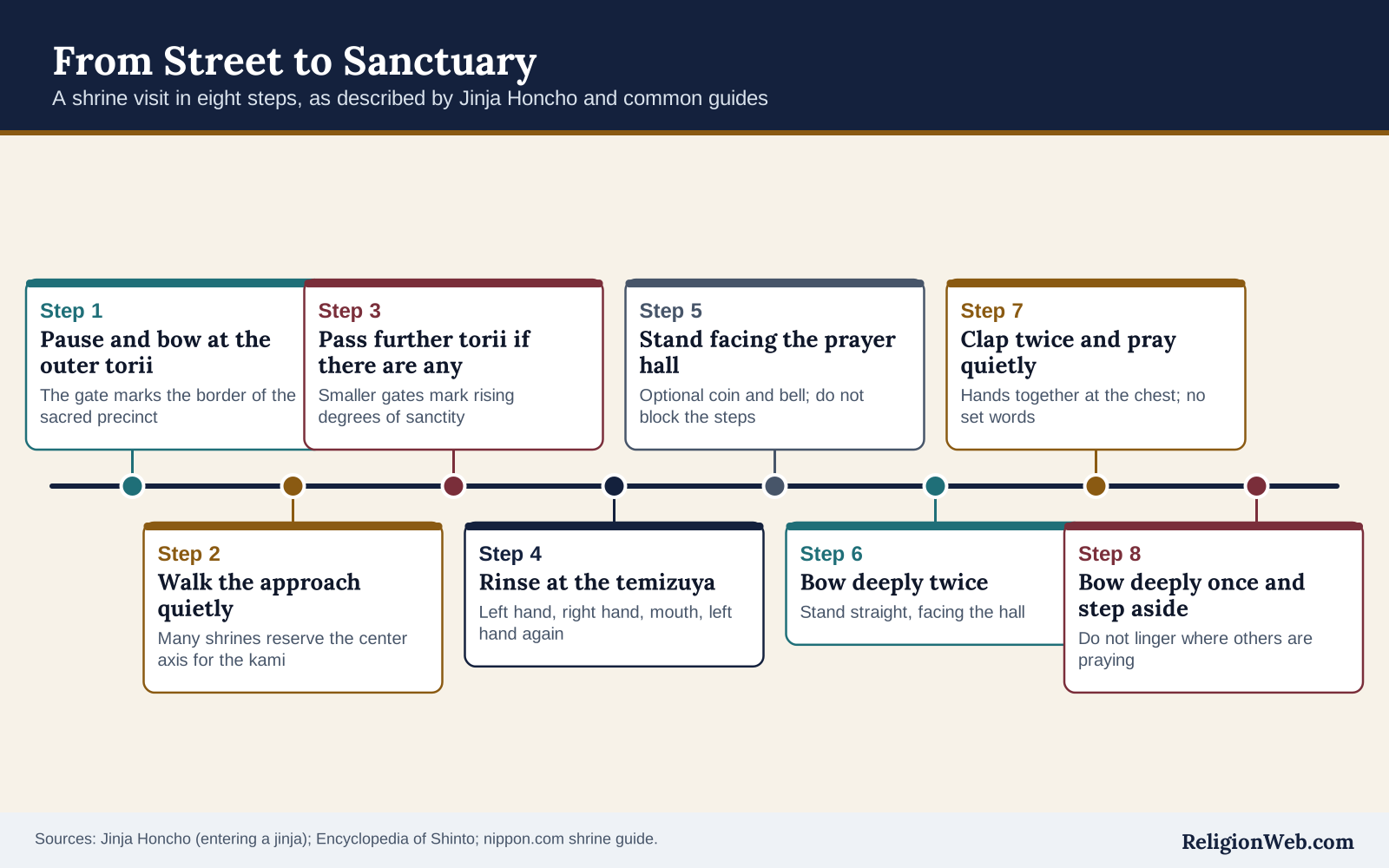
Jinja Honcho says that many visitors pause and bow their heads slightly before passing through the torii. The bow is a courtesy, a way of acknowledging that one is stepping into a different kind of place. It is presented as a custom that many people follow, not as a required rite.
Many people bow again when they leave, turning briefly toward the sanctuary. Whether they do so is a matter of custom and personal habit. Shrines differ, regions differ, and individual visitors differ, so these customs are better understood as a common pattern than as a uniform law.
Which part of the path to walk
A frequently repeated piece of advice is to avoid walking in the exact center of the approach. The nippon.com guide advises visitors to keep a step to the right or left of center because many shrines reserve the central axis, the seichu, for the shrine’s kami. The qualifier “many” matters. Jinja Honcho’s own page on entering a shrine does not mention the center of the path, and some visitors and some shrines do not follow the custom. It is best treated as a widely shared courtesy that visitors can observe at no cost, and as an explanation of why at a busy shrine the crowd often moves along both sides of the path.
Purification at the Basin
The sequence at the temizuya
Near the entrance, many shrines provide a basin, the temizuya, with ladles for rinsing. Jinja Honcho gives the sequence in four parts. The visitor holds the ladle in the right hand and rinses the left hand. The ladle passes to the left hand and the right hand is rinsed. The ladle returns to the right hand, and water is poured into the left palm and used to rinse the mouth, without putting the ladle to the lips and with the water spit at the base of the basin and not into it. The left hand is then rinsed once more and the ladle is put back where it was found. The sequence takes less than a minute, but it gives a clear break between the walk in and the act of prayer.
Why rinsing comes before prayer
The washing is a small version of a larger concept. In Shinto, purity is a condition of approach to the kami, and a visitor sets aside what they have carried in from the outside world. The foundational narrative of this idea appears in the Kojiki, Japan’s oldest surviving chronicle, completed in 712, in which the kami Izanagi returns from the land of the dead and washes. Basil Hall Chamberlain’s translation gives his words as follows.
So I will perform the purification of my august person.
Kojiki, tr. Basil Hall Chamberlain, Part II, “The Purification of the August Person”
The line comes at the moment when Izanagi, having come back from a place he calls polluted, resolves to wash. Within Shinto tradition the episode is read as the origin of purification practice, including the ritual of misogi, bathing in running water or the sea. The hand-and-mouth rinse at a shrine basin is a condensed form of that practice, and the Encyclopedia of Shinto lists rinsing the hands and mouth, temizu, among the older forms of purification alongside misogi. This is a tradition-internal reading, not a claim that the basin ritual is as old as the chronicle. For a fuller account of purification in Shinto, including the great purification rites and the use of salt, see the article on purification in Shinto.
Prayer at the Hall
Two bows, two claps, one bow
At the prayer hall, Jinja Honcho describes a sequence. The visitor stands upright facing the hall, may put in a coin and shake the bell rope if there is one, bows deeply twice, brings the hands together at the chest, claps twice, may say a quiet prayer, and bows deeply once more. The association says that the sound of the bell is believed to purify the person who rings it. The prayer is not scripted; it is the visitor’s own, often silent. Some shrines post a variant, such as a different number of claps, and visitors are expected to follow local instructions.
The form is brief because the essential act is attentiveness. The bows frame the prayer as an address to the kami, the claps mark a moment of focus, and the final bow closes it. Visitors who are not sure of the sequence can simply bow with respect, and shrines ordinarily post guidance for those who want it.
Conduct in the precinct
Beyond the main sequence, Jinja Honcho adds several points of conduct. Visitors should not stand or sit in front of the prayer hall, such as on its steps, because that can disrupt others who are praying. They should not enter buildings without invitation or cross rope-marked boundaries. They should treat lawns and woodland as sacred ground. These are practical expressions of the idea that the whole precinct, beginning at the torii, is a place of respect. A visitor who follows them is not performing a ritual so much as behaving as a guest, which is the role the architecture of the approach invites.
Famous Torii and Multi-Torii Sites
Sea and Mountain Settings
Itsukushima: a great gate in the sea
The Itsukushima Shrine on the island of the same name in the Seto Inland Sea is probably the best-known setting for a single torii. The Government of Japan describes the great gate, the Otorii, as one of the largest wooden torii in the country, 16 meters tall and 24 meters wide, standing in the sea about 160 meters from the shrine’s main hall. At low tide visitors can walk right up to it, and at high tide it stands in the water. UNESCO, which inscribed the shrine on the World Heritage List in 1996, says the island has been a holy place since the earliest times and that the first shrine buildings were probably erected in the sixth century. The shrine’s own English site says its three deities were born from a pledge between the sun kami Amaterasu and her brother Susanoo, and that they have long been honored as protectors of the imperial family, the nation, and seafarers.
In this setting the torii does what it does everywhere, only on a grander stage. It marks the approach from the water to a shrine whose buildings stand over the sea. The location also makes the gate a good illustration of the point that a torii is a boundary marker and not an entrance in the ordinary sense: a visitor reaches the shrine by land, but the gate stands far out in the water, announcing the sacred setting from a distance.
Fushimi Inari: thousands of donated gates
Fushimi Inari Taisha in southern Kyoto is the other great image of the torii, and its tunnels of vermilion gates are among the most photographed scenes in Japan. The Government of Japan reports that the shrine was founded in 711 at the foot of Mount Inari, that its precinct covers the whole mountain, and that about 10,000 large and small torii stand along the paths. The area where the gates are clustered so tightly that they form a tunnel is called Senbon Torii, “thousands of torii.” The shrine heads a network of Inari shrines said to number more than 30,000.
What makes Fushimi Inari instructive is the reason for the gates. After a person’s prayers were answered, some individuals and companies gave a torii inscribed with their name as thanks, and over time those gifts built up the tunnels. The gates are, in this sense, a record of gratitude, with each donor’s name on a pillar. The visitor walks through not one boundary but thousands, a continuous passage along the mountain that is both a path of pilgrimage and a catalog of private thanks.
Landmark Gates
Meiji Jingu: cypress from Taiwan
Meiji Jingu in Tokyo was established in 1920 to commemorate Emperor Meiji and Empress Shoken, and its precinct includes a forest of about 70 hectares. A Japanese tourism agency database describes the shrine’s Ootorii as a wooden myojin-style gate, the largest of its kind in Japan, about 12 meters tall and 17.1 meters wide, with pillars 1.2 meters in diameter and a total weight of about 13 metric tons. The original gate of 1920 was built from a cypress about 1,200 years old from Alishan in Taiwan. Lightning destroyed it in 1966. The replacement, completed on December 23, 1975, is made from a hinoki cypress about 1,500 years old found on a hillside in Taiwan by a Tokyo timber merchant, who had vowed to help rebuild the gate to thank the kami for protecting his business. Because no suitable tree could be found in Japan, he made many trips to Taiwan to find one.
The story shows two things about large wooden torii. They depend on trees of exceptional size, which are now scarce, and they often come into being through personal vows and gifts. The gate at Meiji Jingu is a public landmark and also the result of one man’s promise, and the database records both facts together.
Kumano Hongu Taisha: a steel gate at the old shrine site
At the other extreme from the cypress of Meiji Jingu is a gate of steel. The tourism bureau of the city of Tanabe reports that a giant torii at Oyunohara, the old site of Kumano Hongu Taisha in Wakayama Prefecture, stands 33.9 meters tall and 42 meters wide, was completed in 2000, weighs 172 tons, and took about six months to make and six months to assemble. The bureau calls it the largest torii shrine gate in the world, a claim this article reports as the bureau’s and does not independently confirm. The bureau also notes that in 1889 a severe flood destroyed many of the shrine buildings, after which the pavilions were rebuilt at their present location.
This gate stands at the site where the shrine once stood. It is therefore a marker of a place as much as an entrance to one, and it shows the torii used as a landmark of memory. The use of steel also shows that the tradition has accepted new materials when the scale or the circumstances called for them, as the Encyclopedia of Shinto’s remark on the lack of restrictions would lead one to expect.
Gates That Carry Memory and Renewal
The one-legged torii of Sanno Shrine, Nagasaki
Some gates carry a history of suffering. At Sanno Shrine in Nagasaki, a gate stands today on a single pillar. According to the Japan Up Close feature published on the Web Japan site, the atomic bomb dropped on August 9, 1945, about 800 meters from the shrine, knocked down one of the gate’s two support columns, split the gate, and turned it about 13 degrees on its base. Heat damage is visible on the surviving leg. The gate has remained as a quiet monument to the event. It is a reminder that a torii is a structure in the world as well as a symbol, and that the history of a place can mark it in ways no builder intended.
Ise and the reuse of timber
Renewal is the other side of memory. At Ise Jingu, a Japanese tourism agency database says, the large gate before Uji Bridge is constructed from reclaimed cypress, and the shrine buildings at the inner and outer shrines and fourteen affiliated shrines are rebuilt every twenty years, each next to the old one. After the kami are moved, the old building is carefully taken apart, and parts of Ise Jingu’s old buildings are often reused, with some of the dismantled wood going to other shrines across Japan. The idea that a sacred structure can be taken down, its materials passed on, and a new one raised in its place is central to Ise, and it offers a useful frame for thinking about wooden gates that are rebuilt over time, though not every shrine describes its own gates in these terms. The next section turns to what such gates mean.
| Site | Setting | Reported facts | Source type |
|---|---|---|---|
| Itsukushima Shrine, Hiroshima Prefecture | In the sea off the island shrine | 16 m tall, 24 m wide; present gate built 1875; repair completed December 2022 | Government of Japan |
| Fushimi Inari Taisha, Kyoto | Paths up Mount Inari | About 10,000 large and small torii; many donated after prayers were answered | Government of Japan |
| Meiji Jingu, Tokyo | Main approach in a 70-hectare forest | About 12 m tall; completed 1975; cypress from Taiwan | Japan Tourism Agency database |
| Kumano Hongu Taisha, Oyunohara | Old shrine site, Wakayama Prefecture | Steel; 33.9 m tall, 42 m wide; completed 2000; 172 tons | Tourism bureau |
| Sanno Shrine, Nagasaki | About 800 m from the 1945 hypocenter | Stands on one surviving pillar after the blast | Japan Up Close |
| Ise Jingu, Mie Prefecture | Before the Uji Bridge | Built from reclaimed cypress; shrine buildings rebuilt every 20 years | Japan Tourism Agency database |
Building, Repairing, and Renewing a Torii
Why Gates Are Rebuilt
Weathering and replacement cycles
A wooden gate stands outdoors, often near water or under a canopy of trees, and it weathers. JAANUS makes the point most sharply with the kuroki torii at Nonomiya Jinja in Kyoto, whose unstripped logs had to be replaced about every three years. Most gates last far longer than that, but all of them eventually need repair or replacement, and the history of a famous gate is usually a history of successive gates on one site. The sources on the great gate at Itsukushima illustrate both the pattern and a problem with counting. The Government of Japan says the present gate, rebuilt in 1875, is the ninth to stand on the site, while the Japan Tourism Agency database says the gate has been replaced seven times over the centuries. The two statements may count differently, and this article does not try to reconcile them. What both agree on is that the gate has been renewed repeatedly and that the present one dates to 1875.
The cycle of replacement is one reason that the age of a torii is a poor guide to the age of its shrine. A site may have kept a gate in the same place for many centuries while the actual timbers are far younger. JAANUS also notes that many originally wooden gates have been replaced by stone or reinforced concrete, which changes the pattern: a gate that was once rebuilt every few generations may now stand for much longer.
Finding the right timber
For the largest wooden gates, the first problem is the tree. The Japan Tourism Agency database tells the story of the second gate at Meiji Jingu: the first, made from a cypress about 1,200 years old from Alishan in Taiwan, was destroyed by lightning in 1966, and because no suitable tree could be found in Japan, the timber merchant who had vowed to help rebuild it made many trips to Taiwan before finding a cypress about 1,500 years old on a hillside. The gate was completed on December 23, 1975. The account suggests how much effort goes into a single pair of pillars when a shrine wants a gate on that scale and in that material.
Reuse offers another route. The same database says that the large gate before Uji Bridge at Ise Jingu is built from reclaimed cypress, and that parts of Ise’s old buildings are often reused, with some of the dismantled wood going to other shrines. In this approach the timber is understood as a resource that passes from one sacred use to another, and the gate is one stage in a longer life of the wood.
Repair, Substitutes, and Modern Construction
Repairing a great gate
Not every renewal is a replacement. The Government of Japan reports that a repair project on the great gate at Itsukushima lasted about three and a half years and was completed in December 2022. The gate stands in the sea, and the length of the project suggests the scale of the work involved. The source does not describe the repair methods in detail, and this article does not speculate about them. The point to note is that a living shrine treats its gate as a structure to be maintained across generations, not as a monument to be left alone.
Substitute materials and modern engineering
When the original material cannot be kept, shrines make choices. At Nonomiya Jinja the answer for the kuroki gate was synthetic material that imitates tree bark, according to JAANUS, preserving the look of the original while lasting longer. Elsewhere the answer has been stone or concrete, and at Oyunohara in Wakayama Prefecture it has been steel: the tourism bureau reports that the 172-ton gate there took about six months to make and about six months to assemble. The Encyclopedia of Shinto states that no particular restriction is imposed on materials, and that the choice depends on scale and purpose. The decision therefore rests with each shrine, which weighs durability, cost, appearance, and its own sense of what suits its kami and its community. There is no single rule that every gate must be wood, and no single rule that it must not be.
What Does a Torii Mean? Interpretations and Symbolism
Meanings Stated by Shrines and Reference Works
Boundary and threshold
The most widely documented meaning of the torii is boundary. Jinja Honcho calls it the border between the sacred space of the jinja and the everyday world, the Encyclopedia of Shinto calls it a gateway signifying entrance to a sacred area, and the Government of Japan describes it, in connection with Fushimi Inari, as marking the boundary between the everyday world and the sacred grounds of the deities. These are three different institutions saying the same thing in different words, and the agreement is strong evidence that boundary is the primary meaning in current understanding. It is a statement about space and about conduct: the area beyond is set apart and calls for care.
Protection and the vermilion tradition
A second, narrower meaning attaches to color. The Government of Japan reports the belief that vermilion wards off evil forces. This is a belief about a color and not about the gate as such, and the Association of Shinto Shrines notes that some gates are unpainted. The protective meaning is best understood as belonging to painted gates, and as one explanation among others, including the practical function of lacquer in preserving wood.
Interpretations of the Name and Origin
The bird-perch reading and the rock-cave narrative
The literal meaning of the written word, “bird perch,” has encouraged a popular connection with one of the best-known passages in the Kojiki. When the sun kami Amaterasu withdraws into a rock dwelling and the world falls into darkness, the assembled kami devise a plan to draw her out. The text describes one element of the plan in these words.
assembling the long-singing birds of eternal night and making them sing
Kojiki, tr. Basil Hall Chamberlain, Part III, “The Door of the Heavenly Rock-Dwelling”
Retellings often say that the gate takes its name from the perches on which those birds were set. The Kojiki passage is real, and the birds are part of the story. But the text quoted here does not mention a gate, and the Encyclopedia of Shinto states that no theory of the name has been accepted. Within Shinto tradition, the episode of the rock dwelling is often read as an account of the return of the sun kami and, in some readings, as a source of the ritual music and dance offered to the kami. Whether the torii has any link to it is a proposal, not an established fact. A careful reader can enjoy the association as folk understanding and still keep it separate from the scholarship.
Passage, marked space, and gateway
The other proposals about the name and form are more modest. The reading “pass through and enter” connects the word with movement. The reconstruction in JAANUS, from rope-marked ground to a gate, connects the form with the old practice of marking sacred space with ropes. The comparisons with the Sanchi gateways and with East Asian archways connect it with architecture abroad. None of these has displaced the others. A reasonable approach is to hold them all as hypotheses, and to rest the meaning of the torii on how shrines and communities use it today.
Contemporary Meanings
A shorthand for shrines
For most people in Japan and abroad, the gate has a plain practical meaning: it says that a shrine is here. The Association of Shinto Shrines says the presence of a torii is a clear indication of a jinja, and the Encyclopedia of Shinto notes that on maps it indicates a Shinto shrine. This is a symbol in the ordinary sense of a sign. It is accurate enough for navigation and for casual recognition, and it carries the deeper meaning of boundary along with it.
Gratitude, vows, and gifts
A third modern meaning is gift. The gates at Fushimi Inari were donated in thanks for answered prayers, and the cypress gate at Meiji Jingu was the product of a timber merchant’s vow of gratitude. In both cases the torii is a form of offering made by an individual or a company, and the donor’s name is often inscribed. The gate is thus both a boundary for visitors and a lasting expression of thanks by the people who gave it.
| Interpretation | Basis | Strength of support | Notes |
|---|---|---|---|
| Boundary between everyday and sacred space | Jinja Honcho; Encyclopedia of Shinto; Government of Japan | Strong: stated by several institutions | Primary meaning in current understanding |
| Sign of a Shinto shrine | Jinja Honcho; map convention noted by the Encyclopedia of Shinto | Strong | Not a perfect rule: torii also stand at some Buddhist temples |
| Protection against evil, through vermilion | Government of Japan, on a stated belief | Moderate: a belief tied to one color | Does not apply to unpainted gates |
| Bird perch from the rock-cave narrative | Popular retellings of the name | Weak: not accepted as a theory by the encyclopedia | The Kojiki passage does not mention a gate |
| Passage, “pass through and enter” | Proposed etymology in the Encyclopedia of Shinto | Proposal only | Compatible with the boundary meaning |
| Offering of thanks | Fushimi Inari donations; Meiji Jingu timber merchant’s vow | Strong for those sites | A practice at particular shrines, not a universal rule |
Common Misconceptions About Torii Gates
Misconception 1: Every torii is red
Where the misunderstanding comes from
The belief is easy to understand. The torii images that circulate most widely in travel writing, photographs, and film are overwhelmingly vermilion: the tunnels at Fushimi Inari, the great gate standing in the sea at Itsukushima, the bright gate on a postcard or a souvenir. A person who knows Shinto mainly through such images could reasonably conclude that red is simply what a torii looks like. The Government of Japan also explains the vermilion color with a protective belief, and an explanation of that kind tends to sound like a rule.
The number of red gates is also large in absolute terms, because Inari shrines are said to number more than 30,000 and many of their gates are painted. Red gates are therefore common, and common things are easily mistaken for universal ones. Photographs of unpainted wooden gates or plain stone gates do not travel as well, because they are less striking.
What the evidence and tradition actually show
Jinja Honcho is careful on the point: torii are sometimes painted vermilion, and some are unpainted. It describes the shinmei torii as unpainted, with a straight top lintel. The Encyclopedia of Shinto shows a shinmei gate at the inner shrine of Ise Jingu, and JAANUS lists the kuroki torii, made of logs with their bark still on, whose best-known example at Nonomiya Jinja in Kyoto has been replaced repeatedly because the unstripped wood did not last. Stone gates have been used since at least the middle of the twelfth century. Copper-sheathed, steel, and concrete gates also exist. The color of a gate depends on its style, its material, the history of its shrine, and local custom.
Where red is used, the sources give two kinds of reason. One is religious: the Government of Japan reports the belief that the color wards off evil forces. The other is practical: a Japanese tourism agency database says vermilion lacquer helps protect the wood of the great gate at Itsukushima. Neither reason makes red mandatory. A visitor who finds a plain gate has not found a lesser one.
The Encyclopedia of Shinto adds a further reason that gates differ: the style of a torii depends in part on the character of the central deity enshrined at the shrine. A gate is therefore not an ornament chosen from a single catalog of colors. It is part of the identity of a particular place, and the identity of one shrine may call for a plain gate while that of another calls for a painted one.
Misconception 2: A torii is simply decorative architecture
Where the misunderstanding comes from
The torii stands alone, with no door and no wall, and it frames a view in a way that invites photographs. Outside Japan it often appears detached from its setting: on a tote bag, in a garden, as an ornament in a picture of Mount Fuji. Seen in those contexts, it can look like a purely visual motif, a shape that signals “Japan” in the way a pagoda or a lantern might.
The gate’s openness also invites the thought that it is not doing anything. A structure that does not block movement, shelter anyone, or hold anything up seems to have no function beyond display.
What the evidence and tradition actually show
The gate has a function, even if it is not a mechanical one. The Encyclopedia of Shinto defines it as a gateway arch signifying entrance to a sacred area, and Jinja Honcho says it marks the border between the sacred space of the jinja and the everyday world, with many visitors pausing to bow before passing through. A structure that people bow to is not decoration in the ordinary sense. It also organizes the shrine: the largest gate stands at the entrance, and smaller ones mark rising degrees of sanctity toward the main sanctuary. It works as a map symbol and as a sign that a shrine is near.
The gates also function as offerings. The gates at Fushimi Inari were given in thanks for answered prayers and carry their donors’ names, and the cypress gate at Meiji Jingu came about through a vow. None of this means that the torii is not beautiful or that its design is not admired. It means that the aesthetic and the religious meaning belong to the same object, and that treating the gate as only decoration leaves out what shrines and visitors themselves say about it.
The history of construction points the same way, with a caution. Carpenters’ manuals such as the Shomei of 1608 prescribed proportions for the gate, which shows that makers treated it as a structure worth standardizing. A manual of proportions does not by itself say what a gate means, so the evidence for meaning rests on what shrines, reference works, and visitors say and do. On that evidence the gate is a working part of the way a shrine is entered, and its beauty is real but secondary to that role.
Misconception 3: Passing through a torii means entering the shrine building
Where the misunderstanding comes from
English speakers often speak of “entering a shrine” or “going into a temple,” phrases that imply a building with an interior. In many religious traditions the doorway of a building is the place where a person moves from outside to inside, and it is natural to read a gate in the same way. Where the gate is large and imposing, and where it is the first and most visible structure a visitor meets, it is natural to think that crossing it brings one into the presence of the sacred object, like stepping through the door of a church or hall.
The word “shrine” adds to the confusion. It can refer to a small building, to a whole complex, or to the institution that runs it. A visitor told that the torii is the “entrance to the shrine” may take this to mean the front door of a structure.
What the evidence and tradition actually show
In Shinto practice the torii marks the edge of the precinct, not the entrance to a building. Jinja Honcho says that once past the gate, the entire precinct counts as sacred, including woodland and lawns. The path from the gate leads to the place where respects are paid, which at a larger shrine is the prayer hall, with the main sanctuary behind it. The main sanctuary, where the kami is enshrined, is usually not entered by visitors, and Jinja Honcho advises people not to enter buildings without an invitation, even if they look open. The distance between the gate and the building can be very large: the great gate at Itsukushima stands about 160 meters from the main hall, and at some sacred places there is no building at all, so a torii alone marks the area.
The correct picture is therefore of a series of stages. The gate marks the beginning of the sacred precinct, the approach carries the visitor through it, the basin provides for purification, the prayer hall is where respects are offered, and the sanctuary lies beyond. Passing through the gate is an act of entering a place of respect, which is a different thing from entering the sanctuary itself.
The distinction holds even at the smallest shrines. Jinja Honcho notes that at a small jinja the building where respects are paid may be the main sanctuary itself, so the path from the gate can be very short. Even there, visitors pay their respects from outside the building, and the gate still marks the line where the ordinary world ends and the precinct begins. The arrangement is the same in principle at a village shrine and at a great one.
Misconception 4: Torii are prehistoric, unchanging, and have always been exclusively Shinto
Where the misunderstanding comes from
Shrines and guidebooks often present the torii as a symbol of continuity, and the sense of timelessness is part of its appeal. The form is simple, and its archaic look suggests great age. Statements that a gate is “thousands of years old” or “unchanged since ancient times” appear in popular writing, and the story that links the gate with the birds of the rock-cave narrative sets its origin in the age of the kami. The strong association of the gate with Shinto, in turn, leads many people to assume that it has always belonged to Shinto alone.
The recent history of Shinto, discussed in the hub article on Shinto, also feeds the assumption. After 1868 the separation of kami and buddhas made the torii a clear marker of the difference between shrine and temple, and that modern clarity is easily projected backward.
What the evidence and tradition actually show
The documentary evidence is more modest. JAANUS treats an inventory of 922 as the earliest reliable written mention of torii, and the oldest surviving wooden gate dates to 1535. The Encyclopedia of Shinto says that scholars still disagree about whether the form is native to Japan or imported. Gates have changed in materials, proportions, and construction methods, with standard proportions prescribed from the end of the sixteenth century and modern steel and concrete added in recent times. Individual gates are rebuilt: the great gate at Itsukushima in the sea dates to 1875, and the one at Meiji Jingu to 1975.
The gate has also not always been exclusive to Shinto. JAANUS notes that torii mark the entrances of shrines built within Buddhist temple grounds, and both it and the Encyclopedia of Shinto point to examples such as the stone gate at Shitennoji in Osaka and the copper-sheathed gate at Kinpusenji in Nara, dated 1455 to 1457. During the long period when kami and buddhas were honored together, a gate could belong to a site that was in practice both. The accurate statement is that the torii is a long-established convention of shrine architecture, closely tied to Shinto today, with a documented history of change and a history of use in mixed religious settings. For the broader background on Buddhism in Japan, readers can consult the article on Mahayana Buddhism.
Frequently Asked Questions About Torii Gates
Questions About Meaning and Origins
What does the word torii mean, and how old is the gate?
The word is written with characters meaning “bird” and “to dwell” or “to perch,” and JAANUS renders it literally as “bird perch.” The Encyclopedia of Shinto says that no single explanation of the name has been accepted, and it lists two proposals: a perch for birds, and the sense of “pass through and enter.” Both remain hypotheses.
As for age, the earliest written mention that JAANUS accepts as reliable is an inventory of the Otori shrine dated 922, and the oldest surviving wooden gate dates to 1535. The form is therefore well documented from the Heian period onward, and its earlier history is unclear.
Why are so many torii red?
The Government of Japan reports the belief that vermilion wards off evil forces and notes that palaces, shrines, and temples have used the color since ancient times. A Japanese tourism agency database adds that vermilion lacquer helps protect the wood. The strong association of red gates with Inari shrines, which are said to number more than 30,000, also makes red the color most people see.
Red is not universal. Jinja Honcho says that torii are sometimes painted vermilion and that some are unpainted, and gates of plain wood, bark-covered logs, stone, and other materials are described earlier in this article.
Questions About Visiting
Do visitors need to bow at a torii?
Jinja Honcho says that many people pause and bow their heads slightly before passing through, a courtesy marking the border of sacred space. The sources cited here describe it as a custom and not as a requirement. Visitors who are unsure what to do can bow in a way that feels respectful, and shrines usually post guidance.
On the way in, the same association advises that the whole precinct is sacred, which is the practical reason for quiet and careful behavior. The article on kami in Shinto describes the full sequence of a shrine visit in more detail.
Is it all right to walk through the middle of the gate?
Many shrines reserve the central axis of the approach, the seichu, for the kami, and a nippon.com guide advises keeping a step to the right or left of center. Jinja Honcho’s own page on entering a shrine does not mention the point, and customs differ between shrines. Walking slightly to one side is a widely shared courtesy that costs nothing, and at a crowded shrine it is what most visitors do in any case.
Questions About Forms and Famous Sites
Why are there so many torii at Fushimi Inari?
The Government of Japan explains that after people’s prayers were answered, some individuals and companies gave a torii inscribed with their name as thanks, and over time those gifts built up the tunnels of gates. About 10,000 large and small torii stand along the paths of the mountain, and each donated gate bears the name of its donor. The gates are therefore both a boundary and a record of gratitude.
Are torii found only at Shinto shrines?
Torii are overwhelmingly associated with Shinto shrines, and Jinja Honcho says that the presence of a gate is a clear indication of a jinja. But JAANUS notes that torii also mark the entrances of shrines built within Buddhist temple grounds, and the Encyclopedia of Shinto cites a stone gate at the Buddhist temple Shitennoji in Osaka. The accurate statement is that the torii is the standard sign of a shrine, and that it appears in mixed settings where a shrine and a temple share ground, a legacy of the long period when kami and buddhas were honored together.
Conclusion: What the Torii Shows
What the Evidence Shows
A boundary with many forms
The best-documented fact about the torii is its function. Shrines, reference works, and the Government of Japan agree that it marks the border between the everyday world and sacred ground, and that passing through it calls for attention and respect. The forms vary widely: straight or curved lintels, wood, stone, copper, steel, and concrete, vermilion, bare timber, and bark. That variety is not a departure from tradition but part of it, and the common image of a bright red gate is one form among many.
The gate also belongs to a larger sequence. It leads to an approach path, a basin for purification, a prayer hall, and a sanctuary, and it makes sense only in relation to them. Understanding that sequence is the best way to avoid the common mistakes about the gate, including the idea that it is merely decorative and the idea that crossing it means entering a building.
What remains uncertain
Several questions remain open and should stay open in any careful account. Scholars have not agreed on whether the torii originated in Japan or came from abroad, and no explanation of its name has been accepted. The earliest reliable written record dates to 922, and the earlier history is a matter of reconstruction. Some details reported in this article, such as claims about the largest gates, come from single sources and are attributed accordingly. Gates continue to be built, replaced, and renewed, so any description of the gates at a particular shrine is a description of the present moment.
Continuing to Explore
Related articles on Shinto
For the wider tradition in which the torii stands, the hub article on what Shinto is covers history, texts, and shrine life. The article on kami in Shinto explains the beings and powers whom shrines honor, and the article on purification in Shinto covers the rinsing at the basin, the great purification rites, and the role of salt.
Sacred places in other traditions on ReligionWeb
Readers interested in how other traditions arrange their sacred places can find articles on the Hindu temple, the gurdwara, and the mosque. Each is written on its own terms and in its own historical context, and none is offered as a point of comparison with the torii.
Sources
The table below lists the principal external sources behind this article. Facts, dates and figures were checked against these and related primary, institutional and academic materials.
| # | Source | Publisher and type | Used for | Link |
|---|---|---|---|---|
| 1 | Torii (Japanese Architecture and Art Net Users System, JAANUS), with the related entry kuroki torii | Columbia University, Media Center for Art History · Academic reference | Structural terms, styles, materials, oldest surviving gates, 922 record, 1608 proportions, proposed origins | projects.mcah.columbia.edu |
| 2 | Torii (entry by Mori Mizue), Encyclopedia of Shinto | Kokugakuin University Digital Museum · Academic reference | Definition, ichi no torii, etymology debate, origin disagreement, materials, Shitennoji, map symbol | d-museum.kokugakuin.ac.jp |
| 3 | Entering a jinja, and the Torii, Honden pages (English site) | Jinja Honcho (Association of Shinto Shrines) · Institutional | Boundary meaning, vermilion 'sometimes', shinmei and myojin, temizuya steps, worship sequence, precinct conduct | jinjahoncho.or.jp |
| 4 | Highlighting Japan, October 2020: Fushimi Inari Taisha | Government of Japan (Cabinet Office, gov-online.go.jp) · Institutional | Founding in 711, about 10,000 torii, donated gates, vermilion belief, over 30,000 Inari shrines | gov-online.go.jp |
| 5 | Highlighting Japan, April 2023: Itsukushima Shrine | Government of Japan (Cabinet Office, gov-online.go.jp) · Institutional | Otorii dimensions, 1875 gate, repair completed December 2022 | gov-online.go.jp |
| 6 | Multilingual commentary database: Itsukushima Shrine Great Torii (also entries for Meiji Jingu Ootorii and Ise Jingu) | Japan Tourism Agency / MLIT · Institutional | Itsukushima gate weight and camphor pillars; Meiji Jingu gate history; Ise reclaimed cypress and reuse | mlit.go.jp |
| 7 | The Kojiki, tr. Basil Hall Chamberlain (revised reprint) | Internet Sacred Text Archive (sacred-texts.com) · Primary text | Quoted lines: purification of Izanagi and the long-singing birds of the rock-dwelling narrative | sacred-texts.com |
| 8 | Kumano Hongu Taisha (Oyunohara giant torii) | Tanabe City Kumano Tourism Bureau · Institutional | Steel gate size, weight, 2000 completion, 1889 flood | tb-kumano.jp |
| 9 | Japan Up Close: Sanno Shrine one-legged torii, Nagasaki | Web Japan (japanupclose.web-japan.org) · Institutional | Effect of the 9 August 1945 blast on the Sanno Shrine torii | japanupclose.web-japan.org |
| 10 | Insider's Guide to Shinto Shrines | nippon.com · Educational explainer | Sando description; advice to keep a step off center because many shrines reserve the axis for the kami | nippon.com |
Last fact-check date: 2026-10-21.