A mosque is a place set apart for Muslim worship, and the Arabic word for it, masjid, means a “place of prostration,” the spot where a worshiper touches the forehead to the ground in prayer. In daily life a mosque is a prayer hall, a school, a meeting place, a food distribution point, and the center of a neighborhood’s religious calendar. In practice it can be a monumental stone building in Istanbul, a mud-brick landmark in Mali, a timber-framed courtyard complex in China, or a rented room above a shop in a city where Muslims are a small minority.
What makes a space a mosque is function and orientation, not a required architectural form. The essentials are a clean area for salah, the five daily prayers of Islam, a clear sense of the qibla (the direction of the Kaaba in Mecca), and a community that agrees to use the place for worship. Domes, minarets, arches, and tiled niches are common in many regions, but none is a religious requirement, and a great many mosques have none of them. A visitor who expects one standard silhouette will find the reality much more varied.
This article explains the mosque on its own terms. It begins with vocabulary and layout, follows the institution from the first mosque in Medina to the present, and surveys architecture in different regions. It then walks through what happens inside: washing, entering, standing in rows, the Friday sermon, the rhythm of Ramadan, and the roles of imam, prayer caller, and committee. Later sections cover education and charity, practical guidance for visitors, and the questions people most often ask. Where Sunni, Shia, and other Muslim communities, or the legal schools, differ in practice, the differences are named rather than flattened.
The Mosque at a Glance: Meaning, Vocabulary, and Basic Facts
Readers who want the short version can start here. A mosque is a building or enclosed space dedicated to Muslim prayer and communal life. It has a prayer area with no fixed seating, a way of marking the direction of Mecca, and usually a place to wash before prayer. Most also have a raised pulpit for the weekly Friday sermon. Everything else, including height, color, shape, and ornament, comes from local tradition, the means of the builders, and the climate. The terms below are used throughout the article, so it helps to fix them early.
What the Word Masjid Means
The Arabic root and its meaning
The Arabic noun masjid comes from the verb sajada, “to bow down” or “to prostrate oneself,” the same root that gives sujud, the full prostration of Muslim prayer. A reference entry on the mosque in the Encyclopedia of Religion notes that related forms appear in Nabataean, where a similar word referred to a votive stone, and in Ethiopic, where it could mean a church or temple. The Harvard Pluralism Project likewise glosses masjid as a “place of prostration.” The root thus describes an act, and the place is named for what is done there.
That emphasis on action rather than architecture matters for the rest of the article. In the Quran the word can refer to a particular sanctuary, such as the Sacred Mosque in Mecca, but it is also used for places of worship in general, and Islamic tradition records a saying attributed to the Prophet Muhammad that the whole earth was made a place of prayer for him. For that reason Muslims can and do pray on a roadside, in an airport prayer room, or at home, and the mosque is the preferred setting for the congregation rather than the only valid one.
How the English word mosque arrived
The English word “mosque” reached the language through French (mosquée), and through Italian and Spanish forms before that, all ultimately derived from the Arabic. The Pluralism Project observes that non-Muslims first used the French-derived word and that Muslims now use it as well, though masjid is generally the more common word among English-speaking Muslims themselves. Both words appear in this article. Where an official name is given, as in “Masjid al-Haram,” the Arabic form is kept.
Words for Places of Prayer and Related Spaces
Masjid, jami, and musalla
Arabic uses several words for a space of prayer, and they are not strictly interchangeable. Masjid is the general word. Jami‘, from a root meaning “to gather,” names a congregational mosque, the larger mosque where the Friday prayer and its sermon are held; the term “Friday mosque” reflects that function. A musalla is simply a place of prayer, and the term is also used for an open prayer ground, often used for the two Eid prayers, and for the small prayer rooms found in offices, universities, and airports. The Encyclopedia of Religion notes that jami‘ eventually became the basis of the usual word for a large mosque in several languages, and in Turkish a small neighborhood prayer space (mescit) is distinguished from a full congregational mosque (cami).
| Term | Meaning | Where it appears |
|---|---|---|
| Masjid | “Place of prostration”; the general Arabic word for a mosque | Any prayer space used by a Muslim community |
| Jami‘ | “Gathering” place; a congregational or Friday mosque | Larger mosques with a Friday sermon |
| Musalla | Place of prayer, including open prayer grounds | Eid grounds, campus and workplace prayer rooms |
| Qibla | Direction of the Kaaba in Mecca | Orientation of the whole prayer hall |
| Mihrab | Niche or marked panel in the qibla wall | Front of the prayer hall, where the imam stands |
| Minbar | Raised pulpit with steps | Beside the mihrab; used for the Friday sermon |
| Minaret (manara) | Tower associated with the call to prayer | Many but not all mosques |
| Adhan and iqama | The call announcing prayer and the second call that starts it | Given by the muezzin before each congregational prayer |
| Wudu | Ritual washing before prayer | Ablution area, usually near the entrance |
| Khutba | Sermon, especially at the Friday and Eid prayers | Delivered by the khatib, often from the minbar |
Names used in different communities
Local vocabulary adds to the picture. Many Shia communities hold their gatherings of mourning and remembrance in a husayniyya (in South Asia often an imambargah), a hall named for Imam Husayn, which can stand beside or inside a mosque and which becomes the center of activity during Muharram and Ashura. Sufi communities have historically built lodges known as zawiya, khanqah, or tekke for devotional gatherings, which can include a prayer space but are not congregational mosques in the strict sense (see Sufism). In Southeast Asia small neighborhood prayer houses have regional names such as langgar or surau. These are normal parts of a landscape in which the same basic functions are housed in differently named buildings.
Basic Facts and Scale
A building, a function, and a community
It helps to separate three things that the word “mosque” can mean. The first is the physical building or room. The second is the institution: the congregation, its board, its imam, its programs, and its finances. The third is the act of congregational worship, the line of worshipers shoulder to shoulder behind a single leader. Sunni and Shia Muslims, and the various legal schools within each, agree on the basic elements of the third, even where mosque management and architecture look very different. In many countries a mosque is also a legal trust or endowment (waqf), which means its property is dedicated to a religious purpose and cannot be sold for private gain.
Numbers and scale today
Pew Research Center estimates that there were about 2 billion Muslims worldwide in 2020, roughly a quarter of the world’s population, so the number of mosques is very large, though no single authoritative global count exists and published national totals depend on how a mosque is defined. Better-documented figures are available for some countries. The American Mosque 2020 study, directed by Ihsan Bagby as part of the Faith Communities Today research program and summarized by the Institute for Social Policy and Understanding (ISPU), identified 2,769 mosques in the United States, up 31 percent from 2,106 in 2010. In the same study the average Friday attendance was 410 worshipers, and 37 percent of U.S. mosques were purpose-built, meaning that most congregations met in buildings first designed for another use, a pattern illustrated later in this article. Those numbers describe one country’s minority community, not the world, but they illustrate how often the idea of a “mosque” and the idea of a distinctive building come apart.
Inside a Mosque: Layout, Orientation, and Architectural Elements
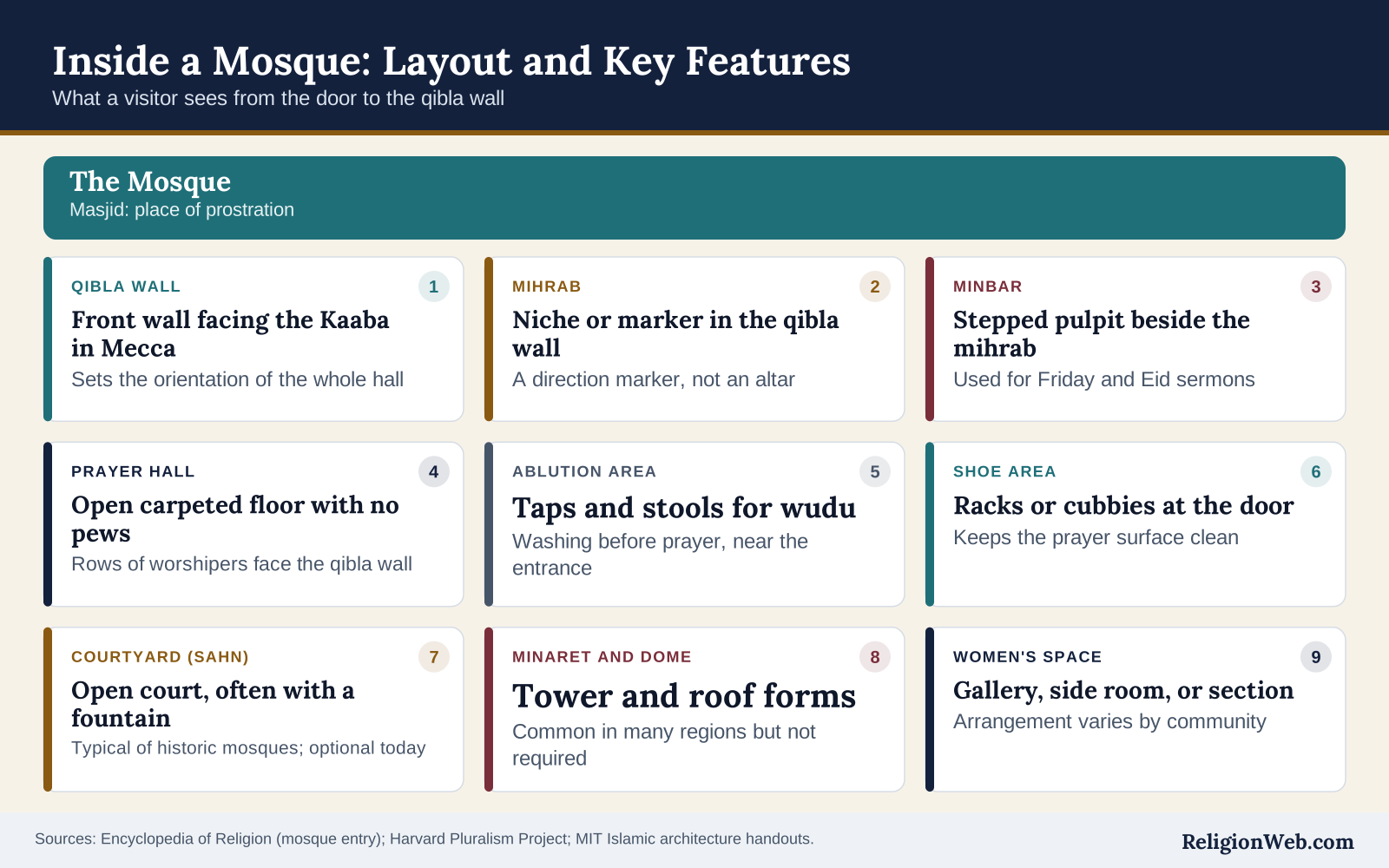
Walk into almost any mosque and the arrangement of the main room tells you what the building is for. There are no pews and no altar, only a large clear floor, usually covered in carpet, with a wall at the front that faces Mecca. Everything else is added around that simple need: a way to wash, a place to leave shoes, a pulpit for the sermon, a tower or speaker for the call to prayer, and whatever decoration the community can afford. The sections below describe each element in turn, with attention to what is essential, what is widespread, and what is optional.
The Prayer Hall and the Direction of Prayer
An open floor oriented to the qibla
The core of every mosque is the prayer hall, sometimes called the musalla or simply the main hall. Its orientation is its one non-negotiable design feature. Muslims pray toward the Kaaba in Mecca, the Kaaba, and a mosque is laid out so that the front wall, the qibla wall, faces that direction. In a new building the architect aligns the plan with a calculated bearing; in a converted shop or office the community may leave the room as it is and mark the direction with a line on the carpet, an arrow on the wall, or a niche added later. How the direction is calculated, and the long history of astronomy and surveying behind it, is covered in the article on Muslim prayer.
The floor is deliberately free of fixed furniture so that rows of worshipers can form across the width of the hall and so that the whole surface can serve as a place of prostration. Carpets are often woven or printed with a repeating pattern of prayer-mat shapes or with stripes that help worshipers align their feet. Chairs are available along the walls in most contemporary mosques for older people and those who cannot stand or kneel, and Muslim jurists consider praying seated to be valid for anyone who cannot do otherwise. Because the forehead touches the floor, the floor is kept clean, which explains many of the customs that follow, including the removal of shoes.
Rows, lines, and the size of the hall
In congregational prayer the worshipers stand in straight, closely spaced rows behind the imam, shoulder to shoulder and facing the qibla. Reports attributed to the Prophet Muhammad urge believers to straighten the rows and close the gaps, and the call that begins the prayer (the iqama) is usually followed by a brief reminder to do exactly that. The first row is generally regarded as the most meritorious, and latecomers fill in behind. For that reason a mosque’s capacity is often described in terms of the number of rows and the width of the hall rather than seats, and the design of the space tries to avoid columns that break the lines. Where columns are unavoidable, as in the great hypostyle halls described later, worshipers form rows between them.
The same open plan accommodates the sections for women. Where a mosque has a dedicated women’s area, it may be a room behind the main hall, a side space, a gallery or mezzanine, or a section separated by a low partition or curtain. In American mosques, according to the Encyclopedia of Religion, women usually have separate space and it is often on a mezzanine level. Details differ widely, and the question of women’s space is treated further in the section on visiting.
Mihrab, Minbar, and the Front of the Hall
The mihrab: a marker, not an altar
The mihrab is the niche or ornamented panel set into the qibla wall. It marks the direction of prayer and the place where the imam stands to lead the congregation. The Harvard Pluralism Project describes it as a prayer niche, usually a small arched indentation, that marks the qibla, with congregations forming parallel lines facing it. It is often the most richly decorated part of the building, and it can be carved stone, tile, plaster, or inlaid wood, with Quranic verses in calligraphy around the arch. Larger mosques sometimes have more than one; the Encyclopedia of Religion mentions that several mihrabs were used in some great mosques by followers of different legal schools, and the Prophet’s Mosque in Medina contains named mihrabs commemorating different places and traditions of prayer.
The mihrab is not an altar. Nothing is sacrificed on it, no consecrated element is kept in it, and no sacred object is housed in it; the niche is empty, and no Muslim prayer is directed to the niche itself. It points beyond itself, toward the Kaaba, and Muslims understand that their prayer is addressed to God alone. The niche has a practical effect as well, since it helps carry the imam’s voice, but its meaning is directional. Some visitors, especially in regions with strong devotion to saints and shrines, touch the mihrab or minbar to seek blessing (baraka); the Encyclopedia of Religion notes that this practice is not universal, and many Muslims and scholars discourage it. The history of how the niche developed, and why the earliest mosques did without it, is taken up in the next section.
The minbar and the Friday sermon
The minbar is a raised pulpit reached by a short staircase, normally placed to the right of the mihrab as one faces the qibla wall. From it the preacher, called the khatib, delivers the Friday sermon (khutba), and often the sermons of the two Eid festivals. Minbars range from a plain wooden stair of a few steps to extraordinary carved works in Cairo and Istanbul. Traditional accounts say that the Prophet Muhammad first preached from a stump or a low seat and later from a wooden platform with steps, and the early caliphs and governors used the minbar as a place from which to address the community. The Encyclopedia of Religion adds that the minbar is associated with seats of authority and was at first reserved for the chief mosques of a city, which fits the pulpit’s link to the Friday prayer, held in the main congregational mosque.
Many small mosques and prayer rooms have only a portable lectern or simply a chair, and the Friday sermon is given from a standing position at the front. The point is not the furniture but the role: the khutba is part of the Friday service rather than a talk added to it. Its content, structure, and language, and how much variation exists between mosques, are discussed in the section on the weekly prayer.
Maqsura, dikka, and other fittings
Reference works list several fittings that were common in classical mosques and that survive in some of them. The maqsura was a screened enclosure near the mihrab reserved for the ruler, built to protect him during prayer. The dikka was a raised platform near the minbar on which assistants repeated the prayer movements, or the call, so that worshipers at the back could follow. The kursi was a seat with a desk for reciting the Quran or teaching. Most modern mosques have none of these, and the sound system has taken over much of the dikka’s old purpose. Lamps, Quran stands and shelves, bookcases, a clock or electronic board showing the prayer times, and racks for prayer beads and prayer caps are the typical contents of a present-day prayer hall.
Entrances, Courtyards, and Washing Areas
Courtyards and ablution fountains
Many historic mosques are organized around an open courtyard (sahn), which can be paved, planted, or tiled, and which often has a basin or fountain at its center. The Encyclopedia of Religion calls this a mida‘a, a place for ritual ablutions (wudu), and the MIT architecture handout on early mosques likewise notes that the ablution fountain is often, though not always, in the middle of the courtyard. Covered galleries or arcades (riwaq) surround the courtyard, and the covered prayer hall stands on the qibla side, usually deeper than the others. This plan, derived from the first mosque in Medina, appears from Spain to Central Asia.
Today the ablution area is often inside the building near the entrance, with rows of taps, low stools, and drainage, usually separate for men and women. In regions where water is scarce, the facility may be as simple as a row of faucets. Washing before prayer is a requirement of prayer itself, not of the mosque, but because congregational prayer is a collective act, washing facilities are among the first things a new community adds.
Shoes, thresholds, and the entrance
Worshipers remove their shoes before stepping on the prayer carpet, and a shoe rack or cubby area at the door is a standard feature. The reason is cleanliness of the surface on which the forehead and hands will rest, and the custom is followed even in mosques where socks are worn. Many mosques also keep a visitor entrance and a separate entrance for women, and larger mosques have a lobby, notice board, and often a bookstall or reception desk. Some communities ask that visitors cover bare arms and legs, and many provide scarves or robes for those who need them.
Minaret, Dome, and Decoration
The minaret and the call to prayer
The minaret (manara or ma’dhana) is a tower from which the muezzin gives the adhan, the call to prayer. According to the Encyclopedia of Religion, minarets appear from the eighth century; the Prophet’s own mosque in Medina had none, and in the first generations the call was reportedly given from a nearby rooftop or other high spot. A mosque may have one minaret or several, and the MIT handout notes that a mosque may have anywhere from one to six. The Blue Mosque in Istanbul, built between 1609 and 1616, is well known for its six. Many mosques, however, have no minaret at all, and the call from a tower is now largely replaced by loudspeakers or by an interior call alone, so the minaret has become mostly an architectural landmark. Local regulations on amplified calls differ widely, and some communities give the adhan inside only.
Domes, calligraphy, and ornament
Domes are likewise common but not required. The Encyclopedia of Religion describes domed mosques as a later development, and many early mosques had flat wooden roofs supported by columns. A dome can mark the space in front of the mihrab, cover the whole prayer hall, as in the great Ottoman mosques, or serve as a visual landmark. Their frequency in modern construction is part of the reason that popular images of mosques often feature them, and it is also why the dome and minaret together can mislead a visitor into thinking they are mandatory.
Decoration is also chosen by tradition rather than rule. Because depictions of living beings are discouraged in a mosque, as the same reference work notes, interiors are typically decorated with geometric patterns, vegetal designs, and Arabic calligraphy, often quotations from the Quran. These can be glazed tile, carved plaster, stained glass, or painted wood, or a bare white wall, since a plain mosque is as valid as an ornate one. Calligraphy, geometry, and light are the main resources of Islamic religious art, and they appear in endless combinations.
| Element | Function | How widespread |
|---|---|---|
| Clean prayer area facing the qibla | Space for rows of worshipers and prostration | Essential to every mosque |
| Mihrab or direction marker | Shows the qibla; position for the imam | Nearly universal; may be a plain niche, panel, or line |
| Ablution (wudu) facilities | Washing before prayer | Nearly universal in purpose-built mosques |
| Minbar | Pulpit for the Friday and Eid sermons | Customary in Friday mosques; often a portable lectern elsewhere |
| Shoe area and carpet | Keeps the prayer surface clean | Very common |
| Separate space for women | Allows women to attend the congregation | Varies by region, school, and community |
| Minaret | Traditional place for the call to prayer; landmark | Common but optional; many mosques have none |
| Dome | Roofing, acoustics, visual landmark | Common in many regions; absent in others |
| Courtyard (sahn) | Gathering space; location of the ablution fountain | Typical of historic mosques; optional today |
Origins and Early History: From the Prophet’s House to the Classical Mosque
The history of the mosque is sometimes told as the story of a form, with arches and domes spreading across continents. A more accurate account follows a function. A community needed a place to pray together, hear the Quran, and take decisions, and over the first two centuries it built, rebuilt, and standardized one answer after another. Some of the features that now seem inseparable from the mosque, such as the recessed niche and the minaret, were later additions. The evidence for the earliest period comes from the Quran, from traditional Muslim accounts recorded generations after the events, and from archaeology and architectural study, and the sections below try to keep those three kinds of evidence distinct.
Places of Worship in the Quran
What the Quran says about sanctuaries
The Quran speaks of masajid, the plural of masjid, as places that belong to God. One short verse, in the Surah of the Jinn (72:18), sets the principle in a single sentence.
And the places of worship are only for Allah, so pray not unto anyone along with Allah.
Quran 72:18, Pickthall translation (1930)
Classical commentators generally read this verse as stating that every place of prayer is dedicated to God alone and may not become a place for calling on others beside Him. Some early commentators also understood masajid here as the parts of the body that touch the ground in prostration, a reading that again links the word to the act of bowing. Elsewhere, the ninth surah says that those who tend God’s sanctuaries are those who believe in God and the Last Day, keep up the prayer, pay the poor-due, and fear none but God (9:18). That verse is the main scriptural basis for the idea, discussed later, that a mosque is maintained by a committed community and not only by a patron.
A well-known passage in the Surah of Light (24:36) speaks of “houses” where God’s name is remembered, and many classical commentators identify these with mosques.
(This lamp is found) in houses which Allah hath allowed to be exalted and that His name shall be remembered therein. Therein do offer praise to Him at morn and evening.
Quran 24:36, Pickthall translation (1930)
The verse sits within the “Light Verse” passage, in which a lamp in a niche is a figure for divine light, and the connection between that imagery and the architectural niche in mosques was later explored by Muslim writers and artists. Mystical commentators in particular drew on it. The historical point here is more modest: the Quran says nothing about the shape of a mosque. It specifies purpose (remembrance of God, regular prayer, charity) and orientation (the direction of the Sacred Mosque), and leaves the form entirely open.
Quba, Medina, and a mosque founded on piety
According to Muslim tradition, when the Prophet Muhammad migrated from Mecca to Medina in 622 CE (the year that begins the Islamic calendar), he stopped first at Quba, a settlement on the outskirts, and prayed there. The Encyclopedia of Religion notes that the Quba mosque is held in special regard for that reason. Many commentators connect it with a verse of the ninth surah, which sits in a passage about mosques built for the wrong reasons.
Never stand (to pray) there. A place of worship which was found upon duty (to Allah) from the first day is more worthy that thou shouldst stand (to pray) therein, wherein are men who love to purify themselves.
Quran 9:108, Pickthall translation (1930)
The preceding verse, in paraphrase, condemns a group that built a mosque in order to cause harm and division among the believers, and the tradition identifies that building as the “mosque of opposition” (Masjid al-Dirar), which the Prophet declined to enter. Commentators differ on whether the “mosque founded on duty from the first day” is Quba or the Prophet’s Mosque in Medina, and classical sources record both views. The passage matters beyond its occasion because it is often cited for a general principle: a mosque is judged by the intention and conduct of those who use it, not simply by its walls.
The Prophet’s Mosque in Medina
A courtyard house and its roles
The most influential early building was the dwelling and gathering place that the Prophet built in Medina after the migration. As the Encyclopedia of Religion describes it, Muhammad’s house of 622 was an open courtyard with mud-brick walls, a roofed portico supported by palm trunks along one side, and small huts for his wives lined up along the east wall. The ground was open, with no pulpit in the beginning and no niche. Later accounts say that a stump or seat and then a wooden minbar were added, and that lamps and a roof over more of the space came gradually.
The space was used for much more than ritual. Traditional sources describe it as the place where the community prayed together, where delegations were received, where consultation and judgment took place, where the poor and homeless found shelter, and where the Quran was recited and taught. Muslim biographical literature also mentions a group of poor and homeless Companions, known as the ahl al-suffa, who are said to have lived on a covered platform at the mosque. That mix of worship, education, welfare, and public business set the pattern that mosques have followed ever since, and it is the reason the later sections of this article treat the mosque as a community institution and not merely a prayer hall.
The change of qibla and the early mihrab
At first the community prayed facing Jerusalem. According to the Saudi government encyclopedia Saudipedia, the direction changed toward the Kaaba about sixteen or seventeen months after the Prophet’s arrival in Medina, and the Prophet’s place of prayer moved from the northern end of the mosque to the southern side. This is the event commemorated at the Mosque of the Two Qiblas (Masjid al-Qiblatayn) in Medina, the place where, in tradition, Muhammad first turned toward Mecca. The same source states that during the Prophet’s time and that of the first four caliphs, the mosque had no recessed mihrab; the qibla wall was flat, and its prayer position was identified by a column and by the wall itself acting as a prayer marker (sutra).
The earliest recessed mihrab at the Prophet’s Mosque, according to Saudipedia, came with the Umayyad reconstruction ordered by the caliph al-Walid and supervised by Umar ibn Abd al-Aziz, then governor of Medina, between 707 and 710 CE. Architectural historians offer varied accounts of the earliest recessed niches, and the question of precedent is debated in the scholarly literature, but the Medina rebuilding is the example most often cited by Muslim writers. By the Abbasid period the niche was standard throughout the Muslim world.
Garrison Towns and the Great Umayyad Mosques
Mosques of the first conquered cities
As Muslim armies settled in new territories during the seventh century, they founded garrison towns, known as amsar (singular misr), and each began with a mosque. The MIT architecture handout lists the best known as Basra and Kufa in Iraq, Fustat in Egypt, and Qayrawan in Tunisia, and gives dates for the first mosques of 635 for Basra, 638 for Kufa, and 641–42 for Fustat, with Basra rebuilt in 665 and Kufa in 670. The Encyclopedia of Religion adds that Basra and Kufa began as simple quadrangles next to the governor’s residence and that walls were added later; the first mosque of Fustat, built by Amr ibn al-As in 642, was a walled quadrangle with a possible roof. These were large, simple buildings meant to hold the entire adult male community for prayer and for announcements.
Jerusalem, Damascus, and the early eighth century
Under the Umayyad dynasty (661–750) Muslim rulers began to build mosques that were consciously monumental. In Jerusalem the caliph Abd al-Malik is credited with the Dome of the Rock, completed in the early 690s; it is a domed shrine over the rock on the Temple Mount rather than a congregational mosque, while the nearby al-Aqsa Mosque is the congregational prayer hall of the compound. In Damascus the Great Mosque, built in the early eighth century, became the model of a vast hypostyle hall around a courtyard, and the Encyclopedia of Religion cites it as an example. The Prophet’s Mosque in Medina itself was enlarged in the same period. It was in these decades that minarets appeared, in the eighth century according to the Encyclopedia of Religion, and that the recessed niche, the stepped pulpit, and the screened ruler’s enclosure became fixed parts of a standard plan.
Classical Institutions: Teaching, Endowment, and Imperial Complexes
From the mosque to the mosque-university
From the beginning, teaching took place in mosques. Circles of students (halqa) formed around a teacher of Quran, hadith, or law, and some great mosques grew into permanent teaching centers. Al-Azhar in Cairo, completed in 972 CE (361 AH), later became one of the most prominent. The Encyclopedia of Religion records that in 988 the Fatimid caliph al-Aziz endowed 35 teaching chairs there. The word jami‘ itself came to be used for a place of learning, and the covered galleries around a courtyard housed students. Most such institutions depended on an endowment (waqf), a property or income stream dedicated permanently to the purpose, which allowed a mosque to pay its staff, light its lamps, and feed its students without relying on any ruler’s whim.
Ottoman complexes and the architecture of charity
The Ottoman centuries produced the great domed mosques that now define the skyline of Istanbul. The Encyclopedia of Religion cites the Suleymaniye, designed by the architect Sinan and built between 1550 and 1557, as a classic example of the domed, centrally planned mosque, and Britannica credits the Sultan Ahmed Mosque (the Blue Mosque), designed by Mehmed Agha and built from 1609 to 1616, with an ensemble of six minarets. Imperial mosques of this period were typically the center of a larger complex, often called a kulliye, that could include a school, a hospital, a kitchen for the poor, a library, and a bath, paid for from endowed revenue. This model shows most clearly the way the mosque, charity, and education were bound together in a single institution, a point returned to in the section on community services.
| Date | Development | Significance |
|---|---|---|
| 622 CE | Prophet Muhammad prays at Quba and builds his house-mosque in Medina | Establishes the courtyard plan and the combination of worship and community functions |
| About 624 CE | Change of qibla from Jerusalem to the Kaaba (about 16 to 17 months after arrival) | Orientation toward Mecca becomes the organizing principle of the prayer hall |
| 635, 638, 641–42 | First mosques at Basra, Kufa, and Fustat | Garrison-town mosques set the model for congregational mosques in new cities |
| Early 690s | Dome of the Rock completed in Jerusalem under Abd al-Malik | Early monumental building in the Umayyad period; a shrine adjacent to the Aqsa mosque |
| 707–710 | Prophet’s Mosque rebuilt under al-Walid; recessed mihrab introduced there, according to Saudipedia | The niche becomes the standard marker of the qibla wall |
| 8th century | Minarets appear; Great Mosque of Damascus built | Tower and hypostyle courtyard plan become widespread |
| 972 CE | Al-Azhar completed in Cairo | Mosque develops into a long-term teaching institution |
| 1550–1557 | Suleymaniye built by Sinan in Istanbul | Peak of the Ottoman central-dome mosque with its charitable complex |
Mosque Architecture Across Regions: One Function, Many Forms
Because the Quran and the practice of the Prophet fix the purpose and direction of a mosque but not its shape, builders in each region have answered the question with the materials, climate, and building skills they had. Historians of Islamic architecture sometimes speak of a few recurring plans and of several regional idioms that borrowed freely from the surrounding building traditions. A Javanese mosque with a stacked roof, a West African mosque of mud, and an Ottoman mosque under a great dome all fulfill the same function, and each is recognizably local. This section surveys the main plans first, then the regional traditions, and finally mosques in the modern diaspora.
Plans That Spread Across the Muslim World
The hypostyle hall
The earliest widely used plan is the hypostyle mosque, in which the roof of the prayer hall rests on many rows of columns or piers. The MIT architecture handout describes it as a prayer hall formed of rows of vertical supports that can multiply as needed and as the dominant type in the early period. It is a natural result of the first mosques: a courtyard with a covered side, expanded by adding more rows of supports as the congregation grew. The plan allowed a building to be enlarged almost without limit, and it created a forest-like interior in which the worshipers’ rows are broken by columns but the line of sight toward the qibla wall remains clear. The Great Mosque of Damascus, the early mosques of Kufa and Fustat, and later buildings such as the Great Mosque of Cordoba in Spain, begun in the late eighth century, belong to this family.
The four-iwan courtyard
In Iran and Central Asia, a different plan became common. The Encyclopedia of Religion describes a mosque in which a central courtyard is framed by a vaulted hall, called an iwan, on each of its four sides, with one of them leading to the prayer area and the qibla. The Friday Mosque of Isfahan, built and rebuilt from the eleventh to the fifteenth centuries, is the reference example. The iwan, an arched vault open at one end, provides shade and a formal entrance, and its big arched frame became a signature of Iranian and Central Asian religious building. The plan was also adopted for religious colleges (madrasa) in many regions, which shows how closely teaching and prayer were linked.
The central-dome mosque
The Ottoman architects, who worked from the fifteenth through the seventeenth centuries, developed a different ideal: a single great space under a central dome, with half-domes and smaller domes around it and slender minarets outside. Architectural historians often note that this approach drew on Byzantine domed building techniques as well as earlier Anatolian Muslim traditions. Sinan’s Suleymaniye in Istanbul (1550–1557) is the classic case cited in the Encyclopedia of Religion, and the Sultan Ahmed Mosque, built between 1609 and 1616, carries six minarets. In these buildings the whole congregation can see the imam and the entire interior reads as a single, unified hall, an arrangement quite different from the columned forest of a hypostyle mosque.
Regional Traditions Beyond the Middle East
The earthen mosques of West Africa
In the Sahel region of West Africa, builders developed a mosque architecture in earth. The Great Mosque of Djenne in Mali is the best-known example. UNESCO describes the town of Djenne, inscribed as a World Heritage property in 1988, as an outstanding example of earthen architecture, built with traditional mud bricks, and notes that the mosque was reconstructed in 1906–1907, resulting in a monument that represents local religious architecture. Because mud plaster erodes in the rainy season, such buildings depend on regular communal maintenance. This pattern, in which a whole town takes part in renewing its mosque, is typical of earthen architecture and has been widely described in studies of the region. The forms, with thick walls, tapering buttresses, and wooden beams that project from the surface to serve as permanent scaffolding, grew out of local materials, not Middle Eastern prototypes.
Chinese timber-frame mosques
Chinese Muslim communities, among them the Hui, adopted the timber-frame courtyard tradition of Chinese temples and palaces. The Smarthistory account of the Great Mosque of Xi’an explains that the qibla is the only essential feature of a mosque, which is why it could be fitted so easily into Chinese conventions. The account says the Xi’an site had a Chinese Buddhist monastery by 742, was rebuilt for Muslim worship between 1260 and 1263, and was supported by the Ming emperor Hongwu. Five courtyards stretch along an east-west axis, with more than twenty buildings, so that worshipers pass through a series of gateways and pavilions before reaching the prayer hall at the western end, where the mihrab sits in the westernmost wall. The prayer hall measures 32.9 by 27.5 meters and can hold more than a thousand people, and its tiled roof, bracket sets, and timber columns would be familiar from any large Chinese hall. An octagonal structure called the Examining the Heart Tower looks much like a minaret, though Smarthistory notes that this identification has never been proved.
South and Southeast Asia
In Island Southeast Asia, a different local idiom developed. The Great Mosque of Demak in Central Java, associated with the fifteenth-century founding of the Demak Sultanate, has a three-tiered pyramidal roof (tumpang) in the style of traditional Javanese architecture, according to Indonesia’s tourism authority, which reads the three levels as standing for faith, Islam, and excellence (iman, islam, ihsan). It has no minaret in the usual sense and no large dome. In South Asia, many mosques of the Mughal era combine domes and tall entrance portals in sandstone, as at the Badshahi Mosque in Lahore, which Britannica pictures among its representative examples. Both traditions remind the reader that a pointed minaret and an onion dome are only one regional look.
| Tradition | Typical features | Examples | Setting |
|---|---|---|---|
| Early Arab hypostyle | Courtyard with a prayer hall on many columns; flat roof | Medina, Kufa, Fustat, Damascus | Garrison towns and early capitals, 7th to 8th centuries |
| Iranian four-iwan | Courtyard with four vaulted halls; large arched portals | Friday Mosque of Isfahan | Iran and Central Asia, from the 11th century |
| Ottoman central dome | Large single dome with half-domes; pencil-shaped minarets | Suleymaniye and Sultan Ahmed Mosque, Istanbul | Anatolia and the Balkans, 15th to 17th centuries |
| West African earthen | Mud-brick walls, buttresses, projecting wooden beams | Great Mosque of Djenne | The Sahel; rebuilt 1906–1907 |
| Chinese timber courtyard | Series of courtyards and pavilions on a long axis; tiled timber-frame hall | Great Mosque of Xi’an | Hui communities; rebuilt 1260–1263 and later |
| Southeast Asian tiered roof | Stacked pyramidal roofs of timber; no large dome | Great Mosque of Demak | Java and the wider archipelago, 15th century onward |
| Diaspora Islamic center | Converted or purpose-built; mosque combined with school, hall, and office | American Islamic centers | North America and Europe, 20th century onward |
Mosques in Minority and Modern Settings
Converted buildings and storefronts
In places where Muslims are a minority, the first mosques have often been adapted from other buildings. The Harvard Pluralism Project lists some U.S. examples: a mosque in Tulsa that was once a church, one in Dorchester, Massachusetts, formerly a synagogue, several urban mosques that began as Nation of Islam temples, a former watch factory in New York, and movie theaters in Palo Alto and Chicago. A 1997–1998 survey cited in the Encyclopedia of Religion counted nearly 2,000 American mosques, of which only about a hundred were purpose-built, and the early examples include Highland Park, Michigan (1919), Cedar Rapids, Iowa (1925), and Sacramento, California (1941). By 2020 the share of purpose-built mosques had risen to 37 percent, according to the ISPU summary of the American Mosque study.
These conversions are not a lesser form of mosque. The logic of the institution is that any clean space aligned to the qibla and dedicated to prayer can serve, and a congregation often begins in a rented room and moves later. Many communities choose to add a marker for the qibla and a washing area and then to grow into a larger home as funds allow.
Contemporary design and community centers
Newer buildings show a range of approaches. The Encyclopedia of Religion mentions the Islamic Cultural Center in Washington, D.C. (1957), a traditional design by Abdur Rahman Rossi; the ISNA mosque in Plainfield, Indiana (1981), an innovative modern design; and the Islamic Cultural Center of New York (1991), a reinterpretation of historical forms by Michael McCarthy of Skidmore, Owings and Merrill. The Pluralism Project adds the Islamic Center of Greater Toledo with Ottoman elements, Dar al-Islam in New Mexico built in a Nubian style, and a small-scale replica of the Dome of the Rock in Tempe, Arizona. Many of these are multi-purpose centers with classrooms, libraries, gymnasiums, kitchens, and offices, which is a modern version of the old Ottoman complex.
From Wudu to Prayer: How Congregational Worship Unfolds in a Mosque
A visit to a mosque at prayer time follows a recognizable sequence, whatever the building looks like. Worshipers wash, enter, greet one another, pray two units on their own, wait for the call to begin, form rows, follow the imam through the prayer, and then spend a few minutes in individual remembrance and supplication before returning to the street. The details of the prayer itself, including its words, postures, and legal rulings, are set out in the article on salah. This section looks at the same sequence from inside the mosque: what the space provides, what a newcomer will see, and where communities differ.
Preparing: Washing and Entering
Wudu, the ritual washing
Before prayer a Muslim must be in a state of ritual purity. For most ordinary purposes this is achieved by wudu, a short washing of the face, hands, head, and feet. The Quran’s instruction appears in the fifth surah (5:6), which, in paraphrase, tells believers who rise for prayer to wash their faces and their hands to the elbows, to wipe their heads, and to treat their feet up to the ankles; the same verse allows dry ablution with clean earth (tayammum) when water is unavailable or an illness makes washing harmful. Sunni manuals describe a sequence in which the worshiper states the intention, washes the hands, rinses the mouth and nose, washes the face and arms, wipes the head and ears, and washes the feet, in that order. Twelver Shia legal manuals follow the same pattern with differences of detail, including the wiping of the feet rather than washing them, a variation traced to a different reading of the same verse. The legal schools also differ on matters such as whether the intention must be stated and whether the order of steps is obligatory.
In a mosque the washing is typically done in a designated area, often with seated stools and rows of taps. It is considered a quiet preparation, and many worshipers recite a short supplication as they finish. The wudu is lost by events such as using the toilet, passing wind, deep sleep, or bleeding in some schools’ rulings, so a person who stays in the mosque for hours may wash again. Ritual washing is also an ecological and social habit in the mosque: many communities post reminders not to waste water and arrange facilities so that elderly or disabled worshipers can sit while washing. Details of how wudu is performed vary by school, and readers who want a specific ruling should consult a qualified scholar from their own tradition.
Entering the mosque
Custom asks the worshiper to enter the mosque with the right foot, to give a greeting of peace, and to say a short supplication, a practice described in the manuals of dua (see the article on dua in Islam). Shoes are left at the entrance. Once inside, the worshiper who arrives before the prayer starts typically prays two units of prayer before sitting. A report preserved in Sahih al-Bukhari (no. 444), narrated by Abu Qatada, says that the Prophet taught that anyone entering the mosque should pray two units before taking a seat; this is the origin of the “greeting of the mosque” (tahiyyat al-masjid), which is recommended rather than obligatory.
Other courtesies are equally familiar: speaking quietly, silencing phones, not walking in front of someone who is praying, and not stepping over seated worshipers. Reports attributed to the Prophet discourage entering the mosque after eating raw garlic or onions, so that the odor will not trouble others, and traditional manuals discourage buying, selling, or announcing lost property in the prayer hall, which is reserved for remembrance and prayer. Children are generally welcome in most communities, though the degree of tolerance for noise differs from mosque to mosque and is a common topic of discussion within families.

The Call and the Congregation
Adhan and iqama in the mosque
The muezzin gives the adhan at the start of each prayer’s time, from the minaret, from a place near the entrance, or simply inside the hall through a microphone. It announces that the time has come, and its wording, summarized in the salah article, proclaims God’s greatness and the Prophet’s mission and invites listeners to prayer and to success. A second, shorter call, the iqama, is given immediately before the congregational prayer begins, at which point worshipers stand and straighten their rows. In many communities there is a gap of ten to twenty minutes between the adhan and the iqama, and during that time worshipers pray optional prayers, read the Quran, or talk quietly. Sunni and Shia communities differ in the exact wording of the calls: many Shia communities add a phrase affirming the guardianship of Imam Ali, which they regard as recommended rather than a required part of the call, and that phrase is not used by Sunni communities.
Rows, the imam, and the congregation
The imam stands alone in front of the congregation, usually before the mihrab, and the rest of the worshipers follow his movements. Shoulders and feet are aligned, gaps are closed, and newcomers fill the first open spot, with women forming their own rows behind the men or in a separate space. The imam begins with a call of “God is greatest” (takbir), and the congregation follows him at each posture without moving ahead of him. If the imam makes a mistake, worshipers behind him say “glory to God” (subhan Allah) as a reminder, and the imam corrects it. Someone who arrives late joins the line and then completes any units he or she missed after the imam finishes. Reports in the hadith collections describe congregational prayer as many times more rewarding than prayer alone, in some versions twenty-seven times, which is one reason the mosque is the preferred place for the obligatory prayers, especially for men.
The choice between praying in the mosque and at home depends on the school and the situation. Many Sunni jurists regard attendance at congregational prayer as strongly emphasized, and some, including a group among the Hanbalis, consider it obligatory for able men, while others call it a confirmed sunnah. Women are not required to attend, though they are free to do so, and the position that women are welcome in the mosque is treated further in the section on visitors and gender.
Recitation, posture, and variation
The pattern of recitation is a clear audible marker. In the two daylight prayers, midday and afternoon, the imam recites quietly, and in the dawn, sunset, and night prayers he recites aloud in the first one or two units. Sunni worshipers typically fold their arms over the chest or below it, while the Maliki school and Twelver Shia practice are often described as keeping the arms at the sides; Shia worshipers commonly prostrate on a piece of natural clay or earth (turba, or sajdagah), which they place in front of them. These are visible differences that a visitor to a mixed or diaspora mosque might see side by side, and each community treats its own manner as part of correct practice and not as a departure from a shared prayer.
After the Prayer: Remembrance, Supplication, and Community
Dhikr and supplication
When the imam finishes with the closing greetings of peace, many worshipers remain seated for a few minutes. Most Sunni communities follow the prayer with seeking forgiveness, glorifying God thirty-three times, praising Him thirty-three times, and declaring His greatness thirty-three times, often counted on the fingers or on prayer beads, and the Throne Verse (Ayat al-Kursi) is commonly recited. Many Shia worshipers recite a similar set of phrases, with a distinct order and some added devotional formulas. Individual supplication (dua) often follows. Optional prayers (sunnah or nafl prayers) are prayed before or after the obligatory ones according to each school’s recommendations.
Funeral prayers and announcements
The end of the prayer is often when the mosque serves its wider community. If a Muslim from the neighborhood has died, the congregation may stand for the funeral prayer (salat al-janaza), which is performed standing, without bowing or prostration, in front of the body if it is present or, in some communities, in absentia. Announcements about classes, food drives, weddings, and events follow, and the doors of many mosques open into a lobby where people drink tea and talk. The worshipers who leave shortly after the prayer and those who stay for the community meal both fit the pattern that the building is designed to support.
| Stage | What happens | Notes |
|---|---|---|
| 1. Washing | Wudu at home or at the mosque’s ablution area | Required for ritual purity; tayammum with clean earth if water is unavailable or harmful |
| 2. Entering | Shoes off, greeting, supplication on entering | Right foot first by custom; quiet voices, phones silenced |
| 3. Greeting prayer | Two units (tahiyyat al-masjid) before sitting | Recommended, based on a report in Sahih al-Bukhari (no. 444) |
| 4. Adhan | Muezzin calls the prayer | From the minaret, the hall, or by recording; wording differs slightly between Sunni and Shia |
| 5. Optional prayers | Worshipers pray sunnah units, read Quran, or wait | Varies by school and by the time of day |
| 6. Iqama | Second call; congregation stands and straightens rows | Shoulder to shoulder, first row filled first |
| 7. Obligatory prayer | The imam leads two, three, or four units depending on the prayer | Fajr two, Dhuhr four, Asr four, Maghrib three, Isha four; Friday replaces Dhuhr with two units and a sermon |
| 8. Closing | Greetings of peace to right and left; remembrance and supplication | Individual dua; counted phrases on fingers or beads |
| 9. Community time | Announcements, funeral prayer if needed, conversation, classes | The mosque doubles as a social space |
The Friday Prayer and the Mosque Through the Year
The five daily prayers can be prayed anywhere, and the mosque is where many of them are prayed in congregation. The Friday midday prayer and the two Eid prayers are different: they are inherently communal, and each includes a sermon. The Friday prayer is the weekly gathering that gives the congregational mosque (jami‘) its character, and the annual cycle of Ramadan, the festivals, and Muharram turns the mosque into a place of vigil, feasting, and mourning in turn. This section follows the mosque through the week and the year.
The Friday Congregational Prayer
What the Quran and tradition establish
The scriptural basis is the Surah of Friday (al-Jumu‘a, 62). Its ninth verse addresses the believers directly.
O ye who believe! When the call is heard for the prayer of the day of congregation, haste unto remembrance of Allah and leave your trading. That is better for you if ye did but know.
Quran 62:9, Pickthall translation (1930)
Muslim commentators and jurists generally read “the remembrance of Allah” here as the Friday sermon and prayer together, and the verse is the main textual reason that the weekly gathering is regarded as obligatory for those on whom the duty falls. The following verse, in paraphrase, says that when the prayer is over the believers may disperse in the land and seek God’s bounty. For that reason Friday is not understood as a Sabbath or a day of rest in the sense of a required break from work; it is a day with a communal obligation, and ordinary activity resumes after the service. The Friday prayer replaces the midday (Dhuhr) prayer for those who attend, and a person who misses it makes up the midday prayer in four units, a point on which the legal schools are in agreement according to the summary of fiqh at Dorar.net.
The structure of the service
A Friday service begins in the late morning or early afternoon, after the sun passes its highest point. Worshipers arrive early; the custom of washing fully, wearing clean clothes, and applying scent before coming to the mosque is widely observed, and reports about the merit of early arrival are well known. The khatib takes his place on the minbar, greets the congregation, and delivers two sermons separated by a short pause during which he sits. A typical sermon begins with praise of God and blessings on the Prophet, quotes verses of the Quran, addresses a moral or practical theme, and closes with a supplication. The congregation listens in silence, and speaking during the sermon is discouraged. After the second sermon the iqama is called and the imam, who is usually the khatib, leads two units of prayer, reciting aloud. In many mosques the Friday prayer also includes an additional call to prayer before the sermon; tradition associates the second call with the caliph Uthman, and many congregations repeat the call at the minbar to this day.
The sermon is part of the prayer rather than an addition to it. The Dorar summary reports that all four Sunni legal schools agree the sermon is a condition for the prayer’s validity and that both sermons must come before the prayer. Most jurists require two sermons, while a minority view treats any speech that can be called a sermon as sufficient. The prayer must also be performed in congregation, and praying alone does not count as a Friday prayer.
Who attends, and where the schools differ
Classical law treats the Friday prayer as an individual obligation for adult, resident, healthy men. Women, travelers, the ill, and children are not required to attend, though women may attend and many do; the Encyclopedia of Religion states that Friday midday congregational prayer is required for adult males. The schools differ in some details that shaped where Friday mosques stood historically. The Dorar summary reports that jurists disagree on the minimum number of attendees, with views ranging from two people in total to the imam plus two others, and that for a village the Shafi‘i and Hanbali positions ask for forty permanent residents, while the Maliki school asks for a large village with a market and a central mosque. It also notes disagreement on the sermon’s language: many jurists require Arabic unless the preacher cannot manage it, while the Hanafi school and several modern authorities do not, though they recommend the opening phrases and any Quranic verses be in Arabic. Twelver Shia jurists have historically debated the conditions for a valid Friday prayer, and communities today differ in how regularly they hold it; Friday congregations are common in Shia mosques, particularly in Iran and Iraq.
Sermons Today: Language, Content, and Oversight
Language and local voice
In most places today the sermon is delivered partly or entirely in the local language, with opening formulas and Quranic quotations in Arabic. Mosques in Europe and North America often alternate between English and the language of the founding community, or hold separate sermons for different audiences. The topics range from the explicitly devotional, such as the meaning of a Quranic passage or the life of the Prophet, to practical themes such as honesty in business, treating neighbors well, caring for parents, or marking a community event. A khatib typically follows a written text, although practice varies, and the preparation of the sermon is considered a serious responsibility.
State oversight and congregational independence
How the sermon and the imam are chosen differs sharply between countries. In several majority-Muslim states a government ministry or religious directorate appoints and pays imams and supplies or approves sermon topics; Turkey’s Presidency of Religious Affairs (Diyanet) and Egypt’s Ministry of Endowments are often cited as examples. In others, and in countries where Muslims are a minority, each congregation hires or recognizes its own imam and decides its own program. The ISPU summary of the American Mosque 2020 study reports that half of U.S. mosques had a full-time imam in 2020, up from 43 percent in 2010 and 33 percent in 2000. Because the arrangements differ, generalizations about “what the mosque preaches” are unreliable, and what a given sermon contains reflects its preacher, its congregation, and its legal context.
The Mosque Through the Year
Ramadan: night prayers, retreat, and shared meals
During Ramadan the mosque is busier than at any other time. After the evening meal that breaks the fast (iftar), which many mosques host for neighbors and the needy, the congregation gathers for the night prayer and then for tarawih, a long, optional prayer in which large portions of the Quran are recited, so that in many communities the entire text is completed over the course of the month. The Encyclopedia of Religion describes the practice of i‘tikaf, a retreat in the mosque, often during the last ten days of Ramadan, as one of the historic uses of the building. The odd-numbered nights of that last decade include Laylat al-Qadr, the Night of Power, which many communities mark with all-night prayer, recitation, and lectures. Near the end of the month, mosques collect the obligatory charity of the fast-breaking, a topic covered in the article on Eid al-Fitr.
Eid prayers, Muharram, and the pilgrimage season
The two Eid prayers are celebrated in the morning, either in a large mosque or on an open prayer ground (musalla or idgah), as congregations too large for the building spill out onto streets and fields. Each consists of two units of prayer followed by a sermon, a sequence that reverses the order of the Friday service. The festival of the breaking of the fast and the Eid al-Adha in the pilgrimage month are the most heavily attended days in many communities. The mosque is also the place where pilgrims are sent off and welcomed home, and where people gather to hear about Hajj.
In the month of Muharram, Shia mosques and husayniyyas hold nightly gatherings of remembrance (majalis) in which the events of Karbala are recited and mourned, building toward the tenth day, Ashura. Sunni mosques treat the day differently, with fasting recommended on the ninth and tenth. These observances, and how Sunni and Shia understanding of the month differs, are described in the article on Muharram and Ashura. In the course of the year the same room therefore becomes a hall of vigil, a banquet hall, and a hall of mourning, depending on the calendar and the community.
Weddings, funerals, and the life cycle
Mosques also host life-cycle events. A marriage contract (nikah) can be concluded anywhere, but many families prefer to have it recited in the mosque in the presence of an imam and witnesses, followed by a meal. Newborns are often brought to the mosque for a prayer, and funerals pass through it on the way to burial, with the funeral prayer offered in the courtyard or in the hall. Converts to Islam may declare the statement of faith in the presence of the community at the mosque, though no building or officiant is required. None of these events is a sacrament in the sense of requiring a priest, and each can be held elsewhere, but the mosque is the place where families most often mark them.
| Occasion | What happens in the mosque | Who typically attends |
|---|---|---|
| Five daily prayers | Adhan, iqama, and congregational prayer led by the imam | Neighbors and workers; attendance is highest at dusk and night prayers |
| Friday midday | Two sermons and a two-unit prayer replacing Dhuhr | The largest weekly gathering; adult men required, women welcome |
| Ramadan evenings | Iftar meals, night prayer, and long tarawih prayers with Quran recitation | Families, students, and the wider neighborhood |
| Last ten nights of Ramadan | I‘tikaf retreats and vigils, with particular emphasis on Laylat al-Qadr | Retreatants and night-prayer worshipers |
| Eid al-Fitr and Eid al-Adha | Morning prayer and sermon, often at an open prayer ground | Whole communities, including children |
| Muharram, first ten days | Majalis of remembrance in Shia mosques and husayniyyas; fasting on Ashura recommended for Sunnis | Shia congregations; Sunni worshipers who fast |
| Funerals and weddings | Funeral prayer; marriage contract and gathering | Families and neighbors |
People and Roles: Imam, Khatib, Muezzin, and the Mosque Committee
Islam has no priesthood in the sense of a class of people whose ordination is required for the validity of worship, and no sacrament that only a cleric can administer. A mosque nevertheless has recognizable roles, because prayer needs a leader, a sermon needs a speaker, a call needs a voice, and a building needs managers and money. Titles overlap, and the same person may hold several: in a small town mosque a single imam may lead the prayer, give the sermon, teach the children, counsel the families, and clean the carpet. In a large urban mosque the work is divided among a staff.
Those Who Lead Worship
The imam
The imam is the person who stands in front of the congregation and leads the prayer. The word means “one who stands in front,” and in Sunni practice any Muslim of good character with enough knowledge of the Quran and the rules of prayer can lead, so the role is a function and not an ordained status. Reports attributed to the Prophet say that the person with the most knowledge of the Quran should lead, and communities usually prefer a trained person with a recognized character. Many mosques hire a full-time imam, who also teaches, officiates at weddings and funerals, visits the sick, and advises families. In the Twelver Shia understanding, the congregational prayer leader is likewise expected to be a person of upright character, and the word imam carries a second, much larger meaning there, because it also names the divinely appointed successors of the Prophet whom Shia Muslims recognize; the two uses of the word should not be confused. This is a point of vocabulary explained further in the articles on Sunni Islam and Shia Islam.
The khatib and the muezzin
The khatib is the preacher who delivers the Friday and Eid sermons. In many mosques the imam and the khatib are the same person, but in large mosques or in countries with an official preaching establishment the two roles can be held by different people. The muezzin (mu’adhdhin) gives the call to prayer. Muslim tradition names Bilal ibn Rabah, an early Companion of the Prophet, as the first person to call the adhan, and the muezzin has long been a respected role; in some historic mosques the post is hereditary or endowed. Today a muezzin may be a paid employee, a volunteer, a student, or a recording, depending on the mosque, and in many communities the person who gives the call also gives the iqama.
Those Who Manage and Teach
Boards, trustees, and endowments
Behind the prayer leaders is the body that manages the property and the budget. Historically, mosques were endowments (waqf) administered by a trustee (mutawalli or nazir), and in many countries a ministry of religious affairs or endowments still oversees this. In minority settings, mosques are typically incorporated as non-profit associations governed by an elected board of trustees or directors. The Pew Research Center, summarizing the American Mosques 2020 study, reports that 88 percent of U.S. mosques in 2020 allowed women on their board of trustees or equivalent body, up from 77 percent a decade earlier, and that women had served on the board in the previous five years at 61 percent of mosques, up from 51 percent. Money comes mainly from donations, including regular giving by members and special appeals, and the board decides on the hiring of the imam, the programs, and the building plans.
Teachers, scholars, and volunteers
Many people besides the imam make a mosque function. Teachers of Quran recitation, women and men who run children’s classes, youth leaders, and volunteer coordinators carry much of the weekly work. In some regions there are also reciters (qari), people who have memorized the Quran (hafiz), chaplains for hospitals and prisons, and visiting scholars. In China, the Saudi Aramco World magazine reports, women religious leaders known as nu ahong serve as spiritual guides for women and for young boys, preside over women’s mosques, and give ritual guidance at marriages and funerals, though their authority does not extend beyond women and children. In countries with an official religious establishment, mosque scholars often hold formal state posts, while in societies such as the United States the imam and the congregation’s volunteer lay leaders work out their roles together.
| Role | Main function | Notes |
|---|---|---|
| Imam | Leads the five daily prayers and often teaches and counsels | In Sunni practice a function, not an ordination; in Twelver Shia thought the word also names the twelve successors of the Prophet |
| Khatib | Delivers the Friday and Eid sermons | Often the imam; in some countries an official preacher |
| Muezzin | Gives the adhan, and often the iqama | Bilal ibn Rabah is named as the first muezzin in tradition |
| Mutawalli or board of trustees | Manages property, finances, and staff | Trustee of the waqf, or an elected board in minority settings |
| Qari and Quran teachers | Teach recitation and memorization | Includes volunteers and part-time teachers |
| Women educators and leaders | Teach women and children; lead women’s programs | In China, nu ahong preside over women’s mosques; elsewhere the role differs |
| Volunteers and committees | Cleaning, hospitality, youth, food service, security | Most mosque labor in many communities |
Education, Charity, and Community Life: The Mosque as an Institution
Seen from the street, a mosque is a place of prayer. Seen across a year, it is a school, a food bank, a counseling office, a funeral home, a community hall, and a neighborhood meeting point. That range is not a modern addition. As the earlier sections showed, the Prophet’s Mosque in Medina was already used for worship, consultation, teaching, and hospitality, and the later mosque-university and the Ottoman kulliye grew from the same root. What follows describes how those functions work in practice, with attention to the American data that happens to be the best documented.
Learning in the Mosque
Quran study and children’s schools
The most basic educational function is teaching children and adults to read and recite the Quran. In many places this takes the form of after-school or weekend classes, where students learn the Arabic letters, the rules of recitation (tajwid), and short surahs, and some go on to memorize the entire text (see the article on the Quran). The Harvard Pluralism Project describes American Islamic centers that run schools and day-care centers, and the ISPU summary notes that Sunday school is commonly held in the early rented spaces that new communities use. Full-time Islamic schools attached to mosques exist in larger communities. Many converts and newcomers use mosque classes to learn how to pray, to read the Quran in translation, and to understand the basics of belief and practice.
Study circles, lectures, and scholarship
For adults, study circles (halqa) and lectures offer instruction in the Quran, in the reports of the Prophet (see Hadith), and in jurisprudence, the field known as fiqh, which is explained in the article on Sharia. The Encyclopedia of Religion notes that the word jami‘ came to mean something close to madrasa and that the arcades of a mosque served as student housing, and the historic role of al-Azhar shows the model at its largest scale. Nowadays a mosque lecture may be a fifteen-minute talk after the evening prayer or a structured multi-year course, a youth halqa, or an online broadcast. Where a mosque follows a particular legal school or a Sufi order, the teaching reflects that tradition, and in a mixed diaspora community the program is often deliberately broad.
Charity and Social Services
Zakat, sadaqah, and shared food
Mosques are among the most common channels of Muslim giving. Zakat, the obligatory annual charity, is collected and distributed in various ways around the world, and in many communities the mosque acts as the local collection and distribution point, alongside voluntary giving (sadaqah). In practice this takes the form of food pantries, clothing drives, emergency assistance for rent or utilities, support for refugees, and communal meals. During Ramadan the evening meal is often free to anyone who comes, and at Eid al-Adha meat from the sacrifice is distributed to the poor. Food served at mosque events is expected to meet halal standards, and mosque leaders are often the people whom families ask about what is permissible. The Ottoman imperial mosques supported soup kitchens for the poor out of waqf revenue as part of their complexes, and the contemporary food pantry reflects the same logic.
Counseling, family, and community services
Most mosques also offer pastoral help in the form of premarital and family counseling, mediation of disputes, support for new Muslims, hospital and prison visits, and assistance with funerals, including ritual washing of the dead, the shroud, and the burial arrangements. The Encyclopedia of Religion lists libraries, conference centers, bookshops, kitchens, social halls, recreation facilities, and funeral services among the facilities of American Islamic centers, and the Pluralism Project adds medical clinics and offices. Larger mosques may host health fairs, tutoring programs, scouting groups, and sports leagues. This breadth is the reason many Muslims refer to their mosque as a “community center” in English, even though it began as a place of prayer.

A Congregation of Many Backgrounds
Ethnic, linguistic, and sectarian diversity
A mosque is rarely a uniform community. The ISPU summary reports that in the United States only 4 percent of mosques in 2020 consisted of a single ethnic or national group, while about 36 percent were largely South Asian and African American Muslims made up 16 percent of attendees. Converts averaged 11.3 per mosque, and the Latino and Latina share of converts rose from 6 percent in 2000 to 15 percent in 2020. The same studies note that Shia mosques are a distinct group within the national total. In other countries the pattern is different: a mosque in a Turkish or Malaysian town may serve a homogeneous community, while a mosque in a European city can include people from dozens of countries, who may pray in a common language, Arabic, but conduct the rest of their activities in different tongues.
Open houses and public engagement
Many mosques hold open houses, tours, and interfaith events, and visitors are discussed in the next section. These events are best understood as part of the mosque’s role as a neighbor. They include food drives with neighboring congregations, joint service projects, school visits, and responses to local emergencies. The extent of this engagement depends on size, resources, and local context, and Pew reports that in 2020 some 77 percent of U.S. mosques had programs specifically for women and 55 percent had a women’s group.
Visiting a Mosque: Who May Enter, Etiquette, and Women’s Spaces
Most mosques are not private clubs. They are community spaces, and visitors from outside the congregation, whether Muslim or not, are a normal part of their life. Still, a mosque is a place of worship with its own customs, and a first-time visitor will feel more at ease knowing what to expect. This section covers the questions visitors ask most often: who is allowed in, how to dress and behave, and how women’s participation and space are arranged. It reflects mainstream practice, and individual mosques may set their own rules.
Who May Enter a Mosque
Non-Muslim visitors
The question of whether non-Muslims may enter a mosque is answered differently in juristic literature depending on which mosque is meant. Egypt’s Dar al-Ifta, in a fatwa dated 2015 on non-Muslim tourists, states that there is “no legal impediment” to non-Muslims entering mosques provided they wear attire that respects the sanctity of the place. It summarizes the classical positions: the Shafi‘i and Hanbali schools generally allow entry to all mosques except the Sacred Mosque in Mecca, and in their soundest view require permission; the Hanafi school holds that entry is permitted even to the Sacred Mosque and does not make the mosque impure; and the Maliki school, with one Hanbali opinion, regards entry as undesirable except where there is a need. The fatwa reads the Quranic verse (9:28) on the polytheists approaching the Sacred Mosque as addressing a particular situation in Mecca and not as a general ban, and it cites reports that the Prophet received delegations of the Thaqif and of the Christians of Najran in his own mosque in Medina.
Practice today follows this broad permission in most of the world. In Europe, North America, and many Muslim-majority countries, mosques welcome visitors, and many hold open days and guided tours. In some countries access is limited to certain mosques or hours, and some historic mosques charge entry fees or have separate visitor routes. The sacred precinct of Mecca is closed to non-Muslims under Saudi law, a subject covered in the article on the Kaaba, and visitors should check the current rules before traveling to any site in the Hejaz. A visitor is generally expected to arrange a visit in advance at smaller mosques and to ask at the door at larger ones.
The three holiest mosques and the merit of visiting
Muslim tradition gives a special rank to three mosques. A report in Sahih al-Bukhari (no. 1189), narrated by Abu Hurairah, says that special journeys for worship are to be made only to the Sacred Mosque in Mecca, the Prophet’s Mosque in Medina, and al-Aqsa Mosque in Jerusalem. These places are the focus of pilgrimage: the Sacred Mosque and the Kaaba are at the center of Hajj and Umrah, and many pilgrims also visit the Prophet’s Mosque. The Encyclopedia of Religion also notes the special regard for the mosque at Quba and the Mosque of the Two Qiblas in Medina. The ranking applies to merit and to travel, and it does not make any other mosque lesser as a place of prayer.
Etiquette for Visitors
Dress, shoes, and conduct
The common expectations are modest. Visitors remove their shoes before the prayer hall, wear clothing that covers the arms and legs, and speak quietly. Women are often asked to cover their hair with a scarf, and many mosques keep scarves for visitors; some mosques, especially in North America, do not require it of non-Muslim women, while others do, so it is best to ask. For more on the meaning of covering in Muslim practice, see the article on hijab. Visitors should not walk in front of someone who is praying, and should wait for a pause. Many Muslims avoid pointing the soles of the feet toward the qibla wall or toward a copy of the Quran, and sitting with the legs folded is the easiest way to avoid it. Eating, loud conversation, and the display of affection are out of place in the prayer hall.
Photography, timing, and asking questions
Photography is a matter for the mosque’s own policy. Taking pictures of the architecture is usually fine, but photographing worshipers without permission is not, and some mosques ask visitors not to photograph people at all. Visitors who want to look at a Quran may be told that many Muslims prefer to handle the book in a state of ritual purity, and it is polite to ask a host before touching one. Timing matters too. The busiest times are Friday midday, the evening prayers during Ramadan, and the two Eid mornings. A visitor who comes at a quiet time outside prayer will usually find a person ready to answer questions.
| Situation | Usual practice | Notes |
|---|---|---|
| Arriving | Remove shoes at the entrance; greet people quietly | Shoe racks are provided; socks are acceptable |
| Clothing | Modest dress covering arms and legs; a scarf for women in many mosques | Requirements for non-Muslim visitors vary; ask first |
| In the prayer hall | Sit quietly, do not walk in front of worshipers, silence phones | Avoid pointing the soles of the feet toward the qibla |
| During prayer | Observe from the back or the side; do not join unless invited | Visitors are not expected to pray |
| Photography | Ask permission, especially of people | Policies differ between mosques |
| Timing | Visit between prayers or by arrangement | Friday midday and Ramadan evenings are the busiest |
| Questions | Ask the imam, a volunteer guide, or the office | Many mosques run open days and tours |
Women and the Mosque
Women in the mosque in early practice and law
Women attended the Prophet’s mosque in Medina, and the early sources preserve reports of women at the dawn and night prayers, of women asking questions of the Prophet, and of women attending the Eid gatherings. Sahih al-Bukhari (no. 900), narrated by Ibn Umar, tells of one of the wives of the caliph Umar attending the dawn and night prayers in congregation even though Umar disliked it, and when she was asked why she kept going, she said that what stopped him from forbidding her was the Prophet’s instruction not to prevent the female servants of God from the mosques of God. The Encyclopedia of Religion adds that women have never been formally barred from mosques, but that in many traditional societies many women could not attend because there was no separate space provided for them. Over the centuries a range of practices developed, from women praying at home as the norm to women attending in large numbers.
The legal position, summarized, is that women are not obliged to attend congregational or Friday prayers, but are permitted and in the view of most scholars encouraged to do so, with arrangements for their space. Questions that remain contested among scholars include whether menstruating women may stay in the prayer hall, whether women may lead mixed congregations, and how much space should be allotted. Most classical jurists permit a woman to lead other women in prayer, but not a mixed congregation, a position that is still held by the majority of scholars today, and a few contemporary figures argue otherwise. In March 2005 the scholar Amina Wadud led a mixed Friday congregation in New York, an event that drew both support and strong criticism and remains a reference point in the debate.
Women’s space and participation today
Arrangements vary widely: a gallery or mezzanine, a side room, a rear section behind a partition or curtain, or, in some communities, an adjacent but independent women’s mosque. The Aramco World article on Chinese women’s mosques reports that, in Maria Jaschok’s estimate, there are roughly one-seventh as many women’s prayer halls and mosques as men’s in China, that most women religious leaders work within rooms attached to men’s mosques, and that some women pray in a curtained section or an outlying room in Gansu. In the United States the Pew Research Center reports that women made up more than a quarter of Friday attendees at 21 percent of mosques in 2020, up from 14 percent in 2011, and that in its 2017 survey 37 percent of Muslim women said they attended mosque weekly, compared with 48 percent of men. Women’s presence in leadership, as board members, teachers, and chaplains, has also risen, as the data on boards and women’s programs in the earlier section show. The balance of space, comfort, and participation remains an active topic in many communities, and mosque committees increasingly treat the quality of women’s space, including whether women can see and hear the imam, as a central design question.
Common Misconceptions About Mosques
Misconception 1: Every mosque must have a dome and a minaret
Where the misunderstanding comes from
The image is understandable. Postcards, news graphics, emoji, and the logos of many organizations depict a mosque as a building with an onion dome and a slender tower. The most photographed mosques in the world, such as the great Ottoman buildings in Istanbul and the monuments of the Mughal and Persian worlds, do have domes and minarets, and many countries have built their national mosques in that idiom. Modern mosque construction, particularly where a congregation wants a building that is easily recognized, often adopts the same look, and a minaret is used to make an unfamiliar building visible in a street of offices and houses.
What the evidence and tradition actually show
Neither feature is required for a mosque to be valid, and neither existed at the beginning. The Encyclopedia of Religion describes the Prophet’s house in Medina as an open courtyard with mud-brick walls and a portico of palm trunks, and it dates minarets to the eighth century and calls domed mosques a later development. The same work notes that the Quran requires only a set-aside place of worship and a direction of prayer, not a specific building. The result is a wide range of forms: the timber courtyard mosques of China with their pavilions and gateways, the tiered-roof mosque of Demak in Java, the earth-built mosque of Djenne, and the plain prayer room in an office park or converted shop. Smarthistory’s account of the Great Mosque of Xi’an makes the point directly, noting that the qibla is the only essential feature and that this is why mosques fit so easily into local building conventions. A tower can be useful for the call to prayer, and a dome can improve acoustics or give a space grandeur, but a mosque without either is no less a mosque.
The test, in other words, is functional and legal and not visual. A space dedicated to prayer and aligned to the qibla is a mosque in the eyes of Muslim law, whatever its roofline. The American figures make the point plainly: only 37 percent of U.S. mosques were purpose-built in 2020, according to the ISPU summary, so most congregations pray in buildings designed for some other use, and a sign over the door is often the only thing that identifies them.
Misconception 2: The mihrab is an altar that holds a sacred object
Where the misunderstanding comes from
The mihrab is the most prominent and decorated feature of the prayer hall. It stands at the front, in the position where visitors from other cultures expect to find the focal point of worship, and its niche shape, often framed with calligraphy, resembles recesses that house sacred objects elsewhere. Visitors may also see worshipers lining up toward it, or a few pilgrims touching it in devotion, and conclude that the niche is itself the object of veneration. Some English-language books and websites have used the word “altar” for convenience, which reinforces the impression.
What the evidence and tradition actually show
The mihrab is a directional marker. The Harvard Pluralism Project describes it as a prayer niche that marks the qibla, with congregations forming parallel lines facing it. It contains nothing, no sacrifice is offered on it, and no Muslim prays to it. Worship is directed to God alone, and the niche shows which way to face in the same way that the qibla wall does. Its history supports the point. The Prophet’s Mosque had no recessed niche in his lifetime, according to Saudipedia, and the first one there dates from the rebuilding of 707 to 710, so the Prophet and his Companions prayed without any such niche. The Quranic word mihrab refers to a prayer chamber associated with Mary and Zachariah and not to a feature of a mosque. Practices such as touching the mihrab for blessing do exist in some regions, as the Encyclopedia of Religion records, but they are not universal and many scholars discourage them, since they could look like treating a structure as a source of blessing in itself.
Misconception 3: Only Muslims can ever enter a mosque
Where the misunderstanding comes from
Two things feed this belief. The first is the real and well-known restriction on non-Muslims entering Mecca and its sacred precinct, which has become shorthand in popular discussion for a general rule about all mosques. The second is that, in some countries and at some historic sites, non-Muslim access has been limited, a policy often set by the state or by local custom and not by a universal religious rule. A visitor who is turned away from one mosque, or who is told that photographs are forbidden, may reasonably assume that the rule is general.
What the evidence and tradition actually show
Classical jurists did not treat the question as closed. In the 2015 Dar al-Ifta fatwa cited earlier, the Egyptian institution states that there is no legal impediment to non-Muslims entering mosques other than the Sacred Mosque, and in the Hanafi view even that one, provided they dress respectfully. It reports that the Maliki school discouraged it without need and the Shafi‘i and Hanbali schools asked for permission. The fatwa cites reports that the Prophet received delegations in his mosque. In practice, countless mosques in Europe, North America, and many Muslim-majority countries welcome visitors for tours, open days, and community events. The Mecca restriction is a specific rule about the sacred precinct, enforced by Saudi law, and it does not describe the practice of ordinary mosques. Entering a mosque is not an act of worship and does not require a visitor to participate in the prayer.
Misconception 4: Women are not allowed in mosques
Where the misunderstanding comes from
Many visitors to mosques see rows of men at the front and nothing of women, because women’s areas are behind, above, or beside the main hall. In some traditional societies women have prayed mostly at home, and in some places, where no space was made for them, women have in practice been unable to attend. News stories about women who were denied access to a mosque, or who have fought for a better women’s section, add to the impression that exclusion is the rule.
What the evidence and tradition actually show
The sources do not bar women. Sahih al-Bukhari (no. 900) preserves the Prophet’s instruction, in the paraphrase above, not to prevent God’s female servants from the mosques of God, and the report about Umar’s wife shows women attending the dawn and night prayers in Medina. The Encyclopedia of Religion notes that women have never been formally barred, but that traditional societies often lacked space for them. Women are not required to attend congregational or Friday prayer, and a large share of the practice that outsiders see is the result of local custom, funding, and building design rather than law. Current survey data show women taking a fuller part: Pew reports that women made up over a quarter of Friday attendees at 21 percent of U.S. mosques in 2020, and that 88 percent of those mosques allowed women on the board. Practice still varies across mosques and regions, and some Muslims, including many women, argue that the quality of women’s space remains inadequate in many places.
The Chinese case shows a different kind of evidence. According to Saudi Aramco World, women’s mosques and women religious leaders, the nu ahong, exist in northern, central, and western China, where they teach, counsel, and preside over women’s prayer, and many schools for Hui women and girls are attached to mosques. Whatever one concludes about the debates over leadership of mixed congregations, the record of women as worshipers, students, and teachers in mosques is long and varied.
Misconception 5: The imam is a Muslim priest who stands between worshipers and God
Where the misunderstanding comes from
Newspapers and television programs often describe an imam as the Muslim equivalent of a priest, minister, or rabbi, and it is easy to see why. He leads the prayer, preaches on Friday, officiates at weddings and funerals, and is the person to whom families bring questions. In some countries imams are salaried officials appointed by the state and wear distinctive robes or turbans, which adds to the sense of a clerical class. The word imam also has a second meaning in Shia Islam, where it names the successors of the Prophet, and the overlap can create confusion about what the title means.
What the evidence and tradition actually show
In Sunni practice the imam of a mosque is a prayer leader and teacher, chosen for his knowledge of the Quran and the rules of prayer and for his character, and not someone whose ordination makes the prayer valid. Any adult Muslim with the necessary knowledge can lead a congregation, and a layperson often does so when the imam is absent. There is no sacrament that only the imam can administer, and Muslims address their prayers and requests for forgiveness to God directly, without an intermediary. A marriage contract or a funeral prayer can be conducted by any qualified Muslim, though families usually prefer a respected figure. The imam’s authority is largely a matter of learning and trust, which is why communities in different countries can organize the role so differently, from a state-appointed official to a congregation-hired employee to a volunteer. In the Twelver Shia tradition, the word also names the twelve divinely guided leaders after the Prophet, a theological meaning separate from the local prayer leader, and the roles table earlier in this article separates the two uses.
Frequently Asked Questions About Mosques
Questions about the word and the building
What is the difference between a mosque and a masjid?
There is no difference in meaning. Masjid is the Arabic word, and “mosque” is its English form, which came through French. Many English-speaking Muslims prefer masjid in everyday speech, while newspapers and official documents more often use “mosque.” Within Arabic and related languages, further words distinguish types: a jami‘ is a congregational mosque with a Friday sermon, and a musalla is a simple place of prayer, as the table of terms near the start of this article sets out.
Can a room in a house, office, or airport count as a mosque?
It can serve as a place of prayer, and Muslims regularly pray in such rooms. Whether it counts as a mosque in the strict legal sense depends on the community and the school of law. Many jurists distinguish a mosque proper, a space permanently dedicated as an endowment (waqf) for prayer, with its own rules of sanctity, from a prayer room (musalla) that is used for prayer but not dedicated in that way. Practically, this means that a prayer room can host congregational prayer with an imam and rows, while certain rules, such as the custom of praying two units on entering, apply most clearly to a dedicated mosque.
Why do all mosques face the same direction?
They do not all face the same compass direction; they face the Kaaba in Mecca, which lies in different directions from different places. A mosque in Indonesia faces roughly west-northwest, one in Spain faces roughly east-southeast, and one in the eastern United States faces roughly northeast. This is why the prayer rows of Muslims around the world form concentric circles around the Kaaba. The orientation is a requirement of prayer, and the mosque is built to match it. The Quranic basis and the history are explained in the articles on the Kaaba and on salah.
Questions about worship and practice
Do Muslims have to pray in a mosque?
Not for the validity of prayer. Islamic tradition holds that prayer is valid anywhere clean and that the earth is a place of prayer. Nonetheless, congregational prayer in the mosque is strongly encouraged, and the Friday prayer is a communal obligation for adult men that is performed in a congregation. Women are welcome but not required, and travelers, the sick, and others are excused. Where mosques are far away, many Muslims pray at home or at work and visit the mosque for Friday, Ramadan nights, and Eid.
Why do worshipers wash and remove their shoes?
The washing, wudu, is a condition of prayer itself and is not specific to the mosque; it prepares the worshiper to stand before God in a state of ritual purity. The shoes come off because the forehead, nose, hands, and knees touch the floor in prostration, and the practice keeps the carpet clean. The two customs, one concerning the worshiper and one concerning the space, together explain why a mosque entrance usually has a washing area and shoe racks.
Does every mosque give the call to prayer from a tower?
No. Many mosques have no minaret, and many give the call inside the building only, sometimes by loudspeaker or recording. The Encyclopedia of Religion notes that the call from minarets is now largely redundant because of electric public-address systems. Local noise rules and community preference differ across countries and cities. Those who live near a mosque will usually find the times of the calls published on a timetable or through an app, and a mosque may follow a specific calculation method; the choice among these methods is explained in the salah article.
Questions for visitors and neighbors
Can a non-Muslim attend the Friday prayer?
At most mosques, yes, as an observer, and the usual practice is to ask in advance, arrive early, and sit at the back or in a designated visitor area. Only worshipers take part in the prayer, and visitors are not expected to bow or prostrate. The Friday service, with its sermon, is often the best-attended time of the week, so a smaller mosque may prefer to host visitors at another time. A call or email to the mosque office is the easiest way to find out.
How are mosques funded and run?
Funding comes mainly from donations by members and neighbors, supplemented in some countries by state support and in many historical settings by endowment income. In the United States, most mosques are independent non-profit associations governed by elected boards and hiring their own imams, as the surveys cited above show. In countries with a state religious administration, a ministry may pay imams and manage buildings. No fee is required to enter, and most mosques have a donation box for visitors who wish to contribute.
Are children welcome, and what about noise?
Children are generally welcome, and in many communities they are encouraged to come to the mosque from a young age, learning by standing with their parents in the rows. Opinions on noise and restlessness during prayer differ, and some mosques provide a separate room or supervised programs for young children so that adults can concentrate. The Quran classes and weekend schools described earlier are often the first place where children spend regular time in the mosque.
Conclusion: What the Mosque Shows About Muslim Community Life
What the history shows
A function before a form
The mosque began as a courtyard house in Medina where a community prayed, learned, consulted, and shared food. The recessed niche, the stepped pulpit, the tower, and the dome appeared later, each answering a need or a local building habit. That sequence explains why the mosque can take such different shapes today, and why a mud-brick hall in the Sahel, a timber pavilion in Xi’an, and a former shop in a city of the American Midwest are all recognizable as mosques to those who pray in them. What holds them together is orientation toward the Kaaba, the clean space for prostration, and the rhythm of the call and the congregation.
An institution of worship and care
The second lesson is that the mosque has always been more than a prayer hall. Teaching circles, endowments, soup kitchens, funerals, and festivals are part of its long history, from the early congregation in Medina and the teaching chairs of al-Azhar to the Ottoman kulliye and the American Islamic center. The details differ among Sunni, Shia, and other communities and among the legal schools, in the words of the call, the posture of the arms, the way the Friday service is organized, and the arrangements for women. The shared structure of prayer, sermon, charity, and learning is still plainly visible.
How to keep exploring
Related topics on ReligionWeb.com
Readers who want to go further can follow several threads. The article on Islam gives the broader picture of belief and history, and the articles on the Five Pillars and on salah cover the obligations that mosque life supports. The Kaaba article explains the point toward which every mosque turns, and the articles on Prophet Muhammad and the Quran cover the figure and the text at the center of the mosque’s teaching. For the festivals that fill the mosque calendar, see the articles on Ramadan and Eid.
Questions to bring to a visit
A visit is the best supplement to any reading. A newcomer might ask which legal school or tradition the congregation follows, how it handles the Friday sermon, who the imam is and how he is chosen, what programs run during the week, and how women’s space is arranged. The answers will reflect the particular community and its context, and they will show, more clearly than any general account, how one institution can look so different from place to place. Practice, as always, belongs to those who live it, and readers who need a ruling on a point of observance should consult a qualified scholar from their own tradition.
Sources
The table below lists the principal external sources behind this article. Facts, dates and figures were checked against these and related primary, institutional and academic materials.
| # | Source | Publisher and type | Used for | Link |
|---|---|---|---|---|
| 1 | The Meaning of the Glorious Koran (Pickthall, 1930): Surahs 72, 62, 9, 24 and 3 (sacred-texts.com edition) | Internet Sacred Text Archive · Primary text | Quran 72:18, 24:36, 62:9, 9:108 quoted; 3:37 (mihrab as sanctuary); chapter pages 072, 062, 024, 003 on same site | sacred-texts.com |
| 2 | Mosque (Encyclopedia of Religion entry) | Encyclopedia.com · Academic reference | Etymology, Medina prototype, minaret dating, functions, Azhar, women, U.S. mosque history | encyclopedia.com |
| 3 | Mosque, Minaret and Mihrab | Harvard Pluralism Project · Institutional | Masjid meaning, core features, American mosques, converted buildings | pluralism.org |
| 4 | Mihrab of the Prophet's Mosque | Saudipedia · Institutional | No recessed mihrab in the Prophet's time; first recessed mihrab 707-710; qibla change timing | saudipedia.com |
| 5 | Non-Muslim tourists entering the mosque (Fatwa 10494, 2015) | Dar al-Ifta al-Misriyyah (Egypt) · Institutional | Schools' positions on non-Muslims entering mosques; evidence and conditions | dar-alifta.org |
| 6 | American Mosque Survey 2020, Report 1 | Institute for Social Policy and Understanding (ISPU) · Demographic data | 2,769 U.S. mosques (2020), Friday attendance, purpose-built share, imams, diversity | ispu.org |
| 7 | Women are becoming more involved in U.S. mosques | Pew Research Center · Demographic data | Women's attendance, boards, and programs in U.S. mosques (2011 and 2020) | pewresearch.org |
| 8 | The Great Mosque of Xi'an | Smarthistory · Academic reference | Chinese timber-frame mosque layout, orientation, and the qibla as the only essential feature | smarthistory.org |
| 9 | Summary of Feqh: Conditions for the Friday Prayer | Dorar.net · Institutional | Friday sermon, timing, congregation, attendance and language, with school differences | dorar.net |
| 10 | Sahih al-Bukhari 900 (also 444 and 1189) | Sunnah.com · Primary text | Women and the mosques of God (900); greeting prayer (444); the three mosques (1189); paraphrased only | sunnah.com |
Last fact-check date: 2026-10-21.