Umrah is the Islamic pilgrimage to Mecca that Muslims may make at almost any time of the year, in contrast to Hajj, which can be performed only on fixed days of the lunar month of Dhu al-Hijjah. It is often called the lesser pilgrimage. The pilgrim enters a consecrated state called ihram at a boundary point known as the miqat, circles the Kaaba seven times in a rite called tawaf, walks seven times between the hills of Safa and Marwah in a rite called sa‘i, and finishes by shaving or shortening the hair. A person who is fit and unhurried can complete the whole sequence in a few hours.
The word umrah is usually translated as “visit,” and that plain meaning explains much of the rite. Muslims regard the Sacred Mosque in Mecca as the house of God, and Umrah is a visit to it undertaken in a state of heightened devotion and restraint. It is not one of the five pillars of Islam. Hajj holds that rank, as a duty for every Muslim who is able to make the journey once in a lifetime. The legal status of Umrah is itself a matter on which Muslim jurists have long differed: some schools of law call it obligatory once in a lifetime, while others call it a strongly recommended practice of the Prophet.
The two pilgrimages share a great deal of vocabulary and several rites, which is why they are so often confused, and this article takes care to separate them. It explains where the practice comes from in the Quran and in the biographies of the Prophet Muhammad, what each stage of the rite involves and why, how the legal schools classify its parts, when it may be performed, and how it is organized today. It also describes the sacred places a pilgrim passes through and the most common misunderstandings about the practice.
Where Sunni schools, Shia jurists, or individual scholars differ, the differences are named rather than smoothed over. Travel permits, visa categories, and health requirements change from season to season, so the sections on current rules give dates and sources, and readers who plan a journey should always consult the official Saudi channels. Nothing here is individualized legal or religious advice; a pilgrim with a specific question about a ruling usually asks a qualified scholar or an experienced guide.
Umrah at a Glance
This opening section gives the short version of what Umrah is, sets out the key facts in one place, and introduces the Arabic terms used throughout the article. Later sections return to each point in depth.
What Umrah Is
The name and its meaning
In Arabic, ‘umrah comes from a root associated with visiting and with inhabiting a place. The Quran uses the word in the verse that tells believers to complete the pilgrimage and the visit for God, and the translator Marmaduke Pickthall renders it as “the visit.” Popular usage calls it al-hajj al-asghar, “the lesser pilgrimage,” and calls Hajj the greater one. That language describes size and ceremony, not worth in the eyes of God, and it is a convention rather than a theological ranking. Hajj has more rites, lasts several days, and is a pillar of Islam; Umrah is shorter and, in most legal opinions, does not carry the same weight of obligation.
The same Arabic word can also refer to the pilgrimage generally, so a Muslim might say “I am going for Umrah” to mean the entire journey to Mecca, including days spent in the city, prayers in the Sacred Mosque, and often a visit to Medina. In legal writing, however, the word has a precise and narrow meaning: the particular sequence of ihram, tawaf, sa‘i, and the cutting of the hair. This article uses it in the narrow sense unless it says otherwise.
The rites in one paragraph
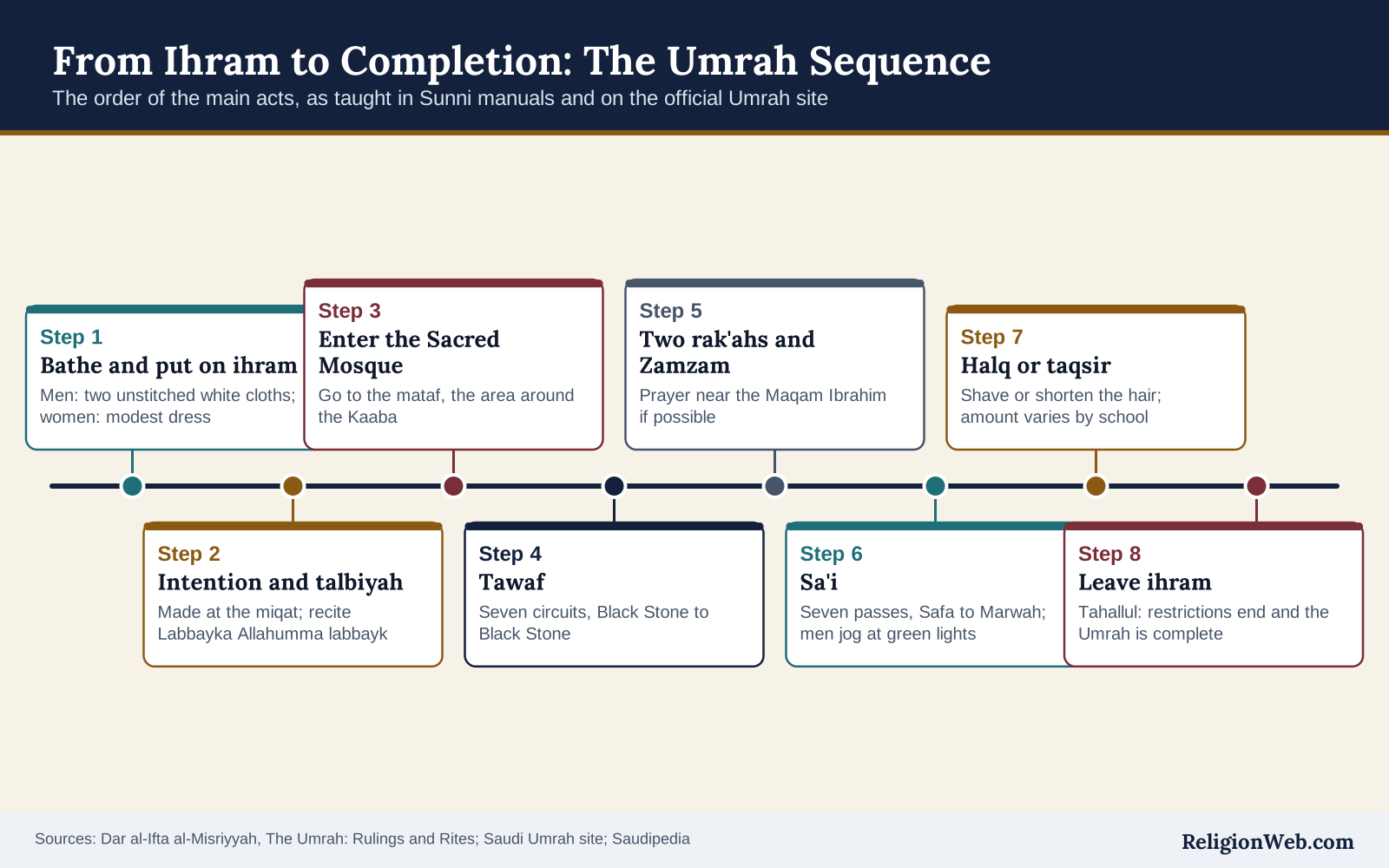
A pilgrim who intends Umrah bathes and puts on the plain garments of ihram, forms the intention at or before the miqat, and begins reciting the call known as the talbiyah. On reaching Mecca the pilgrim enters the Sacred Mosque and performs tawaf, seven counterclockwise circuits around the Kaaba, then prays two rak‘ahs (units of ritual prayer) and often drinks water from the well of Zamzam. Next comes sa‘i, seven passes between the hills of Safa and Marwah, beginning at Safa and ending at Marwah. Finally men shave the head or shorten the hair, and women trim a small portion of theirs. With that, the pilgrim leaves the state of ihram, and the Umrah is complete.
Key Facts at a Glance
Who, where, and how long
Umrah is performed by Muslims, men and women alike, in and around the Sacred Mosque (Masjid al-Haram) in Mecca, in the Hijaz region of western Saudi Arabia. Because only Muslims may enter the sanctuary of Mecca, the pilgrimage is a Muslim rite in the strict sense; others can learn about it, but they do not take part in it. The rites themselves take a few hours, though a pilgrim may spend days or weeks in the city, depending on the permit and personal circumstances. The table below collects the main facts.
| Feature | Summary |
|---|---|
| Meaning of the name | “Visit” (Arabic ‘umrah); popularly “the lesser pilgrimage” |
| Place | The Sacred Mosque in Mecca: the Kaaba, the Safa and Marwah passage, and the surrounding sanctuary |
| Core rites | Ihram at the miqat, tawaf (seven circuits), sa‘i (seven passes), and shaving or shortening the hair |
| Time | No fixed date. It may be performed in any month, with a few days disliked by some jurists (see the timing section) |
| Typical duration of the rites | A few hours; pilgrims often stay in Mecca for several days |
| Legal status | Shafi‘i and Hanbali schools: obligatory once for those able. Hanafi and Maliki schools: a strongly recommended sunna |
| Relation to Hajj | A separate rite that shares ihram, tawaf, and sa‘i; Hajj adds Arafat, Muzdalifah, Mina, stoning, and sacrifice |
| Participants | Muslims only. Millions of foreign visitors each year (18.03 million foreign performers reported for 2025) |
| Texts that ground it | Quran 2:158 and 2:196; reports on the Prophet’s own Umrahs in the hadith collections |
Obligation and timing in brief
Hajj is a fixed duty with a fixed season. Umrah has no season, which is the single most important practical distinction between the two. A Muslim in Cairo, Jakarta, or Chicago can perform Umrah in January or in July, in Ramadan or outside it. Practice in Ramadan is especially valued, for reasons discussed below, and the Saudi authorities restrict who may enter Mecca while the Hajj season is under way. Those restrictions are administrative measures for crowd safety rather than a teaching that Umrah is forbidden during the Hajj months, a point treated in detail in the timing section.
As for obligation, the legal schools do not speak with one voice. The Shafi‘i and Hanbali schools, with the Zahiri scholars, hold Umrah to be obligatory once in a lifetime for those who can afford and manage it. The Hanafi and Maliki schools classify it as a strongly confirmed sunna, meaning a practice the Prophet kept up and that is highly commended but not required. Everyone agrees that it carries great merit, and nearly everyone who goes for the first time does so in the hope of performing it correctly and with sincerity.
Key Arabic Terms Used in This Article
Terms of the sacred state
A small vocabulary unlocks most writing about Umrah. The state of ritual consecration is ihram, from a root meaning “to make forbidden,” because certain ordinary acts become forbidden while in it. The place or line where it must be entered is the miqat. The call pilgrims recite is the talbiyah, from its opening word labbayka, “here I am at Your service.” The act of leaving ihram is tahallul, “becoming lawful again.” The sanctuary around Mecca, whose boundaries are marked, is the Haram, and the great mosque inside it is al-Masjid al-Haram.
Terms of the rites and places
The circling of the Kaaba is tawaf, and the open space around it is the mataf. The walking between the two hills is sa‘i, “striving,” and the covered gallery that now encloses the route is the mas‘a. Cutting the hair is halq when the head is shaved and taqsir when the hair is only shortened. The table below defines the terms a reader will meet most often, and the article uses the English forms and Arabic forms side by side so that readers can follow Arabic-language guides and signs.
| Term | Meaning in Umrah |
|---|---|
| Umrah (‘umrah) | The “visit”: the rite of ihram, tawaf, sa‘i, and cutting the hair |
| Ihram | The sacred state, and also the two unstitched white cloths worn by men |
| Miqat | The appointed place where a pilgrim coming from outside the sanctuary must enter ihram |
| Talbiyah | The pilgrim’s refrain beginning Labbayka Allahumma labbayk |
| Tawaf | Seven counterclockwise circuits of the Kaaba |
| Mataf | The circular area around the Kaaba where tawaf is performed |
| Hajar al-Aswad | The Black Stone, set in the eastern corner of the Kaaba and the starting point of each circuit |
| Maqam Ibrahim | The “Station of Abraham,” near which pilgrims pray two rak‘ahs after tawaf |
| Sa‘i | Seven passes between the hills of Safa and Marwah |
| Halq / Taqsir | Shaving the head / shortening the hair, which ends ihram |
| Zamzam | The well in the Sacred Mosque whose water pilgrims drink |
| Tamattu‘, ifrad, qiran | The three ways of combining Umrah with Hajj, discussed in the timing section |
| Mahram | A close relative with whom a woman may travel, a term central to some legal discussions of women’s travel |
Origins and Historical Development of Umrah
The history of Umrah is a story told in two registers. In the Muslim understanding, the sanctuary at Mecca was established by Abraham (Ibrahim) and his son Ishmael (Ismail), and its rites go back to them. Historians approach the question differently, using the Quran, the earliest biographies of the Prophet, and the reports gathered in the hadith collections to reconstruct how a local sanctuary became the center of an international pilgrimage. This section keeps those two registers distinct. The Kaaba article on this site covers the building’s own history in detail, and the Hajj article covers the annual pilgrimage; here the focus is the lesser pilgrimage.
Roots Before and at the Beginning of Islam
A sanctuary and its visitors
The Quran presents the sanctuary in Mecca as a place of worship set apart long before Muhammad. In the second chapter, God tells Abraham and Ishmael to purify the House for those who circle it, for those who stay there in devotion, and for those who bow and prostrate. The same chapter records the command to take the place where Abraham stood as a place of prayer. Muslim exegetes (mufassirun) have read these verses as the foundation of both tawaf and the prayer that follows it. The wording below is quoted from the Pickthall translation.
Purify My house for those who go around and those who meditate therein and those who bow down and prostrate themselves (in worship).
Quran 2:125 (closing clauses), Pickthall translation, as presented by sacred-texts.com
Historians note that Mecca was a pilgrimage center in the Arabian Peninsula before Islam, with seasonal fairs and visits to the sanctuary, and that tribes observed various rites there. Reference works such as the Encyclopaedia Britannica describe Umrah as having taken its present form during Muhammad’s lifetime, combining several older ceremonies, reinterpreted in monotheistic terms, with distinctly Islamic prayers. Muslim tradition itself says something similar from the inside: it holds that Abraham’s original rites had been overlaid with practices that the Prophet corrected and restored. What historians can say with confidence is that the Umrah of later centuries was shaped by Muhammad’s own practice, and that pilgrims have followed it closely ever since.
Safa, Marwah, and the story of Hagar
No part of the Umrah is more closely tied to a single story than sa‘i. In the account told by Muslim tradition and by the Saudi national encyclopedia, Abraham left his wife Hagar (Hajar) and their infant son Ishmael in a barren valley by God’s command. When the water they had brought ran out, Hagar went up and down between two small hills looking for help, and the well of Zamzam gushed forth near where the child lay. The longer narratives are preserved in the hadith literature, with the report attributed to Ibn Abbas in Sahih al-Bukhari often cited, but they are traditional accounts and not historical records that can be checked independently. Their religious meaning is clear: pilgrims re-enact a mother’s search for water and her trust in God.
The Quran itself speaks of Safa and Marwah in a verse about pilgrimage, calling them among the “indications of Allah” in Pickthall’s phrasing. Commentators and hadith reports connect the verse with early believers’ hesitation about walking between the hills, which some associated with practices from before Islam; the verse answers that there is no sin in the walk. The details of those reports vary, and the article returns to the verse in the section on the Quran’s teaching.
The Prophet’s Umrahs
Hudaybiyyah and the interrupted Umrah
The practice as Muslims know it is anchored in the life of the Prophet. In the sixth year of the Hijri era (traditionally March 628 CE), Muhammad set out from Medina with a large party of companions intending to perform Umrah. The Quraysh of Mecca, who then controlled the city, did not allow them in. After negotiations at a place called Hudaybiyyah, outside the sanctuary, the two sides agreed to a truce, and the Muslims were to turn back and return the following year. The Prophet and his companions slaughtered their sacrificial animals and shaved or cut their hair at Hudaybiyyah, leaving the state of ihram without having reached the Kaaba. Because they had been prevented, the Umrah of that year is counted by Muslim scholars as a case of the rite being blocked rather than completed.
The Quran refers to this episode in its chapter on victory, which promises that the believers will enter the sanctuary in safety. Many Muslims read the following verse as referring to Hudaybiyyah and the Umrah that followed it. The words are also a Quranic reference for the closing act of every Umrah, the shaving or cutting of the hair.
Allah hath fulfilled the vision for His messenger in very truth. Ye shall indeed enter the Inviolable Place of Worship, if Allah will, secure, (having your hair) shaven and cut, not fearing.
Quran 48:27 (first three sentences), Pickthall translation, as presented by sacred-texts.com
The Umrahs of the seventh and eighth years, and the one with Hajj
A report in Sahih al-Bukhari, narrated by Anas ibn Malik and gathered under the chapter heading “How many times did the Prophet perform Umrah?”, says that Muhammad performed four Umrahs and, with the exception of the last, all took place in the month of Dhu al-Qa‘dah. The first was the one at Hudaybiyyah, in which the Muslims were prevented from entering. The second was the following year (7 AH, traditionally 629 CE), the Umrah that fulfilled the truce, known to later writers as the Umrah of making up or fulfillment. The third was performed from a place called Ji‘ranah, on the road outside Mecca, after the distribution of the spoils of the battle of Hunayn in 8 AH. The fourth was made together with his only Hajj, in 10 AH, the Farewell Pilgrimage. The classical manual Fiqh us-Sunnah by Sayyid Sabiq lists the same four.
These reports are doing more than recording a biography. Muslims take them as models. The place of Ji‘ranah, for example, became a recognized point outside the sanctuary from which residents of Mecca may enter ihram to perform Umrah. The Prophet’s choice of Dhu al-Qa‘dah for most of his Umrahs, a month that falls among the months of Hajj, fed into later legal discussion about which times of year are suitable, as the timing section explains. The table below collects the four Umrahs as the hadith tradition and its commentators present them.
| Umrah | Year (Hijri / traditional CE) | Month and place | What happened |
|---|---|---|---|
| 1. Hudaybiyyah | 6 AH / about 628 CE | Dhu al-Qa‘dah; Hudaybiyyah, outside Mecca | Muslims were prevented from entering; truce agreed; they left ihram and returned to Medina |
| 2. Fulfillment (Umrat al-Qada) | 7 AH / about 629 CE | Dhu al-Qa‘dah; Mecca | The Umrah that the truce allowed the following year |
| 3. Ji‘ranah | 8 AH / about 630 CE | Ji‘ranah, northeast of Mecca, after Hunayn | Umrah entered from Ji‘ranah when the spoils were divided |
| 4. With Hajj | 10 AH / 632 CE | Mecca, in the Hajj season | Umrah combined with the Farewell Pilgrimage |
From the Early Caliphates to the Present
Routes, caravans, and the growing Sacred Mosque
After Muhammad’s death in 632 CE, pilgrimage to Mecca became a feature of Muslim life across a rapidly expanding world. The caliphs enlarged the Sacred Mosque and, over the following centuries, rulers in Iraq, Syria, and Egypt organized pilgrimage caravans and maintained water stations and roads along the main routes. Most of that organization was aimed at Hajj, which gathered the largest numbers at one time, but travelers who reached the Hijaz in other seasons also made Umrah, and a long literature of travel accounts and pilgrim guides from the medieval period describes the rites. The building history of the mosque, the Kaaba, and the Mas‘a is a long one. The Saudi national encyclopedia, for instance, records that the walkway between Safa and Marwah was first paved with stone in 1926 and was incorporated into the Sacred Mosque’s structure in the Saudi expansions of the 1950s and later.
The modern Umrah: air travel, expansion, and regulation
The twentieth century changed the practice in two ways. Steamships and then aircraft made the journey a matter of days rather than months, so that Umrah, which had often been a side benefit of a long trip, became a trip in its own right. At the same time, the Saudi state, which took control of the Hijaz in the 1920s, took on the management of the holy places, funding successive expansions of the Sacred Mosque and developing a licensing system for companies that bring pilgrims. In recent decades the system has moved online: visas, bookings, and permits to enter the mosque are now handled largely through a government platform, and the number of foreign performers has grown to the millions each year. The later section on Umrah today gives current figures and rules, with dates.
Meaning, Status, and Legal Ruling of Umrah
To ask what Umrah means is to ask two questions at once. One concerns its place in Islamic law: whether a Muslim must perform it, and which parts of the rite are essential. The other concerns its religious significance: what Muslims understand themselves to be doing when they walk around the Kaaba or between two hills. The Quran, the hadith literature, and the work of jurists speak to both questions, and on the first of them the major schools of law disagree in ways that are worth stating clearly.
What the Quran Says About Umrah
The “visit” in Quran 2:196
The Quran mentions Umrah by name in the second chapter, in a long passage about the pilgrimage rites. The opening command is short. Pickthall’s translation of the first sentence reads as follows.
Perform the pilgrimage and the visit (to Makka) for Allah.
Quran 2:196 (first sentence), Pickthall translation, as presented by sacred-texts.com
The Arabic verb behind “perform” is commonly rendered as “complete” or “fulfill,” and the interpretation of that single verb is where the legal disagreement begins. Jurists of the Shafi‘i and Hanbali schools read the verse as a command that places Umrah alongside Hajj as a duty, and they treat it as the primary scriptural basis for calling Umrah obligatory; the manual Fiqh us-Sunnah by Sayyid Sabiq records this reasoning. Scholars of the Hanafi and Maliki schools generally understand the command differently, as an instruction to complete either rite once a person has begun it, rather than a freestanding obligation to start it. The same passage goes on to discuss what a pilgrim should do when prevented from reaching Mecca, and what is owed by someone who performs the visit and the pilgrimage in one journey, which are the basis for the rulings on blocked pilgrimages and combined rites.
Safa and Marwah among the “indications of Allah”
A few verses earlier, in 2:158, the Quran speaks of the two hills where sa‘i is performed. The first sentence of the verse in the Pickthall translation is the following.
Lo! (the mountains) As-Safa and Al-Marwah are among the indications of Allah.
Quran 2:158 (first sentence), Pickthall translation, as presented by sacred-texts.com
The word rendered “indications” is sha‘a’ir, which can be translated as “signs” or “rites of God.” The verse goes on to say, in paraphrase, that there is no sin for a person on pilgrimage to the House, or making the visit, in going around the two hills, and that God appreciates those who do good of their own accord. (The Pickthall text adds a parenthetical gloss about pre-Islamic custom, which this article does not quote; the gloss reflects one translator’s reading.) The jurists drew different conclusions from the phrase “no sin.” Many treated sa‘i as an essential pillar of both Hajj and Umrah, citing the Prophet’s own practice. The Hanafis classify sa‘i as a strict obligation (wajib) whose omission can be made good by a sacrifice, a distinction taken up in the table below.
Rulings in the Legal Schools
Obligatory or strongly recommended
The question of status divides Sunni jurists along familiar lines. The Shafi‘i and Hanbali schools, and the Zahiri scholars, hold Umrah to be obligatory once in a lifetime for anyone who meets the conditions of ability, as the Egyptian fatwa authority Dar al-Ifta states in its article on Umrah and as an entry in the fiqh encyclopedia hosted on Dorar.net also records. The Hanafi and Maliki schools classify it as a confirmed sunna. In support, they cite a report from the Companion Jabir, quoted by Sabiq, in which the Prophet was asked whether Umrah was obligatory and answered that it was not, but that performing it is better. Sabiq also notes a report in which al-Shafi‘i himself is said to have spoken more cautiously about the evidence. Other early scholars held that it was obligatory only for those who live at a distance from Mecca.
These differences do not affect how the rite is performed, only how it is classed, and in practice they matter less than one might expect. A Muslim who takes the Hanafi view of Umrah as a sunna will still regard it as a highly commended act, and will want to perform it correctly. A Muslim who follows the Shafi‘i or Hanbali view will count a single Umrah in a lifetime as meeting the duty, and will not necessarily regard repeated Umrahs as part of that duty; the Dorar.net entry, for its part, says repetition is permissible but questions the habit of making many Umrahs in quick succession during a single stay.
Pillars and obligations of the rite
The legal schools also classify the individual parts of the rite, using categories that matter when something goes wrong. A rukn (pillar) cannot be omitted without voiding the Umrah. A wajib (obligation, in the Hanafi sense) is required, but its omission can be made up by a compensatory offering, usually a sheep. Sources differ on the details, and the table summarizes the main points as given by Dar al-Ifta, with the Hanafi classification taken from a published Hanafi answer on the subject. It describes the broad classification and is not a substitute for guidance from a scholar of the pilgrim’s own school.
| School | Status of Umrah | Sa‘i | Cutting the hair |
|---|---|---|---|
| Hanafi | Sunna; disliked on five days, 9 to 13 Dhu al-Hijjah | Wajib; omitting it requires a sacrifice, but the Umrah stands | Wajib; at least a quarter of the head |
| Maliki | Strongly recommended sunna | Pillar | Wajib; the whole head shaved or shortened |
| Shafi‘i | Obligatory once for those able | Pillar | Obligatory in the dominant view; at least three hairs |
| Hanbali | Obligatory once for those able | Pillar in the dominant opinion | Wajib; the whole head shaved or shortened |
Across the schools, a valid Umrah requires ihram from the proper place, tawaf, and sa‘i, though the Hanafis class sa‘i as a strict obligation rather than a pillar and treat only the first four circuits of tawaf as the essential part, with the remaining three as obligatory. Dar al-Ifta, in its summary, groups the obligatory actions as the intention to enter ihram, tawaf, sa‘i, the cutting of the hair, and the performance of these in the right order.
Merit and Meaning
Expiation and renewal in the hadith tradition
The hadith collections give Umrah a distinct place in the spiritual life. A report narrated by Abu Hurayrah in Sahih al-Bukhari (no. 1773), under the chapter on the obligation and merit of Umrah, says in paraphrase that one Umrah is an expiation for the sins committed between it and the previous one, and that the reward of an accepted Hajj is nothing less than Paradise. The saying is the main reason Muslims speak of Umrah as an occasion of spiritual renewal, and it is the foundation for the practice of performing Umrah regularly, if the pilgrim can afford to. Exactly what “expiation” covers is a subject of commentary: most scholars, in the generally cited reading, take it to refer to minor sins and to the weight of ordinary failings, and they teach that serious wrongs against other people still require repentance and restitution.
This is a matter on which Muslim authorities counsel humility. The reports on merit are promises of divine mercy and are not mechanical guarantees; the same traditions stress sincerity of intention and the pilgrim’s conduct, and they speak of the pilgrimage being “accepted” (mabrur) rather than simply completed. A pilgrimage can be correct in form and unaccepted in the eyes of God, in the view of devotional writers, if it is undertaken for display or with lawfully unearned money.
The inner meaning of the rite
Devotional and ethical writing on Umrah tends to draw out four meanings. The first is renunciation and equality: the ihram garments of men are two plain, unstitched white cloths, which strip away signs of rank and nationality, so that a prince and a laborer stand in the same cloth. The second is remembrance of Abraham, Hagar, and Ishmael: the rites are understood as a re-enactment of their trust and of Hagar’s search for water, which is why many pilgrims reflect on sa‘i as a lesson in perseverance and in reliance on God. The third is orientation: Muslims pray toward the Kaaba five times a day, and tawaf places the pilgrim at its center, circling the point to which prayer is directed. The fourth is restraint. The Quran’s instruction for the pilgrimage, in 2:197, forbids “lewdness,” “abuse,” and “angry conversation,” and jurists and preachers have long applied that ethic of patience to anyone in ihram, including those on Umrah.
When Umrah Is Performed: Timing, Ramadan, and the Hajj Months
The question “when?” separates Umrah from Hajj more clearly than any other. Hajj happens in one particular stretch of days each year; Umrah does not. That openness is not an accident of practice. It is built into the way the rite is defined in law, and the history of the two is bound up with the lunar calendar and with the Prophet’s own decisions about when to perform it.
No Fixed Date
Why Umrah is not tied to the calendar
Hajj is defined by its sites and its days: the pilgrim must stand at Arafat on the ninth of Dhu al-Hijjah, the twelfth month of the Hijri calendar, and must complete the other rites of the pilgrimage in the days that follow. The Islamic year is lunar, about 354 days long, and it moves earlier by roughly ten or eleven days each year against the solar calendar, so Hajj shifts through the seasons over a cycle of about thirty-three years. Umrah has no equivalent anchor. It consists of ihram, tawaf, sa‘i, and the cutting of the hair, none of which depends on a particular day, a particular moon, or a particular place outside Mecca itself. A pilgrim who is in ihram, in the Sacred Mosque, and able to complete the rites can complete Umrah at dawn, at noon, or at night, in any month of the Hijri year.
Sabiq states the common view in Fiqh us-Sunnah: most scholars permit Umrah at any time of the year, and all agree that it is permissible in the months of Hajj. The same book records that the Companion Ibn Umar saw no harm in performing Umrah before Hajj, and that the best time, in Sabiq’s judgment, is Ramadan. The Hijri calendar also means that the phrase “Umrah season” in everyday speech refers to the administrative period set by Saudi authorities for issuing visas, not to a religious season; the legal tradition has no such thing.
Days some jurists discourage
There is one place where the otherwise open calendar narrows, and it comes from the Hanafi school. According to Sabiq, Abu Hanifa disliked performing Umrah on five days: the Day of Arafah (9 Dhu al-Hijjah), the Day of Sacrifice (10 Dhu al-Hijjah), and the three days of Tashriq that follow (11 to 13). His disciple Abu Yusuf is reported to have disliked it only on Arafah and the three days after it. A modern Hanafi answer published on the IslamQA.org portal puts the point more strongly, saying that Umrah on those five days is makruh tahriman, disliked to the point of being close to forbidden, while recommending Umrah in Ramadan. The other schools do not share this restriction. A common explanation for the restriction is practical as well as legal: those are the days on which the rites of Hajj are being performed, and the pilgrims are occupied with them.
Umrah in Ramadan
The report of the woman from the Ansar
The month of fasting has a special association with Umrah. Sahih al-Bukhari (no. 1782), in a chapter headed “Umrah in Ramadan,” gives a report from Ibn Abbas. The Prophet asked a woman of the Ansar, the Medinan Muslims, why she had not made the pilgrimage with them, and she explained that her family had only one camel for watering their land, since her husband and son had taken the other. He told her to perform Umrah in Ramadan, because, in his words as the report gives them, Umrah in Ramadan equals Hajj in reward. The wording, in paraphrase, is the source for the widespread practice of seeking Umrah during Ramadan.
Scholars have been careful about what the saying means. The report speaks of equality in reward, and the majority of jurists have understood it to mean that Umrah in Ramadan has a reward comparable to that of Hajj, but not that it discharges the obligation of Hajj itself. A Muslim who has not yet performed Hajj and is able to do so still owes it. This distinction is the subject of one of the misconceptions treated later in the article.
Crowds, the last ten nights, and Laylat al-Qadr
The result is that the Sacred Mosque is extremely busy throughout Ramadan, and especially during the final ten nights, when many Muslims seek Laylat al-Qadr, the Night of Power, which tradition places among the odd-numbered nights of the last third of the month. Pilgrims who come at that time combine the rites of Umrah with the nightly taraweeh prayers, fasting, and long periods of recitation of the Quran. The crowding is such that the Saudi authorities and the mosque’s administration channel the flow of pilgrims across the floors of the mosque and into the mas‘a. Pilgrims who choose Ramadan often do so knowing that the experience will be physically demanding, and some scholars and guides advise those who are elderly, ill, or in need of quiet to consider another month. The Ramadan article on this site covers the month itself.
Umrah and the Hajj Months
Tamattu‘, qiran, and ifrad
The Quran refers to the Hajj as taking place in “the well-known months,” which Muslim tradition identifies as Shawwal, Dhu al-Qa‘dah, and the early part of Dhu al-Hijjah. Umrah may be performed in those months too. What the legal tradition adds is a set of three ways of combining the two rites, which are explained more fully in the Hajj article. In tamattu‘ (literally “enjoyment”), the pilgrim performs Umrah first, leaves ihram, and enters a fresh ihram for Hajj on the eighth of Dhu al-Hijjah. In qiran (“joining”), the pilgrim enters a single ihram for both Umrah and Hajj and does not leave it until the Day of Sacrifice. In ifrad (“singling out”), the pilgrim performs Hajj alone, with Umrah either before or after. In the juristic tradition, tamattu‘ and, for most scholars, qiran carry an obligation to make an offering, and the Quranic passage in 2:196 provides fasting for those who cannot afford one.
The schools rank the three forms differently, and the choice is commonly made by the group or the guide. The Hajj article lists the preferences of each school, citing Dar al-Ifta. What matters here is that for the great majority of pilgrims today, Umrah and Hajj are linked by the tamattu‘ pattern: they perform Umrah on arrival and Hajj a few days or weeks later.
Seasonal permit pauses and the 2026 example
Modern regulations create the impression that Umrah is forbidden in the weeks around Hajj. A concrete case from 2026 shows what actually happens. In April 2026, a Saudi Ministry of Interior announcement for the 1447 AH Hajj said that the issuing of Umrah permits through the Nusuk platform would be suspended from 18 April 2026 (1 Dhu al-Qa‘dah 1447) to 31 May 2026 (14 Dhu al-Hijjah 1447), that holders of Umrah visas were to leave the Kingdom by 18 April, and that from that date holders of any visa other than a Hajj visa could not enter or stay in Mecca. Those measures are limits on who may be in Mecca, set to manage the very large Hajj crowd safely, and not statements by the religious scholars that Umrah is invalid at that time. People who perform Hajj by the tamattu‘ route still perform Umrah in those weeks, as part of their Hajj permit.
The practical rule for a reader is therefore simple. In principle, Umrah is open all year. In practice, the permit system in any given year determines which weeks are open to which pilgrims, and the Saudi Ministry of Hajj and Umrah announces an annual calendar. The 1448 AH calendar, announced in May 2026, is described in the section on Umrah today.
Preparing for Umrah: Eligibility, Practicalities, and Intention
Preparation for Umrah is partly legal, partly logistical, and partly spiritual. The legal conditions are brief. The logistics have become more complicated in recent years because of permit systems, health requirements, and the sheer size of the crowds. The spiritual preparation, which Muslim writers have always stressed, is less formal but is often what pilgrims remember most.
Who Is Expected to Perform Umrah
The conditions of obligation
For the schools that treat Umrah as obligatory, the conditions are those that apply to the other duties of the faith: the person must be a Muslim, sane, of age, and free, and must have the ability. Ability, in the classical definition, covers the means to pay for the journey and for the family’s needs during the absence, and the physical capacity to complete the rite. Dar al-Ifta notes that a person who lacks ability but nevertheless performs Umrah has still made a valid Umrah and has fulfilled the obligation. The schools that treat Umrah as a sunna apply the same conditions to the encouragement to perform it, though in a gentler form. Someone for whom the journey would cause hardship, because of illness, poverty, or caring duties, is not blamed for staying at home.
Women, children, and companions
Questions about who may travel with whom are among the most discussed practical points in the older legal literature. Classical rulings on women’s travel, which run through a good deal of Hajj and Umrah law, generally required a woman to be accompanied by a mahram, a husband or close male relative, though the schools differed on what distance counted as travel, and some jurists, including in the Maliki and Shafi‘i traditions, accepted the company of trustworthy women or a safe group. In recent years, Saudi authorities have relaxed their own entry rules for women, and as of the press and ministry reports available for this article, adult women may apply for Umrah visas without a male guardian. Those are administrative rules. The religious opinion that a pilgrim follows depends on the school or scholar she consults.
Children may perform Umrah with their families. Under the usual rule, a minor must travel with a parent or legal guardian, and a child’s Umrah is a voluntary act that does not discharge the duty later in life; that is the standard teaching on children’s pilgrimage, though readers should confirm the details of any school’s position with a scholar. A pilgrim who is unable to complete the rite because of illness or old age may sometimes arrange for it to be performed on their behalf by someone else who has already performed their own, a practice the schools discuss at length under the heading of proxy pilgrimage.
Practical Preparations
Permits, visas, and booking systems
The rules for entering Saudi Arabia to perform Umrah are set by the Saudi government and change from season to season. As of October 2026, the main outline is as follows, and readers should treat it as a snapshot rather than as instructions. The Ministry of Hajj and Umrah describes its Nusuk platform as the place to plan an Umrah and a visit to Medina; Umrah permits are issued through that platform, as the Ministry of Interior’s 2026 announcement shows. Foreign pilgrims need a visa that allows Umrah, which in practice is obtained through a licensed Umrah company in the home country or, for citizens of eligible countries, through the Saudi e-visa system. A travel-industry guide reports that the single-entry Umrah visa has a validity window and a maximum stay of 90 days, but those details are from a commercial source and should be checked against the Ministry’s own current pages.
The annual calendar is announced in advance. For 1448 AH, the Ministry of Hajj and Umrah announced on 17 May 2026, as reported by the Associated Press of Pakistan citing the Saudi Press Agency, that visa issuance would begin on 31 May 2026, that entry to Mecca on Umrah permits would be possible from 1 June 2026, and that the last visas would be issued on 9 March 2027, with the last entry on 23 March 2027 and the last departure on 7 April 2027. These dates are what the authorities announced and may be revised.
Health, vaccination, and physical readiness
The Saudi Ministry of Health publishes a set of health requirements for Umrah travelers each year. The document for 1447 AH (2026) requires meningococcal vaccination (ACYW or ACYWX) for all Umrah travelers from every country, with the conjugate vaccine valid for five years and the polysaccharide vaccine for three, and with either to be given at least ten days before arrival. It sets out further requirements depending on the country of departure for polio and yellow fever, and for COVID-19 vaccination in the case of people over 65, pregnant women, and people with certain chronic conditions. Among its recommendations, it advises people with chronic illnesses to carry medical documentation and enough medication in original packaging, and advises older travelers to avoid direct sun during the rites and to drink plenty of fluids. The rules can change; travelers should read the current year’s document.
Religious practice does not replace medical care. The rites involve long stretches of walking on hard floors, crowds, and in some seasons high heat, and the tradition itself makes allowance: a pilgrim who cannot walk may be pushed in a wheelchair or carried, and the mas‘a has dedicated lanes for this purpose. Pilgrims with heart or lung conditions, diabetes, or limited mobility, and those who are pregnant, are well advised to consult a physician before they travel and to follow the medical guidance they receive.
Preparing Spiritually and Ethically
Repentance, debts, and lawful provision
Classical manuals begin the preparation for Umrah with repentance and with the settling of obligations. A pilgrim is advised to make amends for wrongs done to others, to pay or arrange for the payment of debts, to write a will if appropriate, and to leave provision for those who depend on them. The expenses of the journey are expected to come from lawful earnings, a concern tied to the broader Islamic emphasis on the halal in livelihood as well as in food, and one reason that devotional writers say a pilgrimage paid for with unlawful money is not “accepted.” Many pilgrims also take the occasion to settle outstanding charitable obligations such as zakat, though the two are legally separate.
Learning the rites and finding a guide
The rite can be learned in an afternoon, but most pilgrims prepare for weeks. They read a handbook, attend a class at their mosque or a pre-departure seminar organized by the travel company, and learn the talbiyah and a few short supplications. Groups usually travel with a leader, and in Mecca there are professional guides known as mutawwifs who accompany groups through the tawaf and sa‘i. The Ministry’s own materials and the Nusuk platform also offer guidance. A pilgrim who wants to follow a particular legal school will do well to learn which points it treats as pillars, which as obligations, and which as recommended practices, since the compensation owed for an error depends on that classification.
The Sacred Places of Umrah
Umrah is a rite of place as much as of action. Nearly everything a pilgrim does is done in relation to a particular spot: the line where ihram begins, the boundary of the sanctuary, the Kaaba, the station of Abraham, the well of Zamzam, the two hills. Knowing what each place is, and what it means in Muslim tradition, makes the sequence of the rite easier to follow. The Kaaba article on this site treats the building in depth; this section describes the places as they appear to a pilgrim making Umrah.
The Sanctuary of Mecca
The Haram boundary and who may enter
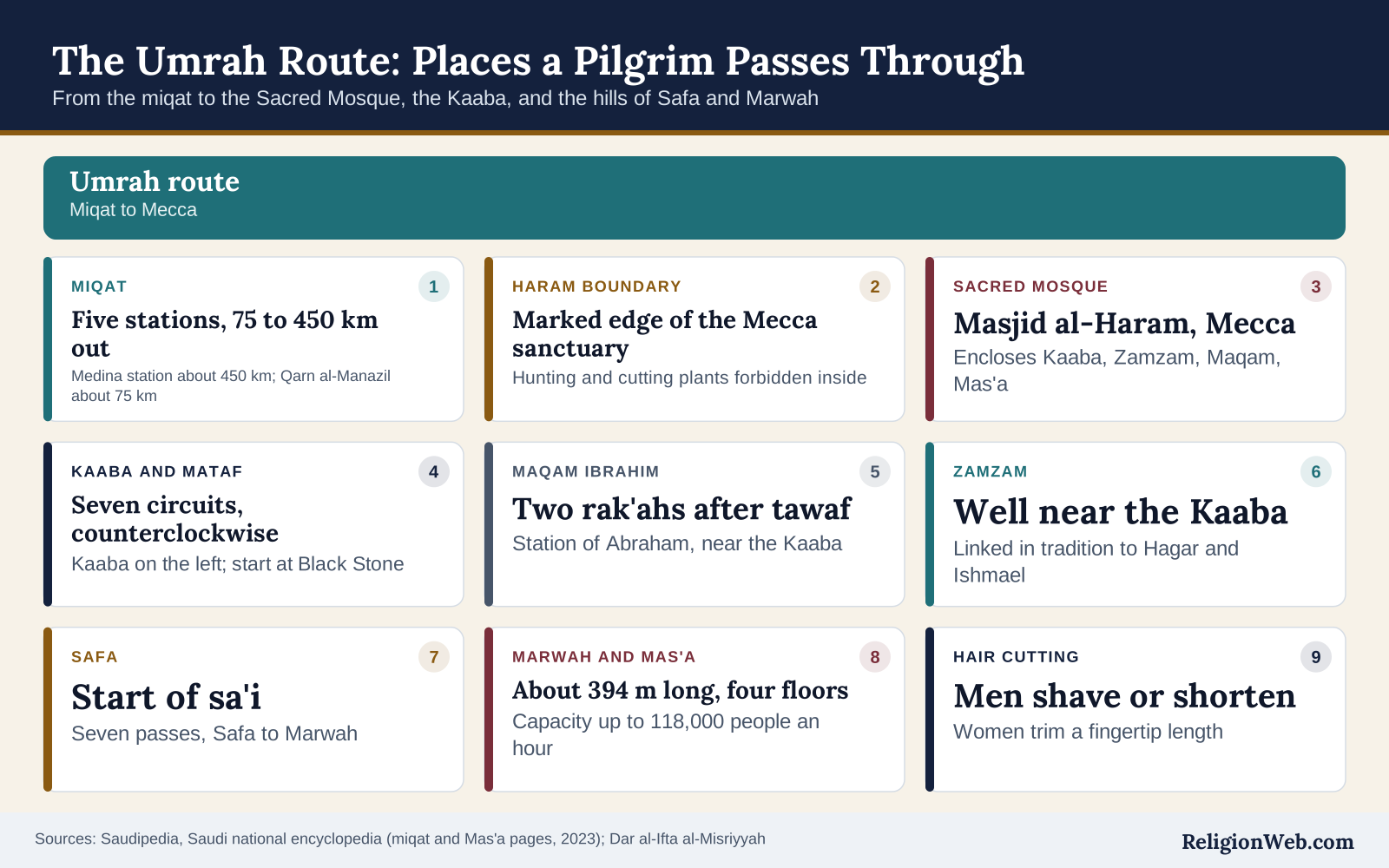
Mecca is surrounded by a protected zone called the Haram, whose edges are marked along the roads. Within it, Muslim law forbids the hunting of game and the cutting of plants, and it is the area that Saudi law and most classical jurisprudence reserve for Muslims: non-Muslims are not permitted to enter Mecca, a rule that jurists have generally applied to the whole sanctuary and not only to the mosque, with some differences between the schools on its extent. Medina has a similar, smaller sanctuary, though access there is regulated differently. The boundary matters for Umrah because it divides pilgrims into two groups: those who come from outside it, who must put on ihram at a miqat before they cross into it, and those who live inside it, who have to step outside the boundary to enter ihram for Umrah. The Saudi national encyclopedia names al-Tan‘im, where a mosque stands, and al-Ji‘ranah as the usual places for residents of Mecca to do so, which is why the Prophet’s Umrah from Ji‘ranah mattered for later practice.
The Sacred Mosque
At the center of the sanctuary is the Sacred Mosque, al-Masjid al-Haram, the largest mosque in the world by capacity and the focus of the Muslim ritual prayer. It encloses the Kaaba, the Maqam Ibrahim, the well of Zamzam, and, since the Saudi expansions of the twentieth century, the passage that links the two hills of Safa and Marwah. The structure that a modern pilgrim sees is largely the product of successive expansions, recorded in some detail by the Saudi national encyclopedia, from the Umayyad and Abbasid periods through the Ottoman works and the Saudi projects that began in the 1950s. Seen from above, it is a vast ring of galleries around an open courtyard in which the Kaaba stands. The five daily prayers are held there in congregation, and the Umrah pilgrim joins the rites in whatever space the crowd permits, on the ground floor, on the upper floors, or on the roof.
The Kaaba and the Mataf
The Kaaba and its features
The Kaaba is the cube-shaped stone building draped in black silk toward which Muslims pray. On its eastern corner is the Black Stone (al-Hajar al-Aswad), set in a silver frame about 1.5 meters above the ground. Tradition holds that the Prophet himself placed it in the wall when the Quraysh rebuilt the Kaaba before his prophethood. The southern corner, called the Yemeni corner (al-Rukn al-Yamani), is also touched by pilgrims when the crowd allows. A low semicircular wall on the northwest side, the Hijr of Ishmael, encloses an area that many traditions consider part of the original Kaaba, which is why a pilgrim performing tawaf must go around the outside of it. The Kaaba article gives the building’s dimensions, history, and the annual changing of its covering, the kiswa.
No part of the Kaaba is worshiped. Muslims pray to God, not to the building, and the Black Stone is kissed or touched as a sign of devotion because the Prophet is reported to have done so; a well-known report attributed to the caliph Umar says that he kissed it while saying that it was a stone that could neither harm nor benefit and that he did so only because he had seen the Prophet do it. The wording of that report is preserved in Sahih al-Bukhari and Sahih Muslim, though this article gives it in paraphrase. Most of the time the pilgrim cannot reach the stone, and the practice of pointing toward it from a distance, with the words Allahu akbar, meets the requirement.
The Station of Abraham and the well of Zamzam
Near the Kaaba is the Maqam Ibrahim, the “Station of Abraham,” a stone that tradition says bears his footprints, enclosed in a small structure. The Quranic instruction to take the place where Abraham stood as a place of prayer is the basis for the two rak‘ahs of prayer that follow tawaf, which the pilgrim performs as near the Maqam as the crowd allows, or anywhere in the mosque if it is too crowded. The well of Zamzam, which the Saudi encyclopedia connects with the story of Hagar and Ishmael, lies close to the Kaaba, and its water is available at coolers throughout the mosque. Britannica lists drinking Zamzam, touching the Black Stone, and praying at the Maqam among the optional extras of the rite, and Muslims commonly drink it with a supplication in mind.
Safa, Marwah, and the Mas‘a
The two hills
Safa and Marwah are two small rises on the eastern side of the Sacred Mosque. Safa lies at the foot of the Abu Qubays mountain, near the Safa gate, and Marwah is a small hill near the Kaaba. According to the Saudi national encyclopedia, in the reign of the Abbasid caliph al-Mansur pilgrims reached them by climbing steps, twelve at Safa and fifteen at Marwah. Today both are incorporated into the building, and the pilgrim begins the walk at Safa and ends it at Marwah.
The covered gallery
The route between them is the mas‘a, now a four-story gallery inside the mosque complex. The Saudi encyclopedia gives its length as 394 meters between the two hills and its width as 40 meters, with a capacity of 118,000 people per hour and a total of 2,761.5 meters for the seven laps; another page of the same encyclopedia gives the length as 375 meters, and the discrepancy probably reflects different points of measurement. The earlier route was an open street, paved with stone in 1926, shaded with canopies in 1947, and incorporated into the mosque’s structure beginning in 1956, according to the same source. In the middle of the course, green lights mark the deepest part of the old valley between the hills, and there are separate lanes and corridors for older pilgrims and pilgrims with disabilities. The table below collects the places and their role in the rite.
| Place | Role in Umrah | Notes |
|---|---|---|
| Miqat | Where ihram must be entered by those coming from outside the sanctuary | Five stations, plus residents’ own points; see the miqat table |
| Haram boundary | The edge of the sanctuary of Mecca | Marked on the roads; hunting and cutting of plants are forbidden inside it |
| Al-Masjid al-Haram | The Sacred Mosque, where tawaf and prayer are performed | Encloses the Kaaba, Maqam Ibrahim, Zamzam, and the mas‘a |
| Kaaba and Mataf | The center of tawaf and the area where tawaf is performed | Pilgrims keep it on their left as they circle counterclockwise |
| Black Stone | The starting and ending point of each circuit | Kissed, touched, or greeted from a distance |
| Maqam Ibrahim | The place of the two rak‘ahs after tawaf | Prayer is offered near it if possible; elsewhere in the mosque if not |
| Zamzam | The well whose water pilgrims drink | Linked in tradition to Hagar and Ishmael |
| Safa and Marwah | The start and end of sa‘i | Seven passes; the walk begins at Safa and ends at Marwah |
| Prophet’s Mosque, Medina | Not part of Umrah; visited separately by most pilgrims as a matter of custom | Roughly 450 km from Mecca; the Medina miqat lies about 14 km from it |
Ihram and the Miqat
The first act of Umrah is also the one that gives the rest its character. Ihram is not a garment but a condition: a person who has formed the intention to perform Umrah and has said the words that begin it passes into a state in which ordinary freedoms are set aside. The garments of ihram, the position of the miqat, and the restrictions that follow are all easier to understand when the state is seen as a threshold, one that a pilgrim crosses deliberately and leaves only when the rite is complete.
The Miqat
The five stations
The miqat is the fixed point, on each of the main routes into Mecca, where a pilgrim must already be in ihram if they intend Umrah or Hajj. Muslim tradition holds that the Prophet designated these places for the peoples approaching Mecca from different directions, and the legal schools agree that a pilgrim must not cross them without ihram. The Saudi national encyclopedia lists five main stations. Dhu al-Hulayfah, now known as Abyar Ali, serves the people of Medina and is about 450 kilometers from Mecca. Al-Juhfah, about 180 kilometers away and now replaced in practice by a station at Rabigh, serves pilgrims from the Levant, Egypt, and North and West Africa. Qarn al-Manazil, about 75 kilometers away, also called al-Sayl al-Kabir, serves the people of Najd and the Gulf. Yalamlam, about 130 kilometers away at its present site, serves Yemen and the south. Dhat Irq, about 100 kilometers away, serves Iraq and the north. The encyclopedia also lists Wadi Muharram, near Taif, for pilgrims from that area.
| Station | Traditionally used by | Distance from Mecca | Note |
|---|---|---|---|
| Dhu al-Hulayfah (Abyar Ali) | People of Medina | About 450 km | About 14 km from the Prophet’s Mosque |
| Al-Juhfah | Levant, Egypt, North and West Africa | About 180 km | Replaced in practice by a station at Rabigh |
| Qarn al-Manazil (al-Sayl al-Kabir) | Najd and the Gulf | About 75 km | Above Taif, with a mosque and facilities |
| Yalamlam | Yemen and the south | About 130 km (present site) | The present site is at the al-Sa‘diyah mosque |
| Dhat Irq | Iraq and the north | About 100 km | Near a mountain called Irq |
| Residents of Mecca | People living inside the sanctuary | Outside the Haram | Usually al-Tan‘im or al-Ji‘ranah for Umrah |
A pilgrim who passes a miqat without entering ihram is expected to return and begin properly; if that is not done, the Saudi encyclopedia says, a sheep must be sacrificed in Mecca and its meat given to the poor. The legal schools treat the details of such cases differently, which is one reason pilgrims are advised to ask a scholar of their school before traveling.
Pilgrims arriving by air, and those living nearby
Most pilgrims now arrive by plane, which raises the practical question of how to enter ihram at a point they cross in the air. Common practice is to put on the ihram garments before or during the flight and to declare the intention when the aircraft is over the miqat region or just before, often prompted by an announcement from the crew; pilgrims arriving in Jeddah are told by their group leaders where to begin. This is a matter of custom and local guidance, and the scholars on whom the pilgrim relies decide the specifics. Residents of Jeddah, according to the Saudi encyclopedia, enter ihram from their homes for both Hajj and Umrah, while residents of Mecca go outside the Haram for Umrah.
Entering Ihram
Bathing, dress, and intention
The sunna practices that surround entering ihram are well established. The pilgrim takes a full bath (ghusl), trims the nails and removes unwanted hair, since these are forbidden once ihram begins, and dresses in the prescribed garments. A man wears two pieces of plain, unstitched cloth, usually white: one wrapped around the waist and one draped over the shoulders, with sandals or other footwear that leaves the ankles uncovered. A woman wears ordinary modest clothing of her choice, with no particular color required. Many pilgrims, following a widely taught practice, then pray two rak‘ahs. Then comes the decisive moment, which is the intention (niyyah), made in the heart and, by custom, spoken aloud as a statement that one is entering ihram for Umrah. According to the majority view recorded by Dar al-Ifta, entering ihram consists of this intention; the Hanafi school adds a verbal act such as the talbiyah.
The talbiyah
After the intention comes the talbiyah, the refrain that marks a pilgrim throughout the period of ihram. Its wording, as transmitted from Ibn Umar in Sahih al-Bukhari (no. 1549), is given in transliteration as: Labbayka Allahumma labbayk, labbayka la sharika laka labbayk, inna l-hamda wa-l-ni‘mata laka wa-l-mulk, la sharika lak. In plain English, this renders roughly as: here I am, O God, here I am; here I am, You have no partner, here I am; praise, favor, and dominion belong to You; You have no partner. The English is the present article’s rendering, not a published translation. Men say it aloud, and women, according to the common teaching, say it quietly. The talbiyah is a statement of obedience to a call and of the oneness of God, and many pilgrims describe the experience of hearing thousands say it together as the moment at which the journey becomes real. The legal schools differ on when it ends in an Umrah, and the more common view holds that the pilgrim stops reciting it when beginning the tawaf.
Rules of the Sacred State
Restrictions for all pilgrims
While in ihram, a pilgrim of either sex may not use perfume or scented products on the body or clothing; may not cut hair or nails; may not hunt or kill land game, or uproot plants in the sanctuary; may not conclude or propose a marriage; and may not engage in sexual relations or intimacy. They are also called to avoid quarrels and wrongdoing, in keeping with the Quran’s counsel of patience in 2:197. The point of the restrictions is to set aside ordinary vanity and ordinary appetite for the duration. The rules are not always intuitive, which is why handbooks and guides spend so much time on them: pilgrims commonly bring unscented versions of ordinary soap and toiletries, and the use of a scented product by mistake requires a compensation in some schools. A lapse that is accidental or necessary, such as covering the head for medical reasons, is generally compensated by a fidya, a payment, a sacrifice, or fasting, depending on the case and the school.
Clothing rules for men and women
The restrictions on clothing differ by sex. Men may not wear stitched garments cut to the shape of the body, nor cover the head with a close-fitting covering, which is why the two-cloth garment is standard. Women are not required to wear any particular garment, and the rules on clothing are the subject of a discussion that touches on hijab: women cover their hair in the manner of their tradition, but according to a widely cited report from the Prophet, a woman in ihram does not wear a face veil that clings to the face or gloves. Jurists differ over the force and scope of that saying and over what a woman should do when men are near, and many women in practice let their head covering fall forward without touching the face. The result is that two women in the same mosque, each following a respected scholarly view, may look slightly different from each other.
The Rites of Umrah Step by Step
This section follows a pilgrim from the arrival in Mecca to the moment the rite is complete. It describes the form most widely taught in Sunni manuals, names the points on which the legal schools differ, and explains the meaning of each stage. The description is general and educational. A pilgrim who needs guidance on a specific question, such as an illness, a missed step, or a disagreement within a group, normally asks a qualified scholar or the group’s guide.
Arriving in Mecca and Entering the Mosque
From the hotel to the Sacred Mosque
For many pilgrims the first view of the Kaaba comes after hours of travel, usually from a hotel near the mosque, still in the garments of ihram. The pilgrim goes to the Sacred Mosque and enters through one of its many gates. The widely taught etiquette is to enter the mosque with the right foot first and with a short supplication, as in any mosque, and to proceed directly to the mataf rather than stopping to pray a greeting prayer, because tawaf itself takes the place of that prayer. Because the Umrah may be performed at any hour, the mataf is never entirely empty. A pilgrim who arrives at night may find the Kaaba lit and the circuits flowing; one who arrives at midday will often find the lower level crowded and will be directed to the upper floors or the roof, where the circuit is longer.
The sequence at a glance
The order of the acts matters. The schools agree that tawaf comes first, then sa‘i, then the cutting of the hair, and Dar al-Ifta lists the order of these acts as an obligation in its own right. On a narrower point, the Malikis and Hanbalis also require the seven circuits to follow one another without a long break, while the Hanafis and Shafi‘is treat that continuity as recommended. The table that follows lays out the whole sequence, using the standard description of the rite from the Egyptian fatwa authority Dar al-Ifta, from the Saudi government’s Umrah site, and from the encyclopedia sources cited in this article.
| Step | What the pilgrim does | Notes |
|---|---|---|
| 1. Ihram | Bathes, puts on the ihram garments, forms the intention at the miqat, and begins the talbiyah | The rite cannot begin without it; restrictions apply from this point |
| 2. Entering Mecca and the mosque | Goes to the Sacred Mosque and proceeds to the mataf | Entry is by permit in the current system |
| 3. Tawaf | Circles the Kaaba seven times counterclockwise, beginning and ending at the Black Stone | Kaaba kept on the left; pass outside the Hijr |
| 4. Two rak‘ahs | Prays two units of prayer near the Maqam Ibrahim | A sunna; Zamzam is commonly drunk afterward |
| 5. Sa‘i | Walks seven times between Safa and Marwah, starting at Safa and ending at Marwah | Men jog between the green lights |
| 6. Halq or taqsir | Men shave the head or shorten the hair; women trim a small amount | Amounts differ by school |
| 7. Release from ihram | The restrictions end; the Umrah is complete | Called tahallul |
Tawaf: Circling the Kaaba
Seven circuits
Tawaf begins at the line of the Black Stone. The pilgrim stands facing the stone, or in the direction of it, says Allahu akbar (God is greatest), and, if possible, touches and kisses it; if the crowd makes that impossible, the pilgrim raises a hand toward it and says the same words, without pushing. Each circuit then proceeds counterclockwise, with the Kaaba on the pilgrim’s left, from the Black Stone around to the Black Stone again. Seven circuits make one tawaf. The Quran’s phrase for the activity is brief and direct, in a verse that speaks of what pilgrims do at the end of their ritual preparations.
Then let them make an end of their unkemptness and pay their vows and go around the ancient House.
Quran 22:29, Pickthall translation, as presented by sacred-texts.com
The verse, which appears in the chapter on the pilgrimage, is the textual basis commonly cited for tawaf. Nothing in the rite requires a particular set of words. Pilgrims commonly recite the Quran, say the name of God, or make personal supplications (dua) in their own language, and many follow a widely taught practice of reciting a short Quranic prayer for good in this world and the next between the Yemeni corner and the Black Stone. The directions in manuals are guidelines. What is required is the intention and the number of circuits, and what is hoped for is attention.
Conditions and common variations
The conditions of tawaf are set out in the legal literature, and Dar al-Ifta lists them: that ihram precede it, that the pilgrim have the intention, that the circuit pass outside the Hijr, that it go counterclockwise, that the pilgrim be free of both minor and major ritual impurity, and that the body be properly covered. The majority treat these as conditions of validity. The Hanafis hold that a tawaf is valid without some of them, such as ritual purity, but that its omission requires a sacrificial compensation. In practice this is why pilgrims perform their ablutions (wudu) before entering the mosque and why a wudu break during tawaf, which can happen in a crowd, is a recurring question for guides.
Two customs apply to men. The first is idtiba‘, the uncovering of the right shoulder during tawaf, and the second is ramal, a brisk, short-stepped walk in the first three circuits. Both are described by the Saudi government’s Umrah site as sunna practices, and both are traced in tradition to the Prophet. Women do not perform them. In a dense crowd, ramal is not attempted. A woman who is menstruating cannot perform tawaf in the usual understanding of the schools, and Sabiq’s Fiqh us-Sunnah mentions the report that Aisha performed her tawaf after her period ended. Questions of medical and personal circumstance are best put to a scholar, since some contemporary authorities have given different opinions in cases of real hardship.
The two rak‘ahs and the water of Zamzam
When the seventh circuit is complete, the pilgrim goes to the Maqam Ibrahim and prays two rak‘ahs, acting on the Quranic instruction to take the place where Abraham stood as a place of prayer. If the area is too crowded, the prayer may be offered elsewhere in the mosque. Britannica lists praying at the Maqam and drinking Zamzam among the common extras of the rite. Pilgrims then typically drink Zamzam water, which is supplied in coolers throughout the mosque, with a personal supplication, and some turn again toward the Black Stone before going on to Safa. None of this is a pillar of the Umrah, but it forms part of the sequence as it is usually taught.
Sa‘i: Walking Between Safa and Marwah
From Safa to Marwah
Sa‘i begins at Safa. The pilgrim climbs or approaches the hill, turns toward the Kaaba, and makes supplication; the widely taught practice, traced to the Prophet’s example in the hadith literature, includes reciting the Quranic phrase about Safa and Marwah as among the signs of God. The pilgrim then walks toward Marwah. In the middle of the course, the green lights that mark the valley indicate the stretch where men jog or move briskly, as the Saudi government’s Umrah site notes; women walk throughout. At Marwah the pilgrim again faces the Kaaba and makes supplication. The journey from one hill to the other counts as one lap, so the walk ends at Marwah on the seventh pass. Seven laps cover a distance of about 2.76 kilometers, according to the Saudi national encyclopedia’s figures for the mas‘a, though the reality of a crowd means that the real distance varies.
Supplication, remembrance, and perseverance
No prescribed words are required, and the time between the hills is often used for private supplication, recitation of the Quran, or silent reflection. The meaning most commonly given to the rite is the remembrance of Hagar’s search for water and her trust in God, as the Saudi encyclopedia puts it, where she walked while looking for water for her son Ishmael. Reflective writers see the walk as a lesson in perseverance in the face of exhaustion and uncertainty. Where the legal schools differ is in the classification of the rite, as Table 4 showed, and in whether ritual purity is required during it. Most scholars treat purity as recommended rather than required for sa‘i, though the pilgrim should confirm the opinion of the school they follow.
Cutting the Hair and Completing the Umrah
Shaving or shortening
The final rite is the cutting of the hair. It is called halq when the head is shaved and taqsir when the hair is merely shortened. The Quran refers to it in the passage that promises the believers entry into the sanctuary “shaven and cut,” as quoted above. Men may do either; shaving the whole head is regarded as preferable, according to Dar al-Ifta, except in the case of a pilgrim who is to perform Hajj soon afterward by the tamattu‘ route, who shortens the hair so that some remains to be shaved at the end of Hajj. Women shorten their hair by a small amount, usually described as the length of a fingertip. The Saudi government’s Umrah site gives the amount as about one to two centimeters from the ends. Shaving is disliked for women, as Dar al-Ifta reports, because it is considered a kind of mutilation, and some scholars treat it as forbidden.
The amount required varies by school. The Hanafis require at least a quarter of the head to be shortened, the Shafi‘is a minimum of three hairs, and the Maliki and Hanbali schools the whole head, according to Dar al-Ifta. Because the restrictions of ihram remain in force until the cutting is done, pilgrims normally complete it promptly after sa‘i, at a barber near the mosque or in their hotel.
Leaving ihram, and what follows
With the hair cut, the pilgrim leaves the state of ihram. Perfume, ordinary clothing, shaving, and marital relations are lawful again, and the Umrah is complete. Many pilgrims continue to pray in the Sacred Mosque for days afterward and perform additional tawafs as voluntary acts. Some travel on to Medina to visit the Prophet’s Mosque, which is not part of Umrah and carries its own customs. The practice of making a second Umrah in the same trip goes back to Aisha, who, as Sabiq reports, performed Umrah from al-Tan‘im after completing Hajj; the modern habit of repeated Umrahs from al-Tan‘im and other points outside the sanctuary draws on that precedent, and it has also attracted criticism from some scholars, a debate described below. For most pilgrims, the moment of release is quiet: a short prayer, the sight of the Kaaba one last time, and the beginning of the return journey.
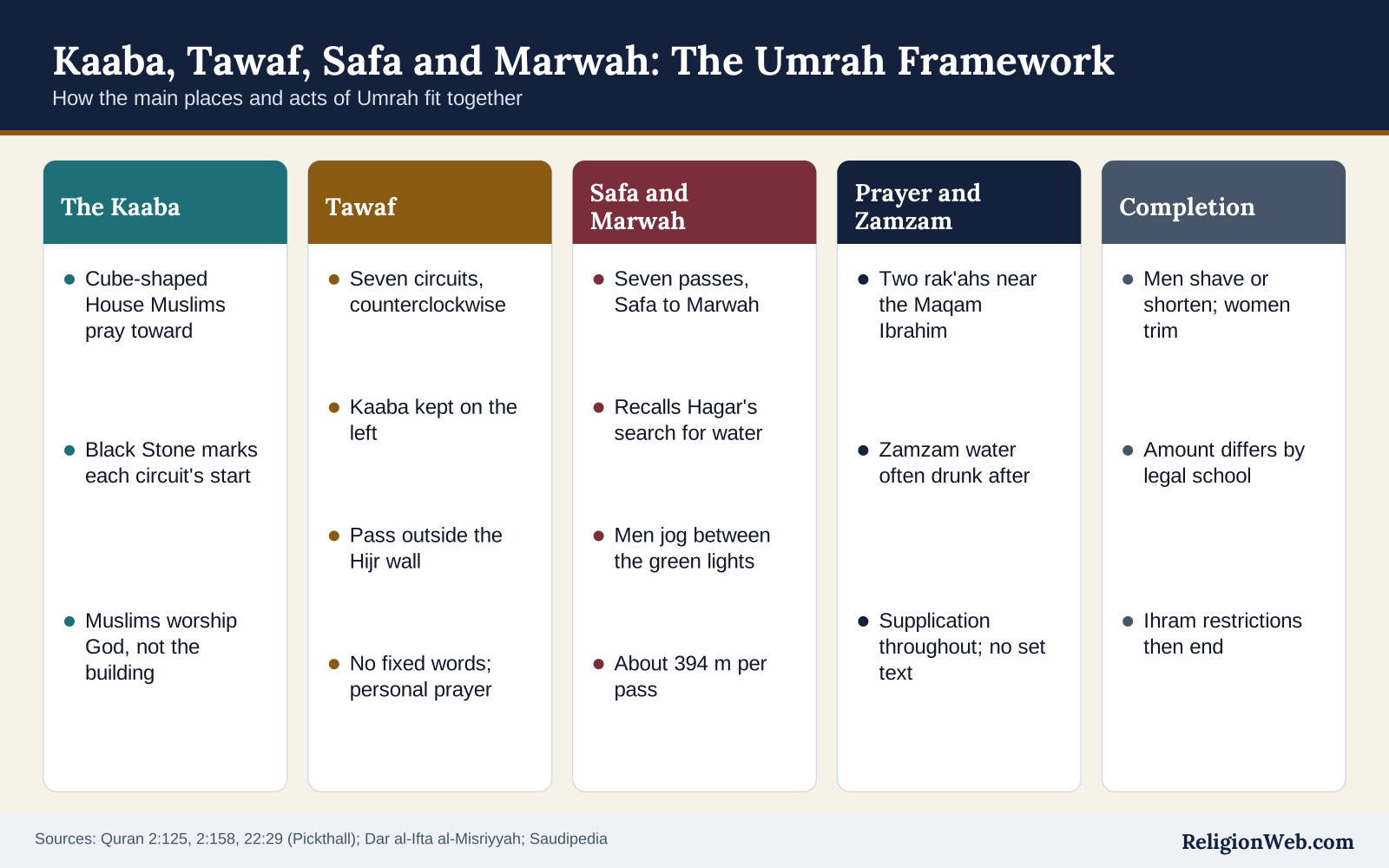
Schools, Traditions, and Internal Diversity
Nothing in Umrah belongs to a single community of interpretation. The rite is performed by Sunni Muslims of four legal schools, by Twelver Shia, by Ibadis, and by Sufi and non-Sufi believers alike, and their practices overlap more than they diverge. The differences that exist are largely differences of classification and detail, and they are recorded here with attribution and without ranking.
The Sunni Legal Schools
Differences of classification
The four Sunni schools, whose legal methods are described in the article on Sunni Islam, agree on the outline of the rite and disagree about how to label its parts. The Hanafis classify sa‘i and the cutting of the hair as strict obligations (wajib) rather than pillars, and treat the first four circuits of tawaf as the essential core. The Shafi‘is count the cutting of the hair as a pillar in the dominant view. The Malikis and Hanbalis treat sa‘i as a pillar and require the whole head to be shaved or shortened. Table 4 shows how they stand, and the underlying principle is that the more essential a part of the rite is, the more serious the consequence if it is omitted. A sharia-based classification of this kind, which separates a pillar from an obligation and an obligation from a recommendation, tells the pilgrim what must be redone, what can be made up, and what may simply be missed.
Practical consequences of the differences
For most pilgrims the differences have little visible effect, because groups follow the school of their country and their guide. They matter in the cases that arise: a person who realizes after returning home that part of the rite was missed, a woman who is unsure how much hair to cut, or a man who wonders whether an accidental break of wudu invalidated his tawaf. Pilgrims in those situations are advised to put the question to a scholar of their school. Mosques and fatwa councils such as Dar al-Ifta in Egypt answer thousands of such questions each year. The scholarly tradition is clear that the intention of the pilgrim and the circumstances of an error are taken into account, and that the rulings are designed to make the rite possible rather than to trap the pilgrim.
Shia and Other Traditions
Twelver Shia practice
Twelver Shia Muslims, whose beliefs and law are the subject of the Shia Islam article, perform Umrah by the same fundamental structure of ihram, tawaf, prayer, sa‘i, and cutting of the hair, and they enter ihram at the same miqat stations. Shia jurisprudence distinguishes between an Umrah performed on its own, called umrah mufradah, and an Umrah performed before Hajj as part of tamattu‘. In published manuals of the Twelver legal tradition, the independent Umrah ends with an additional tawaf and a further two-rak‘ah prayer after the hair is cut; those details, and the rulings of individual authorities (marja‘s), differ, and a pilgrim follows the authority they emulate. The summary here follows what is generally described in such manuals rather than a particular ruling.
Sufi devotion and the inner journey
Muslims in the mystical traditions, discussed in the article on Sufism, practice the same outward rite and tend to emphasize its inner dimension. Sufi writers, like other devotional authors, describe ihram as a symbol of leaving worldly attachments, tawaf as an image of the soul circling the divine, and the walk between Safa and Marwah as the struggle of the self. Many Sufi-oriented pilgrims also treat the visit to Medina as a highly valued part of the journey, while some reform-minded Muslims criticize certain customs of visiting graves and tombs. These are differences of emphasis and of legal reasoning on the margins of the pilgrimage, not on the rite itself.
Regional and Contemporary Custom
Leaving, returning, and the community
Around the central rite, local customs have grown up. In many Muslim communities, an Umrah journey is marked by a send-off from family and neighbors and a gathering on return, where pilgrims share dates, Zamzam water, and prayer beads as gifts. Pilgrims often ask relatives and friends for forgiveness before leaving and for supplications to be made on their behalf at the Kaaba. These customs differ widely from country to country, and no single form is universal. What they share is the sense that the pilgrim carries the community’s hopes with them.
Debates over repeated Umrah
One modern question concerns how often to perform Umrah on a single trip. The legal literature allows repetition. The Dorar.net fiqh entry says that it is permissible to repeat Umrah within a year, citing the majority of Hanafi, Shafi‘i, Hanbali, and some Maliki scholars. The same entry criticizes the habit of making many Umrahs in quick succession from places such as al-Tan‘im and al-Ji‘ranah during a single stay, especially in Ramadan, saying that it lacks evidence in the Prophet’s example. Other scholars point to Aisha’s Umrah from al-Tan‘im as precedent, and many pilgrims regard the practice as an expression of devotion. Crowding is one reason the question is raised in current discussion, since repeated Umrahs add to the pressure on the mataf and the mas‘a.
Umrah Today: Numbers, Organization, and Etiquette
In the twenty-first century Umrah has become one of the largest regular movements of people in the Muslim world. The scale shapes the organization of the holy places, the rules that apply to visitors, and the way many Muslims experience the rite. This section describes the situation as of October 2026 and gives dates for each figure. Because permits and procedures are revised often, the best reference for any traveler is the current guidance of the Saudi Ministry of Hajj and Umrah.
Scale and Seasons
How many people perform Umrah
The most recent full-year figure available for this article comes from the Pilgrim Experience Program, a Saudi program connected with the national Vision 2030 strategy. Its 2025 annual report, as reported by the Saudi Press Agency and carried by the Gulf Daily News on 4 August 2026, gives 18.03 million foreign Umrah performers who arrived in the kingdom in 2025, alongside 1.5 million foreign Hajj pilgrims. The comparison with Hajj makes the point about the two rites: the annual Hajj, bound to a few days of the year and to quotas, draws somewhat over a million and a half foreign pilgrims, while Umrah, spread across the year, draws many times that number. The 2026 Hajj itself, according to the Saudi statistics authority, gathered a total of 1,707,301 pilgrims, domestic and foreign. These figures count arrivals on the relevant visas, not individual rites.
Why the numbers have grown
Several developments explain the growth. Air travel is cheaper and faster than it was a generation ago, and the Saudi government has widened the ways to obtain a visa, including an electronic system open to citizens of many countries; a travel-industry guide reports that the tourist e-visa also permits Umrah outside the Hajj period, though pilgrims should confirm that with the Ministry. Saudi policy since the announcement of Vision 2030 has set out to receive more Umrah visitors, with a publicly stated aim, reported in the press, of 30 million Umrah performers a year by 2030. The expansions of the Sacred Mosque and the mas‘a, which now moves up to 118,000 people an hour according to the Saudi national encyclopedia, are part of the infrastructure that makes such numbers possible. Muslim communities elsewhere have also organized themselves around the practice, with licensed Umrah companies in nearly every country with a Muslim population.
Organization and Safety
Platforms, permits, and licensed operators
The system for organizing Umrah is now largely digital. Permits to perform the rite are issued through the Nusuk platform, as the April 2026 Ministry of Interior announcement shows, and the Ministry of Hajj and Umrah presents the platform as a tool with which pilgrims can plan their own Umrah and visit. The seasons are set by an annual calendar, as the section on timing described, and during the Hajj season the rules on who may enter Mecca are tightened. A pilgrim who plans to travel is generally advised to book through licensed operators, to check the requirements for the specific Hijri year, and to be wary of unofficial offers, since entering Mecca without the right permit can lead to penalties under Saudi law, as the Ministry of Interior’s announcement itself warns for the Hajj period.
Crowds, heat, and accessibility
According to common pilgrim guides, the crowds in the Sacred Mosque are largest in Ramadan, on Fridays, and in school holidays, and lighter in the small hours of the night. The mas‘a has been built over four floors, and the mataf is accessible from several levels, which spreads the load. Official health guidance for 1447 AH, published by the Ministry of Health, advises older travelers to avoid direct sun during the rites and to drink plenty of fluids, and it recommends that people with chronic conditions carry their documentation and medicines. The religious law agrees with the spirit of that advice: a pilgrim who is ill or frail is not required to do what harms their health, and may be pushed in a wheelchair, shorten a trip, or have the rite performed on their behalf where a scholar permits it. Prayer and ritual correctness do not replace medical care, and pilgrims with serious conditions should speak to a physician before they travel.
Etiquette and Visitor Guidance
Conduct in the Sacred Mosque
The ethic of the rite is gentleness. The Quranic counsel of no quarrels during the pilgrimage is repeated in every handbook, and the practical advice follows from it: queue rather than push, do not insist on reaching the Black Stone, give way to the elderly and to those in wheelchairs, keep the voice low in the mataf, and keep the mosque clean. Pilgrims are asked to follow the instructions of the staff and volunteers of the mosque, who direct the flow of people on the floors. Outside ihram, ordinary modest dress applies. Men and women pray in separate areas in most of the mosque, though the mataf itself is mixed because of the circumstances, and women and men perform tawaf side by side; the Hajj and Umrah literature discusses at length how a pilgrim should conduct themselves in a crowd.
Non-Muslim readers and the sanctuary
Because non-Muslims may not enter Mecca, a reader of another faith or none cannot attend Umrah in person. Those who want to understand it can read pilgrims’ accounts, watch the live broadcasts of the Sacred Mosque that are widely available, and visit museum collections of pilgrim art and texts. Rules for non-Muslim visitors to Medina differ from those for Mecca, and anyone considering a visit should check them with the Saudi authorities. Many local mosques also welcome questions from neighbors and students. The mosque article on this site offers a general introduction to the building tradition and to etiquette for visiting a local mosque.
Common Misconceptions About Umrah
Misconception 1: Umrah and Hajj are the same pilgrimage
Where the misunderstanding comes from
The confusion is understandable. Both rites go to Mecca, both begin in ihram, and both include tawaf around the Kaaba and sa‘i between Safa and Marwah. English uses the single word “pilgrimage” for both, and the phrase “lesser pilgrimage” can suggest that Umrah is simply a short edition of Hajj. The Quran itself names them together in the verse that begins “Perform the pilgrimage and the visit,” and pilgrims who follow the tamattu‘ or qiran pattern do perform both in a single journey, which can make them seem like one event.
What the evidence and tradition actually show
Muslim law treats them as two rites with different rules. Hajj is one of the five pillars of Islam, with a fixed season, a fixed itinerary through Mina, Arafat, and Muzdalifah, and an obligation, for those who can afford it, once in a lifetime. Umrah has no season, includes none of those sites, and is classed as obligatory by some schools and as a strongly recommended sunna by others. An Umrah does not discharge the duty of Hajj, and a Hajj does not need an Umrah to be valid. The table lists the main factual distinctions. The Hajj article gives the full account of the annual pilgrimage, and the article on Eid al-Adha describes the festival observed on the tenth of Dhu al-Hijjah, the day on which the main rites of Hajj at Mina begin.
| Feature | Umrah | Hajj |
|---|---|---|
| Legal status | Obligatory once (Shafi‘i, Hanbali) or a confirmed sunna (Hanafi, Maliki) | A pillar of Islam, obligatory once in a lifetime for those able |
| Timing | Any time of year; some Hanafi jurists dislike 9 to 13 Dhu al-Hijjah | Fixed days, centered on the 9th of Dhu al-Hijjah |
| Places | The Sacred Mosque in Mecca | Mecca, Mina, Arafat, and Muzdalifah |
| Core rites | Ihram, tawaf, sa‘i, cutting the hair | Those rites plus standing at Arafat, stoning at Mina, and the sacrifice |
| Duration of the rites | A few hours | Several days |
| Frequency | May be repeated | Obligatory once; voluntary Hajj possible in later years |
| Does it fulfill the other? | No: it does not discharge Hajj | Combined forms exist, but Umrah is still a separate rite |
The relationship is better described as overlapping than as identical. Ihram, tawaf, and sa‘i belong to both, and that shared core is why a pilgrim who has learned one rite finds the other familiar. Yet the Quran and the hadith collections treat them as two named acts, and the law gives them separate chapters, separate conditions, and separate consequences for error. A pilgrim who intends Umrah alone leaves ihram when the hair is cut; a pilgrim in the qiran form stays in a single ihram until the Hajj rites of the Day of Sacrifice are done. The two are linked in a journey, not merged into a single rite.
Misconception 2: Umrah may only be performed during Ramadan
Where the misunderstanding comes from
The belief grows out of a real emphasis. The hadith that Umrah in Ramadan equals Hajj in reward is well known, travel companies advertise Ramadan packages, and the Sacred Mosque is at its fullest in that month. Seasonal visa calendars add to the impression, since the administrative “Umrah season” announced by the Saudi authorities can be mistaken for a religious season. People who hear of Umrah mostly through Ramadan stories may conclude it belongs to that month.
What the evidence and tradition actually show
No legal school restricts Umrah to Ramadan. Sabiq’s Fiqh us-Sunnah states that most scholars permit it at any time of the year and that all agree it is permissible in the months of Hajj; he also considers Ramadan the best time. The Prophet’s own Umrahs, as Anas reported in Sahih al-Bukhari, took place in Dhu al-Qa‘dah, apart from the one combined with Hajj. The single qualification is the Hanafi dislike of the five days from 9 to 13 Dhu al-Hijjah, which Abu Hanifa is reported to have held and which other schools do not share. Ramadan is a time of special merit, not an exclusive time.
The opposite assumption, that Umrah is improper in the Hajj months, also circulates, and it has an old history, as the Fun Fact earlier in this article shows. Sabiq’s text and the Quranic passage on tamattu‘ treat Umrah in those months as lawful, and the combination of Umrah and Hajj in a single journey is, for most pilgrims today, the normal pattern. Modern permit pauses before Hajj are administrative, as the 2026 Ministry of Interior announcement illustrates, and they should not be mistaken for a legal prohibition.
Misconception 3: Pilgrims worship the Kaaba
Where the misunderstanding comes from
To an outside observer, the sight of thousands of people circling a black cube and reaching to touch a stone can look like the veneration of an object. Photographs and broadcasts of the crowd, shown without commentary, can leave that impression, and the vocabulary of a “holy stone” that is kissed suggests worship to people who know other traditions in which sacred objects are venerated.
What the evidence and tradition actually show
Muslim teaching is unambiguous that worship is directed to God alone. The Quranic account of the sanctuary describes it as a House set up for those who circle it, stay in it in devotion, and bow and prostrate, in the verse quoted earlier (2:125), which makes God the one to whom all three acts are directed. The Kaaba functions as the qibla, the direction of prayer, and as a focus of unity. Muslims all over the world pray toward it, and they do not pray to it. The report about the caliph Umar and the Black Stone, in which he says he kisses it only because he saw the Prophet do so and that it cannot harm or benefit anyone, is cited for this reason. Another chapter of the Quran, as Muslim commentators read it, calls on the Quraysh to worship the Lord of this House, which again names the God of the sanctuary and not the structure as the one worshiped. The Kaaba article on this site treats the building in more detail, and the article on the five pillars explains the declaration of God’s oneness that frames the whole rite.
Misconception 4: Umrah in Ramadan, or any Umrah, takes the place of Hajj
Where the misunderstanding comes from
The hadith that Umrah in Ramadan equals Hajj in reward is the source. Reported by Ibn Abbas in Sahih al-Bukhari (no. 1782) in answer to a woman who could not go on Hajj with the Prophet, it is sometimes repeated as if it said that Umrah can replace the pilgrimage. Some pilgrims, hearing it, conclude that a single Ramadan Umrah settles the matter for a lifetime.
What the evidence and tradition actually show
Scholars read the report as describing the measure of reward and not the discharge of the duty. Hajj is a pillar, and a Muslim who is able to perform it remains obligated until they have done so, whatever Umrahs they have made. That is the position of the major schools, and it is the reason the hadith is treated as encouragement rather than as a legal dispensation. The Prophet’s words to the woman were an offer of consolation to one who could not make the larger journey, not a ruling that Umrah and Hajj are interchangeable. Readers interested in how scholars weigh such reports can consult the article on hadith.
Present-day administration reinforces the distinction. A visa that permits Umrah is not a Hajj permit, and the Saudi authorities treat the two separately: the April 2026 Ministry of Interior announcement, for example, ended Umrah permits and ordered holders of Umrah visas to leave before the Hajj season, while Hajj registration for residents of the kingdom in 1447 AH ran through its own process on the Nusuk platform. For a Muslim who has yet to perform Hajj and is able to, Umrah is a worthy act of devotion, but it is not a substitute.
Frequently Asked Questions About Umrah
Questions About the Rite
How long does Umrah take?
The rites themselves usually take between two and five hours, depending on the crowd, the pilgrim’s pace, and which floor is used for tawaf. Entering ihram at the miqat, traveling to Mecca, and waiting to enter the mosque add time before and after. Many pilgrims plan to stay in Mecca for several days to pray in the Sacred Mosque, and their permits and hotel bookings determine how long they may remain.
What happens if a pilgrim makes a mistake or cannot finish?
The answer depends on what went wrong and on the pilgrim’s school. A missed pillar generally has to be made up, while the omission of an obligation such as sa‘i in the Hanafi view is usually compensated by a sacrifice, and a minor lapse in the rules of ihram is compensated by a payment, a sacrifice, or fasting. Pilgrims who fall ill or are prevented from completing the rite are covered by a separate set of rulings, drawn from the Quran’s discussion of prevention in 2:196 and from the Prophet’s experience at Hudaybiyyah. Because the details vary, the usual advice is to ask a scholar of the pilgrim’s own school rather than rely on a general summary.
Questions About Eligibility and Timing
Can Umrah be performed more than once?
Yes. The legal literature allows it, and the Dorar.net fiqh entry says it is permissible to repeat Umrah within a single year. The Prophet performed four in his lifetime, and Aisha made a second Umrah from al-Tan‘im on one occasion. Those who consider Umrah obligatory regard a single Umrah as meeting the duty, and any further ones as voluntary acts of devotion. Some scholars question the habit of making many in a single stay, as the section on repeated Umrah explained.
Can a woman perform Umrah without a male companion?
Under current Saudi rules, as reported by the Ministry and in the press, adult women can apply for Umrah visas without a male guardian. Religious opinion is more varied. Classical jurists in several schools required a mahram for a woman’s long-distance travel, while others accepted a trustworthy group; contemporary scholars and fatwa councils give a range of views. A woman who wants a religious ruling should ask a scholar she trusts, and a woman who wants the current practical rule should check the Ministry’s official guidance.
Does Umrah remove all sins?
The hadith in Sahih al-Bukhari (no. 1773) says, in paraphrase, that one Umrah is an expiation for the sins between it and the next. Scholars who comment on this report generally treat it as a statement about divine mercy toward sincere pilgrims, not as an automatic cancellation of every wrong. Wrongs against other people still call for repentance and restitution, and the same traditions place weight on sincerity. For more on how such reports are evaluated and transmitted, see the article on hadith.
Questions About Practice and Etiquette
Is a visit to Medina part of Umrah?
No. Medina is a separate sanctuary that many pilgrims visit, usually before or after Mecca, and the Prophet’s Mosque there is the second holiest mosque for most Muslims. The visit is a matter of custom and devotion, and the rites of Umrah are complete without it. Pilgrims who go to Medina often combine it with prayers in the Prophet’s Mosque and a visit to the nearby graves, with varying emphases among communities.
How does the Hijri calendar affect Umrah planning?
The Islamic year has twelve lunar months of 29 or 30 days, and its first month is Muharram, discussed in the article on Muharram and Ashura. Because the lunar year is about eleven days shorter than the solar year, the dates of Ramadan and Hajj move earlier through the seasons, and Umrah pilgrims who travel at the same Hijri month in successive years find themselves in different weather. An Umrah season announced by the Saudi authorities for a Hijri year such as 1448 usually crosses two Gregorian years, as the 2026 and 2027 dates given earlier show.
Where can readers find the current requirements?
The authoritative sources are the Saudi Ministry of Hajj and Umrah and its Nusuk platform, the Ministry of Interior’s seasonal announcements, and the Ministry of Health’s annual vaccination requirements. A national religious authority or a licensed Umrah company in the pilgrim’s home country can explain how those rules apply there. This article is a general introduction and does not replace those sources.
Conclusion: Understanding Umrah
What the History and Practice Show
A short rite with long roots
Umrah is brief in its form and deep in its associations. It takes the pilgrim, in a few hours, through a sequence that Muslims trace to Abraham and Hagar and to the Prophet’s own journeys, in the sanctuary that they regard as the first house set up for the worship of one God. Its parts are few: ihram, tawaf, sa‘i, and the cutting of the hair. Its meanings are many, from equality in plain cloth to perseverance in the walk between the hills.
One rite, several readings
The legal schools differ about whether Umrah is an obligation or a strongly recommended sunna, about which parts are pillars, and about how much hair to cut, and a pilgrim’s practice follows the scholarly tradition they rely on. What they hold in common is larger than what divides them: the same Kaaba, the same hills, the same seven circuits and seven passes, and the same hope for acceptance.
Continuing to Explore
Related articles on this site
Readers who want to place Umrah in its wider setting can begin with the articles on the five pillars of Islam, the Quran, and the life of the Prophet Muhammad. The Hajj, Kaaba, and mosque articles give fuller accounts of the pilgrimage, the building, and the places of prayer.
A note on sources and currency
The sources table at the end of this article lists the texts and official pages on which the key claims rest. Rules for permits, vaccination, and seasons change, and the dates given here are those announced in 2026; a reader should always consult the official channels named above before making plans.
Sources
The table below lists the principal external sources behind this article. Facts, dates and figures were checked against these and related primary, institutional and academic materials.
| # | Source | Publisher and type | Used for | Link |
|---|---|---|---|---|
| 1 | The Meaning of the Glorious Quran (Pickthall translation): chapter 2, with chapters 22 and 48 | Internet Sacred Text Archive (sacred-texts.com) · Primary text | Quran 2:125, 2:158, 2:196, 2:197, 22:29 and 48:27 as quoted; edition status noted in the article | sacred-texts.com |
| 2 | The 'Umrah: Rulings and Rites | Dar al-Ifta al-Misriyyah (Egypt) · Institutional | Status, pillars, tawaf and sa'i conditions, and hair-cutting rules by legal school | dar-alifta.org |
| 3 | Fiqh us-Sunnah, vol. 5: 'Umrah (section 5.122) | Sayyid Sabiq, hosted on Alim.org · Academic reference | School rulings, times for Umrah, days disliked by Hanafi jurists, the Prophet's four Umrahs | alim.org |
| 4 | Sahih al-Bukhari 1564 (Umrah in the Hajj months; with nos. 1549, 1773, 1778, 1782) | Sunnah.com · Primary text | Fun Fact; talbiyah; Umrah as expiation; the Prophet's four Umrahs; Umrah in Ramadan (paraphrased) | sunnah.com |
| 5 | Mawaqit al-Ihram (the miqat stations) | Saudipedia, Saudi national encyclopedia · Institutional | Names, users, and distances of the miqat stations; residents of Mecca and Jeddah | saudipedia.com |
| 6 | What Is al-Masa'a? | Saudipedia, Saudi national encyclopedia · Institutional | Length, width, floors, and capacity of the Mas'a; Hagar and the origin of sa'i | saudipedia.com |
| 7 | Ministry of Interior announcement on Hajj 1447 AH arrangements (12 April 2026) | Pilgrim Experience Program, Saudi Arabia (pep.gov.sa) · Institutional | 2026 suspension of Umrah permits on Nusuk, 18 April to 31 May 2026, and Mecca entry limits | pep.gov.sa |
| 8 | Health Requirements for Umrah Pilgrims, 1447H (2026) | Ministry of Health, Saudi Arabia · Institutional | Vaccination requirements and health advice for Umrah travelers in 2026 | moh.gov.sa |
| 9 | Saudi Arabia announces Umrah 1448 AH calendar, visas from May 31 | Associated Press of Pakistan (citing Saudi Press Agency) · News report | 1448 AH season dates announced by the Ministry of Hajj and Umrah on 17 May 2026 | app.com.pk |
| 10 | 19.5m foreign Hajj pilgrims, Umrah performers arrive in Saudi in 2025 | Gulf Daily News (citing the Pilgrim Experience Program annual report via SPA) · News report | 18.03 million foreign Umrah performers and 1.5 million foreign Hajj pilgrims in 2025 | gdnonline.com |
Last fact-check date: 2026-10-21.