Hadith (Arabic hadith, plural ahadith) is the name Muslims give to the reports that preserve what the Prophet Muhammad said, did, silently approved, and was like. In Shia usage the term also covers the words and conduct of the Imams of his family. Alongside the Quran, which Muslims receive as the speech of God, hadith are the main written channel through which the example of Muhammad reaches later generations. That example is called the Sunnah, and a great deal of what is familiar in Islam, from the number of daily prayers to the manners of greeting a neighbor, is known in detail through hadith rather than through the Quran alone.
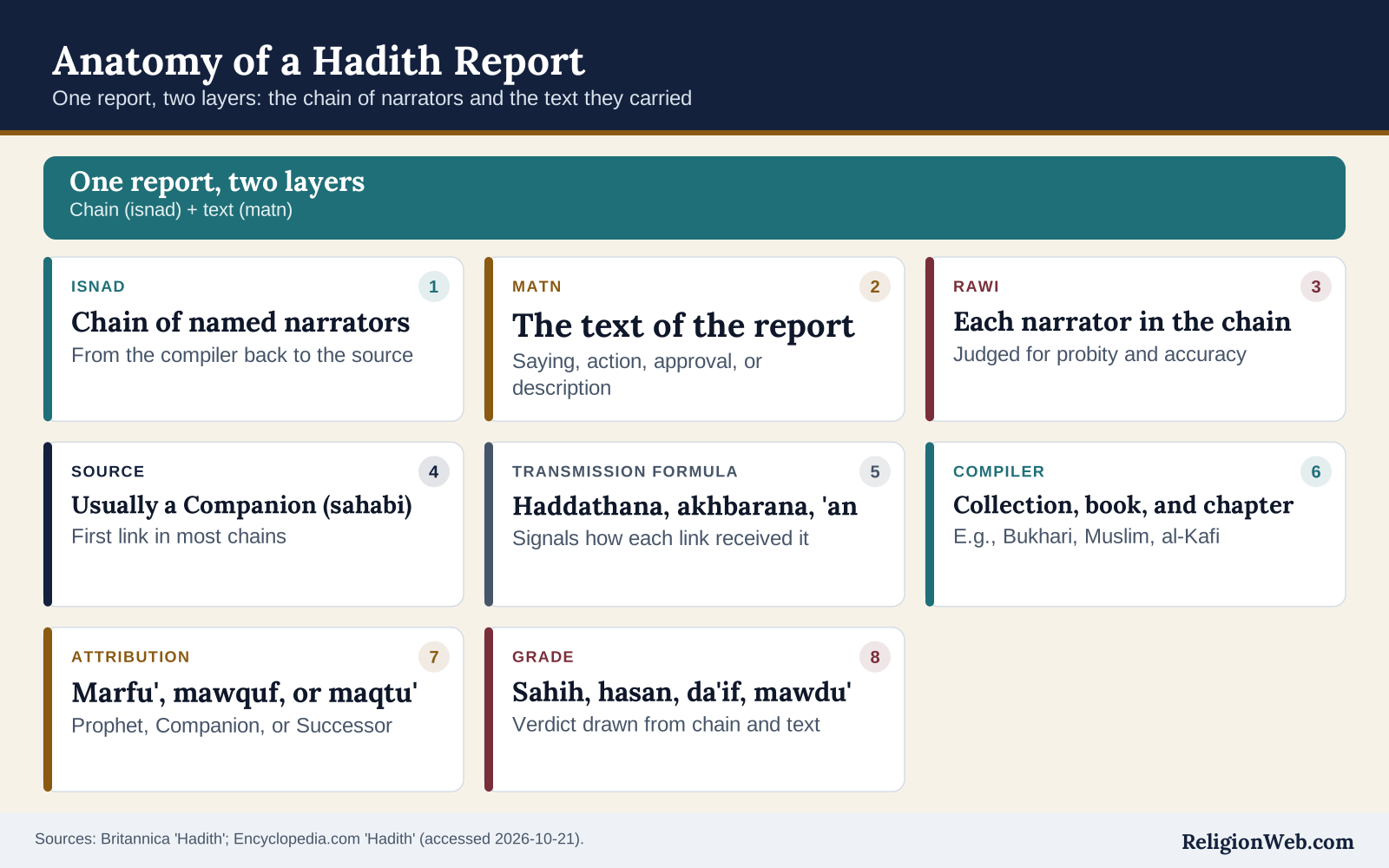
A hadith is not a single sentence floating free. Almost every report comes in two parts: a chain of named people who passed it on, called the isnad, and the content they passed on, called the matn. Because the chain is part of the report, a hadith can be studied on two levels at once, asking who carried it and how reliable they were, and asking what it actually says and whether the wording fits what is otherwise known. This double scrutiny produced one of the most distinctive scholarly disciplines of the medieval world, with biographical dictionaries of narrators, technical grades such as sound, fair, and weak, and sustained arguments about method that continue today.
The vocabulary can mislead. Hadith is not a second Quran, and Muslim scholars have never treated it as one: the Quran is recited in worship, preserved in a fixed wording, and received as revelation word for word, whereas hadith were handed on by many narrators over generations, were collected and graded by later scholars, and vary in reliability. Nor is there one single book of hadith binding on all Muslims. Sunni Muslims turn mainly to a group of collections headed by those of al-Bukhari and Muslim, Twelver Shia Muslims to a different set headed by al-Kulayni’s al-Kafi, and other communities, such as the Ibadis and the Ismailis, to corpora of their own. The sections below describe each on its own terms.
This article explains what hadith are, how a report is built, how reports were remembered, written down, and gathered into books, how scholars decide which to trust, and how the material is used in law, ethics, and devotion. It also covers modern academic debates, from the skeptical conclusions of nineteenth- and twentieth-century Western scholars to the more cautious dating methods of recent decades, and Muslim responses to them. Where Sunni, Shia, and other communities differ, the difference is stated with attribution, not resolved by the author.
Hadith at a Glance: Definition, Scope, and Core Vocabulary
What the word hadith means and what it covers
The word and its range of meaning
The Arabic noun hadith comes from a root associated with newness and with speech, and in ordinary Arabic it means a “report,” “account,” “talk,” or “narrative.” The Quran uses the word in that general sense, including for narratives about earlier peoples and, in one verse, for its own message. In the course of the first Islamic centuries the word narrowed. It came to mean a report about the Prophet specifically, and Muslim scholars today usually use the singular for one report and the collective for the whole body of such material. Encyclopedia entries note that Muslim scholars generally restrict the term to accounts of the Prophet, while many Western scholars also use it for reports about his Companions and later generations.
The narrower sense is also the one that matters in religious life. When a Muslim says “there is a hadith that says…,” the speaker normally means that a saying or practice is attributed to Muhammad and recorded in an identifiable collection with a chain of narrators. In the Shia tradition the same speaker may mean a report from one of the Imams, who are understood as authoritative bearers of the Prophet’s teaching. Context decides, and the term is therefore always understood in relation to a community of transmission.
What a report can contain
A report may preserve a spoken saying (qawl), an action (fi’l), a tacit approval (taqrir) in which the Prophet saw or heard of something and did not object, or a description (sifa) of his appearance and character. Many collections also record the circumstances in which a saying was uttered, since a sentence about debt or hospitality can read quite differently once the occasion is known. The range is wide: reports about how he prayed and fasted sit beside reports about how he settled disputes, how he treated guests, what he said at a funeral, and how he asked God for help in illness.
Muslim scholars also distinguish a special group, the hadith qudsi (“sacred hadith”), in which the Prophet relates words that he attributes to God but that are not part of the Quran. The distinction rests on form and status: the Quran is recited in prayer and preserved in a fixed text, whereas a sacred hadith is transmitted like any other report, with a chain, and graded like any other report. Collections of these reports are comparatively small, and they are especially valued in devotional writing, including works associated with Sufism.
Where hadith sit among the sources of Islam
Beside the Quran, not inside it
Britannica describes hadith as a major source of religious law and moral guidance for Muslims, second only to the Quran in matters of law, ritual, and creed. That wording captures the mainstream Sunni position, in which scripture comes first and the Prophet’s example is the second source, with the consensus of scholars and analogical reasoning following in the standard account of legal sources. The Quran itself tells believers to obey God and the Messenger, and a great deal of practical detail is missing from it: the Quran commands ritual prayer, almsgiving, fasting, and pilgrimage, but the number of daily prayers, the movements of prayer, the minimum amounts for almsgiving, and the sequence of the pilgrimage rites are known mainly through the Prophet’s example as reported in hadith.
That arrangement is not a quirk of one school. Across the main legal and theological traditions of Islam, the Quran is received as revelation recited in a fixed wording, while hadith are received as reports about the Prophet that have to be authenticated. The traditions then differ over the details, including what counts as authentic, how much weight a single-narrator report can carry, and whose reports besides the Prophet’s count, and later sections take those differences in turn.
Sunni and Shia usage in outline
For Sunni Muslims, the corpus is the body of reports about the Prophet transmitted by his Companions and later generations of scholars, and it is anchored in the “Six Books,” with the two collections called the Sahihayn, those of al-Bukhari and Muslim, in highest esteem. The Sunni picture is described further in the article on Sunni Islam. For Twelver Shia Muslims, the corpus includes reports from the Prophet and from the twelve Imams, who are held to have preserved and explained his teaching, and the central compilations are the Four Books gathered in the tenth and eleventh centuries. The Shia tradition is described in the article on Shia Islam. The two bodies of material overlap in some themes and many individual reports, yet the chains, the criteria for trusting narrators, and the status of the collections are not identical.
A small number of Muslims, often called Quranists or by the Urdu name Ahl-e Qur’an, reject hadith as a binding source and rely on the Quran alone. They are a minority and the mainstream traditions dispute their position, but they belong in an honest map of the field, and their arguments are discussed in a later section on modern debates.
Core vocabulary at a glance
Terms for the report itself
Hadith studies has its own precise vocabulary, and the table below gives the working terms that appear throughout this article. Arabic words are given in simplified transliteration, with plurals where they matter.
| Term | Arabic root idea | Plain-English meaning | Why it matters |
|---|---|---|---|
| Hadith (pl. ahadith) | Report, new speech | A single report, or the whole genre, about the Prophet (and, in Shia usage, the Imams) | The unit of study; each has its own chain and text |
| Sunnah | Customary path | The example or normative practice of the Prophet, as known through hadith and community memory | The thing hadith are used to establish; not identical to the books |
| Isnad / sanad | “Support” | The chain of narrators from the collector back to the source | Allows a report to be traced and its carriers evaluated |
| Matn | Solid text | The wording or content of the report | Allows the content to be tested against the Quran and other evidence |
| Rawi (pl. ruwat) | Narrator | A person in the chain | Reliability is judged person by person |
| Sahabi (pl. sahaba) | Companion | A person who met the Prophet as a believer and died as one | First link in most chains; status of Companions is a Sunni-Shia point of difference |
| Tabi’i (pl. tabi’un) | Follower, Successor | A person of the next generation who met Companions | The second link; many early legal opinions come from here |
| Khabar / athar | News, trace | Terms often used for reports about Companions or Successors, or sometimes as synonyms for hadith | Shows that “hadith” can be narrower or broader by context |
| Hadith qudsi | Sacred hadith | A report in which the Prophet relates words attributed to God, outside the Quran | Often devotional; transmitted and graded like other hadith |
| Muhaddith (pl. muhaddithun) | Hadith scholar | A specialist who collects, transmits, and criticizes reports | The professional class who built the sciences described below |
| Takhrij | Extraction | Tracing a report to its sources in the collections and assessing it | The basic research method of hadith scholarship |
Terms for the people and the craft
Beyond the table, a few further ideas recur. Muslim scholars call the study of chains and narrators ‘ilm al-rijal (“the science of men,” in the sense of persons in the chains, although many narrators were women), and the study of the terminology and rules for judging reports mustalah al-hadith. The Arabic word ‘ilm means knowledge, and hadith scholars see their work as part of the broader scholarly obligation to protect the sources of religion from error. The word fiqh refers to Islamic jurisprudence, which draws on hadith extensively, while tafsir is Quranic commentary, which also cites hadith as part of its evidence.
The Anatomy of a Report: Isnad and Matn
The isnad: the chain of transmitters
How a chain is written
A classical hadith begins with the chain of names, moving backward in time from the compiler to the original source. A report in al-Bukhari’s collection, for instance, begins with his own teacher, then names that teacher’s source, and so on, until the line reaches a Companion who says that he heard or saw the Prophet say or do the thing in question. Each link is introduced with a formula that signals how the report was received, such as “so-and-so told us” (haddathana), “informed us” (akhbarana), “I heard” (sami’tu), or “from” (‘an). Scholars read these formulas closely, because they indicate whether the narrator heard the report directly, read it to his teacher, or received a written copy.
Chains can be short or long. A report that reaches the Prophet through fewer intermediaries is called “high” (‘ali), and early scholars traveled great distances to hear a report from a teacher who stood closer to the source. The biography of al-Bukhari, who according to Britannica spent sixteen years seeking informants from Cairo to Merv, reflects that culture of travel in pursuit of hadith. Different chains could also converge on the same text from different directions, and scholars treat such parallel chains as mutual support when judging whether a report is likely to be reliable.
Why the chain became part of the report
Muslim scholars give a historical explanation for the chain. In the introduction to his Sahih, Muslim ibn al-Hajjaj records a statement attributed to the early Successor Muhammad ibn Sirin, who died in 728 CE, to the effect that scholars had not at first asked about chains, but that when civil strife broke out they began to say, “Name us your men,” so that the reports of people of the Sunnah could be accepted and those of innovators set aside. In that account the community’s first major internal conflict, in the middle of the seventh century, created the need for verification. Whether or not the habit began quite that way, the principle was clear by the eighth century: a report without a chain could not be placed.
The same introduction preserves a saying attributed to the scholar Abdullah ibn al-Mubarak, who died in 797, that the isnad is part of religion and that without it anyone could say whatever he wished. Muslim scholars cite such statements to show how seriously the tradition took attribution. The practical result was a vast biographical literature: dictionaries that recorded when each narrator lived, whom he studied with, where he traveled, how good his memory was, and whether other scholars trusted him. These works are described in the section on authentication.
The matn: the text of the report
Speech, action, approval, and description
The matn is what the chain carries. It may be a brief saying of a few words, a narrative of several paragraphs, or a description of an action, as when a Companion describes how the Prophet washed for prayer or performed the pilgrimage. Many reports also carry a framing narrative explaining when and why something was said, and the same matn can appear in different compilations with different amounts of detail. Collectors usually arrange these texts by subject, as al-Bukhari does, or by the Companion who narrated them, as Ahmad ibn Hanbal does.
Scholars read the matn for several things at once. They look at language, to see whether the wording sounds like seventh-century Arabic and fits the way the Prophet is otherwise described. They look at content, to see whether it contradicts the Quran, other well-established reports, or known history. And they look at variants, since a single report often appears in several versions with differences of wording or detail. Those differences can reveal how a text was transmitted, a point that has become central to modern academic study as well.
Transmission by wording or by meaning
An important question is whether narrators passed on the exact words or only the sense. Many early scholars allowed transmission by meaning (riwaya bi’l-ma’na) under strict conditions, mainly that the narrator understood Arabic well enough not to alter the sense, while others insisted on the exact words. The difference explains why variant wordings of the same report are so common in the collections, and it is one reason scholars compare versions carefully. For the Quran, by contrast, the exact wording is considered fixed, and recitation preserves it. This difference of status between the two bodies of text is taken up in the next section.
A worked example: reading one report on two levels
The report about the call to prayer
An entry on hadith in Encyclopedia.com offers a clear example from Malik ibn Anas’s al-Muwatta’, one of the earliest surviving collections. It traces a saying about the call to prayer (adhan) from the Companion Abu Sa’id al-Khudri, through a Successor named Ata’, then through the scholar Ibn Shihab (al-Zuhri), then through Malik, and finally to Yahya, who transmitted Malik’s book. In paraphrase, the report instructs a listener to repeat what the muezzin says when the call is sounded. The chain has five named links, and the text is a single instruction. Both are part of the hadith, and a scholar can ask two kinds of question of it.
About the chain, a scholar asks whether Abu Sa’id was a Companion and could have heard the Prophet, whether Ata’ studied with him, whether Ibn Shihab is known as a reliable student of Ata’, and whether Malik and his transmitter Yahya are trustworthy. About the text, the scholar asks whether the instruction is consistent with other reports and with the practice of prayer, and whether other versions from other chains say the same thing in different words. When both lines of inquiry support the report, scholars treat it with confidence. The table below sets out the elements of a report and the questions each one prompts.
The elements and the questions they prompt
Each part of a report invites its own line of inquiry, and the table below sets them side by side. Reading across a row shows what a scholar looks for in that element, and reading down the table shows how the chain and the text together make up a single object of study.
| Element | Arabic term | Role in the report | Typical question |
|---|---|---|---|
| The chain as a whole | Isnad (sanad) | Lists the narrators from the compiler back to the source | Is it continuous, with each person plausibly able to hear from the next? |
| The source in the chain | Sahabi | The Companion who reports seeing, hearing, or being told | Did he or she have the opportunity to witness this? |
| Intermediate narrators | Ruwat | Carry the report across generations | Are they known, upright, and accurate in memory or record? |
| Transmission formulas | Haddathana, akhbarana, ‘an | Signal how each person received the report | Did the narrator hear it directly or only claim to? |
| The text | Matn | The saying, action, or description itself | Does it fit the Quran, other sound reports, and known history? |
| Level of attribution | Marfu’, mawquf, maqtu’ | Whether the report is traced to the Prophet, a Companion, or a Successor | Whose words or acts is the report actually preserving? |
| Supporting chains | Mutaba’at, shawahid | Other chains conveying the same or similar text | Do independent routes strengthen a chain that looks weak alone? |
| The compiler’s placement | Bab, kitab | The chapter and book in which the compiler places it | What legal or ethical point did the compiler think it supported? |
Hadith, Sunnah, and the Quran: How the Three Relate
How the Quran and hadith differ as texts
Revelation, wording, and recitation
Muslims receive the Quran as the speech of God delivered to Muhammad through the angel Gabriel over roughly twenty-three years, and they hold that its wording as well as its meaning is divine. It is recited in ritual prayer, memorized in full by millions of people, and written in a single consonantal text with a small number of recognized recitation variants. Because of that status, a copy of the Quran is handled with ritual care, and its recitation is an act of worship in its own right. None of this is true of a hadith. A hadith is a report about the Prophet, a human account of what he said or did, even when it records his words. It is not recited in the prayer, it is not a revealed text in the sense that the Quran is, and the exact wording of many reports differs from one collection to another.
The sacred hadith (hadith qudsi) is the closest category, since it contains words the Prophet attributes to God. Even so, scholars keep it apart from the Quran: it does not share the Quran’s recitation status, it is not used for ritual recitation, and it is transmitted by chains and graded like any other report. This line between the two kinds of text has been stable across the main Sunni and Shia traditions, which is why a statement such as “the hadith says” can never in Muslim usage mean “the Quran says.”
Preservation: a fixed text and a graded corpus
The two bodies of material were also preserved differently. According to the traditional account, the Quran was written down in the Prophet’s lifetime on varied materials, gathered into a single volume after his death, and standardized in a codex under the caliph Uthman in the middle of the seventh century. Recitation by large numbers of people provided a check that no one individual could override. Hadith, by contrast, were transmitted by individuals and small groups, and the sheer volume of reports, running to hundreds of thousands in the early period according to the compilers’ own statements, meant that sifting was required. That is why Muslim scholars developed a science of grading hadith and nothing parallel for the Quran: one text is fixed by wording and the other is evaluated report by report.
Why the Prophet’s example carries authority
What the Quran says about following the Messenger
The authority of the Prophet’s example rests, in Sunni legal theory and in the reasoning of other schools, on the Quran’s own language. A verse frequently cited by jurists reads as follows in Marmaduke Pickthall’s early translation.
And whatsoever the messenger giveth you, take it. And whatsoever he forbiddeth, abstain (from it).
Quran 59:7 (part), trans. Marmaduke Pickthall, The Meaning of the Glorious Koran (1930)
The verse appears in a passage about the distribution of property taken without battle, so its immediate setting is practical. Sunni jurists from the time of al-Shafi’i, who died in 820 CE, cited it with similar verses to argue that obedience to the Prophet is an obligation grounded in scripture and not an optional extra. A second verse describes his conduct as a pattern.
Verily in the messenger of Allah ye have a good example for him who looketh unto Allah and the Last Day, and remembereth Allah much.
Quran 33:21, trans. Marmaduke Pickthall, The Meaning of the Glorious Koran (1930)
Classical commentators read “good example” (uswa hasana) as an invitation to imitate his conduct in devotion and in dealings with others, and jurists drew from it the conclusion that his practice is a source of guidance beyond what the Quran states directly. A third verse links obedience to God with obedience to the Messenger.
O ye who believe! Obey Allah, and obey the messenger and those of you who are in authority; …
Quran 4:59 (part), trans. Marmaduke Pickthall, The Meaning of the Glorious Koran (1930)
The verse goes on to direct believers to refer disputes to God and the Messenger. Commentators differ on who “those of you who are in authority” are, with some reading rulers, some scholars, and some both, and Twelver Shia exegetes read the phrase as pointing to the Imams. The point common to those readings is that the Messenger’s authority is stated in scripture and so is not an addition by later generations. Mainstream Muslim traditions therefore treat the question as settled in principle and spend their energy on the practical issue of how to know what the Prophet actually said and did.
How Sunnah and hadith relate
Sunnah and hadith are often used interchangeably in casual speech, but they are not the same. Sunnah means the Prophet’s path, the normative way of life that he modeled. Hadith are the reports that tell us about it. Many hadith describe his Sunnah, but a report can be weak or fabricated while the practice it describes is well attested by other reports and by the continuous practice of the Muslim community. Muslim scholars also speak of Sunnah in a third sense, as a legal category meaning recommended acts that are rewarded but not obligatory, which is the sense in the phrase “the Sunnah prayers.”
Historians point out that the early Muslim idea of Sunnah was wider than the Prophet alone. In the first two centuries the word could refer to the established practice of a region’s community, including the practice of the early caliphs and the scholars of Medina. It was al-Shafi’i, in his Risala, who argued with great force that the binding Sunnah is the Prophet’s, preserved in authenticated reports, and that such reports should take precedence over local custom. Britannica notes that he argued for the Sunnah as a legal proof second only to the Quran, a position that became central to Sunni legal theory. Shia Muslims understand the Sunnah to include the words and conduct of the Imams as transmitters and interpreters of the Prophet’s teaching, which is one of the main structural differences between the two traditions.
How hadith explain and extend the Quran
Supplying practical detail
The Quran establishes the great duties of Islamic life, yet it leaves many practical questions open, and hadith fill the gap. The Quran commands ritual prayer, but the five daily times, the sequence of standing, bowing, and prostration, and the detail of the opening words are known through reports, notably the reported saying that believers should pray as they have seen the Prophet pray. The article on Salah describes that practice in full. Almsgiving is commanded in the Quran, while the thresholds and rates are largely worked out from the Prophet’s instructions to those who collected it. The sequence of the Hajj rites is mostly known from the Prophet’s own pilgrimage, described by the Companion Jabir ibn Abdullah in a long report preserved in Muslim’s collection, together with a saying often cited by pilgrims, “take your rites from me.”
This role explains why, in everyday life, the Sunnah is felt as much as it is studied. Practices in Ramadan, such as eating a pre-dawn meal and breaking the fast promptly at sunset, and customs of the two festivals, are described in the reports and are discussed in the articles on the Five Pillars of Islam. The Quran sets the frame, and the hadith literature describes the practices that fill it in.
Context, interpretation, and the work of commentary
Hadith also serve as a major source for interpreting the Quran. Classical commentators on the Quran (mufassirun) cite reports about the occasions on which verses were revealed, and about how the Prophet and his Companions explained particular words. Many commentaries on the Quran are arranged around such reports, and in the earliest tradition commentary and hadith were hardly separate genres. Reports about the Prophet’s life, preserved in the biographies (sira) and in the collections, also supply the narrative setting for much of what Muslims know about the early community.
The relationship can run in both directions. Scholars use the Quran to test hadith, and they use hadith to interpret the Quran. A report that clearly contradicts a plain Quranic statement is treated with suspicion, and commentators sometimes disagree about whether a report is limiting or explaining a general verse. The interplay is one reason that hadith studies and Quranic studies have always been taught together in the traditional Muslim curriculum.
From Memory to Manuscript: How Hadith Were Transmitted and Collected
The first century: memory, practice, and some writing
The Companions as witnesses and teachers
The Prophet died in 632 CE, and the first link in nearly every chain is a Companion. Some Companions became known for the large number of reports they carried. Abu Hurayra is traditionally credited with the largest total, in the thousands according to classical counts, and the Prophet’s wife A’isha, who taught for decades in Medina after his death, is among the most prolific narrators and a major authority for questions of family and private life as well as law. Others, such as Ibn Umar, Anas ibn Malik, Ibn Abbas, and Jabir ibn Abdullah, were also frequently cited. The numbers vary by counting method, and later sections describe the debate over how to read them.
The status of the Companions as narrators is an issue on which the main Muslim communities speak differently. Sunni tradition holds that the Companions as a group were upright transmitters, so that a chain is not questioned at the Companion level, and the biographical literature devotes its critical effort to the generations after them. Shia scholars assess individual Companions, giving particular trust to those who stood with Ali and the Prophet’s household. Both approaches are applied with scholarly argument, and the difference helps to explain why the Sunni and Shia collections contain different bodies of reports even for events they both remember.
Companions taught students in the garrison cities that grew up after the conquests, including Medina, Mecca, Kufa, Basra, Damascus, and Fustat in Egypt. The next generation, the Successors, carried the reports, and also gave their own legal opinions. Many of those early opinions reflect the local practice of a city as much as a specific report, which is part of why the later movement to anchor law in authenticated reports mattered so much.
Reports for and against writing hadith down
Whether hadith were written in the Prophet’s lifetime and the first century is a long-running question. Muslim sources preserve reports pointing in both directions. One report, preserved in Muslim’s collection, quotes the Prophet as saying that nothing should be written from him except the Quran. Others record that he permitted writing, and early Muslim tradition names Companions who kept written notebooks, among them Abdullah ibn Amr ibn al-As, whose notebook is traditionally called the “truthful sheet” (al-sahifa al-sadiqa). Classical scholars reconciled the reports in several ways, for instance by suggesting that the prohibition was an early precaution against mixing the Quran with other material that was later lifted, or that it applied to certain people only.
Modern historians read the same evidence differently. Encyclopedia.com’s entry notes that Muslim tradition holds the Prophet taught his practice orally, in writing, and by example, while skeptical Western scholars from the late nineteenth century, led by Ignaz Goldziher, held that most material took shape later. Defenders of early writing, most prominently Muhammad Mustafa Azami in his 1968 study of early hadith literature and the Turkish scholar Fuat Sezgin, argued for substantial written transmission from the first century. Most contemporary scholars take a middle position: some writing existed early, but systematic compilation came later, and dating individual reports is a matter of case-by-case analysis.
The second century: systematic collection and the rise of the chain
The caliph’s order and the work of al-Zuhri
A well-known tradition says that the Umayyad caliph Umar ibn Abd al-Aziz, who ruled from 717 to 720 CE, wrote to the governor of Medina asking that the Prophet’s reports be gathered, out of fear that knowledge would vanish with the death of its bearers. The scholar most often credited with carrying out such collection is Ibn Shihab al-Zuhri, who died in 742. Many chains in later collections run through al-Zuhri, and historians have used that fact in different ways, as discussed in the section on modern scholarship. Muslim scholars have commonly viewed him as one of the first to gather reports systematically, while historians note that the stories surrounding the caliph’s order were recorded much later and should be read with care.
By the first half of the eighth century, according to Encyclopedia.com’s summary, students began gathering traditions more systematically and arranging them by topic. The generation after al-Zuhri included scholars in Medina, Mecca, Basra, Kufa, Syria, and Yemen who compiled notebooks and teaching collections, many of which are known today only through excerpts quoted in later works.
Topical books and Malik’s Muwatta’
The earliest substantial work that survives in organized form is the Muwatta’ of Malik ibn Anas of Medina, who died in 795 CE. The book is arranged by legal topic, from purification and prayer to marriage and commerce, and it mixes sayings of the Prophet with opinions of Companions, Successors, and Malik’s own judgments, as well as the practice of the people of Medina. Because it survives in several recensions, with the version of Yahya ibn Yahya al-Masmudi, who died in 848, the most widely known, it also shows how a single teacher’s book was handed down through students. Contemporary scholars use it as evidence for how law and hadith were intertwined in the eighth century, and Sunni Muslims have long revered it, particularly in the Maliki school.
Other compilations of the same period include the collections of Ibn Jurayj and Ma’mar, preserved partly through later works, and Ibn Ishaq’s biography of the Prophet, which survives through the edition of Ibn Hisham. Together these works show a scholarly culture in which reports, legal opinions, and narrative history were still gathered in the same books.
The third century: the age of the great compilations
Topical collections and collections by Companion
In the late eighth and ninth centuries two major arrangements appear. The musannaf is organized by subject, as in the large collection of Abd al-Razzaq al-San’ani of Yemen, who died in 827, and that of Ibn Abi Shayba of Kufa, who died in 849. It typically includes reports from the Prophet, Companions, and Successors together, so that it preserves early legal opinion as well as hadith. The musnad is organized by the Companion who narrated the report, and the largest example is the Musnad of Ahmad ibn Hanbal, who died in 855. Britannica notes that it contains about 27,000 hadiths and that Ibn Hanbal reportedly reviewed nearly 750,000 reports in the course of his work. The musnad arrangement is convenient for studying the transmission of a specific Companion but less convenient for finding a legal ruling, which helps explain why the next step was a different kind of book.
The sahih and sunan movement
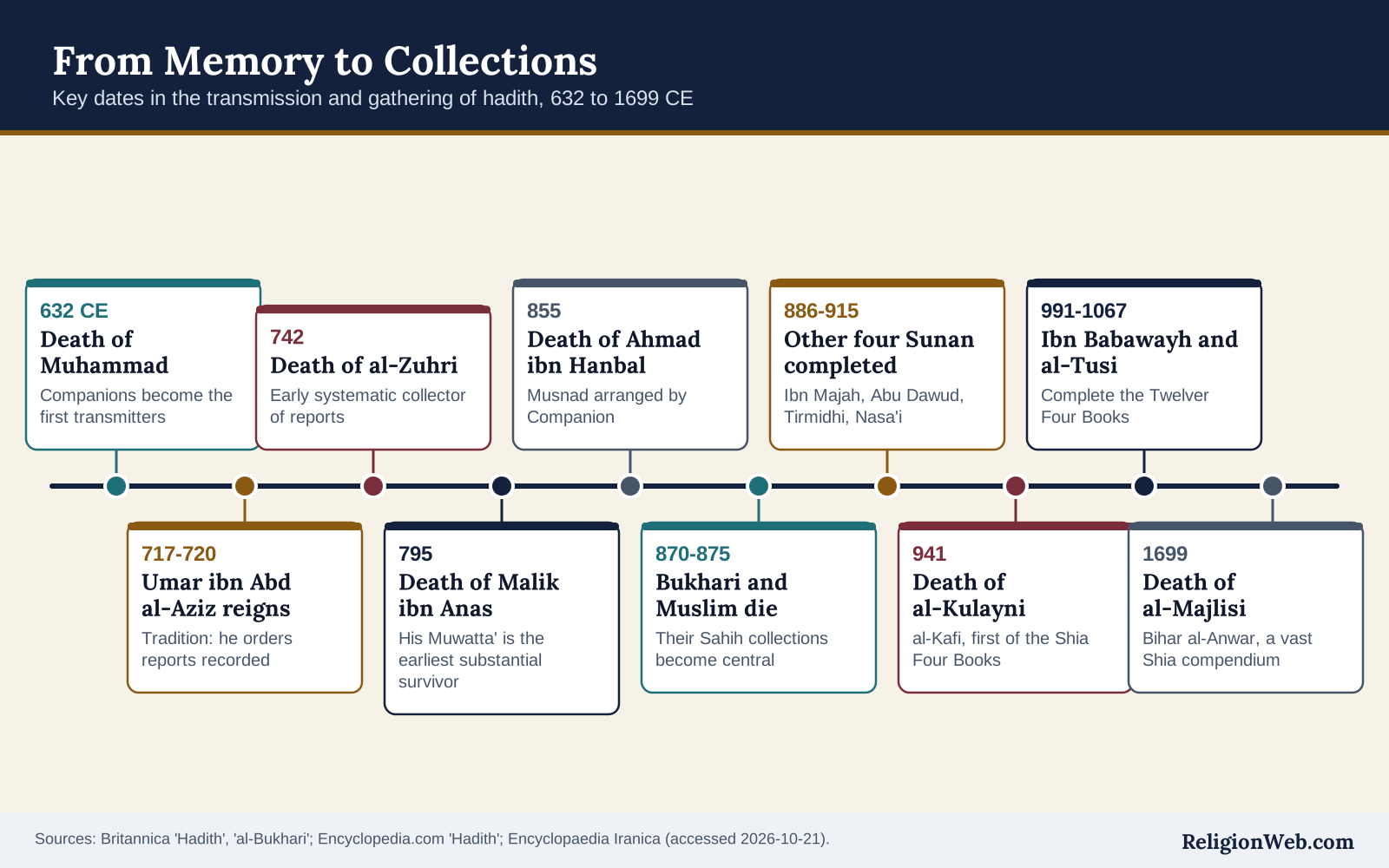
In the middle of the ninth century, scholars began producing books that selected only reports that met a stated standard of reliability, and that arranged them by subject so that they could serve jurists. Al-Bukhari, who died in 870, and Muslim ibn al-Hajjaj, who died in 875, each composed a book called al-Jami’ al-Sahih or simply al-Sahih, “the Sound Collection.” Four more compilers, Ibn Majah, Abu Dawud, al-Tirmidhi, and al-Nasa’i, produced “Sunan” collections focused on legal material and including reports of varying strength with comments by the compilers. Together the six works became known as the Six Books (al-kutub al-sitta), a grouping that, according to scholarly summaries of the history, was fixed by later scholars over the following two centuries. The next section describes them in more detail. Several conditions favored this development: large scholarly networks in cities such as Baghdad, Nishapur, and Cairo, the spread of paper in the Abbasid world, a culture of travel in search of teachers, and a generation of critics who had already graded thousands of narrators. Meanwhile, Imami Shia scholars worked on parallel projects that culminated in the Four Books of the tenth and eleventh centuries.
| Date (CE) | Person or event | Significance |
|---|---|---|
| 632 | Death of the Prophet Muhammad | Companions become the first transmitters of reports about his words and conduct |
| 717 to 720 | Reign of the Umayyad caliph Umar ibn Abd al-Aziz | Tradition credits him with ordering the recording of the Prophet’s reports |
| 742 | Death of Ibn Shihab al-Zuhri | Chief figure in early systematic collection; many later chains pass through him |
| 795 | Death of Malik ibn Anas | His Muwatta’ is the earliest substantial surviving topical compilation |
| 827 and 849 | Deaths of Abd al-Razzaq and Ibn Abi Shayba | Large topical musannaf collections mixing hadith with Companion and Successor opinions |
| 855 | Death of Ahmad ibn Hanbal | His Musnad arranges roughly 27,000 reports by Companion |
| 870 and 875 | Deaths of al-Bukhari and Muslim | Their Sahih collections become the most esteemed in Sunni Islam |
| 886 to 915 | Deaths of Ibn Majah, Abu Dawud, al-Tirmidhi, and al-Nasa’i | The other four of the Six Books are completed |
| 941, 991, and 1067 | Deaths of al-Kulayni, Ibn Babawayh, and al-Tusi | The Four Books of Twelver Shia hadith are completed |
| 1699 | Death of Muhammad Baqir al-Majlisi | His Bihar al-Anwar gathers the largest Shia compendium of reports |
The Major Sunni Hadith Collections
The Sahihayn: al-Bukhari and Muslim
Sahih al-Bukhari: scope, method, and criteria
Muhammad ibn Isma’il al-Bukhari was born in Bukhara in 810 CE and died near Samarkand in 870. According to Britannica, he began memorizing reports as a child, set out on the pilgrimage to Mecca at sixteen, and spent sixteen years seeking informants in towns from Cairo to Merv. He is said to have gathered about 600,000 traditions and to have chosen about 7,275 of them as completely reliable for his al-Jami’ al-Sahih, “The Authentic Collection.” The figure counts repeated reports separately. Counts of the work differ by edition and method, with one widely used modern numbering reaching 7,563 and another count 7,208, while the medieval scholar Ibn Hajar al-Asqalani counted 2,602 distinct reports without repetition. The gap shows how much of the book consists of the same report appearing in several chapters with slightly different chains or wording.
Al-Bukhari arranged the book by subject, beginning with revelation, faith, and knowledge, and moving through ritual law, commerce, family law, biography, Quranic commentary, and the end of the world. A distinctive feature is that the chapter headings often state his own legal conclusions, and scholars have long read the headings as carefully as the reports under them. The criteria attributed to him are demanding. He is reported to have required that each narrator be upright and have a strong memory, that the chain be complete, and that the narrators in adjacent links be shown to have actually met, and not merely to have lived at the same time. His al-Ta’rikh al-kabir, a large biographical dictionary of narrators, gave him the background to apply those standards.
Sahih Muslim: arrangement and its introduction
Muslim ibn al-Hajjaj was born in Nishapur around 817 and died in 875. Britannica says his Sahih is said to have been compiled from about 300,000 traditions gathered in Arabia, Egypt, Syria, and Iraq, and that it was unanimously acclaimed as authoritative. He studied with al-Bukhari, and the two books together are called the Sahihayn, “the two Sahihs.” Sunni scholars such as al-Nawawi held them to be the most authentic books after the Quran, a judgment that does not mean every report in them is beyond discussion, but that their collective standing is exceptional.
Muslim’s arrangement differs from al-Bukhari’s. He gathers the versions of a given report in one place, with the full chain of each, so that a reader can compare the variants, which is one reason his book is especially valued by specialists. He also prefaces the work with a long introduction on the principles of transmission, which includes the statements about the chain that were quoted earlier. In his book he does not use legal chapter headings to argue for rulings in the way al-Bukhari does, and he avoids repeating a report in different chapters.
The other four of the Six Books
The Sunan collections and their legal focus
The four remaining compilations are called Sunan, from a word for the sayings and practices that govern conduct, because they concentrate on reports that bear on legal and ritual questions. Sunan Abu Dawud, compiled by Abu Dawud al-Sijistani, who died in 889, is traditionally described as containing roughly 4,800 reports selected from a far larger pool, and its compiler included reports that were weaker with remarks on their defects. Al-Jami’ of al-Tirmidhi, who died in 892, is notable for adding his own grades, such as “fair” (hasan), and for noting the opinions of jurists on each report. Sunan al-Nasa’i, by Ahmad ibn Shu’ayb al-Nasa’i, who died in 915, is regarded as among the strictest of the group in its choice of narrators, and Sunan Ibn Majah, by Ibn Majah, who died in 886 according to Britannica, contains more reports that scholars grade as weak.
Their different standards mean that the Sunan books cannot be treated as interchangeable with the Sahihayn. A scholar who finds a report in Abu Dawud or Ibn Majah needs to check its grade, and later critics devoted many volumes to assessing the contents of these books individually.
How the Six Books were grouped, and what lies outside them
The idea of a canon of six books is a later development. Some scholars in the Maghreb counted Malik’s Muwatta’ in place of Ibn Majah, and others preferred other works, so the grouping did not settle at once. Some summaries of the history credit the scholar Ibn al-Qaisarani, who died in 1113, with helping to standardize the list of six, and Sunni tradition has treated that group as the central library of hadith ever since. No Sunni scholar has claimed that the Six Books contain every sound report. Many authentic reports appear in other works, and several scholars wrote supplements to the Sahihayn collecting sound reports that the two compilers did not include, among them al-Hakim al-Naysaburi, who died in 1014.
| Collection | Compiler (death, CE) | Type and arrangement | Character and reception |
|---|---|---|---|
| Sahih al-Bukhari | Muhammad ibn Isma’il al-Bukhari (870) | Jami’, by subject; about 7,275 reports with repetition (Britannica) | Most esteemed collection; chapter headings carry legal commentary |
| Sahih Muslim | Muslim ibn al-Hajjaj (875) | Sahih; versions of each report grouped together | Valued for its clear grouping of variants and its methodological introduction |
| Sunan Abu Dawud | Abu Dawud al-Sijistani (889) | Sunan, by legal topic | Focus on legal reports; includes some weaker ones, with remarks |
| Jami’ al-Tirmidhi | Abu Isa al-Tirmidhi (892) | Jami’, by topic, with grades and jurists’ views | Popularized the grade “hasan”; useful for comparing legal opinions |
| Sunan al-Nasa’i | Ahmad ibn Shu’ayb al-Nasa’i (915) | Sunan, by legal topic | Regarded as demanding in selecting narrators |
| Sunan Ibn Majah | Ibn Majah (886 per Britannica) | Sunan, by legal topic | Sixth of the Six Books in most lists; contains more weak reports |
| Muwatta’ | Malik ibn Anas (795) | Topical, mixes hadith with Companion opinions and Medinan practice | Earliest substantial surviving compilation; central in the Maliki school |
| Musnad Ahmad | Ahmad ibn Hanbal (855) | Musnad, by Companion; about 27,000 reports (Britannica) | Vast; includes reports of mixed strength; important in the Hanbali tradition |
Works that Sunni scholars rely on beyond the Six Books
Earlier and later compendia
Beyond the Six Books, Sunni scholarship draws on large collections that have a different purpose. Al-Daraqutni, who died in 995, wrote a critical commentary on narrators and defects. Al-Bayhaqi, who died in 1066, assembled a large collection of reports bearing on Shafi’i law. Ibn Khuzayma and Ibn Hibban, tenth-century compilers, produced books that applied their own criteria for soundness, and Ibn Hibban’s standards are generally considered more lenient than those of the Sahihayn. The scale of these works reflects a scholarly culture that kept collecting after the canonical books had appeared, in order to cover legal and devotional topics in detail.
Anthologies, commentaries, and teaching texts
Most Muslims encounter hadith through short anthologies and not through the large collections. Al-Nawawi, who died in 1277, compiled The Forty Hadith and Riyad al-Salihin (“Gardens of the Righteous”), both widely read for devotion and ethics, and Ibn Hajar al-Asqalani’s Bulugh al-Maram gathers legal reports for jurists. A later work, Mishkat al-Masabih, arranges reports from many books with their sources. Scholars study the great collections through commentaries, of which Ibn Hajar al-Asqalani’s Fath al-Bari on al-Bukhari, written by a scholar who died in 1449, is the most famous, along with al-Nawawi’s commentary on Muslim. These commentaries explain vocabulary, compare versions, and set out the legal discussions that the reports have produced, and they are the usual way the Sahihayn are taught in traditional institutions.
Shia Hadith Collections and the Corpora of Other Communities
Reports from the Prophet and the Imams
Why the Imams’ words count as hadith
For Twelver Shia Muslims, a hadith may come from the Prophet or from one of the twelve Imams, beginning with Ali ibn Abi Talib and ending with the Imam whom Twelvers believe to be in concealment. The tradition holds that the Imams preserved and explained the Prophet’s teaching without error, so their statements have the same kind of authority as his in matters of religion. Encyclopaedia Iranica notes that Shia sources claim the Imams “speak for God concerning the Book,” and that most Shia scholars treat the Imams’ words and conduct as they treat the Prophet’s. The Quran is read as supporting the special position of the Prophet’s household. A verse addressed to the household reads in Pickthall’s translation as follows.
Allah’s wish is but to remove uncleanness far from you, O Folk of the Household, and cleanse you with a thorough cleansing.
Quran 33:33 (last sentence), trans. Marmaduke Pickthall, The Meaning of the Glorious Koran (1930)
Twelver exegetes, drawing on reports of the episode of the cloak, understand “Folk of the Household” as Muhammad, Ali, Fatima, Hasan, and Husayn, and they infer the Imams’ purity from the verse. Many commentators in other traditions read the phrase as including the Prophet’s wives, since the verse follows instructions addressed to them. The difference illustrates the way a Shia reading of the sources and a Sunni reading can arrive at different conclusions from the same text.
A related report is known as the Hadith of the Two Weighty Things (al-thaqalayn), in which the Prophet is reported to have left behind the Book of God and his family. Sources of both Sunni and Shia traditions preserve versions of it, with variations in wording, and the two communities draw different weight from it: Shia scholars treat it as evidence for the guiding role of the Imams, while Sunni scholars have used it to urge love and respect for the Prophet’s family. The point to notice here is that the disagreement is partly about which Companions’ reports are trusted. Sunni tradition holds that all Companions were upright as narrators, whereas Shia scholars assess Companions individually and give particular weight to those who stood with Ali and the household. See Shia Islam for the wider background.
Early written collections and the Usul
Few early Imami writings survive, and Encyclopaedia Iranica describes the surviving material as far from comprehensive. The earliest extant works include the Basa’ir al-darajat of al-Saffar al-Qummi, who died in 902 CE, and the Kitab al-mahasin of Ahmad ibn Muhammad al-Barqi, who died in 887. Shia tradition also speaks of the “Four Hundred Usul,” short notebooks of reports recorded by students of the Imams, especially Muhammad al-Baqir and Ja’far al-Sadiq, which later compilers used as source material. Few of those notebooks survive independently. Ja’far al-Sadiq is quoted in Shia sources as urging his followers to write down hadith, and the Shia tradition thus places a strong emphasis on written transmission from an early date.
The Four Books
Al-Kafi of al-Kulayni
The oldest of the four major Twelver collections is al-Kafi fi ‘ilm al-din (“the sufficient book on the science of religion”) by Muhammad ibn Ya’qub al-Kulayni, who died in 941 CE (329 AH) in Baghdad, during the period Twelver Shia call the Minor Occultation. It has two main parts, one on matters of belief (usul) and one on applied law (furu’), followed by a miscellany of mostly historical material called the Rawda. Most of its reports go back to the Imam Ja’far al-Sadiq. Counts of the number of reports differ with the method of counting: Wikishia lists totals from about 15,176 to 16,199 given by different scholars, with the differences arising from how repeated chains are treated. The book is generally considered the most important of the four.
Shia scholars do not treat every report in al-Kafi as authentic. The seventeenth-century scholar Muhammad Baqir al-Majlisi wrote a major commentary on it that graded many reports by the technical standards of chain criticism, finding a considerable number weak by those standards, and this did not diminish the book’s standing. How much weight such grades should carry is itself part of the Akhbari and Usuli debate described below.
The Faqih, the Tahdhib, and the Istibsar
The second of the four, Man la yahduruhu al-faqih (“For one who has no jurist at hand”), was compiled by Muhammad ibn Babawayh, known as Shaykh al-Saduq, who died in 991. It concentrates on reports relevant to law and was intended as a reference for those who could not consult a jurist directly. The third and fourth are by Muhammad ibn al-Hasan al-Tusi, known as Shaykh al-Tusi, who died in 1067: Tahdhib al-ahkam, a large legal compilation that began as a commentary on an earlier jurist’s work, and al-Istibsar, a shorter book dealing with reports that appear to contradict one another and showing how they might be reconciled. With these two works Encyclopaedia Iranica observes that al-Tusi raised the canonical count from two to four.
| Collection | Compiler (death, CE) | Content and arrangement | Role |
|---|---|---|---|
| al-Kafi | Muhammad ibn Ya’qub al-Kulayni (941) | Belief (Usul), law (Furu’), and a miscellany (Rawda); about 15,000 to 16,200 reports by different counts | Oldest and most important of the Four Books |
| Man la yahduruhu al-faqih | Ibn Babawayh, Shaykh al-Saduq (991) | Reports on law, arranged by legal topic | Second of the Four Books; a reference for those without a jurist |
| Tahdhib al-ahkam | Muhammad ibn al-Hasan al-Tusi (1067) | Large legal compilation, originally a commentary on an earlier work | Third of the Four Books; core legal source |
| al-Istibsar | Al-Tusi (1067) | Selected reports that appear to conflict, with proposed reconciliations | Fourth of the Four Books; a model for handling contradictions |
| Wasa’il al-Shi’a | Al-Hurr al-Amili (late seventeenth century) | Legal reports from many sources, organized for practical use | Standard working reference for jurists (Iranica calls it the most practical) |
| Bihar al-Anwar | Muhammad Baqir al-Majlisi (1699) | Encyclopedic gathering of reports on every theme | The most voluminous compilation; used for belief, history, and devotion |
| Mustadrak al-Wasa’il | Husayn al-Nuri (1902) | Supplement to the Wasa’il | Adds reports the earlier compiler omitted |
Later compendia, disputes, and other communities
Later compendia and the Akhbari and Usuli debate
After the Four Books, Shia scholars produced larger works. Encyclopaedia Iranica lists Fayd Kashani’s al-Wafi, which combines the four early collections, Majlisi’s Bihar al-Anwar, the most voluminous, al-Hurr al-Amili’s Wasa’il al-Shi’a, the most practical, and al-Nuri’s Mustadrak as a supplement. The same period saw a major disagreement over how to use the reports. The Akhbari school, associated with Muhammad Amin Astarabadi, revived a traditionist outlook under the Safavids in the seventeenth century and held that the reports in the Four Books can be trusted as a basis for law. The Usuli school, whose revival ended Akhbari dominance from the late eighteenth century, gave greater weight to rational principles of jurisprudence and to scholarly judgment about the strength of each report. Contemporary Twelver scholarship is overwhelmingly Usuli, and its modern manuals of narrator evaluation, such as Abu al-Qasim al-Khoei’s Mu’jam rijal al-hadith of 1970, refine how the transmitters of the Imams’ reports are classified.
Shia scholars also developed grades for reports. According to Encyclopaedia Iranica, al-Hilli adopted Sunni categories, and the scholar al-Shahid al-Thani, who died in 1559, set out formal categories for Imami hadith in his al-Ri’aya fi ‘ilm al-diraya. The resulting scheme usually distinguishes sound, fair, reliable (a report whose narrator is trusted but is not a Twelver), and weak reports, and it sits beside an older method of judging reports by corroborating indications.
Ismaili, Zaydi, and Ibadi corpora
Other communities have their own collections. Ismaili Muslims in the Fatimid tradition turn to the Da’a’im al-Islam (“Pillars of Islam”) of al-Qadi al-Nu’man, who died in 974. Zaydi Muslims, who follow Imams descended from Zayd ibn Ali, have the Musnad traditionally attributed to Zayd, a work whose attribution scholars discuss. The Ibadis, whose communities are most prominent in Oman, place particular trust in the Musnad of al-Rabi’ ibn Habib, an early collection that Ibadis regard as their most authentic. These traditions lie outside the main focus of this article, but they show that the history of hadith is not a story of two collections only.
Judging Reports: Narrator Criticism, Classification, and the Hadith Sciences
Evaluating the narrators
Biographical dictionaries and the science of criticism and praise
Because a chain is only as strong as its weakest link, Muslim scholars made the study of narrators a discipline in its own right. It is known in Arabic as al-jarh wa’l-ta’dil, “criticism and praise,” and its basic questions are about two qualities. The first is probity (‘adala): was the narrator an upright person who did not lie, was not known for flagrant sin, and did not promote views that made his testimony suspect? The second is accuracy (dabt): did he have a reliable memory or a reliable written copy, and was he consistent when he repeated a report? A narrator might be pious but forgetful, in which case his reports are doubted, or accurate but known to have lied, in which case they are rejected.
Early critics such as Shu’ba ibn al-Hajjaj, who died in 776 CE, Yahya ibn Ma’in, who died in 848, and Ali ibn al-Madini, who died in 849, gave opinions on thousands of narrators that students recorded. Biographical dictionaries followed. Al-Bukhari’s al-Ta’rikh al-kabir, described in Britannica as containing biographies of the people in the chains of transmission, was one of the first, and Ibn Abi Hatim al-Razi, who died in 938, compiled a dictionary devoted to the criticism and praise of narrators. Later scholars, including al-Mizzi, who died in 1341, and Ibn Hajar al-Asqalani, wrote extended biographical works that gathered the earlier opinions. These books record where each narrator lived, whom he studied with, who studied with him, and what earlier critics said, and they form the factual basis for judging a chain.
Grades of narrators and the problem of disagreement
Critics used graded vocabularies for narrators, ranging from the highest praise, such as “a firmly established, reliable authority,” to middling terms such as “truthful but sometimes errs,” to terms of rejection such as “abandoned” or “liar.” Ibn Hajar’s well-known handbook of narrators arranged them into twelve grades. A report from a narrator in the top grades would be likely to meet the standard of soundness, while a report from a narrator in a middle grade might be considered fair or might need support from other chains.
The critics did not always agree. Some were severe and some lenient, and a narrator whom one scholar accepted another might reject. Muslim scholars developed rules for resolving such conflicts, one of which holds that a specific, explained criticism generally takes precedence over a general statement of praise, since the critic may know something the praising scholar did not. Even so, some disagreements remain open. This is one reason the later grading of hadith by modern scholars has produced divergent verdicts on the same report, as the section on modern debates describes.
Classifying the report
Sound, fair, weak, and fabricated
The central scheme for grading a report, summarized by Encyclopedia.com, divides reports into sound (sahih), fair (hasan), weak (da’if), and spurious or fabricated (mawdu’), mainly by examining the chain and checking the text against the Quran and other accepted traditions. The classic definition of a sound report, formulated in the thirteenth century by Ibn al-Salah and elaborated by later scholars such as Ibn Hajar, has five conditions: every narrator in the chain is upright; every narrator is accurate in memory or written record; the chain is continuous, so that each narrator could have received the report from the one before him; the report is free from a hidden defect (‘illa); and it does not contradict a firmly established report or consensus (it is free from shudhudh, “irregularity”).
A “fair” report falls just short of the highest standard, perhaps because one narrator’s memory was good but not excellent, yet it is still usable as evidence. Al-Tirmidhi helped establish the grade in his collection, and Sunni jurists have commonly used fair reports for legal rulings. A weak report fails a condition, usually because the chain is broken or a narrator is criticized, and a fabricated report is one falsely attributed to the Prophet. Scholars hold that weak reports should not be used to establish a legal ruling, though many have allowed their use in encouraging good conduct if they are not seriously defective and not contradicted by sound ones. That latter allowance is debated, and some modern scholars reject it.
Number of narrators, breaks in the chain, and level of attribution
A second set of terms describes the shape of the chain. A report is called mutawatir if it was transmitted by so many narrators at every level that collusion to invent it is considered implausible, and it is said to yield certain knowledge. Scholars regard relatively few reports as strictly mutawatir. A frequently cited example is the warning, in paraphrase, that anyone who knowingly attributes a falsehood to the Prophet should prepare his seat in hell. All other reports are called ahad (“solitary” in the technical sense of not reaching that level). Within ahad reports, scholars distinguish mashhur, reports with at least three narrators at some stage; ‘aziz, with at least two at every stage; and gharib, with only one at some stage. The status of ahad reports in matters of belief, as distinct from law, was a subject of lasting debate among theologians, a point returned to below.
Other terms describe gaps or levels. A report traced to the Prophet is marfu’ (“raised”), one traced only to a Companion is mawquf (“stopped”), and one traced only to a Successor is maqtu’ (“cut off”). A mursal report is one in which a Successor attributes a saying directly to the Prophet and omits the Companion; a munqati’ chain has a break somewhere; a mu’dal chain omits two or more consecutive narrators; and a mu’allaq chain omits narrators at the beginning, nearest the compiler. The table below consolidates the main concepts.
| Concept | Arabic term | Meaning | Note on use |
|---|---|---|---|
| Sound | Sahih | Continuous chain of upright, accurate narrators; no hidden defect or irregularity | Accepted as evidence in law; highest grade |
| Fair | Hasan | Meets the conditions, but with slightly less accurate narrators | Usable as evidence; made prominent by al-Tirmidhi |
| Weak | Da’if | Fails a condition, often through a break or a criticized narrator | Not used for legal rulings; some allow it for encouragement |
| Fabricated | Mawdu’ | Falsely attributed to the Prophet | Rejected; recorded in books on forgeries so readers can avoid it |
| Widely transmitted | Mutawatir | Reported by so many at every stage that invention is implausible | Held to yield certain knowledge; few reports qualify |
| Solitary (technical) | Ahad (mashhur, ‘aziz, gharib) | Any report below the mutawatir level | Accepted in law once sound; debated for creed |
| Raised, stopped, cut off | Marfu’, mawquf, maqtu’ | Traced to the Prophet, a Companion, or a Successor | Shows whose words or acts the report preserves |
| Chain defects | Mursal, munqati’, mu’dal, mu’allaq | Missing narrator at the Companion level, anywhere, in sequence, or at the start | Typically weakening, though some schools accept certain mursal reports |
Testing the text and detecting forgery
Criticism of the matn
Scholars did not rely on chains alone. They also tested the text, comparing it with the Quran and other sound reports, with what was known of history and language, and with plausibility. The Muslim scholar Ibn al-Jawzi, who died in 1201, compiled a book on fabricated reports, and Ibn Qayyim al-Jawziyya, who died in 1350, wrote a well-known short guide to signs of fabrication in the text, such as exaggerated rewards for minor acts or statements that contradict the Quran. Muslim scholars generally hold that a strong chain does not guarantee a sound text, because a narrator may have made an error, and that a seemingly weak chain does not automatically condemn a text that is supported elsewhere.
Contemporary Muslim and Western scholars alike have asked how often traditional scholars actually rejected reports on the basis of their text. Some argue that the tradition focused on chains for practical reasons, since the chain is easier to assess than a text, and that textual criticism was less systematic. Others point to large amounts of textual analysis in commentaries and legal arguments. This question is one of the lines of research taken up in the section on modern scholarship.
Why forgeries arose and how they were identified
Muslim sources describe several motives for invented reports. Political and sectarian partisans circulated sayings favoring one party in the early conflicts. Popular preachers and storytellers (qussas) embellished tales for audiences. Some people, motivated by piety, made up sayings praising good deeds or the merits of chapters of the Quran, believing that the end justified the means, a practice that hadith scholars condemned in the strongest terms. Others forged reports in support of a legal school or to win a point in argument. The scale of the problem is reflected in the compilers’ own statements: al-Bukhari’s selection of about 7,275 from some 600,000 shows how much was set aside.
Scholars identified forgeries by several methods: the confession of a forger, the discovery that a narrator claimed to have met a teacher who had died before he was born, the presence of a narrator known for lying, the absence of the report from the work of the narrator’s well-known students, and contradiction of the Quran or of established reports. Specialized works listing known forgers and fabricated reports allowed later readers to avoid them. The sheer number of such works is itself a sign that the tradition regarded forgery as a real danger and responded with a systematic discipline, not with silence.
Hadith in Law, Ethics, Worship, and Daily Life
Hadith in Islamic law
The place of the Sunnah in legal reasoning
In the classical Sunni framework, the sources of law are the Quran, the Sunnah as known through authenticated hadith, the consensus of qualified scholars, and analogical reasoning. Britannica traces the theoretical framework to al-Shafi’i, who died in 820 and whose Risala argued that a sound report from the Prophet is binding even when it is a solitary report. The jurists generally held that such reports give probable knowledge (zann), which is sufficient for legal rulings, while theological schools differed on whether solitary reports can establish points of creed. Followers of the traditionist approach, such as those associated with Ahmad ibn Hanbal, accepted them in creed as well, while Ash’ari and Maturidi theologians in general were more cautious, and the Mu’tazila were more cautious still.
Hadith are therefore the working material of Islamic jurisprudence. When a jurist asks whether a certain act is obligatory, recommended, permitted, disliked, or forbidden, he looks first to the Quran, then to the reports about the Prophet’s own statements and practice, weighing their strength and resolving apparent conflicts between them. The study of these conflicts, as in the Shia case of al-Tusi’s al-Istibsar, is a recognized branch of the discipline in both traditions.
How the legal traditions weigh reports
The major legal traditions weigh reports in distinct ways. The Hanafi school, associated with Abu Hanifa, who died in 767, has been seen as exacting about solitary reports and generally gives weight to those that are widely known, while using reasoned preference (istihsan) and analogy extensively. The Maliki school gives considerable weight to the continuous practice of the people of Medina, which can in some cases outweigh a solitary report. The Shafi’i school follows its founder in holding that a sound report from the Prophet overrides the opinions of later authorities. The Hanbali school is known for a strong preference for reports over personal reasoning and has historically been closest to the hadith scholars. Among Twelver Shia, the Usuli school accepts a report from a reliable narrator as evidence and combines it with rational principles, whereas the Akhbari school held that the reports of the Imams in the canonical books are the primary basis. For more on the legal schools see the article on Sunni Islam.
These approaches were never sealed off from one another. Hanafi scholars such as al-Tahawi, who died in 933, wrote major works on the transmission and reconciliation of reports, and Shafi’i and Hanbali scholars wrote extensively on legal reasoning. The result in practice is that jurists of every school read the same collections, and their disagreements usually concern how to weigh and combine specific reports, not whether reports matter.
| Tradition | General approach to reports | Distinctive emphasis | Related practice |
|---|---|---|---|
| Hanafi (Sunni) | Cautious about solitary reports; prefers those widely known | Extensive use of reasoned preference and analogy | Dominant in Turkey, the Balkans, Central and South Asia |
| Maliki (Sunni) | Gives weight to the continuous practice of Medina | Malik’s Muwatta’ as foundational text | Prominent in North and West Africa |
| Shafi’i (Sunni) | A sound report from the Prophet is binding and overrides later opinion | Systematic theory of sources in the Risala | Prominent in East Africa, Southeast Asia, and parts of the Middle East |
| Hanbali (Sunni) | Strong preference for reports over personal reasoning | Closest to the hadith scholars; the Musnad of Ahmad | Influential in Saudi Arabia and Qatar |
| Usuli Twelver (Shia) | Accepts reports of reliable narrators, with rational principles and scholarly judgment | Narrator evaluation and ijtihad by senior jurists (marja’) | Dominant in Iran, Iraq, and Twelver communities elsewhere |
| Akhbari Twelver (Shia) | Treats reports in the Four Books as the primary basis | Skepticism toward Usuli reasoning | Historically important; now a small minority |
| Ibadi | Relies on the Musnad of al-Rabi’ ibn Habib and other works | Distinct chains and criteria | Centered in Oman, with communities in North and East Africa |
Hadith in ethics and daily life
Character, community, and neighborliness
A great deal of hadith literature is about conduct, not law. Reports describe the Prophet as gentle with children, kind to neighbors, honest in trade, and patient with people who treated him harshly, and they record sayings on honesty, mercy, generosity, and humility. In paraphrase, one widely cited report in al-Bukhari holds that no one truly believes until he wishes for his brother what he wishes for himself, and another warns against harming one’s neighbor. Muslim parents and teachers draw on such reports in teaching manners, from greeting others to eating with the right hand and visiting the sick, and the sayings are a common vocabulary of Muslim ethics in many languages.
Because of this ethical weight, short anthologies are among the most popular religious books in the Muslim world. Al-Nawawi’s Forty Hadith is memorized in schools from West Africa to Southeast Asia, and Riyad al-Salihin is read in homes and mosques as a guide to character. The habit of selecting forty reports on central topics has a long history, and later scholars composed their own sets of forty on subjects as varied as the pillars of faith, supplication, and compassion.
Food, dress, family, and health
Hadith also supply much of the detail of everyday life: the etiquette of meals, including saying God’s name before eating, the recommended manners for greeting and visiting, guidance on dress, and norms for marriage and the treatment of family members. The reports on health are a special case. A literature called “Prophetic medicine” (al-tibb al-nabawi) gathers sayings about remedies, diet, and illness, and some of its contents are drawn from the customs of seventh-century Arabia. Many Muslim scholars and physicians treat that literature as a source of spiritual and ethical counsel and not as a replacement for modern medicine, and the hadith literature itself includes a report in which the Prophet urges the sick to seek treatment. The same collections include guidance that scholars cited in modern pandemics on avoiding travel into and out of a plague-stricken land. Readers who have a medical concern should consult a physician, whatever their religious views.
Hadith in worship and devotion
Prayer, fasting, festivals, and pilgrimage
The practice of every pillar of Islam draws on hadith. The sequence of ritual prayer, the times of the five daily prayers, the Friday sermon, and the prayers for the two festivals are described in the reports and set out in the articles on Salah, Eid al-Fitr, and Eid al-Adha. The custom of eating a meal before dawn during Ramadan, of breaking the fast promptly with dates and water, and of giving the festival alms at the end of the month all rest on reports in the major collections, as does the practice of sacrificing an animal at Eid al-Adha. Pilgrims follow the pattern of the Prophet’s own pilgrimage as the reports describe it.
Sunni and Shia communities draw on different reports for some details, which explains regional variations in the wording of the call to prayer, the positions of the hands in prayer, and the timing of the evening prayer, all of which differ among the schools. These variations are generally treated within each tradition as legitimate differences in reading the reports, not as deviations.
Devotion, supplication, and the sacred hadith
Reports also shape private devotion. Collections include supplications that the Prophet is said to have recited on rising, on traveling, and at times of distress, and many Muslims memorize some of them. The sacred hadith, with its direct divine address, is especially valued in devotional writing, and Sufi writers have drawn on it heavily. A well-known report called the Hadith of Gabriel, in which the angel asks the Prophet about Islam, faith, and excellence (ihsan) in the presence of his Companions, is often used to outline the structure of the religion, and its third element, worshiping God as though one sees Him, is a favorite starting point for writers on spirituality, including those described in the article on Sufism.
Among Shia Muslims, supplication literature of the Imams occupies a similar place. The Sahifa Sajjadiyya, a collection of prayers attributed to the fourth Imam, Ali Zayn al-Abidin, is widely read in devotion, and reports from the Imams guide the observances of Muharram and pilgrimage to their shrines. These texts function as hadith in the sense used by Shia scholars, as words of the Imams, and are valued for their spiritual content as much as for their legal relevance.
Modern Scholarship, Reform, and Debates About Hadith
Academic study of hadith in the West
From Goldziher and Schacht to the common-link debate
Modern academic study of hadith began in the nineteenth century with scholars such as Aloys Sprenger and William Muir, who were critical of the reliability of the reports. The decisive turn came with the Hungarian scholar Ignaz Goldziher, whose Muhammedanische Studien of 1890 argued that much of the hadith literature reflects the disputes and needs of the first two Islamic centuries and not the words of the Prophet himself. Encyclopedia.com’s entry names Goldziher and the legal historian Joseph Schacht, whose Origins of Muhammadan Jurisprudence appeared in 1950, as the roots of a skeptical view that hadith generally do not reflect the factual history of the first two centuries. Schacht argued that chains of transmission tended to grow backward over time, as later jurists attributed their views to earlier authorities and finally to the Prophet.
Schacht also observed that when many chains for a report converge on a single transmitter, that person, called the “common link,” is the likely originator or at least the first to circulate it widely. The Dutch scholar Gautier Juynboll developed this idea in the 1980s, and in 1983 published a study of Muslim tradition that concentrated on chains. John Wansbrough went further in 1977 and 1978, arguing that hadith reflects a “salvation history” shaped around the turn of the eighth century and that chains and biographical material are unreliable. These conclusions changed how the field thinks about dating: in the skeptical approach, the point at which a chain branches marks roughly when a tradition entered circulation, not when it began.
Combined analysis of chains and texts
Later scholars challenged the more skeptical conclusions. Harald Motzki, writing in the late 1990s and early 2000s, advanced a method that compares the chain and the text together, which scholars call isnad-cum-matn analysis. By comparing variant texts transmitted through different chains and seeing whether the pattern of differences fits the claimed lines of transmission, he argued that some material could be traced back to the early eighth century and in some cases to Companions. Encyclopedia.com’s summary notes that Motzki, together with Josef van Ess and Gregor Schoeler, used these combined methods, while Montgomery Watt relied mainly on texts. The conclusion that has emerged in much recent scholarship is one of uneven results: some reports can be given an early date, some can be shown to be later, and each case must be examined individually.
The Canadian scholar Jonathan Brown, in his 2009 book on the medieval Muslim hadith tradition and in a later volume on the topic written for general readers, argued that the Muslim critics were rigorous within their own framework and aware of many of the issues raised by modern skeptics, a view that other academic scholars accept in part and dispute in part. The same literature has been enriched by the study of manuscripts and by new editions of early compilations, such as the Musannaf of Abd al-Razzaq, which gives researchers direct evidence of how material circulated in the eighth century.
Muslim responses, reform, and critics of hadith
Defenders of early transmission and traditional methods
Many Muslim scholars and some non-Muslim scholars have disputed the skeptical picture. Muhammad Mustafa Azami, in a 1968 study of early hadith literature and later in a critique of Schacht, argued that written records existed from the time of the Prophet and that they provide a bridge to the later collections. The Turkish scholar Fuat Sezgin argued in his multivolume history of Arabic literature that the written transmission of early material was substantial. Traditional Muslim scholars generally respond that the chains and the criticism of narrators, taken together, constitute a rigorous system of verification, and that the sheer number of independent routes by which many reports were transmitted makes wholesale invention improbable. The two sides tend to use different standards of proof, and so their disagreements often come down to what counts as adequate evidence of early transmission.
Reformers, critics, and Quran-only movements
Within the Muslim world, reformers have questioned the traditional classifications. Encyclopedia.com’s entry notes that Sayyid Ahmad Khan, who died in 1898, Muhammad Abduh, who died in 1905, and Fazlur Rahman, who died in 1988, all queried the traditional system, though they differed from one another and none rejected the Sunnah as such. Contemporary Sunni scholars, such as Yusuf al-Qaradawi, who died in 2022, have urged reading reports in light of their historical context and purposes while upholding the authority of the Sunnah. In the opposite direction, Salafi and Ahl-i Hadith currents stress adherence to authenticated reports over the opinions of the legal schools, and scholars such as Muhammad Nasir al-Din al-Albani, who died in 1999, devoted their careers to re-grading hadith. Their re-gradings have themselves been criticized by other Sunni scholars.
A more radical position is that of the Quranists. Britannica notes the Ahl-e Qur’an movement, and general overviews of the field mention Rashad Khalifa, Kassim Ahmad, and Edip Yuksel as modern critics who reject hadith as a second source alongside the Quran. Their arguments typically start from the claim that the Quran is complete and clear, and they point to the late date at which hadith were written down and to the difficulty of verifying them. Mainstream Sunni and Shia scholars answer that the Quran itself instructs believers to follow the Messenger, that the details of ritual practice cannot be reconstructed from the Quran alone, and that the entire tradition of Muslim practice rests on continuous transmission. The Mu’tazila of the early centuries took a different position again: according to standard overviews, they rejected hadith as the basis of law while accepting the Sunnah and consensus.
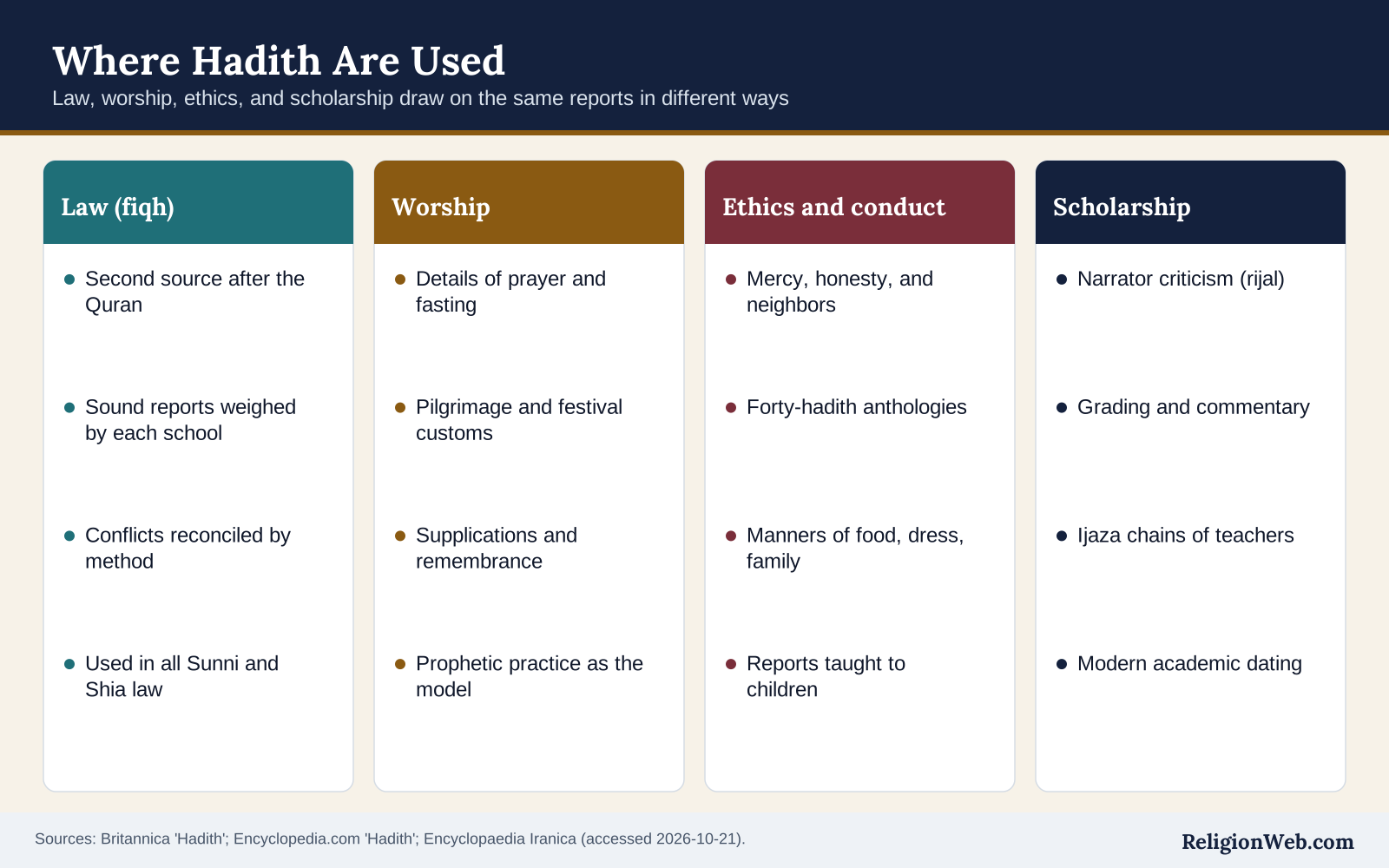
Hadith Study and Transmission in the World Today
Teachers, licenses, and institutions
The living chain and the ijaza
Hadith is unusual among scriptural traditions in that the idea of a personal line of transmission remains alive. A student who reads a collection with a qualified teacher may receive a license, an ijaza, to transmit it onward, and the license records the teacher’s own chain of teachers going back, link by link, to the compiler and sometimes to the Prophet. Traditional scholars in many parts of the Muslim world hold chains of this kind for the Sahih of al-Bukhari, and a student’s chain may be written out and treasured. A custom among hadith scholars is to begin with a report called the “first-heard” hadith, in which each narrator says that it was the first report he heard from his teacher, a practice that makes the personal chain visible. Because reports with fewer links were prized, scholars sought out elderly teachers, and a short chain was a mark of distinction.
Seminaries, universities, and public recitation
Hadith are taught in traditional seminaries and universities across the Muslim world. In South Asian madrasas that follow the Dars-i Nizami curriculum, the final year is devoted to reading the Six Books and is often called the “year of hadith.” Al-Azhar in Cairo and the Islamic University of Madinah, among others, teach hadith studies at advanced levels, and Twelver Shia seminaries in Najaf, Qom, and elsewhere study the Four Books and the science of narrators as part of legal training. In some regions, complete readings of al-Bukhari’s collection are held in the months around Ramadan, with attendees gathered to hear the whole work through in a series of sessions. The details vary by region and institution, and no single model applies to all.
Women, digital access, and the global community
Women as transmitters and teachers
Women have been central to the transmission of hadith from the beginning. A’isha, the wife of the Prophet, taught and corrected Companions and Successors, and many chains in the collections pass through women. In later centuries women continued as teachers and holders of licenses: Karima al-Marwaziyya, who died in Mecca in 1070, was a renowned transmitter of al-Bukhari’s collection. The contemporary scholar Mohammad Akram Nadwi has compiled a large biographical dictionary of women hadith scholars, a project that documents thousands of names across the centuries. Such research has drawn attention to a part of the tradition that was long treated as peripheral in modern accounts.
Digital tools and global reach
In the twentieth and twenty-first centuries, printed concordances and digital databases changed how people consult the literature. The Dutch scholar Arent Jan Wensinck and colleagues produced a multivolume concordance of the main Sunni collections in the twentieth century, and today websites and apps allow readers to search the Six Books and other works in Arabic and in translation, often with grades attached. This has widened access considerably and has also created new problems, since a short report can circulate on social media with no chain and no source, and a reader may mistake an isolated search result for a considered legal ruling. Teachers of hadith often point out that the traditional discipline is meant to prevent this very situation.
The communities who use hadith are large. Pew Research Center’s report on the global religious landscape from 2010 to 2020, published in June 2025, found that Muslims made up 25.6 percent of the world’s population in 2020, and the number of Muslims grew by 347 million during the decade, more than all other religious groups combined. Pew’s earlier estimates, from 2009, put the Shia share of the Muslim population at roughly 10 to 13 percent, with the remainder mainly Sunni, though newer detailed sectarian data are scarce. The reach of the hadith tradition is accordingly global, and its use is shaped by language, region, and school as much as by the texts themselves.
Common Misconceptions About Hadith
Misconception 1: Hadith and the Quran are the same kind of text
Where the misunderstanding comes from
Because both are called sources of Islamic teaching, and because both are cited in sermons and legal rulings, many readers assume that hadith occupy the same level as the Quran, as parallel scriptures. The confusion is encouraged by translations that print a hadith in the same style as a Quranic verse, and by popular speech in which “it is written” is applied to either. Non-Muslim readers who encounter terms like “the Sunnah” and “the traditions” often learn little about the difference in status.
What the evidence and tradition actually show
Mainstream Muslim traditions distinguish the two sharply. The Quran is received as God’s speech in a fixed wording, recited in prayer, and memorized by a very large number of people, whereas hadith are reports about the Prophet transmitted through chains of human narrators, graded by scholars, and in many cases transmitted by meaning. Even the sacred hadith, which attributes words to God, is not part of the Quran and is not recited in prayer. Britannica states that hadith are a major source of law and guidance second only to the Quran, and the traditional order of sources reflects that ranking. Muslim scholars also hold that a hadith contradicting a clear teaching of the Quran should be treated with suspicion. That is quite different from treating the two as equal scriptures.
The difference shows up in ordinary religious life. A Muslim performing the ritual prayer recites the Quran in Arabic and does not recite a hadith in its place. A copy of the Quran is handled with ritual care, while a volume of hadith is treated as a respected book of scholarship. When a Muslim jurist disagrees with another about the grade or meaning of a hadith, the disagreement is not understood as a dispute about the text of scripture, whereas a change in the wording of the Quran would be unthinkable. Shia and Sunni traditions agree on this structural point even though they differ on which hadith collections they rely on.
Misconception 2: Every hadith in circulation has equal authority
Where the misunderstanding comes from
A saying quoted online, in a lecture, or in a printed book is often introduced with “the Prophet said,” and listeners may assume that this phrase certifies it. The collections themselves contribute to the impression, since even very respected books contain thousands of separate reports, and since the Sahihayn have a reputation for soundness that can be wrongly extended to every book called a hadith collection. Some popular anthologies print sayings without chains or grades, which hides the work of verification.
What the evidence and tradition actually show
Muslim scholarship has always treated reports as unequal. Reports are graded as sound, fair, weak, or fabricated, as the section on authentication explains, and the compilers themselves record that they set aside most of what they found: Britannica’s account of al-Bukhari says that of about 600,000 traditions he selected about 7,275. Even among reports in the same book, grades can differ, since Abu Dawud and Ibn Majah included reports that later critics judged weak. Within the Sahihayn, scholars have debated individual reports while holding the collections in very high esteem. The responsible practice, according to scholars of every school, is to ask for the source and grade of any report before relying on it for a legal ruling, and fabricated sayings are widely condemned in the tradition’s own literature.
The practical consequences are considerable. A jurist who finds that a saying circulating in popular preaching is weak will not use it to establish an obligation or a prohibition, and a teacher who is asked about a saying will often ask where it is recorded. Some scholars have compiled lists of sayings that are widely repeated but lack a sound basis, so that students can recognize them. The tradition thus contains within itself a strong norm against the very error that the misconception describes.
Misconception 3: One universal collection is binding in exactly the same way on every Muslim tradition
Where the misunderstanding comes from
People who learn that Sahih al-Bukhari is widely revered sometimes assume that it plays the role of a single canonical volume, comparable to a unified bible, binding on all Muslims alike. Popular descriptions of the Six Books can reinforce this impression, as can the habit of speaking about “Islam says” without naming a school or community.
What the evidence and tradition actually show
No single compilation holds that position. Sunni Muslims hold the Sahihayn in highest esteem, but even for them the Six Books are a library and not a single volume, and Sunni legal schools weigh reports differently. Twelver Shia Muslims rely on the Four Books, led by al-Kafi, and include the reports of the Imams, which Sunni collections do not treat as a source in the same way. Encyclopaedia Iranica notes that the Shia canonical collections and their transmission networks differ from the Sunni ones. Ismaili, Zaydi, and Ibadi Muslims turn to their own works, and the Quran-only minority rejects hadith as a binding source. Even for Sunnis, the esteem for al-Bukhari and Muslim is a scholarly judgment about reliability, not a doctrine that every sentence in them is beyond discussion, and scholars have written critical studies of particular reports in both books.
The practical position of a given Muslim depends on community, school, and teacher. A Sunni Muslim in Indonesia, a Twelver Shia Muslim in Iran, and an Ibadi Muslim in Oman each learn their rituals and ethics from teachers whose training rests on different libraries, and each community would describe its own corpus as the proper basis for its practice. Where the practices overlap, as in the basic shape of the daily prayers, the overlap reflects shared memory of the Prophet, and where they differ, the differences usually trace to different reports or different judgments about the same reports.
Misconception 4: Hadith and Sunnah are the same thing, and hadith only record sayings
Where the misunderstanding comes from
The two terms are often used together or interchangeably in English writing, and “the traditions” is a common rendering of both. Because the word hadith means a “report” or “saying” in ordinary Arabic, readers also imagine that the genre consists only of quotations from the Prophet.
What the evidence and tradition actually show
Hadith are reports, and Sunnah is the practice and example that the reports describe. A report can be fabricated while the practice it describes is well established, and the Sunnah in the sense of recommended acts includes things that the Prophet did, as well as things he said. Reports preserve sayings, actions, tacit approvals, and descriptions of his character and appearance, and in Shia usage they include the words and deeds of the Imams. Many of the most important hadith are narratives: how he prayed, how he performed the pilgrimage, and how he reacted to a question from a Companion. The category is therefore much broader than quotations alone.
Even the term Sunnah has more than one use. Jurists use it for a recommended act, theologians for the way of the Prophet and the early community, and historians for the established practice of early communities, which may or may not coincide with a particular report. Keeping the senses apart prevents errors such as supposing that a weak hadith automatically invalidates a widely observed practice, or that a practice must be obligatory because a hadith describes it.
Misconception 5: Muslims never questioned hadith until Western scholars did
Where the misunderstanding comes from
Accounts that begin with Goldziher and Schacht can give the impression that criticism of hadith started with nineteenth-century Western scholarship and that Muslims before then accepted everything uncritically. This view is sometimes repeated by those who wish to defend the tradition as unquestioned and by those who wish to present criticism as foreign.
What the evidence and tradition actually show
Muslim scholars built a critical apparatus from the early centuries, as the section on authentication shows. They evaluated narrators, graded reports, collected books of fabricated sayings, and disagreed with one another over individual reports. Muslim reformers such as Sayyid Ahmad Khan and Muhammad Abduh raised further questions in the modern period, and the Mu’tazila questioned how far solitary reports could bind in the early centuries. What Western academic scholarship added was a historian’s method: asking not only whether a report was reliably transmitted within the Muslim scholarly tradition but also how and when it entered circulation. Muslim and non-Muslim scholars still disagree about how much that method can establish, but the notion that critical examination began outside the tradition does not match the record.
The two kinds of criticism also differ in purpose. Muslim hadith critics asked which reports a believer could rely on for guidance and law. Academic historians ask what the reports reveal about the formation of early Islamic society, whether or not they reflect the Prophet’s own words. The questions overlap but are not identical, and each side has learned from the other. Contemporary scholars of both backgrounds often work from the same manuscripts and editions, and the best recent work engages the Muslim critical tradition on its own terms.
Frequently Asked Questions About Hadith
Questions about size and authority
How many hadith are there?
There is no single number, because the answer depends on whether repeated reports and variant chains are counted separately. Muslim compilers said that they sifted through enormous pools of material: Britannica reports that al-Bukhari gathered about 600,000 traditions and kept about 7,275, and that Muslim worked from about 300,000. The 7,275 figure counts repetitions, and Ibn Hajar al-Asqalani counted 2,602 distinct reports in al-Bukhari without them. The Musnad of Ahmad ibn Hanbal holds about 27,000 reports by Britannica’s count, and some counts that include repetitions run higher.
Shia collections show a similar pattern. Counts for al-Kafi range from about 15,176 to 16,199 depending on how repeated chains and incomplete chains are treated. When a number is quoted, the sensible question to ask is what is being counted. A large figure for the whole literature does not mean that many separate teachings exist, because the same report appears again and again in different books with different chains.
Who decides whether a hadith is authentic?
No single institution decides. Authenticity is judged by specialist scholars working from the biographical literature on narrators and the technical rules described above, and their conclusions carry weight because the scholarly community accepts them over time. The grades given by early critics and by great compilers such as al-Bukhari and Muslim are treated as especially influential, and later scholars such as Ibn Hajar summarized and refined them.
The result is a tradition of expert judgment, not a central ruling authority. Where experts disagree, as they sometimes do, ordinary Muslims typically follow the guidance of the scholars or the legal school they trust, and jurists weigh the disagreement when they give legal opinions. In Twelver Shia practice, the opinions of senior jurists, who are followed by lay believers, play a similar role in settling which reports are relied on.
Questions about interpretation and controversy
Why are some hadith controversial today?
A small share of the literature touches on subjects that are debated in modern societies, such as the status of women, punishments in Islamic law, relations with other communities, and war. Critics sometimes cite individual reports out of context, and some activists use the same reports to justify positions that most Muslim scholars reject. Muslim scholars generally respond by examining the grade of the report, its historical context, how it fits with the Quran and with the wider body of reports, and how the major schools have understood it over time.
Conclusions differ. Some scholars and reformers argue that particular reports are weak or were addressed to specific circumstances; others maintain a traditional reading. For a reader outside the tradition, the helpful approach is to ask which scholars, in which school, read the report in which way, and not to treat any one quotation as the voice of all Muslims.
Why do some reports seem to contradict one another?
Muslim scholars have long noticed apparent conflicts between reports, and they developed methods to deal with them. One method is to find a reading that harmonizes the two, for example by seeing that one report is general and the other specific, or that they were addressed to different situations. Another is to rank them by the strength of their chains. A third is to hold that a later instruction replaced an earlier one, a doctrine known as abrogation (naskh). If none of these works, a jurist may set both aside and rely on other evidence.
The Shia tradition has its own parallel genre: al-Tusi’s al-Istibsar is devoted to such conflicts, and Sunni scholars wrote books on reconciling differing reports as well. The existence of these works shows that the tradition itself recognized the problem and treated it as a technical question with technical solutions.
Questions about reading and reliability
Does a “sahih” grade mean a report is certainly historical?
A sound grade means the report meets a particular set of criteria: an unbroken chain of upright and accurate narrators and no hidden defect. Most scholars say that a sound report that is not mutawatir yields probable knowledge, enough to act on in law. Some hold that reports in the Sahihayn that the community has accepted yield stronger confidence, a view that others dispute.
Historians approach the question with different tools. Academic scholars may ask whether a report can be dated independently of its chain, and their results vary from case to case. The grade, then, is a statement made within the Muslim scholarly method, and it is best understood as such, whatever conclusion a particular historian reaches about the same report.
Do Sunni and Shia Muslims use each other’s hadith collections?
For legal and devotional purposes, each tradition relies mainly on its own corpus, because the criteria for trusting narrators, the status of the Companions, and the role of the Imams differ. A Sunni jurist will ordinarily cite al-Bukhari and Muslim, and a Twelver jurist will ordinarily cite al-Kafi and the other Four Books. The two bodies of material are not wholly separate, though. Many themes and some individual reports appear in both, and scholars on each side have written about the other’s sources.
Attitudes toward cross-citation vary by period, school, and individual scholar, and some modern scholars in both communities have encouraged comparative study of the sources in the interest of mutual understanding. The accurate description is that the usual practice is separate libraries with real overlap, not a complete wall between them.
Where can a newcomer begin reading hadith?
Short anthologies with commentary are the most common starting point, such as al-Nawawi’s Forty Hadith for Sunni readers, which is explained in many modern translations and study guides. For Twelver Shia readers, selections from al-Kafi and the Nahj al-Balagha are common starting points. Translations differ in quality and in the choices they make, and many of the best known are copyrighted, so a reader benefits from naming the translator and edition when quoting.
Reading a single collection without commentary can mislead, since the books were written for readers who already knew the background. A better method is to read a report together with an explanation of its context, its grade, and its use in law or ethics. Readers who are not Muslim may find it helpful to begin with the overview articles on Islam and the Prophet Muhammad before turning to the hadith literature itself.
Conclusion: What the Study of Hadith Shows
What the history shows
A tradition built on two layers
Hadith began as reports about a man whom his community regarded as a prophet and a model, and they became a literature because that community needed to know what he had said and done. The distinctive feature of the literature is the pairing of chain and text, which gave scholars two layers of evidence and led them to build a discipline of verification. Whatever one concludes about its results, the discipline is a remarkable record of how a community tried to protect the memory of its founder.
The sources describe a long path from the Companions to the books of the ninth century, with collections that were arranged by subject and graded for reliability, and with commentaries that made them teachable. The story is one of continuous scholarly work, which continues today in seminaries, universities, and online communities.
Shared methods, plural collections
At the same time, the tradition is plural. Sunni Muslims turn to the Six Books and especially to the Sahihayn, Twelver Shia Muslims to the Four Books and to reports of the Imams, and other communities to their own corpora. Within each, scholars differ on how to weigh reports, and the legal schools use them in different ways. This plurality is part of the tradition’s character and not a defect in it, and the accurate way to describe hadith is to name the community, the collection, and the method.
How to keep exploring
Related articles on ReligionWeb.com
The place of hadith in Muslim life is best understood alongside the texts and practices it explains. The article on the Quran describes the scripture itself, and the articles on Sunni Islam and Shia Islam describe the two largest communities that use the collections described here. Readers interested in how reports shape practice can turn to the articles on Ramadan and the Five Pillars of Islam.
Reading responsibly
A responsible reader of hadith asks four questions about any report: where it appears, who transmitted it, how scholars have graded it, and how the tradition has understood it. Those questions are the same ones the tradition itself asked, and they remain the best defense against both uncritical acceptance and uncritical dismissal. Modern academic scholarship adds further questions about dating and context, and a reader who holds both sets of questions in view will understand more than one who relies on a single quotation.
For a student of religion the larger lesson is about how a community remembers. The hadith literature shows what happens when a tradition decides that memory alone is not enough, and builds institutions of teaching, record-keeping, and criticism to support it. The success of that effort is judged differently by believers, historians, and critics, and this article has tried to present each judgment with its reasons so that readers can weigh them for themselves.
Sources
The table below lists the principal external sources behind this article. Facts, dates and figures were checked against these and related primary, institutional and academic materials.
| # | Source | Publisher and type | Used for | Link |
|---|---|---|---|---|
| 1 | Hadith | Encyclopaedia Britannica · Encyclopedia | Definition, isnad and matn, Six Books, Musnad size, grades, Shia Four Books | britannica.com |
| 2 | al-Bukhari | Encyclopaedia Britannica · Encyclopedia | Bukhari's life, 600,000 traditions, about 7,275 selected, Ta'rikh al-kabir | britannica.com |
| 3 | Muslim ibn al-Hajjaj | Encyclopaedia Britannica · Encyclopedia | Muslim's dates, about 300,000 traditions, standing of his Sahih | britannica.com |
| 4 | Hadith (reference entry) | Encyclopedia.com · Academic reference | Early collection, musannaf and musnad, canonical books, grading, Western scholarship, reformers | encyclopedia.com |
| 5 | Hadith ii. Hadith in Shi'ism | Encyclopaedia Iranica · Academic reference | Imams' reports, Four Books, later compendia, Akhbari and Usuli schools, rijal | iranicaonline.org |
| 6 | Al-Kafi | WikiShia (Ahl al-Bayt World Assembly encyclopedia) · Community reference | Structure of al-Kafi and the range of counts of its reports | en.wikishia.net |
| 7 | What Does Gharib Hadith Mean | Darul Ifta Birmingham via IslamQA.org · Institutional explainer | Gharib reports; single-narrator links of the hadith of intentions (citing Ibn al-Salah) | islamqa.org |
| 8 | Hadith terminology | Wikipedia · Reference (used for definitions; no better single page found) | Definitions of sahih, hasan, mutawatir, ahad, marfu', mursal and conditions of a sound report | en.wikipedia.org |
| 9 | The Meaning of the Glorious Koran (Pickthall, 1930) | Internet Sacred Text Archive · Primary text | Quran quotations (59:7, 33:21, 4:59, 33:33), Pickthall translation, public domain | sacred-texts.com |
| 10 | How the Global Religious Landscape Changed From 2010 to 2020 | Pew Research Center · Demographic data | Muslims 25.6% of world population in 2020; growth of 347 million, 2010-2020 | pewresearch.org |
Last fact-check date: 2026-10-21.