

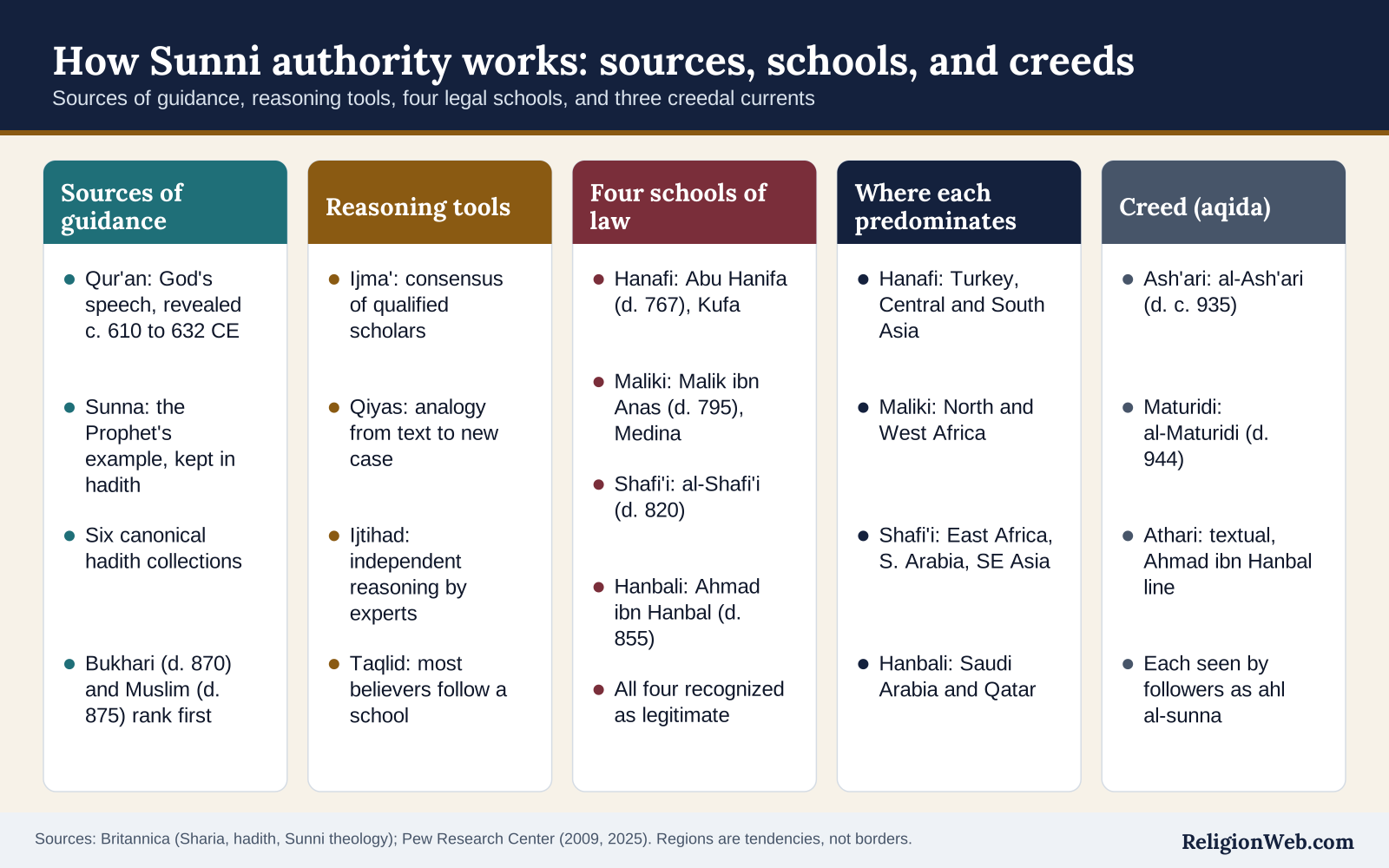
Sunni Islam is the largest branch of Islam, and the one to which roughly nine in ten of the world’s Muslims belong. Sunni Muslims call themselves ahl al-sunna wa’l-jama’a, “the people of the Prophet’s example and of the community,” and they ground their faith in the Qur’an, in the example (sunna) of the Prophet Muhammad as preserved in the reports called hadith, and in the continuous practice and scholarship of the Muslim community. Pew Research Center’s most widely cited estimate, published in 2009, put Sunnis at 87 to 90 percent of all Muslims, and Pew’s 2025 figures on Muslim population change do not break the total down by sect.
The word “Sunni” can suggest a single church with a single creed, but Sunni Islam has never worked that way. It has no pope, no central council, and no ordained priesthood. What holds it together is a shared body of sources, a shared set of obligatory practices, and a long scholarly conversation that has produced four recognized schools of law, three major theological traditions, and a web of colleges, courts, and teaching lineages that stretch from Morocco to Indonesia. Within that frame, a Hanafi villager in Uzbekistan, a Maliki trader in Senegal, a Shafi’i fisherman in Zanzibar, and a Hanbali judge in Riyadh can all be Sunni Muslims while differing on details of prayer, inheritance, or ritual.
The tradition took its distinctive shape in the first three Islamic centuries, as Muslims worked out how to remember the first generations after the Prophet’s death in 632 CE, how to collect and judge his reported sayings, and how to derive law and creed from them. Sunni identity was not announced at a single moment. It crystallized gradually around the memory of the first four caliphs, the rise of hadith scholarship, and the settling of legal and theological methods between roughly the eighth and eleventh centuries. This article explains that formation, the beliefs and law that resulted, and the worship, holy days, and institutions through which Sunni Islam is lived today.
Sunni Islam is one stream within the wider religion described in ReligionWeb.com’s chapter on Islam, which covers the faith that all Muslims share. Here the focus is on what is distinctive to the Sunni tradition and its internal variety. The article describes Sunni Islam on its own terms, naming the school, region, or period whenever practice differs, and it separates what historians can say about early events, what Sunni Muslims believe, what the legal and theological schools teach, and what everyday practice looks like in different places.
Sunni Islam at a Glance: Definition, Meaning, and Essential Facts
The quickest way to orient oneself is to see the main facts together before looking at each in turn. The table below summarizes the tradition as it is usually described by Sunni scholars and by reference works, and the sections that follow explain each row. Where a figure is an estimate, the year and source are given, because sectarian data are among the weakest in the demographic record of Muslim populations.
| Feature | Summary |
|---|---|
| Self-description | Ahl al-sunna wa’l-jama’a, “the people of the Prophet’s example and the community” |
| Share of Muslims | 87 to 90 percent, according to Pew Research Center’s 2009 estimate (Pew’s 2025 population figures give no sect split) |
| Foundational sources | The Qur’an and the sunna of the Prophet, together with scholarly consensus (ijma’) and analogical reasoning (qiyas) |
| Hadith collections | Six collections are regarded as canonical, led by the Sahih works of al-Bukhari and Muslim |
| Schools of law | Hanafi, Maliki, Shafi’i, and Hanbali, all recognized as equally legitimate |
| Schools of theology | Ash’ari, Maturidi, and the traditionalist (Athari) approach |
| Core practices | Declaration of faith, five daily prayers, almsgiving (zakat), fasting in Ramadan, pilgrimage to Mecca (hajj) for those able |
| Leadership | No clergy or central authority; religious authority rests with trained scholars (ulama), judges, and teaching institutions |
| Historical memory | The first four caliphs (632 to 661 CE) are called the “rightly guided” (rashidun); the last widely recognized caliphate ended in 1924 |
| Main regions | South and Southeast Asia, the Middle East and North Africa, sub-Saharan Africa, Central Asia, Turkey, the Balkans, and diaspora communities worldwide |
What the word Sunni means and how Sunni Muslims describe themselves
The phrase ahl al-sunna wa’l-jama’a
The Arabic word sunna originally meant a well-trodden path, a customary way of acting. In the Islamic context it came to mean the normative example of the Prophet Muhammad: what he said, did, approved, and tolerated, as transmitted by those who knew him and by the chain of reporters who followed them. The word jama’a means “the community” or “the assembled body,” and it carries a sense of solidarity and togetherness. Britannica’s account of Sunni theology explains that the two ideas were usually paired, with sunna meaning the traditional, well-defined way and jama’a the consolidated majority of the community. The full phrase therefore describes people who hold to the Prophet’s example and to the unity of the Muslim body.
Muslims who use this phrase understand it as a statement of loyalty rather than a party label. In their own telling, they are simply Muslims who follow the Qur’an and the Prophet’s example as the first generations did, and who refuse to divide the community over questions of leadership or doctrine. The shorter form “Sunni” came into wide use as a convenient name for this orientation, and it is the term used in English-language reference works, in census analysis, and by many Muslims themselves. Many Muslims, however, simply call themselves Muslim and never use a sectarian label at all, a point taken up in the later section on modern global presence.
What Sunni Islam is, and what it is not
Sunni Islam is best understood as a broad tradition of method and memory rather than a denomination with a headquarters. It holds that the Qur’an is God’s speech, that the Prophet’s example is the authoritative explanation of it, and that the early community, especially the Companions of the Prophet, transmitted both faithfully. It treats the work of the great jurists and theologians of the first Islamic centuries as the accepted framework for interpreting those sources. The result is a system with firm common ground and substantial internal variety, not a uniform set of opinions.
It follows that Sunni Islam is not identical with any state, movement, or ethnic group. Governments have sponsored particular schools, reform movements have claimed to speak for the whole tradition, and violent groups have appropriated its vocabulary, but none of these is synonymous with Sunni Islam as a religious community. Sunni scholars and institutions have rejected the claim that any group can excommunicate other Muslims, and the Amman Message of 2004 to 2005, discussed later, put that rejection into an international statement. Readers should also keep in mind that the term is a historical label built up over centuries, and that how it is applied to specific groups is sometimes contested within the Muslim world itself.
How many Sunni Muslims there are and where they live
Numbers and the limits of the data
Pew Research Center’s 2025 study, How the Global Religious Landscape Changed From 2010 to 2020, estimates that the world had about 2.0 billion Muslims in 2020, roughly 26 percent of the global population, up from 1.7 billion in 2010. It does not divide that total by sect. The most cited sect estimate comes from Pew’s 2009 report Mapping the Global Muslim Population, which put Sunnis at 87 to 90 percent of Muslims and Shia Muslims at 10 to 13 percent, while warning that sectarian affiliation had been infrequently collected or not collected at all in many countries. Because the data are thin, those percentages are better read as a range than as a measurement.
If the 2009 share is applied to the 2020 total, the Sunni population would be on the order of 1.7 to 1.8 billion people. That figure is an illustrative extrapolation across two different years, not a measured count, and it should be handled with that caution. Another limit is that sect labels do not capture how people describe themselves. In several countries, large shares of Muslims tell survey-takers that they are “just a Muslim,” and a census category cannot capture the layered identities of those who also practice with a Sufi order, follow a particular legal school, or identify with a reform movement.
A map of Sunni Islam by region
Sunni Muslims form the majority in most Muslim-majority countries. Iran is the best-known exception, and Iraq, Azerbaijan, and Bahrain are usually described as having Shia majorities, while Lebanon is religiously mixed. The largest Sunni populations are in Asia. Pew’s 2025 report finds that 59 percent of all Muslims live in the Asia-Pacific region, with Indonesia alone at about 240 million and India at about 213 million, and Pakistan and Bangladesh also among the largest Muslim countries. The Middle East and North Africa hold about one in five of the world’s Muslims, and sub-Saharan Africa about 18 percent, with 369 million Muslims there in 2020.
Regional patterns of law and theology follow this geography. Britannica’s survey of the schools of law notes that the Hanafi school predominates across the Middle East and the Indian subcontinent, the Maliki school in North, West, and Central Africa, the Shafi’i school in East Africa, southern Arabia, Malaysia, and Indonesia, and the Hanbali school in Saudi Arabia. These are tendencies rather than borders, and the lines have shifted with empires, trade routes, and scholarly networks. Large Sunni communities also live in Europe, where Pew reports Muslims at about 6 percent of the population in 2020, and in North America, where Pew counted 5.9 million Muslims in the same year.
Key vocabulary for reading about Sunni Islam
Terms of belief and authority
Reading about Sunni Islam is easier with a handful of Arabic terms in hand. Iman means faith or belief, and aqida (plural aqa’id) means a creed or statement of doctrine. Kalam, literally “speech,” is the discipline of systematic theology, and a mutakallim is one who practices it. Tafsir is commentary on the Qur’an, and hadith is a report of the Prophet’s words or deeds. The ulama (singular alim) are the scholars of religion, and a mufti is a jurist qualified to issue a non-binding legal opinion, called a fatwa.
Other terms describe the community and its memory. The sahaba are the Companions of the Prophet, those who met him and believed. The khalifa (caliph) is the successor who led the community after Muhammad’s death, and rashidun means “rightly guided,” the title Sunni tradition gives to the first four caliphs. The umma is the worldwide Muslim community. Together these words show where Sunni Islam places its authority: in scripture, in the Prophet’s example, in the Companions who transmitted it, and in the scholars who interpret it.
Terms of law and practice
The vocabulary of law is equally central. Sharia refers to the divine way as Muslims understand it, and fiqh to the human science of understanding that way in detail, which is why one can speak of a single sharia but many fiqh opinions. A madhhab is a school of law, and usul al-fiqh means the “roots of jurisprudence,” the methods by which rulings are derived. Ijtihad is independent legal reasoning by a qualified scholar, while taqlid is following the established opinion of a school or a scholar. Worship terms include salat (the ritual prayer), sawm (fasting), zakat (obligatory charity), and hajj (pilgrimage).
| Term | Meaning | Where it appears |
|---|---|---|
| Sunna | The normative example of the Prophet Muhammad | Second source of law and guidance after the Qur’an |
| Ijma’ | Consensus of qualified scholars or the community on a ruling | Third source in the classical scheme of legal theory |
| Qiyas | Analogical reasoning from a text to a new case | Fourth source in the classical scheme |
| Madhhab | A school of law with its own method and body of opinions | Hanafi, Maliki, Shafi’i, Hanbali |
| Aqida | Creed or statement of doctrine | Ash’ari, Maturidi, and Athari creeds |
| Fatwa | A non-binding legal opinion issued by a mufti | Everyday guidance and institutional rulings |
| Taqlid | Following the established view of a school or scholar | The usual position of lay Muslims and many scholars |
| Bid’a | Innovation in religion, debated as to which kinds are blameworthy | Arguments over practices such as the Mawlid |
The Qur’an, the Sunna, and Hadith: How Sunni Islam Understands Authority
Authority in Sunni Islam is layered. At the top stands the Qur’an, which Muslims hold to be God’s speech revealed to Muhammad. Beneath it stands the example of the Prophet, which explains and applies the Qur’an. Below these, and dependent on them, come the collective judgment of qualified scholars and the reasoning by which new cases are brought under old texts. This layering matters because it explains how a tradition without a central church can still produce stable, shared answers.
The Qur’an as the foundation
Revelation, compilation, and recitation
Sunni Muslims understand the Qur’an as the speech of God (kalam Allah), delivered in Arabic through the angel Gabriel to Muhammad over roughly twenty-two years, from about 610 until his death in 632 CE. The Sunni majority position, settled in the early centuries, is that this speech is uncreated, a view whose defense cost Ahmad ibn Hanbal imprisonment during the inquisition described later. According to the traditional account, the revelations were memorized and written down during the Prophet’s life, gathered into a single codex under the first caliph Abu Bakr, and issued as a standard text under the third caliph Uthman in the mid-seventh century. Scholars outside the tradition debate details of that process, but the standard text itself has been remarkably stable.
The Qur’an consists of 114 chapters (suras) divided into verses (ayat). In the Kufan verse numbering used for most printed copies it contains 6,236 verses, though traditions of numbering differ slightly. It is recited rather than merely read, and recitation is a discipline with its own rules of pronunciation called tajwid. Several canonical readings (qira’at) are recognized, of which the reading of Hafs from Asim is the most widely printed worldwide, while the reading of Warsh from Nafi’ is common in Morocco, Algeria, and parts of West Africa. The variants are small and do not change the basic message.
The text itself speaks of how believers should relate to its guidance and to the community. A verse often cited in discussions of unity reads as follows in Marmaduke Pickthall’s early translation.
And hold fast, all of you together, to the cable of Allah, and do not separate.
Qur’an 3:103 (first sentence), trans. Marmaduke Pickthall, The Meaning of the Glorious Koran (1930)
Sunni commentators have long read the “cable of Allah” as the Qur’an itself or as the religion God has given, and they cite the verse in arguing that the community should not fragment over disputes. The verse is part of the reason that Sunni teaching treats avoiding division (fitna) as a serious religious concern. Commentators differ in detail about what the “cable” denotes, and the verse is quoted across Muslim communities, not only among Sunnis.
Interpretation (tafsir) and the sciences around the text
Interpretation of the Qur’an is a scholarly field of its own. The earliest major Sunni commentary to survive in full is that of al-Tabari (d. 923), which gathers the opinions of the Companions and following generations on each verse. Later commentaries drew on grammar, poetry, law, and theology, and they range from the compendia of al-Qurtubi (d. 1273) and Ibn Kathir (d. 1373) to the concise Tafsir al-Jalalayn, begun by Jalal al-Din al-Mahalli and completed by his student al-Suyuti in the fifteenth century. Each reflects the interests of its author and school, which is part of why Sunni exegesis is a conversation rather than a single reading.
Around the text grew a family of sciences: the study of the circumstances of revelation (asbab al-nuzul), of verses that are said to abrogate or be abrogated (naskh), of the general and specific in the text, and of the Arabic language in which it was revealed. Because the Qur’an is held to be inimitable in its Arabic, translations are regarded by most Sunni scholars as renderings of meaning, not as the Qur’an itself. This is why the ritual prayer is performed in Arabic everywhere, even in communities where almost no one speaks the language in daily life.
The Sunna and the hadith literature
How a hadith is transmitted and graded
The sunna of the Prophet is known through hadith, reports of his sayings, actions, and silent approvals. As Britannica’s article on hadith explains, each report has two parts: the chain of transmitters (isnad), which traces the report back through named narrators to the Prophet or a Companion, and the text (matn), which conveys the content. A report can be no stronger than its chain, so a specialized discipline arose to evaluate narrators, asking whether each was known, truthful, mature, of good memory, and able to relay the wording exactly.
On that basis, reports are graded as sound (sahih), fair (hasan), or weak (da’if), with further terms for broken chains, incomplete chains, and fabrications. The grading was never mechanical. Scholars disagreed on technical points and sometimes on individual reports, and the terms themselves shifted in meaning across time. Britannica also records that persistent forgery was a recognized problem, which is part of why the sciences of narrator criticism became so detailed. In modern scholarship there is a range of views, from Muslim scholars who accept the major collections as authentic records, to academic historians who assess each report individually, to a skeptical minority who regard most reports as later creations.
The six canonical collections
Hadith collecting reached its peak in the ninth century. Sunni tradition treats six collections as canonical, a group often called al-kutub al-sittah. Britannica notes that the first two, the Sahih of al-Bukhari and the Sahih of Muslim, are considered the most authoritative and that both compilers were known for strictness. The other four are Sunan works arranged by legal topic, and they include reports of lower grade that the compilers commented on. Many other collections, such as the Muwatta’ of Malik and the Musnad of Ahmad ibn Hanbal, are also highly respected.
| Collection | Compiler (death year, CE) | Type and notes |
|---|---|---|
| Al-Jami’ al-sahih (Sahih al-Bukhari) | Muhammad al-Bukhari (870) | Sound reports arranged by topic; usually ranked first |
| Al-Jami’ al-sahih (Sahih Muslim) | Muslim ibn al-Hajjaj (875) | Sound reports, noted for careful arrangement of variants |
| Sunan Ibn Majah | Ibn Majah (886) | Legal-topic arrangement; includes some weaker reports |
| Sunan Abi Dawud | Abu Dawud (889) | Focused on reports used in legal reasoning |
| Jami’ al-Tirmidhi | al-Tirmidhi (892) | Grades reports and notes differences among the schools |
| Sunan al-Nasa’i | al-Nasa’i (915) | Known for narrator scrutiny |
The authority of the Prophet’s example rests on the Qur’an’s own language. A frequently cited verse, in Pickthall’s wording, reads as follows.
And whatsoever the messenger giveth you, take it. And whatsoever he forbiddeth, abstain (from it).
Qur’an 59:7 (excerpt), trans. Marmaduke Pickthall, The Meaning of the Glorious Koran (1930)
The verse appears in a passage about the distribution of property taken without battle (fay’), and its immediate context is practical. Sunni jurists, especially from the time of al-Shafi’i (d. 820), cited it and similar verses to argue that obedience to the Prophet’s example is an obligation grounded in scripture and not an optional addition. That reading is the foundation of the legal weight given to hadith across all four schools. Other Muslim traditions and a few modern movements, such as the Ahl-e Qur’an movement mentioned in Britannica’s article, take different positions on how far hadith can bind, but the mainstream Sunni position is as described here.
Consensus, analogy, and the community’s role
Ijma’ and the community’s memory
The third source of law in the classical scheme is consensus (ijma’), the agreement of qualified scholars of a given era, or in a broader sense of the community, on a point of law or doctrine. The idea rests on reports that the community would not agree on error, and it gave the tradition a way to treat settled matters as closed. Britannica observes that Sunnism stressed the views and customs of the majority of the community over those of peripheral groups, and that emphasis on the community is a defining feature of Sunni orthodoxy. Through consensus, Sunni jurists could also accept long-established practices that grew up in ordinary history.
Consensus is more flexible in practice than it sounds. Scholars have disagreed about who must agree, whether silent assent counts, and whether it requires the agreement of the whole community or only of the jurists of one generation. In classical Sunni law, the schools treated the consensus of the Companions as the clearest and most binding instance. In modern times, many reformers have appealed to a broader idea of community consensus, while most traditional scholars hold to the classical criteria.
Qiyas, reason, and the place of the scholars
When neither text nor consensus answers a question, jurists reason by analogy (qiyas), extending the ruling of a known case to a new one that shares the same underlying cause. The classic example is the prohibition on wine in the Qur’an, extended to other intoxicating drinks because they share the quality of intoxication. Beyond analogy, different schools use supplementary principles, such as juristic preference (istihsan), public interest (maslaha), and local custom (‘urf), and they disagree about how far these may be used. The question of how much weight to give human reasoning in understanding revelation is one of the main axes along which the legal schools differ.
The Qur’an itself, in a verse that Sunni jurists have long discussed, tells believers to obey God and the Messenger and “those in authority.” The verse is a basis for respect toward both rulers and scholars.
O ye who believe! Obey Allah, and obey the messenger and those of you who are in authority; …
Qur’an 4:59 (excerpt), trans. Marmaduke Pickthall, The Meaning of the Glorious Koran (1930)
The verse continues by directing believers to refer disputes to God and the Messenger. Classical commentators differ on who “those in authority” are: some read the phrase as rulers and military commanders, some as scholars of religious law, and some as both. That range of readings is itself characteristic of Sunni interpretation, in which the plain statement of the text is read together with the discussions of the early commentators and jurists. The result is an understanding of authority as cumulative: the text, the Prophet’s example, the early community’s practice, and the trained judgment of later scholars each hold a place, in an order that the schools describe slightly differently.
The Historical Formation of Sunni Identity, from 632 CE to the Present
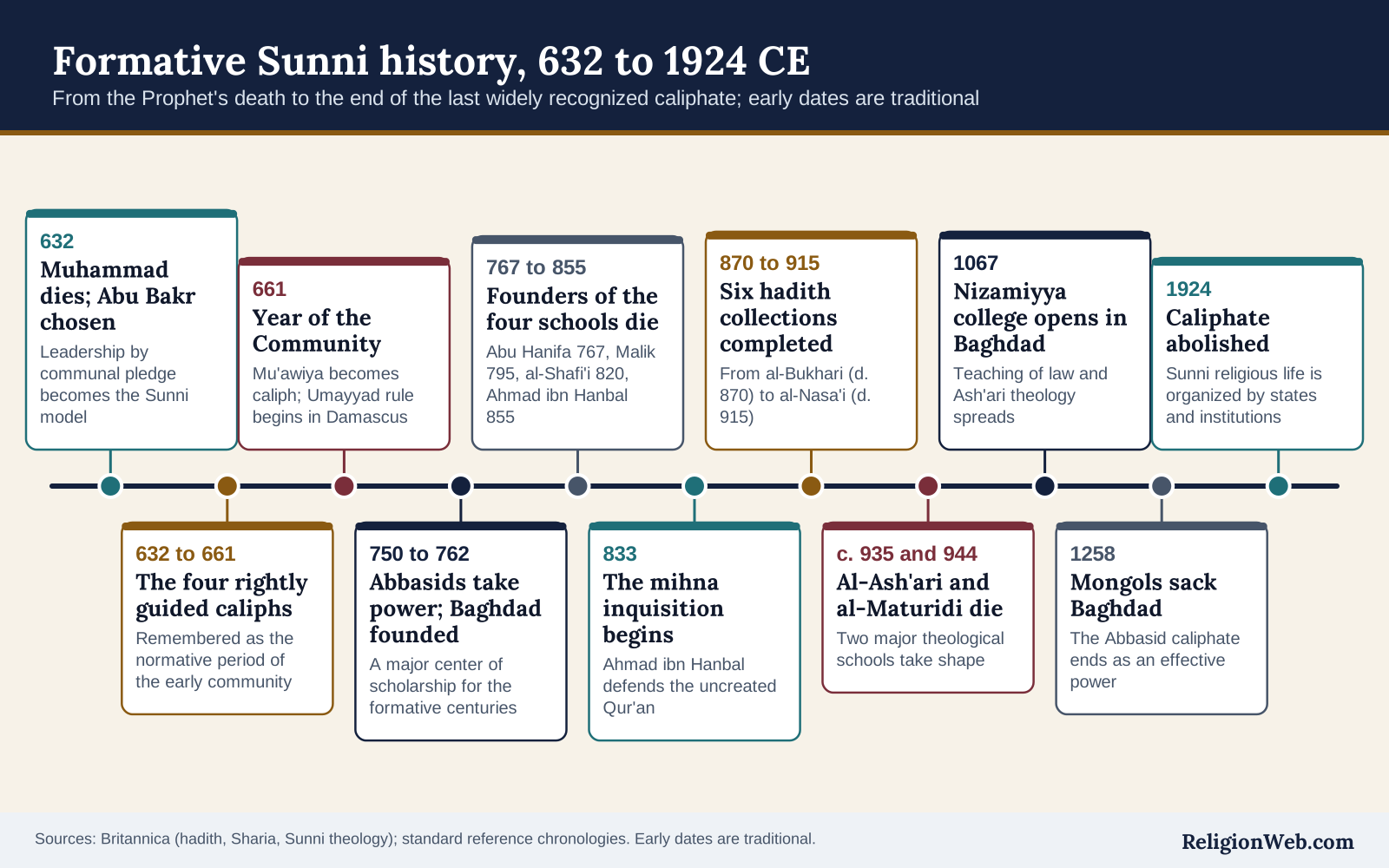
Historians generally agree that Sunni Islam did not begin as a named movement. In the generations after Muhammad’s death in 632 CE, Muslims were simply the community of believers, and the labels that later organized Islamic religious life emerged only as questions of leadership, law, and doctrine had to be answered. What can be traced with reasonable confidence is a process: a memory of the first caliphs that became normative, a body of hadith and legal reasoning that matured in the eighth and ninth centuries, and a settling of theological positions in the tenth and eleventh. The chronology below follows that process, using dates from standard reference works. Early dates, especially for events before the eighth century, rest on later Muslim historical writing and are described as traditional where that matters.
The Prophet’s death and the first four caliphs (632 to 661)
Abu Bakr and the first question of leadership
Muhammad died in Medina in 632 CE, in the eleventh year of the Hijri calendar, and the community faced a question the Qur’an had not settled: who would lead it? According to the traditional accounts, leading figures of the Medinan Helpers (ansar) and the Meccan Emigrants (muhajirun) met at a place called the Saqifa of the Banu Sa’ida, and after discussion Abu Bakr, one of the Prophet’s earliest and closest Companions, was chosen and pledged allegiance (bay’a) by those present. He took the title khalifat rasul Allah, “successor of the Messenger of God,” from which the English word caliph derives. Sunni tradition regards this as a legitimate act of communal choice, and it became the model of a leadership grounded in consultation and acceptance rather than in a designation by the Prophet.
The Qur’an refers to consultation as a mark of the believers. Pickthall renders the relevant description of the faithful as follows, in a verse that Sunni writers have often connected with the practice of the early community.
And those who answer the call of their Lord and establish worship, and whose affairs are a matter of counsel, and who spend of what We have bestowed on them, …
Qur’an 42:38 (excerpt), trans. Marmaduke Pickthall, The Meaning of the Glorious Koran (1930)
Sunni scholars did not read the verse as prescribing a particular procedure for choosing a caliph. They took it as a general principle that communal affairs should be settled by counsel, and they drew on the actual practice of the first four successions to illustrate acceptable methods: choice by leading Companions, nomination by the outgoing caliph, and selection by a small council. Another community of Muslims, described in the chapter on Shia Islam, holds that the Prophet designated Ali ibn Abi Talib to lead after him, and that understanding shaped a different history. The Sunni account stands on its own terms, and this article keeps to it.
Abu Bakr’s brief caliphate (632 to 634) was dominated by the so-called wars of apostasy (hurub al-ridda), in which several Arabian tribes broke away or refused to pay the alms tax, and by the beginnings of campaigns beyond Arabia. According to the traditional account, the Qur’an was also collected during this time at the urging of Umar, who feared the loss of memorizers in battle. This account is part of Sunni teaching about how the text was preserved. Historians outside the tradition debate how much was written and how quickly, but the tradition’s own memory placed concern for the integrity of scripture at the center of the early state.
Umar, Uthman, and Ali, and the First Fitna
Umar ibn al-Khattab (r. 634 to 644), designated by Abu Bakr, presided over the largest conquests of the early period, including most of Syria, Egypt, and the Sasanian lands of Iraq and Iran. He is also credited in Muslim tradition with setting up the administrative registers, the first Hijri-dated documents, and a pattern of governance that later jurists treated as precedent. After his death at the hands of a Persian slave, a council of six leading Companions chose Uthman ibn Affan (r. 644 to 656), under whom the standard text of the Qur’an was distributed to the main cities and further conquests were made. Opposition to Uthman’s rule grew among provincial garrisons, and he was killed by rebels in 656.
The caliphate of Ali ibn Abi Talib (656 to 661), the Prophet’s cousin and son-in-law, was the most turbulent of the four. It began in the aftermath of Uthman’s killing and saw the first civil war (fitna) among Muslims, including the Battle of the Camel in 656 and the Battle of Siffin in 657 against Mu’awiya, the governor of Syria. A group of Ali’s former supporters, known as the Kharijites, rejected the arbitration that followed and broke with him, and one of them assassinated Ali in 661. Sunni tradition remembers all four men as “rightly guided” and it holds that the first thirty years after the Prophet formed a distinct period of exemplary rule, a view anchored in a hadith that speaks of a caliphate of thirty years.
The Sunni insistence on honoring all four caliphs, and all the Companions, grew out of the experience of this civil war. Rather than judging which party among the Companions was right in every dispute, the mainstream Sunni position became that the Companions were upright transmitters of the faith and that the community should refrain from cursing any of them. The historian’s reading is that the memory of the first four caliphs as a unified, exemplary period was shaped over time, and that it served to hold together a community that had experienced bitter division.
From the Year of the Community to the Abbasid age (661 to the tenth century)
The Umayyad caliphate and the idea of the jama’a
After Ali’s death, his son Hasan ibn Ali stepped aside in favor of Mu’awiya ibn Abi Sufyan, and the community gathered behind a single ruler. Muslim chroniclers called 661 CE (41 AH) the Year of the Community (‘am al-jama’a), and many Sunni authors see in the phrase the origin of the jama’a in ahl al-sunna wa’l-jama’a: the principle that unity behind an established order is preferable to continued strife. Historians treat that etymology cautiously, because the full phrase appears in the sources only later, but the sentiment it expresses fits the way Sunni scholars subsequently handled political authority. They prized the stability of the community and tended to counsel obedience to existing rulers so long as those rulers did not command what God forbids.
The Umayyad dynasty ruled from Damascus from 661 to 750. Its caliphs completed the conquest of North Africa, brought most of the Iberian Peninsula and parts of Sindh under Muslim rule in the early eighth century, and made Arabic the language of administration. ‘Abd al-Malik (r. 685 to 705) minted Islamic coinage and sponsored the Dome of the Rock in Jerusalem, completed in about 691 to 692. The period was also marked by political crises, among them the killing of Husayn ibn Ali, the Prophet’s grandson, at Karbala in 680. Sunni Muslims honor Husayn and his brother Hasan as leading members of the Prophet’s family and regard Karbala as a tragedy, and many Sunni scholars condemned the killing and the later pressures on the Prophet’s descendants.
Abbasids, learning, and the inquisition of the ninth century
In 750 the Abbasids, descendants of the Prophet’s uncle al-Abbas, overthrew the Umayyads and moved the center of the caliphate east. Their second caliph al-Mansur founded Baghdad in 762 near the old Sasanian capital, and under al-Mansur, al-Mahdi, and Harun al-Rashid (r. 786 to 809), the city became a major center of scholarship. Translators of Muslim, Christian, and Jewish background rendered Greek, Syriac, and Persian works into Arabic, and the movement fed into mathematics, medicine, philosophy, and the speculative theology called kalam. The Persian-speaking regions of the empire, long home to older religious communities such as Zoroastrians, gradually became majority Muslim during this period, with historians arguing over the pace of conversion.
It was in this environment that the schools of law and the hadith collections took form. Under Caliph al-Ma’mun (r. 813 to 833), the state sided with the rationalist Mu’tazila theologians and began, in 833, an inquisition (mihna) requiring leading scholars to affirm that the Qur’an was created. Ahmad ibn Hanbal refused, was imprisoned and beaten, and became a symbol of steadfast loyalty to the traditional position that the Qur’an is the uncreated speech of God. The policy was abandoned in the 840s under al-Mutawakkil. The episode is often described as a moment when the scholars of hadith emerged as an independent source of religious authority apart from the caliph, an important step in the development of Sunni Islam as a scholar-led tradition.
| Date (CE) | Event | Significance for Sunni tradition |
|---|---|---|
| 632 | Death of Muhammad; Abu Bakr chosen as first caliph | Model of leadership by communal choice and pledge of allegiance |
| 632 to 661 | Caliphates of Abu Bakr, Umar, Uthman, and Ali | The “rightly guided” period, remembered as normative |
| c. 650 | Uthman distributes the standard Qur’anic text (traditional date) | Origin of the standard text used by Sunni communities |
| 661 | Year of the Community; Mu’awiya becomes caliph; Umayyad rule begins | End of the First Fitna; origin of jama’a in later memory |
| 750 to 762 | Abbasid revolution; Baghdad founded | Center of scholarship for the formative centuries |
| 767 to 855 | Deaths of Abu Hanifa (767), Malik (795), al-Shafi’i (820), Ahmad ibn Hanbal (855) | Eponyms of the four schools of law |
| 833 to 840s | The mihna inquisition and its end | Defense of the uncreated Qur’an; scholarly independence |
| 870 to 915 | Deaths of the six canonical hadith compilers | Completion of the canonical hadith collections |
| c. 935 and 944 | Deaths of al-Ash’ari and al-Maturidi | Two major Sunni theological schools take shape |
| 1067 and 1111 | Nizamiyya college in Baghdad opens; al-Ghazali dies | Institutional teaching of law and Ash’ari theology spreads |
| 1258 | Mongols sack Baghdad | End of the Abbasid caliphate as an effective power |
| 1517 and 1924 | Ottoman conquest of Cairo; abolition of the caliphate in 1924 | Last widely recognized caliphate ends |
Consolidation: law, creed, and colleges (ninth to twelfth centuries)
Hadith scholars and the legal schools
The ninth century saw the great hadith collections compiled by al-Bukhari, Muslim, and their contemporaries, and the formation of the four Sunni legal schools around the legacies of Abu Hanifa, Malik, al-Shafi’i, and Ahmad ibn Hanbal. Britannica’s overview of Islamic law describes how regional legal traditions, passed on in teaching circles in the Hijaz, Iraq, Syria, and Egypt, gradually gave way to schools identified with individual masters. Al-Shafi’i’s contribution was to insist that the Qur’an and the sunna were the only authoritative sources, and to supply a method for deriving rules from them. His theory shaped the classical science of legal methodology (usul al-fiqh), and his emphasis on the sunna spurred the collection and classification of hadith.
One further point matters for how the history is told. The idea that a gate of independent legal reasoning (ijtihad) had closed was debated between the ninth and twelfth centuries and, on the usual account, was not firmly established until the twelfth. Modern historians of Islamic law have questioned whether the gate was ever literally closed, arguing that jurists continued to exercise reasoning within their schools. The picture, then, is not of a sudden freeze but of a slow stabilization in which most Muslims came to follow an established school.
Theological schools and the madrasa
Alongside the law, theology settled. In the tenth century two scholars, Abu al-Hasan al-Ash’ari (873/874 to c. 935/936, who worked in Baghdad) and Abu Mansur al-Maturidi (d. 944, who worked in Transoxania), articulated positions that defended traditional beliefs with rational argument, and a third approach, rooted in the Hanbali tradition, defended them by close adherence to the texts alone. Britannica describes the formation of Sunni theology as, in large part, a reaction to the Mu’tazila and the Kharijites. The same period produced creed texts such as that of the Egyptian Hanafi scholar al-Tahawi (d. 933), still taught today.
These positions were institutionalized in colleges. The Seljuk vizier Nizam al-Mulk established a network of madrasas known as the Nizamiyya, with the first major one opening in Baghdad in 1067, to teach Shafi’i law and Ash’ari theology. The theologian and mystic Abu Hamid al-Ghazali (d. 1111) taught there and wrote a major synthesis of law, spirituality, and doctrine, The Revival of the Religious Sciences. Britannica credits al-Ghazali’s influence with the wider spread of Ash’ari theology from the eleventh century. In the same era, Sunni rulers such as Saladin, who ended the Fatimid dynasty in Egypt in 1171, supported Sunni teaching institutions, and al-Azhar in Cairo, founded under the Fatimids around 970 to 972, became over time a major Sunni center of learning. The Sufi orders that grew from the twelfth century added another layer, and most Sunni communities came to hold law, creed, and devotion together.
Empires, networks, and the end of the caliphate (thirteenth century to 1924)
After Baghdad: Mamluks, Ottomans, Mughals, and African and Asian states
In 1258 the Mongols under Hulagu took Baghdad and killed the last effective Abbasid caliph. The Mamluk sultans of Egypt later installed a member of the Abbasid family in Cairo as a ceremonial caliph, preserving the office symbolically. After the thirteenth century the caliphate ceased to be an effective political institution, though Sunni ideas about it persisted. The Ottoman sultans, who conquered Cairo in 1517, ruled the central Islamic lands for four centuries, gave the Hanafi school official standing in their courts, supported the Maturidi and Ash’ari creeds, and patronized scholars and colleges. Later Ottoman legal reform produced the Mecelle, a civil code drawn from Hanafi law, compiled between 1869 and 1876.
Elsewhere, Sunni Islam took distinct regional forms. In India, the Mughal Empire (1526 to 1857) was Hanafi in its jurisprudence, and a compendium of Hanafi law, the Fatawa-i Alamgiri, was compiled under Aurangzeb (r. 1658 to 1707). Islam in South Asia developed in constant contact with the Hindu majority, with mutual influence in language, music, and devotional style. In West Africa, the empire of Mali became known across the Muslim world when its ruler Mansa Musa made the pilgrimage in 1324, and Timbuktu became a center of Maliki scholarship. In island Southeast Asia, Shafi’i law and Sufi networks spread along trade routes from the thirteenth century onward.
The end of the caliphate and the modern era
The modern period brought colonial rule over most Sunni lands, the creation of nation-states, and a search for new forms of religious authority. Ottoman sultans had used the title of caliph more assertively in the nineteenth century, but after the empire’s defeat in the First World War the Turkish Grand National Assembly abolished the sultanate in 1922 and the caliphate on March 3, 1924. The loss prompted conferences and movements, but no new caliphate won general recognition. Sunni religious life since then has been organized by nation-states, universities, voluntary associations, and transnational networks, not by a single office.
Several reform and revival currents arose along the way. In the eighteenth century, Muhammad ibn Abd al-Wahhab and Muhammad ibn Saud formed an alliance in central Arabia, a movement that came to influence the Saudi state and the Hanbali-oriented Salafi approach. In nineteenth-century India, the seminary of Darul Uloom Deoband was founded in 1866 to preserve Hanafi learning under colonial conditions. In Egypt, scholars such as Muhammad Abduh (1849 to 1905) argued for renewal through a return to the sources and engagement with modern knowledge. In the twentieth century, mass organizations such as the Muslim Brotherhood (founded 1928) and Nahdlatul Ulama in Indonesia (founded 1926) pursued social and political aims in very different ways. The result is a Sunni world of unusual institutional variety, treated further below.
Muhammad, the Companions, and the Scholars: Central Figures in Sunni Memory
Sunni Islam does not have founders in the sense that some traditions do. It has an exemplar, the Prophet Muhammad, and a community that preserved and interpreted his legacy. The people most prominent in Sunni memory fall into three groups: the Prophet and his family, the Companions and the first four caliphs, and the scholars who built the disciplines of law, hadith, and theology. Muslims customarily follow the mention of the Prophet’s name with a blessing, usually rendered in English as “peace be upon him,” and many Sunni Muslims add formulas of respect after the names of the Companions as well.
The Prophet and the Companions
Muhammad as the exemplar
Sunni Muslims honor Muhammad as the last prophet and messenger of God, chosen to receive the Qur’an and to demonstrate how it is to be lived. They do not regard him as divine, and they hold that worship is due to God alone. His character, his conduct as a family member, ruler, and neighbor, and his habits of prayer, fasting, and generosity are preserved in hadith and in biographical literature (sira), and they supply a template for ordinary life: how to greet, eat, give charity, or settle a quarrel. Devotion to him takes the form of frequent invocations of blessing upon him (salawat), of study of his biography, and, in many regions, of poems and gatherings in his praise.
The Companions and the principle of their integrity
The Companions (sahaba) are those who met the Prophet and believed in him. Sunni teaching treats them as the generation that received and transmitted the faith, and holds that their integrity as transmitters should not be impugned. This principle underlies hadith criticism, since reports are traced through Companions, and it also underlies the Sunni habit of honoring all of them, including those who took opposing sides in the first civil war. Particular Companions hold special places: Aisha bint Abi Bakr, the Prophet’s wife, who transmitted a large number of reports and taught many students; Abu Hurayra, one of the most prolific narrators; and the ten Companions to whom the Prophet is reported to have given the news of paradise, a group that includes the four caliphs.
The caliphs and the founding scholars
The four caliphs in Sunni memory
The traditional Sunni order of merit among the Companions places Abu Bakr first, then Umar, Uthman, and Ali. Abu Bakr is remembered for his steadfastness at the Prophet’s death and his firmness during the wars of apostasy, Umar for his justice and administrative skill, Uthman for his generosity and for the standardization of the Qur’an, and Ali for his knowledge, courage, and closeness to the Prophet’s family. Sunni authors frequently cite the Prophet’s love for his household (ahl al-bayt), and the family of the Prophet, including Fatima, Hasan, and Husayn, is honored in Sunni devotional literature. Many Sunni Sufi orders trace their chains of spiritual transmission through Ali.
The imams of law and the great teachers
The scholars who gave Sunni Islam its intellectual form are remembered as imams of their fields. The four founders of the legal schools, discussed in detail below, are honored as masters whose methods and opinions guided later jurists. In hadith, al-Bukhari and Muslim hold the highest rank, and in theology, al-Ash’ari and al-Maturidi. Al-Ghazali is remembered as a renewer of the religious sciences, and Ibn Taymiyya (1263 to 1328), a Syrian Hanbali scholar, as a major voice for traditionalist theology whose influence is felt particularly in later reform movements. The table collects some of the central names with the dates and roles that reference works assign them.
| Figure | Dates (CE) | Role in Sunni memory |
|---|---|---|
| Muhammad | c. 570 to 632 | Last prophet; the exemplar whose sunna is a source of guidance |
| Abu Bakr | r. 632 to 634 | First caliph; model of leadership by pledge of allegiance |
| Umar ibn al-Khattab | r. 634 to 644 | Second caliph; administrative organizer of the early state |
| Uthman ibn Affan | r. 644 to 656 | Third caliph; credited with the standard Qur’anic text |
| Ali ibn Abi Talib | r. 656 to 661 | Fourth caliph; revered scholar and relative of the Prophet |
| Abu Hanifa | 699 to 767 | Jurist of Kufa; eponym of the Hanafi school |
| Malik ibn Anas | d. 795 | Jurist of Medina; author of the Muwatta’; eponym of the Maliki school |
| Al-Shafi’i | 767 to 820 | Theorist of legal sources; eponym of the Shafi’i school |
| Ahmad ibn Hanbal | 780 to 855 | Hadith scholar; compiler of the Musnad; eponym of the Hanbali school |
| Al-Bukhari | d. 870 | Compiler of the most authoritative hadith collection |
| Al-Ash’ari | 873/874 to c. 935/936 | Founder of the Ash’ari theological school |
| Al-Maturidi | d. 944 | Founder of the Maturidi theological school |
| Al-Ghazali | d. 1111 | Jurist, theologian, and author of the Revival of the Religious Sciences |
| Ibn Taymiyya | 1263 to 1328 | Hanbali scholar; influential on later traditionalist and reform currents |
Sunni Beliefs and Theology: Creed, Kalam, and the Major Schools
Sunni belief begins from the same core that all Muslims share, and its distinctiveness lies less in a list of unusual doctrines than in a method: the creed is drawn from the Qur’an and hadith, defended by argument, and kept within the bounds that the early community is understood to have accepted. This section describes the shared structure of Sunni belief, then the three theological currents that explain it, and finally the Sunni understanding of leadership and the Companions, which gives the tradition its name.
The articles of faith
Tawhid and the six articles of faith
The center of Sunni belief is tawhid, the oneness of God. God (Allah in Arabic) is the single creator and sustainer, without partner, offspring, or likeness, and all worship belongs to him alone. Sunni creeds describe God by the names and attributes that the Qur’an and hadith ascribe to him, among them mercy, knowledge, power, and justice, and they place great emphasis on a distinction between the Creator and everything created. A well-known hadith report, called the Hadith of Gabriel and found in the collections of Muslim and al-Bukhari, sets out the structure that Sunni catechisms follow: the angel Gabriel appears in human form and asks the Prophet about Islam (the five pillars of practice), about faith (iman), and about excellence (ihsan).
In that report, faith has six elements: belief in God, in his angels, in his revealed books, in his messengers, in the Last Day, and in divine decree (qadar), “the good of it and the bad of it.” Sunni teaching understands angels as created beings who carry out God’s commands, the revealed books as the scriptures given to earlier prophets and, finally, the Qur’an, and the messengers as a chain of prophets from Adam to Muhammad, the last. Ihsan, the third element, is usually explained as worshiping God as though one sees him, knowing that even if one does not, God sees. In many Sunni communities, ihsan is the point at which the spiritual disciplines described in the article on Sufism are connected to the basic structure of the faith.
Faith, sin, and the afterlife
Sunni teaching on the afterlife follows the Qur’an and hadith closely. After death, the soul awaits resurrection in a state called barzakh, and on the Last Day all humanity will be raised, judged by the weighing of deeds, and sent to paradise or hell. Sunni creeds affirm that believers will see God in paradise, that the Prophet will intercede for his community, and that those who die as Muslims but with serious sins remain under God’s will: God may forgive them, or they may be punished and eventually released. This position grew in debate with early groups that held different views: the Kharijites, who declared serious sinners to be unbelievers, and the Mu’tazila, who placed them in an intermediate position.
The refusal to expel believers from the community on account of sin is one of the most consequential features of Sunni theology. Britannica notes that Sunnis treated good works as enhancing faith but not as part of its definition, and that serious consequences were reserved for those who denied God’s unity or rejected Muhammad’s prophethood. This preserved the integrity of the community at some cost in doctrinal uniformity. It also explains why Sunni jurists have generally been cautious about declaring other Muslims outside the faith (takfir), a caution that the Amman Message of 2004 to 2005 later restated in an international form.
Major theological currents
The Ash’ari and Maturidi schools
Two schools of rational theology developed in the tenth century. The Ash’ari school is named for Abu al-Hasan al-Ash’ari, who was born in Basra in 873 or 874 and died in Baghdad around 935 or 936. He had been trained in Mu’tazili thought and moved to a position that defended traditional doctrines with rational methods. He held that God’s attributes, such as knowledge, power, will, hearing, sight, and speech, are real and eternal, that the Qur’an is God’s uncreated speech, and that God creates human acts while humans “acquire” them (kasb), a doctrine meant to preserve both divine omnipotence and human responsibility. Ash’arism became widely accepted among Shafi’i and Maliki scholars and, through institutions such as the Nizamiyya colleges and the writings of al-Ghazali, became the dominant theology of much of the Sunni world.
The Maturidi school takes its name from Abu Mansur al-Maturidi (d. 944), who worked in Transoxania. Britannica’s account of Sunni theology describes him as holding that God alone creates everything, including human acts, but that humans are real actors, and that human reason can recognize good and evil, with revelation aiding reason against passion. His outlook was close to al-Ash’ari’s in many respects. Maturidi theology became associated especially with the Hanafi legal school and prevailed across Central Asia, Anatolia, the Balkans, and the Indian subcontinent, in part through Seljuk and Ottoman patronage. Adherents of each school consider the other to belong to the Sunni mainstream, and the differences between them concern fine points: whether faith can increase and decrease (the Ash’ari view; Hanafi-Maturidi teaching holds that faith itself does not), how far reason knows right and wrong before revelation, and how to explain human action.
| Current | Origins | Approach to God’s attributes | Human action and reason | Common regions |
|---|---|---|---|---|
| Ash’ari | Abu al-Hasan al-Ash’ari (c. 873 to c. 935), Baghdad; spread by al-Ghazali and the Nizamiyya colleges | Affirms attributes as real; interprets some descriptive texts figuratively or defers their meaning to God | God creates acts; humans “acquire” them; reason is secondary to revelation in knowing right and wrong | Shafi’i and Maliki areas: Egypt, the Levant, Southeast Asia, East and West Africa |
| Maturidi | Abu Mansur al-Maturidi (d. 944), Transoxania; linked to the Hanafi school | Affirms attributes, with a role for reasoned interpretation | Stresses real human choice; reason can recognize good and evil in general terms | Hanafi areas: Turkey, Central Asia, the Balkans, South Asia |
| Athari (traditionalist) | Ahmad ibn Hanbal (d. 855) and the hadith scholars; later Ibn Taymiyya (d. 1328) | Affirms texts as stated, “without asking how” and without likening God to creation; suspicious of speculative theology | Emphasizes scriptural statements and the practice of early generations over rational systems | Hanbali areas such as Saudi Arabia and Qatar; many Salafi communities |
| Sufi-affiliated creeds | Orders from the 12th century that adopt Ash’ari or Maturidi doctrine | Follows the underlying school of creed | Adds disciplines of inner purification | North and West Africa, South Asia, Turkey, Central and Southeast Asia |
The traditionalist (Athari) approach
A third approach, called Athari from athar, “transmitted report,” holds that the best way to speak of God is to repeat what scripture says and no more. Its early exponents among the hadith scholars, with Ahmad ibn Hanbal as the key figure, affirmed that God has a hand, a face, and that he rose over the throne, as the texts state, “without asking how” (bila kayf) and without comparing God to creation. They distrusted the methods of speculative theology as a source of doctrine and held that the early community’s silence on questions of metaphysical detail was a model. The approach was developed by later Hanbali scholars and given a systematic form by Ibn Taymiyya in the thirteenth and fourteenth centuries.
Scholars of other schools sometimes characterize the Athari position as too literal, and Athari writers in turn argue that the Ash’ari and Maturidi methods go beyond what the texts permit. These internal discussions can be sharp, but both sides generally regard each other as part of ahl al-sunna. The term Salafi, from salaf, “the predecessors” (the first three generations of Muslims), is used by modern movements that claim the Athari creed and that stress direct appeal to the Qur’an and hadith. Not every Athari scholar is a modern Salafi, and Salafi communities themselves are diverse in politics and temperament, as the later section on currents explains.
Leadership and the Companions in Sunni theology
The caliphate as a matter of law more than of creed
One of the clearest features of Sunni teaching is how it frames the question of leadership. Sunni political thought saw the community established by Muhammad at Medina as a worldly polity, with leadership set by the needs of the community and the practice of the early caliphs rather than by divine appointment. Classical Sunni political writing, such as the work of al-Mawardi (d. 1058) in Baghdad, treated the caliphate as an obligation of the community to maintain, set out the qualifications of the office, and described how a caliph is installed. A majority of jurists held that the caliph should come from Muhammad’s tribe, the Quraysh, though the theory of election was flexible enough to allow allegiance to whoever held effective power and kept the law.
Because leadership was seen as a communal and legal obligation, Sunni creeds usually treat questions about it as matters of jurisprudence and history, not as pillars of faith. Believing in a particular caliph or lineage is not part of the articles of faith, and the tradition’s attention has been less on who leads than on whether the leader upholds the law. That is why the loss of the caliphate in 1924 caused deep discussion in Sunni circles but did not alter the structure of belief or worship, and why Sunni religious authority today can rest on scholars and institutions rather than on a single office.
Respect for the Companions and the family of the Prophet
The Sunni creeds draw an important line on the Companions: they are to be loved and honored, none is to be spoken of with disrespect, and the disputes between them are to be left to God. Early creed texts, such as the Tahawiyya, state this explicitly. The principle has historical roots in the civil wars described above, and it has theological reasons too, since the Companions are the link in the chain that carries the Qur’an and the sunna.
The same creeds call for love of the Prophet’s household (ahl al-bayt). Sunni authors honor Fatima, Ali, Hasan, and Husayn in works of devotion, and the greeting of blessing on the Prophet customarily includes his family. Sunni Muslims thus join reverence for the household to reverence for the Companions, and they regard the two as compatible. How different Muslim communities understand the household’s role in religious leadership is a separate question that is treated in the article on Shia Islam.
Sunni Law: Sharia, Fiqh, and the Four Legal Schools
Law is where the diversity of Sunni Islam is most visible, and also where its principle of unity in difference is most clearly stated. Every Sunni jurist works from the same sources, and yet four schools produce somewhat different rulings on matters of worship, family, and commerce. Understanding why requires distinguishing divine law from human understanding of it, and then looking at how each school came to its methods.
Sharia and fiqh: how law works in Sunni Islam
Sharia and fiqh are not the same thing
In Sunni usage, sharia is the way that God has prescribed, known fully only to God, while fiqh is the human effort to understand it and apply it to particular cases. A fiqh ruling is therefore an opinion about what the sharia requires, reached by a qualified scholar through established methods. This distinction is why Sunni jurists could disagree for centuries and still regard each other’s conclusions as legitimate. Britannica describes the sharia as pluralistic, quoting a saying attributed to the Prophet that difference of opinion among his community is a sign of God’s bounty, and noting that the saying is regarded as putative by many scholars. Whether or not the report is authentic, the attitude it expresses is characteristic.
The content of fiqh is broad. It covers acts of worship (‘ibadat), such as prayer, fasting, and pilgrimage, and dealings among people (mu’amalat), such as marriage, inheritance, contracts, and torts. It also includes classical rules on criminal justice and government, though Britannica points out that sharia doctrine was the focal point of legal activity but was never the only authoritative source of law for Muslims in practice, since rulers’ courts handled much of criminal, land, and commercial law. In most modern Muslim-majority states, statutes drawing on a mixture of sources govern most of public law, and fiqh retains its strongest role in personal status matters like marriage, divorce, and inheritance.
How a ruling is reached
Britannica summarizes the classical method: the jurist consults the Qur’an and hadith first, then reasons by analogy, then makes use of subsidiary principles such as juristic preference and public interest. Each conclusion is regarded as probable rather than certain (zann), in contrast to the certainty of clear texts. Rulings fall into five categories: obligatory (fard or wajib), recommended (mandub), permitted (mubah), disliked (makruh), and forbidden (haram). The Hanafi school distinguishes between fard, established by certain evidence, and wajib, established by evidence that is probable, while the other schools generally treat the two terms as equivalent.
These categories shape lived practice. A prayer performed at its recommended time is not the same legal category as one that is merely valid, and a fast beyond the obligatory month is a voluntary act of devotion. Knowing which category a practice falls into also lets Sunni Muslims understand why scholars disagree without alarm. If one school calls an act recommended and another calls it obligatory, both agree that it is good, and they differ over the degree of the obligation.
The four schools of law
The Hanafi and Maliki schools
The Hanafi school is named for Abu Hanifa al-Nu’man ibn Thabit (c. 699 to 767), a jurist of Kufa in Iraq who died in Baghdad. His students Abu Yusuf (d. 798) and Muhammad al-Shaybani (749/750 to 805) recorded and extended his teaching. The school is known for its use of reasoned opinion (ra’y) and juristic preference where texts are silent. It became the main school of state administration under the Abbasids and later the Ottomans, and it predominates today in Central Asia, India, Pakistan, Turkey, and the countries of the former Ottoman Empire. Because of the Ottoman and Mughal states and the size of South Asia’s population, it is generally thought to be the school followed by the largest number of Sunni Muslims.
The Maliki school derives from Malik ibn Anas (d. 795), the leading jurist of Medina and author of the Muwatta’, which combines hadith with the opinions of the early community and the practice of the people of Medina. That practice (‘amal ahl al-Madina) carries unusual weight in the Maliki school, which regarded the living custom of the Prophet’s city as a transmitted sunna. Britannica notes that the Maliki and Hanafi schools gave greater weight to their regional traditions when these conflicted with individual hadith. Maliki law spread to Muslim Spain and North Africa and became dominant in North, West, and Central Africa.
The Shafi’i and Hanbali schools
The Shafi’i school is named for Muhammad ibn Idris al-Shafi’i (767 to 820), who was raised in poor circumstances in Mecca, studied in Medina and Baghdad, and settled in Egypt. His Risala, which Britannica says he wrote in the last five years of his life, argued that the sources of law are the Qur’an and the sunna, with consensus and analogy as methods of application. He rejected the authority of regional custom and of early jurists as such. The school he inspired is the most prominent in East Africa, southern Arabia, Kurdish regions, Indonesia, and Malaysia.
The Hanbali school follows Ahmad ibn Hanbal (780 to 855), the Baghdad scholar whose Musnad collected about 27,000 hadiths according to Britannica. It gives the greatest weight to hadith and to the precedent of the early generations and is wary of opinion and analogy where a report exists. Hanbali scholarship flourished in Iraq in the eleventh to thirteenth centuries and later in Damascus, where Ibn Taymiyya worked. In the twentieth century the school spread widely through Saudi Arabia, where Hanbali jurisprudence is the principal reference for the courts.
| School | Eponym (CE) | Origin | Characteristic emphasis | Regions where it predominates |
|---|---|---|---|---|
| Hanafi | Abu Hanifa (c. 699 to 767) | Kufa, Iraq | Systematic reasoning (ra’y), juristic preference, weight on regional tradition | Turkey, Balkans, Central Asia, Afghanistan, Pakistan, India, Bangladesh, parts of the Levant |
| Maliki | Malik ibn Anas (d. 795) | Medina | Practice of the people of Medina, the Muwatta’, public interest | North, West, and Central Africa; parts of the Gulf |
| Shafi’i | Al-Shafi’i (767 to 820) | Mecca, Baghdad, and Egypt | Qur’an and sunna as sole sources; formal legal theory; analogy | Egypt, East Africa, southern Arabia, Kurdistan, Indonesia, Malaysia |
| Hanbali | Ahmad ibn Hanbal (780 to 855) | Baghdad | Hadith first, early generations’ precedent, caution about opinion | Saudi Arabia, Qatar; minorities elsewhere |
Following a school, reasoning independently, and living with plural law
Taqlid, ijtihad, and the work of the mufti
Most Sunni Muslims practice taqlid, the following of an established school or of a scholar who works within one. That is not blind obedience in the traditional view but a recognition that rulings on prayer, fasting, or contracts require training that most people lack, and that relying on a qualified jurist is the sensible response, much as one relies on a physician or engineer. Many Muslims inherit their school with their region and family, so a person in Lahore will usually be Hanafi and a person in Rabat Maliki, often without deliberate choice. Where a person moves, or where a ruling in their school causes serious hardship, jurists have generally allowed consultation of another school.
Independent legal reasoning, ijtihad, is the work of a jurist qualified in the Qur’an, hadith, Arabic, and legal methodology. Modern reformers and Salafi scholars alike have urged wider use of it, though they disagree over what it should produce. A mufti applies this learning to questions from the public and issues a fatwa, which is guidance rather than a court judgment. In many countries state-appointed muftis and councils issue fatwas, and in the diaspora scholars at mosques, seminaries, and online platforms perform the same function, so that a Muslim asking whether a certain medicine breaks the fast, or whether a mortgage is permitted, can consult a local imam or a national body.
Why legal plurality is normal
For Sunni Muslims, the existence of four schools has never been a scandal. The schools are mutually recognized, and the tradition holds that when qualified jurists disagree on a matter where the evidence supports more than one reading, each conclusion can be correct for those who follow it. In 2004 to 2005, the Amman Message, issued by King Abdullah II of Jordan and endorsed at a conference of about 200 scholars from 50 countries, stated that it recognized the validity of the legal schools, including the four Sunni ones, and prohibited declaring other Muslims apostates. The site that preserves the statement says that over 500 scholars have endorsed it.
The plurality is also practical. A pilgrim at Mecca may pray beside Muslims of all four schools and notice differences in where they place their hands or how they begin the prayer, but they will find that all are praying. One everyday example of the schools’ differing readings concerns marriage: in the Hanafi school an adult woman can conclude her own marriage contract, while the other three schools require a guardian (wali) to participate. Ways in which the schools handle hardship, local custom, and changing circumstances have been among the means by which Sunni law adapted across fourteen centuries and dozens of cultures. The next section on worship shows how the same plurality appears in the daily prayer itself.
Prayer, Mosque Life, and Daily Worship in Sunni Islam
Worship is where Sunni belief becomes a rhythm of daily life. The five Pillars of Islam, which all Muslims share and which are described in the chapter on Islam, are the declaration of faith, the ritual prayer, almsgiving, fasting in Ramadan, and pilgrimage. Within the Sunni tradition, each pillar has been worked out in detail by the legal schools, so that the way a prayer is performed or a fast is observed can differ in small but recognizable ways depending on school and region. This section describes the ritual prayer and the mosque in which it is typically performed, and the next turns to the annual cycle of fasting, festivals, and pilgrimage.
The five daily prayers
Purity, direction, and time
Sunni Muslims pray five times a day: at dawn (fajr), midday (dhuhr), in the afternoon (‘asr), at sunset (maghrib), and at night (‘isha’). The obligation applies to adults and to young people who have reached puberty, and the prayers consist of two, four, four, three, and four cycles (rak’as) respectively. Prayer times follow the sun, so they shift through the year, and mosques post tables or announce them through the call to prayer (adhan) given by a muezzin. The schools differ slightly on when some periods begin: the Hanafi school, for example, traditionally holds that the afternoon prayer starts when an object’s shadow reaches twice its length, whereas the majority of jurists place it at one times the length.
Before prayer a worshiper must be in a state of ritual purity. The minor ablution (wudu), based on a Qur’anic instruction, involves washing the face and the arms to the elbows, wiping the head, and washing the feet. A full bath (ghusl) is required after certain states, such as the end of menstruation or after sexual intercourse. If water is unavailable or harmful to use, dry ablution with clean earth (tayammum) is permitted. The schools list the acts that break wudu with some variation. Prayer is performed facing the Kaaba in Mecca, in clean clothing that covers the body modestly, and on a clean place: a prayer mat is common but not required, since a well-known hadith holds that the whole earth has been made a place of prayer.
The sequence of the prayer and what it expresses
Each unit of prayer follows a fixed order. The worshiper stands, raises the hands and says Allahu akbar (“God is greatest”), recites the opening chapter of the Qur’an (al-Fatiha) and another passage, bows from the waist (ruku’), stands again, and then places the forehead, nose, palms, knees, and toes on the ground in prostration (sujud). After a brief sitting, the worshiper prostrates a second time, which completes one cycle. At the end of the second cycle and the final cycle, the worshiper sits to recite the testimony of faith and blessings on the Prophet and finishes by turning the head to the right and left with the greeting of peace (salam). Whole sequences are recited in Arabic, with silent supplications in the worshiper’s own language added by many.
The meaning of the postures is part of Sunni teaching. Standing expresses readiness before God, bowing reverence, and prostration the deepest humility, with the forehead, the seat of pride, placed at the level of the feet. Prayer is understood as both an obligation owed to God and a gift: a scheduled return to remembrance that interrupts the day. Congregational prayer reinforces the social side, as worshipers stand shoulder to shoulder in rows without distinction of rank. The four schools differ on small details that visitors to mosques can often see. The Hanafi tradition places the hands below the navel, the Shafi’i and Hanbali traditions higher on the body, and the Maliki tradition has historically allowed the arms to hang at the sides, though many Malikis fold them today. Shafi’is recite the opening invocation, “In the name of God, the Merciful, the Compassionate,” aloud with the Fatiha in the loud prayers and include a special supplication (qunut) in the dawn prayer, practices that other schools do not share.
Several allowances reflect the principle that religion is not meant to impose undue hardship. A person who is ill may pray seated or lying down, and a traveler may shorten the four-cycle prayers to two. The majority of the schools also allow travelers to combine the midday and afternoon prayers, and the sunset and night prayers, whereas the Hanafi school limits combining to the pilgrimage at Arafat and Muzdalifa. Missed prayers are made up when possible. These are examples of how Sunni law mixes strict obligations with carefully defined concessions.
Friday prayer and the mosque
Jumu’a and the sermon
On Fridays, the midday prayer is replaced by a congregational service called jumu’a, attended by the local community. It rests on a Qur’anic verse, which in paraphrase calls believers to hasten to the remembrance of God when the call is made on Friday and to leave off trade. The service consists of two sermons (khutba) delivered by the preacher from the pulpit, usually standing, followed by two cycles of prayer led by the imam. The sermon typically praises God, invokes blessings on the Prophet, quotes verses of the Qur’an, and offers moral or practical counsel. Attendance is considered an obligation for adult men who are resident and able, women are not required to attend but may, and in many places they do.
The language and style of the sermon vary. In many Arab countries it is delivered in formal Arabic, sometimes with a translation, and in Turkey the state religious authority, the Diyanet, distributes a weekly sermon text. In the diaspora, preachers often deliver all or part of the sermon in English, French, or other local languages, and some sermons address issues in the community, such as education or interfaith relations. Friday is not a day of rest in the Sabbath sense. The Qur’an indicates that trade resumes after the prayer, and in practice Friday is often a day for gathering, shared meals, and visiting.
The mosque as a community institution
The mosque (masjid, “place of prostration”) is a place of prayer, but its functions have always been broader. It houses the prayer hall, with a niche (mihrab) marking the direction of Mecca and a stepped pulpit (minbar) for the Friday sermon, an area for ablution, and often a minaret from which the call to prayer was traditionally given. Mosques serve as schools for children learning to recite the Qur’an, as sites for marriage contracts and funerals, as centers for the distribution of charity, and, in Ramadan, as the place for communal meals and night prayers. A mosque has no ordained priesthood: the imam who leads the prayer is selected for knowledge and character, and in many countries is employed by the community or the state.
The architecture of mosques reflects local histories rather than a single plan. The Great Mosque of Kairouan in Tunisia, traditionally founded in 670, is among the oldest in North Africa. The Süleymaniye Mosque in Istanbul, completed in 1557 by the architect Sinan, exemplifies the Ottoman domed complex with attached schools and kitchens. The Great Mosque of Djenné in Mali, a mud-brick structure whose present form dates from 1907, is a landmark of West African design, and the Badshahi Mosque in Lahore, completed in 1673, is a masterpiece of Mughal architecture. Women’s participation varies by region and community, from mosques with full access and active roles for women to those with limited or separate facilities, and the contemporary diaspora has produced many new arrangements.
A hadith report singles out three mosques as especially venerable: the Sacred Mosque in Mecca, the Prophet’s Mosque in Medina, and the Al-Aqsa Mosque in Jerusalem. Pilgrims customarily visit the Prophet’s Mosque in Medina before or after the hajj, and Sunni scholars have written extensively on the etiquette of such visits. Elsewhere, local mosques serve a similar role in miniature, anchoring a neighborhood’s religious life.
Other prayers and personal devotion
Funeral, Eid, and voluntary prayers
Beyond the five obligatory prayers, Sunni practice includes several communal prayers tied to particular occasions. The funeral prayer (salat al-janaza) is performed standing, with four pronouncements of Allahu akbar and supplications for the deceased, without bowing or prostration, and is a collective obligation: if enough members of the community perform it, the duty is fulfilled for all. The two Eid prayers, at the end of Ramadan and at the time of the pilgrimage sacrifice, consist of two cycles with additional pronouncements of takbir, whose number varies by school, and are followed by a sermon, reversing the order of Friday.
Voluntary prayers are numerous and widely practiced. Regular supererogatory cycles (sunna or rawatib prayers) accompany the obligatory ones, notably two before the dawn prayer, and the night prayer called witr is customary after the evening prayer. Many Muslims perform optional prayers in the morning (duha) or in the last third of the night (tahajjud), and some pray two cycles seeking guidance in a decision (istikhara). The Hanafi school treats witr as a required (wajib) prayer, while the other schools consider it strongly recommended. For the overall picture, the obligatory prayers define the frame, and the voluntary prayers fill it according to individual devotion.
Dhikr, supplication, and Qur’an recitation
Personal devotion centers on remembrance of God (dhikr), supplication (du’a), and recitation of the Qur’an. After the prayer, many Muslims recite short formulas of praise, commonly counted on prayer beads or on the fingers: “Glory be to God,” “Praise be to God,” and “God is greatest,” each thirty-three times. Supplication is made with palms raised, in Arabic or in the speaker’s own language, and its occasions range from the moment of prostration to the break of the fast. In communities shaped by Sufi orders, dhikr also takes the form of group sessions with rhythmic recitation of divine names, a practice explained in the article on Sufism.
Recitation of the Qur’an has pride of place. Many Muslims read a portion every day, learn to recite beautifully according to the rules of tajwid, or memorize part or all of the text, and those who know the whole by heart are called hafiz. National and international recitation competitions are popular in Indonesia, Malaysia, Egypt, and elsewhere. Sunni teaching also stresses that supplication and recitation are spiritual comforts and acts of worship, not substitutes for seeking appropriate medical or professional help in cases of illness or distress, and Sunni scholars have repeatedly encouraged people to seek treatment while keeping faith.
Holy Days and the Hijri Calendar: Ramadan, the Two Eids, Hajj, and Other Observances
The Sunni year is organized by the Hijri calendar, a purely lunar system whose dates move through the seasons. Two festivals, Eid al-Fitr and Eid al-Adha, are the only annual religious holidays that Sunni legal tradition establishes, and the fast of Ramadan and the pilgrimage are two of the five pillars. Other observances are recommended, customary, or debated. This section explains the calendar’s logic first, then the major observances, noting how obligation and custom differ.
The Hijri calendar and how months begin
A lunar calendar and its rule
The Islamic calendar counts years from the Hijra, Muhammad’s emigration from Mecca to Medina in 622 CE, and is dated by the abbreviation AH, “after the Hijra.” Tradition attributes the introduction of the era to the caliph Umar in the late 630s. It has twelve months, each beginning with the sighting of the new crescent: Muharram, Safar, Rabi’ al-awwal, Rabi’ al-thani, Jumada al-ula, Jumada al-akhira, Rajab, Sha’ban, Ramadan, Shawwal, Dhu al-Qa’da, and Dhu al-Hijja. A month lasts 29 or 30 days, so the lunar year runs about 354 or 355 days, roughly ten or eleven days shorter than the solar year. As a result, Ramadan and the other observances move earlier through the seasons each year and return to the same season after about 33 years. Each day begins at sunset, which is why Islamic celebrations often begin the evening before their date.
The Qur’an grounds the system in the observation of the moon. One verse, in paraphrase, answers a question about the new moons by describing them as markers of time for people and for the pilgrimage, and another speaks of twelve months in the sight of God, four of them sacred. These four sacred months, Muharram, Rajab, Dhu al-Qa’da, and Dhu al-Hijja, are periods in which, according to tradition, fighting was forbidden and pilgrimage routes were safe. Because the system depends on observation, it is both devotional and astronomical, and the way the new moon is determined has become one of the more visible areas of difference in modern practice.
Sighting and calculation, with Ramadan 2026 as an example
Classical Sunni jurists generally required that the beginning of Ramadan and Shawwal be established by sighting the crescent or, if clouds prevented it, by completing the previous month at thirty days. Today many countries combine this with astronomical calculation, and some rely on calculation alone. The schools have also differed on whether a sighting in one place binds Muslims elsewhere: traditionally, Hanafi jurists held that a reliable sighting anywhere applied to everyone, while Shafi’i jurists generally held that each region follows its own sighting, though modern councils have mixed these approaches.
The start of Ramadan in 2026 illustrates the variety. According to a report by Gulf News, Ramadan 1447 began on Wednesday, February 18, in Saudi Arabia, the United Arab Emirates, Qatar, Kuwait, Bahrain, Yemen, Iraq, Lebanon, and Palestine, after crescent sightings were announced. It began on Thursday, February 19, in Oman, Egypt, Turkey, Indonesia, Malaysia, and several Central Asian countries, where the crescent was not sighted or astronomical assessment showed it could not be, and the announcements for Pakistan, India, Bangladesh, and Iran were still pending at the time of the report. The one-day differences are not disagreements about the faith. They reflect different methods and different local conditions, and each community fasted in the manner its authorities directed.
Ramadan and Eid al-Fitr
The fast: what, who, and why
Ramadan, the ninth month, is the month in which Muslims believe the Qur’an began to be revealed. The Qur’an prescribes fasting, and Pickthall’s translation of the verse is as follows.
O ye who believe! Fasting is prescribed for you, even as it was prescribed for those before you, that ye may ward off (evil);
Qur’an 2:183 (excerpt), trans. Marmaduke Pickthall, The Meaning of the Glorious Koran (1930)
Sunni commentators connect the phrase “ward off (evil)” with taqwa, God-consciousness or restraint, and read the fast as training in self-discipline and gratitude rather than as hardship for its own sake. Adult Muslims abstain from food, drink, and sexual relations from the first light of dawn until sunset each day of the month, and they are encouraged to refrain from quarrelling and idle speech. Each fast begins with an intention, which the Maliki school allows to be made once for the entire month, while the other schools generally require it for each night. Muslims eat a pre-dawn meal (suhur) and break the fast at sunset (iftar), customarily with dates and water or milk, followed by the sunset prayer and a fuller meal.
The fast is not required of everyone. Children before puberty are not obligated, and the Qur’an allows the sick and those traveling to make up the days later. Women who are menstruating or in postpartum bleeding do not fast and make up the days. The elderly or chronically ill who cannot fast can feed a poor person for each missed day, and pregnant or nursing women who fear for themselves or their child may defer the fast, with the schools differing on the details of making up or compensating. Islamic law does not ask anyone to fast where a physician judges it would seriously harm their health, and Muslims with medical conditions, such as diabetes or pregnancy, are advised by Sunni scholars as well as health authorities to consult a doctor in advance.
Nights of Ramadan, Laylat al-Qadr, and Eid al-Fitr
Ramadan has a nightly rhythm as well. After the night prayer, many mosques hold the extra congregational prayers called taraweeh, in which much of the Qur’an is recited, often completing the whole text over the month. According to tradition, the practice of gathering behind one imam was organized under Umar. Most traditional manuals of the Hanafi, Shafi’i, and Hanbali schools give twenty cycles, the Maliki tradition has accepted larger and smaller numbers, and many Salafi and Ahl-i Hadith communities pray eight with the witr prayer. Many mosques and homes also hold communal meals. Local customs differ: in Egypt, children carry decorated lanterns; in Morocco, the soup harira is a staple of iftar; in Indonesia, sweet dishes such as kolak are popular; in South Asia, fried snacks are standard.
The Night of Power (Laylat al-Qadr) is the night on which the Qur’an is believed to have been first sent down, and a chapter of the Qur’an describes it as better than a thousand months. It is sought in the last ten nights of Ramadan, especially the odd-numbered ones, and in many Sunni regions the twenty-seventh night is observed with special vigil. Some Muslims practice i’tikaf, a retreat in the mosque for the last ten days. Ramadan is also the principal season for charity: many Muslims pay their annual zakat then, and all who can must give the zakat al-fitr, a small donation of food or its equivalent for the poor, before the Eid prayer.
Eid al-Fitr, “the festival of breaking the fast,” begins on the first of Shawwal, after the new moon is determined, and fasting on that day is forbidden. The day begins with a bath and fresh clothes, the Eid prayer in a mosque or open prayer ground, and a sermon. Families visit one another, exchange the greeting Eid Mubarak, give gifts to children, and share festive foods, often sweets, such as ma’amoul pastries in the Levant, kahk cookies in Egypt, and sheer khurma in South Asia. Many people visit the graves of relatives. The celebration usually lasts three days, and the stress is on gratitude, forgiveness, and generosity to the less fortunate.
Hajj and Eid al-Adha
The sequence of the pilgrimage
The hajj is obligatory once in a lifetime for every Muslim who is physically and financially able to make the journey. It takes place in the days of Dhu al-Hijja, mostly from the eighth to the thirteenth. Pilgrims enter a state of consecration (ihram), in which men wear two pieces of unsewn white cloth, and recite the call Labbayk Allahumma labbayk, “Here I am, O God, here I am.” On arrival in Mecca they circle the Kaaba seven times (tawaf) and walk seven times between the hills of Safa and Marwa (sa’i), which tradition connects with Hajar’s search for water for her infant son Ishmael. They then proceed to Mina, and on the ninth day gather on the plain of Arafat from noon until sunset in prayer and supplication, which a well-known hadith identifies as the heart of the pilgrimage.
After sunset the pilgrims move to Muzdalifa, where they spend the night, and then return to Mina on the tenth day for the stoning of the pillars (jamarat), the animal sacrifice, the cutting or shaving of hair, and the circumambulation of the Kaaba again. They remain at Mina for further days, completing the stoning, and finish with a farewell circumambulation before leaving Mecca. The rites reenact the story, as Muslims understand it, of Abraham and his family. The shorter visit to the Sacred Mosque outside the pilgrimage season, called umra, is highly recommended but is not a substitute for the hajj.
Meaning, legal variation, and the pilgrimage today
The pilgrimage is a statement of equality and submission. All pilgrims wear the same simple garments, perform the same rites, and stand together at Arafat, and Sunni teaching emphasizes humility, repentance, and renewal of the covenant with God. The four schools differ in some of the details, including which form of the hajj is preferable: the Hanafi school favors the combined form (qiran), the Maliki and Shafi’i schools prefer the single form (ifrad), and the Hanbali school favors a separate umra before the hajj (tamattu’), the form most modern pilgrims perform. Women and men perform the same rites, and rules concerning guardians for women travelers have been a subject of both jurisprudential discussion and administrative change.
The scale of the modern pilgrimage is unusual. Saudi Arabia’s General Authority for Statistics reported that 1,707,301 pilgrims performed the hajj in 2026 (1447 AH), of whom 1,546,655 came from abroad and 160,646 were residents and citizens, as reported by the newspaper Asharq Al-Awsat. Pilgrims come from every region, and the crowds require extensive organization by the host state. Many pilgrims save for years, and those prevented by illness or poverty are not obligated, since the Qur’an makes the duty conditional on ability.
Eid al-Adha and the sacrifice
On the tenth of Dhu al-Hijja, while pilgrims are sacrificing at Mina, Muslims everywhere celebrate Eid al-Adha, the “festival of sacrifice.” The festival commemorates Abraham’s willingness to sacrifice his son at God’s command and God’s provision of a ram in the son’s place, an episode that the Qur’an relates without naming the son. Most classical Sunni commentators identified him as Ishmael, though some identified him as Isaac, and the question is understood as a matter of interpretation. After the festival prayer, households who can afford it sacrifice a sheep, goat, cow, or camel, and customarily divide the meat into portions for the family, relatives and neighbors, and the poor. In the Hanafi school the sacrifice is considered required for those with means, while the other schools hold it as a strongly recommended practice. Muslims who are not on pilgrimage are encouraged to fast on the ninth day, the Day of Arafah.
Other observances: Muharram, Mawlid, and the debated nights
Muharram and Ashura
The new Hijri year begins on the first of Muharram without a major festival; the day is marked modestly by reflection on the Hijra. The tenth of Muharram, called Ashura, is a day of voluntary fasting in Sunni practice. According to a hadith in al-Bukhari, the Prophet found the people of Medina fasting on this day in commemoration of the deliverance of Moses and instructed his followers to fast as well, and when Ramadan became obligatory the Ashura fast became recommended rather than required. Scholars recommend adding the ninth or eleventh day. Ashura is also the anniversary of the killing of Husayn at Karbala in 680, which Sunni Muslims remember with sorrow, and in some regions, such as the Pariaman festival of tabuik in West Sumatra, the commemoration has acquired local ritual forms. Large public mourning observances are more characteristic of Shia communities, whose practices are described in the article on Shia Islam.
Mawlid, the Night Journey, and other debated observances
The Mawlid al-Nabi, the Prophet’s birthday, is observed on or around the twelfth of Rabi’ al-awwal, the date traditionally given for his birth. It is celebrated in many Sunni societies with recitation of poetry in praise of the Prophet, gatherings, processions, and charity meals: in Egypt with sweets and street festivals, in Turkey as the Mevlid, in Indonesia and Malaysia as Maulid, and in South Asia and West Africa with elaborate recitations. Supporters regard it as a praiseworthy expression of love for the Prophet, and some classical scholars defended it as a “good innovation.” Critics, including many Salafi scholars and some other reformist groups, hold that it is an unauthorized addition (bid’a) because the earliest generations did not observe it. Both positions are found among Sunni scholars and communities, and the debate is long-standing.
Other occasions are similarly contested or regional. Many Muslims commemorate the Night Journey and Ascension (Isra’ wa’l-Mi’raj), the Prophet’s miraculous journey from Mecca to Jerusalem and through the heavens that the Qur’an alludes to, on the twenty-seventh of Rajab, though the date is traditional and not certain. The middle night of Sha’ban is observed with prayer and charity in Turkey, South Asia, and elsewhere, and questioned by scholars who find the reports about it weak. As a rule, the Eids and the Friday prayer are legislated observances, while the others fall into the range of recommended, customary, or debated practices, and communities decide according to their scholars’ guidance.
| Observance | When | What participants do | Meaning and status |
|---|---|---|---|
| Five daily prayers | Dawn, midday, afternoon, sunset, night | Ablution, then standing, bowing, and prostration facing Mecca | Obligatory pillar; schools differ on small details |
| Friday prayer (jumu’a) | Midday, Fridays | Two sermons and two cycles of prayer in congregation | Obligatory for adult resident men; women may attend |
| Ramadan fast | Ninth month; 29 or 30 days | Abstaining from food, drink, and sexual relations from dawn to sunset; taraweeh prayers | Obligatory pillar; exemptions for illness, travel, and others |
| Laylat al-Qadr | Last ten nights of Ramadan | Night prayer, recitation, supplication; some retreat in the mosque | Recommended; the 27th night widely observed |
| Eid al-Fitr | 1 Shawwal | Special prayer, sermon, zakat al-fitr, family visits | Established festival; fasting forbidden that day |
| Hajj | 8 to 13 Dhu al-Hijja | Ihram, circling the Kaaba, standing at Arafat, stoning, sacrifice | Obligatory once for those who are able |
| Eid al-Adha | 10 Dhu al-Hijja and following days | Festival prayer, animal sacrifice, shared meat | Established festival; sacrifice required or strongly recommended by school |
| Ashura | 10 Muharram | Voluntary fasting, with the ninth or eleventh day | Recommended; also a day of remembrance of Husayn |
| Mawlid al-Nabi | 12 Rabi’ al-awwal (traditional) | Poetry, gatherings, charity meals | Widely observed; its permissibility is debated |

Scholars, Institutions, and Religious Authority Today
A tradition without a clergy still needs ways to decide who may teach, who may rule on questions of law, and whom ordinary believers should trust. In Sunni Islam these questions are answered by a mixture of personal training, institutional standing, and communal recognition. There is no single hierarchy, which is why Sunni authority can seem diffuse to outsiders, and also why it has proved resilient across political upheavals that destroyed formal structures such as the caliphate.
How authority works without a clergy
The ulama, ijaza, and the fatwa
The ulama, the learned class of Sunni Islam, earn their standing through years of study under teachers who are themselves part of a chain. Traditionally, a student read a text with a teacher and received a license (ijaza) authorizing him or her to teach it in turn, so that a scholar’s credentials consisted of a line of transmission running back through named predecessors, a practice that mirrors the chains of hadith narrators. Women scholars have been part of this tradition from the time of the Companions, and in many modern institutions, including Egyptian and Moroccan universities and seminaries in South Asia, women now train as teachers of the religious sciences.
The fatwa is the best-known product of this system. A mufti responds to a question, citing the sources and the opinions of the school, and the questioner is free to accept the reasoning or consult another scholar. Fatwas are not binding court judgments, though a judge (qadi) may adopt them. Because they are advisory, competing fatwas on the same question can circulate, and believers weigh them according to their trust in the scholar. The same fatwa culture has moved online, where Sunni scholars and institutions maintain question-and-answer services in many languages.
States and official religious bodies
In the modern period, many states have created official religious authorities. Egypt’s office of the Grand Mufti, known as Dar al-Ifta, dates to the late nineteenth century, and Turkey’s Presidency of Religious Affairs (Diyanet) was established in 1924, the same year the caliphate was abolished. Saudi Arabia has a Council of Senior Scholars founded in 1971, and Indonesia has the Indonesian Ulema Council, established in 1975. These bodies appoint imams, supervise religious education, and issue guidance, and their relationship with the state varies from close cooperation to critical independence. Their authority is real but depends on communal trust; Sunnis who regard an official body as too close to government often look instead to independent scholars and networks.
Teaching institutions and networks
Al-Azhar, al-Qarawiyyin, and the classical madrasa
The classical Sunni education system rests on the madrasa, a college for law and the religious sciences, supported by endowments. Two institutions stand out for their antiquity. Al-Azhar in Cairo was founded in the early 970s under the Fatimid dynasty and became a Sunni center of learning after the Ayyubids took power in the twelfth century. In 1961 it was reorganized as a modern university with faculties beyond the religious sciences. Its scholars teach all four schools and the Ash’ari and Maturidi creeds, and it admits students from across the world. The Qarawiyyin in Fez, Morocco, traditionally dated to 859 and attributed to Fatima al-Fihri, is often described as among the oldest continuously operating educational institutions in the world, and it has been a center of Maliki scholarship. The Zaytuna Mosque in Tunis, Sankore in Timbuktu, and other centers played similar roles in their regions.
In South Asia, the standard seminary curriculum, the dars-i nizami, takes its name from the eighteenth-century scholar Mulla Nizamuddin and combines law, logic, Arabic, and hadith. In Mauritania, itinerant schools called mahadir have trained Maliki scholars for centuries. These institutions share a common method of studying authoritative texts with commentary, but each reflects a distinct regional school of thought and sometimes a distinct reformist outlook.
Reform and mass-membership organizations
Modern Sunni life has also produced large organizations. The Darul Uloom seminary at Deoband, founded in 1866 in northern India, trained generations of Hanafi scholars who spread a revivalist, textually grounded approach through South Asia and beyond. Nahdlatul Ulama, founded in Indonesia in 1926, is a mass organization of traditionalist scholars and followers in the Shafi’i and Ash’ari tradition, with extensive networks of Islamic boarding schools (pesantren). Muhammadiyah, founded in 1912 by Ahmad Dahlan, is a reformist association known for its schools and hospitals. The Islamic University of Madinah, established in 1961, has trained students from many countries in a Hanbali and Salafi-oriented curriculum. International bodies, such as the Muslim World League (1962) and the Organization of Islamic Cooperation (1969), connect states and scholars without exercising doctrinal authority.
Regional Diversity and Currents Within Sunni Islam
A Sunni Muslim in Dakar and one in Jakarta may recognize each other’s prayer and disagree on many details of how to live their faith. Region, school, and movement shape these differences, and the table below summarizes common patterns without implying that any region is uniform. Within each country, there are minority schools, diverse movements, and individuals who combine traditions in unexpected ways.
| Region | Common school of law | Common creed | Notable features |
|---|---|---|---|
| Turkey, the Balkans, and Central Asia | Hanafi | Maturidi | Ottoman heritage; Diyanet in Turkey; Naqshbandi and other Sufi lineages |
| South Asia | Hanafi | Maturidi | Deobandi, Barelvi, and Ahl-i Hadith currents; large seminary networks |
| Southeast Asia | Shafi’i | Ash’ari | Nahdlatul Ulama and Muhammadiyah; pesantren boarding schools |
| North and West Africa | Maliki | Ash’ari | Prominent Sufi brotherhoods; Qarawiyyin and Timbuktu scholarly heritage |
| East Africa and Yemen | Shafi’i | Ash’ari | Coastal trade-network scholarship; Sufi lineages from Hadramawt |
| Egypt and the Levant | Shafi’i and Hanafi, with Maliki and Hanbali minorities | Ash’ari and Maturidi | Al-Azhar teaches all four schools; Dar al-Ifta; wide variety of movements |
| Arabian Peninsula and the Gulf | Hanbali and Maliki | Athari in Saudi Arabia and Qatar | Salafi-oriented education; Hajj administration in Saudi Arabia |
| Europe and North America | Mixed by community of origin | Mixed | Mosque associations by ethnic background; new local-language scholarship |
Regional patterns of law and creed
Africa and the Middle East
In North and West Africa the dominant combination is Maliki law, Ash’ari creed, and participation in Sufi brotherhoods. The Moroccan state has described its official religious identity in these terms, and in Senegal and neighboring countries orders such as the Tijaniyya and the Muridiyya structure much of community life. In East Africa, Shafi’i scholarship traveled along the Swahili coast, and links with the Hadramawt region of Yemen shaped its Sufi and scholarly lineages. In Egypt and the Levant, the Ottoman legacy gave the Hanafi school official standing in courts, even where most of the population followed the Shafi’i school in worship, an arrangement that shows how law and worship could belong to different schools in the same city.
The Arabian Peninsula presents another pattern. Hanbali jurisprudence and the Athari creed hold a central place in Saudi Arabia and Qatar, while the Hijaz historically hosted all four schools, and scholars in Mecca and Medina taught students from every region. The Sunni heartland of the Middle East is therefore less a unified bloc than a region of overlapping traditions, with Egyptian, Syrian, Iraqi, Gulf, and Yemeni scholars each carrying distinct emphases.
Asia and the diaspora
South Asia, with its large Muslim population, is predominantly Hanafi and Maturidi, but within that framework are several organized currents. The Deobandi movement stresses scholarly study, reform of popular customs, and strict adherence to Hanafi law. The Barelvi movement, named for the scholar Ahmad Raza Khan (1856 to 1921) of Bareilly, defends devotion to the Prophet, the Mawlid, and veneration of saints’ shrines. The Ahl-i Hadith do not follow a single school, favoring direct appeal to hadith. The currents often compete, and they also share the same mosques in many towns. In Southeast Asia, Shafi’i tradition developed alongside local cultures, and Indonesian Islam, the largest national Muslim community, includes both traditionalist and modernist organizations that are friendly rivals.
In Europe and North America, Sunni communities are formed largely by migration from South Asia, the Middle East, North Africa, Turkey, and the Balkans, as well as by converts and by Muslims of African American heritage. Mosques often reflect the ethnic origin of the founders, but second and third generations have created more mixed congregations, English-language sermons, new seminaries, and online scholarship. Choosing a school is often a family inheritance, though some young Muslims, studying texts for themselves, move between traditions or seek guidance that is not tied to their parents’ background.
Currents across regions
Traditional, Sufi-affiliated, and revivalist currents
The majority of Sunni Muslims historically have held law, creed, and devotion together: a school of law, an Ash’ari or Maturidi creed, and often affiliation with a Sufi order or participation in practices like visiting saints’ tombs, celebrating the Mawlid, and reciting devotional poetry. This pattern, which scholars sometimes call traditional or classical Sunnism, is described further in the article on Sufism, and its institutions include Al-Azhar and the Nahdlatul Ulama. Revivalist movements such as Deoband take a similar legal and creedal base but reform popular practices that they regard as lacking scriptural support. The differences are real, and they are conducted largely through argument, publication, and teaching.
Salafi, modernist, and Islamist currents
Several other currents emerged from the eighteenth century onward. Salafi movements call for a return to the practice of the first three generations and appeal directly to the Qur’an and hadith, often limiting the role of the schools and of Sufi practice. They are diverse: many are quietist and concerned with personal piety, while others engage in politics, and a small violent fringe is rejected by the great majority of Salafi scholars. Modernist reformers such as Muhammad Abduh sought to harmonize the sources with modern science and law. Islamist organizations, such as the Muslim Brotherhood, aim to shape politics and society according to Islamic principles and have taken many forms in different countries.
It is important to separate these currents from armed groups that use Sunni vocabulary. Organizations that carry out mass violence in the name of Islam have been condemned by Sunni scholars and institutions, including Al-Azhar, and they represent neither a school of law nor a theological tradition within the mainstream. Reference works distinguish between a religious tradition, a political movement, and a militant organization, and this article follows that practice.
Community, Ethics, and Daily Life
The rules of Sunni law and the rhythms of worship shape ordinary life through family customs, charitable duties, and ethical norms. The details vary by school and place, and many are matters of custom rather than doctrine. What follows describes the broad patterns that Sunni communities recognize.
Family and the life cycle
Birth, marriage, and family
Birth is welcomed with a custom of whispering the call to prayer into the newborn’s ear, rubbing a chewed date on the palate (tahnik) in memory of the Prophet’s practice, and giving the child a name, often on the seventh day, when families may also offer a sacrifice (‘aqiqa) and share the meat with the poor. Marriage is a contract requiring the consent of both parties, a dower (mahr) given to the bride, and witnesses, and it is typically followed by a wedding feast. As noted earlier, the schools differ on the role of the bride’s guardian. Classical law permits a man to have up to four wives under strict conditions of fairness, a provision that in practice is uncommon and that some states restrict or prohibit: Tunisia, for example, prohibited it in its 1956 personal status code. The Qur’an sets fixed shares of inheritance for spouses, parents, and children, and these shares are still the basis of inheritance law in many countries.
Death, mourning, and burial
When a Muslim dies, the community’s duties are to wash the body, wrap it in a plain shroud, pray the funeral prayer, and bury it promptly, with the body laid on its right side facing Mecca. Burial is simple and a grave is traditionally marked modestly. Relatives receive condolences, and mourning is observed typically for three days, apart from a widow’s waiting period of four months and ten days stated in the Qur’an. Sunni teaching treats death as a transition to the interval before resurrection, and the visiting of graves, with prayer for the deceased, is encouraged, though the extent of devotional practice at tombs is debated among Sunni currents.
Charity, food, and everyday ethics
Zakat, sadaqa, and endowments
Almsgiving is both a pillar and a pervasive ethic. Zakat is an annual levy of 2.5 percent on certain kinds of wealth held for a lunar year above a minimum threshold, distributed to categories of recipients that the Qur’an lists, including the poor and needy, those in debt, and travelers in need. Beyond this obligatory alms, voluntary charity (sadaqa) is praised at all times, and Ramadan is the peak season for giving. Sunni societies have also developed endowments (waqf), in which property is dedicated in perpetuity to a charitable purpose, supporting mosques, schools, hospitals, fountains, and libraries. In the Ottoman world, waqf complexes were a primary means of funding public services.
Halal conduct and health
Dietary and ethical rules fall under the heading of halal (permitted) and haram (forbidden). Pork, carrion, flowing blood, and alcohol are prohibited, and meat should come from an animal slaughtered by a Muslim, or in some views by a person of the People of the Book, while invoking God’s name. The schools differ on some matters, such as which sea creatures may be eaten. The same law that prohibits also allows exceptions: the Qur’an permits otherwise forbidden food to a person who is compelled by necessity, and a central principle of Sunni law is the preservation of life.
That principle governs how religious practice relates to health. Sunni scholars teach that medical treatment is encouraged and consistent with trust in God, and illness exempts a person from fasting, from standing in prayer, or from making the pilgrimage. Prayer, recitation, and supplication are valued as sources of comfort, but they are not a substitute for qualified medical or mental health care, and a person facing a medical or psychological crisis should seek professional help as well as pastoral support. Many mosques now partner with clinics and counselors to support the community.
Sunni Islam in the World Today
Sunni Islam today is a global tradition in motion, shaped by demographic change, migration, new media, and political transformations across the Muslim world. This section sets out what the available data show, the patterns of minority life, and the ways in which Sunni institutions engage with one another and with other Muslim communities.
Demographics and growth
What the data show
Pew Research Center’s 2025 study found that the number of Muslims grew from 1.7 billion in 2010 to 2.0 billion in 2020, an increase of about 21 percent. Muslims form about 26 percent of the world’s population, and the 10 largest Muslim countries together hold 1.3 billion, or 65 percent, of all Muslims. Since the share of Sunnis within Muslims was last estimated at 87 to 90 percent in 2009, the Sunni population is very large, but the precise figures should be treated as approximate because sectarian affiliation is rarely recorded in censuses. Pew also finds that a third of all Muslims live in Indonesia, Pakistan, or India, which means the typical Sunni Muslim lives in South or Southeast Asia and not in the Arab world.
Where growth is concentrated
Growth is uneven. Pew found that the Muslim population of sub-Saharan Africa rose by 34 percent between 2010 and 2020, to 369 million, and that the region now holds 18 percent of the world’s Muslims, up two points. In North America, the Muslim population rose by 52 percent to 5.9 million, and in Europe Muslims reached about 6 percent of the population. These trends point toward a Sunni future that is increasingly African and Asian, and increasingly diverse in language and local custom.
Minority life and cooperation
Minority and diaspora communities
Sunni Muslims who live as minorities, from India to China, Ethiopia, and Western Europe, practice within legal systems that do not apply Islamic law as such. Sunni jurists have developed a body of reasoning for these situations, sometimes called the jurisprudence of minorities, which treats obeying the host country’s laws, honoring contracts, and participating in civic life as consistent with the faith where they do not require disobedience to God. Mosques and associations in these settings frequently serve as social anchors, running schools and weekend classes, and organizing charity.
Relations among Muslim communities
Relations among Muslim groups are shaped by both cooperation and disagreement. The Amman Message, launched by King Abdullah II of Jordan in November 2004 and followed by a July 2005 conference of about 200 scholars from 50 countries, affirmed the validity of eight schools of law, prohibited declaring other Muslims apostates, and set preconditions for issuing fatwas. Its site says it has been endorsed by over 500 leading scholars worldwide. The statement does not remove disagreement, and some groups did not endorse it, but it remains a widely cited reference point for the principle that Sunni Muslims, Shia Muslims, and others are fellow Muslims. Readers who want to explore the beliefs and history of those communities will find them in ReligionWeb.com’s articles on Shia Islam and on the wider religion of Islam.
Common Misconceptions About Sunni Islam
Misconception 1: Sunni Islam has only one legal school
Where the misunderstanding comes from
Many people encounter Sunni law through a single country, and in any one country one school usually dominates. A Muslim in Pakistan, Turkey, or Uzbekistan will meet almost exclusively Hanafi practice, and a Muslim in Morocco or Mauritania will meet Maliki practice. News coverage of Saudi Arabia, where Hanbali jurisprudence is prominent, can give the impression that this school stands for Sunni law as a whole. The common phrase “Islamic law” adds to the impression, since it suggests a single code rather than a set of interpretive traditions.
The word “sharia” itself can mislead in this way. Because Muslims understand sharia as God’s way, English-language writers sometimes assume it exists as a ready-made statute book. In fact, as Sunni scholars have long explained, what exists is the work of interpretation called fiqh, carried out within schools that developed over the eighth and ninth centuries and that continue to teach students today.
What the evidence and tradition actually show
Sunni Islam recognizes four schools of law, the Hanafi, Maliki, Shafi’i, and Hanbali, as equally legitimate, and each has a distinct method, founder, and geography. Britannica’s survey of Islamic law describes how a single sharia produced several schools, associates the Hanafi school with the Middle East and the Indian subcontinent, the Maliki school with North, West, and Central Africa, the Shafi’i school with East Africa, southern Arabia, Malaysia, and Indonesia, and the Hanbali school with Saudi Arabia, and notes that the plurality is considered a feature of the law. Other schools once existed, such as those of al-Awza’i in Syria and the Zahiri school, and they faded over time.
The legitimacy of the plurality is stated in practice and in public statements alike. Students at Al-Azhar learn the four schools side by side, and the Amman Message of 2004 to 2005 recognized the validity of eight schools of law across Sunni, Shia, and Ibadi traditions. A Sunni Muslim who finds that a ruling in the school of her family causes real hardship may, under conditions set by jurists, consult another Sunni school. That the four schools are treated as parallel rather than rivals is one of the most distinctive features of Sunni legal culture.
The schools also cooperate in practice. Fatwa councils in many countries draw on all four when a question has no easy answer in the local school, and a ruling from one school on matters such as the conduct of a business partnership or the treatment of a specific illness is sometimes adopted by national law codes in countries that otherwise follow another. Historians of Islamic law describe this habit of borrowing across schools as one reason the system has stayed workable in changing economies.
Misconception 2: All Sunni Muslims are Arab
Where the misunderstanding comes from
The association is easy to understand. Islam began in Arabia, the Qur’an was revealed in Arabic, prayers are recited in Arabic, and the holiest sites are in Saudi Arabia. Media attention to the Middle East reinforces the impression that “Muslim” and “Arab” overlap. The early Islamic empires were Arab-led, and Arabic became the language of scholarship across much of the Muslim world.
There is also a terminology overlap. People sometimes use “Middle Eastern,” “Arab,” and “Muslim” interchangeably, although these categories describe different things: a region, a language and culture, and a religion. Many Arabs are not Muslim, and most Muslims are not Arab. Even within the Arab world, Sunni communities differ in dialect, custom, and school of law, so the Arab Sunni population is itself plural.
What the evidence and tradition actually show
Pew Research Center’s 2025 analysis shows that 59 percent of the world’s Muslims live in the Asia-Pacific region, with Indonesia alone home to about 240 million, and that about one in five lives in the Middle East and North Africa. A third of all Muslims live in Indonesia, Pakistan, or India. Sub-Saharan Africa holds 18 percent. The overwhelming majority of Sunni Muslims therefore speak languages such as Indonesian, Bengali, Urdu, Turkish, Persian, Hausa, Swahili, or Berber, and they learn Arabic, if at all, as a liturgical and scholarly language.
The history of Sunni scholarship points the same way. The six compilers of the canonical hadith collections came, by the standard biographical accounts, from Iran and Central Asia rather than from Arabia: al-Bukhari from Bukhara, Muslim from Nishapur, and al-Tirmidhi from Termez among them. The theologian al-Maturidi worked in Transoxania, and al-Ghazali was from Tus in Iran. Abu Hanifa is traditionally reported to have been of Persian descent, though the details are uncertain. Sunni Islam has always been multi-ethnic, and the language of its scripture is shared rather than the property of one people.
Misconception 3: Every Sunni community follows identical devotional and legal practices
Where the misunderstanding comes from
The shared core of Sunni practice is real and visible. Sunni Muslims everywhere pray five times a day facing Mecca, fast in Ramadan, and send representatives to the pilgrimage. Images of rows of worshipers in unison, or of the crowds at Mecca, convey a sense of uniformity. Outsiders, and sometimes insiders, may therefore assume that the details are also identical, that a prayer in Lahore matches a prayer in Dakar in every particular.
The assumption also comes from a rhetoric of unity that is itself part of Sunni teaching. Preachers stress that Muslims are one community, and public statements by institutions emphasize shared ground. That emphasis is sincere, but it can hide the real variety that exists below the level of the common pillars.
What the evidence and tradition actually show
Details of ritual differ by school and place. Hanafis, Shafi’is, and Malikis hold their hands in different positions, Shafi’is include a special supplication in the dawn prayer, the Hanafi school considers witr prayer required, and the number of cycles in the Ramadan night prayer varies from eight to twenty or more. The start of Ramadan is announced on different days in different countries, as in 2026, when it began on February 18 in Saudi Arabia and February 19 in Egypt, Turkey, and Indonesia. The sacrifice at Eid al-Adha is considered required in the Hanafi school and strongly recommended in the others.
Devotional life varies even more widely. Many communities celebrate the Prophet’s birthday with processions and recitation, while others regard such observances as unauthorized innovation. Some participate in Sufi orders and visit saints’ tombs, and others avoid these practices as lacking a scriptural basis. Funeral customs, wedding customs, foods of Ramadan, and styles of mosque architecture follow local patterns. These variations are understood by Sunni scholars as differences of method and custom within a shared faith, which is why the tradition has been able to adapt to such varied settings.
Misconception 4: “Sunni” means the same thing as Salafi or Wahhabi, or a single political bloc
Where the misunderstanding comes from
News reports often use “Sunni” as a shorthand for political actors or armed groups, and the Saudi state’s prominence in global Islamic funding and publishing has led some to equate Sunni Islam with the Salafi outlook that Saudi institutions promote. The label “Wahhabi,” used in English since the nineteenth century, has been applied loosely to many different groups, sometimes as a general term of criticism. The result is a blurry picture in which a religious tradition of well over a billion people is treated as a single movement.
Another source of confusion is that definitions of who counts as part of ahl al-sunna wa’l-jama’a are themselves discussed among Muslims. A Salafi scholar may use the term to mean those who hold the Athari creed, while an Azhari scholar may use it to include the Ash’ari and Maturidi schools. Observers who hear one definition may assume it applies to all.
What the evidence and tradition actually show
Salafi movements are one current within Sunni Islam, and a minority one. Historically, most Sunnis have followed one of the four legal schools and either the Ash’ari or Maturidi creed, and large numbers have participated in Sufi orders. The movement associated with the eighteenth-century scholar Muhammad ibn Abd al-Wahhab is one strand of the Salafi family, and its adherents generally reject the label “Wahhabi” as a pejorative, preferring to call themselves Salafis or muwahhidun, “upholders of God’s oneness.” In 2016 a conference in Grozny, Chechnya, attended by leaders of Al-Azhar, issued a statement defining ahl al-sunna in terms of the Ash’ari and Maturidi creeds, the four schools of law, and the Sufi path, and Salafi-oriented scholars objected. Such disputes show how contested the boundary of the label is within the tradition.
Sunni Muslims are also not a political bloc. Sunni-majority states have different governments, alliances, and interests, and Sunni scholars disagree on questions from the role of religion in the state to the permissibility of participating in elections. Groups that commit violence in the name of Islam have been condemned by Sunni scholars and institutions worldwide, and the Amman Message’s prohibition on declaring other Muslims unbelievers directly rejects the logic of many of them. To describe Sunni Islam accurately is to distinguish between a religious tradition, the political movements that appeal to it, and the individuals who act in its name.
Frequently Asked Questions About Sunni Islam
Questions about identity and belief
What does Sunni mean, in plain terms?
“Sunni” comes from ahl al-sunna wa’l-jama’a, “the people of the Prophet’s example and the community.” It names the Muslims who follow the Qur’an and the sunna of the Prophet, honor all of the first four caliphs and the Companions, and belong to the broad majority tradition of scholarship in law and creed. Most Sunni Muslims use the word simply as an accurate shorthand and consider themselves Muslims first.
Do Sunni Muslims have a leader or a pope?
No. Sunni Islam has no single head and no ordained priesthood. Religious authority belongs to scholars trained in the sources, to judges and muftis, and to teaching institutions such as Al-Azhar and the seminaries of Deoband. Many countries have official bodies and a state-appointed grand mufti, but these have authority only within their jurisdictions and by communal trust. The caliphate, which once represented the political leadership of the community, ended as an effective institution in the thirteenth century and as an official one in 1924.
Is Sunni Islam the same as “orthodox” Islam?
Reference works such as Britannica have sometimes described Sunni Islam as the “orthodox” or mainstream branch, and Sunni Muslims often describe their tradition as the traditionalist majority. The word “orthodox” is a loan from other religious histories, however, and it can imply that other Muslim communities are not authentically Muslim. Many Muslims, including those in other communities, reject that implication, and this article uses “Sunni” as a descriptive name for a large tradition with its own sources, schools, and institutions.
Questions about law and worship
Which school of law should a Sunni Muslim follow?
For most people the answer comes from region and family: Hanafi in Turkey and South Asia, Maliki in North and West Africa, Shafi’i in Southeast Asia and East Africa, and Hanbali in Saudi Arabia and Qatar. Sunni jurists regard all four as sound, so there is no requirement to pick the “right” one in the abstract. A person who wishes to understand the differences can consult a local scholar, and in diaspora settings imams often advise on practices from more than one school.
Do all Sunni Muslims celebrate Ramadan and Eid on the same day?
Not always. Because the months begin with the sighting of the crescent or with calculation, dates can differ by a day or two between countries. In 2026, for example, Ramadan began on February 18 in Saudi Arabia and the United Arab Emirates and on February 19 in Egypt, Turkey, and Indonesia. Communities follow the announcement of their own authorities, and the difference is understood as one of method, not belief.
How does someone become a Sunni Muslim?
A person becomes a Muslim by sincerely declaring the testimony of faith, that there is no god but God and that Muhammad is God’s messenger. Those raised in Sunni families generally take their school and creed from their community, and converts typically learn from a local mosque and teachers. There is no formal ceremony required by Sunni law, though many communities welcome a new Muslim with a gathering or a supplication. Sectarian labels, for many Muslims, matter less than the shared declaration of faith.
Conclusion: Sunni Islam as a Tradition of Memory, Method, and Community
What the history shows
A tradition formed by memory
Sunni Islam took shape as Muslims remembered the Prophet, the Companions, and the first caliphs, and as they turned that memory into sources, schools, and institutions between the seventh and eleventh centuries. Its stability came less from a hierarchy than from shared texts and a scholarly method that tolerated difference within limits.
A tradition that is plural by design
Four legal schools, three theological currents, many regions and movements, and no central authority produce a tradition in which diversity is normal. That plurality, from the schools’ mutual recognition to the Amman Message, is part of how Sunni Muslims have understood their own unity.
How to keep exploring
Related chapters on ReligionWeb.com
Readers who want the wider frame can turn to the chapter on Islam, to the article on Shia Islam for another major community’s history and practice, and to the article on Sufism for the devotional path that runs through many Sunni communities.
Learning from living communities
No article replaces the practice and testimony of Muslim communities themselves. Local mosques, university departments of Islamic studies, and the scholarly institutions named above offer teaching and conversation, and they will often show details of practice that a general reference cannot capture.
Sources
The table below lists the principal external sources behind this article. Facts, dates and figures were checked against these and related primary, institutional and academic materials.
| # | Source | Publisher and type | Used for | Link |
|---|---|---|---|---|
| 1 | The Meaning of the Glorious Koran (Pickthall, 1930), Sacred Texts edition | Internet Sacred Text Archive · Primary text | Qur’an quotations 2:183, 3:103, 4:59, 42:38, 59:7; edition listed as public domain | sacred-texts.com |
| 2 | Muslim population change, 2010-2020 | Pew Research Center · Demographic data | 2.0 billion Muslims (2020), regional shares, Indonesia and India counts, Africa and North America growth | pewresearch.org |
| 3 | Mapping the Global Muslim Population | Pew Research Center · Demographic data | Sunni 87-90% and Shia 10-13% of Muslims (2009 estimate); limits of sectarian data | pewresearch.org |
| 4 | Sharia: Development of different schools of law | Encyclopaedia Britannica · Encyclopedia | Four schools, founders’ dates, regional spread, usul, ijtihad, legal pluralism | britannica.com |
| 5 | Islam: Sunnism | Encyclopaedia Britannica · Encyclopedia | Sunna and jama’a, Ash’ari and Maturidi positions, formation of Sunni theology, role of majority | britannica.com |
| 6 | hadith | Encyclopaedia Britannica · Encyclopedia | Isnad and matn, grading, six canonical collections with compilers’ death years, Musnad of Ahmad | britannica.com |
| 7 | Abu Abd Allah al-Shafi’i | Encyclopaedia Britannica · Encyclopedia | Al-Shafi’i’s life, teachers Malik and al-Shaybani, the Risala, move to Egypt (Fun Fact) | britannica.com |
| 8 | The Amman Message | Amman Message (Royal Aal al-Bayt Institute for Islamic Thought, Jordan) · Institutional | 2004-2005 statements: recognition of eight schools, ban on takfir, 200 scholars from 50 countries | ammanmessage.com |
| 9 | Saudi Arabia Says over 1.7 Million Pilgrims Performed this Year’s Hajj | Asharq Al-Awsat · News report on official statistics | Hajj 2026 (1447 AH): 1,707,301 pilgrims per GASTAT, of whom 1,546,655 international | english.aawsat.com |
| 10 | Ramadan 2026 in UAE: crescent moon sighting and announcements worldwide | Gulf News · News report | Ramadan 1447 began on February 18 or 19, 2026 depending on country | gulfnews.com |
Last fact-check date: 2026-10-21.
