

Sufism is the name usually given to the mystical and devotional dimension of Islam: the body of teachings, disciplines, communities, and literature through which Muslims seek closeness to God by purifying the self and remembering God constantly. In Arabic the subject is called tasawwuf, and a person who follows the path is a Sufi. Sufism is not a separate religion and not a third branch standing beside Sunni and Shia Islam. It is a cross-cutting tradition of spiritual practice found among Sunni Muslims, among many Shia Muslims, and in a few communities that blend the two, and most Sufis in history have understood themselves as living out the Qur’an and the example of the Prophet Muhammad at the level of inner intention and attention. The wider faith in which this happens is described in the overview of Islam.
The movement took recognizable shape in the 8th and 9th centuries CE, in Iraq and Iran, among pious Muslims who stressed renunciation, honesty before God, and love of God. By the 12th and 13th centuries it had become institutional: named orders, called tariqas (literally “paths”), formed around a teacher, or shaykh, and his disciples, or murids. Those orders carried Sufi practice across North Africa, West Africa, Anatolia, Central Asia, South Asia, and Southeast Asia, where their lodges, shrines, poetry, and music became part of everyday religious life. Names such as Rumi, Ibn Arabi, Abd al-Qadir al-Jilani, and Mu’in al-Din Chishti belong to this story, as do practices ranging from silent meditation on God’s name to the turning ritual of the Mevlevi order.
The distinctions matter because Sufism is often reduced to a single image, usually the whirling dancer or the poet of love. In practice it includes sober scholars and ecstatic singers, state-sponsored orders and village shrines, strict adherents of Islamic law and a few wandering figures who defied convention. This article follows the tradition through its sources in scripture, its historical development, its core ideas, its master-disciple relationships, its orders, its devotional practices, and its place in the modern world. Where Muslim scholars, Sufi masters, and academic historians disagree, the disagreement is named rather than smoothed over.
Sufism at a Glance: Definition, Vocabulary, and Scope
What Sufism Is and How Sufis Describe It
Sufi self-description: a path to God inside Islam
Sufi writers across more than a thousand years describe their subject in terms of purification, presence, and love. A classic formulation among Muslim teachers is that Sufism concerns the state of the heart: the believer performs the obligations of Islam, such as prayer and fasting, and also works to remove pride, heedlessness, and attachment to the world so that the acts are offered with full attention. Many Sufi authors describe the goal as ma’rifa (direct, experiential knowledge of God), as qurb (nearness), or as ihsan, a Qur’anic and prophetic term for doing good with a sense of God’s presence. These terms are unpacked in later sections; for now, the key point is that Sufis present their path as an intensification of ordinary Islamic life, not an escape from it.
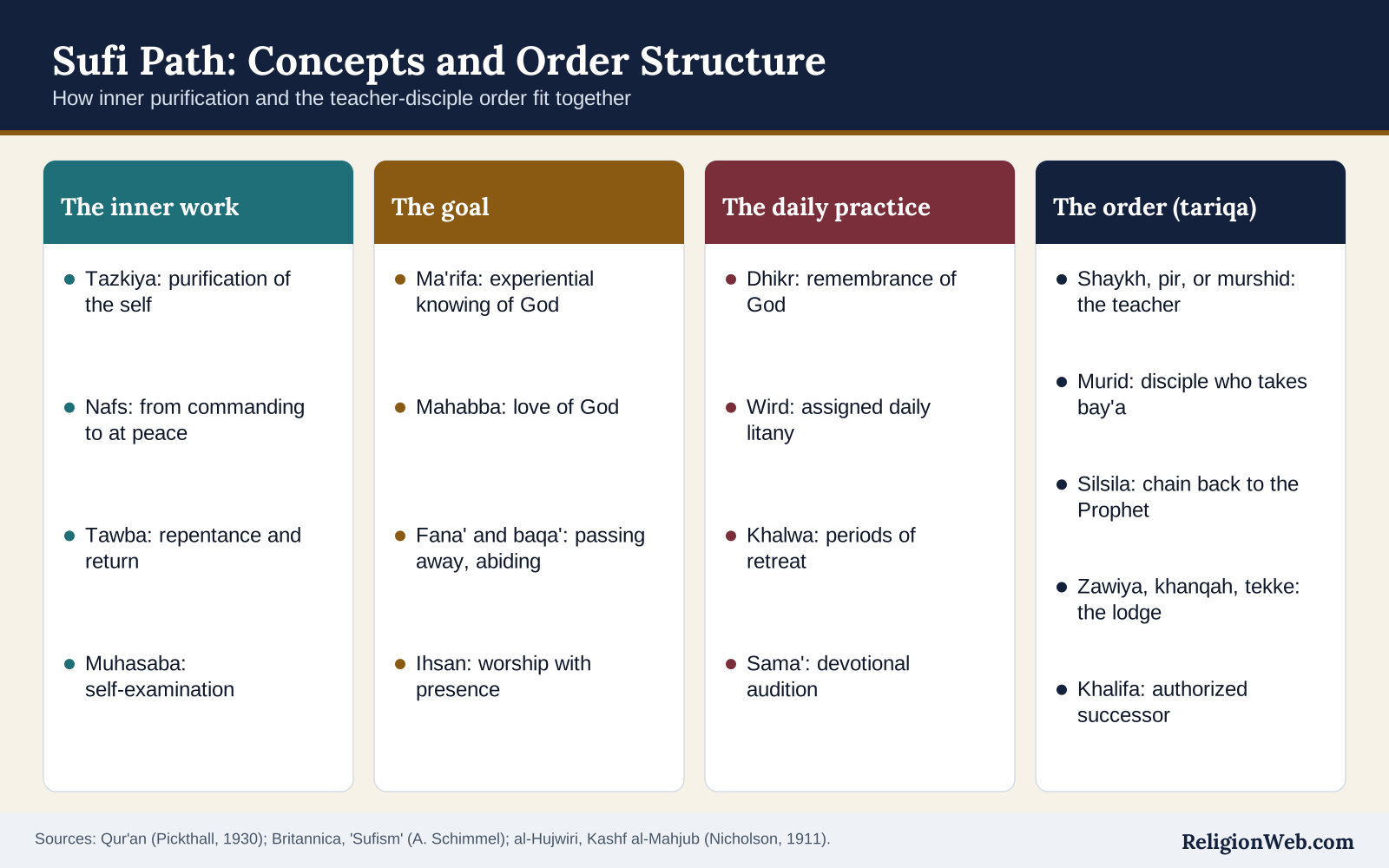
Sufi teaching also insists on method. Nearness to God is not left to mood or temperament but is pursued through a graded training: repentance, self-examination, regular remembrance of God (dhikr), service, and guidance by an experienced teacher. The metaphor of travel is everywhere. The seeker is a traveler (salik) on a path (tariqa) with stations and states, and the teacher is a guide who has walked the road before. That language of journey and guidance explains why Sufi communities grew up around living masters and why lineages of teachers, traced back to the Prophet, carry so much weight in the tradition.
Scholarly classification: a mystical tradition within Islam
Historians of religion usually classify Sufism as Islamic mysticism: a set of paths aimed at direct experience of the divine, practiced within the framework of Islamic belief and ritual. The standard reference description, in the Britannica article by the scholar Annemarie Schimmel, presents Sufism as mystical Islamic belief and practice in which Muslims seek divine love and knowledge through direct personal experience of God. Academic specialists add that the word covers several overlapping realities: an early ascetic and devotional movement, a literature of spiritual psychology, a system of social institutions, and a wide field of popular devotion. No single description fits all four, which is one reason modern scholars such as Ahmet Karamustafa and Alexander Knysh write histories in stages rather than offering one timeless definition.
The taxonomy deserves a careful statement, because it is easy to misplace Sufism on a chart of Muslim groups. Sunni and Shia identity concerns questions of authority and community after the death of the Prophet, as explained in the articles on Sunni Islam and Shia Islam. Sufism concerns a different question, namely how a Muslim cultivates the inner life. For that reason a person can be at once a Sunni and a member of the Naqshbandi order, or a Twelver Shia and a member of the Ni’matullahi order. The historical weight lies on the Sunni side, since most of the large orders arose in Sunni settings and trace their spiritual lineages through Sunni scholars, but Shia Sufi lineages exist and the Bektashi tradition combines Sufi structure with deep reverence for Ali and the Twelve Imams. Sufism is therefore best understood as a dimension that runs through the Muslim world rather than as a sect inside it.
The Names: Tasawwuf, Sufi, and Tariqa
Where the word “Sufi” comes from
The origin of the word sufi has been debated since the Middle Ages. The explanation favored by most modern scholars connects it to suf, the Arabic word for wool, because early ascetics are reported to have worn coarse woolen garments as a sign of renunciation. The 11th-century Persian author Ali al-Hujwiri, writing in what is now Pakistan, surveyed the alternatives in his treatise on the subject. Some, he says, derive the word from the woolen cloak, some from the “first rank” (saff) of those nearest God, some from the People of the Bench (Ahl al-Suffa), the poor Companions who lived in the Prophet’s mosque at Medina, and some from safa, meaning purity. Hujwiri himself concluded that none of these derivations satisfies the rules of philology.
Know that in this our time the science of Ṣúfiism is obsolete, especially in this country.
Ali al-Hujwiri, Kashf al-Mahjub (The Revelation of the Veiled), trans. R. A. Nicholson, 1911, Introduction
Hujwiri’s sentence is not a verdict on the tradition but a complaint from within it. He wrote in the 11th century for a questioner, and the passage laments that people of his time had abandoned the discipline of the earlier masters for empty professions, which is why he set out to explain the path and its teachers afresh. The remark also shows how self-aware the tradition was early on: by Hujwiri’s day Sufis already had a literature of definitions, biographies, and manuals, and they were already arguing about what counted as authentic practice. Another passage, in his chapter on Sufism, deserves mention. Hujwiri describes the designation as a proper name, one that does not need an etymology to work. Later Muslim writers largely followed him in using the word as a label for a recognized way of life and training, and not as a puzzle to be solved.
Tasawwuf, ihsan, irfan, and tariqa: related terms, different meanings
Several Arabic and Persian terms circle the same territory, and keeping them apart helps when reading about the tradition. Tasawwuf is the abstract noun, translated “Sufism” or “the Sufi way,” and it refers to the whole discipline. Ihsan is the older, scriptural term for excellence in worship, discussed in the next section. Irfan (Arabic ‘irfan) means “gnosis” or experiential knowing, and in Persian-speaking and Shia scholarly settings it often names the more philosophical side of mysticism, as in the teaching traditions of Iranian seminaries. Tariqa has two meanings that overlap: the spiritual path in general, and a specific organized order that transmits a path through a chain of teachers. When a text says someone “entered the Qadiri tariqa,” the second sense is meant.
Related words round out the vocabulary. A faqir (Persian darvish, English “dervish”) is a poor person in need of God, and both words describe a person who has taken up the Sufi path, not specifically a performer. A wali, plural awliya’, is a “friend of God,” the category that English speakers loosely translate as “saint.” A pir or murshid is a teacher; a murid is a person who wills or seeks, and thus a disciple. Dozens more terms appear in the glossary table later in this article. Because the vocabulary moves between Arabic, Persian, Turkish, Urdu, and African languages, the same office can carry different names in different regions, and this article gives the common variants where they matter.
Where Sufis Live and How Many There Are
A tradition spread across continents
Sufi communities are found wherever Muslim populations live, but they are especially visible in particular regions. West Africa, above all Senegal, is home to large brotherhoods such as the Tijaniyya and the Muridiyya. North Africa and Egypt have long-standing orders such as the Shadhiliyya, and Morocco’s public religious life is closely tied to Sufi lineages. Turkey and the Balkans carry the heritage of the Mevlevi, Bektashi, Khalwati, and Naqshbandi orders. In Iraq, Syria, and the Levant, the Qadiri and Rifa’i orders are historic presences. The Indian subcontinent has an exceptionally dense network of shrines and the Chishti, Suhrawardi, Qadiri, and Naqshbandi orders, while in Central Asia the Naqshbandi tradition was born. In Southeast Asia, orders and Sufi poets helped shape Muslim life in the Malay and Javanese worlds. More recently, Sufi groups have formed in Europe and North America, both among migrant families and among converts.
| Feature | Summary |
|---|---|
| Arabic term | Tasawwuf (“Sufism”); a follower is a sufi; the path is the tariqa |
| Core aim | Purification of the heart, constant remembrance of God, and nearness to or knowledge of God, within Islamic belief and law |
| Scriptural grounding, as Sufis understand it | The Qur’an, the example (sunna) of the Prophet Muhammad, and the concept of ihsan in the hadith of Gabriel |
| Early forms | Ascetic and devotional circles in 8th-9th century Basra, Kufa, Baghdad, and Khurasan |
| Institutional forms | Lodges and orders from roughly the 12th and 13th centuries CE; the Qadiriyya, traced to Abd al-Qadir al-Jilani (d. 1166), is often cited as the first major order |
| Teacher and disciple | Shaykh, pir, or murshid guides a murid after a pledge of allegiance (bay’a); chains of transmission (silsilas) lead back to the Prophet |
| Typical practices | Dhikr, litanies (awrad), retreat (khalwa), spiritual audition (sama’), visits to saints’ tombs (ziyara), study of Sufi manuals |
| Relation to Sunni and Shia identity | Cross-cutting: most historic orders are Sunni in affiliation, Shia and mixed lineages also exist |
| Central authority | None. Each order has its own lineage of shaykhs; there is no single hierarchy or governing body for all Sufis |
| Notable regions | West Africa, North Africa, Egypt, Turkey and the Balkans, Iran, Central Asia, South Asia, Southeast Asia |
Why counting Sufis is difficult
No census counts Sufis worldwide, and any global figure should be treated with caution. The difficulty is partly definitional. Membership in an order, attendance at a shrine, admiration for Rumi, and a general identification as “Sufi” are different things, and many Muslims do some of these without the others. In addition, many Muslims in Sufi-influenced societies would never use the label for themselves, since for them these devotions are simply part of being Muslim.
The best large-scale survey evidence comes from the Pew Research Center’s 2012 report The World’s Muslims: Unity and Diversity, which asked Muslims in dozens of countries about sectarian identity and, in many places, membership in Sufi brotherhoods. The results show a striking regional spread. In Senegal, Pew reported that 92 percent of Muslims said they belong to a Sufi brotherhood, with the Tijaniyya (51 percent) and the Muridiyya (34 percent) the largest. In Bangladesh 26 percent identified with a brotherhood, and the figure was 19 percent in Russia, 18 percent in Tajikistan, and 17 percent in each of Pakistan and Malaysia. Outside sub-Saharan Africa, only seven of the countries surveyed had more than 10 percent of Muslims identifying with a brotherhood, so in most places only a minority reported such membership. These are survey figures from before 2012 and from the countries where the question was asked; they say nothing about informal devotion, and they should not be extrapolated into a global number. For scale, Pew’s 2025 analysis of religious change estimates that Muslims made up 25.6 percent of the world’s population in 2020.
Foundations in the Qur’an, the Prophet’s Example, and the First Pious Generations
Remembrance, Nearness, and Love in the Qur’an
The command to remember God
Sufis build their practice on the Qur’an, and the verses they cite most often concern remembrance. The Arabic word is dhikr, and the Qur’an uses it for the human act of mentioning, recalling, and keeping God in mind, and also for God’s own attention to creatures. A reciprocal promise appears in the second surah, in the Pickthall translation of 1930:
Therefore remember Me, I will remember you. Give thanks to Me, and reject not Me.
Qur’an 2:152, Pickthall (1930)
The verse is read across Islamic traditions as an instruction in gratitude and mindfulness, and Sufi commentators emphasize its symmetry: the servant’s remembrance is answered by divine remembrance. Another verse, in the thirty-third surah, commands believers to “remember Allah with much remembrance” (33:41, Pickthall), and Sufi teachers treat “much” as an invitation to make remembrance continuous rather than limited to the five daily prayers. In the thirteenth surah the effect of remembrance on the heart is stated directly:
Verily in the remembrance of Allah do hearts find rest!
Qur’an 13:28, Pickthall (1930)
Sunni and Shia commentators alike read this verse as describing the peace that comes from trust in God, and Sufi authors use it as scriptural support for the claim that dhikr heals the restless heart. It is important to stress what the verse does and does not establish. It does not prescribe a particular technique; the specific forms of dhikr in later Sufi orders, such as repeating a divine name aloud or in silence, are interpretations and developments, and some Muslim scholars have questioned particular forms. What the verse supplies is the core claim that attention to God is itself a source of tranquility.
Divine nearness and the language of love
A second cluster of verses concerns nearness. The fiftieth surah states that God knows what the human soul whispers and then adds a famous image of closeness:
and We are nearer to him than his jugular vein.
Qur’an 50:16, Pickthall (1930)
The classical theological reading, shared by Sunni and Shia scholars, takes the verse as a statement of God’s knowledge and sustaining power: nothing in a person is hidden from God, who is closer than the pulse in the neck. Sufi authors draw out a further implication, that the distance a seeker feels is a distance in awareness and not in reality. They do not generally mean that the Creator and creature are identical. Most Sufi theorists, including those who speak of “unity,” keep a clear distinction between the divine and the created, though the exact way to state that distinction is one of the major debates discussed in the section on teachings. A related verse, 2:115, says that wherever one turns there is the face of God, and the verses on divine love, such as 5:54, which speaks of a people whom God loves and who love God, provided the language for the central Sufi theme of mutual love between God and the believer. In paraphrase, that verse describes a community of such people and does not name them, which left room for many readings.
Hadith, Ihsan, and the Example of the Prophet
The hadith of Gabriel and the meaning of ihsan
The most important prophetic report for Sufi self-understanding is the hadith of Gabriel, preserved in the collections of Muslim and al-Bukhari, among others. In it a stranger in white clothes comes to the Prophet and asks three questions: what is submission (islam), what is faith (iman), and what is ihsan. The Prophet’s answer to the third, in paraphrase, is that ihsan is to worship God as though one sees Him, and if one does not see Him, to know that He sees you. The report then identifies the visitor as the angel Gabriel, who came to teach the community its religion. Many Muslim scholars treat the hadith as a summary of the faith’s three dimensions: outward practice, inner belief, and spiritual excellence.
Sufi writers from the early centuries onward identified tasawwuf with the third dimension. Their claim is that the science of ihsan, the training of the heart for presence before God, deserves systematic attention as the other two dimensions have received in jurisprudence (fiqh) and theology (kalam). Not every Muslim scholar accepts that the historical institutions of Sufism are the necessary vehicle for ihsan, and critics have asked whether particular rituals or doctrines have scriptural basis. But the identification of ihsan with the inner work of Sufism is widely accepted among scholars who value the tradition, including many Sunni jurists, and it explains the claim, frequently heard from Sufi teachers, that their path is rooted in the earliest revelation.
Voluntary devotion and the sayings about nearness
A second report often cited is a hadith qudsi, a saying in which the Prophet speaks of what God has said, recorded in the collection of al-Bukhari. In paraphrase, God says that a servant draws near through obligatory acts and then continues to draw near through voluntary ones until God loves him, and when God loves him, God becomes the hearing, sight, and hand through which he acts. Sufi authors read it as a charter for the path of voluntary devotion beyond the obligations, which is the territory of dhikr, night prayer, and fasting. Interpreters differ on the final clause. Many scholars treat it as a figurative description of divine guidance over a servant’s faculties, while Sufi theorists often understand it as describing the transformation of the person in nearness. Both groups affirm that the report does not teach that a human becomes divine.
One further saying circulates widely in Sufi literature: “I was a hidden treasure and loved to be known, so I created the world.” Hadith critics, including prominent Sunni scholars, have not accepted this as an authenticated report from the Prophet, and Sufi writers who cite it generally present it as a statement from within their own tradition and not as part of the canonical collections. The case is a useful reminder that Sufi literature contains sources of different status, and that the tradition itself has long distinguished between the Qur’an, the verified hadith, and the sayings of the masters.
Companions, the People of the Bench, and the First Ascetics
The People of the Bench
Early Sufi writers looked to the generation of the Prophet for models of devotion and poverty. The Ahl al-Suffa, “People of the Bench,” were a group of poor Companions who, according to Muslim tradition, took shelter at a raised platform of the Prophet’s mosque in Medina and devoted themselves to worship and learning. Later authors, including Hujwiri, cite them as precursors of the Sufi way of life, and the story gave the tradition a founding image of communal poverty centered on a mosque and a teacher. Historians caution that the later Sufi use of the story reflects the self-understanding of the 9th and 10th centuries as much as a continuous institution traceable to Medina, but they do not doubt that the tradition of the Companions’ simplicity inspired later renunciants.
Hasan al-Basri and the ethic of renunciation
The bridge from the Companions to the first recognizable Sufis runs through the Umayyad era (661-750 CE) and the figure of al-Hasan al-Basri (642-728), a preacher in Basra revered for piety, fear of God, and constant self-examination. Britannica describes him as a deeply pious and ascetic Muslim and an outspoken critic of Umayyad rulers. Later Sufi lineages often trace their chains through him, though historians note that he was a preacher and scholar rather than the founder of an order, and that the claims of formal initiation in his time are later projections. Renunciation in this period, called zuhd, was a reaction to the wealth that followed the early conquests as much as an expression of devotion. It stressed fear of judgment, weeping, night vigil, and sparing use of the world’s goods, and from that soil came the first generation to be called Sufis in the sense of the word we use today.
Origins and Historical Development of Sufism
The Formative Period: Renunciation, Love, and Ecstasy (8th-10th Centuries)
From renunciation to the love of God
Historians usually describe the earliest Sufism as a development of the pious and ascetic currents of the 8th century CE, centered on Basra and Kufa in Iraq. The ascetics of these cities were not yet called a movement, and the label sufi was applied to individuals before it was used for a school. According to later biographical tradition, the first person named a Sufi was Abu Hashim of Kufa, who died in the second half of the 8th century, but that tradition was recorded generations afterward and should be read as a statement of how the community remembered its beginnings. What can be said with more confidence is that by the early 9th century, circles of devout Muslims were developing a vocabulary of inner states and spiritual discipline that went beyond the fear of judgment typical of earlier renunciants.
The woman most closely associated with that shift is Rabi’a al-‘Adawiyya of Basra, who is traditionally said to have died in 801. According to the later accounts that preserve her sayings, she taught that God should be loved for Himself, neither out of hope for paradise nor fear of hell. Britannica credits her with first formulating the ideal of a love of God that seeks no reward and fears no punishment. The details of her life come mostly from later hagiography, notably the account by the Persian poet Farid al-Din Attar in the 13th century, and scholars distinguish carefully between what is early and what is later embellishment. Her importance as a symbol is clear regardless: the language of love, which would dominate Persian and Turkish poetry for centuries, has her as a founding voice.
Baghdad and the ideal of sobriety
As the movement grew, Baghdad became its main intellectual center. Al-Muhasibi (died 857) wrote on self-examination (muhasaba) and the psychology of motives, arguing that the purging of the soul was the value of asceticism. His younger contemporary Dhu’l-Nun al-Misri of Egypt, who died around 860, is remembered as one of the first to speak systematically of “states” and “knowledge” of God. The central figure, however, is Abu’l-Qasim al-Junayd of Baghdad (died 910), whom later Sufi chains almost universally invoke. Britannica says he perfected the classical teaching of sobriety. Junayd insisted that spiritual experience be measured against the Qur’an and the Prophet’s example, and he spoke of a return to clear-sighted presence after moments of overwhelming experience. His circle formed the template for what historians call the Baghdad school, which values restraint and law-abiding discipline.
Intoxication, controversy, and al-Hallaj
Alongside the sober tradition developed a more ecstatic one, associated particularly with Khurasan and Persian-speaking regions. Abu Yazid al-Bistami, who died around 874, is the best-known figure, remembered for startling utterances in which the speaker seems to lose himself in God. Later theorists described these as sayings made in a state of “intoxication” (sukr) and contrasted them with the sobriety (sahw) of the Baghdad school. In northeastern Iran another current, the Malamatiyya, taught that sincerity required hiding one’s piety and even inviting blame, and historians such as Ahmet Karamustafa have shown that the Malamatiyya merged with Iraq-based Sufism as it spread eastward and left a lasting mark on it.
The most famous test of the boundary between ecstasy and orthodoxy is the case of al-Husayn ibn Mansur al-Hallaj, born around 858 in southwestern Iran and executed in Baghdad in March 922. The utterance attributed to him, ana al-Haqq, “I am the Real” (or “the Truth”), was understood by his accusers as a claim to divinity, and his trial was shaped as well by the political tensions of the Abbasid court, so that historians doubt a purely theological explanation. Interpretations diverged immediately and have remained divided. Some jurists and Sufis considered the verdict justified; other Sufis revered him as a “martyr of love,” as Britannica puts it, whose words were uttered while he was overwhelmed by God; still others, including many who admired him, held that he should not have spoken what was meant to be kept secret. Junayd’s reported distance from Hallaj became a model for the cautious path that many later authors defended.
Consolidation and Defense: Manuals and the Scholars (10th-12th Centuries)
The great Arabic and Persian handbooks
By the late 10th century, Sufis had begun to write systematic handbooks that explained the path and defended its orthodoxy. Abu Nasr al-Sarraj (died 988) wrote the Kitab al-Luma’, Abu Bakr al-Kalabadhi (died around 990) the Kitab al-Ta’arruf, and Abu Talib al-Makki (died 996) the Qut al-Qulub, “The Nourishment of Hearts.” In the middle of the 11th century Abu’l-Qasim al-Qushayri (died 1072) composed his Risala, a letter on Sufism that gathers biographies and definitions and argues that the tradition is consistent with Sunni belief. Britannica notes that these authors wrote to demonstrate Sufism’s orthodox character.
Persian, now becoming a major language of Muslim learning, produced its own classics. Ali al-Hujwiri, who died in the 11th century and is buried in Lahore, wrote the Kashf al-Mahjub, which Reynold Nicholson translated in 1911 and which remains one of the oldest Persian treatises on the subject. Abdullah Ansari of Herat (died 1089) left both Persian devotional prayers and an influential map of spiritual stations. Taken together, these works show a movement defining itself in dialogue with jurists and theologians: explaining technical terms, tracing teacher lineages, and arguing that the path was an interpretation of the Prophet’s example and not an innovation.
Al-Ghazali and the reconciliation of law, theology, and mysticism
The pivotal figure of this period is Abu Hamid al-Ghazali (1058-1111), a Persian jurist and theologian who taught at Baghdad. After an intellectual and personal crisis around 1095 he left his post and, according to Britannica, adopted an ascetic life for about ten years before returning to teaching. His encyclopedic Ihya’ ‘ulum al-din (“The Revival of the Religious Sciences”) sets out the Islamic life in four quarters, including acts of worship, customs, destructive traits of character, and saving traits, with much of the material drawing on Sufi psychology. Britannica says the work made Sufism an acceptable part of orthodox Islam. Historians qualify this: Sufism was already widely accepted by many scholars, and Ghazali’s contribution was to give it a fully elaborated place within the sciences of jurisprudence and theology, and to caution against both legalism that neglects the heart and mystical claims that neglect the law. Ghazali’s synthesis became the reference point for later Sunni scholarship that valued Sufi ethics.
Philosophy, Poetry, and the Rise of Orders (12th-14th Centuries)
Ibn Arabi and the theory of divine self-disclosure
If Ghazali brought Sufism into the center of the religious sciences, Muhyi al-Din Ibn al-‘Arabi (1165-1240) gave it its most comprehensive metaphysical expression. Born in Murcia in Islamic Spain and later settled in Damascus, he wrote the vast Al-Futuhat al-Makkiyya (“The Meccan Revelations”) and the shorter Fusus al-hikam, which Britannica dates to 1229. His followers called him al-Shaykh al-Akbar, “the Greatest Master.” His work explores how the one God discloses names and qualities in creation, how the human being can reflect all of them, and how the awliya’ are heirs to the prophets. Later scholars labeled his school the doctrine of the “unity of being” (wahdat al-wujud), although many scholars note that the phrase is associated with his followers and critics more than with his own writings. The idea became both the most influential and the most disputed theory in Sufi history, as the section on teachings explains.
Persian poetry and the voice of Rumi
In the same centuries Persian poetry became the principal vehicle of Sufi expression. Sana’i of Ghazna (died around 1131) and Attar of Nishapur (died in the early 13th century) wrote long narrative poems of the path, and Attar’s Conference of the Birds became a lasting allegory of the seeker’s journey. Jalal al-Din Rumi (1207-1273) surpassed them in influence. Born in the Persian-speaking world and raised in Anatolia, he taught as a jurist and preacher in Konya until his meeting in 1244 with the wandering dervish Shams of Tabriz transformed his life. His lyric collection, the Divan-i Shams, and his six-book rhymed epic, the Masnavi, which Britannica calls an encyclopedia of mystical thought, were composed in Persian. After his death, his son Sultan Walad and his followers organized the community that became the Mevlevi order. Rumi’s influence on Turkish, Persian, Urdu, and later Western readers is immense, though it is worth remembering that he was a trained scholar and teacher of Islamic law whose poetry assumes the Qur’an throughout.
The emergence of lodges and orders
The 12th and 13th centuries are when Sufism acquired institutions. Earlier masters taught a handful of disciples; now lodges (khanqah, zawiya, ribat, tekke) were endowed, training followed set steps, and chains of teachers were recorded and defended. Britannica’s account of the orders locates the rise of real fraternities in the 12th century and treats the Qadiriyya, named for Abd al-Qadir al-Jilani (1077/78-1166) of Baghdad, as the first and still most important. Others followed quickly: the Rifa’iyya from Ahmad al-Rifa’i (died 1182); the Suhrawardiyya shaped by Shihab al-Din Umar al-Suhrawardi (1145-1234); the Kubrawiyya from Najm al-Din Kubra (died 1221); the Chishtiyya in India, associated with Mu’in al-Din Chishti (died 1236); the Shadhiliyya from Abu’l-Hasan al-Shadhili (died 1258) in North Africa and Egypt; and, from the 14th century, the Naqshbandiyya in Central Asia. J. Spencer Trimingham’s classic study The Sufi Orders in Islam (1971) proposed a sequence from the teacher’s circle, to the lodge, to the full order with branches and hereditary succession. Specialists today refine that model, but the broad picture holds.
Empires, Expansion, and Renewal (15th-18th Centuries)
Orders and the Ottoman, Safavid, and Mughal worlds
In the early modern period three large empires set the political conditions for Sufism. In the Ottoman realm, orders such as the Mevlevi, Khalwati, Naqshbandi, and Bektashi enjoyed patronage and built lodges throughout Anatolia and the Balkans; the Bektashi order, according to Britannica, gained political influence in the 15th century through close ties with the Janissary corps and declined after the corps was disbanded in 1826. In Iran, the Safavid dynasty offers the most dramatic example of a Sufi order that became a state: the Safaviyya, begun by Safi al-Din of Ardabil (1252-1334) as a Sufi community, was led by his descendant Shah Isma’il to power in 1501, after which Twelver Shia Islam became the state religion. In India, the Mughal court’s relations with Sufi shrines were close; Akbar and his successors visited the shrine of Mu’in al-Din Chishti at Ajmer, while a rival tendency emphasized strict law, as the next paragraph shows.
Africa and Southeast Asia
Orders were also vehicles of religious and social change beyond the central Islamic lands. In West Africa, scholarly and trading networks associated with the Qadiriyya, and later the Tijaniyya, spread teachings, literacy, and legal learning; Usman dan Fodio (1754-1817), who founded the Sokoto Caliphate in what is now northern Nigeria, was a member of the Qadiri order. In North Africa the Shadhiliyya and its offshoots, such as the Darqawa, became central to rural and urban religion alike. In Southeast Asia, poets and teachers such as Hamzah Fansuri around the turn of the 17th century wrote in Malay about the path, and orders including the Shattariyya, according to Britannica, extended from India to Java. How much of the expansion of Islam in each region should be credited to Sufi teachers is debated among historians, who now generally describe a combination of trade, political patronage, and local religious change rather than a single missionary agency.
Renewal and critique
The same centuries produced internal reform movements and sharp external criticism. The Indian Naqshbandi master Ahmad Sirhindi (1564-1624), according to Britannica, joined the order in 1593-94 and opposed what he saw as the pantheistic and Shia leanings of the Mughal court; he advocated, in place of the doctrine of the unity of being, a “unity of witnessing” (wahdat al-shuhud), insisting on the distinction between Creator and creation. The scholar Shah Wali Allah of Delhi (1703-1762) sought to reconcile Sufi teachings with hadith scholarship. In the Ottoman capital of the 17th century, the preacher Kadizade Mehmed (died 1635) and his followers attacked certain Sufi practices, including ecstatic dhikr, music, and dance, and the conflict between them and Sufi lodges lasted for decades. A broader line of criticism, going back to the jurist Ibn Taymiyya (1263-1328), faulted certain Sufi doctrines and the veneration of tombs, and was taken up by Muhammad ibn Abd al-Wahhab (1703-1792) and later movements, whose followers destroyed shrines in Arabia. At the same time, reformist currents within Sufism itself, which some scholars have called “neo-Sufism” while others dispute that label, emphasized adherence to the Prophet’s example, the study of hadith, and moral and social activism.
Colonialism, Reform, and the Modern State (19th-21st Centuries)
Resistance, adaptation, and colonial rule
Many European colonial encounters involved Sufi leaders, sometimes as resistance commanders and sometimes as intermediaries. In Algeria, the Qadiri leader Abd al-Qadir (1808-1883) led armed resistance against the French conquest and later became a respected scholar in Damascus. In the Caucasus, Imam Shamil (1797-1871), a Naqshbandi leader, resisted Russian expansion for decades. In Libya the Sanusiyya, founded by Muhammad ibn Ali al-Sanusi (1787-1859), organized a network of lodges that later opposed Italian conquest, as Britannica notes. In Senegal, the Mouride founder Ahmadu Bamba (died 1927) was exiled by the French colonial government to Gabon in 1895, and the order became a major social and economic institution under colonial rule; Britannica’s entry on the order records him as the founder of the town of Touba, its sacred center. The range of responses is important: orders were as likely to cooperate with colonial authorities as to oppose them, and individual leaders made different choices.
Secular states and modern reform
Twentieth-century nation-states took varied approaches to Sufi institutions. In Turkey, a law passed in late 1925 (Law No. 677) closed the dervish lodges and tombs and abolished titles such as shaykh and dervish, a prohibition that, according to the UNESCO account of the Mevlevi ceremony, ended the order’s lodges in 1925; public performances of the whirling ceremony were permitted again in the 1950s, with restrictions eased further in the 1990s. In the Soviet Union, Sufi networks in Central Asia and the Caucasus were suppressed but survived underground. Egypt, by contrast, took the path of recognition and regulation, placing orders under a state-recognized council. Meanwhile, modernist Muslim reformers such as Muhammad Abduh, along with some Salafi and other movements, criticized aspects of popular Sufism, while other reformers, including Deobandi scholars in India, were themselves active in Sufi training. The result was not a decline in a single direction but a rearrangement of Sufism’s place in public life.
Revival, global spread, and attacks on shrines
In recent decades Sufism has experienced both revival and violence. Orders and Sufi-inspired groups have grown in West Africa and expanded in Europe and North America, where Hazrat Inayat Khan (1882-1927), an Indian musician and teacher who settled in London in 1914, founded an influential Sufi order in the West. Governments in several countries, including Morocco, have supported Sufi institutions as expressions of a moderate national Islam, a policy critics regard as political and supporters as consistent with heritage. At the same time, shrines have been targets of armed groups: in 2012 militants destroyed historic mausoleums in Timbuktu, Mali, an act the International Criminal Court called a war crime in its 2016 judgment against Ahmad Al Faqi Al Mahdi, and in February 2017 a suicide bombing at the Lal Shahbaz Qalandar shrine in Sehwan, Pakistan, killed at least 75 people during a devotional gathering. These attacks were carried out by specific armed groups; they do not represent the views of the broad Muslim majority, who regard such shrines in many different ways, and the great majority of Muslims, including many critics of shrine practices, condemn the violence.
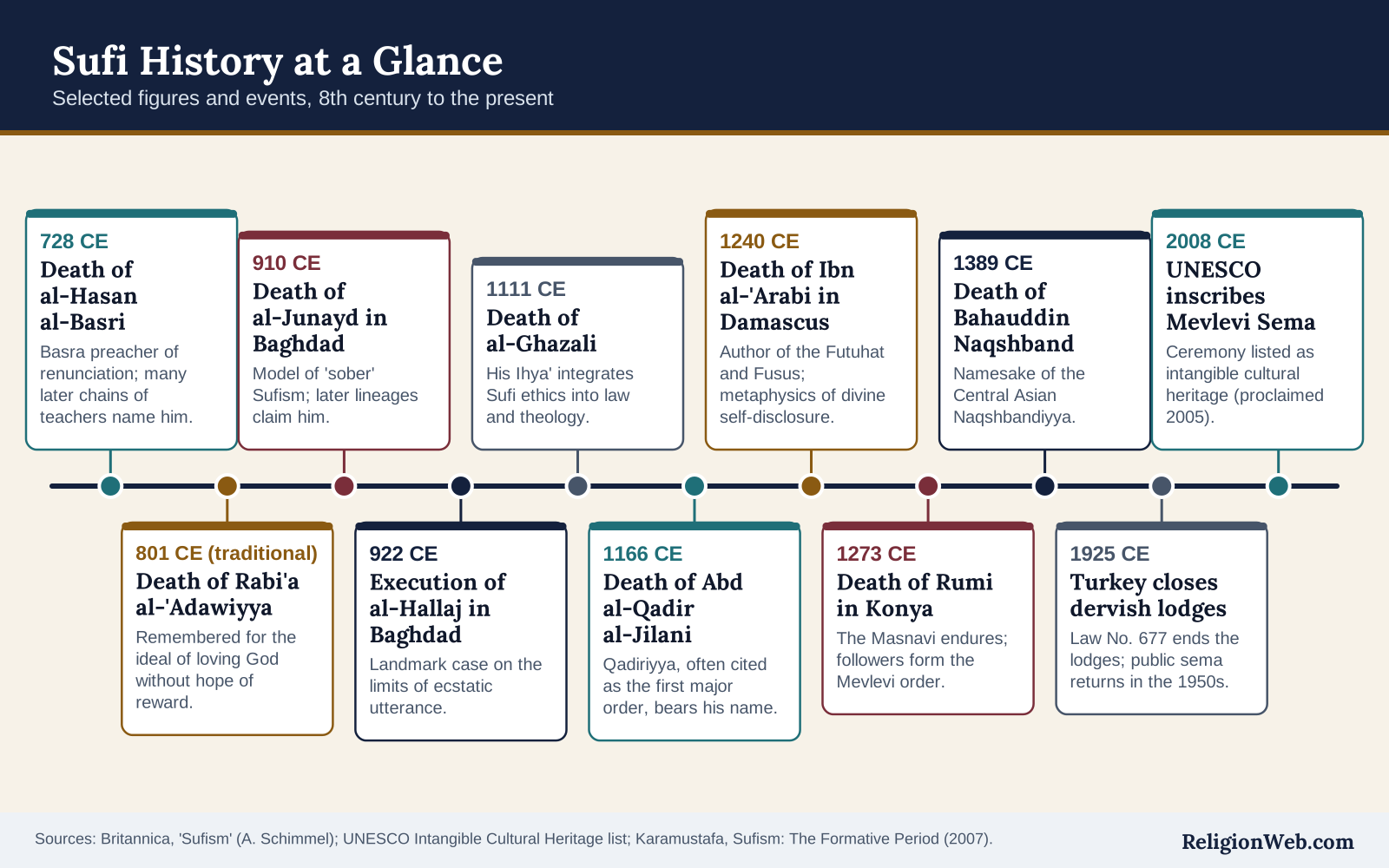
| Date (CE) | Event or figure | Why it matters |
|---|---|---|
| 728 | Death of al-Hasan al-Basri in Basra | Preacher of renunciation whose name stands at the head of many later chains of teachers |
| 801 (traditional) | Death of Rabi’a al-‘Adawiyya in Basra | Symbol of selfless love of God in Sufi tradition |
| 910 | Death of al-Junayd in Baghdad | Model of “sober” Sufism; later lineages claim him |
| 922 | Execution of al-Hallaj in Baghdad | Landmark case on the limits of mystical utterance |
| c. 988-1072 | Era of the classic handbooks (al-Sarraj, al-Makki, al-Qushayri) | Sufism defines and defends itself as a discipline |
| 1111 | Death of al-Ghazali | His Ihya’ integrates Sufi ethics into mainstream scholarship |
| 1166 | Death of Abd al-Qadir al-Jilani | Eponym of the Qadiriyya, often cited as the first major order |
| 1240 | Death of Ibn al-‘Arabi in Damascus | Culmination of speculative Sufi metaphysics |
| 1244 and 1273 | Rumi meets Shams; Rumi dies in Konya | Origin of the Masnavi and the Mevlevi order |
| 1389 | Death of Bahauddin Naqshband | Namesake of the Central Asian Naqshbandiyya |
| 1501 | Safavid state under Shah Isma’il | A Sufi order becomes a ruling dynasty |
| 1925 | Turkey closes dervish lodges | Major rupture in Ottoman-era Sufi institutions |
| 2008 | UNESCO inscribes the Mevlevi Sema ceremony | International recognition of a Sufi ritual as living heritage |
Core Teachings: Purification, Knowledge of God, and the Path
Purification of the Self: Tazkiya and the Nafs
The Qur’anic basis of purification and the three souls
The central practical idea in Sufism is tazkiya, the purification or growth of the self, and the central object of that work is the nafs, an Arabic word often translated “soul,” “self,” or “ego.” The Qur’an uses the word in several senses, and Sufi authors read three of them as describing stages of moral development. The twelfth surah speaks of the self that commands evil (al-nafs al-ammara, 12:53), the seventy-fifth surah swears by the self-reproaching soul (al-nafs al-lawwama, 75:2), and the eighty-ninth surah addresses the soul at peace (al-nafs al-mutma’inna, 89:27) and invites it to return to its Lord. Another passage, in the ninety-first surah, states in paraphrase that the one who purifies the soul has succeeded and the one who corrupts it has failed. For Sufi teachers these verses outline a pathway: the soul begins by pulling toward pride and appetite, becomes aware of its faults, and, with effort and divine help, reaches serenity.
Later writers elaborated the scheme, and different authors enumerate different levels, sometimes seven. The variation matters because it shows that the stages are a teaching tool and not a doctrine with fixed boundaries. What is constant is the claim that the primary struggle is internal. Sufi teachers often cite a saying, widely reported though of uncertain authenticity, that the Prophet called the struggle against the self the “greater” striving (jihad) after returning from battle. Scholars of hadith have questioned its chain of transmission, and the saying should be understood as a teaching preserved within the Sufi tradition rather than as a verified report. Even so, its message, that the hardest work is moral self-discipline, is shared by the major Sunni and Shia traditions of ethics.
Repentance, self-examination, and the cultivation of virtues
The practical method begins with repentance (tawba), understood not as a single act but as a continuing return to God. It is followed by self-examination (muhasaba), a discipline associated with al-Muhasibi, whose name means “the one who takes account of himself.” From there the manuals describe a long list of virtues to be cultivated: scrupulousness in avoiding what is doubtful (wara’), renunciation of excessive attachment to the world (zuhd), patience (sabr), gratitude (shukr), trust in God (tawakkul), and contentment with God’s decree (rida). Each is paired with a vice it replaces: gratitude with resentment, trust with anxious grasping, contentment with complaint.
Anyone who reads Sufi manuals notices how practical they are. They discuss the way arrogance disguises itself as piety, how anger and envy arise, and how a student should treat guests, family, and the poor. Renunciation, in particular, is rarely a call to abandon work or family. Many of the greatest Sufi teachers were married, supported themselves by trade or scholarship, and insisted that the best renunciation was inner detachment while living in the world. This is a major reason why Sufi ethics became part of ordinary Muslim moral education, well outside lodge walls.
Stations, States, and the Goal of the Path
Maqamat and ahwal: what is earned and what is given
Sufi theorists distinguished between stations (maqamat) and states (ahwal). A station is a stable quality that the seeker attains through sustained effort, such as repentance, patience, or trust. A state is a gift that descends on the heart without being earned and often passes quickly: a moment of sudden joy, fear, longing, or intimacy. The distinction, developed in works such as al-Qushayri’s Risala, serves two purposes. It teaches humility, since the most prized experiences are not under the seeker’s control, and it provides caution against confusing a passing emotional state with permanent attainment. The 11th-century teacher Abdullah Ansari of Herat gave one of the best-known maps, his Manazil al-sa’irin (“Stations of the Wayfarers”), organized into a hundred stations in ten sections.
Different authors order the stations differently, and no single list is canonical. This variation is sometimes misunderstood as inconsistency. In practice, the stations are best understood as a vocabulary for describing how a person matures, with each author emphasizing the virtues that his own teachers and students needed most. A reader approaching a manual should also remember that these are descriptions of an ideal; actual communities, like all religious communities, include members at many different levels of seriousness.
Annihilation, subsistence, and love
The goal of the path has been named in several ways. Ma’rifa is experiential knowledge of God, distinguished from learning about God; mahabba is love; and fana’ and baqa’, “passing away” and “abiding,” describe the transformation of the servant. In the teaching associated with al-Junayd, fana’ is the passing away of the self’s claim to independent agency and attention, and baqa’ is the return to everyday life with a heart that remains anchored in God. It is not, in the classical Baghdad school, a loss of the servant’s identity or a fusion with God. Bayazid al-Bistami’s more daring sayings were sometimes read in the same light by later commentators, who said that the speaker had been overpowered by the vision and was no longer reporting about his own separate self.
Love has a special place. After Rabi’a, writers such as al-Ghazali made the love of God the culminating station, arguing that all other virtues serve it. Persian and Turkish poets turned this idea into a vast symbolic language in which the Beloved is God, the lover is the seeker, wine stands for the intoxication of divine knowledge, and the tavern represents the place where outward religious reputation is given up. Commentators warn readers that this imagery is symbolic and that mistaking the figures for literal statements has been a frequent source of confusion, both inside and outside the tradition.
Metaphysics: Unity, the Perfect Human, and Sainthood
Wahdat al-wujud and wahdat al-shuhud
The most debated doctrine in the history of Sufism is the “unity of being,” wahdat al-wujud. The phrase is usually associated with Ibn al-‘Arabi and his school, although, as noted earlier, many scholars observe that it does not appear in his own writings in that form. The core idea, in the explanations of those who defend it, is that God alone is Being in the absolute sense, that the world has no independent existence of its own, and that creation is a continual self-disclosure (tajalli) of the divine names. Defenders insist that this teaching preserves both God’s transcendence, since no created thing can be identified with the essence, and God’s nearness, since nothing is outside divine presence. The Islamic studies scholar William Chittick, among others, has argued that Ibn al-‘Arabi’s writing holds transcendence and immanence together and cannot be reduced to simple pantheism.
Critics read the same doctrine differently. The jurist Ibn Taymiyya considered some formulations to be a denial of the distinction between Creator and creature, and later reformers such as Ahmad Sirhindi proposed an alternative, wahdat al-shuhud, “unity of witnessing.” In Sirhindi’s view, the experience of unity occurs in the heart of the seeker who is overwhelmed by God’s presence, and does not describe the structure of reality; the world and God remain distinct. Britannica notes that later Naqshbandis defended this subjective “unity of vision” in contrast to the existential monism of the unity of being. The debate persisted for centuries and remains a live topic among Muslim scholars, with many Sufi teachers using one or both formulas and others refusing to use either in public instruction.
The Perfect Human and the friends of God
Two other concepts shape Sufi doctrine. The first is the Perfect Human (al-insan al-kamil), developed by Ibn al-‘Arabi and later by ‘Abd al-Karim al-Jili, which describes the human being as the mirror in which all divine names are reflected. In Sufi thought, the Prophet Muhammad is the supreme embodiment of this ideal, which is why love of the Prophet, devotional poems in his praise, and the celebration of his birthday are so prominent in many Sufi communities. Sunni scholars who object to some of the more elaborate formulations of Muhammad’s spiritual reality typically do so on the grounds that they go beyond what scripture states.
The second concept is sainthood, walaya, from the Qur’anic word for the “friend” (wali) of God. Early authors such as al-Hakim al-Tirmidhi (died around 910) developed a theory of the friends of God and their ranks, and later tradition spoke of a hidden hierarchy. In Sunni theology, as formulated by the Ash’ari and Maturidi schools, God may grant extraordinary events to righteous people; such events are called karamat (graces) and are distinguished from the miracles (mu’jizat) of prophets. Sufi manuals consistently warn that miracles are not the aim and may even be a test. Classical authors such as al-Qushayri, who discusses karamat at length in his Risala, caution seekers against treating wonders as the measure of a teacher. A saint’s significance, in these sources, lies in sincerity and conduct, not in marvels.
Law, Theology, and Sufi Practice
Sharia, tariqa, and haqiqa
A common Sufi formula describes three layers of the religious life: the law (shari’a), the path (tariqa), and the reality (haqiqa). The image used is often a road: the wide highway is the law that all Muslims travel, the path is the narrower track along which a seeker advances, and the reality is the destination. Mainstream Sufi authors from Junayd to al-Qushayri to al-Ghazali presented the law as the foundation of the path, not an obstacle to it. A seeker who neglected prayer or fasting on the grounds of higher knowledge was, in their view, deluded.
The historical record also includes figures who stood outside this consensus. Britannica notes that orders in Iran and India were classed as law-bound (ba shar’) or not following the injunctions of the Qur’an (bi shar’). Between the 13th and 15th centuries, wandering groups such as the Qalandars, Haydaris, and Abdals, studied by Ahmet Karamustafa in his book God’s Unruly Friends, rejected conventional norms of dress, work, and social life. Mainstream Sufi leaders and jurists generally distanced themselves from such groups, and the label “Sufi” in the sense of the major orders should not be extended to them without qualification.
Sufism and the theological schools
Sufi teachers have belonged to every major Sunni school of law and creed. Abd al-Qadir al-Jilani, whom Britannica identifies as a Hanbali theologian, taught in a tradition often regarded as austere; al-Qushayri and al-Ghazali belonged to the Ash’ari school of theology and the Shafi’i school of law; and many Central Asian and Ottoman Sufis followed the Maturidi creed and the Hanafi school. For this reason, the common belief that Sufism is a deviation from Sunni orthodoxy cannot be sustained as a general claim, although individual doctrines and practices have been criticized by some Sunni scholars. The article on Sunni Islam describes the schools in more detail.
On the Shia side, mystical thought flourished in the tradition known as ‘irfan, represented by figures such as Haydar Amuli in the 14th century and Mulla Sadra (died around 1640), whose philosophical synthesis drew on Ibn al-‘Arabi. Some Shia clerics have supported mystical teaching while viewing organized Sufi orders with suspicion, and others have opposed both. Orders such as the Ni’matullahi are a living Shia Sufi lineage, and the Bektashi tradition shows the fusion of both currents. The article on Shia Islam sets out the Twelver and other Shia frameworks that shape these relationships.
| Term | Basic meaning | How it is used |
|---|---|---|
| Tasawwuf | Sufism; the discipline of inner purification | Name for the whole subject, the abstract noun for “being a Sufi” |
| Tazkiya | Purification or growth of the self | Qur’anic term that Sufis treat as the aim of the path |
| Nafs | The self, soul, or ego | Described as commanding evil, self-reproaching, or at peace |
| Tawba | Repentance | First step of the path and a continuing practice |
| Zuhd | Renunciation | Detachment from the world, whether or not one owns property |
| Tawakkul | Trust in God | One of the central stations, combined with ordinary effort |
| Maqam / hal | Station / state | A stable attainment earned by effort, as against a passing gift |
| Ma’rifa | Experiential knowledge of God | Often presented as the goal of the path |
| Fana’ / baqa’ | Passing away / abiding | Loss of self-reliance and return to life with God-centered awareness |
| Mahabba | Love | The love between God and the servant, expressed in poetry and prayer |
| Dhikr | Remembrance of God | Central practice, aloud or silent, individual or communal |
| Wird / awrad | Assigned litany or litanies | Daily recitations given by a teacher to a disciple |
| Shaykh / pir / murshid | Teacher or guide | Authorized master in a lineage of teachers |
| Murid | Disciple, “one who wills” | A person who has pledged to follow a teacher |
| Bay’a | Pledge of allegiance | Initiation into an order |
| Silsila | Chain of transmission | The line of teachers linking an order to the Prophet |
| Wali / walaya | Friend of God / sainthood | Honorific for pious teachers, living or dead |
| Baraka | Blessing | Spiritual benefit believed to flow from God through persons and places |
| Sama’ | “Listening”; spiritual audition | Devotional music, poetry, and sometimes movement |
| Khalwa | Retreat or seclusion | Period of solitude for focused devotion |
| Zawiya / khanqah / tekke | Lodge | Regional names for a Sufi gathering and teaching center |
Teachers, Saints, and Lineages: Master and Disciple in Sufism
The Shaykh and the Disciple
Initiation, guidance, and the stages of training
Almost every Sufi path assumes that a seeker needs a guide. The reasoning, given in manuals for centuries, is that the self is a poor judge of its own faults, and a trained teacher can see what the student cannot. Britannica’s description of the orders explains how the relationship developed: in the earliest period a master surrounded himself with a few disciples; later a student swore allegiance (bay’a) to a master, often one for whom he felt a prior affinity, and underwent strict training that might include menial service and a period of seclusion, commonly forty days. Receiving the master’s cloak (khirqa) marked admission to the chain of teachers. The most mature disciple could be authorized as a successor (khalifa) and sent to teach elsewhere.
Reference works also describe two kinds of guidance. The teacher of training (shaykh al-tarbiya) instructs the student in rituals, forms, and literature, while the teacher of companionship (shaykh al-suhba) lives alongside the student and observes his conduct. In many modern orders only a small group of disciples live near the shaykh, and most initiates keep ordinary jobs and families, attending gatherings at set times. A person may receive a blessing from a teacher without taking full initiation, and some orders distinguish between a general affiliation, which requires only a short daily litany, and a deeper commitment.
Etiquette, devotion to the teacher, and safeguards
Sufi manuals devote entire sections to the etiquette (adab) of discipleship: respect for the teacher, discretion about spiritual experiences, avoidance of argument, and service to the community. In some orders, particularly the Naqshbandiyya, the student cultivates a bond (rabita) with the teacher through visualization or reflection, a practice some Muslim scholars have questioned. The language of complete obedience, such as the image of the disciple before his master like a corpse in the hands of its washer, is familiar in the literature but has been interpreted in different ways. Mainstream authors say it applies to training in character and does not override God’s law; a disciple should never obey a command to commit a prohibited act.
The same manuals warn about false teachers and about spiritual pride, and contemporary communities have had to address misconduct by individual leaders. Any relationship that involves deep trust and unequal authority carries risks, and in modern times many Muslim scholars and Sufi leaders have emphasized accountability, the teacher’s conformity to sharia, and the right of a disciple to leave. For readers considering joining a group, ordinary caution about transparency, finances, and respect for personal boundaries applies, as it does for any religious or therapeutic community.
Lineage, Authority, and the Friends of God
The silsila and the claim of unbroken transmission
Each order preserves a silsila, a chain of teachers stretching back to the Prophet. These genealogies serve as the tradition’s equivalent of the chain of narrators that authenticates a hadith: they show that the teaching has been handed on in person. Most chains pass through Ali ibn Abi Talib, the Prophet’s cousin and son-in-law, usually by way of figures such as Hasan al-Basri or Ma’ruf al-Karkhi. The Naqshbandi lineage is the notable exception among large orders, because it is traced through the first caliph, Abu Bakr. Historians note that many of the earliest links are impossible to verify and reflect later efforts to anchor the tradition in the Prophet’s household or Companions. For members, the chain is not merely a historical record but a channel of blessing.
This feature explains why Sufism can be found among both Sunni and Shia Muslims. Reverence for the family of the Prophet, the ahl al-bayt, is shared widely among Sunnis as well as Shia, and for Sunni Sufis the connection to Ali is a way of expressing that love without adopting Shia doctrines about the imamate. The Bektashi tradition, by contrast, as Britannica explains, combines Sufism with Shia Islam and venerates the twelve imams, especially Ali.
Awliya’, baraka, and attitudes toward miracles
Sufis speak of the friends of God (awliya’) as people whose closeness to God is evident in their sincerity, humility, and service. In many societies, their tombs become places of prayer and visitation, where visitors seek blessings (baraka) and ask the saint to intercede with God. Many Sunni scholars regard visiting graves as recommended and see seeking a saint’s prayers as permissible, while other scholars, including those following Ibn Taymiyya and the reformist movements that came after him, object to requests addressed to the dead. These arguments about intercession (tawassul and istighatha) are old and continuing, and they are discussed again in the section on shrines.
Accounts of miracles accompany most saints, from healing to knowing the future. Historians treat these accounts as part of devotional memory, written down in collections of biographies (tabaqat) generations after the saint’s death. Practitioners treat them as signs of God’s favor. Within the tradition, the authoritative guidance remains that wonders do not prove sanctity and that a person of genuine piety may possess none. The typical modern Sufi teacher presents his task as moral and spiritual formation rather than the performance of marvels.
Women in Sufism
Women as teachers, poets, and saints
Women appear in the Sufi tradition from its beginnings. Rabi’a al-‘Adawiyya is the best known, but the biographical literature also mentions Fatima of Nishapur, reportedly a 9th-century ascetic admired by male Sufis of her time. Later centuries offer clearer evidence. A’isha al-Ba’uniyya, who died in 1517, was a scholar and poet from Damascus who wrote devotional verse and works on the Sufi path in Arabic, and Nana Asma’u (died 1864), daughter of Usman dan Fodio, was a poet and educator in the Sokoto Caliphate who belonged to the Qadiri tradition and helped organize an education program for women. These examples show women as authors and teachers, though they were exceptions in a field where most formal leadership was held by men.
Women in devotion and community today
Contemporary practice varies widely. In many communities women attend dhikr gatherings in separate spaces or at separate times; in others they participate in the same room. In the Bektashi and Alevi cem ceremonies, Britannica notes that men and women take part together. Some Sufi orders in the West have women as shaykhas and teachers, as do several Inayati-affiliated groups. Women are also central to visits to shrines, where they are often the majority of visitors, and in many places the shrine provides a socially accepted space for women to pray, make vows, and gather outside the household. Opinions about women’s leadership and mixed gatherings differ among Muslim scholars and communities, and this article describes the range without prescribing one view.
| Figure | Dates (CE) | Region | Known for |
|---|---|---|---|
| Al-Hasan al-Basri | 642-728 | Basra | Preacher of renunciation; head of many later chains of teachers |
| Rabi’a al-‘Adawiyya | d. 801 (traditional) | Basra | Selfless love of God |
| Al-Junayd | d. 910 | Baghdad | Teaching of sobriety; central link in many lineages |
| Al-Hallaj | c. 858-922 | Baghdad | Ecstatic utterance and execution; remembered as a martyr of love by many |
| Al-Qushayri | 986-1072 | Nishapur | Author of the Risala, a defense and handbook of Sufism |
| Ali al-Hujwiri | 11th century | Ghazna and Lahore | Author of the Persian Kashf al-Mahjub; shrine in Lahore |
| Al-Ghazali | 1058-1111 | Tus and Baghdad | Ihya’ ‘ulum al-din; integration of Sufi ethics and law |
| Abd al-Qadir al-Jilani | 1077/78-1166 | Baghdad | Preacher; eponym of the Qadiriyya |
| Ibn al-‘Arabi | 1165-1240 | Murcia, Damascus | Metaphysics of divine self-disclosure; Fusus and Futuhat |
| Mu’in al-Din Chishti | d. 1236 | Ajmer | Early Chishti master in India; major shrine |
| Jalal al-Din Rumi | 1207-1273 | Konya | Masnavi and Divan-i Shams; Mevlevi tradition |
| Bahauddin Naqshband | 1318-1389 | Bukhara area | Namesake of the Naqshbandiyya |
| Ahmad Sirhindi | 1564-1624 | Punjab | Reformer; doctrine of “unity of witnessing” |
| Ahmad al-Tijani | 1737-1815 | Fez | Founder of the Tijaniyya |
| Ahmadu Bamba | d. 1927 | Touba, Senegal | Founder of the Muridiyya |
Sufi Orders (Tariqas): Structure, Major Families, and Regional Forms
How an Order Is Organized
Lodges, shaykhs, and succession
An order is, in structural terms, a lineage of teachers with a network of local centers. The center may be called a khanqah in Persian-speaking lands, a zawiya in North Africa, a tekke or dergah in Turkey and the Balkans, or a dargah in South Asia, the last word also used for a saint’s tomb complex. Many centers combine a prayer hall, a space for gatherings, rooms for students and guests, a kitchen, and often the tomb of a founder or later master. Funding has historically come from endowments (waqf), gifts, and the labor of members, though orders differ widely, as Britannica notes: some relied on alms while others were wealthy.
Succession varies. In some orders the shaykh designates his most capable disciple as successor; in others the leadership passes within a family, so that the descendants of a founder become custodians of his tomb and lineage. Britannica observes, for example, that the main body of the Qadiriyya is headed by a descendant of al-Jilani who keeps his tomb in Baghdad. Where succession is hereditary, critics have pointed to the risk that spiritual authority becomes a matter of birth, and supporters respond that family transmission preserves continuity and that the heir must still be recognized by the community. Branches multiply as authorized successors found their own centers, which is why a single order often contains many independent lineages with their own litanies and customs.
Membership, commitment, and daily life
Membership is not uniform. A small core of disciples may live near the shaykh and devote most of their time to devotion and service, but, as the reference literature points out, most initiates return to ordinary life and take part in gatherings at set times. A typical member keeps a daily litany, attends a weekly gathering, marks the annual anniversary of a saint, and consults the shaykh on personal and spiritual matters. The orders have also served as social networks, offering mutual aid, mediation of disputes, and in some regions trade contacts. Some orders have drawn mainly rural followers, others the urban middle class, and still others rulers and courtiers. This diversity of class and region is one reason Sufism can never be reduced to a single social profile.
Major Orders and Their Characteristic Emphases
The Qadiriyya and the Naqshbandiyya: two widely spread families
The Qadiriyya is generally regarded as the most widespread order, found from West Africa to India according to Britannica. It takes its name from Abd al-Qadir al-Jilani (1077/78-1166), a Hanbali preacher and teacher in Baghdad, and its loose organization allows each regional community to develop its own litanies. Britannica describes the order as emphasizing philanthropy, humility, piety, and moderation, and notes that al-Jilani prescribed only a few rituals. Pew’s 2012 survey found the Qadiriyya to be the second most common order in sub-Saharan Africa after the Tijaniyya, with notable shares in Chad (11 percent), Nigeria (9 percent), and Tanzania (8 percent).
The Naqshbandiyya arose in Central Asia, where it is associated with Bahauddin Naqshband (1318-1389), and spread across the Ottoman world, India, China, the Caucasus, and Southeast Asia. Britannica characterizes it as favoring sober, law-bound practice over emotional or ecstatic display and as emphasizing the purification of the heart through remembrance and contemplation. Naqshbandi tradition summarizes its method in short maxims, among them “awareness in breathing,” “watching one’s steps,” “journey in one’s homeland,” and “solitude in the crowd,” meaning that the seeker keeps inner attention while living among others. The order’s principal spiritual chain runs through Abu Bakr, and in several regions its leaders played an active role in public affairs. Pew’s survey found that 16 percent of Muslims in Tajikistan identified with the order.
The Chishtiyya, Suhrawardiyya, and Shadhiliyya
The Chishtiyya, which takes its name from the town of Chisht in present-day Afghanistan, became the best-known order of the Indian subcontinent through Mu’in al-Din Chishti (died 1236), whose shrine at Ajmer draws pilgrims of many backgrounds, and through Nizam al-Din Awliya of Delhi (1238-1325). It is associated with the practice of spiritual audition (sama’) and with the devotional music called qawwali. Early Chishti masters are remembered for keeping their distance from rulers, although Chishti shrines later attracted royal patronage. Britannica notes that the Chishtiyya and the Suhrawardiyya remain largely concentrated in the Indo-Pakistan subcontinent. In Bangladesh, Pew found 12 percent of Muslims identifying with the Chishtiyya.
The Suhrawardiyya, associated with Shihab al-Din Umar al-Suhrawardi (1145-1234) and his handbook ‘Awarif al-ma’arif, emphasized a structured lodge life and was influential in Sindh and the Punjab. The Shadhiliyya, from Abu’l-Hasan al-Shadhili (died 1258), developed in Egypt and the Maghrib and, as Britannica notes, found a following among the urban middle class. Its masters, including Ibn ‘Ata’illah of Alexandria (died 1309), whose collection of aphorisms, the Hikam, remains widely read, taught that a seeker could pursue the path without abandoning ordinary occupations. Britannica also mentions the order’s protective prayer, the hizb al-bahr. Many later North African and Middle Eastern orders, such as the Darqawiyya, descend from the Shadhili lineage.
The Mevlevi, Bektashi, and Anatolian-Balkan orders
The Mevlevi order (Arabic Mawlawiyya, Turkish Mevleviye) grew from the circle of Rumi, with the center at Konya, where his tomb is now a museum and pilgrimage site. Its distinctive ritual is the sema, the turning ceremony discussed below, and its lodges produced a high culture of calligraphy, music, and poetry in Ottoman cities. UNESCO’s description records that the order was founded in 1273 and spread through the Ottoman Empire, that all Mevlevi lodges in Turkey were closed in 1925, and that public performances resumed in the 1950s.
The Bektashi order is associated with Haji Bektash Veli, a figure of the 13th century whose dates are disputed. According to Britannica, the order took its definitive form in 16th-century Anatolia under Balim Sultan, developed close ties with the Janissary corps, and after the Turkish dissolution of the orders in 1925 moved its headquarters to Tirana, Albania, where it remains. Britannica describes a blend of Sufi practice with Shia Islam, reverence for the Twelve Imams and especially Ali, communal cem ceremonies in which men and women take part, and a close association in Turkey with Alevi communities. Because of this combination, the Bektashi tradition is one of the clearest illustrations that Sufism cannot be placed on only one side of the Sunni-Shia distinction. Pew’s 2012 survey found 12 percent of Muslims in Albania identifying with the Bektashi order, and the Khalwati (Khalwatiyya) lineage, from which Ahmad al-Tijani came, also left a deep imprint on Ottoman religious life.
West African brotherhoods: the Tijaniyya and the Muridiyya
The Tijaniyya was founded by Ahmad al-Tijani (1737-1815), a former Khalwati who, according to Britannica, began the order in Fez around 1781. It spread across northern and western Africa and the Sudan, helped by teachers such as the 19th-century scholar and commander Umar Tal and, in the 20th century, the Senegalese teacher Ibrahim Niasse of Kaolack. Britannica notes that it places great emphasis on good intentions and actions rather than on elaborate or extreme ritual. Pew’s survey found the Tijaniyya to be the most common order in sub-Saharan Africa, with 51 percent of Muslims in Senegal, 35 percent in Chad, 34 percent in Niger, and 31 percent in Cameroon identifying with it.
The Muridiyya (Mouride brotherhood) was founded by Ahmadu Bamba (died 1927) and is centered on the holy city of Touba in Senegal, where his tomb lies within a great mosque. Pew found that 34 percent of Senegalese Muslims identify as Mourides, a movement with little following in other surveyed countries. The Muridiyya is known for the high value it places on disciplined work and service to the shaykh as forms of devotion, for its role in the Senegalese economy, and for the annual Grand Magal pilgrimage, described in the section on shrines and holy days. As with other orders, its history includes both tension with and accommodation to colonial and postcolonial states.
| Order | Named for or associated with | Main regions | Characteristic emphases |
|---|---|---|---|
| Qadiriyya | Abd al-Qadir al-Jilani (d. 1166) | West Africa to South Asia; Middle East | Loose organization, regional litanies, philanthropy, humility, moderation |
| Naqshbandiyya | Bahauddin Naqshband (d. 1389) | Central Asia, Turkey, South Asia, Caucasus, Southeast Asia | Silent dhikr, sober practice, closeness to Islamic law, chain through Abu Bakr |
| Chishtiyya | Mu’in al-Din Chishti (d. 1236) | South Asia | Spiritual audition and qawwali, open-door hospitality, saints’ anniversaries |
| Suhrawardiyya | Shihab al-Din Umar al-Suhrawardi (d. 1234) | Sindh, Punjab, Indo-Pakistan region | Structured lodge life; handbook of conduct and inner states |
| Shadhiliyya | Abu’l-Hasan al-Shadhili (d. 1258) | Egypt, North Africa, wider Arab world | Pursuit of the path within ordinary occupations; Hikam of Ibn ‘Ata’illah; protective prayers |
| Rifa’iyya | Ahmad al-Rifa’i (d. 1182) | Iraq, Egypt, Levant, Anatolia, Balkans | Loud dhikr; some branches known for ecstatic practices |
| Mevlevi (Mawlawiyya) | Rumi (d. 1273) | Turkey, Balkans, Middle East | Sema (turning ceremony), ney music, poetry |
| Bektashiyya | Haji Bektash Veli (13th century) | Anatolia, Balkans, Albania | Sufi structure with Shia reverence for Ali and the Twelve Imams; cem ceremonies |
| Tijaniyya | Ahmad al-Tijani (d. 1815) | West and North Africa, Sudan | Daily litanies (wird), emphasis on intention and conduct |
| Muridiyya | Ahmadu Bamba (d. 1927) | Senegal and diaspora | Work and service as devotion; Touba as sacred center |
| Sanusiyya | Muhammad ibn Ali al-Sanusi (d. 1859) | Libya and the Maghrib | Network of lodges; historic role in resisting Italian conquest |
Regional Shapes of Sufism
Africa and the Mediterranean
In Africa, Sufi orders have been central to the transmission of Islamic education, trade networks, and community leadership. The brotherhoods of Senegal, the Qadiri and Tijani communities of Nigeria, Niger, and Mali, and the Sanusiyya of Libya all show how a religious network can structure social life. In Morocco, Sufi lodges and shrines remain a prominent part of religious practice and public life, and state religious policy has presented Sufism as part of the country’s Islamic heritage. Egypt’s relationship with Sufism is formal and institutional, with orders required to register under state oversight, and large mawlid celebrations for saints remain among its most visible public events.
Turkey, Iran, and Central Asia
In Turkey, the closure of lodges in 1925 shifted Sufi life into private homes, informal gatherings, and cultural institutions, while public performance of the Mevlevi sema was gradually restored in a regulated form. In Iran, Persian poetry carries Sufi language into everyday culture, and Shia orders such as the Ni’matullahi have a long history; members of some orders have also reported harassment and legal pressure in recent years. In Central Asia, the Naqshbandi tradition and the veneration of tombs, notably in Bukhara and its region, endured through the Soviet period and have become more visible since the 1990s, within the limits set by state policy.
South Asia, Southeast Asia, and the diaspora
The Indian subcontinent has an extraordinarily dense geography of shrines, among them Ajmer, Delhi’s Nizamuddin, Lahore’s Data Darbar, and Sehwan in Sindh. These sites draw visitors of many communities, and Britannica notes that Sufi orders in India attracted many Hindus. The Guru Granth Sahib, the scripture of Sikhism, preserves compositions attributed to the Chishti teacher Baba Farid (traditionally four hymns and 112 verses, with scholars debating the exact attribution), a subject the article on Sikhism places in the context of that scripture, and the broader cultural exchange between Sufi poets and devotional movements of the subcontinent is a subject for the article on Hinduism as well. In Southeast Asia, orders such as the Naqshbandiyya and Shattariyya contributed to the development of Malay and Javanese Muslim culture, and Pew found that 17 percent of Muslims in Malaysia identified with a Sufi brotherhood. In Europe and North America, Sufi groups have formed both among migrant families, for example Senegalese, Turkish, and South Asian communities, and among converts, where Inayat Khan’s Sufi Order and later groups have been influential.
Dhikr, Retreat, and Spiritual Audition: How Sufis Practice
Dhikr: The Remembrance of God
What is recited and why
Dhikr is the practice at the center of Sufi life, and it is also the one most easily misunderstood from outside. At its simplest it is the repeated mention of God, carried out with the tongue, with the heart, or with both. The formulas most often used are the single name Allah; the first part of the declaration of faith, la ilaha illa Allah (“there is no god but God”), called the tahlil; praise formulas such as subhan Allah (“glory to God”) and al-hamdu li-llah (“praise be to God”); prayers for forgiveness; blessings on the Prophet, called salawat; and, in some orders, other divine names or the pronoun Hu (“He”). Sufi teachers explain that the purpose is not to produce a trance but to train attention: the practitioner repeats the words until the tongue tires and the heart takes over, so that remembrance accompanies ordinary activity.
The theological basis is the Qur’anic command to remember God often, cited earlier, and the reasoning that what is repeated shapes what is loved. Teachers also draw a distinction between the dhikr of the tongue, the dhikr of the heart, and a state in which the practitioner is so absorbed that the act of remembering falls away. In the Naqshbandi tradition, as in some others, a person in this last stage is said to be in a condition of presence (huzur), and the practices of the order are designed to reach it.
Loud and silent dhikr
Orders differ about whether remembrance should be heard. The Naqshbandiyya, in particular, are known for silent dhikr (dhikr khafi), in which the formula is repeated in the heart, often in coordination with the breath and with attention to specific points in the body that Naqshbandi teachers call subtle centers (lata’if). The Qadiriyya, the Rifa’iyya, the Shadhiliyya, and many others practice audible dhikr (dhikr jahri), often in groups. Both styles claim support from scripture. The Qur’an tells the Prophet:
And do thou (O Muhammad) remember thy Lord within thyself humbly and with awe, below thy breath, at morn and evening.
Qur’an 7:205, Pickthall (1930)
Advocates of silent dhikr read the verse as a direct instruction to remember God quietly and humbly. They also cite a report preserved in the hadith collections in which the Prophet told Companions who were raising their voices in remembrance to be gentle with themselves, because they were not calling on someone deaf or absent. Advocates of audible dhikr point to another report, attributed to the Companion Ibn Abbas, that raising the voice in remembrance after the obligatory prayers was done in the Prophet’s lifetime, and to the Qur’anic encouragement to remember God standing, sitting, and lying on one’s side. Scholars outside the Sufi tradition have taken both positions as well: some accept group dhikr in principle but object to particular forms, while others criticize communal chanting as an innovation. The disagreement is real, and the safest description of the tradition is that it contains both silence and sound.
Litanies, prayer beads, and the daily wird
Most members of an order take on a daily litany, the wird (plural awrad), which is assigned by a shaykh or by the order’s established practice. A typical wird consists of verses of the Qur’an, formulas of praise and repentance, and blessings on the Prophet, recited a set number of times, often morning and evening. Counting is done with prayer beads (misbaha or tasbih), commonly strung in sets of 33, 99, or 100. Some litanies are famous across regions, such as the Shadhili hizb al-bahr, a protective prayer mentioned by Britannica, and the Dala’il al-khayrat, a collection of prayers for the Prophet that is widely read in North Africa and beyond. The Tijaniyya is known for fixed daily litanies that members are expected to keep faithfully, and the Qadiri, Naqshbandi, and Chishti orders each have their own sets. A shaykh’s authorization to recite a particular litany forms part of the chain of transmission described earlier, so that even a short formula carries the weight of a lineage.
The Communal Gathering
A typical sequence
Communal dhikr is usually held on a regular schedule, often one evening a week, with Thursday night and Friday common in many regions, along with special nights tied to the Islamic calendar. The details vary by order, but a widely recognizable pattern can be described. Participants gather after a ritual prayer, often seated in a circle or in rows, and an opening is made with recitation of the Qur’an, frequently the first surah, and blessings on the Prophet. The leader, who may be the shaykh or an authorized deputy, then guides the group through the order’s litany. The dhikr proper follows: the main formula is repeated with a steady rhythm that may gradually speed up, sometimes with head or body movements timed to the words. In many gatherings singers perform devotional poems in praise of God, the Prophet, or the saints of the order, occasionally with frame drums. The session closes with supplication, a prayer for the community and its dead, and often a shared meal.
The purpose, as members describe it, is mutual support in remembrance. The group lends rhythm and energy to an effort that is hard to sustain alone, and the shaykh’s presence adds a sense of connection to the lineage. In Egypt and parts of the Levant such a gathering is often called a hadra, “presence.” In Senegal, Mouride gatherings feature chanting of the long devotional poems composed by Ahmadu Bamba. Visitors who attend are generally welcomed, and the etiquette is simple: respectful dress, modest behavior, and no photography or interruption unless invited.
Bodily movement, intense experience, and limits
Bodily movement during dhikr is common but not universal. Many gatherings are nearly still; others involve swaying, rhythmic head movements, or standing in a circle. At times participants enter intense emotional states, which the tradition describes with terms such as wajd (ecstasy) and discusses with caution, since a state that arises unbidden is considered a gift and not a mark of rank. Britannica notes that the Rifa’is, sometimes called “Howling Dervishes,” historically included practices of self-injury in ecstatic states, and that most orders did not approve of them. Mainstream Sufi teachers and many other Muslim scholars discourage anything that causes bodily harm.
For a reader who is considering attending a gathering, or taking up the practices, a note of practical caution is appropriate. Long fasting, sleep deprivation, controlled breathing, and intense repetition can affect the body and mind, and the classical manuals themselves recommend moderation and guidance. Mainstream Islamic teaching does not treat dhikr or retreat as a substitute for medical or mental-health care, and people with health conditions are generally advised to continue treatment and to consult their physicians and their teachers.
Spiritual Audition: Sema, Qawwali, and the Debate over Music
The Mevlevi sema
The best-known Sufi ritual outside the Muslim world is the Mevlevi sema, in which dancers called semazen turn in place to the sound of the reed flute (ney) and a drum. UNESCO, which inscribed the Mevlevi Sema Ceremony on the Representative List of the Intangible Cultural Heritage of Humanity in 2008, after proclaiming it in 2005, describes the ritual as accompanied by a vocal and instrumental repertoire in four sections and notes that dancers traditionally underwent 1,001 days of training in a Mevlevi lodge. It records that dancers begin after a recommended fast of several hours, turn on the left foot with the right foot propelling the turn, and keep the body supple with eyes open but unfocused. UNESCO also observes that many performances today are shortened for tourist audiences, a reminder that a concert and a religious ceremony are different events.
The traditional interpretation of the ceremony, as Mevlevi teachers describe it, is rich in symbolism. The tall felt hat stands for the tombstone of the ego, the white skirt for its shroud, and the black cloak, removed at the start, for worldly attachment, so the dancer is understood to be reborn into truth. The sequence typically opens with a hymn in praise of the Prophet, a drum stroke, and a reed improvisation, followed by a slow procession of the dancers around the hall and then four sections of turning, called selams, and it closes with Qur’an recitation and prayer. The right hand is held up to receive grace, the left turned down to pass it on. The turning is a form of prayer rather than a performance, which is why Mevlevi teachers have long insisted that its meaning lies in intention and discipline. Whirling in this form is the hallmark of the Mevlevi order, a point addressed again in the section on misconceptions.
Qawwali and the Chishti sama’
In South Asia, spiritual audition takes the form of qawwali, a devotional music performed by a lead singer and a chorus, usually with harmonium, drums, and hand clapping, in Urdu, Persian, Punjabi, and other languages. The texts include praise of God (hamd), praise of the Prophet (na’t), praise of Ali and the saints (manqabat), and mystical love poetry. Tradition credits the poet and musician Amir Khusrau (1253-1325), a disciple of Nizam al-Din Awliya, with shaping its early repertoire, although historians caution that the attribution reflects later memory. Qawwali performances take place at shrines, often on Thursday evenings, at anniversary celebrations, and in private gatherings, and they became known to international audiences through artists such as Nusrat Fateh Ali Khan (1948-1997).
The Chishti masters theorized the practice carefully. They followed a framework set out by al-Ghazali, who argued that the lawfulness and usefulness of audition depend on time, place, and companions, so that the same song might help one listener and harm another. Listeners were expected to prepare through prayer and to treat the music as a way to stir longing for God, never as entertainment. In this setting, the audience’s weeping or swaying is understood as an inward response, and the community’s etiquette discourages loud displays.
The legal and spiritual debate over music
Music in religious settings has been disputed since the early centuries. Al-Ghazali devoted a book of the Ihya’ to the topic and concluded that audition could be permissible and beneficial under conditions. Some jurists have allowed frame drums and unaccompanied singing of religious poetry while prohibiting other instruments, others have forbidden musical audition altogether, and the Naqshbandi tradition has historically favored silent contemplation over musical sama’. In the modern era, Salafi and some reformist critics reject such gatherings as unwarranted additions to worship, while many Sufis and Sunni scholars defend them as expressions of love for God and the Prophet. Practice therefore differs from place to place: what is a central ritual in one country may be rare or contested in another.
Retreat, Fasting, and Contemplation
Khalwa and the forty-day retreat
The practice of withdrawing from ordinary life for a fixed period is called khalwa (seclusion) or, in Persian and Turkish usage, chilla or arba’in (forty). Britannica states that a forty-day seclusion under hard conditions was common in the training of disciples. The retreatant typically stays in a small room or cell, keeps the obligatory prayers, performs prescribed dhikr in large numbers, fasts partially or fully, and meets only the shaykh. The number forty is tied to Muslim and wider scriptural tradition, including Moses’ forty nights on Mount Sinai as told in the Qur’an. The Khalwati order takes its name from the practice. In the Mevlevi tradition a lengthy novitiate of 1,001 days in the lodge, including service in the kitchen, formed the dancer.
The retreat is meant to be undertaken under supervision, since solitude can intensify both insight and vulnerability. Teachers have long advised students to speak openly about experiences, and they warn that visions or unusual sensations are not goals and should not be treated as proof of spiritual progress. Many orders today adapt the practice, offering shorter retreats, often around Ramadan, or maintaining a “retreat in the crowd,” following the Naqshbandi maxim of solitude in company.
Contemplation, night vigil, and fasting
Alongside dhikr, Sufi practice includes contemplation (muraqaba, literally “watching”), in which the practitioner sits in quiet attention, reflecting on God’s nearness or on death and judgment. Night vigil (tahajjud) is widely encouraged, since the last third of the night is understood in Muslim tradition as a time of special nearness. Voluntary fasting, on Mondays and Thursdays or on other days recommended in the hadith literature, is common among devout members, and Ramadan, the month of obligatory fasting, is a period of intensified devotion in most lodges. Sufi teachers repeatedly distinguish between discipline that purifies and austerity that damages; a number of early authorities warned against excessive hunger and sleeplessness, and the principle that the body has rights over a person is cited in the manuals as a corrective.
| Practice | What it involves | Typical setting | Variation |
|---|---|---|---|
| Daily litany (wird) | Fixed Qur’anic verses and formulas recited morning and evening, often counted on beads | Home, mosque, or lodge | Assigned by the shaykh; differs by order and sometimes by individual |
| Silent dhikr (khafi) | Inward repetition, coordinated with breath and attention to the heart | Individual or group, often seated | Associated especially with the Naqshbandiyya |
| Audible communal dhikr (jahri, hadra) | Group recitation with rising rhythm, sometimes poetry and drums | Lodge or mosque, often Thursday night or Friday | Qadiri, Rifa’i, Shadhili, and many other groups; some stay seated, others stand |
| Sema | Turning ceremony with ney and drum, preceded by a hymn and followed by prayer | Mevlevi lodges; Konya and Istanbul | Hallmark of the Mevlevi order; training of 1,001 days historically |
| Qawwali / sama’ | Devotional song with chorus and harmonium | Shrines in South Asia, often on Thursdays | Chishti tradition; debated by jurists and not used in all orders |
| Retreat (khalwa, chilla) | Forty days of seclusion with prescribed prayer, dhikr, and fasting | Cell or room in a lodge | Supervised by a shaykh; often shortened today |
| Visiting tombs (ziyara) | Greeting the saint, recitation, supplication, and sometimes vows | Shrines such as Ajmer, Konya, and Touba | Welcomed by many Sunni and Shia scholars; criticized by others |
| Shared meal and hospitality | Free food for visitors and members, often called langar in South Asia | Lodges and shrines | Funded by endowment and donations; central to community life |

Holy Days, Shrines, and Pilgrimage in Sufi Practice
The Sufi Calendar of Devotion
Shared Islamic observances through a Sufi lens
Sufi communities observe the same fixed obligations as other Muslims, namely the five daily prayers, the fast of Ramadan, almsgiving, and the pilgrimage to Mecca, and they add devotions of their own around the shared calendar. Ramadan is the most intense season of lodge life, with extra night prayers, group recitation of the Qur’an, and communal meals to break the fast, and its last ten nights, which include Laylat al-Qadr, the Night of Power, receive special attention. The Prophet’s birthday, the Mawlid, observed on the 12th of Rabi’ al-awwal in the common Sunni reckoning, is a major occasion for Sufi orders in many countries, marked with recitation of poems in praise of the Prophet and processions or lectures. The Night of the Ascension (Laylat al-Mi’raj), commemorated by many on the 27th of Rajab, recalls the Prophet’s night journey and ascent, a narrative that Sufi writers have long treated as the model of spiritual journeying.
Not all Muslims observe these occasions in the same way. Many Sunni scholars regard the Mawlid as a praiseworthy custom, others consider it permissible but not obligatory, and some reject it as an unauthorized addition to worship, so that its status differs from country to country. Shia communities commemorate the Prophet’s birthday and observe Ashura, the tenth of Muharram, with mourning for Husayn, while many Sunnis mark Ashura with fasting. Because the Islamic calendar is lunar, each of these dates shifts about ten to eleven days earlier against the Gregorian calendar every year, cycling through all the seasons over roughly three decades, and the exact day depends on local moon sighting or calculation. Bektashi and Alevi communities also celebrate Nowruz, the Iranian new year with roots in the Zoroastrian tradition, and Britannica notes that the Bektashi celebrate the birthday of Ali during it.
The urs: a saint’s death anniversary as a “wedding”
The distinctive Sufi occasion is the urs (Arabic for “wedding”), the annual anniversary of a saint’s death, understood in the tradition as the day the saint was united with God. Britannica describes these anniversaries as giving people an emotional outlet through music and festivity. A typical urs lasts several days and includes recitation of the Qur’an, lectures on the saint’s life, devotional singing, the ceremonial covering of the tomb with a cloth, and the distribution of food to the poor. At Ajmer, the urs of Mu’in al-Din Chishti is held in the Islamic month of Rajab and draws visitors from across South Asia and beyond. In Konya, the anniversary of Rumi’s death on 17 December 1273 is observed as Seb-i Arus, the “Night of Union.” UNESCO notes a Seb-i Arus week held from 7 to 17 December, and because Turkish observance follows the solar date, this event does not drift through the seasons as lunar dates do.
In Senegal, the Grand Magal of Touba is the largest gathering of the Mouride calendar. It is held on the 18th of Safar and, according to Mouride tradition, commemorates the 1895 departure of Ahmadu Bamba into exile under French colonial authorities. Organizers and news reports describe attendance in the millions, with pilgrims visiting the Great Mosque, praying at Bamba’s tomb, and chanting his poems, although figures are estimates and vary by source. The calendar rule is the same: because Safar is a lunar month, the Gregorian date changes every year.
| Observance | Calendar rule | Where and by whom | Main activities |
|---|---|---|---|
| Ramadan and Laylat al-Qadr | Ninth Islamic month; the Night of Power falls in the last ten nights | All Muslims; intensified in lodges | Fasting, night prayer, Qur’an recitation, communal iftar |
| Mawlid al-Nabi | 12th of Rabi’ al-awwal in the common Sunni reckoning | Many Sufi orders, especially in Egypt, Turkey, South Asia, and West Africa | Poems in praise of the Prophet, sermons, charity, processions |
| Laylat al-Mi’raj | Commonly the 27th of Rajab | Many Sunni and Sufi communities | Night prayer, recitation, retelling of the Prophet’s ascent |
| Ashura | 10th of Muharram | Shia mourning; Sunni fasting; Alevi-Bektashi commemoration | Mourning gatherings or voluntary fasting, depending on community |
| Urs of Mu’in al-Din Chishti | Islamic month of Rajab | Ajmer, India | Qawwali, recitation, tomb ceremonies, free meals |
| Seb-i Arus | Solar date; the anniversary falls on 17 December | Konya, Turkey; Mevlevi communities | Sema performances, lectures, visits to Rumi’s tomb |
| Grand Magal of Touba | 18th of Safar | Touba, Senegal; Mourides worldwide | Pilgrimage, prayer at the tomb, chanting of Bamba’s poems, hospitality |
Shrines and Pilgrimage (Ziyara)
What visitors do at a shrine
Visiting the graves of the pious, called ziyara, is one of the most widespread forms of Sufi-related devotion, and the tombs of saints form a map of the Muslim world. Prominent examples include the shrine of Abd al-Qadir al-Jilani in Baghdad, the mausoleum of Rumi in Konya, the tomb of Mu’in al-Din Chishti at Ajmer, the complex around Bahauddin Naqshband near Bukhara, the shrine of Ali al-Hujwiri (known as Data Ganj Bakhsh) in Lahore, and the great mosque and tomb of Ahmadu Bamba at Touba. Visitors typically greet the saint with a formula of peace, recite the opening chapter of the Qur’an or other passages, ask God’s forgiveness for the dead and for themselves, and make personal supplication. Many leave offerings of money or food for the poor, tie vows to the shrine, or ask for healing, marriage, or children. Shrines often include a kitchen that serves free meals and a courtyard where music and dhikr take place.
Shrines also play social roles. They are places where families gather, where women may pray in a socially accepted space, and where people of different backgrounds meet. Britannica notes that Sufi orders in India attracted many Hindus, and shrines in South Asia today still receive visitors from several religious communities. Some of these visitors come as devotees of the saint, while others come for hospitality, music, or cultural reasons, and the shrine’s custodians usually welcome all. In some places local custom adds practices, such as tying threads or lighting lamps, which are explained by communities as expressions of hope, and which some Muslim scholars regard as unnecessary additions.
Intercession, blessing, and the scholarly debate
The most contested question surrounding shrines is whether and how the living may ask for the help of the dead. Many Sunni and Shia scholars distinguish between asking God through the merit or status of the righteous (tawassul), which they consider permissible, and directly calling on the deceased for help, which they regard as problematic or forbidden; Sufis who practice ziyara typically say they do the former, treating the saint as an intercessor whose prayers are heard by God. Scholars following Ibn Taymiyya and later reform movements, including the Wahhabi tradition, hold that visiting graves is recommended only for remembering death and praying for the deceased, and they object to building domes over tombs or seeking help from those buried there. In the Hejaz, tomb structures were demolished in the early 19th century and again in the 1920s, an act that remains a point of contention in some Muslim communities.
These disagreements are among Muslims, and they have often been argued peacefully through preaching, writing, and legal opinion. They have also, in recent decades, been drawn into violence, as in the destruction of the Timbuktu mausoleums in 2012 and the 2017 bombing at Sehwan. The International Criminal Court’s 2016 judgment in the Al Mahdi case described the deliberate attack on those buildings as a war crime, and courts and scholars have stressed that a theological critique of shrine practice cannot justify attacks on worshipers or heritage. Most Muslims, including most scholars who disagree with specific shrine customs, reject such violence.
Poetry, Music, Literature, and Community Life
The Literature of the Path
Classic poets and prose writers
Sufism produced one of the great bodies of religious literature in world history, in Arabic, Persian, Turkish, Urdu, Punjabi, Sindhi, Malay, Swahili, Wolof, and other languages. Prose handbooks such as al-Qushayri’s Risala and Hujwiri’s Kashf al-Mahjub explain the discipline, while biographical collections record the sayings of the saints. Poetry carries the emotional register. In Arabic, the Egyptian poet Ibn al-Farid (died 1235) wrote mystical odes and al-Busiri (died around 1295) composed the Burda, a celebrated poem in praise of the Prophet that is recited in many parts of the Muslim world. In Persian the line runs from Sana’i and Attar through Rumi, Sa’di of Shiraz, and Jami, and includes Hafez, whose verse is read as mystical by many and as worldly love poetry by others, a long-standing interpretive question. Turkish tradition has Yunus Emre, whose poems Britannica says were transmitted by the Bektashi order. In South Asia, poets such as Bulleh Shah in Punjab and Shah Abdul Latif Bhittai in Sindh composed in local languages for audiences far beyond the learned elite.
Reading the imagery and its translations
The symbolic language of wine, tavern, beloved, candle, and moth can be misread. Within the tradition, wine often signifies the intoxication of divine knowledge, the tavern the place where social reputation is given up, and the beloved God, the Prophet, or the teacher, depending on context. Poets deliberately leave room for several meanings, which is why a single ghazal can be sung at a shrine, read at a wedding, and analyzed in a classroom. Readers of English translations should be aware that many popular versions of Rumi are free adaptations produced from older scholarly translations, and that they often remove references to the Qur’an, the Prophet, and Islamic practice that the originals contain. Scholars generally recommend comparing a loose version with a more literal one and reading some context on the poet’s life as a teacher in a Muslim community.
Community, Ethics, and Daily Life
Hospitality, education, and social support
Lodges and shrines historically served as hostels, schools, and centers of mutual aid. Travelers, merchants, and the poor were fed, and members settled disputes and sustained networks of trade and scholarship. Free kitchens remain a visible feature of many shrines, and in West Africa and South Asia Sufi institutions have run schools and charities. The ethical vocabulary of the orders, including generosity, humility, patience, service, and avoiding harm to others, flows into family and civic life, and many Muslims who never join an order absorb these values through proverbs, songs, and family traditions. Within a lodge the practical expression of these values is service: cooking, cleaning, and hosting guests are considered as important as formal recitation.
Relations with scholars, other communities, and the wider society
Sufi teachers have often been scholars themselves, and many orders have worked closely with the community of legal scholars, the ulama. The relationship has also been uneasy at times, as in the Ottoman Kadizadeli controversy and in modern reformist critiques discussed earlier. At the level of everyday life, Sufi networks have provided a language for neighborly relations across communal lines. Historians have also studied wider contact: in medieval Egypt, for example, the Jewish pietist movement led by Abraham Maimonides (1186-1237), son of the philosopher Moses Maimonides, adopted practices and vocabulary resembling those of the Sufis, a subject treated in Elisha Russ-Fishbane’s study published by Oxford University Press, and discussed from the Jewish side in the article on Judaism. Such examples show that Sufi practice was embedded in shared urban cultures, not isolated from them.
Sufism in the Modern World: Presence, Policy, and Debate
Numbers, Regions, and State Policy
What the data can and cannot say
Any statement about how many Sufis exist today has to be framed carefully. Pew Research Center’s 2025 study of global religious change estimates that Muslims were 25.6 percent of the world’s population in 2020, having grown by 347 million people between 2010 and 2020, but it does not break that total down by Sufi affiliation. For Sufi identity, the cross-national comparison most often cited remains Pew’s 2012 report The World’s Muslims: Unity and Diversity, summarized earlier, which found membership in a brotherhood to be highest in Senegal and common in much of West Africa, and a minority position in most other surveyed countries. Those findings measure self-reported membership in an order, not devotion to saints, attendance at shrines, or admiration for Sufi poetry, which are far more widespread. Researchers who work on the region generally describe Sufi-influenced practice as a normal part of religious life for many Muslims who would not describe themselves as members of anything.
It is also worth noting how fluid the boundaries are. A person in Cairo may attend a weekly hadra, celebrate the Mawlid, and consult a shaykh, yet identify simply as a Sunni Muslim. A person in Istanbul may attend a sema performance as a cultural event and read Rumi at home without belonging to an order. Counting these different relationships as a single category would obscure more than it reveals, which is why scholars of the field tend to treat Sufism as a spectrum of involvement rather than a membership list.
States and public institutions
Governments have taken very different approaches to Sufi institutions, as the historical section showed. Turkey’s 1925 law remains the clearest example of prohibition, though cultural performance of the Mevlevi sema has been permitted since the 1950s in a regulated form, and the ceremony’s international recognition by UNESCO in 2008 reflects its public standing today. Egypt recognizes and supervises orders through a state-sanctioned council, and the Mawlid celebrations of saints are major public events. Morocco’s state religious policy describes the country’s Islam as resting on Ash’ari creed, Maliki law, and the Sufism of al-Junayd, and Moroccan institutions have supported Sufi orders as part of that heritage. In Central Asia, post-Soviet governments permit the veneration of historic shrines such as that of Bahauddin Naqshband while closely regulating religious organizations. In Pakistan and India, major shrines are administered by trusts, families, or government endowment departments, and in Pakistan they have been targets of attacks by militant groups.
Policy toward Sufism often reflects broader political goals, such as promoting a form of Islam seen as culturally rooted and nonviolent, limiting political Islam, or managing tourism and heritage. Critics argue that government sponsorship can compromise the independence of orders, while supporters argue that it protects a vulnerable heritage. Members of orders themselves hold both views, and the picture differs from one country to another.
Global Spread, Scholarship, and Contemporary Debates
Sufism in Europe and North America
Western interest in Sufism grew in the 19th century through translations of Persian poetry and the work of European scholars, and by the early 20th century there were organized groups. Hazrat Inayat Khan, born in Baroda in 1882, sailed to the United States in 1910 as a musician, settled in London in 1914, and founded a Sufi Order in the West that emphasized universal ethics and music; he died in Delhi in 1927. Since then several kinds of groups have emerged. Some are branches of historic orders, such as Naqshbandi, Shadhili, Mevlevi, Chishti, and Ni’matullahi communities, led by teachers who trace lineages to the Middle East, South Asia, or Africa. Others are universalist groups that welcome people of any background, and some teachers have argued that Sufism can be separated from Islamic ritual, a claim that most Muslim Sufi teachers reject. Alongside these, migrant communities, including Senegalese Mourides in Europe and North America, practice their orders in diaspora.
The reception of Rumi in the English-speaking world shows both the opportunities and difficulties of this spread. His poetry has reached a wide readership, and Sufi-inspired music, from qawwali to the sema, appears on concert stages. At the same time, specialists in Islamic studies point out that detaching the poetry from its Islamic setting changes its meaning, and that many Muslims value Rumi precisely as a Muslim teacher. Readers can approach him with respect for both the universal appeal of the verse and the tradition from which it comes.
Scholarship, debates, and open questions
Academic study of Sufism has expanded greatly. Annemarie Schimmel’s Mystical Dimensions of Islam and her Britannica article, Alexander Knysh’s Islamic Mysticism: A Short History, Ahmet Karamustafa’s Sufism: The Formative Period, and William Chittick’s studies of Ibn al-‘Arabi are among the works that shaped current understanding, and each emphasizes a different dimension: literature, social history, institutions, or metaphysics. Several debates are unsettled. Historians continue to discuss how far the early ascetics should be called Sufis, how to date the first organized orders, and how much the spread of Islam in particular regions owed to Sufi networks. Islamic legal scholars and Sufi teachers continue to argue about questions of music, saint veneration, and group dhikr.
Contemporary Sufi communities also face practical questions: how to preserve authority and training while remaining open to scrutiny, how to handle commercialization of shrines and events, how to respond to misconduct by individual leaders, and how to protect sites and worshipers from violence. The answers vary by community, but a common thread is the tradition’s own insistence on sincerity, humility, and accountability to God and law, which provides internal resources for reform. Readers who want to see how these debates sit within wider Muslim thought can consult the articles on Sunni Islam and Shia Islam.
Common Misconceptions About Sufism
Misconception 1: All Sufis whirl
Where the misunderstanding comes from
The image of the whirling dervish is among the most recognizable pictures of any Muslim practice. Tourist performances in Istanbul and Konya, concert tours, films, and photography have presented the turning dancer as a symbol of Sufism as a whole. The word “dervish” itself, which simply means a poor person who has taken up the Sufi path, has been narrowed in popular use to mean “spinning dancer,” reinforcing the association.
Because the dance is vivid and photogenic, it tends to stand in for a vast and varied tradition. Visitors who see a performance may not realize that the dancers belong to one particular order and that the performance may be a shortened form prepared for an audience, a distinction UNESCO itself notes.
What the evidence and tradition actually show
The turning ceremony, the sema, is the hallmark of the Mevlevi order, which grew from the circle of Rumi, and UNESCO’s inscription concerns that specific ceremony. Most Sufis in most orders have never performed it. Naqshbandi practice is typically silent and seated; Qadiri, Shadhili, and Tijani gatherings consist of chanting and recitation; Chishti gatherings feature qawwali; and many Muslims with Sufi affiliations perform nothing more than a daily litany at home. Some groups, such as the Bektashi and Alevi communities, have their own ritual forms, including a ceremony called the cem and a movement called the semah, which differ from the Mevlevi sema in structure and meaning.
Even within the Mevlevi tradition, the ceremony is a formal ritual with a prescribed sequence, trained participants, and a theological meaning, and it is understood by participants as a prayer. Treating it as a generic Sufi dance misses both the diversity of practice and the seriousness of the rite. A more accurate summary is that whirling is one distinctive form of devotion among many.
The ceremony’s own recent history adds a further caution. UNESCO’s description notes that when the lodges were closed in 1925 clandestine practice shifted the emphasis toward music and song, which reduced the religious significance of some performances, and that many present-day performances are shortened for tourists. A stage show and a full ceremony in a lodge, with its long preparation and its prayer, are related but not identical events.
Misconception 2: Sufism is a single order or organization
Where the misunderstanding comes from
English usage often speaks of “the Sufis” as if they were a church or a society with a headquarters, and some media coverage describes Sufism as a group or movement that can be joined, banned, or blamed. The impression is strengthened by the fact that a few orders, such as the Mevlevi or the Mourides, are well known and sometimes treated as if they stood for the whole.
Another source of confusion is that Sufism is both a discipline of the inner life and a set of institutions. A reader who meets one meaning of the word may assume the other, and may therefore imagine a single structure behind a tradition that has no center.
What the evidence and tradition actually show
There is no central authority for Sufism. Britannica’s survey names orders such as the Qadiriyya, Shadhiliyya, Naqshbandiyya, Chishtiyya, Mawlawiyya, Tijaniyya, and Sanusiyya, each with its own lineage, practices, and regions, and many have numerous branches, each led by its own shaykh. Egypt’s state council lists dozens of registered orders, and the total across the Muslim world is far larger. Orders have cooperated, competed, and sometimes disputed doctrine; the Naqshbandi reform associated with Ahmad Sirhindi, for example, was directed in part against the metaphysics of another Sufi school.
Pew’s 2012 survey shows how varied the picture is even within one country: among Muslims in Senegal, 51 percent identified with the Tijaniyya and 34 percent with the Muridiyya, two distinct brotherhoods with different founders and centers. It also shows how regional the strengths are, with the Naqshbandiyya reported by 16 percent of Muslims in Tajikistan, the Chishtiyya by 12 percent in Bangladesh, and the Bektashiyya by 12 percent in Albania. A person may also practice Sufi devotion without belonging to any order, or may hold affiliation with more than one. The correct picture is of a family of related traditions held together by shared vocabulary, sources, and ideals, not by common governance.
Misconception 3: Dhikr has one universal form
Where the misunderstanding comes from
Many people encounter dhikr through a single filmed gathering or a particular recording, such as rhythmic group chanting, and assume that this is what dhikr is everywhere. The English translation “remembrance” or “chanting” hides the range of acts the Arabic word can cover, including silent meditation, recited litanies, and movement.
Outside observers sometimes also treat communal dhikr as something peculiar to Sufism, when the Qur’anic command to remember God applies to all Muslims, and everyday formulas such as the post-prayer glorifications are forms of dhikr that are practiced by Muslims of every background.
What the evidence and tradition actually show
Dhikr includes silent repetition in the heart, audible individual recitation, group chanting in circles, counted litanies on prayer beads, rhythmic movement, and the audition of devotional poetry. Britannica’s account of the orders distinguishes loud dhikr, with the divine name or the profession of faith repeated aloud, sometimes with movement or breath control, from silent dhikr, in which formulas are repeated inwardly and attention is directed to points in the body. Naqshbandi practice is the best-known example of the latter, and Qadiri and Rifa’i gatherings of the former.
The Qur’an and hadith literature are cited in support of both styles, and scholars have debated the permissibility of particular forms. The variety reflects the orders’ different temperaments and histories, not a single rule. A description of Sufi dhikr is accurate only when it says which order, which region, and which setting it concerns.
Dhikr is also not confined to organized events. Many practitioners describe it as something carried through the day, whether by counting a litany on prayer beads between tasks or by following the Naqshbandi ideal of keeping inward attention while moving among people. For them the weekly gathering is the visible part of a practice that is mostly private and quiet.
Misconception 4: Sufism is a separate sect or religion outside Sunni and Shia Islam
Where the misunderstanding comes from
Charts of Muslim groups often list “Sunni, Shia, and Sufi” side by side, which suggests three parallel categories. Popular writing sometimes goes further, presenting Sufism as a tolerant alternative to “orthodox” Islam or even as an import from other traditions. Some modern critics within Islam have also claimed that Sufism is foreign to the faith, while some enthusiasts outside it have described Sufism as a universal mysticism that predates or transcends Islam.
Part of the confusion stems from the history of scholarship. Nineteenth-century European writers debated whether Sufism derived from Neoplatonism, Christian monasticism, Indian thought, or Persian sources, and the debate sometimes carried assumptions that mysticism was alien to the supposedly legalistic religion of Islam.
What the evidence and tradition actually show
Sufism is a cross-cutting tradition. Pew’s 2012 report itself describes Sufi orders as a mystical movement within Islam that can fall under either Sunni or Shia Islam. Most historic orders were Sunni, and the great systematizers, from al-Qushayri to al-Ghazali, wrote within Sunni schools of law and theology; Shia mystical thought developed its own ‘irfan tradition, and Shia orders exist; and the Bektashi combine Sufi organization with devotion to Ali and the Twelve Imams. The article on Islam places these communities within the larger faith.
On origins, contemporary historians such as Karamustafa describe a movement that emerged from within Muslim piety in the 8th and 9th centuries and then interacted with the surrounding cultures, as every living tradition does. Sufis themselves ground their path in the Qur’an and the example of the Prophet. At the same time, critics such as Ibn Taymiyya and later reformers have argued that some doctrines and customs go beyond scripture. Both the Sufi self-understanding and the criticism belong to the Muslim conversation, and neither supports the claim that Sufism lies outside Islam.
Misconception 5: Sufis reject Islamic law and ritual
Where the misunderstanding comes from
Poetry that mocks outward religiosity, stories of ecstatic saints who seem to break convention, and the existence of historical wandering groups who rejected social norms have led some to conclude that Sufis regard prayer, fasting, and law as beginners’ rules to be left behind. Modern spiritual writing that uses Sufi imagery while omitting Islamic practice can reinforce this impression.
Critics of Sufism have sometimes taken the same view from the opposite direction, asserting that the mystics’ claims of higher knowledge excuse them from obligations. The two perspectives, one admiring and one hostile, share the same assumption.
What the evidence and tradition actually show
The classical Sufi authors uniformly present the law as the foundation of the path. Al-Junayd tied spiritual experience to the Qur’an and the Prophet’s example, al-Qushayri and al-Hujwiri wrote their handbooks to show that Sufism is consistent with Sunni belief, and al-Ghazali integrated mystical ethics into the sciences of law and theology. The common triad of sharia, tariqa, and haqiqa places the law first, and a seeker who neglected the obligatory prayers on the ground of higher knowledge would be judged deluded by mainstream teachers.
The exceptions are real but limited. Britannica notes that orders in Iran and India were sometimes classed as law-bound or not, and Karamustafa’s study of wandering groups such as the Qalandars shows that some rejected social convention. These groups were controversial among Sufis themselves and do not represent the major orders. Many leading Sufi figures were jurists and judges, and the orders’ lodges ordinarily open with congregational prayer.
The biography of Abd al-Qadir al-Jilani shows the pattern. Britannica records that he studied Islamic law in Baghdad, was introduced to Sufism rather late in life, and became a preacher and teacher whose reputation drew followers from across the Muslim world. The order that bears his name grew from a legal and moral education, not from a rejection of one.
Frequently Asked Questions About Sufism
Questions about belonging and identity
Do you have to join an order to be a Sufi?
Not in every sense of the word. In the narrow sense, a Sufi is someone who has been initiated into an order and follows a teacher. In the broader sense used by many Muslims, anyone who takes up the disciplines of inner purification, remembrance, and love of God can be said to follow tasawwuf. Many people take part in Sufi-influenced devotion, such as visiting shrines or reciting a litany, without formal initiation, and many teachers distinguish between a general blessing and a full pledge.
Initiation typically involves a pledge of allegiance (bay’a), sometimes the clasping of the shaykh’s hand, followed by the assigning of a litany and guidance on conduct. It is a commitment to a teacher and a lineage, not a conversion to a different religion, and a person remains in whatever Sunni or Shia community they belonged to.
Was Rumi a Sufi, and was he a Muslim?
Yes to both. Rumi was a Muslim scholar and preacher trained in Islamic law in the 13th century, a teacher in Konya, and a Sufi whose followers later organized the Mevlevi order. His poems assume the Qur’an throughout, and the Masnavi has often been described as a commentary in verse on the inner meanings of the scripture. Popular English versions sometimes present him as a universal, non-religious poet, but specialists in Persian literature and Islamic studies generally stress his Islamic setting.
Questions about visiting and taking part
Can non-Muslims attend a Sufi gathering or visit a shrine?
Practice differs by community and place. Many shrines in South Asia, Turkey, and North Africa welcome visitors of all backgrounds, and some dhikr gatherings and sema performances are open to guests. Others are restricted to members, or closed to women or men, so it is best to ask in advance. Visitors are generally expected to dress modestly, remove shoes where required, and refrain from photography or interrupting ritual, and to follow any local rules about entering prayer areas.
What is the difference between a dervish and a Sufi?
The two words overlap. “Dervish” is the Persian-derived term for a poor person who has taken up the Sufi path, and in Turkish and South Asian usage it often refers to a member of an order or a lodge. In English, the term is often attached to the Mevlevi dancers, but it applies much more widely. “Sufi” is the broader and more commonly used term in Arabic and academic writing.
Questions about reading and learning
Where can a reader begin with Sufi texts?
A good starting point is a scholarly introduction such as Schimmel’s Mystical Dimensions of Islam or Knysh’s Islamic Mysticism, followed by classical sources in translation: Hujwiri’s Kashf al-Mahjub in Nicholson’s 1911 translation is in the public domain, and al-Qushayri’s Risala and Ibn ‘Ata’illah’s Hikam are available in several modern editions. For poetry, translations that include the original context, with notes on Qur’anic allusions, are more informative than free adaptations.
What is the best way to learn more about the wider Muslim context?
Reading about Sufism alongside the main articles on Islam, Sunni Islam, and Shia Islam helps to see where it fits. Sufi teaching assumes familiarity with the Qur’an, prayer, and the Prophet’s biography, and the practices make most sense when read against that background.
Conclusion: Understanding Sufism
What the history shows
A tradition within Islam with many forms
Sufism developed within Muslim piety as a discipline of the heart, grew into schools of thought and organized orders, and spread across continents, taking different forms in each setting. Its core ideas, purification of the self, constant remembrance of God, love, and guidance by a teacher, appear in nearly all of its branches. Its outward forms, from silent meditation to communal chanting, from the sema to the Grand Magal, vary widely, and its relations with scholars and states have ranged from partnership to prohibition.
Why the distinctions matter
Keeping the distinctions in view prevents common errors: treating the whirling ceremony as typical, imagining a single organization, or placing Sufism outside Sunni and Shia identity. Where practitioners, scholars, and critics disagree, as they do about wahdat al-wujud, music, and tomb veneration, the disagreement is part of the tradition’s history.
How to keep exploring
Further reading within the site
The articles on Islam, Sunni Islam, and Shia Islam provide the larger setting in which Sufi paths developed, including the schools of law and creed to which most Sufi teachers belonged. The historical contacts mentioned in this article, with the Sikh scripture, with Jewish pietists in medieval Egypt, and with Indian devotional movements, are taken up from the other side in the articles on Sikhism, Judaism, and Hinduism.
Visiting and reading with care
Those who attend a gathering or visit a shrine do best to go as respectful guests, ask about local customs, and remember that practices differ widely. Those who read Sufi poetry or manuals benefit from the context of the Qur’an and the Muslim communities in which the texts were written.
Sources
The table below lists the principal external sources behind this article. Facts, dates and figures were checked against these and related primary, institutional and academic materials.
| # | Source | Publisher and type | Used for | Link |
|---|---|---|---|---|
| 1 | The Meaning of the Glorious Koran (M. M. Pickthall, 1930), Qur’an 2:152, 13:28, 50:16, 7:205 | Al-Qur’an Cloud (Islamic Network) · Primary text | Pickthall (1930) wording of the four Qur’anic quotations; verses checked against a second edition page | alquran.cloud |
| 2 | Kashf al-Mahjub, the oldest Persian treatise on Sufiism (trans. R. A. Nicholson, 1911) | Project Gutenberg · Primary text | Hujwiri quotation, etymology of ‘Sufi’, complaint on the state of Sufism in his time | gutenberg.org |
| 3 | Sufism (Annemarie Schimmel), including History and Sufi orders sections | Encyclopaedia Britannica · Encyclopedia | Definition, early figures and dates, manuals, orders, dhikr forms, organization, Turkey 1925 closure | britannica.com |
| 4 | Bektashi | Encyclopaedia Britannica · Encyclopedia | Bektashi origins, Janissary ties, Tirana headquarters, Shia elements, cem ceremonies | britannica.com |
| 5 | Naqshbandiyyah | Encyclopaedia Britannica · Encyclopedia | Naqshbandi origins, sober practice, Sirhindi, unity of vision versus unity of being | britannica.com |
| 6 | The World’s Muslims: Unity and Diversity, Chapter 1: Religious Affiliation (2012) | Pew Research Center · Demographic data | Sufi brotherhood membership by country (Senegal, Bangladesh, Tajikistan, Albania, etc.) | pewresearch.org |
| 7 | How the Global Religious Landscape Changed From 2010 to 2020 (2025) | Pew Research Center · Demographic data | Muslims 25.6 percent of world population in 2020; growth of 347 million since 2010 | pewresearch.org |
| 8 | Mevlevi Sema Ceremony (Representative List, inscribed 2008) | UNESCO Intangible Cultural Heritage · Institutional | Mevlevi sema practice, 1,001-day training, 1925 closure, 1950s revival, 2008 inscription | ich.unesco.org |
| 9 | ICC Trial Chamber VIII declares Mr Al Mahdi guilty of the war crime of attacking historic and religious buildings in Timbuktu | International Criminal Court · Institutional | 2012 destruction of Timbuktu sites; 27 September 2016 judgment and nine-year sentence | icc-cpi.int:443 |
| 10 | Sufism: The Formative Period (Ahmet T. Karamustafa, Edinburgh University Press, 2007) | De Gruyter Brill / Edinburgh University Press · Academic reference | Scholarly account of 9th-12th century Sufism, Malamatiyya, formation of communities | degruyterbrill.com |
Last fact-check date: 2026-10-21.
