Sharia (Arabic al-shari’a, also spelled shariah or syariah) is the word that followers of Islam use for the way or path that God has set out for human beings. In the broadest and oldest sense it covers everything that a Muslim understands God to require, permit, recommend, and forbid, from prayer and fasting to honesty in business, family obligations, and care for the poor. Muslims receive this guidance first through the Quran and the example of the Prophet Muhammad, which is preserved in hadith reports. Sharia is therefore best understood as a religious and ethical ideal first, and as a body of law only in a second, derived sense.
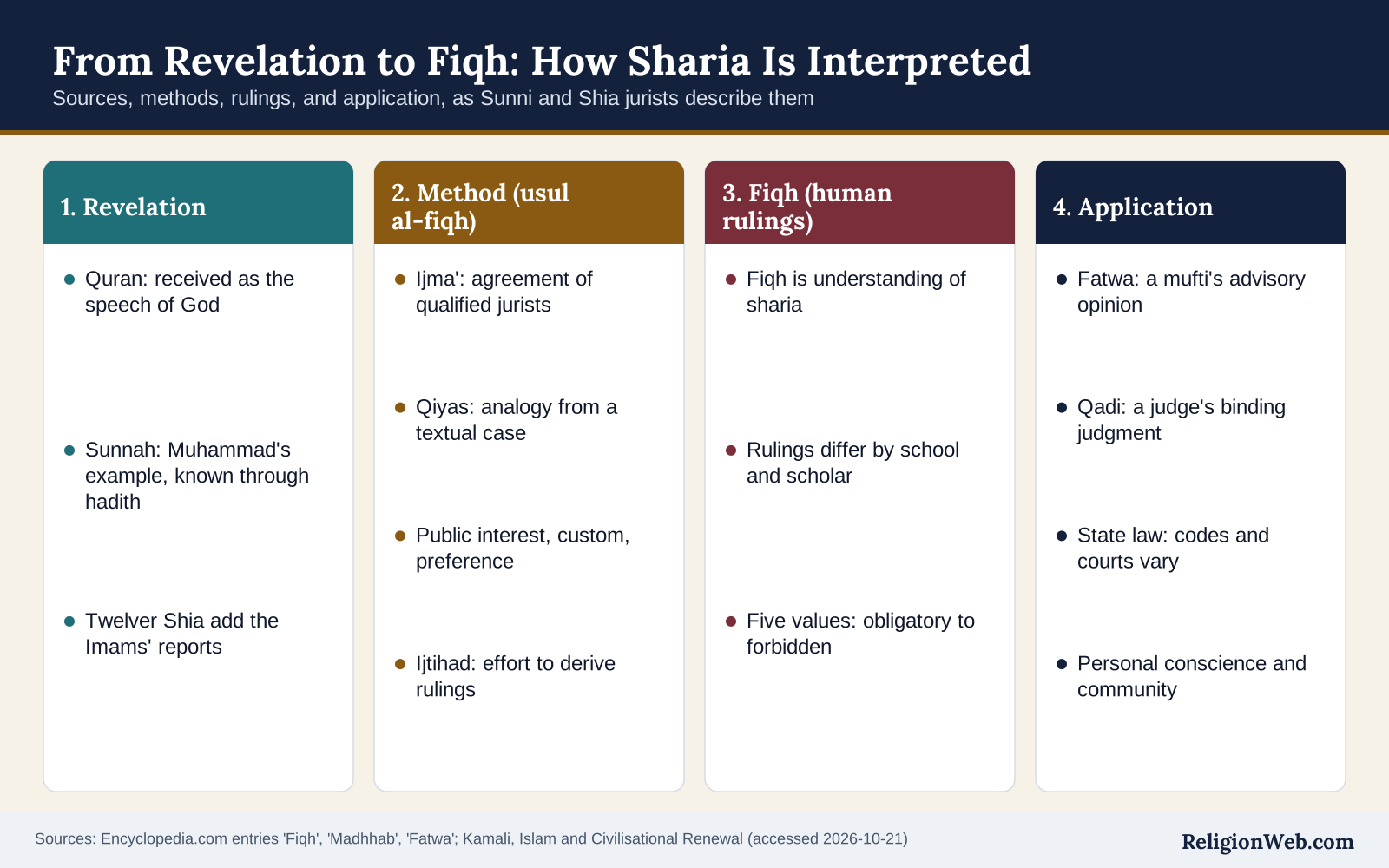
The detailed rulings that people usually mean when they say “Islamic law” belong to a related but separate discipline called fiqh, literally “understanding.” Fiqh is the human effort of trained jurists to work out, from the sources, what sharia requires in particular situations. Because it is human interpretation, it produces disagreement, and that disagreement is built into the tradition. Sunni Muslims, who make up the large majority worldwide, historically follow one of four legal schools. Sunni Islam and Shia Islam each developed their own jurisprudential traditions, and smaller communities such as the Ibadis maintain others. No single book, court, or office has ever stated “the” sharia for all Muslims at once.
In English-language news, the phrase “sharia law” is often attached to criminal punishments, to disputes over dress, or to proposals for state legislation. Those topics are real, and this article addresses them directly. But they cover a small portion of what the tradition contains. Most of the rulings in classical works concern daily matters: how to pray, how to purify oneself, how to write a contract, how to divide an inheritance, when a marriage is valid, what makes food permissible, and what intentions and conduct a believer owes to God and neighbors. Muslims also live under very different legal arrangements, from secular states to constitutional monarchies to systems that apply Islamic rules in family courts only, so “what sharia means in practice” depends heavily on place and period.
The sections below separate the key terms, trace how Islamic legal thought developed between the seventh and tenth centuries CE, explain the sources and methods that jurists use, and describe the Sunni, Shia, and other legal schools. They then cover the roles of judge, mufti, and scholar; the areas of worship, family, economic, and criminal law; the ethical framework known as maqasid; and the relationship between sharia and modern states. Where Muslim scholars and communities differ, the differences are described with attribution instead of being resolved by the author. This is an explanation of a tradition on its own terms, not a guide to what any individual should do, and anyone facing a real legal, medical, or family situation should consult a qualified professional as well as a religious authority.
Sharia at a Glance: Meaning, Scope, and Core Vocabulary
What the Word Sharia Means
A path to water: the root meaning
The Arabic root sh-r-‘ has to do with entering, opening a way, and, in its most concrete sense, approaching a source of water. Arabic lexicographers connected shari’a with the path that leads down to a watering place, and the religious meaning of “the way” is commonly explained as growing out of that image: for communities that lived in dry country, the road to water was the road to life. Reference works therefore usually translate the term as “the path of correct conduct” or “the way,” and note that it was already used before Islam, and by Arabic-speaking Jews and Christians, for the revealed law of a religious community. Early Arabic translators, for example, rendered the Torah as shari’a in some contexts.
That background explains why Muslims are often puzzled by the English phrase “sharia law.” The word does not mean a statute book. It names an orientation toward God that includes law but is not exhausted by it. In ordinary Muslim speech the term can nearly overlap with din, “religion,” and a person who says they want to live “according to sharia” may mean prayer, honest dealing, and modest conduct rather than any specific legal code. In Malaysia and Indonesia the term is rendered syariah and is attached to particular courts and statutes, which shows how the same word can shift from ethical ideal to institutional label.
Sharia in the Quran and in the vocabulary of faith
The Quran uses the noun shari’a once, in a verse addressed to the Prophet in a chapter traditionally classed as Meccan, and uses related forms elsewhere. The usage is worth reading directly because it shows the word as a road to follow instead of a code to enforce.
And now have We set thee (O Muhammad) on a clear road of (Our) commandment; so follow it, and follow not the whims of those who know not.
Quran 45:18, trans. Marmaduke Pickthall (public-domain e-text, sacred-texts.com)
Classical commentators read the verse as saying that God placed Muhammad on a defined course of religion and practice, which he was to follow without being swayed by those who rejected it. A second verse uses a close relative of the word, shir’a, and states a principle that later jurists treated as foundational for understanding earlier revelation:
For each We have appointed a divine law and a traced-out way.
Quran 5:48, trans. Marmaduke Pickthall (public-domain e-text, sacred-texts.com)
In the classical commentary tradition this verse is typically read to mean that each community that received a prophet was given its own law and path, while the underlying call to worship the one God remains the same. A related verb appears in Quran 42:13, which speaks of God having ordained for Muslims the same religion that was enjoined on earlier prophets. Muslim exegetes drew the conclusion that sharia has a divine origin and an underlying ethical unity, even when the specific rules of different communities differ. The idea is also the reason that, for many Muslims, human beings do not “make” sharia: they seek to discover and apply it.
Sharia and Fiqh: Divine Way and Human Understanding
Why jurists separate the two
Reference works in Islamic studies consistently define sharia as God’s law or path and fiqh as the human interpretation of it. Fiqh originally meant “knowledge” or “understanding” in a general sense, and by the eighth century CE it had come to refer specifically to the science of jurisprudence, practiced by specialists called fuqaha’ (singular faqih). The reason for keeping the terms apart is straightforward. If sharia and fiqh were identical, then every ruling in every law book would carry the full authority of divine revelation, and no jurist could ever be mistaken. Muslim scholars have said the opposite for more than a thousand years: a jurist who exerts himself and errs is considered to have made an honest mistake, and the schools preserve rival opinions on thousands of questions precisely because the sources can be read in more than one reasonable way.
This separation also gives the tradition its flexibility. Jurists of every school accept that the divine will is fixed while human understanding of it is provisional, and that makes it possible, within limits that scholars debate, for a later generation to revisit a conclusion reached in an earlier one. Modern Muslim reformers often rely on this very distinction when they argue that certain classical rulings reflect the social conditions of their time. Traditionalists respond that the distinction applies to matters where the sources allow multiple readings, but not to rulings grounded in clear and definitive texts. The argument about where that boundary lies is one of the central debates of modern Islamic thought.
How the difference shows up in everyday disagreements
The difference is easy to see in ordinary practice. All schools agree that Muslims must pray five times daily, but they differ on details such as how some prayers may be combined while traveling or the exact limits of a prayer time. All agree that the marriage contract is a religious and legal act, but they differ on whether an adult woman may contract her own marriage or needs a guardian, and on how divorce proceedings should work. The shared obligation is part of sharia as Muslims understand it. The detailed variations are fiqh. A Muslim who follows a different school from a neighbor is not understood to follow a different religion; the two are following different scholarly routes to the same obligations.
| Feature | Sharia | Fiqh |
|---|---|---|
| Basic meaning | The path or way set out by God; the divine norm for belief, worship, and conduct | Understanding; the body of rulings that scholars derive from the sources |
| Status in Muslim belief | Divine in origin; grounded in the Quran and the example of Muhammad | Human in formulation; authoritative to the degree that the method and evidence are sound |
| Who produces it | God, through revelation, according to Muslim teaching | Jurists (fuqaha’) and, in Twelver Shia practice, mujtahids |
| Can it vary? | Not as an ideal; Muslims differ on how much of it is spelled out in detail | Yes; schools and scholars hold different opinions on many questions |
| Typical question | What does God require of the believer in this area of life? | What is the ruling on this specific case, and on what evidence? |
| Typical output | Principles, commands, prohibitions, and ethical aims | Legal manuals, fatwas, court judgments, and commentaries |
The Scope of Sharia: Five Values and Many Domains
The five legal values
Islamic law does not simply divide actions into “legal” and “illegal.” Jurists classify every human act into one of five categories, called ahkam. An act may be obligatory (fard or wajib), recommended (mandub), permissible (mubah), disliked (makruh), or forbidden (haram). A parallel scale deals with validity, asking whether an act or contract is sound, defective, or void. The five-part scheme has a practical consequence that is easy to miss: most of life falls into the middle three categories, where no strong command applies, and the reward and the blame attached to the outer categories are mainly spiritual. Only some obligations and prohibitions are enforced by courts, and many exist solely between the believer and God. Reference works note that for this reason some scholars regard sharia as closer to ethics than to law in the modern sense, because intention (niyya) matters alongside the outward act.
Beyond courts: intentions, ethics, and conscience
Classical jurists distinguished between a ruling’s force in the sight of God (diyana) and its force in a court of law (qada). A merchant who hides a defect in goods may have a valid contract before a judge and still have sinned in the eyes of the law’s divine author. A person who breaks a fast in private is accountable to God and not to any official. The law of worship, called ibadat, is largely of this kind. The law of dealings among people, called mu’amalat, covers contracts, property, marriage, and wrongs, and it is where courts historically played the larger role. Modern readers who equate sharia with state enforcement are often seeing only the second domain and only the part of it that rulers chose to enforce.
Who Follows Sharia, and in What Sense
Sharia as personal commitment
For most Muslims, sharia is first a matter of personal and communal observance. A believer prays, fasts in Ramadan, gives zakat, observes dietary rules, and marries, divorces, and bequeaths property in ways that the family regards as religiously valid. These practices are carried on whether or not any state recognizes them, which is why Muslim minorities in Europe, North America, and Asia continue to practice what they understand as sharia within civil legal systems that do not enforce it. The Five Pillars of Islam are the best-known core of this personal dimension, and the rest of the tradition elaborates on them.
Sharia as state law
The second sense, sharia as the law applied by courts and legislatures, varies enormously by country and by period. Pew Research Center estimated that Muslims were 25.6 percent of the world’s population in 2020, living in many dozens of countries, and these societies use sharia in very different ways. Some states are officially secular, some treat Islamic principles as a source of legislation, some limit Islamic rules to family and inheritance law, and a few apply Islamic criminal law. Later sections describe these patterns. For now, the key point is that “sharia” names a religious ideal shared across the Muslim world, while “the law of a given country” names a political and historical settlement that differs from place to place and that Muslims themselves debate.
Origins: How Islamic Law Took Shape, 610 to 950 CE
Law in the Time of the Prophet and the First Caliphs
Revelation and adjudication in Mecca and Medina
According to Islamic tradition, the revelations that became the Quran began around 610 CE in Mecca and continued until the Prophet’s death in 632. The Meccan revelations deal mainly with belief, worship, and moral accountability. Most of the passages with legal content, including rules on inheritance, marriage, divorce, contracts, and punishments, belong to the Medinan period, after the migration (hijra) of 622 when Muhammad became the leader of a community with its own institutions. In Medina he is remembered as the arbiter of disputes, the commander of the community, and the interpreter of revelation, and Muslims treat his decisions as the earliest case law. The Quran itself is not organized like a legal code. It mixes rulings with narrative, exhortation, and prayer, and many of its commands are stated briefly and without procedure.
The Quran commands prayer, for example, without giving the number of daily prayers or their movements, and it commands fasting and pilgrimage without all the detail by which they are practiced. These gaps were filled, in the Muslim account, by the Prophet’s own practice, which his community watched, imitated, and remembered. That practice is called the Sunnah, and its written record is the body of hadith. The article on the life of Muhammad describes the historical setting in more detail.
The Rightly Guided Caliphs and the first generation of judges
After 632 the community was led by caliphs, beginning with Abu Bakr, and the conquests of the following decades brought Muslims into rule over Syria, Egypt, Iraq, and Iran. The first four caliphs, known in Sunni tradition as the Rightly Guided (rashidun), ruled until 661. In this period Companions of the Prophet who were consulted on difficult questions formed the community’s first reservoir of legal knowledge, and later generations preserved their opinions alongside their reports of what the Prophet had said and done. Shia Muslims, for their part, hold that authoritative guidance continued through Ali and the Imams descended from him, an understanding explained in the article on Shia Islam. Both traditions agree that the generation of the Companions and their students shaped the questions on which later jurisprudence worked.
The Umayyad and Early Abbasid Centuries
Qadis, governors, and local custom
Under the Umayyad dynasty (661 to 750) and in the early Abbasid period that followed, judges called qadis were appointed by governors and caliphs to decide disputes in the provinces. Scholars of early Islamic law, including Wael Hallaq, have argued that these judges worked from a mix of sources: the Quran, local custom and administrative practice, the decisions of earlier rulers, and their own reasoned opinion (ra’y). Prophetic hadith, in this reconstruction, played a smaller role in the first century of judging than later legal theory would suggest. The point matters because it shows that law was not a finished code handed over whole in the seventh century. It was a developing practice that gradually came to define itself in relation to the Quran and the example of the Prophet.
Medina, Kufa, and the first regional traditions
By the eighth century, circles of scholars in different cities had developed distinct approaches. Reference works describe two early centers in particular. Medina was associated with scholars who relied heavily on transmitted tradition and the established practice of the city’s people, often called ahl al-hadith. Kufa in Iraq was associated with scholars who gave more room to reasoned opinion, the ahl al-ra’y. These labels simplify a more complicated picture, since scholars in both cities used both tradition and reasoning, but they capture a real difference of emphasis. The personal schools that arose later were built on these regional foundations, and for a time regional loyalty and scholarly method were hard to separate.
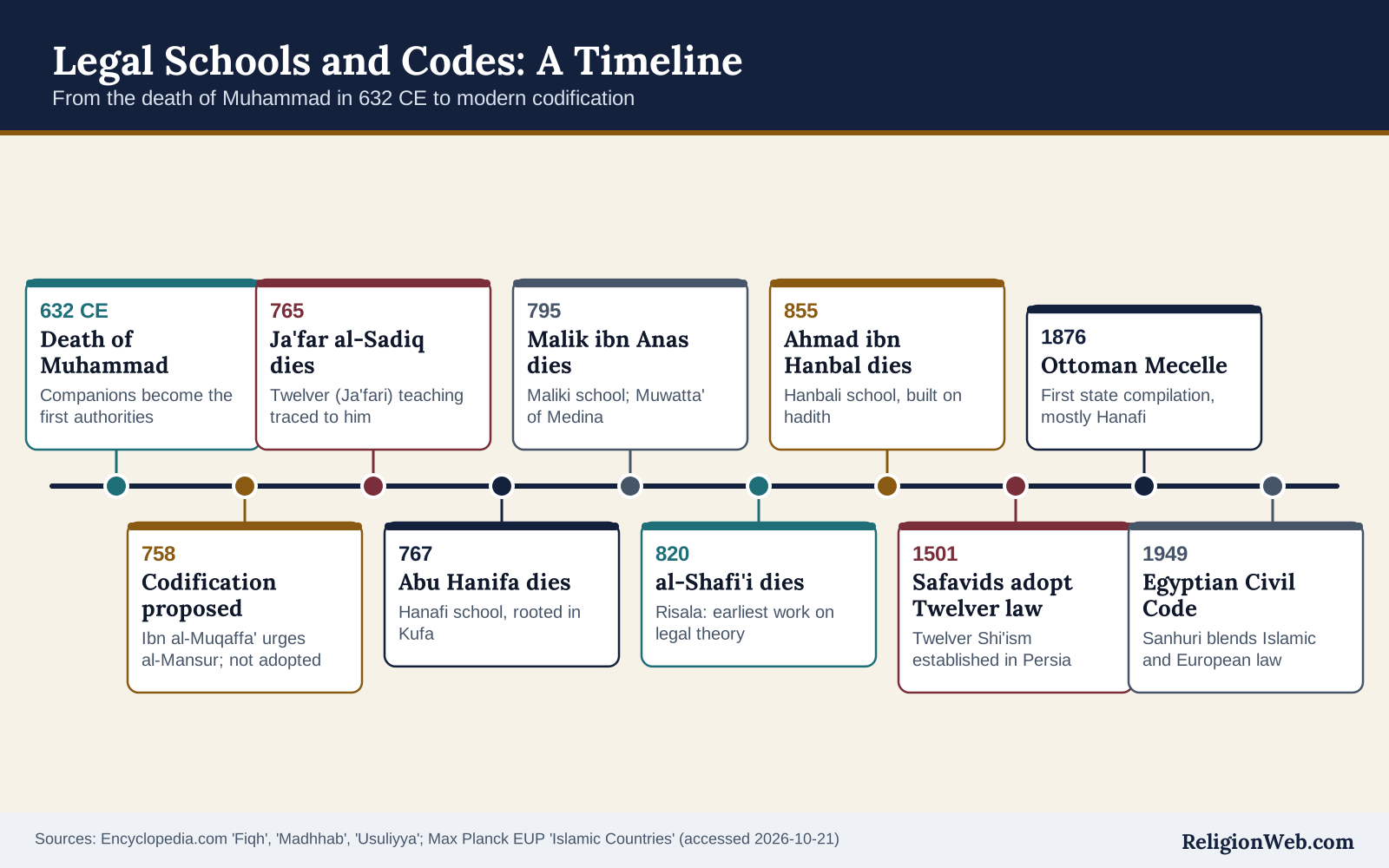
The Abbasid caliphs, who came to power in 750 and built Baghdad as their capital, took an interest in legal order. According to a reference account, the scholar and administrator Ibn al-Muqaffa’ proposed to Caliph al-Mansur in 758 that Islamic law be codified into a single state code. The idea was not carried out. Whatever the reasons, the outcome shaped the next thousand years: legal authority remained with independent scholars, not with a central legislature, and rulers had to negotiate with jurists to claim religious legitimacy.
The Founders and the Systematization of Legal Theory
Abu Hanifa, Malik, and the early schools
The ninth century is when personal legal schools emerged. The scholar Abu Hanifa (died 767), who taught in Kufa, became the eponymous figure of the Hanafi school, known for its use of reasoned opinion and analogy. Malik ibn Anas (died 795) of Medina compiled the Muwatta’, one of the earliest surviving law books, and gave his name to the Maliki school, which treats the established practice of Medina as significant evidence. In the Shia tradition, the sixth Imam, Ja’far al-Sadiq (died 765), is the figure to whom Twelver legal teaching is traced, and the Twelver school is therefore often called the Ja’fari school. These are the central names of the formative period, but reference works emphasize that the schools took full shape only in the later ninth and early tenth centuries, when students and followers organized and extended the teaching of the figures whose names they bore.
Al-Shafi’i and the Risala
The decisive moment for legal theory is associated with Muhammad ibn Idris al-Shafi’i (died 820). He studied with Malik in Medina and with the followers of the Iraqi tradition, and he composed a work known as the Risala, regarded as the earliest surviving treatise on the principles of Islamic jurisprudence (usul al-fiqh). Al-Shafi’i argued that the Quran and the Sunnah of the Prophet are the foundation of law, that the Sunnah is known through authentic reports, and that analogy and consensus complete the system. His argument gave later Sunni law a shared vocabulary. Even jurists who rejected parts of his program worked in the framework he helped to establish.
Ahmad ibn Hanbal and the primacy of transmitted reports
Ahmad ibn Hanbal (died 855) of Baghdad gave his name to the fourth of the Sunni schools. He is remembered above all for his devotion to hadith and for assembling a very large collection, the Musnad. His school preferred to base rulings on transmitted reports whenever a sound one could be found, and it used analogy sparingly. By the end of the ninth century, therefore, the main Sunni methods were all in view: opinion and analogy in the Iraqi tradition, communal practice in the Medinan tradition, a theory that placed the Quran and Sunnah first in the Shafi’i tradition, and a primary reliance on reports in the Hanbali tradition. The table below shows the sequence at a glance.
| Date (CE) | Event or figure | Why it matters |
|---|---|---|
| c. 610 to 632 | Revelation of the Quran; career of Muhammad in Mecca and Medina (migration in 622) | Source of the Quran and the Sunnah; first community adjudication |
| 632 to 661 | Abu Bakr, Umar, Uthman, and Ali as leaders of the community | Companions’ opinions become the first reservoir of legal precedent |
| 661 to 750 | Umayyad dynasty | Appointed qadis decide disputes in the provinces |
| 758 | Ibn al-Muqaffa’ reportedly urges codification to Caliph al-Mansur | The proposal is not carried out; scholars, not rulers, keep legal authority |
| 765 | Death of Ja’far al-Sadiq | Twelver Shia legal teaching is traced to him |
| 767 | Death of Abu Hanifa | Founding figure of the Hanafi school |
| 795 | Death of Malik ibn Anas | Author of the Muwatta’; founding figure of the Maliki school |
| 820 | Death of al-Shafi’i | Author of the Risala, the earliest work on legal theory |
| 855 | Death of Ahmad ibn Hanbal | Founding figure of the Hanbali school |
| Later 9th to early 10th century | Personal schools take full shape | Disciples organize doctrine; membership by school replaces regional identity |
How Modern Scholars Debate the Origins
The skeptical tradition of Western scholarship
The picture above is based on how Muslim tradition and many reference works describe the period, but the earliest history of Islamic law is a subject of vigorous academic dispute. In the late nineteenth century the Hungarian scholar Ignaz Goldziher argued that a large share of the hadith literature reflects debates of the second and third Islamic centuries and was attributed back to the Prophet. In 1950 Joseph Schacht extended the argument to law in The Origins of Muhammadan Jurisprudence, claiming that legal hadith in particular were produced to support positions that jurists had already reached. If correct, these views would mean that the classical account of law flowing outward from the Prophet’s example is, at least in part, a retrospective construction.
Revisions and Muslim responses
Later scholars have both revised and rejected this picture. Harald Motzki, studying early collections such as the Musannaf of ‘Abd al-Razzaq, argued that much material can be traced to the first Islamic century, and that careful analysis of chains and texts allows more of it to be dated early. Wael Hallaq’s The Origins and Evolution of Islamic Law (2005) offers a middle account, stressing the role of the qadis and gradual theory-building. Muslim scholars such as M. M. Azami have defended the classical account on the ground that the discipline of hadith criticism was rigorous and began early. For readers, the lesson is that the broad outline, including the importance of the Quran, the Prophet’s example, and the schools named after eighth- and ninth-century figures, is not in dispute, while the proportion of specific rulings that go back to the earliest period remains contested.
The Sources of Sharia and the Methods of Fiqh
The Quran as the First Source
What the Quran contributes to law
All Muslim legal traditions begin with the Quran, which Muslims receive as the speech of God. Its legal content is a minority of the text. Estimates of the number of verses with legal subject matter vary widely, from under a hundred to roughly five hundred, depending on how strictly “legal” is defined, out of more than six thousand verses in total. What the text provides is a mixture of specific rulings and general principles. Among the specific rulings are the fixed shares of inheritance (Quran 4:11 to 4:12 and 4:176), rules about the marriage payment to the bride (4:4) and the waiting period after divorce or widowhood (2:228 and 2:234), the prohibition of interest-bearing transactions (2:275 to 2:279), the prohibition of intoxicants and gambling (5:90 to 5:91), and the penalties for theft, for false accusation of unlawful intercourse, and for homicide (5:38, 24:4, 2:178). Among the general principles are justice, fulfilling agreements, consultation, and the avoidance of hardship.
Equally important for law is a verse that tells believers where to turn when they disagree. It does not describe a legislature or a court. It identifies a chain of authority and a method of referral.
O ye who believe! Obey Allah, and obey the messenger and those of you who are in authority; and if ye have a dispute concerning any matter, refer it to Allah and the messenger…
Quran 4:59, trans. Marmaduke Pickthall (public-domain e-text, sacred-texts.com)
Classical jurists read the second half of the verse as a mandate for argument from the sources: a dispute is settled by consulting the Quran and the example of the Prophet. Different groups read the phrase “those of you who are in authority” differently. Many Sunni commentators understood it to refer to rulers and, in some readings, to scholars. Twelver Shia commentators generally understand it to refer to the Imams, whom they hold to be divinely guided interpreters. The verse is therefore a good illustration of a feature that recurs throughout this article: the same text is accepted by all, while the institutions built on it differ.
How jurists read the text
Reading a legal text well requires technical tools, and the discipline of usul al-fiqh, the principles of jurisprudence, supplies them. Jurists distinguish between general (‘amm) and specific (khass) wording, between unqualified and qualified statements, between commands that create an obligation and those that only recommend, and between texts whose meaning is clear and those that can bear more than one reading. They also deal with naskh, abrogation, the idea that a later ruling can supersede an earlier one. The schools disagree on its scope. The Shafi’i school accepted only the abrogation of Quran by Quran and Sunnah by Sunnah, while the other schools allowed one source to abrogate the other. Many modern scholars read abrogation narrowly, and some deny it applies to the Quran at all, so the doctrine remains one of the topics on which fiqh preserves real difference.
The Sunnah and Hadith
Why the Sunnah completes the Quran
The second source is the Sunnah, the exemplary conduct of Muhammad, which is known through hadith: reports of what he said, did, or silently approved. In the Sunni jurisprudential tradition the Sunnah has several functions. It explains what the Quran leaves general, as in the details of prayer, almsgiving, and pilgrimage. It adds rulings that the Quran does not mention, and it specifies the scope of Quranic wording. Al-Shafi’i’s argument in the Risala was that the Quranic command to obey the Messenger makes the Sunnah binding, and this reasoning became standard. The place of hadith in law, and the methods by which scholars decide which reports are sound, is the subject of the separate article on hadith.
A well-known report, preserved in the collections of Abu Dawud and al-Tirmidhi, illustrates how jurists described their own method. In it the Prophet sends a Companion named Mu’adh ibn Jabal to Yemen and asks how he will judge. Mu’adh answers that he will judge by the Book of God; if he does not find the answer there, by the Sunnah of the Messenger; and if he does not find it there, he will exercise his own effort and opinion. According to the report, the Prophet approved. Some hadith critics have questioned the chain of transmission of this report, and others defend it; most jurists nonetheless regard the order it describes as a fair summary of how law is derived. This article uses it as a paraphrase and not as a quotation.
The Shia understanding of Sunnah
For Twelver Shia Muslims the Sunnah is broader. It includes the words and actions of the Prophet and of the twelve Imams, who are regarded as divinely protected from error in conveying religion. Their reports are collected in works such as the Four Books of Shia hadith, among which al-Kafi by al-Kulayni is the earliest. Within Twelver jurisprudence, therefore, the transmitted material from the Imams is part of the Sunnah itself. A jurist trained in the Twelver tradition will cite a report from Ja’far al-Sadiq as authority in the same way that a Sunni jurist cites a report from a Companion, though the status of the report differs. The Sunni and Shia collections overlap in many reports from the Prophet but diverge on others, which contributes to differences in ritual and family law that later sections describe.
Consensus and Analogy
Ijma’: agreement of the qualified
The third source in the classical Sunni scheme is ijma’, consensus. The idea draws on the Muslim conviction that the community as a whole will not agree on error, and in legal practice it means the agreement of qualified jurists of a given age on a particular question. Once an issue is settled by consensus, later jurists do not reopen it. Schools differ about who counts and how much agreement is needed. The Maliki school gave special weight to the practice of the people of Medina, the Zahiri school restricted consensus to that of the Companions, and the Hanbali tradition held a similar emphasis on the early generations. Twelver Shia jurists accept consensus mainly because it may reveal the opinion of the Imam; they do not treat it as a free-standing source with independent authority.
Qiyas: reasoning from the known to the new
The fourth source is qiyas, analogy. Qiyas extends a ruling from a case addressed by the text to a new case that shares its effective cause (‘illa). The standard textbook example concerns intoxicants. The Quran and Sunnah forbid wine made from grapes; jurists reason that the reason for the prohibition is intoxication, and therefore other intoxicating drinks are forbidden also. The method gives the tradition a way of answering questions no text addresses, but it is bounded: analogy cannot overturn a text, and it requires that the cause be identifiable. Reference works note that some groups, including the Zahiri school, rejected analogy as unfounded speculation, while Twelver Shia jurists use reason (‘aql) in its place, which in practice means rational principles and presumptions that a jurist applies where no text exists.
Secondary Tools and the Place of Ijtihad
Preference, public interest, and custom
Beyond the four classical sources, jurists use a set of secondary methods whose acceptance varies by school. Istihsan, juristic preference, allows a jurist to set aside the result of strict analogy when it would produce hardship or injustice, and it is closely associated with the Hanafi school. Istislah, reasoning from public interest (maslaha), is associated with the Maliki school, and the Hanbali school developed similar approaches. Al-Shafi’i rejected both preference and public interest as methods unmoored from the text. Other tools include custom (‘urf), the presumption that an existing state of affairs continues until evidence changes it (istishab), and “blocking the means” (sadd al-dhara’i), which prohibits acts that would lead to a clearly forbidden result. The existence of these tools shows that the classical schools were not only textual exercises but also working legal systems that had to deal with commerce, land, and family life.
| Source or method | What it is | Role in law | Points of difference |
|---|---|---|---|
| Quran | The scripture, received as the speech of God | First source; supplies rulings and general principles | All schools accept it; they differ on interpretation and on abrogation |
| Sunnah (hadith) | The example of Muhammad, known through reports | Explains and supplements the Quran | Sunni and Shia collections differ; Twelver Shia include the Imams’ reports |
| Ijma’ (consensus) | Agreement of qualified jurists on a ruling | Settles questions once agreed | Scope varies by school; Twelver Shia treat it as a means of revealing the Imam’s view |
| Qiyas (analogy) | Extending a ruling by a shared effective cause | Answers new cases not covered by text | Rejected by the Zahiri school; Twelver Shia use reason (‘aql) instead |
| Istihsan and istislah | Juristic preference; reasoning from public interest | Corrects harsh results; addresses new needs | Hanafi (istihsan) and Maliki (istislah) emphasis; rejected by al-Shafi’i |
| ‘Urf (custom) | Established local practice | Fills gaps in contracts and dealings | Recognized in varying degrees; limited by clear texts |
| Ijtihad | Independent juristic reasoning from the sources | The method through which all derived law is produced | Debate on who may practice it and whether it ever ended |
Ijtihad, taqlid, and the question of the closed gate
Ijtihad, from a root meaning “to strive,” names the effort a qualified jurist makes to reach a ruling from the sources. A person who exercises it is a mujtahid. The qualifications described in the manuals include mastery of Arabic, knowledge of the Quran and hadith, familiarity with earlier consensus, and command of legal theory. A well-known report states that a judge who strives and reaches the right result receives two rewards, and one who strives and errs receives one. The opposite concept, taqlid, is reliance on the opinion of a jurist or school without independently examining the evidence. For most lay Muslims, taqlid is simply how they live: they follow the school or scholar they trust, as one consults a physician instead of studying medicine.
A long-standing narrative holds that the “gate of ijtihad” closed around the fourth Islamic century (the tenth century CE), after which scholars were expected only to follow the established schools. Recent scholarship has challenged this account. Wael Hallaq, in an influential article first published in 1984, argued that the idea of a closed gate does not match the historical record, and reference works now note that mujtahids were active well into the sixteenth century and that premodern scholars themselves denied any closure. Modern reformers such as Muhammad ‘Abduh and Muhammad Iqbal called for renewed ijtihad as the path to revival, while others, such as Abu al-A’la al-Mawdudi, saw it as the key to establishing an Islamic order. How far independent reasoning should go, and whether it should be exercised by individuals or institutions, remains an active question. One answer given by contemporary Muslim jurists is institutional: collective bodies, described in a later section, deliberate on new issues together.
Legal Schools: Sunni, Shia, and Other Jurisprudential Traditions
What a Madhhab Is and How People Follow One
A school of law, not a sect
The Arabic word madhhab (plural madhahib) is usually translated “school of law.” A madhhab is a body of doctrine and method taught by a leading jurist and developed by generations of students, and Muslims who follow it are said to belong to that school. Reference works stress several features. Schools differ mainly in law and legal method, not in core faith, and a madhhab has no formal organization, membership roll, or governing office. Doctrine is not uniform within a school, since later jurists often disagreed with their predecessors, and some opinions came to be preferred over others in a process internal to the school. By broad agreement among Sunni scholars, the four Sunni schools are equally legitimate, a conviction that kept their disputes from becoming sectarian.
Following, selecting, and combining
Most Muslims inherit a school from their family or region and follow it with little thought. A Muslim in Pakistan is likely to follow Hanafi practice, one in Morocco Maliki practice, one in Indonesia Shafi’i practice. Classical manuals allow a person to move from one school to another, and in many places a layperson may consult a trusted scholar from a different school without formalities. Modern legislators and fatwa councils have also used methods of selection (takhayyur) and combination (talfiq), choosing the most suitable opinion from several schools, or combining parts of different opinions. Family-law reforms in many countries have done this to give women stronger protections than a single school provided. Salafi-oriented movements, for their part, have often urged believers to go back to the Quran and hadith instead of being bound to a school, which has produced lively internal debate about the proper role of the madhhab.
The Four Sunni Schools
The Hanafi school
The Hanafi school traces its teaching to Abu Hanifa (died 767), who taught in Kufa, and to his students, notably Abu Yusuf and al-Shaybani. It is known for its willingness to use reasoned opinion, analogy, and juristic preference, and it is the largest of the Sunni schools. Its historical weight rests on state backing as well as scholarship: the Ottoman Empire adopted it as the official school of its courts in the early sixteenth century, which spread it across the Balkans, Anatolia, and the Arab provinces. Today it predominates in Turkey, in the Levant, in Central Asia, in Afghanistan, and in South Asia, including Pakistan and India. The Ottoman civil code known as the Mecelle, discussed below, was largely drawn from Hanafi law, and Hanafi rules therefore still shape the family law of several successor states. One practical example of a Hanafi position is that an adult woman may, in principle, conclude her own marriage contract, whereas the other Sunni schools require the involvement of a guardian.
The Maliki school
The Maliki school is named for Malik ibn Anas (died 795) of Medina. It treats the established practice of the people of Medina, in the generation after the Companions, as a source of law, on the reasoning that this practice was a continuous record of what the Prophet’s community did. It also gives important weight to public interest. Its core text is the Muwatta’, and its later authorities, such as the commentators of North Africa and Andalusia, built an extensive literature. Maliki law predominates in Morocco, Algeria, Tunisia, Mauritania, Libya, Sudan, and much of West Africa. Because it was the framework of Moroccan and Tunisian courts for centuries, it also shaped the first modern family codes in those countries, including the Moroccan Mudawana of 1956, which was based on Maliki jurisprudence.
The Shafi’i school
Muhammad ibn Idris al-Shafi’i (died 820) was a student of Malik and the author of the Risala. The school that bears his name follows a legal theory built on four roots: the Quran, the Sunnah, consensus, and analogy. It places firm emphasis on the authority of authentic hadith and rejects both juristic preference and public-interest reasoning as independent tools. Shafi’i law predominates in Lower Egypt, the Levant in part, the Hijaz and southern Arabia, the Horn of Africa and East Africa, and in Southeast Asia, particularly Indonesia and Malaysia. The wide spread of the school through trade routes across the Indian Ocean is one reason that Muslims in Zanzibar, Hyderabad, and Java share similar patterns of devotion and legal practice despite their distance from one another.
The Hanbali school
The Hanbali school derives from Ahmad ibn Hanbal (died 855) and has historically been the smallest of the four. Its jurists have emphasized transmitted reports and have used analogy sparingly. The scholar Ibn Taymiyya (died 1328) was a major figure in its later history, and the eighteenth-century reform movement associated with Muhammad ibn ‘Abd al-Wahhab, often called Wahhabi by its critics, drew on Hanbali legal thought. Hanbali jurisprudence is dominant in Saudi Arabia and Qatar and has followers elsewhere in the Gulf region. In modern times, a few Hanbali positions have received wide attention because Saudi courts historically applied uncodified Hanbali fiqh, though in recent years the kingdom has moved toward written codes in some fields, a development discussed under modern states.
| School | Tradition | Eponym (death date) | Distinctive emphasis | Regions where prominent |
|---|---|---|---|---|
| Hanafi | Sunni | Abu Hanifa (767) | Reasoned opinion, analogy, juristic preference | Turkey, the Levant, Central and South Asia |
| Maliki | Sunni | Malik ibn Anas (795) | Practice of Medina; public interest | North and West Africa, Sudan |
| Shafi’i | Sunni | al-Shafi’i (820) | Systematic theory of the four roots; strict textual method | Lower Egypt, East Africa, southern Arabia, Southeast Asia |
| Hanbali | Sunni | Ahmad ibn Hanbal (855) | Primacy of transmitted reports; limited analogy | Saudi Arabia, Qatar |
| Ja’fari (Twelver) | Shia | Ja’far al-Sadiq (765) | Reports of the Imams; reason (‘aql); living mujtahids | Iran, Iraq, Lebanon, Azerbaijan, Bahrain, South Asian communities |
| Zaydi | Shia | Zayd ibn ‘Ali | Closest of the Shia schools to Sunni legal method | Northern Yemen |
| Ibadi | Distinct from Sunni and Shia | Jabir ibn Zayd (early 8th century, traditional) | Own hadith collections and a conservative early-law outlook | Oman, parts of North and East Africa |
| Zahiri | Sunni, now extinct as a school | Dawud al-Zahiri (9th century) | Literal reading of texts; rejection of analogy | Historically Andalusia; influence through Ibn Hazm |
Shia Jurisprudential Traditions
Twelver Shia: Usuli and Akhbari approaches
Twelver Shia jurisprudence is often called Ja’fari after the sixth Imam, Ja’far al-Sadiq, who died in 765 and to whom much of its legal teaching is traced. Its sources are the Quran, the Sunnah as conveyed by the Prophet and the Imams, consensus understood as revealing the Imam’s view, and reason. The formative scholars of the tenth and eleventh centuries, including Shaykh al-Mufid (died 1022), al-Sharif al-Murtada (died 1044), and al-Shaykh al-Tusi (died 1067), organized this heritage, and Ibn Idris al-Hilli (died 1202) was among those who explicitly named reason as a source. Under the Safavids in 1501, Twelver Shi’ism became the established religion of Persia, which tied the school closely to the history of Iran. The broader belief system around these legal methods is described in the article on Shia Islam.
A defining feature of Twelver practice is the principle of emulation. Ordinary believers are expected to follow a living, qualified jurist, called a marja’ al-taqlid, “source of emulation,” and the authority of senior mujtahids became institutionalized over the nineteenth century. Reference works record that Shaykh Muhammad Hasan Isfahani was singled out as the sole supreme mujtahid in Najaf in 1846. Within this tradition there has also been a long argument between the Usuli approach, which holds that mujtahids may use the methods of legal theory to derive rulings, and the Akhbari approach, which relies primarily on the traditions of the Imams and distrusts extended juristic reasoning. The Akhbari movement received its definitive form from Mulla Muhammad Amin Astarabadi (died 1626). The Usuli school regained the upper hand, with Muhammad Baqir al-Bihbihani (died 1791) credited by later Usulis with having re-established it in the shrine cities of Iraq, and it is the dominant approach today.
Zaydi and Ismaili traditions
The Zaydi tradition follows Zayd ibn ‘Ali, a grandson of Husayn, and is found chiefly in Yemen. Its legal method is regarded as the closest of the Shia schools to Sunni jurisprudence, and it historically held that any qualified descendant of Hasan or Husayn who rose in the community’s defense could claim the imamate. The Ismaili tradition, which separated from the main line of Imams in a succession dispute after the death of Ja’far al-Sadiq, developed a legal system of its own, systematized in the tenth century by Qadi al-Nu’man in the Fatimid state. Present-day Ismaili communities, among them the Nizari Ismailis who follow the Aga Khan and the Bohra communities of South Asia, apply Ismaili principles to their community affairs under the guidance of their leaders. These groups differ from Twelver and Sunni Muslims in their legal institutions, though they share the broad categories of worship and law.
Other Traditions: Ibadi and Zahiri
The Ibadi school
The Ibadi school is a distinct tradition whose roots scholars often trace to the early Kharijite movement, a label that Ibadis themselves reject. Ibadis identify as Muslims, do not consider themselves Sunni or Shia, and trace their legal heritage to early scholars such as Jabir ibn Zayd. The school is dominant in Oman and has communities in Zanzibar, in the Mzab Valley of Algeria, on the Tunisian island of Djerba, and in the Nafusa Mountains of Libya. Ibadi jurisprudence has its own hadith collection and its own legal manuals, and it follows many of the same methods as other schools while differing on certain questions of political leadership and some rulings. Omani courts historically drew on Ibadi fiqh, and Ibadi jurisprudence remains an important reference point in Oman.
The Zahiri school
The Zahiri school, named for the “apparent” (zahir) meaning of texts, was founded by Dawud al-Zahiri in the ninth century and received its fullest statement from Ibn Hazm of Cordoba (died 1064). Its jurists read the Quran and hadith according to their literal sense, rejected analogy, and rejected consensus beyond that of the Companions. Reference works describe the school as extinct as an organized tradition, but its arguments survive in the writings of Ibn Hazm and have been invoked by modern scholars who want to limit speculative reasoning. The school is a useful reminder that the four-school Sunni system was not the only possibility that early Muslims explored, and that some alternatives were gradually set aside while others were absorbed.
Qadis, Muftis, and Institutions: Who Applies and Explains Sharia
The Judge and the Court
The qadi and the court of law
A qadi is a judge. In the classical system qadis were appointed by the ruler or his delegate, heard cases in a court called the mahkama, weighed evidence and oaths, and issued binding judgments. They typically followed the school of law recognized in their region, and when unsure they could request a fatwa from a respected jurist. The courts handled marriage, divorce, inheritance, property, contracts, and wrongs, and they kept records of sales and endowments, so surviving court archives have become a major source for historians of everyday life in Ottoman and other Muslim societies. A qadi’s judgment applies to the parties in the case and does not itself set a precedent in the sense familiar in common-law systems, though the reasoning of famous judgments circulated and was cited.
Complaints courts, market inspectors, and rulers’ discretion
Sharia courts did not stand alone. Rulers also ran mazalim courts, a form of grievance hearing that could address complaints against officials and matters the qadi’s court was poorly placed to handle, and the market inspector (muhtasib) enforced standards of weights, measures, and public conduct under the principle of hisba. Beyond this, rulers exercised discretionary authority, sometimes called siyasa, to maintain order and to impose penalties for offenses the fixed sharia categories did not cover. Medieval jurists debated the proper limits of that authority and wrote works on governance to argue that it too should serve the aims of sharia. The result was a layered system in which sharia courts, administrative courts, and customary practice overlapped.
The Mufti and the Fatwa
What a fatwa is
A fatwa is a legal opinion given by a qualified jurist, called a mufti, in response to a question. Reference works describe it as an advisory opinion, usually given on request where there is doubt about the law. It may be a single word, a short paragraph, or a book-length treatise, and it can address worship, belief, or conduct. Originally, only a mujtahid could serve as a mufti, though later any trained jurist could do so, and a mufti traditionally answered according to a particular school. Muftis historically worked independently of courts, often privately and without fee, and they accepted the facts as the questioner presented them, which means that a fatwa is only as good as the description it responds to. Collections of famous fatwas could serve as precedents for later jurists and sometimes for judges.
How fatwas are sought and issued today
In the twentieth century most Muslim-majority countries adopted secular or mixed legal systems, and fatwas became largely personal advice or public commentary instead of an element of court procedure. Many states created official fatwa bodies. Egypt’s Dar al-Ifta, founded in 1895 as a division of the Ministry of Justice, is among the best known, and its Grand Mufti is a prominent public figure. Beyond the state, a number of collective bodies issue guidance to Muslims of different countries. The International Islamic Fiqh Academy, created by a resolution of the Organization of Islamic Cooperation summit in 1981 and based in Jeddah, deliberates on contemporary questions from banking to medical ethics. The European Council for Fatwa and Research, founded in London in 1997 and later based in Dublin, issues opinions for Muslims living as minorities in Europe, and its rulings are not legally binding but gain authority through social acceptance. Online fatwa services answer questions from around the world every day, and quality varies greatly. Traditional jurists do not recognize fatwas issued by people without training, even when some followers treat them as binding.
Scholars and Religious-Legal Offices
Jurist, mujtahid, and the learned class
The word ‘alim (plural ‘ulama’) means “one who knows” and is applied to scholars of religious sciences generally. Among them, the faqih is a specialist in jurisprudence and the mujtahid is one qualified to derive law independently. There is no ordination in the Christian sense and no single hierarchy in Sunni Islam. Authority comes from training, recognition by teachers who grant a certificate of permission (ijaza), and the trust of the community. In the Ottoman Empire the chief mufti of Istanbul, called the shaykh al-Islam, headed a state-appointed hierarchy of muftis and judges, an example of how rulers incorporated the learned class into government. Reformist critics have long objected to government-appointed muftis who justify state policy, a criticism that reference works record and that affects the reputation of some official fatwa bodies.
The marja’ and the Twelver hierarchy
The Twelver Shia tradition has a more formal structure of authority. A believer follows a living marja’ al-taqlid, whose published manual of rulings, usually in the form of a practical treatise, serves as a reference for worship and daily life. The marja’ receives religious payments from followers, supports seminaries, and issues rulings; and several marjas may be recognized at once, so a believer chooses among them. Within the seminary system of cities such as Najaf and Qom, students advance through stages of study and eventually may attain the rank of mujtahid. The Twelver structure shows that the relationship between jurist and community is not the same across the Muslim world: where Sunni practice emphasizes the school and the trusted local scholar, Twelver practice emphasizes allegiance to a living senior jurist.
| Role | Function | Is the output binding? | Typical setting |
|---|---|---|---|
| Qadi | Judge who hears disputes and issues judgments | Yes, for the parties, with enforcement by the state | Court (mahkama); in many countries a family or sharia court |
| Mufti | Scholar who answers questions with legal opinions | No, in classical theory; state law can add force to some fatwas | Private practice, state fatwa office, or council |
| Faqih | Specialist in fiqh who writes and teaches law | Not directly; shapes rulings through teaching and authorship | Seminary, university, or study circle |
| Mujtahid | Jurist qualified to derive rulings independently | Binding only on those who choose to follow him (Twelver emulation) | Seminaries such as Najaf and Qom; Sunni councils |
| Marja’ al-taqlid | Senior Twelver mujtahid followed by lay believers | Followed by the believers who choose him | Twelver communities worldwide |
| Muhtasib | Market inspector under the principle of hisba | Yes, within an official mandate | Historic Muslim cities; the office is largely obsolete |
| Shaykh al-Islam | Title of a chief mufti, notably in the Ottoman Empire | Not as a court, though politically weighty | Ottoman Istanbul; used as an honorific elsewhere |
Sharia in Everyday Life: Worship, Family, Economy, and Conduct
Ritual Law: The Obligations of Worship
Prayer, fasting, almsgiving, and pilgrimage
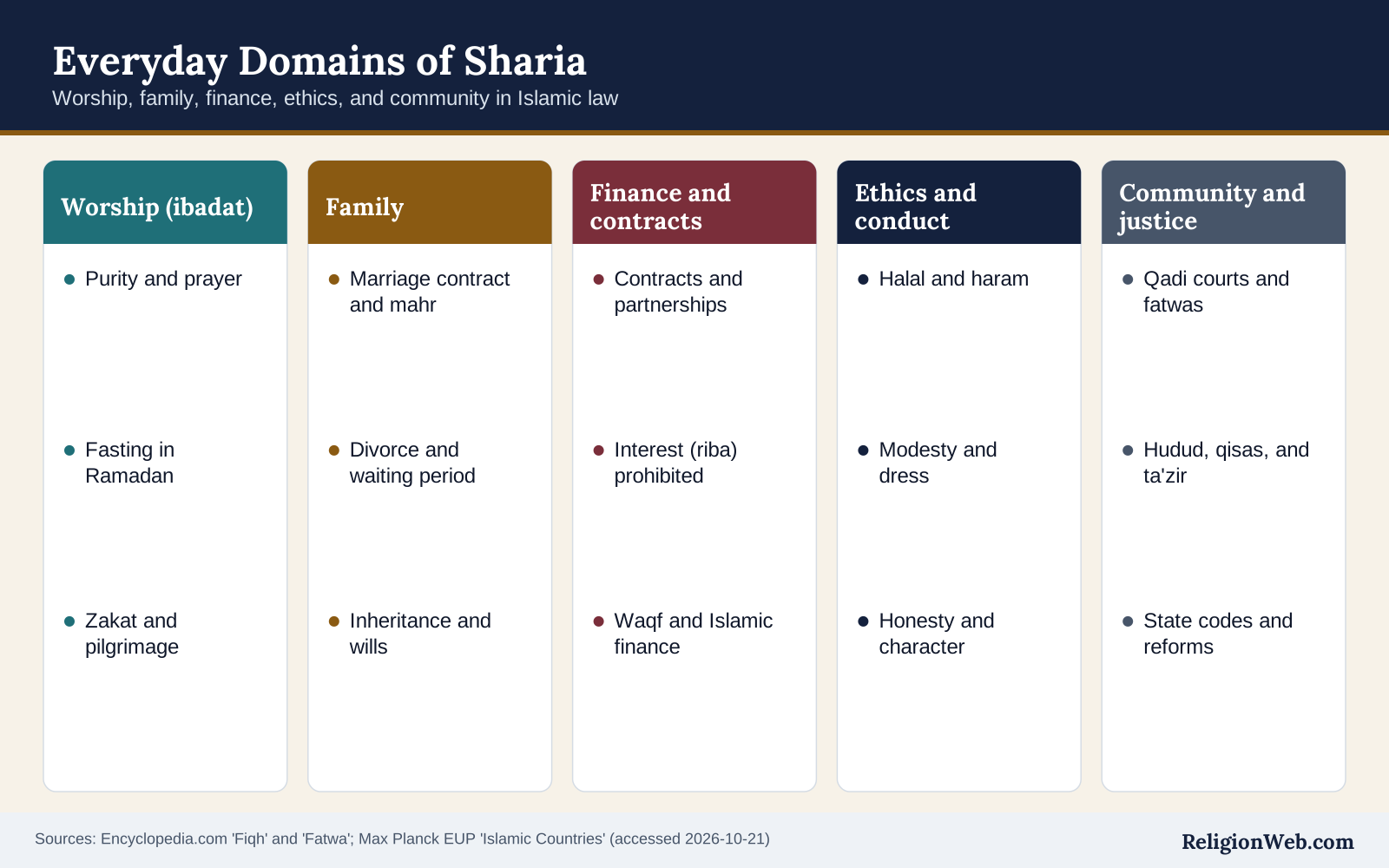
The part of fiqh that deals with worship, called ibadat, is the most universally practiced portion of sharia and the one most Muslims encounter every day. It begins with ritual purity: ablution (wudu’) before prayer, a full washing (ghusl) after certain states, and rules about what makes water and objects pure. It continues with the five daily prayers, treated in the article on salah, whose times, number of cycles, and recited texts are defined by the Sunnah. The congregational prayer on Friday is led from the pulpit of the mosque, and all prayer is oriented toward the Kaaba in Mecca, discussed in the article on the Kaaba. Free personal supplication, which has fewer legal requirements, is the subject of the article on dua.
The jurists also develop rules for fasting in the month of Ramadan, for the annual almsgiving called zakat, and for the pilgrimage to Mecca. The Quran establishes these duties, and the Sunnah and the schools define their conditions: who is required to fast, what breaks a fast, the types of wealth that are liable to zakat and the threshold below which none is due, and the sequence of rites in the pilgrimage described in the articles on Hajj and Umrah. The special nights at the end of Ramadan, including Laylat al-Qadr, and the festivals of Eid al-Fitr and Eid al-Adha, are also governed by rulings on timing, communal prayer, and charity. The law of worship is an area where the reasons given by jurists are mainly devotional; many rulings are accepted as acts of obedience even when their wisdom is not fully explained.
Exemptions, concessions, and the limits of hardship
An important feature of ritual law is its set of concessions (rukhas, singular rukhsa). The Quran, in the passage on fasting, allows the sick and travelers to make up missed days later and presents the rule as a mercy. Jurists elaborate on this with specific provisions: travelers may shorten certain prayers, the ill may pray seated or lying down, and a person who cannot fast because of age or chronic illness may offer compensation by feeding someone in need. These rules show how the tradition treats religious duties as flexible within defined limits. They are also the reason why religious practice is not understood to compete with medical care. Muslim jurists in every school treat the preservation of life and health as a priority, and a person with a medical condition, a pregnancy, or a demanding job should consult a physician as well as a scholar when deciding how to observe a demanding rule such as fasting.
Family Law, Inheritance, and Social Relations
Marriage and divorce
In classical fiqh, marriage (nikah) is a contract made by offer and acceptance in the presence of witnesses and, in most schools, with a guardian for the bride. The husband owes the wife a marriage payment, the mahr, which the Quran refers to in 4:4 and which belongs to the wife herself. The contract can carry stipulations, and jurists differ over which are enforceable. Divorce takes several forms. A husband may pronounce divorce (talaq); a wife may obtain separation by returning part or all of the payment (khul’) or by applying to a judge on recognized grounds (faskh or tafriq). After divorce or the husband’s death a waiting period (‘idda) applies, as the Quran states in 2:228 and 2:234. Custody of young children, maintenance, and the husband’s right to more than one wife under the Quran’s conditions are all topics on which the schools give different rules, and on which modern states have intervened extensively.
Family law is the domain in which sharia-derived rules have survived most completely in modern states. Reference works note that European-style commercial and criminal law replaced classical rules across much of the Muslim world, while personal status law remained anchored in fiqh. Reform has nonetheless been significant. Tunisia abolished sharia courts in 1956 and enacted a Code of Personal Status that bans polygamy and extrajudicial divorce. Morocco revised its family code in 2004 after campaigning by women’s organizations. Turkey went further, adopting a civil code modeled on the Swiss code in the 1920s and ending the application of religious family law. Reformers in these cases often used selection among the schools and the language of public interest to justify change, and conservative scholars have responded that some provisions go beyond what the texts allow. The debate continues in many countries.
Inheritance, wills, and endowments
Inheritance is one of the most detailed fields of Islamic law, and the Quranic verses that regulate it (4:11, 4:12, and 4:176) are among the most precise legal passages in the text. They assign fixed fractional shares to specific relatives, such as the spouse, parents, daughters, and siblings, and specify that, in many cases, a male heir receives a portion equal to that of two females in the same position. Jurists built the science of fara’id, “the apportioned shares,” to calculate the distribution in complex cases, and this became a respected specialty. A person may also make a bequest, generally limited by the Sunni schools to one-third of the estate for people who are not already heirs, so that the fixed shares of the family are protected. Sunni and Shia inheritance rules differ in some details, particularly in how distant male relatives are treated, and these differences appear in the legal codes of states that follow each tradition.
Modern discussions of inheritance often focus on the ratio between male and female shares. Traditional scholars point out that the male share is accompanied by financial obligations the female does not bear, such as supporting the family, and that in some situations a woman receives an equal or larger share than a man. Critics and some reformist scholars argue that the changed economic position of women requires reconsideration. Muslim opinion is divided, and legal outcomes differ from state to state. A related institution is the endowment, waqf, in which property is set aside permanently for a charitable purpose such as a school, a hospital, or a mosque. Waqf was for centuries a major engine of social provision in Muslim societies, and many historic institutions, including universities and public kitchens, were funded in this way.
Economic Life: Contracts, Interest, and Finance
Contract law and the prohibition of riba
The part of fiqh that deals with transactions, mu’amalat, is built on a few central ideas. Contracts require mutual consent, defined objects, and clear terms. Two things are prohibited above all. The first is riba, commonly translated as usury or interest, which the Quran condemns in 2:275 to 2:279. The second is gharar, excessive uncertainty in a contract, along with gambling (maysir), prohibited in 5:90 to 5:91. Classical jurists drew from these principles a detailed law of sales, partnership, leasing, agency, and lending, and they developed instruments such as the mudaraba, a partnership in which one party supplies capital and the other labor, and shares profit and loss accordingly. Merchants across the Indian Ocean and the Mediterranean used these forms for centuries, so the law of transactions was as much a part of lived sharia as the law of prayer.
Islamic finance today
The modern Islamic finance industry applies these principles to banking, insurance, and investment. Its common products include murabaha, a sale with disclosed markup used in place of a loan, ijara, leasing, and sukuk, certificates representing ownership in assets and not debt. Islamic banks typically employ supervisory boards of scholars who review products for compliance, and cooperative forms of insurance known as takaful have developed alongside them. Scholars and economists disagree about the result. Supporters say these institutions let Muslims take part in finance while observing the prohibition of interest. Critics, including the economist Mahmoud El-Gamal in his book on Islamic finance, argue that many products reproduce the economics of conventional lending in a different legal form, and some want a deeper reform that would emphasize risk-sharing and social purpose. The dispute is a modern example of the older debate between following the form of the contract and following its purpose.
Conduct, Food, Dress, and Daily Ethics
Halal and haram in food and daily goods
The categories of permissible (halal) and forbidden (haram) govern what Muslims eat, drink, and buy. The Quran forbids carrion, flowing blood, pork, and meat over which a name other than God’s has been invoked, and it prohibits intoxicants. The schools elaborate on slaughter, the status of seafood, and the treatment of ingredients that come from forbidden sources, and different schools reach different results on some products. Contemporary halal certification, which has become a global industry, applies those rules to processed food, cosmetics, and medicines. The fuller treatment of this subject, including how certification works and where scholars disagree, is in the article on halal. Rulings also provide for emergencies: in the Quranic passage on forbidden foods, necessity removes the prohibition for a person who is compelled by hunger and does not seek to transgress.
Modesty and dress
Rules of modesty, for both men and women, are another part of the law of conduct. Classical jurists drew from the Quran and the Sunnah a duty of lowering the gaze and covering the body, and they specified which parts of the body should be covered in the presence of unrelated people, with differences between schools on questions such as the face and hands. The article on hijab in Islam covers the vocabulary, the textual basis, and the range of practice, which runs from full covering to head-covering to no covering at all among people who nonetheless identify as Muslims. Two points are worth underlining here. First, the legal debate about dress concerns an ethical expectation as understood by jurists, not a universally enforced state rule, and states have taken opposite positions, with some requiring a particular dress and others restricting it. Second, Muslim women hold a wide variety of views, from those who regard covering as a religious duty to those who regard it as cultural or optional, and a reference article should not collapse these into a single position.
| Area | Arabic term | Typical subjects | Main textual basis | Where state law usually engages |
|---|---|---|---|---|
| Worship | Ibadat | Purity, prayer, fasting, zakat, pilgrimage | Quran; detailed Sunnah | Rarely enforced; states may regulate mosques, zakat funds, and Hajj quotas |
| Family and personal status | Ahwal shakhsiyya | Marriage, divorce, custody, maintenance | Quran (e.g., 4:4, 2:228); schools’ manuals | Often codified; family courts apply school-based or reformed rules |
| Inheritance and wills | Fara’id, wasiyya | Fixed shares, limits on bequests | Quran 4:11 to 4:12, 4:176 | Frequently applied in family or probate courts |
| Contracts and economy | Mu’amalat | Sales, partnership, leasing, interest, charity | Quran (e.g., 2:275 to 2:279); Sunnah; custom | Mostly commercial codes; Islamic banking regulated separately |
| Food and consumption | Halal and haram | Slaughter, ingredients, intoxicants | Quran 5:3, 5:90 | Certification, labeling, and import rules in many countries |
| Public and criminal justice | Hudud, qisas, ta’zir | Specified offenses, retaliation, discretionary penalties | Quran; Sunnah; juristic safeguards | Varies from none to full criminal codes |
| Ethics and character | Akhlaq, adab | Honesty, kindness, humility, etiquette | Quran; Sunnah; Sufi and ethical literature | No direct enforcement; shaped by family and community |
Character, community, and the unenforceable parts of the law
A large portion of sharia has no mechanism of enforcement at all. The Quran and Sunnah place heavy emphasis on honesty, patience, generosity, keeping promises, respect for parents, and kindness to neighbors, orphans, and strangers. Ethical literature in Arabic, Persian, Turkish, and other languages, including the devotional writing of Sufism, developed these themes in works that sit between law and moral philosophy. In daily life, much of what Muslims mean by following sharia is of this kind: arriving on time for a promise, being fair in trade, and caring for relatives. This broader ethical dimension is why many Muslims object to descriptions of sharia as merely a system of rules and penalties, and why scholars of the subject so often describe the tradition as a combination of law and ethics.
Criminal Justice in Islamic Law: Hudud, Qisas, and Ta’zir
The Categories of Penal Law
Hudud: the fixed penalties
Public attention to sharia often centers on punishment, so it deserves careful treatment in proportion to its place in the tradition. Classical criminal law is divided into three categories. The first is hudud, “limits,” a small group of offenses for which the Quran or Sunnah prescribes a specific penalty. The classical lists differ by school, but they commonly include theft, unlawful sexual intercourse (zina), false accusation of unlawful intercourse (qadhf), armed robbery or brigandage (hirabah), and, in some schools, the consumption of intoxicants. Some jurists add apostasy or armed rebellion, though these are treated differently in different schools and are more contested. Quranic verses state the penalties for several of these, such as the cutting of the thief’s hand in 5:38 and the lashing for zina and for slander in 24:2 and 24:4. The existence of these penalties in the text is not disputed; what is debated, within the Muslim community as well as outside it, is how and whether they should be applied today.
Qisas, diya, and ta’zir
The second category, qisas (retaliation), applies to homicide and bodily injury, and it is treated in law as a private right of the victim or the victim’s family instead of a matter wholly belonging to the state. The Quran (for example 2:178 to 2:179 and 5:45) establishes equivalence in retaliation and also encourages forgiveness and the acceptance of compensation, diya, often called blood money. The family of a victim may waive retaliation, accept diya, or pardon the offender, and the Quran presents pardon as a better course. The third category, ta’zir, is discretionary punishment for offenses outside the other two. It covers most ordinary crime, from fraud and assault to corruption and public disorder, and leaves the form and degree of penalty to a judge or ruler, who is expected to act with proportion. Historians of the Ottoman and other premodern legal systems, among them Rudolph Peters in his study of crime and punishment in Islamic law, have shown that in practice ta’zir and administrative penalties accounted for most of what courts actually did.
| Category | Meaning | Examples | Key feature |
|---|---|---|---|
| Hudud | Limits set by text, with specified penalties | Theft, unlawful intercourse, false accusation, highway robbery; lists vary by school | Very strict standards of proof; avoided in cases of doubt |
| Qisas and diya | Retaliation and compensation for killing and injury | Homicide, wounding | Private right of the victim’s family; pardon and compensation are possible |
| Ta’zir | Discretionary penalties set by judge or ruler | Fraud, assault, corruption, public disorder | Covers most ordinary crime; form and degree are flexible |
| Kaffara | Expiation for religious wrongs | Breaking an oath; breaking a fast intentionally in some cases | Religious and personal; typically fasting, feeding the poor, or freeing a slave historically |
Safeguards, Evidence, and Historical Practice
Standards of proof and the principle of doubt
The fixed penalties are surrounded by stringent evidentiary rules, and jurists made them stricter over time. For zina, the Quran requires four witnesses in 24:4, which the jurists understood to mean four adult male eyewitnesses to the act itself, and it prescribes a penalty for those who make an accusation without producing them. In practice this meant that the penalty could be reached only by confession or by an almost impossible level of proof. Jurists also applied a maxim commonly rendered “avert the hudud by doubts,” which held that any uncertainty about the facts, the intent, or the applicability of the rule should prevent the penalty. A confession could be retracted. A thief who took property from a place that was not properly guarded, or who acted from need, could escape the hadd penalty. These safeguards tell us something about how classical jurists saw the penalties: as outer limits intended to deter and symbolize the gravity of certain wrongs, with repentance and concealment of sins encouraged in the sources.
Premodern application
Historical research suggests that the hadd penalties were applied rarely in many periods and places, though practice varied by region and ruler. Courts did punish offenses, but often under ta’zir and administrative law, using imprisonment, fines, flogging, and exile as the circumstances required. Modern legislators and critics have sometimes cited the classical safeguards to show that the penalties were never intended as an everyday tool of state, while advocates of implementation have cited the texts to argue that a Muslim state must apply them. Both positions appear in contemporary Muslim discussion, and a historical reader should avoid assuming either that premodern courts regularly carried out the penalties or that they never did.
Penal Law in the Modern Period
Codification and the new states
The nineteenth and twentieth centuries transformed the picture. Most Muslim-majority states adopted penal codes based on European models, which replaced classical categories with statutory offenses and fixed procedures. Reference works observe that after independence only a minority of states reintroduced elements of classical criminal law. Pakistan promulgated its Hudood Ordinances in 1979 and later reformed some of them. Iran, after the 1979 revolution, enacted an Islamic penal code, which includes a book devoted to hudud. In northern Nigeria, twelve of the country’s thirty-six states extended sharia to criminal matters beginning in 1999 and 2000. In Indonesia, the province of Aceh applies a local Islamic criminal regime under autonomy legislation from 2001. Brunei enacted an Islamic penal code in 2014, to be introduced in phases. The Taliban government in Afghanistan, in power since 2021, describes its system as based on sharia in the Hanafi tradition. The details of enforcement in each of these cases are contested and sometimes change quickly, so readers should consult current reporting for the latest situation.
Debate inside and outside the Muslim world
These developments have provoked strong disagreement. International human-rights bodies have criticized corporal and capital punishments and have objected to the way some penal laws affect women, religious minorities, and people accused of sexual offenses. Within the Muslim community, some jurists and activists defend the penalties as divinely ordained limits; others argue that the strict classical safeguards make them practically unenforceable under modern conditions, or that a purpose-oriented approach should lead to different penalties in different contexts. The scholar Abdullahi An-Na’im has argued that a state governed by religious rules compromises the voluntary nature of religious observance and that Muslims are better served by a secular state. Pew Research Center’s survey of Muslims in 39 countries, with fieldwork between 2008 and 2012, found wide variation. Among respondents who supported making sharia the law of the land, Pew reported that about four in five in South Asia favored cutting off the hands of thieves, while only about a third to two-fifths of such supporters in Central Asia and in Southern and Eastern Europe favored severe criminal punishments.
Maqasid, Legal Maxims, and the Ethical Aims of Sharia
The Higher Objectives of Sharia
From al-Ghazali to al-Shatibi
Alongside the technical rules, Muslim jurists developed a theory of the purposes behind them, known as maqasid al-sharia, “the objectives of sharia.” The idea that rulings serve benefits for human beings is old. Early works with titles on the purposes of prayer or on ritual wisdom appear in the ninth and tenth centuries, and al-Juwayni (died 1085) proposed levels of purpose. Abu Hamid al-Ghazali (died 1111) gave the best-known classical formulation: sharia aims to protect five necessities, namely faith, life, intellect, offspring, and wealth. Later scholars grouped purposes into three levels of importance: necessities, needs, and refinements. Al-Shatibi of Granada (died 1388), in his book al-Muwafaqat, made the purposes fundamental to the discipline and argued that universal aims should guide the interpretation of particular rulings. His work was a standard reference in later centuries.
Modern uses and critiques
Modern scholars have revived and extended the theory. Reformers such as Rashid Rida (died 1935) and the twentieth-century Tunisian jurist Ibn Ashur argued that purposes such as justice, freedom, order, and the preservation of human nature belong in the account of sharia. Contemporary writers such as Jasser Auda have proposed to apply maqasid at the level of individuals, families, societies, and humanity, and some reinterpret the traditional “protection of honor” as human dignity and rights, citing the Quranic statement that there is no compulsion in religion (2:256). Fatwa councils and Islamic finance boards also cite maqasid when they weigh public benefit. Critics are not absent. Ibn Hazm and the later textualists rejected any reasoning that goes beyond the explicit causes in the texts. Shafi’i jurists argued that purposes are too imprecise to serve as the basis for rulings, and al-Ghazali himself was reluctant to grant them independent legal authority. A further concern, raised by some scholars, is that maqasid can become a rhetorical device that justifies any conclusion.
Legal Maxims and the Role of Ease
The qawa’id fiqhiyya
Alongside the objectives, jurists compiled short principles known as legal maxims, qawa’id fiqhiyya, that summarize patterns across many rulings. Five are traditionally treated as major: that acts are judged by their intentions; that certainty is not removed by doubt; that hardship brings relief; that harm must be removed; and that custom is a basis for judgment. Authors such as the Egyptian scholar al-Suyuti and the Ottoman jurist Ibn Nujaym wrote on them, and the Ottoman Mecelle, completed in 1876, opened with a long list of maxims before its articles on contracts. The maxims function like a compact index of the tradition’s reasoning, and they let a judge or mufti reason from principle when no precise ruling exists.
The Quranic basis of ease
The maxim on hardship rests on Quranic statements that the law is meant to be livable. In the context of the fasting commandment the text says:
Allah desireth for you ease; He desireth not hardship for you
Quran 2:185, trans. Marmaduke Pickthall (public-domain e-text, sacred-texts.com)
and near the end of the longest chapter it states a general principle of capacity:
Allah tasketh not a soul beyond its scope.
Quran 2:286, trans. Marmaduke Pickthall (public-domain e-text, sacred-texts.com)
Jurists read these verses together with reports of the Prophet’s preference for ease to justify concessions in worship, caution in imposing burdens, and flexibility in cases of necessity. The principle is not understood to mean that obligations disappear whenever they are difficult; the maxim operates within limits, applying to real hardship and not to mere inconvenience, and scholars debate where the line falls. But it is an essential part of how the tradition describes itself. Many Muslims who discuss sharia with non-Muslims begin with these ideas because they show a legal system whose stated purpose is to serve human welfare under divine guidance.
Sharia and the Modern World: States, Reform, and Minorities
How States Relate to Sharia
Four broad patterns
Muslim-majority countries use sharia in very different ways, and describing them as a single bloc misleads. A rough sorting can help, with the reminder that most countries combine elements of more than one pattern. In the first, the state is officially secular, and religious law has no formal legal status. Turkey abolished its sharia courts in 1924, and later adopted a civil code modeled on the Swiss code, ending the application of religious rules in family law. In the second, religious rules apply mainly to personal status, and the rest of the legal system is secular or derived from European codes. Tunisia, Morocco, Jordan, and many other states follow versions of this model, as does India for its Muslim minority under the Muslim Personal Law (Shariat) Application Act of 1937, and as do Kenya’s kadhi courts, whose jurisdiction is limited to marriage, divorce, and inheritance among Muslims.
In the third pattern, the constitution names sharia as a source or the main source of legislation, but courts and legislatures interpret that clause in different ways. Egypt’s constitution says that the principles of Islamic sharia are the main source of legislation, and Egypt’s Supreme Constitutional Court has held that the clause binds the legislature primarily with respect to rules whose text and meaning are definitive, which leaves wide room for ordinary law. In the fourth pattern, classical rules play a larger role in the criminal and civil system. Saudi Arabia historically applied uncodified Hanbali jurisprudence through judges, with codification of personal status law introduced in recent years. Iran bases its legal system on Twelver jurisprudence and requires judges to rely on authoritative Islamic sources. Pakistan has a Federal Shariat Court, created in 1980, which examines whether laws conform to the Quran and Sunnah. Malaysia runs a dual system in which states legislate for Muslims in sharia courts under limits set by the federal constitution. These descriptions are simplified, and each country’s arrangement is the product of its own history.
Why the same word means different things
The variety arises because sharia is not a single code that a state can adopt or reject. Each state that “applies sharia” must choose a school, decide whether to codify, decide which institutions interpret the rules, and decide how to reconcile classical rulings with constitutions, international treaties, and modern economies. Codification itself changes the tradition. When a legislature writes a fiqh ruling into a statute, the rule becomes state law, subject to amendment by parliamentary procedure and to interpretation by state courts, and it loses some of the flexibility that fiqh had when jurists could weigh competing opinions. For this reason, scholars of Islamic law often say that “sharia law” in a particular country is better described as the result of a negotiation between classical heritage and modern statecraft.
Reform, Codification, and the Making of Modern Muslim Law
From the Mecelle to the Sanhuri code
The first great step in codifying Islamic law came under the Ottomans. The Mecelle-i Ahkam-i Adliye, completed in 1876 as part of the Tanzimat reforms, is described in reference works as the first systematic compilation of Islamic law. It drew mainly on the Hanafi school and covered contracts, torts, property, and procedure, while leaving family and inheritance law to the sharia courts. In Egypt, the jurist ‘Abd al-Razzaq al-Sanhuri (1895 to 1971) led the drafting of the Civil Code of 1949, which combined Islamic law, earlier Egyptian practice, and European codes. It became a model for other Arab civil codes, including those of Syria, Iraq, Libya, Jordan, Kuwait, the United Arab Emirates, and Yemen. The pattern shows how sharia and modern law have been woven together in many countries: Islamic rules supplied some provisions, such as the right of pre-emption in sales, while other parts drew from French or German law.
Reform from within
Reformers inside the tradition have argued for renewal by different routes. Late nineteenth-century thinkers such as Muhammad ‘Abduh urged a return to ijtihad and a freer use of the sources. Twentieth-century legislators used selection and combination across the schools to improve women’s legal protections. Contemporary jurists propose that maqasid provide a framework for rethinking rulings, and others favor a more traditional approach that preserves the classical methods but applies them to new questions in collective councils. Traditionalists and reformers also disagree about the limits of reform, and each side accuses the other of misreading the sources. Observers who expect a single trajectory toward either secularization or traditional revival will find that the actual history is more varied: reform and revival have often occurred in the same society at the same time.
Sharia in Muslim-Minority Settings
Private religious life and civil law
Muslims who live as minorities, in Europe, North America, Australia, and elsewhere, observe sharia as a matter of personal and community life, within legal systems that apply secular law. A couple may have an Islamic marriage ceremony and a separate civil registration, and in some countries only the civil marriage has legal effect. In the United Kingdom, councils that offer religious advice on marriage and divorce have no legal status or jurisdiction, and Islamic arbitration bodies must comply with the Arbitration Act 1996 if their decisions are to be enforceable in court. Muslims in these settings can also arrange inheritance through wills that comply with civil law and with their understanding of Islamic shares. The point is practical: sharia in a minority setting is a framework for conscience and community, not an alternative court system, and the secular state remains the sole source of legally enforceable authority.
Jurisprudence for minorities
Scholars have developed a field called fiqh al-aqalliyyat, the jurisprudence of minorities, to address questions that arise for Muslims living in non-Muslim-majority countries, such as mortgage financing, working for institutions that sell prohibited goods, or participating in public life. The European Council for Fatwa and Research and the Fiqh Council of North America are examples of bodies that issue guidance on such questions, and they do so as private religious institutions whose opinions have moral and not legal force. Their work shows the practical application of the principles of necessity and public interest discussed earlier, and it reflects ongoing debate among Muslim scholars about how far minorities may adapt rulings to their circumstances.
What Muslims Themselves Say
Survey evidence from the Pew Research Center
Public opinion data show that Muslim views of sharia are neither uniform nor easily summarized. In its report on 39 countries and territories, with fieldwork conducted from 2008 to 2012 and published in 2013, Pew Research Center asked Muslims whether they favored making sharia the official law of the land. Median support was 84 percent in South Asia, 77 percent in Southeast Asia, 74 percent in the Middle East and North Africa, 64 percent in sub-Saharan Africa, 18 percent in Southern and Eastern Europe, and 12 percent in Central Asia. Pew reported also that among those who favored sharia as official law, the share who wanted religious judges to decide family and property disputes ranged from 41 percent in Southern and Eastern Europe to 84 percent in Southeast Asia. In most regions, those supporters said sharia should apply only to Muslims; Egypt was an exception, where 55 percent of Muslims said Islamic law should apply to people of all faiths.
Reading the numbers carefully
These figures are over a decade old, and the survey did not cover every country or define sharia for respondents. Respondents may have understood the question in a range of ways, from a general commitment to moral guidance to a specific legal program. The numbers show something more modest than a single political demand: many Muslims associate sharia with justice and religious obligation, while Muslims who favor it as state law often hold different ideas about what that would involve. Readers who want current opinion should consult recent national surveys, and any statement about “what Muslims want” should specify the country, year, and question wording.
Common Misconceptions About Sharia
Misconception 1: Sharia is a single codified book of law that Muslims everywhere follow
Where the misunderstanding comes from
The idea of sharia as a single text is encouraged by the way the term is used in news reports and political debate. When a speaker says that a country is “under sharia law” or that a group wants “to impose sharia,” the phrase suggests a legal code with a known content, comparable to a national penal code. The word “law” in English implies a fixed set of enforceable rules. Another source of confusion is the Quran itself, which Muslims treat as the foundation of sharia and which is sometimes described in popular writing as a “law book.” Neither impression matches the actual structure of the tradition, and the long habit of translating sharia as “Islamic law” without further explanation helps maintain the confusion.
What the evidence and tradition actually show
There is no single, authoritative codification of sharia in Islamic history. The Quran contains a limited number of legal rulings alongside much other material, and the Sunnah is known through large hadith collections that were assembled and graded by scholars over centuries. From these sources, jurists produced thousands of volumes of fiqh, and these volumes contain disagreements between schools and between individual scholars. The early proposal by Ibn al-Muqaffa’ to produce a single state code was not adopted, and for most of Islamic history, legal authority remained with independent scholars. The first major codification, the Ottoman Mecelle of 1876, covered only civil transactions, and modern codes of personal status vary by country. A Muslim asking what sharia requires will therefore consult a scholar of a particular school or tradition, not a single book.
The tradition has also treated disagreement as a subject of study in its own right. Classical writers produced works of comparative jurisprudence that set out, question by question, what each school held and why, and students in many madrasas still learn the opinions of more than one school. Seen this way, the plurality of rulings is not a flaw that modern states must correct. It is a feature of a system built on interpretation, and it is one reason that Muslims in different regions can honor each other’s practice while following different rules on details such as the role of a guardian in marriage or the treatment of certain contracts.
Misconception 2: Sharia means only criminal punishments
Where the misunderstanding comes from
Public attention to sharia has been shaped by dramatic cases: reports of flogging, amputation, or stoning, and political movements that campaign for the introduction of Islamic penal law. News coverage tends to concentrate on such cases, and popular discussion in non-Muslim countries often equates the word with punishment. Some movements within the Muslim world also contribute to the impression when they make the penal code the central symbol of implementation. This focus is understandable in a news cycle, but it gives a distorted view of the tradition, much as an account of any legal system based only on its capital cases would. Writers and politicians who oppose the introduction of Islamic penal law, and those who campaign for it, can end up sharing the same narrow picture of what the word covers, even while they disagree about whether that picture is desirable.
What the evidence and tradition actually show
In classical manuals, the penal sections occupy a small fraction of the whole. The bulk of fiqh deals with worship, purity, contracts, marriage and divorce, inheritance, endowments, and ethics. The five legal categories apply to every act, and most acts fall into the neutral and recommended categories. Even within penal law, historians have shown that the fixed penalties were surrounded by strict safeguards and that discretionary penalties covered most real cases. When Muslims describe living by sharia, they usually mean prayer, honest dealing, family duties, and charity. At the same time, it would be inaccurate to deny that penal rules exist in the tradition or that some states and movements apply them. The accurate statement is that penal law is one part of a larger system, and that Muslims disagree about its application today.
The point also applies to the way the term is used by Muslims themselves. A scholar who says that a business practice is contrary to sharia is usually speaking of honesty and the avoidance of exploitation, and a parent who says a family wedding should follow sharia is usually speaking of a valid marriage contract, a fair marriage payment, and respect between families. Neither is describing a criminal code. Equating sharia with its penal chapter therefore leaves out most of what the word means in daily Muslim speech, and it also leaves out the large number of Muslim-majority countries that apply no classical penal rules at all.
Misconception 3: Every Muslim-majority country implements one identical legal system
Where the misunderstanding comes from
The assumption arises from treating Muslims as a single political bloc and from the idea that sharia is one code. Media shorthand such as “the Islamic world” can imply a single legal culture, and political debates about “sharia” in Western countries often treat the Muslim world as uniform. A further source of confusion is that countries with very different systems may use similar vocabulary: a constitution that mentions Islam, a ministry of religious affairs, or a family court with religious judges can look similar on paper while operating very differently.
What the evidence and tradition actually show
Muslim-majority states include secular republics, constitutional monarchies, theocratic systems, and federations with local variation. Turkey’s legal system is secular and derived from European models. Tunisia bans polygamy in its personal status code. Egypt has a constitutional clause naming the principles of sharia as the main source of legislation, interpreted by a constitutional court. Malaysia has parallel civil and sharia courts, while Nigeria’s northern states apply sharia criminal codes within a federal system. Saudi Arabia, Iran, and Afghanistan under the Taliban each use different schools and institutions. Even within a single country, judges and scholars may disagree. The Pew survey showed the variation in public opinion as well: support for sharia as official law ranged from a median of 12 percent in Central Asia to 84 percent in South Asia. Sharia as a religious ideal is shared; sharia as state law is plural.
Differences also appear inside a single country. India, which has a large Muslim minority, applies Muslim personal law to its Muslim citizens in matters such as marriage and inheritance, while the rest of its law is common to all citizens. Nigeria’s federal system allows northern states to adopt sharia penal codes that the southern states do not. In Malaysia the federal constitution and the state sharia enactments share authority in a way that has produced long-running litigation about their limits. These examples show that the question to ask about any country is not whether it “has sharia,” but which parts of the legal system draw on Islamic sources, who interprets them, and for whom they apply.
Misconception 4: A fatwa is a death sentence or a binding order
Where the misunderstanding comes from
For many readers outside the Muslim world, the word fatwa became familiar in 1989, when Ayatollah Khomeini issued a pronouncement calling for the death of the author Salman Rushdie after the publication of The Satanic Verses. Because that statement was widely reported as “a fatwa,” the word came to be associated with death threats. Popular media later used it for any religious condemnation. The impression was reinforced because some fatwas have been issued by authorities with political power, giving them practical force.
What the evidence and tradition actually show
In its ordinary meaning, a fatwa is a legal opinion given in response to a question, covering topics such as the validity of a prayer, the permissibility of a business arrangement, or the correct way to divide an inheritance. Most fatwas have nothing to do with violence. In classical theory it is advisory, and the person who asked is free to consult another mufti. The Khomeini pronouncement was an exceptional political act by a head of state and religious authority, and many Muslim scholars and organizations criticized it. Fatwas issued by unqualified individuals are not recognized as legitimate by traditional jurists. As the Fun Fact earlier in this article explains, the binding character of any fatwa depends on whether a state has attached legal force to it, not on the word itself.
Ordinary fatwa practice looks very different from the headline cases. National fatwa offices and online services receive questions about whether a medication breaks a fast, how to calculate zakat on savings, what to do when a prayer is missed, whether a mortgage is permissible for a family in a non-Muslim-majority country, and how to divide an inheritance among surviving relatives. The answers are written in the language of advice, often with the evidence and the opinions of different schools set out, and the questioner decides how to act. Muslims who find a fatwa unconvincing may consult another scholar, and public scholarly criticism of fatwas, including those of prominent institutions, is common.
Frequently Asked Questions About Sharia
Questions About Meaning and Sources
Is sharia the same as Islamic law?
Not exactly. In everyday English the two phrases are used as synonyms, and reference works often translate sharia as “Islamic law.” Within the tradition, however, sharia means the path or way that God has set out for human beings, while Islamic law in the technical sense is fiqh, the body of rulings that scholars derive from the sources. Sharia is the broader ideal; fiqh is the human attempt to understand and apply it. This is why Muslims can say that sharia is perfect while accepting that any particular legal opinion may be mistaken.
The distinction has practical consequences. When a ruling from a legal manual is challenged, Muslim scholars ask for its evidence and method, not simply its antiquity. When a government writes a rule into a statute and calls it sharia, other Muslims may agree or disagree, and the dispute is understood as a dispute about interpretation.
Where does sharia come from?
Sunni jurists generally name four sources: the Quran, the Sunnah of the Prophet as known through hadith, consensus of qualified scholars, and analogy. Secondary methods such as juristic preference, public interest, and custom supplement these in some schools. Twelver Shia jurists use the Quran, the Sunnah of the Prophet and the Imams, consensus as a way of discovering the Imam’s view, and reason. All of these traditions rely on ijtihad, the qualified effort to derive rulings, and the article above describes how the methods work in detail.
The Quran is the foundation, but it is not organized as a code. Its legal verses are a small portion of the text, and the details of many obligations come from the Sunnah. For that reason the study of hadith, covered in the separate article on hadith, is closely tied to the study of law.
Questions About Practice and Authority
Who decides what sharia says?
No single person or institution decides for all Muslims. Sunni Islam has no central clergy, and authority rests on scholarly training, recognized schools, and community trust. A qadi decides cases, a mufti answers questions, and scholars teach and write. Collective bodies such as national fatwa offices and the International Islamic Fiqh Academy deliberate on contemporary issues. In Twelver Shia practice, believers follow a living senior jurist, the marja’ al-taqlid. States may add their own laws, but these are legal enactments, which Muslims may regard as consistent or inconsistent with their understanding of sharia.
This arrangement explains why Muslims can hold different views on the same question and still regard each other as Muslims. It also explains why statements by one scholar, however prominent, do not speak for the entire community.
Can a Muslim follow more than one school?
Generally yes, with qualifications. Classical manuals allow a person to move from one school to another, and many Muslims consult scholars from different schools depending on the question. Modern fatwa councils and legislators also draw on several schools to find the most suitable ruling. Jurists have debated whether it is acceptable to pick the easiest opinion on every question, a practice some regard as undermining the seriousness of the law, and the usual advice is that a person should follow a sound opinion on each question and avoid treating the schools as a menu. Individual cases can be complex, and a person facing a specific question is best served by consulting a qualified scholar.
Do Muslims living in Western countries have to follow “sharia law” instead of the law of the land?
Muslim jurists who write for minority communities have generally taught that Muslims are bound to obey the law of the country in which they live, keep their agreements and treaties, and observe their religious duties within what the law allows. Scholars in bodies such as the European Council for Fatwa and Research address questions of this kind. In countries such as the United Kingdom, religious councils and arbitration bodies have no jurisdiction beyond what ordinary civil law permits, and civil courts remain the authority for marriage registration, divorce, custody, and property. Individual opinions among Muslims differ, as they do in any population, but the mainstream position in minority jurisprudence is that religious observance and civil legal obligation coexist.
Questions About Change and the Modern World
Does sharia change over time?
Muslims answer this question in two ways, depending on the level they have in mind. On the level of the divine path and the basic commands, such as the obligation of prayer or the prohibition of interest, Muslims hold that the law does not change. On the level of fiqh, the record shows constant development: new schools, new rulings in response to new technologies, new institutions, and reinterpretation by reformers. Contemporary councils rule on topics that classical jurists could not have imagined, from organ transplantation to online contracts. The disagreement among Muslims is about how far change should go and by what method, not about whether interpretation takes place.
Do most Muslims want sharia as the law of their country?
The answer depends on the country, the year, and what the question means. In Pew Research Center’s survey of 39 countries and territories, conducted between 2008 and 2012, median support for making sharia official law was 84 percent in South Asia, 74 percent in the Middle East and North Africa, and 12 percent in Central Asia. Respondents’ ideas of what this would involve varied widely. Support for sharia as a moral and religious guide is not the same as support for a specific penal code, and Muslims who favor a role for sharia in public life disagree about what that means. For an accurate answer in any given country, consult recent national surveys.
Is sharia compatible with modern ideas of rights and democracy?
Muslim thinkers give different answers, and reference works record a spectrum. Some argue that the tradition’s emphasis on justice, consultation, and the protection of life, religion, intellect, family, and property provides a basis for human rights and constitutional government. Others, including Abdullahi An-Na’im, argue that Muslims can only hold religious law voluntarily in a state that does not impose it. Still others hold that certain classical rulings conflict with modern equality norms and require reform, while a further group maintains that the rulings should be applied as understood. International bodies and many Muslim activists criticize certain penal laws and restrictions. This is a live debate, and a reference article cannot settle it; it can only report the positions accurately.
Conclusion: Sharia as Path, Argument, and Practice
What the History Shows
A path interpreted by many hands
The history of sharia is the history of a path that Muslims have continuously interpreted. From the revelation of the Quran and the example of Muhammad, through the Companions, the first judges, and the founders whose names the schools bear, to the codifiers of the Ottoman and Egyptian periods and the councils of the present, each generation worked out what the path required in its own circumstances. The result is not a single code but a long conversation, carried on in courts, seminaries, mosques, and homes, in which agreement on basic obligations coexists with deep and legitimate disagreement on details.
Why precision matters
Understanding that conversation requires keeping the key distinctions in view. Sharia is not the same as fiqh. Fiqh is not one book, and the Sunni, Shia, and other schools differ on important questions. A fatwa is an opinion, and a qadi’s judgment is a ruling. Worship, family, economic, and ethical rules make up most of the content, and penal law is a small portion. The relationship between sharia and a modern state depends on constitutions, courts, and politics, and differs from country to country. Statements about “what sharia says” are accurate only when they name the school, the scholar, the period, and the place.
How to Keep Exploring
Foundations and related topics
Readers who want to continue can start with the sources themselves. The articles on the Quran and on hadith explain how the two foundational sources were preserved and used, and the article on the Five Pillars of Islam describes the core of ritual law in practice. The pages on Sunni Islam and Shia Islam set the legal schools in their theological and historical settings. For one example of how law and devotion meet in communal life, the article on Muharram and Ashura describes observances that are shaped by jurisprudential and devotional traditions alike.
Reading with care
Anyone studying Islamic law should read with attention to who is speaking. Classical manuals, modern legal codes, fatwa collections, scholarly studies, political manifestos, and news reports describe different things under the same word. A source that names its school, period, and country can be weighed; a source that speaks of “sharia” in the abstract usually cannot. Readers who need guidance on a personal legal, family, or financial matter should consult both a qualified religious scholar and a licensed professional in their jurisdiction, because religious rulings and state law answer different questions, and neither is a substitute for the other.
Sources
The table below lists the principal external sources behind this article. Facts, dates and figures were checked against these and related primary, institutional and academic materials.
| # | Source | Publisher and type | Used for | Link |
|---|---|---|---|---|
| 1 | The Meaning of the Glorious Quran (Pickthall translation) | Sacred Texts (public-domain e-text) · Primary text | Quran 45:18, 5:48, 4:59, 2:185, 2:286 as quoted; labeled public domain on the site | sacred-texts.com |
| 2 | Fiqh | Encyclopedia.com (Islamic reference entry) · Academic reference | Sharia and fiqh, usul, school founders, five values, furu', 758 codification proposal, reform | encyclopedia.com |
| 3 | Madhhab | Encyclopedia.com (Islamic reference entry) · Academic reference | Sunni and Shia legal schools, regions, Safavid 1501, switching schools, takhayyur and talfiq | encyclopedia.com |
| 4 | Fatwa | Encyclopedia.com (Islamic reference entry) · Academic reference | Fatwa and mufti definitions, nonbinding status, contrast with court judgments, 1989 Rushdie fatwa | encyclopedia.com |
| 5 | Usuliyya | Encyclopedia.com (Islamic reference entry) · Academic reference | Usuli and Akhbari schools, marja' al-taqlid, Twelver jurists and dates | encyclopedia.com |
| 6 | Moderation in Fatwa and Ijtihad: Juristic and Historical Perspectives | Mohammad Hashim Kamali, Islam and Civilisational Renewal (IAIS Malaysia) · Academic article | Fatwa not binding; qada binds; Malaysian gazetted fatwa and 1997 Act (Fun Fact) | icrjournal.org |
| 7 | What Are Maqasid? (maqasid al-sharia overview) | Jasser Auda · Academic reference | Maqasid history from al-Ghazali to al-Shatibi, modern developments, critiques | jasserauda.net |
| 8 | The World's Muslims: Religion, Politics and Society (overview) | Pew Research Center · Demographic data | Support for sharia as official law by region; 39 countries; fieldwork 2008-2012 | pewresearch.org |
| 9 | How the Global Religious Landscape Changed From 2010 to 2020 | Pew Research Center · Demographic data | Muslims 25.6 percent of the world's population in 2020 | pewresearch.org |
| 10 | Islamic Countries, Influence of European Private Law | Max Planck Encyclopedia of European Private Law · Academic reference | Mecelle 1876, Sanhuri and the 1949 Egyptian Civil Code, Islamic law surviving in family law | max-eup2012.mpipriv.de |
Last fact-check date: 2026-10-21.