Laylat al-Qadr, usually translated the Night of Power or the Night of Decree, is the night that Muslims associate with the first revelation of the Quran and with an outpouring of divine mercy, and it is sought above all in the last ten nights of the month of Ramadan. It is named in Surah 97 of the Quran, a five-verse chapter that calls the night “better than a thousand months” and describes angels descending until the rising of dawn. The Quran does not say which night this is, and the question of its date is the reason the whole last ten nights of Ramadan carry such weight in Muslim devotional life.
The night is not a separate holiday and has no fixed place on the civil calendar. It belongs to Ramadan, the ninth month of the Islamic lunar year, and most Muslims seek it through long night prayers, Quran recitation, supplication, charity, and, for many, a retreat in the mosque called i’tikaf. Sunni Muslims have generally taught that it is most likely an odd-numbered night among the last ten, and many keep the twenty-seventh night with particular intensity. Shia Muslims have traditionally emphasized the nineteenth, twenty-first, and twenty-third nights, with special weight on the twenty-third.
This article sets out what Laylat al-Qadr means, what the Quran and the hadith reports say about it, how the main legal and devotional traditions approach its date, and how the night is observed from Istanbul to Java. It builds on the general background in the chapter on Islam, on the account of the month itself in the article on Ramadan, and on the discussion of scripture in the chapter on the Quran. Where communities differ, the article names the tradition rather than treating any one custom as universal, and it does not declare any single civil night to be certain.
What Laylat al-Qadr Is: Meaning, Names, and Place in Ramadan
The Name and Its Meanings
What “Laylat al-Qadr” means
The Arabic phrase Laylat al-Qadr joins laylah, “night,” to qadr, a word with several overlapping senses. Dictionary definitions summarized in a Turkish scholarly encyclopedia give “decree,” “honor,” “power,” and “nobility,” and English translators have drawn on each of them. Marmaduke Pickthall, whose 1930 translation is quoted in this article, renders the phrase as “the Night of Predestination” in the first verse of Surah 97 and as “the Night of Power” in the next two. Other translators prefer “Night of Decree,” “Night of Destiny,” or “Night of Glory,” and the variety reflects a real range in the word rather than a disagreement about the night itself.
Classical commentary tends to stress two of these senses together. Ibn Kathir, the fourteenth-century Syrian exegete whose tafsir (Quran commentary) remains widely read, explains the night as one on which matters are decreed and determined, and he cites the early authority Qatadah for the view that the times of death and provisions are measured out then, a reading that connects the night to the “wise command” of Surah 44. Other commentators emphasize the night’s rank: it is “power” in the sense of high standing, because of what Muslims believe was sent down on it. Both senses appear in the name as it is used in sermons and everyday speech.
The Quran uses the phrase exactly three times, all in Surah 97, and the second occurrence takes the form of a question: “what will convey unto thee what the Night of Power is.” That rhetorical device is used in the Quran for matters of great weight, and it sets the tone for how the night has been approached ever since, with reverence and a sense that its true measure lies beyond ordinary description.
Names and spellings in other languages
English-language writing uses many spellings: Laylat al-Qadr, Lailat al-Qadr, Laylatul Qadr, Lailatul Qadar, and Shab-e-Qadr. The differences come from transliteration systems and from the languages through which Islam reached different regions. In Persian and Urdu the night is commonly called Shab-e-Qadr, since shab is the Persian word for “night,” and the same form is familiar in Bengali-speaking and other South Asian Muslim communities. In Turkey it is Kadir Gecesi, and in Indonesia and Malaysia it is usually Malam Lailatul Qadar, using the local word for “night” before the Arabic phrase.
Some of these names appear in the news and in mosque announcements for the same night, so a reader moving between sources should treat them as one concept. The vocabulary reaches into family life as well: a Turkish encyclopedia entry notes that children born on the night are sometimes named Kadir or Kadriye.
Where the Night Sits in the Islamic Year
A night inside Ramadan, not a separate festival
The great majority of Muslim scholars place Laylat al-Qadr within Ramadan, a conclusion that follows from reading three Quranic passages together: Surah 97 says the Quran was sent down on the Night of Power, Surah 44 says it was sent down on “a blessed night,” and Surah 2:185 says it was revealed in the month of Ramadan. The Ma’ariful Qur’an, a widely used twentieth-century commentary, treats this chain of texts as the strongest reason for the identification and rejects the minority opinion, reported from the early authority Ikrimah, that the “blessed night” of Surah 44 is the middle of Sha’ban, the month before Ramadan. The fourteenth-century Shafi’i jurist Ibn al-Iraqi, in a treatise on the question, records that a view attributed to the early jurist Abu Hanifa extended the night to any night of the year, but the great majority of opinions he lists place it in Ramadan.
Because the night sits inside the month, it shares the month’s frame: the fast continues by day, the evening prayers and night vigils continue, and the community’s attention builds toward the end of Ramadan and the festival of Eid al-Fitr. Laylat al-Qadr is therefore not a feast day and carries no special greeting ritual or holiday meal across the tradition as a whole. Its character is intensive and inward, which is why the commentary on the topic usually speaks of seeking the night rather than celebrating it.
Why Sunni and Shia communities keep the night differently
Both major branches of Islam hold Surah 97 as scripture and honor the night, so the shared core is large. What differs is the emphasis on dates, certain devotional texts, and some associated commemorations. In Sunni Islam, the odd nights of the last ten, and especially the twenty-seventh, receive the greatest attention, and the devotions center on night prayer, Quran recitation, and individual supplication. In Shia Islam, the nineteenth, twenty-first, and twenty-third nights are the strongest candidates in the hadith corpus, and these nights are marked by all-night vigils, recitation of particular supplications, and the rite of holding the Quran over the head. For Shia Muslims the period also overlaps with the memory of Imam Ali’s death, which gives the twenty-first night a mourning dimension that Sunni observance does not share.
Neither pattern is a correction of the other. Each rests on reports transmitted within its own tradition and on its own tradition’s way of reading them. The later sections of this article take the date traditions and the practices in turn, and the point to keep in mind here is only that “Laylat al-Qadr” names one concept observed through several communities’ inherited forms.
Core Vocabulary at a Glance
Terms for the night and its setting
Reading about the night involves a small, recurring set of Arabic terms. The table below gathers the ones used throughout this article, with brief plain-English glosses, so a reader can return to it when a term reappears. Spellings follow common English usage, and some terms are used in different ways in different communities, which the notes column indicates.
| Term | Plain-English meaning | Notes on usage |
|---|---|---|
| Laylat al-Qadr | Night of Power, Decree, or Predestination | Named three times in Surah 97; translations vary |
| Qadr / qadar | Measure, decree, rank, power | Commentators draw on several senses at once |
| Al-‘ashr al-awakhir | The last ten nights of Ramadan | The window in which the night is sought |
| Witr (odd) nights | The 21st, 23rd, 25th, 27th, and 29th nights | Emphasized in the report of Aisha in Sahih al-Bukhari |
| I’tikaf | Devotional retreat in a mosque | Often undertaken for the last ten days; rules differ by legal school |
| Qiyam al-layl | Standing in night prayer | A general term; includes tarawih and tahajjud |
| Tarawih | Extra evening prayers of Ramadan | Usually prayed after the night prayer called Isha, often in congregation |
| Tahajjud | Voluntary prayer in the latter part of the night | Frequently lengthened in the last ten nights |
| Dua | Personal supplication | Treated in the article on dua in Islam |
| Khatm | Completion of a full recitation of the Quran | Many mosques time it to the 27th night |
Terms for the practices and the texts
Three further words are worth defining before the article turns to the texts. A hadith is a report of the words or actions of the Prophet Muhammad (the subject of the article on hadith), and it is through hadith, not the Quran alone, that Muslims know the practice of seeking the night in the last ten days. Tafsir is commentary on the Quran, and the major classical works such as those of al-Tabari and Ibn Kathir supply much of the interpretation of Surah 97 discussed below. Fiqh is Islamic jurisprudence, the human effort to derive rulings from the sources, and it explains why the schools of law differ on matters such as the details of i’tikaf, the subject of the article on Sharia.
These terms matter because Laylat al-Qadr sits at an intersection of all three. The Quran gives the night its name and its stated qualities, the hadith corpus gives the practice of seeking it and the guidance on how to spend it, and the tafsir and fiqh literatures work out what the texts imply for belief, date, and practice. The sections that follow keep these layers distinct so that readers can see which statement comes from which kind of source.
The Last Ten Nights of Ramadan and the Prophetic Pattern
How the Last Ten Nights Are Counted
Nights come before days in Islamic reckoning
To locate the “twenty-seventh night” one has to understand that in the Islamic calendar a day begins at sunset. The night of the twenty-seventh of Ramadan is therefore the evening and dark hours that precede the daytime of the twenty-seventh, and in practice it begins at sunset on what the civil calendar calls the twenty-sixth day. People new to the subject are sometimes puzzled when a mosque announces a vigil “tonight” for the twenty-seventh while the fast they kept that day was the twenty-sixth; the reckoning is consistent, since each lunar day opens with its night.
This also explains why the last ten nights are counted from the twenty-first. The twenty-first night begins at sunset on the twentieth day of the month, and the series of ten nights runs through the end of Ramadan. When the month has twenty-nine days, the final series contains nine nights; when it has thirty, the tenth night is the evening before the final day of the fast. Hadith reports on the Prophet’s practice speak of “the last ten,” and the traditional understanding is that the series begins at the night of the twenty-first.
The odd nights and the framework for seeking
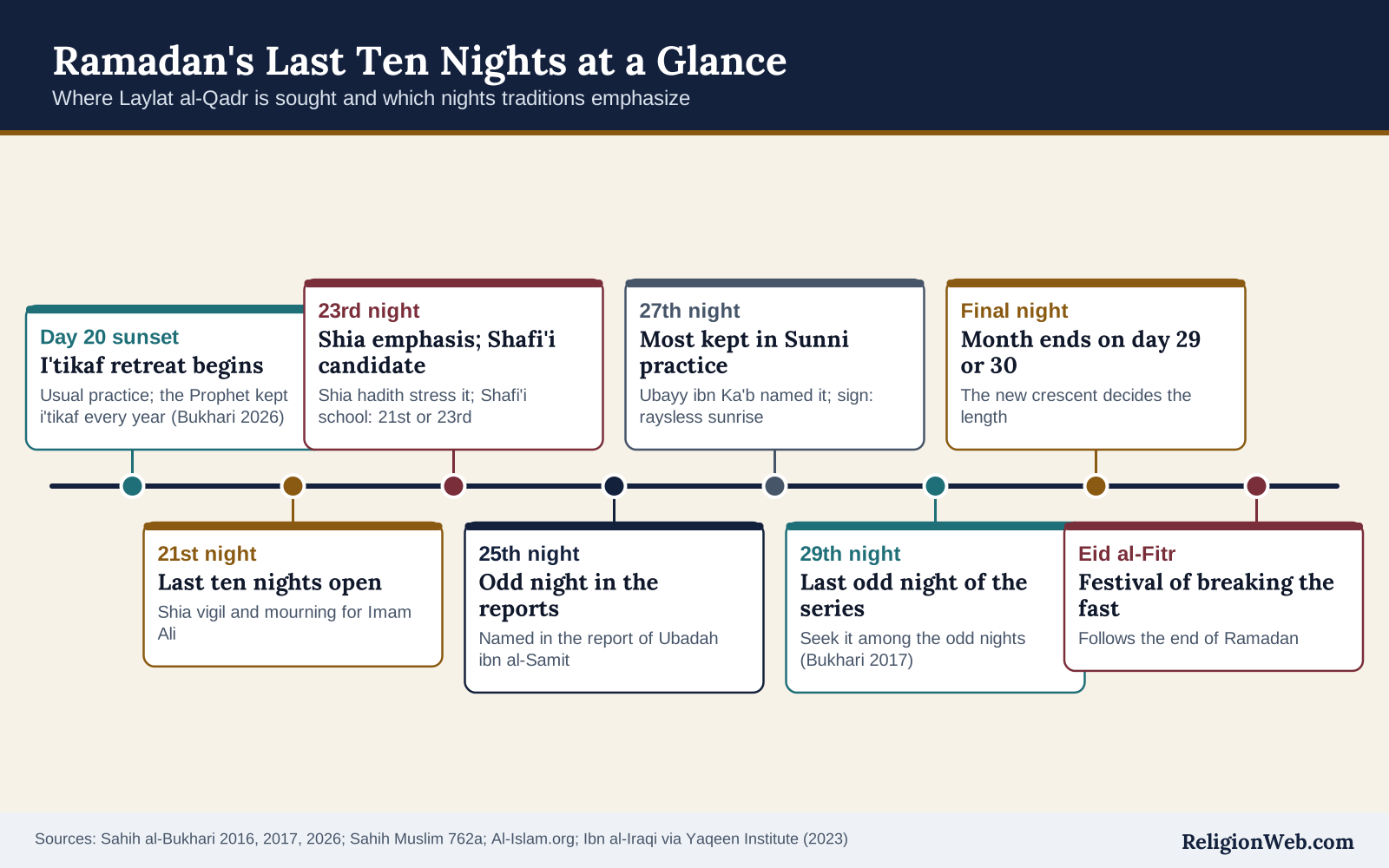
Within those ten nights, the reports single out the odd-numbered ones. A report from the Prophet’s wife Aisha in Sahih al-Bukhari (no. 2017), found also in Sahih Muslim, says in paraphrase that the Prophet told the community to look for Laylat al-Qadr among the odd nights of the last ten of Ramadan. A report in Sahih al-Bukhari (no. 2015) narrated by Ibn Umar says, again in paraphrase, that some Companions had seen in dreams that the night falls in the last seven nights and that the Prophet advised those seeking it to look there. Jurists and commentators have treated these reports as the foundation of the practice, and the table below shows how the framework is usually laid out.
| Night | Begins at sunset on | Associations noted in the traditions |
|---|---|---|
| 21st night | Day 20 of Ramadan | Often the start of i’tikaf; a Shia night of vigil and mourning for Imam Ali; traditionally read as the night of the rain-and-mud report in Sahih al-Bukhari |
| 23rd night | Day 22 of Ramadan | Emphasized in Shia tradition; one of two nights the Shafi’i school has favored |
| 25th night | Day 24 of Ramadan | Listed among the odd nights in the report of Ubadah ibn al-Samit |
| 27th night | Day 26 of Ramadan | Identified by Ubayy ibn Ka’b; widely kept in Sunni communities; in many places mosques complete the Quran recitation |
| 29th night | Day 28 of Ramadan | The last odd night of the series |
| Even nights (22nd to 30th) | Days 21 to 29 | Included in the effort of many who do not limit seeking to the odd nights |
The framework is a guide to effort, not a statement of fact about where the night lies. Several scholars teach that a person seeking the night should strive throughout the whole series, and the narrower reports are read as encouragement toward the odd nights without excluding the others. This approach is discussed further in the section on dating the night.
What the Hadith Reports Say About the Prophet’s Practice
Striving harder and waking the household
The best-known description of how the Prophet spent the last ten nights comes from Aisha. In Sahih al-Bukhari (no. 2024) she reports that when the last ten nights began, the Prophet stayed awake in prayer through the night and woke his family to join him, and the report adds that he tightened his waist wrapper, which readers take as an idiom for applying himself with great effort. A related report in Sahih Muslim (no. 1174) says that he exerted himself in worship in these nights beyond what he did at other times. Muslims read these accounts as a model of intensified devotion, and the practice of waking family members for the late-night prayer in many households follows directly from them.
The reports do not describe a set ritual formula. They describe a change of tempo: more prayer, less sleep, and the participation of the household. This explains why the observance has always been flexible in form, with the main constants being worship, recitation, and prayer for forgiveness.
I’tikaf every year
Another report from Aisha, in Sahih al-Bukhari (no. 2026), says that the Prophet kept i’tikaf in the last ten days of Ramadan every year until his death, and that his wives continued to do so afterward. I’tikaf is a retreat in a mosque in which the person sets aside ordinary affairs for worship, and the Quran mentions being in retreat at the mosques in the context of the fasting rules of Surah 2 (verse 187). Sahih al-Bukhari also preserves an account (no. 2016) from the Companion Abu Said al-Khudri in which the Prophet kept i’tikaf in the middle ten nights, was then shown the night but made to forget its date, and told those with him to return for the final ten, adding that he had dreamed of prostrating in water and mud. In the report, rain fell despite a clear sky and came through the palm-stalk roof of the mosque, and the narrator saw the Prophet prostrating in mud, which he recalls as a confirmation of the dream. The report is traditionally read as describing the twenty-first night, and the Sunnah.com chapter summary places the rain there.
Seeking the night in the odd nights
The third strand is the instruction to seek. Several narrations tie the night to the final days of the month, and the compilations of Sahih al-Bukhari, Sahih Muslim, and the Sunan collections arrange them under the book of fasting, the book of i’tikaf, or a chapter devoted to the merit of the night. The table below gathers the main reports cited in this article, with the narrator, the reference, and a paraphrase of the content. The paraphrases follow the English text of the digital collection Sunnah.com, and the numbers are the collection numbers used there.
| Reference | Narrator | Content in paraphrase |
|---|---|---|
| Sahih al-Bukhari 2017 | Aisha | Seek the night among the odd nights of the last ten of Ramadan |
| Sahih al-Bukhari 2015 | Ibn Umar | Dreams of Companions agreed on the last seven nights; seek it there |
| Sahih al-Bukhari 2024; Sahih Muslim 1174 | Aisha | The Prophet stayed awake, woke his family, and exerted himself in the last ten nights |
| Sahih al-Bukhari 2026 | Aisha | The Prophet kept i’tikaf in the last ten days every year; his wives continued it |
| Sahih al-Bukhari 2016 | Abu Said al-Khudri | The date was shown then forgotten; seek it in the odd nights; the mud-and-rain dream |
| Sahih al-Bukhari 49 | Ubadah ibn al-Samit | A dispute led to the date being lifted; seek it in the last ten |
| Sahih Muslim 762a | Zirr ibn Hubaysh, from Ubayy ibn Ka’b | Ubayy names the 27th night and the raysless sunrise as its sign |
| Sahih al-Bukhari 1901 | Abu Hurayra | Whoever stands in prayer on the night with faith and hope of reward has past sins forgiven |
| Jami at-Tirmidhi 3513 | Aisha | The Prophet taught a short prayer for pardon to say if one knows the night |
These reports are among the most frequently cited in Sunni sermons and manuals on the night, and Shia scholarship draws on a parallel corpus of reports transmitted through the Imams, discussed below. Readers should note that the grading and ranking of hadith is a specialized field and that the reports here are those the major Sunni collections preserve, which Sunni scholars regard as sound.
Surah al-Qadr and the Quranic Evidence
The Text of Surah 97
The five verses in Pickthall’s translation
Surah 97, titled al-Qadr, is among the shortest chapters of the Quran, with five verses. It is the only chapter devoted to the night, and every later discussion of Laylat al-Qadr, whether legal, devotional, or exegetical, goes back to it. The English below is the 1930 translation of Marmaduke Pickthall, an English convert to Islam whose rendering is in the public domain and is reproduced here as it appears in the Internet Sacred Text Archive. As in all translations, the English is an aid to the Arabic and not a replacement for it, which Muslims regard as the actual scripture.
Lo! We revealed it on the Night of Predestination. Ah, what will convey unto thee what the Night of Power is! The Night of Power is better than a thousand months. The angels and the Spirit descend therein, by the permission of their Lord, with all decrees. (The night is) Peace until the rising of the dawn.
Quran 97:1-5, trans. Marmaduke Pickthall, The Meaning of the Glorious Koran (1930), Internet Sacred Text Archive edition
A reader will notice that Pickthall uses two different English phrases for what is a single Arabic expression, “Predestination” in the first verse and “Power” afterward. This is a translator’s choice, not a feature of the Arabic, in which Laylat al-Qadr is repeated unchanged in all three places. Other renderings keep one English phrase throughout, and comparing translations is a common way for readers to see the range of the word qadr described earlier.
A verse-by-verse reading
The first verse says that “We” sent “it” down on the night, and the pronoun refers to the Quran even though the Quran is not named in the verse. Classical commentators such as Ibn Kathir take the antecedent for granted, because the surrounding tradition makes it plain, and the same verb of sending down appears in Surah 2:185 and Surah 44:3. The second verse is the rhetorical question already noted, which in Arabic begins wa-ma adraka, a formula the Quran uses to introduce subjects too large to describe by ordinary comparison.
The third verse gives the night its famous measure, “better than a thousand months.” A thousand months is about eighty-three years and four months, a span longer than most human lifetimes, and commentators have read the figure as expressing the night’s incomparable value. Ibn Kathir’s tafsir states that worship on the night is equal to worship over more than a thousand months and cites a hadith saying that whoever is deprived of its good has truly been deprived. The fourth verse names two groups who descend, the angels and al-Ruh, “the Spirit,” which Ibn Kathir reports is commonly taken to mean the angel Gabriel, singled out in the text for honor. The fifth verse describes the night as peace, and the commentators cited in the tafsir tradition, among them Mujahid, explain it as a night free from harm until dawn begins.
Key Quranic Themes
Revelation and the night
The first and most basic theme is revelation. Surah 97 connects the night to the sending down of the Quran, and the table below follows the main themes of the chapter, the places where the same themes appear elsewhere, and the way commentators read them. The table is a summary of exegetical positions, not a ranking of them, and the readings in the third column are those that appear in widely used classical and modern commentaries.
| Theme | Where it appears | How commentators read it |
|---|---|---|
| Revelation of the Quran | 97:1; 44:3; 2:185 | The Quran was sent down on this night in Ramadan, either entirely to the lowest heaven or as the start of revelation to the Prophet |
| The question of the night’s greatness | 97:2 | A rhetorical formula signaling a subject beyond ordinary description |
| Worth beyond a thousand months | 97:3 | Worship on the night is likened to worship over more than eighty-three years |
| Descent of angels and the Spirit | 97:4 | Angels descend in abundance; the Spirit is commonly identified as Gabriel |
| Decree and measure | 97:4; 44:4 | Matters for the coming year are determined or made clear on the night |
| Peace until dawn | 97:5 | The night is free from harm, and the blessing lasts until the dawn rises |
The theme of revelation is the least disputed among Muslims, and nearly every tradition holds that the night marks a decisive moment in the Quran’s coming down. What differs is the picture of how that coming down happened, which is the subject of the next section of the article.
Angels, the Spirit, and decree
The descent of the angels is the part of the chapter that most directly shapes devotional life. Ibn Kathir explains that the angels come down in great numbers because of the night’s blessing and mercy, in the way they are present at Quran recitation and at gatherings of remembrance, and he cites the early authority al-Sha’bi for the view that they greet worshipers with peace in the mosques until dawn. The phrase “with all decrees” in the fourth verse leads into the second sense of the name, decree. Sunni commentators typically read it as a night on which God’s decisions for the coming year are made known to the angels or written out for them from the Preserved Tablet, a reading Ibn Kathir supports with the opening verses of Surah 44.
Shia commentary takes up the same verses and draws a further conclusion. According to a summary in the Shia reference work Wikishia, a hadith attributed to the fifth Imam, Muhammad al-Baqir, teaches that each person’s destiny for the coming year is determined on the night, and the exegete Muhammad Husayn Tabataba’i, in his commentary al-Mizan, explains the measuring as covering life, death, livelihood, and happiness. Some Shia reports add that the angels present the year’s decrees to the Imam of the age, a claim that Shia scholars use to argue that every era needs an infallible Imam. Sunni Muslims do not share that last inference, but they share the larger picture of a night when heavenly activity is intensified.
Peace until the rising of dawn
The final verse brings the chapter to rest on the word salam, “peace.” Commentators cited in Ibn Kathir’s tafsir understand the peace in more than one way. Mujahid is reported to have said that it is a security in which Satan can do no evil, and that it is peace concerning every matter, while Qatadah and Ibn Zayd are reported to have said that the whole night is good and free of evil until dawn. The verse also gives the night its end point: hatta matla’i al-fajr, “until the rising of the dawn,” which is why the vigil traditionally lasts until the dawn prayer.
The peace in question is not understood as an absence of ordinary weather or events. The hadith literature discussed below includes a report in which rain falls on a night when the Prophet believes it to be Laylat al-Qadr, and scholars have not read the calm of the fifth verse as a meteorological promise. They read it as a spiritual quality that attends worship on the night.
Related Passages: Surah 44 and Surah 2
The blessed night in Surah 44
Two other passages are routinely read alongside Surah 97. The first is the opening of Surah 44, al-Dukhan, which speaks of a “blessed night” on which every wise command is made clear.
Lo! We revealed it on a blessed night – Lo! We are ever warning – Whereon every wise command is made clear
Quran 44:3-4, trans. Marmaduke Pickthall, The Meaning of the Glorious Koran (1930), Internet Sacred Text Archive edition
Most exegetes identify the “blessed night” with Laylat al-Qadr. Ibn Kathir cites Surah 97:1 and Surah 2:185 in support, and the Ma’ariful Qur’an, a widely used twentieth-century commentary from the South Asian Hanafi tradition, adopts the same identification as the majority view. The Ma’ariful Qur’an also reports the opinion of Ikrimah that the blessed night is the middle of Sha’ban, known in South Asia as Shab-e-Bara’at, and it rejects that reading on the ground that the revelation of the Quran in Ramadan rests on clear texts while the Sha’ban traditions are weak. It adds that whether the middle of Sha’ban has independent merit is a separate question on which it says “Allah knows best.” This is a good example of a point on which a mainstream commentary presents a minority view fairly before explaining why it does not follow it.
Ramadan and the Quran in Surah 2:185
The second passage is the verse in Surah 2 that makes Ramadan the month of the Quran. It is also the verse that gives the fast its legal framework, and the portion relevant here is the opening clause.
The month of Ramadan in which was revealed the Qur’an, a guidance for mankind, and clear proofs of the guidance,
Quran 2:185 (opening clause only), trans. Marmaduke Pickthall, The Meaning of the Glorious Koran (1930), Internet Sacred Text Archive edition
The verse does not mention the Night of Power by name. Its role is to establish the month, and the other two texts then locate the event within it. The three passages work like a chain: Surah 2:185 supplies the month, Surah 44 the blessed night, and Surah 97 the name of the night and its qualities. This is why Muslim exegetes treat them as a unit when they speak of the night.
How Commentators Understand the Descent of the Quran
The two-stage view
The most influential classical account of what “sent down” means is attributed to Ibn Abbas, a cousin of the Prophet and a founding figure of Quranic exegesis. In the form Ibn Kathir gives it, the Quran was sent down all at once from the Preserved Tablet to a place called Bayt al-Izzah, “the House of Might,” in the lowest heaven, on Laylat al-Qadr, and was then revealed in parts to the Prophet over twenty-three years. This reading allows the verb in the three Quranic passages to refer to a single event on the night while leaving room for the gradual revelation that the biography of the Prophet describes.
The Ma’ariful Qur’an repeats this account and notes a variant held by some scholars, namely that each year’s portion of the Quran was sent down to the lowest heaven on the night of that year. Both variants rest on the same idea: the night is a moment at which the Quran’s descent begins, and the long course of revelation in Mecca and Medina follows from it.
The beginning of revelation to the Prophet
A second line of reading connects the night more directly to the first revelation received by Muhammad. Britannica’s entry on the night presents the traditional account: after a period of habitual meditation in seclusion, Muhammad received the first revelation through the angel Gabriel, who commanded him to “Recite,” and this is believed to have occurred on one of the last ten nights of Ramadan in 610 CE, though the exact night is unclear. The command to recite is the opening of Surah 96, and Muslim tradition identifies it with the first of the revealed verses.
The two readings are not mutually exclusive, and many Muslim authors present them together, with the heavenly sending down preceding the first revelation to the Prophet on earth. For historians who work outside the tradition, the exact night is not something that early sources allow them to date, since the biographical literature on the Prophet was compiled later. The year 610 CE is a traditional dating, and the precise night within Ramadan remains a matter of belief and not of historical record.
What “better than a thousand months” means
The phrase “better than a thousand months” has produced both practical and interpretive discussion. In the Sunni tradition represented by Ibn Kathir, the main point is that worship on the night carries a reward greater than that of more than eighty-three years of ordinary worship, and the same tradition cites the report of Abu Hurayra that whoever stands in prayer on the night out of faith and in hope of reward has his past sins forgiven (Sahih al-Bukhari, no. 1901). The hadith ties the night to forgiveness as well as to reward, and the emphasis on pardon shapes the supplication Muslims are taught to say, discussed later.
Shia commentary reads the verse in connection with the claim that the night recurs every year, a point made by the exegete Naser Makarem Shirazi in his commentary Tafsir-e Nemuneh, who points to reports that some Shia scholars regard as widely transmitted. Both traditions share the central meaning: the night is one of unusual value, and a person’s effort in it is meant to be understood as extraordinary and never as one routine night among others.

How the Observance Developed: From the Early Community to Today
The Early Community
The Companions and the question of the date
The reports gathered in the hadith collections show that the question of the night’s date was open among the Prophet’s own Companions. Ubayy ibn Ka’b, a Companion known as one of the great reciters of the Quran, swore in a report preserved in Sahih Muslim (no. 762a) that the night was the twenty-seventh and gave the sign of a morning sun that rises bright and without rays. He was answering a statement attributed to another Companion, Abdullah ibn Mas’ud, that whoever prays at night throughout the year will find the night. Ibn Umar is reported to have held that it could be any night of Ramadan, and the Bukhari report on the dreams of the Companions points toward the last seven nights.
This early range of views matters because later scholarship did not close it. The fourteenth-century Shafi’i jurist Ibn al-Iraqi catalogued twenty-seven distinct opinions on the night in his treatise Sharh al-sadr bi-dhikr Laylat al-Qadr, and he notes that the later hadith scholar Ibn Hajar al-Asqalani counted forty-six in his commentary on Sahih al-Bukhari. The multiplicity is a historical fact about the community’s reading of the reports, not a sign of confusion about the night’s reality, which no early authority doubted.
Night prayer in congregation
The communal side of the night grew out of the practice of Ramadan night prayer. Sahih al-Bukhari (no. 2012) preserves a report from Aisha that the Prophet once prayed the night prayer in the mosque in Ramadan, that more people joined him on each successive night, and that on the fourth night he did not come out, explaining afterward that he feared the prayer would be made obligatory for them. After his death, the report adds, people continued to pray individually. Sahih al-Bukhari (no. 2010) then records that Umar ibn al-Khattab, finding people praying in scattered groups in the mosque, gathered them behind a single reciter, Ubayy ibn Ka’b, and called the arrangement “an excellent innovation,” while observing that the prayer of the late night, which people sleep through, is better than the early-night prayer they were performing.
Together the reports explain two features of later practice. The congregational tarawih prayer, discussed in the article on Muslim prayer, traces to Umar’s arrangement, and the preference for the deep night as the best time for devotion is why the vigils of the last ten nights run well past the usual evening prayers.
Medieval and Early Modern Developments
Scholarly debate and devotional literature
By the medieval period the night had its own literature. Jurists wrote on its date, hadith scholars on the soundness of the reports, and preachers on the merit of spending it in worship. The treatise of Ibn al-Iraqi, who lived from 1361 to 1423, belongs to this tradition, as does the extended discussion in Ibn Hajar’s commentary on Sahih al-Bukhari. The Cairo scholarly milieu in which both men worked produced manuals that organized the evidence into the forms later readers know: the opinions on the date, the signs, the hadith on forgiveness, and the supplication to say.
The opinion most often endorsed in this literature is that the night lies in the last ten nights and that an odd night is more likely than an even one. The Saudi Standing Committee for Islamic Research and Fatwa, an institutional source in the modern period, takes the same line and holds the twenty-seventh most likely, while adding, like most scholars, that no one can be certain of a particular night.
Court and community celebrations
In some regions the night acquired public ceremonial. A Turkish encyclopedia entry notes Ottoman-era “Laylat al-Qadr processions” and the illuminated messages called mahya that are hung between minarets. Court-centered ceremonies of this kind also exist in Southeast Asia, and one is described in the section on regional customs.
These ceremonies show how an essentially private devotion was given a civic and cultural shape in particular places. They are regional forms, and they sit beside the near-universal core of prayer and recitation without replacing it. The modern period has brought large-scale mosque programs and national religious administrations into the picture, and those are taken up below.
When Is Laylat al-Qadr? Date Traditions and Calendar Rules
Why the Texts Do Not Name the Night
What the Quran specifies and what it leaves open
Surah 97 names the night, praises it, and says what happens on it, but it gives no date. A Turkish encyclopedia entry puts it plainly: the Quran does not specify the date, and the Prophet recommended searching the odd nights of the last ten days of Ramadan. The result is that every statement about the date is an inference from hadith reports, from the reports of Companions, or from the juristic reasoning that connects them. Even the most widely held views are expressed by scholars in terms of likelihood, not certainty.
This feature of the texts is read by Muslim scholars as deliberate and meaningful, not as a gap to be filled. The practical lesson drawn in the fatwa literature is that the concealment encourages people to exert themselves across many nights and not rely on one; the fatwa site IslamQA, for example, compares the hiddenness of the night to the hadith on learning the names of God. The Saudi Standing Committee for Islamic Research and Fatwa, quoted in a widely read fatwa site, concludes that no one can be sure of a particular night and that believers should not fix on one but should strive through the last ten nights.
The reports that the date was concealed
The hadith corpus does not merely leave the date unstated; it preserves reports in which the Prophet knew it and the knowledge was withdrawn. In the report of Abu Said al-Khudri already noted (Sahih al-Bukhari, no. 2016), the Prophet says he had been shown the night but made to forget it and directs the community to the odd nights of the last ten. The report of Ubadah ibn al-Samit, discussed in the box below, gives a different circumstance for the same withdrawal. Muslim scholars therefore treat the concealment as part of the sources’ own teaching and not as a failure of transmission.
Major Date Traditions
Sunni positions
Among Sunni Muslims there is a broad common ground and several particular views. The common ground is the hadith of Aisha that the night is to be sought among the odd nights of the last ten. Within that framework the twenty-seventh night has the largest popular following. Britannica states that observance is most commonly on the twenty-seventh night for Sunni Muslims, a statement about practice and not a doctrinal ruling, and the Saudi Standing Committee, as reported on a fatwa site, calls the twenty-seventh the most likely night. The report of Ubayy ibn Ka’b supplies the textual basis. Some scholars have added numerical arguments, and a commonly repeated example counts the thirty words of the Arabic surah and observes that the pronoun hiya, “it,” in the phrase “it is peace,” is the twenty-seventh word. Ibn Atiyya, a medieval exegete, is reported by Ibn al-Iraqi to have found such arguments tangential to real interpretation.
The legal schools do not speak with a single voice. According to Ibn al-Iraqi, the Shafi’i school’s preferred opinion is that the night falls in the last ten, more likely on an odd night, and most likely the twenty-first or twenty-third. A group of early authorities, including Malik, Sufyan al-Thawri, Ahmad ibn Hanbal, and Ishaq ibn Rahwayh, held that the night moves from year to year within the last ten nights, and the later jurist al-Nawawi favored this view as the only way to reconcile the various reports. An opinion often attributed to Abu Hanifa makes it possible on any night of the year, while Ibn Hajar also reports that Abu Hanifa held the twenty-seventh. Ibn Umar is reported to have said it could fall on any night of Ramadan.
| Tradition or authority | Position on the night | Basis cited |
|---|---|---|
| General Sunni teaching | An odd night of the last ten nights | Aisha’s report, Sahih al-Bukhari 2017 |
| Ibn Umar and the dreams of the Companions | The last seven nights | Sahih al-Bukhari 2015 |
| Ubayy ibn Ka’b; popular Sunni practice; Saudi Standing Committee | The 27th night, called most likely | Sahih Muslim 762a; sign of the raysless sunrise |
| Shafi’i school (as reported by Ibn al-Iraqi) | Last ten nights, odd more likely, perhaps the 21st or 23rd | Reconciliation of the reports |
| Malik, al-Thawri, Ahmad, Ishaq; favored by al-Nawawi | Moves from year to year within the last ten nights | Harmonizing differing reports |
| Opinion attributed to Abu Hanifa | Any night of the year; also reported as the 27th | Saying attributed to Ibn Mas’ud |
| Shia tradition | The 19th, 21st, or 23rd nights; the 23rd emphasized | Hadith from the Imams, including the account of the man of Juhayna |
The table shows why a sentence such as “Muslims observe Laylat al-Qadr on the twenty-seventh night” is accurate as a description of a widespread custom and inaccurate as a statement of doctrine. It is a popular and well-supported practice, but it sits within a spread of positions that the tradition itself records.
Shia positions
Shia hadith specify the nineteenth, twenty-first, and twenty-third nights as the strongest candidates, and Shia communities keep special all-night worship on these nights. The twenty-third receives the greatest emphasis through a narration about a man from the Juhayna tribe, who lived at a distance from Medina; according to this report, the Prophet told him to come on the twenty-third, which is why the night is called the great night of Qadr and the night of al-Juhani, and the Prophet and the Ahl al-Bayt (his household) are reported to have emphasized this night most. Shia scholars at the same time say that all these nights are valuable. An encyclopedic overview on Wikishia records that some Shia sources also mention the twenty-seventh of Ramadan and the fifteenth of Sha’ban as further possibilities.
The nights also coincide with the memory of the death of Imam Ali, the first Imam in Shia belief, who died during the last ten days of Ramadan; Shia Muslims mourn him on these nights and commemorate his death on the twenty-first. The overlap gives Shia observance a different emotional register from the Sunni pattern without altering the shared aim of seeking forgiveness and nearness to God.
Why scholars say to strive across the whole series
Ibn Hajar’s own conclusion, as quoted in a fatwa, is that the night is most likely in the last ten nights, on an odd night, but not on any one fixed night. The fatwa-based practice that follows from this is to give particular energy to the odd nights without neglecting the even ones, since in the rotating view the night may fall on any of them. The thread that runs through the Sunni positions is practical: the tradition values the seeking more than the knowing, and it asks for worship that would be worthwhile on any night.
Calendar Rules and the Civil Date
How the Islamic calendar sets Ramadan
Ramadan begins when the new crescent moon is sighted or, in countries that rely on calculation, when astronomical criteria say it should have been. The Islamic year has twelve lunar months and is about eleven days shorter than the solar year, so Ramadan arrives about eleven days earlier on the civil calendar each year and cycles through all the seasons in roughly thirty-three years. The month has either twenty-nine or thirty days, depending on the moon.
These rules mean that there is no fixed civil date for any night of Ramadan, and certainly none for Laylat al-Qadr. A neighbor in one country may begin the fast a day before one in another, because religious authorities differ over whether to rely on local sighting, on sighting elsewhere, or on calculation. The article on Ramadan covers these methods in detail.
Why no single civil night applies everywhere
Three things combine to make the question “what is the date of Laylat al-Qadr?” unanswerable with a single civil date. First, the reports leave the night uncertain within the last ten. Second, the start of Ramadan can differ by a day between countries, so the “twenty-seventh night” falls on different civil evenings in different places. Third, in the view that the night rotates, it may be a different night in each year. For these reasons, the question is better phrased as “which nights do people keep,” and the answer is a list of nights and traditions.
When websites or newspapers announce a date for the night, they are announcing the date of the twenty-seventh night, or whichever night is customary in their country. Such announcements are conventions for scheduling prayers and public programs and are not claims of certainty.
2026 and 2027
For orientation, in 2026 Ramadan began on February 18 or 19, depending on the country, and Eid al-Fitr fell on March 20 in Saudi Arabia and many other countries, so the last ten nights of that year have already passed. For 2027, astronomers quoted by Gulf News on October 10, 2026, forecast that Ramadan would begin on Monday, February 8, 2027, in the United Arab Emirates, subject to official moon-sighting confirmation, with Eid al-Fitr on March 9 or 10. If the fast does begin on February 8, then the twenty-first night would begin at sunset on February 27 and the twenty-seventh night at sunset on March 5, by the counting rules explained above. Those dates are a calculation from a forecast and not a published calendar, and local announcements may differ by a day.
Signs Reported for the Night
Reports of a calm night and a raysless sunrise
Several reports describe signs by which the night may be recognized after the fact. The best known is the one given by Ubayy ibn Ka’b: the sun rises on the following morning bright and without rays (Sahih Muslim, no. 762a). Ibn Kathir’s tafsir, drawing on further hadith, describes the night as pure and calm, neither cold nor hot, with no shooting stars until morning, and says the next sunrise comes up without its usual rays, like a full moon.
Ibn al-Iraqi gives the raysless sunrise as the most authentic of the signs and reports other descriptions of weaker transmission, including windless or cool nights. He also notes that one report mentions wind, rain, and thunder, which he reconciles with the view that the night moves from year to year. The report of Abu Said al-Khudri, in which rain fell through the mosque roof, is the classic example of a night described with rain.
How scholars treat the signs
Many scholars treat the signs as retrospective confirmation, not as instructions about when to pray. A believer is encouraged to spend the odd nights in worship whether or not any unusual sign is noticed, and the tradition cautions against turning the night into a search for outward marvels. The practical value of the signs lies in the reassurance they have given generations of worshipers, not in a test of whether one has found the night.
How Muslims Observe Laylat al-Qadr: Prayer, Recitation, Supplication, and Retreat
Night Prayer and Quran Recitation
Qiyam, tarawih, and tahajjud
The central act of the night is standing in prayer. There is no prayer reserved exclusively for Laylat al-Qadr, a point made in a 2025 Bangladeshi news report that notes worshipers offer voluntary prayers, remembrance, recitation, and charity through the night. What the sources encourage is the ordinary night prayer, extended. The report of Abu Hurayra in Sahih al-Bukhari (no. 1901) says that whoever stands in prayer on the night with faith and in hope of reward has his past sins forgiven, and Aisha’s account of the Prophet staying awake in the last ten nights (Sahih al-Bukhari, no. 2024) provides the model.
In practice, many Muslims pray the congregational tarawih prayer after the evening prayer, often with longer recitation in the last ten nights, and then return later for voluntary night prayers (qiyam or tahajjud) in the last part of the night, before the pre-dawn meal. Others pray at home. The five obligatory daily prayers, described in the article on Muslim prayer, continue unchanged, and the extra prayers are voluntary, with their form and length left largely to the individual.
Reading and completing the Quran
Because the night is tied to the Quran’s revelation, recitation has a natural place in its observance. In many communities in South Asia and elsewhere, mosques that hold a khatm (a complete recitation) during tarawih time it so that the final section is read on the twenty-seventh night, and the 2025 report from Dhaka describes mosques completing the Quran on that night. For Shia Muslims the recommended acts include reciting Surahs 44 and 97 and, in the rite described on Al-Islam.org, holding the Quran over the head, which the Al-Islam.org answerer explains as seeking the Quran’s blessings and renewing a commitment to follow God’s commands.
Recitation is understood as a form of devotion in its own right and not only as study. A person who cannot read Arabic may listen, read a translation, or recite the short surahs they know, and the tradition does not require a particular amount.
Supplication and Remembrance
The prayer for pardon
The supplication most closely connected with the night comes from a report in Jami at-Tirmidhi (no. 3513), graded sound in the Darussalam edition shown on Sunnah.com. Aisha asked the Prophet what she should say if she knew which night was Laylat al-Qadr, and he taught her a short prayer, which in transliteration runs Allahumma innaka ‘afuwwun, tuhibbu al-‘afwa fa’fu ‘anni, and which means in paraphrase, “O God, You are the Pardoner and You love to pardon, so pardon me.” Some versions add the word karim, “generous,” after ‘afuwwun. The prayer asks for pardon and not for a worldly benefit, and its brevity makes it one that many Muslims memorize.
The article on dua in Islam treats supplication in general, including its etiquette and the times considered especially suited to it. The last part of the night and the hours before dawn are among those times in the Sunni tradition.
Remembrance, forgiveness, and longer supplications
Alongside personal supplication, Muslims fill the night with dhikr, the remembrance of God by repeating phrases of praise, and with seeking forgiveness (istighfar). Sufi communities, described in the article on Sufism, often make the night an occasion for group remembrance in their own forms. In Shia practice the repertoire includes longer supplications such as the Jawshan al-Kabir, which one Al-Islam.org answerer notes can be recited at any time, and the Iftitah and Abu Hamza al-Thumali supplications, which are recited communally in many Shia settings according to the Wikishia overview.
Retreat, Charity, and Family Life
I’tikaf
For many Muslims the most concentrated form of seeking is i’tikaf, the retreat in a mosque during the last ten days, begun in the usual practice before sunset on the twentieth day, so that the person is in the mosque as the twenty-first night opens, and ended when the month ends. Faraz Rabbani, writing on the Seekers Guidance site from the Hanafi tradition, explains that the retreat at the end of Ramadan is a communal sunna, meaning that the community is expected to ensure that some of its members do it, and that neglecting it altogether is blameworthy for the community as a whole. During i’tikaf a person leaves the mosque only for necessities such as the toilet or a required bath, and the retreat is valid for men only in a mosque.
For women, the Hanafi guidance on the same site is that a woman may designate a place in her home as her prayer space and perform i’tikaf there, and that her presence in a mosque is normally treated as somewhat disliked, though other schools and contemporary scholars differ and many women in fact observe the last ten nights in mosques. Even those who cannot observe a full i’tikaf may spend a part of the night in the mosque. The building itself is described in the article on the mosque.
Charity, reconciliation, and the household
Charity rises in the last ten nights, as it does throughout Ramadan, and the tradition connects giving to the night’s themes of mercy and pardon. Obligatory almsgiving is covered in the article on zakat, and the special alms of the fast-breaking festival, zakat al-fitr, is described in the article on Eid al-Fitr. Many families treat the night as a time for reconciling with relatives and neighbors, since seeking forgiveness from God is connected in the tradition with forgiving others. Following Aisha’s report that the Prophet woke his family, households often wake one another for the late prayer and share a pre-dawn meal afterward.
Women, children, travelers, and those who are unwell
The tradition recognizes that not everyone can keep the same vigil. Women who are menstruating are excused from the ritual prayer and the fast, but they may take part in supplication, remembrance, charity, and attendance at gatherings, and many Muslim women attend mosque programs; modest dress follows the standards discussed in the article on hijab in Islam. Children typically join for part of the night, and travelers, the elderly, and those with illnesses adapt their participation. A short, bounded note belongs here: the exemptions of Islamic law for illness exist so that devotion does not cause harm, and a person with a medical condition, a pregnancy, or a medication schedule should follow a physician’s advice about fasting and sleep, since a long vigil is not a substitute for medical care.
| Practice | What it involves | Notes on status and variation |
|---|---|---|
| Night prayer (qiyam, tarawih, tahajjud) | Extended standing prayer, in congregation or alone | Voluntary; no prayer is exclusive to the night |
| Quran recitation and khatm | Reading, listening, or completing the full Quran | Timing of the khatm varies; often the 27th in South Asia |
| Supplication (dua) | Personal prayer, including the short prayer for pardon | Based on Jami at-Tirmidhi 3513; widely taught |
| Remembrance and forgiveness-seeking | Dhikr and istighfar | Group forms are common in Sufi communities |
| I’tikaf | Retreat in a mosque for the last ten days | Communal sunna in the Hanafi tradition; rules differ by school |
| Charity | Voluntary giving and food for others | Zakat and zakat al-fitr are separate obligations |
| Waking the household | Rousing family for the late prayer | Modeled on Sahih al-Bukhari 2024 |
| Shia vigil acts | All-night worship, Quran over the head, recitation of Surahs 44 and 97, longer supplications | Observed on the 19th, 21st, and 23rd nights |
The practices in the table are complementary and not a checklist, and most worshipers combine several of them in whatever proportion their circumstances and tradition allow.

Regional and Communal Customs Around the World
The Holy Mosques and Turkey
Mecca and Medina
Ramadan draws very large numbers of Muslims to the Grand Mosque in Mecca, the building that surrounds the Kaaba, and many pilgrims perform the lesser pilgrimage known as Umrah during the month. News reports each year describe especially dense crowds on the odd nights of the last ten, and on the twenty-seventh in particular, with long congregational night prayers led by the imams of the two holy mosques. Because the Grand Mosque and the Prophet’s Mosque in Medina broadcast their prayers widely, many Muslims who are not present follow the recitation and the closing supplications at home.
The prevailing opinion expressed by the Saudi Standing Committee, noted earlier, that the twenty-seventh is the most likely night, is part of the background to this emphasis, and it is the night that many visitors plan around. Attendance figures vary from year to year and are reported by officials and the press in different ways, so none are given here.
Turkey and Kadir Gecesi
In Turkey the night is called Kadir Gecesi and is observed, by tradition, on the twenty-seventh night of Ramadan. A 2013 report in Hurriyet Daily News said that more than five thousand mosques across the country would stay open all night and that the Diyanet had prepared 1,694 mosques for people observing i’tikaf, together with arrangements for worshipers with disabilities. A Turkish encyclopedia entry adds the Ottoman-era processions and mahya lights already mentioned, and the custom of naming children born on the night Kadir or Kadriye. The figures are from one year and illustrate the scale of organization; they are not current statistics.
South and Southeast Asia
Shab-e-Qadr in the subcontinent
Across Bangladesh, India, and Pakistan the night is commonly called Shab-e-Qadr. A March 2025 report in the Dhaka Tribune says that many scholars in the subcontinent consider the twenty-seventh night the most likely, that mosques in Dhaka were crowded, with some worshipers praying in the streets, and that the Baitul Mukarram National Mosque was especially full. It adds that mosques holding a khatm during tarawih, the recitation of the whole Quran across the month’s evening prayers, complete it on this night, and that families, including women and children, pray, recite, and make supplications at home until the pre-dawn meal.
The same report notes that no prayer is exclusive to the night, so that people offer voluntary prayers, remembrance, recitation, and charity. This accords with the guidance noted above and illustrates how a night with a single scriptural basis can be lived in recognizably local ways: the Quran completed, the street prayers, and the home vigil are all characteristic of the region.
Malem Selikuran in Java
In the Javanese court city of Surakarta, the Kasunanan Palace holds a ceremony called Malem Selikuran on the twenty-first night of Ramadan to welcome the Night of Power, which Indonesian Muslims call Lailatul Qadar. As described by the Jakarta Post for the 2018 edition, participants carry lanterns and offerings in a procession of about two and a half kilometers from the palace to a nearby park, accompanied by palace marching bands and gamelan music, and the lanterns symbolize the light of the soul. The customary dish is sego wuduk, rice cooked in coconut milk and shaped into a cone, and about a thousand portions are shared with palace servants and the public. A palace official explained the ceremony as a commemoration of the Prophet’s descent from Mount Nur, when his companions welcomed him with torches and food; that is the palace’s own account and not an independently verified history.
The ceremony is a cultural expression layered on the common devotion and is held on the twenty-first night, one of the nights that both Sunni and Shia sources mention. It does not replace the prayers in mosques that the same night brings.
Shia Communities and Muslims as Minorities
Vigils in Shia communities
Shia communities in Iran, Iraq, South Asia, and elsewhere keep the nineteenth, twenty-first, and twenty-third nights with all-night vigils, as noted above. The twenty-first night in particular joins the search for the Night of Power with the memory of the death of Imam Ali, so that the mood in many Shia gatherings combines devotion with mourning. Gatherings include the recitation of the long supplications mentioned earlier, and the rite of holding the Quran over the head is part of the recommended acts of these nights. This pattern is described within Shia communities as the ordinary practice of the nights, not as a departure from the ordinary meaning of the night.
The wider Shia calendar is dominated by the mourning of Muharram and Ashura, treated in the article on Muharram and Ashura. Laylat al-Qadr belongs to a different register of the year, one of intense but quiet prayer within Ramadan, even where it shares the theme of the Imams’ memory.
Muslims in Europe and North America
Muslims living as minorities keep the night within the rhythms of work and school. Many mosques in these settings schedule long programs on the odd nights, particularly the twenty-seventh, when families bring children for part of the evening, and individuals who cannot spend the whole night in the mosque often pray at home for part of it. The civil calendar shifts by about eleven days a year, so the night moves through the seasons, and communities find that a winter night allows an extended vigil that ends before dawn while in high summer at northern latitudes the short night leaves less time. These are general patterns, based on how congregations commonly schedule their programs, and they vary widely between communities and cities.
Dietary and community arrangements follow the usual patterns of Ramadan. Shared meals at mosques before the fast and after the vigil are common, and the rules for such meals are described in the article on halal food.
Common Misconceptions About Laylat al-Qadr
Misconception 1: Every Muslim tradition identifies exactly the same date
Where the misunderstanding comes from
The idea is easy to acquire. Newspapers and mosque announcements commonly say that Laylat al-Qadr “falls on” the twenty-seventh night, and a reader who sees this repeated each year may take it as a settled fact. English-language summaries also tend to compress the range of views into one sentence, and a quick search can produce a single date with no mention of the discussion behind it.
There is a sound reason for the habit. The twenty-seventh night is the most widely kept night in many Sunni communities, and a person looking for a date to plan around will naturally be given that one.
What the evidence and tradition actually show
The sources record a wide spread of positions. Ibn Hajar reported forty-six opinions on the night, and Ibn al-Iraqi listed twenty-seven. Shafi’i jurists favored the twenty-first or twenty-third, a group of early authorities held that the night rotates within the last ten nights from year to year, an opinion attributed to Abu Hanifa allowed any night of the year, and Shia hadith emphasize the nineteenth, twenty-first, and twenty-third, with the twenty-third most prominent. Britannica’s description that observance is most common on the twenty-third for Shia Muslims and the twenty-seventh for Sunni Muslims is accurate as a statement about practice, and no major tradition treats the date as known with certainty.
The calendar itself adds a further layer, since the start of Ramadan can differ by a day from one country to another. For that reason the question “which civil night?” cannot have one answer for all Muslims.
Even within the group that favors the twenty-seventh, the reasons differ. Some rely on the report of Ubayy ibn Ka’b and its sign of a raysless sunrise, some on numerical arguments about the wording of the surah that other commentators regarded as tangential, and some on the practical judgment of the Saudi Standing Committee that odd nights are more likely than others while no one can be sure. A sermon or announcement that names a particular night is best read as devotional emphasis, not as a claim that the question has been closed.
Misconception 2: Laylat al-Qadr is a separate holiday outside Ramadan
Where the misunderstanding comes from
Lists of Islamic holidays often place Laylat al-Qadr beside the two Eids, and some English-language reference works describe it as a festival, which makes it look like an additional date in the year. Calendars that print it on a single day reinforce the impression, and some readers confuse it with other special nights, such as the middle of Sha’ban, which many South Asian and other communities mark separately.
Names such as “Night of Power” also sound like a title for an event with its own day, and the habit of announcing a date makes it seem like a feast day.
What the evidence and tradition actually show
Laylat al-Qadr is a night within Ramadan, and its hadith are placed in the books of fasting and i’tikaf of the great collections. The two festivals of Islam, Eid al-Fitr at the end of Ramadan and Eid al-Adha in the month of pilgrimage, are public celebrations with a prayer, a sermon, and festive meals, while the Night of Power has no feast and no prescribed ceremony. The label “festival” in some reference works reflects its place in calendars more than its character.
The Quranic chain of texts also ties the night to Ramadan: Surah 2:185 for the month, Surah 44 for the blessed night, Surah 97 for its name. The Ma’ariful Qur’an treats the identification of the “blessed night” as part of Ramadan as better supported than the Sha’ban alternative, and the mid-Sha’ban night, where it is observed, is regarded as a separate matter.
Counting adds a further source of confusion. Because the Islamic day begins at sunset, the “night of the twenty-seventh” is the evening before the daytime of the twenty-seventh, so a calendar that prints a single date for the night may be pointing to the daytime date that follows it. Anyone planning to attend a vigil does best to ask the local mosque which evening it keeps.
Misconception 3: The night is primarily a public festival rather than an intensive devotional period
Where the misunderstanding comes from
Images of crowded mosques, illuminated minarets, street prayers, and processions can suggest a public celebration, and photographs in the press often show large gatherings. Cultural ceremonies such as the Javanese Malem Selikuran, with its lanterns and shared food, add to the impression of a festive occasion, as do the Ottoman-era processions that Turkish sources describe.
Observers outside the tradition may also assume that a night so highly valued must be publicly marked in the way many festivals are, especially when they encounter it in a list of holidays.
What the evidence and tradition actually show
The prophetic reports describe an intensification of private and household worship: staying awake, waking the family, retreating to the mosque for i’tikaf, and seeking forgiveness. The gatherings that do happen, such as tarawih and the completion of the Quran, are devotional in character, and the mood is solemn. In Shia communities the nights are accompanied by mourning for Imam Ali, which gives them a still more somber tone.
Cultural ceremonies exist and are part of the lived picture, but they are regional additions that rest on the devotional core and are not its definition. A visitor who attended only the lantern procession in Surakarta, or only a crowded street scene in Dhaka, would see one side of a night that is mostly spent in prayer, in recitation, and in quiet supplication.
Even the communal form of night prayer was shaped by a concern for its voluntary character. The report in Sahih al-Bukhari (no. 2012) says that the Prophet stopped coming out to lead the crowd that gathered, fearing that the prayer might be made obligatory for them. The tradition has since valued the night prayer as freely offered devotion, and that emphasis on voluntary effort is part of why the night is described as one of striving and not of spectacle.
Misconception 4: The night is mainly for making wishes that are granted automatically
Where the misunderstanding comes from
Social media posts and greeting cards sometimes present the night as one on which any wish will be granted, and the idea that fate for the coming year is “written” on the night can be misunderstood as a chance to rewrite it by a particular formula. Some popular guides describe special sequences of prayers promised to bring specific results, and a reader may take these as the point of the night.
The Quranic language of “all decrees” also invites the question of what supplication can change, a question about which Muslim theologians have written at length.
What the evidence and tradition actually show
The supplication that the hadith tradition actually attributes to the Prophet for the night is a request for pardon: “You love to pardon, so pardon me” (Jami at-Tirmidhi, no. 3513). The reports on the night’s merit speak of forgiveness of past sins (Sahih al-Bukhari, no. 1901), not of specific worldly outcomes. Sunnis and Shia both encourage a wide range of personal supplications, including requests for health, provision, and guidance, and the practice of dua is treated in detail in the article on dua in Islam.
The sources frame supplication as an expression of sincerity and dependence on God and not as a mechanism with guaranteed results. A person is encouraged to ask, but the tradition does not describe the night as a transaction.
Shia sources show the same pattern. An answerer on Al-Islam.org notes that the long supplication known as the Jawshan al-Kabir can be recited at any time, so even a text strongly associated with these nights is not confined to them. The long supplications of the Shia tradition are acts of remembrance and praise, and their length and language are part of the devotion they express.
Frequently Asked Questions About Laylat al-Qadr
Questions About Meaning and the Quran
What does Laylat al-Qadr mean in English?
Laylat al-Qadr is most often translated as the Night of Power, the Night of Decree, or the Night of Destiny. The Arabic qadr can mean measure or decree, and it can also mean rank, honor, or power, so each English phrase captures part of the meaning. Pickthall’s translation uses Predestination in the first verse of Surah 97 and Power in the next two.
The choice of phrase is therefore a matter of emphasis. Commentary on the night draws on both the sense of decree, since matters are said to be determined on it, and the sense of exalted standing, since it is described as better than a thousand months.
Is Laylat al-Qadr the night the whole Quran was revealed?
Muslims hold that the Quran’s revelation is connected with the night, but they describe the connection in two ways. In the account attributed to Ibn Abbas and reported by Ibn Kathir, the whole Quran was sent down on the night from the Preserved Tablet to the lowest heaven and then revealed to the Prophet in parts over twenty-three years. In the second view, associated with the traditional biography, the night marks the first revelation to Muhammad, traditionally dated to 610 CE.
Both views appear side by side in Muslim writing and are not treated as rivals. The exact night is not recorded in any historical source that independent historians can date, and the identification rests on the sacred texts and on tradition.
Questions About the Date
Is Laylat al-Qadr always on the 27th night of Ramadan?
No. The twenty-seventh night is the most widely observed in many Sunni communities, and the Saudi Standing Committee calls it the most likely, but other Sunni views point to the twenty-first or twenty-third nights or to a night that moves from year to year within the last ten. Shia tradition emphasizes the nineteenth, twenty-first, and twenty-third, with the twenty-third most prominent.
The common teaching across the traditions is to seek the night throughout the last ten nights, with special effort on the odd ones. This is the reason many Muslims treat the whole series as important.
When is Laylat al-Qadr in 2027?
There is no single answer, since the start of Ramadan depends on the moon. As of October 2026, astronomers quoted by Gulf News forecast that Ramadan 2027 would begin on February 8, 2027, in the United Arab Emirates, subject to official moon-sighting confirmation. On that basis the twenty-first night would begin at sunset on February 27 and the twenty-seventh night at sunset on March 5.
These dates are a calculation from a forecast, and some countries may begin a day earlier or later. Local mosques and religious authorities announce the actual dates, and they will also announce which night they keep as the main night of vigil.
Questions About Practice
What should a person do on Laylat al-Qadr?
The sources describe an intensification of ordinary worship: voluntary night prayer, Quran recitation, remembrance, seeking forgiveness, charity, and, for those who are able, i’tikaf. The short prayer taught to Aisha, asking God to pardon, is widely recited. No prayer is exclusive to the night, and the tradition leaves the form and the amount to the individual.
Anyone with a medical condition, a pregnancy, or care responsibilities should adapt the vigil to their circumstances and follow a physician’s guidance on fasting and rest. The exemptions in Islamic law exist so that devotion does not cause harm.
Are there special foods, greetings, or a public holiday?
There is no obligatory food, greeting, or public holiday for the night across the tradition. Local customs exist: the Javanese court ceremony shares a rice dish called sego wuduk, and in many places families share a pre-dawn meal after the vigil. The foods that accompany Ramadan more generally follow regional habits and are described in the article on Ramadan.
Because it is a night of worship, the dominant mood is quiet and prayerful. Written greetings and messages are common on social media, but they are cultural conventions and not part of the devotional requirements.
Conclusion: A Night Sought and Not Fixed
What the Evidence Shows
A night defined by scripture and sought through practice
Laylat al-Qadr is defined by a short chapter of the Quran and made concrete by the hadith. Surah 97 gives it a name, a measure, a company of angels, and an end at the rising of dawn, and the prophetic reports turn that picture into a pattern of seeking: staying awake, waking the household, keeping i’tikaf, asking for pardon. The result is a night whose meaning is stable across traditions even as its date is not.
A date held in uncertainty on purpose
The central historical point is that the sources never fixed the date, and Muslim scholars read that as part of their meaning. The range of positions, from the twenty-seventh night to the rotating view to the Shia emphasis on the twenty-third, reflects the community’s attempt to reconcile reports while keeping the effort broad. A reader who meets a single date in a headline should understand it as a custom and an announcement, not as a settled ruling.
How to Keep Exploring
Related articles on ReligionWeb.com
Readers who want the wider setting can turn to the chapters on the five pillars of Islam, on the Prophet’s life in the article on Muhammad, and on the festival that closes the month in the article on Eid al-Fitr. The articles on zakat, on Muslim prayer, and on dua describe the practices that fill the last ten nights in more detail.
Reading the sources
Those who want to read further in the sources can start with Surah 97 in several translations, the commentary of a classical exegete such as Ibn Kathir, and the chapters on the night in the hadith collections of al-Bukhari and Muslim. Shia readers and students will find a parallel body of texts in the works cited by Al-Islam.org. Because the tradition itself preserves a range of views, comparing them in the primary sources is often more informative than relying on any one summary.
Sources
The table below lists the principal external sources behind this article. Facts, dates and figures were checked against these and related primary, institutional and academic materials.
| # | Source | Publisher and type | Used for | Link |
|---|---|---|---|---|
| 1 | Surah 97, al-Qadr (also Surahs 2 and 44) in The Meaning of the Glorious Koran, trans. M. M. Pickthall | Internet Sacred Text Archive (sacred-texts.com) · Primary text | Quran 97:1-5, 44:3-4 and 2:185 quotations (Pickthall, public domain) | sacred-texts.com |
| 2 | Sahih al-Bukhari 2017 and related hadith (Bukhari 49, 1901, 2010-2026; Muslim 762a, 1174; Tirmidhi 3513) | Sunnah.com · Primary text | Hadith reports on the odd nights, the Prophet's practice, i'tikaf and the prayer for pardon | sunnah.com |
| 3 | Tafsir Ibn Kathir on Quran 97:1 | Quran.com · Classical commentary | Two-stage descent of the Quran, the Spirit, the angels, signs of the night, views of Qatadah and Mujahid | quran.com |
| 4 | Ma'ariful Qur'an on Quran 44:3 | Quran.com · Modern commentary | Identification of the blessed night; the mid-Sha'ban view and its rejection | quran.com |
| 5 | On the Timing and Virtues of the Night of Power (Ibn al-Iraqi, Sharh al-sadr; Y. Wahb) | Yaqeen Institute for Islamic Research · Academic reference | Survey of legal-school and early opinions on the date; the 27 and 46 opinion counts; signs of the night | yaqeeninstitute.org |
| 6 | Laylat al-Qadr | Encyclopaedia Britannica (A. Zeidan) · Encyclopedia | Tradition of the first revelation in 610 CE; Sunni 27th and Shia 23rd emphasis; i'tikaf | britannica.com |
| 7 | Questions about Laylat al-Qadr | Al-Islam.org · Institutional (Shia) | Shia emphasis on the 19th, 21st and 23rd nights; Quran over the head; Jawshan al-Kabir | al-islam.org |
| 8 | Is It Possible to Determine the Date of Laylat al-Qadr? | IslamQA.info · Fatwa site | Ibn Hajar's conclusion; Saudi Standing Committee view of the 27th; Ubadah report | islamqa.info |
| 9 | The Spiritual Retreat (I'tikaf) (F. Rabbani) | Seekers Guidance · Educational (Hanafi) | Hanafi rulings on i'tikaf, including women at home | seekersguidance.org |
| 10 | When will Ramadan 2027 begin? UAE astronomers share latest moon sighting forecasts | Gulf News (H. Ata, updated 10 Oct 2026) · News (forecast) | Forecast of 8 Feb 2027 as the first day of Ramadan, subject to moon sighting | gulfnews.com |
Last fact-check date: 2026-10-21.