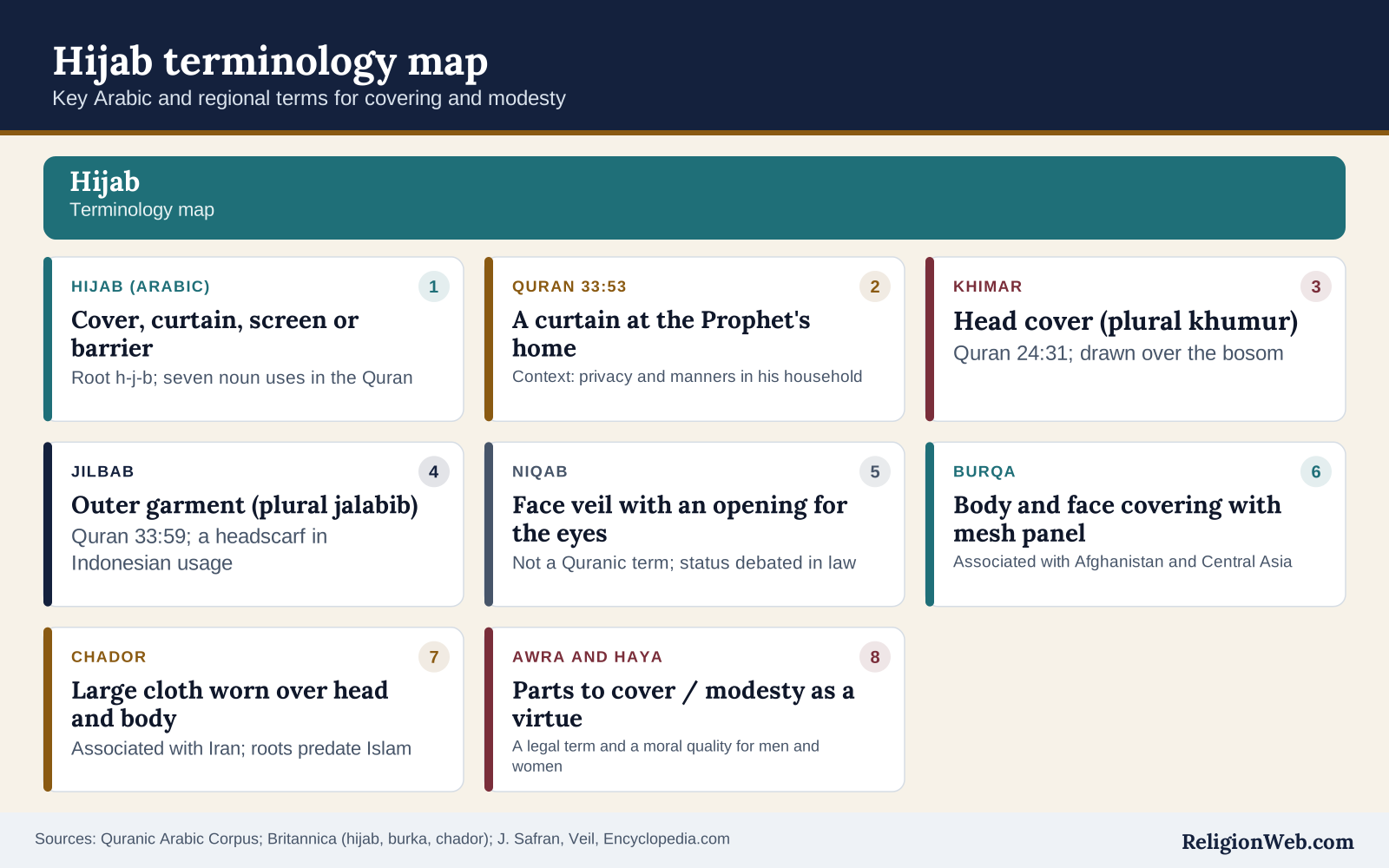
Hijab in Islam is a word with a wider and older range of meaning than the English shorthand for a headscarf suggests. In Arabic, hijab means a cover, curtain, screen or barrier. In the Quran the word appears seven times as a noun, and the passages that speak directly about women’s head coverings and outer garments use two other words, khimar and jilbab. In everyday English, and across much of the Muslim-minority world, hijab now usually names the scarf that some Muslim women wear over their hair, neck and ears. Both usages are real, and the distance between them is where many misunderstandings begin.
The practice itself is anything but uniform. Muslim women who cover their hair may wear a loose scarf in Cairo, a black chador in Tehran, a tudung in Kuala Lumpur, a patterned silk wrap in Istanbul or a plain cotton cloth at a school in Birmingham or Detroit. Others cover the face as well, and many Muslim women do not cover at all. Behind these choices stand different readings of the Quran and the Sunnah, different schools of Islamic law, family expectations, national histories, laws that sometimes require covering and sometimes forbid it, and personal convictions that are not interchangeable.
This article explains hijab on its own terms and in historical context. It begins with the Arabic and Quranic vocabulary, then turns to the early history, the ethics of modesty for both women and men, the reasoning of the legal schools, the regional variety of dress, the reasons women give for their choices, the legal debates in different countries, and the common misconceptions. For the wider setting, readers may want the general introduction to Islam, the article on the Quran, and the explanation of sharia and Islamic law.
At a Glance: What Hijab Means in Islam
The short version is that hijab names three related things. It is an Arabic word for a barrier or screen, used in the Quran in that general sense. It is a broad Islamic idea, found in religious and popular writing, of modest and decorous conduct and dress for believers. And it is the common English and international term for the head covering that many Muslim women wear. Which of these a speaker has in mind usually has to be worked out from context, and conversations go wrong when one meaning is silently swapped for another.
Hijab as a Word and as a Practice
The Arabic root and everyday meaning
The word hijab comes from the Arabic root ḥ-j-b, whose basic sense is to screen, to hide from view, or to separate. Britannica glosses the Arabic noun as “cover” or “barrier.” In ordinary Arabic a hijab can be a curtain in a doorway or a partition between two rooms, and the same root yields words for a doorkeeper or chamberlain, as the Fun Fact later in this article explains. Classical and modern Arabic also use the word figuratively, for the barriers that stand between a person and understanding, or between the heart and God.
Because the root is so general, the Quranic uses of the noun cover a surprising range of situations, from a partition between two groups on the Day of Judgment to the way God is said to speak to humans through revelation or “from behind a veil.” The next section looks at those verses one by one. The point to hold on to here is that the Arabic word is not a technical term for a woman’s scarf. In classical Islamic law, the discussion of what women cover is conducted mostly through other vocabulary, including the legal term awra, the parts of the body that must be covered before others, and the Quranic words khimar and jilbab.
The modern English sense of the word
In contemporary English, hijab most often means a head scarf worn by a Muslim woman. Britannica’s entry defines it as a garment worn by some Muslim women to cover their hair, and the reference entry on the veil by the historian Janina Safran, drawing on the anthropologist Arlene MacLeod, describes it as clothing plus a head scarf that covers the hair, neck and ears. This narrower sense became widespread in English in the later twentieth century, as the head covering turned into a visible marker in the Middle East, in South and Southeast Asia and in Europe and North America.
The modern sense also carries several overlapping associations that the Arabic word does not necessarily have: religious devotion, cultural identity, political statement, and sometimes legal requirement. Many Muslim women, and many scholars, use hijab in the broader way as well, to mean the whole discipline of modest dress and behavior, so that a woman who wears a scarf but dresses in a way she considers immodest may be described by herself or others as “not really in hijab.” Reading any particular sentence about hijab therefore begins with asking which meaning the speaker intends.
What Is Broadly Agreed and What Is Debated
Points of wide agreement among Muslims
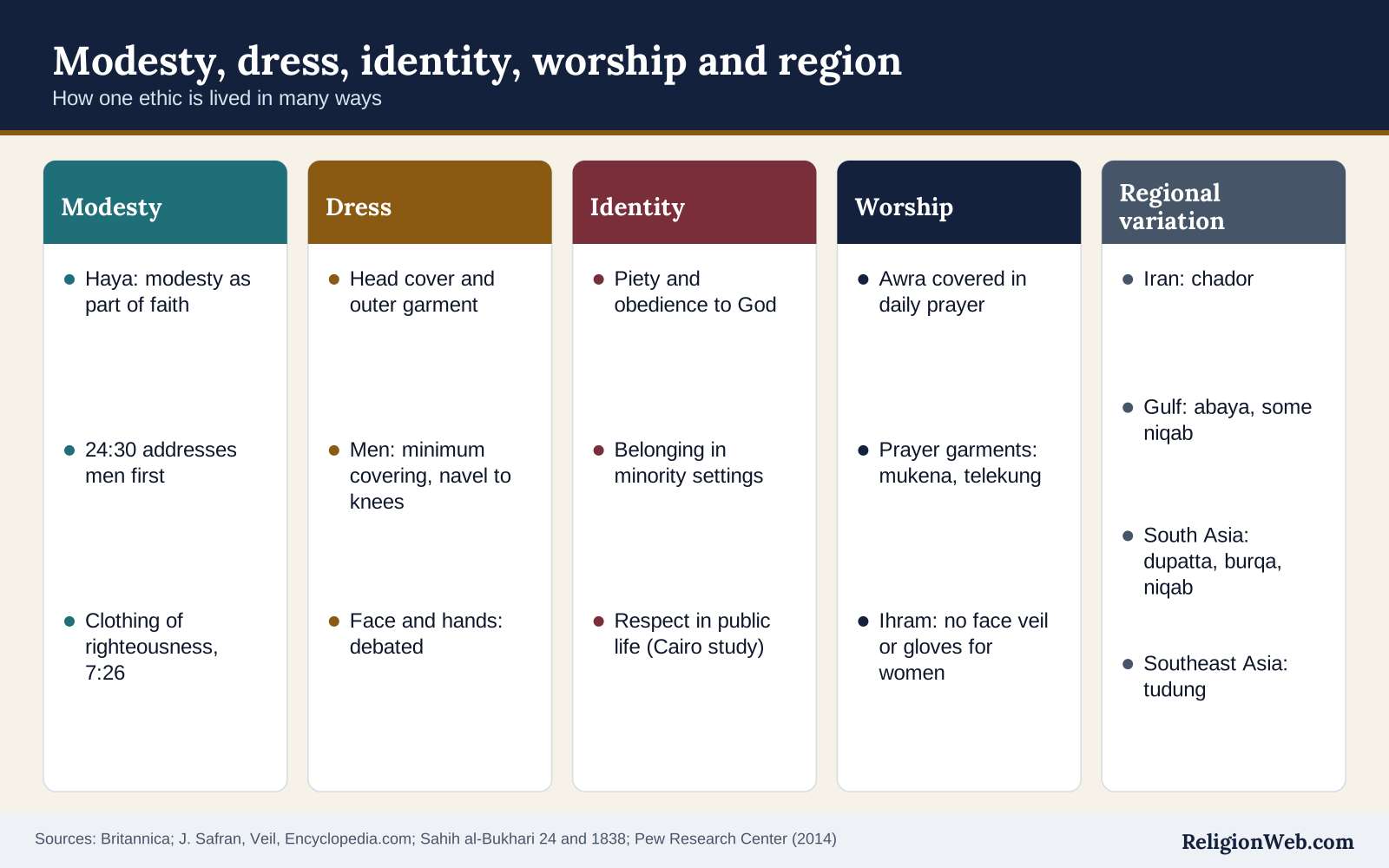
Several points are shared across the main Sunni and Shia traditions. Modesty is a value for both women and men; the Quran addresses men first on the subject of lowering the gaze and guarding modesty (24:30) before it addresses women (24:31). Britannica notes that scholars broadly agree that men and women should dress modestly, and that veiling is not one of the Five Pillars of Islam. Muslims also agree that clothing is not the whole of modesty: character, speech, honesty and restraint are part of the same ethic.
There is also broad agreement that the Quran is the first source for the discussion, and that the Prophet’s example, as preserved in hadith reports, is the second. From there the paths diverge, because the Quranic wording on dress is brief, the hadith reports vary in strength and in what they describe, and the jurists who built the legal schools read the evidence with different methods.
Points that are genuinely debated
The debated questions are specific. How much of the body should a woman cover in front of men outside her close family? Must the face and hands be covered, or are they exempt? Is a head covering required for adult women, or is it a recommended expression of modesty? Is covering the face a duty, a praiseworthy option or a matter of local custom? And how much weight should changing social conditions carry in answering these questions?
The historical majority view within the classical Sunni and Shia legal traditions is that an adult woman should cover her hair and body in front of unrelated men, with the face and hands treated as exempt by most jurists. Some jurists and communities hold that the face should also be covered. Some modern Muslim scholars and writers, among them the Moroccan physician and author Asma Lamrabet, argue that the Quran sets out a broad ethic of modesty rather than a fixed uniform, and that the head scarf is better understood as a moral value than a pillar of the faith. These positions are described in more detail in the legal section below, and none of them is a fringe invention of the present day.
Four Layers: Scripture, Law, Custom and Personal Practice
Why the layers matter
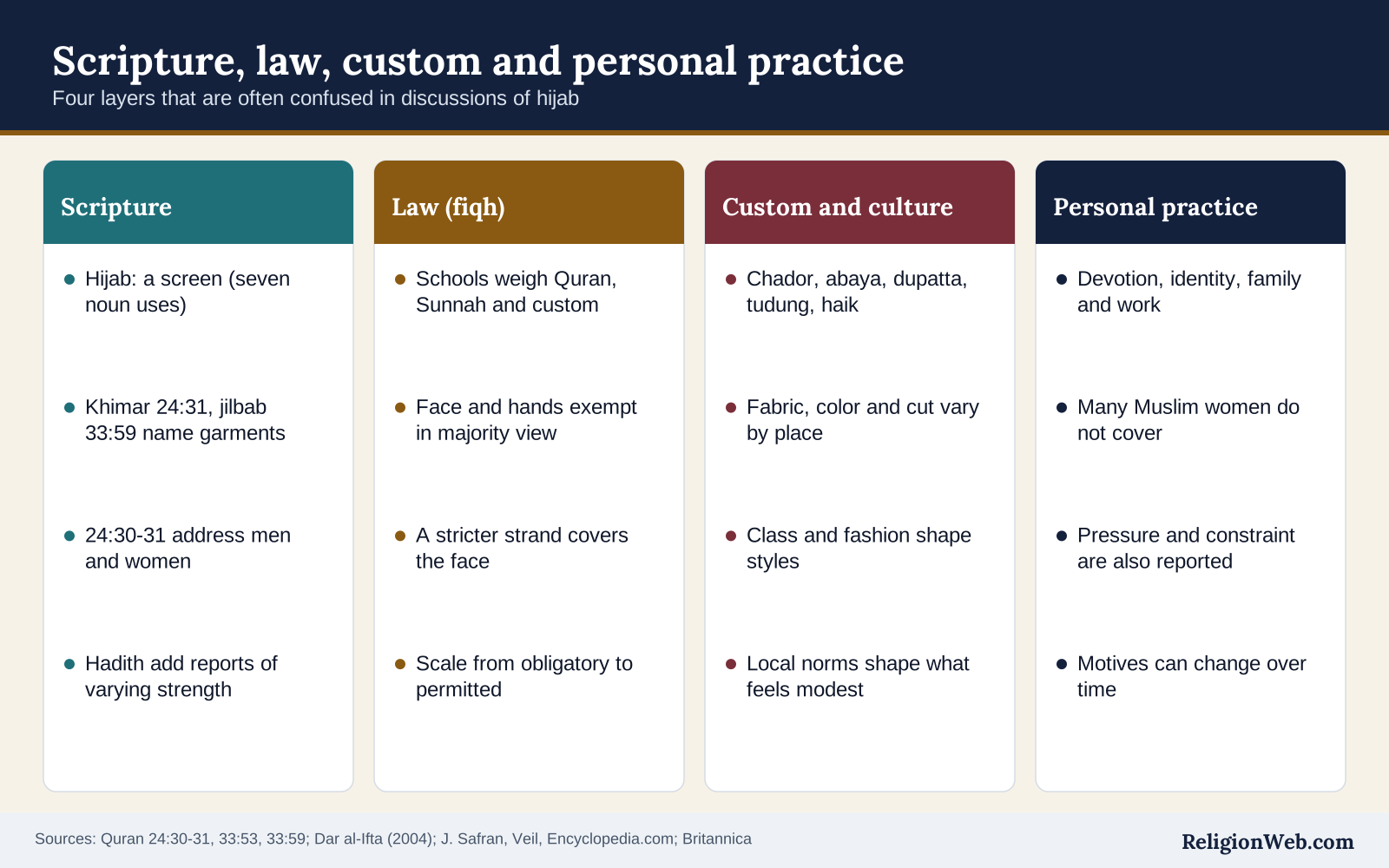
Discussion of hijab is clearest when four layers are kept apart. The first is scripture: what the Quran says, in its own vocabulary, and what hadith reports add. The second is law: how jurists in the schools of fiqh turned those texts into rules, with categories such as obligatory, recommended and permitted. The third is custom: the garments, colors, fabrics and habits that grew up in particular places and were often adopted because they felt modest, were fashionable, or marked a family’s standing. The fourth is personal practice: what an individual woman or man actually decides, in light of conscience, family, work, and community.
A great many arguments about hijab are really arguments between layers. A statement that “the Quran commands the burqa” confuses a regional garment with a text that does not mention it. A statement that “hijab is only culture” sets aside a legal tradition that has treated head covering as a religious duty for many centuries. And a statement that “every woman who covers has been forced to” erases the layer of personal conviction altogether.
How this article uses the layers
The sections that follow move through the layers in order. The Quranic vocabulary and the key terms come first, because most confusion in English begins with translation. The historical section then shows how the practice developed, and the legal section shows how the schools reason. The regional and personal sections describe lived variety, and the section on law and public policy covers cases in which states have required or restricted covering, always with a jurisdiction and a date, because rules in this area change.
The aim is neither to promote nor to discourage any form of dress. It is to explain what the sources say, how Muslims have interpreted them, and how they live those interpretations, while keeping the evidence, the tradition’s own reasoning and modern debate distinct from one another.
Hijab in the Quran: Vocabulary and Passages
The Quran does not contain one passage that lays out a complete dress code. It contains a handful of verses that mention covering, clothing and modesty, in different settings and with different vocabulary, and the legal and devotional traditions have drawn on them together with the hadith literature. Taking each word and each verse in turn is the best protection against the common error of treating “the hijab verse” as a single text.
The Word Hijab in the Quran
Seven noun uses and one related form
According to the Quranic Arabic Corpus, the root ḥ-j-b occurs eight times in the Quran: seven times as the noun hijab and once as a passive participle. The corpus offers brief glosses for each: a “partition” in 7:46, a “barrier” in 17:45, a “screen” in 19:17, a “screen” in 33:53, “the veil” in 38:32, a “screen” in 41:5, a “veil” in 42:51, and, for the participle in 83:15, a verb meaning to be partitioned off. The corpus itself cautions that these are short glosses and that an Arabic word can carry a range of meanings depending on context.
The settings are varied. Surah 7 describes a partition between the inhabitants of paradise and those of the fire. Surah 19 mentions the screen that Mary took apart from her people. Surah 41 uses the word for the barrier that unbelievers claim lies between themselves and the Prophet’s message. Surah 42 says that no human being receives God’s speech except through revelation or from behind a veil, so that the word expresses the distance between creator and creature. Surah 83 applies the related verb to those who will be shut out from their Lord on the Day of Judgment. In none of these passages does the word name a woman’s clothing.
The curtain verse, Surah 33:53
The one hijab verse that concerns human social space is 33:53, which governs conduct in the Prophet Muhammad’s household in Medina. In Pickthall’s 1930 translation, the verse tells believers not to enter the Prophet’s dwellings for a meal without waiting for the proper time and permission, not to linger for conversation, and then continues:
And when ye ask of them (the wives of the Prophet) anything, ask it of them from behind a curtain. That is purer for your hearts and for their hearts.
Quran 33:53 (part), Pickthall translation (1930), via sacred-texts.com
The traditional occasion is the wedding feast of the Prophet and Zaynab bint Jahsh. In a report in Sahih al-Bukhari (no. 4791) transmitted by Anas ibn Malik, guests lingered after the meal, the Prophet repeatedly left and returned, and after the last of them had gone, a screen was placed between the Prophet and Anas, and the verse was revealed. Under the traditional chronology the event falls in the mid-620s CE. The verse is therefore addressed to a particular household in a particular situation, concerned with privacy, hospitality and manners at the Prophet’s home.
How far the verse reaches beyond that household is one of the central questions in later interpretation. Safran’s reference entry notes that after the early conquests, jurists read the Quran’s general instructions and the example of the Prophet’s wives as requiring hijab for Muslim women generally. Lamrabet, by contrast, argues that 33:53 is situational, concerning the Prophet’s wives and the etiquette of visiting them, and that the later use of “hijab” for women’s dress in general reflects a shift in vocabulary rather than the verse’s own wording. Both are positions about interpretation, not about the text’s words, which are not in dispute.
Khimar and Jilbab: The Words That Name Garments
Khimar and the verse of Surah 24:31
The central text for head and chest covering is Surah 24:31, which in Pickthall’s rendering addresses believing women directly. In the Quranic Arabic Corpus, the plural khumur in this verse is the only occurrence of the root in that form, glossed “their head covers.” The verse reads in part:
And tell the believing women to lower their gaze and be modest, and to display of their adornment only that which is apparent, and to draw their veils over their bosoms, and not to reveal their adornment save to their own husbands or fathers or husbands’ fathers…
Quran 24:31 (part), Pickthall translation (1930), via sacred-texts.com
The verse goes on to list the people before whom a woman may show her adornment: her husband, her father, her husband’s father, her sons, her brothers, her nephews, her women, and a few other categories, and it closes by forbidding women to stamp their feet so as to reveal hidden ornament. Three phrases carry most of the interpretive weight. The first is “that which is apparent,” on which early authorities differed, as the legal section explains. The second is the instruction to draw the khumur over the bosoms (the Arabic juyub), which most commentators read as an instruction to extend an existing head cloth down over the neck and chest. The third is the list of exemptions, which defines the category later jurists call mahram, relatives with whom marriage is permanently forbidden and before whom the full rules of covering do not apply.
A report in Sahih al-Bukhari (no. 4759), narrated by Aisha, describes the response when the verse was revealed: the women of the early community tore or cut their wrappers and covered their heads and faces with them. Readers cite this report in different ways. Some use it as evidence of how quickly and comprehensively the verse was received. Others point out that it describes the women’s immediate response and is not itself the rule. Lamrabet, discussing the context, reports that women in Mecca were said to have left their necks and upper chests uncovered, which would explain why the verse focuses on drawing the head cover over the bosom.
Jilbab and the verse of Surah 33:59
The word jilbab appears in the Quran only once, in its plural form jalabib in 33:59, which the corpus glosses as “their outer garments.” Pickthall translates it as “cloaks,” and the verse as a whole tells the Prophet to say to his wives, his daughters and the women of the believers that they should draw their cloaks close around them, so that they will be recognized and not harassed, adding that God is forgiving and merciful. That is a paraphrase; the verse’s purpose clause is the key to its reading.
Many classical commentators connected the verse to the social setting of Medina, in which women who went out, particularly at night, could be accosted, and understood the cloak as a mark that distinguished women who were not to be molested. The details of this occasion are discussed in the commentary tradition and not all of them are equally well attested, so they are best treated as the traditional explanation rather than a settled historical record. Modern jurists generally read the verse as setting a principle of outdoor outer covering, while debating whether it requires a particular garment or simply a decorous outer layer. In several languages, including Indonesian, jilbab has since come to mean a head scarf, a reminder of how much the vocabulary of dress has shifted from one place and century to another.
Related Passages and the Quran’s Wider Language of Modesty
Men, the gaze and Surah 24:30
The verse that precedes 24:31 is addressed to men, and it is brief. In Pickthall’s translation it reads:
Tell the believing men to lower their gaze and be modest. That is purer for them. Lo! Allah is aware of what they do.
Quran 24:30, Pickthall translation (1930), via sacred-texts.com
The verse establishes that the discipline of lowering the gaze and guarding modesty is addressed to men and to women in the same passage. Commentators have drawn on it to argue that responsibility for decorum is shared, and that the rules for women’s dress cannot be read as placing the whole burden on women. The passage uses the same Arabic expression for guarding modesty (literally, guarding one’s private parts or chastity) for both sexes, a point taken up in the section on modesty below.
Older women, clothing of righteousness and the question of adornment
Two further passages are commonly cited. Surah 24:60, in Pickthall’s wording, says that for women past child-bearing who have no hope of marriage, it is no sin to set aside their outer clothing so as not to show adornment, though to refrain is better for them. Jurists have read this as evidence that the outer garment is an obligation that is relaxed for older women, and as an indication that the rules turn on the purpose of avoiding display and not on the garment alone. Surah 7:26, addressed to all the children of Adam, speaks of clothing that covers shame and adorns, and of the “clothing of righteousness” (libas al-taqwa) as the best of all. Many modern writers, and many classical moral authors, use it to say that inner restraint is the root of the ethic and outward dress is its expression.
Taken together, the passages give the vocabulary of the whole discussion: zina, adornment, which the verse says to conceal except what is apparent; khimar, the head cover to be drawn over the bosom; jilbab, the outer garment; hijab, the curtain at the Prophet’s home; and taqwa, the God-consciousness that makes dress meaningful. The table below summarizes the passages most often discussed and the range of readings attached to them.
| Passage | Key wording | Commonly discussed for | Range of readings |
|---|---|---|---|
| Quran 24:30 | Believing men to lower their gaze and be modest | Modesty as a duty of men | Shared responsibility for decorum; basis for rules on looking at the opposite sex |
| Quran 24:31 | Lower the gaze; adornment “that which is apparent”; draw khumur over the bosoms | Head and chest covering; list of persons before whom adornment may be shown | “What is apparent” read as the face and hands, or as outer clothing only; scope of the head covering debated |
| Quran 33:59 | Jalabib, outer garments, drawn close so women are recognized and not harassed | Outdoor outer covering | A principle of decorous outer covering, or a specific cloak; linked to the setting in Medina |
| Quran 33:53 | Ask the Prophet’s wives for anything “from behind a curtain” (hijab) | Privacy in the Prophet’s household; origin of the term hijab in later usage | Specific to the Prophet’s wives, or a model extended to Muslim women generally |
| Quran 24:60 | Women past child-bearing may set aside outer clothing without displaying adornment | Relaxation of the rule for older women | Shows the outer garment is a duty that can be eased; refraining is called better |
| Quran 7:26 | Clothing to conceal shame; the clothing of righteousness (libas al-taqwa) is best | Ethic of modesty for all humanity | Inner piety as the foundation of outward dress |
Key Arabic Terms for Dress and Modesty
A reader who meets the same few words in news reports, legal opinions and everyday conversation benefits from a reference list. The terms below fall into three groups: words from the Quran and the law, words for specific garments, and words for the moral qualities that surround dress. Many of the garment names are regional, and the same word may describe different clothing in different countries, so the table gives general descriptions that are best taken as starting points, not definitions.
Terms from the Quran and the Law
Hijab, khimar and jilbab
These three words are often treated as synonyms in English, though in the Quran they are distinct. Hijab is the barrier or screen discussed above. Khimar is a head cover, and its plural form khumur appears in 24:31. Jilbab, plural jalabib, is an outer garment, mentioned in 33:59. When a modern Muslim writer says that a woman should wear the “hijab,” she is usually folding the khimar, the jilbab and the wider ideal of modest dress into one term. When a classical jurist wrote about what a woman must cover, he more often used the legal vocabulary of awra.
Awra, adornment and the vocabulary of exemption
The term awra refers to the parts of the body that must be covered before others, and it is the central category in the legal discussion of dress. The word is applied to both sexes, with different boundaries for each, and the boundaries change according to who is present: a woman’s awra before other women, before her close male relatives and before unrelated men is not the same. Related terms include zina, adornment, as in 24:31, and mahram, the category of relatives before whom a woman does not need to cover in the same way as before strangers. Two further words describe the moral aim of the system. Haya is modesty or a sense of shame in the good sense, treated in hadith as part of faith, and taqwa is the God-consciousness that Surah 7:26 pairs with clothing.
Terms for Garments in Daily Life
Face veils and full coverings: niqab and burqa
The niqab is a veil that covers the face, usually leaving an opening for the eyes, and is often worn with a scarf and an outer robe. The burqa (or burka) is, in Britannica’s description, a loose outer garment worn mainly in public by some Muslim women, covering the body and face and usually having a mesh panel to see through. Britannica notes that the term properly applies to body coverings worn in southern Central Asia, and that a related garment, the chadari, is worn mainly in Afghanistan. In English-language news the two words are frequently confused, and the burqa is often used loosely for any face covering.
Cloaks, wraps and scarves: chador, abaya and others
The chador is a large cloth worn as a head covering, veil and shawl, typically associated with Iran. Britannica notes that it has roots that predate Islam, and that in Afghanistan the corresponding garment is called the chadri. The abaya is a long loose robe worn over other clothing, especially in the Arabian Peninsula and neighboring regions. Many other terms appear in particular places, including dupatta (a long scarf in South Asia), tudung (the head scarf in Malaysia, Singapore and Brunei) and haik (a wrap traditional in parts of North Africa). These regional examples are explored further below.
| Term | Basic sense | Where it appears | Common modern usage |
|---|---|---|---|
| Hijab | Curtain, screen, barrier | Seven noun uses in the Quran (for example 33:53, 42:51) | Head scarf in English; broader ideal of modest dress among many Muslims |
| Khimar (pl. khumur) | Head cover | Quran 24:31 | A scarf or longer head cover that falls over the neck and chest |
| Jilbab (pl. jalabib) | Outer garment, cloak | Quran 33:59 | Loose outer garment in some Arab contexts; head scarf in Indonesian usage |
| Niqab | Face veil | Not a Quranic term; discussed in hadith and law | Face covering with an opening for the eyes |
| Burqa | Full-body covering with a mesh panel | Not a Quranic term | Associated with Afghanistan and neighboring regions |
| Chador | Large cloth worn over head and body | Persian term; not Quranic | Worn by many women in Iran; often black in public |
| Awra | Parts of the body to be covered | Legal term, from Quran and hadith | Basis of rules on dress in prayer and before others |
| Haya | Modesty, shame in the good sense | Hadith, for example Sahih al-Bukhari no. 24 | Moral quality for men and women |
| Mahram | Close relatives with whom marriage is forbidden | Legal term based on Quran 24:31 and 4:23 | Determines who may see a woman uncovered |
History: How Practices of Covering Developed
Historians generally do not see Muslim practices of covering as appearing in a vacuum. They emerged in a region where several societies already had customs of veiling and seclusion, and they changed in each period as law, politics, class and fashion changed. The summary here relies on Safran’s reference entry on the veil and on Britannica, and it is deliberately modest about what the evidence can establish.
Before Islam and in Muhammad’s Lifetime
Veiling in the ancient and late antique Middle East
Britannica states that veiling predates Islam, which emerged in the seventh century CE, and that Islam probably absorbed some existing local customs as it spread. Safran traces the earliest evidence to an Assyrian legal text of the thirteenth century BCE that required women of certain social status to veil and forbade prostitutes and slaves to do so, so that the veil signaled respectability and protection. In the centuries before the Common Era, veiling and seclusion marked honor and status in cities of the Middle East and the Mediterranean. This is background to the practice, not a verdict on it: Muslims understand the Quranic instructions as revelation addressed to their own community, and historians study how those instructions met existing customs.
The Prophet’s household and the first community
In the early community in Medina, the Quran’s instructions on dress and privacy appeared in the setting of the Prophet’s household and a growing congregation. The reports cited earlier, on the screen at the wedding feast of Zaynab bint Jahsh and the response of women to the revelation of 24:31, are the main early narratives, and they are preserved in the hadith collections. Another report, in Sunan Abi Dawud (no. 4104), has Aisha relate that the Prophet turned away from Asma bint Abi Bakr when she appeared in thin clothing, and said that once a woman reaches maturity only her face and hands should be seen. Abu Dawud himself describes the report as mursal, meaning that a link between the narrators and Aisha is missing, though the twentieth-century hadith scholar al-Albani graded it sound. It is widely cited in discussions of the face-and-hands exemption, and its status is part of the debate.
A report in Sahih al-Bukhari (no. 1838) narrates that a woman in the state of ihram, the ritual condition of pilgrimage, should not wear a face veil or gloves. Jurists use it in both directions. Those who hold that the face and hands are exempt from covering point to it as evidence that the face was normally left uncovered, at least in that state. Those who hold that covering the face is customary or recommended note that the report is about ihram and treat it as a limited case.
Law and Practice in the Classical and Later Periods
How jurists read the evidence
After the conquests of the early seventh century, Safran writes, jurists read the Quran’s general instructions and the example of the Prophet’s wives as requiring hijab of Muslim women. Whether the hijab had to extend to the hands and face divided legal traditions and individual jurists. The scholar Barbara Showalter, whom Safran cites, found that commentaries from the tenth, thirteenth and seventeenth centuries show a trend toward stricter interpretation of modesty. This is a useful corrective to a common assumption that the rules were fixed once and then merely repeated. The commentary and legal tradition shows continuous debate, with different emphases in different periods.
Class, region and everyday life
Safran emphasizes that socioeconomic and regional variation always shaped actual practice. Women who worked in fields, markets or households with little room for seclusion dressed differently from women in wealthy urban families who could remain at home. Safran notes that in the region where Islam spread, respectable non-Muslim urban women already covered their hair and stayed at home, which meant that practices of covering and seclusion carried associations with status as well as religion. In many societies, covering was a sign of a family’s standing; in others it was a sign of the observance of a school of law or a Sufi order. Written rules and everyday practice overlapped but did not coincide.
Colonial Encounters and the Modern Period
Unveiling movements and state policy
In the nineteenth and twentieth centuries, the veil became part of arguments about modernity, empire and women’s status. Safran notes that European imperial officials and other Westerners often cast the veil as a symbol of female oppression and of the backwardness of Muslim societies, while Middle Eastern nationalists and reformers argued among themselves about women’s status and dress. Some women, such as the Egyptian feminist Huda Sha’arawi, discarded the veil after entering public life. By the 1930s, many upper- and middle-class urban women in the region had unveiled, encouraged by governments such as that of the Turkish republic and by legislation in Iran. Such measures were imposed from above in some countries, and their reception among women varied with class, region and conviction.
Revival, politics and the new visibility of the scarf
From the 1970s onward, covering became more visible again in many Muslim-majority societies and in diaspora communities. Safran notes that the 1979 Iranian Revolution imposed full veiling as a symbol of its Islamic state, and that the veil became a widely recognized, ideologically charged symbol taken up by various Islamist movements. At the same time, her entry draws on MacLeod’s study of lower-middle-class women in Cairo, many of them from rural backgrounds and the first in their families to work outside the home. Many adopted the hijab, MacLeod found, to gain respect at work and at home, which in practice helped them take part in public life. The head scarf thus acquired political, economic and devotional meanings at once, and the same garment could express different intentions in different women.
Modesty for Women and Men
A large part of the confusion around hijab comes from reading it as a topic about women only. In the sources, modesty is a quality of the believer, and the rules about dress, gaze and behavior are addressed to both sexes. The rules are not identical, and the legal tradition draws different lines for men and women, but the ethic they serve is shared.
Modesty as a Shared Ethic
Haya as part of faith
The Arabic word haya covers modesty, bashfulness and a sense of shame in its positive meaning: the inner reluctance to do what is shameful or to display oneself immodestly. A report in Sahih al-Bukhari (no. 24), narrated by Abdullah ibn Umar, describes the Prophet passing by a man of the Ansar who was scolding his brother for being too modest, and telling him to leave the brother alone because modesty is part of faith. The report is cited by Muslim writers of every school to show that modesty is a virtue and not a restriction, and that it concerns manner, speech, conduct and dress alike. Collections of hadith include chapters on haya as part of the broader literature on character.
The virtue is not confined to the visible. A person can dress with care and still behave without restraint, and a person can dress plainly and behave with great reserve. The tradition acknowledges both possibilities, which is one reason many Muslim scholars and teachers treat the scarf as one expression of modesty, and not as a measure of it.
The clothing of righteousness
Surah 7:26 addresses all the children of Adam and says that God has sent down clothing to cover shame and to adorn, and then adds that the libas al-taqwa, the clothing of righteousness or God-consciousness, is best. Muslim writers draw different lessons from this verse. Some emphasize that clothing is a gift and a mercy and that covering what should be covered is part of human dignity. Others use it to argue that outward dress is secondary to inner character, so that the real aim of the rules is to produce a person of restraint and reverence. Sufi writers, including the authors discussed in the article on Sufism, often use the vocabulary of veils in yet another sense, for the barriers of ego and heedlessness that stand between a person and God.
Rules and Expectations for Men
Lowering the gaze and covering the awra
Surah 24:30 commands believing men to lower their gaze and guard their modesty before 24:31 says the same to women. Jurists derive from this and from hadith a set of rules about looking at the opposite sex, and also a minimum area of the body that a man must cover. Most schools describe the minimum for men as the area between the navel and the knees, with differences of detail over the status of the thighs and the knees. In practice, mosques, workplaces and social settings add expectations of their own: long trousers or robes, covered shoulders in the mosque, a cap or turban in some communities. These are customs more than rulings, and they vary a great deal.
Jurists have also taught that men are responsible for their own looks, speech and behavior, and that the burden of avoiding temptation does not rest on women’s clothing alone. Contemporary preachers and scholars sometimes stress this point when they discuss how modesty should be taught. It is also a reminder that Islamic modesty has a social dimension: it is about how people treat one another in shared spaces.
Men’s dress in worship and pilgrimage
Some of the most visible rules of male dress belong to worship. In the state of ihram for Hajj or Umrah, men wear two unsewn pieces of cloth, and the same plainness is meant to erase marks of rank. Women in ihram wear ordinary modest clothing and, according to the report in Sahih al-Bukhari (no. 1838), do not wear a face veil or gloves. The result is that pilgrims of different regions and incomes appear in similar dress around the Kaaba, even though they come from places where daily dress is very different.
In daily prayer, men too are required to cover the awra, and many wear a cap or head covering as a custom or an act of respect, though the practice varies among communities and is not universally treated as obligatory. The point to note is that dress rules attach to men in worship just as they attach to women, even though the debate around women’s clothing in public attracts more attention.
Conduct, Speech and Shared Spaces
Behavior beyond clothing
The same verse that tells women to draw their covering over their bosoms also tells them not to stamp their feet so as to reveal their hidden adornment. The verse thus extends modesty to movement and manner. Another passage, Surah 33:32, addressed to the wives of the Prophet, begins by saying that they are not like other women and goes on to speak of how they should speak and conduct themselves. Classical ethical writing builds on such texts with advice about humility, honesty, gentle speech and the avoidance of boasting, advice addressed to men and women alike. A person’s dress is only one part of a larger discipline of presence.
Shared spaces and gender norms
Muslim communities arrange shared space in different ways. Some mosques have separate sections or rooms for women, some have shared halls with women praying behind men, and in some communities women attend only certain occasions. The mosque article describes the architecture and etiquette in more detail. Norms about working together, shaking hands and traveling also differ widely from one country and family to another, and they do not map neatly onto school of law or religious seriousness. A woman wearing a hijab may work in a mixed office with full family approval, while a woman in another community may be expected to avoid it; both may describe themselves as acting on the same principle of modesty.
Legal Schools and Scholarly Interpretations
The Quranic verses and hadith reports are brief; the legal tradition is where they were developed into rules. Islamic law, discussed more fully in the article on sharia, is a body of reasoned interpretation by jurists working within schools of law, and different schools and individual jurists reached different conclusions on dress while using similar evidence.
How Fiqh Frames the Question of Dress
Categories of obligation
Islamic jurisprudence sorts actions into a scale: obligatory (wajib), recommended (mustahabb), permitted (mubah), disliked (makruh) and forbidden (haram). The permitted category overlaps with the idea of halal, and the forbidden with haram. When the jurists discuss women’s dress, the first question is what falls into each category: covering the body generally, covering the hair, covering the face, wearing a particular color or cut. Disagreement among jurists often turns on where a given element sits on the scale. An element one jurist classes as recommended, another may class as obligatory, and a third may treat as a custom that a woman may adopt or not as she chooses.
How evidence is weighed
The schools weigh the Quran, the Sunnah, scholarly consensus and analogical reasoning, and they differ in how much weight they give to hadith of different strength and to local custom. On the question of the face and hands, the argument has typically moved among three kinds of evidence: the wording of 24:31 (“that which is apparent”), reports such as the Asma bint Abi Bakr hadith and the ihram hadith, and reasoning about harm and temptation. Another input is custom (urf), which many jurists treat as a legitimate factor in deciding what counts as decent dress in a given place and time. The result is a legal discussion with a range of defensible positions, and not a single code.
Positions Across the Sunni Schools
The face-and-hands exemption
The most widely held Sunni position is that a free adult woman’s awra before unrelated men is her whole body except the face and hands, and some jurists also exempt the feet. Yusuf al-Qaradawi, in The Lawful and the Prohibited in Islam, as quoted on the IslamOnline fiqh site, says this is the view of the majority and credits early authorities including Ibn Abbas, Anas, Said ibn Jubayr, Ata and al-Awzai. He contrasts it with the narrower reading attributed to Abdullah ibn Masud, that “what is apparent” in 24:31 means only the outer garment. Egypt’s Dar al-Ifta, in a fatwa dated 7 October 2004 and credited to Ali Gomaa, states that it is not obligatory for a Muslim woman to cover her face and hands and classifies the niqab as a permissible act: a woman is rewarded for wearing it but not punished for not wearing it.
A fatwa answer by a mufti at Darul Uloom Trinidad and Tobago, published in 2018, summarizes the four schools in similar terms. The Hanafi school treats the face, hands and feet as outside the awra, although it advises a young woman not to display her face before non-relatives out of fear of temptation. The Maliki school treats the face and hands as outside the awra, but advises covering them where temptation is feared. The Shafii school has two views, one counting the face and hands as awra and one not, with the second described as the school’s official position by the jurist al-Nawawi. These are descriptions given by one contemporary mufti and are best taken as an illustration of how the schools are presented, not as a complete account.
Stricter views and the Hanbali tradition
A stricter strand holds that a woman should cover her face before unrelated men. How this strand relates to the Hanbali school is described differently in different sources. The same Trinidad fatwa describes two narrations in the Hanbali school: one that treats the face and hands as outside the awra, which it says a group of scholars preferred, and one that treats the whole body as awra but permits uncovering the face and hands because covering them is hard. Another summary on IslamOnline states more simply that the Hanbali school holds face and hands to be awra. A reader should therefore be cautious about one-line summaries of the schools, because the schools contain internal positions and later scholars within a school sometimes diverged from earlier ones.
In the present day, the stricter reading has strong support in parts of the Arabian Peninsula, where the survey discussed later in this article found that 63 percent of Saudi respondents picked a niqab-wearing woman as the most appropriately dressed, while the face-and-hands position is the one argued by institutions such as Egypt’s Dar al-Ifta. That fatwa illustrates how a mainstream institution argues against the stricter reading: it says the hadith used to support face-covering does not prove an obligation and may have been specific to the Prophet’s wives. Both sides appeal to the same sources and the same concern for modesty and public decency.
Shia Jurists and Contemporary Debates
Twelver Shia rulings
Twelver Shia jurists, whose reasoning is described in the article on Shia Islam, also draw on the Quran and on reports from the Prophet and the Imams. A question-and-answer page on a Shia community site, which presents the ruling of Grand Ayatollah Ali al-Sistani, says that covering the face and hands up to the wrists is not obligatory, provided a woman’s beauty is ordinary by common standards and she wears no makeup or ornaments. The answer is conditional, and the page does not name its author or date, so this account should be checked against current rulings from the relevant office. Shia authorities, like Sunni ones, issue rulings that depend on the individual marja and on circumstances.
Reformist and critical readings
Within the last two centuries a range of Muslim thinkers have proposed readings that differ from the classical consensus on parts of the question. Lamrabet argues that the Quran sets out an ethic of modesty and not a uniform, that “hijab” and “khimar” have been conflated, and that the khimar originally signaled women’s visibility and dignity. She also points to the Quranic principle that there is no compulsion in religion. Other writers, from a more traditional starting point, emphasize that a Muslim woman’s decision to cover should be hers, because a religious act performed under compulsion loses part of its meaning. These readings are contested, and the majority of jurists continue to hold that head covering is required, but they are part of the living debate and are held by observant Muslims.
The debate also has a practical side. Fatwa councils in Muslim-minority countries are asked about school uniforms, sports clothing, workplaces and hospitals. Answers differ from one scholar and one council to the next. Anyone seeking guidance for personal practice would normally consult a scholar they trust within their own tradition, and the answers they receive vary.
| Question | Widely held position | Other positions | Typical reasoning |
|---|---|---|---|
| Covering the hair and body before unrelated men | Required of adult women in classical Sunni and Shia law | Some modern writers see a broad ethic of modesty and not a fixed rule | Quran 24:31, 33:59; hadith; practice of the early community |
| The face and hands | Exempt from covering (Hanafi, Maliki, Shafii and one Hanbali narration, as commonly presented) | Some jurists and communities hold that the face should be covered | Reading of “that which is apparent”; Asma hadith; ihram hadith |
| The feet | The Hanafi school is cited as treating the feet as exempt | Sources do not present the other schools’ positions on the feet uniformly | Interpretation of adornment; need for movement and work |
| Status of the niqab | Permissible or praiseworthy to many; custom to others | Obligatory in a stricter strand; discouraged by some where it is a sign of division | Whether covering the face was a rule for all women or specific to the Prophet’s wives |
| Covering before women and close relatives | Lighter requirements before women and mahram men | Schools differ on details, including before non-Muslim women | List of persons in Quran 24:31 |
| Older women past child-bearing | May set aside the outer garment without showing adornment | Many still advise covering as “better” | Quran 24:60 |
| Role of custom and circumstance | Custom informs what is decent dress in a place | Some argue custom must not override textual rules; others give it more weight | Principle of urf; concern for harm and public decency |
Clothing Around the World: Regional Examples
No single garment is “the hijab,” and the picture of Muslim women’s dress changes at every border and often within one country. Climate, fabric, local history, school of law, class and fashion all leave their mark. What follows is a set of examples, not an inventory, and it should be read with the caution that individual women within any region dress in many different ways.
The Middle East and North Africa
Iran and the chador
In Iran, the chador is a large semicircular cloth worn over the head and body, often black in public settings, and Britannica notes that its roots predate Islam. Many Iranian women wear it, particularly in religious settings and in some cities and families, while many others wear a scarf with a long coat or loose outer garment. Covering has been a matter of law since the early years of the Islamic Republic, which makes Iran a case in which the religious, cultural and legal layers are tightly entangled; the legal side is treated in the section on law and public policy.
The Arabian Peninsula and the abaya
In the Gulf states and the wider Arabian Peninsula, many women wear the abaya, a long loose robe over other clothing, often black, together with a head scarf. Some also wear a face veil. A survey conducted by the University of Michigan and reported by the Pew Research Center in January 2014 showed how strongly dress preferences varied even within the Middle East: in Saudi Arabia, 63 percent of respondents chose the niqab as the most appropriate public dress for women from a card of six head coverings, and 11 percent chose the fully hooded burqa style. The same survey had very different results elsewhere, which is a reminder that “the Middle East” is not a single dress code.
Egypt, Tunisia and the Maghreb
In the same Pew report, the white hijab, a head scarf covering the hair and neck but not the face, was the most popular choice in Tunisia (57 percent), Egypt (52 percent), Iraq (44 percent) and Turkey (46 percent). In North Africa, traditional garments such as the haik, a large wrap, have long histories as regional dress, and in several countries the djellaba and the headscarf coexist with modern clothing. Whether such garments count as religious dress, regional dress or both is a question on which individual women answer differently.
Central and South Asia
Afghanistan and the burqa
The burqa that is widely associated with Afghanistan is, in Britannica’s description, a loose outer garment that covers the body and face and has a mesh panel for seeing; Britannica adds that the related chadari is worn mainly in Afghanistan and that under Taliban rule in 1996–2001 some women were required by law to wear the burqa. Wearing patterns in the country varied by region and class, and the garment is a long-standing regional dress as well as a legal requirement in some periods. The present legal situation is described below, with dates.
Pakistan and the wider subcontinent
Across Pakistan, India and Bangladesh, many Muslim women wear the shalwar kameez with a dupatta, a long scarf draped over the head or shoulders, and some add a burqa or a niqab outside the home. In the Pew report, Pakistani respondents were divided: 32 percent chose the niqab, 31 percent the black hijab and 24 percent the white hijab as most appropriate. The scarf and the dupatta are also worn by many non-Muslim women in South Asia, so the same garment may be read as religious or regional depending on who is wearing it and where.
Southeast Asia, Turkey and the Diaspora
Southeast Asia
In Malaysia, Singapore and Brunei, the head scarf is commonly called tudung, and in Indonesian usage the word jilbab now generally means the head scarf. Women often combine it with the traditional baju kurung or kebaya, and fashion plays a conspicuous part: designers, online influencers and department stores all take part in a large modest-fashion industry. Prayer garments such as the full-length cloth worn in the mosque, called telekung in Malay, are used for worship.
Turkey
Turkey illustrates how covering can move in and out of public controversy. Safran notes that by the 1930s the Turkish republic had encouraged many upper- and middle-class urban women to unveil. In the Pew report, 46 percent of Turkish respondents chose the white hijab as the most appropriate dress, while 32 percent said a woman with no head covering was acceptable and 52 percent said a woman should decide for herself. Turkey’s own terms for covered dress, such as başörtüsü for the head scarf and tesettür for the broader idea of covered dress, point to its own vocabulary and history.
Europe, North America and the diaspora
In Europe and North America, Muslim women’s dress reflects the origins of each community as well as local fashion and employment. Safran notes that in Germany, Turkish migrants may wear the head scarf as a sign of pride and rejection of assimilation, and that in France Muslim girls and their families have pressed for the right to wear scarves in school on grounds of religious freedom. In diaspora settings, the scarf often becomes more visible as an identity marker than it was in the country of origin, while other Muslim women in the same communities choose not to cover. The legal side of these debates is covered below.
| Region | Garments and terms | Typical description | Notes |
|---|---|---|---|
| Iran | Chador; scarf with long coat | Large cloth worn over head and body; black is common in public | Covering is required by law, and practice varies widely |
| Arabian Peninsula | Abaya; scarf; niqab | Long loose robe, often black; some women add a face veil | In the Pew-reported survey, 63% of Saudi respondents chose a niqab-wearing woman |
| Egypt, Tunisia, Iraq | Hijab (head scarf), often white or black | Scarf covering hair and neck, face uncovered | White hijab was the top choice in each, 44% to 57% |
| North Africa | Haik; djellaba; scarf | Large wrap or hooded robe | Regional dress that some women also regard as religious dress |
| Afghanistan | Burqa; chadari | Full-body covering with a mesh panel | Legal requirements have varied by period |
| Pakistan and South Asia | Shalwar kameez with dupatta; burqa; niqab | Long tunic and trousers with a long scarf | Pakistani survey answers: niqab 32%, black hijab 31%, white hijab 24% |
| Malaysia, Singapore, Brunei, Indonesia | Tudung; jilbab (in Indonesian usage) | Head scarf, often with baju kurung or kebaya | Large modest-fashion sector; separate prayer garments |
| Turkey | Başörtüsü; tesettür | Head scarf and covered dress | History of both legal bans and revival; Pew-reported choices varied |
| Europe and North America | Hijab; niqab for a minority | Scarf with local clothing | Dress shaped by migration histories, work and law |
Personal Piety, Identity and Lived Experience
Surveys and interviews show a wide range of reasons for covering and for not covering. Safran’s reference entry closes on a good starting point: the meaning of the veil, she writes, is “hardly uniform, and often ambiguous” for wearers, advocates and critics alike.
Why Women Cover
Devotion and obedience to God
For many women who cover, the primary reason is religious conviction. They understand the Quranic verses and the legal tradition as setting a requirement or a strongly recommended practice, and they cover as an act of obedience and worship. Some describe it as a daily reminder of faith, similar in function to prayer, and some speak of the decision as a milestone, taken at adolescence, marriage, a pilgrimage or a period of religious deepening. The article on the Five Pillars describes the formal duties of Islam; covering is not among them, and women who cover typically say it belongs to the broader category of Islamic conduct and character.
Identity, belonging and public presence
For others, the head covering is a statement of belonging. In a minority setting it can be a visible sign of Muslim identity, pride and solidarity; in a majority setting it can show membership in a community or a school of thought. MacLeod’s study of lower-middle-class Cairene women, reported by Safran, found that many adopted the hijab to gain respect at work and at home, enabling them to take part in public life. Such accounts cut across a common assumption that covering is necessarily a sign of withdrawal from public life.
Family, community and social expectation
Family and community expectations are also real. Many women begin covering as girls, following a mother or older sisters, and the practice becomes part of who they are. In some communities, covering is the expected norm and not covering invites comment or pressure. Many women describe their covering as freely chosen even when it also conforms to family expectation; others describe it as imposed. These categories are not mutually exclusive, and a woman’s account of her own motives can change over time.
Women Who Do Not Cover or Who Cover Differently
A range of positions
Many Muslim women do not cover their hair, and they come from every school and region. Some say they hold that modesty is a matter of character and conduct and that covering is not required; some consider covering to be recommended but not yet part of their practice; some consider it required but find it difficult in their circumstances; some have never given it much thought. The Pew-reported survey shows how many people in several countries think women should be free to decide: 56 percent in Tunisia, 52 percent in Turkey, 49 percent in Lebanon, 47 percent in Saudi Arabia, 27 percent in Iraq, 22 percent in Pakistan and 14 percent in Egypt. The figures reflect opinion in those countries at the time of the survey, which the Pew page does not date, and not any one woman’s story.
Pressure, coercion and constraint
Safran notes that some women have been pressured into veiling and that others choose it for political, personal or religious reasons. Both statements are true, and they are not in competition. In countries where covering is required by law or enforced by social pressure, some women cover willingly and some do so under constraint; in countries where covering is restricted, some women who wish to cover face constraint in the opposite direction. A respectful account of hijab keeps all these cases in view, and avoids deciding in advance that one explanation covers every woman.
Hijab, Law and Public Policy: Jurisdictions and Dates
Laws about Muslim women’s dress run in two directions. Some states require covering and enforce it; others restrict certain forms of covering in schools, public offices or public spaces. These rules change, sometimes quickly, and they are often contested within the countries concerned. The summary below is limited to measures that can be tied to a jurisdiction and a date, and it states as of 21 October 2026 only what the cited sources support. Readers who need the current legal position in any country should consult a current official source.
Where Covering Is Required or Enforced
Iran
Britannica states that women in Iran have been required by law to wear hijab since the Islamic Revolution of 1978–79. The requirement shaped daily life for more than four decades and has been contested by Iranian women in several waves, and since the death in custody in September 2022 of Mahsa Amini, who had been detained by the morality police, it has been at the center of national protests. A bill known as the Chastity and Hijab law was finalized and published on 30 November 2024, according to a report by the Kurdish outlet Rudaw dated 25 May 2025, which also reported that Parliament Speaker Mohammad Bagher Ghalibaf told the parliament that the Supreme National Security Council had notified it in writing that the law should not be enacted for the time being. The status of the bill and of enforcement may have changed since that report and should be checked.
Afghanistan
Under the first Taliban government of 1996–2001, Britannica notes, some women were required by law to wear the burqa. After the Taliban returned to power in 2021, the Ministry for the Propagation of Virtue and the Prevention of Vice announced on 7 May 2022 that women in public must wear all-encompassing robes covering the face except the eyes, according to an Associated Press caption. In August 2024 the authorities issued the country’s first formal vice and virtue laws, which the Associated Press reported include a requirement for a woman to conceal her face, body and voice outside the home. Roza Otunbayeva, then head of the United Nations mission in Afghanistan, called them a “distressing vision” for the country’s future, and a Taliban spokesman, Zabihullah Mujahid, responded that the concerns would not sway the authorities from enforcing Islamic law. These measures reflect the Taliban authorities’ interpretation. As the sections on the legal schools show, other Muslim scholars and institutions hold different views on the face, and the measures have been criticized internationally.
Saudi Arabia and changing norms
Saudi Arabia has long been associated with strict dress expectations, and the picture there has shifted. In an interview with the American broadcaster CBS in March 2018, Crown Prince Mohammed bin Salman said that sharia requires “decent, respectful clothing, like men,” and does not specify a black abaya or a head covering, adding that the decision was left to women. A report on the interview in The New Arab noted that the existing legal requirements at the time still called for the black robe and hijab, so his remarks conflicted with the written rules. How these expectations are applied in practice today should be verified against current official sources; the example is a useful reminder that even in states with formal dress rules, interpretation and enforcement can change within a few years.
Where Covering Is Restricted or Contested
France
France has the best-documented set of restrictions in Europe. The Law of 15 March 2004, now article L. 141-5-1 of the Education Code, bars pupils in state schools from wearing symbols or clothing that conspicuously show a religious affiliation, and it has been applied to Muslim head scarves, as well as to other religious symbols. A separate law adopted in 2010 prohibits concealing the face in public places, which includes the niqab and the burqa; Britannica dates the bans on face-covering clothing in France and Belgium to 2011. On 1 July 2014, the Grand Chamber of the European Court of Human Rights ruled in S.A.S. v. France that the French law did not violate Articles 8, 9 or 14 of the European Convention on Human Rights. It found that the law pursued the legitimate aim of protecting the rights and freedoms of others, described as the “minimum requirements of life in society” or “living together,” and that it was proportionate, while acknowledging the risk of reinforcing stereotypes and encouraging intolerance.
In September 2023 the French Minister of Education issued a memorandum banning abaya-type garments in state schools. The Conseil d’État rejected urgent applications to suspend it on 7 and 25 September 2023, and on 27 September 2024 it rejected the request to annul the memorandum on the merits. Its reasoning was that abaya-type clothing, in the circumstances described, could be treated as a conspicuous religious manifestation, both because of the garment and because of how it was worn. The Conseil d’État reported 4,710 secularism-related incident reports in the 2022–2023 school year, of which 1,984 concerned symbols or clothing, mostly abaya-type garments. Supporters of the measures present them as protecting a secular and neutral public school, and critics present them as restrictions on religious freedom that fall mainly on Muslim girls; both positions are argued by French citizens, including Muslims.
Other restrictions and disputes
Belgium adopted a comparable ban on face-covering clothing, which Britannica dates, like the French one, to 2011, and several other European countries have adopted similar rules for public spaces or public services in different forms. In India, a dispute over hijab in educational institutions in the state of Karnataka in early 2022 led to a ruling of the Karnataka High Court on 15 March 2022 that upheld the restriction, followed by appeals to the Supreme Court. Turkey is an example of a reversal in the other direction: restrictions on head coverings in public institutions that were in place for decades were gradually lifted. The details of each case differ, and the status of litigation and statutes in particular places changes, so these examples are best taken as indications of the range of policy, with a current check before relying on them.
How the questions are framed
The arguments in these cases draw on different principles. States that restrict face coverings or religious clothing in schools or public service typically cite secularism or neutrality, public safety, communication in public life or what the French court called “living together.” Those who challenge such measures cite freedom of religion, personal autonomy, equal treatment and the risk of excluding women from education and work. Courts have generally given states a margin to decide, as the European Court did in 2014, while acknowledging the risks. It is worth noting that the same women are sometimes affected in opposite ways by laws that require covering and laws that prohibit it, and that Muslim women hold a range of views about these laws, as they do about the practices themselves.
| Jurisdiction | Date | Measure or event | Source type |
|---|---|---|---|
| Iran | 1978–79 onward | Covering required by law after the Islamic Revolution | Britannica |
| Iran | 30 November 2024; reported 25 May 2025 | Chastity and Hijab bill published; Supreme National Security Council advised against enactment for the time being | Rudaw report |
| Afghanistan | 1996–2001; 7 May 2022; August 2024 | Burqa required under the first Taliban government; face-covering robes announced; first vice and virtue laws | Britannica; Associated Press |
| Saudi Arabia | March 2018 | Crown Prince said sharia does not specify a black abaya or head covering | The New Arab report on a CBS interview |
| France | 15 March 2004 | Law bars conspicuous religious symbols and clothing in state schools | Conseil d’État |
| France and Belgium | 2010–2011 | Bans on face-covering clothing in public places | ASIL; Britannica |
| European Court of Human Rights | 1 July 2014 | S.A.S. v. France: Grand Chamber finds no violation of Articles 8, 9 or 14 | ASIL |
| France | September 2023; 27 September 2024 | Abaya-type garments barred in state schools; Conseil d’État upholds the memorandum on the merits | Conseil d’État |
Hijab in Worship, Mosque and Pilgrimage
Dress takes on special significance in worship, where Muslim practice combines the rules for covering with the rules of ritual purity and orientation toward the Kaaba. Women’s and men’s practices are described below in general terms, and local mosques, communities and legal schools add their own customs.
Prayer, Supplication and Night Worship
Covering in the daily prayer
In the five daily prayers, the legal tradition requires worshipers to cover the awra and to be in a state of ritual purity. For women, most schools require covering the whole body except the face and hands, and many women wear a long prayer garment, such as the mukena in Indonesia, the telekung in Malaysia or a simple two-piece cloth, kept clean for prayer and often shared in a mosque’s women’s section. These arrangements make the dress of prayer more uniform than the dress of everyday life: a woman who wears a fashionable outfit in public may change into a plain white garment to pray.
Supplication and the last nights of Ramadan
The same expectations apply when women attend the mosque for special occasions. In the last ten nights of Ramadan, many Muslims seek Laylat al-Qadr, the Night of Power, with extended prayer, recitation and personal supplication, and women in many communities attend mosque programs or pray at home in the same prayer garments. The dress is simple and the focus is on devotion; the idea that dress serves worship, and does not compete with it, is a common theme in Muslim reflections on modesty.
The Mosque, Pilgrimage and Communal Occasions
Visiting a mosque
Visitors to a mosque, whether Muslim or not, are commonly expected to dress modestly and remove their shoes, and many mosques ask women to cover their hair and wear loose clothing that covers arms and legs. Some mosques provide scarves or robes at the entrance for visitors who arrive without them. Etiquette differs from one place to the next, and it is wise to follow the guidance posted or offered at the mosque itself. The article on the mosque explains the architecture, prayer and community life of the institution in more detail.
Ihram, Umrah and Hajj
On pilgrimage, dress is part of the ritual. Men enter ihram by putting on two unsewn cloths, and women wear ordinary modest clothing, with the report in Sahih al-Bukhari (no. 1838) specifying that a woman in ihram does not wear a face veil or gloves. The result is a visible equalizing of dress among pilgrims at Umrah and Hajj. Women who ordinarily cover their faces face the question of how to apply that rule, scholars give different answers on the details, and pilgrims usually follow the guidance of their group’s scholars.
Festivals and mourning
Dress also marks communal occasions. On Eid al-Fitr, many Muslims wear their best clothes for the festival prayer, with local fashions on display, and women’s Eid outfits combine traditional garments, jewelry and modest cover. In Shia communities during the month of Muharram and on Ashura, described in the article on Muharram and Ashura, many participants wear black as a sign of mourning for Husayn and his companions, and women commonly wear black chadors or black scarves in the commemorations. In each case, dress is tied to the meaning of the occasion.
Common Misconceptions About Hijab
Few topics in the study of religion attract as many confident generalizations as Muslim women’s dress. The four misconceptions below are the ones most often met in news coverage, classrooms and conversation. Each is stated fairly, because each has a reason for existing, and each is followed by what the sources and the tradition show.
Misconception 1: Hijab is one identical garment everywhere
Where the misunderstanding comes from
The confusion starts with vocabulary. English uses one word, hijab, for what Arabic, Persian, Turkish, Malay and Urdu speakers describe with many different terms, and photographs in news reports tend to show whatever garment is most familiar to the photographer. Media shorthand also merges the head scarf, the face veil, the burqa and the chador into one image of “the veil,” although Britannica itself lists the niqab, the chador and the burqa as separate garments.
A second source of the idea is the sense that a religious rule must have a uniform expression. People who think of religion mainly in terms of rules and uniforms expect a single approved garment, and they take regional diversity for a sign of confusion or of departure from the faith.
What the evidence and tradition actually show
The Quran does not specify a garment. It names a head cover to be drawn over the bosom (khimar), an outer garment (jilbab) and a principle of modesty, and the legal schools elaborated general rules about what should be covered while leaving the form of the garment to custom. The result is the variety summarized in the regional section: chador, abaya, tudung, dupatta, haik, burqa and countless local scarves and wraps. Even within one country, practice differs by region, class, age and family.
The Pew-reported survey illustrates the point. When respondents in seven countries were asked to choose the most appropriate dress from six head coverings, the answers varied from a clear majority for the niqab in Saudi Arabia (63 percent) to the white hijab as the top choice in Tunisia (57 percent), Egypt (52 percent) and Turkey (46 percent), to a split in Pakistan between the niqab (32 percent) and the black hijab (31 percent). The finding is that large numbers of Muslims prefer that women cover their hair completely, though not necessarily their faces, and that the details of the garment depend on place.
Even where people agree on the broad rule, the details lead to different looks. Because the exact meaning of “that which is apparent” in 24:31 was understood differently by early authorities, two women following sincere readings of the same verse may dress differently: one may leave her face uncovered, another may cover it, and a third may wear a loose scarf that leaves some hair visible. Differences like these are visible in every large city with a Muslim population, and they are not signs that one woman is more observant than another.
Misconception 2: Islamic modesty rules concern only women
Where the misunderstanding comes from
Public debate has concentrated on women’s clothing for more than a century, in colonial argument, in nationalist and Islamist politics, and in contemporary legislation. Because the most visible laws and controversies concern women’s coverings, the conversation naturally seems to be only about women. Online and in the news, the garments that attract comment are almost always women’s garments, so the attention given to men’s modesty is slight by comparison.
Some popular explanations of hijab also describe it as a protection against men’s desire, which leads to the impression that the whole burden falls on women. The tradition does speak of avoiding temptation, but it does not present it as one-sided.
What the evidence and tradition actually show
The Quran addresses men first. Surah 24:30 tells believing men to lower their gaze and be modest, and 24:31 repeats the same instruction to women before adding the rules on adornment and covering. Muslim jurists prescribe a minimum covering for men, usually described as the area from the navel to the knees, and a body of etiquette that includes lowering the gaze, avoiding boasting and keeping speech and conduct restrained. The hadith that modesty is part of faith (Sahih al-Bukhari, no. 24) is not gendered.
Dress rules also attach to men in worship, most visibly in the unsewn garments of ihram for Hajj and Umrah. Britannica puts it simply: scholars broadly agree that men and women should dress modestly, and they disagree about how much of the body women should cover. The rules for women are more detailed in the legal literature, but the ethic is shared.
The Quran’s own language of modesty supports this broader ethic. Surah 7:26 speaks of the clothing of righteousness as the best clothing, and the tradition of haya treats modesty as an inner quality that clothing expresses without exhausting. Scholars and ordinary Muslims alike point out that a person can meet the outward rules and still lack the virtue, or lack the outward form and still possess it, which is a further reason not to treat dress as a complete measure of anyone’s faith.
Misconception 3: Every Muslim woman who covers does so for the same reason
Where the misunderstanding comes from
Two opposing stereotypes feed this belief. One holds that covering always signals oppression, and the other that it always signals devotion. Britannica describes these competing perceptions directly: some people view veiled Muslim women as unlearned, oppressed or politically radical, while others see veiling as a sign of piety, religious freedom, privacy or cultural identity. Each picture is a generalization that one example can support and another can contradict.
The stereotypes persist partly because state policy has tied the issue to politics. When a government requires or prohibits covering, the garment becomes a symbol of the government’s position, and the wearer’s own intention can disappear from view.
What the evidence and tradition actually show
Researchers and women themselves report a spread of reasons. Safran’s entry notes that some women were pressured into veiling, while others chose it for political, personal or religious reasons. MacLeod’s Cairo study found that many working women adopted the hijab to gain respect at work and at home, which allowed them to participate in public life. Other women cover from devotion, from habit, from family loyalty, from a wish to show identity in a minority setting, or from all of these at once. And many Muslim women do not cover at all.
For these reasons, serious accounts treat covering as a practice with several meanings, and they avoid reading a woman’s motives off her clothing. The figures in the Pew-reported survey on whether women should decide for themselves point the same way: about half of respondents in Tunisia, Turkey, Lebanon and Saudi Arabia said women should decide for themselves what to wear, against 14 percent in Egypt.
Misconception 4: The Quran uses the word hijab to command women to wear a headscarf
Where the misunderstanding comes from
Since hijab is the common modern name for the scarf, many people assume that it is the Quran’s own word for it, and that “the hijab verse” is the source of the practice. Popular articles sometimes cite 33:53 as the hijab verse for all women. The assumption makes sense in modern English, where the word and the garment have become identical, but it reads a later usage back into the text.
What the evidence and tradition actually show
The Quran uses the noun hijab seven times, as a partition, barrier, screen or veil, and in 33:53 for the curtain at the Prophet’s home. The words for women’s head and outer coverings are khimar (24:31) and jilbab (33:59). The classical legal tradition drew its rules from those verses together with 33:53, hadith reports and the example of the early community, and it concluded in the great majority that women should cover their hair and bodies in front of unrelated men. That is a conclusion of interpretation, not a quotation of the word hijab.
Some modern writers, such as Lamrabet, argue that the later substitution of “hijab” for “khimar” blurred two different concepts and encouraged an emphasis on seclusion. Others reply that the shift in vocabulary does not change the rulings the jurists derived from the verses. Both points can be accurate: the word hijab did not mean “headscarf” in the Quran, and the practice of covering has a substantial basis in the Quranic and legal tradition as Muslims have understood it.
People on different sides of the debate sometimes take the same shortcut in opposite directions. Those who consider covering unnecessary may point out that the Quran does not use the word hijab for the scarf and conclude that there is no basis for the practice; those who consider covering obligatory may treat every mention of hijab as a command to cover. Reading the Arabic words and the verses separately avoids both shortcuts, and lets the real disagreement, which concerns the interpretation of 24:31 and 33:59, come into view.
| Common claim | What the sources show | Where discussed above |
|---|---|---|
| Hijab is one garment everywhere | Many garments and terms, from the chador to the dupatta; Pew-reported preferences differ by country | Regional examples; table of terms |
| Modesty rules apply only to women | Quran 24:30 addresses men first; men have a minimum covering, and dress rules in ihram | Modesty for women and men |
| All women who cover do so for the same reason | Devotion, identity, family, work and pressure all appear in research; many Muslim women do not cover | Personal piety and identity |
| The Quran uses hijab to mean a headscarf | Seven noun uses meaning barrier, screen or veil; khimar and jilbab name the garments | Hijab in the Quran |
| Covering is a pillar of Islam | It is not one of the Five Pillars, according to Britannica; it is treated within law and ethics | Legal schools |
Frequently Asked Questions About Hijab in Islam
These answers summarize points covered in more detail above. For questions about personal practice, readers usually consult a scholar or community they trust.
Questions About Meaning and Scripture
What does hijab mean in Arabic?
In Arabic, hijab means a cover, curtain, screen or barrier, from the root ḥ-j-b. In the Quran it appears seven times as a noun with those meanings, and in contemporary English it usually means the head scarf worn by some Muslim women. Many Muslims also use the word for the wider ideal of modest dress and conduct.
What is the difference between hijab, niqab and burqa?
The hijab in its common English sense is a head scarf that leaves the face uncovered. The niqab is a face veil with an opening for the eyes, and the burqa is a loose garment that covers the body and face, usually with a mesh panel, associated with southern Central Asia and Afghanistan. The three are often confused in news reports, and women who wear any of them may do so for different reasons.
Which Quran verses are most often cited?
The most-cited verses are 24:30–31 (gaze, adornment and the head cover), 33:59 (outer garments), 33:53 (the curtain at the Prophet’s home) and 24:60 (older women). The scriptural table above summarizes the wording and the range of readings. The article on the Quran explains the structure and interpretation of the book as a whole.
Questions About Practice and Obligation
Do all Muslim women wear hijab?
No. In the classical legal tradition of both Sunni and Shia Islam, covering the hair is understood as required of adult women in front of unrelated men, and many Muslim women cover for that reason. But many Muslim women do not cover, for reasons that range from a different reading of the sources to personal circumstances, and some cover in some settings and not in others. A woman’s dress is not a reliable measure of her faith.
At what age do girls start wearing hijab?
There is no fixed age in the Quran. The legal tradition links the rules of covering to maturity, and the report in Sunan Abi Dawud (no. 4104) refers to a woman who has reached maturity, though the report is graded differently by different scholars. In practice, families vary: some girls begin covering in childhood, some at puberty, some later, and some not at all.
Do Muslim men have dress rules?
Yes. Men are told to lower the gaze and guard modesty (24:30), and jurists prescribe a minimum covering, generally from the navel to the knees. Men also follow dress rules in prayer and in the state of ihram, and many communities expect modest dress in the mosque. The rules differ in detail from those for women but come from the same ethic.
Questions About Law and Society
Is hijab required by law anywhere?
Britannica says that women in Iran have been required by law to wear hijab since the Islamic Revolution of 1978–79, and the Taliban authorities in Afghanistan have issued rules requiring women to cover their faces in public. Laws change, so any answer about a particular country needs a current official source. The legal section above gives the dated cases that could be verified.
Is hijab banned anywhere?
Some countries restrict particular forms of covering or religious clothing in schools or public places. France bars conspicuous religious symbols in state schools under a law of 15 March 2004, prohibits concealing the face in public places under a 2010 law, and banned abaya-type garments in schools in 2023, a measure the Conseil d’État upheld on 27 September 2024. Other jurisdictions have different rules. Such measures are debated, and the arguments for and against are summarized above.
Does wearing hijab show that a woman is oppressed or extremist?
No single meaning can be assumed. Britannica notes that some people view veiled Muslim women as unlearned, oppressed or politically radical, while others see veiling as piety, religious freedom, privacy or identity. Research by MacLeod and others shows many women covering in order to gain respect and move more freely in public life, while Safran notes that others have been pressured. The only reliable way to know a woman’s reasons is to ask her.
Conclusion: What Hijab Means and How to Keep Exploring
Hijab in Islam names a Quranic word, a broad ethic of modesty and a widely worn head covering, and the three are related but not identical. The Quranic noun means a barrier or screen; the verses that speak of women’s coverings use khimar and jilbab; and the legal schools turned those texts into rulings that most jurists summarize as covering the body and hair, with differing views about the face and hands.
What the Sources and History Show
Four layers, many answers
Scripture, law, custom and personal practice each contribute something different, and the clearest accounts keep them separate. The sources are short and their interpretation has been continuous, with stricter and more flexible readings found in every period. Practice has been shaped by class, region, empire, nationalism, revival and migration, and the same garment can mean quite different things to the women who wear it.
What remains constant
Across this variety, one thread is shared: modesty, as haya and as the clothing of righteousness, is understood as a virtue of men and women, and it is meant to shape character as well as dress. Whatever the disagreements over the details, nearly all the parties to the debate appeal to that ethic.
How to Keep Exploring
Related articles on ReligionWeb.com
Readers who want the broader setting can start with the general article on Islam, then move to the explanation of sharia and the legal schools, and to the article on hadith, which explains how the reports cited here were collected and evaluated. The articles on halal and on the mosque cover related questions of daily life.
Reading about contested topics with care
Questions about dress sit close to politics, family and personal conviction, so it helps to ask who is speaking, whether they are describing a legal ruling, a custom or a personal view, and what date their information carries. Descriptions of laws, in particular, can become outdated quickly. Whenever possible, the voices of Muslim women themselves, in all their variety, are a good place to begin.
Sources
The table below lists the principal external sources behind this article. Facts, dates and figures were checked against these and related primary, institutional and academic materials.
| # | Source | Publisher and type | Used for | Link |
|---|---|---|---|---|
| 1 | The Meaning of the Glorious Koran, Surah 24 (An-Nur), Pickthall translation (1930) | Internet Sacred Text Archive · Primary text | Quotations of Quran 24:30 and 24:31; paraphrase of 24:60 | sacred-texts.com |
| 2 | The Meaning of the Glorious Koran, Surah 33 (Al-Ahzab), Pickthall translation (1930) | Internet Sacred Text Archive · Primary text | Quotation of Quran 33:53; wording of 33:59 (cloaks) | sacred-texts.com |
| 3 | Quranic Arabic Corpus: Quran Dictionary, root h-j-b | Quranic Arabic Corpus (University of Leeds project) · Academic reference | Eight occurrences of the root: seven as noun hijab, one participle; glosses | corpus.quran.com |
| 4 | Hijab | Encyclopaedia Britannica · Encyclopedia | Definition, scholarly agreement on modesty, not a pillar, Iran requirement, competing perceptions | britannica.com |
| 5 | Veil (entry by Janina Safran) | Encyclopedia.com · Academic reference | Pre-Islamic veiling, jurists' reading, Showalter, modern history, MacLeod's Cairo study | encyclopedia.com |
| 6 | Niqab (fatwa of 7 October 2004, request no. 2341) | Dar al-Ifta al-Misriyyah (Egypt) · Institutional | Face and hands not obligatory to cover; niqab as a permissible act; majority reading of 24:31 | dar-alifta.org |
| 7 | What is appropriate attire for women in Muslim countries? | Pew Research Center · Demographic data | Survey data on preferred women's dress in seven countries (University of Michigan survey, reported 2014) | pewresearch.org |
| 8 | French secularism: banning abaya-style clothing in schools is legal | Conseil d'Etat (France) · Institutional | Law of 15 March 2004; abaya memorandum of 2023; merits ruling of 27 September 2024 | conseil-etat.fr |
| 9 | Grand Chamber of the European Court of Human Rights upholds French ban on full-face veil (July 1, 2014) | American Society of International Law (ASIL Insights) · Academic reference | S.A.S. v. France judgment and reasoning; 2010 French law on face concealment | asil.org |
| 10 | Hajib | Encyclopaedia Britannica · Encyclopedia | Fun Fact: the hajib as chamberlain and chief minister in Umayyad Spain; al-Mansur in 978 | britannica.com |
Last fact-check date: 2026-10-21.