Sukkot (pronounced sue-KOHT in modern Hebrew and often SOOK-us in Ashkenazi usage), known in English as the Feast of Booths or the Feast of Tabernacles, is the Jewish autumn festival of harvest, joy, and temporary shelter. It begins on the fifteenth day of the Hebrew month of Tishrei, five days after Yom Kippur, and its defining acts are simple to describe and demanding to carry out: Jews build and live in a hut called a sukkah, eating their meals there and, for many, spending time in it throughout the week, and they take up a bundle of palm, myrtle, and willow branches together with a citron fruit, known as the Four Species. The festival is set out in the Torah, shaped by the rabbis of the Mishnah and Talmud, and practiced today in communities that differ on details yet agree on the central rites. It belongs to the wider tradition described in the article on Judaism.
The Torah gives Sukkot two meanings at once. It is an agricultural festival, the last of the three pilgrimage seasons of the year, when the produce of field, orchard, and vineyard has been gathered in. It is also a festival of memory: the booths recall that God “made the children of Israel to dwell in booths” when they were brought out of Egypt. Jewish liturgy calls the festival zeman simchateinu, “the season of our rejoicing,” and both Leviticus and Deuteronomy repeat the command to rejoice. That emphasis follows a solemn stretch of the calendar, since the days of repentance that begin at Rosh Hashanah and end at Yom Kippur lead directly into a festival whose main instruction is to be glad.
Several layers sit inside the single word “Sukkot,” and keeping them apart makes the festival easier to follow. There is the biblical harvest pilgrimage, with its sacrifices and its week of dwelling in booths. There is the Second Temple celebration, with its water-drawing ceremony and nightly illumination. There is the rabbinic system that, after the Temple’s destruction in 70 CE, moved the festival into homes and synagogues and extended the lulav ritual to the full week. And there are present-day customs that differ between Orthodox, Conservative, Reform, and Karaite communities, between Israel and the diaspora, and between a warm courtyard in Jerusalem and a snowy balcony in Toronto.
This article moves through those layers in order. It explains the names and the calendar, the biblical and historical background, the construction and use of the sukkah, the Four Species and their blessings, the synagogue liturgy, and the closing days of Hoshana Rabbah, Shemini Atzeret, and Simchat Torah. It then maps how practice varies and answers common misconceptions and questions. Dates are given for 2026, when the festival began at sundown on Friday, September 25, and for 2027, when it begins at sundown on Friday, October 15.
Sukkot at a Glance: Meaning, Names, and Calendar
What Sukkot Is and What Its Names Mean
Sukkah and Sukkot: the Hebrew words
The Hebrew noun sukkah means a booth, hut, or covered shelter, and sukkot is its plural. The word is related to a verb meaning “to cover” or “to screen,” and the same family gives the Hebrew term for the roof of the booth, sekhakh, usually pronounced schach in Yiddish-influenced English. In the Hebrew Bible a sukkah can be a shepherd’s shelter, a field hut used at harvest, a military encampment, or a temporary protective covering, so the festival’s name points to something modest and practical. English translators have long rendered the festival as “Feast of Tabernacles,” a word that comes from the Latin for “tents,” while modern translations often prefer “Festival of Booths” because it fits the Hebrew more closely.
The same name covers both a place and a time. People speak of building a sukkah in the days before the festival, and they speak of Sukkot as the week in which that structure is used. In Ashkenazi Yiddish-speaking communities the festival is often called Sukkos, and in daily conversation many families simply say “the sukkah” for the whole experience of meals, songs, guests, and weather that surround the structure.
Names in the Torah and the liturgy: ingathering, the festival, and the season of rejoicing
The Torah uses several names for the same observance. The oldest legal collections in Exodus call it the “feast of ingathering,” placing it at the end of the agricultural year (Exodus 23:16 and 34:22). Leviticus 23 calls it a feast to the LORD and later sets out the practice of living in booths. Deuteronomy 16 calls it the “feast of tabernacles” in the translation used below and ties it to the gathering in from the threshing floor and the winepress. The Book of Kings refers to it simply as “the feast” in its account of the dedication of Solomon’s Temple (1 Kings 8:2), a usage the Encyclopaedia Judaica lists among the festival’s names and one that fits its prominence in the Israelite year.
In Jewish prayer the festival has a further name that has become the most common description of its mood. In the festival Amidah and in kiddush, Sukkot is called zeman simchateinu, “the season of our rejoicing.” All of these names remain in use, and each highlights a different side of the festival: the farmer’s harvest, the commanded dwelling, and the duty of joy.
How the Calendar Fixes the Festival
The fifteenth of Tishrei and the full moon
The Jewish calendar is lunisolar. Months begin with the new moon, and an added month in leap years keeps the lunar calendar aligned with the seasons. In the Bible’s own counting, the year begins in spring with the month of Nisan, so Tishrei is the seventh month. Leviticus 23 fixes Sukkot on the fifteenth day of the seventh month, which means that the festival always opens at a full moon, and Numbers 29 supplies a list of offerings for the days that follow. In later Jewish usage the new year is counted from Rosh Hashanah on the first of Tishrei, so the calendar year turns over a fortnight before Sukkot begins.
The placement of Sukkot in the sequence of autumn holy days is deliberate in the traditional reading. Rosh Hashanah on the first of Tishrei opens the ten days of repentance, Yom Kippur on the tenth is the Day of Atonement, and Sukkot starts five days later. In the traditional reading, the days of repentance are meant to lead to forgiveness, and the festival that follows is the occasion for gladness. The practical rhythm reflects this, since families often begin building the sukkah right after the Yom Kippur fast ends. Readers who want the surrounding days in detail can turn to the articles on Rosh Hashanah and Yom Kippur.
Dates in 2026 and 2027
Because the Hebrew date is fixed and the civil date shifts, Sukkot falls in September or October of the civil calendar. According to Hebcal, in 2026 (Hebrew year 5787) the festival began at sundown on Friday, September 25, and the seventh day, Hoshana Rabbah, fell on Friday, October 2. That puts the 2026 festival in the past as of this article’s publication date of October 21, 2026. In 2027 (Hebrew year 5788) the festival begins at sundown on Friday, October 15, so the first full day is Saturday, October 16. Hoshana Rabbah falls on Friday, October 22, and Shemini Atzeret begins at sundown that evening. Because the first day of Sukkot falls on Shabbat in 2027, practices such as taking the lulav are adjusted that year, as later sections explain.
Jewish days run from nightfall to nightfall, so each festival day begins on the evening before the civil date that people usually quote. Israeli and diaspora calendars also diverge for the last days. In Israel the festival is followed by a single combined day of Shemini Atzeret and Simchat Torah on October 23, 2027, while communities outside Israel observe Shemini Atzeret on October 23 and Simchat Torah on Sunday, October 24, 2027, according to Hebcal’s diaspora schedule.
The Festival Week at a Glance
Days and their status
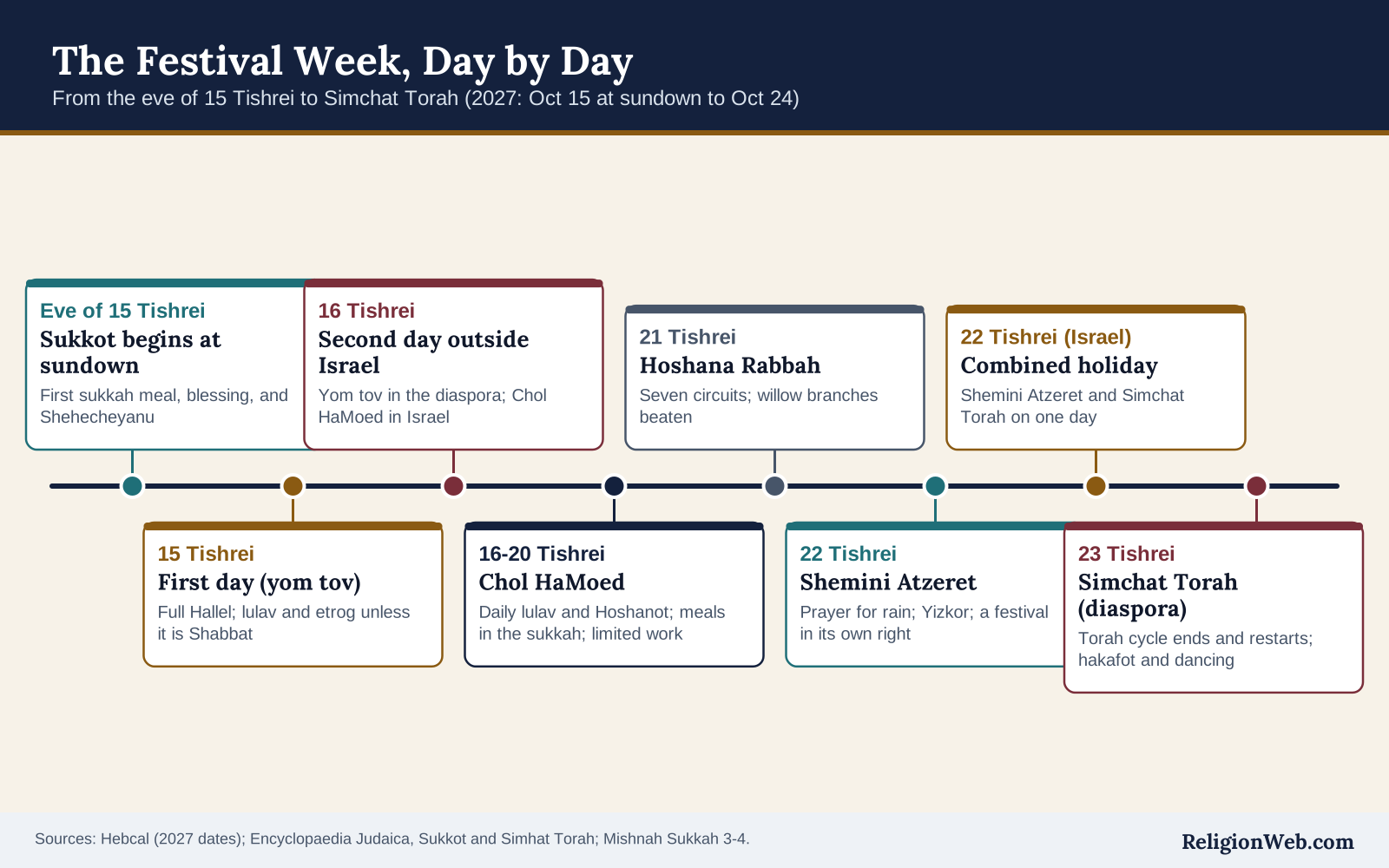
Sukkot is not one uniform block of days. The first day is a full festival day (yom tov) on which the rules of rest are close to those of Shabbat, with exceptions for cooking and carrying that serve the festival itself. In Israel only the first day has that status; in most diaspora communities the first two days do. The days between, called Chol HaMoed, “the weekdays of the festival,” are semi-festive: people may work in limited ways and travel, yet they still dwell in the sukkah, take the Four Species, and recite the festival prayers. The seventh day, Hoshana Rabbah, is the climax of the Chol HaMoed period, and the eighth day, Shemini Atzeret, belongs to the festival cycle but is, in the rabbinic phrase, a separate holiday. The table summarizes the sequence.
| Hebrew date | Name | Status | Main observances |
|---|---|---|---|
| 15 Tishrei | First day of Sukkot | Yom tov in Israel and the diaspora | Festival prayers, full Hallel, Torah reading from Leviticus 23, meals in the sukkah, lulav and etrog (except on Shabbat) |
| 16 Tishrei | Second day of Sukkot | Yom tov outside Israel; Chol HaMoed in Israel | Same liturgy as day one in the diaspora; in Israel an ordinary intermediate day |
| 16 to 20 Tishrei (Israel) or 17 to 20 (diaspora) | Chol HaMoed | Intermediate festival days | Daily lulav and Hoshanot, Hallel, meals in the sukkah, limited work, family outings, hospitality |
| 21 Tishrei | Hoshana Rabbah | Last day of Chol HaMoed | Seven circuits with the Torah scrolls, willow branches beaten, all-night study in many communities |
| 22 Tishrei | Shemini Atzeret | Separate yom tov | Prayer for rain, Yizkor memorial in many communities, one more day of festive meals; in Israel also Simchat Torah |
| 23 Tishrei | Simchat Torah | Yom tov in the diaspora only | Completion and restart of the Torah reading cycle, processions with scrolls, dancing |
Terms used throughout this article
A short vocabulary will make the later sections easier. These Hebrew terms recur throughout the discussion of the festival and are used in the standard sources on Sukkot.
| Term | Meaning | Where it appears |
|---|---|---|
| Sukkah (plural sukkot) | The booth in which people dwell during the festival | Leviticus 23:42; Mishnah tractate Sukkah |
| Sekhakh or schach | The covering of cut plant material laid over the top of the sukkah | Mishnah Sukkah 1:4 and following |
| Arba’ah minim | The Four Species: citron, palm, myrtle, willow | Leviticus 23:40 |
| Lulav and etrog | The palm branch (often meaning the whole bound bundle) and the citron fruit | Mishnah Sukkah 3 |
| Hoshanot | Prayers of “save us” recited with the lulav during processions | Festival liturgy; Mishnah Sukkah 4:5 |
| Chol HaMoed | The intermediate days between the first festival days and Shemini Atzeret | Rabbinic law of festivals |
| Ushpizin | “Guests,” the biblical figures invited into the sukkah in kabbalistic custom | Zohar-based custom, later prayer books |
| Yom tov | A full festival day with Shabbat-like restrictions | First day(s) of Sukkot, Shemini Atzeret, Simchat Torah |
Biblical Roots and Historical Development
Harvest Festival and Memory of Booths in the Torah
The ingathering and the agricultural year
Most historians read the earliest layer of Sukkot as an agricultural festival, and the Torah’s own vocabulary supports that. The oldest festival calendars in Exodus name the “feast of ingathering” and fix it at the year’s end, when grain, fruit, olives, and grapes have been stored. Deuteronomy gives its timing as after the produce has been gathered from the threshing floor and the winepress. The festival comes just as the dry season is about to give way to the first rains, which the land of Israel depends on for the coming year, and that connection to water continues to shape the festival’s prayers and rituals. The Encyclopaedia Judaica entry on Sukkot, by Ernst Kutsch, Louis Jacobs, and Abram Kanof, describes the festival as originally tied to the harvest rather than to a fixed calendar date, with the fifteenth-to-twenty-first range of the seventh month fixed in later periods. It is the last of the three pilgrimage festivals, with Passover and Shavuot, when the males of Israel were to appear at the chosen sanctuary (Deuteronomy 16:16).
The booth itself has an agricultural flavor in the Bible. Prophetic poetry can compare a devastated city to a booth left standing in a vineyard (Isaiah 1:8), an image that makes sense if watchmen and workers set up temporary shelters in the fields at harvest. Some scholars therefore suggest that the festival’s booths grew out of such harvest huts, and that the later commemorative reading was added to a custom that already existed. That suggestion is a scholarly reconstruction and not a claim of the sources themselves, which present the booths from the start as a commanded observance.
Booths as memory: Leviticus 23 and Deuteronomy 16
The two legal texts that describe the booths most directly are Leviticus 23 and Deuteronomy 16. Leviticus sets the dates, assigns the first day and the eighth day as days of sacred assembly, and then adds the instruction to dwell in booths together with an explicit reason.
Ye shall dwell in booths seven days; all that are home-born in Israel shall dwell in booths; that your generations may know that I made the children of Israel to dwell in booths, when I brought them out of the land of Egypt: I am the LORD your God.
Leviticus 23:42-43, The Holy Scriptures: A New Translation (JPS 1917)
The traditional reading of this passage treats the booths as a commemoration of the wilderness years between Egypt and the land, and that is the reading that shaped rabbinic law and the festival’s emotional logic. The verse says the practice exists so that later generations will “know,” and rabbinic commentary takes this to mean that the dwelling is meant to teach by experience. Deuteronomy approaches the same festival from the side of joy and community.
And thou shalt rejoice in thy feast, thou, and thy son, and thy daughter, and thy man-servant, and thy maid-servant, and the Levite, and the stranger, and the fatherless, and the widow, that are within thy gates.
Deuteronomy 16:14, The Holy Scriptures: A New Translation (JPS 1917)
Within the Jewish tradition this verse is read as an instruction about who belongs at the table: household members, servants, Levites who held no land, resident strangers, orphans, and widows. Later hospitality customs, including the invitation of guests into the sukkah, build on that list. The two passages together give the festival its double character, a solemn memory of vulnerability and an obligation to rejoice with everyone who has no field of their own.
Questions that tradition and scholars raise about the booths
Careful readers have always noticed a puzzle in Leviticus 23:43. Other biblical accounts of the wilderness years speak of tents, and Leviticus says the people lived in booths. The Talmud records an early disagreement about this. In a teaching preserved at Sukkah 11b, Rabbi Eliezer holds that the “booths” of the verse were the Clouds of Glory, the divine protection that accompanied the people, while Rabbi Akiva holds that they were actual booths the Israelites built. Both readings are still cited. The first emphasizes that the sukkah is a sign of trust in divine protection, and the second emphasizes the physical experience of dwelling in a shelter.
Modern academic scholars add a third perspective, noting that a commemoration of a wilderness stay is attached to a harvest festival whose roots seem to lie in field huts. Historians of religion tend to describe this as a case in which an older seasonal custom received a historical interpretation inside the covenant story, and that is also how the Encyclopaedia Judaica entry presents the matter. Believers of all movements generally keep the commemorative reading as the center of the festival’s meaning, and academic discussion of origins does not change what the practice means for those who observe it.
Sukkot in the Temple Period
Solomon’s dedication, Nehemiah’s assembly, and the Sabbatical reading
The biblical narratives place Sukkot at turning points. When Solomon dedicated the first Temple, the assembly gathered “at the feast” in the seventh month, and the account in 1 Kings 8 ends with a closing day of celebration. When the exiles returned from Babylon and the community gathered to hear the Torah read, the people discovered the command about booths and carried it out with striking energy.
And all the congregation of them that were come back out of the captivity made booths, and dwelt in the booths; for since the days of Joshua the son of Nun unto that day had not the children of Israel done so. And there was very great gladness.
Nehemiah 8:17, The Holy Scriptures: A New Translation (JPS 1917)
The passage reports that the people made booths on rooftops, in courtyards, in the Temple courts, and in the squares of Jerusalem (Nehemiah 8:16), and that the materials were gathered from the hills (8:15). Jewish tradition reads the passage as a renewal of an observance that had lapsed, and the Encyclopaedia Judaica notes that Nehemiah’s list of branches differs from the list of four in Leviticus 23:40, a difference that has produced debate about how the two passages fit together and that comes up again below in the discussion of Karaite practice. Deuteronomy 31 adds a further Sukkot institution, the hakhel assembly: every seventh year, at the festival, the Torah was to be read aloud to the whole people.
Seventy bulls, water, and light
The Temple-era festival was elaborate. Numbers 29:12-38 lists the offerings for each day, and the number of bulls falls from thirteen on the first day to seven on the seventh, giving seventy over the seven days. A rabbinic tradition, reflected on the Orthodox Union’s festival page, reads the seventy as a prayer on behalf of the seventy nations of the world, and the Book of Zechariah in its closing chapter imagines the nations coming up to Jerusalem each year to observe Sukkot. The eighth day then has a single bull, which rabbinic tradition (Sukkah 55b) associates with Israel in particular.
Pilgrims who wished to enter the sacred precincts first had to be in a state of ritual purity, restored through immersion in a mikveh, so the journey to Jerusalem came with its own preparations. Two ceremonies defined the festival as the Mishnah remembers it. The first was the water libation. During the festival a priest drew water from the Siloam pool in a golden flask, carried it in procession to the altar to the sound of trumpets, and poured it into a basin beside the altar (Mishnah Sukkah 4:9). The Encyclopaedia Judaica connects the rite to Isaiah 12:3, and rabbinic tradition ties it to the festival’s character as a judgment day for water, as stated in Mishnah Rosh Hashanah 1:2. The second was Simchat Beit HaSho’evah, “the rejoicing at the place of the water-drawing,” a nighttime celebration in the Temple’s Court of the Women. Mishnah Sukkah 5:1 states, in paraphrase, that anyone who has not seen this celebration has never seen true rejoicing. The Mishnah describes golden candelabra, the light of which illuminated courtyards across Jerusalem, pious men dancing with flaming torches, and Levites playing instruments on the fifteen steps connecting the courts (Mishnah Sukkah 5:2-4).
Disputes about the rites: Sadducees, willows, and the etrog incident
The festival also carried disagreements between competing groups. The Encyclopaedia Judaica reports that the Sadducees rejected the water libation because Scripture did not mention it, and the Mishnah preserves a story, without naming him, of a Sadducean priest who poured the water on his own feet instead of on the altar. According to the Mishnah, the crowd responded by pelting him with their etrogim (Mishnah Sukkah 4:9). The Jewish historian Josephus tells a similar story in the Antiquities of the Jews (13.372) about the Hasmonean king Alexander Jannaeus, and the Encyclopaedia Judaica cites it as a parallel. The Pharisees and the Boethusians likewise disagreed about the willow rite on the seventh day, which the Pharisees treated as a tradition going back to Moses even though the Bible does not mention it.
These disputes show that the festival’s details were contested during the Second Temple period, in a setting where priestly and lay interpretations of Scripture competed. They also show why the Mishnah’s descriptions are valuable as sources: they preserve how a major Temple ceremony was understood by the tradition that survived the Temple’s destruction, even if the sources cannot always be matched to independent archaeological evidence.
| Practice | In the Temple period | After the Temple’s destruction |
|---|---|---|
| Four Species | Taken all seven days in the Temple, but only on the first day elsewhere (Mishnah Sukkah 3:12) | Taken all seven days everywhere, “in remembrance of the Temple,” by decree attributed to Rabban Yochanan ben Zakkai |
| Willow branches | Stood around the altar; one circuit daily and seven on the seventh day (Mishnah Sukkah 4:5-6) | Circuits made around the synagogue’s reading desk during the Hoshanot prayers; willow branches beaten on Hoshana Rabbah |
| Water | Water libation at the altar; nightly celebration at the Beit HaSho’evah | Rite not performed; its memory shapes festival songs and public celebrations |
| Offerings | Seventy bulls over seven days, one on the eighth (Numbers 29) | Read aloud from Numbers 29 in the Torah service on each day |
| Pilgrimage | Required journey to Jerusalem for those able to travel | Observed in local synagogues and homes; many people still visit Jerusalem during the festival by custom |
After 70 CE: Rabbinic Reshaping and Later Customs
The destruction of the Temple and the extension of the lulav
The destruction of the Second Temple in 70 CE removed the pilgrimage, the altar, and the water ceremony, and the rabbis responded by moving the festival’s weight to the synagogue and the home. Mishnah Sukkah 3:12 records the key decision. Before 70 CE the lulav was taken for seven days in the Temple and for a single day elsewhere; after the destruction, Rabban Yochanan ben Zakkai ordained that it be taken for seven days in every community, in remembrance of the Temple. This ruling meant that the first day became the one day with a biblical obligation, and the following days became a rabbinic enactment tied to memory.
The Mishnah tractate Sukkah is the central early record of the festival’s law, and the Talmudic discussions of it in Babylonia and Palestine filled in the rules for building the booth, for qualified plants, for the position of the body in the sukkah, and for the effects of rain. That material is the foundation of what later codes like Maimonides’ Mishneh Torah and the Shulchan Aruch summarize. Readers who want background on the Talmudic literature can consult the article on the Talmud.
Medieval and mystical developments: Hoshana Rabbah, Ushpizin, and Simchat Torah
Several of the festival’s best-known customs grew up in the medieval centuries. The Encyclopaedia Judaica entry on Hoshana Rabba reports that from the thirteenth century a popular belief held that Hoshana Rabbah was the day on which the verdict of Yom Kippur was sealed, an idea that appears in the Zohar and drew on the older notion that the world is judged for water at Sukkot. The custom of staying awake on the night of Hoshana Rabbah to read the Torah began in the thirteenth century as a way for people who had not finished the Pentateuch to complete it, and it probably became, through the kabbalists of Safed, a formal tikkun, a ritual of spiritual repair. Readers curious about the mystical tradition can find more in the article on Kabbalah.
The ushpizin custom is another layer. The Encyclopaedia Judaica traces it to kabbalistic tradition, citing the Zohar, and the formal invitation of seven biblical guests, one for each day, was adopted by Hasidic communities, among which nineteenth-century pamphlets of ushpizin prayers circulated. Simchat Torah, finally, is a post-Talmudic development. The Talmud (Megillah 31a) knows the day only as the second day of Shemini Atzeret, and the Encyclopaedia Judaica reports that the special celebrations began to develop in the geonic period, after the one-year Torah reading cycle was widely accepted. Each of these customs is later than the Mishnah, yet each has become inseparable from how the festival is lived today.
The Sukkah: Structure, Rules, and Dwelling
Building a Valid Sukkah
Walls, roof, and location
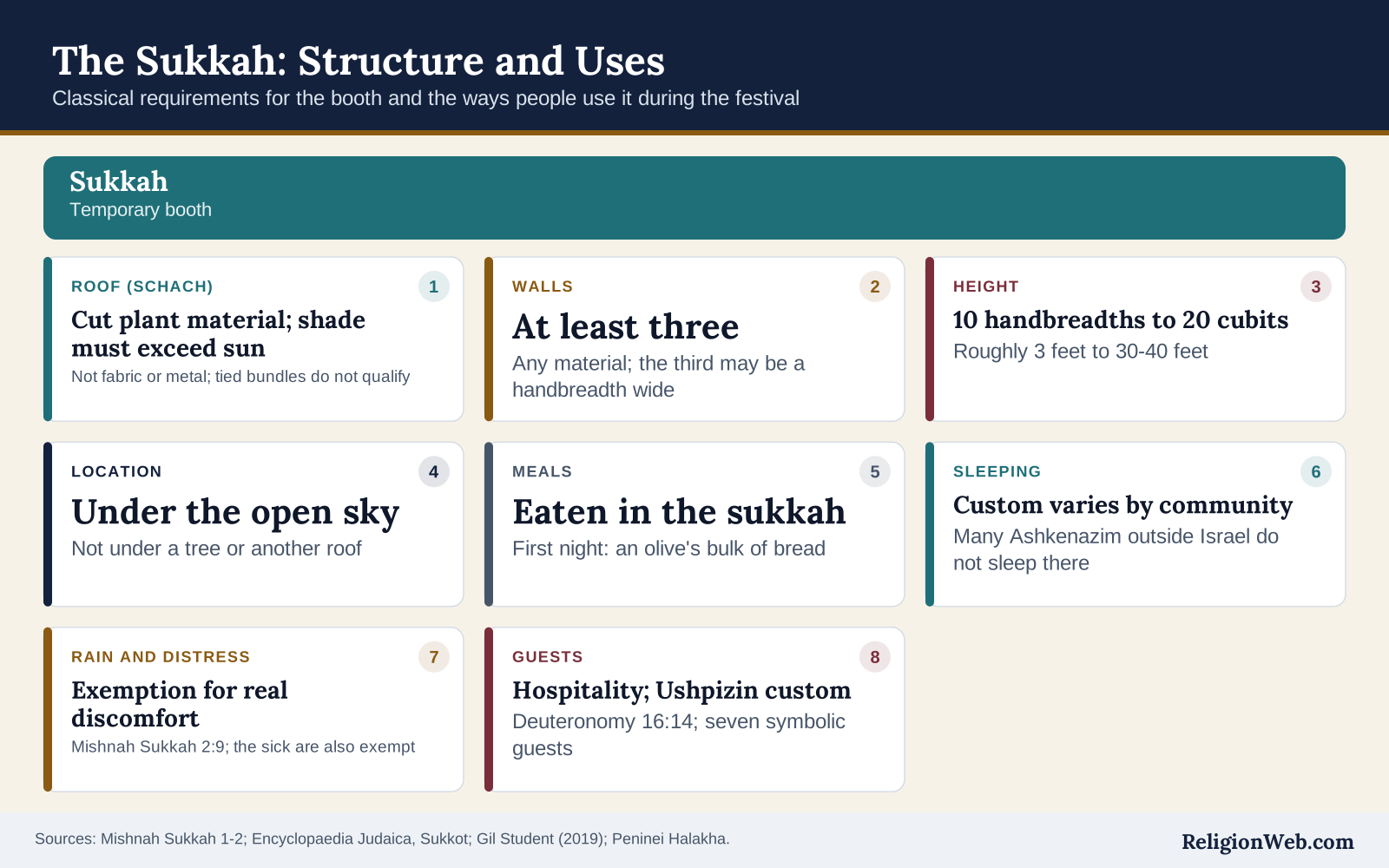
The sukkah is the festival’s central object, and the Mishnah tractate that bears its name opens with its construction. The first mishnah sets the outer limits: a sukkah higher than twenty cubits is invalid (Rabbi Yehuda disagrees), as is one lower than ten handbreadths, one without three walls, or one whose roof lets in more sun than it casts shade (Mishnah Sukkah 1:1). A cubit is roughly a foot and a half to two feet, and a handbreadth roughly three to four inches, so the permitted range runs from about three feet up to some thirty to forty feet. The same chapter requires that the sukkah stand under the open sky. A booth built beneath a tree is treated as if it were inside a house (Mishnah Sukkah 1:2), and the Encyclopaedia Judaica summary of the law adds that the sukkah must be under the open sky and not inside a house.
The walls may be made of almost anything, and the third wall may be only a handbreadth wide. Families have built walls of wood, canvas, cloth, boards, and fabric panels, and some communities, as the Union for Reform Judaism notes, deliberately keep the sides open as a sign of welcome. The roof, by contrast, is tightly regulated. What matters in the law is not that the structure is picturesque or sturdy but that the roof, at its most basic, is made of cut plant material laid loosely over the open top.
| Element | What the classical sources require | Notes and variation |
|---|---|---|
| Roof (schach) | Material that grew from the ground, was cut, and is not susceptible to ritual impurity; shade must exceed sun (Mishnah Sukkah 1:1, 1:4) | Commonly branches, reeds, bamboo, or slats; tied bundles are not valid for the roof (1:5) |
| Walls | At least three; the third may be a handbreadth wide (Mishnah Sukkah 1:1; Encyclopaedia Judaica) | Any material may serve; many families use four walls, Reform communities often leave sides open |
| Height | Between ten handbreadths and twenty cubits (Mishnah Sukkah 1:1) | Rabbi Yehuda would validate a taller structure; the Talmud explains the limit in several ways |
| Location | Under the open sky; not under a tree or another roof (Mishnah Sukkah 1:2) | Apartment dwellers use balconies, yards, or a congregation’s shared sukkah |
| Space | Large enough for a person’s head and most of the body plus a table (Mishnah Sukkah 2:7) | Communal sukkot are built for larger gatherings |
| Decoration | Not required; permitted if it does not replace or lower the roof | Some decorate heavily, others keep it plain (Orthodox Union) |
Schach: what may cover the roof and why
The most distinctive requirement concerns the roof. The Mishnah states a general rule: schach must come from something that grows out of the ground and is not susceptible to ritual impurity (Mishnah Sukkah 1:4). Fabric, metal, and finished furniture are excluded, and cut branches, reeds, and similar plant materials are the typical choices. Tying the stalks in bundles invalidates them as a roof, though bundles are acceptable for walls (1:5). A sheet spread over the roof, to keep off the sun or to catch falling leaves, invalidates the sukkah (1:3). Climbing plants still rooted in the ground cannot form the roof unless they are cut or outweighed by valid cover (1:4).
These rules are not arbitrary. They express the idea that the roof of a sukkah should be natural, and not manufactured, and that it should offer only partial protection. The Mishnah requires that shade exceed sun, so the booth must be genuinely sheltering, yet it also declares a sukkah with a roof thick enough to hide the stars to be valid (Mishnah Sukkah 2:2). Popular guides, including the My Jewish Learning introduction to the festival, describe the ideal roof as one that gives shade but lets the stars be seen. That ideal is a recommendation about how the sukkah feels rather than a condition of validity, and it explains the common image of a family looking up from the table at a night sky through a roof of branches.
Modern builds: kits, balconies, and shared sukkot
Contemporary sukkot reflect where people live. Many families still assemble a wooden frame with canvas or fabric walls and a roof of cut branches, while others buy a prefabricated kit with a metal frame and reed or bamboo mats sold specifically for use as schach. Apartment residents often build on a balcony, provided that nothing stands between the roof and the open sky. Synagogues and community centers commonly erect a shared sukkah so that members without their own can eat there, a practice the Encyclopaedia Judaica notes. In cities with a large Jewish population, restaurants, schools, and workplaces set up sukkot as well. Readers interested in the communal side of festival life can learn more in the article on the synagogue.
Living in the Sukkah
Eating, drinking, and the first night
The Torah’s wording is “ye shall dwell in booths,” and the rabbis take dwelling to mean treating the sukkah as one treats a home. Rabbi Eliezer Melamed’s Peninei Halakha, a contemporary Israeli Orthodox code, summarizes the principle as living in the sukkah as one lives at home. In practice, the center of the obligation is the meal. The Mishnah records an argument over whether a person must eat fourteen meals in the sukkah during the week, one by day and one by night, as Rabbi Eliezer held; the Sages ruled that there is no fixed number except the first night, when a meal is required (Mishnah Sukkah 2:6). The Encyclopaedia Judaica states the standard modern rule that on the first night one must eat at least an olive’s bulk of bread in the sukkah, and later meals should be eaten there as well.
Casual eating and drinking outside the sukkah is permitted, and the Mishnah describes sages who ate small amounts outside (2:4, 2:5). A person recites a blessing over the commandment, using the phrase leishev ba-sukkah, “to dwell in the sukkah,” when sitting down to a meal, and on the first night the Shehecheyanu blessing for reaching a new season is added. The meals themselves follow the usual patterns of Jewish festival dining, including the dietary rules described in the article on kosher and kashrut, with kiddush over wine and challah on the first night, and many families take care that the best meals of the week happen inside the sukkah.
Sleeping, rain, cold, and exemptions
Sleeping in the sukkah has a more complicated history. The Talmud (Sukkah 20b and 26a) indicates that men are commanded to sleep there, yet for more than seven hundred years Ashkenazi practice has treated it as a stringency and not a requirement, according to the Orthodox rabbi and writer Gil Student, writing in the Jewish Press in 2019. The thirteenth-century Mordechai reported that most people in Germany did not sleep in the sukkah because of the cold, and the sixteenth-century authority Moses Isserles, known as the Rema, accepted the practice but gave a different reason, concerning the difficulty of a husband and wife sleeping there together. Student reports that outside Israel most Jews do not sleep in a sukkah, though a significant minority do, and that men in Israel widely do. Beyond that, the question is one of community custom and household judgment.
Rain and discomfort bring other exemptions. Mishnah Sukkah 2:9 states that a person may leave the sukkah when rain falls heavily enough to spoil a cooked dish, and it compares the situation to a servant who comes to pour his master a drink and has the water thrown back in his face, an image of the festival’s pleasure being refused. Rabbi Melamed explains that the rabbis called someone in such discomfort a mitzta’er, a person in distress. The threshold is real discomfort that an ordinary person would find bothersome, not a minor leak or a light drizzle. Sick people and those who care for them are also exempt (Mishnah Sukkah 2:4). If a person moves indoors because of rain and the rain stops, he need not return to finish the meal. As with other religious practices, none of this replaces medical or safety judgment: a person who is ill, elderly, or at risk from cold or storms should use the exemptions the tradition provides.
Women, children, and the obligation to dwell
The Mishnah states that women, slaves, and minors are exempt from the sukkah, while a child who no longer depends on a mother’s care is obligated, since children are trained in the commandments (Mishnah Sukkah 2:8). The exemption of women follows the classical principle that women are not obligated in positive commandments tied to a fixed time. In Orthodox practice that exemption remains, yet many Orthodox women eat, host, and spend time in the sukkah, and women are commonly the hosts of the festival meals. Conservative Judaism has changed the legal position. A 2014 teshuvah by Rabbi Pamela Barmash, adopted by the Rabbinical Assembly’s Committee on Jewish Law and Standards by a vote of fifteen to three with three abstentions, rules that women are now equally obligated with men in time-bound commandments, including dwelling in the sukkah and taking the lulav. Those differences between communities are taken up again in the section on variations.
What the Sukkah Means
Protection, vulnerability, and trust
The sukkah teaches through its physical condition. A person who steps into a booth leaves the usual comforts of a solid house, with its locks, insulation, and roof, and sits under branches that move in the wind and let in sun and weather. The Orthodox Union’s festival page presents it as a reminder to rely on divine protection and describes the sukkah as a commandment that surrounds the person entirely, since one enters it with the whole body. The disagreement between Rabbi Eliezer and Rabbi Akiva about the original booths gives the same idea two forms: the sukkah recalls either the Clouds of Glory that sheltered the people or the huts they built for themselves, and in both readings the point is that human safety depends on something beyond walls.
The same symbolism explains why the festival comes right after Yom Kippur and in the harvest season. After weeks of introspection, and after a season when the barns are full, people are asked to sit in a shelter that makes no claim to permanence. The reading of Ecclesiastes on the festival, discussed later, makes the same point in language about the passing of things. Traditional commentators emphasize that the result is meant to be joy, not anxiety, and the liturgy and the Torah both stress rejoicing as the festival’s purpose. A related point of law shows the same logic: a sukkah is generally understood to be exempt from the requirement of a mezuzah on its doorposts, because it is a temporary dwelling, as the article on the mezuzah explains for permanent homes.
Hospitality, Ushpizin, and decoration
The sukkah is also a place for guests. Deuteronomy 16:14 includes the stranger, the orphan, and the widow in the festival’s rejoicing, and the practice of inviting guests, whether neighbors, relatives, or people who have no place of their own, is one of the festival’s strongest customs. The kabbalistic tradition adds a symbolic layer called ushpizin, from an Aramaic word for “guests,” in which seven biblical figures are invited into the sukkah, one for each night. The Encyclopaedia Judaica lists them as Abraham, Isaac, Jacob, Moses, Aaron, Joseph, and David, in the order that most Ashkenazi prayer books use; the Zohar places Joseph after Moses and Aaron. Before the meal, people recite a short invitation, and many sukkot display a plaque with the seven names. In recent years some families have also invited biblical women, a modern addition that is not part of the older prayer books.
Decoration is a matter of local taste. Orthodox Union guidance notes that decorating is a custom some follow while others keep the sukkah plain, and children’s drawings, fruit, paper chains, and illustrations of the Ushpizin are all common. Reform communities, as described by the Union for Reform Judaism, often emphasize the open sides, doors, and shared meals that welcome neighbors and community. In all of these forms, the sukkah is understood as a space where people gather to eat and celebrate with the festival’s central commandment around them.
The Four Species: Lulav, Etrog, Hadas, and Aravah
What the Torah Commands and How the Rabbis Read It
Leviticus 23:40 and the four plants
The second great commandment of Sukkot is separate from the sukkah. Leviticus 23:40 tells the people what to take on the first day, and the Jewish tradition has understood the verse as describing four kinds of plants, known collectively as the arba’ah minim, the Four Species.
And ye shall take you on the first day the fruit of goodly trees, branches of palm-trees, and boughs of thick trees, and willows of the brook, and ye shall rejoice before the LORD your God seven days.
Leviticus 23:40, The Holy Scriptures: A New Translation (JPS 1917)
The verse does not name the plants in modern botanical terms, and the rabbinic tradition supplied the identifications that are now standard in Jewish practice. Those identifications are summarized in the Encyclopaedia Judaica entry on the Four Species by Louis Isaac Rabinowitz, and the table below sets them beside the biblical phrases.
| Species | Common identification | Phrase in Leviticus 23:40 | Requirements in the sources | Midrashic symbolism |
|---|---|---|---|---|
| Etrog | Citron (Citrus medica) | “fruit of goodly trees” | Whole and unblemished; stem and pitam matter in the Mishnah’s defect rules (Mishnah Sukkah 3:5-7) | Has both taste and aroma (Leviticus Rabbah 30) |
| Lulav | Closed palm frond | “branches of palm-trees” | Top intact; at least three handbreadths long (Mishnah Sukkah 3:1) | Taste without aroma, like the date; a spine in the body image |
| Hadas (plural hadassim) | Myrtle | “boughs of thick trees” | Three sprigs by the usual ruling (Rabbi Yishmael, Mishnah Sukkah 3:4); disqualified if the top is cut or berries outnumber leaves (3:2) | Aroma without taste |
| Aravah (plural aravot) | Brook willow | “willows of the brook” | Two sprigs; a similar non-willow species does not qualify (Mishnah Sukkah 3:3) | Neither taste nor aroma |
Identifying the species: etrog, lulav, hadas, aravah
The rabbinic identification takes the “fruit of goodly trees” as the etrog, the “branches of palm-trees” as the closed central frond of the date palm, the “boughs of thick trees” as myrtle, and the “willows of the brook” as the aravah. The Talmud argues the point at Sukkah 32b-33, and a midrash in Leviticus Rabbah gives parallel reasoning. The Encyclopaedia Judaica adds that Nehemiah 8:15 seemed to connect the plants to the building of booths, but that the Jewish legal tradition treats them as a separate commandment from the sukkah.
Not every Jewish community reads the verse this way, and the difference is instructive. The Karaite tradition, which rejects the authority of the rabbinic oral law, has historically read Leviticus 23:40 as a single commandment, with the plants taken to build the sukkah that Leviticus 23:42 requires, and does not shake the species. Scholar Shawn Joe Lichaa, writing on TheTorah.com in 2016, notes that most Karaite sages follow Nehemiah 8:15 in this way, and that interpreters such as Jacob ben Reuben, an eleventh-century Karaite author, proposed different identifications for the individual plants. A small minority of Karaite sages read the verse as describing fruit and greenery to be eaten and enjoyed during the festival. The Karaite Jews of America site confirms the construction reading as the majority view. These differences are internal to Jewish interpretation, and they show how a short verse can support different practices.
Taking the Species: Blessing, Shaking, and Hallel
Assembling and holding the set
In rabbinic practice the three branches are bound together into a single bundle, which in common speech is called the lulav. The Encyclopaedia Judaica describes the standard arrangement: three myrtle sprigs and two willow sprigs are bound to the palm frond with strips of palm leaf, the myrtle on the right and the willow on the left, with the spine of the palm facing the holder (Sukkah 37b). The bundle is held in the right hand and the etrog in the left. Mishnah Sukkah 3:8 records an old disagreement about whether the bundle may be tied with string or only with material from the species themselves, and the usual practice, as the Encyclopaedia Judaica describes it, is to bind with strips of palm leaf.
The first day has a special requirement. On the first day each person must use a set that is his or her own and not merely borrowed, since the Torah says “ye shall take you,” and on later days borrowing is permitted (Mishnah Sukkah 3:13; Encyclopaedia Judaica). A child old enough to wave the lulav is expected to be trained in the commandment (Mishnah Sukkah 3:15), and in many families children receive their own small sets.
The blessing and the six directions
The commandment is performed in the daytime, usually before or during the morning service. Peninei Halakha reports that it is customarily performed at the morning prayer, may be done later that day if it was missed, and that the commandment for the day is lost once the stars come out. The blessing ends with the phrase al netilat lulav, “on the taking of the lulav,” and on the first day it is joined by the Shehecheyanu blessing for the new season. Afterward the participant waves the bundle together with the etrog.
The Encyclopaedia Judaica reports that the species are shaken toward the six directions, east, south, west, north, up, and down, a gesture the Talmud (Sukkah 37b) explains as acknowledgment of God’s rule over all of nature. The shaking takes place during Hallel, the psalms of praise, at verses from Psalm 118 (the opening verses and verse 25). The Mishnah records an early debate between the schools of Hillel and Shammai about exactly which verses call for the gesture (Mishnah Sukkah 3:9). The order in which the directions are faced differs among communities, a detail that is a matter of local custom and not of the central commandment.
Days, Shabbat, and the year the festival begins on Shabbat
The commandment applies on each of the seven days, but its weight differs. Only the first day has a biblical obligation outside the Temple, and the following days rest on the decree of Rabban Yochanan ben Zakkai described earlier (Mishnah Sukkah 3:12). The lulav is not taken on Shabbat. Peninei Halakha explains that the practice was settled in the generations after the Temple’s destruction, so that it is not taken even in the Land of Israel when the first day falls on Shabbat, and that in such a year the biblical obligation is not fulfilled at all and the commandment is performed on the remaining days as a rabbinic enactment.
That rule matters in 2027, since the first day of Sukkot falls on Saturday, October 16. The lulav and etrog are therefore first taken on Sunday, October 17. In the diaspora that Sunday is still a festival day, and in Israel it is Chol HaMoed. Because the festival’s other practices continue as usual, the loss of the first-day ritual is felt mostly in the synagogue and in the household preparation of sets.
Choosing a Set and Understanding Its Symbolism
Choosing an etrog: grafting, pitam, and sources
Selecting a set of the Four Species is a skilled task, and a good etrog can be costly. The Mishnah already lists defects that disqualify a citron: blemishes over most of its surface, a peeled or split skin, a pierced fruit with loss, a stolen or dried fruit, or one from a forbidden source (Mishnah Sukkah 3:5-6). It sets a minimum size and says a fruit too large to hold in one hand is a topic of debate (3:7). The Encyclopaedia Judaica notes that the stem must remain intact, which is why special boxes exist to protect the fruit, and the small protuberance at the tip of the fruit, called the pitam, has its own history.
Two modern questions concern the pitam and grafting. The Encyclopaedia Judaica notes that the pitam was once a sign of excellence, but that ungrafted trees are vulnerable to pests and disease and often lack it. The permissibility of grafted etrogim for the commandment became a question only in comparatively recent times, and some communities seek ungrafted fruit. The same entry explains that the small-fruited strain predominates in Israel, the large strain was brought by Yemenite Jews, and the island of Corfu was the main center of cultivation until the end of the nineteenth century, supplying European Jewish communities. The name etrog may come from a Persian word, and some scholars hold that the tree reached the Land of Israel only in the Second Temple period, a link between a ritual need and the spread of a crop.
Symbolism: taste, aroma, and the body
The Four Species have inspired a large body of interpretation. The Encyclopaedia Judaica summarizes the best-known midrash, in Leviticus Rabbah 30, which compares the plants by two qualities, taste and aroma. The etrog has both, the date palm has only taste, the myrtle only aroma, and the willow neither. The midrash reads these qualities as pointing to people with Torah learning, with good deeds, with both, or with neither, and it concludes that all four types are bound together so that each atones for the others. A second midrash in Leviticus Rabbah assigns the plants to parts of the body, with the lulav as the spine, the etrog as the heart, the myrtle leaves as the eyes, and the willow leaves as the mouth. Other interpreters have pointed to the agricultural meaning of the plants, as emblems of the fertility of the land.
Several other pieces of evidence show how deeply the species were embedded in the festival. The Encyclopaedia Judaica reports that the etrog appears on coins of the Hasmonean ruler Simeon and others and often in synagogue art and mosaics. It also reports, citing Yigael Yadin, that Bar Kokhba, the leader of the revolt against Rome of 132 to 135 CE, made sure his troops had the species even in wartime. After the festival, many families preserve the etrog by turning it into jam or studding it with cloves for fragrance, customs that are widely reported though not part of the legal tradition.
Prayer in the Synagogue: Hallel, Hoshanot, and the Festival Liturgy
Festival Services and Readings
The festival service: Hallel, Torah, and Musaf
On the first day, and on the second day outside Israel, the synagogue service follows the festival pattern, with the morning prayer, a full recitation of Hallel, a Torah reading, and the additional prayer called Musaf. The Mishnah states that Hallel and rejoicing apply on all eight days of the festival, counting the day that follows the seven (Mishnah Sukkah 4:8), and this is why the complete Hallel is recited throughout the week. The service includes the Amidah with the festival insertions that call the day the season of rejoicing. The weekday and Shabbat prayer frameworks are the same ones described in the article on the synagogue, and the daily recitation of the Shema continues as on any other day.
| Practice | When | Blessing or wording | Notes |
|---|---|---|---|
| Eating in the sukkah | Meals, especially the first night | Leishev ba-sukkah, “to dwell in the sukkah” | First night requires an olive’s bulk of bread (Encyclopaedia Judaica); Shehecheyanu added on the first night |
| Taking the Four Species | Daytime, usually at morning prayer, on each day except Shabbat | Al netilat lulav, “on the taking of the lulav” | Shehecheyanu the first time each year; first-day set must be one’s own |
| Hallel | Every day of the festival and Shemini Atzeret | Psalms 113 to 118 in the standard rite | Species are shaken at verses of Psalm 118 |
| Hoshanot circuit | After Musaf on each weekday; seven times on Hoshana Rabbah | Prayers beginning with the plea “save us” | Memory of the Temple altar circuits (Mishnah Sukkah 4:5) |
| Prayer for rain (Geshem) | Musaf of Shemini Atzeret | Rain is mentioned in the Amidah from then on | Encyclopaedia Judaica lists it with Yizkor on that day |
| Hakafot | Simchat Torah (eve and day) | Verses and songs while carrying the scrolls | Seven circuits in Orthodox and Conservative congregations |
Torah and prophetic readings
The readings for the first day come from Leviticus 22:26 to 23:44, the chapter that sets out the festival calendar, with a closing passage from Numbers 29:12-16 on the offerings, according to Hebcal’s listing. The prophetic portion on the first day is Zechariah 14, a chapter that gave the festival a universal horizon. The prophet imagines a time when the nations will come up to Jerusalem to observe Sukkot.
And it shall come to pass, that every one that is left of all the nations that came against Jerusalem shall go up from year to year to worship the King, the LORD of hosts, and to keep the feast of tabernacles.
Zechariah 14:16, The Holy Scriptures: A New Translation (JPS 1917)
Jewish commentary reads this visionary text in several ways. The Orthodox Union reads the seventy bulls of the Temple period as an offering on behalf of the seventy nations, a theme that resonates with Zechariah’s vision of a future in which all peoples acknowledge one God. The text also links Sukkot with rain, since the next verse says that those who do not go up will receive no rain. On the second day outside Israel the haftarah is 1 Kings 8:2-21, the account of the dedication of the Temple at the festival.
Readings on the intermediate days and Ecclesiastes
On Chol HaMoed the Torah scroll is brought out each morning for a short reading from Numbers 29, which lists the offerings of the day (Numbers 29:17-34 in Hebcal’s day-by-day schedule). On the Shabbat that falls within the festival, the reading changes to a passage connected to the festival’s themes, and the Encyclopaedia Judaica notes that the biblical Book of Ecclesiastes (Kohelet) is read on the intermediate Shabbat or, if there is none, on Shemini Atzeret. The choice of this book is traditionally explained by its meditation on the passing of things and its repeated call to enjoy the portion God gives, a mood that matches a festival of rejoicing held in a temporary dwelling. Readers who want to know more about the Torah’s structure can consult the article on the Torah.
The Hoshanot Processions
Circuits with the lulav
One of the most distinctive moments of the synagogue service comes after Musaf, when the congregation takes the lulav and etrog and walks a circuit around the reading platform while reciting a series of litanies called Hoshanot, from the plea hoshia na, “save us.” The Mishnah describes the Temple origin of the practice: willow branches were set upright around the altar, and the people circled it once on each of the first six days and seven times on the seventh (Mishnah Sukkah 4:5). Rabbi Yochanan ben Zakkai’s ordinance extended the lulav’s role, and the circuits in synagogues are understood as a continuation of the altar circuits, as the Encyclopaedia Judaica entry on Hoshana Rabba explains.
The refrains of the Hoshanot ask for salvation and, in many of the litanies, for rain, in keeping with the festival’s connection to the water year. The congregation sings the refrains together, and the lulav is carried in the right hand with the etrog held against it.
The Shabbat of Sukkot
When Shabbat falls within the festival, the lulav is not taken, and communities differ on how the Hoshanot are recited that day. The Mishnah already records the Temple-era practice of making arrangements for lulavim on Shabbat, including a story of a first-day Shabbat when people threw lulavim to the crowd and scuffles broke out, which led the court to institute that each person take his or her own at home (Mishnah Sukkah 4:4). The Shabbat service of the festival uses the Shabbat liturgy with festival additions, and meals in the sukkah carry the double character of Shabbat and Sukkot. The article on Shabbat describes how the weekly day of rest is kept.
Chol HaMoed in Synagogue and Home
Work, rest, and the semi-festive days
The days between the first festival days and Hoshana Rabbah have a mixed character. They are not full festival days, so ordinary activities are largely permitted, yet the commandments of the sukkah and the Four Species continue, and the festival prayers are recited, as My Jewish Learning’s introduction notes. Detailed rules about which kinds of work are allowed on Chol HaMoed differ by community and by the strictness of the authority followed. Many Jews in Israel take time off work and school, and it is common to travel, visit family, or take excursions to historic sites.
Tefillin, weekday prayer, and the Priestly Blessing
Weekday prayers continue in the synagogue on Chol HaMoed, with Hallel and the added festival offerings. Communities differ on whether tefillin are worn at the morning service on these days, a question of custom that local rabbis settle for their congregations. One notable gathering takes place at the Western Wall in Jerusalem, where priestly descendants of Aaron (kohanim) recite the Priestly Blessing during the intermediate days. In 2023 the Israeli news site Ynet reported that tens of thousands of worshipers took part, the 53rd year of the gathering, with hundreds of kohanim giving the blessing.
Hoshana Rabbah, Shemini Atzeret, and Simchat Torah
Hoshana Rabbah: The Seventh Day
Seven circuits and the beating of the willow
The seventh day of Sukkot, the twenty-first of Tishrei, is called Hoshana Rabbah, “the Great Hoshana.” The Encyclopaedia Judaica explains that the name probably comes from the many hoshanot recited that day, and that the day’s central rite goes back to the Temple. In the Mishnah’s account, the altar was circled once on each of the first six days and seven times on the seventh (Mishnah Sukkah 4:5), and Rabbi Yochanan ben Beroka adds that on the seventh day palm branches were beaten on the ground beside the altar, so that it was called the day of beating branches (4:6). In synagogues today the congregation makes seven circuits around the reading platform while the hoshanot are recited, with the lulav and etrog in hand.
The ritual that follows the circuits is the beating of the willow. Worshipers take a bundle of five willow branches, bound together, and strike it against the floor or another object several times. The Encyclopaedia Judaica notes that the obligation to take willow branches remained after the Temple and that the beating is called the “custom of the prophets” (Sukkah 43b). The Pharisees treated the willow rite as an ancient tradition handed down from Moses, while the Boethusians disputed it. The rite also had a calendar consequence that medieval authorities noted: the Hebrew calendar is arranged so that Rosh Hashanah never falls on a Sunday, which means that Hoshana Rabbah never falls on Shabbat, when the willow rite would be set aside. Hoshana Rabbah falls on Friday, October 22, in 2027.
Judgment, water, and the night of study
Over the centuries Hoshana Rabbah took on the character of a last chance at forgiveness. The Encyclopaedia Judaica reports that from the thirteenth century, popular belief treated it as the day when the verdict of Yom Kippur was sealed or sent out, citing sources such as the Zohar. Many synagogues light a large number of candles for the service, as on Yom Kippur, and the liturgy includes selections borrowed from the Days of Awe. The judgment theme appears to descend from the older idea that the world is judged for water at Sukkot, an idea in Mishnah Rosh Hashanah 1:2, and the water-themed hoshanot and prayers for rain belong to the same strand.
A custom of staying awake the night before has also lasted. Beginning in the thirteenth century, according to the same entry, people read the Pentateuch, Deuteronomy, or Psalms through the night, originally so that those who did not regularly complete the Torah could finish it with the congregation before Simchat Torah. Later it became a formal tikkun, a rite of spiritual repair, probably through the kabbalists of Safed. In some communities the vigil takes the form of open study sessions that continue until dawn.
Shemini Atzeret: The Eighth Day of Assembly
A separate festival
The day that follows Sukkot’s seventh day has a name that translates as “the eighth day of assembly.” Leviticus 23:36 and Numbers 29:35 describe it as a solemn assembly on which no work is done, and it has its own offering of a single bull. The Encyclopaedia Judaica reports that the rabbis treat it as a separate festival, using the phrase regel bifnei atzmo, “a festival on its own.” That description is important, because the final days of the festival season are often called “the end of Sukkot,” which blurs a real distinction in the law. Hebcal’s festival description points out that Shemini Atzeret has no mandated ritual objects such as the sukkah or the Four Species. Outside Israel, many communities continue to eat in the sukkah on Shemini Atzeret, usually without the blessing, though practice varies and a local rabbi can clarify the custom in each community.
The relationship between the two festivals is something the sources describe carefully. Sukkot lasts seven days. Shemini Atzeret is a distinct holiday that comes at its end and has its own character, in which the focus turns from the outward symbols of the sukkah and the species to prayer and to the sense of lingering together after the festival. Its dates in 2027 are the evening of Friday, October 22, to nightfall on Saturday, October 23, according to Hebcal.
Prayer for rain and the memorial service
Two liturgical elements mark Shemini Atzeret in the diaspora: the formal prayer for rain, called Geshem, and the memorial prayer Yizkor, both listed by the Encyclopaedia Judaica. The prayer for rain fits the festival’s agricultural setting. The Mishnah in tractate Ta’anit records an old debate: Rabbi Eliezer held that the mention of rain in the daily Amidah should begin on the first day of Sukkot, while Rabbi Yehoshua held that it should begin on the last festival day, since rain during Sukkot is a sign of displeasure when it forces people from their booths. Eliezer replied that he meant only the mention of rain and not a request for it (Mishnah Ta’anit 1:1). The same chapter says that the request for rain begins on the third of Marcheshvan, though Rabban Gamliel would delay it to the seventh so that the last pilgrim could cross the Euphrates before the rains (1:3). In modern practice the mention of rain begins at the Musaf of Shemini Atzeret, and the request for rain comes later in the year, with timing that differs between Israel and the diaspora.
Yizkor is a prayer for departed relatives that is also recited on other festivals in the Ashkenazi tradition. Its place just before Simchat Torah gives the day a reflective tone, with the memorial service and the prayer for rain setting a quieter mood before the exuberance of the final day.
Simchat Torah: Completing and Beginning the Torah
Origin and name
Simchat Torah, “the rejoicing of the Torah,” marks the end and restart of the yearly cycle of Torah readings. It falls on the twenty-third of Tishrei in the diaspora and is combined with Shemini Atzeret on the twenty-second in Israel. The Encyclopaedia Judaica entry by Aaron Rothkoff states that the Talmud did not know Simchat Torah as a separate festival. It calls the haftarah for the day merely the second day of Shemini Atzeret (Megillah 31a), and the distinctive celebrations began to develop in the geonic period, after the one-year reading cycle replaced the triennial one in wide use. The ninth-century prayer book Seder Rav Amram already assigns the book of Joshua as the day’s haftarah.
The Talmud had already designated Deuteronomy 33 and 34 as the concluding portion, and later authorities began reading Genesis immediately afterward, a custom that the Tur explains, as the Encyclopaedia Judaica reports, as a way to refute any claim that the people were glad only to finish. The effect is a Torah reading that never stops: the last words of Deuteronomy are followed at once by the first words of Genesis. Hebcal’s page for 2027 gives Simchat Torah as Saturday evening, October 23, to Sunday night, October 24, with the Sunday readings from Deuteronomy 33:1 to 34:12, Genesis 1:1 to 2:3, and Numbers 29:35 to 30:1.
Hakafot, the bridegrooms of the Torah, and the children
The evening of Simchat Torah has an unusual feature: the Torah scrolls are taken from the ark at night, a rare occurrence. In Orthodox and Conservative congregations all the scrolls are carried around the reading platform seven times in processions called hakafot, with singing and dancing, and many communities repeat the circuits on the morning of the day. Reform synagogues observe these customs in modified form on Shemini Atzeret, which they treat as the final festival day, and the Union for Reform Judaism notes that scrolls are carried or danced around the sanctuary seven times before the end of Deuteronomy and the opening of Genesis are read together.
Two congregants receive the special honors of the day. The one called to the last portion of Deuteronomy is the chatan Torah, “bridegroom of the Torah,” and the one who begins Genesis is the chatan Bereshit, “bridegroom of Genesis.” A further custom, Kol HaNe’arim, “all the youngsters,” calls children below bar and bat mitzvah age to the Torah together for the final section of Deuteronomy 33, with a prayer shawl spread over them and a blessing based on Jacob’s blessing of Ephraim and Manasseh in Genesis 48:16. Calling children to the Torah in this way anticipates the age of obligation described in the article on bar and bat mitzvah. Children also carry flags, a custom whose earliest known mention the Encyclopaedia Judaica dates to enactments of 1672, and the day has had a modern political side as well: in the 1960s Soviet Jewish youth made Simchat Torah a mass gathering in and around synagogues in Moscow, Leningrad, Riga, and other cities, and Western Jewish youth declared it a day of solidarity.

Variations Across Calendars, Communities, and Climates
Israel and the Diaspora
Why the diaspora observes an extra day
The most common difference in Sukkot observance is the number of festival days. In the period when the Sanhedrin in Jerusalem proclaimed each new month on the testimony of witnesses, communities far from Jerusalem could not know in time which day had been declared, and they observed an extra day to be safe. Rabbi Daniel Kohn explains in a My Jewish Learning article that beacon fires and then messengers carried the news, but that messengers could take a long time to arrive, and the second day ensured that at least one was correct. After the calendar was fixed by calculation, the extra day remained as an inherited custom.
In Israel, as the same article notes, the biblical festivals returned to one day, with the exception of Rosh Hashanah, which keeps two days there as well. For Sukkot this means that only the first day is a full holiday, and Shemini Atzeret and Simchat Torah fall on a single day. A visitor to Israel generally follows Israeli practice, and a person who settles abroad adopts the local custom of the diaspora, as the article explains.
How the pattern differs by community
Besides the number of days, other aspects of the festival differ among Jewish movements. Orthodox Judaism treats the classical legal tradition as binding and keeps two days outside Israel. Conservative Judaism keeps two days in most diaspora congregations, though a few have dropped the second day, while Reform Judaism has officially dropped the extra days for its American congregations, except for Rosh Hashanah, according to My Jewish Learning. The table summarizes the main points, drawn from the sources cited in this article.
| Community or setting | Festival days at the start | Shemini Atzeret and Simchat Torah | Notable features |
|---|---|---|---|
| Israel (all movements) | One yom tov day, then Chol HaMoed | One combined day | Intermediate days are widely a time for family travel; Priestly Blessing at the Western Wall |
| Orthodox, outside Israel | Two yom tov days | Two days: Shemini Atzeret, then Simchat Torah | Classical rules for sukkah, schach, and the Four Species; women generally exempt but often participate |
| Conservative or Masorti, outside Israel | Two days in most congregations | Two days; seven hakafot | Women held equally obligated in sukkah and lulav (Committee on Jewish Law and Standards, 2014) |
| Reform, North America | Extra days dropped | Combined on one day | Seven-day Sukkot; open-sided sukkot as a sign of welcome (Union for Reform Judaism) |
| Reconstructionist and Renewal communities | May drop the extra day | Varies by congregation | Congregational choice, per My Jewish Learning |
| Karaite | Seven days of Sukkot | Shemini Atzeret on the 22nd as a separate holiday | Majority view: the plants of Leviticus 23:40 are used to build the sukkah; the species are not shaken |
Movements and Communities
Orthodox, Conservative, and Reform emphases
Each movement approaches the festival through its own account of Jewish law and tradition. In Orthodox Judaism, the detailed rules for building the sukkah, selecting the Four Species, and observing Chol HaMoed are treated as binding, and authorities such as the Shulchan Aruch and the Mishnah Berurah supply the working detail. Conservative Judaism, known as Masorti outside North America, also treats halakha as binding but interprets it through its Committee on Jewish Law and Standards, which in 2014 approved the teshuvah by Rabbi Pamela Barmash holding that women are equally obligated in time-bound commandments, including dwelling in the sukkah and taking the lulav. The vote was fifteen in favor, three against, and three abstaining.
Reform Judaism presents the festival as a seven-day celebration with temporary booths used for meals, hospitality, and sometimes sleeping, and the Union for Reform Judaism describes open walls and doors as an invitation to guests, neighbors, and community. Local congregations take different approaches to the details. The common point is that each movement sees itself as keeping the festival faithfully within its own understanding of Jewish tradition, and the differences are best understood as differences of authority and interpretation and not as degrees of seriousness.
Karaite, Ashkenazi, Sephardi, and other customs
Within these movements, ethnic and regional traditions add their own layers. The Encyclopaedia Judaica notes that the order of the seven Ushpizin differs between the Zohar, which places Joseph after Moses and Aaron, and most Ashkenazi prayer books, which list them chronologically, and that Moroccan Jews have a special compilation of prayers for the Ushpizin recited during the festival. It also reports that the custom of Simchat Torah flags was an Ashkenazi development, especially popular in Eastern Europe. Yemenite Jews are associated in the same source with the large strain of etrog.
Karaite practice, discussed above, is a further example of internal diversity. The Karaite Jews of America site explains that the Torah requires dwelling in a sukkah but not necessarily building one, and that the majority of Karaite sages follow Nehemiah 8:15 by using the Leviticus 23:40 plants as building material. Hakham Yefet ben Ali is reported to identify the “goodly tree” as the olive tree, on the basis of Nehemiah’s list. The existence of these views is a reminder that Sukkot’s central commandments have been interpreted in more than one way inside the Jewish tradition.
Climate and Place
Cold, rain, and heat
Because the festival is fixed by the Hebrew calendar and not by the seasons of a particular country, its practical difficulty varies enormously. In the Land of Israel and the Mediterranean world, the autumn weather suits eating outdoors. In Canada, northern Europe, and the northern United States, the festival can fall in cold, wet weather, and the rule of the mitzta’er allows people to move indoors when real discomfort sets in. In the Southern Hemisphere the same Hebrew date falls in spring, so the festival begins when the weather is warming. Heat, wind, and storms bring their own safety questions, and the tradition’s exemptions for distress apply to all of them.
The same flexibility appears in how communities cope with the physical limits of their surroundings. As already noted, Gil Student reports that most Ashkenazi Jews outside Israel do not sleep in the sukkah, partly because of cold climates, while sleeping there is widely practiced in Israel. The sukkah is designed to be lived in as one lives at home, and when the weather prevents it, the law offers a path that keeps the commandment without creating hardship.
Sukkot in contemporary Jewish life
For many families the festival is among the most visible of the year, since sukkot appear on balconies, in yards, and outside synagogues for a week. In Israel the intermediate days are widely a time off from school and work, and the Priestly Blessing at the Western Wall draws large crowds. In the diaspora, synagogues commonly build a shared sukkah and host communal meals. The unusual thing about the festival is that it is public and domestic at once. A visitor who walks down a street with sukkot sees the festival without needing to enter a synagogue, and anyone invited to a meal under the branches takes part in one of its oldest customs.
Common Misconceptions About Sukkot
Misconception 1: A sukkah is simply an outdoor dining tent
Where the misunderstanding comes from
It is easy to see why the sukkah is mistaken for a party tent. It stands outdoors, it has a covering of some sort, and its most visible use is a family meal with guests and decorations. Photographs in the news and on social media often show a sukkah as a pleasant backyard structure, and descriptions that stress the picnic atmosphere reinforce the impression. A person encountering a sukkah for the first time may reasonably take it for an awning, a gazebo, or a seasonal pavilion.
The misunderstanding also comes from the festival’s own emphasis on joy and hospitality. Because eating and welcoming guests are central, the legal framework behind the structure is less obvious to a visitor than the meal.
What the evidence and tradition actually show
The sukkah is a defined legal and religious space. The Mishnah tractate that bears its name opens with its rules: height limits, three walls, a roof of unprocessed plant material through which more shade than sun falls, and a location under the open sky (Mishnah Sukkah 1:1-4). A canvas awning, a patio umbrella, or a tent with a fabric roof would not qualify, and neither would a booth built under a tree or another roof. The Torah’s command is to dwell there, and the rabbis understood dwelling to mean living there as one would at home, with the meal as its center (Mishnah Sukkah 2:6; Peninei Halakha).
The sukkah is also tied to a meaning that a dining tent lacks. Leviticus 23:43 gives the reason for the booths as a memory of the exodus, and the classical sources debate whether the original booths were real huts or the Clouds of Glory. The Orthodox Union describes the structure as a reminder of reliance on divine protection. A family may enjoy a meal in a sukkah as much as in a garden pavilion, but the structure is built and used for a purpose defined by the tradition, with a blessing, a set of rules, and a symbolism of vulnerability and trust.
Misconception 2: Sukkot lasts the same number of days in every place
Where the misunderstanding comes from
Calendars and summaries typically describe Sukkot as a seven-day festival, and that description is correct for the festival proper. The confusion arises because the festival is followed immediately by Shemini Atzeret and, outside Israel, Simchat Torah, and because various communities count the surrounding days differently. A traveler comparing a calendar from Jerusalem with one from New York, or a person in a household that observes one pattern joining a family that observes another, will find that the dates for the closing days do not match.
What the evidence and tradition actually show
Sukkot proper lasts seven days, from the fifteenth to the twenty-first of Tishrei, and Shemini Atzeret on the twenty-second is, in rabbinic phrasing, a festival on its own (Encyclopaedia Judaica). What varies is the status of the days. In Israel only the first day is a full holiday and Shemini Atzeret and Simchat Torah fall on one day, while in most of the diaspora the first two days are full holidays and Simchat Torah follows Shemini Atzeret on the twenty-third. My Jewish Learning’s explanation, by Rabbi Daniel Kohn, attributes the extra day to the ancient uncertainty about when each month had been declared, and it reports that the Reform movement has dropped the extra days in North America while most Conservative congregations keep them.
There is therefore no single answer to how long the festival lasts. A person in Jerusalem in 2027 observes one festival day on October 16 and a combined Shemini Atzeret and Simchat Torah on October 23, while a person in Toronto observes festival days on October 16 and 17 and again on October 23 and 24, according to Hebcal’s diaspora schedule. Each pattern is a faithful observance by the standards of the community that follows it, and a traveler is generally advised to follow the practice of the place where he or she is.
Misconception 3: The Four Species are decorative rather than ritual objects
Where the misunderstanding comes from
The palm, myrtle, willow, and citron are attractive, and they appear in synagogue art, on harvest displays, on festival cards, and as decorations for the sukkah. Many people first meet them as ornaments, and the etrog’s fragrance and the green of the branches suggest a seasonal bouquet. That impression is reinforced by the fact that the species are often discussed in terms of symbolism and not in terms of the commandment.
What the evidence and tradition actually show
The Torah says to “take” them, and the verb is the heart of the law. Leviticus 23:40 commands the people to take the fruit and the branches, and the Mishnah devotes an entire chapter to what makes a lulav, a myrtle, a willow, or an etrog fit or unfit, from stolen or dried plants to blemished fruit (Mishnah Sukkah 3:1-7). A person fulfills the commandment by holding the set, reciting a blessing, and shaking it during Hallel, and on the first day the set must belong to the person using it (Mishnah Sukkah 3:13). A bouquet cannot do any of this, and an unfit set cannot be used for the blessing.
The ritual status of the Four Species is also visible in history. The Encyclopaedia Judaica reports that the etrog appears on Hasmonean coins, that the Mishnah tells of a crowd pelting a priest with etrogim in the Temple, and that Bar Kokhba supplied his troops with the species even in wartime. Those details make sense only if the plants were understood as objects of a commandment. The decorative use of the species is a secondary and later development, and the symbolism that interpreters attach to them rests on their prior role as ritual objects.
Frequently Asked Questions About Sukkot
Questions about dates and meaning
When is Sukkot in 2026 and 2027?
According to Hebcal, Sukkot 2026 ran from sundown on Friday, September 25, to nightfall on Friday, October 2, and has therefore ended. Sukkot 2027 begins at sundown on Friday, October 15, and the seventh day, Hoshana Rabbah, falls on Friday, October 22. The rule behind the dates is that the festival begins on the fifteenth of Tishrei, which is five days after Yom Kippur and two weeks after Rosh Hashanah.
Why does Sukkot come right after Yom Kippur?
The sequence follows the calendar of the Torah, in which Yom Kippur falls on the tenth of the seventh month and Sukkot on the fifteenth. In the traditional reading, the days of repentance are meant to be followed by gladness, and families often start building the sukkah as soon as the fast ends. The pairing of solemnity and joy is one of the festival season’s distinctive features.
Questions about practice
Do people have to sleep in the sukkah?
The Talmud indicates that men were commanded to sleep there, but, according to Rabbi Gil Student, Ashkenazi practice for more than seven hundred years has treated it as a stringency, and most Jews outside Israel do not sleep in the sukkah, though a significant minority do. Rain, cold, illness, and real discomfort all create exemptions, and a person who is ill or at risk from the weather should use them.
What if it rains?
The Mishnah allows a person to leave the sukkah when the rain is heavy enough to spoil a cooked dish (Mishnah Sukkah 2:9), and Rabbi Eliezer Melamed’s Peninei Halakha describes the exemption as covering a person in real distress, not a minor leak. A person who moves indoors need not return if the rain stops during the meal. Eating and sleeping are treated separately in the sources.
Why do people shake the lulav in six directions?
The Encyclopaedia Judaica reports that the species are shaken toward the east, south, west, north, up, and down, which the Talmud (Sukkah 37b) explains as an acknowledgment of God’s rule over all of nature. The shaking is done during Hallel, and the order of directions varies by community.
Questions about the closing days
Is Shemini Atzeret part of Sukkot?
It is closely connected but is treated in rabbinic law as a separate festival. It is the eighth day of the sequence, and the sukkah and Four Species are not mandated on it, according to Hebcal, though many diaspora communities keep eating in the sukkah that day. The prayer for rain and the memorial service Yizkor are recited then.
Why do people dance with the Torah scrolls on Simchat Torah?
The day celebrates finishing the yearly Torah reading and beginning it again, and the Torah scrolls are carried in circles as a sign of that joy. The Encyclopaedia Judaica traces the special celebrations to the geonic period, and the day has no separate biblical commandment. In Israel and in Reform congregations the celebration is combined with Shemini Atzeret.
Conclusion: What Sukkot Teaches and Where to Read Next
What the Festival Shows
A festival of harvest and memory
Sukkot brings together a harvest festival, a commemoration of the wilderness, and a commanded joy, and it expresses all three through bodily acts: building, sitting, eating, and carrying branches. The Torah’s description in Leviticus 23 and Deuteronomy 16, the Temple-era water ceremony remembered in the Mishnah, and the rabbinic extension of the lulav after 70 CE are the layers from which today’s observance is built.
A festival that is lived in more than one way
The festival has been kept in different forms by Orthodox, Conservative, Reform, and Karaite Jews, by Ashkenazi and Sephardi communities, and in climates from desert to snow. Its variety does not make its core unclear: a temporary booth, a bundle of four plants, prayers for rain, and a week of gladness. As with the other pilgrimage festivals, Passover and Shavuot, its details are best understood through the practices of the community that observes them.
How to Keep Exploring
Related articles on ReligionWeb.com
Readers who want to place Sukkot within the Jewish year can read about the rabbinic festivals Purim and Hanukkah, which are not among the three pilgrimage festivals, and about the ritual immersion described in the article on the mikveh. The article on Judaism provides general background.
Where to find primary sources and community practice
The best way to understand the festival is to read the texts it rests on: Leviticus 23, Deuteronomy 16, Nehemiah 8, and the tractate Sukkah of the Mishnah. A local synagogue of any movement can show how its congregation builds and uses a sukkah, and a rabbi can explain which customs that community follows. Dates for coming years can be checked on a Jewish calendar service such as Hebcal.
Sources
The table below lists the principal external sources behind this article. Facts, dates and figures were checked against these and related primary, institutional and academic materials.
| # | Source | Publisher and type | Used for | Link |
|---|---|---|---|---|
| 1 | The Holy Scriptures: A New Translation (JPS 1917): Leviticus 23, Deuteronomy 16, Nehemiah 8, Zechariah 14 | Sefaria (public-domain JPS 1917 text) · Primary text | All block quotations from the Hebrew Bible; festival commands for booths and Four Species | sefaria.org |
| 2 | Mishnah Sukkah (chapters 1-5) and Mishnah Ta'anit 1 | Sefaria · Primary text | Sukkah, lulav, water-libation and rain rules (paraphrased from the Mishnah) | sefaria.org |
| 3 | Talmud Bavli, Sukkah 2a and 11b (William Davidson Edition) | Sefaria · Primary text | Temporary-dwelling reasoning (Rava); Clouds of Glory versus actual booths | sefaria.org |
| 4 | Sukkot (Encyclopaedia Judaica, Kutsch, Jacobs and Kanof) | Encyclopedia.com / Gale · Encyclopedia | Biblical roots, Temple rites, sukkah law, lulav, Hoshana Rabbah, Shemini Atzeret | encyclopedia.com |
| 5 | Four Species (Encyclopaedia Judaica, L. I. Rabinowitz) | Encyclopedia.com / Gale · Encyclopedia | Identification, binding, waving, midrashic symbolism, Josephus, Bar Kokhba | encyclopedia.com |
| 6 | Hoshana Rabba (Encyclopaedia Judaica) | Encyclopedia.com / Gale · Encyclopedia | Altar circuits, willow beating, sealing of judgment, night vigil | encyclopedia.com |
| 7 | Simhat Torah (Encyclopaedia Judaica, A. Rothkoff) | Encyclopedia.com / Gale · Encyclopedia | Origins in the geonic period, hakafot, hatan Torah, Kol HaNe'arim, Israel and Reform practice | encyclopedia.com |
| 8 | Sukkot 2027 and Shmini Atzeret 2027 (holiday calendar pages) | Hebcal · Calendar data | 2026 and 2027 dates, Torah and haftarah readings, Israel/diaspora schedule | hebcal.com |
| 9 | Why Some Holidays Last Longer Outside Israel (Rabbi Daniel Kohn) | My Jewish Learning · Educational explainer | Reason for the second festival day; Reform, Conservative, and Israeli practice | myjewishlearning.com |
| 10 | Peninei Halakha, Sukkot: The Exemption of One Who Is Sick or Mitzta'er (Rabbi Eliezer Melamed) | Yeshivat Har Bracha · Halakhic code | Rain, sleeping, and distress exemptions in the sukkah | ph.yhb.org.il |
Last fact-check date: 2026-10-21.