Kosher is the English form of the Hebrew kasher, meaning fit, proper, or correct, and in everyday speech it names food that conforms to the Jewish dietary laws, known collectively as kashrut. The word is used far more widely than the rules behind it are understood. Within Judaism, kosher is not a style of cooking, a health claim, or a blessing placed on a meal. It is a body of religious law, drawn from the Torah and elaborated in the Talmud and later codes, that governs which animals may be eaten, how they must be slaughtered and prepared, which foods may be combined, and how kitchens and food producers keep those categories apart.
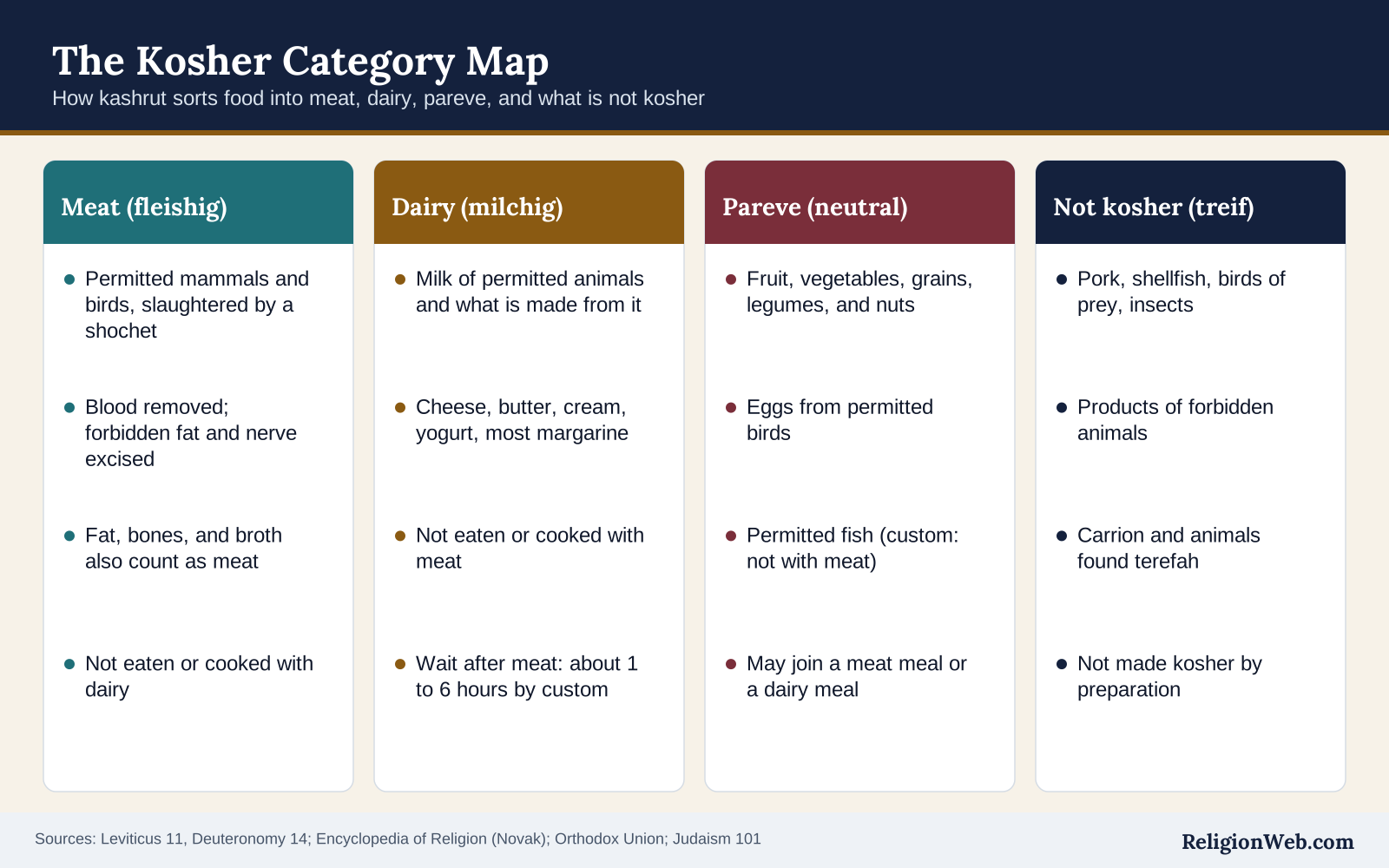
The short version is that kashrut sorts food into three working groups. Meat (basari, or fleishig in Yiddish) comes from permitted animals slaughtered by a trained specialist and then prepared so that blood is removed. Dairy (chalavi, or milchig) comes from permitted animals as well, but it may not be cooked or eaten together with meat. Pareve (parve) food, such as fruit, vegetables, grains, eggs, and fish, is treated as neutral and can accompany either. Almost everything else in the system, from the number of sets of dishes in a household to the small symbols printed on a cereal box, follows from keeping those groups distinct and from excluding animals and parts that the tradition forbids.
Those distinctions matter because, for observant Jews, eating is one of the ordinary places where commandments become daily habit. The Torah ties several food laws to the idea of holiness, and the rabbis of late antiquity treated the details as binding legal categories rather than matters of taste. Jews who keep kosher describe the practice in different ways: as obedience to a divine command whose reasons may be partly hidden, as a discipline that shapes attention to what one consumes, as a link to earlier generations, or as a way of keeping a home open to other observant Jews. Others who identify strongly as Jewish keep none of the rules, or keep only some of them.
This article follows kashrut from its biblical roots through rabbinic law, the permitted species, slaughter, the separation of meat and dairy, the organization of a kosher kitchen, wine and other special categories, Passover, certification and labeling, and the different approaches of Orthodox, Conservative (Masorti), Reform, and other communities. It also addresses common misunderstandings and the questions people most often ask. Throughout, it describes what the tradition teaches and what communities do, and it names the legal school, movement, or custom whenever practice differs.
Kosher and Kashrut at a Glance: Meaning, Vocabulary, and Scope
What the Words Kosher, Kashrut, and Treif Mean
Kosher and kasher: from fitness to food
The Hebrew root k-sh-r has to do with being suitable, fit, or in proper order. The adjective kasher appears in the late biblical book of Esther in a general sense, something that is proper or acceptable, and rabbinic Hebrew narrowed it to ritual and legal fitness. A scroll of the Torah can be kasher if it is written correctly, a witness can be kasher if he or she meets the legal requirements, and a food can be kasher if it conforms to the dietary laws. The English word “kosher” comes from the Ashkenazi (Yiddish) pronunciation of the same adjective.
That wider background explains why Jewish speakers sometimes use the word beyond food. When they say a utensil has been “kashered,” they mean that it has been made fit for use through a prescribed process. The verb has the same legal flavor as the adjective: a status that can be lost through contact with something forbidden and, in many cases, restored through a procedure.
Kashrut as the system, kosher as the status
Kashrut is the noun for the whole system, while kosher describes the status of an item. A restaurant “keeps kosher,” a household “is kosher,” and a product “is kosher,” but the rules that decide each case are collectively kashrut. In strict academic usage, the term refers to the Jewish dietary laws; in broader Jewish usage it can also extend to the supervision structures that apply them.
It is worth keeping the two words apart because they point to different questions. A question about status (“Is this cheese kosher?”) asks whether specific ingredients, equipment, and supervision meet the standard. A question about the system (“What does kashrut require of a kitchen?”) asks about the underlying categories of law. Most of this article is about the second kind of question, with the first kind answered through examples.
Treif, terefah, and the vocabulary of what is not kosher
The opposite of kosher in popular speech is treif (also spelled treyf or tref), a Yiddish word derived from the Hebrew terefah. The Torah uses the root in the command about flesh “torn” in the field (Exodus 22:30), and in rabbinic law terefah acquired a technical meaning: an animal that, although it may have been slaughtered correctly, turns out to have an internal defect, such as a perforated lung, that would have caused it to die. Such an animal is unfit even when the slaughter itself was flawless.
In everyday Yiddish and English, however, treif became a catch-all label for any food that is not kosher, including pork, shellfish, or a dish that has been cooked in a pot that should not have been used. A related term, pasul, means “disqualified” and is used for ritual objects or for foods that were once acceptable but have lost their status. Both usages are normal, and context usually makes clear which sense a speaker has in mind.
What Kashrut Regulates
Five areas of law
Scholars of Jewish law, including David Novak in the Encyclopedia of Religion, commonly group the dietary laws into five broad areas. The first concerns which animals are permitted and which are forbidden. The second concerns forbidden parts of permitted animals, namely blood and certain fats. The third concerns slaughter and preparation. The fourth concerns forbidden mixtures, above all meat with milk. The fifth concerns permitted proportions, meaning how much of a forbidden substance can be present in a mixture before the whole becomes unusable.
This framework helps explain why kashrut feels like more than a list of banned animals. A kosher cow, for example, is only the starting point. The animal must be slaughtered by a qualified person, inspected, stripped of forbidden fat and the sciatic nerve, and then treated to draw out blood, and the resulting meat must be kept apart from dairy products in storage, cooking, and serving. Each of these steps belongs to a different area of the law.
A law of food, not a cuisine
One common point of confusion is that kosher is a type of food, like Italian or Chinese. It is not. Kosher is a standard that can be applied to almost any dish, and Jewish communities around the world have cooked within it using the ingredients and techniques of their own regions. Ashkenazi cooking from Central and Eastern Europe, Sephardi cooking from Spain and its diaspora, and Mizrahi cooking from the Middle East and North Africa differ widely in flavor, yet each aimed to meet the same legal categories. A kosher dish in Marrakesh, Vilnius, and Baghdad could taste entirely different.
This distinction also explains why “kosher-style” menus, which feature foods associated with Jewish delicatessens such as pastrami or bagels, do not necessarily follow the rules. The phrase describes a cuisine, whereas kosher supervision describes compliance with law. A restaurant can serve a classic deli sandwich without being kosher in the religious sense, and a kosher restaurant can serve sushi, tacos, or pizza.
Where kashrut sits within Jewish law
Jewish law, called halakha, divides commandments (mitzvot) into those between a person and God and those between people, and it also recognizes categories of obligation: biblical commands, rabbinic enactments, long-standing customs (minhagim), and personal or communal stringencies. Kashrut includes all four. The prohibition on pork and the prohibition on cooking a kid in its mother’s milk are stated in the Torah. The extension of the milk prohibition to poultry is understood as a rabbinic decree. The custom of waiting a set number of hours after meat varies from community to community. A stringency such as eating only a particular grade of meat may be adopted by a household without being required of everyone.
The rabbis also distinguished between laws that seem to carry their own rationale and those that do not. The Talmud (Yoma 67b) lists the dietary laws among the chukkim, statutes whose reasons are not obvious, and some later teachers argued that observing them without a clear explanation is itself an expression of trust. Others, from Maimonides in the twelfth century onward, proposed reasons, as later sections describe. Most observant communities hold both attitudes at once: the laws are obligatory whether or not a rationale is found, and people are free to look for meaning in them.
How Many Jews Keep Kosher, and What the Figure Means
The 2020 Pew findings for the United States
The most widely cited recent data on American practice come from the Pew Research Center’s 2020 survey of U.S. Jews, conducted by mail and online and fielded mostly before the coronavirus pandemic. According to Pew, about 17% of Jewish adults in the United States keep kosher at home. That group includes 14% who said they separate meat and dairy and 3% who said they are vegetarian or vegan. The proportions varied sharply by denomination: roughly 95% of Orthodox Jews, 24% of Conservative Jews, 5% of Reform Jews, and 6% of Jews with no denominational affiliation reported keeping kosher at home.
Pew cautions that its 2020 results are not directly comparable with its 2013 telephone survey, because the method changed. The figures are therefore best read as a snapshot of one country in one period rather than as a trend line. They describe self-reported home practice and say nothing about what people eat in restaurants, at work, or while traveling, nor about how strictly “keeping kosher” is defined in each household.
Why a single number hides many practices
The phrase “keeps kosher” covers a wide spectrum. In one household it means that only meat from certified butchers enters the kitchen, that two full sets of dishes are in use, and that no food is eaten outside the home unless it carries a trusted certification. In another it means avoiding pork and shellfish but eating freely in restaurants. In another it means keeping meat and dairy apart at home, or following a vegetarian diet as an ethical expression of kashrut. All of these can be sincerely described as keeping kosher, and each reflects a different understanding of what the tradition requires.
For that reason, this article avoids treating any one standard as the Jewish position. Where it describes a rule, it names the source or school behind it, and where communities diverge, it describes the divergence. Readers who want the broader picture of Jewish belief and practice can find it in the main article on Judaism, while this article concentrates on food.
| Category | What it covers | Main biblical anchor | Later rabbinic development |
|---|---|---|---|
| Permitted and forbidden animals | Land animals, fish, birds, insects, and products derived from them | Leviticus 11; Deuteronomy 14 | Signs for identifying species; reliance on a continuous tradition of which birds are eaten |
| Slaughter | Killing of mammals and birds by a trained slaughterer | Deuteronomy 12:21 (“as I have commanded thee”) | Detailed rules on the knife, the cut, and the inspection of organs in Talmud tractate Hullin |
| Blood and forbidden fat | Removal of blood and of certain fats from permitted animals | Genesis 9:4; Leviticus 3 and 17 | Salting, soaking, or broiling; removal of fat by trained butchers |
| Sciatic nerve | A nerve of the hindquarter not eaten | Genesis 32:33 | Skilled removal, or sale of the hindquarters to non-Jewish buyers where the work is not done |
| Meat and milk | Cooking, eating, and benefiting from the mixture | Exodus 23:19; 34:26; Deuteronomy 14:21 | Extension to all mammals and poultry; separate utensils; waiting periods |
| Carrion and torn animals | Animals that died on their own or were killed by others | Exodus 22:30; Deuteronomy 14:21 | Inspection for defects that make an animal terefah |
| Mixtures and proportions | What happens when a forbidden item falls into a permitted one | Derived from rabbinic readings of Torah law | Rules of nullification, often at a ratio of one part in sixty (Hullin 97b) |
| Foods handled by non-Jews | Wine, certain dairy and cooked foods | No single verse; later enactments | Rabbinic decrees on wine (Avodah Zarah 29b) and supervised milk and cheese |
Biblical Foundations of the Dietary Laws
Where the Torah Speaks About Food
The lists in Leviticus 11 and Deuteronomy 14
The two main biblical chapters on permitted and forbidden animals are Leviticus 11 and Deuteronomy 14, which present parallel but not identical lists. Both give a basic sign for land animals, and the Leviticus statement is the best known. In the Jewish Publication Society’s 1917 English translation, the verse reads:
Whatsoever parteth the hoof, and is wholly cloven-footed, and cheweth the cud, among the beasts, that may ye eat.
Leviticus 11:3, The Holy Scriptures: A New Translation (JPS 1917)
The next verses show how the criteria work together. An animal must both have a split hoof and chew its cud, so that the camel, the hyrax (often rendered “rock badger”), and the hare are excluded because they have one sign but not the other, and the pig is excluded because it divides the hoof but does not chew the cud. Sheep, goats, cattle, and deer fit both tests. For water creatures, the text allows those that have fins and scales and prohibits the rest, which in rabbinic reading excludes shellfish as well as eels and other fish without scales.
The passage on birds is different in kind. Leviticus and Deuteronomy name specific forbidden birds, many of them birds of prey or scavengers, but they do not give a general rule for recognizing them, and the identification of several Hebrew bird names is uncertain today. As later sections explain, this gap is why the rabbis developed supplementary signs and why a communal tradition about which birds are eaten carries real weight.
Blood, fat, and the life of the animal
A second group of laws concerns blood. The earliest statement appears not in the Sinai legislation but in the story of Noah, after the flood, where permission to eat animal flesh is paired with a limit:
Only flesh with the life thereof, which is the blood thereof, shall ye not eat.
Genesis 9:4, JPS 1917
Later chapters of Leviticus repeat the prohibition for the people of Israel and connect it to the altar, where the blood of sacrificial animals was handled by the priests. Some forms of animal fat, specifically the fat that covers the inner organs, were also forbidden for eating and set aside for the altar. In rabbinic law these prohibitions grew into the practices of draining blood, salting or broiling meat, and removing forbidden fat, which are described in the later section on slaughter and preparation. Within the Jewish tradition, the underlying idea is usually stated in the biblical language itself: blood is identified with life, and life belongs to God.
The kid in its mother’s milk
The best-known biblical source for the separation of meat and dairy is a single short sentence, which appears three times in the Torah: in Exodus 23:19, in Exodus 34:26, and in Deuteronomy 14:21. In the Deuteronomy passage, it follows the command not to eat anything that has died of itself, and the translators of the 1917 JPS edition render it:
Thou shalt not seethe a kid in its mother’s milk.
Deuteronomy 14:21, JPS 1917 (the same sentence closes Exodus 23:19 and 34:26)
The Torah does not explain the prohibition, and the verse says nothing about utensils, waiting times, or poultry. Historians and commentators have offered several possible backgrounds, including an ethical sensitivity to combining the source of life with the instrument of death and a rejection of a cultic practice, but none of these is stated in the text, and the traditional rabbinic reading builds the legal system on the verse’s wording rather than on an assumed motive. The rabbinic interpretation, discussed in a later section, takes the three appearances of the sentence as the basis for three separate prohibitions: against eating the mixture, cooking it, and deriving any benefit from it.
Reasons Offered for the Laws
Holiness, separation, and discipline
The Torah itself links the food laws to a vocabulary of holiness. The concluding verses of Leviticus 11 call on the people to be holy and to distinguish between the clean and the unclean, and Leviticus 20:26 connects holiness with being set apart from the nations. Many classical and modern interpreters have understood the laws accordingly: they train a community in distinguishing, and they create a boundary that makes shared life possible. In the rabbinic tradition, this reading often appears as the idea that the commandments refine the person who keeps them.
Modern writers within the tradition often add a psychological dimension. Rabbi Harold Kushner, for example, has described kashrut as turning an ordinary act of eating into a religious one, and Rabbi Hayim Halevy Donin, writing for an Orthodox readership, presented the laws as commandments observed because they are divine, whether or not the believer can name the reasons. These are two different emphases, one stressing meaning and the other obedience, and both are well represented in contemporary Jewish thought.
Health, ethics, and symbolism in traditional commentary
Medieval and modern commentators proposed several other kinds of explanation, and the survey in the Encyclopedia of Religion is a useful map. Maimonides (1135/8 to 1204), in The Guide of the Perplexed (3:48), combined arguments about physical health with the avoidance of ancient idolatrous practices, and later authors including Shemuel ben Meir in the twelfth century and Nachmanides in the thirteenth continued different versions of that approach. The ancient Letter of Aristeas (142 to 147) linked forbidden animals to cruelty and predation, and in the nineteenth century Samson Raphael Hirsch read the categories as symbols of moral qualities.
Kabbalistic authors such as Menahem Recanati in the fourteenth century and Yitzhak Arama in the fifteenth read the laws in terms of cosmic order and spiritual impurity, and some medieval critics, among them Abraham ben David of Posquières, regarded purely physical explanations as too thin. The disagreement is real and long-standing. Observant communities do not treat any single rationale as the reason for the laws, and the legal obligation does not depend on which explanation a person finds persuasive.
Anthropological readings and their limits
In the twentieth century, scholars of religion approached the laws as a system of classification. The best-known example is the anthropologist Mary Douglas, whose 1966 book Purity and Danger argued that the Levitical categories reflect an ordered view of creation in which animals that do not fit their expected category are set aside. Her proposal was widely discussed and also criticized and revised by later biblical scholars, and it remains one of several academic frameworks rather than a settled account.
Two cautions apply to any such reading. First, a scholarly theory about the possible origin of a law is different from the way a tradition understands the law’s authority, and neither replaces the other. Second, the popular claim that the laws were primarily a prehistoric health code, which this article returns to in the section on misconceptions, is a reading found in some traditional commentary but not one that the Torah states and not one that most legal authorities rely on to decide cases.
Food and Identity in the Second Temple Period
Daniel and the king’s food
The Hebrew Bible already shows food as a marker of identity under foreign rule. The book of Daniel, set in the Babylonian court, describes a young Judean who declines the royal diet:
But Daniel purposed in his heart that he would not defile himself with the king’s food, nor with the wine which he drank; therefore he requested of the chief of the officers that he might not defile himself.
Daniel 1:8, JPS 1917
The text does not specify what exactly would be defiling. Ancient and modern readers have suggested that the food may have included forbidden animals, meat not properly prepared, or items connected with idolatrous offerings, and the wine suggests a concern with libations. What the narrative makes clear is that eating and drinking were understood as a test of loyalty and that abstention could be a form of public witness.
The Maccabean crisis and martyrdom stories
Food also appears in the literature of the second century BCE, when many Jews lived under pressure to adopt the practices of the surrounding Hellenistic culture. The Second and Fourth Books of Maccabees, which are included in some Christian canons but not in the Hebrew Bible, tell of Jews who died rather than eat forbidden meat, and the historical setting is the mid-second century BCE. These narratives helped shape the later rabbinic principle, stated in the Talmud (Sanhedrin 74a), that when a violation would publicly signify abandoning the faith, a Jew should accept death rather than eat what is forbidden.
It is important to read this principle carefully. In rabbinic law the ordinary rule is that nearly any commandment may be set aside to save a life, and the special category of martyrdom applies only to certain situations, such as public coercion to renounce Judaism. The stories of food and martyrdom therefore reflect an extraordinary moment, not the normal operation of kashrut, though they show how powerfully the tradition associates food with fidelity.
From Torah to Talmud and Codes: How Rabbinic Law Built Kashrut
The Oral Tradition and the Tractate Hullin
Written Torah, oral interpretation
The Torah states the dietary laws briefly. It gives signs for some species, forbids blood and certain fat, and repeats the sentence about the kid and its mother’s milk, but it does not say how an animal is to be killed, how blood is removed, or what happens when a drop of milk falls into a pot of meat. Rabbinic tradition holds that the written Torah was accompanied from the beginning by an oral explanation, and many of the detailed rules are described in the Talmud as halakha le-Moshe mi-Sinai, a law given to Moses at Sinai. David Novak’s survey in the Encyclopedia of Religion notes that the rabbis treated their interpretations of the dietary laws in just this way, as transmitted tradition rather than later invention.
Historians of Jewish law describe the same process in different terms, emphasizing the gradual development of legal reasoning in the centuries around the turn of the era. The two accounts are not equivalent, and this article does not treat them as such. What can be said without disputing either is that by about 200 CE, when the Mishnah was edited, a large body of dietary law already existed in organized form, and that the Gemara, completed in the following centuries, discussed it at length.
What the tractate Hullin covers
The central text for kashrut is the tractate Hullin, whose name means “ordinary” or “non-sacred” things, in contrast to the sacrificial offerings treated in neighboring tractates of the same order. Hullin deals with slaughter outside the Temple, the signs of permitted species, the forbidden sciatic nerve, the prohibition on taking a mother bird with her young, and the separation of meat and milk. Together with the tractate Avodah Zarah, which addresses foods and wine associated with idolatry, it supplies most of the primary material on which later codes are built.
Anyone who opens a page of Hullin in a traditional edition will see how the system works in practice. A short Mishnah states a rule, and the Gemara asks where it comes from, tests it against cases, and records disagreements between named sages. Commentators such as Rashi in the eleventh century and the Tosafists in the twelfth to fourteenth add further layers. The dietary laws in Jewish practice are therefore not a closed list but a conversation preserved in legal form, and rulings today depend on which strands of that conversation a community follows.
Meat and Milk in the Mishnah and Gemara
Three prohibitions from three verses
Because the sentence about the kid appears three times in the Torah, the rabbis read it as three separate statements. According to the Talmud, as summarized by Novak, these yield three distinct prohibitions: eating a mixture of meat and milk, cooking meat and milk together, and deriving any benefit from such a mixture. The third prohibition means, for example, that one may not sell a cooked meat-and-milk dish to someone else for profit or feed it to a pet. The first two shape how a person eats and cooks, while the third reaches into commerce.
The rabbinic reading also widened the reach of the verse. Where the Torah speaks of a kid, a young goat, the rabbis understood the prohibition to cover the meat of all permitted domestic and wild mammals, and they later applied the same rules to poultry. From that decision came the practical system of separate dishes, separate cooking vessels, and waiting periods that this article describes in the section on meat, dairy, and pareve.
Poultry: a debated extension
The Mishnah itself records that the status of poultry was discussed. In tractate Hullin, chapter 8, the Mishnah first states that all kinds of meat, apart from fish and locusts, are forbidden to be cooked in milk and, by rabbinic decree, to be placed on the same table as cheese. It then records that Rabbi Akiva held that wild animals and birds are not covered by the Torah’s prohibition, drawing the point from the threefold repetition of the word “kid,” while Rabbi Yose the Galilean argued that birds fall outside the prohibition because they have no mother’s milk. In the Mishnah’s account, the consequence is that a restriction on poultry and milk exists but is classified as rabbinic.
The classification matters in practice. A rule that is rabbinic rather than biblical is often treated with more flexibility in unusual circumstances, such as a mistake after the fact, and the codes often list such circumstances separately. This is a good example of how the same dish can be regulated at different levels of law, and why a question about a chicken in cream sauce can receive a more detailed answer than a question about beef.
Codes, Commentaries, and Custom
Maimonides, Karo, and Isserles
From the Middle Ages onward, rabbis compiled the Talmudic material into codes. Maimonides, who lived from 1135 or 1138 to 1204, devoted a section of his Mishneh Torah to forbidden foods and to slaughter. In the sixteenth century, Joseph Karo published the Shulchan Arukh (“Set Table”), whose section Yoreh De’ah contains the main laws of kashrut, and the Polish scholar Moses Isserles (known as the Rema) added glosses that recorded Ashkenazi practice where it differed from Karo’s rulings. Printed together, the two layers became the basic reference for most Orthodox communities and are also consulted in Conservative and other rabbinic circles.
The result is a legal map with two main colors. Sephardi and many Mizrahi communities follow Karo’s rulings, while Ashkenazi communities follow the Rema where he disagrees. Differences appear in questions such as the treatment of lung adhesions on slaughtered animals, the status of certain wines, and details of koshering. These are not disputes about whether kashrut applies, but disagreements about how to apply it, and each community regards its own line as a continuous tradition.
Minhag: custom as a legal source
Custom (minhag) also has legal weight in kashrut. Novak notes that a bird not customarily eaten in a particular place can become forbidden there, that waiting periods between meat and dairy vary, and that the labor of removing the sciatic nerve led many Western communities to sell the hindquarters of kosher animals to non-Jewish buyers rather than prepare them. In Israel, by contrast, some of those cuts are prepared for Jewish consumers. Local custom thus continues to shape what ends up on the table.
The authority of custom is part of why the question “What does kosher require?” often calls for a follow-up: “In which community?” A household that follows a Hasidic tradition, a Moroccan Jewish family, and a Reform congregation that has adopted its own guidelines might each give a different answer, and each answer would be recognizable as an attempt to live within the tradition as that community understands it.
| Period or date | Development | Why it matters |
|---|---|---|
| Genesis 9 (traditional setting after the flood) | Permission to eat flesh paired with a prohibition on blood | The earliest biblical statement of the blood rule, which later law applies to all permitted meat |
| Leviticus 11 and Deuteronomy 14 (date debated among scholars) | Lists and signs of permitted and forbidden animals | Foundational source for the species rules |
| Mid-second century BCE | Pressure to abandon dietary practice under Hellenistic rule, reflected in the Books of Maccabees | Food becomes a symbol of fidelity and later a subject of martyrdom law |
| About 200 CE | Editing of the Mishnah, including tractate Hullin | Organizes slaughter, species, and meat-and-milk law |
| 1135/8 to 1204 | Maimonides compiles the laws of forbidden foods and slaughter | Provides a systematic code and a widely read explanation of the laws |
| Sixteenth century | Karo’s Shulchan Arukh and Isserles’s glosses | Standard reference that distinguishes Sephardi and Ashkenazi practice |
| 1885 | Pittsburgh Platform of American Reform rabbis rejects dietary laws as binding | Marks a major division in modern Jewish attitudes to kashrut |
| 1923 | The Orthodox Union’s OU symbol is designed for Heinz | Early landmark of industrial kosher certification in the United States |
| 2020 and 2022 | A European Court of Justice ruling on stunning, and Israeli kashrut-supervision reform | Shows how law and politics now shape slaughter and certification |
Permitted and Forbidden Species
Land Animals and the Two Signs
The animals that pass and fail the test
For land mammals, the Torah requires both signs, a fully split hoof and chewing of the cud. Cattle, sheep, goats, and deer meet the test, and the Torah mentions several of them by name. The pig, the camel, the hyrax, and the hare do not, and the Torah names these as examples of animals that have one sign but not both. Because the pig has a divided hoof but does not chew the cud, it became the best-known example of a forbidden animal in Jewish and general culture alike.
Predators, rodents, reptiles, and amphibians are likewise excluded, and rabbinic law adds detailed rules on the signs that distinguish permitted domestic animals from related species. A single modern word such as “kosher beef” can therefore hide several tests: the animal must be of a permitted species, slaughtered correctly, free of disqualifying defects, and prepared by someone trained to remove the forbidden parts.
Which animals are actually eaten
In practice, communities have eaten a much narrower group than the full set of species that meet the signs. The staples of kosher meat today are cattle, sheep, and goats, and in some regions deer or other game, and there is a tradition-based expectation that an animal be one that earlier communities knew and accepted. Where a species is rarely eaten or its identification is uncertain, many authorities prefer to rely on a continuing tradition rather than a fresh reading of the signs.
This preference for tradition (mesorah) is a recurring feature of kashrut. It reflects the principle that a confirmed chain of practice is stronger evidence than an individual inference, and it explains why questions about new or exotic animals are normally brought to a rabbi instead of being decided by checking a list of physical features.
Fish, Birds, and Insects
Fish with fins and scales
For aquatic animals, the criterion is plain: a fish must have both fins and scales. Salmon, tuna, carp, and herring are examples of permitted fish, while shellfish such as shrimp, lobster, crab, clams, and oysters are forbidden, along with eels and similar species that lack scales. The rabbis added the rule that a fish counts as having scales if it had them at any stage of development, even if they later fell away, and they held that fish do not require slaughter by a shochet, unlike mammals and birds.
Not every fish question is settled across communities. A few species, with sturgeon and swordfish often cited as examples, have been the subject of disagreement between Orthodox and Conservative authorities, depending on how each reads the evidence about their scales. Where kosher fish is sold in pieces, such as fillets, many supervising agencies require that the skin remain attached or that identification be otherwise possible, so that the buyer can be sure of the species.
Birds: lists, signs, and tradition
For birds, the Torah gives a list of forbidden species without a general principle. In Hullin, the Mishnah offers a set of signs to help: birds that seize prey are forbidden, while birds with an extra toe, a crop, and a gizzard whose lining can be peeled are in the permitted category. The rabbis nevertheless repeatedly emphasized that a living tradition, not just the signs, determines which birds are eaten. Chicken, turkey, duck, and goose are the customary kosher birds today, and the practice with regard to chicken is long established.
The turkey is an interesting case. As a bird of the Americas, it was unknown to the ancient texts and was introduced to Europe in the sixteenth century. Rabbis in several communities debated whether it could be accepted, and most came to treat it as permitted on the basis of its resemblance to known kosher birds and of local acceptance. The episode illustrates how kashrut absorbs new foods through argument and precedent rather than through a single administrative list.
Insects and the problem of small creatures
The Torah permits certain winged swarming insects, generally understood to be certain locusts, but the rabbis concluded that the knowledge of which species qualified had been lost in most communities. A ruling attributed to David ben Shemuel ha-Levi, the author of the Turei Zahav commentary known as the Taz, treats all insects as forbidden for that reason. Some Yemenite Jewish communities preserved a tradition of eating specific locusts, and that practice is regarded as a distinct custom.
The prohibition on insects has everyday effects. Leafy vegetables such as lettuce, herbs, and cauliflower, as well as berries and some grains, can harbor tiny insects, and observant households follow detailed checking routines or buy produce that carries a certification for being insect-free. Rinsing, soaking, and visual inspection are the usual methods, and the exact standard differs by community, with some groups avoiding certain vegetables altogether.
Products Derived from Animals
Milk, eggs, fat, and honey
The status of an animal extends to its products. Milk, eggs, fat, and organs from forbidden animals are themselves forbidden, so camel’s milk or the eggs of a non-kosher bird cannot be used. Bee honey is a recognized exception: although bees are not kosher animals, the rabbis held that honey is not an animal substance in the relevant sense, and it is permitted. Eggs from permitted birds are acceptable, but an egg with a blood spot may not be eaten, and cautious households crack eggs into a separate cup before adding them to a dish so that one defective egg does not spoil a whole preparation.
Gelatin, rennet, and cheese
Two modern examples show how ingredient questions arise. Gelatin, used in desserts, marshmallows, and capsules, is traditionally made from animal bones and skin, and authorities have differed about whether gelatin from non-kosher animals is permitted after processing. Most kosher certifiers avoid the question by using gelatin from kosher sources, such as certified beef or kosher fish, or by using plant-based substitutes.
Cheese presents a related issue. Traditional hard cheese is coagulated with rennet, an enzyme historically taken from the stomach lining of calves, and rennet from an animal not slaughtered according to Jewish law raises problems. The rabbis therefore required Jewish supervision of cheese, though, as the Encyclopedia of Religion notes, some authorities relaxed the requirement where adulteration was unlikely. Conservative practice has often accepted cheese without special supervision, while Orthodox communities generally rely on certified cheese, which is one of the places where movement standards visibly diverge.
Slaughter, Inspection, and the Removal of Blood
Shechita: The Law of Slaughter
The shochet and the blessing
Mammals and birds must be slaughtered by a trained person called a shochet, and the act is known as shechita. The Torah refers to the practice indirectly. When Deuteronomy provides for people who live too far from the central sanctuary to bring every animal there, it tells them to slaughter at home, using a phrase that the rabbis understood as pointing to an established manner:
If the place which the LORD thy God shall choose to put His name there be too far from thee, then thou shalt kill of thy herd and of thy flock, which the LORD hath given thee, as I have commanded thee, and thou shalt eat within thy gates, after all the desire of thy soul.
Deuteronomy 12:21, JPS 1917
The words “as I have commanded thee” are read in rabbinic tradition as a reference to an oral instruction about how the killing is to be done. The shochet is typically a pious and well-trained person, supervised by a rabbinic authority, who recites a blessing before slaughter. In the Orthodox understanding, the role combines technical skill with religious responsibility, and in communities across history the presence of a shochet was one of the marks of an organized Jewish settlement. Novak observes that the need for a qualified slaughterer even shaped where Jews could comfortably live.
The knife and the cut
The method is described in the Talmud and the codes. The shochet uses a very sharp, smooth knife, checked before and after slaughter for any nick, because a damaged edge would tear rather than cut. With a quick, uninterrupted motion, the shochet severs the windpipe and the esophagus. Traditional sources list actions that invalidate the slaughter: pausing during the cut, pressing the knife rather than drawing it, digging beneath the tissue, slipping outside the proper area, and tearing. Because any of these would make the meat unfit, the training of a shochet includes extensive study of both the law and the technique.
Supporters of shechita within the tradition describe it as designed to minimize pain, and Jewish sources stress the prohibition of cruelty to animals (tza’ar ba’alei chayim). The Jewish Virtual Library’s overview, drawing on Judaism 101, claims that the cut causes unconsciousness within about two seconds. That scientific claim is contested in some veterinary and animal-welfare debates, so this article records it as a position held within the tradition and not as settled fact.
Inspection and the terefah animal
Slaughter is followed by inspection. The shochet or a trained inspector examines the carcass, above all the lungs, for signs of disease or injury that would make the animal terefah. The inspection involves feeling the lungs and sometimes testing them in water for leaks. If the animal had a defect of the type listed in the legal sources, the meat is unfit, even though the slaughter was correct.
Because lung adhesions are common, the question of how to treat them became a major point of difference between Ashkenazi and Sephardi authorities. The term glatt, from Yiddish for “smooth,” originally referred to lungs found free of adhesions. According to the Orthodox Union’s account, the Sephardi tradition following Karo allows no adhesions that cannot be easily separated, while the Ashkenazi tradition following the Rema allows adhesions to be removed under skilled examination. In modern retail, “glatt kosher” has come to be used more loosely as a label for a higher level of stringency in meat.
Preparing the Meat: Fat, Nerve, and Blood
Forbidden fat and the sciatic nerve
Even after slaughter and inspection, certain parts of a permitted animal remain off limits. The Torah forbids the fat that covers the internal organs, and a separate verse in Genesis forbids eating the sciatic nerve, tied to the story of Jacob’s injury while wrestling. Removing these parts, called nikkur or, in Yiddish, treibering, is delicate and requires specialized skill, particularly in the hindquarters, where the nerve runs deep.
The difficulty explains a historic pattern noted by Novak: in much of Western Europe and North America, butchers sold the hindquarters of kosher animals to the general market, while in Israel, the labor is more often performed so that those cuts can be used. For consumers, this is one reason why certain cuts, such as filet or sirloin, are less commonly available in kosher form than ribs or chuck.
Salting, soaking, and broiling
To remove the remaining blood, meat is prepared by one of two main methods. The standard method is soaking the meat in water, salting it with coarse salt for a set period, and rinsing it thoroughly, often described in the codes as soaking for about half an hour, salting for about an hour, and rinsing three times. The coarse salt used is commonly called “kosher salt” in English for exactly this reason. The other method is broiling over an open flame, which is required for liver because of its high blood content.
According to Judaism 101’s summary, the process must be completed within 72 hours of slaughter and before the meat is frozen or ground. Most kosher butchers and packers perform it before sale, so the average consumer does not handle it, but home cooks who buy fresh meat from non-certified sources are advised to confirm that the step has been done. In the tradition’s reasoning, the practice flows directly from the biblical identification of blood with life.
Debates over Slaughter in Modern Law
Stunning, animal welfare, and legislation
Kosher slaughter has become a topic of public debate in several countries, most often over the question of pre-slaughter stunning. In traditional Orthodox understanding, an animal must not be rendered unconscious or injured before the cut, because that could raise questions about whether it is whole and healthy. Many governments, on the other hand, have laws requiring stunning in the name of animal welfare, and some of them make exceptions for religious slaughter while others do not.
One landmark came on 17 December 2020, when the Court of Justice of the European Union ruled that authorities may require stunning, backing a regulation of Belgium’s Flemish region that took effect in 2019. According to reporting by Al Jazeera, the court said the measure struck a fair balance between animal welfare and the religious freedom of Jewish and Muslim believers, while Jewish leaders such as Yohan Benizri and Rabbi Menachem Margolin criticized the decision as an infringement on religious practice. The debate continues in other jurisdictions, with advocates on each side presenting different values.
Communities and the supply of kosher meat
The practical effect of these debates is felt by consumers. Where shechita is restricted, communities may rely on imported meat, which raises cost and availability questions, and some religious authorities have explored whether alternative forms of stunning might be consistent with the law. These are not uniform positions. Some rabbinic authorities regard any stunning as a disqualifying condition, while others have considered methods that do not cause permanent injury. The matter is an active area of halakhic and legal discussion.
Behind the controversy is a more general point about kashrut: it is a religious system that interacts with secular law, and each country resolves the interaction in its own way. Understanding the legal debates is useful, but they should not be confused with the underlying religious rules, which are stable and which were set out centuries before modern animal-welfare law.
Meat, Dairy, and Pareve: Keeping the Categories Apart
The Three Working Categories
Meat (fleishig): what counts
In kashrut, “meat” is a legal category rather than a general description of animal flesh. It includes the flesh of permitted mammals and, by rabbinic extension, of permitted birds, together with their fat, bones, and the broth made from them. The Mishnah in Hullin specifically excludes fish and locusts from the category, which is why fish does not fall under the same restrictions. Under the rules summarized by Judaism 101, even a tiny amount of meat in a dish makes the whole dish meat, and animal fat counts as meat as well.
The same logic applies to prepared foods. A soup in which a few meat-flavored bones were simmered is a meat soup, even if the pieces of meat were removed, and a spice mixture that contains a small quantity of meat-derived flavoring is, in principle, a meat product. This all-or-nothing approach is one reason why certifiers examine ingredient lists carefully and why food labels in kosher markets include category marks.
Dairy (milchig): milk and what is made from it
Dairy covers milk from permitted animals and the foods made from it, including cheese, butter, cream, yogurt, and many baked goods and chocolates that contain milk solids. Milk from forbidden animals, such as camels or pigs, is itself forbidden, and the Encyclopedia of Religion notes that the product takes on the status of the animal from which it comes. Margarine is usually regarded as dairy in the kosher marketplace because of the whey and other milk derivatives it commonly contains, though pareve varieties exist and are labeled as such.
As with meat, a small quantity makes the whole dish dairy. This applies to unexpected places: a bread made with butter or milk is a dairy bread, and many commercial baked goods carry a dairy mark for exactly that reason. People who keep kosher learn to read such marks as they would read an allergy warning, not because the two are the same but because both signal a hidden ingredient.
Pareve: the neutral middle
The third category, pareve (also spelled parve), is the neutral one. It includes foods that are neither meat nor dairy and that were not combined with either in a way that changes their status: fruits, vegetables, grains, legumes, nuts, eggs from permitted birds, and permitted fish. Pareve foods can be served with meat or with dairy, and this flexibility is why pareve desserts and side dishes are so important at festive meals.
Two points of detail are often confused. Fish is pareve in the sense that it can be eaten with dairy, and a dish of salmon with cream sauce raises no kashrut problem. But the Orthodox Union notes that fish should not be eaten or cooked together with meat, a custom with a long history, and many households use separate pots and serving dishes for fish. Eggs, by contrast, are neutral and can accompany either meat or dairy. The OU also uses the term for products that carry its plain symbol: a plain “OU” without any added letter indicates that the product contains no dairy or meat and was not made on dairy or meat equipment.
| Category | Typical examples | May be eaten with | Points to note |
|---|---|---|---|
| Meat (fleishig) | Beef, lamb, chicken, turkey; their broth, fat, and bones | Pareve foods | Not with dairy; a waiting period before dairy applies by custom |
| Dairy (milchig) | Milk, cheese, butter, yogurt, cream, most margarine | Pareve foods, including fish | Not with meat; the waiting period after dairy is shorter or minimal |
| Pareve (parve) | Fruit, vegetables, grains, legumes, nuts, eggs | Meat or dairy | Stays pareve only if prepared without meat or dairy ingredients or equipment |
| Fish | Salmon, tuna, carp, herring | Dairy and pareve foods | Custom not to eat or cook fish together with meat; permitted fish only |
| Not kosher (treif) | Pork, shellfish, products of forbidden animals | None | Cannot be made kosher by preparation or by combination with kosher foods |
Waiting Between Meat and Dairy
After meat: customs of one, three, or six hours
The most noticeable rule in the daily practice of meat and dairy is the waiting period after a meat meal. Rabbinic sources teach that milk may not follow meat without an interval, and the length of that interval has differed between communities. The Encyclopedia of Religion records that Maimonides required six hours and that most authorities followed him, including Eastern European and Sephardi Jews, while German Jews customarily waited three hours and some Dutch Sephardi Jews waited just over an hour. Judaism 101 summarizes present-day opinion as ranging between three and six hours.
Commentators have given reasons for the delay. One line of explanation points to the residue of fat or particles of meat that may remain in the mouth and between the teeth for some time. Another stresses the symbolic separation between the two categories. The exact reasoning is less important in practice than the custom of the family or community, which is usually inherited and is passed down along with other household habits. A person who is asked how long to wait will generally answer with the practice of a parent or teacher, and that answer is itself part of the legal tradition.
After dairy: rinsing and a lighter standard
The rule after dairy is much lighter. Judaism 101 states that a person who has eaten dairy rinses the mouth and eats a neutral solid food such as bread before eating meat, unless the dairy was sticky or oily, in which case more care is taken. The Orthodox Union, in its explanation of its symbols, adds that no formal waiting period is required after dairy, although rinsing the mouth or waiting about half an hour is suggested. Some communities have a custom of waiting a longer time after aged hard cheese, a custom that varies and is best learned from a local rabbi.
| Custom or source | Wait after meat | Associated communities |
|---|---|---|
| Maimonides and the majority view | Six hours | Most Eastern European (Ashkenazi) and Sephardi Jews |
| German custom | Three hours | German Jewish communities |
| Dutch custom | Just over one hour | Some Dutch Sephardi Jews |
| Contemporary summary | Three to six hours, depending on the household | Present-day Orthodox and traditional practice as summarized by Judaism 101 |
The same table and the same meal
The Mishnah in Hullin 8 records a rabbinic enactment that meat and cheese should not be served on the same table, even by diners who do not eat them together. The enactment was a precaution: people eating at one table might easily share food by mistake. Households that keep strictly kosher still apply this precaution in the form of separate place settings, separate serving dishes, and sometimes separate tablecloths, and they plan menus so that a single meal is either a meat meal or a dairy meal.
Planning a meal this way shapes the entire structure of Jewish hospitality. A hostess who serves roast chicken knows that the dessert must be pareve, and a menu built around cheese blintzes will avoid meat. These habits produce a distinctive repertoire, from non-dairy cakes and sorbets to soups thickened with vegetables rather than cream, and they are a reason why pareve substitutes have become a major category in kosher cooking.
Pareve in Practice
When pareve stops being pareve
A food that begins as pareve can lose that status. A vegetable cooked in a pot used for meat may take on the meat status of the pot under certain conditions, and a vegetable sautéed in butter becomes dairy. Rabbinic law deals with the question through the concept of absorbed taste: whether a utensil that was used for meat within the last twenty-four hours (a state called ben yomo) transfers meat flavor to a new dish. The principle is also reflected in the Orthodox Union’s kashering rules, which require a utensil to sit unused for twenty-four hours before certain procedures.
For ordinary home cooks, the practical consequence is that equipment is assigned to a category and used accordingly. Where the status of a particular dish is uncertain, for example after cooking in a pot that was not clearly labeled, the matter is normally put to a rabbi rather than decided by guesswork. The labeling system on packaged goods exists in part to prevent that uncertainty.
Labels on packaged foods: D, DE, M, and plain pareve
Commercial manufacturers show the category through letters next to a certification symbol. According to the Orthodox Union, an “OU-D” marks a dairy product or one made on dairy equipment, “OU-M” marks meat or meat equipment, and “OU-DE” marks a product that has no dairy ingredients but was made on dairy equipment and is therefore treated with dairy restrictions. A plain “OU” indicates a pareve product, and “OU-P” indicates a product that is both pareve and kosher for Passover. Other certifying agencies use their own marks, and the section on certification explains how to read them.
Consumers should treat these marks as religious category labels rather than allergy statements. A pareve label means that a product is neutral under Jewish law, which is a different question from whether it is free of milk proteins or other allergens. People with allergies or other medical needs should rely on the ingredient list and on guidance from their physician, not on kosher markings alone.
Pareve at the festive table
Since a meal built around meat cannot end with a cream dessert, pareve desserts have a prominent place in holiday dining. Fruit salads, sponge cakes, sorbets, and cookies made with oil rather than butter are standard, and non-dairy whipped toppings and creamers are widely sold for exactly this purpose. The category is also important in the cooking of communal events, where a single menu must serve meat eaters and dairy eaters at the same table.
This practical side of pareve connects to the broader Jewish calendar. The Friday-night dinner for Shabbat is typically a meat meal, and the dessert accordingly pareve, while festivals such as Hanukkah have their own traditional dishes, with some prepared in oil and others based on dairy. The next section looks at how the home kitchen is organized to make all of this possible.
The Kosher Kitchen: Utensils, Surfaces, and Daily Routine
Separation of Utensils and Spaces
Two sets of everything
The visible signature of a kosher home is the duplication of kitchenware. Judaism 101 states that observant households have separate pots, dishes, and cleaning tools for meat and dairy, including dishpans, sponges, and towels. Many families mark the sets by color or by a small label so that guests and children do not mix them up. Some households also keep a third set of pareve utensils, such as a cutting board and knife for vegetables, which lets cooks prepare neutral dishes without worrying about their status.
The reason for the duplication is the rule about absorbed flavor. When hot meat is cooked in a pot, the rabbis taught, the pot takes on a taste of the meat that can be released into the next dish. If that next dish is dairy, the prohibited mixture would be created without anyone adding a single forbidden ingredient. Separate sets prevent the problem before it begins, and the practice of using two sets explains much of the cost and organization of an observant kitchen.
Sinks, stovetops, ovens, and dishwashers
Shared surfaces require attention. Judaism 101 observes that sinks and stovetops can become sources of transfer, and it notes that households therefore use separate spoon rests and trivets, avoid soaking dishes directly in the basin, and often use separate dish racks or basins within the sink. Dishwashers are handled either by owning two machines, by using separate racks, or by running meat and dairy loads separately, and the preferred method depends on the advice of the family’s rabbi.
Ovens present a different question, since the same oven is often used for both categories at different times. Many authorities permit this as long as the food is covered and the oven is clean, while others recommend separate ovens or additional precautions. The disagreement is a good example of how a rule that is clear in principle becomes a range of reasonable practices in actual homes.
Setting up a kitchen for the first time
People who convert, marry into an observant family, or move from a non-kosher kitchen to a kosher one usually ask a rabbi to guide them through the process. A new kitchen may be set up with new equipment, or an existing kitchen may be kashered, a procedure that involves cleaning, waiting, and the use of heat or boiling water on appropriate items. Some items, such as certain ceramic and glass pieces, cannot be kashered and are replaced.
The initial effort is the largest, and many people report that the routines become automatic. The details differ between Orthodox households, which tend to follow detailed codes such as those found in the Orthodox Judaism tradition, and households in other movements that adopt selected practices. Whatever the level of observance, the aim is similar: to make the everyday work of cooking and cleaning a place where the categories remain visible.
| Item | Common practice | Reason or rule behind it |
|---|---|---|
| Dishes and cutlery | Separate sets for meat and dairy, often color-coded, plus a pareve set in some homes | Utensils absorb the flavor of hot food |
| Pots and baking pans | Dedicated pots for each category; separate pans for pareve baking where possible | Heat transfers flavor into the metal |
| Sink and basins | Separate basins or racks; dishes are not soaked directly in the sink | Hot food and water can carry residue |
| Dishwasher | Two machines, separate racks, or separate runs | Prevents transfer of residue between loads |
| Dish towels and sponges | Labeled for each category | Judaism 101 lists cleaning tools among the items kept separate |
| Oven and stovetop | Food covered; some homes keep two ovens; separate trivets and spoon rests | Steam and spills can mix categories |
Heat, Absorption, and Koshering
Why heat matters
Kashrut does not treat every contact between categories as a problem. Judaism 101 explains that utensils take on the status of food only when heat is involved, which is why cold foods can be placed on a dairy plate or a meat plate without changing the plate. The rabbinic reasoning is that heat causes flavor to pass into the material of a pot or dish, and later heat can bring it back out. This is the logic behind the rule that a utensil used for hot meat should not be used for hot dairy.
That same logic explains the importance of the twenty-four-hour interval. If a utensil has been clean and unused for a day, the tradition teaches that whatever flavor it absorbed has become stale and does not transfer a forbidden taste to a new dish. A detailed discussion appears in the Talmud and the codes, with various exceptions and conditions, and the interval is therefore a recurring feature of questions about koshering.
How a utensil is kashered
When a utensil has been used incorrectly, or when a household prepares for Passover, some items can be made fit again through procedures that mirror how the flavor was absorbed. The Orthodox Union describes four main methods. In hagalah, an item that was used with liquid, such as silverware or a pot, is cleaned, left unused for twenty-four hours, and immersed in boiling water. In libun, an item that was used directly over fire, such as a grill, is heated until it glows, with a lighter version using a hot oven. In iruy, an item that contacted hot liquid only on its surface, such as a faucet, is rinsed with boiling water poured over it. Each method corresponds to the way the item was used.
Not everything can be kashered. The OU states that an item must be capable of being scrubbed thoroughly, so objects with narrow crevices or deep scratches cannot be treated. Metal, wood, stone, and similar materials can usually be kashered, while ceramic and enamel-coated pots cannot, and Ashkenazi custom does not kasher glass. These limits help explain why households keep different sets for Passover and why some replace items rather than treating them.
Immersing new utensils
Another practice concerns new utensils. Tradition teaches that metal and glass utensils bought from a non-Jewish manufacturer or merchant should be immersed in a ritual pool of water (a mikveh) before use, with a blessing, an obligation derived by the rabbis from a passage in the Book of Numbers dealing with vessels taken in war. The rite, called tevilat kelim, is separate from koshering, and it applies even to brand-new items that have never touched food. Many kosher stores sell utensils with a notice to remind customers of the requirement.
The practice shows that kashrut is not only about avoiding forbidden food. It also sets a threshold for bringing an object into the household, an act marked with a blessing and a short ritual. For observant families, such gestures are part of how the kitchen becomes a place of religious attention.
Everyday Routines and Mistakes
Checking ingredients and produce
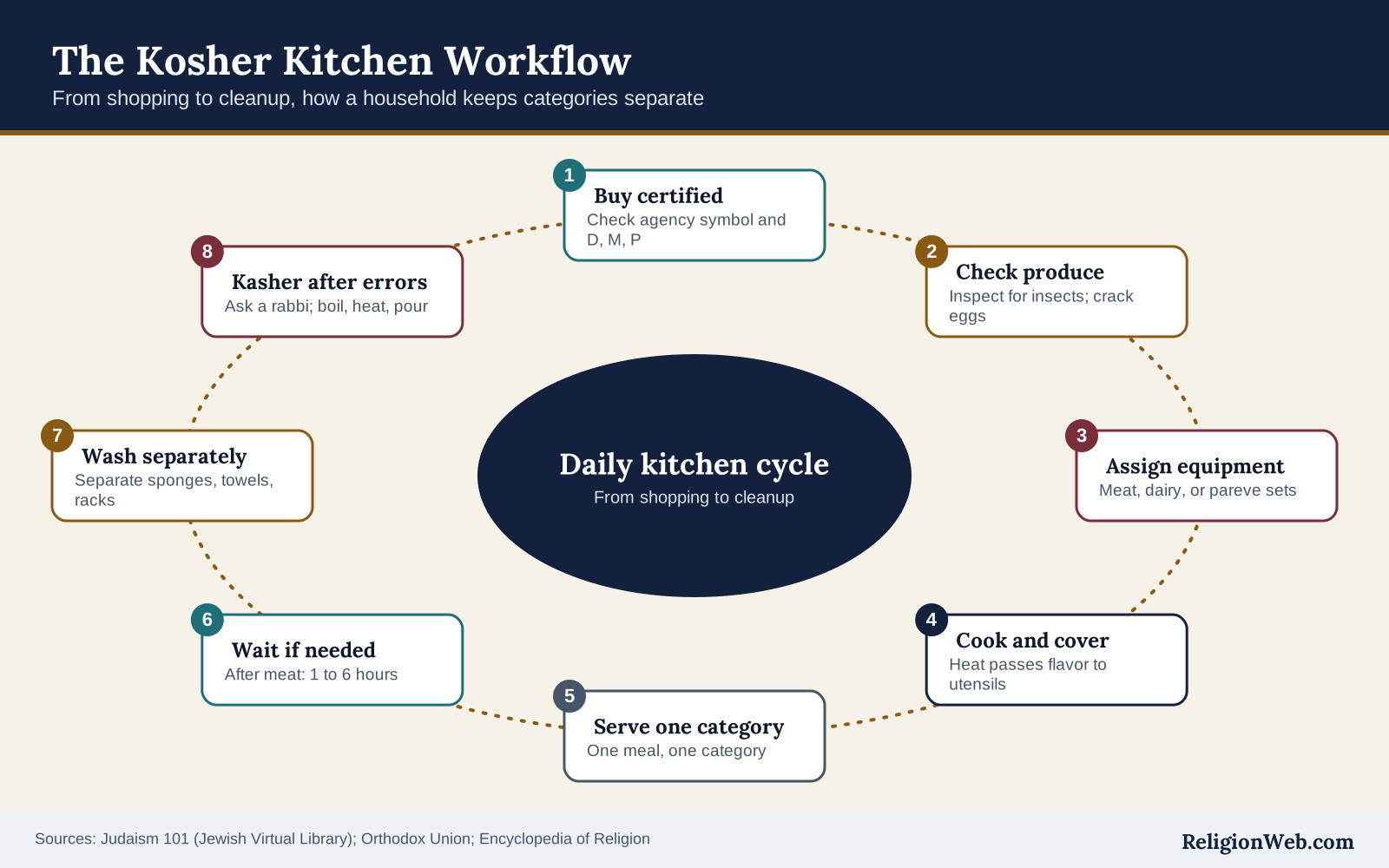
Daily kosher practice consists largely of small checks. Shoppers look for certification marks on packaged goods, read the category letters, and check seasonal changes in the formulation of familiar products. Cooks examine leafy vegetables, herbs, and berries for insects, and they crack eggs into a separate dish to check for blood spots. Wine and grape products, discussed in the next section, are bought with certification, as is cheese in many communities.
These routines can look burdensome from outside, but they are usually described by those who follow them as quickly learned. The most important element is a reliable source of information: a trusted certification, a local rabbi, or a knowledgeable family member. The structure of kosher certification, covered later in this article, is largely a response to the fact that no household can inspect an industrial supply chain for itself.
When categories are accidentally mixed
Mistakes happen, and the tradition has detailed procedures for them. A common case is a drop of milk falling into a pot of meat soup. The Encyclopedia of Religion explains that in such a case the food may still be used if the quantity of the accidental ingredient is no more than one sixty-first of the whole, if it does not change the flavor or form of the larger mass, and if it is no longer recognizable, a principle based on the Talmud (Hullin 97b). Equally important is the instruction to ask a rabbi, because the outcome can depend on many factors, including whether the pot was hot, the nature of the food, and whether the mistake was intentional.
In practice, then, the household kitchen has an informal chain of consultation. Questions are put to a local rabbi or to a trusted rabbinic hotline, and answers may be stricter or more lenient depending on the circumstances and on the tradition of the authority consulted. The existence of such a mechanism is part of what allows a complex set of laws to work in everyday life.
Cleaning, laundry, and the limits of strictness
Cleaning routines are tied to the same rules. Judaism 101 notes that ordinary laundering is considered sufficient to prepare towels and pot holders for use after a mistake, while dishcloths and sponges that absorb food are generally replaced or kept in clearly separate sets. The principle behind these distinctions is that the law attends to flavor transfer and not to visible dirt alone.
Not everyone who keeps kosher applies every stringency. Some families rely on lenient opinions for particular questions, such as the use of a shared oven or the treatment of items that are not used with heat. Others adopt additional restrictions out of custom or conviction. The range of choices is a feature of lived practice rather than a defect, and the tradition has long recognized a distinction between what is required and what a household chooses to add.
Wine, Grape Products, and Foods Handled by Others
Wine and Grape Products
Why wine has its own rules
Among all foods, wine receives the most unusual treatment in kashrut. Under the rabbinic enactment recorded in the Talmud (Avodah Zarah 29b), wine and wine products made by non-Jews are forbidden, and the Encyclopedia of Religion explains the rationale as twofold: a concern that wine might have been used in idolatrous libations, and a wish to limit social contact that could lead to assimilation. In the Jewish Virtual Library’s summary, the rule applies chiefly to wine and grape juice, including fruit drinks sweetened with grape juice.
The prohibition is therefore not about the grape itself. Whole grapes are fine, and so are fruit cocktails containing whole grapes. It is the handling of the liquid that matters, which is why kosher wine is made, or at least handled after pressing, by observant Jews. Over time some authorities relaxed parts of the prohibition. The Encyclopedia of Religion notes that Maimonides and, later, Moses Isserles took more lenient positions in certain circumstances, and these views remain part of the discussion today.
Mevushal wine and everyday grape products
One widespread solution is the production of mevushal wine, which means “cooked” or “boiled.” Wine that has been heated in a prescribed way is not subject to the same concerns, and so it can be handled by non-Jewish servers without losing its status. This is why mevushal wine is common at catered events and in kosher restaurants. Many people prefer unboiled wine for its taste, and both kinds are produced.
The wine rules have ripple effects in the supermarket. Judaism 101 points out that baking powder is difficult to find in kosher form because it contains cream of tartar, a by-product of wine making, and that grape-derived ingredients appear in unexpected products such as juices and fruit snacks. For these reasons, grape products usually carry specific certification, even when the rest of a food’s ingredients are simple.
Wine in ritual life
The reason these rules receive such care is that wine plays a ritual role in Jewish life. Wine is used for Kiddush, the blessing that sanctifies Shabbat and festivals, for Havdalah at the end of Shabbat, under the wedding canopy, and at a circumcision ceremony. The Passover Seder includes four cups of wine, discussed in the article on Passover. Because these are acts of blessing, communities have traditionally wanted the wine used to be unquestionably acceptable.
Movements differ on the details. According to the Jewish Standard’s report on Conservative kashrut, the Conservative movement accepts the general laws of kashrut as obligatory but recognizes some distinctions in the cases of wine, cheese, and certain fish. Orthodox communities, by contrast, generally rely on a kosher certification for wine, while many Reform Jews, in keeping with the Reform approach to kashrut described later, treat the question as one of personal choice.
Milk, Bread, and Cooking Handled by Non-Jews
Supervised milk and cheese
The rabbis also considered the possibility that milk obtained from a non-Jewish source might be mixed with milk of a forbidden animal. They therefore ruled that milk should be milked under Jewish supervision, a standard known as chalav Yisrael (“Israelite milk”). The Encyclopedia of Religion notes that concern about adulteration and about non-kosher rennet led to the requirement of Jewish supervision for milk and cheese, with later authorities relaxing it where fraud was considered unlikely, as in the responsa known as the Tashbatz.
Today many Orthodox consumers distinguish between chalav Yisrael dairy and ordinary kosher dairy made from milk that is subject to government oversight. Some authorities, especially in countries with strong regulation, treat the government’s supervision as sufficient, while others do not. The Orthodox Union notes that products certified as dairy may or may not meet the stricter standard, which is why consumers who care about the difference look for an explicit designation.
Bread and cooked foods
Two further categories are less widely known outside observant communities. Pat Yisrael refers to bread baked by or with the participation of a Jew, and bishul Yisrael refers to certain foods that the rabbis wanted to be cooked with some Jewish participation, even if only by lighting the fire. Both were enacted to limit casual social contact, and both are treated differently by different communities. Some observant Jews keep these standards at home and when eating out, others only when they are easy to meet, and others rely on lenient opinions.
For many readers, the existence of these categories illustrates how kashrut works as a communal system as well as an individual one. The rules about who handles food carry a long memory of life in societies where Jewish minorities lived alongside neighbors of other faiths, and how rigorously they are applied today depends on community, region, and personal conviction.
Laws Connected to the Land and to Dough
Tithes, fruit of young trees, and the seventh year
Some of the Torah’s food laws concern the produce of the Land of Israel and are most relevant for agricultural goods grown there. They include the setting aside of portions of the harvest for priests and Levites and for the poor, the prohibition on eating the fruit of a tree during its first three years (orlah), and the rules of the seventh year (shemitah), when the land lies fallow. These laws apply to produce grown in Israel, and kosher supervision in Israel therefore often includes questions of agricultural law not usually encountered elsewhere.
For Jews outside Israel, such rules matter mostly when they buy produce from Israel, where certification may state that tithes have been separated or that a product comes from land treated under a particular shemitah arrangement. Interested readers can find more on the agricultural and calendar contexts in the broader discussion of the Torah and its commandments.
Separating a portion of dough
A related commandment concerns dough. The Torah (Numbers 15) instructs that when bread is made from a certain quantity of dough, a portion called challah is set aside, which in the time of the Temple was given to the priests. Today a small piece is separated and burned or discarded after a blessing, a practice customarily performed by women, though not exclusively. The word “challah” has also become the common name for the braided loaf eaten on Shabbat, an extension of meaning that comes from the practice.
These examples show that the category of kashrut extends beyond meat and dairy to the entire cycle of growing, preparing, and eating food. The Torah’s picture of food as something received and shared with responsibilities attached remains visible in the details of observant practice.
Passover, Shabbat, and the Holiday Calendar
Passover and the Second Kitchen
Chametz, matzah, and the “kosher for Passover” label
Passover imposes a second layer of rules on top of year-round kashrut. During the festival, chametz, leavened products made from five grains (wheat, barley, spelt, rye, and oats according to the traditional list), are forbidden, and matzah takes the place of bread. The Orthodox Union explains that its plain OU, OU-D, and OU-M symbols are not necessarily kosher for Passover, and that a separate Passover marking, such as OU-P for pareve products, indicates that a product meets the additional standard. The full account of the festival, including the Seder and the laws of the week, appears in the article on Passover.
A product can therefore be kosher all year and still be unsuitable for Passover. Cereals, pasta, beer, and many processed foods fall in this group, and even some medications and cosmetics carry Passover warnings. Households that observe the festival strictly clean their homes of chametz and either replace or kasher their kitchenware, using the methods described earlier. Those with celiac disease or gluten sensitivity should note that a “kosher for Passover” label is not a gluten-free guarantee, since matzah is made from wheat.
Kitniyot and communal differences
One of the best-known differences concerns kitniyot, legumes, rice, corn, and similar foods that many Ashkenazi communities avoid at Passover by custom, though they are not leavened grains. Sephardi and Mizrahi communities generally do eat these foods, and in recent decades some Conservative authorities have permitted them to Ashkenazi Jews as well. The disagreement is a classic case of local custom shaping what a product must say on its label.
Because of such differences, “kosher for Passover” is sometimes accompanied by additional markings such as “kitniyot” or “without kitniyot,” and consumers rely on the advice of their own community. This is an example, one of many, in which the common label “kosher” conceals multiple legitimate standards.
Shabbat and Other Holy Days
Cooking and eating on Shabbat
Kashrut and Sabbath observance are separate sets of laws that intersect in the kitchen. Because the traditional rules of Shabbat restrict lighting a fire and cooking, observant households prepare meals before Shabbat begins and use methods such as keeping food warm on a covered heat source or in a slow cooker. The best-known result is a family of slow-cooked stews, such as the Ashkenazi cholent and the Sephardi hamin or dafina, which stay hot overnight. The meals of Shabbat are often elaborate, and the article on Shabbat describes the Friday night and Saturday meals in detail.
The two systems also intersect in certification. In Israel, for example, manufacturers commonly display a certification stating that production did not occur on Shabbat, an indication that a kosher label may carry more than one kind of assurance. For ordinary readers, the key point is that kosher supervision is concerned with food rules, while Shabbat observance applies to everything a person does on the day.
Fasting, feasting, and the High Holy Days
The festival calendar adds food customs of its own. The fast of Yom Kippur is a total abstention from food and drink for roughly twenty-five hours, and it is not a dietary law in the sense of kashrut but an act of repentance, as described in the article on Yom Kippur. By contrast, the meals before and after the fast are normal kosher meals. The New Year festival of Rosh Hashanah is marked by symbolic foods, such as apples dipped in honey, which are chosen for their meaning and are, like all foods on the table, expected to be kosher.
People with medical conditions are exempt from fasting under Jewish law when their health is at risk, and rabbinic authorities consistently teach that preserving life takes priority. Religious practice here is not a substitute for medical advice, and individuals who are ill, pregnant, or taking medication should consult both a physician and a rabbi.
Festive foods and their meanings
Many holidays have characteristic foods whose meanings are explained by custom rather than law. At Hanukkah the tradition of foods cooked in oil, such as latkes and sufganiyot, recalls the oil of the Temple menorah. At Purim, filled pastries are common, and at Shavuot many communities eat dairy dishes, a custom for which several explanations have been offered. These foods are subject to kashrut like any other, and they offer an example of how law and cuisine interact in the Jewish year.
Life-Cycle Events and Public Meals
Bar and bat mitzvah receptions
Family celebrations often bring the question of kosher catering into focus. A bar or bat mitzvah celebration commonly includes a meal or kiddush after the service, and congregations may have rules about the standard of kashrut required in the building and by the caterer. A synagogue may set a single standard for all events held on its premises, so that every member can eat at every celebration without hesitation.
These policies reflect a practical aspect of kashrut as a communal matter. Hosts often face the challenge of serving guests who keep different standards, and the usual approach is to adopt the strictest standard that the community will accept, so that no one is excluded from the table. That approach is the reason many catering halls and synagogues prefer fully certified food and a mashgiach on site.
Weddings, mourning, and institutions
Weddings, funerals and the meals of comfort that follow them, and communal events in hospitals, universities, and military settings, all raise the question of kosher provision. Many institutions arrange certified meals on request, and Jewish chaplains and community organizations often help to coordinate. For individuals, the availability of kosher food can influence decisions about travel, housing, and employment, and the existence of reliable kosher infrastructure is a sign of an organized local Jewish community.
This institutional dimension explains why kosher supervision has become an organized industry. The next section looks at how certification works and how consumers can read the symbols they encounter.
Kosher Certification: Hechsherim, Symbols, and Supervision
The History of Supervision
From the village butcher to the community rabbi
For most of Jewish history, the supervision of kashrut was local and personal. A community appointed a shochet and a butcher it trusted, and the presence of a kosher butcher was often a visible sign that an observant community lived in a place. Novak notes in the Encyclopedia of Religion that such a figure could mark the difference between a settlement where Jews could live and one where they could not. Trust rested on personal knowledge and on the authority of the local rabbi.
That model worked as long as food was produced and sold locally. Fraud was a recurring concern, and local rabbis and communal boards developed ways to guard against it, including seals on meat and public lists of approved establishments. These local measures set the pattern for modern certification: a recognized authority attests that the rules have been followed and risks losing credibility if it fails.
Industrial food and the rise of certifying agencies
The growth of packaged and processed food changed the situation. A consumer could no longer see where a product came from or what it contained. In the United States, the Orthodox Union (OU) created a certification mark in 1923 at the request of Heinz, which the OU describes as the first company to market kosher-certified products nationally, and the symbol was first used on vegetarian baked beans. Other agencies followed, and today several large organizations operate internationally, including the OU, OK, Star-K, KOF-K, and CRC, alongside many regional and local bodies.
Certification now covers a vast range of products. Supervisors assess ingredients, equipment, and production processes, and they approve changes when a company modifies a recipe. The system is similar in outline to other industry standards, though its criteria come from Jewish law, and its rabbinic authorities must decide questions that earlier generations never faced, such as those raised by synthetic flavorings or by enzymes made through fermentation.
Different agencies, different standards
Not all certifiers apply the same standards. The Encyclopedia of Religion notes that rival rabbinic bodies sometimes certify different standards, and that the practice of certification (hekhsher) has become necessary for processed foods and meat. A consumer may trust one agency fully, accept another for some products only, and decline a third, depending on the household’s tradition and the guidance of its rabbi.
This variety is not necessarily a sign of disorder. It reflects the legitimate range of rabbinic opinion on questions such as the treatment of certain fish, the standards for dairy, or the acceptable level of reliance on government inspection. For manufacturers, it also means that choosing an agency is a decision about which customers they want to reach.
Reading a Label
The plain K and trademarked symbols
On a package, the first thing to notice is which symbol appears. Large agencies register their symbols as trademarks, which means that only certified companies may use them. A plain letter K, by contrast, cannot be trademarked, so any manufacturer can print it, and it carries no guarantee by itself. Some products with a plain K are kosher in fact, since the manufacturer may have relied on a rabbi’s guidance, but a shopper cannot tell from the letter alone, and many observant consumers look for a recognized agency instead.
A label may carry additional information that is easy to miss. The agency’s mark is often paired with a category letter, a Passover notation, or a notation about the plant. Agencies publish guides to their symbols and keep lists of approved products, and many offer apps or telephone lines for consumers.
Category letters and special notations
The most common additions are the category letters discussed earlier: D or Dairy, M or Meat, DE for dairy equipment, F or Fish, and P for Passover. The Orthodox Union gives an example of how fine-grained the rules can be: where a fish ingredient is present in a very small amount, in a ratio of one part in sixty or less, the fish is considered dissipated and no fish mark is added. The reference to a ratio of one in sixty echoes the same principle of nullification found in the Talmud.
Other notations show that a product meets a special standard, such as chalav Yisrael for dairy, pat Yisrael for baked goods, or a statement of a higher meat standard. Agencies differ in how they present these, which is why the same words can mean different things from one certifier to another. The best advice from within the tradition is to learn the key of the specific agency whose mark appears on the package.
“Kosher-style” and what labels do not say
The term “kosher-style” has no legal or religious meaning as a certification. It usually indicates a menu of foods associated with Jewish cuisine and may include items, such as ham or cheese on a corned beef sandwich, that are not kosher at all. A kosher certificate on display in a restaurant, by contrast, will state the agency, the conditions it covers, and sometimes the dates for which it is valid.
It is equally important to know what certification does not say. According to descriptions of the field, a kosher mark attests only to compliance with Jewish dietary law and does not replace government inspection for food safety. It also does not make a claim about nutrition, sustainability, or labor conditions, which is the gap that ethical kashrut initiatives, discussed later, were developed to address.
Supervision in Practice
The mashgiach
The person who verifies compliance on site is the mashgiach (plural mashgichim), a supervisor who may be a full-time employee in a restaurant or a rabbinic field representative who visits a factory. Descriptions of the work stress the importance of unannounced visits, the separation of kosher and non-kosher production runs, and the escalation of questions to a rabbinic coordinator. The Orthodox Union, for its part, describes a structure in which field representatives visit plants and liaise with headquarters staff who manage the accounts.
In a restaurant, a mashgiach may check deliveries, light the stove where required, inspect produce for insects, and ensure that the kitchen’s meat and dairy utensils are used properly. In industrial settings, the supervisor may be present only during certain runs, with the agency relying on seals and records at other times. The presence or absence of a full-time supervisor is one of the details that affects how much trust a consumer can place in a particular establishment.
Israel’s Rabbinate and the 2022 reform
In Israel, kosher supervision has a particular legal and political history. Under the arrangements described in the Times of Israel, only rabbis approved by the Chief Rabbinate could declare businesses kosher, and a reform passed in 2022 under the then religious services minister, Matan Kahana, would have allowed private supervision organizations to do so starting on January 1, 2023. Supporters of the reform said it would reduce monopoly and corruption, while opponents, including some ultra-Orthodox politicians, wanted to reverse it, and on December 29, 2022, the incoming religious services minister signed an order postponing the change by six months.
The reporting that this article relies on ends at that point, and the current status of the reform may have changed since, so readers should check up-to-date sources. The episode is useful as an example of how kashrut can be entangled with public administration in a country where the state recognizes a rabbinic authority.
Hospitals, airlines, and other institutions
Beyond restaurants and factories, many institutions offer kosher options. Airlines, hospitals, universities, prisons, and military services in many countries can provide kosher meals on request, typically sealed and labeled to show that they have not been opened since leaving a certified kitchen. People who rely on such provision are advised to request meals well in advance, since preparation and delivery require lead time.
These services illustrate how a system rooted in ancient law has adapted to contemporary logistics. They also show that kashrut is no longer something maintained only within the Jewish community. It is a recognized category in the wider food industry, and its terminology is understood by caterers and regulators alike.
| Term or mark | Meaning | Where it appears |
|---|---|---|
| Hechsher (hekhsher) | A mark or certificate of approval from a kosher certifying authority | Packaging, restaurant certificates, websites |
| Mashgiach | A supervisor who verifies compliance, on site or by visits | Restaurants, caterers, factories |
| Plain K | A letter that cannot be trademarked, so it carries no assurance by itself | Some packaged foods |
| OU, OK, Star-K, KOF-K, CRC | Registered symbols of large certifying agencies | Packaged goods |
| D, DE, M, F, P | Dairy, dairy equipment, meat, fish, and Passover notations (Orthodox Union usage) | Next to an agency symbol |
| Glatt | Originally smooth lungs; now often a label for a stricter standard of meat | Meat products, restaurants |
| Chalav Yisrael | Milk produced under Jewish supervision | Dairy products |
| Chief Rabbinate | The state-recognized rabbinic authority that has long supervised kashrut in Israel | Israeli restaurants and food producers |
Kashrut Across Jewish Movements and Communities
Orthodox and Traditional Communities
Halakha as binding: Haredi, Hasidic, and Modern Orthodox practice
In Orthodox Judaism, the dietary laws are binding as part of halakha, and the codes of Karo and Isserles, together with later authorities, supply the standards. In the Pew Research Center’s 2020 survey, about 95% of Orthodox Jews said they keep kosher at home, the highest figure of any group. Within Orthodox Judaism, however, there is a spectrum of stringency. Haredi and Hasidic communities typically adopt more additional standards, such as glatt meat, chalav Yisrael, and pat Yisrael, while Modern Orthodox Jews more often rely on mainstream certification and are more likely to eat in restaurants that have a trusted supervisor.
Orthodox rabbinic authorities also give detailed guidance on contemporary questions, and different authorities reach different conclusions. The existence of such disagreement within a framework of shared obligation is a theme that recurs throughout the law of kashrut. A person who follows a particular posek, a decisor of halakha, adopts that authority’s rulings as a matter of religious commitment, and the community’s norms often reflect the preferences of its leading rabbis.
Sephardi, Mizrahi, and other communal traditions
Jewish communities outside Ashkenaz follow their own traditions within the halakhic framework. Sephardi and many Mizrahi communities generally follow the rulings of Joseph Karo, and they keep their own customs regarding foods such as rice and legumes at Passover. Yemenite Jews preserved a distinct tradition about certain locusts, and North African communities developed their own culinary customs, including dishes cooked for Shabbat that remained warm overnight. In many places, the lamb or beef eaten and the way it is slaughtered reflect long-established local practice.
These traditions are not departures from kashrut but different applications of it. Each rests on a chain of teachers and a body of precedent, and each regards itself as faithful to the same sources. When Jews of different origins share a table, as in Israel and in many diaspora cities, they often discover that the same word, kosher, covers practices that differ in visible ways, such as which legumes are served at Passover or which wines are accepted.
Conservative (Masorti) Judaism
Binding law, interpreted through rabbinic committees
In Conservative Judaism, known as Masorti outside North America, halakha is understood as binding but open to interpretation through rabbinic deliberation, with the Committee on Jewish Law and Standards of the Rabbinical Assembly issuing rulings. The Jewish Standard’s report on Conservative kashrut states that the movement accepts the commandments of the Torah, including kashrut, as obligatory and that the general laws apply, with some distinctions in the cases of wine, cheese, and certain fish. The Encyclopedia of Religion similarly says that Orthodox and Conservative Judaism largely share standards, with Conservative Judaism allowing more lenient options on some questions, such as not requiring certified kosher cheese in the United States.
In practice, Conservative households vary widely. In the 2020 Pew survey, 24% of Conservative Jews in the United States said they keep kosher at home. The Jewish Standard article also notes that many people who keep kosher in the movement are willing to eat dairy out and do not require the stricter standards of Orthodox supervision, such as glatt kosher meat. Synagogues in the movement commonly maintain kosher kitchens even when their members do not all keep kosher at home.
Conservative supervision and ethical certification
Conservative rabbis have increasingly become involved in kosher supervision. The Jewish Standard reports examples such as Kosher Michigan, founded in 2008 by Rabbi Jason Miller of Detroit, and MSP Kosher, which Conservative rabbis launched in 2010 in the Minneapolis-St. Paul area. The article also notes that over two decades Conservative rabbis had challenged state kosher laws that favored Orthodox definitions of kashrut, and that courts overturned such laws as interference in religion.
The movement also sponsored the ethical seal Magen Tzedek, which began as Hekhsher Tzedek in 2006 and is discussed below. It illustrates the Conservative interest in connecting the ritual requirements of kashrut with questions of ethics, an interest shared by many in other movements.
Reform and Other Liberal Approaches
From the 1885 platform to informed personal choice
The early Reform movement in the United States rejected the binding force of the dietary laws. At a rabbinical conference in Pittsburgh in November 1885, a group of American Reform rabbis adopted a platform that described the Mosaic and rabbinic laws on diet, priestly purity, and dress as originating in conditions foreign to modern thinking and as obstacles to spiritual elevation. For most of the following century, the platform served as the movement’s official position, though individual Reform Jews and congregations continued to observe some practices, often for the sake of traditional relatives and guests.
The picture changed gradually. The Central Conference of American Rabbis published Gates of Mitzvah in 1979, and its section on kashrut noted that Reform literature had been largely silent and encouraged Reform Jews to study the subject and form a considered personal position. The 1999 Reform Statement of Principles, according to My Jewish Learning’s presentation of it, calls for continued study of the whole array of mitzvot, including those that have long been observed in the movement and others that demand renewed attention. It does not specifically address kashrut.
A spectrum of Reform practice
According to the CCAR guide, Reform Jews may adopt a wide range of positions on kashrut, from full observance of biblical and rabbinic law to none. Possible practices include avoiding pork and shellfish, keeping meat and dairy separate at home or everywhere, eating only kosher meat, or adopting vegetarianism. The guide offers reasons that may lead a person to adopt such practices, including holiness, concern for animal suffering (tza’ar ba’alei chayim), restraint in the face of global hunger, solidarity with Jews in other places and times, and the wish to make a home welcoming to all Jews.
In the 2020 Pew survey, 5% of Reform Jews in the United States said they keep kosher at home. The figure does not capture partial practices, such as avoiding pork or shellfish, and it should not be read as a measure of how much the topic matters to Reform Jews. The article on Reform Judaism describes the movement’s wider approach to ritual and ethical obligations.
Reconstructionist, Renewal, and unaffiliated Jews
Other liberal groups, including Reconstructionist and Jewish Renewal communities, also tend to encourage informed engagement with kashrut as one practice among several, with a frequent emphasis on ethical and ecological dimensions. Their positions vary from congregation to congregation, and there is no single statement that fits every community. Jews who identify as secular or who belong to no denomination also maintain a range of practices; in the 2020 Pew survey, 6% of Jews with no denominational affiliation reported keeping kosher at home.
It is worth noting that practice does not always follow the pattern of denominational labels. Individuals may keep kosher at home but not outside it, may avoid certain foods for family or cultural reasons, or may keep a vegetarian kitchen as a way of taking kashrut seriously without managing two sets of dishes. The categories in surveys are blunt tools for describing this variety.
| Community or movement | Understanding of authority | Typical practice | Characteristic features |
|---|---|---|---|
| Haredi and Hasidic Orthodox | Halakha binding; guided by named rabbinic authorities | Strict home and public observance (95% of Orthodox Jews in Pew 2020 keep kosher at home) | Frequent additional standards such as glatt, chalav Yisrael, pat Yisrael |
| Modern Orthodox | Halakha binding, with engagement in wider society | Kosher at home; eating out in supervised restaurants | Reliance on mainstream certifying agencies |
| Sephardi and Mizrahi communities | Halakha binding; Karo’s rulings and local custom | Varies by region | Different Passover customs, such as eating rice and legumes |
| Conservative (Masorti) | Halakha binding, interpreted by rabbinic committees | Varies; 24% keep kosher at home (Pew 2020) | Some lenient options on wine, cheese, and certain fish; kosher synagogue kitchens |
| Reform | Informed personal choice after study | Wide range from none to full; 5% keep kosher at home (Pew 2020) | 1885 rejection, later encouragement of study; ethical and vegetarian options |
| Other liberal and unaffiliated Jews | Varies by community and individual | Varied; 6% of Jews with no denomination keep kosher at home (Pew 2020) | Ethical and ecological emphases in some communities |
Ethical Kashrut and New Technologies
Hekhsher Tzedek and Magen Tzedek
One of the most discussed developments of recent decades is the effort to add ethical criteria to kosher certification. According to JTA’s report from December 2008, the project began in 2006 after allegations of worker mistreatment at the kosher meatpacker Agriprocessors, and it was sponsored by the Conservative movement, with support from the Reform movement. It was originally called Hekhsher Tzedek (“justice certification”) and was later renamed Magen Tzedek, partly because some saw the word hekhsher as an attempt to redefine kosher.
The seal is meant for products that are already certified kosher and that also meet criteria such as environmental responsibility and good treatment of workers. Rabbi Menachem Genack of the Orthodox Union said that the OU’s agreements with producers generally prevent more than one kosher label on a package, so that the renamed seal could appear alongside the OU’s mark. Orthodox critics, meanwhile, have argued that ethical standards go beyond the ritual requirements of kashrut and are better handled by government agencies, a position the Jewish Standard attributes to Genack as well.
Cultured meat and other new questions
New food technologies raise questions that earlier rabbinic sources did not address. Cultured, or cultivated, meat is grown from animal cells in a laboratory, and rabbinic authorities have disagreed about how to classify it. According to My Jewish Learning, Israel’s then Chief Rabbi David Lau ruled that cultured meat from the company Aleph Farms is pareve, so that it may be eaten with dairy, on the condition that it not be marketed as meat or made to look and taste like it. The Orthodox Union, in contrast, regards cultured meat as meat, and a 2017 Conservative paper reached a similar conclusion on the classification while reasoning differently about the source cells.
Disagreement also exists about whether taking cells from a living animal is permissible, a question tied to the prohibition on eating a limb from a living animal. The OU and some other authorities regard this as a problem, while others, including the Conservative paper, do not. The debate shows how halakhic reasoning proceeds by analogy to older categories and why different authorities can arrive at different conclusions. Readers who need an answer for practical purposes should consult their own rabbi and look for certification.
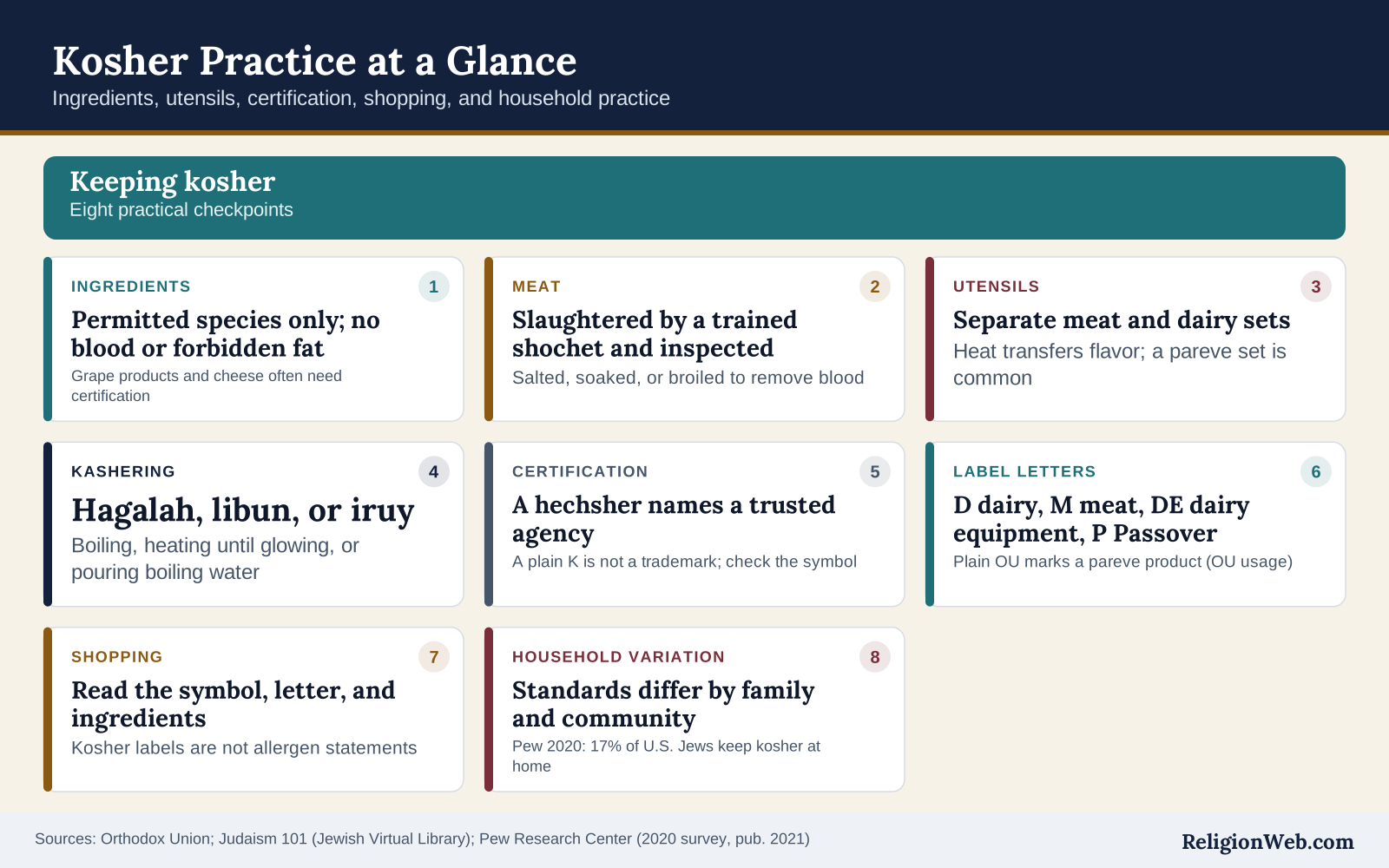
Kosher in the Modern World
Practice and Demographics Today
What the survey data can and cannot show
As described at the start of this article, about one in six Jewish adults in the United States keeps kosher at home, according to Pew’s 2020 survey. The number is much higher among Orthodox Jews and much lower among Reform and unaffiliated Jews. Because the survey asked about home practice, it does not measure what people eat outside the home, how strictly they define kosher, or whether they avoid specific foods without maintaining a full kosher kitchen.
Outside the United States, data are patchier and not directly comparable. Surveys in different countries use different questions, different samples, and different years, and this article does not combine them. Readers who need statistics for a specific country or community should consult the original studies and note the year of each.
Vegetarian and vegan paths
Pew’s 2020 figure for keeping kosher at home includes 3 percentage points of Jews who said they are vegetarian or vegan. This reflects a broader pattern in which some Jews adopt vegetarianism as a way of observing kashrut’s underlying concerns, such as avoiding the taking of life or reducing animal suffering, while keeping a kitchen free of the complexities of meat and dairy. The CCAR guide cited earlier mentions vegetarianism as one option consistent with Reform thinking about kashrut.
It is important to distinguish this ethical or personal vegetarianism from the legal question of whether vegetarian food is kosher. A vegetarian kitchen simplifies the rules, but the rules still apply to the food, the equipment, and certain products such as wine and grape juice, as the section on misconceptions explains.
Kosher Food and the Wider Marketplace
Certified foods in mainstream stores
Kosher certification symbols are now common on mainstream products, from cereals to soft drinks to snack foods, in supermarkets that serve a general public. Manufacturers pursue certification to reach observant Jewish consumers and, in some cases, other buyers who see the mark as a sign of added oversight. For the observant consumer, the presence of a recognized symbol turns a supermarket into a place where choices can be made without examining each ingredient.
This market has also encouraged innovation in pareve and dairy-free products, since a pareve dessert can be served at any meal. The growth of kosher options in airports, universities, and large cities has made observance more convenient, though the availability of kosher food still varies enormously by region.
Travel, eating out, and communal institutions
For those who keep kosher, travel requires planning. Many choose cities with a visible Jewish community, rely on pre-ordered kosher meals, or carry food. Online directories of kosher restaurants and certified products have made the planning easier. Synagogues, community centers, and Jewish day schools usually maintain kosher kitchens, which ensures that members of different levels of observance can eat together.
The result is an infrastructure of supervisors, butchers, bakers, caterers, and certifying agencies that exists largely to make a set of ancient rules livable in a modern economy. It is a feature of Jewish communal life in which religious law, commerce, and trust operate together.
Health, Safety, and Religious Exemptions
Kosher is not a health or safety label
Kosher status is a religious classification. Certification attests to compliance with Jewish dietary law, and it does not replace government food inspection or serve as a guarantee about nutrition. A kosher cake can be high in sugar, and a kosher chicken can be mishandled in a kitchen, just as the same foods without a mark could be. Consumers should apply the same hygiene and nutrition standards to kosher foods that they apply to any others.
Likewise, pareve and dairy-free labels in the kosher system are category labels and do not substitute for allergen information. A person with a milk allergy, for example, should read the full ingredient list and consult a clinician about the reliability of any label, because the religious category and the medical risk do not always coincide.
When health requires an exception
Jewish law places a very high value on preserving life, and rabbinic authorities teach that most commandments, including food laws, are set aside when a person’s life is in danger, with a narrow set of exceptions. Patients who need a medication that is not kosher or who require a particular diet for medical reasons are generally advised to follow their physician’s instructions and to consult a rabbi for guidance on how to proceed. Religious observance is not presented in the tradition as a substitute for medical care.
This principle is one of the clearest signs that kashrut is understood as a framework for living rather than as a goal that outweighs human well-being. Questions in this area are best addressed jointly by a physician and a rabbi who knows the individual’s circumstances.
Common Misconceptions About Kosher Food and Kashrut
Misconception 1: Kosher simply means food blessed by a rabbi
Where the misunderstanding comes from
The idea that kosher means blessed is widespread in popular culture, partly because rabbis are visibly involved in kosher certification and partly because Jewish and Christian blessings over food are familiar from meals and ceremonies. A rabbi standing near a kitchen or a slaughter line can easily look like someone performing a rite. Television and film have sometimes reinforced the picture by showing a rabbi who waves a hand over food and declares it kosher.
A second source of confusion is the existence of blessings in Jewish life. Observant Jews say blessings before and after meals, and the shochet recites a blessing before slaughter. Because blessings and kashrut are both associated with food, the two can seem like the same thing.
What the evidence and tradition actually show
In Jewish law, kosher status depends on facts about the food, not on a blessing placed on it. The animal must be of a permitted species, slaughtered correctly, inspected, and prepared, and the equipment and ingredients must meet the standards described in this article. A rabbi who certifies a product is attesting that these conditions have been met, usually after reviewing ingredients and visiting the production site, and the certificate can be revoked if the conditions are not maintained.
The shochet’s blessing is part of the act of slaughter, but the blessing alone does not make the meat kosher; the slaughter must also meet legal requirements. Equally, food does not become kosher by being prayed over, and a food that is not kosher cannot be made kosher by a rabbi’s declaration. The relevant question is whether the facts match the law, and the rabbi’s role is to know the law and verify the facts.
The confusion matters in practice because it can lead to misplaced trust. A product that a rabbi has merely tasted, praised, or blessed has not been certified, and a certificate is meaningful only to the extent that it names an agency, a scope, and conditions that can be checked. Observant consumers therefore ask not whether a rabbi was involved but which authority stands behind the label and what it covers.
Misconception 2: All vegetarian food is automatically kosher
Where the misunderstanding comes from
It is natural to assume that if the dietary laws focus on animals, then plant foods must be exempt. Vegetarian and vegan menus avoid meat, so many people suppose that they avoid the problem of kashrut as well. The assumption is helped by the fact that fruits, vegetables, and grains are indeed generally pareve and can be eaten with any meal.
Restaurant menus that offer vegetarian dishes sometimes add to the impression, since a vegetarian dish may be offered as an option for observant Jews. In some cases that works, but it depends on the restaurant’s kitchen and ingredients, not on the vegetarian label alone.
What the evidence and tradition actually show
Kosher law reaches well beyond meat. Wine and grape products made by non-Jews are restricted under the rabbinic enactment discussed earlier, so a vegan dish prepared with non-certified wine or grape juice raises an issue. Insects in produce are forbidden, and leafy vegetables, herbs, and berries may require checking. Processed vegetarian foods may contain animal-derived ingredients such as gelatin or certain colorings, or be made on equipment shared with dairy or meat, which a plain K does not rule out.
Utensils matter as well. A vegetable cooked in a pot used for meat may take on meat status, and a pan used for non-kosher food may carry that status to a vegetarian dish. A fully vegetarian kitchen simplifies kashrut, and many Jews keep one for that reason, but it is not automatically kosher. The question to ask is whether ingredients, equipment, and supervision meet the standard.
The converse is also true. Some foods that are not vegetarian can be pareve or kosher without difficulty, such as permitted fish, which is eaten with dairy but is not a plant food. Kosher status and vegetarian status are separate classifications, each with its own tests, and a food can satisfy one without satisfying the other.
Misconception 3: Every Jewish person follows identical kashrut standards
Where the misunderstanding comes from
Outsiders often think of kosher as a single standard because food labels and restaurant signs present it as a yes-or-no category. Media portrayals of Jewish life also tend to show a single image of observance. The word kosher is used in public as if it had one meaning.
Within Jewish communities, the variety is obvious but not always visible from outside. People who share a religion may differ on cheese, wine, fish, the length of waiting between meat and dairy, and whether to eat in non-kosher restaurants at all.
What the evidence and tradition actually show
The Pew Research Center’s 2020 survey found that about 17% of American Jews keep kosher at home, and the rate ranges from 95% among Orthodox Jews to 5% among Reform Jews. Even among those who keep kosher, standards vary. Communities differ in the customary waiting time after meat, with Maimonides’ six hours, German three hours, and some Dutch custom of just over one hour. Ashkenazi and Sephardi traditions differ on lung adhesions in meat and on Passover foods. Movements differ on whether halakha binds and how it is interpreted, as described in the previous section.
These differences are not signs that the tradition has no standards. They show that kashrut is a living legal system in which authorities, communities, and households apply shared sources in different ways. A statement such as “Jews keep kosher” is therefore incomplete unless it specifies which Jews, which standard, and which setting.
Outsiders who host Jewish guests can avoid assumptions by asking directly what the guest observes. Most observant people are used to the question and appreciate it, and the answer typically reveals whether the guest wants certified products, separate utensils, a vegetarian meal, or simply the absence of pork and shellfish.
Misconception 4: The kosher laws were mainly an ancient health code
Where the misunderstanding comes from
It is common to hear that pork was forbidden because of trichinosis or that shellfish was avoided because of spoilage in a hot climate. These explanations have a long history, and some medieval authorities, including Maimonides, did offer health-related reasons for certain prohibitions. Modern writers sometimes took up that line, presenting the laws as early public-health rules.
The health explanation has the appeal of being easy to grasp, and it fits modern assumptions that religious rules must have a rational basis in science. Its weakness is that it treats one possible reason as the explanation for the whole system.
What the evidence and tradition actually show
The Torah does not state a health rationale for the dietary laws; it ties them to holiness and separation. The Encyclopedia of Religion surveys a range of traditional explanations, from health and idolatry avoidance in Maimonides to ethical, symbolic, and mystical readings, and it notes that critics such as Abraham ben David and the Zohar rejected a purely physical explanation as too thin. The Talmud places the laws among the statutes whose reasons are not given. Many laws, such as the ban on mixing meat and milk, have no obvious health basis, and observant Jews keep them whether or not a medical reason exists.
For these reasons, scholars and rabbis commonly caution against reducing kashrut to hygiene. A kosher label is not a statement about nutrition or safety, and the obligation does not rise or fall with changes in food science. The religious reason remains that the commandments are binding, with meaning that individuals and communities explore in several ways.
None of this denies that some rules may have had practical effects, and some modern interpreters note that avoiding certain foods could incidentally have reduced risks. The point is narrower: those effects are not the basis on which the tradition justifies or applies the law. Where a health rationale is offered, it is one voice in a long conversation, not the verdict of the sources.
Frequently Asked Questions About Kosher and Kashrut
Questions About Meaning and Basics
What does kosher mean in simple terms?
Kosher means “fit” or “proper” under Jewish law, and for food it means that the food conforms to the rules of kashrut. Those rules cover which animals may be eaten, how they are slaughtered and prepared, which foods may not be combined, and how equipment is kept separate. A food is kosher when its ingredients, preparation, and handling meet those standards, and it is not kosher if any of them fails.
The word does not describe flavor, cuisine, or health, and it does not mean that a food has been blessed. A cheese, a loaf of bread, and a bottle of wine can each be kosher, and each can also be not kosher, depending on what went into it and how it was made.
Why is it called kosher salt?
In English, “kosher salt” usually refers to a coarse-grained salt favored by cooks. The name is generally explained by its use in the preparation of kosher meat, where coarse salt is applied to draw out blood. The salt itself is not special, and it is not necessarily certified; the name comes from the process, not from a religious status of the salt.
Some brands of kosher salt do carry certification, and some are made without additives that might raise a concern, but cooks should not assume that the words on the box mean that the product was supervised. As with other foods, the certification symbol is what indicates oversight.
Do people who are not Jewish need to follow kashrut?
In the Jewish tradition, the dietary laws are obligations on the Jewish people, and they are not seen as requirements for others. The rabbinic tradition holds that non-Jews are bound by a smaller set of universal commandments, traditionally called the Noahide laws, which in the standard rabbinic enumeration include a prohibition on eating a limb torn from a living animal.
Many non-Jews nevertheless encounter kashrut when they cook for Jewish guests, work in food service, or buy certified products. Hosts who wish to include observant guests can learn a great deal by asking what standard the guests keep and by using certified ingredients or catering.
Questions About the Home Kitchen
Can meat and dairy be served in the same meal if the dishes are separate?
Under the standard rules, meat and dairy are not eaten in the same meal, whether or not they are on separate dishes. The Mishnah also records a rabbinic enactment against placing meat and cheese on the same table, which many households translate into separate settings and serving pieces. A meal is therefore planned as either a meat meal or a dairy meal, with pareve dishes available for either.
Some households with young children or guests of different backgrounds find the planning difficult, and it is common to ask a rabbi for advice on specific situations. The principle, however, is clear: separation applies to the meal as well as to the cooking.
How long do you wait between meat and dairy?
It depends on custom. The most common practice is six hours after meat, following Maimonides and the majority of Eastern European and Sephardi Jews, while German Jewish custom is three hours and some Dutch custom was just over one hour. After dairy, the standard is much lighter, typically a rinse of the mouth and a neutral food such as bread, although some people wait longer after aged cheese.
A person who is unsure should follow the custom of their family or ask a local rabbi, because that is how the tradition itself resolves the question. The waiting time is not a measure of how serious a person is about kashrut but a reflection of the community from which they come.
Can a non-kosher kitchen be made kosher?
In many cases it can, through a combination of cleaning, waiting, and the use of heat or boiling water, depending on the material of each item. The Orthodox Union describes methods such as boiling, heating until glowing, and pouring boiling water, and it notes that items which cannot be thoroughly cleaned, such as certain ceramic or enamel-coated pots, cannot be kashered. Some people choose to replace equipment rather than treating it.
Because the details depend on what the kitchen was used for and on the standards of the household’s rabbi, anyone planning this step should seek personal guidance. An experienced rabbi can usually inspect the kitchen and indicate which items can be kashered and which should be replaced.
Questions About Certification and Eating Out
What does the plain K on a package mean?
A plain K is a letter that cannot be trademarked, so any manufacturer may print it. It does not, by itself, show that a recognized agency supervised the product, and some observant consumers look instead for the registered symbol of an agency they trust, such as the OU or another well-known mark. A manufacturer who uses a plain K may be relying on a rabbi’s advice, but a shopper cannot verify that from the letter alone.
If a product carries a plain K and the household wants more certainty, the common approach is to contact the company or the local rabbi, or to choose a product with a recognized symbol. In many communities, the local rabbinate publishes lists of accepted products.
Is “kosher-style” food kosher?
Not necessarily. The phrase usually refers to a type of food, such as deli sandwiches, bagels, and pickles, and it has no connection to supervision. A kosher-style restaurant may serve food that is not kosher, including combinations of meat and dairy or ingredients from forbidden animals. A restaurant that is kosher in the religious sense will usually display a certificate from a recognized agency.
How do I know which kosher certification to trust?
The answer depends on the community. Different agencies apply different standards, and the Encyclopedia of Religion notes that rival rabbinic bodies sometimes certify different standards. The best course for an individual is to follow the guidance of their own rabbi, who will know which agencies meet the household’s expectations and which do not.
For a visitor or a host who wants to be considerate, asking a guest which certifications they accept is both respectful and efficient. Large agencies publish information about their standards, and many have telephone or online services for consumers with questions.
Conclusion: What Kosher Means and How It Is Lived
What the Tradition Shows
A system of distinctions
Seen as a whole, kashrut is a system of distinctions: between permitted and forbidden animals, between meat and milk, between the sacred and the ordinary, and between what is done in kitchens and what is said in prayer. The Torah supplies the core categories, the rabbis of the Talmud elaborate them, and the codes and customs of later centuries fix them for particular communities. The result is a system that is at once precise and varied, with a legal logic that can be explained and with traditions that are lived at different levels of strictness.
The same system has accommodated change. New technologies, from industrial food processing to cultured meat, are brought into the old categories through argument, and new institutions such as certifying agencies and ethical seals have grown up around it. Disagreements between authorities and movements are part of that process and not signs of its collapse.
A practice with many motives
People keep kosher for many reasons: obedience to a commandment, attachment to family and community, a wish to make eating an act of attention, solidarity with other Jews, or a sense of continuity with earlier generations. Others do not keep kosher at all and remain deeply engaged in Jewish life. A reference article cannot say which of these paths is right, and it should not, but it can describe how each relates to the sources.
What can be said with confidence is that kosher is a precise religious category with a long history, and that its meaning is best learned through the texts, the communities, and the daily habits that carry it.
How to Keep Exploring
Texts and background
Readers who wish to go further into the sources can begin with the biblical chapters cited here, Leviticus 11 and Deuteronomy 14, and with the tractate Hullin in the Talmud, which the articles on the Torah and the Talmud introduce. The reference works cited in this article, including the Encyclopedia of Religion entry on kashrut, offer scholarly overviews of the history and interpretation.
Living practice
For living practice, the best resources are local: a rabbi, a community that keeps kosher, and the certification guides published by the major agencies. The articles on Judaism, Orthodox Judaism, Conservative Judaism, and Reform Judaism describe the wider settings in which kashrut is practiced, and the articles on Passover and Shabbat show how food shapes the Jewish year and week.
Sources
The table below lists the principal external sources behind this article. Facts, dates and figures were checked against these and related primary, institutional and academic materials.
| # | Source | Publisher and type | Used for | Link |
|---|---|---|---|---|
| 1 | The Holy Scriptures: A New Translation (JPS 1917): Genesis 9, Leviticus 11, Deuteronomy 12 and 14, Daniel 1 | Sefaria (public-domain JPS 1917 text) · Primary text | All scripture quotations; species signs; blood; kid in mother's milk; slaughter verse | sefaria.org |
| 2 | Kashrut (David Novak), Encyclopedia of Religion | Encyclopedia.com / Encyclopedia of Religion · Academic reference | Five areas of law, rabbinic development, waiting times, wine, rationales, movements | encyclopedia.com |
| 3 | Jewish Dietary Laws (Kashrut): Overview of Laws & Regulations (from Judaism 101) | Jewish Virtual Library · Educational reference | Species, slaughter, blood removal, meat/dairy/pareve rules, utensils, wine | jewishvirtuallibrary.org |
| 4 | All OU Symbols Explained | Orthodox Union (OU Kosher) · Institutional | OU, D, DE, M, F, P marks and what each means; pareve labeling | oukosher.org |
| 5 | But Is It Glatt Kosher? | Orthodox Union (OU Kosher) · Institutional | Meaning and history of glatt; Ashkenazi and Sephardi lung-adhesion rulings | oukosher.org |
| 6 | Four Ways to Kasher Kitchen Utensils for Passover | Orthodox Union (OU Kosher) · Institutional | Hagalah, libun, iruy; 24-hour rule; materials that can and cannot be kashered | oukosher.org |
| 7 | Jewish Practices and Customs (Jewish Americans in 2020) | Pew Research Center · Demographic data | 17% of U.S. Jews keep kosher at home; rates by denomination (2020 survey) | pewresearch.org |
| 8 | The Reform Approach to Kashrut (from Gates of Mitzvah, CCAR 1979) | My Jewish Learning · Denominational source | Reform history from the 1885 platform; spectrum of practice; ethical reasons | myjewishlearning.com |
| 9 | Conservatives take kashrut challenge up a notch | The Jewish Standard · News report | Conservative position on kashrut; Conservative supervision; Magen Tzedek | jewishstandard.timesofisrael.com |
| 10 | Pareve (Balashon, Hebrew Language Detective) | Balashon · Language reference | Proposed origins of the word pareve, including David L. Gold (1985); Fun Fact | balashon.com |
Last fact-check date: 2026-10-21.