The Talmud is the central work of rabbinic Judaism after the Bible: a vast, many-voiced record of Jewish legal reasoning, ethical reflection, storytelling and scriptural interpretation that took shape over several centuries of teaching and editing. Its name comes from a Hebrew root meaning “to study” or “to learn,” and that origin is a better guide to its character than the common description of it as a rulebook. Page after page, the Talmud shows teachers asking questions, offering competing answers and leaving some matters unresolved, and it preserves minority opinions alongside the views that prevailed.
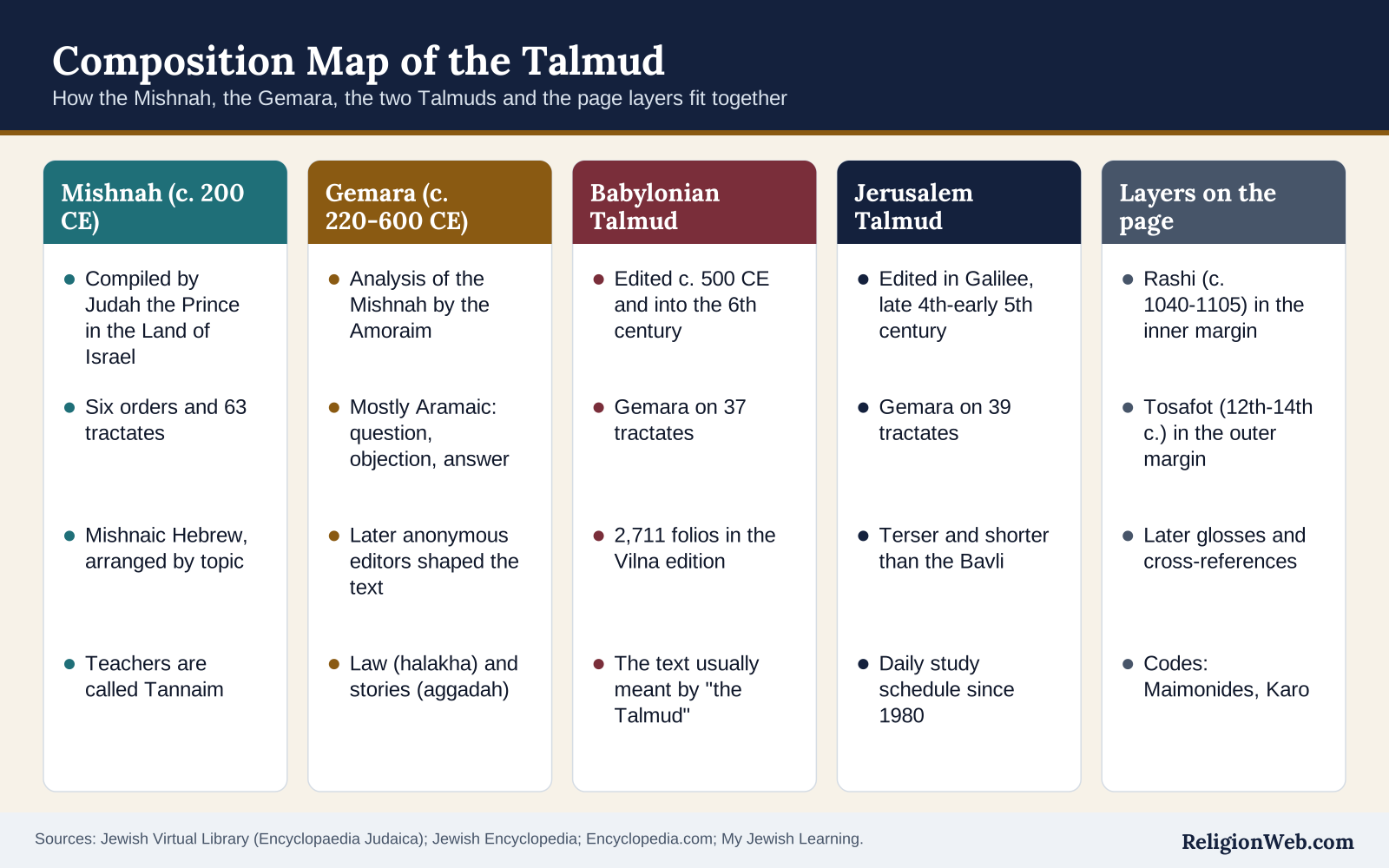
The work has two main layers. The Mishnah, a concise collection of teachings arranged by subject, was compiled in the Land of Israel around 200 CE. The Gemara, written mostly in Aramaic, is the extended discussion of the Mishnah by later generations of teachers. Together they make up a Talmud, and two Talmuds exist: the Jerusalem Talmud (Yerushalmi), completed in the Land of Israel around 400 CE, and the larger and more widely studied Babylonian Talmud (Bavli), edited in Mesopotamia and finished by about the sixth century CE. When people say “the Talmud” without qualification, they almost always mean the Babylonian Talmud.
To understand why the Talmud matters, it helps to place it within Judaism as a whole. Rabbinic tradition holds that God gave Moses an oral explanation of the written Torah at Sinai, and the Mishnah and Talmud are the principal records of how that explanation was handed on, debated and applied. They are the source from which later Jewish law (halakha) was developed, and they remain the core curriculum of the traditional study hall. A printed page of the Babylonian Talmud, with its central text surrounded by commentary from many centuries, has become one of the most recognizable images of Jewish learning.
This article explains the Talmud on its own terms: how the Mishnah and Gemara relate, how the two Talmuds were formed, what is inside them, how the page is laid out, how the text has been studied and applied, and how different Jewish communities understand its authority today. It distinguishes what the tradition teaches about its own origins from what historians reconstruct, and it notes where Orthodox, Conservative, Reform and other Jewish communities, as well as scholars, differ.
At a Glance: What the Talmud Is
Definition, Name and Basic Structure
What the word Talmud means
“Talmud” is a Hebrew noun meaning “study” or “learning,” derived from the verb lamad, “to learn” or “to teach.” In early rabbinic usage it could refer to a teaching drawn out of a scriptural verse, to a student’s body of learning, or to the analytical side of the commandment to study Torah. Over time the word came to name a specific literary corpus: the Mishnah together with the large body of discussion that grew around it. Encyclopedias such as Britannica describe it as a compilation of ancient teachings regarded as sacred and normative by Jews, holding a place in Jewish religious tradition second only to the Bible.
The corpus has several other names. In the Babylonian academies the term Gemara, from an Aramaic verb meaning “to learn,” came to designate the discussion layer, and in some usage the whole work. The Hebrew abbreviation Shas stands for shishah sidrei, the “six orders” of the Mishnah that give the Talmud its framework, and “learning Shas” means studying the Talmud. Readers will also meet the word Bavli for the Babylonian Talmud and Yerushalmi for the Jerusalem Talmud. Because the Babylonian version is the one that dominates study and law, this article uses “the Talmud” for the Bavli unless it says otherwise.
Mishnah and Gemara: the two layers
The simplest way to picture the Talmud is as a conversation built around a core text. The Mishnah supplies that core: short, carefully worded statements of law and teaching, usually in Hebrew, arranged by topic and attributed to named sages and sometimes to unnamed consensus. The Gemara takes a Mishnah passage, asks what it means, where it comes from in Scripture, how it fits with other teachings, and what happens in cases it does not mention. A typical page therefore alternates between a few lines of Mishnah and a long, branching discussion that may drift into stories, medical remarks, biblical interpretation or the biography of a sage before returning to the starting point.
The two layers differ in date, language, authorship and purpose, which is why they cannot be treated as synonyms. The table below sets out the relationship as the tradition and most historians describe it.
| Feature | Mishnah | Gemara |
|---|---|---|
| What it is | A topical collection of rabbinic teachings and rulings | Analysis, debate and expansion of the Mishnah and related sources |
| Approximate date | Compiled around 200 CE | Roughly the third to sixth centuries CE, with later editing |
| Teachers named | The Tannaim, active about 10 to 220 CE | The Amoraim, about 220 to 500 CE, and anonymous later editors |
| Main language | Mishnaic Hebrew | Aramaic (regional dialects), with Hebrew quotations |
| Arrangement | Six orders, tractates, chapters and paragraphs by subject | Follows the Mishnah passage by passage, with digressions |
| Style | Brief, formulaic, often without explanation | Questions, objections, answers and proofs |
| Where it appears | Printed alone and inside both Talmuds | Only within the Talmuds (Bavli and Yerushalmi) |
The Numbers and the Vocabulary
How big the Talmud is
The Mishnah has six orders and 63 tractates. The Babylonian Talmud has Gemara on 37 of those tractates, a figure that some traditional counts give as 36½ depending on how the shortest tractates are reckoned, and it runs to 2,711 double-sided folios (dapim, singular daf) in the standard Vilna edition printed in the late nineteenth century. Reference works commonly estimate its length at about 2.5 million words. The Jerusalem Talmud has Gemara on 39 tractates and is considerably shorter, with one standard reference describing it as roughly a quarter of the Bavli’s size.
Such numbers matter less than the proportions they reveal. Most of the Mishnah’s tractates on agricultural gifts and ritual purity have no Gemara in the Babylonian Talmud at all, while the tractates on festivals, marriage and civil law are discussed at great length. Some scholars attribute the pattern to the curricula of the ancient academies, where the laws of the Sabbath, marriage, commerce and prayer governed daily life, while others think that parts of the Gemara were lost over time.
Words every reader meets
A handful of technical terms recur on nearly every page, and the table below lists the ones that help most when reading about the Talmud. They are defined here in plain English and used throughout the rest of this article.
| Term | Meaning | Where it appears |
|---|---|---|
| Halakha | Jewish law, the “path” of practice, derived from the Torah and rabbinic tradition | The legal discussions of the Mishnah and Gemara |
| Aggadah | Non-legal material: stories, sayings, ethics, theology and biblical interpretation | Woven through the Gemara, especially in the Bavli |
| Masekhet | A tractate, one subject-based book of the Mishnah or Talmud | Berakhot (blessings), Shabbat, Bava Metzia and others |
| Daf and amud | A folio (two-sided leaf) and one side of it, labeled a and b | Citation system such as Berakhot 2a |
| Sugya | A self-contained unit of Talmudic discussion on one topic | The basic building block of the Gemara |
| Baraita | A teaching from the Tannaitic period that is not in the Mishnah | Cited in the Gemara as outside evidence |
| Tanna and Amora | A teacher of the Mishnaic period, and a teacher of the Gemara period | Names that date a saying |
| Havruta | A study partner, and the method of learning in pairs | The yeshiva study hall |
The citation system deserves a note, because it is how readers locate everything. A reference such as Bava Metzia 59b means the second side of folio 59 of tractate Bava Metzia in the Babylonian Talmud, and because the standard pagination has been stable since the sixteenth century, the same citation leads to the same passage in nearly every printed edition. Citations to the Mishnah use chapter and paragraph (Avot 1:1), and the Jerusalem Talmud is cited by chapter and law, often together with the folio of its Venice printing.
The Oral Torah and the Making of the Mishnah
From Oral Teaching to a Written Collection
What the tradition says about the Oral Torah
Rabbinic tradition teaches that at Sinai God gave Moses both the written Torah and an oral explanation of it, and that this explanation was handed from teacher to student through the generations. The Mishnah itself states the chain of transmission at the opening of the tractate Avot, and a short English rendering of it is given here.
Moses received the Torah at Sinai and transmitted it to Joshua, Joshua to the elders, and the elders to the prophets, and the prophets to the Men of the Great Assembly. They said three things: Be patient in [the administration of] justice, raise many disciples and make a fence round the Torah.
Mishnah Avot 1:1, Mishnah Yomit by Dr. Joshua Kulp (CC BY), as published on Sefaria
Within the tradition this verse establishes that the rabbis of the Mishnah stand in a line of authorized teachers reaching back to Moses, and that their task includes protecting the commandments with additional safeguards (the “fence”) as well as teaching them widely. Orthodox communities generally understand the chain literally, as a description of revealed content transmitted without a break. Many academic historians read it as the rabbis’ own account of their authority, composed after the destruction of the Second Temple, and they study the Mishnah as the product of identifiable teachers and schools. These two readings describe the same text differently, and each is held seriously by those who adopt it.
Why the Oral Torah was remembered before it was written
The Talmud itself preserves a rule that matters for understanding how the Mishnah came into being. The tractate Gittin states that teachings handed down orally may not be recited from a written text, and the tractate Temurah is cited for the same principle. Commentators and historians have offered several explanations, among them the wish to keep the written Torah distinct from its interpretation and the wish to keep the living teacher at the center of learning. Students therefore memorized teachings in compact forms. The word Mishnah comes from the Hebrew verb shanah, “to repeat,” and means “repetition” or “study by repeating,” while the teachers of this period are called Tannaim, from the cognate Aramaic root.
Historians debate how far memory and written notes cooperated in practice. A letter written in 987 CE by Sherira Gaon, the head of the academy at Pumbedita in Mesopotamia, is the classic medieval account of how the Mishnah and Talmud were formed. Surviving versions of the letter disagree about whether Judah the Prince recorded the Mishnah in writing, and scholars still discuss whether the final redaction was written or oral. What all agree on is that, by the time the Gemara was composed, the Mishnah existed as a fixed text that students studied in a stable order of words.
The Tannaim and the Compilation of the Mishnah
Sages after the Temple
The Tannaim are the rabbinic teachers whose views are recorded in the Mishnah and in related collections, and they are conventionally dated from about 10 to 220 CE. The period before them is called that of the zugot, “pairs” of leaders, ending with Hillel and Shammai, whose followers, the Houses of Hillel and Shammai, appear in disagreement across the Mishnah. After the Romans destroyed the Second Temple in 70 CE, Yohanan ben Zakkai and his students founded a center of learning at Yavneh, and other schools arose at Lod, Bnei Brak and elsewhere in the Land of Israel. Surviving sources name about 120 Tannaim, grouped by tradition into five generations, among them Gamaliel II, Rabbi Akiva, Rabbi Meir and Judah the Prince.
Several of these figures shaped the material that later became the Mishnah. The Babylonian Talmud links much of the anonymous Mishnah to the school of Rabbi Akiva, and especially to his student Rabbi Meir, an attribution that modern scholars generally read as evidence that earlier collections existed and were gradually combined and refined, rather than as proof that one man composed them. The period saw the catastrophe of the Bar Kokhba revolt, which the Romans crushed in 135 CE, and the long reconstruction of Jewish life around study, prayer and communal courts instead of Temple sacrifice. The Mishnah is in a sense the legal and religious program of that reconstruction.
Judah the Prince and the final form
The Mishnah in its present form is traditionally attributed to Rabbi Judah ha-Nasi, “Judah the Prince,” often called simply “Rabbi,” who led the Jewish community of the Land of Israel at the turn of the third century CE and is traditionally associated with Beit Shearim and Sepphoris in Galilee. Historians generally date the compilation to about 200 CE and agree that it reached its form in the late second or early third century. Judah is credited with selecting from the available traditions and arranging them by subject, and the received text contains some later additions. Scholars disagree about the degree of his editing: Chanoch Albeck saw a conservative anthology that preserved its sources largely unchanged, while Jacob Epstein and later scholars such as Shamma Friedman argued for creative reworking.
The Mishnah was composed in Mishnaic Hebrew, a stage of the language distinct from biblical Hebrew, and it organizes law by topic, not as a running commentary on Scripture. That choice is significant. Earlier interpretive collections called the halakhic midrashim, such as the Mekhilta, Sifra and Sifrei, follow the order of the biblical verses and show how rulings are derived from the text. The Mishnah states the rulings themselves and leaves the scriptural basis for others to find, which made it practical for teaching and memorization and also set the agenda for the Gemara, whose first question is so often “Where does this come from?”
The Six Orders
How the Mishnah is arranged
The Mishnah is divided into six sedarim, or orders, each containing tractates, which are in turn divided into chapters (perakim) and individual paragraphs (mishnayot). The orders cover the whole landscape of life as the Mishnah’s compilers imagined it: agriculture and the produce due to the poor and the priests, the Sabbath and festivals, marriage and divorce, civil and criminal law, the Temple and its sacrifices, and ritual purity. Apart from the first order, the tractates within each order are arranged roughly from the longest to the shortest, and a traditional mnemonic, Z’man Nakat, spells out the initials of the six orders in sequence.
| Order | Meaning of the name | Mishnah tractates | Main subjects | Tractates with Bavli Gemara |
|---|---|---|---|---|
| Zeraim | Seeds | 11 | Blessings and prayer; agricultural laws and gifts for the poor and priests | 1 (Berakhot) |
| Moed | Festival, appointed times | 12 | Sabbath, festivals, fasts, the calendar | 11 |
| Nashim | Women | 7 | Marriage, betrothal, divorce, vows | 7 |
| Nezikin | Damages | 10 | Civil and criminal law, courts, oaths, idolatry; includes Avot | 8 |
| Kodashim | Holy things | 11 | Temple service, sacrifices, slaughter of animals for food | 9 |
| Tohorot | Purities | 12 | Ritual purity and impurity | 1 (Niddah) |
Tosefta, baraitot and the wider Tannaitic library
The Mishnah did not exhaust the teachings of the Tannaim, and a good deal of material survives outside it. The Tosefta, “supplement,” follows the Mishnah’s orders and tractates fairly closely but is much longer, nearly three times as long by some estimates, and it often records parallel traditions, sometimes in what scholars judge to be older forms. Tradition attributes its editing to disciples of Judah the Prince, though the Talmud and medieval sources name different editors, and modern scholars debate its date and relationship to the Mishnah. A teaching of the Tannaitic period that is cited in the Talmud but not found in the Mishnah is called a baraita, “outside” teaching, and the Gemara regularly uses baraitot as evidence for or against a Mishnah interpretation.
These materials explain a feature of the Talmud that surprises first-time readers: the Gemara often quotes a Tannaitic teaching in order to test a Mishnah ruling, treating the earlier texts as a library of precedents. The halakhic midrashim stand beside them, preserving the scriptural reasoning on which many rulings rest. Together, the Mishnah, Tosefta, baraitot and midrashim form the Tannaitic literature that the Amoraim inherited, and the Gemara cannot be understood without the habit of cross-examining one tradition by another.
From Mishnah to Talmud: How the Two Talmuds Were Formed
The Amoraim and Their Two Centers of Learning
The eras of rabbinic literature
Jewish tradition divides the history of rabbinic teaching into named eras, and the labels appear constantly in discussions of the Talmud. The scheme is a convenience rather than a set of sharp boundaries, and historians adjust the dates, but it gives readers a quick way to place a saying in time. A teacher called a Tanna belongs to the Mishnaic age, an Amora to the age of the Gemara, and the later authorities are grouped by the kind of work they produced.
| Era | Approximate dates | Teachers | Main works and activity |
|---|---|---|---|
| Zugot (“pairs”) | About the second century BCE to about 10 CE | Pairs of leaders ending with Hillel and Shammai | Early legal traditions later gathered in the Mishnah |
| Tannaim | About 10 to 220 CE | Yohanan ben Zakkai, Akiva, Meir, Judah the Prince | Mishnah, Tosefta, halakhic midrashim |
| Amoraim | About 220 to 500 CE | Rav, Samuel, Yohanan, Abaye, Rava, Rav Ashi | The Gemara of both Talmuds |
| Savoraim and later editors | About 500 to 600 CE or later | Anonymous “reasoners” | Final editing of the Babylonian Talmud |
| Geonim | Sixth to eleventh centuries | Heads of the Sura and Pumbedita academies | Responsa, early commentaries, spread of the Bavli |
| Rishonim (“first ones”) | About the eleventh to fifteenth centuries | Rashi, the Tosafists, Maimonides | Commentaries and law codes |
| Acharonim (“later ones”) | From about the sixteenth century | Karo, the Vilna Gaon, Akiva Eiger | Codes, glosses, new analytical methods |
The Amoraim, “speakers” or “expounders,” were the teachers who analyzed the Mishnah from roughly 220 CE to about 500 CE. The Talmuds name hundreds of them: one modern count reports 761 by name, of whom 367 worked in the Land of Israel and 394 in Babylonia. Their discussions, preserved first in the memory of their disciples, make up the raw material of the Gemara. The early Amoraim treated the Mishnah as a new and authoritative base text, and a great part of their work consisted of establishing its meaning and sources, resolving apparent conflicts between teachings and extending its rules to cases it had not foreseen.
Teachers of the Land of Israel
After the Bar Kokhba revolt, Galilee became the center of Jewish learning in the Land of Israel. Schools flourished at Sepphoris, Tiberias and Caesarea, and the Amoraim there taught in a Western dialect of Aramaic mixed with Hebrew. Rabbi Yohanan bar Nappaha, who led the academy at Tiberias in the third century, is the best-known teacher of the Palestinian Amoraim, and his debates with his colleague Resh Lakish occupy many pages in both Talmuds. Under Roman and then Christian Byzantine rule, the position of the Jewish community weakened over the fourth century, and a traditional end date for the Palestinian academies’ authority is around 425 CE, when the imperial government ended the office of the patriarch, though the learning did not stop abruptly.
The Jerusalem Talmud was compiled in this setting. Most contemporary scholars date its editing to roughly the late fourth to early fifth century CE, since it quotes teachers of the fourth century and refers to events of that time. Medieval sources credited Rabbi Yohanan with editing it, but the text itself shows later hands, so that attribution is generally set aside today. Its name is a misnomer in a historical sense, because Jews had been barred from living in Jerusalem after the Hadrianic wars and the work was produced in the north; many scholars therefore prefer the descriptive titles “Palestinian Talmud” or “Talmud of the Land of Israel.” It is generally terser than the Babylonian Talmud, and some of its sections show signs of incomplete editing, which is one reason a long tradition of study treated it as secondary.
Teachers of Babylonia
Babylonia, roughly modern Iraq, had been home to a large Jewish community since the sixth century BCE and lived, from 224 CE, under the Sasanian Empire of Iran. Rav (Abba Arikha), a student of Judah the Prince, brought the Mishnah to Babylonia around 219 CE and established the academy at Sura, while his contemporary Samuel led the academy at Nehardea. Later generations taught at Pumbedita, Mahoza and elsewhere. Among the best-known Babylonian figures are Abaye and Rava in the fourth century, whose exchanges, often compressed into the formula “Abaye said… Rava said…,” are among the sharpest in the Talmud, and Rav Ashi, who presided over the academy at Sura from 375 to 427 CE.
The Babylonian community was led internally by a recognized head, the exilarch, and the rabbinic academies operated in a society whose ruling class followed Zoroastrianism and in which Syriac Christians and others were also present. Many modern historians argue that the Babylonian Talmud reflects this environment in its vocabulary, legal concepts and customs, and research on the Persian setting of the Talmud has become a major field. The Babylonian Amoraim wrote in an Eastern dialect called Jewish Babylonian Aramaic, a language preserved in the Talmud and in the writings of the Geonim, and this is the language in which the Gemara is mostly written.
Editing the Babylonian Talmud
The traditional account: Rav Ashi and Ravina
The Babylonian Talmud, unlike the Mishnah, does not say who edited it. Tradition identifies two late Amoraim, Rav Ashi and Ravina, as its principal redactors around 500 CE. Rav Ashi is said to have led the academy for some fifty years and to have begun gathering the discussions of earlier generations into an orderly whole, with Ravina completing the work. The tradition rests on a statement in the Talmud, in the tractate Bava Metzia, that Rav Ashi and Ravina are “the end of instruction,” a phrase understood in the Jewish tradition as marking the close of the age of authoritative Amoraic teaching. Dates for Ravina vary: the traditional reckoning of 475 CE for his death sits beside a report by Sherira Gaon that places it around 500 CE.
Sherira Gaon’s letter of 987 CE, written in reply to the community of Kairouan in North Africa, is the principal medieval source for this account and for the later stages. It describes a period after Ravina when a group of teachers called the Savoraim, “reasoners,” completed and revised the work, and it traces the line of authority through the Geonim who led the academies of Sura and Pumbedita. Orthodox communities generally accept the broad outlines of this chronology, and it remains the standard framework in traditional study. For students, the effect is a sense that the Talmud was brought to its form by one generation of great sages, who then closed the period of teaching in which it was created.
The scholarly picture: a long process with an anonymous layer
Modern scholars, working from the text itself and from manuscripts, generally describe a more gradual process. The Babylonian Talmud contains statements attributed to named Amoraim, but it also contains a great deal of anonymous material, often the questions, objections and connecting arguments that give a sugya its shape. This anonymous editorial layer is called the stam ha-Talmud, “the unattributed Talmud,” and its authors are sometimes called the Stammaim. The scholar David Weiss Halivni argued influentially that the long, dialectical analysis of the Talmud largely belongs to this later stratum, which worked on the Amoraic statements it inherited, while other scholars place more of the structure in the hands of the Amoraim themselves or date the stam differently.
Several features of the evidence support the view that editing was extended. The Talmud was never subject to one authoritative redaction, as a standard reference puts it, and the editorial work apparently continued into the sixth and seventh centuries. Editors moved blocks of text, linked separate discussions into larger structures and sometimes wrote statements in the names of earlier rabbis. The oral transmission of the text meant that no single authorized original existed, and standardization came largely with printing. Scholars working on the Talmud’s formation disagree about where to draw the lines, and the tradition and the academy describe the same text from different starting points: the former emphasizing the continuity of a chain of authorized teachers, the latter the evidence of layers.
The Two Talmuds Side by Side
Scope, language and style
The two Talmuds share the same Mishnah as their base and many of the same teachers, but they differ in place, language, size and emphasis. The table gathers the main descriptive facts. Both are central to Jewish tradition, and neither replaces the other; the Babylonian Talmud, however, became far more influential in legal practice and in the curriculum of the study hall.
| Feature | Babylonian Talmud (Bavli) | Jerusalem Talmud (Yerushalmi) |
|---|---|---|
| Place of origin | Rabbinic academies of Mesopotamia (Babylonia) | Galilee, especially Tiberias, Sepphoris and Caesarea |
| Date of editing | Traditionally about 500 CE, with further editing into the sixth century | Late fourth to early fifth century CE |
| Main language | Jewish Babylonian Aramaic, with Hebrew quotations | Galilean (Western) Aramaic, with Hebrew |
| Tractates with Gemara | 37 (one of Zeraim, eleven of Moed, seven of Nashim, eight of Nezikin, nine of Kodashim, one of Tohorot) | 39 (first four orders, plus part of Niddah) |
| Missing orders | No Gemara on most of Zeraim and Tohorot | No Gemara on Kodashim; almost none on Tohorot |
| Length | About 2.5 million words; 2,711 folios in the Vilna edition | Shorter; one standard estimate gives about a quarter of the Bavli |
| Style | Long dialectical discussion; extensive narrative | Terse; many parallel passages |
| Complete manuscripts | Munich Codex Hebraicus 95 (fourteenth century) | Leiden manuscript (copied in 1289) |
| First complete printing | Bomberg, Venice, 1520 to 1523 | Bomberg, Venice, 1523 |
| Role today | The main text of the yeshiva and of Daf Yomi | Studied in its own right, with a daily schedule since 1980 |
Why the Bavli became the standard
By about the eleventh century, the Babylonian Talmud had become the dominant version for Jewish life across most of the world. Historians point to several reasons. The Geonim, the heads of the Babylonian academies, claimed to inherit authority from the Amoraim and sent responsa to communities from Spain to Egypt, spreading the Bavli’s methods and conclusions. Its thorough, wide-ranging argument made it easier to use as a basis for later commentary than the more compressed Yerushalmi. And as the Land of Israel’s academies declined and the Jewish population shifted, the Babylonian text became the shared reference point, so that medieval commentators and legal codifiers worked from it almost exclusively.
The Yerushalmi has not been forgotten. Its rulings carry weight in matters specifically tied to the Land of Israel, such as agricultural laws, and it preserves early traditions and Palestinian customs absent from the Bavli. Modern scholars, among them Saul Lieberman and Louis Ginzberg in the twentieth century, brought new attention to its text, and critical work on it continues. In 1980 Rabbi Simcha Bunim Alter introduced a daily schedule, the Yerushalmi Yomi, for completing the Jerusalem Talmud, which gave a modern structure to its study without displacing the Bavli’s central place.
Inside the Talmud: Law, Story and Everything Between
Halakha and Aggadah
How legal discussion works
The core operation of the Gemara is to read a Mishnah passage as if it were a puzzle: why does it say this, and in this order, and what must it assume? The opening of the Babylonian Talmud shows the method plainly. The first Mishnah of the tractate Berakhot asks until what time the evening Shema, the prayer proclaiming God’s unity, may be recited. In the translation of Abraham Cohen published by Cambridge University Press in 1921, which is in the public domain, the Mishnah reads and the Gemara begins as follows.
From what time may the Shema’ be read in the evening? From the time the priests enter [the Temple] to partake of their Terumah, until the end of the first watch. These are the words of R. Eliezer; but the Sages say: Until midnight. Rabban Gamaliel says: Until the rise of dawn.
GEMARA What authority has the Tanna [that the Shema’ is to be read at all] that he raises the question: From what time? Further, on what ground does he first deal with the evening?
Mishnah and Gemara, Berakhot 2a, translated by A. Cohen (Cambridge University Press, 1921), as published on Sefaria
The Gemara does not ask about the answer; it asks about the question. The Mishnah assumes there is a commandment to recite the Shema, so where does that come from? The reply points to a verse in Deuteronomy that commands recitation when one lies down and when one rises, which explains why the evening is mentioned first. Only after establishing the foundation does the discussion proceed to the details, and even those details lead into long exchanges about the meaning of the evening, the Temple priests and the practice of Rabban Gamaliel. This pattern, in which an apparently simple rule is traced back to its scriptural source, tested against other teachings and then applied to new cases, is the signature of Talmudic argument.
Stories, sayings and interpretation
The Talmud is also a literature of narrative and moral reflection, and the Jewish tradition calls its non-legal material aggadah, from a root meaning “to tell.” Aggadah includes biographical stories of sages, parables, proverbs, ethical maxims, interpretations of biblical verses, discussions of the nature of God, the world to come and the Messiah, and observations about everyday human life. In the Babylonian Talmud, much aggadic material is of Palestinian origin but has been reworked, and it is often woven directly into legal discussion, so that a debate over a point of law may suddenly open into a story.
One of the best-known aggadic passages in the Babylonian Talmud concerns the sage Hillel. The story, in the tractate Shabbat, tells of a man who comes before both Hillel and his rival Shammai and says he will convert if he can be taught the whole Torah while standing on one foot. Shammai drives him away. Hillel receives him, and the text gives Hillel’s answer in the following words.
“What is hateful to you, do not do to your neighbor, that is the entire Torah, the rest is just commentary, now go and study.”
Babylonian Talmud, Shabbat 31a, Sefaria Community Translation (CC0)
Traditional readers take the story as a lesson in patience and in the priority of ethical principles, and Hillel’s saying has been widely quoted as a summary of the Torah’s moral teaching. The closing words, “now go and study,” are equally typical of the Talmud, which does not treat a principle as a substitute for learning. Historians caution that aggadic narratives were shaped by the editors who transmitted them and should not be treated as reliable biography without corroboration, and Jewish teachers likewise often read such stories for their meaning and their lessons rather than as strict reports.
Subjects Beyond Law
Courts, evidence and civil life
Much of the Talmud’s legal material would be recognized today as the law of a functioning community: how courts are constituted, who may testify, what counts as evidence, how contracts, loans and inheritances work, what liability a person bears for damage done by an animal, a pit or a fire, and how marriage and divorce are carried out. The tractates of Nezikin treat these civil and criminal matters, and the tractates of Nashim treat marriage and family law, in each case through cases and counter-cases. Britannica’s survey of the Talmud lists the administration of justice, rules of evidence, trial procedure, criminal law and civil and social law among the main areas of its legal content.
The setting for this law is important. The Talmud was formed when Jews lived under Roman, Byzantine and Sasanian rule and ran their own communal institutions under the authority of those governments. Rabbinic courts decided matters of personal status, contracts and ritual obligation, and the rabbis developed a principle, which the Talmud itself states, that in civil matters the law of the land is binding, a rule that shaped Jewish life under many later governments. The legal discussion therefore often reads as a blend of ideal reasoning from Scripture and practical accommodation to circumstances.
Medicine, science, folklore and belief
Interspersed with law and story are passages on medicine, anatomy, astronomy, agriculture, dreams, demons and magic, reflecting the knowledge and assumptions of the late ancient Near East. Britannica’s overview lists medicine and science, legend and folklore, and astrology, magic and divination among the nonlegal topics. The rabbis cite remedies, record observations on the body and the heavens, and sometimes disagree among themselves or with the views of other peoples. Modern readers meet these passages in different ways: some read them as historical windows into ancient science, others as texts whose authority lies in law and ethics rather than in the natural science of their day, and traditional teachers often distinguish between the Talmud’s legal rulings and its comments on nature.
The same breadth appears in theology. The Talmud discusses the nature of God, divine justice, the purpose of creation, the soul, prayer, repentance, the resurrection of the dead, the messianic age and the standing of non-Jews, among other topics. It rarely systematizes these ideas, and different sages hold different views, which is why Jewish philosophers and mystics over the centuries have been able to draw on the same pages for very different theologies. A reader seeking a fixed creed in the Talmud will find instead an ongoing conversation in which belief, practice and interpretation are intertwined.
The Art of Rabbinic Debate
Disagreement as Method
Why minority opinions are preserved
The most distinctive feature of the Talmud, and the one that most often surprises new readers, is that it records disagreement openly. A reader expecting a list of rulings meets instead a succession of named teachers who hold different positions and defend them with arguments, and the page often ends with the question unsettled. The tradition itself asks why the Mishnah would preserve views that were not adopted, and answers in the tractate Eduyot, a collection of testimonies about earlier teachings.
And why do they record the opinion of a single person among the many, when the halakhah must be according to the opinion of the many? So that if a court prefers the opinion of the single person it may depend on him.
Mishnah Eduyot 1:5, Mishnah Yomit by Dr. Joshua Kulp (CC BY), as published on Sefaria
The Mishnah goes on to explain that a court may not overturn another court’s decision unless it is greater in both wisdom and number. Within the tradition, the passage is read as a principle of legal method: the majority decides, but the dissent is kept on record so that later courts can reconsider if circumstances change, and so that the reasoning of the minority is not lost. Jewish legal writers over the centuries have also drawn a broader lesson about intellectual humility, since a view that fails in one generation may be the one that succeeds in another. Whether read as a rule of procedure or as a statement of values, the passage explains why the Talmud is built as it is.
“These and these are the words of the living God”
The best-known pair of disputants in rabbinic literature are the Houses of Hillel and Shammai, schools of the generations before the destruction of the Temple whose disagreements fill the Mishnah on matters from Sabbath law to marriage. The Talmud preserves a famous account of how their dispute was understood, in the tractate Eruvin.
Rabbi Abba said in the name of Shmuel, For three years, the House of Hillel and the House of Shammai argued. One said, ‘The halakha is like us,’ and the other said, ‘The halakha is like us.’ A heavenly voice spoke: “These and these are the words of the living God, and the halakha is like the House of Hillel.”
Babylonian Talmud, Eruvin 13b, Sefaria Community Translation (CC0)
The passage makes two statements at once: both schools’ positions have value as expressions of the divine will, and yet practice follows one of them. The Talmud then explains that the ruling follows the House of Hillel because its students were kind and gracious and taught the opinions of Shammai’s students together with their own, even mentioning the opponents’ view first. Rabbinic and modern readers have taken the passage in different directions. Some emphasize that legitimate debate is a sign of the Torah’s depth, others that a community must still choose a single course of action, and others that the dispute shows how character shapes legal authority. In practice, Jewish communities and movements have applied the logic in their own ways, a point taken up later in this article.
Authority, Heaven and Majority
The Oven of Akhnai
The most famous narrative about legal authority in the Babylonian Talmud is the story of the Oven of Akhnai in the tractate Bava Metzia. The sages debated whether a particular oven could become ritually impure. The Talmud explains that the oven was called Akhnai, a word it connects with a coiled snake, because the sages had surrounded it with arguments as a snake coils around its prey, and the majority declared it impure. Rabbi Eliezer ben Hurcanus, who held the opposite view, answered every argument, but no one accepted his answers. He then called on a series of signs to prove that he was right: a carob tree was uprooted, a stream flowed backward, and the walls of the study hall began to fall. The sages answered that none of these signs proved anything about the law. Then a heavenly voice came out in support of Rabbi Eliezer, and Rabbi Joshua rose and replied with the words of Deuteronomy 30:12, “[The Torah] is not in heaven.”
R. Natan met the prophet Elijah and said to him, “What did the Holy One Blessed be He do in that hour?” He said to him: “He smiled and said, “My sons have defeated Me, My sons have defeated Me.””
Babylonian Talmud, Bava Metzia 59b, Sefaria Community Translation (CC0)
Rabbi Yirmiyah, the text explains, understood the verse to mean that the Torah had already been given at Sinai and that heavenly voices were no longer to determine law, since the Torah itself says that a dispute is decided by the majority. Within the rabbinic tradition, the story is usually read as a statement that legal decisions are made by human reasoning and majority vote according to agreed procedures, a principle that accounts for the authority of rabbinic courts and the stability of halakha over time. The passage goes on to describe the human cost of the controversy: the sages excommunicate Rabbi Eliezer, the text tells of his grief, and it relates the death of Rabban Gamaliel, his brother-in-law. Many readers focus on that sequence, seeing in the story a warning that being right does not license ignoring the community or humiliating a colleague. Modern interpreters have also read it as a reflection on the limits of miracle, of charisma and of authority itself. The story is one of the aggadic passages that scholars point to as an example of how the Babylonian Talmud embeds reflection on law inside a narrative.
Reading a sugya: question, objection, answer
Most Talmudic argument is far less dramatic, and its building block is the sugya, a self-contained unit of discussion on a single point. A typical sugya begins with a Mishnah or a baraita and then moves through a recognizable sequence. The Gemara asks for the source of the ruling, a teacher gives it, someone raises an objection (kushya), another answers it (terutz), and the exchange continues until the matter is settled or the discussion reaches an impasse. The Hebrew phrase shakla ve-tarya, “taking and giving,” describes this back-and-forth. Hermeneutical rules, such as those traditionally attributed to Hillel and Rabbi Ishmael, supply the tools for deriving law from biblical wording, and the rabbis also test positions by comparing them with other texts and with logical consequences.
When no resolution is found, the Talmud sometimes ends with the word teiku, “let it stand,” which traditional sources explain as meaning that the question is left unresolved until a future teacher can clarify it. The practical consequences of such unresolved questions are handled by later authorities, who often adopt a cautious ruling in cases of doubt. For modern readers, the structure explains why the Talmud is both difficult and rewarding to study: the text is not a lecture but a record of thinking, and following it requires attention to who is speaking, which statement is quoted from an older source, and which is the voice of the anonymous editors who join the pieces.
The Talmud on the Page: Manuscripts, Printing and Layout
From Manuscript to Printed Book
Manuscripts and the Cairo Genizah
For many centuries the Talmud existed only in handwritten copies, and each scribe made decisions about wording and layout. The earliest surviving Talmudic fragments, found among the thousands of medieval documents in the Cairo Genizah, a storeroom for worn Hebrew writings, date to about the late seventh or eighth century. Fuller manuscripts from the Middle Ages survive in libraries in Oxford, Florence, the Vatican and elsewhere. Only one complete manuscript of the Babylonian Talmud survives, the Munich Codex Hebraicus 95, copied in the fourteenth century, and the only complete manuscript of the Jerusalem Talmud is held in Leiden.
The manuscripts differ from one another and from the printed text in many details, and scholars have worked since the nineteenth century to record the variants. Raphael Nathan Nata Rabbinovicz’s Diqduqei Soferim began that effort, and a later computerized databank at the Saul Lieberman Institute has continued it, but no critical edition of the whole Talmud exists. The point matters for understanding authority: in the manuscript era, no single authorized version existed, and the standardization that students now take for granted is the product of printing, not of antiquity.
The Soncino family and Daniel Bomberg
The first printed Talmud tractates appeared in the 1480s. The Soncino family of Jewish printers in northern Italy published individual tractates, and their page design, with the Talmud text in the center and the commentaries of Rashi and the Tosafot arranged around it, set the pattern that was followed afterward. A Spanish printing at Guadalajara in 1482 included Rashi but not the Tosafot, which illustrates that early printed pages varied before one format took hold.
The first complete edition of the Babylonian Talmud was printed in Venice between 1520 and 1523 by Daniel Bomberg, a Christian printer born in Antwerp. Jews were not generally permitted to own presses in Venice at that time, so Christian printers produced Hebrew books for the Jewish market, and Renaissance interest in ancient sources also created a Christian audience. Bomberg followed the Soncino layout, worked with a Jewish staff that included scholars from the ghetto, and obtained favorable terms that limited church censorship. His most lasting contribution was a fixed system of numbered pages that included Rashi and the Tosafot, so that any passage could be cited by folio and side. One widely repeated explanation for the fact that every tractate begins on folio 2a is that the title page was counted as folio 1, although scholars have discussed the origin of the practice. The Bomberg Talmud became the model for nearly all later editions, with only rare exceptions such as a 1616 Kraków printing.

The Vilna Edition and the Classic Page
Why the Vilna edition became the standard
The edition that students use today is the Vilna Shas, printed in the late nineteenth century by the Widow and Brothers Romm in Vilna (now Vilnius, Lithuania). It runs to 25 volumes and 2,711 double-sided folios, follows Bomberg’s pagination, and gathers a large body of commentary and reference notes. Its publishers competed with an earlier Slavuta edition of 1807 and with disputes over rights, but their version won out, and it is the printing that photomechanical reprints still reproduce worldwide. Because its pagination matches that of earlier editions, a citation to a given folio and side leads to the same discussion whether the reader holds a sixteenth-century or a twentieth-century book.
Later printings kept the Vilna page while adding features such as bolded opening words of commentary and further cross-references. A few modern editions have departed from it, and the choice has sometimes provoked resistance among observant readers. Rabbi Adin Steinsaltz, for example, said that the traditional page would have been about two and a half times larger in his format, which he considered unusable, and so he chose a different layout. Digital editions go further, linking each passage to the Vilna and Venice printings without reproducing the page.
Reading the page
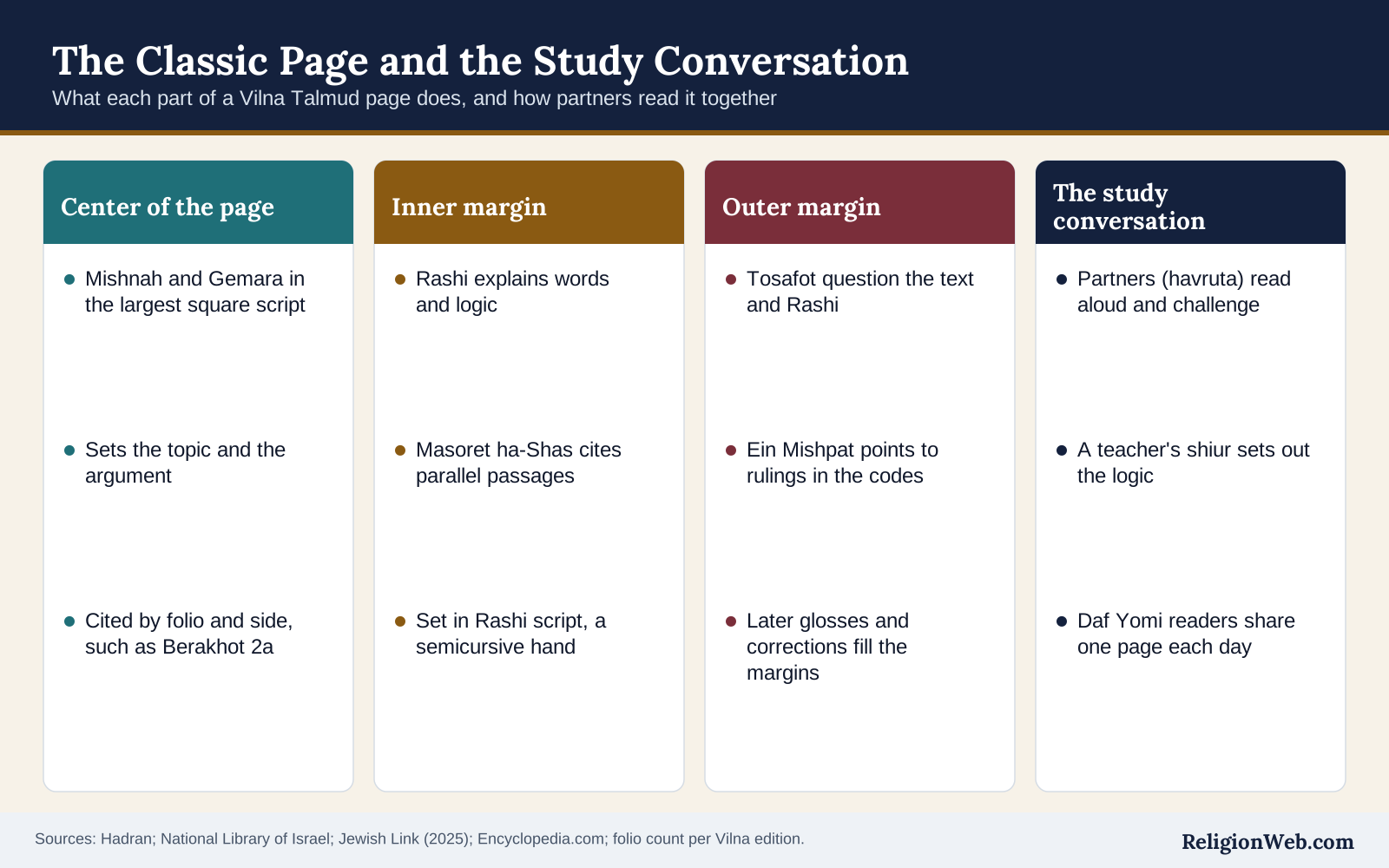
The traditional page is designed for several kinds of reading at once. The central block holds the Mishnah and Gemara in the largest square script, with the Mishnah marked by an abbreviation and the Gemara introduced by another. Rashi, the great commentator from Troyes in France, stands in the inner margin nearest the binding, and the Tosafot, the analytical glosses of the French and German scholars who followed him, occupy the outer margin. Around them are smaller columns of cross-references and glosses added by later scholars. A reader’s eye moves among these layers: from a word in the Gemara to Rashi’s explanation, to a Tosafot question about it, and out to a note pointing to a parallel passage or the law codes.
| Element | Position on the page | What it does | Author and period |
|---|---|---|---|
| Mishnah and Gemara | Center, largest square script | The text under study | Tannaim and Amoraim; edited by about the sixth century CE |
| Rashi | Inner margin, beside the binding | Running explanation of words, grammar and logic | Shlomo Yitzchaki of Troyes, about 1040 to 1105 |
| Tosafot | Outer margin | Questions and comparisons that cross-examine the text and Rashi | French and German scholars, twelfth to fourteenth centuries |
| Masoret ha-Shas | Inner margin, above Rashi | Cross-references to parallel passages elsewhere in the Talmud | Later printed apparatus |
| Ein Mishpat Ner Mitzvah | Outer margin, above Tosafot | Points to legal rulings in the codes | Later printed apparatus |
| Torah Or | Margin, position varies by edition | Identifies biblical verses quoted in the discussion | Later printed apparatus |
| Gilyon ha-Shas | Margins | Short glosses and cross-references | Akiva Eiger, 1761 to 1837 |
| Hagahot ha-Bach | Margins | Proposed corrections to the wording of the text | Joel Sirkes, 1561 to 1640 |
One detail of the page puzzles newcomers: the commentary is printed in a different, semicursive Hebrew script. This so-called Rashi script is named for the commentator but was not his handwriting. It is based on a fifteenth-century Sephardic semicursive hand, centuries after Rashi’s death, and early printers adopted it for secondary texts, such as commentaries, to distinguish them from the square script used for the main text. The page is often described as an early form of hypertext, with every layer connected to the others, and a fixed layout lets study partners and lecturers direct a listener to a spot on the page in seconds.
Commentators, Codes and the Layers of Interpretation
From the Geonim to the Tosafists
The Geonim and the first commentaries
Once the Babylonian Talmud had taken its form, the question became how to understand and apply it. The Geonim, who led the academies of Sura and Pumbedita from roughly the sixth to the eleventh century, answered in the form of responsa, written replies to questions sent from Jewish communities near and far. They did not generally write comprehensive commentaries on the Talmud, and their interpretations survive mainly in those responsa and in fragments, which scholars such as Benjamin Lewin gathered in the twentieth century in the collection Otzar ha-Geonim. Before such collections were published, much of the Geonim’s thinking was known mostly through the quotations of later authorities. The earliest known gaonic commentary is attributed to Paltoi ben Abaye, around the year 840.
Running commentaries on the text began to appear in the tenth and early eleventh centuries, among them the work of Rabbenu Gershom of Mainz and Rabbenu Hananel of Kairouan. At about the same time Isaac Alfasi (1013 to 1103), known as the Rif, produced an abridgment of the Talmud that retained only its legal conclusions, leaving out most of the debate, a form that proved popular with readers who wanted a practical guide. These works prepared the ground for the great medieval commentators, whose explanations later became part of the printed page.
Rashi and the Tosafot
Rabbi Shlomo Yitzchaki, known as Rashi, lived from about 1040 to 1105 and was born and buried in Troyes in northern France. He studied in Worms and Mainz, returned to Troyes and wrote a commentary on the Torah and a commentary on nearly all of the Babylonian Talmud. His Talmud commentary is a model of clarity: it explains the meaning of words, supplies missing steps in the argument, identifies who is speaking and why, and does so in a few lines. His death left the commentary unfinished, and it was completed by members of his family and circle, including his grandson Samuel ben Meir (the Rashbam), who finished the commentary on Bava Batra, and his son-in-law Judah ben Nathan, who finished Makkot. It appears in every printed edition on the inner margin of the page.
The Tosafot, literally “additions,” are the work of the generations of scholars in France and Germany who followed Rashi, beginning in the twelfth century and continuing for more than two centuries. They are often associated with Rashi’s own grandsons and their students, among them Rabbenu Tam (Jacob ben Meir) and Isaac ben Samuel of Dampierre. Unlike Rashi, the Tosafists do not explain the whole text. They address difficult passages, bring in texts from other tractates to challenge an interpretation, including Rashi’s, and resolve apparent contradictions by distinguishing cases. They were respectful of Rashi but freely disputed his readings. A tradition reports that, when copies of the Talmud were burned in Paris, the Tosafists assigned scholars to memorize individual volumes so that the work could be studied without a book and checked against each other’s memory. The Tosafot occupy the outer margin of the printed page and have shaped analytical study ever since.
Codes and Later Commentary
From the Talmud to the law codes
Because the Talmud records argument at length and often does not state a conclusion, medieval Jewish scholars wrote works that extracted the law. The Rif’s abridgment was an early example. Moses Maimonides (1138 to 1204), working in Egypt, wrote a commentary on the Mishnah in 1168 and then, about a decade later, the Mishneh Torah, a comprehensive code of Jewish law organized by subject, which he wrote in Hebrew and which states the rulings without citing the debates behind them. Jacob ben Asher, in the fourteenth century, organized his Arba’ah Turim into four divisions that later codes followed. In the sixteenth century, Joseph Karo, working in Safed, composed the Shulchan Arukh, printed in 1565, and Moses Isserles of Kraków added glosses that recorded Ashkenazi custom, so that the work could serve communities of both traditions.
These codes do not replace the Talmud, which remains the source of the reasoning, and a rabbi giving a ruling will usually trace it back through the code to its Talmudic roots. Communities and movements differ in how they treat the codes: Orthodox communities generally regard the Shulchan Arukh with its glosses as a primary framework for practice, while Conservative and Reform scholars treat the codes as important precedents that may be reconsidered. The next section, on halakhic reasoning, returns to this point. For now, it is enough to note that the Talmud and the codes stand in a relationship of source and summary, and that reading one without the other gives an incomplete picture.
The Acharonim and the continuing tradition
Scholars from the sixteenth century onward are called the Acharonim, “later authorities,” and they produced a vast literature of commentary, supercommentary and novellae (hiddushim), new insights on the text. In Poland and Lithuania, writers such as Samuel Eliezer Edels (the Maharsha) and Meir of Lublin (the Maharam) wrote commentaries that were later printed alongside the Talmud. Joel Sirkes (the Bach) proposed corrections to the text. Elijah ben Solomon, the Vilna Gaon (1720 to 1797), emphasized careful textual study. Akiva Eiger (1761 to 1837), rabbi of Posen, wrote the short glosses that were first printed in a Prague edition of 1830 to 1835 and later appeared in the margin of the Vilna Talmud.
The chain of commentary has never ended. New insights are still published every year, and each generation of students adds its own questions to the text. The table below lists the main layers and methods that surround the Talmud, from the Geonim to the present, and shows how each adds a different kind of reading to the page.
| Layer or method | Period | Representative figures | What it adds |
|---|---|---|---|
| Geonic responsa and commentary | Sixth to eleventh centuries | Paltoi Gaon, Sherira Gaon | Early explanations and rulings from the Babylonian academies |
| Running commentary | Tenth to twelfth centuries | Rabbenu Gershom, Rabbenu Hananel, Rashi | Plain explanation of words and argument |
| Tosafot | Twelfth to fourteenth centuries | Rabbenu Tam, Isaac of Dampierre | Cross-examination of the text and of Rashi |
| Legal codes | Eleventh to sixteenth centuries | Rif, Maimonides, Jacob ben Asher, Karo, Isserles | Rulings extracted from the debates |
| Pilpul | Late fifteenth to eighteenth centuries | Jacob Pollak, Shalom Shachna | Intensive reconciliation of sources |
| Brisker method | Late nineteenth century onward | Chaim Soloveitchik of Brisk | Conceptual analysis of legal categories |
| Historical-critical study | Nineteenth century onward | Zecharias Frankel, Saul Lieberman, Shamma Friedman, David Weiss Halivni | Manuscripts, layers of editing, historical setting |
| Digital study | Twenty-first century | Sefaria and similar libraries | Searchable, linked texts with open translations |
How the Talmud Is Studied
In the Yeshiva and the Study Hall
Learning in pairs
The traditional setting for Talmud study is the yeshiva, a school for advanced Jewish learning, and its central room is the beit midrash, the “house of study,” which can be an unusually loud place. Students sit at long tables in pairs or small groups, reading the text aloud, arguing over its meaning and testing readings against Rashi, the Tosafot and later commentary. This partnership is the havruta, an Aramaic word meaning “fellowship.” The Talmud itself praises study with a companion: a tractate warns that scholars who study alone become foolish, and teachers of the Mishnah urge a student to acquire a partner as well as a teacher. In many yeshivas the day is divided into morning, afternoon and evening sessions, each beginning with preparation with a partner and ending with a lecture (shiur) from a senior teacher who sets out the logic of the passage.
Different tracks of study coexist. Some students work on iyun, in-depth analysis of a small section, and others on bekiut, covering ground quickly to gain familiarity with the whole. Students often begin with the Mishnah and early Gemara in childhood, and a saying in Pirkei Avot sets fifteen as the age for Talmud study. The point of the exercise is not to memorize answers but to learn to think like the text, to anticipate the next question and to hear the reasoning behind a ruling. Observers sometimes note that Talmud study is both an intellectual discipline and a devotional act, since the Jewish tradition regards the study of Torah as a commandment in itself.
Pilpul, Brisk and other analytical styles
Methods of study have changed over the centuries. In the late fifteenth and the sixteenth centuries, a style known as pilpul became popular in Central and Eastern Europe, associated with teachers such as Jacob Pollak and Shalom Shachna. It aimed at reconciling apparent contradictions and explaining the differences between authorities through elaborate argument. Many leading rabbis criticized it as a display of cleverness that could lead away from the truth. The Maharal of Prague argued that learning a trade would be a better use of time, and some historians regard the older style as largely discredited by the time of the Vilna Gaon, though the word survives in modern English as a term for hairsplitting.
In the nineteenth century, Chaim Soloveitchik of Brisk (1853 to 1918) developed a conceptual approach, known as the Brisker method, that seeks precise definitions of the legal categories in a passage. By asking what a law concerns, for example the object or the person, and what practical difference a distinction makes, students can explain why seemingly similar cases are treated differently and why medieval authorities disagreed. The method spread through yeshivas around the world, and it influenced later teachers such as Joseph B. Soloveitchik. Not everyone accepted it: some critics called it overly abstract, and other Lithuanian traditions favored broader approaches. The variety of methods shows that Talmud study is a living discipline, not a fixed technique.
Daf Yomi and Daily Learning
A page a day
In August 1923, at the first World Congress of Agudath Israel in Vienna, Rabbi Meir Shapiro proposed that Jews around the world study the same page of the Babylonian Talmud each day. The proposal was adopted, and the first cycle of Daf Yomi, “the daily page,” began on September 11, 1923, the first day of Rosh Hashanah. Because the standard pagination is the same everywhere, a student in New York, Jerusalem or Johannesburg can open the same folio on the same day. The Talmud has 2,711 folios, so one cycle takes about seven and a half years, and the completion of a cycle is celebrated with a public ceremony called a Siyum HaShas, a “completion of the Talmud.”
The program grew gradually. The first Siyum HaShas was held on February 2, 1931, and by the early twenty-first century cycles were completed with mass gatherings. The completion of the thirteenth cycle was celebrated at MetLife Stadium in New Jersey on January 1, 2020, a few days before the cycle’s final page, and drew a capacity crowd of more than 90,000 people. The fourteenth cycle began on January 5, 2020, and is scheduled to end with Tractate Niddah on June 7, 2027, with the fifteenth cycle starting the next day. Daf Yomi has produced companion programs, among them a daily schedule for the Jerusalem Talmud, begun in 1980, and a daily Mishnah schedule. Participants include people who have never attended a yeshiva, and many follow the page through lectures, podcasts, printed translations and online tools.
Completing a tractate: the siyum
The idea of marking a completed text with celebration is old. The Talmud itself mentions a teacher who held a celebration for the rabbis when a young scholar finished a tractate, and the custom continues in the form of the siyum, a short ceremony in which someone reads the last passage of a tractate, a special prayer is recited, and a festive meal follows. The prayer includes the words hadran alakh, “we will return to you,” which express the hope that the learner will come back to the text. A special form of the Kaddish, the memorial doxology, is also recited. Because a siyum is regarded as a religious celebration, a gathering on the morning before Passover may be arranged so that firstborn Jews, who customarily fast that day, can eat. A tractate is thus a unit of achievement as well as of study.
These customs reflect the way learning is woven into Jewish time. The Talmud is studied daily by those who follow Daf Yomi, weekly in classes, on holidays in the tractates that deal with them, and at specific moments such as the anniversary of a death, when many study Mishnah in memory of a relative. This blend of daily routine and communal celebration is one reason the Talmud is experienced as a living text in the communities that study it, not only as an artifact of the past.
Who Studies the Talmud
Women and Talmud study
For most of history, formal Talmud study was a male activity, and the ancient sources reflect an ongoing discussion about whether women should learn it. The Mishnah records a disagreement in the tractate Sotah between Ben Azzai, who says a man must teach his daughter Torah, and Rabbi Eliezer, who says that teaching a daughter Torah teaches her something unseemly, a Hebrew word that translators render as folly or lasciviousness and that later commentators and codifiers read in different ways. Later authorities generally discouraged the teaching of women without forbidding it outright, and the Talmud mentions learned women such as Beruriah. In the twentieth century, Sarah Schenirer opened a school for girls in Kraków in 1917, which grew into the Bais Yaakov network, and the education of Orthodox girls expanded greatly.
Women’s study of the Talmud itself became common in the late twentieth century. Institutions in Israel and the United States, Orthodox and non-Orthodox, now offer advanced Talmud study for women, and women serve as teachers and scholars. Rabbanit Michelle Cohen Farber began a women’s Daf Yomi class in Ra’anana in 2012, recorded it as a podcast, and founded the organization Hadran in 2018; on January 5, 2020, Hadran hosted a Siyum HaShas for women in Jerusalem that more than 3,300 women attended. Orthodox communities differ about the role of women in learning and leadership, and the debate continues.
Learning outside the yeshiva
Talmud study today extends well beyond traditional yeshivas. Universities teach the Talmud as a text of ancient history, literature and law, and scholars analyze its manuscripts, language and layers of editing. Rabbinical seminaries of the Conservative, Reform, Reconstructionist and other movements include Talmud in their training, with varying emphasis. In Israel, secular and pluralistic study halls bring the text to people who do not identify as religious. In 1989 the scholar Ruth Calderon founded the first Israeli secular, pluralistic and egalitarian beit midrash, and in her 2013 maiden speech to the Knesset she drew on Talmudic stories to plead for mutual understanding. Translations and online libraries make the text available to readers who cannot read Aramaic, and the next sections return to those resources.
The Talmud and Halakha: How Jewish Law Is Reasoned
A Source of Law, Not a Rulebook
From debate to practical ruling
Describing the Talmud as a rulebook misses how it works. A rulebook states what to do; the Talmud records how a community of teachers arrived at what to do, including the paths they rejected. Many passages end without a stated conclusion, others record a dispute with no verdict, and a ruling often has to be inferred from the weight of the arguments. That is why the Talmud produced a long tradition of further literature intended to turn its discussions into practice: the commentaries of Rashi and the Tosafists, the codes of Maimonides, Jacob ben Asher and Joseph Karo, and the vast body of responsa in which rabbis answer specific questions by citing Talmudic precedent.
Jewish law follows a set of working principles for deciding between conflicting opinions. The Talmud itself says that the law follows the majority, as the Oven of Akhnai passage illustrates, and that in the disputes between the Houses of Hillel and Shammai the ruling follows Hillel. Later authorities developed further rules about whose opinions to follow when sages of different generations disagree, and they gave weight to the customs of particular communities (minhag). The result is a legal system in which the Talmud is the authoritative base, medieval and modern authorities add layers of interpretation, and each community’s rabbis apply the whole to present circumstances. Orthodox communities generally regard this chain as binding, and other Jewish movements treat the same texts with different degrees of authority, a subject covered later in this article.
Two examples: Sabbath labor and carrying
The tractate Shabbat shows how a brief biblical command grows into a detailed legal system. The Torah commands rest on the seventh day and prohibits work, but it does not define work. The Mishnah supplies a list of thirty-nine main categories of prohibited labor, described in the text as “forty less one,” among them sowing, plowing, reaping, grinding, kneading, baking, shearing wool, spinning, weaving, tying and untying a knot, sewing, writing two letters, building, extinguishing a fire, kindling a fire, and carrying an object from one domain to another. The Gemara discusses how these categories were derived, and tradition links them to the kinds of work needed to build the portable sanctuary described in the Torah. Each category then becomes a family of cases, which explains why Sabbath law can seem elaborate to outsiders. For how those rules shape the day itself, see the article on Shabbat.
The rule on carrying shows how Talmudic law responds to communal needs. Moving an object between a private and a public domain is among the prohibited labors, which would seem to make an ordinary neighborhood unusable on the Sabbath. The tractate Eruvin, whose name means “mixtures” or “blendings,” develops legal devices that allow a defined area to be treated as one shared domain. The Talmud does not weaken the prohibition; it specifies, with considerable precision, the conditions under which a space counts as enclosed, and later communities built boundaries accordingly. The example shows a characteristic feature of the system: a rule remains in force while the tradition develops detailed procedures for living under it.
Tools of Adjustment and Purpose
Rabbinic enactments, protective fences and custom
The rabbis did not only interpret existing commandments; they also enacted new rules, known as takkanot, and protective decrees (gezerot) meant to keep people from violating a Torah law, which is the meaning of the “fence around the Torah” in the Mishnah quoted earlier. They could also soften a law that had become unworkable. A well-known case is the prozbul. Under the Torah’s laws of the seventh, or sabbatical, year, loans were canceled, and the Mishnah (Sheviit 10:3) reports that Hillel the Elder saw people refusing to lend to one another for fear of that cancellation, and thus, in the Mishnah’s words, transgressing what the Torah warns against. In response he enacted the prozbul.
The prozbul was a legal instrument that, in the traditional understanding, placed the debt under the control of the court so that the loan was not canceled, and it protected both lenders and the poor who needed credit. Within the tradition, the case is cited as an example of a sage acting on the Torah’s own purpose to adapt its application. It is also a reminder that Talmudic law has always combined fidelity to the text with attention to consequences.
Saving life, ethics and the purpose of the law
The Talmud sets certain principles above ordinary rules. The most important is pikuach nefesh, the duty to save a human life, which overrides nearly every other commandment, including the Sabbath. The Talmud derives this principle from a biblical verse and teaches that one should live by the commandments and not die by them. In practice, this means that Jewish law directs a person to seek medical care and to violate the Sabbath if necessary to save life, and it is therefore a mistake to see the law as a barrier to medical treatment. Anyone with a health question should consult a qualified physician, and a rabbi can then advise on how Jewish law applies to the situation.
The Talmud also reflects constantly on why the law exists. Hillel’s summary of the Torah in the tractate Shabbat, quoted earlier, locates the heart of the commandments in ethical responsibility toward one’s neighbor. Elsewhere, the sages speak of the “ways of peace” as a reason for certain rulings and of the dignity of the human being as a limit on the application of rules. Another principle, which Samuel taught in Babylonia, holds that in civil matters the law of the government of the land is binding. These principles do not remove the authority of the text but shape how it is read, and they help explain how a body of law set in ancient courts has continued to be applied by communities living under many governments.
The Talmud in Prayer, Holidays and Daily Life
The Jewish Year and the Tractates
How the tractates stand behind familiar observances
Many practices that Jews follow today are described in detail in the Talmud, and specific tractates are associated with specific observances. The Mishnah’s order of the Passover meal is the basis of the Seder, and the Mishnah in Pesachim 10 contains the question of the son, which the father answers by explaining “How different this night is from all other nights.” The story of the Hanukkah lights comes from a passage in the tractate Shabbat that asks “What is Hanukkah?” and tells of a flask of oil that lasted eight days. The table below gathers some of the best-known connections. They are not the only places where each observance is discussed, and the later development of each holiday is covered in its own article.
| Observance or practice | Main tractates | What the Talmud discusses |
|---|---|---|
| Shabbat | Shabbat, Eruvin | The thirty-nine categories of labor, carrying, lights, shared domains |
| Passover | Pesachim | Removal of leavened food, the Passover offering, the order of the Seder, the four cups, the questions |
| Rosh Hashanah | Rosh Hashanah | Setting the new moon, the shofar, the days of judgment |
| Yom Kippur | Yoma | The Temple service of the day and the rules of fasting and atonement |
| Sukkot | Sukkah | The booth and the four species |
| Hanukkah | Shabbat 21b | The lighting of lamps and the account of the oil |
| Prayer and blessings | Berakhot | The Shema, the Amidah, blessings before and after food |
| Marriage and divorce | Kiddushin, Ketubot, Gittin | Betrothal, the marriage contract, the writ of divorce |
| Dietary law | Chullin | Slaughter, forbidden foods, the separation of meat and dairy |
| Mourning | Moed Katan | Rules for mourners and for work during the intermediate festival days |
Readers who want the holidays in detail can turn to the articles on Passover, Rosh Hashanah, Yom Kippur and Hanukkah, each of which describes the observance as it is practiced. The point here is that the observances were given their structure by the rabbis of the Mishnah and Talmud, working from the Bible, and the later customs developed within that framework. The Seder, for example, preserves in its questions and cups the form that the Mishnah describes, and later authorities adapted that form after the Temple’s destruction, when the Passover offering could no longer be brought; the Mishnah’s question about roasted meat was eventually dropped for that reason.
Food, marriage and the stages of life
The same tractates stand behind practices that are not tied to the calendar. The laws of kosher slaughter and forbidden foods are discussed chiefly in the tractate Chullin, and the broader system, with its separation of meat and milk, is explained in the article on kosher food and kashrut. The tractates of the order Nashim govern betrothal, marriage contracts and divorce, and the rabbinic wedding, with its blessings and contract, grows from those discussions. The Mishnah’s list of the stages of life in Avot sets thirteen as the age at which a person becomes subject to the commandments and fifteen as the age for the study of Talmud, and Talmudic discussions of when a minor becomes responsible for the commandments stand in the background of the modern coming-of-age ceremony described in the article on bar and bat mitzvah.
The Talmud shapes ordinary habits as well: the blessings said before eating, the practice of washing hands, the rules of visiting the sick, comforting mourners, honoring parents and giving charity, and countless details of etiquette and ethics. Many of these rules originated as the advice of a single teacher and became customary over time. The Talmud’s discussions are the reason that Jewish practice can be traced, in detail, to named teachers and recorded arguments.
Talmudic Texts in the Prayer Book and the Calendar
Passages recited in worship
The Talmud is not only studied; parts of it are recited. The traditional prayer book includes passages from the Mishnah and the Gemara, among them a short passage from the Mishnah, recited with the morning blessings, that lists acts of kindness and study to which no fixed limit is set. After the Sabbath afternoon service in many communities, a chapter of the tractate Avot is read each week from Passover until Rosh Hashanah, a custom attested since at least the time of Saadia Gaon in the tenth century, though the exact schedule varies by community. The Haggadah, the text of the Seder, quotes the Mishnah’s question of the son and builds on a passage from the Jerusalem Talmud that identifies four kinds of child. And the Kaddish said after a completed study session, in a special form called the rabbis’ Kaddish, takes its name from its mention of the rabbis and their students.
These customs mean that even Jews who never open a volume of the Talmud meet its phrases in worship and at the table. They also mean that the line between “study” and “prayer” is thin, since reciting a Mishnah or a Talmudic teaching is regarded as a way of honoring those who taught it. In many communities, a family will study Mishnah in memory of a deceased relative, a practice that links the text to remembrance and mourning.
The Talmud and the rhythm of time
Time in Jewish life is partly organized by the Talmud: the structure of the daily prayers, discussed in Berakhot, the setting of the new moon described in Rosh Hashanah, the weekly cycle of the Sabbath, and the yearly cycle of study that now includes Daf Yomi. A person who follows the daily page experiences a cycle of seven and a half years in which the text moves through blessings, Sabbath and festival law, marriage, civil law and Temple sacrifice, and who then begins again with the first page of Berakhot. For many participants, this routine gives the Talmud a place in daily life comparable to that of the weekly Torah reading.
Authority and Interpretation: How Jewish Communities Relate to the Talmud
The Main Streams of Rabbinic Judaism
Orthodox and Haredi communities
In Orthodox Judaism, the Talmud is the written record of the Oral Torah, which Orthodox teaching holds was given to Moses at Sinai together with the written text. On this understanding the Talmud’s rulings and interpretive methods carry binding authority, the framework of halakha derives from it, and the task of each generation is to study it and apply it faithfully. The Talmud stands at the center of the education of Haredi (strictly Orthodox) communities, where a young man may spend many years in a yeshiva devoted almost entirely to Talmud study, and it is also central to Modern Orthodox education, where it is combined, in varying proportions, with secular studies and in some institutions with academic methods. Both groups use the standard printed page, the medieval commentaries and the codes.
Within Orthodoxy there are real differences of emphasis. Some communities prize the analytical method associated with Brisk, others the broader surveys that favor wide knowledge of the text, and others combine Talmud with Hasidic teaching and devotional practice. Disagreements also arise over how far historical and manuscript research should affect the reading of the text, and over what role women should have in advanced study. The common ground is the conviction that the Talmud is part of a chain of revealed teaching, and that its study is a religious act.
Conservative and Reform approaches
Conservative (Masorti) Judaism also regards the Talmud as foundational and treats halakha as the framework of Jewish life, while accepting the historical and critical study of the texts. Its rabbinical schools teach the Talmud in Hebrew and Aramaic using traditional methods alongside the history of its manuscripts and the world in which it was composed. Rabbis in the movement write responsa that cite the Talmud, the codes and later authorities and then state a conclusion, and the movement’s Committee on Jewish Law and Standards reviews them. In this view, the law is binding but can develop through scholarly and communal processes, and the Talmud itself is a record of such development.
Reform Judaism holds the Talmud, the medieval commentaries and the codes as part of the Reform library, but it does not treat them as binding law in the way Orthodox communities do. Reform teachers emphasize individual and communal informed choice, and they study the Talmud as a major source of Jewish values, history and practice from which to draw guidance. Its responsa often cite Talmudic sources, weigh them against other considerations and offer a conclusion as advice. Reconstructionist and other communities, along with many Jews who do not belong to any movement, also read the Talmud, each from within their own understanding of tradition. The range of views is wide, and it is accurate to say that Jews agree on the importance of the Talmud while differing on its authority.
Communities That Read Differently
Karaites and earlier disputes over the Oral Torah
The authority of the oral tradition has been contested within Judaism before. Ancient sources from the Second Temple period report that the Sadducees rejected the oral tradition that the Pharisees, ancestors of the rabbinic movement, accepted. In the early Middle Ages, the Karaite movement arose in the Islamic world, in Babylonia and Persia, with the teacher Anan ben David in the eighth century often considered a founder, and it holds that the written Tanakh alone is the supreme authority in law and theology. Karaites do not treat the Talmud or the midrash as binding, and they hold that each individual is responsible for studying Scripture and determining its meaning, seeking the plain sense of the text.
The Karaite community survives today in small numbers, with estimates running from roughly 30,000 to 50,000 worldwide and the largest concentration in Israel. The relationship between Karaites and rabbinic Jews has been marked by long disputes, including criticism from the Gaon Saadia, as well as periods of coexistence, and Jewish authorities have held varying positions on questions such as intermarriage between the groups. The Karaite example is a reminder that the rabbinic position, with the Talmud at its center, is one of several approaches to Scripture, and that it is accepted by the great majority of Jews but is not universal.
Local traditions and popular study
The Talmud has also been absorbed into Jewish life through channels that do not depend on formal yeshiva training. Jacob ibn Habib, who died in 1516, compiled the Ein Yaakov, a collection of the aggadic, or non-legal, passages of the Talmud, which gave readers who could not follow its legal debates access to its stories and ethical teaching, and the book became a popular text for study in many communities. Sephardic and Mizrahi communities, shaped by the legal work of Maimonides and Joseph Karo, have their own traditions of learning and pronunciation. Hasidic communities, whose movement began in the eighteenth century, combine Talmud study with devotional practice and the teachings of their rebbes, while the Lithuanian yeshiva tradition, associated with the Vilna Gaon and the schools that followed, has emphasized analytic rigor.
The differences matter because they remind readers not to equate “the Talmud” with a single style of learning. A Yemenite family studying at the table, a Hasidic student reading with a partner at dawn, a Conservative rabbi consulting a responsum, a Reform congregation discussing a story at a Sabbath morning class, and a university student comparing manuscripts are all reading the same text, each with a different purpose and a different sense of what it asks of them.
Suppression, Censorship and Misreading
Burnings and Censors
The Paris trial and the burnings
The Talmud has often been a target of hostility from outside the Jewish community, and the history of that hostility is part of the history of the book. In the 1230s, a convert from Judaism to Christianity named Nicholas Donin brought a list of thirty-five charges against the Talmud to Pope Gregory IX, alleging that it contained blasphemous statements about Jesus, Mary and Christianity. The pope ordered copies seized, and in June 1240 a disputation was held at the court of King Louis IX of France in Paris, at which Rabbi Yechiel of Paris and other rabbis defended the Talmud. Yechiel argued among other things that the “Yeshu” mentioned in the Talmud was not the Jesus of the Christians and that passages about non-Jews referred to idolaters of the ancient world, not to Christians. The church authorities nevertheless condemned the Talmud, and in 1242 about twenty-four wagonloads of manuscripts were burned in Paris.
The burning contributed to the decline of the great schools of northern France. Later disputations, such as those at Barcelona in 1263 and Tortosa in 1413 and 1414, again examined the Talmud, and in the sixteenth century copies were burned in Italy and the book was listed on the Church’s Index of forbidden books. A report that a bishop ordered copies burned in the region of Podolia in 1757 is among the last known cases. In every case, the Jewish response included both legal defense and an effort to preserve the text, including by memory, in hidden copies and in new editions.
Censorship of printed editions
As printing spread, church authorities moved from burning to censoring. In 1564 the Church allowed the circulation of the Talmud on the condition that passages deemed hostile were removed, and a censored edition was printed at Basel around 1580. The tractate Avodah Zarah, which deals with idolatry, was omitted from several early editions and restored in the Amsterdam edition of 1644 to 1648. Censors also forbade the word “Talmud” in some printings, which is one reason the title “Gemara” appears on many editions. Jewish printers and communities sometimes removed passages themselves to protect their books from seizure, and modern scholarship has worked to restore the uncensored readings from manuscripts and from Bomberg’s relatively free Venice edition.
These episodes illustrate how a religious text can be subject to external control, and they also show the strength of the tradition’s commitment to its book. The cycle of burning and reprinting is part of why the Talmud’s physical history, its page, its editions and its variants, remains a field of study.
Misquotation and Its Corrections
Quotations taken out of context
From the early modern period onward, a literature emerged that quoted isolated Talmudic passages to portray Jews as hostile to non-Jews. Johann Andreas Eisenmenger’s Judaism Unmasked appeared in 1700, and in the nineteenth century August Rohling’s Der Talmudjude drew on it. Scholars such as Hermann Strack and Joseph Samuel Bloch demonstrated that many of Rohling’s quotations were fabricated or distorted. In 1892 Justinas Pranaitis published The Talmud Unmasked, and in 1912, in the Beilis blood libel case in Russia, he was discredited as an expert witness. In the twentieth century, propagandists in Nazi Germany and in other countries recycled such claims, and the Anti-Defamation League reported in 2003 that similar material continued to circulate as old accusations and distortions.
Historians who have studied this literature, among them Alan Steinweis, who has written about Eisenmenger, note a common method: rabbinic debating tactics and hyperbole were presented as doctrine, contrary passages were omitted, and legal statements about ancient situations, such as idolatry in the Roman world, were read as rules about modern neighbors. The Talmud is not a secret document, and it has been printed and translated openly for centuries. The responsible way to read any disputed passage is to locate it in its tractate, to see what the surrounding discussion says, to consult the commentators who explain it, and to notice what later Jewish law actually decided.
How to read difficult passages responsibly
Like all ancient literature, the Talmud contains statements that modern readers find troubling, including remarks about non-Jews, women, slaves and others, as well as stories that reflect the assumptions of their time. Jewish teachers and scholars discuss these passages openly. They distinguish between a legal ruling and an aggadic remark, between a view recorded and a view adopted, and between the situation of the third-century Babylonian academy and the situation of the present. Medieval and modern authorities often limited or reinterpreted harsh rulings, and Jewish law in many periods established principles of fair dealing with all people, including the Talmud’s own teaching that the “ways of peace” apply to non-Jews as well as Jews.
For a non-specialist, the best approach is to read passages in a reliable translation, preferably one with commentary, and to be wary of quotations that appear without a precise locator or that come from websites with a political purpose. Citing a tractate and folio allows anyone to check the original. The same advice applies to any scripture: a single sentence lifted from a vast text tells less than the argument surrounding it.
The Talmud Today: Translation, Scholarship and Technology
Editions, Translations and Digital Libraries
English and Hebrew editions
Until the twentieth century, serious Talmud study required reading Aramaic and Hebrew, but translations have made the text accessible to many more readers. The English translation of the Babylonian Talmud published by the Soncino Press, edited by Isidore Epstein, appeared in the mid-twentieth century. The Schottenstein Edition, published by ArtScroll in 73 volumes between 1990 and 2004, pairs the Hebrew and Aramaic with an English translation and an explanatory commentary and is credited with enlarging English-language participation in Daf Yomi. Rabbi Adin Steinsaltz (1937 to 2020) founded an institute for Talmudic publications in 1965 and spent decades writing a commentary and translation into modern Hebrew, completed in 2010; an English and Hebrew edition of his work, the Noé Edition of the Koren Talmud Bavli, began to appear in 2012.
These editions differ in approach and in the theological assumptions of their commentary. Some follow the Vilna page closely, others reorganize the text into more readable sections with punctuation and explanation, and each reflects the audience it addresses. Many readers use several at once, comparing a literal translation with an explanatory one.
Sefaria and open libraries
Digital libraries have extended access further. Sefaria, a nonprofit founded in 2011 by Joshua Foer and Brett Lockspeiser, offers the Hebrew and Aramaic texts of the Talmud and many other Jewish works free of charge, with linked commentaries and multiple English translations under open licenses, some of which are quoted in this article. In 2017 it released the William Davidson Talmud, a Hebrew and English digital edition based on the Steinsaltz work, and users can move from a passage in the Gemara to Rashi’s comment, to a parallel text, to a later discussion. Other projects, including a computerized databank of manuscript variants and searchable concordances, serve scholars.
Digital tools change how people study without replacing the traditional page. Many learners use an app to look up a word and then open a printed volume for sustained work, and many teachers record lessons for listeners worldwide. At the same time, the open availability of the text is a reminder that the Talmud, once a book accessible to few, has become one of the most widely available classical religious works.
Scholarship and Open Questions
Academic study of the Talmud
The scholarly study of the Talmud as a historical document began in earnest in the nineteenth century with the movement known as the Science of Judaism (Wissenschaft des Judentums), and it has expanded into a field with its own journals and methods. In the twentieth century, scholars such as Louis Ginzberg and Saul Lieberman at the Jewish Theological Seminary examined the Jerusalem Talmud, the Tosefta and the manuscripts with great philological care, and later generations such as Jacob Neusner, David Goodblatt, Shamma Friedman and David Weiss Halivni asked new questions about literary form, editing and culture. Many academic scholars read the Talmud as a product of its time, in dialogue with the Greco-Roman and Persian worlds, and they study both the law and the stories.
This work is not a rival to traditional study but a different way of reading, and the two often overlap. Several Jewish seminaries combine them, and many traditional scholars use manuscripts and historical insights in their work. Others hold that the questions raised by historical research should not affect how the text is understood in religious life. Both positions are held with seriousness.
Questions that remain open
Many basic questions are still debated. Scholars disagree about the dates and the nature of the anonymous editorial layer, about how far written notes supplemented memory in the early stages of the Mishnah and Gemara, about the relationship between the two Talmuds, and about the degree to which the Babylonian text was shaped by its Persian environment. No critical edition of the whole Talmud exists, and the edition of the Jerusalem Talmud is less advanced than that of the Babylonian. New manuscript discoveries, new methods of digital analysis and new translations continue to add information.
For readers who are not specialists, the most useful takeaway is that the Talmud is both a historical document and a living book. It records a conversation that began nearly two thousand years ago and has not ended, and each generation that studies it joins that conversation in some way.
Common Misconceptions About the Talmud
Misconception 1: The Talmud is a single book written by one author at one time
Where the misunderstanding comes from
In English, “the Talmud” sounds like the title of a single book, and a modern set of volumes on a shelf encourages the impression of a unified work with a unified author. Popular summaries add to it by naming a few figures, such as Judah the Prince for the Mishnah or Rav Ashi and Ravina for the Gemara, and readers may take those names the way they would take the name of an author on a title page. The comparison with scripture also plays a part: where people think of a sacred book as the product of one revelation, they may assume the Talmud is the product of one author.
The Jewish tradition itself uses the language of authorship in a limited way. It credits Judah the Prince with compiling the Mishnah and credits Rav Ashi and Ravina with bringing the Babylonian Talmud to completion, and those attributions are real and important within the tradition. They describe editors and compilers, however, not authors in the sense of a writer who composed every sentence.
What the evidence and tradition actually show
The Talmud is an anthology of voices arranged over centuries. The Mishnah draws on the teachings of about 120 Tannaim and was compiled around 200 CE from earlier collections. The Gemara of the Babylonian Talmud records the sayings of hundreds of named Amoraim who lived between roughly 220 and 500 CE in different places, and it includes an anonymous editorial layer that scholars date to the generations after them. A second Talmud, the Jerusalem Talmud, was edited independently in the Land of Israel. The printed page then adds the commentary of Rashi, the Tosafot and later scholars, who lived between the eleventh and the nineteenth centuries.
The tradition and academic scholarship agree on this layered picture even where they disagree about the dating and the mechanism. Orthodox teaching emphasizes the faithful transmission of the Oral Torah through a chain of teachers, while historians emphasize editing and development, but neither describes a single author at a single desk. A more accurate description is that the Talmud is a library with a shared structure, shaped by many hands over about a thousand years.
The manuscripts point the same way. Copies of the Babylonian Talmud differ from one another in wording, in the order of some passages and in the names attached to some sayings, and no single authorized original existed in the age of the handwritten book. A fixed, standard text is largely the product of printing, which is itself a reminder that the Talmud has had many editors, copyists and printers in addition to its ancient teachers.
Misconception 2: The Talmud is a secret legal code or a simple rulebook
Where the misunderstanding comes from
Two ideas are tangled here. The first is that the Talmud is a code: a list of rules telling Jews what to do. The word halakha, often translated as “Jewish law,” and the existence of detailed rules for the Sabbath, food and ritual encourage the impression of a rulebook. The second is that the Talmud is hidden. Historically, hostile writers claimed that the Talmud contained secret teachings against non-Jews, and the fact that the text is written in Aramaic and Hebrew, with technical terms and an unfamiliar logic, allowed such claims to circulate among readers who could not check them.
It is true that law occupies a large share of the Talmud and that much of Jewish practice rests on it. The misunderstanding arises when that fact is turned into the claim that the Talmud is simply a set of commands, or that its contents are concealed.
What the evidence and tradition actually show
The Talmud is not secret. It has been printed since the 1480s, publicly examined in disputations before kings and popes, translated into many languages and studied by millions of people through programs such as Daf Yomi. Anyone can read it, and Sefaria and other libraries make the full text available free of charge. The difficulty is in understanding it, not in obtaining it.
It is also not a simple rulebook. A code, such as Maimonides’s Mishneh Torah or Karo’s Shulchan Arukh, states rulings; the Talmud records the reasoning and the disagreement behind them, along with stories, interpretation of Scripture, ethical teaching and observations about the world. Many of its discussions end unresolved, and a good number of its laws, such as those of Temple sacrifice, have no practical application today. Rabbis who decide present-day questions begin with the Talmud but also rely on the codes, responsa, local custom and a judgment about circumstances. In that sense, the Talmud is the foundation of a legal tradition, not the whole of it.
The notion of secrecy sometimes arises from confusing the Oral Torah with esoteric teaching. “Oral” here describes how the material was first transmitted, by memory and speech, not how widely it could be shared, and the Mishnah and Talmud were taught openly in the academies. The separate literature of Jewish mysticism, which some communities guard more carefully, is a different body of writing from the Talmud, though its authors also quote and interpret it.
Misconception 3: Mishnah and Gemara are interchangeable terms
Where the misunderstanding comes from
Several reasons lead people to treat the two words as synonyms. Printed pages show Mishnah and Gemara one after the other without a visible break, and a casual reader may not notice where one ends and the other begins. Popular English sometimes uses “Mishna,” “Gemara” and “Talmud” as near equivalents. And inside the yeshiva world, where students say they are “learning Gemara,” the word has become a colloquial name for the whole Talmud, so that a newcomer hears the terms used loosely.
The overlap in usage is genuine, which is why the confusion is easy to understand. The distinction matters, however, because the two layers differ in date, language, purpose and method.
What the evidence and tradition actually show
The Mishnah is a compilation of rabbinic teachings produced in the Land of Israel around 200 CE, written in Mishnaic Hebrew and arranged by topic. The Gemara is the later analysis of the Mishnah, written mostly in Aramaic between the third and sixth centuries, and it exists only within the two Talmuds. A Talmud is the combination of the two. The Mishnah can be studied on its own, and many people do so through daily Mishnah programs, but the Gemara cannot be read without the Mishnah passage it discusses.
It follows that statements about “the Talmud” can be true of one layer and not of the other. The Mishnah, for example, is dispute-laden but concise, while the Gemara is expansive and narrative. The word Gemara, in its specific sense, refers to the discussion layer, and careful writers use it that way, even though colloquial usage is broader.
The opening of Berakhot shows the difference in practice. The Mishnah states the time for the evening Shema in a few lines and names three authorities, Rabbi Eliezer, the Sages and Rabban Gamaliel. The Gemara then asks what grounds the Mishnah has for raising the question at all and why it begins with the evening, and it supplies a scriptural answer. One layer states a position, and the other examines it.
Misconception 4: All Jews accept the Talmud’s authority in the same way
Where the misunderstanding comes from
Outsiders often assume that a religion has one set of authoritative texts accepted by all adherents in the same way, and discussions of the Talmud sometimes treat “the Jews” as a single group that follows it. Polemical writing has encouraged this by attributing every statement in the Talmud to all Jews, and the prominence of Orthodox practice in public portrayals of Judaism makes it seem like the only version.
The reality is that Jewish communities differ in how they relate to the Talmud, and this difference is old.
What the evidence and tradition actually show
Orthodox communities regard the Talmud as the record of the Oral Torah and as binding in the structure of halakha. Conservative Judaism treats it as foundational while applying historical study, and Reform Judaism treats it as an important part of the Jewish library without regarding its rulings as binding law, as the articles on Orthodox, Conservative and Reform Judaism explain. Karaites reject its authority altogether, and many Jews who identify with no movement know the Talmud mainly through cultural references or through a few well-known stories.
Differences exist inside each movement as well. Orthodox rabbis disagree about methods, the role of historical study and the standing of particular rulings, and non-Orthodox rabbis differ on how closely to follow Talmudic precedent. To say what “the Talmud teaches” about a practice, then, a careful writer needs to specify who is speaking: a Talmudic sage, a medieval commentator, a particular community’s rabbi or a modern scholar.
Engagement with the Talmud also extends beyond religious observance. In Israel, secular and pluralistic study halls, such as the one founded by Ruth Calderon in 1989, treat the Talmud as part of a shared cultural heritage, and universities in many countries teach it as ancient literature and law. Authority and interest are different things, and a person may study the Talmud closely without accepting its rulings as binding, just as another person may regard its rulings as binding and study it as an act of devotion.
Frequently Asked Questions About the Talmud
Questions About the Basics
What is the difference between the Talmud and the Torah?
The word Torah can mean the Five Books of Moses, the whole Hebrew Bible, or, more broadly, the entire body of Jewish teaching. The Talmud is a later work of rabbinic discussion that interprets and applies the Torah, and it is not part of the Hebrew Bible. The article on the Torah describes the scrolls and the five books in detail.
Rabbinic tradition regards the Talmud as the record of the Oral Torah, the explanation that accompanied the written text, so in a broad sense the Talmud belongs to the larger idea of Torah as teaching. In the study hall, however, the two are distinct: the weekly reading of the Torah and the study of a page of Talmud are separate activities with separate texts.
Which Talmud is meant when people say “the Talmud”?
Usually the Babylonian Talmud, or Bavli, which is the larger and more influential of the two. The Jerusalem Talmud, or Yerushalmi, was completed in the Land of Israel around 400 CE and is shorter and less commonly studied, though it has its own devoted readers and a daily study schedule.
Because the Bavli became the basis of nearly all later Jewish law and commentary, writers often use “the Talmud” without qualification to mean it, and this article does so as well.
How long does it take to read the Talmud?
The answer depends on what “read” means. Daf Yomi, the daily study of one page, takes about seven and a half years to complete the 2,711 folios of the Babylonian Talmud, and many participants find that they need a daily lecture or a commentary to follow the discussion. A deeper, analytical study of a single tractate with its commentaries can take many months or years.
Students in yeshivas often study the same tractate for years and return to it throughout their lives, which reflects the view that depth, not speed, is the aim.
Questions About Study
Can anyone read the Talmud?
Yes. The Talmud is widely available in print and online, and translations exist in English and many other languages. Jews and non-Jews study it in universities, adult-education programs and religious settings. Traditional teachers add that it is best read with a teacher or study partner, because the text assumes a great deal of background knowledge and can be misread when taken out of context.
Readers should be especially careful with isolated quotations, a point discussed in the section on misquotation above. Locating a passage in its tractate and reading the surrounding discussion is the dependable way to understand it.
Where should a beginner start?
Many teachers suggest beginning with the Mishnah, whose short paragraphs introduce the topics of the Talmud, or with the first chapter of Berakhot, whose opening passage appears earlier in this article. The tractate Avot is a popular entry point for ethical teaching. For the Gemara, a translation with explanatory notes, such as the Steinsaltz or ArtScroll editions, or an online library such as Sefaria, makes the structure easier to follow.
A beginner who joins a class or a study partnership gains the experience the Talmud was designed for: working through a text aloud with another person, asking why a sentence says what it says and hearing a different reading.
Why is the Talmud studied in pairs?
The Talmud is a record of dialogue, and its study imitates its form. In the havruta system, two students read, question and challenge each other, so that each must articulate a position and defend it. The Talmud itself praises study with a companion and warns that scholars who study alone become foolish.
The practice also reflects the idea that understanding emerges from disagreement and that a text is clarified by being argued over. In a large study hall, dozens of pairs argue at once, which gives the room its characteristic noise.
Questions About Authority and Use
Does the Talmud decide Jewish law today?
It is the foundation of Jewish law but rarely the last word. For Orthodox Jews, halakha is determined by the Talmud as interpreted through the medieval and early modern codes, the responsa of later authorities and the rulings of a community’s rabbi. Conservative Jews follow a similar process with a stronger role for historical development, and Reform Jews treat the Talmud as a source of guidance in making personal and communal choices.
In every case, a living authority applies the text to present circumstances, and the Talmud’s role is to supply the reasoning and the precedents.
Why does the Talmud record opinions that were rejected?
The Mishnah itself gives the answer: a minority view is preserved so that a later court that prefers it may rely on it, and so that the reasoning behind it is not lost. The Talmud also holds that both sides in a sincere legal dispute express something of the divine word, even when practice follows only one.
The result is a text that teaches how to disagree as well as what to do, which is one reason the Talmud has been admired by readers who are not bound by its rulings.
Conclusion: The Talmud as a Living Conversation
What the History Shows
A text built in layers
The Talmud began as the teaching of rabbis who were rebuilding Jewish life after the destruction of the Temple, and it grew into a many-layered work: the Mishnah of about 200 CE, the Gemara of the following centuries in the Land of Israel and Babylonia, the editorial work of later generations, and the commentary of the Geonim, Rashi, the Tosafists and countless successors. Its printed page, set by printers in Italy in the sixteenth century and standardized in Vilna in the nineteenth, still shows those layers at a glance.
That layered structure explains much about how the text is used: why it is studied in pairs, why it records the dissent of the minority, why it can speak at once as law, story and theology, and why Jewish communities relate to it in more than one way.
A tradition that argues
The most characteristic feature of the Talmud is its habit of preserving argument, from the schools of Hillel and Shammai to the Oven of Akhnai and beyond. Its teachers disagree, ask for sources and test positions, and the tradition has treated this as a strength rather than a flaw. Whether one approaches the Talmud as an Orthodox student of the Oral Torah, as a Conservative or Reform Jew drawing on the library of Jewish tradition, as a historian of late antiquity or as an interested reader, the central experience is the same: a text that invites questions.
How to Keep Exploring
Reading the Talmud itself
The best way to understand the Talmud is to read some of it, in a good translation and ideally with a teacher or partner. A single page of the tractate Berakhot, a chapter of Avot, or the story of the Oven of Akhnai in Bava Metzia is enough to show how the text works. Digital libraries and printed editions with commentary allow readers to compare translations and follow the references.
Because the Talmud is part of a long conversation, it helps to read it alongside the surrounding tradition, including the Bible, the codes and the writings of modern teachers.
Related articles on ReligionWeb.com
For the broader setting of rabbinic literature, see the article on Judaism, which covers beliefs, history and practice across the movements. The observances rooted in the Talmud are described in the articles on Shabbat, Passover, Rosh Hashanah, Yom Kippur and Hanukkah linked above, and the article on kosher food explains the dietary system built from its discussions.
Each of those topics shows the Talmud at work in daily and seasonal practice, and each is best understood on the terms of the community that observes it.
Sources
The table below lists the principal external sources behind this article. Facts, dates and figures were checked against these and related primary, institutional and academic materials.
| # | Source | Publisher and type | Used for | Link |
|---|---|---|---|---|
| 1 | Pirkei Avot 1:1 and Mishnah Eduyot 1:5 (Mishnah Yomit, Joshua Kulp, CC BY) | Sefaria · Primary text | Quoted Avot 1:1 and Eduyot 1:5; Sheviit 10:3, Sotah 3:4, Avot 5:21 and Pesachim 10:4 paraphrased | sefaria.org |
| 2 | Babylonian Talmud: Bava Metzia 59b, Eruvin 13b, Shabbat 31a, Berakhot 2a, Gittin 60b | Sefaria (Community Translation, CC0; A. Cohen, 1921, public domain) · Primary text | Quoted Talmud passages; Oven of Akhnai summary; Gittin 60b on oral teaching | sefaria.org |
| 3 | Talmud (article by Lou H. Silberman) | Encyclopaedia Britannica · Encyclopedia | Definition of Talmud; scope of legal and nonlegal subject matter; Mishna, Tosefta and Gemara | britannica.com |
| 4 | Mishnah (Encyclopaedia Judaica) | Jewish Virtual Library · Academic reference | Six orders, Judah ha-Nasi, Mishnaic Hebrew, Tosefta, debate over Rabbi's editing | jewishvirtuallibrary.org |
| 5 | Talmud | Encyclopedia.com (Encyclopedia of Religion, New Catholic Encyclopedia and related reference works) · Academic reference | 63 tractates; Amoraim; Rav Ashi and Ravina; Bavli and Yerushalmi scope; censorship; modern scholarship | encyclopedia.com |
| 6 | Talmud (Jewish Encyclopedia, 1906) | Jewish Encyclopedia · Academic reference | Etymology, Gemara, tractate counts per order, Bomberg printing 1520-23, use of 'Gemara' under censorship | jewishencyclopedia.com |
| 7 | The Editing of the Talmud (Rabbi Jill Jacobs) | My Jewish Learning · Educational explainer | Dating of the Yerushalmi; Bavli 36.5 tractates and Yerushalmi 39; scholarly reassessment of the Yerushalmi | myjewishlearning.com |
| 8 | The Christian Who Set the Talmud's Layout | National Library of Israel blog · Institutional | Bomberg, Venice 1519-1523; layout and fixed pagination; Guadalajara 1482; Kraków 1616 exception | blog.nli.org.il |
| 9 | The Primacy of the Page (Rabbi Dr. Joshua Waxman, 6 November 2025) | The Jewish Link · Educational explainer | Soncino, Bomberg and Vilna page; Zevachim 56a example; Steinsaltz layout; digital editions | jewishlink.news |
| 10 | Daf Yomi Calendar | My Jewish Learning · Educational explainer | Daf Yomi cycle 14: began 5 Jan 2020; Niddah ends 7 June 2027; cycle 15 starts 8 June 2027 | myjewishlearning.com |
Last fact-check date: 2026-10-21.