The Kaaba is the cube-shaped stone building that stands at the center of the Sacred Mosque (Masjid al-Haram) in Mecca, in the Hijaz region of western Saudi Arabia. Muslims honor it as the House of God, the first sanctuary of their faith, and the point toward which every Muslim turns in the five daily prayers. It is the focus of the circumambulation called tawaf, which pilgrims perform during Hajj and Umrah, and it is draped each year in a black silk cloth known as the kiswa.
The building is small and almost bare, which surprises many first-time visitors and readers. It has no windows, holds no image or altar for worship, and is entered only on rare occasions. Its importance does not come from what it contains but from what it signifies in Islam: a place that, in the Muslim understanding, was set apart for the worship of one God, rebuilt by Abraham (Ibrahim) and his son Ishmael (Ismail), and confirmed as the direction of prayer in the Quran. Muslims do not worship the building itself. They worship God, and the Kaaba gives that worship a shared orientation and a physical center.
This article explains the Kaaba on its own terms and in historical context. It sets out what the structure is and how it is built, what the Quran and Islamic tradition say about its origins, how it was repaired and rebuilt across fourteen centuries, and what the Black Stone, the kiswa, and the surrounding features mean. It then follows the Kaaba into practice: tawaf, the pilgrimage, the qibla, access to the precinct, and the misunderstandings that most often surround it. Where scholars, legal schools, or Sunni and Shia communities differ, the differences are named. Where the evidence is traditional rather than documentary, the text says so.
The Kaaba at a Glance: Name, Place, and Vocabulary
Readers who want the short version can start here. The Kaaba is a roughly cubic masonry building about thirteen meters high, covered by a black cloth, standing in an open courtyard inside the largest mosque in the world. It is not a mosque itself, because worshipers do not gather inside it for the congregational prayer. It is instead the reference point that gives every mosque, and every Muslim prayer, its direction. The sections that follow expand each element, but a few facts and terms are worth fixing in mind first.
Definition and Name
What the Kaaba is
The Kaaba is a free-standing stone structure of simple geometry, built of local granite according to the Encyclopedia of Religion, with a flat roof, a single door set well above ground level, and an interior that holds three wooden pillars and little else. Islamic tradition holds that it is the oldest house of worship dedicated to God, and the Quran calls it the Sacred House. In Muslim practice it serves three roles at once: it is the qibla, or direction of prayer; it is the center of tawaf, the ritual circling that forms part of both Hajj and Umrah; and it is a symbol of the unity of Muslims, who face the same point from every continent.
The table below gathers the essential facts. Figures for the building’s dimensions differ slightly between sources, so they are given as approximations and explained in the section on structure.
| Feature | Summary |
|---|---|
| Arabic names | al-Ka’ba (the Kaaba); al-Ka’ba al-Musharrafa (the Honored Kaaba); al-Bayt al-Haram (the Sacred House); al-Bayt al-Atiq (the Ancient House) |
| Location | Center of the Sacred Mosque (Masjid al-Haram), Mecca, Hijaz region, Saudi Arabia |
| Form | Roughly cubic masonry building, about 13 m high, with sides of roughly 10 to 13 m depending on the source |
| Covering | The kiswa, a black silk cloth embroidered with Quranic text in gold and silver thread, replaced annually |
| Traditional builders | Abraham and Ishmael, according to the Quran and Islamic tradition; earlier foundations are ascribed to Adam or to angels in some accounts |
| Main religious roles | Qibla for prayer; center of tawaf; focus of Hajj and Umrah |
| Last full reconstruction | 1630 CE (1039 AH) under Ottoman Sultan Murad IV; a major renovation followed in 1996 under King Fahd |
| Administration | The Saudi state body responsible for the Two Holy Mosques; the keys are held by the Banu Shayba, a family descended from Uthman ibn Talha |
What the name means and what else it is called
The English word comes from the Arabic ka’ba, which means “cube” in ordinary usage and describes the shape well. In the Quran the building is usually called simply “the House” (al-bayt), and it carries several more descriptive names. One verse calls it “the Sacred House” (al-bayt al-haram), another “the ancient House” (al-bayt al-atiq), and the Saudi authorities and many Muslims add an honorific, speaking of al-Ka’ba al-Musharrafa, “the Honored Kaaba.” Spellings in English vary: Kaaba, Ka’ba, Ka’bah, and Kaabah all appear, and none is more correct than the others.
The older word Bakka, which appears once in the Quran in connection with the first house of worship, is understood by most commentators as a name for the valley of Mecca or for the immediate site of the sanctuary. Mecca itself is Makka in Arabic, and the city carries the epithet al-Mukarrama, “the Honored.” These names matter for readers who search the Arabic sources or the older English translations, since the same place can appear under several spellings.
Where It Stands and Who Looks After It
Position within the Sacred Mosque
The Kaaba sits roughly in the middle of the Sacred Mosque, on a paved floor that Muslims call the mataf, the place of circling. Around it, in concentric arrangement, are the worshipers’ prayer areas, the colonnades and galleries of the surrounding mosque, and, farther out, the hills of Safa and Marwa that pilgrims walk between during sa’i. The mosque takes its name, al-Masjid al-Haram, from the prohibitions that apply within its sanctuary, which according to the Saudi national encyclopedia include the prohibition of fighting. Near the Kaaba stand the Station of Abraham (Maqam Ibrahim), a stone associated with the patriarch, and the well of Zamzam, which lies to the east of the building.
Mecca lies in a valley among dry hills, inland from the Red Sea coast. That setting is part of the story told in later sections, since pre-Islamic Mecca was a trading town that grew around this sanctuary and the spring beside it. The modern mosque is a vast structure, dwarfing the Kaaba it surrounds, and the contrast of a small, dark, unadorned cube at the center of an enormous white marble complex is one of the most recognizable images in the Muslim world.
Custodianship today
Responsibility for the Kaaba and the Sacred Mosque rests with the Saudi state, whose king bears the title Custodian of the Two Holy Mosques, referring to Mecca and Medina. Day-to-day care falls to a government body that Saudi sources call the General Authority (earlier, the General Presidency) for the Care of the Affairs of the Grand Mosque and the Prophet’s Mosque. It maintains the building, organizes the annual replacement of the kiswa, and manages crowd flow around the mataf. Its name has changed over the years, so older publications may use an earlier title.
A second and much older form of custodianship is hereditary. The keys of the Kaaba have remained for centuries with the Banu Shayba, descendants of Uthman ibn Talha, a Meccan whom, according to Saudi sources and the Islamic tradition behind them, the Prophet Muhammad confirmed as key-holder after the city passed to the Muslims. The key-holder opens the door on the few occasions when the interior is entered, an arrangement discussed later in this article under access and etiquette. Saudi historical accounts also record earlier lines of custodianship, passing from the descendants of Ishmael to the tribe of Jurhum, then to Khuza’a, to Qusayy, and to the clan of Abd al-Dar, which shows how long the care of the House has been a matter of inherited trust.
Key Vocabulary at a Glance
Core terms for reading about the Kaaba
The vocabulary of the Kaaba is mostly Arabic, and a few dozen terms recur in every discussion of the sanctuary. The glossary below defines the ones that matter most for this article. Several of them have their own pages on this site, including salah and the mosque, and most return in the sections that follow with fuller explanation.
| Term | Meaning | Where it matters |
|---|---|---|
| Ka’ba | “Cube”; the building at the center of the Sacred Mosque | Direction of prayer; focus of tawaf |
| Qibla | The direction Muslims face in prayer | Daily prayer, burial, supplication |
| Tawaf | Ritual circling of the Kaaba, seven circuits | Hajj, Umrah, voluntary visits |
| Hajar al-Aswad | The Black Stone, set in the eastern corner | Starting point of each circuit |
| Kiswa | The black cloth covering the Kaaba | Annual replacement |
| Hijr (Hatim) | Semicircular walled area on the north side | Tawaf must go around it |
| Multazam | Stretch of wall between the Black Stone and the door | Supplication |
| Maqam Ibrahim | The Station of Abraham, a stone enclosed in a small structure | Two-unit prayer after tawaf |
| Mataf | The paved area around the Kaaba | Where tawaf takes place |
| Ihram | State of ritual consecration entered for Hajj or Umrah | Required before tawaf of the pilgrim |
| Sa’i | Walking seven times between Safa and Marwa | Follows tawaf in Umrah and Hajj |
Notes on spelling and usage
Arabic terms are rendered here in a simplified transliteration that drops most diacritical marks, so that readers can match them against search results and signage. A few conventions are worth noting. The apostrophe in ka’ba and sa’i marks a glottal stop or the letter ayn, depending on the word. Names of the prophets are given in their familiar English form with the Arabic form in parentheses at first mention, such as Abraham (Ibrahim). Muslims customarily add a phrase of blessing after the names of the prophets, such as “peace be upon him.” That phrase is a form of respect within the tradition, and this article omits it in running text only for readability, not out of any intent to withhold honor.
Dates follow the Common Era, with the Hijri (lunar) year given as AH where it adds clarity. The Hijri calendar counts from the emigration of the Prophet and his companions from Mecca to Medina in 622 CE, and because its months follow the moon, a Hijri year is about eleven days shorter than a solar year. That is why the annual replacement of the kiswa, which is tied to the Hijri new year, moves through the solar calendar from one year to the next.
What the Kaaba Means: A House Dedicated to God, Not a Deity
No explanation of the Kaaba is sound unless it begins with what Muslims themselves say about it. The Kaaba is not an object of worship, an image of God, or a dwelling in which God is thought to reside. In Islamic theology God is one, without partner or likeness, and not confined to any place. The Kaaba is honored because God commanded that it be honored, in the same way that a day or a month may be honored by revelation without possessing divinity of its own.
A House of God Without a Resident God
The meaning of “the House of God”
Muslims commonly call the Kaaba Bayt Allah, the House of God. Classical commentators on the Quran and later theologians generally understood this phrase as an honorific attribution, a grammatical form in which something is “ascribed” to God to mark its nobility, as when Muslims speak of “the camel of God” or “the month of God.” The phrase does not mean that God occupies the building. The Quran says elsewhere that “Unto Allah belong the East and the West, and whithersoever ye turn, there is Allah’s Countenance,” and the passage is often cited to show that no direction or place contains God.
Unto Allah belong the East and the West, and whithersoever ye turn, there is Allah’s Countenance. Lo! Allah is All-Embracing, All-Knowing.
Quran 2:115, Pickthall translation (1930)
The verse stands in the same chapter as the passages that establish the Kaaba as the qibla, and the juxtaposition is instructive. The Quran first asserts that God is not tied to any horizon, and later directs the community to face a particular House. Muslim commentators reconcile the two by distinguishing between God’s presence, which is everywhere, and the community’s prayer, which needs a common direction. In their reading, the Kaaba gives the believers an orientation, not a location for the Creator.
What the Quran says the Kaaba is for
Several Quranic verses describe the purpose of the sanctuary in the language of service. One passage describes the House as a gathering place and refuge for people, and it records a divine instruction to Abraham and Ishmael to keep it clean for those who circle it, those who pray there, and those who bow and prostrate themselves. Another commands Abraham to ascribe no partner to God while preparing the site. A third calls the Kaaba “a standard for mankind,” a phrase the commentators connect with its role in anchoring the pilgrimage, the sacred months, and the offerings.
And (remember) when We prepared for Abraham the place of the (holy) House, saying: Ascribe thou no thing as partner unto Me, and purify My House for those who make the round (thereof) and those who stand and those who bow and make prostration.
Quran 22:26, Pickthall translation (1930)
The structure of this verse deserves attention. The instruction to avoid associating partners with God, the central Islamic principle of tawhid, comes before the instruction to keep the House pure. Many commentators read this ordering as a statement of priority: the sanctuary exists to serve the worship of the one God, and the purity it requires is first of all purity of belief. The verse then names three ritual postures, standing, bowing, and prostrating, that make up the movements of prayer, and one act, circling, that belongs to the Kaaba alone. Together they describe the sanctuary as a place of worship in motion.
The Kaaba in the Quran and the Prophetic Tradition
The Quranic vocabulary of sanctuary
The Quran speaks of the Kaaba within a larger vocabulary of sanctity: the Sacred House, the Sacred Mosque, the sacred months, the sanctuary where whoever enters is safe. These ideas appear together. The Sacred House is protected ground in which, according to the tradition, fighting, hunting, and the uprooting of plants are prohibited, and the verses on pilgrimage tie that sanctuary to a duty that falls on those who are able to make the journey. Another chapter, which addresses the Quraysh tribe of Mecca directly, reminds them that their trade caravans prospered under divine protection and invites them to “worship the Lord of this House.” The wording is exact: the object of worship is the Lord of the House, not the House.
So let them worship the Lord of this House, Who hath fed them against hunger and hath made them safe from fear.
Quran 106:3-4, Pickthall translation (1930)
Commentators note the historical context, which matters for understanding how the building was seen before and after the revelation. Mecca’s economy depended on pilgrimage and trade, and the Quraysh, the tribe that controlled the sanctuary, derived prestige and income from it. The chapter does not condemn the House. It redirects the Quraysh from the shrine and its prestige to the God who had sustained them, which is a theological correction offered from within the community that guarded it.
The Prophet and the House
The sayings and practice of the Prophet Muhammad, preserved in the hadith literature, reinforce the same understanding. The best-known report concerns the second caliph, Umar ibn al-Khattab, who is said to have addressed the Black Stone while kissing it, telling it that he knew it was only a stone that could neither benefit nor harm, and that he kissed it solely because he had seen the Prophet do so. The report appears in Sahih al-Bukhari (no. 1597), and it is quoted by Muslim scholars of every school as the standard statement of the right attitude toward the sacred objects of the sanctuary: reverence that follows the Prophet’s example and attributes no power to the object itself.
The Prophet’s own relationship with the Kaaba spanned his whole life. He grew up in Mecca, where the building was already ancient and revered. He took part in its rebuilding as a young man, according to the traditional accounts examined below, and he later prayed in its direction after the revelation of the verses that made it the qibla. The sources agree that he regarded the sanctuary as inherited from Abraham and as a trust to be restored to the worship of God alone. How he did so is the subject of the section on history.
Different Emphases Within Islam
Sunni and Shia understandings
On the central points, Sunni and Shia Muslims agree: the Kaaba is the qibla, the center of tawaf, and the House that Abraham and Ishmael raised. Both communities perform the circling in the same direction and begin it at the Black Stone. They differ in some details of legal practice, which are mentioned in the section on rites, and in some devotional traditions. Shia tradition, for example, holds that Ali ibn Abi Talib, the cousin and son-in-law of the Prophet, was born inside the Kaaba, an account that Shia scholars have long emphasized and that other Muslims treat with varying degrees of acceptance. Shia pilgrims also associate the sanctuary with the Ahl al-Bayt, the family of the Prophet, in their supplications. These are differences of emphasis within a shared reverence, not of the building’s status.
Mystical and symbolic readings
The mystical traditions of Islam, known collectively as Sufism, developed a rich symbolic vocabulary around the Kaaba. According to the Encyclopedia of Religion, mystical traditions link the earthly Kaaba to a heavenly counterpart said to lie directly above it. Many Quranic commentators identify that counterpart with “the House frequented” mentioned in the opening verses of chapter 52, understood as a shrine visited by angels in the heavens. Sufi writers also spoke of the heart of the believer as the true House of God, so that the physical Kaaba becomes an outward sign of an inward orientation. Some mystical authors described the pilgrim’s circling as an imitation of the angels’ devotion around the divine throne.
These readings are interpretive. They are not articles of faith in the way that the qibla and the obligation of pilgrimage are, and Muslim scholars hold them with varying degrees of confidence. They are mentioned here because they show how the Kaaba functions in Muslim thought as a symbol that works on several levels, from legal fact to inward meaning, without ever becoming something other than a created building that points beyond itself.
Origins in Islamic Tradition: Adam, Abraham, Ishmael, and Hagar
Muslims understand the Kaaba as far older than Islam as a historical movement. The Quran presents it as a house raised by Abraham and Ishmael for the worship of God, and the wider tradition adds layers of earlier and later narrative. This section sets out what the Quran itself says, what the hadith literature and the commentary tradition add, and how historians distinguish between the two. Each strand is a different kind of evidence, and keeping them apart helps avoid both over-claiming and dismissal.
What the Quran Says About Abraham and Ishmael
The raising of the foundations
The central Quranic passage is in the second chapter, where the narrative of Abraham in the sanctuary comes just before the redirection of the prayer direction. It describes God making the House “a resort for mankind and sanctuary,” instructing the community to take the place where Abraham stood as a place of prayer, and charging Abraham and Ishmael to purify the House for worshipers. A few verses later it shows the two men at work, raising the foundations while praying that God would accept the task from them.
And when We made the House (at Makka) a resort for mankind and sanctuary, (saying): Take as your place of worship the place where Abraham stood (to pray). And We imposed a duty upon Abraham and Ishmael, (saying): Purify My house for those who go around and those who meditate therein and those who bow down and prostrate themselves (in worship).
Quran 2:125, Pickthall translation (1930)
Classical commentators read this as the Quranic foundation for three practices that remain central: the prayer behind the Station of Abraham, the circling of the House, and the keeping of the sanctuary as a place of safety. The prayer that follows in the next verses, “Our Lord! Accept from us,” is treated in the tradition as a model of the right spirit for any act of worship, offered in humility by the very people who had been commanded to build. The verses do not say where in the world the House stood in distant antiquity, but the surrounding chapters, and the commentary tradition, identify it with the sanctuary at Mecca.
Abraham’s call and the duty of pilgrimage
A second passage, in chapter 22, ties the building of the House to the pilgrimage. After instructing Abraham to prepare the site and to keep it free from the association of partners with God, the text continues, in paraphrase, with a command to proclaim the pilgrimage among people so that they would come on foot and on every lean camel, from every distant pass, to witness benefits for themselves and to remember God’s name on appointed days. Muslim commentators understand this as the divine origin of Hajj, and a common devotional tradition holds that Abraham called out from the Station and that all souls to be born, who would make the journey, answered.
That second detail is a narrative elaboration, not a Quranic statement, and it appears in the commentary literature with varying degrees of confidence. The Quranic core is simpler: Abraham is the one commanded to prepare the House, the pilgrimage is tied to that House, and a later verse in the third chapter makes pilgrimage a duty on those who have the means, as discussed in the article on the five pillars of Islam. The Kaaba thus stands at the junction of Abrahamic memory and present obligation.
Extra-Quranic Narratives and Their Status
Hagar, Ishmael, and the well of Zamzam
The hadith literature, especially a long report attributed to Ibn Abbas that appears in Sahih al-Bukhari, adds the story that explains why the sanctuary stands in a barren valley. It tells that Abraham brought Hagar (Hajar) and the infant Ishmael to the site of Mecca, left them with a small supply of water and dates by the House, and departed in obedience to God. When the water ran out, Hagar ran between the hills of Safa and Marwa searching for help, and a spring appeared beside the child, the well now called Zamzam. People of the tribe of Jurhum then settled nearby, and Ishmael grew up among them.
This account is the traditional origin of two rites. The walking between Safa and Marwa that pilgrims perform in sa’i is understood to commemorate Hagar’s search, and drinking Zamzam water after tawaf is a recommended practice. The Saudi national encyclopedia describes the well as dating from the time of Ishmael, and Muslim tradition widely holds that the area enclosed by the semicircular wall called the Hijr is associated with Hagar and Ishmael, though the strength of that last association varies by source. The story is told in many forms and has been explained by commentators in different ways, a point worth remembering when reading summaries that present it as a single fixed text.
Adam, the angels, and the flood
Islamic tradition does not limit the Kaaba’s origins to Abraham. Different accounts, found in the commentary literature and summarized in several contemporary reference works, place its first foundation earlier. A Qatar National Library exhibition on the architecture of the Kaaba reports that, according to Islamic sources, the building was destroyed in the flood of Noah. The Encyclopedia of Religion records the Muslim belief that Adam first worshiped God at the site. A presentation on the Discover Makkah site notes narrations that angels first established the House and that Adam later rebuilt it, before Abraham and Ishmael raised it again. The Saudi national encyclopedia adds that the prevailing view is that it predates Adam.
These accounts differ among themselves on who laid the first stone, and the sources do not agree on a single sequence. Their shared point is that the sanctuary belongs to the earliest history of human worship, and that Abraham’s role was to restore and rebuild it, not to found it as a new institution. For readers following the traditional chronology, then, the Kaaba has passed through several phases: an original foundation in primordial time, a destruction in the flood, the rebuilding by Abraham and Ishmael, and a long line of subsequent repairs by tribes and rulers.
How Historians Approach the Question
What the documentary record can and cannot show
Academic historians treat the early history of the Kaaba as a problem of sources. No inscription, building record, or contemporary text survives that mentions Abraham or Ishmael at Mecca, and the earliest detailed accounts of the sanctuary’s pre-Islamic history appear in Arabic works written generations after the Prophet, which drew on oral tradition. The Encyclopedia of Religion entry by Gordon Newby notes that pre-Islamic records describe the site as an ancient shrine and a place of sacrifice, and it points out that the Greek geographer Ptolemy’s name for a place in Arabia, Macoraba, may be related to words meaning temple and sacrifice. Whether Ptolemy’s name refers to Mecca is itself discussed among specialists, and the entry offers it as a possibility, not a fact.
Historians who work on Mecca therefore draw a line between what can be dated from independent evidence, such as the existence of a regional sanctuary by the early centuries CE, and what depends on the Islamic tradition, such as the specific account of Abraham, Hagar, and Ishmael. They do not take the second as evidence against the first or as proof of it. They treat it as the way the Muslim community remembered and interpreted its sanctuary, which is itself a historical fact of great importance.
Faith and history in a single account
For Muslims the two kinds of knowledge are not in competition. Belief in the Abrahamic origins of the Kaaba rests on the Quran, which is held to be God’s word, and it does not depend on archaeological confirmation. For the historian, the Quranic text is a source that tells us how Mecca’s sanctuary was understood in the early seventh century and how the community that formed around it interpreted its past. The reference works consulted for this article follow that division of labor: they state the Islamic accounts as traditions, attribute them to the sources that transmit them, and reserve firm dates for the periods in which the evidence supports them.
The same approach applies to the rebuilding accounts in the next section. Some rebuildings, such as those of 683, 693, and 1630, are well attested and dated in several sources. Others, such as the repair by Qusayy or the rebuilding by the Quraysh, are known from traditional narratives that agree on the main outline while differing in detail. Readers should hold each at the level of confidence the evidence allows.
History of the Kaaba: From Pre-Islamic Mecca to the Present
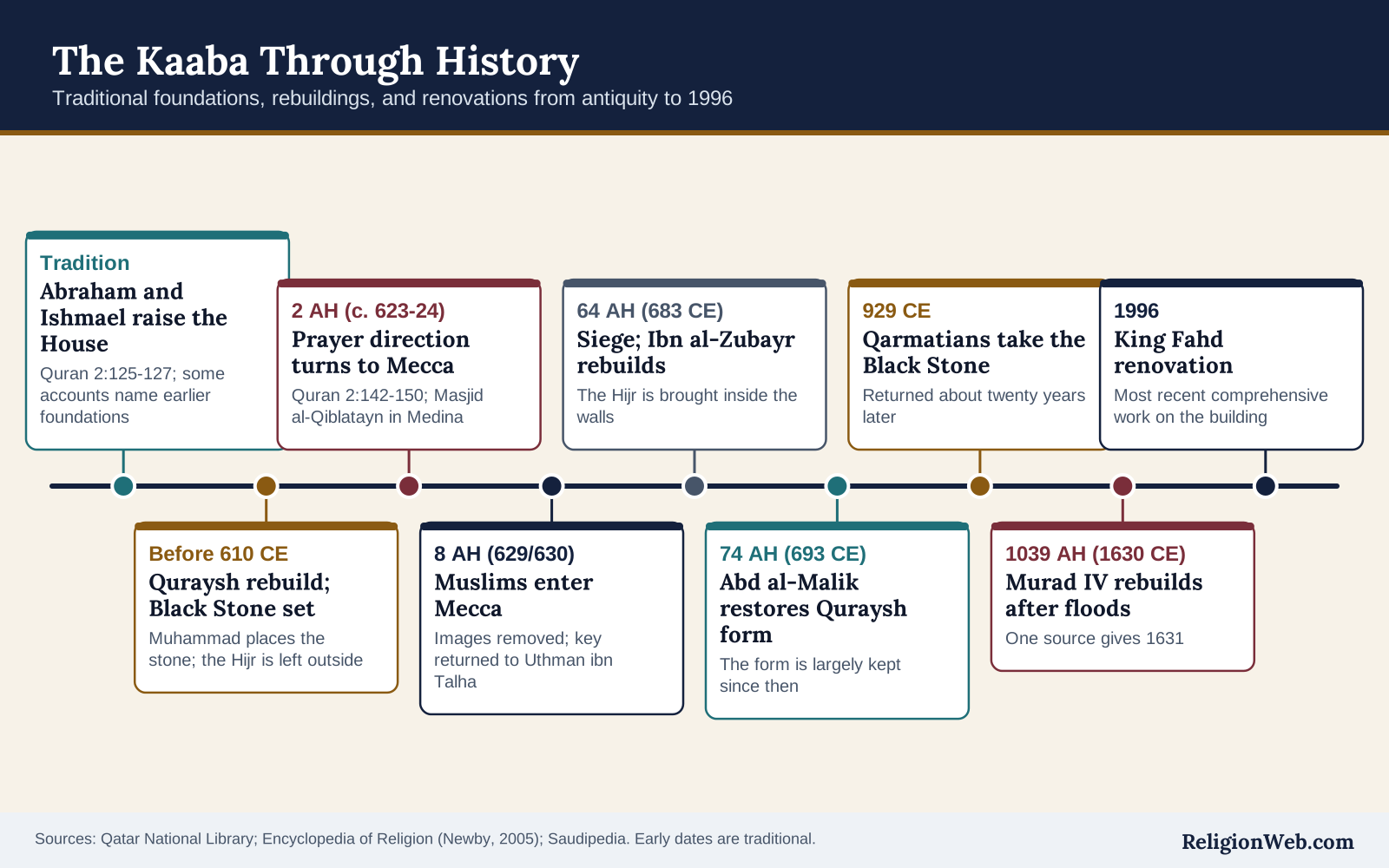
The Kaaba has been repaired, rebuilt, and reconfigured many times, and the building seen today is largely a seventeenth-century structure on foundations that the tradition regards as far older. The history can be told in five phases: the pre-Islamic sanctuary, the lifetime of the Prophet, the Umayyad and Abbasid centuries, the Ottoman period, and the modern Saudi era. A timeline table follows the narrative so that readers can check the sequence at a glance.
Before Islam: Mecca, the Quraysh, and the Sanctuary
Custodians of the House
Muslim historians, drawing on the traditions collected in the early centuries of Islam, describe the care of the Kaaba as passing through successive hands. Saudi sources list the descendants of Ishmael, then the tribe of Jurhum, then Khuza’a, then Qusayy ibn Kilab, a forebear of the Prophet who united the Quraysh in Mecca, and finally his descendants in the clan of Abd al-Dar. The Qatar National Library exhibition adds that Qusayy, who is said to have died in 480 CE, rebuilt the walls after a fire had cracked them about a century before the Prophet’s birth, using rough square stones from the valley and alternating wood and stone in the interior columns. The same exhibition describes the building of that era as trapezoidal, with walls no higher than about 4.5 meters and no roof, so that its covering hung loosely down the walls.
The same tradition describes how the cloth covering began. Saudi sources report that a Yemeni king, Tubba’ al-Himyari, was the first to cover the building in the pre-Islamic period, and that later the Quraysh organized the duty among themselves, with a wealthy merchant proposing that the tribe take turns, each one funding a covering for a year. Whatever the exact details, the stories agree that the House was a focus of respect and prestige in the Arabian world before Islam, and that its care was a sought-after honor.
Idols, pilgrimage, and the year of the Elephant
The tradition also records that, before Islam, the House and its surroundings housed images of the gods and goddesses that various Arabian groups venerated. The Encyclopedia of Religion states that Arabic sources report sacrifice at the site until Islam arrived, and that tradition counts more than 360 idols placed in and around it. One principal figure in these accounts was Hubal, a deity associated with Mecca in the early Arabic sources. This is the situation to which the Quran’s call to purify the House responds: the faithful reading is that the sanctuary had been Abraham’s, and that its original monotheistic purpose had been obscured over time.
Another event that the tradition places shortly before the Prophet’s birth is the failed expedition of Abraha, a Christian ruler from Yemen, who is said to have marched on Mecca with an army that included an elephant. A short chapter of the Quran refers to the “owners of the Elephant” and recounts how their plan was brought to nothing. Muslim tradition dates the event to the “Year of the Elephant” and connects it to the year of the Prophet’s birth, traditionally placed around 570 CE. Historians debate the exact date and the circumstances, though the tradition’s broad outline fits what is known about sixth-century Arabia. The event matters for the Kaaba because it is remembered as a demonstration of the sanctuary’s protected status.
The Lifetime of the Prophet Muhammad
The Quraysh rebuilding and the Black Stone
The rebuilding in which the Prophet took part is among the best-known episodes in the sanctuary’s history. According to the Qatar National Library exhibition and the Encyclopedia of Religion, floods had weakened the structure, and the Quraysh leaders agreed to demolish the walls and rebuild from the foundation. When the work reached the corner where the Black Stone was to be set, the clans disputed who should have the honor of lifting it into place, and the quarrel threatened to end in violence. Tradition says they agreed to accept the judgment of the first person to enter the sanctuary, who proved to be Muhammad, then known in Mecca as al-Amin, “the trustworthy.” He placed the stone on a cloak, had a representative of each clan hold an edge of it, and set the stone in the wall himself.
The rebuilt structure was smaller than the foundations laid by Abraham, according to a tradition that explains the existence of the Hijr. Sources report that the Quraysh lacked sufficient funds from lawful sources to complete the building on the original plan and so shortened it, leaving part of the older foundation outside the walls. A report attributed to Aisha, the Prophet’s wife, says that Muhammad later remarked that he would have rebuilt the Kaaba on Abraham’s foundations if the people had not so recently left polytheism. The report is widely cited, as the Saudi national encyclopedia does, to explain why the Hijr is still counted as part of the House for the purposes of tawaf and why it was a point of later dispute between rulers.
The redirection of prayer and the return to Mecca
The Prophet began to receive revelations in Mecca around 610 CE, and in 622 he and his companions emigrated to Medina. According to the traditional accounts, the community at first prayed toward Jerusalem, and in the second year after the emigration, the Quran redirected them toward the Sacred Mosque. The verses on this change are discussed in the section on the qibla below. The event is remembered at the Masjid al-Qiblatayn in Medina, the “Mosque of the Two Qiblas.”
In 8 AH, a date that corresponds to late 629 or early 630 CE depending on how the Hijri year is converted, the Muslim community entered Mecca. Muslim tradition recounts that Muhammad circled the Kaaba, that the images in and around it were removed and destroyed, and that the House was dedicated to the worship of God alone. The Saudi national encyclopedia adds that he returned the key to Uthman ibn Talha, whose descendants, the Banu Shayba, still hold it. In 10 AH (632 CE), the year of his death, the Prophet led the pilgrimage known as the Farewell Hajj, which established the form of the rites as Muslims have practiced them since. The same sources say he kissed the Black Stone during that pilgrimage, which is the basis for the custom of doing so.
The Umayyad and Abbasid Centuries
Ibn al-Zubayr, Abd al-Malik, and the two forms of the building
The most consequential rebuilding after the Prophet’s lifetime took place during the Second Muslim Civil War. Abd Allah ibn al-Zubayr, a companion’s son, had claimed the caliphate from Mecca, and in 64 AH (683 CE) Umayyad forces besieged the city. The Qatar National Library exhibition reports that the Kaaba was damaged by bombardment with catapults, and the Encyclopedia of Religion adds that a fire during the siege cracked the Black Stone. Ibn al-Zubayr then rebuilt the House. Following the report of Aisha mentioned above, he enlarged it to include the Hijr within the walls, according to the Saudi national encyclopedia, and he paved the area around it.
A few years later, in 74 AH (693 CE), the Umayyad caliph Abd al-Malik ibn Marwan, whose forces under the commander al-Hajjaj ibn Yusuf had ended Ibn al-Zubayr’s rule, restored the building to the form it had had under the Quraysh, with the Hijr outside the walls. The Encyclopedia of Religion notes that the Umayyads in this way reversed many of Ibn al-Zubayr’s changes, restoring a simpler form that the building, in essence, still keeps. A widely repeated report says that when later caliphs considered rebuilding the House on Ibn al-Zubayr’s plan, the Medinan jurist Malik ibn Anas advised against it, warning that the Kaaba should not become something that each ruler remade in his own style. The report is traditional, and its details vary in the sources.
The Qarmatian raid and later care
The most dramatic disruption in the medieval period was the raid by the Qarmatians, a militant movement that had broken from the Abbasid order and governed eastern Arabia from its base in al-Ahsa. According to the Encyclopedia of Religion, in 929 CE (317 AH) they took the Black Stone from the Kaaba, and it was returned about twenty years later. The Saudi national encyclopedia gives the return as 950. Scholars note that the Qarmatians were a political and religious movement that most Sunni and Shia authorities rejected, and their act was understood by other Muslims as a profanation, not an expression of any broader Muslim view of the Kaaba.
The Abbasid, Mamluk, and later rulers who held authority over the Hijaz saw the care of the Kaaba and its covering as a mark of legitimacy. They repaired the roof and doors, replaced the gutter, endowed lamps and furnishings, and extended the surrounding mosque. The Saudi national encyclopedia describes an Abbasid colonnade built by the caliph al-Mahdi between 778 and 785, which surrounded the Kaaba for nearly twelve centuries, and records that the Umayyad caliph al-Walid covered the mataf with white marble in 709. For pilgrims, these changes meant that the Kaaba stood at the center of an increasingly monumental space.
The Ottoman and Saudi Periods
Murad IV and the 1630 reconstruction
The building visible today dates in its main fabric from the Ottoman period. After heavy rains in the early seventeenth century caused sections of the walls to collapse, the Ottoman sultan Murad IV ordered the Kaaba rebuilt. The Qatar National Library exhibition dates the work to 1039 AH (1630 CE), and the Saudi national encyclopedia, which places the floods in 1631, shows that the sources differ by a year. Most accounts agree on the substance: the walls were taken down and rebuilt in stone, with the sanctuary’s general form preserved. This is why the Kaaba is often described as largely a seventeenth-century structure built on much older foundations.
The Saudi era: renovation and expansion
Since the 1920s the Saudi state has held responsibility for the sanctuary. According to the Saudi national encyclopedia, work in the twentieth century included repairs to the Kaaba itself, the founding of a kiswa workshop in Mecca in 1927, the installation of a new door in 1979, and the enlargement of the mataf in the late 1970s with Greek marble flooring. A comprehensive renovation of the Kaaba took place in 1996 under King Fahd, a date that several reference works give for the most recent major work on the structure itself. The surrounding mosque has been expanded several times, most recently in the Third Saudi Expansion launched in 2015, which the encyclopedia says brought the building area to about 1.47 million square meters.
The modern period has also included crises of a kind not seen in earlier centuries. The Saudi encyclopedia records that the Sacred Mosque was closed for about two weeks in 1979 following the armed seizure known as the Juhayman incident, and that it was partially closed in 2020 because of the COVID-19 pandemic. These interruptions were brief, and the Kaaba itself has stood unaltered, in its Ottoman form, through them.
Reading the Rebuilding Accounts with Care
Where the accounts come from
The sources for the Kaaba’s rebuilding fall into three groups. The first is the Quran, which says that Abraham and Ishmael raised the foundations but does not narrate later repairs. The second is the hadith and biographical literature of the Prophet, which preserves the traditions about the Quraysh rebuilding and the conquest of Mecca and which was compiled in the generations after the events. The third is the historical chronicle tradition, together with the records of rulers and the accounts of travelers, which becomes more detailed and more securely dated from the Umayyad period onward. Each kind of source answers different questions.
Where the sources disagree
Several points are uncertain or reported differently. The year of the Quraysh rebuilding is not given in the sources used for this article, and the tradition does not fix it exactly. The date of the conquest of Mecca depends on how 8 AH is converted. The year of the Ottoman rebuilding appears as 1630 in one source and 1631 in another, and the return of the Black Stone after the Qarmatian raid is given as about twenty years later, or as 950. Dimensions of the building are reported with slight variations. These discrepancies are normal in the study of any ancient structure, and they affect the details more than the shape of the story. The lesson is that every sentence about the Kaaba’s past should be read with its source in mind.
| Date | Event | Basis |
|---|---|---|
| Undated, traditional | Foundations raised by Abraham and Ishmael on an earlier site | Quran 2:125-127; commentary tradition |
| Pre-Islamic, undated | Care of the House passes through Jurhum, Khuza’a, and Qusayy; Qusayy rebuilds after a fire (he is said to have died in 480 CE) | Traditional narrative; Qatar National Library; Saudipedia |
| Traditionally about 570 CE | Year of the Elephant: the expedition of Abraha is turned back | Quran, chapter 105; tradition |
| Before 610 CE | Quraysh rebuild; Muhammad sets the Black Stone in place; building is shortened and the Hijr left outside | Traditional narrative; Encyclopedia of Religion |
| 2 AH (about 623-624 CE) | Prayer direction redirected from Jerusalem to the Sacred Mosque | Quran 2:142-150; tradition |
| 8 AH (about 629-630 CE) | Muslims enter Mecca; images removed; key returned to Uthman ibn Talha | Encyclopedia of Religion; Saudipedia |
| 10 AH (632 CE) | Farewell Pilgrimage of the Prophet | Hadith and biographical tradition |
| 64 AH (683 CE) | Siege of Mecca; Kaaba damaged; Ibn al-Zubayr rebuilds, including the Hijr | Qatar National Library; Encyclopedia of Religion |
| 74 AH (693 CE) | Abd al-Malik restores the Quraysh form of the building | Qatar National Library; Encyclopedia of Religion |
| 929 CE (317 AH) | Qarmatians take the Black Stone; returned about twenty years later | Encyclopedia of Religion; Saudipedia |
| 1039 AH (1630 CE) | Murad IV rebuilds after floods | Qatar National Library (Saudipedia gives 1631) |
| 1979 and 1996 | New door installed under King Khalid; comprehensive renovation under King Fahd | Saudipedia |
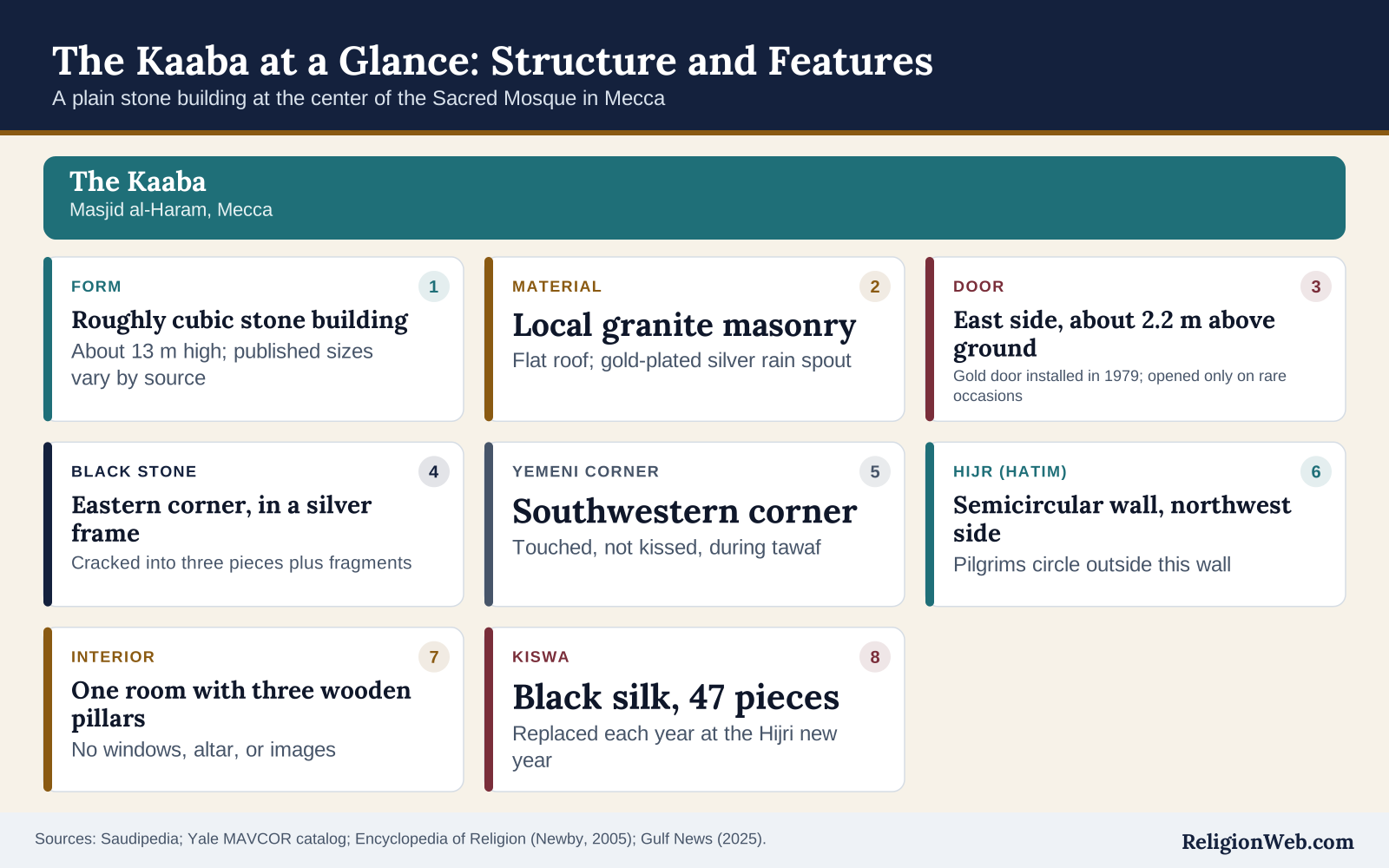
Structure and Features: Walls, Door, Interior, Hijr, and Black Stone
The Kaaba is plain by design. Its power as a symbol comes partly from its simplicity: a single masonry volume, no windows, no ornament except the cloth that covers it. Yet the building and the small set of features around it are named and described with great precision in the Islamic sources, because each one is tied to a rite or a memory. This section describes the structure from the outside in, then the objects and places adjacent to it, and finally the Black Stone.
The Building Itself
Shape, size, and materials
The Kaaba is a roughly cubic building whose corners are oriented approximately to the four points of the compass, according to the Encyclopedia of Religion. It is built of local Meccan granite set in mortar, with a flat roof. Published measurements vary slightly. A Yale University catalog entry on the Kaaba lists a height of about 13.1 meters and base dimensions of about 12.86 by 11.03 meters. The Encyclopedia of Religion gives the height as about 50 feet, which is roughly 15 meters, and the Saudi national encyclopedia, citing measurements by the Hajj Research Center at Umm al-Qura University, gives wall lengths between about 9.9 and 12.0 meters. These figures reflect different measuring methods and different rounding, and they should be read as approximations of a building about thirteen meters high and a dozen meters on a side.
A band of white marble at the base, known as the shadhrawan, surrounds the building on three sides, though not at the Hijr. Saudi sources explain that it shields the foundation from rainwater, protects pilgrims from the edge of the wall, and provides an anchor for the kiswa. The upper part of the walls is hidden from view by the cloth, so most visitors never see the bare stone, and photographs of the uncovered Kaaba, taken during the annual replacement, are among the few views of the building itself.
The door, the roof, and the rainspout
The door is on the east side, near the Black Stone, and sits well above the ground. The Saudi national encyclopedia gives its height above the pavement as 222 centimeters, and the Encyclopedia of Religion puts it at about seven feet, which is why a movable staircase is needed for anyone entering. A tradition reported in several accounts says the Quraysh raised the door so that they could control who entered; the earlier door, according to the Qatar National Library, had been at ground level and fitted with a lock to protect valuables given as gifts. The present door was made in 1979 under King Khalid. The Saudi encyclopedia describes it as being of gold, weighing about 280 kilograms, and requiring twelve months of work in a dedicated workshop.
On the roof, at the northwest side, a spout called the mizab or mizab al-rahma (the “spout of mercy”) channels rainwater into the Hijr. The Saudi encyclopedia says that the present spout is silver plated with gold, and that the Umayyad prince al-Walid ibn Abd al-Malik was the first to add gold to it. When heavy rain falls in Mecca, the sight of the water falling from the spout is widely photographed and is regarded by many pilgrims as a moment of blessing. The roof itself is not accessible to the public.
Inside the Kaaba
Pillars, floor, and lamps
The interior is a single room. The Saudi national encyclopedia describes it as having three wooden pillars that support the roof, no windows, marble floors and walls, and a silk curtain, and it reports ten marble stones inscribed with commemorative texts. The Encyclopedia of Religion adds that gold and silver lamps hang from the ceiling. There is no altar, no image, and no pulpit, and the room is not a place of regular worship. Visitors on the rare occasions of entry perform individual prayers, as the tradition regards any clean place as suitable for prayer.
The simplicity of this interior is part of the point. The sacred geography of Islam locates devotion in the community’s acts around the Kaaba, not in what the Kaaba holds. The washing of the interior, described below, is one of the few public events that give a glimpse of the space.
Who enters, and how rarely
Entry into the Kaaba is exceptional. The door is opened on specific occasions, including the annual washing ceremony, and then only for officials, invited dignitaries, and the custodians of the keys. Egypt’s Dar al-Ifta, in its overview of the Hajj and Umrah rites, notes that after the farewell tawaf it is recommended to enter the Kaaba, if possible, and pray inside and make supplication in its corners. The qualification “if possible” is important. In practice, entry is not available to the general public, and the great majority of Muslims who visit the sanctuary never go inside. Their pilgrimage is complete without doing so, because the rites are performed around the building, not within it.
Features Around the Kaaba
The corners and the Multazam
The four corners of the Kaaba have traditional names, and two of them are the focus of ritual attention. The Black Stone is set in the eastern corner, which some descriptions call the southeastern corner. Opposite it is the Yemeni corner (al-rukn al-yamani), which faces toward Yemen; pilgrims touch it, if they can, but do not kiss it. A report in Sahih al-Bukhari (no. 1608) records that the companion Mu’awiya touched all four corners, that Ibn Abbas told him the two corners facing the Hijr should not be touched, and that Mu’awiya replied that no part of the House should be left untouched. The report shows that the practice was discussed among the earliest Muslims, and it lies behind the widely followed custom of touching only the Black Stone and the Yemeni corner, in imitation of the Prophet’s practice. The other two corners are traditionally known as the Iraqi and Levantine corners.
The Multazam is the stretch of wall between the Black Stone and the door, about two meters wide according to a Gulf News guide for pilgrims. Pilgrims customarily press themselves against it and make supplication there, a practice that Egypt’s Dar al-Ifta mentions in connection with the end of the pilgrimage. The tradition associated with it is one of intense personal prayer, and it is a place where dua, the Muslim practice of personal supplication, takes its most concentrated and visible form. In crowded periods the Multazam is difficult to reach, and pilgrims may raise their hands and pray from a distance without any loss of validity.
The Hijr, the Station of Abraham, and Zamzam
The Hijr, also called the Hatim, is a semicircular area enclosed by a low white marble wall on the northwest side of the Kaaba. As explained in the history section, it represents part of the foundation that the Quraysh left outside their rebuilt walls. Muslim jurists teach that it is part of the House, so that pilgrims performing tawaf must circle outside the Hijr wall, and not through it, for the circuit to count as encircling the entire building. A Discover Makkah presentation adds that praying in the Hijr is regarded as praying inside the Kaaba. A popular tradition holds that Hagar and Ishmael are buried there, though the sources consulted here give the belief as tradition and not as established fact.
The Station of Abraham (Maqam Ibrahim) stands a few meters from the Kaaba’s door, enclosed within a small structure with a glass or crystal dome and a gold-colored metal frame. The Saudi national encyclopedia describes the stone as about fifty centimeters on each side and bearing impressions that are described in the tradition as Abraham’s footprints, and it notes that the caliph Umar moved it away from the wall of the Kaaba, that the enclosure was renewed in 1967, and that a brass and gold-plated structure was installed in 1996. After completing tawaf, pilgrims pray two units of prayer near this station, in obedience to the Quranic instruction. The well of Zamzam lies to the east, near the Multazam, and pilgrims customarily drink its water after the prayer.
The Black Stone
What the stone is, and what is known of its history
The Black Stone (al-Hajar al-Aswad) is a dark reddish-brown stone set into the eastern corner of the Kaaba, about 1.5 meters above the pavement according to the Saudi national encyclopedia, and framed in silver. According to the Encyclopedia of Religion, it is now cracked into three pieces plus several fragments, held together in a heavy silver frame, and has been the structure’s main feature since pre-Islamic times. Islamic tradition says it came from heaven and that the angel Gabriel brought it to Abraham. The Encyclopedia of Religion records that modern secular scholars have speculated that it is a meteorite, while a reference work from EBSCO notes that scientists have not been permitted to test it, so its composition remains unknown.
The stone has survived several injuries, each recorded in the sources. It cracked during the siege of Mecca in 683. It was removed by the Qarmatians in 929 and returned about twenty years later. The Saudi national encyclopedia adds that a piece was stolen in 1932 and restored through the efforts of King Abdulaziz. Constant touching over the centuries has worn its surface smooth. These are the facts that can be stated with confidence; claims about its mineral identity or its origin remain either traditional or speculative.
How Muslims understand the stone
Muslim teaching is consistent on the status of the Black Stone: it is a created object honored because the Prophet honored it, and it is not an object of worship. The best-known statement of this principle is the report of the caliph Umar in Sahih al-Bukhari (no. 1597), in which he tells the stone that he knows it is a stone that can neither help nor harm, and that he kisses it only because he saw the Prophet do so. The report is cited by scholars of all four Sunni legal schools and by Shia scholars as a model of how to approach objects of reverence. The attitude it expresses is one of imitation of the Prophet’s practice, not of seeking power from the stone.
In practice, pilgrims treat the Black Stone in several ways. The preferred act is to kiss it, if the crowd permits. If that is not possible, pilgrims may touch it with the hand, or with a stick, and kiss the hand, or, in the common case, simply raise a hand in its direction while saying a phrase of glorification, called takbir. Egypt’s Dar al-Ifta states that at each pass of the Black Stone the pilgrim kisses it if possible or points toward it while saying takbir. The act is a recommendation and not an obligation, and a pilgrim who never reaches the stone has fulfilled the rite. Some reports transmitted in hadith collections describe the stone as having been brighter at first and darkened over time; Muslim scholars assess such reports differently, and none is an article of faith.
| Element | Location | Description | Role in practice |
|---|---|---|---|
| Walls | Four sides | Granite masonry, roughly cubic, about 13 m high | Define the qibla and the circuit of tawaf |
| Door | East side, about 2.2 m above the pavement | Gold door installed in 1979 | Opened on rare occasions only |
| Black Stone | Eastern corner | Dark stone in three pieces plus fragments, in a silver frame | Start and end of each circuit |
| Yemeni corner | Southwestern corner | Faces Yemen | Touched, not kissed, during tawaf |
| Multazam | Wall between the Black Stone and the door | About two meters wide | Supplication |
| Hijr (Hatim) | Northwest side | Semicircular low marble wall | Tawaf goes around it; prayer there counts as prayer within the House |
| Shadhrawan | Base of the walls | Marble band on three sides | Protects foundation; anchors the kiswa |
| Mizab | Roof, northwest | Gold-plated silver spout | Drains rainwater into the Hijr |
| Maqam Ibrahim | Near the door, in the mataf | Stone with impressions, enclosed in a glass and metal structure | Two-unit prayer after tawaf |
| Zamzam | East of the Kaaba | Well, now served through taps and dispensers | Water drunk after tawaf |
The Kiswa and the Care of the Kaaba
The black cloth that covers the Kaaba is the feature most people recognize from photographs, and it is among the best-documented parts of the sanctuary’s life. The Arabic word kiswa means a garment or covering. The custom of covering the House is older than Islam, and it has been continued by Muslim rulers for fourteen centuries as an act of honor. Today the cloth is produced in a dedicated Meccan workshop and replaced once a year in a short, carefully organized ceremony.
The History of the Covering
From pre-Islamic cloths to the caliphal covering
According to the Saudi national encyclopedia, the earliest covering is attributed in tradition to Tubba’ al-Himyari, a king of Yemen, who is said to have covered the House in the pre-Islamic period and to have provided a door and a key. The text records that Qusayy organized the covering and that the Quraysh later took turns providing it. After the entry of the Muslims into Mecca, the Prophet is said to have covered the Kaaba with striped Yemeni cloth in white and red. Under the Umayyads, the House was covered twice a year, on the day of Ashura and at the end of Ramadan before the festival of Eid al-Fitr, and under the Abbasids the covering became black, with gold inscriptions and silver embroidery, woven in Egypt. The caliph al-Ma’mun is said to have had it covered three times a year, and the names of caliphs, the place of manufacture, and the date were sometimes inscribed on the cloth.
Covering the Kaaba thus became a public sign of authority and care, and rulers competed to provide it. In the Saudi era, the First Saudi State covered the Kaaba in red silk in 1806 and in black silk a year later, according to the same source, and in 1927 King Abdulaziz ordered that the cloth be made in Mecca itself. The shift from foreign workshops to a Meccan one ended a long period in which the cloth had been woven elsewhere and sent to the sanctuary.
The modern workshop
The Saudi encyclopedia’s timeline of the kiswa complex traces the development. A workshop was established in Mecca’s Ajyad district in 1927, relocated to the Jarwal neighborhood in 1962, and produced its first machine-made kiswa in 1965. In 1972 King Faisal ordered a new factory in the Umm al-Joud district, which opened in 1977 with a full range of production departments. Supervision passed in 1993 to the authority responsible for the Two Holy Mosques, and the factory carries the name of the founder of the Saudi state, the King Abdulaziz Complex for the Holy Kaaba Kiswa. Gulf News describes it as the sole production site of the kiswa.
How the Kiswa Is Made
Materials and workmanship
The kiswa is made of natural silk dyed black, with gold-plated silver thread used for the embroidery. Gulf News, reporting on the 2025 changeover, gives the materials as black silk, with silver threads plated with 24-karat gold, and notes that production takes nearly eleven months. The stages it lists are the purification of water, the washing of the silk, black dyeing, weaving, geometric printing of Quranic verses, gold and silver embroidery, and final assembly and inspection. The Saudi encyclopedia adds that threads are tested in a laboratory for tensile strength and resistance to wear, and that the embroidery is done by hand with gold thread.
Published figures for weight and cost vary, and the variation should be understood as a reflection of different years and different reporting methods. The Saudi national encyclopedia gives a weight of about 980 kilograms, comprising 760 kilograms of silk, 120 kilograms of gold wire, and 100 kilograms of silver wire, and says that some 220 artisans and technicians take part and that the annual cost exceeds 20 million Saudi riyals. Gulf News reported about 1,415 kilograms in 2025. The two figures are not necessarily in conflict, since they may describe different totals, but readers should treat any single weight as approximate.
Parts and inscriptions
The cloth is assembled from separate panels. The Saudi encyclopedia and Gulf News both give forty-seven pieces of black silk. The kiswa has four sides, one for each wall, and a separate curtain for the door. A broad belt (hizam) of embroidered Quranic text runs around the upper part of the building; in 2022 Gulf News reported that the top third of the cloth stands 14 meters high and that the door curtain measures 7 meters by 4 meters. The inscriptions consist of Quranic verses, the declaration of faith, and the names of God. Gulf News counts sixty-eight Quranic verses in the 2025 kiswa. The door curtain, known as the sitara or burqa, is the most elaborate element, and the Saudi encyclopedia describes its installation as one of the most demanding stages of the changeover.
| Aspect | Reported detail | Source |
|---|---|---|
| Materials | Natural silk dyed black; silver thread plated with 24-karat gold | Gulf News (2025); Saudipedia |
| Pieces | 47 pieces of black silk | Saudipedia; Gulf News (2025) |
| Parts | Four side panels, a door curtain, and an embroidered belt (hizam) | Saudipedia; Gulf News (2022) |
| Weight | About 980 kg (Saudipedia); about 1,415 kg (Gulf News, 2025); figures vary | Saudipedia; Gulf News |
| Production time | Nearly 11 months | Gulf News (2025) |
| Place of manufacture | King Abdulaziz Complex for the Holy Kaaba Kiswa, Umm al-Joud, Mecca | Saudipedia; Gulf News |
| Inscriptions | Quranic verses (68 reported for 1447 AH), the declaration of faith, and names of God | Gulf News (2025); Encyclopedia of Religion |
Replacement, Washing, and Everyday Care
The annual replacement
The timing of the replacement has changed in recent years. According to Gulf News, the cloth was traditionally changed on the ninth of Dhu al-Hijjah, the Day of Arafah, while pilgrims were standing at Arafat, and in 2022 it was replaced instead on the first of Muharram, the first day of the Hijri year, which the paper described as the first time in the kingdom’s history. The Saudi encyclopedia states that the annual replacement now takes place on that date. The ceremony in which the finished cloth is handed over to the senior custodian of the Kaaba is held at the factory in the middle of Dhu al-Qa’da, and the cloth is delivered to the sanctuary on Eid al-Adha, the tenth of Dhu al-Hijjah, according to the same source. The festival’s significance for pilgrims is explained in the article on Eid al-Adha.
The changeover itself is brisk. In 2025, reported Gulf News, the old cloth was removed after the afternoon prayer on the 29th of Dhu al-Hijjah, and the new one was installed in the early hours of the first of Muharram, as the Hijri year 1447 began. The workers lift each of the four sides to the roof and unfold it over the old one, and the lower portion is first raised about three meters above the marble base and tied up. The Saudi encyclopedia calls this raised hem the “ihram of the Kaaba,” a phrase that echoes the white garments of pilgrims. The new year’s date is discussed further in the article on Muharram and Ashura.
Washing, perfuming, and the keys
The interior is washed in a ceremony reported by Saudi media. Arab News reported that the 2026 washing took place on 15 Muharram 1448 AH, which fell in late June 2026, led by the deputy governor of the Mecca region on behalf of the king and attended by officials, members of the diplomatic corps of Muslim countries, and the custodians of the Kaaba. Zamzam water mixed with rose water and a premium oud mixture is used, the cloths are soaked in it, the interior walls, the three pillars, and the floor are washed and dried, and the walls are then perfumed. Older reference works describe the washing as taking place twice a year, and current practice appears to be an annual event, a difference that readers should keep in mind when consulting older sources.
Custody of the keys remains with the Banu Shayba, who open the door at these occasions. The Encyclopedia of Religion reports that, in earlier times, pieces of the old cloth were cut up and given to pilgrims as keepsakes; it does not describe current practice, and modern procedures for the old cloth should be checked against Saudi announcements. Taken together, these arrangements show a pattern that runs through the whole story of the Kaaba: ancient forms of care, inherited custodianship, and carefully organized modern administration working side by side.
Tawaf, Hajj, and Umrah: How Pilgrims Move Around the Kaaba
Tawaf is the rite that most directly involves the Kaaba. It is simple to describe: the worshiper walks around the building seven times, keeping it on the left, beginning and ending each circuit at the Black Stone. Within that simple shape lie a good many rules, customs, and meanings, and the legal schools of Islam classify the different forms of tawaf differently. The sections below describe the rite in sequence, explain how it fits into the larger rites of Hajj and Umrah, and note where the schools part ways.
Performing Tawaf
The sequence of a circuit
A pilgrim begins tawaf at the Black Stone, usually marked by a line on the floor or a light on the wall of the surrounding colonnade, and turns so that the Kaaba is on the left. Egypt’s Dar al-Ifta describes this in its overview of the rites: the circuit begins at the Black Stone, the Kaaba is kept on the left, and at each pass of the stone the pilgrim kisses it if possible or points toward it while saying takbir, the phrase that declares God’s greatness. Seven circuits make a complete tawaf. Because the Hijr is counted as part of the House, the pilgrim walks outside its curved wall on each circuit, not between it and the building.
Most jurists expect the pilgrim to be in a state of ritual purity and to be properly covered, and the schools differ on how strictly purity is required for tawaf and on the consequences of lapses. The words said are not fixed. Pilgrims recite supplications from books, say prayers in their own language, recite the Quran, or simply remember God in silence, and some phrases are customarily said at particular points. For men, the practice described in the account of the Prophet’s pilgrimage by his companion Jabir includes uncovering the right shoulder (idtiba) and walking briskly (raml) in the first three circuits of a tawaf that is followed by sa’i, then walking at an ordinary pace for the remaining four. Women do not perform these two actions. After the seventh circuit, the pilgrim prays two units of prayer near the Station of Abraham, if the crowd permits, and drinks Zamzam water.
The meaning of the circling
The sources do not give one reason for the direction of the circuit. The Quran refers to those who “make the round” of the House as one of the groups the sanctuary serves, and the practice rests on the example of the Prophet. Muslim writers have offered meanings for it. A common reflection is that the circling expresses a life organized around God: as the pilgrim moves, the Kaaba remains at the center, and every person in the crowd, whatever language they speak, moves in the same direction around the same point. Others point to the unity of the worshipers, who come from every country and in every kind of clothing but perform the same movement. Mystical writers connect it to the angels’ devotion around the divine throne. These are interpretations, not legal reasons, and the legal schools do not require a pilgrim to hold any particular one.
What the rite does not express is veneration of the building as such. A pilgrim circling the Kaaba is making an act of worship directed to God, in obedience to a command, and the pilgrim’s intention (niyya) is declared as such. The hadith of Umar discussed earlier supplies the teaching that every gesture at the sanctuary, including the kiss given to the Black Stone, is performed in imitation of the Prophet and in obedience to God.
Tawaf in Hajj and Umrah
Tawaf in Umrah
In the lesser pilgrimage, Umrah, tawaf is the central act. The pilgrim enters a state of consecration called ihram at a boundary point on the way to Mecca, arrives at the Sacred Mosque, and performs seven circuits. After the prayer near the Station of Abraham and a drink of Zamzam, the pilgrim goes to Safa and walks seven times between Safa and Marwa, remembering Hagar’s search for water. Men then shave or shorten their hair, and women cut a small lock, and the pilgrim leaves the state of ihram. The whole sequence can be completed in a few hours when crowds are moderate. The detailed steps and the clothing involved are explained in the article on Umrah.
Tawaf in Hajj: arrival, ifada, and farewell
The greater pilgrimage includes three forms of tawaf, each with its own timing. The tawaf of arrival (tawaf al-qudum) greets the House when a pilgrim reaches Mecca before the eighth day of Dhu al-Hijjah. The tawaf of ifada, or “pouring forth,” follows the return from Arafat, Muzdalifa, and Mina on the day of sacrifice, the tenth, and releases the pilgrim from the remaining restrictions of ihram. The farewell tawaf (tawaf al-wada’) is performed just before leaving Mecca. The details of the other Hajj rites, which take place outside the Sacred Mosque, are in the article on Hajj.
The legal schools classify these three differently, as a summary on IslamOnline’s fiqh encyclopedia shows. The tawaf of ifada is a pillar of Hajj, without which the pilgrimage is incomplete. The tawaf of arrival is considered obligatory in the Maliki school and recommended in others. The farewell tawaf is considered obligatory by Abu Hanifa, al-Shafi’i, and Ahmad ibn Hanbal and a recommended practice by Malik. The two-unit prayer after tawaf is obligatory in the Hanafi school and recommended according to others. Shia jurists follow their own legal tradition, which agrees on the main structure while differing in details, as set out in the rulings issued by marja’ authorities.
| Rite | When | Connection to the Kaaba | Legal note |
|---|---|---|---|
| Ihram | Before entering Mecca for Umrah or Hajj | Consecration that precedes any tawaf of the pilgrim | Required; entered at a boundary point |
| Tawaf of arrival (qudum) | On reaching Mecca, before 8 Dhu al-Hijjah | Greets the House; seven circuits | Obligatory (Maliki); recommended (others) |
| Prayer behind the Station of Abraham | After each tawaf | Two units of prayer near Maqam Ibrahim | Obligatory (Hanafi); recommended (others) |
| Sa’i | After tawaf in Umrah and Hajj | Seven passages between Safa and Marwa within the Sacred Mosque | Pillar (most schools); obligatory (Hanafi) |
| Tawaf of ifada | 10 Dhu al-Hijjah or after | Main tawaf of Hajj; releases pilgrim from remaining ihram restrictions | Pillar of Hajj |
| Farewell tawaf (wada’) | Before leaving Mecca | Final circuit of the House | Obligatory (Hanafi, Shafi’i, Hanbali); recommended (Maliki) |
| Touching or pointing at the Black Stone | At the start of each circuit | Follows the Prophet’s practice | Recommended, not required |
| Supplication at the Multazam | At the end of the pilgrimage | Prayer pressed against the wall between the door and the Black Stone | Recommended if the crowd permits |
Voluntary Tawaf and Daily Life at the Mataf
Circling outside the pilgrimage seasons
Tawaf is not limited to Hajj and Umrah. Muslims who live in Mecca, or who are visiting at any time of year, perform voluntary tawaf as an act of devotion, and it is often done between prayers or late at night, when the crowds thin. The month of Ramadan brings very large numbers, especially during the last ten nights, when many Muslims seek the Night of Power described in the article on Laylat al-Qadr. The Saudi national encyclopedia gives the capacity of the circling area as 107,000 worshipers per hour, a number that shows the scale of the arrangements. The Sacred Mosque’s total capacity is reported as exceeding 1.7 million worshipers, in a 2023 entry on the same site.
Crowds, comfort, and health
The same crowds that make the Kaaba visually striking make the rite physically demanding, and the tradition itself gives allowances. Those who cannot walk may be pushed in a wheelchair or carried, and the elderly and the ill are encouraged to choose less crowded times of day. Pilgrims are also taught that pushing and shoving are contrary to the spirit of the rite. Religious practice does not replace medical advice, and pilgrims with heart conditions, respiratory illness, or other health concerns are advised by health authorities to consult a physician before travel, to stay hydrated, and to rest in the heat. The Muslim legal tradition supports this caution by treating the preservation of life as a higher priority than the completion of any ritual detail.
The Kaaba as Qibla: Direction in Daily Prayer
For the vast majority of Muslims, who will never see the Kaaba, its principal meaning is the direction it gives. Five times each day, in every mosque, home, airport prayer room, and open field where Muslims pray, the worshiper stands facing the same building. This is the qibla, and its importance in the structure of Muslim prayer is hard to overstate. The detailed procedure of prayer is described in the article on salah; this section looks at the qibla itself.
How the Qibla Was Established
From Jerusalem to the Sacred Mosque
According to Islamic tradition, the Muslim community in Medina at first prayed toward Jerusalem. About a year and a half after the emigration, the Quran redirected them. The passage, which comes in the second chapter, includes the command that the Prophet and the believers should turn toward the Sacred Mosque.
So turn thy face toward the Inviolable Place of Worship, and ye (O Muslims), wheresoever ye may be, turn your faces (when ye pray) toward it.
Quran 2:144, Pickthall translation (1930)
Tradition holds that the change occurred during a congregational prayer, when the worshipers turned in mid-prayer, and the mosque in Medina where it happened is known as the Masjid al-Qiblatayn, the mosque of the two qiblas. The usual dating is Rajab or Sha’ban of the second year after the emigration, around the turn of 623 and 624 CE. This was a significant moment in the community’s early history, and the Quran addresses it directly, noting that some people questioned the change and answering with the statement that East and West belong to God.
What the change meant
The commentary tradition reads the redirection as marking the community’s distinct identity and its connection to the Abrahamic sanctuary. It is noteworthy that the same chapter rules out any idea that the direction is itself the point of piety. A later verse states that righteousness does not consist in turning one’s face to the East and the West, but in believing in God and the Last Day, giving wealth to relatives, orphans, and the needy, and observing prayer and the poor-due. Read together, the verses frame the qibla as an obligation of order and unity, with the substance of religion lying elsewhere. Muslims face the same direction so that their prayer is a single act in many places, and they do so because God commanded it.
Facing the Qibla in Practice
Prayer, burial, and other uses
Facing the qibla is a condition for the validity of the prayer. In Islamic law, the classical conditions of prayer, as set out in the works of Sharia jurisprudence, include ritual purity, covering of the required parts of the body, the proper time, and the qibla. The orientation extends beyond prayer. The Encyclopedia of Religion notes that Muslims bury their dead facing it, and the legal and ethical literature adds further customs: turning an animal toward the qibla in ritual slaughter, as discussed in the article on halal, facing it when making personal supplication, and avoiding facing it or turning one’s back to it when relieving oneself. These are customary and juristic rulings, not matters of belief, and they vary somewhat among schools.
Exceptions and flexibility
Islamic law adapts the requirement to circumstances. Prayer in fear or war, prayer by a person unable to determine or to face the direction, and voluntary prayer on a journey on a mount or vehicle are among the recognized exceptions. For people far from Mecca, jurists distinguish between facing the Kaaba itself (ayn al-ka’ba) and facing its general direction (jihat al-ka’ba). A person who can see the building must face it exactly. Those at a distance are generally held to be required to make a sincere effort to determine the direction, and to be correct in their prayer if the effort was honest, even if later found to be a few degrees off. Some jurists, in earlier centuries, took stricter views, and the question has a long history in the legal literature.
Finding the Direction
From mihrabs to astronomy
In the earliest mosques the qibla was indicated by the orientation of a wall. The mosque niche called the mihrab became a regular feature in the Umayyad period and was standardized in the Abbasid period, and it remains the most visible indicator of the qibla in any mosque. Muslim astronomers and mathematicians then developed methods for calculating the direction from any point, using spherical trigonometry to find the great circle between a location and the Kaaba. Names associated with this work include Habash al-Hasib, al-Biruni, Ibn Yunus, and, in the fourteenth century, Shams al-Din al-Khalili, whose tables listed the direction for many places.
Specialized instruments and maps followed. Eighteenth-century Iranian brass instruments used a projection centered on the Kaaba, and in 1910 the Scottish mathematician James Ireland Craig, working for the Egyptian Survey Department, devised a world-map projection that preserves the bearing from every point to Mecca. Sun-based observation and the magnetic compass came to complement these methods in later periods.
Modern tools
Today most worshipers rely on a smartphone, a printed qibla compass, or an indication in a hotel room or prayer hall. Each has limits. A magnetic compass is affected by local magnetic declination, which can reach about twenty degrees in some places, and phone applications depend on the quality of the device’s sensors and location data. Many mosques in the modern world have lines marked on the carpet to guide worshipers where the mihrab is not perfectly aligned with a calculated direction. The practical lesson, taught widely, is that a sincere effort to face the right direction is what the law asks.
| Method | Period | How it works | Main limit |
|---|---|---|---|
| Orientation of the mosque wall | Earliest mosques | The wall facing Mecca marks the direction | Depends on local knowledge and judgment |
| Mihrab niche | Umayyad and Abbasid periods onward | A niche in the qibla wall; the imam stands near it | May be misaligned in older buildings |
| Astronomical calculation | Abbasid period onward | Great-circle direction from spherical trigonometry and coordinates | Requires accurate coordinates and tables |
| Mecca-centered maps and instruments | Medieval to early twentieth century | Projection that preserves the bearing to Mecca | Specialist tools, limited use by the public |
| Magnetic compass | Widely used in modern times | Needle indicates magnetic north; angle table gives qibla | Magnetic declination, metal interference |
| Phone applications and signage | Present day | Use GPS and sensors to show bearing | Depends on sensor quality and settings |
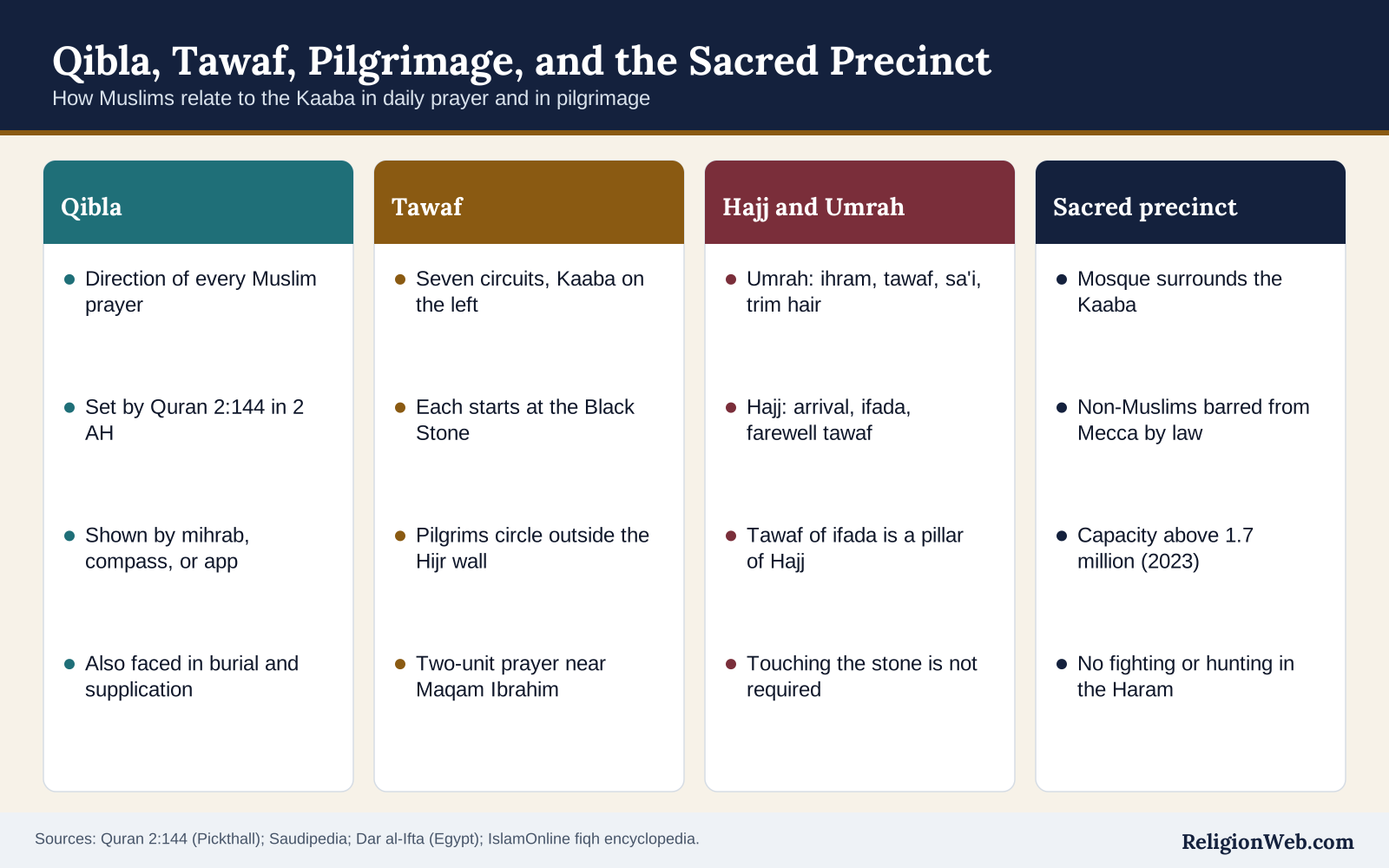
The Sacred Mosque and Precinct: Access, Etiquette, and Today’s Setting
The Kaaba stands within a sanctuary that has its own rules of conduct and access, and the modern setting differs greatly from what pilgrims saw even a century ago. This section describes how the Sacred Mosque grew around the House, what the sanctuary’s sacredness means in practice, who may enter and under what conditions, and what etiquette visitors are asked to observe. Entry rules and permit systems change from year to year, so the practical details below describe general principles, and anyone planning to travel should consult the current guidance of the Saudi authorities.
The Sacred Mosque Around the Kaaba
How the mosque grew around the House
In the Prophet’s lifetime there was no mosque wall around the Kaaba. According to the Saudi national encyclopedia, the circling area was an open courtyard bounded by the houses and enclosures of the Meccans, with openings on every side. The caliph Umar bought neighboring properties, added them to the sanctuary, and built a low wall with lamps. The caliph Uthman bought more houses in 647 and added colonnades, the first in the mosque. Later rulers, among them Ibn al-Zubayr, al-Walid, and the Abbasid al-Mahdi, paved the area, covered it in marble, and built the colonnade that surrounded the Kaaba for nearly twelve centuries. The Ottoman sultan Sulayman gave a marble and wood pulpit in 1559.
The scale of the change in the twentieth century is striking. The encyclopedia gives the area of the mosque before the Saudi era as about 12,000 square meters, about 160,000 square meters at the end of the first Saudi expansion, and about 1.47 million square meters of built surface after the Third Saudi Expansion launched in 2015. A 2023 entry on the same site gives the present capacity as exceeding 1.7 million worshipers. The result is a small, dark building in the middle of a very large marble and glass complex, with the circling area open in the middle and rings of prayer space around it. For readers who want to understand the general architecture of mosques, the article on the mosque explains the design vocabulary, though the Sacred Mosque is unique in that its prayer lines form circles around the qibla instead of rows facing a wall.
The sanctuary and its prohibitions
The mosque takes the name al-Masjid al-Haram, the Sacred Mosque, from the prohibitions that govern it; the Saudi encyclopedia connects the name to the prohibition of fighting within the grounds. The sanctuary extends beyond the mosque itself. The area around Mecca, known as the Haram, is marked by boundary stones along the roads, and in it, according to the Islamic legal tradition, fighting, the hunting of wild game, and the cutting of growing plants are forbidden. These rules express the idea in the Quran that whoever enters the sanctuary is safe. They apply to Muslims and non-Muslims alike, and they have shaped the way Mecca has been governed and experienced for centuries.
Who May Enter and Under What Conditions
Access for Muslims
The Sacred Mosque is open to Muslims at all hours, and the sanctuary holds congregational prayers throughout the day and night. Access for the pilgrimages is more regulated. The number of people who can safely perform Hajj each year is limited, and the Saudi authorities allocate places by country and by registered permit. Umrah is open throughout most of the year, though the authorities set procedures for booking times and visa categories, and these procedures have changed several times in recent years. Pilgrims are advised to rely on the current notices issued by the official Saudi pilgrimage and Umrah platforms, since rules, quotas, and technology change from season to season. Details of the legal prerequisites, including the requirement of means described in the third chapter of the Quran, are covered in the article on Hajj.
The financial and physical capacity to travel is one of the conditions of the pilgrimage, much as a minimum of wealth is a condition of zakat. This is why the tradition describes Hajj as a duty on those who “can find a way thither,” and why a person who cannot make the journey is not considered blameworthy. Many Muslims never visit Mecca at all, yet are fully part of the community that faces it five times a day.
Non-Muslim visitors and the legal position
Under Saudi law, non-Muslims are not permitted to enter Mecca, and the road signs near the city direct them to alternative routes. The rule has roots in the juristic tradition. Most classical schools hold that non-Muslims may not enter the sanctuary area, basing their view on a Quranic verse about those who associate partners with God and the Sacred Mosque, while the Hanafi school is generally reported to have taken a narrower reading of the prohibition. Readers who want to know the scholarly detail should consult a specialized legal reference, since the question has a long history and different interpretations among jurists. As a matter of present practice, the restriction is enforced by the Saudi state. Non-Muslim readers who wish to see the sanctuary can do so through broadcast footage, museum exhibitions, and published photographs, and several museums and universities maintain collections on the Kaaba and its coverings.
Etiquette and Dress
Conduct in the sanctuary
Etiquette at the Sacred Mosque stresses patience, courtesy, and attention to prayer. Pilgrims are taught to enter with a supplication, to avoid pushing even when crowds are heavy, to speak quietly, and to refrain from arguments. The sanctuary is a place where Muslims of different nationalities, schools, and social backgrounds stand side by side, and men and women circle the Kaaba together, a feature that distinguishes the circling area from the separate prayer areas of many mosques. Visitors are asked to keep the sanctuary clean, to follow the instructions of the staff, and to avoid practices that disturb others, including loud recitation and obstruction of the path. The custom of kissing the Black Stone, touching the Yemeni corner, or supplicating at the Multazam is a matter of opportunity and not of obligation.
Clothing and modesty
During Hajj and Umrah, men enter the state of ihram wearing two pieces of unsewn white cloth, while women wear ordinary modest clothing that covers the body, following the style of their own region. Outside the pilgrimage rites, people in the sanctuary generally dress modestly, in line with the guidance described in the article on hijab in Islam. The hadith report that the face veil and gloves are not worn by women in ihram is cited in juristic discussions, and practice varies among communities, with some women covering the face with a separate cloth when men are near. In the sanctuary the white garments of the men and the varied clothing of the women create a visual picture of uniformity in worship alongside variety of origin.
Common Misconceptions About the Kaaba
Because the Kaaba is photographed constantly and rarely visited by non-Muslims, a number of misunderstandings circulate about it. Some come from the visual impression of crowds circling a veiled cube, some from confusion with the pre-Islamic past, and some from simple lack of access to the sources. The four below are the most common. Each is stated fairly, traced to its source, and corrected using the Quran, the Islamic tradition, and the reference works used for this article.
Misconception 1: Muslims worship the Kaaba
Where the misunderstanding comes from
The image of a huge crowd moving around a black cube, and the sight of thousands bowing and prostrating toward it, can easily suggest that the building itself is the object of devotion. The impression is strengthened by the pre-Islamic history of the site, which the tradition says included images of deities, and by the fact that many religions have shrines at which images are venerated. The description of the Kaaba as “the House of God” can also be misread as a claim that God lives in it. Writers who are unfamiliar with Islamic vocabulary sometimes use words like “idol” or “shrine of worship” without noticing that the tradition draws an exact distinction between the object that gives direction and the God to whom prayer is addressed.
A further source of confusion is language. English renderings often say that pilgrims “venerate” or “revere” the Kaaba, words that readers may hear as worship, and short captions on photographs rarely explain that the Arabic vocabulary of prayer and the vocabulary of directional orientation are different. A visitor watching worshipers in the Sacred Mosque sees thousands standing in rings around the building and may not realize that the same worshipers, in a mosque anywhere else, would face the same point without any building in view.
What the evidence and tradition actually show
The Quran and the whole tradition of Islamic theology are explicit that worship belongs to God alone. The verse addressed to the Quraysh invites them to worship “the Lord of this House,” and the instruction to Abraham in the chapter on the pilgrimage places the avoidance of associating anything with God before the purification of the House. The verse that “whithersoever ye turn, there is Allah’s Countenance” shows that no direction contains God. The commentary tradition on the qibla explains that the Kaaba is a focus for unity and discipline, as a common orientation, and the Quran adds that righteousness is not a matter of turning faces in a direction at all.
Muslim jurists and theologians also teach that to treat the Kaaba as an object of worship, or to address prayers to it, would be a violation of the central doctrine of the oneness of God. Worshipers in the Sacred Mosque pray with their faces toward the building while their prayer is addressed to God, and they declare their intention in those terms. The best-known report from the early community, the statement of Umar at the Black Stone, makes the same point about every sacred object in the sanctuary. The accurate description is therefore that Muslims worship God and face the Kaaba.
The tradition remembers the history of the sanctuary in a way that underlines the point. The Encyclopedia of Religion records that the images associated with the shrine were removed after Muslims entered Mecca in 8 AH and that Islamic worship was established there. The act is remembered as the decisive break with the pre-Islamic practice of the sanctuary, not as a transfer of devotion from one object to another. Muslim scholars therefore reject the idea that the Kaaba is a continuation of earlier image worship, while acknowledging, as the sources do, that the site had a long pre-Islamic history as a place of sacrifice and pilgrimage.
Misconception 2: The Black Stone is treated as a god
Where the misunderstanding comes from
The sight of pilgrims struggling toward the Black Stone, kissing it, touching it, and gesturing at it from a distance can look like reverence for a sacred idol. Some popular accounts, and some polemical ones, have described it as a relic of an earlier practice of venerating stones. The tradition that the stone came from heaven, and the speculation that it may be a meteorite, add to a sense of mystery that invites overstatement. Photographs of crowds pressing toward the corner reinforce the impression that the stone has a special power of its own.
What the evidence and tradition actually show
The Muslim position is stated in the report of Umar in Sahih al-Bukhari (no. 1597): the stone can neither benefit nor harm, and it is kissed only because the Prophet kissed it. Scholars of every school cite this report as the standard teaching. The Encyclopedia of Religion states that Muslims venerate the stone but do not worship it, since only God is worshiped. The kiss is a recommended act, not an obligation, and a pilgrim who cannot reach the stone, which is true for most pilgrims in most years, simply points toward it while saying takbir, as Egypt’s Dar al-Ifta notes.
It is also true that some devotional literature attaches special spiritual meaning to the stone, for example by associating it with the covenant between God and humanity or by describing it as a witness for those who touch it. Such statements are devotional and are held with varying degrees of confidence by scholars. They do not alter the legal and theological position that the stone is a created object whose honor derives wholly from the Prophet’s practice.
The way pilgrims treat the Yemeni corner confirms the point. That corner is touched but not kissed, and the other corners are left alone by most pilgrims, which shows that each gesture is regulated by what the Prophet is reported to have done and not by a general belief that sacred objects hold power. The same applies to the Station of Abraham and the well of Zamzam, which are honored for their associations and used in ways the tradition prescribes. Muslim teachers also remind pilgrims that a tawaf in which the Black Stone is never reached is as valid as one in which it is kissed, so no pilgrim’s standing depends on contact with the stone.
Misconception 3: The Kaaba has never been rebuilt or repaired
Where the misunderstanding comes from
The Kaaba is described in religious language as the ancient House of Abraham, and photographs show a building that looks unchanged. Popular devotional accounts sometimes speak as though the stones now standing were those that Abraham and Ishmael laid. The unusual continuity of the form, a simple cube that has kept the same basic shape for centuries, supports the impression. Another source of confusion is the tradition itself, which emphasizes continuity of the site and the sanctuary and says less about the many repairs that maintained it.
What the evidence and tradition actually show
The sources are clear that the building has been damaged and rebuilt many times. The Qatar National Library exhibition describes floods and fires and lists reconstructions by the Quraysh, by Ibn al-Zubayr after the siege of 683, by Abd al-Malik, and by the Ottoman sultan Murad IV in 1630. The Saudi national encyclopedia adds a comprehensive renovation in 1996, and the Encyclopedia of Religion notes that the Umayyads in 693 restored a simpler form that the building largely retains. The description of the present Kaaba as largely a seventeenth-century structure on older foundations is therefore a fair summary.
What persists is the site, the general shape, and the practice. The tradition regards each rebuilding as a continuation of the same House, and the Hijr, the Black Stone, and the foundations are treated as links across the changes. A balanced statement is that the Kaaba is both very old, in the sense of the sanctuary and its rites, and repeatedly rebuilt, in the sense of its physical fabric.
The details of rebuilding have been matters of discussion among Muslims themselves. The change from Ibn al-Zubayr’s larger building to Abd al-Malik’s restoration of the Quraysh form shows that rulers and scholars of the early centuries weighed the report of Aisha about Abraham’s foundations against the desire to keep the House stable. A widely repeated tradition says that the jurist Malik ibn Anas advised a later caliph not to alter the building again, so that it would not become something each ruler remade. The report is traditional and its details vary, but it reflects a consistent attitude: care for the House means maintaining it faithfully, not redesigning it.
Misconception 4: Muslims have always prayed toward the Kaaba
Where the misunderstanding comes from
Because the Kaaba is so closely associated with Muslim prayer, many assume that the direction has been fixed since the first revelation. The Quran’s references to Abraham and the House, and the fact that Muslims pray toward Mecca today, make the assumption natural. Summaries of Islam for general readers often state the qibla as a fixed element without explaining its history.
What the evidence and tradition actually show
The traditional accounts report that during the first years in Medina the community prayed toward Jerusalem, and that the Quran redirected them to the Sacred Mosque in the second year after the emigration. The verses in the second chapter address the change directly and respond to the questions it raised among the people of Medina. The Masjid al-Qiblatayn marks the event. Some reports say the Prophet, while in Mecca, chose a position where he could face both Jerusalem and the Kaaba, though the details of such reports differ and should be treated with care. The established point is that the qibla toward the Kaaba became the settled direction of Muslim prayer at a specific moment, which the tradition dates to the early Medinan years.
The redirection also had lasting effects on Muslim practice. It made orientation a legal requirement of prayer, led to the mihrab and other markers in mosques, and encouraged centuries of work in mathematical astronomy to determine the direction from distant places. The earlier direction is remembered in the name of the Masjid al-Qiblatayn, and the Quranic answer to those who questioned the change, that East and West belong to God, is cited by commentators as a reminder that the direction is a matter of divine command and not a claim that any place contains God.
Frequently Asked Questions About the Kaaba
The questions below are those that readers most often ask about the Kaaba. Each answer is short and points back to the fuller discussion earlier in the article.
Questions About the Building
Why is the Kaaba covered in black cloth?
The cloth is the kiswa, and covering the House is an old custom. Saudi sources report that a Yemeni king covered it before Islam and that the Prophet used striped Yemeni cloth after the entry into Mecca. Under the Abbasids the covering became black, with gold inscriptions, and it has remained so. The sources consulted for this article do not give a single stated reason for the choice of black, so it is best understood as an established tradition of honor and not as a doctrinal requirement.
Today the cloth is made in Mecca and replaced once a year, as described in the section on the kiswa. It carries Quranic verses and the declaration of faith, so the covering is a form of calligraphy as well as a mark of respect.
What is inside the Kaaba?
The interior is a single plain room with three wooden pillars, marble floors and walls, a silk curtain, and hanging lamps, according to the Saudi national encyclopedia and the Encyclopedia of Religion. It has no windows, altar, or images. It is not used for congregational worship, and it is opened only on rare occasions, such as the annual washing. Most Muslims never see the inside, and their pilgrimage is complete without doing so.
Is the Kaaba the center of the world?
In the devotional and symbolic sense, many Muslims regard the Kaaba as the spiritual center of the community, since all prayer is oriented toward it. Muslim astronomers and cartographers developed maps centered on Mecca precisely because the bearing to the Kaaba mattered for prayer. That is a statement about orientation and not a doctrine about geography, and no article of Islamic belief depends on the Kaaba being the physical center of the earth.
Questions About Visiting and Practice
Does every Muslim have to visit the Kaaba?
No. Pilgrimage is a duty once in a lifetime for those who are physically and financially able to make the journey, as the Quran puts it in the third chapter. Like the obligations of zakat and fasting, it is conditioned by capacity. Muslims who cannot go are not considered to have fallen short, and their daily prayer toward the Kaaba already connects them to it. The place of the pilgrimage among the core practices is explained in the article on the five pillars of Islam.
Can non-Muslims see the Kaaba?
Under Saudi law, non-Muslims may not enter Mecca. The Kaaba can be seen through broadcasts, photographs, and museum collections, and it is the subject of numerous exhibitions. The reasons and the legal background are summarized in the section on access.
Can a person pray inside the Kaaba?
Entry is rare, but when it occurs, the visitor may pray inside, and Egypt’s Dar al-Ifta lists entering and praying inside as a recommended act after the farewell tawaf, if possible. A Discover Makkah presentation also says that prayer in the Hijr counts as prayer inside the Kaaba, which makes the Hijr the practical place for those who wish to follow the practice. The Hijr is open to pilgrims, subject to crowd conditions.
Questions About History and Meaning
Who built the Kaaba?
According to the Quran and Islamic tradition, Abraham and Ishmael raised the foundations, and some accounts say earlier foundations were laid by angels or by Adam. Historically, the building has been rebuilt several times, notably by the Quraysh before the Prophet’s mission, by Ibn al-Zubayr and Abd al-Malik in the seventh century, and by Murad IV in 1630. The sections on origins and history set out the sources.
Is the Kaaba older than Islam?
Yes. Islamic tradition holds that the House predates the Prophet by many centuries, and the Encyclopedia of Religion notes that pre-Islamic records describe an ancient shrine and sacrificial site at Mecca. Islam understands its mission as restoring the House to the worship of one God. Historians treat the pre-Islamic details as less certain than the later, better-documented history.
Do Sunni and Shia Muslims face the same Kaaba?
Yes. Both communities pray toward the Kaaba, circle it in the same direction, and begin at the Black Stone. They differ in some legal details and devotional traditions, as noted earlier, but not in the status of the House. Other communities within Islam, including the Ibadi and Ismaili communities, likewise pray toward it, and the unity of direction is among the most widely shared features of Muslim practice.
Conclusion: What the Kaaba Shows
The Kaaba is a small building that carries a large idea. In the Muslim understanding it is neither a god nor a dwelling for God but a place that God commanded be honored, and it gives a scattered community a single direction and a single center of movement. Everything about it, from the Quranic account of Abraham and Ishmael to the circling of the pilgrims, expresses that purpose.
What the History Shows
A building that points beyond itself
The Quran addresses the Quraysh not as guardians of a shrine but as servants of “the Lord of this House.” The Prophet’s answer to the dispute over the Black Stone, the report of Umar at the stone, and the Quranic verse that “whithersoever ye turn, there is Allah’s Countenance” all point the same way. The building is honored because it directs attention to God, and the disciplines of tawaf, qibla, and pilgrimage keep that direction clear.
Continuity and change
The physical history is one of repeated rebuilding: floods, fires, sieges, and renovations from the Quraysh to King Fahd. Yet each rebuilding was understood as a continuation of the same House, and the rites around it have kept their form. That combination of continuity of practice and change of fabric is a useful way to read the sanctuary: what endures is the use to which the building is put.
How to Keep Exploring
Related topics on this site
Readers who want to continue can move from the Kaaba to the larger frameworks in which it sits. The article on Islam gives the overall picture, the article on Hajj covers the full sequence of pilgrimage rites, and the article on Umrah explains the lesser pilgrimage step by step. The article on the Quran introduces the text from which the passages quoted here are drawn.
Reading the sources
The Quranic passages cited here come from the Pickthall translation of 1930, which is in the public domain and available in several online editions. Readers who want the Arabic text and other translations, as well as the commentary tradition, will find that different translators render some of the key terms differently, including the words for the House, the sanctuary, and the place where Abraham stood. For the history of the building, the reference works consulted for this article are listed in the sources table at the end, and readers are encouraged to compare them. Where the sources disagree, as they do on several dates and measurements, the disagreement is itself part of what is known.
Sources
The table below lists the principal external sources behind this article. Facts, dates and figures were checked against these and related primary, institutional and academic materials.
| # | Source | Publisher and type | Used for | Link |
|---|---|---|---|---|
| 1 | The Meaning of the Glorious Quran (Pickthall translation, 1930): chapters 2, 5, 22 and 106 | Internet Sacred Text Archive (sacred-texts.com) · Primary text | Quran 2:115, 2:125, 2:144, 5:97, 22:26 and 106:3-4 as quoted; edition status noted | sacred-texts.com |
| 2 | Grand Mosque (Masjid al-Haram), Makkah | Saudipedia (Saudi national encyclopedia) · Institutional | Kaaba features, custodianship, rebuilding, mosque expansions, Black Stone, Hijr, Maqam Ibrahim | saudipedia.com |
| 3 | Al-Kaaba's Kiswa | Saudipedia (Saudi national encyclopedia) · Institutional | History, materials, production and replacement of the kiswa | saudipedia.com |
| 4 | The Architecture of the Holy Kaaba | Qatar National Library exhibition · Academic reference | Pre-Islamic structure and rebuilding episodes including 683 CE and 1630 CE | exhibits.qnl.qa |
| 5 | Ka'bah (Encyclopedia of Religion, G. D. Newby, 2005) | Encyclopedia.com / Macmillan Reference USA · Encyclopedia | Structure, pre-Islamic status, Black Stone, kiswa, tawaf, qibla and rebuilding history | encyclopedia.com |
| 6 | Kaaba (Ka'aba), catalog entry | Yale University, MAVCOR (Material and Visual Culture of Religion) · Academic reference | Published dimensions: about 13.1 m high, 12.86 by 11.03 m | mavcor.yale.edu |
| 7 | Sahih al-Bukhari 1597 and 1608 (Hajj: the Black Stone and the corners) | Sunnah.com · Primary text | Umar's statement at the Black Stone; report on touching the corners (paraphrased, not quoted) | sunnah.com |
| 8 | Saudi Arabia to replace Kaaba's Kiswa as Hijri Year 1447 begins | Gulf News · News report | 2025 kiswa replacement timing, 47 pieces, 68 verses, materials and production time | gulfnews.com |
| 9 | Overview of the Rites of Hajj and Umrah | Dar al-Ifta al-Misriyyah (Egypt) · Institutional | Tawaf procedure, types of tawaf, pointing at the Black Stone, entering the Kaaba | dar-alifta.org |
| 10 | Essentials of Hajj (Ahmad Kutty) | IslamOnline Fiqh Encyclopedia · Institutional | Legal classification of the tawaf of arrival, ifada, farewell tawaf and its prayer by school | fiqh.islamonline.net |
Last fact-check date: 2026-10-21.