Zakat is the obligatory annual giving of a set portion of qualifying wealth by Muslims, to be distributed to specified groups of recipients. Muslims understand it as one of the five pillars of Islam, a religious duty rooted in the Qur’an and in the practice of the Prophet Muhammad, and not simply as a generous impulse. The Arabic word is often rendered into English as “charity” or “almsgiving,” but both translations leave out the features that define it: it is owed, it is calculated, it is measured against a minimum threshold of wealth, and the Qur’an itself names the categories of people who may receive it.
The idea has a long history inside the wider tradition of Islam. The Qur’an pairs zakat with the ritual prayer again and again, and Muslim scholars have drawn out a detailed body of rules from those verses and from hadith, the reports of the Prophet’s words and actions. Those rules cover which kinds of property are assessed, how much is due, how long wealth must be held, who qualifies to receive it and how it should be distributed. The details are the work of jurists across many centuries, and they are not identical in every legal school or region. That is why a question such as “how much zakat do I owe?” has a framework for an answer but not a single universal number.
This article explains zakat on its own terms: what the word means, where the obligation comes from in scripture, how it developed historically, who must pay, what is assessed, what the eight Quranic categories of recipients are, and how zakat differs from voluntary giving (sadaqah) and from the special payment made at the end of Ramadan (zakat al-fitr). It also looks at how the schools of law differ, how states and charities organize collection today, and which common misunderstandings the evidence corrects. For the wider setting, the article on the five pillars of Islam shows how zakat sits beside the declaration of faith, prayer, fasting and pilgrimage.
A note on scope. Zakat is a matter of Islamic law as well as ethics, and individual situations vary with a person’s assets, debts, country and school of law. Nothing here is a ruling for a particular person. Muslims who want a personal calculation traditionally consult a qualified scholar or a trusted zakat institution, and this article describes the frameworks those authorities use.
Zakat at a Glance: Meaning, Status, and Vocabulary
Before the details of calculation and distribution, it helps to fix the basic picture. Zakat is a duty with a fixed religious character, a defined set of conditions and a defined set of beneficiaries. Reference works describe it as the alms tax levied to benefit the poor and the needy, and Britannica adds that it is “separate from” voluntary donation, which Muslims call sadaqah. The sections below set out the meaning of the term, the place of zakat among Islamic duties, and the vocabulary that anyone reading about the subject will meet.
What the word zakat means
The Arabic root and its range of meaning
Zakat (Arabic zakat or zakah) comes from a root associated with purity, growth and goodness. In the account of the historian of religions Azim Nanji in the Encyclopedia of Religion, the term derives from a root meaning purity, with connotations of increase, virtue and giving. That cluster of meanings matters because it shapes how Muslims explain the duty. Paying zakat is understood as purifying the wealth that remains in the giver’s hands, and also as purifying the giver from stinginess and attachment to property. At the same time the root carries the sense of increase, so that wealth given in the right way is described as growing, not shrinking.
The Qur’an draws on exactly this vocabulary in a verse addressed to the Prophet about collecting from believers. In the ninth surah (9:103), the Prophet is told to take a portion of believers’ wealth so as to purify them and cause them to grow, and the section on the meaning of zakat below quotes the verse in full. Classical commentators on the Qur’an (the discipline known as tafsir) read the two verbs together: purification from the faults associated with greed, and growth in spiritual standing, in the community’s welfare and, in a moral rather than arithmetical sense, in the wealth itself. Some reference works also note that the Arabic word may be related to the Hebrew zakut, but what matters for the Islamic tradition is how the Qur’an and the jurists use it.
Why “charity” is an incomplete translation
In everyday English, charity suggests a free gift prompted by compassion, given or withheld at the donor’s discretion. Zakat differs on each of those points. It is obligatory for those who meet the conditions, it is calculated from a defined base using defined rates, its recipients are listed in the Qur’an, and failing to pay it is regarded as a serious failure of religious duty. Muslim jurists describe it as a right (haqq) that the poor and the other listed groups hold in the property of those who are better off, not as a favor that the donor grants.
The English renderings in use for the word reflect this difficulty. Translators have written “the poor-due,” “almsgiving,” “obligatory charity,” “purifying alms,” “welfare tax” and “alms tax,” and none of them carries the whole meaning. Many writers on the subject now simply keep the Arabic word. That is also the practice on this site: zakat means the specific obligation, while “charity” is used only for giving in a general sense, which in Islamic terminology belongs mostly to sadaqah and related practices discussed in a later section.
Zakat as a pillar and an obligation
Where zakat stands among the five pillars
In the standard Sunni enumeration, found in the well-known report in which the Prophet is quoted as saying that Islam is built on five things, zakat comes third in the order given in the Sahih al-Bukhari version, after the declaration of faith (shahada) and the prayer (salat), while other narrations vary the order of pilgrimage and fasting. Twelver Shia teaching also treats zakat as a core religious duty, though it organizes the central acts differently and counts them among the “branches of religion” (furu’ al-din) rather than as one of five pillars. The five pillars article covers the ordering of those lists and the debate about how they developed.
What stands out in the sources is how closely zakat travels with prayer. Among many other places, the Qur’an says in the second surah:
Establish worship, pay the poor-due, and bow your heads with those who bow (in worship).
Qur’an 2:43, Marmaduke Pickthall, The Meaning of the Glorious Koran (1930)
Muslim commentators read the pairing as expressing two sides of one religious life: worship directed to God, and the use of wealth in ways that God has laid down. Prayer disciplines the body and the day; zakat disciplines the relation to property. In the account preserved in Sahih al-Bukhari of the early caliph Abu Bakr’s response to tribes that withheld payment, he is reported to have said that he would fight those who separated prayer from zakat. Whatever one makes of that episode historically (it is discussed in the history section), the report shows how firmly early Muslims linked the two duties.
A conditional duty rather than a flat payment
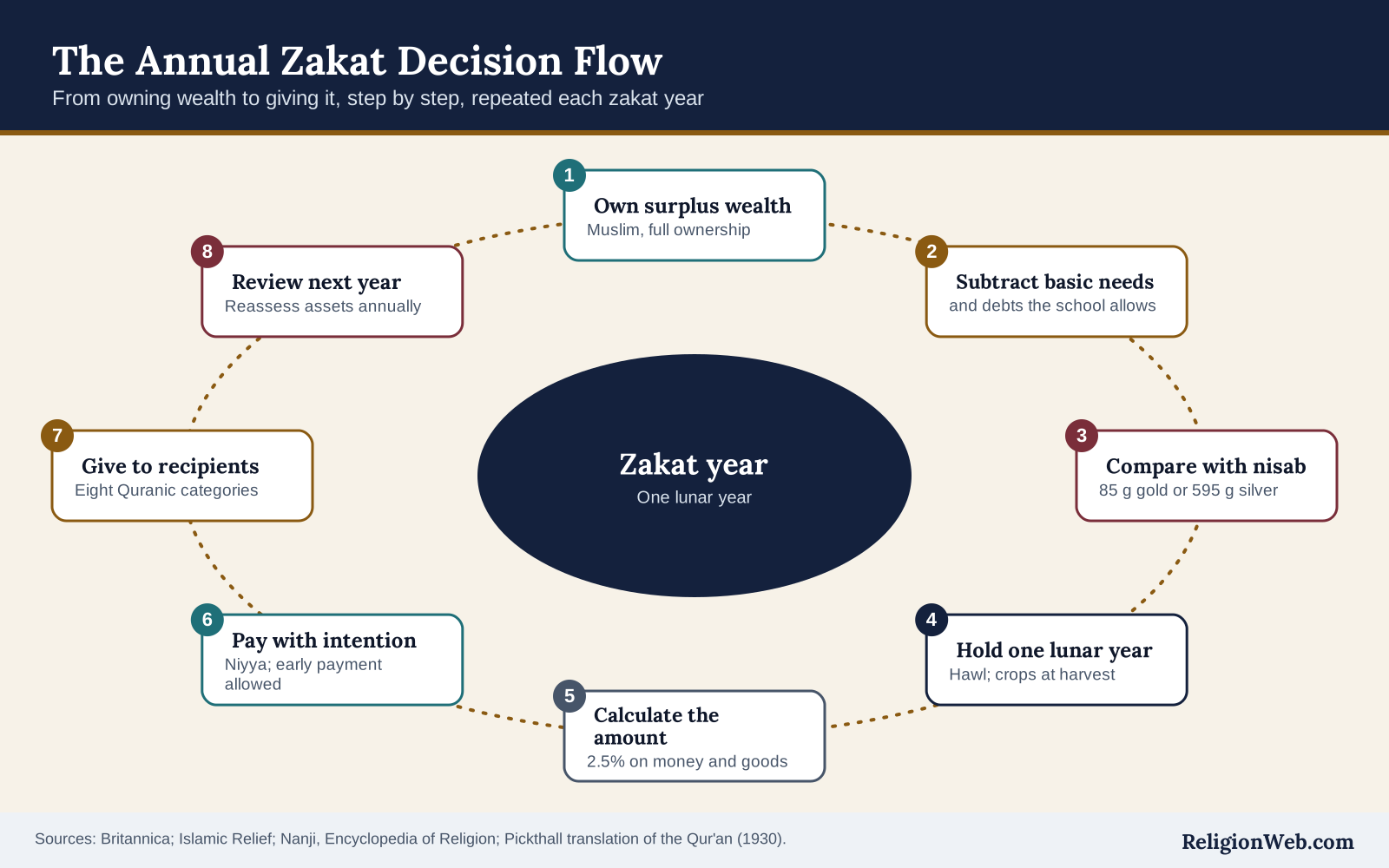
Zakat is not owed by every Muslim in the same amount. The duty arises only for a person who holds wealth above a minimum threshold, called the nisab, for the span of a lunar year, called the hawl, and it is then assessed at a rate that depends on the type of property. Britannica states the general case for cash and savings above the threshold as one-fortieth, which is 2.5 percent, while produce and livestock have their own rates and thresholds. A person below the threshold owes no zakat at all and may, depending on circumstances, be among those eligible to receive it.
This conditional design explains much about the way zakat is discussed. Questions about eligibility, thresholds and categories of wealth fill the juristic literature because the obligation is tied to precise facts about ownership. It also explains why the same word can describe a modest annual payment by an employee, a large corporate assessment in a state system, and the in-kind tithe of a farmer after harvest.
Key terms and how they fit together
A working glossary
Articles on zakat quickly accumulate Arabic terms. The table below gathers the ones used throughout this page, with a plain-English gloss for each. It is a reference for the rest of the article, so readers can come back to it when a term appears in a later section.
| Term | Meaning in plain English | Where it appears |
|---|---|---|
| Zakat (zakah) | The obligatory annual payment on qualifying wealth, with defined recipients | Qur’an, hadith, all schools of law |
| Zakat al-mal | Zakat on wealth or property, the main subject of this article | Juristic literature, modern institutions |
| Zakat al-fitr | A small per-person payment at the end of Ramadan, often called fitrah | Hadith, Ramadan practice |
| Nisab | The minimum amount of wealth, below which zakat is not due | Hadith and fiqh |
| Hawl | The lunar year for which wealth must be held before zakat falls due | Fiqh |
| Sadaqah | Voluntary giving; also used in the Qur’an for the obligatory payment | Qur’an, hadith |
| Amil | A collector or administrator of zakat, who is also a recipient category | Qur’an 9:60 |
| Fiqh | Islamic jurisprudence: the scholarly derivation of rules from the sources | Legal schools |
| Madhhab | A school of law, such as Hanafi, Maliki, Shafi’i, Hanbali or Ja’fari | Variation in details |
| Khums | A one-fifth levy in Shia law, separate from zakat | Twelver jurisprudence |
How the terms relate
The terms divide into three groups. The first group names the payment and its forms: zakat al-mal on wealth, zakat al-fitr at the end of Ramadan, and, outside zakat strictly speaking, sadaqah as voluntary giving and khums as a distinct Shia obligation. The second group describes the conditions that make wealth zakatable, namely the nisab threshold and the hawl period. The third group concerns administration and law: the amil who collects, the madhhab that governs the details, and the fiqh tradition that supplies the reasoning.
It helps to hold those three groups in mind when the article turns to calculation, because most of the disputes between scholars fall into one of them. Some are disputes about what counts as wealth, others about how thresholds and years are measured, and others about who may legitimately collect and receive. Reading any question on zakat as a question about one of those three groups makes the literature easier to follow.
Zakat in the Qur’an and the Sunna
The legal rules of zakat rest on two sources of authority. The first is the Qur’an, which Muslims regard as the word of God revealed to the Prophet Muhammad and which supplies the principle, the vocabulary and the list of recipients. The second is the sunna, the exemplary practice of the Prophet preserved in hadith, which supplies most of the thresholds, rates and procedures. The next sections describe what each source contributes and where scholars have had to interpret rather than simply read off a rule. For the nature and transmission of the first source, see the article on the Qur’an, and for the second, the article on hadith.
Quranic language and verses
Zakat beside prayer
The most noticeable pattern in the Quranic text is the pairing of zakat with the ritual prayer. Reference works record that the Qur’an treats zakat as a specific obligation to give part of one’s wealth, that it is often paired with prayer, and that it is presented as a continuation of the practice of earlier prophets. The command “establish worship, pay the poor-due,” in Pickthall’s wording, recurs in several surahs, and a verse in the second surah (2:277) describes believers who do good works, establish worship and pay the poor-due as those whose reward is with their Lord. Muslims commonly take the pairing as a signal that devotion and economic conduct belong together.
The verses do not, however, supply a calculation. The Qur’an says that zakat is owed and that wealth should be given for stated purposes, but it does not set the nisab, the rate for each kind of property or the length of the hawl. Those specifics come from the practice of the Prophet and the early community, as reported in hadith, and from the reasoning of jurists. That division of labor is one reason the schools of law reach somewhat different conclusions in detail while agreeing on the principle.
The verse on recipients and the word sadaqat
One verse stands apart because it lists who may receive. The ninth surah (al-Tawba, “Repentance”) names the eight categories in verse 60, and Britannica notes that the categories of recipients are defined in that surah. The Arabic noun that opens the verse is not zakat but al-sadaqat, a plural of sadaqa, a word that elsewhere in the Qur’an and in later usage refers to voluntary giving. Classical and modern jurists read the verse as governing the distribution of zakat, and the point is treated at length in the section on recipients below.
The overlap in vocabulary has consequences. It means that when English readers meet the word “alms” in a translation of the Qur’an, it may stand for sadaqa in the broad sense or for zakat in the technical sense, depending on the verse. Scholars distinguish the two by context and by the weight of the juristic tradition, which developed zakat as the fixed obligation and sadaqah as the open-ended practice. The distinction is explained further in the section comparing zakat, sadaqah and zakat al-fitr.
Spending, secrecy, and hoarding
Public and hidden giving
Several verses concern the manner of giving. The second surah says, in Pickthall’s rendering:
If ye publish your almsgiving, it is well, but if ye hide it and give it to the poor, it will be better for you,
Qur’an 2:271 (first part of the verse), Marmaduke Pickthall, The Meaning of the Glorious Koran (1930)
Commentators have long discussed whether the verse refers to voluntary giving, to the obligatory payment, or to both. A common resolution in classical discussions is that open payment of the obligatory duty can encourage others and show that the duty has been met, while voluntary gifts are better given quietly to protect the recipient’s dignity and the giver’s sincerity. This is an interpretive judgment rather than a single settled reading, and different commentators weight the two halves of the verse differently.
The verses on hoarding
A more severe passage appears in the ninth surah. It speaks of those who accumulate precious metals and do not spend them for God’s purposes:
They who hoard up gold and silver and spend it not in the way of Allah, unto them give tidings (O Muhammad) of a painful doom,
Qur’an 9:34 (part of the verse), Marmaduke Pickthall, The Meaning of the Glorious Koran (1930)
Muslim commentators have read this verse in more than one way. In the interpretation most often reported in the classical schools, wealth on which zakat has been paid is not hoarded in the sense the verse condemns, so that the verse establishes the seriousness of withholding the due portion rather than prohibiting savings as such. Some ascetically minded voices in the early community and later in Sufi circles read it more strictly, as a call to give away what exceeds need. Nanji’s entry in the Encyclopedia of Religion notes that in Sufi settings there was an emphasis on the mystical value of giving, and that some individuals gave away all their possessions. Both strands belong to the tradition, and both are best described with attribution rather than as a single Islamic position.
Hadith and the practice of the Prophet
The instructions to Yemen and the structure of the obligation
The best-known hadith on the obligation is the account of the Prophet sending Mu’adh ibn Jabal to Yemen, preserved in Sahih al-Bukhari under the chapter “The obligation of zakat” and narrated on the authority of Ibn Abbas. In paraphrase, the Prophet instructs Mu’adh to call the people first to bear witness to God’s oneness and to Muhammad’s messengership, then to teach that God has made five daily prayers obligatory, and then to teach that God has made zakat obligatory on their property, to be taken from their wealthy and given to their poor. Scholars have long drawn two points from the report: that zakat is a communal transfer organized within a locality, and that it is an obligation attached to wealth and not to income alone.
Nanji’s entry likewise records that the Prophet eventually organized collection and distribution, that it applied to crops, animals, merchandise, gold and silver above a minimum amount, and that collectors were urged to be fair and to persuade rather than coerce. Those statements describe the scholarly consensus at the level of general outline. They are different from the detailed schedules found in hadith collections and in the books of law, which were compiled and organized in later generations.
Reports on rates for crops and other property
A second group of hadith supplies figures. In a report found in the chapter on the yield of land in Sahih al-Bukhari, which is narrated from Abdullah ibn Umar, land watered by rain or by flowing springs owes one-tenth of its yield, and land watered by a well owes half of that, which is one-twentieth. In paraphrase, the report ties the rate to the effort of irrigation: where nature supplies the water the farmer owes more, and where labor and cost have been invested the farmer owes less. The principle is widely cited in the juristic literature and reappears in other collections.
For money, gold and silver, the figure that jurists derive from the sources is one-fortieth, or 2.5 percent, as Britannica also states. Scholars have used analogy to extend the same rate to trade goods and, in modern discussion, to forms of wealth that did not exist in the seventh century. Some of those extensions are broadly agreed and others are contested, which the section on categories of wealth treats in detail.
It is worth saying something about method here. Most of the figures cited in popular guides to zakat are not found in the Qur’an at all. They come from hadith whose authenticity, chains of transmission and interpretation were examined by scholars in the discipline of hadith criticism, and from legal reasoning about those hadith. A reader who wants to understand why two reputable authorities give different figures will usually find the explanation at that level, in the choice of report or in the way it was read.
The History of Zakat: From Medina to the Modern State
Zakat has a long administrative history as well as a scriptural one. Its early development took place in Arabia in the lifetime of the Prophet and the generations immediately afterward, and its later development followed the fortunes of the states that Muslims lived in. The record of the earliest stages comes mainly from later Muslim sources, so statements about the first decades are usually framed as the tradition’s own account, which historians weigh alongside other evidence.
The time of the Prophet
Giving and collecting in Medina
According to Muslim tradition, the obligation to give from wealth was already part of the Prophet’s message in Mecca, where the Qur’an stresses generosity toward the poor, orphans and travelers. Many scholars hold that the specific, regulated form of zakat, with defined property classes and rates, took shape after the move to Medina in 622 CE, when the Muslim community had a political center and the means to collect and distribute resources. This is a widely repeated account, not a point on which the earliest evidence is complete. What is clear from the sources is that collection and distribution were organized during the Prophet’s time and that, in Nanji’s summary, the practice took institutional form in his lifetime.
Collectors and the tribes
The tradition reports that the Prophet appointed officials to collect zakat from the groups who had accepted Islam, and that he sent envoys such as Mu’adh to Yemen. It also reports that some Bedouin groups were reluctant to pay. The picture that emerges is of a system that depended on trust, persuasion and tribal relationships as much as on formal enforcement, which helps explain what happened next.
The early caliphate and classical law
Abu Bakr and the dispute over payment
After the Prophet’s death in 632 CE, Abu Bakr became the first caliph, and several Arab tribes refused to send their zakat. In the account in Sahih al-Bukhari, the caliph’s close companion Umar questioned whether those who still professed the declaration of faith could be fought. Abu Bakr answered that zakat is the right due on wealth and that he would fight those who separated prayer from zakat; the report adds that Umar later acknowledged that Abu Bakr’s position was correct. Nanji describes the episode as a rebellion, in which tribes argued that the Prophet’s death ended their obligations and Abu Bakr sent forces to restore payment. Historians who study the so-called wars of apostasy (the ridda) point out that the motives of the tribes were mixed, involving political loyalty as well as the question of payment, and the sources are not neutral. Within the Sunni tradition the episode has been read as establishing that zakat is a binding duty that a ruler may enforce.
Visible and hidden wealth in classical administration
Classical jurists divided property into what is apparent, such as crops and livestock that a collector can see and count, and what is hidden, such as cash, goods and savings that only the owner knows about. Reports from the early caliphate, often connected with the third caliph Uthman, describe the owner being trusted to pay on hidden wealth directly rather than through the state’s officials, though the sources for the exact sequence are late and the details vary. The distinction left a lasting mark: it explains why individual conscience plays such a large part in the modern practice of zakat, and why state systems are most comfortable assessing visible assets or those held in banks and companies.
Jurists, treatises, and the state
By the late eighth and ninth centuries CE the rules were written down in treatises. Nanji’s entry singles out the Hanafi jurist Abu Yusuf’s Kitab al-Kharaj, which reflects collaboration between jurists and the Abbasid state, and credits al-Shafi’i with systematizing practice. These writers set out the types of property, the amounts due and the recipients, and they extended zakat to minerals and treasure finds. Over time the rules of the four Sunni schools and of the Shia schools hardened into the frameworks that Muslims still follow, with differences that the section on legal schools sets out.
From empire to nation state
Taxes outside the zakat framework
Premodern Muslim rulers also levied many other taxes, and historians of Islamic economic institutions note that zakat did not remain the only fiscal instrument of the state. In his entry on property in the Encyclopedia of Islam and the Muslim World, the economic historian Timur Kuran observes that zakat’s fixed rates, such as 10 percent on land watered naturally and 5 percent on land irrigated artificially, left it with few principles for revising rates or expanding coverage, and that the agricultural tax called ushr, modeled on zakat, varied widely and was often accompanied by other taxes with no basis in the traditional sources. His judgment is an economist’s evaluation, not a religious one, and many Muslim writers would read the same facts differently. It is useful as a reminder that the classical rules and the historical practice did not always coincide.
Revival and legislation in the modern period
In the later twentieth century, as many Muslim-majority countries debated how Islamic law should relate to public policy, several states legislated zakat. Nanji lists Pakistan, Saudi Arabia, Sudan and Yemen among those that made it part of state fiscal practice, while noting that some countries created non-state agencies for voluntary contributions and that most Muslims still give zakat as an expression of personal faith. Indonesia’s national law on zakat management, passed in 2011, is a more recent example of a framework that keeps collection regulated but does not make payment compulsory for individuals; it is described in the section on institutions below.
| Period | Development | Basis for the account |
|---|---|---|
| Early seventh century CE | Quranic emphasis on giving, with zakat paired with prayer | Qur’an |
| After 622 CE | Collection and distribution organized in Medina; envoys sent to tribes | Hadith and early biographical tradition |
| 632 CE onward | Abu Bakr acts against tribes withholding payment | Sahih al-Bukhari; later historical works |
| Late eighth to ninth century CE | Treatises by Abu Yusuf and al-Shafi’i systematize rules | Juristic literature (Nanji) |
| Later twentieth century | Several states legislate zakat collection | Reference works |
| 2011 | Indonesia’s Law No. 23 on zakat management | Text of the law |
Why Zakat Matters: Worship, Purification, and Social Welfare
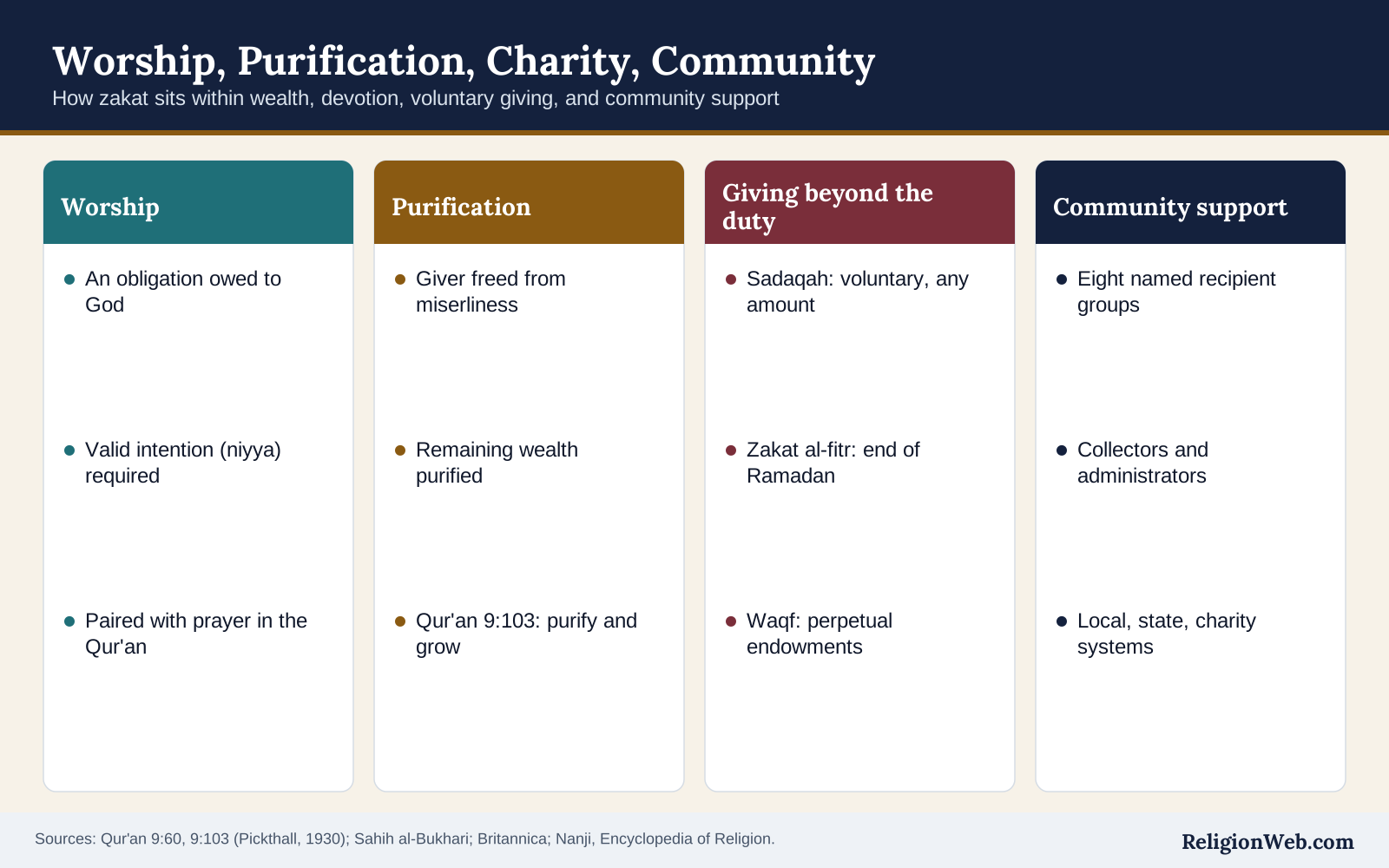
Muslims describe the purpose of zakat on several levels at once. It is an act of worship, because it is commanded by God and performed with the intention of obeying that command. It is a moral discipline for the giver, a form of economic ethics for the community, and a source of practical support for people in need. Writers in the Islamic tradition do not usually treat these aims as competing explanations, and they tend to resist reducing zakat to a welfare mechanism or, on the other side, to a purely private devotion.
Worship and purification
Zakat as an act of worship
In Islamic law, rites that are acts of worship (ibadat) require a valid intention (niyya), and zakat is classed with them. A payment made with no intention of fulfilling the duty, or one made while expecting a return, is not understood to discharge the obligation, however useful it may be to the recipient. This is one practical reason that jurists distinguish zakat from taxes in a secular sense and from ordinary gifts. The same sum of money might help a family either way, but the religious status of the act depends on what the giver intends and on whether the payment meets the conditions for validity.
That emphasis on intention also explains why many Muslims prefer to calculate and pay zakat themselves even where a state collects some of it, and why scholars in several countries have discussed whether automatic deductions by banks or tax offices satisfy the duty without a separate declaration of intention. Pakistan’s system of deducting zakat from bank accounts, described in the section on institutions, has been accompanied by a procedure for people who do not wish to have it deducted, and the existence of that procedure reflects the principle that the duty is a personal one.
Purifying the giver and the remaining wealth
The Qur’an itself explains one purpose of collection in the ninth surah. In Pickthall’s rendering:
Take alms of their wealth, wherewith thou mayst purify them and mayst make them grow, and pray for them.
Qur’an 9:103 (first sentence), Marmaduke Pickthall, The Meaning of the Glorious Koran (1930)
Commentators have drawn two lines of meaning from the verse. One concerns the giver, who is purified from sins and from the vice of miserliness. The other concerns the wealth, which is purified from the claim of others upon it. According to this second reading, property from which the due portion has not been paid carries an unpaid debt, and paying zakat makes the remainder fully the owner’s to use. Nanji notes that some commentators read the idea as purifying the rest of one’s wealth. The language of growth is usually taken spiritually, as an increase in blessing (baraka), though some modern economists in the Islamic tradition also point to the circulation of resources through the community.
The social purpose
A right of the poor in the wealth of others
Many Muslim scholars stress that zakat is a right (haqq) held by the poor and by the other named groups. The Mu’adh report discussed earlier speaks of zakat taken from the wealthy of a community and given to its poor, and the Quranic verse on recipients ends by calling the distribution “a duty imposed by Allah.” The framing treats the poor as claimants with an entitlement, not as objects of benevolence. It also helps explain why the classical tradition developed rules about local distribution, about avoiding favoritism and about the dignity of recipients.
Modern writers on Islamic economics have taken this idea in several directions. Some argue that zakat is a core instrument of poverty reduction that can work alongside conventional taxation, while others, including some economic historians, note the limits of a system with fixed rates that was designed for the property forms of a particular era. These are scholarly debates within and about the tradition, and they do not alter the basic religious understanding of the duty as a right of those in need.
Zakat within Islamic economic ethics
Zakat belongs to a wider set of ethical commitments about property. Wealth is regarded as a trust from God, to be earned by lawful means (what the tradition calls halal) and spent responsibly, with a share going to those in need. The Qur’an’s warning against hoarding, the encouragement of generosity and the prohibition of exploitative lending together form the background against which zakat is understood. Muslim jurists also developed other charitable institutions, such as the waqf, a perpetual endowment for a designated purpose, which Kuran notes often provided social services. Zakat is distinct from these, but they work in the same ethical field.
The same ethical field includes personal conduct that is discussed in other articles on this site, such as the Sharia framework that gives shape to the legal rules, and questions of dress and modesty that are discussed in the article on hijab in Islam. Seeing zakat alongside these areas makes it easier to understand why writers describe it as part of a coherent moral order rather than as an isolated financial rule.
Zakat in the rhythm of Muslim devotion
Ramadan and the last ten nights
Zakat al-mal has no fixed month of its own, because the hawl is counted from the day a person’s wealth first reached the nisab. Even so, many Muslims choose to pay during Ramadan, because acts of devotion are believed to carry added reward in that month. Institutions reflect the pattern: Pakistan’s government, for instance, notified banks to deduct zakat from qualifying savings accounts on the first day of Ramadan 1447 AH, a date its Ministry’s letter of 16 February 2026 said was likely to fall on 19 or 20 February 2026, depending on the sighting of the moon.
The last ten nights of the month hold special significance because they include Laylat al-Qadr, the Night of Power, which Muslims associate with the first revelation of the Qur’an and seek through prayer and giving. Many charities report a rise in donations at that time, though the sums given in those nights may be voluntary sadaqah rather than the obligatory payment. The difference is exactly what the later section on terminology clarifies.
Supplication for the giver and the recipient
The ninth-surah verse quoted above instructs the Prophet to pray for those who give. Many scholars have taken this as the root of a courtesy that collectors and recipients still observe: the recipient or collector makes du’a (supplication) for the giver, and the giver in turn is encouraged to pray that the payment be accepted. The practice links two forms of devotion, giving and personal prayer, that Muslims experience as complementary. It also reminds the giver that the transaction is not simply a transfer between two parties, since in the Islamic understanding the payment is first of all offered to God.
Who Must Pay: Conditions, Nisab, and Hawl
The duty of zakat attaches to a person who meets a set of conditions concerning the person and the property. Classical manuals list them in slightly different ways, but they reduce to a small number of questions. Is the person a Muslim in full legal capacity? Does the person truly own the property? Does the wealth reach the minimum threshold? Has it been held for a full lunar year? And is it surplus to basic needs? The following sections go through those questions and note where the schools part company.
Conditions concerning the person
Muslim status and full ownership
The obligation falls on Muslims. Jurists across the schools hold that it is a duty of Muslims toward God and toward the community, so that wealth owned by non-Muslims is not assessed in the zakat system. They also require that the property be in the owner’s full possession, meaning that the person has control over it and can benefit from it. Wealth that is lost, stolen or otherwise out of reach has been the subject of extended discussion, with the schools giving different answers about when the year runs and what should be paid on recovery. Those details matter for anyone calculating zakat on assets that are not fully accessible, such as frozen accounts or disputed property.
Age, capacity, and the property of minors
Whether zakat is due on the property of children and of people lacking legal capacity is a point where the schools are traditionally reported to differ. In a commonly cited classical division, the majority of jurists hold that zakat is owed on the wealth of a minor or an incapacitated person, to be paid by the guardian, while the Hanafi school has traditionally held that the formal duty applies to the adult who is responsible for religious obligations, with exceptions for produce. This is a general characterization drawn from the classical manuals and from secondary descriptions, and readers should treat the specific school positions as a guide to the debate and not as a ruling.
Basic needs and debts
Zakat is levied on surplus wealth, not on the property a person needs to live. The home a person lives in, clothing, household goods, the tools of a trade and a vehicle for ordinary use are generally outside the base, which is expressed in the classical manuals as wealth in excess of “basic needs.” Debts raise a separate question. Many jurists allow immediate and due debts to be subtracted from the zakatable total, since a person who owes money does not really have free surplus, while some limit the deduction or take positions about particular kinds of debt such as mortgages. Contemporary fatwa councils and institutions publish guidance on that question, and it is among the matters on which a personal consultation is most useful.
The nisab threshold
Gold and silver as the traditional measures
The nisab is the minimum amount of wealth that makes a person liable for zakat. Britannica explains that the threshold fluctuates with the value of gold and silver, and that Muslims whose wealth falls below it in a given year are exempt. The traditional measures are expressed in weights of the two metals. In the figures most often published by Islamic charities today, the threshold is 85 grams of gold or 595 grams of silver. A second set of figures, based on the Hanafi measurement of the classical units, is 87.48 grams of gold or 612.36 grams of silver, and Islamic Relief states that the nisab was set by the Prophet at those weights. The differences between the two sets arise from how classical weights such as the mithqal and the dirham are converted into modern grams.
The ratio between the gold and silver amounts is roughly seven to one, which reflects the relative values of the metals in the seventh century. Today the ratio of their market prices is very different, and a silver nisab comes to a far smaller sum than a gold nisab. That gap is the root of an important contemporary debate.
Silver or gold as the benchmark today
Because a silver-based threshold is much lower in modern currency than a gold-based one, institutions and scholars have to choose which to apply to cash and other assets that are not themselves metal. According to Human Appeal, many contemporary scholars, including the late Yusuf al-Qaradawi and various Islamic finance bodies, recommend the silver nisab, arguing that a lower threshold brings more Muslims into the duty and directs more wealth to those in need. Others favor the gold nisab as better reflecting the original intention to exempt people of modest means. The organization describes this as a genuine scholarly difference and advises following one’s school or a trusted scholar, and Islamic Relief notes that most scholars advise using the silver value while accepting the gold nisab for people whose assets are all in gold.
The disagreement shows how zakat works as a living legal tradition. The sources fix the structure, but the application to money in modern economies needs reasoning, and reasonable scholars reach different results. A person whose wealth falls in the gap between the two thresholds might owe zakat under one view and not under the other.
Changing prices and local currencies
The nisab in any currency depends on the market price of the metal, so published figures change daily. Islamic Relief’s nisab page carries a live calculator, and Human Appeal states that the nisab is calculated using the market price on the day of payment. States that collect zakat publish a fixed figure for each zakat year. Pakistan’s Administrator General Zakat, for instance, notified a nisab of Rs. 503,529 for the zakat year 1446-1447 AH, applied to the bank-account deduction on the first day of Ramadan 1447 AH. That number is a snapshot tied to a specific country and a specific year, and it is not a universal figure.
The hawl, or lunar year
What the year means
The hawl requires that wealth remain at or above the nisab for one full lunar year before zakat is due. Islamic Relief puts it that the zakat year begins on the date when a person first possessed wealth above the nisab. Many Muslims therefore fix a personal zakat date, often tied to a particular day in the Islamic calendar, and review their assets then. Others choose Ramadan for convenience, which makes the date the same for everyone in their community, even though it may not coincide with the exact anniversary.
The year is a lunar one, around 354 or 355 days. Some institutions and individuals who keep accounts in the solar calendar adjust the percentage slightly. Since a solar year is about 365 days, the same payment spread over the longer year works out to roughly 2.58 percent instead of 2.5 percent of the assets, a figure that follows from simple arithmetic and that individuals who keep solar-year accounts may wish to discuss with a scholar.
Fluctuating wealth and early payment
Few people’s wealth stays constant over a year, which raises the question of what happens to the hawl if a balance dips below the nisab. Human Appeal notes that scholars differ on whether a temporary dip resets the year, and the classical schools are traditionally described as disagreeing about it; the details are best checked with a scholar of one’s own school. The schools do broadly allow payment in advance. IslamQA, answering in the Hanafi tradition, notes that a person who has reached the nisab may pay before a full year has passed, and the payment is then considered complete. This flexibility is why many people simply pay in a single month each year.
The calculation of zakat on income or salary that is received during the year raises further questions, because each payment may start its own year. Contemporary scholars have therefore proposed practical methods, such as setting a single date and adding up all zakatable assets held on it. Those methods are widely used, though they too are a matter of scholarly opinion and are not found in the early sources.
Categories of Wealth and How Zakat Is Assessed
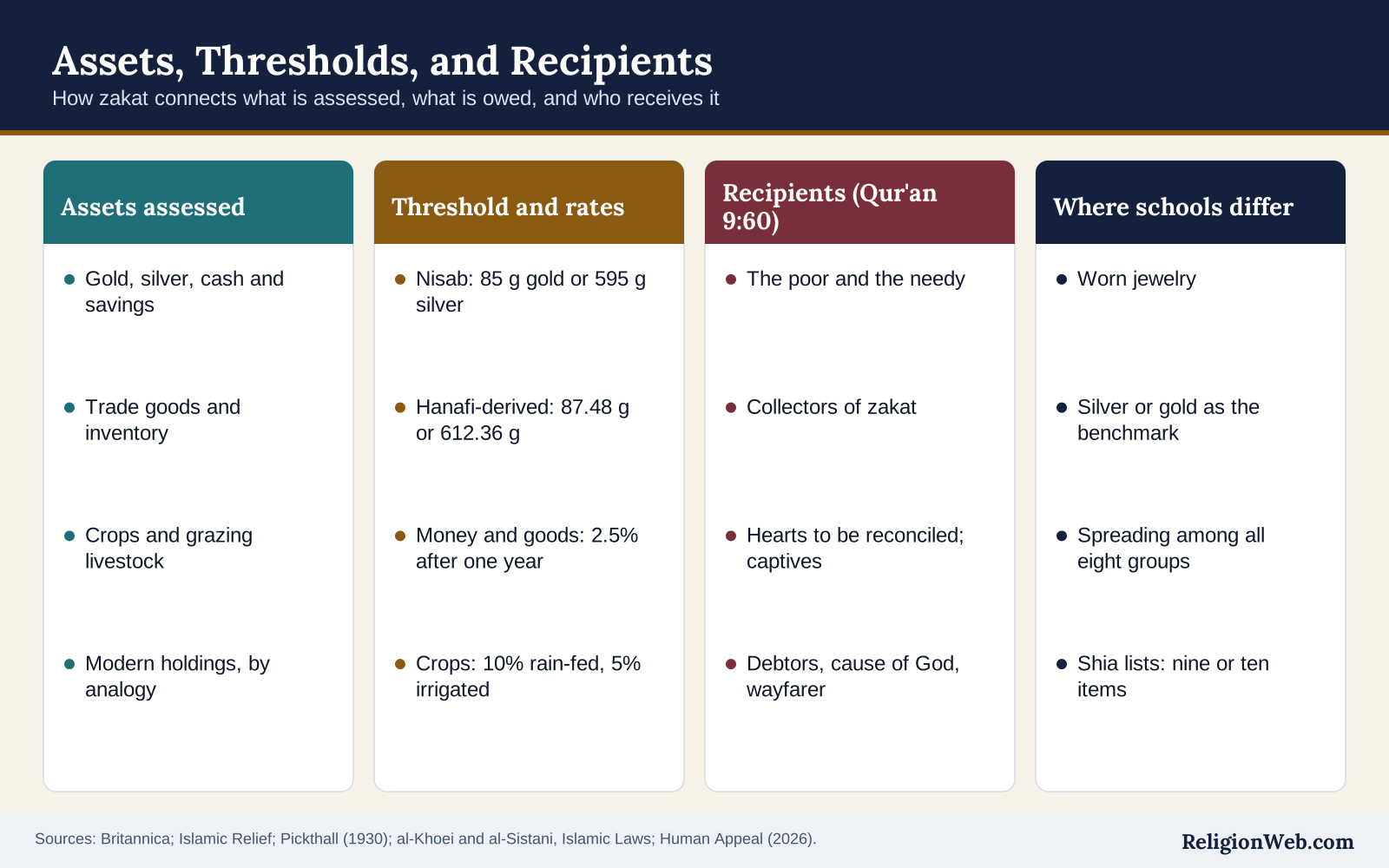
Once a person meets the conditions, the next question is what is assessed and at what rate. The classical answer lists specific kinds of property, each with its own rule. The modern answer extends those rules by analogy to forms of wealth such as shares, pensions and online balances. The two layers should be kept apart: the first is largely agreed across the major schools in outline, while the second is an area of active scholarly work.
Traditional categories of property
Gold, silver, and cash
Gold and silver in any form of money or bullion are the clearest case. The assessed rate is one-fortieth, or 2.5 percent, once the nisab and hawl are met. Britannica gives the same rate for cash and savings above the threshold, and contemporary institutions treat bank balances and paper currency as the successors of coined metal. The IslamQA answer by the Hanafi scholar Ilyas Patel adds that gold or silver held below the nisab can be combined with the other metal’s value, and the total is measured against the threshold.
Trade goods, crops, and livestock
Goods held for sale are assessed at their market value, usually at the same 2.5 percent, because jurists treated merchandise as a kind of wealth in circulation like coin. Agricultural produce has a separate rule tied to the harvest rather than to the lunar year: one-tenth where the land is watered by rain or flowing water, and one-twentieth where irrigation requires labor and cost. The Twelver jurist al-Khoei gives a similar three-way split of 10, 5 and 7.5 percent for grain irrigated by rain or canal, by buckets, or by both. Livestock, such as camels, cattle, sheep and goats that graze freely, has a graduated schedule of thresholds and fixed payments in kind, which the manuals set out in detail and which most urban Muslims never need to apply.
| Category | General rule | Points of disagreement or modern adaptation |
|---|---|---|
| Gold and silver (coins, bullion) | 2.5 percent after nisab and one lunar year | Which metal sets the threshold when applied to cash |
| Cash and bank balances | Treated like money; 2.5 percent | Gold or silver benchmark; treatment of debts |
| Trade goods and business inventory | Assessed at market value; usually 2.5 percent | Valuation date; fixed assets such as equipment are generally excluded |
| Agricultural produce | One-tenth if rain-fed; one-twentieth if irrigated by effort | Some schools require a minimum quantity and others do not; no hawl |
| Livestock grazing freely | Graduated schedule of animals | Applies mostly to herding communities |
| Minerals and buried treasure | Extended by jurists; separate rates | Rates and conditions differ by school |
| Jewelry and personal ornament | Gold and silver content may be assessed | Hanafi view assesses worn jewelry; other Sunni schools generally exempt it |
| Shares, funds, retirement savings | Modern analogy to trade goods and cash | Methods vary among contemporary councils |
Modern assets and open questions
Investments, retirement accounts, and property
Contemporary fatwa councils and Islamic finance bodies apply the old categories to new holdings. Shares and funds held for trading are commonly assessed like trade goods, at market value, while a company’s shares held as a long-term investment are sometimes assessed on the underlying zakatable assets of the firm. Rental property is often treated as productive capital, with the rental income assessed rather than the building itself, and a home used as a residence is outside the base. Retirement accounts, which a person may not be able to withdraw without penalty, are among the most debated cases, with some scholars assessing them annually and others at the point of access. A reader will find that institutions publish different methods, and it is reasonable to treat the variety as a sign of ongoing scholarly reasoning, not confusion.
Jewelry and personal ornament
Worn jewelry is a standard example of a disagreement that has lasted since the Companions. The Shafi’i scholar Taha Karaan, writing on IslamQA, reports that the preferred Shafi’i, Maliki and Hanbali position is that zakat is not due on jewelry kept for use, while the Hanafi school is understood to require it, and he notes that the Companions themselves differed, with Aisha, Jabir, Ibn Umar and Anas reported on one side and Umar and Ibn Amr on the other. He also describes the hadith evidence on both sides as contested in its chains. The example shows why the schools can give different answers in good faith: the texts are not decisive, and scholars rely on analogy.
How a calculation is structured
Assets, liabilities, and the threshold
Whatever the method, a calculation follows a common shape. A person adds the value of zakatable assets held on the zakat date, subtracts the liabilities that the relevant school or council allows, and compares the remainder with the nisab. If it falls below the threshold, nothing is due. If it is at or above it, the person pays 2.5 percent of the zakatable total. For a figure of 10,000 units of currency, for instance, the payment would be 250 units; the figure is purely arithmetic and has no bearing on any real case. Produce and livestock follow their own separate schedules.
Why personal advice still matters
The structure looks simple, but the inputs are not. The choice of nisab, the treatment of debts, the classification of an asset and the question of what counts as “needed” for living all require judgment. For that reason, many mosques, scholars and charities offer zakat advice and calculators, and the standard guidance is to consult one’s own tradition’s authorities for a personal case. This article explains the framework only, and it does not offer a personal ruling.
Who Receives Zakat: The Eight Categories
The Qur’an specifies the recipients in a single verse, which makes zakat unusual among charitable obligations: the beneficiaries are named by scripture and not left to the giver’s taste. The verse, in the ninth surah, reads in Pickthall’s translation:
The alms are only for the poor and the needy, and those who collect them, and those whose hearts are to be reconciled, and to free the captives and the debtors, and for the cause of Allah, and (for) the wayfarer; a duty imposed by Allah. Allah is Knower, Wise.
Qur’an 9:60, Marmaduke Pickthall, The Meaning of the Glorious Koran (1930)
The eight categories in the Qur’an
The list and its terms
The verse gives eight categories: the poor (fuqara), the needy (masakin), the collectors (amilin), those whose hearts are to be reconciled (mu’allafat al-qulub), those in bondage (riqab), the debtors (gharimin), those in the cause of God (fi sabil Allah) and the wayfarer (ibn al-sabil). Nanji’s entry lists the same groups, glossing them as the poor, the needy who cannot support themselves, workers who collect and distribute funds, those to be attracted to the faith, captives to be ransomed, debtors, travelers and those engaged in serving God. Britannica similarly names the poor and needy, administrators, converts and those seeking reconciliation, people in bondage or debt, and travelers in need.
| Arabic term | Common English rendering | Usual understanding | Interpretive notes |
|---|---|---|---|
| Fuqara | The poor | People whose means do not cover basic needs | Schools differ on how the poor and needy are distinguished |
| Masakin | The needy | People with some income that falls short of need | Same discussion; both groups are recipients |
| Amilin alayha | Collectors | Officials who collect, record and distribute | Paid from zakat for their work even if they are not poor |
| Mu’allafat al-qulub | Hearts to be reconciled | New Muslims and others whose goodwill is sought | Hanafi and Maliki scholars treated it as lapsed; others hold it still applies |
| Riqab | Captives or those in bondage | Freeing slaves or ransoming captives | Some modern scholars extend the principle to freeing people from bonded conditions |
| Gharimin | Debtors | People burdened by debt incurred for lawful needs | Debt from extravagance or sin is treated differently |
| Fi sabil Allah | In the cause of Allah | Service for the community’s religious or defensive needs | Classical and modern scholars differ on how wide the category is |
| Ibn al-sabil | The wayfarer | A traveler stranded without funds | May receive even if wealthy at home |
The poor, the needy, and the collectors
The first two categories stand at the center of the system, and classical jurists spent much effort on the difference between them. In general terms the poor are those whose means do not cover basic needs, and the needy are those who have some income but not enough to live adequately, though the schools disagree over which group is worse off, and the disagreement affects how jurists define the thresholds for eligibility. The third group, the collectors, shows that the Qur’an envisages organized administration from the start. Their share is a wage for their work, which is why classical jurists allowed the collectors to receive from zakat even when they were not poor. Nanji adds that later interpreters sometimes extended the uses of zakat to people facing hardship or transition who needed help to rebuild their livelihoods.
How jurists have read the less obvious categories
Reconciled hearts, captives, and debtors
The fourth category is the most debated. According to the Darul Ifta Birmingham ruling, its original purposes were to strengthen the faith of new Muslims whose belief was still developing and to win over influential non-Muslims, either to encourage conversion or to protect the Muslim community from possible harm. SeekersGuidance reports that Hanafis and Malikis regarded the category as dropped once Islam had spread and grown strong, while the majority held that the ruling was not abrogated and that the early caliphs’ non-payment reflected the absence of need. Modern scholars cited by the Birmingham ruling hold that it still applies where its aims can be achieved, for instance in supporting people who are new to Islam. The fifth category, the captives, referred historically to the freeing of slaves and the ransoming of prisoners, and some contemporary writers apply the principle to people freed from forms of bondage such as debt slavery. The sixth, the debtors, covers people overwhelmed by debt for lawful needs, and also those who took on debt to settle a dispute between others.
The cause of God and the wayfarer
The phrase fi sabil Allah, literally “in the way of God,” is read narrowly by some jurists and broadly by others. Classical manuals commonly connect it with those engaged in military effort on behalf of the community, with some extending it to pilgrims, while other scholars, ancient and modern, hold that it can cover public welfare, education and the work of religious institutions. Nanji’s gloss, “those engaged in serving God,” reflects the wider reading. This is an area where the term is best presented with attribution to each view and without an attempt to settle the matter. The eighth category, the wayfarer, is the least controversial: a traveler who is stranded without means is eligible, even if the person is wealthy at home.
Rules of distribution
Who may not receive zakat
The classical manuals also say who is excluded. Jurists generally hold that a person may not give zakat to those he or she is already obliged to support, such as a spouse or young children, because the payment would simply discharge an existing duty. Most Sunni jurists also exclude the descendants of the Prophet’s clan from receiving zakat, a rule connected with hadith about the dignity of that family, while Shia law makes parallel provision through khums, which is discussed in the next section. These are general summaries, and the schools differ on the fine points, such as the status of parents and adult children and the position of non-Muslims. SeekersGuidance records, for example, that Hanafis and Shafi’is say non-Muslims should not receive zakat on account of Islam, citing a statement attributed to Umar, while Hanbalis and Malikis allow giving to non-Muslims to encourage them toward Islam.
Local priority, timing, and spreading among categories
Two further rules shape how zakat is delivered. The first is a preference, held by many jurists, for distributing zakat first in the community where it was collected, so that the needy of a locality benefit from its wealthy. The second concerns how widely to spread the payment. Reference descriptions report that the Shafi’i school traditionally requires distribution among all eight categories where they exist, while the Hanafi school allows zakat to go to all, some or even a single category. All classical schools, according to the same sources, agree that collectors are paid first. These positions are summarized from secondary accounts and not from the manuals themselves, and readers who want the exact rules for a school should consult its own texts.
Zakat, Sadaqah, Khums, and Zakat al-Fitr
Several Islamic terms for giving overlap in everyday speech, and the overlap produces much of the confusion about zakat. The distinctions are more than technical. They decide whether a payment discharges a religious duty, how it must be calculated and who may receive it. The table below summarizes the main differences among zakat on wealth, voluntary giving and the end-of-Ramadan payment, and the sections after it explain each.
| Feature | Zakat al-mal | Sadaqah | Zakat al-fitr |
|---|---|---|---|
| Religious status | Obligatory for those who meet the conditions | Voluntary and encouraged | Obligatory in the Sunni schools and in Shia law, with details varying |
| Basis of amount | Percentage of qualifying wealth above the nisab | Any amount; in the broad sense of the term, kind acts as well as money | Fixed measure per person, traditionally a sa’ of staple food |
| Timing | Once a lunar year after wealth reaches the nisab; produce at harvest | Any time | By the end of Ramadan, before the festival prayer |
| Wealth threshold | Nisab required | None | Surplus beyond the household’s needs for the day |
| Recipients | The eight Quranic categories | Anyone in need, and broader good causes | Chiefly the poor |
| Purpose | Purifying wealth and meeting needs of the community | Generosity and seeking God’s favor | Purifying the fast and ensuring all can celebrate the festival |
Zakat and voluntary giving
What sadaqah covers
Britannica states that zakat is separate from sadaqah, which it describes as a voluntary donation. Sadaqah has no minimum, no calendar and no fixed recipients, and it extends in the tradition far beyond money. Hadith collections include reports that a kind word, removing an obstacle from a path or helping a neighbor counts as sadaqah, which Muslims understand as showing that generosity is a pattern of life and not a single payment. Institutions such as the waqf, the perpetual endowment, and the distribution of sacrificial meat at Eid al-Adha belong to the wider family of voluntary and recommended giving, along with ordinary gifts to relatives, neighbors and charities.
Why the two are kept distinct
The legal distinction has practical effects. Voluntary giving does not discharge an unpaid zakat obligation unless the giver intended it as zakat and the recipient qualifies, and zakat cannot be spent on projects that do not fall within the named categories, however worthy. A mosque building fund, for example, is a good cause by the standards of many Muslims, but jurists do not agree that it counts as zakat unless it can be brought within an eligible category, and the question is a frequent subject of fatwas. The consequence for individuals is that many keep their zakat and sadaqah accounts separate, and charities typically ask donors to specify which they mean.
Zakat al-fitr
Amount, timing, and obligation
Zakat al-fitr, the “zakat of breaking the fast,” is also called sadaqat al-fitr or fitrah. It is a different payment from zakat al-mal, though it shares the name and the idea of obligatory giving. In a report in Sahih al-Bukhari from Ibn Umar, in paraphrase, the Prophet made it obligatory on every Muslim, whether enslaved or free, male or female, young or old, at one sa’ of dates or one sa’ of barley, and ordered that it be paid before people set out for the festival prayer. The website sunnah.com estimates a sa’ at about three kilograms. The measure is fixed per person and does not depend on wealth beyond the means to spare it, which is why the payment is much the same for rich and poor.
Institutions and scholars calculate the sum for a given place by pricing the traditional measure of a staple food, so the payment in a given year varies by country. Heads of households ordinarily pay for their dependents as well as themselves. These details and the specification of which staples count are matters of school and local custom.
The festival link and the question of cash
The purpose that the tradition attaches to zakat al-fitr is twofold: to purify the fast from lapses and to ensure that the poor can take part in the festival. The article on Eid al-Fitr describes how the payment fits into the festival morning. The schools differ on whether the payment can be made in cash. The Hanafi school is generally reported to allow the monetary value of the food, while the other Sunni schools traditionally emphasize paying in kind, and many contemporary institutions collect cash on the donor’s behalf and buy the food. As with the other details, Muslims typically follow the school or institution they trust.
Khums and the Shia framework
Khums as a separate levy
Twelver Shia law recognizes a separate payment called khums, “one-fifth,” due on the surplus of a person’s annual earnings after expenses and on certain other gains. Muslims in Shia communities pay it in addition to zakat. A portion traditionally goes to the descendants of the Prophet’s family who are in need, and a portion is given to a qualified jurist for religious purposes, often a maraji’ (a leading jurist whom believers follow) or his agents. The precise rules vary among jurists, and Sunni law uses the word khums mainly for the one-fifth share of war spoils and certain finds. This article therefore distinguishes it from zakat without treating it as a variant.
Zakat in Twelver law
Twelver jurists do list zakat itself as a separate duty, and the lists of what is assessed are narrower than the Sunni ones. Ayatollah al-Khoei’s book Islamic Laws names nine things on which zakat is obligatory: wheat, barley, dates, raisins, gold, silver, camels, cows and sheep including goats. In Ayatollah al-Sistani’s Islamic Laws the list is introduced as ten, with business goods added on the basis of what the text calls obligatory precaution (al-ihtiyat al-wajib), a term for the cautious position adopted where a jurist considers the evidence not fully conclusive. The two lists show that even within one Shia tradition, different living jurists may reach different results. Nanji adds that Twelver Shia have entrusted zakat to representatives of the absent imam, which in practice means qualified jurists and their agents.
Legal Schools and Internal Diversity in Zakat
The foregoing sections have already shown that zakat is applied differently in different traditions. This section gathers the main sources of variation in one place. The point is not to rank the schools. Each school reached its rules by a consistent method from the Qur’an and hadith, and the tradition itself regards disagreement among qualified jurists as legitimate. The summary below uses secondary accounts and a few jurists’ published rulings, and it is no substitute for the manuals.
The Sunni schools
Where the four schools agree
The Hanafi, Maliki, Shafi’i and Hanbali schools agree on the foundations: that zakat is an obligation on Muslims, that it applies to money, trade goods, produce and grazing livestock above set thresholds, that the standard rate for money is 2.5 percent after a lunar year, and that the Quranic list of eight categories defines the recipients. They also agree that collectors have a claim on the proceeds. Because of this shared core, Sunni Muslims from different schools can pay into the same charity or state fund without much practical difficulty, and the differences that exist usually concern edge cases.
Where they differ in detail
The differences are found in specific rules, several of which have been mentioned above. They include the benchmark measures for the nisab, the treatment of worn jewelry, whether produce requires a minimum quantity, whether the hawl restarts when wealth dips, the status of the “hearts to be reconciled” category, whether zakat must be spread across all eight categories or can go to a single one, and the rules for paying zakat al-fitr in cash. The table gathers these points, with the caution that the school positions are summarized from the accounts cited in this article.
| Variable | Positions reported | Why it matters |
|---|---|---|
| Gold and silver nisab in grams | 85 and 595 in widely published guidance; 87.48 and 612.36 in Hanafi-derived figures | Changes who falls above the threshold |
| Worn jewelry | Hanafi: assessed. Shafi’i, Maliki, Hanbali: generally exempt when kept for use | Affects many households’ totals |
| Produce | Hanafi: no minimum quantity required. Others: a minimum quantity applies | Affects small farmers |
| Distribution | Shafi’i: among all eight categories where present. Hanafi: all, some, or one | Shapes how charities allocate funds |
| Hearts to be reconciled | Hanafi and Maliki: lapsed. Others: still applicable | Determines whether support for new Muslims counts as zakat |
| Non-Muslim recipients | Hanafi and Shafi’i: not for that purpose. Hanbali and Maliki: allowed to encourage toward Islam | Affects charity programs |
| Items assessed in Twelver law | Nine items (al-Khoei) or ten with business goods (al-Sistani) | Different base than Sunni lists |
| Zakat al-fitr in cash | Hanafi: generally permitted. Others: traditionally in kind | Determines how charities collect |
Shia, Ismaili, Zaydi, and Sufi emphases
Twelver and other Shia communities
For Twelver Shia, the Shia tradition shapes both the list of assessed items and the question of who collects. The legal sources are the Qur’an, the sayings of the Prophet and of the Imams, and the reasoning of the jurists, and the authority to receive zakat is vested, in the absence of the twelfth imam, in qualified jurists and their agents. Nanji notes that the Ismaili Shia add a spiritual dimension interpreted by the imam, and that Zaydis require payment to the official collectors of a legitimate imam’s state. These variations come from different understandings of religious authority, not from different texts on the principle of giving.
Sufi emphases and the role of the individual
Within the Sunni world, Sufi teachers have often stressed the inner side of giving. Nanji records an emphasis on its mystical value and cases of individuals who gave away all their possessions. The ideal was not a replacement for zakat. In most accounts it stood on top of the legal minimum, a higher level of renunciation for those called to it. The distinction between the required and the recommended runs through the whole subject, and it is the same distinction that separates zakat from sadaqah.
Contemporary authorities
Councils, institutions, and individual scholars
Today the interpretation of zakat is exercised by several kinds of authority. National fatwa councils and ministries of religious affairs issue guidance and publish annual nisab figures. International bodies of jurists address questions common to many countries, such as the treatment of shares and other modern assets. Islamic charities employ scholars who review how funds are collected and distributed. Individual scholars, including those who publish answers online through projects such as IslamQA and SeekersGuidance, give rulings within particular schools. The authority of each rests on its standing with the believers who consult it, since Islam has no single body that rules for all Muslims.
Why variation is accepted
Classical Islamic law accepted that qualified jurists could reach different conclusions from the same sources, and it produced works devoted to the reasons for such differences. In the case of zakat the reasons are mostly textual (which hadith is accepted and how it is read) and analogical (what counts as like gold or like livestock). Contemporary writers on the subject, such as the authors of the guidance quoted in this article, therefore usually advise a person to follow the school they belong to or a trusted scholar, and to be consistent. The point is practical as much as theological: a person who follows one coherent method can fulfill the duty with confidence.
Zakat Institutions and Practice Today
In the twenty-first century, zakat is organized in three broad ways. In a few countries the state assesses and collects part of it. In others the state sets a legal framework for licensed collecting bodies while payment remains a matter of personal religious choice. In many places, including most Muslim communities in Europe and North America, collection is carried out entirely by mosques, charities and individuals. The examples below come from documents and reference sources that describe how each model works, and they are illustrations rather than a complete survey.
State and legal frameworks
Saudi Arabia and the Gulf
In Saudi Arabia the tax authority, the Zakat, Tax and Customs Authority (ZATCA), treats zakat as the obligation of Saudi and other Gulf Cooperation Council nationals instead of income tax. According to a summary by the tax-software firm ClearTax, zakat applies to the Saudi or GCC national share of companies at a flat 2.5 percent of a “zakat base” calculated from zakatable assets such as cash, receivables and inventory minus deductible short-term liabilities, while foreign shareholders are subject to income tax instead. Nanji also lists Saudi Arabia among the states that made zakat part of fiscal practice. The arrangement is a corporate assessment, so it does not replace an individual’s personal obligation or charitable giving.
Pakistan: deduction at source
Pakistan is a well-known case of state collection from individuals. A letter from the Ministry of Poverty Alleviation and Social Safety to the State Bank of Pakistan, dated 16 February 2026, sets out the annual procedure. The Administrator General Zakat notified a nisab of Rs. 503,529 for the zakat year 1446-1447 AH. Banks deduct zakat from savings, profit-and-loss-sharing and similar accounts holding at least that amount on the first day of Ramadan 1447 AH, which the letter said was likely to fall on 19 or 20 February 2026, depending on the moon, and they deposit the sums in a central zakat account. Accounts below the threshold on that date are not charged. Nanji includes Pakistan among the states that legislated zakat as part of fiscal practice, and the letter’s central account at the State Bank shows that deducted sums are deposited into a central zakat account at the State Bank.
Indonesia: a national agency and licensed institutions
Indonesia offers a different model, set out in Law No. 23 of 2011 on Zakat Management. The law establishes the National Board of Zakat (BAZNAS) as the national authority responsible for planning, implementing, controlling and reporting on the collection, distribution and use of zakat, with provincial and local boards beneath it. Communities may also establish licensed zakat institutions (LAZ), which must meet requirements including legal entity status, a recommendation from BAZNAS, sharia supervisors and regular financial and sharia audits. The law recognizes zakat fitrah and zakat mal, and lists categories of wealth including gold and precious metals, money, trade, agriculture, livestock, mining, income and services, and buried treasure. Penalties are aimed at officials and unlicensed bodies, such as imprisonment of up to five years for intentionally and unlawfully failing to distribute zakat or misusing funds under management.
| Country or setting | Model | Main features reported in the sources |
|---|---|---|
| Saudi Arabia | State assessment on companies and nationals | ZATCA applies a 2.5 percent rate to the zakat base of Saudi and GCC-owned shares |
| Pakistan | State deduction at source | Banks deduct from qualifying accounts on the first day of Ramadan; nisab notified annually |
| Indonesia | State framework with licensed institutions | BAZNAS as national authority; licensed LAZ; audits and penalties for misuse |
| Diaspora and voluntary settings | Charities, mosques, and individuals | Organizations publish nisab guidance and distribute on donors’ behalf |
Charities and community institutions
Mosques, charities, and online platforms
Where the state does not collect, most zakat is given directly to people the giver knows, through the local mosque, or through registered charities. Islamic relief organizations publish nisab figures, calculators and guidance on the zakat date, and they typically describe how funds are allocated to categories of eligible recipients, with a share, where the jurists allow it, set aside as the collectors’ wage. Online platforms have made payment easier for Muslims living far from their families’ communities, though the usual caution applies that a donor should check how an organization defines and distributes zakat.
Accountability and eligibility
Because zakat is a religious trust, accountability matters. The Indonesian law’s requirements for audits and its penalties for misuse reflect a general principle that collectors must be trustworthy and that funds must reach eligible recipients. Many charities now publish financial reports, and some obtain external sharia review. A donor who wants certainty usually asks about the proportion of funds that goes to administration, which categories of recipients are served and whether the organization accepts the donor’s school of law, since the classification of some projects as eligible differs among scholars.
How widely Muslims report giving
Survey evidence from Pew
The Pew Research Center’s report “The World’s Muslims: Unity and Diversity,” published on August 9, 2012, surveyed Muslims in 39 countries and territories, and found that majorities said they give alms in 36 of them. Among the highest were Indonesia at 98 percent, Malaysia at 93 percent, Morocco at 92 percent, Afghanistan at 91 percent and Pakistan at 89 percent, while lower figures included Egypt at 70 percent, Albania at 43 percent, Russia at 39 percent and Kazakhstan at 36 percent. The page describes zakat as an annual donation to help the poor based on 2.5 percent of accumulated wealth.
Reading the numbers carefully
These figures are worth reading cautiously. They are self-reports from surveys published in 2012, the report page does not quote the question wording, and the date of the fieldwork is not given there, so the numbers describe the early part of the 2010s and not the present. Respondents may also have understood “alms” to include voluntary giving as well as formal zakat. The survey supports the conclusion that giving is very widely practiced as a religious duty, but it cannot say how closely individuals follow the calculation rules described above.
Common Misconceptions About Zakat
Because zakat sits between religion, law and everyday finance, several misunderstandings about it are common among newcomers and sometimes among practitioners. The four below are the most frequent, and each is stated as fairly as possible before being corrected with attention to the sources.
Misconception 1: Zakat is just another name for any voluntary donation
Where the misunderstanding comes from
The confusion starts with translation. English renderings such as “charity” and “almsgiving” suggest freely chosen giving, and the Qur’an itself uses words from the sadaqa family in contexts that overlap with zakat. In daily speech Muslims also say they gave “zakat” for gifts that are in fact voluntary, and charities sometimes use the word loosely in appeals. For someone meeting the term for the first time, there is little to signal that a legal category lies underneath.
What the evidence and tradition actually show
Britannica states plainly that zakat is separate from sadaqah, which it describes as a voluntary donation, and it notes that zakat is often described as a tax. In Islamic law zakat is an obligation with a nisab, a hawl, defined rates and eight named categories of recipients, while sadaqah has no such conditions. A voluntary gift does not discharge zakat unless it was made with that intention and to an eligible recipient. At the same time the tradition values voluntary giving highly, and the two work together. The accurate statement is that zakat is a kind of giving, not that all giving is zakat.
The distinction has a practical edge for believers. A Muslim who has given generously through the year to causes and relatives, but has never calculated zakat, has not necessarily met the obligation, and scholars generally advise working out the amount separately. In the other direction, the Quranic verse that tells the Prophet to take alms in order to purify and cause growth (9:103) shows that the obligatory payment was understood from the start as more than generosity, since it carries a purpose of purification for the giver that voluntary gifts share only in part.
Misconception 2: Every Muslim pays the same flat amount regardless of assets
Where the misunderstanding comes from
The source of this idea is the familiar figure of 2.5 percent, which people sometimes remember as a rate on income or on everyone’s total possessions. The fixed measure paid for zakat al-fitr also encourages the idea of a flat sum. Popular summaries of the five pillars, which present each pillar in a sentence, rarely mention thresholds or exemptions.
What the evidence and tradition actually show
Zakat al-mal is owed only by those whose qualifying wealth reaches the nisab and stays there for a lunar year, and the amount depends on the wealth and on its type. Britannica notes that those below the threshold are exempt, and the rate differs for produce, where hadith reports give one-tenth or one-twentieth, and for livestock, which follows a separate schedule. A person with modest savings below the threshold owes nothing and may qualify as a recipient. The idea that one fixed amount applies to everyone comes closest to zakat al-fitr, which is a per-person payment, but that is a different duty.
The 2.5 percent figure itself needs context. It applies to the zakatable total, which may be a fraction of a person’s overall possessions once a home, daily necessities and, in many views, due debts are set aside. It is also not an income tax: it is assessed on holdings that have been kept for a year, so that a person who earns a large salary but spends it all may have little to assess. State systems such as Pakistan’s bank-account deduction, which charges only accounts at or above the notified nisab, reflect the same threshold logic.
Misconception 3: Zakat and zakat al-fitr are interchangeable
Where the misunderstanding comes from
The two payments share a name, both are obligatory in most accounts, both are made in the context of Ramadan by many Muslims, and both are often collected by the same charities. Lists of the pillars usually mention just “zakat,” and a reader who meets “zakat” in an article about Eid may reasonably assume it is the same obligation.
What the evidence and tradition actually show
They differ in basis, timing and purpose. Zakat al-mal is a percentage of qualifying wealth, due annually after the hawl, while zakat al-fitr is a fixed measure per person, traditionally a sa’ of a staple such as dates or barley, due by the end of Ramadan and before the festival prayer according to the report in Sahih al-Bukhari. Paying one does not satisfy the other. The recipients also differ in emphasis, with zakat al-fitr directed chiefly at the poor, while zakat al-mal is distributed among the eight categories. A person may owe both, one, or neither, depending on circumstances.
The payments also differ in whom they bind. In the report from Ibn Umar the festival payment is described as due for every Muslim, including children, and heads of households ordinarily pay on behalf of dependents, whereas zakat al-mal is owed only by those who hold wealth above the threshold. The article on Eid al-Fitr shows the festival setting for the first, and the earlier sections of this article show the second. Keeping the two apart avoids the mistake of assuming that one payment settles both.
Misconception 4: Zakat is only for the poor, or can be spent on any good cause
Where the misunderstanding comes from
Two opposite assumptions circulate. Some people take zakat to be only for the poor, since poverty relief is its best-known purpose. Others, reasoning from the idea that it is charity, assume that it can fund any worthy project, such as a building, a school or a campaign.
What the evidence and tradition actually show
The Qur’an names eight categories, and the poor and needy are the first two of them. Collectors, debtors, travelers and the other groups listed in 9:60 are also eligible, so zakat extends beyond the poor in the narrow sense. At the same time the list is closed: the verse begins with the word “only,” in Pickthall’s rendering, and it ends by calling the distribution a duty imposed by God. Whether a particular modern project counts, for example a school or a hospital, depends on how scholars read categories such as “in the cause of God,” and the answer is contested. Both assumptions are therefore partly mistaken.
Institutions handle the uncertainty in different ways. Some charities may allocate zakat funds only to the categories that every school accepts, such as the poor, the needy and debtors, and fund wider projects from sadaqah donations, while others rely on a broader reading of the cause-of-God category. Donors who care about the distinction usually ask which approach an organization takes, because a good cause funded from the wrong kind of donation is not necessarily a discharge of the duty.
Frequently Asked Questions About Zakat
The questions below are among those most often asked by readers who meet zakat for the first time. The answers summarize the framework described in this article, and none of them is a personal ruling.
Questions about obligation and calculation
Who has to pay zakat?
Zakat is obligatory for a Muslim who owns qualifying wealth at or above the nisab, free of the claims of basic needs and, on the view of many jurists, of due debts, and who has held it for a full lunar year. Produce is assessed at harvest instead. The schools differ on some personal conditions, such as the status of the property of minors, and a person whose wealth is below the threshold owes nothing.
The duty is attached to ownership, not to occupation or income alone. A salaried worker, a shopkeeper and a retiree are all assessed by the same logic: what they hold in zakatable form on their zakat date, measured against the threshold.
How much is zakat, and how is it calculated?
For money, gold, silver and trade goods the standard rate is 2.5 percent, or one-fortieth, of the zakatable total, as Britannica and the jurists’ manuals state. For produce the hadith reports give one-tenth for rain-watered land and one-twentieth where irrigation requires effort, and livestock follows a separate schedule. The nisab is commonly given as 85 grams of gold or 595 grams of silver, and in a second set of figures as 87.48 grams or 612.36 grams.
The practical steps are to list zakatable assets, subtract the liabilities that one’s school or advisor allows, check the total against the threshold and then apply the rate. Because the details vary, many people use a calculator from a trusted institution or ask a scholar.
Questions about giving and receiving
Who can receive zakat?
The eight categories in Qur’an 9:60 are the poor, the needy, the collectors, those whose hearts are to be reconciled, those in bondage, debtors, those in the cause of God and the wayfarer. A person who fits one of these categories and does not fall under an exclusion, such as being a dependent of the giver, may receive zakat.
Scholars differ on how some categories apply today, especially “in the cause of God” and “hearts to be reconciled,” so institutions publish their own policies on which projects they will fund from zakat.
Can zakat be given to relatives?
Jurists generally do not allow zakat to be given to those whom the giver is already obliged to support, such as a spouse or young children, because that would simply meet an existing duty. Many scholars, however, regard giving to needy relatives outside that circle as especially worthwhile, because it combines the duty of zakat with the bond of kinship. The details of which relatives count as dependents vary among the schools, and a person with a specific question is best advised to ask a scholar of their own tradition.
Can zakat be paid early or during Ramadan?
Yes, in the accounts cited here. IslamQA, answering in the Hanafi tradition, states that a person who has already reached the nisab may pay before a full year has passed and the payment is then considered complete, and many Muslims choose Ramadan for convenience. The date of the hawl is otherwise personal, and the choice of a single annual date makes the accounting easier.
Questions about related practices
Is zakat the same as a tax?
The answer depends on what one means. Reference works such as Britannica note that zakat is often described as a tax, and in some countries the state collects a version of it. Yet Muslim jurists classify it as an act of worship with an intention, a fixed purpose and named beneficiaries, which distinguishes it from a general tax paid to fund public services. In states where both exist, Muslims commonly treat zakat as a religious obligation alongside, not instead of, ordinary taxation, though Saudi Arabia is an example of a system in which zakat takes the place of income tax for nationals and their companies.
How is zakat related to the other pillars and to pilgrimage?
Zakat is paired with the prayer in the Qur’an and listed with the other pillars in the hadith. A common observation in the study of the pillars is that several of them depend on capacity: fasting has exemptions for illness and travel, and the obligation of Hajj applies to those who are physically and financially able, a condition Britannica notes in its discussion of the pillars. Zakat is the pillar most directly concerned with property, as pilgrimage to the Kaaba and the shorter Umrah are the ones most directly concerned with journeying and resources. The daily prayer is the pillar that zakat is most often named beside.
Conclusion: Zakat as Obligation, Ethics, and Community Structure
Zakat is best understood as a fixed obligation set within a flexible interpretive tradition. Its core is shared by the Sunni and Shia communities and rests on the Qur’an and the practice of the Prophet Muhammad, and its details were worked out over centuries by jurists who disagreed in good faith.
What the sources and history show
A defined duty with room for interpretation
The sources fix the principle, the pairing with prayer and the list of recipients, and they leave rates, thresholds and the treatment of new forms of wealth to hadith and to reasoning. That explains both the stability of the institution and the variety in its application. It also explains why the same word describes a village tithe, a bank deduction and a corporate assessment.
A duty tied to community
From the mission of Mu’adh to modern national agencies, zakat has been organized as a transfer within a community, from those with surplus to those in need. Classical and modern scholars differ on how far a state should enforce it, and many Muslims treat it as a personal duty fulfilled through trusted institutions. In every form it is explained in the tradition as worship expressed through property.
How to keep exploring
Related topics on ReligionWeb
Readers who want the broader setting can start with the article on Sunni Islam, which describes the four schools of law that shape much of the zakat discussion, and the article on the Prophet Muhammad, whose practice supplies the model for the obligation. The article on Eid al-Fitr covers the festival at which zakat al-fitr is paid.
Consulting original and institutional sources
For the primary texts, the verses cited here can be read in any translation of the Qur’an alongside commentary, and the hadith reports are collected in the “Book of Zakat” sections of the major collections. For personal guidance, the standard advice in the tradition is to consult a qualified scholar or a reputable zakat institution rather than to rely on a general article, since the correct application depends on the individual’s assets and on the school or authority that he or she follows.
Sources
The table below lists the principal external sources behind this article. Facts, dates and figures were checked against these and related primary, institutional and academic materials.
| # | Source | Publisher and type | Used for | Link |
|---|---|---|---|---|
| 1 | The Meaning of the Glorious Koran (Marmaduke Pickthall, 1930), Surahs 2 and 9 | Internet Sacred Text Archive (sacred-texts.com) · Primary text | Quoted verses 2:43, 2:271, 9:34, 9:60, 9:103; fun fact on 'poor-due' and 'alms' | sacred-texts.com |
| 2 | Sahih al-Bukhari, Book 24: Obligatory Charity Tax (Zakat), hadith 1395, 1400, 1483, 1503 | Sunnah.com · Primary text | Mu'adh mission, Abu Bakr and withheld zakat, crop rates, zakat al-fitr (all paraphrased) | sunnah.com |
| 3 | Zakat (Azim Nanji), Encyclopedia of Religion | Encyclopedia.com · Academic reference | Etymology, Quranic use, early history, recipients, school and Shia variation, state collection | encyclopedia.com |
| 4 | Pillars of Islam | Encyclopaedia Britannica · Encyclopedia | Zakat defined, 1/40 rate, nisab, separation from sadaqah, recipients, hajj capacity | britannica.com |
| 5 | Zakat, in Islamic Laws (Ayatullah al-Khoei) | Al-Islam.org · Institutional | Twelver list of nine zakatable items, nisab for gold and grain, grain rates | al-islam.org |
| 6 | Islamic Laws, Alms Tax (Zakat), ruling 1871 (Ayatullah al-Sistani) | Office of Grand Ayatollah al-Sistani (sistani.org) · Institutional | Twelver list of ten items with business goods by obligatory precaution | sistani.org |
| 7 | What is Nisab? | Islamic Relief · Institutional | Nisab of 87.48 g gold or 612.36 g silver; silver benchmark; lunar-year condition | islamic-relief.org |
| 8 | The World's Muslims: Unity and Diversity, Religious Commitment (2012) | Pew Research Center · Demographic data | Share of Muslims giving zakat in 39 countries and territories, published 2012 | pewresearch.org |
| 9 | Law No. 23 of 2011 on Zakat Management (English translation) | Government of Indonesia (peraturan.go.id) · Legal text | BAZNAS, licensed LAZ, categories of zakat, audits and penalties | peraturan.go.id |
| 10 | Letter to the State Bank of Pakistan on zakat deduction, 16 February 2026 | Ministry of Poverty Alleviation and Social Safety, via State Bank of Pakistan · Official notification | Pakistan nisab Rs. 503,529 and bank deduction on 1 Ramadan 1447 AH | sbp.org.pk |
Last fact-check date: 2026-10-21.