The Trinity is the Christian teaching that there is one God who exists eternally as three distinct persons, the Father, the Son, and the Holy Spirit, who share a single divine nature. Churches that affirm it include the Catholic Church, the Eastern and Oriental Orthodox churches, and the great majority of Protestant bodies, so the doctrine shapes the prayers, baptisms, creeds, and blessings of most of the world’s Christians. It is stated in the classic creeds of the fourth century, and these churches treat it as a summary of what scripture says about God rather than as a separate teaching added to scripture.
Two things are often misunderstood at the outset. The doctrine does not say that Christians worship three gods, and it does not say that one God simply wears three masks in turn; the careful language of “one essence, three persons” was chosen precisely to exclude both readings. The word “Trinity” also does not appear in the Bible. It turns up in Greek and Latin Christian writing in the late second and early third centuries, and the full vocabulary was settled through a long argument in the fourth century, after the Council of Nicaea in 325 and the Council of Constantinople in 381.
This article explains the doctrine the way the churches that hold it explain it, then follows its history, its technical vocabulary, its place in worship and baptism, and the different ways traditions express it. It sets Trinitarian belief within the wider story of Christianity and the Christian Bible, and it describes movements that do not hold the doctrine without argument. Statements of belief are attributed to the traditions that make them, because the goal here is to explain, not to defend or dispute.
At a Glance: What Christians Mean by the Trinity
A Working Definition in Mainstream Christian Terms
One God, three persons, one essence
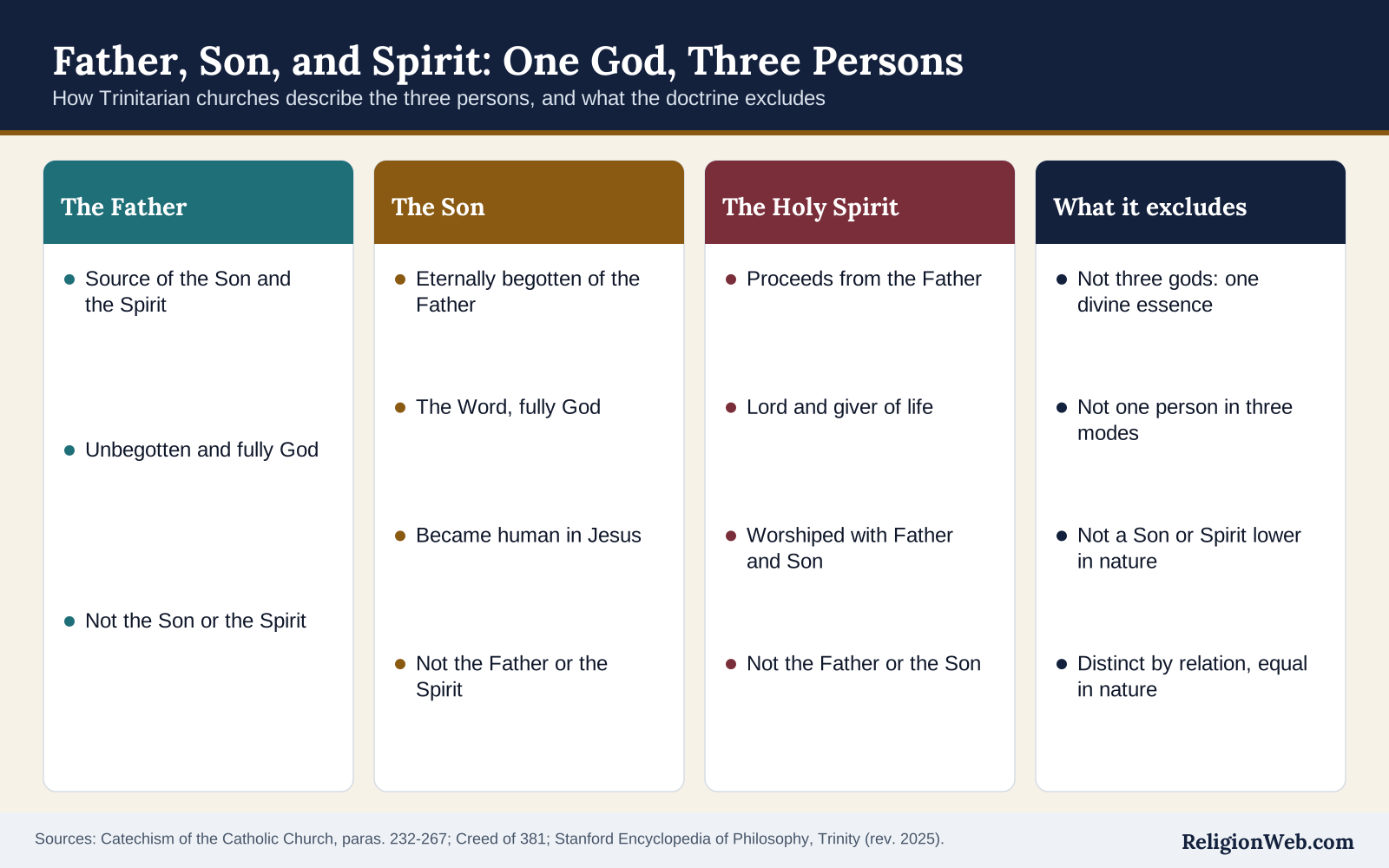
The standard formulation is short enough to memorize and dense enough to occupy theologians for centuries. There is one God, not three. This one God is the Father, the Son, and the Holy Spirit, each of whom is fully God. The three are not parts or portions of God, and they are not three separate beings who happen to cooperate; they share one divine being, which Greek-speaking writers called ousia and Latin-speaking writers called substantia or essentia.
The Catechism of the Catholic Church puts the matter in a sentence that many other traditions would also accept in substance: “We do not confess three Gods, but one God in three persons” (paragraph 253). The Orthodox, Anglican, Lutheran, Reformed, Baptist, Methodist, and Pentecostal traditions each have their own confessional wording, and later sections show how they differ in emphasis. What they share is the combination of two claims that can seem to pull apart: God is one, and the Father, the Son, and the Spirit are each truly God and truly distinct from one another.
Christian writers consistently call this a mystery, and they mean something specific by the word. It does not mean a puzzle that can be solved or a contradiction that must be accepted blindly. It means a reality that exceeds what human concepts can fully contain, so that the doctrine marks the boundaries of correct speech about God rather than offering a complete picture. The Catechism calls the Trinity “the central mystery of Christian faith and life” (paragraph 234).
What “person” does and does not mean
The word “person” causes more confusion than any other term in the doctrine, because its everyday meaning has shifted. In ordinary modern English a person is an individual self with a separate mind, will, and body. If that meaning is read into the creeds, “three persons” sounds like three gods. The Latin persona and the Greek hypostasis and prosopon carried older shades of meaning: an individual subject of existence, a concrete someone distinguished by relationships rather than by being a separate kind of thing. Philosophers who write on the subject, including the author of the Stanford Encyclopedia of Philosophy entry on the Trinity, note that “person” has moved from a sense closer to “role” toward a sense closer to “self,” which is one reason the doctrine is harder to state today than it was in the fourth century.
Traditional Trinitarian theology therefore uses “person” for what is distinct among the three while insisting that nothing else is divided. The Father, the Son, and the Spirit are distinguished by how each relates to the others, not by differing in power, wisdom, goodness, or eternity. In Catholic teaching, for example, the divine persons are “relative to one another,” and the real distinction among them lies in their relations of origin (Catechism, paragraphs 254 and 255).
Where the Doctrine Appears in Christian Life
In creeds, baptism, and worship
For most Christians the Trinity is encountered less as a lecture than as a pattern of speech and action. A baptism is performed “in the name of the Father and of the Son and of the Holy Spirit.” Public worship opens or closes with Trinitarian blessings and doxologies, and the sign of the cross traces the same three names for many Catholic, Orthodox, Anglican, and Lutheran worshipers. Prayer is often addressed to the Father, through the Son, in the Holy Spirit, and the great creeds recited on Sundays are structured in three parts around the three persons.
This is why traditions that disagree about much else, such as how to baptize, how to celebrate the Eucharist, or how scripture and tradition relate, still often recognize one another’s baptisms if they use water and the Trinitarian name. The doctrine functions as a shared boundary marker of historic Christian worship. The article on Christian baptism covers the rite in detail, and later sections here return to the way Trinitarian language is built into liturgy.
Who affirms it today
The Pew Research Center’s 2025 study of the global religious landscape estimated that there were about 2.3 billion Christians in the world in 2020, or 28.8 percent of the global population. Pew does not measure belief in the Trinity directly, so there is no precise count of Trinitarian Christians. Roman Catholics, Eastern Orthodox, Oriental Orthodox, Anglicans, Lutherans, Reformed and Presbyterian churches, Baptists, Methodists, and most Pentecostal and independent churches all affirm it in their official teaching, which places the large majority of the 2020 total in churches that hold the doctrine. Individual believers may of course understand it more or less precisely than their churches do.
The World Council of Churches, a fellowship that reports 356 member churches on its website, describes its basis as the confession of Jesus Christ as God and Savior and a shared calling “to the glory of the one God, Father, Son and Holy Spirit.” Trinitarian faith is thus a common reference point in ecumenical life, even as the council’s members come from Orthodox, Anglican, Protestant, and other traditions with different structures of authority. A small number of Christian movements reject the doctrine or express it differently, and they are described in a dedicated section below.
Key Vocabulary at a Glance
Greek and Latin terms that carry the doctrine
Technical terms matter in this subject because the doctrine took shape through disputes over a few precise words. Several of them were borrowed from philosophy and then given settled theological meanings. The table collects the main terms in one place; the sections that follow explain how each came into use and why the fourth-century debates turned on them.
| Term | Language | Basic meaning | Role in the doctrine |
|---|---|---|---|
| Trinity (trinitas) | Latin (Greek trias) | “Threeness,” a triad | The name for the one God who is Father, Son, and Spirit |
| Ousia | Greek | Being, essence, substance | What the three persons share: one divine being |
| Hypostasis | Greek | Concrete individual existence | Became the Greek word for each of the three persons |
| Prosopon and persona | Greek and Latin | Face, role, character; later “person” | Latin word for each of the three; Greek parallel for hypostasis |
| Homoousios | Greek | “Of the same essence” | Nicaea’s word for the Son’s relation to the Father |
| Economy (oikonomia) | Greek | Management, plan | God’s saving action in history, as it is revealed to humans |
| Perichoresis | Greek (Latin circumincessio) | Mutual indwelling | How the persons are said to dwell in one another |
| Procession | Latin and Greek | Coming forth | How the Holy Spirit is said to originate |
| Modalism | Modern term | One God in successive modes | An early position rejected for erasing real distinction |
| Subordinationism | Modern term | The Son or Spirit ranked below the Father | A family of positions rejected for denying full equality |
Words for how the three are related
Besides the terms for unity and distinction, a second set of words describes what theologians call the relations of origin. The Father is traditionally said to be unbegotten, the Son to be begotten of the Father, and the Spirit to proceed. These verbs are not descriptions of events in time, since the tradition insists that none of the three has a beginning. They describe an eternal order of relationship, sometimes called the monarchy of the Father in Eastern theology, in which the Father is the source from which the Son and the Spirit receive the one divine nature without being made or created.
A further pair of terms distinguishes God as God is revealed in saving action from God as God is in eternity. The first is the economic Trinity, meaning the Father sending the Son and the Spirit in history; the second is the immanent or essential Trinity, meaning the eternal life of God. Most theologians hold that these are not two Trinities but one, so that what is revealed in history truly discloses who God is. The questions of how closely the two correspond, and how far human language can reach beyond revelation, remain live topics in modern theology and are taken up later.
Biblical Language Behind the Doctrine
The Foundation in Israel’s Scriptures
The oneness of God and the Shema
Christianity arose within Second Temple Judaism, and its earliest Scriptures took the oneness of God as a starting point rather than a conclusion. The fundamental confession of Israel’s faith, in the passage Jews call the Shema, is stated this way in the World English Bible:
“Hear, Israel: Yahweh is our God. Yahweh is one.”
Deuteronomy 6:4, World English Bible (Classic edition, public domain)
Christian Trinitarian theology reads this verse as a foundation that the doctrine is meant to preserve, not to overturn. The early church fathers who developed the teaching wrote against what they understood as polytheism and against any view that made the Son or the Spirit a lesser, separate god. In their reading, the confession that God is one remains fully in force, and the language of three persons is an attempt to describe how the Christian community came to speak of Jesus and the Spirit within that one God. Jewish tradition understands the Shema as an affirmation of absolute divine unity and does not read the Trinitarian development into it; the article on the Shema explains its meaning and use in Jewish worship on its own terms.
The Word, Wisdom, and Spirit of God
Christian writers also looked to the Hebrew scriptures for language about God’s agency in the world. The scriptures speak of the Spirit of God hovering over the waters in Genesis 1:2, of the divine Wisdom present at creation in Proverbs 8, and of the creative and prophetic Word of God in passages such as Psalm 33:6. In the Christian reading, these images prepared the way for speaking of the Son as the Word and of the Holy Spirit as the divine presence at work in creation and in prophecy. The plural wording of God’s speech in Genesis 1:26, where God speaks of making humankind in “our” image, was already read by many church fathers as a hint of plurality in God, although other readers, ancient and modern, take it as a heavenly council or a plural of majesty.
It is worth stating plainly that these are Christian readings made in light of the New Testament. Scholars of the Hebrew Bible generally do not find a doctrine of the Trinity in these texts, and most Trinitarian theologians do not claim that the doctrine could have been derived from them alone. The usual Christian claim is narrower: once the Christian community had experienced Jesus and the Spirit as divine, the earlier language of Word, Wisdom, and Spirit became available as a vocabulary for describing that experience.
The New Testament Witness
Triadic formulas in the apostolic writings
The New Testament contains no systematic treatment of the doctrine, but it does contain passages in which the Father, the Son, and the Spirit are named together as one pattern. The best known are the commission at the end of Matthew’s Gospel and the blessing at the close of Paul’s second letter to the Corinthians. The first is the origin of the baptismal formula used by most churches.
“Go and make disciples of all nations, baptizing them in the name of the Father and of the Son and of the Holy Spirit, teaching them to observe all things that I commanded you.”
Matthew 28:19-20 (opening of the passage), World English Bible (Classic edition, public domain)
Several features of this sentence matter to the way Trinitarian traditions read it. The word “name” is singular, which the Fathers took to indicate one divine name for the three. The three are named together in a single act of initiation, as the basis of a person’s new life in the community. Historians of liturgy note that Acts also describes baptisms “in the name of Jesus” (for example Acts 2:38 and 10:48), and they debate how the Matthean wording relates to earliest practice; the manuscript tradition of Matthew, however, carries the longer formula. Churches that hold the doctrine generally read the Acts passages as shorthand for Christian baptism and the Matthew passage as the full form.
“The grace of the Lord Jesus Christ, God’s love, and the fellowship of the Holy Spirit be with you all. Amen.”
2 Corinthians 13:14, World English Bible (Classic edition, public domain)
This blessing is often called the Pauline benediction, and it is still spoken at the close of services in many liturgical traditions. It is not an explanation of how three can be one, but it names Jesus Christ, God, and the Spirit as the shared source of grace, love, and communion. Other triadic texts include 1 Corinthians 12:4-6, which ties together Spirit, Lord, and God as the source of different gifts, Ephesians 4:4-6 with its sequence of one Spirit, one Lord, and one God and Father, and 1 Peter 1:2.
Passages on the Son and the Father
The Gospel of John opens by speaking of the Word who was “with God” and who “was God” (John 1:1), and later says that the Word “became flesh” (John 1:14). The letter to the Philippians, in the hymn of 2:5-11, speaks of Christ Jesus, who existed in the form of God and emptied himself in a human life and death. In John 20:28 Thomas addresses the risen Jesus as his Lord and his God. Trinitarian theologians take such texts, with many others, as the biblical basis for confessing that the Son is fully divine, as developed in the article on Jesus Christ.
The same Gospel also contains sayings that appear to place the Son below the Father, such as John 14:28, where Jesus says that the Father is greater than he is. Historic Trinitarian teaching has handled these sayings in two main ways. One reading, common in the Fathers, applies them to the Son in his human nature, in which he is less than the Father. A second applies them to the order of origin within God, in which the Father is the source of the Son without the Son being lesser in nature. Both readings were developed to keep the full divinity of the Son while taking such passages seriously, and the tension between sayings of equality and sayings of subordination is exactly where the fourth-century controversies grew.
Passages on the Holy Spirit
The New Testament speaks of the Spirit in personal terms in several places. In John 14 to 16, Jesus promises the Spirit as another Advocate, who will teach, remind, guide, and testify, and who, in John 15:26, is said to proceed from the Father. In Acts 5:3-4, Peter tells Ananias that lying to the Holy Spirit is lying to God. In Acts 2, the Spirit’s coming at Pentecost is the founding event of the church, which is why the festival of Pentecost has a central place in the doctrine’s liturgical memory. Most Trinitarian traditions take these passages to show that the Spirit is not an impersonal force but a divine person who acts, speaks, and can be grieved.
| Passage | What it says in context | How Trinitarian traditions use it | Interpretive note |
|---|---|---|---|
| Deuteronomy 6:4 | Israel’s confession that the Lord is one | Foundation for insisting that God is one, not three gods | Jewish tradition reads it as strict unity without a Trinitarian dimension |
| Genesis 1:26 | God speaks in the plural about making humankind | Read by many Fathers as a hint of plurality in God | Other readers see a heavenly council or a plural of majesty |
| Matthew 3:16-17 | Jesus is baptized; the Spirit descends; a voice speaks | Seen as the three acting at once and as distinct | Used against the idea of three successive modes |
| Matthew 28:19 | Disciples baptize “in the name of the Father and of the Son and of the Holy Spirit” | Source of the baptismal formula | Acts also mentions baptism “in the name of Jesus” |
| John 1:1, 14 | The Word is with God, is God, and becomes flesh | Central text for the Son’s divinity and incarnation | Debated in the fourth century by the Arian party |
| John 14:16-17, 26; 15:26 | Jesus promises the Spirit, who proceeds from the Father | Source of language about the Spirit’s personhood and origin | Basis for the later Eastern and Western arguments over procession |
| John 14:28 | Jesus says the Father is greater than he is | Read as speaking of the Son’s humanity or of the order of origin | Cited by subordinationist readers as showing a lower rank |
| John 20:28 | Thomas addresses the risen Jesus as Lord and God | Affirmation of the Son’s full divinity | Read by some interpreters as a devotional exclamation |
| 1 Corinthians 12:4-6 | Different gifts from one Spirit, one Lord, one God | Triadic pattern in the church’s life | A pattern of naming, not a full explanation |
| 2 Corinthians 13:14 | Blessing naming Lord Jesus Christ, God, and the Spirit | Model for liturgical greetings | Not a statement of nature or relation |
| Acts 5:3-4 | Lying to the Holy Spirit is lying to God | Evidence of the Spirit’s divinity and personhood | Read by some as a metaphor for God’s presence |
| 1 John 5:7-8 | Three who testify: the Spirit, the water, and the blood | Later copies expanded it with an explicit Trinitarian statement | The expanded wording is absent from the earliest manuscripts |
How Interpreters Handle the Evidence
The doctrine as a summary of scripture
Trinitarian churches generally describe the doctrine as an attempt to say what the whole biblical witness requires rather than as a deduction from a few proof texts. In their reading, the Bible presents one God, presents the Father, the Son, and the Spirit as each acting divinely and each spoken of as God, and presents them as distinct from one another in the Gospel narratives, where the Son prays to the Father and the Spirit descends on the Son. The doctrine, in this view, holds these affirmations together. This is also why different traditions can honor the same creeds while differing about authority: Catholic and Orthodox theology treat the creeds as expressions of apostolic tradition read within the church, while many Protestant bodies treat them as authoritative because they are judged to faithfully summarize scripture.
Not every scholar describes the doctrine this way. Many historians and some theologians, including some within Trinitarian churches, hold that the doctrine as it was formulated in the fourth century is a later development that goes beyond the text of the New Testament, though they differ about whether that development was faithful or an unwarranted addition. The Stanford Encyclopedia of Philosophy entry quotes William Hasker’s statement that “the Church’s doctrine of the Trinity is not as such to be found in the New Testament.” Trinitarian traditions answer that development of this kind is exactly what is to be expected when later questions are put to earlier texts.
Textual questions and the limits of proof texts
One well-known case shows why scholars are careful with isolated verses. In the World English Bible, 1 John 5:7 reads “For there are three who testify:” and a footnote says that only a few recent manuscripts add the words “in heaven: the Father, the Word, and the Holy Spirit; and these three are one.” That expanded reading, long known as the Johannine Comma, appears in the Latin tradition and in a small number of late Greek copies, and it is absent from the earliest Greek manuscripts and from nearly all modern critical editions and translations. Most Trinitarian scholars today do not rely on it, and the doctrine does not depend on it.
The wider lesson is that the doctrine’s defenders and critics both have to work with the whole body of texts. A single verse rarely settles a question, and the interpretive tradition matters: how a church reads the Fathers, how it relates scripture to the creeds, and which passages it treats as controlling. The following sections turn from the texts to the history, because the vocabulary Trinitarian theology uses was worked out in specific places, by specific people, in response to specific disputes.
Early Christian Development Before Nicaea
Second-Century Beginnings of Trinitarian Language
Baptism and the rule of faith
The first Christians did not begin with a doctrine of the Trinity; they began with a practice. The Didache, an early church manual that most scholars date between the late first century and the early second century, directs that baptism be performed in the name of the Father and of the Son and of the Holy Spirit, in running water if possible, and that water be poured three times on the head if no other means is available. The text is in Lightfoot’s translation of the Apostolic Fathers, and its date and composition remain debated, but it shows a threefold baptismal pattern in use very early. Justin Martyr, writing in Rome in the middle of the second century, describes baptism with a similar threefold naming, and the second-century bishop Irenaeus of Lyons speaks of a received rule of faith that confessed the Father, the Son, and the Spirit.
In other words, the worshiping community was already speaking of the three together long before anyone defined how they related. Theological reflection followed the liturgy. The baptismal questions put to candidates in the early centuries, and the creeds that grew out of them, took the form of three confessions: belief in God the Father, in Jesus Christ, and in the Holy Spirit. This is the pattern that later made the Apostles’ Creed and the Nicene Creed three-part texts. Many Trinitarian theologians cite it as evidence that the doctrine grew out of lived worship and not simply from speculation.
Logos theology and the first uses of “Trinity”
Second-century writers called apologists tried to explain Christian belief to a Greek-speaking world, and many of them used the idea of the Logos, the Word or Reason of God, to speak of the Son. Justin and others described the Logos as God’s agent in creation and revelation, distinct from the Father yet divine. This kind of reflection gave Christians a way of affirming that Jesus Christ was divine without abandoning the oneness of God, though early versions often left unclear whether the Word had always existed alongside the Father or came forth at the moment of creation. That ambiguity would matter greatly later.
The word that eventually named the whole pattern appears first in Greek and then in Latin. Theophilus, bishop of Antioch in the late second century, uses a Greek word for a triad in his work addressed to Autolycus, and Tertullian, a North African writer, uses the Latin trinitas in the early third century, around 213 CE, in his treatise Against Praxeas. Both uses are occasional, not systematic, and neither writer was defining a doctrine for a council. They are evidence that the vocabulary came into Christian speech before the full doctrine was agreed.
Early Debates Over Unity and Distinction
Monarchian and modalist positions
By the end of the second century and the early third, some Christians worried that talk of the Word as a distinct figure endangered the oneness of God. They are grouped under the label Monarchians because they stressed the single divine rule, or monarchy. One strand taught that Jesus was a man adopted by God and empowered by the divine Spirit. Another, usually called modalism or Sabellianism after the Roman teacher Sabellius, held that Father, Son, and Spirit are successive names or modes in which the one God appears: the Father in creation and law, the Son in redemption, the Spirit in sanctification. Writers such as Noetus, Praxeas, and Sabellius are named in the sources that survive, though those sources were written by their opponents, and historians caution that the positions are known mainly through criticism.
The mainstream response, found in Tertullian’s Against Praxeas and the Roman writer Hippolytus, was that the Gospels show the three acting together and speaking to one another. At the baptism of Jesus the Son is in the water, the Spirit descends, and a voice from heaven speaks, and such a scene would make little sense if one subject only appeared in different guises. This is one reason modalism has been treated in Trinitarian churches as an error about the Trinity, not a version of it. It is also what the diagram in the first infographic is designed to clarify.
Tertullian, Origen, and the problem of rank
Tertullian described the relationship in terms that anticipated later usage. He spoke of one substance shared by three persons, and he used the image of a root, a shoot, and a fruit to suggest that distinction does not imply separation. His position is often summarized in the Latin formula una substantia, tres personae, which became the backbone of Western Trinitarian language. At the same time, his wording about the Son’s coming forth from the Father sometimes left an impression of lower status, a tendency known as subordinationism.
Origen of Alexandria, a Greek-speaking scholar of the early third century, pushed Eastern thought in a different direction. He taught that the Son is eternally begotten of the Father, with no moment when the Son did not exist, and he thereby gave the East a concept that later Nicene writers would rely on. Yet Origen also described the Son as subordinate to the Father in ways that later parties could cite for very different purposes. Both the defenders and the opponents of Nicaea could claim him as a source. The result by the early fourth century was a church in which a shared devotion to Father, Son, and Spirit coexisted with unresolved questions about how the Son and the Spirit stood in relation to the one God.
From Arius to Constantinople: The Fourth-Century Controversies
The Crisis at Alexandria and the Council of Nicaea
Arius, Alexander, and the question about the Son
The dispute that produced the Council of Nicaea began in Alexandria around 318 to 320. Arius, an Alexandrian priest, taught that the Son, the Word, had a beginning and was not coeternal with the Father, even though he was the first and greatest of God’s creatures and the agent through whom all else was made. To Arius and his supporters this protected the uniqueness of the unbegotten God. Alexander, the bishop of Alexandria, and his younger associate Athanasius saw it differently: if the Son was a creature, they argued, then Christians who worshiped him and looked to him for salvation were attributing to a created being what belongs to God alone.
According to the New Catholic Encyclopedia, Arius was excommunicated by a synod of about one hundred Egyptian and Libyan bishops around 320 and expelled from Alexandria, but he found support among bishops elsewhere in the East. Both sides appealed to scripture. Arius’s party pointed to texts such as Proverbs 8:22 and John 14:28, which seemed to place the Son beneath the Father, while their opponents answered with John 1:1 and the many passages that call the Son Lord and God. The dispute spread quickly, and by 324 Emperor Constantine, who now controlled both halves of the empire, was concerned about the unity of the churches.
The council of 325
Constantine summoned a general gathering of bishops to Nicaea in Bithynia, the modern city of Iznik in northwestern Turkey, probably near the end of 324. The council met in the summer of 325, and the New Catholic Encyclopedia puts attendance at about three hundred bishops, most of them from the eastern half of the empire. The traditional figure of 318 is described there as symbolic. It was the first general council of the church, and it produced a creed, a set of twenty disciplinary canons, and an agreement on a common date for Easter, a subject covered in the article on Easter.
The creed began from a baptismal creed that Eusebius of Caesarea proposed, and a majority added clauses meant to exclude the teaching of Arius. Arius and two bishops, Secundus and Theonas, refused to subscribe and were sent into exile in Illyricum. It would be misleading to picture the council as one quick vote, because the surviving accounts show debate over the wording of the creed, and the creed’s content concentrated on the Son. On the Holy Spirit it said only that the signers believed “in the Holy Ghost,” a point that matters for the later controversy. The statement about the Son shows the core of the decision:
“and in one Lord Jesus Christ, the Son of God, the only-begotten of his Father, of the substance of the Father, God of God, Light of Light, very God of very God … being of one substance (omoousion, consubstantialem) with the Father.”
Creed of Nicaea (325), English translation in Percival, Seven Ecumenical Councils (Nicene and Post-Nicene Fathers, 2nd series, vol. 14), as presented in the Fordham Internet Medieval Sourcebook; the ellipsis marks omitted words
What homoousios meant and why it was contested
The Greek word homoousios, rendered “of one substance” or “of the same essence,” is the hinge of the creed. It is not found in scripture, and the New Catholic Encyclopedia calls it the creed’s most significant word, adding that it was not biblical and was rejected by the Arians. Its purpose was to say that the Son does not belong to the order of created things; he shares the very being of the Father. The council chose a non-biblical word because the Arian party was willing to accept almost any scriptural phrase, and a phrase that could be read two ways would not exclude their view.
The same word raised worries on the other side. In the East some bishops feared that homoousios could be heard as implying that the Father and Son were one individual, which would resemble modalism, and the creed’s own wording did not help, because its closing condemnation treated ousia and hypostasis as practically equivalent terms. The language was therefore settled only partly. The task of showing how a shared ousia could be combined with a real distinction among three hypostaseis was left to later theologians. That is why Nicaea was a beginning rather than an end of the doctrine’s development.
Decades of Dispute After Nicaea
Athanasius and the Nicene party
The council did not end the controversy, and for much of the next half century it was not clear whose reading of the faith would prevail. Athanasius, who became bishop of Alexandria in 328 and held the see until his death in 373, became the most persistent defender of the Nicene language. He was exiled from his city several times as imperial and ecclesiastical fortunes shifted, and in his writings he argued that salvation requires that the Son be truly God, since only God could share divine life with human beings. Later he extended the same argument to the Holy Spirit. Along with the Cappadocian writers, Athanasius is honored in Catholic, Orthodox, and many other traditions, as described in the article on saints in Christianity.
The decades after 325 are sometimes narrated as a simple contest between Arians and Nicenes, but historians now describe a more varied field. Many bishops who were uneasy about Arius were also uneasy about homoousios, and they sought other formulas. The term “Arian” was largely a label applied by opponents, and several groups so named would not have accepted it.
Homoian, Homoiousian, and Anomoean parties
Several distinct positions emerged. The Homoians said that the Son is “like” the Father and avoided the language of ousia altogether, a view that enjoyed imperial favor under Constantius II and was set out in a series of creeds in the late 350s and a council at Constantinople in 360. The Homoiousians, associated with bishops such as Basil of Ancyra, said that the Son is “like in essence,” a formula that came close to the Nicene view. The Anomoeans, whose best-known figures were Aetius and Eunomius, argued that the Son is “unlike” the Father in essence and that human reason can know God’s essence, a position that Basil of Caesarea and Gregory of Nyssa answered at length.
These labels clarify why the debate lasted. The question was not only whether the Son is divine but what words could say so without importing the errors that both sides feared. By the 360s a group of Homoiousian and Nicene bishops were moving toward agreement, and the groundwork for a settlement was being laid. What remained was to supply a vocabulary that distinguished clearly between what the three share and what distinguishes them.
Emperors, councils, and church politics
Imperial power shaped the controversy without deciding its content. Constantine summoned Nicaea and enforced its decrees, Constantius II favored the Homoian side, Valens later supported Homoians in the East, and Theodosius I, who became emperor in 379, supported the Nicene side. In February 380 Theodosius issued a decree from Thessalonica directing his subjects to follow the faith received from the apostle Peter at Rome, which was understood to mean the Trinitarian faith of Father, Son, and Holy Spirit in equal majesty. Exile and deposition were common tools, and several bishops lost their sees more than once.
It would nevertheless be inaccurate to describe the doctrine as simply imposed by emperors. Bishops resisted imperial wishes in both directions, and the case for the Nicene position was argued from scripture and from the church’s practice of baptism and worship for decades before any imperial decree. Historians continue to debate the weight of political and theological factors, and the answer is that both were at work.
The Cappadocians, the Spirit, and Constantinople in 381
Basil, Gregory of Nazianzus, and Gregory of Nyssa
Three bishops from Cappadocia in central Asia Minor supplied the distinction that made the Nicene settlement workable. Basil of Caesarea, his friend Gregory of Nazianzus, and Basil’s younger brother Gregory of Nyssa taught that God is one ousia in three hypostaseis: one being, three concrete subjects. They answered the charge of tritheism by arguing that the three share a single nature and a single activity, and they answered the charge of modalism by insisting that each of the three is a real subject distinguished by a particular relation. Basil also helped shape the monastic tradition described in the article on Christian monasticism.
Gregory of Nazianzus, who from 379 preached to a small Nicene congregation in Constantinople, wrote of the experience of this balance with a line that has often been cited:
“No sooner do I conceive of the One than I am illumined by the Splendour of the Three …”
Gregory of Nazianzus, Oration 40 (On Holy Baptism), chapter 41, English translation as presented by New Advent (Nicene and Post-Nicene Fathers, 2nd series, vol. 7; translator not confirmed on the page)
In context Gregory continues by saying that, in turn, as soon as he distinguishes the Three he is carried back to the One. The sentence is cited in Eastern and Western traditions alike as an expression of what the doctrine is meant to preserve: the unity is not lessened by the distinction, and the distinction does not break the unity.
The question of the Holy Spirit
By about 360, the controversy had spread to the third person. A group whom opponents called Pneumatomachi, “fighters against the Spirit,” and who are sometimes called Macedonians, accepted that the Son was divine but denied that the Spirit should be called God. Athanasius, Basil, and the two Gregorys answered this position with arguments drawn from baptism and worship. If Christians are baptized into the name of the Spirit together with the Father and the Son, and if they glorify the Spirit in the doxology, then the Spirit cannot be less than divine.
Basil’s treatise On the Holy Spirit, written around 375, makes this argument from liturgical practice, and many historians observe that he was careful in his language in a politically sensitive time. Gregory of Nazianzus was more direct in declaring that the Spirit is God. Their writing established the principle that the Spirit is worshiped and glorified together with the Father and the Son, wording that later entered the creed of 381.
The council of 381 and its creed
The Council of Constantinople met from May to July 381 at the invitation of Emperors Theodosius I and Gratian, with about 150 bishops mostly from the eastern provinces. Meletius of Antioch presided at first and Gregory of Nazianzus took over after Meletius died; Gregory later resigned and was succeeded by Nectarius. The council confirmed the faith of Nicaea, condemned the main Arian and Pneumatomachian positions, and, according to the New Catholic Encyclopedia, affirmed the consubstantiality and coeternity of the three divine persons. The council’s own acts are lost, so much of what is known comes from later documents.
The creed that Christians today call the Nicene Creed is usually the form associated with this council, and it expands the clause on the Spirit considerably. A modern translation of the clause is not needed here, since the older English version in Schaff’s Ante-Nicene Fathers shows the language clearly:
“The Lord, the Giver of life, Who proceedeth from the Father; …”
Nicene Creed, addenda authorized at Constantinople (381), English translation in Ante-Nicene Fathers, vol. 7, ed. Philip Schaff, pp. 524-526 (CCEL)
The text goes on to say that the Spirit is worshiped and glorified together with the Father and the Son and spoke through the prophets. Scholars debate how directly the creed of 381 descends from the creed of Nicaea, and some argue that it is rooted in an older baptismal creed of the Jerusalem region. Rome received the creed of 381 at the Council of Chalcedon in 451, according to a Vatican text on the Filioque, and it became the baptismal and eucharistic creed of the East and, in time, of the West.
Key dates in one view
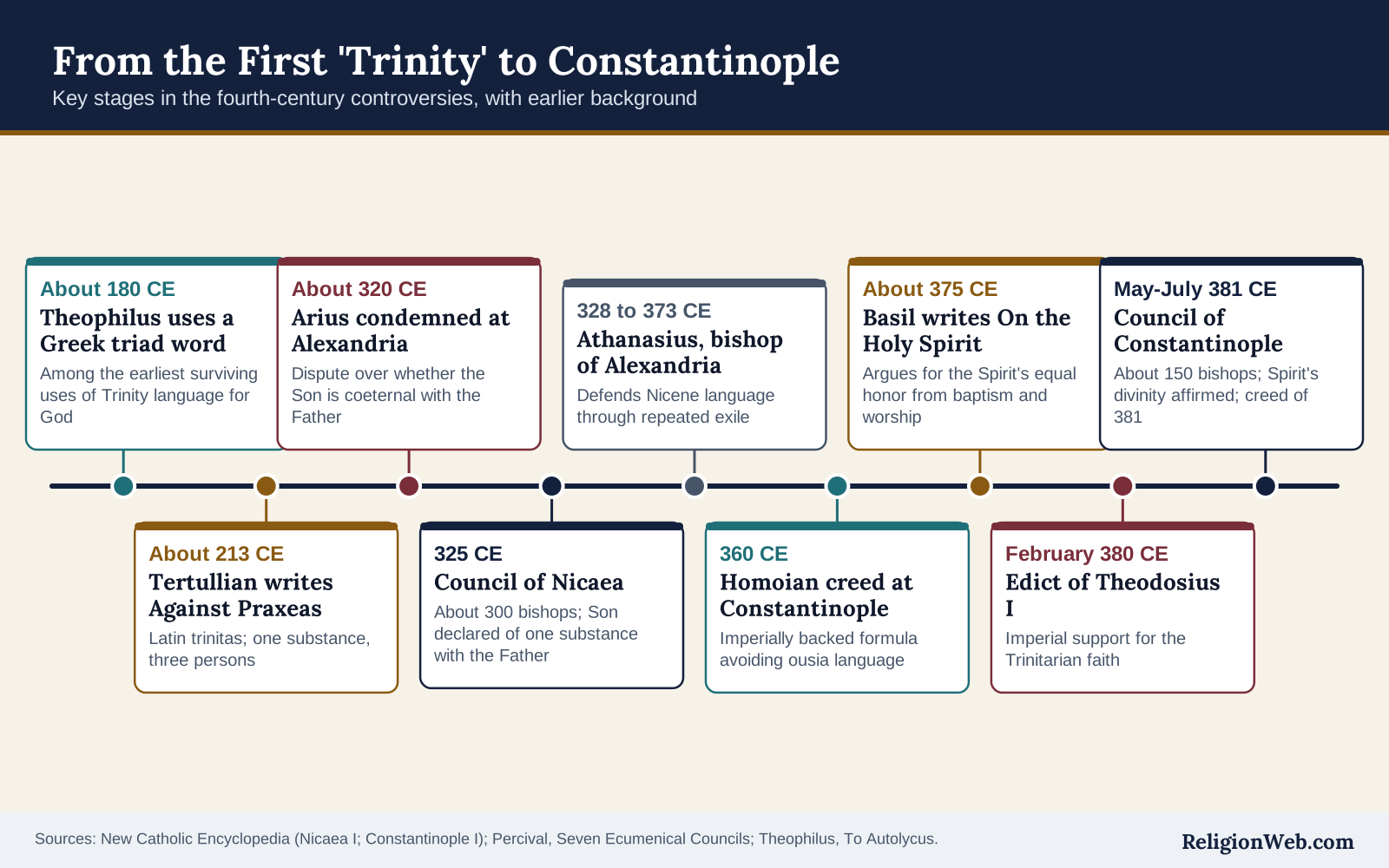
Because the sequence is complex, the table below sets out the main stages from the earliest use of Trinitarian vocabulary to the council of 381. The dates for the earliest writers are approximate, and the dates for the controversies are those given in the encyclopedic and scholarly sources named in the notes.
| Date | Event | Significance for the doctrine |
|---|---|---|
| About 180 CE | Theophilus of Antioch uses a Greek triad word in a work addressed to Autolycus | Among the earliest surviving uses of “Trinity” language for God |
| About 213 CE | Tertullian writes Against Praxeas | Latin trinitas; one substance, three persons; reply to modalism |
| About 320 CE | A synod in Alexandria excommunicates Arius | Opens the dispute over whether the Son is coeternal with the Father |
| 325 CE | Council of Nicaea, called by Constantine | Declares the Son homoousios with the Father; says little on the Spirit |
| 328 to 373 CE | Athanasius is bishop of Alexandria | Defends Nicene language through repeated exile |
| Late 350s to 360 CE | Homoian creeds and a council at Constantinople | Imperially backed formula avoiding ousia language |
| About 375 CE | Basil of Caesarea writes On the Holy Spirit | Argues for the Spirit’s equal honor from worship and baptism |
| February 380 CE | Theodosius I issues an edict at Thessalonica | Imperial support for the Trinitarian faith |
| May to July 381 CE | Council of Constantinople | Confirms Nicaea; affirms the Spirit’s divinity; creed of 381 later associated with it |
One Essence, Three Persons: How the Doctrine Is Explained
Unity and Distinction in Classical Teaching
One divine nature, three who share it
Classical Trinitarian teaching starts from the unity of God and then asks what can be said about distinction. God is one in nature, power, knowledge, goodness, and eternity. These are not divided among the three persons as shares of a whole; each person is fully God, and the three are one God. The Catechism of the Catholic Church expresses the same idea by saying that the three persons are “inseparable in what they are” and therefore also inseparable in what they do (paragraph 267). Eastern writers say much the same when they speak of one will and one activity of the Godhead. In this view there is no task that belongs to one person alone, since creation, redemption, and sanctification are works of the one God.
If all three act together, why does Christian speech so often assign particular works to particular persons? Theologians answer with the idea of appropriation. Creation is customarily attributed to the Father, redemption to the Son, and sanctification to the Spirit, not because the others are absent but because the pattern shows forth each person’s distinct relation to the others. The New Testament itself supports this way of speaking, since it presents the Son as sent and incarnate and the Spirit as given at Pentecost, which is the “economy” of salvation mentioned earlier. The distinct roles in history reveal real distinctions in God, but they do not divide God’s action.
Relations of origin: unbegotten, begotten, proceeding
If the three are not distinguished by nature, power, or knowledge, the tradition says they are distinguished by their relations to one another. The Father is the unbegotten source, in the Greek tradition the one from whom the Son and the Spirit receive the divine nature. The Son is begotten of the Father, and the Spirit proceeds. Teachers speak of the eternal generation of the Son to indicate that this begetting is not an event in time, because there never was a time when the Son was not. The vocabulary is analogical, since human language of begetting is used for what is beyond ordinary experience, and the Fathers took pains to say that nothing in God is material or subject to change.
Not every contemporary Trinitarian shares the full traditional vocabulary. In recent decades some evangelical and Reformed writers have debated whether eternal generation is a necessary part of orthodoxy and whether the Son’s submission to the Father in the incarnation reflects an eternal relationship. These internal discussions show that the doctrine is not static, though all parties to them intend to remain within the Nicene confession. The persons themselves are best understood when taken one at a time.
The Three Persons in Turn
The Father as source
In Trinitarian teaching, the Father is not simply the first of three equals in a list but the source from whom the Son is begotten and from whom the Spirit proceeds. Eastern theologians call this the monarchy of the Father, and the Catholic Church affirms that the Father is the first origin of the whole Godhead, while stressing that this does not make the Father more divine. The word “Father” is therefore used first of the relationship to the Son, and only secondarily as a name for God as creator. Christians also say that God addresses humanity as Father in the prayer Jesus taught, as the article on the Lord’s Prayer describes.
The tradition has always held that the word “Father” is not a claim that God is male. Classical authors insist that God has no body and no sex, and that “Father” and “Son” are names given in revelation. The question of how best to use or supplement this language in modern liturgy is a live topic in several churches, and the section on modern discussion below describes it.
The Son and the incarnation
The Son, called the Word in the Gospel of John, is said to be eternally with the Father and to have become human in Jesus of Nazareth. The doctrine of the Incarnation, in the creeds, says that the Son became flesh through the Holy Spirit and the Virgin Mary; the article on the Virgin Mary discusses how traditions understand her role. The Christological questions that follow, such as how divine and human natures are related in one person, were addressed at the Councils of Ephesus in 431 and Chalcedon in 451 and are treated in the article on Jesus Christ. The two doctrines are connected but distinct: the Trinity concerns who God is, and Christology concerns who Jesus is.
The Trinitarian claim is that the person who became human is the second person of the Trinity, not a lesser being sent by God. For this reason Trinitarian churches describe the incarnation as God’s self-giving and not simply as God’s messenger arriving. For the same reason, the cross and the resurrection are described in Trinitarian terms: the Son offers himself to the Father, and the Spirit is the one through whom, in the New Testament’s language, Christ was raised.
The Holy Spirit as giver of life
The Spirit is the least visible of the three in popular imagination, partly because the New Testament often uses images of wind, breath, fire, and water, and partly because the Spirit’s work is usually described as making others known. The creed calls the Spirit “the Lord, the Giver of life,” and traditions describe the Spirit as present in creation, in the inspiration of scripture, in the sacraments, and in the life of the church and of individual believers. In the Pentecost narrative of Acts 2 the Spirit is described as given to the whole community, and Pentecostal and charismatic movements emphasize the Spirit’s gifts in worship, as described in the article on Pentecostal Christianity.
Trinitarian doctrine holds that the Spirit is a divine person and not merely God’s power or influence. The Fathers who made this argument pointed to the way the New Testament speaks of the Spirit teaching, speaking, interceding, and being grieved. They also pointed to baptism, which includes the Spirit’s name beside the others. The Spirit’s relation to the Father and the Son is the subject of the East and West discussion treated in a later section.
Creedal Language Across the Centuries
Reading the creeds together
The Trinity is spelled out most precisely in the creeds, which have different origins and uses. Some began as baptismal confessions, some as statements adopted by councils to settle a dispute, and some as private or catechetical summaries that later gained wide use. The table gives an overview of the principal texts that Trinitarian churches use, with their approximate dates and distinctive wording about the Father, Son, and Spirit.
| Text | Approximate date and setting | Language about the three | Distinctive features |
|---|---|---|---|
| Apostles’ Creed | Developed from the Old Roman baptismal creed; the received Western form is later | Belief in God the Father almighty, in Jesus Christ his only Son, and in the Holy Spirit | Three-part baptismal structure; used mainly in Western churches; not written by the apostles |
| Creed of Nicaea | 325 CE; a council creed | The Son is of the substance of the Father; “of one substance” with him | Anathemas against teaching that the Son is a creature; brief on the Holy Spirit |
| Nicene-Constantinopolitan Creed | Associated with the council of 381 and received more widely after Chalcedon in 451 | Expands on the Spirit: Lord, giver of life, proceeding from the Father, worshiped and glorified with the Father and Son | The creed recited in most liturgical churches; Western text adds “and the Son” |
| Athanasian Creed (Quicumque) | Probably fifth or sixth century; named for Athanasius but not written by him | One God in Trinity and Trinity in unity; neither confusing the persons nor dividing the substance | Used in Western churches, more rarely today; includes the Filioque |
| Western form with the Filioque | Taught in Spanish councils from 589; in the Creed by the late eighth century; in Rome’s liturgy from 1014 | The Spirit proceeds from the Father and the Son | Not in the 381 text; the source of the East and West discussion |
The Athanasian Creed and later Western statements
The Athanasian Creed, also known by its opening Latin words Quicumque vult, is a long and carefully balanced text that was long attributed to Athanasius but is now generally dated to the fifth or sixth century and associated with the Latin West. It states in precise paragraphs that the Father, the Son, and the Holy Spirit are each uncreated, each almighty, each eternal, and yet that there are not three almighties but one. It has been used liturgically in medieval and some modern Western churches and appears in Lutheran confessional collections and in the Anglican Book of Common Prayer tradition.
Augustine of Hippo wrote a major work on the Trinity in the early fifth century and argued that the traces of the Trinity can be seen in the human mind in its remembering, understanding, and loving. Later Western medieval writers, among them Thomas Aquinas in the thirteenth century, developed Latin scholastic accounts of the relations of origin. The Fourth Lateran Council of 1215 and the Second Council of Lyons in 1274 affirmed the Trinitarian faith and the Filioque, and the Reformation churches in the sixteenth century repeated the ancient creeds in their own confessions. The development did not end with the Fathers, though its central vocabulary was set by them.
Analogies and Their Limits
Why teachers reach for analogies
Anyone who tries to explain the Trinity soon looks for a picture, and Christian teachers from the Fathers to modern catechists have offered many. A picture can help a learner grasp that three can be spoken of as one, but any picture will also suggest something false, since the doctrine concerns the only God and nothing created is exactly like God. Theologians therefore describe analogies as aids that must be checked against the creed. A good analogy is one whose failure is understood as well as its helpfulness.
Some popular illustrations are in effect the very positions the Fathers rejected. Water in three states that are never simultaneous resembles modalism, and a whole divided into parts resembles a form of tritheism in which each person is only a portion of God. Teachers in many traditions say plainly that it is better to use an analogy with a stated limit than to avoid analogies altogether, or to pretend that the doctrine can be explained exhaustively.
Common analogies and their limitations
The table lists several of the best-known illustrations, what each is meant to show, and the problem each is generally said to raise. The entries are drawn from patristic and modern teaching rather than from any single church document, so the cautions are those commonly made by Trinitarian teachers and theologians.
| Analogy | What it tries to show | Where it falls short | Tendency it risks |
|---|---|---|---|
| Water as ice, liquid, and steam | One substance in three forms | One sample of water is in one state at a time; the persons coexist eternally | Modalism |
| An egg with shell, white, and yolk | Three components in one thing | The persons are not parts; each is fully God | Partition of God into parts |
| A shamrock with three leaves on one stem | Three distinct items belonging to one plant | Leaves are parts of a plant; a traditional story links this image to Saint Patrick, but its historical basis is uncertain | Partition of God into parts |
| The sun, its light, and its heat | Source and radiance sharing a nature | Can suggest that the Son and Spirit are lesser effects of the Father | Subordinationism |
| Augustine’s memory, understanding, and love in one mind | Three distinct acts that are one person | Describes a single human person with three faculties, not three persons | Modalism if pressed literally |
| Three human persons sharing one humanity | Three distinct subjects with one common nature | Human persons are separable and have separate wills; Gregory of Nyssa himself acknowledged the limit | Tritheism |
East and West: Terminology and Emphasis
The Filioque Question
How the clause entered Western practice
The most discussed difference in Trinitarian language between Eastern and Western churches concerns a single Latin word. Filioque, meaning “and from the Son,” is the phrase added in the West to the creed’s statement that the Holy Spirit proceeds from the Father. According to a 1995 clarification by the Pontifical Council for Promoting Christian Unity, the text of 381 confesses the Spirit as taking origin from the Father, and Western Fathers such as Hilary, Ambrose, Augustine, and Leo taught that the Spirit proceeds from the Father and the Son. The phrase spread in the West from the fifth century and was used by the Councils of Toledo from 589 to affirm the equality of the three persons against Arianism.
The same document says that the phrase appears in the creed itself by the late eighth century, at Aquileia in 796 and Aachen in 809. Pope Leo III resisted the addition in the interest of unity with the East, and Rome admitted it into the liturgical creed only in 1014. At the Second Council of Lyons in 1274 the Latin church stated that the Spirit proceeds “as from one single principle,” a phrase the Vatican text reads as meaning that the Father and the Son together, not the divine essence, are the one source. The Catechism likewise notes that the Filioque “does not appear in the Creed confessed in 381 at Constantinople” (paragraph 247).
What each side affirms and objects to
Both traditions agree that the Father is the ultimate source of the Son and the Spirit. The disagreement concerns whether the Son also has a part in the Spirit’s origin, and the document draws a distinction in vocabulary that has helped dialogue. The Greek ekporeusis names the Spirit’s origin from the Father alone, as the “principle without principle,” while the Latin processio is a broader term for the communication of divinity from the Father through or with the Son. The Vatican text calls the translation of the Greek by the Latin procedentem a “false equivalence” that obscured this difference.
Orthodox churches reject the formula “from the Father and the Son” as a statement of the Spirit’s origin and object to inserting it into the creed without a common council. They commonly prefer the expression that the Spirit proceeds from the Father “through the Son,” which is found in Basil, Maximus the Confessor, and John of Damascus. The Catholic Church holds that the Filioque expresses a legitimate truth but does not require that it be added to the Greek creed, and it treats the original Greek use as legitimate. Many Protestant bodies inherited the Western wording, and ecumenical discussions have at times proposed restoring the 381 text for common use, though practice varies by church. The Orthodox and Catholic positions on the question are described in the articles on Eastern Orthodox Christianity and Catholic Christianity.
Different Starting Points, Shared Faith
From the Father or from the shared nature
Textbook accounts often say that Eastern theology starts from the three persons and moves to the one nature, while Western theology starts from the one nature and moves to the three. The Catechism itself offers a version of this idea, saying that the Eastern tradition expresses the Father’s character as first origin of the Spirit, while the Western tradition expresses first the consubstantial communion between Father and Son. It calls these emphases a “legitimate complementarity” (paragraph 248).
Historians now warn against hardening this contrast into a rule. The Stanford Encyclopedia of Philosophy notes that the neat division of Latin and Greek Trinitarianism derives from the nineteenth-century theologian Théodore de Régnon and is widely regarded as an inaccurate account of the history. Augustine did not ignore the three persons, and the Cappadocians did not neglect divine unity. The more reliable picture is one of distinct emphases, shaped by language, church life, and controversy, within a shared Nicene faith.
Oriental Orthodox and other ancient churches
The ancient churches of the East that did not accept the Council of Chalcedon in 451, known collectively as the Oriental Orthodox churches, also confess the faith of Nicaea and Constantinople. The Coptic, Ethiopian, Eritrean, Syriac, Armenian, and Malankara Indian churches have their own liturgical languages and calendars, and their disagreement with other churches has centered on the language of Christ’s two natures, not on the Trinity. The article on Oriental Orthodox Christianity explains this history. The Church of the East, historically centered in Mesopotamia and Persia, likewise professes a Trinitarian faith expressed in Syriac, though it too has a distinct Christological history.
Seen from the standpoint of the Trinity, therefore, the main historic families of Christianity share the same fundamental confession of God as Father, Son, and Spirit. Differences exist in how the Spirit’s procession is expressed, how the creed is used in worship, and how doctrine is held to be defined, but they share the baptismal formula and the central creeds.
Worship, Baptism, and Devotion
Baptism in the Name of the Father, Son, and Holy Spirit
How the rite is performed
Baptism is the most direct place where the Trinity enters the lives of individual Christians. In its usual form, a minister uses water and speaks the Trinitarian formula over or to the candidate, who is immersed, has water poured over the head, or in some traditions is sprinkled. In Western churches the minister typically says that he or she baptizes the candidate in the name of the Father, the Son, and the Holy Spirit, while in the Eastern Orthodox Church the priest uses a passive form, declaring that the servant of God is baptized in the name of the Father, then of the Son, then of the Holy Spirit, with the response of Amen after each name. Orthodox practice usually involves threefold immersion, matching the three names, followed by chrismation, the anointing with consecrated oil.
The sequence around the formula varies. In many churches the candidate, or the parents and sponsors on behalf of an infant, first renounce evil and then answer questions that follow the structure of a creed: do you believe in God the Father, in Jesus Christ the Son, in the Holy Spirit? The Roman Catholic Easter Vigil and many Anglican and Lutheran services preserve this question-and-answer form of confession. Baptist and many other churches practice believer’s baptism, in which a person old enough to profess faith makes the confession personally before being immersed, and the article on Baptist Christianity explains the reasoning behind it. The article on baptism covers these variations, which differ over age and mode but not over the Trinitarian name.
Why the formula matters
In traditions that regard baptism as a sacrament, the Trinitarian formula is usually considered essential, together with water and the intention to do what the church does. For this reason many churches accept baptisms from one another when they have been done with water and in the name of the Father, the Son, and the Holy Spirit, and many do not accept baptisms performed with a different formula. Some communities, discussed below, baptize differently, and there the question of recognition is handled by each church according to its own rules.
The argument that links baptism to doctrine is old. Basil and Athanasius argued that if believers are baptized into the Spirit’s name with the Father and the Son, the Spirit must belong in the same divine company; baptismal practice thus served as evidence in the fourth-century controversy. That connection explains why the Trinity is so often described as a practical belief, learned in the act of becoming a Christian before it is analyzed as a doctrine.
Liturgy, Prayer, and the Sign of the Cross
Blessings, doxologies, and the sign of the cross
Trinitarian speech runs through the structure of public worship. Services in many churches begin and end with the invocation of the three names, and a short hymn of praise, often called the Gloria Patri or Lesser Doxology, gives glory to the Father, the Son, and the Holy Spirit and is sung or spoken after psalms in Catholic, Orthodox, Anglican, and Lutheran liturgies. The apostolic benediction of 2 Corinthians 13:14 is used as a greeting or blessing in many Protestant and Anglican services.
The sign of the cross is a physical form of the same invocation. Catholics, Anglicans, and Lutherans who use it touch the forehead, chest, and shoulders while saying the three names, moving from left shoulder to right in the Western tradition. Orthodox Christians typically move from right to left and hold the thumb and first two fingers together, which many explain as a sign of the Trinity. Different traditions explain the gesture in different ways, and some Protestant churches do not use it at all, so it is best described as a common but not universal practice.
Prayer to the Father, through the Son, in the Spirit
The pattern of Christian prayer is itself Trinitarian in many traditions. Prayers are commonly addressed to the Father, offered through the Son as mediator, and prayed in the power of the Spirit. The collects of Western liturgies typically close by naming Jesus Christ, who lives and reigns with the Father and the Holy Spirit, one God. Eastern liturgies are filled with refrains that glorify the Trinity, and the Divine Liturgy opens with a blessing of the kingdom of the Father, the Son, and the Holy Spirit.
The central eucharistic prayer follows a Trinitarian shape as well. In its classic form it gives thanks to the Father for creation and salvation, recalls the Son’s words and deeds at the Last Supper, and calls on the Spirit to sanctify the gifts and the people, a calling known in Greek as the epiclesis. The article on the Eucharist explains the rite in more detail, and the Lord’s Prayer, which addresses God as Father, is described in the article on the Lord’s Prayer.
Trinity Sunday, Icons, and the Church Year
Trinity Sunday in the church calendar
The Western churches observe Trinity Sunday on the first Sunday after Pentecost. The Episcopal Church’s glossary describes it as one of the seven principal feasts of the church year, a day that commemorates the equal and shared glory of the Father, Son, and Holy Spirit. The seasons that precede it, such as Advent and Lent, tell the story of the Son, and Pentecost tells of the Spirit’s coming, so Trinity Sunday gathers the whole cycle into praise of the one God. Because Pentecost is counted from Easter, the date moves from year to year, a rule explained in the articles on Easter and Pentecost.
The feast is a late addition to the calendar. A Catholic liturgical-year source records that for the first thousand years no special feast honored the Trinity, since, as Pope Alexander II said in 1073, every day was devoted to it. Frankish bishops promoted a separate feast from the ninth century, and Pope John XXII accepted it into the official Western calendar in 1334 and directed that it be observed everywhere. Eastern Orthodox churches do not keep a separate Trinity Sunday; in Orthodox practice the Sunday of Pentecost is itself associated with the Trinity, and its services include prayers addressed to the three persons.
Icons and images of the Trinity
One of the best-known Christian images of the Trinity is the icon painted by Andrei Rublev in early fifteenth-century Russia, usually called the Hospitality of Abraham or simply the Trinity. It shows three angelic figures seated at a table, based on the story in Genesis 18 in which Abraham receives three visitors, and Eastern theologians have long seen in that story an anticipation of the Trinity. Rublev’s composition emphasizes the unity of the figures through their circular arrangement and the shared cup at the center, and it has become a model for devotional and theological reflection in Orthodox and, more recently, Western circles.
Traditions differ about how the Trinity may be depicted at all. Many Western churches have used images such as the three-sided symbol, the triquetra, and artistic scenes of the Father, Son, and dove, while the Orthodox and some Protestant churches regard direct depiction of the Father as inappropriate. These disagreements concern art and devotion rather than doctrine, since churches on every side affirm the same Trinity and differ only on whether and how it should be shown in images.

Trinitarian Faith Across Christian Traditions
Confessional Statements in Major Traditions
Catholic, Orthodox, and Oriental Orthodox teaching
The three oldest Christian families all place the Nicene faith at the center of their teaching, though they express its authority differently. In Catholic teaching the doctrine is defined by the early councils and is explained at length in the Catechism, which calls the Trinity the central mystery of Christian faith and life. In Eastern Orthodoxy the doctrine is the faith of the seven ecumenical councils and is lived above all in the liturgy, where hymns and prayers address the three persons constantly. The Oriental Orthodox churches hold to the first three ecumenical councils, those of Nicaea, Constantinople, and Ephesus, and their liturgies are likewise filled with Trinitarian praise.
In all three, the authority of the creed is bound up with the authority of the church that proclaims it. A Catholic, an Orthodox, or an Oriental Orthodox Christian does not usually think of the doctrine as the result of one person’s interpretation of scripture. They think of it as the faith handed down in the community and tested against scripture by the councils. This is one reason why Orthodox and Catholic theologians sometimes speak of the Trinity in the language of “tradition” where Protestants might say “scripture.”
Reformation and later Protestant statements
The sixteenth-century Reformers did not set out to revise the doctrine of God, and nearly all the major Reformation confessions begin by restating it. The Lutheran Augsburg Confession of 1530 opens its first article by affirming the decree of the Council of Nicaea on the unity of the divine essence and the three persons, and the Lutheran tradition, described in the article on Lutheranism, places the three ecumenical creeds in its Book of Concord. The Reformed confessions of the sixteenth and seventeenth centuries, such as the Belgic Confession and the Westminster Confession, treat the Trinity as the foundation of the doctrine of God; the tradition is explained in the article on Reformed Christianity.
In the Church of England the first of the Thirty-Nine Articles is devoted to faith in the Holy Trinity, and the Anglican tradition, described in the article on Anglicanism, carries that Trinitarian emphasis into the Book of Common Prayer and Anglican liturgy. John Wesley’s abridgment of the Articles for American Methodists kept the Trinitarian first article, and the article on Methodism shows how hymnody carried the doctrine into popular devotion. Baptist confessions of the seventeenth century, among them the Second London Confession, followed Reformed models in affirming the Trinity, and Pentecostal statements of faith, which began to be written in the early twentieth century, likewise affirm it in most cases. The wider story of these bodies is told in the article on Protestant Christianity.
| Tradition | Representative statements | Typical emphasis |
|---|---|---|
| Roman Catholic | Nicene-Constantinopolitan Creed with the Filioque; Catechism of the Catholic Church (1992) | Trinity as the central mystery; relations of the persons; legitimate complementarity with Eastern language |
| Eastern Orthodox | Nicene-Constantinopolitan Creed without the Filioque; seven ecumenical councils | Monarchy of the Father; the Trinity as lived in the liturgy |
| Oriental Orthodox | Nicene-Constantinopolitan Creed; councils of Nicaea, Constantinople, and Ephesus | Liturgical praise of the Trinity in Coptic, Ethiopic, Syriac, Armenian, and other languages |
| Anglican | Book of Common Prayer; first of the Thirty-Nine Articles; the creeds | Creeds and liturgy as the carriers of the doctrine |
| Lutheran | Augsburg Confession (1530), Article I; Book of Concord | Ancient creeds as a statement of what scripture teaches |
| Reformed | Belgic Confession (1561); Westminster Confession (1646) | Trinity as the foundation of the doctrine of God and of salvation |
| Baptist | Second London Confession (1689) and later confessions; local church statements | Scripture as final authority, with the Trinity affirmed in most confessions |
| Methodist | Articles of Religion abridged by Wesley; Wesleyan hymnody | Doctrine taught through hymns and preaching |
| Pentecostal | Statements of faith of denominations such as the Assemblies of God | Emphasis on the Spirit’s presence and gifts, within a Trinitarian frame in most bodies |
Modern Theological Discussion
The twentieth-century renewal of Trinitarian theology
For much of the modern period, Trinitarian doctrine was treated in many Western textbooks as a difficult appendix to the doctrine of God. In the twentieth century that changed. The Swiss Reformed theologian Karl Barth began his Church Dogmatics, from 1932, with a discussion of revelation that placed the doctrine of the Trinity at its starting point: God reveals himself as Father, Son, and Spirit, so the doctrine is where theology begins and not where it ends. The Catholic theologian Karl Rahner offered a much-discussed principle that the economic Trinity is the immanent Trinity, meaning that the God who is revealed in salvation history is the real God and not a mask over some different reality.
Orthodox and Protestant writers also contributed. The Orthodox theologian John Zizioulas wrote on the persons of the Trinity as a model of communion in his book Being as Communion, published in 1985, and the Protestant theologian Jürgen Moltmann developed what is usually called a social doctrine of the Trinity that stresses the relationships of the three. Catherine LaCugna, a Catholic, argued that the doctrine is about God’s life with creatures and not about God in isolation. These writers differ among themselves, and critics within the same traditions have asked whether some social models come close to describing three gods, a worry that the Stanford Encyclopedia entry also records.
Questions about language and imagery
A second set of modern discussions concerns the names of the persons. The words Father and Son are used in scripture and in the baptismal formula, but some contemporary theologians and worshipers raise the question of whether exclusively male language is adequate, and some churches have experimented with additional or alternative expressions such as Creator, Redeemer, and Sustainer in some liturgical settings. Many churches distinguish between supplementary language in prayer and hymns, which they often accept in varying degrees, and the baptismal formula itself, which is seen as fixed by Christ’s command in Matthew 28:19. The Catholic Church, for example, has declared that baptisms using substitute formulas are not valid, and other churches that value ecumenical recognition of baptism have been cautious for similar reasons.
Traditional Trinitarian theology offers its own reply to the worry about gendered language: the persons are named by relationships revealed in scripture, and the tradition has always said that God is neither male nor female. The discussion continues, and it shows how living the doctrine’s vocabulary remains. It also illustrates a point made throughout this article, that the doctrine is held with a recognition of the limits of language and not as a finished system.
Non-Trinitarian Christian Movements
Movements That Understand God Differently
Unitarian and Oneness traditions
Several movements within the broad Christian family have declined to affirm the Trinity as the Nicene churches define it, each for different reasons and in different ways. Unitarian Christianity, which emerged in the Protestant Reformation, holds that God is one person and that Jesus is a human teacher and savior distinct from God, though views differ among Unitarians. Early figures include Michael Servetus, who was executed in Geneva in 1553, and the Polish Brethren, and a Unitarian church took shape in Transylvania in the sixteenth century. Unitarian Universalism, in the modern world, is a pluralist religious association that no longer defines itself by a Christian creed.
Oneness Pentecostalism represents a different position. Oneness Pentecostals, who belong to denominations such as the United Pentecostal Church International, teach that there is one God who has manifested himself as Father, Son, and Holy Spirit, and who is fully revealed in Jesus. They baptize in the name of Jesus. The movement arose within Pentecostalism in the 1910s, and Trinitarian Pentecostal churches such as the Assemblies of God reject the Oneness teaching. The Oneness position is closer to the ancient idea of modalism, a description that Oneness Pentecostals themselves sometimes accept and sometimes dispute, and the Pentecostal family discussed in the article on Pentecostal Christianity includes both Trinitarian and Oneness churches.
Jehovah’s Witnesses, Latter-day Saints, and others
Jehovah’s Witnesses, who identify as Christians, teach that Jehovah is the one God, that Jesus is his Son and a distinct, subordinate being, and that the holy spirit is not a person. In one of their publications the holy spirit is called “God’s active force that he uses to accomplish his will,” and the same publication states that the Trinity teaching came centuries after the early church. The Church of Jesus Christ of Latter-day Saints describes the Godhead as “three separate beings” who are “one in purpose and doctrine,” and its official page on the subject does not use the word Trinity. Latter-day Saints also identify as Christians and understand the Father and Jesus Christ to be glorified, physical beings, a teaching that differs from the Nicene doctrine of one immaterial divine essence. The movement is described in the article on the Latter-day Saint tradition.
Other small groups, such as the Christadelphians, also reject the Trinity, while some groups with Trinitarian teaching have had a more complicated history. Seventh-day Adventists, for instance, affirm the Trinity in their current statement of fundamental beliefs, though some early Adventist leaders held different views, as the article on Seventh-day Adventism discusses. Because these groups differ so widely, it would be a mistake to treat non-Trinitarian Christianity as a single movement.
Classification and Neutral Description
How each community describes itself
The communities named above describe themselves, without exception, as Christian, and they ground their teaching in the Bible as they read it. Unitarian Christians often say that they return to the simple monotheism of the Hebrew scriptures and the humanity of Jesus. Oneness Pentecostals say that they uphold the oneness of God more strictly than other Pentecostals do. Jehovah’s Witnesses say that they follow what the Bible teaches about Jehovah and Jesus, and Latter-day Saints say that they have restored teachings about God that were obscured after the apostolic age. These are self-descriptions, and the article reports them as such.
It is useful to note the diversity of their historical sources. Unitarianism began as a Reformation-era reading of scripture, Oneness Pentecostalism as a twentieth-century dispute within the Pentecostal movement, and the other movements as nineteenth-century and later movements. Their origins are separate from one another and from the fourth-century controversies.
How other churches and scholars classify them
Churches that hold the Nicene faith generally regard teaching that rejects the Trinity as outside historic orthodox Christianity, and their practices of mutual recognition reflect this. The World Council of Churches, for example, bases its fellowship on the confession of Jesus Christ as God and Savior and a shared calling to the glory of the one God, Father, Son, and Holy Spirit, and its membership is drawn from churches that make that confession. Many churches that accept one another’s baptisms do not accept baptisms from communities that use a different understanding of God.
Scholars of religion use varied categories. Some describe Latter-day Saints, Jehovah’s Witnesses, and similar movements as restorationist Christian movements, others as new religious movements that emerged from a Christian background, and some simply use the self-designation. This site’s editorial approach is to describe the doctrine of the Trinity as the teaching of mainline historic Christian churches, to report how other groups describe themselves, and to avoid ruling on who is or is not Christian. Readers can find fuller accounts in the dedicated articles on these traditions.
Common Misconceptions About the Trinity
Misconception 1: The Trinity means Christians worship three gods
Where the misunderstanding comes from
This is the most common way the doctrine is heard by people who meet it for the first time. The phrase “three persons” suggests three individuals, and the everyday meaning of “person” is a separate self. Devotional images that show three figures side by side, and sermon illustrations that treat the persons as members of a divine family, can strengthen that impression. Some modern theological proposals that stress the relationships among the persons have also drawn the criticism from within Christianity that they come close to describing three gods, a concern recorded in the Stanford Encyclopedia of Philosophy.
What the evidence and tradition actually show
The creeds and the major teaching documents say the opposite in plain words. The Catechism of the Catholic Church states that Christians do not confess three Gods but one God in three persons, and the Athanasian Creed insists that there are not three almighties but one. The Cappadocian Fathers faced exactly this objection in the fourth century and answered it by arguing that the three share a single nature and a single activity, so that they cannot be counted as three gods. The word “person” in this context names who is distinct, not a second or third divine being.
Christians of the traditions that hold the doctrine therefore describe their worship as directed to one God. What the objection correctly notices is that the language strains ordinary categories, and theologians accept that. They do not claim that the doctrine is easy to picture, only that it is the form of speech that best preserves both the oneness of God and the full divinity of the Father, the Son, and the Holy Spirit.
Worship practice points the same way. Trinitarian Christians pray to the Father, through the Son, in the Spirit, and they address doxologies to the three together, but they do so as one act of worship directed to one God, not as the distribution of devotion among three objects. Orthodox liturgical texts speak of worshiping the one Godhead in three persons, and Catholic, Anglican, and Lutheran prayers regularly close by naming one God. The practical test the churches apply is whether a statement or prayer preserves both the unity and the distinction.
Nor do the churches that hold the doctrine regard it as a compromise between monotheism and something else. Their own account is that the oneness of God stated in Deuteronomy 6:4 is never set aside, and that the New Testament’s language about the Son and the Spirit is taken to belong inside that oneness. Whether that account is persuasive is a separate matter from what the doctrine actually says, and the description above is the one the churches themselves give.
Misconception 2: The Trinity means one person appearing in three temporary modes
Where the misunderstanding comes from
This reading is as old as the third century, when modalist teachers proposed that the one God appears as Father in creation, as Son in redemption, and as Spirit in sanctification. Popular illustrations keep the idea alive: the image of one person who is at once a father, a son, and a husband, or of water in three forms, both suggest a single entity switching roles. Many Christians who first learn the doctrine through such pictures come away with a modalist understanding without realizing it, and some contemporary communities, such as Oneness Pentecostals, hold a view with real similarities to it.
What the evidence and tradition actually show
Mainstream Trinitarian teaching rejects modalism for reasons that appear in the Gospels. At the baptism of Jesus the Son is in the water, the Spirit descends, and a voice from heaven speaks, and Jesus prays to the Father and speaks of sending the Spirit. Tertullian made this argument against Praxeas in the early third century, and later councils repeated it. The three are not roles that one actor plays one after the other; they are eternally distinct in their relations to each other, while sharing one divine nature.
The rejection of modalism is why Trinitarian theologians caution against many popular analogies, as the table in an earlier section shows. It is also why the first infographic includes a caveat: the diagram of Father, Son, and Spirit is not a picture of three stages or masks. The doctrine claims a real, eternal distinction, and the tradition regards the loss of that distinction as a loss of what the New Testament narrates.
The same point applies to the Oneness position mentioned above. Oneness Pentecostals regard the Trinitarian formulation as an unhelpful addition to biblical language and hold that the one God is fully revealed in Jesus, while Trinitarian Pentecostals regard that as a version of modalism. The two sides appeal to the same New Testament and read it differently, which is a reminder that the question is not settled by the label alone.
Misconception 3: The doctrine was invented in a single vote at Nicaea
Where the misunderstanding comes from
Popular histories, novels, and online summaries often present Nicaea as the moment when the church voted on the divinity of Jesus, with the Emperor Constantine imposing the result. The image is dramatic and easy to remember, and it has some basis in fact: Constantine did call the council, and its creed was backed by imperial authority. Because the Nicene Creed is the best-known creed, many people assume it contains the whole doctrine, and that it was composed in one session by a majority.
What the evidence and tradition actually show
The record is more complicated. Trinitarian vocabulary had been in use for well over a century before 325, as the writings of Theophilus and Tertullian show, and the baptismal practice that underlies the doctrine goes back to the earliest church manuals. The council itself concerned the status of the Son, and on the Holy Spirit it said only that the signers believed in the Holy Ghost. According to the New Catholic Encyclopedia, Arius and two bishops were the only ones named as refusing to subscribe, but the dispute did not end there. It continued for decades, and the clearer account of the Spirit and of the three persons came from the Cappadocian writers and the council of 381.
The picture of a single vote also overlooks how doctrines are understood to develop in these traditions. Catholic and Orthodox Christians treat the councils as moments in which the church recognized and put into words what it already believed and practiced. Protestant churches generally treat the creeds as authoritative to the extent they reflect scripture. Historians may judge the process differently from believers, but virtually none describes it as a sudden invention in one session, and the span from the first uses of the language to the mature formulations covers roughly two centuries.
Misconception 4: Eastern and Western Christians believe in different Trinities
Where the misunderstanding comes from
The Filioque dispute is often described in popular accounts as the reason the churches of East and West separated, and its wording makes it sound as if one side believes the Spirit comes from the Father alone and the other believes in a different arrangement within God. Textbook generalizations that Eastern theology begins with the persons and Western theology with the nature can add to the impression that two incompatible doctrines exist. In church polemics of past centuries, each side sometimes accused the other of a damaging error about God.
What the evidence and tradition actually show
Both families confess the creed of Nicaea and Constantinople, baptize in the same Trinitarian name, and affirm that the Father is the ultimate source of the Son and the Spirit. The 1995 clarification from the Pontifical Council for Promoting Christian Unity states that the Filioque must not imply any subordination of the Spirit or contradict the monarchy of the Father, and the Catholic Catechism calls the two emphases a legitimate complementarity. The Orthodox position on the question varies in tone: many Orthodox theologians object to the Latin addition on theological and canonical grounds, and the disagreement is treated seriously in the dialogue between the churches.
It is therefore accurate to say that real differences about how to express the Spirit’s origin remain, and that they are not trivial to those who debate them. It is not accurate to say that the two traditions teach different doctrines about the number or equality of the persons or the unity of God. The historian’s distinction is between a disagreement about a precise formula and a division over the basic content of the faith.
A last point concerns the churches’ own self-understanding. Neither Catholic nor Orthodox theologians describe the Filioque question as a mere quarrel over words, and both have regularly said that it touches on how the Spirit and the Son are related and on who has authority to alter a creed. That seriousness is itself a sign that both sides take the same doctrine to be at stake, and it is part of why dialogue has continued for generations, including the 1995 Vatican clarification cited here.
Frequently Asked Questions About the Trinity
Questions About Meaning
Is the word Trinity in the Bible?
No. The word does not appear in scripture, and it first turns up in Christian writing in the late second and early third centuries, in Greek and then in Latin. Trinitarian churches say that the doctrine summarizes biblical teaching even though the term is a later label. They point to passages that name the Father, the Son, and the Spirit together, such as Matthew 28:19 and 2 Corinthians 13:14, and to the many texts that call each of the three divine.
Scholars who are not committed to the doctrine often agree that the full teaching is not stated in the New Testament, which they describe as a later development. The two accounts differ on whether the development was faithful, not on whether the word is there.
Do Christians who believe in the Trinity believe in one God or three?
They believe in one God. The standard formula is that this one God exists as three persons who share a single divine nature, which is why the creeds begin by confessing one God in the singular. Teachers say that the doctrine is about the inner life of the one God and not about a group of gods.
The statement that the three are “persons” means that each is a distinct subject of relationship, so that the Father is not the Son and the Son is not the Spirit. Beyond that, traditions describe the unity and distinction with the vocabulary set out earlier in this article.
Who or what is the Holy Spirit?
In Trinitarian teaching the Holy Spirit is the third person of the Trinity, fully divine, and not merely a force or influence. The creed of 381 calls the Spirit the Lord and giver of life, worshiped and glorified with the Father and the Son. Christians describe the Spirit as present in creation, in the inspiration of scripture, in baptism and the sacraments, and in the life of believers.
Some Christian communities understand the Spirit differently, and the section on non-Trinitarian movements describes how. Within Trinitarian churches, Pentecostal and charismatic Christians give special emphasis to the Spirit’s gifts in worship.
Questions About History
Who invented the doctrine of the Trinity?
No single person did. The pattern of naming Father, Son, and Spirit together appears in the New Testament and in early baptismal practice, and writers such as Theophilus, Tertullian, Origen, Athanasius, the Cappadocians, and Augustine contributed vocabulary and arguments over about two centuries. Councils at Nicaea in 325 and Constantinople in 381 gave the doctrine its classic creedal form.
Churches that hold the doctrine would say that it was not invented but articulated, as the church sought words for what it experienced in worship and read in scripture.
What is the Nicene Creed and who wrote it?
The Nicene Creed in common use is the Nicene-Constantinopolitan Creed, a statement of faith in the Father, the Son, and the Holy Spirit recited in the liturgy of Catholic, Orthodox, Anglican, Lutheran, and many other churches. It is associated with the councils of 325 and 381, although it is not simply the text issued at Nicaea. No single author wrote it, and historians still discuss how the text of 381 relates to earlier creeds.
The Western text includes the phrase “and the Son” about the Spirit’s procession, which the Eastern churches do not use.
Is the Trinity the same as the doctrine of the Incarnation?
They are connected but not the same. The doctrine of the Trinity concerns who God is: one God in three persons. The doctrine of the Incarnation concerns how the Son became human in Jesus of Nazareth. Christological formulations, such as the definition of Chalcedon in 451, deal with the union of divinity and humanity in Christ, while the Trinitarian creeds deal with the relations among the three.
The two meet in the claim that the one who became human is the eternal Son, the second person of the Trinity.
Questions About Practice
Why do Christians baptize in the name of the Father, Son, and Holy Spirit?
Churches follow the command at the end of Matthew’s Gospel, which they understand as the risen Jesus’s instruction to baptize in the three names. Early church manuals such as the Didache record the practice, and the questions put to candidates took the form of three confessions that later became creeds.
In this way baptism is where the doctrine enters the life of each believer, and many churches mutually recognize baptisms that use water and the Trinitarian name.
What is Trinity Sunday?
Trinity Sunday is a feast observed in Western churches on the first Sunday after Pentecost, dedicated to the Father, the Son, and the Holy Spirit. It entered the Western calendar gradually, from the ninth century, and was extended to the whole Western church in 1334. Eastern Orthodox churches do not have a separate Trinity Sunday, and their celebration of Pentecost has a strong Trinitarian focus.
The date moves each year because it depends on the date of Easter.
Do all Christians believe in the Trinity?
Most do, but not all. The Catholic, Eastern Orthodox, Oriental Orthodox, Anglican, Lutheran, Reformed, Baptist, Methodist, and most Pentecostal traditions affirm it, as do the churches that make up the World Council of Churches. Unitarian Christians, Oneness Pentecostals, Jehovah’s Witnesses, Latter-day Saints, and some other groups hold different understandings of God while describing themselves as Christian.
The classification of these groups is a matter on which churches and scholars differ, and this article describes the differences without ruling on them.
Conclusion: What the Doctrine of the Trinity Shows
What the History Shows
A doctrine formed in worship and dispute
The history traced here suggests that the Trinity was not a sudden invention or a purely abstract proposition. It grew from the early Christian practice of baptizing and praying in three names, from the effort to read the Hebrew scriptures and the apostolic writings together, and from controversies about how to speak of the Son and the Spirit without abandoning the oneness of God. The vocabulary arrived in the late second and early third centuries, the crisis broke in the fourth, and the settlement drew on the work of many people over about two centuries.
A boundary for speech about God
The creedal language works as a boundary and not as a complete explanation. It excludes the reading that there are three gods, the reading that there is one person in three roles, and the reading that the Son or Spirit is a creature. Within those limits, Eastern and Western, Catholic and Protestant traditions have found different emphases, and modern theology continues to discuss language, imagery, and the relation of God’s inner life to God’s action in history.
How to Keep Exploring
Related articles on this site
Readers interested in the wider context can begin with the overview of Christianity and the article on the Bible. The doctrine’s lived forms are covered in the articles on baptism, the Eucharist, Pentecost, and the Lord’s Prayer, and each major tradition’s own approach is described in its dedicated article. The Christological side of the story is told in the article on Jesus Christ.
Questions to bring to the primary texts
The best way to continue is to read the sources themselves. The creeds are short and available in many translations, and the writings of Athanasius, Basil, and the two Gregories are accessible in public-domain English editions. A useful exercise is to read the baptismal commission in Matthew 28 alongside the Pauline benediction and to ask how each tradition in this article would explain them. The aim is understanding, and that can begin with the texts that churches themselves recite.
Sources
The table below lists the principal external sources behind this article. Facts, dates and figures were checked against these and related primary, institutional and academic materials.
| # | Source | Publisher and type | Used for | Link |
|---|---|---|---|---|
| 1 | World English Bible (Classic): Matthew 28, 2 Corinthians 13, Deuteronomy 6, John 1, 1 John 5 | eBible.org · Primary text | Biblical quotations (public domain) and the footnote on 1 John 5:7 | ebible.org |
| 2 | Catechism of the Catholic Church, paragraphs 232-267 (The Most Holy Trinity) | Holy See (Vatican) · Institutional | Catholic formulation: three persons, one God; relations; Filioque; inseparable action | vatican.va |
| 3 | Creed of Nicaea (325), in Percival, The Seven Ecumenical Councils (NPNF 2nd series, vol. 14) | Fordham University, Internet Medieval Sourcebook · Primary text | Text of the 325 creed and its anathemas | sourcebooks.web.fordham.edu |
| 4 | The Nicene Creed and addenda authorized at Constantinople (381), Ante-Nicene Fathers vol. 7, ed. Schaff | Christian Classics Ethereal Library · Primary text | The Holy Spirit clauses of the creed of 381 | ccel.org |
| 5 | Gregory of Nazianzus, Oration 40 (The Oration on Holy Baptism) | New Advent (Church Fathers) · Primary text | Quotation on the One and the Three (Oration 40.41) | newadvent.org |
| 6 | Trinity (Dale Tuggy), Stanford Encyclopedia of Philosophy, rev. 2025 | Stanford University · Academic reference | Terms, modalism, social Trinitarianism, de Regnon thesis, Hasker quotation | plato.stanford.edu |
| 7 | Nicaea I, Council of (I. Ortiz de Urbina), New Catholic Encyclopedia | Encyclopedia.com (Gale) · Encyclopedia | Date, attendance, creed, homoousios, Arius's exile and the aftermath | encyclopedia.com |
| 8 | Constantinople I, Council of (H. D. Kreilkamp), New Catholic Encyclopedia | Encyclopedia.com (Gale) · Encyclopedia | Council of 381: attendance, presidents, creed, Pneumatomachi, canons | encyclopedia.com |
| 9 | The Greek and Latin Traditions regarding the Procession of the Holy Spirit (1995) | Pontifical Council for Promoting Christian Unity (text hosted by EWTN) · Institutional | History of the Filioque; ekporeusis and processio; monarchy of the Father | ewtn.com |
| 10 | To Autolycus, Book II (Theophilus of Antioch), chapter 15 | New Advent (Church Fathers) · Primary text | Fun Fact: early use of 'Trinity' for God, his Word, and his wisdom | newadvent.org |
Last fact-check date: 2026-10-21.