

Pentecostal Christianity is a family of churches and networks within Christianity that places the Holy Spirit’s present-day work at the center of faith and worship. Its members typically teach that a believer can receive a distinct experience called baptism in the Holy Spirit, that gifts such as speaking in tongues, prophecy, and healing continue in the church, and that every Christian is meant to be empowered for witness and service. Most Pentecostals also hold the central convictions of other Protestants, including the authority of the Bible and salvation through faith in Jesus Christ.
The movement took recognizable shape in the first years of the twentieth century. Revival meetings in Topeka, Kansas, in 1901 and in Los Angeles in 1906, the latter remembered as the Azusa Street Revival, convinced a growing body of believers that the events described in the second chapter of the Acts of the Apostles were being repeated. The name does not come from an earthly founder or a doctrine. It comes from the biblical day of Pentecost, which the Christian feast of Pentecost commemorates in churches of nearly every tradition, Pentecostal or not.
Today Pentecostalism ranks among the fastest-growing expressions of Christianity, with its largest numbers in sub-Saharan Africa, Latin America, and parts of Asia. It also includes a wide range of denominations, from the Assemblies of God and the Church of God in Christ to thousands of independent congregations. This article explains where the movement came from, what its members believe about the Spirit, the Bible, healing, and the church, how they pray and worship, and how it relates to the wider Protestant Christianity of which it is usually counted a part.
Pentecostal Christianity at a Glance
Readers new to the subject usually need a few anchors before the details make sense: what the word means, how large the movement is, and which neighboring terms are easily confused with it. This section supplies those anchors. Later sections take up history, belief, worship, and global presence in depth.
| Feature | Summary |
|---|---|
| Self-description | Full Gospel, Spirit-filled, Apostolic Faith, evangelical Christians |
| Core emphasis | Baptism in the Holy Spirit, spiritual gifts, divine healing, holiness, mission, and the expected return of Christ |
| Origins | Revivals in the United States between 1901 (Topeka) and 1906 (Los Angeles), growing out of Holiness and Higher Life currents |
| Key early figures | Charles Parham, William J. Seymour, Agnes Ozman, Charles H. Mason, and many missionaries and women evangelists |
| Authority | The Bible, read as God’s written word, alongside the guidance of the Spirit in prayer and congregational life |
| Ordinances | Believer’s baptism by immersion and the Lord’s Supper; foot washing in some bodies |
| Worship style | Participatory and music-rich, with prayer, testimony, preaching, and prayer for needs at the altar |
| Major bodies | Assemblies of God, Church of God in Christ, Church of God (Cleveland, Tennessee), Foursquare Church, Pentecostal Assemblies of the World, United Pentecostal Church International, and many national churches |
| Size | About 279 million Pentecostals and 305 million charismatics in 2010, according to Pew Research Center |
| Strongest regions | Sub-Saharan Africa, Latin America, and parts of Asia, with large communities in North America |
What Pentecostal Christianity Is
A movement centered on experience of the Holy Spirit
Pentecostals understand the Holy Spirit as the third person of the Trinity, fully God and present with believers today. What sets them apart in the wider Christian landscape is less the existence of that belief, which almost all Christians share in some form, than the expectation that the Spirit’s presence can be felt, recognized, and followed in concrete ways. Prayer meetings may include spoken prophecy, praying aloud in unlearned languages, prayer for the sick, and moments when a congregation sings or prays together without a fixed script.
Pentecostals describe this as a return to the pattern of the earliest churches in the New Testament, where, in their reading of Acts and the letters of Paul, the Spirit’s gifts were ordinary parts of church life. The movement’s own term for itself in the early years was often “the Apostolic Faith” or “the Full Gospel,” and many bodies still use “Full Gospel” in their names. The aim, as Pentecostal writers usually put it, is not to add a new teaching to the Christian message but to restore a lived experience of power and holiness that they believe had been neglected.
The movement’s central text is the account in Acts 2 of the day of Pentecost, supported by passages in Acts 8, 10, and 19 and by 1 Corinthians 12 to 14. Its central practice is prayer, personal and communal, and its central gathering is a worship service that expects the Spirit to act. These emphases connect doctrine and practice closely, which is one reason Pentecostalism is often described as a movement of experience as well as of belief.
Self-description, scholarly classification, and this site’s taxonomy
Pentecostal churches describe themselves as Christian, evangelical, and Bible-centered, and most affirm the historic creeds’ teaching on God as Trinity and on the divinity of Jesus Christ. Many of them also identify as evangelical Protestants, although some groups, especially in the Holiness and Oneness streams, shape their identity differently, and some Pentecostals prefer to say that they are simply “apostolic” or “full gospel” Christians rather than Protestants in the sense of heirs of the sixteenth-century Reformation.
Scholars of religion generally classify Pentecostalism as a Protestant movement of the twentieth century, with roots in the Wesleyan Holiness and Higher Life currents of nineteenth-century revivalism. The Pew Research Center, in its global studies, treats Pentecostals as a distinct family within Protestant Christianity and separates them from charismatics, who are members of other churches. Some scholars argue that the movement has grown so large and varied that it is better described as a stream flowing through several traditions than as a single branch.
ReligionWeb.com places this article within Christianity and Protestant Christianity, following the most common scholarly practice, while recognizing that members describe themselves in their own terms. Classification here is a matter of reference, not of ranking, and nothing in this arrangement is meant to settle questions of theology. Several groups discussed below, such as Oneness Pentecostals, hold views on God’s nature that other Pentecostals do not share, and those differences are described where they arise.
Size, Geography, and Basic Terms
How large is the Pentecostal movement?
Counting Pentecostals depends heavily on definitions. In its 2011 report on global Christianity, using data for 2010, the Pew Research Center estimated about 279 million Pentecostals and about 305 million charismatics, together roughly 584 million people, or about 27 percent of all Christians and more than 8 percent of the world’s population. Pew noted that these figures rely mainly on counts supplied by Christian organizations, not on censuses and surveys, so they should be read as estimates rather than precise measurements.
The geography of those numbers is striking. Pew reported that about 80 percent of the world’s Pentecostals lived in sub-Saharan Africa (44 percent) or the Americas (37 percent), and that Pentecostals made up about 15 percent of the population of sub-Saharan Africa. The Asia-Pacific region contained about 16 percent of the world’s Pentecostals but only about 1 percent of that region’s people. Other researchers, including the Center for the Study of Global Christianity, use broader definitions and arrive at larger totals, which is why published figures differ by tens of millions.
A vocabulary guide to the movement
Pentecostal writing uses a compact vocabulary, much of it drawn directly from the King James and later English Bibles. The table below defines the terms most likely to appear in books, church websites, and news coverage, with the caution that denominations disagree about some of them.
| Term | Meaning in Pentecostal usage | Where usage varies |
|---|---|---|
| Baptism in (or with) the Holy Spirit | A Spirit-given experience, understood as distinct from conversion, that empowers a believer for witness and service | Some bodies treat it as a separate stage after conversion; others see it as part of a continuing process |
| Speaking in tongues (glossolalia) | Speech in a language the speaker has not learned, understood as prayer or praise inspired by the Spirit | Whether tongues are always the “initial evidence” of Spirit baptism is disputed |
| Spiritual gifts (charismata) | Abilities given by the Spirit for the good of the church, listed in 1 Corinthians 12 and elsewhere | Groups differ on how many gifts are active and how prophecy is tested |
| Full Gospel / Foursquare Gospel | A summary of the message: Jesus as Savior, Healer, Baptizer in the Spirit, and Coming King | Some versions add Sanctifier, giving a fivefold pattern |
| Altar call | An invitation at the end of a service to come forward for prayer, repentance, or Spirit baptism | Practices range from lengthy altar services to brief prayer at the seats |
| Testimony | A spoken account of what a person believes God has done in their life | Some churches schedule testimony; others leave it to the moment |
| Oneness (Jesus’ Name) Pentecostalism | A stream teaching that God is one person who appears as Father, Son, and Spirit | Most other Pentecostals affirm the Trinity |
Pentecostal, Pentecost, and Charismatic: Three Terms to Keep Apart
The movement and the feast of Pentecost
The word “Pentecostal” can lead readers to assume that Pentecost belongs to this movement alone. It does not. Pentecost is one of the oldest feasts of the Christian year, observed fifty days after Easter in Catholic, Orthodox, Anglican, Lutheran, Reformed, Methodist, and many other churches, as the day that the church remembers the coming of the Holy Spirit on the apostles in Jerusalem. The separate article on Pentecost, its liturgy and its customs, covers that observance.
Pentecostal Christians take their name from the event, not from the liturgical celebration. They speak of a “personal Pentecost,” meaning an individual’s experience of Spirit baptism, and they treat the Acts account as a pattern for the present. Many Pentecostal churches mark Pentecost Sunday with special services, though some give it less formal attention than churches that follow a liturgical calendar closely. In short, the feast is shared by most Christians, while the movement is a specific stream of churches that make its meaning for the individual a defining theme.
Pentecostals and the wider Charismatic movement
The second distinction matters even more for accurate description. The term “charismatic” refers to Christians who share Pentecostal experiences, such as tongues, prophecy, and healing prayer, but who belong to non-Pentecostal denominations or independent networks. Pew’s definition, used in its global estimates, describes a charismatic as a member of a non-Pentecostal denomination who holds at least some Pentecostal beliefs and practices. The charismatic movement is usually dated from 1960, when the Episcopal priest Dennis Bennett told his congregation in Van Nuys, California, that he had spoken in tongues, and it reached Roman Catholics in 1967 at Duquesne University in Pittsburgh.
Because the two movements share practices, the lines are sometimes blurred in popular speech. Pentecostalism in the strict sense refers to the denominations and church families that grew out of the early twentieth-century revivals, including bodies that were organized as separate churches from the start. Charismatic Christianity describes renewal within existing churches, including Catholic Christianity and Anglicanism. Later sections return to the relationship, and the misconceptions section addresses the most common confusion directly.
Origins and Historical Development of Pentecostalism
The start of Pentecostalism cannot be reduced to a single day or a single founder. Historians describe a convergence of ideas about holiness, healing, and the end of the age that had been developing for decades, followed by a cluster of revivals in the early 1900s that gave those ideas a shared experience and a shared name. The sequence below separates what the sources document well from what remains disputed.
Roots in Holiness, Healing, and Revival
Wesleyan holiness and the search for entire sanctification
The deepest root is the teaching of John Wesley and the early Methodist movement on Christian perfection, the hope that a believer could be freed from the power of sin and filled with perfect love. In the nineteenth century, American revivalists such as Phoebe Palmer popularized the idea that this “entire sanctification” was a definite second experience after conversion, one that a person could seek in prayer. The Holiness movement that grew from this teaching produced camp meetings, new denominations, and a vocabulary of “second blessing” and “baptism of the Holy Spirit,” often used in the sanctification sense long before tongues entered the picture.
Many early Pentecostals came out of this world. Several of the first Pentecostal denominations began as Holiness bodies, and some later Holiness Pentecostals added a third stage: conversion, then sanctification, then Spirit baptism with tongues. Others, as discussed below, rejected the second stage altogether. The shared background explains why Pentecostal churches often combine an emphasis on spiritual power with an ethic of personal holiness that can look strict to outsiders.
Divine healing, the Higher Life, and a hope for a latter-day outpouring
Two further currents shaped the movement. The first was the divine healing movement of the late nineteenth century, associated with figures such as A. B. Simpson, who taught a “fourfold gospel” of Jesus as Savior, Sanctifier, Healer, and Coming King. Pentecostals would later replace “Sanctifier” with “Baptizer in the Holy Spirit” in a very similar formula. The second was the Higher Life or Keswick tradition, which stressed a Spirit-filled, victorious Christian life and encouraged believers to seek empowerment for service.
Many in these circles believed that they were living in the last days and expected a great renewal of the Spirit before Christ’s return, drawing on the prophet Joel’s image of an outpouring “in the last days,” which Acts 2 applies to Pentecost. This expectation, joined to the broader nineteenth-century interest in recovering the New Testament church, a theme that in different ways also shaped the Seventh-day Adventist and Latter-day Saint traditions, created a climate in which reports of tongues and healings could spread quickly. In 1896, for example, a revival at the Shearer Schoolhouse in North Carolina, linked to the roots of the Church of God (Cleveland, Tennessee), included reports of tongues that its heirs later understood as Spirit baptism; historians debate whether such events should be counted as the first Pentecostal outpourings or as precursors.
Topeka, 1901: Charles Parham and the Tongues Teaching
Bethel Bible School and the New Year’s night of 1901
The usual starting point is Bethel Bible School, a small school in Topeka, Kansas, led by Charles F. Parham, a former Methodist preacher in the Holiness tradition. Parham asked his students to study what the Bible taught as the evidence that a person had received the baptism of the Holy Spirit. According to the accounts he and his students gave, they concluded from the book of Acts that the evidence was speaking in tongues. On the night that the students record as New Year’s Eve 1900 or New Year’s Day 1901 (Parham’s and Agnes Ozman’s accounts differ), Ozman asked Parham to lay hands on her, and she was the first at the school reported to speak in tongues.
Over the following days, other students reported the same experience. Parham himself believed that these tongues were actual human languages, which he thought God was giving so that missionaries could preach abroad without years of language study. Newspapers from Topeka and other cities sent reporters, and most were skeptical. The school building, nicknamed “Stone’s Folly,” was sold in July 1901.
Evidence, interpretation, and early disappointment
The belief that tongues were known languages ran into difficulty. Missionaries who went abroad expecting to preach in newly given languages found, according to the Kansas Religion exhibit on this history, that this did not happen, and many returned discouraged. A critic who in 1914 tried to locate the professors and interpreters Parham cited as witnesses reported that none would confirm his claims. Scholars have suggested explanations such as unconscious memory of foreign words heard earlier, though no consensus has emerged and the exhibit notes that no evidence of this was found.
Over time, most Pentecostals came to understand tongues as a spiritual language of prayer and praise that need not correspond to any human language, while allowing that on occasion a listener may recognize a language they know, as the Acts narrative reports. Parham kept the core teaching that tongues are the initial evidence of Spirit baptism, and his work in Texas and Missouri after 1901 laid the ground for the next stage. The significance of Topeka lies in the doctrine it formulated rather than in the size of the event, which remained small.
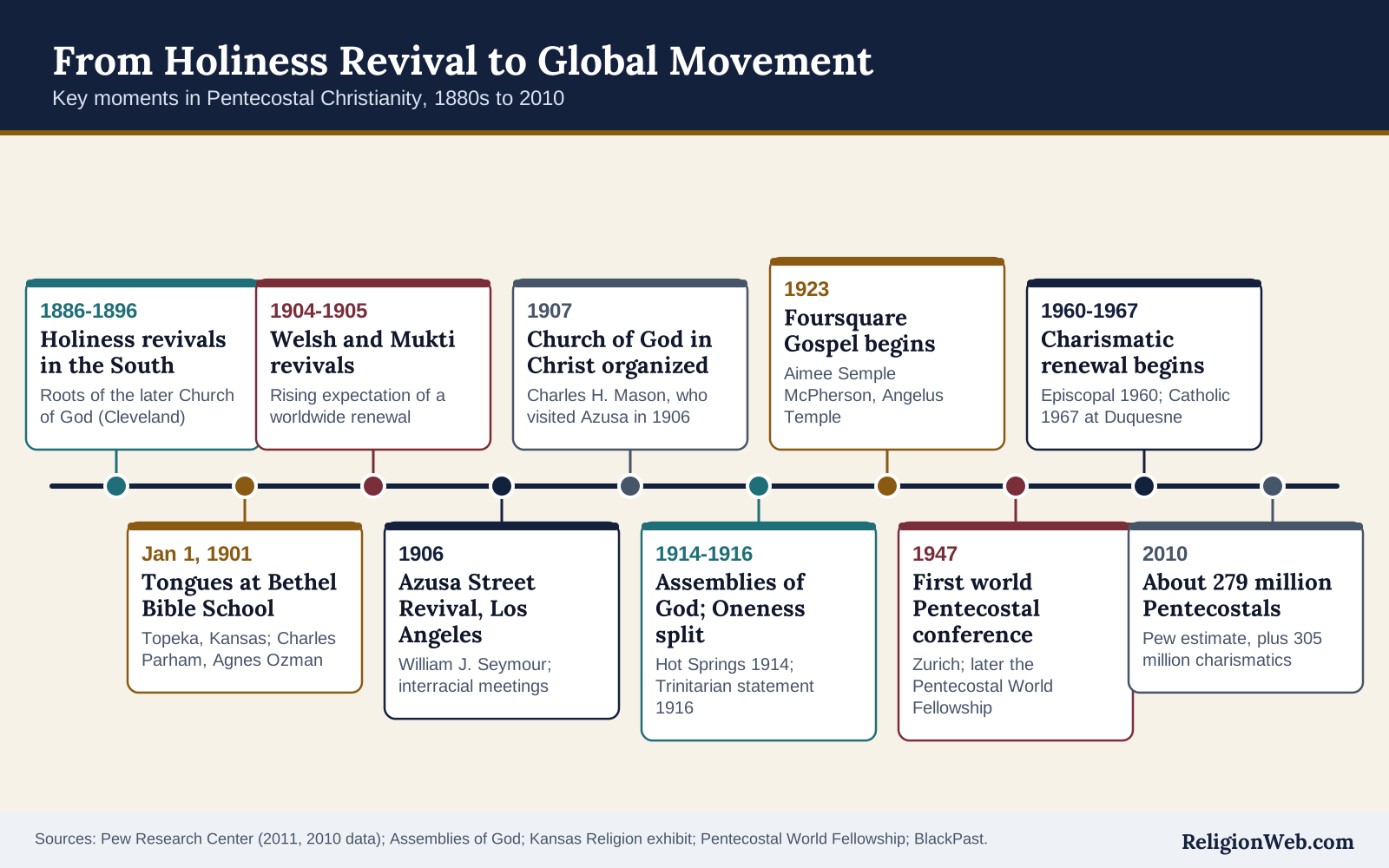
Azusa Street, 1906 to 1909: The Revival That Became a Landmark
William J. Seymour, Bonnie Brae Street, and 312 Azusa Street
William Joseph Seymour was born on May 2, 1870, in Centerville, Louisiana, to parents who had been enslaved. A holiness preacher with Methodist, Baptist, and Holiness experience, he heard of Parham’s teaching in Houston, where he was allowed to attend Parham’s Bible school but, because of racial segregation, had to sit apart from the other students. In February 1906 Seymour arrived in Los Angeles to serve a small Holiness congregation. When he preached that tongues were the evidence of Spirit baptism, the congregation locked him out, and he began prayer meetings at the home of Edward Lee and then at the home of Richard and Ruth Asberry at 214 North Bonnie Brae Street. After about five weeks, Lee was the first reported to speak in tongues, and others followed.
As crowds grew, the group rented a former African Methodist Episcopal church at 312 Azusa Street in downtown Los Angeles, a building that had recently been used as a livery stable and tenement house. Services began there in April 1906 (sources give different days for the first meetings) and ran for several hours, often daily, for about three years. Seymour led from a modest platform, and the mission’s newsletter, The Apostolic Faith, carried reports across the country and abroad.
An interracial revival and its limits
Visitors to Azusa Street noticed first the mixture of people. African Americans, Latinos, and whites, men and women, worshiped together in an era of strict segregation, and the evangelist Frank Bartleman later wrote that “the color line was washed away in the blood.” The Los Angeles Times reported on the services in 1906, describing a “bizarre new religious sect” whose members were “breathing strange utterances,” a hostile tone typical of early press coverage.
The picture was not simple, and historians record its limits. Parham, who arrived in Los Angeles in October 1906, was offended by the mixing of Black and white worshipers and broke with Seymour, taking a small group to form a rival mission. Over time the mission at Azusa became predominantly African American, and later Pentecostalism in the United States divided largely along racial lines, with separate white, Black, and Hispanic denominations, a pattern that Pentecostal historians discuss frankly. Seymour died in 1922, and for decades his role in Pentecostal histories was understated before scholars restored it.
Spreading Worldwide and Dividing at Home
Revival connections across continents
Pentecostalism spread quickly through travel, letters, and print. Visitors left Azusa Street for cities across North America, and missionaries reached Liberia and South Africa by 1907 and 1908. T. B. Barratt, a Norwegian Methodist, brought the message from New York to Scandinavia, and from there to Germany, France, and England. In 1908 the American evangelist John G. Lake went to South Africa, where Pentecostal teaching contributed to the growth of the Apostolic Faith Mission and to many African-initiated churches.
The new movement also found places where related revivals were already underway. The Welsh Revival of 1904 and 1905, led by Evan Roberts, reportedly included some tongues-speaking and raised the expectation of a worldwide outpouring. In India, a revival at Pandita Ramabai’s Mukti Mission near Pune began in 1905. In Chile, the Methodist missionary Willis Hoover in Valparaiso led a revival from 1909 that became the Methodist Pentecostal Church. In Brazil, immigrants and missionaries, including the Swedish Baptists Gunnar Vingren and Daniel Berg in Belém and the Italian-American Luigi Francescon in São Paulo, began Pentecostal congregations between 1910 and 1911 that would become the Assemblies of God in Brazil and the Christian Congregation in Brazil.
Controversies over sanctification, God, and organization
Growth brought disagreement. From about 1910 William H. Durham of Chicago taught what he called the “finished work of Calvary,” arguing that Christ’s cross accomplished both salvation and sanctification and that believers grow in holiness progressively rather than receiving it in a second crisis. The Holiness Pentecostals, including the Church of God (Cleveland, Tennessee) and the Pentecostal Holiness Church, kept the three-stage scheme. Durham died young, in 1912, but by about 1915 roughly half of Pentecostals favored his view, and the finished-work position is today held by most American Pentecostals, including the Assemblies of God.
A second controversy began at an Arroyo Seco camp meeting in California in 1913, where preachers including Frank Ewart argued that baptism should be administered in the name of Jesus alone, on the basis of Acts 2:38, and that Father, Son, and Spirit are three manifestations of the one God, Jesus. In October 1916 the young Assemblies of God, founded in Hot Springs, Arkansas, in 1914, adopted a Trinitarian Statement of Fundamental Truths, and about a third of its ministers left to form Oneness bodies. The doctrinal divisions of this decade fixed the main families of Pentecostalism that exist today, and they are described in the next section.
| Date | Event | Significance |
|---|---|---|
| 1886 to 1896 | Christian Union in Tennessee; revival at the Shearer Schoolhouse in North Carolina | Holiness origins of the later Church of God (Cleveland, Tennessee) |
| January 1, 1901 | Agnes Ozman reported to speak in tongues at Bethel Bible School, Topeka | Formulation of tongues as evidence of Spirit baptism |
| 1904 to 1905 | Welsh Revival; revival at Mukti Mission, India | Global expectation of renewal |
| February to April 1906 | Seymour arrives in Los Angeles; meetings at Bonnie Brae Street, then 312 Azusa Street | Azusa Street Revival becomes the movement’s best-known center |
| 1907 | Church of God in Christ organized under Charles H. Mason | Largest Black Pentecostal denomination begins |
| 1908 | John G. Lake in South Africa; Apostolic Faith Mission work expands | Early African growth |
| 1909 | Willis Hoover’s revival in Valparaiso, Chile | Start of a major Latin American Pentecostal church |
| 1910 to 1911 | Durham’s finished-work teaching; Pentecostal work begins in Belém and São Paulo, Brazil | Split over sanctification; Brazilian foundations |
| 1914 | Assemblies of God organized at Hot Springs, Arkansas | Largest white-majority Pentecostal denomination begins |
| 1916 | Assemblies of God adopts Trinitarian Statement; Oneness ministers withdraw | Oneness Pentecostalism becomes a separate stream |
| 1923 | Aimee Semple McPherson dedicates Angelus Temple in Los Angeles | Foursquare Gospel movement begins |
| 1947 | First world conference of Pentecostal leaders in Zurich | Start of an international fellowship |
| 1960 and 1967 | Charismatic renewal reaches Episcopalians and then Catholics | Pentecostal experience spreads into older churches |
Major Pentecostal Families, Denominations, and Networks
Pentecostalism has never had a pope, a single confession, or a central headquarters. It is better described as a set of related families, each with its own history and its own answer to a few key questions: how holiness is received, how God is understood, how churches are governed, and how they relate to the wider world. Scholars often distinguish three classical streams and then add a growing set of networks that do not fit the older categories neatly.
The Three Classical Streams
Holiness Pentecostals
Holiness Pentecostal bodies grew directly out of the nineteenth-century Holiness movement and kept its three-stage pattern: a person is converted, then receives entire sanctification as a second work of grace, and then may receive baptism in the Holy Spirit with tongues. The Church of God (Cleveland, Tennessee), the Pentecostal Holiness Church, and the Church of God in Christ are the best-known examples. The Church of God in Christ was organized in 1907 by Charles Harrison Mason after he attended the Azusa Street meetings in 1906; it describes itself as the largest Black Pentecostal denomination and reports millions of members, though denominational membership figures are self-reported and hard to verify independently.
These churches tend to give particular weight to holiness standards, which historically included plain dress, avoidance of tobacco and alcohol, and caution about entertainment, and some have practiced foot washing as an ordinance alongside the Lord’s Supper. The practices have softened in many congregations, but the ethical seriousness remains a recognizable feature. Mason came from a Baptist background and was removed from his Baptist fellowship when he taught sanctification and Spirit baptism, which shows how the new teaching strained existing denominations from the start.
Finished-work Pentecostals
The finished-work stream follows William Durham’s teaching that sanctification is received at conversion and then lived out progressively. It includes the Assemblies of God, organized in 1914 at Hot Springs, Arkansas, and the International Church of the Foursquare Gospel, which grew from the ministry of Aimee Semple McPherson and the dedication of Angelus Temple in Los Angeles in 1923. The Assemblies of God describes itself today as a worldwide fellowship which reports more than 88 million adherents worldwide and close to 13,000 churches in the United States (its own figures); its Statement of Fundamental Truths contains sixteen articles and is the standard doctrinal reference for the denomination.
Finished-work churches generally structure themselves as cooperative fellowships of local congregations, with a general council, districts, and credentialed ministers. They have tended to be the most visible Pentecostals in public life, in part because of their institutions, from missions agencies to colleges and universities, and because their theology of sanctification fits more easily with the evangelical mainstream, many of whose members hold that holiness is progressive.
Oneness Pentecostals
The Oneness stream, which separated from the Assemblies of God in 1916, teaches that God is a single person who has revealed himself as Father in creation, Son in redemption, and Holy Spirit in the church, and that the name of Jesus is the saving name by which baptism is performed. Its adherents typically baptize by immersion “in the name of Jesus Christ” on the basis of Acts 2:38, and many teach that repentance, baptism, and receiving the Spirit with tongues together constitute the new birth. The Pentecostal Assemblies of the World, formed from several small ministerial groups and led early on by the African American pastor Garfield T. Haywood, and the United Pentecostal Church International, formed in 1945, are the best-known Oneness bodies in the United States.
Trinitarian Pentecostals, who are the large majority, disagree with this understanding of God and with its teaching on baptism, and some scholars classify the Oneness view as a form of modalism, a term Oneness adherents often reject. Oneness churches nonetheless identify as Christian and as Pentecostal, and they have a significant presence in Latin America, Southeast Asia, and China, where the True Jesus Church, an independent Chinese body founded in the early twentieth century, holds related views. Estimates of worldwide Oneness adherents are in the range of tens of millions, but reliable figures are scarce.
Networks, Independent Churches, and Cooperation
National, ethnic, and independent churches
Much of Pentecostalism’s growth since mid-century has taken place outside the older denominations. In Latin America, indigenous Pentecostal churches such as Chile’s Methodist Pentecostal Church and Brazil’s Christian Congregation and Assemblies of God grew under national leadership; in Africa, the Redeemed Christian Church of God, founded in Nigeria in 1952 by Josiah Akindayomi and led since 1981 by Enoch Adeboye, reports millions of members and parishes in nearly two hundred countries. In South Korea, the Yoido Full Gospel Church, begun in Seoul in 1958 by David Yonggi Cho and his mother-in-law Choi Ja-shil, grew into one of the largest congregations in the world, organized through lay-led cell groups.
Alongside them, thousands of independent and nondenominational Pentecostal congregations exist in nearly every country, many led by a single pastor and without ties to a denomination. Scholars sometimes group the newer independent churches under labels such as neo-Pentecostal or neocharismatic, particularly where they emphasize prosperity teaching or international media ministries. Such labels are analytical categories, and the congregations themselves usually call themselves simply churches, fellowships, or ministries.
Fellowships and dialogue that link the families
The families are connected by fellowships and conferences more than by organization. The Pentecostal World Fellowship traces its beginning to a May 1947 conference in Zurich, Switzerland, organized by Pentecostal leaders including Leonard Steiner, David du Plessis, J. Roswell Flower, and Donald Gee, and attended by about 3,000 people. The gatherings, held every three years, were named the Pentecostal World Conference in 1961, and the fellowship’s 2025 conference in Helsinki drew participants from 97 nations. Its statement of faith summarizes common ground that includes the inspiration of the Bible, the Trinity, the deity and resurrection of Jesus, salvation by faith, and baptism in the Holy Spirit evidenced by tongues.
In the United States, the all-white Pentecostal Fellowship of North America, founded in 1948, was dissolved in 1994 at a gathering in Memphis and replaced by a racially inclusive body, an episode often called the “Memphis Miracle.” Pentecostal leaders have also entered formal dialogue with other churches, including an international dialogue with the Roman Catholic Church that began in 1972. These contacts illustrate that, although Pentecostals have often been outsiders to the older churches, they now take part in wider ecumenical conversation.
| Family or network | Representative bodies | Distinctive features |
|---|---|---|
| Holiness Pentecostal | Church of God (Cleveland, Tennessee); Pentecostal Holiness Church; Church of God in Christ | Three-stage pattern; strong holiness ethic; Spirit baptism with tongues |
| Finished-work Pentecostal | Assemblies of God; International Church of the Foursquare Gospel | Sanctification begins at conversion; cooperative fellowship governance; global missions |
| Oneness (Jesus’ Name) | Pentecostal Assemblies of the World; United Pentecostal Church International; True Jesus Church | One God manifested as Father, Son, and Spirit; baptism in Jesus’ name |
| Indigenous national churches | Methodist Pentecostal Church (Chile); Christian Congregation in Brazil; Redeemed Christian Church of God (Nigeria) | National leadership and funding; rapid growth; locally shaped worship |
| Large independent congregations | Yoido Full Gospel Church (Seoul) and many urban megachurches | Cell-group structure; heavy emphasis on prayer, healing, and evangelism |
| Charismatic renewal in other churches | Catholic, Anglican, Lutheran, Methodist, and Orthodox renewal groups; Vineyard and similar networks | Pentecostal-style gifts within or beside older traditions; not counted as Pentecostal by Pew |
Core Beliefs and Theology of Pentecostal Christianity
Pentecostal theology is usually described as evangelical theology with a distinctive emphasis on the Holy Spirit. Most Pentecostals share the central Christian convictions about God, Jesus Christ, sin, and salvation with other conservative Protestants, and they differ in the weight they give to the Spirit’s present work. This section sets out the shared base first and then the distinctive themes, with notes on where Pentecostal groups disagree among themselves.
God, Christ, and Salvation
The Trinity and the person of Jesus Christ
Most Pentecostals confess the doctrine of the Trinity: one God in three persons, Father, Son, and Holy Spirit, a teaching they find in the New Testament and affirm along with the historic creeds, even though their churches typically do not recite creeds in worship. Statements of faith such as the Assemblies of God’s Fundamental Truths and the Pentecostal World Fellowship’s statement speak of one God existing eternally in three persons and of Jesus Christ as fully God, born of the virgin Mary, who died for sin and rose bodily from the dead. Oneness Pentecostals, as noted above, hold a different view of God’s nature. The article on Jesus Christ covers the figure at the center of Christian faith in more detail.
Pentecostal preaching returns constantly to the cross and resurrection and to the person of Jesus as Savior, Healer, and coming King. The Spirit, in this understanding, does not replace Christ as the focus of worship but makes him present to believers. This explains why a Pentecostal service may spend as much time on testimony about answered prayer as on formal teaching, and why a sermon that sounds like a call to repentance may be followed by prayer for physical healing.
Salvation, repentance, and the new birth
Pentecostals teach that human beings are separated from God by sin and that salvation comes through repentance and faith in Christ, an experience they commonly call being “born again” or “saved.” Most have been shaped by the Wesleyan-Arminian tradition of revivalism, in which people respond freely to God’s offer of grace, although some Pentecostals and charismatics, particularly in Reformed circles, hold more Calvinist views of divine election. The conversion experience is typically understood as the beginning of a life of discipleship, publicly marked by baptism by immersion.
The role of works and the possibility of falling away vary by body. Many Holiness and Oneness Pentecostals teach that a believer can lose salvation by persistent sin and that holiness of life is a necessary evidence of faith. Many finished-work Pentecostals emphasize assurance of salvation while still warning of the dangers of abandoning the faith. Because these questions are not settled across the movement, anyone describing “the Pentecostal view” of salvation needs to specify which tradition they have in mind.
The Spirit in the Life of the Believer
Sanctification and the call to holy living
Sanctification, being set apart for God, is a central theme because of the movement’s Holiness roots. For Holiness Pentecostals it is a second definite work of grace; for finished-work Pentecostals, it is a status received in Christ at conversion that is worked out through growth in the Spirit. In both views, the Spirit is understood to produce moral change, summarized in Paul’s “fruit of the Spirit” (Galatians 5:22 to 23): love, joy, peace, patience, kindness, goodness, faithfulness, gentleness, and self-control.
The emphasis on moral fruit is intended to balance the emphasis on gifts. Pentecostal teachers often say that gifts without character are dangerous and that character is the proof of authentic spiritual life. The practical result is a strong ethic of integrity, family loyalty, abstaining from practices considered harmful, generosity through tithes and offerings, and service within the congregation.
Baptism in the Holy Spirit as empowerment for witness
In the classic Pentecostal understanding, the Spirit’s work at conversion is distinct from a later filling or “baptism” that empowers the believer for witness, rooted in Jesus’ promise in Acts 1:8 that the disciples would receive power when the Spirit came on them. The Assemblies of God’s Statement of Fundamental Truths, for example, describes this baptism as distinct from and following the new birth and as bringing power for service and gifts for ministry. Because the topic is central, the next section is devoted to it, including tongues as initial evidence and the debates within Pentecostalism and among other Christians about the claim.
Last Things and Christian Hope
The expected return of Christ
Pentecostalism began in a period of intense expectation that Christ’s return was near, and this hope remains central. The Assemblies of God speaks of the “Blessed Hope,” the imminent return of Christ, the resurrection of believers who have died, and the transformation of those still living. Historically, most Pentecostals have held premillennial views, expecting a future reign of Christ on earth, and many have adopted dispensational patterns that include a rapture of the church before a period of tribulation, though denominations differ on details and many Pentecostal scholars treat the specifics as secondary to the hope itself.
The expectation shaped the movement’s urgency about mission. If the Spirit had been poured out in the last days, as Pentecostals read Joel and Acts, then evangelism was a task of the hour. Early missionaries sailed with one-way tickets, and the sense of urgency still shapes Pentecostal missions, which tend to emphasize church planting and rapid training of local leaders.
Judgment, resurrection, and new creation
Pentecostals affirm a final judgment, the resurrection of the dead, and the new heavens and new earth described at the end of the Bible, and the Assemblies of God devotes its last articles to the millennial reign of Christ, the final judgment, and the new creation. These beliefs correspond to the mainstream of conservative Protestantism, and the differences from other churches lie mainly in the intensity of expectation and in how the Spirit’s present activity is understood as a foretaste of the coming age.
Debates About the Gifts Among Christians
Continuationism, cessationism, and how Acts is read
One of the most discussed theological questions around Pentecostalism concerns whether the miraculous gifts of the Spirit continued after the apostolic age. Continuationists, a group that includes Pentecostals and charismatics, hold that they did and do. Cessationists, found among some Reformed, Baptist, and other evangelical Christians, hold that the extraordinary gifts such as tongues and prophecy ceased with the first generation of apostles. Many Christians in these traditions also hold intermediate positions and affirm that God can heal and guide today without regarding tongues as normative. The articles on Reformed Christianity and Baptist Christianity describe the range of views within those traditions, which is wide.
The disagreement is partly about how to read the Bible. Many Pentecostal scholars argue that the book of Acts is theology as well as history and that its pattern of Spirit-empowered witness is meant to be repeated. Others, including some evangelical scholars sympathetic to Pentecostal experience, argue that narratives describe what happened without necessarily prescribing what must happen again, and that teaching on doctrine should be drawn primarily from the letters. This is an interpretive debate that continues within and between traditions, and the fair way to present it is as a disagreement about method, not a contest of loyalty.
How Pentecostal scholars describe their own method
Since the Society for Pentecostal Studies was founded in 1970, Pentecostal scholars have developed their own theological literature, with journals, commentaries, and university programs. Many describe their approach as reading Scripture in the context of the worshiping community, where the Spirit is understood to illuminate the text. They also debate whether the movement’s theology should be organized around the fourfold gospel, a narrative of the Spirit’s mission, or a theology of the “Spirit-filled life.” The existence of this internal debate is a reminder that Pentecostal theology is still being written, by a movement whose center of gravity is now in the Global South.
| Theme | Common Pentecostal teaching | Internal variation |
|---|---|---|
| God | One God in three persons: Father, Son, and Holy Spirit | Oneness Pentecostals teach one divine person revealed in three modes |
| Scripture | The Bible is inspired and authoritative for faith and conduct | Views on inerrancy and interpretation range from strict to moderate |
| Salvation | Repentance and faith in Christ bring forgiveness and new birth | Some stress eternal security, others warn that salvation can be lost |
| Sanctification | The Spirit sets believers apart and produces moral fruit | A second crisis experience (Holiness) or progressive growth (finished work) |
| Spirit baptism | A Spirit-given empowerment for witness, distinct from conversion | Whether tongues are always the initial evidence is disputed |
| Gifts of the Spirit | Gifts listed in 1 Corinthians 12 continue in the church | Prophecy is tested by Scripture and the congregation; practices differ |
| Divine healing | God heals in response to prayer and faith | Relationship to medicine varies from cooperative to cautious |
| Last things | Imminent, personal return of Christ; resurrection and final judgment | Premillennial views predominate; details of the end times vary |
Baptism in the Holy Spirit, Speaking in Tongues, and Spiritual Gifts
If one feature distinguishes Pentecostalism in the minds of most observers, it is the practice of speaking in tongues. Inside the movement, however, tongues are best understood as one part of a larger teaching about the Spirit’s empowerment of the church. This section explains the teaching in the order Pentecostals usually present it: first the experience of Spirit baptism, then tongues, then the wider range of gifts.
Baptism in the Holy Spirit
What the experience is understood to be
Pentecostals base their teaching on the account in Acts 2 of the first Pentecost after Jesus’ ascension, when the first followers of Jesus, traditionally counted as about a hundred and twenty, were gathered in Jerusalem. The World English Bible renders the central moment this way:
Tongues like fire appeared and were distributed to them, and one sat on each of them. They were all filled with the Holy Spirit and began to speak with other languages, as the Spirit gave them the ability to speak.
Acts 2:3-4, World English Bible (public domain)
Within the Christian tradition, this passage is read in several ways. Many churches treat it as the founding moment of the church and the fulfillment of Jesus’ promise in Acts 1:8, and understand the Spirit as given to all believers at baptism or conversion. Classical Pentecostals read it as the first of several patterns in Acts, alongside the Samaritans in Acts 8, the household of Cornelius in Acts 10, and the disciples at Ephesus in Acts 19, in which people who already believed received the Spirit in a further, recognizable experience. On this reading, the experience is available to every believer who seeks it, and it is a source of power for witness, boldness, worship, and the use of spiritual gifts.
Pentecostals often speak of “tarrying,” a word taken from the older English rendering of Jesus’ instruction to wait in Jerusalem (Luke 24:49), and some bodies still hold prayer meetings in which seekers wait and pray for Spirit baptism, often with others laying on hands. Others emphasize that the experience is a gift, not a reward, and that receiving it is a matter of asking in faith. The terminology varies among “baptized in,” “baptized with,” and “filled with” the Holy Spirit, and the differences reflect different readings of Acts more than different experiences.
Tongues as initial evidence: agreement and debate
The classical Pentecostal doctrine holds that speaking in tongues is the initial physical evidence of Spirit baptism. The Assemblies of God gives this teaching its own article in the Statement of Fundamental Truths, stating that the baptism is accompanied by speaking in other tongues as the Spirit gives utterance and that this is the same in essence as the gift of tongues but different in purpose and use. The Church of God (Cleveland, Tennessee), the Pentecostal Holiness Church, the United Pentecostal Church International, and the Pentecostal World Fellowship’s statement of faith express similar teachings.
Other Pentecostals and many charismatics read the evidence differently. Some hold that tongues are one of several possible signs, such as boldness, prophecy, or joy, while still affirming the gift. Others, especially in charismatic circles, argue that the Bible does not require any single sign. Charismatic Catholics, Anglicans, and Lutherans generally do not treat tongues as a requirement for the fullness of the Spirit. The disagreement is among people who all affirm that the Spirit empowers believers, and it is argued on scriptural grounds by each side.

Speaking in Tongues
Private prayer language and public message
Pentecostals distinguish two uses of tongues. The first is a private or devotional “prayer language,” in which a person prays in the Spirit in an unlearned language, understood by many as a form of prayer that goes beyond the limits of ordinary speech. They connect this to Paul’s statement in 1 Corinthians 14:2 that one who speaks in a tongue speaks to God and not to people. The second is a public message in tongues, which Paul in 1 Corinthians 14 says should be accompanied by interpretation so that the church is built up. In a typical service, a message in tongues may be followed by an interpretation, given by the same or another person, which the congregation then weighs.
Singing in the Spirit, in which many people sing freely, often in tongues, is common in some congregations. In others the practice is restrained, and tongues are largely confined to private prayer or small meetings. Paul’s counsel that everything be done in a fitting and orderly way (1 Corinthians 14:40) is often cited as the principle by which pastors keep public worship orderly while leaving room for the gifts.
How scholars describe tongues, and how often members practice them
Scholars from linguistics, anthropology, and psychology have studied glossolalia in many cultures. The linguist William Samarin, in a study published in 1972, concluded that the speech he recorded did not show the structure of a natural language, though it has the sounds and rhythms of one. Pentecostals generally respond that they do not claim tongues are ordinary languages in most cases, and that the question of their authenticity is a spiritual one that cannot be settled by linguistic analysis. Anthropologists add that comparable speech occurs in other religious settings, and they study it as a widespread feature of devotional life.
Practice is also less uniform than the stereotype suggests. Pew Research Center’s 2006 survey of Pentecostals and charismatics in ten countries found that in six of the ten, more than four in ten Pentecostals said they never speak or pray in tongues themselves, even though many attend churches where tongues are practiced. Members of Pentecostal churches may therefore hold the doctrine firmly while experiencing the gift to varying degrees, and many treat it as a lifelong aspiration. The survey also showed large majorities in every country reporting that they had experienced or witnessed divine healing, which is discussed later.
The Wider Range of Spiritual Gifts
The lists in 1 Corinthians 12 and how Pentecostals sort them
Pentecostals draw the larger vocabulary of gifts from Paul’s first letter to the Corinthians. The World English Bible renders the opening of his teaching in this way:
Now there are various kinds of gifts, but the same Spirit. There are various kinds of service, and the same Lord. There are various kinds of workings, but the same God who works all things in all. But to each one is given the manifestation of the Spirit for the profit of all.
1 Corinthians 12:4-7, World English Bible (public domain)
Interpreters of every tradition note Paul’s stress on unity and shared benefit: the gifts are given “for the profit of all,” not for the status of the one who receives them. Pentecostal teachers commonly sort the nine gifts in verses 8 to 10 into groups: gifts of utterance (prophecy, tongues, and interpretation of tongues), gifts of revelation (the word of wisdom, the word of knowledge, and discernment of spirits), and gifts of power (faith, healings, and miracles). The sorting is a teaching convenience, not a division in the text, and churches differ in how many gifts they expect to see on a regular basis.
Paul’s wider teaching in the same letter, that gifts without love are empty (chapter 13), and that the church is a body with many members (chapter 12), is the interpretive frame most Pentecostal pastors use when correcting excess. In practice, most congregations also recognize ministry gifts of teaching, administration, hospitality, and service as spiritual gifts, so the vocabulary of the Spirit extends to ordinary church life.
Prophecy and the testing of what is spoken
Prophecy in Pentecostal usage generally means a message understood to come from God for encouragement, correction, or guidance, not a new addition to Scripture. Most Pentecostal teachers say that prophetic words are subject to testing by the Bible and by mature believers, following Paul’s instruction in 1 Corinthians 14:29 that prophets speak and others weigh what is said, and his counsel in 1 Thessalonians 5:19 to 21 not to quench the Spirit but to test everything. Many denominations have written guidelines for such testing, and ministers are accountable to their fellowships.
The practice has produced both blessings and problems, which Pentecostal leaders themselves discuss openly. Predictions that fail, personal prophecies used to control, and claims of authority beyond Scripture have all been criticized from inside the movement, and the New Testament’s call for testing is the usual basis for the criticism. For visitors, the practical point is that a prophetic word offered in a service is typically understood as fallible human reception of a divine impression, open to evaluation, rather than as infallible revelation.
| Gift | Main biblical passage | How it is understood | Typical expression |
|---|---|---|---|
| Tongues | Acts 2; 1 Corinthians 12 and 14 | Spirit-given speech in an unlearned language, for prayer or as a message | Prayer language in worship; message followed by interpretation |
| Interpretation of tongues | 1 Corinthians 12:10; 14:13 | A Spirit-given rendering of the meaning of a message in tongues | Spoken after a message in tongues |
| Prophecy | 1 Corinthians 14:1 to 5, 29 | A word for encouragement, correction, or guidance, to be tested | Brief spoken word; leaders weigh it |
| Words of wisdom and knowledge | 1 Corinthians 12:8 | Insight given for a specific situation | Offered in prayer ministry or counsel |
| Faith, healings, miracles | 1 Corinthians 12:9 to 10; James 5 | Spirit-given trust and answers to prayer for the sick | Prayer with laying on of hands and anointing with oil |
| Discernment of spirits | 1 Corinthians 12:10; 1 John 4:1 | Distinguishing the Spirit’s work from other influences | Evaluating messages; prayer for deliverance |
The Bible, Authority, and Church Order
Pentecostals are not a people who prize experience at the expense of the Bible. Their churches typically describe Scripture as the final authority for belief and conduct, and the movement’s theology consistently argues that experiences must be judged by the written word. This section covers how the Bible is used and how authority is organized.
The Bible in Pentecostal Life
Scripture as the final authority
Pentecostal statements of faith describe the Bible as inspired by God and authoritative, and the Assemblies of God places this first among its Fundamental Truths. Churches use the sixty-six books of the Protestant canon, and for most of the movement’s history the King James Version was the preferred translation, joined in recent decades by modern versions, with large communities worshiping in local languages across Africa, Asia, and Latin America. Sermons typically move through a chosen passage with extended application to daily life.
Many Pentecostals read the Bible with a strong sense of immediacy, expecting that God speaks through it to the reader’s situation. They also tend to read texts about the Spirit, the gifts, and healing as describing normal Christian experience. Scholars note that this reading makes Pentecostal interpretation both devotional and experiential, and Pentecostal scholars have increasingly written about hermeneutics, the discipline of interpretation, as a means of examining that approach.
Spirit and Word together
The pairing of Spirit and Word is a recurring theme. Preachers argue that the Spirit who inspired the text also helps believers understand it, and that prophecy, tongues, and impressions in prayer must be consistent with what Scripture teaches. This conviction functions as a theological safeguard: when a practice is disputed, the debate is conducted by reference to biblical texts. It also explains why Bible schools and Pentecostal universities, including those connected to the Assemblies of God and the Church of God, have grown steadily since the mid-twentieth century.
Leadership and Governance
Pastors, bishops, overseers, and elders
Forms of church government vary widely. The Church of God in Christ is led by bishops and a general board, with jurisdictions across the United States and around the world. The Church of God (Cleveland, Tennessee) uses a general overseer and an international general assembly. The Assemblies of God is a cooperative fellowship of self-governing local churches that join a general council, with elected district and national officers. Many independent Pentecostal churches are led by a founding pastor and a board, and some belong to apostolic or prophetic networks led by senior ministers. The pastor holds a central role in preaching, counsel, and prayer, and pastors are often supported by deacons, elders, evangelists, and teachers.
What most bodies share is the belief that leadership is a calling confirmed by the Spirit and recognized by the church, not primarily a matter of academic credentials. That belief opened the ministry in the early years to people who might not have been welcome in older denominations, including laborers, immigrants, and women, and it continues to shape the movement’s diversity today.
Women, race, and the question of who may lead
Women were prominent in early Pentecostalism: Agnes Ozman at Topeka, Lucy Farrow in Houston and Los Angeles, Florence Crawford, who founded the Apostolic Faith Church in Portland, Oregon, and Aimee Semple McPherson, who founded the Foursquare Church. Policies later diverged. The Assemblies of God moved to full ordination for women in the 1930s, while the Church of God in Christ, among others, does not ordain women as pastors but has a large women’s department with its own leadership. Debates about the place of women in ministry continue in many Pentecostal bodies.
Race is the other historic fault line. The movement’s earliest meetings were interracial, but segregation in American society produced separate denominations, and the 1994 dissolution of the all-white Pentecostal Fellowship of North America was an attempt to repair the division. Pentecostal historians treat both questions as ongoing subjects of self-examination, and an accurate account notes both the movement’s early openness and its failure to preserve it.
Worship, Prayer, and Church Services in Pentecostal Christianity
Pentecostal worship is the part of the movement that visitors encounter first, and it is also the part most often described with stereotypes. A more accurate account starts with the aim: Pentecostals gather in the expectation that God is present and will act, and they arrange worship to give room for that expectation. The forms differ by country, denomination, language, and generation, so what follows describes common patterns instead of a universal liturgy.
A Typical Pentecostal Service
The usual sequence and the reasons behind it
A Sunday morning service in an Assemblies of God church, a Church of God in Christ congregation, or a Nigerian Pentecostal parish usually moves through recognizable stages, even when no printed order is provided. The service begins with a time of congregational singing, often led by a worship team or choir, during which people arrive, greet one another, and begin to pray. Announcements and a welcome follow, then prayer, scripture reading, an offering of tithes and gifts, and the sermon, which is typically the longest element and may last thirty to sixty minutes. The service commonly ends with an invitation, or altar call, to come forward for prayer, repentance, healing, or Spirit baptism, and the final period may run well beyond the formal conclusion as people continue to pray.
The reasoning is theological. Pentecostals hold that worship is a response to God’s presence, that every believer can approach God directly through Christ, and that the Spirit moves in and through ordinary members and not only through the clergy. For this reason, many services leave room for spoken prayer from the congregation, testimonies, prophecy, and the gifts discussed earlier. Pastors typically describe this as following the Spirit’s leading, while also holding that the Spirit is the Spirit of order, so most services include a clear structure and a leader who guides the transitions.
Why services differ so widely
Visitors to different Pentecostal churches can find very different services. A small Church of God congregation in rural Appalachia may hold a mostly quiet service with congregational hymns and a sermon, followed by a time of prayer at the altar. A Pentecostal church in Lagos or Seoul may hold several services a day, in large buildings, with hundreds of ushers, a trained choir, and a sermon translated into several languages. A Spanish-language Pentecostal church in Los Angeles may combine lively music, a long period of testimony, and a sermon of an hour or more. Younger congregations in many countries now use contemporary worship bands and projected lyrics, while older congregations may keep hymnals and organs.
Several factors account for the variation: the founding tradition (Holiness, finished-work, or Oneness), the culture of the region, the size of the church, and the leadership style of the pastor. Within a single congregation, the Sunday morning service may be formal, the Sunday evening service more open, and the midweek prayer meeting the most spontaneous. Describing Pentecostal worship as uniformly spontaneous, or as uniformly loud, therefore misrepresents both the planning that goes into services and the range of styles.
| Element | What usually happens | Purpose |
|---|---|---|
| Opening praise | Congregational singing, sometimes with raised hands, clapping, or dancing | Turn attention to God and prepare the gathering for prayer |
| Prayer | Pastoral prayer, and often many people praying aloud together | Express dependence on God and the participation of all believers |
| Testimony | Members share answers to prayer, healings, or changes in their lives | Encourage faith and give credit to God |
| Offering | Tithes and gifts collected, often with a short prayer | Support the church, ministry, and mission |
| Sermon | Extended Bible teaching, often with a call to respond | Teach the Scriptures and invite commitment |
| Altar ministry | Prayer for seekers, the sick, and those seeking Spirit baptism, often with laying on of hands | Offer personal prayer and an opportunity to respond |
| Gifts of the Spirit | Message in tongues, interpretation, prophecy, as the pastor allows | Build up the congregation and demonstrate the Spirit’s presence |
Music, Testimony, and Expressive Worship
The role of music
Music is often described as the heartbeat of Pentecostal worship. The earliest Pentecostals drew on Holiness hymns, camp meeting songs, the hymns of Charles Wesley, and, especially in African American congregations, spirituals and the emerging gospel tradition. Instruments that were sometimes viewed as worldly in other churches, such as drums, tambourines, guitars, and pianos, were welcomed in worship, and the result influenced American popular music well beyond the churches. Pentecostal and charismatic songwriters have since shaped much of the global contemporary worship repertoire sung in many denominations.
In many churches, music is organized around a sequence in which faster songs of praise lead to slower songs of worship, a movement that mirrors the sense of drawing near to God. Singing in tongues or in the Spirit may occur during these times. Choirs are prominent in Black Pentecostal and Nigerian churches, and bands in Latin American and Korean churches. The point of the music, as pastors usually explain it, is not performance but participation, so that a congregation of untrained singers can join in worship.
Testimony and bodily expression
Testimony is a traditional element of Pentecostal worship, in which a member stands to describe what they believe God has done. It reflects the movement’s understanding that faith is shared and that stories of experience support the congregation. Many churches now schedule testimony at a set moment, and larger churches may share testimonies by video or on social media.
Pentecostal worship has often been recognized by its physical expressiveness: raised hands, clapping, dancing, kneeling, weeping, and shouting. These practices have biblical references, such as the psalms’ calls to lift hands and clap, and in many congregations they are encouraged but not required. Some groups practice “resting in the Spirit,” in which a person prayed for sinks to the floor; others regard this practice with caution, and many Pentecostal leaders teach that it is not an essential sign. Visitors are not obliged to take part, and most congregations welcome observers who simply listen.
Prayer and Fasting
Personal and corporate prayer
Prayer is the foundation of Pentecostal life. Believers are encouraged to pray daily, often in their native language and in tongues, and many congregations hold weekly prayer meetings, early-morning prayer gatherings, and all-night prayer vigils. In some churches, such as the Redeemed Christian Church of God, a monthly Holy Ghost service held on the first Friday of the month draws large crowds for hours of prayer and worship. The Lord’s Prayer is widely known and used, although Pentecostal prayer in general is extemporaneous and often intercessory, as members pray for the sick, for family, for the nation, and for missionaries.
The emphasis on prayer rests on the conviction that prayer changes situations and that the Spirit helps believers pray, as Paul writes in Romans 8:26 and 27. Pentecostals often describe prayer in terms of relationship, a conversation with a God who is both near and active. Many pastors teach that the discipline of regular prayer is a more reliable sign of spiritual maturity than any single manifestation.
Fasting and spiritual discipline
Fasting is the second major discipline. Pentecostal congregations commonly call for periods of fasting, which may mean skipping a meal, abstaining from food for a day, or observing a longer fast, along with prayer, before major decisions or in times of need. They are voluntary, and ministers typically counsel that those with health conditions, pregnant women, children, and the elderly should adapt fasting to their circumstances and consult a physician, since religious practice does not replace medical advice.
Pentecostalism has no monastic orders, and its disciplines are generally practiced by laypeople within ordinary family and work life. This distinguishes it from traditions with a long history of Christian monasticism, though some Pentecostal prayer centers and retreat communities have adopted elements of communal prayer. The ideal in most churches is that the discipline of prayer and fasting be practiced by every member while living in the world.
Baptism and the Lord’s Supper
Water baptism as a public act of faith
Most Pentecostal churches practice believer’s baptism by immersion, administered to those who have professed faith in Christ, and understand it as an act of obedience and a public declaration of new life. In Trinitarian churches the baptism is performed in the name of the Father, the Son, and the Holy Spirit; Oneness churches baptize in the name of Jesus Christ and teach that baptism is part of the new birth. Pentecostals generally do not baptize infants, and in this they are close to Baptists and other churches that practice believer’s baptism; the article on Christian baptism surveys the wider range of understandings. The practice is distinct from Spirit baptism, which Pentecostals regard as a separate experience.
Baptisms are often held in church baptistries, rivers, or lakes, with the candidate testifying before the congregation. The service is typically joyful, with singing, and baptism is often followed by a celebration, as new believers are welcomed into the church.
The Lord’s Supper and foot washing
The Lord’s Supper, also called Communion, is observed in remembrance of Christ’s death, typically with bread and grape juice rather than wine, and frequently on a monthly or quarterly schedule. Most Pentecostals understand it as a memorial and as a time of fellowship with Christ by faith, not as a change in the elements, and they do not use the word “sacrament” as often as Catholic or Orthodox Christians do, preferring “ordinance.” The article on the Eucharist and the Lord’s Supper explains the wide range of Christian understandings of this rite.
Some Pentecostal bodies, particularly in the Holiness stream, such as the Church of God (Cleveland, Tennessee), also observe foot washing as an ordinance of humility, based on Jesus’ action in John 13. The congregation separates into pairs, often men with men and women with women, and washes one another’s feet after the Lord’s Supper. The practice is not universal and is declining in many places, but it remains a distinctive sign of the Holiness heritage.
Divine Healing, Prayer for the Sick, and Deliverance
Healing is one of the most visible elements of Pentecostal practice, and it is also one of the areas where responsible description requires the most care. The movement’s teaching is distinctive, the testimonies are numerous, and the questions raised about medical care are important.
Healing in Pentecostal Teaching and Practice
Biblical basis and the “healer” in the fourfold gospel
Pentecostals understand healing as part of Christ’s work, one of the four aspects of the “Foursquare Gospel” proclaimed by Aimee Semple McPherson: Jesus saves, baptizes with the Holy Spirit, heals, and will return as king. The Assemblies of God’s Statement of Fundamental Truths speaks of divine healing as an integral part of the gospel and teaches that deliverance from sickness is provided for in the atonement and is available to all believers. Not all Pentecostal bodies phrase the doctrine in this way, and some stress healing as a gift God grants in his wisdom rather than a guaranteed result. A central text is the New Testament letter of James, which in the World English Bible reads:
Is any among you sick? Let him call for the elders of the assembly, and let them pray over him, anointing him with oil in the name of the Lord; and the prayer of faith will heal him who is sick, and the Lord will raise him up. If he has committed sins, he will be forgiven.
James 5:14-15, World English Bible (public domain)
Pentecostals take this passage as a model for congregational practice: the sick person asks the church’s leaders to pray, and they anoint with oil. Other Christians, including Catholics, who use anointing of the sick in a sacramental form, and Orthodox Christians, who practice the mystery of holy unction, also draw on this text, and the traditions differ about the purposes of anointing and the expectations of the rite.
How prayer for healing is carried out
Prayer for healing takes place in several settings: at the altar during regular services, in special healing services, in homes and hospitals, and in large public meetings. Typical practices include laying on of hands, anointing with oil, and prayer by the elders or by gifted members. The mid-twentieth century saw a healing revival in North America led by evangelists such as Oral Roberts and William Branham, whose tent meetings drew large crowds and widened Pentecostalism’s public profile. Pew’s ten-country survey from 2006 found that majorities of Pentecostals in all ten countries, from 56 percent in South Korea to 87 percent in Kenya, said they had personally experienced or witnessed the divine healing of an illness or injury.
Deliverance, Medicine, and Responsible Practice
Spiritual warfare and deliverance
Pentecostal worldviews typically include a belief in spiritual powers of evil that oppose God’s work, and in the authority of believers to resist them in the name of Jesus. Deliverance ministry, sometimes called exorcism, is the practice of praying for people who are believed to be troubled by such forces. Pew’s 2006 survey found that majorities of Pentecostals in seven countries said they had witnessed or experienced the devil or evil spirits being driven out of a person. Practice varies from brief prayer to extended ministry sessions, and different denominations have different guidelines.
Responsible pastors distinguish between spiritual and medical or psychological problems and counsel people who are troubled by distressing symptoms to seek professional care as well as prayer. Pentecostal bodies have faced criticism, from inside and outside the movement, when deliverance practices were applied to people with mental illness or in ways that caused harm, and many have since issued guidance. Readers should note that religious prayer is not a substitute for emergency or mental health care.
Healing and medical care
Early Pentecostals sometimes taught that faith should replace medicine, and a minority of groups still discourage medical treatment. Most Pentecostal churches today encourage prayer alongside medical care, regarding doctors and medicines as means God may use, and many Pentecostal missionaries have founded hospitals and clinics. When a person is not healed, pastors generally explain that God’s purposes are not always understood, and they discourage blaming the sick person for lack of faith, though such blame has occurred and has been criticized by Pentecostal leaders.
For anyone dealing with serious illness, the sound practical rule, shared by the movement’s mainstream, is to pursue both prayer and professional medical treatment, and to avoid stopping prescribed treatment on the basis of religious advice without consulting a physician. Descriptions of healing in this article report the movement’s beliefs and the testimonies of its members, and they are not medical claims.
Holy Days, the Christian Year, and Special Gatherings
Pentecostalism began as a movement of revival rather than of liturgical observance, and its calendar is correspondingly lighter than that of Catholic, Orthodox, or Anglican churches. Nonetheless, most Pentecostal churches mark the major Christian festivals, and the movement has developed its own recurring gatherings.
Observing the Christian Year
Pentecost, Easter, and Christmas
Most Pentecostal churches celebrate Easter and Christmas with special services, and many observe Pentecost Sunday as a day to emphasize the Spirit. The date of Easter is set by the rule used in Western churches, the first Sunday after the ecclesiastical full moon that falls on or after March 21, and Pentecost falls fifty days after Easter, so the feast moves with Easter. Good Friday and Easter services emphasize the cross and resurrection, and sunrise services are common. Christmas observances typically include carols, a pageant, and a sermon on the incarnation, as described in the article on Christmas. The separate article on Pentecost covers the wider Christian observance.
The degree of formality varies. Some Pentecostal churches, particularly those with Holiness roots, historically downplayed the church calendar as a human tradition, while many today value it as an opportunity for teaching. Churches that follow Lent or Advent are less common among Pentecostals than among liturgical churches, but many congregations hold seasonal prayer and fasting emphases, such as a New Year’s fast or a church-wide fast before Easter, and the practices are increasing in some regions.
Sunday worship, watch night, and weekly rhythms
Sunday, the day of Christ’s resurrection, is the main day for worship, and many churches hold services on Sunday morning and evening and a midweek Bible study and prayer meeting. In African American churches, including Pentecostal ones, the Watch Night service on New Year’s Eve, a practice with roots in Methodist and Moravian traditions, is a major occasion, held late into the night with prayer and testimony as the year ends.
Conventions, Camp Meetings, and Revival Gatherings
Annual convocations and general councils
Pentecostal denominations hold regular large gatherings that combine business, teaching, and worship. The Church of God in Christ holds an annual Holy Convocation in Memphis, Tennessee, at Mason Temple, completed in 1940 and named for the founder, and reports of the gathering put attendance above 50,000. The Assemblies of God holds a biennial General Council of its ministers and delegates, the Pentecostal World Fellowship holds a world conference every three years, and the Redeemed Christian Church of God holds an annual Holy Ghost Convention in August and a Holy Ghost Congress in December at its camp near Lagos. These events provide opportunities for fellowship, ordination, and the sharing of mission reports.
Revivals, crusades, and remembrance of Azusa Street
Revival meetings, series of services held over several days or weeks with guest preachers, are a long-standing Pentecostal custom, descended from the Holiness camp meetings of the nineteenth century. Tent campaigns and stadium crusades have carried the practice into public spaces, and the arrangement of seekers, prayer, and altar response follows the pattern of regular services on a larger scale. Pentecostal communities also commemorate historical anniversaries, especially of Azusa Street, with services and conferences, including events in Los Angeles, where historians and church leaders reflect on the legacy of the 1906 revival. These commemorations are not liturgical feasts, but they function as moments in which the movement recalls its origins.
Community, Ethics, and Daily Life in Pentecostal Churches
For most members, Pentecostalism is lived out in the weekly pattern of congregational life more than in dramatic experiences. Churches function as extended families, offer practical help, and teach an ethic that shapes dress, speech, family life, and work. This section describes that pattern and the points where practice differs.
Family, Ethics, and Church Belonging
Holiness standards, giving, and family life
Pentecostal ethics grew from the Holiness tradition and emphasize personal integrity, sexual faithfulness within marriage, honesty in business, and abstaining from practices considered harmful or worldly. In the early decades those standards were detailed and specific: many churches discouraged jewelry, cosmetics, theaters, dancing, tobacco, and alcohol, and some Holiness bodies required particular styles of dress, especially for women. Over the twentieth century, the rules in many American and European congregations relaxed, but they remain strong in some Holiness and Oneness churches and in many congregations around the world. Where the standards persist, they are generally taught as a response to the Spirit’s work, not as a means of earning salvation.
Giving is another mark of church life. Most Pentecostal churches teach tithing, the practice of giving a tenth of income to the church, with additional offerings for missions and special needs. Many churches also have a strong family orientation, with children’s ministries, youth groups, Bible schools, and women’s and men’s fellowships. Marriage and parenting are treated as spiritual vocations, and congregations commonly offer counseling and prayer for families. Churches in many countries also form networks of mutual help, offering meals, employment contacts, and support for new migrants.
Saints, Mary, and the community of believers
Pentecostal Christians use the word “saints” in the New Testament sense for all believers, and they address prayer to God through Christ in the Spirit, without invoking departed saints. They affirm the virgin birth of Jesus and honor Mary as the mother of Jesus as a model of faith, but Marian devotion as practiced in Catholic and Orthodox churches is not part of Pentecostal worship. The articles on Christian saints and the Virgin Mary describe those practices on their own terms.
The sense of community is built less through inherited ritual than through shared experience: prayer for one another, testimony, and the expectation that every member has a gift to contribute. This is why Pentecostals often describe the church as a family or a body, and why congregations of widely different sizes try to preserve small-group structures, such as cell groups, home fellowships, and prayer circles, to keep a personal dimension of belonging.
Education, Service, and Public Life
Schools, hospitals, and relief work
Pentecostal churches operate schools, Bible colleges, universities, clinics, orphanages, relief agencies, and addiction recovery programs on every continent. Early Pentecostals focused heavily on evangelism, partly because they expected Christ’s imminent return, and were sometimes suspicious of education. From the mid-twentieth century onward, the denominations built institutions of higher learning, and today Pentecostal universities and seminaries train pastors, teachers, and professionals.
In many developing countries, Pentecostal churches have become significant providers of social services, particularly where state services are limited. Scholars who study the movement in Latin America and Africa note that Pentecostal congregations often provide networks of trust, discipline, and mutual aid for people on the margins of society, including migrants to growing cities. The movement’s own explanation is theological: the Spirit empowers believers for service to the poor, the sick, and the stranger, as well as for evangelism.
Politics and public engagement
Pentecostal attitudes to politics are diverse. Many early Pentecostals were suspicious of political involvement, regarded war as incompatible with the gospel, and awaited Christ’s return; the Assemblies of God and other bodies originally held pacifist views before changing their positions in the twentieth century. Today Pentecostals are found across the political spectrum. In the United States, many white Pentecostals have aligned with conservative evangelical politics, while Black Pentecostals have often been active in civil rights and community work, and in Latin America and Africa Pentecostal leaders participate in elections, run for office, and comment on public issues.
Because of this diversity, generalizations about the political positions of “Pentecostals” are unreliable, and the safest approach is to identify the denomination, country, and period. Scholars also remind readers that political activity by individual leaders or parties is distinct from the faith as such, and that the movement includes many people who avoid politics altogether.

Modern Global Presence and the Charismatic Movement
Pentecostalism has changed from a small American revival into a movement whose center of gravity lies in the Global South. This section summarizes the available data with its dates and sources, then turns to the Charismatic movement and newer currents that have extended Pentecostal practice beyond the older denominations.
Numbers and Regions
Africa and Latin America
According to the Pew Research Center’s estimates for 2010, 44 percent of the world’s Pentecostals lived in sub-Saharan Africa and 37 percent in the Americas. Pentecostals accounted for about 15 percent of the population of sub-Saharan Africa and about 11 percent of the population of the Americas. Pew’s 2006 ten-country survey, which measured Pentecostals and charismatics together as “renewalists,” found that about half or more of the population of Brazil, Guatemala, and Kenya fell in this group, with Guatemala at about 60 percent. The survey also found that Pentecostals alone ranged from about 9 percent of Chile’s population to about 33 percent of Kenya’s.
The growth has taken many institutional forms. In Africa, the Redeemed Christian Church of God, begun in Lagos in 1952, has become one of the continent’s largest churches, with parishes in nearly two hundred countries and territories by its own account. African-initiated churches that emphasize Spirit-led prayer and healing, such as the Aladura churches in Nigeria, belong to a wider family of Spirit-centered Christianity that scholars sometimes treat alongside Pentecostalism. In Latin America, the Assemblies of God in Brazil, begun in Belém in the early 1910s, the Christian Congregation in Brazil, and the Universal Church of the Kingdom of God, founded in 1977, are among the largest bodies, and Pentecostals are the main component of the region’s evangelical Protestant growth.
Asia, North America, and Europe
In Asia, Pew counted about 16 percent of the world’s Pentecostals in the Asia-Pacific region in 2010, but only about 1 percent of the region’s population, and nearly 30 percent of the world’s charismatics. The 2006 survey found charismatics making up about 40 percent of the population of the Philippines, a very high share. South Korea, home to the Yoido Full Gospel Church, has one of the largest Pentecostal communities in the world, and the church’s own membership claims, which run to several hundred thousand, are self-reported and have been questioned. India has an older Pentecostal presence reaching back to the Mukti revival of 1905, though Pentecostals were only about 1 percent of the surveyed population. In China, Pentecostal-style practice is widespread among house churches and in groups such as the True Jesus Church, though reliable figures are difficult to obtain.
In the United States, Pew’s 2006 survey found about 5 percent of adults were Pentecostals, with a larger share, roughly one in five, counted as charismatics. Pentecostalism is strong among African American and Hispanic Christians, and immigrant congregations from Africa, Latin America, and Asia are changing the movement’s profile. In Europe, Pentecostal churches are well established in Scandinavia, Britain, Italy, and elsewhere, and African and Latin American migrant communities have planted many new congregations. The next table summarizes the data and the sources discussed above.
| Region | Pentecostals (2010 estimate) | Charismatics and survey notes | Examples of major bodies |
|---|---|---|---|
| Sub-Saharan Africa | About 44 percent of world Pentecostals; about 15 percent of the regional population | Kenya: Pentecostals about 33 percent of adults in 2006 survey | Redeemed Christian Church of God; Aladura churches; Apostolic Faith Mission |
| Americas | About 37 percent of world Pentecostals; about 11 percent of the regional population | About 49 percent of world charismatics; Brazil and Guatemala near or above half renewalist in 2006 | Assemblies of God; Church of God in Christ; Christian Congregation in Brazil |
| Asia-Pacific | About 16 percent of world Pentecostals; about 1 percent of the regional population | Nearly 30 percent of world charismatics; Philippines about 40 percent charismatic in 2006 | Yoido Full Gospel Church; True Jesus Church; Indian Pentecostal churches |
| North America | Included in the Americas figure; about 5 percent of U.S. adults in 2006 survey | About one in five U.S. adults charismatic in 2006 survey | Assemblies of God; Church of God (Cleveland, Tennessee); Foursquare Church |
| Europe | Smaller shares; strong in Scandinavia, Britain, and Italy | Growth driven partly by migrant congregations | Elim and Assemblies of God churches in Britain; Pentecostal churches in Sweden and Norway |
Charismatic Renewal and Newer Currents
From Van Nuys to Duquesne: renewal in older churches
The Charismatic movement is the form of Pentecostal-style renewal that took place within existing denominations. According to the account in the Christian Century, it became public on Passion Sunday of 1960, when Dennis Bennett, rector of an Episcopal parish in Van Nuys, California, told his congregation that he and about seventy others had been speaking in tongues. The dispute that followed led to his resignation, though he later became a leader of the renewal. In 1967, a renewal movement began among Catholic students and faculty at Duquesne University in Pittsburgh and spread to Notre Dame and the University of Michigan, and Catholic dioceses later accepted renewal groups under church oversight.
Charismatic renewal then took root in Lutheran, Methodist, Presbyterian, Baptist, Episcopal, and Orthodox settings, with renewal organizations such as Lutheran Renewal and the Episcopal Charismatic Fellowship. Members typically stay in their churches and continue to worship in their own liturgies, adding prayer for the gifts of the Spirit, healing, and informal praise. The relevant articles describe these traditions on their own terms, including Lutheranism and Catholic Christianity. Charismatic leaders have tended to play down tongues as a required sign of Spirit baptism, which is one of the main points on which they differ from classical Pentecostals.
Third Wave, neo-Pentecostal, and prosperity currents
Since the 1980s, scholars have used “Third Wave” for evangelical networks that adopted miracles, healing, and prophecy without the label Pentecostal, with the Vineyard movement as a well-known example, and “neo-Pentecostal” or “neocharismatic” for independent churches that combine Pentecostal practices with new organizational forms. These networks are often led by founders who run large urban churches, television ministries, or international fellowships.
A subset of such churches teaches what supporters call the faith or prosperity message: that God desires believers to enjoy health and material blessing and that faith and giving open the way to them. The teaching has many defenders, who see it as a message of hope for poor communities, and many critics, including Pentecostal scholars and pastors who argue that it distorts the gospel or exploits the vulnerable. Because it is contested within the movement itself, it is best described as one current among several, not as the teaching of Pentecostalism as a whole.
Challenges and Self-Criticism
Leadership accountability and institutional questions
Large independent churches and rapid growth raise questions of governance. Scandals involving finances or leaders’ conduct have affected churches in several countries, including a financial case in South Korea that involved the leadership of one of the world’s largest congregations. Pentecostal denominations have responded with written codes of conduct, financial audits, and ministerial accountability systems, and the topic is widely discussed in Pentecostal publications.
Maturing movements and new generations
As the first Pentecostal families age, the movement faces the task of passing its practices to children and grandchildren in cultures that differ from those of their parents. Studies of Pentecostal institutions often describe a cycle in which spontaneous revival gives way to organization, and then to renewal movements seeking to recover the earlier energy. Pentecostal scholars generally see this pattern as normal in the history of Christian movements, and they note that the movement’s growth in younger regions, along with ongoing dialogue with other churches, suggests that its development is far from finished.
Common Misconceptions About Pentecostal Christianity
Because Pentecostalism is large, varied, and often described by outsiders in a few striking images, certain misunderstandings recur in news coverage, classroom discussions, and everyday conversation. The five below are corrected with attention to how members describe themselves and what the historical and survey evidence shows.
Misconception 1: Pentecostals are the only Christians who believe in the Holy Spirit
Where the misunderstanding comes from
This idea arises naturally from the way Pentecostals talk about the Spirit. Their services highlight the Spirit’s activity, their literature returns to it constantly, and their name points to it. A visitor from a church where the Spirit is mentioned briefly in the creed or the closing blessing may conclude that other Christians do not hold the belief at all, and some Pentecostal preaching, which contrasts a “Spirit-filled” life with a merely formal faith, has encouraged the impression.
Media coverage adds to it. Reports on tongues and healing meetings seldom explain that the doctrine of the Spirit is shared across Christianity, and descriptions of the “charismatic” and “evangelical” churches sometimes treat Spirit-centered faith as an invention of the twentieth century.
What the evidence and tradition actually show
Belief in the Holy Spirit as the third person of the Trinity is part of the historic Christian creeds, and it is affirmed by Catholic, Orthodox, Anglican, Lutheran, Reformed, Methodist, Baptist, and other churches. The Eastern Orthodox tradition, for example, gives the Spirit a prominent place in its liturgy, in the invocation over the bread and wine, and in its theology of sanctification, and Catholic teaching treats the Spirit as the giver of life in baptism, confirmation, and the other sacraments. The feast of Pentecost celebrates the Spirit’s coming in nearly all of these churches.
What distinguishes Pentecostals is a particular teaching about how the Spirit is received and experienced: a distinct baptism in the Spirit, the continuing availability of gifts such as tongues and prophecy, and an emphasis on expectation in worship. Other Christians may disagree with those emphases, or hold some of them in different forms, but they do not deny the Spirit. The accurate statement is that all major Christian traditions believe in the Holy Spirit and understand its work differently.
The Nicene Creed, the fourth-century statement of faith that Catholic, Orthodox, Anglican, Lutheran, and many other churches still recite in worship, confesses faith in the Holy Spirit as Lord and giver of life. Long before Pentecostalism existed, Christian writers were composing treatises on the Spirit, and the question of how the Spirit relates to the Father and the Son was a major subject of theology for centuries. Pentecostals draw on this inheritance when they affirm the Trinity, even though their own worship does not center on creeds.
Misconception 2: All Pentecostal services are spontaneous and identical
Where the misunderstanding comes from
The picture of a loud, unscripted service with shouting, dancing, and tongues comes from a few widely seen images, such as film depictions of rural revival meetings, news clips of large crusades, and descriptions from the earliest years of the movement. Early Pentecostals themselves wrote about services in which no one led and the Spirit directed everything, and the slogan about not quenching the Spirit still appears in Pentecostal sermons. Visitors who attend a single lively service can easily generalize from it.
A second source of the impression is the movement’s own self-image. Pentecostals often emphasize spontaneity in contrast with fixed liturgy, and so outsiders may assume that no planning exists.
What the evidence and tradition actually show
Pentecostal services follow patterns that are as recognizable to members as a liturgy is to Anglicans or Lutherans: singing, prayer, offering, preaching, and altar ministry, in a sequence set by local custom. Large churches often plan services to the minute, with trained music teams, stage managers, and translators. Even in smaller churches, pastors exercise judgment about when to allow the gifts, as Paul’s call for order in 1 Corinthians 14 encourages them to do.
The range of styles is wide, from quiet and hymn-based services in some Church of God congregations to long, intensely participatory services in Black Pentecostal churches and large, professionally produced services in urban megachurches. Services in Nigeria, Brazil, Korea, and the United States differ in language, music, length, and dress. The most reliable description is that Pentecostal worship values openness to the Spirit within an organized form, and that the proportion of open and planned elements varies a great deal.
Visitors can notice the structure in small details: a worship leader who signals transitions, ushers who guide people to the altar, a time set aside for testimony, and a closing prayer that marks the end of the formal service. Pentecostals themselves say that the Spirit can work through a prepared sermon or a rehearsed song as well as through an unplanned word, and that planning and openness are not opposites.
Misconception 3: Pentecostalism and the Charismatic movement are exactly the same
Where the misunderstanding comes from
The two movements share vocabulary and practice, including baptism in the Spirit, tongues, prophecy, and healing prayer, and popular speech often merges them. Large conferences, television ministries, and worship songs are shared across both. In many countries, researchers and journalists use “Pentecostal” for any Spirit-centered church, and the word “charismatic” is sometimes applied to any energetic worship.
Some surveys also combine the groups. Pew’s global estimates, for example, report Pentecostals and charismatics together as “renewalists,” which is useful for measuring the scale of the broader phenomenon but can obscure the distinction.
What the evidence and tradition actually show
The distinction is real, and it concerns church affiliation and history. Pew defines Pentecostals as members of distinct Pentecostal denominations or independent churches, with roots in the early twentieth-century revivals, and charismatics as members of non-Pentecostal denominations, such as Catholic, Orthodox, or mainline Protestant churches, who hold at least some Pentecostal beliefs and practices. The Charismatic movement dates from 1960 among Episcopalians and from 1967 among Catholics, and it generally developed within existing churches, not outside them.
Differences in emphasis also exist. As the Christian Century reported, charismatic leaders have often downplayed tongues as a required sign of Spirit baptism, and charismatic Christians have tended to remain in churches with their own liturgies and sacramental teaching, while classical Pentecostal bodies were separate denominations from the start. The relationship is best described as a family resemblance with historical continuity, not as identity. Pew’s 2010 figures, for instance, count about 279 million Pentecostals and about 305 million charismatics as separate groups.
Misconception 4: Every Pentecostal speaks in tongues, and all mean the same thing by it
Where the misunderstanding comes from
Since tongues are the most visible mark of the movement and a central doctrine in several of its largest denominations, outsiders often assume that every Pentecostal practices them. Popular descriptions often present tongues as a sign that distinguishes a person as Pentecostal, and the doctrine of initial evidence can sound like a universal requirement.
The assumption that tongues mean the same thing everywhere also comes from the Acts account, in which the Spirit’s gift enables people to speak in recognizable languages, and from the early movement’s belief that tongues were missionary languages. Later descriptions as ecstatic speech, whether sympathetic or critical, obscure the differences in how members understand it.
What the evidence and tradition actually show
Surveys indicate that practice is more varied than the doctrine alone suggests. In Pew’s 2006 ten-country survey, more than four in ten Pentecostals in six of the ten countries said they never speak or pray in tongues. Members of churches that teach tongues as initial evidence include people who have not yet experienced it, and some who do not expect to. Charismatic Christians in other churches, and some Pentecostals, hold that tongues are one valued gift among many and not a necessary sign of Spirit baptism.
Understandings of the gift also differ. Some Pentecostals emphasize a private prayer language, some emphasize a public message with interpretation, and a minority hold that tongues can on occasion be known human languages, as in Acts 2. Linguistic studies, such as William Samarin’s 1972 analysis, found that recorded tongues do not show the structure of a natural language, while Pentecostals reply that the gift is spiritual and not linguistic in the ordinary sense. These are distinct kinds of claims, and presenting them as one obscures the debate.
Misconception 5: Pentecostalism is mainly an American or European movement
Where the misunderstanding comes from
The movement’s best-known origin stories take place in Kansas and Los Angeles, and much of the early historical writing was done by American scholars. English-language media tend to focus on American televangelists and megachurches, which reinforces the perception that Pentecostalism is a Western export. Missionary narratives also encourage the idea of a movement moving outward from a single center.
What the evidence and tradition actually show
By the numbers, Pentecostalism is predominantly a movement of the Global South. Pew’s 2010 data place 44 percent of the world’s Pentecostals in sub-Saharan Africa and 37 percent in the Americas, with the Americas figure including Latin America as well as North America. Only a small share of the world’s Pentecostals live in the United States, and the largest growth over recent decades has occurred in Africa, Latin America, and parts of Asia.
Historians also stress that early expansion often involved local leaders. Willis Hoover’s church in Chile, the Brazilian churches founded by Swedish and Italian immigrants, and the African-initiated and Korean churches grew under national leadership with their own theology and funding. Pentecostalism’s American origins are real, but the movement’s later history is better described as polycentric, with Seoul, Lagos, and São Paulo now as important as Springfield or Memphis.
Frequently Asked Questions About Pentecostal Christianity
The questions below are those most often asked by readers, students, and visitors, answered briefly with pointers to the fuller treatment above.
Questions About Identity and Origins
Who started Pentecostalism?
No single person founded Pentecostalism. Charles Parham formulated the teaching that tongues are the evidence of Spirit baptism at Bethel Bible School in Topeka in 1901, and William J. Seymour led the Azusa Street revival in Los Angeles in 1906 that made the movement widely known. Alongside them stand many others, including Agnes Ozman, Charles Harrison Mason, Florence Crawford, and missionaries around the world. Historians describe the movement as the result of several overlapping revivals, with Holiness teaching as its background.
Different denominations tell the story with different emphasis. Some Holiness bodies trace themselves to earlier revivals in Tennessee and North Carolina, while others trace themselves to Azusa. Neither account excludes the other.
Are Pentecostals Protestants?
Most scholars classify Pentecostals as Protestant, and most Pentecostal churches share the Protestant emphasis on the authority of the Bible and salvation by grace through faith. Many members also describe themselves as evangelical. At the same time, some Pentecostals prefer to describe their identity in terms of the “Full Gospel” or the “Apostolic Faith” and see their movement as a restoration of New Testament Christianity, not as a product of the sixteenth-century Reformation. The overview of Protestant Christianity covers the wider family.
ReligionWeb.com lists the movement under Protestant Christianity as a reference convenience. This does not settle the question of how members understand themselves, which is why this article gives their self-description first.
How many Pentecostals are there?
Pew Research Center estimated about 279 million Pentecostals worldwide in 2010, and about 584 million Pentecostals and charismatics together, roughly 27 percent of all Christians. Other researchers using wider definitions report higher totals. All such numbers depend on definitions and on figures supplied by churches, so they are best used as indications of scale.
Questions About Belief and Practice
What is baptism in the Holy Spirit, and why do Pentecostals speak in tongues?
Baptism in the Holy Spirit is, in Pentecostal teaching, an experience of being filled with the Spirit that empowers a believer for witness and service. Pentecostals base the teaching on Acts 2 and on later passages in Acts that describe believers receiving the Spirit. Many Pentecostal denominations, including the Assemblies of God, teach that speaking in tongues is the initial physical evidence of this baptism.
Members describe tongues as a way of praying beyond their own words and as a sign of the Spirit’s presence. Others, including many charismatics, hold that tongues are one gift among many. The experience and its meaning are discussed at length in the section on Spirit baptism.
Do Pentecostals celebrate Christmas and Easter, and use sacraments?
Yes. Most Pentecostal churches celebrate Christmas and Easter, and many also observe Pentecost Sunday, though they usually do so without the full liturgical year of older churches. Pentecostals practice believer’s baptism and the Lord’s Supper, which they call ordinances, and some also practice foot washing.
They generally understand these rites as acts of obedience and remembrance rather than as sacraments that convey grace in the sense used by Catholic and Orthodox churches, though views vary and many Pentecostals believe that the Spirit is present in the celebration.
Questions for Visitors and Families
What should a first-time visitor expect at a Pentecostal service?
Expect several songs, prayer, an offering, a sermon, and possibly an invitation to come forward for prayer. Services often run longer than visitors anticipate. Some people may raise their hands, pray aloud, or speak in tongues; visitors are not expected to join in, and sitting quietly is appropriate. Dress and customs vary: some Holiness churches ask for modest dress, while many congregations are informal.
Asking an usher or greeter about the order of service is welcome. A visitor who is prayed for at the altar may decline politely.
Do Pentecostals reject medicine?
Most do not. The mainstream of Pentecostal teaching encourages prayer for healing and also the use of doctors and medicine, and Pentecostal missionaries have built hospitals and clinics. A minority of groups discourage medical treatment, and Pentecostal leaders have criticized the practice when it has led to harm. Anyone facing an illness should consult a medical professional, and prayer should not be treated as a substitute for professional care.
This guidance reflects what most Pentecostal denominations themselves say, and it also reflects the general principle used throughout this site that religious practice does not replace medical, mental health, or emergency help.
Conclusion: Pentecostal Christianity in Perspective
What the History Shows
A movement of the Spirit with identifiable roots
The history of Pentecostal Christianity shows a movement that grew out of identifiable streams, namely Wesleyan holiness, divine healing, and expectation of revival, and then spread quickly through travel, correspondence, and print. The events at Topeka in 1901 and Azusa Street in 1906 gave it a doctrine of Spirit baptism and a public identity, and the divisions over sanctification and the nature of God in the 1910s produced the families that still exist. At every stage it combined a conservative view of the Bible with a conviction that the Spirit acts in the present.
A global family that resists simple description
Today the movement spans denominations, independent churches, and renewal networks on every continent, with its largest communities in Africa, Latin America, and Asia. It cannot be reduced to tongues, to televangelism, or to a single doctrine, and accuracy requires naming the tradition in question. Where members disagree among themselves, as on sanctification, the Trinity, and the initial evidence of Spirit baptism, those disagreements are part of the record.
How to Keep Exploring
Related topics on ReligionWeb.com
Readers interested in the wider setting may continue with Christianity for the whole family of churches, or with the articles on Methodism, Baptist Christianity, and Reformed Christianity for neighboring Protestant traditions. The article on the Trinity covers the doctrine of God that most Pentecostals share with other Christians, and the article on Pentecost covers the festival from which the movement takes its name.
Reading and visiting with care
Those who wish to learn directly should read denominational statements of faith alongside the work of historians and sociologists, and should attend services as respectful guests. Each tradition within Pentecostalism is best understood on its own terms, in its own words, and with attention to the particular country and decade in which it is found.
Sources
The table below lists the principal external sources behind this article. Facts, dates and figures were checked against these and related primary, institutional and academic materials.
| # | Source | Publisher and type | Used for | Link |
|---|---|---|---|---|
| 1 | Global Christianity: Movements and Denominations | Pew Research Center · Demographic data | Pentecostal and charismatic definitions, 2010 counts, and regional shares | pewresearch.org |
| 2 | Spirit and Power: A 10-Country Survey of Pentecostals | Pew Research Center · Demographic data | 2006 survey data on tongues, healing, and deliverance in ten countries | pewresearch.org |
| 3 | Statement of Fundamental Truths | Assemblies of God (USA) · Institutional | Doctrines of Spirit baptism, initial evidence, healing, and the Blessed Hope | ag.org |
| 4 | William J. Seymour and the Azusa Street Revival | Assemblies of God News · Institutional | Seymour's life, Bonnie Brae Street, 312 Azusa Street, The Apostolic Faith press runs | news.ag.org |
| 5 | The Topeka Outpouring of 1901 | Kansas Religion exhibit (Omeka) · Academic reference | Parham, Bethel Bible School, Agnes Ozman, and early views of tongues | ksreligion.omeka.net |
| 6 | Sanctification Scuffles | Christian History Institute · Academic reference | William Durham, finished-work teaching, and the Holiness three-stage pattern | christianhistoryinstitute.org |
| 7 | The Charismatic and the Mainline | The Christian Century · Academic reference | Dennis Bennett (1960), Catholic renewal (1967), and Charismatic versus classical Pentecostal | christiancentury.org |
| 8 | Church of God in Christ (1907- ) | BlackPast.org · Encyclopedia | Founding of the Church of God in Christ by Charles H. Mason and its Memphis base | blackpast.org |
| 9 | About Us | Pentecostal World Fellowship · Institutional | 1947 Zurich conference, Pentecostal World Conference, and shared statement of faith | pwfellowship.org |
| 10 | World English Bible: 1 Corinthians 12 (also Acts 2 and James 5) | eBible.org · Primary text | Quoted passages: Acts 2:3-4, 1 Corinthians 12:4-7, James 5:14-15 (public domain) | ebible.org |
Last fact-check date: 2026-10-21.
