Christian monasticism is the tradition in which men and women commit themselves, usually for life, to a disciplined way of living organized around prayer, simplicity, celibacy, and obedience to a rule or to a spiritual elder. Those who follow it are called monks, nuns, friars, sisters, hermits, and several other names that mean different things, and they live in monasteries, convents, hermitages, priories, and abbeys. The practice is part of the wider story of Christianity, yet it is not a denomination or a single church. It is a form of life found in Catholic, Eastern Orthodox, Oriental Orthodox, and Anglican settings, and in a smaller number of Lutheran, Reformed, and ecumenical communities.
The word itself comes from the Greek monachos, which is related to monos, meaning “alone” or “single.” It first described solitary ascetics, and only later came to include men and women living together. The movement is usually traced to Egypt in the late third and fourth centuries CE, where figures such as Antony and Pachomius became models for different ways of withdrawing from ordinary life. Similar movements arose at about the same time in Syria, Palestine, and Asia Minor, and over the following centuries they spread through the Mediterranean world, Ireland, western Europe, the Slavic lands, Ethiopia, Armenia, and India.
Why the distinctions matter becomes clear quickly. A Benedictine monk in Minnesota, a Franciscan friar in Brazil, an Orthodox nun in Romania, a Coptic monk in the Egyptian desert, and a member of an Anglican community in England all belong to the broad family of Christian religious life, yet they follow different rules, take different promises, keep different daily schedules, and understand their own calling in language shaped by their own tradition. Treating them as interchangeable produces many of the common misunderstandings addressed later in this article.
This article follows the story from the desert fathers and mothers to present-day communities. It explains the main forms of monastic life, the Benedictine and Eastern Orthodox traditions, the later Western orders, vows and formation, the rhythm of prayer and work, the buildings and clothing of monastic life, Protestant and ecumenical communities, and the modern situation. Where traditions disagree, or where historians dispute a date or a claim, the text says so and names the tradition or source.
Christian Monasticism at a Glance
What Christian Monasticism Is
A Definition in Plain Terms
In its broadest sense, Christian monasticism is a stable, committed form of Christian life that sets apart time, space, and personal freedom for the pursuit of God. Those who enter it generally give up marriage, personal property, and some measure of self-direction, and they receive in return a shared or guided life of prayer, work, and study. The Roman Catholic Code of Canon Law describes the wider category of consecrated life as “a stable form of living” in which the faithful follow Christ more closely under the action of the Holy Spirit and dedicate themselves to God, and it identifies the chief means as the profession of the evangelical counsels of chastity, poverty, and obedience (canon 573). Orthodox writers use different vocabulary and speak of a life of repentance, obedience, and unceasing prayer, but the outline is recognizable.
Monastics themselves rarely describe their life as an escape. The Catholic and Orthodox traditions alike understand it as a particular way of living out baptismal promises that every Christian makes, offered as a gift to the whole church rather than as a higher class of membership. Catholic law states that this way of life belongs to the life and holiness of the church and should be fostered by all (canon 574), and the Orthodox tradition has long treated monks and nuns as people whose constant prayer supports the life of the wider community. Historians, for their part, describe monasticism as a social institution as well as a spiritual one, with its own economies, politics, schools, and architecture.
It is also worth saying what the term does not mean. Monasticism is not the same as clergy, since many monks and nuns have never been ordained and many priests are not monastics. It is not the same as asceticism in general, because a married layperson can fast and pray without being a monastic. And it is not confined to Christianity, although this article treats only the Christian forms.
Monk, Nun, Friar, Sister, and Hermit: the Vocabulary
English uses several overlapping words, and each has a more precise meaning in church language. A monk is a man who belongs to a monastic community, typically one that is anchored in a single house under an abbot, and a nun is a woman in the corresponding life, often in a cloistered or contemplative house under an abbess or prioress. In Catholic usage the word friar refers to a member of a mendicant order, such as the Franciscans or Dominicans, whose members historically lived by begging and moved between houses for preaching and teaching. The word sister commonly names women who belong to an active congregation engaged in teaching, nursing, or social service, although in everyday speech “nun” and “sister” are often used for each other.
A hermit or anchorite is a solitary. The adjective eremitic comes from the Greek word for desert and describes the solitary life, while cenobitic, from Greek words for “common life,” describes the life of a community. Abbot and abbess derive from the Aramaic abba, “father,” and name the head of a monastery; the desert tradition used amma, “mother,” for women spiritual guides. Eastern Christians use hegumen or archimandrite for a male superior and hegumenia for a female one. Religious order is a Western Catholic term for a body of men or women approved by the church who take vows and follow a common rule, while religious congregation describes a newer type of institute, usually with simple rather than solemn vows. Orthodox tradition has no such orders, and each monastery or group of monasteries governs itself under its own rule.
| Form | Meaning | Typical setting | Examples |
|---|---|---|---|
| Hermit or anchorite (eremitic) | Solitary life of prayer, work, and penance, often under an elder or bishop | Desert cave, cell, hermitage, or anchorhold attached to a church | Antony in Egypt; hermits of Mount Athos; diocesan hermits under Catholic canon law |
| Cenobite (communal monk or nun) | Life in common under a rule and an abbot or abbess | Monastery or abbey with a church, cloister, refectory, and workshops | Pachomian communities; Benedictine and Cistercian houses; Orthodox monasteries |
| Semi-eremitic cluster | Solitary dwellings joined by common worship or a shared center | Lavra, skete, or charterhouse | Palestinian lavras; Athonite sketes; Carthusian charterhouses |
| Mendicant friar | Poverty, preaching, and ministry in towns, supported by alms and not by landed estates | Convent in a city; provincial network | Franciscans, Dominicans, Carmelites, Augustinian friars |
| Canons regular | Priests who live in common under a rule while serving churches and parishes | Priory, abbey, or collegiate church | Augustinian canons; Premonstratensians |
| Active congregation of sisters or brothers | Vows and common life combined with work such as teaching, nursing, or mission | Schools, hospitals, parishes, missions | Daughters of Charity; Missionaries of Charity; Christian Brothers |
| Consecrated virgin or other consecrated person | Individual consecration recognized by a bishop, without a community | Home, parish, or diocese | Order of virgins under Catholic canon 604 |
| Ecumenical or new community | Shared life with commitments adapted to a Protestant, mixed, or lay setting | Rural community or city household | Taizé Community; Iona Community; new monastic households |
Where Monasticism Is Found Today
Geography and Traditions
Christian monastic life exists on every inhabited continent, but its institutional shape varies by tradition. In the Catholic Church it is organized into hundreds of orders, congregations, and societies, with houses from Ireland and Poland to Korea and Tanzania, and with a central office in Rome that supervises them. In the Catholic tradition, consecrated life is not a separate rank of the hierarchy, since its members may be clerics or laypeople. In Eastern Orthodoxy, monasteries cluster in Greece, Cyprus, the Balkans, Romania, Russia, Ukraine, Georgia, and the Holy Land, with newer foundations in North America and Western Europe, and the autonomous monastic republic of Mount Athos in northern Greece holds a special place in Orthodox imagination.
The ancient churches grouped as Oriental Orthodoxy have their own long monastic histories. Coptic monasteries stand in the Egyptian desert where the movement began, Ethiopian and Eritrean monasteries shape church life in the Horn of Africa, and Syriac, Armenian, and Indian communities maintain their own houses. Anglican religious communities exist in England, North America, Africa, Australia, and the Pacific, and a few Lutheran and Reformed sisterhoods and brotherhoods carry the name of the Reformation churches that once largely closed their cloisters. Newer ecumenical communities, of which Taizé in eastern France is the best known, draw members from several Christian backgrounds.
How Many Monastics Are There?
No single count covers every Christian tradition, so numbers must be read with care. For the Catholic Church, the Vatican’s statistical yearbook, as reported by the Fides news agency in October 2025, listed 589,423 women religious worldwide for the year 2023, a decline of 9,805 from the previous year. The same agency’s report on the 2021 data counted 49,774 non-ordained religious men and 128,262 priests who belong to religious institutes. These figures cover all forms of Catholic religious life, including active sisters in hospitals and schools, so they should not be mistaken for the number of cloistered monks and nuns, which is much smaller.
The trend differs by region. In the 2021 report, Africa and Asia showed growth in the number of women religious while Europe and the Americas showed the largest declines. For one monastic family with published figures, the Order of Cistercians of the Strict Observance, often called Trappists, gives roughly 150 monasteries with about 1,400 monks and about 1,400 nuns on its statistics page, although it does not date the figures. Orthodox and Oriental Orthodox communities do not publish comparable worldwide totals, and their monasteries are numbered by local church rather than by order. At Mount Athos, a 1988 evaluation prepared for UNESCO counted 20 monasteries, 12 skites, and close to 1,400 monks, and later estimates differ.
Why People Take This Path, in Their Own Words
The Call to Follow Christ More Closely
Monastics typically describe their path as a response to a call, which Catholic canon law describes as a gift that God gives to certain people for the church’s saving mission (canon 574). The Orthodox tradition speaks of repentance and the desire to place God first, and it often calls the monastic life “the angelic life,” a phrase that refers to its aspiration toward the unceasing praise associated with angels. In both traditions monastics emphasize that the choice is not made out of contempt for marriage, family, or work, which are honored as callings of their own, but out of a conviction that some people are drawn to a single-hearted dedication.
The reasons given for entering vary by century and culture. Late antique ascetics often spoke of fleeing the corruption of cities and finding a place for repentance, medieval communities attracted both devout adults and children offered by their families, and modern entrants frequently describe a long period of discernment, usually after university or professional work. An honest history acknowledges that social reasons also played a role, including family strategy, the education of women, political patronage, and the security a community could offer. These factors do not cancel the religious meaning that monastics attach to their lives, but they help explain why monasteries have been so durable.
Contemplative and Active Vocations
Catholic canon law distinguishes institutes devoted wholly to contemplation, which it says “always hold a distinguished place” in the church (canon 674), from those whose members combine common life with work in the world. The first group includes Benedictine, Cistercian, Carthusian, and Carmelite nuns and monks who rarely leave their enclosure. The second includes the many congregations of sisters and brothers who teach, nurse, run orphanages, or serve as missionaries, and whose houses are open to the public. Both groups are considered part of religious life, and they share the same commitments to poverty, chastity, and obedience, though they live them in different circumstances.
Orthodox monasticism draws a similar, though not identical, contrast between the solitary or hesychast life, aimed at silence and inner prayer, and the communal life of a large monastery with agriculture, icon painting, book production, and pastoral guidance. A single Orthodox house may contain both, with some monks in the community and others living as hermits nearby. The two ideals are not treated as rivals. Tradition holds that the communal life is a school in which monks learn the humility and obedience that make solitary prayer safe, and that the hermit’s life is the fruit that community seeks to ripen.

Early Roots: Asceticism, Martyrdom, and the Desert Fathers and Mothers
Before the Desert: Ascetic Currents in the Early Church
The Biblical and Jewish Background
Christians who later founded monastic communities looked to the Bible for models, though the New Testament nowhere describes a monastery. They pointed to the Hebrew prophets Elijah and John the Baptist, who lived in wilderness places, and to the practice of fasting and night prayer attested in the Gospels. They also pointed to the Nazirite vow in the Book of Numbers, in which a person set aside for a period of devotion avoided wine and cut no hair, and to the example of Jesus himself, who is shown withdrawing to pray and who taught about the cost of discipleship. Historians add that Second Temple Judaism contained communities with shared property and strict discipline, including the Essenes described by ancient authors and often associated with the Dead Sea Scrolls, although scholars debate how directly such groups influenced early Christian practice.
Two texts in particular became charters for later monastic communities. The first is the encounter between Jesus and a wealthy man in the Gospel of Matthew, where the man asks what more he must do and receives a reply that early ascetics took as a personal invitation:
“If you want to be perfect, go, sell what you have, and give to the poor, and you will have treasure in heaven; and come, follow me.”
Matthew 19:21, World English Bible (public domain)
Most Christian interpreters have read this verse as a call addressed to the particular man, and many have understood the phrase “if you want to be perfect” as marking a higher aspiration beyond the commandments that bind everyone. That reading underlies the Catholic idea of the evangelical counsels, which are distinguished from commandments because they are recommended rather than required of all. Other Christian traditions, including many Protestant churches, have read the passage as a warning against attachment to wealth that applies to every disciple, and they do not draw from it a separate state of life. Both readings have a long history, and the monastic tradition developed within the first.
The second charter is the description of the Jerusalem community in the Acts of the Apostles, a passage that Augustine and many later rule writers cited as the model of common life:
“The multitude of those who believed were of one heart and soul.”
Acts 4:32 (opening clause), World English Bible (public domain)
The verse goes on to say that no one claimed private ownership of possessions and that goods were distributed according to need. Monastic writers read this as the pattern of a community in which property is shared and the unity of heart is both a gift and a task. Historians generally add that the Acts account is brief and idealizing, and that it cannot by itself prove a fully developed communal economy in first-century Jerusalem. For monastics it functions less as a historical report than as a statement of what common life is meant to be.
Virgins, Widows, and Ascetics in the Early Church
Before there were monasteries, there were Christians who chose celibacy and strict discipline while remaining in their families and cities. Second- and third-century writers mention consecrated virgins and widows who held a recognized place in the church community, and in the Syriac-speaking world groups sometimes called the “sons and daughters of the covenant” (bnay and bnat qyama) took vows of celibacy and served the church. The apostle Paul’s counsel on celibacy in the First Letter to the Corinthians was an important text for them. Their asceticism was often practiced at home, with prayer, fasting, almsgiving, and study of the scriptures, and it did not yet require withdrawal from society.
Martyrdom also shaped the development. In the periods of persecution, martyrs were honored as those who had given the supreme witness, and some historians suggest that when large-scale persecution ended in the fourth century, ascetic life came to be understood as a bloodless equivalent, a daily dying to the self. This view appears in early monastic literature, but scholars caution that it is a pattern of interpretation and not a complete explanation. Ascetic movements had begun before Constantine’s reign, and Egyptian monasticism developed for several reasons at once, including a desire for renewal, the growth of the church, and local social conditions. The link between monasticism and the honor given to the martyrs, expressed in the veneration of Christian saints, remained strong throughout the Middle Ages.
Antony and the Egyptian Desert
Antony’s Call and the Life by Athanasius
Antony, born in Egypt around the middle of the third century, is the best-known figure in early monasticism. Our main source for his life is a biography attributed to Athanasius, bishop of Alexandria, written soon after Antony’s death in 356. According to that account, Antony was a young man from a Christian family who entered a church shortly after his parents died, heard the words of the Gospel about selling one’s possessions, and took them as spoken to himself. He gave away the land he had inherited, sold his other goods, provided for his sister by placing her with trusted women who lived as virgins, and began a life of discipline near his village before moving gradually farther into the desert.
The Life of Antony is a work of theology and persuasion as well as biography. It presents the ascetic as a warrior against demonic temptation, portrays Antony as obedient to the church and to bishops, and was read in Greek and Latin across the Roman world. Scholars debate how much of its detail reflects Antony’s actual experience and how much reflects Athanasius’s concerns, but they agree that it did more than any other text to make the desert life a model for others. The biography states that Antony lived to the age of 105, a figure that modern historians generally treat with caution. A standard reference work describes him as the model of the anchorite movement and not its founder, noting that others were already living as ascetics in Egypt before him.
Nitria, Scetis, and Kellia
Antony’s followers settled in clusters. Nitria, in the western Nile Delta, was associated with Ammon, whose monastic colony grew in the early fourth century. Farther into the desert lay Scetis, today the Wadi Natrun, where Macarius the Egyptian gathered disciples, and Kellia, “the Cells,” where monks lived in separate dwellings under an older monk and met for common prayer on weekends. These settlements demonstrated a semi-eremitic pattern, with solitude in the week and community on the Lord’s Day, and the pattern survives in modified form in later Eastern skites and Western charterhouses.
The ascetics who lived there included Evagrius of Pontus (345 to 399), an educated theologian who worked out a detailed psychology of prayer and temptation at Kellia and whose writings shaped both Eastern and Western spirituality, often under other names after later controversy over some of his speculative ideas. The visitors who came to learn included pilgrims, later authors of travel narratives, and clergy from distant regions. Palladius, who wrote the Lausiac History in the early fifth century, and the anonymous History of the Monks in Egypt from the late fourth century transmitted the memory of the desert settlements to the Latin and Greek worlds.
Desert Mothers, Desert Fathers, and Their Sayings
Ammas and Abbas
The wisdom of the desert reached later generations largely through collections of short sayings and stories called the Apophthegmata Patrum, “Sayings of the Fathers.” The collections include sayings attributed to women such as Syncletica, Sarah, and Theodora, who are called ammas, “mothers,” as the men are called abbas, “fathers.” These titles meant spiritual guides, not necessarily heads of institutions, and they point to a crucial feature of the tradition: a disciple would come to an elder with the request, “Give me a word,” and the elder’s reply, often only a sentence, was treated as a prescription for that person’s situation.
The sayings are brief, sometimes startling, and they rarely explain themselves. A frequently retold story concerns Abba Moses, a former robber who became a monk in Scetis and who, when a brother asked for advice, told him to go and sit in his cell and let the cell teach him everything. The tradition reads this as counsel about perseverance and stability. Because modern English editions of the sayings are protected by copyright, this article paraphrases them and does not quote them. The best-known printed translations are by Benedicta Ward and by John Wortley, and readers can find them in most libraries.
The Spiritual Teaching of the Desert
Several themes recur in the desert literature and became common property in later monasticism. One is the discernment of the “thoughts” (logismoi), the inner suggestions that lead to sin, which Evagrius arranged into a list of eight. John Cassian carried this list to the Latin West as eight principal faults, and Pope Gregory the Great later revised it into the seven deadly sins familiar in Western tradition. Another is hesychia, a Greek word for stillness or quiet, which names the inner peace sought through prayer and which became central to Eastern monastic spirituality. A third is the repeated, short prayer, often built on a verse of a psalm or on the name of Jesus.
The desert teachers also emphasized humility, obedience to an elder, hospitality, and the avoidance of judgment. Many sayings treat the guest as a person to be welcomed even if fasting must be broken, a principle later enshrined in Benedict’s Rule. Others stress labor, since monks supported themselves by weaving baskets and mats and by giving surplus goods to the poor. What the desert movement passed on, in short, was not a system but a collection of practices and attitudes, and it was left to later founders to turn them into rules for communities.
The Rise of Organized Monasticism: Communities, Rules, and Councils to About 1000
Pachomius, Basil, and the Communal Ideal
Pachomius and the Egyptian Communities
If Antony stands for the solitary ideal, Pachomius stands for the communal one. A standard encyclopedia reference reports that he became a monk around 313 and began organizing cenobitic communities around 320 at Tabennisi and Pebou in the Thebaid, in southern Egypt. Later Pachomian sources describe him as a former soldier who was impressed by the charity of local Christians, and they credit him with creating a federation of monasteries with common rules, common property, and a hierarchy of officers. During his lifetime the communities are said to have included several thousand brothers, and according to the Pachomian tradition his sister Mary founded a house for women nearby.
The Pachomian houses regulated work, meals, and prayer with considerable precision. Monks were organized into houses by trade or by group, each with a leader, and the whole federation answered to a single head. The rules were put into Latin by Jerome in the early fifth century, which allowed them to influence the West. Historians note that the narrative sources about Pachomius were composed after his death and contain legendary elements, so details of his biography remain debated. What is secure is that by the middle of the fourth century organized communal monasticism existed in Upper Egypt and that it provided a template for later rules.
Basil of Caesarea and the Asketikon
In the Greek-speaking East, the most influential architect of communal life was Basil of Caesarea, who died in 379 after serving as bishop of Caesarea in Cappadocia. Basil traveled to visit the Egyptian and Syrian ascetics, then wrote a set of replies to questions, later organized as the Long Rules and Short Rules and known collectively as the Asketikon. He argued that the full Christian life requires community, because in solitude a person has no one to serve and no one to correct. He also joined monastic life to care for the poor and sick, and a complex of hospitality, medical care, and work for the needy associated with his name grew up outside his city.
A standard reference points out that Basil’s rule had no legal binding force, and this is important for understanding Eastern monasticism. Unlike the later Western system of orders under a single rule, Eastern monasteries have generally borrowed from Basil’s writings, from Pachomian practice, and from local customs, while keeping their own written statutes called typika. As a result, many Orthodox monks will say that they follow the “rule of Saint Basil” and mean a general spirit and set of principles rather than a single text imposed everywhere.
Spread Across the Mediterranean and Beyond
Palestine, Syria, and Sinai
Monasticism took hold quickly in Palestine, where the desert near Jerusalem and the Dead Sea became the home of lavras, clusters of hermit cells around a central church. Euthymius and Sabas organized communities in the fifth and sixth centuries, and the monastery associated with Sabas, Mar Saba, traditionally dated to 483, is still inhabited. In Syria, ascetics developed some of the most extreme forms of discipline, including the pillar saints such as Simeon the Stylite, who lived on a platform atop a column near Aleppo in the fifth century, drawing pilgrims and giving counsel. Syriac tradition also produced the poet-theologian Ephrem and a rich literature of monastic poetry and homilies.
At the foot of Mount Sinai, the monastery that bears the name of Saint Catherine is tied by tradition to the emperor Justinian in the sixth century and has been inhabited for much of the time since. In the Maronite tradition of Lebanon and Syria, the memory of the hermit Maron, who lived in the early fifth century, gave a monastic character to the origins of the church that bears his name. These regions show that monasticism did not move along a single path from Egypt but arose and took distinct forms in several lands at once.
Gaul, Italy, and Ireland
In the West, monastic life arrived through travel and translation. Martin of Tours, a former soldier who became bishop in the late fourth century, founded a community at Marmoutier near his city, and the island monastery of Lérins off the southern coast of Gaul became a school for bishops and teachers in the early fifth century. John Cassian, who had lived among the monks of Egypt, brought their teaching to Provence in the early fifth century through two works, the Institutes and the Conferences. Benedict later recommended the Conferences as spiritual reading, which helped ensure their long influence.
In Ireland, a monastic form of church life took root in the sixth century in which abbots exercised great authority and monasteries became centers of learning and mission. Columba, an Irish monk, founded the community on the island of Iona off the Scottish coast around 563, and Columbanus carried Irish practice to the continent, founding houses in Gaul and northern Italy. The Irish tradition emphasized penance, travel for the sake of Christ, and the copying of manuscripts. In subsequent centuries these customs interacted with the Benedictine Rule, and by the early ninth century a Rule-based pattern had become the usual one in much of the Carolingian realm.
Church and State: Chalcedon and After
Bishops and Monks
As monasteries multiplied, bishops and councils had to decide how they related to church authority. The Council of Chalcedon, meeting in 451, addressed the matter in its fourth canon. According to the translation in the Nicene and Post-Nicene Fathers series, the canon says that “the monks in every city and district shall be subject to the bishop.” It also forbids anyone to found a monastery or oratory against the wishes of the local bishop, restricts monks from taking part in church or secular business unless the bishop calls them, and imposes excommunication on violators. The canon was prompted in part by monks in the eastern Mediterranean who had separated from bishops they suspected of doctrinal error.
The rule that monasteries should be under episcopal oversight set a lasting principle for many churches, but it was applied unevenly. In the Latin West, some great abbeys later obtained exemption from the local bishop and were answerable directly to the pope, a development most visible at Cluny. In the Eastern churches, monasteries were often placed under the authority of a patriarch or an autocephalous church, and a few, such as the houses of Mount Athos, enjoyed special self-government. The relationship among abbot, bishop, and ruler would remain one of the central questions of monastic history.
Emperors, Reformers, and the Shaping of Monastic Law
Rulers also shaped monasteries, as patrons, protectors, and sometimes oppressors. Byzantine emperors endowed and regulated houses, and in Constantinople the monastery of Stoudios under Theodore the Studite (759 to 826) became a model of disciplined communal life whose customs spread to other Greek houses and later to the Slavic lands. In the West, the Carolingian kings treated monasteries as pillars of their realm, and under Benedict of Aniane the Synod of Aachen in 817 issued reforms that, according to one reference work, made the Benedictine Rule obligatory in the Carolingian realm. Cluny, founded in 910, took a different road by seeking protection from the papacy and independence from local lords, a pattern that later reformers would imitate.
| Date | Event or figure | Why it matters |
|---|---|---|
| Late 3rd to 4th century | Antony and the Egyptian anchorites | Established the desert as a place of ascetic withdrawal; Antony died in 356 |
| Around 320 | Pachomius organizes communities at Tabennisi | First large-scale cenobitic federation, with shared rules and property |
| 4th century (Basil died 379) | Basil of Caesarea and the Asketikon | Joined communal life to service of the poor; shaped Eastern monasticism |
| Early 5th century | John Cassian in Provence; Jerome’s Latin Pachomian rule | Brought Egyptian teaching and practice to the Latin West |
| 451 | Council of Chalcedon, canon 4 | Placed monks under the authority of the local bishop |
| 6th century | Rule of Benedict; Monte Cassino | Produced the Western rule that became the standard for centuries |
| 563 | Columba founds Iona | Marks the rise of Irish monastic mission and learning |
| 817 | Synod of Aachen under Benedict of Aniane | Carolingian reform strengthened Rule-based monasticism |
| 910 | Cluny founded | Created a reformed network exempt from local control |
| 963 | Great Lavra on Mount Athos | Founded by Athanasius the Athonite with imperial support; a model of communal life on the Holy Mountain |
| 1084 and 1098 | Carthusians (Bruno) and Cistercians (Cîteaux) | Reform movements seeking greater solitude and simplicity |
| 1209 to 1223 | Francis, Dominic, and the mendicant orders | Moved religious life into towns and universities |
| 1536 to 1540 | English monasteries dissolved | Ended monastic life in England and Wales for centuries |
| 1940 to 1949 | Taizé begins | First lifelong commitments by men of Protestant background since the Reformation |
| 1965 | Perfectae Caritatis | Vatican II decree calling for renewal of religious life |
The Rule of Benedict and the Benedictine Tradition
Benedict and His Rule
The Life and the Sources
Benedict of Nursia, the author of the most influential monastic rule in the Latin West, is known mainly through the second book of the Dialogues of Pope Gregory the Great, written around 593 to 594. Gregory presents Benedict as a young man from Nursia in central Italy who withdrew to a cave at Subiaco, gathered disciples, founded several small communities, and later established the abbey of Monte Cassino, traditionally dated to around 529. He died, according to tradition, around the middle of the sixth century. Gregory’s account is a work of edification filled with miracle stories, and historians treat it as a valuable witness to how Benedict was remembered rather than as a modern biography.
The Rule itself is a separate source, and it is known to scholars as a text whose author and date are better attested than many of the details of his life. Most specialists today believe Benedict drew on an earlier anonymous Latin text known as the Rule of the Master, as well as on Cassian, Basil, Augustine, and the Egyptian tradition. The Rule was not an immediate sensation. It spread slowly through the seventh and eighth centuries, often alongside other rules, and became dominant in Carolingian lands after the reforms of the early ninth century. Monte Cassino itself was destroyed more than once, most recently during World War II, and rebuilt each time.
What the Rule Is Like
The Rule consists of a Prologue and 73 short chapters, covering the spiritual aims of the community, the role of the abbot, obedience and humility, the prayer of the day and night, discipline, property, food, sleep, work, guests, admission of new members, and the ordering of the community. The Prologue describes the monastery as a “school of the Lord’s service” and says that the author hopes to introduce nothing harsh or burdensome. That tone is characteristic. Where Egyptian and Irish texts could prescribe severe penances, Benedict aims for a moderate regime that a community of ordinary people could sustain, and he explains in several chapters that the abbot must adapt rules to the needs of individuals.
Chapter 1 begins by classifying the kinds of monks. Benedict names four: cenobites, anchorites, a class he condemns as “most vile” called Sarabaites, and a fourth group of wandering monks. The text states the principle on which the whole Rule rests: the first kind of monk is the cenobite, one who lives in a monastery under a rule and an abbot (Rule of St. Benedict, chapter 1).
Benedict presents the cenobite as the strong kind of monk and speaks respectfully of anchorites who have first been tested in community. This ranking has shaped Benedictine identity: the hermit’s life is an honored possibility for those prepared by long experience, but the ordinary path is the common life. Benedictines and other Catholic readers interpret this as a statement of the Rule’s theological anthropology, in which a person grows in holiness by being corrected and supported by others. Historians add that the passage is also part of a polemic against unregulated wandering monks, who were a social problem in the sixth century.
The final chapter of the Rule, whose title in English translations says that the whole observance of righteousness is not laid down in this Rule, points beyond itself to Scripture, the church fathers, and the earlier monastic authors. Benedictines take this as an invitation to humility, since the Rule presents itself as a modest beginning and not as a complete system. It is one reason why different Benedictine houses and congregations have been able to adapt the Rule to many centuries and cultures without abandoning it.
Stability, Conversion of Life, and Obedience
The Benedictine Promises
Chapter 58 of the Rule describes how a newcomer is received. The candidate is tested, spends time in the guest quarters and then the novitiate, hears the Rule read, and, if he remains, makes a promise before the community. In the Rule’s wording the promise concerns three things: stabilitas, conversatio morum, and obedience. These Latin phrases are usually rendered as stability, fidelity to the monastic way of life or conversion of manners, and obedience. The three differ from the poverty, chastity, and obedience of later orders, although Benedictine communities live a life of common property and celibacy, and the Rule’s other chapters presume them.
Stability means that a monk belongs to a particular community for life, and does not move freely from house to house. This was a deliberate response to the wandering monks Benedict criticized. Conversatio morum is a notoriously difficult phrase, and scholars debate its exact sense. Many understand it as a commitment to continual conversion, to the whole monastic way of life including celibacy and simplicity, and to the daily work of changing one’s habits. Obedience is directed to the abbot and, in a mutual sense, to the brothers. Benedict’s chapter on obedience (chapter 5) is strict, but chapter 71 insists that the brothers be obedient to one another, which tempers the picture of a purely top-down chain of command.
Governance and the Role of the Abbot
The abbot holds a central place in the Rule, which describes him as one who holds the place of Christ in the monastery. That language is solemn, and it is balanced by requirements: the abbot must teach by example more than by words, must consult the entire community on important matters (chapter 3), and must listen even to the youngest, since the Lord often reveals what is best to the junior. Chapter 64 provides for the election of an abbot by the community, with the aim of choosing one who is good and wise, not one who comes from a particular rank. The Rule thus combines a strong head with a participatory element that later generations would call a form of constitutional government.
Because the Rule provides for the autonomy of each house, Benedictine monasteries historically did not form a single centralized order like the Franciscans or Jesuits. Many joined congregations for mutual help, and in 1893 these congregations were united in the Benedictine Confederation under an Abbot Primate at Rome. The Confederation is a federation of autonomous communities of monks, and a parallel family of Benedictine nuns and sisters exists in many congregations. A monk belongs to his own abbey for life, and the abbot of that abbey, not a distant superior general, is the head of the household.
Prayer and Work in Benedictine Life
The Work of God
Benedict calls the community’s liturgical prayer the opus Dei, “the work of God,” and he insists that nothing be preferred to it. The Rule arranges the prayer of the day and night around the psalms. It sets a night office, morning praise, four short daytime hours, evening prayer, and night prayer, with the full 150 psalms recited over each week. In chapter 16, he explains the number of daytime hours by pointing to a verse from the psalter:
Seven times a day, I praise you, because of your righteous ordinances.
Psalm 119:164, World English Bible (public domain); the verse Benedict cites in explaining the hours of the day
Jewish and Christian readers have long taken the verse as a reference to a regular pattern of prayer through the day, and the Christian tradition of the “hours” draws on this and related passages. Benedict adds the night office from another verse, Psalm 119:62, to reach his total of eight. Monastic communities today, Catholic and Anglican, still follow versions of this pattern, now usually called the Liturgy of the Hours. The psalms are sung or recited in common, with readings from Scripture and the church fathers, and with the Lord’s Prayer as a regular conclusion.
Manual Labor, Reading, and Study
The second pillar of the Benedictine day is work. Chapter 48 opens with a sentence that has become one of the most quoted passages of the Rule: idleness is the enemy of the soul, so the brothers should be occupied at set times with manual labor and at others with devout reading (Rule of St. Benedict, chapter 48).
The sentence names two activities, labor and sacred reading, and sets them against idleness as the opposite of the monastic ideal. The chapter goes on to assign hours for each season of the year, with reading in the late morning, a rest after the midday meal, and more work in the afternoon. Benedict also adds that if local conditions require the monks to do the harvest themselves, they should not be distressed, since they are truly monks when they live by the labor of their hands. Medieval and modern commentators have drawn out the point that manual work is not a lower activity but a shared discipline that keeps scholars and nobles humble and sustains the community’s independence.
Sacred reading in this setting is not private study for its own sake. The Latin phrase lectio divina, “divine reading,” names a slow, prayerful reading of Scripture and the fathers aimed at meeting God and not at gathering information. Benedict allots hours to it daily, with extra time in Lent. Over the centuries Benedictine houses also became centers of learning, with libraries and scriptoria in which manuscripts, both sacred and classical, were copied. The Venerable Bede, a monk at Jarrow in northern England, wrote his Ecclesiastical History in this setting in the early eighth century, and the copying work done in monastic houses preserved a large proportion of the Latin texts that survive from antiquity, though historians note that cathedral schools, courts, and secular scribes also played a part.
Eastern Orthodox and Oriental Orthodox Monasticism
Eastern Orthodox Monastic Life
Monasteries Without Orders
Eastern Orthodox monasticism is organized very differently from the Western pattern of orders. There is no Orthodox equivalent of the Benedictines, Franciscans, or Jesuits, no superior general, and no central body that governs all monasteries. Each monastery is a self-contained community under an abbot (hegumen) or abbess (hegumenia), usually subject to the local bishop or to a synod, and each lives by its own statute, called a typikon, which draws on the writings of Basil, the Studite customs, and local tradition. A monk who is also ordained is called a hieromonk, and most monks in a large monastery are not priests.
Orthodox teaching ties monastic life closely to the structure of the church. The Orthodox Church in America’s educational materials state that all Orthodox bishops are also monks, which reflects the practice that bishops are chosen from among celibate clergy and that, in many churches, the candidate for bishop must first be tonsured as a monk. Monasteries thus act as seedbeds of church leadership, and elders such as abbots and experienced monks serve as confessors and guides to laypeople who visit. At the same time, the monastic life remains distinct from the work of a parish priest, who may be married, and the two paths are not confused in Orthodox understanding.
Tonsure and the Stages of Monastic Life
The Orthodox path into monastic life follows recognized stages, each marked by a rite of tonsure and by new clothing. According to the Department of Christian Education of the Orthodox Church in America, a novice spends a probationary period of about three years under an experienced elder, living with labor, fasting, prayer, and obedience. The novice may then be tonsured as a rassophore (the term means “robe-bearer”), receiving the outer cassock and the monastic headwear, and later makes the final vows of the lesser schema, taking a new name and being clothed with a cross and a candle. After that, monks are addressed as “Father” and nuns as “Mother.”
A small number go on to the great schema, sometimes called the angelic habit, in which the monastic spends the rest of life in prayerful silence and seclusion, sometimes in a hermitage. Some Orthodox writers also describe an intermediate stage, the stavrophore, or “cross-bearer,” which in the Greek tradition precedes the great schema. The commitments are obedience, poverty, and chastity, and their meaning is explained in the Orthodox tradition as a renunciation of self-will, possessions, and family ties for the sake of a single-minded devotion. Many Orthodox authors call tonsure a “second baptism,” a phrase that emphasizes the new life but that does not make the rite a repetition of baptism itself, which Orthodox teaching holds is received only once.
Mount Athos and Other Great Centers
Mount Athos, the easternmost of the three peninsulas of Halkidiki in northern Greece, is the most famous Orthodox monastic center. A 1988 evaluation prepared for UNESCO describes it as including 20 monasteries, 12 skites, and about 700 houses, cells, or hermitages. According to that document, the monastic movement intensified in 963, when Athanasius the Athonite founded the Great Lavra, and a typikon issued by the emperor Constantine IX Monomachos in 1046 barred women, a restriction that remains in force and is regarded by the community as part of its tradition. Of the twenty ruling monasteries, seventeen are Greek, and one each is Serbian, Bulgarian, and Russian. The peninsula is administered as a self-governing monastic republic within Greece under the spiritual oversight of the Ecumenical Patriarchate, with its governing bodies drawn from the monasteries.
Athos keeps its own rhythm of time. Its monasteries follow the Julian calendar for feasts, and many keep Byzantine time in which the day is reckoned from sunset. Male visitors need a permit from the monastic authorities, and the guesthouses offer lodging and simple meals to pilgrims according to the ancient practice of hospitality. Other major Orthodox centers include the cliff-top monasteries of Meteora in central Greece, whose surviving foundations date from the fourteenth century onward, the Monastery of Saint Catherine at Sinai, and the great Russian houses, among them the Trinity Lavra of Saint Sergius at Sergiev Posad, associated with Sergius of Radonezh in the fourteenth century, and the Kyiv Caves Lavra, which has its roots in the eleventh century. Soviet policy closed or repurposed most monasteries in the twentieth century, and many reopened after 1988 as the Russian Orthodox Church recovered property and recruited new members.
Prayer of the Heart: Hesychasm and the Jesus Prayer
Hesychasm in the Orthodox Tradition
Orthodox monasticism is closely identified with hesychasm, a tradition of silent, interior prayer that takes its name from the Greek hesychia, stillness. Its roots reach back to the desert fathers and to Evagrius, and it was developed in later centuries by figures such as John Climacus, abbot at Sinai, whose Ladder of Divine Ascent in the seventh century became one of the most widely read monastic books in the Orthodox world, and Symeon the New Theologian, who lived in Constantinople around the year 1000. The Orthodox Church honors Symeon, Climacus, and many others as saints whose writings guide monastic practice. In the fourteenth century, Gregory Palamas, a monk of Athos who later became archbishop of Thessalonica, defended hesychast prayer against the criticisms of the scholar Barlaam of Calabria.
The debate turned on whether a person can truly experience God in prayer. Palamas answered, in the teaching known as the distinction between God’s essence and energies, that God remains unknowable in essence but is truly present and knowable in his uncreated energies. Church councils held in Constantinople between 1341 and 1351 supported this view, and it has since been regarded in Orthodox teaching as an expression of the church’s faith about the Trinity and the possibility of union with God. Western Christians have responded in different ways, and some Catholic theologians accept Palamas’s concerns while others question his formulations. For the purposes of understanding monastic practice, what matters is that hesychast writers describe a path of purification, attention, and prayer that is meant to be pursued under the guidance of an experienced elder.
The Jesus Prayer, the Prayer Rope, and the Philokalia
The best-known instrument of hesychast practice is the Jesus Prayer, a short phrase repeated often as a prayer of the heart, commonly in the form “Lord Jesus Christ, Son of God, have mercy on me, a sinner.” Monastics may repeat it for long periods, in the cell or while working, and often count repetitions on a knotted prayer rope, a cord that the Orthodox Church in America’s materials mention as a tool for counting prayers and prostrations. The prayer is not restricted to monasteries. Many Orthodox laypeople use it, and the spread of printed spiritual books in the eighteenth and nineteenth centuries, including the anonymous Russian narrative The Way of a Pilgrim, brought it to wider audiences.
A key source for the practice is the Philokalia, an anthology of texts on prayer and inner watchfulness by authors from the fourth to the fifteenth centuries, compiled by Nikodemos of the Holy Mountain and Makarios of Corinth and published in Greek in Venice in 1782. A Slavonic version prepared by the elder Paisius Velichkovsky, who had worked in the monasteries of Moldavia, followed within a few decades and influenced Russian monasteries such as Optina. In Russia, the tradition of the starets, or elder, produced figures such as Seraphim of Sarov (1754 to 1833), who received thousands of visitors. Elders are not necessarily priests, and their authority rests on spiritual experience and recognition by their community rather than office.
Oriental Orthodox Monasticism
Coptic Monasticism in Egypt
The Coptic Orthodox Church, one of the churches grouped as Oriental Orthodox, regards the Egyptian desert as the cradle of its monastic heritage, and it venerates Antony, Pachomius, Macarius, and Shenoute as founding figures. Its monasteries include the communities of Wadi Natrun, the ancient Scetis, which survive as walled settlements with church, refectory, library, and farm, and the monasteries of Saint Anthony and Saint Paul in the desert near the Red Sea, whose origins the tradition traces to the fourth century. Coptic monks live a communal life with the Divine Liturgy and the daily prayers of the Coptic office, and many monasteries receive large numbers of visitors and pilgrims.
As in Eastern Orthodoxy, the leadership of the Coptic Church is linked to monastic life: by long-standing practice, bishops and the pope of Alexandria are chosen from among monks. The twentieth century saw a renewal of Coptic monasticism, with new recruits, many of them educated, and with expanded land reclamation and publishing, a development often associated with the efforts of church leaders in the second half of the century. Coptic women’s convents also exist and have grown. The scale and organization of these communities can be learned from the church’s own publications, and numbers change from year to year.
Ethiopian, Eritrean, Syriac, and Armenian Traditions
In the Ethiopian and Eritrean Orthodox Tewahedo churches, monasticism has been central to church life for about fifteen centuries. Tradition credits a group of monks called the Nine Saints, who came from the Byzantine world in the late fifth or sixth century, with spreading monastic Christianity in the Aksumite kingdom, and the thirteenth-century saint Tekle Haymanot is honored as a founder of the monastic network centered on Debre Libanos. Monasteries on mountaintops and on the islands of Lake Tana serve as places of prayer, manuscript production, and theological education, and they are also repositories of artwork and illuminated books.
The Syriac Orthodox Church preserves a monastic tradition in the region of Tur Abdin in southeastern Turkey, where the monastery of Mor Gabriel is traditionally dated to 397, and in Syria, Iraq, Lebanon, and India. The Armenian Apostolic Church has medieval monasteries that served as schools and scriptoria, among them Tatev, Haghpat, and Geghard, and the Armenian tradition links monastic life to the scholarly and artistic work of its culture. Details of founding dates in these traditions often rest on local chronicles, and historians use them with caution. For the churches themselves, these monasteries are living centers of worship and not only monuments.

Western Religious Orders After 1000: Reform, Friars, and Congregations
Monastic Reform in the Central Middle Ages
Cluny and Its Network
By the tenth century, many Western monasteries had fallen under the control of local nobles and bishops, and reformers sought ways to protect their independence. Cluny, in Burgundy, was founded in 910 and, as one encyclopedia reference puts it, became a centralized order exempt from secular authority and answerable only to the pope. Its abbots governed a network of dependent houses, called priories, that spread across France, Spain, Italy, England, and Germany. Cluny emphasized an elaborate liturgy, including prayers for the dead and the benefactors of the monastery, and its great abbey church, built in stages from the eleventh century, was for a time the largest church in western Europe before it was dismantled after the French Revolution.
Cluny’s wealth and influence also drew criticism, and its history shows a recurring tension in monastic life between fidelity to a strict ideal and the success that follows from it. Reformers from within and outside the Benedictine family argued that liturgical splendor had crowded out manual labor and simplicity, and these arguments helped launch new movements. Historians stress that the criticism should not be read as a simple decline narrative, since Cluniac houses continued to serve as centers of prayer, learning, and charity, and the later movements built on the idea of a federation of monasteries that Cluny had pioneered.
Cistercians, Carthusians, and Women’s Communities
The Cistercian movement began in 1098 when Robert of Molesme and a group of monks founded a new monastery at Cîteaux, seeking a stricter observance of the Rule of Benedict. Stephen Harding, an English monk, helped draft the constitutional charter that bound the daughter houses to the mother house and provided for annual visitation, and Bernard of Clairvaux, who entered Cîteaux in the early twelfth century, became the order’s most famous voice. The Cistercians chose remote sites, wore undyed wool that gave them the name “white monks,” and combined liturgy with manual work, partly by employing lay brothers who did much of the farming. By 1300, according to an encyclopedia reference, the order had about 700 men’s monasteries across Europe.
A different reform came from the Carthusians, founded in 1084 when Bruno of Cologne and companions established a hermitage at La Grande Chartreuse in the Alps. The Carthusian monk lives mostly in a small cell with its own garden and workshop, praying many of the hours alone and gathering with the community for the night office, Mass, and Vespers, and for a few shared meals and walks each week. An encyclopedia reference reports that by the fifteenth century the order had over 190 charterhouses. Women too took part in these movements. Hildegard of Bingen (1098 to 1179), a Benedictine abbess, composed music and wrote theological and medical works, and Cistercian nuns, along with other Benedictine communities, produced scholars, visionaries, and administrators. Medieval nuns often held power over large estates, though they also faced restrictions, since from 1298 papal law increasingly required nuns to live in strict enclosure.
Friars and the Mendicant Orders
Francis and Clare of Assisi
In the thirteenth century, a new kind of religious life took shape in the growing towns of Europe. Francis of Assisi (about 1181 to 1226), the son of a cloth merchant, renounced his inheritance and began a life of poverty, preaching, and service to the poor, attracting companions who sought to follow the Gospel literally. Pope Innocent III approved their way of life orally around 1209 or 1210, and a revised Rule was confirmed by Pope Honorius III in 1223. The Franciscans, officially the Order of Friars Minor, called themselves “lesser brothers” and, rather than owning landed estates like older monasteries, they depended on alms and on the work of their hands. Their rule commits them to live in obedience, without property, and in chastity.
Clare of Assisi, who was inspired by Francis’s example, left her family’s home in 1212 and founded a community of women at San Damiano. The Poor Clares, as the order became known, followed a contemplative life of enclosure while seeking to maintain the radical poverty at the heart of the Franciscan movement. Clare struggled for years with church authorities who thought that women’s communities needed property to survive, and her rule was approved only shortly before her death in 1253. The Franciscan family today includes several branches of friars, the Poor Clares, many congregations of sisters, and a lay Secular Franciscan order, and it is one of the largest religious families in the Catholic Church.
Dominicans, Carmelites, Augustinians, and Others
The Order of Preachers, known as the Dominicans, was founded by the Spanish priest Dominic and approved by Pope Honorius III in 1216. It combined mendicant poverty with an emphasis on study and preaching, and it established houses near universities, where members such as Thomas Aquinas became leading theologians. The Carmelites, who originated as a group of hermits on Mount Carmel in the Holy Land, migrated to Europe in the thirteenth century and were recognized as a mendicant order. The Augustinian friars were formed by uniting several groups of hermits in 1256, and the Servites emerged in Italy in the thirteenth century with a devotion to the sorrows of Mary.
The difference between friars and monks lies in their relation to place and work. A monk traditionally takes a vow of stability to a single house, while a friar belongs to a province and may be assigned to any of its convents, which allows greater mobility for preaching, teaching, and pastoral care. Friars typically live in towns, not remote sites, and their poverty, at first collective as well as personal, was a response to the commercial wealth of the age. Over time most mendicant orders accepted the right to hold corporate property, a development that provoked debates within the Franciscan family that lasted for centuries. The mendicants also gave the church many of its preachers, inquisitors, missionaries, and university professors, a mixed record that historians evaluate case by case.
Early Modern and Modern Congregations
Catholic Reform and New Foundations
The sixteenth century brought both crisis and renewal. Many monasteries and convents in Protestant lands were closed, while in Catholic lands new reforms arose. Teresa of Avila (1515 to 1582), a Carmelite nun and writer, established a reformed branch of her order in 1562, beginning with the small convent of Saint Joseph in Avila, and with John of the Cross she shaped the Discalced Carmelites, who emphasize silence, simplicity, and contemplative prayer. Ignatius of Loyola founded the Society of Jesus, approved in 1540, which differs from older orders in that its members do not recite the hours in common but are available for mission and education. The Ursulines, founded in 1535 by Angela Merici, pioneered the education of girls.
The Council of Trent, which met between 1545 and 1563, addressed monastic reform and reaffirmed the enclosure of nuns, a policy that made it difficult for women to engage in active work outside the walls. In response, the seventeenth century saw the rise of communities such as the Daughters of Charity, founded in 1633 by Vincent de Paul and Louise de Marillac, whose members took simple annual vows and lived among the poor rather than behind walls. Such groups initially had no official recognition as “religious” in the canonical sense, but over time the church acknowledged them, and the distinction between nuns with solemn vows in enclosed monasteries and sisters with simple vows in active congregations became standard in Catholic usage.
Missions, Schools, and Hospitals
The nineteenth and twentieth centuries saw an extraordinary expansion in the number of congregations, especially of women. Sisters ran much of the Catholic school system and many hospitals in Europe, North and South America, and Australia, and they were prominent as missionaries in Africa and Asia. The Missionaries of Charity, founded in Kolkata in 1950 by Mother Teresa, devoted themselves to the care of the destitute and the dying, and similar congregations arose in many countries. This expansion has since reversed in much of the Global North, where the number of sisters has fallen, but it continues in parts of Africa and Asia.
The following table summarizes the main traditions and families discussed so far. It is a guide, not a ranking, and each family has its own internal variety.
| Tradition | Origin | Distinctive emphasis | Typical structure |
|---|---|---|---|
| Benedictines | 6th-century Italy; the Rule of Benedict | Stability, liturgical prayer, work, reading, hospitality | Autonomous abbeys; Benedictine Confederation since 1893 |
| Cluniacs | Cluny, 910 | Elaborate liturgy and prayer for the dead | Centralized network of priories under one abbot |
| Cistercians and Trappists | Cîteaux, 1098; Trappist reform in the 17th century | Simplicity, manual labor, remote locations | Daughter houses visited by the founding abbey; General Chapter |
| Carthusians | La Grande Chartreuse, 1084 | Solitude in cells combined with limited common prayer | Charterhouses grouped under a Prior General |
| Franciscans | Assisi, about 1209 to 1223 | Poverty, preaching, service among the poor | Provinces under a Minister General |
| Dominicans | Approved 1216 | Preaching and study | Provinces under the Master of the Order |
| Carmelites | Mount Carmel, 12th century; reformed by Teresa of Avila from 1562 | Contemplative prayer and silence | Friars, nuns, and the Discalced reform |
| Jesuits | Approved 1540 | Education and mission; the Spiritual Exercises | Centralized under a Superior General; hours not recited in common |
| Eastern Orthodox monasteries | Egypt, Palestine, Cappadocia, Constantinople; Athos from 963 | Hesychast prayer, obedience to an elder, long liturgical services | Self-governing houses under an abbot or abbess and a bishop |
| Oriental Orthodox monasteries | Egypt, Ethiopia, Syria, Armenia, India | Desert heritage, liturgy in ancient languages, source of bishops | Monasteries under church synods or patriarchs |
| Anglican communities | Revived in the 19th century | Common prayer, service, adapted rules | Independent communities with Anglican oversight |
| Taizé and other ecumenical communities | Taizé, 1940 to 1949 | Shared prayer, reconciliation, welcome of young people | Community led by a prior, drawing on several traditions |
Vows, Formation, and Authority in Monastic Life
The Evangelical Counsels
Poverty, Chastity, and Obedience in Catholic Teaching
In Catholic teaching the central commitments of religious life are called the evangelical counsels, a phrase that distinguishes them from the commandments that bind all Christians. The Code of Canon Law states that consecrated life is a stable form of living in which the faithful, following Christ more closely, profess chastity, poverty, and obedience by vows or other sacred bonds (canon 573). It says that the counsels have a basis in the teaching and example of Christ and are a divine gift that the church received and preserves (canon 575), and it leaves each institute to define in its constitutions how the counsels are lived (canon 598). A person who makes religious profession assumes the observance of the three counsels by public vow, is consecrated to God through the church, and is incorporated into the institute (canon 654).
The Code spells out each counsel briefly. Chastity embraced for the kingdom of heaven requires perfect continence in celibacy (canon 599). Poverty means being genuinely poor in fact and in spirit, living a life that is productive and moderate, detached from earthly riches, and dependent on the community in the use and disposal of goods according to the law of each institute (canon 600). Obedience means submitting one’s will to legitimate superiors, who, when they command according to the constitutions, are said to stand in the place of God (canon 601). These definitions apply to religious institutes of the Latin Church, and the Eastern Catholic churches have parallel norms. The historic distinction between solemn vows, taken in older orders, and simple vows, taken in many congregations, remains in Catholic vocabulary, though its practical effects are less sharp than they once were.
The Second Vatican Council, in its 1965 decree Perfectae Caritatis, framed the same commitments in language that stresses the Gospel. It says that renewal means a continual return to the sources of Christian life and to the original spirit of each institute, together with adaptation to changed conditions. It also says that religious should be poor “both in fact and in spirit,” and that a community has the right to possess whatever is required for its life and work but must avoid luxury, excessive wealth, and the accumulation of goods. Such texts show that the counsels are interpreted by the church as a pattern of living with practical, communal consequences, and not only as private spiritual ideals.
How Communities Live the Counsels
In daily practice, poverty usually means that members own nothing individually and that everything used belongs to the community. A monk or nun may be given a room, clothing, books, and a small allowance for personal needs, and may ask permission for larger purchases or travel. The community, in turn, may own farms, schools, or buildings, which is why many commentators distinguish the personal poverty of the member from the corporate resources needed for the institute’s work. The gap between ideals and reality has been a recurring theme of monastic reform. The Franciscan debates over whether the order could hold property, and the Cistercian protest against Cluniac wealth, are early examples.
Celibacy is understood in Catholic and Orthodox teaching as an undivided love given to God, and not as a rejection of the goodness of marriage. Communities speak about the importance of friendship, mutual support, and honest conversation as part of a healthy chastity, and they stress the need for human maturity in the candidate. Obedience is the least familiar commitment to modern readers. Its Latin root, oboedire, is related to the verb for listening, and the monastic tradition describes it as a practiced attention to the needs of the community and the guidance of the superior, not as unthinking submission. The Rule of Benedict expects the abbot to consult the brothers and to treat each person according to need, and canon law itself limits what a superior may command.
| Tradition or form | Core commitments | Notes on practice |
|---|---|---|
| Catholic religious institutes | Public vows of poverty, chastity, and obedience | Defined in canons 598 to 601; each institute’s constitutions explain how they are lived |
| Benedictine monks and nuns | Stability, fidelity to the monastic way of life (conversatio morum), and obedience | Promise described in chapter 58 of the Rule; poverty and celibacy are presupposed |
| Franciscan friars | Obedience, living without property, and chastity | Formulated in the Franciscan Rule; corporate property is handled differently across branches |
| Catholic hermits | Public profession of the three counsels before the diocesan bishop | Recognized under canon 603, with a plan of life directed by the bishop |
| Consecrated virgins | Consecration by the bishop in a liturgical rite | Described in canon 604; no common life required |
| Eastern and Oriental Orthodox monastics | Obedience, poverty, and chastity, made at tonsure | Stages: novice, rassophore, lesser schema, and for a few, great schema |
| Taizé brothers | Celibacy, life in common, and great simplicity | First lifelong commitment made at Easter 1949 |
| New monastic households | Shared life, a common purse, fidelity in marriage or celibacy, and accountability | Usually pledges and community covenants, not canonical vows |
Becoming a Monk or Nun: Stages of Formation
The Catholic Path
Entry into Catholic religious life is gradual and designed to test the candidate and the community. A person typically begins by visiting a community, making a retreat, and speaking with a vocation director. Many institutes then admit the person as a postulant for a period of months before the novitiate. Canon law requires that the novitiate include twelve months spent in the community of the novitiate itself and that it not last longer than two years (canon 648). During this time the novice studies the community’s history, the Rule or constitutions, scripture, and prayer, and takes part in work and common life without yet taking vows.
At the end of the novitiate the novice may make temporary profession, which under canon 655 lasts for a period set by the institute’s law of not less than three years and not more than six. Many communities use several renewals during this time. After this period the person may make perpetual profession, called solemn profession in some older orders, and in a Benedictine house this includes a rite in which the monk sings a verse of the psalter asking God to receive him, signs the document of profession, and places it on the altar. A person who does not feel called may leave at the end of the novitiate or of any temporary period, and communities may also decline to admit someone to the next stage.
The Orthodox Path
The Orthodox path follows a similar logic with different vocabulary. According to the Orthodox Church in America’s educational material, a novice spends about three years under an experienced elder, practicing labor, fasting, prayer, and obedience, and cannot marry during this period if not yet professed. Tonsure to the rank of rassophore marks a first stage, and the final vows of the lesser schema, in which the monk receives a new name, a cross, and a candle, mark the full commitment. In many monasteries the abbot also acts as spiritual father, and the novice is expected to open his or her thoughts regularly to a confessor.
The changing of the name at tonsure is a feature shared by Orthodox and many Catholic communities. It signifies a new beginning and a link to a patron saint, and in practice it means that members are known by their monastic names within and sometimes outside the community. Monastic life in the Orthodox world is considered a vocation recognized by the church, but vows are not made in the same juridical sense as in Catholic canon law. Orthodox writers describe them instead as promises given before God and the church. The community, for its part, discerns whether a candidate can persevere, and a monastery may send away someone who is not suited to its way.
Authority, Leaving, and Accountability
Abbots, Abbesses, Superiors, and Elders
Monastic communities have clear structures of authority, though those structures vary widely. In Benedictine and Cistercian monasteries the abbot or abbess is elected by the community, usually for life or for a long term, and holds primary responsibility for spiritual direction and administration. In many apostolic congregations the highest authority is a superior general, elected for a limited term by a general chapter of delegates. In Orthodox monasteries the abbot or abbess is typically chosen with the involvement of the bishop and the community. Alongside formal office, the Eastern tradition recognizes the authority of the elder, whose guidance is sought because of spiritual maturity rather than election.
Authority in monastic life is meant to operate through relationships and through structures of consultation. The Rule of Benedict requires the abbot to take counsel with the whole community on important matters and with senior members on lesser ones, and later orders developed chapters, councils, and visitations. Nuns have historically exercised notable authority as abbesses. Medieval abbesses such as Hilda of Whitby in the seventh century and Hildegard of Bingen in the twelfth were known as advisers to rulers and bishops, and some abbesses governed both women and men in double monasteries. At the same time, women’s communities were often subject to male oversight, a situation that has shifted in the modern church through reform of constitutions and greater self-government.
Leaving, Dispensation, and Safeguarding
Not everyone who enters religious life remains, and the traditions have procedures for departure. A novice or a member in temporary vows can generally leave freely when the period ends, and a member in perpetual vows who wishes to leave must seek a formal release from the commitment through the appropriate church authority. Communities speak candidly about the pain of departures, which are common, and about the importance of treating those who leave with respect and, when needed, practical help to re-enter civil life. The monastic literature, from the desert fathers to modern writers, also warns against the restlessness that can lead a monk to wander without discernment.
Because monastic communities involve strong bonds of trust and obedience, abuse of authority is a serious risk, and historians and church bodies have documented cases of spiritual, psychological, financial, and sexual abuse in some religious communities and the schools and institutions they ran. In response, the Catholic Church and other churches have developed safeguarding norms, reporting channels, and training in recent decades, though the adequacy of these measures remains debated. Monastic spiritual teachers have long insisted that obedience is owed to legitimate authority within the limits of the Gospel and of law, and that no one may be compelled to act against conscience or the commandments of God. A responsible account of monasticism includes both the lofty ideals and the human failings that have accompanied them.
Daily Prayer, Work, Study, and Hospitality
The Daily Round of Prayer
The Liturgy of the Hours in Western Monasteries
In Benedictine, Cistercian, and many other Western houses, the day is built around the Liturgy of the Hours, the church’s public prayer, also called the Divine Office. The traditional hours are the night office (called Vigils, Matins, or the Office of Readings), Lauds at daybreak, the small daytime hours of Prime, Terce, Sext, and None, Vespers at evening, and Compline before sleep. Since the liturgical reforms after the Second Vatican Council, Prime has been suppressed in the Roman rite, and many communities pray three short daytime hours or consolidate them into a midday office. The core of each hour is the psalms, sung or recited in alternating choirs, along with readings, hymns, intercessions, and the Lord’s Prayer.
The Eucharist stands at the center of the day in Catholic communities. Canon law instructs religious to strive to take part in the Eucharistic sacrifice daily and to celebrate the Liturgy of the Hours according to the law of their institute (canon 663), and every religious house is to have at least an oratory where the Eucharist is celebrated and reserved (canon 608). Many monasteries sing in Gregorian chant, a tradition that Benedictine houses such as Solesmes in France helped revive in the nineteenth century, though others sing in the vernacular. The day ends with Compline and, in many places, a hymn or antiphon to the Virgin Mary such as the Salve Regina, followed by silence until the next morning.
The Orthodox Monastic Day
In Orthodox monasteries, the daily cycle is longer and more varied. The Orthodox Church in America’s educational material lists the services of Matins, the Divine Liturgy, Vespers, Compline, and the Hours as the framework of monastic prayer, supplemented by private prayer in the cell. On Mount Athos and in other traditional houses, the night begins early in the morning, with the Midnight Office, followed by Orthros (Matins) and the Liturgy, so that a monk may spend several hours in church before the day’s work. On Sundays and major feasts, vigils lasting through the night are common in some monasteries. Each monk also keeps a private rule of prayer, often with the Jesus Prayer, prostrations, and a prayer rope.
Fasting is an integral part of the Orthodox monastic round. Monastic rules typically exclude meat throughout the year and add further restrictions on dairy, fish, wine, and oil on fast days, with strict observance in Great Lent and the other fasting seasons. Meals are taken in the refectory, called the trapeza, often in silence while a reader recites lives of saints or patristic texts. The strictness varies by monastery and by the health of the monk. Orthodox tradition teaches that fasting is a discipline of the whole person, not a measure of merit, and that an elder or abbot may adjust it, particularly for the sick or elderly. As with all such practices, they do not replace medical care, and monasteries typically provide infirmaries and consult doctors.
Work, Study, and Reading
Work as Prayerful Service
Work in a monastery is understood as part of the same offering as prayer, and monastic writers have long insisted that tools and goods should be treated with reverence. The Rule of Benedict assigns the care of the community’s property to an official called the cellarer, whose qualities are described in chapter 31, and instructs that the monastery’s tools and goods be treated as if they were sacred vessels of the altar. In practice, the tasks have ranged from copying manuscripts and keeping bees to farming, brewing, cooking, nursing, teaching, painting icons, binding books, baking altar breads, and making candles and incense.
Modern monasteries support themselves through a mix of enterprises. Trappist abbeys are known in Europe and North America for beer, cheese, bread, fruitcake, and other foods, and some Benedictine houses operate schools, publishing houses, farms, and guest ministries. Orthodox monasteries often produce icons, candles, incense, and church supplies, and women’s monasteries in many countries are known for embroidery and vestments. Some communities depend largely on donations and the labor of their members, while others hire staff. The aim, as in the Rule, is to be self-supporting without making profit the purpose, and monasteries regularly discuss the tension between running a successful business and keeping a life of prayer.
Lectio Divina and Study
Reading in the monastic tradition is more than study. The term lectio divina, “divine reading,” names a slow, repeated, and prayerful reading of a short passage of Scripture or another spiritual text. In the twelfth century Guigo II, a Carthusian prior, described it in a short treatise as a ladder of four rungs: reading, meditation, prayer, and contemplation. In this scheme the reader first takes in the words, then ponders them, then responds to God in prayer, and finally rests in the presence of God without words. Benedictine and Cistercian communities set aside time every day for such reading, and the practice has been taken up by lay Christians in many traditions.
Orthodox monastics also give a central place to reading, particularly of the Psalms, the Gospels, the lives of saints, and the writings of the church fathers, including the Philokalia. In both East and West, monasteries became libraries and centers of learning, and many produced scholars and bishops. Medieval abbeys ran schools for novices and sometimes for outsiders, and in modern times monastic scholars have contributed to biblical studies, patristics, liturgical research, and the editing of ancient texts. The tradition thus combines a suspicion of learning pursued for pride with a deep respect for the transmission of the church’s written heritage.
Hospitality, Care, and Service
Guests Received as Christ
Hospitality is among the most recognizable monastic practices, and Benedict gives it a chapter of its own. At the head of that chapter he states the principle with a scriptural echo: all guests who arrive are to be received as Christ, because he will say, “I was a stranger and you took me in” (Matthew 25:35; Rule of St. Benedict, chapter 53).
Benedictine commentators read this as an application of the Gospel’s teaching that the stranger is the occasion of an encounter with Christ, and they interpret the chapter as a call to treat every visitor, rich or poor, with equal attention. The chapter goes on to prescribe that the abbot and the community greet guests with prayer and with the kiss of peace, and that they wash the hands and feet of those who arrive, details that make the principle concrete. A porter at the gate, described in a separate chapter of the Rule, is to be an older, trustworthy member who answers kindly. The Rule adds that special care is to be shown to the poor and to pilgrims, since in them Christ is received more truly.
Today most monasteries maintain a guesthouse or retreat house where visitors can stay for a few days, join the community’s prayer, and experience the daily rhythm. Many Orthodox monasteries, especially on Athos and in the Balkans, offer simple lodging and meals to pilgrims. Visitors are usually asked to respect the schedule, dress modestly, keep silence in designated areas, and follow the house’s rules about photography and enclosure. Some communities charge a modest offering, and others rely on donations. Hospitality also has a historical dimension: in remote regions, medieval monasteries served as inns, hospitals, and places of refuge for travelers.
Care for the Sick, the Poor, and the Dying
Closely related to hospitality is care for the sick, which the Rule of Benedict treats in a separate chapter on the sick brethren. The tradition of monastic infirmaries, with their gardens of medicinal herbs, grew from this concern, and many monasteries also ran hospitals or almshouses for outsiders. Basil’s complex of care for the poor and sick in Cappadocia is an early example, and orders such as the Hospitallers of Saint John, though not monks in the strict sense, joined religious vows to the care of the ill. Monks and nuns have also traditionally cared for the dying and for the burial of the dead, with prayers for the departed forming part of the daily liturgy.
In the modern era, many congregations of sisters have run hospitals, orphanages, and hospices, and monasteries have opened their grounds for retreats on grief, illness, and addiction recovery. Monastic care is spiritual and practical, and it is intended to complement, not replace, professional medical and psychological help. Communities often work with doctors and social workers, and monks and nuns themselves use modern medicine when ill. The tradition’s emphasis on dignity at the end of life has also led monastic communities to establish hospices and to host support groups for caregivers.
A Sample Monastic Day and Community Roles
A Sample Benedictine Day
The shape of a monastic day varies by community, season, and tradition, but a typical pattern in a Benedictine or Cistercian house can be outlined. The following table gives approximate times for a day that follows the classical sequence of hours, work, reading, and rest. Actual schedules differ, with many communities beginning later than in the past, and the Rule itself allows variation by season and by latitude.
| Approximate time | Activity | Purpose |
|---|---|---|
| 4:00 to 5:30 | Vigils (night office), followed by private prayer or reading | Praise before dawn; psalms and readings from Scripture and the fathers |
| 6:00 to 7:00 | Lauds, breakfast, and Mass | Morning praise and the Eucharist as the center of the day |
| 7:30 to 11:30 | Work, study, or ministry | Support of the community; teaching, farming, crafts, or service to guests |
| 12:00 | Midday prayer and main meal | Short office of Sext; shared meal, often with a reader |
| 1:00 to 2:00 | Rest or quiet reading | Recovery; lectio divina in the Rule’s tradition |
| 2:00 to 5:00 | Work and study | Continued labor, with None prayed in the afternoon |
| 5:00 to 6:00 | Vespers and light supper | Evening praise and thanksgiving |
| 7:30 to 8:00 | Compline, then silence | Night prayer and the “great silence” until morning |
Who Does What: Community Roles
Community life depends on a set of roles, many of which are named in the Rule of Benedict and have equivalents in other traditions. The roles listed in the table below are typical, though titles differ between orders and between East and West. Monks and nuns also take turns at humbler tasks such as kitchen service and cleaning, a practice the Rule requires for weekly servers in the kitchen.
| Role | Function | Notes |
|---|---|---|
| Abbot or abbess | Spiritual head and chief administrator of the community | Elected in most Benedictine and Cistercian houses; hegumen or hegumenia in Orthodox usage |
| Prior or prioress | Deputy to the abbot, or head of a smaller house | Chapter 65 of the Rule discusses the prior |
| Novice master or mistress | Guides new members through the novitiate | Teaches the Rule, prayer, and community life |
| Cellarer or steward | Manages food, goods, and finances | Described in chapter 31 of the Rule |
| Porter | Receives visitors at the gate | Chapter 66 of the Rule |
| Infirmarian | Cares for sick and elderly members | Chapter 36 treats the sick |
| Cantor or choirmaster | Leads the singing of the hours | Prepares chant, readings, and ceremonies |
| Lay brothers or oblates | Members who are not choir monks, or laypeople affiliated with the community | Oblates make a promise to live by the Rule’s spirit while remaining in the world |
| Elder (starets or geronda) | Spiritual guide to monks and visitors | Authority comes from experience, not from office alone |
The Year of the Community: Liturgical Seasons
Advent, Christmas, and Epiphany
The monastic year follows the church’s calendar, and its seasons give the day-to-day routine a larger arc. Advent, the season of preparation before Christmas, is observed in Western monasteries with a more penitential tone and a longing for the coming of Christ, expressed in the chant of the Office. In the days from 17 to 23 December, many communities sing the Great O Antiphons at Vespers, a series of short texts that address Christ with titles such as Wisdom and Emmanuel. Orthodox monasteries observe a Nativity Fast before the feast, with its own diet and services, beginning in mid-November on the church’s calendar.
The celebration of Christmas and the days that follow bring festive meals, extra services, and visits from family and neighbors. Because Eastern and some Western churches follow different calendars, the date of the feast depends on the community’s tradition, with the Julian calendar still used for church feasts at Mount Athos and in several Orthodox churches. Epiphany and the Baptism of the Lord, which the Orthodox call Theophany, include the blessing of waters in many Eastern monasteries. In all these cases the monastery acts both as a household celebrating a feast and as a house of prayer open to guests.
Lent, Holy Week, and Easter
Lent holds a special place in monastic life, and Benedict devotes a chapter to its observance. His reasoning, in paraphrase, is that the life of a monk ought to be a continual Lent, but because few have the strength for that, he urges the community during Lent to guard its life with special care, to make up for earlier negligence, and to give more time to prayer, reading, and restraint, each offering something freely to God with the abbot’s blessing. The tradition makes Lent a communal season of repentance, not a competition in severity, and it corrects excesses by requiring that private practices be approved by the abbot.
In the Orthodox churches, Great Lent is observed with strict fasting and special services such as the Presanctified Liturgy, and on Athos the monastic services of Holy Week can last many hours. Holy Week and Easter are the high point of the year in all traditions. Western monasteries celebrate the Triduum of Holy Thursday, Good Friday, and Holy Saturday with long liturgies, including the Easter Vigil. Orthodox monasteries celebrate the Paschal service at midnight, after which the fast is broken. The date of Easter is calculated differently in Eastern and Western churches in most years, and monastic communities follow the calendar of their own church.
Monasteries, Convents, Habits, and Sacred Spaces
The Layout of a Monastery
Church, Cloister, Chapter House, and Refectory
A traditional Western monastery is designed around the daily round of prayer and common life. At its heart is the abbey church, where the hours and the Eucharist are celebrated. Next to the church lies the cloister, a square or rectangular garden, called the garth, surrounded by covered walkways that connect the main rooms of the community. Off the cloister were usually the chapter house, where the community gathered daily to hear a chapter of the Rule read, a custom that gave the room its name; the refectory, where meals were taken in silence while a reader recited; the dormitory; a warming room; a library or scriptorium; and, nearby, an infirmary, kitchens, workshops, and a guesthouse.
The best-known medieval illustration of this ideal is the Plan of Saint Gall, a detailed drawing on parchment made in the early ninth century, probably at the monastery of Reichenau and long preserved at Saint Gall, which shows a model layout for a large abbey with church, cloister, gardens, brewery, and guest quarters. Historians treat the plan as an ideal rather than a record of a particular building, and surviving monasteries differ widely depending on terrain, wealth, and the order’s customs. Cistercian abbeys, for instance, were typically built in remote valleys with water, and Carthusian charterhouses are organized as groups of separate cells around a great cloister.
Orthodox Monastic Architecture
Orthodox monasteries are built around the katholikon, the main church, whose interior is adorned with icons and divided from the sanctuary by an icon screen. The monastery’s other buildings typically include the refectory (trapeza), the guesthouse, workshops, storerooms, a library, and the cells of the monks, which may be arranged in rows, around courtyards, or in separate small houses. On Athos, monasteries look like fortified villages, with high walls and towers that recall periods when pirates and raiders threatened the coast. Services are announced not only by bells but also by the semantron, a wooden board struck with a mallet, a custom that preserves very old practice.
Beyond the walls, hermitages and small clusters of cells, called sketes and kellia, extend into forests and cliffs. At Meteora in Thessaly, the monasteries sit on tall sandstone pillars, reached in earlier centuries by ladders and nets, and they illustrate how Orthodox monks have used landscape as part of their spiritual vision. Monastic churches are also repositories of art, including wall paintings, icons, illuminated manuscripts, and liturgical vessels, and they remain active places of worship for local communities as well as the monks themselves.
Enclosure, Cloister, and Visitors
Papal Enclosure and Its Adaptation
Enclosure, or cloister, is the practice of reserving part of a monastery to its members alone. Canon law states that every religious house is to observe a cloister suited to the character and mission of the institute, with some part always reserved to members only, and that contemplative monasteries of nuns follow what is called papal cloister (canon 667). In its stricter forms, enclosure involves physical features such as a grille in the parlor through which members speak with visitors, and a turn, a revolving window used for passing goods. Its aim, in the tradition’s own understanding, is to create a space for undistracted prayer and for the community’s life.
Enclosure has a long and sometimes controversial history for women. In 1298, Pope Boniface VIII issued the decree Periculoso, which required nuns to remain within their walls, and the Council of Trent reaffirmed enclosure in the sixteenth century. These rules limited the activity of many women’s communities and helped lead to the later development of active congregations. The Second Vatican Council asked that papal cloister be maintained for nuns engaged exclusively in contemplative life but adapted to conditions of time and place, with obsolete practices suppressed after consultation with the monasteries concerned. As a result, enclosure today is generally less rigid than in past centuries.
Visiting a Monastery Respectfully
Most monasteries welcome visitors, and a few simple customs make a visit smoother. Visitors are asked to call or write ahead for a stay, to dress modestly, and to follow the schedule of the house. Public areas such as the church are usually open for services, and guests may attend the hours and Mass, standing, sitting, and kneeling as others do, without needing to participate in every response. In Catholic churches, non-Catholics are welcome to attend and typically do not receive communion, and in Orthodox churches visitors similarly refrain from communion unless they belong to the church. Silence is observed in cloister areas and at meals in many houses.
Orthodox monasteries and convents have additional customs. Women are generally asked to wear long skirts and cover their heads, men to wear long trousers, and visitors may ask the monk or nun at the gate for a blessing and directions. Photography is restricted in churches and sometimes prohibited. On Mount Athos, male pilgrims need a permit from the monastic authorities. Behind these customs lies the idea that a monastery is a home as well as a place of worship, and that guests should receive the welcome of the house while respecting the life it protects.
Habits and Symbols
What the Habit Means
The habit is the distinctive dress of a religious community, and canon law describes it as a sign of consecration and a witness to poverty, requiring religious to wear the habit of their institute (canon 669). Perfectae Caritatis calls the religious habit an “outward mark of consecration to God” and directs that it be simple and modest, suited to health, time, place, and ministry. The traditional Benedictine habit consists of a tunic, a scapular, a belt, and, for choir, a hooded garment called a cowl, usually black. Cistercians wear a white tunic and cowl with a black scapular, Franciscans a brown or gray tunic tied with a cord, Dominicans a white tunic with a black cloak, and Carmelites a brown habit with a scapular. Nuns have traditionally worn a veil, and the veil is given at profession.
Each element can carry layered meanings, although explanations differ between orders and are often later reflections rather than original intentions. The cord of a Franciscan, with its three knots, is commonly explained as a reminder of the three vows. The scapular, originally a work apron, is interpreted as a sign of readiness to work, and the veil as a sign of consecration to Christ. Many congregations of active sisters adopted simpler garments after the Second Vatican Council, and some wear ordinary clothing with a cross or a ring. The variety of practice shows that the habit, while significant, is understood by the church as a sign and not as an essential element of religious life.
Orthodox Monastic Dress and Symbols
Orthodox monastic dress also expresses the stages of monastic life. The Orthodox Church in America’s materials note that a rassophore receives the riasa, the outer robe, and the kamilavka, a cylindrical hat, and that the lesser schema includes a cross and a candle. Monks cover the kamilavka with a black veil that falls over the shoulders, and nuns wear a veil as well. Those who receive the great schema wear a garment with embroidered crosses and symbols of the passion, the analavos, which signifies their complete dedication to prayer. The color is traditionally black, which monastics explain as a sign of repentance and death to the world.
Other symbols appear throughout the monastery. The prayer rope is carried on the wrist or in a pocket, and the cross is worn on a chain or sewn on clothing. In Orthodox practice the hair is cut during the tonsure as an offering, and monastics afterward commonly let it grow, keeping it tied up under the headwear. As with all external signs, the Orthodox tradition insists that dress serves interior transformation, and monastic authors warn against pride in appearance as much as against laxity.
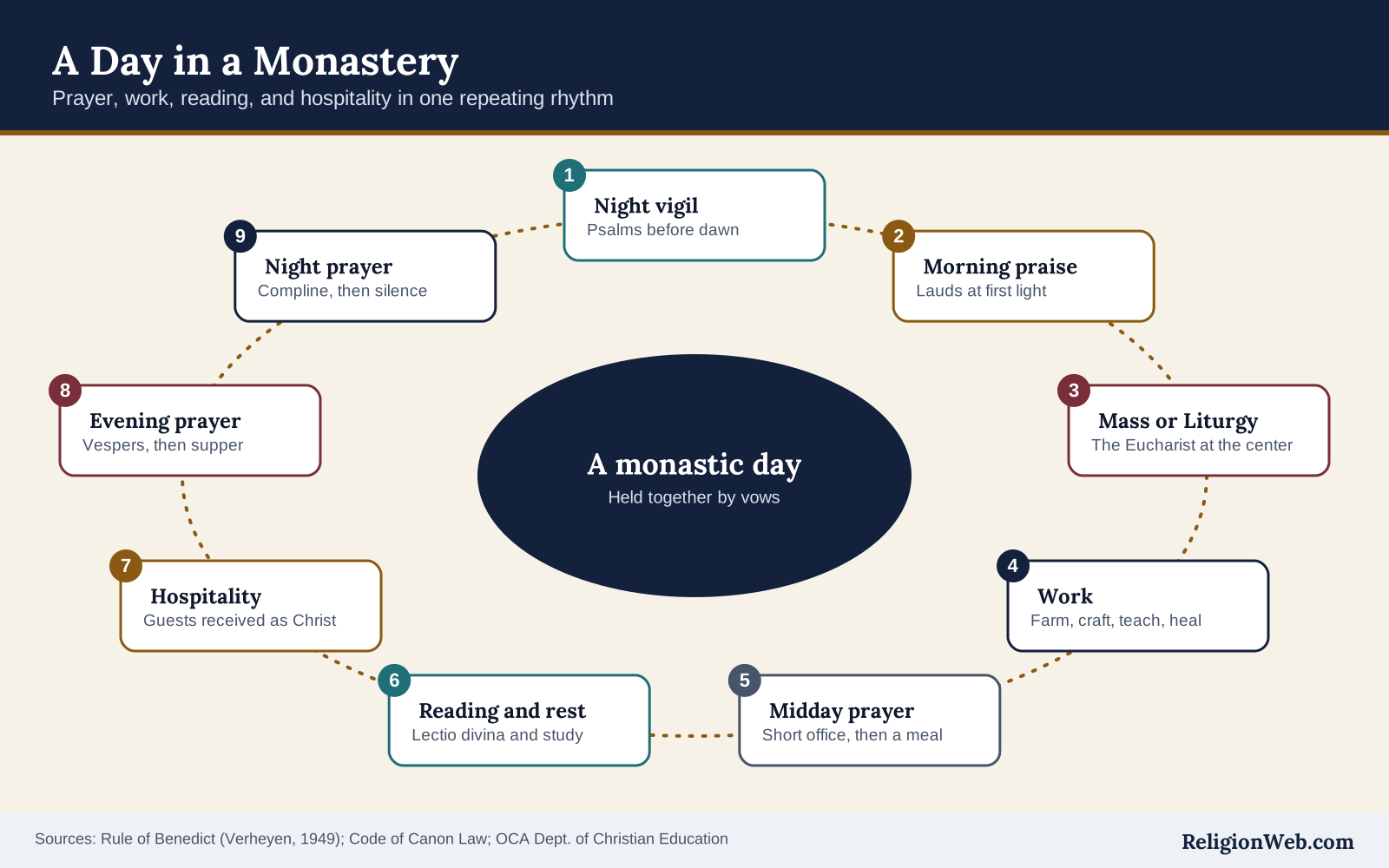
Protestant, Anglican, and Ecumenical Communities
The Reformation and Monastic Life
Why Reformers Criticized Monastic Vows
The sixteenth-century Reformation brought a sharp break in the Western history of religious life. Martin Luther, himself an Augustinian friar, came to criticize monastic vows in the early 1520s, arguing that they were often presented as a superior path to holiness and that they obscured the teaching that salvation comes by grace through faith. He left his order and married the former nun Katharina von Bora in 1525. Other reformers in the Lutheran and Reformed traditions made similar arguments, and the Lutheran Augsburg Confession of 1530 devoted an article to monastic vows. In their view, a Christian calling was to be found in ordinary work, marriage, and civic life, rather than in a state set apart.
Catholic theologians answered that the evangelical counsels are a gift recommended by Christ and that vows can be a legitimate way to live baptismal faith, and the Council of Trent affirmed the value of religious life and reformed it. The disagreement thus concerned the theological meaning of vows, not only the practice of monastic life. In many Protestant territories, the closure of monasteries followed from political and economic decisions as well as theology. In England, Parliament acts of 1536 and 1539 dissolved the monasteries, and the last abbey, Waltham in Essex, closed in March 1540. Of roughly 800 houses, an estimated 7,000 monks, friars, nuns, and other residents had to find new homes or livelihoods, and a number of abbots who resisted were executed.
Communities That Continued
Although the Reformation ended most monastic life in Protestant lands, some forms continued in modified shape. In parts of northern Germany, former convents were turned into Lutheran women’s foundations, where unmarried women lived communal lives under a rule of prayer and service, and a few of these institutions survive today in Lower Saxony. Moravian communities, in the eighteenth century, organized their settlements into groups called choirs by age and marital status, with shared worship and work. Within the Reformed and Lutheran churches, women’s diaconal communities, such as the deaconess house founded at Kaiserswerth in Germany in 1836, joined common life with nursing and teaching.
Most Protestant traditions have not created lifelong vowed orders as part of their official structure. Baptist, Methodist, and Pentecostal churches, for example, generally have no monasteries or convents, though members of these traditions have at times joined or founded communities that borrow monastic practices. The Baptist, Methodist, and Pentecostal emphases on congregational life, evangelism, and the priesthood of all believers shaped a different understanding of how Christian devotion should be organized. These differences are best understood as differences of ecclesiology and history, not of seriousness about prayer or discipline.
Anglican and Lutheran Revivals
Religious Life in the Anglican Communion
In Anglicanism, the dissolution of the monasteries under Henry VIII was followed by three centuries with little organized religious life. The Oxford Movement of the 1830s and 1840s, which stressed the Catholic heritage of the Church of England, encouraged a revival, and the first Anglican sisterhoods were founded in the 1840s. Communities of men followed, among them the Society of Saint John the Evangelist, founded in 1866, and the Community of the Resurrection, founded in 1892 at Mirfield in Yorkshire. In the twentieth century these were joined by Anglican Benedictine and Franciscan communities, and today Anglican religious life exists in many countries.
Anglican communities take vows of poverty, chastity, and obedience or similar promises, and their members pray the hours in common, run retreat houses, serve in parishes and missions, and work in education and social care. They are governed by their own constitutions, with oversight from a bishop who serves as visitor. Their relationship to the wider church has sometimes been tense, as the revival of vowed life was suspected of undermining Protestant identity, but the communities have become a respected part of Anglican life. They have also become places of ecumenical connection, welcoming Catholic, Orthodox, and Protestant guests.
Lutheran, Reformed, and Other Communities
In the twentieth century, a number of Lutheran and Reformed communities adopted a more explicitly monastic form. In Germany and Scandinavia, Lutheran sisterhoods and brotherhoods emerged, such as the Evangelical Sisterhood of Mary in Darmstadt, founded after the Second World War, and in Switzerland and France Reformed women formed communities modeled in part on older monastic patterns. These groups typically practice common prayer, hospitality, and service, and their members make commitments that may be lifelong or time-limited. Details vary and are best learned from the communities themselves.
Their existence shows that, even in churches that rejected vows in the sixteenth century, the desire for a shared life of prayer and simplicity has returned in new forms. Some commentators see this as part of a broader ecumenical convergence in which Protestants have rediscovered monastic wisdom, while others stress that the Protestant communities define their vocation differently, often without claiming that celibacy or poverty is a higher state. The Reformation’s concern for the dignity of ordinary life and the Catholic and Orthodox concern for dedicated vocations are present in these communities in a tension that each member resolves in personal and communal terms.
Taizé, Iona, and New Monasticism
The Taizé Community
The best-known ecumenical monastic community is Taizé, in Burgundy, France. According to the community’s own history, Roger Schutz-Marsauche, a young Swiss Protestant, arrived in the village of Taizé in 1940, near the demarcation line of occupied France, and welcomed refugees, particularly Jews fleeing the war. In 1942 he had to return to Switzerland, where he met his first companions, and the brothers returned to Taizé at the end of 1944. At Easter 1949, seven men made a lifelong commitment to celibacy, life together, and great simplicity, which the community describes as the first time since the Reformation that men of Protestant background made such a commitment.
The community soon became ecumenical. The first Catholic brother joined in 1969, and Brothers Roger and Max attended the Second Vatican Council as observers between 1962 and 1965. Brother Roger died violently in 2005, and Brother Alois led the community until 2023, when Brother Matthew became prior. From its first years the community has prayed together three times a day, and it is widely known for meditative sung prayer in short repeated chants and for the many young people who spend a week there each summer.
The Iona Community and New Monastic Households
Other ecumenical and Protestant communities followed. The Iona Community was founded in 1938 by George MacLeod, a Church of Scotland minister, and it has combined a community of men and women, living in their home contexts, with a rebuilt abbey on the island of Iona and a commitment to social justice. In northern Italy, the Bose Community, founded in 1965, brings together men and women, including members from several Christian backgrounds, under a rule of prayer, work, and hospitality. These examples show that the term “monastic” can be extended to communities with flexible vows and mixed membership.
Since the early 2000s, some evangelical and Protestant Christians in North America and Europe have formed what they call new monasticism. A report in the Christian Century in 2005 describes Rutba House in Durham, North Carolina, as an example, where a small group shares meals, a common purse, and daily prayers from the Book of Common Prayer. The report notes that these communities pursue “the ancient triumvirate of poverty, chastity and obedience, but with a twist”: married people take part, chastity is framed as marital fidelity, and obedience means accountability to Jesus and the community rather than to an abbot. A 2004 conference hosted by Rutba House led to a book, School(s) for Conversion: 12 Marks of a New Monasticism. These households do not usually take vows in the canonical sense and are not recognized as religious orders, and the movement continues to develop.
Monasticism in the Modern World
Suppression, Decline, and Renewal
Revolutions, Reforms, and Closures
The modern era has been difficult for many monasteries. An encyclopedia reference records that in the 1780s Emperor Joseph II suppressed numerous Benedictine abbeys in Austria and neighboring lands, and that during the French Revolution monastic houses were completely suppressed in France. Monasteries in the Netherlands and Switzerland were forced to close in 1796, and Spanish monasteries were suppressed in 1809. Later disruptions included the expulsion of monks from Mexico in 1913, the persecution of religious in Spain during the civil war of the 1930s, and the closure of nearly all monasteries in the Soviet Union and other communist states. The same reference describes monasticism as reduced across Europe by 1810.
Many communities were later refounded. Benedictine monks returned to France in the nineteenth century, and Solesmes became a center of liturgical revival. Orthodox monasteries in Russia, Ukraine, Romania, Bulgaria, and Georgia reopened or were newly built after the fall of communism, and women’s monasteries in particular have grown in several of these countries. These revivals have not been uniform, and their health depends on local conditions, including the availability of experienced elders after decades of persecution.
Renewal and Decline After Vatican II
In the Catholic Church the Second Vatican Council called all religious institutes to renewal, as Perfectae Caritatis set out in 1965. Communities revised their constitutions, reconsidered their dress, schedules, and works, and in many cases brought lay people and women into greater roles. The same decades saw a sharp drop in entrants in Europe and North America, and the median age of members in many communities has risen. Statistical reports show that the number of women religious worldwide fell by 9,805 between 2022 and 2023 to 589,423, with growth recorded in parts of Africa and Asia and declines in Europe and the Americas in earlier reports.
Communities have responded in different ways. Some have merged houses, closed schools or hospitals, or transferred sponsorship of institutions to lay boards. Others have sent members to new missions in Africa and Asia, where vocations are more numerous, or have welcomed international members. Some young entrants are drawn to communities with a more traditional liturgy and habit, while others join communities known for social engagement or ecumenical outreach. The picture is of change, not simple extinction, and the future shape of religious life remains an open question that the communities themselves discuss.
Monastic Voices in Contemporary Life
Contemplation, Retreat, and the Wider Public
In the twentieth century, monks and nuns reached large public audiences. Thomas Merton, a Trappist monk of Gethsemani Abbey in Kentucky, published his autobiography The Seven Storey Mountain in 1948, a book that brought many readers to the idea of monastic life, and he wrote on contemplation, social justice, and dialogue until his death in 1968. Monasteries have since become sites of retreat for people of many backgrounds, and guesthouses report steady demand for silent retreats and spiritual direction. The 2005 documentary Into Great Silence, about the Carthusians of the Grande Chartreuse, drew large audiences for a film with almost no spoken words.
Monasticism has also taken new roles in public life. Communities provide spiritual guidance, shelter, and education, they preserve manuscripts and art, and some host interfaith and ecumenical gatherings. Mother Maria Skobtsova, an Orthodox nun who ran a house of hospitality in Paris and died in Ravensbrück concentration camp in 1945, was canonized in 2004 by the Ecumenical Patriarchate, and her example is often cited for the link between monastic prayer and care for the destitute. Such figures show that the monastic tradition continues to produce witnesses whose lives are known beyond their communities.
Monastic Life in the Global South and Diaspora
As the center of gravity of world Christianity has shifted to Africa, Asia, and Latin America, so has the center of religious life. Benedictine, Cistercian, Franciscan, and other communities in Africa are growing, and local congregations of sisters, founded by missionaries or by local bishops, now run schools and clinics across the continent. Coptic, Ethiopian, and Eritrean monasteries have established houses in North America, Europe, and Australia to serve diaspora communities, and Orthodox monasteries in the United States, Canada, and Western Europe draw converts and immigrants. These developments show that monasticism is not a relic of one region but a global form of Christian life.
Regional differences affect how communities understand their mission. In places where Christians are a minority, monasteries may serve as cultural and educational anchors for the whole community, while in places of rapid growth they may focus on training leaders and sustaining local charity. Communities in regions with conflict, such as parts of the Middle East, have also faced emigration and insecurity, and their continued presence is a matter of concern for church leaders. Because conditions change quickly, readers seeking current information about a particular community should consult its own publications.
Common Misconceptions About Christian Monasticism
Misconception 1: All Monks and Nuns Live in Total Silence
Where the misunderstanding comes from
The picture of the silent monk is vivid and not wholly mistaken, which is why it persists. Popular culture has long associated monasteries with silence, from films and novels to the phrase “vow of silence.” Certain communities, notably the Trappists in earlier generations and the Carthusians today, have a reputation for strict quiet, and the Rule of Benedict gives silence real weight: one chapter is titled “Of Silence,” and another forbids anyone to speak after Compline. Visitors to monasteries are often told to keep silence in the church, cloister, and refectory, and a retreat guest who hears almost no conversation for a weekend may reasonably conclude that the community never speaks.
The Trappist tradition also developed a system of hand signs so that necessary communication could take place without speech, and the use of signs, which gradually declined after the Second Vatican Council, reinforced the image of mute monks. The 2005 documentary Into Great Silence, filmed at the Carthusian Grande Chartreuse, added to it. Another source of confusion is the Orthodox ideal of hesychia, or stillness, which can be mistaken for a prohibition on speech when it refers chiefly to inner quiet and attention in prayer.
What the evidence and tradition actually show
In nearly all communities silence is a discipline with times and places, not a permanent condition. The Benedictine “great silence” runs from Compline to the next morning, and daytime quiet is kept in particular areas, but monks and nuns talk during work, community meetings, recreation, spiritual conversations, and classes. The liturgy itself is spoken or sung for several hours a day. Active congregations of sisters, whose members teach, nurse, and administer, speak as much as any professionals, and the Taizé community combines long periods of silent prayer with open conversation among guests and brothers. No major tradition lists a vow of silence among the standard monastic commitments.
Even the strictest houses are not mute. Carthusian monks live largely in their cells but, according to their own custom, gather for common prayer and share conversation on set occasions, including a weekly walk. In Orthodox monasteries, elders spend long hours speaking with monks, pilgrims, and visitors seeking counsel. The tradition treats silence as a means of listening to God, to scripture, and to others, and it regards speech that builds up the community as good. Some individual monks or hermits do adopt extended silence for a period, but they do so as a particular practice, with the approval of their superior, and not as the rule for all. Monastic writers also point out that the ideal is a quality of attention rather than the absence of sound, and that a monk who speaks gently and rarely is practicing the same discipline as one who keeps long periods of quiet.
Misconception 2: Every Monastic Tradition Takes Exactly the Same Vows
Where the misunderstanding comes from
It is common to read that monks and nuns “take vows of poverty, chastity, and obedience,” and in Catholic canon law these three counsels are indeed the foundation of religious life. Summaries written for general readers tend to flatten this into a single formula. The phrase has also spread through fiction, film, and journalism, and it is applied indiscriminately to Benedictines, Orthodox monks, and Anglican sisters. A reader who has seen the formula repeated many times can reasonably assume that all monastic traditions make the same pledges in the same legal form.
What the evidence and tradition actually show
The traditions share a family resemblance, but the commitments differ in wording, legal structure, and meaning. The Rule of Benedict speaks of stability, fidelity to the monastic way of life, and obedience, with poverty and celibacy presupposed by the common life. Franciscan friars promise obedience, living without property, and chastity, and Jesuits who make final profession add a special vow concerning missions at the pope’s disposal. Catholic hermits profess the three counsels before their bishop and follow a personal plan of life, and consecrated virgins are consecrated by the bishop without a community. Some Catholic bodies, such as secular institutes, use other sacred bonds in place of public vows. Canon 573 itself refers to “vows or other sacred bonds.”
Outside the Catholic system the differences grow. In Orthodox monasticism, a monk is tonsured in stages and promises obedience, poverty, and chastity before the church, but there is no equivalent of canonical vows administered by a central authority. The Taizé brothers commit to celibacy, life together, and great simplicity, and new monastic households use pledges and community covenants that allow marriage. These variations reflect different histories, different ideas of the church, and different understandings of what a vow is. Describing them accurately requires naming the tradition, as this article does throughout.
Misconception 3: Christian Monasticism Disappeared After the Middle Ages
Where the misunderstanding comes from
The belief that monasticism ended with the Middle Ages comes mostly from the way English-language history is told. Many readers know monasteries through ruins such as Fountains Abbey or Tintern, and through the story of Henry VIII, whose acts of 1536 and 1539 dissolved the English houses and closed the last, Waltham Abbey, in 1540. School curricula often move from medieval abbeys to the Reformation as though the story ended there. The suppressions of the Enlightenment and the French Revolution, when the monasteries of France were completely suppressed and houses in Austria, the Netherlands, Switzerland, and Spain were closed, deepen the impression of an institution finished off by modernity.
A related assumption is that monastic life belongs to a vanished feudal world and has no place in societies built on markets, democracy, and mass education. Because the most visible surviving monasteries are tourist sites and museums, many people never meet a working community, and the sense that monasticism is a historical subject rather than a living practice is reinforced by the fact that some of the best-known abbeys now serve as heritage attractions.
What the evidence and tradition actually show
These closures were real and often devastating, but they were regional and political, not universal. Monasticism never ceased in the Orthodox and Oriental Orthodox worlds, where Athos, the Coptic desert monasteries, and the houses of Ethiopia and Armenia have been inhabited through the centuries. In the Catholic world, the sixteenth and seventeenth centuries produced the Discalced Carmelites, the Jesuits, the Ursulines, the Daughters of Charity, and the Trappist reform, and the nineteenth century saw the refounding of Benedictine houses in France and the explosive growth of women’s congregations. Anglican religious life was revived in the 1840s, and Taizé began in 1940.
Present-day numbers show that monastic life continues on a significant scale. In 2023 the Catholic Church counted 589,423 women religious worldwide, according to figures reported by Fides in October 2025, although this was fewer than a year earlier. Decline in Europe and North America is real, and many communities are aging and consolidating. At the same time, growth has been recorded in parts of Africa and Asia, Orthodox women’s monasteries have expanded in several countries after the end of communist rule, and new monastic households have appeared in the evangelical world. The accurate description is of change, closure, and renewal all happening at once.
Misconception 4: Monk, Nun, Friar, and Sister Are Just Different Words for the Same Thing
Where the misunderstanding comes from
English speakers often use “monk” and “nun” for anyone in a habit, and many assume that all monks are priests and that all nuns live behind walls. Newspapers and films seldom distinguish, and even Catholics use “nun” and “sister” interchangeably in everyday speech. Churches themselves use terms inconsistently across languages, and the Eastern and Western vocabularies differ. A reader who meets a Dominican friar, a Benedictine monk, and an Orthodox hieromonk in a single week may find it hard to tell how they relate.
What the evidence and tradition actually show
The terms have specific meanings, as explained earlier in this article. Monks live in a stable community, traditionally in one house, while friars belong to a province and are assigned to different convents. Nuns in the strict sense are women in contemplative monasteries, while sisters belong to active congregations, although the words are often blurred. Priesthood is a separate matter. In the Rule of Benedict, the priests of the monastery are treated in their own chapter, which indicates that they were a limited group within a community made up mostly of laymen, and today many monks are not ordained, though some are. Catholic and Orthodox teaching restricts ordination to men, so sisters and nuns are not priests.
These distinctions are not just technical. They affect how members pray, work, and are governed, and they shape the way each community understands its history. A Franciscan friar works in a city parish or a university, a Carthusian rarely leaves his cell, and an Orthodox nun may spend her day in an icon workshop and the services of the church. Learning the vocabulary, as the early section on terms did, is the first step toward seeing why the traditions are not interchangeable.
Frequently Asked Questions About Christian Monasticism
Questions About Beginnings and Meaning
What is Christian monasticism?
Christian monasticism is a stable way of living, practiced by monks, nuns, hermits, and other religious, in which people commit themselves to prayer, simplicity, celibacy, and obedience within a community or under a spiritual guide. It began in the late third and fourth centuries in Egypt and other eastern Mediterranean lands, and it now exists in Catholic, Orthodox, Oriental Orthodox, Anglican, and some Protestant and ecumenical forms.
The term covers many variations, including hermits, communal monks, friars, active sisters, and new monastic households. Each tradition understands its own calling in its own language, and this article names the tradition whenever a statement does not apply to all.
Who was the first Christian monk?
There is no single first monk. Antony of Egypt, who died in 356, is the best-known early figure, but a standard reference describes him as the model of the anchorite movement and not its founder, since others were already living as ascetics. Pachomius is regarded as the pioneer of organized communal monasticism, around 320 at Tabennisi.
Later tradition names earlier hermits, and ascetic Christians such as consecrated virgins and widows lived in the churches before the desert movement. Historians therefore speak of a gradual development rather than a single founder.
Is monasticism mentioned in the Bible?
The Bible does not describe monasteries or use the word monk. Monastic writers have appealed to passages such as the call to the rich man in Matthew 19:21, the description of shared goods in Acts 4, and the teaching on celibacy in 1 Corinthians 7. Catholic and Orthodox interpreters read these as foundations for a recommended way of life, while many Protestant interpreters read them as applying to all believers or to particular circumstances.
Because of these differing readings, the question is also one of how the churches understand tradition. Catholic and Orthodox Christians treat the developed monastic tradition as a legitimate growth of the Gospel, whereas Reformation-era critics argued that it lacked biblical warrant.
Questions About Daily Life
What do monks and nuns do all day?
A typical day combines communal prayer, private prayer, work, and reading. In a Benedictine or Cistercian house, the community gathers for the hours of the Divine Office from early morning to evening, celebrates Mass, and spends the hours between on work such as farming, teaching, crafts, or hospitality. Orthodox monks attend a longer cycle of services and keep a private rule with the Jesus Prayer.
Active sisters and brothers combine a shorter prayer schedule with work in schools, hospitals, and parishes. The sample table in this article shows one pattern, but schedules vary by community and season.
Do monks and nuns have to stay for life?
Final commitments are intended to be lifelong, but formation is gradual, with a novitiate and a period of temporary vows before perpetual profession. In Catholic law the novitiate lasts at least twelve months and no more than two years, and temporary profession lasts between three and six years. A person may leave at the end of these periods, and members of perpetual vows may seek a formal release.
Some people leave, and communities say so frankly. The traditions emphasize discernment so that candidates and communities both can recognize whether the way of life fits.
Can a visitor stay at a monastery?
Many monasteries welcome guests, and the Rule of Benedict tells the community to receive them as Christ. Visitors usually write or call ahead, follow the daily schedule, and respect quiet areas. Some houses accept only men or only women for overnight stays, and Orthodox houses and Mount Athos have their own rules and permits.
Guests of any background are often welcomed to attend services, though they generally do not receive communion in Catholic or Orthodox churches unless they belong to that church, apart from limited exceptions provided in church law. Anyone planning a stay should consult the monastery directly for current practice.
Questions About Differences
What is the difference between a monk and a friar?
A monk traditionally belongs to a single community under an abbot, in a house to which he is bound by stability, and the monastery supports itself by work. A friar belongs to a province of a mendicant order such as the Franciscans or Dominicans and is assigned to different houses for preaching, teaching, or pastoral care.
The difference arose in the thirteenth century, when friars moved into towns and universities. Both live under vows and common prayer, but their relation to place, property, and ministry differs.
Do Protestants have monks and nuns?
Most Protestant churches have no vowed orders in their official structures, and the Reformation criticized monastic vows. There are exceptions. Anglican communities of monks, nuns, and friars exist in many countries, and Lutheran and Reformed sisterhoods and brotherhoods have appeared since the nineteenth and twentieth centuries. Taizé, founded by a Swiss Protestant in 1940, is ecumenical.
In addition, some evangelical Christians have formed new monastic households that share meals and money without canonical vows. The range of practice is wide, and the term “monastic” is used in a looser sense in some of these communities.
Can women lead monasteries?
Yes. Women’s monasteries are led by abbesses or prioresses in the Catholic Church and by abbesses (hegumenias) in the Orthodox churches, and medieval abbesses such as Hilda of Whitby and Hildegard of Bingen were influential figures. Abbesses govern their communities, though they do not ordain, since Catholic and Orthodox teaching reserves ordination to men.
In the Catholic Church, women’s communities have historically been under male oversight, and this has been changing as constitutions are revised to give them more self-government. Orthodox women’s monasteries are under the authority of a bishop but are governed day to day by their abbess.
Conclusion: What Christian Monasticism Shows
What the History Shows
A Tradition That Keeps Adapting
Seen over seventeen centuries, Christian monasticism is less a fixed institution than a recurring response to a question: how can people give their lives wholly to God, and how should they do it together? Egyptian hermits answered with the desert, Pachomius and Basil with communal rules, Benedict with a moderate school of the Lord’s service, Cluny and Cîteaux with reform, Francis and Dominic with the city, Teresa and Ignatius with new foundations, and Taizé with ecumenical reconciliation. Each answer arose in a particular setting, drew on earlier ones, and was criticized by contemporaries.
The record includes achievements in prayer, learning, hospitality, and care, and also failures, abuses, and conflicts over wealth and power. Both belong to an honest account. The reasons that monastics give for their way of life are religious, and they are best described in their own terms, while the social and political history can be studied alongside them.
Continuity and Difference
The traditions show remarkable continuity in some respects. The psalms prayed by Benedictines are the psalms that Orthodox monks chant, the Lord’s Prayer is said in every house, and the ideals of obedience, simplicity, and hospitality recur from Egypt to Burgundy to Ethiopia. They also differ in structure, vows, leadership, and spirituality, and these differences should not be erased. The Catholic system of orders, the Orthodox system of self-governing monasteries, and the Protestant experiments with new communities each reflect different ideas of the church.
How to Keep Exploring
Related Topics on ReligionWeb.com
Readers who want to continue can follow several paths on this site. The story of the holy men and women whom the churches honor is told in the article on Christian saints, and the belief that underlies Orthodox hesychast prayer is set out in the article on the Trinity. The seasons that shape the monastic year are described in the articles on Advent, Lent, and Easter, and the broader background is in the article on Christianity.
Reading and Visiting
For primary sources, the Rule of Benedict, the Life of Antony, the Sayings of the Desert Fathers, and the Philokalia are available in many editions, and readers should check the translator and edition. For present-day practice, the most reliable guides are the communities themselves, whose websites usually explain their history, prayer times, and visiting arrangements. A visit to a monastery or convent, with attention to its customs, remains the best way to understand what the texts describe.
Sources
The table below lists the principal external sources behind this article. Facts, dates and figures were checked against these and related primary, institutional and academic materials.
| # | Source | Publisher and type | Used for | Link |
|---|---|---|---|---|
| 1 | The Holy Rule of St. Benedict (1949 edition, trans. Boniface Verheyen) | Christian Classics Ethereal Library · Primary text | Rule of Benedict chapters 1, 48, 53; chapter titles and structure; quoted edition | ccel.org |
| 2 | World English Bible, Matthew 19 (also Acts 4 and Psalm 119) | eBible.org · Primary text | Quoted verses Matthew 19:21, Acts 4:32, Psalm 119:164; public-domain status of the WEB | ebible.org |
| 3 | Code of Canon Law, Book II, canons 573-606 (consecrated life) | Vatican (Secretariat for Communication) · Institutional | Evangelical counsels, hermits, consecrated virgins, canons 573-604 | vatican.va |
| 4 | Code of Canon Law, Book II, canons 607-709 (religious institutes) | Vatican (Secretariat for Communication) · Institutional | Novitiate, temporary profession, cloister, habit, prayer (canons 607-674) | vatican.va |
| 5 | Perfectae Caritatis (Decree on the Adaptation and Renewal of Religious Life), 1965 | Vatican (Second Vatican Council) · Institutional | Renewal principles, poverty, enclosure, and the religious habit | vatican.va |
| 6 | Monasticism (encyclopedia entry) | Encyclopedia.com · Encyclopedia | Pachomius, Basil, Cassian, Aachen 817, Cluny, Cistercians, Carthusians, suppressions | encyclopedia.com |
| 7 | Monasticism (Orthodox focus unit) | Orthodox Church in America, Department of Christian Education · Institutional | Orthodox stages of monastic life, daily services, prayer rope, bishops as monks | dce.oca.org |
| 8 | Looking at the Origins of the Phrase Ora et Labora | Pazmany Law Review (ojs.mtak.hu) · Academic article | Fun Fact: ora et labora absent from the Rule; Wolter 1880; Meeuws 1992 | ojs.mtak.hu |
| 9 | More Catholics worldwide, fewer priests: Church statistics (Fides data, 2023) | Aleteia (reporting Agenzia Fides, 17 Oct 2025) · Demographic data | 589,423 women religious in 2023, down 9,805 from 2022 | aleteia.org |
| 10 | History of the Taize Community | Taize Community · Institutional | Taize founding 1940, 1949 commitment, ecumenical development, leadership | taize.fr |
Last fact-check date: 2026-10-21.