Christian saints are the people whom Christians regard as holy because of their union with Christ, and the phrase carries two meanings that run side by side. In the New Testament, “saints” (Greek hagioi, “holy ones”) usually names an entire community of believers, as when Paul writes to everyone in Rome who is “called to be saints.” In later Catholic, Orthodox, and Oriental Orthodox usage, “a saint” also means a particular person, usually deceased, whom the Church publicly honors as a model of Christian life and as a companion who prays for the living. Both senses are old, and both remain in use today.
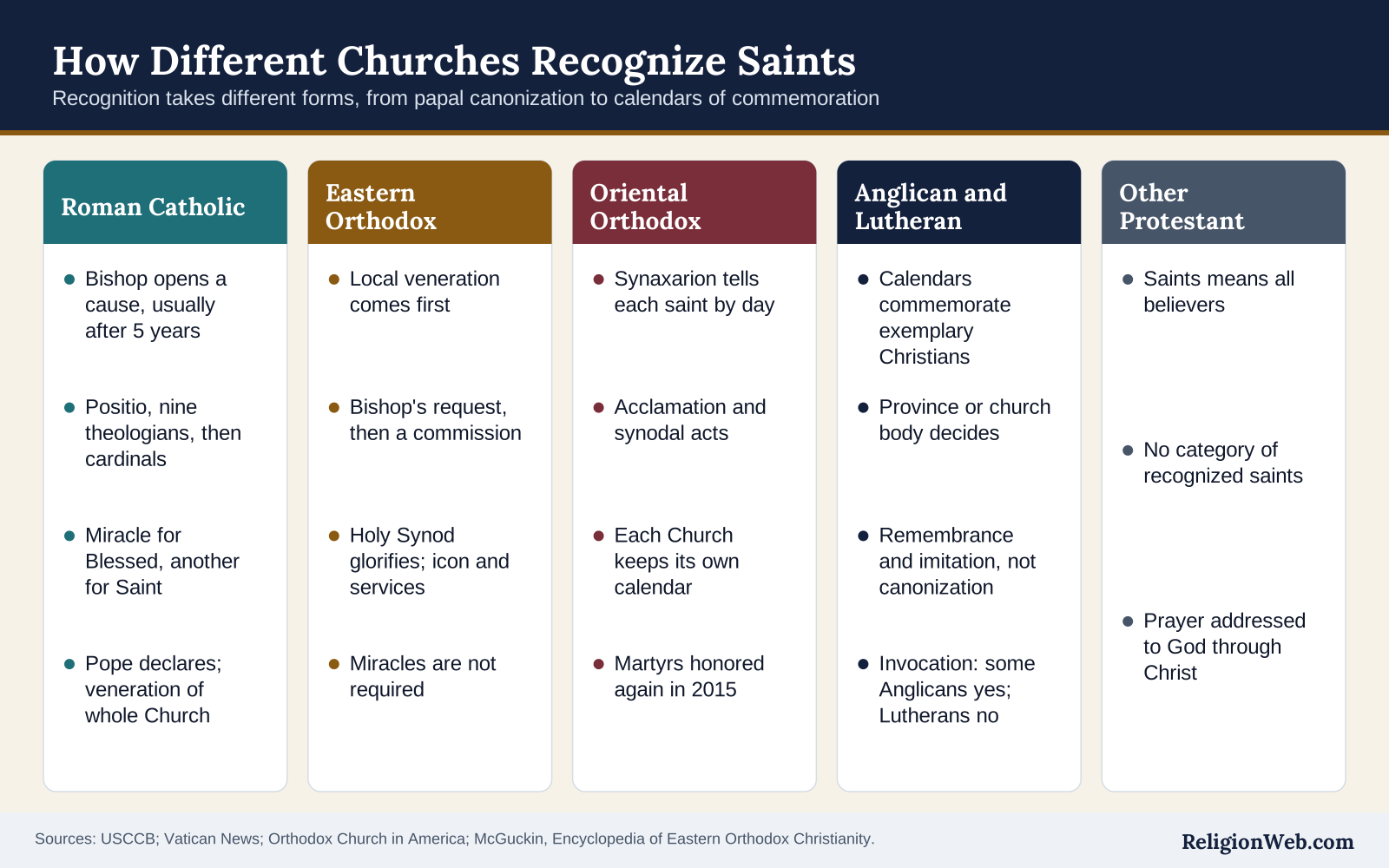
The way a person comes to be recognized as a saint differs from one part of Christianity to another. The Catholic Church has a formal judicial and investigative procedure called canonization, which ends with a papal declaration. Eastern Orthodox Churches speak of glorification, a decision by a synod of bishops that usually follows a long period of popular veneration. Many Protestant churches have no category of recognized saints at all, while using the word “saints” for every believer, and some Anglican and Lutheran traditions keep calendars that commemorate exemplary Christians without invoking them in prayer.
This article explains what “saint” means in each of those settings, how martyrs became the first honored saints, how canonization and glorification developed, and how feast days, patron saints, relics, icons, pilgrimage, and hagiography (writing about saints’ lives) work in practice. It also sets out, without ranking them, the reasons why some Christians pray for the intercession of the saints and others do not. Wherever traditions differ, the tradition is named, because “Christians believe” rarely describes this subject accurately.
What Is a Saint in Christianity? Meanings and Vocabulary
Two Meanings That Run Side by Side
The inclusive meaning: the holy people of God
The oldest Christian meaning of “saint” is collective. The Greek word hagios means “holy” in the sense of “set apart for God,” and in the apostolic letters its plural form hagioi is a common name for Christian believers as a group. Paul addresses congregations in Rome, Corinth, Philippi, Ephesus, and Colossae as saints, and he does so in the opening greetings of letters that go on to rebuke some of those same congregations for quarrels, lawsuits, and moral failures. Holiness in this usage is not a reward for achievement. It describes what God has done in calling a people, and what the baptized are summoned to grow into.
That inclusive meaning has never disappeared. Baptist, Pentecostal, Methodist, Adventist, and many other Protestant churches use “saints” in precisely this broad sense, and The Church of Jesus Christ of Latter-day Saints, described in the article on the Latter-day Saint tradition, carries the word in its official name. Catholic and Orthodox teaching also affirm that every baptized person is called to holiness, a point that Catholic documents call the universal call to holiness. The inclusive sense is therefore not a Protestant innovation laid over an older, narrower meaning. It is the starting point from which the narrower meaning grew.
The recognized meaning: models and intercessors
The second meaning appears when a church publicly identifies particular people as saints, places their names in liturgical calendars, and asks for their prayers. Catholic teaching describes this as a recognition and not a creation. The Catechism of the Catholic Church says, in paraphrase, that when the Church canonizes some of the faithful it solemnly declares that they practiced heroic virtue, recognizes the power of the Spirit of holiness at work within her, and offers the saints to believers as models and intercessors (CCC 828). Orthodox writers put the same idea in their own terms: the Church does not make saints, because only God can do that, and the Church can only recognize those whose lives show cooperation with divine grace.
In this second sense the saints serve three roles in the traditions that honor them. They are examples, whose lives show what a Christian life can look like in a particular century, culture, and vocation. They are friends or members of a family, because the departed are understood to remain part of the Church. And they are intercessors, in the sense that they are asked to pray to God on behalf of the living, much as a living friend might be asked to pray for someone. How far each of these roles is accepted, and what language is used for them, is the main line of difference among Christian churches.
Key Vocabulary for Reading About Saints
Saint, by context
Because one English word covers several things, it helps to see the range side by side. The table below summarizes how the word works in the New Testament and in the major Christian settings. It describes teaching and practice as each tradition presents itself, and it simplifies, since every tradition has internal variation.
| Context | Typical meaning of “saint” | How a person is recognized | Practice toward saints |
|---|---|---|---|
| New Testament (Greek hagioi) | Members of Christian communities, called and set apart by God | Through faith and baptism into the community | Greetings, shared aid (as in the collection for Jerusalem), prayer by and for the saints |
| Roman Catholic Church | Both all the faithful and, in the narrower sense, those canonized | Canonization by the pope after an investigation of heroic virtue or martyrdom and, normally, a miracle | Liturgical feast days, invocation, patron saints, relics, images, pilgrimage |
| Eastern Orthodox Churches | People whom God has glorified, and the whole body of the faithful | Glorification by a synod of bishops, usually after popular veneration | Icons, services (troparia and akathists), name days, relics, daily commemorations |
| Oriental Orthodox Churches | Martyrs, ascetics, bishops, and holy people honored in each Church’s tradition | Acclamation and synodal acts, varying by Church | Synaxarion readings, feasts, icons, pilgrimage to tombs and monasteries |
| Anglican and Episcopal churches | All believers; also exemplary Christians commemorated in a calendar | Inclusion in a province’s calendar by church authority; no single universal procedure | Commemoration and thanksgiving; invocation is practiced in some circles and not in others |
| Lutheran churches | All who are justified by faith; also remembered exemplary Christians | Calendars of commemoration; no canonization | Thanksgiving and imitation; invocation is not practiced |
| Reformed, Baptist, Pentecostal, and most other Protestant churches | All believers, living and departed | No category of recognized saints | Gratitude for examples of faith; prayer is addressed to God alone |
| Latter-day Saints | Members of the Church, as a self-designation | Membership through baptism and confirmation | No invocation of departed saints; “saints” is a self-designation |
Terms used in this article
A handful of terms recur throughout. Canonization is the Catholic act by which the pope declares that a person is in heaven and may be venerated by the whole Church; the word comes from the Greek kanon, a rule or list, and it originally meant entry in the official list of saints. Beatification is the preceding Catholic step, which permits limited, usually regional, public honor to a person called “Blessed.” Glorification is the Orthodox term for a church’s formal recognition of a saint.
Veneration means honor or reverence directed to a holy person or sacred image, as distinct from the worship due to God alone; the later sections explain how Catholic and Orthodox teaching draw this distinction. Intercession means asking someone to pray on one’s behalf. Communion of saints is the phrase from the Apostles’ Creed that, in Catholic, Orthodox, Anglican, and Lutheran readings, includes both shared participation in holy things and the fellowship of the living and the dead in Christ. A relic is the body of a saint or an object closely associated with one, a patron saint is a saint regarded as a special protector of a place, group, or person, and hagiography is writing about saints.
Who Honors Saints, and How Widely
Traditions with developed saint veneration
Saint veneration in the recognized sense is central to the Catholic Church, the Eastern Orthodox Churches, and the Oriental Orthodox Churches, which together include the Coptic, Ethiopian, Eritrean, Syriac, Armenian, and Malankara Churches. In these families of churches, saints appear in the daily and yearly cycle of prayer, in the names of parishes and children, in church art, and in the dedication of altars. The details differ widely. A Catholic parish dedicated to a medieval friar, an Orthodox monastery on Mount Athos, and an Ethiopian church keeping the feast of its local saint each draw on a shared inheritance, but they do not use identical rites.
Anglican traditions occupy a range between these families and the Protestant churches. The Church of England and other Anglican provinces maintain calendars of saints’ days that commemorate apostles, martyrs, and later figures, and Anglo-Catholic parishes often practice invocation of saints, whereas evangelical Anglicans generally do not. Lutheran churches also observe saints’ commemorations, and the day of All Saints holds an important place in many Lutheran congregations. Many members of both traditions distinguish remembering and imitating the saints from praying to them, though practice varies from parish to parish.
Traditions that use “saints” mainly for all believers
In Baptist, Pentecostal, and many other churches that emerged from the Reformation or after it, “the saints” simply means the congregation or the whole body of believers, and the New Testament’s inclusive usage is treated as the only legitimate one. These churches typically hold that prayer is addressed to God through Christ alone, and that no honor of the departed should compete with that. They do commonly honor heroes of the faith, such as missionaries, reformers, and martyrs, through sermons, hymns, and church history, without a formal category of recognized saints.
The picture across Protestantism is not uniform, as the later section on Protestant approaches explains. The rest of this article follows the order in which the practices arose: first the biblical background, then the age of the martyrs, then the formal procedures of recognition, and then the devotional life that surrounds the saints.
Saints in the Bible: The Holy People of God
The Hebrew and Greek Background
Qadosh and hagios: set apart for God
The Hebrew Bible uses the adjective qadosh, “holy,” for God first of all, and then for whatever God sets apart: the people of Israel, the priests, the sanctuary, the Sabbath. Leviticus calls Israel to be holy because the Lord is holy, which makes holiness a shared vocation of the whole people and not a private achievement. When the Hebrew scriptures were translated into Greek in the Septuagint, the translators regularly rendered qadosh with hagios, which is the word the New Testament authors inherited and applied to the Christian community.
The sense of “set apart” matters because it explains how a congregation full of flawed people can be called holy without contradiction. In biblical usage a thing or a person is holy because of a relationship, not because of a record of conduct. A temple vessel is holy because it is dedicated to God, and the early Christians described themselves as holy because they were dedicated to God through Christ. The moral expectation follows from the status, and the New Testament letters are full of exhortations to live up to it.
Holy ones in the Hebrew Bible and Second Temple writings
The Hebrew Bible also speaks of “holy ones” in contexts that later Christian readers connected to the saints. The Book of Daniel describes how the holy ones of the Most High will receive the kingdom (Daniel 7:18), a phrase that older English versions translate as the saints of the Most High. Scholars interpret the identity of these holy ones in different ways, as the Jewish people, as angels, or as both, and the New Testament writers drew on this imagery when they described the Christian community’s future vindication. The point for this article is that the Greek and Hebrew vocabulary Christians used for “saints” already existed, and it already referred to a group before it was applied to individuals.
Saints in Acts, the Letters, and Revelation
Whole congregations addressed as saints
The clearest evidence is in the opening lines of Paul’s letters. The World English Bible renders the address of the letter to the Romans this way:
to all who are in Rome, beloved of God, called to be saints: Grace to you and peace from God our Father and the Lord Jesus Christ.
Romans 1:7, World English Bible (public domain)
The letter to the Philippians begins “to all the saints in Christ Jesus who are at Philippi, with the overseers and servants” (Philippians 1:1, World English Bible), and the letters to the Corinthians, Ephesians, and Colossians use similar greetings. In each case the recipients are the entire local church, including its leaders. Most Christian interpreters of every tradition read these verses as evidence that “saint” was first an ordinary name for a baptized believer. Where traditions diverge is in what they conclude from that fact, and the later sections take up the Protestant argument that the term should keep its original breadth and the Catholic and Orthodox argument that the narrower, recognized sense developed legitimately from it.
The saints in Jerusalem and the collection
Acts and the Pauline letters use “the saints” for specific communities as well. In Acts 9, Ananias objects to caring for Saul of Tarsus because of the harm he has done to the Lord’s saints at Jerusalem, and later in the same chapter Peter visits the saints living at Lydda. In Acts 26 Paul describes his own earlier conduct as imprisoning many of the saints. In his letters, Paul organizes a collection of money from Gentile churches “for the saints” in Jerusalem (Romans 15:25-26; 1 Corinthians 16:1-3; 2 Corinthians 8:4 and 9:1). Here the word has a social meaning: it names the Jerusalem church as a community with material needs, and the act of giving to the saints is an expression of shared membership.
Saints in Revelation and the Gospel of Matthew
The Book of Revelation uses “saints” often, and in two senses that later readers distinguished. Some verses describe saints who are still suffering on earth, as in the call for the perseverance of the saints under persecution (Revelation 14:12). Others describe the prayers of the saints rising to God as incense (Revelation 5:8 and 8:3-4), and the souls of those who have been killed for the word of God, calling out from beneath the heavenly altar (Revelation 6:9-10). Catholic and Orthodox writers have long read those scenes as pictures of the departed praying in heaven, while many Protestant interpreters read the “prayers of the saints” as the prayers of believers on earth that God receives. Both readings are attested in the history of interpretation.
A different kind of text is Matthew 27:52-53, which says that at the moment of Jesus’ death many bodies of the saints who had fallen asleep were raised. Interpreters have debated the meaning of this passage since antiquity. It shows that by the time of the Gospel the word “saints” could be applied to the righteous dead of Israel, which is one of the biblical roots of the idea that holy people continue to exist in some relation to the living community.
The Cloud of Witnesses
Hebrews 12:1 and how it has been read
The most often cited text in discussions of the saints’ relationship to the living church is the opening of Hebrews 12, which follows a long chapter listing figures of faith from Abel to the prophets:
Therefore let’s also, seeing we are surrounded by so great a cloud of witnesses, lay aside every weight and the sin which so easily entangles us, and let’s run with perseverance the race that is set before us,
Hebrews 12:1, World English Bible (public domain)
Catholic and Orthodox interpreters have commonly understood the “cloud of witnesses” as the company of the faithful departed, who are alive in God and who accompany and encourage the Christians still running the race. The Catholic Catechism cites this kind of reading when it speaks of the Church as one communion of the pilgrims on earth, the dead being purified, and the blessed in glory. Many Protestant commentators accept the image of encouragement but read the “witnesses” primarily as people whose recorded faith in chapter 11 bears testimony to those who read it, so that the verse supports imitation more than intercession. The text itself does not settle the question, which is one reason it has been debated for centuries.
One Mediator and the saints’ prayers
The second great biblical text in the discussion is 1 Timothy 2:5, which speaks of one mediator between God and humanity, the man Christ Jesus. Reformation-era writers appealed to this verse to argue that prayer to saints diminishes the unique mediation of Christ. Catholic teaching answers that the saints’ intercession does not compete with Christ’s mediation but participates in it. The Catechism says that the blessed in heaven “do not cease to intercede with the Father for us” as they offer the merits acquired on earth “through the one mediator between God and men, Christ Jesus” (CCC 956). Orthodox theology makes a parallel argument, based on the fellowship of all members of Christ’s body, living and departed.
The Bible alone has not ended the disagreement, because each side reads the relevant texts within a larger frame about the Church, tradition, and the state of the dead. Understanding that frame is more useful than counting verses, and it is the reason the following sections follow the history of practice as well as of doctrine. The next section turns to that history, beginning with the martyrs.

How Martyrs Became Saints: Historical Development to the Reformation
The Age of the Martyrs, to About 313 CE
Witness unto death: what “martyr” meant
The Greek word martys means “witness,” and in the New Testament it describes anyone who testifies to what they have seen and heard of Jesus. Within a few generations of the first Christian communities, the word narrowed to mean a person who bore that witness by dying rather than renouncing the faith. Persecution of Christians in the Roman Empire was irregular, local, and at times intense, with major empire-wide campaigns under the emperors Decius in the middle of the third century and Diocletian from 303 CE. Christians who were executed came to be remembered by their communities with a seriousness that set them apart from other dead members of the church.
Two terms from this period remain in use. A martyr died for the faith. A confessor suffered imprisonment, torture, or exile and survived, and was honored as having “confessed” the faith publicly. Later Christians added a third category that is not strictly a martyr or a confessor, the ascetic or holy teacher whose life is regarded as a continuing witness, and the history of saint recognition is in part the story of how that third group joined the first two.
Polycarp and the anniversary at the tomb
The earliest detailed account of how a Christian community treated a martyr’s remains is the Martyrdom of Polycarp, a letter from the church of Smyrna describing the death of its bishop. The date of the event is debated, and scholars have proposed years ranging from the mid-150s to the late 160s CE. After the execution, the authors say, the Christians gathered what remained of his body:
Accordingly, we afterwards took up his bones, as being more precious than the most exquisite jewels, and more purified than gold, and deposited them in a fitting place
Martyrdom of Polycarp 18, Roberts-Donaldson translation (Ante-Nicene Fathers, vol. 1; public domain)
The same chapter expresses the hope that the community would be allowed to gather at that place “with joy and rejoicing” to celebrate the anniversary of his martyrdom. That sentence summarizes the origin of much that followed: a tomb, a yearly observance on the day of death, and a community that regarded the dead witness as honored by God. Later Latin writers called the martyr’s day of death the dies natalis, the “birthday,” meaning birth into the life of heaven, and that is why many saints’ feast days fall on the date of death and not of birth.
Perpetua, Felicity, and written memory
Churches also wrote down what happened. The Passion of Perpetua and Felicity, set in Carthage and traditionally dated to 203 CE, preserves the prison account of a young noblewoman and the experience of an enslaved woman who was her companion, in a text that combines first-person narrative with the report of an editor. Accounts of this kind circulated among churches and were read aloud on the anniversaries, which is one root of the later genre of hagiography. The Christian communities of North Africa, as other regional churches, kept lists of their martyrs and the days of their deaths, and a Roman calendar compiled in the middle of the fourth century includes a list of martyrs and the places in Rome where they were buried.
From Persecution to Public Shrines, Fourth to Sixth Centuries
Confessors, ascetics, and bishops join the martyrs
The end of systematic persecution in the early fourth century, associated with the policies of Constantine and Licinius around 313 CE, changed what holiness looked like. When Christians were no longer being killed in large numbers, the ascetic life began to be described as a kind of bloodless martyrdom, a daily dying to the world. The biography of Antony of Egypt, written by Athanasius of Alexandria around 360, and the life of Martin of Tours, written by Sulpicius Severus around the time of Martin’s death in 397, presented living or recently dead holy people as models. The movement that produced these figures is described in the article on Christian monasticism.
Bishops who had defended the faith in theological disputes were also remembered as holy, and by the fifth century the lists of those honored included confessors, ascetics, teachers, and bishops alongside martyrs. The Eastern Orthodox encyclopedia entry on canonization notes that all patriarchs of Constantinople from 315 to 1025 were added to the catalog of saints soon after death, with exceptions for those condemned for doctrinal error or violations of church discipline. In the early centuries, in other words, recognition often followed a bishop’s reputation with little formal investigation.
Basilicas over tombs and the movement of relics
Imperial patronage turned local graves into major shrines. Constantine built churches over the Roman burial sites traditionally identified with Peter and Paul, and Constantius II completed the Mausoleum of the Twelve Apostles in Constantinople, according to the entry on canonization in McGuckin’s Encyclopedia of Eastern Orthodox Christianity. In 386, Bishop Ambrose of Milan oversaw the discovery of bodies identified as the martyrs Gervasius and Protasius and the translation of those relics into a new basilica, an episode that Augustine also remembered. Over the next centuries, bodies and fragments of bodies were moved, divided, and enshrined in churches far from the places where the martyrs had died, and the principle that an altar should contain or stand near relics became a common practice.
The Roman liturgy, for its part, wrote the saints into its central prayer. The older Roman Canon of the Mass names Mary, the apostles, and a list of early martyrs, among them Linus, Cletus, Clement, Cyprian, Lawrence, and Cosmas and Damian. The article on the Eucharist explains the place of the Great Prayer in Christian worship, and in that prayer the naming of saints expresses the conviction that the worshiping congregation is joined by the departed.
Early voices of caution and of defense
Honor for martyrs and relics did not go unquestioned. Councils such as Laodicea in the fourth century and Carthage in 419 addressed the veneration of martyrs, and the entry on canonization in McGuckin’s encyclopedia treats their rules as the earliest precursors of later investigations into whether a claimed saint was authentic. Historians often call such organized honor the cult of the saints, using the word in its technical sense of ritual veneration and without any negative judgment. In the early fifth century, the priest Jerome defended the honor of martyrs’ relics against the criticism of a contemporary named Vigilantius, arguing, in the usual account of his reply, that the honor was directed to the Lord whom the martyrs had served.
Augustine of Hippo made a distinction that later writers repeated. In works such as the City of God, he explained that Christians honor the martyrs and remember them at their shrines, but that sacrifice and worship belong to God alone. That line between honor and worship, developed further by Greek and Latin theologians, remains the center of how Catholic and Orthodox teaching defend the veneration of saints, and it is examined in a later section.
Local Recognition and the Rise of Papal Canonization
Bishops, synods, and local calendars
For roughly a thousand years the recognition of saints was mostly local. According to the 1907 Catholic Encyclopedia, the bishop of the place where a martyr had died judged the case and could share the veneration with neighboring churches, and a primate or patriarch might extend it across a wider region, but only the acceptance of the Bishop of Rome made the veneration universal. There was no single list. Regions kept their own martyrologies and calendars, and a saint honored in Gaul might be unknown in Egypt. In the Greek East, the lives and commemorations of saints were collected in synaxaria and in the liturgical books called Menaia, and the tenth-century Byzantine compilation attributed to Symeon Metaphrastes gathered lives of saints arranged by the days of the year.
Ulrich of Augsburg and the reservation to the pope
The first documented papal canonization is that of Bishop Ulrich of Augsburg, proclaimed by Pope John XV in 993, as the United States Conference of Catholic Bishops notes. The practice grew slowly. From the late eleventh century, popes insisted that the virtues and miracles of a claimed saint be examined, and the Catholic Encyclopedia reports that Alexander III (pope from 1159 to 1181) restricted veneration of a person not authorized by Rome, though theologians have disagreed about whether that act created a new reservation or confirmed an existing one. The decretal collection promulgated under Gregory IX in 1234 is generally cited as embedding the principle in canon law; the claim is widely stated, and this article records it with that caution.
An important feature of this development is that it was gradual, contested, and tied to politics. Rulers wanted canonizations of their dynasties’ saints, religious orders pressed for recognition of their founders, and towns sought saints as patrons. By the later Middle Ages, a papal inquiry with testimony about miracles, a record of the candidate’s life, and a verdict at Rome had become the usual route.
Medieval sanctity: friars, mystics, kings, and pilgrims
The high and later Middle Ages broadened the types of saints recognized. Francis of Assisi died in 1226 and was canonized in 1228, and Dominic, founder of the Order of Preachers, was canonized in 1234. Women such as Elizabeth of Hungary, canonized in 1235, and Catherine of Siena, who died in 1380 and was canonized in 1461, show how lay and religious women joined the lists. Kings were included as well, as in the canonization of Louis IX of France in 1297. Thomas Becket, the archbishop of Canterbury killed in his cathedral in 1170, was canonized in 1173, and his shrine became one of the great pilgrimage destinations of Europe until its destruction in 1538.
The Reformation, Trent, and the Modern Process
The Reformation challenge and the Council of Trent
In the sixteenth century, reformers including Martin Luther, Huldrych Zwingli, and John Calvin attacked what they regarded as abuses in the veneration of saints: the sale of relics, pilgrimages undertaken as meritorious works, the invocation of saints as a substitute for trust in Christ, and the multiplication of legendary lives. Calvin’s Treatise on Relics (1543) is a well-known example of the polemic against relic trade. Reformation churches reduced or abolished the veneration of saints, with the results described in the later section on Protestant approaches.
The Catholic Council of Trent responded in its twenty-fifth session in December 1563. The decree affirmed that the holy bodies of martyrs and others who live with Christ are to be venerated by the faithful, and that invocation of the saints, the veneration of relics, and the sacred use of images are legitimate. It also directed bishops to remove superstition and abuses and provided that no new miracles be accepted unless the local bishop had investigated and approved them. The decree therefore combined defense and discipline, and it set the tone for later Catholic regulation.
Sixtus V, Urban VIII, and Benedict XIV
The administrative structure followed. In 1588 Pope Sixtus V established the Congregation of Rites, the body that handled causes of saints for centuries. Pope Urban VIII issued decrees in 1634 (the Catholic Encyclopedia gives 1640 for their publication) that reserved both beatification and canonization to the Holy See and set rules for the public honor of persons not yet recognized. In the eighteenth century, the canonist Prospero Lambertini, who became Pope Benedict XIV, wrote the classic treatise on the beatification of servants of God and the canonization of the blessed, which governed the procedure for generations. In this period the inquiry also gained its popular nickname: the official charged with raising objections, the promoter of the faith, was widely called the “devil’s advocate.”
Twentieth-century reforms and recent changes
The 1917 Code of Canon Law gathered the rules on canonization into 145 canons. Pope Paul VI reorganized the Roman office in 1969, and in 1983 Pope John Paul II issued the apostolic constitution Divinus Perfectionis Magister, which reformed the procedure by placing the first investigation with the local bishop and by creating a college of rapporteurs to prepare the summary of each cause. The instruction Sanctorum Mater followed in 2007. In 2017 Pope Francis added a further category for people who freely offered their lives out of Christian love, and in 2022 the Roman office was renamed the Dicastery for the Causes of Saints. The table below places these developments in order.
| Date | Development | Why it matters |
|---|---|---|
| Mid-second century CE (date debated) | Martyrdom of Polycarp of Smyrna; community keeps his bones and the anniversary | Earliest detailed record of a martyr’s tomb and yearly commemoration |
| Traditionally 203 | Passion of Perpetua and Felicity at Carthage | Written martyr accounts read in worship on anniversaries |
| 303 to 313 | Diocletian’s persecution and the turn to imperial toleration under Constantine and Licinius | Public shrines become possible; ascetic and episcopal holiness gain prominence |
| Around 360 and 397 | Athanasius writes the Life of Antony; Sulpicius Severus writes the Life of Martin | Non-martyr models of sanctity enter the pattern of hagiography |
| 386 | Ambrose of Milan translates relics of Gervasius and Protasius | Movement and enshrinement of relics becomes a central practice |
| 787 | Second Council of Nicaea affirms the veneration of images | Sets out the Eastern and Western distinction between veneration and worship |
| 993 | Pope John XV canonizes Ulrich of Augsburg | First documented papal canonization |
| Twelfth century | Popes, notably Alexander III, assert authority over public veneration | Recognition begins to move from bishops to Rome |
| 1563 | Council of Trent, session 25, on invocation, relics, and images | Catholic defense of veneration combined with reform of abuses |
| 1588 and 1634 | Sixtus V founds the Congregation of Rites; Urban VIII reserves beatification and canonization to the Holy See | A permanent judicial process takes shape |
| 1983 | John Paul II issues Divinus Perfectionis Magister | Local bishops lead the first investigation; the Roman review is restructured |
| 2017 | Pope Francis adds the offering of life as a path to beatification | Recognizes self-sacrifice distinct from martyrdom |
Three conclusions follow from the chronology. First, the earliest honor for saints grew from local communities and their tombs, not from a central office. Second, the formal papal process is a medieval and early modern development, which is why the Orthodox churches, which share the earlier history but not the later Roman centralization, recognize saints by a different path. Third, the question of what the saints are for, whether examples, friends, or intercessors, was being answered in practice for centuries before it was defined in doctrine.
Catholic Canonization Today: Stages, Evidence, and Meaning
The Path from Servant of God to Saint
Opening a cause: the five-year wait and the diocesan inquiry
In the Catholic Church, a process for recognizing a saint is called a cause, and it begins locally. According to the United States Conference of Catholic Bishops, a waiting period of five years after the candidate’s death must normally pass before a cause can start, although the pope can waive it. A petitioner, usually a religious community, a diocese, or a group of devotees, asks the bishop of the place where the person died to open the inquiry. The bishop appoints a postulator, the person who guides the cause, and after obtaining a statement from the Holy See that it has no objection (the nihil obstat), he forms a diocesan tribunal. At this point the candidate receives the title Servant of God.
The tribunal gathers testimony from witnesses, collects the person’s writings, and, with the help of historians, examines whether the candidate lived with heroic virtue or died as a martyr. The inquiry also studies whether any public devotion has arisen in ways the Church has not authorized, since Catholic law permits public veneration only of those whom Church authority has listed among the saints or the blessed (canon 1187 of the 1983 Code of Canon Law). The diocesan phase ends when the sealed documents are sent to Rome.
The Roman phase: the Positio, theologians, and the Dicastery
In Rome, a postulator appointed for the cause works with a relator, an official who assists in preparing the Positio, a long document that presents the evidence of the candidate’s life and virtues. Nine theologians review the Positio and vote on whether the candidate lived heroic virtue or was a martyr. If they agree, a meeting of cardinals and bishops who are members of the Dicastery for the Causes of Saints reviews the cause, and if they approve, the prefect presents it to the pope. When the pope approves the finding, the candidate is declared Venerable. The Vatican News description of the Dicastery adds that historians take part in the review of older causes, and that the procedure rests on the reforms of 1983.
Venerable, Blessed, Saint: what each title permits
The stages carry separate titles, and each title corresponds to a different level of public honor. Venerable is a declaration that the person lived heroically; it does not yet permit public liturgical veneration. Beatification, which confers the title Blessed, allows limited public veneration, usually within the diocese, region, or religious community connected to the person. Canonization extends veneration to the universal Church and allows the saint to be named in the liturgy anywhere. The table sets out the sequence.
| Stage | Title | Main requirements | What it permits |
|---|---|---|---|
| Preliminary | None yet | Normally five years after death (the pope may waive); petition to the bishop; nihil obstat from Rome | Opening of a diocesan inquiry |
| Diocesan inquiry | Servant of God | Testimony, writings, and historical evidence gathered by a tribunal; sealed and sent to Rome | Private prayer for the cause; no public liturgical veneration |
| Roman review | Venerable | Positio; vote of nine theologians; review by cardinals and bishops; papal approval of heroic virtue or martyrdom or offering of life | Recognition that the person lived heroically; no public veneration yet |
| Beatification | Blessed | One miracle attributed to the candidate’s intercession; none required for a martyr | Limited public veneration, usually local, regional, or within a community |
| Canonization | Saint | A further miracle after beatification, including for martyrs; papal declaration | Veneration by the whole Church; inclusion in the universal liturgical calendar as appropriate |
Miracles, Martyrdom, and the Offering of Life
What counts as a miracle in the process
The requirement of a miracle reflects the Catholic view that God may confirm a person’s holiness through events that science cannot explain. In practice the miracle most often examined is a physical healing, presented as having followed prayer to the candidate. The Vatican News account describes it as usually a medically inexplicable healing, and the Church submits such claims to expert medical review before theologians evaluate whether the healing can be attributed to the candidate’s intercession. The review is one of the more demanding elements of the process, and many causes stall because no sufficiently documented case is found. Catholic teaching treats a miracle as a sign and not as the source of holiness, and the Church does not teach that failing to produce one means that a person is not in heaven.
Martyrs follow a shorter route at the first stage. A person killed out of hatred for the faith can be declared Blessed once the pope recognizes the martyrdom, without a miracle. Canonization still requires one. In 2017, Pope Francis added a further category for people who freely and knowingly offered their lives for others out of Christian charity, and who, in that case, need a miracle for beatification like other non-martyrs. The Vatican News description records that this category now stands beside martyrs and confessors.
Exceptions and equivalent canonization
The pope can depart from the standard procedure. The Catholic Encyclopedia describes “equivalent” or equipollent canonization, in which a saint with a long-established veneration is extended to the universal Church without the full judicial process, and it names Romuald, canonized 439 years after his death, as an example. In modern times Pope John XXIII was canonized together with John Paul II in 2014 without a second miracle, an exception the Vatican News account notes. The pope’s power to dispense is a reminder that the procedure is church law and not a fixed natural process.
What Canonization Means, and Recent Cases
The theological meaning of a canonization
In Catholic teaching, a canonization declares that a person is in the presence of God and that the Church can propose that person as a model and an intercessor. Many Catholic theologians hold that the pope’s solemn declaration is a definitive act, which the faithful are to accept with certainty, although the Church has not issued a formal definition on this point and theologians vary in how they state it. Canonization does not mean that the person was without fault. Biographies of the saints often emphasize struggle, mistakes, and repentance, and the Church holds that saints are people who responded to grace, not people who earned it.
Equally important, the process does not decide who is in heaven. The feast of All Saints on November 1 honors all the blessed, known and unknown, which is why Catholics often say that there are far more saints than the Church has named. The Catechism describes the communion of saints as the Church itself (CCC 946), and as embracing the pilgrims on earth, those being purified after death, and the blessed in glory. A canonization identifies particular exemplars from that larger company.
Recent canonizations, 2025
The recent canonizations show the range of people recognized. On September 7, 2025, Pope Leo XIV canonized Pier Giorgio Frassati (1901 to 1925), an Italian layman in Catholic Action who served the poor of Turin and died of polio at age 24, and Carlo Acutis (1991 to 2006), a teenager who used the internet to share his faith and died of leukemia at 15. America magazine reported more than 80,000 people in Saint Peter’s Square. On October 19, 2025, he canonized seven more, among them José Gregorio Hernández of Venezuela, a physician known as the doctor of the poor, Peter To Rot of Papua New Guinea, a lay catechist who was martyred during the Japanese occupation in the Second World War, Ignatius Maloyan, an Armenian Catholic archbishop killed during the Armenian genocide, and Bartolo Longo, an Italian lawyer who promoted the rosary and built the Shrine of Our Lady of the Rosary at Pompeii.
The group included laypeople, a physician, a catechist, an archbishop, and founders of religious institutes, and it included the first saints from Venezuela and Papua New Guinea. In 2025 Pope Francis also established a commission within the Dicastery to compile a catalog of new martyrs, including Christians of other denominations, who shed their blood for their witness. Canonizations that took place after October 2025 are not covered here, and readers who need the current list should consult the Holy See’s own announcements. That the Church’s body of saints is still growing, and that it increasingly includes people from every continent, is a significant fact about the present state of Catholic devotion.
Orthodox Glorification and Recognition in the Eastern and Oriental Churches
How the Eastern Orthodox Churches Recognize Saints
Holiness comes first, recognition second
The Eastern Orthodox Churches approach the question with a different emphasis. In an article published by the Orthodox Church in America, a member of its Canonization Commission, Father Joseph Frawley, writes that the Church does not make a saint, because only God can do that, and that the Church’s task is to recognize those whose lives show that they cooperated with divine grace. There is no formal court, no panel of advocates, and no majority vote that corresponds to the Roman procedure. In the early Church, as that article and the entry on canonization in McGuckin’s encyclopedia both point out, relics were treasured and the anniversaries of martyrs were observed without a special process.
From local veneration to synodal decision
In current practice, veneration of a holy person typically begins locally, among people who knew the individual or who pray at the grave. A request is usually made through the diocesan bishop. A commission, such as the Canonization Commission of the Orthodox Church in America, researches the person’s life, writings, and reputation and reports to the Holy Synod with a recommendation. If the synod decides to number the person among the saints, the formal rite of glorification follows: a final memorial service, Vespers and Matins with hymns written for the saint, the unveiling of the saint’s icon, the publication of a life of the saint, and the assignment of a feast date. The synod then notifies other Orthodox Churches so that they can add the saint to their calendars.
The entry on canonization by Andrei Psarev in McGuckin’s encyclopedia adds that glorification may be local or general, and that the Greek term for a local recognition was anagnorisis. The same entry says that the Synod of Constantinople developed a more formal examination of a bishop’s life and the extent of his veneration after the eleventh century, and it notes that scholars have suggested, without confirming, that the Latin procedure may have influenced that development.
Miracles, relics, and what is not required
Miracles often accompany a glorification, but Orthodox writers insist that they are not required. Frawley notes that Saint Nicodemos of the Holy Mountain and Saint Innocent of Moscow were glorified without any known miracles. What is required is a life of evident holiness and teaching and writing that are fully consistent with the Orthodox faith. The incorrupt condition of a body is likewise not a requirement, though remains are sometimes examined before a decision is announced and the translation of relics to a new shrine may form part of the glorification. This approach explains why the Orthodox understanding of a saint is closely tied to a living memory of a person’s life and teaching and to the experience of a community that already honors the person.
Orthodox Terms for Kinds of Saints
Titles by type of holiness
Orthodox calendars and service books use titles that identify what kind of witness the saint offered, and the titles shape how the saints are remembered in hymns and icons. The McGuckin entry observes that the categories of saints expanded beyond martyrs, ascetics, and hierarchs to include rulers canonized for their service to the Church, and Frawley lists forefathers of Christ, prophets, apostles and evangelists, martyrs and confessors, ascetics, bishops and priests who defended the faith, and people from other walks of life. The following table lists the most common titles and examples, drawing on standard Orthodox liturgical usage.
| Term | Meaning | Examples |
|---|---|---|
| Glorification | Formal recognition of a saint by a synod of bishops, often following local veneration (also called canonization) | The Greek term for a local recognition is anagnorisis |
| Local and general glorification | Recognition within one diocese or Church, or throughout the Orthodox world | Local saints are later added to wider calendars as veneration spreads |
| Hosios (venerable) | A monastic or ascetic saint | Anthony the Great, Sergius of Radonezh, Seraphim of Sarov |
| Hieromartyr and great martyr | A bishop or priest who was martyred; a martyr of exceptional renown | Polycarp of Smyrna (hieromartyr); George and Demetrios (great martyrs) |
| Holy hierarch | A bishop honored for teaching and pastoral service | Basil the Great, Gregory the Theologian, John Chrysostom |
| Equal-to-the-apostles | A saint credited with spreading the faith to a people | Constantine and Helena, Nina of Georgia, Cyril and Methodius |
| Unmercenaries | Healer saints who refused payment | Cosmas and Damian, Panteleimon |
| Passion-bearer | A saint who faced death with Christlike non-resistance, not necessarily for explicit confession | Boris and Gleb of Kyiv |
| Fool for Christ | An ascetic who adopted apparent madness to embody humility | Basil the Blessed of Moscow, Xenia of Saint Petersburg |
New martyrs and modern glorifications
The twentieth century produced a large body of Orthodox martyrs, particularly in the Soviet Union, and the recognition of those martyrs has been a major part of recent glorification. According to the Orthodox Church in America’s account, the New Martyrs and Confessors of Russia were glorified by the Russian Orthodox Church at its Jubilee Council in 2000, and their common feast, the Synaxis, is kept on the Sunday nearest January 25. The same council is widely reported to have glorified Tsar Nicholas II and his family as passion-bearers, and Russian Orthodox communities abroad had begun to honor the new martyrs earlier. Other recent acts include the Ecumenical Patriarchate’s glorification in 2004 of Mother Maria Skobtsova, a nun who died in the Ravensbrück camp in 1945 after helping Jews in Paris.
Oriental Orthodox Recognition
Synaxaria and acclamation in the ancient Churches
The Oriental Orthodox Churches have their own traditions. The Coptic Church keeps a Synaxarium, a calendar of readings that tells a saint’s story on the day of commemoration, and the Ethiopian and Eritrean Orthodox Tewahedo Churches honor a large roster of saints, including monastic founders and local figures that other traditions may not know. Syriac, Armenian, and Malankara churches each maintain their own calendars. Recognition in these Churches has generally followed a path closer to the early, acclamatory model than to the Roman judicial one: a saint is acknowledged by the community and the bishops, and the name enters the liturgical books through the synods of the particular Church.
Modern martyrs in the Oriental Orthodox Churches
Recent acts show the continuing life of these traditions. The Coptic Orthodox Church honors as martyrs the twenty-one Christians killed in Libya in February 2015, and the Armenian Apostolic Church proclaimed the victims of the Armenian genocide saints on April 23, 2015, the year of the centennial. These cases illustrate the shared point across Catholic, Orthodox, and Oriental Orthodox traditions: the age of the martyrs did not end in the fourth century, and those who suffer for the faith in the present continue to be received into the company of the saints.
Veneration, Intercession, and Worship: How Traditions Draw the Distinction
The Vocabulary of Honor and Worship
Latria, dulia, and hyperdulia
Catholic and Orthodox theology both rest on a distinction between the worship that belongs to God alone and the honor that may be given to creatures. Christian writers developed technical Greek terms for the difference. Latreia (Latin latria) is adoration, the worship offered only to God, and in Christian teaching it is directed to the Father, the Son, and the Holy Spirit, the persons of the Trinity. Douleia (dulia) and proskynesis in its honorific sense name the reverence given to saints and sacred images. Medieval Latin theologians added hyperdulia, the “greater” veneration due to the Virgin Mary as the mother of Christ, who is honored above all other saints but still distinguished from God.
The Second Council of Nicaea in 787 applied the distinction to images during the iconoclast controversy. The council’s definition affirmed that images may receive a veneration of honor but not the true worship reserved for the divine nature, and Catholic and Orthodox churches still cite that definition. The Catechism of the Catholic Church states the position in its own terms: “The honor paid to sacred images is a ‘respectful veneration,’ not the adoration due to God alone” (CCC 2132). The distinction is therefore not a modern apologetic device. It is part of the way these churches have explained their practice since the eighth century and, in its roots, since Augustine.
| Term | Language | Directed to | Meaning |
|---|---|---|---|
| Latria (latreia) | Greek, Latin | God alone: Father, Son, and Holy Spirit | Adoration and sacrifice; worship in the strict sense |
| Dulia (douleia) | Greek, Latin | Saints and angels | Veneration and honor, including asking for prayers |
| Hyperdulia | Latin (medieval) | The Virgin Mary | Highest veneration among creatures, still distinct from adoration |
| Proskynesis (timetike proskynesis) | Greek | Icons, relics, the Gospel Book, and persons | Honorific bowing or kissing; honor passes to the person depicted |
| Intercession | English | Saints in heaven, and living Christians | Asking for another’s prayer to God |
Why English makes the distinction harder to see
English contributes its own confusion. In older English, “worship” could mean simply honor or respect, as in the British forms of address that survive in “your worship” for a magistrate, and “pray” meant “ask,” as in “I pray thee.” In modern usage, “worship” almost always means adoration of a deity and “prayer” means speaking to God, so a statement such as “Catholics pray to saints” sounds, to many English speakers, like a claim of divine status. Catholic and Orthodox writers who use the word “pray” for requests to saints generally mean the older sense of asking, and they commonly say “ask for their prayers” or “invoke their intercession” to avoid the confusion.
Intercession: Asking the Saints to Pray
How Catholic and Orthodox teaching describe it
The central idea is that the departed in Christ remain alive in him and remain members of the Church, so that asking them to pray is continuous with asking a living friend to pray. The Catechism (paragraph 2683, in its treatment of the tradition of prayer) describes the saints as contemplating God, praising him and caring for those they have left on earth, and calls their intercession their most exalted service to God’s plan. It teaches that the faithful can and should ask them to intercede for themselves and for the whole world.
The Catholic practice takes many forms: the Litany of the Saints, which invokes saints by name in liturgies such as baptism and ordination, novenas to particular saints, and private prayers addressed to a patron. Orthodox practice is similar in substance and different in style. Hymns for a saint’s day, the troparia and kontakia, regularly end with a petition that the saint intercede with Christ God for the salvation of the singers’ souls, and Orthodox Christians often ask the Theotokos and the saints for help in the course of ordinary prayer.
What is claimed and what is not
Both traditions insist that the saints are not sources of grace independent of God. In the Catechism’s wording, the saints “do not cease to intercede with the Father for us” and they do so through Christ (CCC 956). Neither tradition teaches that a saint can compel God, that saints hear every prayer by their own power, or that asking a saint is necessary for salvation. The practice is described as optional in the sense that the Church does not require any individual Christian to pray to a particular saint, though Catholic law commends the true and authentic veneration of the saints (canon 1186) and the Church’s public liturgy includes their invocation.
Some Christians, including many Anglicans and Lutherans, accept the doctrine that the departed are alive in Christ and part of the communion of saints, but do not accept that Scripture authorizes asking them for prayer. Others, as the later section explains, regard the practice as obscuring the sole mediation of Christ. The disagreement concerns a specific practice and its warrant, not whether Christians should honor those who have died in faith.
Icons, Relics, and the Bodily Gestures of Veneration
Kissing, bowing, and lighting candles
In many Catholic and Orthodox churches, veneration of a saint is physical. Worshipers light candles before an image, make the sign of the cross, bow, or kiss an icon, a relic, or the Gospel Book. In Orthodox churches an icon is typically displayed on a stand near the entrance, where people venerate it as they enter, and the screen of icons that separates the nave from the sanctuary, the iconostasis, shows Christ, the Theotokos, and saints in a customary arrangement. The theological explanation is that the honor given to an image goes to the person it represents. As the Catechism says, quoting the early tradition, “the honor rendered to an image passes to its prototype” (CCC 2132).
Iconoclasm and the Triumph of Orthodoxy
The controversy that produced the Nicaean definition was serious. The Byzantine Empire experienced two periods of official iconoclasm, the first beginning in the 720s and ending at the Second Council of Nicaea in 787, and the second from 815 to 843. The restoration of icons in 843 is commemorated as the Triumph of Orthodoxy on the first Sunday of Great Lent, as described in the article on Lent. John of Damascus, who wrote in defense of images in the eighth century, argued that because God took flesh in Christ, material images of Christ and his saints became possible and honorable. This Christological reasoning is why Orthodox theology treats icons as part of the confession of the Incarnation and not as decoration.
Feast Days, Patron Saints, and the Calendar of the Saints
Feast Days and the Liturgical Year
Why saints are remembered on particular days
The practice of assigning a day to each saint begins with the martyrs’ anniversaries described earlier. A church kept the date of a martyr’s death, gathered at the tomb, and read the account of the death. As the number of recognized saints grew, the lists of anniversaries grew into martyrologies and calendars. The Roman Martyrology and the Byzantine synaxaria assign saints to days across the whole year, so that on most days several saints are remembered. Most saints are commemorated on the day of their death, which the tradition regards as their birth into heaven, though other dates are used when the death date is unknown or when a feast marks the translation of relics.
Ranks of celebration in the Roman calendar
The General Roman Calendar divides celebrations into ranks. A solemnity is the highest, such as All Saints on November 1 or the feast of Saints Peter and Paul on June 29. A feast is next, and memorials follow, which can be obligatory or optional. Many local saints are celebrated in particular countries, dioceses, or religious orders but not in the universal calendar. Pope Paul VI’s 1969 motu proprio Mysterii Paschalis approved a revised calendar that took effect on January 1, 1970. The document explains that saints’ feasts had multiplied over the centuries, that celebrations of local significance were to be left to the local church, and that only saints of truly universal significance were to remain in the universal calendar. Some saints whose historical details are uncertain were removed from the universal calendar as a result. That is not a declaration that they were not saints, and local calendars can retain them.
All Saints, All Souls, and the Orthodox Sunday of All Saints
Several traditions have a day for all the saints. In the Western churches, All Saints’ Day is November 1, and it is followed on November 2 by All Souls’ Day, a commemoration of all the faithful departed. The Western feast is generally traced to an early medieval dedication of the Roman Pantheon to Mary and the martyrs, and it was later fixed on November 1; the details of that history are debated. Lutheran, Anglican, and Methodist churches also keep All Saints, often with the reading of the names of members who have died during the year, and the hymn “For All the Saints,” written by the Anglican bishop William Walsham How in the nineteenth century, is sung in many denominations. Byzantine churches honor all the saints on the first Sunday after Pentecost, a placement that Father John McCuen connects with the coming of the Holy Spirit upon every baptized believer, according to the Catholic Near East Welfare Association.
Saints within the seasons of the year
Saints’ days are woven into the larger yearly cycles. During Advent, Western Christians remember Nicholas of Myra on December 6 and Lucy of Syracuse on December 13, and in many countries the days carry customs of giving and light that anticipate Christmas. The saints most closely tied to the Gospel story, such as John the Baptist, Joseph, and the apostles, hold higher ranks than saints of later centuries. In both East and West, the principle is that the calendar of the saints should serve the calendar of Christ’s life, so that celebrations of the saints never compete with the great feasts of Christmas and Easter.
Patron Saints and Name Days
What a patron saint is
A patron saint is a saint regarded as the special protector or advocate of a person, a place, a group, or a cause. Patronage can be personal, as when a child receives the name of a saint at baptism, or local, as when a parish church is dedicated to a saint and named for that saint. Catholic law provides that every church should have its own title, which cannot be changed once the church has been dedicated. Patronage can be national: Patrick is honored as the patron of Ireland, George of England, Andrew of Scotland, and Francis of Assisi and Catherine of Siena are patrons of Italy. Popes have also proclaimed patrons for continents, as when Paul VI named Benedict of Nursia patron of Europe in 1964.
How patronage is assigned
The grounds for patronage vary. Some come from the New Testament, such as Luke as the patron of physicians, because the letter to the Colossians calls him a physician. Others arise from a saint’s life or the manner of death: Joseph, the husband of Mary, is honored as a patron of workers because the Gospels describe him as a carpenter, and a Catholic memorial of Joseph the Worker on May 1 was established in the twentieth century. Some patronages come from legend, and some are assigned by popes, as when Pius XII named Clare of Assisi patron of television in 1958, citing a story from her life in which she was said to have seen and heard a service from her sickbed. Informal patronage also grows from popular devotion, which is why newly canonized figures are sometimes invoked in connection with the particular causes in which they were involved.
| Saint | Patronage | Basis |
|---|---|---|
| Luke the Evangelist | Physicians | The letter to the Colossians describes Luke as a physician |
| Joseph, husband of Mary | Workers | The Gospels describe Joseph as a carpenter; the memorial of Joseph the Worker is on May 1 |
| Nicholas of Myra | Sailors, children, and many cities | Medieval legends and widespread devotion in both East and West |
| Patrick | Ireland | Fifth-century missionary bishop traditionally credited with evangelizing Ireland |
| Benedict of Nursia | Europe | Proclaimed patron of Europe by Paul VI in 1964, citing the spread of monastic culture |
| Clare of Assisi | Television | Named by Pius XII in 1958 on the basis of a story from her life |
| Thérèse of Lisieux | Missions | Named patron of the missions by Pius XI in 1927, although she was an enclosed Carmelite who never served in a mission field |
Name days and baptismal names
Many Catholic and Orthodox families give children the names of saints, and in some cultures a person’s name day, the feast of the saint whose name they bear, is celebrated more elaborately than a birthday. In Greece, for example, a person named Dimitris celebrates on the feast of Saint Demetrios, and neighbors and relatives visit to offer good wishes. The custom links baptism to the communion of saints, since the new Christian receives a name and thereby a companion and model in the heavenly company. Parents who choose a saint’s name often tell the child the saint’s story, which is one of the most common ways in which the lives of the saints are passed on within families.
Relics, Shrines, and Pilgrimage
Relics: Bodies, Belongings, and Boundaries
Classes of relics and what Church law asks
A relic (from the Latin reliquiae, “remains”) is the body of a saint, a part of the body, or an object connected with a saint. Catholic custom commonly sorts relics into classes: a first-class relic is a part of the saint’s body, a second-class relic is something the saint owned or used, and a third-class relic is an object that has touched a first-class relic. The classification is a matter of custom and of pastoral handbooks, and not of the creeds. The Council of Trent affirmed in 1563 that the bodies of martyrs and other saints are to be venerated by the faithful, and it also ordered bishops to remove superstition and abuses and to approve no new miracles without investigation.
Catholic canon law now regulates relics in two directions. It forbids selling them absolutely (canon 1190 §1), and it provides that relics of great significance, and other relics honored with great reverence by the people, cannot be validly alienated or permanently transferred without the permission of the Apostolic See (canon 1190 §2). The same law preserves the ancient tradition of placing relics of martyrs or other saints beneath a fixed altar, and the connection between altar and relic is one of the oldest in Christian architecture. In the Orthodox Church, a consecrated altar cloth known as an antimension typically contains a relic of a saint, so that the Eucharist is celebrated in union with the martyrs.
Relics in Orthodox and Oriental Orthodox practice
Eastern churches have a long tradition of keeping the bodies of saints visible and accessible. The body of Saint Spyridon on the island of Corfu, for example, is kept in a silver casket and is carried through the streets in procession on several days each year, and the catacomb-like caves of the Kyiv Caves Lavra preserve the remains of monks in the places where they lived and died. Orthodox writers add that the incorrupt condition of a body is not a requirement for glorification, and that the veneration of relics expresses the belief that the body shares in the sanctification of the person and will share in the resurrection.
Authenticity, critics, and the meaning of relics
Questions of authenticity are as old as the veneration of relics. Medieval Europe saw a lively trade in relics and a number of competing claims, and the Reformation critics whom the earlier section described made the trade a principal target. Catholic and Orthodox teaching distinguish between veneration of a relic and certainty about its identity: the honor is directed to the saint, and where the origin of an object is uncertain, the Church can ask for its veneration to continue in the form the tradition has long given it, without making a claim about every historical detail. Scholars of material culture study relics as evidence of how communities understood the connection between the living and the dead.
Shrines and Pilgrimage
Why pilgrims travel to a saint’s tomb
Pilgrimage is a journey undertaken for religious reasons to a place regarded as holy, and for centuries the tombs and shrines of saints have been among its principal destinations. Pilgrims go to give thanks, to ask for help, to do penance, to seek healing, or to deepen their faith, and many describe the journey itself as a form of prayer. The best-known pilgrimage cities in the West include Rome, with the traditional tombs of Peter and Paul, Jerusalem, the destination for those following the footsteps of Jesus, and Santiago de Compostela in Spain, where Christian tradition holds that the relics of the apostle James are venerated. The Canterbury of the Middle Ages, with the shrine of Thomas Becket, was the destination of the pilgrims in Chaucer’s Canterbury Tales.
The scale of present-day pilgrimage to Compostela is considerable. The pilgrims’ office there issued 499,239 completion certificates in 2024, up from 446,082 in 2023, according to reporting by Our Sunday Visitor. The certificate has traditionally required walking the last 100 kilometers or cycling the last 200, and the same report indicates that Catholic faith was the decisive factor for around 30 to 35 percent of pilgrims. The figures show both that the old road is thoroughly alive and that motives are mixed, ranging from devotion to spiritual searching, to hiking and cultural interest.
Eastern shrines and monasteries
Pilgrimage in the Eastern churches often centers on monasteries. Mount Athos in Greece, a peninsula with twenty ruling monasteries open only to men, receives pilgrims from across the Orthodox world, and the Trinity Lavra of Saint Sergius in Sergiev Posad, near Moscow, has long been a destination for Russian pilgrims. Saint Catherine’s Monastery on Sinai, the Kyiv Caves Lavra, and the island of Patmos, associated with the writer of Revelation, have similar roles. In Ethiopia, the rock-hewn churches of Lalibela are a pilgrimage destination for the Ethiopian Orthodox Tewahedo Church, and the king traditionally credited with having them built is himself honored as a saint. In each of these places, a visit commonly includes attendance at the liturgy, confession, and veneration of the relics and icons of the site.
What pilgrims do, and a note on healing
The customs of pilgrimage are varied but recognizable. Pilgrims walk or travel to the shrine, attend Mass or the Divine Liturgy, go to confession, venerate relics by kissing or touching the reliquary, light candles, and leave votive offerings, which are objects such as small plaques or candles that give thanks for answered prayer. Many shrines are associated with healing, and the sick are among those who travel. Churches that welcome such pilgrims do not teach that prayer replaces medical care. At Lourdes in France, a Marian shrine, the Church recognizes a cure as miraculous only after review by physicians and church authorities, and pilgrims with illnesses generally travel with medical support. Long-distance pilgrimage can also carry real physical risks from heat, exhaustion, and injury, and pilgrims are advised to prepare for them as they would for any demanding journey.
| Practice | What it involves | Examples | Where emphasis differs |
|---|---|---|---|
| Feast days | Annual commemoration, usually on the day of death; readings, hymns, and a liturgy for the saint | Peter and Paul (June 29); All Saints (November 1); Orthodox All Saints Sunday | Catholic ranks (solemnity, feast, memorial); Orthodox synaxaria and Menaia list many saints daily |
| Relics | Veneration of a saint’s body or associated objects; relics in altars and shrines | Bones of Polycarp kept by the church of Smyrna (second century); body of Spyridon at Corfu | Sale forbidden in Catholic law; incorruption not required for recognition in either tradition |
| Patronage | A saint is regarded as the protector of a person, place, group, or cause | Patrick for Ireland; Benedict for Europe; Luke for physicians | Assigned by tradition, local choice, or papal proclamation; patron saints of Orthodox churches and name days are widely honored |
| Pilgrimage | Travel to a tomb or shrine for prayer, penance, thanks, or healing | Rome, Santiago de Compostela, Mount Athos, Lalibela | Many Protestant churches value journeys to historical sites but do not treat them as veneration of saints |
| Icons and images | Painted or carved images before which people bow, light candles, or kiss | Icon corner in homes; iconostasis in Orthodox churches; statues in Catholic churches | Orthodox icons follow established patterns; Catholic art includes a wide range of styles |
Hagiography, Iconography, and Saints in Daily Life
Writing About Saints: Hagiography
Genres: passions, lives, legends, and synaxaria
Hagiography, from the Greek hagios and graphe, means “writing about holy people,” and it covers several genres. Accounts of martyrs, called passions or acts, were the earliest, and the letter on Polycarp and the Passion of Perpetua and Felicity belong to that group. Lives of saints who were not martyrs came next, such as Athanasius’s life of Antony around 360 and Sulpicius Severus’s life of Martin of Tours. In the sixth century, Gregory the Great wrote the Dialogues, whose second book is the main early narrative of the life of Benedict of Nursia. The thirteenth-century Golden Legend of Jacobus de Voragine collected hundreds of saints’ lives arranged by the church year and was among the most widely copied books of the later Middle Ages. In the East, the tenth-century compilation attributed to Symeon Metaphrastes and the Synaxarion of Constantinople served similar roles.
Reading hagiography with care
Hagiographers wrote to edify, not to produce a modern biography. They commonly used conventional patterns, such as a childhood sign of holiness, an encounter with demons, a healing, or a death foretold, and they drew on earlier saints’ lives as models. The Bollandists, a group of Jesuit scholars who began publishing the Acta Sanctorum in the seventeenth century, applied critical methods to the sources, and in 1905 Hippolyte Delehaye, one of their number, published a study of the legends of the saints that distinguished historical record from literary convention. Historians read these texts for what they reveal about communities and ideas, even where the events described cannot be confirmed. Believers read the same texts for edification and encouragement, and the two ways of reading are not necessarily in conflict.
The Church has sometimes made its own judgments about historical uncertainty. When the General Roman Calendar was revised in 1969, as described earlier, the principle was that saints of truly universal significance would stay in the universal calendar and others would be left to local churches. Some figures whose lives are thinly documented, such as Christopher and Barbara, were removed from the universal calendar, though not struck from the lists of saints, and local communities that honor them continue to do so.
Saints in Art, Music, and Daily Devotion
Attributes and the visual language of saints
Christian art developed a set of visual signs, called attributes, that let viewers recognize saints. Peter holds keys, recalling the keys of the kingdom in the Gospel of Matthew. Catherine of Alexandria appears with a wheel, Lawrence with a gridiron, Sebastian with arrows, and James the Greater with a scallop shell, the badge of the pilgrims who travel to Compostela. A halo marks sanctity in both Western and Eastern art. In Orthodox icons the saint’s name is written on the image, and the conventions of pose, color, and composition are carefully maintained so that an icon connects the viewer to the saint in a recognizable and stable way.
Prayer, music, and the objects of devotion
The devotional life around the saints includes many forms. Catholics use the rosary, which centers on Mary, and the novena, nine days of prayer to a saint, as well as medals, prayer cards, statues, and home shrines. Orthodox Christians keep an icon corner in the home, where family prayers are said before icons of Christ, the Theotokos, and the family’s patron saints, and they sing akathists, hymns of praise sung standing, to particular saints. Anglicans and Lutherans sing hymns about the saints at All Saints and on other commemorations, and the hymn “For All the Saints” is probably the best-known example.
These practices belong to the broader life of prayer, including the Lord’s Prayer, which is addressed to the Father, and the central worship of the Eucharist. In Catholic and Orthodox teaching, devotion to the saints is secondary to worship of God and is meant to lead toward it. That ordering matters in understanding how believers describe the role of the saints in their lives.
Saints next door: holiness in ordinary life
Many of the saints honored in churches today were not rulers or founders but people in ordinary occupations. In his 2018 apostolic exhortation Gaudete et Exsultate, Pope Francis described the “saints next door,” meaning people of everyday patience and kindness, as part of the same company as those who are canonized. The Orthodox emphasis that all baptized people are called to holiness, and the Protestant use of “saints” for all believers, point in the same direction from other starting points. Across traditions, the best-known saints stand for a calling that is understood to belong to the whole church.

Protestant, Anglican, and Other Approaches to the Saints
The Reformation Critique and Its Positive Side
Christ alone as mediator
The sixteenth-century reformers did not deny that the saints were holy or that their lives were worth remembering. Their objection was to the invocation of saints and to the system of merit and intercession that had grown around it. Reformed writers in the tradition of John Calvin argued that Scripture directs prayer to God alone through Christ, the only mediator, and that asking the departed for prayer lacks biblical warrant. The Westminster Confession of 1646, a major Reformed statement, says in paraphrase that religious worship is to be given to God alone and not to angels, saints, or any other creature. The Reformed tradition therefore tends to keep the term “saints” for the whole body of believers and to treat departed Christians as examples of faith.
What Lutheran teaching keeps
The Lutheran confessions took a more moderate position on remembrance while rejecting invocation. Article XXI of the Augsburg Confession, presented in 1530, states the Lutheran view of the saints concisely:
Of the Worship of Saints they teach that the memory of saints may be set before us, that we may follow their faith and good works, according to our calling … But the Scripture teaches not the invocation of saints or to ask help of saints, since it sets before us the one Christ as the Mediator, Propitiation, High Priest, and Intercessor.
Augsburg Confession, Article XXI, Bente and Dau translation (Triglot Concordia, 1921; public domain), via Project Wittenberg
In that statement, remembrance and imitation of the saints are positive duties, and invocation is excluded because it is thought to shift trust from Christ. Lutheran churches accordingly retain festivals and commemorations of apostles, evangelists, and some later figures, and give a prominent place to All Saints, while declining to ask the departed for prayer. Different Lutheran bodies vary in how widely they commemorate saints, but the basic pattern of honoring examples without invocation is common to them.
Anglican, Methodist, and Free-Church Practice
The Anglican range
Anglicanism, which holds a place among both Catholic and Reformation heritages, has no single position on invocation of the saints. Article XXII of the Thirty-nine Articles, in its 1560s and 1570s form, rejects what it calls the Romish doctrine concerning purgatory, pardons, images, relics, and invocation of saints, and evangelical Anglicans generally follow that line. Anglo-Catholic communities and some others practice invocation and keep devotional customs close to Catholic ones. The Episcopal Church’s glossary defines a saint as a holy person or faithful Christian who “shares life in Christ,” and notes that the word can also refer to someone formally recognized by church authority. Anglican provinces maintain calendars of commemorations and have in recent decades added figures from the modern era, but they do so by synodal and liturgical decisions of each province and not through a judicial process comparable to Rome’s. The article on Anglicanism describes the family of churches in detail.
Methodist, Baptist, Pentecostal, and Adventist usage
In the Methodist tradition, the Apostles’ Creed’s confession of “the communion of saints” is recited in worship, and the term is commonly understood as the fellowship of all believers, living and departed. Methodist worship observes All Saints, and the Wesleyan emphasis on holiness of heart and life gives the idea of sanctification a central place. In Baptist and Pentecostal churches, “saints” typically names the congregation, and calls to “the saints” in sermon or testimony refer to living members. In Seventh-day Adventism, “the saints” is a frequent term for the faithful, and the Adventist reading of Revelation 14:12 applies it to those who keep God’s commandments and hold the faith of Jesus. These descriptions generalize, and individual congregations vary in practice.
Latter-day Saints and the Use of the Word “Saints”
Self-description and name
The word “saints” also appears in the official name of The Church of Jesus Christ of Latter-day Saints. The Church’s own website states that its name was given by Jesus Christ and describes “Mormon” as not the preferred term for members or for the Church. In this usage “Saints” means members of the Church, who see themselves as followers of Christ, and the term “Latter-day” refers to the Church’s understanding of itself as a restoration of New Testament Christianity in the modern era. Latter-day Saints do not canonize saints or pray to departed individuals, and their usage of the word is close to the inclusive New Testament sense.
Classification and the editorial taxonomy
Classification of the movement differs according to who is speaking. The Church of Jesus Christ of Latter-day Saints identifies itself as Christian. Many Nicene churches classify its teaching outside historic Nicene Christianity, on grounds that include differences over the Trinity and the canon of scripture, while scholars of religion commonly describe it as a distinct restorationist movement that emerged from nineteenth-century American Christianity. ReligionWeb.com’s own taxonomy places the tradition within Christianity, in a Restorationist category, and this article uses the site’s taxonomy without adjudicating the theological question. The separate article on the Latter-day Saint tradition treats the movement’s history and teaching on its own terms.
Common Misconceptions About Christian Saints
Misconception 1: Christians who venerate saints worship them as gods
Where the misunderstanding comes from
The assumption has several sources. English words are one: “worship” and “pray” now mostly imply adoration of a deity, so that a sentence like “Catholics pray to saints” sounds like a claim of divinity. Behavior is another. An observer who sees someone kneel before a statue, kiss an icon, light a candle, or sing a hymn that addresses a saint may reasonably assume that the same acts of devotion are directed to God. Titles also contribute, since some Marian and saintly titles, taken out of context, sound like claims of power. And the claim has a history: it was made by iconoclasts in the eighth century, by Reformation critics in the sixteenth century, and by many popular writers since.
What the evidence and tradition actually show
Catholic and Orthodox teaching both say, in explicit and long-standing terms, that adoration is reserved for God. The distinction between latria and dulia was articulated by writers such as Augustine and John of Damascus and is cited in the definition of the Second Council of Nicaea in 787. The modern Catechism repeats it, describing the honor paid to sacred images as “respectful veneration” and not the adoration due to God alone (CCC 2132). The Council of Trent ordered bishops to remove superstition from the invocation of saints, and Catholic canon law speaks of “true and authentic” veneration (canon 1186), language that acknowledges the possibility of distortion.
Honesty requires adding that critics make a more precise argument than the charge of treating saints as gods. They hold that regular invocation of the saints, whatever the intention, can in practice blur the line, and that the Bible does not authorize the practice. Reformation-era statements such as Article XXI of the Augsburg Confession are of this kind. They do not claim that Catholics believe saints are divine. They claim that the practice competes with trust in Christ. Catholic and Orthodox teaching rejects that conclusion, and the difference lies in the theology of mediation and of the Church, not in a mistake about whom Christians worship.
The structure of the liturgy itself shows where the line is drawn. In the Mass and the Divine Liturgy, the central act of worship, the offering of the Eucharist, is directed to God alone, even when the day is a saint’s feast. The Council of Trent, in its teaching on the Mass, said that the Church sometimes celebrates Masses in memory of the saints but that the sacrifice is offered to God and not to them. Orthodox liturgies likewise remember the Theotokos and the saints in the course of prayers that are addressed to the Trinity. Believers in both traditions describe the saints as fellow members of the Body of Christ who join in worship, not as recipients of it.
Misconception 2: Every Christian tradition has a formal canonization process
Where the misunderstanding comes from
The Catholic procedure is the best known in the English-speaking world. News reports of canonizations, films about the Vatican, and the popular image of the “devil’s advocate” give the impression that there is a single, universal Christian system for making saints. The word “canonization” is also used loosely for any recognition of a holy person. Readers who encounter the term in an Orthodox or Anglican context may assume that it refers to the same process.
What the evidence and tradition actually show
The traditions differ in structure as well as in terms. The Catholic Church has a judicial and investigative process that culminates in a papal act, with stages and required miracles. The Orthodox Churches use glorification, a synodal decision that usually follows long popular veneration, and Orthodox writers stress that miracles are not required and that the Church recognizes but does not make saints. The Oriental Orthodox Churches maintain their own synaxaria and decisions. Anglican provinces maintain calendars of commemoration through synodal decisions, with no central tribunal. Lutheran churches commemorate saints without canonization, and most other Protestant churches and the Latter-day Saint tradition have no category of recognized saints. Historically, even in the West, the universal papal process is a medieval development, since for the first thousand years recognition was local. A statement about “the Christian process for becoming a saint” is therefore accurate only for a given tradition and period.
The variety extends to what the recognition is for. In the Catholic Church, a canonization establishes the right of the whole Church to venerate the person publicly, and in the Orthodox Churches a glorification adds a name to the liturgical calendar. In churches that commemorate without invoking, a calendar entry is an invitation to give thanks for an example of faith. In traditions with no calendar of saints, the equivalent might be a sermon on a missionary or a hymn on a martyr. These are different practices answering different needs, and treating them as variations on one process hides what each church is actually doing.
Misconception 3: Only clergy, monks, and nuns can be saints
Where the misunderstanding comes from
The calendars of saints are crowded with popes, bishops, abbots, and founders of religious orders, and the lives written about them in earlier centuries often presented the monastic or clerical life as the surest path to holiness. Medieval hagiography sometimes portrayed marriage and secular work as spiritually inferior. A reader who samples a list of saints’ names may reasonably conclude that the category is mostly clergy.
What the evidence and tradition actually show
The lists include many laypeople, and the number is growing. Pier Giorgio Frassati was a university student and lay activist, and Carlo Acutis was a teenager when he died. José Gregorio Hernández was a physician, and Peter To Rot was a lay catechist and a husband and father who was martyred in Papua New Guinea. Earlier examples include Joan of Arc, a young peasant woman canonized in 1920, Thomas More, a lawyer and statesman, and Louis IX, a king. The Second Vatican Council taught explicitly that all the baptized, in every state of life, are called to holiness, a teaching often described as the universal call to holiness. Orthodox tradition has always included lay martyrs and saints of every walk of life, as Father Frawley’s list of categories shows, and the New Martyrs of the twentieth century include large numbers of laypeople. The monastic life is one honored path to holiness among several.
Women and children appear in the lists as well. Perpetua and Felicity, whose passion was described earlier, were a young mother and an enslaved woman. Among the best-known Orthodox types are the fools for Christ, ascetics who lived on city streets, often without any ecclesiastical office, and the passion-bearers, such as Boris and Gleb, who were laymen. A visitor to a church of any of these traditions will meet saints who were farmers, soldiers, physicians, queens, and teenagers, and the diversity of the list is part of its message that holiness is not tied to a single status.
Misconception 4: Saints were perfect, and only canonized people are saints
Where the misunderstanding comes from
In everyday English, “a saint” often means a person of unusual patience or goodness, and “saintly” implies the absence of fault. Stained glass and devotional art show saints serene, haloed, and untroubled, and traditional lives often stress virtue and omit failure. Because canonization is the only form of recognition most people hear about, it is easy to infer that people who have not been canonized are not considered saints.
What the evidence and tradition actually show
The tradition’s own accounts are blunter. The apostle Peter denied Jesus, and Paul had persecuted the church before becoming an apostle. Augustine wrote of his early life in his Confessions, and many canonized people were known for struggle, temper, and error. The Catechism of the Catholic Church describes the Church as holy because of Christ and the Spirit while including sinners, and Catholic teaching holds that the saints were people who responded to grace and not people who needed none. Catholic teaching holds that the Virgin Mary was preserved from sin by a singular grace, a belief that Orthodox churches approach in different terms, as described in the article on the Virgin Mary, and that exception is not applied to other saints.
Even among canonized people, the Church sometimes preserves the record of failings. Augustine’s mother Monica prayed for years over her son’s way of life, Francis of Assisi renounced his father’s wealth after a worldly youth, and Peter To Rot lived as a husband and father under wartime pressure. Accounts of such lives do not present the saints as having avoided struggle. They present them as people who, in the tradition’s words, cooperated with grace over a lifetime, and for whom the Church is thankful as much as impressed.
The second half of the claim is also incorrect on the churches’ own terms. The Catholic observance of All Saints honors all who are with God, whether or not they were ever named by the Church, and the New Testament sense of “saints” includes every baptized believer. The Church’s formal recognition identifies models for public veneration. It does not claim to list everyone who is in heaven.
Frequently Asked Questions About Christian Saints
Questions About Meaning and Recognition
What is the difference between a saint and an ordinary Christian?
In the New Testament sense, there is no difference: every baptized believer is a saint, a person set apart for God. In the Catholic, Orthodox, and Oriental Orthodox sense, a saint is a person whom the Church has publicly recognized as being with God and as worthy of veneration, usually after a period of investigation or sustained popular devotion. The two senses overlap, since the second group is viewed as the first group at its fullest. Writers in all traditions use the word in both ways, so the context usually decides which meaning is intended.
How long does it take for someone to be recognized as a saint?
The length varies enormously. Francis of Assisi died in 1226 and was canonized in 1228, and Thomas Becket was killed in 1170 and canonized in 1173. In recent practice, a cause typically takes decades or longer: Carlo Acutis died in 2006 and was canonized in 2025, and Pier Giorgio Frassati died in 1925 and was canonized in 2025. Catholic law normally requires a waiting period of five years after death before a cause can open, and many causes remain open for generations because of the need to document virtues and miracles. Orthodox glorification has no fixed timetable and often follows decades of local veneration.
Do you have to be Catholic to be recognized as a saint?
Catholic canonization concerns people whom the Catholic Church proposes as models for its own members, and the process takes place within that Church, including its Eastern Catholic Churches. Many of the best-known saints, however, lived in the first millennium, before the division between East and West, and Catholic and Orthodox calendars share many of them. The Dicastery for the Causes of Saints has also created a commission to catalog new martyrs, including Christians of other denominations, which indicates that the Catholic Church honors witnesses outside its own communion even though it does not canonize them. Orthodox Churches glorify saints through their own synods, and most Protestant churches do not have a category of recognized saints.
Questions About Practice and Belief
Can Protestants honor saints?
Many do, in the sense of remembering and imitating the faithful. Lutheran teaching, as the Augsburg Confession puts it, commends remembering the saints so as to follow their faith and good works. Anglicans commemorate saints in their calendars, and Methodists, Baptists, and Pentecostals regularly honor missionaries, reformers, and martyrs. What most Protestant traditions do not do is invoke departed saints in prayer, because they hold that prayer goes to God through Christ alone. Some Anglicans, as noted earlier, do invoke saints, so the line does not follow denominational labels exactly.
Do Catholics and Orthodox Christians honor the same saints?
There is a substantial shared core. The apostles, the early martyrs, the great teachers of the first centuries such as Basil, Gregory, and John Chrysostom, and many early monastic figures appear in both calendars. Orthodox churches also honor several Western saints of the first millennium, such as Benedict of Nursia and Patrick of Ireland. After the separation of the churches, the lists diverged: Francis of Assisi and Thomas Aquinas, for instance, are Catholic saints, while Gregory Palamas, glorified in the fourteenth century, is honored in Orthodox churches. Catholic and Orthodox writers treat the shared early saints as a common inheritance.
Can the Church remove someone from the list of saints?
The Catholic Church does not have a procedure for “decanonizing” a saint. What it has done is revise its liturgical calendar, removing or downgrading celebrations of saints whose historical details are uncertain or whose veneration was only local, as in the 1969 reform. A saint taken out of the universal calendar remains a saint, and may be celebrated locally. In Orthodox practice, a synod that does not approve a proposed glorification may reconsider the case later, but the removal of an established saint is not a normal part of Orthodox life.
Questions About Relics and Pilgrimage
Are relics always genuine?
Not necessarily, and the churches have said so. The Council of Trent ordered bishops to prevent abuses, and Catholic law forbids the sale of relics. The Church distinguishes between a relic whose identity has a well-documented history and one whose origin is uncertain, and for the latter it emphasizes that veneration is directed to the saint and not to the object as such. Historians and scientists have studied individual relics, with results that vary from case to case. Many believers regard the historical question as secondary to the devotion, though that view is not shared by all.
Is pilgrimage to a saint’s shrine required?
No Christian tradition requires an individual to make a pilgrimage in order to be a Christian in good standing. Pilgrimage is a pious practice that the Catholic, Orthodox, and Oriental Orthodox Churches encourage as an aid to prayer, penance, or thanksgiving. For Christians who undertake it, preparation is advisable, particularly for long walks in hot weather, and pilgrims who are ill or elderly are encouraged to consult their physicians before traveling.
Conclusion: Saints as Memory, Example, and Communion
What the History Shows
One word that grew in two directions
The word “saint” began as a name for the holy people of God, the whole body of those called by Christ, and in some traditions that remains its main meaning. In others the word also acquired a second sense, rooted in the memory of martyrs at their tombs and extended over centuries to ascetics, bishops, teachers, rulers, and ordinary laypeople. The evolution was gradual, local at first, and shaped by liturgy, art, politics, and theology. Seeing both senses clearly makes it easier to understand why the same word can describe a congregation in a Pauline letter and a particular canonized figure in a modern basilica.
Why traditions differ about recognition and prayer
The differences among Christian churches concern a limited set of questions: who may be publicly named a saint and by what authority, whether the departed may be asked to pray, and how honor should be expressed in images and relics. Catholic, Orthodox, and Oriental Orthodox churches answer these questions in broadly parallel ways, with different procedures. Lutheran, Anglican, and Reformed churches answer them in a range of ways that preserve remembrance while limiting or excluding invocation. All of them draw on the same scriptural vocabulary, and they differ most on the Church’s relationship with the dead.
How to Keep Exploring
Related topics on ReligionWeb.com
Readers who want to place the saints in a wider setting can turn to the articles on Jesus Christ, on the Bible, and on Protestant Christianity, as well as the pages on Lent, Advent, and Pentecost already mentioned. The article on Christian monasticism shows the world from which many early saints came, and the article on the Virgin Mary treats the figure whom many Christians honor above all other saints.
Visiting shrines and churches with respect
Visitors to churches and shrines dedicated to saints are generally welcome, and common courtesy applies: dress modestly, keep quiet during services, and ask before photographing people at prayer or the relics themselves. Practices such as lighting candles, kissing icons, or touching a reliquary are acts of devotion for those who take part, and visitors who do not share the beliefs behind them are not expected to join in. Asking a priest, guide, or parish volunteer about the saint to whom a church is dedicated is often the best way to learn why the building and its community are shaped as they are.
Sources
The table below lists the principal external sources behind this article. Facts, dates and figures were checked against these and related primary, institutional and academic materials.
| # | Source | Publisher and type | Used for | Link |
|---|---|---|---|---|
| 1 | World English Bible (Classic): Romans 1; Hebrews 12; Philippians 1 and 4 | eBible.org · Primary text | Public-domain Bible text for Romans 1:7, Hebrews 12:1 and Philippians quotations | ebible.org |
| 2 | The Martyrdom of Polycarp (Roberts-Donaldson translation, Ante-Nicene Fathers vol. 1) | New Advent · Primary text | Quotation from chapter 18 on keeping Polycarp's bones and the anniversary | newadvent.org |
| 3 | Augsburg Confession, Article XXI (Bente and Dau, Triglot Concordia, 1921) | Project Wittenberg · Primary text | Lutheran statement on remembering saints and rejecting invocation | projectwittenberg.org |
| 4 | Catechism of the Catholic Church: The Communion of Saints (paragraphs 946-962) | Holy See (Vatican) · Institutional | Catholic teaching on the communion of saints, intercession; CCC 828, 2132, 2683 also consulted | vatican.va |
| 5 | Code of Canon Law, Book IV, canons 1166-1190 (veneration of saints, images, relics) | Holy See (Vatican) · Institutional | Canons 1186-1190 on veneration of saints and the sale and transfer of relics | vatican.va |
| 6 | Saints: stages of canonization and the causes process | United States Conference of Catholic Bishops · Institutional | Five-year wait, stages, miracles, Ulrich of Augsburg (993), Sixtus V (1588), 1983 norms | usccb.org |
| 7 | The Dicastery for the Causes of Saints | Vatican News · Institutional | Roman procedure, 1969 and 1983 reforms, 2017 offering of life, 2022 renaming, 2025 new martyrs commission | vaticannews.va |
| 8 | The Glorification of the Saints in the Orthodox Church | Orthodox Church in America · Institutional | Orthodox glorification: local veneration, synod decision, rite, miracles not required | oca.org |
| 9 | Canonization (Andrei Psarev), in The Encyclopedia of Eastern Orthodox Christianity | Wiley-Blackwell (McGuckin, ed.) · Academic reference | Early councils on martyr cults, Byzantine synodal procedure, local and general glorification | azbyka.ru |
| 10 | Beatification and Canonization (Camillo Beccari), Catholic Encyclopedia, vol. 2 (1907) | New Advent · Encyclopedia | Local episcopal recognition, Alexander III, Urban VIII (1634), equivalent canonization | newadvent.org |
Last fact-check date: 2026-10-21.