Lent is the season of preparation before Easter in many Christian churches, a stretch of weeks set aside for prayer, fasting, almsgiving, and repentance. It is traditionally linked to the number forty, and it runs from the opening day of the season, Ash Wednesday in most Western churches or Clean Monday in the Eastern Orthodox calendar, up to the threshold of Holy Week and the celebration of Christ’s resurrection. What Lent asks of people varies a great deal by church, by country, and by household, and the “forty days” are counted in more than one way.
The short version is that Lent is less a single rule than a shared rhythm. Christians in the Roman Catholic, Eastern Orthodox, Oriental Orthodox, Anglican, Lutheran, and many other traditions use the season to turn attention toward the death and resurrection of Jesus, to practice self-restraint, and to give to people in need. Some keep a strict fast from animal products, some give up a single habit, and some add a discipline of reading or service instead. Many Protestant congregations, especially in Reformed and free-church traditions, observe little or none of it. Understanding Lent therefore means asking which church, which period of history, and which kind of practice is being described.
This article explains where Lent came from, why it is tied to forty, how fasting and almsgiving work in different churches, what Ash Wednesday involves, how worship changes in the season, and how it leads into Holy Week. It is a topical companion to the broader articles on Christianity and on Easter, which treat the festival that Lent prepares for. Where traditions differ, each is described on its own terms and attributed to its own church or period.
Lent at a Glance: Meaning, Name, and Place in the Christian Year
What Lent Is and What the Name Means
A season of preparation, not a feast
In the Roman Catholic Church’s official Universal Norms on the Liturgical Year (1969), Lent is described as a preparation for the celebration of Easter, and the same document says that the Lenten liturgy disposes both catechumens (people preparing for baptism) and the faithful to celebrate the paschal mystery, the saving death and resurrection of Christ. Other churches phrase the purpose differently, but the common thread is preparation. Lent is not a commemoration of a single event in the way Christmas or Pentecost is. It is a period of formation that points beyond itself to Easter, the central feast of the Christian year.
Three practices are named again and again across traditions: prayer, fasting, and almsgiving. The Catechism of the Catholic Church, for example, says that Scripture and the Church Fathers insist above all on three forms of interior penance, “fasting, prayer, and almsgiving,” and Orthodox teaching on Great Lent uses very nearly the same triad. Repentance, which in Greek is metanoia, a change of mind and direction, is the inner purpose these practices are meant to serve.
The English word and its relatives
The English word “Lent” is the Old English term for spring. In most other languages the name comes from the Latin quadragesima, “the fortieth,” which is why the season is Cuaresma in Spanish, Carême in French, and Quaresima in Italian. The Greek equivalent Tessarakoste, also “the fortieth,” appears in the fourth century in the records of the Council of Nicaea. The Eastern churches generally call the season the Great Fast or Great Lent, a name that sets it apart from the shorter fasting periods in their calendars.
Where Lent Sits in the Church Year
The path from Ash Wednesday to Easter
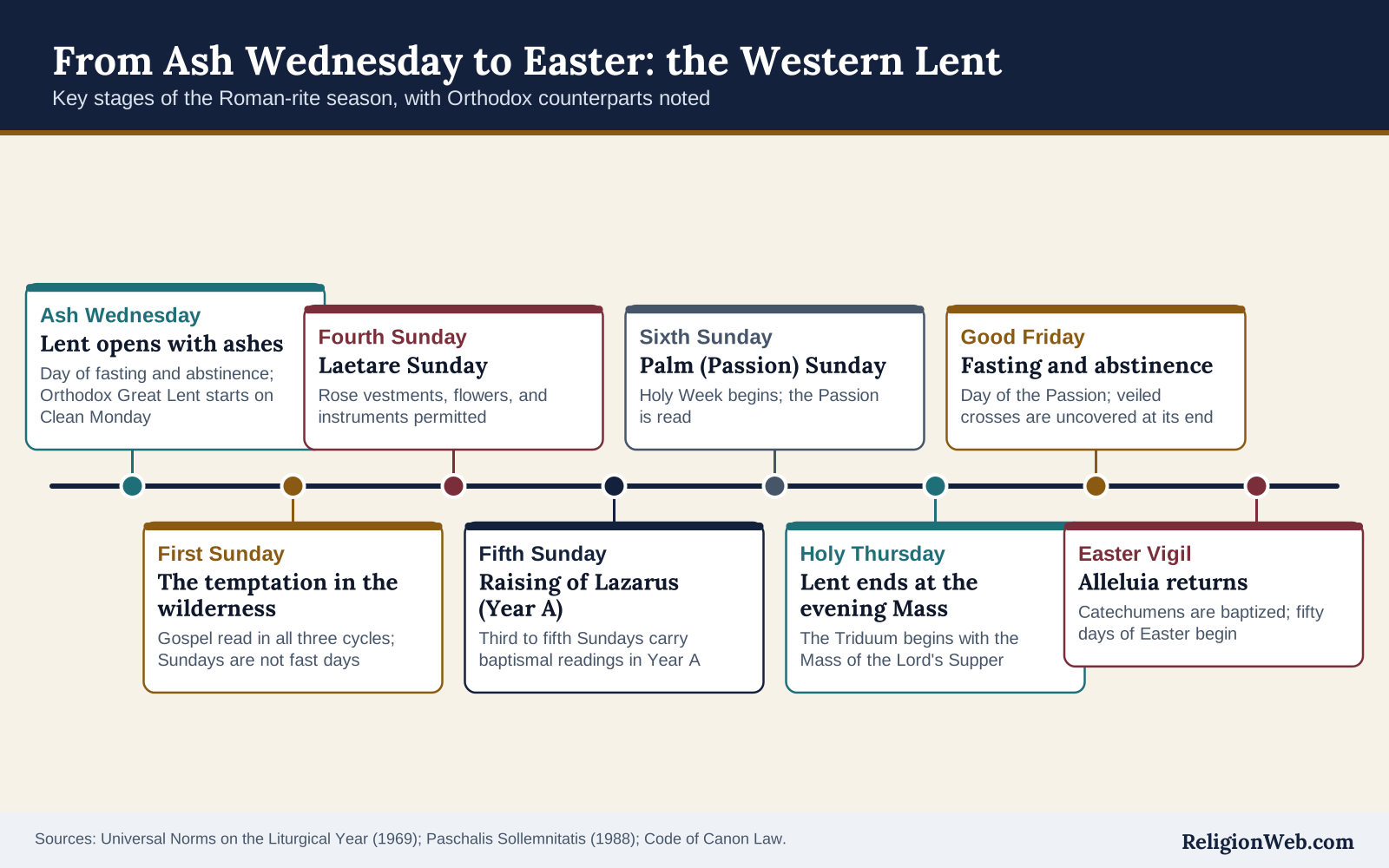
In the Roman rite, the one used by most Catholics, Lent begins on Ash Wednesday and, according to the 1969 norms, runs “until the Mass of the Lord’s Supper exclusive,” meaning up to the evening Mass of Holy Thursday. That Mass opens the three-day liturgy of Holy Thursday, Good Friday, and the Easter Vigil, called the Paschal Triduum, which is treated as its own unit rather than as the last days of Lent. Easter then begins fifty days of celebration that end at Pentecost. Many Protestant churches that observe Lent follow a similar outline, usually adding the Triduum days to their sense of the season’s climax.
In the Eastern Orthodox Church, Great Lent begins on the Monday seven weeks before Pascha, as the Orthodox call Easter, and ends on the Friday before Lazarus Saturday. Lazarus Saturday and Palm Sunday follow, then Holy Week, which the Orthodox often call Great Week. The beginning and end points therefore differ from those in the West, and so does the way days are counted, a subject taken up in detail below.
Related seasons before and after
Lent is one of several seasonal rhythms. Christmas is preceded by Advent, a season of expectation that has its own, much milder, penitential history. In the East, a series of preparatory Sundays, collected in a service book called the Triodion, lead into Great Lent before it formally starts. After Easter the season turns in the opposite direction: the Alleluia returns, fasting is relaxed, and the fifty days from Easter Sunday to Pentecost are celebrated, in the words of the 1969 norms, as “one feast day, or better as one ‘great Sunday.'” Lent is best understood as the dark half of a single arc whose bright half is Easter.
Who Observes Lent Today
A varied pattern across churches
Lent is observed in some form by the largest Christian communions: the Catholic, Orthodox, and Oriental Orthodox churches keep it as part of their formal calendars, and so do the Anglican Communion and many Lutheran and Methodist churches. Reformed, Baptist, and many nondenominational and Pentecostal congregations have traditionally given the season less weight, although a growing number of them mark it. A Christianity Today history of Ash Wednesday notes that Reformed churches dropped much of the church calendar during the Reformation, while Lutherans and Anglicans kept the service but often omitted the ashes and the call to fast, and that renewed interest in free-church traditions dates largely from the liturgical exchange that followed the Second Vatican Council.
What survey data can and cannot show
Reliable numbers on Lenten practice are scarce, because most large surveys ask about fasting generally rather than Lent specifically. The Pew Research Center’s February 2024 survey of 12,693 U.S. adults found that 21% fasted for certain periods during holy times, including about four in ten Catholics, 34% of Black Protestants, 16% of white evangelical Protestants, and 7% of white nonevangelical Protestants. That survey did not ask about Lent by name. The only Lent-specific figure Pew cited in the same report came from a 2015 survey, in which 47% of U.S. Catholics said they had given something up or done something extra for Lent in the previous year. Both figures describe the United States only, and neither says how strictly any individual kept the season.
Key Terms for Understanding Lent
A working vocabulary
Lent comes with its own vocabulary, and several terms are used differently in different churches. The table below defines the words readers meet most often, and the sections that follow return to each in context.
| Term | Meaning | Where it is most used |
|---|---|---|
| Quadragesima | Latin for “the fortieth,” the root of the season’s name in most languages | Latin and Romance-language usage; Catholic liturgical books |
| Ash Wednesday | The first day of Lent in the Roman rite, marked by the imposition of ashes | Catholic, Anglican, Lutheran, Methodist, and other Western churches |
| Clean Monday | The first day of Great Lent, the Monday after Forgiveness Sunday | Eastern Orthodox and many Byzantine-rite Catholic churches |
| Fasting | Reducing the quantity of food, or going without food for part of a day | Catholic canon law; Orthodox, Coptic, Ethiopian practice |
| Abstinence | Refraining from particular foods, such as meat, without necessarily reducing quantity | Catholic Fridays of Lent; Eastern fasting rules |
| Almsgiving | Giving money, food, or time to people in need as an act of mercy and justice | All traditions that observe the season |
| Triduum | The three-day liturgy from Holy Thursday evening through the Easter Vigil | Catholic, Anglican, Lutheran, and many Protestant churches |
| Triodion | The Orthodox service book for the weeks before and during Great Lent | Eastern Orthodox and Byzantine-rite Catholic churches |
| Catechumen | A person preparing for baptism, historically the main reason for the Lenten fast | Catholic, Orthodox, and Anglican initiation traditions |
| Laetare Sunday | The fourth Sunday of Lent, named for the Latin “rejoice,” when rose vestments may be worn | Roman rite |
Why the vocabulary matters
The distinction between fasting and abstinence is a good example of why the terms matter. In Catholic usage, to fast means to limit the amount of food eaten, while to abstain means to avoid certain kinds of food, usually meat. In Orthodox usage, “the fast” often means the whole pattern of avoiding animal products, so the same English word covers a different rule. A reader who assumes that “fasting” means the same thing everywhere will misread what each church is actually asking.
Origins and Historical Development of Lent
Before Lent: The Early Paschal Fast
Fasting before the feast in the second century
Christians fasted before Easter earlier than they fixed any forty-day season. The best-known early witness is a letter that Irenaeus of Lyon wrote around 190 CE to Pope Victor, preserved by the historian Eusebius. According to the Catholic Encyclopedia’s reading of the passage, it describes a range of customs, from one day of fasting to as long as forty hours, and does not describe a forty-day Easter fast. The same article notes that a Latin translation by Rufinus altered the punctuation in a way that makes the text appear to say otherwise, but that modern scholars generally prefer the reading in which no forty-day fast appears.
The earliest fasts were therefore short and tied directly to the commemoration of Christ’s death. They were observed in preparation for the annual Pascha, the celebration that combined the remembrance of the crucifixion with the proclamation of the resurrection, and they were kept in different lengths in different regions.
Baptism and the catechumenate
A second thread developed alongside the first. As the church of the third and fourth centuries organized a formal period of instruction for adults seeking baptism, the weeks before Easter became the final stage of that preparation, because Easter was the preferred time for baptism. The candidates fasted, were examined, and received teaching; the baptized community often joined them. Orthodox sources still describe Great Lent as having begun as the fast of those preparing for baptism before it became a season for all Christians, and the modern Catholic Lent keeps this link through the rite of election and the scrutinies for catechumens described in the 1988 Vatican letter on the Easter feasts. The article on baptism describes the rite that these weeks lead toward.
The Fourth-Century Forty Days
Nicaea, Athanasius, and Egeria
The number forty appears in the record in the fourth century. Canon 5 of the Council of Nicaea in 325 CE is the first text to mention the tessarakoste, the “fortieth,” but it concerns the timing of regional synods, so historians debate whether it refers to a fasting season at all. A firmer witness is Athanasius, bishop of Alexandria. In a festal letter of 331 he prescribed forty days of fasting before the stricter fast of Holy Week, and in 339, after traveling in Rome and elsewhere, he urged Alexandria to keep it because it was observed everywhere, so that Egypt would not be a laughing-stock among the churches.
Jerusalem offers a different picture. The pilgrim Egeria, whose travel account scholars usually date to the late fourth century, describes a Lent of eight weeks there in which Saturdays and Sundays were exempt from fasting, so that the total again came to forty days of fasting. The point is not that these communities already agreed with one another. They did not. The point is that by the end of the fourth century, forty had become the expected number, even where the weeks that produced it were counted differently.
Different lengths, one number
The Catholic Encyclopedia reports that Rome, around the same period, observed six weeks of six fast days, which comes to thirty-six days. The historian Socrates, writing in the fifth century, describes three weeks of actual fasting in Rome, again excluding Saturdays and Sundays, and other regions followed their own counts. The early forty days were thus a family of related customs rather than one uniform calendar.
From Gregory’s Tithe to Ash Wednesday
The shape of the medieval Western Lent
According to the Catholic Encyclopedia, Pope Gregory the Great (pope from 590 to 604) described the Roman thirty-six days as the “spiritual tithing of the year,” since thirty-six is roughly a tenth of 365. At a later date, unspecified in that source, the Roman Lent was moved back to begin on a Wednesday so that it would contain exactly forty fasting days. The Church of Milan kept the older schedule, and a trace of that older beginning survives in the Roman Missal’s phrase “sacrificium quadragesimalis initii,” the “sacrifice of the beginning of Lent.”
Sundays were never fast days, because each Sunday was understood as a weekly celebration of the resurrection. In the early Middle Ages, nevertheless, meat was prohibited on Sundays of Lent too, and later papal dispensations gradually permitted meat on Sundays and then on certain weekdays. The result was a Western Lent that was strict in theory and softened by custom and dispensation over time.
The ashes
The name dies cinerum, “day of ashes,” appears in the earliest surviving copies of the Gregorian Sacramentary and probably dates from at least the eighth century. The Catholic Encyclopedia traces the distribution of ashes to all the faithful to the older practice of ashes for public penitents, notes that the Anglo-Saxon homilist Ælfric treated ashes as applying to all classes of people about a century before 1091, and reports that the synod of Benevento in 1091 listed ashes as a general observance for both clergy and laity.
Reformation, Revival, and the Modern Lent
Reformation reactions
The sixteenth-century Reformation changed Lent unevenly. The Christianity Today history of Ash Wednesday reports that Reformed churches dropped it along with much of the church year, partly out of a reluctance to treat one day as holier than another. Lutheran and Anglican churches kept the Ash Wednesday service but often left out the ashes and the call to fast. Traditions that grew from the Anglican setting, including Methodist and Baptist churches, did not carry the day forward in its older form: John Wesley’s American Sunday Service kept the sacramental core of the Book of Common Prayer but removed much of the surrounding church year.
Twentieth-century reform and ecumenical revival
The same article places the modern revival of Ash Wednesday in many Protestant traditions after the Second Vatican Council, when Roman Catholics and Protestants showed more interest in each other’s liturgical practices. In the Catholic Church itself, the post-conciliar reform produced the 1969 General Roman Calendar and its norms, which defined Lent as running from Ash Wednesday to the Mass of the Lord’s Supper and tied the season more closely to baptism and penance. Eastern churches continued their older rhythms, and ecumenical conversations about shared practice have continued in recent decades.
| Date | Development | Evidence or source |
|---|---|---|
| c. 190 CE | Irenaeus’s letter to Pope Victor mentions fasts of different lengths before Easter | Quoted by Eusebius; discussed in the Catholic Encyclopedia |
| 325 CE | Council of Nicaea, canon 5, uses the term “fortieth” (tessarakoste) | Debated whether it denotes a fast or a period |
| 331 and 339 CE | Athanasius of Alexandria prescribes a forty-day fast before Holy Week, then urges its observance | Festal letters |
| Late 4th century | Egeria describes eight weeks of Lent in Jerusalem, with Saturdays and Sundays exempt | Her travel account (Peregrinatio) |
| 590 to 604 CE | Gregory the Great calls Rome’s thirty-six fast days a “spiritual tithing of the year” | Catholic Encyclopedia |
| 8th century or earlier | Name dies cinerum appears in the Gregorian Sacramentary | Catholic Encyclopedia |
| 1091 CE | Synod of Benevento lists ashes as a general observance for clergy and laity | Catholic Encyclopedia |
| 1969 CE | Universal Norms define Lent as running from Ash Wednesday to the Mass of the Lord’s Supper | Vatican liturgical norms |
Why Forty? Scripture, Symbol, and Counting the Days
The Number Forty in Scripture
Wilderness, flood, and journey
The Bible uses forty repeatedly for periods of testing, preparation, or transformation. Moses is described in Exodus as remaining on Mount Sinai for forty days and forty nights (Exodus 24:18; 34:28). Elijah travels forty days and nights to Horeb, the mountain of God (1 Kings 19:8). The flood rains in Genesis fall for forty days, the spies spend forty days in Canaan, and the generation that left Egypt wanders for forty years (Numbers 14:33-34). In the book of Jonah the prophet announces that Nineveh will be overthrown in forty days, and the city responds with fasting and repentance. Biblical scholars often observe that forty functions as a round number for a significant stretch of time, and Christian writers from the early centuries onward have read these accounts as patterns that find their fulfillment in the fast of Jesus.
The fast of Jesus in the wilderness
The anchor text for Lent is the Gospel account of Jesus fasting in the wilderness, found in Matthew 4:1-11 and Luke 4:1-13, with a shorter version in Mark 1:12-13. In Matthew, Jesus fasts for forty days and forty nights before being tempted. Churches that observe Lent understand their season as a participation in, or an imitation of, that fast, but they differ on how closely the parallel should be pressed. Some writers stress the imitation of Christ, while others stress the church’s own preparation for Easter, and the second emphasis has often shaped the calendar more than a strict reenactment has. The article on Jesus Christ discusses the Gospel accounts of his life and the historical questions they raise.
How the Forty Days Are Counted
The Western count
The traditional Western arithmetic can be set out step by step. From Ash Wednesday through Holy Saturday there are forty-six days. Within them fall six Sundays: the five numbered Sundays of Lent and Palm Sunday. Because each Sunday has always been treated as a weekly celebration of the resurrection and not as a day of fasting, taking them away leaves forty days of fasting before Easter. This is the count that lies behind the popular saying that “Sundays do not count” in Lent. It is also the reason that the Catholic Church’s official definition of Lent, which stops before the evening Mass of Holy Thursday, does not by itself add up to forty: the three days of the Triduum are treated as a distinct unit that completes the paschal fast.
The Eastern and Oriental counts
The Eastern Orthodox Church counts differently. Great Lent begins on the Monday seven weeks before Pascha and ends on the Friday before Lazarus Saturday, a stretch of forty days in which Sundays are counted. Lazarus Saturday, Palm Sunday, and Holy Week then follow as a further stage of the fast. Counting from Clean Monday to Holy Saturday gives forty-eight days. The Armenian Apostolic Church, according to its Western Diocese, also calls the season Karasnork, a name tied to forty, and observes forty days beginning on the Monday after the pre-Lenten day called Poon Paregentan, again ending on the Friday before Lazarus Saturday.
The Oriental Orthodox Churches of Ethiopia, Eritrea, and Egypt keep longer fasts. The Ethiopian Orthodox Tewahedo Church’s Great Fast, called Abiy Tsom, is commonly described as lasting fifty-five days, divided into an eight-day first period, a forty-day core, and a seven-day Holy Week fast. The Coptic Orthodox Church likewise describes a Great Lent of about fifty-five days that includes a preparatory week and Holy Week around the core forty. In each tradition, forty remains the symbolic center even though the full season is longer.
| Observance | 2026 | 2027 |
|---|---|---|
| Ash Wednesday (Western churches) | February 18 | February 10 |
| Clean Monday (Eastern Orthodox) | February 23 | March 15 |
| Palm Sunday (Western churches) | March 29 | March 21 |
| Holy Thursday (Western churches) | April 2 | March 25 |
| Easter (Western churches) | April 5 | March 28 |
| Palm Sunday (Eastern Orthodox) | April 5 | April 25 |
| Pascha (Eastern Orthodox) | April 12 | May 2 |
These dates follow the Gregorian calculation for Western Easter and the Julian-calendar calculation used by the Orthodox for Pascha, each expressed in civil dates. Some Orthodox churches, including the Church of Greece and others that adopted the Revised Julian calendar for fixed feasts, still calculate Pascha by the Julian method, so the Orthodox dates above apply to most Orthodox churches. The Orthodox Church in Finland is a notable exception that follows the Western date for Easter. The dates show that the two traditions can be as much as five weeks apart, and that in some years, such as 2026 for the Orthodox Palm Sunday and the Western Easter, they coincide in ways that surprise people who expect the calendars to line up.
The Biblical Roots of Lent: Fasting, Prayer, and Almsgiving
The Prophets and the Call to Return
Joel: a fast of the heart
The Hebrew prophets supply the vocabulary that Lenten liturgies still use. The book of Joel summons the people to a public fast in a time of crisis, and the passage is read in many churches at the start of the season, including, in the Roman Catholic lectionary, on Ash Wednesday. The text reads:
“Yet even now,” says Yahweh, “turn to me with all your heart, and with fasting, and with weeping, and with mourning.”
Joel 2:12, World English Bible
The verse goes on to say, in the same translation, “Tear your heart and not your garments,” a line that Christian preachers have long read as a warning against fasting as outward display. In the prophet’s own setting, the call concerned national repentance after a locust plague. Christian tradition took the passage as a model for the repentance that precedes a feast, and the liturgies of Ash Wednesday still frame the season as a return “with all your heart.”
Isaiah: fasting and justice
The prophet Isaiah presses the connection between fasting and mercy. In chapter 58 the speaker asks what kind of fast God desires:
Isn’t this the fast that I have chosen: to release the bonds of wickedness, to undo the straps of the yoke, to let the oppressed go free, and that you break every yoke? Isn’t it to distribute your bread to the hungry, and that you bring the poor who are cast out to your house?
Isaiah 58:6-7a, World English Bible
Interpreters in nearly every Lenten tradition cite this passage when they explain why almsgiving belongs next to fasting. The usual reading is not that fasting is unnecessary, but that a fast cut off from care for the poor misses its purpose. The Catechism of the Catholic Church places fasting, prayer, and almsgiving together for this reason, and Orthodox homilies for Great Lent often draw the same link.
The Gospel Foundations
The temptation in the wilderness
The Gospel account that most directly shapes Lent is the opening of Jesus’s ministry:
Then Jesus was led up by the Spirit into the wilderness to be tempted by the devil. When he had fasted forty days and forty nights, he was hungry afterward.
Matthew 4:1-2, World English Bible
In the Roman Catholic lectionary the first Sunday of Lent reads the temptation narrative every year, from Matthew, Mark, or Luke depending on the cycle. Traditions that follow the Revised Common Lectionary, which includes many Anglican, Lutheran, Methodist, and Presbyterian congregations, also begin the season with that story. The reading frames Lent as a time to face temptation, trust in God, and rely on something other than food, and it places the believer’s season of testing beside the testing of Jesus.
Matthew 6: giving, praying, and fasting in secret
The other foundational text is in the Sermon on the Mount, where Jesus discusses three practices of piety in order: giving to the needy, prayer, and fasting (Matthew 6:1-18). In paraphrase, the passage tells listeners not to practice these things to be admired, and to fast without gloomy looks, anointing the head and washing the face, so that the fast is seen only by the Father. The Ash Wednesday Gospel in the Roman lectionary is drawn from this chapter, which gives the tension in the day its particular character: the liturgy asks Christians to receive a visible sign of ashes while hearing a reading about not showing off one’s devotion. Preachers have treated this as an invitation to inner sincerity, and some Protestant traditions have used the passage to argue that fasting should be voluntary and private. In the middle of this same section, Jesus gives the prayer that became the Lord’s Prayer, which is why many churches pair the two.
Ash Wednesday and the Opening of Lent
The Western Rite of Ashes
What happens in the service
On Ash Wednesday, many Western Christians attend a service in which ashes are placed on the forehead, usually in the shape of a cross. In the Roman Catholic Church the ashes are traditionally made by burning the palms blessed on the previous year’s Palm Sunday, a custom the Catholic Encyclopedia describes. The priest or a lay minister marks each person with the ashes, and the traditional words, as that encyclopedia gives them in older English, are “Remember man that thou art dust and unto dust thou shalt return.” The current Roman rite offers a second formula, “Repent, and believe in the Gospel.” Catholic law treats Ash Wednesday as a day of fasting and abstinence, though attendance is not a holy day of obligation, and ashes are commonly offered to anyone who asks for them.
Anglican, Lutheran, Methodist, and many other Protestant congregations hold similar services. According to the Christianity Today history of Ash Wednesday, the observance was widely dropped in Reformed churches and often shorn of ashes elsewhere, and it returned to many of them only in the later twentieth century. A Protestant Ash Wednesday service today is likely to include a confession of sin, a reading from Joel or Matthew 6, and an optional imposition of ashes. The article on Anglicanism and the article on Protestant Christianity describe how these traditions order their worship more generally.
The meaning of dust and ashes
The sign is rooted in biblical language about mortality and mourning. In Genesis 3:19, God tells Adam that he is dust and will return to dust, and sackcloth and ashes appear in Scripture as signs of grief or repentance, for example in Jonah 3:6, Esther 4:1, and Daniel 9:3. Christians who receive ashes generally understand them as a reminder of human mortality, a public acknowledgment of sin, and a beginning of the season of repentance. Many also stress that ashes are a sign and not a sacrament that confers forgiveness; in the Catholic Church they are classed as a sacramental, a blessed object or action that disposes a person to receive grace but is distinct from the seven sacraments.
The Eastern Beginning: Forgiveness Sunday and Clean Monday
The preparatory weeks and Forgiveness Sunday
The Orthodox calendar does not start Great Lent abruptly. A sequence of Sundays in the Triodion leads into it, with themes that include the Publican and the Pharisee, the Prodigal Son, and the Last Judgment. Meat is set aside after Meatfare Sunday, and dairy products after the Sunday that Orthodox sources call both Cheesefare Sunday and Forgiveness Sunday. At the evening service of that day, commonly called Forgiveness Vespers, members of the community ask forgiveness of one another before the fast begins, a practice that makes reconciliation the doorway to the season. The Eastern Orthodox approach to Lent places a strong emphasis on this communal beginning.
Clean Monday and its customs
The next day, Clean Monday, is the first day of the fast. The name is usually explained as a cleansing of the soul, and in Greece and Cyprus the day has also acquired a set of popular customs: families picnic outdoors, fly kites, and eat Lenten foods such as flatbread (lagana), shellfish, and sesame-based sweets, all of which are permitted under the strict fast because they contain no meat, dairy, or eggs. These customs are regional and cultural rather than liturgical, and not every Orthodox country shares them.
Fasting, Abstinence, and Almsgiving in Practice
The Catholic Discipline of Penance
What canon law requires
The Code of Canon Law gives the Catholic Church’s current rules for penance. Canon 1250 names every Friday of the year and the season of Lent as the penitential days and times of the universal Church. Canon 1251 says that abstinence from meat, or from some other food as determined by the episcopal conference, is to be observed on all Fridays unless a solemnity falls on one, and that abstinence and fasting are to be observed on Ash Wednesday and Good Friday. Canon 1252 binds those who have completed their fourteenth year to abstinence and those who have reached majority, until the beginning of their sixtieth year, to fasting. It adds that pastors and parents are to ensure that even people not bound by the law are taught the true meaning of penance. Canon 1253 lets a conference of bishops specify the observance more precisely and substitute other forms of penance, especially works of charity and exercises of piety, for abstinence and fasting in whole or in part.
The law does not define what a fast consists of, and national guidelines fill that gap. In many countries, including the United States, bishops’ conferences have described the Catholic fast as one full meal and two smaller meals that together do not equal the full one, with no eating between meals. Because canon 1253 allows conferences to adapt the rules, the details of Friday abstinence outside Lent differ from country to country, while abstinence on the Fridays of Lent is a firm part of the season almost everywhere.
Exemptions and the purpose behind the rule
The rule is an expression of repentance and not an end in itself. Catholic pastoral guidance has traditionally excused people for whom fasting would be harmful, such as the sick, pregnant or nursing women, and those whose work or health would be endangered, and it invites them to take up another form of penance, such as prayer or charity. Anyone with a medical condition, a history of disordered eating, or a pregnancy should follow the advice of a physician before fasting, and religious practice does not replace medical care. The Catechism explains the aim in terms of interior conversion: the outward practices are meant to express a change of heart, which is why the same document lists daily gestures of reconciliation and concern for the poor beside fasting.
Fasting in the Eastern and Oriental Churches
The Orthodox pattern
The Orthodox fast during Great Lent is more extensive in what it restricts than the Western one. According to the OrthodoxWiki summary of the season, the faithful abstain from meat, dairy, fish, wine, and oil, although some traditions give up only olive oil and others all vegetable oils. Wine and oil are allowed on Saturdays and Sundays, because strict fasting is not observed on those days, and if the Feast of the Annunciation falls within Lent, fish, wine, and oil are permitted. How these rules are applied depends on the person. Orthodox teaching generally adjusts the fast with the guidance of a spiritual father or parish priest, so that the old, the sick, children, and the pregnant do not face the same expectations as a healthy adult. Mealtimes and quantity matter as well as the choice of food, and the aim is to keep the fast humble and not boastful.
Coptic and Ethiopian practice
The Oriental Orthodox fast is, if anything, more demanding. Accounts of Coptic Orthodox practice describe a diet that is essentially vegan during Great Lent, excluding meat, poultry, milk, eggs, and butter, and not allowing fish in this season, though it is allowed in some other Coptic fasts. The original rule called for abstaining from food and drink from midnight until sunset, and those who cannot keep this are guided by a spiritual father to a shorter fast, with many ending it at noon or at three in the afternoon, the hours associated with the crucifixion. Ethiopian Orthodox accounts describe observers eating no more than one meal a day, in the afternoon or evening, and nothing before three o’clock, while avoiding meat, dairy, and eggs. The Ethiopian Church has a larger annual calendar of fasting days than most others, with the Great Fast as only one part. The article on Oriental Orthodox Christianity describes the wider setting.
Giving Up and Taking On
Voluntary disciplines
Many Christians whose churches have no formal fasting code still keep Lent through personal disciplines. The familiar pattern of “giving something up” is one form: sweets, alcohol, coffee, television, or social media are common choices, and they work as a daily reminder that the season is underway. A second form is “taking something on,” such as a daily reading of Scripture, regular attendance at weekday services, or a habit of visiting the lonely. Clergy in many traditions encourage both, and the difference between them is often stressed in sermons: abstaining from a luxury that is easily replaced by another one can leave the heart unchanged.
Almsgiving as part of the fast
Almsgiving is the third element in the traditional triad, and it connects the fast to the Isaiah passage cited above. In practice it includes giving money saved by simpler meals, volunteering, and parish collections for relief and development work. In an Orthodox or Catholic household the sum saved by abstaining from costly foods is sometimes set aside for the poor. The older Christian argument is that the fast supplies the means and the discipline, and that the gift completes the act.
| Tradition | Length of the season | Typical discipline | Notes |
|---|---|---|---|
| Roman Catholic | Ash Wednesday to Holy Thursday evening; forty fasting days counted without Sundays | Fasting and abstinence on Ash Wednesday and Good Friday; abstinence from meat on Fridays | Canon law sets ages; bishops’ conferences adapt details |
| Eastern Orthodox | Forty days from Clean Monday, then Lazarus Saturday and Holy Week | No meat, dairy, fish, wine, or oil on weekdays; wine and oil on weekends | Adjusted by spiritual father; Annunciation permits fish |
| Coptic Orthodox | Core forty days within a fast of about fifty-five | Vegan diet; abstinence from food and drink until noon or later | Fish not allowed in Great Lent |
| Ethiopian Orthodox | Fifty-five days: eight, forty, and seven | One meal a day, no food before three in the afternoon; no meat, dairy, or eggs | Part of a large annual calendar of fasting days |
| Anglican, Lutheran, Methodist, and others | Ash Wednesday to Holy Saturday in churches that observe it | Chiefly voluntary; individual or congregational disciplines | Varies widely by province and congregation |

Worship in Lent: Color, Sound, Sundays, and Devotions
The Look and Sound of the Season
Color and restraint
Worship changes noticeably in Lent, and the changes are intended to be felt. In the Roman rite, violet or purple vestments mark the season, and the 1988 Vatican letter on the Easter feasts says that the altar is not to be decorated with flowers and that musical instruments may be played only to support the singing. Both restrictions are relaxed on the fourth Sunday of Lent, called Laetare Sunday, when the letter says that instruments may be played, the altar may be decorated, and rose-colored vestments may be worn. Many Anglican, Lutheran, and Methodist churches follow similar color conventions. Orthodox churches also change their services in Lent, using darker vestments and hangings in many places and reading special prayers.
The same letter also says that, where the episcopal conference decides it, crosses and images in the church may be veiled, with crosses remaining covered until the end of the Good Friday celebration and images until the Easter Vigil. This practice is optional, so a visitor may see veiled statues in one parish and none in the next.
The silence of the Alleluia
Among the most noticeable Western customs is the omission of the Alleluia. According to the Universal Norms, it is not used from the beginning of Lent until the Easter Vigil, when it returns with the first Easter proclamation. The Gloria is also omitted from Sundays in Lent in the Roman Mass. The effect is deliberate: by withholding the song of joy for weeks, the liturgy makes its return at Easter more striking. This is not a universal Christian practice. Eastern Orthodox services in Lent, for instance, make frequent use of the Alleluia at weekday Matins, which shows that even within Christianity the sound of the season depends on the liturgical tradition.
Sundays in Lent
Western Sundays and their readings
The Sundays of Lent hold a special place. The 1988 letter states that they take precedence over all feasts and all solemnities, so a solemnity that would fall on one of them is moved to the preceding Saturday. They are numbered the First through Fifth Sundays of Lent, and the sixth, which begins Holy Week, is Passion Sunday (Palm Sunday). In the Roman lectionary’s Year A, the Gospels for the third, fourth, and fifth Sundays are the Samaritan woman, the man born blind, and the raising of Lazarus, readings associated with baptismal themes of water, light, and new life and used in the preparation of catechumens. The article on Catholic Christianity places these readings within the larger cycle of the Mass.
Orthodox Sundays of Great Lent
The Orthodox keep a different set of themes. According to OrthodoxWiki, the five Sundays of Great Lent commemorate, in order, the Triumph of Orthodoxy, Saint Gregory Palamas, the Holy Cross, Saint John Climacus, and Saint Mary of Egypt. The first recalls the restoration of the veneration of icons, the second a fourteenth-century theologian of Thessalonica, the third places the cross at the midpoint of the fast, and the last two hold up exemplars of ascetic struggle and repentance. On the Sundays of Lent the Divine Liturgy of Saint Basil the Great replaces that of Saint John Chrysostom, and the Sundays are marked off from the weekdays by their relaxed fasting.
Devotions and Special Services
Stations of the Cross and the sacrament of penance
The Vatican letter on the Easter feasts encourages devotions such as the Stations of the Cross as Lenten exercises that prepare the faithful for the paschal mystery. In this practice, which many parishes hold on Friday evenings, worshipers move before fourteen images or scenes that recall the path of Jesus to the cross, with a short reading and prayer at each. The same letter urges the faithful to approach the sacrament of Penance during Lent, and many parishes extend confession hours and hold penitential services in the weeks before Easter.
The Presanctified Liturgy and the Prayer of Saint Ephrem
Two Orthodox Lenten forms deserve separate mention. On weekdays in Great Lent the full Divine Liturgy is not celebrated; instead, on Wednesdays and Fridays the Liturgy of the Presanctified Gifts is held, in which Communion bread consecrated on the preceding Sunday is distributed, and Orthodox tradition attributes the service to Saint Gregory the Dialogist, a title for Pope Gregory the Great. The relationship of such services to the Eucharist shows how the fast and the reception of Communion are joined: the day of strictest fasting is paired with a service that supplies Communion without the festive character of a full Liturgy.
The Prayer of Saint Ephrem the Syrian, recited with prostrations in Orthodox Lenten services, is the season’s signature prayer. In paraphrase, it asks the Lord to take away the spirit of idleness, despondency, lust for power, and idle talk, and to grant a spirit of chastity, humility, patience, and love, and closes with a plea to see one’s own faults and not to judge others. It gives the fast an inner program: the discipline of the body serves the discipline of speech, attention, and charity.
| Custom | What it involves | Where it is found |
|---|---|---|
| Violet vestments | Penitential color worn by clergy and used on altar cloths | Roman Catholic; many Anglican, Lutheran, and Methodist churches |
| Rose vestments on Laetare Sunday | A lighter color on the fourth Sunday, when instruments and flowers are also allowed | Roman rite |
| Omission of the Alleluia | The acclamation is not used from the start of Lent until the Easter Vigil | Roman rite and many churches that follow it |
| Restrained music and flowers | Instruments only to support singing; altar not decorated with flowers | Roman rite |
| Veiling of crosses and images | Optional covering, crosses until Good Friday and images until the Easter Vigil | Where permitted by the bishops’ conference |
| Stations of the Cross | Prayer before fourteen scenes of the Passion, often on Fridays | Catholic and Anglican parishes, and some other Protestant congregations |
| Liturgy of the Presanctified Gifts | Communion from reserved gifts on Wednesdays and Fridays | Eastern Orthodox and Byzantine-rite Catholic churches |
| Prayer of Saint Ephrem with prostrations | A short prayer of repentance said with bows to the ground | Eastern Orthodox and related churches |
From Lent to Holy Week: The Threshold of Easter
Palm Sunday and the Turn Toward the Passion
Palm Sunday in the West
The sixth Sunday of Lent marks a change of mood. The 1969 norms call it Passion Sunday (Palm Sunday), and it begins Holy Week. In Catholic, Anglican, Lutheran, and many Protestant churches, the service opens with a commemoration of Jesus’s entry into Jerusalem, often with a procession and palm branches, and then turns to a long reading of the Passion narrative. The 1988 Vatican letter on the Easter feasts says that the procession may take place only once, before the Mass with the largest attendance. The palms are customarily kept and, in the Catholic tradition described earlier, burned the following year to make the ashes of Ash Wednesday, which ties the end of one Lent to the beginning of the next. The day-by-day sequence of the week is treated in the article on Easter.
Lazarus Saturday and Palm Sunday in the East
In the Orthodox calendar, the end of the forty days of Great Lent is marked by two feasts. Lazarus Saturday, on the day before Palm Sunday, commemorates the raising of Lazarus in the Gospel of John, and Palm Sunday follows. Great Lent as a forty-day season ends before Lazarus Saturday, but the fast does not: it continues through Holy Week, which the Orthodox call Great Week, until Pascha. The structure shows how the East treats the pre-Easter fast as a sequence of stages, with the forty days followed by two feast days that look ahead to the Passion, and then the great fast of the week itself.
Where Lent Ends
The Roman definition and the Triduum
The Roman rite draws the line very precisely. Lent ends with the beginning of the evening Mass of the Lord’s Supper on Holy Thursday, and the Paschal Triduum, which the 1969 norms say begins with that Mass, reaches its high point in the Easter Vigil, and closes with Evening Prayer on Easter Sunday. In the morning of Holy Thursday, the bishop traditionally celebrates the Chrism Mass with the clergy of the diocese, a point the 1988 letter makes when it says the Chrism Mass is traditionally celebrated on the Thursday of Holy Week. These choices give the last days of Lent an unusual character: Lent ends before its final fast days are over, because Good Friday and Holy Saturday are counted as the first days of the Triduum.
Other churches and the Easter Vigil
Other Western churches generally consider the season to continue through Holy Saturday, and many Anglican, Lutheran, and Methodist congregations observe the Triduum in a form close to the Catholic one. In every tradition the culmination of the season is the vigil of Easter. Churches that baptize adults at that time bring forward the candidates whom Lent has prepared, as baptism in the early church was commonly celebrated on the night of Pascha. The Alleluia returns, and the season of fifty days, described in the 1969 norms as one great Sunday, begins.
Lent Across Churches and Regions
Catholic and Eastern Catholic Practice
The Latin Church
In the Latin Church, the largest part of the Catholic communion, Lent is defined by the Roman Missal and canon law, and local customs are layered on top. Where Catholic populations are large, Lenten life can extend well beyond church walls. Parishes often hold Friday meatless meals, which in some English-speaking regions have become known as fish fries, and many families treat Ash Wednesday as a day when work and school pause around the service. The article on Catholic Christianity describes the church’s wider structure and sacraments.
The Eastern Catholic churches
Several Eastern Catholic churches are in communion with Rome while keeping Byzantine, Alexandrian, or other Eastern liturgical traditions. In general, those that follow the Byzantine rite observe Great Lent in the Eastern pattern, beginning on Clean Monday and using the Triodion, while governed by their own particular law and not by the Latin code. Their practice is therefore closer to Orthodox Lent in its structure even though the church is in communion with the pope. This is one reason that no description of “Catholic Lent” is complete without noting which Catholic church is meant.
Orthodox and Oriental Orthodox Churches
Cultural settings of the fast
In the Eastern Orthodox world, Lent often shapes the whole rhythm of a community’s week. Markets, kitchens, and church bells reflect the fast, and in Greece the beginning of Great Lent has its own public holiday and outdoor customs. In the Oriental Orthodox churches, the fast is even more visible. Ethiopian Orthodox communities, for example, are often described as keeping a large share of the year in some kind of fast, and the Great Fast is the longest continuous part. These descriptions come from accounts of practice, and individuals differ in how strictly they follow the rules.
Shared themes with distinct names
The names of the pre-Lenten and Lenten days differ across the Eastern churches, but the themes recur: forgiveness before the fast, a core of forty days, and a week of Passion afterward. The Armenian Apostolic Church, as described by its Western Diocese, treats fasting as something done “in secret,” a phrase that echoes Matthew 6. The Coptic and Ethiopian churches add the three-day Fast of Nineveh before Lent, commemorating the repentance of Nineveh after Jonah’s preaching. The article on Eastern Orthodox Christianity places these observances in context.
Anglican, Lutheran, Reformed, and Free-Church Practice
Liturgical Protestants
Anglican and Lutheran churches have kept Lent since the Reformation, although with changes in emphasis. As noted earlier, they continued the Ash Wednesday service while often omitting the ashes and the call to fast, and in the late twentieth century many revived both. Methodist churches, which descend from Anglican roots, have in recent decades joined this movement, with the United Methodist Church publishing materials explaining Ash Wednesday and Lent for its congregations. In these churches the emphasis tends to fall on repentance, Scripture reading, and charitable giving more than on a formal fast.
Reformed and evangelical churches
Reformed, Baptist, and many evangelical and Pentecostal congregations have a different history. Their founders were often wary of fixed fasts and holy seasons that were not commanded in Scripture, and so Lent was not part of their inherited calendars. A number of these congregations have recently begun to mark the season with special studies, Lenten devotional guides, or voluntary fasts, but many do not observe it, and nothing in these traditions requires that they do. The article on Protestant Christianity describes the diversity of Protestant worship more broadly.
Customs Before and Around Lent
Shrove Tuesday, Mardi Gras, and Carnival
In many countries the days before Ash Wednesday have their own customs. Shrove Tuesday takes its name from the old English verb “to shrive,” to hear confession and grant absolution, and in the English-speaking world it is associated with pancakes, a custom often explained as a way of using up eggs, milk, and fat before the Lenten fast. The French name Mardi Gras means “Fat Tuesday,” and carnival celebrations in parts of Europe and the Americas gather feasting and parades into the days before the season begins. These customs are popular and regional, and they reflect Lent’s influence on the surrounding calendar more than they form part of the liturgy of the church.
Lenten foods and local specialties
Fasting has shaped regional cuisines. Fish dishes in Catholic countries, bean and vegetable dishes in Orthodox communities, and sweets made without eggs or milk are among the foods linked to Lent. Some of these are rooted in the rules of abstinence, and some in local economy. When a dish is called a “Lenten food,” the label usually means that it contains no meat and, in stricter traditions, no dairy, eggs, or oil, which can vary across the Orthodox world.
| Tradition or region | Where the season begins | How the days are counted | Distinctive features |
|---|---|---|---|
| Roman Catholic (Latin Church) | Ash Wednesday | Forty fasting days, Sundays excluded; Lent proper ends on Holy Thursday | Ashes, violet vestments, Alleluia omitted, Stations of the Cross |
| Eastern Orthodox | Clean Monday, after Forgiveness Sunday | Forty days with Sundays counted; then Lazarus Saturday and Holy Week | Triodion, Presanctified Liturgy, Prayer of Saint Ephrem |
| Armenian Apostolic | Monday after Poon Paregentan | Forty days to the Friday before Lazarus Saturday | Name Karasnork; emphasis on fasting in secret |
| Coptic Orthodox | A preparatory week, then the core forty days | About fifty-five days including Holy Week | Vegan fast; Fast of Nineveh before Lent |
| Ethiopian Orthodox | Eight-day opening fast, then forty days | Fifty-five days: eight, forty, and seven | One meal a day after three in the afternoon |
| Anglican, Lutheran, Methodist | Ash Wednesday in most congregations | Forty days without Sundays in the Western pattern | Ashes revived in recent decades; voluntary disciplines |
| Reformed, Baptist, Pentecostal | Often not observed; optional where kept | Varies by congregation | Devotional guides and voluntary fasts in some communities |

Lent in Households and Modern Life
At Home and in the Parish
The household table
For most Christians who keep Lent, the season is lived mostly at home. Meals become simpler, family prayers are added or lengthened, and a household may choose a shared project such as setting aside money for a charity. In an Orthodox home, the rule of the fast shapes shopping, cooking, and the preparation of foods that can be eaten on Saturdays and Sundays when strictness relaxes. In a Catholic home, the Friday meal is often the most visible marker. Children are usually not held to adult norms; canon law’s age limits, which begin abstinence at fourteen and fasting at majority, reflect the principle that discipline should fit the person.
Parish life and shared study
Parish and congregational life also changes in Lent. Many churches add weekday services, soup suppers, study groups on a book of the Bible, or visiting preachers. Catholic dioceses and Protestant denominations alike publish daily reflections for the season, and the Pope issues a Lenten message each year to the whole Catholic Church. These gatherings give a social shape to practices that might otherwise be solitary, and they are one reason that Lent has remained a durable part of Christian life.
Lent in a Modern Setting
New forms of fasting and giving
Modern observance has taken new forms. People give up social media, streaming, or online shopping, and some clergy suggest “fasting” from habits such as complaining or gossip. Others pair a physical discipline with an act of justice, such as supporting a food bank. Whether these practices fit within a given church’s definition of Lent depends on the church, but pastors in many traditions regard them as consistent with the inward purpose of the season, so long as they lead to prayer and charity rather than self-display. The Pew Research Center’s reports, cited above, suggest that fasting is a minority practice in the United States overall but a common one among Catholics and Black Protestants, which helps explain why Lent receives so much attention in some communities and so little in others.
Health, boundaries, and respect
Lent should not be mistaken for a diet. Religious fasting is a spiritual practice, and a person who has a medical condition, is pregnant, takes medication that requires food, or has struggled with disordered eating should consult a physician and their pastor about a safe form of observance. The churches’ own rules provide for this. Catholic law excuses those outside its age ranges, Orthodox practice adjusts the fast for the sick and the weak on the advice of a spiritual father, and the Coptic tradition allows a shorter daily fast for those unable to keep the full one. A person who cannot fast can still pray, give, and serve.
Common Misconceptions About Lent
Misconception 1: Lent is always exactly forty consecutive calendar days
Where the misunderstanding comes from
The phrase “forty days of Lent” is easy to take literally. It matches the Gospel account of Jesus fasting for forty days, and simple calendar counting from Ash Wednesday seems to produce a season of about six weeks. Because most popular summaries do not explain the counting rules, readers often assume that the season is a block of forty consecutive days from start to finish.
What the evidence and tradition actually show
In the Roman rite, the forty days are a count of fasting days, not of the days between the start and the end. Ash Wednesday through Holy Saturday spans forty-six days, and the six Sundays are not counted as fast days, which leaves forty. The Church’s formal definition of Lent also stops on Holy Thursday, before the evening Mass of the Lord’s Supper. The Eastern Orthodox Church does count Sundays and arrives at forty by a different route, with Great Lent running from Clean Monday to the Friday before Lazarus Saturday. The Ethiopian Orthodox Great Fast is commonly described as fifty-five days, and the Coptic fast is of similar length. History adds more variety: around the time of Gregory the Great, Rome fasted for thirty-six days, and Egeria describes eight weeks in Jerusalem. The number forty is therefore best understood as a symbol and a target that different calendars reach in different ways.
The popular shorthand is not wrong so much as compressed. Church documents and preachers use “forty days” to name the season in the same way that people say “a week” for the seven days between two Sundays, without implying that every day has the same character. Anyone planning a Lenten discipline, or trying to find out when a given church’s Lent ends, should ask how that church counts.
Misconception 2: Every Christian must give up the same foods
Where the misunderstanding comes from
The best-known Lenten rule, no meat on Fridays, is widely publicized, and it is often assumed to apply to all Christians or to be the sum of what Lent requires. Popular culture adds the idea that Lent means giving up chocolate or another treat, and that this is universal. In many English-speaking countries the Catholic version of Lenten practice is the most visible, so it can seem to represent the whole.
What the evidence and tradition actually show
Even within the Catholic Church, the rules are narrower and more flexible than the popular version. Canon law requires abstinence and fasting on Ash Wednesday and Good Friday, abstinence on Fridays with a role for national conferences in specifying it, and fasting only for those in certain age ranges. Canon 1253 allows other forms of penance, especially works of charity, to be substituted. The Orthodox, Coptic, and Ethiopian fasts are stricter and cover many more foods and days, and they are adjusted individually by a spiritual father. In most Protestant churches, there is no required food discipline at all, and the choice of what to give up, or whether to give up anything, is personal. The Pew Research Center’s 2015 finding that 47% of U.S. Catholics gave something up or did something extra for Lent shows that even among those who observe, the practice is varied and voluntary.
The word “extra” in that survey question matters. Many Christians treat Lent as a season for adding a discipline, such as daily prayer or an act of service, in place of or alongside giving something up. The older vocabulary of the three works, prayer, fasting, and almsgiving, does not make abstaining from food the only or even the central act.
Misconception 3: All churches begin Lent on Ash Wednesday
Where the misunderstanding comes from
In the United States and much of Europe, Ash Wednesday is the most widely recognized start of Lent, and it is one of the few Christian observances that appears in secular calendars and news coverage. That prominence makes it natural to assume that every church begins the season on the same day.
What the evidence and tradition actually show
Ash Wednesday is the opening day of Lent in the Roman rite and in the many Western churches that follow it. The Eastern Orthodox Church begins Great Lent on Clean Monday, the day after Forgiveness Sunday, and in many years that falls weeks later than Ash Wednesday, because the Orthodox calculate Pascha differently. The Armenian Apostolic Church begins on the Monday after Poon Paregentan, the Coptic Church has a preparatory week before its core forty days, and the Ethiopian Church begins with an eight-day opening fast. Many Reformed and free-church congregations do not observe the day at all. Even in the Latin West, the Catholic Encyclopedia reports that the Roman Lent was moved at a later date to begin on Ash Wednesday, and that Milan kept the older schedule. The beginning of Lent is a feature of each church’s calendar and not a single date shared by all Christians.
Even the word “Ash Wednesday” has no counterpart in some calendars. The Orthodox name for the first day is Clean Monday, and the Orthodox emphasis falls on the forgiveness exchanged the evening before, not on a mark received on the forehead. A congregation that does not impose ashes is not necessarily skipping Lent; it may be following a calendar in which the season opens in a different way.
Misconception 4: Lent is only a Catholic practice, and Protestants rejected it
Where the misunderstanding comes from
Many Americans first encounter Lent through Catholic neighbors and parish customs, and some Protestant traditions did set aside the church calendar in the sixteenth century. These facts combine into a belief that Lent belongs to Catholicism alone and that rejecting it was a defining Protestant move.
What the evidence and tradition actually show
Lent developed in the early church, long before the divisions of the sixteenth century, and the Eastern Orthodox and Oriental Orthodox churches keep it in forms that continue early practice. As the Christianity Today history of Ash Wednesday describes, the Reformation produced a range of responses: Reformed churches generally dropped the calendar, while Lutherans and Anglicans kept the Ash Wednesday service even if they often omitted the ashes and the call to fast. Methodist and Baptist traditions inherited less of it, and many Protestant churches have revived Lenten observances since the Second Vatican Council. Today, Lent is kept by Catholic, Orthodox, Oriental Orthodox, Anglican, Lutheran, and many Methodist and other Protestant congregations, and the question of how much to emphasize it remains an internal conversation within Protestantism.
Frequently Asked Questions About Lent
Questions About Meaning and History
What is Lent in simple terms?
Lent is a season of preparation before Easter in which many Christians pray more, fast or give up something, and give to people in need. It is meant to turn attention toward repentance and toward the death and resurrection of Jesus. The way it is kept differs among Catholic, Orthodox, Anglican, Lutheran, and other churches, and some Christian communities do not observe it at all.
Why do Christians observe Lent for forty days?
Forty is a number of testing and preparation in the Bible, from Moses on Sinai to Jesus in the wilderness. The early church adopted it for the fast before Easter in the fourth century, and different calendars reached the number in different ways. The Roman rite counts forty fasting days by leaving out Sundays, and the Orthodox count forty days with Sundays included.
Is Lent in the Bible?
The season is not described in Scripture as a command. Its themes draw on biblical passages, including the prophets’ calls to repentance, the Gospel accounts of Jesus fasting in the wilderness, and the teaching on giving, prayer, and fasting in Matthew 6. The season itself grew in the early centuries of the church, as the historical sections above describe.
Questions About Practice
Are Sundays part of Lent?
It depends on how Lent is counted. In the Roman rite, the Sundays of Lent belong to the season and are named as its Sundays, but they are not counted among the forty fasting days, and they are celebrated as weekly commemorations of the resurrection. In the Orthodox count, Sundays are included in the forty days, although the strict fast is relaxed on them. Whether a particular person keeps a personal Lenten promise on Sundays is a matter on which clergy give differing advice.
What if someone cannot fast for health reasons?
Most traditions that observe fasting make provision for illness, age, pregnancy, and necessary work. Catholic law binds only people within certain age ranges and allows other forms of penance, and Orthodox and Coptic practice adjusts the fast with the guidance of a spiritual father. Prayer, almsgiving, and service remain open to everyone, and medical advice should be followed first.
Can non-Christians or non-members receive ashes?
Ashes are generally treated as a blessing offered by the church and not as a sacrament restricted to members. Many congregations offer them to anyone who asks, though individual churches set their own practice. Visitors can ask the parish what is customary.
Questions About Dates
When does Lent start and end this year and next?
In 2026, Western churches began Lent on Ash Wednesday, February 18, and celebrated Easter on April 5. In 2027, Ash Wednesday falls on February 10 and Easter on March 28. For the Eastern Orthodox, Great Lent began on Clean Monday, February 23, 2026, with Pascha on April 12; in 2027 Clean Monday is March 15 and Pascha is May 2. These dates are calculated from the computus used by each tradition, and a local church calendar is the best confirmation.
Why does the date of Lent change every year?
Lent is counted backward from Easter, and Easter is a movable feast whose date depends on the spring equinox and the full moon. Because Lent follows Easter, it moves too. The article on Easter explains the calculation and why the Western and Orthodox dates often differ.
Conclusion: Lent as a Season of Return
What the History Shows
A practice that grew over centuries
Lent did not appear fully formed. It grew from short fasts before Pascha, through the catechumenate and the fourth-century forty days, into the Western Lent with its ashes and the Eastern Great Lent with its Triodion. The Reformation reshaped it in the West, and the twentieth century saw a partial revival among Protestants. Each stage reflects both the shared Christian conviction that Easter deserves preparation and the freedom of churches to set the pattern of that preparation.
Variety within a shared purpose
The most reliable generalization about Lent is that its forms vary and its aim recurs. Fasting, prayer, and almsgiving appear in nearly every tradition that keeps the season, and so does the movement toward Holy Week. What differs is the count, the starting day, the foods, and the sounds of worship. Reading each tradition on its own terms is the best way to describe the season fairly.
How to Keep Exploring
Related articles on ReligionWeb.com
Readers who want the festival that Lent leads to can turn to the articles on Easter and on Jesus Christ, and those who want the wider tradition can read the overview of Christianity. The articles on the Lord’s Prayer and on the Eucharist describe two practices that are especially prominent in the season.
Learning from a local church
For practical questions about how a particular community keeps Lent, the most dependable source is its own parish, diocese, or congregation, which publishes its own calendar and fasting guidance. Visiting a service, such as Ash Wednesday or a Presanctified Liturgy, is often the clearest way to see how a tradition understands the season.
Sources
The table below lists the principal external sources behind this article. Facts, dates and figures were checked against these and related primary, institutional and academic materials.
| # | Source | Publisher and type | Used for | Link |
|---|---|---|---|---|
| 1 | World English Bible (Classic): Matthew 4 (also Joel 2 and Isaiah 58 and Matthew 6 pages on the same site) | eBible.org · Primary text | Public-domain text for the quoted Joel 2:12, Isaiah 58:6-7, and Matthew 4:1-2. | ebible.org |
| 2 | Universal Norms on the Liturgical Year and the General Roman Calendar (1969), Lent and Easter Triduum | Catholic Culture (hosting the Vatican text) · Institutional | Definition of Lent, Alleluia, Ash Wednesday, Sundays of Lent, Triduum, Easter season. | catholicculture.org |
| 3 | Paschalis Sollemnitatis: Circular Letter on the Preparation and Celebration of the Easter Feasts (1988) | Congregation for Divine Worship, via Catholic Culture · Institutional | Lenten Sundays, flowers and instruments, Laetare, veiling, scrutinies, Stations, Palm Sunday, Chrism Mass. | catholicculture.org |
| 4 | Code of Canon Law, canons 1244-1253 (days of penance) | Holy See (vatican.va) · Institutional | Penitential days, abstinence and fasting ages, and episcopal conference adaptation. | vatican.va |
| 5 | Catholic Encyclopedia: Lent | New Advent (1910 edition) · Encyclopedia | Irenaeus, Nicaea, Athanasius, Egeria, Gregory's tithe, move to Ash Wednesday, Sundays. | newadvent.org |
| 6 | Catholic Encyclopedia: Ash Wednesday | New Advent (1907 edition) · Encyclopedia | Dies cinerum, Aelfric, Council of Benevento 1091, burned palms, traditional formula. | newadvent.org |
| 7 | Ashes to Ashes (history of Ash Wednesday) | Christianity Today · Academic reference | Reformation and Protestant treatment of Ash Wednesday and its later revival. | christianitytoday.com |
| 8 | How common is religious fasting in the United States? | Pew Research Center (April 2024) · Demographic data | February 2024 fasting data for U.S. adults; 2015 Catholic Lent figure. | pewresearch.org |
| 9 | Great Lent (Orthodox Church reference) | OrthodoxWiki · Reference | Orthodox length, fasting rules, Presanctified Liturgy, Sundays of Great Lent, Triodion. | orthodoxwiki.org |
| 10 | Great Lent Begins (Armenian Church explanation of Great Lent) | Western Diocese of the Armenian Church of North America · Institutional | Armenian start after Poon Paregentan, forty days, Karasnork, fasting in secret. | wdacna.com |
Last fact-check date: 2026-10-21.