
Methodism is a family of Christian churches that traces its origin to the eighteenth-century revival led by John Wesley and his brother Charles, two Anglican clergymen who sought to renew the Church of England and ended by launching a movement far larger than they planned. Methodists describe themselves as part of the one Church of Jesus Christ, and they share with other Christians the Bible, the ancient creeds and the belief in the Trinity. What marks the Methodist or Wesleyan tradition is a particular emphasis: God’s grace is freely offered to everyone, faith is trusted as the way a person receives it, and a believer is invited to grow in holiness, meaning a life increasingly shaped by love for God and neighbor.
The name itself began as a nickname. Around 1729 a small group of students at Oxford met for prayer, Bible reading, frequent Communion and visits to prisoners, and others joked that they lived by a rigid method. The label stuck, and by the end of the eighteenth century it described preaching houses, societies and eventually independent churches in Britain, Ireland and North America. Today the World Methodist Council describes itself as an association of 80 member churches in more than 130 countries, representing over 80 million people in the Methodist, Wesleyan and United or Uniting church traditions. Those figures count adherents in a broad sense, and the formal membership rolls of individual churches are considerably smaller.
This article treats Methodism as a branch of Protestant Christianity with its own history, doctrine, worship and structure. It follows the Wesleyan story from Epworth and Oxford to Aldersgate Street, the open-air preaching of 1739, the class meeting and the founding of the Methodist Episcopal Church in 1784. It then explains Wesleyan teaching on grace, faith and sanctification, with careful attention to how different Methodist bodies use terms such as Christian perfection. Later sections describe sacraments, hymns, small-group practice, church government, the divisions and realignments of recent years, and how Methodism is lived across the world. Where Methodist bodies disagree, the disagreement is described and attributed rather than resolved.
One note on scope. There is no single Methodist church, and no single authority speaks for every Methodist. The United Methodist Church, the Methodist Church of Great Britain, the African Methodist Episcopal Church, the Free Methodist Church, the Global Methodist Church and dozens of other bodies share a heritage but govern themselves, and they sometimes answer the same question differently. The fixed points are the Wesleyan inheritance, the shared hymnody and the habit of treating the Christian life as something practiced in community, not only believed.
What Methodism Is: The Wesleyan Family at a Glance
Methodism is easiest to understand as a movement that became a family of denominations. It began inside the established Church of England, spread through preaching and small groups, and took institutional shape in several countries within a generation of Wesley’s death in 1791. The sections below set out who Methodists say they are, where they live, and the vocabulary needed to read the rest of the article.
Definition and Self-Understanding
A Christian tradition rooted in the Church of England
Methodists place themselves within historic Christianity. The Articles of Religion adopted by American Methodists in the eighteenth century begin with faith in the Holy Trinity, and Methodist liturgies recite the Apostles’ Creed or the Nicene Creed alongside Scripture and hymn. The distinctive Wesleyan emphasis lies in how salvation is understood and lived: as a gift of grace received by faith and then worked out in a life of holiness and service.
That emphasis grew inside Anglicanism. John Wesley was ordained in the Church of England, remained a priest of that church until his death, and drew on its Prayer Book, its Articles of Religion and its homilies. Britannica notes that the movement began within the Church of England and only later separated from its parent body to become an autonomous church. The relationship between Methodism and Anglicanism is therefore one of shared origin and eventual institutional distance, not of two unrelated religions.
The name and what Methodists say it means
Methodists have never claimed that the word describes a unique doctrine. John Wesley wrote in 1742 that the name had been fixed on the early group by way of reproach, without their approbation or consent, and he insisted that the distinguishing marks of a Methodist are not his opinions of any sort. In his view the word pointed to a way of living: loving God and neighbor, praying, studying Scripture, receiving Communion and doing good. Most Methodist churches today use the word as a plain denominational name and sometimes add a qualifier such as United, Free, Wesleyan, African or Global.
Many Methodists also speak of themselves as people of “the Wesleyan tradition,” a broader phrase that includes holiness churches and some Pentecostal bodies that grew out of Wesleyan roots. This article uses Methodist for churches that use that name or belong to the Methodist family, and Wesleyan for the wider theological stream.
Where Methodists Live and How Many There Are
Counting a global family
The most widely cited figure comes from the World Methodist Council, which states on its website that it is an association of 80 member churches representing over 80 million people in the Methodist, Wesleyan and United or Uniting traditions. The Council’s own pages give 132 and 138 as the number of countries in different places, and the Vatican’s account of a December 2024 papal audience with the Council’s new leaders repeats the 138 figure. Britannica, by contrast, cites a figure of more than 40.5 million for the Council, which suggests the sources count different things, with the larger number likely including all those who identify with member churches and the smaller closer to formal membership.
For this reason the article treats global totals as rough orders of magnitude and gives the date and source of every figure. The United Methodist Church, the largest single Methodist body, reports approximately 11.3 million members, based on a report to its General Council on Finance and Administration in November 2025. Its own regional table, which draws on older reports, shows about 5.4 million members in the United States and about 4.6 million in its Africa, Asia and Europe conferences as of 2022.
Regions and concentrations
Methodism grew first in Britain, Ireland and the thirteen American colonies, and then spread through trade, migration and missionary work. Large Methodist populations are found in the United States, the United Kingdom, sub-Saharan Africa, South Korea, Brazil, the Caribbean and the Pacific islands. In several African countries Methodist churches are among the largest Protestant bodies, and the United Methodist Church’s own 2022 regional table places roughly 46 percent of its members in its Africa, Asia and Europe conferences.
The picture varies by region. In Britain, Methodism is a mid-sized church that has been declining in membership for decades. In parts of Africa, the Caribbean and Asia it is growing or holding steady, and a number of national Methodist churches have become autonomous and set their own policies. Methodism has also contributed to united churches formed with other denominations in places such as Australia, Canada and South India, which are discussed in the branches section.
Key Terms and Core Facts
Methodism at a glance
The table gathers the basic facts the rest of the article develops. It describes the tradition as a whole, and where a point differs among Methodist bodies, the entry says so.
| Topic | Summary |
|---|---|
| Origin | Eighteenth-century revival within the Church of England, led by John and Charles Wesley; first small group at Oxford about 1729 |
| Name | Began as a nickname for the Oxford group’s disciplined routine; Wesley said it was given as a reproach |
| Founders and key figures | John Wesley (1703-1791), Charles Wesley (1707-1788), George Whitefield, Francis Asbury, Thomas Coke |
| Theological emphasis | Grace offered to all, justification by faith, assurance, growth in holiness, Christian perfection understood as perfect love |
| Authority | Scripture first, interpreted with tradition, reason and experience; doctrinal standards differ by church |
| Sacraments | Baptism and the Lord’s Supper (Communion) in most Methodist churches |
| Characteristic practices | Congregational hymn singing, preaching, small groups, annual Covenant Service, works of piety and mercy |
| Government | Connexional: churches are linked through conferences and, in many bodies, bishops or superintendents; details vary widely |
| Largest bodies | United Methodist Church (about 11.3 million members, 2025 report), African Methodist Episcopal Church, Methodist Church of Great Britain, many national Methodist churches |
| Global association | World Methodist Council: 80 member churches, over 80 million people (self-description) |
Vocabulary used in this article
A handful of terms recur throughout the Wesleyan story. A society was the local body of people who joined Wesley’s movement, a class was a weekly group of about a dozen society members, and a band was a smaller group for closer confession. The Connexion, a spelling used in British Methodism, names the whole linked body of societies and later churches, while the adjective connectional describes the principle that congregations are bound together rather than independent. A circuit is a group of local churches served by a team of ministers, and an itinerant preacher is one sent from place to place instead of settled in one parish.
Other terms are theological. Prevenient grace is the grace that comes before human response, justification is God’s pardon of the sinner, and sanctification is the growth in holiness that follows. Christian perfection or entire sanctification names the Wesleyan hope of a heart made perfect in love, a phrase that Methodist bodies interpret differently. The means of grace are the practices, such as prayer, Scripture, the Lord’s Supper, fasting and fellowship, through which Methodists understand God to work. Each term is explained again where it first matters.
Origins: Anglican Roots and the Eighteenth-Century Revival
The Methodist revival unfolded over about fifty years, from a student prayer group in the late 1720s to a transatlantic network of societies by the time John Wesley died on March 2, 1791. The story is usually told in stages: the Wesley household and Oxford, the Georgia mission and the turning point at Aldersgate Street, the move into open fields in 1739, and the slower construction of a connected movement.
The Wesley Family and the Oxford Group (1703-1735)
Epworth and the Wesley household
John Wesley was born on June 17, 1703 (Old Style), at Epworth in Lincolnshire, where his father Samuel was rector. His brother Charles was born in 1707. The household was devout, disciplined and at times strained by money troubles. The brothers’ mother, Susanna Wesley, taught her children at home and kept a regular schedule of prayer and study, and later generations of Methodists have often pointed to her as an example of method in spiritual life.
The family belonged to the Church of England in a period when that church was socially established and, in many parishes, spiritually quiet. Samuel Wesley was a High Church Anglican with an interest in religious societies, voluntary groups of laypeople who met for prayer and mutual support. Those societies, which were already common in England, offered a pattern that his sons would later adapt.
The Holy Club at Oxford
Charles Wesley was at Christ Church, Oxford, when he and a few friends began meeting for prayer, study and Communion. John Wesley, a fellow of Lincoln College, joined and soon became the leader. Britannica dates the nicknaming of the group to 1729 and the United Methodist Church dates its history to 1730, which reflects how difficult it is to pin down the moment a small circle becomes a movement. Wesley’s own later account places the first meeting in November 1729, when four young gentlemen of Oxford began meeting to read the Greek New Testament as a group.
The group’s members visited prisoners, taught poor children, fasted regularly and received the Lord’s Supper often, which was unusual at the time. Observers called them by various nicknames, among them the Holy Club. One of the labels became permanent, and the story of that name appears in the Fun Fact later in this article. The Oxford period matters because it set habits that outlasted the club: structured use of time, attention to the poor, and the conviction that holiness is something one pursues deliberately. Wesley’s later biographers note that the group’s discipline echoed older Christian rules of life, including the spiritual disciplines that had long been practiced in Christian monasticism and that Wesley met through devotional writers such as Thomas à Kempis.
Georgia, Aldersgate and the Turn to the People (1735-1739)
The Georgia mission and the Moravians
In 1735 John Wesley went to the new colony of Georgia as a missionary and chaplain, with Charles as secretary to the governor. The mission largely failed. Wesley’s strict liturgical practice and disciplinary approach caused conflict with colonists, and he returned to England in December 1737 troubled about the state of his own faith. The United Methodist Church marks 1736 as the beginning of Methodism in the Americas, based on the brothers’ arrival in the New World.
The Georgia years also brought Wesley into contact with Moravians, members of a renewal church with roots in German Pietism and the Lutheran and Hussite heritages. The Moravians impressed him by their calm confidence in the face of a storm at sea and by their emphasis on a personal assurance of forgiveness. Their influence continued after his return, and several practices later associated with Methodism, among them the love feast and the watch night, were adapted from Moravian use. Readers who want background on the Lutheran side of this conversation can find it in the article on Lutheranism.
Aldersgate Street, May 24, 1738
On May 24, 1738, Wesley attended a society meeting on Aldersgate Street in London where someone was reading from Martin Luther’s preface to the Letter to the Romans. His Journal records the experience in words that Methodists have quoted ever since.
I felt my heart strangely warmed. I felt I did trust in Christ, Christ alone, for salvation; and an assurance was given me that He had taken away my sins, even mine, and saved me from the law of sin and death.
John Wesley, Journal, entry for May 24, 1738 (text of the Journal of John Wesley, Christian Classics Ethereal Library)
Interpretations of Aldersgate differ, and the differences are worth noting. Many Methodists treat it as Wesley’s evangelical conversion, the moment when assurance of forgiveness became real to him. Other historians point out that Wesley had been a sincere Christian priest before 1738 and that his own later writings sometimes describe the event as a deepening of faith, not a first turning to God. Both readings agree that the evening changed how he preached, and it is commemorated each year in many Methodist churches on or near May 24.
Open-air preaching at Bristol, 1739
In 1739 Wesley’s friend George Whitefield, who had begun preaching outdoors to coal miners near Bristol after being barred from many pulpits, invited him to join the work. Wesley, who had been taught that preaching belonged inside a consecrated building, hesitated and then preached in the open air in the spring of that year. The decision opened Methodism to people who rarely attended church: miners, laborers, weavers and the urban poor.
That same year the movement acquired its first fixed meeting places. Methodists in Bristol built what is now called the New Room, which is widely described as the oldest Methodist building in the world, and Wesley took over an abandoned foundry in London for preaching and meeting space. The sequence shows the pattern of the revival: open-air preaching drew crowds, and societies and meeting rooms gave those who responded a structure for continued growth.
Building a Movement (1739-1791)
Societies, preachers and the first Conference
As converts multiplied, Wesley organized them into societies, groups led by lay stewards and, increasingly, by lay preachers, many of whom had no university training. Women and men without ordination took on real responsibility, and Wesley supervised the system by traveling constantly. In 1744 he called the first Conference of preachers, a gathering that became the model for the annual conferences that still govern many Methodist churches.
The class meeting, discussed in its own section below, began in Bristol in 1742 as a way to raise money and to watch over members’ conduct, and it became the movement’s basic unit of discipleship. Wesley also issued the General Rules in 1743 and began publishing sermons, hymn collections and pamphlets, creating a body of Methodist literature that fed both devotion and doctrine.
Calvinist and Arminian currents within the revival
The revival was never theologically uniform. Whitefield preached the Calvinist doctrine of election, which holds that God chooses those who will be saved, while Wesley preached that Christ died for all and that human beings can respond to grace and can also resist it. The difference produced a separation of ways in the early 1740s, though the two men remained on respectful terms and Wesley preached Whitefield’s funeral sermon in 1770.
The Calvinist wing of the revival gave rise to its own institutions, including the Welsh Calvinistic Methodists and the Countess of Huntingdon’s Connexion. The word Methodist therefore carried two theological tendencies in the eighteenth century. Today the large bodies that call themselves Methodist follow the Wesleyan line, while the Reformed stream of the revival appears in traditions described in the article on Reformed Christianity.
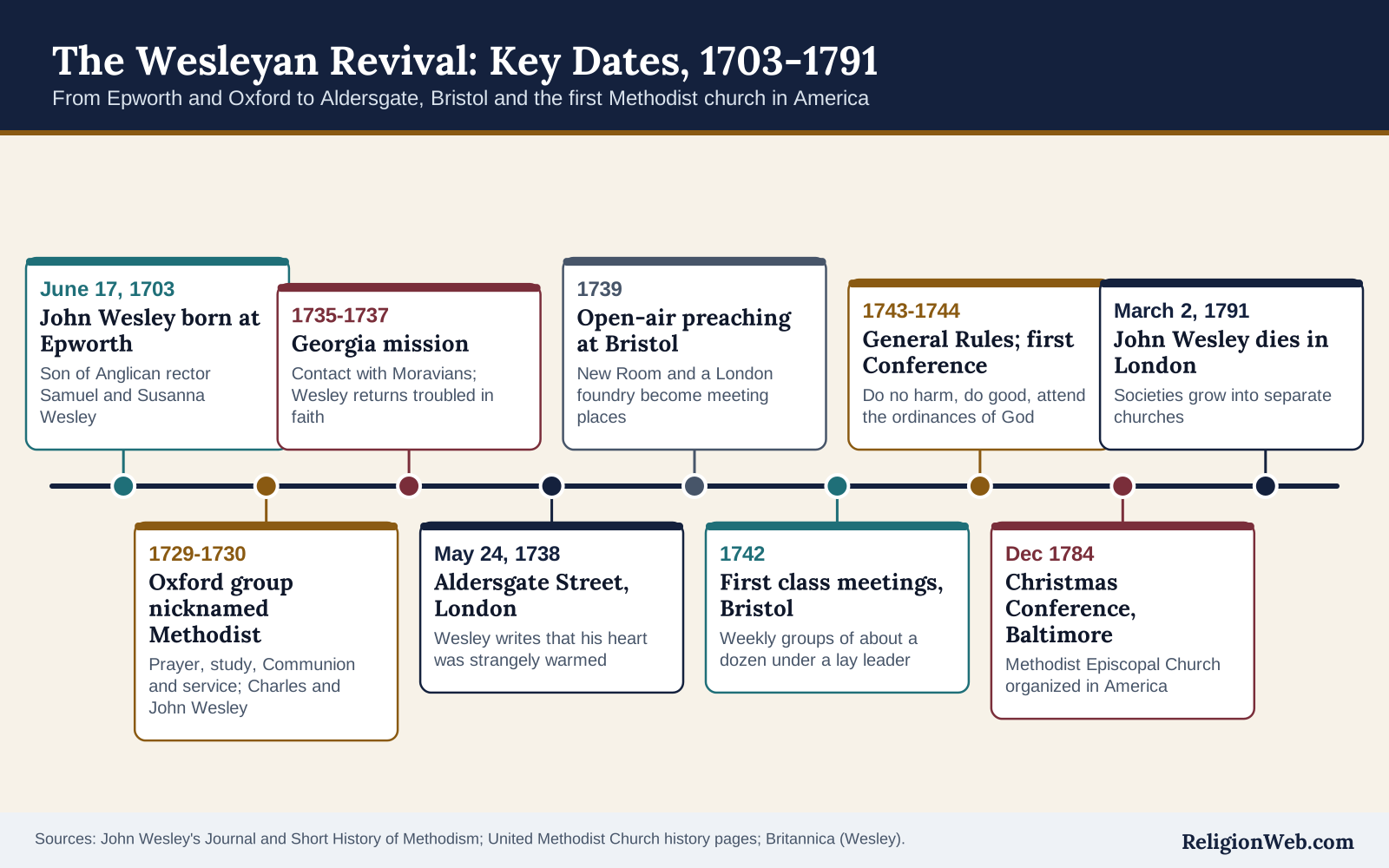
Timeline of the Wesleyan revival
The table sets the main dates in order. Where sources disagree by a year, the entry notes the range.
| Date | Event | Why it matters |
|---|---|---|
| June 17, 1703 (Old Style) | John Wesley born at Epworth | Son of an Anglican rector and of Susanna Wesley |
| 1729-1730 | Oxford group forms and is nicknamed Methodist | Disciplined prayer, study, Communion and service |
| 1735-1737 | Georgia mission | Contact with Moravians; mission judged unsuccessful |
| May 24, 1738 | Aldersgate Street experience | Wesley’s account of assurance of forgiveness |
| 1739 | Open-air preaching in Bristol; New Room and London foundry | Revival reaches working people; first fixed meeting places |
| 1742 | Class meetings begin in Bristol | Weekly group becomes the basic unit of discipleship |
| 1743 | General Rules issued | Three rules: do no harm, do good, attend the ordinances of God |
| 1744 | First Conference of preachers | Beginning of annual conference governance |
| 1784 | Christmas Conference, Baltimore | Methodist Episcopal Church organized in America |
| March 2, 1791 | John Wesley dies in London | Societies continue as an organized movement and, over time, as separate churches |
From Societies to Churches
America and the Christmas Conference of 1784
Methodist preaching had reached the American colonies by the 1760s through lay preachers and immigrants. During and after the Revolutionary War, Methodists in America were left with few Anglican clergy who could administer the sacraments. In 1784 Wesley ordained preachers for America, an act that Britannica notes was against the wishes of the bishop of London, and he sent Thomas Coke with instructions and a revised version of the Anglican liturgy.
At the Christmas Conference, held at Lovely Lane Chapel in Baltimore from December 24, 1784, into early January 1785, preachers organized the Methodist Episcopal Church in America. According to the United Methodist Church, Coke was received as a general superintendent, Francis Asbury was elected by the ministers present and then consecrated, and the new church adopted initial policies and made circuit appointments. The United Methodist Church counts its own beginning from this meeting.
Britain after Wesley
In Britain the move toward separation was slower and more contested. Wesley insisted to the end that Methodists belonged within the Church of England, yet his ordinations, the preaching houses licensed as dissenting chapels and the growing demand for Methodist ministers to administer the sacraments all pushed in the other direction. After his death the Conference gradually took over the administration of the societies, and in the following decades Methodism in Britain became a distinct church, with later divisions and reunions explained in the branches section.
John Wesley, Charles Wesley and Early Methodist Leaders
Methodism has founders in the ordinary sense, but its early growth depended on a wide circle of preachers, class leaders, patrons and organizers. This section introduces the central figures and some of the others whose names appear throughout Methodist history, separating what is well documented from the layers of later devotion and commemoration.
The Wesley Brothers and Their Mother
John Wesley: priest, organizer and writer
John Wesley (1703-1791) combined three roles that rarely appear together. He was an Anglican priest who preached and presided at Communion throughout his life, an organizer who built a network of societies and preachers, and a prolific author and editor who produced sermons, a commentary on the New Testament, hymn collections, a health manual, a dictionary and an abridged library of Christian writings for his followers. Methodists treat his sermons and his Explanatory Notes Upon the New Testament as doctrinal reference points, a point taken up in the section on authority.
He was also known for travel. Wesley rode and preached across Britain and Ireland for decades, and contemporary descriptions of his life emphasize his regular hours, plain dress and habit of reading while on horseback. Historians generally describe him as a theologian of practical divinity, someone more interested in forming a holy people than in building a speculative system. His final years included public opposition to the slave trade, and in 1784 he took the step of ordaining preachers for America, the act that made a separate Methodist church in the United States possible.
Charles Wesley: poet of the revival
Charles Wesley (1707-1788) was a priest, a preacher and, above all, the writer of thousands of hymns. His verse made doctrine memorable and communal. The hymns teach justification, assurance, holiness and the love of God in language ordinary worshipers could sing, and they became the main way many Methodists learned their theology. Charles remained more committed than his brother to Methodism staying inside the Church of England, and he opposed John’s decision to ordain ministers for America.
The hymn “O for a thousand tongues to sing” was written in 1739 for the anniversary of the author’s conversion and was first published in 1740, according to the United Methodist Church’s hymn history. In that work, which began as eighteen stanzas, Charles Wesley wrote that if he had a thousand tongues he would use them to praise his Redeemer. The hymn is typically sung in worship today with a shorter selection of its original verses.
Susanna Wesley and the household of faith
Susanna Wesley (1669-1742) is often called the mother of Methodism, a title that reflects her influence on her sons and not an office she held. She educated her children at home, and in the rectory she held devotional gatherings that drew in neighbors. Her letters on child-rearing and on prayer were later read by John Wesley with great respect, and accounts of the family stress her insistence on regular time for reflection. Writers have drawn a line from her household schedule to the Methodist taste for order and routine, though the link is better described as formative influence than as direct cause.
Other Early Leaders
Whitefield, Fletcher, Coke and Asbury
George Whitefield (1714-1770), a member of the Oxford group who became one of the most famous preachers of the century, introduced field preaching to the movement and crossed the Atlantic repeatedly. He was a Calvinist in theology, and his followers formed a separate stream of the revival. John Fletcher of Madeley (1729-1785), an Anglican vicar of Swiss origin, was Wesley’s defender in the controversy over free will and grace and was widely admired for his piety; Wesley had hoped he would succeed him as leader.
Thomas Coke (1747-1814) was an Anglican priest who became Wesley’s colleague, led early Methodist missionary efforts in the Caribbean and was ordained a general superintendent of the American church. Francis Asbury (1745-1816), an English lay preacher who emigrated in 1771, became the dominant figure in American Methodism. He traveled thousands of miles on horseback each year, shaped the circuit-rider system and was consecrated at the Christmas Conference. Under Asbury the American church grew from a few hundred members to well over 200,000.
Women preachers, class leaders and benefactors
Women were central to early Methodism, both as members, who were frequently a majority of society rolls, and as leaders. Wesley permitted some women to speak publicly in a society setting when he judged them to have an extraordinary call, and women such as Sarah Crosby and Mary Bosanquet Fletcher exercised leadership in societies and classes. In America the question of ordination remained contested for generations. The Methodist Church in the United States granted full clergy rights to women in 1956, and the Methodist Church of Great Britain readmitted women to ordination as presbyters in 1974, when seventeen women were received into full connexion at the Conference.
Wealthy patrons also shaped the movement. Selina, Countess of Huntingdon, supported evangelical preachers and founded her own chain of chapels, and many local chapels depended on the gifts and labor of tradespeople and the working poor. The movement’s strength lay in this breadth of participation more than in any single leader.
Black Methodist leaders
Black people took part in Methodism from its American beginnings. Harry Hosier, often called Black Harry, traveled with Asbury and Coke as a preacher and was widely regarded as an outstanding speaker. Richard Allen (1760-1831), a formerly enslaved man who bought his freedom and became a Methodist preacher in Philadelphia, led Black members out of St. George’s Methodist Episcopal Church after experiencing discrimination there. He built Bethel Church in Philadelphia, and on April 9, 1816, he called together Black Methodist congregations at a conference there, which formed the African Methodist Episcopal Church and elected Allen its first bishop. The AME Zion and Christian Methodist Episcopal churches have separate but related histories.
| Figure | Dates | Role | Contribution |
|---|---|---|---|
| John Wesley | 1703-1791 | Anglican priest, organizer, author | Led the revival, built societies and conferences, wrote the sermons treated as doctrinal standards |
| Charles Wesley | 1707-1788 | Priest and hymn writer | Wrote thousands of hymns that carried Wesleyan teaching into worship |
| Susanna Wesley | 1669-1742 | Mother and teacher | Shaped her sons’ habits of prayer, study and order |
| George Whitefield | 1714-1770 | Preacher | Pioneered field preaching; Calvinist stream of the revival |
| John Fletcher | 1729-1785 | Vicar and theologian | Defended Wesleyan teaching on grace and holiness |
| Thomas Coke | 1747-1814 | Priest, missionary leader | Ordained general superintendent for America; promoted overseas missions |
| Francis Asbury | 1745-1816 | Itinerant preacher, bishop | Organized circuits and led American Methodism’s expansion |
| Richard Allen | 1760-1831 | Preacher, first AME bishop | Founded the first independent Black denomination in the United States |
Wesleyan Theology: Grace, Faith and Holiness
Wesleyan theology is less a new system than a particular arrangement of themes found throughout historic Christianity. John Wesley described his preaching as an effort to teach the way of salvation: how a person comes to faith, receives pardon and grows in love. Because he wrote mostly in sermons, letters and hymns, later Methodists have organized his thought in different ways, and the summary here follows widely used descriptions while noting where Methodist bodies diverge.
Grace as the Organizing Idea
Prevenient grace: God acts first
Methodists speak of grace in stages, as a way of describing the continuous work of God. Prevenient grace, from a Latin word meaning going before, is the grace that comes ahead of any human choice. It is understood to awaken conscience, create a longing for God and make a response possible. The United Methodist Church describes it with an image often linked to Wesley, “the grace of the porch,” the grace that prepares a person to enter the house of faith.
The doctrine matters because it addresses a question every Protestant tradition has to answer: how can sinful human beings respond to God at all? Wesley’s answer was that God’s initiative is universal, extending to every person, while the response remains a response, one that can be given or refused. Christians in other traditions answer the question differently, for example by teaching that God elects some for salvation, and Wesley and his followers did not hide the disagreement with Calvinist teaching; they argued that their reading better fit the biblical emphasis on God’s love for all.
Justifying grace and the new birth
Justification is God’s pardon of the sinner on the basis of Christ’s work and received through faith. The United Methodist description calls this “the grace of the door,” the moment of passing from unbelief to belief. The Articles of Religion state the doctrine in language inherited from the Anglican Thirty-Nine Articles.
We are accounted righteous before God only for the merit of our Lord and Saviour Jesus Christ, by faith, and not for our own works or deservings. Wherefore, that we are justified by faith, only, is a most wholesome doctrine, and very full of comfort.
Articles of Religion of the Methodist Church, Article IX, “Of the Justification of Man,” as published by the United Methodist Church
The article places the weight on Christ and on faith, not on human achievement, in line with the Lutheran and Reformed Reformation emphasis. Wesley paired justification with the new birth, which is the inward change by which a person begins to live as a child of God. In Wesley’s usage, justification is what God does for a person and the new birth is what God begins to do in a person. Methodist churches that practice infant baptism understand the sacrament as a sign of this new birth without assuming that the inner change has already occurred.
Sanctifying grace: growth in love
Sanctification is the process by which a believer is made holy. The United Methodist Church calls it “the grace of the interior,” the ongoing spiritual growth of a follower of Jesus, presented as a gift from God, not an achievement. For Wesley the goal of the Christian life was not only forgiveness but transformation, a life ruled by love for God and neighbor and shown in ordinary conduct.
This is the place where Methodists most often speak about discipline and practice. Sanctification is supported by what Wesley called the means of grace, such as prayer, Bible reading, Communion, fasting and fellowship in small groups, and by acts of mercy toward others. Methodists understand these as ways of receiving grace, not as ways of earning it. That distinction runs through Wesleyan literature, and it answers the common suspicion that an emphasis on holiness implies salvation by works.
Christian Perfection and Careful Terminology
What Wesley meant by perfection
Few Wesleyan terms are misunderstood as often as Christian perfection. In Wesley’s writings the word does not mean a life without error, ignorance or weakness. He taught that Christians could be perfect in love, meaning that love for God and neighbor could so govern their motives that sin no longer ruled their hearts, while still being subject to mistakes of judgment, physical limitation and temptation. He also used the phrase to describe a goal, not a status to boast about, and he said that those who were perfect in this sense should still grow.
The doctrine rests on Wesley’s reading of biblical commands to love God with all one’s heart and to be holy, and on his conviction that God would not command what God would not enable. Wesley’s contemporaries debated it, and he returned to it often in print, refining his language, qualifying it and defending it against both critics and enthusiasts. A reader who sees the phrase without the surrounding qualifications can easily take it to mean something Wesley did not.
How Wesleyan-holiness churches teach entire sanctification
In the nineteenth century a holiness movement, influenced by Methodist preachers and lay leaders such as Phoebe Palmer, gave the doctrine a sharper form. Many holiness churches, among them the Wesleyan Church, the Free Methodist Church and the Church of the Nazarene, teach entire sanctification as a distinct work of God’s grace, often received by faith at a definite moment after conversion, by which the heart is cleansed and filled with perfect love. These churches typically make the doctrine a condition of their official statements of faith and often of ordination.
Their teaching has also been an ancestor of other movements. Some Pentecostal churches grew out of the holiness stream and reshaped its language of a second experience in relation to the Holy Spirit, as described in the article on Pentecostal Christianity. The roots are shared, but the teaching of each church is its own.
How other Methodist bodies describe the goal
In the United Methodist Church and the Methodist Church of Great Britain, the language of perfection is present in official tradition but is often used more quietly. The emphasis falls on growth in grace across a lifetime, and many pastors and theologians read Wesley as describing a process of deepening love with moments of significant change, instead of a single experience. The practice of asking candidates for ministry whether they are going on to perfection, a question in the historic Wesleyan questions for ordination, keeps the vocabulary alive without requiring one theory of when or how it occurs.
This is why the misconception that every Methodist body defines Christian perfection identically does not hold. Bodies differ on whether it is a moment or a process, on how far it is expected in this life, and on how much weight it receives in preaching and church discipline. The differences are real and are usually discussed within the Wesleyan family as differences of emphasis.
Other Doctrinal Themes
The Trinity and the person of Christ
Methodist doctrinal standards affirm the ancient teaching on the Trinity and on Christ as fully God and fully human. The Articles of Religion begin with faith in the Holy Trinity, and the second article speaks of the Word, or Son of God, who was made very man. Methodists therefore stand with the broad stream of historic Christianity, a theme explored more fully in the article on the Trinity, and Wesleyan preaching characteristically centers on Jesus Christ as redeemer and Lord.
The Wesleyan tradition also gives the Holy Spirit a prominent place, especially in teaching about assurance and holiness. Wesley’s sermons speak of the Spirit’s witness with a believer’s spirit and of the Spirit as the one who forms holy tempers, meaning settled dispositions of love, joy and peace in the believer. That emphasis explains much of Methodism’s later closeness to renewal movements.
Assurance and the witness of the Spirit
Assurance is the confidence that one’s sins are forgiven and that one is a child of God. Wesley taught that such assurance is possible and normal, not reserved for a few, and he connected it to the Aldersgate experience in his own life. The Methodist Church of Great Britain lists assurance of God’s love among the distinctive features of Methodism, saying that faith rests on the promises of a faithful God more than on one’s feelings.
The doctrine carries a pastoral balance. Methodist teaching does not make feelings the basis of faith, and Wesley himself counseled people who had periods of darkness that they should continue in the means of grace. Pastors today use the teaching to encourage trust while warning against discouragement when feelings fade.
Universal offer, free response and the possibility of falling away
Methodist doctrine holds that Christ’s atonement is for all people and that God’s grace is offered to everyone. It also holds that a person who has received grace can, in principle, turn away. The Article on sin after justification states this possibility directly, and Wesley wrote against what he saw as the practical danger of teaching that the elect cannot fall. Methodists in the Wesleyan line therefore speak of persevering in faith rather than assuming that salvation is irreversible.
The same universality shapes how Methodists describe mission and neighbor-love. If grace is meant for everyone, then evangelism, education and care for the poor are natural expressions of faith. The section on daily life returns to this link between doctrine and action.
Key theological themes at a glance
| Theme | Core idea | Where it appears |
|---|---|---|
| Prevenient grace | God’s grace precedes and enables any human response | Wesley’s sermons; United Methodist teaching on the “grace of the porch” |
| Justification | Pardon received by faith through Christ’s merit | Article IX of the Articles of Religion |
| New birth | The beginning of inward renewal | Sermons on the new birth; baptismal teaching |
| Assurance | Confidence of forgiveness through the Spirit’s witness | Wesley’s Aldersgate account; British Methodist statements |
| Sanctification | Growth in holiness and love across the Christian life | Wesley’s sermons; hymns; the “grace of the interior” |
| Christian perfection | Perfect love, understood differently by different bodies | Wesley’s writings; holiness churches’ statements of faith |
| Means of grace | Practices through which God is understood to work | General Rules; works of piety and mercy |
| Social holiness | Faith lived in community and service | Wesley’s preface to his hymns; Methodist social teaching |
Scripture, Tradition, Reason and Experience: Authority in Methodist Life
Every Christian tradition has to say where its teaching comes from and who may interpret it. Methodists answer with a layered account: the Bible is the primary authority, doctrinal standards express what the church has agreed to teach, and tradition, reason and experience help Christians understand and apply Scripture. This section describes those layers, with attention to how they work in the largest Methodist body and how other Methodist churches differ.
Doctrinal Standards
Articles of Religion and the Confession of Faith
The United Methodist Church holds two historic statements as part of its official doctrine. The first is the Articles of Religion, a set of twenty-five articles that came to American Methodism from Wesley. In 1784 he abridged the Church of England’s Thirty-Nine Articles for the American Methodists, omitting those he judged unnecessary, and the new church added an article on the rulers of the United States. The list opens with faith in the Holy Trinity and runs through the sufficiency of Scripture, original sin, free will, justification, good works, the church, the sacraments and the Lord’s Supper. Two further provisions appear with the Articles in the United Methodist presentation, one on sanctification and one on the duty of Christians to civil authority.
The second is the Confession of Faith of the Evangelical United Brethren Church, which came into the denomination at the 1968 union with that body. The Confession is organized in a more modern style and includes an article on sanctification and Christian perfection. Both documents are protected in the church’s constitution, which means they can be changed only by an elaborate process and not by ordinary legislation.
Wesley’s sermons and Notes
Wesley’s own writings function as a third standard in several Methodist bodies. The sermons in the first four volumes of his collected sermons and his Explanatory Notes Upon the New Testament (1755) were named in early trust deeds as the doctrine to be preached in Methodist chapels, and later church unions kept them as reference points. In practice the sermons are taught as an interpretive guide to what Methodists mean by the Articles, and the sermon titles, such as “The Scripture Way of Salvation,” “Christian Perfection” and “The Catholic Spirit,” are shared vocabulary for many Methodists.
The United Methodist Church describes the sermons and Notes as standards that keep the church’s preaching within its inherited doctrine. They are authoritative as an expression of Wesley’s mature teaching, not as a replacement for Scripture. The distinction matters because Methodists commonly say they follow the Bible first and Wesley as a guide who pointed to it.
The Book of Discipline and other churches’ standards
The Book of Discipline, revised at each General Conference, brings together the doctrinal statements, the church’s law, its structure and its Social Principles. The Methodist Church of Great Britain has a comparable framework in its Constitutional Practice and Discipline and in the doctrinal clauses that accompanied the 1932 union, which refer to Wesley’s Notes and sermons. Other bodies publish their own manuals and articles. The African Methodist Episcopal Church uses its own Doctrine and Discipline, and holiness churches such as the Free Methodist Church and the Wesleyan Church include articles on entire sanctification.
These documents are not identical, and Methodist authority is sometimes described as connectional for this reason: the church speaks through conferences and agreed documents and not through a single leader. A Methodist teaching can therefore be found stated in different words by different bodies, and the differences are historical as well as theological.
The Four Sources of Theological Reflection
Scripture first
The United Methodist Book of Discipline, in its statement on the church’s theological task, says that Scripture holds a place of primary authority among the sources of theology and is the norm by which all traditions are judged. Methodists read the Bible in worship through a public lectionary, in sermons, in small groups and at home. Wesley described himself as a person of one book, and the Articles of Religion state that Holy Scripture contains all things necessary to salvation.
Methodists differ on how to interpret the Bible, as other Christians do. Some read it with an emphasis on inerrancy, while others stress that the Bible’s authority lies in its saving message and read it with the help of historical scholarship. Both positions appear in the Wesleyan family, and debates between them have been part of the church’s recent disagreements.
Tradition, reason and experience
The same Discipline passage describes tradition as both a source and a measure of authentic Christian witness, with authority that depends on its faithfulness to the biblical message. Experience is said to authenticate in our own lives the truths revealed in Scripture, interpreted in the light of scriptural norms. Reason is the use of the mind to read Scripture, to test whether the witness is clear and to relate faith to human knowledge. The passage adds that all four sources work together without displacing the primacy of Scripture for faith and practice.
Wesley drew on all of these. He read the early Christian writers, among them Eastern authors that scholars sometimes link to his teaching on holiness, and he valued the Church of England’s liturgy. He used logic in argument and called for faith that was reasonable and not credulous. He also trusted the testimony of Christian experience, including the experience of assurance and the changed lives of those who joined his societies.
The quadrilateral label and Wesley’s catholic spirit
The shorthand “Wesleyan Quadrilateral” is a twentieth-century label for the four sources, usually credited to the American Methodist scholar Albert Outler, and Wesley himself never used it. The United Methodist Discipline does not use the word in its statement on the theological task, though the Methodist Church of Great Britain does speak of a Methodist quadrilateral. Some Methodists find the label useful, and others criticize it as implying four equal sources, which the Discipline’s language about the primacy of Scripture does not support.
Wesley’s sermon “Catholic Spirit,” preached in 1750, adds another element of Methodist authority: the conviction that Christians can differ in opinions and still love one another. Taking a text from the Hebrew Bible in which a king meets an ally, he asks a question that Methodists have often quoted.
Is thine heart right, as my heart is with thy heart … If it be, give me thy hand.
John Wesley, Sermon 39, “Catholic Spirit” (1750), Part I section 1 and Part II section 1, Wesley Corpus transcription
Wesley used the question to argue that agreement in love and basic Christian faith is wider than agreement in every opinion. Methodist ecumenical work has often invoked the sermon, and the point is consistent with his statement elsewhere that the distinguishing marks of a Methodist are not opinions of any sort. The idea does not mean that doctrine is unimportant, since Wesley wrote at length on doctrine, but it explains why Methodists have been active in conversations among Christian churches.

Worship, Sacraments and Hymns
Methodist worship combines the inheritance of the Church of England with the preaching and singing of the eighteenth-century revival. Styles range from liturgical services with robed clergy and printed prayers to informal gatherings with praise bands and extemporaneous prayer. The sacraments and hymns hold the tradition together across that range, and the annual Methodist occasions give the year its distinctive shape.
The Shape of Sunday Worship
A typical order of service
A typical Methodist service in North America or Britain includes a greeting and call to worship, opening hymns, prayers of confession and pardon, readings from Scripture, a sermon, an offering, intercessions, the Lord’s Prayer and a closing hymn and blessing. When Communion is celebrated it follows the sermon. Many congregations use the Revised Common Lectionary, a three-year cycle of readings shared by a wide range of churches, and they follow the Christian year with its seasons.
The United Methodist Book of Worship and Hymnal, along with the Methodist Worship Book used in Britain, provide orders of service, but local congregations adapt them and many use bulletins of their own design. Methodists have long recognized both set and free prayer, and ministers often combine liturgical texts with prayers composed for the occasion. The result is a form of worship that feels familiar to visitors from many traditions without being identical to any of them.
Preaching, prayer and the role of the congregation
Preaching holds a central place. Methodist sermons typically explain a Scripture passage, relate it to daily life and invite a response, and the Wesleyan tradition has often combined doctrinal teaching with practical application. The sermon is sometimes followed by an invitation to prayer or to renewal of commitment. In some churches, particularly in African American and holiness settings, the congregation responds aloud, and the preaching and music can be extended and emotionally expressive.
The prayers of the people, in which the congregation prays for the church, the world and those in need, draw on a long Wesleyan sense that faith should shape concern for neighbors. Lay people read Scripture, lead prayers, usher, serve as stewards and often lead music, so worship is shared work rather than a performance by clergy alone. This practice reflects the Methodist history of lay leadership, and it is one reason the movement spread so quickly.
Variety across churches and regions
Methodist worship differs widely by place. A small rural church in the American South, a large urban African American congregation, a Korean-American church with early-morning prayer meetings, a British town chapel and a congregation in Zimbabwe or Ghana may each sing different music and keep different customs, even though all use Wesleyan hymns and some form of the common calendar. Church buildings range from simple preaching halls to Gothic cathedrals, and some Methodist congregations in Britain meet in chapels founded in the eighteenth century.
These differences reflect local culture and history more than doctrine. In Africa and the Caribbean, extended singing, choirs and processions have become part of Methodist identity, while in some Western churches contemporary worship has been added to or has replaced older forms. A visitor can expect to find a hymn, a sermon and a welcome in almost any Methodist church, but not a uniform liturgy.
Baptism and the Lord’s Supper
Baptism: sign of new birth and entry into the church
Most Methodist churches recognize two sacraments, baptism and the Lord’s Supper, and understand them as means of grace instituted by Christ. The Articles of Religion describe baptism as more than a public sign of Christian profession.
Baptism is not only a sign of profession and mark of difference whereby Christians are distinguished from others that are not baptized; but it is also a sign of regeneration or the new birth. The Baptism of young children is to be retained in the Church.
Articles of Religion of the Methodist Church, Article XVII, “Of Baptism,” as published by the United Methodist Church
Methodist churches therefore baptize infants and believing adults, and they usually accept baptism by sprinkling, pouring or immersion, the choice often resting with the person or family. The rite is performed once and is not repeated, and it is understood as God’s act, which the community and the person receive with promises of faith. The United Methodist Church describes baptism as new birth through water and the Spirit that begins life in Christ and the church, a covenant open to people of all ages. Traditions that baptize only believers, described in the article on Baptist Christianity, hold a different practice, and Methodist churches recognize baptism from many other churches as valid. For general background on the rite, see the article on Christian baptism.
The Lord’s Supper: an open table
The Lord’s Supper, also called Holy Communion or the Eucharist, is a central act of worship, described in more detail in the article on the Eucharist, Communion and the Lord’s Supper. The United Methodist Church invites all baptized people, including those from other churches, to receive, and extends the invitation to all who love Christ, earnestly repent of their sin and seek to live in peace with one another. There is no minimum age, and unbaptized people who come are to be counseled toward baptism. This practice is often called an open table.
In United Methodist practice the bread should look and taste like bread, and the church has long used unfermented grape juice, a custom that grew out of the nineteenth- and twentieth-century temperance movement and concern for people for whom alcohol is a problem. In the Great Thanksgiving, the prayer said over the elements, the Holy Spirit is invoked on bread and wine so that they may become for the congregation the body and blood of Christ. Methodist teaching affirms that Christ is truly present in the sacrament without adopting a detailed theory of how, and different Methodists understand the presence in somewhat different ways. The United Methodist Church reports that in its most recent study about 97 percent of U.S. congregations celebrate the Lord’s Supper at least monthly, and its worship resources encourage weekly celebration. Wesley himself urged frequent communion, and quarterly celebration was once common where ordained clergy were scarce.
Other rites: confirmation, marriage, ordination and funerals
The United Methodist Church does not count confirmation as a sacrament but calls it an important step in the journey of faith, in which baptized young people or adults affirm for themselves the vows made at baptism. Marriage and funerals are conducted as services of worship. The funeral service is called a service of death and resurrection in United Methodist books, and it stresses hope in God’s promise of life. Ordination, to the office of deacon or elder, is a further rite with its own order of service.
Other Methodist bodies follow similar patterns with local variations. Many holiness and African Methodist congregations give a large place to an invitation at the altar after preaching, where people kneel to pray, and many Methodist churches offer services of prayer and anointing for healing. Most Methodist bodies present such prayer as a complement to medical care and not a substitute for it. The sacraments and the occasions around them give Methodist worship its liturgical backbone.
Hymns and the Methodist Year
Charles Wesley and the hymn tradition
Hymn singing is among the best-known Methodist traits. Charles Wesley’s hymns, together with those of Isaac Watts and many later writers, taught the congregation to sing theology. A hymn collection prepared by John Wesley in 1780, A Collection of Hymns for the Use of the People Called Methodists, served as a kind of small manual of doctrine and experience, and later hymnals have continued to place Charles Wesley’s verse at their center. Hymns such as “And can it be,” “Love divine, all loves excelling” and “Hark! the herald angels sing” remain in use across many denominations.
The tradition has remained open to new music. Methodist churches in the twentieth and twenty-first centuries have added spirituals, global songs, gospel music and contemporary worship songs to their hymnals. The Methodist Church of Great Britain notes that singing remains a key way of learning about and celebrating the faith. Singing is therefore both a worship practice and a means of instruction, a combination Wesley intended.
The Christian year
Methodists follow the Christian calendar. Advent begins the year and prepares for Christmas; Lent leads to Holy Week and Easter; and Pentecost marks the coming of the Holy Spirit. The movable dates follow the same calendar rule used by other churches that share the Western Christian year: Easter is set by the spring full moon, and the other dates are counted from it. Many congregations also keep All Saints Day, using the word saints in the Methodist sense of all those who belong to Christ, and Epiphany, Baptism of the Lord and Christ the King Sunday.
Methodist occasions add to this calendar. Aldersgate Day, around May 24, remembers Wesley’s 1738 experience. Some churches observe a Heritage Sunday, and annual conferences in many regions hold services of ordination and commissioning. Methodists honor Mary as the mother of Jesus in Advent and Christmas observance, as described in the article on the Virgin Mary, without most Methodist bodies adopting the Marian doctrines that other churches hold.
The Covenant Service, Watch Night and the love feast
Three occasions are especially associated with Methodism. The Covenant Service is held at or near the beginning of the year, when worshipers renew their commitment to God in a prayer based on a form Wesley adapted from earlier Puritan writers and introduced to his societies in the 1750s. British Methodism describes it as a distinctive resolution made at the start of the new year. In the prayer the worshiper accepts God’s will in every circumstance, and it is a solemn rite of dedication.
The Watch Night service, held on New Year’s Eve, was adapted from Moravian practice and became a night of prayer and reflection. Among African American Methodists and other Black churches, Watch Night also commemorates the night of December 31, 1862, when congregations gathered to await the Emancipation Proclamation, and it carries that historical memory. The love feast is a simple shared meal of bread and water or tea, often accompanied by testimony and hymns, which Wesley also drew from Moravian custom. It is not a sacrament, and it is practiced irregularly, usually on special occasions.
Worship, sacraments and small-group practices at a glance
| Practice | What happens | Meaning in Methodist teaching |
|---|---|---|
| Sunday worship | Hymns, prayers, Scripture readings, sermon, offering, blessing | Gathered praise, teaching and response; a means of grace |
| Baptism | Water applied by sprinkling, pouring or immersion; infants and adults; performed once | Sign of new birth and entry into Christ’s church |
| Lord’s Supper | Bread and cup shared after the Great Thanksgiving; open to all baptized believers (United Methodist) | Christ’s presence and the church’s unity; a means of grace |
| Hymn singing | Congregational singing from hymnal; Charles Wesley’s hymns prominent | Teaches doctrine and expresses faith in song |
| Covenant Service | Renewal prayer near the new year | Annual recommitment of life to God |
| Watch Night | Prayer vigil on New Year’s Eve | Reflection; in Black churches, memory of December 31, 1862 |
| Love feast | Shared simple meal with testimony | Fellowship; not a sacrament |
| Class meeting or small group | Weekly gathering for prayer, Scripture and accountability | Mutual care and growth in holiness |
Class Meetings, Societies and Small-Group Discipleship
If hymns are the most visible sign of Methodism, the small group is its most distinctive institution. Wesley believed that preaching alone produced hearers, and that disciples were formed through regular conversation, mutual accountability and shared practice. The structures he built for that purpose, societies, classes and bands, shaped Methodist life more than any single doctrine, and they continue to influence how Methodist churches think about discipleship.
Societies, Classes and Bands
How the class meeting began
The class meeting began as a practical problem. According to a standard early-twentieth-century history hosted by Wesley Center Online, the Bristol meetinghouse in 1742 still carried a heavy debt, and Captain Foy proposed that each member give a penny a week. When it was objected that the poor could not afford even that, Foy offered to take eleven of the poorest members himself and to collect their pennies weekly, covering any shortfall, and he suggested that other leaders do the same. Wesley saw at once that the arrangement could serve a second purpose, because leaders who visited members weekly would learn how they were living.
The result was a network of classes of about a dozen people, each under a leader. When Wesley asked the leaders what they had discovered, some members were found to be walking in ways that contradicted their profession, and some reformed while others left the society. The practice spread across the societies and became the movement’s basic unit of pastoral care, run largely by laypeople who often had little formal training.
What happened in a class meeting
A class met weekly, usually in a home or a small meeting room, under a lay leader who opened with a hymn and a prayer and then asked each member in turn how things stood with their soul. Members spoke of their struggles, temptations, joys and progress, and the leader encouraged, advised and sometimes rebuked. The meeting was not primarily a Bible study or a lecture; it was a structured conversation about spiritual life, held in a setting where people could be honest with each other.
Leaders collected the weekly contribution and visited members who were sick or absent. Every quarter, Wesley or his preachers examined each member and issued a ticket that certified good standing, a system that began around 1742. Those who did not attend or whose conduct had become a scandal were not given tickets and could be removed. Contemporary descriptions stress both the warmth of the class and its seriousness, and members and critics alike saw it as the heart of the Methodist system.
Bands, select societies and wider fellowship
Beyond the class, Wesley organized smaller voluntary groups called bands, which allowed closer confession and mutual counsel. Bands were separated by sex and marital status, with groups for married men, married women, single men and single women. Members of a band spoke frankly about their faults and temptations, and the groups were intended for those who wished to pursue holiness more intensively. The larger society met for preaching, Bible reading and administrative business, and the whole system gave members several levels of belonging.
The society was defined in the 1743 General Rules as a company of people having the form and seeking the power of godliness, united to pray together, to receive the word of exhortation and to watch over one another in love. That phrase, watching over one another in love, is a good summary of what Wesley expected of every level of the system. It explains why Methodist small groups have been understood as a form of mutual care and not as a social club.
Rules and Means of Grace
The General Rules of 1743
The General Rules, issued in 1743 as the “Nature, Design and General Rules of the United Societies,” set out the conduct expected of members. They are brief and are still printed in United Methodist books of discipline. The rules name three duties.
First: By doing no harm, by avoiding evil of every kind, especially that which is most generally practiced … Secondly: By doing good; by being in every kind merciful after their power; … Thirdly: By attending upon all the ordinances of God
John Wesley, General Rules of the United Societies (1743), as published by Discipleship Ministries of the United Methodist Church
The rules went on to give examples. Doing no harm included avoiding profane swearing, quarreling and the buying or selling of goods on which duty had not been paid; doing good included visiting the sick and imprisoned, feeding the hungry and instructing others; and the ordinances of God included public worship, the Lord’s Supper, prayer, searching the Scriptures and fasting. Wesley said that the only requirement for joining a society was a desire to be saved from sin, and that the rules described what such a desire looks like in conduct. Methodists today often summarize the three rules in a slogan: do no harm, do good, stay in love with God.
Works of piety and works of mercy
Wesley taught that God ordinarily acts through the means of grace, the outward signs, words or actions appointed as regular channels of grace. Methodist teachers describe two kinds. Works of piety are the practices directed toward God, among them reading and hearing Scripture, public, family and private prayer, receiving the Lord’s Supper and fasting. Works of mercy are acts of care for the souls and bodies of other people, which Wesley also counted as means of grace because acting on love strengthens it.
The pairing is one of the most useful ways to understand Methodist spirituality. A Methodist who worships on Sunday, prays at home and also volunteers at a food pantry, visits a neighbor or supports a school is carrying out both kinds of practice, and many Methodists would say the two belong together. Wesley called the combined result social holiness and wrote that Christianity is essentially a social religion, a conviction that explains why Methodist identity is tied so closely to community and service.
Small groups today
The class meeting declined in many Methodist churches during the nineteenth and twentieth centuries as congregations grew, as attendance at class stopped being required for membership and as other activities took its place. Many pastors and writers have tried to recover it. Late-twentieth-century programs such as Covenant Discipleship groups, which ask members to write a covenant of practices and to report weekly, and Bible study courses such as Disciple Bible Study borrowed explicitly from Wesley’s model, and some congregations have re-introduced classes under the name of the early system.
Contemporary Methodist small groups take many forms, among them Sunday school classes, Bible studies, prayer groups, men’s and women’s groups, youth groups and mission teams. They vary in how much accountability they require. The Methodist Church of Great Britain notes that early gatherings were called societies and that small groups continue this tradition, and the shared aim in all of these settings is to give people a regular place where faith is discussed and practiced with others.
Branches and Families of Methodism
Methodism has never been a single organization. Almost from the beginning, differences over authority, race, slavery, holiness and social change produced new bodies, and later movements brought some of them back together. The families described below are grouped by historical stream, not ranked, and each has its own account of itself.
The Main Historical Streams
British Methodism and its unions
After Wesley’s death the Conference took over leadership of the societies, and disputes about lay participation, church order and the sacraments produced several divisions. The Methodist New Connexion separated in 1797, the Primitive Methodists, who emphasized camp meetings and revival preaching, formed in the early nineteenth century, and the Bible Christians and other smaller groups followed. These bodies gradually moved toward reunion. In 1932 the Wesleyan Methodists, Primitive Methodists and United Methodists merged to form the present Methodist Church of Great Britain, whose supreme authority is the annual Conference. It reported about 137,000 members in 2022, according to a summary of its published statistics.
The Welsh Calvinistic Methodists took a different path, forming a church that in time became the Presbyterian Church of Wales. The history shows that the word Methodist has covered more than one theological stream, a point made earlier in the discussion of the Calvinist and Arminian currents within the revival.
American Methodism and the Black Methodist churches
The Methodist Episcopal Church organized in 1784 grew rapidly through circuit riders and camp meetings. Disputes over slavery divided it in the 1840s, when a southern church formed, and the Wesleyan Methodist Connection had already separated in 1843 as an antislavery body. The northern and southern churches and the Methodist Protestant Church reunited in 1939 as The Methodist Church, a union that created a racially segregated Central Jurisdiction for Black congregations, which lasted until the 1968 formation of the United Methodist Church.
Black Methodists built their own denominations in response to exclusion and to a desire for self-governance. The African Methodist Episcopal Church was organized under Richard Allen in 1816. The African Methodist Episcopal Zion Church, which grew from a congregation formed in New York in the 1790s, organized as a denomination in 1821, and the Christian Methodist Episcopal Church was established in 1870 by formerly enslaved members of the southern Methodist church. These churches have been centers of worship, education, political activity and community life, and they hold the Wesleyan heritage in their own voice.
Holiness and Wesleyan bodies
The nineteenth-century holiness movement formed several denominations out of dissatisfaction with what its members saw as a loss of emphasis on entire sanctification. The Free Methodist Church began in 1860, the Church of the Nazarene was organized in 1908 from several holiness groups, and the Wesleyan Church was formed in 1968 by a merger of the Wesleyan Methodist Church and the Pilgrim Holiness Church. These churches maintain Wesleyan teaching on holiness and often have a strong emphasis on missions and evangelism.
The family also includes the Evangelical United Brethren, a church with German-speaking roots that grew from the United Brethren in Christ and the Evangelical Association. It merged with The Methodist Church in 1968 to form the United Methodist Church.
United and uniting churches
In several countries Methodists joined other Protestants to form united churches. The United Church of Canada was formed in 1925, the Church of South India in 1947 and the Uniting Church in Australia in 1977, each including Methodist traditions alongside Presbyterian, Congregational or Anglican ones. The World Methodist Council describes its membership as including Methodist, Wesleyan and United or Uniting churches, so these bodies remain part of the global Methodist family while holding more than one confessional heritage.
Many other churches arose from Methodist missions and are now autonomous, among them national Methodist churches in Nigeria, Ghana, Kenya, Zimbabwe, South Korea, Brazil, Cuba and the Pacific, with their own conferences, bishops or presidents and local customs.
| Family or church | Origin | Distinctive features |
|---|---|---|
| Methodist Church of Great Britain | Union of 1932 (Wesleyan, Primitive and United Methodists) | Conference as supreme authority; circuits and districts; president and vice-president of Conference |
| United Methodist Church | 1968 union of The Methodist Church and the Evangelical United Brethren | Largest Methodist body; General Conference; bishops; itinerant appointment system; regional structure since 2025 |
| African Methodist Episcopal Church | Organized in Philadelphia, 1816 | First independent Black denomination in the United States; bishops and General Conference |
| AME Zion and Christian Methodist Episcopal churches | 1821 and 1870 | Black Methodist denominations with episcopal governance |
| Free Methodist, Wesleyan and Nazarene churches | Holiness movement, 1860-1968 | Teaching on entire sanctification; strong missionary tradition |
| Global Methodist Church | Launched May 2022 | Emphasis on scriptural holiness; formed by congregations leaving the United Methodist Church |
| United and uniting churches | Canada 1925, South India 1947, Australia 1977 | Methodist, Presbyterian, Congregational and in some cases Anglican traditions combined |
| Autonomous national Methodist churches | Growth of missions in Africa, Asia, Latin America and the Pacific | Local leadership and music; many are members of the World Methodist Council |
Realignment in the United Methodist Church, 2019-2025
Disaffiliation and the Global Methodist Church
For decades United Methodists debated the church’s teaching on same-sex marriage and the ordination of openly gay and lesbian clergy. The church’s rules prohibited both, many congregations and clergy disagreed, and the conflict reached a crisis in a special General Conference in 2019. The church then adopted a temporary process under which congregations could leave with their property. Christianity Today reported that about 7,659 United States congregations disaffiliated between 2019 and 2023, including 5,642 in 2023, which was nearly one in four of the roughly 30,000 congregations the denomination had.
Many of those congregations and clergy joined the Global Methodist Church, which launched in May 2022 as a traditional-leaning Wesleyan denomination, and others became independent. The Global Methodist Church says its mission is to make disciples of Jesus Christ and spread scriptural holiness across the globe, and calls itself a global church that works as partners in the gospel. In September 2026 it reported 7,252 congregations and 55 annual conferences at its second General Conference in Johannesburg, up from about 4,700 congregations and 36 annual conferences at its 2024 conference, according to MinistryWatch’s account of its press release. The figures are self-reported and the church did not provide membership numbers.
General Conference 2024 and regionalization
The United Methodist General Conference that met in Charlotte, North Carolina, in April and May 2024 voted to remove the denomination’s bans on ordaining LGBTQ clergy, on same-sex weddings in United Methodist churches and on United Methodist pastors conducting such weddings. It also adopted revised Social Principles that dropped an earlier statement that the practice of homosexuality is incompatible with Christian teaching. Supporters describe these actions as a move toward the inclusion of all people, while opponents regard them as a departure from biblical teaching, and members, congregations and regions of the church continue to hold different views.
The same body approved a plan to restructure the denomination into regional conferences, with equal standing for the United States and for regions in Africa, Europe and the Philippines. On November 5, 2025, the Council of Bishops announced that the four related constitutional amendments had been ratified after a year of voting by annual conferences, each reportedly with more than 90 percent approval. The resulting eight regions are Africa, Congo, West Africa, Central and Southern Europe, Germany, Northern Europe and Eurasia, the Philippines and the United States, and each may adapt parts of the Book of Discipline to its own context while following national law and the church’s core doctrines.
What remains shared
The changes do not alter the Wesleyan inheritance that all of these bodies claim. Congregations of the United Methodist Church, the Global Methodist Church and others still sing Charles Wesley’s hymns, read Wesley’s sermons, baptize and celebrate Communion, and describe their work with Wesley’s language of grace and holiness. The differences concern how church authority is organized, how the Bible is read on particular moral questions and how much regional variation a global church should allow.
Readers should be cautious about summaries that describe these developments only as a conflict. For many congregations the decisions were painful and local, and members on both sides expressed grief as well as conviction. The World Methodist Council continues to describe itself as an association of Methodist, Wesleyan and United or Uniting churches, a reminder that the Wesleyan family is larger than any one denomination.
How Methodist Churches Are Organized: Connexion and Conference
Methodist church government is built on the idea that congregations belong to one another. The word connexion, used in British Methodism, and its adjective connectional name that principle. A Methodist church is not an independent congregation that makes every decision locally, and it is not a hierarchy in which one authority decides everything. It is a network of linked bodies, from the local church to the regional conference to a general or national body, with powers divided among them.
The Connectional Principle
What connexion means in practice
In a connectional system, the local church shares in a wider body that sets standards of doctrine and ministry, appoints or approves clergy, supports common mission and holds property in trust for the whole church. The Methodist Church of Great Britain describes its governance as a single linked body in the tradition of Wesley’s Connexion, with the annual Conference as its supreme authority. The United Methodist Church uses the same word to describe the relationship among congregations, annual conferences and the General Conference.
The principle has historical roots. Wesley personally supervised the societies and called the preachers together in Conference to decide matters of doctrine and discipline. The system he created was in effect a connection of societies bound by common rules and common service, and it passed to the churches that followed him.
Itinerancy and the appointment of ministers
Early Methodist preachers traveled circuits, visiting societies in turn and rarely staying more than a short time in one place. In many Methodist churches that pattern developed into a system of itinerancy, in which ordained ministers are appointed to congregations by a bishop or a Conference and not called by the congregation. In the United Methodist Church bishops, advised by district superintendents, appoint clergy each year, and appointments may be renewed or changed.
The system has advantages and drawbacks that Methodists regularly debate. It allows the church to send clergy where they are needed and gives congregations access to ministers they might not attract on their own. Critics point to the limits it places on local choice and on long relationships between pastor and people. In the United Kingdom, ministers are stationed by the Conference rather than by a bishop, and some other Methodist bodies allow more congregational involvement in calling pastors. Practice differs by body, and this point is one of the clearest examples of how a single Methodist government does not exist.
Structures in the Major Bodies
The United Methodist Church
The United Methodist Church is organized in layers. The local church is led by a church council and pastor. Local churches belong to districts, which are overseen by district superintendents, and to annual conferences, the basic regional units, where clergy and an equal number of lay members vote on ministry, finance and policy. The United Methodist Church’s own table lists 53 annual conferences in the United States and 80 in the central conferences of Africa, Asia and Europe. Above the annual conferences stands the General Conference, which meets every four years and is the only body that can speak officially for the whole church and revise its Book of Discipline.
The regionalization amendments ratified in 2025 add a new structure. They create eight regional conferences, including one for the United States, each with equal authority to adapt parts of the Discipline within the limits of the church’s doctrine and national law. A committee of United States bishops is responsible for deciding how the new United States region will be organized, including whether it keeps the five jurisdictions (Northeastern, North Central, Southeastern, South Central and Western). The Council of Bishops provides leadership and oversight, and a Judicial Council rules on whether decisions conform to church law.
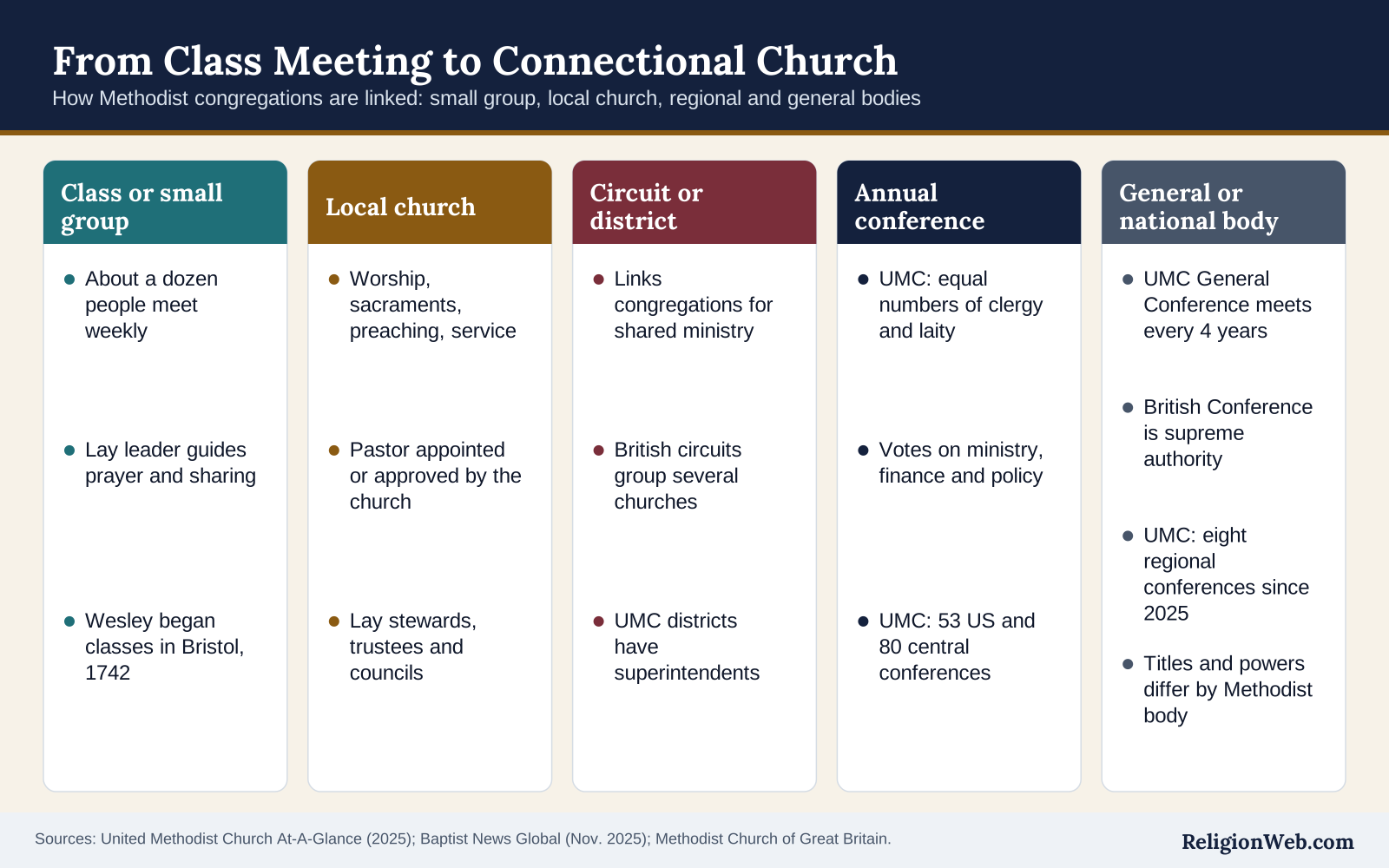
The Methodist Church of Great Britain
British Methodism has no bishops. Its structure runs from the local church, through the circuit, which groups several local churches under a team of ministers, and the district, up to the annual Conference, which a president and vice-president lead. The president is a minister and the vice-president may be a layperson or a deacon, and both serve for one year. Reference summaries count 23 districts and more than 4,000 local churches as of 2019. The Conference also makes decisions on doctrine, ministry and discipline and appoints its ministers to circuits.
The church recognizes two orders of ordained ministry, presbyters and deacons, and trained lay local preachers lead worship in large numbers. The shared emphasis on lay participation is one of the persistent features of Methodism: the British church describes its distinctive features as including that ordinary lay people play a major part in running the church.
The AME Church and other bodies
The African Methodist Episcopal Church is led by bishops who oversee episcopal districts and by a General Conference. Its structure and its name reflect the Methodist Episcopal origins from which it separated, with the added emphasis on Black self-governance. The AME Zion and Christian Methodist Episcopal churches also have bishops and conferences, and the holiness bodies, among them the Free Methodist Church, the Wesleyan Church and the Church of the Nazarene, typically use general superintendents or similar leaders along with general conferences or assemblies.
Some national Methodist churches elect bishops, others elect presidents, and a few combine bishops with elected presidents of conference. The titles differ, but the pattern of regional assemblies, a national or general body and a shared discipline recurs.
| Level | United Methodist Church | Methodist Church of Great Britain | AME Church |
|---|---|---|---|
| Local | Local church with church council and pastor | Local church with church council | Local congregation |
| Intermediate | District with district superintendent | Circuit and district | Episcopal district and annual conferences |
| Regional | Annual conferences (53 in the United States, 80 in Africa, Asia and Europe) | District synods | Annual conferences under a bishop |
| Highest body | General Conference every four years; regional conferences since 2025 | Annual Conference with president and vice-president | General Conference |
| Oversight | Bishops; Council of Bishops | No bishops; president and vice-president of Conference | Bishops |
| Ordained orders | Deacons and elders | Presbyters and deacons | Deacons and elders |
Ministry and Lay Leadership
Ordained ministry and the office of bishop
Methodist churches ordain clergy to word, sacrament and order. In the United Methodist Church the two orders are deacon and elder: deacons are ordained to a ministry of word and service, and elders to word, sacrament, order and service, and only elders and those authorized by a bishop may preside at baptism and Communion. Bishops are elected from among the elders and consecrated to the office of bishop, which United Methodists understand as an office of oversight and not a separate order of ministry.
Other churches use different language. British Methodism ordains presbyters and deacons, and some holiness churches ordain elders and licensed ministers. Methodist bodies that ordain women have done so since different dates, so the question of women in ministry is another place where Methodist practice varies.
Local preachers, class leaders, stewards and trustees
Lay leadership remains a defining feature. Local preachers, trained laypeople licensed to preach, were essential to early Methodism and remain a large share of those who lead worship in Britain. In the United Methodist Church licensed local pastors serve many congregations, and lay speakers and lay leaders assist. Stewards oversee money and the care of members, trustees hold property, and class leaders, where classes still exist, look after the spiritual life of their group.
Laity also vote. Annual conferences in the United Methodist Church have equal numbers of lay and clergy members, and a similar emphasis appears in British church councils. This shared governance has helped Methodist churches resist both clerical control and congregational isolation.
Faith in Daily Life: Social Holiness, Education and Mission
Methodists tie belief to action through a phrase of Wesley’s, social holiness. The idea is that holiness is not a private possession but a way of living with others, and that love for God leads to concern for neighbors. The principle has produced schools, hospitals, relief agencies and reform movements, and it has also been a source of disagreement when Methodists differ about what love requires.
Social Holiness and Reform
Wesley’s phrase and its meaning
Wesley wrote in the preface to a 1739 collection of hymns that Christianity is essentially a social religion, meaning that it cannot be lived in isolation, and the phrase social holiness has become shorthand for that conviction. In the Methodist system it explains why the society and class mattered, and also why works of mercy count among the means of grace. A Methodist is expected to care for the sick, the poor and the prisoner, as the General Rules direct, as part of growth in holiness and not as an optional addition.
Wesley also taught about money. His sermon on the use of money is commonly summarized in three directions: earn what one can by honest work, save what one can by avoiding waste, and give what one can to those in need. Methodists continue to cite the formula in stewardship teaching, and it reflects the view that wealth is a trust to be used for others.
Slavery, abolition and the church’s divisions
Methodism’s relationship to slavery was both a source of witness and of division. Wesley published a tract against slavery in 1774, and early American Methodists adopted rules against slaveholding that were weakened or suspended in the face of opposition. In the nineteenth century, antislavery members left to form the Wesleyan Methodist Connection, the church divided north and south in the 1840s, and Black Methodists formed their own denominations, partly because of discrimination within white-led congregations.
This history is told differently by different Methodist bodies. The AME and AME Zion churches present themselves as institutions of freedom and self-determination, and the constitutional amendments the United Methodist Church ratified in 2025 include a strengthened commitment to combating racism, which reflects continuing attention to that legacy. A responsible account names the actors, which were specific conferences, bishops and congregations, without treating all Methodists as sharing one position.
Temperance and personal discipline
Methodists have a long record of association with temperance. The use of unfermented grape juice at Communion in the United Methodist Church grew from the nineteenth- and twentieth-century temperance movement, and many Methodist bodies continue to encourage abstinence from alcohol or to counsel moderation. The practice is not uniform: British Methodism has a historic association with abstinence that has softened in recent decades, and members in many countries make their own decisions.
The discipline is best understood within Wesley’s broader concern for health, work and self-control as part of holiness. It was not an attempt to withdraw from society, and Wesley’s own practice included frequent travel, regular exercise and an interest in medicine. Modern Methodist social teaching treats questions such as alcohol, gambling and drug use as matters of pastoral care and public health as well as personal choice.
Institutions and Mission
Education, health care and relief
Wesley opened a school at Kingswood near Bristol in 1748, set up a free medical dispensary in London and published a popular health manual, Primitive Physick, in 1747. In the following centuries Methodists in Britain, North America and elsewhere founded hundreds of schools, colleges and universities, as well as hospitals, orphanages and homes for the elderly. The United Methodist Committee on Relief, UMCOR, carries out disaster response and refugee assistance, and many national Methodist churches run similar programs.
These institutions are often independent of the church in legal terms but retain links to Methodism through history and governance. They reflect the same impulse that created the early societies: that growth in faith is accompanied by practical service, and that education and health are matters of Christian concern.
Missions and women’s organizations
Thomas Coke promoted missions in the Caribbean in the 1780s, and Methodist missions followed trade routes and colonial expansion across Africa, Asia, the Pacific and Latin America. Missionary work has a complicated record, as it does for other churches, and in many places Methodist missionaries worked alongside colonial rule while in others they supported education and local leadership. Today many Methodist churches in those regions are led by nationals and send their own missionaries.
Women formed their own missionary societies in the nineteenth century, raised funds and trained deaconesses to serve in cities and overseas. These organizations gave many women a role in church leadership at a time when ordination was closed to them, and they remain active in some Methodist bodies as women’s fellowships.
Ethical debate within contemporary Methodism
Methodists today disagree on several ethical questions, including marriage, sexuality, abortion and the use of force, and the Social Principles of the United Methodist Church are revised periodically and are official teaching statements but not binding church law. The 2024 revision, which dropped earlier language about homosexuality, was welcomed by some members and rejected by others. Global Methodist and other holiness-oriented churches have adopted more traditional positions.
The range of positions is part of the Methodist experience. Wesley’s own advice to listen to one another in a catholic spirit is cited by members on every side, and church bodies at various levels have sought ways of holding conversations while governance changes. For a general reader, the sound approach is to ask which church, region and document is speaking on any question.
Methodism Around the World Today
Methodism is now a worldwide family, with its largest numbers in North America and sub-Saharan Africa and significant communities in Europe, Asia, Latin America and the Pacific. Figures below come from the churches themselves or from international bodies, and the year of each is given, because numbers in this field shift with reporting practices and recent divisions.
Numbers and Regions
What the data show, and what they do not
The World Methodist Council reports 80 member churches and over 80 million people. The United Methodist Church, as of a November 2025 report to its General Council on Finance and Administration, counts approximately 11.3 million members; its regional table lists 5.4 million in the United States and 4.6 million in Africa, Asia and Europe as of 2022. The Methodist Church of Great Britain had about 137,000 members in 2022. The Global Methodist Church reported 7,252 congregations in September 2026 but gave no membership number.
Several cautions apply. Churches count members differently, with some including baptized children and regular attenders and others counting only those on a roll. Numbers from different years cannot be added without error. The 2022 United Methodist regional figures predate the largest wave of congregational departures in 2023, so the current share of United States membership is probably lower than they suggest. Pew Research Center and other survey organizations report religious identification rather than denominational rolls, so their figures for people who identify as Methodist can differ from the church’s own counts.
Africa, Asia, Latin America and the Pacific
In sub-Saharan Africa, Methodism includes both United Methodist conferences and independent national churches, and several are among the larger Protestant bodies in their countries. The United Methodist Church reports 20 episcopal areas across Africa, Europe and the Philippines. In South Korea, the Methodist tradition is influential in universities and hospitals, and in the Philippines the United Methodist Church is a significant denomination. In the Caribbean, Methodist churches have a long history of community leadership, and in the Pacific, Methodism is closely tied to national and local identity in places such as Tonga, Fiji and Samoa.
These regional churches often have different musical traditions, forms of leadership and social concerns than their North American and British counterparts, and increasingly they shape the global conversation. Regionalization in the United Methodist Church is one response, giving the central conferences of Africa, Europe and the Philippines the same standing as the United States.
Ecumenical Relations
The World Methodist Council and its partners
The World Methodist Council traces its beginning to 1881, when the first Ecumenical Methodist Conference met, and today it organizes the World Methodist Conference, which last met in Gothenburg, Sweden, in August 2024. It describes itself as an association of member churches in the Methodist, Wesleyan and United or Uniting traditions. It also carries on formal dialogues with other Christian communions, and in December 2024 Pope Francis received its new leadership in Rome, praising the dialogue between the Council and the Catholic Church and linking the 2025 anniversary of the Council of Nicaea to the pursuit of visible unity.
Methodist-Catholic dialogue began in the late 1960s, and Methodists have taken part in dialogues with Anglican, Lutheran, Reformed and other churches. In 2006 the World Methodist Council affirmed the Joint Declaration on the Doctrine of Justification first issued by the Catholic Church and the Lutheran World Federation, a milestone that connects Wesley’s stress on justification by faith with the wider Protestant and Catholic conversation.
Anglican, Lutheran and Reformed partners
Because of its Anglican origin, Methodism has a long relationship with the Anglican Communion. In England the Methodist Church and the Church of England signed a covenant in 2003 to work toward closer relations, and in parts of the world Methodists and Anglicans have joined in united churches. Methodist-Lutheran conversations draw on the shared emphasis on grace and the personal influence of Luther’s writings on Wesley, while Methodist-Reformed dialogue addresses the historical disagreement over predestination, set out in the article on Reformed Christianity.
These dialogues have generally been conducted in the spirit of Wesley’s catholic spirit, and they present Methodism as one part of a larger Christian conversation and not as a church defined by its disagreements.
Common Misconceptions About Methodism
Misconception 1: Methodism began as a completely separate religion from Anglican Christianity
Where the misunderstanding comes from
The idea has several sources. Today Methodist and Anglican churches have different governments, different names and in most countries separate congregations, so it is natural to assume they began apart. The 1784 organization of the Methodist Episcopal Church in America looks like a founding act, and popular summaries often say that Wesley “founded” Methodism as though he had set up a rival to the Church of England. In some regions the word Methodist is also used loosely to mean any evangelical or revivalist Protestant, which hides the specific Anglican background.
The wording of the claim also mixes two different questions. Methodism is not a separate religion from Christianity at all; every major Methodist body affirms the Trinity and the ancient creeds, and the Methodist Church of Great Britain and the United Methodist Church both place themselves within the one Church of Christ. The real question is how and when Methodism became a church distinct from Anglicanism.
What the evidence and tradition actually show
The evidence shows a gradual separation. John Wesley was ordained in the Church of England and remained one of its priests until he died in 1791. Britannica describes the movement as beginning within the Church of England and aiming at reform from within, and as separating from its parent body only later. Wesley’s own writings, including his account of the Oxford years, say that the early Methodists took the Bible as interpreted by the primitive church and by their own church as their rule. His brother Charles opposed separation to the end of his life.
Separation came through a series of steps rather than a single declaration: lay preachers who administered no sacraments, preaching houses licensed as dissenting chapels, the ordination of ministers for America in 1784 and the organization of the American church at the Christmas Conference. In Britain the break was slower still and was consolidated only after Wesley’s death. Relations today are cordial and structured, including the 2003 covenant between the Methodist Church and the Church of England. The accurate description is that Methodism grew out of Anglicanism and became a distinct family of Christian churches, and it is described in this article as a Protestant Christian tradition with Anglican roots.
Misconception 2: Every Methodist body defines Christian perfection identically
Where the misunderstanding comes from
People who encounter Christian perfection in a single church assume the teaching is the same everywhere. The phrase itself invites misreading, since in everyday English perfect suggests flawless, and critics and enthusiasts alike have sometimes taken it to mean sinlessness. Because Wesley wrote about the doctrine in several periods and in several genres, it is possible to quote him in ways that seem to support quite different positions.
A second source is the relationship between the holiness movement and mainstream Methodism. Churches that emphasize entire sanctification as a definite experience are often described as simply Methodist, and the less prominent role of the doctrine in other bodies is not always visible to outsiders.
What the evidence and tradition actually show
Wesley’s own use of the term was qualified. He spoke of perfection as perfect love, in which love for God and neighbor governs the heart, and he did not claim that believers become free from ignorance, error or temptation. Many holiness churches, among them the Wesleyan Church, the Free Methodist Church and the Church of the Nazarene, teach entire sanctification as a distinct work of grace that can be received at a definite moment. The United Methodist Church and the Methodist Church of Great Britain maintain the language of holiness and perfect love in their heritage but generally speak of growth in grace over a lifetime, and individual pastors and theologians read the doctrine in different ways.
Wesley himself modeled the caution. In his own account of the doctrine he distinguished perfection in love from absolute perfection, which he reserved to God, and he warned against claiming a state that one could not verify. Hymns and sermons from the movement also speak of a continual need for Christ’s atonement, even for those who believe their hearts have been made perfect in love. Readers who meet a confident or a dismissive statement about Christian perfection should therefore ask whether it describes Wesley, a particular holiness church or a general impression.
The disagreement has to do with timing, expectation and emphasis, not with a rejection of the goal. A fair summary is that Methodist bodies share the Wesleyan hope for a life transformed by love, that they differ on whether and how it comes in a moment or a process, and that each church should be asked for its own statement of belief.
Misconception 3: All Methodist churches share one central government
Where the misunderstanding comes from
The word Methodist suggests a single organization, and the term connectional suggests a unified hierarchy. Large denominations such as the Catholic Church have a recognizable central authority, so people often assume that Methodism does too. News coverage of the United Methodist Church adds to the impression, because decisions of its General Conference are widely reported as decisions of Methodism in general.
The World Methodist Council can also look like a governing body because of its name and its global reach, although it does not govern its member churches.
What the evidence and tradition actually show
There is no single Methodist church. The United Methodist Church, the Methodist Church of Great Britain, the African Methodist Episcopal Church, the Free Methodist Church, the Global Methodist Church and many national Methodist churches each have their own governing bodies, disciplines and officers. Within the United Methodist Church itself, the 2025 constitutional amendments created eight regional conferences with power to adapt parts of the Book of Discipline, so even one denomination no longer has an entirely uniform law. The Methodist Church of Great Britain has no bishops, while the AME Church and the United Methodist Church do.
What the churches have in common is a shared heritage, certain historic doctrines and the connectional principle within each body. The World Methodist Council gathers member churches for fellowship, study and shared witness, and it describes itself as an association. It does not make binding decisions for them. The accurate statement is that each Methodist body is connectional internally and independent externally, with relationships among them based on fellowship.
Misconception 4: Methodists teach that salvation is earned by good works and strict rules
Where the misunderstanding comes from
The name itself suggests a rule-bound approach, and the early Methodists did keep a demanding schedule. The General Rules, the class meeting and the language of holiness can look like a system of earning merit. Popular histories sometimes repeat the nickname story as if it proved that Methodists were primarily interested in regulation. The common habit of reading any emphasis on conduct as a claim about merit has also fed the assumption.
What the evidence and tradition actually show
The Articles of Religion state that people are accounted righteous before God only for the merit of Jesus Christ, by faith, and not for their own works or deservings. Wesley preached justification by faith and treated the Aldersgate experience as a recognition that he trusted Christ alone for salvation. Methodist teaching on the means of grace presents prayer, Scripture, the Lord’s Supper, fasting and works of mercy as ways of receiving and responding to grace, not as payments. The General Rules describe the conduct that grows from a desire to be saved from sin, and they do not set a price for salvation.
The tension between faith and holiness is real in Methodist history, and preachers and theologians have sometimes emphasized one at the expense of the other. The Wesleyan answer is that faith is the way grace is received and holiness is the life it produces, a position that is close to the Lutheran and Reformed teaching on justification, as described in the articles on Lutheranism and Reformed Christianity, and distinctive mainly in its stress on the possibility of growth in love.
Misconception 5: All Methodists are teetotalers and avoid all worldly amusements
Where the misunderstanding comes from
This stereotype has historical roots. In the nineteenth and early twentieth centuries many Methodist churches were prominent in the temperance movement, and some held to strict standards about alcohol, gambling, dancing and theater. The use of grape juice at Communion has kept the association alive in popular memory, and comedians and novelists have used the image of the abstemious Methodist.
What the evidence and tradition actually show
The United Methodist Church does use unfermented grape juice at Communion, and the practice grew out of the temperance movement and concern for people who struggle with alcohol. Methodist social teaching in many bodies encourages abstinence or responsible moderation and calls attention to the harm of addiction. At the same time, practice varies widely among churches and countries, and members make their own decisions about drinking, entertainment and recreation. Wesley’s rules named specific practices to avoid in the eighteenth century, such as drunkenness, but did not define a general withdrawal from ordinary life.
The Methodist Church of Great Britain has historically been closely associated with abstinence, and its own materials today place more emphasis on pastoral care and responsible decision-making than on a single rule. In the United States, the Social Principles of the United Methodist Church encourage abstinence from alcohol as a faithful witness for those who choose it, and they ask the church to support those affected by addiction. Whether a given member drinks, and how a given congregation handles the question, is a matter of local custom and personal conscience more than of a common law.
Many Methodist congregations today run theaters, concerts, sports programs and community meals, and the church’s educational institutions engage with the arts and sciences. The stereotype describes a particular period and certain communities and not the whole family.
Frequently Asked Questions About Methodism
The following questions are among those most often asked by readers who are new to the Methodist tradition. Each answer is brief and points back to the fuller discussion above.
Questions About Origins and Identity
What is Methodism in simple terms?
Methodism is a family of Christian churches that grew from the eighteenth-century revival led by John and Charles Wesley within the Church of England. Methodists share the Bible and the ancient creeds with other Christians and emphasize God’s grace offered to all, faith, assurance and a life of growing holiness expressed in worship, small groups and service. The tradition is sometimes called Wesleyan, after its founder, and its churches range from large denominations such as the United Methodist Church to small national and holiness bodies.
Who founded Methodism?
John Wesley is usually named as the founder, with his brother Charles Wesley and their colleague George Whitefield as other central figures. The Oxford group that gave the movement its name met around 1729, and the revival took shape after 1738. Wesley organized the societies and preachers, but he did not intend to start a new church. The first separate Methodist church, the Methodist Episcopal Church, was organized in America at the Christmas Conference of 1784, and the British societies became a distinct church over the following decades.
Why are Methodists called Methodists?
The name began as a nickname for the Oxford students, who lived by a regular method of prayer, study and service. Wesley recalled that a Christ Church student remarked that a new set of Methodists had sprung up, alluding to ancient physicians who bore the name, and he said in 1742 that the label had been fixed on the group by way of reproach. The members accepted it over time. It does not refer to a unique doctrine, though Methodists have continued to value disciplined practice.
Questions About Beliefs and Worship
What do Methodists believe about salvation?
Methodists teach that salvation is a gift of God’s grace, offered to all people, received through faith in Jesus Christ and followed by growth in holiness. Wesley described grace as working before a person responds, in the moment of pardon and throughout the Christian life. The Articles of Religion state that people are accounted righteous before God by faith and not for their own works. Methodists do not all agree on every question of detail, for example whether a believer can fall from grace or how Christian perfection is expected to appear, and each church states its own position.
Do Methodists baptize babies and take Communion?
Most Methodist churches baptize infants and adults, and the Articles of Religion state that the baptism of young children is to be retained in the church. They recognize two sacraments, baptism and the Lord’s Supper. The United Methodist Church invites all baptized people to Communion, uses unfermented grape juice and offers the sacrament at least monthly in most congregations, with weekly celebration encouraged. Other Methodist churches have their own customs about frequency, elements and who may preside.
Do Methodists honor saints and the Virgin Mary?
Methodists use the word saints for all who belong to Christ, and many congregations observe All Saints Day to remember faithful Christians who have died. They do not generally practice prayers addressed to saints or hold the Marian doctrines taught in other churches, though they honor Mary as the mother of Jesus, especially in Advent and Christmas. For background on how other traditions understand these matters, see the articles on Christian saints and the Virgin Mary. Practice varies among Methodist bodies, and some are more liturgical than others.
Questions About Church Life and Membership
How is a Methodist church governed?
Methodist churches are governed through connected conferences, not through independent congregations or a single central authority. The United Methodist Church has local churches, districts, annual conferences, regional conferences and a quadrennial General Conference, with bishops who oversee and appoint clergy. British Methodism has circuits, districts and an annual Conference led by a president and a vice-president, without bishops. Other bodies, such as the AME Church and the holiness churches, have their own patterns of bishops or superintendents and general conferences.
What is the difference between the United Methodist Church and the Global Methodist Church?
Both churches claim the Wesleyan heritage. The United Methodist Church, formed in 1968, is the older and larger body, and it voted in 2024 to remove its bans on LGBTQ clergy and same-sex weddings and in 2025 ratified a regional structure. The Global Methodist Church launched in May 2022, largely from congregations that left the United Methodist Church, and describes its mission as making disciples of Jesus Christ and spreading scriptural holiness. The two churches differ in governance and in their positions on some moral questions, and each describes itself in its own terms.
Can anyone attend a Methodist church or join?
Methodist worship is generally open to visitors, and the United Methodist Church extends an open invitation to the Lord’s Supper to all baptized people. Membership usually follows baptism and a public profession of faith, with confirmation or reception into membership by the congregation, and members make vows of support through prayer, presence, gifts and service. Many Methodist churches welcome people with no church background, and joining a small group or a worship service is a common first step. Practices differ among bodies, so the local church is the best source for current details.
Conclusion: A Family Shaped by Grace and Method
Methodism is best understood as a Christian tradition that took form around a pattern of living. Its beginnings in an Oxford prayer group, a Georgia mission, an evening on Aldersgate Street and a field outside Bristol produced a movement of preaching, singing and small groups that has been carried to every inhabited continent.
What the History Shows
From a nickname to a worldwide family
The history shows how a label meant to tease a routine became the name of a family of churches. Wesley organized the movement to renew the Church of England, and the societies he built, with their classes, preachers and conferences, became churches in Britain, America and beyond. Later divisions over authority, race, slavery, holiness and, in recent years, sexuality and church structure reflect the same pattern of renewal, disagreement and reorganization that marks other Christian traditions.
What holds the family together
Several things continue to unite Methodists across their differences: the singing of Charles Wesley’s hymns, the Wesleyan language of grace and holiness, the two sacraments of baptism and the Lord’s Supper, the practice of small groups and mutual accountability, and the conviction that faith leads to service. The World Methodist Council’s gatherings and ecumenical dialogues give that unity an institutional expression. It is not a uniform church, and readers should look to each church for its own account of belief and practice.
How to Keep Exploring
Reading Wesley and the doctrinal standards
Readers who want to go deeper can begin with Wesley’s own sermons, especially “The Scripture Way of Salvation,” “Christian Perfection” and “The Catholic Spirit,” along with the Articles of Religion and the General Rules. The United Methodist Church and the Methodist Church of Great Britain publish accessible statements of their beliefs, and the Wesley Corpus project and the Christian Classics Ethereal Library offer text of Wesley’s writings, although some transcriptions are not yet collated against page scans.
Related topics on ReligionWeb
Methodism is part of the wider story of Protestant Christianity, and its relatives include Lutheranism, Reformed and Baptist churches, Anglicanism and Pentecostalism. The articles on the Eucharist, baptism and the Christian year explain practices that Methodists share with other Christians, and the overview of Christianity places the whole tradition in its larger setting.
Sources
The table below lists the principal external sources behind this article. Facts, dates and figures were checked against these and related primary, institutional and academic materials.
| # | Source | Publisher and type | Used for | Link |
|---|---|---|---|---|
| 1 | World Methodist Council (home page) | World Methodist Council · Institutional | Council self-description: 80 member churches, over 80 million people; established 1881 | worldmethodistcouncil.org |
| 2 | Articles of Religion (United Methodist presentation) | The United Methodist Church · Primary text | Quoted Articles IX and XVII; list of twenty-five articles | umc.org |
| 3 | Book of Discipline 105: Our Theological Task | The United Methodist Church · Institutional | Scripture, tradition, experience and reason in United Methodist theology | umc.org |
| 4 | United Methodists At-A-Glance | The United Methodist Church · Demographic data | About 11.3 million members (Nov. 2025); 2022 regional figures; conferences; 1968 formation | umc.org |
| 5 | The General Rules | Discipleship Ministries, The United Methodist Church · Primary text | Quoted General Rules of 1743 | umcdiscipleship.org |
| 6 | Journal of John Wesley (Christian Classics Ethereal Library edition) | Christian Classics Ethereal Library · Primary text | Quoted Aldersgate passage, May 24, 1738 | ccel.org |
| 7 | John Wesley, A Short History of Methodism (1765), Wesley Corpus | Wesley Corpus, History of Methodism project · Primary text | Oxford origins in 1729; Christ Church remark and ancient physicians (Fun Fact) | corpus.historyofmethodism.com |
| 8 | John Wesley, The Character of a Methodist (1742), Wesley Corpus | Wesley Corpus, History of Methodism project · Primary text | Name fixed by way of reproach; marks of a Methodist not opinions | corpus.historyofmethodism.com |
| 9 | John Wesley, Sermon 39, Catholic Spirit (1750), Wesley Corpus | Wesley Corpus, History of Methodism project · Primary text | Quoted lines on giving a hand despite differing opinions | corpus.historyofmethodism.com |
| 10 | United Methodists ratify new global structure | Baptist News Global · News report | Regionalization amendments ratified, announced Nov. 5, 2025; eight regions | baptistnews.com |
Last fact-check date: 2026-10-21.
