Salah (Arabic ṣalāh, also spelled salat and known as namaz in Persian, Turkish, Urdu and several other languages) is the ritual prayer of Islam. It is a set sequence of standing, bowing, prostrating and sitting, accompanied by recitation from the Quran and fixed phrases of praise, performed facing the Kaaba in Mecca. Muslims understand salah as an obligation placed on every adult Muslim of sound mind, and the major legal traditions agree that it is performed five times a day: at dawn (Fajr), midday (Dhuhr), afternoon (Asr), sunset (Maghrib) and night (Isha). Each obligatory prayer lasts only a few minutes, but together the five give the day a recognizable rhythm.
Salah is the second of the Five Pillars of Islam, the basic acts of worship that structure Muslim religious life. Muslims regard it as an act of obedience and gratitude to God (Allah), a form of remembrance, and a regular return of attention to what they hold to be most important. It is distinct from du‘a, the free and personal supplication that a Muslim may make at any time in any language, because salah has a prescribed form and is normally recited in Arabic. Understanding that distinction explains much of what an observer sees: why prayer begins with a washing, why worshipers line up in rows, why a rug or a clean floor is spread, and why a mosque has a niche marking a direction.
The Quran gives the times and the central instruction of prayer in outline, and the detailed form comes from the practice of the Prophet Muhammad as preserved in hadith reports and handed down in the Muslim community. The words of the Quran are recited inside the prayer, and the pattern of postures is traditionally traced to a saying attributed to the Prophet, “Pray as you have seen me praying.” Because the details were worked out by jurists in several centuries of discussion, Sunni Muslims, Shia Muslims and the legal schools within each group differ on matters such as the placement of the hands, the exact beginning of some prayer times, and whether two prayers may be combined. Those differences are real but small compared with the shared core.
This article explains what salah is and how it is performed, step by step; how the prayer times are defined and calculated; what ritual purity and the washing called wudu involve; what the qibla is and how it has been determined; how prayer works in congregation, in the mosque and at home; what the Friday prayer adds; and how travel, illness and other circumstances change the rules. It also describes where Sunni, Shia and other traditions differ, and it separates what the Quran states, what the hadith literature reports, what the law schools conclude, and what is local custom. For the wider religion, see the chapter on Islam.
At a Glance: What Salah Is, Who Prays It, and When
Definition and Vocabulary
The word salah and what it covers
The Arabic noun ṣalāh (plural ṣalawāt) is usually translated as “prayer,” but in Islamic usage it names a specific rite rather than prayer in general. Classical dictionaries connect the root with ideas of supplication and blessing, and the Quran uses the word both for the ritual and, in some verses, for the blessing that God and the angels invoke on the Prophet. In the language of Islamic law, salah means the prescribed sequence beginning with the spoken declaration Allahu akbar (“God is greatest”) and ending with the greeting of peace, the taslim. Persian-influenced languages use namaz for the same rite, which is why a visitor to Istanbul, Tehran or Lahore will usually hear that word instead.
Muslims distinguish salah from other forms of devotion. Du‘a is personal petition, dhikr is the repeated remembrance of God through phrases such as subhan Allah, and ‘ibadah is the wider category of worship that includes fasting, charity and pilgrimage. Salah belongs to that wider category but has fixed conditions: a state of ritual purity, a direction, a time window, a sequence of acts and a core of recited words. Much of the legal literature on prayer concerns the question of which elements are essential, which are strongly recommended, and which are matters of preference.
Key terms used in this article
The vocabulary of prayer is compact, and a handful of Arabic words recur throughout the sections that follow. The table below defines the main ones so that later descriptions can use them freely. Arabic terms are given in the simplified spellings common in English, and several have more than one accepted spelling.
| Term | Meaning in plain English |
|---|---|
| Adhan | The public call to prayer, recited aloud by a mu’adhdhin when a prayer time begins. |
| Iqama | A shorter second call recited just before a congregational prayer begins. |
| Wudu | The partial ritual washing (face, arms, head, feet) that precedes prayer. |
| Ghusl | A full-body ritual washing required after certain states, such as sexual intercourse or the end of menstruation. |
| Qibla | The direction of the Kaaba in Mecca, which Muslims face in prayer. |
| Rak‘ah | One complete cycle of standing, bowing, prostrating and sitting; each prayer is made of two to four. |
| Ruku‘ and sujud | Bowing from the waist and prostrating with the forehead, nose, palms, knees and toes on the ground. |
| Tashahhud | The recited testimony of faith and blessings said while seated. |
| Taslim | The closing greeting of peace, turning the head to the right and then the left. |
| Imam | The person who stands in front and leads a congregational prayer. |
| Fard and sunnah | Obligatory prayers and the voluntary prayers modeled on the Prophet’s practice. |
| Khutbah | The sermon delivered at the Friday prayer and at the festival prayers. |
The Five Daily Prayers in Brief
The five prayers and their rak‘ahs
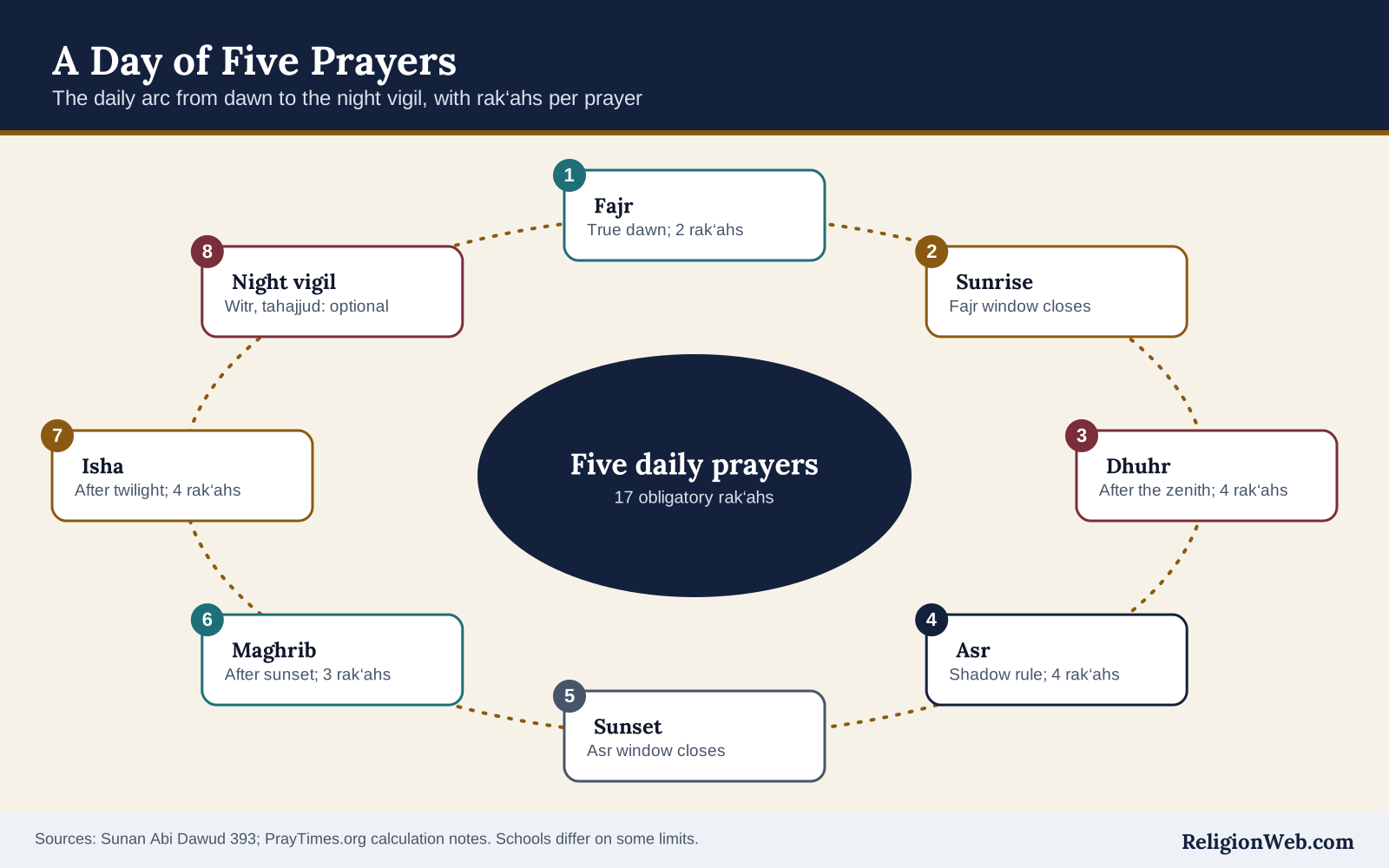
The five obligatory prayers are named for their times, and each has a fixed number of rak‘ahs. Fajr has two, Dhuhr four, Asr four, Maghrib three and Isha four, for a total of seventeen obligatory rak‘ahs a day. Maghrib is the only one of the five with an odd number of rak‘ahs. The table summarizes the basic pattern that Sunni and Shia Muslims share, with the time windows described in more detail in a later section.
| Prayer | Arabic name | Approximate time | Obligatory rak‘ahs | Recitation |
|---|---|---|---|---|
| Dawn prayer | Fajr (also Subh) | From first light until sunrise | 2 | Aloud |
| Midday prayer | Dhuhr (Zuhr) | After the sun passes its highest point | 4 | Silent |
| Afternoon prayer | Asr | Mid to late afternoon, until sunset | 4 | Silent |
| Sunset prayer | Maghrib | Just after sunset | 3 | Aloud in the first two |
| Night prayer | Isha | After twilight fades | 4 | Aloud in the first two |
On Friday, the Dhuhr slot is taken by the congregational Friday prayer, salat al-jumu‘a, which has two rak‘ahs preceded by two sermons. Festival prayers on Eid mornings are separate occasions, treated in the chapters on Eid al-Fitr and Eid al-Adha.
How long prayer actually takes
An obligatory prayer is short. Recited at an ordinary pace, a two-rak‘ah Fajr prayer takes a few minutes and a four-rak‘ah prayer somewhat longer, and the whole set of five obligatory prayers adds up to well under an hour of a person’s day, even with wudu and the voluntary prayers that many Muslims add. Congregations in a mosque pray at the speed of the imam, and some imams are known for brevity while others read longer passages, especially in Ramadan.
The five prayers are not a continuous stretch of devotion but five separate appointments within windows that last for hours. A person who prays Dhuhr at 1:00 p.m. has not missed it if the prayer is said at 2:30, provided the time has not ended. That flexibility inside each window, and the practice of fitting prayer around work, school and travel, is a theme the rest of this article returns to.
Who Is Required to Pray
Adulthood, sound mind and the idea of legal responsibility
Islamic law describes the person who is obligated to pray as mukallaf, a Muslim who has reached puberty and has the mental capacity to understand the obligation. Children are not held to the duty. Hadith literature records that parents should encourage children to begin praying at about the age of seven, and jurists have generally read that report as a call for gradual, gentle training and not as a requirement on the child. Adults who lack mental capacity are likewise not obligated, and a person who becomes unconscious for a period is generally not required to make up the prayers that passed during that time, although the schools differ on details.
The duty is personal. A person who can pray in no other way still prays, adjusting posture to ability, and the law says that the prayer is never to be dropped entirely while the person remains conscious. Communities of Muslims also talk about the practical side of this: workplaces, schools and hospitals in many countries now set aside prayer space or time for the purpose.
Women, menstruation and other exemptions
Salah is obligatory on Muslim women and men alike, with one well-known exception: during menstruation and postpartum bleeding a woman does not pray, and unlike the fast of Ramadan, she does not make those prayers up afterward. The reasoning transmitted in hadith reports is that this relieves hardship, and scholars from all the major schools treat the point as settled. After bleeding ends she performs a full-body washing (ghusl) and resumes prayer.
Other situations modify the prayer without removing it. Illness permits praying while seated or lying down, travel permits shortening and sometimes combining prayers, and fear or danger permits an abbreviated form. These adjustments are described in a dedicated section below. As with every aspect of practice, the religious ruling is not a substitute for medical advice: a Muslim who is unwell is expected to seek treatment, and the tradition’s own concessions exist so that prayer does not become a danger to health.
Origins and Historical Development of Salah
Prayer in the Quran and the Meccan Period
Night vigil and the times of day in the Quran
The Quran speaks of prayer from its earliest passages, but it speaks mostly in terms of times and attitudes and not of procedure. Early Meccan chapters, especially Surah 73 (al-Muzzammil), address the Prophet about standing in prayer for much of the night, and Muslim tradition treats this vigil as an early form of worship that was later eased. Other verses mention praising God before sunrise and before sunset, at the “two ends of the day” and during parts of the night (the most commonly cited are Surah 11:114, 17:78–79, 20:130 and 30:17–18). Verse 24:58 names two prayers, the prayer of dawn (salat al-fajr) and the prayer of night (salat al-isha).
Because no single verse lists five prayers by name, the five-part schedule is understood by Muslim scholars as the result of combining several verses with the practice and teaching of the Prophet. One verse that exemplifies the exhortation to regular observance is a call to guard the prayers, among them one singled out for special care.
Be guardians of your prayers, and of the midmost prayer, and stand up with devotion to Allah.
Quran 2:238, Pickthall translation (1930)
The identity of the “midmost prayer” (al-salat al-wusta) is a recurring topic of Quran commentary. A number of reports in the hadith collections identify it as the Asr prayer, and that is the most widely held view, but early authorities also proposed Fajr and Dhuhr, and the question shows how commentators weighed the text against reports of the Prophet’s practice. What nearly all commentators agree on is the verse’s emphasis on guarding prayer as a habit: regularity, attentiveness and humility.
The Night Journey and the five prayers
Muslim tradition associates the establishment of five daily prayers with the Night Journey and Ascension (al-Isra’ wa-l-Mi‘raj). In a long report in Sahih al-Bukhari (no. 349), narrated through Anas ibn Malik from Abu Dharr, the Prophet describes how fifty prayers were first prescribed. On the advice of Moses, whom he met during the ascent, he returned to God several times asking for a reduction until the number was five. In the report, God then says that these five are equal to fifty in reward, because His word does not change. The report is treated as authentic in Sunni collections, and Shia traditions likewise teach that the five prayers were instituted on that occasion.
The date of the Night Journey is not firmly fixed. Muslim sources generally place it some time before the Hijra of 622 CE, and the sources disagree about the year and month. Academic historians approach the question as a matter of sources: the oldest accounts of how and when prayer was shaped were collected in hadith and biography (sira) works compiled from the eighth century onward, and scholars debate how far those accounts preserve the earliest practice. Muslim scholars, for their part, treat the established pattern of the five prayers as part of the Prophet’s own lifetime and as continuously transmitted from the first generation.
Medina, the Qibla and the Call to Prayer
The change of qibla from Jerusalem to Mecca
A report in Sahih al-Bukhari (no. 40), narrated by al-Bara’ ibn Azib, says that after the Hijra to Medina the Prophet and his community faced Jerusalem (Bayt al-Maqdis) in prayer for sixteen or seventeen months, the narrator being unsure of the exact figure, and that the direction then changed to the Kaaba in Mecca. The same report says that the first prayer offered toward the Kaaba was the Asr prayer. The traditional date is the second year of the Hijra, about 624 CE. The Quran addresses the change directly in the second chapter, where it records the Prophet looking to the heavens for guidance and instructs the community to turn toward the sacred place of worship wherever they are.
So turn thy face toward the Inviolable Place of Worship, and ye (O Muslims), wheresoever ye may be, turn your faces (when ye pray) toward it.
Quran 2:144, Pickthall translation (1930)
The verse works as both a historical marker and a legal principle. As a marker, it records a decisive moment in the formation of a distinct community of worship, and Muslims in Medina commemorate it with a mosque known as the Mosque of the Two Qiblas. As a principle, it fixes a single direction for all Muslims regardless of place, and the long scholarly effort to work out that direction from every city of the world is treated in a later section.
The origin of the adhan
In Mecca the small Muslim community had no public call, and prayer took place without announcement. Tradition says that in Medina, as the community grew, the question arose of how to summon people at the right time. Reports preserved in the hadith literature describe proposals borrowed from other communities, such as a horn or a bell, and describe the human voice as the solution. The companion Bilal ibn Rabah, of Abyssinian descent, is remembered as the first mu’adhdhin, the caller. Sunni accounts also relate that a companion named Abdullah ibn Zayd reported a dream containing the words of the call, which the Prophet endorsed and taught to Bilal; Shia sources preserve a different account of how the call was taught.
Whatever the details of these reports, the adhan became one of the visible and audible marks of Muslim life: a call heard five times a day, in the same Arabic words, from Cairo to Jakarta. Its wording and the points at which Sunni and Shia practice differ are discussed in the section on prayer times.
From Practice to Law
How the form of prayer was transmitted
Muslims believe that the structure of the prayer was transmitted by observation, not by written instruction. The best-known statement of this principle is in a report in Sahih al-Bukhari (no. 631), in which the Prophet, finishing a visit by a group of young men who had stayed with him for twenty days, told them to return to their people, teach them, and “pray as you have seen me praying.” Another report in the same collection (no. 757) recounts a man whom the Prophet told three times to go back and pray again because he had not prayed correctly, and then taught him the sequence in order: the opening takbir, recitation, bowing until at ease, rising until standing straight, prostrating until at ease, and sitting until at ease. The repeated phrase about being at ease has shaped the law of prayer, which requires a pause in each position and not a hurried motion.
Such reports, together with the daily example of the community in Medina, gave jurists their raw material. The Gabriel report in Sunan Abi Dawud (no. 393) describes the angel Gabriel leading the Prophet in the five prayers on two successive days at the Kaaba, first at the earliest time of each prayer and then at the latest, and telling him that the times lie between the two. That report is one of the foundations of the prayer-time schedule discussed in the next section.
The schools of law and a chronology of prayer
By the ninth century CE the major hadith collections had been compiled and the great jurists had begun to organize the rules of worship into the systems that became the Sunni schools of law (Hanafi, Maliki, Shafi‘i and Hanbali) and the Shia Ja‘fari tradition. They did not disagree about whether to pray five times a day or which prayers to pray; they disagreed on details drawn from different sets of reports, such as the posture of the hands or the end of a prayer time. The table gives a short chronology of the development of salah as Muslim sources and standard histories describe it.
| Date | Development | Basis |
|---|---|---|
| Early 7th century CE (Mecca) | Night vigil and prayer at dawn and sunset in the earliest revelations | Quran 73, 11:114, 17:78, 20:130 |
| Traditionally shortly before 622 CE | Night Journey; five prayers prescribed after reduction from fifty | Sahih al-Bukhari 349 |
| 622 CE | Hijra to Medina; the first mosque built and the community prays together | Biography (sira) and hadith |
| Traditionally 2 AH (about 624 CE) | Qibla changes from Jerusalem to the Kaaba | Quran 2:142–144; hadith |
| Early Medina period | Adhan instituted; Bilal as first mu’adhdhin | Hadith reports |
| 632 CE | Death of the Prophet; the pattern of prayer is carried by the community | Traditional dating |
| 9th century CE | Major hadith collections compiled (Bukhari d. 870, Muslim d. 875, Abu Dawud d. 889) | Hadith literature |
| 9th to 13th centuries CE | Qibla tables, prayer-time calculation and instruments developed by astronomers | Histories of Islamic astronomy |
| 20th to 21st centuries CE | Printed timetables, then smartphone apps and online calculation of times and qibla | Modern practice |
Prayer Times: How the Five Windows Are Defined and Calculated
The Textual Basis and the Five Windows
What the Quran and the hadith provide
The Quran states the principle that prayer has appointed times. In the fourth chapter, in a passage on prayer under conditions of danger, it says that worship at fixed times has been prescribed for the believers (Surah 4:103). The same chapter does not give clock times, and nor do other chapters. Instead, the Quran uses natural markers, such as the declining of the sun, the darkness of the night and the light of dawn, and leaves the precise limits to the practice of the Prophet. Muslims therefore turn to hadith for the definitions that jurists later turned into law.
The most frequently cited report is the one in Sunan Abi Dawud (no. 393), narrated by Ibn Abbas, in which Gabriel leads the Prophet in prayer at the Kaaba on two consecutive days. On the first day, Dhuhr was prayed when the sun had passed its zenith, Asr when an object’s shadow equaled its height, Maghrib at sunset, Isha when twilight ended and Fajr when eating and drinking become forbidden for a person fasting. On the second day, Dhuhr was prayed when the shadow equaled the object’s length, Asr when it was twice the object’s length, Maghrib at the same time, Isha at about one third of the night and Fajr when there was ample light. Gabriel then said that the time of the prayers lies between those two sets of times. Muslim jurists drew the windows from that statement, which is why each prayer has a start, a preferred period and a final limit.
Definitions of the five times
The practical definitions follow from those reports. Fajr begins at “true dawn,” the horizontal band of light that spreads along the horizon, and not the faint vertical glow that sometimes precedes it, and it ends at sunrise. Dhuhr begins just after the sun passes its highest point (zawal) and lasts until Asr begins. Asr begins when the shadow of an object reaches a set multiple of its height, in addition to the shadow it had at noon, and lasts until sunset. Maghrib begins at sunset. Isha begins when the twilight has faded from the western sky. The table below gives these definitions along with the places where schools part ways.
| Prayer | Begins | Ends or preferred limit | Where schools differ |
|---|---|---|---|
| Fajr | True dawn, when light spreads across the horizon | Sunrise | Calculation methods set the dawn angle differently, from about 15 to 19.5 degrees below the horizon |
| Dhuhr | Shortly after the sun passes its highest point | When Asr begins | Twelver jurists treat Dhuhr and Asr as sharing one window from midday to sunset, with each having an initial part reserved for it |
| Asr | When an object’s shadow equals its height, plus its noon shadow (Shafi‘i, Maliki, Hanbali, Ja‘fari) | Sunset; the last part before sunset is discouraged | Hanafi school begins Asr when the shadow equals twice the object’s height, so Asr starts later |
| Maghrib | Sunset (Sunni schools) | The end of red twilight, according to most Sunni jurists | Twelver jurists wait until the reddish afterglow has passed overhead, a few minutes later |
| Isha | When twilight has faded (red glow in most schools; white glow in the Hanafi school, per Abu Hanifa) | Preferred until the middle or third of the night; permissible later for many jurists | Twelver jurists give Maghrib and Isha a shared window running to midnight |
Hadith reports also name moments when prayer is discouraged: around sunrise, when the sun stands at its zenith, and around sunset. One report gives as the reason that people who worship the sun prostrate to it at those moments. The schools differ in how strictly they apply the restriction, and in which kinds of prayer it covers, such as a missed obligatory prayer or a prayer offered on entering a mosque. Ordinarily the restriction is understood to concern voluntary prayers.
Calculation, Timetables and Local Conditions
How modern timetables are calculated
In medieval and early modern Muslim cities, a mosque’s timekeeper (muwaqqit) used observation, sundials, astrolabes and astronomical tables to announce the times. Today almost every printed mosque timetable or smartphone app is computed from astronomy: the date, the latitude and longitude, and the angle of the sun below the horizon at dawn and nightfall. The calculation of Dhuhr, Asr and Maghrib is straightforward. The disagreement is over the angles for Fajr and Isha, which depend on how one defines the onset of dawn and the end of twilight.
Several organizations publish standard settings. The Muslim World League uses 18 degrees for Fajr and 17 for Isha. The Islamic Society of North America (ISNA) uses 15 degrees for both. The Egyptian General Authority of Survey uses 19.5 and 17.5, the University of Islamic Sciences in Karachi uses 18 for both, and the Umm al-Qura method used in Saudi Arabia uses 18.5 degrees for Fajr and sets Isha at 90 minutes after Maghrib (120 minutes during Ramadan). The University of Tehran method uses 17.7 degrees for Fajr and 14 for Isha. A local mosque normally chooses one method and posts its timetable, and most Muslims follow the mosque’s schedule. This is the reason that two apps, set to different methods, can show Fajr ten minutes or more apart in the same city.
High latitudes and the long twilights of summer
The angle-based rules fail in places far from the equator, such as northern Europe in summer, where twilight never completely ends and the sky may never be fully dark between sunset and dawn. For such places, calculation tools offer fallback rules. One divides the night in half, so that Isha and Fajr fall at the midpoint. Another divides the night into seven parts, with Isha after the first seventh and Fajr at the start of the last. A third, called the angle-based method, divides the night in proportion to the angle used. Proposals discussed by scholars and fatwa councils include following the timings of the nearest city where the signs of day and night are distinct, or following Mecca’s timings. These are reasoned solutions to a situation that earlier jurists did not face, and communities choose among them.
The Adhan and the Iqama
Wording and structure of the call
The adhan opens with “God is greatest” (Allahu akbar), repeated, followed by the testimony that there is no god but God and that Muhammad is the messenger of God, and then two invitations: “Come to prayer” (hayya ‘ala-s-salah) and “Come to success” (hayya ‘ala-l-falah). It ends with a repeated takbir and a final declaration of God’s oneness. The Sunni schools differ slightly in the number of repetitions, so that the adhan consists of somewhere between fifteen and nineteen phrases depending on the school. The Fajr call adds a line, “prayer is better than sleep” (as-salatu khayrun mina-n-nawm).
The iqama is the second, shorter call said inside the mosque just before the congregational prayer begins, and it adds a line announcing that the prayer is about to begin (qad qamati-s-salah). Its purpose is practical: the people in the mosque stand and straighten their rows. The schools classify the adhan and iqama differently, as a communal obligation in some and a strongly recommended practice in others. For a person praying alone at home they are generally recommended and not required.
Differences between Sunni and Shia calls
Twelver Shia practice differs from Sunni practice in three details. The Shia adhan adds the phrase “Come to the best of deeds” (hayya ‘ala khayr al-‘amal), which Sunni tradition does not include, and it does not use “prayer is better than sleep.” Many Twelver Shia also add a further testimony that Ali is the friend of God (wali Allah). Twelver jurists generally say that this addition is not part of the adhan itself but is a customary expression of devotion said with that intention, and the question of whether to include it is itself a topic of discussion within Shia communities. Zaydi communities also include the phrase about the best of deeds, and other groups have their own conventions for the call. The shared opening of the call, the testimony of God’s oneness and the invitation to prayer and success, is common to all.
In many countries today the call is amplified by loudspeakers, and some municipalities regulate the volume or timing of amplified calls, while in other places the adhan is broadcast on television or delivered by phone applications. Hearing the call, many Muslims repeat its phrases quietly and then recite a prayer of blessing on the Prophet, a courtesy that hadith reports commend.
Wudu and Ritual Purity: Preparing for Prayer
The Idea of Purity
Why Muslims wash before prayer
The Quran gives the instruction to wash directly in the fifth chapter: when believers rise for prayer they are to wash the face and the hands up to the elbows, wipe the heads and wash the feet up to the ankles. The same verse closes with a comment on its purpose that Muslims often cite when explaining the practice.
Allah would not place a burden on you, but He would purify you and would perfect His grace upon you, that ye may give thanks.
Quran 5:6, Pickthall translation (1930)
The purity involved is partly physical and partly symbolic. Muslim scholars describe taharah (purity) as a precondition of prayer in the same way that attention is a precondition of conversation: an act of preparation that marks a change from everyday activity to standing before God. Reports in the hadith literature compare the washing to the shedding of sins, and many Muslims describe wudu as the moment in which they collect their thoughts. Ritual purity is not the same as hygiene, because a person can be clean in the ordinary sense and still need wudu, and the reverse is also true.
Minor and major impurity, ghusl and tayammum
Islamic law distinguishes two levels of ritual impurity. A minor impurity, caused by sleep, the passing of waste or wind, or the loss of consciousness, is removed by wudu. A major impurity, caused by sexual intercourse, ejaculation, menstruation or postpartum bleeding, is removed by ghusl, the washing of the whole body. Ghusl is also recommended before the Friday prayer and the festival prayers.
When water is unavailable or its use would be harmful, as in illness, a desert journey or severe cold, the Quran provides an alternative: the dry ablution called tayammum. The verse tells the believer, if water is absent, to go to clean earth and rub the face and the hands with it. Jurists describe this as a concession that preserves the form of purification without requiring water, and they discuss the type of material allowed, the number of strokes and the intention. In a hospital, prison or on a long flight, the concession allows prayer to proceed.
How Wudu Is Performed
The sequence of wudu, step by step
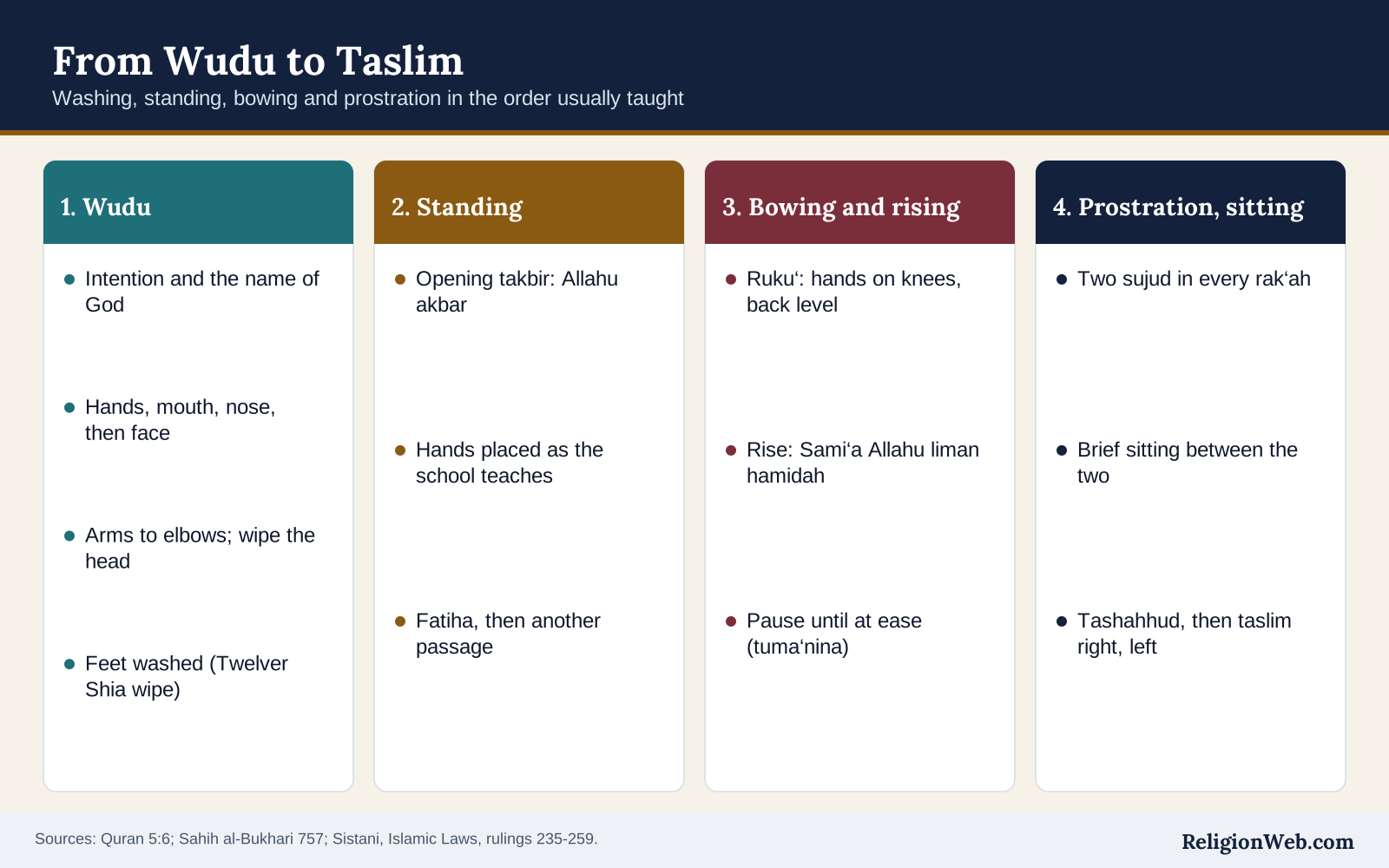
Wudu has a customary order based on reports describing the Prophet’s own ablution. The worshiper forms an intention in the heart, says the name of God, washes the hands, rinses the mouth and nose, washes the face, washes the arms up to and including the elbows, wipes over the head, and washes the feet up to and including the ankles. Sunni practice recommends three washings of each part, whereas Twelver Shia practice, in the rulings of Grand Ayatollah Ali al-Sistani, treats a single washing of the face and arms as obligatory and a second as recommended. The table gives the sequence as it is most often taught.
| Step | Action | Notes on practice |
|---|---|---|
| 1 | Intention (niyya) and the name of God | Intention is of the heart; the spoken bismillah is recommended |
| 2 | Wash both hands to the wrists | Commonly done three times in Sunni practice |
| 3 | Rinse the mouth and draw water into the nose | Obligatory in the Hanbali school; recommended in the others for wudu |
| 4 | Wash the face from hairline to chin and ear to ear | Required in every school |
| 5 | Wash the right arm, then the left, including the elbows | Twelver Shia wash from the elbow down toward the fingertips |
| 6 | Wipe the head with wet hands | Extent varies: a quarter (Hanafi), a part (Shafi‘i), all (Maliki, Hanbali); Twelver Shia wipe the front of the head |
| 7 | Wash the feet to the ankles, right then left | Twelver Shia wipe the top of each foot instead of washing it |
| 8 | Close with a short testimony of faith | A recommended supplication, not a condition |
What is required and what is recommended
Jurists divide the acts of wudu into those that are required for its validity (fard) and those that are recommended (sunnah). The core obligations in the Sunni schools are washing the face and arms and the feet and wiping over the head. The Hanafi school counts four obligatory acts, which are exactly these four. The Shafi‘i school adds the intention and the proper order, the Maliki school adds the intention, continuity (not letting the washing dry before the next stage) and rubbing the skin, and the Hanbali school adds order and continuity and counts the rinsing of the mouth and nose as obligatory, which the other schools classify as recommended. The schools also differ on how much of the head must be wiped.
Twelver Shia jurisprudence, as stated in the rulings of Sistani, lists the same four acts but differs in the fourth: the feet are wiped on the upper surface from the toes to the ankle and not washed, and the washing of the arms proceeds from the elbow to the fingertips. The Shia position rests on a reading of the verse’s grammar and on reports transmitted through the Imams. Sunni scholars read the same verse as requiring the washing of the feet, and the visible difference between the two practices is therefore one of the quickest ways to see the two legal traditions at work.
What Invalidates Wudu and Special Cases
Acts that end a state of wudu
Wudu lasts until something breaks it. All schools agree that the passing of urine, stool or wind, deep sleep and loss of consciousness end the state of purity. The schools differ on other acts: the Shafi‘i school holds that touching a person of the opposite sex ends wudu, while the Hanafi school generally holds that it does not, the Hanbali school adds the eating of camel meat on the basis of a specific report, and the Hanafi school counts a flow of blood from the body. These disagreements illustrate the way different schools weigh the same hadith evidence and the Quranic wording.
Doubt does not break wudu. A basic legal principle shared by the schools says that certainty is not removed by doubt, so a person who is unsure whether wudu has been broken assumes it remains valid. This rule is intended to prevent anxious scrupulosity, and a number of Muslim scholars discuss it as a safeguard for people troubled by repetitive worry about purity.
Socks, bandages and difficulty
Islamic law adds several concessions. The Sunni schools allow a person who put on leather socks (khuffayn) in a state of wudu to wipe over them for one day while resident and three days while traveling, rather than removing them. Bandages and casts can be wiped over when water would be harmful. Twelver Shia jurists, as stated in Sistani’s rulings, do not accept wiping over socks or shoes except in situations of necessity or taqiyya (protective concealment of one’s practice), and they require tayammum together with wiping where removal is impossible.
Water use itself is regulated by the ethic of moderation. Hadith reports warn against wasting water even at a flowing stream, and in dry regions the washing is done with a small quantity. For people with skin conditions, cold climates or a disability, wudu may be adapted, and Muslim authorities across the schools affirm that nobody is expected to harm their health to complete it. In such cases a Muslim consults a physician for the medical side and a scholar or imam for the religious ruling.
The Qibla: Facing the Kaaba in Prayer
What the Qibla Is and Why It Matters
The Kaaba as a direction, not an object of worship
The qibla (also spelled qiblah or kiblah) is the direction of the Kaaba, the cube-shaped sanctuary at the center of the Sacred Mosque (al-Masjid al-Haram) in Mecca. Britannica defines it as the direction that Muslims face five times daily during salah, and notes that it also governs burial, in which the dead are laid facing Mecca, and the ritual slaughter of animals. Muslims believe that the Kaaba was built by Abraham and Ishmael as a house for the worship of the one God, and that it is the first such house. In prayer, they say, they address God and not the building, which is why the direction is described as a point of orientation and unity: Muslims in every part of the world face the same place, and in Mecca itself they stand in concentric rows around it.
That distinction answers a question that outsiders sometimes ask. The Kaaba contains no image and receives no prayer addressed to it. The statement in the Quran that “unto Allah belong the East and the West” (2:142) is often cited in the commentaries to remind readers that no direction possesses divine power, and that the qibla is a commanded discipline of the community and not a claim about where God is located. The practice of the qibla belongs with other commanded forms in Islam, such as the washing before prayer and the postures of the body, whose value Muslims find in obedience and in the unity that a shared form creates.
From Jerusalem to Mecca: reading the change
Britannica notes that soon after the migration to Medina in 622 CE the Prophet first set Jerusalem as the qibla, probably influenced by Jewish tradition, and later changed it to Mecca. That is a historian’s summary. Muslim tradition tells the story differently: Jerusalem was the direction of earlier prophets, the Prophet longed for the Kaaba, and the Quran’s verses in the second chapter answered that longing, giving the Muslim community its own distinct direction. Both accounts agree on the sequence and on the importance of the change as a moment when the Muslim community of worship took a recognizable independent form.
The second chapter also anticipates the controversy the change caused. Some people asked what had turned the Muslims away from the direction they had formerly observed, and the Quran’s reply is the declaration that the East and the West belong to God. The change did not come from doubt about earlier practice but from the instruction to turn to the Sacred Mosque wherever one is, an instruction that most Muslims treat as a permanent and universal part of prayer.
How the Direction Has Been Found
Local knowledge, stars and the sun
For a person who can see the Kaaba, facing it is a matter of looking. For everyone else the direction is a problem of geography, and Muslim communities answered it with the tools available. Early Muslims in newly settled regions took the direction from the local knowledge of those who had traveled, from the rising and setting points of the sun and the positions of stars, and from the orientation of the first mosque established in a town, which others then copied. Medieval mosques are not all aligned identically even within one region, a fact that historians of architecture often use to study how particular communities estimated the direction.
Jurists also asked how exact the facing must be. A common legal distinction separates those who are in the sanctuary and can see the Kaaba, who must face the building itself, from those far away, for whom the question is whether they must aim at the Kaaba itself (‘ayn) or merely toward its general direction (jiha). Many jurists in the Hanafi, Maliki and Hanbali schools accept the direction, while the Shafi‘i school emphasizes the effort to face the Kaaba itself while accepting that a distant person can only do his best. In practice both approaches result in a sincere effort and a valid prayer.
Spherical astronomy, tables and instruments
As Muslim astronomy developed, mathematicians treated the qibla as a problem in geometry. According to an academic page maintained at Utrecht University on the mathematics of the qibla, by the late eighth century scholars in the Islamic world had worked out sophisticated solutions based on spherical trigonometry, most commonly computing the angle, measured from north, of the great-circle path from the observer to the Kaaba. The eleventh-century scholar al-Biruni wrote, in a statement quoted by the same source, that nearby directions could be found by a diligent seeker but distant ones only by astronomers.
Astronomers produced extensive tables giving the qibla for each latitude and longitude of the known world, engraved curves on astrolabes and quadrants that showed the hour at which the sun points toward Mecca, and drew world maps centered on Mecca for the purpose of finding direction and distance. A medieval method described by Nasir al-Din al-Tusi in the thirteenth century used the sun’s noon position over Mecca and the time difference from local longitude to read the qibla from the shadow of a vertical stick. These methods show how the practice of prayer helped drive mathematics and observational astronomy, and why a muwaqqit in a major mosque was a learned figure.
Compasses, maps and smartphones
The magnetic compass entered Muslim practice through later centuries, and it brought a new problem: magnetic north differs from true north by an amount, called declination, that varies by place and time. Historians of architecture have studied how magnetic declination affected the alignment of mosques in Turkey. Today the best tools combine GPS position with the great-circle calculation known to medieval astronomers, and a smartphone can display a bearing and a map line to the Kaaba within seconds. The weakness of such an app is the phone’s own compass, which can be disturbed by metal and electronics, and mosque committees therefore check their qibla with a surveyed line or an astronomical observation.
The Qibla in Practice
The mihrab, the rows and the prayer rug
In a mosque, the qibla is marked by the mihrab, a niche set into the wall that faces Mecca. The mihrab does not show the exact orientation of the Kaaba so much as it provides a visual focus, and the imam stands in front of it while the congregation arranges itself in straight rows parallel to the qibla wall. Many mosques display the niche prominently with calligraphy, tile and carved stone, and outside the Islamic world a visitor can often identify a converted building or a prayer room in a hotel or airport by a simple arrow pointing to the qibla.
A prayer rug, usually rectangular with a pointed arch or niche design at one end, is a portable clean surface oriented to the qibla. The rug is not required by law, since the prayer is valid on any clean ground, but it provides a clean and defined space and many Muslims carry one for travel. Mats and carpet rows in mosques are often marked with lines to help worshipers keep straight.
When the direction is uncertain
Islamic law is generous when the direction cannot be known with certainty. A person who is unsure makes a reasonable effort by asking someone, consulting a compass or app, or using whatever signs are available, and then prays in the direction judged best. If the person later learns that the direction was mistaken, many jurists hold that the prayer remains valid, because the obligation was to make a sincere effort. Reports in the hadith literature describe the Prophet praying voluntary prayers on a mount in whatever direction it was facing, and jurists have used that practice to allow voluntary prayer on a moving vehicle.
For obligatory prayers on a ship, train or aircraft, the usual guidance is to face the qibla at the beginning and to adjust during the prayer as far as possible, with schools and scholars differing about whether turning is required throughout. Mosques and airports in many countries now provide a clear marker, and some airlines display the qibla direction on the cabin screen.
How Salah Is Performed: The Rak‘ah, Posture by Posture
Before the First Takbir
The conditions that make prayer valid
Before the prayer begins, several conditions must be met, all treated in the legal manuals. The worshiper must be in a state of ritual purity, with wudu or, if required, ghusl; the body, clothing and place should be free of impurity; the prayer must be performed within its time; the person must face the qibla; and the body must be covered in accordance with the rules of modesty. The required covering differs by gender and school: for men it extends at minimum from the navel to the knees, while for women it extends, in most schools, to the entire body except the face and hands, with some variation concerning the feet.
The final condition is intention (niyya), which is a decision of the heart to perform this particular prayer for the sake of God. It does not require spoken words, and the jurists of several schools discourage speaking the intention aloud. These conditions are not meant to create obstacles. They define the prayer as a deliberate act with a beginning, a purpose and a place.
Standing and the opening takbir
The prayer begins when the worshiper stands, raises the hands and says Allahu akbar, the opening takbir (takbirat al-ihram). The raised hands are held to the level of the ears or shoulders, depending on the school and the hadith report followed. This takbir is the formal beginning of the prayer; from that point until the final greeting, the person is in a state in which talking, eating and unrelated movement are not permitted. Standing (qiyam) is required in obligatory prayers for anyone able to do it, and the person looks toward the place of prostration.
In congregation the imam says the takbir aloud, and the followers say it silently or aloud after him, depending on the school. The imam’s speech marks the changes of posture for the entire row: after the first takbir, each movement down or up is announced with a takbir, so that the worshipers can follow the sequence without seeing the imam.
The Rak‘ah Step by Step
Standing: hands, opening and recitation
Standing in the first rak‘ah, the worshiper places the hands on the body and recites a short opening supplication of praise, then seeks refuge in God from Satan and says the opening formula, bismillah, before reciting Surah al-Fatiha, the seven-verse opening chapter of the Quran. After the Fatiha the worshiper says amin (“may it be so”) and, in the first two rak‘ahs of any prayer, recites another passage, often one of the short chapters near the end of the Quran. The Fatiha holds a special place: a well-known report in the hadith collections says there is no prayer for one who does not recite it, and the schools treat its recitation as required or strongly obligatory, with the Hanafi school classing it as a necessary act (wajib) and not as a pillar.
The position of the hands varies. The Hanafi school places the right hand over the left below the navel for men; the Shafi‘i school places them above the navel and below the chest; the Hanbali school preserves several narrations, including one from Ahmad ibn Hanbal that leaves the choice of placement to the worshiper; the Maliki school is associated in many accounts with letting the arms hang at the sides, although folding the right hand over the left is also a position among Malikis; and Twelver Shia let the arms hang at the sides, and most Twelver jurists hold that folding the hands in prayer should be avoided. These are differences in hadith interpretation and local transmission, and each school considers its own position the better reading of the evidence.
Bowing and rising
After the recitation, the worshiper says Allahu akbar and bows from the waist (ruku‘), placing the hands on the knees with the back straight and the head level with it. In this position, the worshiper says subhana rabbiya-l-‘azim (“Glory to my Lord, the Magnificent”), normally three times. Standing again, the worshiper says sami‘a Allahu liman hamidah (“God hears those who praise Him”), and then rabbana wa laka-l-hamd (“Our Lord, to You is the praise”). The jurists emphasize that the person must come to a full standing position before going down again.
The emphasis on calm in each position is based on the report in Sahih al-Bukhari (no. 757) in which the Prophet told a man who was hurrying through his prayer to do each act “until you feel at ease.” In Arabic the quality is called tuma‘nina, and the Sunni schools generally treat it as an essential feature of a valid prayer. A prayer with rapid, unsettled movement is considered deficient even if the postures are technically complete.
Prostration and sitting
From standing, the worshiper says Allahu akbar and goes down to prostration (sujud), placing the forehead and nose, both palms, both knees and the toes of both feet on the ground. The worshiper says subhana rabbiya-l-a‘la (“Glory to my Lord, the Most High”), normally three times. Muslim tradition regards prostration as the position of the greatest closeness and humility, and many Muslims use it for personal supplication in their own language. The worshiper then sits briefly, sometimes saying a short request for forgiveness, and performs a second prostration. Those two prostrations, together with the standing and bowing, complete a rak‘ah.
Twelver Shia place the forehead on natural earth or a material that grows from it, and many use a small piece of baked clay called a turbah brought from a place such as Karbala; Sistani’s rulings define the turbah as a piece of earth or clay on which one places the forehead during prostration. Shia jurists base this on reports from the Imams and on the practice of the Prophet. Sunni jurists generally accept prostration on any clean surface, including carpet, and do not require a specific substance.
The tashahhud and the closing greeting
After the second rak‘ah of a prayer, and again at the end of the final one, the worshiper sits and recites the tashahhud, a set text of greetings to God, a greeting of peace to the Prophet, and the testimony of faith. In the final sitting, Sunni worshipers add a blessing on the Prophet and his family, modeled on the blessing given to Abraham and his family, and may add a personal supplication. The prayer ends with the taslim: turning the head to the right and saying “Peace be upon you and the mercy of God,” then to the left with the same words.
Twelver practice has its own wording of the closing, which includes a greeting directed to the Prophet and the righteous servants of God and then the taslim, and it is customarily followed by three takbirs and the glorification attributed to Fatima, consisting of 34 repetitions of Allahu akbar, 33 of al-hamdu lillah and 33 of subhan Allah. Many Sunnis also recite a very similar set of phrases after each prayer, in different order, so that a person watching a mosque after the prayer will often see worshipers silently counting on their fingers or prayer beads.
Putting Rak‘ahs Together into a Prayer
Two, three and four rak‘ah prayers
Each prayer is made by repeating the rak‘ah and adding a sitting at the correct point. A two-rak‘ah prayer, such as Fajr, has the full cycle twice with the tashahhud and taslim after the second. Dhuhr, Asr and Isha have four: after the second rak‘ah the worshiper sits for the first tashahhud, stands for the third and fourth rak‘ahs, which in most schools include only the Fatiha, and sits for the final tashahhud and the greeting. Maghrib has three, with the first tashahhud after the second rak‘ah and the final one after the third. The table sets out the structure.
| Prayer | Rak‘ahs | Where the sittings occur | Recitation after the Fatiha |
|---|---|---|---|
| Fajr | 2 | Final sitting after the second | Another passage in both, aloud |
| Dhuhr | 4 | After the second and after the fourth | Another passage in the first two, silently |
| Asr | 4 | After the second and after the fourth | Another passage in the first two, silently |
| Maghrib | 3 | After the second and after the third | Another passage in the first two, aloud |
| Isha | 4 | After the second and after the fourth | Another passage in the first two, aloud |
| Friday congregational prayer | 2 | Final sitting after the second | Another passage in both, aloud, after the two sermons |
Aloud, silent and the role of the imam
The distinction between aloud and silent recitation follows the time of day. The Fajr prayer and the first two rak‘ahs of Maghrib and Isha are recited aloud by the imam, and the Dhuhr and Asr prayers are recited silently. The practice is traced to the example of the Prophet. The schools differ on whether a person praying alone should recite aloud in the aloud prayers, and many allow the worshiper a choice.
The followers in a congregation follow the imam’s movements and do not move ahead of him. The schools differ about whether the follower recites the Fatiha behind the imam. The Hanafi school holds that the imam’s recitation suffices for the followers, while the Shafi‘i school requires the follower to recite the Fatiha, and others hold that followers recite in silent prayers. These details seldom disturb the outward unity: in a mixed congregation, people of different schools stand side by side and follow the same imam.
Recitation, Meaning and Language
Why the recitation is in Arabic
The words of the prayer are Arabic, and the Quranic portion is recited in Arabic because Muslims regard the Quran in its Arabic wording as the speech of God, not a translation. A Muslim from Indonesia, Nigeria or Bosnia who does not speak Arabic learns the Fatiha, the short chapters and the formulas by memorization, usually in childhood, and many are taught their meaning in their own language. Beyond the fixed recitation, a Muslim is free to speak to God in any language, particularly in prostration and in the supplications after the final greeting.
Learning the prayer is typically a family and community activity. Children watch parents, young converts take lessons from a mosque or friend, and many communities publish illustrated guides with transliteration. Because the prayer is meant to be understood as well as repeated, scholars in many countries have encouraged reading translations of the Fatiha and the common short chapters so that the words carry meaning for the worshiper.
After the prayer: remembrance and supplication
When the greeting is finished, many Muslims remain seated for a few minutes to say phrases of remembrance, to recite a short passage such as the Throne Verse or the closing chapters of the Quran, and to make personal supplication. These acts are recommended, not obligatory, and customs differ by region and school. In some communities the imam turns to face the congregation and leads a collective supplication, while in others each person prays quietly alone. In the sources of both Sunni and Shia tradition, the time after the prayer is described as a particularly receptive moment for supplication.
Muslims also use prayer beads (misbaha or tasbih), often with 33 or 99 beads, to count the phrases of remembrance. The beads have no role in the prayer itself. They belong to the broader tradition of dhikr, practiced especially in Sufi communities, whose collective remembrance gatherings have their own forms and are described separately.
Voluntary and Occasional Prayers
Sunnah, Witr and Night Prayers
The regular sunnah prayers
Beyond the seventeen obligatory rak‘ahs, Muslim tradition describes a set of voluntary prayers that the Prophet is reported to have kept regularly. Collectively called rawatib (“regular”) or sunnah mu’akkadah (“emphasized practice”), they are performed before or after the obligatory prayers. A report narrated through the Prophet’s wife Umm Habiba, found in the major Sunni collections, promises a house in Paradise to the person who prays twelve voluntary rak‘ahs a day and night, and the commentators list them as two before Fajr, four before Dhuhr and two after it, two after Maghrib and two after Isha. The Hanafi, Shafi‘i, Maliki and Hanbali schools count the emphasized prayers slightly differently, but all treat the two rak‘ahs before Fajr as particularly valued.
Twelver Shia jurisprudence also teaches a set of recommended prayers, called nawafil, which accompany the obligatory prayers. The usual Twelver count is thirty-four voluntary rak‘ahs a day, which together with the seventeen obligatory ones is often described as the fifty-one rak‘ahs of the day, but the details are matters of detailed manuals and the practice of individuals varies.
Witr, tahajjud and taraweeh
The witr prayer is an odd-numbered prayer, one or three or more rak‘ahs, said after Isha and before dawn. The Hanafi school classes it as necessary (wajib), which is a rank just below obligation, while the other Sunni schools and the Shia tradition treat it as a strongly recommended practice. Many Muslims pray it as the last act of the night. Tahajjud is the voluntary night prayer, performed after sleeping and before dawn, which the Quran mentions in connection with the Prophet (17:79) and with the earliest believers in the chapter of the Wrapped One. Many pious Muslims pray it regularly, and in the final days of Ramadan whole congregations pray in the night.
Taraweeh is the congregational night prayer of Ramadan, described at length in the chapter on Ramadan. The most widespread form in many Sunni communities is twenty rak‘ahs, prayed in pairs after Isha, whereas other communities, particularly Salafi and some others, pray eight with the witr. Twelver Shia jurists do not generally regard congregational taraweeh as a recommended practice but encourage the recommended night prayers individually.
Prayers for Particular Occasions
The funeral, eclipse and rain prayers
The funeral prayer (salat al-janaza) is unique in having no bowing or prostration. The congregation stands in rows facing the qibla and, in Sunni practice, the imam says four takbirs with recitation and supplication between them, ending with the greeting. Twelver practice has five takbirs. The prayer is a communal obligation (fard kifaya), meaning that when enough members of the community perform it, the obligation is met for the rest. The deceased is placed in front of the imam, and the prayer is made for their forgiveness.
Other occasional prayers include the eclipse prayer, salat al-kusuf for the sun and khusuf for the moon, which Muslim tradition associates with a report that the Prophet prayed during a solar eclipse. There is also the prayer for rain (istisqa’), performed in times of drought with supplication and sometimes the turning of the cloak. These are described in the manuals of all the legal schools, and they are used by communities in specific circumstances. They show that prayer is the form in which Muslims bring their anxieties about nature and loss to God as a community.
Festival prayers and greeting the mosque
Festival prayer (salat al-‘id) is a two-rak‘ah congregational prayer performed in the morning of the festivals that follow Ramadan and the Hajj season, usually in a large mosque or an open ground. It is followed by a sermon, unlike the Friday prayer in which the sermon comes first, and it includes additional takbirs whose number varies by school. The festivals are described in the chapters on Eid al-Fitr and Eid al-Adha.
A smaller practice, which most Sunni schools recommend, is the two-rak‘ah prayer of greeting the mosque (tahiyyat al-masjid) said on entering a mosque before sitting down. The table brings these voluntary and occasional prayers together.
| Prayer | When | Form | Status in most traditions |
|---|---|---|---|
| Rawatib | Before and after the five prayers | Pairs of rak‘ahs, usually twelve in the best-known report | Strongly recommended |
| Witr | After Isha, before dawn | Odd number of rak‘ahs | Necessary (wajib) in the Hanafi school; strongly recommended elsewhere |
| Tahajjud | In the last part of the night | Pairs of rak‘ahs, with longer recitation | Recommended |
| Taraweeh | Nights of Ramadan, after Isha | Pairs of rak‘ahs, often twenty or eight | Recommended; congregational in many Sunni communities |
| Funeral prayer | When a Muslim dies | Standing with four takbirs (five in Twelver practice), no bowing | Communal obligation |
| Festival prayer | Morning of the Eids | Two rak‘ahs plus sermon | Emphasized; schools differ on its rank |
| Rain and eclipse prayers | Drought; solar or lunar eclipse | Short or lengthened prayers with supplication | Recommended |
Congregation, the Imam and the Mosque
Praying Together
The merit of congregation
Muslims may pray alone anywhere and the prayer is valid, but the tradition places great emphasis on praying in congregation (jama‘a). A report in the major collections states that prayer in congregation is worth twenty-seven times more than prayer alone, although some versions give a different number, and the point is repeated in sermons and religious instruction. The legal rank of congregation differs: the Hanbali school treats attendance at the mosque as an individual duty for able men, while the Hanafi and Maliki schools tend to call it a strongly emphasized practice, and authorities of the Shafi‘i school have given both views, a communal obligation or an emphasized practice.
Beyond the legal arguments, the practical logic is social. Standing side by side with neighbors, coworkers and strangers five times a day or at least on Friday forms a pattern of regular contact that sustains mosque communities, and this is one reason that the visible rows are described by Muslims as a form of equality before God. Rich and poor, employer and employee, stand in the same lines.
Rows, the imam and etiquette
In congregation, worshipers stand in straight rows facing the qibla, with the imam alone in front. Hadith reports urge the worshipers to straighten the rows, to stand close together and to fill gaps, and a mosque will often have a person or an announcement calling for this before the iqama. The first row is the most meritorious in these reports, and latecomers join the end of the row and complete the prayer after the imam finishes the greeting.
The imam should be the person best qualified in recitation and knowledge of the law, and an imam may be a trained scholar, a community volunteer or simply the most suitable person present. Several schools permit a woman to lead other women in prayer, while others discourage or disallow it. The leading of a mixed congregation by a woman is rejected by the classical schools and by most contemporary Sunni authorities; it has been advocated by a minority of modern scholars, and a widely reported case was the Friday prayer led by the American academic Amina Wadud in New York in 2005, which provoked strong debate. Twelver Shia jurisprudence likewise requires a male imam for a mixed congregation.
The Mosque as a Prayer Space
The features of a mosque
The word masjid (mosque) means “a place of prostration.” A mosque needs, at minimum, a clean space oriented to the qibla. Over centuries, communities developed a recognizable set of features. The mihrab marks the direction of prayer and the pulpit (minbar) is where the Friday sermon is given. A minaret, historically a platform for the adhan, signals the building from a distance, and many mosques have a courtyard with a fountain or a row of taps for washing. The prayer hall is usually carpeted and free of furniture, and worshipers remove their shoes before entering it.
Architectural styles vary enormously, from the hypostyle halls of early Arab mosques to the domed Ottoman complexes, the courtyards and iwans of Persianate mosques, the mud-brick mosques of West Africa and the pagoda-like roofs of Chinese mosques. The Prophet’s Mosque in Medina, built soon after the Hijra with a simple courtyard, is regarded as the model from which these forms grew. Mosques usually avoid figurative images in the prayer hall, and they use calligraphy, geometry and floral patterns instead.
Women, separation and the mosque
The place of women in mosque prayer is a matter of both law and local custom. Women are not obliged to attend the congregational prayer, whether on ordinary days or Friday, but they may do so, and hadith reports urge that women not be forbidden from the mosques. Most mosques arrange for women to pray behind the men or in a separate room or gallery, a practice based on the principle of modesty and the order of the rows in early reports. The details vary widely: in the Sacred Mosque in Mecca, women and men often pray in the same large space in separate sections, while in some mosques in North America, Europe and elsewhere women have dedicated rooms of equal size and in others a small area at the back.
Women are fully valid when they pray at home, and for many generations most women prayed at home, often in a specific corner. In contemporary debates, some Muslim women ask for more space and a role in mosque governance, while others value separate spaces, and the variety of local arrangements reflects both inherited norms and new thinking by communities and scholars.
Prayer Outside the Mosque
Home, work and open ground
Prayer does not require a mosque. A report in Sahih al-Bukhari narrated by Jabir ibn Abdullah, in the chapter on dry ablution, lists among the things the Prophet was given that the earth was made a place of prayer and a means of purification, so that any man of his community can pray wherever the time of prayer overtakes him. Muslims pray in their homes, offices, university prayer rooms, parks, airports and on roadsides. The requirements are a clean place, the direction and a state of purity. A few locations, such as a restroom or a graveyard, are discouraged according to hadith and legal discussions.
This portability is one reason that Muslim life adapted so easily to travel, trade and migration. A merchant caravan, a pilgrim column or a modern commuter can stop and pray with only a small space and, if desired, a rug. For this reason the five-times-daily rhythm has not depended on any institution being present.
Family prayer and the prayer rug at home
At home, a family may pray individually or in a small congregation led by a parent or the person with the most Quranic knowledge. Many Muslim households keep prayer rugs, a copy of the Quran and a list of prayer times in a visible place, and children learn to pray by standing beside their parents. In Ramadan and on Fridays many families go to the mosque together, but the home remains the primary place where most prayers are said, especially the day prayers at work and the Fajr prayer before leaving.
The balance between home and mosque is shaped by custom. In some communities the mosque is the center of daily life and a person might visit it for several prayers a day, while in other places mosques are far apart, and most observant people attend mainly on Fridays and the festivals. Both patterns count as full participation, and Muslims tend to emphasize the intention and regularity of prayer over the place.
The Friday Prayer (Jumu‘a)
Meaning and Basis of the Friday Prayer
The Quranic call to the day of congregation
The Friday prayer, salat al-jumu‘a, is the weekly congregational prayer that takes the place of Dhuhr on Friday. Its textual basis is the sixty-second chapter of the Quran, which is named for the day itself. The chapter addresses the believers directly about the call to prayer on that day.
When the call is heard for the prayer of the day of congregation, haste unto remembrance of Allah and leave your trading. That is better for you if ye did but know.
Quran 62:9, Pickthall translation (1930)
The next verse completes the thought: when the prayer is ended, believers may disperse in the land and seek God’s bounty, remembering God often. Muslim commentators read the pair of verses as establishing a pattern: Friday is not a day of mandated rest in the way the Sabbath is in other traditions, since work resumes after the prayer, but a pause in the working day for a communal act of worship. In many Muslim-majority countries Friday is nonetheless a day off, and in others the weekend has been arranged around it, but those are matters of national calendars and not of the religious ruling.
Who must attend and under what conditions
The majority view in the Sunni schools is that the Friday prayer is obligatory for adult, resident, healthy Muslim men. Women, travelers and the sick are not required to attend, though women may do so and the prayer they attend is valid. A person who misses it prays Dhuhr instead. The schools have worked out conditions that make the Friday prayer valid, and a summary of the four Sunni schools published by the Dorar al-Saniyyah foundation in Saudi Arabia gives a good picture of the range. All four agree that the prayer is performed in congregation and that the sermon comes before it, and the majority hold that it must take place after the sun passes its zenith, though the Hanbali school also permits it earlier in the day.
The minimum number of people differs. In one narrated opinion in the Hanafi and the Hanbali schools it can be as few as two besides the imam, whereas the Shafi‘i and Hanbali schools in their stricter view require a village to have clustered dwellings and forty permanent residents, and the Maliki school requires a sizable settlement with a market and a central mosque. Two sermons are required by the majority, and the schools differ about whether they must be in Arabic. These details show how the schools tried to define a congregation large enough to be public and stable. In modern practice, a large city mosque, a campus prayer room or a mosque in a small town will all hold a Friday prayer, usually following the school of the local community.
What Happens at the Friday Prayer
From preparation to the final greeting
Muslims prepare for Friday by taking a full bath, dressing in clean and often the best clothes, applying perfume (for men) and going early to the mosque. Hadith reports describe the merit of arriving early, and at many mosques the first people to arrive spend the time reciting the Quran or praying voluntary rak‘ahs. When the time begins, the call to prayer is made. In many Sunni mosques there are two calls, with the first added by the caliph Uthman to give the people of a growing Medina time to come, according to Sunni tradition, and the second said when the preacher is seated on the pulpit.
The preacher gives two sermons (khutbah), separated by a brief sitting. Each begins with praise of God and blessings on the Prophet, and each includes religious advice and reminders of piety; the second often includes a supplication for the Muslim community. The congregation listens in silence, and talking during the sermon is discouraged. After the second sermon, the iqama is said, and the imam leads two rak‘ahs aloud, often reciting the sixty-second chapter and the sixty-third chapter or other chapters customary in the Prophet’s practice. A common explanation is that the two sermons take the place of two of the four rak‘ahs of Dhuhr, which is why the Friday prayer has two.
Language, content and modern settings
The language of the Friday sermon is one of the visible differences from place to place. The schools generally require some portion in Arabic, including the praise of God and the Quranic quotations, but they differ on the language of the rest. In many mosques, particularly in non-Arab countries and in the diaspora, the sermon is given in the local language, sometimes in two languages in sequence, with Arabic for the formulaic parts. In Turkey, the state directorate of religious affairs prepares topics for the weekly sermon, a model of centralized preaching, whereas in most countries the content is chosen by the local imam.
Practical issues of timing are a feature of the Friday prayer in minority settings. Muslims in workplaces and schools often negotiate a break of an hour or so, and universities, hospitals and airports host multiple shifts of the prayer to accommodate large numbers. Because the prayer is brief and the sermon is expected to be short enough to allow people to return to work, these accommodations are usually modest.
Friday Prayer in Shia and Other Traditions
Twelver positions on the Friday prayer
Twelver Shia jurisprudence also teaches a Friday prayer, with two sermons and two rak‘ahs in place of Dhuhr. Classical Twelver scholars attached its obligatory character to the presence of the Imam or of a person he authorizes, and during the Occultation of the Twelfth Imam (see the chapter on Shia Islam) jurists adopted several positions. Many hold that during the Occultation the Friday prayer is permitted and valid and that a person may choose between praying it and praying Dhuhr, others emphasize that it should be held when conditions are met, and some are more cautious. Today, Friday prayers are held regularly in Iran, Iraq, Lebanon and in Shia communities elsewhere, often led by appointed prayer leaders.
The content of the Twelver sermon commonly includes praise of God, blessings on the Prophet and his family, advice on piety, and discussion of social and political matters, a feature that is also true of many Sunni sermons. As with Sunni practice, Friday carries a sense of weekly renewal, but Twelver communities also observe other weekly rhythms, such as evening gatherings for supplication on Thursday night.
Friday as a social and civic day
Beyond the legal rules, Friday has a distinctive social character. Mosques fill, streets near large mosques are crowded, and many families have a special meal. In some cities the Friday prayer is also a public occasion with civic overtones, since the sermon names the ruler in the historic practice of many Muslim states, a custom that marked authority, and today that practice is mostly ceremonial or absent. In diaspora communities, Friday prayer often becomes the one occasion in the week where members of a whole local community meet together.
Nevertheless, the heart of Friday remains simple: a congregation, a sermon, two rak‘ahs and a return to work. The shortness of the ritual allows the day to coexist with a normal working schedule in a way that a long service could not, and this is part of the reason the practice has been maintained in a wide range of economic conditions.
Travel, Illness and Other Special Circumstances
Prayer During Travel
Shortening the four-rak‘ah prayers
A traveler may shorten the four-rak‘ah prayers (Dhuhr, Asr and Isha) to two, a concession called qasr. The Quran refers to it in the fourth chapter, saying that there is no sin in curtailing worship when travelers fear attack (4:101). The hadith literature records that the second caliph Umar asked the Prophet why the concession continued when the danger had passed, and was told that it was a gift from God to be accepted. Fajr and Maghrib are not shortened. The Hanafi school treats shortening as obligatory for the traveler, whereas the other Sunni schools treat it as permitted and recommended, and Twelver jurists likewise treat it as required.
The schools define the qualifying journey differently, and the distances given in the manuals are conversions from medieval units. The Hanafi school measures it as a journey of about three days, which modern scholars convert to a range of roughly 77 to 92 kilometers, whereas the other Sunni schools commonly give four burud, a unit usually converted to about 80 to 89 kilometers, and Twelver jurisprudence uses a figure of eight farsakh, about 44 kilometers. A traveler who stays in one place for a certain length of time ceases to be a traveler for this purpose, and the schools set that period at about four days or fifteen days. A person in doubt asks a local scholar, since the details vary among the schools and among contemporary rulings.
Combining prayers
The permission to combine (jam‘) two prayers in a single time is related. Reports in the hadith literature describe the Prophet combining Dhuhr with Asr, and Maghrib with Isha, on journeys. The majority of Sunni jurists allow combining for a traveler, and some allow it for illness, heavy rain or severe hardship, whereas the Hanafi school restricts combining mainly to the pilgrims at Arafat and Muzdalifa during Hajj. Twelver jurists regard the combination of Dhuhr with Asr, and Maghrib with Isha, as permitted at any time, a position that fits their understanding that those prayers have shared windows, although many recommend separating them when possible.
For a Muslim who works in a setting where the prayer cannot be accommodated at set times, the question of whether to combine arises frequently. Different councils and scholars give different answers, which is why many communities consult a local scholar who knows their school and the circumstances.
Illness, Disability and Missed Prayers
Praying seated or lying down
Islamic law adjusts the prayer to the worshiper’s ability. A report in Sahih al-Bukhari narrated by Imran ibn Husayn, who suffered from a condition that made standing difficult, quotes the Prophet saying that one should pray standing, and if unable, sitting, and if unable, lying on the side. Later jurists elaborated: a person who cannot bow or prostrate indicates the movement with the head, a person in a chair may pray in the chair, and some jurists say that a person who cannot move at all prays with the eyes or in the mind. The principle is that the obligation falls on what the worshiper is able to do.
These rules matter in hospitals, care homes and homes of people with disabilities. They should not be read as a substitute for medical care. Religious guidance in every school instructs the sick to seek treatment, and prayer is understood as a source of consolation and strength alongside medicine, not as an alternative to it.
Missed and delayed prayers
If a prayer is missed because of sleep or forgetfulness, the hadith reports say that the person should pray it when remembered. The scholars of all the major schools agree that such prayers are made up (qada’). The question of how to treat a prayer deliberately omitted is more serious, and the schools differ: many jurists hold that it must be made up and that the person must repent, whereas a minority argues that the missed time cannot be recovered and only repentance is appropriate. Menstruating women, as discussed above, do not make up the prayers of those days.
The classical literature distinguishes between delaying a prayer beyond its time without excuse, which is sinful, and the permitted concessions for sleep, illness or compelling work. Muslim teachers today commonly advise people who have drifted from regular prayer to begin again gently with the next prayer, without despair, and to build up gradually.
Fear, Work and Unusual Places
The prayer of fear
The Quran describes a distinct form of prayer for situations of danger (4:102). The community divides so that part of the group prays with the imam while the other part stands guard, and then the groups exchange places. Jurists have described several variants based on reports from the Prophet’s campaigns, and they permit prayer on horseback or on foot and without facing the qibla when the danger is acute. The prayer of fear is a concession for war and emergencies, and it also demonstrates how the law gives priority to preserving life while holding on to the obligation.
The principle behind the prayer of fear is also applied to emergencies of civilian life, such as fire, flood or an attack, in which the person may pray as best as possible or delay a prayer for a short time until safe, depending on the school. Such cases are rare, but they show that the structure of prayer has been designed to be flexible when circumstances require it.
Workplaces, aircraft and the far north
Modern working life raises new questions. Employers in many countries make arrangements for short prayer breaks, schools provide rooms, and airports provide prayer areas. On aircraft, passengers pray seated if standing is not possible and estimate the direction as best they can, and the time of the prayer is calculated by the clock at the departure point, or by the local sun, depending on the scholar’s guidance. In regions of extreme latitude with continuous daylight or twilight, communities use the fallback methods described earlier, or follow the timetable of Mecca or a nearby city.
The table below summarizes the most common special circumstances and the usual adjustment, with the caveat that schools and scholars differ on details.
| Situation | Usual adjustment | Basis or note |
|---|---|---|
| Travel over the qualifying distance | Four-rak‘ah prayers shortened to two | Quran 4:101; distance varies by school |
| Travel, rain or hardship | Dhuhr with Asr, Maghrib with Isha may be combined | Majority of Sunni jurists allow with excuse; Twelver jurists allow combining generally; Hanafi limits it |
| Illness or disability | Pray seated, lying down or by gesture | Report of Imran ibn Husayn in Sahih al-Bukhari |
| No water or water harmful | Dry ablution with clean earth (tayammum) | Quran 5:6 |
| Menstruation and postpartum bleeding | No prayer; no make-up afterward | Agreed by the major schools |
| Missed through sleep or forgetting | Pray as soon as remembered | Hadith reports; made up in all schools |
| Danger or battle | Short form, possibly while moving | Quran 4:102 |
| Direction cannot be known | Pray toward the best judgment | Prayer remains valid for many jurists |
Variations Among Sunni, Shia and Other Traditions
Sunni Legal Schools and Hadith-Centered Approaches
Where the four schools differ in practice
The Hanafi, Maliki, Shafi‘i and Hanbali schools, the four principal legal schools of Sunni Islam, share the same five prayers, the same number of rak‘ahs and the same sequence of postures. Their disagreements lie in what jurists call furu‘, the branches or details: how to hold the hands, when exactly Asr begins, whether to recite the opening phrase aloud, whether the follower recites behind the imam, whether to say a particular supplication in the dawn prayer. Each school derived its position from different hadith reports, from the practice of the people of its home city, and from its own principles of legal reasoning. When Muslims who follow different schools pray side by side, as they do in the Sacred Mosque in Mecca and in many mosques across the world, the differences are usually invisible except to someone looking at the hands.
The Shafi‘i school is known for reciting the bismillah that opens the Fatiha aloud in the aloud prayers and for a supplication in the second rak‘ah of Fajr (qunut), while the Hanafi and Hanbali schools generally do not hold these practices. The Maliki school traditionally omits the bismillah in the obligatory prayers and, historically, lets the arms hang. The Hanafi school counts a category of necessary acts (wajib) between the obligatory and the recommended and sets a later time for Asr. These contrasts should be read as differences of emphasis within a shared structure, and each school regards the others as legitimate interpretations.
| Practice | Hanafi | Shafi‘i | Maliki | Hanbali | Twelver Shia (Ja‘fari) |
|---|---|---|---|---|---|
| Asr begins | When shadow equals twice the object plus noon shadow | Shadow equals the object plus noon shadow | Same as Shafi‘i | Same as Shafi‘i | Same as Shafi‘i |
| Maghrib begins | Sunset | Sunset | Sunset | Sunset | When the eastern redness has passed |
| Hands in standing | Folded below the navel (men) | Folded above the navel, below the chest | At the sides in many accounts; folding also held | Folded; placement varies by narration | At the sides |
| Feet in wudu | Washed | Washed | Washed | Washed | Wiped on the upper surface |
| Fatiha behind the imam | Imam’s recitation suffices | Follower recites | Follower recites in silent prayers | Follower recites in silent prayers | Follower is silent in the first two rak‘ahs |
| Funeral prayer takbirs | Four | Four | Four | Four | Five |
Hadith-centered and Salafi approaches
A second axis of variation within Sunni Islam concerns the relationship to the schools themselves. Movements that emphasize direct recourse to hadith, including the Ahl-i Hadith of South Asia and the Salafi tradition, prefer to determine the form of prayer from the reports about the Prophet, instead of from the manual of a particular school. A well-known work of this kind is Sifat Salat al-Nabi (“The Prophet’s Prayer Described”) by the twentieth-century scholar Nasir al-Din al-Albani, which sets out the prayer according to the reports he judged most reliable. This approach tends to favor the raising of the hands at several points, the eight-rak‘ah taraweeh and the placing of the hands on the chest, a placement that a Dorar al-Saniyyah summary of the prayer attributes to scholars such as Ibn Baz, Ibn Uthaymin and al-Albani.
The disagreements between school-based and hadith-centered approaches have at times been sharp, as with disputes in parts of South Asia over saying amin aloud or raising the hands. Most Muslims, however, regard these as questions on which a sincere believer can follow a qualified scholar, and many mosques accommodate worshipers of several approaches, with a common sentiment that the unity of the prayer line matters more than a gesture.
Shia and Other Traditions
Twelver Shia practice
Twelver Shia pray the same five prayers with the same rak‘ahs, but their practice is guided by the rulings of their own jurists, called marja‘, and by the legal tradition associated with the sixth Imam, Ja‘far al-Sadiq. The differences described in earlier sections include the wiping of the feet in wudu, the shared windows for Dhuhr with Asr and Maghrib with Isha, the later start of Maghrib, the arms at the sides, the use of a clay tablet or earth for the forehead, the additional phrase in the call and the five takbirs of the funeral prayer. The closing of the prayer also includes the recitation attributed to Fatima, after which many worshipers perform a prostration of thanksgiving.
The shared windows have a visible consequence. Many Twelver Shia combine Dhuhr with Asr and Maghrib with Isha in everyday practice, praying them one after the other, and a Shia mosque will often have congregational prayer at three times, not five. The five prayers remain distinct in name and form, and Twelver scholars note that they follow the Quranic indication of times and the practice of the Prophet. Sunni scholars who limit combining to cases of need take a different view, and Shia scholars point to reports from the Prophet in support of the practice. In practice, Sunni and Shia worshipers have prayed in the same mosques at Hajj and in some places of mixed community life without difficulty.
Zaydi, Ibadi and other communities
Other Muslim communities have their own legal traditions. The Zaydi school, which Britannica describes as the Shia group closest to the Sunnis, is based principally in Yemen and shares the call that includes the phrase about the best of deeds. The Ibadi school, the dominant tradition in Oman, has its own manuals and jurists. Both pray the five obligatory prayers with the essential postures and recitation. This article describes the common core and the best-known points of difference, and for the rest, the communities’ own legal works are the authority.
Smaller groups, including Ismaili and other communities, also have teachings about devotion that differ in form from those described here. Because accuracy requires attribution, readers who want a detailed account of such a community’s practice should consult its own institutions, which publish materials on the subject.
How Differences Are Understood
Disagreement within a shared core
Muslim scholars have long distinguished between the fundamentals of faith, on which there is wide agreement, and the legal details, on which disagreement is accepted as the result of honest interpretation. This is why the manuals can describe many different positions on a given point and still treat each as valid for those who follow it. A worshiper is generally encouraged to follow the school of their community or a scholar they trust, and to avoid condemning those who follow another. The classical term for permissible disagreement is ikhtilaf.
For the observer, the lesson is that Muslim prayer is both uniform and varied. The five prayers, the qibla, the postures, the call and the opening words are common to all, while the details of the hands, the times and the closing phrases show the history of legal reasoning. A statement such as “Muslims pray with their arms folded” or “Muslims pray with their arms at their sides” is therefore true of some and false of others.
Visiting a mosque during prayer
Non-Muslim visitors are welcome in many mosques, especially those that run open-house programs, and a few courtesies are widely appreciated. Visitors remove their shoes before entering the carpeted prayer hall, dress modestly (long sleeves and trousers or skirts, with a head covering for women in many mosques), and avoid walking in front of people who are praying. Visitors may sit at the back during the prayer, and may ask the staff or volunteers questions afterward. Photography is often allowed outside prayer times but should be done with permission.
A visitor will see the straight rows, the movements in unison and the quiet in the room, and may notice that late arrivals complete the missing rak‘ahs on their own after the imam concludes. They may also see people praying alone in corners, because voluntary prayers are said individually. The practice is orderly but not rigid, and mosques generally have a welcoming approach to guests who ask.
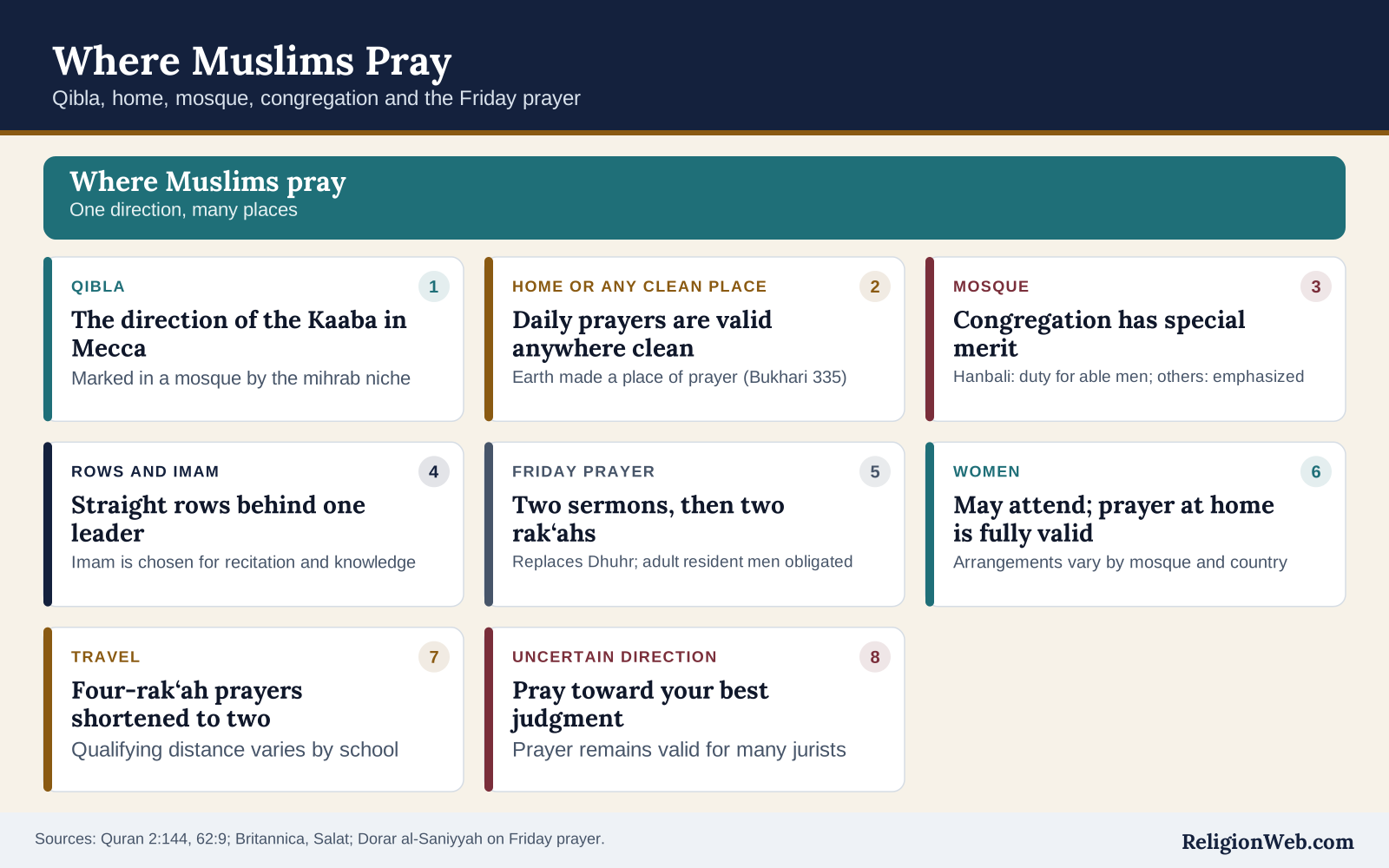
Meaning, Ethics and Daily Life
What Prayer Means to Muslims
Remembrance, gratitude and submission
Muslims describe salah as the central act of the relationship between the worshiper and God. The Quran connects prayer with the remembrance of God, and with the statement that prayer restrains from indecency and wrongdoing (a thought found in Surah 29:45). The word Islam itself means submission or surrender to God, and the posture of prostration, with the forehead on the ground, is understood as the physical expression of that submission. The words of the prayer are those of praise, acknowledgment of God’s sovereignty, and a request for guidance on the straight path, which is the central request of the Fatiha.
The quality of attention in prayer, called khushu‘ (humility and concentration), is treated in the religious literature as the heart of the practice. Teachers ask worshipers to prepare, to understand what they say, and to pray as though they were in the presence of God. They also acknowledge that attention wanders, and they treat the effort to return it as part of the discipline. A prayer that is outwardly correct but inwardly inattentive is still valid in law, though it is regarded as lacking in spirit.
Time, discipline and community
The five appointments divide the day into segments and place the remembrance of God at the beginning, middle and end. For many Muslims this rhythm is a form of personal discipline: waking before dawn, pausing at work, ending the day with prayer. The idea that time itself is structured by devotion is a theme in Muslim writing about the day, and the repetition is meant to prevent long gaps in attention. The prayer also builds a link between the other pillars, since fasting in Ramadan involves extra prayer, zakat expresses the gratitude that prayer voices, and the Hajj culminates in circling the Kaaba toward which every daily prayer is directed.
The communal side is equally important. When Muslims line up in rows, they create a visible community, shoulder to shoulder, and the prayer is the occasion on which social differences are set aside. The mosque is also a site of education, charity and mutual help, and for many communities the Friday gathering is the place where news, needs and celebrations are shared.
Contemplative and Modern Perspectives
Inner dimensions of prayer in the Sufi and scholarly tradition
Muslim scholars and mystics have written extensively about the inner meaning of the prayer. The medieval theologian Abu Hamid al-Ghazali, in his encyclopedic work Ihya’ ‘Ulum al-Din (“Revival of the Religious Sciences”), devoted a section to the inner dimensions of prayer, discussing humility, presence of heart and understanding of the words. In Sufism, the prayer is the foundation on which other practices such as dhikr are built, and many Sufi teachers emphasize that outward rites should be accompanied by inward attentiveness.
These writers did not set the inner against the outer. The classical view is that the outward form is the container for the inner meaning, and a person who neglects the form loses the structure through which the meaning is practiced. This balance explains why Muslim reflection on prayer pays as much attention to the details of posture and time as to the experience of the worshiper.
Prayer in contemporary Muslim life
Surveys offer a sense of how widely prayer is observed, with the caution that they measure self-reported behavior and that the questions differ. The Pew Research Center’s 2023–24 Religious Landscape Study of 36,908 U.S. adults, with fieldwork from July 2023 to March 2024, found that 59% of Muslim adults in the United States say they pray several times a day, 28% pray regularly but less often, and 13% seldom or never pray, and that 39% attend religious services at least once a week. The survey did not measure the five prayers separately. Pew’s earlier global report, published in August 2012 and covering 39 countries and territories, found wide variation in the share of Muslims who say they pray all five daily prayers, from 88% in Afghanistan and 83% in Iraq to 2% in Kazakhstan, with a median across countries of 63%.
These numbers should be read alongside the size of the community. Pew’s 2025 analysis of the global religious landscape reports that Muslims made up 25.6% of the world population in 2020, which is about two billion people. Within that population, practice runs from those who keep every prayer to those who pray mainly on Fridays and festivals, and from those whose prayer is private to those who attend a mosque daily. The salah is a common thread, and individual observance varies as it does in every religious community.
Common Misconceptions About Salah
Misconception 1: Muslims spend long, continuous stretches in prayer five times a day
Where the misunderstanding comes from
The phrase “five daily prayers” can suggest five long services, and some of the most widely seen images of Muslim prayer reinforce the impression. Photographs of vast crowds in the Sacred Mosque in Mecca, videos of the long night prayers of Ramadan, and descriptions of Sufi gatherings in which remembrance of God goes on for hours all show a scale of devotion that is real but exceptional. Someone who sees a mosque at the Friday noon hour, or who hears that a devout Muslim prays at dawn, midday, afternoon, sunset and night, may reasonably imagine that observant Muslims spend a large part of the day in prayer.
Another source of confusion is vocabulary. English uses “prayer” for personal petition, for a church service and for a ritual, whereas Arabic has distinct words: salah for the ritual, du‘a for supplication, dhikr for remembrance. A reader who meets all of these under one English word may take them to be a single continuous activity.
What the evidence and tradition actually show
Each obligatory prayer is brief. A two-rak‘ah Fajr prayer or a four-rak‘ah Dhuhr, recited at an ordinary pace, takes a few minutes, and the five prayers together amount to a small fraction of the day. The five are also not continuous: each has a window of hours within which it may be said, and the worshiper steps out of ordinary activity for a short time and returns to it. The seventeen obligatory rak‘ahs of the day are the fixed core. Many Muslims add voluntary prayers, but those are optional and variable.
The tradition itself warns against excess in congregational prayer. A report in Sahih al-Bukhari describes the Prophet expressing displeasure at an imam whose prayer was so long that it drove people away, and instructing those who lead to keep it brief, since the congregation includes the weak, the sick and the elderly. In the same spirit, the longer prayers of Ramadan nights, the night vigil of tahajjud and Sufi gatherings are voluntary additions, which are valued but not required. The shared rhythm of Muslim life is five short appointments, not five long services, and that brevity is what allows them to coexist with school, work and travel.
Misconception 2: Every school performs every posture and hand position the same way
Where the misunderstanding comes from
From a distance, Muslim prayer looks strikingly uniform. Rows of worshipers rise, bow and prostrate together in response to the same Arabic phrases, and photographs from Istanbul, Jakarta, Lagos and Dearborn can be nearly indistinguishable. That visual unity is real, and Muslims often cite it as one of the signs of a shared religion. Printed guides and websites that describe “how to pray” usually offer one standard description, which can lead readers to believe the details are fixed everywhere.
The misunderstanding can also come from the opposite direction, from polemics between and about Muslim communities, where the details are used as signs of belonging. A claim that one hand position is the only correct one, or that another group does not pray properly, turns a difference in legal interpretation into an identity marker.
What the evidence and tradition actually show
The structure of the prayer is shared, but several details vary by school and region. Hanafi men typically fold the hands below the navel, Shafi‘i worshipers above it, and Twelver Shia let the arms hang at the sides, while the Maliki school is associated in many accounts with the arms at the sides, although folding is also held among Malikis, and the Hanbali sources preserve several narrations. Schools also begin Asr at different times, with the Hanafi school waiting until the shadow of an object reaches twice its length, and Twelver Shia begin Maghrib after the eastern redness has passed.
Muslim scholars treat these as legitimate differences, not as lapses. The reports about the Prophet’s prayer, transmitted over generations by different communities, contain variations, and each school preserved a reading of them. The usual summary is that all of the schools pray the same prayer with different emphases in minor matters. For a visitor, the sensible conclusion is that a description of “the” way Muslims pray should always specify whose practice it describes.
Misconception 3: Muslim prayer requires a mosque
Where the misunderstanding comes from
In many cultures religious worship is closely identified with a building and a clergy, so it is natural to assume that Muslim prayer works the same way. The mosque is a prominent institution, with its dome and minaret, and the call to prayer that sounds from it announces the prayer times. In some places the media show crowds at mosques on Fridays and at the festivals, and these scenes create the impression that mosque attendance is the form of worship.
The Friday prayer adds to the confusion. Because it is a congregational prayer with a sermon, and because it is the one weekly gathering that most observant men attend in a mosque, visitors may assume that daily prayer likewise requires a building and an official leader.
What the evidence and tradition actually show
Britannica’s summary of salat states that individual prayer is permitted in any clean place, while collective worship in the mosque has special merit. A report in Sahih al-Bukhari narrated by Jabir ibn Abdullah says that the earth was made a place of prayer and purification for the Prophet and his community, so that anyone may pray wherever the time overtakes them. This is why Muslims pray in homes, offices, fields, airports and on the roadside, and why a rug or a clean floor is sufficient.
The mosque nonetheless has a real place. Congregational prayer is highly valued, and in the Hanbali school and some other views it is an individual obligation for able men. The Friday prayer, for the majority of Sunni jurists, requires a congregation and sermon. Many women pray at home by custom, and the prayer is valid there. There is also no priesthood in Sunni or Twelver Shia practice in the sense of a mediator: the imam leads the prayer, but any suitably knowledgeable worshiper may do so, and no ordination is required for a prayer to be valid.
Misconception 4: Muslims worship the Kaaba or the city of Mecca when they pray
Where the misunderstanding comes from
Photographs of worshipers circling the Kaaba, and of millions of people facing the same direction, can look to an outside observer like the veneration of an object. Phrases such as “praying toward Mecca” can add to the impression. The rituals of the Hajj, in which the Kaaba is circled and a black stone is touched or greeted, also lead some to suppose that the building itself is an object of devotion.
Another factor is the sheer visibility of the Kaaba as a symbol. It appears on prayer rugs, in calligraphy and in the logos of Muslim organizations, and symbols are easily taken for the thing they represent.
What the evidence and tradition actually show
Muslim teaching is explicit that prayer is directed to God alone. The qibla is a direction, set by divine command as described in the second chapter of the Quran, which also says that the East and the West belong to God. The Kaaba is described as a house of worship and a focus of unity, and Muslims do not address prayers to it. The same logic applies to the Hajj ritual: according to a report in Sahih al-Bukhari attributed to the caliph Umar, he kissed the Black Stone while saying that it could neither harm nor benefit and that he did so only because he had seen the Prophet do it.
The significance of the qibla is therefore that of orientation and unity, a shared direction that forms a single community of worshipers. A Muslim in a hotel room in Tokyo and one in a village in Mali face the same point, and each prays to the same God. This is how Muslim scholars and ordinary believers describe it, and it is the position taken by the classical commentaries on the verses concerning the change of the qibla.
Misconception 5: There is a single worldwide prayer schedule that every Muslim follows
Where the misunderstanding comes from
Because the five prayers have standard names and a shared sequence, it is easy to assume that they also have a single schedule. Printed timetables and phone applications present each time as a plain clock reading, and the impression arises that some central authority issues the figures. News reports about the beginning of Ramadan or the festivals, which sometimes differ by a day between countries, are not usually read as evidence that the daily prayers might also vary.
What the evidence and tradition actually show
Prayer times are tied to the sun, so they differ by place and by date. Dhuhr follows the sun’s highest point, which comes at different clock times in Jakarta, Cairo and Chicago, and changes through the year as the length of the day changes. The times of Fajr and Isha depend further on how the onset of dawn and the end of twilight are defined. Published methods set the angle of the sun below the horizon for Fajr between about 15 and 19.5 degrees, so two reputable timetables for the same city can differ by minutes.
The legal schools add further variation. The Hanafi school begins Asr later than the others, and Twelver Shia begin Maghrib a little after sunset. In far northern and southern regions where twilight lasts all night in summer, communities adopt one of several fallback rules. None of this is regarded as a sign of disunity, since the hadith report of Gabriel’s two days of prayer itself teaches that each prayer has a range between an earliest and a latest time. A Muslim usually follows the timetable of the local mosque or the method preferred by the scholar they follow.
Frequently Asked Questions About Salah
Questions About the Basics
How many times a day do Muslims pray, and why five?
Muslims pray five obligatory prayers a day: Fajr at dawn, Dhuhr at midday, Asr in the afternoon, Maghrib at sunset and Isha at night. The Quran mentions the times of prayer in several verses, and the number five is established in Muslim understanding by the practice and teaching of the Prophet Muhammad as transmitted in hadith. A well-known report in Sahih al-Bukhari (no. 349) links the number to the Night Journey, in which fifty prayers were reduced to five at the suggestion of Moses, while retaining the reward of fifty.
Beyond the story, Muslim teachers point to the logic of the schedule: the day is divided by prayer into manageable parts, with remembrance at the start, the middle and the end. The number is also a matter of agreement across the schools. Twelver Shia pray the same five, though they often combine them into three sessions, and the Sunni schools agree on the five with different views on when combining is allowed.
Do Muslims have to pray in Arabic?
The fixed parts of the prayer, which are the opening takbir, the Fatiha and the other Quranic recitation, and the set phrases of bowing, prostration and sitting, are recited in Arabic by the great majority of Muslims and jurists. The reason is that the Quran is regarded as God’s speech in its Arabic wording, so a translation is an explanation and not the Quran itself. Muslims who do not speak Arabic learn the required words by heart, usually in childhood, and many study translations to understand them.
Outside the fixed recitation, the worshiper may use any language. In prostration and after the closing greeting, many Muslims make personal supplications in their mother tongue, such as Turkish, Urdu, Swahili, Bengali or English. The distinction between the formal prayer and the free supplication (du‘a) allows both a shared liturgical language and personal expression.
What is the difference between salah and du‘a?
Salah is the structured ritual with fixed times, postures and recitation. Du‘a is the free calling upon God, which can be done at any time, in any place and in any language, in any posture or without any posture, and it needs no ablution. A Muslim might make du‘a while driving, before a meal, or in the final prostration of salah. The two overlap in practice, since the prayer contains supplications and is followed by them, but the law distinguishes between them.
The distinction matters because failing to perform a salah is a matter of religious obligation with legal consequences, whereas du‘a is voluntary though strongly encouraged. Muslim writers often say that du‘a is the marrow of worship, and many families teach children short du‘as before they learn the full prayer.
Questions About Preparation and Practice
Why do Muslims wash before praying, and what if there is no water?
Washing is required because the Quran instructs believers to wash when they rise for prayer, and because Muslim scholars view the prayer as a meeting with God for which one should be clean in body and attentive in mind. The washing, wudu, takes only a few minutes, and many Muslims do it at home before going to the mosque or in the ablution area of the mosque. It is valid for several prayers as long as nothing breaks it.
If water is not available, or if using it would cause harm, the Quran permits dry ablution (tayammum) with clean earth. The concession applies to illness, extreme cold, a desert or a lack of safe water, and in a hospital room or on an aircraft where washing is not possible. A person is not expected to risk their health to complete the form.
Do women pray differently from men?
Women and men pray the same prayers with the same structure and recitation. Some differences recorded in the legal manuals concern posture and modesty: in the Hanafi and some other manuals women keep the arms closer to the body and sit differently in the tashahhud, and in most schools they cover more of the body than men. Other jurists, particularly in the hadith-centered tradition, hold that the description of the prayer is the same for both. Women also do not pray during menstruation and postpartum bleeding, as described above.
In congregation, women generally stand behind men or in a separate area, and in a women’s prayer group a woman may lead. A woman in a mosque or a home prays as a full participant in the same obligation, and nothing in the form of the prayer is restricted to men.
How do Muslims know which way to face?
In a mosque the mihrab shows the direction, and at home people use a compass, a smartphone application, a map or the guidance of a neighbor. Historically, astronomers computed the direction for each city, and today the same calculation is performed by software. On two days each year the sun passes directly over the Kaaba, and shadows in daylight can then be used to check the direction.
If the direction cannot be determined, the worshiper makes a reasonable judgment and prays. Many jurists hold that the prayer is valid even if the direction turns out to be slightly wrong.
Questions About Special Situations
What happens if a prayer is missed, or if work makes prayer difficult?
A prayer missed through sleep or forgetfulness is prayed when the person remembers or wakes up, according to the hadith reports on the subject. The time windows are wide, so a worker with a break in the afternoon can usually fit Dhuhr or Asr into it. Many Muslims coordinate with employers and schools for a short break, and in settings where time is limited the options described in the section on travel and special circumstances, including combining or shortening, may apply according to the scholar a person follows.
Teachers advise a person who has been inconsistent in prayer to resume with the next prayer and build a habit gradually, rather than despair. For more complicated cases, such as long-term shift work, imams and scholars in the local community are commonly consulted.
Can non-Muslims watch or take part in a prayer?
Non-Muslims are welcome in many mosques as visitors and may watch from the back or from a visitor gallery. The prayer itself is an act of worship by Muslims, and standing in the rows is understood as joining the prayer, so visitors normally observe instead. Dressing modestly, removing shoes and not walking in front of people praying are the main courtesies, and mosques that hold open days often explain the prayer in advance.
Someone who is interested in becoming Muslim learns the prayer from a teacher or community, and the prayer is often among the first practices a convert learns. For those who are not Muslim, attending a Friday sermon or an open-house program is a good way to see how the prayer fits into the life of a community.
Conclusion: What Salah Shows About Muslim Practice
What the History and Practice Show
A short ritual with a long history
Salah is a brief rite that carries a great deal of history. Its times are defined by the sun and moon, which connected it from the start to astronomy and the making of timetables. Its direction, fixed in the second year after the Hijra, led to centuries of geometry, instruments and mapping. Its preparation in wudu joined worship to the habits of cleanliness, and its congregational form shaped the mosque as an institution. Its details were worked out in the hadith literature and in the schools of law by generations of scholars who differed in minor points while agreeing on the shape of the prayer, as the chronology in this article shows.
The picture that emerges is of a practice that is both uniform and varied. Muslims face one direction and use the same sequence of postures, yet the placement of the hands, the beginning of a prayer time and the closing words differ among Sunni, Shia and other communities. Describing those differences precisely, and attributing them to the school or tradition that holds them, is how an accurate account of salah is written.
How prayer fits into a life
For observant Muslims, salah is not one activity among many but a frame for the others. It provides a rhythm, a discipline and a point of return, and it can be done in a mosque, at home or on the road with nothing more than a clean space and the direction. It is adapted to illness and travel in ways that the law specifies, and it does not replace medical care, but it travels with a person wherever they are.
The prayer also has a social meaning, shown in the straight rows, the shared language of recitation and the Friday gathering. Whether a Muslim prays alone in a hospital room or among thousands in a great mosque, the prayer unites individual devotion with membership in a community that stretches across continents and centuries.
How to Keep Exploring
Related chapters on ReligionWeb
For the wider religion, the chapter on Islam provides the context of belief, history and law, and the chapter on the Five Pillars of Islam places prayer alongside the declaration of faith, almsgiving, fasting and pilgrimage. The life of the Prophet whose example shaped the prayer is described in the chapter on Prophet Muhammad, and the text recited in every rak‘ah is described in the chapter on the Quran.
Readers interested in how the prayer changes during the fasting month can turn to the chapter on Ramadan, while those interested in the legal traditions behind the variations can consult the chapters on Sunni and Shia Islam already linked in this article.
Learning about prayer on its own terms
The best way to understand salah is to read how Muslim communities describe it themselves. Many mosques and Islamic centers publish guides to the prayer for visitors and new Muslims, and most welcome questions. Reliable fiqh manuals exist in English for each of the major schools, and the rulings of contemporary jurists such as Grand Ayatollah Ali al-Sistani are available online for Twelver Shia readers. A reader who wishes to perform the prayer should learn it from a teacher in person, since the postures and recitation are best learned by observation, as the Prophet is reported to have taught.
The prayer is also a subject that rewards patience. Many of its details are matters on which jurists differ, and the tradition itself regards such differences as part of the richness of legal reasoning rather than as a problem to be resolved. A careful description is one that names whose practice is being described and what the sources say.
Sources
The table below lists the principal external sources behind this article. Facts, dates and figures were checked against these and related primary, institutional and academic materials.
| # | Source | Publisher and type | Used for | Link |
|---|---|---|---|---|
| 1 | The Meaning of the Glorious Koran (Pickthall): Surah 2 | Internet Sacred Text Archive · Primary text | Quran 2:142, 2:144, 2:238 quotations and paraphrase (qibla, midmost prayer); Pickthall 1930, public domain | sacred-texts.com |
| 2 | The Meaning of the Glorious Koran (Pickthall): Surah 5 | Internet Sacred Text Archive · Primary text | Quran 5:6 quotation and paraphrase (wudu, tayammum) | sacred-texts.com |
| 3 | The Meaning of the Glorious Koran (Pickthall): Surah 62 | Internet Sacred Text Archive · Primary text | Quran 62:9-10 quotation and paraphrase (Friday prayer) | sacred-texts.com |
| 4 | Sunan Abi Dawud 393 (Gabriel and the prayer times); also Sahih al-Bukhari 40, 349, 631, 757 | Sunnah.com · Primary text | Hadith reports on prayer times, the Night Journey, qibla change and the sequence of prayer (paraphrased) | sunnah.com |
| 5 | Salat | Encyclopaedia Britannica · Encyclopedia | Five prayers, ablution, qibla, congregation, Friday sermons, prayer in any clean place, concessions | britannica.com |
| 6 | Calculation Methods and Definitions of Prayer Times | PrayTimes.org · Academic reference | Fajr/Isha angles by method, Asr shadow rules, Maghrib views, high-latitude methods | praytimes.org |
| 7 | Summary of Feqh: Conditions for the Friday Prayer | Dorar al-Saniyyah Foundation · Institutional | Friday prayer conditions, attendance, sermons and time across the four Sunni schools | dorar.net |
| 8 | Islamic Laws, rulings 235-259 (wudu) | Office of Grand Ayatollah Ali al-Sistani · Institutional | Twelver Shia wudu: wiping head and feet, direction of washing, number of washings, socks | sistani.org |
| 9 | Mathematics of the qibla (Utrecht University history-of-Islamic-science pages) | Utrecht University · Academic reference | Spherical-trigonometry qibla methods, al-Biruni, al-Tusi noon-shadow method, tables and instruments | webspace.science.uu.nl |
| 10 | How U.S. Muslims compare with other Americans religiously and demographically | Pew Research Center · Demographic data | Share of U.S. Muslims who pray several times a day; Religious Landscape Study 2023-24 | pewresearch.org |
Last fact-check date: 2026-10-21.