A gurdwara is the Sikh place of congregation and worship: a building, or sometimes just a room, in which the Guru Granth Sahib, the Sikh scripture, is installed with honor and where people gather to sing its hymns, hear it read and explained, pray together, and share a meal. The Punjabi word gurdwārā is usually explained as “the Guru’s door” or “the Guru’s abode.” Sikhism, which began with Guru Nanak in the Punjab region in the late fifteenth century, has no ordained priesthood and no altar, so what makes a gurdwara is not a particular style of architecture or a particular official. It is the presence of the scripture and of a congregation, called the sangat, gathered around it.
Because the scripture occupies the place that a statue or painted image might hold in other sacred spaces, the whole room is arranged around it. The Guru Granth Sahib rests on a raised seat under a canopy, wrapped in cloth when it is closed, with an attendant waving a whisk over its pages while it is open. Worshipers sit on the floor facing it, men and women alike, with heads covered and shoes left outside. A tall saffron or blue flag, the Nishan Sahib, flies outside, and beside the prayer hall there is almost always a kitchen and dining hall where a free vegetarian meal, called langar, is served to everyone who comes.
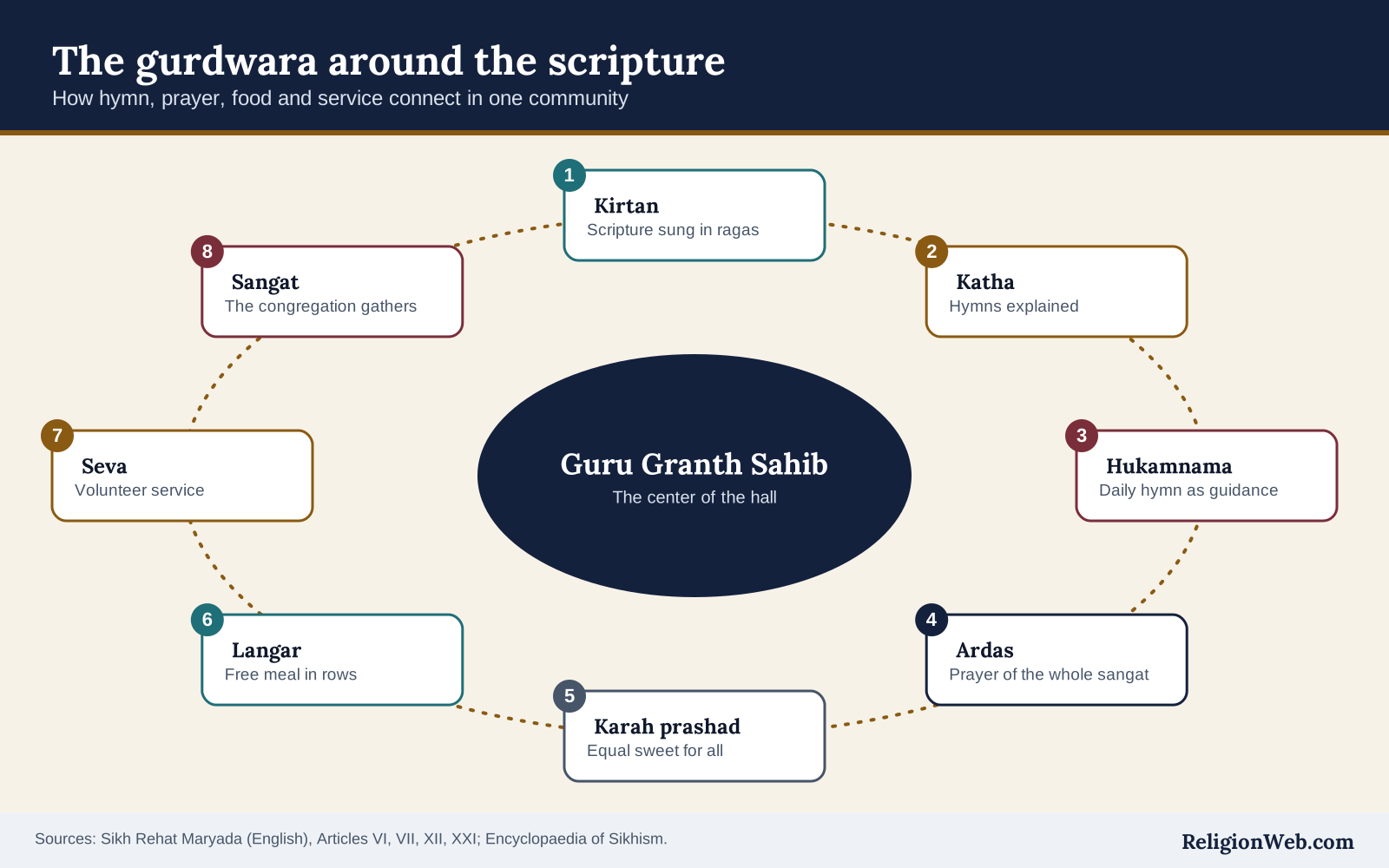
This article explains the gurdwara on its own terms: what the word means, how the institution developed from the first Sikh congregations of the early sixteenth century, how the hall and its surrounding rooms are laid out, and what happens during worship, from kirtan (the singing of scripture) through the hukamnama (the “command” read from the scripture) and the ardas (the congregational prayer) to karah prashad (the sacred sweet offering). It then turns to langar and seva (selfless service), the rules and customs a visitor meets at the door, the way gurdwaras are governed, and the questions people most often ask.
Practice differs between gurdwaras, countries and Sikh communities, and the article says so where it matters. Where it describes a norm, the main reference is the Sikh Rehat Maryada, the code of conduct published by the Shiromani Gurdwara Parbandhak Committee (SGPC), the elected body that manages the historic gurdwaras of the Punjab region. Local custom, such as seating arrangements, the hour of the main weekly gathering, or how the meal is served, is described as custom and not as rule.
What Is a Gurdwara? Meaning, Name, and Defining Features
The Word Gurdwara and What It Means
Gur and dwara: the Guru’s door
The word joins gur, referring to the Guru, and dwārā, a door or gateway. The Encyclopaedia of Sikhism, compiled at Punjabi University in Patiala, glosses it as “the Guru’s portal or the Guru’s abode.” Britannica gives the simpler “doorway to the Guru.” Both readings point to the same idea: the building is understood as a threshold, a place through which a person approaches the Guru’s word, and not as a house for a deity in the sense of a dwelling that must be tended and fed.
The word appears in English in several spellings, including gurdwara, gurudwara and gurdwārā, and all of them refer to the same institution. Some Sikhs and many institutions also add the honorific “Sahib” to the name of a specific gurdwara, as in Gurdwara Bangla Sahib in Delhi, in the way that the scripture itself is called Guru Granth Sahib. The honorific is a sign of respect and not part of the generic term.
Why “Sikh temple” is only a rough translation
Newspapers, tourist guides and many Sikhs themselves sometimes say “Sikh temple” for convenience, and the phrase is harmless in casual speech. Reference works are more careful. The Encyclopaedia of Sikhism entry on the gurdwara says “temple” is an unsatisfactory translation, because Sikhism has no idols, altars, sacraments or priestly order of the kind the word suggests. Those missing elements are exactly the ones that shape how a gurdwara functions. Anyone who knows the hymns may lead a service, and no sacrament or ritual consecration is needed for the congregation to be valid.
That does not make a gurdwara a purely informal gathering place. Its conduct is regulated by a published code of practice, its central object receives elaborate daily care, and many Sikhs describe entering it as stepping into the Guru’s court, a phrase that also appears in the names of the main hall: darbar (court) and diwan (assembly). The better short description is that a gurdwara is a house of the scripture and the community, in which worship, learning, charity and communal decision-making all take place in one compound.
What Makes a Place a Gurdwara
The installed scripture as the defining requirement
Reference works agree on one point: the single essential feature is the Guru Granth Sahib, installed on a seat under a canopy, usually on a raised platform. The Encyclopaedia of Sikhism states that no particular design is required. Britannica describes the main room as housing the scripture “on a cot under a canopy.” Everything else, whether a dome, a flag, a marble floor or a kitchen, is customary or functional, and gurdwaras built in a village in Punjab, a converted warehouse in Birmingham or a purpose-built hall in Surrey differ widely in appearance.
The Rehat Maryada states the rules for the scripture’s care in Article V of its section on congregational life: a cot suited to its size, clean bedding, an awning above, a whisk and a cloth cover (romala), with ceremonial opening each day. A building where the scripture is installed with this care is a gurdwara, and a building without it is not, whatever it is called. The care required is why a gurdwara needs people to be present in the early morning and again in the evening, and why a small community often needs a team of volunteers before it can open a gurdwara at all.
Gurdwaras at home and in small rooms
Britannica notes that many Sikh families set aside a room at home for the scripture, and that this room is also called a gurdwara. The Rehat Maryada anticipates the practice: in its article on reading the scripture in full at home, it directs Sikhs, as far as possible, to maintain a separate and exclusive place for the installation of the Guru Granth Sahib in the home. Where a family does so, the same standards apply as in a public gurdwara, which is why a household that installs the scripture generally commits to opening it each morning and closing it each night.
Many Sikhs have no scripture at home and rely entirely on the congregational gurdwara. That is normal, and it is one reason the neighborhood gurdwara functions as a general community center as well as a place for prayer. In places where Sikhs are few, the first “gurdwara” may be a rented hall or a dedicated room in a private house, opened for weekly gatherings, and larger premises follow as the community grows.
Key Terms at a Glance
The vocabulary of gurdwara life
Anyone reading about gurdwaras meets a cluster of Punjabi and Gurmukhi words. The table below gathers the terms used most often in this article, with plain-English meanings. Spellings vary in English (for example prashad and prasad, or kirtan and keertan), and the forms here follow common usage in Sikh institutional writing.
| Term | Meaning | Where it appears |
|---|---|---|
| Guru Granth Sahib | The Sikh scripture, honored as the living Guru by Sikhs | Installed in the main hall |
| Sangat | The congregation; the community gathered in the presence of the Guru | Seated in the hall |
| Pangat | A row of people sitting together to eat | Langar hall |
| Darbar Sahib / Diwan | The main hall, “the Guru’s court,” where the congregation gathers | Main hall |
| Palki / Manji Sahib | The canopied seat or raised platform on which the scripture rests | Front of the hall |
| Chaur | A whisk waved over the open scripture as a sign of honor | Beside the scripture |
| Romala | Cloth coverings for the scripture | Over the scripture |
| Nishan Sahib | The Sikh flag, flown on a tall pole outside | Outside the building |
| Kirtan | Singing of scripture to traditional musical measures | Main hall |
| Katha | Exposition or discourse on the scripture | Main hall |
| Hukamnama / Vak | The hymn read at random as the day’s guidance | Main hall |
| Ardas | The congregational prayer, recited standing | Main hall |
| Karah prashad | Sweet offering of flour, sugar and clarified butter, shared with all | End of worship |
| Langar | The free community meal and the kitchen that serves it | Langar hall |
| Seva | Selfless service to the community, often unpaid | Everywhere |
| Granthi | A reader and custodian of the scripture | Main hall |
| Ragi | A musician who sings kirtan | Main hall |
| Matha tekna | Bowing with the forehead to the floor before the scripture | Entrance to the hall |
A note on translation and spelling
Sikh terms were written in the Gurmukhi script, and English forms differ because Gurmukhi vowels do not map neatly onto Roman letters. Both Waheguru and Vahiguru refer to the same name of God, and both langar and langgar will be seen in older documents. This article uses the most widely recognized forms and gives a short English gloss on first use. When a term has shades of meaning, such as seva, which covers anything from cooking to sweeping to accounting, the section where it matters explains the range.
Inside a Gurdwara: Layout, Spaces, and Objects
The Main Hall and the Seat of the Guru Granth Sahib
The darbar hall and how people sit
The main hall, called the darbar hall or diwan hall, is usually a large carpeted room with no pews or benches. Worshipers sit on the floor, which is usually covered with white cotton sheets over carpet, facing the scripture. The conventional explanation is that no one sits above the Guru Granth Sahib and everyone sits at the same level as one another. Many gurdwaras also provide chairs or benches along the walls for elderly and disabled people, and the Rehat Maryada prohibits discrimination within the congregation on the basis of such factors as caste or sex.
A widespread custom, especially in gurdwaras in India and in older diaspora communities, is for men to sit on one side of the hall and women on the other, with a central aisle leading to the scripture. This is a custom of seating, not a rule found in the Rehat Maryada, and some gurdwaras, particularly newer ones, have mixed seating or use some other arrangement. Children sit with whoever they came with. Visitors may sit on either side, and no one is asked to move.
The palki, canopy, chaur and cloth coverings
At the front of the hall, the Guru Granth Sahib rests on a low platform, the manji sahib, beneath a canopy called the chanani or contained in a canopied seat called the palki, a term that also names the palanquin used to carry the scripture from one place to another. In larger halls, the scripture sits on a cushioned stand with a cloth, called a rumala, spread beneath and over it, and a smaller bolster for the front of the volume. When closed, the scripture is wrapped in several layers of cloth in the colors a gurdwara prefers, with embroidered or plain covers, and that fabric is laid aside as the volume is opened for the day.
An attendant, who is usually the same person who reads or serves in the hall, waves a chaur (a whisk of fine hair or synthetic fiber, with a wooden or metal handle) above the open pages. The gesture is a mark of respect and has historical roots in how rulers were honored in northern India. Many Sikhs describe it as a gesture of loyalty to the Guru: the person who waves it is serving the Guru as a courtier might serve a sovereign. In the Rehat Maryada, the whisk is listed among the items to be present at the scripture’s seat.
Entrances, Courtyard, and the Nishan Sahib
The Nishan Sahib flagpole
Outside, almost every gurdwara flies the Nishan Sahib, the Sikh flag, from a tall pole. Article V of the Rehat Maryada states that it should be installed at a high-level site in every gurdwara. The Encyclopaedia of Sikhism describes it as saffron or blue, flying day and night on or near the building, and the flag usually carries the khanda, the Sikh emblem of a double-edged sword within a circle and flanked by two curved swords. The pole is often sheathed in cloth of the same color, and the cloth and flag are changed on a schedule that varies by gurdwara, often at the festival of Vaisakhi.
The flag signals that a gurdwara is present, so travelers and visitors can find it from a distance, and it expresses the sovereignty of the Guru and the Sikh commitment to protect the vulnerable. Some Sikhs also associate it with the history of the Khalsa, the community of initiated Sikhs founded in 1699, which is explained in the article on the Khalsa and Amrit Sanchar. Because it is regarded as an emblem of the Guru’s authority, those who care for it treat it with the kind of reverence due to the flag of a sovereign, and the flag is not allowed to touch the ground.
Shoe rooms, washing areas, and the doorway
The entrance of a gurdwara is practical as well as symbolic. Shoes and socks, in some gurdwaras, are left at a shoe room staffed by volunteers who tag and store them. Visitors are expected to wash their hands, and in many gurdwaras to wash their feet, at taps or a shallow basin at the entrance. Article V of the Rehat Maryada says that one should take off the shoes and clean oneself up before going in. Head coverings are required, and many gurdwaras keep a basket of scarves or rumals at the door for visitors who arrive without one.
At the threshold of the main hall, worshipers customarily pause, fold their hands and bow to the scripture. Many large gurdwaras have a lobby or a gallery with a view into the hall where visitors may watch quietly. A collection box or offering table is typically placed in front of the scripture. Offering money is voluntary, and gifts fund the kitchen, the upkeep of the building and charitable work.
The Langar Hall, Kitchen, and Supporting Rooms
Langar hall and kitchen
Next to the main hall, or on a lower floor, is the langar hall, a large room where people sit in rows on the floor facing one another, and a kitchen behind it staffed almost entirely by volunteers. The kitchen is regarded as an extension of worship and not as a separate catering service. Large gurdwaras may serve many thousands of people on festival days, while a small neighborhood gurdwara may serve a few dozen on a weekday. The langar hall is described at length in a later section, and the dedicated article on langar covers its history and meaning in more depth.
Other rooms: library, school, guest rooms, and offices
Many gurdwaras include classrooms where children learn the Gurmukhi script, kirtan and the basics of Sikh history, often on weekends. Others house a library, offices, a hall for weddings and other family events, and in India and Pakistan, guest rooms or sarai for pilgrims. Britannica notes that many gurdwaras have a communal kitchen and often a school attached. The Encyclopaedia of Sikhism similarly says the kitchen is typically in the same or an adjacent compound, along with pilgrim accommodation.
Some historic gurdwaras are built around a tank of water, called a sarovar, where pilgrims may bathe or wash. The best known is the one at Harmandir Sahib in Amritsar. Most gurdwaras in cities do not have one. A separate room is usually set aside for the scripture to rest overnight, and in some gurdwaras this room is called sach khand, “the realm of truth,” a name that also appears in the Sikh scripture.
A summary table of gurdwara spaces
The table below lists the main spaces found in a typical gurdwara, what each is used for, and whether it is essential or customary. A small gurdwara may have only a hall and a kitchen, while a large one may have most of the spaces listed.
| Space | Purpose | Essential or customary |
|---|---|---|
| Darbar (main) hall | Houses the Guru Granth Sahib; kirtan, katha, hukamnama and ardas take place here | Essential |
| Palki or manji sahib with canopy | Seat on which the scripture is installed during the day | Essential (the Rehat Maryada requires a cot and awning) |
| Nishan Sahib | Flag on a high pole that marks the site as a gurdwara | Required by Rehat Maryada Article V |
| Shoe room and washing area | Storage for shoes; washing of hands and feet | Customary and widespread |
| Langar hall and kitchen | Free communal meal for all visitors | Customary; found in nearly all gurdwaras |
| Room for overnight rest of the scripture | Where the scripture is placed after the evening service | Customary (some call it sach khand) |
| Classrooms and library | Teaching Gurmukhi, kirtan, history; reference books | Customary in larger or diaspora gurdwaras |
| Guest rooms (sarai) | Pilgrim lodging | Common at historic gurdwaras in South Asia |
| Sarovar (water tank) | Ritual bathing and visual focus for the site | Found at some historic gurdwaras |

From Dharamsal to Gurdwara: A Short History
The First Congregations: Guru Nanak and the Dharamsal
Kartarpur and the community around Guru Nanak
Sikh tradition traces the first settled Sikh congregation to Kartarpur, a village on the Ravi River that Guru Nanak (1469-1539) founded, according to common Sikh reckoning, around 1521, after the long journeys described in the janam sakhis, the devotional biographies of the Guru. The Encyclopaedia of Sikhism, citing those traditions, says he settled there and gathered a community that sang hymns at fixed hours, worked the land and shared a common meal. Historians treat the janam sakhis as later devotional narratives, so dates for Kartarpur are approximate, but the picture of an early community built around hymn-singing, farm work and a communal table is consistent across the sources. More about his life and teaching appears in the article on Guru Nanak.
Kartarpur matters to the history of the gurdwara because it joined, for the first time on a lasting basis, the elements that still define the institution: sung scripture, shared work and a shared meal. SikhiWiki, a community encyclopedia, dates the beginning of the kirtan tradition at Kartarpur to 1521, with the Guru’s companion Bhai Mardana playing the rabab, a stringed instrument, as accompanist. The settlement is today the site of Gurdwara Darbar Sahib Kartarpur, in Narowal District, Pakistan, a short distance from the border with India.
Dharamsals as the early form
In the earliest period a place of Sikh assembly was called a dharamsal (also written dharamsala), meaning roughly “abode of righteousness.” The Encyclopaedia of Sikhism says Guru Nanak told his followers to establish such places wherever he went and founded one at Kartarpur. A dharamsal was a modest hall, a room or a courtyard where the sangat met to sing hymns and listen to the Guru and, later, his successors. These early assembly places were the ancestors of the gurdwara, and the word dharamsala survived for generations as the Sikh name for a place of congregation.
The same word has other senses in South Asia, including a rest house or hostel, which is why it may appear in older documents about travelers’ lodging as well. In the Sikh sense it names a place where a Guru’s community met. Each successive Guru in the sixteenth century developed centers at places such as Khadur, Goindwal and Amritsar, and the dharamsal grew from a local meeting room into a network of Sikh centers connected by pilgrim travel and shared practice.
Harmandir Sahib and the Installation of the Scripture
Guru Arjan’s Amritsar and the 1604 installation
Guru Ram Das founded the town of Amritsar, according to SikhiWiki, in 1577, and the pool around which it grew gave the city its name, “pool of nectar.” His son Guru Arjan (Guru from 1581) oversaw the building of the Harmandir Sahib in the middle of the pool. Sikh tradition says the Muslim Sufi saint Mian Mir was invited to lay the foundation stone, and community sources date the laying to 1588, though the account rests on tradition, and historians do not agree on the details. The building was complete by about 1601, according to SikhiWiki, and the newly compiled Adi Granth was installed there in 1604.
That installation was a turning point for what a gurdwara was. The Adi Granth, the volume compiled under Guru Arjan, held the hymns of the first five Gurus along with those of other saints, and it was placed in the central shrine at Amritsar. The SGPC describes Baba Buddha as the first granthi, or reader of the scripture, there. The article on the Guru Granth Sahib traces how the volume was compiled and later expanded with the compositions of the ninth Guru.
The four entrances and the sarovar
The Harmandir Sahib stands on a platform in the sarovar, the pool, reached by a causeway, and it has an entrance on each of its four sides. SikhiWiki states that the four doors face the four directions and that they symbolize openness to all people and religions, and that Guru Arjan designed them so that people could come in from whichever direction they chose. Many later gurdwaras followed this pattern, which the Encyclopaedia of Sikhism calls the Harimandar pattern: a square hall, a raised plinth and doors on four sides, with a domed sanctum at the center.
The four doors are often cited as an architectural statement about who may enter, and Article V of the Rehat Maryada says in words that no one is barred from entering a gurdwara on grounds of country, religion or caste. Modern gurdwaras are not required to have four doors, and many have a single entrance with the scripture at the far end of a long hall. The idea of an open threshold nevertheless remains a common explanation of the word gurdwara itself, the Guru’s door.
From Guru Hargobind to the Eighteenth Century
The word gurdwara comes into use
The Encyclopaedia of Sikhism says that in the time of the sixth Guru, Hargobind (1595-1644), dharamsals began to be called gurdwaras. Guru Hargobind also built the Akal Takht (“timeless throne”) facing the Harmandir Sahib, after the death of his father Guru Arjan in 1606, an event Sikh sources remember as his martyrdom, and the pairing of the two buildings is often described as expressing the joining of devotion and temporal responsibility. Sikhs today recognize five seats of religious authority, the Takhts, with the Akal Takht in Amritsar serving as the highest of them.
Tradition holds that in 1708 the tenth Guru, Gobind Singh, installed the scripture as the Guru of the Sikhs, a moment which shaped the later gurdwara more than any building. From that point the volume now called the Guru Granth Sahib became the focus of the congregation in the way a living Guru had been before. The Encyclopaedia of Sikhism dates this installation to 1708.
Endowments, hereditary custodians, and the spread of gurdwaras
In the second half of the eighteenth century, as Sikh power grew in Punjab, gurdwaras spread across Sikh settlements and sites linked to the Gurus. The Encyclopaedia of Sikhism adds that rulers and nobles endowed most historical gurdwaras with land, and that this led in many cases to hereditary priesthoods. The gurdwara thus acquired a second layer of life, as a landholding institution with revenue, caretakers and rights, and in the nineteenth century that layer sometimes came into tension with the earlier ideal of a community-run space.
The Harmandir Sahib itself was damaged repeatedly during these decades of conflict. SikhiWiki records that in 1762 Ahmad Shah, the Afghan ruler, destroyed the building with gunpowder, and that in January 1764 Jassa Singh Ahluwalia called for reconstruction after the capture of Sirhind. The gold covering associated with Maharaja Ranjit Singh began, according to the same source, in 1802. Whether this is exact or approximate, the gilded exterior that gave the shrine its English name, the Golden Temple, belongs to the early nineteenth century.
Reform in the Twentieth Century: Gurdwara Control and the SGPC
Hereditary custodians and the Akali movement
By the early twentieth century many major gurdwaras were controlled by hereditary custodians, called mahants, who had inherited management and income from endowments. Britannica notes that during the period of Mughal persecution some gurdwaras and their lands and funds came under caretakers it describes as Hindu mahants, and that Sikhs agitated for years to regain control. The Akali movement of the early 1920s organized that agitation, using mass processions, nonviolent occupation of gurdwaras and legal petitions, and it faced both police action and violence at several sites, including Nankana Sahib in 1921.
The campaign changed the relationship between Sikhs and their gurdwaras. A reading of the period that stresses religion alone leaves out that it was also a political and legal struggle over property, authority and the right of a community to manage its own sacred sites under British colonial law. The SGPC’s own account mentions an incident in 1922 known as the Guru ka Bagh Morcha, which began as a dispute over the cutting of wood for the community kitchen, showing how closely langar was tied to the question of who controlled gurdwara lands.
The Sikh Gurdwaras Act of 1925 and what followed
The SGPC says it was set up in stages in 1920 and 1921: an assembly of Sikh leaders created a committee of 175 members on 15 November 1920, the committee held its first meeting on 12 December 1920, and it was registered on 30 April 1921. The Punjab government then passed the Sikh Gurdwaras Act in July 1925, it received the governor-general’s consent on 28 July, and it came into force on 1 November 1925. The first election to the SGPC under the Act was held on 18 June 1926.
The Act placed major historical gurdwaras under an elected body, the Shiromani Gurdwara Parbandhak Committee, with members chosen by adult franchise. Britannica notes that the committee now manages the historic gurdwaras, and the Encyclopaedia of Sikhism adds that other shrines are run by committees chosen by the local sangat, on which men and women can serve and either may be president. The SGPC page lists 83 historic gurdwaras under Section 85 of the Act and 200 under Section 87, and states that the body has managed gurdwaras for more than a century. Gurdwaras outside the Act’s scope, including nearly all in other countries, are run by their own elected or appointed committees.
A Timeline of the Gurdwara
Dated milestones
The table gathers the main dates mentioned in this section. Dates for the earliest period rest on Sikh tradition and the janam sakhis, and should be read as approximate.
| Date | Event | Why it matters for the gurdwara |
|---|---|---|
| c. 1521 | Guru Nanak settles at Kartarpur (traditional dating) | First settled community built on hymn-singing, shared work and a common meal |
| 1577 | Guru Ram Das founds Amritsar | Creates the city where the central Sikh shrine later stands |
| 1604 | Adi Granth installed at Harmandir Sahib | Scripture becomes the center of the shrine |
| Early 17th century | Guru Hargobind builds the Akal Takht; dharamsals begin to be called gurdwaras | Name and institution of authority emerge together |
| 1708 (tradition) | Guru Gobind Singh installs the scripture as Guru | The Guru Granth Sahib becomes the permanent center of every gurdwara |
| 1762-1764 | Harmandir Sahib destroyed and rebuilt | Shows the shrine’s repeated loss and restoration |
| 1802 onward | Gilding of Harmandir Sahib under Ranjit Singh | Origin of the name “Golden Temple” |
| 1912 | First gurdwara in the United States opens at Stockton, California | Early diaspora institution |
| 15 Nov 1920 | SGPC created by an assembly of Sikh leaders | Elected committee to manage gurdwaras |
| 1 Nov 1925 | Sikh Gurdwaras Act takes effect | Places historic gurdwaras under SGPC control |
How to read the dates
Two cautions apply. First, Sikh sources sometimes differ on exact years for events in the sixteenth through eighteenth centuries, and the dates in this article follow the sources named, flagged as traditional where the evidence is mainly devotional. Second, the rows are not a complete history of Sikh institutions. They are a skeleton of the points at which the idea of a gurdwara changed: from a hall of hymn-singing to a shrine around a volume, from a volume to a Guru, and from a hereditary property to a community-governed institution.
The Guru Granth Sahib at the Center of the Gurdwara
Why a Gurdwara Is Organized Around the Scripture
The Guru in the form of the word
Sikhs understand the line of ten human Gurus, from Guru Nanak to Guru Gobind Singh, as having ended in 1708 with the installation of the scripture as the Guru, which is why it carries the name Guru Granth Sahib and not simply “holy book.” The Sikh Rehat Maryada’s definition of a Sikh in Article I includes belief in “the Guru Granth Sahib” among its conditions, alongside belief in one immortal being and in the ten Gurus. Sikhs therefore treat the volume as a living spiritual authority, not an object that represents one, and they speak of “taking the Guru’s command” and “bringing the Guru” to a place.
The result is a space organized for a presence, not for a performer. The point of focus at the front of the hall is not a stage, a pulpit or a figure but a seat, with the person who recites or sings sitting to one side. This pattern follows from the Sikh understanding that the Guru’s authority lies in the word, a claim made in the scripture itself. The article on Sikhism explains the wider theology of the Gurus and the scripture.
No images and no idol worship
Because the Guru is the word, a gurdwara does not contain images of God or statues to be honored. The Rehat Maryada’s article on the congregation lists, among practices contrary to Sikh teaching (gurmat), bowing before pictures of the Gurus or elders, waving lamps and incense in arti before the scripture, and offering food to it. The same article permits flowers, incense and scent as aids to freshness and fragrance but not as ritual offerings. Pictures of the Gurus are common in Sikh homes and shops, but the code asks that the focus of the congregation be on the scripture alone.
Understanding this helps with what a visitor sees. A bow to the Guru Granth Sahib is a mark of respect to the Guru, and Sikhs do not describe it as a bow to a statue or an image. Sikh writers often point to hymns in the scripture that criticize ritual display, and the Rehat Maryada reflects that emphasis. Sikh sources use words such as “honor” and “bow before” and not “worship” for the gesture, and so does this article.
The Daily Care of the Scripture
Prakash: the morning opening
Each day begins in a gurdwara with the ceremonial opening of the Guru Granth Sahib, called prakash, meaning “revealing” or “illuminating.” The Rehat Maryada states that the scripture should be opened ceremonially every day. In practice, a small group of attendants brings the scripture from its resting room, often carried on the head of a respected attendant, and installs it on the seat under the canopy. A passage is read at the time of opening, and the congregation stands as the scripture is brought into the hall, which Article V requires of every Sikh.
The timing varies. In many gurdwaras prakash happens before dawn, in time for the morning prayers that some Sikhs observe in the early hours before sunrise. At the Harmandir Sahib the routine begins very early indeed, with published descriptions saying the scripture is carried in procession from the Akal Takht across the causeway in the small hours of the morning. A small neighborhood gurdwara in a city may open later to suit working schedules.
Sukhasan: closing and rest for the night
The evening rite is called sukhasan, “comfortable rest.” The Rehat Maryada says that the scripture is generally closed after the evening prayer Rehras and should not be left open overnight except in special circumstances. The scripture is wrapped in its cloths and carried in procession to a room set aside for its rest, where it lies on a bed or cot until the next day. SikhiWiki records that the room is sometimes called sach khand.
Some occasions modify the routine. When a continuous reading of the whole scripture, called an akhand path, is under way, the scripture remains open for roughly two days and the readers work in relays. The Rehat Maryada deals with the akhand path in its articles on reading, and the article on the Guru Granth Sahib describes the practice in detail. For the ordinary daily cycle, though, the gurdwara is something that opens and closes with the scripture, and the staff, whether paid or volunteer, work around that timetable.
How Worshipers Show Respect
Standing, bowing, and covered heads
When the scripture is carried in, the Rehat Maryada says that every Sikh should stand to show respect. On entering the hall, the first act is to bow before the scripture, and the customary way to do so is matha tekna: kneeling and touching the forehead to the floor, usually with a small offering placed in front. The congregation then sits, men and women covering their heads. The code is explicit about this:
No Sikh should sit bare-headed in the presence of the Guru Granth Sahib.
Sikh Reht Maryada, English translation (Sikh Missionary Society, UK), Section Three, Article V
The rule is addressed to Sikhs, but the custom is followed by all who enter, and gurdwaras keep scarves at the door for visitors. How a person covers the head is not specified. Turbans, patkas (a smaller cloth worn by boys and some men), scarves and the folded cloth called a rumal are all acceptable, and the article on the Sikh turban, or dastar explains why the turban holds a separate place in Sikh identity.
Offerings and what is not done
Visitors and worshipers commonly place a gift of money, food or flowers before the scripture. These offerings, sometimes called maya, support the kitchen and the gurdwara’s charitable work, and they are not payment for a service, because no official is paid for performing a rite. The Rehat Maryada, however, lists the offering of food to the scripture as a ritual act, and the waving of lamps and incense before it, among practices contrary to gurmat, and gurdwaras differ in what they accept at the front of the hall. Visitors who bring food can simply ask a volunteer where it should go, since the kitchen is the usual destination.
A few prohibitions are widely observed. Tobacco and intoxicants are not allowed on the premises, which the Rehat Maryada states for those entering the gurdwara. Visitors should avoid turning their backs to the scripture, pointing their feet toward it or sitting with legs outstretched in its direction. These practices are reflected in visitor guidance from gurdwaras such as the Gurdwara Sahib Yishun in Singapore, which also suggests that visitors who are not comfortable bowing may go straight to a seat.
Worship in the Gurdwara: Kirtan, Katha, Hukamnama, and Ardas
The Shape of a Service
The order of a congregational program
A gurdwara service, called a diwan or satsang in many places, is not a rigid liturgy that begins at a fixed signal. It is a sequence of recognized parts, each carried out in the presence of the Guru Granth Sahib, and its length can range from under an hour on a weekday to several hours on a Sunday or festival. Article XV of the Rehat Maryada outlines the standard order: the ceremonial opening of the scripture, kirtan, exposition of scripture and discourses, recitation of the Anand Sahib, the ardas, the Sikh proclamation of victory and the greeting Sat Sri Akal, and finally the taking of the hukam. The code adds that only one activity, whether kirtan, discourse, exposition or reading, should proceed at a time.
In practice the order flexes. A morning program may center on a single long composition, Asa di Var, sung in sections with brief readings between them. A weekend program in a diaspora city may run for two hours and include talks in English for children. Karah prashad is distributed at the end, and the program often leads straight into langar. The table sets out the sequence as it is commonly followed and notes how it relates to the Rehat Maryada.
| Stage | What happens | Who takes part | Basis |
|---|---|---|---|
| Prakash (opening) | The scripture is brought in, installed and opened | Attendants; congregation stands | Rehat Maryada Article V |
| Kirtan | Hymns are sung to traditional measures | Ragis, or any Sikh singers | Article VI |
| Katha / discourse | A speaker explains the hymns and Sikh teaching | Granthi, scholar or speaker | Articles XIII and XIV |
| Anand Sahib | Recitation of the hymn of bliss, at or near the close | Congregation or reader | Article XV |
| Ardas | Congregational prayer, recited standing | One reciter; all stand | Article IV and Article XV |
| Hukamnama | A hymn is read as the day’s command | Granthi or reader | Article VII |
| Karah prashad | Sweet offering is distributed equally | Attendants; all receive | Article XII |
| Langar | Communal meal is served | Volunteers and all attendees | Article XXI |
Who leads, and who may
No ordained clergy are needed to lead any part of the service. The person who reads and cares for the scripture is the granthi, a role that requires training in reading Gurmukhi and in the rules of the code but not ordination. In many gurdwaras the granthi is a salaried employee, though the role is not a priesthood in the sense of a mediator between the worshiper and God. Musicians called ragis lead the singing, again by training and not by ordination, and a visiting speaker may give the discourse.
The Rehat Maryada does attach some conditions to the roles. It says that only a Sikh may perform kirtan in a congregation and only a Sikh may read from the scripture aloud for others, though a non-Sikh may read it for his or her own benefit. Exposition, too, is to be given by a Sikh. These provisions concern leadership of the congregation and do not limit who may attend. Visitors are welcome to sit and listen, and the Rehat Maryada states that no one is barred from entering a gurdwara on grounds of country, religion or caste.
Kirtan: Singing the Scripture
Ragas, ragis, and instruments
Kirtan means the singing of scriptural hymns to music, and in Sikh practice it is the central act of congregational worship. The scripture is arranged by musical measure, raga, with 31 principal ragas organizing the hymns of the Gurus, as the SGPC describes, and a singer works from the raga named at the head of each hymn. The Rehat Maryada’s Article VI limits the texts for kirtan to the scripture and the compositions of Guru Gobind Singh, and allows the verses of Bhai Gurdas and Bhai Nand Lal to be used for elaboration. It asks that any refrain come from the hymn itself and not from an extraneous line.
The instruments are not specified in the code. SikhiWiki notes that the typical ragi group today uses a harmonium and tabla, with a third musician on a stringed instrument or cymbals, and it lists the taus, rabab, sarangi and dilruba among instruments associated with Sikh music. In the early tradition the rabab was played by Bhai Mardana, who accompanied Guru Nanak, and descendants of the rababi families, including Satta and Balwand, sang kirtan at Amritsar until the partition of India in 1947, after which the tradition nearly ended in India. Several musicians and institutions have since worked to revive the older instruments and styles, sometimes under the name gurmat sangeet.
Why the congregation sings
For Sikhs, kirtan is not entertainment and not a performance for the congregation. It is a way of hearing the word of the Gurus carried by melody, and congregants often join in the refrain or the concluding line of a hymn. The Sikh tradition holds that Guru Nanak’s own hymns were sung from the beginning, and the structure of the scripture around ragas reflects that origin. SikhiWiki notes that the morning kirtan of the whole of Asa di Var, a long composition of twenty-four sections, is to be completed without interruption by talks or lectures.
Different forms appear within the gurdwara. Alongside ragi kirtan, some congregations sing the shorter hymn-lines called shabad in a group, with the leader calling and the sangat responding. There is also a tradition of heroic ballads, vars, sung by performers called dhadhis, whom Guru Hargobind engaged in the early seventeenth century according to SikhiWiki. Children’s classes in kirtan are among the most common activities in diaspora gurdwaras, a way of passing on the style and the language along with the words.
Katha and Discourse
Exposition of the scripture
Katha, usually translated as exposition, is the explanation of a hymn or a passage from the scripture, given in the language of the congregation. In Punjab this is typically Punjabi, with Hindi or English mixed in as needed, and in the diaspora English is common. A speaker reads a verse, translates it and draws out its meaning, often tying it to the Sikh history or ethics of everyday life. Article XIII of the Rehat Maryada states that the purpose of exposition is to promote understanding of the Guru’s tenets, and that it may draw on the writings of the ten Gurus and on Bhai Gurdas, Bhai Nand Lal and accepted Panthic histories.
The same article allows other faiths’ books to be referenced for illustration only. This provision has practical consequences: a speaker may explain a hymn by reference to a story from elsewhere, but the scripture remains the text under explanation. Interpretation of the scripture is a field of ongoing scholarship and debate, discussed further in the article on the Guru Granth Sahib, and different speakers and traditions emphasize different readings.
Limits on discourse in the hall
The Rehat Maryada sets an explicit boundary on what is said in the hall. Its Article XIV states:
No discourse contrary to the Guru’s tenets should be delivered inside a Gurdwara.
Sikh Reht Maryada, English translation (Sikh Missionary Society, UK), Section Three, Article XIV
The rule reflects the principle that the hall is a space of worship under the Guru, and it is interpreted by each gurdwara committee. In practice it is the basis for a committee’s decisions about who may speak and what announcements may be made. Because gurdwaras are also community centers, disagreements about political speech, local elections and community disputes are a recurring feature of gurdwara life, and committees differ in how they handle them.
Hukamnama: The Command of the Day
How the hukam is taken
The hukam or vak, also called the hukamnama when written down, is a passage read from the scripture as the day’s spiritual guidance. The Rehat Maryada’s Article VII describes the procedure: the reader opens the scripture at random, begins with the hymn at the top of the left-hand page, and reads to the end of that hymn. Its wording on where to stop is specific:
Conclude the reading at the end of the Hymn with the line in which the name ‘Nanak’ occurs.
Sikh Reht Maryada, English translation (Sikh Missionary Society, UK), Section Three, Article VII
The code adds that the hukam should be taken at the end of a congregational session or after the ardas, and that a person who lifts the cover and merely looks at the page without reading the command acts contrary to gurmat. Only a Sikh may read it aloud to others. Some gurdwaras also take a hukam in the morning when the scripture is opened, and the same text is then recited as the day’s guidance.
What the hukam means for Sikhs
Britannica describes the hymn read from the scripture as taken to be the divine reply, and Sikh writers describe it as the Guru’s answer to the congregation’s prayer or to a family’s question. Many Sikhs read the day’s hukamnama from the Harmandir Sahib, which is published online and in print, and some families take a hukam at home for guidance on decisions such as the naming of a newborn. The Rehat Maryada says that the name of a child is taken from the hukam, and by widespread custom the first letter of the hymn supplies the initial of the name.
Readers differ in how they understand the practice. Many see it as a direct communication from the Guru, others as a way of focusing reflection on a text that happens to be at hand. In either case, the hukam is not used for predicting the future, and the Rehat Maryada rejects omens and horoscopes elsewhere in its text. The reading is a prompt for reflection and prayer, and the long lines of scripture that follow in katha or in private reading make it into a conversation with the text.
Ardas and Karah Prashad
Ardas: the congregational prayer
The ardas is the formal prayer of the congregation. Article IV of the Rehat Maryada gives the posture, and elsewhere in the same section it adds that all men and women in the congregation should stand with hands folded. In its words:
The person who performs the Ardas should stand facing the Guru Granth with hands folded.
Sikh Reht Maryada, English translation (Sikh Missionary Society, UK), Section Two, Article IV
Its text is commonly described in three parts. The first opens with a verse from the “Var Sri Bhagauti Ji” attributed to Guru Gobind Singh and invokes the ten Gurus in turn. The second remembers Sikhs who suffered or died for their faith, with names of individuals and groups from Sikh history. The third is a personal petition that varies by occasion: it names the event, asks for blessing on the karah prashad and langar, and asks forgiveness and guidance. The Rehat Maryada says the opening composition must not be altered and that the prayer ends with the line beginning “Nanak naam,” a petition that the Name be in ascendance. The congregation then bows to the floor and the leader calls the greeting that the sangat answers.
Karah prashad: the shared offering
Karah prashad is the sweet that is offered to the congregation after the ardas. The Rehat Maryada’s Article XII specifies that it is made from equal quantities of wheat flour, sugar and clarified butter while hymns are recited, and that the first five and the last stanza of the Anand Sahib are recited over it, followed by ardas and an offering with the kirpan. The five initiated Sikhs of the Khalsa, called the Panj Pyare, are remembered through a set-aside share, and the person who serves it also receives a portion, though the code says a double share would be improper discrimination.
Distribution is equal and open. The code states that karah prashad is to be distributed without regard to whether the recipient is Sikh or not, or to caste or untouchability. Recipients sit or kneel with cupped hands, one over the other, and receive a portion in the palm. Visitors who are not comfortable receiving prashad may politely decline, though many accept it as a gift. The sweet is the one element of the service that people carry out of the hall in their hands, and for that reason the practice is commonly described as the link between worship and the meal that follows.
The ardas, hukam and prashad together close the formal program. The Sikh greeting of victory, with the call Bole So Nihal answered by Sat Sri Akal, concludes the ardas in many gurdwaras, and the congregation then moves toward the dining hall. Those who have been present for the whole program often describe the day’s service as having three parts: the word sung, the word explained and the word shared as food.

The Rhythm of the Day, the Week, and the Year in a Gurdwara
Daily Prayers and the Gurdwara Day
Morning prayers and the early hours
A Sikh’s daily discipline, called nitnem, is practiced at home and in the gurdwara. The Rehat Maryada says to rise during the ambrosial hours before dawn, bathe, and meditate on the name Waheguru, and then to recite the Japu (Japji), the Jaap and the Ten Swayyas in the morning. The Japji, the first composition in the scripture, is attributed to Guru Nanak. Many Sikhs say these prayers at home and others attend the early program at the gurdwara, which is when the scripture is opened for the day.
The morning program at a gurdwara therefore tends to be the quietest and most devotional of the day, with a smaller group of regular worshipers, often older members of the community, and a reading or the singing of Asa di Var. The Pew Research Center’s survey of Sikhs in India, conducted between November 2019 and March 2020 with 1,782 Sikh respondents, found that 40 percent said they go to the gurdwara daily, and 37 percent said they read the Guru Granth Sahib or listen to recitations of it every day. These figures describe India, not the diaspora, and the Sikh community abroad has different patterns shaped by work schedules and distances.
Evening and night prayers
The evening prayer is Rehras, recited after sunset, and the Rehat Maryada says it should be followed by ardas. At bedtime a Sikh recites the Kirtan Sohila. In a gurdwara, the evening program often consists of kirtan followed by Rehras and ardas, after which the scripture is closed and carried to rest. At some gurdwaras the day ends with the Kirtan Sohila, recited as the scripture is taken to its resting place.
The structure is deliberately parallel to the individual’s day. Both begin with the early-morning hours, both close with a night prayer, and the scripture itself is treated as though it were living with the household of the sangat, woken and put to rest at the appointed times. For a family that has installed the scripture at home, the same timetable applies on a smaller scale.
The Weekly Gathering
The main weekly diwan
Although a gurdwara is open every day, most diaspora communities hold their largest gathering on a weekend, usually Sunday morning, because it suits work schedules and school. This is a matter of convenience and custom, not rule, and in Punjab there is no single “Sabbath” day. In some places, large gatherings fall on particular calendar days such as the first day of the lunar month (sangrand) or the new moon day (masya), and Sikhs may choose to attend on those dates.
The weekly diwan is also where a gurdwara’s community life becomes visible. Announcements about births, deaths and local events are made, scholarships are announced, and the committee may report on finances. Families sponsor the langar and the program for particular occasions, sometimes called a sponsorship or seva of the day, and a prayer is offered on their behalf in the ardas.
Classes, community work, and the gurdwara as a center
Education is a large part of weekly life. Many gurdwaras hold classes in Punjabi and Gurmukhi, kirtan, tabla, gatka (a martial art practiced by many Sikhs), and Sikh history, mostly taught by volunteers. In the diaspora these classes are central to how children learn the language of the scripture. Many gurdwaras also host blood drives, food banks, interfaith events and visits from schools, which fits the Sikh emphasis on service described later in this article.
Life-Cycle Ceremonies in the Presence of the Scripture
Naming and the child’s first visit
Many family ceremonies take place in the gurdwara because the presence of the scripture is what the Rehat Maryada requires. In the naming ceremony, described in Article XVII, the family goes to a gurdwara with karah prashad, hymns are recited in the holy presence of the Guru Granth Sahib, and the child’s name is taken from the hukam. The Anand Sahib is then recited. Families also hold thanksgiving programs for a birth, a recovery, a graduation or a new home, often arranged as a reading of the scripture followed by langar.
For Sikhs who have been initiated into the Khalsa, ceremonies of initiation are conducted in the presence of the scripture, with the Five Beloved Ones, as described in the article on the Khalsa and Amrit Sanchar. These ceremonies are not an obligation for every gurdwara visit, and many people attend a gurdwara all their lives without being initiated.
Marriage and funeral customs
The Sikh marriage ceremony, the Anand Karaj (“ceremony of bliss”), is held before the Guru Granth Sahib, usually in a gurdwara. Article XVIII of the Rehat Maryada says:
For marriage, there should be a congregational gathering in the holy presence of Guru Granth Sahib.
Sikh Reht Maryada, English translation (Sikh Missionary Society, UK), Section Four, Article XVIII
The four stanzas of the Lavan, a hymn by the fourth Guru, are recited, and the couple circles the scripture as each is read. Funeral rites follow a different pattern. According to Article XIX, the cremation takes place at the cremation ground, with Gurbani recited or “Waheguru” repeated beside the body, and afterward a reading of the scripture begins at home or in a nearby gurdwara. The Kirtan Sohila is recited once the pyre is fully alight, and the Anand Sahib is recited on returning. The gurdwara thus provides a place for the community to mourn, gather and share a meal with the bereaved.
Annual Observances and Processions
Gurpurabs, Vaisakhi, and other days
The Sikh year is marked by commemorations of the Gurus’ birth and death anniversaries, called gurpurabs, and by days such as Vaisakhi, the spring day associated with the founding of the Khalsa in 1699. Gurdwaras mark these days with extended programs of kirtan and katha, often with an unbroken reading of the scripture timed to finish on the day itself. The article on Vaisakhi covers the history, the calendar and the traditions of that day. Because several Sikh observances follow a lunar calendar and others follow a solar one, their dates on the Gregorian calendar can change from year to year, and gurdwaras publish a calendar each year.
Programs of this kind are among the busiest in the gurdwara year. The kitchen may serve many times its usual numbers, volunteers organize parking and shoe rooms, and neighbors who are not Sikh are often invited. For visitors, these are good days to see a gurdwara at its most active, though they are also the days when quiet access to the hall is limited.
Nagar kirtan and the Akhand Path
Two other features recur around festivals. The nagar kirtan is a procession through the streets led by five Sikhs and accompanied by the scripture on a decorated vehicle, with hymns sung along the way and free food offered to onlookers. Procession and gurdwara are linked, since the scripture leaves the hall to travel through the town and then returns to it. The akhand path is the continuous reading of the whole scripture without a break, which the Rehat Maryada says should be completed in about forty-eight hours, with readers taking turns and with listeners present, and which is begun and ended with karah prashad, the Anand Sahib, ardas and a hukam.
Families commission an akhand path for births, weddings, anniversaries, memorial occasions and at times of difficulty, and some gurdwaras host one every week. The Rehat Maryada cautions that the placing of pitchers, lamps or coconuts around the reading is contrary to gurmat, in keeping with the principle that the scripture, not ritual accessories, is the focus.
Langar and Seva: The Kitchen and Service at the Heart of the Gurdwara
Langar: The Community Kitchen as Part of Worship
What langar is and where it comes from
Langar is the free communal meal served in a gurdwara, and the same word names the kitchen and the dining hall. Sikh tradition attributes the practice to Guru Nanak at Kartarpur, where, according to SikhiWiki’s account of the gurdwara, it was started as an expression of equality regardless of religion, caste, gender or social status. The tradition developed under the later Gurus and became an institution of every Sikh center. The full history, the foods and the theology are covered in the dedicated article on langar, so this section concentrates on how it works in the life of a gurdwara.
The phrase Sikhs use for it is Guru ka Langar, the Guru’s kitchen, which makes the point that the meal belongs to the Guru and not to the individuals who cook or pay for it. The Encyclopaedia of Sikhism describes the kitchen as typically provided in the same or an adjacent compound, along with pilgrim accommodation, and Britannica calls it a communal dining hall attached to the gurdwara. In most gurdwaras the meal follows the worship program, and the two are experienced as parts of one visit.
Equality at the meal
The Rehat Maryada places langar in its article on voluntary service, Article XXI, and states its purpose plainly:
to help banish all distinction of high and low, touchable and untouchable from the Sikhs’ minds.
Sikh Reht Maryada, English translation (Sikh Missionary Society, UK), Section Five, Article XXI, clause 1(a)
The article adds that people of any caste or color, high or low, may sit and eat in the langar, that seating in rows must not discriminate, and that only initiated Sikhs may eat from one plate. The detail about the shared plate refers to a ceremony of the Khalsa and not to ordinary langar, where each person receives a plate of their own. Sikhs who describe langar as essential to Sikh identity, as many do, are pointing to this teaching: the meal is a daily rehearsal of the principle that people of every background are equals in front of the Guru.
The setting makes the idea physical. Guests sit on the floor in rows, called pangat, with nobody on a higher seat than anyone else, whether they are a government minister, a day laborer or a visitor who has never been to a gurdwara before. Sikh tradition associates the arrangement with the third Guru, Amar Das, who is remembered as asking visitors to eat in the common row before meeting him, a principle summed up in the phrase “pangat before sangat.” This article reports the story as tradition and not as documented history.
How a Gurdwara Kitchen Works
Food, preparation, and funding
The meal is vegetarian in nearly every gurdwara. The Rehat Maryada does not say so in the passages consulted for this article, so the practice is best described as a long-standing custom whose practical logic is that everyone, whatever their dietary rules, can eat the same food. A typical meal consists of flatbread (roti), a lentil dish (dal), a vegetable dish, sometimes rice or a sweet such as kheer, and tea. Menus differ by region and by what donors bring, and festival meals are often larger and more varied.
The kitchen runs on donations of money, food and time. Families sponsor a day’s meal for a birthday, an anniversary or a memorial, and members of the sangat bring flour, rice, lentils, vegetables and milk. Because no payment is asked at the door, there is no price and no ticket, and the success of the langar depends on a steady supply of both ingredients and volunteers. Large historic gurdwaras may serve many thousands of people daily, while a small neighborhood gurdwara in a city may serve a few dozen after the weekly program.
Serving, sitting, and eating
At mealtime, volunteers lay long cloths or mats on the floor and guests sit in lines. Servers pass along the rows with buckets of food and ladles, and a plate, often a stainless steel tray with compartments, is placed in front of each person. Visitors are asked to take what they will eat, a norm that makes sense in a kitchen built on donated labor and food, and to accept second helpings if they wish. Heads remain covered in the dining hall, and in many gurdwaras shoes remain outside.
Many gurdwaras, especially in the diaspora, now provide tables and chairs in a separate part of the hall for elderly guests and for those who cannot sit on the floor, as part of the general commitment that nobody should be excluded. Newer gurdwaras often combine the two settings. When the meal ends, volunteers collect the plates and clean the hall, and anyone who is able is welcome to help with the washing-up, which is one of the most popular ways for newcomers to take part.
Seva: Service as a Form of Practice
What seva covers
Seva, meaning selfless service, runs through every part of a gurdwara. The Rehat Maryada’s Article XXI lists examples that include serving water to the congregation, fanning it, and rendering any kind of service in the common kitchen and eating house. In practice, volunteers also keep the shoe room, sweep and clean the hall, wave the chaur, set up the sound system, teach classes, handle money, drive elderly worshipers to the gurdwara and organize children’s activities. SikhiWiki observes that gurdwara work is largely done by volunteers, with few paid staff.
The Rehat Maryada elsewhere expresses the same ethic in a line about charity. In Article XVI, clause (n), it says:
A Sikh shall regard a poor person’s mouth as the Guru’s cash offerings box.
Sikh Reht Maryada, English translation (Sikh Missionary Society, UK), Section Four, Article XVI, clause (n)
The saying is often used to explain why generosity to the needy is a form of giving to the Guru. It is also a statement about institutional priorities, since it places the poor person at the center of what the gurdwara is for.
Why service is treated as devotion
Sikh teachers commonly explain seva as a discipline against ego. Work done without recognition, such as washing plates or cleaning shoes, is considered a practical way to cultivate humility, and the principle that all service is equal is meant to prevent any task from being seen as beneath a person. The Sikh tradition associates this with a threefold ideal usually summed up as remembering the Name, earning an honest living and sharing with others, which the article on Sikhism explains in the context of Sikh ethics.
The effect on how a gurdwara feels is noticeable. Many visitors remark that the people who serve them are not employees but neighbors, and that a senior figure in the community may be found rolling dough beside a teenager. The volunteer system also means that every gurdwara depends on its community in a literal way. When participation drops, the langar shrinks, which is why committees often put considerable effort into recruiting and training volunteers.
Langar and Seva Beyond the Gurdwara
Outdoor kitchens, processions, and relief work
The langar principle has also moved outside the building. At large public events such as nagar kirtan processions, volunteers set up stalls and offer free vegetarian food to anyone passing by. Sikh relief organizations in several countries have also organized community kitchens in response to floods, earthquakes and other emergencies, applying the langar model of cooking for large numbers and serving everyone without distinction. These activities are covered more broadly in the article on langar.
Gurdwaras may also run food drives and deliver meals to the housebound, and some run weekly meals for people experiencing homelessness. These programs vary with local needs, with the capacity of the volunteer base and with the relationship the gurdwara has built with local authorities and other community groups.
Services and seva at a glance
The table below summarizes the main community services associated with a gurdwara, what each involves, and who normally carries it out. It is a general pattern: smaller gurdwaras combine roles, and larger ones specialize.
| Service | What it involves | Who usually does it |
|---|---|---|
| Langar kitchen | Cooking, serving and cleaning for the shared meal | Volunteers of all ages, supervised by experienced cooks |
| Care of the scripture | Opening, closing, reading, waving the chaur, changing cloths | Granthi and trained attendants |
| Kirtan and katha | Singing and exposition during programs | Ragis, speakers, and trained volunteers |
| Shoe room and entrance | Storing shoes, supplying head coverings, welcoming visitors | Volunteers, often youth |
| Education | Classes in Punjabi, Gurmukhi, music and history | Volunteer teachers and older students |
| Administration | Finances, maintenance, event planning, record keeping | Elected or appointed committee |
| Welfare and relief | Food drives, support for the elderly, emergency kitchens | Volunteers and affiliated organizations |
| Ceremonies | Weddings, naming ceremonies, funeral readings | Granthi, family, and congregation |
Visiting a Gurdwara: Who May Enter, Etiquette, and Accessibility
Who May Enter a Gurdwara
Open to everyone, with simple conditions
A gurdwara is open to everyone. Article V of the Rehat Maryada states that no person is debarred from entering, whatever country, religion or caste they belong to, with the single stated condition that those who enter should not carry tobacco or other intoxicants. Gurdwaras also welcome school groups, researchers, interfaith visitors and neighbors, and many publish guidance for first-time visitors on their websites. The long-standing practice of free langar for all is the most visible form of this welcome.
The wording of the rule rests on the idea that the Guru’s door is open. A non-Sikh visitor does not need an invitation, a membership or any introduction, and is not expected to share Sikh beliefs. What is expected is the same respect for the space that Sikh worshipers show. One point of nuance is that the Rehat Maryada has a distinct provision about the inner enclosures of the five Takhts, the seats of religious authority, so visitors to those sites should follow the directions of staff and signs.
How to be welcomed well
A visitor who arrives at a gurdwara for the first time will usually be greeted at the door by a volunteer, who can explain where to leave shoes, where to wash and where to find a head covering. Questions are welcome, and most gurdwaras are happy to explain what is happening in the hall or to arrange a tour for a group in advance. A phone call or email ahead of time is helpful for groups and for anyone who would like to join a particular program.
The greeting used by Sikhs on entering the hall is Waheguru ji ka Khalsa, Waheguru ji ki Fateh, spoken in a low voice, according to the Rehat Maryada’s Article V. Visitors need not say it, and a quiet nod or a smile is enough. The simple rule, which gurdwara guides repeat, is to watch what others do and to ask when in doubt.
Before and After Entering the Hall
Shoes, washing, and head covering
Three steps come before the hall. Shoes and socks come off and go into the shoe room or onto the racks provided. Hands, and in many gurdwaras feet, are washed. The head is covered with a scarf, bandana, rumal or turban, and gurdwaras generally keep a supply for visitors. Gurdwara Sahib Yishun in Singapore suggests a bandana, cloth or scarf, and notes that extra coverings are kept for visitors. The Rehat Maryada’s article on the congregation lists shoe removal and cleaning up among its provisions, and it says that women should not enter with their faces veiled.
The head covering is not a statement of belief. For visitors it is a courtesy that matches what everyone else in the room is doing, in the way that a visitor to many places of worship might remove a hat or add a shawl. People with long hair can tie it up under the cloth, and those who already wear a head covering of their own, such as a turban, skullcap or headscarf, can ask a volunteer whether anything more is needed.
Clothing, conduct, and phones
Modest, comfortable clothing is advisable, because everyone will be sitting on the floor. Tobacco, alcohol and drugs are not allowed anywhere on the premises, including the parking lot, according to the guidance from Gurdwara Sahib Yishun. Phones should be silenced, conversation kept low during kirtan and katha, and children supervised so that they do not run through the hall. Photography is permitted in many gurdwaras but should be cleared first, and flash is best avoided in the prayer hall.
Taking photographs of worshipers at prayer, of the scripture or of the langar without permission can cause discomfort, and some gurdwaras have specific rules. A volunteer at the entrance can explain the local policy. The reverse is also true: visitors who would like a photograph of themselves with the Nishan Sahib or the building exterior are generally welcome to take one outside.
Inside the Hall
Bowing, sitting, and leaving
On entering the hall, Sikhs bow before the scripture, customarily with the forehead touching the floor, and make a small offering. Visitors may do the same, may bow with folded hands, or may go straight to a seat. Gurdwara Sahib Yishun states that visitors who are not comfortable bowing can go directly to their seat, and that is the general understanding. Whether to bow is a personal decision, and it is not expected to carry any statement of belief from a visitor.
Sit cross-legged on the floor facing the scripture, or on a chair if you need one. Avoid turning your back to the scripture or pointing your feet toward it, and avoid stretching out your legs. Men and women often sit on opposite sides of the hall, but visitors can sit where they find room, and families are not asked to separate. When leaving, many people step back a few paces before turning around, so as not to turn their back on the scripture.
Receiving prashad and joining langar
At the end of the program, karah prashad is distributed. Hold your hands together, one palm over the other, and the server will place a portion in them. It is eaten at once, and people with food restrictions may decline politely. After the program, the congregation moves to the langar hall, where visitors are welcome to sit down and eat. Gurdwara guidance often asks guests to take only what they will finish.
Visitors can also offer a donation, flowers or food, though it is never required. The money supports the kitchen and the gurdwara’s upkeep. Those who would like to help instead of giving money can join the volunteers in the kitchen or in cleaning up, which is often the best way to experience the community directly.
Etiquette and Accessibility at a Glance
A visitor etiquette table
The table sets out what is generally expected, the reason, and whether the expectation comes from the Rehat Maryada or from local custom. Where the basis is custom, practices can differ from one gurdwara to another, and the volunteers at the door are the final authority.
| Situation | What is expected | Reason | Basis |
|---|---|---|---|
| Entering the building | Remove shoes and socks; wash hands and, where provided, feet | Cleanliness and respect for the Guru’s presence | Rehat Maryada Article V |
| Head covering | Cover your head with a scarf, bandana or turban | Respect in the presence of the scripture | Rehat Maryada Article V (for Sikhs); universal custom |
| Tobacco and intoxicants | Do not bring them or use them on the premises | Sikh teaching and the Rehat Maryada | Rehat Maryada Article V |
| Facing the scripture | Sit on the floor or a chair; do not point feet or turn your back to it | Respect for the Guru Granth Sahib | Custom stated in gurdwara visitor guides |
| Bowing | Optional for visitors; Sikhs bow with the forehead to the floor | Honor shown to the Guru | Rehat Maryada Article V (for Sikhs); visitor guidance |
| Karah prashad | Receive with cupped hands, or decline politely | Shared offering, given equally to all | Rehat Maryada Article XII |
| Langar | Sit in the row, take what you will eat, and keep your head covered | Equality and avoiding waste | Rehat Maryada Article XXI; custom |
| Photography | Ask first; avoid flash in the hall | Privacy and quiet worship | Local policy |
Accessibility and practical needs
Visitors with limited mobility should know that many gurdwaras have ramps, elevators, and seating areas with chairs, which is consistent with the long-standing Sikh arrangement of seating along the walls for elderly and sick people, noted by SikhiWiki. Gurdwara Sahib Yishun’s guidance does not address chairs and lists sitting on one among practices not condoned, so a visitor with a mobility need should check with the gurdwara in advance or ask a volunteer on arrival. Most communities respond readily to such requests, and the Rehat Maryada’s prohibition on discrimination in the congregation supports that response.
Other practical points include noting whether the program is in Punjabi, English or both, checking whether services are held at the time the visitor expects, and being prepared for a busy hall on weekends and festivals. Parking can be limited at large gurdwaras on festival days. Families with young children often find that the langar hall is the easiest place to relax, and volunteers are accustomed to helping families who are visiting for the first time.
Governance, Historic Gurdwaras, and Gurdwaras Today
Who Runs a Gurdwara
Local committees and the sangat
Most gurdwaras are run by a committee chosen by the local congregation. The Encyclopaedia of Sikhism notes that shrines outside the historic group are administered by committees chosen by local sangats, and that men and women may be elected and either may serve as president. Typical committee tasks include maintaining the building, hiring a granthi and ragis where needed, managing finances, scheduling programs and deciding the rules for use of the hall. Committees are normally elected at an annual general meeting, and in diaspora countries a gurdwara is usually registered as a charity or a nonprofit organization under local law.
Disputes do occur. Elections can be contested, the question of who may serve on the committee and who may vote is sometimes debated, and arguments over seating, language, the use of chairs in the langar hall, or the balance between religious and cultural events can divide a community. These disagreements are part of the ordinary life of any self-governing institution, and they are usually settled by the sangat itself. The Rehat Maryada offers guiding principles, such as the equality of the congregation, but not a full constitution for committees.
The SGPC and the Akal Takht
The Shiromani Gurdwara Parbandhak Committee is the main institutional body in India. Its own account calls it the apex governing body of Sikh gurdwaras in India and abroad, working under the directives of the Sri Akal Takht Sahib. The house of the committee has 191 members, of whom 170 are elected from Punjab, Haryana, Himachal Pradesh and Chandigarh, 15 are nominated from across the country and six are ex officio: the heads (jathedars) of the five Takhts and the head granthi of Sri Harmandir Sahib. Thirty of the seats are reserved for women, and Sikh men and women aged eighteen and over who are registered voters under the Act choose the elected members.
The SGPC also runs a research board on Sikh history, a reference library in Amritsar and a large network of educational institutions, including 53 schools and 35 degree colleges, according to its own page. The code of conduct used throughout this article, the Sikh Rehat Maryada, is published by the SGPC and accepted as the standard reference by the Akal Takht, although some Sikh groups follow their own customs. Outside Punjab and outside India, gurdwaras are typically independent and may or may not follow the SGPC’s rules in detail, which is one source of the variation in practice that visitors may notice.
Historic Gurdwaras as Examples
Harmandir Sahib and the Akal Takht
The best-known gurdwara is the Harmandir Sahib in Amritsar, which Britannica calls the chief gurdwara of Sikhism and the Sikhs’ most important pilgrimage site. Its history, summarized earlier in this article, runs from its building under Guru Arjan and the installation of the scripture in 1604 to its destruction in 1762, its rebuilding, and the gilding that began in the early nineteenth century. Across the causeway stands the Akal Takht, the seat of Sikh religious authority established by Guru Hargobind. In June 1984 an Indian army operation inflicted severe damage on the Akal Takht and the surrounding complex, an event that remains a painful memory for many Sikhs and a subject of continuing historical and political debate.
Visitors to the Harmandir Sahib find the routines described throughout this article at very large scale: the scripture opened and closed in procession, kirtan continuing through the day, and a kitchen that serves vast numbers of people. Because the site is both a place of daily worship and a major tourist and pilgrimage destination, rules about dress, shoes and head covering are applied firmly at the entrances, and volunteers help visitors from all backgrounds find their way.
Other historic sites and the five Takhts
Britannica names, besides Harmandir Sahib, the five Takhts and the birthplace of Guru Nanak at Nankana Sahib, now in Pakistan, as major pilgrimage sites. The Takhts are the Akal Takht in Amritsar, Takht Sri Keshgarh Sahib at Anandpur, Takht Sri Damdama Sahib at Talwandi Sabo, Takht Sri Patna Sahib in Bihar and Takht Sri Hazur Sahib at Nanded in Maharashtra. Each is a gurdwara with a special historical association and, in the Sikh understanding, a role as a seat of authority for the community. The table gives a few examples with their locations and associations; it is illustrative, not a complete list.
| Gurdwara | Location | Association |
|---|---|---|
| Harmandir Sahib (Darbar Sahib) | Amritsar, Punjab, India | Chief gurdwara; scripture installed there in 1604 |
| Akal Takht | Amritsar, Punjab, India | Highest seat of Sikh religious authority, founded under Guru Hargobind |
| Nankana Sahib (Janam Asthan) | Punjab, Pakistan | Marks the birthplace of Guru Nanak |
| Gurdwara Darbar Sahib Kartarpur | Narowal District, Pakistan | Place where Guru Nanak settled and gathered a community |
| Takht Sri Keshgarh Sahib | Anandpur Sahib, Punjab, India | One of the five Takhts; associated with the founding of the Khalsa |
| Takht Sri Hazur Sahib | Nanded, Maharashtra, India | One of the five Takhts; associated with Guru Gobind Singh’s last years |
Pilgrimage and Visiting Historic Sites
How pilgrimage is understood
Sikh pilgrimage is a matter of visiting sites linked to the Gurus and to events in Sikh history, and Britannica notes that the historically important gurdwaras draw pilgrims during festivals. Unlike pilgrimages that are prescribed as a duty for every adherent, a Sikh visit to historic gurdwaras is a matter of devotion and family custom. Many Sikhs make a trip to the Harmandir Sahib at least once in their lives, others travel on gurpurabs, and families may plan journeys around weddings or after the birth of a child.
The experience of the visit is similar at all of these sites: bathing or washing at the entrance, bowing before the scripture, hearing kirtan, receiving karah prashad and eating in the langar. In that sense a pilgrimage is a concentrated version of an ordinary gurdwara visit, in a place with a particular history, and not a different kind of rite.
Sites across a border
Because the partition of Punjab in 1947 placed many of the earliest Sikh sites in Pakistan, pilgrimage often crosses an international border. Pilgrims from India and other countries visit Nankana Sahib and other sites on occasions arranged under bilateral agreements. A corridor to Gurdwara Darbar Sahib Kartarpur was opened in November 2019, in time for the 550th anniversary of Guru Nanak’s birth, allowing pilgrims from India to visit without going through the usual long journey. Rules for the crossing have depended on relations between the two countries, so travelers should check current official guidance before planning a visit.
Gurdwaras Around the World
Spread through migration
Sikh migration in the late nineteenth and twentieth centuries carried the gurdwara across the world. The Harvard Pluralism Project records that the first gurdwara in the United States opened in 1912 in Stockton, California, and that Sikhs had first come to the United States by way of Vancouver in the first decade of the twentieth century, with the first recorded arrivals in 1903. That Stockton building, called a “Sikh Temple” in its day, was the focus of organized Sikh religious life in the United States for more than thirty years. Similar institutions followed in Canada, Britain, East Africa, Southeast Asia, Australia and elsewhere as Sikh communities grew.
Today gurdwaras exist in many countries, from small rented halls to large purpose-built complexes. The exact number worldwide is not recorded in the sources consulted for this article, and counts differ depending on whether home gurdwaras and small prayer rooms are included. In the diaspora the gurdwara often serves as the main community institution, holding classes in Punjabi, supporting newly arrived families, and acting as a point of contact with local authorities, schools and interfaith groups.
Variation and adaptation
Diaspora gurdwaras adapt in visible ways. Many hold the largest program on Sunday morning, some offer English translation on screens beside the scripture, and some use tables and chairs in the langar hall alongside floor seating. Buildings range from converted warehouses and former churches to domed halls built in the architectural style of Punjab. What remains constant is the core: the scripture installed under a canopy, the covered head, the shared meal and the open door.
Differences also exist among Sikh communities. This article follows the mainstream pattern reflected in the SGPC’s code of conduct. Some groups that identify with or emerged from Sikh traditions, such as the Namdhari and Nirankari communities, maintain their own centers and customs, and some Sikh orders, such as the Nihang Singhs, keep distinctive forms of dress, music and ritual in their own gurdwaras. Such differences are best described by the communities themselves, and a visitor to any gurdwara is wise to follow local guidance.
Common Misconceptions About the Gurdwara
Misconception 1: A gurdwara is simply a Sikh version of a church building
Where the misunderstanding comes from
The idea is understandable. Many gurdwaras in the diaspora hold their main program on Sunday morning, many are described in local newspapers as a Sikh “temple” or “place of worship,” and some occupy buildings that were originally built for other purposes. A new visitor looking for a familiar pattern may see a hall, a congregation, singing and a talk, and conclude that the gurdwara is a variant of something already known. The English word “temple,” used by early observers and by some Sikhs themselves, adds to the impression.
Reference works have long cautioned against the equivalence. The Encyclopaedia of Sikhism says “temple” is an unsatisfactory translation because Sikhism has no idols, altars, sacraments or priestly order. The comparison also misses the fact that a gurdwara is defined by a different logic from a building with a fixed sanctuary: it is the place where the scripture is installed and the congregation gathers, whether the building is a dome in Amritsar, a rented hall, or a room in a private house.
What the evidence and tradition actually show
Seen on its own terms, the gurdwara is a multi-purpose institution. It includes a hall for congregational worship in which the scripture is the Guru, a kitchen and dining hall where the Guru’s langar is served daily, classrooms for Gurmukhi and kirtan, and in many places a hostel or a meeting room for community business. Services are led by trained readers and musicians but not by ordained clergy, and the Rehat Maryada speaks of readers, musicians and the congregation, not of a priesthood. Sikhs do not designate a single weekly day of obligatory worship, and many attend daily, weekly or on special days as suits their circumstances.
The better summary is that a gurdwara is a house of the scripture, the congregation and the shared table. Visitors who arrive with that description in mind will find the room easier to read: the front of the hall is arranged for the Guru Granth Sahib and not for a performer, the walls are bare of images, and the kitchen is as much a part of the institution as the prayer hall.
The history of the name supports the same point. The word gurdwara replaced the earlier dharamsal as Sikh congregations multiplied, and it does not translate any older term for a place of sacrifice or sacrament. The institution was shaped by Sikh needs: a place to sing the Gurus’ hymns, to keep the scripture, to feed travelers and to decide communal matters. Descriptions that start from the Sikh vocabulary, rather than from a borrowed one, tend to be more accurate and also easier to follow.
Misconception 2: Only Sikhs may enter a gurdwara
Where the misunderstanding comes from
People who have not been inside a gurdwara sometimes assume that it is closed to outsiders, perhaps because of the strict etiquette that surrounds the scripture, or because some sacred spaces in the world do restrict entry by membership. The visible requirements of covered heads and removed shoes can also read as a test of belonging. In addition, certain inner areas of some historic sites have special rules, which can be mistaken for a general rule.
Those special rules do exist. The Rehat Maryada has a separate provision about the inner enclosures of the five Takhts, and some functions, such as leading kirtan in the congregation or reading the scripture aloud to others, are reserved for Sikhs. These limits concern roles and specific enclosures and not entry to the gurdwara.
What the evidence and tradition actually show
The Rehat Maryada’s Article V states that no person is barred from entering a gurdwara, whatever country, religion or caste they belong to, provided they do not carry tobacco or other intoxicants. Gurdwaras routinely host school visits, interfaith events and neighbors. Langar is offered to all, and the Rehat Maryada requires that karah prashad be distributed without regard to whether the recipient is a Sikh.
A non-Sikh may even read the scripture for personal benefit, though not aloud for others. The expectations placed on visitors are the same ones placed on everyone: covered head, removed shoes, quiet conduct and respect for the scripture. Where a visitor is unsure, the volunteers at the door are used to such questions and usually glad to answer them.
Practical experience bears this out. Gurdwara visiting guides written by Sikh communities, such as the one published by Gurdwara Sahib Yishun in Singapore, address the visitor directly: cover your head, remove your shoes, ask before photographing, and feel free to approach anyone with questions. The guidance assumes that the reader is probably not a Sikh and treats that as ordinary. The misconception may arise partly because the same code that welcomes all comers also sets demanding standards of conduct, but demanding standards for conduct are not the same as a bar on entry.
Misconception 3: Langar is optional hospitality, unrelated to worship and community ethics
Where the misunderstanding comes from
It is easy to see langar as a pleasant extra, something like a community lunch served after the main event. The meal happens in a different room from the prayer hall, it is staffed by volunteers and not by religious officials, and nobody is required to eat it. Visitors may also encounter langar first at festivals or in street processions, where it looks like generosity to the public and not like a feature of worship.
What the evidence and tradition actually show
The Rehat Maryada gives langar a stated religious and ethical purpose. Article XXI, on voluntary service, says the langar is meant to help banish all distinction of high and low, touchable and untouchable, from the minds of Sikhs, and that people of any caste or color may sit and eat in it. Sikh tradition traces it to Guru Nanak’s community at Kartarpur, and it is described by SikhiWiki and by Sikh institutions as an expression of equality regardless of religion, caste, gender or social status. The kitchen is in the same compound as the hall precisely because the meal is understood as continuous with the singing, the ardas and karah prashad.
It is true that no individual is obliged to eat, and that people give to langar through voluntary donation and labor. That voluntary character is itself the point, since the service is offered as seva and not as a transaction. The meal is also closely tied to the broader ethic of sharing that runs through the Rehat Maryada, including the line that a poor person’s mouth is the Guru’s offerings box. The article on langar follows these themes in more depth.
Seen from inside a gurdwara, the connection is hard to miss. The same volunteers who wave the chaur or sing in the hall often cook in the kitchen, the ardas asks a blessing on the karah prashad and the langar together, and the committee’s budget treats the kitchen as a first charge on donations. For many Sikhs, taking part in the meal, whether by eating, serving or washing plates, is a form of practice as direct as hearing a hymn.
Misconception 4: Sikhs worship the Guru Granth Sahib as an idol
Where the misunderstanding comes from
The visible honors paid to the scripture, including the canopy, the whisk, the cloth coverings, the bowing and the procession, can look like the rites performed for an image in other settings. A visitor who sees people bowing to a book may conclude that the book has become an object of worship in itself, or that the Sikh prohibition on idols is not strictly observed.
What the evidence and tradition actually show
Sikhs describe their relationship to the scripture differently. The Guru Granth Sahib is regarded as the Guru, the embodiment of the Gurus’ teaching and the source of guidance, and the bow is a mark of respect to that guidance. Sikh teaching directs devotion to the one God, whom the scripture’s opening symbol calls Ik Oankar, and the scripture is the means through which the Gurus speak. The Rehat Maryada’s definition of a Sikh lists belief in one immortal being first, and belief in the Guru Granth Sahib third.
The code also rules out practices that could make the scripture a ritual object: it lists waving lamps and incense before it, offering food to it and bowing before pictures of the Gurus among practices contrary to gurmat. Sikh sources typically use the verbs “honor,” “revere” and “bow before” for the gesture. The accurate picture is of a community that treats a text as its living teacher, which is a different thing from reverence for an image, and it explains why the front of the hall holds a book and nothing else.
Within the Sikh community, the question of how to describe the scripture’s status in legal and everyday language has itself been discussed. Courts in India have addressed it, and in a 2000 judgment, SGPC v. Som Nath Dass, the Supreme Court of India held that the scripture may be treated as a juristic person for limited purposes. Whatever the legal language, Sikh practice continues to treat the scripture with the honors described in this article.
Frequently Asked Questions About the Gurdwara
Questions About Meaning and Purpose
What does the word gurdwara mean?
The word combines gur, the Guru, and dwārā, a door or gateway, and is usually glossed as “the Guru’s door” or “the Guru’s abode.” Britannica gives “doorway to the Guru,” and the Encyclopaedia of Sikhism offers “the Guru’s portal or the Guru’s abode.” Both point to the same sense of a threshold through which a person approaches the teaching of the Gurus, as it is carried in the scripture.
In the earliest period of Sikh history, the place of assembly was called a dharamsal. The Encyclopaedia of Sikhism says that in the time of the sixth Guru, Hargobind, these places began to be called gurdwaras, and the new name eventually became the standard one for every Sikh place of congregation, from a village hall to the Harmandir Sahib.
Why is there no statue or picture at the front of the hall?
The front of the hall holds the Guru Granth Sahib on a seat under a canopy, because Sikhs regard the scripture as the Guru. The Rehat Maryada lists bowing before pictures of the Gurus or elders, waving lamps and incense in front of the scripture, and offering food to it among practices contrary to Sikh teaching, so the code itself directs attention to the scripture and away from images.
Pictures of the Gurus do appear in homes, shops and some community buildings, and they are treated as reminders of history and not as objects of worship. The hall is deliberately plain so that the focus remains on the word that is sung, read and explained.
Is a gurdwara the same as a “Sikh temple”?
The phrase “Sikh temple” is common in everyday English, and the early gurdwara in Stockton, California, was known locally by that name. Reference works treat it as a rough gloss. The Encyclopaedia of Sikhism says “temple” is an unsatisfactory translation because Sikhism has no idols, altars, sacraments or priestly order.
Using the Punjabi term helps keep the picture accurate. It names a place centered on the scripture and the congregation, where worship, learning and a shared meal belong together.
Questions About Worship
What happens during a gurdwara service?
A typical program includes the opening of the scripture, kirtan, an explanation or talk, the recitation of the Anand Sahib, the ardas, the reading of the hukam and the distribution of karah prashad, in the order outlined in Article XV of the Rehat Maryada. Most of the congregation sit on the floor facing the scripture, men and women with covered heads, and stand for the ardas. The program often runs for an hour or more, and people may arrive and leave quietly.
A langar meal usually follows. Visitors are welcome at every stage, and nobody is asked to take part in any act that they are uncomfortable with.
What is a hukamnama?
A hukamnama, or hukam, is a hymn read from the scripture as the day’s guidance. It is taken by opening the scripture and reading the hymn at the top of the left-hand page, finishing at the line containing the name Nanak, as the Rehat Maryada’s Article VII describes. Britannica describes the hymn as taken to be the divine reply.
Many Sikhs read the day’s hukamnama from the Harmandir Sahib online or in print, and some families take a hukam at home. The reading is meant as guidance and reflection and not as prediction.
What is karah prashad, and do I have to eat it?
Karah prashad is a sweet made from equal quantities of wheat flour, sugar and clarified butter, prepared with prayer and distributed after the ardas. It is offered equally to everyone, regardless of religion or caste, as the Rehat Maryada states. Recipients hold out cupped hands and receive a portion.
Accepting it is a courtesy and not a requirement. People who cannot eat it for medical, dietary or personal reasons can decline politely, and many gurdwaras will simply pass over a person who signals that they do not wish to receive it.
Questions About Visiting
Can non-Sikhs visit a gurdwara?
Yes. Article V of the Rehat Maryada states that no person is debarred from entering a gurdwara, whatever country, religion or caste they belong to, provided they do not carry tobacco or other intoxicants. Gurdwaras welcome school groups, interfaith visitors, researchers and neighbors, and the langar is offered to all.
The Rehat Maryada does have a separate provision about the inner enclosures of the five Takhts, so visitors to those sites should follow staff directions. For an ordinary neighborhood gurdwara, visitors need only follow the usual courtesies.
What should I wear and do when I arrive?
Wear modest, comfortable clothing, since you will sit on the floor. Remove your shoes and socks, wash your hands, and cover your head with a scarf, bandana or turban, which most gurdwaras provide. Enter the hall quietly, bow or go directly to a seat, and sit facing the scripture without pointing your feet toward it.
Silence your phone, keep conversation low, and ask before taking photographs. Tobacco, alcohol and drugs are not permitted anywhere on the premises, according to guidance such as that published by Gurdwara Sahib Yishun.
Do visitors have to bow or donate?
No. Sikhs bow to the scripture as a mark of respect, and visitors may bow, fold their hands or go straight to their seats, as visitor guidance from Gurdwara Sahib Yishun makes clear. A visitor’s decision on this is personal and carries no statement of belief.
Donations are voluntary as well. Money, food and flowers are welcome offerings that support the kitchen and the gurdwara’s upkeep, but nobody is asked to pay for the meal. Volunteering in the kitchen is an equally welcome alternative.
Questions About Community and Governance
Who runs a gurdwara?
A committee chosen by the local congregation runs most gurdwaras, as the Encyclopaedia of Sikhism notes, and men and women may serve on it and either may be president. The historic gurdwaras of the Punjab region fall under the Shiromani Gurdwara Parbandhak Committee, an elected body created in 1920 and given a statutory framework by the Sikh Gurdwaras Act of 1925.
Day-to-day work is carried out largely by volunteers, with a few paid staff such as a granthi or a cook. Because no priesthood is involved, the Rehat Maryada concentrates on the conduct of the congregation and the care of the scripture, not on a hierarchy of officials.
Is the food at a gurdwara vegetarian?
In practice, yes. Langar is vegetarian in nearly every gurdwara, which lets people of different dietary rules eat together. The Rehat Maryada passages consulted for this article do not state the rule, so it is best described as a long-standing custom and not a written requirement. Menus differ by region and by what donors bring.
If you have allergies or dietary needs, ask a volunteer what is in each dish. Volunteers are used to such questions, and many will point out what suits you.
Conclusion: What the Gurdwara Shows
What the History and Practice Show
A house built around the word
The gurdwara grew from the dharamsal of Guru Nanak’s Kartarpur into a network of congregations centered on the Guru Granth Sahib, and everything in its layout follows from that center. The canopy, the whisk, the cloths and the open floor mark the hall as the place where the Guru is present. No statue, altar or ordained priest stands between the congregation and the scripture, which is why Sikh sources describe the building less as a temple than as the Guru’s door.
Its worship reflects the same logic. The scripture is sung, read at random as a command, explained, and then prayed over by the whole congregation standing together. The sweet offering that closes the program is shared equally, and the next step is the meal.
A house built around the table
The kitchen is as much a part of the gurdwara as the hall. Langar and seva turn the teaching of equality into a daily routine, and the Rehat Maryada names the removal of distinctions of high and low as the purpose of the meal. A visitor who sits on the floor beside a stranger and receives food from a volunteer experiences, in a small way, what the institution is for.
History adds a further dimension. Gurdwaras were endowed, contested, destroyed and rebuilt, and in the early twentieth century they became the subject of a large reform movement that produced the SGPC. They remain both sacred and civic spaces, which explains why the same building can hold a wedding, a committee meeting and a free meal on the same afternoon.
How to Keep Exploring
Related articles on ReligionWeb.com
For the wider picture, start with the article on Sikhism and the detailed study of the Guru Granth Sahib. The life of the founder is covered in the article on Guru Nanak, and the history of the community of initiated Sikhs in the article on the Khalsa. Practices of dress and identity are covered in the articles on the Five Ks and the Sikh turban, and the principal spring observance is described in the article on Vaisakhi.
The kitchen has its own detailed treatment in the article on langar, which follows its history, its foods and its meaning through the centuries.
Visiting with respect
The best way to learn about a gurdwara is to visit one, ideally for an ordinary weekly program and not only a festival. Arrive with a covered head and an open mind, ask a volunteer for help if you are unsure, and stay for the meal. Because practice varies between gurdwaras, countries and Sikh communities, the final authority on any local custom is the sangat itself, and the descriptions in this article are a guide to what is common and not a substitute for the guidance of the people present.
Sources
The table below lists the principal external sources behind this article. Facts, dates and figures were checked against these and related primary, institutional and academic materials.
| # | Source | Publisher and type | Used for | Link |
|---|---|---|---|---|
| 1 | Sikh Reht Maryada, Section Three (English translation) | Sikh Missionary Society (UK) · Institutional (code of conduct) | Articles V-XV: installing and honoring the scripture, entry, kirtan, hukam, karah prashad, order of service | sikhmissionarysociety.org |
| 2 | Sikh Reht Maryada, Section Two (English translation) | Sikh Missionary Society (UK) · Institutional (code of conduct) | Article IV: the ardas, and daily prayers (nitnem) | sikhmissionarysociety.org |
| 3 | Sikh Reht Maryada, Section Four (English translation) | Sikh Missionary Society (UK) · Institutional (code of conduct) | Articles XVI-XIX: charity, naming, Anand Karaj marriage and funeral practice in the gurdwara | sikhmissionarysociety.org |
| 4 | Sikh Reht Maryada, Section Five (English translation) | Sikh Missionary Society (UK) · Institutional (code of conduct) | Article XXI: voluntary service and the purpose and rules of langar | sikhmissionarysociety.org |
| 5 | About SGPC | Shiromani Gurdwara Parbandhak Committee (SGPC) · Institutional | SGPC formation 1920-21, Sikh Gurdwaras Act 1925, membership, historic gurdwaras managed | sgpc.net |
| 6 | Gurdwara | Encyclopaedia Britannica · Encyclopedia | Meaning of the name, main features, community functions, mahants and the 1925 Act, pilgrimage sites | britannica.com |
| 7 | Gurdwara (Encyclopaedia of Sikhism) | Punjabi University, Patiala · Academic reference | Etymology, dharamsal to gurdwara, structure, Nishan Sahib, management by committees and SGPC | eos.learnpunjabi.org |
| 8 | Sikh kirtan | SikhiWiki · Community reference | Kirtan history, rababis, ragis, instruments, Asa di Var | sikhiwiki.org |
| 9 | Religion in India: Tolerance and Segregation | Pew Research Center · Demographic data | 2019-20 survey of Sikhs in India: 40% visit a gurdwara daily; 37% read or hear the scripture daily | pewresearch.org |
| 10 | Visiting a Gurdwara for the first time? | Gurdwara Sahib Yishun (Singapore) · Community guidance | Visitor guidance: head covering, shoes, bowing optional, seating, prasad, photography, langar | gsy.org.sg |
Last fact-check date: 2026-10-21.