Guru Nanak (1469–1539) is the founder of the Sikh tradition and the first of its ten human Gurus. Sikhs call him Guru Nanak Dev or Baba Nanak, and they understand him not as a philosopher who proposed a new set of ideas but as a teacher through whom the one God, Ik Onkar, spoke. He was born in a village in the Punjab region, in what is now Nankana Sahib in Pakistan, and he died in the town he helped to found, Kartarpur, on the Ravi River. Between those two places lie a career as a village accountant’s son turned state storekeeper, a reported moment of divine commission in his thirties, years of travel, and nearly two decades of farming and teaching among a growing community of followers. Anyone asking who Guru Nanak was is really asking about the starting point of Sikhism.
The short version of his message is easy to state and hard to exhaust. There is one God, formless and truthful, who is present in creation and reachable through remembrance of the divine Name. Human beings are bound by ego and by the cycle of birth and death, and they are freed through the Guru’s guidance, grace and disciplined living, not through ritual status or birth. Nanak’s hymns, preserved in the Guru Granth Sahib, press this message again and again, and the practices he is remembered for, which are communal worship, honest work and sharing with others, became the daily texture of Sikh life.
This article treats Guru Nanak on two levels at once, and keeps them clearly apart. One level is what historians can say from the evidence: his own hymns, a few early references, and a large later body of devotional life-stories called janamsakhis. The other level is how Sikhs understand and remember him, which draws on those stories and on the lived experience of the Panth, the Sikh community, for more than five centuries. Both are needed to explain why a man who left no autobiography is, in Sikh practice, honored at every service, every shared meal and every sung hymn.
Guru Nanak at a Glance: Who He Was and Why He Matters
A Short Biography in Plain Terms
The main dates and places
Encyclopaedia Britannica, in an entry written by the historian W. H. McLeod, gives Nanak’s birth as 15 April 1469 (with a question mark on the day) in Rai Bhoi di Talvandi, later known as Nankana Sahib, near Lahore, and his death around 1539 in Kartarpur. Sikh tradition itself divides along a different line on the birthday: the oldest narrative accounts place the birth in the spring month of Baisakh, while the later and now dominant observance, the Gurpurab, is held on the full moon of the autumn month of Kartik. The year 1469 is widely accepted, and the traditional date of death is the tenth day of the bright half of Asu in 1596 of the Bikrami calendar, which corresponds to 22 September 1539. Only the Kartarpur death is firmly fixed in every tradition. The birth date illustrates a pattern that recurs in this article: what is certain is the outline, and what is debated is the detail.
His father, Kalu (often called Mehta Kalu), worked as a village accountant for the local landlord, and his mother was Tripta. He had an elder sister, Nanaki, who is remembered as the first person to recognize his spiritual stature. Nanak married, and the sources agree that he had two sons, Sri Chand and Lakhmi Das. In his early adult years he moved to Sultanpur, in the Bist-Jalandhar region, where his brother-in-law Jai Ram arranged work for him in the household and storehouse of the local governor, Daulat Khan Lodi. Those years end, in the traditional telling, with a disappearance at the nearby Bein stream and a return that opened his public mission.
The center of his message
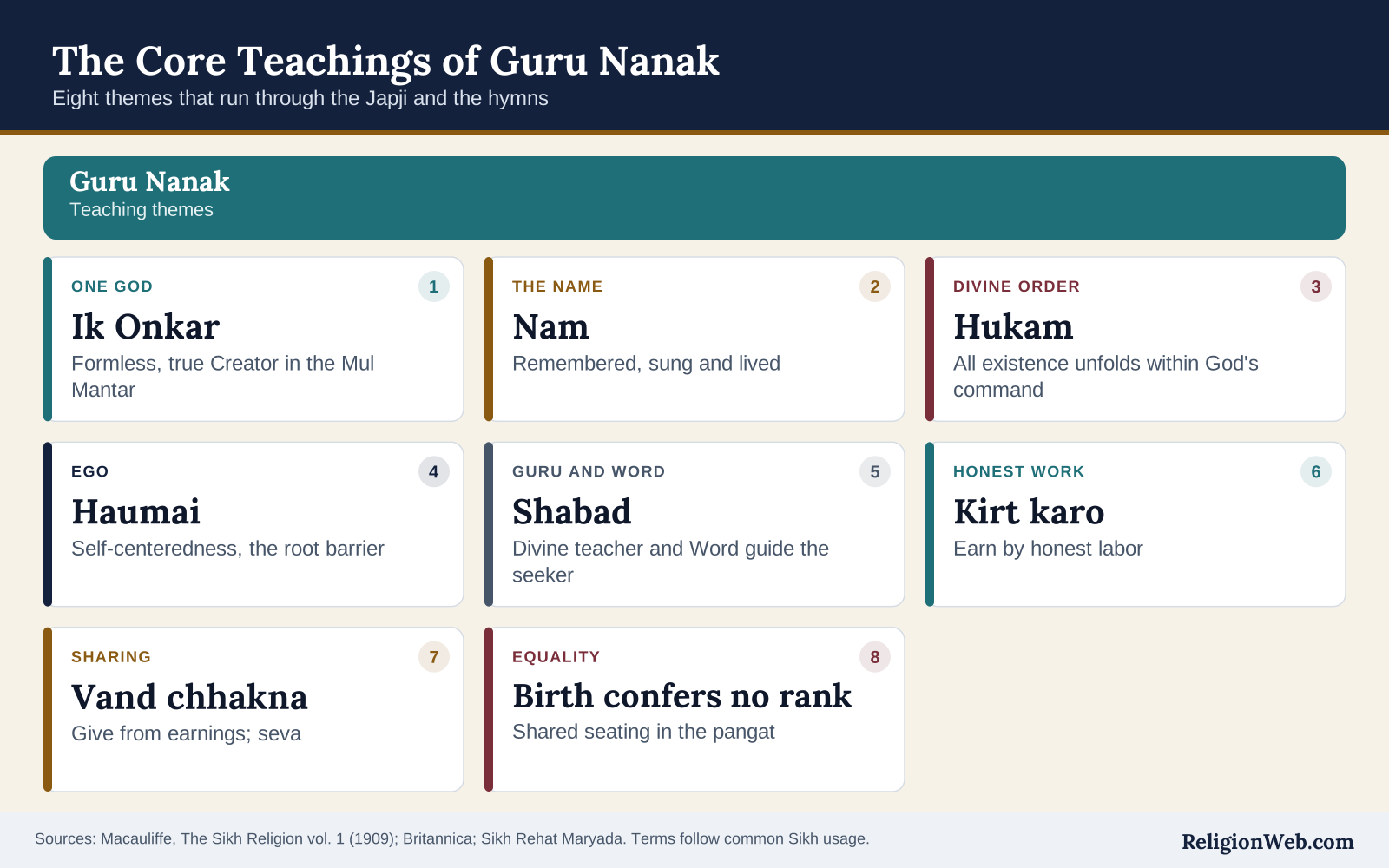
Nanak’s teaching is compressed in the opening of the Guru Granth Sahib, a creedal verse called the Mul Mantar, and then expanded in the long morning prayer called the Japji. In outline it holds that God is one (Ik Onkar), true, without fear or enmity, beyond birth and death, and known through the Guru’s grace. It holds that the Divine Order (Hukam) governs everything, that the human problem is haumai (self-centeredness), and that the remedy is Nam, the Name, internalized through remembrance, hymn-singing, ethical life and service. The Panth later summarized the lived program in three phrases attributed to Nanak’s example: nam japna (remember the Name), kirt karo (earn by honest work) and vand chhakna (share with others).
It is worth saying plainly what this summary leaves out. Nanak did not write a systematic treatise. His thought comes through poetry composed in a regional literary idiom often called Sant Bhasha, written down in the Gurmukhi script, and set to musical modes (ragas). Much of the interpretive work, including how to hold together divine transcendence and divine nearness, how to understand rebirth and liberation, and how a householder’s life relates to spiritual aspiration, is carried out in the hymns by image and argument rather than by definition. That is part of why the Sikh community has kept returning to the text, and why scholars still debate how best to describe it.
Names, Titles and Key Terms
What “Guru” means in Sikh usage
In Sikh usage the word Guru has a specific range of meanings that differs from its casual use in English. At its most basic it names the Divine Teacher, the voice of God that dispels spiritual darkness. In the Panth’s structure it also names the ten human Gurus, from Nanak to Gobind Singh, who are understood to share one spiritual light (jot) even as the body changed, and since 1708 it names the Guru Granth Sahib, the scripture, as the continuing Guru. Calling Nanak “Guru” therefore does not mean that he was only a respected teacher, and it also does not mean, in Sikh understanding, that he was an incarnation of God. Mainstream Sikh teaching describes him as the bearer of the Guru’s revelation, not as a divine manifestation in human form.
Words readers will meet again and again
Several terms appear throughout any serious account of Nanak, and the table below gathers them. The spellings used here follow common English usage in Sikh publications; Punjabi vowel length and diacritics vary from one transliteration scheme to another, so readers will sometimes see Nanak’s contemporaries and places spelled slightly differently elsewhere. Where the difference could confuse a search, both forms are given.
| Term | Plain-English meaning | Why it matters for Guru Nanak |
|---|---|---|
| Ik Onkar (Ek Onkar) | “One Creator,” the numeral one joined to the word for the Divine | Opens the Mul Mantar and the Guru Granth Sahib; summarizes the oneness of God |
| Nam | The Name; God’s revealed nature | The object of remembrance (nam simran) and the path to liberation |
| Hukam | Divine Order or Command | The principle that governs creation; to recognize it is to dissolve ego |
| Haumai | “I-ness,” ego and self-centeredness | Named as the root barrier between the person and God |
| Shabad | The Word; also a hymn | The Guru’s voice and the form in which Nanak’s teaching survives |
| Janamsakhi | “Birth-story”; a devotional life narrative | The main later source for Nanak’s life; a hagiographic genre |
| Udasi | A journey or period of detachment | The name given to Nanak’s travels in the janamsakhi tradition |
| Sangat and pangat | The holy assembly; the row of people seated to eat together | The congregation and shared-meal practices that began at Kartarpur |
| Dharamsal | “Place of righteousness” | The early term for the gathering place, forerunner of the gurdwara |
| Panth | “The path”; the Sikh community | The community formed around Nanak’s teaching and his successors |
How Sikhs and Historians Approach His Life
Two kinds of questions, two kinds of evidence
The most useful habit when reading about Guru Nanak is to ask which kind of question is on the table. A historical question asks what the surviving evidence supports: that he lived in Punjab, that he composed hymns in a particular set of musical measures, that he traveled, that his community at Kartarpur practiced shared worship and farming, and that a successor was chosen. A devotional question asks what the life means: why a story is told, what it teaches, and how it shapes practice. Sikh tradition itself has always understood the janamsakhi stories mainly as the second kind of material, as a way of remembering the Guru’s character and teaching, and the better Sikh scholarship on the topic has been careful about the difference.
Why the distinction does not diminish the tradition
Careful readers sometimes assume that separating historical evidence from devotional narrative weakens a religion’s claims. For Nanak the effect is the opposite. The stories give the Panth a repertory of moral images, such as the honest bread of a poor carpenter set against a rich man’s feast, the refusal to claim a religious label, and the insistence that the divine cannot be located in one direction of prayer. Those images carry the teaching, and they remain useful whether or not each event can be dated. The hymns, which are Nanak’s own words in the community’s understanding and the earliest and most reliable evidence of his thinking, anchor the rest. This article follows that order: hymns first, early references second, janamsakhi narratives third, each labeled as what it is.
Punjab and North India in the Time of Guru Nanak
The Political World: Lodi Sultans, Governors and the Arrival of Babur
A frontier province under the Delhi Sultanate
When Nanak was born, northern India was ruled from Delhi by the Lodi dynasty, an Afghan Muslim line whose founder, Bahlul Lodi, took the throne in the middle of the fifteenth century. Punjab was a frontier province, rich in agriculture along the five rivers but exposed to every force that crossed the northwest passes. Real authority in the region often lay with provincial governors and local chiefs rather than with the sultan. One such governor, Daulat Khan Lodi, is named in the Sikh sources as the patron under whom Nanak worked at Sultanpur, and the Sikh tradition presents this relationship with plain-spoken candor: the Guru served the state economy as a storekeeper before leaving that role.
That detail matters for understanding Nanak’s background. The tradition does not describe a hermit raised outside society. It describes a young man trained in accounts and Persian-influenced administrative life, working inside a Muslim-ruled bureaucracy, with a family that belonged to the Khatri mercantile and clerical community of Punjab. His later hymns draw on the vocabulary of commerce, weighing, accounting and rule with an ease that suggests familiarity with all of these.
The Mughal conquest and the hymns on Babur
The political order around Nanak changed violently in his last decades. Babur, a Timurid prince from Central Asia, moved into Punjab in the early 1520s and defeated the last Lodi sultan, Ibrahim, at the first Battle of Panipat in April 1526. Among the compositions that the Guru Granth Sahib attributes to Nanak are four hymns, in the musical measures Asa and Tilang, that refer to the invasion and its human cost, and they are often called the Babar Vani, the “utterances on Babur.” Sikh tradition associates them with the assault on the town of Saidpur, now Eminabad, around 1520–21. Historians treat these hymns as unusually valuable because they are among the few passages in the Sikh scripture that respond to a datable public event, and they show that Nanak spoke to both the rulers and the ruled of his day, with grief and protest in language that does not flatter either the Lodi administration or the invaders.
The Religious World: Devotion, Yoga and Sufi Shrines
Devotional currents among Hindus and Muslims
Punjab around 1500 was religiously layered. Many of its people practiced forms of what is now broadly called Hindu devotion, including temple and household worship of Vishnu, Shiva and the goddess, and the Vaishnava bhakti movement, which stressed personal love for God. For background on those traditions see the overview of Hinduism and the article on Vaishnavism. Muslims, including Sunni families, Sufi brotherhoods and Persian-speaking officials, formed another major presence, especially in towns and along trade routes. The wider north Indian landscape also included a loose set of poet-saints, often grouped as the Sants, who spoke of a formless God and criticized empty ritual in vernacular verse. Kabir and Ravidas are the best-known of these, and later Sikh scripture preserves hymns by them alongside those of the Gurus.
The exact relationship between Nanak and the Sant tradition is one of the most discussed questions in Sikh studies. W. H. McLeod’s influential scholarship described Nanak as emerging from and developing the Sant milieu. Many Sikh scholars and a number of other historians have argued that this description understates the originality and the self-understanding of the Guru’s revelation, and that Sikh sources present his message as a direct divine commission. This article takes up that debate again in the section on common misconceptions, because it bears directly on whether Nanak should be called a “blend” of other religious ideas.
Sufi communities and the Nath yogis
Muslim mystical life was well established in Punjab by Nanak’s time. The shrine of the Chishti Sufi Baba Farid at Pakpattan was an important pilgrimage and teaching center, and verses attributed to Farid were later included in the Guru Granth Sahib. Sikh tradition says that Nanak visited Pakpattan and received Farid’s verses from the shrine’s then leader, a claim that shows how the early community understood its connection to the wider devotional world. A fuller picture of this strand of Islam appears in the article on Sufism, and the background on Muslim practice and belief is in the overview of Islam.
Another active group was the Naths, or Jogis, ascetics who practiced a path of yogic discipline associated with the teacher Gorakhnath and with Shaiva traditions of yoga. Nanak’s hymn called Sidh Gosht, the “discourse with the Siddhas,” stages a conversation with such ascetics and argues for a householder’s life of remembrance and service in place of withdrawal. The exchange is critical but not contemptuous, and it shows Nanak engaging a living religious option, not a straw figure.

Society, Language and Livelihood
Caste, occupation and the world of work
Society in sixteenth-century Punjab was organized by overlapping systems of hereditary status, occupation and religion. Brahmins held ritual authority within Hindu life, Khatris were prominent in trade and records, Jats formed the large agricultural communities, and many artisan and laboring groups were excluded from temple access and from several forms of social contact. The hymns attributed to Nanak consistently challenge the idea that birth fixes spiritual worth. They also engage economic life directly: the early Sikh ideal of earning by honest labor was formed in a world of farming, trade and wages, not in a monastery.
Language, script and music
Nanak composed in a poetic language that mixes Punjabi with Hindi, Persian-Arabic vocabulary and other regional forms, which is why Sikh tradition and many scholars refer to it as Sant Bhasha. Written Punjabi at the time was often recorded in several scripts. The Gurmukhi script, which Sikh tradition associates with the second Guru, Angad, became the script of the Sikh scripture and gave the community its own written medium. Equally important was music. The hymns in the Guru Granth Sahib are arranged by raga, and Sikh tradition holds that Nanak’s companion Mardana, a Muslim bard who played the rebeck, accompanied his singing from the start. The Panth therefore inherited from its first Guru not only words but a musical form of devotion that still shapes the experience of hearing scripture today.
How Historians Know About Guru Nanak: The Sources and Their Limits
The Hymns: Nanak’s Own Voice
What the hymns can and cannot tell us
The most reliable evidence about Nanak’s thought is the body of hymns attributed to him in the Guru Granth Sahib, which the Sikh community regards as his own words, composed in the sixteenth century, collected under the later Gurus and finally compiled into the scripture in 1604 and again, in its present form, in the early eighteenth century. Standard counts give Nanak close to a thousand hymns in nineteen ragas, plus the long compositions Japji and Asa di Var. The hymns show a mind steeped in the poetry, music and imagery of the region, and they are the main basis for any account of his teaching.
They are not, however, a biography. Nanak’s hymns hardly ever name the places he visited or the people he met, and they say very little about his family or about public events. The few exceptions, such as the lines on Babur’s invasion, are precious for that reason. Anyone reconstructing his life from the hymns alone would have a clear picture of a thinker and a very thin one of a man, which is the gap that later narrative sources set out to fill.
Authorship and the shared name “Nanak”
A practical complication is that every Sikh Guru signs his compositions with the name “Nanak,” following the founder, and the scripture distinguishes them by a numbered label, Mahala 1 for the first Guru, Mahala 2 for the second, and so on. The convention expresses the doctrine of one light passing through successive Gurus, and it means that attribution within the scripture is clear to readers who follow the headings. For historians it also means that the works of the first Guru are clearly marked, and that the editors of the 1604 compilation took care to distinguish authors.
Early Narrative and External Sources
Bhai Gurdas and the earliest Sikh accounts
The earliest sustained narrative references to Nanak outside the scripture come from Bhai Gurdas, a respected Sikh scholar and scribe who worked with the fifth Guru, Arjan, and whose Punjabi poems known as the Varan are venerated as a key to scripture. The first of these poems includes a sequence of stanzas about Nanak’s life, including his meeting with the Nath yogis, his journeys to Mecca and elsewhere, and his establishment of a community. Bhai Gurdas was born only a decade or so after Nanak’s death and wrote his poems several decades later, which places him close enough to have heard memories from people who knew Nanak’s first followers, and far enough away that his account already carries the shape of tradition.
Persian and later outside references
Outside references from the sixteenth and seventeenth centuries are sparse. Persian-language sources of the seventeenth century refer to Nanak and the Sikh community, and they tend to describe him in terms familiar to their own readers, which is useful as evidence of how outsiders saw the Panth but not as a rich biography. The silence of contemporary chronicles on the founder of a regional religious movement is not unusual for the period. Court histories concentrated on rulers and warfare, and a village-born teacher whose followers were farmers and shopkeepers would rarely have been recorded.
The Janamsakhi Tradition
Four main traditions of life-stories
The janamsakhis, literally “birth-stories,” are a set of Punjabi prose narratives about Nanak’s birth, youth, travels and death. Scholars usually sort them into several traditions named for their features or reputed authors. The Puratan (“ancient”) tradition is a collection of narratives that organizes Nanak’s journeys into four directions; the Miharban tradition, linked to the line of Guru Arjan’s elder brother Prithi Chand, mixes narrative with extended commentary on hymns; the Bala tradition claims to rest on the testimony of a companion named Bala; and the Gyan-ratnavali, attributed to the early eighteenth-century scholar Bhai Mani Singh, is a late and more doctrinal retelling. A further early work, known as the Adi Sakhis, is notable because it does not divide the journeys into four.
The oldest surviving manuscripts date from the seventeenth century and the early eighteenth. The Encyclopaedia of Sikhism, published by Punjabi University, Patiala, reports that the two earliest dated manuscripts of the Adi Sakhis are from 1701, and notes that the work took its present shape no earlier than the middle of the seventeenth century. In his study Early Sikh Tradition, McLeod dates the earliest dated Bala manuscript to 1658 and argues that the common label “Puratan” is misleading, since the tradition is a composite, not an original text. These gaps of a century and more between the events and the manuscripts are the main reason historians treat the janamsakhis with caution.
How scholars read them
McLeod’s judgment, still the starting point of much discussion, is that the janamsakhis are hagiographic accounts and not biographies, and that their greatest value is as evidence for the seventeenth and early eighteenth centuries, when the Sikh community was defining itself, not as an exact record of the sixteenth. He questioned in particular the claim that Bhai Bala was a companion of Nanak, observing that Bala is not named in janamsakhis dated before the eighteenth century. Other scholars, including a number of Sikh historians, accept more of the narrative as an echo of real events and argue that a purely skeptical stance undervalues oral memory. The disagreement is real, and it is best presented as a range of positions rather than a settled verdict.
A sensible reading, and the one followed in this article, treats three kinds of statements differently. Claims supported by Nanak’s own hymns and by several independent early sources can be stated with confidence. Claims that appear in the janamsakhis but have no support elsewhere are reported as the tradition’s account, with the source named. Stories that carry miraculous or symbolic weight are explained as devotional narrative: Sikh teaching itself is cautious about attributing supernatural display to the Gurus, and the stories are valued mainly for the moral they teach.
Scholarly Debates: McLeod and His Critics
The skeptical turn in the study of the janamsakhis
The modern academic study of Nanak’s life was reshaped in the second half of the twentieth century by W. H. McLeod, a New Zealand historian who worked for many years in Punjab. His books on Nanak and on the janamsakhis applied the methods of textual criticism to the sources, asking when each was composed, for whom, and with what purpose. The result was a more cautious biography than the one inherited from earlier writers, with fewer secure details and a sharper sense of how the Sikh community’s later concerns shaped its memory of the founder. That approach is the reason why this article distinguishes carefully between the hymns, the early narrative sources and the later stories.
McLeod’s work was also controversial. Some of his conclusions, such as the late and composite character of the janamsakhis and the placement of Nanak within the Sant tradition, were received by many Sikh readers as a challenge to the community’s own understanding. The debates of the 1980s and 1990s were at times heated, and they involved questions about who has the authority to interpret Sikh history, the academy or the community.
Sikh scholarship and the case for continuity
Sikh scholars have responded in several ways. Some have argued that oral memory in a close-knit community can preserve more than a text-critical approach allows, and that the janamsakhis contain reliable cores. Others, working within academic frameworks, have accepted much of the source-critical method while questioning the conclusion that Nanak was essentially a Sant. They point to the structure of the hymns and to the early community’s institutions as evidence of a distinct vision, and they note that the Sikh scripture itself speaks of a direct divine commission. Pashaura Singh, a scholar of Sikh scripture, is among those who have examined the manuscript history of the Adi Granth in detail.
For a general reader the useful lesson is not that one side has won. The shared ground is considerable: that the hymns are the best evidence, that the janamsakhis are devotional literature with historical value of varying kinds, and that the Kartarpur community was a real and formative institution. The disagreements concern emphasis, interpretation and the proper relationship between academic and community voices, and they continue to be conducted in journals, conferences and community forums.
| Source type | Approximate date | What it offers | Historical caution |
|---|---|---|---|
| Hymns of Guru Nanak in the Guru Granth Sahib | Composed in the 1500s; compiled 1604 and early 1700s | His teaching in his own words, including the Babar Vani | Little biographical detail; attribution rests on community and manuscript tradition |
| Varan of Bhai Gurdas | Early 1600s | Earliest narrative sketch of Nanak’s life, travels and community | Written by a devout Sikh a century later; poetic and selective |
| Puratan janamsakhi tradition | Manuscripts from the early 1700s; core possibly mid-1600s | Detailed narrative organized around four journeys | Composite; hagiographic; miracle stories |
| Miharban janamsakhi | 1600s | Narrative joined with commentary on hymns | Reflects the viewpoint of a rival line within the family of the Gurus |
| Bala janamsakhi | Earliest dated manuscript 1658 | Popular and widely copied life narrative | Claimed companion Bala not named in earlier janamsakhis |
| Adi Sakhis and Gyan-ratnavali | Late 1600s to early 1700s | Alternative arrangements of the story; later doctrinal retelling | Later compilations; the endings are confused in some copies |
| Persian-language works and chronicles | 1600s onward | Outside views of Nanak and early Sikh community | Sparse, indirect, written for non-Sikh readers |
| Place traditions and memorial gurdwaras | Local memory across centuries | Sites linked with the Guru’s life | Association is devotional memory, not archaeological proof |
The Life of Guru Nanak: Birth, Family, Sultanpur and the Call
Birth and Boyhood in Talwandi
The place, the family and the birth date question
Nanak was born in the village of Talwandi, which the landlord Rai Bhoi’s family held and which later took the name Nankana Sahib, about forty miles from Lahore. Max Arthur Macauliffe, the Irish-born civil servant who compiled a six-volume English account of Sikh history and scripture in 1909 on the basis of Sikh informants and manuscripts, reports that Sikh records place the birth in the early morning of the third day of the light half of Baisakh (April–May) in 1469, and also that Sikhs now celebrate the anniversary on the full moon of Kartik. The two dates are six months apart, and the difference is old. The Puratan narrative favors the spring date, while the Bala tradition, whose popularity spread across Punjab, favors the autumn full moon. The latter gradually became the community’s choice, and the Shiromani Gurdwara Parbandhak Committee (SGPC), the main administrative body of Sikh shrines in Punjab, continues to observe the Gurpurab on that day.
His father, Kalu, kept accounts for the landlord of the village, and his mother, Tripta, is remembered in Macauliffe’s account as devoted to her son. According to tradition, a midwife named Daulatan attended the birth and an astrologer named Hardial came to cast the child’s horoscope. Such accounts mark the child as extraordinary from the first. They are best read as the narrative conventions of devotional biography, in which a beloved figure’s whole life is retold in light of its end.
Stories of school, herding and withdrawal
The janamsakhis crowd Nanak’s childhood with episodes that have become part of Sikh popular memory. Macauliffe summarizes the best known of them: at age seven his father sent him to school, where he is said to have mastered the alphabet in a day and composed an acrostic hymn on it, and then turned the schoolmaster’s lessons toward the knowledge of God. At other times, tradition says, he tended buffaloes and was found absorbed in meditation while they strayed into a neighbor’s field, and no crop was harmed. These stories share a pattern that scholars of religion know from the early lives of many founders, in which spiritual depth shows itself against the practical expectations of a household.
The tradition also records the tension between the young Nanak and his father’s hope that he would become a farmer or a trader. In the best-known story, Kalu gave his son money to trade and Nanak spent it on feeding hungry holy men, which became known as the sacha sauda, the “true bargain.” Sikh pilgrims still visit a shrine near Chuharkana, in Pakistan’s Punjab, associated with this episode. The story’s meaning in Sikh teaching is moral, not historical: it frames the Guru’s later insistence that honest earning and generous sharing belong together, and that hospitality to the hungry is the profit worth seeking.
Sultanpur: Work, Marriage and Household
Employment under Daulat Khan Lodi
The sources agree that Nanak left Talwandi as a young man and moved to Sultanpur, now Sultanpur Lodhi in Punjab’s Kapurthala district, where his married sister Nanaki lived with her husband Jai Ram. Jai Ram worked for the governor, Daulat Khan Lodi, and through him Nanak was hired to manage the provisions store, known in the sources as the modikhana. Pluralism Project materials at Harvard describe the position as a clerkship in the Lodi administration, while the Sikh tradition emphasizes the quality of his work: his accounts were reportedly scrupulous, and he is said to have distributed much of his wage to the poor. A well-known episode has him weighing grain and, on reaching the number thirteen, which in Punjabi sounds like the word tera, “yours,” repeating it in a trance of offering. The story is told to illustrate a teaching, that everything belongs to God, rather than as an account of corporate bookkeeping.
Nanak’s elder sister Nanaki holds a special place in Sikh memory. Tradition says that she was the first to perceive that her brother was no ordinary person, and that she and her husband gave him a home in Sultanpur when he left Talwandi. Her name is invoked with affection in Sikh retellings, and she is one of the women of the early community whom Sikhs remember with honor. Her story also shows something about the nature of the early community. It grew first around a family and its household, and its first adherents included relatives and neighbors as well as travelers and strangers, which fits the later emphasis on the household as the place where the Guru’s teaching is lived.
Marriage, children and the shape of a householder’s life
Tradition holds that Nanak married Sulakhani, the daughter of Mula, a resident of Batala, and that they had two sons, Sri Chand and Lakhmi Das. Details such as the year of the wedding vary across the janamsakhis and later Sikh writings, and this article does not rely on them. What matters for the faith is the fact itself. Nanak was a married man with children when he began to teach, and he returned to family life and to farming at Kartarpur. That reality shaped the Sikh ideal of the grihasthi, the householder, and set the community apart from traditions in which religious aspiration is ordinarily pursued through renunciation. The Guru’s later criticism of the Yogis, in the hymn Sidh Gosht, rests partly on this commitment to life within the family and the working world.
The Bein Experience and the Beginning of the Mission
What the janamsakhis relate
The turning point in every janamsakhi is the same. Nanak went to bathe in the river Bein near Sultanpur, as he did each morning, and did not come back. His clothes were found on the bank, and the town feared he had drowned. After three days he reappeared and was silent for a time. When he spoke, the sources say, his first words were a statement of religious unity, usually rendered “There is neither Hindu nor Muslim.” In the narrative that follows, he describes being taken into the divine presence, offered a cup of nectar and commanded to repeat the Name, to pray and to teach. The Pluralism Project summary dates the experience to about his thirtieth year, which corresponds to roughly 1499 in the traditional chronology.
How the experience is understood
Sikhs generally read this episode as the moment of the Guru’s commission, what some Sikh writers call the revelation of the divine mission, and they emphasize that the commission is the origin of the Guru’s authority. The hymns themselves speak of a direct divine order and of the Guru as God’s servant and bard. The reported words about Hindus and Muslims are usually interpreted in Sikh teaching as a statement that spiritual worth is not determined by communal label and that the path of the Name is open to all, not as a rejection of the two communities or of their scriptures and practices. Nanak’s later actions in the sources, including worship in public with Muslim and Hindu companions, are consistent with that reading.
A historian can add a caution. The three-day disappearance and the vision are known only from the janamsakhis, whose earliest forms were written down well over a century after the event. The hymns that survive, which Britannica’s entry by McLeod describes as stressing salvation through meditation on the divine Name, do not themselves narrate the Bein episode. The experience is therefore best described as the community’s central memory of his commission, not as an event for which independent evidence exists. That is a statement about sources, not about the sincerity or significance of the memory.
| Approximate date | Event | Basis |
|---|---|---|
| 1469 | Birth at Rai Bhoi di Talvandi (Nankana Sahib) | Year widely accepted; day debated between Baisakh and Kartik |
| Late 1400s | Move to Sultanpur; work in the household and storehouse of Daulat Khan Lodi | Janamsakhis and Bhai Gurdas; accepted in outline by most historians |
| About 1499 | Bein experience and commissioning | Janamsakhi tradition; traditional chronology gives age about thirty |
| About 1500 to 1520 | Journeys (udasis) in India and, in tradition, beyond | Janamsakhis and Bhai Gurdas; routes and dates uncertain |
| About 1520 to 1521 | Babur’s assault on Saidpur; hymns of protest (Babar Vani) | Hymns in the Guru Granth Sahib; the link to a particular event is traditional |
| Early 1520s | Settlement at Kartarpur on the Ravi | Tradition; exact year disputed |
| Early 1520s to 1539 | Farming, daily worship and teaching at Kartarpur | Janamsakhis and Bhai Gurdas; consistent across traditions |
| 22 September 1539 (traditional) | Death at Kartarpur; Lehna named as Guru Angad | Tradition; Britannica gives “around 1539” |
| 1604 | Hymns of Nanak placed in the Adi Granth compiled by Guru Arjan | Sikh tradition and manuscript history |
The Udasis: Guru Nanak’s Journeys
What the Sources Say About the Journeys
The scheme of four journeys
According to the Puratan janamsakhi tradition, Nanak made four long journeys, called udasis, a Punjabi word related to the idea of detachment, in each of the four directions. The first went east, the second south, the third north into the mountains and the fourth west to the Islamic heartlands. Later Sikh writers adopted this scheme because it gave an orderly shape to a life that the sources record in scattered anecdotes. The accompanying dates are traditional, roughly spanning the years between 1500 and 1521, and the traditional chronology gives the whole traveling period as about two decades.
Bhai Gurdas, the Adi Sakhis and alternatives to the four-journey scheme
The four-journey scheme is not universal even within early Sikh tradition. The Encyclopaedia of Sikhism notes that the Adi Sakhis, an early collection with manuscripts dated 1701, does not divide Nanak’s travels into four udasis and groups most of the journey stories into a single sequence. Bhai Gurdas, in his first Var, speaks of visits to Mecca and Baghdad and to places where yogis gathered, without the four-direction architecture. Careful readers therefore treat “four journeys” as one organizing device of one important tradition, and not as a fixed historical itinerary. What the several traditions share is a picture of a teacher who traveled widely, carrying his hymns, accompanied by Mardana, and meeting religious people of many persuasions.
Places Associated With the Journeys
Within the subcontinent
The best-known stops in the east, in the janamsakhis and later Sikh writing, include Hardwar on the Ganges, Banaras (Varanasi), Gaya, the temple city of Puri on the eastern coast, and Assam. In the south, the tradition carries Nanak to the far end of the peninsula and across the water to Sri Lanka, where the Adi Sakhis name a ruler, Raja Shivnabh. In the north, the stories take him to Kashmir and into the Himalayan foothills, where he meets ascetics. Many of these places hold gurdwaras today that commemorate the visit. It is important to remember that a gurdwara’s claim to commemorate a visit rests on local and community memory, which is valuable to the Sikh community but does not amount to archaeological confirmation.
Mecca, Medina and Baghdad
The western journey is the most famous and the most discussed. Bhai Gurdas places Nanak at Mecca dressed as a pilgrim and tells of a confrontation over his sleeping with his feet toward the sanctuary. The Pluralism Project summary retells the encounter in similar terms, with a guardian of the Kaaba objecting to the sleeper’s feet, and in the usual Sikh telling the Guru answers by asking the guardian to turn his feet toward any place where God is not. The stories of Medina and Baghdad build on the same pattern. Because they involve the holiest site of Islam, the narratives are told with care by Sikh authorities, and the point drawn is a spiritual one, that God is not confined to a direction. Historians note that no non-Sikh source from the period records the visit, and that claims about an inscription in Baghdad have not been established to the satisfaction of most scholars. The visits remain a matter of tradition and faith, to be reported as such. Readers interested in the actual pilgrimage to Mecca and its ritual meaning will find it explained in the article on Hajj.
| Place | Region | Tradition associated with the visit | Source status |
|---|---|---|---|
| Sultanpur Lodhi | Punjab, India | Years of work and the Bein experience | Janamsakhis and Bhai Gurdas; widely accepted as a place of residence |
| Hardwar | Uttarakhand, India | Offering of water toward Punjab to challenge a ritual practice | Janamsakhi episode; teaching story |
| Puri | Odisha, India | Composing a hymn of worship (the Arti) rather than joining temple ritual | Later Sikh tradition; the hymn itself is in the Guru Granth Sahib |
| Sri Lanka | South Asia | Meeting with a local ruler named in the Adi Sakhis | Early manuscript tradition; details vary between texts |
| Hasan Abdal (Panja Sahib) | Punjab, Pakistan | Encounter with a Muslim saint on a hill; the shrine Gurdwara Panja Sahib | Janamsakhi and place tradition |
| Achal Batala | Punjab, India | Gathering with Nath yogis, linked with the hymn Sidh Gosht | Janamsakhi tradition; hymn exists independently |
| Mecca and Medina | Arabian Peninsula | Rebuke to a guardian over direction of prayer | Bhai Gurdas and janamsakhis; no outside source |
| Baghdad | Iraq | Teaching among Muslim Sufis | Bhai Gurdas and later accounts; inscriptions are disputed |
| Saidpur (Eminabad) | Punjab, Pakistan | Witness to Babur’s assault; meal in the home of a carpenter named Lalo | Babar Vani in scripture; details from janamsakhis |
Reading the Stories: Meaning and Memory
Famous episodes and the teachings they carry
A few journey stories are told to Sikh children and adults alike, and each condenses a teaching. At Hardwar, pilgrims were throwing water toward the sun for the sake of their ancestors, and Nanak threw it the other way, toward his fields in Punjab, saying that if their water could reach the realm of the dead his could reach a farm a few hundred miles away. The point is a challenge to ritual that has lost sight of its purpose, not a mockery of pilgrims. At Puri, he is said to have declined to join temple worship and instead sang of the whole cosmos as an offering plate for the divine, in the hymn known as the Arti. At Saidpur he refused the rich feast of a prominent official, Malik Bhago, and ate with the carpenter Lalo, remembering that honest bread has more worth than wealth made by exploitation. These episodes teach, respectively, inward sincerity, the universe as worship and the ethics of earning.
What the journeys mean for Sikh practice
The sum of the journey tradition is a portrait of a Guru who engages people of many religious backgrounds respectfully and honestly, who is not afraid to criticize practices that harm or mislead, and who spreads his teaching through song. Sikh scholars often add that the journeys explain why the Panth values the open door of the gurdwara and the practice of reading scripture aloud in the vernacular. Historians stress, as a separate observation, that the traveling Guru is a useful figure for the seventeenth-century community that compiled the stories, a community that was expanding beyond Punjab and defining itself in a diverse religious environment. Both observations can be true at once.
Kartarpur: The Community Guru Nanak Founded
Settling on the Ravi and Building a Daily Rhythm
From traveler to farmer
After the journeys, the tradition says, Nanak did not move from shrine to shrine but settled. He founded a town named Kartarpur, “the settlement of the Creator,” on the right bank of the Ravi River in the Punjab plain. The Pluralism Project summary notes that he farmed there and spent his last years shaping the first Sikh community, and the Tribune, reporting in 2026, repeats the Sikh memory that he spent about the last eighteen years of his life at the site. The sources do not agree on the year of the founding, and a figure in the early 1520s is the safest approximation. What they do agree on is the unusual choice the settlement represents. A teacher with a following, who might have lived on offerings, put on a farmer’s clothes and worked the land beside his family and companions.
The decision matches the content of his hymns. The Guru’s teaching is that liberation is not found by leaving the world but by living in it with the Name in mind, and Kartarpur turned that principle into a daily program. The land was cultivated, the harvest was shared, and the hungry and the traveler were fed from a common kitchen. The pattern defined Sikh life for the next centuries: the three practices of remembering the Name, earning honestly and sharing with others, all of which could be carried out by ordinary families.
The order of the day
Sikh tradition describes a day structured around prayer and work. Before dawn the community gathered to sing hymns, among them the Japji, composed by Nanak and still recited at the start of the Sikh day, and the long morning composition Asa di Var, which is sung by gurdwara musicians in the early morning in a tradition that Sikhs trace to Kartarpur. In the evening the community gathered again for evening hymns, and the late-evening bedtime prayer, the Sohila, closes the day in most Sikh households. The hours between were filled with field work, household tasks and, at midday, a meal prepared in a shared kitchen. Scholars note that the hymns bearing these names are certainly Nanak’s, but that the claim that the daily order was practiced exactly in this way at Kartarpur is a tradition, carried by Sikh liturgical practice and not documented by independent evidence.
Sangat, Pangat and Dharamsal
The holy assembly and the shared meal
Two Punjabi words carry the social teaching of Kartarpur. Sangat means the holy assembly, the company of people who gather in the Guru’s name for hymn-singing and discussion, and pangat means the line in which people sit on the floor to eat together. In sixteenth-century Punjab, eating together across caste lines was a radical act, because food was a primary place where status was enforced. By having people of different backgrounds sit in a single row and eat from the same kitchen, the early community made equality a daily practice and not merely a doctrine. Later Gurus expanded the institution, and the free community kitchen, the langar, is now a recognizable feature of every gurdwara. The article on the Sikh tradition describes langar in its modern forms and gives scale in the case of Harmandir Sahib.
The dharamsal, Mardana and early companions
The place where the early sangat met was called a dharamsal, a “place of righteousness,” and the word is the direct ancestor of the institution that is now called the gurdwara, “the Guru’s door.” Sikh tradition remembers a small circle of companions around the Guru: the Muslim bard Mardana, who accompanied his singing on the rebeck, a bowed stringed instrument that gives the early image of the Guru and musician; Bhai Lehna, who became Guru Angad; and the elder Bhai Buddha, remembered in tradition as a long-lived senior figure at the installation of several Gurus. Details about each vary between sources, and the roster of companions in the janamsakhis, especially Bala, is the subject of the scholarly caution already described. The overall picture of a community that sang, farmed and ate together is, however, consistent across the early sources.
Kartarpur Today and the Corridor
The shrine at Narowal
The site of Nanak’s settlement is now Gurdwara Darbar Sahib Kartarpur in the Narowal district of Pakistan’s Punjab Province, just across the border from the Indian town of Dera Baba Nanak in Gurdaspur district. The Tribune notes that the shrine stands about 4.7 kilometers from the Indian border. After the 1947 partition of Punjab, the site was cut off from most Indian Sikhs, and for decades devotees gathered on the Indian side to look across at the shrine through binoculars, an image that came to symbolize separation. The same article records that pilgrims could for some years after partition cross the Jassar Bridge informally, until the bridge was destroyed in the India-Pakistan war of 1965.
The Kartarpur Corridor and its present status
In November 2018 the two governments laid foundation stones for a visa-free pilgrimage route, and the Kartarpur Corridor opened on 9 November 2019, a few days before the 550th anniversary of Nanak’s birth, with Indian pilgrims allowed to cross to Kartarpur for the day without a Pakistani visa. It was suspended in 2020 because of the COVID-19 pandemic. In May 2025, following the military conflict between India and Pakistan known in India as Operation Sindoor, India closed its side of the corridor until further orders. The Tribune’s explainer, published on 26 September 2026, states that the corridor remains closed from the Indian side while the Pakistani side has kept its gate open, and reports that the SGPC passed a resolution on 28 March 2026 asking for it to reopen. Sikh pilgrims from India who wish to visit the shrine in the meantime must travel with a Pakistani visa by the land crossing at Attari-Wagah. This is a fast-moving situation, and readers planning a pilgrimage should check the current rules with the relevant authorities before they travel.
Guru Nanak’s Teachings: God, the Name, Order and Liberation
One God, the Name and the Divine Order
Ik Onkar and the opening creed
The summary of Nanak’s theology is the short passage at the head of the Guru Granth Sahib known as the Mul Mantar, the “root formula.” It begins with Ik Onkar, “One Creator,” and goes on to describe God as the True Name, the Creator, free of fear and hatred, timeless in form, beyond birth and death, self-existent and known through the Guru’s grace. The Sikh community treats this as the foundation of belief, and many Sikhs recite or sing it daily. The wording stresses two things at once: God is one, beyond all division, and God is personal enough to be addressed by name and to act as Creator, Guru and Lover. Sikh commentary has long insisted that this God is formless (nirankar) but not remote, and that the divine is present in creation without being identical to it.
Hukam: the order that governs everything
A second basic idea is Hukam, the Divine Order or Command. The Japji introduces it in its second stanza, and the Japji’s overall movement can be read as an invitation to recognize the Order and align with it.
By His order bodies are produced; His order cannot be described.
Japji, pauri 2 (Guru Granth Sahib, ang 1), trans. Max Arthur Macauliffe, The Sikh Religion, vol. 1 (1909)
The Sikh interpretation of the stanza, as it is usually taught, is that everything that exists, including joy, suffering, birth and death, takes place within a divine ordering that human ingenuity cannot fully measure. The same stanza, as Macauliffe renders it, adds that a person who understands the Order is never guilty of egoism, and that point is crucial. In Sikh teaching, the recognition of Hukam is not fatalism but the dissolution of the sense of self as an independent author of life, and it leads not to passivity but to humility and responsible action. Different Sikh teachers emphasize different sides of this, some stressing acceptance and contentment, others the call to act justly within the Order, and both emphases are found in the community.
A God who cannot be reached by cleverness
The first stanza of the Japji turns the same idea toward the limits of human reasoning.
By thinking I cannot obtain a conception of Him, even though I think hundreds of thousands of times.
Japji, pauri 1 (Guru Granth Sahib, ang 1), trans. Max Arthur Macauliffe, The Sikh Religion, vol. 1 (1909)
In the Sikh reading, the stanza says that neither purity rituals, nor silence, nor fasting, nor intellectual cleverness, can by itself bring a person to God, and that the way forward is to live in accord with the Divine Will that is written into one’s existence. It is a statement of epistemic humility that coexists with confidence: God cannot be grasped by thinking, yet God is accessible through grace, the Guru’s word and the Name. Sikh theologians stress that this is not an anti-intellectual position, since the same scripture is filled with argument and image, but a claim about the limits of reason as a tool for reaching the divine.
The Human Condition and the Path to Liberation
Haumai: the problem of self-centeredness
If God is the center of Nanak’s theology, haumai is the center of his analysis of the human problem. The word, often translated “ego” or “I-ness,” names the habit of treating oneself as the center of the world and the source of one’s own security and worth. The hymns describe it as a sickness that separates the person from God and traps the mind in cycles of desire and fear. The cure is not suppression, as in some ascetic strategies, but reorientation: the self is turned toward the Name and toward the neighbor.
The Guru, the Shabad and the grace of God
The path of liberation depends on the Guru, which in Nanak’s hymns refers first to God as the inner teacher and second to the Shabad, the divine Word that the Guru brings. The human Gurus are understood as those through whom that Word is spoken, and the line of Gurus ends in the scripture. Practice means hearing, singing, reflecting and living the Word, in the company of the sangat. Grace (nadar or kirpa) is decisive, because effort alone cannot dissolve the ego, but grace is understood to meet sincere practice.
Karma, rebirth and liberation
Nanak’s hymns operate within the wider Indian vocabulary of action (karam), rebirth and liberation (mukti), for which the article on karma in Hinduism gives general background. The hymns accept that actions carry consequences and that souls pass through repeated births, and Britannica’s summary describes Nanak’s teaching as one that emphasizes salvation from rebirth through meditation on the divine Name. Sikh writers differ in how they stress this today. Some teachers emphasize liberation while living (jivan mukti), the state in which a person lives free from egoism in this life, and others speak more about the afterlife. The common thread is that the goal is union with God and that the Name, not caste or ritual rank, opens the way.
The Inner Journey: Stages Described in the Japji
The five realms or khands
Toward the end of the Japji, in stanzas 34 to 37, Nanak describes five khands, a word usually translated “realms” or “stages.” The first is Dharam Khand, the realm of duty or righteousness, where the world is understood as a place of moral action and where deeds are weighed. The second is Gian Khand, the realm of knowledge, in which the seeker glimpses the immensity of creation and the limits of any single viewpoint. The third, Saram Khand, is the realm of effort or spiritual refinement, where the mind and understanding are shaped. The fourth, Karam Khand, is the realm of grace, and the fifth, Sach Khand, is the realm of Truth, where the formless Creator dwells and the seeker is at one with the divine.
Readers have long disagreed about how literally to take the scheme. Many Sikh commentators read the khands as stages of inner growth, a map of how a person’s awareness widens from moral responsibility to union with God. Others, drawing on the language of cosmology in the stanzas, read them also as descriptions of levels of existence. The two readings are not mutually exclusive, and both are found in Sikh exposition. What the passage makes clear is that Nanak did not present liberation as an instantaneous event or a reward for a single act, but as a path with recognizable phases.
Remembrance and service as the engine of growth
The hymns say little about technical methods of meditation, and this is one reason that Sikh practice is often described as simple in form. The central discipline is nam simran, the remembrance of the Name, which can be silent or sung, individual or communal. It is paired with service, because the hymns treat love of God and care for others as inseparable. In Sikh understanding the stages in the Japji are not entered by withdrawing from society. They unfold in the middle of family life and work, which is why the early community at Kartarpur is remembered as a farming community with a rhythm of prayer and not as a monastery.
Critique of Empty Ritual and Hereditary Status
Pilgrimage, ritual dress and outward sign
Many hymns attributed to Nanak address religious practice directly. They question the idea that bathing at a river, wearing a distinguishing thread or garment, observing a diet, or making a pilgrimage can by itself purify a person whose mind remains full of greed, anger and deceit. The criticism is aimed at externals separated from inner devotion, and it is addressed to Hindu, Muslim and yogic contexts alike, with images borrowed from the practices he knew. Sikh interpreters do not read it as dismissing all ritual, since the community developed its own forms of worship, but as a principle that no outward form substitutes for inward remembrance and ethical life.
Birth, caste and the dignity of the person
A parallel line of argument rejects the claim that birth in a high or low community determines spiritual standing. The hymns affirm that all people carry the same divine light and that worth is measured by deeds and devotion. This part of the teaching is developed in the next section, along with the question of women’s standing, because it provides the clearest link between Nanak’s theology and the social practices of the early community.
| Theme | Core idea | Where it appears | How it shapes Sikh life |
|---|---|---|---|
| Oneness of God | One Creator, formless and truthful | Mul Mantar; opening of the Japji | Opening of all Sikh prayer; the Ik Onkar symbol |
| The Name (Nam) | God’s revealed nature, to be remembered and lived | Throughout the Japji and the hymns | Meditation, recitation and hymn-singing |
| Divine Order (Hukam) | All existence unfolds within God’s command | Japji, pauri 2 and 3 | Contentment, acceptance and responsible action |
| Ego (Haumai) | Self-centeredness as the root barrier | Many hymns, including the Asa di Var | Humility and service (seva) |
| Guru and Word | Divine teacher and divine Word guide the seeker | Hymns across ragas | Reverence for the Guru Granth Sahib |
| Householder life | Spiritual life lived in family and work | Sidh Gosht; Kartarpur example | Marriage, work and community as religious life |
| Equality | Birth confers no spiritual rank | Hymns and the pangat of the early community | Langar and shared seating |
| Honest work and sharing | Earn rightfully and give to others | Hymns and the Kartarpur tradition | Kirt karo and vand chhakna |
Equality, Honest Work, Sharing and Remembrance in Daily Life
Three Practices Attached to Nanak’s Example
Nam japna: remembering the Name
Sikh teachers often summarize Nanak’s practical program in three Punjabi phrases. The first, nam japna, means to repeat, recall and live in the Name of God. In the Sikh understanding this includes silent or spoken repetition of a chosen divine Name (traditionally Waheguru in later Sikh practice), the reading and singing of scripture, and a continuing awareness of the divine in daily life. The phrase is a convenient modern summary and not a quotation from Nanak, but the three practices it organizes can all be traced to the hymns and to the life at Kartarpur. In a typical Sikh household, nam japna means rising early to recite morning prayers, and in many communities it also means communal singing in the gurdwara, where the hymns of Nanak and his successors are the heart of the service.
Kirt karo: earning by honest work
The second phrase, kirt karo, means to earn one’s living by honest labor. The ideal is rooted in the example of Kartarpur, where the Guru farmed, and in the repeated hymn motif that wealth gained by deceit or exploitation poisons the person who holds it. The janamsakhi story of Saidpur makes this point: the Guru is reported to have declined the rich food of Malik Bhago and eaten the simple bread of the carpenter Lalo, and the tradition explains that Bhago’s food was earned by oppression while Lalo’s was earned by honest effort. Sikh teaching applies the principle across occupations. The ideal is not poverty but integrity, and the Sikh tradition has historically valued farmers, soldiers, merchants, craftspeople and professionals so long as the means are honest.
Vand chhakna: sharing with others
The third phrase, vand chhakna, means to share what one has, and its institutional form is the sharing of food and resources. At the personal level it means giving to the needy from one’s own earnings. At the communal level it is expressed through the langar, the community kitchen, and through seva, selfless service performed without expectation of reward, from cooking and cleaning in the gurdwara to disaster relief. The later Sikh practice of setting aside a tenth of one’s income, dasvandh, developed after Nanak’s time, but it is understood as an extension of the sharing he taught. For the larger story of how these practices expanded under later Gurus, see the article on Sikhism.
Equality Across Caste, Creed and Gender
Against hereditary rank
Nanak’s hymns deny that birth determines spiritual worth. The early community made the denial concrete by seating people of different backgrounds in the same row, and the practice of eating together in the pangat has remained a Sikh signature. It is worth adding a careful historical note. The ideal was set at the beginning, but social distinctions in Punjab did not vanish because a teaching rejected them, and Sikh communities in later centuries, like communities everywhere, have had to confront caste prejudice within their own ranks. Gurdwaras in some regions have faced criticism and internal reform movements on this point. The founding principle is clear in the hymns and in the practice of the pangat, and the history of living up to it is a continuing story.
Women in Nanak’s hymns
One of the best-known passages in the Asa di Var, the long morning hymn, asks a rhetorical question: why call woman inferior, when kings are born from her? The passage is summarized here in paraphrase and not quoted. The hymn, which sits within the Asa di Var (angs 462 to 475 of the Guru Granth Sahib) and is usually cited at ang 473, argues that women are the source of human life and the partners in the life of every household, and so should not be treated as polluting or lesser. In a society where purity rules often limited women’s participation in religious life, the hymn was a notable statement. Sikh tradition reads it as a foundation for women’s equal standing in prayer, in the congregation and in the community.
What the record shows about practice
Reading the hymn as a principle is different from describing how the Panth has acted over time, and the record is mixed. Women have been prominent in Sikh history as teachers, patrons and martyrs, and the Sikh Rehat Maryada, the code of conduct issued by the SGPC, states that women and men have equal right to initiation and to participate in congregational service. At the same time, some roles, such as the service of the five initiators at the Khalsa initiation ceremony or of musicians at certain central shrines, have been the subject of debate. The tradition’s own scripture is the usual reference point in these debates, and thoughtful voices on both sides appeal to the same hymns.
Remembering the Name Together
Kirtan and the sung hymn
Singing is the chief form of communal remembrance, and it goes back to the earliest memory of the community. The tradition remembers Nanak singing his hymns accompanied by Mardana’s rebeck, and the Guru Granth Sahib is arranged by musical mode so that its hymns can be sung. In the gurdwara today the central service is kirtan, the singing of scripture by musicians or the congregation, followed by a reading from the scripture and the sharing of karah prashad, the sweet offering made of flour, clarified butter and sugar. The experience is meant to be both devotional and instructive, since the hymns are in a language ordinary people can follow.
How the three practices fit together
It is possible to view the three practices as separate duties, but Sikh writers usually present them as one pattern. Remembrance without honest work can become withdrawn or self-satisfied; work without remembrance can become mere acquisition; and sharing without either becomes a transaction. In the community’s ideal, the three keep each other honest. A Sikh who rises before dawn to recite the Japji, who works with integrity during the day and who spends the evening serving others in the langar is following, in a modern form, the rhythm that tradition ascribes to Kartarpur.
Guru Nanak’s Hymns and the Guru Granth Sahib
The Major Compositions
The Japji
The Japji is the best-known of Nanak’s works. It stands at the opening of the Guru Granth Sahib, begins with the Mul Mantar, and consists of 38 stanzas called pauris followed by a closing couplet. Sikh tradition holds that Nanak composed it as a sustained meditation, and it is recited every morning by observant Sikhs as the first of the daily prayers called Nitnem. Its structure moves from the nature of God and of the divine Order to the limits of human effort, through a vision of countless worlds and realms, to a description of stages of spiritual growth, and finally to a concluding statement that the Name is the real teacher. The Japji is not a creed in the manner of a short confession, but it is the closest thing in the Guru Granth Sahib to a condensed statement of belief.
Asa di Var, Sidh Gosht and other long hymns
Several other compositions by Nanak are central. The Asa di Var is a ballad-form hymn of twenty-four stanzas, framed by shorter verses, sung in the early morning in gurdwaras across the world, and it addresses ritual, status, hypocrisy and the nature of truth. The Sidh Gosht is a dialogue with the Siddha ascetics on the question of whether liberation requires withdrawal from life. The Dakhani Oankar reflects on the divine Word through the letters of the alphabet, the Patti works through the Gurmukhi letters as a series of moral and spiritual reflections, and the Barah Maha, “the twelve months,” follows the seasons of the year as an expression of longing for God. The four Babar Vani hymns, mentioned earlier, are among the few compositions that respond to a historical event. Together they show a poet who handled lyric, argument, satire and lament.
The Sidh Gosht: a dialogue about how to live
The Sidh Gosht deserves separate attention because it shows Nanak arguing a position rather than stating it. The setting is a conversation with the Siddhas, or Nath yogis, who practice austerity and retire from ordinary society, often to hills and caves. Tradition connects the exchange with a mountain gathering or with the fair at Achal near Batala, but the hymn itself carries its own argument. The Siddhas ask who Nanak is, where he comes from, and what path he follows. His replies insist that he has come from the Creator and that his path is the Name, the Word and the company of the holy, and that withdrawal from the world is not required for liberation. The tone is firm and courteous, which is why Sikh teachers cite the hymn as a model for religious discussion.
For historians, the Sidh Gosht is a window into the religious competition of early sixteenth-century Punjab, where ascetic and householder ideals were both live options and teachers publicly contended for followers. For Sikhs, it is a statement of the principle that spiritual life can be lived while working, marrying, raising children and taking part in society. The text does not mock the yogis. It describes their practices accurately enough to be recognizable and then proposes a different order of priorities.
Evening and night hymns
Some of Nanak’s shorter hymns have been absorbed into the evening and night prayers of the Sikh community. Sikh tradition places hymns of his in the evening prayer Rehras and in the bedtime prayer Sohila, and the hymn commonly called the Arti, which imagines the sky as a salver and the stars as lamps in the worship of God, is sung in many gurdwaras. The link between the Arti and Puri comes from the janamsakhi tradition and is not stated in the hymn itself. The point of such hymns in liturgy is that the whole day, from dawn to night, is framed by words that are held to come from the Guru.
From Pothi to Scripture
Preservation under Guru Angad and the early Gurus
How did Nanak’s hymns reach the Guru Granth Sahib? The Sikh tradition says that Nanak kept his compositions, and the compositions of other saints he chose to include, in a notebook or pothi, and that he gave it to his successor Angad. Each successive Guru added his own hymns, using the same pen name “Nanak” and distinguishing himself in the scripture by numbered headings. Modern scholars, including Pashaura Singh in his study of the Adi Granth’s textual history, have examined the surviving manuscripts to try to trace this process. The traditional account is accepted as the basis of the community’s understanding, and the manuscript studies add detail and, in some places, debate on questions of dating and attribution.
The 1604 compilation and the present Guru Granth Sahib
The fifth Guru, Arjan, compiled the first formal version of the scripture, called the Adi Granth, in 1604, with Bhai Gurdas as scribe, and installed it at Harmandir Sahib in Amritsar. It contained the hymns of the first five Gurus and a selection of works by devotional poets from different regions and social backgrounds. In the early eighteenth century, Guru Gobind Singh added the hymns of the ninth Guru, Tegh Bahadur, and in 1708 declared the scripture to be the Guru for all time. Nanak’s compositions occupy the first position in each musical section, a placement that reflects both his seniority and the way the scripture is organized. For the structure and use of the text as a whole, see the article on the Guru Granth Sahib.
Music, Language and Interpretation
Ragas and the performance of the hymns
The scripture is arranged by raga, not by author or subject, and each hymn is headed with its musical mode. The practice has two effects. First, it ties the meaning to performance, so that a hymn about longing is sung in a mode suited to longing. Second, it means that Nanak’s compositions, which are found under many of the headings, can be heard in different emotional registers. The tradition of kirtan, with trained musicians known as ragis, keeps this musical knowledge alive, and some gurdwaras and institutions teach the old stringed instruments and the raga system as part of Sikh heritage.
Reading Nanak today
Sikhs approach Nanak’s hymns through several modes at once: recitation, singing, listening, exposition by teachers and private reflection. English translations are widely used, especially in the diaspora, and their wording differs, so it is helpful to compare more than one. Scholars read the hymns alongside the poetry and philosophy of the surrounding period, and the Sikh tradition’s own commentarial work, which goes back centuries, offers the most sustained inside readings. Because the text is a living part of worship and not only a historical document, readers should expect that questions of translation and interpretation are serious ones, and that the community’s understanding is the proper starting point for a discussion of what the hymns mean.
Succession to Guru Angad and the Continuity of the Guru
The Choice of Lehna as Guru Angad
Who Bhai Lehna was
As his life at Kartarpur drew to a close, Nanak faced a question that every founder faces: who would lead the community? Sikh tradition answers with a name, Lehna, a man from the village of Khadur who had come to Kartarpur as a devotee and stayed to serve. Britannica reports that he met Nanak while on pilgrimage to the shrine of a Hindu goddess and decided to follow him, and Sikh tradition adds that he was drawn to the Guru after hearing the Japji recited. The details of his earlier life come from later Sikh writings and may be treated as the community’s memory, but his central role in the succession is among the best-attested facts of Sikh history, because every Sikh tradition agrees that the second Guru was Angad and that he was Nanak’s chosen successor.
The naming and the installation
The name Angad means “one’s own limb,” and the tradition holds that Nanak gave it to Lehna to signal that he was now part of the Guru’s own person. Sikh accounts say that the Guru tested the disciples’ obedience and willingness to serve in several ways before choosing, and that Lehna alone passed. The installation is remembered as a simple ceremony of homage, with Nanak bowing before his successor. Britannica places Nanak’s death around 1539, and the installation of Angad is placed at the same time; the traditional date of 22 September 1539 is the one most Sikh sources give. Britannica gives his years as Guru as 1539 to 1552, and he led the community from Khadur, where he died.
Why the Office Did Not Pass to a Son
Sri Chand and the Udasi tradition
Nanak had two sons, and the choice of an outsider over a son was an important precedent. Sri Chand, the elder, is remembered in Sikh tradition as a devout ascetic who founded a renunciant order known as the Udasis. The same word, udasi, was also used for Nanak’s journeys, and the connection has produced confusion, since the order that bears the name is a renunciant one, whereas Nanak’s own example at Kartarpur was that of a householder and farmer. Today the Udasi tradition is a separate current with its own institutions that venerates Nanak, and relations between it and the broader Sikh community have varied over the centuries. Sikh writers present Sri Chand with respect while explaining why the Guru’s office was not his.
The principle behind the choice
The Sikh explanation is that the office of Guru depended on spiritual fitness and service, not on birth. This reading fits the content of the hymns, which reject hereditary status as a ground for spiritual authority, and it is a powerful part of how Sikhs remember Angad’s selection. Historians, who are cautious about reading backward from later developments, point out that the early Panth faced real tensions over leadership, that later Gurus came from within one family from the fourth Guru onward, and that rival claimants appeared from time to time. These observations do not contradict the tradition’s account of Nanak’s decision, but they remind readers that a principle stated at the beginning was tested repeatedly in practice.
One Light in Successive Bodies
The idea of the shared jot
The most important theological idea tied to the succession is that the Guru’s spiritual light is one. Sikhs speak of jot, the “light,” passing from Nanak to Angad and on through the ten Gurus as one flame passes from one lamp to another. This explains why every Guru’s hymns are signed “Nanak” and why a Sikh may speak of “Guru Nanak” when referring to the continuous presence of the Guru. It also explains why Sikhs do not describe the later Gurus as reformers of the first Guru’s teaching but as embodiments of the same revelation in new circumstances, which is a key to understanding later developments such as the creation of the Khalsa.
From Angad to the Guru Granth Sahib
Britannica reports that Angad standardized Gurmukhi, the Punjabi script in which much of the scripture is written, and Sikh tradition credits him with sixty-three couplets that are included in the Guru Granth Sahib. He was followed by Amar Das, Ram Das, Arjan, Hargobind, Har Rai, Har Krishan, Tegh Bahadur and Gobind Singh, and in 1708 the line of human Gurus ended with the designation of the scripture as Guru. The development of the Khalsa in 1699, the discipline of the Five Ks and the commemoration of the Khalsa on Vaisakhi belong to the later story, and the articles on the Five Ks and on Vaisakhi take it up in detail. The point to hold on to here is that Sikh teaching presents these later developments as growth within the tradition that Nanak began. They are not seen as a break with it.
Remembering Guru Nanak Today: Gurpurab, Gurdwaras and Everyday Practice
Gurpurab: The Annual Remembrance
The calendar rule and the date in 2026
The annual celebration of Nanak’s birth is called Guru Nanak’s Gurpurab, from gur (Guru) and purab (festival). It is observed on the full moon of the lunar month of Kartik, in October or November, even though tradition places his birth in the spring, as the Religious Education Online resource in the United Kingdom explains. Because the date follows the lunar calendar, it moves from year to year against the civil calendar. Religious Education Online lists the observance in 2026 as 24 November. In some time zones the full moon straddles two civil dates, so local gurdwaras announce the day, and in Punjab the SGPC calendar is the authority that most Sikh institutions follow. Readers who plan to attend should confirm the date with a nearby gurdwara.
What happens on the day
The same source describes the typical pattern. An akhand path, an unbroken reading of the entire Guru Granth Sahib that takes about two days, begins two days before the festival and is completed on the morning of the celebration. Sikhs gather at the gurdwara for kirtan, for katha (spoken exposition of the hymns and of the Guru’s life) and for langar. Gurdwaras are often lit with lamps or lights, and in many cities a procession called a nagar kirtan carries the scripture through the streets, with hymn-singing and volunteers distributing food. The mood is joyful and devotional, and the day gives families an occasion for gathering, service to others and teaching children the stories of the Guru.
Pilgrimage and the 550th anniversary
For many Sikhs in India, Gurpurab has long involved the hope of visiting Nankana Sahib, the site of Nanak’s birth in Pakistan. The 550th anniversary of his birth, observed in November 2019, drew special attention because the Kartarpur Corridor was opened a few days earlier, and Sikh communities around the world marked it with events, publications and service projects. The present closure of the Indian side of the corridor, described earlier, means that the experience of that anniversary is not currently repeatable for most Indian pilgrims in the same way, and the question of access to Nankana Sahib and Kartarpur remains a living concern in the Panth.
Gurdwaras and Places of Memory
Nankana Sahib and the birthplace
The place of Nanak’s birth is marked by Gurdwara Janam Asthan at Nankana Sahib, which is one of the most important pilgrimage sites in the Sikh world. The town grew around the shrine and took the name Nankana, “the place of Nanak.” It lies in Pakistan’s Punjab Province and hosts large gatherings at Gurpurab. Other shrines in Nankana Sahib mark episodes associated with Nanak’s childhood. Like many Sikh historical shrines, these gurdwaras are administered in Pakistan under government-linked bodies, and their upkeep, access and restoration have been recurring topics of discussion among Sikhs worldwide.
Sultanpur Lodhi, Kartarpur and the other sites
Sultanpur Lodhi in India’s Punjab is the city of Nanak’s years of service and the Bein experience, and its gurdwaras are among the most visited pilgrimage sites on the Indian side. Kartarpur, as discussed above, is the place of the community’s founding and of Nanak’s death. Dera Baba Nanak in Gurdaspur district holds shrines associated with the Guru’s later years, and Panja Sahib at Hasan Abdal, in Pakistan, is associated with the story of the saint on the hill. Further away, gurdwaras across India and in several other countries commemorate traditional journey sites. For all of them the key point is the same one made earlier: they preserve devotional memory, and the Panth values them as such.
Nanak in Sikh Worship, Home and Identity
Nanak in prayer and liturgy
Nanak is present in Sikh worship far beyond Gurpurab. His hymns open the scripture and fill the daily prayers. The Ardas, the formal supplicatory prayer that closes most Sikh services and is recited at many important moments in life, remembers the Gurus in order, beginning with Nanak, and the Guru Granth Sahib is treated as the continuing Guru in whom his teaching lives. The name “Nanak” itself, signed at the end of each hymn, is a constant presence in the spoken service, so that a congregation hears the founder’s name hundreds of times in any given gathering.
Nanak at home and in community life
In Sikh homes, the memory of Nanak shows in small ways: the recitation of the Japji at dawn, the display of the Ik Onkar symbol, the telling of stories of the Guru to children, and the habit of sharing food with guests. In Sikh community life it shows in the langar and in the many service organizations that cite the Guru’s example. Sikhs understand later developments, including the Khalsa, as continuous with what the first Guru began, and so each practice carries something of the memory of Kartarpur.
| Practice or institution | Link to Guru Nanak | How it appears today |
|---|---|---|
| Japji recitation | Composition of Nanak at the head of the scripture | First of the daily prayers (Nitnem), recited at dawn at home and in gurdwaras |
| Kirtan | Nanak’s hymns sung with Mardana’s rebeck | Central part of gurdwara worship, in the ragas of the Guru Granth Sahib |
| Sangat | The gathering of followers at Kartarpur | The congregation in gurdwaras and at community events |
| Langar and pangat | Shared meals and equal seating at Kartarpur | Free community kitchens in gurdwaras around the world |
| Seva | Service as part of daily life in the early community | Volunteer work in the gurdwara, in disaster relief and in charity |
| Honest livelihood (kirt karo) | Nanak’s life as a farmer at Kartarpur | An ethical expectation across professions |
| Gurpurab | Remembrance of his birth | Akhand path, kirtan, nagar kirtan and langar at the November full moon |
| Ik Onkar symbol | The opening of the Mul Mantar | Seen on gurdwaras, publications and homes |
| Pilgrimage to Nanak sites | Birth, work, mission and death places | Visits to Nankana Sahib, Sultanpur Lodhi, Kartarpur and others |
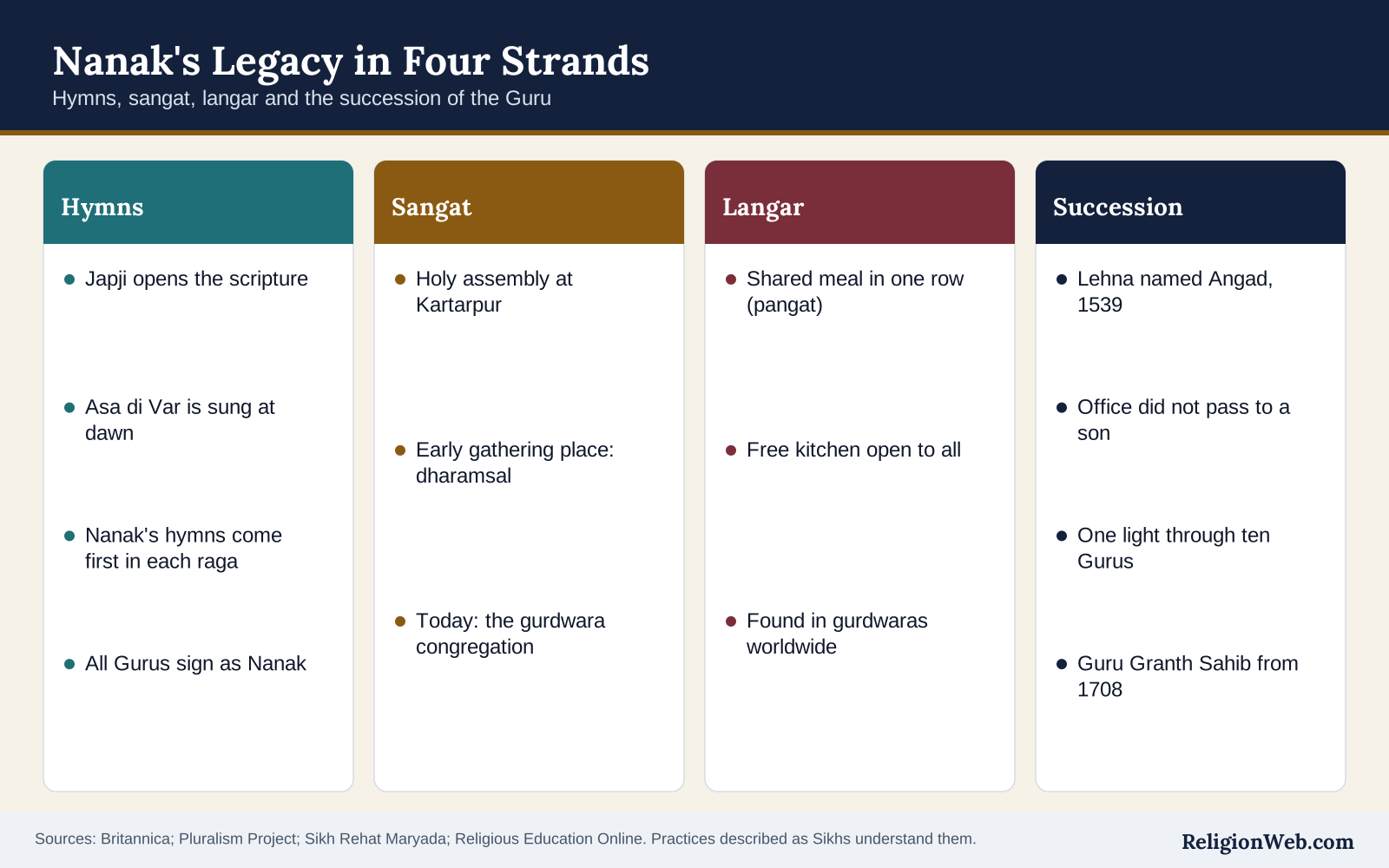
Common Misconceptions About Guru Nanak
Misconception 1: Guru Nanak was simply a blend of other religions
Where the misunderstanding comes from
The idea that Nanak mixed together ideas from other traditions is common in popular summaries, and it has some understandable roots. His hymns use a vocabulary shared across the devotional world of northern India, with names for God such as Hari, Ram, Allah and Rahim sitting side by side, and they speak of ideas, like rebirth and liberation, that are familiar from other Indian traditions. Some reference works compress the point into a phrase. Britannica’s biography, for example, describes his faith as monotheistic and as combining Hindu and Muslim influences. The famous words reported after the Bein experience, “There is neither Hindu nor Muslim,” can also be misheard as an invitation to merge the two communities into one.
A further source of the idea is nineteenth- and twentieth-century scholarship that sought the “origins” of Sikhism in earlier movements. Researchers placed Nanak in the broader world of the northern Indian Sants, poet-saints who preached devotion to a formless God and criticized empty ritual, and some summaries turned that scholarly placement into a statement about borrowing.
What the evidence and tradition actually show
The picture is more layered. Historians agree that Nanak lived in a shared linguistic and devotional environment and that he drew on its images and vocabulary, as every poet does. W. H. McLeod argued that Nanak should be understood as emerging from the Sant tradition. Many Sikh scholars and some other historians respond that this description underplays the distinctive structure of his teaching, which includes the doctrine of Ik Onkar, the role of the Guru and the Word, the commitment to householder life and the founding of a community with its own institutions at Kartarpur. In their view the vocabulary is shared but the message is not borrowed.
The term “syncretism” itself deserves care. It describes a deliberate blending of existing systems, and nothing in Nanak’s hymns presents the teaching that way. The hymns present it as a revelation, and the Sikh tradition has always understood Nanak as speaking with divine authority and not as assembling a compromise. The respectful and accurate statement is that Nanak taught in an environment of many religious voices, that he addressed all of them, and that Sikhs, and most of the scholars who have studied the hymns closely, regard the resulting teaching as an independent religious vision.
One further piece of evidence is often cited by Sikh writers. The scripture compiled under Guru Arjan includes hymns by devotional poets of different regions, communities and religious backgrounds, among them Kabir, Ravidas, Namdev and the Sufi Baba Farid, set beside the hymns of the Gurus. Sikh tradition understands this inclusion as an expression of the Gurus’ openness to truth wherever it is voiced, and also as evidence that the Gurus knew exactly how their own teaching related to that of the other poets and chose which to include. The compilers therefore had a clear sense of what the Sikh message was, and that sense is a sign of coherence and not of a patchwork.
Misconception 2: Every story in the janamsakhis has the same historical status
Where the misunderstanding comes from
Many Sikhs and non-Sikhs first meet Nanak through the janamsakhi stories, which are retold in children’s books, illustrated comics, films, sermons and school lessons. In those retellings an episode like the tale of Mecca, the thirteen at the grain store or the meeting with the thug Sajjan appears as plain biography. The stories are vivid and easy to remember, and in the process of retelling the distinctions among sources fall away. Some devotional writing also treats questioning the stories as disrespect.
What the evidence and tradition actually show
The janamsakhis are a layered literature. As the earlier discussion of sources shows, the manuscripts date from the seventeenth century and later, several different traditions exist, and they sometimes tell the same event differently or tell different events in different order. McLeod described them as hagiographic accounts and not biographies, and the entry on the Adi Sakhis in the Encyclopaedia of Sikhism shows that even the four-journey scheme is not universal. Within the janamsakhi corpus some elements, such as the work at Sultanpur, the journeys and the settlement at Kartarpur, are supported by several lines of testimony, while miraculous incidents are, in the nature of the genre, narratives of meaning.
It is not disrespectful to say so. Many Sikh writers have long distinguished between the stories as lessons and the stories as chronicle, and they see the stories as part of the way the community has taught its values. A balanced approach, followed in this article, is to say which source is speaking, to separate the broad outline from the details, and to keep the teaching that each story carries.
Three practical questions help a reader weigh a given story. How early is the earliest source that tells it? Do independent traditions agree on it, or does only one tradition carry it? And does anything in Nanak’s own hymns point toward it? The Babur episode scores well on the last question, because the hymns themselves refer to the invasion. The claim that a named companion, Bala, traveled with Nanak scores poorly on the first, since the name is absent from the janamsakhis dated before the eighteenth century, in McLeod’s analysis. Such questions turn an all-or-nothing argument into a graded one.
Misconception 3: Sikh tradition began and ended with Guru Nanak
Where the misunderstanding comes from
Guru Nanak’s name is by far the best known of the Gurus outside the Sikh community, and his birthday is the most widely recognized Sikh festival. In many general accounts he stands alone as “the founder of Sikhism,” and the later Gurus appear only in a list. It is easy to conclude that the faith was the work of one man, or, conversely, that it is a finished teaching that stopped with him. Some visitors to a gurdwara also meet the phrase “Guru Nanak” used as a general respectful reference to the Guru’s teaching and may not realize that a long line of figures is being invoked.
What the evidence and tradition actually show
Sikh tradition counts ten human Gurus from Nanak (1469–1539) to Gobind Singh, who died in 1708, followed by the Guru Granth Sahib as the continuing Guru. Each of the human Gurus contributed to the community. Angad is remembered for the Gurmukhi script, Amar Das for the langar and the organization of the sangat, Ram Das for the founding of Amritsar, Arjan for the Adi Granth and Harmandir Sahib, Hargobind for the idea that spiritual and worldly authority are joined, Tegh Bahadur for his martyrdom and Gobind Singh for the founding of the Khalsa in 1699. Sikhs understand these figures as sharing a single light, so what appears to be a long history is, in the tradition’s own view, one revelation unfolding.
Nanak’s wider fame has its own explanation. As the founder he is invoked at the start of every Sikh prayer and his Gurpurab is observed widely, and in parts of South Asia, including some Sindhi Hindu communities, he is also honored by people who do not identify as Sikh. That wide reverence helps explain why his name often stands for the whole tradition in conversation, and it is one reason a visitor can mistake the Panth for a single-founder movement.
The community also continues in the present: it has an administrative body for historic shrines, the SGPC, which was founded in 1920, a code of conduct and a worldwide membership. For a fuller account of how the faith developed after Nanak, see the main article on Sikhism.
Misconception 4: Sikhs worship Guru Nanak as God or as a divine incarnation
Where the misunderstanding comes from
Visitors to a gurdwara see Sikhs bowing before the Guru Granth Sahib, kissing the ground, waving a whisk over the scripture, and hear the Gurus addressed with titles of reverence. In an environment where bowing before an image or person often signals worship of a deity, the scene can easily be misread. Popular treatments of the founders of religions also frequently assume that founders are regarded as divine, which can lead to the same assumption about Nanak.
What the evidence and tradition actually show
Mainstream Sikh teaching holds that devotion is directed to the one God, Ik Onkar, and that the Gurus are teachers through whom the divine Word was revealed, not God in human form. The bowing before the Guru Granth Sahib is understood as honor to the Word and to the Guru’s authority, and it is not understood as worship of an object. The scripture itself, in hymns by Nanak, speaks of the human being as a servant of the Creator, and the tradition emphasizes that the Gurus did not claim divinity. Sikh sources also use strong language for the Gurus, such as the title Satguru, which should be read as the Sikh vocabulary of spiritual authority and not as a claim of incarnation.
It is accurate to add that practices of reverence in the Panth are intense, and that some groups that trace themselves to Sikh roots follow living teachers whom the mainstream community does not accept as Gurus. The SGPC and most Sikh institutions hold that the line of human Gurus closed in 1708. The correct summary of mainstream belief is that Nanak is honored as the first Guru and as the bearer of revelation, and that worship is directed to the one God.
Frequently Asked Questions About Guru Nanak
Questions About His Life
When and where was Guru Nanak born?
Guru Nanak was born in 1469 in the village of Rai Bhoi di Talvandi, which is now Nankana Sahib in Pakistan’s Punjab Province, about forty miles from Lahore. Britannica gives 15 April for the day, with a question mark. Sikh tradition itself preserves two different seasons for the birth, spring and autumn, and the community observes Gurpurab on the Kartik full moon in the autumn.
The year is widely accepted, while the day is not certain. This kind of uncertainty is normal for the period and does not diminish the community’s observance.
Was Guru Nanak married and did he have children?
Yes, according to every early tradition. He married Sulakhani and they had two sons, Sri Chand and Lakhmi Das, in the standard account. His life as a householder and farmer is part of why Sikh teaching values family life and honest work.
Details such as the wedding date differ between sources and should be treated as traditional. The fact of his family life is not in dispute within Sikh tradition.
Who were Mardana and Bala?
Mardana, a Muslim bard and rebeck player, is the best-remembered companion of Nanak in Sikh tradition, and the pairing of the Guru’s voice with Mardana’s instrument is a standard image of early Sikh worship. Mardana appears in the earliest janamsakhi traditions and in the writings of Bhai Gurdas, which is part of why historians treat his role as better attested than that of most other named companions.
Bala is a more contested figure. The Bala janamsakhi claims to be his eyewitness account, but McLeod’s analysis finds that no janamsakhi before the eighteenth century names him. Sikh scholars differ on how to interpret this, and the best summary is that Mardana’s role is widely accepted while Bala’s remains an open question.
How did Guru Nanak die?
Nanak died at Kartarpur around 1539, aged about 69 or 70. The Pluralism Project at Harvard retells the tradition that Hindu and Muslim followers each placed flowers beside his body, that the flowers were found fresh the next day, and that no body remained beneath the sheet. Sikhs relate the story as a statement of his universal regard and not as a literal account of what historians could verify.
What the sources agree on is that Nanak had named Angad as successor before his death and that the community continued under him.
Questions About His Teaching
What did Guru Nanak teach in a single sentence?
The shortest accurate summary is that there is one God who is known through the Name and the Guru’s grace, and that human beings find freedom from ego by remembering the Name, working honestly and sharing with others. Each element has deep roots in the hymns, and none can be separated from the others without loss.
The three practices sometimes listed as nam japna, kirt karo and vand chhakna are a later summary of this teaching in lived form.
Did Guru Nanak reject other religious traditions?
The hymns criticize particular practices that they regard as empty, such as ritual without devotion or status claimed by birth, and they do so in addressing Hindu, Muslim and yogic contexts alike. They do not present Nanak as hostile to the people who follow those paths. The reported words “There is neither Hindu nor Muslim” are typically read in Sikh teaching as a statement about the common humanity of all people.
The Sikh path developed its own institutions and identity, and Sikhs understand it as an independent religion that welcomes people of any background.
Why does the Ik Onkar sign appear so often in Sikh settings?
Ik Onkar is the first expression of the Mul Mantar and therefore the first words of the Guru Granth Sahib and of the Japji. Sikhs place it on the covers of scripture, on gurdwara entrances, in printed greetings and on household walls as a short statement of the oneness of God. Seeing it is meant to bring to mind the whole creed.
It is a statement of belief and is not regarded as a charm or ornament. Sikh teachers sometimes remind visitors that treating it with respect is part of the same reverence due to the Name it expresses.
What is the difference between Guru Nanak and the Guru Granth Sahib?
Nanak was the first of ten human Gurus, and the Guru Granth Sahib is the scripture that Sikhs regard as the Guru after 1708. The scripture contains his hymns alongside those of other Gurus and of devotional poets. Sikhs speak of one light passing through all of them.
In practical terms, a Sikh service centers on the Guru Granth Sahib, and in it the voice of Nanak is heard first.
Questions About Remembrance and Visiting
When is Guru Nanak’s Gurpurab in 2026?
The celebration falls on the full moon of the lunar month of Kartik. Religious Education Online lists the date as 24 November 2026. Because the full moon may straddle two dates in some time zones, local gurdwaras confirm the day, and the SGPC calendar guides Sikh institutions in Punjab.
The observance is preceded by an akhand path that begins two days earlier.
Can pilgrims visit Kartarpur now?
As of the Tribune’s September 2026 report, the Kartarpur Corridor remains closed from the Indian side, though Pakistan has kept its side open. Pilgrims from India who want to visit must travel with a visa through the Attari-Wagah crossing. Pilgrims from other countries follow Pakistan’s usual visa rules.
The situation can change, so travelers should check official guidance.
How can a visitor behave respectfully at a gurdwara?
Visitors are welcome at gurdwaras regardless of background. The customary expectations are to remove shoes, cover the head, avoid tobacco and alcohol, and sit on the floor, and visitors are invited to eat in the langar. Photography and conversation are best left until after one has asked what is appropriate.
Gurdwaras usually have volunteers who can explain the order of the service, and asking is always welcome.
Conclusion: What the Life of Guru Nanak Shows
What Evidence and Tradition Together Establish
What can be stated with confidence
Several things about Guru Nanak can be said with confidence. He lived in Punjab between 1469 and about 1539. He composed hymns of lasting poetic power that were preserved by his successors and placed first in each section of the Guru Granth Sahib. He worked in the Lodi administration for a time, traveled, and later settled at Kartarpur, where a community practiced shared worship, shared meals and farming. He was followed by Guru Angad. These points are supported by the hymns and by the early narrative sources, and historians of different persuasions agree on their outline.
What belongs to the tradition’s memory
Other things belong to the tradition’s memory: the three-day disappearance at the Bein, the Mecca encounter, the precise itinerary of the journeys, the flowers at his death. They are not insignificant. Their value is in what they teach and how they shape the practice and identity of the Panth, and a reference work serves readers best by naming them as tradition and respecting what they carry.
How to Keep Exploring
Reading the hymns and visiting a gurdwara
The best way to know Nanak is to read his hymns, beginning with the Japji, preferably in a translation that gives the Gurmukhi and transliteration alongside, and to attend a service at a gurdwara, where the hymns are sung and the langar is shared. Both let a reader experience the teaching as the community does and not only as a subject of study.
Related articles on ReligionWeb
For the overall picture, begin with the article on Sikhism. For the scripture that holds Nanak’s hymns, see the Guru Granth Sahib article. For later developments that Sikhs trace to the first Guru’s teaching, consult the articles on the Five Ks and on Vaisakhi.
Sources
The table below lists the principal external sources behind this article. Facts, dates and figures were checked against these and related primary, institutional and academic materials.
| # | Source | Publisher and type | Used for | Link |
|---|---|---|---|---|
| 1 | Guru Nanak (biography by W. H. McLeod) | Encyclopaedia Britannica · Encyclopedia | Birth 1469 at Talvandi, death c. 1539 at Kartarpur, summary of teaching | britannica.com |
| 2 | Angad | Encyclopaedia Britannica · Encyclopedia | Succession of Guru Angad (1539-1552) and standardization of Gurmukhi | britannica.com |
| 3 | Sikhism: Guru Nanak (Pluralism Project summary) | Harvard Pluralism Project · Academic reference | Life outline, Sultanpur, Bein account, travels, Kartarpur, tradition of his death | pluralism.org |
| 4 | Early Sikh Tradition: A Study of the Janam-sakhis | W. H. McLeod (Oxford: Clarendon Press, 1980), archive.org text · Academic monograph | Janamsakhi traditions, manuscript dates, Bala and Puratan analysis | ia802307.us.archive.org |
| 5 | Adi Sakhian | Encyclopaedia of Sikhism, Punjabi University, Patiala · Academic reference | Adi Sakhis manuscripts of 1701; no four-udasi scheme | eos.learnpunjabi.org |
| 6 | The Sikh Religion, vol. 1: Japji (Macauliffe, 1909) | Sacred-Texts.com · Primary text | Public-domain Japji translation for the two quotations (pauris 1 and 2) | sacred-texts.com |
| 7 | The Sikh Religion, vol. 1: Life of Guru Nanak, Chapter I (Macauliffe, 1909) | Sacred-Texts.com · Primary text | Birth traditions, parents, boyhood stories, Baisakh and Kartik dates | sacred-texts.com |
| 8 | Explainer: Emotional saga of the open-shut Kartarpur Corridor | The Tribune (India) · News reference | Corridor history and status as of 26 September 2026; SGPC resolution | tribuneindia.com |
| 9 | Birthday of Guru Nanak | Religious Education Online (UK) · Educational reference | Kartik full-moon rule, akhand path, Gurpurab practice, 24 November 2026 | reonline.org.uk |
| 10 | U+0A74 Gurmukhi Ek Onkar | Codepoints.net (Unicode character data) · Technical reference | Ik Onkar encoded as a single Unicode character (Unicode 1.1) | codepoints.net |
Last fact-check date: 2026-10-21.