The Five Ks of Sikhism are five articles of faith worn by initiated members of the Khalsa, the community of Sikhs who have received amrit, the sanctified water of initiation. Each name begins with the Gurmukhi letter ਕ, pronounced “kakka” and written K in English: kesh or kes (uncut hair), kangha (a small comb), kara (a steel bracelet), kachhehra (a particular cotton undergarment) and kirpan (a sheathed sword). In Punjabi they are known together as the panj kakar or panj kakke, “the five K-items,” and for the Sikhs who wear them they are a daily, physical discipline that is also a statement of belonging.
The list is short, but what stands behind it is not. Within the tradition described in What Is Sikhism?, the Five Ks are tied to a specific founding moment, the creation of the Khalsa by Guru Gobind Singh on Vaisakhi in 1699, and to a code of conduct called the Rehat Maryada. Historians add a second layer: they ask when the five items came to be spoken of as a set, and they find a longer and more gradual story than the single day of 1699. Both layers matter for understanding what the Five Ks are, and this article keeps them apart so the reader can see which is which.
Three clarifications help at the outset. The Five Ks are not the whole of Sikh identity; the turban, which is the most visible sign of Sikhs in public life, is not one of them, though it is closely related to the first. They are also not a condition of being a Sikh in the widest sense: the Sikh Rehat Maryada defines a Sikh by belief, not by dress, and reserves the five articles for those who take amrit. And the kirpan, the item that attracts the most public attention, is understood by Sikhs as a religious emblem with a particular ethic of restraint, not as an everyday weapon.
What follows covers each article in turn, with its Gurmukhi name, its physical form, its daily care and its meaning. It then looks at the Khalsa initiation, the question of who wears the Ks, the turban, practice in daily life, internal diversity and the jurisdiction-specific questions that arise when the kirpan or the kara meets public rules. It ends with common misconceptions and a set of frequently asked questions.
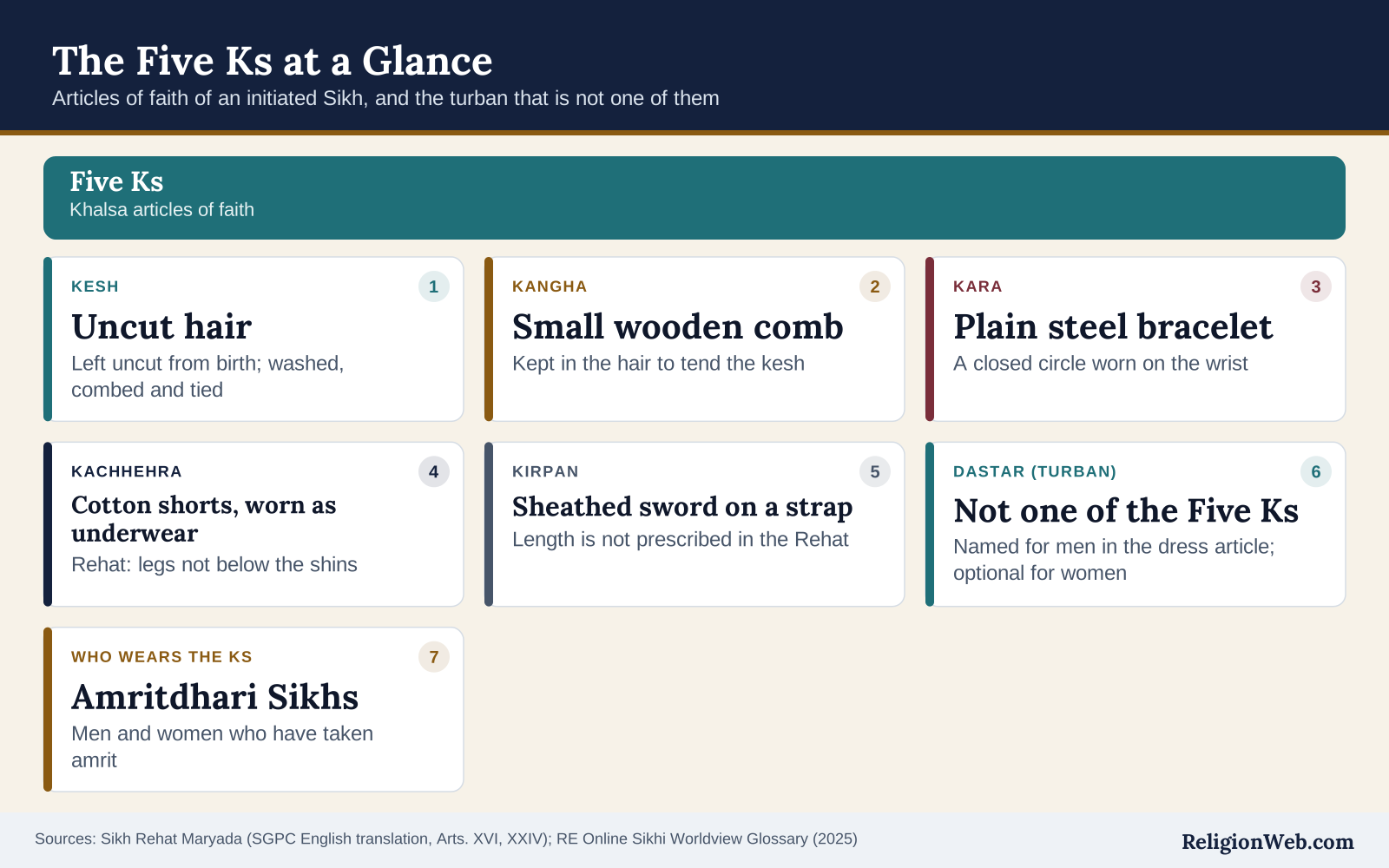
The Five Ks at a Glance
What the Five Ks Are
A working definition
The Sikh Rehat Maryada, the code of conduct issued by the Shiromani Gurdwara Parbandhak Committee (SGPC) in Amritsar and described as authorized by the Akal Takht, the seat of supreme temporal authority for Sikhs, places the Five Ks in its article on initiation. It says that the person receiving amrit must wear all five, naming them as uncut hair, a strapped sword, the prescribed shorts, a comb and a steel bracelet, and the same article later says that those who have been initiated must always wear them. In other words, the Five Ks are the visible rule of life of an Amritdhari Sikh, a member of the Khalsa who has taken amrit, and they are not a general dress code for all who identify as Sikh.
The reason the Ks are called articles of faith rather than accessories is that Sikh teaching connects each one to a quality the initiated person is meant to cultivate. Hair is a sign of accepting the form in which God made the person; the comb stands for order and cleanliness; the bracelet for restraint and a commitment that has no end; the undergarment for self-control; the sword for dignity and the duty to protect others. These are the meanings most often given in Sikh educational material, such as the glossary prepared for teachers of religious education in the United Kingdom, and later sections explain them one at a time. The Ks are never described as magical objects or as the source of virtue in themselves. They are reminders worn on the body, and a Sikh is expected to supply the discipline they point to.
It also helps to know what the Ks are not. They are not the Five Pillars of any other tradition, and they are not a list of commandments in the sense of a decalogue. They are a set of external disciplines that came to be grouped together, and the grouping has a history. The practical center of Sikh religious life remains the remembrance of God’s name, honest work and sharing with others, which Guru Nanak taught well before the Khalsa existed. The Ks give that inner life an outward form for those who choose the Khalsa path. The article on Guru Nanak describes the earlier teaching in more detail.
| Article | Gurmukhi | What it is | Meaning most often given |
|---|---|---|---|
| Kesh (kes) | ਕੇਸ | Hair left uncut from birth, on the head and the body | Acceptance of God’s design; freedom from fashion; respect for the body |
| Kangha | ਕੰਘਾ | A small wooden comb, usually kept in the hair | Cleanliness, order and care of the hair |
| Kara | ਕੜਾ | A plain steel bracelet worn on the wrist | Commitment without beginning or end; restraint in action |
| Kachhehra (kachera) | ਕਛਹਿਰਾ | Cotton shorts worn as an undergarment | Modesty, self-control and readiness for action |
| Kirpan | ਕਿਰਪਾਨ | A sheathed sword or blade, carried on a strap | Dignity, compassion and the duty to protect the vulnerable |
Names, spellings and what the words mean
English writing on the Five Ks shows a great deal of spelling variation, and a reader who meets “kachera,” “kachha,” “kacchera” and “kachhehra” in different sources is looking at the same garment. The variation comes from the fact that Gurmukhi is a different script from the Latin alphabet, and that Punjabi vowels and the aspirated “chh” sound can be rendered in several ways. The SGPC’s English translation of the Rehat Maryada writes Kesh, Kirpan, Kachhehra, Kanga and Karha in one place and Kangha elsewhere, while educational glossaries write Kesh or Kes, Kangha or Kanga, Kara or Kada, and Kachera or Kaccha. This article uses kesh, kangha, kara, kachhehra and kirpan, and notes variants where it helps a search or a citation.
The collective names are also worth knowing. Panj means “five” in Punjabi, and kakar or kakke refers to the letter K. The phrase is therefore a plain description, “the five K-things.” A second set of terms comes from the founding event. The first five initiates are remembered as the Panj Pyare, “the five beloved ones,” and the community they began is the Khalsa, a word that Sikh educational sources translate as “pure.” The code of discipline for the Khalsa is the rahit, and its modern written form is the Rehat Maryada, which is sometimes spelled Rahit Maryada or Reht Maryada. Learning these few terms makes it much easier to read Sikh sources, and the table below gathers them with the Gurmukhi forms.
| Term | Gurmukhi | Common variants | Meaning |
|---|---|---|---|
| Panj kakar | ਪੰਜ ਕਕਾਰ | Panj kakke, five Ks | The five articles of faith whose names begin with K |
| Khalsa | ਖ਼ਾਲਸਾ | Khalsa Panth | The community of initiated Sikhs; the name means “pure” |
| Amrit | ਅੰਮ੍ਰਿਤ | Amrita | Sanctified water and sugar used in the initiation |
| Panj Pyare | ਪੰਜ ਪਿਆਰੇ | Panj Piare, Five Beloved Ones | The five who administer amrit; also the first five initiates in 1699 |
| Rahit Maryada | ਰਹਿਤ ਮਰਯਾਦਾ | Rehat Maryada, Reht Maryada | The code of conduct and ceremony issued by the SGPC |
| Dastar | ਦਸਤਾਰ | Dastaar, turban | The turban, which is related to the Ks but is not among them |
Who Wears the Five Ks
Amritdhari Sikhs and the Khalsa
The people for whom the Five Ks are required are Amritdhari Sikhs, a Punjabi term meaning “those who hold amrit.” The Rehat Maryada states who may take amrit in generous terms: any man or woman, of any country, religion or caste, who embraces Sikhism and accepts its principles. It asks only that the person be past early childhood and have reached a reasonable degree of discretion, and it does not set a fixed age. The initiation is therefore open to both genders, to adults and to older children who can understand the commitment, and to people who were not born into Sikh families.
Once the person takes amrit, the Rehat Maryada treats the Five Ks as a permanent part of life. The initiate is expected to wear all five at all times, and the code treats this as a standing obligation, not as a matter of style. The same code adds four prohibitions that accompany the Ks, which are discussed in the section on initiation. Taken together, the articles and the prohibitions make the Khalsa discipline distinctive among Sikhs: it is a daily regime of the body as well as of belief, and the expectation of it is the reason why many Sikhs choose to wait until adulthood before taking amrit.
Sikhs who keep some of the Ks or none
Most people who identify as Sikh in the wider sense have not taken amrit. The Rehat Maryada’s own definition of a Sikh, in its first article, lists belief in one immortal being, belief in the ten Gurus, from Guru Nanak to Guru Gobind Singh, belief in the Guru Granth Sahib, belief in the teachings of the ten Gurus, and belief in the initiation bequeathed by the tenth Guru, together with not owing allegiance to any other religion. It does not mention uncut hair or any other article of faith in that definition. So a Sikh who does not wear the Five Ks is still a Sikh by the code’s own terms, though the same code holds that a fully committed Sikh will eventually take amrit.
Observed practice varies widely. Pew Research Center’s face-to-face survey of Indian adults, conducted between November 2019 and March 2020 and including 1,782 Sikh respondents, found that 76 percent of Sikhs said they keep their hair long, and 67 percent said it was very important to them that children in their families do so. Pew’s published findings on this point concern hair; they do not give comparable figures for the kara, the kirpan or the other articles. Even so, the figure for hair suggests that the practice reaches well beyond the small share of Sikhs who are formally Amritdhari. Sikhs in the diaspora, in the United Kingdom, Canada, the United States and elsewhere, show a similar spread of practice, from fully initiated families to those who observe a few of the articles or none.
Origins and Historical Development of the Five Ks
The Founding of the Khalsa in Sikh Tradition
Vaisakhi 1699 and the Five Beloved Ones
In the account held by Sikh institutions, the Five Ks were given to the Sikh community by Guru Gobind Singh, the tenth Guru, when he founded the Khalsa at Anandpur Sahib in Punjab on the day of Vaisakhi in 1699. Accounts differ on how that day is placed in the modern calendar, and the details, including the festival that commemorates it, are covered in the article on Vaisakhi. The tradition holds that the Guru asked for five volunteers willing to give their heads for the faith, that five men came forward one after another, and that he then prepared amrit by stirring water and sugar crystals with a double-edged sword while verses were recited.
The five volunteers became the first Panj Pyare, and in the traditional account the Guru then asked to receive amrit from them, making the founder a disciple of his own community. The Sikh educational glossary used in United Kingdom classrooms describes the Panj Pyare as the five men who offered their lives on 14 April 1699, and the names remembered in Sikh sources are Daya Singh, Dharam Singh, Himmat Singh, Mohkam Singh and Sahib Singh. Sikh tradition stresses that they came from different regions and social backgrounds, a detail that gives the Khalsa its egalitarian meaning. Readers should note that the early narratives of the event are later than 1699 and that historians differ about their details, so the account above is best read as the community’s own foundational memory.
Why the Guru’s gift is called the Khalsa
The word Khalsa is usually translated as “pure,” and in Sikh usage it names both the order of the initiated and, in a wider sense, the Sikh community as a whole. The name carries the idea that the initiated person belongs directly to the Guru and is no longer defined by earlier caste, lineage or family religion. The Rehat Maryada says as much when it describes initiates as born into the Guru’s household, with Guru Gobind Singh as their spiritual father and Mata Sahib Kaur as their spiritual mother, and as spiritual siblings of one another who give up previous ties of caste, lineage and religion. The shared names Singh for men and Kaur for women, which the tradition associates with the Khalsa, express the same idea of one family.
Seen in this light, the Five Ks are the Khalsa’s uniform in the sense of shared form, not in the sense of a military costume. Their purpose, as Sikh sources explain it, is to make the commitment visible to others and to remind the wearer, many times a day, of vows taken in front of the Guru Granth Sahib. A Sikh who is recognizable by hair, bracelet and turban is also a Sikh who can be asked for help, and the tradition has long drawn from this a duty of service, which is discussed in the later sections on daily life.
How Historians Trace the List
Rahit-namas and the slow formation of a code
Scholars of Sikh history approach the origin of the Five Ks by asking when the five items first appear together as a set. W. H. McLeod, the historian who spent decades on the question, studied the eighteenth- and nineteenth-century rahit-namas, the manuals of Sikh conduct, and concluded that they show several ways of understanding Sikh history instead of one. In an essay on the Tat Khalsa, the reforming wing of the Singh Sabha movement, he argued that the Tat Khalsa held that Guru Gobind Singh required all Khalsa Sikhs to observe the five Ks, but that the evidence does not support the claim; on his reading, only kes, kirpan and kachh were evidently specified, and the full list of five appears in the Rahit only from the late nineteenth century.
A more recent study reaches a related conclusion by a different route. Parminder Singh Kairo’s 2015 master’s thesis at the University of Birmingham, “The evolution of the five Ks within Sikh texts,” challenges the common view that Guru Gobind Singh first introduced the Five Ks in 1699 and argues that the convention developed over about three centuries and was consolidated in the Singh Sabha reform movement of the nineteenth century.
These findings are scholarly interpretation and do not displace the Sikh institutional account. For Sikhs who hold that the Guru instituted the Khalsa discipline in 1699, the question of when a numbered list was formally fixed does not touch the authority of the practice, much as the question of when a creed was first written does not decide the belief behind it in other traditions. The two views answer different questions: the community’s memory says why the articles exist, while historians describe how a loose set of practices became a standard list. A responsible reading holds both.
The Singh Sabha reformers and the Sikh Rehat Maryada
The Singh Sabha movement, which began in the 1870s, responded to the pressures of colonial Punjab, including missionary activity and the weakening of Sikh institutions after the fall of the Sikh kingdom. Its radical wing, the Tat Khalsa, whose Lahore branch was founded in 1879 according to McLeod, argued that Sikhs were a distinct community with a distinct identity, and it gave the Five Ks a central role in defining who was fully a member of the Khalsa. Kahn Singh Nabha’s booklet Hum Hindu Nahin (“We are not Hindus”) became its rallying text. Some Sikhs hold that this chapter clarified a standard that had always been intended, and some historians see it as the point at which the standard was fixed.
The reformers’ work led to the twentieth-century effort to produce one agreed code. The Gurdwara reform movement created the SGPC in 1920, and over the following decades a committee-based process produced the Sikh Rehat Maryada, which McLeod dates in its published form to 1950. The code still serves as the main written reference for the Five Ks, the initiation ceremony and the four prohibitions, and the SGPC’s English translation is the version cited in this article. Even so, some groups within the Sikh world, including certain orders and sects, follow their own rahit-namas or place different emphasis on particular articles, a diversity covered in a later section.
A Short Chronology of the Five Ks
From the Gurus to the Khalsa
The chronology below mixes events that Sikh tradition dates firmly with developments that historians have reconstructed more tentatively, and the wording of each row says which is which. Dates for the early Gurus are traditional ones, while the dates for the Singh Sabha, the SGPC and legal cases are documented in modern records. The point of the table is to show the shape of the history: a founding moment remembered by the community, a long period of practice, a nineteenth-century consolidation and a twentieth-century written code, followed by legal and social questions about how the Ks are worn in public.
| Period | Development | Basis |
|---|---|---|
| Late 15th to early 16th century | Guru Nanak teaches in Punjab; the early Sikh community forms around his hymns and the practice of remembering God’s name | Sikh tradition and historical scholarship |
| 1699, Vaisakhi | Guru Gobind Singh founds the Khalsa at Anandpur Sahib with the Panj Pyare and amrit | Sikh tradition; accounts written later |
| 18th to 19th centuries | Rahit-namas record codes of conduct; kes, the sword and the undergarment feature prominently | McLeod and other historians |
| 1870s to 1900s | Singh Sabha reformers, including the Tat Khalsa, standardize the Five Ks as the mark of the Khalsa | McLeod; Kairo (2015) |
| 1920 | The SGPC is founded to manage Sikh shrines and later oversees the Rehat Maryada | SGPC history |
| 1950 | The Sikh Rehat Maryada is published in its modern form | McLeod (date of the published text) |
| 1983 onward | Courts in several countries begin to address the turban, kara and kirpan | Case law, discussed below |
From colonial Punjab to the present
After the Rehat Maryada was issued, the Five Ks became more widely known outside Punjab through the movement of Sikhs to Britain, North America, East Africa and Southeast Asia. In these new settings the Ks were no longer largely private matters within a Sikh majority region; they met workplace dress rules, school uniform policies, security regulations and public curiosity. Each of the later sections on law and public life reflects this: the questions arose because Sikhs kept the articles in places that had not planned for them. The same history explains why discussions of the Ks today often combine religious explanation with practical advice, since a Sikh family may need to think about both at once.
At the same time, the diaspora has also been a place of renewal. Many younger Sikhs describe taking amrit as an informed choice made in adulthood, supported by gurdwara study groups and by the availability of English translations of the Rehat Maryada and scripture. The text is not static; it is read, debated and applied in new settings, and Sikh scholars continue to ask how best to explain each article to people who did not grow up with it.
Kesh: Uncut Hair as the First K
What Kesh Is and What the Rehat Maryada Says
Hair left as it grows
Kesh (also written kes, Gurmukhi ਕੇਸ) is the hair of the head and body, left uncut from birth. In the Rehat Maryada the first of the four prohibitions that bind an initiated Sikh is, in paraphrase, dishonoring the hair, and the usual understanding of that phrase among Sikhs is that hair is not cut, shaved or removed anywhere on the body, including the beard for men. A separate article on daily conduct adds that a Sikh should not harbor any antipathy toward the hair a child is born with and should keep the hair of sons and daughters intact. The Rehat Maryada therefore presents kesh both as a personal commitment of the initiated and as a family practice that begins in childhood.
Kesh is also the first K in the list and, for most observers, the most basic one. McLeod, whose view was discussed above, held that hair, along with the sword and the undergarment, belongs to the items evidently specified for the Khalsa itself, while the comb and bracelet were added to the list later. In Sikh devotion the hair is also closely associated with the Gurus’ own appearance, which Sikh paintings and narratives show with long hair under a turban, so for many Sikhs keeping kesh is a way of resembling the Gurus as well as obeying a rule.
A practical point deserves clarity: the rule concerns cutting, not grooming. Kesh is washed, combed, oiled by some families and tied up in a way that keeps it clean, and Sikh teaching treats the care of hair as part of the discipline of the body, not as a form of vanity. What is set aside is the fashion of cutting, dyeing or styling hair for the sake of appearance, which the Rehat Maryada lists elsewhere when it mentions dyeing the beard among conduct that brings automatic boycott for an initiated Sikh.
Hair in the Punjab of the Gurus
It helps to picture the setting in which Guru Nanak and his successors taught. Punjab in the fifteenth and sixteenth centuries was home to Hindu and Muslim communities as well as to many ascetics. Among them were yogis of the Nath tradition and other Shaiva renunciants, some of whom wore matted hair as a sign of renunciation. Guru Nanak met and debated such ascetics, according to the Sikh narratives, and the teaching that he gave, preserved in the Guru Granth Sahib, held that a person could live fully in the world, raise a family and earn an honest living while remaining devoted to God. Readers who want more about the background of these ascetic movements can turn to the articles on Hinduism and Shaivism, and to the article on Islam for the history of the region’s Muslim communities.
Because of this setting, Sikh authors often stress that uncut hair in the Khalsa is not the hair of a renunciant. It belongs to a householder, a worker, a parent and a soldier, and it is kept neat and covered. Historians are more cautious than devotional writers about the earliest period, since the sources for the first Gurus are limited and the Five Ks were not yet a set. Even so, McLeod’s view that kes was among the items evidently specified for the Khalsa is consistent with the tradition that long hair was a mark of the community from the time of Guru Gobind Singh onward.
Care and Meaning of Kesh
Daily care: washing, combing and tying
For an observant Sikh the care of kesh follows a regular pattern. The hair is washed as part of bathing, which the Rehat Maryada also requires of anyone about to receive amrit, who must bathe and wash their hair beforehand. After washing, the hair is combed with the kangha, then gathered and tied. Many Sikh men and women tie it into a topknot called a joora, which is then covered by a turban or a smaller head covering, and the comb is kept in the knot. Beards are combed and either left loose or tied up or set under the chin with a light net or cloth. The routine takes a few minutes and is part of the morning that precedes prayer.
Children’s hair is often braided or tied in a small knot covered by a patka, a small cloth head covering, until the child is old enough to tie a full turban. In many families the first tying of a turban is a family occasion, a point of passage in which relatives gather and give the young person a first turban. This is a custom and varies from family to family and region to region; it is not prescribed in the Rehat Maryada, which says only that parents should keep their children’s hair intact.
Meanings Sikhs give to uncut hair
The meanings given to kesh are several, and they are best presented as the explanations Sikhs themselves offer. The most common is that hair is part of the form in which God made the person, and that keeping it uncut expresses acceptance of God’s will, which the Guru Granth Sahib calls the hukam. A second is freedom from fashion: the educational glossary for British schools says that kesh stands for freedom from worldly fashion and respect for the body. A third is identity and belonging, which many reference works give as a core meaning, since long hair under a turban or keski makes a Sikh recognizable and so answerable for how they behave. A fourth is the ideal of the saint-soldier, the figure who combines spiritual devotion with a readiness to protect others, for which the Gurus and the first Khalsa serve as models.
Some modern explainers add physiological arguments, such as the claim that hair channels energy to the body. These statements are not found in the Rehat Maryada and are not part of the doctrinal teaching, and the Sikh institutional sources consulted for this article do not make them. A reader should treat them as individual opinions within the community. Similarly, no Sikh authority presents kesh as a substitute for care of the body: when hospitals require hair to be shaved for a surgical procedure, Sikh patients and families generally ask first whether it can be avoided and decide what to do in consultation with doctors and, often, with a gurdwara committee or a respected elder. Religious practice does not replace medical advice, and the choice in each case rests with the patient and their family.
In practical terms, then, kesh functions as a continuous reminder that is also a public commitment. It is the K that is most often compromised in pressured settings, such as school or the workplace, and for that reason many Sikh families treat the decision to keep hair uncut as one to be made with the child’s understanding, not imposed without explanation. That sense of choice is part of how the tradition explains why the Ks matter at all.
Kangha, Kara and Kachhehra: Comb, Bracelet and Garment
Kangha: The Comb
Form and use of the kangha
The kangha (Gurmukhi ਕੰਘਾ, also kanga) is a small comb, traditionally of wood, kept in the hair and worn at all times. The comb is placed in the joora, or topknot, under the turban, so it is seldom visible. Many Sikhs carry a second, larger comb for daily grooming and keep the small one as the article of faith. The Rehat Maryada lists the comb among the five items the initiate wears, and it is one of the simplest of the Ks, since it requires no special manufacture beyond a durable, fine-toothed comb that can be used on long hair.
The use of a comb shows how the Ks work together. A person who keeps uncut hair needs a comb in order to keep it clean and ordered, so the second K serves the first. Sikh sources describe combing as a morning and evening routine, though the Rehat Maryada itself, as consulted for this article, does not set a number, and families follow their own rhythm. Because the small comb stays in the hair, it is also a quiet sign that the wearer has taken amrit, even when the wearer’s turban looks like any other.
Meanings given to the comb
The usual explanation is that the kangha stands for cleanliness and for the order that comes with discipline. The glossary used in British religious education says that it represents social responsibilities such as cleanliness, a way of saying that the care of the body is also care of the community. A related explanation contrasts a tidy mind with a tangled one, and says that combing the hair each day is a small daily act of attention. Sikh writers who make this point generally do so as an analogy and not as a doctrine, and the comb carries no ritual function of its own.
The comb also guards against a misunderstanding about uncut hair. If hair is left uncut, the possibility arises that it is neglected, and the comb answers this by making grooming part of the faith. In that sense the kangha is the K that most clearly shows that the Khalsa discipline is not asceticism: it asks for order and self-respect in the same breath as it asks for restraint.
Kara: The Steel Bracelet
Form and how the kara is worn
The kara (Gurmukhi ਕੜਾ, also kada and, in the SGPC’s English translation of the Rehat Maryada, karha) is a plain bracelet, a closed ring of steel worn on the wrist. The Rehat Maryada fixes the metal.
The Karha should be of pure steel.
Sikh Rehat Maryada, SGPC English translation, Article XXIV
Beyond the metal the text sets no rules, so the width and finish vary: some karas are thin and smooth, others are broad, and some have cut patterns or a flat face. In a 2008 English High Court judgment described below, the bracelet is characterized as a plain steel bangle usually worn on the right wrist, and that matches common practice, although the wrist chosen varies, and some Sikhs wear it on the hand with which they work. Because the kara is a closed circle with no clasp, it is put on once and stays on. Sikh families usually obtain a first kara for a child at an early age, and the decision to wear one is often the first step toward the other articles.
Meanings given to the kara
The circle of the kara has two strands of meaning in Sikh explanation. The first is theological: a circle has no beginning and no end, and the educational glossary says the kara represents God’s infinite, eternal presence. The judgment in the Watkins-Singh case, which records the claimant’s own account of the bangle, says that its circular shape is understood to symbolize God’s infinity and a bond with God. The second is ethical: the bracelet sits on the wrist near the hand, and so is a reminder to act honestly and with restraint, since hands do the work of the day. Sikh writers describe it as a chain that binds the wearer to the Guru and to the community, a reading in which the Guru’s discipline is not felt as confinement but as a bond of belonging.
The kara is also the K that people most commonly adopt without being initiated. Many Sikh children and adults who have not taken amrit wear a kara as a mark of identity, and Sikh teachers generally ask that it be understood as a religious article and not as jewelry. The kara’s legal career is covered later in the discussion of schools, since it was the subject of a notable English decision.
Kachhehra: The Undergarment
What the Rehat Maryada describes
The kachhehra (Gurmukhi ਕਛਹਿਰਾ, also spelled kachera, kacchera or kachha) is a pair of shorts worn as an undergarment. The SGPC’s translation of the Rehat Maryada names it among the five articles and adds one specification, that its legs should not reach down below the shins. In its article on daily conduct, the Rehat Maryada says that a Sikh has no restriction or requirement as to dress except the kachhehra, with a turban named in addition for men, and the same passage describes the garment as underwear fastened at the waist with a string. It is traditionally made of cotton and cut loose with short legs, and many Sikhs wear one at all times beneath their other clothes.
Because the garment is private, it is the K that is least visible and the least discussed in public. It is also the K that least often causes problems with employers or schools, since nothing needs to be shown or accommodated. The practical rule in many households is that the kachhehra is changed with care, so that the person is not left without one, a custom taught to children in many families but not stated in the Rehat Maryada, which is why it is described here as family practice and not as a requirement.
Meanings and customs of the kachhehra
The most common explanation is that the kachhehra stands for modesty and self-control, and the glossary used in British schools gives modesty and purity as its meaning. A second explanation, widely given in Sikh books, is that it was suited to a warrior community, since a short garment allows free movement on foot and horseback. Sikh authors who give this account present it as historical context, and it should be read as the community’s explanation, not as a documented origin. A third strand concerns chastity: the Rehat Maryada’s prohibition on sexual relations outside marriage is one of the four prohibitions for the initiated, and Sikh teachers frequently link the garment to that discipline.
The kachhehra also illustrates a general principle in the way Sikh teaching speaks of the Ks. Each is a physical object, but each points past itself to a habit of character. A Sikh teacher might say that the comb teaches order, the bracelet teaches restraint and the garment teaches self-command, and that the three together prepare the person to bear the fifth K, the sword, with the responsibility it demands.
Kirpan: The Sword of Dignity and Duty
Form, Size and Carrying
A strapped sword with no fixed length
The kirpan (Gurmukhi ਕਿਰਪਾਨ) is a sheathed sword or blade carried by an initiated Sikh. The Rehat Maryada, in listing the five articles the initiate must wear, describes it as strapped, a reference to the cloth strap called a gatra that holds the sheath, and it speaks directly to the question of size.
The length of the sword to be worn is not prescribed.
Sikh Rehat Maryada, SGPC English translation, Article XXIV
This single sentence explains why kirpans in the world look so different from one another. Some are a few inches long and sit in a small sheath under the clothing, some are ceremonial blades of a foot or more, and some are larger swords carried by particular orders. The text asks that a kirpan be worn and that it be a real sword, but it leaves the length to the wearer and the circumstances. The educational glossary for British schools describes the usual form as a small sheathed sword worn diagonally across the torso, which refers to the strap that crosses the body from shoulder to hip, though many Sikhs wear it at the waist or under a shirt.
The kirpan is also known by the honorific Sri Sahib, and in some regions, especially among Nihang Singhs, a traditional warrior order, larger weapons appear in processions and at festivals. These are variations of practice and not of doctrine. In the sources used for this article, the Rehat Maryada’s wording on the kirpan is the same for every initiate, and decisions about the size to carry in daily life are left to the individual, often with attention to the rules of the place where the person lives or works.
Small kirpans, lockets and the question of “symbolic” forms
Because strict rules about weapons exist in many countries, Sikhs have developed a number of practical forms. A short kirpan with a blunted or sheathed blade may be worn under clothing, and a very small kirpan can be set in a comb or hung as a locket or pendant. Educational material from Sikh organizations explains that where carrying a full sword is illegal, a small symbolic kirpan may be worn instead. A Sikh legal advocacy group’s guidance for travelers says the same in a different register: it advises that small kirpan lockets are less likely to be classified as weapons, while stating that officials keep discretion at inspection.
Within the community, views differ about how far such adaptations satisfy the requirement. Some Sikhs hold that a small blade is a kirpan in full measure, since the Rehat Maryada fixes no length; others regard a locket or a tiny symbolic form as an accommodation made for circumstances and hope that the full article can be worn again in time. These are internal conversations about balancing religious duty with civic law, and they are conducted respectfully. The legal side of the question is taken up in the section on law and public life.
Meaning and Ethics of the Kirpan
Kirpa and aan: mercy and honor
Sikh explanation of the word kirpan commonly divides it in two. Kirpa means kindness or grace, and aan means honor or dignity, so the kirpan is read as an emblem of compassion joined to self-respect. The educational glossary translates the name as “sword of mercy,” which reflects the same reading. Linguists observe that the word has an older Sanskrit relative meaning sword, so the division into kirpa and aan is best understood as a devotional analysis that has become standard in Sikh teaching, not as a technical etymology. The two ideas it combines are central to the way the tradition speaks of the Ks: the sword is a symbol of strength that is placed in the service of mercy.
That reading explains an important feature of Sikh teaching about the kirpan. The article is not meant to threaten anyone and is not drawn for ordinary quarrels. A Sikh educational site describes it as a last resort, to be used to protect honor or those who cannot protect themselves, and the Sikh organizations that advise travelers and students stress that the kirpan stays sheathed. The glossary used in religious education gives the duty it reminds the wearer of as the duty to the community, to protect the vulnerable and to resist injustice.
The saint-soldier and the duty to protect
The sword has a place in Sikh history that goes back before the Khalsa. Sikh tradition holds that Guru Hargobind, the sixth Guru, wore two swords, one representing spiritual authority and one representing temporal authority, a pairing called miri and piri. The tradition of the Khalsa under Guru Gobind Singh continued the idea that a devout Sikh can also be a defender of others, a figure often called the saint-soldier. The kirpan is the daily emblem of that idea, carried by people who are, in nearly all cases, teachers, shopkeepers, engineers, nurses and farmers, living lives in which the sword never leaves its sheath.
It is worth saying plainly that the saint-soldier ideal is a moral one, with its own conditions. Sikh teaching does not treat the sword as a license to settle disputes or as a symbol of aggression against any community; it treats it as a reminder that those with strength owe protection to those without, and that restraint is part of strength. Historians and Sikh writers both emphasize that the Khalsa arose in a period of conflict with the Mughal state and hill rulers, and that the idea of defense grew from that setting. At the same time they emphasize that the Gurus’ hymns and the Rehat Maryada give Sikh practice its center in devotion, honest work and service, and that the kirpan has to be read within that frame.
The Kirpan in Daily Practice
Handling, respect and restraint
Among observant Sikhs, the kirpan is handled with respect. It is not a toy and not an object to be shown off, and it is generally not drawn from the sheath in public. Parents who teach children about the article usually begin with its meaning, and give a child a small kirpan only when the child understands why it is worn. An initiated Sikh wears the kirpan to the gurdwara, to work, to travel and to bed, in the same way as the other four articles, and removes it only when circumstances require, such as when a legal rule or a medical procedure forces the issue, in which case many Sikhs look for an accommodation that lets them wear it again.
Wearing the kirpan also places a particular responsibility on its owner. Because the article attracts attention, Sikhs often say that it makes them ambassadors of their community, and many describe feeling a heightened duty to behave with calm and courtesy. This sense of responsibility is probably the best answer to the common question of why a religion that emphasizes peace asks its initiates to carry a blade: the answer is that the sword is a reminder of obligations, and the Sikh ethic places those obligations firmly within a framework of mercy and protection.
How the five articles work together
Taken together, the Five Ks cover the body from head to hip to hand. Kesh and kangha concern the head, kara the wrist, kachhehra the lower body and kirpan the side. This is a convenient way to remember them, though Sikh teachers more often explain them as a discipline: the hair and comb ask for acceptance and order, the bracelet and garment ask for restraint, and the sword asks for courage in service of others. No one article is complete without the rest, and an initiated Sikh who wears all five is understood to carry a small, portable summary of the Khalsa’s values everywhere.
The way the Ks combine also explains why initiation is a serious step, since an initiate takes on all five at once and promises to keep them. The next sections look at how the tradition prepares for that step and at the turban, the item that often sits next to the Ks in discussion but is not one of them.
Khalsa Initiation: Taking Amrit and Receiving the Five Ks
The Amrit Ceremony
Setting, participants and preparation
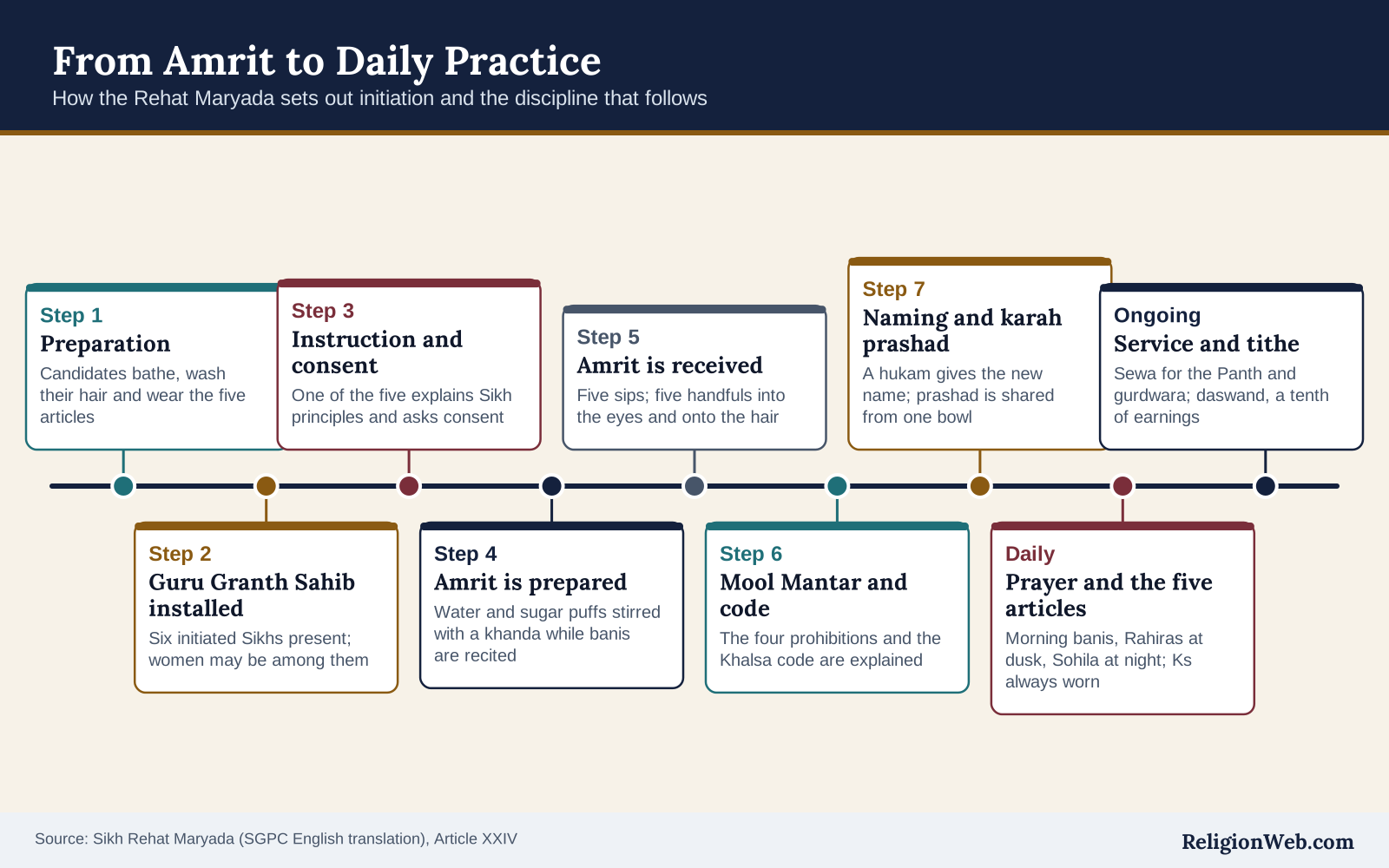
The ceremony by which a Sikh joins the Khalsa is called Amrit Sanskar in Punjabi, and the Rehat Maryada describes it in its article on initiation. The setting is a place away from ordinary traffic, where the Guru Granth Sahib is installed and opened. Six initiated Sikhs are present: one attends the scripture, and five, the Panj Pyare, administer the amrit. Each of those who is to receive amrit must have bathed and washed their hair, and each stands before the Guru Granth Sahib with hands folded, wearing all five articles. The text adds that candidates must not have the head bare or wear a cap, must not wear ornaments that pierce the body, and must not carry a token of another faith. Only people who are present for the whole ceremony can take part in it, and someone who arrives after it has begun cannot be initiated that day.
The Rehat Maryada also states that those who administer amrit should be initiated Sikhs of good standing who have not broken Sikh discipline. The code also sets out personal qualifications for the five, which this article does not reproduce in full. Before the ceremony begins, one of the five explains the principles of Sikhism to the candidates, including devotion to the One Creator and the rejection of the worship of created things, and asks whether they accept willingly. Only after they say yes does the preparation of amrit start. The emphasis on consent is important: the ceremony is understood as a free commitment, made by a person old enough to understand it, and not as an inheritance.
Preparing and receiving amrit
The amrit is prepared in a bowl of pure steel set on a clean support. Clean water and sugar puffs, called patashas, are placed in the bowl, and the five sit around it and recite the compositions the Rehat Maryada prescribes: the Japuji, the Jaap, the Ten Sawayyas, a portion of the Bainti Chaupai and the Anand Sahib. While one recites, the others hold the bowl, and the reciter stirs the water with a double-edged sword, the khanda, held in the right hand while the left hand steadies the bowl. The khanda that stirs the amrit gives the Khalsa its emblem, the double-edged sword set within a circle and flanked by two curved swords, which is found on the Sikh flag and on many gurdwara signs.
After a prayer of supplication, the Ardas, each candidate sits upright, with the right hand cupped over the left, and drinks the amrit five times from the cupped hands. With each portion the administering Sikh calls out a greeting, and the candidate repeats it: “Waheguru ji ka Khalsa, Waheguru ji ki Fateh,” which can be translated, in paraphrase, as the Khalsa belonging to God and victory belonging to God. Five handfuls of amrit are then sprinkled into the candidate’s eyes and five onto the hair, with the same greeting. Any amrit that remains is drunk together by all the new initiates, out of a single bowl, a gesture that expresses the equality the Khalsa claims. The Mool Mantar, the opening statement of the Guru Granth Sahib, is then recited by the five and repeated aloud by the initiates.
Instruction, naming and karah prashad
The ceremony does not end with drinking. One of the five then explains the Khalsa discipline, and the Rehat Maryada says that initiates are to be regarded as reborn into the Guru’s household, as the children of Guru Gobind Singh and Mata Sahib Kaur, and as brothers and sisters of one another and of all initiated Sikhs. It adds that they give up their former ties of caste, lineage and religion and worship the One Timeless Being alone. Among the practices set out here are recitation of the daily compositions, the study of Gurmukhi, service to the community and gurdwara, and the giving of a tenth of earnings, known as daswand.
The code also gives a procedure for naming. A hukam, a passage from the Guru Granth Sahib, is taken, and those who have not already received a name in a Sikh naming ceremony take a new name beginning with the first letter of that passage. In practice, Khalsa Sikhs add Singh, meaning lion, to men’s names and Kaur, meaning princess, to women’s. McLeod notes that the use of Kaur for all Sikh women became a standard feature of naming ceremonies in the Rehat Maryada published in 1950. The ceremony closes with a final Ardas and the distribution of karah prashad, the sweet offering of flour, sugar and ghee, which new men and women eat from the same bowl.
| Stage | What happens | Who takes part |
|---|---|---|
| Preparation | Candidates bathe, wash their hair and wear the five articles; the Guru Granth Sahib is installed and opened | Candidates; one Sikh attending the scripture |
| Instruction and consent | One of the five explains the principles of Sikhism and asks if the candidates accept willingly | The Panj Pyare and the candidates |
| Preparing amrit | Water and sugar puffs are stirred in a steel bowl with a khanda while the five banis are recited | The five who administer |
| Receiving amrit | Five sips are drunk, five handfuls go into the eyes and five onto the hair, each with the Khalsa greeting | Each candidate in turn |
| Mool Mantar and teaching | The Mool Mantar is recited; the Khalsa code and four prohibitions are explained | The five and the new initiates |
| Naming and prashad | A hukam is taken for new names; karah prashad is shared from one bowl | All present |
The Commitments That Follow Initiation
The four prohibitions
The Rehat Maryada pairs the Five Ks with four prohibitions for the initiated. In paraphrase, they are dishonoring the hair, eating meat from an animal slaughtered by ritual means, sexual relations outside marriage, and using tobacco. The code states that if one of them is committed knowingly, the person must take amrit again, and that unintentional or unknowing breaches carry no penalty. The first prohibition is directly tied to kesh, because the Rehat Maryada’s use of “dishonoring the hair” ties the first K to a rule that can be broken, and the repetition of the pledge means that the Ks are part of a commitment that is taken seriously by the community.
The prohibition on ritually slaughtered meat is the one most often misunderstood. It is a rule of the Khalsa’s own discipline about food, set in the Rehat Maryada, and it is not a statement about the practices or the faith of any other community. Reference works note that some Sikh groups interpret the rule differently, and this article describes the code’s wording without ranking those views. Broader Sikh opinion about eating meat varies, while the community kitchen of the gurdwara, the langar, is vegetarian so that all may eat together.
Daily discipline, the tithe and service
Beyond the four prohibitions, the Rehat Maryada lists a pattern of daily life. The initiated Sikh is to recite or listen to the daily compositions, which the code names as the Japuji, the Jaap and the Ten Sawayyas, the Sodar Rahiras and the Sohila, to read or hear the Guru Granth Sahib, to learn Gurmukhi, to serve the Panth and the gurdwara, and to give a tenth of earnings. These make the Khalsa discipline a rounded one: prayer, scripture, charity and service are set beside the Five Ks as parts of one commitment. The article on the Guru Granth Sahib explains the scripture that stands at the center of these practices.
The code also asks the initiate to avoid the company of Sikhs who have cut their hair after initiation or who smoke, and it lists a number of offences for which a person is to be boycotted. These provisions show that the Rehat Maryada is a collective code with a form of discipline in the community, administered by the Panj Pyare and the congregation. They also show why Sikhs describe taking amrit as a serious decision: the commitments are lifelong, they involve the community and they cover conduct as well as dress. The text holds that someone who falls short may be restored by appearing before the congregation, accepting the penalty set by the Panj Pyare and, where the code requires it, taking amrit again.
The Turban and Its Relationship to the Five Ks
Why the Turban Is Not One of the Five Ks
What the Rehat Maryada names
The turban is the most visible sign of Sikh identity, and it is easy to see why many people assume it is one of the Five Ks. It is worn by the great majority of Sikh men who keep their hair, by many Sikh women, and by children after a first turban-tying, and it is the item that non-Sikhs most often notice. But the Rehat Maryada’s list of articles for the initiate has five entries, and the turban is not among them. The article on initiation names uncut hair, the strapped sword, the prescribed shorts, the comb and the steel bracelet, and its only related requirement about the head is that the candidate must not have the head bare or be wearing a cap.
The turban appears elsewhere in the code, in the article on daily conduct. There the Rehat Maryada says that for a Sikh there is no restriction or requirement as to dress except that a Sikh must wear the kachhehra, and it then names a turban for Sikh men. The text adds a sentence about women.
A Sikh woman may or may not tie turban.
Sikh Rehat Maryada, SGPC English translation, Article XVI
The turban therefore belongs to the code as a matter of dress, with a clear expectation for men and a stated choice for women, while the Five Ks belong to the code as articles of faith for the initiated. The difference does not make the turban less important in practice; it means that a precise account of the Ks does not include it, and that a Sikh who wears a turban is not necessarily Amritdhari.
Dastar, patka and keski
Several Punjabi and English words cover the head coverings Sikhs wear. The dastar (Gurmukhi ਦਸਤਾਰ) is the full turban, a long piece of cotton or other cloth wound round the head, and the educational glossary describes it as a head covering worn by some Sikh men and women that helps keep the kesh tidy and is a visible sign of identity. The patka is a small cloth, often used for boys and for sports, that covers the topknot and is tied at the back. The keski is a small turban of its own, which some Sikhs, women and men alike, wear under a larger one or on its own. Some groups treat the keski as part of the discipline of the hair, so that in those groups the small turban is worn as a matter of course.
These terms matter because they explain how the turban is described by different writers. A Sikh explaining their practice may say that the dastar is a crown given by the Guru, and a historian may say that it is an item of dress that became a community marker. Both statements are compatible with the Rehat Maryada’s wording, which places the turban in the sphere of dress, close to the Ks but separate from them. Readers who see the turban called a “fifth K” or “sixth K” in popular writing should treat that as loose speech, not as a statement of Sikh doctrine.
How the Turban Protects and Presents Kesh
A covering for uncut hair
The turban’s relation to the first K is practical. Hair that is never cut becomes long, and the turban keeps it contained, clean and in order. The comb sits in the joora, the joora sits under the turban, and so the three items form a unit: the hair, the comb that tends it and the cloth that covers it. For this reason many Sikhs speak of the turban in the language of care, as the garment that protects what the Guru asked them to keep, and the daily act of tying it, which takes several minutes and is done in front of a mirror, becomes part of the morning routine described below.
The turban also serves as a public mark. A Sikh with a turban can be recognized from a distance, and Sikh organizations often say that recognition carries responsibility, since the wearer is understood to speak for the community whether or not they wish to. In a number of countries, Sikh turbans have been the subject of discrimination and of misidentification, and Sikh advocacy groups regard public understanding of what the turban is, and what it is not, as part of the protection of the community.
Women, men and the freedom to choose
The Rehat Maryada’s sentence about women is permissive, and Sikh women follow it in different ways. Some wear a full dastar every day, some wear a keski or a scarf-like covering, and some keep their hair uncovered or loosely tied. The same code states in its article on conduct that it is not proper for a Sikh woman to wear a veil or keep her face hidden, so whatever covering is chosen is not a veil in the sense of concealment. For Sikh men who keep their hair, the turban is the expected form, though some wear a patka in sport or occupational settings.
The result is that the turban has a range of meanings for different wearers: expectation for men, choice for women, a mark of discipline for Amritdhari Sikhs and a mark of heritage for others. That range is why careful writing separates it from the Ks, and why the next section moves from the articles themselves to the ceremony that binds them to a commitment.
Daily Practice: Living with the Five Ks
A Day in the Life of an Observant Sikh
Morning: bathing, tying the hair and prayer
For an Amritdhari Sikh, the day usually begins before sunrise, in the early hours that Sikh tradition calls amrit vela, the ambrosial hour, regarded as especially suited to remembering God’s name. The person bathes and washes the hair, a step that the Rehat Maryada also requires before amrit is taken, and then combs and ties the kesh, setting the kangha in the joora and winding the turban or keski. The kara and kirpan stay on the body throughout, so nothing has to be added or removed at this stage. The sequence takes perhaps twenty minutes, and for many Sikhs it is part of preparing the mind for prayer.
Prayer follows. The Rehat Maryada names the compositions that an initiated Sikh recites every day, collectively called nitnem in Sikh usage: the Japuji, the Jaap and the Ten Sawayyas in the morning, the Sodar Rahiras in the evening and the Sohila at night. Many Sikhs say them at home from a small prayer book or from memory, and many go to the gurdwara in the morning or evening to hear kirtan, the singing of hymns, and the reading of the Guru Granth Sahib. Those who have not taken amrit often keep some or all of these prayers too, so the daily rhythm is shared more widely than the Ks themselves.
Through the day: work, service and remembrance
The rest of the day is lived according to what Guru Nanak taught: remembering God’s name, earning an honest living and sharing with others. These are commonly summarized in Punjabi as naam japna, kirt karni and vand chakna. The Five Ks are the visible frame for that way of life, and Sikh families often say that a Sikh in a turban at a bus stop or a shop counter is expected to be honest and helpful because the community is judged by the individual. The article on Guru Nanak sets out these founding principles in detail.
The Rehat Maryada’s call to serve the Panth and the gurdwara shows in the Sikh practice of sewa, voluntary service, which includes cooking and serving in the langar, cleaning the gurdwara and helping in the wider community. The Ks do not alter these activities, but they sometimes make them more visible, and Sikh teachers present service as a continuation of the duty to protect and help others that the kirpan symbolizes.
| Practice | Typical timing | What it involves | Basis |
|---|---|---|---|
| Bathing and hair care | Early morning | Washing, combing with the kangha, tying the joora and winding the turban or keski | Bathing is required before amrit; the details are custom |
| Morning prayers | Before or around sunrise | Japuji, Jaap and Ten Sawayyas, recited or heard | Rehat Maryada, Article XXIV |
| Wearing the five articles | All day | Kesh, kangha, kara, kachhehra and kirpan stay on the body | Rehat Maryada, Article XXIV |
| Work, tithe and service | Throughout the day and week | Honest work, a tenth of earnings given as daswand, sewa at the gurdwara | Rehat Maryada; teaching of Guru Nanak |
| Evening prayer | At dusk | Sodar Rahiras, often at the gurdwara with kirtan | Rehat Maryada, Article XXIV |
| Night prayer | Before sleep | Sohila, followed by rest | Rehat Maryada, Article XXIV |
Looking After the Articles
Practical care of each article
The practical care of the Ks is simple but regular. Hair is washed and combed, the comb is kept clean, and the kara is worn constantly and cleaned like any metal object. The kachhehra is changed and washed as ordinary clothing, though some families teach children to take care in changing it, as noted above. The kirpan is kept in its sheath, the strap is replaced when worn, and the blade is kept clean and dry. Sikh families treat the articles with respect, and a worn or damaged article is usually replaced instead of being discarded carelessly.
These routines are among the reasons why gurdwaras and Sikh organizations in many countries publish practical guides. The guides cover questions such as how to wear a kirpan at school, what to say at an airport and how to arrange a hospital stay so that the hair and the kara can remain in place. Such guidance is local by nature, because rules differ between places, and readers should look to the relevant Sikh organization and to current local law for specifics.
Adjusting to school, work, sport and travel
Daily life introduces situations that the Rehat Maryada does not address in detail. A child who plays contact sport may wear a patka instead of a full turban. A worker who handles machinery may wear a small kirpan or arrange the sheath so that it is secure. A traveler may pack the kirpan in checked luggage and carry a small symbolic form. Sikhs describe these adjustments as ways of keeping the discipline while respecting reasonable safety rules, and they are usually made quietly and with the understanding of employers or school staff once the meaning of the articles has been explained.
The key point in such cases is explanation, not confrontation. Sikh advocacy groups generally advise that, where a rule conflicts with an article of faith, the person should explain what the article is, ask for an accommodation and seek advice from a community organization if needed. The sections on law and public life below show how that approach has played out in specific places.
Women, Children and Internal Diversity in Wearing the Five Ks
Women and the Five Ks
Equal access to amrit and to the Panj Pyare
The Rehat Maryada states the principle of equal access in plain language: any man or woman of any country, religion or caste who embraces Sikhism and accepts its principles may receive amrit. A woman who takes amrit receives the same five articles as a man, takes the same vows and is bound by the same four prohibitions. The code goes further in describing who may administer the ceremony.
These six may even include Sikh women.
Sikh Rehat Maryada, SGPC English translation, Article XXIV
The sentence refers to the six initiated Sikhs who conduct the ceremony: the five who prepare and give amrit and the one who attends the Guru Granth Sahib. The code therefore allows women to serve as Panj Pyare and does not reserve the central role of the Khalsa to men. This provision reflects a long Sikh conviction, traced to Guru Nanak’s teaching and to later Gurus, that women and men stand equally before God, and it is cited in Sikh discussions of gender as an institutional expression of that conviction. How far Sikh institutions and communities live up to it in practice, in matters such as who leads kirtan or serves in particular roles, is a topic on which Sikh women and men hold a range of views, and this article does not attempt to settle it.
Kaur, dress and individual choice
The Five Ks apply to women as they do to men, with some differences in how they are worn. The turban is a choice for women, as the Rehat Maryada’s sentence quoted earlier states, and the same code says it is not proper for a Sikh woman to veil herself or hide her face. The name Kaur, which McLeod notes became the standard form for all Sikh women in naming ceremonies after the 1950 Rehat Maryada, is a marker of this equality, since it gives every woman an equal designation in the way that Singh does for men. Some women keep the name Kaur as a surname even when they have not taken amrit, and some Sikh families give it to girls at birth.
Women wear the kara and carry the kirpan in the same ways as men, and adjustments for work or school are made by women as well. The Rehat Maryada’s wording makes clear that the turban is not reserved for men. A woman who ties a dastar is following an option available to her, and one who does not is also following the code.
Children and Young People
From the first kara to amrit
Children in Sikh families typically meet the Ks in stages. The Rehat Maryada says that parents should not cut their children’s hair, so kesh is where most children start. A patka or a small knot of hair is common for young boys, and girls’ hair is usually plaited or tied. Many children are given a kara early, and a small kirpan may be given later, with explanation. The Ks do not become obligations in the full sense until the young person takes amrit, which most Sikh families see as a decision for the young person to make, usually after some years of attending gurdwara, studying the Guru Granth Sahib and observing the household practice.
Gurdwaras in many countries run classes in Gurmukhi, kirtan and Sikh history for young people, and youth camps, which often explain the Ks in plain terms. The aim is to help children understand why the articles are worn before they are asked to commit to them. Sikh teachers sometimes say that a young person who wears the articles without understanding them is carrying only the form, and one who understands them but has not yet taken the vow is on the way to the discipline.
Why the tradition waits for understanding
The Rehat Maryada’s wording that the person receiving amrit should be past early childhood and have reached a reasonable degree of discretion expresses the principle that the initiation is a conscious choice. It sets no fixed age. In practice many Sikhs take amrit as teenagers or adults, while some do so in later life and some do not do so at all. Among families, the question of whether a teenager is ready is often discussed with the child, the family and local Sikh elders.
The point is significant for understanding how the Ks are described in public. A Sikh child with uncut hair or a kara is following family practice and the Rehat Maryada’s call to keep children’s hair intact; that child is not yet an Amritdhari Sikh and has not taken the vows of the Khalsa. The distinction is helpful for teachers, employers and officials who need to understand which articles are matters of family custom and which are matters of personal vow.
Different Sikh Paths
Amritdhari, Keshdhari and Sahajdhari Sikhs
Sikh usage distinguishes several categories of practice. Amritdhari Sikhs have taken amrit and keep all five articles. Keshdhari Sikhs keep their hair uncut and often wear a turban, but have not taken amrit. Sahajdhari Sikhs, from a word meaning “slow adopters,” identify as Sikh and follow its teachings but do not keep the visible discipline. Reference works draw these distinctions and describe the formally initiated as a minority of Sikhs, though no precise count exists. The SGPC’s definition of a Sikh in the Rehat Maryada is, as noted, a belief-based one that does not exclude any of these groups.
What these categories show is that the Five Ks sit at one end of a spectrum of Sikh practice. Some Sikhs regard the Khalsa as the fullest expression of the faith, some respect it while following a less demanding path, and some, especially in families with a long history of Sahajdhari practice, see themselves as Sikhs by devotion to the Gurus and the Guru Granth Sahib without the outward articles. The Rehat Maryada itself is not silent on the matter, since its call to take amrit is addressed to every Sikh, but its definition leaves the widest circle intact.
Groups with their own emphases
Within the Khalsa there are also communities with their own traditions. The Nihang Singhs maintain a distinctive warrior order with its own dress and larger weapons. The Akhand Kirtani Jatha, a twentieth-century movement, places emphasis on the keski and on its own rahit. Namdhari and Nirankari groups, which many Sikhs regard as separate movements, follow living teachers and have their own practices. Some groups treat the keski as part of the first K, wearing it alongside or in place of a larger turban, and interpretations of the four prohibitions differ in some groups.
These differences are best viewed as internal diversity within a common frame. They do not alter the basic list of five articles in the Rehat Maryada, and they do not make one group more or less Sikh in the eyes of the others. For a reader trying to understand the Ks, the important point is that the Rehat Maryada is the broadest shared reference, issued by the SGPC and described as authorized by the Akal Takht, and that particular groups add emphases that should be described as theirs and not as the whole of Sikh practice.
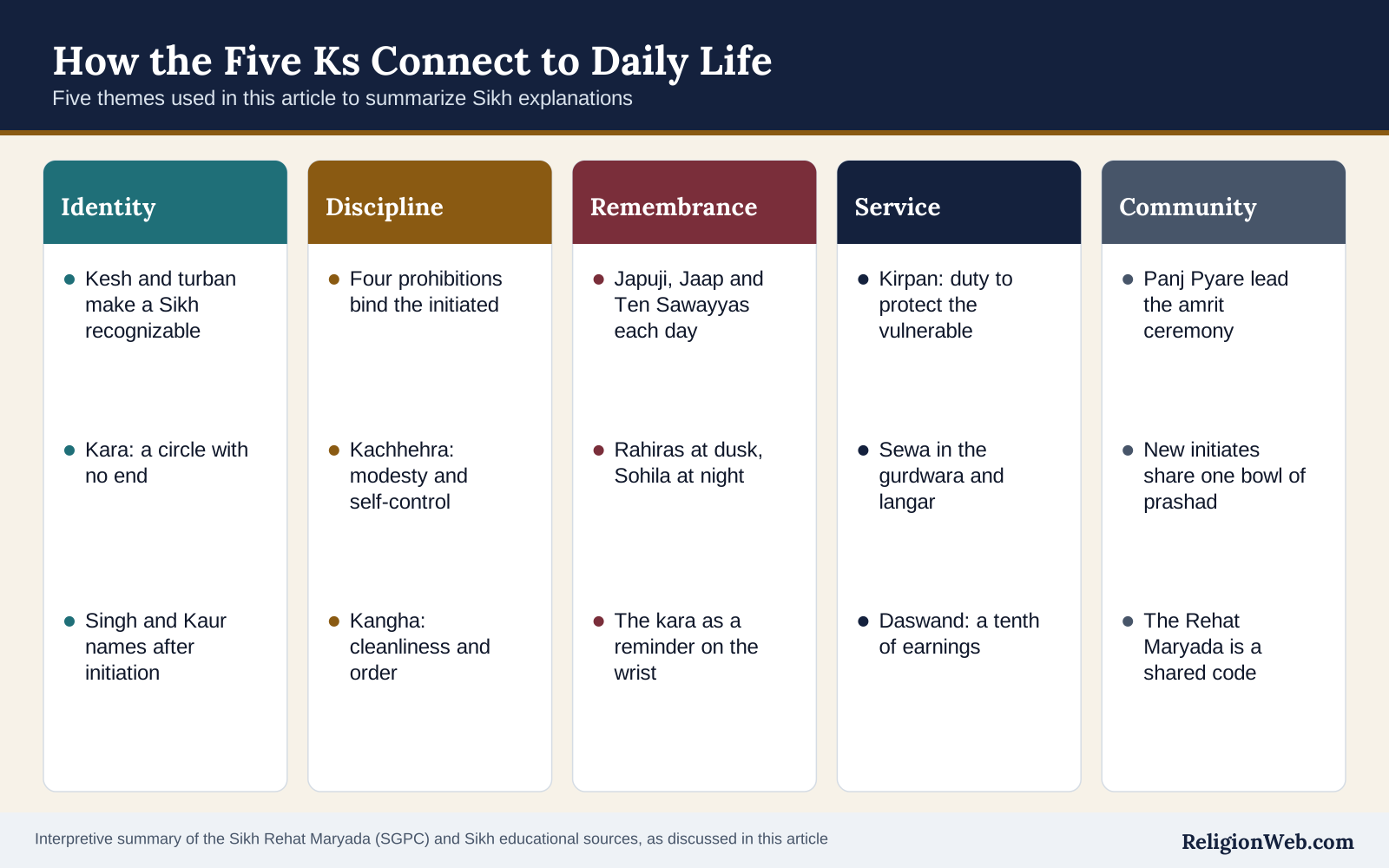
The Five Ks, the Law and Public Life
Principles of Accommodation
Why legal questions arise
Questions of law arise because the Five Ks pass through spaces governed by rules written without them in mind. A school has a uniform policy, an airport has security procedures, a courthouse has weapons rules, a workplace has safety regulations. Most of the Ks pass through these spaces without difficulty. Kesh and kangha raise questions mainly in jobs that require a particular head covering or hair standard, the kara in places with jewelry rules, and the kirpan in any setting where blades are controlled. The kachhehra, being private, raises almost none.
The usual legal reasoning has two parts. The first asks whether the article is a genuine religious practice of the person who wears it, and courts and institutions usually take the Sikh position on this point seriously. The second asks whether the rule can be adjusted with reasonable measures that meet the safety purpose, such as securing the kirpan inside clothing. The answer depends on the country and on the setting, and the examples below show that outcomes differ.
How to read the examples that follow
Everything in this section is jurisdiction-specific. It describes how a particular law or decision treated a particular article in a particular setting, using sources that are named, and it is information and not legal advice. Laws change, and a decision in one country says nothing about another. A reader who needs to know the rule for a specific school, airport, employer or court should consult the current text of the law, the relevant institution’s policy and, where needed, a lawyer or a Sikh legal advocacy organization.
Examples From Specific Jurisdictions
India
India’s Constitution addresses the kirpan directly in its provision on freedom of religion. Article 25 includes an explanation concerning Sikhs.
The wearing and carrying of kirpans shall be deemed to be included in the profession of the Sikh religion.
Constitution of India, Article 25, Explanation I
The explanation means that the wearing and carrying of the kirpan is treated as part of the right to profess the Sikh religion, which is itself subject to the other limits that Article 25 sets for public order, morality and health. It does not settle every practical question about size or place, and India’s rules for particular settings, such as aviation security, are set by regulation and have been the subject of public discussion and court petitions. The text of the constitutional provision, however, is among the most explicit statements of the status of any of the Five Ks in national law.
England and Wales
In England and Wales, the Criminal Justice Act 1988 makes it an offense to have a bladed or sharply pointed article in a public place without good reason or lawful authority, and its section 139 sets out defenses. Subsection (5) says that a person may rely on having the article for use at work, for religious reasons or as part of national costume, which can cover a kirpan carried for religious reasons when the circumstances meet the conditions. The section does not name Sikhs or the kirpan, and whether the defense applies is a matter for the court in each case. Scotland has separate legislation on bladed articles, and schools and some other premises have separate rules, so the statute is a starting point and not a full answer.
The kara has its own English decision. In 2008, in R (Watkins-Singh) v Governing Body of Aberdare Girls’ High School, Mr Justice Silber of the High Court considered the case of a 14-year-old Sikh pupil who had been refused permission to wear a kara under the school’s uniform policy, which allowed only plain stud earrings and a wristwatch. The court held that the refusal was indirect discrimination on grounds of race under the Race Relations Act 1976 and on grounds of religion under the Equality Act 2006, that Sikhs are a racial group for these purposes, and that the school had not justified the refusal. The judge stressed that the decision turned on its facts and did not decide whether karas must be allowed in all schools. The reasoning drew on the earlier House of Lords decision, Mandla v Dowell-Lee (1983), which concerned a Sikh boy’s turban and is generally cited for the proposition that Sikhs are an ethnic group under British race-relations law.
Canada
In Canada the leading decision is Multani v. Commission scolaire Marguerite-Bourgeoys, decided by the Supreme Court of Canada in 2006. Gurbaj Singh Multani, a Sikh student, accidentally dropped his kirpan in a Montreal schoolyard in 2001, refused to remove it afterward and was expelled. The Superior Court of Quebec ruled for him in 2002, the Quebec Court of Appeal reinstated the ban, and the Supreme Court found that the ban violated his freedom of religion. The court accepted a condition that he wear the kirpan inside a fabric pouch stitched into his clothing so that it could not be removed, and it reasoned that reasonable safety measures could address the risks, that many everyday objects could be misused as weapons and that no kirpan-related violence had been reported in Canadian schools. The decision is often cited as a leading Canadian case on reasonable accommodation of religion.
United States
In the United States the practical questions most often arise in air travel and in federal and state buildings. Guidance published by the Sikh American Legal Defense and Education Fund (SALDEF) advises that carrying a kirpan on the person or in carry-on luggage on commercial flights is prohibited under federal aviation security rules and that travelers should pack it in checked luggage. The guidance adds that small kirpan lockets are less likely to be classified as weapons, although officials retain discretion. That page is undated and cites a regulation that may since have been renumbered, so readers should check the Transportation Security Administration’s current rules before traveling. Rules for courts, schools, workplaces and the military vary by state, institution and period.
| Question | Jurisdiction | What the cited source says | Caution |
|---|---|---|---|
| Is the kirpan protected as religious practice? | India | Article 25, Explanation I, deems its wearing and carrying part of the profession of the Sikh religion | Subject to other limits in Article 25; setting-specific rules differ |
| Is there a defense for carrying a blade in public? | England and Wales | Criminal Justice Act 1988, section 139(5), allows a defense of religious reasons | Applies to the offense in that section; schools and premises have separate rules |
| Can a school ban the kirpan outright? | Canada | Multani (2006): a blanket ban violated freedom of religion; a sealed kirpan sewn into clothing was accepted | Facts of that case; conditions were specific |
| Can a school ban the kara? | England and Wales | Watkins-Singh (2008): refusal in that school was unjustified indirect discrimination | Court said the ruling turned on its facts |
| Can a kirpan go on a commercial flight? | United States | SALDEF guidance: not in carry-on or on the person; pack in checked luggage | Undated page; check current federal rules |
Practical Questions for Schools, Workplaces and Travelers
Airports, courts and schools
In practice, the best-documented route to accommodation is advance communication. Sikhs who travel with a kirpan commonly check it or arrange a small form in advance, and some carry a letter or a copy of local guidance. In schools, a family usually meets with staff before the term to explain the article and propose a secured form, and in courts the arrangements depend on the building’s security rules. In each case the request is stronger when it is specific, such as a described size, a sewn sheath or a secured strap, and when it is made before a conflict arises.
Workplaces and public services
Workplaces vary even more widely. Many employers adjust uniforms or safety equipment to allow a turban, a kara or a covered kirpan, and some jurisdictions require such adjustments where they are reasonable. In others the rules are narrower, and a Sikh may have to choose between an article and a particular job. Public discussion often contrasts the rights of a worker with the rights of colleagues and customers to safety, and the examples above suggest that the most durable solutions come from specific, secure arrangements and not from blanket permissions or blanket bans. Readers who need advice should rely on current law and on the organizations named above, not on this overview.
Common Misconceptions About the Five Ks of Sikhism
Misconception 1: The turban is one of the Five Ks
Where the misunderstanding comes from
This is probably the most common error in popular writing, and it is easy to see why it arises. The turban is the item of Sikh dress that people notice first, it is worn daily by a large share of Sikh men, and news photographs and school guides often show it beside the other articles. Because “five K” is a memorable phrase, writers sometimes reach for a turban when they need a fifth item or add it as a sixth. The turban is also closely linked to kesh, since it covers and tidies the hair, so a casual reader may fold the two together.
A second source of confusion is translation and summary. Short explainers often say that Sikhs “wear a turban, a steel bracelet and a comb” without distinguishing between the articles that the Khalsa discipline requires and the dress that surrounds them. Over several repetitions, the summary can harden into a list.
What the evidence and tradition actually show
The Rehat Maryada’s list of articles for the initiate has five entries: uncut hair, the strapped sword, the prescribed shorts, the comb and the steel bracelet. The turban is not on that list. It appears in the code’s separate article on conduct, which names a turban for men and says that a Sikh woman may or may not tie one, and in the initiation article it appears only in the rule that the candidate must not have the head bare or capped. This is a deliberate difference of category: the Ks are articles of faith for the initiated, while the turban is a garment whose expectations differ by gender and by individual choice.
None of this reduces the turban’s importance to Sikhs. Many describe it as a crown given by the Guru, and courts in several countries have treated it as a central expression of Sikh identity. The accurate statement is that the turban is closely connected to the first K and highly visible, and that it should be described in those terms. A person who wears one is not necessarily Amritdhari, and an Amritdhari Sikh who wears a keski or a patka has not left any of the Ks aside.
Educational materials follow the same pattern as the code. The glossary prepared for religious education teachers in the United Kingdom lists kesh, kangha, kara, kachera and kirpan as the Five Ks, and it treats the dastar in a separate entry on the turban, describing it as a head covering worn by some Sikh men and women that helps keep the kesh tidy. Keeping the two entries apart is the clearest way to avoid the error.
Misconception 2: Only Sikh men can wear the Five Ks
Where the misunderstanding comes from
The public image of the Five Ks is heavily male. Pictures of turbaned men with beards dominate news coverage, and the Khalsa tradition is associated with the name Singh, meaning lion, which is also used by men outside the Khalsa as a family name. Historical accounts of the first Khalsa name five men, and military images of the Khalsa show male warriors. People who learn that the turban is expected of men but optional for women sometimes conclude that the Ks as a whole are a men’s discipline.
Another source of confusion is that the visible differences between men and women in how they wear the Ks are real. Women’s dress and head coverings vary more than men’s, and a woman who wears a kara and carries a kirpan under her clothing may be invisible as a Sikh to people who look only for a turban.
What the evidence and tradition actually show
The Rehat Maryada does not limit the Five Ks or initiation to men. It states that any man or woman of any country, religion or caste who embraces Sikhism may receive amrit, and it provides that the six initiated Sikhs who conduct the ceremony may include Sikh women. A woman who takes amrit wears all five articles, with the single flexible point that the code says a Sikh woman may or may not tie a turban. The name Kaur, which McLeod reports became standard for all Sikh women in naming ceremonies after the 1950 Rehat Maryada, expresses the same principle of equal membership.
It remains true that Sikh communities, like others, have their own debates about the roles of women in particular practices and institutions, and those debates do not change what the Rehat Maryada says about the Ks. The accurate statement is that the Five Ks are a discipline for every initiated Sikh, and that differences in how they appear on the body reflect the code’s wording on dress and individual choice.
The same equality shows in the shared bowl at the end of the ceremony, where the Rehat Maryada has new initiates, men and women together, eat karah prashad from one bowl. A girl raised in a household that keeps the Ks grows up with the same kesh and kara as her brothers, and her later decision to take amrit is understood in the same terms as theirs.
Misconception 3: The kirpan is understood simply as an ordinary weapon within Sikh religious practice
Where the misunderstanding comes from
The kirpan is a blade, and public rules about blades are framed in terms of weapons. Security staff, school administrators and legislators must treat it first as an object that could cause harm, and that is a reasonable starting point for their work. News reports about incidents, even rare ones, reinforce the impression that the kirpan is a weapon like any other, and some photographs of Nihang Singhs in festival processions with large swords add to that picture.
The English word “sword” can mislead too. A reader who hears that Sikhs carry a sword may picture a battlefield weapon, when the usual daily form is a small sheathed blade worn under clothing. The Punjabi word kirpan itself is rarely explained in the headlines that discuss it.
What the evidence and tradition actually show
Within Sikh practice the kirpan is a religious article first, with a defined ethic. Sikh sources explain the name as joining kirpa, kindness, with aan, honor, and the glossary used in religious education calls it a “sword of mercy” that reminds the wearer of duty to protect the vulnerable and resist injustice. The Rehat Maryada requires it to be worn strapped and leaves its length to the wearer. Sikh explanations describe it as a last resort and not as a means of settling quarrels, and Sikh organizations advise that it stay sheathed.
At the same time, it is accurate to say that the kirpan is a real blade and that Sikh tradition does not deny its defensive history. The more careful claim is that, in Sikh religious understanding, the kirpan is not simply an ordinary weapon, and that legal systems which take both the religious meaning and the safety concern seriously have tended to look for secured forms. The Supreme Court of Canada’s 2006 decision in Multani, which accepted a kirpan sealed inside the clothing, is one example, and the statutory defense for religious reasons in England and Wales is another. The question is handled differently in different places, and the tradition itself accepts that adaptations such as small or symbolic forms may be needed where a full sword is not allowed.
Misconception 4: Anyone who does not wear the Five Ks is not a Sikh, or every Sikh must wear them
Where the misunderstanding comes from
The visible image of Sikhs in public life is that of men with uncut hair and turbans, and many outsiders come to assume that this is the definition of a Sikh. The opposite assumption also appears: people who learn that the Five Ks are required of the initiated sometimes assume that all Sikhs wear all five. Both assumptions flatten a wide range of practice into a single picture.
The confusion is partly encouraged by internal usage. Sikhs who have taken amrit sometimes speak of “Sikhs” and “the Khalsa” almost interchangeably, and in certain contexts, especially in Punjab, social expectation around hair is strong. Statements about what a “proper” Sikh looks like can therefore be heard in the community as well as outside it.
What the evidence and tradition actually show
The Rehat Maryada defines a Sikh by belief: faith in one immortal being, in the ten Gurus, in the Guru Granth Sahib, in the Gurus’ teachings and in the initiation bequeathed by the tenth Guru, with no allegiance to another religion. The definition does not list uncut hair or any of the five articles, and Sikh usage recognizes Keshdhari and Sahajdhari Sikhs alongside the Amritdhari. The Five Ks are required of those who take amrit, and the code calls on every Sikh to consider doing so.
It would be equally wrong to say that the Ks are optional ornaments. Pew Research Center’s 2019 to 2020 survey in India found that 76 percent of Sikhs said they keep their hair long, which shows how widely at least one of the articles is observed, and the Rehat Maryada treats all five as binding on the initiated. Within the community there are varied views about how strictly the standard should be applied to others, and this article reports the code’s wording without ranking Sikhs by their practice.
Frequently Asked Questions About the Five Ks of Sikhism
Questions About Meaning and Names
What do the Five Ks stand for?
Sikh sources give each article a meaning: uncut hair for acceptance of God’s design and freedom from fashion, the comb for cleanliness and order, the steel bracelet for commitment without end and restraint in action, the undergarment for modesty and self-control, and the sword for dignity, mercy and the duty to protect. Together they make the visible discipline of the Khalsa. These meanings are the ones Sikh teachers offer, and individual Sikhs may emphasize some more than others.
Why do all five begin with the letter K?
In Punjabi, the five items share the initial letter ਕ, pronounced “kakka,” so the group is called the panj kakar or panj kakke. English adopted the same shorthand as “the five Ks.” The shared letter is a memory aid and a convenient label, and it has no doctrinal meaning of its own. It works in Gurmukhi and in English, which is part of why the phrase has traveled so widely.
What is the connection between the Five Ks and Vaisakhi?
Sikh tradition places the founding of the Khalsa on Vaisakhi in 1699, when Guru Gobind Singh created the Panj Pyare and the first amrit. Many Sikhs choose to take amrit around Vaisakhi in memory of that day, and the festival’s processions and gurdwara services often include the Panj Pyare. The article on Vaisakhi describes the festival and its history in more detail.
Questions About Who Wears the Ks
Do all Sikhs wear the Five Ks?
No. The Rehat Maryada requires the Five Ks of those who take amrit and defines a Sikh by belief, so many people who identify as Sikh wear some of the articles or none. Practice varies by family, region and generation, and the community includes Amritdhari, Keshdhari and Sahajdhari Sikhs. A single question about whether someone wears all five therefore cannot tell you whether they are Sikh.
Can a person who was not born into a Sikh family take amrit?
Yes. The Rehat Maryada says that any man or woman of any country, religion or caste who embraces Sikhism and accepts its principles may receive amrit, provided they have reached a reasonable degree of discretion. In practice, Sikh communities in several countries include members who joined as adults. The process normally involves study, contact with a gurdwara and a decision to follow the whole discipline, including the Five Ks and the four prohibitions.
Questions About Practice and Public Life
Can the Five Ks ever be removed?
The Rehat Maryada expects an initiated Sikh to wear them always, and cutting the hair knowingly is one of the four prohibitions that requires taking amrit again. At the same time, Sikhs face situations such as surgery, security searches or rules at a workplace, and in those cases the person usually seeks an accommodation first and consults family, a gurdwara committee or a respected elder. Religious practice does not replace medical advice, and decisions about care belong to the patient and their family with their doctors.
Can a Sikh carry a kirpan on an airplane or into a courthouse?
It depends on the country, the airline, the facility and the date. Guidance from a Sikh American advocacy organization advises that in the United States the kirpan should be packed in checked luggage rather than carried on the person, and the same guidance notes that officials have discretion over small lockets. Other countries have different rules, so the safest course is to check the current regulations of the relevant authority before traveling, and to contact a Sikh organization if a dispute arises.
Is it appropriate to ask a Sikh about their articles of faith?
Respectful questions are generally welcome, and many Sikhs are glad to explain what the articles mean, especially in settings such as schools and workplaces. Sikh organizations ask that the articles be treated as religious items, so it is courteous not to touch a person’s turban, kirpan or kara without invitation. A good question starts with interest in the meaning, not with a challenge to the practice.
Conclusion: Reading the Five Ks Carefully
What the History and Practice Show
A discipline with a founding memory and a long formation
The Five Ks are a compact summary of the Khalsa discipline: hair kept as it grows, a comb to tend it, a steel circle on the wrist, a garment of restraint and a sheathed sword. Sikh institutions trace them to the founding of the Khalsa on Vaisakhi in 1699, while historians such as McLeod and Kairo describe a longer process in which the list took its present form through the eighteenth and nineteenth centuries. The two accounts answer different questions, and a fair reading keeps both.
Meaning that points beyond the object
In Sikh teaching each article points past itself to a quality of character, and the Ks gain their sense from the broader life of prayer, honest work and service that Guru Nanak and the later Gurus described. The turban, though not among the five, is closely tied to the first of them, and the Rehat Maryada’s own wording keeps the categories distinct. The result is a set of practices that are visible, specific and open to anyone who chooses the Khalsa path, man or woman.
How to Keep Exploring
Related articles and primary sources
Readers who want the wider setting can turn to What Is Sikhism? for the overall tradition, to the article on the Guru Granth Sahib for the scripture that stands at the center of Sikh worship, and to the article on Guru Nanak for the teaching that preceded the Khalsa. The Rehat Maryada itself, available in English from the SGPC, is the best primary text for the wording discussed here.
A note on respectful use
When writing or speaking about the Five Ks, it helps to name them accurately, to avoid calling the turban a K, to describe the kirpan as a religious article with its own ethic and to remember that Sikhs differ in their practice. Local law and institutional policies change, so questions about accommodation should always be checked against current sources.
Sources
The table below lists the principal external sources behind this article. Facts, dates and figures were checked against these and related primary, institutional and academic materials.
| # | Source | Publisher and type | Used for | Link |
|---|---|---|---|---|
| 1 | Sikh Rehat Maryada, Section Six (Article XXIV, initiation); also Sections One and Four (Articles I and XVI) | Shiromani Gurdwara Parbandhak Committee (SGPC), English translation · Primary text / Institutional | Five Ks list, amrit ceremony, four prohibitions, women among the Panj Pyare, turban and dress clauses | old.sgpc.net |
| 2 | The evolution of the "five Ks" within Sikh texts (M.Res. thesis, 2015) | University of Birmingham (Parminder Singh Kairo) · Academic | Scholarly view that the Five Ks list developed over centuries and was consolidated by the Singh Sabha | etheses.bham.ac.uk |
| 3 | The Tat Khalsa and Sikh historiography (W. H. McLeod) | Seminar (India) · Academic essay | Rahit-namas, Tat Khalsa, Singh Sabha, when the five Ks entered the Rahit; 1950 Rahit Marayada and Kaur | india-seminar.com |
| 4 | Sikhi Worldview Glossary | RE Online (Culham St Gabriel's / NATRE, UK) · Educational glossary | Names, variant spellings and common meanings of the Ks, Khalsa, Panj Pyare, dastar and amrit | reonline.org.uk |
| 5 | Religion in India: Tolerance and Segregation (2019-20 survey) | Pew Research Center · Demographic data | 76 percent of Sikhs in India keep hair long; survey dates and sample | pewresearch.org |
| 6 | Criminal Justice Act 1988, section 139 (Offence of having article with blade or point in public place) | legislation.gov.uk (UK National Archives) · Legislation | Defenses including religious reasons, England and Wales | legislation.gov.uk |
| 7 | R (Watkins-Singh) v Governing Body of Aberdare Girls' High School [2008] EWHC 1865 (Admin) | National Archives Find Case Law · Case law | Kara and school uniform decision (29 July 2008) | caselaw.nationalarchives.gov.uk |
| 8 | Multani v. Commission scolaire Marguerite-Bourgeoys | The Canadian Encyclopedia · Encyclopedia | 2006 Supreme Court of Canada kirpan decision and its conditions | thecanadianencyclopedia.ca |
| 9 | Constitution of India, Article 25 (freedom of religion), Explanation I | Constitution of India (constitutionofindia.net) · Legislation | Wearing and carrying of kirpans deemed part of the profession of the Sikh religion | constitutionofindia.net |
| 10 | Carrying Kirpan During Air Travel (SMART program guidance) | Sikh American Legal Defense and Education Fund (SALDEF) · Advocacy guidance | US air travel guidance on the kirpan and kirpan lockets (undated page; check current TSA rules) | saldef.org |
Last fact-check date: 2026-10-21.