The Guru Granth Sahib is the sacred scripture of Sikhism and, in Sikh understanding, far more than a book. Sikhs regard it as the living Guru, the abiding presence of the divine teaching in the community, and they honor it accordingly: it is installed on a throne under a canopy each morning, fanned with a whisk, bowed to by every visitor, and put to rest at night. In its standard printed form it runs to 1,430 pages, called angs, and it holds nearly six thousand hymns that Sikhs call Gurbani, “the Guru’s utterance.”
The hymns come from several voices. Six of the human Gurus of the Sikh lineage, beginning with Guru Nanak, are represented, along with fifteen devotional poets known as bhagats and eleven bards known as bhatts, according to the count of the Shiromani Gurdwara Parbandhak Committee (SGPC), the elected body that manages many historic gurdwaras in Punjab. The collection was first assembled by the fifth Guru, Guru Arjan, who had it installed at Harmandir Sahib in Amritsar in 1604. It reached its present form in the following century, when, according to Sikh tradition, the tenth Guru, Guru Gobind Singh, had a revised version prepared, and in 1708 he is said to have declared that the line of human Gurus had ended and that the scripture would be the Guru of the Sikhs.
Two features set the Guru Granth Sahib apart as a text. First, almost everything in it is organized by musical raga, so that the volume is built less like a chaptered book than like a book of songs, each with its prescribed mood and mode. Second, it is a text that Sikhs use constantly, not only one they keep: it is sung in kirtan, recited in unbroken readings called Akhand Path, opened at random for a daily message called a hukamnama, and placed at the center of weddings, naming ceremonies and funerals. The worship of a Sikh congregation takes place in its presence.
This article follows the scripture from its first manuscripts to its place in a gurdwara today. It explains how the volume was compiled and who contributed to it, how it is arranged and why, what Sikhs mean when they call it the Guru, and how it is handled, read, sung and consulted. Wherever the evidence of historians and the account preserved in Sikh tradition differ, both are given and attributed, and the article uses the plain titles “Guru Granth Sahib” and “Guru Arjan” without the honorific forms (Sri, Ji, Sahib) that Sikhs add as a matter of course. For the wider tradition, readers can turn to the overview of Sikhism.
The Guru Granth Sahib at a Glance
What the Guru Granth Sahib Is
Names and titles
The scripture has gone by several names, and each reflects a stage in its history. The earliest compilation, made in 1604, is usually called the Adi Granth, “the first volume,” a name that distinguishes it from later collections. After the revised version of the early eighteenth century and the declaration of 1708, Sikhs began to use the title Guru Granth Sahib, which joins the word for teacher (Guru) to the word for a bound volume (Granth) and the respectful term Sahib. Sikhs often add Sri, “revered,” and write Sri Guru Granth Sahib. Informal speech shortens it to “Guru Ji” or “Maharaj,” and the volume is sometimes called Pothi Sahib in a more devotional register.
The content of the book has its own vocabulary. Gurbani, “the Guru’s utterance,” names the hymns of the Gurus and the other contributors that are included in the Guru Granth Sahib, and Sikh usage is careful to separate Gurbani from other Sikh writing. A hymn is a shabad, which also means “word” and carries a larger theological sense that is taken up later in this article. The hymns are grouped under musical measures called ragas, and the pages are counted in angs, “limbs,” a word that suggests the volume is treated as a body rather than a mere set of leaves.
A scripture that is also the Guru
The idea that a book can be a Guru needs some explanation, because in many religious settings scripture is a record of teaching while teachers are people. Sikh teaching holds that the Guru is the divine Word (Shabad) and not a physical body, and that the ten human Gurus were its successive vehicles. After 1708, according to the tradition, the Word itself, preserved in the scripture, took the role of Guru. The consequence is practical. Sikhs do not treat the Guru Granth Sahib as an object of study alone; they approach it as a teacher in whose presence they sit, to whom they bow and from whom they seek guidance.
Sikhs distinguish this reverence from the worship of an image. The Guru Granth Sahib is honored as the embodiment of the teaching, and its words are what Sikhs sing, hear, study and try to live by. Pew Research Center’s 2019–20 survey of India found that 94 percent of Sikhs there regard the Guru Granth Sahib as the word of God. How the volume can be both a book and a Guru, and how that dual character shapes everyday conduct, is the thread that runs through the rest of this article.
Key Facts: Size, Language and Authorship
Size and layout
Printed copies of the Guru Granth Sahib follow a fixed pagination. The standard edition has 1,430 angs, and the SGPC reports 5,894 hymns in it. Counting conventions vary among scholars, but the SGPC’s figure is the one most often cited. Because every standard copy is laid out identically, a reader can cite a passage by ang number and find the same words on the same page in a gurdwara in Amritsar, in Birmingham or in Vancouver. This uniformity is one of the quiet reasons Sikhs speak of the text as unchanging. Hand-copied volumes were made for centuries before the printing press, and the history of how the present layout became standard is discussed later in the article.
The text opens with the Mul Mantar, the root statement about God, followed by the Japji, the morning prayer attributed to Guru Nanak. After the opening prayers, the great body of the book is arranged by raga, from the first section (Sri Raga) onward. At the very end come a group of verses that complete the volume, including a closing seal called the Mundavani and a short list of musical measures called the Rag Mala. Those closing pages are numbered 1429 and 1430, and the raga sections that make up the bulk of the book fall between the opening prayers and a group of concluding verses, as the structure section below explains.
Languages and script
The Guru Granth Sahib is written throughout in the Gurmukhi script, which Sikh tradition associates with the second Guru, Guru Angad. The languages that Gurmukhi carries are another matter. The hymns of the Gurus draw on Punjabi and on a broader literary register of North Indian speech, often called Sant Bhasha, the “language of the saints,” that was shared by poets of the devotional movements across the region. The bhagats composed in the speech of their own regions, so that the volume holds verses with Braj, Avadhi, Marathi, Persian, Sanskritic and Punjabi features, all written in one script.
| Feature | Detail |
|---|---|
| Title | Guru Granth Sahib (Sri Guru Granth Sahib); earlier called the Adi Granth, “the first volume” |
| Status in Sikhism | Eternal Guru of the Sikhs, according to Sikh tradition from 1708 |
| Compiled by | Guru Arjan, 1604; written down by Bhai Gurdas; installed at Harmandir Sahib |
| Later recension | Associated with Guru Gobind Singh at Damdama Sahib, about 1704–06 (sources differ), adding the hymns of Guru Tegh Bahadur |
| Length | 1,430 angs (pages) in the standard printed edition; 5,894 hymns by the SGPC’s count |
| Contributors | Six Gurus, 15 bhagats and 11 bhatts, by the SGPC’s count |
| Organization | Opening prayers, then 31 ragas with hymns grouped by poetic form, author and musical setting, then closing verses |
| Script | Gurmukhi, used for all contributors and languages in the text |
| Main uses | Kirtan, daily prakash and sukhasan, Sehaj Path, Akhand Path, hukamnama, life-cycle rites |
Where the Scripture Lives Today
Gurdwaras, homes and institutions
The Guru Granth Sahib is found wherever Sikhs have an organized community. In a gurdwara, a name that means “gateway to the Guru,” the scripture sits at the head of the main hall on a raised platform, usually with a canopy above it and a cloth beneath it. Smaller gurdwaras, and some homes, keep a copy in a dedicated room. In Punjab, historic shrines such as Harmandir Sahib and the Takhts (seats of authority) hold the most ceremonially elaborate worship, and the SGPC, founded in 1920, administers many of them.
The scripture also has a presence in Sikh life outside buildings. Gurbani passages are memorized, sung at home, carried in small prayer books, and increasingly accessed through phone applications and digital libraries. Households that keep a full copy treat the room as sacred, and families arrange for the scripture to be read in their homes at births, weddings, deaths, new ventures and anniversaries. The sections that follow return to each of these uses.
Who uses it and how
The 2011 census of India, the most recent to publish counts by religion, recorded about 20.8 million Sikhs, who made up roughly 58 percent of the population of Punjab, and Pew Research Center’s 2019–20 survey found that 77 percent of India’s Sikhs live in that state. There are significant communities in Canada, the United Kingdom, the United States, Australia and East Africa. The Sikh code of conduct, the Rehat Maryada, sets out who does what. Sikhs, men or women, may serve as the attendant of the scripture during a congregational session, and only a Sikh may read from it aloud for others, although a non-Sikh may read it for personal use. Anyone, regardless of country, religion or caste, may enter a gurdwara for darshan, the sight of the Guru, as long as they do not carry tobacco or other intoxicants. In practice visitors cover their heads and remove their shoes, as Sikhs do.
Practice varies in emphasis. Some Sikhs read the Japji and other Gurbani daily by memory, others read from a pocket-sized prayer book, and many take part mainly through the congregation’s kirtan and the hukamnama. Sikh institutions, historians and individual families sometimes differ on details of ritual, and the sections ahead mark those differences where they matter. What nearly all share is the conviction that the hymns are the central source of the community’s teaching and the standard to which conduct is brought.
Origins and Compilation History of the Guru Granth Sahib
Before the Adi Granth: Early Collections of Gurbani
Guru Nanak’s hymns and the first manuscripts
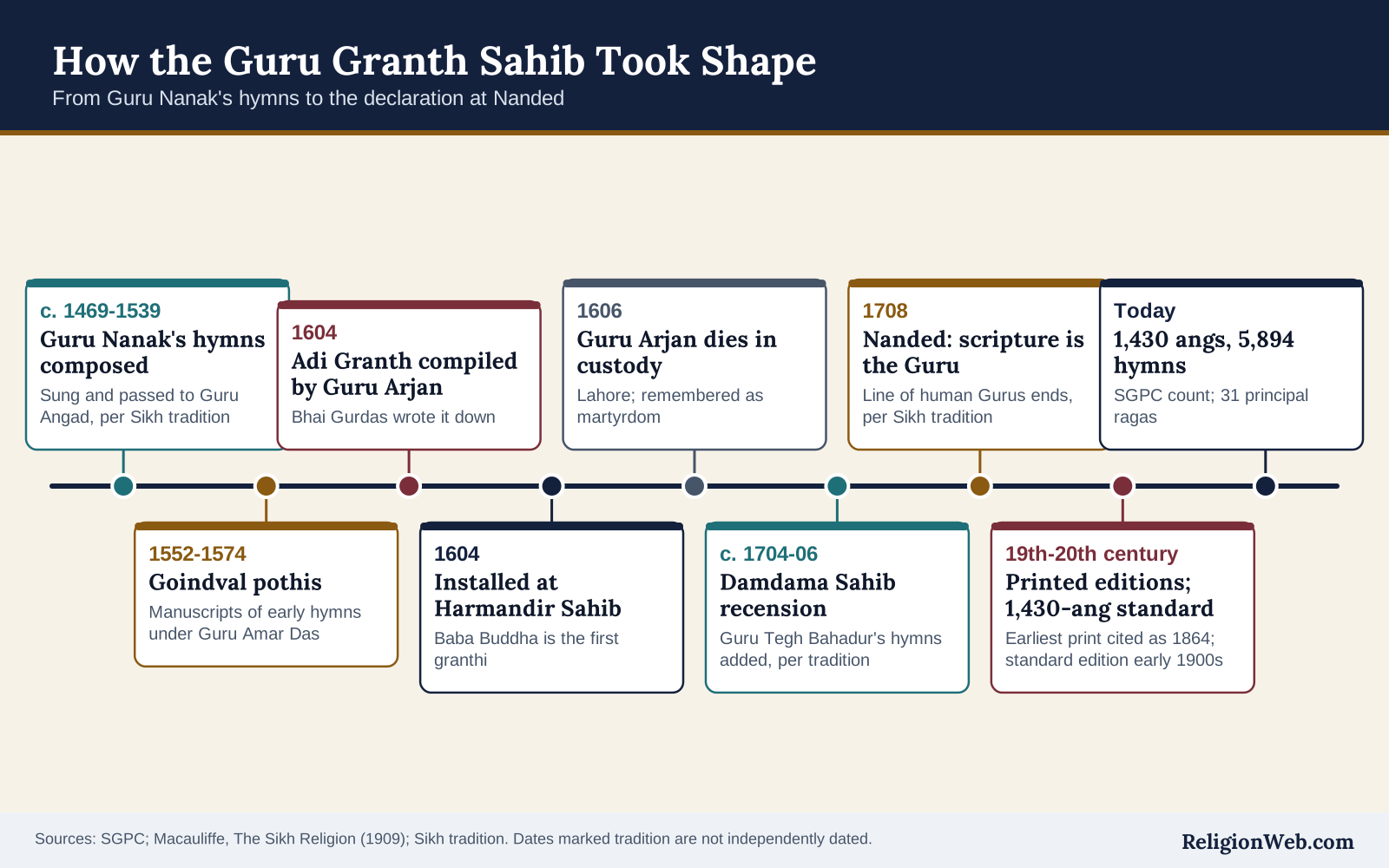
The Guru Granth Sahib begins, in Sikh memory, with the compositions of Guru Nanak (traditionally 1469 to 1539), the founder of the Sikh path. Sikh tradition holds that Nanak composed his hymns over a lifetime of travel and, in later years, of settled teaching at Kartarpur on the Ravi River, and that they were sung to the accompaniment of the stringed rabab played by his companion Mardana. Early Sikh sources describe the hymns as being kept in written form and passed, along with the Guru’s authority, to his successor, Guru Angad. Historians cannot reconstruct the earliest manuscripts, because none survives from Nanak’s own hand, but the Sikh community’s own accounts and the later collections agree that his compositions were written down and handed on within the Guru’s household and followers.
This picture matters for how Sikhs understand the text. The hymns were not first preserved by a class of scribes and then adopted as scripture; they were sung, memorized and recorded in the course of congregational worship, and they were treated as authoritative from the start. The Gurus who followed Nanak each used the same pen name, Nanak, and each added hymns to the stream of Gurbani, so that the collection grew as the lineage continued.
The Goindval pothis and the collections of the Gurus
By the time of the third Guru, Guru Amar Das (Guru from 1552 to 1574), the community had a settled center at Goindval, on the Beas River, and manuscript volumes called pothis were prepared there. Sikh tradition remembers them as the Goindval pothis, and they are generally understood to have gathered the hymns of Nanak, Angad and Amar Das, together with verses of some of the devotional poets whose words the Gurus esteemed. According to Sikh tradition, these volumes passed to Amar Das’s son Mohan, from whom Guru Arjan later obtained them, which allowed him to draw on them in his own compilation. Scholars who study the text of the Guru Granth Sahib treat these early pothis, together with other early manuscripts, as the best evidence for how the Adi Granth took shape.
Guru Arjan and the Adi Granth of 1604
Why a standard volume was needed
Guru Arjan, the fifth Guru (Guru from 1581 to 1606), faced a community that was growing quickly and, by Sikh tradition, a problem that comes with growth: compositions attributed to the Gurus were circulating that the Guru did not consider authentic. The SGPC describes later efforts of the same kind, saying that Guru Gobind Singh removed unauthorized passages that had entered some copies. A single, authoritative volume would give the congregation a fixed standard, which is how Sikh tradition explains the motive for the project. It also fit the Guru’s wider work, which included building the central shrine in Amritsar and developing the institutions of the growing Panth, the Sikh community.
There was a devotional reason as well. In Sikh understanding, Gurbani is the Word of God that comes through the Gurus, so gathering it in one place meant preserving the revelation itself and not just a literary legacy. That is why the compilation is remembered not as an editorial task but as a work of sacred significance that the Guru undertook personally.
Compilation, scribe and installation
Tradition places the work of compiling in the period around 1603 and 1604, and the SGPC records that Guru Arjan gathered the hymns of the first three Gurus and some of the bhagats, then added compositions of his father, Guru Ram Das, and his own. The scribe was Bhai Gurdas, a respected Sikh poet and scholar, who in the Macauliffe account wrote the volume from Guru Arjan’s dictation. Macauliffe, writing in 1909, adds that it then contained “the hymns of the first five Sikh Gurus and of the saints who preceded them” and that Guru Arjan made Baba Buddha its reader and custodian at Amritsar. The SGPC also notes that a figure called Bhai Banno was involved in binding a copy.
The completed volume, the Adi Granth, was installed in the Harmandir Sahib, the central shrine in Amritsar, in 1604. Sikh calendars mark the anniversary in late August or early September, and many gurdwaras celebrate it as the day the scripture was first installed. Baba Buddha served as the first granthi, the reader and keeper of the volume. The occasion is regarded as the moment the community received a written standard for its worship, a role that the Adi Granth held through the generations of Gurus that followed.
The Kartarpur manuscript and the question of the original
The oldest surviving Adi Granth manuscript is held by a family of Guru Arjan’s descendants at Kartarpur in Jalandhar district, and it is known as the Kartarpur bir. Many Sikhs regard it as the manuscript Bhai Gurdas wrote, while some scholars debate whether it is the original or a very early copy made in the first decade of the seventeenth century. A later copy associated with Bhai Banno, which scholars date to 1644, follows the Kartarpur manuscript closely but differs from it in details, and the differences have been discussed by Sikh scholars. The question of the original cannot be settled by assertion, and access to the Kartarpur manuscript for study is limited. What is not in doubt is that the text of the Guru Granth Sahib in use today follows that early volume closely, apart from the later additions and revisions described below, which is one reason Sikhs speak of the scripture as unchanged.
Guru Arjan died in 1606 in Mughal custody at Lahore, in circumstances that Sikh tradition remembers as martyrdom and that historians connect to the political tensions of the time. The memory of his death shaped Sikh history, and with it the memory of the compilation he had completed only two years earlier.
Later Recensions and the Declaration of 1708
Damdama Sahib and the hymns of Guru Tegh Bahadur
The ninth Guru, Guru Tegh Bahadur, was executed at Delhi in 1675 by order of the Mughal authorities, and his hymns were not in Guru Arjan’s volume because they came decades after it. According to Sikh tradition, his son, the tenth Guru, Guru Gobind Singh, had a new version prepared at Damdama Sahib (also called Talwandi Sabo), with Bhai Mani Singh as the scribe, and had his father’s hymns added. Sources give the year differently: the SGPC says the Guru dictated the entire Adi Granth at Damdama Sahib in 1706, while other accounts place the work in 1704 or in 1705 and 1706. A copy dated 1707 is preserved at Nanded. This version is the ancestor of the text that Sikhs use now. A few manuscripts and traditions carry variants, and the question of the places where the early manuscripts differ is a lively area of scholarship.
Guru Gobind Singh’s own hymns are not in the Guru Granth Sahib. Compositions attributed to him were gathered after his death in a separate volume, the Dasam Granth, which the section on other writings treats below. Sikh tradition therefore keeps two separate categories: the Guru Granth Sahib, which contains the hymns of six Gurus, and the writings of the tenth Guru, which are honored by many Sikhs but are not installed as the Guru.
Nanded and the line of Gurus
The central event for the scripture’s status came in 1708. Guru Gobind Singh, then at Nanded on the Godavari River in what is now Maharashtra, is said by Sikh tradition to have told his followers that the line of human Gurus would end with him and that the Guru Granth Sahib was thereafter the Guru of the Sikhs. He died in the autumn of that year. The declaration is remembered in the daily prayer of the community, the Ardas, in which many Sikhs recite a couplet ending in the words Guru Maneyo Granth, “accept the Granth as the Guru.”
Historians approach the event in a different way, tracing the surviving eighteenth-century sources that mention the succession and the gradual growth of the practice of seeking the Guru’s authority in the scripture and in the collective body of the Khalsa, the order founded at Vaisakhi in 1699. This does not contradict Sikh tradition, which locates the decisive act in 1708, and Sikh scholars and secular historians alike agree that by the middle of the eighteenth century the Guru Granth Sahib was the center of Sikh worship and corporate decision-making. The tradition of Guru Panth, the idea that the Guru’s authority also rests in the community gathered before the scripture, developed alongside it.
Transmission: From Manuscript to Print
Handwritten copies and scribal tradition
For roughly two centuries after 1604, each copy of the Guru Granth Sahib was written by hand. Sikh scribes copied the text with great care, and gurdwaras and families commissioned volumes that were sometimes beautifully illuminated. Scribal traditions, regional preferences and the differing layouts of early manuscripts produced small variations, such as differences in the way the text was divided across pages, though the words themselves were regarded as fixed. A scribe who copied the scripture was doing a devotional act, and Sikh communities remember several scribes by name.
Printing and the standard 1,430-page layout
Printing came to the Guru Granth Sahib in the nineteenth century. One account dates the first printed copy to 1864, although that date is not firmly documented, and early editions were lithographed. Its arrival raised questions of respect and accuracy that Sikh institutions had to settle. The standard edition of 1,430 angs, which is now universal in printed copies, has been printed since the early twentieth century, and the SGPC and Sikh publishers have since encouraged the use of one authorized layout so that every copy carries the same text on the same page. The details of how the standard layout was chosen, and by whom, belong to the history of Sikh publishing and are discussed in the scholarly literature. The result is that today every printed volume, whatever its binding, can be cited by ang.
| Date | Event | Notes |
|---|---|---|
| Traditionally 1469–1539 | Life of Guru Nanak; composition of the first hymns | Hymns sung in congregation and passed to Guru Angad, according to Sikh tradition |
| 1552–1574 | Guru Amar Das; Goindval pothis | Early manuscript collections of the hymns of the first three Gurus |
| 1604 | Adi Granth compiled by Guru Arjan and installed at Harmandir Sahib | Bhai Gurdas wrote it down; Baba Buddha was the first granthi |
| 1606 | Death of Guru Arjan in Mughal custody at Lahore | Remembered in Sikh tradition as martyrdom |
| 1675 | Execution of Guru Tegh Bahadur at Delhi | His hymns were added in the later recension |
| About 1704–06 | Damdama Sahib recension under Guru Gobind Singh | Bhai Mani Singh as scribe, according to tradition; Tegh Bahadur’s hymns included; sources differ on the year |
| 1708 | Declaration at Nanded that the Guru Granth Sahib is the Guru | Central event in Sikh tradition; historians trace its development through eighteenth-century sources |
| Nineteenth century | Printed editions begin | One account dates the first printed copy to 1864; early editions were lithographed |
| Early twentieth century | Standard 1,430-ang edition printed | Now the universal layout for citing by ang |
Who Wrote the Guru Granth Sahib? Gurus, Bhagats, Bhatts and Others
The Sikh Gurus as Contributors
Six Gurus and a shared signature
Six of the ten human Gurus contributed hymns to the Guru Granth Sahib: Guru Nanak, Guru Angad, Guru Amar Das, Guru Ram Das, Guru Arjan and Guru Tegh Bahadur. Guru Hargobind, Guru Har Rai and Guru Har Krishan have no compositions in it, and Guru Gobind Singh’s writings are collected elsewhere. All the Gurus who composed signed their hymns with the name Nanak, a convention that Sikh teaching explains by the belief that the same light passed from one Guru to the next. Macauliffe summed up the system in 1909 by noting that the first nine Gurus adopted the name Nanak as their pen name, and that their compositions are distinguished by Mahallas, a word he rendered as “quarters” or wards.
The SGPC’s published tallies by author give a sense of proportions. Guru Arjan, who compiled the book, contributed the most hymns, 2,218. Guru Nanak is credited with 974, Guru Amar Das with 907, Guru Ram Das with 679, Guru Tegh Bahadur with 115 (another count gives 116) and Guru Angad with 62. These counts follow the SGPC’s conventions, and other scholars count slightly differently, so the numbers should be read as close approximations. They show that the Gurus themselves wrote the large majority of the book, and that the fifth Guru, who gathered the collection, was also its most prolific poet.
What each Guru is known for
Each Guru left a recognizable body of work. Guru Nanak is the author of the Japji, the morning prayer that opens the volume, and of Asa di Var, a long ballad-form composition that is traditionally sung at dawn in gurdwaras. Guru Angad’s small contribution consists chiefly of couplets, called saloks, that are set among the compositions of other Gurus. Guru Amar Das composed the Anand Sahib, a hymn of joy that is recited at many Sikh services and ceremonies, and Guru Ram Das the Lavan, the four marriage hymns around which the Sikh wedding ceremony is arranged.
Guru Arjan’s compositions are the longest and include the Sukhmani Sahib, a long meditation on the divine Name that is a favorite of Sikh devotional reading. Guru Tegh Bahadur’s hymns and saloks, composed in the troubled decades of the seventeenth century, reflect on detachment, the fragility of worldly attachments and steadiness in the face of fear, and they appear near the end of the volume as well as within the ragas. Together the six bodies of work give the Guru Granth Sahib both unity of teaching and variety of voice.
The Bhagats: Voices Beyond the Lineage
Fifteen devotional poets
Alongside the Gurus, the Guru Granth Sahib includes compositions of fifteen poets whom Sikhs call bhagats, “devotees,” according to the SGPC’s count. They include Kabir, Namdev, Ravidas, Farid and Surdas, as the SGPC names them, and by common Sikh lists also Jaidev, Trilochan, Dhanna, Beni, Sain, Pipa, Ramanand, Sadhna, Bhikhan and Parmanand. The SGPC credits the bhagats with 922 hymns in all, of which 541 are by Kabir. Counting conventions vary: Surdas, for example, is represented by a single line in some counts, and scholars sometimes disagree on how to treat short verses.
These poets lived in different centuries and regions, from Jaidev in twelfth-century Bengal to Kabir and Ravidas in fifteenth-century Banaras, from Namdev in Maharashtra to Farid in the Punjab. They came from varied social backgrounds, including weavers, leatherworkers, barbers and farmers, and from different religious worlds, including Vaishnava devotion and Sufi piety. The inclusion of such a range was unusual for a scripture compiled in the early seventeenth century, and it has drawn the attention of historians as much as of theologians.
Why the Gurus included them
Sikh theology explains the presence of the bhagats in terms of agreement. Their verses are included because they express the same truth of the divine Name that the Gurus taught, not because their traditions are absorbed into Sikhism. In several places the Gurus add their own verses beside those of a bhagat, so that the bhagat’s words are accompanied by a Sikh comment. The pattern is visible in the Slok Farid, a section in which couplets of Farid are followed by verses of the Gurus that respond to or develop them.
Historians see the inclusion as a mark of the shared devotional culture of the period, the movement of bhakti, familiar from the wider devotional world of Hinduism, and the Sant tradition that crossed regional and religious lines and spread through hymn. Readers who want that background can turn to the articles on Vaishnavism, which explains the devotional world of poets such as Ramanand, and on Sufism, which places Farid within the Muslim mystical tradition of the Punjab. The Sikh understanding and the historian’s understanding are not in conflict here; they answer different questions, one about why the Gurus judged these verses worthy of the scripture and the other about what cultural world made the meeting possible.
Bhatts, Sikh Disciples and Other Voices
The bhatts and their verses of praise
The SGPC lists eleven bhattas, or bhatts, in the volume. These were bards, professional praise-poets in the Punjabi and North Indian tradition, who according to Sikh accounts came to the Gurus’ court and composed verses in praise of the Gurus and the divine Name. Their verses, called Swayyas, appear late in the volume, after the ragas and the sections of couplets. They are written in a more ornate poetic register than the hymns of the Gurus and are among the best examples of the courtly poetry of the period.
Sikh contributors and shared compositions
A few compositions come from Sikhs who were close to the Gurus. Satta and Balvand, minstrels at the court of Guru Arjan, are credited with a ballad, and the volume includes a hymn by Sundar, a descendant of Guru Amar Das. Sikh tradition also attributes three verses to Mardana, Guru Nanak’s companion on his travels, though that attribution rests on tradition rather than on manuscript evidence that a historian could confirm. These contributors are fewer, but they matter for the picture the Guru Granth Sahib gives of a community in which the Gurus’ households, musicians and disciples all took part in shaping the sacred text.
| Contributor | Category | Hymns (SGPC count) | Best known in the volume for |
|---|---|---|---|
| Guru Nanak | Sikh Guru (Mahala 1) | 974 | Japji, Asa di Var; opening of the volume |
| Guru Angad | Sikh Guru (Mahala 2) | 62 | Couplets (saloks) set within longer compositions |
| Guru Amar Das | Sikh Guru (Mahala 3) | 907 | Anand Sahib; hymns on service and equality in the congregation |
| Guru Ram Das | Sikh Guru (Mahala 4) | 679 | Lavan, the four marriage hymns |
| Guru Arjan | Sikh Guru (Mahala 5); compiler | 2,218 | Sukhmani Sahib; the largest single share of the volume |
| Guru Tegh Bahadur | Sikh Guru (Mahala 9) | 115 | Hymns and saloks on detachment and steadfastness |
| Bhagats | Fifteen devotional poets, not in the Guru lineage | 922 (Kabir 541) | Kabir, Namdev, Ravidas, Farid and others |
| Bhatts | Eleven bards | Not tallied here | Swayyas in praise of the Gurus |
| Sikh disciples and musicians | Satta and Balvand, Sundar, and others | Small number | A ballad and a hymn connected with the Gurus’ households |
Other Sikh Writings and Their Relationship to the Scripture
The Dasam Granth
The Dasam Granth, the “Book of the Tenth,” is a large collection traditionally connected with Guru Gobind Singh. It includes devotional prayers, an autobiographical poem, a letter in Persian known as the Zafarnama, and long narrative retellings of stories drawn from Indian epic and Puranic literature. Sikh scholars disagree about how much of it was composed by the Guru himself, and the collection took its present form after his death. Some Sikhs honor the whole of it, others accept only some compositions as his, and the SGPC and mainstream gurdwaras install only the Guru Granth Sahib as the Guru. Several compositions from the collection are included in the Rehat Maryada’s list of daily prayers, a point taken up in the section on daily practice.
Bhai Gurdas, janamsakhis and rahitnamas
Sikhs also revere other early writings that are not Gurbani. The Varan of Bhai Gurdas, the scribe of the first compilation, are poems in Punjabi that Sikhs use as an aid to understanding the scripture, and the Rehat Maryada allows the compositions of Bhai Gurdas and of the poet Bhai Nand Lal to be sung in kirtan for the purpose of elaborating a hymn. The janamsakhis recount the life of Guru Nanak, and rahitnamas are manuals of conduct from the eighteenth century and later. These works are honored for their teaching and their historical interest, but Sikh tradition does not give them the authority of Gurbani, which is why only the Guru Granth Sahib is installed as the Guru.
Language, Script and Poetic Form in the Guru Granth Sahib
The Gurmukhi Script
Origins of the script
Gurmukhi means “from the mouth of the Guru,” and the name signals how Sikhs regard the script: it is the alphabet in which the Gurus’ words are recorded. Sikh tradition credits the second Guru, Guru Angad, with developing and standardizing it for use in the community, and the thirty-five-letter alphabet that begins with the traditional paintī (the “thirty-five”) is the basis of the modern script. Scholars note that Gurmukhi grew out of earlier North Indian scripts used by traders and scribes in the Punjab, and that Guru Angad’s role may have been one of adopting, refining and promoting a script so that it became the standard of the community. The two accounts are compatible: Sikh tradition emphasizes the Guru’s act of establishing the script, and historians emphasize the materials he had to work with.
Why one script for many languages
One result of this history is that the Guru Granth Sahib is written entirely in Gurmukhi even where the language is not Punjabi. A verse by a poet from Maharashtra or Banaras appears in the same letters as a hymn of Guru Nanak, which means the volume presents all of its voices in a single visual form. That unity has a devotional meaning for Sikhs, since it supports the idea that the contents speak with one voice, and a practical meaning as well, because a reader who has learned Gurmukhi can read the entire book. The Rehat Maryada says that every Sikh should learn Gurmukhi, and this is part of the reason.
Traditional copies of the scripture are printed in larivaar, a continuous script in which words run together without spaces. Editions with spacing between words, called pad-chhed, were developed to make the text easier to read, and the SGPC and Sikh scholars have used them in study editions and commentaries. Sikh groups hold different views on which form should be used in the volume installed in a gurdwara, and the question has been discussed within the Panth for decades.
The Languages of Gurbani
Sant Bhasha and Punjabi
The language of the Gurus’ hymns is not a single standard dialect. It is built on the speech of the Punjab, enriched by a broader literary idiom of North India that scholars call Sant Bhasha, the “language of the saints,” which the devotional poets of the period shared across regions. Vocabulary from Sanskrit, Persian and Arabic sits comfortably alongside everyday Punjabi words, and a single hymn can move from a rural image to a philosophical term without a break. For readers today the difficulty is real: a Punjabi speaker will recognize much of the text but not all of it, which is why commentaries and glossaries exist.
The speech of the bhagats
The bhagats’ verses reflect their origins. Kabir and Ravidas wrote in forms of the Hindi-speaking region around Banaras, Namdev’s verses show the influence of Marathi and of the Hindi he used in the north, and Farid’s saloks are in a Punjabi dialect of the western Punjab. Gurmukhi gives all these forms a common appearance, but the vocabulary and grammar differ, and commentators find it necessary to explain them. This variety is part of what makes the book a witness to the linguistic world of medieval and early modern North India as well as a religious text.
Poetic Forms and Their Names
Shabad, ashtapadi, chhant and others
The hymns of the Guru Granth Sahib are written in forms that have their own names, and these names appear in the headings of the compositions. A shabad is a hymn, usually of a few stanzas, and a line marked rahau, “pause,” often states the central idea to which the singer returns. A chaupada has four stanzas, a dupada two, an ashtapadi eight, and a chhant is a lyrical composition in a distinctive meter. A salok is a couplet, a pauri a stanza of a longer poem, and the var is a ballad form with a series of pauris preceded by saloks. The Guru Granth Sahib is traditionally counted as containing twenty-two vars, and some of them name the tune of a popular heroic ballad to which they are sung.
Ghar, dhuni and musical instructions
Many headings include musical directions in addition to the raga. A number after the word ghar indicates a musical variant, which scholars explain in different ways, as a rhythmic pattern, a melodic setting or a combination of both. A dhuni names a known tune. Together these directions show that the hymns were composed with a particular performance in mind, and that the arrangement of the volume is bound up with how it is sung. The next section explains how that logic organizes the whole book.
Structure of the Guru Granth Sahib: Ragas and Sections
The Overall Plan of the Volume
The opening prayers
The volume begins with the Mool Mantar, the root statement about God, which stands at the head of the Japji at ang 1. The Japji, composed by Guru Nanak, follows, running to about ang 8. After it come two evening prayers, So Dar and So Purakh, and a bedtime prayer, the Sohila, which closes the opening section at about ang 13. Sikhs recite these as part of their daily prayers, so the opening section is the part of the scripture that most Sikhs know best.
The raga section
The main body of the volume, which begins at ang 14 with Sri Raga and runs to about ang 1353, is divided into raga sections. The Gurus used thirty-one principal ragas, and the sections for the ragas follow one another in a fixed order. A raga, in the North Indian musical tradition, is a melodic framework associated with a mood and, in many accounts, a time of day or season. In the Guru Granth Sahib the raga is the organizing principle, so that a reader looking for a hymn first finds the raga and then the Guru who composed it.
The SGPC notes that the Rag Mala at the end of the book lists eighty-four ragas and raginis, yet the Gurus used only thirty-one. Some sources list the sections as sixty by counting variants and combinations of the principal ragas, such as the several forms of Gauri or Suhi. The difference between thirty-one and sixty is a matter of counting: the former refers to the principal ragas, the latter to the named sections and variants that fall under them.
The closing verses
After the raga section the book turns to groups of verses that are not set to ragas. These include Sanskritic couplets called Slok Sahaskriti, the compositions known as Gatha, Phunhe and Chaubole, the Saloks of Kabir and of Farid, the Swayyas of the bhatts, a collection of saloks in miscellaneous groupings, and the saloks of Guru Tegh Bahadur. The volume ends with the Mundavani, a short composition of Guru Arjan that serves as a seal, followed by a brief closing couplet and the Rag Mala. The SGPC places the Mundavani and the Rag Mala at angs 1429 and 1430.
Order Within Each Raga
Form, author and ghar
Within each raga the hymns follow a regular order. According to the SGPC, the arrangement goes first by raga, then by poetic form, then by author, and then by ghar. The hymns of the Gurus appear first, grouped by form, generally with shorter forms such as chaupadas and ashtapadis preceding longer compositions such as chhants and vars, and within each form they run in order of Mahala from Guru Nanak (Mahala 1) through Guru Arjan (Mahala 5) and, where it applies, Guru Tegh Bahadur (Mahala 9). The verses of the bhagats come after the Gurus’ hymns in the same raga.
The regularity is useful in practice. A Sikh who knows that Mahala 3 comes after Mahala 1 within the same form can predict where a hymn will be, and a singer who knows the raga knows which section to open. The system also explains why the Gurus’ work from different decades sits together on a page: the volume is arranged by musical setting, not by the date on which each hymn was composed.
Rahau and the center of a hymn
Within a hymn, the line marked rahau typically holds the thought that the rest of the hymn develops, and in performance it is often the line that returns as a refrain. Sikh commentators therefore treat the rahau line as the key to reading a shabad. The practice shows how the volume’s musical structure and its meaning work together: the verse that the singer repeats is also the verse that states the point.
Why the Volume Is Arranged by Raga
A text composed to be sung
Sikh tradition holds that Guru Nanak sang his hymns, accompanied by Mardana on the rabab, and that the later Gurus continued the practice and prescribed ragas for their compositions. A volume that placed hymns in chapters by theme or date would have hidden the musical form in which they were created. Arranging the book by raga preserves it. Macauliffe, in his introduction to The Sikh Religion, explained the system to English readers this way:
The hymns of the Gurus and saints are not arranged in the holy volume according to their authors, but according to the thirty-one rags or musical measures to which they were composed.
Max Arthur Macauliffe, The Sikh Religion, vol. 1 (1909), Introduction, ch. II
Macauliffe’s sentence expresses the principle clearly, and it applies equally to the way many Sikhs experience the book today: a hymn is identified first by its raga and then by the Guru who composed it. He continued with an image of the system, in which each Guru’s work forms a ward of a city:
The Granth Sahib is likened to a city and the hymns of each Guru to a ward or division of it. Thus the compositions of Guru Nanak are styled Mahalla one, that is, the first ward; the compositions of Guru Angad the second ward, and so on.
Max Arthur Macauliffe, The Sikh Religion, vol. 1 (1909), Introduction, ch. II
The city image is Macauliffe’s own way of explaining the Mahalla system to English readers, and it makes a practical point. The number after a hymn’s heading identifies the Guru who composed it, and because every raga section repeats the sequence, the voice of each Guru in turn can be found again and again in different musical settings.
Raga as mood and as performance instruction
What the ragas of the Guru Granth Sahib sound like in practice is a subject of both devotion and scholarship. Sikh musicians in the tradition of Gurmat Sangeet, “music of the Guru’s way,” sing the compositions in the prescribed ragas, and Sikh institutions have worked to preserve and teach the tradition. Musicologists note that the ragas of the early seventeenth century cannot be assumed to match their modern forms in every detail, and that the meaning of the ghar numbers is still discussed. The Rehat Maryada requires that kirtan be sung in the traditional musical measures but does not itself name individual ragas.
Not chronological, not by theme
Because the volume is arranged by raga, form and author, it is neither a chronological record of the Gurus’ teaching nor a thematic anthology. Hymns of Guru Nanak from the end of his life can stand beside hymns from earlier years, and a hymn of Guru Arjan about the Name may sit near a hymn of Kabir on the same subject. Readers who want to follow the development of Sikh thought across the Gurus’ lifetimes therefore need commentaries and the tools of historical scholarship rather than the order of the pages. The point is taken up again under common misconceptions.
| Section | Angs | Contents |
|---|---|---|
| Opening prayers | 1 to 13 | Mool Mantar and Japji (to about ang 8), So Dar, So Purakh and Sohila |
| First ragas | From 14 | Sri (14), Majh (94), Gauri (151), Asa (347) and Gujari (489) |
| Middle ragas, first group | From 527 | Devgandhari (527), Bihagra (537), Vadhans (557), Sorath (595), Dhanasari (660), Jaitsri (696) |
| Middle ragas, second group | From 711 | Todi (711), Bairari (719), Tilang (721), Suhi (728), Bilaval (795), Gond (859), Ramkali (876) |
| Later ragas | From 975 | Nat Narayan (975), Mali Gaura (984), Maru (989), Tukhari (1107), Kedara (1118), Bhairo (1125) |
| Final ragas | From 1168 | Basant (1168), Sarang (1197), Malar (1254), Kanra (1294), Kalyan (1319), Prabhati (1327), Jaijavanti (1352) |
| Closing verses | From about 1353 | Slok Sahaskriti, Gatha, Phunhe, Chaubole, Saloks of Kabir and Farid, Swayyas, Saloks of Guru Tegh Bahadur |
| Conclusion | 1429 to 1430 | Mundavani, closing couplet and Rag Mala |
The Rag Mala question
The Rag Mala, the “garland of ragas,” is the most discussed text in the volume. It lists musical measures in a poetic form after the Mundavani. Sikhs hold different views on it. Some regard it as part of the scripture and read it at the conclusion of a complete reading. Others do not, and some Sikhs have questioned its authorship and its place in the volume. The Rehat Maryada’s wording on concluding a reading lets the reading end at either the Mundavani or the Rag Mala, so that both practices are found in gurdwaras. The question has been argued within the Panth for more than a century, and it remains unresolved by any single authority.

The Eternal Guru: What It Means to Call the Scripture the Guru
The Shabad as Guru
The Word, not the body
Sikh theology rests on a distinction that makes the status of the scripture intelligible. The Guru, in Sikh teaching, is not a human body but the divine Word, the Shabad, that the Gurus received and passed on. The scripture itself uses a phrase, dhur ki bani, which Sikhs translate as the utterance that comes from the Primal Source, to describe the origin of Gurbani. Because the Word is understood to be continuous with the Divine, and not the possession of any individual, a Sikh can say both that Guru Nanak was a Guru and that the Shabad he spoke is the Guru, without contradiction. The human Gurus are revered as the persons through whom the Word was revealed, and their authority is understood to rest in the Word they carried.
This is why the title Guru, in Sikh usage, does not refer only to a historical teacher. Sikh teaching speaks of the ten Gurus as one light that passed from one body to the next, the same Jot in successive forms, and says that after the tenth the light was vested in the scripture. The community’s daily prayer reflects the idea, since the Ardas invokes the ten Gurus in turn and then turns the congregation’s attention to the Guru Granth Sahib. The act of reading, singing or listening to Gurbani is, from this standpoint, a form of meeting the Guru.
The sacred text as teacher
Calling a text a teacher has practical consequences, because a teacher is consulted, obeyed and respected in ways that a record of teaching need not be. Sikhs open the Guru Granth Sahib to seek counsel at moments of decision, take its hymns as the basis of conduct and begin significant life events in its presence. The relationship is also one of listening: more than a source of rules, the scripture is a voice to be heard in the rhythms of kirtan. The Pew Research Center’s 2019–20 survey of India found that 94 percent of Sikhs said they regard the Guru Granth Sahib as the word of God, and 37 percent said they read it, or listen to recitations of it, every day.
From the Ten Gurus to the Guru Granth and the Guru Panth
Guru Granth and Guru Panth
Alongside the scripture, Sikh tradition speaks of the Guru Panth, the community of committed Sikhs, as bearing the Guru’s authority in matters of collective decision. The two ideas are usually presented together: the Guru Granth Sahib gives the teaching, and the Panth, gathered in the presence of the scripture, decides how to apply it. Historically this was expressed in the gathering of the Sarbat Khalsa, the whole body of the Khalsa, before the Guru Granth Sahib, and in the resolutions called gurmatas that such gatherings adopted. The institutions of the modern Panth, including the Akal Takht and the SGPC, derive their authority from this understanding.
Sikh scholars discuss how the two concepts relate and how the Panth should act on its authority in a world of states, courts and diasporas. The scripture’s authority is not in question among mainstream Sikhs, who treat it as final in matters of belief, and the debate concerns the practical mechanisms by which a scattered community can take a decision together.
Communities that differ
Not every group with Sikh roots shares the view that the line of Gurus ended in 1708. The Namdhari community, which arose in the nineteenth century, holds that a series of human gurus continued after Guru Gobind Singh, and other groups centered on a living teacher have also taken their own positions. The SGPC and the Akal Takht do not accept these claims, and Namdhari Sikhs, for their part, regard themselves as Sikhs. The disagreement is real and is part of the contemporary religious landscape, but it does not affect the mainstream understanding described in this article, which is that of the Khalsa Panth and the great majority of Sikh institutions.
Reverence Without Idolatry
What reverence looks like
The honor given to the Guru Granth Sahib is expressed in gestures that Sikhs understand as respect for a teacher and not as worship of an image. A visitor bows, touching the forehead to the floor in front of the scripture, an act called matha tek, and many leave an offering. Sikhs stand when the scripture is brought into a room, and the Rehat Maryada says that every Sikh should stand whenever the Guru Granth Sahib is brought in, even if another copy is already installed. The Maryada also says that no Sikh should sit bareheaded in its presence and that no one should sit on a distinctive seat, cushion, chair or cot in the Guru’s presence.
The same code limits the forms that reverence may take. According to the Rehat Maryada, idol worship, the waving of burning lamps and incense in the form known as arti, food offerings to the Guru Granth Sahib and bowing to pictures of Gurus or elders are not part of Sikh practice, while flowers, incense and scent may be used to freshen the room. These rules reflect the Sikh conviction that the Guru is the Word and not a form, and that honor belongs to the teaching and not to a representation of the divine.
The scripture in law
Reverence for the scripture also has a legal dimension in India. In Shiromani Gurdwara Parbandhak Committee v. Som Nath Dass, decided in 2000, the Supreme Court of India recognized the Guru Granth Sahib as a juristic person, a legal status that allows it to be treated as holding property, but only to a limited extent, according to a legal commentary on the case. The Court did not adopt the Sikh belief that the scripture is the living Guru, which shows how a court’s category and a religious community’s understanding can sit side by side without coinciding. Legislatures have also addressed the protection of the scripture from desecration. In April 2026 the Punjab Legislative Assembly passed an amendment to the JaagatJot Sri Guru Granth Sahib Satkar Act of 2008, with penalties of seven to twenty years for direct sacrilege against copies of the scripture, according to the same commentary, which also raises constitutional questions about the law.
Gurdwara Handling of the Guru Granth Sahib
Installation and Daily Care
Prakash in the morning
The care of the Guru Granth Sahib follows a daily rhythm that Sikhs describe with two terms. Prakash, meaning “light” or “revealing,” is the ceremonial opening of the scripture at the start of the day, when it is brought to the hall, placed on its throne, uncovered and opened to a page, and the first message of the day is read. The Rehat Maryada says that the Guru Granth Sahib should be opened ceremonially every day. In most gurdwaras prakash takes place in the early morning, after the dawn prayers, and the day’s activity in the hall begins after it.
The scene at Harmandir Sahib in Amritsar shows the ceremony in its most elaborate form. According to a Sikh educational account of the routine, the Guru Granth Sahib is carried on the head of the head priest from the Akal Takht along the causeway to the Harmandir Sahib in a procession announced by drums, and the journey can take up to half an hour. The scripture is then placed under a canopy and opened, and the day’s message is read. In the evening it is wrapped and carried back to a resting place for the night, and the doors are closed.
Sukhasan and the resting place
Sukhasan, “the posture of comfort,” is the ceremony that puts the scripture to rest. The Rehat Maryada says the scripture is usually closed after the evening prayer, Rehras, and kept open at night only in special circumstances. In many gurdwaras the evening program continues with the bedtime Sohila before the scripture is closed, wrapped in clean cloths and taken to its resting place. In diaspora gurdwaras this is often a room set aside for the purpose, and some Sikh homes arrange a similar room for a copy kept in the house.
The Furnishings and Etiquette of the Hall
The throne and its furnishings
The Rehat Maryada describes the setting: a cot matched to the scripture’s size with a clean mattress and sheets, an awning above, cushions and cloth coverings called romalas, with a whisk kept nearby. The whisk, called a chaur, is waved over the scripture by an attendant, a gesture associated with royal honor that Sikhs use to honor the Guru. When it is not being read, the scripture is kept covered with a romal. The Rehat Maryada also says the place must be very clean and that a Nishan Sahib, the Sikh flag, should stand at a high point of the gurdwara.
Etiquette for worshipers and visitors
Everyone who enters the hall follows the same conventions. Shoes are removed, and the Rehat Maryada adds that dirty feet should be washed. The head is covered, and the Maryada says no Sikh should sit bareheaded before the scripture or in the congregation. Visitors are welcome: the Maryada says that anyone may enter for darshan regardless of country, religion or caste, provided they do not carry tobacco or other intoxicants. Worshipers sit on the floor, so that no one is seated higher than the Guru, and men and women may sit side by side or in separate areas depending on local custom. Many gurdwaras provide cloths for covering the head to those who arrive without one.
Karah Prashad, a sweet offering made from equal parts of wheat flour, sugar and clarified butter, is distributed at the end of the service. According to the Maryada it is prepared while scripture is recited, placed before the Guru Granth Sahib during the closing prayer, and distributed to everyone present without distinction of religion, caste or status. Sikhs customarily receive it in cupped hands as a sign of respect.
Carrying, Moving and Retiring the Scripture
Carrying the scripture
When the Guru Granth Sahib is moved, it is carried on the head of a Sikh, who according to the Maryada should walk barefoot. In processions it is accompanied by the Panj Pyare, the five beloved ones, who lead the way, and by singers of hymns. The most visible example is the nagar kirtan, the procession on the streets, which is a feature of Vaisakhi and of other Sikh festivals, in which the scripture travels on a decorated vehicle with the five leading the way and the congregation singing.
Worn or damaged copies
Sikh institutions have rules for the respectful retirement of copies of the scripture that are damaged or worn beyond use. In many communities this involves a ceremony, often called Angitha Sahib, in which the copy is cremated with prayers, and some communities also have places where damaged pages are kept. Practice varies by region and group, and diaspora communities have created their own arrangements in consultation with local authorities. The concern in all cases is that the scripture not be discarded like ordinary material.
| Practice | What it involves | Basis or note |
|---|---|---|
| Prakash | Ceremonial opening each morning; first message of the day read | Rehat Maryada, Art. V |
| Sukhasan | Closing and resting of the scripture in the evening, usually after Rehras and Sohila | Rehat Maryada, Art. V; widespread practice |
| Standing | All stand when the scripture is brought in | Rehat Maryada, Art. V |
| Head and feet | Head covered, shoes removed, dirty feet washed | Rehat Maryada, gurdwara articles |
| Seating | Worshipers sit below the scripture; no distinctive seat in its presence | Rehat Maryada, gurdwara articles |
| Chaur and romala | Whisk waved over the scripture; cloths cover it when not read | Rehat Maryada, Art. V |
| Carrying | On the head of a Sikh, barefoot where possible, with hymns | Rehat Maryada, gurdwara articles |
| Karah Prashad | Offering of flour, sugar and ghee, shared after Ardas | Rehat Maryada, Art. XII |
| Not part of Sikh practice | Arti with lamps and incense, food offerings, bowing to pictures | Rehat Maryada, Art. V |
Reading the Guru Granth Sahib: Sehaj Path, Akhand Path and Hukamnama
Reading as Devotion
Path, understanding and listening
Sikhs use the word path, meaning “reading” or “recitation,” for the devotional reading of Gurbani. In Sikh understanding the practice is not complete when the words have been pronounced; it is meant to be paired with understanding and, ideally, with a change in the reader. The Rehat Maryada says an Akhand Path must be read clearly and correctly, never so quickly that the listeners cannot follow, and that a person who cannot read can still take part by listening. The same Maryada says every Sikh should learn Gurmukhi, which shows how closely reading, understanding and personal devotion are linked.
Listening carries equal weight. The Sikh tradition describes the congregation as sangat, the company of those who gather around the Guru’s word, and the hearing of Gurbani in kirtan, katha (exposition) and path is regarded as a way of encountering it. Someone who cannot read Gurmukhi can still be a full participant in the community’s relationship with the scripture, and the Maryada’s rule that a lone reader should never be left without listeners during an Akhand Path expresses the idea that the Guru’s word is meant to be heard.
Who may read
Sikhism has no ordained priesthood, and the person who reads from the scripture is not a priest in the sense that term has in other traditions. A granthi is a reader and caretaker of the scripture, often employed by a gurdwara, and a pathi is a person who performs the reading. According to the Rehat Maryada, only a Sikh may read from the Guru Granth Sahib aloud for others, though a non-Sikh may read it for personal use, and Sikh men and women alike may serve as its attendant during a congregational session. In most gurdwaras the managing committee appoints the granthis, and no hereditary class holds the role by right.
Sehaj Path and Other Complete Readings
The unhurried reading
The most common complete reading is the Sehaj Path or Sadharan Path, in which a family or an individual reads the entire scripture at an unhurried pace over days, weeks or months. The Rehat Maryada encourages full readings over one or two months or longer, with the pause between sessions chosen to suit the reader’s life. Before beginning a complete reading, the reader recites the first five and the last stanza of Anand Sahib, offers the Ardas and then reads the Japji, according to the Maryada’s description. Sikh families often start a Sehaj Path in the home and conclude it with a gathering of relatives and friends for the bhog, the closing ceremony.
A variant called the Saptahik Path completes the reading in a week. Sikh practice recognizes several such forms, and the choice depends on the occasion and the family. What they share is that the reader reaches the end of the volume, so that the reading is complete, and then marks the completion with prayer and a shared offering of karah prashad.
Occasions for a complete reading
Families arrange complete readings for many reasons. The birth of a child, a wedding, the opening of a new home or business, recovery from illness, a graduation and the anniversary of a death are all occasions on which a reading may be started or completed. After a death, a reading of the entire scripture, begun at the home or in the gurdwara, is the central observance of the mourning period, and it is concluded on a day chosen by the family with a service of kirtan and prayer. In each case the reading serves as both a devotional act and a way of placing the family’s event within the presence of the Guru.
Akhand Path: The Unbroken Reading
How an Akhand Path is conducted
The Akhand Path is a continuous reading of the entire Guru Granth Sahib, from the first page to the last, without a pause. The Rehat Maryada describes it as lasting about forty-eight hours. Readers, called paathis, take turns at set intervals, day and night, each taking up where the previous reader stopped, so that the reading continues through the night. The reading begins after a short opening service. According to the Maryada, karah prashad is laid out, six stanzas of Anand Sahib are recited, the Ardas is offered and the hukam is taken. The reading is then started from the beginning.
The Maryada gives specific guidance on conduct. The reading should be clear and accurate, and a lone reader should never be left without listeners. The Maryada also says that pitchers, lamps and coconuts placed around the reading are contrary to gurmat, “the Guru’s way.” Sikh educational accounts add that the midpoint of the reading is marked with an Ardas and karah prashad and that listeners may come and go as they wish. The reading is concluded at the Mundavani or the Rag Mala, followed by Anand Sahib, the Ardas, the distribution of karah prashad and, commonly, the taking of the hukam.
Origins and meaning
The origin of the Akhand Path as a practice is uncertain. Sikh accounts connect it with the time of Guru Gobind Singh, saying that he had the completed Adi Granth read to him continuously before declaring it the Guru, while others link it with the troubled decades of the eighteenth century, when Sikh bands living under pressure from the authorities of the time are said to have held readings as they moved. Sikh educational sources present these accounts as tradition and conjecture, and a historian would say that the early evidence is thin. The practice itself is well established today.
Its meaning is usually explained in terms of continuity. An unbroken reading is understood to place a household or a community in unbroken contact with the Guru’s word for as long as it lasts, and many Sikhs describe it as an intensification of the ordinary reading rather than a different kind of practice. Some gurdwaras hold a reading every week, which gives members the opportunity to take turns as readers and to serve in the kitchen, and Sikh writers have emphasized that reading should be accompanied by understanding. Religious reading of this kind is a devotional practice and is not meant to substitute for medical, legal or practical help in a crisis, though many families draw on it for comfort alongside such help.
The Hukamnama: Taking the Guru’s Command
How the hukam is taken
Hukam, “command” or “order,” is a central word in Sikh theology, where the divine Hukam is the order by which creation unfolds and the Japji teaches that understanding it is the key to living well. Taking the hukam, also called taking a vak or mukhwak (“word from the mouth”), is the practice of opening the Guru Granth Sahib and reading the passage that appears as the Guru’s message for the moment. The Rehat Maryada gives the procedure in its article on taking the hukam. The person bows before the scripture, looks at the congregation, opens the volume, and reads the hymn at the top of the left-hand page from its beginning. When the page shows part of a var, the reading begins from the first saloks of the pauri.
Hukam is taken at set points in the day’s worship. The Maryada says it is taken at the close of a congregational service after the Ardas, and as a personal practice a Sikh should ideally take it in the early morning before eating. At Harmandir Sahib the vak is read three times in the day’s cycle, at the morning prakash, at the conclusion of Asa di Var and at the sukhasan in the evening, according to an educational account of the shrine’s routine.
The daily hukamnama
The hukamnama is the written or announced form of the day’s hukam, and Sikhs follow it closely. The message taken at the Harmandir Sahib is read and shared in Punjabi and English each day by the SGPC and by many websites and phone applications, and gurdwaras around the world post it on a board or announce it to the congregation. The text is considered the Guru’s word for that day, and families discuss it at home as a theme for reflection.
Hukam in personal and family life
The hukam has a role in the milestones of family life. At a Sikh naming ceremony, the family takes a hukam and gives the child a name that begins with the first letter of the first word of the hymn, a custom widely followed across the community. Many families also take a hukam when starting a journey, a business or a major decision. Sikh teachers commonly stress that the hukam is a source of counsel to be read in light of the whole hymn and the whole teaching and not a prediction or an omen, a position consistent with the Rehat Maryada, which rejects belief in omens, auspicious days and horoscopes.
| Term | Meaning | Use in practice |
|---|---|---|
| Gurbani | “The Guru’s utterance”; the hymns of the Guru Granth Sahib | Sung, read and recited in all Sikh worship |
| Shabad | “Word”; also a hymn | The unit of kirtan; the Guru in Sikh theology |
| Ang | “Limb”; a page of the standard edition | The universal reference number, from 1 to 1,430 |
| Mahala | “Quarter” or “ward”; marks the Guru who composed a hymn | Mahala 1 is Guru Nanak, Mahala 5 is Guru Arjan |
| Rahau | “Pause”; marks the central line of a hymn | The refrain in kirtan |
| Prakash | “Light”; ceremonial opening of the scripture | Each morning in the gurdwara |
| Sukhasan | Resting the scripture for the night | Evening, after Rehras and Sohila |
| Path | Reading or recitation of Gurbani | Daily prayers and full readings |
| Sehaj Path (Sadharan Path) | Unhurried complete reading over days or weeks | Home and gurdwara, often for family occasions |
| Akhand Path | Continuous reading, about 48 hours | Festivals, weddings, deaths, thanksgiving |
| Hukam, Hukamnama, Vak, Mukhwak | “Command”; the passage taken as the day’s message | Taken at close of service and in the morning |
| Kirtan | Singing of Gurbani in its ragas | The core of congregational worship |
| Ardas | The Sikh prayer of petition, offered standing | Closes services and readings |
| Granthi | Reader and caretaker of the scripture | Gurdwara staff or volunteers |
| Karah Prashad | Sacred pudding of flour, sugar and ghee | Shared at the end of every service |
Kirtan, Daily Prayers and the Guru Granth Sahib in Sikh Life
Kirtan: Singing the Scripture
What kirtan is and who performs it
Kirtan is the singing of Gurbani in its traditional musical measures, and it is the form in which most Sikhs encounter the Guru Granth Sahib in congregational worship. A group of singers called a ragi jatha sits before the scripture, usually with a harmonium and a pair of drums called tabla, and sings a hymn, with the congregation joining in the refrain. The Rehat Maryada states that only a Sikh may perform kirtan in a congregation. It allows the singing of Gurbani, which it understands to include the hymns of Guru Gobind Singh, and of the compositions of Bhai Gurdas and Bhai Nand Lal for the purpose of elaborating a hymn. It also says that improvised refrains and borrowed tunes are improper, so that the only line repeated as a chorus should be one from the hymn itself.
The Maryada does not name the instruments of kirtan or require particular ragas, which leaves the practice to local custom and to the musical tradition. In gurdwaras across the world the harmonium and tabla are standard, and in some institutions the older stringed instruments are also taught and played, among them the rabab, the taus, the dilruba and the saranda. Sikh musicians often note that the hymn’s heading names the raga and that a skilled ragi will sing in it. In practice, however, many congregational kirtans use simplified melodies in which only the raga’s general mood is retained.
The rababis and the heritage of the Gurus’ musicians
Sikh tradition remembers Mardana, a Muslim musician who played the rabab for Guru Nanak, as the first of the community’s kirtan singers, and the Guru Granth Sahib itself preserves a ballad by Satta and Balvand, who sang for Guru Arjan. For generations, families of Muslim rababis performed kirtan at the Harmandir Sahib, and the tradition largely ended at Partition in 1947, when most of the families left for Pakistan. Sikh musicians and scholars have since worked to revive the rabab and the older style of Gurmat Sangeet, which is taught at gurdwaras and institutes in India and abroad.
Kirtan in the day and the year
At the Harmandir Sahib, kirtan runs from the opening of the doors in the early hours until the shrine closes at night, as the educational account of its routine puts it, with a succession of ragis relieving one another. The day begins with Asa di Var, the ballad of Guru Nanak, sung before the scripture is carried into the shrine, and it ends with the evening Rehras and the bedtime Sohila. Elsewhere, the weekly program of a gurdwara usually includes kirtan before and after the main service, and Sikh communities also hold all-night kirtan gatherings on festivals and anniversaries. Many Sikhs also listen to recordings or live broadcasts at home, which turns the commute or the household chore into a time of hearing the Guru’s word.
Daily Prayers From the Scripture
Morning, evening and bedtime
The daily prayers of an observant Sikh, called nitnem, are drawn largely from the Guru Granth Sahib. The Rehat Maryada prescribes recitations at three points of the day. In the early morning, which Sikhs call amrit vela, “the ambrosial hour,” and which the Maryada places about three hours before dawn, a Sikh bathes, turns the mind to the One and repeats Waheguru, then recites the Japji, the Jaap Sahib and the Ten Savaiyye, the last two of which come from the Dasam Granth. After sunset comes Sodar Rehras, which the Maryada says includes nine hymns from the Guru Granth Sahib, the Benti Chaupai of Guru Gobind Singh, selected stanzas of Anand Sahib and the Mundavani with a closing slok of Guru Arjan. Before sleeping the Sikh recites the Sohila, drawn from the opening of the Guru Granth Sahib. Both the morning and the evening recitations close with the Ardas, and the Anand Sahib of Guru Amar Das is also recited at the end of congregational gatherings to express gratitude for the company of the Guru.
The Pew Research Center’s survey in India found that 40 percent of Sikhs said they go to the gurdwara daily, and 37 percent said they read the Guru Granth Sahib or listen to recitations every day. These are the reported practices of a specific population in 2019–20, and they say nothing about how often Sikhs elsewhere pray. What they show is that the scripture is part of the daily routine of a large minority of Sikhs in India, and the Sikh sources describe this as the ideal for all.
Prayer books, pothis and phones
Most Sikhs do not carry the Guru Granth Sahib but a small prayer book called a gutka, which contains the daily prayers, or a pothi, a larger collection of Gurbani. These books are kept clean, wrapped in cloth and treated with respect. In recent decades phone applications and websites that display the full text, with transliteration and translation, have become widely used for reading and for following kirtan. Sikh organizations differ in their guidance about the etiquette of reading Gurbani on a device, and many advise the same respect that is shown to a printed copy.
The Scripture in Life-Cycle Ceremonies
Birth and naming
When a child is born, the family goes to the gurdwara, once the mother is able to move about, to give thanks and to name the child. According to the Rehat Maryada, the family brings karah prashad, joyful hymns are sung and any reading of the scripture in progress is concluded. The hukam is then taken, and the granthi proposes a name beginning with the first letter of the first hymn on the page. The congregation must accept the name before it is announced. Sons receive the surname Singh and daughters Kaur, and the ceremony closes with Anand Sahib, the Ardas and the distribution of karah prashad.
The Anand Karaj
The Sikh wedding, called Anand Karaj, “the ceremony of bliss,” takes place in the presence of the Guru Granth Sahib. A master of ceremonies, who the Rehat Maryada says may be a man or a woman, leads the service once the congregation has given its consent, and the bride sits to the left of the groom, both facing the scripture. The officiant explains the couple’s shared and individual duties, using the image of the soul’s union with the Divine as the model for marriage. The central rite is the four Lavan, stanzas composed by Guru Ram Das in Suhi raga at angs 773 and 774. As each stanza is read and sung, the bride holds the end of the groom’s sash and the couple walks once around the scripture, bowing at the end of each round. The ceremony closes with Anand Sahib and the Ardas.
The Maryada adds rules that reflect the scripture’s teaching: a Sikh must not take payment in exchange for a match, spouses are to be chosen without regard to caste or descent, and the marriage is between Sikhs. It also calls the consulting of horoscopes to choose a wedding date a sacrilege, and says the couple should set the date by mutual agreement. The ceremony was given separate legal recognition in British India by the Anand Marriage Act of 1909, which was amended in 2012 to allow the registration of Sikh marriages in India. In the diaspora the Anand Karaj is conducted in gurdwaras, and registration is handled by civil authorities under local law. Customs around the ceremony, such as dress and gifts, vary by region and family.
Death, mourning and remembrance
The Rehat Maryada describes the Sikh funeral as a simple rite. The body is bathed and dressed in clean clothes with the Sikh articles of faith left on, the Ardas is offered, and hymns of detachment are recited during the procession. After the pyre is lit the Kirtan Sohila is recited and the Ardas is offered. The ashes are immersed in flowing water or buried, and building a monument at the site is forbidden. A reading of the Guru Granth Sahib begins at the home or at a nearby gurdwara and, according to the Maryada, should be completed on the tenth day, with Anand Sahib, the Ardas and karah prashad. Family and relatives share the reading, and kirtan is held in the evenings if possible. No further funeral ceremonies are required after the tenth day.
The reading is the center of the mourning period. In Sikh understanding its purpose is to turn the family’s grief toward the teaching on the divine order and the soul’s return to its source, and Sikh teaching counsels acceptance of that order and discourages ritual lamentation. Bereaved families, like all families, are encouraged to seek the support of friends, community and professionals, and the rites do not take the place of counseling where it is needed.
Initiation, festivals and the Khalsa
The scripture also stands at the center of the ceremonies of the Khalsa. The initiation rite, Amrit Sanchar, takes place in the presence of the Guru Granth Sahib, with five initiated Sikhs, the Panj Pyare, performing the rite. The disciplines of the Khalsa, including the Five Ks, are explained in the article on the Five Ks of Sikhism, and the birth of the Khalsa at Vaisakhi in 1699 is described in the article on Vaisakhi. Throughout the Sikh calendar, from the anniversaries of the Gurus (gurpurabs) to the festival of Bandi Chhor, the scripture is the focus of the day’s observances. The usual form is an Akhand Path concluded on the festival day, followed by kirtan, a talk on the history, and langar.

Interpretation, Translation, Printing and Study of the Guru Granth Sahib
Commentary and Exposition
Katha and the oral tradition of explanation
Sikh communities have always explained the scripture as well as sung and read it. The oral tradition of exposition is called katha, and the person who gives it, often a trained scholar known as a giani, takes a hymn, explains its words and meaning, and connects it to stories from the lives of the Gurus. The Rehat Maryada includes articles on the exposition of Gurbani and on expository discourse in its section on congregational life, which reflects the place of katha in the gurdwara program. Several traditional schools of interpretation, among them the Udasi and Nirmala orders and the Damdami Taksal, developed their own methods of teaching, and they differ from one another and from modern university scholarship on points of method and emphasis.
The early Sikh writer Bhai Gurdas is regarded as a first interpreter. His Punjabi poems, the Varan, restate the Gurus’ teaching in simple verse and are valued as a key to the scripture’s meaning, which is why the Rehat Maryada allows them to be sung to elaborate a hymn. The place of such secondary works is clear in Sikh teaching: they illuminate Gurbani but do not stand beside it.
Written commentaries
Written commentaries, called teekas, appeared in the nineteenth and twentieth centuries as literacy spread and print became available. Well-known examples include the Faridkot Teeka, completed in the early twentieth century under the patronage of the Faridkot court, and Professor Sahib Singh’s multi-volume Guru Granth Sahib Darpan, written in the mid-twentieth century, which applies methods of grammar and language study to the text. The SGPC has published its own word-by-word commentary, and other Sikh scholars have produced works of their own. These commentaries differ on the meaning of difficult passages, and the differences are part of an ongoing conversation within the Panth.
Translation Into English and Other Languages
From Trumpp to the present
The first major English translation of selected portions of the scripture was published in 1877 by the German missionary-scholar Ernest Trumpp, who worked under the sponsorship of the colonial government. Many Sikhs found it unsympathetic in tone, and it prompted Sikh and sympathetic British readers to look for an alternative. Max Arthur Macauliffe, an Indian Civil Service officer who worked with Sikh scholars for years, published his six-volume work The Sikh Religion in 1909 as a response, presenting the lives of the Gurus together with extensive translation. It remains in print and, being in the public domain, it is widely available online.
Later translators include Gopal Singh, Manmohan Singh, whose eight-volume English and Punjabi edition was published under the SGPC’s auspices in the 1960s, and Gurbachan Singh Talib, whose translation was published by Punjabi University in the 1980s. More recent translators have included Sant Singh Khalsa, whose online translation is widely used, and Nikky-Guninder Kaur Singh, Nirmal Dass and others who have published selections or translations for general readers. Each translation reflects a choice among styles: some are literal, some are devotional in tone, some prefer gender-neutral language for the Divine, and the differences are an invitation to compare rather than to settle on one.
What is hard to translate
Several of the central words of Gurbani resist single-word English equivalents. Nam, the divine Name, means more than a title; hukam is both command and order; shabad is word, hymn and Guru; haumai, the self-centeredness that the hymns identify as the root problem, is variously rendered as ego, I-ness or self-reliance. A translation therefore carries commentary even when it intends to be neutral. Because the poetry is bound to its raga, the meter and the refrain, much is also lost when the text is read in translation. For this reason Sikh worship uses the Gurmukhi text, and translation and exposition are offered alongside it in katha or in the display of the translated line on a screen.
Academic Study and Textual Questions
Historians and the study of the text
Since the late twentieth century the Guru Granth Sahib has been studied in universities as well as in gurdwaras. Historians such as Gurinder Singh Mann, who wrote a study of the making of the scripture, and Pashaura Singh, who has examined early manuscripts, have asked how the text took shape and how the early manuscripts compare. Their approach, which treats the scripture as a historical document as well as a revealed one, has been welcomed by many readers and has drawn objections from others. In the 1990s the methods of some North American scholars, among them W. H. McLeod, provoked a public debate in the Sikh community about who has the right to interpret the tradition and by what method. The debate is part of the history of Sikh studies and has not ended.
Printing, standardization and digital access
The printing of the scripture is a matter of both reverence and administration. Sikh institutions have sought to make sure that copies are printed from an authorized text, that every volume has the same 1,430 pages, and that the finished copies are handled with the respect due to the Guru. In Punjab the SGPC has taken a leading role in this, and disputes over unauthorized printing and over the treatment of copies have been a recurring subject of controversy. Alleged desecration of copies of the scripture in Punjab has caused protests and political debate, and in April 2026 the Punjab Legislative Assembly passed an amendment to its 2008 law on the respect of the Guru Granth Sahib, as described in the discussion of the scripture in law above. How such a law should be applied, and how it fits with constitutional protections, are matters of continuing public discussion.
Digital access has changed how the scripture is studied. Searchable websites and phone applications show the text in Gurmukhi with transliteration, translations and the ang number, and they allow a reader to look up a word or a phrase in seconds. Sikh teachers see this as a gain for access, since a reader anywhere can look up a hymn, and they also raise questions about reverence, such as the etiquette of reading on a device. Both the opportunities and the cautions are part of how the text continues to be received.
The Guru Granth Sahib in the World Today
A Scripture Across Continents
Where the scripture is found
The Guru Granth Sahib is found wherever there are Sikh communities. The 2011 census of India counted about 20.8 million Sikhs, and the Pew Research Center’s survey of India in 2019–20 found that 77 percent of Sikhs there live in Punjab. Large communities also live in Canada, the United Kingdom, the United States, East Africa, Australia, New Zealand and the Gulf, and each has gurdwaras where the scripture is installed. The 2021 censuses of England and Wales and of Canada counted more than half a million and more than 770,000 Sikhs respectively, according to the Office for National Statistics and Statistics Canada. The article on Sikhism gives a fuller picture of the community’s global distribution and its institutions.
No authoritative figure exists for how many copies of the scripture or how many gurdwaras there are worldwide, and the numbers vary with the source. Each gurdwara, however large or small, keeps the scripture in the same way, which is one of the unifying features of Sikh life across continents.
Scripture and public life
The scripture also appears in the public life of Sikh communities. It is carried at the head of processions at Vaisakhi and other festivals, it is the focus of memorial gatherings, and it is the standard to which Sikh institutions refer when they make decisions. In the diaspora, communities have worked with local authorities on practical questions, such as permission for processions, the arrangement of a room for the scripture in a rented hall, and the legal recognition of Sikh marriages performed under its authority.
Questions Sikhs Are Discussing
Authority, language and the next generation
Sikh communities are discussing how the scripture should be taught to young people who may not read Gurmukhi, how to balance the reverence due to the Guru with the need to make the text accessible, and how to understand the relationship between the authority of the scripture and that of the Panth. Some gurdwaras provide translations on screens during the service, offer classes in Gurmukhi and kirtan, and encourage children to take part in reading. Others emphasize the traditional forms. The discussion reflects the confidence that the community has in the scripture and the care with which it wishes to hand it on.
Where to go for more
Readers who wish to go further can begin with the life and teaching of Guru Nanak, whose hymns open the scripture, and with the overview of Sikhism. The article on the Five Ks explains the articles of faith that mark Khalsa Sikhs, and the article on Vaisakhi describes the festival at which the scripture leads the procession. For Sikh readers and non-Sikh visitors alike, the most direct introduction is to attend a service at a gurdwara and to hear the scripture sung.
Common Misconceptions About the Guru Granth Sahib
Misconception 1: The Guru Granth Sahib contains only the writings of Guru Nanak
Where the misunderstanding comes from
It is easy to see why this idea circulates. Guru Nanak is the founder of the Sikh path, his Japji opens the volume, and in popular speech the whole body of Sikh hymns is sometimes attributed to him. The fact that every Guru signed his hymns with the name Nanak adds to the confusion, because a reader who sees the name on a page may assume that the same person wrote it. Short quotations on posters and social media, which often carry only the name Nanak, reinforce the impression.
Another source is the habit of describing Sikh scripture in a sentence or two. A summary such as “Sikhs follow the teachings of Guru Nanak” is accurate but incomplete, and when it is applied to the book, it can suggest a single author. The title Guru Granth Sahib itself does not signal the multiplicity of voices, so a newcomer who has not looked inside has no reason to suspect it.
What the evidence and tradition actually show
The Guru Granth Sahib is an anthology of many voices, and Guru Nanak is only one of them. By the SGPC’s count the hymns of Guru Nanak number 974 of a total of 5,894, which is roughly one in six, while Guru Arjan contributed 2,218. Six Sikh Gurus are represented, from Guru Nanak to Guru Tegh Bahadur. The SGPC counts fifteen bhagats and eleven bhatts, and credits the bhagats with 922 hymns, of which 541 are by Kabir. The text also includes compositions by Sikh disciples and musicians connected with the Gurus.
The signature “Nanak” in the headings is explained by the Mahala system. The mark Mahala 1 identifies Guru Nanak, Mahala 2 Guru Angad, Mahala 3 Guru Amar Das, and so on, which makes it possible to tell the authors apart despite the shared pen name. Sikh teaching explains the shared name by the belief that the same Light, the same divine teaching, passed from one Guru to the next. For the reader, the practical lesson is that the heading of a hymn tells whose voice is speaking.
Misconception 2: In Sikh worship the Guru Granth Sahib is treated merely as a book
Where the misunderstanding comes from
The statement comes in two opposite forms, and both rest on a misunderstanding. Some observers who see a book on a throne, fanned with a whisk and bowed to by visitors, conclude that Sikhs worship an object or an idol. Others who hear the scripture described as a “holy book” assume that it is simply a text, venerated as many sacred books are but not fundamentally different from a library volume. Each reading takes the outward form for the whole.
English vocabulary adds to the difficulty. The word “scripture” suggests a record of revelation, and “worship” suggests directing devotion to a deity, and neither word quite fits a volume that Sikhs call the Guru. Visitors with little context may also not know that the same Sikhs who bow to the volume do not bow to pictures of the Gurus or perform lamp rituals before it, which would be part of a practice of image worship.
What the evidence and tradition actually show
Sikh teaching holds that the Guru Granth Sahib is the Guru, the embodiment of the Shabad and the continuing presence of the divine teaching, and it distinguishes this from both an object of worship and an ordinary book. The Rehat Maryada says that every Sikh should stand when it is brought in, that no one should sit bareheaded before it and that the scripture should be opened each day with ceremony. It also says that idol worship, food offerings to the Guru Granth Sahib and bowing to pictures of Gurus are not part of Sikh practice. The honor is directed to the Word, and not to paper and ink.
A further difference from treating it as a book is that Sikhs use it. It is sung in kirtan, recited in daily prayers, read in complete readings, consulted for guidance through the hukam and placed at the center of weddings and funerals. The Pew Research Center found in 2019–20 that 94 percent of Sikhs in India regard it as the word of God, and 37 percent said they read it, or listen to recitations of it, every day. The Sikh position, in short, is that it is a teacher to be heard and obeyed, and the forms of respect follow from that.
Misconception 3: All the passages in the Guru Granth Sahib are organized chronologically
Where the misunderstanding comes from
Many readers expect a sacred text to follow the order of its authors’ lives or of a story. Other religious books are often read from beginning to end in historical order, and a reader who opens the Guru Granth Sahib with that expectation may assume that the early pages are the earliest hymns of Guru Nanak and that the later pages come from the later Gurus. The fact that the book opens with Guru Nanak’s Japji, and that the Gurus are listed in a numbered sequence, supports the assumption.
Popular summaries sometimes describe the book as a “collection of the Gurus’ teachings in the order they were given,” which is a natural way to compress the truth but not an accurate one. The numbering of the Mahalas also looks like a sequence of dates, although it identifies authors and not years.
What the evidence and tradition actually show
The volume is organized by musical and poetic principles. After the opening prayers, the main body is divided by raga. Within each raga the hymns are grouped by poetic form, then by author, and then by ghar, according to the SGPC’s description. Macauliffe summed up the principle in 1909 when he wrote that the hymns are arranged according to the thirty-one ragas to which they were composed, and not according to their authors. A hymn of Guru Nanak from the end of his life and one from earlier years can sit side by side, and a hymn composed in the sixteenth century may be followed by one composed in the seventeenth.
The order of the Mahalas inside a raga follows the sequence of the Gurus, but this sequence is a convention of the volume’s design and does not record when each hymn was composed. A reader who wants a chronology of the Gurus’ teaching therefore has to use historical sources and commentaries, not the page order. The musical arrangement is a feature of the book and not a flaw: it preserves the hymns in the form in which they were sung, and it lets a singer find a hymn by its raga.
Misconception 4: The Guru Granth Sahib includes the writings of the tenth Guru, Guru Gobind Singh
Where the misunderstanding comes from
Guru Gobind Singh is one of the best-known figures in Sikh history, and the tradition that he dictated the revised recension at Damdama Sahib and that he declared the scripture the Guru in 1708 makes his name closely associated with the book. It is a short step from “he finalized it” to “he wrote part of it.” The Rehat Maryada’s inclusion of some of his compositions in the daily prayers can also lead to the impression that they are drawn from the Guru Granth Sahib.
What the evidence and tradition actually show
The tenth Guru’s hymns are not in the Guru Granth Sahib. The compositions attributed to him are collected in the Dasam Granth, which was compiled after his death. The Jaap Sahib, the Ten Savaiyye and the Benti Chaupai are in the Dasam Granth and are part of the daily prayers set out in the Rehat Maryada, but they are recited alongside Gurbani and are not part of it. The hymns of Guru Tegh Bahadur, his father, were added to the Guru Granth Sahib at the later recension. The status of the Dasam Granth, and the authorship of different parts of it, are questions that Sikh scholars and institutions discuss, and the SGPC and mainstream gurdwaras install only the Guru Granth Sahib as the Guru.
Misconception 5: Only ordained priests may read, touch or carry the Guru Granth Sahib
Where the misunderstanding comes from
Visitors who see the elaborate care given to the scripture, and who know that in many religious settings sacred objects are restricted to clergy, often assume that a hereditary or ordained class guards the Guru Granth Sahib. The granthi, who is visible at the front of the hall, reinforces the impression. In English the granthi is sometimes called a “priest,” a label that carries expectations from other traditions.
What the evidence and tradition actually show
Sikhism has no ordained priesthood, and the granthi is a reader and caretaker whose role is service and not sacramental authority. The Rehat Maryada states that a Sikh, man or woman, may serve as the attendant of the Guru Granth Sahib during a congregational session and that only a Sikh may read it aloud for others, while a non-Sikh may read it for personal use. A Sikh family may keep a copy in the home, observing the conventions of cleanliness and respect, and ordinary Sikhs take part in Akhand Paths as readers, in rotation. The restrictions that exist concern conduct and reverence, such as covering the head and removing shoes, and are shared by everyone in the hall. Sikh communities differ on some details of who may perform specific services at particular shrines, especially at the five Takhts, where the Maryada says only initiated Sikhs may enter the enclosures, but that is a matter of institutional rule and not of a priestly class.
Frequently Asked Questions About the Guru Granth Sahib
Questions About the Text
How many pages and hymns does the Guru Granth Sahib have?
The standard printed edition has 1,430 pages, called angs, and every authorized copy is laid out the same way, so that a passage can be located by its ang number. The SGPC reports 5,894 hymns in the volume, with compositions by six Gurus, fifteen bhagats and eleven bhatts. Other scholars count hymns, stanzas and couplets slightly differently, so figures in other books may vary a little, and the SGPC’s tallies by author do not add up exactly to its overall total because the conventions for counting shared and short compositions differ.
Length is not the only measure Sikhs use. The Japji, the opening prayer, runs to only a few pages, and a Sikh who recites it daily may know it by heart, while the Sukhmani Sahib of Guru Arjan is a much longer meditation. A complete Akhand Path of about forty-eight hours gives some sense of the whole.
What is the difference between the Adi Granth and the Guru Granth Sahib?
Adi Granth, “the first volume,” is the name usually given to the compilation made by Guru Arjan in 1604. Guru Granth Sahib is the name Sikhs use for the scripture as it exists after the later recension associated with Guru Gobind Singh, which added the hymns of Guru Tegh Bahadur, and after the declaration of 1708 that made it the Guru. In ordinary speech the two names refer to the same scripture seen at different stages of its history. Sikhs prefer the second, because it names the status that the text holds today.
In what language is it written?
The script is Gurmukhi throughout. The languages are a range of North Indian literary and spoken forms, with the Gurus’ hymns built on Punjabi and the shared devotional idiom called Sant Bhasha, and the bhagats’ verses reflecting the speech of their own regions. A Punjabi speaker will recognize much of the text but not all of it, and Sikh readers commonly use commentaries and translations to follow the more difficult passages.
Questions About Worship and Etiquette
Can non-Sikhs visit a gurdwara and see the Guru Granth Sahib?
Yes. The Rehat Maryada says that anyone may enter a gurdwara for darshan regardless of country, religion or caste, provided they do not carry tobacco or other intoxicants. Visitors remove their shoes, cover their heads and sit on the floor. A visitor who is offered karah prashad in the hall may accept it with cupped hands, and most gurdwaras also offer a free meal in the langar, open to everyone. Practices about photography and mobile phones vary, so it is courteous to ask a volunteer.
The Maryada reserves some roles to Sikhs. Only a Sikh may read from the scripture aloud for others or perform kirtan in the congregation, and only a Sikh may serve as its attendant during the congregational session. A non-Sikh may read it for personal use. These are rules about service to the Guru, not rules of hospitality, and visitors are welcome in the hall.
Why do Sikhs bow to the Guru Granth Sahib?
The bow, called matha tek, is an act of respect to the Guru. A Sikh approaches the scripture, touches the forehead to the floor, and often leaves an offering. The act expresses humility before the divine teaching and gratitude for it, in the same way that a student might bow to a teacher in cultures where that is the custom. It is not worship of an image. Sikh teaching directs the honor to the Shabad and not to the physical volume, and the Rehat Maryada rules out forms of image worship in the hall.
How long does an Akhand Path take, and who can arrange one?
An Akhand Path takes about forty-eight hours, because the reading is continuous and the readers take turns day and night. Any Sikh family or congregation can arrange one, usually by contacting the gurdwara, which provides the scripture, the readers and the hall, or by arranging for the scripture to be brought to a home. The Rehat Maryada says that a family or congregation carries out the reading together, that a lone reader should never be left without listeners, and that the reading should be clear enough to be followed. Families commonly hold one for births, weddings, anniversaries and after a death, and some gurdwaras hold one weekly.
Questions About Reading and Understanding
How can a beginner start reading the Guru Granth Sahib?
Many Sikhs begin with the Japji, which opens the volume and is recited daily by observant Sikhs, then add the evening Rehras and the bedtime Sohila. A beginner who does not read Gurmukhi can start with a translation alongside the original, listen to kirtan, or attend katha at a gurdwara, where a speaker explains a hymn. Sikh organizations also offer classes in Gurmukhi. Because the hymns are meant to be sung, hearing them is as good an introduction as reading them. Readers should keep in mind that translations vary and that none carries the authority of the Gurmukhi text.
What is a hukamnama, and who can take one?
A hukamnama is the passage taken from the Guru Granth Sahib as the day’s message, found by opening the volume and reading the hymn at the top of the left-hand page. The Rehat Maryada describes the procedure and says it is taken at the close of a service, and a Sikh may also take it in the early morning before eating. At the Harmandir Sahib the day’s message is read out and shared widely, including online. A person who does not have a copy of the scripture at home can follow the daily hukamnama published by Sikh institutions, and a non-Sikh may read it for personal reflection.
Conclusion: The Guru Granth Sahib as Word, Song and Teacher
What the History and Practice Show
A text built to be sung and heard
The Guru Granth Sahib was compiled by Guru Arjan in 1604 from the hymns of the Gurus and the poets he honored, revised in the early eighteenth century, and, according to Sikh tradition, declared by Guru Gobind Singh in 1708 to be the Guru of the Sikhs. Its structure follows the principle on which the hymns were created: they are sung, and so they are arranged by the ragas in which they are sung. That one choice explains much about the book, from its numbered authorship to its use in kirtan, and it distinguishes the volume from texts that are arranged by chapter or by date.
A teacher as well as a text
Sikhs relate to the scripture as a teacher. They install it each morning and put it to rest at night, bow to it, stand for it, sing it, hear it read, and open it to hear a message for the day. They place it at the center of the births, weddings and deaths of their families. These practices, set out in the Rehat Maryada and followed in gurdwaras across the world, express a single conviction, that the Guru is the Word and that the Word is present in the community in this book.
How to Keep Exploring
Next steps for readers
Readers who want to continue can follow several paths. The life of Guru Nanak and the broader overview of Sikhism provide the background for the hymns. The article on Vaisakhi shows how the scripture figures in the festival in which the Khalsa is remembered, and the article on the Five Ks explains the articles of faith through which many Sikhs express their commitment to the Guru’s teaching.
Questions that remain open
Some questions about the scripture are still open, and honest treatment of the subject keeps them open. Historians continue to study the early manuscripts and the stages of compilation. Sikhs discuss the status of the Rag Mala, the authority of the Dasam Granth, the form in which the text should be printed and the best way to teach it to a new generation. These conversations take place within the Panth and in the wider field of Sikh studies, and they show a community that treats its scripture as a living presence and not as a closed subject.
Sources
The table below lists the principal external sources behind this article. Facts, dates and figures were checked against these and related primary, institutional and academic materials.
| # | Source | Publisher and type | Used for | Link |
|---|---|---|---|---|
| 1 | Guru Granth Sahib (SGPC page on the scripture) | Shiromani Gurdwara Parbandhak Committee (SGPC) · Institutional | Compilation, 1604 installation, contributors, 5,894 hymns, counts by author, 31 ragas, 1,430 pages | sgpc.net |
| 2 | The Sikh Religion, Volume 1: Introduction (M. A. Macauliffe, 1909) | Sacred-Texts.com · Primary text (public-domain translation and commentary) | Two quotations on raga arrangement and Mahallas; Bhai Gurdas and Baba Buddha | sacred-texts.com |
| 3 | Sikh Reht Maryada, Section Three (English translation) | Sikh Missionary Society (UK) · Institutional (code of conduct) | Rules on installing, standing for, reading, Akhand Path, hukam, kirtan, karah prashad and gurdwara conduct | sikhmissionarysociety.org |
| 4 | Sikh Reht Maryada, Section Two (English translation) | Sikh Missionary Society (UK) · Institutional (code of conduct) | Daily nitnem: morning, evening and bedtime prayers; amrit vela | sikhmissionarysociety.org |
| 5 | Sikh Reht Maryada, Section Four (English translation) | Sikh Missionary Society (UK) · Institutional (code of conduct) | Naming ceremony, Anand marriage, funeral rites; rejection of omens and horoscopes | sikhmissionarysociety.org |
| 6 | Structure of Guru Granth Sahib | SikhiWiki · Community reference | Opening prayers and starting angs of ragas; 31 principal ragas and 60 listed variants | sikhiwiki.org |
| 7 | Akhand Path | SikhiWiki · Community reference | Akhand Path duration, rotation of readers, occasions, uncertain origin | sikhiwiki.org |
| 8 | Religion in India: Tolerance and Segregation | Pew Research Center · Demographic data | 2019-20 survey: 94% say the Guru Granth Sahib is the word of God; 37% read or hear it daily | pewresearch.org |
| 9 | A Day at the Darbar Sahib | AllAboutSikhs.com · Educational explainer | Daily routine at Harmandir Sahib: procession, prakash, hukam, Rehras, sukhasan | allaboutsikhs.com |
| 10 | Sacrilege And The State: Three Constitutional Questions Punjab's Anti-Sacrilege Law Has Not Answered | LiveLaw · Legal commentary | SC 2000 juristic-person ruling (Som Nath Dass); Punjab Assembly's April 2026 sacrilege amendment | livelaw.in |
Last fact-check date: 2026-10-21.