Vaisakhi (also spelled Baisakhi) is a spring festival that falls in mid-April, on the first day of the solar month of Vaisakh in the Punjabi calendar. For Sikhs it is above all the anniversary of the day in 1699 when the tenth Guru, Guru Gobind Singh, founded the Khalsa, the community of initiated Sikhs, at Anandpur in the foothills of the Shivalik range. For farmers in Punjab it is also a harvest day, when the wheat sown the previous autumn stands ripe in the fields. Both meanings are real, and this article treats them as layers of one festival rather than as rivals.
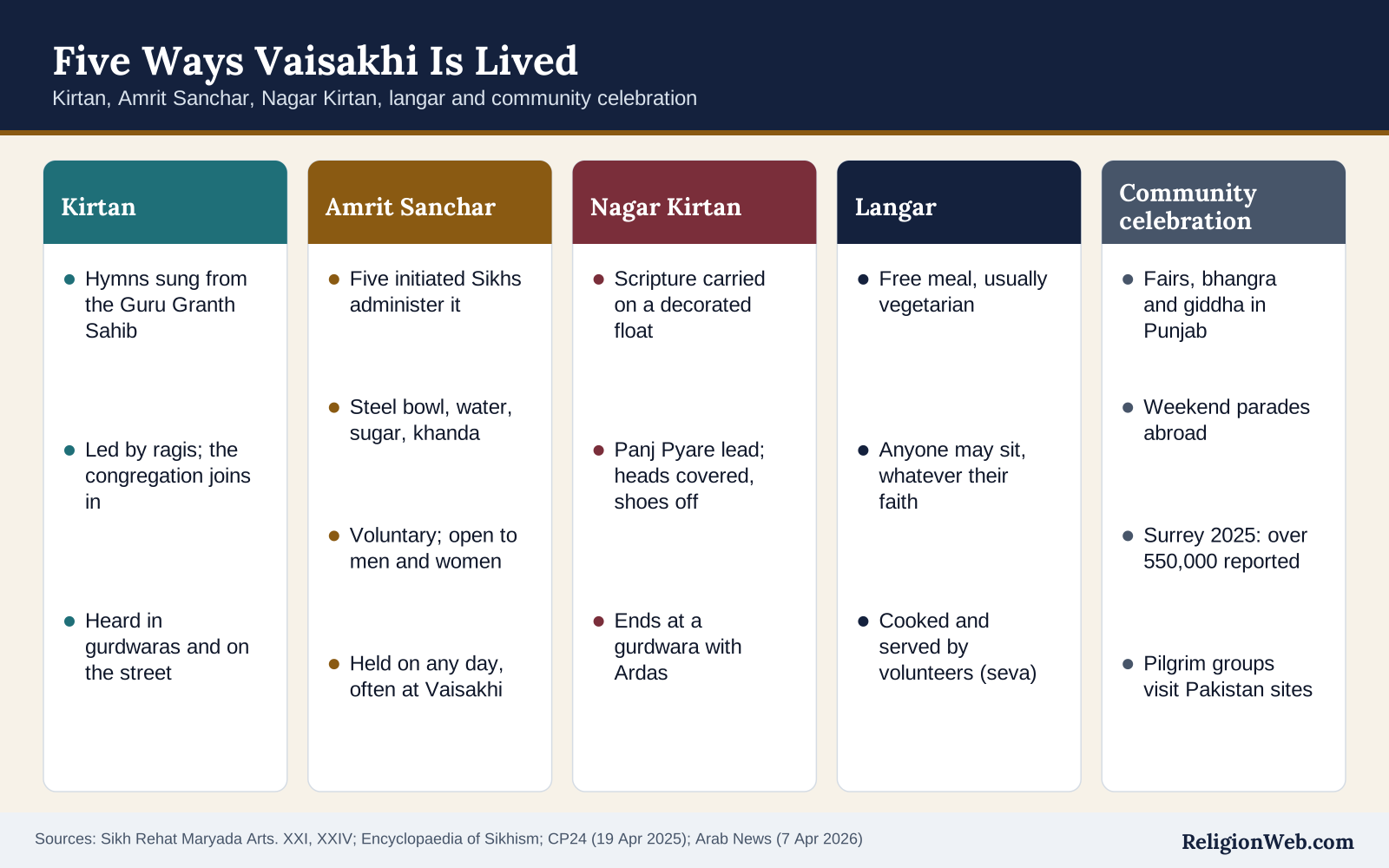
On Vaisakhi, Sikh gurdwaras (houses of worship) fill with hymn singing called kirtan, with a continuous reading of the scripture known as an Akhand Path, with the congregational prayer called Ardas, and with the sweet offering karah prashad. The free community kitchen, langar, feeds everyone who comes. Many gurdwaras hold the Amrit Sanchar, the Khalsa initiation ceremony, and communities in Punjab and around the world organize a Nagar Kirtan, a hymn-singing procession that carries the Guru Granth Sahib through the streets. Some of these processions now draw crowds counted in the hundreds of thousands.
The history behind the day is told in layers, and it helps to keep them apart. Sikh tradition gives a vivid narrative of the gathering at Anandpur, with a call for heads, five volunteers, and a new kind of initiation. Early Sikh texts confirm that the Khalsa took shape around the turn of the eighteenth century, while later chronicles add detail and historians weigh what can be known. The date is a puzzle of its own, because the same festival is placed on 30 March, 13 April, or 14 April depending on the calendar and the source.
This page is a festival chapter. For the wider picture of the faith, its ten human Gurus, and its beliefs, see the broader article on Sikhism. The founder is the subject of the article on Guru Nanak, and the articles of faith that Khalsa Sikhs keep are explained in the article on the Five Ks of Sikhism. Here the focus is on what people do on Vaisakhi, how they do it, and why it matters, in Punjab and in the diaspora.
Vaisakhi at a Glance: Meaning, Names, and Key Vocabulary
What Vaisakhi Means to Sikhs
A Solar Spring Day in the Punjabi Calendar
Vaisakhi marks the first day of Vaisakh (Baisakh), a month of the Indian solar calendar. Britannica describes Baisakhi as a spring harvest festival marking the first day of Vaishakha in the Hindu solar calendar, and says it usually occurs on 13 or 14 April. The Encyclopaedia of Sikhism, published by Punjabi University, similarly calls it a seasonal festival of the Punjab that opens the solar month of Baisakh. Because the date depends on the sun and not on the moon, Vaisakhi stays within a day of the same Gregorian date year after year, unlike Sikh observances that follow lunar months.
Punjab, the region of the five rivers that is today divided between India and Pakistan, is where the Sikh tradition began, and its farming calendar shapes the festival. The winter wheat crop ripens in April, so the first days of Vaisakh are a natural moment for thanksgiving and for fairs. The Sikh meaning of the day was added to this seasonal setting rather than replacing it, a point that matters when reading both the history and the present-day celebrations.
Why the Festival Has Several Names
Vaisakhi and Baisakhi are two spellings of the same word, derived from the month name, and both are in wide use. Sikh institutions and newspapers also call the day Khalsa Sajna Divas, roughly “Khalsa Creation Day,” and large parades in Canada often use the title Khalsa Day. In the press the day is sometimes described as the Sikh or Punjabi New Year, but that label is not used consistently, since the Nanakshahi calendar discussed later places the start of its year in the month of Chet, in March.
The variety of names reflects the variety of meanings. A farmer in a Punjab village may think first of the harvest, a gurdwara committee in Surrey or Southall of the parade, and an initiated Sikh of the vows taken at Anandpur more than three centuries ago. None of these uses is wrong, and the article uses “Vaisakhi” for the whole festival and “Khalsa Sajna Divas” when the focus is the founding of the Khalsa.
How Sikh Significance Relates to Harvest and Regional Custom
The Religious Meaning Sikhs Give the Day
Statistics Canada, in a 2023 article on the festival, calls Vaisakhi the holiest day of the year in the Sikh faith and links it to the creation of the Sikh collective faith by Guru Gobind Singh in 1699. In Sikh understanding the day commemorates a decision to form a community in which every member stands in direct relation to the Guru, without intermediaries, and shares one discipline and one family name. The gurdwara services of the day return again and again to that theme of commitment, courage, and equality.
Sikh reflection on the day also draws on devotion that has nothing to do with the sword. The Guru Granth Sahib contains a twelve-month poem by Guru Arjan, the Barah Maha in the raga Majh (pages 133 to 136), in which each month is a season of the soul. According to the entry on the poem in the Encyclopaedia of Sikhism, its Vaisakh stanza says, in paraphrase, that the month is joyful only when a person meets the devotees of the Lord and the sense of separateness dissolves. In many gurdwaras the stanza for a new month is read or sung when that month begins, a custom tied to the monthly day of sangrand.
The Shared Seasonal Meaning in Punjab
The Encyclopaedia of Sikhism entry on Baisakhi, written by S. S. Vanjara Bedi, begins with the festival’s agricultural roots. It records that the folk dance bhangra, now famous worldwide, was traditionally performed at harvest time, and that the day was understood as bringing plenty and happiness. Fairs, called melas, gather around gurdwaras and market towns each April, and India’s tourism ministry describes the mela at Talwandi Sabo as marking the Punjabi New Year and the rabi (winter) wheat harvest.
This seasonal side belongs to Punjabi culture as a whole and is not confined to Sikhs. Punjabis of several faiths, along with other communities across South Asia, treat the opening of the solar year as a time for gratitude, food, and visiting. A later section looks at these wider customs. The key point for now is that Sikh religious significance and the harvest tradition coexist on the same day, and neither requires the other to be minimized.
Key Vocabulary of the Festival
Terms for People and Institutions
A handful of words recur in every account of Vaisakhi. The Khalsa (“the Pure”) is the order of initiated Sikhs, and the Panj Pyare, the “Five Beloved Ones,” are the five Sikhs who volunteered at Anandpur and who are remembered each time the ceremony of initiation is performed. The Guru Granth Sahib is the scripture that Sikhs treat as their eternal Guru, and the sangat is the congregation that gathers before it. A gurdwara is the building where the scripture is installed, from Punjabi words meaning roughly “doorway of the Guru.”
Terms for Practices and Objects
The remaining terms name things people do or see. Amrit is the sweetened water used in initiation, and Amrit Sanchar is the ceremony itself, also called khande di pahul, “initiation of the double-edged sword.” The Nishan Sahib is the saffron or blue flag flying above a gurdwara, and seva means selfless service, which in practice often means cooking, serving, cleaning, or guiding visitors. The table below collects these and related terms in one place.
| Term | Meaning | Place in Vaisakhi |
|---|---|---|
| Vaisakhi (Baisakhi) | First day of the solar month Vaisakh, mid-April | The festival itself: Khalsa anniversary, harvest and new-year season |
| Khalsa | “The Pure”; the order of initiated Sikhs, from the Arabic khalis | Founded by Guru Gobind Singh in 1699 |
| Panj Pyare | “Five Beloved Ones”; the first five initiates | Lead initiations and processions |
| Amrit Sanchar | Initiation ceremony, also called khande di pahul | Held at many gurdwaras and gatherings on or near Vaisakhi |
| Khanda | Double-edged sword, also the Sikh emblem | Stirs the amrit in the initiation bowl |
| Guru Granth Sahib | Sikh scripture and eternal Guru | Installed in the gurdwara; carried in processions |
| Kirtan | Devotional singing of scripture | The main sound of the day, in gurdwaras and on the street |
| Akhand Path | Unbroken reading of all 1,430 pages of the scripture | Often timed to end on the morning of Vaisakhi |
| Ardas | Congregational prayer, offered standing | Closes services and processions; recalls Sikh history |
| Karah prashad | Sweet offering of flour, sugar, and ghee | Distributed to all after prayers |
| Langar | Free community kitchen open to all | Meals at gurdwaras and along parade routes |
| Nagar Kirtan | Hymn-singing procession through a town or city | The public form of the celebration |
| Nishan Sahib | Flag on a tall pole outside a gurdwara | The cloth is replaced on Vaisakhi in many gurdwaras |
| Seva | Selfless service to the community | The labor behind every kitchen, procession, and service |
Before 1699: Vaisakhi in the Gurus’ Time and the Road to Anandpur
Vaisakhi as a Gathering Day Before the Khalsa
Guru Amar Das and the Fair at Goindval
The festival did not begin in 1699. The Encyclopaedia of Sikhism entry on Baisakhi reports, citing the Mahima Prakash of Sarup Das Bhalla, that the third Guru, Guru Amar Das, began an annual fair at his seat of Goindval on Baisakhi, to which Sikhs from distant congregations traveled. The account fits what is known of his organization of the early community, in which regional preaching seats and large gatherings tied scattered Sikhs to the Guru. It gave the spring day a place in Sikh life long before the Khalsa existed.
The same entry notes that some Sikh texts place the birth of Guru Nanak in the month of Baisakh. Most Sikhs today observe the Guru’s birth anniversary on the full moon of Kartik in the autumn, and the question of his birth date is separate from Vaisakhi as the Khalsa festival. Readers who want the founder’s life and the traditions about his birth will find them in the article on Guru Nanak.
The Panth and Its Regional Agents
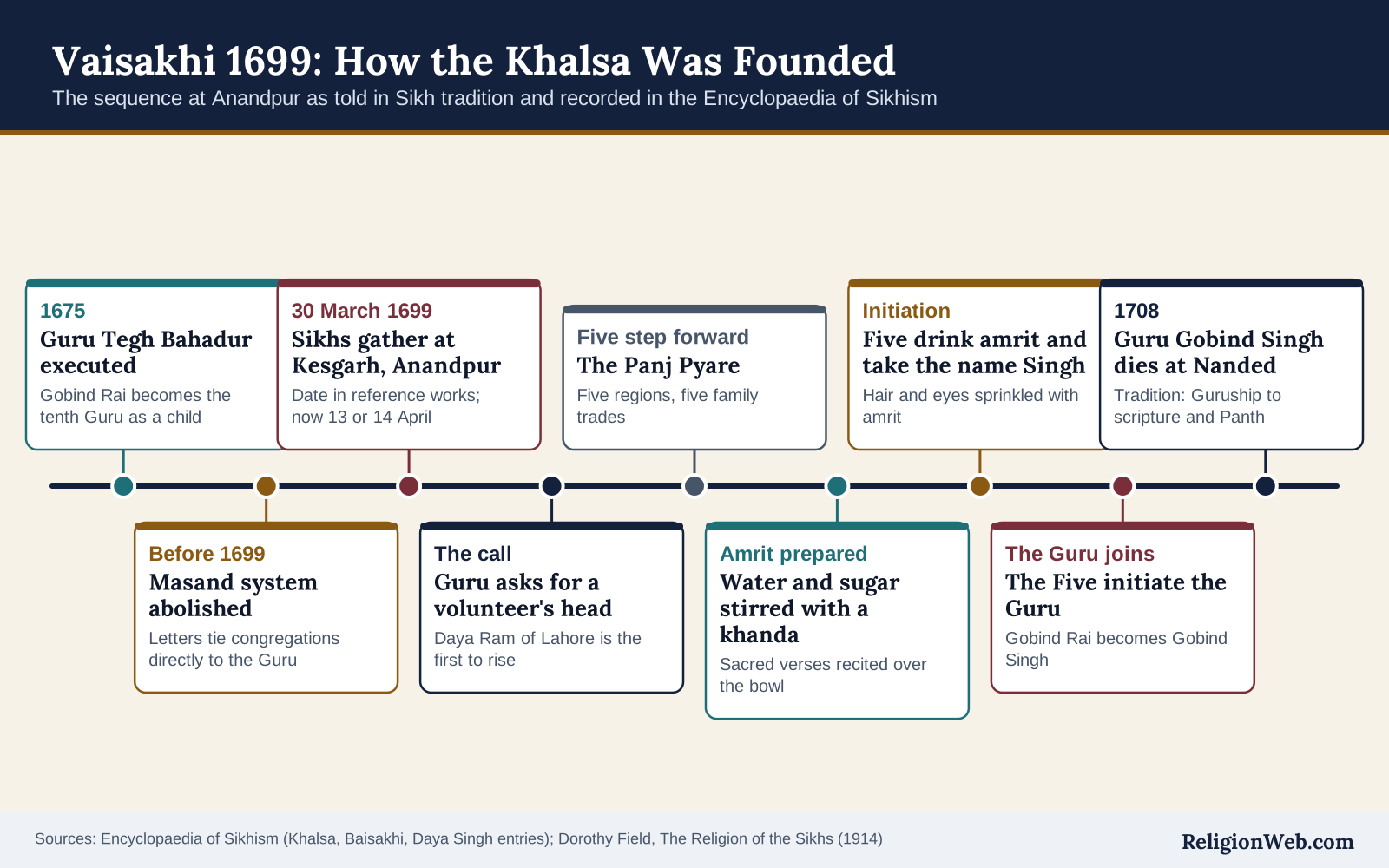
By the late seventeenth century the Sikh community, called the Panth, was spread across Punjab and beyond, and the Gurus relied on appointed agents known as masands to gather offerings and tend local congregations. Britannica’s account of Sikhism says that, according to Sikh tradition, Guru Gobind Singh created the Khalsa partly to end the power of masands who had grown corrupt, and to bind all Sikhs directly to the Guru. The Encyclopaedia of Sikhism notes that shortly before 1699 the Guru abolished the masand system, and that his letters, called hukamnamas, confirm a direct relationship between congregations and the Guru.
Guru Gobind Singh at Anandpur
A Young Guru in the Shivalik Foothills
Guru Gobind Singh was born in 1666 and died in 1708, according to the Encyclopaedia of Sikhism. He became Guru in 1675 as a child, after his father, Guru Tegh Bahadur, was executed in Delhi on the orders of the Mughal authorities. He grew up at Anandpur, the town in the Shivalik hills founded by his father, which became the center of a growing community. Its fort of Kesgarh would become the setting for the gathering that Sikhs remember each Vaisakhi, and the Takht Sri Kesgarh Sahib there is today one of the five seats of Sikh religious authority.
Hill Chiefs, Mughal Power, and a Community Under Pressure
The Guru’s years at Anandpur were marked by tension with neighboring hill chiefs and, later, with imperial forces. Biographies of the Guru written by Sikh scholars describe battles around Anandpur in the 1690s and after, and the siege and evacuation of the town in the winter of 1704 to 1705. For Sikh readers the founding of the Khalsa therefore sits between two experiences: the memory of the martyrdom of Guru Tegh Bahadur and the ongoing uncertainty of life in the hills. That background helps explain why the narrative of 1699 places so much weight on courage, readiness to sacrifice, and loyalty to the Guru and the community.
The Founding of the Khalsa in 1699: Tradition and History
The Account in Sikh Tradition
The Call at Kesgarh
In the account that Sikhs have told for generations, Guru Gobind Singh summoned the Sikhs to Anandpur for the spring festival of 1699. The Encyclopaedia of Sikhism places the gathering, a diwan or court of the congregation, in the fort of Kesgarh at Anandpur. Before the assembled Sikhs the Guru is said to have called for a volunteer willing to give his head. The first to rise, according to the entry on Bhai Daya Singh in the same encyclopedia, was a Sikh from Lahore named Daya Ram. The Guru took him into a tent, and the crowd waited in silence.
In the versions most often retold, the Guru returned to the assembly alone, with a sword that appeared bloodied, and asked for a second head. The scene was repeated until five men had followed him one after another into the tent. Retellings differ about what happened inside it, and Sikh authors have long debated the details. What the narrative stresses is the readiness of the five to surrender everything to the Guru without knowing the outcome. Many Sikh readers hear an echo of a verse attributed to Guru Nanak in the scripture, which invites anyone who wishes to enter the path of love to come with the head held in the palm of the hand.
It is a fair inference that the Guru chose a day already associated with travel to the Guru. Since the time of Guru Amar Das, according to the Encyclopaedia of Sikhism, Sikhs from distant congregations had been accustomed to come to the Guru on Baisakhi. A call for volunteers made to a large, assembled Panth had a different weight from the same call made in a small meeting, and the spring date gave the founding a built-in audience.
The Five Who Stepped Forward
The five emerged from the tent unharmed, and the Guru presented them to the congregation as his Panj Pyare, the Five Beloved Ones. The Encyclopaedia of Sikhism records their pre-initiation names and places: Daya Ram, son of a Sobti Khatri family of Lahore; Dharam Das, from the farming family of Hastinapur; Himmat, from a family of water suppliers at Jagannath, on the eastern coast; Muhkam Chand, from a cloth-printing family of Dwarka, on the western coast; and Sahib Chand, the son of a barber from Bidar, in the south. Accounts differ on some details of caste labels, and the sources used here describe family trades more often than castes.
The geography is part of the message. The five came from the north, east, west, and south of the subcontinent, and from families that earlier social hierarchies ranked very differently. Sikh tradition and Sikh teachers read this as the opening act of a community in which birth did not decide rank. That reading is a statement about meaning, but the pattern of regions and trades is itself recorded in the encyclopedia entries and in educational accounts from Sikh organizations.
| Name before initiation | Name after | Home | Family background given |
|---|---|---|---|
| Daya Ram | Daya Singh | Lahore | Sobti Khatri family; first to rise |
| Dharam Das | Dharam Singh | Hastinapur | Farming family |
| Himmat (Rai) | Himmat Singh | Jagannath (Puri), east | Family of water suppliers |
| Muhkam (Mohkam) Chand | Mohkam Singh | Dwarka, west | Cloth-printing family |
| Sahib Chand | Sahib Singh | Bidar, south | Barber’s son |
Amrit and the Guru’s Own Initiation
According to tradition, the Guru then prepared a new kind of initiation. He poured water into an iron bowl and stirred it with a double-edged sword, the khanda, while reciting sacred verses. In a widely repeated detail, the Guru’s wife, named Mata Jito in some accounts and Mata Sundari in others, added sugar crystals to the water, so that the drink joined the sweetness of devotion to the strength of the steel. The mixture was called amrit, a word used in the scripture for the nectar of the divine Name. The Guru gave the amrit to the five to drink and sprinkled it on their eyes and hair, and he gave them the surname Singh, “lion.”
The most striking feature of the account is what happened next. The Encyclopaedia of Sikhism entry on Daya Singh records that the five then initiated Guru Gobind Singh himself. The Guru, who had been Gobind Rai, became Gobind Singh, and Sikh tradition sees the moment as the Guru placing himself within the community he had created. A British writer, Dorothy Field, summarized the core of the event for English readers in 1914 with the following sentence.
But the great work of Gobind Singh’s life was the institution of the Khanda-di-Pahul or Baptism of the Sword.
Dorothy Field, The Religion of the Sikhs (1914), chapter I, “The Sikh Gurus”
Field was an outside observer writing in a series of introductions to world religions, and her term “baptism” is a translation of convenience. Sikhs themselves speak of pahul, amrit sanchar, or taking amrit, and they understand the ceremony as a rebirth into the Guru’s household, not as a sacrament copied from elsewhere. Her sentence is useful for another reason: it reflects the way many early English accounts treated the founding of the Khalsa as the high point of the tenth Guru’s career.
What the Sources and Historians Allow
Early Texts and Later Chronicles
The earliest surviving Sikh text that speaks of the formation of the Khalsa is the Sri Gur Sobha, attributed to Sainapati and usually dated to the years around 1700 to 1711, although both its authorship and its exact date are discussed by scholars. The Encyclopaedia of Sikhism cites it for Sikhs describing the removal of the masands as making all Sikhs the Guru’s own Khalsa. A 2014 article in the journal Modern Asian Studies by Hardip Singh Syan uses the same text to show that the Khalsa was debated among Sikhs in Delhi soon after its formation, with supporters and opponents.
The detailed narrative of the five volunteers, the tent, and the bowl is richer in the later chronicles. These include the Gurbilas literature, the Bansavalinama of Kesar Singh Chhibbar, and the Gur Pratap Suraj Granth, all composed in the eighteenth and nineteenth centuries, as the bibliography of the encyclopedia entries shows. Historians read such works as valuable witnesses to how Sikhs remembered the event, and as less certain guides to what was said and done on the day. This is ordinary practice in the study of any founding story, and it does not require anyone to doubt the importance of the Khalsa.
Scholars of Sikh history differ on how much of the Khalsa’s later code was settled in 1699 itself. Some historians, W. H. McLeod among them, have argued that the discipline of the Khalsa developed gradually through the rahit-namas, the manuals of conduct written in the eighteenth century. Sikh scholars and institutions generally treat the gathering as a decisive moment in which the main features of the order were laid down. The two positions are not always as far apart as they sound, since both accept that something new began around 1699 and that its form continued to develop.
The Question of the Date
The Encyclopaedia of Sikhism gives the day of the founding as 1 Baisakh 1756 in the Bikrami era, which it equates with 30 March 1699, and Britannica also gives 30 March 1699. This is probably a date in the old-style (Julian) calendar still used in much of Europe then. The same day expressed in today’s Gregorian calendar would fall about ten days later, in early April. The festival has since drifted: the Indian solar year that fixes the date is slightly longer than the Gregorian year, so the day has crept later by a day every seventy years or so, and after the British adoption of the Gregorian calendar in 1752 it fell usually on 13 April and now most often on 14 April.
The result is a harmless confusion. Some reference works give 30 March for the founding, some give 13 April, and Sikh calendars give 14 April for the festival. They are describing the same Baisakhi, expressed in different calendars and different centuries. For the lived festival, the rule matters more than the arithmetic: Vaisakhi is the first day of Vaisakh, and it is celebrated when that day arrives.
| Date | Event | Note |
|---|---|---|
| 1552 to 1574 | Guruship of Guru Amar Das; annual Baisakhi fair at Goindval | Reported in the Mahima Prakash, cited in the Encyclopaedia of Sikhism |
| 1666 | Birth of Gobind Rai, later Guru Gobind Singh | Encyclopaedia of Sikhism gives 1666 to 1708 as his life span |
| 1675 | Execution of Guru Tegh Bahadur; Gobind Rai becomes Guru | Date widely cited in Sikh history |
| Before 1699 | The masand system abolished | Letters confirm direct ties between Guru and congregations |
| 30 March 1699 | Founding of the Khalsa at Kesgarh, Anandpur | Reference-work date; 1 Baisakh 1756 Bikrami |
| 1704 to 1705 | Siege and evacuation of Anandpur | Dates vary by calendar used |
| 7 October 1708 | Death of Guru Gobind Singh at Nanded | Tradition holds that he named the Guru Granth Sahib and the Panth as Guru |
| 1752 | Britain and its colonies adopt the Gregorian calendar | Baisakhi thereafter usually 13 April |
| 13 April 1919 | Firing on the crowd at Jallianwala Bagh, Amritsar | Remembered on the festival day |
| 1947 | Partition of Punjab | The large pre-1947 fairs at Panja Sahib and Eminabad fall in Pakistan |
| 14 April 2003 | Nanakshahi calendar launched at Takht Sri Damdama Sahib | Date from the SGPC’s own account of the calendar |
| 19 April 2025 | Surrey, British Columbia, parade | Reported at more than 550,000 attendees |
What the Khalsa Means: Names, Equality, and Discipline
Singh and Kaur: A Shared Name
The Names and What They Signify
The names Singh (“lion”) and Kaur (often rendered “princess”) are the most visible legacy of 1699 outside the gurdwara. The Rehat Maryada, the code of conduct issued by the Shiromani Gurdwara Parbandhak Committee (SGPC), instructs that boys be given names ending in Singh and girls names ending in Kaur. Field’s 1914 account puts the first half of this succinctly.
The Guru also gave them the name of Singh, or lion, which was to be added to the name of each baptized disciple.
Dorothy Field, The Religion of the Sikhs (1914), chapter I, “The Sikh Gurus”
Sikh tradition explains the shared name as a deliberate step away from family names that signaled caste or occupation. A person who takes amrit is told, in the SGPC’s description of the ceremony, to leave behind earlier ties of caste, occupation, and previous religion, and to become a member of the Guru’s household. Another mark of this new belonging is the Khalsa greeting, Waheguru ji ka Khalsa, Waheguru ji ki Fateh, meaning roughly “the Khalsa belongs to the Wonderful Lord, and victory belongs to the Wonderful Lord.”
Equality and Its Limits in Practice
Equality is the theme that Sikh speakers return to most often on Vaisakhi, and the five from five regions and five trades are its standing illustration. That ideal is also shared with Guru Nanak’s earlier teaching, which the article on Guru Nanak describes. Sikh writers themselves acknowledge that caste distinctions have not disappeared from Punjabi social life, including among Sikhs, and that the history of the Khalsa is better understood as a standard to which the community holds itself than as a finished achievement. A balanced account therefore describes the ideal and the reality together.
Discipline and Identity in the Khalsa
The Five Ks and the Four Prohibitions
The Rehat Maryada’s article on initiation requires those who take amrit to wear the articles of faith known as the Five Ks: kesh (uncut hair), kangha (a comb), kara (a steel bracelet), kachhehra (a type of shorts), and kirpan (a sword). It also lists four cardinal transgressions, called kurahits: dishonoring the hair, eating meat from an animal killed by the ritual method called kutha (the code’s wording refers to the Muslim method of slaughter, and its subject is a food practice), sexual relations outside marriage, and the use of tobacco. A person who commits one of these after initiation is expected to be re-initiated. The meaning of each article is treated at length in the article on the Five Ks of Sikhism, and this page does not repeat it.
Initiated and Non-Initiated Sikhs
The Khalsa is the disciplined core of the Panth, not the whole of it. Many Sikhs honor the Gurus, revere the Guru Granth Sahib, and take part fully in gurdwara life without having taken amrit, and some groups within the community, such as Sahajdhari Sikhs, do not adopt the full Khalsa discipline. The Rehat Maryada’s definition of a Sikh refers to belief in the Gurus and the scripture and in the amrit given by the tenth Guru, and it does not turn every Sikh into an initiate. This is one reason why Vaisakhi has two audiences: those who take or renew the vows, and the far larger community that celebrates what the Khalsa represents.
The Khalsa as a Collective Body in Later History
The word Khalsa had a history before 1699. The Encyclopaedia of Sikhism, in an entry by Ganda Singh, traces it to the Arabic khalis (“pure”) and the Perso-Arabic khalisa, which in Mughal administration meant crown lands run directly by the ruler without intermediaries. In Sikh usage it first appears in a letter of Guru Hargobind that calls an eastern congregation “the Guru’s Khalsa,” and Guru Tegh Bahadur used it in a letter to the congregation at Patna. The background explains the choice of word: members of the Khalsa belong directly to the Guru.
The same entry traces the later life of the term. The Sikh volunteer force of the eighteenth century was called the Dal Khalsa, and the government of Maharaja Ranjit Singh (1780 to 1839) was called Sarkar-i-Khalsa. For the community as a whole the entry prefers Khalsa Panth or Sarbat Khalsa, a collective will guided by the Guru Granth Sahib. Sikh tradition adds that before his death Guru Gobind Singh conferred Guruship on the Khalsa together with the scripture, which is why the Panth and the book are named together in Sikh prayer.
Vaisakhi in the Gurdwara: Services, Akhand Path, and Langar
Preparing for the Day
The Akhand Path Before Vaisakhi
Many gurdwaras begin their Vaisakhi observance two days earlier with an Akhand Path, an unbroken reading of the Guru Granth Sahib’s 1,430 pages from beginning to end. The Sikh Rehat Maryada describes the reading as taking about forty-eight hours, to be done clearly and correctly, and not so fast that listeners cannot follow. Readers take turns, each continuing where the last stopped, so that the scripture is never left unread. The reading begins with karah prashad, a few stanzas of the Anand Sahib, the Ardas, and a hukam, a verse taken at random as the day’s guidance, and it ends with a concluding hymn, another Ardas, and the distribution of prashad. The article on the Guru Granth Sahib explains how the scripture is installed, read, and honored.
The timing is customary and not a rule. A Malaysian press report from April 2025 describes the Akhand Path at Gurdwara Sahib Sentul as completed before the start of the Vaisakhi celebrations, and gurdwaras in many countries follow the same pattern so that the reading ends on the morning of the festival. Sikh families also arrange Akhand Paths in their homes for births, weddings, and other occasions, and a congregation may instead hold shorter readings. The choice depends on the size of the congregation, the volunteers available, and local custom.
Where an Akhand Path is not practical, the Rehat Maryada provides for the Sadharan (ordinary) Path, a reading of the whole scripture at a measured pace over days or weeks, begun with a few stanzas of the Anand Sahib, an Ardas, and the Japji. Families and small gurdwaras often choose this form, and some gurdwaras hold readings only on the day itself. The scripture is thus read in full in many different rhythms around the festival, from a single weekend to a month.
Changing the Nishan Sahib
Outside every gurdwara stands a tall flagpole carrying the Nishan Sahib, a triangular flag in saffron or yellow, in some places blue, often with the khanda emblem. On Vaisakhi, many gurdwaras replace the cloth. The Malaysian report notes that the flag at each gurdwara is replaced with a new one, and that the old flag is washed with milk and water, a ceremony that opens the day’s celebrations.
The Nishan Sahib is a sign of the Guru’s presence and of the sovereignty Sikhs associate with the Guru and the Panth. Raising a new flag on the festival that recalls the founding of the Khalsa makes a simple, visible statement of renewal. Because the details vary from place to place, in some gurdwaras the cloth is changed on other occasions as well, and practices such as washing the pole follow local custom.

The Day’s Service
Kirtan, Exposition, and the Hukam
On an ordinary day a gurdwara service has a recognizable shape. According to the Rehat Maryada, the order of service includes the opening of the scripture, kirtan, exposition of the teaching, the Anand Sahib, the Ardas, a slogan of victory, and the hukam. On Vaisakhi the kirtan is typically led by singers called ragis, who perform hymns from the Guru Granth Sahib, often with harmonium and tabla. The Rehat Maryada also allows the singing of hymns attributed to Guru Gobind Singh and of the poetry of Bhai Gurdas and Bhai Nand Lal for explanation, and it asks that any refrain the congregation repeats come from the hymn itself.
Between hymns, speakers give katha, the exposition of the scripture and of Sikh history. On this day the subject is almost always the Khalsa: the story of the five, the meaning of the initiation, and the obligations that follow. Some gurdwaras invite dhadi singers, who perform heroic ballads in a loud and rhythmic style, though their use varies. The point of the exposition is to pass the story on, so that young people who attended in childhood can retell it in their own words.
Ardas, Karah Prashad, and the Fateh Greeting
The Ardas is the prayer of the whole congregation, offered standing and facing the scripture. In its form as practiced in most gurdwaras it recalls the ten Gurus, the Five Beloved Ones, and the martyrs and trials of the Panth, and then it asks for the welfare of all. On Vaisakhi the prayer often includes special mention of the Khalsa and the day’s purpose. At its close the congregation joins the Sikh victory slogan, Bole so nihal, sat sri akal.
The service ends with the distribution of karah prashad. The Rehat Maryada specifies equal portions of wheat flour, sugar, and ghee, prepared with the recitation of verses, and requires that it be distributed impartially to everyone present, whatever their background. A visitor who joins the line is expected to accept it in cupped hands, which is a way of receiving the Guru’s blessing, not just a snack. The prashad is often followed immediately by the hukam and then by the call to langar.
Langar and Seva on Vaisakhi
What Langar Is and Who Eats
Langar is the Guru’s kitchen. Article XXI of the Rehat Maryada, the article on voluntary service, describes its purpose as training Sikhs in service and removing from their minds distinctions of high and low and of touchable and untouchable. It says that anyone may sit and eat there, whatever their rank, color, country, or religion, and that no discrimination should be made in seating people in rows. People sit together on the floor, a posture that puts the wealthy and the poor at the same level, and food is served by volunteers.
The meal is typically a simple vegetarian one of lentils, vegetables, flatbread, rice, and a sweet, although the menu depends on the gurdwara and the day. The vegetarian custom is general in gurdwara kitchens so that no visitor is excluded by diet, and it is a practice of the kitchen and not a rule about what Sikhs eat elsewhere. On Vaisakhi the preparation often begins the day before, and many gurdwaras serve far more people than on an ordinary day.
Seva as the Labor Behind the Festival
Seva, selfless service, is how the festival is carried out. The same Article XXI names simple forms of service such as cooking and serving food, serving water, fanning the congregation, and dusting visitors’ shoes. At Vaisakhi, seva may also mean directing traffic, setting up marquees, washing dishes, preparing prashad, or helping elderly visitors. Families often bring children to take part, so that service becomes a habit of the household. Sikh teaching presents seva as a form of worship, and its value lies in the doing, not in the recognition.
| Practice | What happens | Meaning and variation |
|---|---|---|
| Akhand Path | Unbroken reading of the Guru Granth Sahib over about 48 hours | Often timed to end on the morning of the festival; a custom, not a requirement |
| Changing the Nishan Sahib | Old flag taken down and washed; new cloth raised | Renewal of the Guru’s sign; details differ by region |
| Kirtan | Ragis sing hymns from the scripture; congregation joins refrains | The Rehat Maryada limits kirtan to Gurbani and approved poets |
| Katha and lectures | Exposition of scripture and the story of 1699 | Passes on the history; often in Punjabi and English |
| Anand Sahib and Ardas | Hymn of joy, then standing prayer | The prayer recalls the Gurus, the Panj Pyare, and martyrs |
| Hukam | Verse taken from the scripture as the day’s guidance | Read by a Sikh from the left page of the open scripture, often at closing |
| Karah prashad | Sweet offering given to all in cupped hands | Equal ingredients; given without distinction |
| Langar | Free meal served to everyone seated together | Embodies equality; run by volunteers |
| Amrit Sanchar | Initiation held at many gurdwaras | Voluntary; see the next section |
| Fairs and sports | Sports contests, martial displays, and market stalls at larger centers | Seen at sites such as Anandpur and Talwandi Sabo |
Amrit Sanchar: The Khalsa Initiation Ceremony
How the Ceremony Is Performed
Who May Take Amrit and Who Administers It
The ceremony recalls the gathering of 1699 and it is conducted by a group that stands in for the Five Beloved Ones. Article XXIV of the Rehat Maryada says that any man or woman of any country, religion, or caste who accepts Sikh principles may take amrit, provided the person is not very young and has reached a reasonable degree of discretion. It does not set a specific age. Five initiated Sikhs administer the rite, and they should be free from physical disability and breaches of discipline and should have a pleasing presence. A sixth initiated Sikh attends the scripture, and the code explicitly allows women to be among the six.
The ceremony takes place in a secluded place with the Guru Granth Sahib installed. Everyone bathes and washes their hair, and the candidates wear the Five Ks and nothing associated with another faith. Before the rite begins, the Five explain the principles of Sikhism and ask each candidate whether he or she accepts them willingly, after which the preparation of the amrit begins. Because the rite makes serious commitments, those who administer it are expected to take care that candidates understand what they are undertaking.
The Bowl, the Banis, and the Five Handfuls
The amrit is prepared in a clean steel bowl set on a steel ring or support, with fresh water and sugar crystals. The Five sit around the bowl and stir the water with a double-edged sword while reciting five prayers in turn: the Japji, the Jaap, the Ten Savaiye, part of the Benti Chaupai, and the first five stanzas and the last stanza of the Anand Sahib. The recitation is followed by an Ardas for the amrit. The candidates sit in the alert posture called bir asan, receive the amrit in cupped hands, and drink it five times. Five handfuls are sprinkled into the eyes and five on the hair, and at each step the candidates and the Five exchange the Khalsa greeting.
The new initiates then share the remaining amrit from the same bowl, men and women together. The Mool Mantar, the root statement of the Sikh creed, is recited and repeated, and the Five explain the discipline of the Khalsa. A hukam is taken, and candidates who do not yet have a Sikh name receive one beginning with the first letter of the hukam. The rite closes with karah prashad. The overall sense is of being joined to the order founded in 1699 through the same steps its first members took.
What the Initiate Promises
Commitments Taken at Initiation
The Rehat Maryada says that the newly initiated are told they are reborn in the household of the Guru, with Guru Gobind Singh as their spiritual father and Mata Sahib Kaur as their spiritual mother. They are asked to worship only the One Timeless Being, to learn Gurmukhi (the script of the scripture), to recite the daily prayers, to keep the Five Ks, and to give a tenth of their earnings to the community. They also accept the four prohibitions discussed in the previous section. A person who commits one of them knowingly is expected to be initiated again, while the code provides that lapses made unintentionally or unknowingly are not punished.
Why Vaisakhi Is a Time for Initiation
Amrit can be taken on any day, and the Rehat Maryada does not tie it to the festival. Many Sikhs choose Vaisakhi because it recalls the first initiation, and the Encyclopaedia of Sikhism notes that larger centers hold amrit-prachar, programs to encourage initiation, on the day. A gurdwara may host the ceremony in the early morning before the main service, or on the day before, so that new initiates can take part in the procession or the congregation. For those who take amrit, the festival is both a personal rite of passage and a link with the first five who did so.
The choice is a personal one. A Sikh who does not take amrit on Vaisakhi, or at all, is not excluded from the day’s worship or from any part of gurdwara life, and the Sikh community has long included members at different stages of observance. The festival is for everyone who values what the Khalsa represents.
Nagar Kirtan: The Vaisakhi Procession
What a Nagar Kirtan Is
Meaning and Origins of the Term
Nagar Kirtan means roughly “hymn singing through the town.” The first word is the Sanskrit-derived nagar, town or city, and the second is kirtan, devotional singing. Reference works note that the term also appears in Hindu devotional settings, especially in Bengal, where the Vaishnava saint Chaitanya Mahaprabhu is credited with promoting communal singing in the streets, and the article on Vaishnavism explains the devotional movement behind that custom. In Sikh usage the word names a procession that carries the Guru Granth Sahib, accompanied by hymn singing, through a neighborhood, a town, or a city.
Sikh communities hold Nagar Kirtans for several Gurpurabs, the anniversaries of the Gurus, and for Vaisakhi they are the most visible public form of the celebration. The sections of the Rehat Maryada consulted for this article do not lay down a procession liturgy, which suggests that the Nagar Kirtan is a custom that grew out of congregational practice and not a prescribed rite. It follows the code in one important respect: the scripture is treated in the street as it is in the gurdwara.
The Scripture at the Center
At the heart of every Nagar Kirtan is the Guru Granth Sahib itself, usually carried on a decorated float or vehicle. Descriptions of the Sikh form of the procession mention that participants walk barefoot out of respect for the scripture, many cover their heads, and many wear saffron or orange, and that bystanders bow as it passes. Attendants often wave a ceremonial whisk, the chaur, over the scripture, as is done in the gurdwara. The float is the focal point, and everything else in the procession is arranged around it.
The reason for the arrangement lies in the Sikh understanding of the scripture as the living Guru. In the processions the Guru is not being displayed; the Guru is visiting the neighborhood and receiving the people, who in turn line the street to see and greet. For that reason the procession is long and slow, and it often begins and ends at a gurdwara, where the Ardas is offered at the conclusion.
Elements and Etiquette of the Procession
The Panj Pyare, Nishan Sahibs, and Kirtan Groups
The procession is led by five initiated Sikhs who stand for the Panj Pyare, often dressed in saffron or blue robes and carrying swords. Behind or beside them walk bearers of the Nishan Sahib, the flags that announce the procession, and groups of singers, called jathas, who perform hymns from the back of trucks or on foot. In the Sikh form of the procession described in reference works, volunteers called sewadars clear the road ahead of the scripture. Many parades also feature gatka, the Sikh martial art, in which practitioners demonstrate sword and staff skills, and floats prepared by gurdwaras that depict scenes from Sikh history.
Different gurdwaras and committees organize different parts of the procession, and the order and atmosphere vary from place to place. A parade in Punjab may be mostly local, with a village or neighborhood gathering behind a single float. A city parade in Canada may include nearly two dozen floats, marching bands, politicians, community organizations, and large crowds from outside the Sikh community who come to watch and to eat.
Food, Water, and Seva Along the Route
Free food is a recognized part of a Nagar Kirtan. Reference descriptions of the Sikh form note that food may be offered from floats that follow the scripture or from stationary points along the route, and press reports from large parades describe volunteer-run stalls that serve meals, sweets, and drinks to anyone who passes. Families, gurdwaras, and local businesses typically sponsor the stalls, each one run by volunteers who give their time without payment. Sikh teaching treats this as an expression of seva, and the stalls are usually described as part of the gift of the day, not as a commercial service.
The logic comes from langar. Where the gurdwara kitchen feeds those who sit in its hall, the stalls along the route feed those who walk by, and in both cases the invitation does not depend on who the visitor is. Attendance is often much wider than the Sikh community, which is one reason for the festival’s role in introducing neighbors to each other. Visitors are welcome to accept food, and organizers generally ask only that they follow the basic courtesies of the event, such as covering the head and removing shoes near the scripture.
| Element | What participants see or do | Meaning |
|---|---|---|
| Guru Granth Sahib | Carried on a decorated float or vehicle, with a ceremonial whisk waved over it | The living Guru visits the neighborhood |
| Panj Pyare | Five initiated Sikhs lead, in saffron or blue robes | Recall the first five of 1699 |
| Nishan Sahib | Flags carried at the head of the procession | Announce the Guru’s presence and the Panth |
| Kirtan groups | Jathas sing from trucks or on foot; the crowd joins in | The scripture is sung, not just displayed |
| Sewadars | Volunteers clear and prepare the road ahead | Service as honor to the scripture |
| Etiquette | Heads covered, shoes removed near the float; bystanders bow | Same respect as in the gurdwara |
| Gatka and floats | Martial displays and tableaux of Sikh history | Teach history and Khalsa tradition; vary by community |
| Food stalls | Free meals, sweets, and drinks offered along the route | Langar and seva in public space |
| Conclusion | Procession ends at a gurdwara with Ardas | The Guru returns to the gurdwara |
Vaisakhi in Punjab, Pakistan, and the Diaspora
Punjab and Pakistan
Anandpur Sahib, Talwandi Sabo, and Amritsar
In India the festival has three major Sikh centers. The Encyclopaedia of Sikhism names the Golden Temple (Harmandir Sahib) in Amritsar, Takht Sri Damdama Sahib at Talwandi Sabo, and Takht Sri Kesgarh Sahib at Anandpur Sahib as the principal venues, and it notes that larger centers add fairs, initiation ceremonies, and sports contests to the gurdwara program. Anandpur, as the site of the 1699 gathering, draws devotees who wish to be where the tradition says the Khalsa began. The Golden Temple draws pilgrims of every background, many of whom come to pay respects and to eat in its enormous kitchen.
The mela at Talwandi Sabo is the best known of the fairs. India’s tourism ministry lists the 2026 edition for 13 and 14 April around Takht Sri Damdama Sahib, with prayers, kirtan, discourses, Nagar Kirtan processions, and community langar, together with bhangra and giddha performances and a rural marketplace. It is a reminder that in Punjab religious and agricultural celebration remain closely joined, and that a visitor can go from the sound of kirtan in the morning to folk dance in the afternoon.
Pilgrimage to Panja Sahib and Nankana Sahib
Partition in 1947 placed several of the most important Sikh sites in Pakistan. The Encyclopaedia of Sikhism records that before 1947 the largest Baisakhi fairs were held at Panja Sahib in the Attock district and at Eminabad, both now in Pakistan. Today Indian Sikh groups travel to Pakistan for the festival when visas are granted. Arab News reported in April 2026 that Pakistan’s High Commission in New Delhi had issued more than 2,800 visas to Sikh pilgrims for Baisakhi observances running from 10 to 19 April 2026 at sites including Gurdwara Panja Sahib in Hasan Abdal, Nankana Sahib, the birthplace of Guru Nanak, and the Kartarpur gurdwara.
These journeys depend on the political relationship between the two states, and the report itself notes that religious tourism is among the few steady areas of contact. For the pilgrims, the meaning is spiritual and historical: they visit places linked to the Gurus and gather for the festival in the lands where the tradition took shape. For readers outside the region, the example is a reminder that Vaisakhi is celebrated across the border of two countries.
The Sikh Diaspora
Canada
Canada has a large Sikh population, and its Vaisakhi parades are among the biggest in the world. Statistics Canada reported about 770,000 Sikhs in the 2021 census, or 2.1 percent of the population, up from 0.9 percent in 2001. The parade in Surrey, British Columbia, held on 19 April 2025 along 128 Street from Gurdwara Dashmesh Darbar, was reported by CP24 to have drawn more than 550,000 people; the article did not say who produced the count, and such figures are estimates by organizers and media, not independent head counts. A week earlier, on 12 April 2025, a parade in South Vancouver drew thousands, according to CTV News.
The Khalsa Day parade in Toronto, which CBC News describes as running from the Canadian National Exhibition grounds to City Hall, offers a different scale and urban setting, with street closures along Lake Shore Boulevard and attendees who say it brings people together. In these cities, Vaisakhi has become a public festival that politicians, including federal party leaders, attend, and one that introduces non-Sikh neighbors to Sikh practice through food and music.
The United Kingdom and Beyond
In England and Wales, the 2021 census counted 525,865 Sikhs, or 0.9 percent of the population on Census Day, 21 March 2021, according to the Office for National Statistics. About a quarter of them (26.4 percent) lived in five West Midlands authorities (Sandwell, Birmingham, Wolverhampton, Walsall, and Coventry), and 18.5 percent in four outer London boroughs (Ealing, Hillingdon, Hounslow, and Redbridge). Nagar Kirtans and community events take place in cities such as Birmingham, Southall, and Coventry, where the city council lists a Vaisakhi parade among its events.
Elsewhere, observance follows the pattern of local gurdwaras. In Malaysia, a press report from April 2025 describes a three-day Vaisakhi at Gurdwara Sahib Sentul in Kuala Lumpur with an Akhand Path, the replacement of the Nishan Sahib, and an attendance that included the Deputy Prime Minister. Communities in the United States, Australia, East Africa, and elsewhere hold their own processions and services, adapted to local rules about permits and street closures.
| Place | Typical form of observance | Detail and source year |
|---|---|---|
| Anandpur Sahib, Punjab | Gatherings at Takht Sri Kesgarh Sahib, site of the 1699 gathering | Encyclopaedia of Sikhism lists it as a principal venue |
| Talwandi Sabo, Punjab | Mela at Takht Sri Damdama Sahib with kirtan, langar, Nagar Kirtan, bhangra, and giddha | 13 to 14 April 2026 listing by India’s tourism ministry |
| Amritsar, Punjab | Pilgrimage to Harmandir Sahib, with kirtan and langar | Encyclopaedia of Sikhism lists it as a principal venue |
| Hasan Abdal and Nankana Sahib, Pakistan | Pilgrim groups from India visit Gurdwara Panja Sahib and other shrines | 10 to 19 April 2026; more than 2,800 visas reported |
| Surrey, British Columbia | Large Nagar Kirtan with floats and free vegetarian meals | 19 April 2025; more than 550,000 reported by CP24 |
| Vancouver, British Columbia | Parade with a main float, thousands in attendance | 12 April 2025, per CTV News |
| Toronto, Ontario | Khalsa Day parade from the CNE grounds to City Hall | Reported by CBC News as drawing thousands |
| England and Wales | Nagar Kirtans and gurdwara programs, concentrated in the West Midlands and outer London | 525,865 Sikhs in the 2021 census (ONS) |
| Kuala Lumpur, Malaysia | Three-day observance with Akhand Path and replacement of the Nishan Sahib | April 2025 press report |
Harvest, Regional New Years, and Remembrance: Vaisakhi Beyond the Gurdwara
Harvest and New-Year Customs Across Communities
Punjabi Harvest Customs
Outside the gurdwara, Vaisakhi in Punjab is a farmers’ festival. Fields of wheat turn gold in April, and the arrival of the crop is a reason for fairs, new clothes, sweets, and visits between families. The Encyclopaedia of Sikhism entry on Baisakhi notes that bhangra, the energetic folk dance now known worldwide, was traditionally linked to the harvest, and the mela at Talwandi Sabo still features bhangra and giddha, the women’s counterpart, with dhol drumming and colorful dress. People of several faiths take part in these celebrations because they belong to Punjabi culture and not to a single religious community.
A respectful account keeps the two registers distinct without setting them against each other. For Sikh participants the harvest fair and the Khalsa anniversary are not competing claims on the same date. A family might attend an early morning service, take part in a procession, and then spend the afternoon at a fair or a meal with relatives. The religious meaning gives the day its depth for Sikhs, and the seasonal meaning gives it a wider community.
The Same Day in Other Regions of South Asia
The first days of the solar month Vaisakh mark the opening of the year in several other regional calendars, and Britannica notes that Baisakhi is associated with other regional new year festivals. In Bengal, Pohela Boishakh falls around this date, in Assam it is Bohag Bihu, in Tamil Nadu Puthandu, and in Kerala Vishu. These are separate festivals with their own histories, rituals, and meanings, observed by communities of different religious backgrounds. Their shared timing reflects the solar calendar behind them, which is also the calendar of the Hindu month Vaishakha that gives Vaisakhi its name.
Vaisakhi Within the Sikh Year
Solar and Lunar Observances
Vaisakhi is unusual among Sikh observances because it follows the sun. The birth anniversaries of the Gurus, called Gurpurabs, generally follow lunar dates, so that Guru Nanak’s Gurpurab falls on the full moon of the month of Kartik, in the autumn, and moves across the Gregorian calendar. Vaisakhi, by contrast, stays near 14 April. The effort to fix all Sikh dates in one calendar has made this difference more visible, as the next section explains, but Vaisakhi itself is the least disputed date in the Sikh year.
The Nanakshahi Calendar and Its Disputes
The Nanakshahi calendar was designed by Pal Singh Purewal (1933 to 2022), a Sikh calendar specialist who presented it in 1996. It counts years from 1469 CE, the traditional year of Guru Nanak’s birth, and was meant to give Sikh observances fixed solar dates in place of the lunar Bikrami reckoning. In its original form it places the start of the year at the first of Chet, which falls around 14 March, and the first of Vaisakh on 14 April. The SGPC adopted it in 2003, and the Takht Sri Damdama Sahib launch of the calendar took place on Vaisakhi, 14 April 2003.
The calendar has been contested since. In 2010 the SGPC adopted a revised version that ties many Gurpurab dates to the Bikrami calendar, and groups that prefer the original, including the Dal Khalsa, which released a copy in 2019, have campaigned for its restoration, as the Tribune reported. Sikh institutions and organizations still differ over which calendar should govern, so a Gurpurab date can differ between calendars and gurdwaras. For Vaisakhi the effect is small, because both versions place it in mid-April, and Punjab listings for 2026 gave 14 April.
Other Khalsa Gatherings: Hola Mohalla and Bandi Chhor Divas
Two other seasonal Sikh gatherings are sometimes mentioned alongside Vaisakhi. Hola Mohalla is held at Anandpur Sahib on the day after Holi, in late winter or early spring, and is known for martial displays and processions; the article on Holi describes the spring festival that gives it its timing. Bandi Chhor Divas, the “Day of Liberation,” falls at the same time of year as Diwali in the autumn, and the article on Diwali explains the wider festival season. Each of these has its own Sikh meaning, tied to the history of the Gurus, and none duplicates the commemoration of the Khalsa.
Remembering Jallianwala Bagh
What Happened on 13 April 1919
Vaisakhi in Amritsar also carries the memory of one of the most painful days of Punjab’s modern history. On 13 April 1919, British Indian troops under the command of General Reginald Dyer fired on a large crowd of unarmed people gathered in the Jallianwala Bagh, a walled public garden near the Golden Temple. Britannica records that several hundred people were killed and many more wounded. Estimates of the death toll differ by source, and the event is widely regarded as a turning point in the movement for Indian independence.
How the Date Is Remembered
The massacre happened on the festival day, in a city that was full of visitors and pilgrims for the occasion. As a result, 13 April has two overlapping meanings in Punjab: a day of celebration and a day of remembrance. Visits to the Jallianwala Bagh memorial in Amritsar are common on the anniversary, and the dead are remembered in prayer and public ceremony. The two are not mixed up by those who observe them, but they share a date, and many Punjabis feel the weight of both on the same morning.
Common Misconceptions About Vaisakhi
Misconception 1: Vaisakhi is only a harvest festival
Where the misunderstanding comes from
Many people first meet Vaisakhi through a one-line description in a news story or a calendar: a spring harvest festival celebrated in Punjab, with bhangra and fairs. That description is accurate as far as it goes. Britannica opens its entry on Baisakhi in just these terms, and the Encyclopaedia of Sikhism begins with the festival’s agricultural roots. A reader who sees only this summary can fairly conclude that the day is about the wheat crop.
The confusion is reinforced by the fact that the same solar day opens the new year in several other regions of South Asia, where it has no connection to the Sikh story at all. A journalist writing quickly for a general audience may reasonably choose the broadest frame. The Sikh meaning then appears, if at all, as a secondary note.
What the evidence and tradition actually show
For Sikhs, the harvest is one layer of the day and the founding of the Khalsa is another. Statistics Canada, in its public explanation of the festival, calls Vaisakhi the holiest day of the year in the Sikh faith, and the Encyclopaedia of Sikhism treats the 1699 initiation at Anandpur as what made Baisakhi a major Sikh festival. Sikh institutions name the day Khalsa Sajna Divas, and gurdwara services, the Akhand Path, Amrit Sanchar, and the Nagar Kirtan are organized around that history and not around the crop.
The reverse error is also worth avoiding. To say that Vaisakhi is only a religious commemoration would ignore the fairs, the dance, and the agricultural year that the same encyclopedia entry places first. The accurate statement is that the festival has a shared seasonal meaning in Punjab and a specific Sikh meaning added to it, long before and again after 1699, since the Gurus had already used the spring day for large gatherings.
Misconception 2: Every Sikh is initiated into the Khalsa on Vaisakhi
Where the misunderstanding comes from
Public images of Sikhs often show people with uncut hair, a turban, and the other articles of faith, and the festival that commemorates the Khalsa is the most visible Sikh occasion in many cities. It is easy to infer that the Khalsa is simply the Sikh community, and that Vaisakhi is the day on which Sikhs enter it, in the way that some religious traditions have a single rite of entry for all members. Media coverage of Amrit Sanchar ceremonies on the festival can add to the impression.
A related assumption is that the 1699 event transformed the whole Sikh population at once. The popular retelling of the day emphasizes the large assembly and the five who stepped forward, so it can sound as if every Sikh of the time joined the Khalsa on that day, and every Sikh since then has done the same.
What the evidence and tradition actually show
Initiation is voluntary and personal. Article XXIV of the Rehat Maryada says that any man or woman who accepts Sikh principles may take amrit, provided the person is not very young and has reached a reasonable degree of discretion, which excludes infants and treats the step as a decision. Nothing in the code limits initiation to Vaisakhi, and many Sikhs take amrit on other days, at gurdwaras that hold the ceremony regularly. The same code defines a Sikh by belief in the Gurus, the scripture, and the amrit of the tenth Guru, and it does not make every Sikh an initiate.
The Sikh community in fact includes people at many stages of observance, including Sahajdhari Sikhs who follow the Gurus’ teaching without adopting the full Khalsa discipline. Estimates of the share of initiated Sikhs vary, and one encyclopedia survey puts the figure at roughly 15 to 18 percent. Vaisakhi is therefore the festival of the whole Panth, with the initiated Khalsa at its center. The article on the Five Ks and the article on Sikhism describe the different categories of Sikhs in more detail.
Initiation is also open in principle to people from any background, so it would be a mistake to treat it as a rite of belonging reserved for those born into Sikh families. The Rehat Maryada states that any man or woman of any country, religion, or caste may take amrit, and that women may be among the five who administer it. What it asks is understanding and willing commitment, not an inherited status, which is why the ceremony begins with an explanation of the principles and a question to each candidate.
Misconception 3: All Vaisakhi celebrations take the same form in Punjab and the diaspora
Where the misunderstanding comes from
The best-known images of Vaisakhi come from a few places: the Golden Temple in Amritsar, the gurdwara services in India, and the very large parades in Canada and Britain. Because images travel more easily than context, one scene can stand for the whole. A reader who has seen the Surrey parade, with its floats and half a million people, may assume that this is what Vaisakhi looks like everywhere, and that a quieter observance elsewhere is somehow incomplete.
Summary articles add to the effect when they describe the festival with a single list of features, such as a procession, free food, and prayers, without noting that each community decides which of these it will emphasize. The word “celebration” may also suggest a uniformly festive mood, although some Sikhs approach the day mainly as a time of reflection and commitment.
What the evidence and tradition actually show
Observance varies by place, size, and organization. In Punjab, the festival often centers on the takhts, on village gurdwaras, and on melas such as Talwandi Sabo, where kirtan sits beside bhangra and market stalls. For pilgrims from India in Pakistan, it is a journey to sites such as Panja Sahib and Nankana Sahib, dependent on visas. In Malaysia, a press report describes a three-day program at a single gurdwara with an Akhand Path and the changing of the Nishan Sahib. In large Canadian cities, the main parades are scheduled on weekends: the South Vancouver parade took place on Saturday, 12 April 2025, and Surrey’s on Saturday, 19 April, although Vaisakhi itself was 14 April that year.
The weekend scheduling of the diaspora parades is a good example of how a community adapts a fixed festival to the rhythm of working life. Gurdwaras may mark the actual day with services and hold the public procession when the largest number of people can attend. Both are Vaisakhi, and neither is more authentic than the other. The sections of the Rehat Maryada consulted for this article do not prescribe a single form for the Nagar Kirtan, so the shape of the procession belongs largely to local custom.
The practical consequence is that a Vaisakhi program can look different from one gurdwara to the next even within a single city. One congregation may hold its Akhand Path in the days before the festival and a procession on the weekend, while another may hold a smaller service on the day and no parade at all. Visitors do best to ask local organizers what is planned, and to treat differences as signs of local custom and not of disagreement about the festival’s meaning.
Misconception 4: Vaisakhi always falls on 13 April, the date of the founding of the Khalsa
Where the misunderstanding comes from
Older English-language reference works and many school calendars give 13 April as the date of Baisakhi, and the Encyclopaedia of Sikhism itself says that after Britain adopted the Gregorian calendar in 1752 the festival usually fell on 13 April. The Jallianwala Bagh massacre of 13 April 1919 also fixed that date in the memory of many people in Punjab and beyond. Some popular accounts then treat 13 April as the day of 1699 as well.
Meanwhile the reference works that give the founding of the Khalsa as 30 March 1699 seem to contradict the popular date. A reader who meets 30 March, 13 April, and 14 April in three sources can reasonably suspect that something is wrong with one of them.
What the evidence and tradition actually show
The dates are not rival claims but expressions of one rule applied through different calendars. Vaisakhi is the first day of the solar month Vaisakh. The Encyclopaedia of Sikhism equates the first of Baisakh 1756 in the Bikrami era with 30 March 1699, almost certainly a Julian date, which would be about ten days later in the Gregorian calendar. Because the Indian solar year is slightly longer than the Gregorian year, the festival has moved later, from 13 April to 14 April in recent years, as Punjab holiday listings for 2026 reflect. The Nanakshahi calendar fixes Vaisakhi on 14 April, and calendars that follow the traditional sun-sign reckoning may show a day earlier or later.
For anyone planning to attend, the practical rule is to check the local gurdwara or the SGPC calendar for the year in question. Because it is a solar festival, the date will fall within a day of 14 April, and the diaspora parade may be held on a nearby weekend.
Frequently Asked Questions About Vaisakhi
Questions About Meaning and History
What does Vaisakhi commemorate in Sikhism?
Vaisakhi commemorates the founding of the Khalsa by Guru Gobind Singh at Anandpur in 1699. According to Sikh tradition, the Guru called for volunteers willing to give their heads, five Sikhs responded, and he initiated them with amrit prepared in a bowl and stirred with a double-edged sword. He then received amrit from them, so that the Guru and the community stood on the same footing.
The day is also a spring harvest festival in Punjab and, in earlier centuries, a gathering day for Sikhs visiting the Gurus. Sikhs hold all of these meanings together, which is why the observance mixes solemn worship with feasting and music.
Who were the Panj Pyare?
The Panj Pyare, or Five Beloved Ones, were the first five Sikhs initiated into the Khalsa: Daya Singh, Dharam Singh, Himmat Singh, Mohkam Singh, and Sahib Singh, known before initiation as Daya Ram, Dharam Das, Himmat, Muhkam Chand, and Sahib Chand. They came from Lahore, Hastinapur, Jagannath, Dwarka, and Bidar, and from families with different trades.
The Sikh community remembers them in its daily prayer and honors their role at every initiation, where five initiated Sikhs administer the amrit. They also lead the Nagar Kirtan, where five Sikhs walk at the head as a sign of the first five. According to the Encyclopaedia of Sikhism, several of them fought in the battles around Anandpur, and Himmat Singh, Mohkam Singh, and Sahib Singh are recorded as dying at the battle of Chamkaur.
Is Sikh Vaisakhi the same as the Baisakhi observed by other communities?
They share a date and a season, but their meanings differ. The first of Vaisakh is a solar new year or harvest marker in the calendars of several communities in South Asia, each with its own customs. For Sikhs, the day carries the added meaning of the Khalsa’s founding, and the observance centers on the gurdwara and the Nagar Kirtan.
The wider Punjabi harvest celebration, with bhangra, fairs, and family meals, is shared among people of different religions in the region. Nothing in Sikh teaching sets the two against each other, and many Sikh families take part in both the religious and the seasonal celebrations on the same day.
Questions About Dates and Calendars
When is Vaisakhi, and what is the date in 2027?
Vaisakhi falls on the first day of the solar month Vaisakh, which is 13 or 14 April in the Gregorian calendar. In recent years, including 2026, listings for Punjab give 14 April. By the same rule the festival in 2027 should fall in mid-April, most likely on 14 April, but readers planning to attend should check the calendar of the SGPC or their local gurdwara, since this article does not rest on a published 2027 calendar.
Because the date follows the sun, it does not move through the seasons the way lunar festivals do. Diaspora parades may be held on the nearest weekend, so the procession in a given city can be a week before or after the day itself.
Is Vaisakhi the Sikh New Year?
The answer depends on the calendar. The press often calls Vaisakhi the Sikh or Punjabi New Year, and the first of Vaisakh does open the year in the traditional Punjabi solar calendar. The Nanakshahi calendar, however, begins its year on the first of Chet, around 14 March, and Sikh institutions that use it count years from 1469 CE.
In practice, both usages are common. Sikhs wishing each other a happy new year on Vaisakhi are following the Punjabi tradition of the season, while those who mark Chet are following the Nanakshahi reckoning. Neither is a doctrinal question; both are choices of calendar.
Questions About Attending Vaisakhi Events
Can non-Sikhs attend a Vaisakhi service, Nagar Kirtan, or langar?
Yes. The Rehat Maryada states that anyone may enter a gurdwara to pay respects regardless of country, religion, or caste, and Article XXI says anyone may sit and eat in the langar without discrimination. Nagar Kirtans are held in public streets and welcome spectators, and the large parades in Canada and Britain draw many people from outside the Sikh community.
The code does ask visitors not to bring tobacco or intoxicants into the gurdwara, and it limits entry to the inner enclosures of the five takhts to initiated Sikhs. Visitors are not expected to join in worship that they do not share, and they are welcome simply to watch, to listen, and to eat.
What should a visitor wear and do?
Visitors should dress modestly, cover the head with a scarf or bandana (gurdwaras commonly provide head coverings), and remove their shoes before entering the prayer hall. People usually sit on the floor, with men and women in some gurdwaras sitting on separate sides, and do not point their feet toward the scripture. On approaching the scripture many Sikhs bow, and visitors may bow or simply stand quietly.
When karah prashad is offered, it is received in cupped hands, and refusing it may be taken as discourtesy, though a visitor with dietary restrictions may quietly explain. Langar is eaten seated in rows, and food is not wasted, so it is wise to take small amounts and ask for more. Photography rules differ among gurdwaras, so it is best to ask a volunteer before taking pictures inside.
Conclusion: What Vaisakhi Shows About Sikh Memory and Community
What the History Shows
A Founding Remembered and Debated
The core of Vaisakhi is a founding story that Sikhs have told, retold, and examined for more than three centuries. The Encyclopaedia of Sikhism and the earliest Sikh texts agree that the Khalsa was established by Guru Gobind Singh at Anandpur around 1699 and that the Guru abolished the masand system and bound congregations directly to himself. Later chronicles added the vivid details of the five volunteers and the amrit bowl, and historians continue to discuss how much was settled on the day and how much developed afterward.
That conversation does not diminish the festival. For Sikhs, what matters is the meaning that the story carries: a community of equals, committed to the Guru and to one another, with courage and service as its working virtues.
A Festival of Many Layers
Vaisakhi combines a solar new year, a harvest, a founding anniversary, a pilgrimage season, and the public life of a global diaspora. It can be a quiet morning prayer, an initiation, a village fair, or a parade of hundreds of thousands. The festival works because its layers do not need to be separated by those who observe it, and because the central practices, kirtan, prayer, langar, and seva, are open to anyone who comes with respect.
How to Keep Exploring
Related Topics on ReligionWeb
Readers who want the wider background can turn to the article on Sikhism, which covers the ten Gurus, beliefs, and practices, and to the article on Guru Nanak for the founder’s life and teaching. The scripture that stands at the center of every Vaisakhi service and procession is the subject of the article on the Guru Granth Sahib, and the articles of faith linked to initiation are explained in the article on the Five Ks.
Checking Dates and Local Programs
Because dates and program details change from year to year and from place to place, the most reliable guides are the SGPC’s published calendar and the announcements of the local gurdwara. A short visit to a gurdwara in the days before Vaisakhi will usually reveal the schedule of the Akhand Path, the Amrit Sanchar, the Nagar Kirtan, and the langar, and visitors are generally welcomed and invited to eat.
Sources
The table below lists the principal external sources behind this article. Facts, dates and figures were checked against these and related primary, institutional and academic materials.
| # | Source | Publisher and type | Used for | Link |
|---|---|---|---|---|
| 1 | Baisakhi (entry in the Encyclopaedia of Sikhism, by S. S. Vanjara Bedi) | Punjabi University, Patiala (Encyclopaedia of Sikhism, online edition) · Academic reference | Harvest roots, Guru Amar Das fair at Goindval, 1699 date, principal venues, pre-1947 fairs | eos.learnpunjabi.org |
| 2 | Khalsa (entry in the Encyclopaedia of Sikhism, by Ganda Singh) | Punjabi University, Patiala (Encyclopaedia of Sikhism, online edition) · Academic reference | Meaning of Khalsa, masands, Sri Gur Sobha, 30 March 1699, later uses of the term | eos.learnpunjabi.org |
| 3 | Daya Singh, Bhai (1661-1708) (entry in the Encyclopaedia of Sikhism); with the entries on Dharam Singh, Himmat Singh and Sahib Singh | Punjabi University, Patiala (Encyclopaedia of Sikhism, online edition) · Academic reference | Kesgarh gathering, first volunteer, Panj Pyare names, homes and family trades | eos.learnpunjabi.org |
| 4 | Sikh Rehat Maryada, Article XXIV: Ceremonies of Baptism or Initiation | Sikhs.org (English translation of the SGPC code) · Institutional (code of conduct) | Amrit Sanchar: who may take and administer it, banis, handfuls, vows, four prohibitions | sikhs.org |
| 5 | Sikh Rehat Maryada, Article XXI: Voluntary Service (Guru ka Langar) | Sikhs.org (English translation of the SGPC code) · Institutional (code of conduct) | Purpose of langar, who may eat, forms of seva | sikhs.org |
| 6 | The Religion of the Sikhs, Chapter I: The Sikh Gurus (Dorothy Field, 1914) | Sacred-Texts.com · Primary text (public-domain English account) | The two quotations on the Khanda-di-Pahul and the name Singh | sacred-texts.com |
| 7 | Celebrating Vaisakhi in Canada | Statistics Canada · Demographic data | Vaisakhi as holiest day; 2021 census: about 770,000 Sikhs, 2.1% of Canada | statcan.gc.ca |
| 8 | More than half a million in attendance for Surrey Vaisakhi parade, the world's largest | CP24 / The Canadian Press · News report | Surrey parade of 19 April 2025: reported size, route, floats, free vegetarian meals | cp24.com |
| 9 | Sikhs throng gurdwaras to celebrate Vaisakhi | New Straits Times (Malaysia) · News report | April 2025 Malaysian observance: Akhand Path, replacing the Nishan Sahib, three-day program | nst.com.my |
| 10 | Pakistan issues over 2,800 visas to Indian Sikhs for Baisakhi festival | Arab News Pakistan · News report | April 2026 pilgrimage to Panja Sahib, Nankana Sahib and Kartarpur; festival dates 10 to 19 April 2026 | arabnews.pk |
Last fact-check date: 2026-10-21.