Mahavir Jayanti is the Jain festival that commemorates the birth of Mahavira, the twenty-fourth Tirthankara of the present half-cycle of time, and it is observed on the thirteenth day of the bright half of the lunar month of Chaitra, which falls in March or April. Jains also call it Mahavir Janma Kalyanak, a phrase that means “the auspicious event of Mahavira’s birth.” The day belongs to Jainism as a whole, and both Digambara and Shvetambara communities keep it, although what people actually do on the day varies a good deal from one sect, city, and temple to the next.
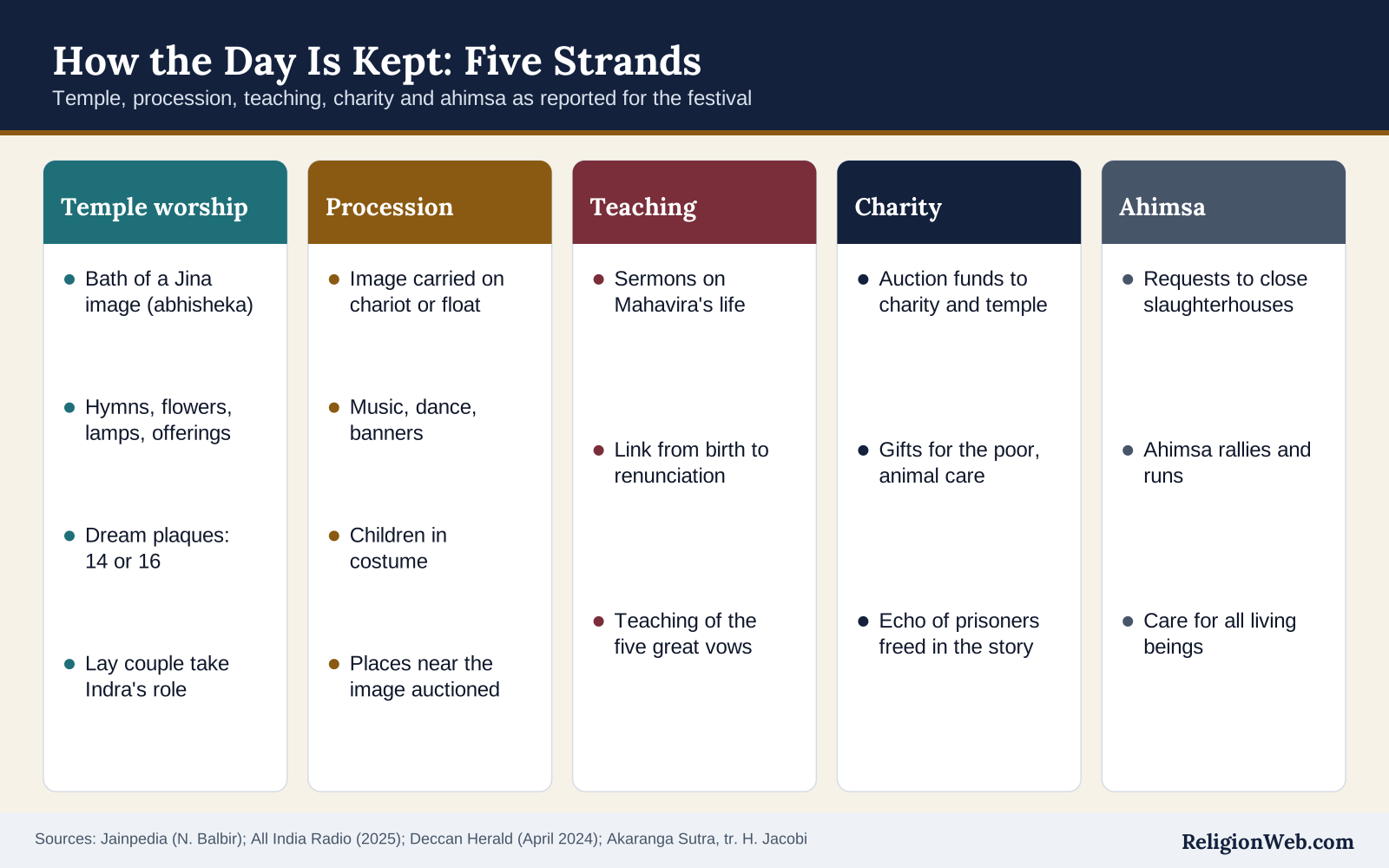
In many places the observance centers on the temple. Worshipers gather before an image of Mahavira, sing hymns, offer flowers, fruit, and rice, and wave small lamps. Where images are used, the image may be given a ceremonial bath that re-enacts a scene from the sacred biography, in which the king of the gods bathes the newborn Tirthankara on the cosmic Mount Meru. Many communities also carry an image of Mahavira through the streets on a chariot or float, hear sermons from monks and nuns, give money or food to charity, and mark the day with restraint toward living beings, a theme the tradition calls ahimsa, or nonviolence.
Three distinctions organize everything that follows. First, the festival commemorates the birth of a person within a long lineage of Tirthankaras, not the beginning of Jainism itself. Second, there is no single form of the celebration: Jains who worship through images, Jains who do not, and Jains of different regions describe the day differently, and an accurate account has to say so. Third, the day is both devotional and civic. It is a moment of worship inside the temple and, in modern India, a public holiday and a public occasion with processions that non-Jains also see and sometimes join.
This article sets out what the festival commemorates, why it carries the name Janma Kalyanak, how the date is fixed, what happens in temples and streets, how charity and ahimsa are woven into the day, and where sects and regions diverge. It draws on early Jain scripture in a public-domain translation, on the scholarship of the Jainpedia project, and on public reports of recent observances. It also keeps the festival apart from two neighbors that readers often confuse with it: Paryushana, the autumn season of fasting and forgiveness, and Diwali, when Jains remember Mahavira’s final liberation. The most recent observance in India was on March 31, 2026, and the next falls in 2027, as the calendar section explains.
Mahavir Jayanti at a Glance: Meaning, Names, and Vocabulary
What Mahavir Jayanti commemorates
The short answer
Mahavir Jayanti commemorates the birth of Vardhamana, who received the name Mahavira and who Jains revere as the last Tirthankara, or “ford-maker,” of the present age. In Jain understanding a Tirthankara is a human being who has conquered the passions, attained omniscience, and established a community that carries the path of liberation forward. The festival does not celebrate a founder in the sense that other religions might use that word; it celebrates the human birth of a teacher whom the tradition places at the end of a sequence of twenty-four. The longer account of his life, dates, and teaching is given in the article on Mahavira, and this page concentrates on how the birth is remembered.
The day also looks backward and forward. It looks backward to the sacred biography, in which the soul of the future Tirthankara descends from a heavenly realm, enters a womb, and is born amid dreams, divine attendants, and royal celebration. It looks forward to what the tradition holds Mahavira would become: a wandering ascetic, an omniscient teacher, and the figure whose liberation is remembered each year at the festival of lights. Because the birth is the second in a series of five auspicious moments, the festival makes most sense when read as one chapter in a larger liturgical story.
Who observes it
Jainpedia, the scholarly resource on Jain culture, describes the festival as celebrated by all Jain sects, Digambara and Shvetambara alike, and as the only Jain festival that the Indian government officially recognizes, so that it appears in the national calendar of holidays. The author of that article, the Jain studies scholar Nalini Balbir, adds that diaspora communities also keep the day, with customs shaped by the countries where Jains have settled. Observance is therefore a matter of Jains, who are a small minority in India but a nationally visible one, and of public life more broadly, because the holiday and the processions occupy shared civic space.
Participation is not uniform even among Jains who share a sect. Some come to the temple only on the day; others take part in the auctions, committees, and processions that organize the celebration; others prefer a quiet reading of scripture. Balbir, drawing on the work of the scholar John Cort, contrasts a festival that is very prominent in a large city such as Ahmedabad with a much quieter one in a small town such as Patan, a pattern the discussion of regional variation below describes with examples.
Names and key terms
Jayanti, Janma Kalyanak, and other names
The two most common names for the day are Mahavir Jayanti and Mahavir Janma Kalyanak. In Sanskrit and Hindi, jayanti is a general word for the birthday or birth anniversary of a revered figure, and it is used for saints and teachers across Indian traditions. Janma Kalyanak is the more specifically Jain expression. Janma means birth, and kalyanak (also spelled kalyanaka) names an auspicious moment in the life of a Jina, a term explored in detail in the section on the meaning of the name. Some communities and temples use the longer form Mahavir Swami Janma Kalyanak or the Hindi phrase Mahavir Janm Kalyanak Mahotsav, the last adding “great festival.”
The spelling of the name varies in English as well. Mahavira, Mahavir, and Mahaveer all appear, depending on whether a source follows Sanskrit, Hindi, or Gujarati conventions. This article uses Mahavira for the person and Mahavir Jayanti for the festival, because that is how the festival is most often written in English-language calendars and news reports. The older personal name, Vardhamana, is the one his parents gave him; the title Mahavira, “great hero,” is explained in the scriptural account of his naming.
A short glossary
Several terms recur throughout the festival and are worth fixing at the outset. The table lists them in plain English, with the form in which they most often appear in Jain usage.
| Term | Meaning | Role in the festival |
|---|---|---|
| Tirthankara (also Jina) | A human teacher who attains omniscience and founds a community; twenty-four appear in each half-cycle of time | Mahavira is the twenty-fourth of the present age; the festival honors his birth |
| Kalyanaka | An auspicious moment in a Jina’s life; five are counted: conception, birth, renunciation, omniscience, and liberation | Janma Kalyanak is the second of the five |
| Chaitra Shukla Trayodashi | The thirteenth day of the bright (waxing) half of the month of Chaitra | The date on which the festival is observed |
| Abhisheka (also snatra puja) | Ceremonial bathing or anointing of a Jina image | Re-enacts the bath given to the newborn Tirthankara by the king of the gods |
| Boli | An auction in which families bid for ritual honors | Often used to choose the lay couple who take the part of Indra and his consort |
| Rath yatra or shobha yatra | A chariot procession or a “procession of splendor” | Carries an image of Mahavira through the streets |
| Svapna (dreams) | The auspicious dreams seen by Mahavira’s mother | Displayed on plaques in many temples; fourteen in Shvetambara tradition, sixteen in Digambara |
| Mount Meru | The cosmic mountain at the center of the Jain universe | The setting of the divine bath; represented by a pedestal in the temple rite |
None of these terms is invented for the festival; each belongs to the wider vocabulary of Jain worship and sacred biography, which is why the festival cannot be understood in isolation from it.
Mahavira and the Tirthankara Tradition Behind the Festival
The twenty-fourth Tirthankara of this age
What the title Tirthankara means
Jain teaching holds that time moves through endless cycles with a descending and an ascending half, and that in each half twenty-four Tirthankaras arise. The word tirtha means a ford or crossing, and a Tirthankara is a “ford-maker” who shows others how to cross the stream of rebirth. In the present descending half-cycle, tradition names Rishabhanatha as the first Tirthankara, Parshvanatha as the twenty-third, and Mahavira as the twenty-fourth and last. These are not treated as divine beings who created the universe, since Jainism does not teach a creator god; they are souls who completed the path of liberation and are revered for pointing the way. The festival honors Mahavira in that role.
For this reason the images worshiped on the festival day are not images of a deity who answers requests in the way that devotional traditions elsewhere understand worship. Jain teaching describes the liberated Tirthankara as free from attachment and aversion, so worship expresses respect, gratitude, and a wish to follow the example. How Jains understand worship before such an image, and the architecture that frames it, is the subject of the article on the Jain temple.
Mahavira in a lineage, not at a beginning
Mahavira’s place at the end of a lineage matters for the festival because it shapes what the day does not claim. Jain tradition teaches that the path he taught was taught before him, and it identifies his immediate predecessor, Parshvanatha, as a Tirthankara who lived about two hundred and fifty years earlier. Scholars generally accept that Parshva is likely to have been a historical figure, while the earlier Tirthankaras belong to the tradition’s sacred history rather than to evidence that historians can test. Jainpedia notes that the usual scholarly view is that Mahavira reorganized and renewed an existing ascetic tradition rather than starting a new religion.
The festival’s language reflects this. It speaks of his birth, his name, and his place in the sequence; it does not speak of a founding. That is one reason that the misconception examined later in this article, that Mahavir Jayanti marks the birth of Jainism, runs against both Jain teaching and the usual scholarly account.
Tradition and history on Mahavira’s birth
The traditional date and the counting of years
Jain tradition places Mahavira’s birth in 599 BCE and his liberation, at the age of seventy-two, in 527 BCE, and the festival is counted from these dates. In 2001 the 2,600th anniversary of the birth was marked by a year-long celebration that began on April 6, 2001, according to the Jain Heritage Centres, a Jain heritage organization. In 2025, a report by All India Radio, the public broadcaster, described the day as the 2,623rd birth anniversary, a figure consistent with the same 599 BCE reckoning. These counts are the community’s own and are not claims that historians accept.
Many historians place Mahavira’s life somewhat later than the traditional dates and propose that his death fell closer to the 5th century BCE, in the same general period as the Buddha. The sources do not allow a precise date, and the article on Mahavira sets the debate out. For the purposes of the festival, what matters is that the Jain calendar of anniversaries is built on the traditional reckoning, and that communities number the anniversary accordingly.
What the early sources say about his family and birth
The earliest detailed account of the birth is the Kalpa Sutra, a Shvetambara scripture read aloud each year during Paryushana, which narrates the lives of the Jinas and gives the longest treatment to Mahavira. It names his father as King Siddhartha, a leader of the Jnatri clan, and his mother as Queen Trishala. In its telling the future Tirthankara was conceived in Brahmin Devananda’s womb and moved to Trishala’s womb on the eighty-third day, an episode that Shvetambara and Digambara traditions treat differently and that later sections discuss. The text places the birth at Kundagrama, a town associated in later tradition with the region of Vaishali in what is now Bihar, and it gives his first name as Vardhamana, “the one who grows.”
The Kalpa Sutra is a work of devotional biography, not a chronicle in the modern sense, and it was composed and set down centuries after the events it narrates. Its value for the festival lies in how it frames the birth: as an event witnessed by gods, announced by dreams, and followed by a celebration that the king himself orders. Those elements reappear, transformed, in the modern ritual.

Janma Kalyanak: Why the Birth Is Called an Auspicious Event
The meaning of kalyanaka
An auspicious moment in a Jina’s life
The Sanskrit word kalyana means welfare, good fortune, or auspiciousness, and the Jain technical term kalyanaka derives from it. Jainpedia’s glossary defines a kalyanaka simply as an auspicious moment in a Jina’s life. The word does not mean “birthday” or “anniversary,” and that difference explains why Jains who speak English often say Mahavir Janma Kalyanak rather than Mahavir Jayanti when they want to be precise. A birthday marks the return of a date; a kalyanaka marks an event whose significance the tradition says is shared by the whole universe. In the narrative, the gods take notice and descend to take part.
Calling the birth a kalyanaka therefore places it inside Jain sacred biography. It is the second of five events that mark the career of any Tirthankara, and the same five are told for all twenty-four. That repeated structure is part of why the festival can seem both unique, because it is about Mahavira, and familiar, because the pattern of the birth account is the same for every Tirthankara.
The five kalyanakas
Jainpedia names the five as conception (garbha), birth (janma), renunciation (vairagya), omniscience (kevala-jnana), and liberation (moksha or nirvana). Shvetambara and Digambara sources use somewhat different words for some of them, such as chyavana, “descent,” in place of garbha, and diksha, “initiation,” in place of tapa, “austerity,” but the sequence is the same. For Mahavira, Jain calendars assign each of the five a date; the table gives the commonly cited dates, with the caution that month names for the dark half of the lunar month differ between calendar systems.
| Kalyanaka | What it marks | Date commonly given |
|---|---|---|
| Garbha or Chyavana (conception) | The soul of the future Tirthankara enters a womb | Bright sixth of Ashadha |
| Janma (birth) | Birth of Vardhamana at Kundagrama | Bright thirteenth of Chaitra (Mahavir Jayanti) |
| Vairagya, Diksha, or Tapa (renunciation) | He leaves home and becomes a houseless ascetic | Dark tenth of Margashirsha (called Kartik Vad 10 in Gujarati month names) |
| Kevala-jnana (omniscience) | He attains infinite knowledge beside the Rijupalika river | Bright tenth of Vaishakha |
| Moksha or Nirvana (liberation) | He leaves the body for the last time at Pava | New-moon night at Diwali (the Jain Diwali observance) |
Of the five, the birth and the liberation are the two that have grown into widely observed festivals. The others are kept in more local ways, and the date of the renunciation illustrates the calendar problem: the same dark fortnight is called by different month names depending on whether a community counts the month from full moon to full moon or from new moon to new moon.
Why birth receives a festival
The birth as an event for the whole cosmos
Jain narrative does not present the birth of a Tirthankara as a private family event. In the accounts that Balbir summarizes, the gods descend to celebrate; their king, Indra (also called Shakra), takes the infant to Mount Meru to be bathed; and the birth is greeted with showers of flowers and precious substances. The ritual bath that many temples perform on Mahavir Jayanti is a human reenactment of that divine bath. By taking Indra’s part, a lay couple stand in for the king of the gods at the moment of the birth, and the congregation takes the role of the gods who witnessed it.
This explains why the festival’s central ritual is a bath rather than a feast. The other element of the scriptural birth, the king’s celebration, finds its modern counterpart in the procession and in the giving of charity. The two together, the divine bath in the temple and the royal festival in the street, give the day its two registers: one sacred and inward, the other communal and public.
From the five events to the liturgical year
The kalyanakas also organize Jain worship beyond the annual festival. Temples are consecrated through a ceremony called Panch Kalyanaka Pratishtha Mahotsava, “the great festival of installation through the five auspicious events,” in which newly made Tirthankara images are consecrated while the five auspicious events are celebrated, after which the images become objects of daily worship. Reference sources describe this as a general pattern that varies in length and form by community. The point for Mahavir Jayanti is that the second kalyanaka, the birth, has a place both in the yearly calendar and in the ritual that makes a temple image worshipable. A visitor who sees the same birth scenes at a consecration and at the festival is seeing one script put to two uses.
The Birth Story: From Trishala’s Dreams to the Ten-Day Festival
Conception, the transfer, and the dreams
Devananda, Trishala, and the embryo transfer
According to the Shvetambara Kalpa Sutra, the soul of Mahavira descended from a celestial abode and was conceived in the womb of a Brahmin woman, Devananda, who also saw auspicious dreams. The text continues that the king of the gods, Shakra, reflected that Tirthankaras are not born in poor or Brahmin families, and he therefore commanded his commander Harinegameshin to move the embryo to the womb of Trishala, the wife of the Kshatriya king Siddhartha. The transfer is dated in the text to the eighty-third day after conception, and the festival of the birth is the festival of the child born to Trishala.
Digambara tradition does not accept the embryo-transfer account, and it holds that Mahavira was conceived in Trishala’s womb from the start. This is one of the two best-known differences between the two lineages’ versions of the life, the other being the number of Trishala’s dreams, and it is one reason the narratives told on the festival day differ. A fuller discussion of how the two traditions tell the whole life is given in the article on Mahavira.
The fourteen dreams and the sixteen
In the Kalpa Sutra, Trishala sees fourteen auspicious dreams in a single night. The text states that every mother of a Tirthankara sees these dreams on the night the Arhat enters her womb. The Shvetambara count is fourteen, and the Digambara count is sixteen; Digambara lists usually include a pair of fish and a throne in addition to the others, and the objects are arranged slightly differently in the different Digambara texts. The table gives the fourteen in the order and wording of the English translation by Hermann Jacobi, published in 1884.
| Order | Object seen (Jacobi’s wording) | Section |
|---|---|---|
| 1 | a fine, enormous elephant | 33 |
| 2 | a tame, lucky bull | 34 |
| 3 | a handsome, handsomely shaped, playful lion | 35 |
| 4 | the goddess of famous beauty, Sri | 36 |
| 5 | a garland charmingly interwoven with fresh Mandara flowers | 37 |
| 6 | the moon | 38 |
| 7 | the large sun | 39 |
| 8 | an extremely beautiful and very large flag | 40 |
| 9 | a full vase of costly metal | 41 |
| 10 | a lake, called Lotus Lake | 42 |
| 11 | the milk-ocean | 43 |
| 12 | a celestial abode | 44 |
| 13 | an enormous heap of jewels | 45 |
| 14 | a fire in vehement motion | 46 |
In temples, these dreams are often shown as symbols on plaques of silver or gold hung from a cord, a detail discussed below. The symbols have long been rendered in manuscript painting as well, and they make the festival visually distinctive: a lion, an elephant, a lotus pond, and a flame stand in for a mother’s night.
Birth and royal celebration
King Siddhartha’s orders
The Kalpa Sutra describes the birth in few words and the celebration at length. When the child is born, the king orders a series of measures that Jacobi’s translation renders as follows, with the first command given in the text before a long list of decorations and entertainments.
“O beloved of the gods, quickly set free all prisoners in the town of Kuṇḍapura, increase measures and weights, … and report on the execution of my orders.”
Kalpa Sutra, Life of Mahâvîra, tr. Hermann Jacobi, Sacred Books of the East vol. 22 (1884), Lecture 5, section 100 (ellipsis marks the omission of the long list of decorations)
The passage is a description of royal custom as the text’s authors imagined it, and within the Shvetambara tradition it is read as showing the joy that the birth of a Tirthankara brings even to the unfree. The release of captives is placed first in the list, before the town is swept, hung with flags, and filled with performers. The link to the modern festival is thematic and not documented: the sources do not claim that today’s charitable giving descends from this passage. Even so, readers who meet the passage can see why compassion for the confined and the poor has remained a natural theme of the day.
A ten-day festival and its remissions
The text goes on to say that the king held a festival lasting ten days, and its description includes acts of fiscal and legal mercy that go beyond music and decoration.
“… held during ten days the festival in celebration of the birth of a heir to his kingdom; … no policemen were allowed to enter houses, great and small fines were remitted, and debts cancelled.”
Kalpa Sutra, Life of Mahâvîra, tr. Hermann Jacobi, Sacred Books of the East vol. 22 (1884), Lecture 5, section 102 (ellipses mark omitted phrases)
Taken at face value the passage describes a general suspension of the machinery of the state: no entry by police, fines forgiven, and debts wiped away, for the length of a festival. Whether any king actually did this is not something the text can establish, and historians read such lists as a literary ideal of a righteous ruler’s celebration. What the passage does show is that the earliest surviving account of Mahavira’s birth connects it with relief of debt and confinement. The modern day is much shorter than ten days and seldom involves debts, but the idea of a day of release is older than the processions.
The divine bath and the naming
Indra’s bath on Mount Meru
The bath on Mount Meru is not told in the Kalpa Sutra in the form that the modern ritual uses. Balbir points instead to the medieval Trishashtishalakapurushacharitra (“Lives of the Sixty-three Illustrious Persons”) by the Shvetambara scholar Hemachandra, in which Shakra, the king of the gods, carries the newborn to Mount Meru and bathes him. According to Balbir’s summary, Shakra leaves behind a likeness of the child so that the parents are not alarmed by his absence, and after the bath he returns the baby to his mother. Prisoners are also released at the birth festival in that version, which echoes the earlier text.
This is the story that the temple rite re-enacts. The small image of the Jina that is bathed on the festival day stands for the infant on the mountain, and the pedestal on which it is placed represents Meru. The gods who attended the original bath are represented by the congregation, and Indra and his consort by a lay couple. The rite is therefore a play in the sense of a participatory commemoration, not a theatrical performance, and it is always conducted with the solemnity of worship.
The names Vardhamana and Mahavira
The Kalpa Sutra also explains how the child received his names. His parents called him Vardhamana, “increasing,” because the family’s wealth and well-being had grown since the conception. The title Mahavira, which became his best-known name, is given later, and the text attributes it to the gods in a passage that describes the qualities it honors.
“… because he stands fast in midst of dangers and fears, patiently bears hardships and calamities, adheres to the chosen rules of penance, is wise, indifferent to pleasure and pain, rich in control, and gifted with fortitude, the name Venerable Ascetic Mahâvîra has been given him by the gods.”
Kalpa Sutra, Life of Mahâvîra, tr. Hermann Jacobi, Sacred Books of the East vol. 22 (1884), Lecture 5, section 108
The passage matters for the festival because it shows that the name by which the day is known belongs to the later, ascetic life and not to the infant. Jains celebrate the birth of Vardhamana under the title that the adult earned, and the sermons of the day often move quickly from the cradle to the renunciation. The names also illustrate a larger point about Jain sacred biography: the same figure is understood through his birth, his conduct, and his liberation at once.
From narrative to ritual
Which story elements the day re-enacts
The festival does not stage the entire life. It selects scenes that suit a day of worship in a temple, and the table below matches the narrative elements to the way the modern observance echoes them. Where the sources describe the connection, it is given; where it is an inference from the shape of the rite, that is stated.
| Theme in the story | What the early texts say | How the festival echoes it |
|---|---|---|
| Auspicious dreams | Trishala sees fourteen dreams in one night (Kalpa Sutra, sections 33 to 46) | Dream plaques are hung in many temples; some programs include the dreams in recitation |
| Birth and royal joy | The king orders prisoners freed and holds a ten-day festival (sections 100 and 102) | Processions, music, and public celebration; charity and acts of mercy are encouraged |
| Divine bath | Told in medieval retellings such as Hemachandra’s, with Shakra bathing the child on Mount Meru | The abhisheka of a Jina image, with a lay couple in the roles of Indra and his consort |
| Naming | Vardhamana from the parents; Mahavira from the gods (sections 106 to 108) | Hymns and sermons that praise the qualities summed up in the title |
| Later life | Renunciation, omniscience, and teaching | Sermons by monks and nuns; the day is a prompt to recall the teaching on ahimsa |
What the day does not re-enact
The festival does not reenact the renunciation, the twelve years of austerity, the attainment of omniscience, or the death, which are remembered on other occasions. The reason is not that they matter less. In Jain thinking the ascetic path is the heart of the Tirthankara’s career, and the birth festival takes its significance from that fact. A temple on Mahavir Jayanti typically celebrates the potential, the promise made visible by the dreams and the divine attention, and leaves the fulfillment to the days that mark it.
A sermon on the day may state this connection directly, moving from the birth to the renunciation and the teaching of nonviolence, because the sacred biography treats the birth as the beginning of a story that finishes in liberation. That movement from cradle to final liberation is itself part of the day’s meaning.
When Is Mahavir Jayanti? The Calendar Rule and Recent Dates
The rule: Chaitra Shukla Trayodashi
Lunar months, fortnights, and tithis
Mahavir Jayanti follows the Indian lunisolar calendar, in which months are lunar and are periodically adjusted to stay in step with the seasons. The festival falls in the month of Chaitra, in the shukla paksha or bright half, which runs from the new moon to the full moon, on the trayodashi, the thirteenth lunar day. A lunar day, or tithi, is not a civil day: it is the time the moon takes to advance a fixed amount relative to the sun, and it can begin and end at any hour. Calendar makers therefore have to decide which civil day carries a given tithi, and different calendars decide in slightly different ways.
Balbir’s article on Jainpedia gives the rule in just this form, the thirteenth day of the bright half of Chaitra, and says the date usually falls between roughly mid-March and mid-April. She notes that the Kalpa Sutra itself records the birth on the thirteenth day of the bright fortnight, in the second fortnight of Chaitra, so the festival date and the scriptural date are intended to coincide. The scriptural wording has been translated in different ways, which is one of several reasons that the festival is anchored in the calendar tradition and not in a reading of any one English version.
Why the date moves between March and April
A year of twelve lunar months is about eleven days shorter than a solar year, so a purely lunar date such as Chaitra Shukla Trayodashi drifts earlier on the Gregorian calendar by roughly eleven days each year. To prevent the months from wandering through the seasons, Indian calendars insert an intercalary month every two or three years, and the date then jumps later by about a month. The pattern is visible in recent observances: April 21 in 2024, April 10 in 2025, and March 31 in 2026 each fall about ten or eleven days earlier than the year before, and the 2027 date, April 18 in the Jain calendar discussed below, jumps back by close to three weeks.
The practical consequence is that there is no stable “Mahavir Jayanti date” in the Gregorian calendar. People who plan around it, from temple committees to schools and offices in India, consult a yearly almanac, called a panchang, or the official holiday list, and the day is announced in advance.
Dates by year
Recent and upcoming observances
The table collects the dates of the festival in four recent and upcoming years, together with the 2001 start of the 2,600th anniversary year. The dates are those reported for India in public sources; the 2027 date comes from a Jain calendar computed for a location in California and may differ by a day in India.
| Year | Gregorian date | Weekday | Note |
|---|---|---|---|
| 2001 | April 6 | Friday | Start of the year-long 2,600th birth anniversary celebration |
| 2024 | April 21 | Sunday | The Animal Welfare Board of India asked for slaughterhouses to close on this Sunday |
| 2025 | April 10 | Thursday | Reported as the 2,623rd birth anniversary |
| 2026 | March 31 | Tuesday | Observed date in India; some locations computed March 30 |
| 2027 | April 18 | Sunday | Per a Jain calendar set for California; verify locally |
Readers who need the date for a specific place should check a local Jain calendar or a temple notice, because the table gives national reference dates, not binding local ones. As of October 2026 the 2026 festival has passed, and the 2027 observance is the next one to plan for.
Why calendars can disagree by a day
Even within one year, calendars can differ. The publisher of one widely used Jain calendar notes that most Jain festivals and fasting days are fixed by the positions of the sun and moon and that they depend on geographic location, so that dates can differ between cities, especially across time zones. A calendar set for Columbus, Ohio, listed Mahavir Jayanti for 2026 on March 30, with the thirteenth tithi running from late evening on March 29 until late evening on March 30 in local time, while the date observed in India was March 31. The same tithi therefore touched different civil days in different places.
Differences can also arise from the way communities count the month. Calendars used in Gujarat commonly count a month from new moon to new moon, while calendars in much of North India count from full moon to full moon. For the bright half of Chaitra the two systems agree, which is why Mahavir Jayanti is the same lunar date everywhere. For the dark half they differ, which is why a date such as the renunciation of Mahavira can be named with two different month names. A visitor who sees two different dates for the same Jain observance has usually found a calendar convention, not a disagreement over doctrine.
Counting years: the Vira Nirvana era
An era that begins with liberation
Jains have long dated events by an era that begins with Mahavira’s final liberation. The era is called Vira Nirvana Samvat, “the year of the hero’s nirvana,” and in the traditional reckoning it begins in 527 BCE, so that its year number is roughly the Gregorian year plus 527. The year changes in the autumn, around the days of Diwali, because that is the season of the liberation, rather than on January 1. A temple notice for a spring festival in 2026 would thus refer to a Vira Nirvana year number that changes only in late 2026.
A Digambara reckoning places the liberation seventeen years later, in 510 BCE, so that the era number differs for communities that follow it. Year numbers on notices and calendars should therefore be treated as local conventions, and the article on Diwali explains how Jains observe the autumn festival that marks the liberation and the new year.
How the birth anniversary is counted
The birth anniversary has its own count. Since the traditional birth date is 599 BCE, the number of years elapsed in a given Gregorian year can be found by adding 598 to it, because there is no year zero in the common era. The result is that 2025 was the 2,623rd anniversary, the figure used in the All India Radio report, and 2026 is the 2,624th by the same reckoning. In 2001 the same arithmetic gave 2,600, and the Jain community in India and abroad marked that round number with a celebration lasting a year.
Counts like these are devotional and communal rather than historical. They express continuity with a recorded tradition, and they remind participants that each year’s festival belongs to a numbered series. Historians who date Mahavira later would give different totals, but they do not dispute the use of the traditional count within the community.

A Day at the Temple: Abhisheka, Worship, and Offerings
The ceremonial bath
Re-enacting Indra’s bath
In temples where images are used, the characteristic act of Mahavir Jayanti is the bathing of an image of the Jina, called abhisheka. Balbir describes the rite as a restaging of the bath that the gods gave the newborn. A small image of the Jina is set on a pedestal that stands for Mount Meru, and perfumed water is poured over it. Sandalwood paste is then applied. In the rite a lay husband and wife take the roles of Indra and his consort, which means that the ordinary worshipers play the parts of the king and queen of the gods while the rest of the congregation witnesses the bath as the gods did.
The language of the rite matters. Participants are not pretending to be gods in a theatrical sense but accepting for a moment a role the tradition assigns to those who honor a Tirthankara. In Digambara usage the head anointing of an image is often called mastakabhisheka, and reports of the 2025 festival in Bihar from All India Radio mention such rituals alongside processions and temple prayers, which shows that the rite is carried out in several regional forms.
Auctions and the honor of playing Indra
Because the roles in the bath are an honor, many communities allot them by auction. Balbir notes that the couple who play Indra and his consort are often selected through a boli, a bidding in which families offer sums for the privilege, and that the money is distributed to charity and used for the upkeep of the temple. In the same way, families in the town of Khandwa in Madhya Pradesh in 2013 bid for positions near the image in the procession, according to the report that Balbir cites.
The auction can look strange to outsiders because it puts money in front of a sacred role, but it follows a recognizable logic in Jain ritual. Giving is itself a religious act, and the temple is a community institution that depends on gifts. In Jain understanding, giving for the support of worship is meritorious, and the sum supports the shared life of the community. Practices differ, and some communities allot honors by lot or by rotation instead.
Worship, offerings, and the dream plaques
Hymns, flowers, and lamps
Worship before the image on the festival day follows the pattern of Jain temple worship generally, with some features tied to the day. According to Balbir, congregations, often in temples dedicated to Mahavira, sing hymns of praise, throw flowers toward the image, and wave small lamps in front of it. Hymns on this day often recount the birth, the dreams, and the gods’ celebration, so that devotional singing becomes a form of narration. The article on the Jain temple describes the architecture, the types of images, and the ordinary daily worship that the festival builds on.
Not every worshiper takes part in the same way. In many Jain communities the formal worship of an image can include an elaborate sequence of offerings, and others come simply for darshan, the act of seeing the image with reverence. Individuals decide how much to do, and a short visit with a bow before the image is a complete act of respect.
Offerings and rice patterns
The offerings associated with the day are those of ordinary Jain worship. Jainpedia lists fruit, flowers, water, and precious substances, and it mentions designs made of rice laid out before the image. Jainpedia illustrates the festival with a decorated statue of Mahavira at a Shvetambara temple in Potters Bar, England, and with offerings at a temple in Mumbai, and the contrast of the two settings is useful: the vocabulary of offering is shared across continents, while the decoration reflects local resources and taste.
The offerings are made without killing or harming any living thing, and that is one reason that fruit, grain, and flowers play such a large part. This follows the general principle of Jain practice, described in the article on Jain ahimsa, that worship should not itself cause injury; how strictly the principle is applied to a given offering depends on the community.
Dream plaques in the temple
One of the most distinctive objects of the festival is the set of dream plaques. Balbir describes fourteen plaques in Shvetambara temples and sixteen in Digambara temples, made of silver or gold and hung on a cord from the ceiling, each showing one of the auspicious objects that Trishala saw. They announce the greatness of the child who is to come. The plaques are often displayed in a set, so that worshipers walking in can see the lion, the elephant, the lotus pond, and the flame in sequence.
A related display of the dreams belongs to Paryushana. In many Shvetambara communities the birth of Mahavira is recited on the fifth day of that autumn festival and the dreams are shown to the congregation, and Balbir notes that Mahavira’s birth is part of that festival as well. The two moments, one in spring and one in autumn, tell the same story at different times of the year. The article on Paryushana explains why the birth narrative appears there and how it fits the sequence of the eight days.
Putting the day together
The elements of the observance
No single script describes the whole day. Jainpedia, public reports, and scholarly studies describe elements that appear in many places, but their order and prominence vary with the sect, the size of the community, and the resources of the temple. The table lists the principal elements, what takes place, and the meaning that the tradition or the reports attach to each.
| Observance | What takes place | Meaning given to it |
|---|---|---|
| Abhisheka | A Jina image is bathed with perfumed water and anointed with sandalwood paste; a lay couple take the roles of Indra and his consort | Re-enacts the bath of the newborn Tirthankara by the king of the gods on Mount Meru |
| Temple worship | Hymns of praise, flowers thrown toward the image, small lamps waved, offerings of fruit, water, and rice | Honors the Jina as a liberated teacher; in Jain understanding the Jina does not grant favors in return |
| Dream plaques | Fourteen (Shvetambara) or sixteen (Digambara) plaques are hung from the temple ceiling | Announce the greatness of the child whom Trishala is to bear |
| Procession | An image of Mahavira is carried on a chariot or float through the streets, with music and banners | Brings the celebration into public space and shares it with the town |
| Sermons and lectures | Monks, nuns, and lay speakers speak on Mahavira’s life and teaching | Connects the birth to the ascetic path and the ethic of nonviolence |
| Charity and mercy | Funds from auctions and gifts go to charity and the temple; donations may support animal protection and feeding the poor | Echoes the release of prisoners and the royal festival of the birth narrative |
| Restraint toward living beings | Calls for closure of slaughterhouses and meat sales on the day; ahimsa rallies in some places | Expresses the central Jain ethic of non-injury |
Who takes part and who leads
Laypeople organize and perform most of the visible ritual. Temple trustees and community associations arrange the abhisheka, allot honors, arrange the procession, and raise funds. Monks and nuns, where they are present, typically contribute sermons and guidance rather than leading the rite of bathing, and in some Digambara communities novice monks accompany the image in procession, as in the Indore procession that Balbir describes. Children, who in Jaipur in 2010 dressed in white to represent monks and nuns, are often given parts in the procession, so that the festival also serves to teach the young what the community values.
Participation by non-Jains is welcome at many public events, and temples generally explain their customs to visitors. Those who plan to attend should follow the local custom on dress, footwear, and photography, which varies by temple, and the Jain temple article lists the usual points of etiquette. The festival is a community’s own observance, and visitors take part as guests.
Processions: Rath Yatras and Shobha Yatras
What a procession does
The image on the chariot
The procession is the most visible form of the festival outside the temple. Jainpedia reports that images of Mahavira are often carried through the streets, sometimes on chariots or floats, and public reports from 2025 describe the same practice in several states. In Maharashtra, All India Radio reported a rath yatra, a chariot procession, in which the idol rode on a decorated chariot to devotional songs and chanting. In Bihar the same report described shobha yatras, “processions of splendor,” along with the anointing of images and temple prayers, and it mentioned processions with holy chants at a hillock near Lachhuar in the Jamui district.
The image on the chariot is usually a Mahavira image, and its distinguishing mark is the lion, which Jain iconography uses as his emblem. Placing the image on a vehicle has several meanings that the sources do not spell out but that follow from the rite: it brings the Tirthankara, in effect, to the people who cannot enter the temple, and it recalls the royal progress that accompanied the birth in the scriptural account, in which the king orders the town decorated and filled with processions of performers. The link to the birth narrative is an interpretation of the form and not a claim made in the sources.
Order, music, and participation
Processions bring together elements of the temple and the street. Reports describe bands and singers, dancers, banners, and decorated vehicles. The positions nearest the image are honors, and in at least one reported case, in Khandwa in Madhya Pradesh in 2013, families won the places beside the image by auction. The procession there was led by white horses, and a boy dressed as the lion emblem walked in front.
Children often take part in costume. In a procession in Jaipur in 2010 that Balbir describes, children dressed in white stood for monks and nuns, and the procession carried a message about protecting the environment. Such details show that the procession is not a fixed ritual but a flexible form, which each community fills with its own concerns, whether devotion, education, civic pride, or public advocacy for ahimsa.
Processions in different places
Cities and small towns
The size and tone of processions depend on the place. Balbir cites the scholar of Jainism John Cort, who contrasted a very large procession in Ahmedabad in 1987, with speeches by industrialists and officials, and the much lower profile of the festival in the small town of Patan in Gujarat. In a major city with an organized Jain business community, the procession can be a showcase of the community’s resources and relationships with civic leaders. In a small town where Jains are a few families and the temple is a short walk from every house, the festival may stay inside the temple and the lane.
This contrast corrects an easy assumption that the festival is everywhere a loud public parade. In some places it is a quiet morning of worship and a sermon. The public face of the day, and in particular its status as a holiday and an occasion for civic greetings, developed mainly in the twentieth century, and it is strongest where Jains are numerous and well organized.
Madhya Pradesh, Rajasthan, Maharashtra, and Bihar
Several regional patterns appear in the reports. In Indore in Madhya Pradesh, Balbir describes a Digambara procession in which novice monks carried an image, lay participants danced the ras and garba dances familiar from western India, and the lay couple playing the king and queen rode an elephant. In Jaipur in Rajasthan, the 2010 procession included animals, musicians, and dancers. In Khandwa, as noted, horses and a boy in the guise of a lion led the way. In Maharashtra, the 2025 report mentions a chariot procession, and in Bihar, the state most closely tied to Mahavira’s life, processions were held in the Nalanda, Vaishali, and Jamui districts.
Bihar has a particular character because the festival there coincides with a pilgrimage geography. The places traditionally associated with Mahavira’s birth and liberation, discussed later in this article, are within a short distance of each other, and processions and anointing rituals there are held in a landscape that the tradition treats as the setting of the sacred biography.
Teaching, Charity, and Ahimsa on Mahavir Jayanti
Sermons and the teaching of Mahavira
Lectures by monks, nuns, and lay speakers
The day is also a day of teaching. Reference accounts of the festival describe monks and nuns delivering lectures on the path of virtue, and the larger public processions can include speeches, as in the Ahmedabad procession of 1987 with its industrialists and officials. The usual themes are the life of Mahavira, the five great vows, nonviolence, and the importance of self-restraint, which All India Radio summarized in 2025 as reflection on his path of renunciation and self-discipline. The same report observed that his teachings spread across regions in Prakrit and Vajjika dialects, a reminder that the tradition understands Mahavira as a teacher who spoke in the languages of ordinary hearers.
A sermon on this day would naturally move from the birth to the renunciation and to the ethical teaching, because those are the parts of the biography that bear on how a layperson should live. How much of the day is given to preaching depends on whether monastics are present in the town, since Jain monks and nuns travel on foot and cannot be scheduled in the way that a visiting speaker can.
Scripture in the background
Jain teaching on nonviolence is anchored in the early scriptures, and the best-known statement appears in the Acaranga Sutra, the first of the Shvetambara canonical texts on conduct. In Hermann Jacobi’s translation, the text declares the following.
“… all breathing, existing, living, sentient creatures should not be slain, nor treated with violence, nor abused, nor tormented, nor driven away.”
Akaranga Sutra (Acaranga), Book I, Lecture 4, Lesson 1, section 1, tr. Hermann Jacobi, Sacred Books of the East vol. 22 (1884)
In the Jain reading, the next verse declares this to be a pure, unchangeable, and eternal law, and Jain teachers treat the rule as the first of the five great vows, with ahimsa as the root of the others. The Shvetambara tradition accepts the Acaranga as part of its canon; the Digambara tradition holds that the original canon was lost and relies on other early texts for the same teaching, so the passage is not equally central in all communities. The meaning is not limited to humans: the text’s list of beings covers animals, plants, and the elemental beings of earth, water, fire, and air, which is why the Jain ethic extends to details of diet and daily conduct. The article on Jain ahimsa discusses that wider ethic.
Charity and compassion
Giving as part of worship
Giving has a place in the festival at every level. Balbir records that the lay couple who bathe the image distribute money to charity and the upkeep of the temple, and the funds raised by auctions are put to similar uses. Public descriptions of the day add that devotees give donations for causes such as saving cattle from slaughter and feeding the poor, and that individuals carry out acts of charity, vows, and prayers. In Jain ethics generosity (dana) is among the duties of the layperson, and a festival that honors a Tirthankara is a natural occasion for it.
The channels of giving differ. Community trusts and individuals direct gifts to varied causes, which can include meals for the poor, community institutions, and shelters for animals, called panjrapols, and many people give quietly. The sources used here do not provide a count of how much is given or where, and it would be a mistake to treat the charitable side of the day as uniform across communities.
The echo of the freed prisoners
Readers who know the birth narrative will recognize an echo in the charitable mood of the day. The scriptural account has the king order the release of prisoners and the remission of fines and debts at the birth, and the medieval account repeated that detail. When a modern temple organizes a food distribution or a donation to a shelter on Mahavir Jayanti, the activity answers the same instinct: that the birth of a Tirthankara should be marked by mercy toward those who are confined, hungry, or in debt.
It would be too strong to say that the modern practice is a direct continuation of the ancient royal custom. The sources show a thematic resemblance, not a documented line of descent. They are nonetheless worth noting together, because they show how the festival’s ethics and its narrative support one another in the minds of many participants.
Ahimsa in public life
Closures of slaughterhouses and meat sales
Because Jain teaching makes nonviolence central, the festival has led to public requests and, in many cities, official orders to close slaughterhouses and suspend the sale of meat for a day. In April 2024 the Animal Welfare Board of India, a statutory advisory body, directed state authorities to ensure that slaughterhouses were shut for the day on which Mahavir Jayanti fell, a Sunday, and asked district collectors and municipal corporations to close them in areas with a predominantly Jain population. The Board relied on a 2008 order of the Supreme Court of India in a case brought by an organization named Hinsa Virodhak Sangh, in which the court held that a temporary closure of a trade for a limited period is not an unreasonable restriction.
Practice varies from city to city, and the sources report that orders are not always observed. Balbir notes that reports from Chennai in 2013 described violations of the bans on slaughter and the sale of meat during the festival. Closure orders are matters of civic regulation, decided by municipal authorities, state governments, and courts; they are not part of the ritual itself. From the standpoint of Jain practice they express the community’s request that the day be kept free of violence to animals in its neighborhoods, and from the standpoint of the wider public they are one of the more visible effects of the festival on daily life.
Rallies, runs, and environmental messages
Alongside official orders, communities hold ahimsa rallies and runs, with banners and slogans on nonviolence and compassion. Public descriptions of the day list such events among its observances, and the Jaipur procession of 2010 carried a message of environmental conservation, which draws on the Jain teaching that earth, water, and plants are also inhabited by life. These public programs express ahimsa as a civic value as well as a personal discipline. They are also places where Jains explain the teaching to others, and many are open to all.
Whether in the form of closure orders, rallies, or sermons, these public aspects of ahimsa raise a recurring question about how a religious community’s observance meets the rights and customs of neighbors who do not share it. The sources reviewed here describe the orders and the court ruling, and they note that compliance varies; they do not settle the larger debate, and this article does not attempt to.
Digambara, Shvetambara, and Local Variation
Differences between the two major lineages
Dreams and the birth narrative
The two main Jain lineages, Digambara and Shvetambara, agree on the date of the festival and on the outline of the birth, but they tell parts of the story differently, and those differences show up on the day. The Shvetambara tradition counts fourteen dreams and accepts the account of the embryo’s transfer from Devananda to Trishala. The Digambara tradition counts sixteen dreams and does not accept the transfer. Shvetambara sources also say that Mahavira married and had a daughter, while Digambara sources hold that he never married, a difference that affects how the years between birth and renunciation are told in sermons.
These disagreements are old and are not usually sources of conflict at the festival itself. They surface in the number of plaques that hang in the temple and in the narrative a speaker chooses. A visitor who counts sixteen plaques in one temple and fourteen in another has seen the difference in tradition and not a mistake. The article on Mahavira sets out the two accounts of the life side by side and explains how each tradition understands its own sources.
Names, calendars, and the five kalyanakas
Differences also appear in vocabulary and in the dates of the other events. As noted, Shvetambara sources speak of chyavana, diksha, and kevala-jnana, where Digambara sources use garbha, tapa, and jnana. The date of the liberation differs by seventeen years in the two traditions’ reckonings, and the Digambara era number is correspondingly different. The birth is the one kalyanaka whose date is the same in every list that this article consulted, the bright thirteenth of Chaitra, and for that reason Mahavir Jayanti is the point at which the two lineages’ calendars most reliably meet.
That shared date is part of why the festival has become a common public occasion. A day on which both lineages can hold programs, invite each other, and appear together before the government and the press has a unifying role that the more sect-specific festivals, such as the Shvetambara Paryushana with its Kalpa Sutra recitation, lack. Balbir’s statement that all sects celebrate the day reflects this.
Image-using and image-free traditions
Temple-based practice among Shvetambara image worshipers and Digambaras
Most of the ritual described in the previous sections presupposes worship through images. The Shvetambara community known as Murtipujaka, “image worshipers,” and the Digambara community worship in temples before images of the Tirthankaras, and in these communities the abhisheka, the dream plaques, and the chariot procession belong to the festival. Within these communities there is further variation. Balbir’s examples show a Shvetambara temple in England with a decorated statue, a Digambara procession in Indore led by novice monks, and a Gujarati city procession attended by public figures, and each of these has features not shared by the others.
Further variation comes from the sub-traditions within each lineage and from the habits of individual temples, which differ in what they offer, how they allot honors, and how elaborate a program they mount. This article cannot catalog those differences, and a visitor is best guided by the temple’s own notice or trustees. The point is that even within the image-worshiping majority, the shape of the ceremony is set locally.
Sthanakavasi and Terapanthi observance
Balbir states that not all sects use images, though the festival is shared by all. Two Shvetambara communities, the Sthanakavasi and the Shvetambara Terapanth, do not worship images in temples. The Sthanakavasi tradition traces itself to Lonka Shah, a fifteenth-century scribe in Gujarat, and to a seventeenth-century reform led by Lava of Surat, and it holds that scripture does not require image worship and that offerings to images cause subtle harm. The Terapanth, founded in the eighteenth century, similarly favors mental worship over reliance on images and temples. In these communities the day is not marked by the bath of an image or by dream plaques hung in a temple.
The sources reviewed for this article do not describe a standard program for these communities. What can be said is that the elements which do not depend on images, namely the gathering of the community, the sermon by monks and nuns, the recollection of Mahavira’s life, charity, and the observance of ahimsa, are available to them and are the likely core of their observance. Readers who want details for a particular community should consult that community’s own publications, because a general statement here would risk overstating the uniformity of a diverse group.
Regional and diaspora patterns
Gujarat, Rajasthan, Madhya Pradesh, Maharashtra, and the south
Regional contrasts are as significant as the divisions between sects. The examples that Balbir gives place the largest and most formal processions in cities such as Ahmedabad and Jaipur, a Digambara procession in Indore with folk dances and a lay couple riding an elephant, and a procession led by white horses in the town of Khandwa. Maharashtra, with a large Jain population, held chariot processions in 2025, according to the public broadcaster. In Chennai in Tamil Nadu, Balbir cites reports in 2013 that the bans on animal slaughter and meat sales were violated, which shows both that the festival is observed in the south and that its public effects are contested there.
Local forms reflect local culture. The ras and garba dances in Indore belong to the musical idiom of western and central India; the white horses of Khandwa belong to a regional taste for pageantry. In each case the Jain content, a procession for a Tirthankara’s birth, is expressed in a form drawn from the surrounding culture, and this blending is one of the features that make it difficult to speak of a single “authentic” form of the celebration.
Jain communities abroad
Jain communities outside India observe the day as well. Balbir notes that diaspora customs vary according to the host country, and her article illustrates the festival with a decorated statue at a Shvetambara temple in Potters Bar, England. Outside India, the festival is not a public holiday, and the programs are shaped by the working week and by smaller numbers; the processions that are conspicuous in Indian cities are less common, while worship at temples, children’s programs, and lectures are typical. The sources reviewed do not give a survey of diaspora practice, and this is an area where local information is better than generalization.
The table brings together the principal communities and places mentioned in this section, with the features that the sources attribute to each. It is not a complete map of Jain practice, and entries record what a source reports for a given place and year, not a rule for the community.
| Community or place | Use of images | Features reported |
|---|---|---|
| Shvetambara Murtipujaka | Yes | Fourteen dreams; embryo-transfer narrative; abhisheka and temple worship; decorated statue at Potters Bar, England |
| Digambara | Yes | Sixteen dreams; no embryo transfer; Indore procession with novice monks carrying an image, ras-garba dances, and a lay couple on an elephant |
| Sthanakavasi and Shvetambara Terapanth | No images in temples | Not described in the sources reviewed; image-based rites are not part of their worship |
| Ahmedabad and Patan, Gujarat | Not described | Large procession in 1987 with speeches by public figures, contrasted with a low-profile festival in Patan |
| Jaipur, Rajasthan | Not described | 2010 procession with animals, musicians, dancers, children dressed as monks and nuns, and a conservation message |
| Khandwa, Madhya Pradesh | Yes | 2013 procession led by white horses and a boy as the lion emblem; places near the image auctioned |
| Maharashtra and Bihar | Yes | 2025 chariot procession (Maharashtra); shobha yatras and anointing in Nalanda, Vaishali, and Jamui districts (Bihar) |
| Chennai, Tamil Nadu | Not described | 2013 reports of violations of bans on slaughter and meat sales |
Places and History of the Festival
Places tied to Mahavira’s birth
Kundagrama, Kshatriyakund, and Kundalpur
Jain texts place Mahavira’s birth at Kundagrama, “the village of Kunda,” in the territory of Videha, in the region of what is now northern Bihar, near the city of Vaishali, the capital of a republic of clans. The exact location of Kundagrama is not agreed. Shvetambara tradition identifies the birthplace with Kshatriyakund, associated with a hillock near Lachhuar in the Jamui district, where processions were held in 2025 according to All India Radio. Digambara tradition and some modern historians identify it with Kundalpur, a village in Bihar that sources place in the Nalanda or Vaishali district, and a Digambara temple stands there. Other places also claim the association.
The disagreement does not prevent the festival from being held on the same date in all these places. It does show that a Jain pilgrim must choose, in effect, among traditions of locality, and that the choice often follows sect. On the festival day, both Kundalpur and the Lachhuar hillock are the scenes of processions and prayers, and the pilgrims at each regard their site as the birthplace.
The Bihar circuit of Mahavira’s life
Bihar contains several places that tradition links to Mahavira’s life. In addition to the birthplace sites, the report from All India Radio mentions Pawapuri in the Nalanda district, where he is said to have attained final liberation and where the Jal Mandir, a white temple standing in a lotus pond, drew worshipers in 2025. Taken together, the birthplace sites and Pawapuri form a pilgrimage circuit that links the first and last of the five kalyanakas to the landscape.
The sacred geography of Mahavira’s life is a subject of its own, and the article on Mahavira treats the places of renunciation, omniscience, and liberation. For Mahavir Jayanti the point is that for many Jains the festival has a physical home in Bihar, even if the great majority celebrate it at a temple in their own city or town.
How the public festival developed
From temple rite to civic holiday
The birth of Mahavira has been celebrated in Jain worship for centuries, and the texts of the birth story, from the Kalpa Sutra to Hemachandra’s medieval retelling, give the content of the rite. The public festival is more recent. Balbir writes that Mahavir Jayanti rose to prominence in twentieth-century India, after independence, and suggests that it may have been encouraged by the example of Buddha Jayanti, the public celebration of the Buddha’s birth that is described in the article on Vesak. The comparison is Balbir’s historical observation about how a public form of festival spread, and it does not suggest that the two commemorations share a meaning.
The festival now appears in the national calendar. Balbir states that it is the only Jain festival officially recognized by the Indian government, and she mentions that in 2010 the prime minister, Manmohan Singh, greeted Jains on the day. Public holiday status has made the day visible to people who are not Jains, and it has also created expectations about civic behavior, such as the closure of slaughterhouses discussed above. The details of which governments declare the day a holiday, and for which offices, are set each year by official notifications and should be checked there.
The 2,600th anniversary and after
The numbers attached to the festival can be public too. The Jain Heritage Centres, a heritage organization, records that April 6, 2001 marked the beginning of a year-long celebration of the 2,600th birth anniversary of Mahavira. The 2,500th anniversary of his liberation, observed in the mid-1970s, similarly left a lasting public mark, the Jain emblem described in the article on Mahavira.
These anniversaries show the festival at a larger scale. They also show that the Jain calendar of commemoration is linked to the traditional dates, which most historians treat as approximate. For participants, the point of the numbers is continuity: the festival is the latest in a counted series that, in the community’s reckoning, reaches back more than two and a half millennia. Historians may date the series differently, and the festival continues regardless.
Common Misconceptions About Mahavir Jayanti
Misconception 1: Mahavir Jayanti marks the birth of Jainism itself
Where the misunderstanding comes from
The word jayanti is used across South Asia for the birth anniversary of a founder or great teacher, and English-language media often describe Mahavira as “the founder of Jainism.” Together these habits make it natural to read Mahavir Jayanti as a founding day. The confusion has an older scholarly background as well. In the nineteenth century some European writers, noticing that both Mahavira and the Buddha taught in the same region and period, took Jainism to be an offshoot of Buddhism, and the idea that Mahavira began a new religion lingered in popular reference books long after specialists had set it aside.
The festival’s rise as a public occasion in post-independence India, which Balbir links in part to the model of Buddha Jayanti, can also give the impression of a modern creation. The festival’s own vocabulary is sometimes misread in the same way. A person who hears that Jains celebrate “the birth of the last Tirthankara” may take “last” to mean “final in a series of prophets” in the sense of other traditions, when in Jain usage it means the last of twenty-four in the present half-cycle of time.
What the evidence and tradition actually show
In Jain understanding, Mahavira is the twenty-fourth Tirthankara of the present age, preceded by twenty-three others, beginning with Rishabhanatha and including Parshvanatha, who tradition places about two hundred and fifty years earlier. The teaching he gave is held to be the same path that earlier Tirthankaras taught, which is why Jain texts speak of a lineage and not of a founding. The festival accordingly commemorates a birth within that lineage. The overview of Jainism explains the cosmology of the half-cycles and the place of the Tirthankaras in it.
The historical picture agrees in its main point, though for different reasons. Buddhist texts in Pali refer to a teacher called Nigantha Nataputta, usually identified with Mahavira, as one of several recognized teachers of the time, with a community already in existence, and Jainpedia reports the scholarly view that Mahavira reorganized an existing ascetic tradition. Scholars do not claim to know how old that tradition was, but they do not treat Mahavira as the originator of every element of Jainism. The festival thus marks a birth, and the question of origins is answered by the longer history in the article on Mahavira.
The setting of the festival points the same way. Balbir notes that congregations gather, often, at temples dedicated to Mahavira, a phrasing that implies that many Jain temples have other Tirthankaras as their principal images. A Jain who visits a temple of Parshvanatha or Rishabhanatha on another day is honoring a teacher of the same path, and the festival of Mahavira’s birth is one honor within that wider reverence, not a ceremony that begins the religion over again each spring.
Misconception 2: Every Jain community uses identical procession and image rituals
Where the misunderstanding comes from
Photographs and news reports of the festival concentrate on the most visible form, a chariot procession with an image of Mahavira, and from this a single picture of “the Jain celebration” emerges. Descriptions of Jain worship in general books often rely on the image-worshiping majority, so that the practice of that majority is presented as the practice of Jains as a whole. The unity of the festival’s date, which is the same for all communities, adds to the impression that the observance itself is uniform.
What the evidence and tradition actually show
Jainpedia states that not all sects use images, even though all keep the festival, and that the number of dreams differs between the two main lineages: fourteen in the Shvetambara tradition and sixteen in the Digambara. Two Shvetambara communities, the Sthanakavasi and the Terapanth, hold that image worship is not required and do not worship images in temples, so the bath of an image and the chariot procession of an image are not part of their devotional life. Among image-worshiping Jains, the examples from Ahmedabad, Patan, Indore, Jaipur, and Khandwa show that processions differ in scale, style, and participants.
The right statement is therefore that Jains agree on the date, on the person commemorated, and on the central theme of nonviolence, and differ on how the day is marked. Even the same temple may change its program from year to year as its trustees decide how elaborate a celebration to mount. The table in the section on variation lists what the sources report for each community and place.
The differences reach the stories told as well as the objects used. A Shvetambara speaker may recount the transfer of the embryo and Mahavira’s later married life, while a Digambara speaker will not, since that tradition rejects the first and holds that he never married. Two temples in the same city on the same day can therefore present noticeably different programs, and both are authentic expressions of the day within their own traditions.
Misconception 3: The festival is only a cultural birthday celebration
Where the misunderstanding comes from
Several features of the day invite a secular reading. It is a public holiday in India; officials issue greetings; processions include bands, dancers, and costumed children; and the word jayanti sounds like “birthday.” Reports about the festival often emphasize the parade and the civic dimension, and commentators who do not take the ritual seriously describe the day as a cultural occasion that has little to do with doctrine.
What the evidence and tradition actually show
The festival is also a rite with a theological structure. Its name, Janma Kalyanak, places the birth among the five auspicious moments of a Jina’s life, and the central ritual, the bath of the image, re-enacts a scene from sacred biography in which the king of the gods honors the newborn Tirthankara on Mount Meru. Temple worship, hymns, and the display of the dreams follow the same logic, and sermons connect the birth to the renunciation, the teaching, and the ethic of nonviolence. For participants who approach the day in this way it is a day of worship before it is a day of celebration.
The two readings are not mutually exclusive. Balbir observes that the public form of the festival grew in the twentieth century, and the civic and cultural side is real and important to many Jains, who see the day as a way to present their community and its values to the wider society. The most accurate description is that the day has a ritual core and a public rim, and that different participants stand nearer one or the other.
The ritual material itself is old. The birth narrative that supplies the content of the day comes from the Kalpa Sutra and from medieval retellings such as Hemachandra’s, and the temple bath restages a scene from those accounts. A reader who dismisses the festival as only cultural would have to explain why a modern public holiday keeps so closely to a script that the scriptures already contain.
Misconception 4: Mahavir Jayanti is the most important Jain festival
Where the misunderstanding comes from
Mahavir Jayanti is the Jain festival that the wider public in India meets most often, because it is the only one that is a national holiday, and Balbir notes that it is the only Jain festival officially recognized by the government. Calendars, news items, and school holiday lists feature it, while other Jain observances rarely appear outside community announcements. From this public visibility many readers infer a religious ranking.
What the evidence and tradition actually show
Official recognition measures visibility to the state, not importance in the tradition. Jainpedia describes Paryushana as the most important festival of the Shvetambara community, and the ten-day Digambara festival Das Lakshana is a parallel season of fasting, study, and forgiveness. Diwali holds a special place because it commemorates the liberation of Mahavira, the event that the tradition treats as the culmination of his career. The article on Paryushana describes the autumn festival, and the article on Diwali describes the festival of lights and its Jain meaning.
Which festival matters most depends on the community and the person. Many Jains would say that the days which call for fasting and repentance carry a weight that a birth festival does not, while others emphasize the shared public character of Mahavir Jayanti. Neither view is a mistake, and the festival is best understood as one of several moments in a Jain year that remembers the life of Mahavira from different sides.
Frequently Asked Questions About Mahavir Jayanti
Questions about meaning and names
What is the difference between Mahavir Jayanti and Mahavir Janma Kalyanak?
They name the same day. Mahavir Jayanti is the common name, using a general word for a revered person’s birth anniversary. Mahavir Janma Kalyanak is the more specifically Jain name and means the auspicious event of Mahavira’s birth. The second name belongs to the vocabulary of the five kalyanakas, so it places the birth within the pattern of a Tirthankara’s life.
Who was Mahavira, and why is his birth celebrated?
Mahavira, born Vardhamana, is revered by Jains as the twenty-fourth and last Tirthankara of the present age. Tradition holds that he renounced worldly life, attained omniscience, taught the path of nonviolence and self-restraint, and was liberated at the end of his life. His birth is celebrated because Jain sacred biography treats the birth of a Tirthankara as an event of cosmic significance. The article on Mahavira gives the fuller account of his life and the debate about dates.
Do only Jains observe Mahavir Jayanti?
The festival is a Jain observance, kept by Jains of all sects. In India it is also a public holiday, and public greetings, processions, and civic events mean that many non-Jains encounter it and some take part in public programs. Participation in temple rites is guided by each community’s customs.
Questions about the date
When is Mahavir Jayanti in 2027?
A Jain calendar computed for California lists Mahavir Jayanti on Sunday, April 18, 2027. The calendar’s publisher notes that Jain festival dates depend on location, so the date in India or elsewhere could differ by a day. The date for 2026 was March 31, and for 2025 it was April 10. Check a local Jain calendar or a temple notice closer to the time.
Why does the date change every year?
The festival is fixed by the lunar calendar, on the thirteenth day of the bright half of Chaitra, and the lunar year is about eleven days shorter than the solar year. The date therefore moves earlier by about eleven days each year until an intercalary month is added, at which point it jumps later. The result is a date that ranges between roughly mid-March and mid-April.
Questions about practice and visiting
What do Jains do on Mahavir Jayanti?
Practices differ, but the elements most often reported are worship at temples, including the bathing of a Mahavira image where images are used; hymns, flowers, lamps, and offerings; the display of dream plaques; processions with an image on a chariot or float; sermons by monks and nuns; charity; and calls for the day to be free from slaughter. The section on a day at the temple describes each. Communities that do not worship images keep the day through assembly, teaching, and charity.
Do Jains fast on Mahavir Jayanti?
The sources used for this article do not describe a prescribed fast for the day, in contrast to Paryushana, which is closely associated with fasting. Individuals may take vows or fast according to their own practice and community custom. Jain communities generally treat fasting as a voluntary discipline with limits, which the article on Paryushana discusses, and anyone considering a fast should follow medical advice, since religious practice does not replace it.
Are meat shops and slaughterhouses closed on Mahavir Jayanti?
In many places, yes, by order of local or state authorities, but not everywhere and not always with full compliance. In 2024 the Animal Welfare Board of India directed state authorities to see that slaughterhouses were closed on the day, citing a 2008 Supreme Court ruling. Balbir reports violations of such bans in Chennai in 2013. Anyone who needs to know the rule for a particular city should check the municipal notice for that year.
Can visitors attend a Mahavir Jayanti program?
Many Jain temples and community groups welcome visitors to public programs and processions. Customs differ, so it is best to ask the temple’s trustees or to follow posted notices on dress, footwear, photography, and any items that may not be brought inside, such as leather. The Jain temple article lists common points of etiquette and explains what visitors are likely to see.
Conclusion: What Mahavir Jayanti Shows
What the festival shows
A birth remembered inside a larger story
Mahavir Jayanti commemorates a birth, but the tradition does not let the birth stand alone. By calling it Janma Kalyanak, Jains place it as the second of five auspicious moments, and by bathing the image on a model of Mount Meru, they join their worship to a scene in which the gods took part. The early text that tells of the birth adds a ten-day festival with prisoners freed and debts cancelled, so that mercy and celebration are joined from the start. The day looks forward to the renunciation, the teaching, and the liberation that the sacred biography narrates.
A day shared and divided
The festival is also a day on which the Jain community is both united and diverse. All sects keep it, on the same lunar date; yet they count the dreams differently, differ over the embryo transfer, and split over the use of images. Regions add their own processions, music, and dances. A reader who keeps both facts in view, the shared date and the varied practice, will be better placed to understand reports of the festival and to approach Jain neighbors and temples with respect.
How to keep exploring
Further reading on ReligionWeb
Readers who wish to go further can start with the overview of Jainism, the biography of Mahavira, and the discussion of ahimsa. For the other occasions on which Jains remember Mahavira’s life, the articles on Paryushana and on Diwali describe the autumn festivals, and the Jain temple article explains the space in which the festival is kept.
Questions worth carrying forward
Two questions are worth carrying into further reading. The first is how the community’s own sources, such as the Kalpa Sutra and later retellings, shape the way a birth festival is kept in different regions. The second is how a festival with a ritual core becomes a public holiday and what that does to both. The sources reviewed here answer parts of those questions, and local temples, community publications, and the scholars named in this article can answer more.
Sources
The table below lists the principal external sources behind this article. Facts, dates and figures were checked against these and related primary, institutional and academic materials.
| # | Source | Publisher and type | Used for | Link |
|---|---|---|---|---|
| 1 | Mahavir Jayanti, by Nalini Balbir (Jainpedia) | Jainpedia · Academic reference | Date rule, names, bath, dream plaques, processions, sect and regional variation, official recognition | jainpedia.org |
| 2 | Kalpa Sutra, Life of Mahavira, Lecture 5 (sections 100, 102, 108), tr. Hermann Jacobi, Sacred Books of the East vol. 22 (1884) | Internet Sacred Text Archive (sacred-texts.com) · Primary text | Quoted passages: release of prisoners, ten-day birth festival, naming of Mahavira | sacred-texts.com |
| 3 | Kalpa Sutra, Life of Mahavira, Lecture 1 (section 1), tr. Hermann Jacobi, SBE vol. 22 (1884) | Internet Sacred Text Archive (sacred-texts.com) · Primary text | Five most important moments under Uttaraphalguni and liberation under Svati (Fun Fact) | sacred-texts.com |
| 4 | Kalpa Sutra, Life of Mahavira, Lecture 3 (sections 31-46), tr. Hermann Jacobi, SBE vol. 22 (1884) | Internet Sacred Text Archive (sacred-texts.com) · Primary text | The fourteen dreams of Trishala in Jacobi's wording (table) | sacred-texts.com |
| 5 | Akaranga Sutra, Book I, Lecture 4, Lesson 1, tr. Hermann Jacobi, SBE vol. 22 (1884) | Internet Sacred Text Archive (sacred-texts.com) · Primary text | Quoted passage on not slaying or tormenting any living being | sacred-texts.com |
| 6 | Kalyanaka (glossary entry, Jainpedia) | Jainpedia · Academic reference | Definition of kalyanaka and the five events of a Jina's life | jainpedia.org |
| 7 | Jain Calendar 2027 (Lancaster, California) | Drik Panchang · Calendar reference | Mahavir Jayanti on April 18, 2027 for that location; festival dates depend on location | drikpanchang.com |
| 8 | Mahavir Jayanti, 31 March 2026 | Drishti IAS · Calendar reference | Observed date in India in 2026 and the Chaitra Shukla Trayodashi rule | drishtiias.com |
| 9 | Nation observes Mahavir Jayanti with devotion, festivities (April 10, 2025) | All India Radio (newsonair.gov.in) · News report | 2025 observances in Maharashtra and Bihar; 2,623rd anniversary; Kundalpur, Pawapuri, Lachhuar | newsonair.gov.in |
| 10 | Animal Welfare Board directs slaughterhouses to shut down on Mahavir Jayanti (PTI, April 20, 2024) | Deccan Herald · News report | 2024 Animal Welfare Board directive and the 2008 Supreme Court ruling it cited | deccanherald.com |
Last fact-check date: 2026-10-21.