Ahimsa in Jainism is the discipline of not injuring any living being, and Jains treat it as the foundation of their whole ethical and spiritual path rather than as one virtue among many. The Sanskrit word means “non-injury” or “non-harming,” and in Jain teaching it covers far more than refraining from murder. It extends to animals, insects, plants and even to beings Jains believe inhabit earth, water, fire and air, and it governs thoughts and words as well as bodily acts. For the roughly 4.5 million Jains counted in India’s 2011 census, and for Jain communities in North America, Europe, East Africa and elsewhere, ahimsa shapes what is eaten, how a kitchen is run, what work is considered suitable, how a monk walks, and how a person speaks when angry.
This article explains the teaching on its own terms. It follows ahimsa from its early textual roots in the sixth to fifth centuries BCE, associated with the Jain tradition’s last Tirthankara, Mahavira, through the great systematizing works of the first millennium CE, to the lived choices of Jain households today. It describes the Five Great Vows (mahavratas) that bind monks and nuns, the smaller vows (anuvratas) adopted by lay people, and the practical reasoning behind Jain food customs, travel habits, professions and fasts. The wider tradition is introduced in the companion article on Jainism; here the focus is on ethics and practice.
Two points are worth stating at the outset because they prevent common misreadings. First, Jain ahimsa is not a policy of passivity. The tradition’s own texts define harm by the state of the person acting, so that carelessness, anger and greed count as violence even when no creature is visibly hurt, and they praise compassion, protection of the vulnerable and the “gift of fearlessness” as positive duties. Second, Jain practice is not uniform. A Digambara monk, a Shvetambara nun, a Terapanthi householder in Rajasthan, a Gujarati merchant family and a Jain student in Houston all draw on the same principle, yet they apply it differently, and Jain authorities themselves debate where the lines fall.
What Ahimsa Means in Jainism
A Definition Built on Souls and Intention
What the word literally says
The Sanskrit ahimsa is formed by adding the negating prefix a- to himsa, a noun related to the verb root for striking or killing. Himsa is usually translated “violence” or “injury,” but Jain writers use it in an unusually wide sense that includes any act that damages, pains, deprives or frightens a living being. Ahimsa is therefore not merely the absence of killing but a sustained attitude of restraint and care. The term is also used in other Indian traditions, including the yoga tradition described in Yoga in Hinduism, where it is the first of the restraints called yamas, and it was already a recognized ethical idea in the intellectual world of early India; what distinguishes the Jain version is how far it is pressed, how systematically it is worked out, and how directly it is tied to the Jain understanding of the soul and of karma.
In Jain texts the word is paired with a wide family of terms for compassion and care. Daya (compassion), karuna (active pity for the suffering), maitri (friendliness toward all beings) and anukampa (sympathy) all appear in discussions of ahimsa, and they are usually taken as its positive expression. The negative rule, do not harm, and the positive attitude, cherish life, are understood as two sides of the same discipline.
Why the Jain definition goes beyond “do not kill”
The most influential classical definition comes from the Tattvartha Sutra, a Sanskrit work attributed to Umasvati (also called Umaswami) and traditionally placed somewhere between the second and fifth centuries CE. It is accepted as authoritative by both the Digambara and Shvetambara branches, which is unusual in a tradition that disagrees about its canon. In its seventh chapter, which deals with the vows, the text defines himsa, in paraphrase, as the severing of a being’s vital powers (pranas) through activity that is driven by negligence or passion. The key words are pramatta-yoga, “careless or passion-driven activity.” Harm, on this view, is not simply an event in the world; it is an event joined to a state of mind. The same sutra chapter treats the vows as the abstentions from violence, falsehood, theft, unchastity and possessiveness.
This definition explains a feature of Jain ethics that surprises newcomers. A person who accidentally steps on an insect after taking reasonable care has still caused an injury, and the tradition does not pretend otherwise, but the karmic consequence is understood to be far lighter than when someone crushes the insect in anger. Conversely, a person who never touches a living creature but nurses hatred toward someone is said to commit violence in the mind. Jain teachers speak of bhava-himsa (violence of inner disposition) alongside dravya-himsa (physical violence) and insist that the first is the root of the second.
The Scope of Living Beings
The six classes of life
Jain doctrine holds that every living being possesses a jiva, an eternal conscious soul, and that jivas inhabit a much larger range of bodies than ordinary experience suggests. Jain texts classify embodied souls by the number of senses they have. Beings with one sense, touch, include plants and also what the tradition calls earth-bodied, water-bodied, fire-bodied and air-bodied beings: the idea is that soil, a drop of water, a flame and a current of air can each be a living body for souls. Beings with two senses (touch and taste) include worms and shellfish; with three, ants and lice; with four, bees, flies and spiders; and with five, which adds hearing, animals, humans, celestial beings and hell beings. The classification is described in the early canonical literature and set out systematically in the Tattvartha Sutra.
Within this scheme the more senses a being has, the more acutely it can suffer, and so the heavier the injury of harming it. That ordering is the reason Jain communities treat the killing of a mammal as far graver than the cutting of a vegetable, yet it does not make the lowest forms of life morally invisible. Every harm to any jiva binds karma, and the practical aim is to arrange life so that the unavoidable harm is as small as possible.
Why this reaches into the kitchen and the road
Because even soil, water, fire and air are regarded as embodied, ordinary daily activities involve injury: digging, walking, drinking, cooking, lighting a lamp, fanning oneself. The Jain response is not despair but minimization, and the vocabulary of the tradition reflects this. A famous distinction separates the sthavara (immobile, one-sensed) beings from the trasa (mobile) beings, and householders are expected to avoid the second kind of harm entirely where it can be avoided, while keeping injury to the first kind as small as their livelihood and health permit. This graded, practical approach is why the same tradition can ask a monk to avoid even lighting a lamp, and ask a householder to cook, work and raise a family with careful restraint rather than to leave the world.
Communities and Numbers
Who counts as a Jain and how many there are
Jains describe their tradition as eternal and as renewed in each cosmic age by twenty-four Tirthankaras, “ford-makers” who teach the path across the cycle of rebirth. The historical founder of the present community’s institutions is usually identified as Mahavira, a contemporary of the Buddha, with the preceding Tirthankara, Parshvanatha, regarded by many historians as an earlier historical figure as well. The two main branches are the Shvetambara (“white-clad”) and the Digambara (“sky-clad”), with further subdivisions such as the image-worshiping Murtipujaks and the non-image-worshiping Sthanakvasis and Terapanthis among Shvetambaras. The branches agree on ahimsa as the first principle even where they differ on scripture, monastic dress and some ritual details.
India’s 2011 census, the most recent to publish religion counts, recorded about 4.5 million Jains, approximately 0.4 percent of the population, with the largest communities in western and central India and in Karnataka. The census scheduled for 2021 was postponed, so the 2011 figure remains the latest official count at the time of writing. Diaspora communities, including large groups in the United States, the United Kingdom, Canada, Belgium and Kenya, are organized through temples, community centers and federations, and are far smaller in number but active in publishing Jain educational material in English.
Monastics and householders as two levels of one path
Jain ethics distinguishes between two levels of commitment that scholars often describe as the mendicant path and the lay path. Monks and nuns (sadhus and sadhvis; in Digambara usage, munis and aryikas) have given up home, property and ordinary occupation, and they take the Five Great Vows in their complete form. Lay Jains (shravakas and shravikas, literally “listeners”) take the same five principles in a limited form, as small vows that fit the unavoidable realities of family and work. Both are regarded as followers of the same path, and the lay community is considered essential: householders feed and support the monastics, and the monastics teach and set the standard. The relationship is covered in more detail in the section on monastic and lay discipline below.
The Vocabulary of Jain Ethics
Why the vocabulary matters
Jain ethical vocabulary is mostly drawn from Sanskrit and Prakrit, the Middle Indo-Aryan language of the early canon, and several terms carry shades of meaning that English renderings lose. “Karma,” for example, names a subtle substance in Jain teaching, whereas other Indian traditions use the same word with different meanings, as the articles on karma in Hinduism and karma and rebirth in Buddhism explain. Learning the Jain terms on their own footing makes the primary literature and the community’s own explanations much easier to follow.
A short glossary of working terms
The table below gathers the most important terms; each is explained again in context in later sections.
| Term | Rough meaning | How it relates to ahimsa |
|---|---|---|
| Ahimsa | Non-injury; refraining from harming living beings in action, speech and thought | The first and governing principle of the Five Great Vows |
| Himsa | Injury, violence | Defined in the Tattvartha Sutra as severing life-powers through careless or passion-driven activity |
| Jiva | The eternal, conscious soul present in every living being | The reason all life, down to the smallest, is morally significant |
| Karma | In Jain teaching, a subtle material substance that binds to the soul through activity and passion | Harm, anger and greed are major causes of karmic bondage |
| Mahavrata | “Great vow”; the five vows taken in full by monks and nuns | Ahimsa heads the list; the other four support it |
| Anuvrata | “Small vow”; the same five principles in a limited form for householders | Allows daily work while forbidding intentional violence |
| Samiti | Carefulness in walking, speaking, seeking food, handling objects and disposing of waste | Practical techniques for avoiding injury |
| Gupti | Restraint of mind, speech and body | Protects against harm that begins as thought or word |
| Aparigraha | Non-possession; non-attachment to things and people | Possessiveness and craving are regarded as the roots of violence |
| Anekantavada | “Many-sidedness”; the doctrine that reality can be described from multiple standpoints | Often presented by Jain writers as ahimsa applied to ideas |
| Abhayadana | The gift of fearlessness | Sheltering or protecting a threatened being, counted among the highest gifts |
| Tapas | Austerity, including fasting | Reduces both consumption and the attachments that lead to harm |
Roots and Development: How Jain Nonviolence Took Shape
The Early Period: Ascetic Movements and Canonical Sources
The shramana context of the sixth to fifth centuries BCE
The Jain tradition grew in the Ganges plain of eastern India, in an environment that historians describe as the shramana movement: itinerant renunciants, including Buddhists, Jains, Ajivikas and others, who left household life to pursue liberation from rebirth, and who debated the nature of action, the soul and the right way to live. Ahimsa was not unique to Jain teachers in that environment. Early Buddhist sources (see Buddhism) and Brahmanical sources (see Hinduism) also discuss restraint from harm. What historians note about the Jain case is the unusual rigor with which non-injury was made the central rule, with consequences for diet, travel, shelter and every kind of work.
Jain tradition teaches that the principle is as old as the Tirthankara line. The twenty-third Tirthankara, Parshvanatha, is traditionally said to have taught a fourfold restraint (chaturyama dharma) of non-violence, truthfulness, non-stealing and non-possession, and Mahavira is said to have added sexual restraint as a separate fifth vow, producing the Five Great Vows. A dialogue between a follower of Parshva and a disciple of Mahavira about this difference is preserved in the Uttaradhyayana, and it is a good example of how the tradition itself remembers continuity and change. Historians generally treat Parshva as plausibly historical, and treat the details of the traditional account with the caution that applies to any religious memory of the distant past.
The Acaranga and early monastic literature
The earliest layers of Jain ethical writing are in the Shvetambara canon, known as the Agamas. The first book of the Acaranga Sutra, a manual of monastic conduct, is widely regarded as among its oldest parts, and it argues for ahimsa through what scholars read as an appeal to the reader’s own experience: all beings wish to live and to avoid pain, so none should be injured. The same text describes at length the souls dwelling in earth, water, fire, air, plants and mobile creatures and tells the monk how to conduct himself without harming them. The Dashavaikalika, a short work of monastic discipline, adds the image of the monk who collects alms the way a bee takes nectar from flowers, without damaging the blossom. Dates are uncertain; many scholars place the earliest material in the last few centuries BCE, though the canon was fixed in writing much later, traditionally at the council at Valabhi in the fifth century CE.
… all breathing, existing, living, sentient creatures should not be slain, nor treated with violence, nor abused, nor tormented, nor driven away. This is the pure, unchangeable, eternal law, which the clever ones, who understand the world, have declared:
Acaranga Sutra, Book I, Lecture 4, Lesson 1, verse 1, in Hermann Jacobi’s translation, Jaina Sutras, Part I (Sacred Books of the East, vol. 22)
The verse is introduced in the text as the declaration of the Arhats of the past, present and future, which is how the tradition expresses the claim that ahimsa is not the invention of any one teacher but the common content of every Tirthankara’s message. Jain commentators read “eternal law” in this sense, and historians read it as an early sign that non-injury was already being presented as the foundation of the whole path.
Digambara Jains hold that the original Agamas were gradually lost and therefore do not accept the surviving Shvetambara canon as the words of Mahavira. They rely instead on early texts attributed to teachers such as Kundakunda and on works that systematize the doctrine, among which the Tattvartha Sutra holds a central place for both branches. This difference in scriptural authority is real, yet it does not alter the core position on non-injury, which is a point of shared agreement.
Systematization and Social Influence
Philosophers, commentators and the householder’s code
In the first millennium CE Jain thinkers produced the systematic literature that still anchors teaching today. Umasvati’s Tattvartha Sutra condenses the doctrine into short aphorisms. Later authors wrote detailed codes for lay conduct (shravakachara literature), including the Digambara Ratnakaranda Shravakachara attributed to Samantabhadra, the Purushartha-siddhyupaya of Amritachandra, which develops the inner-outer analysis of violence, and the Shvetambara Yogashastra of Hemachandra (1089 to 1172 CE). These works elaborate how a householder can honor ahimsa while maintaining a household, and they supply the lists of transgressions, permitted and forbidden trades and dietary prohibitions that later communities adopted.
A notable feature of this literature is its psychological analysis. Amritachandra’s work, in paraphrase, treats the appearance of passions such as attachment and aversion in the mind as itself the beginning of violence, even before any outward act. That teaching is one of the clearest places where the Jain concept of nonviolence separates itself from a purely behavioral rule, and it makes sense of the great stress Jain teachers place on forgiveness and equanimity.
Rulers, merchants and public policy
Jain ideas about non-injury also influenced public life, though historians caution against overstating the case. Jain accounts credit Hemachandra with persuading the Chaulukya king Kumarapala, who ruled in Gujarat in the twelfth century, to prohibit animal slaughter in his realm, and Jain tradition remembers the monk Hiravijaya Suri as visiting the Mughal emperor Akbar’s court in the 1580s, after which Akbar issued orders restricting killing on certain days and around Jain pilgrimage places. Historians generally treat these episodes as real examples of Jain influence while noting that other political and personal factors also shaped the decisions, and that the Jain sources are the main evidence for some of the details. The pattern shows a tradition that, even where it was a minority, sought to protect animals through petition and persuasion, not coercion.
Jain lay communities, particularly in western India, also created durable institutions that expressed the principle in practice: animal shelters called panjrapols that care for aging, injured or unwanted livestock and birds, and charitable hospitals. These continue to be supported by Jain donors. They exemplify the idea that nonviolence includes obligations of care, a theme developed in later sections.
Modern Reinterpretations
Gandhi, Rajchandra and the global conversation
In the modern period Jain ahimsa became known well beyond Jain communities. Mohandas K. Gandhi, who grew up in Gujarat among Jain neighbors, wrote in his autobiography that he met the Jain jeweler and scripture scholar Shrimad Rajchandra (Raychandbhai) in Bombay shortly after returning from England, and that Rajchandra, whom he did not take as his guru, was his refuge in moments of spiritual crisis. Gandhi also recalled that Becharji Swami, a Jain monk and family adviser, administered the vow he took before leaving for England not to touch wine, women or meat. Gandhi remained a Hindu, drew heavily on his own reading of the Bhagavad Gita, and developed his own politically active ahimsa in the context of the Indian freedom movement and his engagement with many traditions, so his philosophy should not be mistaken for the Jain monastic code. But the encounter is part of the story of how a rule once practiced in monasteries and merchant households became a global ethical vocabulary.
Within Jainism, the twentieth century produced reform and revival movements, including the Anuvrat movement launched by the Terapanth leader Acharya Tulsi in 1949, which invited people of any background to adopt small ethical vows, and the meditation system called Preksha Dhyana developed by Acharya Mahapragya. Contemporary Jain organizations also publish declarations on environmental responsibility and animal welfare, discussed in the closing sections of this article.
A timeline of key developments
The table below places the main texts, figures and episodes in order, using the dates that Jain tradition and scholarship most commonly give. Many early dates are approximate, and where Jain tradition and academic history differ the entry says so.
| Period | Development | Note on dating or evidence |
|---|---|---|
| Traditionally 8th century BCE | Parshvanatha, the 23rd Tirthankara, teaches a fourfold restraint including non-violence | Many historians regard Parshva as plausibly historical; exact dates are uncertain |
| 6th to 5th century BCE | Mahavira teaches the Five Great Vows and organizes the monastic community | Dates debated; traditional and scholarly chronologies differ |
| Last centuries BCE | Earliest layers of the Acaranga and other Shvetambara Agamas take shape | Transmitted orally; written down much later |
| 2nd to 5th century CE | Umasvati composes the Tattvartha Sutra, defining himsa and the vows | Accepted by both Digambaras and Shvetambaras; date approximate |
| 5th century CE (traditional) | Shvetambara Agamas committed to writing at Valabhi | Digambaras do not accept these texts as authentic |
| 12th century CE | Hemachandra writes the Yogashastra and advises King Kumarapala in Gujarat | Jain biographical accounts are the main source for the king’s laws |
| 1580s CE | Hiravijaya Suri visits the Mughal court of Akbar | Jain and Mughal-era sources report restrictions on slaughter on certain days |
| 1891 CE | Gandhi meets Shrimad Rajchandra in Bombay | Described in Gandhi’s autobiography |
| 1949 CE | Acharya Tulsi launches the Anuvrat movement | Offered as a small-vow ethic open to people of all backgrounds |
Intention, Action and the Anatomy of Harm
How Harm Binds Karma
Inflow, bondage and the role of passion
To understand why Jains scrutinize their own states of mind so closely, it helps to recall how the tradition pictures karma. In Jain teaching karma is not an abstract moral ledger but a fine material substance that streams toward the soul whenever a living being acts, speaks or thinks, a process called asrava (inflow). The inflow becomes lasting bandha (bondage) when it is joined to the passions, and it can be blocked (samvara) by restraint and gradually shed (nirjara) through austerity and meditation. Liberation (moksha), the goal of the tradition, is the soul’s final freedom from all karmic matter. The details of this system are discussed in the article on Jainism; what matters here is that violence is considered one of the strongest causes of bondage, because it combines action in the world with the passions that darken the soul.
The same physics explains why the Jain ethic is concerned with the doer as much as the deed. An act of harm done with strong anger or greed binds a heavy quantity of karma, an act done carelessly but without ill will binds less, and a deed done with full attention and no passion binds almost none, even if some living being is unavoidably hurt. This graduated view is what keeps Jain practice from collapsing into either rigid literalism or self-justifying laxity.
The four passions as the inner sources of violence
Jain texts name four basic passions, the kashayas: anger (krodha), pride (mana), deceit (maya) and greed (lobha). They are called the roots of violence because nearly every injurious act can be traced to one of them. Anger lashes out at others, pride demeans them, deceit exploits them and greed consumes resources at their expense. Each has degrees, from the mild to the most binding, and much of Jain religious practice is aimed at weakening them. Daily self-examination, confession of faults in the ritual of pratikramana and the repeated request for forgiveness all serve this purpose, and the connection helps explain why forgiveness plays such a prominent role in the observances described in the article on Paryushana.
Degrees and Kinds of Harm
Intentional, domestic, occupational and defensive harm
Medieval Jain writers, and the modern teachers who follow them, typically divide violence into four types, and this classification is one of the most useful keys to understanding how ahimsa works for a person who is not a monk. Sankalpi himsa is deliberate, intended injury, such as hunting for sport or killing an animal for food. Arambhi himsa is harm incidental to household activities: sweeping, cooking, washing, building. Udyogi himsa is harm incidental to earning a living. Virodhi himsa is harm done in defending oneself, one’s family or others against an attacker. The householder’s vow is understood to forbid the first kind absolutely, while the other three are acknowledged as hard to avoid altogether and are to be minimized by care, by choice of occupation and by restraint in response.
The classification is not a loophole, and Jain teachers are careful to say so. Calling a harm unavoidable does not make it harmless; it only describes why a lay person who is not yet capable of the monastic path is not condemned for it in the same measure as an intentional killer. The monastic, by contrast, has given up the household and its occupations specifically so that these categories of harm no longer arise, and he or she is expected to avoid even virodhi himsa. Debate about how these categories apply in extreme situations, including war and policing, has continued in Jain thought for centuries and is addressed later in this article.
Doing, causing and approving
Jain ethics also holds that responsibility is shared by those who cause or endorse an act. The tradition lists three ways in which an act may be carried out: doing it oneself (krita), having it done by another (karita), and approving it when others do it (anumodita). Combined with three channels, mind, speech and body, these give nine modes of involvement. A monk’s vow of ahimsa renounces all nine: he will not commit violence by thought, word or deed, will not instruct others to do so and will not approve it. A householder’s vow is limited, in the traditional formulation, to refraining from intentional killing of mobile beings by himself or through others, with some schools allowing a more measured application depending on his stage.
The principle of approval has everyday consequences. A Jain who eats meat prepared by someone else, or who profits from a slaughterhouse without personally doing the work, is regarded as sharing in the violence. It is for this reason that Jain communities have often avoided investing in or working for industries seen as dependent on harm, and also why many Jain families will not host or attend events where meat is served. These are communal norms rather than state laws, and they are applied with different degrees of strictness from family to family.
Nonviolence of Mind, Speech and Ideas
The three guptis: guarding thought, word and deed
The tradition’s practical method for applying these ideas is the cultivation of guptis, or restraints, over the three channels of action. Restraint of mind (manogupti) involves noticing hostile or covetous thoughts and refusing to dwell on them. Restraint of speech (vachana-gupti) involves silence or careful words; the mouth-cloth worn by some Jain monastics is, among other things, a physical reminder of this practice. Restraint of body (kaya-gupti) involves steady, careful movement. The guptis are paired with the five samitis (disciplines of careful walking, speaking, seeking alms, handling objects and disposing of waste) to form the eight “mothers of the teaching” (ashta-pravachana-matrika), and they are considered the working core of monastic training.
Anekantavada: nonviolence applied to ideas
Jain thinkers carry the principle into the realm of argument. Anekantavada, usually translated as the doctrine of many-sidedness or non-absolutism, holds that reality has endless aspects and that any single description captures only one standpoint. Its companion syadvada prefixes statements with a qualifier meaning “in some respect.” Modern Jain writers, such as the Terapanth leader Acharya Mahapragya, often present this as intellectual ahimsa: one avoids doing violence to another person’s view by acknowledging what is true in it, just as one avoids doing violence to a body. Historians of Indian philosophy describe anekantavada first of all as a metaphysical and logical doctrine, developed in debates with other philosophical schools; the ethical reading is a legitimate interpretation within the tradition, and it has become prominent in modern Jain teaching about dialogue.
Compassion and protection as positive duties
Reading ahimsa as only a list of things not to do would miss a large part of the tradition. The Tattvartha Sutra lists four attitudes to be cultivated toward other beings: friendliness toward all living creatures (maitri), delight in the virtuous (pramoda), compassion toward the suffering (karunya) and equanimity toward those who are hostile or unreceptive (madhyastha). Jain teachers also describe four kinds of gift: food, medicine, knowledge and abhayadana, the gift of fearlessness, which means rescuing or sheltering a threatened being. Of these, abhayadana is often described as the highest. The tradition’s long record of animal shelters, hospitals, food distribution and disaster relief rests on this idea, and it is the main reason that Jain ahimsa is not accurately described as passivity.
As it would be unto thee, so it is with him whom thou intendest to kill. … The righteous man who lives up to these sentiments, does therefore neither kill nor cause others to kill (living beings).
Acaranga Sutra, Book I, Lecture 5, Lesson 5, verse 4, in Hermann Jacobi’s translation, Jaina Sutras, Part I (Sacred Books of the East, vol. 22)
The Acaranga passage above, from one of the oldest strata of the Shvetambara canon, grounds the rule in empathy: the person contemplating harm is asked to imagine himself in the victim’s place. In the tradition’s classical reading, this appeal to common experience underlies the claim that all living beings share the same fundamental wish to live and to be free from pain, and that no being therefore has a right to treat another as a thing. Jain commentators from different branches read the verse as a statement about the equality of souls rather than about any particular species.
The Five Great Vows and the Place of Ahimsa
Structure and Origins of the Five Vows
What the vows are
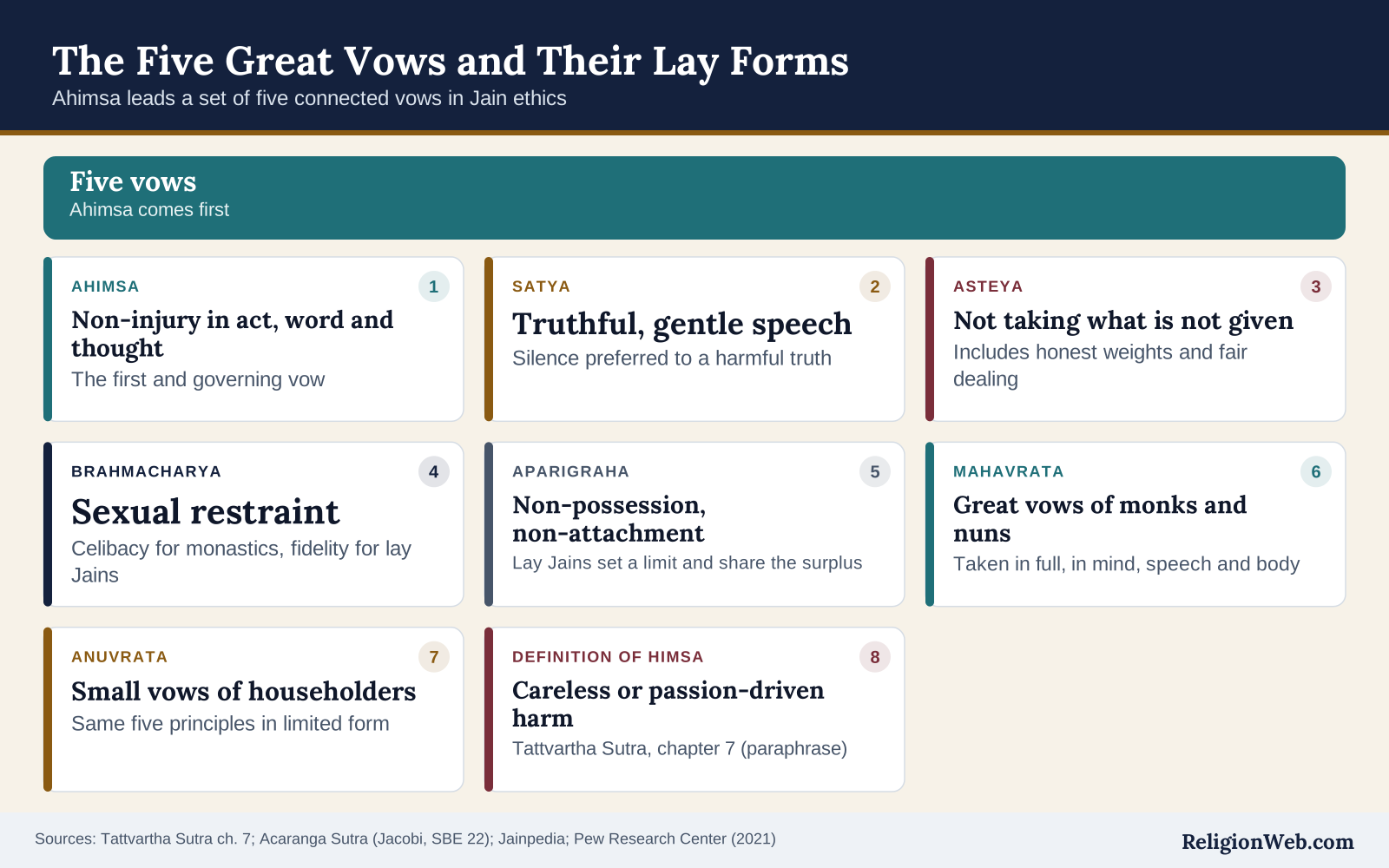
The core of Jain moral life is a set of five vows (vratas): ahimsa (non-violence), satya (truthfulness), asteya (not taking what is not given), brahmacharya (sexual restraint, which means celibacy for monastics and fidelity for householders) and aparigraha (non-possession or non-attachment). The Tattvartha Sutra introduces the vows at the start of its seventh chapter, defining a vow as abstaining from violence, falsehood, theft, unchastity and possessiveness, and it distinguishes the complete form (mahavrata, the “great vow”) from the partial form (anuvrata, the “small vow”). Monks and nuns undertake the complete form at ordination; lay Jains take the partial form, either formally before a monastic or informally as a personal commitment.
Four vows and five
As noted above, Jain tradition teaches that Parshvanatha taught four restraints and that Mahavira made sexual restraint an explicit fifth. The Uttaradhyayana records an encounter between Keshi, a follower of Parshva, and Gautama, a leading disciple of Mahavira, in which Keshi asks why the two teachers set out different rules for the same goal. Gautama replies that the different forms were suited to the abilities of the people of each age: people in Parshva’s time were, in the text’s description, straightforward and discerning, while those in Mahavira’s time were more prone to evasion and slow to understand. Historians of religion read the exchange as evidence for how the tradition understood its own development, and for the early existence of more than one organized ascetic community that was later unified.
How Each Vow Supports Nonviolence
Ahimsa: the first and governing vow
Ahimsa stands first in every list, and the Jain tradition treats the other four as extensions or protections of it. In the monastic form it means never intentionally harming any living being in the nine modes described above, which is why monks and nuns avoid agriculture, cooking, building, travel by vehicle and many ordinary conveniences. In the lay form it means refraining from intentional harm to mobile beings and being careful to limit unavoidable harm to others. Commentaries list five typical transgressions of the lay vow: binding or confining a creature, beating it, mutilating it, overloading it, and withholding its food and drink. The list is a window into everyday life in an agrarian society, since it concerns draft animals and dependents, and Jain teachers today apply it to pets, livestock and also to workers and employees.
Satya: truthfulness that does not wound
The vow of truthfulness is more than a prohibition on lying. Jain teachers say speech should be true, but should also be beneficial and gentle, and where speaking the truth would only cause suffering, silence is preferred. The link to ahimsa is direct: words are one of the three channels of action, and harsh, deceitful or divisive speech injures. Typical transgressions of the lay vow include false teaching, spreading someone’s secret, forging documents, and misappropriating a deposit, all of which harm trust and livelihood.
Asteya: not taking what is not given
Asteya prohibits theft, and in Jain exposition it covers a much broader field than stealing a wallet. Cheating customers with false weights and measures, adulterating goods, smuggling and avoiding legitimate dues are named as violations. The reasoning is that unjust acquisition deprives and harms others, and it expresses the greed that Jain doctrine regards as a root of bondage. For a community with a historic concentration in trade, the vow has long functioned as a code of commercial honesty.
Brahmacharya: restraint of desire
For monks and nuns, brahmacharya means complete celibacy. For lay people it means fidelity within marriage and restraint, with many Jains taking temporary or lifelong vows of abstinence at particular stages of life. In the Jain account, sexual activity is linked to ahimsa both because it is thought to involve harm to tiny beings and because it is regarded as a powerful source of attachment. The first reason reflects a traditional physiological belief, which modern Jain writers often reinterpret in terms of attachment and the spiritual value of restraint. The vow also carries an ethical dimension: abuse, coercion and exploitation of others are plainly opposed to ahimsa.
Aparigraha: non-possession and the roots of harm
The fifth vow, aparigraha, is often described as the quiet partner of ahimsa. Monastics give up property entirely. Lay Jains vow to set a limit on their possessions (parigraha-parimana) and to give away what exceeds it. The Jain analysis treats attachment as both an inner and an outer matter: the passions, wrong beliefs and cravings that fill the mind are called internal possessions, and land, wealth and goods external ones. The logic of the connection is that accumulation requires resources, and resources are taken from other beings, so every excess carries a hidden price in harm; moreover, the grasping mind is the mind in which anger and greed flourish. The modern interest in aparigraha as a basis for simple living, charitable giving and ecological restraint builds on this older reasoning.
| Vow | Meaning | Monastic form (mahavrata) | Lay form (anuvrata) |
|---|---|---|---|
| Ahimsa | Non-injury to living beings | No intentional or unintentional harm in thought, word or deed, done, caused or approved | No intentional harm to mobile beings; care to limit unavoidable harm in work and household |
| Satya | Truthfulness | Speech that is true, measured and beneficial; silence preferred to harmful truth | Avoids lying, forgery, slander and betrayal of confidences |
| Asteya | Not taking what is not given | Accepts only food and necessities offered by householders | Honest dealing; avoids false weights, smuggling and fraud |
| Brahmacharya | Sexual restraint | Complete celibacy | Fidelity within marriage; temporary or lifelong abstinence by choice |
| Aparigraha | Non-possession and non-attachment | Renounces property and ordinary household goods | Sets a limit on wealth and possessions and shares the surplus |
Safeguards and Supporting Practices
Reflections that strengthen the vow
The Tattvartha Sutra adds that each vow is supported by five bhavanas, meditative reflections that deepen it. For ahimsa these are, in paraphrase, guarding the mind, guarding speech, careful walking, careful handling of objects, and careful inspection of food and drink. The list shows how practical the tradition is: nonviolence is not described as a feeling but as a set of habits of attention, from the way one steps to the way one looks before eating.
Confession and renewal
Because the vows are high standards, the tradition provides ways to acknowledge shortcomings without despair. Pratikramana is a ritual of confession performed daily, fortnightly, four-monthly and annually, in which the participant reviews faults, expresses regret and asks forgiveness. A well-known verse used in this setting, in paraphrase, asks all living beings for forgiveness, offers forgiveness to them, and declares friendship with all and enmity toward none. The practice turns the vow into a continuing process of examination and repair, and its annual form is the heart of Paryushana.

Monastic and Lay Practice: Two Levels of One Discipline
The Monastic Path
Entering the order and the Five Great Vows
A Jain monk or nun enters the order through initiation (diksha), a ceremony in which the candidate gives away possessions, takes the Five Great Vows in their complete form, and in most traditions has the hair removed and receives the basic equipment of a mendicant. Initiation is often preceded by a period of study and testing, and the candidate must usually have the consent of family members. Jain communities treat the occasion as both a solemn religious event and a public celebration, and the decision is generally honored even when the initiate is young. How this should be balanced with the rights of minors and the wishes of parents has become a subject of discussion within the community and in Indian public debate, with Jain authorities generally defending initiation as a voluntary vocation that is carefully screened.
From that point the monastic does not use fire, cultivate land, cook, build or work for pay, and does not keep property beyond a small list of permitted items. The vows are taken in the three-by-three formula of mind, speech and body, and doing, causing and approving, so that a monk does not even ask a householder to do on his behalf what he is forbidden to do himself.
Daily conduct: walking, alms, water and shelter
The five samitis turn the vow of ahimsa into an everyday routine. In walking, a monastic moves barefoot, looks a short distance ahead to avoid stepping on small creatures, and travels by day and on foot rather than by vehicle. In alms-seeking, he or she accepts only food prepared by householders for their own use, without hint or request, and does not take food made specially for the monastic; the early texts compare this to a bee taking a little nectar from many flowers, so that no single household is burdened. Water is accepted only in the boiled form, which Jain teaching regards as free of living beings. In handling objects, the monastic examines and gently brushes the place where something is to be set down or where he or she will sit, using a soft broom or whisk, and in disposing of waste, chooses a spot free of living things.
These disciplines vary between branches. Digambara monks are naked, own only a water pot for hygiene, a soft whisk and a scripture, and eat a single meal a day, standing, from cupped hands. Shvetambara monks and nuns wear white cloth, carry a woolen broom and alms bowls, and may eat from bowls in the morning and at midday. Many orders avoid using electrical lights, fans and telephones, partly because fire and electricity are linked in some Jain thinking to fire-bodied beings, although the way this rule is applied differs between groups and has been the subject of debate. Monastics also pull out their hair by hand at intervals (kesha-lochana), a practice that Jain teachers explain as an expression of endurance and of freedom from vanity and from the need for razors, soap and water.
The four months of the rains
For most of the year Jain monastics wander on foot, staying only briefly in any one place. During the four months of the monsoon (chaturmas), roughly from July to November in the lunisolar calendar, they remain in a single location. The reason is ahimsa: the rains bring a sudden burst of insect, worm and plant life, and walking through it would destroy great numbers of beings. The period is also the main teaching season, when local communities host monastics, listen to sermons and take on fasts, and it includes Paryushana, the most important annual observance for many Jains.
The Householder’s Path
The twelve vows of the lay Jain
The lay path is set out in the shravakachara literature as a graduated scheme of vows. In the commonly cited Shvetambara scheme there are twelve. The first five are the anuvratas, the small versions of the five principles. Three gunavratas (“merit vows”) then extend them. The first sets limits on the directions and distances one will travel for business or pleasure (digvrata), so that violence in distant regions is kept out of the account. The second limits the foods, goods and occupations one will use (bhogopabhoga-parimana), and it is here that traditional texts list the trades to be avoided. The third forbids needless harm, including idle destructive activity, giving harmful tools to others and careless speech (anartha-danda-viramana). Four shikshavratas (“training vows”) add disciplines of practice: a daily period of equanimity meditation (samayika) of about forty-eight minutes, further self-limitation on specific days (desavakasika), periods of fasting and monastic-style living (paushadha), and the sharing of food with monastics and guests (atithi-samvibhaga). Digambara texts present a slightly different list, treating some elements, such as the end-of-life vow of sallekhana, in different positions.
Seen together, the twelve vows are best understood as a design for reducing the footprint of violence in an ordinary life: fewer places to travel, fewer things to consume, fewer needless acts, more time in stillness and more giving. They also illustrate the logic that ahimsa is built from many small decisions rather than a single dramatic one.
Eleven stages of lay advancement
Some texts, especially in the Digambara tradition, describe a ladder of eleven stages (pratimas) on which a householder can progress toward the monastic life. They begin with firm right faith and the basic vows, move through regular meditation and fasting, and proceed to renouncing living (raw) plant foods, eating after dark, sexual relations, business activity, possessions and finally even approval of household activity, before the person is ready to become a mendicant. Few householders go through all the stages in order, but the scheme shows that the line between lay and monastic life is understood as a continuum, and many devout Jains adopt some of its disciplines for part of their lives.
Variation Among Jain Communities
Digambara and Shvetambara emphases
The two main branches, introduced in the overview of Jainism, differ in canon, monastic dress, the status of women’s liberation and some liturgical practice, and they sometimes differ in the details of ahimsa as well. Digambara monastic practice is stricter on possessions, and some details of lay conduct, including diet and the pratimas, follow Digambara texts such as the Ratnakaranda Shravakachara. Shvetambara communities follow the Agamas and later codes such as Hemachandra’s Yogashastra. For ordinary lay practice, the differences are modest compared with the large area of agreement: a Digambara and a Shvetambara Jain family will usually share the same basic dietary rules.
Sthanakvasi and Terapanth traditions
Among the Shvetambaras, the Murtipujak (image-worshiping) tradition and the Sthanakvasi and Terapanth reform traditions, which reject image worship, differ visibly in practice. Sthanakvasi and Terapanthi monastics wear a cloth over the mouth (muhpatti) continuously, a practice intended to protect air-borne beings and discipline speech, whereas Murtipujak monastics generally hold the cloth in the hand while speaking. The Terapanth, founded in the eighteenth century by Acharya Bhikshu, is noted for a single-leader organization and for a distinctive teaching on compassion: its teachers distinguish between worldly kindness and acts of spiritual restraint that bring liberation, and they hold that only the second produce spiritual merit. Other Jain groups have criticized this teaching as seeming to downplay compassion, and Terapanth teachers reply that it protects the purity of the monastic discipline and that lay members remain free, and encouraged, to be kind in their daily lives. The disagreement is a good example of how seriously the tradition takes the question of what ahimsa requires.
| Area of life | Monks and nuns | Householders |
|---|---|---|
| Scope of the vow | Complete: all beings, all modes of involvement | Partial: intentional harm to mobile beings avoided; other harm minimized |
| Occupation | None; relies on alms and study | Work chosen to limit violence; avoids trades listed as heavily injurious |
| Movement | On foot, by day, with careful gaze; stays put during the rainy season | May use vehicles; limits travel by vow and avoids unneeded journeys |
| Food | Alms only, prepared for the household’s own use; no cooking | Vegetarian diet with further restrictions varying by family and region |
| Water | Boiled only | Boiled or filtered, depending on family practice |
| Possessions | Minimal items; Digambara nothing beyond whisk, water pot and book | Self-chosen limit on wealth; regular giving |
| Speech | Silence or measured words; mouth-cloth in some orders | Truthful and gentle speech; avoids slander and harsh language |
| Self-defense | None; defensive violence is also renounced | Defensive harm tolerated but kept to a minimum |
Food, Water and the Jain Kitchen
What Jains Eat and Avoid
A vegetarian baseline
The most visible expression of ahimsa for the lay community is diet. Jains do not eat meat, fish or eggs, and they avoid alcohol. The reasoning is straightforward from the principle that harming a five-sensed or even a two-sensed creature is the gravest kind of injury: obtaining meat involves killing, and the gravity of the act increases with the complexity of the animal. The prohibition has deep roots in the household codes of the first millennium CE and is among the most strongly held norms of the community. Survey data suggest it is also very widely observed. In Pew Research Center’s national survey of India, conducted between November 2019 and March 2020 with nearly 30,000 adults, 92 percent of the Jains interviewed described themselves as vegetarian. The Jain sample was small, only 109 people, so the figure should be read as a rough indication rather than a precise count, and individual practice varies.
Milk and dairy products are traditionally accepted, since milk is obtained without killing the animal, and ghee, butter and yogurt play a regular role in Jain cooking, especially in Gujarat and Rajasthan. Some modern Jains question dairy on animal-welfare grounds, a debate taken up near the end of this article.
Root vegetables and shared bodies
The best-known additional restriction concerns root vegetables such as potatoes, onions, garlic, carrots, radishes, beets and ginger. Jain doctrine distinguishes plants whose body houses a single soul (pratyeka) from those in which a body is shared by infinite souls (sadharana or anantakaya), a category that includes many tubers and roots. Pulling such a plant from the ground ends vast numbers of lives at once, and the plant may also contain microscopic beings in the soil. The tradition therefore regards fruits, grains and leaves that can be taken without killing the whole plant as preferable to tubers and bulbs. Ascetic reasoning adds a second element: onions and garlic are often also considered stimulating foods that inflame the passions.
How strictly the rule is kept varies. In the same Pew survey, 67 percent of Jains said they abstain from root vegetables such as onions and garlic, which means that a sizable minority do not, even among a population in which vegetarianism is nearly universal. Many Jain families in Gujarat and Rajasthan avoid all the listed vegetables, especially on holy days, while others, particularly outside India, keep a looser version that excludes only some. In restaurants across India, the phrase “Jain food” signals a dish made without onion, garlic and root vegetables, a convention that has even produced adaptations of popular dishes.
Honey, alcohol and fermented foods
Honey is avoided because collecting it is understood to harm bees and their larvae, and because it is considered a product of regurgitation holding many tiny lives. Mushrooms and other fungi are commonly avoided for similar reasons, and alcohol is excluded for the loss of awareness it causes and for the microscopic life involved in fermentation. Many families also avoid items such as figs and other fruits with many tiny seeds or insects, pickles and foods left to ferment for several days, and foods containing gelatin, animal rennet or insect-derived colors. The rules are applied with diverse levels of rigor, but the underlying test is the same: does obtaining or preparing the food involve avoidable injury to beings of more or fewer senses?
Time, Light and Water
Eating before sunset
A well-known Jain custom is to finish the last meal before sunset and not to eat or drink until after sunrise (chauvihar, or ratri-bhojana-tyaga, abstaining from night meals). In the days before electric lighting, the practical rationale was that at night insects are drawn to lamps and fall into food, and are impossible to see in the dark. Today the rule continues as a discipline even with electric light. Many families keep it daily, others on holy days or during the monsoon. The custom also has a secondary logic of moderation and digestion that Jain teachers cite, but the primary reason they give remains the protection of small life.
Boiled and filtered water
Water presents a double problem for the Jain ethic, since it is both a living body in the tradition’s classification and the home of minute life forms. Monastics accept only water that has been boiled (prasuka or achitta, “free of life”). Lay families often strain water through a close cloth and, in stricter households, boil it; some drink boiled water throughout the monsoon and on fast days. Boiled water has a limited time in which it is considered life-free, a period that Jain texts reckon differently by season, and householders who observe the rule keep track of the time. The practice also had real public-health advantages in a world without modern water treatment, but Jain teachers present the religious logic as primary.
Time limits on prepared food
Jain households traditionally observe time limits (kala-maryada) beyond which certain foods are considered to be teeming with microscopic life. Flour, pastes, sweets, cooked items, curd and some spices are each assigned a period of days, sometimes shorter in the monsoon, after which they are avoided. Foods left overnight or fermented batters are treated with similar caution. The limits differ by community, and many modern families rely on fresh preparation rather than on counting days. What the rules show is how an ethic of care for micro-life can shape ordinary household management, from the pantry to the refrigerator.
Kitchen, Shopping and Eating Out
Care in the kitchen
Traditional guidance for the kitchen reads like a program of attentiveness. Grains and lentils are sifted and inspected for insects, vegetables and fruits are examined and washed, water vessels are covered, cooking fire is lit carefully and not left burning unattended, and the floor is swept gently. Cooking waste is disposed of in places where it will not attract or harm creatures. These habits are often passed down through women of the household, who bear much of the responsibility, and they are an important element in how the culture of ahimsa is transmitted to children.
Markets, restaurants and travel
In contemporary life the main challenge is outside the home. Jains in India navigate a food market where vegetarian and non-vegetarian items are labeled with green and brown dots, but where hidden animal-derived ingredients and cross-contamination remain concerns. Restaurants, airlines and railways commonly offer meals labeled Jain, and many Jain organizations publish ingredient guides. Abroad, many Jain families rely on community networks, temple kitchens and careful reading of labels. For the many Jains who travel for business or study, observance is often a matter of negotiating between the household rule and what is available, and communities generally encourage flexibility within the core vows over rigid perfectionism.
| Practice | Reason given in Jain teaching | Common variation |
|---|---|---|
| No meat, fish or eggs | Obtaining them involves killing beings with several senses | Near-universal among practicing Jains; some individuals outside India are less strict |
| No root vegetables | Uprooting kills the plant and the many souls said to share its body | Strict, partial or seasonal; stricter on holy days |
| No honey | Harm to bees and larvae | Widely observed |
| No eating after sunset | Unseen insects and small beings in food | Daily for some; on holy days or monsoon for others |
| Boiled or filtered water | Water is regarded as a living body and as a habitat for microscopic life | Monastics only boiled; lay practice varies |
| Time limits on prepared foods | Microscopic life multiply after set periods | Number of days differs by community and season |
| Avoiding leather and silk | Obtained by killing animals or pupae | Common; observed with varying strictness |
| Limited travel and consumption | Fewer opportunities for harm; restraint of desire | Taken as formal vows by some, as a general guideline by others |
Livelihood, Money and Care for Other Beings
Choosing a Livelihood
Trades that classical texts advise avoiding
Because the householder’s vow forbids intentional violence and urges minimal harm, the classical lay codes give guidance on occupations. A traditional list of fifteen “karmic trades” (karmadanas), found in Shvetambara lay-conduct literature and discussed in connection with the vow of limiting consumption and occupations, names livelihoods thought to involve especially heavy or pervasive injury. In paraphrase, the list includes burning charcoal or operating large fires, felling forests, building carts and similar vehicles, hiring out draft animals, quarrying and digging, trade in ivory and animal parts, trade in lac, liquor and other substances with many small life forms, selling living creatures, trade in poisons and weapons, operating presses and mills that crush living things, castrating or branding animals, setting fires to clear land, draining water bodies, and rearing animals for sale. Sources differ somewhat in how they describe individual items. The list reflects the economy of medieval western India, and its items need interpretation today. Jain teachers apply the underlying principle rather than the letter, asking whether a line of work depends on deliberate cruelty or large-scale, avoidable destruction.
In practice the guidance has steered many Jain families toward occupations such as trade, banking, jewelry, publishing, teaching, medicine, engineering and the professions, and away from slaughter, hunting, fishing and the leather and liquor trades. It has also encouraged ethical business conduct, in line with the vow of non-stealing, with an emphasis on honest weights and fair dealing.
Merchants, farmers and the limits of a stereotype
It is often said that Jains are a community of merchants, and historically there is truth in the claim. In western India, particularly Gujarat and Rajasthan, Jains have long been prominent in trade, money-lending and gem and textile businesses, and scholars of Jain society have linked this pattern in part to the restrictions on agricultural work, which involves tilling the soil and killing many small creatures. The picture is not uniform, however. Digambara Jain communities in parts of Maharashtra and Karnataka have traditionally included many farmers, and Jain rulers, ministers, generals and artisans appear throughout the historical record. It is more accurate to say that the vow of ahimsa influenced occupational choices in some regions and periods than to treat Jains as a single economic group.
Generosity and Protection
Charity, hospitals and the four gifts
The Jain tradition prizes giving (dana) as both a lay duty and a way of loosening attachment. Classical texts name four kinds of gift: food, medicine, teaching and the gift of fearlessness. Jain donors have supported temples, libraries, schools, hospitals, drinking-water facilities and disaster relief in India and abroad, and many Jain families give a regular share of income. Philanthropy is thus not viewed as separate from nonviolence but as one of its principal forms, because it gives practical effect to compassion and counters possessiveness.
Animal shelters and the protection of life
Jain communities in western India established and maintain panjrapols, shelters that take in aged, injured, abandoned or rescued livestock and other animals, and some run veterinary services and bird hospitals. Delhi’s Digambara Jain temple at Chandni Chowk, for example, is known for the charity bird hospital associated with it. Jain organizations also campaign for animal welfare and, in some cases, lobby for restrictions on slaughter, activities that sometimes provoke debate in a diverse society. The shelters are among the clearest institutional answers to the claim that Jain nonviolence is merely passive: they are organized, funded and staffed efforts to protect life.
Hard Cases: Defense, Medicine and the Environment
Soldiers, rulers and defensive harm
If ahimsa forbids harming any being, how can a Jain serve as a soldier, a police officer or a king? The tradition has not avoided the question. Jain texts distinguish the householder’s duty from the monk’s, and the classification of defensive harm (virodhi himsa) acknowledges that a lay person may sometimes protect others by force, while holding that this is a lesser evil to be limited and not a virtue to be celebrated. Jain history includes kings, ministers and commanders, among them the Ganga minister and general Chamundaraya, who is traditionally credited with commissioning the colossal statue of Bahubali at Shravanabelagola in Karnataka in the late tenth century CE. Jain authors typically treat these figures as examples of devout laymen who accepted the demands of their station, and sometimes as men who retired to ascetic life afterward.
Medicine and health
Jain teaching does not require lay people to refuse medical care, and Jain communities support hospitals and doctors. Questions do arise about medicines made with animal-derived ingredients, such as gelatin capsules, or tested on animals, and some families seek alternatives. Monastics who become ill are expected to accept limited and carefully chosen treatment according to their order’s rules. As with all religious guidance on health, the tradition’s teachings on diet and fasting are not a substitute for medical advice, and Jain teachers themselves encourage people with medical conditions, including pregnant women, children, older adults and those with illnesses, to modify fasts as their health requires.
Ecology and the Jain Declaration on Nature
Many modern Jain writers present ahimsa as an environmental ethic. The principle that earth, water, air and plants possess souls, together with the vows of limiting consumption and possessions, provides what they describe as a ready-made framework for ecological restraint. On 19 April 1990, at Buckingham Palace, a Jain Declaration on Nature, issued with a foreword by the jurist L. M. Singhvi, was presented to Prince Philip, then president of WWF International, in a ceremony that marked the Jain faith’s entry into the WWF Network on Conservation and Religion. The declaration draws on the principle of mutual support among living beings, expressed in the Tattvartha Sutra as the idea that souls render service to one another, and it has been cited in Jain environmental education since. Historians of religion note that environmental readings are modern interpretations of older teachings, and that the tradition’s classical interest was spiritual liberation rather than conservation as such; still, the continuity of concern for small life gives the modern reading a credible foundation.
Fasting, Austerity and Letting Go
Fasting as Applied Nonviolence
Why Jains fast
Fasting (upavasa) is a major part of Jain devotion, and it follows from the same logic as the rest of the ethical system. Every act of eating involves some injury to living beings, so reducing consumption reduces harm. Fasting also trains the will, weakens craving and the passions, and is understood to help burn away accumulated karma. Jain teaching groups fasting among the external austerities (tapas) and pairs it with internal austerities such as confession, study, service and meditation. The tradition regards the spirit in which a fast is done as crucial: fasting out of pride, anger or competition defeats its purpose.
Forms and rhythms of fasting
Jain fasts range from simple to demanding. An ekasana is a single meal in a day. An ayambil is a single bland meal of boiled or plain grains and pulses without oil, ghee, milk, sugar, spices or salt in the strictest form, typically observed in two nine-day periods a year and on other occasions. An upavasa in the full sense means no food and, on strict days, no water. Longer fasts include the eight-day athai during Paryushana and, for some, month-long fasts. A fast of alternating days stretching over more than a year, called varsitap, commemorates the long fasting of the first Tirthankara, Rishabhanatha. These vigorous fasts are voluntary, are generally undertaken after preparation and with the guidance of a monastic or experienced elder, and are accompanied by prayer and study. They are not required of everyone, and Jain teachers advise those who are ill, pregnant, very young or elderly to choose a gentler form. A fast is a religious discipline, and anyone with a medical condition should take advice from a doctor in addition to their religious teacher.
Sallekhana and the End of Life
What the practice is
The most debated Jain austerity is sallekhana, also called santhara or samadhi-marana. In its classical definition, it is the voluntary, gradual giving up of food and drink, together with the loosening of attachments and the cultivation of equanimity, by a person who is approaching death through old age, incurable illness or inescapable calamity, undertaken with permission and guidance. Jain texts, including the Tattvartha Sutra, describe it as the culmination of the householder’s or monk’s practice and insist that it is different from suicide, because suicide is driven by passion such as despair or anger, and therefore is itself an act of violence, whereas sallekhana is meant to be free of passion and reached only after careful discernment. It is not recommended for people who are healthy or in emotional distress.
Law, ethics and public debate
On 10 August 2015 the Rajasthan High Court, hearing a public interest petition, ruled that the practice, which it called Santhara, amounted to suicide, was not an essential part of the Jain religion, and should be treated under Sections 309 and 306 of the Indian Penal Code (attempted suicide and abetment of suicide). On 31 August 2015 the Supreme Court of India admitted an appeal by Jain community members and stayed that judgment, and the matter has remained in legal and public discussion. Jain organizations argued that the practice is a constitutionally protected religious freedom, rare, supervised and different from suicide in intention, while critics, including some within and outside the community, have raised concerns about coercion of the elderly and about the state’s duty to protect life. This article describes the positions without adjudicating them. Anyone who is experiencing thoughts of self-harm, regardless of religion, should contact a local emergency number or crisis service, and the Jain tradition itself holds that despair is not a basis for the vow.
Daily Restraint and Renewal
Daily meditation and confession
The discipline of the lay vows is reinforced through daily and periodic practice. The samayika is a period of about forty-eight minutes spent in equanimity, reciting prayers or silent meditation, in which the practitioner temporarily takes on the behavior of a mendicant. Daily and periodic pratikramana reviews faults, asks pardon from all beings and renews the vows. Many Jains also say the five-line homage known as the Namokar (Navkar) Mantra, which honors enlightened beings, liberated souls, leaders, teachers and all monastics, and which is regarded as the core prayer of the tradition. None of these practices requires a priest, and each is an occasion to bring the idea of ahimsa into the mind before it is tested in the day.
Forgiveness at the center
The theme that holds the practices together is forgiveness. The ritual request of forgiveness at the end of Paryushana, expressed in the Prakrit greeting Micchami Dukkadam (“may any wrong I have done be undone”), is addressed to family, friends and even acquaintances and adversaries, and it applies to hurts caused by thought, word and deed. The practice demonstrates that the Jain ethic of nonviolence includes repairing relationships and not only avoiding harm. It is covered in more depth in the article on Paryushana.
| Practice | Who usually observes it | What it involves | Typical variation |
|---|---|---|---|
| Vegetarian diet | Nearly all practicing Jains | No meat, fish, eggs; avoidance of alcohol and honey | Strictness of related rules differs by family and region |
| Avoiding root vegetables | Many lay Jains, especially in western India | No potatoes, onions, garlic and similar | Full, partial or only on holy days |
| Eating before sunset | Many lay Jains; all monastics | No food or drink after dark | Daily, seasonal or on special days |
| Boiling or filtering water | Monastics (boiled); many lay families | Strained or boiled water, used within a time limit | Differs by season and household |
| Samayika | Devout lay Jains | About 48 minutes of meditation and equanimity | Daily for some, occasional for others |
| Pratikramana | Monastics and lay Jains | Ritual confession and renewal of vows | Daily, fortnightly, four-monthly, annual forms |
| Fasting | Voluntary for lay Jains; core part of monastic life | Ekasana, ayambil, upavasa and longer fasts | Level of austerity chosen individually |
| Mouth-cloth | Sthanakvasi and Terapanth monastics (continuous); Murtipujak monastics (when speaking) | A small cloth held or tied over the mouth | Style differs by order |
Ahimsa in the Modern World
Public Life and Law in India
Jain influence on public rules about animals
In India, Jains are a small minority with an influence on public life that is larger than their numbers, because of their prominence in business, philanthropy and civic institutions. Jain organizations have lobbied for protections for animals and for restrictions on slaughter on specific days. In recent years several municipal and state authorities in western India have ordered temporary closures of slaughterhouses or meat shops during Paryushana, and these orders have prompted legal challenges and public argument. Petitioners and supporters point to long precedent, including the historical Mughal-era orders mentioned above, whereas critics emphasize the rights of other communities to follow their own dietary customs and livelihoods. The disagreement shows that a private religious ethic can become a public controversy when it is translated into law, and that Jain leaders themselves hold varied views on how far to seek legal measures.
Active ahimsa and the question of passivity
Modern interpreters, including the Terapanth monk Acharya Mahapragya and many lay writers, stress that Jain ahimsa is not a retreat from the world. The Anuvrat movement, for example, asks participants of any background to adopt small commitments: not to kill innocent creatures, not to attack, to avoid cruelty, to practice honesty in business and to avoid intoxicants. The movement has been promoted through schools, community programs and public campaigns in India. Whether such programs succeed in changing behavior at scale is a matter for social research, but they demonstrate that the Jain ethic has been framed as a positive program of social conduct.
Jains in the Diaspora
Transplanting practice to new places
Jain emigration from India (the wider history of the religion is outlined in the article on Jainism), especially from Gujarat and Rajasthan, to East Africa, the United Kingdom and North America during the twentieth century created communities that had to adapt practices to new foods, climates, workplaces and laws. Temples (derasars and mandirs) and community centers were built, and in North America a federation of associations, JAINA, was organized in the early 1980s to unite Jains of different branches. Diaspora Jains keep many core practices, but they also face new choices, such as how to follow the rules of food and fasting in a school cafeteria or an office, how to teach children the vows, and what form of monastic visitation is possible where traditional wandering monastics cannot travel by vehicle. The monastic rule against vehicles means that most monks and nuns have not traveled abroad, though some branches have created intermediate roles, such as the samani order in the Terapanth tradition, whose members may travel with certain permissions.
Ahimsa Day and public presentation
Diaspora Jains have also found new ways to present the principle to a wider public. Ahimsa Day, which according to Jainpedia was created by the British Jain community, many of whom arrived in the 1970s from Kenya and Uganda, has been held in London each October since 2002, usually at the House of Commons. It is a non-sectarian gathering with talks by activists, educators and politicians rather than a religious festival, and the Institute of Jainology presents an annual Ahimsa Award; the recipients have included Nelson Mandela in 2006 and the Dalai Lama in 2007. The event is not an official Jain observance, but it shows how the vocabulary of Jain nonviolence is used in civic settings far from its origins.
Passing the vow to young people
Jain educators in India and abroad produce curricula for children on the vows, stories of the Tirthankaras and everyday ahimsa, including pathshalas, weekend schools that teach the language, prayers and ethics. Young people often adopt the tradition selectively, prizing its ethical clarity and environmental relevance while adjusting some customs. Community leaders frequently describe the challenge as transmitting the reasoning behind the rules so that the rules are not experienced as arbitrary.
Contemporary Debates
Veganism, dairy and animal welfare
The largest present-day debate among thoughtful Jains concerns dairy. Milk has been accepted since antiquity, but modern industrial dairy farming involves practices, such as separating calves from mothers and slaughtering unproductive cattle, that many Jains consider incompatible with the intent of ahimsa. A vegan Jain movement has grown, and several Jain teachers and organizations now urge avoiding dairy, leather, silk and wool from commercial sources. Others note that the tradition did not forbid milk and argue for sourcing it from humane producers or from the cow shelters that Jains support. These positions are all argued from within the tradition, and the debate is a sign that the principle continues to be reasoned rather than simply inherited.
Technology, plastics and new forms of harm
The second set of questions concerns the modern world’s forms of injury. Jain scholars and monastics have asked whether electricity, refrigeration, antibiotics, mass-produced packaging and digital devices should be counted as sources of harm, and how a lay Jain should weigh convenience against care. Responses vary. Some stress ahimsa’s call for restraint in consumption, and some interpret the vow of limiting possessions as a basis for minimalism. Others emphasize the compassion and education that modern technology can enable. The disagreements illustrate the typical Jain way of reasoning: the principle is fixed, but its application requires thoughtful judgment, informed by the tradition’s own categories of intention, degree and necessity.

Common Misconceptions About Jain Ahimsa
Misconception 1: Ahimsa simply means never taking action
Where the misunderstanding comes from
The idea that Jain nonviolence is a form of passivity has several sources. One is the image of the monastic who sweeps the ground before sitting, covers the mouth and avoids nearly all work; it is easy to see that picture as a withdrawal from the world. Another is the popular use of “nonviolence” to mean “doing nothing,” a misreading that has also attached itself to modern political movements that used the term. A third is the existence of genuine internal debates in which some Jain teachers, such as the Terapanth, insist that certain acts of kindness do not bring spiritual merit, and that statement is sometimes heard as indifference.
What the evidence and tradition actually show
Jain texts define violence by the agent’s state of mind, so the discipline is first of all an active practice of watchfulness, restraint of passion and care. The tradition also commends compassion, friendliness and the protection of the vulnerable as duties. The Tattvartha Sutra names friendliness, appreciation, compassion and equanimity as attitudes to cultivate, and the gift of fearlessness is counted among the highest forms of giving. Jain communities have a long record of founding shelters for animals, hospitals, schools and relief programs, and many Jain lay people have been prominent in public life. Even monastic life, which looks withdrawn, includes teaching, counseling and moral leadership on which lay communities rely.
The Terapanth teaching mentioned above is better understood as a claim about the nature of spiritual merit than as advice to ignore suffering. Its teachers say that the monastic vow is one of restraint and that acts of worldly kindness belong to the householder’s sphere, where they are welcome. Other Jain traditions reject that division and place compassion more squarely at the center of religious merit, so the disagreement is about classification and emphasis, not about whether care for living beings matters.
The nuance lies in what ahimsa does not permit. It does not permit intentional violence, and it asks for restraint even toward those who are hostile. In that sense it is not a call to ignore injustice but a call to respond without cruelty or hatred. How far that principle extends to defense of others and to political action has been debated in Jain thought, and modern interpreters have reached different conclusions.
The tradition’s emphasis on equanimity also deserves a fair reading. When Jain teachers speak of remaining calm before an aggressor, they are describing the state of mind of the person who acts, not recommending that harm go unanswered. Stories in the biographies of Mahavira, discussed in the article on Mahavira, present patience under attack as an expression of strength and spiritual freedom, and the same stories are read by Jain communities as a model of steadiness rather than of helplessness.
Misconception 2: All Jains follow the monastic rules
Where the misunderstanding comes from
Descriptions of Jainism for general readers often begin with the most dramatic figures: the naked Digambara monk, the Shvetambara nun with a mouth-cloth, the sage who fasts for weeks. Those vivid details make the mendicant path seem like the whole religion. Media stories about unusually strict practices, such as sweeping ahead of one’s steps, can make the same impression. Because Jain ethics is described through the Five Great Vows, readers may also assume that all Jains have taken those vows in their complete form.
What the evidence and tradition actually show
The overwhelming majority of Jains are householders. The tradition has always provided them with their own scheme of vows, the anuvratas and associated disciplines, designed for people who work, marry and raise children. Lay Jains are expected to avoid intentional violence, follow a vegetarian diet and limit their possessions, but they drive vehicles, cook, run businesses and use electricity. Monastics are a small fraction of the community, which as a whole is counted in millions, so the typical Jain a visitor meets at a temple, a wedding or a workplace is a householder with a job, a family and a partial set of vows. The relationship is mutual: householders feed and support the monastics, who in turn teach and offer an example.
Within the lay community, levels of observance vary a great deal. Some families keep all the dietary rules and fast frequently, others observe only the core vegetarian rule, and individuals may deepen their practice at different stages of life. The tradition acknowledges this range and treats a partial vow, sincerely kept, as meaningful progress rather than as failure.
The proportions matter for accuracy. To describe a Jain family’s kitchen, school fees, business and weekend fasts as though they were the rules of a monastery would be like describing the Jain tradition by its most austere members alone. Scholars of Jain society generally take care to separate the two levels, and community leaders often say that the lay path is the main body of the religion, not a lesser version of it.
Misconception 3: Jain vegetarian practice is identical in every community and circumstance
Where the misunderstanding comes from
The phrase “Jain food” in restaurants, airline menus and cookbooks suggests a single standard: no meat, no onion, no garlic, no root vegetables. The simplified standard is useful for caterers, but it flattens an internal variety. Another source is the tendency of outsiders to treat a religion as a rulebook with one correct reading, and not as a set of communities that interpret and apply their teaching differently. Labels on packaged food in India, which mark products only as vegetarian or non-vegetarian, add to the impression that the category is simple.
Finally, accounts written by and for Jain communities often describe the ideal rather than the average. A devotional or educational text lists what a faithful householder should do, and a reader can easily take that list as a description of what every Jain does every day. Survey data, which record what people say they actually do, give a more varied picture.
What the evidence and tradition actually show
Everyday observance differs by region, sect, family and stage of life. Jains in western India are known for avoiding root vegetables; in the Pew survey of India in 2019 and 2020, 67 percent of Jains reported abstaining from them, and 92 percent called themselves vegetarian, which indicates both the strength of the norm and the existence of variation. Some families avoid root vegetables only on holy days or in the monsoon, others follow strict time limits on cooked food, and many Jains abroad adapt to the foods available. Digambara and Shvetambara texts and teachers do not agree on every detail, and monastic orders have their own rules.
Circumstances also matter. The tradition makes exceptions for illness, travel and necessity, and it holds that the intention to minimize harm counts for more than rigid perfection. Contemporary debates about dairy, silk, leather and processed foods show that the application of the principle continues to develop. Describing Jain practice accurately therefore means naming the community and context, not announcing a single rule.
A further point concerns authority. No single body issues binding dietary rulings for all Jains, and the four-fold community has historically relied on the teaching of monastics, the example of elders and local custom. Differences are therefore expected, and Jain commentators themselves often say that a family should adopt the restrictions it can keep sincerely, rather than taking on a standard it will abandon.
Misconception 4: Ahimsa is only about what Jains eat
Where the misunderstanding comes from
Diet is the most visible and the most easily explained feature of Jain practice, and so it dominates introductory accounts and public discussion. Food rules can be listed, labeled and ordered at a restaurant, whereas inner discipline cannot. Writers who focus on diet may overlook the fact that the classical texts spend as much attention on speech, thought, trade, travel and the handling of possessions.
What the evidence and tradition actually show
In Jain ethics, ahimsa is one member of a set of five vows that together govern the whole of a person’s conduct, and it is defined by intention as well as by outward action. The classical lay codes regulate occupation, travel, consumption, speech and the use of leisure time. The tradition’s psychological analysis names anger, pride, deceit and greed as the sources of violence, and its practices, from daily meditation to annual confession and forgiveness, are directed at those sources. Diet is the most visible application of the principle, but it is only one of many, and a Jain who ate perfectly while speaking cruelly to family members would not be considered to have kept the vow.
The scope of the vow is easiest to see in the list of its traditional transgressions: binding, beating, mutilating, overloading and starving a dependent creature, as well as harsh speech and careless handling of objects. None of these is about food. They concern how people treat animals, workers, family members and the physical world, which is why modern Jain teachers apply the vow to areas such as treatment of employees, waste, and online speech.
Frequently Asked Questions About Jain Ahimsa
Questions About the Principle
Does ahimsa mean Jains cannot defend themselves or others?
Jain teaching on this point depends on whether the person is a monastic or a householder. A monk or nun renounces even defensive harm. A householder is not expected to do so, and the traditional category of defensive harm (virodhi himsa) recognizes that protecting family or community may sometimes require force. The same tradition insists that the response should be proportionate, free of hatred, and the least harmful available. Jain history includes rulers and generals who fought, and Jain authors reflect on those cases without treating violence as a virtue.
Do Jains believe plants have souls, and is eating them wrong?
Jain doctrine teaches that plants are living beings with a single sense, touch, which makes harming them less grave than harming animals, but not morally weightless. The tradition’s answer is not to stop eating, which would end life and the possibility of spiritual progress, but to eat in the way that causes the least harm: grains, fruits and vegetables that can be taken without destroying the whole plant, prepared with care and eaten in moderation. The ideal in the monastic tradition is to take only what has been freely offered and to eat sparingly.
How does Jain teaching treat accidental harm?
The Jain vow is wider than most everyday moral codes in its scope, since it covers insects and even the elements in the Jain classification, but it is also carefully differentiated. It separates intended from accidental harm, degrees of harm by the number of senses and the strength of passion, and the obligations of monastics from those of householders. Understanding these distinctions prevents both the mistaken view that Jains must be perfect and the opposite mistake of thinking that the rule is merely symbolic.
Questions About Food and Daily Life
Why do Jains avoid onions, garlic and potatoes?
The classical explanation is that these are plants whose bodies are shared by countless souls, and that uprooting them destroys many lives for a single meal. Teachers also note that such foods are traditionally considered heating and stimulating, which is unhelpful for self-restraint. Observance varies: a majority of Jains in India’s national survey of 2019 and 2020 said they abstain, but a substantial minority did not.
Can Jains consume dairy products?
Traditionally yes, because milk is regarded as taken without killing the animal, and dairy foods are central to many Jain cuisines. Some contemporary Jains choose to avoid dairy because of present-day industrial practices, and a vegan Jain movement argues that this is more faithful to the aim of ahimsa. Other Jains support humane dairy sources. Both positions are presented as applications of the same principle.
Why do some Jain monks and nuns cover their mouths?
In the Sthanakvasi and Terapanth traditions, monastics wear a small cloth over the mouth at all times, and in the Murtipujak tradition they hold it near the mouth when speaking. The usual explanations are that it protects small airborne beings from being harmed by the breath and by the movement of air, keeps insects from entering the mouth, and reminds the wearer to speak carefully. The Digambara tradition does not use the cloth. Some Jain critics outside the cloth-wearing orders argue that it is not required by the old texts, and the disagreement is part of the long-standing differences among branches.
Questions About Practice and Belonging
Must a Jain become a monk or nun to follow ahimsa seriously?
No. The tradition provides a complete path for householders, who are encouraged to progress in stages and may become mendicants late in life if they wish. Lay people also make up the supporting community of the monastic order and are considered equal partners in the Jain fourfold community of monks, nuns, laymen and laywomen. Seriousness is measured by sincerity and consistency, not by status.
What does Micchami Dukkadam mean, and who says it?
The Prakrit phrase is a formula of forgiveness, usually rendered as “may the wrong I have done be undone” or “may my wrongdoing be in vain.” Jains say it to family and friends, particularly at the close of Paryushana, and they may also use it in daily confession. It is an acknowledgment of harm done by thought, word or deed and a request for pardon, and it applies to every living being. The observance is described in detail in the article on Paryushana.
Can someone who is not a Jain practice Jain-style ahimsa?
People of any background have adopted Jain-inspired practices, from vegetarian diets to the small-vow programs of the Anuvrat movement, which was designed to be open to everyone. Jain teachers generally welcome interest, but they distinguish the broader ethical ideas from the full religious path, which includes the Jain understanding of the soul, karma and liberation. Those interested in learning more can start with the overview of Jainism.
Conclusion: What Jain Ahimsa Teaches
What the Tradition Shows
A principle with an inner and an outer side
Across texts and centuries, Jain teachers keep returning to two connected claims. One is that every living being has a soul and therefore a claim to be spared harm. The other is that harm begins in the mind, in anger, pride, deceit and greed, before it appears in action. The combination explains why the vow reaches into diet, speech, work and possessions, and why it is accompanied by practices of confession, forgiveness and restraint. It also explains why Jain ahimsa cannot be reduced to either a food rule or a political slogan.
Unity of principle and diversity of practice
Monks and nuns apply the principle in its fullest form, householders apply it as far as their circumstances allow, and communities in different regions and branches apply it differently. The tradition regards this range as natural, since souls are at different stages of the path. For readers, the practical lesson of the topic is to name the community and context when describing Jain practice, and to separate the principle, which is shared, from its applications, which are many.
How to Keep Exploring
Related reading on ReligionWeb.com
The life and teaching of the Tirthankara most closely associated with the Five Great Vows are discussed in the article on Mahavira, and the wider religion in the article on Jainism. The observance in which fasting, confession and forgiveness come together is covered in the article on Paryushana.
Reading the primary sources
Readers who want to go to the texts can begin with the early monastic manual known as the Acaranga Sutra in the translation by Hermann Jacobi, and with the Tattvartha Sutra, which exists in several modern English translations from both Digambara and Shvetambara scholars. The reference works and survey data listed at the end of this article provide further guidance, and community websites such as Jainpedia offer articles and manuscript images that show how the tradition presents itself.
Sources
The table below lists the principal external sources behind this article. Facts, dates and figures were checked against these and related primary, institutional and academic materials.
| # | Source | Publisher and type | Used for | Link |
|---|---|---|---|---|
| 1 | Jaina Sutras, Part I (Acaranga Sutra and Kalpa Sutra), translated by Hermann Jacobi, Sacred Books of the East vol. 22 | Sacred Texts Archive (public-domain edition) · Primary text | Acaranga Sutra quotations (I.4.1; I.5.5) and the water lesson (I.1.3) behind the Fun Fact | sacred-texts.com |
| 2 | Eight-in-ten Indians limit meat in their diets, and four-in-ten consider themselves vegetarian | Pew Research Center (2021; survey fieldwork Nov. 2019 to Mar. 2020) · Demographic data | 92% of Jains vegetarian; 67% avoid root vegetables; sample of 109 Jains | pewresearch.org |
| 3 | Ahimsa | Encyclopaedia Britannica · Encyclopedia | Ahimsa as the standard of Jain action; lay and monastic vows; night eating and mouth-cloth | britannica.com |
| 4 | Tattvartha-sutra | Encyclopaedia Britannica · Encyclopedia | Umasvami's text composed early in the Common Era; accepted by Digambara and Shvetambara traditions | britannica.com |
| 5 | Ahimsa Day (article by Nalini Balbir) | Jainpedia (Institute of Jainology, with the British Library and Bodleian Libraries) · Academic reference | Origin, timing, format and awards of London's Ahimsa Day | jainpedia.org |
| 6 | Supreme Court stays Rajasthan HC ban on 'Santhara' | LiveLaw · Legal reporting | Rajasthan High Court ruling of 10 Aug 2015 and Supreme Court stay of 31 Aug 2015 | livelaw.in |
| 7 | 1990: The Jain Declaration on Nature | Institute of Jainology · Institutional | Presentation of the Declaration to Prince Philip at Buckingham Palace, 19 April 1990 | jainology.org |
| 8 | An Autobiography, Part I, ch. 11 'Preparation for England' (M. K. Gandhi, trans. Mahadev Desai) | Hosted by Frances Pritchett, Columbia University · Primary text | Becharji Swami, a Jain monk, administering Gandhi's vow before he left for England | franpritchett.com |
| 9 | An Autobiography, Part II, ch. 1 'Raychandbhai' (M. K. Gandhi, trans. Mahadev Desai) | Hosted by Frances Pritchett, Columbia University · Primary text | Gandhi's account of meeting Raychandbhai and his role in Gandhi's spiritual crises | franpritchett.com |
| 10 | India has 79.8% Hindus, 14.2% Muslims: Census | Gulf News (reporting Census of India 2011 religion data) · Demographic data | About 4.5 million Jains, 0.4% of India's population, in the 2011 census | gulfnews.com |
Last fact-check date: 2026-10-21.