Bahá’u’lláh (a title meaning “Glory of God” in Arabic) is the central figure of the Bahá’í Faith. He was born Mírzá Ḥusayn-‘Alí Núrí in Tehran on 12 November 1817, spent roughly the last forty years of his life as a prisoner and exile of the Persian and Ottoman states, and died at the mansion of Bahjí, outside the walled city of ‘Akká (Acre) in what was then Ottoman Syria, on 29 May 1892. Bahá’ís understand him to be the Manifestation of God for the present age, the bearer of a divine revelation that completes and renews the work of earlier religious founders. Outside the Bahá’í community, historians describe him as the founder of a new religion that grew out of the Bábí movement of nineteenth-century Iran.
Those two descriptions are not the same kind of statement, and this article keeps them apart. When it says that Bahá’u’lláh was born in 1817, was exiled from Iran in 1853, or wrote a book called the Kitáb-i-Aqdas, it is reporting events that are documented in Bahá’í, Persian, Ottoman, and European sources. When it says that he is a Manifestation of God, it is reporting a belief, stated in his own writings and held by Bahá’ís worldwide. The distinction matters because the subject is often presented in only one of the two registers, either as pure devotion or as a footnote to the history of Iran.
The article follows his life from the noble household in Tehran through the Bábí movement, the dungeon known as the Síyáh-Chál, and the successive banishments to Baghdad, Constantinople (Istanbul), Adrianople (Edirne), and ‘Akká. It then turns to the writings that Bahá’ís regard as revealed scripture, from the Hidden Words and the Kitáb-i-Íqán to the Kitáb-i-Aqdas and his letters to kings, and to the questions of how those texts were transmitted, translated, and spelled. Later sections cover the Covenant by which his authority passed to his son, the shrine and holy places associated with him, his place in Bahá’í devotional life today, and the way people outside the faith, including some Muslim authorities and historians, assess him. For the broader picture of the religion he founded, the companion article on the Bahá’í Faith covers beliefs, institutions, and practice; this one concentrates on the person and the texts.
Bahá’u’lláh at a Glance
The shortest accurate summary combines what is documented with what is believed. Documented: a Persian nobleman’s son who joined the Bábí movement, was imprisoned after an attempt on the life of the shah in 1852, was exiled by the Persian and then the Ottoman governments, and wrote a very large body of Persian and Arabic letters, treatises, prayers, and legal texts before his death in 1892. Believed, by Bahá’ís: that these texts are the Word of God revealed through a Manifestation, that he fulfilled the expectations of earlier religions for a promised teacher, and that his teachings carry the spiritual and social principles for humanity’s unification. The sections that follow develop each strand with attribution.
His Names, Titles, and Dates
The name Bahá’u’lláh and the titles that go with it
Mírzá Ḥusayn-‘Alí was his given name; “Mírzá” is a courtesy title for an educated man, and “Núrí” points to the family’s origins in the district of Núr in the northern Iranian province of Mázandarán. The name Bahá’u’lláh, written in Arabic script as بهاء الله, is a title rather than a birth name. Its two parts are bahá’ (glory, splendor) and Alláh (God), and in the Bahá’í Reference Library’s English it is regularly rendered “the Glory of God.” The Bahá’í International Community’s biography says he became known by it after the gathering at Badasht in 1848; it is the name by which he is addressed and remembered after his declaration in 1863. Bahá’ís also use several other designations, many of them drawn from his own texts: the Blessed Beauty, the Ancient Beauty, the Pen of the Most High, the Supreme Pen, and the Lord of Hosts. These are honorific phrases from the devotional vocabulary of Persian and Arabic, and they are not names of separate beings.
The two calendars of his life
Bahá’í sources give Bahá’u’lláh’s dates according to the Gregorian calendar for civil purposes and the Badí‘ calendar for liturgical ones. His birth date is 12 November 1817, which falls on the second day of the Islamic month of Muḥarram 1233 AH. Bahá’ís observe the birthdays of Bahá’u’lláh and the Báb together as the Twin Holy Days, and the date is set each year by a rule tied to the lunar cycle, a calendar logic explained in the companion article on the Bahá’í calendar and holy days. The year 1844, which Bahá’ís count as the first year of the Badí‘ calendar’s era (1 B.E. is 1844 CE), is the year of the Báb’s declaration and is the anchor from which later Bahá’í events are dated.
Who He Is for Bahá’ís
Manifestation of God and promised one
In Bahá’í teaching a Manifestation of God is a divinely appointed teacher who reflects God’s attributes to humanity, in the way a polished mirror reflects the sun without being the sun. Bahá’u’lláh holds that station for this age, and Bahá’ís also regard him as the fulfillment of promises made in earlier scriptures, including the “Him Whom God shall make manifest” foretold by the Báb. The title “Founder of the Bahá’í Faith” is common in encyclopedias and is used by Bahá’ís too, but it is not how they usually express his station, since they hold that the source of the revelation is God and not the human being who bore it.
What the Bahá’í view does not claim
Two clarifications help readers who meet the material for the first time. First, Bahá’ís do not teach that Bahá’u’lláh is God incarnate; the Bahá’í understanding of God is of an unknowable, transcendent Creator, and the Manifestations are channels of divine guidance, not divinity walking the earth. Second, Bahá’ís do not teach that he cancels earlier religions. They hold that Abraham, Moses, Krishna, Zoroaster, the Buddha, Jesus, and Muḥammad were also Manifestations, each bringing teachings fitted to a particular age. The Bahá’í name for this idea is progressive revelation, discussed in a later section.
Why His Story Matters to Historians
A religious movement born in a prison empire
For scholars of religion, Bahá’u’lláh is of interest on several grounds. He lived in the age of steamships, telegraphs, and consular reporting, and his life is therefore documented in a way that the lives of earlier religious founders are not. His correspondence with, and about, governments appears in Persian, Ottoman, British, French, and Russian records. His writings, which secretaries copied and the community preserved, survive in manuscripts, and Bahá’í institutions hold that the texts were authenticated in his lifetime. And the religion that developed from him has spread from nineteenth-century Iran and the Ottoman provinces to communities in many countries.
A figure approached from different directions
Readers should expect to find him described differently by different groups. Bahá’ís, as noted, call him a Manifestation of God. A minority of Bábís, the Azalís, followed his half-brother Mírzá Yaḥyá instead and did not accept his claim. Many Muslim scholars and religious authorities treat the Bahá’í Faith as outside Islam on the basis of the doctrine that Muḥammad is the final prophet, and the Iranian state does not recognize Bahá’ís as a protected religious minority. Academic historians study him without adopting any of these positions. The section on how outsiders view Bahá’u’lláh returns to this range of assessments with named examples.
Key Titles and Terms
Names and titles you will meet
Bahá’í writing uses a compact vocabulary of Arabic and Persian titles, many of which look alike to a newcomer. The table gathers those used most in this article, with their literal meanings and the sense in which Bahá’ís use them. Meanings are given as the Bahá’í community and standard reference works give them.
| Term | Literal sense | Meaning in Bahá’í usage |
|---|---|---|
| Bahá’u’lláh | Glory of God | Title of Mírzá Ḥusayn-‘Alí Núrí, the Manifestation of God for this age in Bahá’í belief |
| The Báb | The Gate | Title of Siyyid ‘Alí-Muḥammad of Shiraz, herald of Bahá’u’lláh and an independent Manifestation |
| ‘Abdu’l-Bahá | Servant of Bahá | Title of ‘Abbás Effendi, Bahá’u’lláh’s eldest son, Center of the Covenant and authorized interpreter |
| Manifestation of God | One in whom the divine attributes appear | A divine messenger who founds a religion; the Bahá’í term for figures such as Moses, Jesus, Muḥammad, the Báb, and Bahá’u’lláh |
| Kitáb-i-Aqdas | The Most Holy Book | Bahá’u’lláh’s book of laws, written in Arabic around 1873 |
| Kitáb-i-Íqán | The Book of Certitude | His principal theological work on the continuity of revelation |
| Riḍván | Paradise | The twelve-day festival commemorating his 1863 declaration, and the name of the garden |
| Qiblih | Direction of prayer | The Shrine of Bahá’u’lláh at Bahjí, toward which Bahá’ís face in obligatory prayer |
| The Covenant | An agreement or binding promise | The arrangement by which authority passed from Bahá’u’lláh to ‘Abdu’l-Bahá, the Guardian, and the Universal House of Justice |
| Azalí | Follower of Ṣubḥ-i-Azal | A Bábí who followed Mírzá Yaḥyá and did not accept Bahá’u’lláh’s claim |
Why titles are not names
Many of these words are honorifics, not personal names, and using them correctly avoids a frequent confusion. “The Báb,” “Bahá’u’lláh,” and “‘Abdu’l-Bahá” are all titles by which their bearers came to be known, and none is the name its bearer was born with. In each case the personal name (Siyyid ‘Alí-Muḥammad, Mírzá Ḥusayn-‘Alí, ‘Abbás) is distinct from the title by which the Bahá’í community knows the person, and reference works often give both.
How We Know About Bahá’u’lláh: Sources and Evidence
A biography of a religious founder rests on a few kinds of evidence: the person’s own writings, accounts by followers, records kept by the governments and observers who dealt with him, and later scholarship that weighs them against each other. Bahá’u’lláh’s case is unusually well supplied with the first and third kinds for a figure of his era, though much of the narrative detail comes from believers. Knowing which kind of source supports which claim is the best protection against both uncritical retelling and uncritical dismissal.
Bahá’í Sources for the Life
His own writings and recollections
The most direct source is Bahá’u’lláh himself. In a number of tablets he refers to his imprisonment, to the hardships of exile, and to the experience of receiving revelation. The best known retrospective is the Epistle to the Son of the Wolf (Lawḥ-i-Ibn-i-Dhi’b), written near the end of his life, which quotes and comments on earlier tablets and recalls events of 1852. These passages are brief and allusive, and they are addressed to particular recipients, so they confirm certain events and their significance without providing a continuous narrative. Bahá’ís read them as revelation as well as testimony, and historians read them as primary evidence of how he understood his own experience.
Chronicles and biographies by believers
The standard narrative of the early period was compiled by Nabíl-i-A‘ẓam (Muḥammad-i-Zarandí), a Bahá’í historian who gathered eyewitness testimony in the later nineteenth century. Shoghi Effendi, grandson of ‘Abdu’l-Bahá and head of the faith from 1921 to 1957, translated and edited it into English as The Dawn-Breakers, and his own survey of the Bábí and Bahá’í Faiths, God Passes By (1944), supplies a chronological backbone that most later Bahá’í writers follow. The most extensive modern biographies by Bahá’ís are H. M. Balyuzi’s Bahá’u’lláh: The King of Glory (1980) and Adib Taherzadeh’s four-volume The Revelation of Bahá’u’lláh, which is organized around the writings. The Bahá’í International Community also publishes a short official biography of Bahá’u’lláh at bahai.org, which is the source for many of the dates in this article. These works are careful about dates but written from the standpoint of faith, and they draw on oral testimony recorded decades after the events.
Outside Sources and Their Limits
Governments, diplomats, and visitors
Outside documents confirm the framework of the life. The Encyclopaedia Iranica, a scholarly reference work, states that Bahá’u’lláh was imprisoned after the attempted assassination of Náṣiri’d-Dín Sháh but was found innocent, that he was sent to Ottoman Iraq and then to Istanbul and Edirne (Adrianople), and that in 1868 the Ottomans exiled him and his close followers to ‘Akká. European travelers recorded their impressions as well. The Cambridge orientalist Edward Granville Browne is the best-known European witness: he met Bahá’u’lláh at Bahjí in April 1890 and published his impressions in the introduction to his 1891 edition of A Traveller’s Narrative. Browne was an academic who wrote with evident respect for the movement while remaining outside it. Earlier, the French diplomat and writer Arthur de Gobineau gave one of the first European accounts of Bábism, in a book of 1865, though he wrote before Bahá’u’lláh’s claim was widely known.
The Azalí and hostile accounts
The followers of Bahá’u’lláh’s half-brother Mírzá Yaḥyá, known as Ṣubḥ-i-Azal, produced their own interpretation of the same decade. They maintained that Yaḥyá held the Báb’s authority and that Bahá’u’lláh’s claim went beyond what the Báb had sanctioned. Persian clerical writers hostile to Bábism and Bahá’ísm produced a third body of polemical texts. Historians treat such accounts cautiously and compare them with sources from the other side. The result is that the framework of events is secure, while motives, internal conversations, and the exact timing of Bahá’u’lláh’s claim are more contested than the standard Bahá’í narrative suggests.
Where Historians and Believers Part Company
When did Bahá’u’lláh’s claim begin?
Bahá’í tradition dates the first stirring of his revelation to the Síyáh-Chál in 1852 and his declaration to the twelve days in the garden of Riḍván in April and May 1863. The Encyclopaedia Iranica article by Juan Cole, drawing on an early memoir, says that in the garden of Najíb Páshá in Baghdad in 1863 he told a few close followers that he was the one the Báb had promised, “Him Whom God shall make manifest,” and that in letters from Edirne between 1863 and 1868 he openly proclaimed to Bábís in Iran that he was the spiritual return of the Báb. Cole adds that the Bahá’í community came into being only gradually in the late 1860s, and that most Bábís became Bahá’ís in earnest after 1867. Bahá’ís hold that the claim was made explicit from the beginning, and the disagreement is largely about pace and publicity, not about whether the claim existed.
Bábí continuity and discontinuity
A further point of debate is how far Bahá’u’lláh’s teachings continue or depart from the Báb’s. Bahá’ís hold that the Báb was an independent Manifestation and also the herald of Bahá’u’lláh, and that the Bahá’í teachings fulfill the Bábí promise. Some historians stress continuity in expectation and in the persons involved, while others point out that Bahá’u’lláh’s writings replaced the Báb’s legal code with a different one, and that the movement turned from the armed episodes of 1848–1853 toward the commitment to non-violence that Bahá’ís now emphasize. Both readings rely on the same documents, and the dispute is largely about emphasis.
The Bábí Background and Early Life
Bahá’u’lláh’s early life belonged to the world of the Persian elite, and his path to prison came not through poverty but through religious conviction. The story begins with his family’s place in Qajar society, passes through the Bábí movement in which he was a respected leader, and ends with the arrests that followed the attempt on the shah’s life in August 1852.
Family and Childhood
A noble family from Núr
Mírzá Ḥusayn-‘Alí was born in Tehran on 12 November 1817, into a noble family whose father held government office. The family’s origins lay in the district of Núr in Mázandarán, in the Caspian region of northern Iran, which is the source of his surname Núrí. The Encyclopaedia Iranica names his father as Mírzá ‘Abbás Núrí, known as Mírzá Buzurg, who served the Qajar court and died in 1839, and Bahá’í histories describe a family with a tradition of court and provincial service. The same article gives his birth date as 2 Muḥarram 1233 in the Islamic calendar, which corresponds to 12 November 1817. The Bahá’í International Community’s biography adds that in his youth he devoted himself to caring for the poor and showed no interest in position or status, a portrait that is the standard Bahá’í picture and that historians cannot independently confirm.
Marriage, children, and the wider family
The Encyclopaedia Iranica records that he married three times, to Ásíyih Khánum (known by the title Navváb) in Iran, to Mahd-i-‘Ulyá in Baghdad, and to Gawhar Khánum in ‘Akká, and that he had fourteen children, four of them girls, of whom five sons died before him. The children of the first marriage who survived to adulthood include ‘Abbás, who became ‘Abdu’l-Bahá (born, according to Bahá’í sources, on the night of the Báb’s declaration in May 1844), a daughter, Bahíyyih Khánum, and a son, Mihdí, called the Purest Branch, who died in ‘Akká in 1870. Among his sons by later marriages was Muḥammad-‘Alí, who after 1892 opposed ‘Abdu’l-Bahá’s leadership. His half-brother Mírzá Yaḥyá, who would become the leader of the Azalí Bábís, was a member of the same extended family. Where birth years differ between sources, this article follows the Bahá’í Reference Library.
The Bábí Movement and Bahá’u’lláh’s Role
Acceptance of the Báb’s message
The Báb, Siyyid ‘Alí-Muḥammad of Shiraz, declared himself in May 1844 to be the promised Qá’im of Shia Islam and the bearer of a new revelation. According to the Bahá’í International Community’s biography, Bahá’u’lláh accepted the Báb’s religion, declared his belief, and worked to promote it; the same biography states that the two never met in person. The Iranica article adds that he spread Bábism in Núr and Mázandarán. Within the Bábí community he became a respected figure, and the Báb’s writings reached him through correspondence and through the Bábís who traveled in Mázandarán and the capital.
Badasht and the first arrests
In 1848 a gathering of the Báb’s followers at Badasht, a village in northeastern Iran, affirmed the independence of the new religion from the older legal order. The Iranica article says that Bahá’u’lláh played a low-key role there, suggested divine names for some of the attendees, and himself took the name Bahá; the Bahá’í International Community’s biography likewise states that he was known as Bahá’u’lláh, “Glory of God,” after this event. In the accounts of The Dawn-Breakers and in the Encyclopaedia Iranica, the poet and theologian Ṭáhirih, who appeared at Badasht without her veil, became the best-known symbol of the break. When Bábís took refuge at the shrine of Shaykh Ṭabarsí in Mázandarán later that year, Bahá’u’lláh set out to join them but was prevented from reaching them. The Iranica article records that he was arrested at Āmul in December 1848 while traveling to aid the Bábís there.
The Attempt on the Shah and the Síyáh-Chál
August 1852
After the Báb’s public execution in Tabriz in 1850, the Bábí community was shattered and demoralized. In 1852 a few Bábís attempted to assassinate Náṣiri’d-Dín Sháh. The government responded with mass arrests and executions of Bábís, including Ṭáhirih. The Bahá’í International Community’s biography says Bahá’u’lláh was falsely charged with complicity and taken barefoot and in chains to a subterranean dungeon in Tehran that Bahá’ís call the Síyáh-Chál, “Black Pit.” The Encyclopaedia Iranica agrees that he was imprisoned after the attempt and found innocent. Historians generally hold that the attack was the act of a small number of Bábís and that Bahá’u’lláh was arrested because of his prominence in the movement, not because of evidence against him.
The dungeon and the first intimations of revelation
According to the official biography, Bahá’u’lláh remained in the dungeon for about four months and was released ill and exhausted, then exiled from Iran, with his family, to Baghdad. In his own later writings, including the Epistle to the Son of the Wolf, he recalls this period as the setting in which the first intimations of his mission came to him, and Bahá’ís mark it as the beginning of his revelation. That is a claim of religious experience that historians record but cannot verify. Bahá’í histories add that the Russian minister in Tehran intervened on his behalf; the Persian government, rather than executing him, banished him.
Exile and Imprisonment: Baghdad, Constantinople, Adrianople, and ‘Akká
The route of Bahá’u’lláh’s banishments, from Tehran to Baghdad, Constantinople, Adrianople, and ‘Akká, took him farther from his homeland and into harsher conditions each time. Bahá’ís often speak of these as the forty years of his exile and imprisonment, counted from the arrests of 1852 to his death in 1892. The route is not only a travel itinerary. Each place corresponds to a phase of his work, and each marks a shift in how he addressed his followers and the world.

Baghdad, 1853–1863
Arrival and the withdrawal to Kurdistan
After his release from the Síyáh-Chál in the winter of 1852–1853, Bahá’u’lláh was banished from Iran with his family. Sources differ on the date of his arrival in Baghdad: Bahá’í chronologies give 8 April 1853, while the Encyclopaedia Iranica gives 12 January 1853. Baghdad was then an Ottoman provincial capital with a large Iranian Shia population and the nearby shrine cities of Najaf and Karbala. Many exiled Bábís gathered there, and the community was demoralized by the executions in Iran and divided over leadership. The Encyclopaedia Iranica notes that the Báb had pointed to Mírzá Yaḥyá, Bahá’u’lláh’s half-brother, as leader of the Bábí community in 1850, and that Yaḥyá, known as Ṣubḥ-i-Azal, kept himself out of public view and, in Cole’s judgment, provided little effective leadership. According to the Bahá’í International Community, Bahá’u’lláh became the leader of the Bábís in Baghdad, and tensions with his half-brother led him to withdraw to the mountains of Kurdistan for two years. A chronology at the Bahá’í Library Online dates this retreat from 10 April 1854 to 19 March 1856. Bahá’í sources add that he lived as a solitary dervish near Sulaymaniyah in what is today northern Iraq, and that the Bábís of Baghdad, learning where he was, asked him to return.
The Baghdad years as a time of teaching
After his return he became the center of the Bábí community in Baghdad. It was in the years between 1856 and 1863 that he wrote several of the works that Bahá’ís now consider among the most important of his scriptures. The Bahá’í Reference Library dates the Hidden Words to 1857–1858 in Baghdad and the Kitáb-i-Íqán, or Book of Certitude, to 1861–1862, written in reply to questions posed by one of the maternal uncles of the Báb; the Seven Valleys belongs to the same period. These texts, covered in the sections on the writings, address mystical themes, the theology of revelation, and the stages of the spiritual life. The official biography says that clerical pressure then led to representations to the shah, and a second banishment was decreed.
The Garden of Riḍván and the Journey to Constantinople
Twelve days in a garden
In the spring of 1863 the Ottoman authorities ordered Bahá’u’lláh to Constantinople, the imperial capital. The Bahá’í International Community describes a farewell scene on the Tigris, with his companions present, and then twelve days in a garden on the river’s bank called Riḍván, “paradise.” The Encyclopaedia Iranica identifies it as the garden of Najíb Páshá in Baghdad. There, according to Bahá’í tradition, he declared himself to be the one foretold by the Báb, “Him Whom God shall make manifest.” Iranica, citing an early memoir, says he told a few close followers; Bahá’ís, for whom the event marks the beginning of the Bahá’í dispensation, regard the declaration as the heart of the twelve days. They observe the first, ninth, and twelfth days of the Festival of Riḍván as holy days, and in 2026 these fell on 21 April, 29 April, and 2 May, according to the dates published at bahai.org.
The road to Constantinople
The party left Baghdad with family members and companions in early May 1863 and reached Constantinople, according to the official biography, about three months after leaving Baghdad. They stayed there for four months. Bahá’u’lláh was then banished to Edirne (Adrianople) in European Turkey, in what the official biography calls the coldest winter, and the party arrived there in December 1863. The Bahá’í account stresses the hardships of the journey; it does not detail the diplomatic maneuvering between the Iranian and Ottoman governments, which scholars infer from consular correspondence.
Adrianople, 1863–1868
The break with Mírzá Yaḥyá
Bahá’u’lláh’s five years in Adrianople, which the Encyclopaedia Iranica dates from 12 December 1863 to 12 August 1868, are considered a turning point. The Bahá’í biography says he lived in the house of Riḍá Big for a year. The Encyclopaedia Iranica reports that in letters from Edirne he openly wrote to Bábís in Iran proclaiming himself the spiritual “return” of the Báb, and that in 1867 he wrote to Mírzá Yaḥyá demanding obedience to the new revelation, which Yaḥyá refused. Bábís in Iran then had to choose between the two, and according to Cole the great majority accepted Bahá’u’lláh. The relations between the half-brothers turned hostile. The Bahá’í International Community states that Mírzá Yaḥyá attempted to poison Bahá’u’lláh, leaving a tremor in his handwriting for the rest of his life; Azalí accounts tell the story differently, and historians treat the surviving sources on this episode as partisan. When the Ottomans exiled Bahá’u’lláh to ‘Akká in 1868, they sent Mírzá Yaḥyá and his partisans to Cyprus.
Letters to kings and ministers
According to the Bahá’í biography, Bahá’u’lláh began in September 1867 to write letters to world leaders, proclaiming his station and calling for collective action toward peace; the Encyclopaedia Iranica dates the Súriy-i-Mulúk, the first of the letters, to 1866, a discrepancy of a year that reflects the difficulty of dating some tablets. The Súriy-i-Mulúk (Chapter of the Kings) is addressed collectively to the rulers of the world. The tablets later gathered in The Summons of the Lord of Hosts are addressed to Pope Pius IX, Napoleon III of France, Czar Alexander II of Russia, Queen Victoria, and Náṣiri’d-Dín Sháh of Persia, among others; the volume’s introduction places the Súriy-i-Ra’ís, addressed to the Ottoman grand vizier ‘Álí Páshá, in August 1868 during the journey from Adrianople toward Gallipoli, and the Lawḥ-i-Fu’ád, addressed to Fu’ád Páshá, in 1869. The letters are examined in more detail in the next major section.
‘Akká, 1868–1892
The prison city
On 31 August 1868 Bahá’u’lláh arrived at the Mediterranean prison city of ‘Akká, on the coast of present-day Israel, where, in the words of the official biography, he spent the rest of his life. Bahá’í sources describe ‘Akká as a penal colony for political prisoners and criminals, with a harsh climate and poor sanitation. He was held in prison for over two years and then moved to a cramped house inside the city walls. Bahá’í histories record that several of his companions died of disease in the first months and that in 1870 his young son Mihdí, called the Purest Branch, died after a fall in the barracks. The restrictions eased gradually: the Encyclopaedia Iranica describes the years 1870 to 1877 as a period of house arrest in the old city, during which, around 1873, he set down the Kitáb-i-Aqdas, and says that from 1877 until his death he lived outside ‘Akká, at Mazra‘ih until 1879 and then at Bahjí.
From the house in the city to Bahjí
In ‘Akká, the Kitáb-i-Aqdas was followed by the tablets that Bahá’ís call the Tablets Revealed After the Kitáb-i-Aqdas. In the late 1870s, the official biography says, Bahá’u’lláh was granted freedom to move beyond the city walls. The biography names the Mansion of Mazra‘ih as one of his homes after his release, and Bahá’í tradition places his last years at the nearby Mansion of Bahjí (“delight”), where he received visitors and pilgrims and continued to write. The Epistle to the Son of the Wolf, addressed to the Iranian cleric Shaykh Muḥammad-Taqí Najafí, was revealed around 1891 at Bahjí. Bahá’í sources also record a visit to Mount Carmel in 1891, during which he revealed the Tablet of Carmel. In April 1890 the Cambridge orientalist Edward Granville Browne met him at the mansion near ‘Akká, and Browne recorded what he heard in the introduction to his 1891 edition of A Traveller’s Narrative.
That all nations should become one in faith and all men as brothers; that the bonds of affection and unity between the sons of men should be strengthened; that diversity of religion should cease, and differences of race be annulled – what harm is there in this?
Edward Granville Browne, introduction to A Traveller’s Narrative (Cambridge University Press, 1891), p. xl, reporting Bahá’u’lláh’s words in 1890
Browne was not a Bahá’í, and his report reflects what he took from the conversation; it is an outsider’s English rendering of words spoken in Persian, not a text from Bahá’u’lláh’s writings. It shows the themes of unity and the end of religious and racial strife that Bahá’ís regard as central to his message, as an eyewitness recorded them. Bahá’u’lláh died at Bahjí on 29 May 1892, at the age of seventy-four, and later sections return to his shrine.
Dates and Places at a Glance
The exile timeline
The following table collects the main stages of Bahá’u’lláh’s life with their dates. Dates follow the Bahá’í International Community’s biography of Bahá’u’lláh, cross-checked against the Encyclopaedia Iranica and chronologies in the Bahá’í Library Online; where sources give no exact date, the table says so.
| Date | Place | Event |
|---|---|---|
| 12 November 1817 | Tehran, Iran | Birth of Mírzá Ḥusayn-‘Alí Núrí |
| 1844 onward | Iran | Accepts the message of the Báb and works to promote it; the two never meet |
| 1848 | Badasht, Iran | Gathering of the Báb’s followers affirms the independence of the new religion |
| 1852 | Tehran | Arrested after the attempt on the shah; held for about four months in the Síyáh-Chál |
| 1853 | Baghdad, Ottoman Iraq | Arrives in exile (8 April in Bahá’í chronologies; 12 January in the Encyclopaedia Iranica) |
| 10 April 1854 to 19 March 1856 | Kurdistan | Withdraws to the mountains, then returns to Baghdad |
| 1861–1862 | Baghdad | Reveals the Kitáb-i-Íqán |
| 21 April to 2 May 1863 | Garden of Riḍván, Baghdad | Twelve days of the Riḍván declaration |
| Summer 1863 | Constantinople | Arrives in the Ottoman capital and stays about four months |
| 12 December 1863 to 12 August 1868 | Adrianople (Edirne) | Five years of exile, according to the Encyclopaedia Iranica |
| September 1867 | Adrianople | Begins writing letters to world leaders |
| 31 August 1868 | ‘Akká, Ottoman Syria | Arrives in the prison city |
| About 1873 | ‘Akká | Reveals the Kitáb-i-Aqdas |
| 1877–1892 | Mazra‘ih and Bahjí | Lives outside ‘Akká, at Mazra‘ih until 1879 and then at Bahjí |
| April 1890 | Near ‘Akká | Meets the Cambridge orientalist Edward Granville Browne |
| 29 May 1892 | Bahjí | Passes away; names ‘Abdu’l-Bahá as successor in his will |
Reading the route as a pattern
Read as a sequence, the route shows a gradual widening of audience. In Baghdad Bahá’u’lláh addressed a Bábí community and, increasingly, the Sufis and clerics around it. In Adrianople he addressed the Bábís as a whole and turned outward to rulers. In ‘Akká he wrote laws for a community that was becoming a new religion and letters to political leaders that Bahá’ís read as a warning and invitation to the world. The pattern is visible in the writings themselves and not only in the biography, which is why the next sections take up what he claimed and what he wrote.
Revelation and Station: What Bahá’ís Believe About Bahá’u’lláh
The biography above is the shared ground of historians and believers. The doctrine of Bahá’u’lláh’s station is not. This section explains, in the voice of the tradition and with attribution, how Bahá’ís understand what it meant for him to receive and communicate revelation, who they say he is, and how the idea of a Manifestation of God fits into the Bahá’í view of history. It describes belief and does not argue for or against it.
The Doctrine of the Manifestation of God
God, the unknowable, and the Manifestations
Bahá’í teaching begins from the idea that God, the creator, is beyond human comprehension. Bahá’u’lláh’s writings describe the divine essence as unknowable, and say that human beings can know God only through the divine attributes as they are reflected in creation and, most perfectly, in the Manifestations of God. These are the founders of the world’s major religious traditions, whom Bahá’ís regard as perfect mirrors of the divine attributes. Abraham, Moses, Krishna, Zoroaster, the Buddha, Jesus, Muḥammad, the Báb, and Bahá’u’lláh are the figures most often named. The Bahá’í Faith treats such a list as illustrative rather than complete, and holds that there have been other messengers whose names are not preserved.
Progressive revelation and the unity of religion
From this understanding follows the Bahá’í idea of progressive revelation: that God has sent a series of messengers over time, each bringing teachings suited to the capacity of the people and the age, so that the spiritual core is constant while the social laws change. In this view the religions are chapters of a single book and not rival books. Bahá’ís therefore do not describe themselves as having replaced earlier faiths. They hold that earlier religions come from genuine revelation, and that the Bahá’í teachings address a new stage in humanity’s collective life. The Kitáb-i-Íqán, which the Bahá’í Reference Library says was revealed in Baghdad in 1861–1862 in response to questions from one of the Báb’s maternal uncles, is the text in which this theme is developed at length. How the concept differs from the doctrine of incarnation in some other traditions is explained in Bahá’í sources, which stress that a Manifestation does not become God.
Bahá’u’lláh’s Own Account of Revelation
The experience in the Síyáh-Chál
Bahá’u’lláh described the origins of his mission only rarely and in indirect language. The Bahá’í International Community’s biography says that in the dungeon in Tehran he described a revelation experience, and Bahá’í sources point to passages in the Epistle to the Son of the Wolf and in other tablets in which he recalls that period. Shoghi Effendi’s history God Passes By reads some of these passages, in which a heavenly “Maiden” announces his mission, as symbolic descriptions of the way the revelation entered his consciousness; Bahá’ís do not take the Maiden as a literal woman or an independent being. Scholars of religion treat such accounts as religious experience described in the idiom of Persian and Islamic mystical literature, which they can read but cannot verify.
The manner of revelation and the secretaries
Bahá’í sources describe the process by which revelation reached written form as one of dictation. Eyewitness accounts preserved by Bahá’í historians say that Bahá’u’lláh would reveal verses in the presence of secretaries, who wrote them down, and that the pace could be so rapid that the scribes could barely keep up. Bahá’u’lláh’s chief secretary, Mírzá Áqá Ján, wrote down much of the dictated material over several decades, and other scribes copied tablets. Bahá’í institutions state that texts were authenticated in his lifetime, a point developed in the section on transmission and translation.
Claims of Station and Their Development
From the declaration of 1863 to the open claim
Bahá’í tradition holds that Bahá’u’lláh’s declaration in the garden of Riḍván in 1863 was made to those with him, and that a more public statement followed in the writings of Adrianople. The Encyclopaedia Iranica, in the article by Juan Cole, says that he told a few close followers in the garden that he was the figure the Báb had promised, that from Edirne between 1863 and 1868 he wrote openly to Bábís in Iran proclaiming himself the spiritual return of the Báb, and that in 1867 he demanded obedience from Mírzá Yaḥyá. By September 1867, according to the official biography, he was writing to world leaders, proclaiming his station. Bahá’ís add that he veiled the claim until the believers were ready to hear it, a practice they find in his own statements about prudence.
Titles used in the writings
In his writings Bahá’u’lláh uses many titles for himself, drawn from the vocabulary of Islam, Judaism, Christianity, and other traditions. Bahá’ís interpret these as signs that the promises of earlier scriptures are fulfilled in him: the “Promised One” of all religions, the “Lord of Hosts,” the “Glory of God” (the literal meaning of Bahá’u’lláh). Some titles echo specific expectations, such as the return of the Imam Ḥusayn in Shia tradition or the Day of the Lord in Jewish and Christian scripture. Readers who are not Bahá’ís can treat these as expressions of how the community reads its own scripture rather than as claims requiring agreement.
The Station as Bahá’ís Distinguish It
The Báb, Bahá’u’lláh, and ‘Abdu’l-Bahá
Bahá’ís distinguish carefully among three central figures. The Báb is regarded as an independent Manifestation of God and as the herald of Bahá’u’lláh. Bahá’u’lláh is regarded as the Manifestation of the age whose coming the Báb foretold. ‘Abdu’l-Bahá, Bahá’u’lláh’s eldest son, is regarded not as a Manifestation but as the Center of the Covenant, the authorized interpreter of the writings, and the perfect exemplar of Bahá’í life. The first two stations are those of Manifestations; the third is a lower, though still exceptional, station. The article on the Bahá’í Faith sets out the structure that follows, in which the Guardian Shoghi Effendi and the Universal House of Justice hold positions of authority but not of revelation.
Why the distinction matters
Confusing the stations is one of the most common errors in popular descriptions. A reader who encounters “the Báb” and “Bahá’u’lláh” in the same sentence may take them for the same person, or for a teacher and a successor in the sense of an apostolic line. In Bahá’í belief they are separate Manifestations who appeared in succession within a few decades, a point that returns in the section on misconceptions. Likewise, the stations of ‘Abdu’l-Bahá and Shoghi Effendi differ from those of the Manifestations: their interpretations are authoritative for Bahá’ís, but they do not receive new revelation.
The Writings of Bahá’u’lláh: Principal Works
Bahá’ís hold that the writings of Bahá’u’lláh are revealed scripture, the Word of God expressed through a Manifestation, and they refer to them simply as “the Writings” or “the Revelation.” Their volume is very large: books, letters of varying length, prayers, and poems in Persian and Arabic, of which only a portion has been translated into English. The works below are the principal ones, grouped by the period and the type of material. Dates follow the Bahá’í Reference Library and the Encyclopaedia Iranica; where a date is approximate, the sources say so.
The Baghdad Period: Mysticism and the Theology of Revelation
The Hidden Words
The Hidden Words (Kalimát-i-Maknúnih) is a collection of short spiritual utterances in two parts, “From the Arabic” and “From the Persian.” The Bahá’í Reference Library dates it to 1857–1858 in Baghdad and credits the English translation to Shoghi Effendi. Bahá’í sources count 71 utterances in the Arabic part and 82 in the Persian. Each is a compact statement, typically opening with an address such as “O Son of Spirit” or “O Son of Man,” on a spiritual or ethical theme. The text is often the first Bahá’í scripture a reader meets, partly because of its brevity. Bahá’ís use it devotionally, reading it in the morning and evening, and ethically, as a guide to character.
The Seven Valleys and the Four Valleys
The Seven Valleys and the Four Valleys are two mystical treatises written in Persian in response to questions from Sufi correspondents in Iraqi Kurdistan. The Seven Valleys describes the stages of the soul’s journey to God as a passage through seven valleys, from the Valley of Search through Love, Knowledge, Unity, and Contentment to Wonderment and, finally, True Poverty and Absolute Nothingness. Its structure recalls the twelfth-century poet Farídu’d-Dín ‘Aṭṭár’s Conference of the Birds, a landmark of Persian Sufi literature in which the birds cross seven valleys in search of their king. Scholars of religion note the debt to that tradition and the way Bahá’u’lláh adapts, rather than rejects, its language. Bahá’ís read both treatises as spiritual guides that preserve the Sufi insight that the seeker is drawn to God while grounding it in the revelation of a new Manifestation.
The Kitáb-i-Íqán
The Kitáb-i-Íqán (Book of Certitude) is the principal theological work of the Baghdad years. The Bahá’í Reference Library says it was revealed in Baghdad in 1861–1862 in response to questions posed by one of the maternal uncles of the Báb, and that Shoghi Effendi translated it into English in 1931. Bahá’í tradition adds that it was dictated in the space of about two days and two nights. Its argument is that the Manifestations of God form one continuous succession; that the prophecies of earlier scriptures about a promised one are symbolic and are fulfilled in ways that earlier believers, including many clerics, did not expect; and that the rejection of a new Manifestation by religious leaders is a recurring pattern in history. The book interprets passages from the Bible and the Qur’an in the light of this theme, and Bahá’ís regard it as the foundational statement of the doctrine of progressive revelation.
Adrianople and the Early ‘Akká Years: Proclamation to the Rulers
The Súriy-i-Mulúk and the tablets to individual rulers
From Adrianople, Bahá’u’lláh began to address political and religious leaders. According to the Bahá’í International Community, he began writing letters to world leaders in September 1867, proclaiming his station and calling for collective action toward peace. The Súriy-i-Mulúk (Chapter of the Kings) is addressed collectively to the rulers of the world. Tablets to individual rulers, collected in the volume The Summons of the Lord of Hosts, were addressed to Pope Pius IX, Napoleon III, Czar Alexander II, Queen Victoria, and Náṣiri’d-Dín Sháh. The Encyclopaedia Iranica adds that Bahá’u’lláh urged a world assembly of rulers to discuss peace and prevent war through collective security, a proposal it connects with the Lawḥ-i-Maqṣúd, and that he advocated constitutional monarchy to restrain tyranny in the Tablet of Glad-Tidings (Bishárát), while commanding obedience to government. Bahá’ís read the letters as an early statement of principles that later Bahá’í literature develops under the headings of collective security and the oneness of humanity.
Tablets to Ottoman ministers
Bahá’u’lláh also addressed the Ottoman authorities who had banished him. The introduction to The Summons of the Lord of Hosts dates the Súriy-i-Ra’ís, addressed to the grand vizier ‘Álí Páshá, to August 1868, when the exiles were being moved from Adrianople to Gallipoli, and the Lawḥ-i-Fu’ád, addressed to the foreign minister Fu’ád Páshá, to 1869. The tablets denounce what Bahá’u’lláh regarded as the injustice of the exile. They illustrate the difference between his tone toward the powerful, which was often severe, and the language of his devotional works, which is tender.
The ‘Akká Period: Law, Ethics, and Social Teachings
The Kitáb-i-Aqdas and its companions
The Kitáb-i-Aqdas (the Most Holy Book), written in Arabic around 1873 in ‘Akká, is the central book of Bahá’í law and is treated in detail in a later section. Bahá’u’lláh followed it with a series of tablets that Bahá’ís call the Tablets Revealed After the Kitáb-i-Aqdas, which elaborate its teachings and address administrative and social questions. They include the Lawḥ-i-Ṭarázát (Ornaments), the Lawḥ-i-Tajallíyát (Effulgences), the Lawḥ-i-Ishráqát (Splendors), the Lawḥ-i-Bishárát (Glad-Tidings), the Kalimát-i-Firdawsíyyih (Words of Paradise), and the Lawḥ-i-Maqṣúd, among others. Several of these tablets set out social principles in terms that later Bahá’í writers cite as the basis of the Bahá’í social agenda.
The Lawḥ-i-Ḥikmat, the Lawḥ-i-Dunyá, and the last works
Among the tablets of this period are the Lawḥ-i-Ḥikmat (Tablet of Wisdom), which discusses philosophy and the transmission of knowledge from ancient Greece; the Lawḥ-i-Dunyá (Tablet of the World), which, according to the Encyclopaedia Iranica, charges a Universal House of Justice with promoting peace among secular powers; and the Lawḥ-i-Karmil (Tablet of Carmel), which Bahá’í sources link to his visit to Mount Carmel in 1891. Toward the end of his life, around 1891 at Bahjí, Bahá’u’lláh wrote the Epistle to the Son of the Wolf, addressed to Shaykh Muḥammad-Taqí Najafí, a prominent Muslim cleric who had persecuted Bahá’ís; the Bahá’í Reference Library lists Shoghi Effendi as its translator. The Kitáb-i-‘Ahd (Book of the Covenant), his will, was entrusted to ‘Abdu’l-Bahá and is treated in the section on the Covenant.
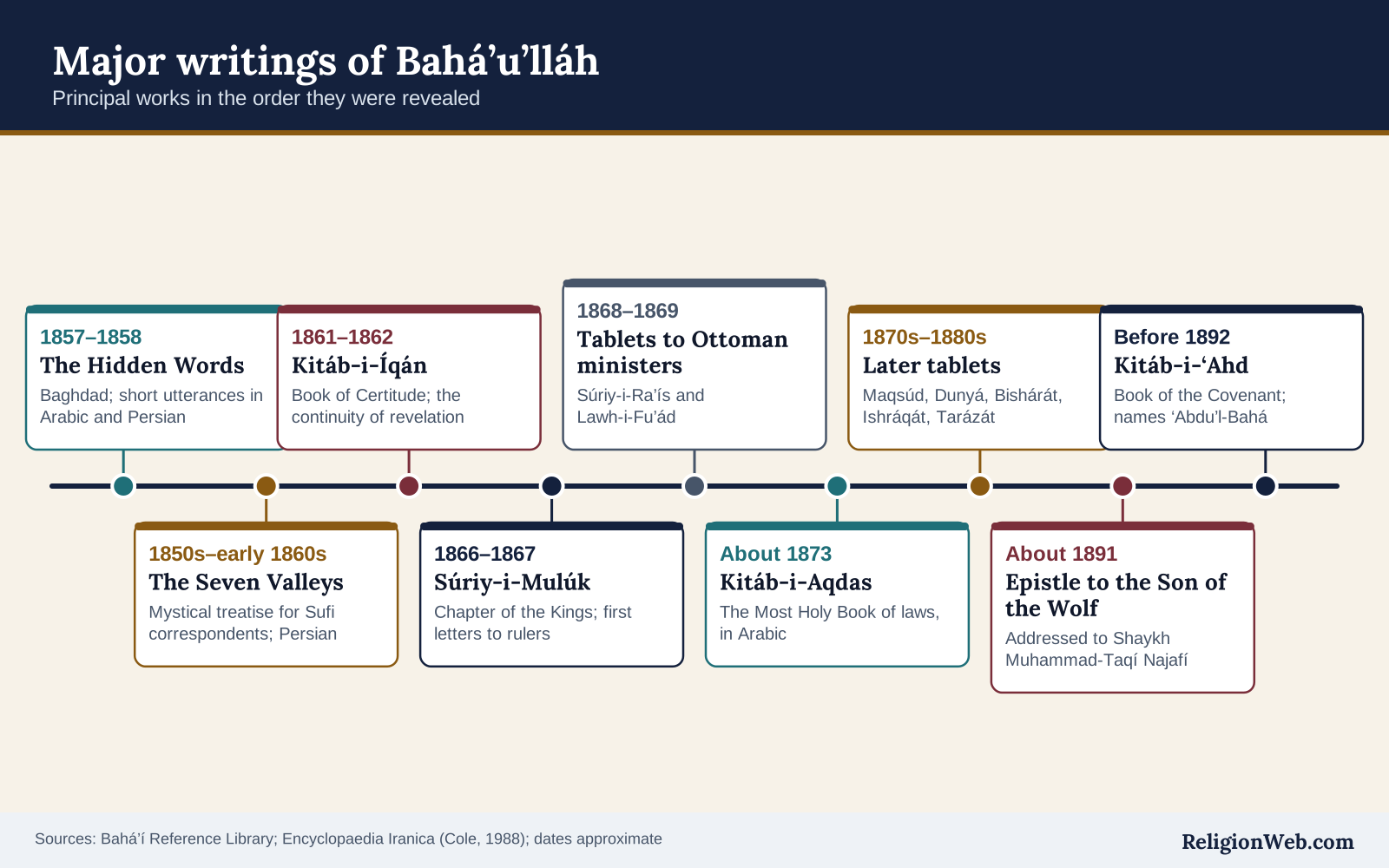
A Table of the Major Works
Works by period and subject
The table below lists the principal works with their approximate dates, original languages where the sources give them, and brief descriptions. It is a selection, not a complete bibliography; the Bahá’í Reference Library contains many more tablets.
| Work (transliterated title) | Approximate date and place | Language | Subject and significance |
|---|---|---|---|
| The Hidden Words (Kalimát-i-Maknúnih) | 1857–1858, Baghdad | Arabic and Persian | Short ethical and mystical utterances in two parts |
| The Seven Valleys and the Four Valleys | Baghdad years | Persian | Mystical treatises on the stages of the soul’s journey, written for Sufi correspondents |
| Kitáb-i-Íqán (Book of Certitude) | 1861–1862, Baghdad | Persian | Doctrine of revelation and the continuity of divine messengers |
| Súriy-i-Mulúk (Chapter of the Kings) | Adrianople, from 1867 | Arabic | Collective address to the rulers of the world |
| Súriy-i-Ra’ís and Lawḥ-i-Fu’ád | August 1868 and 1869 | Arabic and Persian | Addresses to the Ottoman ministers ‘Álí Páshá and Fu’ád Páshá |
| Tablets to Pius IX, Napoleon III, Alexander II, Queen Victoria, Náṣiri’d-Dín Sháh | Late 1860s and after, Adrianople and ‘Akká | Arabic and Persian | Letters calling on rulers to justice, consultation, and peace |
| Kitáb-i-Aqdas (Most Holy Book) | About 1873, ‘Akká | Arabic | Laws, institutions, and teachings of the Bahá’í dispensation |
| Lawḥ-i-Maqṣúd, Lawḥ-i-Dunyá, Bishárát, Ishráqát, Ṭarázát, Tajallíyát | ‘Akká period | Arabic and Persian | Tablets on world order, consultation, and social principles |
| Lawḥ-i-Ḥikmat (Tablet of Wisdom) | ‘Akká period | Arabic | Philosophy and the transmission of knowledge |
| Lawḥ-i-Karmil (Tablet of Carmel) | About 1891, Mount Carmel | Arabic | Short tablet linked by Bahá’ís to the mountain that later became the site of the World Center |
| Lawḥ-i-Ibn-i-Dhi’b (Epistle to the Son of the Wolf) | About 1891, Bahjí | Persian | Addressed to Shaykh Muḥammad-Taqí Najafí; a retrospective of his teachings |
| Kitáb-i-‘Ahd (Book of the Covenant) | Before 1892, Bahjí | Arabic and Persian | Will naming ‘Abdu’l-Bahá as successor and interpreter |
Compilations in English
Most English readers meet the writings in compilations rather than as individual works. Gleanings from the Writings of Bahá’u’lláh, a selection arranged and translated by Shoghi Effendi, remains the most widely read, and Prayers and Meditations provides devotional material. The Bahá’í World Center has also published The Summons of the Lord of Hosts and Tablets of Bahá’u’lláh Revealed After the Kitáb-i-Aqdas. The authorized English texts, translated by Shoghi Effendi or at the Bahá’í World Center, are available online in the Bahá’í Reference Library, whose terms of use allow copying for non-commercial purposes subject to conditions; this article paraphrases the writings instead of quoting them at length.
From Dictation to Library: Transmission, Translation, and Spelling
The Bahá’í writings have a documented history from the moment of revelation to the present. Unlike the scriptures of religions founded in antiquity, they were written down by identifiable secretaries, copied in the author’s lifetime, and translated under the supervision of his descendants and the Universal House of Justice. For readers who want to know how far a given English passage can be trusted, the questions of manuscript, authentication, translation, and transliteration are central.
Authenticity and Preservation
Secretaries, manuscripts, and authentication
As noted above, Bahá’u’lláh’s revelation was typically dictated to secretaries. Bahá’í institutions hold that texts were authenticated in his lifetime, and the Bahá’í World Center in Haifa preserves original manuscripts and copies. This practice of authentication is the basis of the Bahá’í view that the text of the writings has been preserved as revealed, in contrast to scriptures whose earliest surviving manuscripts postdate their founders by generations or centuries. Independent scholars can examine the printed editions and manuscripts for themselves, and the comparative situation is a favorable one for textual study, although access to some archival materials remains controlled by the Bahá’í institutions.
Printing and early circulation
Several of the major works were printed during or soon after Bahá’u’lláh’s life. Bahaipedia, a reference work maintained by Bahá’ís, records that Bahá’u’lláh arranged for the original Arabic text of the Kitáb-i-Aqdas to be published in Bombay in 1308 AH (1890–1891), within his lifetime. Tablets also circulated in handwritten copies among the Bahá’ís of Iran and neighboring countries in the decades before printing was widely available there. The existence of printed texts from his lifetime, together with the manuscript tradition, is one reason the Bahá’í community regards the text of his writings as fixed.
Translation into English
Shoghi Effendi and the standard English style
The standard English of the Bahá’í writings was set by Shoghi Effendi, who according to the Bahá’í Reference Library translated the Hidden Words, the Kitáb-i-Íqán (first published in English in 1931), the Epistle to the Son of the Wolf, and a large selection of other tablets. His style is often described as an elevated, King James–influenced English, with archaic pronouns and long periodic sentences, chosen to carry the weight of the original’s rhetorical style. Bahá’ís regard his translations as authoritative. Readers new to the writings sometimes find the style dense, and the more recent translations produced at the Bahá’í World Center of works that Shoghi Effendi did not translate tend toward a more modern idiom.
Translation under the House of Justice
Since 1963 the Universal House of Justice has overseen the translation of works not translated by Shoghi Effendi, through translators and researchers working at the Bahá’í World Center. The Bahá’í Reference Library states that the first authorized English translation of the Kitáb-i-Aqdas appeared in 1992, annotated and accompanied by supplementary writings and Bahá’u’lláh’s answers to questions. In practice, quotations from the writings in official Bahá’í publications are drawn from translations by Shoghi Effendi or from the World Center. The Bahá’í World News Service reports that Bahá’í writings and literature have been translated into more than 800 languages. The Library’s terms of use allow copying for non-commercial purposes under conditions, which is one reason this article paraphrases its texts.
Transliteration: Why a Name Is Spelled the Way It Is
The system and its origin
The Bahá’í scriptures were written in Persian and Arabic, and the names and terms in them are spelled in Latin letters according to a fixed system. The Bahá’í Reference Library’s guide to the system says it was adopted by Shoghi Effendi for use generally in all languages written in the Roman alphabet, to give Bahá’ís a common spelling of Arabic and Persian names and terms and to prevent the confusion that arises from multiple transliteration systems. In a historical article at the Bahá’í Library Online, the system is traced to a letter of 12 March 1923, in which Shoghi Effendi asked the Bahá’ís of America to use it from then on, and to the system adopted at the Tenth International Congress of Orientalists in Geneva in September 1894, which he adapted. The result explains the marks seen throughout this article: the acute accent on long vowels (á, í, ú), dots under certain consonants (ḥ, ṣ, ṭ, ẓ, ḍ), and two different apostrophe-like marks.
Why accuracy matters in Bahá’í publishing
For Bahá’í publishers the reason for the exacting system is partly scholarly and partly devotional. Consistent spelling records the original script, avoids ambiguity among Persian or Arabic words that sound alike in English, and treats the names of central figures with care. It also solves practical problems: a name like Bahá’u’lláh appeared in many forms in older Western books, and standardized spelling lets readers and search tools identify the same person. For this reason this article spells his name with the Library’s diacritics and treats the plain form “Bahaullah” as a search variant. Scholarly works published outside the Bahá’í community often use their own transliteration systems instead, so a reader moving between sources should expect to see, for example, “Ḥusayn-ʿAlī Nūrī” and “Mírzá Ḥusayn-‘Alí Núrí” for the same man. Readers who find the marks distracting can ignore them without losing the meaning.
The Kitáb-i-Aqdas: The Most Holy Book and Bahá’í Law
Among Bahá’u’lláh’s works, the Kitáb-i-Aqdas holds the distinct place of the book of laws. The Bahá’í Reference Library calls it his “book of laws,” and Bahá’ís regard it as the charter of the Bahá’í dispensation. Though it is short compared with some of his other works, it addresses worship, family law, social ethics, and the structure of Bahá’í institutions, and it supplies the basis for many practices described elsewhere in this article.
What the Book Is and How It Is Structured
Date, language, and purpose
The Aqdas was written in Arabic around 1873 in ‘Akká, according to the Bahá’í Reference Library. The Encyclopaedia Iranica, in the article by Juan Cole, dates it to 1873, composed under house arrest in the old city of ‘Akká in response to requests from the Bahá’í community in Iran for a book of laws to accompany the new revelation, and describes it as meant to supersede the Qur’an and the Báb’s Bayán. That description states the historian’s reading of the book’s function within the Bahá’í community; Bahá’ís themselves describe the Aqdas as laws of a new dispensation, and they honor the Qur’an as revealed scripture. Iranica adds that the book established local Houses of Justice and set out laws on marriage, taxes, and ritual.
The 1992 edition and the Synopsis and Codification
In 1992 the Universal House of Justice published the first authorized English translation, annotated and accompanied by supplementary writings and by Bahá’u’lláh’s answers to questions. The edition includes a Synopsis and Codification of the laws, which arranges them by subject. These apparatus help readers see which laws bind individual Bahá’ís now. The House of Justice has explained that the application of some provisions awaits conditions that do not yet exist, and that the penal provisions in the book are not now applied.
Principal Laws and Ordinances
Worship, fasting, and the calendar
According to the Synopsis and Codification, the Aqdas prescribes three obligatory prayers, one of which a believer chooses; the prayers bind from the age of fifteen, are said individually, and are preceded by ablutions. Congregational prayer is not allowed, with the exception of the Prayer for the Dead. Fasting runs from the end of the Intercalary Days to the festival of Naw-Rúz, with abstention from food and drink from sunrise to sunset, and it binds from age fifteen. The exemptions listed include travelers, the ill, those over seventy, pregnant and nursing women, women in their courses, and those engaged in heavy labor. The Aqdas also confirms the Bahá’í festivals and calls for the building of Houses of Worship, the Mashriqu’l-Adhkár.
Family law, ethics, and social provisions
The Synopsis lists marriage as highly recommended but not obligatory. It requires the consent of both parties and of their parents, sets a dowry in gold or silver, forbids plural marriage, and allows marriage to people of other religions. Divorce is strongly condemned and is permitted only after a full year of waiting. The inheritance law divides an estate into 2,520 shares among children, spouse, parents, siblings, and teacher. Among the prohibitions are intoxicating drinks, opium, and gambling, backbiting and calumny, adultery, murder, theft, arson, and carrying arms unless essential; the Synopsis also lists the slave trade, asceticism, monasticism, mendicancy, priesthood, and confession of sins. Bahá’ís understand the writings of Bahá’u’lláh to have set aside holy war, and Bahá’í law applies to Bahá’ís as members of their religion; it is not offered as a code for others. Iranica describes the Huqúqu’lláh (Right of God) as a nineteen-percent levy on gold and profits, which Bahá’ís pay as a voluntary offering for the work of the Faith.
Authority, Interpretation, and Application
Gradual application of the law
Shoghi Effendi taught that the laws of the Aqdas should be introduced in stages, as conditions allow. The community follows the personal laws, such as prayer, fasting, marriage, and the prohibition of alcohol, and defers laws that would require a Bahá’í society or state, including penal provisions. The Universal House of Justice has authority to legislate on matters not explicitly covered by the text. The Aqdas is addressed to Bahá’ís; Bahá’u’lláh’s writings direct believers to obey the governments of their countries and to avoid partisan politics.
Interpretation within the community
The Aqdas also provides the authority for the Bahá’í system of interpretation. In the Aqdas and in the Kitáb-i-‘Ahd, Bahá’u’lláh named ‘Abdu’l-Bahá as the interpreter, and the Iranica notes that he appointed his eldest son to head the religion. ‘Abdu’l-Bahá’s and Shoghi Effendi’s interpretations are authoritative for Bahá’ís, and the Universal House of Justice, which Bahá’u’lláh authorized in the Aqdas, has authority to resolve questions not addressed by the interpreters. Individuals are encouraged to read and reflect on the text, but personal opinions about its meaning are treated as such. Writers outside the community note that this arrangement is intended to prevent the splintering into sects that has occurred in other traditions, a topic revisited in the section on the Covenant.
Central Teachings in His Writings
The teachings that Bahá’ís attribute to Bahá’u’lláh range from the inner life of the individual soul to proposals for the political and economic organization of the planet. Many are summarized in later Bahá’í literature as “principles,” a list that ‘Abdu’l-Bahá used in his talks in Europe and North America. This section follows the writings themselves, naming the works in which each theme is developed, and it distinguishes what is stated in Bahá’u’lláh’s texts from what authorized Bahá’í interpreters later drew from them.
The Spiritual Life of the Individual
Knowing and loving God
A recurring theme of the writings is that the purpose of human existence is to know and to worship God. The Hidden Words begins from the premise that God created humanity out of love and in order to be loved, and the Seven Valleys describes how the seeker moves from search through love and knowledge toward detachment from the self. Prayer, meditation, and the study of the revealed Word are the means. Bahá’u’lláh discouraged formal asceticism and monasticism, teaching that the spiritual life is lived in the world, through work, family, and service. The writings use language of love and longing found in Persian and Arabic mystical poetry, and Bahá’ís often read them aloud in groups.
The soul, character, and the afterlife
Bahá’u’lláh’s writings state that each person has a rational soul that is created by God, begins at conception, and continues to exist after the death of the body. The next world is described as a continuation of the soul’s progress toward God, and heaven and hell are described primarily as states of nearness to or remoteness from the divine, not as physical places. The texts stress character as the measure of the spiritual life: truthfulness, trustworthiness, courtesy, generosity, and detachment from material attachments. Bahá’u’lláh also condemned backbiting in strong terms. Bahá’í teaching does not include reincarnation, a point sometimes asked about by readers familiar with Indian religions.
The Unity of Humankind and Religion
One humanity and the removal of prejudice
Bahá’u’lláh wrote that humanity is one family and that the earth is one homeland. Bahá’ís cite the Tablet of the World and the Tablet of Maqṣúd as texts in which he describes the unification of the peoples as the principal need of the age, and they read his letters to rulers as treating prejudice and the rivalry of nations as barriers to it. The Bahá’í community cites these passages as the basis for its work on racial unity, and ‘Abdu’l-Bahá’s talks in Europe and North America applied them to racial prejudice, to the position of women, and to the relations of religions. Within the Bahá’í community, “the oneness of humanity” is the key principle from which many others follow.
The unity of religion and independent investigation
The corollary in the realm of belief is the unity of religion, expressed through progressive revelation. A related teaching is that each person should investigate truth independently and not rely on inherited belief or religious authority. The Kitáb-i-Íqán insists that the seeker must free the heart from the “veils” of imitation and inherited prejudice in order to recognize the truth of a Manifestation. The Bahá’í writings also hold that religion and science are two complementary systems of knowledge, and that religious belief that contradicts established science should be re-examined. This is a position that Bahá’ís draw from ‘Abdu’l-Bahá’s expansions of Bahá’u’lláh’s statements.
Society, Governance, and World Order
Justice, consultation, and the rulers
The letters to rulers set out a political theory in outline. Rulers are exhorted to justice and compassion and to regard their subjects as a trust. They are urged to consult together in times of dispute and to avoid reliance on armaments. The Encyclopaedia Iranica reports that in the Tablet of Maqṣúd Bahá’u’lláh urged a world assembly of rulers to discuss peace and prevent war through collective security, and that in the Tablet of the World he charged a Universal House of Justice with promoting peace among secular powers. Bahá’í writers describe these passages as an early statement of the principle of collective security. He did not set out a detailed constitution for such a body, and how far his words can be read as a plan for world government is a matter on which later Bahá’í and non-Bahá’í writers have offered different readings.
Women, education, and the economic order
Bahá’u’lláh’s writings call for the education of all children and for special attention to the education of girls, and they speak in strong terms about the importance of work and trades. The Bahá’í teaching that women and men are equal in the sight of God is stated explicitly by ‘Abdu’l-Bahá and the Universal House of Justice, which draw on a number of passages in Bahá’u’lláh’s writings. Other principles, including a universal auxiliary language, moderation in wealth and poverty, and the use of consultation as a method of decision-making, appear in the Tablets Revealed After the Kitáb-i-Aqdas, notably in the Glad-Tidings and the Ishráqát. The Encyclopaedia Iranica article by Juan Cole singles out Bahá’u’lláh’s teachings on a universal language, an international parliament, the education of women, and opposition to nationalist chauvinism as significant elements of his social thought, and notes that he gradually gained the respect of some former opponents.
The Covenant and the Question of Succession
When a religion’s founder dies, the question arises of who has authority to interpret his writings and to lead his community. Bahá’u’lláh addressed it explicitly in his own writings, and the resulting arrangement, called the Covenant, is one of the features that most distinguishes the Bahá’í Faith from earlier religions, in Bahá’í understanding. The following sections describe the Covenant as Bahá’ís understand it, how it operated at Bahá’u’lláh’s death, and how it developed after.
The Covenant of Bahá’u’lláh
What the term means
In Bahá’í usage, the word covenant refers to two kinds of binding agreements. The Greater Covenant is the promise God makes with humanity, through each Manifestation, to send a successor, and the pledge of believers to accept him when he comes; the Bahá’í understanding links it to the Báb’s promise of “Him Whom God shall make manifest.” The Lesser Covenant is the agreement of believers to follow the authority that the Manifestation designates for his own dispensation. Bahá’u’lláh’s writings name the persons and institutions to whom the community is to turn for authority after his death, so that the unity of the community, in the Bahá’í view, is maintained by an explicit and written arrangement and not by a process of dispute and interpretation.
The Kitáb-i-‘Ahd and the naming of ‘Abdu’l-Bahá
Bahá’ís find the provision in two places. In the Kitáb-i-Aqdas, they hold, Bahá’u’lláh refers to a figure to whom the community is to turn after him, and in his will, the Kitáb-i-‘Ahd (Book of My Covenant), the official biography says he named ‘Abdu’l-Bahá as his successor. The Encyclopaedia Iranica likewise states that Bahá’u’lláh appointed his eldest son, ‘Abbás Effendi, known as ‘Abdu’l-Bahá, to head the religion, and that he assumed leadership in 1892. Bahá’ís understand ‘Abdu’l-Bahá as the Center of the Covenant, the interpreter of the writings, and the head of the community until his death in 1921.
Challenges, the Guardianship, and the House of Justice
The dispute over succession in 1892
The Book of the Covenant did not end disagreement. Some of Bahá’u’lláh’s younger sons, led by Muḥammad-‘Alí, joined a few Bahá’í teachers in opposing ‘Abdu’l-Bahá’s authority. According to the Encyclopaedia Iranica, almost all Bahá’ís accepted ‘Abdu’l-Bahá, and Cole writes that the opposing group eventually died out. Bahá’ís use the term “Covenant-breakers” for those who rejected the line of authority designated in the Writings. The term describes a religious status within Bahá’í teaching and carries particular weight inside the community, and outsiders should read it as a Bahá’í term of art and not as a neutral description. Historians would call the episode a succession dispute, of a kind that has occurred in many religious movements, and note that in this case it was resolved in ‘Abdu’l-Bahá’s favor.
Shoghi Effendi, the Guardianship, and the Universal House of Justice
‘Abdu’l-Bahá’s Will and Testament named his eldest grandson, Shoghi Effendi, as Guardian of the Faith and interpreter of the writings, and reaffirmed the Universal House of Justice, which the Kitáb-i-Aqdas had provided for. Shoghi Effendi led the community from 1921 until his death in 1957 without naming a successor, and in 1963 the first Universal House of Justice was elected by the members of the National Spiritual Assemblies. The Bahá’í institutions hold that the Guardianship could not continue without a successor in the line prescribed by the Will and Testament. Today the Bahá’í Faith is led by the House of Justice, an elected nine-member body, together with elected local and national institutions. The Encyclopaedia Iranica notes that a few Bahá’ís rejected Shoghi Effendi, among them Ruth White and Aḥmad Sohrāb, and that after 1963 Charles Mason Remey declared himself Guardian; Cole characterizes these followings as very small, and Bahá’ís cite the absence of any major schism as evidence for the strength of the Covenant. The article on the Bahá’í Faith describes the institutions in detail.
The line of authority at a glance
The following table summarizes how authority passed after Bahá’u’lláh according to Bahá’í teaching and the Encyclopaedia Iranica. It records the community’s own account of the arrangement and the dates on which the main transitions occurred.
| Period | Holder of authority | Basis in the texts | Notes |
|---|---|---|---|
| Until 29 May 1892 | Bahá’u’lláh | Manifestation of God for this age, in Bahá’í belief | Wrote the Kitáb-i-Aqdas and the Kitáb-i-‘Ahd |
| 1892 to 1921 | ‘Abdu’l-Bahá | Named in Bahá’u’lláh’s will, the Kitáb-i-‘Ahd | Center of the Covenant and authorized interpreter; opposed by Muḥammad-‘Alí and a small group |
| 1921 to 1957 | Shoghi Effendi, Guardian of the Faith | Named in ‘Abdu’l-Bahá’s Will and Testament | Interpreter and translator; died in 1957 without naming a successor |
| 1963 to the present | Universal House of Justice | Provided for in the Kitáb-i-Aqdas and the Will and Testament | Elected nine-member body; legislates where the texts are silent |
| Local and national levels | Spiritual Assemblies | Houses of Justice envisaged in the Kitáb-i-Aqdas | Elected annually; no clergy |
Passing, Shrine, and Holy Places Associated with Bahá’u’lláh
The places where Bahá’u’lláh lived, wrote, and was buried hold a particular place in Bahá’í devotion. The most sacred of them are in and around ‘Akká and Haifa in present-day Israel, the location of the Bahá’í World Center, while the earlier places of his exile in Iran, Iraq, and Turkey figure mainly as historical memory. This section describes his death and the shrine at Bahjí, the other places of significance, and the practice of pilgrimage.
His Passing and the Shrine at Bahjí
The Ascension
Bahá’u’lláh died at Bahjí on 29 May 1892, at the age of seventy-four. Bahá’ís call the event the Ascension of Bahá’u’lláh, a term that reflects their belief that he did not simply die but passed to the next world, and they observe it as a holy day. In 2026 it fell on 29 May, according to the dates published at bahai.org, and like all Bahá’í days it begins at sunset on the previous evening. Many communities hold a commemoration in the small hours of the morning, in keeping with the hour traditionally given for his passing, although the official calendar does not specify a time. In his will, the official biography says, he named ‘Abdu’l-Bahá as his successor, and ‘Abdu’l-Bahá assumed the leadership of the community.
Burial and the Qiblih
Bahá’u’lláh was buried at Bahjí. A reference work maintained by Bahá’ís, Bahaipedia, records that the building that became his Shrine had been the residence of his son-in-law, Siyyid ‘Alí Afnán, in the late 1880s, and that his remains rest in a small room within the Shrine’s central room, which is set around a small garden. The Shrine is the Qiblih, the direction toward which Bahá’ís turn in the obligatory prayer, and Bahá’ís regard it as the most holy place of their religion. In the days after ‘Abdu’l-Bahá’s death in 1921 the Shrine became the center of a dispute: according to the same source, Mírzá Muḥammad-‘Alí seized control of it in January 1922, and its keys were returned to Shoghi Effendi in early 1923. The Bahá’í World News Service gives the number of visitors to the Shrine on Mount Carmel at around one million a year; visitors to the Shrine at Bahjí are asked to observe silence and respect and to follow the guidance of the Bahá’í institutions that care for it.
The Sites of the Holy Land
Bahjí, the Mansion, and Mazra‘ih
Bahjí, Arabic for “delight,” lies on the plain north of ‘Akká. The official biography states that in the late 1870s Bahá’u’lláh was granted freedom to move beyond the city walls and names the Mansion of Mazra‘ih as one of his homes, and Bahá’í tradition places his last residence at the Mansion of Bahjí, where Edward Granville Browne met him in April 1890. The official biography records that in 1892 he died there. The Mansion, the Shrine, and the gardens around them form a single pilgrimage site, a place of silence and prayer in which visitors typically read from the writings, chant or hear prayers, and walk the gardens.
Mount Carmel and the Bahá’í World Center
On the slopes of Mount Carmel in Haifa stand the Shrine of the Báb and the buildings that serve as the seat of the Universal House of Justice. Bahá’í sources record that Bahá’u’lláh visited Carmel in 1891 and revealed the Tablet of Carmel. In 2008 UNESCO inscribed the Bahá’í Holy Places in Haifa and the Western Galilee on the World Heritage List, a serial property that includes the Shrine of Bahá’u’lláh near ‘Akká and the Shrine of the Báb in Haifa with their gardens and associated buildings.
Places Beyond the Holy Land
Tehran, Baghdad, and Adrianople
The earlier places of Bahá’u’lláh’s life are remembered chiefly through the writings and through the festivals that recall them. The Tehran of his birth and imprisonment is not a place of Bahá’í pilgrimage, given the legal position of Bahá’ís in Iran described below. The garden near Baghdad where he spent twelve days in 1863 is commemorated each year by the Festival of Riḍván. In Adrianople, where the official biography says he lived for a year in the house of Riḍá Big, Bahá’ís recall the five years of exile as the period of his first letters to the world’s rulers. The Kitáb-i-Aqdas ordains pilgrimage to the House of Bahá’u’lláh in Baghdad and the House of the Báb in Shiraz, a provision that the Bahá’í institutions treat as not currently capable of fulfillment.
Pilgrimage today
Bahá’í pilgrims travel to the Bahá’í World Center in small groups from around the world to visit the Shrines of Bahá’u’lláh and the Báb and the associated sites. The visit is devotional and not obligatory in the sense of the Aqdas, since the pilgrimage that law ordains is to the houses in Baghdad and Shiraz. The World Center publishes guidance on arrangements, security, and timing, and readers who plan a visit should consult it, since the conditions of travel to the region change.
The Major Places at a Glance
A table of sites
The following table lists the principal places associated with Bahá’u’lláh, with their present-day location and their role in Bahá’í memory. It records no claim about access to sites in countries where Bahá’í institutions face restrictions.
| Place | Present-day location | Association with Bahá’u’lláh | Role in Bahá’í memory |
|---|---|---|---|
| Family home in Tehran | Iran | Born 12 November 1817 into a noble family | Marks his origin in the Persian elite |
| Síyáh-Chál (“Black Pit”) | Tehran, Iran | Underground dungeon where he was held for about four months in 1852 | Setting for the first intimations of his revelation, in Bahá’í belief |
| Garden of Riḍván | Baghdad, Iraq | Twelve days in 1863; declaration | Origin of the Festival of Riḍván |
| House of Bahá’u’lláh | Baghdad, Iraq | Residence during the Baghdad years, 1853–1863 | Designated in the Kitáb-i-Aqdas as a place of pilgrimage |
| Constantinople | Istanbul, Turkey | Stayed about four months in 1863 | Ottoman capital, a stage of the exile |
| House of Riḍá Big | Edirne, Turkey | Lived there about a year in the 1860s | Associated with the Adrianople period and the first letters to rulers |
| Citadel prison | ‘Akká, Israel | Held there for over two years from 1868 | Remembered as the place of his imprisonment |
| Mansion of Mazra‘ih | Near ‘Akká, Israel | One of his homes after release from confinement | Associated with his freedom beyond the walls |
| Mansion of Bahjí | Near ‘Akká, Israel | Last residence; where Browne met him in April 1890 | Part of the pilgrimage site |
| Shrine of Bahá’u’lláh | Bahjí, Israel | Burial place since 1892 | The Qiblih; World Heritage property since 2008 |
| Mount Carmel | Haifa, Israel | Visit in 1891; Tablet of Carmel | Site of the Shrine of the Báb and the Bahá’í World Center |
How to read the table
The places divide into three groups. The Iranian and Iraqi sites are the settings of the early events in the story, and they are remembered through scripture, history, and festivals rather than through regular visits by Bahá’í pilgrims. The Turkish sites mark the middle of the exile and the beginning of the letters to rulers. The sites in Israel, around ‘Akká and Haifa, are where Bahá’u’lláh spent the last decades of his life, and are the places that Bahá’ís visit, maintain, and protect today. Sites in countries where the Bahá’í institutions face restrictions or no longer have access are listed here for their historical significance only.
Bahá’u’lláh in Bahá’í Worship and Community Life Today
For Bahá’ís, Bahá’u’lláh is present in daily life less as a historical figure than as the source of the texts they read and the laws they follow. His words give them their obligatory prayers, their fast, their calendar, and the basic shape of their community’s institutions, while his birth, declaration, and passing are marked as holy days. This section describes that lived dimension, with the caveat that practice varies across countries and cultures and that the Universal House of Justice, not a writer on the subject, sets the guidance that applies.
Prayer and Scripture in Daily Life
The obligatory prayers
Bahá’u’lláh revealed three obligatory prayers of different lengths. According to the Synopsis and Codification of the Kitáb-i-Aqdas, a Bahá’í chooses one of the three, which becomes binding from the age of fifteen. The prayer is said individually and not in congregation, with the exception of the Prayer for the Dead, and it is preceded by ablutions, washing of hands and face. The Synopsis assigns the times by the position of the sun: the morning prayer between sunrise and noon, the noon prayer between noon and sunset, and the evening prayer from sunset to two hours after. The worshiper faces the Qiblih, the Shrine of Bahá’u’lláh at Bahjí. Those who are ill, who are older than seventy, or, for women, who are in their courses are exempt. Women exempted in this way instead perform ablutions and repeat a specified verse ninety-five times a day. These are the tradition’s own provisions, and the choice among the three prayers is left to the individual.
Daily reading of the Writings and other prayers
In the Kitáb-i-Aqdas Bahá’u’lláh also asks believers to read from his writings morning and evening, and Bahá’ís understand this as a practice of reading with attention, not as a fixed liturgy. Many choose the Hidden Words, the Gleanings, or one of the many prayers he revealed for specific occasions, such as healing, protection, marriage, or travel. Short phrases are used as invocations, notably the Greatest Name, “Alláh-u-Abhá” (“God is Most Glorious”) and “Yá Bahá’u’l-Abhá” (“O Glory of the All-Glorious”), which are said at greetings, at gatherings, and as private devotions. Bahá’í teaching holds that prayer and meditation are not substitutes for medical care and that, in the case of illness, the Bahá’í writings encourage consulting qualified physicians.
Holy Days Centered on Bahá’u’lláh
Riḍván, the Ascension, and the Birth
Several of the nine Bahá’í holy days on which work is suspended are connected with Bahá’u’lláh. The first, ninth, and twelfth days of Riḍván commemorate his time in the garden in 1863. The Ascension of Bahá’u’lláh is observed on 29 May, and some communities mark it with a gathering in the small hours of the morning. His birthday is observed with that of the Báb as the Twin Holy Birthdays: according to the dates published at bahai.org for the year 183 B.E., the Birth of the Báb falls on 10 November 2026 and the Birth of Bahá’u’lláh on 11 November 2026, each beginning at sunset on the evening before. The Day of the Covenant, on 26 November 2026, and the Ascension of ‘Abdu’l-Bahá, on 28 November 2026, appear on the same calendar as significant dates and not among the nine holy days. Because the Badí‘ calendar is solar and the Twin Birthdays are determined by a lunar rule, the Gregorian dates change from year to year; the companion article on the Bahá’í calendar and holy days explains the rule.
What happens at a commemoration
A Bahá’í holy-day gathering is usually simple and organized by the local Spiritual Assembly or the community. It consists of prayers and readings from the writings of Bahá’u’lláh and often those of the Báb and ‘Abdu’l-Bahá, with music or chanting where the culture supports it, and a period for refreshments and conversation. There is no sermon and no officiant; those present take turns reading. In many communities the gathering is hosted in a home or rented hall. Participation is voluntary; Bahá’ís are asked to suspend work on the nine holy days where circumstances allow, and the form of the observance varies with local culture.
The Writings in Prayer, Law, Theology, and the Calendar
Which texts serve which purpose
Bahá’u’lláh’s works serve different purposes in Bahá’í life. Some are devotional, others legal, others doctrinal or social. The table groups selected works by the function that they perform in community life today. It is a summary and not an official classification.
| Function | Representative writings | How they are used |
|---|---|---|
| Obligatory prayer | The three obligatory prayers (short, medium, and long) | One is recited daily by each Bahá’í aged 15 or older, facing the Qiblih |
| Devotional reading and occasional prayer | The Hidden Words; Prayers and Meditations; the prayers for healing, marriage, and the dead | Read in morning and evening devotions, at the devotional part of the Nineteen Day Feast, and at life-cycle events |
| Law and practice | Kitáb-i-Aqdas | Source of the laws of prayer, fasting, marriage, inheritance, burial, and the Huqúqu’lláh |
| Theology and doctrine | Kitáb-i-Íqán; Seven Valleys; Four Valleys; Gleanings | Studied individually and in classes for the doctrine of revelation and the stages of the spiritual path |
| Social teachings and world order | Súriy-i-Mulúk; Tablets to the rulers; Lawḥ-i-Dunyá; Lawḥ-i-Maqṣúd; Bishárát | Cited in Bahá’í statements on peace, justice, and global community |
| Holy days and the calendar | Kitáb-i-Aqdas on Naw-Rúz and the Fast; the tablets on Riḍván; the Tablet of Carmel | Guide the observance of the Fast, Naw-Rúz, Riḍván, and the Ascension |
| Succession and institutions | Kitáb-i-‘Ahd (Book of the Covenant); the Aqdas on the House of Justice | Basis of the Bahá’í Covenant and the Universal House of Justice |
Study, education, and service
Study of the writings has become a central feature of Bahá’í community life. Bahá’ís organize children’s classes in which the young memorize prayers, programs for adolescents that work with texts on service and character, and study circles for adults, a pattern coordinated through training institutes, of which the Bahá’í World News Service counts over 300. These programs use quotations from the writings of Bahá’u’lláh, ‘Abdu’l-Bahá, and the Universal House of Justice as their basis. Bahá’ís also contribute to the Huqúqu’lláh, the “Right of God,” which supports the work of the Faith and is administered by Bahá’í institutions, and they work in neighborhood projects that they describe as an expression of the teachings. The article on the Bahá’í Faith describes these institutions and activities.
Bahá’u’lláh’s Role in the Bahá’í Faith Today
More than a century after his death, Bahá’u’lláh’s writings remain the foundation on which Bahá’í communities organize their worship, their law, and their public activity. The sections above describe the devotional side. This section looks at how the community that follows him is organized and what it reports about its own scale, with the caution that most figures come from the community itself and are not independently audited.
A Community Built on His Writings
Numbers and reach
The Bahá’í World News Service, the community’s news agency, gives these statistics without a date on the page: more than five million Bahá’ís; well over 100,000 localities in which they live; and 188 councils at the national level. It adds that Bahá’í writings and literature have been translated into more than 800 languages, and that the Faith is established in virtually every country. Independent estimates vary, because most national censuses do not record the Bahá’í Faith separately. Readers should therefore treat the five-million figure as the community’s own self-reported estimate, not an audited count.
Houses of Worship
In the Kitáb-i-Aqdas Bahá’u’lláh calls for the building of the Mashriqu’l-Adhkár, the Dawning-place of the Remembrance of God, a House of Worship in which the Word of God is chanted. The Bahá’í World News Service lists fourteen Houses of Worship currently in existence, in Australia, Cambodia, Chile, Colombia, the Democratic Republic of the Congo, Germany, India, Kenya, Panama, Papua New Guinea, Samoa, Uganda, the United States, and Vanuatu, and says that national Houses of Worship are planned in Brazil, Canada, Malawi, and the Philippines. The Houses are open to people of all backgrounds for prayer and the reading of scripture, and they are the visible architectural expression of the instruction he gave. The article on the Bahá’í Faith describes them in more detail.
How the Writings Guide Present-Day Institutions
The Universal House of Justice and the Writings
The Universal House of Justice, elected every five years by the members of the National Spiritual Assemblies, guides the worldwide community in the light of Bahá’u’lláh’s writings and those of ‘Abdu’l-Bahá and Shoghi Effendi. Its authority is that of legislating where the texts are silent, not of overriding them, and its letters regularly cite the Writings as the standard. The House issues an annual message at Riḍván and periodic plans for the community’s activities, and it has addressed public statements to humanity at large, among them The Promise of World Peace (1985), a statement that Bahá’ís connect with the themes of Bahá’u’lláh’s letters to rulers.
Education, development, and service
The Bahá’í World News Service reports more than 300 training institutes, more than 900 large-scale social and economic development efforts, including over 600 schools and over 70 development agencies, and about 2,100 groups among indigenous peoples. The Bahá’í International Community has been registered with the United Nations as a non-governmental organization since 1948. These are the community’s own figures. Bahá’ís describe such work as an expression of the teaching that spiritual belief and service to society belong together, a reading they draw from Bahá’u’lláh’s writings on the oneness of humanity and the importance of work performed in a spirit of service.

How Others View Bahá’u’lláh: Scholars, Muslim Authorities, and Iran
Most descriptions of Bahá’u’lláh outside the Bahá’í community come from one of three positions: the scholarly, which studies him as a historical and religious figure; the position of Muslim authorities, which in many countries regards his claim as incompatible with the Islamic belief in the finality of Muḥammad’s prophethood; and the stance of governments, notably Iran’s, which has historically treated Bahá’ís as a threat. A reference article should describe each accurately and without taking sides.
Academic Assessments
Bahá’u’lláh in the study of religion and of Iran
Scholars of religion describe the Bahá’í Faith as an independent religion that arose from Shia Islam through the Bábí movement, a historical description that does not assert anything about truth. Cambridge University Press published Peter Smith’s survey The Babi and Baha’i Religions: From Messianic Shi’ism to a World Religion in 1987, and Abbas Amanat’s Resurrection and Renewal (Cornell, 1989) is the standard study of the Bábí movement. The Encyclopaedia Iranica, which has entries on Bahá’u’lláh and the movement by Juan Cole, Denis MacEoin, and others, treats him as the founder of the Bahá’í religion. Academic work differs on how far to credit Bahá’í accounts of the early period, and Bahá’í and non-Bahá’í scholars have debated these questions in the open.
Where scholarly judgments remain open
Several questions remain open. How far Bahá’u’lláh’s teachings on peace and the oneness of humanity were original, and how far they drew on ideas circulating among reformers in the Ottoman Empire and Iran, is a matter of discussion. So too is the question of the degree to which later Bahá’í administrative practices were foreseen in his writings, or developed by ‘Abdu’l-Bahá and Shoghi Effendi in response to circumstances. A third open topic is the relation between the Bahá’í community and the Azalís, who preserved a more strictly Bábí identity, and who are now very few in number.
Muslim Perspectives and the Question of Finality
The doctrine of the seal of the prophets
The majority view among Sunni and Shia Muslim scholars is that Muḥammad is the “seal of the prophets,” a phrase from the Qur’an (33:40), and that no prophet or bearer of new revelation can follow him. On that understanding, the claims of the Báb and Bahá’u’lláh to bring a new revelation fall outside Islam. Bahá’ís do not claim to be Muslim; they describe their religion as independent, and they honor Muḥammad as a Manifestation of God. The difference is thus one of theological premise and not of dispute over a shared label, since Bahá’ís describe their religion as independent. Many Muslim religious authorities have consequently classified Bahá’ís as non-Muslims, and in some countries the authorities treat them as apostates or restrict the community’s institutions.
The range of Muslim views
Muslim opinion is not uniform. Some Muslim intellectuals and human-rights advocates have publicly defended the civil rights of Bahá’ís while holding that their religion is not Islamic. The distinction between the theological question, which Muslim scholars answer from within their own tradition, and the legal and civil question of how a state should treat a minority, is one that many commentators on these cases emphasize. This article records the theological positions as they are held and does not adjudicate them.
Bahá’ís in Iran
History of the persecution
The history of the Bábís and Bahá’ís in Iran has been marked by violence from the 1840s onward, including the executions of 1850 and 1852 described above. Bahá’ís in Iran, whom the Bahá’í World News Service puts at about 300,000, are described by the International Service for Human Rights as the country’s largest non-Muslim religious minority and as constitutionally unrecognized. The same organization, reporting on a March 2024 report of the United Nations Special Rapporteur on Iran to the Human Rights Council, says that for more than four decades Bahá’ís have suffered severe violations, including executions, the denial of educational rights, and the deprivation of property rights, and that the Special Rapporteur recorded at least 70 Bahá’ís in detention or serving prison sentences and about 1,200 more facing trial or lengthy sentences. The Iranian authorities have rejected such characterizations in the past, saying that those prosecuted are charged with offenses against the state and not for their beliefs. This article reports the findings as attributed and does not adjudicate disputed individual cases.
Why this matters for understanding Bahá’u’lláh
The persecution is part of the story of Bahá’u’lláh for two reasons. First, Bahá’ís regard their own suffering as continuous with that of their founders, and the experience of exile and imprisonment shapes their identity. Second, it influences the way Bahá’ís describe their relation to political authority: Bahá’u’lláh’s writings direct believers to obey their governments and to avoid partisan politics, and the Bahá’í International Community states that its approach to persecution is through patience, legal appeal, and public information, without violence. Readers can find these themes in the Aqdas and in the tablets to rulers, as well as in the statements of the Bahá’í International Community.
Common Misconceptions About Bahá’u’lláh
Because the Bahá’í Faith is less familiar than the older religions, a handful of misunderstandings circulate about its central figure. Most arise from the unfamiliar names, the shared history with the Báb, or the assumption that a new religion must resemble the structures of an old one. Each of the following is stated fairly, traced to its source, and then corrected from the tradition’s own texts and the historical record.
Misconception 1: Bahá’u’lláh and the Báb are the same person
Where the misunderstanding comes from
The two names appear together in almost every Bahá’í source, the two figures were born within two years of each other, and both are called Manifestations of God. Their names are also easily confused because “Báb” and “Bahá” share a sound, and the Bahá’í Faith is often introduced with a single sentence about its “two founders.” In casual descriptions the Báb is sometimes called Bahá’u’lláh’s “forerunner” or “earlier name,” which encourages the idea that they are one person described at two stages of life. Some popular accounts also confuse the Báb’s title, which means “Gate” in Arabic, with the Bahá’í term “Bahá,” meaning “glory.”
What the evidence and tradition actually show
They were two men with different families, careers, and fates. Siyyid ‘Alí-Muḥammad, the Báb, was born in Shiraz in 1819, worked as a merchant, declared his mission in May 1844, and was executed by firing squad in Tabriz on 9 July 1850. Mírzá Ḥusayn-‘Alí Núrí, Bahá’u’lláh, was born in Tehran in 1817 into a government family, and the Bahá’í Faith’s own biography states that the two never met in person. Bahá’u’lláh accepted the Báb’s claim, was a leading Bábí, and later declared that he was the one the Báb had foretold. Bahá’ís therefore regard them as two Manifestations of God in succession, with the Báb as the herald of the second. Historians agree that they were distinct individuals and that the Bábí movement preceded the Bahá’í Faith, which grew out of it in the 1860s.
For the first misconception, readers can also compare the two stations by looking at the writings each left: the Báb’s principal works include the Bayán, while Bahá’u’lláh’s include the Kitáb-i-Aqdas and the Kitáb-i-Íqán. They are different books by different authors, written in different decades and in different places, and the Bahá’í Reference Library lists them under separate headings.
Misconception 2: Bahá’í scripture is a single book
Where the misunderstanding comes from
Many readers expect each religion to have one defining volume, as the Qur’an is for Muslims or the Bible for Christians. Introductions to the Bahá’í Faith commonly name a single work, often the Kitáb-i-Aqdas (“the Most Holy Book”) or the Hidden Words, and the title “Most Holy Book” suggests a single scripture. The Bahá’í Reference Library presents the texts of the Báb, Bahá’u’lláh, ‘Abdu’l-Bahá, Shoghi Effendi, and the Universal House of Justice in separate collections, which a first-time reader may take for the table of contents of one canon.
What the evidence and tradition actually show
Bahá’u’lláh’s writings run to many books and letters, as shown in the table of principal works earlier in this article; the Kitáb-i-Aqdas is the central book of law, not the sole scripture, and Bahá’ís rely equally on the Kitáb-i-Íqán, the Hidden Words, the tablets to rulers, and the prayers. In addition to his writings, Bahá’ís regard the revealed Word of the Báb as scripture, and they treat the authorized interpretations of ‘Abdu’l-Bahá and Shoghi Effendi, and the legislation of the Universal House of Justice, as authoritative in their own spheres but not as revelation. The canon is therefore best described as a body of texts of several kinds, and not a single volume. Bahá’ís also honor the Bible and the Qur’an as revealed scripture, but their own canon is distinct.
A fuller picture comes from looking at how the texts are used. In devotional life Bahá’ís read the Hidden Words and prayers; in matters of law they turn to the Kitáb-i-Aqdas; in doctrine they study the Kitáb-i-Íqán; and in questions of administration they look to the Will and Testament of ‘Abdu’l-Bahá and the letters of the Universal House of Justice. Each text has its own register, and readers who go to the wrong text for the wrong purpose may come away with a distorted view. The table of writings and their uses earlier in this article is intended to prevent that.
Misconception 3: Bahá’í communities have a professional clergy led by Bahá’u’lláh’s successors
Where the misunderstanding comes from
Observers who know that Bahá’u’lláh named a successor, ‘Abdu’l-Bahá, and that Shoghi Effendi later held the office of Guardian, sometimes assume a hereditary priesthood or a line of religious rulers continuing to the present. Titles such as “Guardian,” “Hands of the Cause,” and “Counsellor” sound clerical, and the Universal House of Justice, with its nine members and a seat in Haifa, can seem like a college of bishops or a papacy. The elected character of the Bahá’í institutions and the lack of congregational ritual are less familiar than the language of leadership.
What the evidence and tradition actually show
Bahá’u’lláh’s Kitáb-i-Aqdas abolished the priesthood and the confession of sins to a human being, and the Synopsis and Codification lists both among the prohibitions. Bahá’í communities have no professional clergy and no sacramental rites performed by an ordained person. Local and national Spiritual Assemblies are elected annually by secret ballot without nominations or campaigning, and their members serve in addition to their ordinary work. The Universal House of Justice is elected every five years by the members of the National Spiritual Assemblies. The Guardianship ended with Shoghi Effendi’s death in 1957, and there is no hereditary successor to Bahá’u’lláh today. Appointed individuals such as Counsellors advise and encourage but do not rule.
The same point can be made from the opposite direction. Where Bahá’í teaching speaks of the “learned,” it means individuals who offer counsel and teaching without authority to command or to interpret; where it speaks of authority, it means elected institutions acting as bodies, and the interpreters named in the Covenant. Neither is a priesthood. Readers coming from traditions in which ordination is central should expect a different pattern, in which religious life is shared among believers and guided by elected councils.
Misconception 4: Bahá’ís believe that Bahá’u’lláh is God
Where the misunderstanding comes from
Bahá’u’lláh used elevated titles for himself, including “the Lord of Hosts” and “the Ancient Beauty,” and Bahá’ís chant devotional invocations in which his name appears. Some Bahá’ís’ phrases, such as “the Manifestation of God,” sound similar to doctrines of incarnation in other traditions. Critics from outside the Faith have sometimes described the Bahá’í view in those terms to argue that it is blasphemous, and a few popular summaries treat the Bahá’í view as “a belief that God has come to earth again.”
What the evidence and tradition actually show
Bahá’í teaching holds that God is a single, transcendent Creator, wholly beyond human understanding, who cannot incarnate in a human body. A Manifestation is described as a perfect mirror reflecting the attributes of God, as the sun’s light is reflected in a spotless mirror, without the mirror becoming the sun. Bahá’u’lláh’s station is therefore that of a divine messenger with a unique relationship to God, but not that of God. Bahá’í prayers are addressed to God, and the Bahá’í Reference Library explains the distinction in the sections on the Manifestations. Readers who encounter the titles should treat them as the language of Persian and Arabic devotion and scripture.
The Bahá’í community also stresses that the Manifestation is to be honored and loved without being turned into an object of worship in the sense reserved for God. Bahá’í sources describe the distinction as one of station and purpose: a Manifestation is the channel through which the knowledge of God reaches humankind, and love for the Manifestation is, in Bahá’í teaching, a way of loving God. Whether one finds that distinction persuasive is a theological question for each reader; what is a matter of record is that Bahá’í authorities explicitly reject the claim that Bahá’u’lláh is God.
Misconception 5: Bahá’u’lláh’s message is only a general ideal of peace with no law, practice, or doctrine
Where the misunderstanding comes from
Bahá’í public statements, such as The Promise of World Peace (1985), and the community’s involvement in education and development stress unity, equality, and peace, and some summaries reduce the Faith to a list of social ideals. Pamphlets that list the “principles” of the Faith often omit the laws and the devotional discipline. A reader may then conclude that Bahá’í belief is a humanistic philosophy, or a universalism in which all religions are interchangeable and no one need follow any particular practice.
What the evidence and tradition actually show
Bahá’u’lláh’s writings include a detailed code of personal and social law, the Kitáb-i-Aqdas, with obligatory prayer, a nineteen-day fast, prohibitions of alcohol and gambling, laws of marriage and inheritance, and the payment of the Huqúqu’lláh. Bahá’ís consider these binding, subject to the House of Justice’s guidance on gradual application. The doctrine of progressive revelation is a specific theological claim, not a statement that all religious paths are identical; Bahá’ís hold that the Manifestations share one divine source while bringing different social laws for different ages. The social teachings are part of the Bahá’í understanding of what the revelation requires of its followers, and not the whole of it.
It follows that the social teachings and the laws are best seen as two parts of one vision. In Bahá’í writing the ideals of unity and peace depend on the transformation of individuals and communities through prayer, study, and service, and the laws of the Aqdas are understood as protecting and shaping that process. Observers who read only the public statements may therefore underestimate how much of Bahá’í life is lived according to a specific religious discipline, with its own calendar, fast, and prayers.
Frequently Asked Questions About Bahá’u’lláh
The questions below are those that readers most often bring to the subject. Each answer is brief and refers to the fuller discussion earlier in the article. Where an answer rests on Bahá’í belief, it is attributed as such.
Questions About His Life
Who was Bahá’u’lláh?
Bahá’u’lláh, born Mírzá Ḥusayn-‘Alí Núrí in Tehran in 1817, was an Iranian nobleman’s son who became a prominent follower of the Báb, spent forty years in imprisonment and exile under Persian and Ottoman authority, and wrote the scriptures of the Bahá’í Faith. Historians describe him as the founder of the Bahá’í religion. Bahá’ís describe him as the Manifestation of God for this age, the promised one foretold by the Báb and by earlier religions.
He died on 29 May 1892 at Bahjí, near ‘Akká, and is buried there. The fuller account is in the sections on his exile and on the Shrine.
Why was Bahá’u’lláh exiled?
He was banished twice for reasons that combined politics and religion. In 1852 the Persian government arrested him after the attempt on the shah’s life by a few Bábís; he was held in the Síyáh-Chál for about four months and then expelled to Baghdad. In 1863 the Ottoman government, responding in part to representations from the Iranian authorities and clerics, moved him to Constantinople, Adrianople, and finally the prison city of ‘Akká in 1868. Bahá’í sources emphasize that he was falsely accused in 1852 and that the later banishments were on account of his growing following. The Encyclopaedia Iranica states that he was found innocent of involvement in the attempt.
Did Bahá’u’lláh meet the Báb?
No. The Bahá’í International Community’s biography states that the two never met in person. Bahá’u’lláh accepted the Báb’s claim in the 1840s, corresponded with the Báb’s circle, and was recognized as a leader among the Bábís. Their relationship was therefore one of belief and correspondence and not of direct acquaintance.
Questions About His Writings
What are Bahá’u’lláh’s most important books?
The most influential are the Kitáb-i-Aqdas (the Most Holy Book of laws), the Kitáb-i-Íqán (the Book of Certitude, on the continuity of revelation), the Hidden Words (short ethical and mystical utterances), the Seven Valleys and the Four Valleys, and the tablets addressed to kings and rulers. Which is “most important” depends on the purpose: Bahá’ís look to the Aqdas for law, to the Íqán for doctrine, and to the Hidden Words for devotional reading. The table of principal works in this article lists dates and subjects.
Where can the writings be read?
The Bahá’í Reference Library at bahai.org hosts the authorized texts online, including Bahá’u’lláh’s works in English and other languages, and the Bahá’í World Center publishes print editions. Readers new to the writings often begin with the Hidden Words or Gleanings from the Writings of Bahá’u’lláh. Translations by individuals who are not authorized by Bahá’í institutions exist and vary in quality, so a reader who wants the standard text should look for the Library’s edition.
Questions About Belief and Practice
Do Bahá’ís pray to Bahá’u’lláh?
Bahá’í prayer is addressed to God. Bahá’u’lláh revealed many of the prayers that Bahá’ís use, and the Shrine at Bahjí is the Qiblih, the direction faced in obligatory prayer, in the way that other religions have a sacred direction. Bahá’ís also use invocations containing his name, such as “Yá Bahá’u’l-Abhá,” which they understand as a calling upon the glory of God as manifested through him. Bahá’í teaching distinguishes this devotion to the Manifestation from worship of him as God.
Is Bahá’u’lláh the last Manifestation of God?
Bahá’ís do not teach that revelation has ended. They hold that Bahá’u’lláh is the Manifestation for the present age and that a future Manifestation will come, but that no one may claim such a station before a full thousand years have passed from his own revelation, a limit stated in his writings. The claim of a new revelation within that period is therefore considered false by Bahá’ís.
How many Bahá’ís follow Bahá’u’lláh today?
The Bahá’í World News Service, the community’s own source, reports a worldwide membership of more than five million in over a hundred thousand localities. Independent estimates vary because most national censuses do not record the Bahá’í Faith separately. Readers should therefore treat any single figure as an estimate with a stated source and year.
Conclusion: What the Life and Writings Show
The life of Bahá’u’lláh can be told as a sequence of dated events: a birth in Tehran in 1817, an imprisonment in 1852, exiles to Baghdad, Constantinople, Adrianople, and ‘Akká, a death at Bahjí in 1892. It can also be told as the story of a revelation, and Bahá’ís tell it that way. The two accounts meet at the point where the documents allow them to: in the cities, the dates, the surviving manuscripts, the letters to rulers, and the community that continued after him.
What the Record Shows
A figure documented in unusual detail
Historians of religion have few cases in which the life and the writings of a founder can be set side by side with as much documentation as in his. That fact does not settle the question of his station, which depends on belief and not on archives. It does make it possible to describe, accurately and with attribution, what he wrote, where, and under what conditions, and to separate that description from claims that rest on faith.
A tradition that built its own institutions
The Bahá’í Faith differs from many religious movements in having an explicit line of authority from its founder, through the Covenant, to the elected institutions that guide it now. Whether one regards that arrangement as divinely provided or as a historically successful solution to the problem of succession, it explains why the community has remained united in a way that many new movements have not.
Continuing to Read
Where to go from here
Readers who want the wider picture of the religion should continue with the article on the Bahá’í Faith, and those who are interested in how the community marks time will find the Badí‘ calendar, the Nineteen Day Feast, and the Fast explained in the article on the Bahá’í calendar and holy days. For the texts themselves, the Bahá’í Reference Library is the authoritative source.
Reading with care
Names, dates, and terms in this field are often transliterated inconsistently. When consulting other sources, readers will find that spellings vary and that popular accounts sometimes blur the stations of the Báb, Bahá’u’lláh, and ‘Abdu’l-Bahá. The distinctions drawn here, between what is documented and what is believed, between a Manifestation and an interpreter, and between law and ideal, are the ones that make the material readable on its own terms.
Sources
The table below lists the principal external sources behind this article. Facts, dates and figures were checked against these and related primary, institutional and academic materials.
| # | Source | Publisher and type | Used for | Link |
|---|---|---|---|---|
| 1 | The Life of Bahá’u’lláh | Bahá’í International Community (bahai.org) · Institutional | Dated biography: birth, Síyáh-Chál, exiles, Riḍván, ‘Akká, Browne, passing 1892 | bahai.org |
| 2 | BAHĀʾ-ALLĀH (Juan R. I. Cole) | Encyclopaedia Iranica · Academic reference | Family, Badasht, arrests, exile dates, writings, 1873 Aqdas, scholarly assessments | iranicaonline.org |
| 3 | BAHAISM i. The Faith (Juan R. I. Cole) | Encyclopaedia Iranica · Academic reference | Declaration of 1863, Azali split, Aqdas, succession disputes, Iran population | iranicaonline.org |
| 4 | The Kitáb-i-Aqdas: Synopsis and Codification of its laws | Bahá’í Reference Library (Bahá’í International Community) · Primary text (institutional) | Laws on prayer, fasting, marriage, inheritance, prohibitions; 1992 English edition | bahai.org |
| 5 | Introduction to A Traveller’s Narrative (E. G. Browne, Cambridge, 1891), p. xl | Bahá’í Library Online (transcription of Browne’s text) · Primary text | Quoted eyewitness report of Bahá’u’lláh’s words, April 1890 (public domain) | mail.bahai-library.com |
| 6 | The Transliteration System Used in Bahá’í Literature | Bahá’í Reference Library (Bahá’í International Community) · Institutional | System adopted by Shoghi Effendi; diacritics; ‘ayn and hamza marks | bahai.org |
| 7 | Transliteration (Moojan Momen, 1991) | Bahá’í Library Online · Academic reference | 12 March 1923 letter, Geneva 1894 basis, earlier spellings, 1902 change | bahai-library.com |
| 8 | Bahá’í Holy Days, 183 B.E. (2026–27) | Bahá’í International Community (bahai.org) · Institutional | Holy-day dates for 2026, Twin Birthdays, Day of the Covenant, sunset rule | bahai.org |
| 9 | Statistics | Bahá’í World News Service (Bahá’í International Community) · Demographic data (community figures, undated) | 5 million members, 188 councils, 800 languages, 14 Houses of Worship, Iran figure | news.bahai.org |
| 10 | Iran: extreme persecution of the Bahá’ís | International Service for Human Rights (ISHR), 19 April 2024 · Human-rights reporting | Special Rapporteur’s March 2024 findings on detentions, trials, education and property | ishr.org |
Last fact-check date: 2026-10-21.