
Confucius (Kongzi, or “Master Kong,” traditionally dated 551–479 BCE) was a teacher, ritual specialist, and would-be political adviser from the state of Lu, in what is now Shandong province in northern China. He left no book in his own hand. What readers have is the Analects (Lunyu), a collection of sayings and conversations assembled by later students and admirers, together with a body of biography that grew up in the centuries after his death. Through those materials he became the most influential teacher in East Asian history, honored by emperors, scholars, schoolchildren, and ordinary families, and he is still the person most closely linked with the question “What does it mean to become a good human being?”
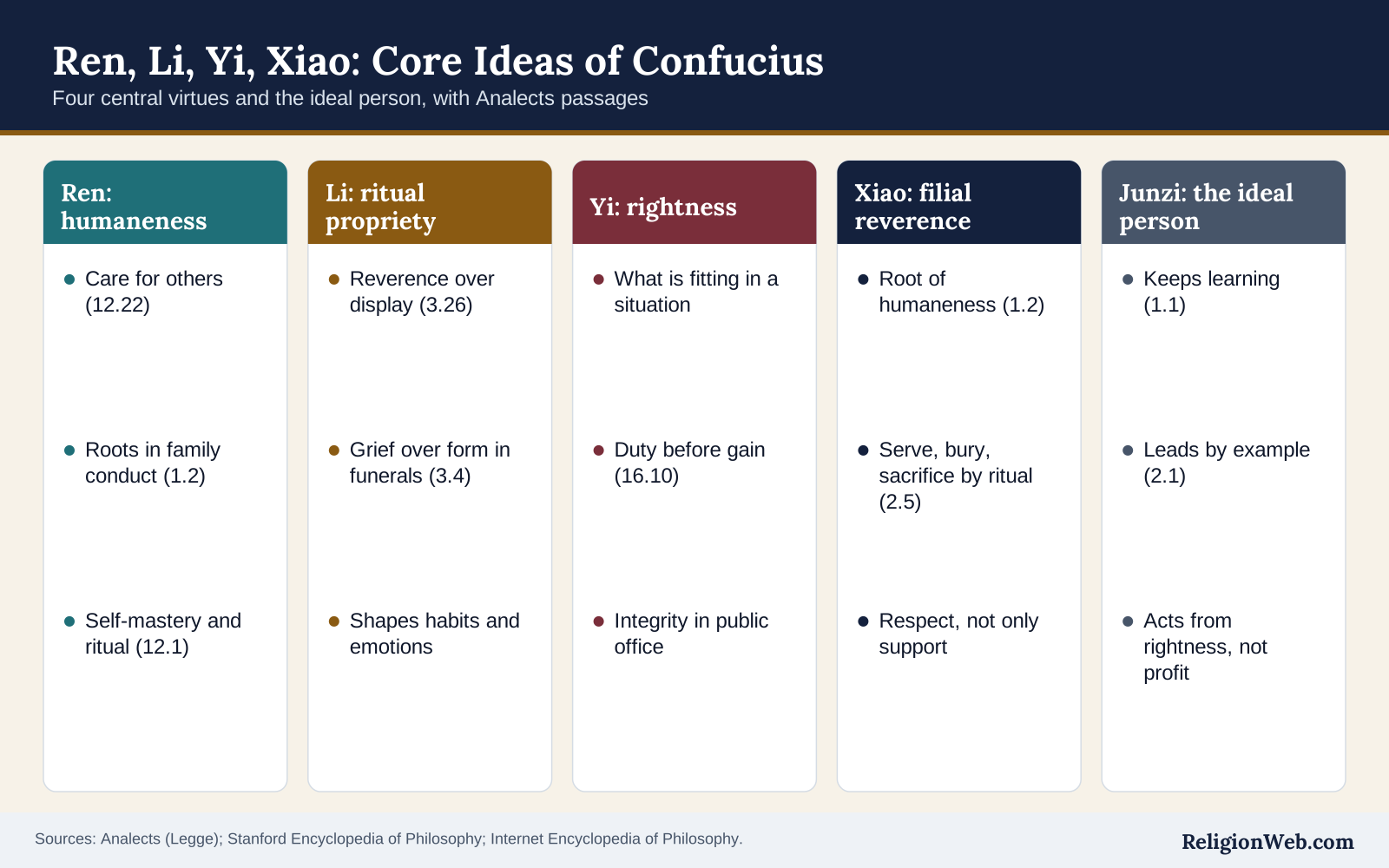
The short answer to “Who was Confucius?” is that he was a thoughtful, often frustrated man of the late Zhou period who believed that moral character could be trained through study, ritual, and attentive family life, and that a government led by people of real virtue would serve its people better than one run by force or fear. He described himself as a transmitter of older wisdom rather than an inventor, and he spent much of his career teaching students of different backgrounds. His central ideas include ren (humaneness or goodness toward others), li (ritual propriety), yi (rightness), xiao (filial reverence toward parents and ancestors), and the ideal of the junzi, the cultivated or “profound” person. Each of these words receives careful treatment below.
The later movement that carried his name is covered in ReligionWeb’s overview of Confucianism, which follows the tradition through Mencius, Xunzi, the Han dynasty, Neo-Confucianism, and modern revivals. This article has a narrower and, in some ways, harder task. It asks what can be known about the historical Confucius, how the Analects came to exist, what the sayings in it meant in their own setting, and how a late Zhou teacher was gradually turned into a sage, a state symbol, and a name recognized across the world. The distinction matters, because much that is called “Confucian” was developed by later thinkers who built on his example rather than repeating it.
The sections that follow move from context to life, from life to disciples and text, from text to teaching, and from teaching to afterlife. Throughout, the article separates what early sources report, what later tradition claims, and what modern scholars infer. Where a passage of the Analects is quoted, it comes from the public-domain translation by James Legge, whose nineteenth-century wording is sometimes dated but remains openly available. Passage numbers follow the modern convention (for example, 2.4 for Book 2, chapter 4) unless Legge’s own numbering is named.
Confucius at a Glance: Name, Dates, and Why He Matters
Who was Confucius?
His names: Kongzi, Kong Fuzi, and “Confucius”
In Chinese the man is usually called Kongzi, “Master Kong,” or in a more formal and old-fashioned style Kong Fuzi, “Venerable Master Kong.” Kong is a family name, and zi is a respectful word for a teacher or gentleman, so that the Analects itself generally says simply “the Master said.” Britannica gives his personal name as Kong Qiu and his literary or courtesy name as Zhongni; Chinese tradition understands the “Zhong” in Zhongni as marking a second son. None of these forms sounds like the English word, because “Confucius” is not Chinese at all. The Stanford Encyclopedia of Philosophy describes it as a Latinized form of the surname Kong with the honorific fuzi, a form worked out by European Jesuit missionaries, and the story of that coinage is told later in this article.
Names matter here for a practical reason. The title “Confucius” has been applied to a historical teacher, to a literary and legendary figure in the Han dynasty and after, and to a symbol used by reformers and critics in the nineteenth and twentieth centuries. Keeping the Chinese forms in view, especially Kongzi, helps a reader remember that the Chinese tradition has its own long vocabulary for honoring and discussing him.
Dates, birthplace, and social background
The conventional dates are 551 to 479 BCE. The Stanford Encyclopedia notes that the Gongyang Commentary gives 551 BCE for his birth, and that he was born in the domain of Zou, south of the state of Lu in present-day Shandong. His father belonged to a noble clan of Lu but died when the boy was young, leaving the family poor yet with some status. The Internet Encyclopedia of Philosophy places him in the shi class, the lower rank of retainers and knights who served aristocratic houses and who, as the old order weakened, increasingly worked as advisers, administrators, and teachers. Many readers know September 28 as his birthday, a modern convention used for commemorative ceremonies; it should be treated as a traditional commemorative date rather than a documented fact.
The dates are traditional because every account of his life was written well after he died. The Internet Encyclopedia of Philosophy points out that surviving sources postdate his lifetime by a few decades at the least and several centuries at the most. For that reason this article writes “traditionally” or “according to the earliest biography” wherever a detail depends on later narration.
Why Confucius matters
A teacher before an institution
Confucius never held a position of lasting political power. Accounts of his career describe minor and then senior posts in Lu, followed by years of travel in search of a ruler willing to follow his advice, and a return to Lu to teach. His greatest influence came through the students who gathered around him and through the texts that later generations connected to his name. By the Han dynasty, scholars were citing him as the model teacher, and later emperors gave him titles ranging from “Venerable Ni” to “Ultimate Sage, First Teacher,” both discussed below. The man who failed to persuade the rulers of his own time came to be honored by the rulers of every later dynasty.
This reversal explains why his story is often told as a tension between ideals and circumstances. He taught that rulers should lead by moral example, yet he held little power. He valued ritual, yet he also said that ritual without reverence was intolerable (3.26). He claimed only to transmit the past, yet his questions about character and responsibility opened a new way of thinking about ethics in a society that had been used to ask mainly about ancestry and rank.
How this article relates to the broader Confucian tradition
It helps to think of three layers. The first is the historical Confucius, a teacher whom scholars can approach only through texts compiled later. The second is the Analects, which preserves a selection of what students and later editors thought worth remembering. The third is the large system of commentary, ritual, education, and political thought that later Confucians built, often with great creativity. The Confucianism overview on this site treats the third layer in detail. Here the focus is the first two, along with the ways later centuries reshaped the figure of the Master himself.
The table below collects the main facts in one place. Each row is developed in the sections that follow, and some entries (such as exact dates) carry the same caveats noted above.
| Topic | Summary |
|---|---|
| Chinese names | Kongzi (Master Kong); Kong Fuzi; personal name Qiu, courtesy name Zhongni |
| Traditional dates | 551–479 BCE; the birth year comes from a later commentary (the Gongyang) |
| Home region | Zou and the state of Lu, in present-day Shandong province |
| Social position | Shi class: educated retainer and teacher, not a hereditary ruler |
| Principal source of his teaching | The Analects (Lunyu), twenty books compiled after his death |
| Earliest full biography | Sima Qian’s “Hereditary House of Confucius,” written about four centuries later |
| Main ideas | Ren, li, yi, xiao, the junzi, learning, and government by moral example |
| Best-known sacred site | Temple, cemetery, and mansion at Qufu, inscribed by UNESCO in 1994 |
The Late Zhou World: Where Confucius Lived and Why It Mattered
From the Zhou order to the Spring and Autumn period
The Zhou order and the Mandate of Heaven
Confucius lived near the end of the long Zhou era, which began when a western power overthrew the Shang dynasty. The date most often given for that conquest is about 1046 BCE, though the precise year is still debated. The Zhou rulers justified their rise through the idea that Heaven (tian) grants authority to those who rule virtuously and withdraws it from those who do not. The Stanford Encyclopedia notes that this early Zhou theory of the Mandate of Heaven appears in the Odes and the Documents, the two ancient anthologies that Confucius is said to have taught. From a Zhou perspective the king was the “Son of Heaven,” and the order of ritual, music, and kinship was meant to keep human society in tune with a larger moral pattern.
Later Chinese thinkers would remember the early Zhou, and especially the Duke of Zhou, as a model of ideal government. In the Analects, Confucius says that he follows Zhou (3.14), and the reasons are partly nostalgic and partly philosophical: the Zhou rituals offered a ready-made language of respect, obligation, and shared meaning. Seeing that language as something worth recovering is one of the most important keys to his thought.
Fragmenting states and the rise of the shi
By the sixth century BCE the Zhou kings had lost most of their practical authority. The royal court had moved east around 770 BCE, and regional states competed through warfare and diplomacy, each with its own ruling house and its own aristocratic factions. In Lu, the dukes were overshadowed by three powerful noble families, a development that shaped Confucius’s career and several of the best-known episodes in the sources. Ritual obligations that had once held the Zhou world together now seemed hollow to many observers, and the old hereditary order was giving way to a more mobile society.
In that setting the shi grew in importance. They were educated men, often of modest rank, who could draft documents, conduct ceremonies, advise rulers, and manage estates. Confucius belonged to this group, and much of what he teaches is aimed at its members: the officer who must be steadfast, truthful, loyal, and fit for office through character rather than birth alone. The Analects shows a teacher who accepts the world of rank but tries to redefine what makes a person worthy of it.
Lu and the intellectual landscape
Lu as a custodian of Zhou ritual
Lu was a small state, but it had a distinguished reputation. Tradition connected its ruling house to the family of the Duke of Zhou, and early sources regard Lu as a place where Zhou rites, music, and records were carefully preserved. The Spring and Autumn Annals, a terse chronicle of Lu’s history for the years 722 to 481 BCE, comes from this setting, and later tradition (not modern historical consensus) credits Confucius with editing it. The Zuo Commentary, a much longer narrative work that elaborates on the Annals, is among the earliest texts to mention him.
For a young man who wished to learn ritual and history, Lu was therefore a natural place to study. The Stanford Encyclopedia notes that Confucius became known for his expertise in Zhou ritual and ceremony, and the Zuo Commentary shows him in ritual roles at gatherings with visiting dignitaries. This background helps explain why li, ritual propriety, plays such a large part in his teaching. It was not an abstract idea. It was the practical vocabulary of the court and the clan in which he was raised.
Teachers, advisers, and the many voices of the period
Confucius did not live in the age of the “Hundred Schools,” the lively contest between competing philosophies that followed in the Warring States period (traditionally 403 to 221 BCE). Mozi, who criticized costly ritual and elaborate burial, the strategists and administrators later grouped as Legalists, and the thinkers associated with the Daoist tradition all came after him or at least became prominent after him. Readers who want the background to the Daoist tradition or the text known as the Dao De Jing will find that later tradition made its supposed author, Laozi, a contemporary of Confucius, but the dating of that text and its author is debated among historians.
What can be said is that Confucius belonged to the generations that began to ask what a good ruler is, what makes a person trustworthy, and how rituals should be understood. His students and later followers were to be among the voices in the debates that arose after him, and their arguments make more sense when the historical starting point is clear. He was not responding to those schools. They, in various ways, were responding to him and to the problems he had named.
A timeline of Confucius and his world
Key dates from the Zhou founding to Han recognition
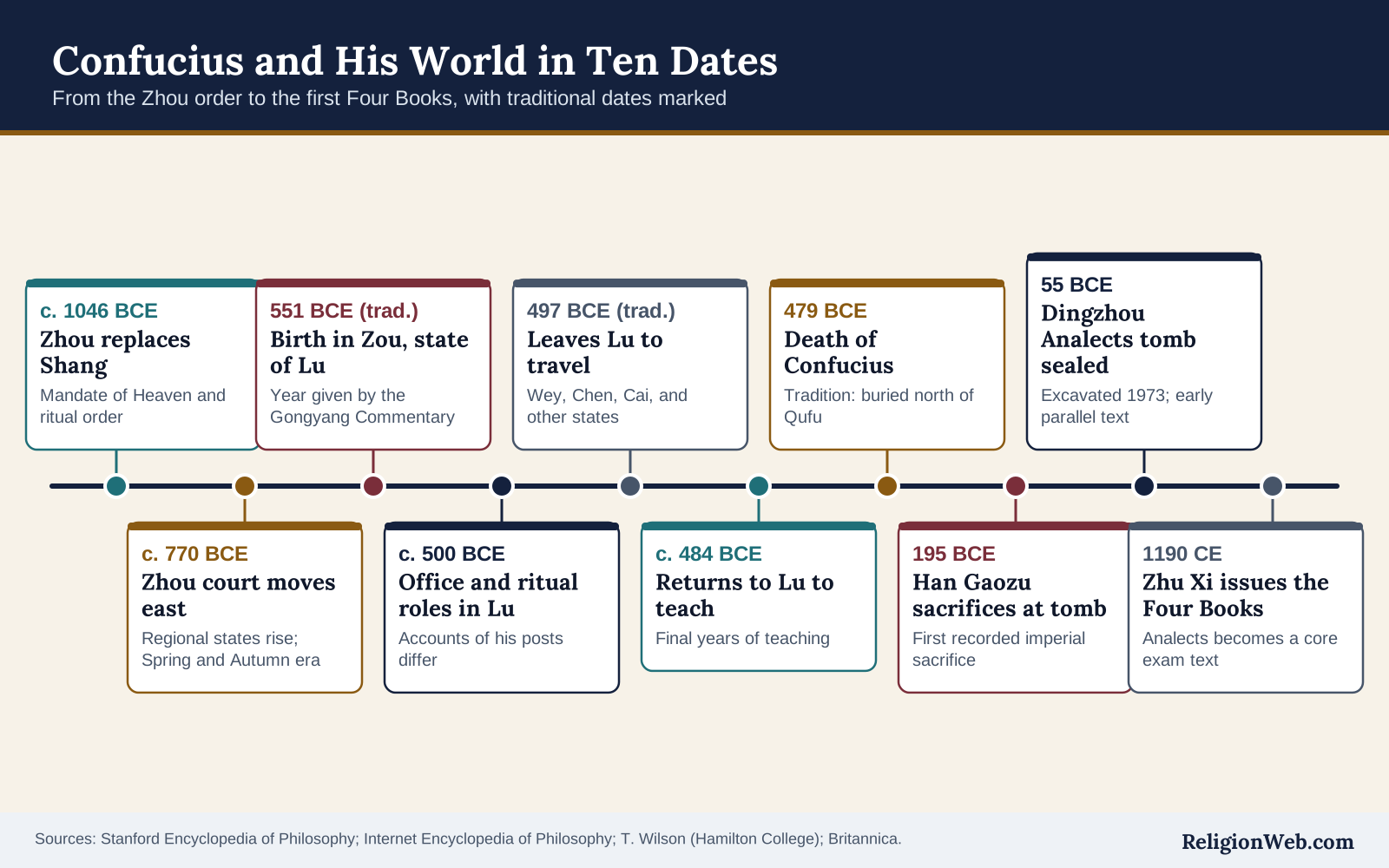
The table gathers the most important dates for placing Confucius in his era and for seeing how quickly the tradition about him grew. Items before 479 BCE rest on traditional chronology, and several dates for his own life are reported by later sources, so the first column should be read with that in mind.
| Date | Event | Why it matters |
|---|---|---|
| c. 1046 BCE | Zhou overthrows the Shang dynasty | Sets the Mandate of Heaven idea and the ritual order that Confucius admired |
| c. 770 BCE | Zhou court moves east; Spring and Autumn period begins by convention | Royal power weakens and regional states rise |
| 722–481 BCE | Years covered by the Spring and Autumn Annals of Lu | The chronicle later tradition linked to Confucius |
| 551 BCE (traditional) | Birth of Confucius in the Zou area of Lu | Year given by the Gongyang Commentary |
| c. 500 BCE | Sources place him in office and ritual roles in Lu | His only recorded years of practical government |
| 497 BCE (traditional) | He leaves Lu and begins years of travel | Accounts describe visits to Wey, Chen, Cai, and other states |
| c. 484 BCE | He returns to Lu to teach | The period in which tradition places much of his teaching |
| 479 BCE | Death of Confucius | Marks the end of the historical life |
| 478 BCE | Duke Ai of Lu is reported to confer the title “Venerable Ni” | The earliest recorded honor, according to Thomas Wilson’s account of his canonization |
| 195 BCE | Han founder Gaozu offers a Great Sacrifice at the tomb | First imperial sacrifice to Confucius |
| 1 CE | Emperor Ping confers a ducal title | Marks the start of the long series of imperial titles |
How firm are these dates?
The firmest anchor is the broad period: Confucius lived in the later Spring and Autumn period, in Lu, and was remembered by students whose sayings were gathered in the following generations, with manuscript evidence for such collections by about 300 BCE. Beyond that, specific dates often depend on the Zuo Commentary, the Gongyang Commentary, or Sima Qian, and sometimes those sources do not agree with each other. The Stanford Encyclopedia notes inconsistencies in the accounts of his offices, for example, and warns that many details were recorded as teaching anecdotes.
A careful reader will therefore treat the sequence of events as probable and the exact years as approximate. That caution is not a reason to distrust everything. The outline of a poor but cultured Lu man who studied ritual, served briefly, traveled, taught, and died around 479 BCE is accepted by most modern scholars. What changes from one scholar to another is how much of the surrounding detail can safely be believed.
The Traditional Life of Confucius and Its Uncertainties
The sources for his life
The Analects, the Zuo Commentary, and Sima Qian
Three kinds of evidence stand behind every biography of Confucius. The first is the Analects itself, which contains a few remarks that sound autobiographical, such as the sentence in which he says that he was not born knowing but was fond of antiquity and eager to learn (7.19). The second is the Zuo Commentary, a long narrative work attached to the Spring and Autumn Annals, which mentions him in connection with specific events in Lu around 509 and 500 BCE. The Stanford Encyclopedia notes that it names him as Director of Corrections and places him in ritual roles when dignitaries visited. The third is the Mencius, whose account of his early jobs is a good deal humbler: it describes him as a keeper of granary accounts and a scribe in charge of livestock.
The fullest narrative comes from Sima Qian, the Han court historian whose Records of the Grand Historian includes a chapter often translated as the “Hereditary House of Confucius.” Sima Qian wrote around 100 BCE, roughly four centuries after the death of his subject. His account draws on circulating dialogues and anecdotes, and he supplies precise offices, itineraries, and conversations that no earlier source preserves. Almost every popular life of Confucius, ancient or modern, follows his outline, which means that the reliability of the whole story depends heavily on how far his material can be trusted.
Why the biography must be read with caution
Modern scholars do not dismiss Sima Qian, but they read him as a gatherer of stories rather than a modern biographer. The Stanford Encyclopedia observes that many biographical details survive as didactic anecdotes, so that linking them directly to Confucius’s philosophy is “risky and potentially circular.” A story in which a ruler fails to recognize the sage’s worth, for example, may have been told to illustrate a lesson, and a lesson can shape the story’s details.
The accounts of his offices illustrate the problem. The Zuo Commentary, the Mencius, and Sima Qian each describe different posts, and the entry for Confucius in the Stanford Encyclopedia notes that these accounts are inconsistent. The numbers are also suggestive. Sima Qian credits Confucius with about three thousand students and seventy-seven direct disciples, figures that the same encyclopedia suggests may reflect the multiplication of texts associating different traditions with the Master. None of this means that the broad outline is false. It means that a responsible narrative uses phrases such as “according to Sima Qian” or “the tradition holds” far more often than most popular accounts do.
Birth, youth, and training
Family, birth, and early hardship
According to the traditional narrative, Confucius was born in the Zou area of Lu to a father from a minor noble line, who died while the boy was still small. The later biographical tradition names the father as Kong He, also called Shuliang He, and the mother as Yan Zhengzai, and portrays a childhood marked by poverty. Accounts trace the family back through the ducal house of Song to the Shang dynasty, although not every modern scholar accepts that genealogy, and the names and ages given for his parents come from sources much later than the events they describe. The safest summary is the one in the Stanford Encyclopedia: his father, a man of Lu, belonged to a noble clan and died when Confucius was young, leaving a family of reduced means that nevertheless kept some status.
Later tradition adds that he married as a young man and had a son, Kong Li, who was also called Boyu and who appears in the Analects (16.13) as a student who learned the Odes and ritual from his father. The Mencius gives the granary and livestock posts as early employment. Taken together, these details describe a young man of cultured background who earned a living through humble service and had to make his own way in learning.
A self-portrait in the Analects
The most famous autobiographical passage in the Analects is a compact account of moral development.
The Master said, ‘At fifteen, I had my mind bent on learning. At thirty, I stood firm. At forty, I had no doubts. At fifty, I knew the decrees of Heaven. At sixty, my ear was an obedient organ for the reception of truth. At seventy, I could follow what my heart desired, without transgressing what was right.’
Analects 2.4 (Legge II.IV), trans. James Legge, The Analects of Confucius, Project Gutenberg eBook #3330
Interpreters have read this passage as a map of learning, a description of how study gradually becomes character. The expression “the decrees of Heaven” (tian ming) is read in different ways: as awareness of a moral mission, as acceptance of the limits that circumstances place on a person, or as knowledge of the order of Heaven itself. The final line, in which desire and rightness finally coincide, is often taken as the ideal of Confucian cultivation, a state in which the learned habits of ritual and reflection are so complete that following one’s own inclination no longer leads astray. Some scholars add a historical caution: the passage is a retrospective summary, probably assembled after his death, and cannot be used as a reliable year-by-year diary.
Office, exile, and return
Service in Lu
The accounts of his public career place him in positions of some responsibility in Lu around the year 500 BCE, a time when the duke’s authority was limited by the three leading noble families. Sima Qian lists a series of offices, including steward of a town called Zhongdu, minister of works, and eventually a senior post often described as minister of crime. Modern retellings frequently add that Confucius took part in an effort between roughly 500 and 498 BCE to have the great families dismantle the fortified walls of their strongholds, an attempt that is said to have failed in part and that left him politically exposed.
These details come from the Zuo Commentary and later narratives, and the Stanford Encyclopedia notes that the accounts of his offices conflict. A sober reading is that Confucius did serve in Lu, that he had a genuine role in ritual and administration, and that his time in office ended in disappointment with the way the government was run. How far he acted as a reformer is a matter of interpretation rather than established fact.
The years of travel
Sima Qian and the Zuo Commentary report that Confucius left Lu around 497 BCE and spent many years visiting other states. According to Sima Qian’s story, the neighboring state of Qi sent a gift of horses and dancers to the Duke of Lu, who then neglected his duties; when the duke failed to share the meat from a sacrifice as ritual required, Confucius took it as a sign that he should depart. In the following years, the narrative places him in Wey, Song, Chen, Cai, and other states, where he is welcomed with courtesy, tested by danger, and rarely given the opportunity to put his ideas into practice. The Stanford Encyclopedia describes these accounts as presenting a story of rulers who fail to recognize his worth.
The Analects reflects some of this restlessness. A short exchange often connected to the journey (15.2) describes a time of hardship in the state of Chen, when supplies ran out and Zilu, one of his students, asked angrily whether a person of character must endure such want; the Master answered that a person of character stays firm in poverty, while a lesser person loses control. Even if the setting of the passage was supplied later, the moral is characteristic: virtue is tested by difficulty, not by comfort.
Return to Lu, final years, and death
The Zuo Commentary reports that Confucius returned to Lu at the invitation of the leading official there, which most accounts place around 484 BCE, when he was in his late sixties. The remaining years are traditionally portrayed as a period of teaching, reflection on the older texts, and loss. The same sources describe the deaths of his son and of favored students in this period, and the Analects itself preserves his grief at the death of Yan Hui (11.9). He died in 479 BCE, and tradition says he was buried on the bank of the Si River north of Qufu, the site that became the Cemetery of Confucius.
Later writers describe how his students mourned him. The Mencius, in a passage widely cited by later writers, records a period of three years of mourning by the disciples, with at least one of them, Zigong, staying on afterward. This detail comes from a later source and is best understood as part of the tradition about the community he left behind. What is clear from the evidence is that within a generation there were students, compilations of his sayings, and a growing sense that he was a teacher worth remembering.
From teacher to legend
The superhuman Confucius of the Han period
Within a few centuries of his death, some writers began to portray Confucius as much more than a good teacher. The Internet Encyclopedia of Philosophy notes that Han hagiographies made him a superhuman figure, destined to be the “uncrowned king” of pre-imperial China, with birth markings and a revelation to his disciples after death. The Stanford Encyclopedia credits the Han writer Wang Chong with describing him as an uncrowned king whose work on the Spring and Autumn Annals aimed to prepare for a future sage ruler. These ideas appear in a literature that treated him as the author of a hidden political program, rather than as a teacher whose sayings had been gathered by students.
The same literature helps explain why later emperors honored him. If he was a king without a throne, then the dynasties that ruled after him could claim to complete his project. The IEP adds a historical observation from the scholar Feng Youlan, that had such portraits prevailed, Confucius might have become something comparable to a religious founder in Chinese history; in the end the more humanistic image of the teacher won out, though the honors paid to him remained substantial.
The Confucius that historians can reconstruct
If the Han legend is set aside, a modest but substantial figure remains. He was a man of Lu from the educated shi class, trained in ritual and in the older anthologies, who held office in his home state for a time and then spent years in other courts. He taught students from a variety of backgrounds, and his teaching emphasized moral cultivation, learning, and responsible conduct within family and government. He spoke of himself as a transmitter, not a creator (7.1), a phrase explored later in this article. And he was remembered with such affection and intensity that his sayings were collected, copied, and eventually canonized.
The IEP quotes the scholar H. G. Creel’s point that stories told about a famous person often reveal more about the tellers than about the person. It also notes that later interpreters, from the Jesuits to Hegel to Mao, remade Confucius in their own image. That caution applies to modern writers as well. The reconstruction offered here relies on the evidence most scholars accept, and flags uncertainty wherever the sources are thin.
Disciples and the First Circle of Students
A teacher and his students
How many students, and who were they?
Sima Qian says that about three thousand people studied with Confucius and that seventy-seven of them became close disciples, although other traditions give seventy-two. Modern scholars treat the larger number as a round figure and the smaller as a list that grew as later schools claimed descent from him. The Stanford Encyclopedia names the most prominent figures in the Analects as Zigong, Yan Hui (also called Yan Yuan), Zilu, Zixia, Zengzi, You Ruo, and his son Boyu.
The students seem to have varied in age, family background, and temperament. Some came from poor families and some from wealthy ones; some entered government service and others did not. This variety is part of what the Analects preserves: it is less a lecture series than a set of conversations in which the Master tailors his responses to the person in front of him. The same question about ren or filial piety can receive different answers depending on who asks it.
The four divisions of the disciples
One passage (11.3) organizes the best-known disciples into four groups according to their strengths. In Legge’s translation, virtuous principles and practice are credited to Yan Yuan, Min Tsze-ch’ien, Zan Po-niu, and Chung-kung; ability in speech to Tsai Wo and Tsze-kung; administrative talents to Zan Yu and Chi Lu; and literary acquirements to Tsze-yu and Tsze-hsia. In modern pinyin these are Yan Hui, Min Ziqian, Ran Boniu, and Zhonggong; Zai Wo and Zigong; Ran Qiu (Ran You) and Zilu (Jilu); and Ziyou and Zixia. Commentators have long linked the list to the group who accompanied him during his hardships in Chen and Cai.
The four divisions say something about what Confucian education was meant to produce. Moral character stands first, but speech, administration, and literary learning are all recognized as legitimate fields of excellence. A school that valued only quiet virtue would not have needed this list, and one that valued only skill would not have put moral practice at its head.
Portraits of individual disciples
Yan Hui, the favorite who died young
Yan Hui is the disciple most warmly praised in the Analects. A saying in Book 6 describes him as content to live on a small basket of rice and a gourd of water in a poor alley, without allowing hardship to disturb his joy. The Master calls him a student who loved learning, and the text suggests that he understood the teaching more thoroughly than anyone. Tradition holds that he died young, before Confucius.
His death evokes some of the most affecting passages in the book. The Stanford Encyclopedia reports that when his favorite disciple died, Confucius is said to have cried out “Heaven has forsaken me!” (11.9). Whether the sentence expresses a personal belief in a Heaven that acts toward individuals, or the overwhelming grief of a teacher who has lost his best hope for the transmission of his way, has been discussed by interpreters for centuries. Both readings are possible, and the passage is one of the clearest windows in the book onto the emotional life of the community.
Zilu and Zigong: contrasting temperaments
Zilu (Zhong You, also called Jilu) appears as bold, direct, and practical, a man more likely to speak first than to reflect. The Analects shows the Master correcting him and sometimes teasing him, and also asking him pointed questions about courage and about service. The Zuo Commentary is the usual source for the tradition that he died in a political upheaval in the state of Wey in 480 BCE, about a year before the death of his teacher, but that detail comes from later retelling and is flagged as traditional.
Zigong (Duanmu Ci) offers a very different picture. Sima Qian describes him as a gifted speaker and successful merchant and diplomat, and the Analects shows him as someone who asks probing questions. In one exchange he says that what he does not wish others to do to him, he also wishes not to do to others; the Master answers, in Legge’s rendering, “Ts’ze, you have not attained to that” (Analects 5.12). Another passage (15.24) has him ask whether there is a single word that could guide a person’s whole life, and the Master replies with shu, reciprocity or consideration for others. Together the two scenes show a teacher who values the principle but refuses to let a student believe it has been reached too easily.
Zengzi, You Ruo, and Zixia
Zengzi (Zeng Shen), whose sayings are gathered in Book 8, is portrayed as thoughtful, serious, and devoted to family duty. One of his most famous remarks concerns the weight of a moral calling.
The officer may not be without breadth of mind and vigorous endurance. His burden is heavy and his course is long. Perfect virtue is the burden which he considers it is his to sustain;– is it not heavy? Only with death does his course stop;– is it not long?
Analects 8.7 (Legge VIII.VII), trans. James Legge, The Analects of Confucius, Project Gutenberg eBook #3330
Legge’s “officer” translates shi, the educated class to which Confucius and his students belonged, and the passage presents moral cultivation as a lifelong obligation rather than a stage to be completed. Later tradition made Zengzi central to the transmission of the teaching and credited him, with weaker evidence, with a role in the Great Learning and the Classic of Filial Piety. You Ruo is the disciple whose saying about filial piety and fraternal duty as the root of benevolence opens the Analects (1.2), and Zixia, associated with literary learning, is one of the main voices of Book 19. The fact that an entire book of the Analects consists largely of disciples’ sayings, not the Master’s, shows that the early community had several voices.
Disciples at a glance
A table of the first circle
The table lists the disciples most often cited in the text. Passage numbers follow the modern convention, and traditional details beyond the Analects are marked as such.
| Disciple | Known for | Key passages |
|---|---|---|
| Yan Hui (Yan Yuan) | Love of learning, contentment in poverty; died young according to tradition | 6.11, 11.9 |
| Zilu (Zhong You, Jilu) | Courage and directness; official service; asked about serving spirits | 11.12, 15.2 |
| Zigong (Duanmu Ci) | Eloquence, diplomacy, and wealth in later accounts; asked about the one word for a lifetime | 5.12, 15.24 |
| Zengzi (Zeng Shen) | Serious self-examination and family duty; tradition links him to later texts | Book 8, especially 8.7 |
| Zixia (Bu Shang) | Literary learning; prominent in Book 19 | 11.3, Book 19 |
| You Ruo | Filial and fraternal conduct as the root of benevolence | 1.2 |
| Ran Qiu (Ran You) | Administrative ability in the service of a powerful family | 11.3, 11.17 |
| Zai Wo | Sharp speech; questioned the length of mourning and was rebuked | 5.10, 17.21 |
| Boyu (Kong Li) | The son of Confucius; learned the Odes and ritual | 16.13 |
What the group tells us about the early community
The list shows a school with different strengths and sometimes sharp disagreements. Ran Qiu serves a powerful family and receives a strong rebuke from the Master (11.17), while Zai Wo challenges the traditional three-year mourning period and is called to account (17.21). These stories were preserved, not erased, which suggests that the compilers valued moral honesty and did not insist on a smooth, uncritical picture of the group.
After the Master’s death the community did not remain a single school. Later texts, including the writings of critics, speak of several branches that claimed to preserve his teaching, and the controversies between these branches helped to produce the larger Confucian tradition. The debates between Mencius and Xunzi in the fourth and third centuries BCE, discussed in a later section, are the best-known example of that process.
The Analects: How the Book Took Shape
What the Analects is
Title, length, and form
The Chinese title Lunyu is usually translated “Analects,” a word that comes from a Greek term for things gathered, but the Chinese title is different in flavor. Lun can mean to discuss, sort, or dispute, and yu means speech or sayings, so the phrase has been understood as “edited conversations” or “selected sayings.” Britannica glosses the title simply as “Conversations.” The book is divided into twenty books or chapters, each named after the first words or a prominent name in its opening line. Those titles rarely describe the contents, so they work more like labels on scrolls than like chapter headings in a modern book.
The text is short, probably fewer than 16,000 characters in Chinese, and much of it consists of brief passages: a single saying of the Master, a short question and answer between him and a student, or an anecdote about his habits. Some passages include comments by the disciples themselves, and a few record criticisms of Confucius by outsiders. This variety gives the work a distinctive voice, closer to a diary of a school than to a treatise.
A book of conversations rather than an argument
Readers expecting a systematic philosophy are often surprised. The Analects does not define its key terms in a glossary, and it does not build arguments step by step. The Stanford Encyclopedia notes that the text lacks systematization, which is one reason that its ideas can be arranged in different ways by different interpreters. Related sayings are sometimes grouped together, but adjacent passages are often unrelated, and themes such as learning, ritual, and humaneness recur across many books.
This form shaped how the book was taught. A student would read a saying, ask what the setting might have been, compare it with parallel passages, and then consult the commentaries of earlier readers. Britannica notes that the Analects is usually the first Confucian text studied in schools, and the habit of reading it slowly, line by line, is part of what made its short sentences carry so much weight.
How the text was formed
The traditional account of disciple compilation
The traditional view, reported by the Han historian Ban Gu (39–92 CE) and later endorsed by Zhu Xi, is that Confucius’s disciples recorded his conversations and that first- and second-generation students compiled them after his death. On this reading the Analects preserves the voices of people who heard him, and its twenty books are the work of a single sustained effort. The Stanford Encyclopedia describes this as the view that treats the work as the most reliable record of his thought.
Variations on the traditional view appeared over time. The Qing scholar Liu Baonan (1791–1855) proposed that each chapter was written by a different disciple. Others suggested that the earliest layers belong to the students’ own words, and the later ones to the generations that followed them. These readings accept that the book grew in stages, even while they hold on to the idea that it comes close to the Master’s circle.
Modern critical views and recovered manuscripts
Modern scholarship has complicated the traditional picture. The Stanford Encyclopedia reports that Zhu Weizheng argued in 1986 that early sources do not cite the Analects before the second century BCE, and that Michael J. Hunter and others have found sustained interest in it only from the late second and first centuries BCE. The same entry frames this as a widening of the source base, not a denial that Confucius lived or taught. Earlier critics had made related points: Cui Shu argued that the last five books were written much later, and the Japanese scholar Itō Jinsai proposed that Books 1 to 10 and 11 to 20 had separate origins. E. Bruce Brooks and A. Taeko Brooks put forward a more elaborate theory of four strata, while many scholars today think the book was compiled over roughly two centuries during the Warring States period.
Archaeology has added evidence. A tomb at Dingzhou in Hebei, excavated in 1973 and dated to 55 BCE, contained a parallel version of the Analects, and a partial parallel was found at Jongbaekdong near Pyongyang, dated to about 62 to 45 BCE. The Haihun tomb in Jiangxi, dated to 59 BCE, appears to include material associated with the lost twenty-two-chapter Qi version, with two chapters titled “Understanding the Way” and “Questions about Jade.” Other recovered texts, including the Guodian “Thicket of Sayings,” the “Sayings of the Ru,” and the Wangjiazui “Kongzi said,” contain sayings that resemble the Analects without being identical to it. The Stanford Encyclopedia concludes that the Analects may be a topical selection from a larger body of Confucius-related material that circulated with different emphases.
Transmission and commentary
Three Han versions and the received text
By the Han dynasty there were at least three versions in circulation. The Lu version had twenty chapters, the Qi version had twenty-two, and an “Old Text” version of twenty-one chapters was said to have been found in a wall during the reign of Emperor Jing. Zhang Yu, a tutor to the crown prince who died in 5 BCE, combined the Lu and Qi traditions in a composite text sometimes called the Zhanghou Lun, which became the basis of the version that survives. No complete copies of the Lu or the Old Text versions have come down to the present, and the Qi version was lost for many centuries, until the Haihun finds gave scholars a new glimpse of what it may have contained.
The Analects’ standing in the Han period was not that of the Five Classics. It was treated as a work of “transmission,” a commentary and companion to the great texts, and only later did it rise to the status of a primary school text. That change in status is part of the broader story of how the Master’s sayings came to be read as the key to his tradition.
He Yan, Zhu Xi, and the commentarial tradition
Commentary became the principal way in which the Analects was read. He Yan’s Collected Explanations (around the middle of the third century CE) gathered earlier interpretations and served as a standard guide for close to a thousand years. In the Song dynasty, Zhu Xi (1130–1200) made the Analects one of the Four Books, published together in 1190, and wrote his own Collected Commentaries, which eventually replaced He Yan’s work as the authoritative reading and, in the examination system, remained required until 1905. The effect was that, for centuries, most educated readers encountered the sayings of Confucius through Zhu Xi’s eyes.
Translators today work with the same text and a long line of commentaries. James Legge’s 1861 translation, quoted here, remains a landmark English version, prepared by a scholar who worked closely with the Chinese commentaries. Later translators include Arthur Waley, D. C. Lau, and the team of Roger Ames and Henry Rosemont, who each made different choices about the vocabulary of virtue. Reading two or three translations side by side is one of the best ways to see how many possibilities a single Chinese phrase contains.
The twenty books at a glance
Structure and themes
The table below summarizes the twenty books by name and by their most prominent themes. The summary is necessarily approximate, because most books contain several topics, and the book titles are drawn from opening words. It is meant as a map for orientation, and readers should consult a translation for the exact wording.
| Book | Title (from opening words) | Prominent themes |
|---|---|---|
| 1 | Xue er | Learning, sincerity, filial and fraternal conduct, the gentleman who is not discouraged by being overlooked |
| 2 | Wei zheng | Government by virtue, filial piety, the stages of a life of learning (2.4) |
| 3 | Ba yi | Ritual and music, reverence in sacrifice, concern about the misuse of ritual by powerful families |
| 4 | Li ren | Dwelling in humaneness, rightness and profit, serving parents, the single thread of the Way (4.15) |
| 5 | Gongye Chang | Assessments of disciples and officials, including Zigong’s reciprocity saying |
| 6 | Yong ye | Yan Hui, wisdom and humaneness, the relation to spirits (6.22) |
| 7 | Shu er | The Master’s own character and habits, transmission without invention, teaching (7.1) |
| 8 | Tai Bo | Zengzi’s sayings, the burden of virtue, culture through the Odes, ritual, and music |
| 9 | Zi han | What he rarely spoke about, praise of Yan Hui, his sense of cultural mission |
| 10 | Xiang dang | A portrait of his daily conduct: dress, food, bearing, and ritual behavior |
| 11 | Xian jin | Disciples and their temperaments, the four divisions (11.3), Yan Hui’s death, questions about spirits and death |
| 12 | Yan Yuan | Humaneness and self-mastery, trust in government, the ruler and the ruled |
| 13 | Zi Lu | Governance, the rectification of names, family loyalty and public duty |
| 14 | Xian wen | Shame, righteousness, the officer who serves with integrity |
| 15 | Wei Ling Gong | The gentleman in adversity, reciprocity, the character of the learner |
| 16 | Ji shi | Warnings to powerful families, kinds of friends, Boyu’s learning of the Odes and ritual |
| 17 | Yang Huo | Human nature and habit, the length of mourning, the Odes, Heaven’s silence |
| 18 | Weizi | Worthies who withdrew from a disordered age, and the choice to remain engaged |
| 19 | Zizhang | Sayings of disciples such as Zixia, Zizhang, and Zengzi |
| 20 | Yao yue | A short, unusual book on ancient sage rulers, responsibility, and the mandate |
How to read across the books
Several features of the table deserve comment. Book 10 is exceptional because it describes how the Master behaved rather than what he said, and it offers an unusually concrete picture of ritual in daily life. Book 19 is distinctive because it presents the words of disciples, a sign that the community valued more than one voice. Book 20 has long puzzled readers because of its style and subject, and some scholars suspect that parts of it were lost or garbled in transmission. These oddities are part of the evidence for the Analects as a layered work.
A practical way to use the table is to follow a theme, for example filial piety (1.2, 2.5), ritual (3.26), or the relation to Heaven (7.23, 11.9, 17.19), across several books. Doing so shows how the same idea appears in different settings with different emphases, which is the best protection against reading any single sentence as a complete doctrine.
Core Teachings: Ren, Li, Yi, Xiao, and the Cultivated Person
Ren: humaneness and goodness toward others
What ren means in the Analects
Ren is the virtue the Analects discusses more than any other, and no single English word captures it. Translators have used benevolence, goodness, humaneness, perfect virtue, and (in Peter Boodberg’s proposal, noted by the Internet Encyclopedia of Philosophy) “co-humanity.” D. C. Lau observed that ren is a quality of persons, whereas yi, rightness, is a quality of actions. According to the Stanford Encyclopedia, the Analects connects ren with caring for others (12.22), with its roots in family conduct (1.2), with respectful and reverent behavior in specific situations, and with the ideal of “overcoming oneself and returning to ritual propriety” (12.1). It also says that a person of character would rather die than abandon ren (15.9).
Fan Ch’ih asked about benevolence. The Master said, ‘It is to love all men.’
Analects 12.22 (Legge XII.XXII), trans. James Legge, The Analects of Confucius, Project Gutenberg eBook #3330
This brief exchange is often read as the plainest definition of ren in the book, with a warm, direct emphasis on love for people. Within the commentarial tradition, however, the sentence was understood in the context of graded concern, in which care begins with the family and widens outward. Zhu Xi’s school later interpreted ren as the principle of love that underlies all other virtues. The Analects itself leaves the matter open, and Confucius answers the question in different ways for different students, which suggests that ren is not a single formula but a quality of character that appears in many situations.
Reciprocity and the thread through his teaching
Another passage points to a unifying principle. In Legge’s translation of 4.15, the Master says that his doctrine is “an all-pervading unity,” and when the other disciples ask what he means, Zengzi explains that the doctrine consists of being true to the principles of one’s nature and benevolently applying them to others. Other translators render the two terms, zhong and shu, as loyalty and reciprocity, or as doing one’s utmost and consideration for others. The Internet Encyclopedia of Philosophy summarizes the Master’s way as zhong, other-regard, and shu, self-reflection or reciprocity, with shu given in the form of a negative rule.
That negative rule appears in several places. In 12.2 and 15.24, the Master advises not imposing on others what one does not desire for oneself, and in 5.12 Zigong expresses a similar wish and is told that he has not yet attained it. The Stanford Encyclopedia notes that scholars have debated whether some of these sayings were later additions, but the concept of consideration runs through the book. It anchors the idea that a cultivated person starts from an honest awareness of his own feelings and uses it as a guide to how others should be treated.
Li and yi: propriety and rightness
Li: ritual propriety as a way of living
Li covers a wide range of behavior: court and state ceremonies, sacrifices to ancestors and spirits, weddings and funerals, and the everyday courtesies by which people show respect. Confucius did not invent these practices, which he took from the Zhou heritage. The Stanford Encyclopedia argues that his rationale for them was new. Earlier texts often treated ritual as an exchange with spirits, whereas Confucius emphasized the inner state of the person performing it. He criticizes ritual performed without reverence (3.26), he prefers an excess of reverence to an excess of ceremony, and he treats sincere grief as more important than correct form in mourning (3.4).
The same entry observes that ritual shapes emotions and limits appetites, creating what it calls psychological space for moral reflection. A bow, a seat given to an elder, or a mourning garment trains the body and the mind in habits of respect before reflection arrives. This is why the idea of “returning to propriety” in 12.1 can be a statement about character and not merely manners. The theme is explored further in the section on ritual and the religious dimension below.
Yi: rightness and the problem of profit
If ren is the warmth of care and li is the form of conduct, yi is the sense of what is fitting or right in a particular situation. The Stanford Encyclopedia connects it with integrity in public responsibility, especially when gain and duty seem to pull in different directions (16.10, 14.12). The Master says that he would prefer poverty to dishonest gain (7.16) and that wealth and status must be pursued only by the proper way (4.5). In the contrast between the junzi and the “small person,” the junzi acts from moral understanding while the small person acts from profit.
This emphasis on rightness over advantage is often misunderstood as hostility to prosperity. The Analects does not condemn a decent livelihood, and it assumes that rulers have a duty to see that people are fed. What it rejects is making gain the standard of conduct, particularly for those who hold public responsibility. A government official who first asks what he can obtain has already lost the capacity to ask what is right.
Xiao: filial reverence and the family root
Filial piety in the Analects
Xiao, usually translated filial piety, begins in the household. A saying attributed to You Ruo claims that filial and fraternal conduct are the root of humaneness (1.2), and the Stanford Encyclopedia notes that Confucius extended xiao from ancestral sacrifice and family conduct into a general virtue. In 2.5, when Meng Yi asks about filial piety, the Master answers that it means serving parents according to ritual while they are alive, burying them according to ritual, and sacrificing to them according to ritual. Another saying, summarized by Britannica, holds that merely supporting one’s parents is not enough without genuine respect, and the Internet Encyclopedia of Philosophy names reverence (jing) as the key quality of xiao.
The family is therefore the first school of ethics. A child learns care, gratitude, and the discipline of obligation in the household, and these qualities are carried into public life. The later tradition would build elaborate rules of mourning, ancestral rites, and family organization on this base, discussed in the sections on family ritual and on lived practice. Readers interested in the continuing ritual side of these ideas can follow them in the article on Chinese ancestor veneration.
Reverence, remonstrance, and the limits of obedience
Filial piety in the Analects is not simply obedience. When Meng Yi asks about it, the Master’s first answer is that it means “not being disobedient,” and he then explains to a puzzled disciple that this means doing everything according to ritual, which includes honoring parents in a way that goes beyond instant compliance. The text also contains a famous difficulty (13.18). The Duke of She tells Confucius of an “upright” man in his territory who testified against his father; the Master replies that in his community, fathers cover for sons and sons for fathers, and that uprightness is found in that. The Stanford Encyclopedia reads the story as showing that Confucius sometimes values the family’s protective loyalty over a literal definition of public uprightness.
Interpreters have disagreed about how far this passage extends. Some read it as a limited statement about privacy within families, while others see a deeper principle about conflicting duties. The later Classic of Filial Piety, according to the same encyclopedia, redefines filial conduct in a way that limits extreme submission. The point to retain is that the Analects treats filial reverence as a serious moral relationship with its own tensions, not as a rule that ends the conversation.
The junzi and moral cultivation
The junzi and the small person
The junzi literally means “son of a lord,” and in earlier usage it referred to a person of noble birth. In the Analects it becomes a moral category: the person who follows the Way (dao), whatever his rank. Legge translates it as “superior man” or “man of complete virtue,” while the Internet Encyclopedia of Philosophy prefers “profound person,” and others use “gentleman” or “exemplary person.” The opening of the Analects draws a quiet portrait: such a person is not troubled when others fail to notice him (1.1). The contrasting category, the xiaoren or small person, is someone whose conduct is led by profit and narrow self-interest.
This moral reinterpretation was part of what made the teaching distinctive in an age of hereditary rank. It did not abolish social distinctions, but it asked whether a person living within them was worthy of the role. Later Confucian writers could therefore use the vocabulary of the junzi to criticize officials of high birth and to encourage students of humble origin.
De and moral example
Closely related is de, a word translated virtue, moral force, or charisma. In the Analects, de is the quality by which a person of good character draws others toward the good without compulsion. The Master compares a ruler who governs by his virtue to the north polar star, which keeps its place while the other stars turn toward it (2.1), and elsewhere says that the relation between a leader and the people is like that between wind and grass, so that the grass bends when the wind blows across it (12.19).
The images are sometimes read as endorsements of a hierarchy in which the common people simply follow. Another reading, favored by those who stress the educational side of the teaching, is that they describe how example works: people imitate what they see in those they respect. Either way, de turns the question of governance into a question of character, and this explains why the Confucian tradition places such weight on the education of rulers and officials.
Core concepts in one table
A reference table of key terms
The following table summarizes the principal terms with typical translations and sample passages. It is a guide to the vocabulary, not a substitute for reading the passages in context.
| Term | Common translations | Role in the teaching | Sample passages |
|---|---|---|---|
| Ren | Humaneness, benevolence, goodness | Care for others; the central virtue | 1.2, 12.1, 12.22, 15.9 |
| Li | Ritual propriety, rites, etiquette | Shapes conduct and emotions; reverent practice | 3.26, 3.4, 12.1 |
| Yi | Rightness, righteousness | Sense of what is fitting; integrity when gain tempts | 4.5, 7.16, 16.10 |
| Xiao | Filial piety, filial reverence | Respect and care for parents in life and in death | 1.2, 2.5, 13.18 |
| Zhi | Wisdom, understanding | Knowing people and knowing the limits of one’s knowledge | 2.17, 12.22 |
| Xin | Trustworthiness, good faith | Required of officials; a ruler cannot govern without it | 12.7, 17.6 |
| Junzi | Gentleman, profound person, exemplary person | The moral ideal of the learner | 1.1, 16.10 |
| De | Virtue, moral force | Influence of good character on others | 2.1, 12.19 |
| Zhong and shu | Loyalty and reciprocity; doing one’s utmost and consideration | The thread through the Master’s way | 4.15, 5.12, 15.24 |
| Tian | Heaven | Moral order; source of mission and of destiny | 7.23, 11.9, 17.19 |
Why these terms resist single translations
Each of these words has been translated in several ways because each carries a range of meaning that English divides differently. Legge used “benevolence” and “perfect virtue,” which stress the moral quality. Roger Ames and Henry Rosemont argue that the vocabulary describes roles within relationships and not isolated individual traits, a reading that the Stanford Encyclopedia notes under the heading of role ethics. Others have compared the pattern of virtues to Aristotelian virtue ethics, a comparison the entry credits to Bryan Van Norden. No translation settles these debates, but each shows a different facet.
The practical lesson is that students of the Analects need to read the passages, not just the glossary. The terms gain precision from the situations in which the Master uses them, the persons whom he addresses, and the examples he gives, and those details are lost whenever a concept is reduced to a one-word definition.
Ritual, Heaven, and the Spirits: The Religious Dimension of His Teaching
Li as lived ritual
Reverence over display
For Confucius, the inner attitude of a ritual mattered more than its splendor. The Stanford Encyclopedia lists several passages that make the point. He condemns ritual performed without reverence (3.26), and when asked about the root of ritual, he says that in ceremonies it is better to be sparing than extravagant and that, in funerals, real grief counts for more than formal correctness (3.4). In another exchange (3.17), a disciple proposes dispensing with the sacrificial sheep offered at a monthly ceremony, and the Master answers that, though the student cares about the sheep, he cares about the ritual.
These sayings should not be read as hostility to ceremony. They are a reminder that ritual forms exist to express and to cultivate certain feelings: respect, gratitude, sorrow, loyalty. A rite performed mechanically fails its own purpose. This is the root of the later Confucian conviction that ritual is a school of character, and also the reason why the tradition could be criticized, even by sympathizers, whenever ceremony hardened into display.
Sacrifice, mourning, and the dead
The Analects shows Confucius participating in the sacrificial life of his time. In 3.12 the text says that he sacrificed to the dead “as if” they were present and sacrificed to the spirits “as if” the spirits were present, a formula later commentators read in several ways: as sincere acceptance of the ritual world, as an instruction about the proper attitude of the sacrificer, or as a reflection of the Master’s reserve about what lies beyond. In either reading, the key point is that the act of offering is performed seriously, with the participant’s whole attention.
Mourning was a place where this seriousness was tested. When the disciple Zai Wo suggested that the traditional three-year period of mourning for a parent was too long (17.21), the Master asked whether he would feel at ease abandoning the old form sooner, and when Zai Wo said yes, he told him to do as he pleased, but he later remarked on the student’s lack of ren. The three-year form, he suggested, answers the three years in which a child is carried in the arms of its parents. The rites of burial and sacrifice (2.5) thus carry forward a relationship that death does not end. For the later history of these customs in homes, graves, and festivals, see the article on Chinese ancestor veneration.
Heaven and the spirits
Tian in the Analects
Heaven (tian) appears in the Analects as a moral power, though rarely as a personal deity who intervenes in daily life. When Confucius is threatened by a hostile official, he says that Heaven has given him virtue (7.23), and when he is in danger at a town called Kuang, he suggests that higher powers will protect the culture that he is meant to carry (9.5). Yet at the death of Yan Hui he cries that Heaven has forsaken him (11.9), and in 17.19 he asks whether Heaven speaks, observing that the four seasons run their course and creatures are born without a word from above.
The Internet Encyclopedia of Philosophy describes the picture as ambivalent: Heaven is aligned with the moral order but depends on human agents to carry out its will. Zigong adds a note of reserve when he observes that the Master’s discourses on human nature and the way of Heaven could not be heard (5.13). Interpreters differ about whether this means that the Master avoided such topics, or that he thought them poorly suited to teaching by words. In either case, Heaven functions in the Analects as the horizon of a person’s calling, not as the subject of speculative doctrine.
Respect and distance: how he spoke of spirits
One of the best-known sayings about spirits is also among the most carefully worded.
Fan Ch’ih asked what constituted wisdom. The Master said, ‘To give one’s self earnestly to the duties due to men, and, while respecting spiritual beings, to keep aloof from them, may be called wisdom.’
Analects 6.22 (Legge VI.XX), trans. James Legge, The Analects of Confucius, Project Gutenberg eBook #3330
Legge’s “keep aloof” translates a phrase that other translators render as “keep at a respectful distance.” The saying asks for two things at once: reverence and restraint. Another passage (7.21 in modern numbering) lists the subjects on which the Master did not talk: extraordinary things, feats of strength, disorder, and spiritual beings. When Jilu asked about serving spirits (11.12), the Master replied that if one cannot yet serve people, one cannot serve their spirits. A common reading in the commentarial tradition is that this directs the learner toward the duties that lie closest at hand. A more modern reading stresses an agnostic tone. Both agree that the Analects does not make speculation about the unseen the center of the teaching, while it does keep sacrifices and respect for the spirits firmly in place.
A religious teacher? Why scholars differ
Reasons scholars see a religious dimension
Several features lead many scholars to speak of a religious dimension in the Analects and in the tradition that followed. The text takes for granted a world of ancestral sacrifice and of Heaven as a moral power. The ritual practice it describes involves reverence, offering, and a sense of obligation to the dead. The Stanford Encyclopedia stresses the psychology of ritual, and the Confucian tradition later developed temples, sacrifices to Confucius himself, and a rich vocabulary of sagehood. Joseph Adler, whose work informs the Confucianism overview, has described the tradition as a diffused religious tradition, in which religious elements are woven into family, school, and state rather than being gathered in a separate institution.
From this angle, Confucius is a figure who reinterpreted an existing religious world and gave it an ethical center. He asks that sacrifice be sincere, that mourning be real, and that people understand their obligations to those who came before them. The result is a teaching in which the sacred and the moral are not separate departments.
Reasons others stress ethics and education
Others emphasize that Confucius founded no church, claimed no revelation, and described himself as a transmitter of ancient learning. He does not appear in the Analects as a prophet or a miracle worker, and he treats the cultivation of character as a human task. The Analects’ reticence about spirits and the afterlife, and its concentration on family, education, and government, lead many readers to describe the teaching as a humanistic ethics or philosophy of self-cultivation.
The disagreement is often one about definitions. If religion means worship of a deity, doctrine of salvation, or an organized community of believers, then the Analects looks mainly ethical. If it includes ritual, reverence for ancestors, and a sense of moral order in the cosmos, then the Analects looks religious in a wide sense. A responsible account notes that both descriptions can be defended and that later Confucianism, with its temples and ancestral rites, developed more explicit religious forms than the historical Confucius ever mentioned. Popular temple religion in China often places Confucius beside other figures; the article on Chinese folk religion describes that wider setting.
Learning, Governance, and Family: How the Teachings Were Applied
Education and self-cultivation
Learning as a lifelong path
The Analects opens with a question about learning, and it comes back to the subject again and again. The first passage asks whether it is not pleasant to learn with constant perseverance and application (1.1). Another notes that learning without thought is wasted effort, while thought without learning is dangerous (2.15), and in 7.19 the Master denies that he was born with knowledge, describing himself as a lover of antiquity who eagerly seeks it. The curriculum implied in the text includes the Odes, ritual, and music (8.8), with the Odes treated as a training in speech and as preparation for both family and public life (17.9).
Learning in this sense is not simply the accumulation of information. It is the formation of character through the study of models, from ancient sage-kings to living teachers, and through practice. A saying often cited from Book 14 (14.24) distinguishes learning for oneself from learning to impress others, a distinction that later Confucian educators would return to when they warned students against treating study as a route to office alone.
Teaching across social lines
Confucius taught students of different backgrounds. The Stanford Encyclopedia notes his willingness to accept even a modest gift of dried meat (7.7), a detail commonly read as a sign that he would teach anyone who came with sincere intent and a basic token of respect. A brief saying in Book 15 (15.39) is often translated as “in teaching there should be no distinction of classes,” and it is widely cited as a statement of educational openness, though the phrase can be read in more than one way.
The ideal of open teaching should not be exaggerated. Confucius expected his students to be eager, and he described the effort required of a learner as a precondition for his help. The remarkable feature is that rank by birth, so central to the Zhou world, was not the sole condition of entry. In later centuries, the idea that anyone might rise through study contributed to the examination system, although access in practice was always limited by wealth, gender, and local conditions.
Governance and public life
Rule by virtue rather than force
The political teaching of the Analects centers on example. In one often-cited passage, the Master contrasts two methods of government.
If the people be led by laws, and uniformity sought to be given them by punishments, they will try to avoid the punishment, but have no sense of shame. If they be led by virtue, and uniformity sought to be given them by the rules of propriety, they will have the sense of shame, and moreover will become good.
Analects 2.3 (Legge II.III), trans. James Legge, The Analects of Confucius, Project Gutenberg eBook #3330
This sentence is traditionally taken as a statement of the ideal of moral rule: laws and punishments restrain conduct from outside, whereas virtue and ritual form the character from inside. Later Confucian officials cited it when they argued for education and moral example in preference to harsh penal codes. Critics in the Warring States and Han periods, especially those who favored strict law, took the opposite view, and the debate between these positions shaped Chinese statecraft for centuries. The Master’s own position was not that laws are unnecessary, but that they cannot by themselves make a people good.
Trust, names, and accountability
Two other themes run through the Analects’ treatment of government. The first is trust. When a disciple asks about governing, the Master lists sufficient food, sufficient weapons, and the confidence of the people, and says that if one had to be given up, weapons should go first and then food, because without trust a state cannot stand (12.7). The second is the “rectification of names” (13.3), an idea developed in an exchange about what a ruler should do first. The Master answers that it is necessary to rectify names, since if names are not correct, language does not accord with the truth of things, and affairs cannot be carried on to success. Commentators have understood this as a call for officials to live up to the titles and roles that they hold.
Accountability follows. In 12.11, asked about government, the Master answers that there is government when the prince is prince, the minister is minister, the father is father, and the son is son. The point is not to defend any ruler’s privilege. It is to hold that each role carries duties, and that disorder grows from failing them. The Master’s loyalty to a ruler was conditional on the ruler’s own ritual propriety (3.19), a detail that shaped later debates over remonstrance and the right of ministers to criticize.
Family and society
The relationships that structure a life
The later Confucian list of five relationships, ruler and minister, parent and child, husband and wife, older and younger sibling, and friend and friend, is formulated in the Mencius rather than the Analects, but the Analects supplies its raw material. The family comes first, as the setting where the habits of respect, affection, and responsibility are learned. Ames and Rosemont and others have argued that this makes Confucian ethics an ethics of roles, in which a person becomes good by performing well the specific roles of child, parent, friend, teacher, and citizen.
A fair account must also note passages that modern readers find difficult. One brief remark (17.25) says that women and “small people” are hard to handle, and it has drawn criticism from many modern interpreters, who read it either as a limited observation about household servants and relatives or as evidence of the gendered assumptions of the time. Later Confucian writers often elaborated hierarchical rules for women that go far beyond anything in the Analects, and the history of those rules is a subject of continuing scholarship.
Friendship, loyalty, and the limits of duty
Friendship has a modest but real place. Disciples are urged to be trustworthy in dealing with friends (Book 1), and the saying in 16.4 about kinds of beneficial and harmful friends is often cited for the idea that moral growth is shared. Loyalty to superiors is real but not unconditional. The Stanford Encyclopedia notes that the Analects asks for zhong, loyalty, toward a ruler who is ritually proper (3.19), and elsewhere it records the Master leaving states where he was not treated with respect.
These details show a teaching in which duties are bound together but not identical. Obligations to parents, rulers, friends, and community overlap, and the hard cases, such as the dispute about concealment within a family (13.18), show that the Master was aware of conflicts. A common feature of the Confucian tradition is therefore not a mechanical hierarchy, but a continuing conversation about how to balance competing responsibilities.
How the principles show up in practice
From principle to institution
The table maps four areas of life against the principles the Analects states and the institutions that later developed. It is a guide to relationships, not a claim that each later institution was directly authorized by Confucius himself.
| Area | Principle in the Analects | Sample passages | Later application |
|---|---|---|---|
| Ritual | Reverence outweighs display; sacrifice is performed seriously | 3.4, 3.12, 3.26 | State sacrifices, temple ceremonies, and household ancestral rites |
| Education | Lifelong learning of the Odes, ritual, and music; teaching without narrow barriers | 1.1, 8.8, 15.39 | Academies, the Five and Four Books, and the examination system |
| Governance | Rule by virtue and example; trust; rectification of names | 2.1, 2.3, 12.7, 13.3 | The scholar-official ideal and the tradition of remonstrance |
| Family | Filial reverence as the root of humaneness; burial and sacrifice by ritual | 1.2, 2.5, 17.21 | Mourning rules, ancestral altars, lineage halls, grave visits |
Reading later practice back onto the Master
The right-hand column of the table can mislead if it is taken as a straight line. Examinations, lineage halls, and the sacrifices in the Confucian temple all developed long after Confucius, under the influence of Han scholars, Song reformers, and many local communities. The Analects supplies a vocabulary and a set of ideals, but it does not describe those institutions, and in some cases later practice reversed or hardened its emphasis. This caution returns in the section on misconceptions.
It also helps to remember that living practice varies. Pew Research Center’s 2023 surveys in East Asia found, for example, that large majorities in Taiwan and Japan had taken part in some form of ancestor-care activity in the previous year, while very few people in those societies call themselves Confucian. The ideals connected with the Master are present in many homes, often without any label.
After Confucius: Successors, Imperial Honors, and Neo-Confucian Readings
The first successors
Mencius and the goodness of human nature
Within a century or two of Confucius’s death, thinkers appeared who saw themselves as continuing his work and who also changed it. Mencius (Mengzi), whose life is traditionally dated 372 to 289 BCE, argued that human beings are born with moral sprouts of compassion, shame, deference, and a sense of right and wrong that education can nourish into virtue. The book that bears his name consists of seven parts and was later supplied with a major commentary by Zhao Qi in the second century CE. Mencius gave the Master’s concern with ren and yi a theoretical foundation in human nature, and he also developed a strong theory of benevolent government.
His portrait of Confucius shaped later reverence. In the Mencius, the Master appears as a sage who, although he never held the throne, understood the Way in a way that earlier rulers had not, and Mencius presents himself as someone who wishes to learn from Confucius. The Mencius is thus one of the earliest witnesses to the process by which a teacher was turned into a model sage.
Xunzi and ritual as formation
Xunzi, who lived in the third century BCE (traditionally about 310 to 220), took a different path. He held that human nature, left alone, tends toward disorder, and that the teachings of ritual, music, and the example of teachers are what make people good. For Xunzi, ritual was not simply the expression of an inner moral sense but a human creation that educates desire, a conviction that grew from the Master’s emphasis on li. The Stanford Encyclopedia’s entry on Xunzi adds that two of his students, Han Fei and Li Si, became prominent figures in the Legalist tradition of strict law, which shows how complicated the intellectual descent could be.
The contrast between Mencius and Xunzi is often presented as a quarrel, but both aimed to explain how people become moral and both insisted on study and ritual. In the later history of the tradition, scholars returned to this pair when they wished to ask whether the Master’s teaching assumed a natural moral beginning or a need for reshaping, and the question is still debated.
Han and Tang: from teacher to state symbol
Han scholarship and the Five Classics
The Han dynasty (206 BCE to 220 CE) transformed the Master’s legacy. After the Qin dynasty’s attempts to control learning, including the burning of books in 213 BCE, Han rulers and scholars gathered and interpreted the older texts. Dong Zhongshu (c. 179 to c. 104 BCE), an adviser to Emperor Wu, helped to build a cosmology connecting Heaven, humanity, and government, and the court established positions for scholars of the Five Classics in 136 BCE and a national university in 124 BCE. Confucius was increasingly seen as the sage who had transmitted, and in some accounts edited, those classics, and the Spring and Autumn Annals was read as his statement on rulership.
It was in this environment that the portraits of a superhuman Master spread, alongside the more sober scholarly use of him as a teacher and model. The Han accommodation between learning, ritual, and state authority gave later dynasties a template for using Confucian ideas, although it also bound the teacher more closely to the interests of rulers than the Analects itself would suggest.
Titles, temples, and imperial sacrifices
The historian Thomas Wilson, in his account of the canonization of Confucius, shows how imperial honors rose over the centuries. The earliest recorded step came in 478 BCE, the year after his death, when Duke Ai of Lu is said to have conferred the title “Venerable Ni.” The Han founder Gaozu offered a Great Sacrifice at Confucius’s tomb in 195 BCE, regular spring and autumn sacrifices in Qufu began in the second century CE, and by the Tang dynasty temples to Confucius were being set up in prefectural and county state schools (630). In 739 the emperor Xuanzong gave him the title “Exalted King of Culture.”
The titles continued to change. Song, Yuan, and Ming emperors adjusted them, and in 1530 the Ming Jiajing emperor conferred “Ultimate Sage, First Teacher Master Kong,” a title that moved away from royal rank toward teaching. In 1645 the Qing Shunzhi emperor added “Great Completer.” Emperors also made Confucius’s descendants hereditary nobles, at first marquises and by Song times dukes, and Wilson notes that the family kept this position until the 1940s. The table lists the principal steps.
| Date | Ruler | Title or action |
|---|---|---|
| 478 BCE | Duke Ai of Lu | Title “Venerable Ni” |
| 195 BCE | Han Gaozu | Great Sacrifice offered at the tomb in Qufu |
| 1 CE | Emperor Ping (Western Han) | “Exalted Ni Duke of Consummate Perfection” |
| 169/170 CE | Emperor Ling (Han) | Regular spring and autumn sacrifices begin in Qufu |
| 630 | Tang Taizong | Temples established in prefectural and county state schools |
| 739 | Tang Xuanzong | “Exalted King of Culture” (Wenxuan wang) |
| 1013 | Song Zhenzong | “Ultimate Sage and Exalted King of Culture” |
| 1307 | Yuan court | “Great Completer, Ultimate Sage and Exalted King of Culture” |
| 1530 | Ming Jiajing | “Ultimate Sage, First Teacher Master Kong” (Zhisheng xianshi Kongzi) |
| 1645 | Qing Shunzhi | “Great Completer, Ultimate Sage, Exalted First Teacher of Culture” |
Song to Qing: Neo-Confucian readings and examinations
Zhu Xi and the Four Books
The most consequential new reading of Confucius came from Zhu Xi (1130–1200), the Song philosopher who organized study around the Four Books: the Analects, the Mencius, the Great Learning, and the Doctrine of the Mean. Working in an age when Buddhism and Daoism were also intellectually powerful, he published the set in 1190 and wrote commentaries that read the Analects through a metaphysics of principle (li, a different word from the ritual li) and material force (qi). In Zhu Xi’s scheme, ren was the principle of love implanted in human nature, and the Master’s teaching was a program for cultivating the mind and understanding things. Wilson’s chronology records that in 1241 the Daoxue (Learning of the Way) masters, including Zhu Xi, were enshrined in the Confucian temple, and in 1267 Zeng Can and Kong Ji were promoted to correlates, a step that reflects the canonical status of the Four Books.
For many readers, Zhu Xi’s commentary on the Analects was the Analects. Its authority was reinforced by the examination system, in which candidates were required to answer on the Four Books according to his interpretation from the early fourteenth century until the abolition of the examinations in 1905. A modern reader who picks up a translation is thus holding a book that has been read through one particular philosophical lens for most of its history.
Examinations, challengers, and critical scholars
The Neo-Confucian synthesis was not universally accepted. Wang Yangming (1472–1529) argued that moral knowledge is found in the mind and cannot be separated from action, a view that influenced Korean and Japanese thinkers as well. Qing scholars such as Gu Yanwu and Dai Zhen emphasized careful philology and criticized speculative metaphysics, a method that fed into the modern critical study of the Analects. In the nineteenth century, Liu Baonan produced a major commentary on the text, and Kang Youwei (1858–1927) presented Confucius as a reformer in the late Qing debates about institutions and state.
These developments show a tradition that regularly returned to the Master to renew itself. Each age asked which Confucius it needed and found him in the sentences of the Analects. That habit is a strength, since it kept the teaching alive, but it also means that no later description can be treated as a transparent window on the historical man.
Later interpreters at a glance
A table of key interpreters
The table gathers some of the most influential readers of Confucius after the first circle of disciples. Dates marked “traditionally” follow the usual reference works, which differ on some points.
| Interpreter | Dates | Contribution to the understanding of Confucius |
|---|---|---|
| Mencius (Mengzi) | Traditionally 372–289 BCE | Argued that human nature is good; presented Confucius as the sage of the Way |
| Xunzi | Traditionally c. 310–220 BCE | Emphasized ritual and teachers as the means of shaping human nature |
| Dong Zhongshu | c. 179–c. 104 BCE | Han thinker who linked Confucian learning with a cosmology of Heaven and the state |
| Zhang Yu | d. 5 BCE | Combined the Lu and Qi versions of the Analects into the basis of the received text |
| He Yan | Mid-third century CE | Compiled the Collected Explanations, the standard Analects commentary for centuries |
| Zhu Xi | 1130–1200 | Made the Analects one of the Four Books; wrote the commentary used in examinations |
| Wang Yangming | 1472–1529 | Taught that moral knowledge lies in the mind and is realized in action |
| Liu Baonan | 1791–1855 | Qing scholar of the Analects; proposed that each chapter was written by a different disciple |
| Kang Youwei | 1858–1927 | Presented Confucius as a reformer in the late Qing debates over institutions |
What the sequence shows
Reading down the table, one notices how each interpreter answers a different problem. Mencius and Xunzi respond to the question of human nature, Dong Zhongshu to the needs of a unified empire, Zhu Xi to the challenge of a philosophical age, and Kang Youwei to the pressures of reform. Each, in turn, finds in the Master a resource for his own purposes, and each comes closer to some elements of the Analects while leaving others in the background.
This is the basic lesson for anyone who wishes to separate Confucius from Confucianism. The first is a historical figure about whom certain things can be said with reasonable confidence. The second is a long conversation in which he is a founding voice, and that conversation produced ideas, institutions, and rituals that he could not have anticipated. Both subjects are worth studying, and the best accounts keep them distinct.
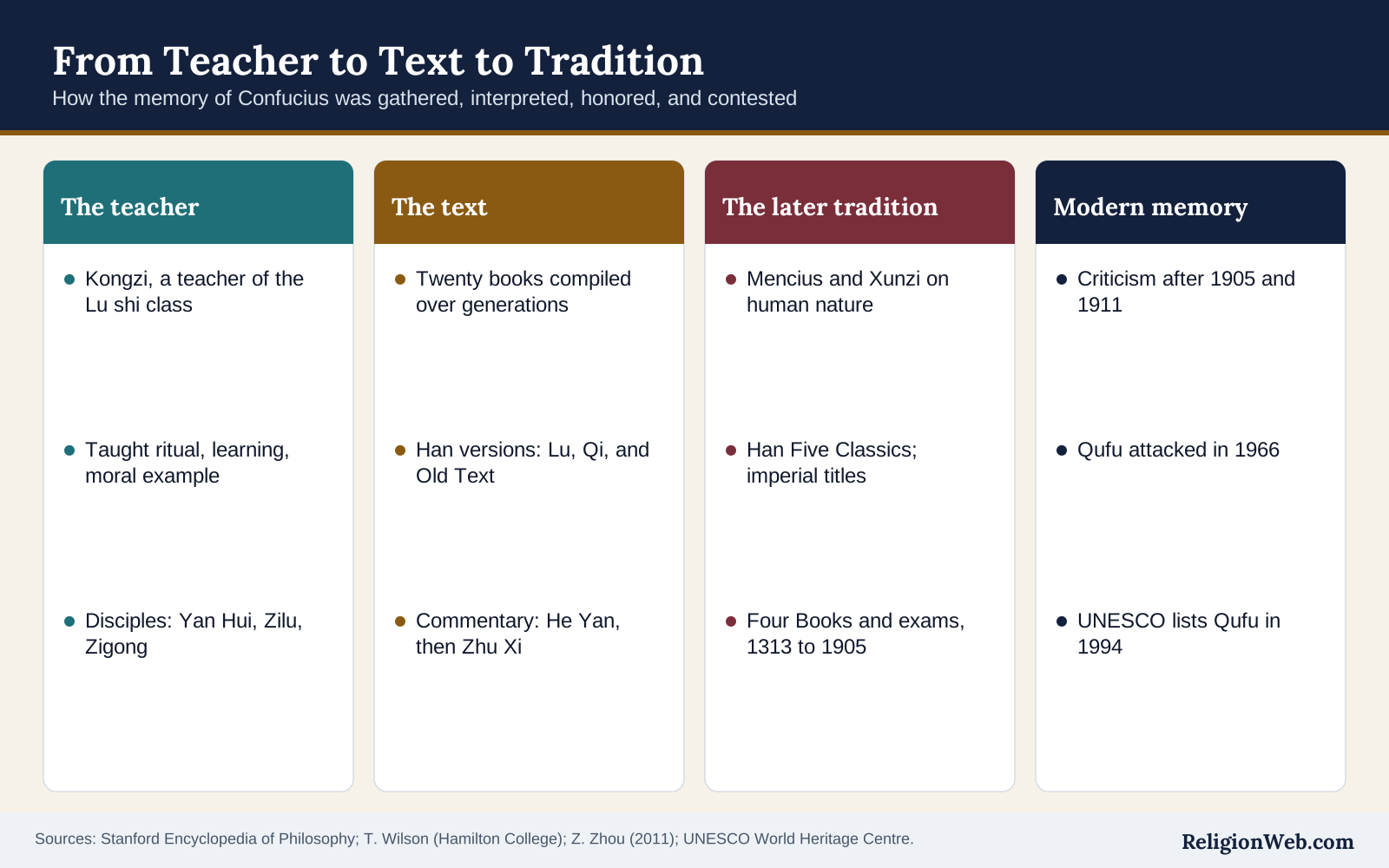
Temples, Qufu, and Ceremonies: Honoring Confucius in Practice
Qufu, the home of the Kong family
Temple, cemetery, and mansion
The best-known site associated with Confucius is a group of three linked places in Qufu, Shandong: the Temple of Confucius, the Cemetery of Confucius, and the Kong Family Mansion. UNESCO inscribed the complex on the World Heritage List in 1994 under criteria (i), (iv), and (vi), and describes the temple as built in 478 BCE to honor the Master, destroyed and rebuilt many times, and now covering about 14 hectares with 104 buildings dating from the Jin to the Qing dynasties. The cemetery lies about 1,100 meters north of the city and contains Confucius’s tomb along with more than 100,000 graves of his descendants. The mansion, which grew from a modest family house into a large residence, covers about 7 hectares, and UNESCO’s own pages give figures of roughly 150 to 170 buildings for it.
UNESCO notes that Chinese emperors revered Confucius as the “Sacred Model Teacher for Ten Thousand Generations,” and it credits their devotion over more than two thousand years for the preservation and splendor of the site. Qing imperial craftsmen built the Dacheng Hall, whose name echoes the title “Great Completer” described in the earlier section on honors. For a visitor, the site conveys the scale of the imperial effort to honor a teacher who held no throne.
The Kong descendants
The Kong Family Mansion served as the office and home of Confucius’s direct male descendants, who held hereditary noble titles conferred by emperors: first as marquises and, by Song times, as dukes. Thomas Wilson’s chronology notes that the family kept this position until the 1940s. UNESCO says that Qufu remains the main residence of his descendants today, and that the cemetery holds the graves of more than 100,000 of them.
The existence of a family lineage devoted to the care of the Master’s memory is itself an expression of the values he taught. The Kong descendants performed sacrifices, maintained the temple, and received visitors and officials. At the same time, the family’s long association with imperial power meant that, in modern times, it became a symbol for those who regarded the Confucian tradition as bound up with the old order, a subject that returns in the section on modern debates.
Ceremonies for the Master
The memorial ceremony on September 28
Each year, on September 28, the date commonly observed as the Master’s birthday, temples in China, Taiwan, and other parts of East Asia hold ceremonies of remembrance. Pew Research Center describes the Grand Ceremony of the Worship of Confucius as a tradition about two thousand years old in which participants wear traditional costumes, perform dances, and make offerings of food and drink, and it notes that millions of people celebrate the day with temple ceremonies. In Chinese the central rite is commonly called shidian, and in Korea the corresponding ceremonies at Sungkyunkwan in Seoul, the Seokjeon Daeje, are held twice a year.
The ceremonies are not uniform. Some are state-supported cultural events, some are organized by temples and schools, and some are smaller gatherings that include recitation of classical passages. Details such as the number of dancers, the instruments used, and the foods offered depend on place and period. The imperial rules that Wilson records, for instance, increased the dancers to seventy-two in 1496 to match the regulations for the Son of Heaven, but modern performances adapt those forms in different ways.
What participants do and what it means
A typical ceremony includes processions to the main hall, offerings placed before the tablets or images of Confucius and the sages who accompany him, music, dances, and bows. In the historical temple the Master received the main offering, with his disciples and, from the Song dynasty on, major later scholars sharing the hall in graded positions. Those placements, which Wilson’s chronology traces through repeated additions and removals, express an idea of a community of teachers across time.
The meaning for participants varies. For many, the ceremony is an act of gratitude and respect toward the founding teacher of their cultural heritage, something like honoring a revered ancestor. Others, especially students, pray to Confucius for success in study, and for some the temple ceremonies belong to the wider world of ritual and devotion. Pew’s surveys give a sense of the range. In Taiwan, 26 percent of adults said they venerate Confucius, compared with 69 percent who pray to Guanyin and 46 percent who pray to the Buddha, which suggests that devotion to Confucius is one practice among many for those who take part.
Confucius Beyond China: East Asia and Europe
The Master in East Asia
Korea
In Korea, the Joseon dynasty (founded in 1392) made Neo-Confucian learning the framework of state and society. The national academy Sungkyunkwan, with a shrine to Confucius at its center, and a network of private academies called seowon trained generations of scholar-officials, and nine of those academies were inscribed by UNESCO in 2019. Korean scholars such as T’oegye (1501–1570) contributed major works to the Neo-Confucian tradition, and Zhu Xi’s Family Rituals shaped Korean practice at weddings, funerals, and ancestral rites. The 2023 Pew survey, in which 59 percent of South Korean adults said they feel connected to Confucianism, more than for any other tradition Pew asked about there, shows that the heritage remains vivid in the present.
That connection is a matter of culture and family values rather than of formal membership. Very few South Koreans identify as Confucian when asked about religion, but many keep ancestral memorial rites and speak of respect for elders and teachers as part of their heritage.
Japan and Vietnam
In Japan, Confucian learning flourished in the Tokugawa period, when Neo-Confucian scholars such as Hayashi Razan, Nakae Tōju, Kumazawa Banzan, and Kaibara Ekken built schools and wrote on ethics and government. The Yushima Seidō in Tokyo, a Confucian temple traditionally dated to 1690, remains a well-known site. Confucian ideas also intertwined with native traditions in complex ways; the thinker Yamazaki Ansai, for instance, combined Neo-Confucian thought with Shinto doctrine, and readers interested in that setting can consult the overview of Shinto.
In Vietnam, the Temple of Literature in Hanoi, founded in 1070, became a center for scholarly education and a site for honoring Confucius. Pew’s 2023 survey found that 96 percent of Vietnamese adults had burned incense to care for ancestors in the previous year, which illustrates how family ritual, an inheritance shared with the Confucian tradition, persists in contemporary life. In all of these countries, the Master has been understood through local histories, languages, and institutions, and the image of Confucius differs from place to place.
Europe and the Latin Confucius
Jesuit translation and the 1687 book
European knowledge of Confucius began with Jesuit missionaries. Michele Ruggieri and Matteo Ricci began translating Confucian texts into Latin while living in Zhaoqing in southern China, and Ricci developed an approach that sought to integrate Christian theology with the Confucian worldview. The Boston College “Beyond Ricci” project describes how the Jesuits had to find a way to render Kong Fuzi in Latin, and notes that their solution, the form “Confucius,” is still in use today. The Latin translation of the major Confucian texts was published as a whole in 1687, the product of a century of translation by Jesuit missionaries.
The Jesuits’ picture was shaped by their own situation. They addressed European readers with questions in mind, including how a society could be well governed without the institutions that Europeans associated with moral order. In presenting Confucius as a teacher of ethics and rule by virtue, they were selecting from the sources, as every interpreter before and after them had done.
Enlightenment readers and later reinterpretations
The Stanford Encyclopedia notes that Jesuit accounts and writers such as Leibniz portrayed Confucius as a rationalist and moral philosopher, and that Enlightenment writers valued his independence from Church dogma, although some criticized him. The Internet Encyclopedia of Philosophy adds that later interpreters, from the Jesuits to Hegel to Mao, remade Confucius to suit their own values. The result was a Confucius who appeared in Europe as a sage of moral reason, in Chinese reform movements as a founder of institutions, and in revolutionary polemics as a symbol of the old order.
These shifting images are part of the story of the name itself. As the fun fact above notes, the Latin form traveled into English and other European languages, and it carries with it the history of that first encounter. In scholarly writing, the pinyin form Kongzi is now common, but “Confucius” remains the form by which most readers know him.
Modern Debates: Criticism, Rejection, and Revival
Criticism and rejection in the twentieth century
Reformers and the May Fourth critics
The fall of the imperial order in the early twentieth century put Confucius at the center of a political and cultural argument. The Stanford Encyclopedia notes that some reformers saw him as a potential moral basis for national renewal, while May Fourth and Communist critics rejected the hierarchies associated with his name. The abolition of the examination system in 1905 removed the institutional link between the Four Books and public office, and the end of the Qing dynasty in 1911 removed the imperial court that had offered the state sacrifices. Hu Shi’s early history of Chinese philosophy, the same entry observes, made Confucius central to the new academic field, even as writers of the New Culture movement attacked Confucian family and social norms as obstacles to modernization.
It is important to distinguish these criticisms from the teachings of the Analects itself. Many of the targets of the critics, such as arranged marriages, the subordination of women, and the demand for unquestioning obedience, were products of later centuries and of specific social arrangements. Some critics were attacking an institutional system, others a stereotype, and still others the Master, and they did not always distinguish among them.
The Cultural Revolution and the attack on Qufu
The most violent episode was the Cultural Revolution. Zehao Zhou’s 2011 University of Maryland dissertation on the campaign against Confucian sites traces what happened to the three Kong sites in Qufu. In August 1966, local Red Guards attempted to raid them during the campaign against the “Four Olds” but failed. In November 1966, Red Guards from Beijing came to Qufu, attacked the Three Kong Sites, and leveled Confucius’s tomb, and in January 1967 local peasants plundered the cemetery for buried treasures. Zhou argues that the violence resulted from a complex process involving several actors, including inner-party conflict, Red Guard factionalism, and local opportunism, rather than simply outsiders acting alone.
A later national campaign, widely known as “Criticize Lin Biao and Confucius,” followed in the early 1970s and used the Master’s name as a political symbol. For historians, these events illustrate how a figure from the fifth century BCE could be drawn into the struggles of the twentieth, without much regard for what the Analects actually says.
Revival and present-day attitudes
Scholarship, heritage, and public memory
Since the 1980s, scholars in China, Taiwan, Korea, Japan, and the West have returned to Confucian thought with renewed interest. Twentieth-century “New Confucian” philosophers such as Mou Zongsan (1909–1995) sought to reinterpret the tradition for modern conditions, and temples and sites, including Qufu, have been restored and promoted. UNESCO’s inscription of Qufu in 1994 marked international recognition of its heritage value, and Confucius’s birthday is again marked publicly. Institutions teaching Chinese language and culture abroad have also adopted the Master’s name, although their funding and purposes have been the subject of public debate in several countries.
The revival raises its own questions. Some see in it an authentic return to a rich ethical heritage, others a selective use of tradition for contemporary political or commercial purposes. The Analects itself is a reminder that the teacher worried about both extremes: ritual without reverence and virtue without practice.
What surveys show about attitudes today
Survey data suggest a pattern of widespread practice and little formal identification. Pew’s 2023 surveys of Hong Kong, Japan, South Korea, Taiwan, and Vietnam found that very few people name Confucianism as their religion, yet majorities take part in ancestor-care activities: 86 percent in Taiwan and 85 percent in Japan reported recent activity, and in Vietnam 96 percent had burned incense for ancestors. Pew’s 2022–23 survey of Asian American adults found that about one in five Americans of East Asian origin feel close to Confucianism, including 24 percent of Chinese Americans and 22 percent of Korean Americans, compared with 4 percent of Japanese Americans. Pew did not survey mainland China in this series, so figures from there rely on other surveys such as the East Asian Social Survey, in which 88 percent of respondents in 2016–18 agreed that children must try to bring honor to their parents.
These numbers should be read as signs of cultural connection and family practice and not as church membership. They confirm what the Analects suggests: that for most people the influence of Confucius is found in how they treat parents, teachers, and the dead, not in a doctrine declared on a census form.
Common Misconceptions About Confucius
Misconception 1: Confucius personally wrote the Analects as a finished book
Where the misunderstanding comes from
The impression is easy to understand. Bookstores sell The Analects of Confucius under his name, the cover often lists him as the author, and the sayings in it are phrased in the first person or as direct teaching. The Chinese tradition also contributed to the idea of a Master who wrote or edited the classics: later writers credited him with shaping the Odes, the Documents, the Spring and Autumn Annals, and other works. A reader who encounters these claims may assume that the Analects belongs to the same category, a text composed by a single hand.
Translation conventions play a part too. Many English editions present the book as a continuous work in twenty chapters, with a title page and an introduction, and the habit of reading a printed book from start to finish naturally suggests an author with a plan. The older, traditional picture of disciples recording what they heard has sometimes been simplified in popular summaries into a claim that the Master himself composed the work.
What the evidence and tradition actually show
The Analects is a compilation. Its sayings are introduced by phrases such as “the Master said,” it speaks of Confucius in the third person, and it includes sayings of his disciples, including a whole book (19) that consists mostly of their words. One passage (8.3) records the dying words of Zengzi, who lived after Confucius, which means that the book as it stands was not completed in the Master’s lifetime. The traditional account reported by Ban Gu holds that first- and second-generation disciples compiled the conversations, and modern scholars refine that picture. The Stanford Encyclopedia notes that Zhu Weizheng argued in 1986 that the Analects is not cited before the second century BCE, and that excavated manuscripts show Confucius-related material circulating in several forms, so the book may be a selection from a wider body of sayings.
None of this means that the Analects has nothing to do with Confucius. Most scholars still regard it as the best available source for his ideas, and the Master himself described his role as transmitting rather than creating (7.1). The more accurate statement is that the Analects reflects the teaching of Confucius as remembered, collected, and arranged by his students and later editors over a period of generations.
Modern scholars approach the traditional claim that Confucius edited the Five Classics with similar caution, and many treat the Spring and Autumn Annals as a chronicle of Lu that later tradition linked to him. The safest summary is that he taught from older texts, that his students and successors preserved and interpreted them, and that the connection between his name and the finished books grew stronger over time.
Misconception 2: Confucian ritual means empty etiquette
Where the misunderstanding comes from
In modern English, “ritual” often suggests empty formality, and “propriety” suggests stiff manners. When the word li is translated in those terms, readers conclude that Confucius cared mainly about bowing correctly, wearing the right clothing, and following protocol. The impression was strengthened in the early twentieth century, when critics of the old order attacked what they saw as a rigid and hypocritical code of behavior, and the image of ceremonious hierarchy became a standard shorthand for the tradition.
There is some basis for the criticism in later history. In certain periods and places, the forms of ritual and etiquette hardened, and officials and families used them to display status rather than to express real feeling. Because the Analects is concerned with ritual, it is easy to assume that it endorses everything done in ritual’s name.
What the evidence and tradition actually show
The Analects itself warns against the very emptiness that critics describe. Ritual performed without reverence is, in the Master’s words, something he cannot bear to watch (3.26). In funerals he values real grief over correctness of form (3.4), and when a disciple would save the cost of a sacrificial sheep, he sides with the ritual because of what it carries (3.17). The Stanford Encyclopedia argues that his innovation was precisely to emphasize the inner state of the person performing the rite, and that ritual works to shape emotions and to create room for moral reflection.
Li also covers far more than manners. It includes the sacrifices to ancestors, weddings, mourning, and the ways in which people of different roles treat each other at home and at court. A fair statement is that the tradition values forms as the means by which respect becomes concrete, and that its best teachers, from Confucius to Zhu Xi, warned that forms without sincerity are hollow. Whether particular rituals in particular periods lived up to that standard is a matter for historical judgment, not a defect of the Master’s teaching.
Later teachers pressed the same point. Zhu Xi’s school stressed reverence (jing) as the attitude that animates ritual, and manuals such as his Family Rituals were written to guide ordinary households through weddings, funerals, and offerings to ancestors, occasions on which the feelings involved are anything but trivial. A tradition that produced such manuals was not asking people to perform courtesy for its own sake.
Misconception 3: Later Confucian teachings can all be projected directly back onto the historical Confucius
Where the misunderstanding comes from
The word “Confucian” covers more than two thousand years of writing, institutions, and practice. In textbooks and popular articles, the label is often applied to a bundle of ideas: strict hierarchy, the five relationships, the imperial examinations, ancestor veneration, patriarchal families, and the idea that human nature is good. Because all of these are associated with the tradition that took his name, readers conclude that Confucius himself taught them in this form.
This habit was encouraged by the tradition. Later scholars often presented their own innovations as faithful readings of the Master, and commentaries on the Analects were written to find in it the philosophy of their own age. The Stanford Encyclopedia describes his philosophy as “historically underdetermined,” meaning that the early materials contain diverse elements that later interpreters selected and combined in different ways.
What the evidence and tradition actually show
Many items on the bundle can be dated to later centuries. The list of five relationships is formulated in the Mencius, not the Analects, and the Han period grouped the virtues into a set of five constant virtues. The doctrine that human nature is good belongs to Mencius, and Xunzi argued the opposite. The cosmology linking Heaven, humanity, and the state is associated with Dong Zhongshu, the Four Books with Zhu Xi (1190), the examination use of that set with the Yuan court of 1313, and the metaphysics of principle and material force with the Song Neo-Confucians.
That does not make the later developments illegitimate. They are creative continuations of themes that the Master raised: ritual, learning, family, and moral example. But responsible writing distinguishes the stages. In this article the historical Confucius is the figure reconstructed from the earliest layers of the Analects and other early sources, and statements about Confucianism in later centuries are marked as such. The overview of Confucianism on this site traces how the larger tradition grew.
A simple test helps: ask which text first states an idea. If the answer is the Mencius, the Xunzi, a Han treatise, or a Song commentary, then the idea belongs to the later tradition even when it grows out of something in the Analects. Applying that test does not weaken the later thinkers. It lets each of them be read for what he actually said, and it keeps the Master from being credited with a system he never described.
Misconception 4: Every saying quoted online as “Confucius says” comes from Confucius
Where the misunderstanding comes from
Quotation websites, social media images, and motivational posters attribute a very large number of sayings to Confucius. Some are genuine paraphrases of Analects passages, some come from other early texts such as the Mencius or the Xunzi that were later associated with the Confucian tradition, and some are modern slogans with no known Chinese source. A familiar example is the line “Choose a job you love, and you will never have to work a day in your life,” which circulates widely under his name; no early Chinese source for it has been identified.
The reasons are easy to see. The name of Confucius carries authority, a short proverb is easier to share than a context-bound passage, and the translation of any ancient text can vary so much that two versions of a genuine saying may look like different sayings. Once a quote has been repeated across many websites, it begins to seem established.
What the evidence and tradition actually show
The Analects has about five hundred short passages, and a reader can check any quotation against a standard edition by looking for the book and passage number. A genuine saying will have a locator, such as 2.4 or 12.22, and a translator. If a quote has neither, the reasonable response is caution. In many cases the quote turns out to be a loose paraphrase of an existing passage, a saying from another early text, or a modern composition that borrowed the Master’s name.
Even genuine sayings require context. A line that sounds like a general maxim may have been spoken to a particular student about a particular problem, and the commentary tradition often reads it that way. Readers who want the Master’s own voice are better served by reading a full passage in a reliable translation than by collecting aphorisms, and by treating attributions without a source as unverified.
Searchable text archives and annotated editions make this easy today, and a few minutes of checking usually settles whether a quotation is an Analects passage, a line from another early text, or a modern creation. Responsible writers on any ancient teacher, not only Confucius, give the source of a quotation, and readers are right to ask for it.
Frequently Asked Questions About Confucius
Questions about his life and identity
When and where did Confucius live?
Confucius is traditionally dated 551 to 479 BCE and is said to have been born in the Zou area of the state of Lu, in what is now Shandong province. He died in Lu and is traditionally buried north of Qufu. The dates rest on later sources, notably the Gongyang Commentary and Sima Qian, so they are best treated as traditional rather than precisely documented.
His lifetime fell in the late Spring and Autumn period, when the Zhou kings had lost most of their power and regional states were in competition. That setting explains many features of his teaching, including the emphasis on trustworthy officials and the revival of ritual as a shared moral language.
Did Confucius found a religion?
Confucius did not found a church or claim a revelation, and he described himself as a transmitter of older wisdom. Many scholars therefore describe him as a teacher and moral thinker. At the same time, the Analects takes for granted ancestral sacrifice, reverence for Heaven, and ritual as a path of self-cultivation, and later generations built temples, sacrifices, and titles around his memory. Scholars who emphasize those features speak of a religious dimension in the tradition.
Whether the result counts as a religion depends on how the word is defined. The Confucianism article on this site discusses that debate and the ways in which communities across East Asia understand it.
What does the name “Confucius” mean?
The English name is a Latinized form of Kong Fuzi, which means roughly “Master Kong” or “Venerable Master Kong.” Kong is the family name, and zi and fuzi are respectful terms for a teacher. Britannica gives his personal name as Kong Qiu and his courtesy name as Zhongni. The form “Confucius” was created by European Jesuit missionaries, and it has no counterpart in the Chinese language.
In current scholarship, many writers use Kongzi or Master Kong, especially when they wish to stay close to the Chinese sources. “Confucius” remains the standard English form and is used throughout the world.
Questions about the Analects and his teachings
What is the Analects, and who wrote it?
The Analects (Lunyu) is a collection of sayings, conversations, and anecdotes in twenty books. Tradition holds that disciples and their students compiled it after the Master’s death, while modern scholars think it took shape over several generations in the Warring States period and was edited further in the Han. Excavated manuscripts from the first and second centuries BCE show earlier versions in circulation.
It is the principal source for his thought, but it was not written by him in the sense of a treatise. Readers should treat it as a layered record of a teaching community.
What are the most important Confucian virtues?
The central virtue is ren, humaneness or goodness toward others, supported by li (ritual propriety), yi (rightness), zhi (wisdom), and xin (trustworthiness), according to the list in the Stanford Encyclopedia. Filial reverence (xiao) is the root of family ethics, and the ideal person is the junzi, who cultivates these qualities through learning and reflection. Later tradition grouped five virtues as a set, but the Analects uses the terms more flexibly.
The virtues are not meant to be memorized as a list. They are qualities that the learner develops in daily relationships with parents, teachers, friends, and fellow citizens.
What did Confucius believe about Heaven and the afterlife?
The Analects speaks of Heaven as a moral power that supports those who act rightly, and Confucius refers to Heaven when he speaks of his calling and of his grief (7.23, 9.5, 11.9). He took part in sacrifices to ancestors and spirits and insisted that they be performed seriously. About the nature of death and the unseen, he was reserved: when asked about serving spirits and about death, he directed attention to the duties owed to the living.
Scholars read this reserve differently, some as agnosticism and others as a form of reverence that prefers silence to speculation. The sources do not give a systematic doctrine of the afterlife.
Questions about legacy and practice
Why is Confucius honored with temples and ceremonies?
Confucius is honored because later generations regarded him as the supreme teacher of moral cultivation and the transmitter of the classical heritage. Han and later emperors gave him titles, and from the Tang dynasty onward temples to him were established in state schools. The honors escalated for centuries, from “Venerable Ni” to “Exalted King of Culture” and eventually “Ultimate Sage, First Teacher,” as the table of imperial honors above shows.
Today the ceremonies are understood in different ways, as expressions of gratitude toward a teacher, as acts of cultural remembrance, and, for some participants, as devotion. The main sites are the temple at Qufu, temples in Taiwan, and Sungkyunkwan in Seoul.
How is Confucius remembered in East Asia today?
He is remembered through temples, schools, family ritual, and public holidays or commemorations, and his birthday is observed on September 28 in many places. Surveys by Pew Research Center in 2023 found that very few people in Hong Kong, Japan, South Korea, Taiwan, and Vietnam identify as Confucian, but majorities take part in ancestor-care practices and many, particularly in South Korea, feel connected to the Confucian tradition.
Attitudes also differ within each society. For some he is a cultural ancestor, for others a symbol of an old order, and for scholars a subject of renewed study.
How can I read the Analects, and which translation should I choose?
A good starting point is to read one complete translation slowly, one book at a time, with the notes. James Legge’s public-domain translation is freely available, though its vocabulary is old-fashioned. More recent translations by D. C. Lau, Roger Ames and Henry Rosemont, and others use contemporary English and give different choices for key terms such as ren and junzi.
Comparing two translations for passages such as 2.4, 4.15, or 12.22 shows how many readings are possible. Whenever a quotation is attributed to Confucius, looking for its book and passage number is the simplest check.
Conclusion: What Confucius Left Behind
What the history shows
A teacher who transmitted and transformed
The Confucius that emerges from the earliest sources is a teacher of the late Zhou world who believed that character could be formed through study, ritual, and attention to relationships. He asked rulers to lead by example, students to learn with constancy, and families to practice reverence in life and in death. Within a few generations, his sayings were collected in the Analects, and over the following centuries Mencius, Xunzi, Han scholars, and Song philosophers developed those themes into a large intellectual tradition.
That development explains why the same name can refer to a historical teacher, a text, a sage honored by emperors, and a symbol in modern debates. The sources are limited and the later images are rich, so responsible accounts keep the layers distinct.
A figure remembered in layers
Each layer of memory reveals something. The Analects shows the voice of a teaching community; the Han stories reveal how people imagined a sage without a throne; the imperial titles record how states used his authority; and the ceremonies at Qufu and in East Asian temples show how ordinary people and officials still express gratitude to a teacher. Criticism and revival in the twentieth century add yet another stage, in which his name has been used both to reject and to renew a heritage.
Seeing these layers does not diminish the Master. It shows how a teacher who claimed only to transmit the past became part of how a great many people think about learning, family, and public responsibility.
How to keep exploring
Reading the Analects slowly
The most direct way to understand Confucius is to read the Analects itself, preferably in two translations, with attention to the setting of each saying and to the questions that the students ask. A reader might begin with Book 1 for the themes of learning and family, Book 2 for government and the stages of life, and Book 12 for the discussion of humaneness and self-mastery, and then turn to the commentaries to see how different ages understood the same lines.
Reading slowly also protects against the habit of treating the Master as a source of slogans. His teaching is a conversation, and part of its value lies in the questions it leaves open.
Next steps on ReligionWeb
For the broader history of the tradition, including Mencius, Xunzi, Neo-Confucianism, and modern revivals, see the article on Confucianism. For the household and temple practices connected to the teaching on filial reverence, see Chinese ancestor veneration, and for the wider religious setting of Chinese temples, see Chinese folk religion.
Readers interested in other textual traditions of China may also consult the articles on the Dao De Jing and on Daoism, which explain those traditions on their own terms and in their own historical context.
Sources
The table below lists the principal external sources behind this article. Facts, dates and figures were checked against these and related primary, institutional and academic materials.
| # | Source | Publisher and type | Used for | Link |
|---|---|---|---|---|
| 1 | The Analects of Confucius (from the Chinese Classics), translated by James Legge, Project Gutenberg eBook #3330 | Project Gutenberg · Primary text | All five quoted Analects passages and the passages paraphrased from Legge's numbering | gutenberg.org |
| 2 | Confucius (Mark Csikszentmihalyi, rev. 2024) | Stanford Encyclopedia of Philosophy · Academic reference | Life, sources, Analects formation, excavated texts, virtues, ritual, Heaven, reception | plato.stanford.edu |
| 3 | Confucius | Internet Encyclopedia of Philosophy · Academic reference | Shi class, Han portraits, key concepts, Heaven, Jesuit and later reinterpretations | iep.utm.edu |
| 4 | Confucius (Annping Chin) | Encyclopaedia Britannica · Encyclopedia | Names (Kong Qiu, Zhongni) and traditional dates | britannica.com |
| 5 | Canonization of Confucius (Thomas A. Wilson) | Hamilton College, Asian Studies · Academic reference | Imperial titles, descendants' hereditary rank, dates of honors | academics.hamilton.edu |
| 6 | Chronology of Sacrifices (Thomas A. Wilson) | Hamilton College, Asian Studies · Academic reference | Temple sacrifices, enshrinements, Ming ritual changes | academics.hamilton.edu |
| 7 | Temple and Cemetery of Confucius and the Kong Family Mansion in Qufu | UNESCO World Heritage Centre · Institutional | Qufu: 1994 inscription, temple, cemetery, mansion, dimensions, descendants | whc.unesco.org |
| 8 | The Anti-Confucian Campaign during the Cultural Revolution, August 1966-January 1967 (Zehao Zhou, 2011) | University of Maryland (DRUM repository) · Academic reference | Attacks on the Three Kong Sites at Qufu in 1966-67 | drum.lib.umd.edu |
| 9 | Translation of Confucian classics into European languages | Boston College, Beyond Ricci · Academic reference | Jesuit rendering of Kong Fuzi as Confucius; the 1687 Latin translation | beyondricci.bc.edu |
| 10 | 5 facts about Confucianism (Yunping Tong, Sept. 23, 2024) | Pew Research Center · Demographic data | 2023 East Asia surveys, Sept. 28 ceremony, ancestor rites, Taiwan veneration figures | pewresearch.org |
Last fact-check date: 2026-10-21.

