
Zen Buddhism is a school of East Asian Buddhism that places seated meditation, a close bond between teacher and student, and the awakening of the Buddha at the center of religious life. The word “Zen” is the Japanese reading of the Chinese Chan, which in turn transliterates the Sanskrit dhyana, “meditation.” Zen therefore belongs to the Mahayana Buddhist world, and its monasteries, ordination rules, sutras, and ideals of compassion are those of the wider Buddhist tradition, expressed through the language, art, and institutions of China, Korea, Vietnam, and Japan.
The tradition looks back to a line of ancestral teachers who are said to have passed the Buddha’s awakened mind from one person to the next, beginning with the Buddha himself and reaching China through the Indian monk Bodhidharma. Historians read that lineage as a story that took shape gradually, between roughly the seventh and eleventh centuries, as Chinese monks built a distinct identity around meditation and the authority of living teachers. From China the movement spread to Korea, where it is called Seon, to Vietnam, where it is called Thien, and to Japan, where it divided into the Soto and Rinzai schools that most English speakers now mean when they say “Zen.”
Popular images of Zen, from raked gravel to one-line riddles, capture real features of the tradition but leave out a great deal. Zen monasteries keep detailed schedules of chanting, bowing, meals, and ceremony; its teachers work within recorded lineages; and its practice is closely tied to the wider range of Buddhist meditation as well as to the vows and precepts every Buddhist undertakes. This article follows the tradition from its Indian and Chinese background through Korea, Vietnam, and Japan, then explains zazen, koan practice, monastic and lay life, ritual, schools, and modern global Zen, always attributing teachings to the school that holds them.
Zen Buddhism at a Glance: Names, Features, and Geography
What “Zen” Means and What It Is Called
From dhyana to Chan to Zen
The Sanskrit dhyana (Pali jhana) names a state of settled, unified attention that early Buddhist texts treat as part of the training of the path, as right concentration within the Noble Eightfold Path. When Buddhist texts were translated into Chinese, dhyana was sounded out as channa and then shortened to Chan. Japanese readers pronounced the same character as zen, and that reading became the English word. A Zen teacher in Kyoto, a Chan teacher in Taiwan, a Seon teacher in Seoul, and a Thien teacher in Vietnam are therefore using four regional forms of one Chinese term.
The historical Chan school was sometimes called the “Buddha-mind school” (foxin zong), which points to its claim that the awakened mind of the Buddha is the heart of the teaching. Other Buddhist traditions also teach meditation, so the name does not mean that Zen alone meditates. It means that, for this school, meditation and the transmission of awakening from teacher to student became the organizing principle of institutional and spiritual life.
Four names for one family of traditions
Chan is the Chinese tradition from which the others descend. Seon (also spelled Son) is the Korean form, in which the medieval teacher Jinul (1158 to 1210) joined sudden awakening to gradual cultivation and the practice of working on a key phrase. Thien is the Vietnamese form, long intertwined with Pure Land recitation and with national history. Zen is the Japanese form, shaped by medieval warrior-era politics, the temple system of Kyoto and Kamakura, and later Edo-period reform. Each has its own monasteries, its own clergy, and its own relationship to the state, so a statement that is true of a Japanese Soto temple may be only loosely true of a Korean mountain monastery.
The Defining Features of Zen
Seated meditation at the center of training
Zen’s signature practice is zazen (“seated meditation”), practiced daily in monasteries and in lay centers. In the Soto school the emphasis falls on “just sitting” (shikantaza), an open, nonobjective awareness. In the Rinzai school, sitting is commonly combined with work on a koan, a short case taken from the recorded sayings of earlier teachers. Both are discussed in detail in the section on zazen and koan practice below.
Lineage, teachers, and the recorded sayings
Zen understands awakening as something that is confirmed in a living relationship. Teachers hold a place in a lineage chart that traces back to the Buddha, and they are traditionally expected to test students in private interviews. Over centuries the school produced a distinctive literature of recorded sayings, transmission histories, and koan collections, which monks and lay students still read, chant, and comment on.
Monastic structure and lay participation
Behind the stories of eccentric masters stands an ordinary Buddhist institution: ordained monks and nuns, a rule for community life, a calendar of retreats, and a body of lay supporters. In Japan most Zen temples are family-run parish temples that provide funerals and memorial services; in Korea and Vietnam, monasteries and nunneries remain central; in the West, lay-led practice centers are common. This breadth of settings is one reason it is hard to describe “Zen” as a single thing.
Where Zen Is Practiced and How Many Practice It
The East Asian heartlands
According to Britannica’s entry by the scholar William Bodiford, Zen is the mainstream monastic form of Mahayana Buddhism in China, Korea, and Vietnam, and in Japan roughly 20 percent of Buddhist temples belong to Zen schools. Japan’s Agency for Cultural Affairs publishes a Religion Yearbook that counts temples by denomination; the 2025 edition, reflecting figures at the end of 2024, is reported to list about 14,400 Soto temples, about 5,600 temples in the registered Rinzai denominations, and about 450 Obaku temples. These are counts of institutions that report to their denominations, not counts of practitioners, and many of the people who use a Zen parish temple for funerals and annual observances would not describe themselves as meditators.
The global spread
Since the late nineteenth century, Zen teachers from Japan, Korea, Vietnam, and Taiwan have established centers in the United States, Europe, Latin America, and Oceania. Western Zen includes branches of the Japanese schools, Korean Seon organizations such as the Kwan Um School, the Vietnamese communities around Plum Village, and independent lay groups that grew from these. The final section before the conclusion describes that history.
Why there is no reliable global count
No census can count Zen Buddhists worldwide. Surveys of religion usually record “Buddhist” without branch, Chinese and Korean practitioners often mix Chan or Seon temple visits with Pure Land and ancestor practices, and Western retreat participants may attend without formal affiliation. Any single number for “Zen Buddhists” should therefore be treated with caution unless it names its definition and its year.
| Feature | Summary |
|---|---|
| Names | Chan (Chinese), Seon (Korean), Thien (Vietnamese), Zen (Japanese); all from Sanskrit dhyana, “meditation” |
| Classification | School of East Asian Mahayana Buddhism centered on meditation and lineage |
| Place of origin | China, where the tradition formed between about the 6th and 11th centuries CE |
| Traditional founder | Bodhidharma, an Indian or Central Asian monk traditionally placed in the late 5th or early 6th century CE; historians treat the figure cautiously |
| Major Japanese schools | Soto (founded in Japan by Dogen), Rinzai (introduced by Eisai), Obaku (brought by Ingen in 1654) |
| Core practices | Zazen, koan study, chanting, precepts, work practice, private teacher interviews |
| Characteristic texts | Heart Sutra, Diamond Sutra, Platform Sutra, recorded sayings, koan collections, Dogen’s Shobogenzo |
| Clergy | Celibate monks and nuns in China, Korea, and Vietnam; largely married priests in Japanese parish temples; lay teachers in the West |
| Scale in Japan | About 20 percent of Buddhist temples (Britannica); counts per denomination in the Religion Yearbook |
Origins: From Indian Dhyana to Chinese Chan
The Indian and Central Asian Background
Dhyana in early Buddhist practice
Buddhist meditation did not begin in China. The early discourses attributed to the Buddha describe absorptions (jhana) and the cultivation of calm and insight as core elements of the path to liberation, and the monastic code assumes that monks and nuns will spend time in seclusion. The teaching of the four noble truths sets this training in a context of ethics, wisdom, and the end of suffering. When Zen later speaks of “just sitting” or of “returning to the mind,” it is drawing on this shared inheritance, even though its language and institutions are Chinese.
Meditation texts travel to China
Buddhism reached China by the first or second century CE along the trade routes of Central Asia. Among the earliest translators was An Shigao, active in Luoyang in the middle of the second century, whose renderings include works on breath meditation. Later translators, including Kumarajiva in the early fifth century, brought meditation manuals and Mahayana scriptures into Chinese, and by the sixth century Chinese teachers were organizing their own systems of calm and insight practice. Chan emerged in this crowded environment of translators, scholars, and meditation specialists rather than as a lone outsider.
Mahayana ideas the Chan teachers inherited
Chan inherited from the Mahayana its main doctrinal vocabulary: emptiness (shunyata), the idea that all beings possess the potential to become buddhas, often called buddha-nature, and the ideal of the bodhisattva, who vows to attain awakening for the benefit of all beings. The Lankavatara Sutra, the Diamond Sutra, and later the Platform Sutra and the Awakening of Faith were among the texts that shaped early Chan thought. This is why historians describe Chan as a movement within Chinese Mahayana rather than as an alternative to it.
Bodhidharma and the Making of a Lineage
What the earliest sources say about Bodhidharma
Tradition names Bodhidharma as the “First Patriarch” of Chan in China. The surviving early evidence is thin and inconsistent. A mid-sixth-century guide to the monasteries of Luoyang describes a foreign monk of that name who praised the architecture of a great temple; a preface by the monk Tanlin, whose dates are usually given as 506 to 574, attributes to a “Dharma master Bodhidharma” a short text known as the Two Entrances and Four Practices, which survives among the manuscripts found at Dunhuang. Later accounts disagree about whether he came from Persia or South India, and the familiar images of nine years facing a wall at Shaolin Monastery belong to later layers of the story. Most scholars therefore treat him as a real but shadowy teacher around whom a legend grew.
The patriarch chart and the story of mind-to-mind transmission
By the eighth century, Chan communities drew up charts of succession: Bodhidharma, Huike, Sengcan, Daoxin, Hongren, and then, in the version that prevailed, Huineng. Later Song-era writers carried the chain back through twenty-eight Indian patriarchs to the Buddha, including the well-known account in which the Buddha holds up a flower and only his disciple Mahakashyapa smiles. Specialists, among them John McRae and Robert Sharf, have shown that these charts were assembled gradually, and that no institutionally separate Chan “school” is clearly visible in the earliest centuries. This does not make the lineage meaningless. In the Zen tradition it functions as a statement of belonging, in which each teacher stands responsible to the one before.
Huineng, Shenxiu, and the Platform Sutra
The sixth patriarch’s story is told in the Platform Sutra of the Sixth Patriarch. In it Huineng, an illiterate woodcutter in the south, is said to have awakened on hearing a line of the Diamond Sutra, and later to have won recognition over the learned head monk Shenxiu in a contest of verses. The text exists in several versions, the earliest recovered at Dunhuang, and scholars think it grew over time from a core of Huineng’s teaching. Modern historians also note that the neat division between a “gradual” Northern line and a “sudden” Southern line was heightened by the monk Shenhui, who campaigned for Huineng’s standing in the 730s, and that Shenxiu himself was a respected teacher honored at the Tang court.
Chan in the Tang and Song Dynasties
Mazu, Shitou, and the Hongzhou style
The eighth- and ninth-century generations of Chan teachers around Mazu Daoyi (709 to 788) and Shitou Xiqian (700 to 790) gave the tradition much of the character that later readers admired. Mazu is credited with the saying that the ordinary mind is the Way, and his recorded encounters feature shouts, blows, and abrupt questions meant to cut through a student’s habitual thinking. Historians caution that the “golden age” of these shouting masters was written up largely in the Song dynasty, so the vivid stories reflect Song-era memory as much as Tang-era events.
Baizhang, monastic rules, and the Five Houses
Chan’s monastic institutions are commonly traced to Baizhang Huaihai, to whom later tradition attributes the saying that a day without work is a day without food. His original rules do not survive, and the oldest extant Chan monastic code is the Chanyuan qinggui, compiled in 1103 by Changlu Zongze. Over the late Tang and Five Dynasties periods, several family lines emerged, later grouped as the Five Houses: Guiyang, Linji, Caodong, Yunmen, and Fayan. Of these only Linji and Caodong endured as major lineages, and they became the Rinzai and Soto schools in Japan.
Song Chan, koan literature, and two methods of meditation
During the Song dynasty (960 to 1279), Chan became the dominant form of Buddhist monasticism in China, with government-recognized public monasteries led by abbots chosen from Chan lineages. The first great histories of the “transmission of the lamp” were compiled in this era, and teachers gathered the encounter stories into koan collections, among them the Blue Cliff Record (compiled by Yuanwu Keqin and published in 1125) and the Gateless Barrier (Wumen Huikai, 1228). Two contrasting methods are associated with leading figures: Dahui Zonggao (1089 to 1163) taught “observing the key phrase” (huatou), a way of concentrating on a single koan phrase, while Hongzhi Zhengjue (1091 to 1157) taught “silent illumination,” an open awareness practiced in stillness. The two men knew and respected each other, and the sharp contrast drawn between their methods in later polemics is generally considered overstated.
Chan After the Song
Chan, Pure Land, and the Ming revival
From the late Tang onward, many Chinese monks combined Chan meditation with recitation of the name of Amitabha Buddha, the practice at the center of Pure Land Buddhism. Yongming Yanshou (904 to 975) is the best-known early advocate of this blend, and Ming-dynasty teachers such as Yunqi Zhuhong carried it forward. As a result, Chinese monasteries today commonly host both seated meditation and Pure Land chanting, and the two are not experienced as opposing choices.
Modern China and Taiwan
The twentieth century brought both revival and destruction. The monk Xuyun, who died in 1959, was regarded as the leading Chan teacher of the early twentieth century and restored several monasteries. After the Cultural Revolution, many temples were rebuilt from the 1980s onward under state supervision, and Shaolin and other Chan monasteries now host monks, visitors, and tourists. In Taiwan, the monk Sheng Yen (1930 to 2009) founded the Dharma Drum Mountain organization and taught Chan in Taiwan and the United States, including both Linji and Caodong lineages that he had inherited.
Chan and other Chinese traditions
Chan grew up in a society where Confucian ethics and Daoist thought supplied much of the educated vocabulary. Scholars have long noted echoes between Chan sayings and the language of Daoism, and Song-era Chan teachers moved in the same literati circles as the Neo-Confucian thinkers of Confucianism. Historians generally read these as shared Chinese idiom and mutual conversation, not as proof that Chan is a Daoist offshoot, and Chan teachers consistently presented their lineage as Buddhist.

| Period | Development | Notes |
|---|---|---|
| 5th century BCE (traditional) | The Buddha teaches in India | Meditation is part of the path from the earliest strata of the texts |
| 2nd century CE | Meditation texts translated into Chinese | An Shigao and later translators bring breath practice and Mahayana scriptures |
| Late 5th to early 6th century CE | Bodhidharma tradition | Earliest sources are brief; later legends add detail |
| 7th to 8th centuries | Chan lineage charts, Huineng, Platform Sutra | Shenhui’s campaign in the 730s promotes the Southern line |
| 8th to 9th centuries | Mazu, Shitou; Seon enters Korea | Korean monks study in Tang China; Nine Mountain schools form later |
| 10th to 13th centuries | Song Chan, koan collections, public monasteries | Blue Cliff Record (1125), Gateless Barrier (1228) |
| 1191 | Eisai returns to Japan | Rinzai teachings introduced |
| 1227 | Dogen returns to Japan | Soto school develops; Eiheiji opens in 1244 as Daibutsuji and is renamed in 1246 |
| 1654 | Ingen arrives in Japan | Manpukuji founded in 1661; Obaku school |
| 1893 | Soyen Shaku attends the World’s Parliament of Religions in Chicago | Early step in Zen’s English-language presence |
Zen Beyond China: Korea, Vietnam, and Japan
Korean Seon
Early transmission and the Nine Mountain schools
Chan teachings reached the Korean peninsula during the Silla period. The monk Beomnang, active in the middle of the seventh century, is traditionally said to have studied with the fourth Chan patriarch Daoxin, and by the early ninth century monks such as Doui were returning from Tang China to establish mountain monasteries. These centers eventually formed the “Nine Mountain” schools of Seon, which were named for the mountains on which their founding monasteries stood and which looked to different Chinese teachers, including the lineage of Mazu Daoyi. The earliest record that names the group as a whole dates from the late eleventh century, so the idea of nine unified schools was probably a later organizing device.
Jinul, hwadu practice, and the Joseon period
The most influential Korean teacher is Jinul (1158 to 1210), who founded a reform community at Songgwangsa. Jinul argued that awakening could come suddenly while the habits of the mind still had to be cultivated gradually, and he promoted the use of the hwadu (Chinese huatou), the “key phrase” of a koan, as the principal meditation method. His successor Hyesim compiled a large Seon koan anthology in 1226. After 1392 the Joseon dynasty adopted a Neo-Confucian state ideology that restricted Buddhism for centuries, and monasteries withdrew to the mountains, where meditation retreats continued. Reform in the late nineteenth and early twentieth centuries is associated with teachers such as Gyeongheo.
Seon today
The Jogye Order is the largest Korean Buddhist order. Korean monasteries maintain two three-month retreat seasons each year, in summer and winter, during which monks and nuns practice many hours of seated meditation, most often with a hwadu. In the later twentieth century the master Seongcheol revived the slogan “sudden awakening, sudden cultivation,” a position still debated in Korean Seon circles. Korean teachers have also carried Seon abroad: Seungsahn moved to the United States in 1972 and founded the Providence Zen Center, which grew into the Kwan Um School of Zen with more than a hundred centers on six continents. Korean temples also run “temple stay” programs for visitors, which many Koreans use as a first experience of monastic life.
Vietnamese Thien
Traditional beginnings and early schools
Vietnamese tradition says that the Indian monk Vinitaruci reached the north of the country in 580 and founded the first Thien lineage. Some modern scholars regard that story as a later construction, and the early history rests on the fourteenth-century compilation Thien uyen tap anh (c. 1337), which records the lives of early masters. A second early school traced to the Chinese monk Wu Yantong, whose teaching is associated with Mazu, and a third, the Thao Duong school, incorporated the recitation of the Buddha’s name, which shows a long-standing link between Thien and Pure Land practice.
The Tran dynasty and Truc Lam
The Tran dynasty (1225 to 1400) was a high point for Thien. The emperor Tran Nhan Tong (1258 to 1308) abdicated, became a monk, and is considered the founder of the Truc Lam (“Bamboo Grove”) school, which is often called the first distinctively Vietnamese Thien lineage. In later centuries Chinese monks introduced the Lam Te (Linji) school in the seventeenth century and helped bring the Caodong lineage to northern Vietnam. As a result, Vietnamese Thien monasteries commonly hold both Linji and Caodong inheritances alongside Pure Land chanting.
Modern Thien and engaged Buddhism
In the twentieth century, Vietnamese Buddhists organized reform movements and, from the 1960s, a distinctive “engaged Buddhism” that brought meditation into social action during wartime. The monk Thich Nhat Hanh (1926 to 2022), who founded the Plum Village community in France, taught a version of Thien that stresses mindful breathing and everyday awareness and was widely read in English. The monk Thich Thanh Tu (1924 to 2022) is credited with renewing the Truc Lam tradition inside Vietnam. Religious life in Vietnam today is subject to state oversight, and the state presents Thien as part of the national heritage.
The Japanese Reception of Zen
Eisai, Dogen, and the Kamakura monasteries
Teachers had carried Chan to Japan earlier, but a firm foothold came in the Kamakura period (1185 to 1333). The Tendai monk Eisai (1141 to 1215) returned from his second journey to Song China in 1191 with the Linji lineage; he argued in Kozen gokokuron (1198) that Zen would protect the state, and he founded Shofukuji in Hakata and Kenninji in Kyoto, where Zen practice was combined with Tendai and esoteric rites. Dogen (1200 to 1253) traveled to China with Myozen in 1223, studied under the Caodong teacher Rujing, and returned in 1227 convinced that seated meditation was the very expression of awakening. He taught at Koshoji near Kyoto, moved north to Echizen in 1243, and opened the monastery Daibutsuji in 1244, renamed Eihei-ji in 1246. Chinese teachers who emigrated to Japan, including Lanxi Daolong at Kencho-ji in Kamakura, strengthened the Rinzai line under the sponsorship of the warrior government.
Gozan, Soto expansion, and medieval religion
Under the Ashikaga shoguns the leading Rinzai temples were organized into a ranked “Five Mountains” (Gozan) system, whose arrangement was promulgated in 1386. Gozan monasteries were centers of Chinese learning, poetry, painting, and printing, and teachers such as Muso Soseki (1275 to 1351) were patrons of art and gardens. Outside that system, Rinzai temples such as Daitokuji and Myoshinji developed their own meditation-centered communities. The Soto school, meanwhile, spread widely in rural Japan under Dogen’s successor generations, especially Keizan (1268 to 1325), who founded Sojiji in 1321. Historian William Bodiford has shown that medieval Soto grew largely by providing precepts, funerals, and ritual for lay communities, a fact that is easy to overlook when Zen is described only as meditation.
The Edo period and Hakuin
In the Edo period (1603 to 1868) the government required every household to be registered at a Buddhist temple, which made temples administrative as well as religious institutions and fixed the pattern of parish funerals still visible today. Within that framework reform movements arose. Soto scholars of the seventeenth and eighteenth centuries returned to Dogen’s writings, and a major Rinzai revival came with Hakuin Ekaku (1686 to 1769), who stressed intense questioning and organized the koan curriculum still used in Rinzai monasteries. A third school, Obaku, arrived with the Chinese monk Ingen in 1654 and established Manpukuji in 1661, introducing Ming-dynasty Chinese chanting and ritual into Japan.
Zen in Modern Japan
Meiji reforms and married clergy
The Meiji government separated Buddhist institutions from Shinto shrines after 1868, and in the same period Buddhist temples faced hostility and loss of income. An 1872 edict ended state penalties for clergy who ate meat or married, and over the following decades most Japanese Zen priests became married parish priests who inherit temples within families. Monastic training remains central: a priest typically spends some years in a training monastery before taking charge of a temple, and the training monasteries of the Soto, Rinzai, and Obaku schools still keep the rules of communal life.
Zen, nationalism, and the war years
Zen leaders in the early twentieth century, like many Japanese Buddhists, supported the state during an era of expansion and war, and some used Zen language to justify military service. The scholar Brian Victoria documented these statements in his book Zen at War. In 1993 the Soto school issued a statement of repentance about its wartime role, and in 2001 two Rinzai branches, Myoshinji and Tenryuji, issued their own statements of regret. Historians debate how far Zen’s teachings caused or merely accommodated nationalism, and they caution against reading the actions of particular leaders as the whole of the tradition.
Postwar Zen and the lay movement
After 1945, lay-oriented Zen groups grew in Japan. The Sanbo Kyodan, founded by Yasutani Hakuun in 1954, combined Soto and Rinzai practices and welcomed lay students, and several of its teachers taught Westerners. Universities and publishers made Zen a subject of academic study, and the philosophers of the Kyoto School, including Nishida Kitaro (1870 to 1945), drew on Zen to develop an original modern philosophy. At the same time, some scholars, among them Robert Sharf, have argued that early twentieth-century presentations of Zen to the West emphasized experience and uniqueness in ways that reflected modern Japanese concerns as much as medieval practice.
Core Teachings: Awakening, Buddha-Nature, and Practice
Awakening and Buddha-Nature
What Zen means by awakening
Zen takes over the Buddhist goal of liberation from suffering through awakening, the realization that the Buddha attained and that Buddhists call bodhi. The Chinese word wu and the Japanese satori or kensho (“seeing one’s nature”) name moments of insight in which a person sees directly into the way things are. Different schools hold that this insight can be a decisive turning point, as in Rinzai teaching, or an aspect of everyday practice from the start, as in the Soto teaching of Dogen. The Zen tradition insists that such insight must be tested by a teacher and deepened over years, and it speaks of awakening as the beginning of mature practice, not its end.
Buddha-nature in Zen
Behind this view stands the Mahayana idea of buddha-nature: that all beings have the capacity, or in some formulations the very nature, of awakening. Chan teachers read texts that teach this, such as the Lankavatara Sutra, and developed the language of the “original face” or “this very mind is Buddha.” Dogen offered an influential reinterpretation of the phrase “all beings have buddha-nature,” reading it as “all beings are buddha-nature,” so that impermanent, changing things are themselves what awakening looks like. Other Zen teachers hold more traditional readings, and the question remains open for scholars as well.
Sudden and gradual
The old Chan slogan of “sudden awakening” was long taken as the dividing line between Zen and other Buddhists, but modern specialists note that almost every Zen lineage also teaches gradual cultivation. Jinul in Korea, the Rinzai commentators in Japan, and Dogen’s Soto successors all combined a moment of insight with long training. The practical difference lies in emphasis, so teachers speak of the first glimpse as the beginning and describe the following decades of integration as equally essential.
Emptiness, Karma, and the Bodhisattva Path
Emptiness and the Heart Sutra
Zen sources lean heavily on the Mahayana doctrine of emptiness: the teaching that all things are empty of an independent, unchanging self, and arise only in dependence on causes and conditions. This is not a claim that nothing exists. The most chanted statement of it in Zen halls is the Heart Sutra, a very short text from the Perfection of Wisdom literature, in which the bodhisattva Avalokiteshvara addresses the monk Shariputra. In Max Muller’s 1894 translation, the central lines read:
‘O Sâriputra,’ he said, ‘form here is emptiness, and emptiness indeed is form. Emptiness is not different from form, form is not different from emptiness.’
Smaller Pragñâ-pâramitâ-hridaya-sûtra, trans. F. Max Müller, Buddhist Mahâyâna Texts (Sacred Books of the East, vol. 49, 1894)
In the interpretation of Mahayana commentators, “emptiness” here means that things lack inherent existence, so that appearances are not denied but are understood as interdependent. Zen teachers treat the passage as a reminder that clinging to either permanence or nothingness misses the point, and the sutra is chanted in the Zen schools of several countries as an act of devotion as well as a teaching.
Karma and ethical causality
Zen accepts the Buddhist teaching of karma and rebirth, in which intentional actions have consequences. The point is dramatized in a well-known koan, found in the Gateless Barrier, in which an old man who had been reborn as a fox for denying that an awakened person falls under cause and effect asks the teacher Baizhang for help, and Baizhang answers that such a person does not “obscure” cause and effect. The case is read in Zen schools as a warning against supposing that awakening places anyone beyond ethical responsibility. Modern Western teachers differ in how much weight they give to rebirth, and the question is a matter of discussion rather than a settled position.
The bodhisattva vow and compassion
Zen practice is framed by the bodhisattva vow to seek awakening for the sake of all beings. Zen services commonly include the Four Great Vows, in which practitioners resolve to save numberless beings, to end endless afflictions, to enter limitless teachings, and to realize the unsurpassable Buddha way. The vow is the reason Zen teachers often present meditation as the basis of compassionate action instead of a private achievement. It also links Zen to the shared Buddhist cultivation of the four immeasurables, including loving-kindness (metta), which some contemporary Zen groups practice and teach.
“A Special Transmission Outside the Scriptures”
Where the slogan comes from
The most quoted summary of Zen is a four-line formula: a special transmission outside the scriptures, no dependence on words and letters, direct pointing to the human mind, seeing one’s nature and becoming a buddha. Tradition attributes it to Bodhidharma, but historians find it in Song-dynasty sources, where it served to define a Chan identity. It is best read as a statement of the school’s priorities and as a rhetorical contrast with scholastic traditions of its time, written by monks who were themselves steeped in the sutras.
What the slogan does and does not mean
Chan monasteries kept libraries, chanted sutras, copied texts, and produced one of the largest bodies of Buddhist literature in East Asia. The slogan therefore cannot mean that Zen abandoned scripture. It means that, for Zen, the point of a text is its realization in a person, and that intellectual understanding alone is insufficient. Dogen, one of the most text-oriented of all Zen teachers, argued that practice and the study of scripture were inseparable, a point taken up again in the section on texts and the discussion of misconceptions below.
Everyday activity as practice
The Hongzhou tradition’s saying that the ordinary mind is the Way, and Baizhang’s association with work as discipline, shaped a Zen outlook in which daily activities such as sweeping, cooking, eating, and bowing can be forms of practice. This attitude explains the rule-bound detail of Zen monastic life, which is discussed later in the article. In Zen institutions, informality and precision go together, since both are ways of attending to what is in front of one.
Texts, Scripture, and Authority in Zen
Sutras Used in Zen Practice
The Heart Sutra and the Diamond Sutra
Two short Perfection of Wisdom texts have a special place in Zen. The Heart Sutra, quoted above, is chanted daily in nearly every Zen monastery in East Asia, and the Diamond Sutra has been central to the Chan tradition since the story of Huineng’s awakening. The Diamond Sutra teaches that a bodhisattva should act without attachment to the marks of things, including the mark of oneself as a giver or of beings as receivers. In William Gemmell’s 1912 English version, the passage runs:
Enlightened disciples ought therefore to engender within themselves a pure and holy mind; they ought not to depend on the phenomena of form, sound, odour, taste, touch, or Law; they ought to sedulously cultivate a mind independent of every material aid.
Diamond Sutra, ch. 10, trans. William Gemmell (London: Kegan Paul, Trench, Trubner, 1912; Project Gutenberg)
The Chinese Chan tradition connected the central idea here, a mind that arises without “abiding” anywhere, with the Platform Sutra’s account of Huineng’s awakening. Gemmell’s wording differs from later translations, which render the key phrase as arousing a mind that does not dwell on anything, but the thrust is shared: the Mahayana interpreters understand it as practice without clinging to results, including clinging to the idea of being awakened.
Other Mahayana scriptures
The Lankavatara Sutra, which Chan tradition connects with Bodhidharma, is a Mahayana scripture on mind-only teaching and buddha-nature, and the Vimalakirti Sutra, in which a lay bodhisattva outshines the monks in wisdom, has long been loved in Zen for its affirmation of lay insight. The Lotus Sutra is widely used in Zen chanting, especially its chapter on the bodhisattva Avalokiteshvara (Kannon), and the Avatamsaka tradition lies behind the Zen image of a universe in which each thing contains every other. The Brahma’s Net Sutra supplies the bodhisattva precepts that Zen schools confer on monastics and laypeople, and these are treated in the section on ritual and precepts. Because the Lotus Sutra stands at the center of Nichiren Buddhism, readers sometimes assume it belongs to a single school, yet it is chanted widely across East Asian Buddhism.
Reading, reciting, and enacting a sutra
In a Zen monastery sutras are usually chanted in unison from memory or from a text on a stand, often in a Sino-Japanese, Sino-Korean, or Sino-Vietnamese pronunciation of the classical Chinese, so that the sound is as much a part of the practice as the meaning. Teachers also give formal talks on a sutra or koan, and entire sections of Dogen’s Shobogenzo are commentaries on scriptural passages. The Zen attitude is that the sutra is read in order to be lived, and that reading without practice and practice without reading are both incomplete.
Zen’s Own Literature
The Platform Sutra and recorded sayings
The Platform Sutra of the Sixth Patriarch is the only Chan work traditionally given the title “sutra” (jing), a rank usually reserved for the Buddha’s own words, and it records the teaching and autobiography attributed to Huineng. The later Chan genre called yulu, or “recorded sayings,” collects the talks and dialogues of a teacher as written down by students. The Record of Linji is the best known; its famous exhortations to students to stop seeking outside themselves, and its dramatic style, continue to shape how Rinzai Zen is described, though specialists note it was edited over generations.
Transmission histories
Chan communities also wrote histories of their lineages. The Zutang ji (952) and the Jingde chuandeng lu, the “Record of the Transmission of the Lamp” presented to the throne in 1004, were large collections of biographies and encounters, and later “lamp records” followed the same model. Historians use them with care, because they present the patriarchs’ lives in the form that Song-era Chan wanted them remembered.
The great koan collections
Four collections shaped koan practice. The Blue Cliff Record (1125) added commentary by Yuanwu Keqin to a hundred cases chosen by the earlier master Xuedou Chongxian. The Book of Equanimity (Congrong lu), from the 1220s, rests on cases chosen by Hongzhi Zhengjue and is favored in the Soto school. The Gateless Barrier (Wumenguan, 1228) offers forty-eight cases with the compiler Wumen Huikai’s commentary and verse, and is often the first collection a Rinzai student meets. Together they supplied the material for the training that Hakuin systematized in Japan.
Japanese Writings and Monastic Rules
Dogen’s Shobogenzo and the writing on zazen
Dogen’s Shobogenzo (“Treasury of the True Dharma Eye”) is a collection of essays composed in Japanese between 1231 and 1253, and exists in several versions of different lengths, including a 75-fascicle arrangement that Dogen himself organized. It includes chapters on the unity of practice and realization, on time, on buddha-nature, and on daily conduct. His short manual Fukanzazengi (“Universal Recommendation for Zazen”), probably written soon after his return to Japan in 1227, is the Soto school’s basic instruction for seated meditation and is still recited and studied. A Soto monk may spend years reading these writings under a teacher.
Keizan, Hakuin, and later writers
Keizan’s Denkoroku (“Record of the Transmission of Light”) retells the lives of Zen ancestors with an emphasis on awakening, and Hakuin Ekaku left a large body of letters, poems, and autobiographical writings. His verse Song in Praise of Zazen is chanted in Rinzai monasteries, and his Yasen kanna treats the physical and mental strain that intense meditation can cause and prescribes remedies, a reminder that Zen teachers have long treated the risks of practice as a serious subject.
Rules of purity
Chan and Zen monasteries are governed by “rules of purity” (qinggui, shingi). The Chinese Chanyuan qinggui of 1103 became a model that Dogen consulted, and in Japan his own instructions for the cook (Tenzo kyokun, 1237), for meals, and for the training hall were gathered in the Eihei Shingi, compiled by Eiheiji monks in 1667. These texts carry practical authority, since they tell monks how to wake, bow, eat, and clean, and they show that Zen’s relationship to scripture includes law as well as inspiration.
| Text | Origin and approximate date | Role in Zen |
|---|---|---|
| Heart Sutra | Perfection of Wisdom literature; Chinese version associated with the 7th century | Chanted daily in Zen halls in many countries |
| Diamond Sutra | Indian Mahayana sutra translated by Kumarajiva in 401 CE | Associated with Huineng’s awakening; studied and chanted |
| Platform Sutra | Chinese text attributed to Huineng; Dunhuang version from the 8th to 9th centuries | Founding narrative and sermon of the Southern line |
| Record of Linji | Recorded sayings of Linji Yixuan (died 866 or 867) | Core text of Rinzai identity |
| Blue Cliff Record | Compiled by Yuanwu Keqin, 1125 | Koan collection used in Rinzai study |
| Gateless Barrier | Wumen Huikai, 1228 | Forty-eight koans; often the first collection studied |
| Shobogenzo | Dogen, composed 1231 to 1253 | Foundational writings of the Soto school |
| Chanyuan qinggui | Changlu Zongze, 1103 | Earliest surviving Chan monastic code |
Founders, Teachers, and the Teacher-Student Relationship
Key Figures in Zen History
Chinese ancestors
Zen does not worship a founder, but it honors a line of ancestors whose names appear on altars, in chants, and in lineage charts. Bodhidharma is commemorated as the figure who brought a meditation-centered teaching to China, and in Japan his round, glaring image appears on the folk-art “Daruma” dolls. Huineng, Mazu, Baizhang, and Linji each represent a facet of Chan: the sudden teaching, ordinary mind, monastic discipline, and fierce directness. Contemporary scholars treat many of their biographies as shaped by later memory, but their roles in the tradition’s self-understanding are secure.
Japanese founders and reformers
Eisai, Dogen, Keizan, Muso Soseki, Hakuin, and Ingen mark the major turning points of Zen in Japan. Soto monasteries honor Dogen as “High Ancestor” (Koso) and Keizan as “Great Ancestor” (Taiso), while Rinzai temples keep memorials for their own founders and for Eisai as the figure who brought the lineage from Song China. Each of these figures wrote and taught within particular political circumstances, so their legacies are best understood in the settings described in the history sections above.
Teachers who carried Zen abroad
Soyen Shaku (1860 to 1919) attended the 1893 World’s Parliament of Religions in Chicago, and his disciple D. T. Suzuki (1870 to 1966) wrote widely read English books on Zen. Shunryu Suzuki (1904 to 1971) arrived in San Francisco in 1959 and helped found the San Francisco Zen Center, and Thich Nhat Hanh and Seungsahn taught in Europe and North America from the 1960s and 1970s. Their students have since become teachers, and a large body of Western Zen leadership, including many women, now stands in these lines.
| Figure | Dates | Tradition | Significance |
|---|---|---|---|
| Bodhidharma | Traditionally 5th to 6th century CE | Chan | Legendary first patriarch in China; Two Entrances and Four Practices attributed to him |
| Huineng | 638 to 713 | Chan | Sixth patriarch; central figure of the Platform Sutra |
| Mazu Daoyi | 709 to 788 | Chan | “Ordinary mind is the Way”; Hongzhou style of encounter |
| Linji Yixuan | died 866 or 867 | Chan | Namesake of the Linji (Rinzai) lineage |
| Hongzhi Zhengjue | 1091 to 1157 | Chan | Taught “silent illumination”; Caodong lineage |
| Dahui Zonggao | 1089 to 1163 | Chan | Developed the huatou method |
| Eisai | 1141 to 1215 | Rinzai | Returned from China in 1191; founded Shofukuji and Kenninji |
| Dogen | 1200 to 1253 | Soto | Founded Eiheiji; author of the Shobogenzo |
| Jinul | 1158 to 1210 | Seon | Joined sudden awakening to gradual cultivation; promoted hwadu practice |
| Hakuin Ekaku | 1686 to 1769 | Rinzai | Revived and systematized koan training |
| Thich Nhat Hanh | 1926 to 2022 | Thien | Founded Plum Village; taught mindfulness widely in the West |
The Teacher-Student Relationship
Lineage, transmission, and certification
In Zen a teacher’s authority rests on a documented lineage. In Japan, the Soto tradition separates ordination as a monk, the act of becoming a priest, from “dharma transmission” (shiho), in which a teacher authenticates a student as a successor in his or her line. Rinzai tradition speaks of inka, a seal of approval given after a student completes the koan curriculum. Western centers have inherited these terms in several ways, with some adopting formal certificates and others distinguishing between “authorized” and “transmitted” teachers. Chinese and Korean monasteries have their own practices, in which dharma transmission is a recognized but less prominent institution.
Private interview and public talk
Two forms of instruction are universal. In a private interview (dokusan in Soto and Sanbo circles, sanzen in Rinzai), the student meets the teacher briefly, presents their understanding of a koan or describes their practice, and receives a response. In a formal talk (teisho), the teacher addresses the whole group on a text. Interviews are the place where a teacher can see how students are doing, and the tradition regards the willingness to be seen as part of the practice.
Authority, ethics, and accountability
Because teachers hold great authority, Zen communities have also faced problems when that authority was abused. Since the 1980s, several Western Zen centers have publicly documented cases of sexual or financial misconduct by teachers, and some leaders resigned or were removed. Many centers responded with ethics codes, grievance procedures, and teacher associations. Students are generally advised to evaluate a teacher’s conduct as well as their charisma, and traditional teachings distinguish genuine insight from the conduct of a leader. The question of how to maintain accountability without abandoning the lineage system is one that Zen communities continue to discuss.
Women in the Zen Tradition
Women in China, Korea, and Japan
Records of Chan include a small number of women teachers, such as the ninth-century nun Moshan Liaoran, who appears in the transmission histories. In Korea, communities of fully ordained nuns have trained in Seon for centuries, and in Japan Mugai Nyodai (1223 to 1298) is often described as the first woman to receive dharma transmission and lead a temple. Dogen’s writings are sometimes read as affirming that a teacher’s gender is irrelevant to the dharma, but scholars note that other passages are less consistent, and the question remains debated.
Women teachers in the West
In the modern West, women have become prominent Zen teachers and authors, and the question of equal participation has led some centers to revise their liturgies and their historical records. Teachers’ associations now include many women, and several lineages have publicly addressed the male-dominated language of traditional chants. These developments are recent, and practice varies considerably between organizations.
Major Schools: Soto, Rinzai, Obaku, and Other Lineages
Soto Zen
Origins and institutions
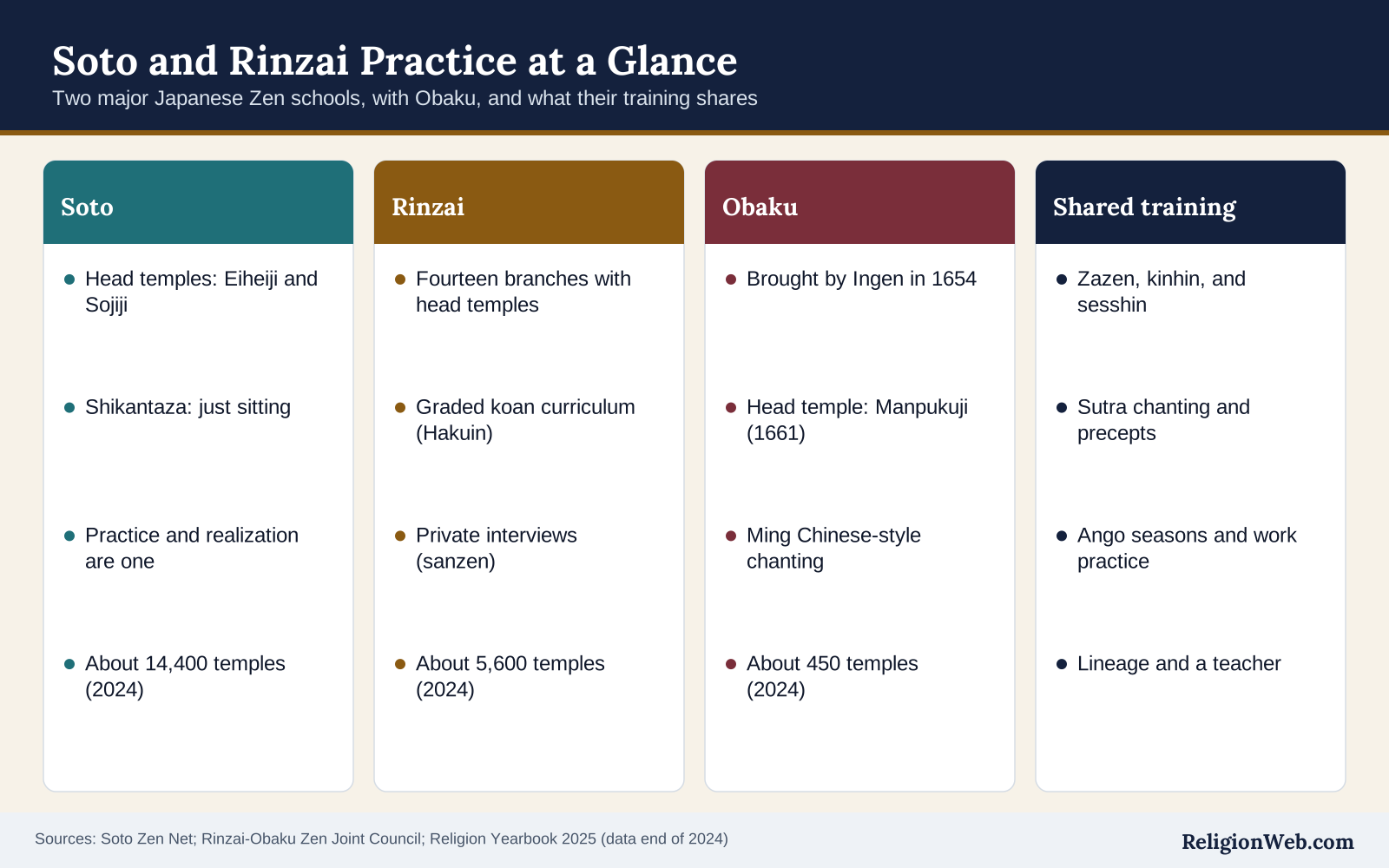
The Soto school takes its name from the Chinese Caodong lineage and traces itself in Japan to Dogen and to Keizan. It has two head temples, Eiheiji in Fukui Prefecture, founded by Dogen in 1244, and Sojiji, founded by Keizan in 1321 in what is now Ishikawa Prefecture and relocated to Yokohama after a fire in the Meiji period. The school’s headquarters is in Tokyo, and it maintains regional offices for its overseas work in Hawaii, California, Brazil, and France. With roughly 14,400 temples reported in the Agency for Cultural Affairs yearbook (figures as of the end of 2024), Soto is the largest of the Zen denominations in Japan.
Teaching and practice
Soto teaching is associated with Dogen’s view that practice and realization are not two separate stages: sitting is itself the expression of buddha-nature rather than a means to attain it. The school’s characteristic method is shikantaza, “just sitting,” in which the practitioner rests in open awareness without a prescribed object. The school also places a strong emphasis on the precepts, and on ceremonies in which monks and lay people receive them. Koans are studied as literature and as teaching, but traditionally they are not assigned in a graded sequence as they are in the Rinzai school.
The parish temple
Most Soto temples serve their local communities through funerals, memorial services, seasonal observances, and ceremonies for the dead. Historians such as William Bodiford argue that this ritual outreach, not meditation retreats, explains how Soto became so widespread across rural Japan from the fifteenth century onward. In practice, a typical temple priest balances family life, local ritual duties, and periods in the training monastery, and the tradition regards this arrangement as a legitimate form of Buddhist life.
Rinzai Zen
Origins and branches
Rinzai is the Japanese form of the Chinese Linji lineage. The Joint Council of Japanese Rinzai and Obaku Zen lists fourteen Rinzai branches, each led by a head temple: Myoshinji, Nanzenji, Kenchoji, Tofukuji, Engakuji, Daitokuji, Hokoji, Eigenji, Tenryuji, Shokokuji, Kenninji, Kogakuji, Buttsuji, and Kokutaiji. The Obaku school adds a fifteenth head temple, Manpukuji. Some of these were once part of the shogunate’s Gozan system, while others, such as Daitokuji and Myoshinji, developed outside it. The yearbook count for registered Rinzai denominations is about 5,600 temples, as of the end of 2024.
Koan training and the monastic curriculum
Rinzai monasteries are known for the use of koan study as a graded program, a method that the Rinzai tradition associates with Hakuin and his successors. A student works with a teacher through a series of cases, beginning with an introductory koan such as “Mu” from the Gateless Barrier or Hakuin’s “sound of one hand,” and presenting a response in private interviews. Over years the student may work through many cases and often composes or selects verses called “capping phrases” to accompany them. According to the Stanford Encyclopedia of Philosophy, Hakuin’s system comprises about 1,700 cases, or roughly 3,000 when sub-questions are counted. The pace of training and the amount of koan study differ among Rinzai teachers.
Training styles and culture
In many Rinzai halls, practitioners sit facing the center of the room in two rows, while in Soto halls they typically face the wall. Rinzai retreats (sesshin) are often described as intense, with long sitting periods and frequent interviews, though the specific intensity varies. The Rinzai temples of Kyoto and Kamakura have also supported arts such as ink painting, calligraphy, and gardens, which the section on arts treats separately.
Obaku and Other Lineages
The Obaku school
Ingen Ryuki, a Chinese Linji teacher, arrived in Nagasaki in 1654 and founded Manpukuji at Uji in 1661. The school’s liturgy, architecture, and chanting follow late-Ming Chinese models, and its services retain a Chinese flavor that distinguishes them from other Japanese Zen temples. The yearbook reports about 450 Obaku temples, a small number compared with Soto and Rinzai.
Lay-oriented and reform movements
In the twentieth century several organizations for lay practitioners arose in Japan. The Sanbo Kyodan, founded by Yasutani Hakuun in 1954, drew from both Soto and Rinzai methods and taught lay students from outside the temple system. Its approach to breath practice, koan study, and awakening has influenced many Western teachers, though some later branches have distanced themselves from its Japanese organization. Groups like these show that Zen’s institutional forms in Japan are not limited to the temple system.
Korean, Vietnamese, and Chinese schools
Outside Japan, Zen is organized differently. In Korea, the Jogye Order includes Seon monasteries, with meditation halls, retreat seasons, and a hwadu-centered approach. Vietnamese Thien communities draw on the Truc Lam and Lam Te lineages, while Chinese Chan monasteries typically carry both Linji and Caodong transmissions and combine seated meditation with Pure Land practice. Because these traditions have different institutions, statements about “Zen” often need a regional qualifier.
| School | Region | Origin | Practice emphasis | Institutions |
|---|---|---|---|---|
| Soto | Japan, with overseas centers | Dogen (1200 to 1253), Keizan (1268 to 1325); Caodong lineage | Shikantaza; practice as expression of realization; precepts | Head temples Eiheiji (1244) and Sojiji (1321); about 14,400 temples |
| Rinzai | Japan | Eisai (returned 1191); Linji lineage | Koan curriculum; private interviews; intensive retreats | Fourteen head-temple branches; about 5,600 temples |
| Obaku | Japan | Ingen (arrived 1654); Manpukuji (1661) | Zazen and koan with Ming Chinese-style liturgy | Head temple Manpukuji; about 450 temples |
| Sanbo Kyodan | Japan and abroad | Yasutani Hakuun (1954) | Lay-oriented koan and breath practice | Lay organization with international students |
| Seon (Jogye Order) | Korea | Silla-era transmission; Jinul (1158 to 1210) | Hwadu practice; three-month retreats | Mountain monasteries and meditation halls |
| Thien (Truc Lam, Lam Te) | Vietnam and diaspora | Traditional 580 start; Tran Nhan Tong (1258 to 1308) | Meditation with Pure Land recitation and engaged practice | Monasteries; Plum Village in France |
| Chan (Linji and Caodong lines) | China, Taiwan, diaspora | Tang and Song dynasties | Huatou, silent illumination, and Pure Land recitation | Public monasteries; Dharma Drum Mountain in Taiwan |
Why the Schools Differ and What They Share
Differences in emphasis
Soto and Rinzai are often described through a short contrast, “just sitting” and “koan study,” but teachers in both schools say that this is a simplification. Many Soto teachers use koans, and many Rinzai teachers instruct students in shikantaza. The schools differ in lineages, liturgy, calendars, and styles of teaching, and in how they speak about the role of a breakthrough experience, but they share the same monastic rules, bodhisattva precepts, and sutras.
Shared structure of training
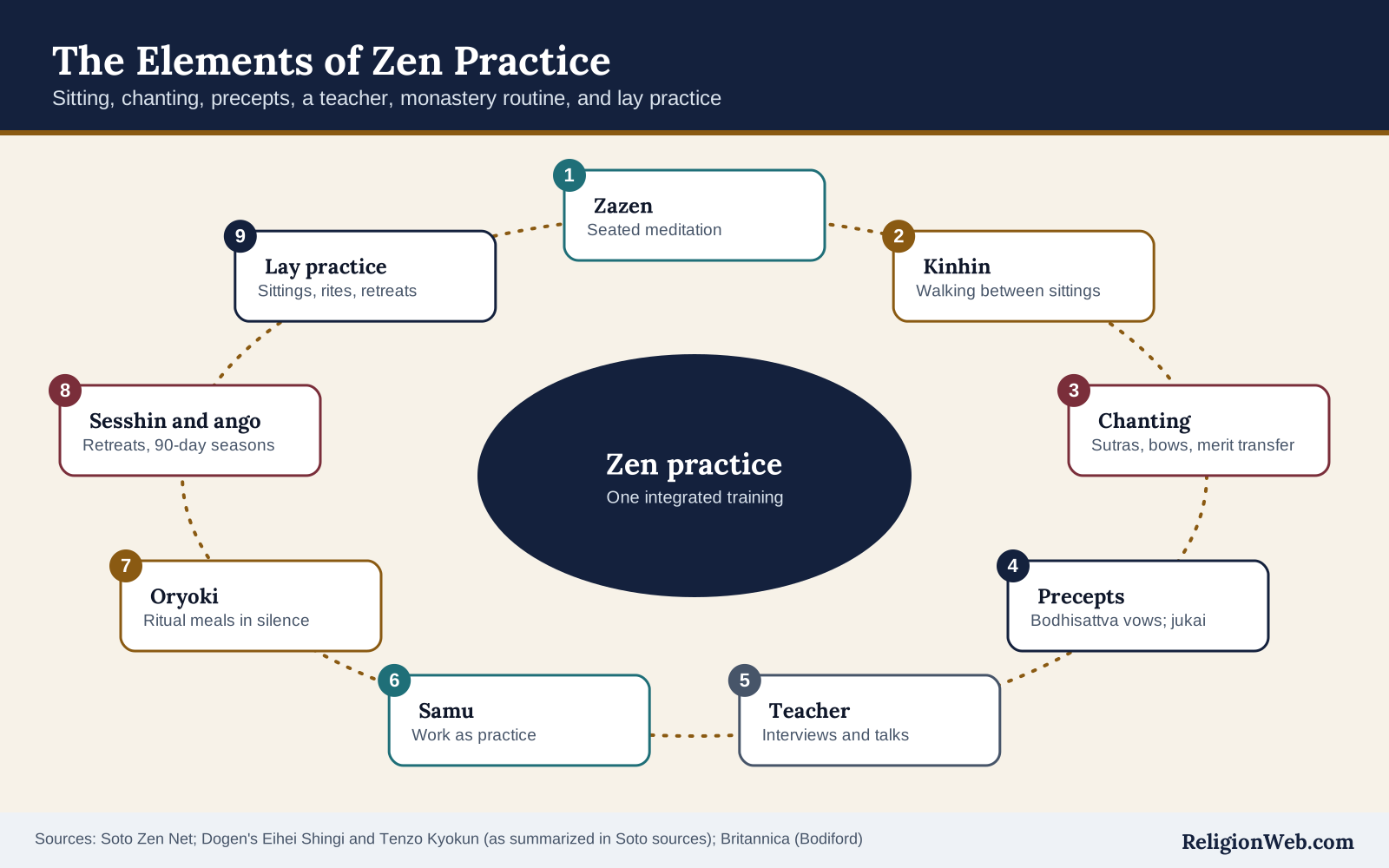
Both schools organize training around sitting, chanting, communal work, a teacher, and retreats. Both observe the same founders’ memorials, the Buddha’s awakening on the eighth day of the twelfth month, and the ninety-day retreat seasons. The next sections explain these elements in detail, starting with the practice that gives the tradition its name.
Zazen and Koan Practice
Zazen: Seated Meditation
What the practice looks like
The early twentieth-century teacher Soyen Shaku, writing for American readers, described the foundation of the practice this way:
Dhyâna literally means, in Sanskrit, pacification, equilibration, or tranquillization, but as religious discipline it is rather self-examination or introspection.
Soyen Shaku, “Practice of Dhyana,” Sermons of a Buddhist Abbot (Zen for Americans), trans. D. T. Suzuki (Chicago: Open Court, 1906; public domain, sacred-texts.com)
In its standard form, zazen is done on a thick round cushion (zafu) placed on a mat. The practitioner sits cross-legged, in the half-lotus or full-lotus posture, or kneels over a low bench, or sits on a chair if the legs make the floor impossible. The spine is upright, the head balanced, the chin slightly tucked, and the hands are placed in the “cosmic mudra,” with the left hand resting on the right palm and the thumbs touching lightly. The eyes remain open and lowered, gazing at about a forty-five-degree angle toward the floor or wall.
Breath and attention
Beginners are commonly given a simple breath practice, such as counting each exhalation from one to ten and starting again, or following the breath as it enters and leaves. The breath is natural, through the nose, without forcing. As attention steadies, the teacher may recommend moving to shikantaza or to a koan. Thoughts are not suppressed, and the instruction is to notice them and let them pass, returning to the posture and the breath.
Dogen’s “non-thinking” and shikantaza
Dogen’s instruction in Fukanzazengi is often summarized with the phrase “think of not thinking,” followed by his own question about how one thinks of not thinking, and his answer, “without thinking” (hishiryo). This is commonly taken in the Soto school to describe an attitude that neither pursues nor rejects thoughts. In shikantaza, the practitioner does not use a counting method or a koan, but sits with alert, open awareness, and Soto teachers describe the sitting as the realization of awakening, not a technique for producing it. Other schools may understand the term differently.
Walking meditation and sesshin
Periods of sitting, usually twenty-five to forty minutes, are separated by kinhin, slow walking meditation in which the hands are held at the chest in a closed-fist gesture (shashu). In the Soto school each half-step follows one breath, while Rinzai kinhin is often brisker. During a sesshin, an intensive retreat that may last from one to seven days, participants sit many hours a day, eat in silence, and work. The most important annual retreat in Japan is Rohatsu, observed in early December in memory of the Buddha’s awakening, which tradition places on the eighth day of the twelfth month.
Koan Practice
What a koan is
The Chinese term gong’an, from which “koan” derives, originally meant a “public case,” like a legal precedent. In Chan, it refers to a story of an encounter, or a question or statement from a teacher, that serves as a model and as an object of meditation. Examples include the question whether a dog has buddha-nature, to which the Tang master Zhaozhou answered “Mu” (“no” or “nothing”), and the question about the sound of one hand clapping. A koan is not a riddle with a clever solution; teachers describe it as a way of bringing the student’s whole attention to a question that cannot be settled by ordinary reasoning.
How koans are used in Rinzai
In the Rinzai curriculum, the student takes a koan into zazen and into daily activity until a breakthrough, and presents it to the teacher at sanzen. The teacher tests the response, which is often not verbal, and may send the student back to the cushion. After a first breakthrough, further koans refine and deepen insight, and students may study the koans in a sequence that Hakuin’s successors established. The Rinzai tradition describes three qualities needed for this work: great faith, great doubt, and great determination.
Koans in Soto, Seon, and Chan
Dogen taught the use of koans in a different way. He quoted hundreds of old cases in his writings and gathered three hundred in a Chinese-language collection, the Mana Shobogenzo, and the Soto school generally treats a koan as an expression of the reality that sitting realizes, not as an obstacle to be broken through. In Korean Seon, the hwadu method derived from Dahui is the primary meditation, and Chan monasteries in China use huatou as well as silent sitting. In short, there is no single koan method; each lineage uses cases in its own way.
Practicing with Care
Difficulties that can arise
Zen literature has long acknowledged that intense meditation can be hard. Hakuin wrote of a “Zen sickness” (zenbyo) that he suffered in his own training, with exhaustion, anxiety, and physical symptoms, and he offered breathing and visualization practices to treat it. Modern researchers who study meditation have documented that some practitioners, particularly during long retreats, experience distress, dissociation, or the return of traumatic memories. Responsible teachers screen participants, offer guidance, and encourage people to leave a retreat or reduce effort when needed.
Meditation and professional care
Zen teaching offers a spiritual path and does not claim to replace medical or psychological treatment. Anyone dealing with depression, trauma, a psychiatric condition, or a medical problem should seek professional help in addition to, or before, an intensive retreat, and should tell the retreat teacher about relevant conditions. Many Zen centers state this explicitly. The tradition’s emphasis on a teacher who knows the student well is partly a safeguard.
| Practice | Where emphasized | What it involves | Notes |
|---|---|---|---|
| Zazen | All Zen schools | Seated meditation on a cushion or chair, upright posture, eyes open | Typically twenty-five to forty minutes per period |
| Breath counting or following | Common starting practice | Counting exhalations from one to ten, or following the breath | Used by beginners in many schools |
| Shikantaza | Soto, and some Rinzai and lay teachers | Open, nonobjective awareness without a prescribed object | Associated with Dogen and with Hongzhi’s silent illumination |
| Koan study and sanzen | Rinzai, Sanbo lineages | Working on a case and presenting it in private interview | Hakuin’s curriculum organizes the sequence |
| Huatou or hwadu | Chan and Korean Seon | Concentrating on the critical phrase of a koan with “great doubt” | Linked to Dahui and Jinul |
| Kinhin | All Zen schools | Slow walking between sitting periods | Hands held in shashu at the chest |
| Sesshin | All Zen schools | Intensive retreat of one to seven days or longer | Rohatsu in early December commemorates the Buddha’s awakening |
Zen Monastic Life and Training
The Zen Monastery
The layout of a training monastery
A Japanese Zen training monastery is traditionally organized around seven principal buildings, called the “seven-hall compound” (shichido garan): the mountain gate, the Buddha hall, the dharma hall for formal talks, the kitchen, the monks’ hall, the bath, and the latrine. The monks’ hall (sodo) is the center of daily training. In it each monk has a personal space on a raised platform, about one tatami mat wide, where he sits in meditation, eats his meals, and sleeps, and the image of the bodhisattva Manjushri (Monju) is commonly enshrined at the center. Korean and Chinese monasteries differ in details but share the same elements of Buddha hall, meditation hall, dining hall, and kitchen.
Offices and roles
Zen monasteries are led by an abbot and run by monks who hold rotating offices. The cook (tenzo) manages the kitchen, the head of the meditation hall (jikijitsu) leads the schedule of sitting, the ritual director (ino) oversees conduct and ceremony, and others handle guests, accounts, and maintenance. Dogen insisted that these posts were forms of practice, not administrative chores, and that senior monks should take them seriously. The rotation also prevents any single role from becoming a position of status.
A day in a training monastery
Schedules vary by monastery and season, but a typical day at a Japanese training monastery begins well before dawn, around four in the morning, with a bell, washing, and a morning service, followed by periods of sitting, a meal, manual work, a midday service, study or a talk by the teacher, an evening meal, and a final sitting before bed in the evening. In the intense retreat periods, the timetable becomes stricter and the amount of sitting increases. The monastery’s bells, drums, and wooden boards mark the day, so that the whole community moves together without verbal instruction. Readers can compare this pattern with the general discussion of Buddhist monastic life, Vinaya, and ordination.
Becoming and Remaining a Zen Monastic
Ordination and entering the training hall
A person who wishes to become a Zen monk or nun is ordained by a teacher in a ceremony in which the head is shaved, a robe and bowls are given, and the precepts are received. In Japan, a novice then enters a training monastery as an unsui, literally “cloud and water,” a name for a wandering monastic, and is expected to follow the regulations and the schedule. Admission to a Japanese monastery traditionally involves waiting at the gate in a formal posture, as a sign of sincerity, though practices vary by place. Korean and Chinese monastics undergo their own ordination, in which a fully ordained status is conferred under the monastic code, a topic covered in the article on Buddhist monastic life.
Retreat seasons
The Zen year follows the Indian Buddhist custom of a rains retreat, adapted into two ninety-day periods, summer and winter, called ango in Japanese and kyolche or angeo in Korean. During these periods, monks stay in the monastery, intensify practice, and limit travel. Between periods, they may travel, work in temples, or study with other teachers. Lay practitioners often join special retreats timed to these seasons.
Monks, priests, and families
The difference between monastic celibacy in China, Korea, and Vietnam and married priesthood in Japan is among the most important institutional differences within Zen. In Japan, a priest may spend a few years in training and then return to inherit a family temple. In Korea, the Jogye Order includes celibate monks and nuns as its core monastics, with a separate history of married clergy that arose during the Japanese colonial period. These differences matter, since a visitor to a Japanese parish temple and a visitor to a Korean mountain monastery will meet very different forms of community.
Work as Practice
Samu: working meditation
Manual labor is a defined part of Zen training. Samu includes cleaning, gardening, farming, repairs, and the preparation of firewood. The saying attributed to Baizhang, that a day without work is a day without food, is often cited as the origin of this emphasis. Work is done in silence, with attention, and is treated as continuous with sitting.
Oryoki: ritual meals
Formal meals in a Soto training hall use a set of nested bowls called oryoki, meaning “just enough.” Servers pass food, each monk takes what is needed, chants verses of gratitude, eats in silence, and cleans the bowls with tea or water, which is then drunk. The procedure follows rules in Dogen’s meal instructions and expresses the ideas of gratitude, non-waste, and shared effort. Lay retreats at Western centers often use a simplified version.
The cook and the kitchen
Dogen’s account of two monastery cooks he met during his years in China is among the best-known stories in Soto Zen. In his manual he recalls how these encounters changed his view of kitchen work, which he had thought a mundane task, and he wrote the text in 1237 for his own community. Soto monasteries still honor the cook’s role, and many Zen centers in the West have developed a tradition of cooking as an active form of practice.
Ritual, Chanting, Precepts, and the Annual Cycle
Services and Chanting
The daily service
Despite its reputation for plainness, Zen is a ritual tradition. A temple has a daily service before the Buddha image: incense is offered, the community bows, and sutras are chanted in unison. Commonly chanted texts include the Heart Sutra, the Dharani of Great Compassion in honor of Avalokiteshvara, and, in Soto temples, Chinese poems such as the Sandokai and Hokyo zammai. Rinzai temples chant Hakuin’s Song in Praise of Zazen and the chapter of the Lotus Sutra devoted to Avalokiteshvara. After the chants, the merit of the recitation is dedicated, in a formula called ekō, to the awakening of all beings or to named individuals such as the deceased.
Instruments, bowing, and etiquette
The service is coordinated by percussion. A wooden fish (mokugyo) keeps the rhythm of the chant, hand bells and large bells mark changes, and a wooden board (han) and drum announce the schedule. Participants bow with hands joined, and full prostrations are made at defined points. Detailed rules govern how to enter a hall, how to hold the hands (shashu and gassho), where to stand, and how to leave. The conduct manuals of Dogen and the Chinese rules of purity explain that these forms are meant to give practitioners a shared pattern that allows the individual to disappear into the activity.
Why Zen includes ritual
Zen teachers explain ritual in several ways. Soto teachers see it as an expression of the same awareness found in sitting. Some describe it as training in attention, others as an act of gratitude toward the Buddha and the lineage, and others as service to the community. Historians add that the Chan monasteries of the Song dynasty, which gave Zen many of its forms, were large public institutions with imperial and civic obligations, so that rituals for the state, for the dead, and for the Buddha were part of their role from the start. Both observations help explain why the image of a Zen practice without ritual does not describe any known Zen institution.
The Precepts
The bodhisattva precepts in Zen
Zen schools confer the bodhisattva precepts drawn from the Brahma’s Net Sutra: the three refuges in the Buddha, the dharma, and the sangha; three pure precepts (to avoid evil, to do good, and to benefit others); and ten grave precepts. The ten include refraining from killing, stealing, misusing sexuality, lying, and intoxicants, and also from speaking of the faults of others, praising oneself while blaming others, being stingy with the teaching or with possessions, indulging anger, and slandering the three treasures. Dogen taught sixteen precepts in this form, and the Soto school treats them as central. The first five correspond to the ethical guidelines discussed in the article on the Five Precepts.
Receiving the precepts: the jukai ceremony
In a ceremony called jukai (“receiving the precepts”), lay people take the precepts before a teacher and the community. Beforehand the participant usually sews a small garment called a rakusu, a bib-like version of the monk’s robe, under the guidance of a teacher. During the ceremony the participant receives the rakusu, a dharma name, and a lineage paper in Soto practice that traces the teacher’s line back to the Buddha. Lay jukai is understood as a formal commitment to Buddhist ethics and as entry into the lineage.
Rohatsu, the observance of the Buddha’s awakening, shows how these elements combine. In the week leading up to December 8, training monasteries hold an especially strict retreat, with sitting continuing late into the night; in some halls the final night is spent in unbroken sitting. Lay centers often schedule a shorter Rohatsu sesshin. Participants recall the Buddha’s awakening by sitting, which is the way the tradition prefers to honor it, and the retreat closes with chanting and a meal.
The precepts in daily life
The tradition teaches that the precepts are not only prohibitions but expressions of awakened conduct, and teachers differ on how strictly to apply them. Some lay Zen groups emphasize personal reflection over rules. Questions about alcohol, sexuality, and the conduct of teachers have prompted much discussion in modern Zen, and several organizations have developed ethical guidelines that apply the precepts to current situations.
Funerals, Memorials, and the Zen Year
Funeral and memorial rites
In Japan the funeral is the main point of contact between the public and Zen. In Soto practice, the deceased is symbolically ordained in a ceremony, receives the precepts and a posthumous Buddhist name, and is sent off with sutra chanting by the priest and community. Memorial services are then held on the seventh day, at forty-nine days, and at set anniversaries, and families visit the temple cemetery during the midsummer Obon season. These rites express the Buddhist belief in merit transfer, in which the living dedicate the benefit of their practice to the dead.
Annual observances
The Zen calendar includes the Buddha’s birthday, celebrated in Japan on April 8 with sweet tea poured over a small statue, and in Korea on the eighth day of the fourth lunar month with a lantern festival; the commemoration of the Buddha’s final nirvana on February 15 in Japan; and Rohatsu, the Buddha’s awakening, on December 8. Other days honor founders such as Bodhidharma and Dogen, and each Zen temple also keeps memorial days for its own founders and abbots. On such days the community offers incense, chants for the ancestor, and reads from the person’s writings or recorded sayings. The festivals of other Buddhist countries are described in the article on Vesak, which commemorates the Buddha’s birth, awakening, and passing together in many countries.
Lay participation
Lay people take part in Zen through parish ceremonies, weekend sitting groups, retreats, and study classes. In Japan, most lay involvement centers on family rites, while many practitioners elsewhere join groups for meditation and discussion. The tradition’s expectations vary by setting, from formal membership in a temple to occasional attendance at public sittings.
| Activity | Who takes part | What happens | Meaning |
|---|---|---|---|
| Morning and evening service | Monastics, priests, lay members | Incense, bows, chanting of sutras and dharanis, dedication of merit | Offering to the Buddhas and ancestors; unifying the community |
| Oryoki meal | Monastics and retreat participants | Nested bowls, chanted verses, silent eating, washing of bowls | Gratitude and attention in ordinary acts |
| Samu | Monastics and retreat participants | Silent manual work: cleaning, gardening, kitchen tasks | Practice continues outside the meditation hall |
| Ango retreat | Monastics; some lay participants | Ninety-day summer or winter residency with intensified practice | Continues the early Buddhist rains retreat |
| Jukai | Lay people and monastics | Sewing a rakusu, taking refuges and precepts, receiving a dharma name | Formal commitment to Buddhist ethics |
| Funeral and memorials | Priests and families | Posthumous ordination and name, sutra chanting, anniversary services | Transfer of merit to the deceased |
| Rohatsu sesshin | Monastics and many lay practitioners | Intensive retreat ending December 8 | Remembers the Buddha’s awakening |
Zen and the Arts: Tea, Gardens, Calligraphy, and Martial Arts
Tea and Gardens
Tea in the Zen monastery
Tea has been drunk in Chan and Zen monasteries for as long as the institutions have existed, as an aid to wakefulness during long sitting. Eisai, who brought tea seeds and the practice of drinking powdered tea from Song China, wrote a treatise on tea and health, the Kissa yojoki, in 1211. Monastic rules of purity describe ceremonial tea offered to the Buddha and to honored guests, and formal tea service remains part of the ritual life of Zen monasteries. In 1906, the art historian Okakura Kakuzo described the monastic roots of the later Japanese tea ceremony:
The monks gathered before the image of Bodhi Dharma and drank tea out of a single bowl with the profound formality of a holy sacrament.
Okakura Kakuzo, The Book of Tea, ch. II, “The Schools of Tea” (New York: Fox, Duffield, 1906; Project Gutenberg)
Okakura’s account is influential, but specialists note that the tea ceremony as practiced in later centuries also grew out of aristocratic, merchant, and warrior culture, and that its great masters, such as Sen no Rikyu (1522 to 1591), practiced within several social worlds. The slogan “tea and Zen are one taste” expresses a real historical association and a sense of shared values, without implying that a tea gathering is a Zen service.
Gardens and temple architecture
Zen temples in Kyoto and elsewhere are known for dry landscape gardens in which raked gravel and stones suggest water, mountains, and islands. These gardens were created over several centuries by monks, professional garden makers, and patrons, and they served multiple purposes, including as settings for ritual, reception halls, and views from abbots’ quarters. The Dutch scholar Kuitert and others have argued that the idea that such gardens directly express Zen philosophy is largely a modern development. Visitors may find it more useful to treat them as the product of Zen temple culture than as diagrams of Zen teaching.
Visiting a temple respectfully
Most Japanese Zen temples welcome visitors, though some areas are closed to the public, and some monasteries admit only participants in retreats. Common courtesies include removing shoes, bowing at the gate, keeping quiet in the meditation hall, and not photographing worshipers or altars where signs forbid it. Participation in sitting sessions is usually open to newcomers with a brief orientation, and temple stay programs in Korea and Japan offer a way to experience monastic routines as a guest.
Painting, Calligraphy, and Martial Arts
Ink painting and calligraphy
Zen monks were prominent in Chinese and Japanese ink painting and calligraphy. The Rinzai monk Sesshu painted in the Muromachi period, and the Gozan monasteries produced poetry and painting in the Chinese style. Hakuin and other Edo-period masters made bold brush paintings and calligraphy, now called zenga, that teach through humor and directness. A hanging scroll of a teacher’s calligraphy, or bokuseki, may be displayed in a tea room as a mark of respect for the teacher.
The warrior connection
The Rinzai monastic network enjoyed the patronage of the Kamakura and Ashikaga warrior governments, and the tradition of Zen teachers advising warriors is old. The Rinzai teacher Takuan Soho (1573 to 1645) is credited with letters on the “immovable mind” to a swordsman, but historians treat the link with the sword master Yagyu Munenori as traditional and note that later writers expanded it. Modern ideas of a samurai “Zen way of the sword” were shaped by early twentieth-century writers, including D. T. Suzuki, and critics have argued that they reflect modern Japanese nationalism more than medieval practice.
Meditation and martial arts today
Some modern martial arts dojo include zazen at the start or end of practice, and some teachers describe the discipline of the art as a form of practice. In temples associated with martial arts, such as Shaolin in China, the connection between Chan and physical training is cultural and popular. Practitioners who value both should understand that they are different traditions with overlapping history.
Reading Zen Culture With Caution
Aesthetics and religion
Zen’s reputation for simplicity has made it a favorite shorthand in design, advertising, and architecture. Many qualities associated with Zen, such as restraint, asymmetry, and appreciation of impermanence, also have roots in Japanese court poetry, Shinto-related sensibilities, and the tea world, so assigning them all to Zen may blur historical differences. At the same time, the monastic world did sustain many of these arts, so the link is neither invented nor exclusive.
“Zen” as a popular word
In English, “zen” has become an adjective for calm, minimal, or unbothered, often without a connection to Buddhist practice. This use is not a religious claim, but readers should be aware that the actual tradition includes ordination, precepts, chanting, communal discipline, and a lineage. The article’s final sections on misconceptions return to this distinction.
Zen in the Modern World
Zen Reaches the West
From the Parliament of Religions to the 1960s
Zen first reached a broad English-speaking audience through Soyen Shaku, who attended the 1893 World’s Parliament of Religions in Chicago, and through his student D. T. Suzuki, who lived in the United States for periods in the early twentieth century and wrote extensively in English. Interest in Zen grew sharply after the Second World War, when authors, poets, and artists in the United States and Europe encountered it through Suzuki’s lectures, books by Alan Watts, and the writings of the Beat generation. Scholars such as Robert Sharf have noted that this early Western image often emphasized personal experience and anti-institutional themes more strongly than Japanese practice did.
Centers and lineages
Permanent teaching centers followed. Shunryu Suzuki helped establish the San Francisco Zen Center in 1962, Philip Kapleau published The Three Pillars of Zen in 1965 and founded the Rochester Zen Center in the following year, and Taizan Maezumi founded the Zen Center of Los Angeles in 1967. Korean teacher Seungsahn began teaching in the United States in 1972, Vietnamese teacher Thich Nhat Hanh developed Plum Village in France, and Sheng Yen taught Chan in New York and Taiwan. The Soto school’s headquarters maintains overseas offices, and groups tied to the Sanbo Kyodan, Rinzai monasteries, and independent teachers also operate throughout the world.
Zen and secular mindfulness
Zen is one of several sources that influenced the modern mindfulness movement. The founder of Mindfulness-Based Stress Reduction, Jon Kabat-Zinn, has said that his own practice drew on teachers including Thich Nhat Hanh and Seungsahn, along with Theravada and yoga traditions. Mindfulness programs in hospitals and schools are designed as secular health interventions and typically omit the ethics, ritual, and lineage of Zen. Both Buddhist teachers and researchers have discussed what is gained and lost in that adaptation, and the two are best understood as related but separate endeavors. Zen practitioners also draw on other Buddhist teachers, such as Theravada meditation masters and Tibetan lamas, which has made Western Buddhism more eclectic than most of its Asian counterparts.
Contemporary Zen Communities
Lay leadership and new forms of practice
Western Zen is frequently led by lay teachers and organized as nonprofit communities that gather for weekly sittings, daily practice periods, retreats, and classes. Online sittings and recorded talks have expanded access, and many practitioners join several communities. Zen-trained chaplains work in hospitals, hospices, and prisons, and some centers run programs on social issues. These communities negotiate ongoing questions about authority, gender, ethics, and how much of the Japanese, Korean, or Vietnamese form of Zen to retain.
Zen in East Asia today
In Japan, the pattern of parish funerals and memorial services remains the economic basis of most temples, and demographic change has made it hard for some rural temples to find successors. Training monasteries receive both aspiring priests and lay visitors. In Korea, the Jogye Order’s monasteries remain active as places for meditation retreats, and temple stay programs introduce the public to monastic life. In China, many Chan monasteries have been rebuilt, and in Taiwan, organizations such as Dharma Drum Mountain run educational and social programs. In Vietnam, Thien monasteries continue under state regulation, and Vietnamese communities abroad maintain temples in Europe and North America.
Continuity and change
Across these settings the basic elements are recognizable: sitting, a teacher, precepts, chanting, and communal work. The differences between a Korean mountain monastery, a Japanese parish temple, a Vietnamese diaspora temple, and a Western lay sangha are significant, and most Zen teachers encourage newcomers to learn from a specific community instead of drawing conclusions from images alone.
Scholars of Zen continue to revise the picture. Studies of the Dunhuang manuscripts, of Song-era monastic institutions, and of medieval Japanese temple records have changed how historians describe the origins and spread of Zen, and recent work on women, on lay practitioners, and on Korean and Vietnamese sources has widened the story beyond its older focus on a few Chinese and Japanese masters. Readers should expect that some details given here, especially early dates and lineage claims, may be refined as research proceeds.
Common Misconceptions About Zen Buddhism
Misconception 1: Zen rejects all scripture and ritual
Where the misunderstanding comes from
The belief has several sources. The old four-line formula describing “a special transmission outside the scriptures” is easy to read as a rejection of texts. Chan literature also contains vivid stories of teachers who seem to attack the objects of devotion: the monk Tianran is said to have burned a wooden Buddha image for warmth, and the Record of Linji tells students that if they meet the Buddha they should kill him. Twentieth-century interpreters who presented Zen to Western audiences as a mystical experience beyond institutions reinforced the impression, as did the bare look of Zen halls and gardens.
These images were widely repeated by writers who were reacting to the formalities of their own religious backgrounds and who found in Zen a spontaneous alternative. Because the stories are short and memorable, and the daily routine of a monastery is not, the stories traveled farther than the routine.
What the evidence and tradition actually show
Every Zen institution of which there is detailed record has been a ritual institution. Chan monasteries of the Song dynasty were governed by rules of purity that specify bowing, offerings, chanting, and memorial services, and Japanese, Korean, and Vietnamese monasteries still chant the Heart Sutra and other texts every day. Dogen, who is read for his emphasis on sitting, wrote extensively on sutras and on the correct procedures for meals, the bath, and the training hall. Chan masters produced a large body of literature, and the Zen schools of every country preserve it.
The iconoclastic stories are read within the tradition as teaching devices aimed at students who cling to the image or to the idea of awakening, and they are told by monks who bowed to the Buddha image every day. The school’s own phrase, “not dependent on words and letters,” is better understood as a warning against mistaking words for the realization they point to. In short, Zen has a distinctive attitude to scripture and ritual, but it does not reject them.
Even the figures most often quoted as iconoclasts were products of this textual world. The Record of Linji says that its hero studied the monastic code and the sutras before turning to meditation, and Chan teachers of later centuries, including the Ming-dynasty monk Hanshan Deqing, wrote commentaries on major scriptures. A fair summary is that Zen asks what it means to practice a text, and that its answer includes both chanting the words and sitting in silence.
Misconception 2: Zazen means trying to empty the mind completely
Where the misunderstanding comes from
English summaries of meditation often describe it as “clearing the mind” or “thinking about nothing,” and the Zen vocabulary of emptiness, “no-mind” (mushin), and “non-thinking” seems to confirm that this is the goal. Beginners who sit for the first time and find their thoughts racing sometimes conclude that they are doing it wrong. Popular accounts of enlightenment as a blank, thoughtless state add to the confusion.
The words themselves are also open to misreading. Emptiness in the Mahayana texts refers to the absence of fixed self-existence in things, and “no-mind” in Chan and Zen writing generally means a mind free of clinging and fixed ideas, not a mind without content.
What the evidence and tradition actually show
Teachers in the Zen schools instruct beginners to count or follow the breath, return to the posture, and let thoughts arise and pass without following them. In Dogen’s formulation, thinking of not-thinking is done by “non-thinking,” which Soto teachers describe as a stance that neither pursues nor suppresses thought. A mind that is awake to its own movements is the aim, rather than a mind that has been blanked.
The Zen practice of sitting is also connected to Buddhist ethics and to the bodhisattva vow, and its stated purpose is awakening and compassion rather than a pleasant stillness. Some practitioners do experience periods of great calm, and some teachers speak of absorptions, but these are not treated as the measure of practice. Anyone struggling with a restless mind is encountering the ordinary starting condition of the practice, which teachers address with posture, breathing, and the guidance of an experienced teacher.
Contemporary meditation researchers sometimes distinguish practices that focus attention on a single object from those that monitor whatever arises, and they often place shikantaza in the second group. That comparison is a modern scientific classification, not a Zen category, but it shows why “emptying the mind” is an inadequate description of a method that asks for continuous, open alertness.
Misconception 3: All Zen traditions use koans in the same way
Where the misunderstanding comes from
Koans have become the best-known feature of Zen in popular culture, where “the sound of one hand” has become shorthand for any paradox. English-language books often present koan study as the central method of all Zen, and a reader may come away with the picture of a single technique used in every monastery. The Rinzai school’s graded program, with private interviews, was also described in influential Western books of the 1960s, which made it appear to be the model for all Zen.
A further source of confusion is the word itself, which names both the story, the collection, and the meditative practice, so that the same word covers very different activities.
What the evidence and tradition actually show
The tradition employs cases in at least four ways. Rinzai training in Japan uses a curriculum of koans taken up in sequence with a teacher. Korean Seon and many Chinese Chan monasteries concentrate on a single key phrase (hwadu or huatou), which the practitioner holds throughout meditation and daily life. In the Soto school, koans are studied through commentary, lectures, and sometimes in interviews, and are treated as expressions of the reality that sitting realizes, a view that follows Dogen’s writings. Many lay-oriented groups use a mix of methods, and some teachers use none.
Historically, the koan collections themselves are products of the Song dynasty, and the elaborate graded system was shaped in Japan by Hakuin and his successors. Even within a school, teachers differ in how they assign cases and judge responses. A statement about Zen practice is therefore most reliable when it names the school and the period.
Examples show the range. A winter retreat in a Korean meditation hall may consist of ten or more hours of sitting with one hwadu, a Soto retreat may include lectures on cases from the Book of Equanimity together with silent sitting, and a Rinzai sesshin will include several interviews a day. A lay group in the Sanbo Kyodan line may combine breath counting, shikantaza, and a first koan such as “Mu.” All of these are recognizably Zen, and none is the only form.
Misconception 4: Zen is not a religion, only a form of mindfulness or philosophy
Where the misunderstanding comes from
This view grows from several things. Many people first meet Zen as a seated meditation class or a book that describes it as an experience rather than a creed. Some twentieth-century interpreters described Zen as beyond religion or as a psychology, and the current use of “zen” as a word for calm further detaches it from its context. Secular mindfulness programs, which do borrow from Buddhist practices, also reinforce the idea that Zen is a technique that can be removed from its tradition.
Many Zen practitioners in the West do participate without adopting a formal Buddhist identity, and teachers often welcome them, so the lived reality supports the idea in some settings.
What the evidence and tradition actually show
Zen is a Buddhist school with ordination, vows, precepts, liturgy, funerals, lineages, and a body of scripture. Its monks and nuns take the bodhisattva precepts, its temples hold services for the Buddha and the ancestors, and in Japan its priests provide the rites of death and memory for millions of families. By any ordinary academic definition of religion, which includes ritual, community, ethics, and teachings about the human condition, Zen qualifies, and the schools describe themselves as Buddhist.
At the same time, Zen communities do not require a particular metaphysical belief for participation in sitting, and many teachers invite newcomers to practice before settling questions of identity. A balanced description is that Zen is a Buddhist tradition that is also open to people who do not identify as religious, and that the meditation taught in secular programs is related to, but not the same as, the full tradition.
Public records point the same way. In Japan, Zen temples are registered as Buddhist religious corporations, and the national yearbook of religions counts Soto, Rinzai, and Obaku temples as Buddhist institutions. Their annual calendars, memorial services, and ordinations show a religious tradition at work, whatever individual visitors make of it.
Misconception 5: Zen is a Japanese tradition
Where the misunderstanding comes from
The English word is the Japanese reading of a Chinese term, and most English-language books of the twentieth century presented Zen through Japanese teachers and Japanese examples, including tea, gardens, and the samurai. As a result, many readers assume that Zen began in Japan, or that its Chinese, Korean, and Vietnamese counterparts are minor variants of a Japanese original.
What the evidence and tradition actually show
Chan formed in China, and the Japanese schools are transplants made in the twelfth and thirteenth centuries by monks who traveled to Song China, followed by Chinese teachers who settled in Japan. Korean Seon has its own lineages, among them the Nine Mountain schools and the reforms of Jinul, and the Jogye Order is the largest Buddhist order in Korea. Vietnamese Thien has its own history, from the Truc Lam school of the Tran dynasty to the modern teaching of Thich Nhat Hanh. Each of these has monasteries, texts, and teachers in its own language, and each has contributed to Zen in the West. A fuller picture of the tradition keeps all four national forms in view.
Frequently Asked Questions About Zen Buddhism
Questions About Meaning and Origins
What does the word Zen mean?
Zen is the Japanese pronunciation of the Chinese word Chan, which transliterates the Sanskrit dhyana, meaning meditation or meditative absorption. The term names both the practice and the Buddhist school that grew around it. Equivalent terms are Seon in Korean and Thien in Vietnamese.
In everyday English, “zen” is sometimes used as an adjective for calm. The Buddhist tradition is the origin of the word but is considerably broader than the popular sense.
Who founded Zen Buddhism?
No single person founded Zen. Tradition names Bodhidharma as the first patriarch in China, and Huineng as the sixth, but historians see a gradual formation of Chan communities between roughly the sixth and eleventh centuries. In Japan, Eisai is associated with the introduction of Rinzai, Dogen with the Soto school, and Ingen with Obaku.
Because the lineage accounts were written in later centuries, scholars distinguish between the history of particular teachers and the traditional story of an unbroken line from the Buddha.
How do Soto and Rinzai Zen differ?
Both are Japanese Zen schools with shared monastic rules, precepts, and sutras. Soto, descended from Dogen, emphasizes “just sitting” and the unity of practice and realization, and Rinzai, associated with Eisai and Hakuin, is known for its graded koan curriculum and private interviews. Many teachers in each school use methods from the other.
They also differ in lineage, in head temples, and in some chanting and liturgy. The section on major schools gives the details.
Questions About Practice
How do people begin zazen?
Most centers offer an introductory session in which a teacher or experienced member explains posture, breathing, and etiquette, and the new participant sits for a short period with the group. A beginner may sit on a cushion, bench, or chair, and counts breaths. Sitting briefly every day is generally recommended over occasional long sessions.
Practitioners with injuries or health conditions can adapt posture, and a teacher can advise on this. Anyone with a history of trauma or serious mental-health conditions should consult a professional before long retreats.
Is a teacher necessary?
Zen tradition holds that a teacher is essential, especially for koan work, because someone must test and guide the student. In practice, many people begin with books, groups, or apps, and take up a teacher later. A thoughtful approach is to choose a community whose teachers have clear lineage, ethical guidelines, and a record of openness.
Different centers offer different levels of contact with teachers, from regular interviews to occasional talks, and newcomers can ask about this before joining.
What is a koan, and does it have an answer?
A koan is a case taken from the record of a Chan or Zen teacher, used for study and meditation. In schools with formal koan training, a student presents a response to the teacher, who judges whether it shows genuine understanding. Responses are often nonverbal or unexpected.
Because the purpose is a change in how the student understands, rather than a verbal solution, a koan is not a riddle with a published answer. Published collections include commentary, but teachers say the commentary cannot do the work for the student.
Questions About Belief and Community
Do Zen Buddhists believe in rebirth or in a god?
Traditional Zen teaching accepts the Buddhist understanding of karma and rebirth, although Zen texts concentrate on awakening in the present. Buddhism does not teach a creator god; its texts speak of gods as beings within the cycle of rebirth, not as sources of salvation. These are the teachings of the tradition, and individual practitioners, especially in the West, hold a range of views on rebirth.
Zen centers generally do not require a statement of belief for participation in meditation, though ordination and precepts are expressions of Buddhist commitment.
Can someone practice Zen without becoming a Buddhist?
Many centers welcome people of any background to sit, and some people attend while keeping other religious identities. The tradition itself regards the three refuges and the precepts as the formal marks of becoming a Buddhist, and these are optional for those who attend. Practitioners who wish to remain in their own tradition should discuss this with a teacher, who can explain what the center expects.
Opinions differ among teachers about how to understand such dual participation, and the question is still discussed in Zen communities.
Can I visit a Zen monastery or temple?
Many temples and some monasteries welcome visitors for services, public sittings, or short stays, and Korean temple stay programs and Japanese temple lodgings are examples. It is best to arrange a visit in advance, follow the rules of the host, dress modestly, and observe silence where it is requested. Some training monasteries admit only monastics or participants in specific retreats.
Visitors should check each temple’s schedule and policies, as these vary widely and change over time.
Questions About Ritual and Modern Practice
Why do Zen monasteries have so much ritual and etiquette?
Zen teachers give several reasons. For Dogen and the Soto school, the details of daily conduct are the practice itself: if sitting expresses awakening, then so do bowing, eating, and cleaning. Others describe the forms as a shared discipline that supports concentration and community harmony. Historically, Chan monasteries were large public institutions with obligations to the state, the dead, and the laity, which required formal ceremony.
The impression of an informal, ritual-free Zen comes largely from popular stories and from modern presentations aimed at lay audiences. Visitors to a training monastery will find that the schedule of bells, chants, and procedures is one of its most distinctive features.
Is Zen the same as mindfulness?
No, although the two overlap. Mindfulness (Pali sati) is a quality of attention taught in early Buddhist texts and is one element of Buddhist meditation; the secular mindfulness programs developed in medicine and psychology adapt such practices for health. Zen is a complete Buddhist tradition that includes seated meditation, koans, precepts, ritual, and lineage, and its stated aim is awakening and the benefit of all beings.
Many people move between the two, and some find their way to Zen centers through mindfulness courses. A participant who wants the full tradition should ask a center about its teachers, its practice schedule, and the commitments involved.
Conclusion: Zen in Perspective
What the History Shows
A Buddhist school formed over centuries
Zen emerged from Indian meditation practice, Mahayana ideas, and Chinese monastic life, and took form in the Tang and Song dynasties as a tradition built around meditation, teachers, and lineage. It then divided and adapted as it moved to Korea, Vietnam, and Japan, where it became Seon, Thien, and the Soto, Rinzai, and Obaku schools. The recorded stories of its masters were shaped in later centuries, and historians are careful to separate the tradition’s memory from its documented history.
Practice and institution together
The picture that results is of a tradition in which seated meditation, koan study, chanting, precepts, work, and funeral and memorial rites form one fabric. Its teachings on awakening, emptiness, and compassion come from the wider Mahayana, and its distinct character lies in how these are practiced and transmitted. Understanding Zen means holding together its simplicity of form and its detailed discipline.
How to Keep Exploring
Related articles on ReligionWeb
Readers who want the wider context can turn to the articles on Mahayana Buddhism and Buddhism, or can compare approaches to practice in the article on Buddhist meditation. The articles on the meaning of nirvana and the Vajrayana traditions add further background.
Learning from a community
Reading can introduce the vocabulary, but Zen has always been learned in communities. A visit to a local temple or practice center, a conversation with a teacher, or a short retreat can show how the forms described here are lived. As with any tradition, the most reliable guidance comes from teachers and institutions that are open about their lineage, ethics, and expectations.
Sources
The table below lists the principal external sources behind this article. Facts, dates and figures were checked against these and related primary, institutional and academic materials.
| # | Source | Publisher and type | Used for | Link |
|---|---|---|---|---|
| 1 | Zen (Buddhism) – Britannica entry by William M. Bodiford | Encyclopaedia Britannica · Encyclopedia | Zen as mainstream monastic Buddhism in China, Korea, Vietnam; about 20% of Japanese temples | britannica.com |
| 2 | Japanese Zen Buddhist Philosophy (S. Nagatomo) | Stanford Encyclopedia of Philosophy · Academic reference | Dates of Hakuin, Dogen, Zhaozhou; Hakuin's koan curriculum; Soto and Rinzai emphases | plato.stanford.edu |
| 3 | The Sound of Zen (leaflet) | Soto Zen Net (Sotoshu Shumucho) · Institutional | Eiheiji (1244) and Sojiji (1321) head temples; Sotoshu overseas offices | sotozen.com |
| 4 | Head Temples | Joint Council for Japanese Rinzai and Obaku Zen · Institutional | Fourteen Rinzai branches and head temples; Obaku head temple Manpukuji | zen.rinnou.net |
| 5 | Introduction to Dogen (handout) | Sanshin Zen Community · Educational explainer | Dogen's writings on daily conduct: Senmen, Senjo, Tenzo Kyokun (1237), Eihei Shingi (1667) | sanshinji.org |
| 6 | The Smaller Pragna-paramita-hridaya-sutra (Heart Sutra), trans. F. Max Muller, SBE vol. 49 | Sacred-Texts.com · Primary text | Heart Sutra quotation on form and emptiness (Muller, 1894) | sacred-texts.com |
| 7 | The Diamond Sutra (Chin-Kang-Ching), trans. William Gemmell (1912) | Project Gutenberg · Primary text | Diamond Sutra chapter 10 quotation on a mind independent of material aid | gutenberg.org |
| 8 | Sermons of a Buddhist Abbot (Zen for Americans), Soyen Shaku, trans. D. T. Suzuki | Sacred-Texts.com · Primary text | Soyen Shaku on the meaning of dhyana in Zen practice | sacred-texts.com |
| 9 | The Book of Tea, Okakura Kakuzo (1906) | Project Gutenberg · Primary text | Okakura quotation on the Zen monks' ritual tea before Bodhidharma's image | gutenberg.org |
| 10 | Zen at War, Preface to the Second Edition (Brian Victoria) | Adishakti.org (reprint) · Scholarly essay | Sotoshu (1993) and Myoshinji/Tenryuji (2001) statements on wartime Zen | adishakti.org |
Last fact-check date: 2026-10-21.
