A Hindu temple, most often called a mandir in Hindi and several other languages, is a consecrated building or sacred enclosure in which one or more deities are honored through a living practice of worship. Encyclopaedia Britannica notes that other names for it include alaya, devasthanam, gudi, kovil and koyil, a spread of vocabulary that already hints at how many regional traditions the word covers. At the center of nearly every temple stands a murti, the sacred image in which, according to the traditions that build and tend such images, the deity has agreed to be present for worship. People come to see that image, a practice called darshan, to offer flowers, fruit, light, music or prayer, and to receive blessed food and a sense of the deity’s favor in return.
That description is deliberately broad, because a Hindu temple is not one building type or one liturgy. A granite complex in Tamil Nadu with towering gateways, a sandstone tower in Odisha, a small village shrine under a tree, a marble hall in suburban New Jersey and a wooden pagoda-style temple in the Kathmandu Valley all belong to the same family of sacred spaces, yet their plans, priesthoods, festivals and daily routines differ considerably. Within the wider Hindu world, temples also serve different devotional streams, including Vaishnavism, Shaivism and Shaktism, each with its own texts, images and ritual manuals.
It also helps to know what a temple is not. It is not primarily a congregational hall in which a community listens to a sermon, and Hindu worship does not require attendance at a temple on a fixed day each week. Many Hindus worship mainly at a home shrine, and a visit to a temple is often something done for a festival, a vow, a family occasion or simply for the pleasure of darshan. The home practice of puja, the ritual of honoring a deity with offerings, is the companion to temple worship, and the two shape each other.
This article explains what Hindu temples are and how they developed, what the murti and the sanctum mean, how temples are laid out and why regional architecture differs, who serves in them, and what actually happens during darshan, puja, aarti and the distribution of prasada. It then turns to festivals, pilgrimage temples, etiquette for visitors, the place of temples in modern India and the diaspora, and a set of common misconceptions. Where a practice belongs to one tradition or region, the text says so, because no single plan or procedure describes every Hindu temple.
Hindu Temples at a Glance: Names, Purpose, and Core Vocabulary
What the Word Temple Covers
Names for the temple across languages
English speakers use the single word “temple,” but Hindu communities use several, and the differences are not only linguistic. Mandir, from a Sanskrit word for a dwelling or house, is the most widely recognized term in northern India and in the diaspora, and it is the word printed on many temple signboards in North America and Britain. Kovil and koyil are the common Tamil forms, built on a root that means “king’s house” or “god’s house,” which already carries the idea that the deity is a sovereign who lives in a palace. Devalaya, devasthana and devasthanam use the word for “god” with a word for an abode, and gudi is the everyday term in several southern languages for a smaller shrine or local temple.
Behind these names stands one repeated metaphor: the temple is a house. It is the house of a deity, not a hall for a congregation, and the daily life of a temple follows from that idea. The deity is woken in the morning, bathed, dressed, offered meals, honored with lamps at set times and put to rest at night, in a pattern that resembles the care given to a revered guest or ruler. Larger temples in particular are organized around that household rhythm, and the buildings, kitchens, storerooms, flower gardens and processional streets that surround the sanctum exist to support it.
Temples, shrines, and the places in between
Not every site of worship is a temple in the architectural sense. A roadside stone smeared with vermilion, a tree wrapped in sacred thread, a small niche holding a lamp and an image of Hanuman, and a household altar are all places where Hindus perform acts of devotion, and the line between a shrine and a temple is a matter of scale, consecration and custom. A common working distinction is that a temple has a consecrated image or emblem installed according to a ritual manual, a regular program of worship, and a person or family responsible for its upkeep, while a wayside shrine may have none of these. Many communities nonetheless call both by the same name, and scholars generally avoid treating the boundary as fixed.
Sacred natural places complicate the picture further. Rivers, hills, groves and springs are honored as tirthas, crossing places where the divine is thought to be especially accessible, and many famous temples grew up at such sites. In those cases the temple building is one part of a larger sacred landscape, a point taken up in the later section on pilgrimage temples and in the article on the Kumbh Mela, where the river itself is the focus of ritual.
Scale and geography today
The Pew Research Center’s 2025 study of global religious change estimated that about 1.2 billion people, or 14.9 percent of the world’s population, were Hindu in 2020, with 95 percent of them living in India and 97 percent in India and Nepal together. Temples are therefore concentrated in South Asia, but they also stand wherever Hindu communities have settled, from Southeast Asia, where Hindu temple architecture has a long history, to East Africa, the Caribbean, Europe, North America, Australia and the Gulf. The Hindu American Foundation states on its website that there are nearly 1,000 Hindu temples in the United States, a figure that has grown rapidly in recent decades, and Harvard’s Pluralism Project describes American temples as places that often reproduce sacred sites of India, from a temple modeled on the shrine of Venkateshvara at Tirupati to ones that recreate Vrindavan or Ayodhya.
No reliable single count of temples in India exists in the sources reviewed for this article. India’s 2011 census recorded about three million places of worship of all religions, of which Hindu temples form the majority, but that figure mixes major temples with small neighborhood shrines, so it says little about the number of consecrated temples with daily worship.
The Purpose of a Temple in Hindu Life
A meeting place of the divine and the devotee
Britannica’s summary gives the idea in a sentence: temples are thought to allow devotees access to the gods, to offer worship and receive blessings in return. Hindu traditions elaborate this in different ways, but they tend to agree on a few points. The deity, who is understood by most theistic traditions to be present everywhere, has also chosen to be present in a particular form at a particular place, so that human beings can approach with their senses and not only with thought. The devotee comes to see the image, to hear the bell and the chanting, to smell the incense and camphor, to taste the blessed food and to touch the threshold or the lamp’s flame, and each of these engages the body as well as the mind.
The Harvard Pluralism Project puts the underlying belief this way in its description of images: Hindus believe that the Supreme Being “has graciously condescended to dwell in the image,” which it calls “a window opening out toward God.” The language of condescension here is not negative. It expresses the Hindu devotional view, particularly strong in the Vaishnava and Shaiva traditions, that divine grace consists partly in making itself accessible.
Temple, home shrine, and personal practice
For most Hindus the temple complements the home rather than replacing it. The Pew Research Center’s survey of 29,999 adults in India, which was completed before the COVID-19 lockdowns and published in 2021, found that 76 percent of Hindus said they perform puja at home at least weekly, and 53 percent said they do so at a temple at least weekly. Women reported higher frequencies than men for home puja (84 percent against 68 percent), and the temple figures were closer (55 percent against 51 percent). These figures describe self-reported behavior in India and do not capture every form of devotion, but they show that regular temple worship is common without being the only or even the main setting of daily religious life.
The home shrine is usually tended by the household, often by the women of the family, while the temple is served by trained priests. Each setting has its own tone: the home is intimate and flexible, whereas the temple observes fixed timings, manuals and a degree of public ceremony. A family might offer a lamp at its own altar every morning and visit a temple on a birthday, before an examination, during a festival or at a time of illness or gratitude. The detailed sequence of home worship is treated in the article on puja, which this article does not repeat.
A social and cultural institution
Temples have always been more than places of ritual. In historical India they were centers of learning, music, dance, charity and local economy, and many still run kitchens that feed visitors, schools, hospitals, cultural programs and festival committees. In the diaspora they often serve as community centers as well, and a review in Education About Asia of Diana Eck’s book Darsan notes the example of the Hindu Temple of Atlanta, whose consecration took place in 1991, as a building that functions both as a place of worship and as the heart of the local Indian community. Language classes, youth programs, weddings, thread ceremonies and funerary rites often take place in or near a temple, and some communities describe the building as the fixed point around which immigrant religious life reorganized.
This social dimension is important to keep distinct from belief. A temple can be a cultural landmark for people who rarely perform rituals there, and it can be a place of intense personal devotion for people who have no interest in its civic role. Both are part of its life, and the two overlap in different proportions in different places.
A Compact Glossary of Temple Terms
Words that name the sacred space
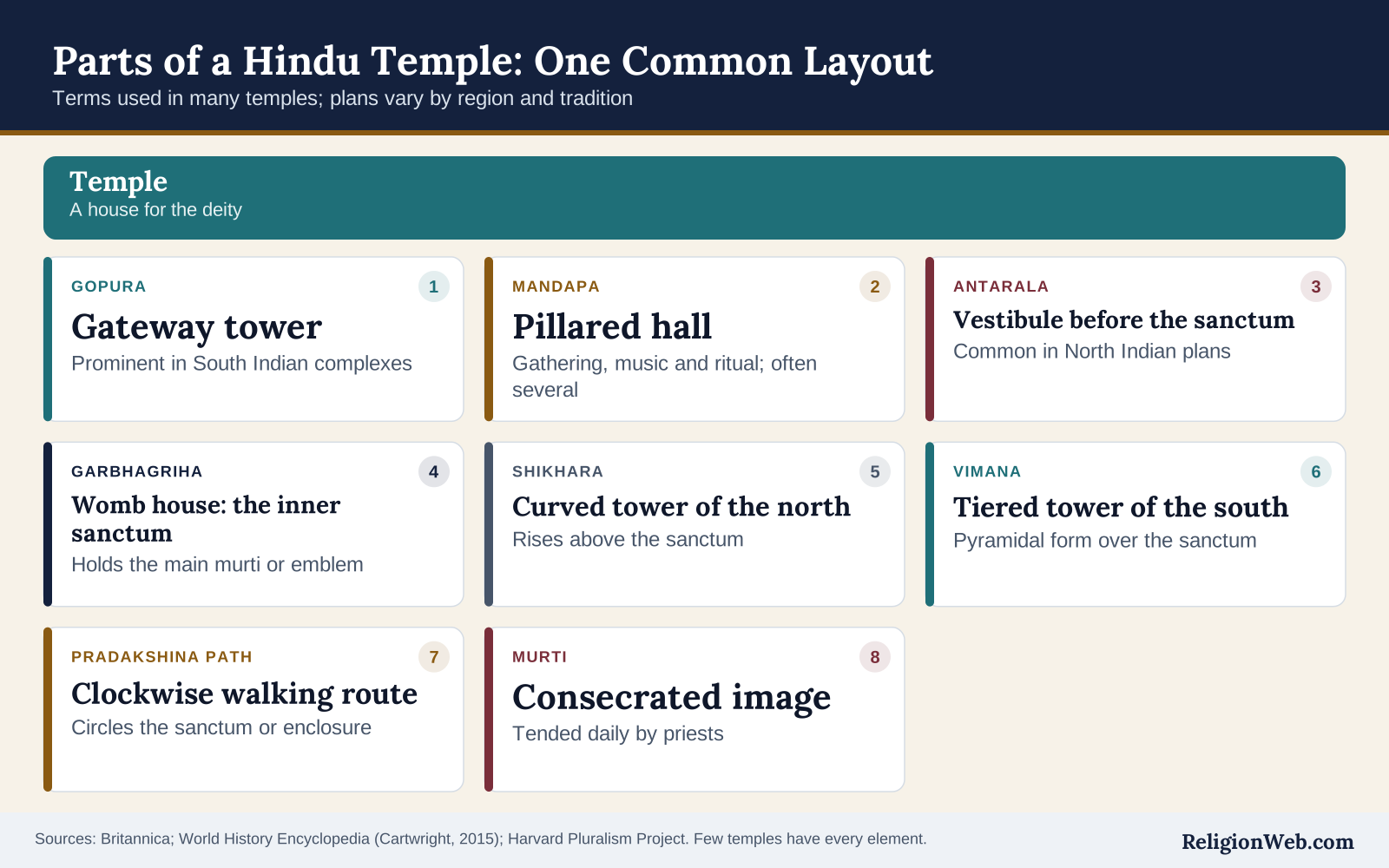
Most of the vocabulary used throughout this article can be introduced briefly here, and each term is explained in context in later sections. The table below collects the principal parts of a typical temple, with the caution that the terms are drawn from several regional and textual traditions and that few temples contain every element.
| Element | Meaning of the term | Role in the temple | Where it is most prominent |
|---|---|---|---|
| Garbhagriha | “Womb house,” the innermost chamber | Holds the main murti or emblem; the most sacred space | Almost all consecrated temples, in many forms |
| Mandapa | Pillared hall or portico | Gathering space for devotees, music, and rites; there may be several | North and South; larger temples have multiple halls |
| Antarala | Vestibule between hall and sanctum | Transition space before the sanctum | Common in North Indian plans |
| Shikhara | “Peak,” the tower over the sanctum | Marks the sacred center from outside; often curved in profile | North India and neighboring regions |
| Vimana | Tower or structure over the sanctum in the Dravida tradition | Pyramidal, tiered form that rises above the shrine | South India, including Tamil Nadu |
| Gopura (gopuram) | Gateway tower | Marks the approach through enclosure walls; can dominate the skyline | South Indian temple complexes |
| Pradakshina path | Clockwise circuit | Passage for circumambulating the sanctum or enclosure | Widespread, with different physical forms |
| Murti | Consecrated image | Receives worship in the sanctum; may be accompanied by a festival image | Almost all temples |
Words that name the acts of worship
A second set of terms names what people do. Darshan is the act of seeing the deity and being seen. Puja is the ritual of honoring a deity with offerings, and in a temple it is usually performed by a priest on behalf of devotees. Aarti, sometimes written arati, is the waving of a lamp before the image while a hymn or mantra is sung. Abhisheka is the ritual bathing of the image. Prasada is food or another substance offered to the deity and then returned to the worshiper as a blessing. Pradakshina is the clockwise walk around the sanctum, and pranama is the gesture of bowing or prostration. All of these are explained in the sections on worship and etiquette.
A third set names people and institutions. The priest may be called pujari, archaka, bhattar, gurukkal, shivacharya, panda or other titles depending on region and tradition, and the temple administration may be a family trust, a community committee, a monastic order, a state endowment board or a private trust. These roles are discussed in their own section, and the word sampradaya, meaning a lineage or tradition of teaching, appears throughout because many temples belong to one.
Origins and Historical Development of the Hindu Temple
Before the Permanent Temple: Altars, Shrines, and Early Images
Vedic ritual without a temple building
The oldest ritual system associated with the Vedas, described in the Vedas and Upanishads and in the ritual manuals that follow them, centered on fire altars built for specific occasions rather than on a permanent house for an image. Priests recited hymns, poured offerings of clarified butter and other substances into the fire, and then dismantled or let lapse the arrangements. In this system the deities were invoked to the sacrificial space for the duration of the rite. There was no standing building that held a deity continuously, and scholars of ritual generally treat this as an important contrast to the later temple tradition.
This does not mean that the Vedic world and the temple world are unrelated. The fire offering, the recitation of mantras, the idea of inviting a deity as a guest and the careful purification of the ritual space all continue in temple worship, often in transformed form. Many temple consecrations, including the ones described later in this article, still include a fire ritual (homa) performed by priests chanting Vedic and later texts.
Early shrines and the problem of dating
When the first shrines for images appeared is a question on which the evidence is thin and scholarship cautious. Reference summaries of the archaeology mention elliptical or apsidal shrine foundations at sites such as Besnagar and Nagari that are dated to roughly the third to first centuries BCE and are linked by some scholars to the early Bhagavata devotion to Vasudeva-Krishna. These identifications rest on limited remains, and specialists continue to debate their dating and their relationship to later temples. The safest statement is that devotional worship of images in some form existed in the centuries around the turn of the Common Era, and that the permanent stone or brick temple developed more fully in the first millennium CE.
Textual evidence is also hard to date. Grammarians, epics and devotional passages mention images and shrines, but whether a given reference points to a temple building in the later sense is often uncertain. Scholars of religion also remind readers that the Sanskrit and vernacular literatures use many words for sacred places, and not every one corresponds to what a modern visitor would call a temple.
Rock-cut caves and Buddhist architectural models
World History Encyclopedia’s overview of Hindu architecture, written by Mark Cartwright, states that the first Hindu temples were rock-cut caves influenced by Buddhist structures, and it gives the Udayagiri cave temples in the Malwa region, from the fifth century CE, as an example. The cave sanctuaries of the period, whether Buddhist, Jain or Hindu, shared techniques and craftspeople, and the plan of a carved shrine with a pillared hall in front of it set a pattern that later builders adapted in freestanding stone. This is a point of shared regional craft history, not a sign of derivation from any one tradition. Artisans moved between patrons, and the same workshops could serve different religious communities.
The Udayagiri caves are associated with an inscription dated to 401 CE in some summaries, which makes them among the best-dated early Hindu sanctuaries. The reliefs there, including images of Vishnu in his boar form, show that by the early fifth century monumental sculpture for Hindu deities was well established under Gupta patronage.
From Gupta Experiments to the Great Medieval Temples
The first freestanding stone temples
Freestanding temples of brick and stone appear in the Gupta period, from roughly the fourth to the sixth centuries CE, and the Dasavatara temple at Deogarh in central India, dedicated to Vishnu and dated by Cartwright to the sixth century, is among the best-known early examples. Early Gupta-era temples were typically small, with a modest flat-roofed sanctum, a porch and a square plan. Over time builders added a tower above the sanctum, an enclosed circumambulatory passage and more elaborate sculptural programs, and the shikhara, which becomes the defining feature of northern temples, developed from these early superstructures.
These experiments took place across a wide area, and different regions reached different solutions. Some reference works distinguish early northern forms such as the latina, a single curved tower, from later multi-part forms such as the shekhari, which attached smaller towers to the main one. The point to retain is that there was no single moment of invention and no single center from which the temple form spread.
Regional dynasties and the growth of temple complexes
From the seventh century onward, regional dynasties sponsored temple building at a new scale. In the Deccan and the south, the Pallavas built rock-cut and structural temples at Mamallapuram and Kanchipuram, and the Chalukyas experimented with northern and southern forms at Aihole, Badami and Pattadakal. The Rashtrakutas excavated the great Kailasa temple at Ellora, which Cartwright dates to about 770 CE, by carving it down from a hillside in a single design. In the north and east, the Chandella dynasty built the temples of Khajuraho between roughly 950 and 1050, and builders in Odisha produced the Lingaraja temple at Bhubaneswar and the Sun Temple at Konark.
UNESCO’s description of Konark attributes the temple to King Narasimha Deva I (1238 to 1264) in the thirteenth century and describes it as a monumental representation of the chariot of the sun god Surya. Its 24 wheels, each about three meters in diameter on the north and south sides, make the temple a rare case in which the building’s plan embodies a deity’s vehicle. The UNESCO text itself gives inconsistent figures for the number of horses, so this article does not repeat one.
The Chola temples and the culture of temple worship
The Chola dynasty, which ruled much of southern India from the ninth to the thirteenth century, made the temple the institutional center of its kingdom. UNESCO inscribed the Great Living Chola Temples in 1987, and its description says that the Brihadisvara Temple at Thanjavur, built under Rajaraja I, was inaugurated around 1003 to 1004 and consecrated in 1009 to 1010. Its sanctum tower, or vimana, is given as 59.82 meters high. The Chola temples at Gangaikondacholapuram (completed 1035, vimana about 53 meters) and Darasuram (twelfth century, vimana about 24 meters) are included in the same listing, and UNESCO emphasizes that they remain active places of worship.
Britannica’s entry on the Nayanar poet-saints adds an important detail about how these buildings were used. An inscription records that Rajaraja I (985 to 1014) introduced the singing of the Tamil Shaiva hymns, collected in the Tevaram, at the great temple of Thanjavur. Britannica’s entry on the Alvars similarly states that the Shrivaishnava leader Nathamuni, in the tenth century, gathered the Alvars’ hymns into the Nalayira Prabandham and introduced their regular singing in South Indian Vaishnava temples. Vernacular devotional poetry thus entered the temple liturgy in this period, and in many South Indian temples it still shapes the daily service, as discussed in the section on priests and temple staff.
Temples in Changing Political and Social Worlds
Royal patronage, endowments, and the fortunes of temples
For much of the medieval period, temples depended on gifts of land, money, jewelry and labor from kings, queens, merchants, guilds and ordinary worshipers, and inscriptions on temple walls record these endowments in detail. A temple of this kind functioned as an economic as well as a religious institution, employing priests, musicians, dancers, cooks, gardeners and accountants. Rulers of many religious backgrounds also took part in this economy, and the history of any single temple needs to be read from its own records.
The fortunes of temples also changed with wars and changes of power. Some were damaged, repurposed or lost patronage in conflicts, others were rebuilt or enlarged, and historians disagree about the scale, motives and context of particular episodes. Reference summaries of architecture note, for example, that building activity in northern India was reduced in the centuries after the eleventh century and that the Vijayanagara Empire in the south later added tall gateway towers to older temples. Because the evidence varies by region and reign, careful accounts avoid broad generalizations and name the dynasty, place and period.
Colonial administration and temple reform movements
Under British rule, the management of temple endowments was brought under legal frameworks, and a statutory board for temple matters in Madras was created by the Madras Hindu Religious Endowments Act of 1925. After independence, state laws such as Tamil Nadu’s Hindu Religious and Charitable Endowments Act of 1951 extended state supervision of many temples. The relationship between temple trusts and the state remains a live question in India and is discussed in the section on temples today.
Social reform also reshaped who could enter temples. The Vaikom Satyagraha, which ran from 30 March 1924 to 23 November 1925 in the princely state of Travancore, campaigned for public access to the roads around the Vaikom temple that had been closed to Ezhavas and communities then labeled untouchable. It ended in a compromise that opened three roads, with the eastern road and the temple itself opened only after the Temple Entry Proclamation of 1936. The Constitution of India, which came into force in 1950, authorizes laws “throwing open” Hindu religious institutions of a public character to all classes and sections of Hindus, and it defines the word Hindu in that clause to include Sikhs, Jains and Buddhists.
Temples beyond South Asia and in the modern diaspora
Hindu temple traditions traveled across the Indian Ocean and the Bay of Bengal long before the modern era. The Prambanan complex in central Java, a UNESCO site of the ninth century with three main temples dedicated to Shiva, Vishnu and Brahma, and the Angkor Wat complex in Cambodia, whose twelfth-century construction was dedicated to Vishnu in its original form, show Indian temple ideas adapted by local rulers and builders. Bali, where Hindu religious life continued through the centuries, developed a distinctive tradition of walled open-air temples called pura, and UNESCO’s 2012 listing of the Balinese subak landscape includes water temples such as Pura Ulun Danu Batur and Pura Taman Ayun.
The modern diaspora added a new chapter. From the nineteenth century Indian laborers and merchants carried temple traditions to the Caribbean, East and South Africa, Fiji, Mauritius and Southeast Asia, and after the 1960s migration to Britain, Canada, the United States and Australia led to purpose-built temples. In the United States, the Pluralism Project notes, one temple in Pittsburgh recreates the shrine of Venkateshvara at Tirupati and another in Massachusetts occupies a renovated former restaurant, a contrast that captures the range of resources and approaches.
| Period | Development | Examples or evidence | Source note |
|---|---|---|---|
| Vedic period (traditionally the second to first millennium BCE) | Ritual centered on fire altars built for the occasion | Descriptions in Vedic ritual texts | Ritual manuals; scholarly consensus |
| Third century BCE to first century BCE | Early shrine foundations for devotional worship | Besnagar and Nagari, linked by some scholars to Bhagavata worship | Reference summaries; dating debated |
| Fifth century CE | Rock-cut sanctuaries with monumental sculpture | Udayagiri caves, Malwa | World History Encyclopedia |
| Fourth to sixth century CE | First freestanding stone and brick temples | Dasavatara temple, Deogarh (sixth century) | World History Encyclopedia |
| Eighth century CE | Monumental rock-carved temple | Kailasa temple, Ellora (about 770 CE) | World History Encyclopedia |
| Tenth to eleventh century | Chandella and Chola monuments | Khajuraho (peak 950 to 1050); Brihadisvara, Thanjavur (consecrated 1009 to 1010) | UNESCO |
| Thirteenth century | Odisha Sun Temple conceived as a chariot | Konark, under Narasimha Deva I | UNESCO |
| 1924 to 1936 | Campaigns for temple access in Travancore | Vaikom Satyagraha; Temple Entry Proclamation (1936) | Reference summaries |
| 1950 onward | Constitutional framework for temple access and regulation | Article 25(2)(b) of the Constitution of India | Constitution text |
The Meaning of the Temple: Divine Presence, Cosmos, and Sacred Texts
The Deity Present in the Murti
How the image becomes a place of presence
The central idea of temple worship in most Hindu traditions is that a properly prepared image is not only a representation of a deity but a place where the deity is present for worship. The Harvard Pluralism Project describes the stone before consecration as still stone, and after consecration as “imbued with the permanent presence of God.” The transformation is brought about by a rite of installation, commonly called pratishtha, in which priests invoke the deity into the image, and the Pluralism Project describes two principal moments within it: the “opening of the eyes,” in which a craftsman carves or uncovers the pupils, and the prana pratishtha, or “establishing the breath,” in which the deity’s power is transferred to the image, sometimes through silver or gold threads strung from the fire altar to the figure.
The BAPS Swaminarayan Sanstha, which describes its own consecration practice on its website, outlines a longer series of rites based on the Pancharatra Agama: preparatory periods in which the image is immersed in water, grain and ghee, bathing with a hundred and eight substances, the uncovering of the eyes, a sixteen-part puja and the concluding transfer of life-force. Other traditions follow different manuals and different sequences, and some small village shrines use simpler rites. The common elements are a period of preparation, the invoking of the deity, the opening of the eyes and the beginning of daily worship.
Presence everywhere and presence here
A frequent question from outside the tradition is whether Hindus believe the deity is only in the image. The tradition’s own answer, stated by many teachers and summarized by the Pluralism Project, is that the Divine is present throughout the universe and has also chosen to be present in the image, so that the devotee has a place where meeting the deity is possible. The two claims are held together, not set against each other. A temple priest may therefore bathe and feed the murti as a living guest while also teaching that God is not limited to any form.
This outlook helps explain the variety of images. Philosophical schools differ on whether the highest reality is personal or impersonal, a theme addressed in the articles on moksha and on samsara and rebirth, but the temple tradition accommodates both by providing a form through which an unlimited reality can be approached. The English word “idol” is often used by outsiders and was historically a polemical term in some contexts. Hindu writers and scholars of religion generally prefer murti, vigraha or “sacred image,” and this article follows that usage.
What a consecrated image requires from the community
Consecration creates obligations. The Pluralism Project observes that after consecration “a priest must be in residence to offer honor, praise, and hospitality to the Divine guest every day,” whether or not anyone else is present. This is why temples keep a regular schedule of worship even on days with no visitors, and it is also why a temple that loses its priests or its funding faces a religious and not only a practical problem. In some traditions, an image that is damaged or neglected may be ritually retired, and a new image is installed; in others, repair rites restore the original. These practices vary and are governed by the relevant manuals.
The same logic explains restrictions on who may touch the image. In the Pluralism Project’s account, the laity may bathe the image during the consecration, calling it “the first and only time” they approach it directly, and after that the deity is normally attended only by priests who have undergone the required training and observances. These conventions are about ritual care of a sacred presence, and they are separate from the questions of caste and gender in priesthood discussed in the section on priests.
The Temple as Cosmos, Mountain, and Body
The temple as a map of the universe
Texts on temple building, known as the Vastu Shastras and Shilpa Shastras, treat the temple as a sacred diagram. World History Encyclopedia notes that the Vastu Shastras describe the temple as the sacred mountain Meru or Kailasa, and that the plan is organized by the eight cardinal directions, each guarded by a regent called a dikpala. Reference summaries add that the ground plan is often laid out on a grid of squares, commonly eight by eight (64) or nine by nine (81), with different zones associated with different classes of beings, and that builders used the grid as a guide that they adapted to local conditions, not as a rigid formula.
The tower rising over the sanctum is read in this system as the world mountain at the center of the universe, and the circuit of the pradakshina path is read as a movement around that center. For visitors the practical result is that a temple’s form, from the position of its entrance to the ascent of its tower, is meant to carry meaning. The details of the grid, the name often given to its central figure, the Vastu Purusha, and the rules of proportion are specialized subjects, and this article describes them only in outline.
The body as a temple, the heart as a sanctum
A second line of thought, found in the Upanishads, turns the building inward. The Chandogya Upanishad, in the passage that opens its eighth chapter, uses the language of a city and a palace to describe the human body and heart. In Max Müller’s translation in the Sacred Books of the East it reads:
There is this city of Brahman (the body), and in it the palace, the small lotus (of the heart), and in it that small ether. Now what exists within that small ether, that is to be sought for, that is to be understood.
Chandogya Upanishad 8.1.1, in The Upanishads, Part 1 (Sacred Books of the East, vol. 1), trans. F. Max Müller
The passage belongs to the Upanishadic tradition of inquiry into the self and Brahman, and it is not a description of a temple. Later teachers and poets nonetheless drew on its imagery. In the lineages that read the Upanishads as teaching the identity of the self with Brahman, the “small ether” in the heart is the ground of being the seeker must understand, and in devotional theologies the heart is the place where the Lord dwells. The tradition does not usually set the heart-sanctum and the built sanctum against each other. They are treated as two places where the same presence can be met, which is one reason the innermost chamber of a temple is called the “womb house.”
Temple walls, the four aims of life, and the sculpted world
Visitors are often surprised by the range of subjects carved on temple walls, which can include gods and goddesses, guardians, musicians, scenes from the epics, animals, foliage and, in some temples, couples in embrace. Vidya Dehejia of Columbia University, in the Metropolitan Museum of Art’s Heilbrunn Timeline of Art History, explains that a temple is dedicated to a deity and aims to help devotees reach moksha, liberation, but that its walls may also depict the other three aims of life recognized in Hindu thought: dharma, righteous conduct, artha, prosperity, and kama, pleasure and desire. This explains why sensuous and worldly images appear on a sacred building, and Dehejia notes that couples (mithunas) and similar motifs signify growth, abundance and prosperity.
The same essay observes that large niches on the sanctum’s three outer walls typically hold images of aspects of the enshrined deity, and that the halls and porch are also covered with figural sculpture. The temple exterior can thus be read as a book of the deity’s world, with the plain interior sanctum at the end of the journey. The concept of dharma and its relationship to the other aims is discussed in its own article.
The Texts That Govern Temples
Agamas: manuals of temple building and worship
Britannica describes the Agamas as post-Vedic scriptures that convey ritual knowledge, and as including the earliest codes of temple building, image making and religious procedure. Shaiva Agamas are usually dated by scholars from around the eighth century onward, while Vaishnava texts of the Pancharatra and Vaikhanasa schools and Shakta Tantras supply parallel manuals for their own traditions. Each text typically covers site selection, the proportions of the image and the building, the rites of installation, the daily and periodic worship, the festivals, and the duties of the priest.
An account recorded in the Indian Supreme Court’s 1996 judgment in A. S. Narayana Deekshitulu v. State of Andhra Pradesh describes how this knowledge works in practice: the Agamas are treated as manuals of ceremonial law, twenty-eight of them are associated with Shiva temples and the Pancharatra texts govern a large group of Vaishnava temples, while the Vaikhanasa Agama is associated with the Tirumala temple. The judgment records this as the position of the parties in the case and not as the Court’s own finding, and it is cited here only to show how the Agamic system is understood in legal and temple life.
Vaikhanasa, Pancharatra, and Shaiva Agamic worship
Temples that follow Agamic manuals do so in distinct schools. In Vaishnava worship, the Vaikhanasa tradition is traced to the sage Vikhanasa and is associated with hereditary priestly families and with temples such as Tirumala, which an explanatory 2026 blog post from a Dallas-area temple describes as emphasizing disciplined, sanctum-centered daily worship. The Pancharatra tradition, whose name refers to a teaching said to have been revealed over five nights, is associated with the Shrivaishnava acharyas and with a stronger emphasis on festivals and processions. One temple’s own explanation stresses that these are complementary and not rival currents within Vaishnavism, and that the choice of tradition for a given temple depends on lineage, region and how its deity was installed.
Shaiva temples follow Shaiva Agamas, and the Shaiva Siddhanta tradition of South India has its own detailed liturgy, discussed in the article on Shaivism. Shakta temples may follow Tantric ritual manuals, and the goddess traditions treated in the article on Shaktism include temples with distinct practices, some of which differ from the Vedic-derived rites of Brahmin priests. The existence of several systems is a reminder not to treat one manual as the single rule for all Hindu temples.
Traditions that do not center on images
Not every Hindu movement values the temple and its images in the same way. Britannica’s entry on the Arya Samaj, founded in 1875 by Dayananda Sarasvati, states that the movement opposes the worship of murtis and upholds the efficacy of Vedic oblations to the fire, so Arya Samaj congregations gather in halls for hymns, fire rituals and lectures. Britannica’s entry on the Lingayat community describes devotees who wear a small linga on a cord around the neck in place of the sacred thread and who are opposed to the worship of any image other than the linga. Lingayat tradition credits the twelfth-century teacher Basava with founding the community.
These examples show that the temple is central to many forms of Hindu religion but not to all of them. The article on yoga in Hinduism describes paths in which the practitioner’s inner discipline is the primary place of worship, and many householders combine temple visits with such practices. Hindu thought has long included both image-centered devotion and approaches that stress inner realization or fire ritual, and the traditions treat each other with a range of attitudes, from complementarity to criticism.
Layout and Architecture of a Hindu Temple
From the Gate to the Sanctum
The approach, the gateway, and the courtyard
A large temple is entered through stages. The visitor first meets an outer boundary, which in South India is often a high wall pierced by one or more gateway towers called gopuras. World History Encyclopedia notes that in southern complexes the gateway “became even more massive and ornate than the temple itself” over time, which is why a skyline in Tamil Nadu is often dominated by painted gateway towers rather than by the sanctum tower. Inside the wall there may be a sequence of courtyards, a water tank used for ritual bathing and purification, a flagstaff, an offering stone and a hall for the deity’s mount, such as a bull facing a Shiva shrine.
The Himalayan Academy, a Shaiva institution that publishes a guide to visiting temples, lists a similar sequence of features in its description of a South Indian temple: the gopura as the entrance tower, the prakara as the outer hallway for circumambulation, the dhvajastambha as the flagpole, the balipitha as the offering place, the mahamandapa as the central hall and the garbhagriha as the sanctum, with smaller shrines for other deities set around them. These terms belong chiefly to the Agamic tradition of the south, and a northern temple may have a different list of parts.
The mandapa: halls for gathering, music, and ritual
Britannica defines the mandapa as a pillared hall or portico found in Hindu temples. It is the gathering space for devotees, connecting the sanctum to the outside, and its walls and ceilings are often decorated with carvings, friezes and murals depicting mythology. In North Indian temples, one or more mandapas lead to the main shrine and are joined to the sanctum by a vestibule called the antarala, which may be open or closed. Southern temples also use mandapas, often with elaborate decoration, and larger complexes may have several for different purposes: a hall for the festival image, a hall for music and dance, a hall of a thousand pillars used for ceremonial gatherings, or a hall for the vehicle of the deity.
In daily life the mandapa is where people stand or sit during worship, where hymns are sung, where devotional lectures take place and where visitors wait for the curtain to open for darshan. Because it is a transition between the public world and the sanctum, it often has a stepped threshold, a bell, and an increasing sense of enclosure as one approaches the center.
The pradakshina path and the idea of circling the center
Many temples have a covered or open path around the sanctum for pradakshina, the clockwise circumambulation that keeps the right side of the body toward the sacred object. Some plans enclose this passage within the sanctum’s outer wall, others place it in a surrounding courtyard, and large complexes have several concentric paths. The practice is described in the Himalayan Academy’s visitor guide, which suggests walking clockwise around the main shrine one, three, five, seven or nine times, and in other traditions the number of circuits depends on the deity or on a vow.
The practice is not limited to the sanctum. Devotees may circle the whole temple, a sacred tree, a hill or even a city, as in the pilgrimage circuits discussed later. The logic is the same: the devotee keeps the sacred at the center and moves around it with respect.
The Sanctum and Its Towers
The garbhagriha: the womb house
Britannica describes the garbhagriha as the innermost sanctuary of a Hindu temple, often translated as “womb house,” and as the most sacred space within the temple, housing the primary deity or emblem. World History Encyclopedia calls it “a small window-less shrine room located at the very heart of the temple.” The sanctum is typically small, dim and plain by comparison with the exterior, lit by oil lamps and the camphor flame of the aarti, and the light that reaches the image is carefully controlled. The Hindu American Foundation’s 2017 booklet on how Hindus worship notes that the exterior is often intricately carved while the interior is plain with the murti as its only major feature.
What stands in the sanctum depends on the temple’s dedication. It may be an anthropomorphic image of Vishnu, Devi or Hanuman, a linga for Shiva, a pair of images such as Radha and Krishna, or an emblem such as a footprint or a stone. Some temples have several sanctums within one complex, each with its own deity. The sanctum is usually entered only by the temple priests, and devotees see the image from the threshold or from the hall beyond.
The shikhara: towers of the north
Above the sanctum, northern temples rise in a tower called a shikhara, a word meaning “peak.” Britannica defines the northern or Nagara style as characterized by its distinctive shikhara, a tower-like superstructure rising above the garbhagriha, and notes that it is produced throughout northern India, reaching as far south as Bijapur district in northern Karnataka. World History Encyclopedia describes the shikhara as “a huge corbelled tower” whose profile curves inward as it rises and carries a series of niche-like forms called gavakshas, and the walls of the building project in stepped faces called rathas.
The shikhara marks the center of the temple from afar and gives the sanctum a vertical axis. Its profile differs by region: in Odisha the tower is a steep curved form with a flattened crown, while at Khajuraho a cluster of smaller towers climbs toward the main summit, creating what is often compared to a mountain range. These variations are discussed in the regional section.
The vimana and the Dravida tower
Temples in the Dravida tradition of the south rise over the sanctum in a pyramidal tower called a vimana, built in diminishing tiers and topped by a dome-like crown. World History Encyclopedia describes it as more dome-like with cornices than the northern curved tower, and UNESCO gives the height of the vimana of the Brihadisvara Temple at Thanjavur as 59.82 meters. The gateway towers may in later periods overshadow it, so visitors to many southern temples first see the gopura and find the vimana only once they reach the inner court.
The tiers are often decorated with small replicas of shrines and with sculpture, and the vimana is crowned with a finial. The tower is closely tied to the sanctum below it, and in rituals of renewal, discussed in the festivals section, water is poured over the crowning finial.
Planning, Craft, and Materials
The sthapati and the role of the architect
The Hindu American Foundation states that Hindu temples are typically designed under Vastu Shastra, with a sthapati, a religious architect, guiding site selection, layout, dimensions and materials. A sthapati is both a craftsman and a ritual specialist who works from a tradition of texts and workshop practice, often handed down in a family, and the stone carvers, bronze casters and painters who work under him also belong to hereditary or trained lineages. The temple building is, in this view, a ritual act and not simply an engineering project, so the laying of the foundation, the placing of the first stone and the setting of the sanctum are accompanied by ceremonies.
In the diaspora many temples are built by teams of craftsmen brought from India, who carve components in stone workshops in India and ship them for assembly abroad. The Pluralism Project notes that temples in the United States may also be adapted from existing buildings, such as a former restaurant in Massachusetts, in which case the sanctum and shrine are consecrated within a repurposed structure and the exterior may not follow any traditional form.
Stone, brick, wood, and metal
Building materials follow local geology and climate. Sandstone is the material of Khajuraho, as UNESCO notes, and granite is used in much of South India. Brick and terracotta characterize the temples of Bengal, wood is the medium of Kerala’s sloping-roofed temples and of the pagoda-style temples of Nepal, and bamboo and thatch form the basis of many village shrines. The choice of material affects the building’s form. A wooden roof with deep eaves suits a monsoon climate, a granite vimana can be stacked in precise courses, and terracotta panels allow narrative scenes in low relief.
The images inside also have material traditions. Main images in many South Indian temples are carved from stone, while festival images are usually cast in an alloy of five metals, called panchaloha, which makes them light enough to carry in procession. These choices are matters of ritual as well as craft, because each type of image has its own rules for consecration and care.
Temples that adapt, grow, and are rebuilt
A temple is not a finished monument. Many consist of layers added over centuries, so that a visitor to a large South Indian complex may pass through gateways of different dates before reaching the original sanctum. Fire, flood, earthquake and war have caused damage, and communities have rebuilt temples in new styles or on the same plan. In modern times, a temple may be renovated, enlarged or reconsecrated, a process that includes a renewal ceremony, the kumbhabhishekam, discussed in the festivals section.
It follows that a temple’s architecture is a record of its patrons and craftspeople as well as an expression of doctrine. For readers who want to identify what they see, the simplest approach is to ask which region the building is in, which tradition it belongs to, and which period each part comes from, and then to read the plan as a layered text.
Regional Styles and Architectural Terminology: Why Hindu Temples Do Not Share One Plan
North India and the Nagara Tradition
The Nagara plan and its tower
The northern tradition, called Nagara in the old architectural texts, is easiest to recognize by its tower. The shikhara rises above the sanctum as a curved, tapering form, usually crowned with a ribbed disk and a finial, and the building below it is arranged along an axis from an entrance porch through one or more halls to the sanctum. World History Encyclopedia notes that the northern tower curves as it rises and that its walls are broken into projecting faces called rathas, with up to seven on each side in mature examples. Many northern temples stand on a raised platform and are approached by steps, so that the worshiper ascends toward the sanctum.
Within the tradition, reference works distinguish sub-types by the tower’s silhouette, including the single-spire latina, the multi-tower shekhari and the roof type called valabhi. These are classifications used by historians of architecture, and temple builders and priests may not use the same terms. The important point for a general reader is that “northern” describes a family of forms, not a single design.
Odisha: the rekha deul, the jagamohana, and the chariot temple
The temples of Odisha, historically called Kalinga, form one of the most distinctive northern regional schools. Reference summaries describe the sanctum tower as a rekha deul, a steep curved tower, usually fronted by a hall with a pyramidal roof, the jagamohana, with later additions for dance and offering. The Lingaraja temple at Bhubaneswar is a major example. UNESCO’s description of the Sun Temple at Konark, dated to the thirteenth century under Narasimha Deva I, emphasizes that the temple is conceived as the chariot of the sun god Surya, with elaborately carved wheels and horses, and the building thus translates a mythic image into architecture.
Britannica’s note on the Jagannath temple at Puri, which it describes as a twelfth-century complex in the Nagara style with a shikhara, shows how the same regional tradition serves a Vaishnava shrine. Its deities are wooden images of Jagannatha, a form of Krishna, his brother Balabhadra and his sister Subhadra, and its chariot festival is described in the section on festivals.
Khajuraho and the Chandella temples of central India
UNESCO inscribed the Khajuraho Group of Monuments in 1986. Its description attributes the temples to the Chandella dynasty at its peak between 950 and 1050, and it notes that the temples belong to two faiths, Hinduism and Jainism. The Nagara-style temples are built of sandstone, each stands on a raised platform called a jagati, and each has a shikhara over the sanctum, with a plan running from an entrance porch through a main hall and vestibule to the sanctum. UNESCO says about twenty temples survive, while the Outstanding Universal Value section counts twenty-three and some translations speak of twenty-two of an original eighty-five, so the figures depend on how one counts.
The sculpture at Khajuraho is integrated into the architecture. Dehejia’s essay on Hindu art explains the conception: couples and other motifs on temple walls are linked with abundance and prosperity, and the walls represent the full range of human aims. Reading the temples as erotic sites to be viewed in isolation misses this context, a point also taken up in the misconceptions section.
South India and the Dravida Tradition
Pallava and Chola temples
The southern tradition takes its name from the Tamil-speaking region, Dravida, and is distinguished by the pyramidal vimana over the sanctum. Reference summaries date the structural temples of the Pallavas, including those at Mamallapuram and Kanchipuram, to roughly the seventh to ninth centuries, and the shore temple at Mamallapuram is commonly dated to the eighth century. The Chola period carried the tradition to monumental scale, as in the UNESCO-listed temples at Thanjavur, Gangaikondacholapuram and Darasuram, whose vimana heights range from about 24 to nearly 60 meters.
The Chola temples were built as centers of ritual, music, dance and bronze casting. UNESCO’s description says that they show the achievements of Chola architecture, sculpture, painting and bronze casting, and that they remain active places of worship. This continuity is what sets them apart from many of the world’s ancient monuments, because a visitor today can see priests performing the same daily services that the building was designed to house.
Gateway towers, temple cities, and the Vijayanagara and Nayaka eras
In later centuries, South Indian temples expanded outward. Reference summaries of architectural history note that the Vijayanagara Empire, which flourished from the fourteenth to the sixteenth century, added tall gateway towers to older temples, and the successor Nayaka rulers continued the practice. The result is the multi-courtyard temple city, in which concentric walls, streets and halls enclose a central sanctum and in which the largest gateways stand at the outer edge. In places such as Madurai, Srirangam and Chidambaram, the surrounding streets are used for festival processions, and the chariots grow larger as the processions move to the wider outer streets.
World History Encyclopedia’s account of Chidambaram’s Nataraja temple, which it dates to the twelfth century, and of other southern complexes mentions features such as the nandi mandapa, the walled courtyard and the shala-type roof, and it stresses that the southern gateway, the gopura, can end up larger than the temple itself. For the visitor, this means that the sense of approach is protracted, with the sanctum reached after passing through successive thresholds.
Kerala: wood, sloping roofs, and strict customs
Kerala developed its own southern variant, shaped by heavy monsoon rains and abundant timber. Reference summaries describe Kerala temples as a sub-style of Dravida architecture, often with a sloping, tiled or copper-sheathed roof, a circular or square sanctum and a surrounding wall rather than a monumental gateway. The sanctum is called the sreekovil in Malayalam, and the temple has its own set of ritual practices, with a distinctive style of music and temple arts. Dress customs in some Kerala temples are strict, in line with the practice, noted by the Hindu American Foundation, of certain temples that ask men to enter bare-chested in an unsewn cloth.
The Sabarimala temple in Kerala, dedicated to the celibate deity Ayyappan, has been the subject of a prominent legal dispute over the entry of women between the ages of ten and fifty, discussed in the section on access. The point here is architectural: Kerala shows how a regional tradition has its own material and ritual character, and that it should not be treated as an offshoot of Tamil Nadu forms.
Other Regional Traditions and Temples Abroad
The Deccan and the Vesara idea
Between the northern and southern traditions lies a zone in the Deccan plateau, especially in what is now Karnataka, where builders under the Chalukyas, Rashtrakutas and Hoysalas combined features of both. Texts classify this hybrid as Vesara, and reference summaries associate it with the Chalukyan region of northern Karnataka. The Rashtrakuta Kailasa temple at Ellora, dated by World History Encyclopedia to about 770 CE, belongs to this wider southern world but is unique in being carved from the living rock. The Hoysala temples of the twelfth and thirteenth centuries are known for their star-shaped platforms and finely carved stone.
Scholars use the Nagara, Dravida and Vesara labels as a starting point, and they caution that the real map of temple building is more complex. Architectural boundaries cross political ones, and a single dynasty may have built in more than one style.
Bengal, the Himalayas, and Nepal
In Bengal, the lack of local stone and the heavy rainfall led to brick and terracotta temples. Reference summaries describe three types: the chala temple, with curved hut-like roofs, the ratna temple, with multiple spires, and the dalan temple, with a flat roof. The terracotta panels of Bengal temples, which can illustrate episodes from the epics and scenes of local life, are among the most distinctive features of the region’s art.
The Himalayan regions have wooden temples with tiered roofs, and the Kathmandu Valley in Nepal is known for pagoda-style temples with stacked roofs, such as the great Shaiva shrine of Pashupatinath. A popular explanation repeated in reference summaries is that the stacked-roof form derives from the shape of Himalayan fir trees, which is better read as an illustration than as a settled finding. The valley’s temples also illustrate the close relations between Hindu and Buddhist traditions in Nepal, whose artisans have shared techniques and imagery.
Southeast Asia and Bali
Indian temple ideas reached Southeast Asia in the first millennium, and local builders developed their own forms. UNESCO’s description of the Prambanan complex in Java identifies the ninth-century temples as dedicated to Shiva, Vishnu and Brahma, with reliefs illustrating the Ramayana, set at the center of concentric square enclosures. Angkor Wat in Cambodia, inscribed by UNESCO in 1992, shows how Khmer builders adapted Indian models, though the UNESCO page consulted for this article does not detail its original dedication.
On Bali, Hindu worship continues in walled, mostly open-air temples called pura, with split gateways and multi-roofed shrines. UNESCO’s description of the Balinese cultural landscape says that water temples have, since the eleventh century, coordinated the cooperative management of rice terraces, and that the Tri Hita Karana philosophy, bringing together the spiritual, human and natural realms, grew from cultural exchange between Bali and India over roughly two thousand years. This shows a temple tradition that is Hindu in origin but distinctively Balinese in form and function.
| Tradition or region | Typical sanctum tower | Characteristic features | Example |
|---|---|---|---|
| Nagara (north India) | Shikhara: curved, tapering tower | Raised platform; axial plan with porch, hall, vestibule (antarala), sanctum | Khajuraho temples (Chandella, 950 to 1050) |
| Odisha (Kalinga) | Rekha deul: steep curved tower | Fronting hall (jagamohana); intricate carving | Lingaraja, Bhubaneswar; Konark; Jagannath, Puri |
| Dravida (south India) | Vimana: tiered pyramidal tower | Gateway towers (gopuras), courtyards, large halls, water tanks | Brihadisvara, Thanjavur (consecrated 1009 to 1010) |
| Vesara (Deccan, Karnataka) | Hybrid forms | Mixture of northern and southern features | Chalukya and Hoysala temples |
| Kerala | Sloping roof over round or square sanctum | Timber, tiled or copper roofs; encircling wall | Regional temples with a sreekovil |
| Bengal | Chala, ratna, dalan types | Brick and terracotta; curved hut-style roofs | Terracotta temples of Bengal |
| Himalaya and Nepal | Tiered pagoda-style roofs | Wood and brick; carved struts | Pashupatinath, Kathmandu Valley |
| Java and Bali | Stone towers (candi) in Java; multi-roofed shrines (meru) in Bali | Concentric enclosures; walled open-air courtyards in Bali | Prambanan; Pura Taman Ayun |
Deities, Images, and the Many Kinds of Temple
Whom Temples Honor
Vishnu and his forms
Vaishnava temples are dedicated to Vishnu or to one of his forms, which the tradition teaches include Rama and Krishna. The shrine may hold the god in a standing form, as in the great temple of Venkateshvara at Tirupati in Andhra Pradesh, in a reclining form on the serpent Shesha, or with his consorts Lakshmi and Bhudevi. Temples to Krishna often present him with Radha or with Rukmini, and the festivals of birth and play are described in the articles on Krishna and Janmashtami. In Odisha, Jagannatha, Balabhadra and Subhadra are carved in wood and renewed periodically, and the distinct form of these images is a reminder that Vaishnava temple iconography is not uniform.
The Alvar poet-saints of the Tamil country, whom Britannica dates broadly to the seventh to tenth centuries, are honored in Shrivaishnava temples, and their hymns are sung in worship. The theological and devotional background is explained in the article on Vaishnavism.
Shiva, the linga, and Shaiva sanctums
In Shaiva temples the principal object of worship is most often the linga, an upright, rounded stone set in a base, which Shaiva traditions understand as an emblem of Shiva beyond form, while many temples also contain images of Shiva in human form and of his family. World History Encyclopedia notes that the garbhagriha of a Shiva temple housed the deity’s symbol, such as a linga. The famous bronze images of Shiva as Nataraja, the lord of the dance, are a particular feature of Chola-period South India, and the Nataraja temple at Chidambaram is a celebrated center of worship. The meanings of these forms are discussed in the article on Shiva.
Shaiva temples often include a Nandi, the bull who serves as Shiva’s mount, facing the sanctum, as well as shrines to Ganesha, Murugan or Parvati. The Pluralism Project notes that the Geeta Temple in Elmhurst, New York, includes shrines for all twelve of the jyotirlingas, the famous Shaiva sites in India, so that devotees abroad can take darshan of all of them in one place. This kind of replication is common in the diaspora and shows how sacred geography is carried in temple design.
The Goddess in temples
Temples to the Goddess honor her under many names, among them Durga, Kali, Lakshmi, Parvati, Meenakshi, Kamakshi and local forms. In Shakta traditions the goddess is the supreme power, not a consort, and her temples can have a distinct ritual style that includes Tantric forms of worship and, in some regions, animal offerings that other Hindus do not practice. The articles on Shaktism and Durga trace these ideas, and Navaratri is the principal festival in which Goddess temples fill with worshipers.
Because the Goddess is also worshiped as the village protector, many local temples are dedicated to a regional goddess who is not identified with a pan-Indian figure. Such temples may be tended by priests from the local community, and their rituals differ from the Sanskrit-based worship of temples that follow the Agamas. This difference is one reason scholars speak of Hindu temple traditions in the plural.
Ganesha, Hanuman, and other widely honored deities
Some deities appear in many temples. Ganesha, the remover of obstacles, is often honored first, and the Himalayan Academy’s visitor guide advises worshiping Ganesha before other deities in the temple. Hanuman, the devotee of Rama, has temples throughout northern India and in the diaspora, and his images are often smeared with vermilion. Murugan (Karttikeya) is especially honored in Tamil Nadu and in Tamil communities abroad, and Ayyappan is the focus of the Sabarimala pilgrimage.
Smaller shrines for these deities often sit within the precincts of a larger temple. A temple dedicated to Shiva may contain separate shrines for Ganesha, Murugan, Parvati and the nine planetary deities, and a temple to Vishnu may include shrines for his consort, the Alvar saints and Hanuman. A visit often involves moving among these shrines in a customary order.
The Varieties of Images and Emblems
The main image and the festival image
A temple often has two kinds of main image. The principal image installed in the sanctum, called the mulavar or mula murti in South Indian usage, normally stays in place, and is usually stone. A smaller, portable image, the utsava murti or festival image, is usually of bronze or an alloy, and represents the deity in processions. Reference summaries explain that the utsava murti stands in for the main image when the deity goes out, so that the stone image never leaves the sanctum, and that the festival image receives its own ritual bathing and care.
This arrangement allows a temple to take the deity to the people, through streets, on chariots and in palanquins, while preserving the stationary center. It also explains why festival processions are described as the deity “going out” and why the return to the sanctum is a ritual moment in its own right.
Aniconic emblems: linga, shaligrama, yantra, and footprints
Not all sacred objects in temples are images of a human or animal form. The Shiva linga is the best-known aniconic emblem. Vaishnava worship uses the shaligrama, a fossil stone from the Gandaki river region of Nepal, as a form of Vishnu, and goddess temples may center on a yantra, a geometric diagram, or on a stone, a pit or a natural formation regarded as the deity’s presence. Footprints of deities or saints, called padukas, are honored at some shrines.
These emblems show that the question “what does the temple worship?” has more than one kind of answer. The tradition does not treat the human-form image as the only way for the divine to be present, and some of the most intense places of pilgrimage focus on a stone, a hill or a natural cave.
Subsidiary shrines and the order of a visit
A large temple is rarely a single shrine. Around the central sanctum may stand shrines to the deity’s consort, to attendant saints, to guardian figures and to deities such as Ganesha and the planetary gods. Agamic texts prescribe the arrangement in some detail, placing certain deities in particular directions, and the layout provides the order in which many visitors circulate. The Himalayan Academy’s guide recommends beginning with Ganesha and then visiting each shrine, greeting the deity and offering a flower.
Such guidance reflects one tradition’s customs. Another temple may begin with the main deity, or ask devotees to go straight to the sanctum, and the priests will normally explain local practice. This article describes a typical sequence in the worship section but stresses that the order varies.
Temples Shaped by Movements and Lineages
Movement temples with their own manuals
Some temples belong to organized devotional movements that give their own definition of how worship should be done. The BAPS Swaminarayan Sanstha, a Vaishnava movement originating in Gujarat, publishes the rites of its image consecration on its website, and the sequence it describes is drawn from the Pancharatra Agama. In such movements, the temple often combines worship of the main deities with the teachings of a lineage of spiritual leaders and a program of community service, and large new temples built by such groups in India and abroad are designed according to the sthapati traditions with local adaptations.
Other movements follow similar patterns, such as the Gaudiya Vaishnava temples associated with the International Society for Krishna Consciousness (ISKCON), which emphasize congregational chanting of the Krishna names alongside deity worship. Each of these organizations publishes its own guidance for visitors, and readers are encouraged to consult it when planning a visit.
Monastic centers and their temples
Some Hindu temples are linked to monastic centers called mathas or ashrams, whose heads are teachers in a lineage. The Shankaracharya centers of the Advaita tradition, the Ramanuja and Madhva centers of Vaishnava traditions and the Shaiva Siddhanta monasteries of Tamil Nadu all maintain temples and rituals. In such cases the temple’s priests may be monastics or may serve under a monastic head, and the relationship between temple and lineage affects how decisions are made.
The result is a temple landscape with overlapping forms of authority: the priestly family, the lineage head, the trust, the state in some cases and the donors and devotees. This overlap is a source of strength and also of dispute, as the later section on temples today shows.
Priests, Temple Staff, and Visitors: Who Does What
Who Serves in a Temple
Archakas, pujaris, and the priesthoods of the temple
The priest of a temple is called by different names in different regions and traditions. Pujari is the common northern term and means one who performs puja. Archaka (also spelled archakar) is widely used in the south and in the Sanskrit manuals, and other titles include bhattar in Shrivaishnava and Vaikhanasa contexts, gurukkal or shivacharya in Shaiva temples, and panda for priests at some pilgrimage centers. What the titles share is the function of performing the daily services for the deity on behalf of the community, and what distinguishes them is the lineage, the texts and the training that qualify a person to serve.
In Agamic temples, the right to enter the sanctum and touch the image has traditionally been held by priests who have been trained and initiated in the temple’s tradition. The Hindu American Foundation notes that a temple affiliated with a sampradaya may impose additional requirements on its priests. The 1996 Supreme Court judgment in A. S. Narayana Deekshitulu v. State of Andhra Pradesh records the petitioners’ account that only a qualified archaka may enter the garbhagriha after the prescribed daily discipline and that the archaka alone performs daily rituals, because touch by others would defile the image. That description is not the whole picture of Hindu priesthood, but it captures the Agamic ideal on which many temples operate.
Musicians, reciters, cooks, and other specialists
A functioning temple relies on many roles besides the priest. The Hindu American Foundation notes that in Tamil temples, Odhuvars, singers of Tamil liturgy, are an integral part of most worship ceremonies, which connects directly to the order of Rajaraja I, recorded in an inscription, to introduce Tamil hymn singing at Thanjavur. Other roles include nadaswaram and drum players who sound the temple’s music at set points, Vedic reciters, garland makers, lamp tenders, those who draw ritual patterns, cooks who prepare the offerings, treasurers, and guards. The foundation adds that food served in a temple is considered sacred, and that temple kitchens avoid meat and limit onion and garlic.
In large temples these functions may be assigned to families or guilds that have held them for generations, while in newer diaspora temples volunteers and paid staff fill many of them. The smooth working of a daily service therefore depends on cooperation among people with different skills and statuses, and a visitor who notices only the priest sees a small part of the whole.
Who runs the temple: families, trusts, lineages, and the state
Management is distinct from priestly service. Some temples are owned by a family, often descended from the founder, who appoint the priests and manage the income. Others are controlled by a community trust, a monastic lineage, a movement’s headquarters or a registered society. In several Indian states, as the section on temples today explains, many large temples are administered by government endowment departments, and temples elsewhere in the world are generally run as nonprofit organizations governed by boards.
These arrangements affect the experience of visitors, from the prices of special services to the language of announcements. They also affect disputes: when a temple has a hereditary priesthood, a trust and a state board, a question about who may decide on ritual or finances may involve all three.
Who May Worship, and the Debates over Access
Caste, temple entry, and the law
Access to temples has a contested history that a reference article should state plainly. In many regions, communities classified by the caste system as lower or as untouchable were barred from entering temples, or from walking on the roads around them, until reform movements and law changed the situation. The Vaikom Satyagraha of 1924 to 1925 in Travancore, in which activists demanded public access to the roads around a temple, ended with a compromise that opened three roads, and temple entry for all castes in the state followed with the Temple Entry Proclamation of 1936. The Constitution of India of 1950 abolished untouchability and, in Article 25(2)(b), allows the state to throw open Hindu religious institutions of a public character to all classes and sections of Hindus.
Practice has changed unevenly since then. Many temples are open to all Hindus, and the great majority of temples in the diaspora have no caste restrictions, but discrimination in specific places and roles has been reported and legally contested. The Hindu traditions themselves include strong voices on both sides, from reformers who regarded caste exclusion as a violation of dharma to ritual specialists who defended hereditary rules, and the question remains a part of public debate.
Priestly appointments and the Supreme Court
One long-running debate concerns who may be appointed as a priest. In Tamil Nadu, the state government’s Hindu Religious and Charitable Endowments department announced on 14 August 2021 the appointment of trained archakas from various castes to temples under its administration, a move reported as part of a long-running reform effort. The earlier Supreme Court decision in the Adi Saiva Sivachariyargal case in December 2015, as reported by the legal news service LiveLaw, held that appointments of archakas must follow the Agamas applicable to the particular temple, subject to constitutional limits, and that a distinction not based on caste or birth does not by itself violate the Constitution.
The positions in this debate are not simply traditional against modern. Supporters of Agamic specificity argue that the right of a temple to follow its own ritual manual is part of religious freedom and that training matters more than birth, and reform advocates argue that capable, trained candidates from all castes should be eligible. Observers on each side have also reported cases of non-Brahmin trained priests facing difficulty in practice. The legal and social situation continues to develop and varies from state to state.
Gender, Sabarimala, and non-Hindu visitors
Women are the majority of worshipers in many temples, and Pew’s survey in India found that Hindu women report performing puja at home more often than men. Restrictions on women in some contexts are customary and specific, and the best known is at Sabarimala in Kerala, where the deity Ayyappan is regarded as celibate and where women and girls between the ages of ten and fifty were barred by custom. The Kerala High Court upheld the bar in 1991, and in a 4 to 1 decision on 28 September 2018 the Supreme Court of India ruled that women of all ages may enter. The decision led to protests, and in November 2019 a five-judge bench referred review petitions to a larger bench. A reference summary written in spring 2026 reports that hearings before a larger bench began in April 2026, so the matter should be treated as unsettled and the reader should check current reports.
Entry for non-Hindus differs by temple. Most temples are open to the public and welcome visitors, as the Hindu American Foundation states, but a few, including the Jagannath temple in Puri, are known to restrict entry to Hindus. The issue has been discussed in Indian courts and in the media, and rules can change, so a visitor should check with the specific temple. Many such temples offer viewing of the spires or festival processions from outside, and the chariot festival at Puri is open to anyone along the route.
| Role | Common titles | Principal functions | Notes on variation |
|---|---|---|---|
| Priest | Pujari, archaka, bhattar, gurukkal, shivacharya | Performs daily worship, bathes and dresses the image, offers food, waves the lamp | Qualification, lineage and training vary by Agama and tradition |
| Reciters and singers | Vedic reciters; Odhuvars in Tamil temples | Chant Sanskrit and vernacular hymns during worship | Tamil hymns of the Nayanars and Alvars are sung in many southern temples |
| Instrumentalists | Nadaswaram and drum players | Mark moments of the service with music | Strongest in South Indian temple traditions |
| Kitchen and flower staff | Cooks, garland makers | Prepare offerings and decorations | Food in the temple is considered sacred; many avoid meat |
| Administrators | Trustees, executive officers, committees | Manage finances, schedules, property and events | Family, trust, lineage or state endowment; varies by region |
| Devotees and visitors | Worshipers, pilgrims, tourists | Take darshan, offer prayers and gifts, receive prasad | Rules on dress and entry differ by temple |
| Teachers and gurus | Acharyas, swamis | Give lectures, lead chanting, advise on practice | Common in lineage-based and movement temples |
Worship in the Temple: Darshan, Puja, Aarti, and the Daily Cycle
Worship in a Hindu temple has no single script, but three acts recur across most traditions: seeing the deity, offering something to the deity through the priest, and receiving something back. These are darshan, puja and prasada, and the lamp ritual called aarti links them. The following sections describe each act, then walk through a typical visit as one common pattern among several. The general theory of puja, including its history and the sixteen-part model, is covered in the dedicated article on puja, and this section concentrates on how it works in a temple.

Darshan: Seeing and Being Seen
What the word means
Britannica defines darshan as “the beholding of a deity (especially in image form), revered person, or sacred object,” and adds that the experience is considered to be reciprocal, in that the viewer receives a blessing. The Sanskrit word comes from a root meaning “to see,” and in modern Hindi and other languages it is also used for a formal visit, an audience or a viewing. The Harvard Pluralism Project writes that the term is central to Hindu worship and that worshipers come to the temple “to be held reciprocally in the Divine gaze.”
The scholar Diana Eck, whose book Darsan: Seeing the Divine Image in India remains the standard English-language study, explains in an excerpt that darsan means “seeing” and that in the Hindu ritual tradition it refers especially to religious seeing, “to see and be seen by the deity.” She adds that seeing in this religious sense is not initiated by the worshiper alone, because the deity presents itself to be seen in its image, and she notes the common idiom in Hindi of people “taking darsan” (darsan lena). The word thus describes an encounter in which the image is active and not merely an object of the gaze.
How darshan is arranged in practice
In many temples the sanctum is hidden from view for much of the day, and the opening of a curtain or screen marks the moment when darshan begins. The Hindu American Foundation’s booklet describes how, at set times, the screen is pulled back so that worshipers can view the murti, which is decorated with flower garlands. In large temples the arrangement is more complex, with queues, timed entry and different categories of darshan, from free general access to paid or ticketed forms, and the popular pilgrimage sites handle very large numbers of visitors each day.
The experience of darshan is shaped by the temple’s design. The dim sanctum, the light of lamps, the gleam of silver or gold, the flowers and the central position of the image on the axis from the entrance all direct attention toward the deity’s eyes. Many worshipers fold their hands, close their own eyes briefly and then open them to meet the image’s gaze. For many, the quiet moment before the image is the center of the visit, more important than any other ritual action.
Darshan beyond the temple doors
Darshan is not limited to temples. Britannica notes that gurus give darshan to followers, rulers to subjects, and pilgrimage shrines to visitors. It also observes that chariot festivals, in which images of gods are carried through the streets, allow people once barred from the temple to receive darshan of the deity. A sage or a teacher may be visited for darshan, a sacred river or mountain may be seen as a form of the divine, and a festival procession brings the deity out into public view.
This wider use of the word shows that a temple is one important setting for a larger practice of seeing and being seen, and it explains why a procession through the streets is so important. For people who for historical or personal reasons could not enter, the chariot has been a way of encountering the deity.
The Daily Cycle of Temple Worship
From waking the deity to rest at night
In temples that follow Agamic manuals, the day is organized around a cycle of services that treat the deity as a living guest. The Tirumala Tirupati Devasthanams, the body that administers the temple of Venkateshvara at Tirumala, publishes a daily schedule on its website, and the one posted for 20 October 2026 begins well before dawn with the Suprabhatam, the hymn of awakening, followed by the Thomala Seva, an early service of garlanding, then the Koluvu and Panchanga Sravanam, in which the day’s calendar is read to the deity, and the Sahasranama Archana, the recitation of the thousand names. The final service of the night, the Ekanta Seva, puts the deity to rest. The exact times change with season and festival and are not given here.
Other temples divide the day differently. Some Shaiva temples hold services at several fixed times between dawn and night, and smaller temples may have only a morning and an evening service. The common thread is that the deity is awakened, bathed, dressed, offered food and honored with lamps at regular times, and put to rest at night. As the Pluralism Project puts it, the priest offers “honor, praise, and hospitality to the Divine guest every day.”
Abhisheka, dressing, and decoration
One of the central acts of temple worship is abhisheka, the ritual bathing of the image with water, milk, curd, honey, clarified butter, sandalwood paste and other substances, accompanied by mantras. The Pluralism Project mentions a weekly abhishekam in the temples it describes, and reference summaries describe the bathing of festival images in milk, curd, honey and sugar. After the bath the image is dried, dressed in cloth, adorned with jewelry and garlands and marked with the distinctive signs of its tradition, such as the namam in Vaishnava temples or the three lines of ash in Shaiva ones.
The decoration itself is a form of worship, called alankara, and many temples take pride in the daily and festival dressing of their images. Devotees may attend specifically to see the deity in a particular costume or to witness the bathing, and some temples schedule bathings at times convenient for visitors.
Hymns, music, and recitation
Sound is as important as sight. Priests chant Sanskrit mantras, and in many regions hymns in the vernacular are sung as well. As noted earlier, Britannica reports that the singing of the Tamil Shaiva hymns of the Nayanars was introduced at Thanjavur by Rajaraja I, and that Nathamuni introduced the regular singing of the Alvars’ hymns in South Indian Vaishnava temples. In the north, bhajans and kirtans, devotional songs in Hindi, Bengali, Gujarati and other languages, are sung by gatherings of worshipers, often in the mandapa after the main service.
The Hindu American Foundation notes that worship in a temple is usually not congregational in the sense of a sermon-based service, although some temples hold group mantra chanting. The soundscape of a temple, with its bell, drums, conch, wind instrument and voices, forms part of the way the worshiper experiences the presence of the deity.
A Visit to a Temple, Step by Step
Arrival, purification, and entering
A visitor typically arrives with clean clothes and sometimes an offering such as flowers, fruit or a coconut. Shoes are removed at a designated place, and many temples provide a place to wash the hands and feet. The Himalayan Academy’s guide describes raising the hands in prayer at the entrance, rinsing the mouth, hands and feet where facilities are provided, and praying at the flagstaff before entering, and the Hindu American Foundation notes that many temples have a brass bell near the entrance that devotees ring to refocus their minds.
Some temples also expect devotees to bow, touch the threshold or prostrate. The Foundation describes bowing and touching the head to the ground as a way of expressing humility. Individual temples may differ in these details, and visitors are encouraged to watch what others do or ask a volunteer.
Circling, standing before the deity, and the priest’s puja
After entering, visitors often walk clockwise around the sanctum and then stand before the deity. In the Himalayan Academy’s account, one sits and attends during the puja, standing for the final part, and then prostrates; in other temples visitors remain standing in a queue and take darshan briefly before moving on. In all cases the priest performs the offerings on behalf of the community, presenting flowers, water, incense, food and a lamp, with chanting. A devotee may ask for a personal puja, called archana, in which the priest recites the names of the deity and the devotee’s own name and family lineage. The Himalayan Academy lists archana as an option after the main worship.
The devotee’s inner attitude is the traditional center of the act. In the Bhagavad Gita, in the translation by Kashinath Trimbak Telang, Krishna extends the idea of offering from ritual objects to the whole of life:
Whatever you do, O son of Kuntî! whatever you eat, whatever sacrifice you make, whatever you give, whatever penance you perform, do that as offered to me.
Bhagavad Gita 9.27, trans. K. T. Telang, Sacred Books of the East, vol. 8 (1882)
Devotional commentators in the Bhagavad Gita tradition read this verse as a summary of bhakti, the path of loving devotion, and the Gita itself does not describe a temple or an image. The verse is cited here because temple ritual is understood within the tradition as an outward form of the attention it describes, in which a gesture as small as a flower is meant to carry the intention of offering everything.
Aarti, blessings, and departure
The climax of many services is aarti, in which the priest waves a lamp, often a tray with a camphor flame or several wicks, before the image, accompanied by a bell and a hymn. Afterward the priest or an attendant carries the lamp to the worshipers, who pass their hands over the flame and draw them toward their eyes. The Hindu American Foundation’s booklet describes the order: after darshan, the priest sings a hymn while performing aarti, and then offers worshipers holy water, a tilak (forehead mark) and prasad, usually a sweet or flowers. The Himalayan Academy adds ash, sandalwood paste and a flower to the list.
Many visitors then sit in the hall for a time, sing, meditate or recite a mantra, give a gift to the donation box, and leave without turning their backs to the deity where this is the custom. The visit may last ten minutes or several hours depending on the occasion, and some devotees return daily.
| Stage | What usually happens | Typical meaning given | Variation |
|---|---|---|---|
| Preparation | Bathing, clean clothes, offerings gathered | Purity and respect for a sacred place | Standards of dress and offerings differ by temple |
| Entering | Shoes removed; bell rung; bow or prostration at the entrance | Humility; shifting attention to the sacred | Some temples have flagstaff, tank and shrine for Ganesha first |
| Circumambulation | Clockwise walk around the sanctum or enclosure | Keeping the sacred at the center | Number of circuits varies; sometimes done after darshan |
| Darshan | Standing before the image when the curtain is open | Seeing and being seen by the deity | Queues, timed entry and ticketed lines at large temples |
| Priest’s puja | Offerings of flowers, water, incense, food and light, with chanting | Hospitality and honor to the deity | Sequence follows the temple’s Agama or manual |
| Aarti | Lamp waved before the image; bell; hymn | Light offered; light received | Time and hymn differ; common in most traditions |
| Blessings and prasad | Holy water, tilak, ash, flower, blessed food | Grace returned from the deity | Substances and food differ by tradition |
| Staying or leaving | Sitting, singing, meditation, donations | Gratitude and reflection | Some stay for lectures or community meals |
Offerings, Prasad, Dress, and Etiquette
What Worshipers Offer
Flowers, fruit, coconuts, and lamps
The simplest gifts are the most common. The Hindu American Foundation says that bringing a flower, fruit or other item is common but not required and describes it as an act of service that can deepen devotion. A coconut broken before the deity in many southern and western temples, a garland, a few coins, a lamp of clarified butter or oil, and camphor are other frequent offerings, and each tradition may have preferred items for particular deities, such as the leaves of the bilva tree for Shiva or tulsi (holy basil) for Vishnu. Pew’s survey in India found that 72 percent of Hindus keep a tulsi plant at home, which shows how widespread the plant’s religious use is.
The scriptural anchor for this attitude is a verse from the Bhagavad Gita that the article on puja discusses at greater length. In Telang’s translation, Krishna says:
Whoever with devotion offers me leaf, flower, fruit, water, that, presented with devotion, I accept from him whose self is pure.
Bhagavad Gita 9.26, trans. K. T. Telang, Sacred Books of the East, vol. 8 (1882)
Devotional traditions read the verse as an assurance that what matters is the spirit of the gift and not its cost, and the verse is often quoted in temples to explain why a single flower is welcome. The Gita does not mention temples, so the connection is a matter of later application.
Money, service, and giving
Money is a regular part of temple giving. The Hindu American Foundation’s booklet says that offerings of fruit or flowers are often returned with blessings and that money is also accepted, and temples commonly have a donation box or a tray at the aarti. Devotees may also pay for particular services, such as a special puja in their name, the sponsoring of a day’s food or flowers, or a festival expense. For large temples, these gifts support the daily services, the staff and the temple’s charitable work. For small temples, they may be the only income.
Service is also an offering. Volunteers help cook, clean, decorate and manage crowds, and in diaspora temples much of the work is done by members who see it as a form of devotion. The Pluralism Project describes the temple as a place where worshipers cultivate “the arts of hospitality, honor, and praise” toward God, and the same attitudes are directed toward fellow visitors in the form of shared meals and welcome.
Items to leave at home
Some objects are not welcome. The Hindu American Foundation’s booklet advises avoiding leather products out of respect for cows, and temple kitchens avoid meat and limit onion and garlic. Alcohol, tobacco and meat are not brought into most temples. Practices on photography vary: some temples forbid it in the sanctum or inside the building, and others allow it in public areas, so it is best to follow posted signs.
These customs reflect concern for purity and respect for the shared space. They are not uniform, and a temple in a different tradition may emphasize other things, such as the unsewn cloth that some temples require of men.
Prasad and Sacred Food
Offered first, then returned as a blessing
Prasada (also prasad, prasadam) is food or another substance that has been offered to the deity and then returned to the worshiper. The Hindu American Foundation notes that puja items are passed around after worship as a blessed gift, called prasadam, and the booklet says the priest offers worshipers holy water, a tilak and prasad, usually a sweet or flowers. In the logic of the tradition, the deity receives the essence of the offering, and what remains becomes a vehicle of grace. The word itself is related to a Sanskrit term for favor, clarity or graciousness, which is explored further in the article on puja.
The offering is first presented to the deity, often behind a curtain, and then distributed. Typical items include sweets, rice dishes, fruits, coconut pieces, sacred ash, flowers and blessed water, and a visitor may be given more than one. Receiving it with the right hand or both hands is customary, as the Himalayan Academy notes, and many people keep a portion to share with family members who could not come.
Temple kitchens and community meals
Many temples run substantial kitchens. The Hindu American Foundation states that prasadam is prepared in the temple kitchen and that “any and all food served in a Hindu temple is considered sacred.” Large temples serve thousands of meals a day, and some, such as the famous temples of Tirumala and Puri, are known for their prasad traditions. The preparation follows rules of cleanliness and often vegetarian restrictions, and the cooks work under the temple’s authority.
Community meals, often free, are part of the social life of many temples. In diaspora temples, a shared meal after a Sunday program or a festival is a common way for members to meet. The meal is understood by many worshipers as a continuation of the worship, a point connected to the idea of hospitality that underlies the whole temple tradition.
Dress and Etiquette for Visitors
Clothing, footwear, and cleanliness
The Hindu American Foundation’s guide for visitors, published in June 2024 and written by Syama Allard, advises wearing clean, modest clothing, which for both men and women generally means not wearing shorts and keeping the shoulders covered, and it notes that some temples are stricter, requiring men to go shirtless and wear unsewn cloth. Shoes are removed before entering the temple proper, and the removal area may be outside the complex or in a designated spot inside. The guide says that removing dirty shoes is a courtesy because temple spaces are communal.
Most visitors find that a few simple practices suffice: arrive with clean hands and feet, dress in a way that would suit a place of worship, and ask if unsure. At large pilgrimage temples, such as those with strict dress codes, signs and staff give clear instructions. Visitors who are menstruating may be asked to refrain from entering in some temples, a custom that varies widely by region and tradition and is disputed within Hindu communities, so it is best to ask locally.
Behavior inside the temple
The tone inside a temple is respectful but not silent. The Himalayan Academy’s guide advises giving and receiving with the right hand or both hands, keeping the mind on worship and not on worldly matters, and notes that expressing emotion is considered appropriate. Devotees may sing, chant or pray aloud. Many temples ask visitors not to point the feet toward the sanctum, not to touch the image unless invited and not to step over offerings, and they request quiet in meditation areas.
Bowing and prostration are common. The Foundation’s guide describes bowing and touching the head to the ground as building humility. Visitors who prefer not to prostrate usually fold their hands in the gesture of greeting, called namaskara, which is accepted in any temple.
Visitors who are not Hindu
The Hindu American Foundation states that most Hindu temples are usually open to the public and should be treated as sacred spaces. The Himalayan Academy’s guide explains temple customs for both Hindus and non-Hindus. Visitors will often be offered prasad or a blessing, and it is acceptable to accept it politely or to decline. A small number of temples limit entry to Hindus, as described earlier, and some places within a temple, notably the sanctum, are reserved for priests regardless of the visitor’s identity.
Guidance for visitors is best taken from the temple itself. Many temples have a website, a notice board or volunteers who explain what to do. Tour groups arriving at a temple should be respectful of worshipers’ attention, avoid blocking the darshan line and refrain from treating a living place of worship as a museum.
| Item or practice | What happens | Meaning commonly given | Note on variation |
|---|---|---|---|
| Flowers and garlands | Given to the priest to place before the image | Devotion offered freely (Gita 9.26) | Preferred flowers and leaves differ by deity |
| Fruit and coconut | Offered; coconut sometimes broken before the deity | Giving of the first and best; humility | Coconut-breaking is stronger in some regions |
| Lamp and camphor | Oil or ghee lamp lit; camphor flame in aarti | Light dispelling darkness | Light is received by worshipers who pass hands over it |
| Prasad | Offered food returned to worshipers | Grace shared from the deity | Sweets, rice, fruit; varies by temple |
| Donations | Money placed in box or tray | Support for worship and charity | Special services may be sponsored |
| Dress | Modest, clean; shoulders covered; no shorts | Respect for a communal sacred space | Some temples require unsewn cloth for men |
| Footwear | Removed before entering | Cleanliness; courtesy | Location of shoe removal varies |
| Bowing and prostration | Head to the ground or folded hands | Humility and respect | Folded hands accepted everywhere |
Temple Festivals and the Ritual Calendar
The Rhythm of the Year
Daily, weekly, and monthly observances
Besides the daily services, temples observe days that recur on the lunar calendar. Many deities are associated with particular days of the week or with lunar days, so that Vishnu temples may be especially busy on the eleventh day of each lunar fortnight, Shiva temples on certain evenings, and Goddess temples on Fridays or on the days of the waxing moon. These customs are widespread but vary by region and temple, and a local calendar, called a panchanga, gives the dates.
The lunisolar basis of the Hindu calendar means that festivals do not fall on the same Gregorian date every year. Months follow the moon, with an extra month inserted periodically to keep them aligned with the seasons, and festivals are fixed to lunar days within a named month. A reader who needs a date for a given year should consult the calendar published by the relevant temple or community, and this article therefore gives rules and not dates.
The annual festival and the Brahmotsavam
Most large temples have one annual festival that is their principal celebration. In South India it is often called the Brahmotsavam or mahotsavam. Reference summaries explain that the name means the “festival of Brahma,” that it is classified by length as five, seven or nine days (and in Tamil Nadu often ten), and that it begins with the raising of a flag on the temple’s flagstaff and ends with its lowering. Each day the festival image of the deity is taken in procession on a different vehicle, such as a sun or moon disk, a bull, a serpent, an elephant or the bird Garuda, and the festival typically climaxes in a chariot procession through the streets. The Tirumala Brahmotsavam is described as lasting nine days.
The festival is both a ritual of renewal and a social event. Streets are decorated, music and dance are performed, and large crowds gather to see the deity in procession. Local communities, trusts and guilds each have traditional roles, and the festival may draw pilgrims from far away.
Why festival dates move
The same lunisolar logic applies to the major pan-Indian festivals. Festivals are tied to specific lunar days in particular months of the calendar, so the Gregorian date shifts from year to year, and regional calendars sometimes differ in the month they use because of different ways of counting months. This is why neighboring communities may observe the same festival on different days, and why a temple’s published schedule is the authoritative guide.
For this reason, the article does not list dates for 2026 or 2027. The articles on Diwali, Navaratri, Holi and Janmashtami each explain the calendar rule for that festival.
Great Festivals as Seen in Temples
Diwali, Navaratri, and Holi
Several of the best-known festivals are celebrated both at home and in temples. At Diwali, temples are lit with lamps, and many hold special worship of Lakshmi and, in some traditions, a food offering heaped before the deity at the “mountain of food” ceremony, as the article on Diwali explains. During Navaratri, the nine nights devoted to the Goddess, Goddess temples hold daily worship and in some regions communal dance, while many temples host recitations and processions. At Holi, Krishna temples in the Braj region and elsewhere hold special celebrations with colored powder and songs.
Each of these festivals has its own detailed practice, which the dedicated articles describe. Here the point is that the temple is a stage on which these seasonal observances are shared by the larger community, with special decorations, music, services and food.
Janmashtami, Shivaratri, and other deity festivals
Janmashtami, the celebration of Krishna’s birth, is observed in Vaishnava temples with fasting, vigil and a midnight moment when the birth is marked, in many places with the opening of a curtain on an image of the infant Krishna. Maha Shivaratri, the great night of Shiva, is observed in Shaiva temples with vigil, repeated bathing of the linga and chanting. Other festivals honor Rama’s birth, the birthday of Hanuman, the festival of Ganesha in the late summer and the days of the Goddess, and individual temples have their own anniversaries and local festivals. The article on Ganesha describes the festival that brings public processions in many cities.
Because of the variety of Hindu festivals, a temple’s year is rarely quiet. A large temple may hold dozens of observances annually, ranging from small private rites to large public processions, and the priests, staff and volunteers plan around them.
Chariot festivals and processions
Processions take the deity out of the temple. Britannica describes the Rath Yatra, or Chariot Festival, at Puri as held annually in June or July, when devotees pull the wagons bearing the images of Jagannatha, Balabhadra and Subhadra through the town. The same Britannica entry notes that the English word “juggernaut” comes from the massive wagons used in the festival. Similar chariot festivals take place at many temples in South India, where the festival image is carried on a large wooden car, and in the diaspora, where smaller chariots are drawn through city streets.
These events are the occasions on which the idea of darshan reaches the largest audience. Britannica notes that chariot festivals have allowed people who were not allowed to enter the temple to receive darshan of the deity. A procession is therefore both a ritual and a public statement about who may see the deity.
Consecration and Renewal
Installing the deity: the first consecration
The first consecration of a temple is its founding moment. As described earlier, the process includes preparatory rites, the installation of the main image, the opening of the eyes and the transfer of the deity’s power, all carried out by priests according to the temple’s manual. The BAPS organization describes a multi-day sequence that includes homas and the final rite of establishing life in the image, and the Pluralism Project describes the carved pupils and the mirror.
After consecration, daily worship begins and the temple is considered inhabited. In many temples the date of the consecration is remembered as the temple’s anniversary and celebrated each year.
Kumbhabhishekam: the renewal of the temple
The Pluralism Project describes the kumbhabhishekam as “the most important ritual in the life of a newly built temple” and defines it as “sprinkling (abhishekam) the temple with sacred waters brought in a water pot (kumbha).” The rites run over several days. They begin with the honoring of Ganesha and prayers to the earth, and priests tie protective threads around their wrists. A large tent beside the temple becomes a fire-offering hall with brick altars surrounded by hundreds of pots of water, often Ganges water with water from local rivers, each topped with mango leaves and a coconut. Priests kindle fires, chant and make offerings, and the ceremony ends with a completion rite, after which the largest pot is carried in procession and the water sprinkled over the temple’s towers and the crowd.
In India, a kumbhabhishekam is also performed for older temples after renovation, and it is repeated periodically, often at intervals of about twelve years, though this varies. The reference to the Hindu Temple of Atlanta, whose kumbhabhishekam took place in 1991 according to the Education About Asia review of Eck’s Darsan, shows the same rite carried out in the diaspora.
Anniversaries, rebuilding, and temporary relocation
When a temple is rebuilt or repaired, the image may be moved to a temporary shrine, and the festival image takes its role during the work. Reference summaries refer to this practice as balalayam in the Tamil context. After the work is complete, the main image is returned and the rites of renewal are performed.
The Pluralism Project adds that communities mark the anniversary of the consecration every year as one of the temple’s major festivals. A temple’s calendar therefore includes the story of its own founding as well as the cycles of the Hindu year.
| Festival or event | What happens in temples | Calendar logic | Related article |
|---|---|---|---|
| Brahmotsavam (annual festival) | Flag hoisting, daily processions on different vehicles, chariot procession | Fixed by each temple’s own tradition; nine, ten or fewer days | This article |
| Diwali | Lamps, special worship, food offerings | Lunisolar; dates move each year | Diwali |
| Navaratri | Nine nights of Goddess worship, dance and recitation | Lunisolar; begins on the first lunar day of a bright fortnight | Navaratri |
| Janmashtami | Fasting, vigil, midnight birth ceremony | Lunar day in the dark fortnight of the month in which Krishna’s birth is remembered | Janmashtami |
| Holi | Colored powder, songs, bonfire in many regions | Full moon of the spring month | Holi |
| Rath Yatra (Puri) | Chariots of Jagannatha, Balabhadra and Subhadra drawn through town | Annual, in June or July | This article |
| Kumbhabhishekam | Multi-day fire rites; water poured over towers | Set by priests with astrological timing, not on a fixed annual date | This article |
Pilgrimage Temples and Sacred Geography
Temples as Destinations
Tirtha: places of crossing
In Hindu thought a tirtha is a crossing place, a spot where the divine and human worlds come close. Rivers, mountains, forests, springs and cities may all be tirthas, and many of the most important temples stand at such places. A pilgrimage, called tirtha yatra, usually has a goal such as darshan of a particular deity, bathing in a sacred river, fulfilling a vow or performing rites for ancestors. It is typically understood as a source of spiritual merit and renewal, and not as an obligation in the sense that a ritual duty might be.
The Hindu American Foundation’s booklet distinguishes kinds of ritual, noting that daily (nitya) rituals such as puja are done every day, while festival (naimittika) and pilgrimage (kamya) rituals are tied to special times and sacred sites. A pilgrimage to a temple therefore sits within a wider structure of obligatory, occasional and optional practices.
Tirumala, Puri, and the great pilgrimage centers
Some temples draw visitors from across the subcontinent and beyond. The temple of Venkateshvara at Tirumala, administered by the Tirumala Tirupati Devasthanams, is a major Vaishnava pilgrimage center, and the Pluralism Project notes that a temple in Pittsburgh recreates its shrine for American devotees. The Jagannath temple at Puri, in the Nagara style, is a center of Vaishnava devotion in Odisha, with the famous chariot festival. Other pilgrimage temples include the Meenakshi temple at Madurai, the Nataraja temple at Chidambaram, the Kashi Vishwanath temple at Varanasi, the Vaishno Devi shrine in the Himalayan foothills and the Pashupatinath temple in Nepal.
These temples have their own customs. Pilgrimage routines often include a ritual bath, a queue for darshan lasting hours at peak times, the purchase of prasad to take home, and visits to nearby shrines. Large temples have extensive facilities and officials to manage crowds, and pilgrims are advised to check current rules and times before traveling.
Vows, discipline, and the pilgrim’s journey
Pilgrimage frequently involves a vow. A family may promise to visit a temple if a wish is fulfilled, or a person may undertake a period of discipline before a pilgrimage. The Sabarimala pilgrimage, for example, is associated with a period of austerity observed before the journey. The pilgrim may travel on foot, carry an offering or walk barefoot, and the journey itself is understood as part of the devotion.
Religious practice does not substitute for medical care, and pilgrimage sites often involve heat, crowds and long walks. Pilgrims with health conditions are advised to consult a physician before undertaking a demanding journey, and temple authorities commonly provide medical stations at major sites during peak seasons.
Networks of Sacred Sites
Jyotirlingas, Shakti Pithas, and Divya Desams
Sacred sites are often linked in sets. Shaiva tradition speaks of twelve jyotirlingas, sites where Shiva is said to have appeared as a pillar of light, and the Pluralism Project notes that a temple in Elmhurst, New York, includes shrines for all twelve. Shakta tradition recognizes a network of Shakti Pithas, sites linked with the body of the Goddess in a well-known story, and Shrivaishnava tradition honors the 108 Divya Desams, temples praised in the hymns of the Alvars. Britannica states that the Alvars lived in roughly the seventh to tenth centuries and sang in praise of Vishnu in Tamil, and that Nathamuni collected their hymns in the tenth century.
These networks give pilgrims a framework for travel, and a pilgrimage may aim to visit the whole set or a part of it. They also illustrate how a temple belongs to a larger devotional geography, and how tradition links places by narrative and song.
Char Dham and other circuits
Other circuits link temples across the subcontinent. The Char Dham, or four abodes, is often described as comprising Badrinath in the north, Dwarka in the west, Puri in the east and Rameswaram in the south, and a separate Himalayan circuit of four shrines in Uttarakhand has become a popular pilgrimage in recent decades. Local circuits circle a hill or a city, such as the walking of the path around the sacred hill at Tiruvannamalai.
The details of these circuits vary by tradition and are described differently in different sources, so a visitor interested in a specific route should consult the temple or official pilgrimage authority. The unifying idea is that the whole land is traversed by sacred paths.
Rivers, the Kumbh Mela, and temple towns
Many temple towns stand on rivers, and bathing is an important part of the pilgrimage. At Varanasi, Prayagraj, Haridwar, Ujjain and Nashik the river bank is as significant as the temples. The Kumbh Mela, the great periodic gathering at four river sites, is a pilgrimage centered on bathing and on the monastic orders of ascetics, and it is described in its own article. Temple towns also support markets, guesthouses, music traditions and craft industries, and the economy of a pilgrimage center may depend on the flow of visitors.
For many Hindus, pilgrimage is the extension of daily devotion into travel, and a trip to a famous temple often begins and ends with the same acts of darshan, offering and prasad that a local temple provides.

Hindu Temples Today: India, the Diaspora, Law, and Community Life
Temples in India Today
How often Hindus visit and worship
The best recent evidence on temple practice comes from the Pew Research Center’s face-to-face survey of 29,999 adults in India, conducted before the COVID-19 lockdowns and published in 2021. It found that 53 percent of Hindus say they perform puja at a temple at least weekly, that 76 percent perform puja at home at least weekly, and that 59 percent pray daily. Women reported higher rates of weekly home puja than men (84 percent against 68 percent), and the figures for temples were closer (55 percent against 51 percent). The report also notes regional differences, with Hindus in the Eastern region generally less likely than Hindus elsewhere to perform puja weekly at home or at a temple.
These numbers are self-reports and describe India only. They indicate that temple worship is a frequent practice for a majority of Hindus but that it is complemented by home devotion, and they also show that different regions and social groups differ in their habits. The global picture is broader: Pew’s 2025 study estimated about 1.2 billion Hindus in 2020, or 14.9 percent of the world’s population, with 95 percent in India.
Who governs temples: trusts and state endowments
In India, the legal framework for temples differs by state. A summary by the Drishti IAS educational service, written in October 2024, explains that in Tamil Nadu the Hindu Religious and Charitable Endowments department oversees temple finances and appointments under a 1951 act, that the head of the Tirumala Tirupati Devasthanams is appointed by the Andhra Pradesh government, that the Shri Mata Vaishno Devi Shrine in Jammu and Kashmir is governed by a 1988 act, and that a Madras statute of 1925 had created a statutory board for temple affairs. The constitutional basis lies in Article 25, which guarantees freedom of religion while allowing the state to regulate economic, financial, political or secular activity associated with it, and in Article 26(d), which gives religious denominations the right to manage their own affairs. In the 1954 case Shirur Mutt, the Supreme Court held that denominations have such a right but that the state may regulate administration.
The same summary sets out the arguments in the continuing public debate. Supporters of state oversight say it promotes transparency, protects temple funds from misappropriation and enforces social reform such as access for all castes. Critics say it can lead to political interference, that it treats Hindu institutions differently from those of other religions, and that it undermines the right of communities to manage their own temples. The summary mentions a controversy over the quality of ghee in the Tirumala laddus in 2024 as the occasion for renewed discussion. This article reports the arguments and does not take sides.
Heritage, tourism, and living worship
Many temples are both active places of worship and heritage monuments. UNESCO stresses that the Great Living Chola Temples remain active places of worship, and the Khajuraho and Konark temples, also on the World Heritage List, draw large numbers of visitors who come as tourists as well as pilgrims. Managing this overlap means balancing conservation, access, safety and the needs of daily ritual, and it can involve the Archaeological Survey of India, state departments, temple trusts and local priests.
For visitors, the practical consequence is that the same site may have a worship area and a tourist area, with separate rules. Visitors should follow signs and stay out of areas reserved for worship unless invited. A site’s historic importance does not suspend its religious character.
Temples Abroad
Growth and the purpose of diaspora temples
The Hindu American Foundation puts the number of temples in the United States at nearly 1,000, and the Pluralism Project describes rapid growth in recent decades. Temples abroad often begin in a rented room or a converted building, and over years they raise funds to build a purpose-designed structure with a traditional sanctum and tower. Because the Hindu population in a given city is often drawn from many regions of India and the Indian diaspora, a single temple may host multiple deities and serve devotees who speak different languages, an arrangement that differs from the usual pattern in India, where temples are often tied to a specific deity and region.
Diaspora temples take on roles beyond worship. They offer language classes, youth programs, cultural events, support for new immigrants and interfaith activities. The Education About Asia review of Eck’s Darsan notes that Hindus abroad seek darshan and that the Hindu Temple of Atlanta serves as the heart of the local Indian community, and the Pluralism Project’s description of American temples reflects the same dual character.
Adapting traditions to new settings
Adaptation takes many forms. Priests may be trained in India or in the United States, and the services may be scheduled for weekends to suit working families. Temples may combine deities that would be separate in India, such as Shiva, Vishnu and the Goddess, in a single hall, and they may add facilities such as a community kitchen, a library or a hall for events. The Pluralism Project describes temples that reproduce Indian pilgrimage sites, from the Tirupati shrine in Pittsburgh to the twelve jyotirlinga shrines in Elmhurst, New York, which allows devotees to experience sacred geography in one place.
The question of how much to adapt is debated by community members. Some value fidelity to a regional or sectarian form of worship, and others prefer a broader inclusive style, and the balance reached differs from temple to temple.
Large new temples and craftsmanship
In recent decades several movements have built large temples abroad using traditional stone carving. The carving is often done in India by hereditary craftsmen working under sthapati guidance and then assembled on site, and these buildings draw both worshipers and visitors. Their scale and detail have made them landmarks, and they are described in the movements’ own publications, which readers should consult for the facts of each building.
At the same time, small temples continue to serve neighborhoods in modest buildings, and the Pluralism Project’s example of a temple that occupies a renovated restaurant is a reminder that the sanctity of a temple comes from its consecration and use and not from the grandeur of its architecture.
Contemporary Questions
Online services and cautions against fraud
Many temples now offer online booking of services, live-streamed darshan and electronic donations. Temple authorities have also warned about fraud. The Shree Jagannath Temple Administration at Puri, in a notice issued ahead of the 2022 Rath Yatra, said that it does not accept donations or offerings for online puja and warned against fraudulent websites. Devotees using online services are advised to use the temple’s official channels and to confirm any website with the temple itself.
The idea that darshan can be received on a screen is itself a matter of discussion within the tradition. Some devotees find that a live broadcast preserves a sense of presence for those who cannot travel, and others hold that being physically present before the image is essential. The tradition has long included such practices as seeing the deity in a picture at home, and the question is how much weight to place on each.
Flowers, water, waste, and care for the environment
A busy temple generates large quantities of flowers, plastic, food waste and, at festivals, immersion materials. Temples and communities have responded in various ways, including composting flowers, making incense and dyes from them, using clay and natural materials, and restricting plastic. The Hindu American Foundation’s home puja guide recommends disposing of offerings in a way that returns them to nature in line with local ordinances, and many communities see environmental care as consistent with reverence for rivers, trees and the earth.
Debates continue about immersion of images in rivers and lakes, the use of chemical colors and the management of crowds at pilgrim sites. These questions are addressed by local authorities and community groups, and practices continue to change.
Safety, accessibility, and welcome
Temples also face the practical tasks of crowd safety, accessibility for elderly and disabled worshipers, and the welcome of newcomers. Large temples now often provide ramps, wheelchairs and special queues, and many publish visitor guides. Temples in the diaspora increasingly offer information for school groups and interfaith visitors.
Religious practice does not replace medical care, emergency services or legal advice, and visitors to crowded temples in hot weather should take ordinary precautions, such as carrying water and following staff instructions. Temples themselves generally include first-aid arrangements during major festivals.
Common Misconceptions About Hindu Temples
Misconception 1: All Hindu temples have the same architecture
Where the misunderstanding comes from
Many people form their picture of a Hindu temple from one or two famous examples, usually a southern temple with a colorful gateway tower or a northern temple with a curved spire, and from the reasonable assumption that a religion with a shared name must have a shared building plan. Tourist photography and popular media also tend to show the most dramatic examples, which leads to the idea that a Hindu temple is, by definition, a stone building with a tall tower and carved walls. The use of the single English word “temple” for very different structures adds to the impression of uniformity.
Handbooks of architecture can also contribute. When they present the northern shikhara, the southern vimana and the hybrid Vesara as three categories, readers may assume that these three cover every case, when they are a starting framework used by historians.
What the evidence and tradition actually show
The surviving temples show a wide range. Reference summaries distinguish northern Nagara temples with curved towers, southern Dravida temples with tiered pyramidal towers and monumental gateways, hybrid forms in the Deccan, brick and terracotta temples in Bengal, timber temples with sloping roofs in Kerala, and pagoda-style temples in Nepal, and the Balinese pura is a walled, open-air complex of separate shrines. UNESCO’s descriptions of Khajuraho, Konark, the Chola temples and Prambanan each describe a different plan, material and scale, and the temple at Konark was conceived as the chariot of the sun god.
Even within one tradition, the details vary. The Agamic manuals prescribe patterns for temples that follow them, but many temples are older than the manuals, or belong to village traditions that never used them, and builders have always adapted texts to site and patron. A small village shrine under a tree and the Brihadisvara temple at Thanjavur are both Hindu temples, and the useful question is not whether they match a template but which tradition, region and period each belongs to. What they share is a sacred center, usually housing a consecrated image or emblem, and an arrangement of space that leads toward it.
Misconception 2: Murtis are merely decorative statues
Where the misunderstanding comes from
Visitors encounter murtis in several settings. They see images in museums, where they are displayed as art, and in shops, where small statues are sold as decoration. A temple image may be highly decorated and covered in jewelry, and the visual similarity between a consecrated murti and an unconsecrated sculpture leads some people to conclude that the two are equivalent. A related confusion arises from older English writing that used the word “idol” for any image and often implied that worshipers confused an object with God.
It is also true that some Hindu thinkers and movements, such as the Arya Samaj, reject the worship of images and criticize the practice, so that the status of images is discussed within the tradition itself. That internal discussion is sometimes presented to outsiders as if it settled the question for all Hindus.
What the evidence and tradition actually show
In the many traditions that practice temple worship, the status of a murti before and after consecration is sharply different. The Harvard Pluralism Project writes that before consecration the stone is “still but stone” and that afterward it is “imbued with the permanent presence of God.” The rites that make the difference, including the opening of the eyes and the establishing of the breath, are elaborate, and after them the image is cared for daily as a living guest with bathing, dressing, food and rest. A museum display of the same object, or a decorative copy in a home, does not carry the same status in these traditions.
Hindu teachers also explain that the murti does not limit God. The Pluralism Project describes the belief that the Divine is present throughout the universe and has also chosen to be present in the image, which it calls “a window opening out toward God.” For many devotional traditions, such as those described in the articles on Vaishnavism and Shaivism, the image is the form in which the Lord has made himself accessible. The Arya Samaj and certain other movements take a different view, and that is a real internal difference, but it describes one group within a very large and varied family of traditions.
Misconception 3: Temple worship always follows one universal sequence
Where the misunderstanding comes from
Descriptions of Hindu worship in introductory books and on websites often present a sequence, such as the sixteen-step puja or a standard order of bell, circumambulation, darshan, aarti and prasad. Such descriptions are useful, and this article includes one, but a single list can give the impression of a universal liturgy. The wish for a simple guide also encourages writers to merge the practices of different regions into one.
Visitors who observe a service in one temple may assume what they see is typical. A visitor to a Tirumala service, which follows the Vaikhanasa manual, may conclude that all Vaishnava temples do the same, and a visitor to a diaspora temple that combines several deities may assume that India has the same pattern.
What the evidence and tradition actually show
Temples follow different manuals, and the choice depends on lineage, region and history. The 1996 Supreme Court judgment in A. S. Narayana Deekshitulu records that the Agamas for Shiva temples number twenty-eight and that Pancharatra texts govern a large group of Vaishnava temples, while the Vaikhanasa Agama is associated with Tirumala. A Dallas-area temple’s explanatory post describes the Vaikhanasa tradition as more sanctum-centered and priest-led, and the Pancharatra as more focused on festivals and community participation, while stressing that the two are complementary within Vaishnavism. Movements such as BAPS have their own consecration rites and ritual calendars, and Goddess temples may follow Tantric manuals.
The details of a visit differ too. The Himalayan Academy’s guide, which reflects a Shaiva temple custom, begins with worship of Ganesha and the ringing of the bell before each shrine, while the Hindu American Foundation’s booklet describes darshan, aarti and then holy water, tilak and prasad, and its 2024 visitor guide emphasizes the bell at the entrance, bowing and a priest-led puja without a sermon. These are not contradictions, and they illustrate that a description of a typical visit is a composite. The sound approach for a visitor is to treat any sequence as one common pattern and to follow the guidance of the temple being visited.
Misconception 4: Hindus are expected to attend a temple regularly, like a weekly congregation
Where the misunderstanding comes from
In many religious traditions, communal worship on a fixed day is central, and observers often look for the Hindu equivalent. Because Hindu temples are visible, active and sometimes crowded, they are easily assumed to play the role of a weekly congregational service. Temple programs in the diaspora, which often schedule events on weekends, reinforce the impression, because they have in part adopted the weekend schedule that suits working families.
Media coverage of festivals and pilgrimages, which feature large crowds, can also suggest that temple attendance is a universal obligation.
What the evidence and tradition actually show
Hindu tradition does not require temple attendance on a set day in the way that some other traditions require a weekly gathering. Worship can be done at home, at a temple, at a river or in solitary practice, and the choice is a matter of family custom, personal devotion and occasion. The Hindu American Foundation describes home worship as similar to the priests’ worship of temple deities, and Pew’s Indian data show both patterns: 76 percent of Hindus said they perform puja at home weekly and 53 percent said they do so at a temple weekly.
The central religious duty in the traditions is expressed in terms of dharma, in the ethics of action described in the article on karma, and in the devotional and philosophical paths that lead to liberation, and the temple is an important support for these but is not their only setting. Some Hindu movements, such as the Arya Samaj, meet in halls without images, and some Hindus rarely visit temples at all, which does not make them less Hindu in their own understanding.
Misconception 5: The sensuous carvings on some temples show that the temples were built for erotic ritual
Where the misunderstanding comes from
Temples such as those at Khajuraho are among the most photographed in India, and the images that circulate in tourism and in popular media often select the carvings of couples and intimate scenes from among thousands of figures. Colonial-era writers frequently reacted to such imagery with surprise or disapproval, and later popular accounts sometimes replaced disapproval with the opposite claim, that the temples were centers of sexual ritual. A visitor who meets this imagery on a sacred building with no context may reasonably wonder how it fits with devotion.
What the evidence and tradition actually show
Art historians offer a different explanation. Vidya Dehejia, in the Metropolitan Museum of Art’s Heilbrunn Timeline of Art History, writes that a temple is dedicated to a deity and aims to help devotees reach liberation, but that its walls may also show the other three aims of life recognized in Hindu thought: righteous conduct, prosperity and pleasure. Loving couples (mithunas) and similar motifs, she explains, signify growth, abundance and prosperity. The images thus belong to a program that depicts the whole of human life on the outside of the building, while the interior sanctum, where the deity is worshiped, is typically plain.
The sources reviewed for this article do not support the claim that the carvings record a particular erotic ritual tradition. Scholars do continue to debate the meaning of specific sculptural programs, and interpretations differ by temple and period, so the careful answer is that the imagery is part of a wider symbolic vocabulary of auspiciousness and fullness of life, and that specific readings should be tied to the particular temple and the evidence for it.
Frequently Asked Questions About Hindu Temples
Questions About Words and Meaning
What is the difference between a mandir and a temple?
There is no religious difference. Mandir is a Hindi and Sanskrit-derived word for a house or dwelling, and “temple” is the English word used for the same kind of building. Britannica lists several other names, including kovil or koyil in the Tamil tradition, gudi, alaya and devasthanam. Different communities prefer different words, and a temple’s own sign usually shows the term it uses.
In the diaspora, a temple may use the word “mandir” on its signboard, and some use names that combine a deity and a place, such as a temple of Venkateshvara, or describe themselves as a “Hindu temple” for a general audience. All of these refer to the same kind of consecrated place of worship.
What does garbhagriha mean, and who may enter?
The garbhagriha is the innermost sanctuary, often translated as “womb house,” where the main deity or emblem is installed. It is the most sacred space in the temple, and in most Agamic temples only the priests who serve there may enter it. Worshipers stand in the hall before it and take darshan from there. The Hindu American Foundation observes that in many temples only certain people may touch the deity or enter the sanctum.
Some temples, especially small ones and those in certain traditions, allow devotees closer access, and the rule is set by the temple’s manual and custom. When in doubt, a visitor should wait for the priests’ invitation.
What does darshan mean?
Darshan means “seeing,” and in a religious setting it refers to beholding a deity, a revered person or a sacred object. Britannica notes that the experience is considered reciprocal, and Diana Eck describes it as seeing and being seen by the deity. Worshipers speak of “taking darshan” when they visit a temple or a teacher. The act is not only visual; it can involve bowing, a moment of quiet and receiving the blessing the tradition associates with it.
A devotee may take darshan in a few seconds in a long line or linger in the hall. Either way, it is considered a form of worship and not merely sightseeing.
Questions About Visiting
Can non-Hindus visit a Hindu temple?
Usually yes. The Hindu American Foundation states that most temples are open to the public and should be treated as sacred spaces, and the Himalayan Academy explains customs for both Hindus and non-Hindus. A small number of temples in India, including the Jagannath temple at Puri, limit entry to Hindus, so it is wise to check before traveling. Even in open temples, the sanctum is reserved for priests.
Visitors are welcome to observe, and may be offered prasad. Taking it politely is generally appreciated, and declining it politely is understood. A visitor who wishes to learn more can ask a volunteer or priest, preferably at a quiet time and not during a service.
What should I wear to a Hindu temple?
Clean, modest clothing is the rule. The Hindu American Foundation says this generally means not wearing shorts and keeping the shoulders covered for both men and women, and notes that some temples require men to go shirtless in unsewn cloth. Shoes are removed before entering. Avoid leather items where the temple asks for that, as the Foundation’s booklet advises.
For temples with strict dress codes, such as some of the great pilgrimage temples, the entrance usually has a notice or staff who explain what is required. Women often find that a long skirt or a scarf over the shoulders is acceptable almost everywhere.
Is photography allowed inside?
It depends on the temple. Many temples forbid photography in the sanctum and sometimes anywhere inside the building, and others allow it in courtyards and halls. Signs usually state the rule. Even where it is allowed, photographing worshipers at prayer without their consent is discourteous.
When in doubt, ask. Priests and volunteers are usually glad to explain, and some temples sell postcards or maintain an official online gallery.
Questions About Worship and Offerings
Do Hindus believe the murti is God?
The traditions that practice temple worship hold that God is present in the consecrated image, while also holding that God is not limited to the image. The Pluralism Project states that Hindus believe the Supreme Being “has graciously condescended to dwell in the image,” and describes the consecrated image as a window opening toward God. A devotee therefore treats the image with the respect due to a living presence.
Philosophical traditions explain this in different ways, and not every Hindu school gives the same account. Some teach that the ultimate reality is without form and that images support devotion, others that the Lord truly takes form, and some movements do not use images at all. The article on Hinduism introduces these differences.
What is prasad, and may I decline it?
Prasad is food or another substance offered to the deity and returned as a blessing. It is usually a small portion of sweets, fruit, rice, flowers, water or ash. It is normally given freely to anyone present, and receiving it with the right hand or both hands is customary. A visitor with dietary restrictions or allergies may decline politely, and temple volunteers will understand.
It is polite to accept something even if one does not eat it, such as a flower or a pinch of ash, and to say thank you. If you have a medical condition or allergy, ask about ingredients, because temple sweets often contain nuts, dairy and sugar.
Why does the priest perform puja instead of each worshiper?
In temples that follow Agamic manuals, the right to approach the image and perform the offerings belongs to trained priests, who act on behalf of the community, much as a household member might perform a ritual on behalf of a family. The devotee participates by watching, sometimes by presenting the offerings, and by giving a name for a personal puja. The Hindu American Foundation notes that a priest generally performs the puja, offering flowers, water, incense, food and a lamp, and that worship is usually not congregational.
Devotees also worship directly, in their own words, by bowing, circling, chanting and silent prayer, and at home they perform their own puja. The two modes complement each other.
Conclusion: Reading a Hindu Temple
What the History and Practice Show
A house for the deity, in many forms
The Hindu temple is best understood as a house prepared for a deity who has agreed to be present, and the variety of its forms follows from the variety of the deities, regions and lineages that build it. From rock-cut caves and Gupta shrines through the Chola vimana and the Odisha chariot temple to the wooden temples of Kerala and Nepal, the island temples of Bali and the new stone mandirs of the diaspora, the common thread is a consecrated center and a program of care. No one plan, text or sequence describes them all.
This is why careful descriptions name the tradition, region and period, and why generalizations should be held loosely. The Agamas, the Vastu texts, the bhakti poets and the practices of particular communities each shape temples in their own ways.
Seeing, offering, and receiving
At the heart of temple practice is a reciprocal movement: the worshiper sees and is seen, offers and is given back. Darshan, puja, aarti and prasad express this movement in different forms, and the daily cycle of services, the festivals and the pilgrimages are arranged around it. As the Pluralism Project puts it, worshipers come to be held reciprocally in the Divine gaze.
How to Keep Exploring
Related articles on ReligionWeb
Readers who want to continue can turn to the article on Hinduism for the wider tradition, to puja for the practice of worship, and to the articles on Vaishnavism, Shaivism and Shaktism for the devotional streams that build temples. The articles on Krishna, Shiva and Durga introduce the deities most often enshrined, and the articles on Diwali, Navaratri and Holi describe seasonal observances.
Visiting with respect
A visitor who dresses modestly, removes shoes, follows the lead of worshipers, asks before photographing and accepts or declines prasad politely will be welcomed in most temples. The visit is also a chance to notice the details: the way the building leads toward the sanctum, the sounds of the bell and the hymn, the offerings carried by others and the moment when the curtain opens. These details are the grammar of a living tradition.
Sources
The table below lists the principal external sources behind this article. Facts, dates and figures were checked against these and related primary, institutional and academic materials.
| # | Source | Publisher and type | Used for | Link |
|---|---|---|---|---|
| 1 | Murti: The Image of God | Pluralism Project, Harvard University · Academic reference | Consecration, eye-opening and mirror (Fun Fact), presence in the image, daily care, darshan | pluralism.org |
| 2 | Darshan (Hinduism) | Encyclopaedia Britannica · Encyclopedia | Definition of darshan, reciprocity, chariot festivals and darshan | britannica.com |
| 3 | Hinduism and Hindu Art (Vidya Dehejia, 2007) | Metropolitan Museum of Art, Heilbrunn Timeline of Art History · Academic reference | Temple niches, four aims of life, mithuna imagery | metmuseum.org |
| 4 | Hindu Architecture (Mark Cartwright, 2015) | World History Encyclopedia · Encyclopedia | Garbhagriha, mandapa, shikhara, vimana, gopura, early temples, dated examples | worldhistory.org |
| 5 | Great Living Chola Temples (World Heritage List, no. 250) | UNESCO World Heritage Centre · Institutional | Brihadisvara dates and vimana heights; continuing worship | whc.unesco.org |
| 6 | The Upanishads, Part 1 (Sacred Books of the East, vol. 1), trans. F. Max Muller; Chandogya VIII | Internet Sacred Text Archive (sacred-texts.com) · Primary text (public-domain translation) | Chandogya Upanishad 8.1.1 quotation | sacred-texts.com |
| 7 | The Bhagavadgita, trans. Kashinath Trimbak Telang (Sacred Books of the East, vol. 8, 1882), chapter IX | Internet Sacred Text Archive (sacred-texts.com) · Primary text (public-domain translation) | Bhagavad Gita 9.26 and 9.27 quotations | sacred-texts.com |
| 8 | What do you do at a Hindu temple? Here are 5 things you should know (Syama Allard, 2024) | Hindu American Foundation · Community organization guide | Dress, shoes, bell, offerings, prasadam, priest-led puja | hinduamerican.org |
| 9 | Religious Practices, in Religion in India: Tolerance and Segregation (2021) | Pew Research Center · Demographic data | Share of Hindus performing puja weekly at home and at temples (India) | pewresearch.org |
| 10 | How the Global Religious Landscape Changed From 2010 to 2020 (2025) | Pew Research Center · Demographic data | Hindu population in 2020 and its distribution | pewresearch.org |
Last fact-check date: 2026-10-21.