Shavuot (pronounced shah-voo-OHT in modern Hebrew and SHAH-vuh-us in much Ashkenazi English usage) is the Jewish festival of the grain harvest and of the giving of the Torah. Its Hebrew name means “weeks,” and English-speaking Jews and Bible readers often call it the Feast of Weeks. It falls on the sixth day of the Hebrew month of Sivan, seven weeks after Passover, and it closes a fifty-day span that begins with the barley offering in spring and ends with the wheat harvest in early summer. In the Hebrew Bible it is one of three pilgrimage festivals, the days when the Israelites were told to appear at the central sanctuary with offerings from the land. In the Jewish liturgy it is also called “the season of the giving of our Torah,” and for most Jews today that second identity is the one that shapes the day.
The festival belongs to the wider tradition described in the article on Judaism, and it makes the most sense when its layers are kept apart. The Torah itself describes an agricultural festival with a precise count of days, a special offering of two loaves, and the bringing of first fruits. It never states a date for the revelation at Mount Sinai in connection with the festival, and it does not mention dairy meals, a book of Ruth, or a night of study. The rabbis of the Talmudic era, working after the destruction of the Second Temple in 70 CE, tied the day to the revelation of the Torah at Sinai. Later centuries added the reading of Ruth, hymns in Aramaic, greenery in the synagogue, the custom of eating dairy foods, and the all-night study session known as Tikkun Leil Shavuot.
What people actually do on Shavuot depends on where they live and which community they belong to. Many Orthodox families spend two festival days in the diaspora, with candle lighting, festive meals, synagogue prayer, and an evening of study, while Jews in Israel observe a single day. Reform congregations, which usually keep one day everywhere, link the festival to the confirmation of teenagers. Karaite Jews, who accept the written Torah but not the rabbinic oral tradition, calculate the date by a different reading of the biblical count. The sections below follow the festival in order: its calendar and vocabulary, its biblical roots and the counting of the Omer, the Sinai theme, synagogue worship, the Book of Ruth, the night of study, food and home customs, regional and movement differences, and the most common misunderstandings.
Two cautions about method apply throughout. Dates for the revelation, the origin of particular customs, and the spread of practices such as Tikkun Leil Shavuot are known unevenly, and where the evidence is thin the article says so. And because Jewish communities differ, a practice described here as common is not necessarily universal. The goal is a reliable map of the festival, not a single prescribed way of keeping it.
Shavuot at a Glance: Names, Calendar, and Core Practices
The Names of the Festival
Hag HaShavuot, the Feast of Weeks
The name used most often in the Bible is Hag HaShavuot, “the Festival of Weeks.” Exodus 34:22 and Deuteronomy 16:10 both use it, and the sense is that the festival is reached by counting weeks from the start of the grain harvest. The Encyclopaedia Judaica entry by Louis Jacobs notes that the name refers to the weeks counted from Passover. The Hebrew plural shavuot comes from shavua, “week,” and the festival is sometimes spelled Shavuos in Ashkenazi usage, reflecting the Yiddish pronunciation. English translations have long rendered the name as the Feast of Weeks, the form found in both the older JPS and King James traditions.
Harvest, First Fruits, and the Fiftieth Day
The Torah names the festival in other ways that describe the season. Exodus 23:16 calls it Hag HaKatzir, the Harvest Festival, and Numbers 28:26 calls it Yom HaBikkurim, the Day of the First Fruits. Leviticus 23 sets it fifty days after the waving of the first barley sheaf, and Greek-speaking Jews of the Second Temple period called it by a Greek word meaning “fiftieth,” the same word that later gave the Christian festival of Pentecost its name. That later festival is treated separately in the article on Pentecost. The Hebrew text expresses the same idea in Leviticus 23:16, where the count ends on the morrow after the seventh week and totals fifty days.
Atzeret and Zeman Matan Torateinu
The rabbis added two names. One is Atzeret, usually translated “solemn assembly” or “day of gathering,” which is the rabbinic name for Shavuot. Jacobs notes that its meaning is uncertain, and he links it to the day of assembly that follows Sukkot, suggesting that for the rabbis Shavuot was a one-day addition to Passover in the way that day is an addition to the Feast of Booths (see Sukkot). The other is Zeman Matan Torateinu, “the season of the giving of our Torah,” which appears in the festival liturgy and expresses the rabbinic identification of the day with Sinai.
The Calendar Rule and the Dates
Why Shavuot Falls on 6 Sivan
The Jewish calendar is lunisolar: months follow the moon, and a leap month is added in certain years so that Passover stays in the spring. Passover begins on 15 Nisan, and in the rabbinic reckoning the counting of the Omer begins on 16 Nisan. Forty-nine days later, at the end of seven full weeks, is 5 Sivan, and the fiftieth day is 6 Sivan. Because the date is set by that count, and not by a separate sighting or computation of its own, Shavuot always comes on 6 Sivan on the Hebrew calendar. On the civil calendar it moves, usually landing in May or June.
Dates for 2027
According to Hebcal, the Jewish calendar site that publishes holiday dates for the diaspora and for Israel, Shavuot in 2027 (the Hebrew year 5787) begins at sundown on Thursday, June 10, 2027. Its first day is Friday, June 11, which is 6 Sivan, and its second day, observed outside Israel, is Saturday, June 12, 7 Sivan, ending at nightfall. The festival in 2026 has already passed as of this writing in October 2026. Jewish days begin at sundown, so festival candles are lit on the evening before the date on which the holiday is listed, and a calendar that prints a festival date refers to the day, not to the first evening.
One Day or Two
The festival lasts one day in Israel and two days in the diaspora in most Orthodox and many Conservative communities. The reason for the second day goes back to the time when the Sanhedrin in Jerusalem fixed each month according to testimony about the new moon, and Jewish communities far away could not be sure which day was correct. Rabbi Daniel Kohn, in an article on the extra festival days for My Jewish Learning, explains that the diaspora kept a second day as insurance and continued to do so after a fixed calendar was published in the mid-fourth century. The later sections on variation take up how Reform and other movements handle it.
The Shape of the Festival in One View
What Happens on Shavuot
The main acts of the festival are easy to list. People light candles and recite the festival blessings at the start of the holiday and make kiddush (the blessing over wine) over a festive meal. Many remain awake for part or all of the first night to study. The next morning the synagogue service includes the Hallel psalms of praise, a reading from the Torah about Sinai, the Ten Commandments, and a reading from the prophets. The Scroll of Ruth is read at some point in the service. Meals in many homes feature dairy dishes, at least for one of the festival meals. Congregations decorate their sanctuaries with flowers or branches. Work that is forbidden on a major festival is restricted in the same way as on other festival days, with preparation of food permitted.
A Short Glossary
The table below collects the Hebrew terms that appear repeatedly in this article, with the plain-English sense of each and the setting in which the term is used. The sense of each word is described here as it appears in the sources discussed below.
| Term | Meaning in plain English | Where it appears |
|---|---|---|
| Shavuot | “Weeks”; the festival of the seven weeks after Passover | Exodus 34:22; Deuteronomy 16:10 |
| Sefirat HaOmer | The counting of the forty-nine days from Passover to Shavuot | Leviticus 23:15-16; evening liturgy during the Omer |
| Bikkurim | First fruits brought to the Temple | Exodus 23:19; Deuteronomy 26; Mishnah Bikkurim |
| Shtei HaLechem | The two loaves of new wheat waved in the Temple | Leviticus 23:17-20; Mishnah Menachot |
| Atzeret | “Solemn assembly”; the rabbinic name for Shavuot | Mishnah and Talmud |
| Zeman Matan Torateinu | “Season of the giving of our Torah” | Festival prayers and kiddush |
| Tikkun Leil Shavuot | The all-night study session on the first night | Kabbalistic and later custom |
| Megillat Ruth | The Scroll of Ruth, read at Shavuot in many communities | Synagogue custom |
| Akdamut | Aramaic poem chanted before the Torah reading in the Ashkenazi rite | Medieval liturgical poetry |
| Yom Tov | A major festival day with Sabbath-like restrictions | Rabbinic law |

Biblical Roots: Harvest, Pilgrimage, and the Counting of the Omer
What the Torah Says About the Festival
Weeks, Harvest, and Ingathering in Exodus and Deuteronomy
The earliest biblical references are short and agricultural. Exodus 23:16 lists three annual festivals, the first of which is the Harvest Festival at the time of the first fruits of the field. Exodus 34:22 repeats the list with the name that became standard.
And thou shalt observe the feast of weeks, even of the first-fruits of wheat harvest, and the feast of ingathering at the turn of the year.
Exodus 34:22, The Holy Scriptures: A New Translation (JPS 1917), via Sefaria
The verse sets Shavuot between the barley and the fruit seasons: the wheat harvest in the late spring and the ingathering of fruit in the autumn. Deuteronomy 16:9-12 gives the practical rule. A person counts seven weeks from the time the sickle is first put to the standing grain, then keeps the festival with a freewill offering proportionate to the blessing received, and rejoices before God with the whole household. The command to rejoice names a wide circle: sons and daughters, male and female servants, the Levite, the stranger, the fatherless, and the widow. The festival is a harvest of gratitude, and its law makes sure that gratitude is not limited to those who own land.
Leviticus 23 and Numbers 28: The Offerings
Leviticus 23 is the longest biblical description and the one on which later law depends. It places Shavuot after the waving of the first sheaf of barley, the omer, and instructs the people to count seven complete weeks, then to present a new meal offering to God. Two loaves of bread, waved before God as first fruits, are the distinctive offering of the day, and a series of animal offerings accompanies them. The chapter calls the day a holy convocation and forbids ordinary labor (Leviticus 23:21). Numbers 28:26-31 adds the additional offerings of the “day of the first fruits” (Yom HaBikkurim), which is the name Jacobs identifies with this passage. Taken together, the passages describe a festival that was marked by a precise count, by specific offerings of grain and bread, and by a day of rest, without any statement of a historical event behind it.
The Social Ethic Inside a Harvest Law
A short law about the poor sits in the middle of the Leviticus festival chapter. Immediately after the section on Shavuot and before the autumn festivals begin, Leviticus 23:22 tells landowners not to reap the corners of the field or to gather the gleanings, but to leave them for the poor and the stranger. Readers in the rabbinic tradition noticed the placement and drew a conclusion: a festival of harvest is not complete if the harvest does not reach those with no field. The same idea runs through the Deuteronomy list of those invited to rejoice. It also prepares the ground for the Book of Ruth, a story of gleaning at the barley and wheat harvest, which many synagogues read on the festival.
The Omer: From Barley to Wheat
The Barley Sheaf and the Count
The Hebrew word omer means a sheaf. According to Leviticus 23:9-14, the first sheaf of the harvest was brought to the priest and waved before God, and only after this offering could the new grain be eaten. The rabbis understood the grain to be barley, and David Feldman’s entry on the Omer in the Encyclopaedia Judaica reports that the rabbinic tradition placed the ceremony on 16 Nisan, the day after the first day of Passover. The Mishnah in tractate Menachot, chapter 10, describes the ritual in detail, with its reapers, its sifting, and the waving of a measured portion by the priest.
And ye shall count unto you from the morrow after the day of rest, from the day that ye brought the sheaf of the waving; seven weeks shall there be complete;
Leviticus 23:15, The Holy Scriptures: A New Translation (JPS 1917), via Sefaria
This verse is the root of the counting of the Omer (Sefirat HaOmer), the forty-nine days between the offering of the barley and the festival of wheat. The count was originally tied to the Temple offering, and Feldman explains that it carried Pentateuchal authority while the offering was made but is now of rabbinic authority only. The barley harvest in the land of Israel comes roughly seven weeks before the wheat, so the span of days existed in the agricultural year before it became a liturgical one.
Counting Today
In synagogues and homes, the Omer is counted each night after the evening service, standing, after a blessing that refers to the counting. The formula states both the day and the weeks: on the eighth night, for instance, one says that it is eight days, which is one week and one day. Someone who forgets at night may count during the next day without the blessing, and a person who misses a whole day, in the view Feldman reports, may not continue to recite the blessing. Many families keep an Omer calendar, a chart on which the number is moved forward each night. The practice, though it recalls a Temple offering, is carried out entirely in the present: it turns the seven weeks between Passover and Shavuot into a period of anticipation.
Semi-Mourning and Lag BaOmer
In the course of the Middle Ages, the Omer took on a second character, that of a period of partial mourning. According to Feldman, the custom is first recorded in the eighth century, in a responsum from the geonim, the heads of the Babylonian academies. Weddings were forbidden first, then haircuts, and later music. The traditional explanation, found in Talmud Yevamot 62b, is that a plague killed the students of Rabbi Akiva because they did not treat one another with respect, although the Talmud itself does not tell of any later mourning for them. Thirteenth-century authorities connected the restrictions to the massacres of Jews in the Rhineland during the Crusades, and later writers added the massacres of 1648-49. The Shulchan Aruch, the sixteenth-century code of Jewish law, records the custom in Orach Chayim 493.
The thirty-third day of the Omer, Lag BaOmer, interrupts the restrictions in many communities. Its origin is obscure: Feldman identifies Menachem HaMeiri, writing in the thirteenth century, as the earliest to mention it, saying that, according to a geonic tradition, the plague stopped on that day. In kabbalistic tradition the day is the anniversary of the death of Rabbi Shimon bar Yochai, traditionally regarded as the author of the Zohar, and crowds gather at his tomb at Meron in northern Israel. Communities differ on which days the restrictions apply, and the article on Kabbalah explains why the Zohar occupies such a central place in this part of the calendar.
Seven Times Seven in Kabbalistic Thought
Kabbalists read the forty-nine days as a spiritual climb. Feldman reports that they linked the seven weeks of seven days each to an ascent from the “forty-nine gates” of impurity toward the revelation at Sinai. The idea goes back to the Exodus story: Passover marks departure from slavery, and the count of days leads the people from that departure to a destination, which in the rabbinic reading is the receiving of the Torah. In later kabbalistic writing each day of the count is associated with a combination of divine attributes, so that the count becomes a daily exercise in character. This is an interpretive layer built on the biblical count, not a feature of the original text, and it is practiced most intensely in kabbalistic and Hasidic circles.
The Temple Festival: Two Loaves and First Fruits
The Two Loaves of Wheat
The offering most closely identified with the day in the Torah is the pair of loaves (shtei halechem) described in Leviticus 23:17-20. They were made from the new wheat flour, and according to the Mishnah (Menachot 8:1), as Jacobs summarizes, the flour had to be the finest wheat grown that year in the Land of Israel. Unlike the unleavened bread of Passover, the loaves were baked as ordinary leavened bread, a contrast the rabbis noted. The priest waved them before God together with two lambs. After the Temple’s destruction the loaves became a memory, but the memory lives on at the table: Rabbi Moses Isserles, in his gloss to the Shulchan Aruch, records that two loaves are placed on the festival table in remembrance of the altar and the first-fruits offering.
The Bikkurim Procession
Shavuot opened the season in which Israelites brought bikkurim, the first ripe fruits of the land, to the sanctuary. Deuteronomy 26:1-11 gives the ceremony: the farmer places a basket before the altar and recites a declaration summarizing the history of his people from a wandering ancestor to the settlement in the land. The Mishnah in tractate Bikkurim, as Jacobs summarizes, says that the season for bringing them ran from Shavuot until Sukkot (Bikkurim 1:6). Mishnah Bikkurim 3:2-4 describes villagers gathering in the large town of their district, walking in procession to Jerusalem with their offerings, and being welcomed by the Levites with song. This procession, with its baskets, its music, and its public recitation, is the ancient scene that some modern Israeli schools and agricultural settlements have re-created in first-fruits festivals on Shavuot.
A Pilgrimage Festival
Deuteronomy 16:16 names Shavuot as one of the three times a year when all males were to appear before God, and tradition calls these the shalosh regalim, the three “foot festivals.” The other two are Passover and Sukkot, and Shavuot is the shortest of the three. When the Temple fell in 70 CE, the pilgrimage ended and the focus of the festival moved to the synagogue and the home. That move did not erase the older layers. The two loaves, the first fruits, the harvest greenery, and the dairy dishes that recall the offerings are all connected by tradition to the ancient festival, as the sections below show.
Who Counted Differently? The Dispute Over the Morrow After the Sabbath
The Pharisaic and Rabbinic Reading
The phrase in Leviticus 23:15, “the morrow after the day of rest,” was read in more than one way in antiquity. In the reading that became standard, the “day of rest” is the first day of Passover, a festival day on which work is forbidden, so the count begins on 16 Nisan and ends on a fixed date, 6 Sivan. Jacobs notes that the Pharisees held this view, which rabbinic sources defend in the Sifra and in Menachot 65a-66a. A fixed date had a consequence: it allowed the festival to be linked to a specific historical event, the revelation at Sinai, in a way that a floating date would not. Jacobs presents this as a possibility, not a settled conclusion, and he ties it to the Pharisaic belief in an oral Torah.
The Sadducean, Boethusian, and Karaite Reading
Another group read the verse literally, taking the “day of rest” to be the weekly Sabbath. In this view the count starts on the Sunday after the Sabbath that falls during Passover, and the fiftieth day is always a Sunday. According to Feldman, the Boethusians and the Karaites held this reading, and he cites Louis Finkelstein for the suggestion that it may have been convenient for Temple worship. Karaite Jews, who accept the written Hebrew Bible as their authority and not the rabbinic oral tradition, still follow it. A Karaite draft commentary on the festival explains that on their reading the count begins on a Sunday during the festival of unleavened bread, and so Shavuot is always a Sunday. Karaite sources also tie the start of the count to the ripening of the barley, and their calendar is not identical to the rabbinic one, so their Shavuot does not necessarily fall on the same day as the rabbinic festival.
Qumran, Ethiopia, and Other Readings
Jacobs records two further variants. The community whose writings were found at Qumran followed a fixed solar calendar and understood the “Sabbath” as the one after the end of Passover, which on that calendar always fell on 26 Nisan, so that their Shavuot fell on a Sunday, 15 Sivan. The Beta Israel of Ethiopia, according to the same entry, read “the day after the Sabbath” as the day after Passover and kept the festival on 12 Sivan. The table below sets out the readings. It shows that the dispute was not a quarrel about whether to count, since all parties counted, but about where the count began.
| Tradition | Reading of “the morrow after the Sabbath” | Resulting date of Shavuot |
|---|---|---|
| Pharisees and rabbinic Judaism | The “Sabbath” is the first day of Passover; the count starts on 16 Nisan | 6 Sivan, any day of the week |
| Boethusians and Karaites | The “Sabbath” is the weekly Sabbath within Passover week; the count starts on the following Sunday | Always a Sunday |
| Qumran community | The Sabbath after Passover ends, on a fixed solar calendar | Sunday, 15 Sivan |
| Beta Israel (Ethiopia) | The day after Passover | 12 Sivan |
The next table lays out the rabbinic count itself on the Hebrew calendar, which is the one used by most Jewish communities and the one that produces the dates in modern calendars.
| Date (Hebrew calendar) | Count | Event or custom |
|---|---|---|
| 15 Nisan | Before the count | Passover begins; the first count is made on the following evening |
| 16 Nisan | Day 1 | Day of the barley omer offering in the Temple (counted the evening before) |
| 22 Nisan | Day 7 | One full week counted; the last day of Passover in the diaspora |
| 18 Iyar | Day 33 | Lag BaOmer; mourning restrictions eased in many communities |
| 5 Sivan | Day 49 | Seventh week completed |
| 6 Sivan | Day 50 | Shavuot (first day, and only day in Israel) |
| 7 Sivan | Day 51 | Second day of Shavuot outside Israel |
Shavuot and Sinai: How a Harvest Festival Became the Season of Revelation
The Sinai Narrative in Exodus 19
What Exodus 19 Says
The central scene that Jewish tradition connects to Shavuot is the arrival of the Israelites at Mount Sinai after the Exodus from Egypt. The chapter opens with a precise reference to time.
In the third month after the children of Israel were gone forth out of the land of Egypt, the same day came they into the wilderness of Sinai.
Exodus 19:1, The Holy Scriptures: A New Translation (JPS 1917), via Sefaria
The chapter goes on to describe days of preparation, thunder and lightning, a dense cloud on the mountain, and the sound of a ram’s horn. In Exodus 19:5-6 God offers the people a covenant that makes them a kingdom of priests and a holy nation, and in Exodus 20 the Ten Commandments are spoken. Exodus 19:1 supplies the only chronological anchor: the third month, which in the Hebrew calendar is Sivan. The chapter does not say that the event took place on 6 Sivan, and it does not connect the arrival at Sinai to the festival of weeks.
Counting the Days from the Exodus to Sinai
Because the verse says that the people reached Sinai in the third month, rabbinic readers asked which day of that month the revelation occurred. The Talmud in tractate Shabbat 86b discusses the sequence of days from the departure from Egypt to the giving of the Torah, and its authorities calculate a date in early Sivan; the reasoning involves how many days of preparation Exodus 19 implies and when the month began. The sages and Rabbi Yose, in the account usually cited, differ by a day over whether the Torah was given on the sixth or the seventh of Sivan. The difference is sometimes mentioned when the diaspora’s second festival day is discussed, because the seventh of Sivan is the second day of the festival outside Israel, though the second day exists for the calendar reasons described earlier and not because of the Talmudic disagreement.
What the Revelation Is Understood to Include
What exactly was given at Sinai is also a question with a history. In mainstream rabbinic teaching, the revelation includes the written Torah and the oral explanations of it that later became the Talmud. Jacobs notes that the rabbis discouraged reciting the Ten Commandments separately in daily prayer, to refute the claim of certain sectarians that only the Decalogue had been given at Sinai (Berakhot 12a). That ruling is one reason why the Ten Commandments are read on Shavuot in the setting of the whole Torah scroll, as one section of the weekly or festival reading and not as a freestanding creed. Readers who want a fuller account of the structure of the Five Books and of how a scroll is read will find it in the article on the Torah.
How the Rabbis Linked the Festival to Sinai
The Earliest Rabbinic Evidence
The Bible never says that Shavuot commemorates the revelation. Jacobs observes that Josephus and Philo, two Jewish writers of the first century CE who discuss the festival, do not describe it that way. The earliest rabbinic reference he cites is in Shabbat 86b, which he dates to the second century CE, and the clearest statements come from the third century. One is the teaching of Rabbi Elazar in Pesachim 68b that all agree Shavuot requires eating, drinking, and rejoicing as a festival “for you,” since the Torah was given on that day. The same page records a story about Rav Yosef, who on Shavuot asked for a choice third-born calf to be prepared; he reasoned that without the Torah given on that day he would be one of many ordinary Josephs in the marketplace. The talmudic wording is paraphrased here and not quoted.
Why Scholars Think the Link Developed
Historians have asked why a harvest festival acquired a historical meaning. One explanation, noted by Jacobs, is that other biblical festivals had already been given historical associations: Passover recalls the Exodus and Sukkot recalls the booths of the wilderness, and it would be natural for the third festival to be assigned its own event. Jacobs also reports an argument associated with Louis Finkelstein that the Pharisaic practice of a fixed calendar date, 6 Sivan, may have supported the idea that the festival commemorated Sinai, and that the idea fitted their belief in an oral Torah given along with the written one. He frames this as a plausible account, not proof. The alternative reading, in which the Sadducees and later the Karaites kept a floating Sunday, did not provide a fixed anniversary at all. The Karaite practice described earlier shows that a community can honor Sinai in prayer while still counting the festival by a different rule, a reminder that the date and the meaning were not the same question.
The Name in the Liturgy
By the time of the classical prayer books, the identification was complete. The festival prayers call the day Zeman Matan Torateinu, “the season of the giving of our Torah,” and the kiddush over wine recalls the same phrase. A congregation that hears the Ten Commandments read from the scroll on the first day, with the Aramaic poem Akdamut chanted before it in the Ashkenazi rite, experiences the Sinai theme as the center of the service even though none of these elements appear in the biblical festival laws. This is the sense in which the festival has two layers, one that the Torah describes and one that the rabbis, and communities after them, made primary.
The Themes the Tradition Draws Out
Torah as Gift and as Obligation
The word the liturgy uses is “giving” (matan), and many teachers distinguish it from “receiving” (kabbalah): the Torah is understood as given once at Sinai and received anew by each generation. That distinction explains why people speak of Shavuot as a day for renewing commitment to study and to the commandments, not only for remembering an ancient event. In this reading, the revelation is both a gift and an obligation, and it is both addressed to a people and received by individuals. Many synagogues and schools mark that idea with teaching sessions, with new students beginning Torah study, and with confirmation ceremonies, practices taken up in later sections.
Consent and Covenant
Exodus 24:7 records the people’s response to the covenant, a pledge that tradition summarizes in the Hebrew phrase naaseh venishma, “we will do and we will hear,” and reads as a promise to act before fully understanding. A Talmudic passage in Shabbat 88a offers a sharper picture, in which the mountain is held over the people like a barrel, a coercive image that other teachers then answer by saying that the people freely re-accepted the Torah in the days of Esther and Mordecai. The passage connects the Shavuot theme to the story told on Purim, and it shows that the rabbis themselves debated how voluntary the covenant at Sinai was. For present purposes the passage shows that the Sinai theme is not a single doctrine but a conversation, with different teachers emphasizing grace, obligation, consent, and renewal.
Harvest and Revelation Together
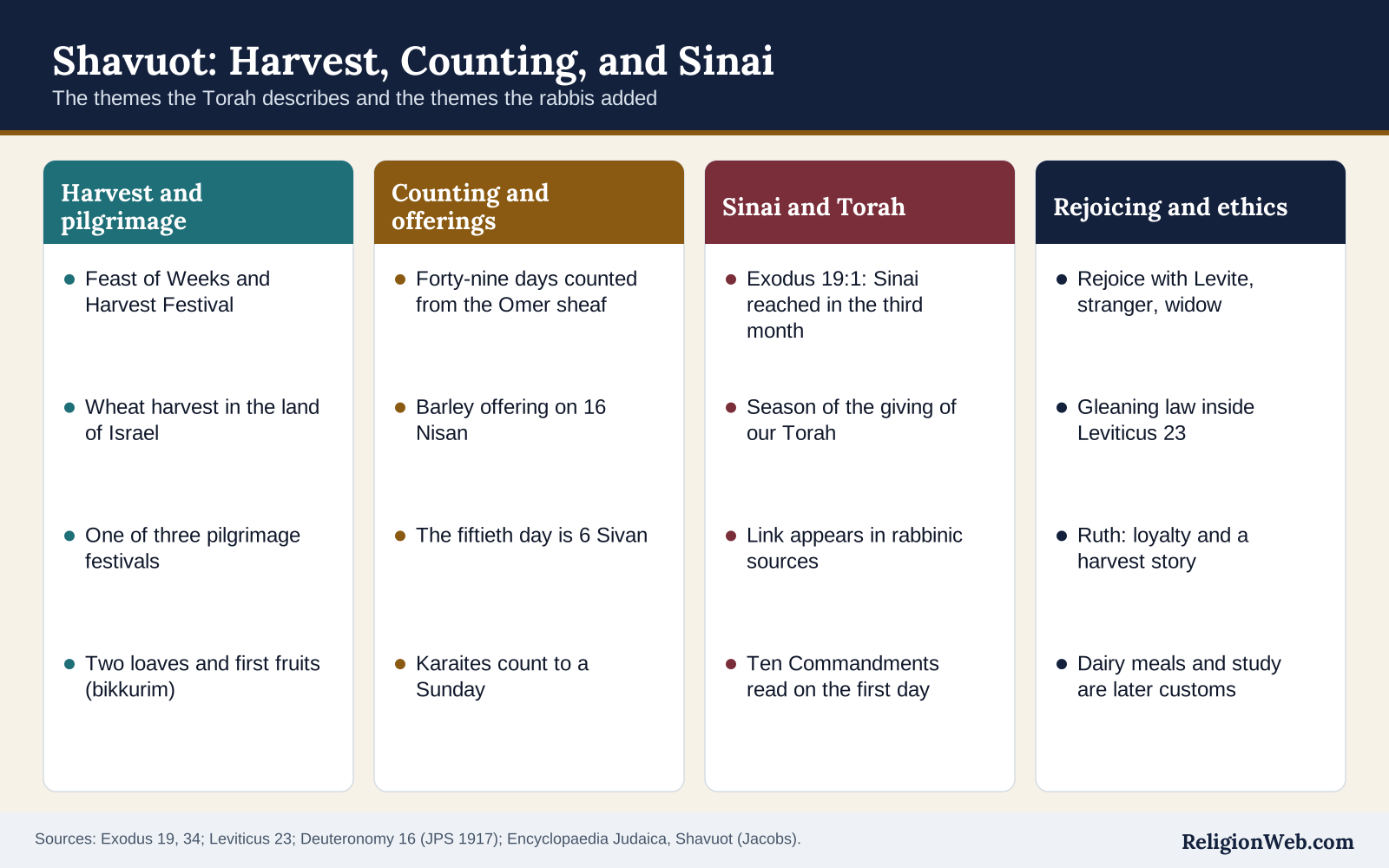
The two meanings of Shavuot do not compete in the sources. The harvest theme provides the gratitude, the bread, the first fruits, and the inclusion of the poor, while the Sinai theme provides the study, the reading, and the covenant. The table below sets side by side the themes that the festival carries, the biblical basis for each, and the form each took in rabbinic and later practice.
| Theme | Biblical basis | Rabbinic and later development |
|---|---|---|
| Wheat harvest and gratitude | Exodus 23:16; 34:22; Deuteronomy 16:9-10 | Two loaves on the table; greenery and flowers in the synagogue |
| Counting toward the festival | Leviticus 23:15-16 | Nightly counting of the Omer; semi-mourning customs; kabbalistic ascent through the forty-nine days |
| First fruits and pilgrimage | Exodus 23:19; Deuteronomy 16:16; 26:1-11 | Bikkurim procession (Mishnah Bikkurim); later first-fruits festivals in Israel |
| Rejoicing with the vulnerable | Deuteronomy 16:11; Leviticus 23:22 | Festival meals open to guests; gleaning story of Ruth |
| Revelation at Sinai | Exodus 19-20 | Season of the giving of the Torah; Ten Commandments read; Pesachim 68b rejoicing |
| Covenant and acceptance | Exodus 24:7 | Debate in Shabbat 88a; confirmation and study customs |
| Study and preparation | Exodus 19:10-15 (days of preparation) | Tikkun Leil Shavuot; the all-night session |
| Sweetness of Torah | Song of Songs 4:11; Psalm 19 | Dairy and honey customs; children’s first lessons |
Shavuot in the Synagogue: Prayer, Torah Readings, and Liturgy
Beginning the Festival
Candles, Kiddush, and the Festival Blessings
Like every Jewish festival, Shavuot begins at sundown on the evening before the date on the calendar. Households light festival candles before sunset and recite a blessing over them. The meal that follows opens with kiddush, the blessing over wine that sanctifies the day, and the Shavuot version of the blessing includes the phrase Zeman Matan Torateinu, the season of the giving of our Torah. The blessing known as Shehecheyanu, which thanks God for bringing the worshiper to a new season, is recited on the first night of a festival, as it is for the other pilgrimage festivals. These are the same ritual forms that mark the other festivals described in the articles on Passover and Sukkot, adapted with the festival’s own words.
The Evening Service in the Synagogue
The evening service, Maariv, is the festival version of the daily evening prayer. Its central section is the Shema and its blessings, followed by the Amidah, the standing prayer, in its festival form, which names the day as “the season of the giving of our Torah.” The Shema, which declares the unity of God and is taken from the Torah, is recited at both the evening and morning services every day, and the article on the Shema explains its text and its place in the liturgy. In many communities the sanctuary has already been decorated with greenery for the festival, and the prayer hall looks and smells of cut branches and flowers, an arrangement discussed below. After the service, many congregations move directly to the study program of the night, or the congregants go home for dinner and return later.
Synagogue as Setting
The synagogue is the main place of public worship in Jewish life, and the larger article on the synagogue describes its layout, its officers, and its etiquette. On Shavuot the building is full. A congregation that fills only a few rows on a weekday may fill the room for the festival, and it is common for people who do not attend regularly to come for the Torah reading, for the Ten Commandments, and for the memorial prayer.
The Morning Service
Hallel and the Festival Amidah
On the morning of the festival the service follows the pattern of the other major festivals. The morning prayers include the complete Hallel, the group of psalms of praise (Psalms 113 through 118) that are recited on festivals. After the Torah reading a further service, Musaf, recalls the additional offerings brought in the Temple on the day; the Torah reading for the day ends with Numbers 28:26-31, which lists them. Worshipers wear the prayer shawl, the tallit. Men who put on tefillin every weekday morning do not wear them on the festival, in the traditional practice, because the festival day is itself regarded as a sign of the covenant; that is a rule shared with the Sabbath and the other major festivals.
The Torah Readings
The first day’s Torah reading is the Sinai passage itself, Exodus 19:1 through 20:23, and the concluding section, in a second scroll, is the offering list in Numbers 28:26-31. The prophetic reading (haftarah) is Ezekiel 1:1-28 and 3:12, the prophet’s vision of the divine chariot, which the tradition pairs with the theophany at Sinai. Outside Israel, the second day’s Torah reading comes from Deuteronomy and ends at 16:17, the passage that gives the law of the three pilgrimage festivals, and the haftarah is Habakkuk 3 (for Sephardic communities Habakkuk 2:20 through 3:19), a poem that describes a divine appearance. The readings are those listed by Hebcal for the 2027 festival. Jacobs adds that the congregation customarily stands for the Ten Commandments, a custom that Jacobs notes was protested by some medieval authorities.
Akdamut and Ye’iv Pitgam
In the Ashkenazi rite, the Torah reading on the first day is preceded by Akdamut, a long Aramaic poem that praises God and Israel’s faithfulness to the Torah. Jacobs reports that it is traditionally ascribed to Meir ben Isaac Nehorai, an eleventh-century figure. A similar Aramaic hymn, Ye’iv Pitgam, is sung before the second day’s reading; Jacobs attributes it to Jacob ben Meir of Troyes, who lived from 1100 to 1171. Both hymns are medieval Ashkenazi compositions in Aramaic. Sephardi and Mizrahi rites have their own poetic additions for the day, so the presence of these two poems is a mark of one liturgical tradition and not of the festival as a whole.
Memorial, Psalms, and Other Customs of the Day
Yizkor
In the Ashkenazi tradition, a memorial prayer for deceased relatives, Yizkor, is recited on the last day of each of the three pilgrimage festivals, which means on the final day of Shavuot. Many people who attend synagogue only a few times a year come for this prayer, and some communities have a custom that those whose parents are both living leave the room while it is recited. The details of the rite differ among Ashkenazi communities, and Sephardi and Mizrahi communities have their own ways of remembering the dead on festivals.
David and the Psalms
Jacobs reports a custom, observed less widely, of reading the entire Book of Psalms on the second night of the festival, because of its association with King David, who by tradition died on Shavuot. Tradition ascribes the Book of Psalms to David, and Ruth, whose story is read on the festival, is described in her own book as his great-grandmother. Recitation of the complete Psalter is a familiar form of communal prayer, and on Shavuot it ties the festival to the memory of David.
Reading the Calendar of Worship
The table below summarizes the principal features of Shavuot worship in one place. It uses the common Ashkenazi diaspora pattern as its base, with the Israeli and other practices noted where they differ.
| Moment | Custom or text | Notes |
|---|---|---|
| Eve of the festival | Candle lighting, festival kiddush, festive meal | Kiddush names the day as the season of the giving of the Torah |
| First night | Festival evening service; Tikkun Leil Shavuot study | All-night study is a custom, not a commandment |
| First morning | Complete Hallel; Akdamut (Ashkenazi); Exodus 19:1-20:23 read from the Torah; Ezekiel 1 haftarah | Congregation stands for the Ten Commandments |
| Maftir | Numbers 28:26-31, the additional offerings of the day | Read on both days outside Israel |
| Scroll of Ruth | Read in the synagogue in many communities | Time of day varies by community |
| Second day (outside Israel) | Deuteronomy reading; Habakkuk 3 haftarah; Ye’iv Pitgam (Ashkenazi) | Yizkor is customary in the Ashkenazi tradition |
| Second night | Reading of the entire Book of Psalms | Less widely observed; linked to King David |
These practices are described in the classical codes and in the scholarly summaries, though not every community performs every item. The next two sections look at the book that is read in the middle of the service and at the night of study that precedes it.
The Book of Ruth and Shavuot
The Story the Congregation Hears
A Brief Summary of the Book
The Book of Ruth is a short narrative of four chapters, one of the five scrolls (Megillot) in the third division of the Hebrew Bible, the Writings. It is set in the time of the judges. A famine drives an Israelite family from Bethlehem to the country of Moab, where the father dies and the two sons marry Moabite women, and then the sons die as well. The widowed mother, Naomi, decides to return to Bethlehem and urges her daughters-in-law to remain among their own people. One of them, Ruth, refuses, and her words have become among the best known in the Hebrew Bible.
Entreat me not to leave thee, and to return from following after thee; for whither thou goest, I will go; and where thou lodgest, I will lodge; thy people shall be my people, and thy God my God;
Ruth 1:16, The Holy Scriptures: A New Translation (JPS 1917), via Sefaria
Back in Bethlehem at the beginning of the barley harvest, Ruth gleans in the field of Boaz, a kinsman of Naomi’s late husband, who treats her with unusual generosity. The plot turns on the duty of a kinsman to redeem family land and to preserve a dead man’s name; Boaz fulfills it by marrying Ruth, and their son Obed becomes the grandfather of David (Ruth 4:17). The story therefore ends with a genealogy leading to Israel’s greatest king, and it makes a Moabite woman his ancestor.
Gleaning and the Law of the Harvest
The harvest setting is not incidental. The narrator notes that Ruth gleaned until the end of the barley and wheat harvests (Ruth 2:23), which is the same seven-week span between the Omer and Shavuot. The practice she relies on, the right of the poor and the stranger to gather what the harvesters leave, is the one the Torah requires in Leviticus 19:9-10 and repeats in the middle of the Shavuot chapter in Leviticus 23:22. Boaz goes beyond the law by instructing his workers to leave extra grain for her. Read in the synagogue on the festival, the book turns the legal formulation into a scene, and it shows what the commandment looks like when it is observed with kindness and not simply with minimal compliance.
Why the Book Is Read on Shavuot
The Reasons the Tradition Gives
No biblical text commands the reading of Ruth. The custom is not found in the Talmud, and the Encyclopaedia Judaica entry by Louis Jacobs lists four reasons that writers give for it. The first is the harvest setting of the story. The second is the descent of David from Ruth, together with the tradition that David died on Shavuot. The third is that Ruth’s choice to join the Israelite people is suited to a festival that commemorates the receiving of the Torah. The fourth is that Ruth’s loyalty to Naomi and to Israel’s God symbolizes Israel’s loyalty to the Torah. These reasons do not exclude one another, and different teachers and communities stress different ones. The historical origin of the custom is less clear than the explanations, which is a common pattern with synagogue customs: the reasons are often supplied after the practice has taken hold.
Ruth as the Model Convert
In rabbinic literature, Ruth became the paradigm of the sincere convert to Judaism. Later law drew on the exchange between Naomi and Ruth in the first chapter for its description of how a prospective convert is warned of the difficulty of Jewish life and then accepted if the intention remains firm. Formal conversion in classical Jewish law includes immersion in a ritual bath, which the article on the mikveh describes in detail, though the Book of Ruth itself does not narrate any such ceremony. The connection to Shavuot is thematic: a festival about accepting a covenant has as its companion text the story of someone who accepts it freely and without obligation of birth. The point is made in synagogues of all movements, and it is one reason the book is often cited in discussions of converts and of those who join the Jewish community by choice.
How the Scroll Is Read
The Scroll of Ruth is one of five books read in the synagogue at particular times of the year. Song of Songs is read at Passover, Ecclesiastes at Sukkot, Lamentations on the Ninth of Av, and Esther on Purim. The Book of Esther is read from a handwritten scroll with a blessing, as described in the article on Purim, while the practice with Ruth is less formal: the book may be read from a printed text or a scroll, and the timing differs from community to community. Hebcal’s schedule for the 2027 festival lists the reading of Ruth with the second day outside Israel.
How Readers Have Interpreted Ruth
Traditional Commentary
Ancient rabbinic commentary on the book is collected in the midrash called Ruth Rabbah, which treats the book as a story about kindness (chesed), about repentance, and about the way God arranges events out of sight. Medieval commentators such as Rashi supply the background of names and customs, and later teachers have treated the book as a text on the mutual obligations of family and community. For many readers the lesson is that ordinary acts of loyalty and generosity, with no miracle in sight, are the way the covenant is lived.
Modern Scholarly Questions
Modern scholars ask different questions. They differ on when the book was written, with some placing it in the monarchy and others in the period after the Babylonian exile. Those who favor a later date often read it as a quiet counterpoint to texts such as Deuteronomy 23:4, which excludes Moabites from the assembly, and the exile-era concern in Ezra and Nehemiah about marriages with foreign women; on that reading the book argues for an inclusive understanding of who belongs. Others find the book to be a family story with a genealogical purpose and no intended polemic. The disagreement is open, and the reading of the book on Shavuot does not depend on resolving it.
Tikkun Leil Shavuot: Why Many Jews Stay Awake All Night to Study
What Happens on the Night
The Shape of the Study Session
Tikkun Leil Shavuot is the custom of keeping a vigil of Torah study on the first night of the festival. In its most traditional form, the vigil begins after the festive meal and continues until dawn, when the morning service is recited at sunrise or a little before. The program in many synagogues is a series of lectures and classes, taught by rabbis and lay teachers, on topics ranging from the Sinai story to Jewish law, ethics, history, and contemporary questions. In its older form, the vigil follows a printed anthology, the Tikkun, which Jacobs describes as a reading of selected passages from the classics of Jewish religious literature. The Orthodox Union says the Arizal arranged passages from the Bible and the Talmud into an order for the night, and an OzTorah article credited to Rabbi Raymond Apple adds that the anthology includes the mystical Sefer Yetzirah and selections from the Zohar. Many congregations now combine a reading from the Tikkun with classes of their own.
Who Takes Part
The custom has widened over time and across Jewish movements. The scholar Jacob Neusner writes, in a reference entry on Shavuot in the volume Contemporary American Religion, that American synagogues often hold all-night Torah study sessions attended by many young people. The Union for Reform Judaism’s own page describes Tikkun Leil Shavuot as an evening-long study session held on the night of Shavuot. In Israel and elsewhere, synagogues and study houses (batei midrash) now commonly open the night to the wider community. In this respect the practice has become a communal event as much as a devotional one, a night on which people who differ in belief and observance sit in one hall to study the same sources.
An Observance, Not a Commandment
The vigil is a custom, not a biblical or Talmudic command. Jewish law does not require anyone to stay awake, and the Shulchan Aruch does not mention the practice, according to the OzTorah article. The festival day itself carries the obligation of rejoicing and prayer, so the night is a voluntary preparation. Staying awake all night is a personal decision that depends on health and circumstances, and anyone who is ill, elderly, pregnant, or caring for young children can reasonably choose to sleep, since the custom adds to the festival and does not replace the obligations of the day.
Where the Custom Comes From
The Midrash of the Sleeping Israelites
The narrative that explains the custom is a midrash found, according to the Orthodox Union’s summary, in Shir HaShirim Rabbah. It says that the Israelites slept late on the morning when God was to give the Torah, which suggests a lack of eagerness, and that the all-night study of later generations is a way of correcting it. The OzTorah article gives a version in which the people had to be woken by thunder and lightning, and says later generations, ashamed, stayed up on Shavuot night. The midrash is not a historical report of what happened at Sinai but an interpretive story, and the custom is often described as a “rectification,” a repair of that earlier lapse.
The Zohar and the Mystics of Safed
A second source is the Zohar, the central text of the Kabbalah. According to the Orthodox Union, the Zohar describes Rabbi Shimon bar Yochai and his companions staying awake all night, comparing them to the attendants who prepare a bride before her wedding, an image in which the Torah is the bride and the Sinai revelation the wedding. The sixteenth-century kabbalists of Safed built a program around that image. The Orthodox Union credits the great Safed kabbalist known as the Arizal with arranging passages from the Bible and the Talmud into an order for the night. The article on Kabbalah explains how the Zohar and the Safed circle shaped Jewish practice more widely.
Alkabetz, Karo, and the Printed Accounts
The best-known early account concerns Rabbi Yosef Karo, the author of the Shulchan Aruch, and Rabbi Shlomo Alkabetz, the poet of the Sabbath hymn Lecha Dodi. A modern popular article by Pearl Herzog, summarizing the account, dates it to Shavuot night in 1534 in Adrianople (Edirne) and describes the two men studying Torah, Prophets, Writings, and Mishnah all night. In the account, a voice speaking through Karo, which he understood as a heavenly teacher, urged the group to move to the Land of Israel. Alkabetz did go to Safed. The account was printed in Karo’s mystical diary Maggid Meisharim in Lublin in 1646 and in Isaiah Horowitz’s Shnei Luchot HaBrit in Amsterdam in 1648, according to that article, so the earliest written report reached readers more than a century after the night it describes. The date and place come from this later tradition, and scholars of Jewish mysticism may weigh the sources differently.
From Mystical Circle to Widespread Custom
Jacobs states that under the influence of the Kabbalah the all-night vigil became customary. The OzTorah article adds that a later commentator, the Ba’er Hetev, wrote that one who studies on Shavuot night will merit to complete the year in health. The practice went from a small circle to a custom of many Ashkenazi and Sephardi communities, and in the twentieth century it expanded into the wider communal event described above. How quickly it spread, and in which communities it was absent for long periods, is not well documented in the sources consulted for this article.
What “Tikkun” Means
Arrangement, Preparation, and Repair
The Hebrew word tikkun has several senses, and the OzTorah article distinguishes three that are applied to the night. It can mean an arrangement, in the sense of an ordered anthology of readings, which is the original reference of the term. It can mean preparation, a spiritual readiness to renew the acceptance of the Torah. And it can mean repair, as in the phrase tikkun olam, the repair of the world. The Orthodox Union adds that the Arizal’s order for the night is one source of the name, though the term is now used loosely for any all-night session of study. All of these senses are present in the way the night is described by participants.
The Wedding Imagery
The Zohar’s picture of the companions as attendants of a bride gives the night a wedding atmosphere. In this image the festival day is the wedding and the preceding night the time of preparation, and the study is the dressing of the bride. The metaphor is a kabbalistic one, and it sits beside, and does not replace, the more familiar explanations of the custom as repentance for sleeping at Sinai or as devotion to study. Teachers draw on all of these, often in the same lecture.
The Custom in a Modern Setting
In present-day practice, Tikkun Leil Shavuot is as likely to include a talk on a contemporary question as a recitation from the classical anthology. Many communities end the night with the morning service at sunrise. For participants outside the Orthodox world, the evening often functions as a form of adult education, a setting in which Jewish texts are read in translation and discussed. The shape of the night varies, but the core idea persists: the arrival of the festival of the Torah is marked by a collective act of study.
Food, Home, and Children: Dairy Meals, Greenery, and Family Customs
The Custom of Dairy Foods
What the Early Sources Say
Dairy foods are the best-known sign of Shavuot to people outside the Jewish community, and the custom is old enough to be recorded in the standard code of Jewish law. Rabbi Moses Isserles, the Polish authority whose glosses on the Shulchan Aruch record the practice of Ashkenazi communities, notes in Orach Chayim 494:3 that there is a custom everywhere to eat dairy foods on the first day of Shavuot. According to the Sefaria Community Translation of that passage, he explains that a dairy dish is followed by a meat dish, in parallel with the two dishes that recall the Passover offering and the festival offering on Passover eve, and that two loaves are placed on the table in place of the altar, recalling the two loaves brought on the day of the first fruits. The custom is thus tied in its earliest codified form to Temple memory and to the structure of the meal, not primarily to a statement about the nature of the Torah.
The Reasons Offered
Writers have offered many explanations over the centuries, and the Encyclopaedia Judaica entry by Louis Jacobs gives two of the oldest. One compares the Torah to milk, drawing on Song of Songs 4:11, which describes honey and milk under the beloved’s tongue and which the tradition reads as an image of Torah. The other notes that the biblical law of first fruits in Exodus 23:19 stands beside the law against boiling a kid in its mother’s milk, so that the placing of the two commandments side by side, in the text that deals with the pilgrimage festival, might suggest a link between first fruits and dairy. Other explanations circulate widely in popular writing, including that the Hebrew word for milk, chalav, has a numerical value of forty, matching the forty days Moses spent on Sinai, and that the Israelites, who had just received the dietary laws, did not yet have properly prepared meat. These are best understood as later interpretive suggestions and not as the sources of the custom. The multiplicity of reasons is a sign that the custom was in place before anyone settled on a single account of it.
Dairy, Meat, and the Kosher Kitchen
The dairy meal also interacts with the laws of kashrut, the Jewish dietary rules described in the article on kosher and kashrut. Traditional law separates milk from meat, with a waiting period after meat before dairy may be eaten and separate utensils for each, and these rules shape how a household carries out the Shavuot custom. A family that eats a dairy meal first and then a meat meal, in the pattern Isserles describes, must clear and reset the table, rinse the mouth, and follow the community’s custom on waiting between the courses; the length of the wait differs among communities. Households that keep only a dairy meal avoid the question entirely. A kosher kitchen has its own details, so people with specific questions generally consult a rabbi of their own tradition.
Foods on the Festival Table
Ashkenazi Dishes
In Ashkenazi homes the dairy table has come to include blintzes, thin pancakes filled with sweetened cheese, which the Union for Reform Judaism’s page on the festival names as the dish most often served for the holiday. Cheesecake, noodle puddings, cheese-filled pastries, and fruit with sour cream or yogurt are other well-known dishes, though these belong to the general food culture of Jewish communities in Central and Eastern Europe and North America and are not mentioned in the classical sources. Jacobs notes an older tradition, in some communities, of triangular pancakes filled with meat or cheese, with the triangle said to point to the three divisions of the Hebrew Bible (Torah, Prophets, Writings) and to the three groups of Israel, the priests, Levites, and ordinary Israelites. Such explanations show how a food shape can be given a teaching.
Sephardi and Mizrahi Traditions
Sephardi and Mizrahi communities, whose families trace their histories to Spain, North Africa, the Middle East, and Central Asia, keep their own festival tables. Many keep the dairy custom with dishes of their own, and some use rosewater and nuts in festival sweets. Because these foods differ so much from one community to the next, specific dishes are not catalogued here. Readers interested in a particular tradition, such as the Iraqi, Moroccan, Yemenite, Syrian, or Persian practice, will find that local food writers, community cookbooks, and rabbis from each tradition are better guides than any single summary.
Cooking on a Festival Day
The rules for preparing food on the festival differ from those for the Sabbath. On Shabbat, which is described in the article on Shabbat, cooking must be done in advance. On a major festival, in traditional law, work needed for preparing food to be eaten that day is allowed, which is why a festival meal can include freshly cooked dishes. Other restrictions, such as the carrying rules and the use of electricity, are handled differently by different communities. The practice of the family therefore depends on both the festival rules and the kitchen’s observance of kashrut.
| Food or practice | Where it is found | Reason or source | Notes |
|---|---|---|---|
| Dairy meal on the first day | Ashkenazi custom recorded by Isserles; widely kept elsewhere | Shulchan Aruch, Orach Chayim 494:3; Song of Songs 4:11; Exodus 23:19 | A custom, not a biblical commandment |
| Dairy followed by meat | Described by Isserles | Parallel to the two dishes of Passover eve | Requires a break and fresh settings in a kosher kitchen |
| Two loaves on the table | Described by Isserles | The two loaves of the Temple offering (Leviticus 23:17) | Often expressed as a pair of festival challot |
| Blintzes | Ashkenazi homes; noted on the Reform movement’s festival page | Popular dairy dish | Not mentioned in classical sources |
| Triangular filled pancakes | Some Ashkenazi communities, as reported by Jacobs | Three divisions of the Bible and three groups of Israel | An interpretive explanation of a food shape |
| Cheesecake and cheese pastries | Common in North American and European Jewish homes | Dairy tradition | A widespread modern favorite |
| Honey and sweets for children | Medieval Ashkenazi communities, as reported by Jacobs | So that the Torah may be sweet on the child’s lips | Linked to beginning a child’s study |
| Rosewater and nut sweets | Reported for some Sephardi and Mizrahi homes | Local culinary tradition | Varies by community |
Greenery, Children, and the Home
Greenery and Flowers
One of the most visible customs is the decoration of the synagogue and the home with plants. According to Jacobs, synagogues are adorned with plants and flowers on the basis of the idea that Mount Sinai was green at the time of the revelation. He also cites the Mishnah (Rosh Hashanah 1:2), which teaches that on Shavuot the world is judged for the fruit of trees, as a support for decorating with trees, and he notes that some authorities objected to the custom because it resembled the decorations in churches. The objection shows that the custom had a history of debate, and that communities weighed how closely a practice should follow the surrounding culture. Where the custom is kept, a sanctuary can be filled with cut branches, potted plants, and flower arrangements, and families place bouquets on their dining tables.
Children, Honey, and Beginning Torah Study
Jacobs reports a medieval custom in which children began their Hebrew schooling on Shavuot, with honey and sweets given to them so that the Torah might be sweet on the child’s lips. The scene links the festival’s theme of receiving the Torah to the start of each child’s education. In a related modern development, the Reform movement and some Conservative congregations hold confirmation on Shavuot, a ceremony that, as Jacob Neusner writes, concludes teenagers’ formal religious education. The Union for Reform Judaism describes confirmation as a Reform-originated ceremony tied to the festival. It differs from a bar or bat mitzvah, which marks the age of legal responsibility, and the two ceremonies coexist in many Reform communities.
Hospitality and Charity
The biblical call to rejoice together with the household, the Levite, the stranger, the fatherless, and the widow (Deuteronomy 16:11) remains the ethical center of the festival meals. Families invite guests, including newcomers to the community and those who would otherwise eat alone, and many give charity before or during the festival. Because money is not handled on a festival day, charitable giving is usually arranged before it begins. The practice reflects the placement in Leviticus 23:22 of the gleaning law in the middle of the festival chapter: the joy of the harvest is incomplete if it does not include those without a share of it.

Israel, the Diaspora, and the Movements: How Observance Varies
One Day or Two: The Israel and Diaspora Difference
The Calendar Reason for a Second Day
The difference in length is the single most visible variation. Shavuot is observed on 6 Sivan in Israel, and on 6 and 7 Sivan outside it in communities that keep the traditional diaspora practice. The reason, as Rabbi Daniel Kohn explains in an article for My Jewish Learning, lies in the way the calendar once worked. In the Second Temple period and for some centuries after it, the court in Jerusalem proclaimed each new month on the basis of witnesses who had seen the new moon, and distant communities learned the date by signal fires and later by messengers, who could arrive late. Because most festivals fall in the middle of the month, the delay was usually small, but a second day guaranteed that at least one of the two was correct. After Hillel II published a fixed calendar in the middle of the fourth century, the second day was no longer needed for accuracy, and the diaspora kept it as an inherited custom.
Israelis Abroad and Visitors
The rule is tied to where a person lives. Kohn notes that Israelis visiting other countries often keep the Israeli custom, while an Israeli who settles in the diaspora should adopt the local practice, citing Orach Chayim 496:3. A family rule applies in some cases: if a family is entirely in Israel they observe one day, but if one member is in the diaspora while the others are in Israel, the family may observe two days. These distinctions can make the second day a question of hospitality and mutual respect as well as law, since hosts and guests may follow different practices at the same table.
What the Dates Look Like in a Given Year
Because Shavuot always falls on 6 Sivan, the civil date moves from year to year, and the weekday does too. In 2027, according to Hebcal, the festival begins at sundown on Thursday, June 10, with its first day on Friday, June 11 and its second day outside Israel on Saturday, June 12. The Union for Reform Judaism lists 2027 as June 10 to 11, which is consistent with a one-day observance. In years when the first day falls on a Friday, the festival leads directly into the Sabbath, a situation that calls for advance planning of meals in communities that keep the Sabbath and festival rules strictly. Anyone planning to attend an event should check a calendar published for their location, since communities in the Southern Hemisphere and in far northern cities experience the same date with very different hours of daylight.
The Movements and Their Practices
Orthodox and Hasidic Communities
Orthodox communities, described in the article on Orthodox Judaism, keep two days of Shavuot outside Israel and one day in Israel. They follow the traditional rules of festival rest, the full liturgy including Hallel, Musaf, and the Torah readings, and the customs of dairy meals, decorated synagogues, and all-night study. Within Orthodoxy there is variety: Hasidic groups, Lithuanian-style yeshiva communities, and Sephardi and Mizrahi congregations differ in melody, in the poems added to the service, and in how they arrange the night of study.
Conservative and Reconstructionist Communities
In the Conservative movement, described in the article on Conservative Judaism, Kohn reports that most congregations outside Israel keep the traditional diaspora practice of two days, though some follow the Israeli custom. Reconstructionist and Jewish Renewal congregations, according to the same article, decide for themselves. In all of these communities the synagogue service resembles the traditional one, with the Torah readings, Hallel, and often the reading of Ruth, and the Tikkun Leil Shavuot is widely observed in adult-education form. The movements differ more in questions of obligation and of which customs are emphasized than in the outline of the service.
Reform Judaism
The Reform movement, described in the article on Reform Judaism, observes Shavuot on one day, according to Kohn, having dropped the extra diaspora days for its American congregations except for Rosh Hashanah. Confirmation is the distinctive Reform association with the festival: the Union for Reform Judaism describes it as a Reform-originated ceremony for boys and girls that is tied to Shavuot. The URJ page also describes Tikkun Leil Shavuot as an evening-long study session and presents the festival as a celebration of Torah, education, and the choice to participate actively in Jewish life. This phrasing reflects the movement’s emphasis on commitment, which also appears in its confirmation classes.
Karaite Communities
Karaite Jews, as noted earlier, count the fifty days from a Sunday within the week of unleavened bread, which makes Shavuot always fall on a Sunday. A Karaite draft commentary on the festival reports that the count is traditionally spoken aloud and that, in the Karaite practice described there, it takes place in the morning, whereas rabbinic Jews count in the evening. The commentary says Karaite prayers for the day mention the giving of the Torah. Karaite practice is thus an example of a community with a shared biblical text, a shared festival name, and a shared theme that arrives at its own calendar.
Regional and Community Traditions
Differences Between Liturgical Rites
Within the rabbinic tradition, the main differences among Jewish communities are in liturgy. The haftarah on the second day is Habakkuk 3 for Ashkenazim, while Sephardim begin at Habakkuk 2:20, as Hebcal’s table of readings shows. The Aramaic hymns Akdamut and Ye’iv Pitgam belong to the Ashkenazi rite. Melodies for the Torah reading, the chanting of Ruth, and the Hallel differ from one tradition to another. These differences are part of a larger fact about Jewish liturgy, which is that a single outline of festival prayers is carried out in many local forms.
Agricultural Festivals in Modern Israel
In modern Israel the festival has often been observed through its agricultural meaning. Schools and agricultural settlements have held first-fruits celebrations on Shavuot, in which children carry baskets of fruit, flowers, and produce in processions that recall the biblical bikkurim. For many Israelis, including those who do not attend synagogue, Shavuot is associated with dairy meals, with the arrival of summer fruit, and with a day off from work; those with a stronger religious commitment add the services and the night of study. The two aspects of the festival, harvest and revelation, are sometimes divided among different parts of the society.
Climate, Hemisphere, and Daily Life
Because Shavuot falls in late spring or early summer in the Northern Hemisphere, the all-night study falls on one of the shortest nights of the year in northern cities, where dawn arrives early. In the Southern Hemisphere the same date falls in autumn and the night is long. These practical facts affect how communities plan the vigil, when they hold the dawn service, and how they handle the first morning’s prayers. The festival’s ancient agricultural symbolism, linked to the wheat harvest in the land of Israel, is also experienced differently by communities whose own harvests come at other times of the year.
| Community or setting | Days observed | Distinctive features |
|---|---|---|
| Israel (all movements) | One day, 6 Sivan | Single day of festival rest; first-fruits themes in schools and settlements |
| Orthodox, outside Israel | Two days, 6 and 7 Sivan | Full traditional liturgy; Tikkun Leil Shavuot; dairy meals; Yizkor on the last day in the Ashkenazi tradition |
| Conservative, outside Israel | Two days in most congregations; one in some | Traditional service; adult-education study night |
| Reconstructionist and Renewal | Each congregation chooses | Varied practice; study and community meals |
| Reform | One day | Confirmation; evening-long study session; blintzes |
| Karaite | One day, always a Sunday | Count begins on a Sunday during the week of unleavened bread |
| Ashkenazi rite | As set by the community | Akdamut and Ye’iv Pitgam; Habakkuk 3 haftarah |
| Sephardi rite | As set by the community | Haftarah begins at Habakkuk 2:20; own liturgical poems |
Common Misconceptions About Shavuot
Misconception 1: Shavuot Is Only About Dairy Food
Where the misunderstanding comes from
For many people outside the Jewish community, the first thing they learn about Shavuot is that it is the holiday of cheesecake. Food writing, grocery promotions, and holiday roundups understandably emphasize what can be photographed and cooked, and a dairy menu is easy to explain in a sentence. The dairy custom is also real, widespread, and recorded in the standard code of Jewish law. The shortcut turns a single custom into a definition of the festival.
What the evidence and tradition actually show
The festival’s defining content is elsewhere. The Torah describes a harvest pilgrimage fixed by a count of fifty days, with two loaves and first fruits, and the rabbinic tradition describes it as the season of the giving of the Torah, a theme expressed in the readings of Exodus 19 and 20, in the Ten Commandments, in the Aramaic poems, and in the night of study. The dairy meal is a home custom that Isserles records in Orach Chayim 494:3 and that has several explanations, none of them a biblical command. For many families the dairy meal is a pleasant part of a festival whose center is prayer, study, and the reading of Ruth, and for some it is one of several meals, with the other festival meals following the family’s usual practice. A description of Shavuot that stopped at the menu would leave out the counting of the Omer, the Sinai readings, and the ethic of including the poor.
The dairy custom itself also has a narrower scope than its reputation suggests. Isserles speaks of the first day, and he describes a dairy dish followed by a meat dish, which is a meal of two courses and not a menu without meat. Communities differ about how the rest of the festival is kept, and the many reasons offered for the custom, from the comparison of the Torah to milk in Song of Songs 4:11 to the placement of the first-fruits law beside a law about milk in Exodus 23:19, show that it was explained after it was practiced. That history is a reason to describe the dairy meal as a well-loved custom with a distinguished set of interpretations, and not as the meaning of the day.
Misconception 2: The Bible Explicitly Describes Every Modern Shavuot Custom
Where the misunderstanding comes from
Many people reasonably assume that a festival is observed today as the Bible commanded it. Holiday customs are often presented as ancient, and the biblical names, the Feast of Weeks and the Day of the First Fruits, give the impression that the whole festival is described in Scripture. Readers who meet the Sinai story in Exodus 19 may also take it for granted that the festival was always about Sinai.
What the evidence and tradition actually show
The Bible describes a count, a pilgrimage, a convocation, and offerings. It does not mention the revelation at Sinai as the reason for the festival, a night of study, the reading of Ruth, dairy dishes, or the Aramaic hymns. As the Encyclopaedia Judaica entry by Louis Jacobs points out, the Sinai association appears in rabbinic sources, with the earliest references he cites in Shabbat 86b and the clearest in the third century, and the vigil is a kabbalistic-era development. In Orthodox and other halakhic frameworks, customs of this kind (minhagim) develop within a legal system that recognizes them as valid expressions of the festival’s meaning. Karaite Jews, who rely on the written Bible and do not accept the rabbinic oral tradition as binding, keep the festival on the biblical count and do not follow the rabbinic additions in the same way. The accurate statement is that the festival’s skeleton is biblical and its present form is the result of many centuries of interpretation, a distinction that the tradition itself acknowledges.
Some customs are also known to have drawn objections. Jacobs reports that standing for the Ten Commandments was protested in the Middle Ages and that some authorities opposed decorating with greenery because it resembled church practice. The Shulchan Aruch, according to the OzTorah article, does not mention the all-night study at all. These details show a living process in which communities proposed, debated, and sometimes rejected customs, and they are a reminder that a practice can be deeply meaningful without being scriptural.
Misconception 3: All Jewish Communities Observe Shavuot for the Same Number of Days
Where the misunderstanding comes from
People often meet Shavuot through a single synagogue, a single family, or a single calendar. A Jewish calendar printed for a diaspora Orthodox community lists two days, while a calendar printed in Israel lists one, and a person who has attended only one kind of service may assume that all communities do the same.
What the evidence and tradition actually show
Observance varies by place and by movement. In Israel the festival lasts one day, and in the diaspora Orthodox communities and most Conservative congregations keep two, according to Rabbi Daniel Kohn’s explanation in My Jewish Learning. Reform congregations observe one day, and Reconstructionist and Renewal congregations choose for themselves. The difference goes back to a calendar procedure of the Second Temple era, not to a disagreement about the festival’s meaning. Karaite practice differs again in the date itself, since it places Shavuot on a Sunday, and the Qumran and Ethiopian Jewish readings in the sources fix other dates. The festival is the same set of themes in each of these settings, but the number of days is not uniform.
The variation is also not simply a contrast between Israel and everywhere else. Within the diaspora, a Reform congregation and an Orthodox congregation in the same city may keep different numbers of days, and an Israeli visitor may follow the practice of home while the host family follows another. Even the question of which day a family’s Yizkor prayer falls on depends on this count, since the memorial service belongs to the last day of the festival. Anyone planning to attend a service or a meal is best served by asking the community or consulting a calendar for that particular location and tradition.
Misconception 4: Shavuot Is a Minor Holiday Because It Has No Signature Object or Ritual
Where the misunderstanding comes from
Passover has the Seder and matzah, Sukkot has the sukkah and the four species, and Hanukkah has the menorah. Shavuot has no equally recognizable object, and its leading customs, such as the night of study and the dairy meal, are quieter. Visitors to a Jewish neighborhood can see a sukkah from the street, but a Shavuot celebration may be visible only as a crowded synagogue or an open study hall. The absence of a signature object can be mistaken for an absence of importance.
What the evidence and tradition actually show
Shavuot is one of the three pilgrimage festivals named in the Torah, and it carries the full status of a major festival day (Yom Tov), with the rest, the festival prayers, Hallel, and Musaf that go with it. The Talmud in Pesachim 68b treats rejoicing on the day as an obligation grounded in the giving of the Torah, and Rav Yosef’s story in the same passage shows a leading sage marking the day with a special meal. The distinctive biblical acts of the festival, the two loaves and the first fruits, belonged to the Temple, and they cannot be performed in the same way without it. What survives is the counting that leads up to the day, the study that expresses its meaning, and the synagogue readings. For many Jews, the festival’s emphasis on Torah study is exactly what makes it central, and the quieter forms of observance are an expression of that emphasis and not a sign of lesser importance.
Frequently Asked Questions About Shavuot
Questions About Meaning and Origins
What does Shavuot mean?
Shavuot means “weeks” in Hebrew. The name refers to the seven weeks counted from the offering of the first barley sheaf at Passover to the festival of the wheat harvest on the fiftieth day. In Jewish liturgy it is also called the season of the giving of our Torah, which expresses the rabbinic link to Sinai.
Is Shavuot the same as Pentecost?
The two festivals share a name in origin, since the Greek word for “fiftieth” was used by Greek-speaking Jews for the festival of weeks, and the Christian festival takes its name from the same count. They are different observances, each with its own meaning within its own tradition, and the article on Pentecost describes the Christian festival.
Why is Shavuot linked to the giving of the Torah?
The Bible says the Israelites reached Sinai in the third month, and the rabbis of the Talmudic era connected the festival to that event. Jacobs points to Shabbat 86b and Pesachim 68b as early evidence. Scholars suggest several reasons for the link, including the Pharisaic fixed date of 6 Sivan.
Questions About Practice
Do Jews have to stay up all night on Shavuot?
No. Tikkun Leil Shavuot is a custom, not a commandment, and the Shulchan Aruch does not mention it. Many people take part for part of the night, and people who are unwell, elderly, or caring for young children can choose to rest. Religious practice does not replace medical advice, and those who are unsure about staying awake can consult both a doctor and a rabbi.
Must everyone eat dairy on Shavuot?
The custom of eating dairy on the first day is widely observed, but it is not a biblical command. Isserles records it as a custom in the standard code, and families interpret it differently: some eat only dairy, some serve a dairy meal and a meat meal, and some follow another family tradition.
When is Shavuot in 2027?
According to Hebcal, Shavuot in 2027 begins at sundown on Thursday, June 10, with the first day on Friday, June 11 and the second day, outside Israel, on Saturday, June 12. In Israel the festival is the single day of 6 Sivan.
Why is the Book of Ruth read?
Writers give four reasons: the harvest setting, Ruth’s descent line to David, the connection between her choice to join the Jewish people and the receiving of the Torah, and the symbol of Israel’s loyalty to the Torah. The custom is not found in the Talmud.
Conclusion: What Shavuot Shows About Jewish Tradition
What the History Shows
Layers That Remain Visible
Shavuot demonstrates how a single festival can carry several layers at once. The Torah’s harvest pilgrimage, with its count of weeks and its two loaves, remains in the vocabulary and the table. The rabbinic reading, which makes the day the season of the giving of the Torah, shapes the readings and the prayers. The later additions, including Ruth, the Aramaic hymns, greenery, dairy foods, and the night of study, show a tradition continuing to build on what it received.
One Festival, Many Communities
The festival is also a clear example of internal variety: one day or two, a Sunday or a fixed date, an all-night Tikkun or a shorter evening session, confirmation or Yizkor. These differences are not signs of confusion but of a tradition practiced across continents and centuries.
How to Keep Exploring
Related Festivals and Practices
Readers who want to follow the Jewish year further can turn to the fall festivals, including Rosh Hashanah and Yom Kippur, and to the winter festival of Hanukkah. The doorway objects and rituals described in the article on the mezuzah show how the Shema and the Torah shape the home throughout the year.
Primary Texts to Read
The most direct way to understand the festival is to read the passages it is built on: Leviticus 23, Deuteronomy 16, Exodus 19 and 20, and the four chapters of Ruth. Together with the articles on the Torah and the Talmud, they provide the sources from which the later customs grew.
Sources
The table below lists the principal external sources behind this article. Facts, dates and figures were checked against these and related primary, institutional and academic materials.
| # | Source | Publisher and type | Used for | Link |
|---|---|---|---|---|
| 1 | The Holy Scriptures: A New Translation (JPS 1917): Exodus 19:1 and 34:22; Leviticus 23:15; Ruth 1:16 | Sefaria (public-domain JPS 1917 text) · Primary text | All four block quotations; the Torah's festival of weeks, the Omer count, and the Sinai chronology | sefaria.org |
| 2 | Shavuot (Encyclopaedia Judaica, Louis Jacobs; also Neusner and Bowker entries) | Encyclopedia.com / Gale · Encyclopedia | Names, offerings, calendar dispute, Sinai link, Ruth, Akdamut, Tikkun, greenery, dairy, confirmation | encyclopedia.com |
| 3 | Omer (Encyclopaedia Judaica, David M. Feldman) | Encyclopedia.com / Gale · Encyclopedia | Omer offering, nightly counting, semi-mourning customs, Lag BaOmer, Boethusian and Karaite reading | encyclopedia.com |
| 4 | Shavuot 2027 (holiday dates and Torah readings) | Hebcal · Calendar reference | 2027 dates for the diaspora; readings and haftarot for both days; 6-7 Sivan rule | hebcal.com |
| 5 | Shulchan Arukh, Orach Chayim 494 (Sefaria Community Translation, CC0) | Sefaria · Primary text | Rema's gloss on the dairy custom, the two loaves, and the dairy-then-meat meal (paraphrased) | sefaria.org |
| 6 | Talmud Bavli, Pesachim 68b (William Davidson Edition) | Sefaria · Primary text | Rabbi Elazar on rejoicing on Shavuot; Rav Yosef and the calf (paraphrased, not quoted) | sefaria.org |
| 7 | Why Some Holidays Last Longer Outside Israel (Rabbi Daniel Kohn) | My Jewish Learning · Educational explainer | Reason for the second day; Orthodox, Conservative, Reform, and Reconstructionist practice | myjewishlearning.com |
| 8 | Shavuot (Reform Judaism) | Union for Reform Judaism · Institutional | Reform confirmation, Tikkun Leil Shavuot as study session, blintzes, 2027 dates | reformjudaism.org |
| 9 | Tikkun Leil Shavuot (Orthodox Union article, post 13719) | Orthodox Union · Institutional | Midrash of sleeping Israelites, Zohar image of the bride, Karo and the Arizal | ou.org |
| 10 | The all-night Tikkun (OzTorah) | OzTorah · Educational explainer | Meanings of tikkun; Shulchan Aruch silent on the custom; Ba'er Hetev; Tikkun contents | oztorah.com |
Last fact-check date: 2026-10-21.