
Reformed Christianity is the family of Protestant churches that trace their teaching and church life to the sixteenth-century Reformation in Switzerland, especially the work of Huldrych Zwingli in Zurich, Heinrich Bullinger after him, and John Calvin in Geneva. Its churches confess that salvation is God’s gift of grace received through faith in Jesus Christ, that Scripture is the supreme authority for teaching and worship, and that God’s sovereign purpose governs creation, history, and the lives of believers. The family goes under several names. Presbyterian churches are Reformed churches in the Scottish and English-speaking tradition, “Reformed” is the usual name across much of continental Europe and in churches that grew from Dutch, Swiss, German, and Hungarian roots, and many Congregational and united churches belong to the same stream.
The tradition is one of the great branches of Protestant Christianity, which is itself a major division of Christianity. Its nearest historical neighbor is Lutheranism, which began with Martin Luther a few years earlier and shares many convictions with it, though the two families went separate ways over the Lord’s Supper after 1529 and have developed their own confessions, worship, and church structures. Today the World Communion of Reformed Churches lists more than 230 member churches in 109 countries and speaks of a constituency of about 100 million Christians. That figure covers churches of very different size, style, and theology, and it does not include every Reformed body in the world.
Many readers first meet the word “Reformed” through “Calvinism” and through a one-word summary of it: predestination. The summary is not false, but it is far too small. Reformed churches have produced catechisms for children, psalm books, systems of church government, schools and universities, and some of the most widely discussed theology of the twentieth century. Their members disagree with one another about baptism, worship, the ordination of women, and how strictly to read their own confessions. The picture becomes clearer once the family is described in its full range rather than through its most famous doctrine.
This article follows the tradition from the Swiss cities of the 1520s through Geneva, the great confessions, and the spread to Scotland, the Netherlands, Hungary, North America, Korea, and Africa. It explains Reformed beliefs about God, grace, election, and covenant with attention to the debates inside the family, then turns to Scripture and authority, worship, baptism and the Lord’s Supper, church government, the church year, daily life, and the main branches. Neighboring traditions such as Baptist Christianity and Pentecostal Christianity have their own articles, and they appear here only where their histories touch the Reformed story.
Reformed Christianity at a Glance: Definition, Names, Geography, and Vocabulary
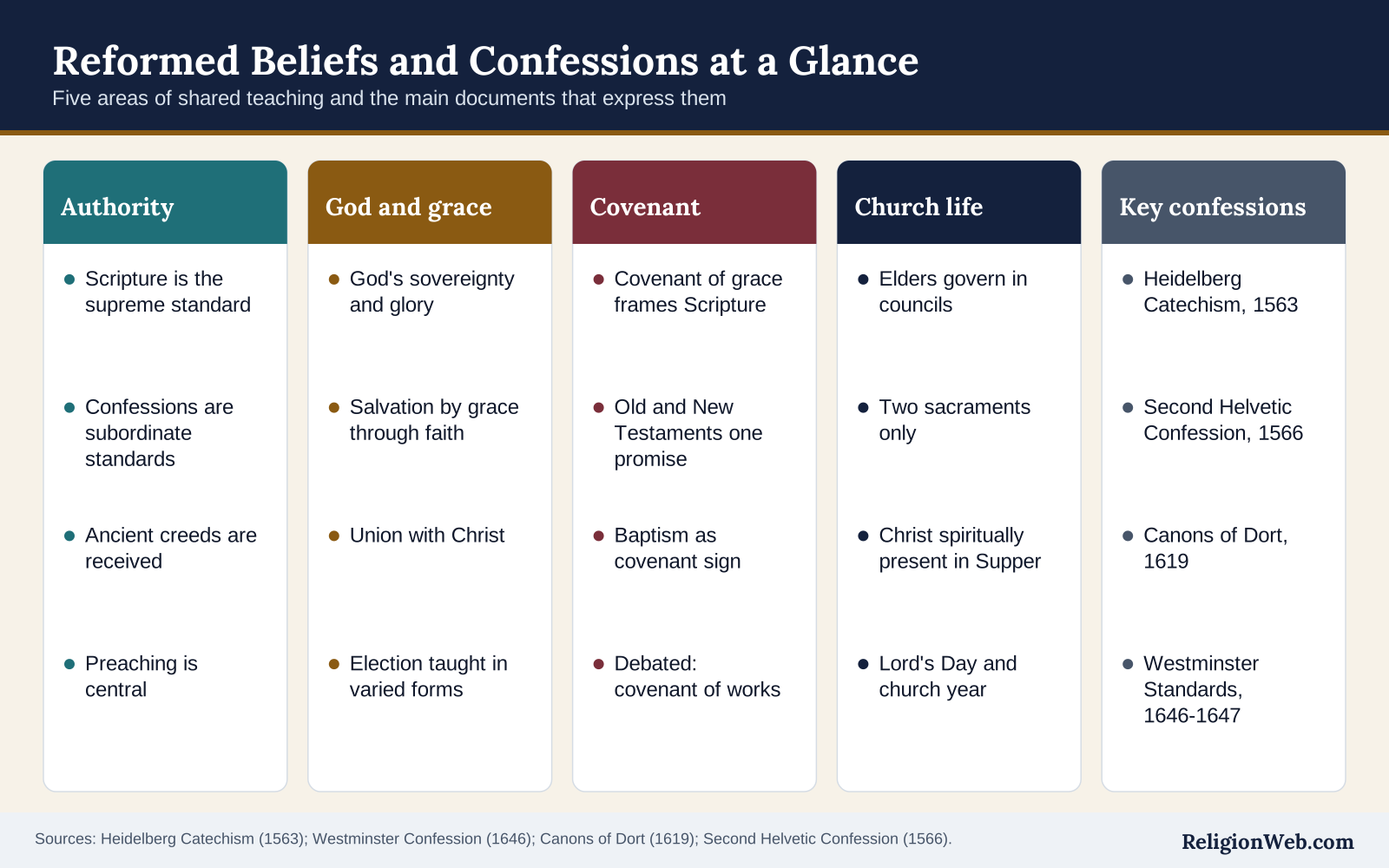
The table below gives a quick orientation. Each row is developed later in the article, and the entries describe the family as a whole; individual churches may differ on any of them.
| Feature | Summary |
|---|---|
| Self-description | Churches “reformed according to the Word of God,” continuing the church of the apostles and of the ancient creeds |
| Origins | Zurich from 1519 (Zwingli), Geneva from 1536 (Farel and Calvin), consolidated by Bullinger and Calvin by the 1550s |
| Main names | Reformed (continental Europe and its descendants), Presbyterian (Scotland, Ulster, and English-speaking world), also Congregational and united churches |
| Authority | Scripture as the supreme standard, with confessions and catechisms as subordinate standards; the ancient creeds are received |
| Characteristic emphases | God’s sovereignty and glory, grace alone, covenant, election, the centrality of preaching, ordered church life |
| Sacraments | Two: baptism and the Lord’s Supper, understood as signs and seals of God’s promises |
| Church government | Usually rule by elders in councils (presbyterian or synodal); some congregational and a few episcopal forms |
| Worship | Word-centered; preaching, prayer, psalms and hymns, sacraments; liturgical style ranges from very plain to formally ordered |
| Key texts | Calvin’s Institutes, Heidelberg Catechism (1563), Second Helvetic Confession (1566), Canons of Dort (1619), Westminster Standards (1646-1647) |
| Size | World Communion of Reformed Churches: more than 230 churches, 109 countries, about 100 million (self-reported, accessed October 2026) |
What “Reformed” Means
A family of churches, not one denomination
Nobody joins “the Reformed Church” in the abstract. A person belongs to a particular church such as the Church of Scotland, the Reformed Church in Hungary, the Protestant Church in the Netherlands, the Presbyterian Church (U.S.A.), the Christian Reformed Church in North America, or one of the many Presbyterian denominations in South Korea. Each of these is self-governing, and each has its own history. What links them is a shared origin in the Swiss and Genevan Reformation, a related set of confessions, and a recognizably similar way of reading Scripture, preaching, and ordering church life. Reference works describe the family as various Protestant churches that share a common origin in the Reformation in sixteenth-century Switzerland, and they use “Reformed” for churches regarded as essentially Calvinistic in doctrine.
The word itself began as an adjective. In the early sixteenth century many churches that broke with Rome, Lutheran ones included, described themselves as “reformed” or “evangelical.” According to the entry on the Reformed churches in the New Catholic Encyclopedia, the term narrowed as the dispute over Christ’s presence in the Lord’s Supper deepened in 1529, separating the Swiss and South German reformers from Luther and his followers. After that point “Reformed” gradually became the name of one stream of the Reformation rather than a general description of all of them.
Reformed, Calvinist, and Presbyterian: how the labels overlap
Three words are often used as if they meant the same thing, and they overlap without being identical. “Reformed” names a family of churches. “Calvinism” names the theology associated with John Calvin and developed by those who followed him. “Presbyterian” names a form of church government by elders (presbyters), and in practice it also names the Reformed churches of Scotland, Ireland, and the English-speaking world. Reference works note that in northern Europe “Reformed” means in practice what “Presbyterian” means in Britain and America.
“Calvinism” was in origin an outsider’s label. Opponents, especially Lutheran critics, began using it in the 1550s, and Calvin himself is said to have disliked it. Many Reformed Christians today accept it as a convenient shorthand, others prefer “Reformed” because the tradition has many teachers and founders, and a good number of them, such as Zwingli and Bullinger in Zurich, worked independently of Calvin or alongside him rather than under him. Using “Calvinist” for everything Reformed therefore leaves out half the story. Another point matters just as much: Calvin did not invent the main Reformed doctrines from nothing. He drew on Augustine, on Luther, on Bucer in Strasbourg, and on the Swiss reformers who preceded him in Zurich and Basel.
Core Convictions in Brief
Commitments most Reformed churches share
Most Reformed churches begin with the greatness of God. The first question of the Westminster Shorter Catechism asks for the chief purpose of human life, and its answer, to glorify God and enjoy him forever, captures a theme that runs from Calvin to the present. God’s sovereignty is understood to cover creation, providence, and salvation, and the proper human response is gratitude, worship, and obedience. Reformed churches receive the doctrine of the Trinity as set out in the ancient councils and creeds, and they emphasize that the Bible is the final standard by which all teaching is tested.
A second cluster concerns salvation. Reformed confessions teach that sinners are put right with God by grace alone, through faith in Christ, and that the Holy Spirit unites believers to Christ and gradually renews their lives. Most speak of election, God’s gracious choice of a people for salvation before the foundation of the world, and of a covenant relationship in which God binds himself to his people by promise. A third cluster concerns the church: the preaching of the Word and the administration of the two sacraments are its central activities, and faithful discipline and orderly government by elders belong to its life.
Where Reformed churches differ among themselves
It would be a mistake to treat this agreement as uniformity. Reformed churches differ over whether baptism is for infants or only for professing believers, a question on which some Reformed Baptists differ from most of the family. They differ over whether worship may include only what Scripture commands or whatever Scripture does not forbid, over whether women may be ordained as ministers and elders, over how closely ministers must adhere to the wording of the confessions, and over how to explain the relationship between God’s election and human responsibility. Church-wide statements of belief range from the single confession of one denomination to the collected Book of Confessions of the Presbyterian Church (U.S.A.), which includes documents from the early church to the twentieth century.
Geography and Numbers
Where Reformed churches are found
The historic heartlands are Switzerland, the Netherlands, western and northern Germany, parts of France, Scotland, Northern Ireland, Hungary, and Transylvania in Romania. From these regions the tradition spread through emigration, colonization, and missions. The Pilgrims and Puritans who settled New England in the 1620s and 1630s came from the Reformed wing of English Protestantism, Dutch Reformed settlers organized congregations in New Amsterdam in the 1620s, and Scots-Irish Presbyterians arrived in large numbers in the eighteenth century. Nineteenth- and twentieth-century missions then planted Presbyterian and Reformed churches in Korea, India, Indonesia, Brazil, Mexico, southern and eastern Africa, and many other places. Reference works on world Christianity now observe that most Reformed Christians live in the Southern Hemisphere, that Presbyterians are the largest Protestant group in South Korea, and that in Western Europe and North America the Reformed share of the population has been shrinking.
Counting a tradition without a central office
Since no single body speaks for all Reformed Christians, any total depends on who is counted. The World Communion of Reformed Churches (WCRC), formed in 2010 by the merger of the World Alliance of Reformed Churches and the Reformed Ecumenical Council, reports more than 230 member churches in 109 countries and about 100 million Christians, according to its own website in October 2026. A reference article in the Gale Worldmark Encyclopedia of Religious Practices gave an earlier figure: the predecessor World Alliance of Reformed Churches had 218 member churches in 107 countries and over 75 million members in 2003, representing about 70 percent of Reformed Christians by that estimate. These figures differ because of different dates, definitions, and counting methods, and neither should be read as an exact census.
Individual denominations publish their own statistics, and the trends vary. The Presbyterian Church (U.S.A.) reported 1,019,003 members for 2025 in a report released in June 2026, a decline of 26,845 from the year before. The Church of Scotland recorded about 229,000 members at the end of 2025, a fall of about 5 percent. In contrast, Presbyterian and Reformed churches in parts of Africa, Asia, and Latin America have grown in the same decades. The overall pattern is not one of simple decline or growth but of a movement of the center of gravity from the North Atlantic to the Global South.
Key Vocabulary
Terms of doctrine
Reformed discussion uses a distinctive vocabulary, and a few words recur throughout this article. Covenant is a relationship established by God’s promise. Election is God’s gracious choice of his people. Providence is God’s sustaining and guiding of everything that exists. Justification is God’s declaring sinners righteous because of Christ, and sanctification is the lifelong renewal of believers by the Spirit. Union with Christ is the bond through which both are received. The table that follows gathers these terms along with the terms of church life discussed next.
Terms of church life
Church-life words differ between the Presbyterian and continental Reformed vocabularies, which can confuse newcomers. A session or consistory is the local council of ministers and elders; a presbytery or classis is the regional council; a synod or general assembly is the wider body. A catechism is a set of questions and answers for teaching, and a confession is a formal statement of what a church believes. A psalter is a book of the psalms in metrical or singable form. The glossary table keeps these terms in one place.
| Term | Meaning in Reformed usage |
|---|---|
| Covenant | God’s binding relationship with his people, expressed in promise, sign, and obligation; basis of Reformed thought about salvation and the sacraments |
| Election | God’s gracious choice of those who are saved, taught in different forms across the family |
| Providence | God’s continuing care and governance of all things |
| Justification and sanctification | Being declared righteous before God through Christ, and being gradually renewed in holiness by the Spirit |
| Minister of Word and sacrament | An ordained pastor, also called a teaching elder in Presbyterian churches |
| Elder (presbyter) | A lay or ordained leader elected to share in governing the church and, in many churches, in oversight of its teaching |
| Session or consistory | The governing council of a local congregation |
| Presbytery or classis | A regional council of ministers and elders from several congregations |
| Synod or general assembly | The wider or national assembly of a church |
| Catechism and confession | A teaching text in question-and-answer form, and a public statement of a church’s belief |
| Psalter | A collection of the Psalms for singing, historically central to Reformed worship |
Origins: The Swiss Reformation and Its Setting
The Swiss and European Setting before 1519
A confederation of cities and valleys
The Reformed tradition began in a place with a particular political shape. The Swiss Confederation of the early sixteenth century was a loose alliance of cantons, some dominated by powerful cities such as Zurich, Bern, and Basel and some made up of mountain communities with assemblies of their own. It was nominally part of the Holy Roman Empire but in practice independent, and its cantons made their own laws and their own alliances. City councils in particular had long been taking over responsibilities once left to bishops, including oversight of local clergy, schools, charity, and church property. When reform came, the councils were ready to act as its legal agents, and the question of who would decide religious change was answered locally, canton by canton.
The confederation also exported its young men as mercenary soldiers. Pensions paid by foreign rulers, above all the French king and the pope, enriched some families and caused sharp quarrels over foreign policy. The mercenary trade is part of why Zwingli, who served as a chaplain with Swiss troops, came to speak with such force about national and moral reform. He had seen what the system cost.
Humanism, the Greek New Testament, and the call to the sources
The second ingredient was Renaissance humanism. Scholars such as Erasmus of Rotterdam called for a return to the original sources of the Christian faith, ad fontes, “to the sources.” In 1516 Erasmus published at Basel the first printed Greek New Testament, along with a fresh Latin translation, and Basel’s printers turned the city into a center of Bible and patristic publishing. Zwingli, Oecolampadius, and many other future reformers were readers of Erasmus, and they carried his habit of close attention to the Greek text into the pulpit. Humanism did not by itself make anyone Protestant, and Erasmus himself stayed within the Catholic church. It did shape the style of Reformed preaching: sermons that move steadily through a biblical book, verse by verse, were part of the humanist legacy as much as of the church fathers.
Huldrych Zwingli and the Zurich Reformation
From Glarus to the Grossmünster
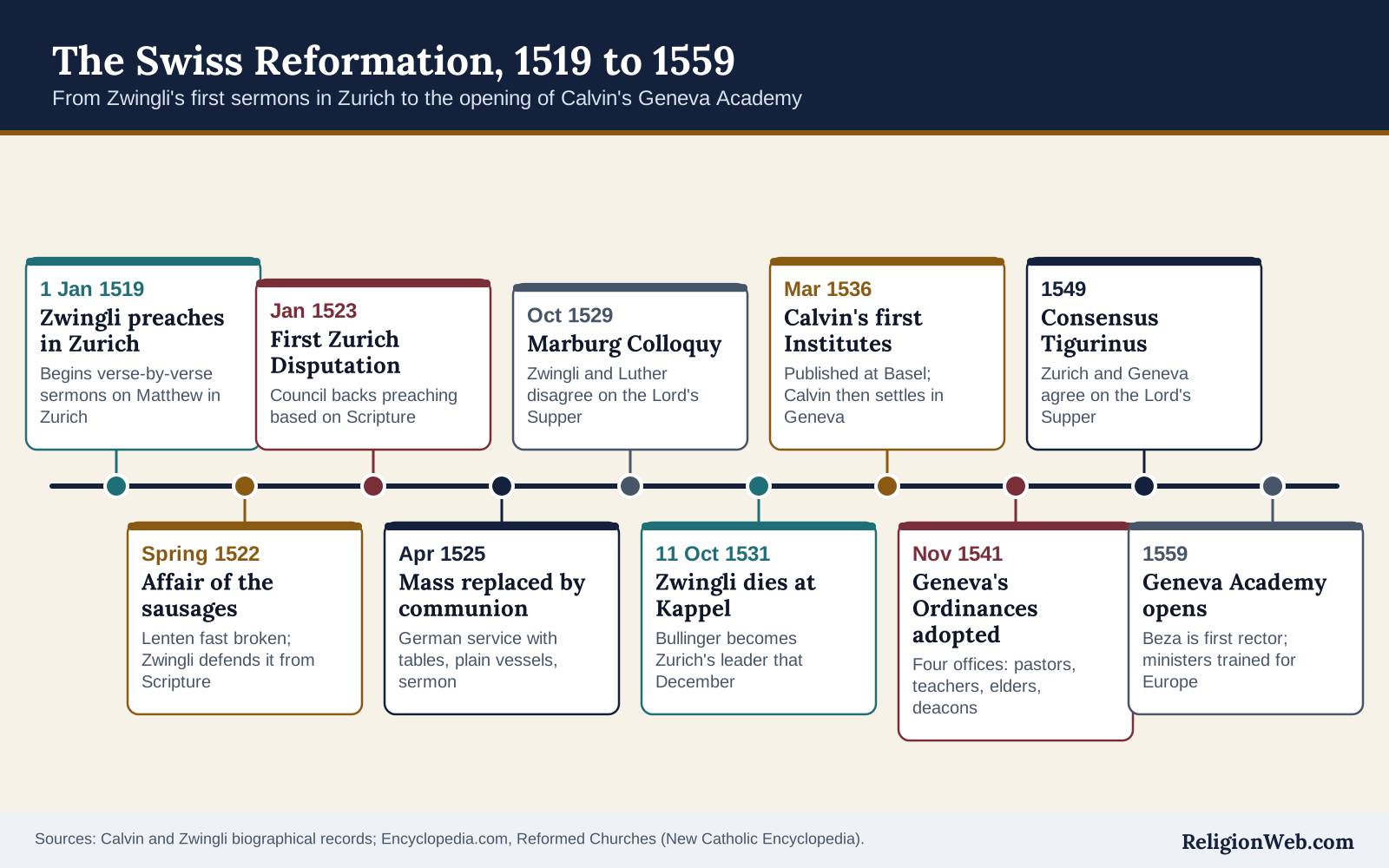
Huldrych Zwingli was born on 1 January 1484 in Wildhaus in the Toggenburg valley, studied at Vienna and Basel, and was ordained a priest in 1506. He served as parish priest at Glarus for about ten years, accompanied Glarus troops as chaplain to Italy, and was shaken by the slaughter of Swiss soldiers at Marignano in 1515. He then moved to Einsiedeln, a pilgrimage center, where he studied Greek and read Erasmus’s New Testament closely. In December 1518 the canons of the Grossmünster, Zurich’s principal church, chose him as people’s priest, and on 1 January 1519 he preached his first sermon there. Departing from the customary lectionary readings, he began working verse by verse through the Gospel of Matthew, a practice known as lectio continua.
The plague struck Zurich in the late summer of 1519 and killed perhaps a quarter of the city’s people. Zwingli stayed to care for the sick and nearly died himself. His recovery, and the text he wrote to mark it, are often read as marking a deepening of his sense that God’s will governs life and death. In the following years his preaching drew in the city council, the guilds, and a circle of humanist friends, and he became a citizen and canon of the Grossmünster in 1521.
Disputations, images, and a new communion service
The break with traditional practice came in stages and by public decision. In Lent 1522 some of Zurich’s printer Christoph Froschauer’s workmen ate sausage during the fast, and Zwingli defended them in print on the ground that Scripture does not forbid such eating. The incident, known as the affair of the sausages, is often taken as the beginning of the Reformation in Zurich. In January 1523 the city council convened a public disputation in which Zwingli defended sixty-seven theses, and the council ruled that he might continue preaching and that other preachers should teach nothing not found in Scripture. A second disputation in October 1523 turned to images and the Mass. Over the following months and into 1524 the council ordered the orderly removal of images from the city’s churches, and the organ at the Grossmünster fell silent.
On Maundy Thursday 1525 the Mass was replaced by a communion service in German in which the congregation sat at tables, wooden vessels were used, and the sermon stood at the center. Zwingli understood the Lord’s Supper as a memorial and a meal of thanksgiving in which the community confessed its faith, rather than a sacrifice or a change in the elements. In June 1525 a school of biblical study, called the Prophezei, began to train ministers by reading Scripture in Hebrew, Greek, and Latin and then preaching on it. Its work contributed to the Zurich Bible, which Froschauer printed.
Conflict with the Anabaptists and with Luther
Two disputes shaped the movement’s character. The first was with Zurich radicals who argued that baptism belongs only to those who can profess faith. In January 1525, after the council ruled in favor of infant baptism, Conrad Grebel and George Blaurock performed the first recorded adult baptisms among the group that became known as the Anabaptists. Zurich’s authorities treated the movement as a threat to civic and religious order. In 1526 the council made rebaptism a capital offense, and on 5 January 1527 Felix Manz was drowned in the Limmat River, the first Anabaptist execution in Zurich. The episode remains painful in Reformed memory, and in recent decades several Reformed churches have formally expressed regret for the persecution of Anabaptists.
The second dispute was with Martin Luther over the Lord’s Supper. Philip of Hesse brought the two sides together at Marburg from 1 to 4 October 1529. According to the usual account, Zwingli, Luther, and their colleagues agreed on fourteen of fifteen articles but could not agree on the manner of Christ’s presence in the Supper. Luther insisted on the literal sense of “this is my body,” while Zwingli read “is” as “signifies.” The split between the Lutheran and Reformed churches dates from this failure to agree. Two years later Zwingli served as chaplain to Zurich’s army in a war with the Catholic cantons, and he was killed in the battle of Kappel on 11 October 1531, aged forty-seven.
Bullinger, Basel, Bern, and Strasbourg: A Network of Reformers
Heinrich Bullinger and the consolidation of Zurich
Zurich appointed Heinrich Bullinger as Zwingli’s successor in December 1531, and he led the city’s church for more than forty years. Bullinger was a steady organizer and a prolific writer. His Decades, fifty sermons gathered in five groups of ten, became a widely read summary of Reformed teaching, and his correspondence with leaders across Europe, from England to Poland, made Zurich a clearing-house for the movement. He also wrote the Second Helvetic Confession, which began as a private statement in 1562 and was published in 1566 at the request of Elector Frederick III of the Palatinate. It was soon adopted by Reformed churches in Switzerland, Scotland, Hungary, France, and Poland, and it is still part of the Book of Confessions of the Presbyterian Church (U.S.A.).
Bullinger and Calvin worked out a common doctrine of the Lord’s Supper in the Consensus Tigurinus (“Zurich Agreement”) of 1549, uniting the Swiss churches of Zurich and Geneva. The agreement combined Zwingli’s emphasis that the sacraments are signs of God’s promises with Calvin’s teaching that in the Supper the Holy Spirit truly nourishes believers in union with Christ. That convergence is why historians treat Zurich and Geneva as two centers of one Reformed tradition rather than as rival movements.
Oecolampadius, Bucer, Farel, and the other cities
Reform spread through a web of cities in which Zurich was only one node. In Basel, Johannes Oecolampadius, a humanist and Hebraist, led the movement and worked closely with Zwingli. Bern adopted the Reformation in 1528 after a public disputation, and its large territory gave the movement a strong political ally and, later, a protector for Geneva. In Strasbourg, Martin Bucer and Wolfgang Capito developed a church order built on the cooperation of ministers, elders, and city magistrates, and their model deeply influenced Calvin, who spent three years there. The French-speaking reformer Guillaume Farel preached in the towns of the French-speaking Swiss lands and was the man who drew Calvin to Geneva. The first common Swiss statement of faith, the First Helvetic Confession, was drafted at Basel in 1536.
These cities did not follow a single plan. Their reformers disagreed about the Lord’s Supper, church discipline, and the role of city magistrates, and what became Reformed Christianity was the outcome of continuing negotiation among them. The shared themes were attention to the Bible in the original languages, the reform of worship, the preaching office, and a confidence that the church could be ordered according to Scripture with the help of elders. These themes were ready to be carried far beyond the Swiss cantons by a younger French exile who arrived in Geneva in the summer of 1536.
John Calvin, Geneva, and the Growth of an International Movement
The chronology below places the Swiss and Genevan events in the wider sequence that made Reformed Christianity an international movement. Dates are given as precisely as the sources allow.
| Date | Event | Why it matters |
|---|---|---|
| 1516 | Erasmus publishes the first printed Greek New Testament at Basel | Gives the Swiss reformers a shared text and a method of returning to the sources |
| 1 January 1519 | Zwingli begins preaching through Matthew at the Grossmünster, Zurich | Start of the Zurich Reformation and of verse-by-verse preaching |
| 1522-1525 | Affair of the sausages, Zurich disputations, removal of images, new communion service | Worship reformed by civic decision under the authority of Scripture |
| 1-4 October 1529 | Marburg Colloquy between Zwingli and Luther | Disagreement over the Lord’s Supper separates the Reformed and Lutheran streams |
| 11 October 1531 | Zwingli killed at Kappel; Bullinger succeeds in December | Zurich’s leadership passes to a long-serving organizer and writer |
| 1536 | Calvin publishes the first Institutes at Basel; Geneva adopts the Reformation; First Helvetic Confession | A new leader, a new city, and the first common Swiss statement of faith |
| 1541 | Calvin returns to Geneva; Ecclesiastical Ordinances adopted | Four church offices and a consistory define a Reformed model of church order |
| 1549 | Consensus Tigurinus unites Zurich and Geneva on the Lord’s Supper | Zwinglian and Calvinist streams converge |
| 1559 | Geneva Academy opens; first national synod of the French Reformed churches | A training center for ministers across Europe; the rise of the Huguenot church |
| 1560-1566 | Scots Confession (1560), Belgic Confession (1561), Heidelberg Catechism (1563), Second Helvetic Confession (1566) | Confessions for Scotland, the Low Countries, the Palatinate, and the wider Swiss family |
| 1618-1619 | Synod of Dort meets in the Dutch Republic | Issues the Canons of Dort in response to the Arminian Remonstrance |
| 1643-1649 | Westminster Assembly; Confession and Catechisms completed 1646-1647 | Standards for Presbyterian churches in Britain and beyond |
| 1648 | Peace of Westphalia names the Reformed in imperial law | Legal recognition in the Holy Roman Empire |
| 1934 | Barmen Declaration | Reformed-led statement in opposition to Nazi claims on the church |
| 2010 | World Communion of Reformed Churches formed | Two global Reformed bodies merge |
John Calvin’s Life and Work
From Noyon to Basel
John Calvin, born Jean Cauvin on 10 July 1509 at Noyon in Picardy, was a generation younger than Zwingli and Luther. He studied arts and theology at Paris and then law at Orléans and Bourges, where he learned Greek and entered the humanist world of his time. In his own later account, in the preface to his commentary on the Psalms, he described a “sudden conversion” to teachableness by the hand of God. Scholars date this change somewhere between 1529 and 1533 and continue to discuss what Calvin meant by it. After a wave of persecution of evangelicals in France in 1534, he left the country, settled in Basel, and in March 1536 published the first edition of the Institutes of the Christian Religion, a six-chapter handbook that followed the order of the catechism and defended the French evangelicals before their king.
Geneva, exile in Strasbourg, and return
Calvin intended to settle quietly into a life of study. When he passed through Geneva in July 1536, the city had just voted to adopt the Reformation under the preaching of Guillaume Farel, and Farel urged him to stay and help. Calvin and Farel’s attempt to impose a confession and a stricter discipline led in 1538 to the expulsion of both from the city. Calvin went to Strasbourg, where for about three years he served a congregation of French refugees, learned from Martin Bucer, married Idelette de Bure in 1540, and revised and enlarged the Institutes. In September 1541, after the city council changed its mind, he returned to Geneva and remained there until his death on 27 May 1564.
The Institutes and the commentaries
The Institutes grew with Calvin. The 1539 edition was about three times as long as the first, further editions appeared in 1543 and 1550, and the definitive Latin edition of 1559 organized the work in four books on the knowledge of God the Creator, the knowledge of God the Redeemer in Christ, the way in which the grace of Christ is received, and the outward means by which God calls people into the society of Christ and keeps them there, meaning the church and the sacraments. Calvin also wrote commentaries on most books of the Bible, gave thousands of sermons, and wrote a steady stream of letters. The opening lines of the Institutes present the double knowledge, of God and of oneself, that shapes the whole work.
Our wisdom, in so far as it ought to be deemed true and solid Wisdom, consists almost entirely of two parts: the knowledge of God and of ourselves.
John Calvin, Institutes of the Christian Religion, 1.1.1, English translation as reproduced at sacred-texts.com (Beveridge translation; translator not named on the page consulted)
Calvin goes on to say that the two kinds of knowledge are so linked that it is not easy to determine which comes first. The sentence is often read as a summary of the Reformed approach to theology: knowledge of God is never merely abstract, and knowledge of the self leads to reverence, awareness of dependence, and the desire for help. The same frame explains why Reformed theology so often begins with the nature of God and the human predicament together rather than with an argument for God’s existence.
Geneva as a Church and a City
The Ecclesiastical Ordinances of 1541
The Ecclesiastical Ordinances, adopted by Geneva’s council on 20 November 1541, set out four permanent offices in the church: pastors, who preached and administered the sacraments; doctors, who taught Scripture and theology; elders, laymen chosen from the city’s councils to oversee the moral and spiritual life of the congregations; and deacons, who cared for the poor and the sick. The pastors met weekly in a body called the Company of Pastors. Pastors and elders together formed the Consistory, which met weekly to deal with moral and doctrinal problems, mostly by admonition and, as a last step, by barring a person from communion. This structure, built from Strasbourg experience and local Genevan politics, became the model that later Reformed churches adapted in Scotland, France, and the Netherlands.
Discipline, conflict, and the case of Servetus
The Consistory is the most contested part of Geneva’s reputation. Calvin and his colleagues considered church discipline a mark of a faithful church: a community that shared the Lord’s Supper needed a way to address public scandal. Many Genevans, including some old and influential families, resented the Consistory’s reach, and a long struggle over who held the power of excommunication was settled only in the council’s favor in 1543 for sentencing and in the Consistory’s favor in 1555 for barring from the Supper. Geneva was a republic with its own magistrates. Calvin held no civil office, and the city council retained the power to impose civil penalties. Calvin was a foreign resident for most of his time in Geneva and received citizenship only in late 1559.
The execution of Michael Servetus remains the most serious charge against the Geneva of Calvin’s day. Servetus, a Spanish physician and theologian, had published works rejecting the traditional doctrine of the Trinity and infant baptism. He had escaped from Catholic custody in France, where he had been condemned, and was arrested in Geneva in August 1553. The council, after consulting other Swiss churches, condemned him for blasphemy and he was burned at the stake outside the city on 27 October 1553. Calvin had argued for his conviction, though he reportedly pressed for a less painful form of execution. Contemporaries such as Sebastian Castellio protested against putting anyone to death for religious belief, and many Reformed Christians today regard the episode as a grave wrong rooted in the assumptions of a time when almost every European government, Protestant and Catholic, enforced religious conformity by law. Historians continue to debate Calvin’s own responsibility.
Refugees, the Academy, and the Psalter
Geneva became a refuge for evangelicals driven from France, Italy, and, after 1553, England. Among them was John Knox, who served the English-speaking congregation in the city and described Geneva as an ideal school of Christian discipleship. The Genevan Academy opened in June 1559 with Theodore Beza as rector, training ministers who went back to France, the Netherlands, Scotland, and the German lands. Beza succeeded Calvin as leader of the Genevan church and became a major Reformed teacher in his own right.
The Genevan Psalter was another export. Calvin had met the practice of congregational psalm singing in Strasbourg and published psalms in the vernacular in 1539 and 1542. Poets and musicians, notably Clément Marot, Theodore Beza, and the composer Louis Bourgeois, supplied French metrical versions and tunes, and the complete Psalter of 150 psalms was published in 1562. Translations of it into Dutch, German, Hungarian, and many other languages gave Reformed congregations a common repertoire and a style of worship in which the whole congregation, and not a choir, sang.
The Spread of Reformed Churches across Europe
France, the Netherlands, and the Palatinate
In France the Reformed church was organized under persecution. Its first national synod met secretly in Paris in 1559, adopted the French Confession of Faith, and established a system of local consistories, regional colloquies, and national synods. Its members, called Huguenots, grew to include a significant minority of the nobility and the urban middle classes. After a generation of civil wars, including the massacre of thousands of Protestants beginning on St. Bartholomew’s Day in August 1572, the Edict of Nantes of 1598 gave them limited rights, and Louis XIV revoked it in 1685. Tens of thousands of Huguenots fled to the Netherlands, Britain, Prussia, Switzerland, and the colonies, and their emigration scattered the tradition across Europe and the Atlantic world.
In the Low Countries, Guido de Brès drafted the Belgic Confession in 1561 and sealed his witness with his life in 1567. The Dutch Revolt against Spanish rule, which began in the late 1560s, tied the Reformed church to the national cause. A synod at Emden in 1571 laid down the shape of the Dutch church, and the northern provinces that formed the Dutch Republic in the 1570s and 1580s made the Reformed church the privileged public church while allowing other groups to exist in private. In the Rhineland Palatinate, Elector Frederick III, who came to power in 1559, moved his territory toward the Reformed faith and commissioned the Heidelberg Catechism, making Heidelberg a leading university of the movement.
Scotland, Hungary, Poland, and England
John Knox returned to Scotland in 1559, and the Scottish Parliament in August 1560 abolished the authority of the pope, forbade the Mass, and approved the Scots Confession, drafted in four days by six ministers who all happened to be named John. The Church of Scotland that followed became the model of what the world calls Presbyterianism. In Hungary and Transylvania the Reformed faith spread rapidly after the Ottoman victory at Mohács in 1526 weakened the old church structures, and the Hungarian Reformed Church adopted the Second Helvetic Confession and the Heidelberg Catechism. In Poland a Reformed community flourished among the nobility in the sixteenth century; a minority left it in 1556 over the doctrine of the Trinity, forming the Minor Reformed Church, whose members were called the Polish Brethren.
England’s case was different. The Elizabethan settlement of 1559 gave the realm a church with bishops and a Book of Common Prayer, and the Thirty-Nine Articles of 1563 and 1571 are widely described as Reformed in their doctrine of grace and the sacraments. Yet a party of reformers known as Puritans wanted to go further toward the Genevan pattern in worship and church order, and in the seventeenth century their influence rose, fell, and rose again. The English story is told in the article on Anglicanism, and it is one reason the term “Reformed” overlaps with more than one church family.
Legal recognition and the limits of tolerance
Recognition came slowly and unevenly. In Switzerland, the Netherlands, and Scotland, Reformed churches became the public churches of their territories, but in France and much of eastern Europe they lived under restrictions. In the Holy Roman Empire, the Peace of Augsburg of 1555 had recognized Catholic and Lutheran territories only, which meant that Reformed princes such as Frederick III of the Palatinate stood on uncertain legal ground for nearly a century. The settlement of 1648 resolved the question, as the Fun Fact below explains. Throughout this period, the expectation that a territory should have a single established religion meant that Reformed Christians were sometimes persecutors as well as the persecuted, a point that Reformed historians now address openly.
Scripture, Confessions, and Authority in the Reformed Tradition
Scripture as the Supreme Authority
The Bible, the canon, and the apocryphal books
Reformed churches receive the sixty-six books of the Protestant Old and New Testaments as the written Word of God and regard them as the supreme and sufficient standard for faith and life. The confessions of the sixteenth and seventeenth centuries typically list the canonical books by name, and several of them add that the books commonly called the Apocrypha, which were read in the Catholic church as part of the Old Testament, may be read for example of life and instruction in conduct but are not used to establish doctrine. The Westminster Confession states the same position in its first chapter. Reformed churches share this view with Protestantism generally, and the broader history of the Christian canon is told in the article on the Bible.
The Bible in the vernacular was central. The Geneva Bible, produced by English exiles in Geneva and published in 1560, included extensive study notes and was the household Bible of English-speaking Puritans and Scots for decades. The Dutch Statenvertaling of 1637 played a similar role for the Reformed of the Netherlands, and Reformed translators around the world have repeated the pattern in languages from Hungarian to Korean.
The preached Word and the inner witness of the Spirit
Reformed confessions distinguish the written Word, the Bible, from the preached Word, which is the faithful proclamation of the Bible to a congregation. The Second Helvetic Confession teaches, in its first chapter, that the preaching of the Word of God is the Word of God, by which Bullinger meant that a sermon that sets forth what Scripture teaches is received by the hearers as God speaking to them, even though the preacher is a human being and the sermon is not a new revelation. This conviction explains why Reformed churches place the pulpit at the center of the room and expect ministers to be educated in the biblical languages.
Calvin also taught that the authority of Scripture is confirmed to believers by the inward testimony of the Holy Spirit and not by the church’s declaration alone. The Westminster Confession adds that the whole counsel of God concerning salvation, faith, and life is either expressly set down in Scripture or may be deduced from it by good and necessary consequence, and that nothing is to be added by new revelations or traditions of men. In practice that principle encouraged Bible reading in the home, the training of laypeople in doctrine, and a long tradition of biblical commentary.
Why Reformed Churches Write Confessions
Confessions as subordinate standards
Reformed churches describe their confessions as “subordinate standards,” subordinate to the Bible and open to correction by it. A confession is not a second Scripture. It is a public statement of what a church understands the Bible to teach, composed in a particular time and place, and it serves to unify the church, to teach new members and children, to show other churches where it stands, and to guard against teachings it regards as mistaken. Ministers and elders in many Reformed denominations are asked to affirm the confession at ordination, and churches differ on how that agreement is defined. Some require agreement with every statement, some with the “system of doctrine” it contains, and some, such as the Church of Scotland, allow liberty of opinion on matters that do not touch the substance of the faith.
A family of confessions, not one book
There is no single Reformed equivalent of the Lutheran Book of Concord. Each region wrote its own statement, and the family’s unity rests on a convergence of teaching rather than a shared text. Switzerland produced the Helvetic Confessions, France its own, Scotland the Scots Confession, the Low Countries the Belgic Confession, and the Palatinate the Heidelberg Catechism. The Canons of Dort became part of the Dutch Reformed standards, and the Westminster Assembly’s work shaped the Presbyterian world. Twentieth-century churches have added statements that address new situations, such as the Barmen Declaration of 1934. The result is a family in which a minister in Budapest, a pastor in Seoul, and an elder in Pittsburgh may each affirm different documents and still recognize one another as Reformed.
| Document | Date | Origin and main author | Where it is used |
|---|---|---|---|
| First Helvetic Confession | 1536 | Swiss reformers, drafted at Basel (Bullinger, Bucer, others) | Early common Swiss statement; later superseded |
| Consensus Tigurinus | 1549 | Calvin and Bullinger | Agreement on the sacraments uniting Zurich and Geneva |
| French (Gallican) Confession | 1559 | First national synod of the French Reformed churches | Huguenot church and later Reformed bodies |
| Scots Confession | 1560 | Six ministers including John Knox | Church of Scotland until 1647; PC(U.S.A.) Book of Confessions |
| Belgic Confession | 1561 | Guido de Brès; revised at Dort 1619 | Dutch-heritage churches (Three Forms of Unity) |
| Heidelberg Catechism | 1563 | Commissioned by Frederick III; Zacharias Ursinus principal author | Germany, the Netherlands, Hungary, North America, and many other churches |
| Second Helvetic Confession | 1566 | Heinrich Bullinger | Switzerland, Hungary, Scotland, France, Poland; PC(U.S.A.) |
| Canons of Dort | 1619 | Synod of Dort, responding to the Remonstrance | Dutch-heritage Reformed churches (Three Forms of Unity) |
| Westminster Confession and Catechisms | 1646-1647 | Westminster Assembly (England and Scotland) | Presbyterian churches worldwide; basis for Savoy and Baptist adaptations |
| Helvetic Consensus Formula | 1675 | Swiss Reformed theologians | Swiss churches (short-lived binding authority) |
| Barmen Declaration | 1934 | Confessing Church; Karl Barth principal drafter | German Protestant churches; PC(U.S.A.) Book of Confessions |
| Confession of 1967 and Belhar Confession | 1967; 1986 | United Presbyterian Church U.S.A.; Dutch Reformed Mission Church of South Africa | PC(U.S.A.); Uniting Reformed Church in Southern Africa and other bodies |
Two Standards in Closer View: Heidelberg and Westminster
The Heidelberg Catechism (1563)
Elector Frederick III of the Palatinate commissioned the Heidelberg Catechism to unify the religious life of his territory, which included Lutheran and Reformed teachers who disagreed about the Lord’s Supper. Zacharias Ursinus, a young theology professor, is generally regarded as its principal author; Caspar Olevianus was once thought to be a co-author, though modern scholarship has largely set that view aside. A synod in Heidelberg approved it in 1563. It consists of 129 questions and answers divided into 52 sections called Lord’s Days, so that a minister could teach one on each Sunday of the year, and it is organized in three parts that tradition summarizes as guilt, grace, and gratitude: human sin and misery, deliverance by Christ, and the thankful life that follows, explained through the Ten Commandments and the Lord’s Prayer. Its first question is among the best-known passages in Reformed literature.
What is thy only comfort in life and death? That I with body and soul, both in life and death, am not my own, but belong unto my faithful Saviour Jesus Christ …
Heidelberg Catechism (1563), Lord’s Day 1, Q. and A. 1, English text as reproduced at the Christian Classics Ethereal Library (translator not identified on the page)
The answer, which continues with Christ’s satisfaction for sin, the Father’s care, and the Spirit’s assurance, is notable for its pastoral warmth. Many Reformed Christians point to it as proof that the tradition’s central theme is comfort in God’s care, not fear. The catechism is also known for its sharp Question 80, added in later 1563 editions, which describes the Roman Mass as “idolatry”, language that Catholics found offensive and that some modern Reformed churches have qualified in their own editions. The Synod of Dort adopted the catechism in 1618-1619 as one of the Three Forms of Unity, alongside the Belgic Confession and the Canons of Dort, and it is still taught or affirmed by the Christian Reformed Church in North America, the Reformed Church in America, the Presbyterian Church (U.S.A.), the Hungarian Reformed churches, and many others.
The Westminster Standards (1646-1649)
The Westminster Assembly, called by the English Parliament in 1643, met in Westminster Abbey and included English divines and a delegation of Scottish commissioners. It sat for about six years and produced a Directory for Public Worship, a form of church government, the Westminster Confession of Faith in thirty-three chapters, and the Larger and Shorter Catechisms. The Church of Scotland’s General Assembly adopted the Confession in August 1647, replacing the Scots Confession, and the Shorter Catechism, designed for children, became one of the most widely memorized texts in the English-speaking Reformed world. It opens with a famous pair of lines.
Q1: What is the chief end of man? A1: Man’s chief end is to glorify God, and to enjoy Him for ever.
Westminster Shorter Catechism (1647), Q. 1, text as reproduced at the Christian Classics Ethereal Library
The Westminster Standards were never limited to Scotland. English Congregationalists adapted the Confession in the Savoy Declaration of 1658, and the Particular Baptists of England revised it again in 1677 and 1689 in what is known as the Second London Confession, a document still treasured by Baptist churches that call themselves Reformed. American Presbyterians amended its chapters on the civil magistrate in the late eighteenth century, and Presbyterian churches in Korea, Africa, Brazil, and elsewhere have adopted it by translation. Where some churches treat it as a living standard to be interpreted, others have set it alongside later statements, and others maintain it in its original wording.
Core Beliefs: God’s Sovereignty, Grace, Election, and Covenant
God’s Sovereignty, Providence, and Human Purpose
The glory of God and the Trinity
Reformed theology is usually described as God-centered. Its confessions start with God’s being, glory, and purposes before turning to human needs, and its writers repeatedly return to the thought that creation, redemption, and the church exist for the glory of God. At the same time, the tradition is built on the received doctrine of the Trinity: one God in three persons, Father, Son, and Holy Spirit. Reformed churches affirm the Apostles’, Nicene, and Athanasian creeds, and they read the Bible as the story of the Triune God’s work. Calvin’s own treatment of the Trinity in the Institutes is shaped by the conviction that the Father creates, the Son redeems, and the Spirit applies redemption to believers.
The word “sovereignty” needs its context. In Reformed usage it means that nothing exists or happens outside God’s rule and purpose, not that God is a distant ruler who treats creatures as pieces on a board. The confessions say with equal force that God is good, that he is not the author of sin, and that the creatures he made act according to their own nature and will. How these claims fit together is a long-standing question, and Reformed theologians answer it by appeal to mystery, to the distinction between God’s secret decree and his revealed will, and to the character of God known in Christ.
Providence and human responsibility
Providence is the doctrine that God preserves and governs everything he has made. The Heidelberg Catechism applies the doctrine to ordinary life: it teaches that nothing happens by chance, that good fortune and hardship alike come from the Father’s hand, and that believers can be patient in adversity, thankful in prosperity, and confident about the future. For many Reformed Christians this is the most personal part of the tradition. It is also tied to a strong sense of human responsibility. The Westminster Confession says that God’s decree does not take away the liberty or contingency of secondary causes, which means that human choices are real choices, and the sermon, the call to repentance, and the work of the church are all means God uses.
Sin, Grace, and Salvation in Christ
Human sinfulness and the need for grace
Reformed confessions follow Augustine in teaching that, since the fall of Adam, every part of human nature is affected by sin, so that people cannot save themselves or even turn toward God without his help. The Canons of Dort speak of the corruption of the whole person, and later writers popularized the phrase “total depravity.” The word “total” refers to the extent of sin’s effects on the whole person, mind, will, and affections. It does not mean that people are as wicked as they could be, and the confessions explicitly allow that fallen people can show civic virtue, kindness, and cultural achievement, a point Calvin and later Dutch theologians developed under the heading of common grace.
Union with Christ, justification, and sanctification
In the Reformed account, salvation is received through union with Christ by the work of the Holy Spirit and the gift of faith. Calvin spoke of a “double grace” flowing from that union: justification, in which God accepts sinners as righteous because of Christ’s work, and sanctification, in which the Spirit gradually transforms them. The two can be distinguished but never separated, and good works are the fruit and evidence of faith and not its basis. The Heidelberg Catechism treats the Christian life under the heading of gratitude, and Reformed churches commonly say that obedience is the thankful response of the redeemed. The person and work of Jesus Christ are at the center, and the confessions follow the Chalcedonian understanding of Christ as truly God and truly human.
Election and Predestination, with Careful Nuance
What the confessions say
Election is the most famous and most misunderstood Reformed doctrine. The word means that God, from eternity, chose a people for salvation in Christ, not because of foreseen merit or faith, but by his gracious will. The Westminster Confession, in the third chapter, states the matter in strong terms.
By the decree of God, for the manifestation of his glory, some men and angels are predestinated unto everlasting life; and others foreordained to everlasting death.
Westminster Confession of Faith (1646), 3.3, text as published by the Orthodox Presbyterian Church
The same chapter at once adds a pastoral rule about how the doctrine should be taught, and a reader who stops at the first sentence misses it.
The doctrine of this high mystery of predestination is to be handled with special prudence and care, that men, attending the will of God revealed in his Word, and yielding obedience thereunto, may, from the certainty of their effectual vocation, be assured of their eternal election.
Westminster Confession of Faith (1646), 3.8, text as published by the Orthodox Presbyterian Church
The statement invites believers to find assurance in the call of the gospel and in a life of obedience, and not to speculate about hidden decrees. The Canons of Dort close with a similar plea for humility and reverence, and the Second Helvetic Confession tells ministers to teach election in Christ, so that people look to Christ and not to a secret list of names. Calvin likewise urged his readers to find their election in Christ.
Disagreements inside the Reformed family
Reformed theologians have not all answered the questions raised by election in the same way. One debate concerns the logical order of God’s decrees: supralapsarians placed the decree to elect before the decree to permit the fall, while infralapsarians placed it after, and the Westminster and Dort documents are generally read as infralapsarian without condemning the other view. Another concerns the extent of Christ’s atonement. Most Reformed writers have taught that Christ died effectively for the elect, while others, following Moses Amyraut in seventeenth-century France, held that Christ died sufficiently for all while God applies that death only to the elect, a position called Amyraldism or hypothetical universalism. The Synod of Dort met before Amyraut wrote, and French national synods in the 1630s declined to condemn him, so Reformed churches have in practice lived with both emphases.
The sharpest argument was with Jacobus Arminius and his followers. After Arminius died in 1609, his supporters issued the five articles of the Remonstrance in 1610 in the Dutch Republic, teaching that election rests on God’s foreknowledge of faith and that grace can be resisted. A counter-statement followed in 1611, and the Synod of Dort answered in 1618-1619. The Dutch church rejected the Remonstrant position, and Arminian ideas continued in other traditions, notably within Methodism. The familiar five-point summary known by the acronym TULIP is not the wording of Dort. It is a later mnemonic popularized in the twentieth century, and many Reformed Christians consider it too narrow to represent their tradition’s full teaching.
In the twentieth century Karl Barth, a Swiss Reformed theologian, offered a major reconstruction. In his Church Dogmatics he argued that Jesus Christ is both the electing God and the elected human being, so that election is first of all about Christ and, in him, about all humanity. Some Reformed theologians have embraced his approach, others consider it a departure from the confessions, and the dispute continues. These differences show why the claim that Reformed Christians believe one specific thing about predestination is misleading.
Covenant Theology
The covenants of works and grace
The covenant is the main framework through which Reformed theologians read the Bible. Heinrich Bullinger wrote early on the single and eternal covenant of God, and later Reformed theologians, including Caspar Olevianus and Johannes Cocceius, developed what is called federal or covenant theology. The Westminster Confession, in chapter 7, describes two covenants: a covenant of works made with Adam, in which life was promised on condition of perfect obedience, and, after the fall, a covenant of grace in which God freely offers life and salvation by Jesus Christ and promises the Holy Spirit to those ordained to eternal life. Within the covenant of grace, the Old Testament and the New Testament are two administrations of one gracious promise, with different signs: circumcision and Passover in one, baptism and the Lord’s Supper in the other.
How Reformed Christians debate the covenant
Not every Reformed theologian speaks of a covenant of works. Barth rejected it as a creation of later theology, and some twentieth-century writers, among them John Murray, preferred other language for the relationship between God and Adam, while others, such as Michael Horton, have defended the older framework. The covenant also explains the Reformed practice of baptizing infants, which is considered a sign and seal of belonging to the covenant community, and it is the main reason that Reformed Christians and Baptists differ over baptism. The idea of covenant has also influenced political thought, from Scottish national covenants to the Puritan colonies of New England, where the language of covenant shaped local church and civil life.
Law, Vocation, and the Christian Life
The law and its uses
Reformed churches teach that God’s moral law, summarized in the Ten Commandments, has a continuing place in the life of believers. Calvin distinguished three uses of the law: to show people their sin and need of grace, to restrain evil in society, and to guide believers in the life of gratitude. The Heidelberg Catechism devotes its third part to the commandments, and a Reformed church service often includes a reading of the law. The Lord’s Day has a special place in this teaching, and Sabbath observance has historically been a mark of Reformed communities, as the later section on the church year explains.
Calling and everyday work
Reformed teachers also emphasized that all legitimate work is a vocation, a calling from God, whether in the pulpit, the shop, the farm, or the council chamber. The idea gave dignity to ordinary occupations and encouraged education, literacy, and responsible citizenship. The sociologist Max Weber’s early twentieth-century argument that Calvinist ideas about calling influenced the rise of modern capitalism is famous, but historians have debated it ever since, and few now accept it in its original form. What can be said with confidence is that Reformed communities placed a high value on schooling, on caring for the poor through the diaconate, and on the Christian’s responsibility in public life.
Worship and Preaching in Reformed Churches
Reformed worship is shaped by a few simple convictions and carried out in many styles. The table lists the usual elements of a Sunday service in the order in which they commonly occur, along with the reasoning behind each. Individual congregations vary, and some omit or reorder items.
| Element | What happens | Why it matters |
|---|---|---|
| Call to worship and greeting | The minister invites the congregation to worship, often with a verse of Scripture and a greeting | Worship begins with God’s initiative, not human effort |
| Prayer of confession and assurance | The congregation confesses sin, and the minister declares God’s promise of pardon | Echoes Calvin’s liturgy; links law and gospel |
| Psalms and hymns | Congregational singing, historically of the metrical Psalms | The people’s part in worship, rooted in Scripture |
| Reading of Scripture | One or more passages, often following a continuous reading or a lectionary | God speaks through the written Word |
| Prayers of the congregation | The minister leads prayers for the church and the world | Intercession for others; often includes the Lord’s Prayer |
| Sermon | An exposition of a biblical passage, usually 20 to 45 minutes | The center of the service; the Word proclaimed |
| Sacraments | Baptism of infants or adults; the Lord’s Supper at stated times | The Word made visible in signs and seals |
| Offering and benediction | Gifts for the church and the poor; a blessing from Scripture | Response and sending; the service ends with God’s blessing |
Principles of Reformed Worship
The regulative principle and how it is applied
The founding principle of Reformed worship, sometimes called the regulative principle, holds that the church should worship God only in ways he has commanded in Scripture. Calvin and the sixteenth-century Swiss confessions argued this against medieval ceremonies they regarded as human inventions. The Westminster Confession states it in its chapter on worship: the acceptable way of worshiping God is instituted by himself and limited by his revealed will. The principle has been applied in different ways. A strict reading limited singing to the Psalms, without instrumental accompaniment, and a number of small bodies still observe this exclusive psalmody. A broader reading allows anything that is consistent with Scripture and good order, and most Reformed churches today use hymns, organs, bands, and in some cases contemporary music.
Simplicity, the Word, and the people’s part
The Reformers wanted worship that the ordinary person could understand and share in. They removed images from church interiors on the ground that the second commandment forbade them, moved the table of the Lord’s Supper into the midst of the congregation, and placed the pulpit at the center. A Reformed church building is traditionally a plain space, with clear glass or modest windows, a central pulpit, a table, and a font. Many modern Reformed churches have changed this style, adding art, banners, and more ceremony, while others maintain the older simplicity. The core idea stays the same: the congregation gathers around the Word.
The Sunday Service in Practice
A common order of worship
The sequence in the table owes much to Calvin’s liturgy, which was first used in Strasbourg in 1540 and then in Geneva in 1542. Calvin included a prayer of confession, a psalm, a prayer for illumination before the sermon, the sermon itself, prayers for the church and the world, the Apostles’ Creed, and a blessing, and he preferred that the Lord’s Supper be celebrated frequently. Scottish and English Puritans later set their order out in the Westminster Directory for the Public Worship of God of 1645, which gave rules and suggestions rather than a fixed liturgy and encouraged ministers to pray in their own words. Churches in the continental tradition more often kept written forms for baptism and the Lord’s Supper, which were read aloud at each celebration.
Psalms, hymns, instruments, and language
Singing has always been central. The Genevan Psalter of 1562 and its translations gave Reformed congregations metrical psalms in the vernacular, and the Scottish and English Psalters did the same in English. In the eighteenth century Isaac Watts and others introduced hymns written by contemporary authors rather than drawn directly from the Psalms, and that began a long debate, now largely settled in favor of hymn-singing in most churches. Organs, silenced in Zurich in the 1520s, returned to many Reformed churches in the seventeenth and eighteenth centuries. Today worship in the Reformed tradition may be sung in Hungarian, Korean, Dutch, Afrikaans, or Swahili. Worship in a Korean Presbyterian church often includes early-morning prayer meetings and a vigorous tradition of congregational prayer, and in an African Presbyterian church it may include choirs and, in some places, dance, showing that the Reformed family adapts its principles to local custom.
Prayer, Catechizing, and Family Devotion
Prayer in public and private
Prayer in Reformed worship is both liturgical and spontaneous. The congregation commonly prays the Lord’s Prayer, and the Heidelberg Catechism devotes its final eight Lord’s Days to it. A pastor’s own prayers often follow a fixed pattern of adoration, confession, thanksgiving, and intercession. Private prayer is encouraged with the Psalms as a model, and Calvin described the Psalms as an anatomy of every part of the soul. Reformed Christians address their prayers to God alone, through Christ, and do not invoke Mary or the saints, although they honor biblical and historical figures as examples of faith, a theme developed in the articles on the Virgin Mary and Christian saints.
Catechizing and family worship
The Reformed tradition has a strong teaching culture. In the Dutch and German Reformed churches, the Heidelberg Catechism was traditionally preached on in an afternoon service, one Lord’s Day at a time, and children learned its answers by heart. In Scotland and its daughter churches the Shorter Catechism served the same purpose. Families were expected to read Scripture and pray together at home, a practice called family worship, and many households sang a psalm at the end of the day. Confirmation or profession of faith, usually in the teenage years, marks the point at which baptized children publicly affirm their faith and are admitted to the Lord’s Supper.
Baptism and the Lord’s Supper in the Reformed Tradition
Reformed churches recognize two sacraments, baptism and the Lord’s Supper, because they hold that Christ himself instituted these two and no others. A sacrament is understood as a visible sign and seal of God’s promise: the sign points to a spiritual reality, and the seal confirms God’s pledge to those who receive it in faith. The table summarizes the main teaching and practice of both, and the sections that follow explain the differences within the family.
| Aspect | Baptism | Lord’s Supper |
|---|---|---|
| Basis | Command of Christ in Matthew 28:19; sign of entry into the covenant community | Institution by Christ at the Last Supper; command to remember him |
| Meaning | Sign and seal of cleansing, union with Christ, and new life | Sign and seal of Christ’s body and blood, spiritually received by faith |
| Who receives it | Infants of believing parents and adult converts; believers’ baptism only in Reformed Baptist and some other churches | Baptized members who profess faith, in most churches after confirmation |
| Elements and action | Water applied with the Trinitarian formula, usually by pouring or sprinkling | Bread and wine (or juice in some churches), distributed by elders |
| Who administers it | An ordained minister in public worship | An ordained minister with elders assisting |
| Frequency | Once only; not repeated | Monthly, quarterly, or at other stated times; weekly in some churches |
| Characteristic emphasis | God’s promise comes first; the child belongs to the covenant | Spiritual presence of Christ by the Holy Spirit; nourishment of faith |
Baptism
A sign and seal of the covenant
The Westminster Confession calls baptism a sacrament ordained by Jesus Christ for the solemn admission of the person baptized into the visible church, and also a sign and seal of the covenant of grace, of ingrafting into Christ, of regeneration, of the forgiveness of sins, and of giving oneself up to God to walk in newness of life. That is a compact summary of what most Reformed churches teach. Baptism is not itself the cause of salvation, and the church does not teach that an unbaptized child is lost, but it is a promise made visible, and God’s promise is what gives it meaning. Reformed theology generally treats baptism as the New Testament counterpart of circumcision, the sign of belonging to the covenant people. The wider history of the rite is covered in the article on Christian baptism.
Who is baptized, and how
Most Reformed churches baptize the infant children of believing parents as well as adult converts, and they do so for the reason that the promise of the covenant extends to believers and their children. The parents promise to raise the child in the faith, and the congregation promises to help. Baptism is administered by an ordained minister, usually during public worship, with water and the words of the Trinitarian formula, and it is done by pouring or sprinkling, although many churches accept immersion. It is not repeated, and baptism in the name of the Father, Son, and Holy Spirit in other churches is generally recognized. Some Reformed Baptists and other Christians who share Reformed doctrine but hold that baptism is only for those who personally profess faith, differ on this point, a disagreement that goes back to the quarrel between Zwingli and the Anabaptists in Zurich in 1525.
The Lord’s Supper
Zwingli, Bullinger, and Calvin on the Supper
The meaning of the Supper was the most disputed question among sixteenth-century Protestants. Zwingli taught that the bread and wine are signs that commemorate Christ’s death and express the community’s faith, and he read “this is my body” as “this signifies my body.” Luther held that Christ’s body and blood are truly present “in, with, and under” the bread and wine, a view developed in the article on Lutheranism. Calvin took a third position: Christ is not physically present in the elements, but the Holy Spirit unites believers to the risen Christ in heaven, so that they truly receive him by faith in the sacrament. The Consensus Tigurinus of 1549 joined Geneva and Zurich around this teaching, and the Reformed confessions after it speak of a real, spiritual presence. The Westminster Confession says it in these terms.
Worthy receivers, outwardly partaking of the visible elements, in this sacrament, do then also, inwardly by faith, really and indeed, yet not carnally and corporally but spiritually, receive, and feed upon, Christ crucified …
Westminster Confession of Faith (1646), 29.7, text as published by the Orthodox Presbyterian Church
The phrase “really and indeed, yet … spiritually” holds the center of the Reformed teaching. It rejects both a merely symbolic meal and a change in the physical elements, and it places the action of the Spirit at the heart of the sacrament. Within the Reformed family, some emphasize the memorial aspect, in the tradition of Zwingli, while others emphasize the spiritual feeding, in the tradition of Calvin. The wider history of the rite, across traditions, is described in the article on the Eucharist, Communion, and the Lord’s Supper.
How the Supper is celebrated
Practice varies widely. In most churches the minister reads the words of institution from 1 Corinthians 11 or the Gospels, gives an exhortation and prayer of thanksgiving, and the bread and wine are distributed by elders to the congregation, who receive them either in the pews or by coming forward to a table. Some churches use a common cup, others small individual cups, and in some American churches grape juice replaces wine. Calvin wished the Supper to be celebrated every Sunday, but the Genevan magistrates allowed it only four times a year, and the quarterly custom spread widely. Today the frequency ranges from weekly to a few times a year.
The Supper has also carried a strong sense of preparation and self-examination. In Scotland, from the seventeenth to the nineteenth century, communion was celebrated in “communion seasons,” multi-day gatherings with preaching on the preceding days, and elders gave tokens to those judged ready to receive. This practice of “fencing the table,” excluding the unrepentant, reflects the Reformed concern for discipline, though contemporary Reformed churches usually fence the table with a verbal invitation to all baptized believers rather than with tokens.
Church Government: Presbyterian, Continental Reformed, and Other Forms
The Reformed churches were not only a body of doctrine but a way of ordering communal life. Sixteenth-century Reformers believed that Scripture teaches not only what to believe but how a church should be governed, and they rejected the rule of one bishop over many congregations in favor of councils of elders. The table lists the principal forms.
| Form | Governing bodies | Where found | Distinctive features |
|---|---|---|---|
| Presbyterian | Session, presbytery, (synod), general assembly | Scotland, Ireland, United States, Korea, Africa, Australia | Teaching and ruling elders; presbytery ordains ministers and receives call |
| Continental Reformed | Consistory, classis, synod | Netherlands, Switzerland, Germany, France, North American Dutch-heritage churches | Same principles as Presbyterian; different names for the bodies |
| Congregational | Local congregation; voluntary associations | New England heritage churches, United Church of Christ, Congregational unions | Each congregation has full authority; fellowship by consent |
| With bishops (superintendents) | Bishop plus synod | Reformed churches in Hungary and Romania | Bishop as senior pastor and chair, not a separate order |
| United and uniting churches | Varies; often presbyterian with other elements | United Church of Canada, Uniting Church in Australia, Church of South India | Reformed families merged with Methodist, Congregational, Anglican, or Lutheran churches |
Principles Behind Reformed Order
Offices of the church
Calvin’s Genevan Ordinances set out four offices drawn from his reading of the New Testament: pastors, teachers, elders, and deacons. Most Reformed churches today have three: ministers (also called pastors or teaching elders), elders (also called ruling elders), and deacons. Ministers are trained in the biblical languages and theology, called by a congregation, and ordained by a presbytery or classis. Elders are elected by the congregation to share in leadership, discipline, and pastoral care, and deacons are charged with the care of the poor, the sick, and the church’s finances. All three offices are held by the church’s members, and ministers are regarded as equals in rank to one another, with no minister ruling over another.
Councils, representation, and accountability
The Reformed system is representative and graded. A local council of ministers and elders governs the congregation, delegates go to regional bodies, and those bodies send representatives to a national assembly. Disputes go upward by appeal. No office has authority over the whole church, and decisions are made by majority vote after deliberation. Many Reformed writers see this as a protection against concentrated power, and the structure influenced the thinking of those who later designed representative civil governments. The confessions name church discipline, along with the pure preaching of the Word and the proper administration of the sacraments, as one of the marks of a true church, though not all Reformed churches agree on the number of marks.
Presbyterian, Continental, and Congregational Forms
The Presbyterian system
In the Presbyterian pattern the local council is called a session, composed of the minister and the elected ruling elders. Sessions belong to a presbytery, which examines and ordains ministers, oversees congregations, and decides disputes. Some denominations add a synod at the intermediate level, though the Church of Scotland abolished its synods in 1993. The general assembly is the national body, led by a moderator who is elected for a limited term and presides over the meetings but does not rule the church. Presbyterian churches in the United States, Canada, Scotland, Ireland, Australia, Korea, Ghana, and Brazil all follow this basic plan.
The continental Reformed system
Continental Reformed churches use the same principles with different names. The consistory is the local council, the classis is the regional body, and the synod is the national or regional assembly. In Switzerland, churches are traditionally organized by canton, and in some cantons they are recognized by public law and supported through church tax. In the Netherlands, the Protestant Church in the Netherlands (PKN), formed in 2004 from the Dutch Reformed Church, the Reformed Churches in the Netherlands, and the Evangelical Lutheran Church, uses a mixed structure of local congregations, regional bodies, and a general synod. A few continental Reformed churches, notably in Hungary and Romania, have retained the office of bishop, understood as a pastoral and administrative role.
Congregational and other variations
In Congregational polity, each local church is self-governing and relates to others through voluntary association and not through binding courts. This pattern grew out of the English Puritan movement and was adopted by the Pilgrim and Puritan colonies of New England, and it is described in the Savoy Declaration of 1658. Congregational churches in the United States later joined other groups to form the United Church of Christ in 1957, and churches in England, Canada, and Australia entered united churches of their own. Women’s ordination also varies: many Presbyterian and Reformed churches ordained women as deacons, elders, and ministers during the twentieth century, while others, such as the Presbyterian Church in America and the Orthodox Presbyterian Church, limit the offices of minister and elder to men, citing their reading of Scripture.
Founders, Central Figures, and Teachers
No single founder defines the tradition. The table lists the principal reformers and later teachers whose work shaped Reformed thought and church life, with dates and places.
| Figure | Dates | Place | Contribution |
|---|---|---|---|
| Huldrych Zwingli | 1484-1531 | Zurich | Began the Swiss Reformation; verse-by-verse preaching; reform of worship |
| Johannes Oecolampadius | 1482-1531 | Basel | Humanist and Hebraist; led the Basel Reformation |
| Martin Bucer | 1491-1551 | Strasbourg, later England | Church order of elders and ministers; mentor to Calvin |
| Guillaume Farel | 1489-1565 | French-speaking Switzerland, Geneva | Evangelist who brought the Reformation to Geneva and drew Calvin there |
| Heinrich Bullinger | 1504-1575 | Zurich | Consolidated the Swiss churches; Second Helvetic Confession; covenant theology |
| John Calvin | 1509-1564 | Geneva | Institutes; commentaries; Genevan church order and Academy |
| Peter Martyr Vermigli | 1499-1562 | Italy, Strasbourg, England, Zurich | Theologian whose work shaped Reformed and Anglican teaching |
| John Knox | c. 1514-1572 | Scotland, Geneva | Led the Scottish Reformation; Scots Confession |
| Theodore Beza | 1519-1605 | Geneva | Succeeded Calvin; rector of the Academy; Psalter |
| Zacharias Ursinus | 1534-1583 | Heidelberg | Principal author of the Heidelberg Catechism |
| Jonathan Edwards | 1703-1758 | New England | Theologian and philosopher of the Great Awakening |
| Abraham Kuyper | 1837-1920 | Netherlands | Neo-Calvinist theologian, journalist, and politician; Free University of Amsterdam |
| Karl Barth | 1886-1968 | Switzerland, Germany | Church Dogmatics; principal drafter of the Barmen Declaration |
Reformation-Era Leaders
The Swiss and French reformers
The first generation was international. Zwingli, Oecolampadius, and Bucer worked in cities across the Swiss and South German lands and exchanged letters constantly. Farel and Calvin, both French, were exiles, and Peter Martyr Vermigli, a former Italian monk, taught in Strasbourg, Oxford, and Zurich. These men were friends as well as colleagues, and they did not always agree. Bucer’s church order in Strasbourg shaped Calvin’s, while Vermigli’s careful work on the sacraments influenced both continental and English Protestants.
Leaders in Scotland, the Palatinate, and the Low Countries
In the second generation, Beza trained ministers at Geneva, Knox led the Scottish church after his years in exile, and Ursinus taught in Heidelberg. Guido de Brès, the author of the Belgic Confession, died a martyr’s death in 1567, and the Dutch reformers who followed him led a church that was repeatedly tested by war. Each of these figures extended the tradition into a new national setting and wrote confessions or church orders that continued to guide later generations.
Later Teachers and Movements
Puritans, revivalists, and Dutch neo-Calvinists
Later centuries added new teachers. English and Scottish Puritans wrote works on prayer, preaching, and the Christian life that are still widely read. In the 1730s and 1740s Jonathan Edwards in Massachusetts and George Whitefield, an Anglican minister whose followers formed a Calvinistic Methodist stream, took part in the revivals now called the Great Awakening. Those revivals also involved John and Charles Wesley’s followers, whose Arminian-leaning Methodist stream developed alongside the Calvinistic one. In the Netherlands, Abraham Kuyper and Herman Bavinck led a revival of Reformed thought in the late nineteenth century, often called neo-Calvinism, which stressed the Lordship of Christ over every area of life, including education, politics, and the arts.
Twentieth-century voices
The twentieth century produced a broad range of Reformed voices. Karl Barth’s commentary on Romans, published in 1919, and his Church Dogmatics shaped theology across denominations. In 1934 Barth was the principal drafter of the Barmen Declaration, which Protestants in the Confessing Church used to reject Nazi claims on the church. J. Gresham Machen at Princeton and later Westminster Seminary defended a conservative understanding of the Westminster Standards, and in South Africa the Reformed minister Allan Boesak and others spoke out against apartheid. These figures disagreed with one another on important questions, which is one more reminder that the Reformed tradition is a conversation across centuries and not a set of identical views.
The Lord’s Day, the Church Year, and Holy Days in Reformed Practice
The Reformed relationship to the calendar differs from that of churches with a long liturgical year, and it also varies within the family. The table shows the main observances and how Reformed churches commonly treat them. Dates for 2026 and 2027 follow the Western rule for Easter, the first Sunday after the first full moon on or after 21 March, and are computed from it.
| Observance | Meaning | Typical Reformed practice | Date (2026-2027) |
|---|---|---|---|
| Lord’s Day | Weekly day of worship, rest, and remembrance of the resurrection | Central; Word, sacraments, and rest from ordinary work | Every Sunday |
| Reformation Sunday | Remembrance of the sixteenth-century Reformation | Widely observed, often with a reading of a confession | 25 October 2026 |
| Christ the King Sunday | Closes the church year with the reign of Christ | Observed in many mainline Reformed and Presbyterian churches | 22 November 2026 |
| Advent | Four weeks of preparation for Christmas | Increasingly observed with wreaths, candles, and readings | Begins 29 November 2026 |
| Christmas | Celebration of the birth of Christ | Worship on Christmas Eve or Day in most churches today | 25 December 2026 |
| Ash Wednesday and Lent | Forty days of repentance before Easter | Observed in many churches; plainer or absent in more traditional ones | Begins 10 February 2027 |
| Good Friday and Easter | Remembrance of the crucifixion and celebration of the resurrection | Worship on Good Friday and a major celebration at Easter | 26 and 28 March 2027 |
| Ascension and Pentecost | Christ’s ascension and the gift of the Holy Spirit | Celebrated on the Sunday or the day itself, depending on the church | 6 May and 16 May 2027 |
The Lord’s Day and Sabbath Observance
Reformed teaching on the Lord’s Day
For most of Reformed history, the weekly rhythm has mattered more than the annual one. Reformed confessions treat the first day of the week, the Lord’s Day, as the Christian day of worship and rest. The Westminster Confession teaches that one day in seven is set apart by God’s commandment and that, since the resurrection of Christ, this day is Sunday. On this day people are to rest from ordinary work and recreation and to devote the time to public and private worship and acts of mercy. The Heidelberg Catechism applies the fourth commandment in a different tone, speaking of attending the church, hearing the Word, and resting from evil works so that the Lord may work through the Spirit. Thus within the Reformed tradition the Sabbath was understood in both stricter and more flexible forms.
Variations in observance
Practice has ranged from strict to relaxed. In seventeenth- and nineteenth-century Scotland, the Netherlands, and New England, Sunday was marked by closed shops, restricted travel, and long worship services, and in places such as the Outer Hebrides in Scotland strict observance persisted into the twentieth century. Today most Reformed Christians keep the Lord’s Day with worship, family meals, and rest, while the degree of restriction on recreation and commerce differs from church to church. Other Christians, such as Seventh-day Adventists, keep the seventh day of the week as the Sabbath, a different reading of the same commandment that is described in its own article.
The Christian Year in Reformed Practice
Reformation caution about holy days
Sixteenth-century Reformers abolished the medieval calendar of saints’ days and many feasts because they saw no biblical warrant for them and because the crowded calendar seemed to compete with Sunday. Geneva, in the middle of the sixteenth century, largely removed holy days other than Sunday, and the Church of Scotland, in the First Book of Discipline, rejected them. Christmas and Easter were treated with particular suspicion by the strictest Puritans, and Christmas was not a public holiday in Scotland until the twentieth century. Not all Reformed churches took this line. The Second Helvetic Confession allows the celebration of the principal feasts of Christ, though not of the saints, and continental Reformed churches kept Christmas, Easter, Ascension, and Pentecost as days of worship from early on.
Recovery and modern observance
Many Reformed and Presbyterian churches have since recovered more of the traditional year. Advent wreaths, Lenten studies, Maundy Thursday and Good Friday services, Easter sunrise services, and Pentecost celebrations are common in these churches today, and Christmas is observed almost everywhere. They add their own days as well: Reformation Sunday, near 31 October, recalls the Reformation, and many congregations hold a day of prayer or thanksgiving at the beginning of the year or at harvest. Some small and strict bodies still follow the older view and observe only the Lord’s Day. The observance of each season is a matter of church order and conscience, and the confessions leave room for local decisions.
Branches and Global Presence: Presbyterian, Continental Reformed, and Related Churches
The Reformed family comprises many church bodies in many countries, and its internal geography can be summarized by family and heritage. The table groups the main streams; the sections after it describe each.
| Family | Typical names | Main regions | Characteristic standards and order |
|---|---|---|---|
| Presbyterian | Church of Scotland; Presbyterian Church (U.S.A.); Presbyterian Church in America; Presbyterian Church of Korea | Scotland, Ireland, United States, Canada, Australia, Korea, Africa, Brazil | Westminster Standards; session, presbytery, general assembly |
| Continental Reformed | Reformed Church; Hervormd; Gereformeerd; Református; Église réformée | Netherlands, Switzerland, Germany, France, Hungary, Romania, South Africa | Heidelberg Catechism, Belgic Confession, Dort, Second Helvetic; consistory, classis, synod |
| Dutch-heritage churches in North America | Reformed Church in America; Christian Reformed Church; United Reformed Churches | United States, Canada | Three Forms of Unity; classis and synod |
| Congregational | Congregational churches; United Church of Christ | New England, England, Wales | Savoy Declaration (1658); local congregational authority |
| Calvinistic Baptist | Particular Baptist; Reformed Baptist | England, United States, elsewhere | Second London Confession (1689); believers’ baptism |
| Calvinistic Methodist | Presbyterian Church of Wales | Wales | 1823 Confession of Faith; presbyterian order |
| United and uniting churches | United Church of Canada; Uniting Church in Australia | Canada, Australia, South Asia | Formed by mergers in 1925 and 1977; Reformed heritage within a wider union |
The Presbyterian Family
Scotland, Ireland, and the English-speaking world
The Church of Scotland, the national church of Scotland, remains the best-known Presbyterian body. It reported about 229,000 members at the end of 2025, a fall of about 5 percent from the year before, and its history includes the Disruption of 1843, which created the Free Church of Scotland, and a reunion in 1929. Presbyterianism came to Ulster with the Scottish settlers of the early seventeenth century, and it is the largest Protestant denomination in Northern Ireland. In the United States the Presbyterian Church in the United States of America was organized in 1789. The largest present-day body, the Presbyterian Church (U.S.A.), reported 1,019,003 members for 2025 and 8,304 congregations, and the more conservative Presbyterian Church in America (founded in 1973) and Orthodox Presbyterian Church (founded in 1936) belong to the same wider family. Canada, Australia, and New Zealand have their own Presbyterian histories, shaped in Canada and Australia by large mergers into united churches in 1925 and 1977.
Korea, Africa, and Latin America
Missionary work from the nineteenth century created large Presbyterian communities outside the English-speaking world. In Korea, Presbyterian missionaries arrived in the 1880s, the church grew rapidly during the twentieth century, and Presbyterians are now the largest Protestant group in South Korea, divided among more than a hundred denominations. A notable split in 1959 produced the two largest bodies. In Africa, Scottish and American missions founded churches that are now independent and large, including Presbyterian churches in Kenya, Malawi, Zambia, Ghana, Nigeria, and Sudan. In Latin America, the Presbyterian Church of Brazil and the National Presbyterian Church in Mexico are among the larger Protestant bodies. These churches are often more evangelistic, more socially active, and more vigorous in worship than their parent bodies, and they are increasingly the main source of leadership in the global Reformed family.
Continental Reformed Churches
The Netherlands, Switzerland, Germany, and France
In the Netherlands the Reformed church was long the public church, and the nineteenth century brought a series of secessions: the Afscheiding of 1834 and the Doleantie of 1886, the latter led by Abraham Kuyper. These movements, which were reactions against theological liberalism and state control, created the stricter Gereformeerde churches, and in 2004 the main streams came together in the Protestant Church in the Netherlands. Immigrants carried the same debates to North America, where the Reformed Church in America, the Christian Reformed Church, and several smaller bodies trace their roots to Dutch settlement. In Switzerland the cantonal Reformed churches carry the heritage of Zwingli, Bullinger, and Calvin. German Reformed congregations are concentrated in the Rhineland, East Frisia, and the former Palatinate, and in France the Reformed tradition survives as a small minority church that descends from the Huguenots.
Hungary, Romania, and South Africa
Hungarian Reformed Christians form one of the largest Protestant communities in central Europe. After the Treaty of Trianon of 4 June 1920 redrew borders, Hungarian-speaking Reformed congregations were left in Romania (especially Transylvania), Slovakia, Ukraine, and Serbia, and the Hungarian Reformed churches in these countries keep ties with the church in Hungary. In South Africa, Dutch and French Huguenot settlers established the Dutch Reformed Church in the seventeenth century, and its history includes both a deep rootedness in Afrikaner culture and, in the twentieth century, a theological defense of racial separation that other Reformed churches and the World Alliance of Reformed Churches rejected. Black and mixed-race Reformed churches produced the Belhar Confession in 1986, and the Uniting Reformed Church in Southern Africa was formed later from several of them.
Related Families and Ecumenical Ties
Congregational, Reformed Baptist, and united churches
At the edges of the family are churches that share much Reformed teaching but differ in polity or in baptism. Congregational churches follow the Savoy Declaration, a Westminster revision of 1658, and many merged in the twentieth century into united churches such as the United Church of Christ. Particular Baptists adopted a Calvinistic confession in 1644 and again in 1689, and “Reformed Baptist” churches today are part of the broader Reformed conversation, although they reject infant baptism, a matter treated in the article on Baptist Christianity. In Wales, the Calvinistic Methodists organized separately from the Church of England, with a confession of 1823, and became the Presbyterian Church of Wales.
Ecumenical bodies and relations with other traditions
The World Communion of Reformed Churches was formed in 2010 from the merger of the World Alliance of Reformed Churches and the Reformed Ecumenical Council. Reformed churches have also joined wider ecumenical structures, and in 1973 the Leuenberg Agreement brought many Lutheran, Reformed, and united churches in Europe into pulpit and table fellowship. Relations with the Pentecostal and charismatic movements have been complex. Some Reformed theologians hold that the miraculous gifts of the New Testament era have ceased, while others, sometimes called Reformed charismatics, expect them to continue, and the article on Pentecostal Christianity describes the movement that places those gifts at its center. Such differences are debated within and between churches without being treated as grounds for division.
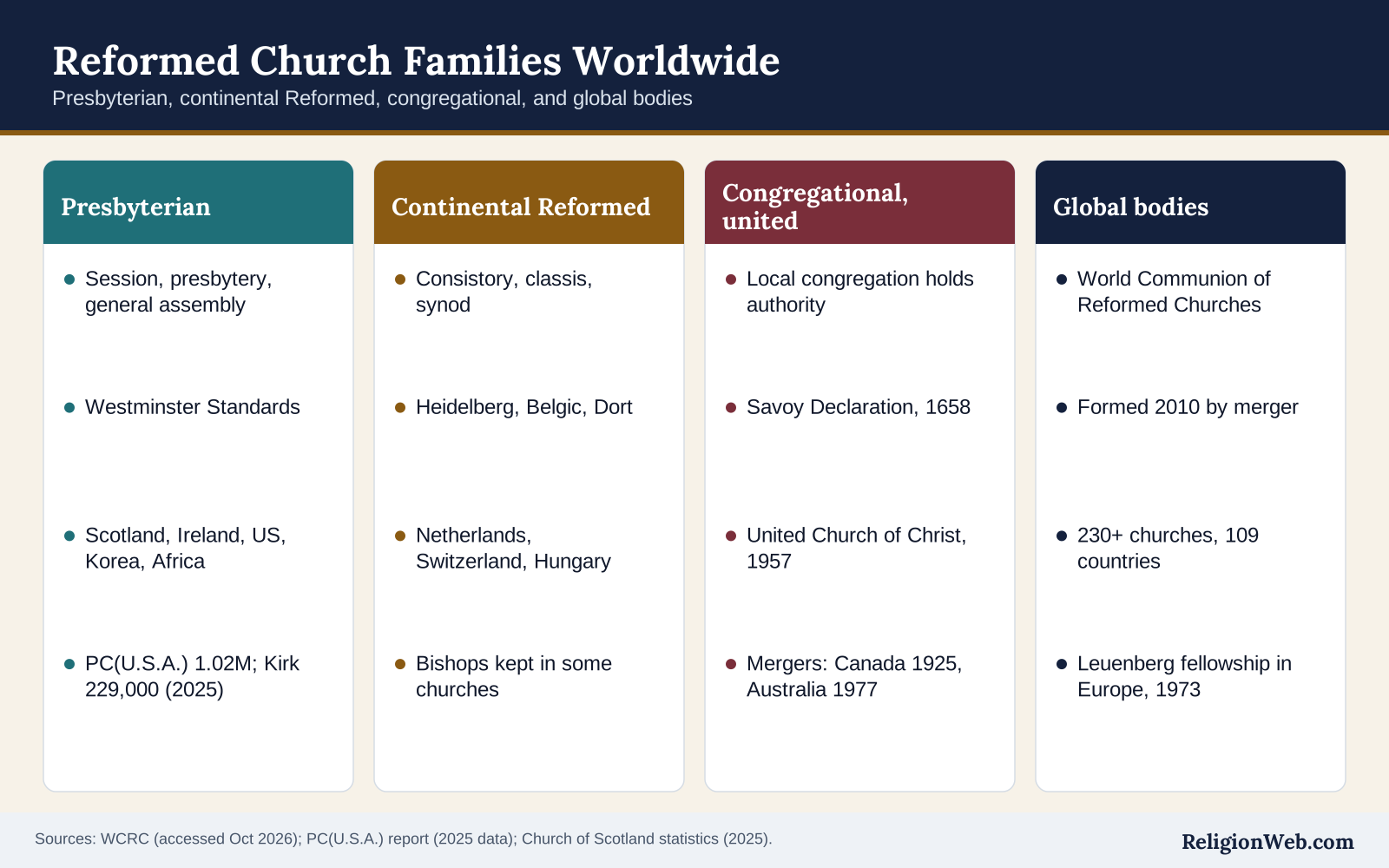
Community, Ethics, and Daily Life
Home, School, and Charity
Education and the catechized community
The Reformed churches made learning a religious duty. They wanted every believer able to read the Bible, and they supported schools, academies, and universities. The Geneva Academy of 1559 became the University of Geneva, the Free University of Amsterdam was founded in 1880 under Kuyper, and Harvard (1636), Yale (1701), and Princeton (founded as the College of New Jersey in 1746) all began with strong Reformed or Puritan ties. The First Book of Discipline in Scotland proposed a school in every parish, and the catechism, taught from childhood to adulthood, shaped a literate and doctrinally informed laity.
Calling, marriage, and the question of monastic life
Reformed Christians do not set a special class of religious vocations above ordinary callings. The sixteenth-century Reformers rejected monastic vows as a human invention and closed the monasteries of the territories they reformed, and they taught that marriage, family, and work are all spheres of Christian service. Pastors marry, and the minister’s household has long been a model of Christian family life. Yet the desire for a shared life of prayer has not disappeared. The Taizé Community in France, founded in 1940 by Roger Schutz, a Swiss Reformed pastor’s son, has become a world-famous center for ecumenical prayer, and the article on Christian monasticism places such communities in a longer story.
The diaconate and care for the poor
Deacons are one of the offices of the Reformed church, and their work is to care for the poor, the sick, and the stranger. In Geneva the diaconate managed a general hospital and aid for refugees, and in the Dutch and Scottish churches collections for the poor were taken in worship and administered by deacons. Today Reformed agencies run schools, hospitals, and relief programs in many countries, and the diaconal tradition remains a point of pride in the family.
Public Life, Conscience, and Social Witness
Church, state, and the right to resist
The Reformed confessions teach that civil government is ordained by God and that Christians owe it obedience, but they also teach that the church has its own jurisdiction under Christ, and that obedience to rulers has limits. In the sixteenth century some Reformed writers, among them Theodore Beza, argued that lesser magistrates may resist a ruler who tyrannizes the people, and Huguenot, Dutch, and Scottish thinkers developed these ideas during the wars of religion. In 1934 the Barmen Declaration, drafted largely by Barth, rejected the claim that the state or any other power could be a source of revelation alongside Christ, and this became a famous example of the church asserting its independence.
Race, justice, and reconciliation
The tradition’s record on race is mixed, and Reformed churches say so. Churches in the United States and South Africa included slaveholders and defenders of segregation, and others included abolitionists and civil rights leaders. In 1982 the World Alliance of Reformed Churches declared that apartheid was sin and that its theological justification put the integrity of the gospel itself at stake, a stance it called a status confessionis, and it suspended the membership of two white South African churches. The Belhar Confession, which affirms unity, reconciliation, and justice, was adopted by the Dutch Reformed Mission Church in 1986 and has since been received in several other Reformed churches. Reformed churches today continue to discuss how to confess these failures and to act on what they have learned.
Contemporary Debates and Change
Marriage, sexuality, and ordination
Like other Christian traditions, Reformed churches are divided over questions of sexuality, marriage, and the ordination of women. Some, such as the Presbyterian Church (U.S.A.) after 2014 and the Presbyterian Church in Canada after 2021, allow local churches to decide on same-sex marriages, while others, including the Presbyterian Church in America and many Reformed churches in Africa and Asia, uphold marriage as the union of one man and one woman and do not ordain people in same-sex relationships. These differences have led to departures and the formation of new bodies, such as the Evangelical Covenant Order of Presbyterians in 2012. The disagreements are about how to read Scripture and the confessions, and each side appeals to the same tradition.
Decline, renewal, and a changing center
In the North Atlantic world, historic Presbyterian and Reformed churches have lost members for several decades, and many congregations are small and aging. At the same time, new congregations and fresh forms of church life continue to appear, including the new worshiping communities recorded by the Presbyterian Church (U.S.A.) and the growing Presbyterian and Reformed churches of Africa, Asia, and Latin America. The tradition’s future seems likely to be shaped as much by Seoul, Nairobi, and São Paulo as by Edinburgh or Grand Rapids.
Common Misconceptions About Reformed Christianity
Misconception 1: Reformed Christianity is only the doctrine of predestination
Where the misunderstanding comes from
The reputation is understandable. Predestination is the most dramatic doctrine associated with Calvin and with the Synod of Dort, and it has been the subject of famous quarrels, from the Arminian controversy in the Dutch Republic to modern arguments among Baptists and evangelicals who call themselves Calvinists. The five-point acronym TULIP, a twentieth-century mnemonic, reinforced the impression that the tradition can be reduced to five headings about sin, election, atonement, grace, and perseverance. Popular accounts of Puritan New England and of Max Weber’s argument about the “Protestant ethic” added a picture of anxious believers wondering whether they were among the chosen.
Those who describe Reformed Christianity this way are usually reacting to something real. The confessions do teach election, and some Reformed preachers and writers have used the doctrine in ways that created fear. But a selective focus on one teaching distorts the whole.
What the evidence and tradition actually show
In the Reformed confessions, predestination is one doctrine among many, and it is treated with an explicit pastoral purpose. The Westminster Confession gives it one chapter out of thirty-three, and the same chapter says that it must be handled with special prudence and care. The Heidelberg Catechism, the most widely used Reformed teaching text, opens with a question about comfort and builds its whole structure around sin, deliverance, and gratitude. It speaks of the elect, but it does not present election as an argument or a puzzle. Reformed worship, preaching, covenant theology, the doctrine of the church, and the teaching on vocation and the Christian life fill far more pages of the standard documents than predestination does.
Moreover, even within the doctrine there is no single Reformed view. The debates among supralapsarians and infralapsarians, the position of Amyraut, and Barth’s christological reconstruction of election show that Reformed theologians have treated the subject differently, and the Synod of Dort itself closed its work with an appeal for humility. The doctrine of election is also not unique to Reformed Christians: Augustine taught a form of it centuries earlier, and parts of the Lutheran confessional tradition and some Baptist churches affirm it in their own ways. Predestination is thus important to Reformed Christianity, but it is a part of the tradition and not a complete description of it.
Misconception 2: Every Reformed church is Presbyterian
Where the misunderstanding comes from
In the United States and the English-speaking world, “Presbyterian” is the more familiar word, and many people meet “Reformed” only as a rarely used adjective. Church names reinforce the confusion: the Presbyterian Church (U.S.A.) and the Reformed Church in America are different denominations with different histories, and two churches with nearly identical teaching may have “Presbyterian” and “Reformed” in their names. Reference works sometimes add to the blur by noting that in northern Europe “Reformed” means essentially what “Presbyterian” means in Britain.
What the evidence and tradition actually show
Presbyterianism is one part of the Reformed family, not a synonym for it. The word “presbyterian” properly describes a form of church government by elders (presbyters) in graded councils, and it also names the Reformed churches of Scotland and their offshoots. Continental Reformed churches use similar principles but different terms, with consistories, classes, and synods, and they have their own confessions, notably the Heidelberg Catechism and the Belgic Confession. Congregational churches share the Reformed heritage but place authority in the local congregation. The Reformed churches of Hungary and Romania have bishops, and Particular Baptists and Calvinistic Methodists share Reformed doctrine under other names and structures.
The relationship runs the other way as well. A church can use presbyterian-style councils without being Reformed in its theology, since polity alone does not make a church part of the family. Reformed identity rests on a combination of confessional heritage, theology, worship, and church life, and the word “Presbyterian” fits only one of its principal expressions. A practical sign is the name of the governing body and the documents a church affirms: a church that speaks of a consistory and the Heidelberg Catechism is most likely continental Reformed, while one that speaks of a session and the Westminster Confession is most likely Presbyterian, although the two vocabularies overlap in North America where Dutch and Scottish heritages meet.
Misconception 3: Calvin personally authored every Reformed confession
Where the misunderstanding comes from
The label “Calvinism” suggests a single author, and Calvin’s Institutes is the most famous Reformed book. Because the word “Reformed” is often treated as shorthand for “Calvinist,” many people assume that the creeds and catechisms came from Calvin’s pen, or at least that they merely repeat his system. Popular histories that center on Geneva reinforce the impression, as does the fact that Calvin’s name is attached to the doctrine of predestination, which several confessions discuss.
What the evidence and tradition actually show
Almost none of the major Reformed confessions was written by Calvin alone, and most were written after he died on 27 May 1564. Zwingli drafted the Sixty-seven Articles of 1523 for the Zurich disputation, and Bullinger, with Bucer and others, helped shape the First Helvetic Confession of 1536 and later wrote the Second Helvetic Confession, which was published in 1566. Six ministers named John, led by John Knox, drafted the Scots Confession in four days in 1560. Guido de Brès wrote the Belgic Confession in 1561, and the Heidelberg Catechism of 1563 was prepared in the Palatinate under Elector Frederick III, with Zacharias Ursinus as its principal author. The Canons of Dort came from an international synod in 1618 and 1619, and the Westminster Standards from an assembly of English and Scottish divines in the 1640s.
Calvin did write a catechism for Geneva, and he had a hand in some documents, such as the Consensus Tigurinus of 1549, which he and Bullinger produced together, and he is traditionally credited with helping to prepare the draft of the French Confession of 1559. But the tradition’s confessional life is the work of many people in many countries, and its documents often differ from one another in emphasis. Treating all of them as Calvin’s work obscures that variety and underestimates the roles of Zwingli, Bullinger, Bucer, Knox, Ursinus, and many others.
The same point applies to doctrine. Calvin’s Institutes is a personal work of theology, not a church standard, and Reformed churches have never been bound to it as they are to their confessions. Later confessions sometimes depart from his emphases, for example in the way the Westminster Confession organizes the covenants or in the way the Second Helvetic Confession treats holy days, and Reformed theologians have often said that they follow Scripture and their confessions with Calvin as a teacher and not as an authority.
Misconception 4: Calvin ruled Geneva as a dictator, and Reformed life is joyless
Where the misunderstanding comes from
Stories about Geneva under Calvin, repeated in polemical histories, novels, and classroom summaries, often picture a city in which one man dictated what everyone must believe and do, and where laughter, dancing, and music were forbidden. The execution of Michael Servetus in 1553 is the most serious episode behind this image, and the strict Sabbath rules of Scotland and New England, plain church buildings, and Puritan restrictions on certain amusements added to it. A picture of dour severity follows the Reformed tradition into popular culture.
What the evidence and tradition actually show
Geneva was a republic governed by its councils, and Calvin was a pastor, not a magistrate. He held no civil office, he was a foreign resident for most of his time in Geneva, and he received citizenship only in 1559. The councils, not the Consistory, imposed civil penalties, and in the 1540s and early 1550s a significant part of the city’s political class openly opposed him. The Consistory did supervise moral life, and the Servetus case was a real and grave episode in which Calvin took part and which many Reformed Christians now lament. But strict moral ordinances and religious uniformity were not unique to Geneva; they were found in Catholic, Lutheran, and Reformed territories alike in the sixteenth century. The Servetus case needs to be understood as part of that age rather than as proof that Geneva was unusually tyrannical, and it also should not be minimized.
The charge of joylessness likewise fails to fit the evidence. The Reformed tradition produced the Genevan Psalter and the strong congregational singing that followed it, and the Heidelberg Catechism begins with comfort. Dutch Reformed society in the seventeenth century supported a flourishing market for painting, from landscapes to portraits, even though its churches were stripped of images. Reformed churches celebrate weddings, baptisms, and festivals, and Reformed Christians have been prominent in education, science, and the arts. The tradition’s reputation for gravity reflects real habits of seriousness about worship and conduct, but its writers also describe gratitude and joy as the proper fruits of the gospel.
Plain church interiors have a similar background. They came from a theological conviction about the second commandment and about attention to the Word, and not from a dislike of beauty as such. Reformed churches have long valued fine singing, careful architecture, and well-made books, and in recent decades many congregations have added visual art, banners, and drama to their worship. The question of how much ornament is fitting is still discussed within the family, which shows that the plain style was a considered choice and not a settled rule.
Frequently Asked Questions About Reformed Christianity
Questions About Origins and Names
Where and when did Reformed Christianity begin?
Reformed Christianity began in the Swiss cities of the 1520s. Huldrych Zwingli started preaching through the Gospel of Matthew in Zurich on 1 January 1519, and the Zurich council made reforms in worship between 1522 and 1525. Basel, Bern, and Strasbourg followed, and John Calvin’s work in Geneva from 1536 gave the movement a second center. The Reformed family had a recognizable shape by the late 1540s, when Zurich and Geneva agreed on the Lord’s Supper in the Consensus Tigurinus of 1549.
The movement did not begin with a single founding event or a single founder. Scholars describe it as the result of several local reformations that influenced one another, and the family’s later confessions, written in Scotland, the Low Countries, Germany, and Hungary, show the same pattern of independent but related development.
Is Reformed Christianity the same as Calvinism?
The two terms overlap but do not mean exactly the same thing. “Reformed” names a family of churches that arose from the Swiss and Genevan Reformation, and “Calvinism” usually names the theology associated with Calvin and with later confessions such as the Canons of Dort and the Westminster Standards. Many Reformed Christians accept “Calvinist” as a description of their theology, while others regard the term as too narrow, since figures such as Zwingli, Bullinger, and Bucer also shaped the tradition.
In everyday speech, “Calvinist” is sometimes used outside the church for a strict or pessimistic outlook, and this use says little about the actual teaching of Reformed churches. When the word is used in a theological context, it is best understood to refer to a set of doctrines about God’s sovereignty, grace, and election rather than to a particular denomination.
Questions About Belief
Do Reformed Christians believe in free will?
The answer depends on what is meant by free will. Reformed confessions teach that human beings make real choices and are responsible for them, and the Westminster Confession has a chapter on free will that says God has given the will a natural liberty. The same confessions teach that, since the fall, human beings are unable by their own power to turn to God for salvation, and that this ability is given by God’s grace. Reformed theologians therefore speak of freedom within the limits of fallen nature, and they distinguish this from the freedom to choose salvation independently of grace.
This view differs from the one held in Arminian traditions, which teach that grace enables all people to respond and that the response can be resisted. The difference, which was at the center of the dispute at the Synod of Dort, remains a point of lively discussion among Christians. Reformed writers also point out that they do not regard their view as denying human responsibility.
Do Reformed churches teach that some people are created to be condemned?
This is the question that most troubles people who first meet the doctrine, and Reformed writers have answered it in different ways. The Westminster Confession, in chapter 3, says that some are foreordained to everlasting death, and it adds that the rest of humankind are passed by and ordained to dishonor and wrath for their sin. The Canons of Dort teach election as an act of grace and treat reprobation as God’s passing over of those who are not chosen, with condemnation resting on their sin. Many Reformed writers insist that the doctrine does not describe God creating people in order to condemn them.
Reformed theologians are not united here. Some, following Barth, argue that election and rejection are first of all about Christ, who bore rejection on behalf of all. Others, such as Amyraldians, teach that Christ’s death is sufficient for all. Most confessions also stress that the doctrine is meant for believers as a source of comfort and humility, not as a basis for judging any particular person.
Questions About Worship and Church Life
Why do Reformed churches baptize infants?
Reformed churches baptize infants because they understand baptism as the sign of the covenant of grace, which in their reading of Scripture includes believers and their children, just as circumcision in the Old Testament was given to infants. They emphasize that baptism does not save by itself, and that it expresses God’s promise and the church’s responsibility to raise the child in the faith. They also baptize adults who come to faith and have not been baptized.
Not all Christians who share Reformed doctrine agree. Reformed Baptists believe baptism should follow a personal profession of faith, and the disagreement has been present since the Anabaptist controversy in Zurich in 1525. Most Reformed churches regard it as a difference over the meaning of the sign, not over the faith itself.
Do Reformed churches ordain women, and how do they decide?
Practice varies by denomination. Many Presbyterian and Reformed churches, including the Presbyterian Church (U.S.A.) and the Church of Scotland, ordain women as ministers, elders, and deacons, and they have done so for decades. Other bodies, such as the Presbyterian Church in America and the Orthodox Presbyterian Church, reserve the offices of minister and elder to men, citing their reading of passages in the New Testament, and some of these churches allow women to serve in diaconal roles.
Each church decides through its own councils and appeals to Scripture and its confessions. The differences are among the most visible internal disagreements in the Reformed world, and members of each group generally regard their position as an expression of the same Reformed principle of obedience to the Word.
How can a visitor learn what a particular Reformed church believes?
The simplest approach is to look for the church’s confession or statement of faith, which most congregations list on their website or in the front of their service book, and to ask whether the church belongs to a denomination or association. The confession will usually name documents such as the Heidelberg Catechism, the Westminster Standards, or the Three Forms of Unity. Visitors are welcome in most Reformed services, and the sermon and the printed order of worship say a good deal about the congregation’s character.
A visitor will find that Reformed churches differ in style, from formal liturgies with organ music to informal gatherings with a band. Visitors from other traditions should check the church’s practice before the Lord’s Supper, since churches differ in whom they invite to the table.
Conclusion: A Family of Churches with a Shared Memory
What the History Shows
A tradition made by many hands
Reformed Christianity began as a set of reforms in a handful of Swiss cities, and within a century it had churches in Scotland, the Netherlands, France, the Palatinate, Hungary, and the American colonies. No single leader, council, or book defines it. Zwingli, Bullinger, Calvin, Bucer, Knox, Beza, and Ursinus each contributed, and the family’s confessions record conversations carried on over generations. That is why accurate descriptions of the tradition are tied to particular places and periods, and why “Reformed” cannot be reduced to one doctrine, one denomination, or one era.
Continuity and change
Across five centuries the tradition has kept certain commitments: the centrality of Scripture and preaching, the grace of God in salvation, the covenant, ordered church life under elders, and the two sacraments. It has also changed. Worship that was once a cappella psalm singing now includes hymns and bands; ministry once limited to men is open to women in many churches; and the center of the family has moved from Europe and North America to Asia, Africa, and Latin America. The tradition continues to argue with itself about election, baptism, worship, and ethics, which is in keeping with its own motto, often quoted in Latin, that the church reformed is always to be reformed.
How to Keep Exploring
Related articles on this site
Readers who want the wider setting can place this tradition beside the other large families of Christianity, described in the articles on Catholic Christianity, Eastern Orthodox Christianity, and Oriental Orthodox Christianity. Topics treated here in summary, including the Trinity, baptism, and the Lord’s Supper, each have their own articles with a wider scope, and the neighboring Protestant traditions of Lutheranism, Anglicanism, Methodism, and Baptist Christianity are linked where they first appear above.
Reading the primary documents
For those who want to read the tradition in its own words, the best starting places are short. The Heidelberg Catechism can be read in an hour, the Westminster Shorter Catechism in a little longer, and the opening chapters of Calvin’s Institutes and the first chapters of the Second Helvetic Confession introduce the basic themes. Reading them alongside the history in this article, and noting where different churches interpret them differently, is the most reliable way to understand what Reformed Christians believe and why.
Sources
The table below lists the principal external sources behind this article. Facts, dates and figures were checked against these and related primary, institutional and academic materials.
| # | Source | Publisher and type | Used for | Link |
|---|---|---|---|---|
| 1 | The Westminster Confession of Faith | The Orthodox Presbyterian Church · Primary text | Quoted WCF 3.3, 3.8, 29.7; chapters on covenant, baptism, worship, Lord's Day | opc.org |
| 2 | Heidelberg Catechism (1563) | Christian Classics Ethereal Library · Primary text | Quoted Lord's Day 1, Q&A 1; structure and content of the catechism | ccel.org |
| 3 | Westminster Shorter Catechism | Christian Classics Ethereal Library · Primary text | Quoted Shorter Catechism Q. 1 | ccel.org |
| 4 | Institutes of the Christian Religion, Book 1, Chapter 1 | Internet Sacred Text Archive · Primary text | Quoted Calvin, Institutes 1.1.1 | sacred-texts.com |
| 5 | Reformed Churches (New Catholic Encyclopedia and other entries) | Encyclopedia.com · Encyclopedia | Origin of the term, Zwingli and Calvin, Heidelberg, polity, regional history, North American bodies | encyclopedia.com |
| 6 | Christianity: Reformed Christianity (D. K. McKim) | Worldmark Encyclopedia of Religious Practices, via Encyclopedia.com · Academic reference | Reformed vs. Calvinist, sacraments, worship, polity, 2003 membership figures | encyclopedia.com |
| 7 | World Communion of Reformed Churches | WCRC · Institutional | More than 230 member churches, 109 countries, about 100 million (accessed October 2026) | wcrc.eu |
| 8 | Peace Treaties of Westphalia, 14/24 October 1648 | German History in Documents and Images · Primary text | Treaty of Osnabruck Art. VII, 'those who call themselves the Reformed' (Tanaka and Brady translation) | germanhistorydocs.org |
| 9 | PC(USA) is still home to more than 1 million members | Presbyterian Church (U.S.A.), Presbyterian News Service · Demographic data | PC(U.S.A.): 1,019,003 members and 8,304 congregations for 2025 | pcusa.org |
| 10 | Congregational statistics | Church of Scotland · Demographic data | Church of Scotland: about 229,000 members at 31 December 2025 | churchofscotland.org.uk |
Last fact-check date: 2026-10-21.
