
A mezuzah is a small handwritten parchment scroll, inscribed with two passages from the Book of Deuteronomy in the Torah, that Jewish households attach to their doorposts in fulfillment of a biblical commandment. The scroll is almost always rolled up and slipped into a protective case, and the case is fixed to the right side of a doorway as one enters. The Hebrew word mezuzah (plural mezuzot) originally meant simply “doorpost,” and over the centuries the name moved from the frame to the scroll that is fastened to it. In the broad religious tradition described on our overview of Judaism, the mezuzah is among the most visible objects of Jewish home life, and many people who never enter a synagogue still touch one on the way into their own front door.
The commandment itself is brief. Deuteronomy 6:9 and 11:20 say that certain words are to be written “upon the door-posts of thy house, and upon thy gates.” The words in question come from the passages that Jewish liturgy later organized into the Shema, the declaration beginning “Hear, O Israel.” That is why a mezuzah belongs to the same family of commanded signs as tefillin, which are worn on the arm and head and contain the same biblical passages, along with a few others. Both are meant to place the central text of Jewish devotion physically within a person’s daily movement, on the body in one case and at the threshold of the home in the other.
The details are where the subject becomes interesting. Under traditional Jewish law, the essential element is the scroll, not the decorative case; the scroll must be written by hand, on prepared parchment, by a trained scribe, and a single faulty letter can make it unfit. Rules govern which doorways receive a mezuzah, on which side, at what height, and at what angle. A short blessing accompanies the first affixing. Scrolls are inspected on a schedule. Communities also differ: Ashkenazi and Sephardi custom disagree on the tilt, Orthodox, Conservative (or Masorti) and Reform Jews approach the legal framework differently, and some Jews understand the object chiefly as protection while others emphasize memory and identity.
This article explains the mezuzah on its own terms and in historical context: what the scripture says, how the object developed, how a kosher scroll is made, how it is placed and used, what it means within the tradition, and how practice varies. Where Jewish authorities differ, the differences are named and attributed rather than resolved. Nothing here is a ruling for any household, and readers who want a decision about a particular doorway or scroll are directed, as the tradition itself directs them, to a knowledgeable rabbi or a qualified scribe.
At a Glance: What a Mezuzah Is and Where It Is Used
Definition and Vocabulary
A scroll in a case
In ordinary speech “mezuzah” is used for the whole object a visitor sees on a doorframe: a small case of metal, wood, glass, stone or ceramic, often with the Hebrew letter shin on its face. Strictly speaking, the traditional literature uses the word for the parchment inside. The scroll is written on a single piece of prepared animal skin, rolled from the end so that the opening words of the first passage face outward, and inserted in the case. The case protects the scroll from weather, handling and moisture, and it is where most of the aesthetic variety lies. The scroll is where the legal significance lies, a distinction that later sections return to repeatedly.
The word mezuzah
In the Hebrew Bible the term refers to the doorpost or the frame of a gate. It appears for the posts on which the blood was applied in Exodus 12:7, and, in the Samson narrative of Judges 16:3, for the posts of a city gate. The Encyclopaedia Judaica notes that the origin of the word is uncertain and that a suggested connection with an Assyrian term, manzazu, is unproven. What is clear is the semantic shift: after the rabbinic period, mezuzah usually means the scroll affixed to the post rather than the post itself, so that a person can speak of “hanging a mezuzah” without any thought of carpentry.
Key terms at a glance
A handful of Hebrew terms recur in discussions of the object, and the table below gathers them. The words klaf (the prepared parchment), sofer (a scribe, in this context a sofer stam, one trained in writing Torah scrolls, tefillin and mezuzot) and kasher (fit for use, the root of the English “kosher” explored in the article on kosher food rules) appear most often in everyday conversation. The vocabulary also includes Shaddai, a divine name that is traditionally written on the back of the scroll, and Chanukat HaBayit, the “dedication of the house” that often accompanies a first affixing.
| Term | Meaning in this context | Why it matters |
|---|---|---|
| Mezuzah (plural mezuzot) | Originally “doorpost”; now usually the scroll, or the scroll and case together | The scroll is the element required by Jewish law |
| Klaf | Parchment prepared from the skin of a kosher animal | Paper and printed or photocopied text are not valid |
| Sofer (sofer stam) | A trained scribe of sacred scrolls | The scribe’s knowledge and care affect validity |
| Kasher (kosher) | Fit for ritual use | A “kosher mezuzah” is one whose scroll meets the scribal rules |
| Shaddai | A divine name, often translated “Almighty” | Written on the back of the scroll and often visible through the case |
| Chanukat HaBayit | “Dedication of the house” | A household ceremony often paired with the first mezuzah |
| Likboa mezuzah | “To affix a mezuzah” | The closing words of the blessing said at affixing |
Where and How Often It Is Encountered
Homes, gates and doorways
The mezuzah is first of all a domestic object. Within Jewish practice it is attached to the entrance of a Jewish residence and, in the traditional understanding, to the doorways of most of its inhabited rooms. It is also found on the gates of courtyards and compounds, on the entrances of many apartment buildings, and, by a long-standing and not entirely uncontested custom discussed later, on the doors of synagogues and other communal buildings. In Israel it is a common sight on public buildings, hotels, schools and shops as well as homes.
How common is the practice?
Reliable numbers are scarce for most of the world, but one large survey is available for the United States. In the Pew Research Center’s 2020 survey of American Jews, whose findings were published in May 2021, nearly two-thirds of respondents said they own a mezuzah, and ownership was higher among Jews who identify with an organized stream of Judaism, especially Orthodox Jews, than among those who identify with none. That is a measure of owning the object, not of affixing it to every doorway in line with the legal rules, and the survey does not break the practice down further in the publicly summarized text. It does show that the mezuzah has a reach well beyond the Jews who keep all of the commandments.
Who is expected to keep the commandment
Jewish law places the obligation on the household. A teaching preserved in the Talmud (a baraita discussed at Yoma 11b) lists a synagogue, a house belonging to a woman, and a house owned by partners as all subject to the law of the mezuzah, and the Gemara explains that the singular “your house” in the verse is not meant to restrict the duty to a single male owner. The result is a commandment that applies to Jewish dwellings whoever holds the title; how later authorities treated the synagogue itself is taken up in the section on placement. Questions about renters, partners, and non-Jewish landlords, and about what to do on moving out, belong to the practical sections later in this article.

The Biblical Commandment: Deuteronomy, the Shema, and the Doorposts
Deuteronomy 6:4-9, the First Passage
Hear, O Israel, and love
The first of the two passages begins with the words that Jewish tradition treats as the central declaration of faith. In the Jewish Publication Society’s 1917 translation, it reads as follows.
HEAR, O ISRAEL: THE LORD OUR GOD, THE LORD IS ONE. And thou shalt love the LORD thy God with all thy heart, and with all thy soul, and with all thy might.
Deuteronomy 6:4-5, JPS Tanakh 1917, as presented on Sefaria
These two verses are addressed to the people as a whole and, in rabbinic reading, as a daily recitation. The usual Jewish reading of the opening line is that it affirms the unity and exclusivity of the God of Israel, though commentators from the medieval period onward have understood its precise force in different ways. For the purposes of the mezuzah, the key observation is that the passage that gives the Shema its name is also the passage that prescribes where it should be written.
Words on the heart, the hand, the forehead and the doorpost
Verses 6 through 9 turn from the declaration to the practice. The words are to be “upon thy heart,” taught diligently to children, and spoken about when sitting at home, walking on the road, lying down and rising. Then follow two commanded signs.
And thou shalt bind them for a sign upon thy hand, and they shall be for frontlets between thine eyes. And thou shalt write them upon the door-posts of thy house, and upon thy gates.
Deuteronomy 6:8-9, JPS Tanakh 1917, as presented on Sefaria
Rabbinic tradition read the first sign as the commandment of tefillin, the leather boxes with scriptural passages worn on the arm and head, and the second as the commandment of the mezuzah. This is the dominant reading in Jewish law. The Karaites, a medieval Jewish movement that rejected the authority of the rabbinic oral law, read these verses more metaphorically and do not consider the mezuzah obligatory, as the variations section describes. The mainstream rabbinic tradition, and the early archaeological evidence discussed below, treat the text as describing a literal inscription.
Writing on the post and the gate
The phrase “thy house, and upon thy gates” later became a source for rulings about where mezuzot go. “House” was understood to include the rooms of a dwelling, and “gates” was extended to the gateways of courtyards and cities. The Encyclopaedia Judaica reports that the apartment-house entrance is covered by the word “gates” in the tradition, and cites Jerusalem examples such as the gates of Yemin Moshe, erected in 1860, and the Old City gates after the Six-Day War of 1967. The verse also speaks of “writing,” and Jewish law accordingly insists that a mezuzah be written and not printed.
Deuteronomy 11:13-21, the Second Passage
Reward, rain and consequence
The second passage appears several chapters later and shares its closing sentences with the first. It opens with a conditional promise: if the people obey the commandments, love God and serve with all their heart, the rains will come in their season, the land will yield grain, wine and oil, and the cattle will have grass. It then warns that turning to other gods will bring the closing of the heavens and the loss of the good land. Readers often observe that this second passage addresses a plural “you” and links obedience to the fortunes of the community on its land, whereas the first passage opens in the singular.
The second mention of the doorposts
After the conditional promise and warning, the text repeats the instruction to place the words in heart and soul, to bind them as a sign on the hand, and to write them on doorposts and gates.
And thou shalt write them upon the door-posts of thy house, and upon thy gates; that your days may be multiplied, and the days of your children, upon the land which the LORD swore unto your fathers to give them, as the days of the heavens above the earth.
Deuteronomy 11:20-21, JPS Tanakh 1917, as presented on Sefaria
The ending of verse 21 gives the commandment a stated purpose: length of days for the household and its children. Talmudic stories, such as the one about the convert Onkelos in tractate Avodah Zarah 11a, present the mezuzah as a sign of divine protection over those inside. Maimonides, by contrast, places the emphasis on the reminder it supplies. These two emphases are discussed in the section on meaning.
Why two passages are written
Traditional Jewish law requires both passages to appear on the mezuzah scroll, in the order in which they occur in Deuteronomy, so that a scroll with only the first, or with the passages reversed, is not valid. Rabbinic discussions in the tractate Menachot also address whether the two passages may be written on separate sheets, and rule against it. The two texts together give the full picture: devotion and teaching in the first, consequence and continuity in the second. The table below sets out how they relate.
| Passage | Opening theme | Reference to the doorposts | Role in Jewish liturgy |
|---|---|---|---|
| Deuteronomy 6:4-9 | “Hear, O Israel”: the unity of God and the command to love | Verse 9: “write them upon the door-posts of thy house, and upon thy gates” | First paragraph of the Shema, recited morning and evening |
| Deuteronomy 11:13-21 | Obedience, rain and the land; warning against turning away | Verse 20: the same command, followed by a promise of long days | Second paragraph of the Shema |
| Exodus 12:7 (not written on the scroll) | Passover blood placed on the side-posts and lintel | The word for doorpost is the one later used for the scroll | Read in the Passover narrative; a vocabulary link, not a source of the law |
| Numbers 15:37-41 (not written on the scroll) | The commandment of fringes (tzitzit) | None | Third paragraph of the Shema; omitted from the mezuzah |
Doorposts Elsewhere in the Hebrew Bible
The Passover blood on the side-posts
The earliest mention of doorposts in a ritual context is not Deuteronomy but Exodus. In the narrative of the tenth plague, the Israelites are told to take of the blood of the Passover offering and put it “on the two side-posts and on the lintel, upon the houses wherein they shall eat it” (Exodus 12:7, JPS 1917). The word for side-posts is the plural of the same Hebrew noun. The scene is retold every year at Passover. The legal literature grounds the mezuzah in Deuteronomy, whose command concerns written words and not blood, rather than in Exodus. Even so, the shared vocabulary of the doorpost, and the shared image of a sign set on the threshold of a home, make the comparison a natural one for readers.
Gates, posts and household law
Other biblical references show the doorpost as a place of legal and symbolic significance. Exodus 21:6 has a servant who chooses to remain with a master brought to the door or doorpost for a ritual. Judges 16:3 describes Samson carrying off the posts of the gate of Gaza. These passages do not describe a written text on a doorway; they establish that thresholds were treated as places where status was declared and where households met the outside world. Seen in that setting, the Deuteronomic instruction to write on the doorposts uses an existing idea of the doorway as a boundary and applies it to scripture.
Reminder or protection in the biblical setting
Whether the original verse was meant to protect a home or to remind its residents is a question the text itself leaves open. The surrounding verses stress teaching, memory and conversation: the words are to be repeated to children at home and abroad, at rest and in motion. That context supports an educational reading. The promise in 11:21 supports a reading in which the practice carries blessing. Rabbinic and later Jewish writers drew on both threads, and there is no single Jewish view that rules the other out. What the scripture does ensure is that the commanded object is a written text, on a doorway, tied to the central declaration of Israelite devotion.
History: From Doorpost Inscription to Established Ritual
Evidence From the Second Temple Period
Parchments from the Qumran caves
The earliest physical evidence for the mezuzah comes from the Dead Sea Scrolls. The Encyclopaedia Judaica reports a parchment from Qumran Cave 8, measuring about 6.5 by 16 centimeters, that bears Deuteronomy 10:12 through 11:21 and does not contain the Shema passage of Deuteronomy 6. The Center for Online Judaic Studies adds that seven further mezuzah parchments were found in Cave 4 (catalogued as 4Q149 to 4Q155). The documents belong to the Hellenistic and early Roman periods, which makes them the oldest known examples of the practice and an important piece of evidence in scholarly discussions of how early the doorpost and tefillin commandments were observed in literal form.
What the finds show and what they leave open
It would be a mistake to read too much into a handful of fragments. The Qumran texts come from a particular community near the Dead Sea, and they were not written to the specification later set out in the Talmud. The Cave 8 parchment, for example, covers a continuous stretch of Deuteronomy rather than the two selected passages that became standard. That variation suggests that the selection of the passages was not yet fixed in the late Second Temple period, or at least was not fixed everywhere. What the finds do establish is that at least some Jews of that era wrote biblical text on small parchments for the purpose of the doorpost commandment, and that the verse in Deuteronomy was being read literally.
Rabbinic Codification
The Mishnah and the Talmud
The rabbinic literature of late antiquity is where the mezuzah becomes a fully regulated practice. The third chapter of tractate Menachot, with its Talmudic discussion at about 31b to 34a, takes up the writing, the sheet, the placement and the position of the scroll, while tractate Yoma (at 10a to 11b) discusses which dwellings are subject to the law and how often scrolls must be inspected. The Talmud also preserves memories of practice under pressure. In one account studied on Yoma 11a, an examiner of mezuzot in the upper marketplace of Tzippori, working in a period of decrees against Jewish observance, was caught by a Roman official and fined a thousand zuz. And in a discussion at Menachot 33a, sages debate whether the bolt-shaped mezuzot of Rabbi Judah the Prince were fit, a discussion that later authorities drew on in debating how a scroll should be positioned.
The medieval codes
The sages of the Middle Ages turned the Talmudic debates into usable law. Rashi (1040 to 1105) and his grandson Rabbeinu Tam argued over whether a mezuzah should stand upright or lie flat. Maimonides, in the twelfth century, set out the laws of the mezuzah in the section of his Mishneh Torah called the Laws of Tefillin, Mezuzah and Torah Scroll. Jacob ben Asher, author of the Tur (c. 1269 to c. 1343), recorded the diverging opinions, and in the sixteenth century Joseph Karo’s Shulchan Arukh (Yoreh De’ah, chapters 285 to 291) and Moses Isserles’s glosses to it set the framework within which most Orthodox practice operates today. The Sephardi tradition largely follows Karo, and the Ashkenazi tradition follows Isserles.
Medieval and Modern Developments
Mystical additions and Maimonides’ objection
As Jewish mysticism developed in the medieval period, some scribes and writers added angel names and symbols such as the six-pointed star to the mezuzah, and some of these were written on the scroll itself. Maimonides objected strongly. In the Laws of Tefillin, Mezuzah and Torah Scroll (5:4), as summarized in the Encyclopaedia Judaica, he wrote that those who do this empty a commandment of its purpose and turn it into an amulet for personal benefit, and he said they would have no share in the world to come. His view prevailed in practice, and the standard scroll today contains only the two biblical passages, with the divine name Shaddai and a letter-substitution cipher on the reverse. These additions on the back are traditional and accepted, and they are treated in detail in the section on the scroll.
The rise of the decorated case
Cases were not originally a field of art. A Reform responsum from 1986 notes that early practice used simple coverings, such as a reed or a wooden or metal holder, and that decorated cases developed slowly, with few before the seventeenth or eighteenth century. After that point the variety grew steadily, and the Encyclopaedia Judaica observes that decorated mezuzah cases have become an art form, with notable development in modern Israel. The historical sequence matters, though: the scroll came first, and the artistry came to surround it.
Twentieth-century campaigns and legal questions
In the modern period the mezuzah became both a focus of outreach and an occasional subject of law. In 1974 the Lubavitcher Rebbe, Menachem Mendel Schneerson, launched a worldwide Chabad campaign to encourage mezuzah observance, which the movement says led to the replacement of tens of thousands of faded or unfit scrolls and the affixing of several hundred thousand new ones. In the United States, disputes arose in which residents of apartment and condominium buildings were told to remove objects from their doorposts. A federal appeals court sitting en banc in November 2009, in Bloch v. Frischholz, held that a Chicago condominium owners’ claims over mezuzah removal could go to trial under federal housing law, and several states, among them Illinois, Florida and Texas, passed their own statutes protecting religious displays on doorposts.
| Period or date | Development | Evidence or source |
|---|---|---|
| Biblical text | Deuteronomy 6:9 and 11:20 command writing on doorposts and gates | Hebrew Bible |
| Hellenistic to early Roman era | Mezuzah parchments written and deposited at Qumran, including Cave 8 and Cave 4 examples | Dead Sea Scrolls; Encyclopaedia Judaica |
| Talmudic era | Rules on writing, sheets, position, and houses obligated are discussed in Menachot and Yoma | Babylonian Talmud |
| 11th to 12th centuries | Rashi and Rabbeinu Tam disagree on vertical and horizontal placement | Medieval commentaries on Menachot 33a |
| 12th century | Maimonides codifies the laws and condemns angel names as amulet-writing | Mishneh Torah, Tefillin, Mezuzah and Torah Scroll |
| 13th to 14th centuries | The cipher on the front is mentioned by Asher b. Jehiel; Jacob ben Asher records the slanted compromise | Encyclopaedia Judaica; Tur |
| 16th century | Karo’s Shulchan Arukh and Isserles’s glosses give the Sephardi and Ashkenazi frameworks | Yoreh De’ah 285 to 291 |
| 17th and 18th centuries | Decorated cases become more common | CCAR responsum, 1986 |
| 1974 | Chabad launches a worldwide mezuzah campaign | Chabad.org |
| 2003 | The Conservative movement’s law committee adopts a responsum on removing a mezuzah when moving | CJLS, Kurtz |
The Scroll: Parchment, Scribe, Ink, and Text
How a Kosher Scroll Is Made
The parchment
A kosher mezuzah is written on klaf, parchment prepared from the skin of a kosher species such as a cow, sheep or goat. According to the guide published by Chabad.org, the animal does not need to have been ritually slaughtered, but the writing must be done by hand: a printed mezuzah, a photocopy, or text on paper does not meet the requirement. The guide also warns that the grayish, slightly uneven surface of real parchment differs from the glossy, coated surface found on some cheap scrolls. The guide therefore advises buyers to choose a scribe with a strong reputation.
The scribe
The scribe, or sofer, is the same kind of specialist who writes Torah scrolls, tefillin and the scroll read at Purim. Chabad.org emphasizes that both his knowledge of the law and his personal reliability bear on whether a scroll is valid. Many scribes declare before beginning that they are writing for the sake of the mezuzah’s holiness, and repeat the declaration before each divine name. Some immerse in a mikveh before writing, and some do so before each Name. The scribe’s work is therefore religious as well as technical, which is why those who commission scrolls look to the scribe’s reputation as much as the price.
Ink, quill and ruled lines
The writing is in black ink, in the square Hebrew script known as Ashuri, the same script used for Torah scrolls. Many scribes use a quill cut from a feather or a reed. Before writing, the parchment is ruled with 22 lines, and the letters hang from those lines rather than standing on them. Chabad.org notes that a scroll without ruled lines is not kosher. Seven letters carry three small strokes, called crowns or tagin, and many authorities invalidate a scroll that lacks them. Each letter must be surrounded by white space, and letters that touch one another make the scroll unfit.
What Is Written, and Why Each Letter Matters
The two passages in order
The text consists of the full first passage (Deuteronomy 6:4-9) followed by the full second passage (Deuteronomy 11:13-21), in that order. Chabad.org counts 713 letters in the combined text. The Encyclopaedia Judaica likewise states a traditional layout of 22 lines, and the guide points out that the last line begins with the words “above the earth,” the closing phrase of Deuteronomy 11:21. All of this is written on one sheet: the Talmud (Menachot 33a) records Shmuel’s ruling that a mezuzah written on two separate sheets is unfit.
The back of the scroll: Shaddai and the cipher
By long custom the word Shaddai, a divine name often translated “Almighty,” is written on the back of the parchment at the point where it faces the case’s opening, so that it can be seen without unrolling the scroll. The Encyclopaedia Judaica adds that these letters are also read as the initials of the phrase “Guardian of the doors of Israel,” a reading cited from the medieval work Kol Bo. Many Ashkenazi scribes also write, on the front at the foot of the scroll, a cryptogram that replaces each letter with the next in the alphabet and that stands for the three divine names “the Lord, God, the Lord.” Asher ben Jehiel mentions it in the thirteenth century. Practices differ on whether both additions are used, a matter of regional custom that scribal manuals handle in detail.
Errors and validity
The scribal tradition treats a mezuzah as a text in which every letter counts. The Chabad.org guide states that one missing, misspelled or misplaced letter makes a scroll unfit, which is why scrolls are checked after writing and again later. A scroll that was once fit can become unfit through fading, cracking or damp, and Chabad.org notes that optical scanning software is now sometimes used alongside the expert eye. The requirement of exactness is the same one that applies to a Torah scroll, and it reflects the weight that the tradition gives to the words themselves.
| Component | What it is | Role in Jewish law | Can it vary? |
|---|---|---|---|
| Parchment (klaf) | Prepared skin of a kosher species, written by hand | Required; paper or printed text is invalid | Quality and size vary within the rules |
| Text | Deuteronomy 6:4-9 and 11:13-21, in order, on one sheet | Required; any lost or malformed letter can invalidate | Not by legitimate custom; the passages are fixed |
| Ink and script | Black ink in square Ashuri script, in 22 ruled lines | Required | Minor scribal style differences (Ashkenazi, Sephardi, Chabad) |
| Name on the back | Shaddai, facing the opening of the case | Customary and widely observed | Some also add a front cipher by custom |
| Case | Metal, wood, glass, stone or ceramic holder | Protects the scroll; no specific design is required | Wide variety of design and material |
| Fastening | Nails, screws, or adhesive on the doorpost | Practical; the placement rules matter more than the method | Varies by building and community |
Rolling and Inserting the Scroll
How the scroll is rolled
The scroll is rolled and then covered. The Shulchan Arukh (Yoreh De’ah 289:6), as summarized in the Daf Yomi study materials of the Dafyomi Advancement Forum, describes the scroll as rolled with the end bearing the word Shema on the outside. The practice has older roots: the Talmud (Menachot 33a) tells of a sage, Rav Chelbo, who watched Rav Huna roll his scroll in a particular direction, and medieval authorities debated how that report should be understood. The details of rolling are usually handled by the scribe, and a buyer who receives a scroll from a reputable scribe will normally find it already rolled.
Placing the scroll in the case
Once rolled, the scroll is placed inside the case, which is closed or sealed. Many cases have a small opening through which the divine name Shaddai on the back of the scroll can be seen, and the scroll is positioned so that the letters show. Once the scroll is in the case, the case is attached to the doorpost in the manner described in the section on placement.
The Case: Protection, Craft, and What It Does Not Do
What the Case Does
Protection and display
The case has a practical job. A handwritten parchment exposed on a doorway would suffer from rain, handling, sun and the damp of an outer wall, and a damaged scroll is an unfit one. The Talmudic discussion illustrates the problem. Medieval commentators on Menachot, including the Tosafot, explain that a reed or tube into which the scroll is placed protects it from the moisture of the wall. Modern cases serve the same purpose in a wider range of materials.
Materials and design
The materials are very varied. Silver and other metals, wood, stone, ceramic, pewter and polymer clay are all common. Designs may be minimal or elaborate, geometric or figurative, and many carry the Hebrew letter shin, which is an initial of Shaddai. The Reform responsum of 1986 cited above observes that, in the tradition’s literature, casing receives little discussion and no restrictions on decoration are recorded. In practice, cases are chosen to fit the house, the doorframe and the owner’s taste.
The Case Compared With the Scroll in Jewish Law
What fulfills the commandment
In Jewish law the scroll bears the legal weight. The commandment concerns writing the specified words and attaching them to the doorpost, and every requirement of validity discussed in the section above applies to the parchment and the writing. A beautiful case with no scroll in it, or with a printed card, fulfills nothing. Conversely, the law does not prescribe a particular shape, size or material for the case. A responsum adopted by the Conservative movement’s law committee in 2003 allows a departing resident to substitute cheaper or different cases and parchment, provided they are valid under Jewish law, which shows how the object is divided: the scroll must be right, and the case can change.
Art, jewelry and the limits of a decorative object
The same distinction explains how Reform rabbis treated two practical questions. In the 1986 case, a congregational youth group wanted to mount a kosher scroll in a case made of seashells on a walnut base, and the responsum answered that using an animal shell as decoration is permitted. In a separate and undated responsum about a “modernized” mezuzah with printed text and the opening words of the Ten Commandments, the CCAR committee said the item could be sold if clearly labeled, might be worn on a chain as an ornament, and should not be presented as a kosher mezuzah or affixed to a doorpost on the understanding that it fulfills Orthodox law. The CCAR notes that historical responsa of this kind do not necessarily reflect its current policy. The Encyclopaedia Judaica notes that some people today wear a mezuzah around the neck as a charm, an adaptation that sits at the edge of the traditional framework.
Placement: Which Doorways, Which Side, and What Angle
Which Doorways Receive a Mezuzah
Dwellings and their rooms
Within traditional law the duty attaches to a doorway that belongs to a dwelling. The Encyclopaedia Judaica summarizes the rule as requiring a mezuzah at the entrance of every home and at the door of every living room, while storerooms, stables, lavatories and bathrooms are excluded. Space matters as well as use. The Talmud exempts a house smaller than four cubits by four cubits, and the later codes disagree about how that measure applies: Maimonides is understood to count an area of sixteen square cubits in any shape, the Rosh requires both dimensions to reach four cubits, and the Shulchan Arukh (Yoreh De’ah 286:13) follows Maimonides. For that reason authorities such as the Shach recommend affixing a mezuzah in a long narrow room but omitting the blessing. Poskim, the rabbinic decisors, also disagree on the length of a cubit itself, with figures between about 19 and 23 inches proposed by modern authorities.
Gates, porches and workplaces
The phrase “and upon thy gates” extends the obligation beyond the front door. Gateways with posts and a crossbar are generally included, and so are the entrances of apartment buildings and courtyards. Open-air spaces are a different case, and the Shulchan Arukh (Yoreh De’ah 286:14) suggests that a porch without a roof does not require one; if the porch is roofed, the usual analysis changes. Opinions also differ about which side to place a mezuzah on a porch. Chabad.org’s guide, compiled from material by Rabbi Aaron Wolf, adds that workplaces can require one, without a blessing, particularly when the premises are rented from a non-Jewish landlord. A doorway that is sealed shut, or an attic reached by a trapdoor rather than a vertical doorway, does not qualify.
Synagogues and public buildings
Whether a communal building needs a mezuzah has been argued since antiquity. A baraita discussed in tractate Yoma lists a synagogue among the structures that are obligated, but a midrash (Deuteronomy Rabbah 7:2) asks whether a synagogue really has one, and the Encyclopaedia Judaica reports that, although putting mezuzot on synagogues and other public buildings is now nearly universal, there is little formal authority for it unless the building also serves as a residence, citing the Spanish authority Levi ibn Habib. In practice, the doors of a modern synagogue usually carry mezuzot, and so do many schools, community centers and, in Israel, a wide range of public buildings. Some classical sources treat the temporary booth of the festival of Sukkot as a temporary dwelling rather than a home, so that the ordinary law of the mezuzah is not applied to it in the same way.

Where on the Doorpost
The right side as one enters
A mezuzah is fixed on the right-hand doorpost of a person entering the room or building. The Talmud (Menachot 33a), as presented in the Sefaria edition, determines “right” by the direction one enters, and in a case of doors between rooms, by the hinge socket. A back door from the house into a yard receives its mezuzah on the right of a person exiting into the yard, since the yard is the space being entered from the house, according to the halakhic summary published by Din Online. Rabbinic opinion divides on a few unusual cases, such as porches, where the side may depend on whether the porch is roofed. For the standard front door of a house or apartment, the instruction is simple and consistent: to the right as you come in.
The upper third of the post
The Talmudic debate on height is recorded in Menachot 33a. Shmuel says it should be placed at the beginning of the upper third of the doorpost. Rav Huna said it could be placed anywhere between a handbreadth above the ground and a handbreadth below the lintel. A baraita is brought to show that these opinions parallel disputes between earlier sages, and the Gemara reconciles Shmuel with Rabbi Yosei. In the standard understanding the later codes follow Shmuel, and popular guides therefore speak of the upper third, roughly shoulder height. The same discussion makes clear that the scroll must be inside the airspace of the doorway, not outside it, and the codes add fine points about the distance from the edge.
Why the mezuzah is often tilted
The best-known feature of placement is the slant. The Talmud does not say how the scroll should be oriented, and the medieval authorities came to opposite conclusions. Rashi (1040 to 1105) held that the scroll should be vertical, like a standing shin bone. His grandson Rabbeinu Tam held that it should be horizontal, so as not to appear “standing,” like the tablets and the Torah scroll that lay in the Ark. Jacob ben Asher recorded the two views, and the compromise he reported, that careful people place the mezuzah on a slant, was endorsed by Moses Isserles in his glosses. Ashkenazi practice therefore tilts the top inward, toward the room. Sephardi communities largely follow the ruling of Karo and Rashi and affix it upright, as the Chabad.org explainer on the slant and the Union for Reform Judaism both note. Both forms are accepted practices, and neither community regards the other as mistaken.
| Question | General rule | Source or authority | Where practice varies |
|---|---|---|---|
| Which doorways | Entrances to dwellings and to inhabited rooms; also gates with posts and crossbar | Talmud; Maimonides; Shulchan Arukh, Yoreh De’ah 286 | Small rooms, porches, workplaces, synagogues |
| Which rooms are exempt | Bathrooms, lavatories, storerooms and stables | Encyclopaedia Judaica | Closets and narrow rooms are debated |
| Which side | The right side as one enters the room | Menachot 33a | Porches and back doors |
| What height | Beginning of the upper third of the doorpost | Shmuel, Menachot 33a | Rav Huna’s wider span is rarely applied |
| What angle | Upright (Rashi) or horizontal (Rabbeinu Tam); slanted as compromise | Tur; Shulchan Arukh; Isserles | Ashkenazi tilt inward; Sephardi upright |
| How soon | Affixed on occupying a home in Israel; after 30 days in the Diaspora per one summary | Encyclopaedia Judaica | Distinctions between rented and owned homes |
Special Situations: New Homes, Rentals, and Shared Buildings
Moving in
The Encyclopaedia Judaica states that in Israel a mezuzah is affixed immediately on occupying a home, while in the Diaspora it is affixed after the householder has lived there for thirty days. The codes make further distinctions between rented and purchased homes and between Israel and other lands, and a household with a specific situation, such as a short lease, should ask a rabbi. Many families affix their mezuzot at the start in any case, often as part of a household dedication.
Renting, selling and non-Jewish occupants
A 2003 responsum of the Conservative movement’s Committee on Jewish Law and Standards, written by Rabbi Vernon Kurtz, addresses what to do when moving out. Drawing on the Talmud (Bava Metzia 101b to 102a), Maimonides and the Shulchan Arukh (Yoreh De’ah 291:2), the committee ruled that when a Jewish resident will follow another Jewish resident, the mezuzot should generally be left for the newcomer. A departing resident may take valuable or sentimental cases if the new occupant immediately affixes their own. If the next occupant is not Jewish, the mezuzah should be removed, and if the new occupant wishes it to remain, it may be left only if proper respect is assured.
Dormitories, apartments and the law of the building
Modern housing raises its own questions. Chabad.org’s answer to a reader’s question about a shared dormitory room is that ideally one should be affixed, and rabbis commonly advise residents to ask for guidance when the layout is unusual. Rules in apartment buildings sometimes forbid objects on door frames in common hallways, and this has led to legal conflict, as the history section noted. In the United States, the Fair Housing Act has been applied in this setting, and several states have passed laws on the subject. Many families work out a practical arrangement with building management, and a rabbi can help where a compromise on placement is needed.
The Blessing, the Dedication, and Daily Use
Affixing the Mezuzah: Blessing and Procedure
The wording and its meaning
Before attaching the first mezuzah to a doorpost, a person traditionally holds it in position and recites a one-line blessing. In transliteration it is Barukh atah Adonai, Eloheinu melekh ha’olam, asher kidshanu b’mitzvotav v’tzivanu likboa mezuzah. The Union for Reform Judaism renders the English as thanks to God, “Sovereign of the universe,” for sanctifying us through the commandments and commanding us to affix a mezuzah. The structure is that of most blessings over commandments in Jewish liturgy, and the Hebrew verb likboa means to fix or set in place, which is why the blessing is said when the scroll is affixed and not when it is merely carried or hung.
Who says it, and when it is omitted
Reference summaries state that any Jew old enough to understand the commandment may recite the blessing, and that one blessing suffices when several mezuzot are affixed in the same session. A blessing is omitted in some doubtful cases. Chabad.org notes that a workplace doorway requires a mezuzah without a blessing, and Rabbi Chaim Jachter’s survey of the law on small rooms explains that the Shach, followed by the Aruch HaShulchan, advises affixing a mezuzah in a narrow room but omitting the blessing out of deference to the Rosh’s stricter rule. The principle behind this is that a blessing should not be recited where the obligation itself is open to doubt.
Dedicating the House
Chanukat HaBayit
Many families link the first mezuzah to a ceremony of dedication, Chanukat HaBayit, “the dedication of the house.” A PBS Religion and Ethics report quotes Rabbi Tamara Miller describing it as a custom held for a new home, ideally with other people present. The word chanukah is built on the same Hebrew root as Hanukkah, the winter festival that commemorates the rededication of the Temple, so the idea of dedicating a space to sacred use is a recurring one in Jewish tradition. The details of a house dedication vary from family to family and from one community to another.
The household as a place of study and prayer
The ceremony is more than a housewarming because of what the home is understood to be. Deuteronomy 6:7 speaks of talking about these words “when thou sittest in thy house,” and the rabbinic tradition has long treated the home as a place of learning, blessing and ethical conduct alongside the synagogue. Because the mezuzah is on the threshold, it is often the first Jewish object a visitor meets, and a household that dedicates its home with a blessing signals that it intends the space to be used in line with that vision. Rabbi Miller, quoted by PBS, says she values that it can be reached without going to a synagogue and is fixed in place.
Touching and Kissing the Mezuzah
The custom
Many observant Jews touch the mezuzah when passing through a doorway, then kiss the fingers that touched it. The guide published by the Jewish United Fund of Metropolitan Chicago describes the practice as reaching up to touch the mezuzah on entering a home and kissing the hand that touched it. The Encyclopaedia Judaica notes that pious Jews do this on entering and leaving and that the Maharil, the fifteenth-century authority Jacob Moelin, based it on the Talmudic story in Avodah Zarah 11a, in which the convert Onkelos explains the mezuzah to Roman soldiers as an image of God guarding His servants from outside. This is a custom and not a requirement of law.
Meanings and variations
The custom is usually explained as a sign of respect for God and for the words in the case, and the Maharil’s use of the Onkelos story ties it to the idea of divine protection at the threshold. Because it is a custom and not a legal requirement, households differ in how they keep it, and the Union for Reform Judaism’s introductory page on the mezuzah, which lays out the text, placement and blessing, does not mention it. The same organization publishes a separate answer for people who cannot reach a mezuzah, a reminder that the gesture is meant to be accessible.
| Custom | What is done | Status in the tradition | Notes on variation |
|---|---|---|---|
| Blessing at affixing | Holding the mezuzah in position and reciting the blessing ending in “likboa mezuzah” | Required in the codes for the main entrance | Omitted for doubtful cases such as narrow rooms |
| One blessing for several | A single blessing covers mezuzot affixed in one session | Standard summary of the law | Debated rooms may be affixed without it |
| Dedication of the house | A household ceremony, often with guests, linked to the first mezuzah | Customary | Form varies by family and community |
| Touching and kissing | Touching the mezuzah and kissing the fingers on passing | Custom, attributed to the Maharil | Not universal; some Jews do not follow it |
| Inspection | A scribe checks the scroll | Required by law on a set schedule | Many households inspect in the month of Elul |
| Leaving a mezuzah when moving | Leaving it for a Jewish successor; removing it if the successor is not Jewish | Ruled on by the Conservative movement in 2003 | Other authorities have other detailed rulings |
Checking, Repair, and Replacement of Scrolls
Why and How Often Scrolls Are Checked
The schedule in the Talmud
Because the validity of a scroll depends on every letter, the tradition requires periodic inspection. As taught in Yoma 11a and summarized by the Steinsaltz Center, mezuzot in private homes are checked twice every seven years, and those in public places twice every fifty years. Commentators explain the different intervals in different ways: Rashi gives a reason related to not disturbing the public, one medieval work says public mezuzot are seen by everyone so problems are noticed quickly, and the Rosh suggests that checking public mezuzot is dangerous. Later codes, including the Shulchan Arukh (Yoreh De’ah 291:1), keep the seven-year standard for homes, and a twice-in-seven-years rhythm is the common basis for the practice today.
Why scrolls fail
A scroll written correctly can still lose its validity. Ink can flake or fade, parchment can crack where it was rolled, damp can run the letters together, and a letter that was once complete can lose a stroke. Because a doorway on the outside of a building faces weather, these problems are more likely there than inside. Chabad.org reports that its inspection campaigns have led to many unfit scrolls being replaced. The remedy for a faulty scroll is repair by a scribe where the law permits, or replacement with a new scroll.
Practical Care of the Scrolls
Who checks and when
Inspection is done by a qualified scribe, who examines each letter and each line. Chabad.org notes that computer-based scanning can help catch errors, and that many Jews inspect their mezuzot during the Hebrew month of Elul, the month before Rosh Hashanah, which already carries associations of reflection and accounting. The timing fits the character of the month, which is traditionally a period of preparation before the High Holy Days.
Retiring a scroll
When a scroll is judged unfit or worn out, it cannot be put back on the doorpost until it is repaired or replaced. Because a mezuzah contains divine names, Jewish custom treats even a retired scroll with respect, and a scribe or rabbi can advise on what to do with it. The principle that sacred writing is not casually discarded applies throughout Jewish practice, to Torah scrolls and tefillin as well, and in this respect the mezuzah belongs with them.
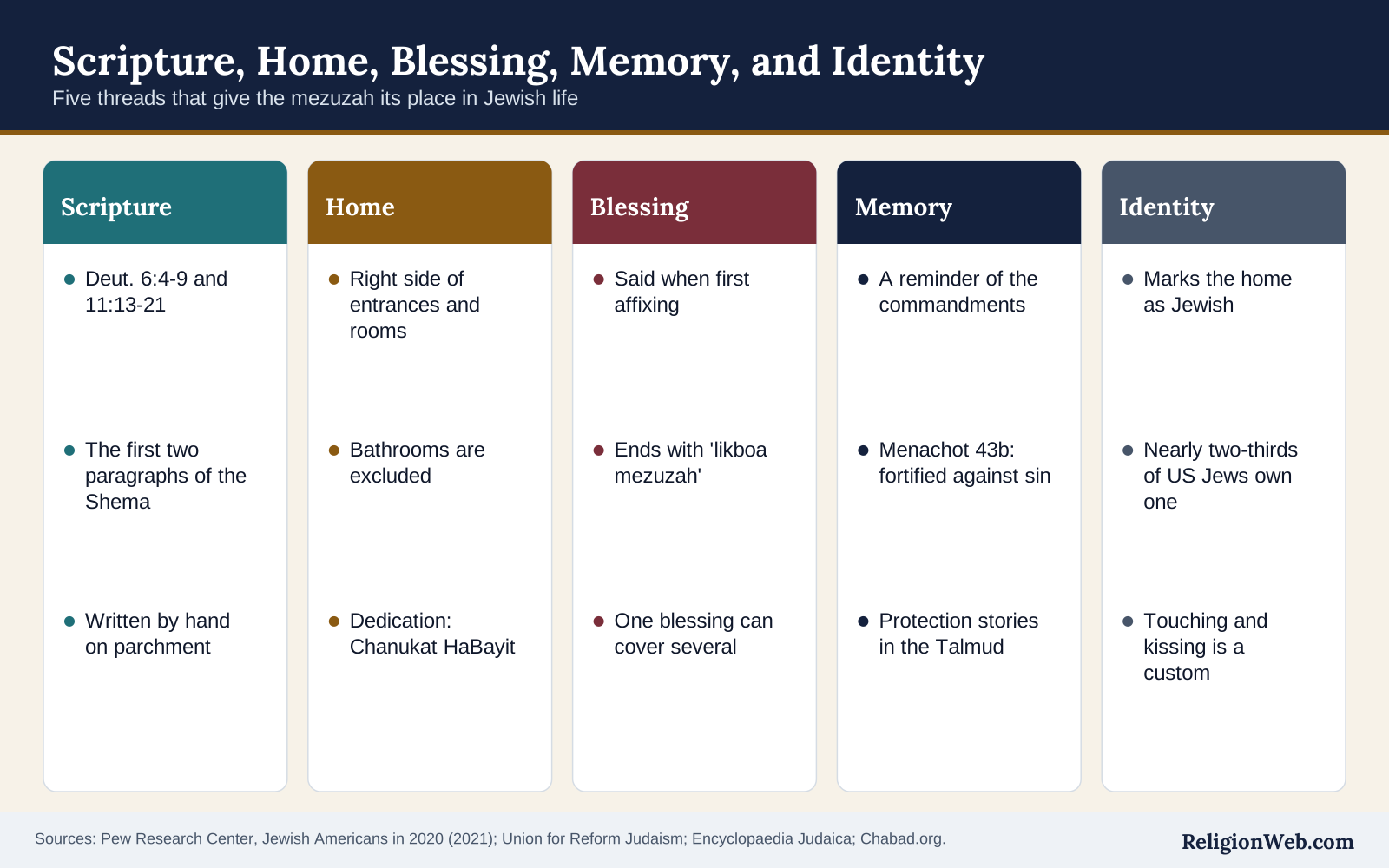
Meaning: Memory, Protection, and Identity
A Reminder of the Commandments
The emphasis in Maimonides and the Talmud
One long line of Jewish thought understands the mezuzah first of all as a reminder. The Conservative responsum by Rabbi Vernon Kurtz cites Maimonides (Laws of Mezuzah 6:13) for the view that the mezuzah reminds a person of God each time the threshold is crossed. The same thought appears in the Talmud (Menachot 43b), where Rabbi Eliezer ben Jacob says that a person who wears tefillin, has fringes on a garment and has a mezuzah on the door is fortified against sinning, as the Encyclopaedia Judaica reports, and the Talmud counts the mezuzah among seven precepts that God gave Israel out of love. In this reading the object works through memory and attention: the doorway is where a person pauses between public and private life, and the mezuzah marks the pause with a text.
The home as a place of Torah and the Shema
The location of the commandment matters because of what Deuteronomy 6 says about the household. The words are to be spoken of “when thou sittest in thy house,” and taught to children, and the first word of the passage is “Hear.” The mezuzah therefore connects the daily recitation of the Shema with a physical sign in the house. The festival of Shavuot, which tradition associates with the giving of the Torah, is marked by study and special meals, and the household is a primary setting for the practices that shape Jewish life. A mezuzah at the door tells visitors, and residents, which kind of place the house means to be.
Protection in Rabbinic and Later Thought
Talmudic stories of guarding
A second strand stresses protection. The Encyclopaedia Judaica notes that the Talmudic literature contains a clear reference to the mezuzah’s protective power: the sage Rav sent a mezuzah to Ardavan in return for a gift, saying that it would guard him (Jerusalem Talmud, Pe’ah 1:1; Genesis Rabbah 35:3), although the encyclopedia adds that this may reflect the context of the story and need not be taken as doctrine. In Avodah Zarah 11a, the convert Onkelos tells the Roman soldiers sent to arrest him that, unlike a human king, who sits within while his servants stand guard outside, God keeps watch outside over His servants within. The Tosafot and the printed Ritba, according to the Kurtz responsum, remark that a house without a mezuzah leaves room for evil spirits to enter.
Maimonides’ warning and later teaching
The two strands meet in the figure of Maimonides. Alongside his emphasis on the reminder, he was alarmed by the idea that the mezuzah could work as a charm. In the Laws of Mezuzah 5:4, he condemns writing angel names and other additions on the scroll as turning a commandment into an amulet. Later Jewish teaching holds both points of view. Chabad.org presents the mezuzah as part of a protective connection and says that a mezuzah on the door means a person is protected at home and away, citing the sages of the Talmud and the Lubavitcher Rebbe’s 1974 campaign. The medieval mystical tradition, discussed in the article on Kabbalah, is the setting in which the angel names and symbols that Maimonides opposed were added to scrolls. Maimonides’ emphasis on the reminder, and the Reform emphasis on identity and the holiness of the home described below, weigh the same practice differently. These positions are all held within one religion.
Identity, Memory, and the Public Sign
Marking a Jewish home
The mezuzah is also a public sign. The Union for Reform Judaism describes it as marking a home as Jewish, as a visible sign of Jewish identity, and as a reminder to the people who live there that the home is holy and should be treated accordingly. Pew’s 2020 survey of American Jews found that nearly two-thirds own one, with ownership higher among Orthodox Jews and others who identify with an organized stream of Judaism. A figure of that size suggests that the mezuzah has a symbolic reach beyond the Jews who keep every rule about it.
Continuity across generations
The second passage on the scroll gives the practice a generational horizon. Deuteronomy 11:21 hopes for long days for “you and your children,” and the commandment itself speaks of teaching the words to the next generation. The laws on leaving a scroll for the next Jewish occupant of a house mean that a single scroll can mark the same doorway through several households.
Movement and Community Variations
Orthodox Practice
Ashkenazi and Sephardi custom
Within Orthodox Judaism, which holds that the Torah’s commandments remain binding as interpreted through the Talmud and the codes, the main internal differences follow the old division between Ashkenazi and Sephardi custom. Ashkenazi communities tilt the mezuzah, following the compromise reported by the Tur and endorsed by Isserles, while Sephardi communities generally set it upright, following Rashi and the Shulchan Arukh. There are differences on the back of the scroll as well: the divine name Shaddai is nearly universal, while the front cipher is an Ashkenazi addition supported by Isserles. These variations are among the clearest illustrations of how a single commandment can develop two accepted forms.
The Chabad-Lubavitch emphasis
Chabad-Lubavitch, a Hasidic movement whose 1974 campaign gave the practice worldwide prominence, encourages regular checking, asks that unfit scrolls be replaced, and presents the mezuzah as a source of protection. The movement’s teaching materials emphasize the scribe’s training and character and the practice of checking in Elul. Other Orthodox communities, including those in the Sephardi and Mizrahi traditions, share the commitment to a valid scroll while expressing it through their own legal and cultural traditions.
Conservative (Masorti) and Reform Practice
Conservative and Masorti Judaism
Conservative Judaism, called Masorti in much of the world, treats Jewish law as binding while applying it with attention to historical development. On the mezuzah its law committee has worked within the traditional framework. In the 2003 responsum by Rabbi Vernon Kurtz, for example, the committee relied on the Talmud, Maimonides, the Shulchan Arukh, Isserles and later authorities including Rabbi Ovadiah Yosef in ruling on leaving or removing mezuzot, and it required that any substitute scroll or case remain valid under Jewish law. The responsum thus assumes the same kind of handwritten, scribe-prepared parchment that Orthodox sources describe.
Reform Judaism
Reform Judaism historically treated ritual law as a field for informed choice by individuals and congregations. The Union for Reform Judaism’s introductory page nevertheless presents the mezuzah largely in traditional terms, saying that according to tradition it is placed on the right side of entrances and interior rooms, usually excluding bathrooms, with the text from Deuteronomy 6 and 11 and a blessing on affixing. The Central Conference of American Rabbis has published responsa on the subject, among them the 1986 opinion on the seashell case and an undated opinion on a modernized mezuzah, which together show that Reform authorities distinguish between a kosher handwritten scroll and an object that serves as an ornament. The CCAR cautions that older responsa do not necessarily reflect its current policy.
Other Communities and Cultural Practice
Karaites and Samaritans
Two other groups in the Land of Israel and beyond have their own approaches. The Encyclopaedia Judaica reports that the Karaites, who do not accept the rabbinic oral law, do not consider the mezuzah obligatory, though they attach blank tablet-shaped plates to the doorways of public buildings and sometimes homes. The Samaritans, a distinct community with its own version of the Pentateuch, have historically displayed carved stones inscribed with the Ten Commandments or the “ten categories by which the world was created,” and stones of this kind, dating to the early Arab and possibly the Byzantine period, have been found in Israel.
Cultural, artistic and secular uses
Cultural practice runs wider than any legal category. The Israeli art tradition of the decorated case has become a field of its own, as the Encyclopaedia Judaica observes, and some people wear a miniature mezuzah around the neck as a charm, a use that falls outside the legal framework. Pew’s finding that a majority of American Jews own one suggests that the object also serves as a mark of heritage for many households. Such uses are better described as customs of identity than as observance of the commandment in its legal sense, and a respectful account notes the difference without judging either one.
| Community | Typical approach to the scroll | Placement custom | Notes |
|---|---|---|---|
| Orthodox, Ashkenazi | Handwritten kosher scroll; checked on the traditional schedule | Slanted, top inward | Often includes the front cipher, supported by Isserles |
| Orthodox, Sephardi and Mizrahi | Handwritten kosher scroll, following Karo | Upright in most communities | Divine name Shaddai on the back |
| Chabad-Lubavitch | Emphasis on scribe, checking and replacing unfit scrolls | Follows Ashkenazi custom | 1974 worldwide campaign |
| Conservative (Masorti) | Traditional scroll; law committee works within halakhic sources | Follows traditional norms | 2003 responsum on moving |
| Reform | Presents the mezuzah in traditional terms; responsa distinguish kosher scrolls from ornaments | Right side of entrances and rooms; Ashkenazi tilt or upright | Historical responsa are not necessarily current policy |
| Karaite | Not considered obligatory | Blank plates on some doorways | Verses read more metaphorically |
| Samaritan | Verses from the Samaritan Pentateuch | Stone plaques or cases above doorways | Historical stones in Israeli collections |
Common Misconceptions About the Mezuzah
Misconception 1: A mezuzah is simply a Jewish good-luck charm
Where the misunderstanding comes from
The idea is easy to understand. Mezuzot hang in doorways, some are worn as jewelry, and the Talmud does record stories in which a mezuzah protects. The Encyclopaedia Judaica itself notes that some people wear a mezuzah around the neck as a charm. Objects fixed to the threshold of a home also have a place in the protective customs of many cultures, which makes the comparison easy to draw.
It is also true that protection has a place in the tradition. Onkelos, Rav and the commentators on Menachot all use the language of guarding, and Chabad teaching presents the protective function prominently. The misunderstanding comes from taking one theme, in one reading of the tradition, as the whole.
Language contributes as well. English has no ready word for a commanded object that also carries protective associations, and “charm” or “amulet” is the nearest everyday vocabulary. The Hebrew term, by contrast, names a doorpost and then the scroll fixed to it, and carries no suggestion of luck.
What the evidence and tradition actually show
In law, the mezuzah is a commandment, a mitzvah, and the scroll’s validity depends on scribal exactness, not on any promise of good fortune. Maimonides, whose rulings form the base of much later law, criticized treating the scroll as a charm and rejected the addition of angel names. In his emphasis the object reminds a person of God. Others stress protection, but in the framework of a divine commandment and not of luck. A decorative piece with no kosher scroll fulfills nothing in the legal sense, and a kosher scroll on a doorpost is understood within the tradition as the performance of a duty.
Even the Talmudic statement most often quoted about protection is framed in moral terms. In Menachot 43b, as reported by the Encyclopaedia Judaica, Rabbi Eliezer ben Jacob says that a person with tefillin, fringes and a mezuzah is fortified against sinning. The safeguard in view there is against wrongdoing, which is a different matter from fortune or chance.
The better summary is that mezuzah observance combines commandment, memory, protective hope and identity in proportions that differ among Jews. Describing it as a good-luck charm leaves out the first of these.
Misconception 2: The outer case alone fulfills the traditional commandment
Where the misunderstanding comes from
The case is the visible part. Most people who pass a mezuzah see a small decorated holder, and because cases and scrolls can be bought separately, a case can easily be mistaken for the whole object. Decorative pieces and pendants that carry no scroll at all reinforce the impression.
The vocabulary adds to the confusion. In English, and in everyday Hebrew, people say “a mezuzah” for the item on the door, even though the older and stricter use of the word refers to the scroll. A conversation about “buying a mezuzah” can therefore mean buying a case, a scroll, or both, and the difference is rarely spelled out.
What the evidence and tradition actually show
Jewish law places the commandment in the scroll, written by hand on parchment, and in affixing it to the doorpost. The CCAR responsum of 1986 notes that casings receive little attention in the traditional literature, and the Conservative responsum of 2003 allows a case to be changed if the parchment remains valid. An empty case, or a case with a printed card, does not fulfill the commandment under the traditional rules described by Orthodox, Conservative and Reform sources alike.
That does not make the case unimportant. It protects the scroll, it carries artistic and family meaning, and it is where the divine name Shaddai is often visible. But the legal weight rests on the parchment inside.
The practical consequence is that an apparent defect in a scroll cannot be seen from outside. The Chabad.org guide explains that a single missing, misspelled or misplaced letter makes a scroll unfit, which is why checking by a qualified scribe is built into the practice. A household that has a handsome case and has never had the scroll inspected may therefore have the less important half of the object in good order and the more important half in doubt.
Misconception 3: Every doorway always receives a mezuzah under every interpretation
Where the misunderstanding comes from
Popular summaries often say “put a mezuzah on every door” because it is easy to remember, and some traditions do hang them widely. The Union for Reform Judaism’s page places one at the entrance and at the entrance to each interior room, except bathrooms, and a summary in a PBS report says many households place one on every interior door except the bathroom. The slogan hides a body of detailed law.
The verse itself invites the broad reading, since it speaks of the “house” and the “gates,” and an unwary reader can take that to mean every opening in every structure. The medieval codes did not read it that way, and later authorities spent considerable energy on exactly where the line falls.
Everyday experience adds to the impression. The Encyclopaedia Judaica reports that affixing mezuzot to synagogues and other public buildings is now nearly universal, even though it finds little formal authority for the custom unless the building also serves as a residence. A visitor who sees mezuzot on schools, community halls and shops can reasonably conclude that the rule has no exceptions, when what they are seeing is a widespread custom that extends beyond the core obligation.
What the evidence and tradition actually show
Traditional law sets conditions. A room must be a dwelling space of a minimum size, the opening must have posts and a lintel, and some spaces are exempt, including bathrooms, storerooms and spaces without a roof. Authorities disagree about the edges, such as long narrow closets, porches and synagogues, and the Shach and the Aruch HaShulchan recommend affixing a mezuzah in a narrow room but omitting the blessing to account for the disagreement. A Karaite or Samaritan household would not follow the rabbinic rules at all.
Other conditions come from the structure itself. Maimonides (Laws of Mezuzah 5:1), as summarized by Din Online, requires an entrance at least ten handbreadths high, and Chabad.org adds that a door nailed shut does not qualify, nor does an attic reached through a trapdoor in the floor. Whether a doorway with no door at all is covered is itself discussed in the Shulchan Arukh (Yoreh De’ah 286:15). These are fine points, but they show why the phrase “every door” overstates what the law actually says.
The accurate statement is that most doorways of a Jewish home qualify under mainstream rabbinic law, and that the answer for a particular doorway depends on its dimensions, use and construction, as well as the community’s authorities.
Misconception 4: The scroll contains the Ten Commandments or a prayer for the home
Where the misunderstanding comes from
The mezuzah is often described as a prayer, and in some modern or reinterpreted forms the Ten Commandments appear on or in the case. A Reform responsum on a “modernized” mezuzah, for example, describes a version that adds the opening words of the commandments, and the Samaritans have historically used stones inscribed with the Ten Commandments. The assumption is understandable.
The first passage on the scroll also contains the command to love God and to teach the words to children, which can sound like the content of a prayer, and the scroll shares its text with the Shema, a central item of Jewish liturgy. People who know that the Shema is recited in prayer sometimes conclude that the scroll must itself be a prayer.
What the evidence and tradition actually show
The traditional scroll contains Deuteronomy 6:4 to 9 and 11:13 to 21, the first two passages of the Shema, and nothing else on the front besides, by some custom, a cipher. These are declarations and teachings addressed to a community and not a petition for the home. The Qumran Cave 8 parchment contained a continuous section of Deuteronomy 10:12 to 11:21, a reminder that the selection of text has had a history.
The scroll also leaves out part of the daily Shema. The third paragraph recited in the liturgy, on the fringes of Numbers 15:37 to 41, does not appear on a mezuzah, which carries only the first two passages. The omission shows that the scroll was assembled around the commandment about the doorpost and the home, not as an abridgment of the whole prayer.
The scroll is better described as scripture placed at a threshold. It is not addressed to God as a request and it is not a summary of the law.
Frequently Asked Questions About the Mezuzah
Questions About the Object
What is written inside a mezuzah?
A kosher mezuzah contains Deuteronomy 6:4 to 9 and 11:13 to 21, written by hand in Hebrew on a single piece of parchment, in 22 lines. The first passage begins “Hear, O Israel” and the second begins with a promise tied to obedience. The divine name Shaddai is written on the back by custom. There is no translation or other commentary on the scroll.
Why do many cases show the letter shin?
The letter shin is the first letter of Shaddai, a divine name often rendered “Almighty.” PBS reports that the case usually bears the letter, and the Encyclopaedia Judaica adds that the same letters are read as an acronym for a phrase meaning “Guardian of the doors of Israel.” The shin on the case echoes the Name written on the scroll.
Is a mezuzah a prayer?
The scroll consists of scripture, not a prayer addressed to God. The blessing recited when it is affixed is a liturgical formula, and the first passage is part of the daily Shema, but the object itself is a written text affixed at the threshold. Some Jews experience it as a prompt for prayer or reflection, which is a matter of personal use and not of the object’s legal definition.
Questions About Practice
Where should a mezuzah be hung?
On the right side of the doorway as one enters, in the upper third of the post, and, in Ashkenazi custom, slanted with the top toward the room. Sephardi custom places it upright. The details for particular rooms, porches and unusual doorways are matters for a rabbi, since the codes disagree on several edge cases.
How can one tell whether a scroll is kosher?
It cannot be judged by the case or by appearance alone. A qualified scribe checks the letters, spacing and parchment, and Chabad.org advises buyers to choose a scribe with a strong reputation. Scrolls are inspected twice every seven years, and many people check them in Elul. A scroll that is faded, cracked or has lost a letter may need to be repaired or replaced.
Do Jews of all movements use a mezuzah?
Many do, but not in identical ways. Orthodox, Conservative and Reform authorities all describe the mezuzah as a handwritten scroll fixed on the doorpost, while Karaites do not regard it as obligatory and Samaritans use their own forms. Pew’s 2020 survey found that nearly two-thirds of American Jews own a mezuzah, with ownership higher among Orthodox Jews and others who identify with a stream of Judaism.
Conclusion: A Written Text at the Threshold
What the History Shows
From parchment to practice
The mezuzah began as a biblical instruction to write certain words on doorposts and gates and developed, through the Qumran parchments, the Talmudic debates, the medieval codes and modern movements, into a regulated practice with a recognizable form. The scroll has stayed at the center throughout. The shape of the case, the angle of its placement, the order of the cipher and the sources of authority have varied, and the Deuteronomy text has not.
Scroll, case and community
The distinction between the scroll and the case is the most useful key to understanding the whole subject. The scroll carries the legal weight and the case protects and displays it. Around that distinction, communities have developed their own customs, which should be described as they are without ranking one over another.
How to Keep Exploring
Related practices and festivals
The mezuzah belongs with other Jewish practices that bring sacred text and ritual into daily life, such as Shabbat, the food rules explained in the article on kosher practice, and the life-cycle milestone of a bar or bat mitzvah. Readers interested in the Torah text behind it can turn to the article on the Torah itself.
Asking a scribe or rabbi
For decisions about a specific home, a specific scroll, or a specific doorway, the tradition’s own answer is to consult a rabbi or a qualified scribe. This article explains the framework, and the people who work within it apply it to each case.
Sources
The table below lists the principal external sources behind this article. Facts, dates and figures were checked against these and related primary, institutional and academic materials.
| # | Source | Publisher and type | Used for | Link |
|---|---|---|---|---|
| 1 | Deuteronomy 6:4-9, 11:18-21 and Exodus 12:7, The Holy Scriptures: A New Translation (JPS 1917) | Sefaria (Jewish Publication Society, 1917) · Primary text | Quoted scripture: Deuteronomy 6:4-5, 6:8-9 and 11:20-21; paraphrase of 11:13-17 | sefaria.org |
| 2 | Mezuzah (Encyclopaedia Judaica, L. I. Rabinowitz) | Jewish Virtual Library / Encyclopaedia Judaica · Encyclopedia | Qumran parchment, scroll form, Shaddai and cipher, rooms, Maimonides, Karaites, Samaritans, customs | jewishvirtuallibrary.org |
| 3 | Menachot 33a (Talmud, Sefaria English edition) | Sefaria · Primary text (Talmud, paraphrased) | Side, height, two-sheet rule and bolt-shaped mezuzot in the Talmudic discussion | sefaria.org |
| 4 | Yoma 11 (Daf Yomi commentary) | Steinsaltz Center · Academic/educational reference | Houses obligated, checking schedule (twice in seven or fifty years), Tzippori account | steinsaltz.org |
| 5 | Removing a Mezuzah (YD 291:2.2003), Rabbi Vernon H. Kurtz | Rabbinical Assembly, Committee on Jewish Law and Standards · Institutional (Conservative responsum) | Conservative ruling on moving, substitute cases, non-Jewish occupants, Rambam 6:13 | rabbinicalassembly.org |
| 6 | Casing of a Mezuzah (CARR 117-119, No. 71, 1986) | Central Conference of American Rabbis · Institutional (Reform responsum) | Case versus scroll; seashell case; history of decorated cases; Reform approach | ccarnet.org |
| 7 | What Is a Mezuzah, and Why and How Do We Use It? | Union for Reform Judaism · Institutional | Reform description of text, placement, blessing, and meaning | reformjudaism.org |
| 8 | How a Mezuzah Is Written | Chabad.org · Institutional (Orthodox educational) | Parchment, scribe, ink, 22 lines, letters, checking in Elul | chabad.org |
| 9 | Jewish Practices and Customs (Jewish Americans in 2020) | Pew Research Center · Demographic data | Nearly two-thirds of US Jews own a mezuzah (2020 survey, published 2021) | pewresearch.org |
| 10 | Do Walk-In Closets and Porches Require a Mezuzah?, Rabbi Chaim Jachter | Kol Torah (Torah Academy of Bergen County) · Academic/educational reference | Room-size rules, porches, blessing omitted in doubtful cases (Shulchan Arukh YD 286) | koltorah.org |
Last fact-check date: 2026-10-21.