
Dua (Arabic du‘a’) is the act of calling on God with a request, a plea, a word of praise or a note of thanks. In Islam it is usually translated as supplication, invocation or personal prayer, and it is among the most widely practiced devotions in Muslim life. A person can make dua silently on a crowded train or aloud in a mosque, in classical Arabic or in Urdu, Turkish, Malay, Swahili or English, at a moment of crisis or on an ordinary morning. The word comes from an Arabic root meaning to call or to summon, and the idea at its center is direct address: a human being turns to God and speaks.
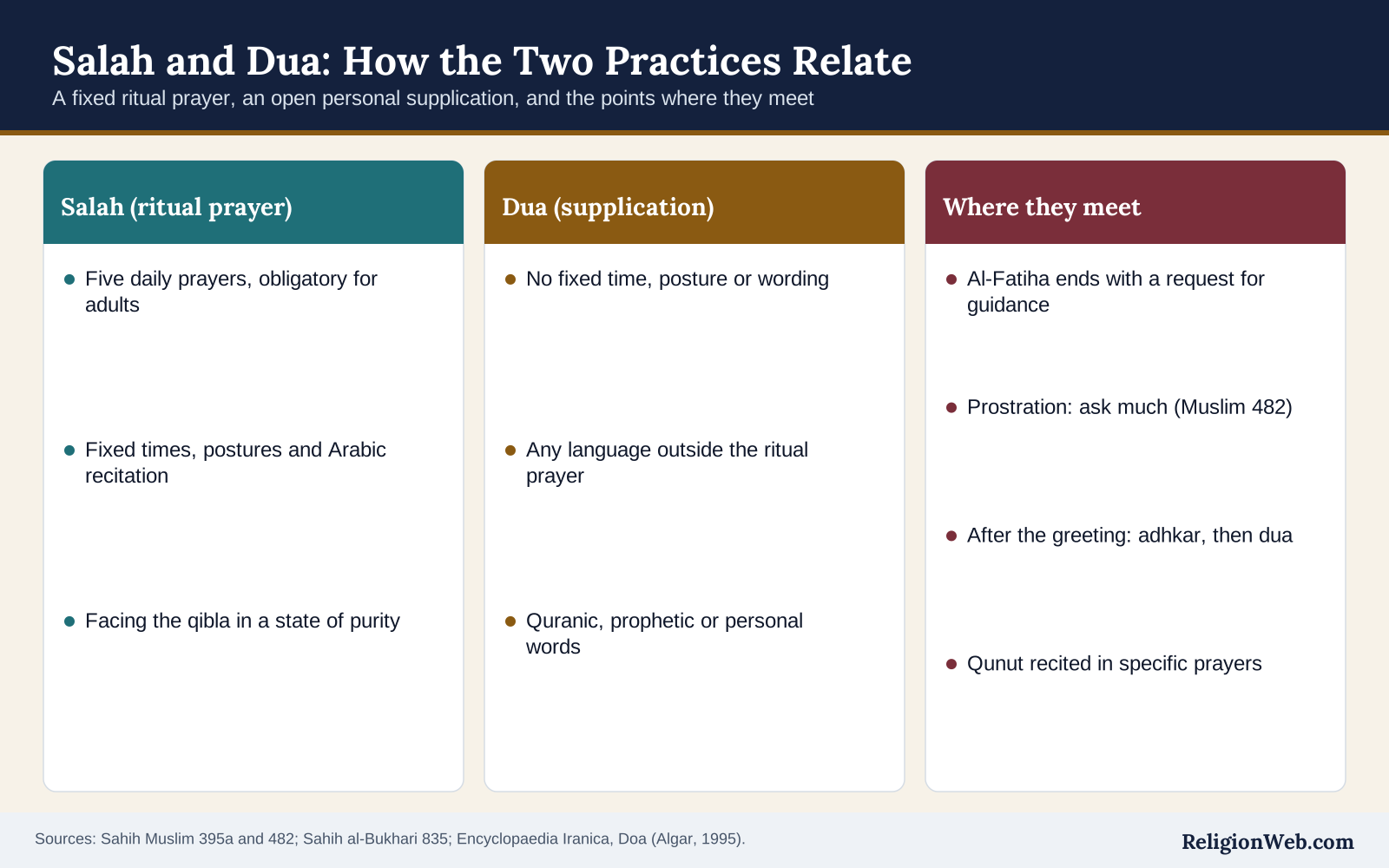
Dua is not the same thing as salah, the five daily ritual prayers whose postures, times and recitations are fixed. Salah has a prescribed form and is an obligation for adult Muslims, while dua is open-ended, can be made at any hour, and does not require a particular wording or posture. The two practices are closely woven together all the same. A worshiper asks for guidance in the opening chapter of the Quran that is recited in every cycle of salah, may pray in their own words while prostrating, and often turns to dua once the formal prayer has ended. That is why the distinction matters: it lets a reader see where the fixed liturgy stops, where personal speech begins, and how Muslim tradition treats each.
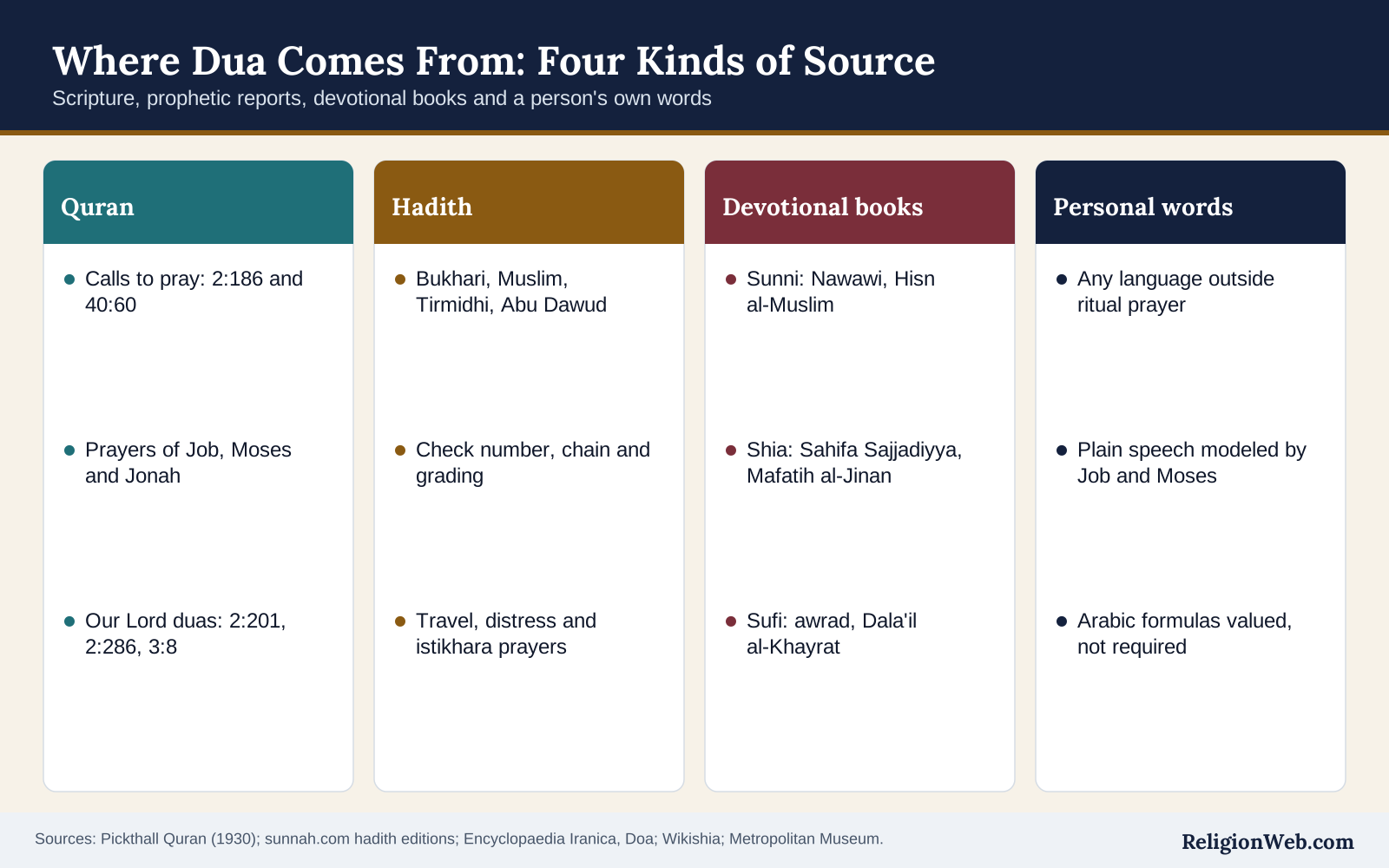
The authority for dua rests on three layers. The first is the Quran, which commands believers to call on God, promises that He is near, and preserves the supplications of Adam, Abraham, Moses, Job, Jonah and others. The second is the Prophet Muhammad’s practice as preserved in hadith, the reports of his words and conduct, where many of the most-loved formulas for morning, travel, distress and forgiveness are found. The third is the long tradition of devotional collections compiled by Sunni, Shia and Sufi authors, from medieval manuals to pocket books carried today. Muslim communities differ on the weight they give to each layer, and this article names those differences as they arise.
What follows explains what dua means, how it relates to salah, what the Quran and hadith say about it, how scholars ask readers to cite supplications precisely, which devotional collections exist, which language may be used, what etiquette surrounds it, and when and where Muslims make it. It also takes up common misunderstandings. The article describes religious teaching and practice. It does not offer rulings for individual situations, and it treats prayer as a complement to, never a replacement for, medical, mental-health or emergency help.
At a Glance: What Dua Means in Islam
The Word and Its Range
The first step in understanding dua is to see how wide the Arabic word is. English “prayer” covers both the ritual and the personal, but Arabic keeps them apart, and dua belongs to the personal side even though it appears inside the ritual as well.
The Arabic root and everyday use
Dua comes from the triliteral root d-‘-w, which carries the sense of calling out to someone, summoning, or inviting. Related words show the family: da‘wa is an invitation or a call, and a da‘i is one who calls. In everyday Muslim speech, to “make dua” means to raise a request or an invocation to God, and the phrase can describe a single sentence whispered before an exam or a long, structured supplication recited from a book on a particular night of the year.
The Encyclopaedia Iranica entry on the topic, written by the scholar Hamid Algar, notes that in the Quran the word often means worship in a general sense, while as a distinct practice it combines praise of God with an admission of human weakness. That double character, praise joined to need, explains why many classic supplications begin by naming God’s attributes before they ask for anything.
Petition, praise and confession together
Muslim teachers commonly describe two overlapping senses of the term. In the narrower sense, dua is a request: asking God for health, forgiveness, guidance, provision or protection. In the broader sense, it includes any invocation of God, such as glorifying Him, thanking Him, or declaring one’s dependence on Him. Sunni writers often express this as a distinction between a dua of asking and a dua of worship, though the vocabulary varies by author and school.
Most of the supplications that Muslims know best mix both senses. A typical formula opens with praise, moves to a confession of fault or need, and then states a request. Because of that structure, dua is seldom treated as a transaction in which a person simply lists wants. The tradition describes it as a relationship of address, trust and humility, and that framing shapes the etiquette discussed later in this article.
Where Dua Sits Within Muslim Life
Dua is not one of the five pillars, but it touches all of them and fills the spaces between obligations. For that reason it is best described as a constant companion of Muslim practice, not a separate institution.
A devotion open to everyone
No ordination, special training or ritual state is required to make dua. A child learns a short formula before eating or sleeping, an adult may address God in the middle of a hard day, and a scholar may spend a night in extended supplication. Muslims also ask others to make dua for them, particularly parents, teachers and respected elders, and tradition encourages praying for fellow believers in their absence. Some Sufi and Shia communities place additional weight on the intercession or the blessing of holy figures, a subject taken up in the discussion of devotional collections.
Dua and the five pillars
Each of the five pillars of Islam has its own dua life. The profession of faith is itself a declaration made to God. Salah contains petition within its structure. In the Quran, the Prophet is told to pray for those who give zakat, and many Muslims ask for acceptance when they give. The verse that promises God’s nearness to those who call on Him sits within the Quran’s passage on the Ramadan fast, which is one reason supplication and fasting are so closely linked in practice. During the hajj, standing at Arafat is traditionally a time of extended personal supplication. Dua therefore runs through the pillars without being counted among them.
Core Vocabulary at a Glance
Arabic has a family of words for speaking to God, and English translations often flatten them all into “prayer.” Table 1 lays out the terms most often confused, with particular attention to how dua and salah differ. The terms are descriptive, and the boundaries between some of them are fluid in practice.
Terms that overlap with dua
| Term | Basic meaning | Relation to dua and salah |
|---|---|---|
| Du‘a’ (dua) | Calling on God; supplication, petition, invocation | Personal and open-ended; no fixed times, postures or wording; also occurs inside salah |
| Salah (salat) | The five daily ritual prayers with fixed form and times | Obligatory; recited formulas in Arabic; contains moments of supplication but is not itself called dua |
| Dhikr | Remembrance or mention of God, such as repeating His names or praises | Often paired with dua; the line between a dhikr formula and a dua can be thin |
| Istighfar | Asking forgiveness | A specific kind of dua centered on repentance |
| Isti‘adha / ta‘awwudh | Seeking refuge in God | A dua of protection, such as the refuge sought in the last two chapters of the Quran |
| Munajat | Intimate, whispered conversation with God | A devotional genre of private speech, prominent in Sufi and Shia literature |
| Ta‘qibat | Supplications and litanies recited after the ritual prayer | Term used in Shia practice for the post-prayer sequence; Sunnis speak of adhkar after the prayer |
| Tawassul | Seeking nearness to God through a means, such as good deeds or a revered figure | A method of framing a dua; scholars differ on which means are valid |
| Awrad / ahzab | Fixed daily devotional routines assigned in Sufi orders | Collections of verses and prayers recited regularly, often after the dawn prayer |
One detail in the table deserves emphasis. The Arabic word salat can itself carry the sense of invocation or blessing, as when the Quran tells the Prophet to pray for donors. So the same root appears in both the formal prayer and in blessings, which shows how closely early Arabic linked ritual and invocation. In later Muslim usage, however, the specialist terms settled into the pattern shown above.
Terms specific to particular traditions
Some of these words belong mostly to particular communities. Ta‘qibat, munajat and the long named supplications such as the Dua Kumayl are especially at home in Shia devotion, where they fill printed prayer books, while the awrad and hizb routines belong to Sufi orders. Sunni communities use adhkar (plural of dhikr) for the formulas of morning, evening and after-prayer remembrance. A reader moving from one community’s books to another’s will meet different headings for what is recognizably the same impulse.
Dua and Salah: How the Two Practices Relate
Different Forms, One Direction
The comparison most often drawn in Muslim teaching is between a prayer whose words are provided and a prayer whose words are chosen. It is a distinction of form within one devotional life, not a ranking of one above the other, and Muslim writers regularly teach them together.
What makes salah distinct
Salah is a ritual with a defined sequence. It must be performed at set times of day, facing the direction of the Kaaba in Mecca (see the discussion of the Kaaba and the qibla), in a state of ritual purity, with standing, bowing, prostration and sitting, and with recitations in Arabic that start from the opening chapter of the Quran. Its structure is common across the major communities, with differences in detail between the Sunni legal schools and the Shia Twelver tradition. The ritual is an obligation for adult Muslims who are able, and it is described in full in the main article on the ritual prayer and its times.
What makes dua distinct
Dua requires none of these conditions. It may be made while walking, driving, lying down or sitting at a desk; with or without ablution; facing any direction, although Muslim etiquette recommends facing the qibla when possible. Its wording is the speaker’s own, or a formula taken from the Quran or hadith. Dua is encouraged strongly but it is not scheduled, which is why some scholars describe it as the open field of Muslim worship around the fixed frame of salah. The two forms are complementary: salah gives a day its rhythm, and dua carries the particular content of a person’s life into it.
Supplication Inside the Ritual Prayer
Calling the ritual prayer a fixed script is accurate but incomplete. Its structure leaves room for supplication at several points, and Muslim jurists and teachers have long treated those moments as especially valuable.
Al-Fatiha as petition
The opening chapter of the Quran is recited in every cycle of the prayer, and its final verses are a request for guidance to the straight path. A report preserved in Sahih Muslim (no. 395a), a divine saying in which God speaks of having divided the prayer between Himself and His servant, describes God answering each verse of the chapter as the worshiper recites it. According to that report, the closing request for guidance belongs to the servant, and God says that His servant will have what he asks for. Many commentators have read this as a sign that the heart of the salah already contains a dua.
Prostration, the last sitting and the qunut
Reports make several positions in the prayer into natural moments for personal speech. In Sahih Muslim (no. 482) the Prophet is reported to have said that a servant is closest to the Lord while prostrating, so that one should make much supplication there. In Sahih al-Bukhari (no. 835), the chapter heading itself says that after the final testimony of faith one may select any supplication one likes, adding that doing so is not obligatory. Some prayers also include the qunut, a supplication recited while standing: Encyclopaedia Iranica notes that Sunnis and Shia both recite it in specific prayers, though they differ over which. Shia practice also includes an opening supplication and the post-prayer ta‘qibat.
The schools of Sunni law do not agree on how far a worshiper may go beyond the narrated formulas of the Prophet within the prayer itself, and the question of language inside the ritual is treated in a later section. For now the point is that the prayer is not a closed box. A worshiper who prostrates and quietly asks for something is acting within a pattern the tradition itself describes.
Supplication After the Prayer Ends
The moments immediately after the final salutation are among the most common times for dua. What people do there depends on their school, region and family habit, and no single pattern is universal.
Remembrance formulas after the salutation
Sunni Muslims commonly follow the final greeting of peace with a sequence of remembrance known as the adhkar after prayer, often including repeated phrases of praise (subhan Allah, al-hamdu lillah, Allahu akbar) counted on the fingers or on prayer beads. Shia Muslims commonly recite the tasbih attributed to Fatima, the Prophet’s daughter, followed by the ta‘qibat. These are conventionally described as remembrance that precedes or accompanies dua rather than as petition itself, though many collections place them together.
Personal dua after the prayer
After those formulas, many worshipers raise their hands and speak privately to God. Whether the worshiper does this alone, with the imam leading, or at all, is a matter on which communities have different customs, and the discussion of individual and shared dua later in this article returns to the debate. Everywhere, the act is the same in kind: the formal prayer closes, and the worshiper’s own words begin.
Dua in the Quran: Commands, Promises, and Prophetic Prayers
What the Quran Says About Calling on God
The Quran addresses dua in two ways. It issues direct statements about calling on God, which Muslims treat as the foundation of the practice, and it narrates the supplications of earlier figures, which Muslims treat as models. The quotations here use the 1930 English translation by Marmaduke Pickthall, which is in the public domain; its older English diction is part of the quoted text, and other translations word the same verses differently.
The promise of nearness
The best-known verse on the subject is 2:186. It appears in the long passage of the second chapter that regulates the Ramadan fast, and it interrupts the legal detail with a statement about God’s closeness.
And when My servants question thee concerning Me, then surely I am nigh. I answer the prayer of the suppliant when he crieth unto Me. So let them hear My call and let them trust in Me, in order that they may be led aright.
Quran 2:186, Pickthall translation (1930)
Commentators in the classical tafsir tradition and in modern works have generally read this verse as a reassurance: it is addressed to people asking about God and answers that no intermediary is needed to reach Him. The placement matters to many Muslims, because it links the discipline of fasting with the openness of supplication. Verse 2:186 is also cited by Encyclopaedia Iranica among the principal texts on dua. Readers should note that the Arabic phrase here that Pickthall renders as “the prayer of the suppliant” uses the same root as dua itself.
The command to call and the link to worship
A second pillar text is 40:60, which turns the promise into an instruction.
And your Lord hath said: Pray unto Me and I will hear your prayer.
Quran 40:60, Pickthall translation (1930)
The rest of the verse, in the same translation, says that those who scorn God’s service will enter hell disgraced. Muslim scholars have long noticed that the verse moves from “call on Me” to “My service,” that is, from dua to ‘ibada (worship). A report in the Jami‘ of al-Tirmidhi (no. 3372), narrated by al-Nu‘man ibn Bashir, has the Prophet say that dua is worship and then recite this verse. The sunnah.com edition shows a grading of sahih from its Darussalam editors, and al-Tirmidhi himself called the report hasan sahih, while noting that it is known through one transmitter. For Sunni readers this is the classic link between supplication and the idea that worship is, at heart, an act of turning to God.
Supplications of Prophets and Righteous Figures
The Quran does more than command dua. It quotes people at prayer, and the quotations are short, concrete and unadorned. They show the range of what may be asked: relief, ease, knowledge, forgiveness, a steady heart.
Short prayers of need
The prayer of Job (Ayyub) is among the shortest and the most often cited as a model of uncomplaining need.
Lo! adversity afflicteth me, and Thou art Most Merciful of all who show mercy.
Quran 21:83, Pickthall translation (1930), words of Job
The Quran then states that God heard his prayer and removed the adversity, and gave him his household and the like of it besides. Moses’ request before facing Pharaoh, at 20:25 to 28, is similarly specific. In Pickthall’s wording he asks that God “relieve my mind,” “ease my task for me,” and “loose a knot from my tongue,” so that people may understand his speech. A verse later in the same chapter (20:114) tells the Prophet Muhammad to say, “My Lord! Increase me in knowledge,” a prayer that many Muslim students recall before study or an examination.
Prayers of repentance and trust
Other supplications are confessions. After the story of the first couple’s error, Pickthall renders their words at 7:23 as “Our Lord! We have wronged ourselves,” followed by an appeal to be forgiven and shown mercy. A comparable confession is attributed to Dhu’n-Nun, “the man of the fish,” whom Muslim tradition identifies with the prophet Jonah (Yunus).
There is no God save Thee. Be Thou Glorified! Lo! I have been a wrong-doer.
Quran 21:87, Pickthall translation (1930), prayer of Dhu’n-Nun
The verse that follows says God heard him and saved him from his anguish, and adds that this is how God saves believers. Many Muslims recite this formula in distress, and its structure, which moves from declaring God’s oneness, to praising Him, to admitting fault, is a compact pattern of the praise-confession-request sequence described earlier. The Quran does not itself say that Dhu’n-Nun means Jonah; that identification comes from Muslim tradition and commentary.
Reading Quranic Supplications
Because Quranic duas are scripture, they carry a status no later composition has. They are also easy to learn: most are a sentence or two, and many open with the same vocative.
The “Our Lord” pattern
Many Quranic supplications begin with rabbana, rendered “Our Lord!” in Pickthall. The verses at 3:8 and 2:286 are typical. In the first, in Pickthall’s words, people of understanding pray, “Our Lord! Cause not our hearts to stray after Thou hast guided us, and bestow upon us mercy from Thy Presence.” In the last verse of the second chapter, believers ask, “Our Lord! Condemn us not if we forget, or miss the mark!” The plural “our” is significant: even a prayer made alone is worded in the voice of a community. Table 2 lists examples by reference only, so that readers can find the verses in the translation or edition they use.
| Reference | Speaker or setting | Theme of the request |
|---|---|---|
| 1:5-7 | Opening chapter, recited in each prayer cycle | Help and guidance on the straight path |
| 2:127-129 | Abraham and Ishmael raising the foundations of the House | Acceptance of their work, submission, a messenger for their descendants |
| 2:201 | Believers, often taught for pilgrimage and daily use | Good in this world and the next, protection from the Fire |
| 2:286 | Closing verse of the second chapter | Forgiveness for forgetting and error, and relief from heavy burdens |
| 3:8 | People of understanding | Hearts that do not stray after guidance |
| 3:147 | Followers of earlier prophets in battle | Forgiveness, a firm foothold and help |
| 3:191-194 | Believers who reflect on creation | Reflection, protection from the Fire, hope of reward |
| 7:23 | Adam and his wife | Repentance and mercy after error |
| 14:40-41 | Abraham | Steadfastness in prayer, forgiveness for himself, his parents and believers |
| 17:24 | Believers, for their parents | Mercy for parents, as they raised the speaker |
| 18:10 | Young men sheltering in the cave | Mercy and right guidance in their affair |
| 20:25-28 | Moses before approaching Pharaoh | Relief of the mind, an easier task, clarity of speech |
| 20:114 | The Prophet is told to say | Increase in knowledge |
| 21:83 | Job | Relief from affliction, trust in God’s mercy |
| 21:87 | Dhu’n-Nun, identified in tradition with Jonah | Repentance and rescue from distress |
| 25:74 | Servants of the Merciful | Comfort in spouses and children, and leadership in piety |
| 40:7 | Angels who bear the Throne | Mercy and knowledge, forgiveness for believers |
| 59:10 | Later generations of believers | Forgiveness for themselves and for those who preceded them in faith |
How Muslims use Quranic duas
The Quranic supplications are recited in many settings. Children memorize them in Quran classes, adults say them at moments the verse suits, and some are woven into the ritual prayer by worshipers who choose to recite them in their own supplication. A report in Sahih al-Bukhari (no. 6389), narrated by Anas ibn Malik, says the Prophet’s most frequent supplication asked for good in this world, good in the next, and protection from the Fire; the chapter heading in that collection names it as the Quranic supplication found at 2:201. That alignment of scripture and the Prophet’s own habit is one reason Quranic duas have a special rank. Encyclopaedia Iranica observes that, among traditional Arabic formulas, Quranic ones are generally the most favored.
Dua in Hadith and the Prophetic Example
What the Reports Say About Dua
The Quran supplies a limited number of supplications, scattered across its chapters. For a large share of the other formulas that Muslims recite, the source is hadith. The reports about dua fall into several kinds: statements about its value, accounts of the times and conditions under which it is said to be answered, and the wording of particular prayers.
Dua as the center of worship
Two closely related reports show why exact citation matters. The Jami‘ of al-Tirmidhi preserves one (no. 3371), narrated by Anas ibn Malik, in which the Prophet says that supplication is the essence of worship; the Darussalam edition on sunnah.com grades it weak, and al-Tirmidhi notes that it is unusual and known through one chain. It is this wording that Encyclopaedia Iranica reflects when it reports that the Prophet called dua the “kernel” of worship. The sibling report, no. 3372 narrated by al-Nu‘man ibn Bashir, is graded sahih in the same edition and says simply that supplication is worship. A reader who sees only a paraphrase, “dua is the heart of worship,” cannot tell which report is behind it, which is why scholars insist on naming the source.
Reports about answered supplication
Several widely cited reports concern the answering of dua. In the Jami‘ of al-Tirmidhi (no. 3573), narrated by ‘Ubada ibn al-Samit and graded hasan, the Prophet says that when a Muslim makes a supplication that does not ask for sin or the cutting of family ties, God either grants it or turns away from the person an equivalent harm. When a companion asks whether they should therefore make much dua, the answer is that God’s bounty is greater. In Sahih al-Bukhari (no. 6340), supplication is answered unless the person grows hasty and concludes that it was ignored. These reports shape a theology of answer that is broader than “getting what one asks,” a topic taken up in the discussion of etiquette.
Using Exact-Source Rules
Hadith scholars, and many Muslim teachers today, ask that a supplication attributed to the Prophet be traced to a named source before it is taught as his. The same discipline applies to this article: hadith are described here by collection, number and, where checked, grading, and are paraphrased rather than quoted.
What a precise citation contains
A sound citation gives the collection, the number or the book and chapter, the narrator at the top of the chain, and the grade the compiler or later critics assigned. Table 3 shows each element, with an example from this article.
| Element | Example from this article | Why it matters |
|---|---|---|
| Collection | Sahih al-Bukhari, Sahih Muslim, Jami‘ al-Tirmidhi, Sunan Abi Dawud, Sunan Ibn Majah | Compilers applied different standards of selection |
| Number, book and chapter | Bukhari 6340, Book of Invocations; Muslim 2732a | Numbering differs between editions, so book and chapter help locate the report |
| Narrator | Tirmidhi 3372, narrated by al-Nu‘man ibn Bashir | The first narrator and the chain affect the report’s reliability |
| Grade | Tirmidhi 3371 graded weak; Tirmidhi 3372 graded sahih (Darussalam edition) | Grades come from named critics and can differ among them |
| Wording | Paraphrase here; Arabic text in the collection | Translations vary, and wording can differ between versions of a report |
Why numbers and grades differ
Two readers may find different numbers for the same report, because editions count differently, and different critics may grade the same chain differently. An edition used for this article, the English database on sunnah.com, attaches grades from named editors such as Darussalam, or from the twentieth-century scholar al-Albani, and these are their views and not a universal ruling. Scholars have long debated whether weakly attested reports may be used for devotions that bring no legal consequence, with some permitting this under conditions and others rejecting it. For ordinary readers the working rule is to look for the collection and number, to check the grading in a trusted edition, and to ask a qualified teacher when a formula is unfamiliar.
The Prophet’s Own Practice of Dua
According to the reports, the Prophet made dua constantly and taught his companions to do so. The formulas attributed to him are often short, balanced and general, which is part of why Muslims have preserved and recited them for fourteen centuries.
Prayers for particular moments
Several reports preserve prayers for named occasions. Sahih al-Bukhari (no. 6346), narrated by Ibn ‘Abbas, records the words the Prophet used in hardship, which affirm God’s oneness and call on Him as Lord of the great Throne and Lord of the heavens and the earth. Sahih Muslim (no. 1342), narrated by Ibn ‘Umar, records a longer supplication he said when mounting his camel to travel, asking for piety, an easy journey and a safe return. Sahih al-Bukhari (no. 1166), narrated by Jabir ibn ‘Abdullah, records the istikhara prayer, taught after two voluntary cycles of prayer by someone considering a decision. Jabir adds that the Prophet taught it as he taught a chapter of the Quran.
The Prophet as teacher of dua
The same report on the istikhara shows a pattern: the Prophet is remembered as taking care that his companions learned particular supplications precisely, in the way that they learned scripture. In the Jami‘ of al-Tirmidhi (no. 3513), graded sahih in the Darussalam edition, his wife ‘A‘isha asks what to say if she finds the Night of Power, and is taught a short request for pardon; this is treated in the article on Laylat al-Qadr. Taken together, these reports are why Muslims treat prophetic supplications as a model. They do not replace the open invitation of the Quranic verses, which allow the believer to call on God at any time and with any need.
Devotional Collections: Sunni, Shia, and Sufi Sources of Supplication
Major Types of Devotional Source
Muslims rarely make dua from a blank page alone. Alongside improvised speech, there is a large literature of ready-made supplications, ranging from a few verses of scripture to book-length prayers for days of the week. Knowing the genres helps a reader see why a prayer book in one community looks nothing like another’s.
Scripture, hadith and compilations
Three kinds of source come first in the usual ordering. The Quran provides supplications that carry scriptural authority. The hadith collections preserve prophetic formulas, and several of the major collections gather them in dedicated sections: the Book of Invocations in Sahih al-Bukhari, the Chapters on Supplication in the Jami‘ of al-Tirmidhi, and the Book of Remembrance, Supplication, Repentance and Seeking Forgiveness in Sahih Muslim. Compilations by later scholars then arrange the same material by occasion, so that a reader can find the words for waking, traveling or eating without searching through volumes of hadith. Table 4 sets these source types side by side with examples.
| Source type | Examples | Character and use |
|---|---|---|
| Quran | 2:201, 2:286, 3:8, 21:87 | Supplications in scripture; recited in prayer, taught to children, valued above later formulas |
| Hadith collections | Bukhari, Muslim, Tirmidhi; Shia works such as al-Kafi | Prophetic and, for Shia, Imams’ supplications, preserved with chains of transmission |
| Sunni manuals of remembrance | Nawawi, al-Adhkar; Qahtani, Hisn al-Muslim | Topical arrangement by occasion; widely used in mosques, schools and apps |
| Shia supplication books | al-Sahifa al-Sajjadiyya; Qummi, Mafatih al-Jinan; Dua Kumayl | Long named supplications and prayers for days, nights and months, recited individually and in groups |
| Sufi litanies | Awrad of the orders; Jazuli, Dala’il al-Khayrat | Daily routines of verses, blessings and prayers, often assigned by a shaykh |
| Personal speech | Prayers in one’s own words and language | Spontaneous; free of any fixed text, subject to the etiquette discussed below |
Later manuals and named supplications
As the table shows, the later literature falls into recognizable families. Sunni authors tend to arrange supplications by occasion and source them to the Quran and hadith with a stated grading. Shia authors, working within a tradition that gives authority to the reports of the twelve Imams, have produced longer named supplications attributed to them. Sufi orders add routines assigned by teachers. The distinctions are not hard borders. Individual Muslims often use material from more than one family, and some texts, such as the blessings on the Prophet in Sufi manuals, are used widely among Sunnis who are not members of any order.
Sunni Collections
Sunni devotion draws on a long line of scholars who gathered and sorted the prophetic supplications. Two examples show the range, one medieval and one modern.
Medieval manuals of remembrance
Among the best known medieval works is al-Adhkar by the Shafi‘i jurist and hadith scholar al-Nawawi, who died in 1277 or 1278 CE (676 AH); Encyclopaedia Iranica lists it among the principal Sunni collections. Al-Ghazali’s Ihya’ ‘ulum al-din (Revival of the Religious Sciences), written around 1100 CE, also treats supplication and its etiquette, and the Iranica article draws on it when it sets out the conduct that he recommends. Such works give the formulas, name the hadith that report them, and often describe the occasion on which each is said.
Modern pocket manuals
The best-known modern example is Hisn al-Muslim (Fortress of the Muslim), compiled by the Saudi scholar Sa‘id ibn ‘Ali ibn Wahf al-Qahtani in the late 1980s from supplications in the Quran and the Sunna. It is organized by situation, from waking to entering the mosque to traveling, and its English and other editions generally print the Arabic text, a translation and a transliteration side by side. Because it is small and topical, it has become a common first book of dua for Sunni Muslims of many backgrounds, and apps built on its contents are widely used. The same format, with the Arabic on one side and a translation on the other, is the practical answer to the language question discussed in the next section.
Shia Collections
In Shia tradition, which holds that the Prophet’s family are authoritative guides to piety, the supplications transmitted from the Imams form a major devotional library. Wikishia, a Shia reference work, lists among the principal hadith-based supplications the Dua Kumayl, the Dua al-Nudba, the Dua al-Tawassul, the Dua al-‘Ahd and the Dua al-Jawshan al-Kabir, and notes that these are usually long and received their titles in later times.
The Sahifa Sajjadiyya
The best-known single book is al-Sahifa al-Sajjadiyya, attributed to ‘Ali ibn al-Husayn Zayn al-‘Abidin (called al-Sajjad), the fourth Shia Imam (c. 659 to 713 CE). Its core consists of fifty-four supplications; editions often add an appendix of fourteen further supplications and fifteen whispered prayers (munajat). Shia tradition regards the text as transmitted through numerous chains, and has honored it with titles such as the Psalms of the Household of Muhammad. William Chittick’s English translation, The Psalms of Islam (1987), introduced it to many non-Arabic readers. Its themes include praise, thanks, repentance, prayer for parents and for the community, and requests for noble character. Its attribution to al-Sajjad is often regarded as authentic, though some modern scholars have suggested that parts may have been edited by others.
Mafatih al-Jinan and named supplications
For daily use, the standard compendium among Twelver Shia is Mafatih al-Jinan (Keys to the Gardens), compiled by Shaykh ‘Abbas Qummi (d. 1359 AH, 1940 CE), whom Iranica calls the definitive Shia compendium. It gathers supplications, ritual prayers, and visitation texts by day, month and occasion, and it has been printed and translated many times. The Dua Kumayl, which tradition says ‘Ali ibn Abi Talib taught to his companion Kumayl ibn Ziyad al-Nakha‘i, is recommended on Thursday nights, and communities in many countries gather to recite it. During Ramadan Shia books prescribe nightly supplications, including the Dua Iftitah. Shia devotion in Muharram combines supplication with the mourning rituals described in the article on Muharram and Ashura. The background to these practices is set out in the articles on Shia Islam and on Sunni Islam, which describe how the two traditions understand religious authority.
Sufi and Regional Devotional Literature
The communities of Sufism have contributed a distinct body of dua literature. Much of it is organized around regular recitation instead of occasion, and a great deal of it is regional in language and style.
Awrad, hizb and munajat
Encyclopaedia Iranica describes awrad as daily devotions, generally recited after the dawn prayer, made up of Quranic verses, traditional prayers and sentences from the masters of an order, and names the Awrad-e Baha’iyya attributed to Baha’ al-Din Naqshband and the Awrad-e Fathiyya attributed to ‘Ali Hamadani. The same article describes munajat, intimate supplications that in Persian-speaking Sufi circles were largely written in Persian, and cites al-Sarraj’s definition of them as the addressing of secrets to God in a state of pure recollection. Many of the munajat leave aside worldly requests, and their emphasis is on love and nearness. The Persian language of these texts is a reminder that devotional dua has never been limited to Arabic.
Dala’il al-Khayrat
A very widely copied devotional work in the Sunni Sufi world is Dala’il al-Khayrat, a book of blessings on the Prophet compiled by the Moroccan mystic Muhammad ibn Sulayman al-Jazuli, who died in 1465. The Metropolitan Museum of Art, which holds a copy made in 1625 or 1626 in what is probably Algeria or Tunisia, describes it as gaining popularity from the sixteenth century and spreading across North Africa as far as China. Many copies carry drawings of Mecca and Medina, and its owners have regarded carrying and reciting it as a source of blessing and protection, a belief that reflects devotional practice and not a universal doctrine. Scholars who study the genre, notably Constance Padwick in Muslim Devotions (1961), have shown how such manuals served ordinary readers across the Muslim world.
Language and Personal Voice in Dua
Making Dua Outside the Ritual Prayer
The question of which language to use is among the most practical ones for non-Arab Muslims, who are the large majority of the world’s Muslims. The answer outside the ritual prayer is clear and consistent across the mainstream schools, though the preference for Quranic and prophetic wording remains strong.
Any language is permitted
Scholars from a range of positions agree that a person may make dua outside salah in any language, provided the content is lawful. An answer published on the IslamQA.info site states that supplication in a non-Arabic language or in colloquial Arabic is allowed if the request involves no sin or severing of family ties, and it cites Ibn Taymiyya for the view that a sincere supplication is answered whether or not it is in classical Arabic. A Hanafi fatwa service in Birmingham says that outside prayer one may make dua in whatever language one prefers. Encyclopaedia Iranica makes the same point, saying the petitioner may formulate a dua “in any language of his choosing” while noting that Arabic and traditionally hallowed prayers are generally preferred in practice.
Why Arabic remains valued
If any language is permitted, why do printed manuals still give the Arabic first? One reason is continuity. A formula in the Prophet’s own words, or in the words of the Quran, links the worshiper to the generations who said it before. Another is community: wherever Muslims gather, an Arabic formula can be recited together by people who speak different mother tongues, and the same one can be understood by a visitor from another continent. A third is the sense that a recognized formula is safer than improvising. None of these reasons makes the Arabic obligatory, which is why the same manuals present a translation beside it, and why teachers commonly encourage learners to understand what they are saying.
Dua Inside the Ritual Prayer: Differences Among Schools
The ritual prayer is a different matter, because the recitation of the Quran and the formulas in it have a fixed liturgical character. Here the schools of Sunni law express different positions, and the differences are matters of internal scholarship, not of conflict.
What the schools say
The IslamQA answer summarizes positions by school. It reports that the Hanafi school regards supplication in a language other than Arabic during salah as disliked, with the dislike close to prohibition. Among Malikis, it reports a debate: one reading prohibits foreign phrases whose meaning is unclear, while others permit it where the meaning is known. For the Shafi‘i and Hanbali schools it reports that narrated supplications may be said in another language only by someone unable to say them in Arabic, and that non-narrated supplications in foreign languages are not permitted. A Hanafi fatwa from Darul Iftaa Birmingham agrees that doing so in prayer is disliked, citing the standard Hanafi reference Radd al-Muhtar. These summaries reflect the answers’ authors and their own affiliations; Twelver Shia jurists have their own detailed rulings, which are not surveyed here. Table 5 gathers the school positions as reported.
| School | Reported position | Notes |
|---|---|---|
| Hanafi | Disliked in prayer; permitted outside prayer | Basis cited: ‘Umar’s disapproval of foreign speech; Radd al-Muhtar |
| Maliki | Debated among later authorities | One reading prohibits unclear foreign phrases; another permits where meaning is known |
| Shafi‘i | Narrated supplications: permitted only for one unable to use Arabic; non-narrated: not permitted | Other views on narrated supplications are mentioned |
| Hanbali | Narrated supplications: permitted only for one unable to use Arabic | Reported as the sounder view in this school |
Learners and those unable to use Arabic
Several of these positions include an allowance for people who cannot yet say the Arabic. The same Egyptian fatwa quoted above permits Persian for someone unable to recite Arabic in prayer, and the Shafi‘i and Hanbali views reported by IslamQA permit a non-Arabic supplication for such a person. In practice this means that new Muslims, children and others who are still learning are usually encouraged to learn the key formulas gradually while continuing to speak freely to God in their own words outside the prayer. As in all matters of religious law, a person with a specific question is advised to consult a qualified teacher of their own school.
Speaking in One’s Own Words
Beyond the question of language lies the question of voice. The Quran’s own examples, and the practice of the Prophet, show a range from carefully shaped formulas to brief, unpolished appeals.
Quranic examples of plain speech
Job’s prayer is a single sentence naming his affliction and God’s mercy. Moses’ prayer lists, in simple terms, what he needs to carry out his task. These verses show that dua need not be elaborate; the form is that of someone describing a situation to someone they trust. Many Muslim teachers use these examples to encourage people who feel unable to put their requests into polished Arabic: the Quranic models are neither ornate nor technical.
Sincerity over style
Classical writers on etiquette pay attention to the form of personal speech. According to Encyclopaedia Iranica, al-Ghazali’s list of recommended practices includes avoiding rhyming phrases, a caution traditionally understood to mean that strained eloquence can distract from humility. The result is a consistent teaching: the words matter less than the posture of the heart, and a plain request made in one’s own language can be as sincere as a long text in classical Arabic. This does not conflict with the esteem in which the hallowed formulas are held; teachers generally present them as complementary.
Adab: The Etiquette of Making Dua
Inner Attitudes
Muslim writers on dua devote more attention to the state of the person praying than to the wording. The recurring themes are humility, hope tempered by fear, sincerity and trust, and they come from the Quran itself.
Humility, hope and fear
The key text for the manner of dua is 7:55, which instructs the believer on how to call on God.
(O mankind!) Call upon your Lord humbly and in secret. Lo! He loveth not aggressors.
Quran 7:55, Pickthall translation (1930)
The next verse, in the same translation, adds that the believer should “call on Him in fear and hope.” Commentators have drawn several lessons from these lines. Calling “humbly and in secret” is taken to mean a lowered voice and a lowered self, without display. Encyclopaedia Iranica notes that al-Ansari cited this verse in listing praying quietly and in private among his five conditions of dua. Some commentators read “aggressors” as including those who overstep proper bounds in what they ask or how loudly they ask it, although the Arabic word has a range of meanings and interpreters have understood it differently.
Praise first, then the request
A frequently taught pattern puts praise before petition. Iranica reports that al-Ghazali, in listing the etiquette of dua, recommends beginning with the divine attributes rather than with the request itself, and also counts cultivating regret and repentance for sins among the fitting inner states. In Shia sources summarized by Wikishia, the recommended order begins with asking forgiveness, states the purpose, glorifies God and recalls His blessings, and includes sending blessings on the Prophet and his family. Sunni practice also commonly includes sending blessings on the Prophet near the start or end of a dua. The common principle is that one approaches God as a servant, not as a client with a demand.
Outer Practices
Alongside the inner attitudes, teachers list outward practices that express them. These are recommendations of etiquette rather than conditions that make dua valid, which is a point several Muslim scholars stress to prevent anxiety about getting the form wrong.
Body, place and posture
Most manuals recommend, when possible, being in a state of ritual purity, facing the qibla, and choosing a quiet moment, though dua is also made without any of these. Hands are commonly raised and held apart at about breast level with the palms facing upward, a posture that Iranica notes is reversed for the rain prayer, when the palms face downward. Many Muslims then pass their hands over the face at the end, although the status of this custom is discussed among scholars. The voice is generally kept low. The Hanafi scholar Muhammad ibn Adam of Darul Iftaa Leicester prefers silent supplication on the basis of 7:55, while allowing a louder voice when an imam wants others to learn the supplications.
Conduct and conditions of the heart
Three further themes recur. The first is lawful livelihood: a widely cited report in Sahih Muslim describes a traveler raising his hands in need whose food and drink were unlawful, and asks how his dua could be answered. Because of this report, teachers link the quality of one’s earnings and food to the quality of one’s prayer, a link taken up in the article on what halal means. The second is the content of the request: the report in al-Tirmidhi (no. 3573) excludes requests for sin or for severing family ties. The third is persistence without impatience, as in Sahih al-Bukhari (no. 6340). Prayer for others is especially encouraged: Sahih Muslim (no. 2732a) reports that when a believer prays for a brother or sister in their absence, an angel wishes the same good for the one who prayed. Table 6 sets out these themes.
| Theme | Typical practice | Basis in the sources |
|---|---|---|
| Humility and secrecy | Lowered voice, no display, plain words | Quran 7:55; stressed by al-Ansari and al-Ghazali as reported in Iranica |
| Hope and fear | Asking with confidence in God’s mercy and awareness of one’s faults | Quran 7:56 |
| Praise before the request | Begin with God’s attributes, and in many communities with blessings on the Prophet | Al-Ghazali (Iranica); Shia manuals (Wikishia) |
| Purity and direction | Ablution and facing the qibla when feasible; not a condition | Al-Ghazali (Iranica); Shia manuals (Wikishia) |
| Hands and posture | Palms upward at breast level; downward for the rain prayer | Described in Iranica |
| Lawful sustenance | Care that food and earnings are lawful | Report in Sahih Muslim; Shia sources also list unlawful income as an obstacle |
| Lawful content | No request for sin or for cutting family ties | Tirmidhi 3573 |
| Persistence | Repeating the dua; not giving up because of delay | Bukhari 6340; al-Ghazali (repeat three times) |
| Praying for others | Including parents, family and the community, often before oneself | Muslim 2732a; Shia manuals |
Understanding Answer and Delay
Every tradition of petitionary prayer has to say what it means when a request is not granted as asked. Islamic teaching returns to this question often, partly because it is one of the most common sources of distress for sincere believers.
Forms of answer
The key hadith is Tirmidhi 3573, discussed above, which says God grants the request or turns an equal harm away, as long as it is lawful. Many teachers read from this that the answer to a dua may take forms the person does not recognize: the thing itself, a protection from something unseen, or, as many teachers add, a reward in the next life. The teaching has a pastoral purpose. It tells the believer that no sincere request is wasted and discourages the conclusion that unanswered means rejected, which Bukhari 6340 expressly names as a mistake of impatience.
Dua and divine wisdom
Shia and Sunni teaching both treat dua as consistent with belief in divine wisdom and decree. Wikishia reports a saying of Imam ‘Ali that God’s generosity does not contradict His wisdom, which is why some prayers are not granted, and a saying of Imam al-Hasan that one who guards his heart against what displeases God will find his prayers answered. Classical theologians such as al-Ghazali also discuss the objection that supplication seems pointless if outcomes are fixed. In outline, the traditional reply is that God Himself commands dua, in verses such as 40:60, and that asking is part of the way outcomes unfold. A bounded note is also necessary here: mainstream Muslim teaching treats dua as complementary to medical treatment, not as a substitute for it, and a person facing illness, danger or deep distress should seek professional care alongside prayer.
Times, Places, and Contexts of Dua
The Daily Rhythm
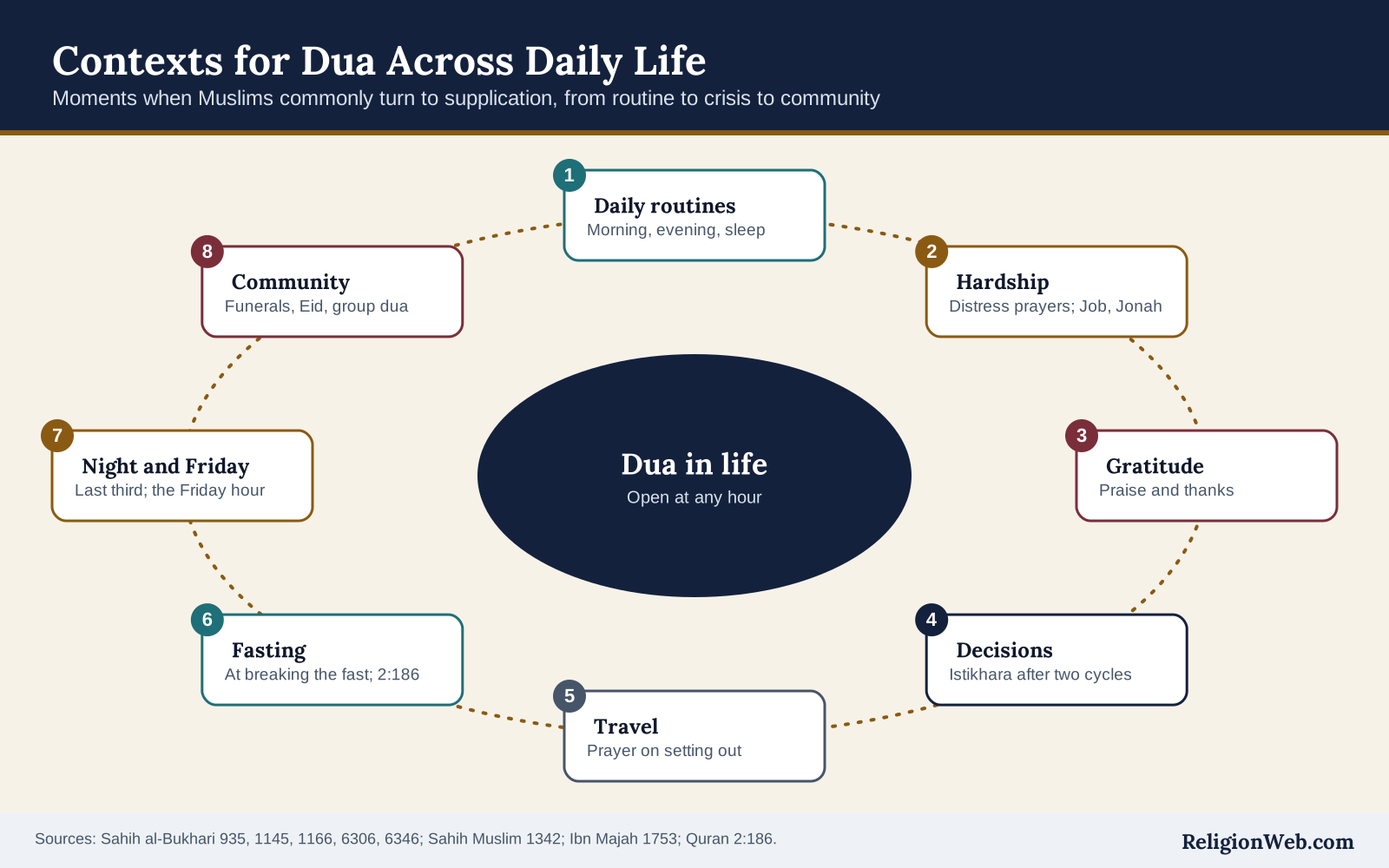
The rhythm of Muslim life gives dua many anchors. Some are tied to time and others to activity. Here again the picture is one of recommendations that communities observe to different degrees.
Morning, evening and sleep
Collections such as Hisn al-Muslim are organized around the moments of an ordinary day: waking, dressing, leaving the house, entering the mosque, eating, going to bed. A notable example is the “master supplication for forgiveness” (sayyid al-istighfar), recorded in Sahih al-Bukhari (no. 6306) from Shaddad ibn Aws, in which the speaker affirms God as Lord, confesses blessings and sins, and asks for pardon. The report states that whoever says it with conviction by day and dies before evening, or by night and dies before morning, will be among the people of Paradise. Muslims who recite it do so as a daily act of repentance, and the promise reflects the tradition’s belief about the value of sincere forgiveness-seeking.
Around the call to prayer and in prostration
Two moments linked to salah are recommended for personal supplication. A report in Sunan Abi Dawud (no. 521), narrated by Anas ibn Malik and graded sahih by al-Albani on sunnah.com, says that dua made between the call to prayer and the second call is not rejected. And, as noted earlier, Sahih Muslim (no. 482) encourages much supplication in prostration. For many people these two moments are the easiest anchors in a working day, since they already involve a pause.
Special Times and Places
Beyond the daily rhythm, the sources point to certain times that are thought especially favorable. Muslims who value them treat the lists as invitations and not as limits; the tradition also says that any time is open.
Night, Friday and fasting
Sahih al-Bukhari (no. 1145), narrated by Abu Hurayra, reports that in the last third of every night God descends to the lowest heaven and invites those who call on Him, ask Him, or seek His forgiveness. Muslim theologians have interpreted such wording about God in different ways, so readers will find this report cited with differing interpretive notes. Many Muslims who keep a voluntary night prayer use that hour for dua. Sahih al-Bukhari (no. 935) mentions an hour on Friday in which a Muslim standing in prayer who asks God for something will receive it, and scholars have proposed many identifications for the hour. For the fasting person, Sunan Ibn Majah (no. 1753) reports that the dua at the time of breaking the fast is not rejected, and the sunnah.com edition grades it hasan. Together with 2:186, this is why the Ramadan evening meal is often framed by a short supplication. The article on Ramadan describes how the month is observed.
Pilgrimage and sacred places
At the hajj, the standing at Arafat on the ninth of Dhu al-Hijjah is widely taught as a day of extended personal supplication, and many pilgrims spend the afternoon in it; the full sequence of rites is described in the articles on Hajj and on Umrah. Pilgrims commonly recite the Quranic dua at 2:201 during circumambulation of the Kaaba, and many make personal dua at the Multazam, the stretch of wall between the Black Stone and the door. Outside the pilgrimage, a mosque is the usual place for community supplication, though nothing in the tradition requires it. Muslims may pray at home, in a car, or in the open.
Contexts of Need, Gratitude, and Decision
Dua also follows life events. Muslims turn to it in hardship, to give thanks, when making a choice, and when beginning a journey. Table 7 summarizes the main contexts.
Crisis, hardship and illness
When life becomes hard, the Quranic models of Job and Jonah and the prophetic distress prayer in Bukhari 6346 give believers words to use. Many Muslims also ask relatives and friends to pray for them, and they pray for the sick when visiting them. In Iranica’s account, popular religion in Iran also developed written dua texts carried as amulets for protection, a practice that some Muslim writers have criticized and others have defended; such texts are distinct from the mainstream teaching of personal supplication. Religious teachers generally add that dua does not replace medical, psychological or emergency care, and that seeking such care is itself encouraged by the tradition.
Gratitude, choices and travel
Dua is not limited to need. Praise and thanks (hamd and shukr) are themselves a kind of supplication, and prayers of gratitude accompany meals, good news and recovery. The istikhara, taught in Bukhari 1166, is a request for guidance in a decision, made after two voluntary cycles of prayer; the supplication asks that the matter be made easy and blessed if it is good for the person’s religion, livelihood and future, and turned away otherwise. It is a prayer for guidance, not a method for predicting outcomes. On a journey, the Prophet’s travel supplication (Muslim 1342) is widely used by those who set out by car, plane or train.
| Context | Typical supplication or practice | Source note |
|---|---|---|
| Morning and evening | Remembrance formulas and the master supplication for forgiveness | Bukhari 6306; manuals such as Hisn al-Muslim |
| Between adhan and iqama | Personal requests | Abu Dawud 521 (graded sahih by al-Albani) |
| Prostration | Personal requests within the prayer | Muslim 482 |
| Last third of the night | Voluntary prayer and asking forgiveness | Bukhari 1145 |
| Friday | Personal requests during the favored hour | Bukhari 935 |
| Fasting and Ramadan | Supplication at the time of breaking the fast; nightly supplications | Ibn Majah 1753 (hasan); Quran 2:186; Shia books prescribe nightly texts |
| Laylat al-Qadr | A short request for pardon | Tirmidhi 3513 (sahih, Darussalam) |
| Pilgrimage | Extended dua at Arafat; Quran 2:201 at the Kaaba | Hajj and Umrah manuals |
| Distress | Formulas praising God’s oneness and lordship | Bukhari 6346; Quran 21:83, 21:87 |
| Decision | Istikhara after two voluntary cycles | Bukhari 1166 |
| Travel | Travel supplication on setting out | Muslim 1342 |
| Praying for another | Supplication for an absent believer | Muslim 2732a |
Individual and Shared Dua: Community Practice Today
Dua Together in Congregation
Although dua is a personal devotion, Muslims have always also made it in groups. The Arabic word amin (amen), said by listeners as one person prays, is the audible sign of this shared practice, and the occasions on which it occurs show how closely dua is woven into communal worship.
Occasions for shared supplication
Several rituals consist largely of supplication made together. The funeral prayer has no bowing or prostration, and its central part is a series of requests for forgiveness and mercy for the deceased and for the living. The sermon on Friday, which Muslims attend in the mosque, traditionally ends with prayers for the believers, and the prayers on the two festivals of Eid al-Fitr and Eid al-Adha are followed by a sermon that often includes supplication. Prayers for rain, for relief from drought or other calamity, are made together in some communities, with the special hand posture Iranica describes. In each of these, an imam or speaker leads, and the congregation joins by saying amin.
Collective dua after the obligatory prayer
One question divides communities in practice: whether a group should make dua together after each of the five daily prayers, with the imam leading and the worshipers raising their hands. Darul Iftaa Leicester, a Hanafi fatwa service, answers that supplicating together after the obligatory prayers is permissible, that the author regards it as recommended or a sunna and not an innovation, and that supplicating after prayer is supported by many reports. The same answer cautions that dua is not part of the prayer itself and is not obligatory, that those who omit it should not be criticized, and that some scholars suggest leaving it out at times so that people do not see it as required.
A second view, associated with scholars of Salafi and Ahl-i Hadith orientation, and attributed by contemporary writers to Ibn Taymiyya and Ibn al-Qayyim, is that a regular, structured group dua led by the imam after every obligatory prayer is not established as the Prophet’s practice. On this view, individual dua after prayer is fully acceptable; what is questioned is the habit of making the group form a fixed custom. The difference is of long standing, and it is mostly a matter of how strictly one reads the absence of a report about the Prophet’s own custom. Practice varies accordingly: in many South Asian mosques a short group dua follows the prayer, while in many other mosques each worshiper finishes the prayer, makes personal dua and leaves.
Dua in Shia and Sufi Gatherings
In Shia and Sufi settings, shared supplication often takes the form of long, patterned recitation. The following descriptions are general and local practice varies widely.
Shia gatherings
Among Twelver Shia, congregations gather on Thursday nights, which Iranica identifies as the recommended time for the Dua Kumayl, to recite it together, commonly led by a reader while the congregation follows or responds. Gatherings in Ramadan may draw supplications from books such as Mafatih al-Jinan, and Muharram gatherings combine elegies with prayer. The supplications attributed to the Imams are typically long, rhythmic and emotionally expressive, and the gatherings that recite them are among the most distinctive features of Shia devotional life.
Sufi gatherings
In Sufi orders, dua appears alongside dhikr. According to Iranica, members recite assigned awrad after the dawn prayers, individually or with others, and many orders hold weekly sessions in which supplications and the remembrance of God are performed together under a shaykh. Not all Muslims share this devotional style: some Sunni scholars have criticized parts of it and others have defended it, and the debates are described in the article on Sufism. What is shared is the conviction that remembering and calling on God are done better in company.
Dua in Modern Life
The tools of dua have changed more in the last generation than in the previous several centuries, while the practice itself has stayed recognizably the same.
Print, apps and diaspora communities
Pocket manuals, printed cards on the walls of homes and hospitals, and smartphone apps now carry supplications to places where an imam or teacher may be far away. For Muslims who live as minorities, and for the many who do not speak Arabic, the format of Arabic text with translation and transliteration is especially helpful, since it allows a person to say the words the way they were first said and to understand them. Children learn short duas for eating, sleeping, leaving the house and traveling, often in the home language, as a first step toward the longer formulas of the prayer. Muslim chaplains in hospitals and universities frequently offer supplication with patients and students who ask for it.
Dua, health and professional care
The tradition has a clear position on the relationship between prayer and treatment: it treats them as complementary. A well-known report in Sahih al-Bukhari says that God sent down a cure for every disease, a statement that Muslim jurists and physicians have cited for centuries in support of seeking medical care. Muslim counselors today commonly advise people who are anxious, depressed or in danger to seek professional help while continuing their prayers, and they treat the two as not in competition. Anyone in an emergency should contact local emergency services; dua is a companion to such help and not a replacement.
Common Misconceptions About Dua
Misconception 1: Dua and salah are identical terms
Where the misunderstanding comes from
English offers one word, “prayer,” for both the ritual and the personal address to God, so a reader meeting the phrase “Muslim prayer” can reasonably assume it names one thing. Muslim speech adds to the overlap. People say they are “going to pray” when they mean salah and also when they mean that they will make dua, and a worshiper who raises their hands after the final greeting may describe the whole sequence as a single prayer. The classical Arabic vocabulary overlaps too: the word salat can carry the sense of blessing or invocation, and the Quran sometimes uses the root of dua to mean worship in general.
What the evidence and tradition actually show
In Muslim usage the two terms name different things. Salah is the ritual prayer, an obligation with fixed times, a fixed sequence of postures, and recitations in Arabic. Dua is the open category of calling on God, which needs no fixed time or wording. Encyclopaedia Iranica states that dua is distinct from the obligatory salat, even though supplicatory formulas appear within the prayer. The distinction is not a ranking: Muslim teachers regard both as acts of worship, and the report in al-Tirmidhi (no. 3372) that calls dua worship is understood to place it within the same devotional frame. The relationship is best described as one of overlap, since salah contains moments of dua, and dua often follows salah.
A practical consequence is that the two can be missed or kept separately. A Muslim who is not performing the ritual prayer at a given moment, for example a woman during menstruation, when the prayer is not required, or a person who is not yet in a position to stand and pray, remains free to make dua, and a worshiper who has completed the obligatory prayer has not thereby exhausted the opportunity to speak to God. Conversely, making dua does not discharge the obligation of salah. Keeping the terms distinct allows each to be understood on its own terms and prevents the confusion in which a long supplication is thought to stand in for the daily prayers, or the daily prayers are thought to leave no room for personal speech.
Misconception 2: Dua must always be in Arabic
Where the misunderstanding comes from
The belief has understandable roots. The Quran was revealed in Arabic, the prayer’s recitations are in Arabic, and the printed prayer books that new Muslims receive are mainly in Arabic. Because rules about the language of salah are real, a person may reasonably extend them to every form of speech to God. Some people also come to feel that Arabic is a more acceptable language of prayer, and those learning the faith as adults, or growing up far from Arabic-speaking communities, may worry that their own speech is not good enough.
What the evidence and tradition actually show
Outside the ritual prayer, the sources reviewed for this article agree that any language is permitted. Encyclopaedia Iranica says the petitioner may compose a dua in any language, an IslamQA.info answer cites Ibn Taymiyya for the view that a sincere supplication is answered whether or not it is in classical Arabic, and a Hanafi fatwa service in Birmingham tells questioners to use whatever language they prefer outside the prayer. The restrictions that exist apply to the ritual prayer, and they differ among the schools, as Table 5 shows, with allowances for those who cannot yet use Arabic. Arabic formulas are valued and often preferred, but valued is not the same as required. Persian Sufi munajat are one of many examples of devotional speech in other languages.
The practical result is a layered picture. For the formal prayer, learners are expected to acquire the Arabic gradually, and the schools make allowance for those who cannot yet do so. For dua, a Muslim in Jakarta, Lagos, Istanbul or Chicago may speak to God in the language of the household, and many do so every day. The Arabic formulas continue to serve as a shared inheritance, and the printed manuals that place a translation beside each one reflect the view that understanding what one says is part of what makes a supplication sincere.
Misconception 3: Only memorized formulas count as valid supplication
Where the misunderstanding comes from
Many Muslims first meet dua as a list of formulas for particular moments: before eating, upon leaving home, after the prayer. Teachers rightly emphasize that these have the weight of prophetic precedent. A listener can easily conclude that the formulas are the only correct form, and that spontaneous words are second-rate or risky. In communities with strong traditions of printed manuals, this impression can be reinforced by the habit of reading from a book.
What the evidence and tradition actually show
The Quran and hadith model both approaches. Job’s prayer and Moses’ request in the Quran are plain statements of need, and the Sahih al-Bukhari chapter heading (no. 835) notes that after the final testimony of faith a worshiper may choose whatever supplication he likes. Encyclopaedia Iranica states that the believer may compose a dua freely and that traditional formulas are generally preferred, a description of preference and not requirement. Al-Ghazali’s counsel to avoid strained rhyming (Iranica) reflects the old concern that eloquence can crowd out sincerity. The teaching in most sources is thus that the narrated formulas are the best-attested and the most blessed, while spoken, personal requests are fully valid.
There is also a cautionary point on the other side. Muslim teachers who stress the formulas do not mean that a person should say nothing until the Arabic is learned. The advice most often given is to learn the short, well-known supplications first, to understand their meaning, and to speak to God freely about everything else. A person who knows only a handful of formulas and a great deal of sincere private speech is, on this account, making dua properly.
Misconception 4: An unanswered dua means it was rejected, or that the person lacked faith
Where the misunderstanding comes from
People who pray for something that does not happen, such as a recovery, a job or a reconciliation, may feel that their dua was refused or that they did something wrong. Popular sayings that stress the certainty of answer can intensify this feeling, as can well-meant advice that blames the person for insufficient sincerity. The experience can be painful, and it is one of the questions that Muslim scholars and counselors receive most often.
What the evidence and tradition actually show
The reports taken as the main guides teach a broader idea of answer. Tirmidhi 3573 says that God either grants the request or averts an equal harm, and Bukhari 6340 warns against concluding that a dua has been ignored. Wikishia cites a saying of Imam ‘Ali that God’s generosity does not contradict His wisdom, which is why some prayers are not granted as asked. Together these suggest that, in the tradition’s own terms, answer and delay are not evidence of a person’s worth. Teachers also separate the experience of grief from the question of reward, and they encourage continued supplication together with practical action and, where needed, professional help.
It is also worth noting what the sources do not say. They do not promise that every request will be granted in the form requested, and they do not treat a prolonged wait as a sign of divine displeasure. The stories of Job and Jonah in the Quran, as quoted above, describe affliction before relief, and the Quran presents their prayers as models for believers in the same position, without promising a particular timetable. For a person living through a loss or an illness, these examples are often cited as a reason to keep praying, and as a reason not to read the delay as a verdict.
Frequently Asked Questions About Dua
Questions About Meaning and Terms
What does dua mean in Islam?
Dua means calling on God. The Arabic word comes from a root meaning to call or summon, and in Muslim usage it names the personal act of asking, praising, thanking or confessing to God, in the speaker’s own words or in a formula from the Quran, hadith or a devotional book.
The Quran describes God as near to those who call on Him (2:186) and commands believers to call (40:60), and Muslim teaching builds on those verses to treat dua as an act of worship in its own right and as a daily companion to the obligatory prayers.
What is the difference between dua and dhikr?
Dhikr means remembrance or mention of God, and it is usually a matter of repeating praises, divine names or short phrases. Dua is address with a request or an appeal. In practice the two are closely mixed: a dua often begins with dhikr, and many compilations present the two together, as in the Sunni manuals of adhkar and the Sufi litanies described earlier.
Some formulas count as both. The prostration supplication, for instance, may open with praise of God, which is dhikr, and then move to a request. The categories help a reader understand a text but do not need to be separated in the act of prayer.
Questions About Practice
Do I need ablution to make dua?
No. Ablution (wudu) is required for the ritual prayer, but dua may be made without it, and the Quranic and prophetic models do not make it a condition. Etiquette manuals recommend purity, facing the qibla and quietness as fitting practices, and the Shia sources summarized by Wikishia include wudu among them, but these are recommendations and not requirements.
Because this is a matter of religious law, the detail can vary by school. People who are menstruating or otherwise in a state that prevents ritual prayer are generally understood to be free to make dua and remembrance; a qualified teacher can address individual circumstances.
Can I make dua in my own language?
Yes, outside the ritual prayer. Scholars cited in this article agree that dua may be made in any language, provided the request is lawful, and Iranica notes that Arabic and traditional formulas are preferred in practice. Inside the ritual prayer, the schools differ, with allowances for those who cannot yet use Arabic.
Many people combine the two: they learn a few well-known Arabic formulas, with the meaning, and speak to God in their own language about everything else.
Questions About Answers and Others
Why are some duas not answered as asked?
Muslim teaching does not treat an unanswered dua as a refusal. The report in al-Tirmidhi (no. 3573) says that God either grants the request or averts a comparable harm, and the report in al-Bukhari (no. 6340) warns against impatience. Shia sources add the principle, attributed to Imam ‘Ali, that God’s generosity does not conflict with His wisdom.
Teachers also recommend continuing to pray and to take practical steps, and they advise that persistent distress be shared with a trusted counselor or a health professional.
Can I make dua for other people?
Yes, and the tradition encourages it. The Quran presents a prayer for parents at 17:24 and a prayer for earlier generations of believers at 59:10, and Sahih Muslim (no. 2732a) reports that an angel responds to a believer who prays for another in their absence by wishing the same for that believer. The funeral prayer is also a collective supplication for the deceased.
The wider tradition of hadith and the guidance of religious law (see sharia) treat such prayers as expressions of solidarity within the community, and Muslims commonly ask each other for dua during illness, exams, travel and bereavement.
Conclusion: Dua in Muslim Life
What the Sources and Practice Show
A relationship of address
Across the Quran, the hadith, the devotional collections and everyday practice, dua appears as a relationship of address between a person and God. It joins praise to need, confession to hope, and it does so in forms that range from a single sentence of Job to the long, rhythmic supplications of the Shia Imams and the daily litanies of Sufi orders. The tradition surrounds it with etiquette, but it also insists that the door is always open.
Fixed form and open voice
The structure of salah and the freedom of dua are best understood as two parts of one devotional life. The first gives a day its frame and provides the same words to Muslims everywhere. The second carries each person’s own circumstances to God, in whatever language they speak. Where Muslim scholars and communities differ, as they do on the language of supplication inside the prayer, on group dua after salah, and on the use of particular collections, those differences are internal ones, argued from shared sources.
How to Keep Exploring
Related topics on this site
Readers who want the wider context can start with the article on Islam, then turn to salah for the ritual prayer and to the Quran for the scripture from which Quranic supplications are drawn. The articles on Prophet Muhammad and on Laylat al-Qadr add the life and the night most closely tied to the supplications described here.
Reading sources well
Anyone who wants to learn specific supplications should look for a collection that states its sources, shows the Arabic with a translation, and names the grading of each hadith, and should consult a knowledgeable teacher when a formula is unfamiliar or a question concerns personal circumstances. Whatever form a person chooses, the tradition’s central instruction is simple: call on God humbly, with hope, in a way that is true to who one is.
Sources
The table below lists the principal external sources behind this article. Facts, dates and figures were checked against these and related primary, institutional and academic materials.
| # | Source | Publisher and type | Used for | Link |
|---|---|---|---|---|
| 1 | The Meaning of the Glorious Koran (Marmaduke Pickthall, 1930), Surahs 2, 3, 7, 20, 21, 40 | Internet Sacred Text Archive (sacred-texts.com) · Primary text | Quoted 2:186, 40:60, 21:83, 21:87, 7:55; inline fragments of 3:8, 2:286, 7:23, 20:25-28, 20:114 | sacred-texts.com |
| 2 | Hadith collections: Sahih al-Bukhari, Sahih Muslim, Jami' al-Tirmidhi, Sunan Abi Dawud, Sunan Ibn Majah (nos. cited in text) | Sunnah.com · Primary text | Hadith references, chapter headings and gradings, all paraphrased | sunnah.com |
| 3 | Doa (Hamid Algar), Encyclopaedia Iranica, vol. VII, fasc. 5, 1995 | Encyclopaedia Iranica Foundation · Academic reference | Definition, etiquette, hand posture, language, awrad, munajat, Shia and Sunni collections | iranicaonline.org |
| 4 | Ruling on offering supplication in a language other than Arabic in the prayer and otherwise | IslamQA.info · Institutional | School positions on non-Arabic supplication inside and outside salah | islamqa.info |
| 5 | Dua in a Non Arabic Language (Darul Iftaa Birmingham) | IslamQA.org · Institutional | Hanafi position: makruh in prayer, any language outside prayer | islamqa.org |
| 6 | Translating the Quran during prayer (fatwa of 25 April 1961) | Dar al-Ifta al-Misriyyah (Egypt) · Institutional | Fun Fact: Abu Hanifa, Abu Yusuf and Muhammad on Persian in prayer | dar-alifta.org |
| 7 | Collective supplication (dua) after fard prayers (Muhammad ibn Adam, Darul Iftaa Leicester) | IslamQA.org · Institutional | Hanafi view on group dua after prayer; silent dua and 7:55; evidence cited | islamqa.org |
| 8 | Supplications (Wikishia article) | Wikishia · Encyclopedia | Shia etiquette of dua, named supplications, sayings of Imam Ali and Imam al-Hasan | en.wikishia.net |
| 9 | Dala'il al-Khayrat Prayer Book | The Metropolitan Museum of Art · Museum reference | Al-Jazuli (d. 1465), spread of the devotional text, copy dated 1625-26 | metmuseum.org |
| 10 | Al-Sahifa al-Sajjadiyya | Wikipedia · Encyclopedia | 54 supplications plus addenda; attribution to al-Sajjad; Chittick translation (1987) | en.wikipedia.org |
Last fact-check date: 2026-10-21.