Buddhist meditation is a family of mental and bodily practices through which Buddhists train attention, emotion, and understanding. The traditional English translation of the Pali and Sanskrit word bhāvanā is “cultivation” or “development,” and that choice of word is telling: in the Buddhist sources meditation is something one grows over time, inside a wider pattern of living that also includes ethical conduct, study, community, and teachers. Its stated aims range from a settled and kindly mind to the full liberation that Buddhists call nirvana (Pali nibbāna), depending on the tradition and the practitioner.
The phrase covers far more than one technique. Early Buddhist texts describe calm (samatha) and insight (vipassanā), the four foundations of mindfulness, absorption states called jhāna, and loving-kindness. Later traditions added seated Zen practice (zazen), the recitation of a buddha’s name, the chanting of mantras, and the visualization of deities in Tibetan Buddhism. In some settings the practice is silent and nearly motionless; in others it is spoken, sung, walked, or performed with elaborate imagery. These forms developed in different regions and centuries, and teachers within each lineage disagree about how they should be combined.
This article explains the main families of Buddhist meditation on their own terms, with attention to the vocabulary, the historical layers, the role of ethics and teachers, and the reasons practitioners give for what they do. It also covers lay and monastic settings, retreats, the relationship between Buddhist practice and secular mindfulness programs, safety and context, and several common misunderstandings. Statements of doctrine are attributed to the tradition that holds them. For the wider background, see the parent chapter on Buddhism and the article on the Noble Eightfold Path, where meditation forms one of three groups of training.
Buddhist Meditation at a Glance: Meaning, Vocabulary, and Range
What the English Word “Meditation” Covers
Bhāvanā: meditation as cultivation
No single Buddhist word matches the English “meditation.” The closest general term is bhāvanā, from a verb meaning “to cause to become,” so that a person “develops” or “cultivates” a quality such as mindfulness, kindness, or insight. The early discourses use this vocabulary constantly. A well-known text on mindfulness of breathing says that when this practice is “developed and cultivated” it is “very fruitful and beneficial.” In Thai Buddhism a related word, kammaṭṭhāna, literally “place of work,” names the meditation subject a teacher assigns, and it gives its name to the Thai forest tradition of monastic practice.
English translators often render a different verb, jhāyati, as “meditates.” That verb is the root of jhāna (Sanskrit dhyāna), the word for deep absorption. The Chinese transliteration of dhyāna became Chan, and the Japanese form of the same word is Zen, which is why the names of those schools literally mean “meditation.” The long road from one Sanskrit word to many school names is a reminder that “meditation” in Buddhist history is a flexible category rather than a fixed technique.
Sati, samādhi, jhāna, and paññā
Four Pali terms recur throughout the literature. Sati, usually translated “mindfulness,” carries the sense of remembering or keeping something in mind; in the texts it means attention that stays present and aware of what is happening, not a general state of relaxation. Samādhi is concentration or “immersion,” the unification of the mind on an object. Jhāna names the refined states of absorption in which that unification becomes deep and pleasant. Paññā (Sanskrit prajñā) is wisdom or discernment, the understanding of how experience actually arises and passes.
These terms matter because translators do not agree on English equivalents. The translations used on this site for early texts, by Bhikkhu Sujato at SuttaCentral, often use “immersion” for samādhi, “serenity” for samatha, and “discernment” for vipassanā, while many other books use “concentration,” “tranquility,” and “insight.” When the same Pali word appears in different guises on a retreat handout, a library book, and a phone app, the confusion is usually one of translation rather than of doctrine.
A Family of Practices Rather Than a Single Technique
Five broad families
Scholars and teachers commonly sort Buddhist meditation into broad families, and a workable sorting has five. The first is calm practice, which stills and unifies the mind on one object such as the breath. The second is insight and mindfulness practice, which examines body, feeling, mind, and mental events in order to see their changing and conditioned character. The third is the cultivation of kindness, compassion, joy, and equanimity toward all beings. The fourth is devotional and mantra practice, in which the mind is gathered by recollecting a buddha or reciting a name or sacred syllable. The fifth is visualization and ritual contemplation, found especially in Tibetan and Japanese esoteric lineages, in which the practitioner imagines a deity, a pure land, or a mandala.
Zen sitting does not fit neatly into any single family, and that fact is instructive. Zazen as taught in the Sōtō school is described by its own authorities as “just sitting” (shikantaza), and Rinzai teachers also use kōan cases as objects of contemplation. These practices overlap with calm, insight, and non-conceptual awareness all at once. The five families are therefore sorting devices used by modern writers, not an official list endorsed by every Buddhist school.
How the traditions sort themselves
Buddhist traditions describe their own practice in different frameworks. Texts in the Pali tradition speak of the training in ethics, immersion, and wisdom, and they list forty or so traditional meditation subjects in later systematic works. Mahāyāna writings place meditation inside the six perfections of the bodhisattva path, where meditation (dhyāna) is the fifth perfection and is practiced for the benefit of all beings. Tibetan teachers often organize practice by “vehicles,” from the shared teachings through the tantric methods. Zen lineages speak of “transmission outside the scriptures,” a phrase that, within the tradition, points to direct teacher-to-student guidance rather than to a rejection of the sutras.
The table below sets out the major families with representative practices and the settings in which each is most prominent. It is a map, not a ranking, and many individual Buddhists and teachers combine more than one family. A Thai forest monk, for example, may practice breath-based calm, walking, loving-kindness, and recollection of the Buddha in a single day.
| Family | Representative practices | Settings where especially prominent | Typical emphasis |
|---|---|---|---|
| Calm (samatha) | Mindfulness of breathing; colored discs (kasiṇa); recollections; absorption (jhāna) | Pali tradition; Tibetan “calm abiding”; Tiantai (Chinese) calming-and-contemplation | Unifying and steadying the mind; supporting insight |
| Insight and mindfulness (vipassanā, satipaṭṭhāna) | Four foundations of mindfulness; noting; body-sensation scanning; walking | Theravāda monasteries and lay insight centers in Myanmar, Thailand, Sri Lanka, and the West | Seeing impermanence, unsatisfactoriness, and not-self directly |
| Brahmavihāras (divine abidings) | Loving-kindness (mettā), compassion, sympathetic joy, equanimity | Pali tradition; Mahāyāna bodhisattva training; Tibetan mind-training | Freeing the heart from ill will; compassion as a path |
| Zen sitting and kōan | Zazen; shikantaza; kōan study; walking between periods (kinhin) | Chan, Seon, Thiền, and Zen monasteries and lay groups | Direct awareness of mind; practice and realization as one |
| Recitation and recollection | Recollection of the Buddha; nianfo / nembutsu; chanting a sutra title; mantras | Pure Land traditions; Nichiren traditions; Tibetan and Shingon practice | Gathering the mind through name, sound, and devotion |
| Visualization and deity practice | Imagining a deity, mandala, or pure land; mantra with mudra and imagery | Tibetan Buddhism; Shingon and Tendai esoteric lineages; Newar Buddhism | Transforming ordinary perception; ritual and meditative union |
Scale and Practice Today
How many Buddhists, and where
The Pew Research Center, in a report on global religious change between 2010 and 2020 published in 2025, estimated that there were about 324 million Buddhists in 2020, just over 4 percent of the world’s population and down from about 343 million in 2010. Thailand had the largest Buddhist population, at 68 million (94 percent of its people), followed by China at 53 million (about 4 percent) and India at about 10 million. Pew counts seven countries in which Buddhists are a majority: Cambodia (97 percent), Thailand (94), Myanmar (89), Bhutan (75), Sri Lanka (70), Laos (64), and Mongolia (51). These figures describe self-identification in 2020, not meditation habits.
How many Buddhists meditate
Counts of Buddhists tell us little about who meditates, and the available data are limited. In the 2023-24 Religious Landscape Study of the United States, reported in 2025, Pew found that 38 percent of American Buddhists said they meditate for spiritual reasons at least weekly, compared with 23 percent of all American adults. So roughly three in five American Buddhists meditate less often than weekly. The study covers one country, whose Buddhist population includes many converts and Asian American communities with different habits, and it should not be generalized to Thailand or Japan.
Historians and anthropologists of Asian Buddhism have long observed that, for many lay Buddhists, the central practices are giving, taking refuge and precepts, chanting, honoring images and relics, and merit-making, with intensive meditation concentrated among monastics and a smaller group of committed laypeople. That description is a generalization with many exceptions, since Burmese lay meditation movements and Japanese temple sitting groups are large, but it helps explain why this article treats meditation as one part of Buddhist practice and not the whole of it.

Origins and Historical Development of Buddhist Meditation
Meditation in the Buddha’s Own Story
Teachers before awakening
Buddhist accounts of the Buddha‘s life do not begin meditation with the Buddha. In the Pali discourse called the Greater Discourse to Saccaka (Majjhima Nikāya 36), the future Buddha, after leaving home, studies first with Āḷāra Kālāma and then with Uddaka, son of Rāma. Each teacher guides him to a refined meditative attainment, described as the “dimension of nothingness” and the “dimension of neither perception nor non-perception.” In the text’s own account he judges that neither teaching leads to “disillusionment, dispassion, cessation, peace, insight, awakening, and extinguishment,” and that each reaches only as far as rebirth in the corresponding realm. He then leaves both teachers and practices severe austerities.
The passage is a retrospective narrative composed by the Buddhist community, and historians treat it with the usual care owed to early religious biography. Even so, most scholars read it as evidence that contemplative practice was already established among wandering ascetics in the Gangetic plain before Buddhism took shape, and that early Buddhists defined their own method partly in relation to existing methods. This is context for the origin of the practice, not a comparison of the value of different religions, and it explains why Buddhist meditation shares some vocabulary with the wider religious world of ancient India while giving that vocabulary its own meaning.
The memory under the black plum tree
The same discourse supplies the tradition’s best-known account of why seated meditation became central to the path. After the austerities fail, the future Buddha recalls an episode from childhood.
‘I recall sitting in the cool shade of a black plum tree while my father the Sakyan was off working. Quite secluded from sensual pleasures, secluded from unskillful qualities, I entered and remained in the first absorption, which has the rapture and bliss born of seclusion, while placing the mind and keeping it connected.
Majjhima Nikāya 36 (Mahāsaccaka Sutta), segment 31.2, trans. Bhikkhu Sujato, SuttaCentral (CC0)
In the narrative, this memory leads him to recognize “that is the path to awakening,” to take solid food, and to resume practice by a middle course. Theravāda commentators and most modern teachers read the passage as the foundation for the role of jhāna in the path, and for the principle that the path avoids both self-torment and sensual indulgence. Translators differ on the tree (older translations say “rose-apple tree”), but the point of the story is the pleasant, ethically clean quality of the absorption, which the text treats as a trustworthy basis for further training and not as a reward for suffering.
The Early Texts: How the Path of Practice Takes Shape
Right mindfulness and right immersion in the Eightfold Path
In the discourses, meditation is not a separate discipline attached to Buddhist ethics; it is built into the formula of the path itself. The Noble Eightfold Path, the fourth of the Four Noble Truths, lists right effort, right mindfulness, and right immersion (sammā samādhi) as three of its eight factors, and the Pali tradition groups them as the training in the mind. One discourse (Saṃyutta Nikāya 45.2), for example, says that each factor of the path “relies on seclusion, fading away, and cessation, and ripens as letting go.” The path can be cultivated, the text adds, with the help of good friends, a point taken up below in the section on teachers.
Texts also tie practice to its intended results. The opening of the Discourse on the Foundations of Mindfulness (Majjhima Nikāya 10) says the four kinds of mindfulness meditation are in order “to purify sentient beings, to get past sorrow and crying, to make an end of pain and sadness, to discover the system, and to realize extinguishment.” That final phrase points to nirvana, which Buddhist traditions understand in different ways and which is treated in its own article.
From discourses to systems
The early discourses present meditation in many short descriptions, similes, and instructions, and later generations systematized them. Abhidhamma literature classified states of mind in detail. The most influential Pali manual of meditation is the Visuddhimagga (“Path of Purification”), attributed to Buddhaghosa, who worked in Sri Lanka around the fifth century CE. It organizes meditation into forty traditional subjects, including ten kasiṇa discs, recollections of the Buddha and other topics, the four divine abidings, and contemplations of impermanence and the body. Many Theravāda teachers still draw on its map, while others rely directly on the discourses.
In India, Mahāyāna literature added new emphases: the bodhisattva’s meditation was placed within a vow to benefit all beings, and meditation sutras described absorptions in which practitioners saw the buddhas of the present. Later Indian authors such as Kamalaśīla, whose Stages of Meditation was influential in Tibet, wrote systematic guides to combining calm and insight. These Indian guides, together with the esoteric methods of the first millennium CE, are the textual background for the practices discussed later in this article.
Spread Across Asia
China, Korea, Vietnam, and Japan
When Buddhism entered China in the early centuries CE, meditation was among the first subjects translated. The Chinese rendering of dhyāna produced the word chan, and a school by that name took shape around practices attributed to a legendary Indian teacher, Bodhidharma, and developed in the Tang and Song dynasties (roughly 618 to 1279). Chan reached Korea as Seon, Vietnam as Thiền, and Japan as Zen. Japanese Zen’s two main schools were established in the Kamakura period, with Eisai associated with Rinzai and Dōgen (1200-1253) with Sōtō. Alongside Chan, the Tiantai scholar Zhiyi (538-597) produced a major system of “calming and contemplation” that mirrors the Indian pair samatha and vipassanā, and Pure Land recitation became one of the most widely practiced forms of Buddhist devotion across the region.
Britannica’s article on Zen, by William M. Bodiford, notes that Zen is the mainstream monastic form of Mahāyāna Buddhism in China, Korea, and Vietnam and accounts for about 20 percent of Buddhist temples in Japan. That figure is a helpful reminder that Zen is a significant part of East Asian Buddhism but far from all of it, a point developed in the section on East Asian practice.
Tibet and the Himalaya
Buddhism took root in Tibet from the seventh century onward, drawing on Indian monastic universities and on Chinese teachers. Tibetan scholars translated a very large body of Indian meditation literature, and Tibetan traditions preserve both the sutra-based pairing of calm abiding (zhiné) and special insight (lhaktong) and the tantric methods of visualization and mantra described in a later section. Tradition also remembers a debate at Samye monastery in the late eighth century about whether awakening comes gradually or suddenly, usually associated with Kamalaśīla and a Chinese teacher; historians continue to discuss how the debate happened and what it settled. Buddhism in Bhutan, Mongolia, Sikkim, Ladakh, and the Newar valleys of Nepal reflects related Himalayan and Tibetan lineages. The article on Vajrayana Buddhism covers their history in more depth.
Twentieth-Century Reform and the Modern World
Lay meditation in Burma
Until the nineteenth century, intensive meditation in Theravāda countries was mainly the work of forest monks and a minority of lay devotees. That began to change in colonial Burma. The scholar-monk Ledi Sayadaw (1846-1923) worked to make Abhidhamma teaching accessible to ordinary laypeople and encouraged lay meditation, and the Pali scholar Anālayo describes the result as a mass movement. Its heirs include the teachers Mahāsi Sayādaw (1904-1982), whose “noting” method spread widely across East Asia and the West, U Ba Khin (1899-1971), and S. N. Goenka, a disciple of U Ba Khin who built the network of ten-day courses now offered in many countries. Pa Auk Sayādaw (born 1934) became known for a method that gives much more room to deep absorption.
Meditation in the West and in secular settings
From the 1960s onward Western students began to study in Asia, and Zen, Theravāda, and Tibetan teachers established centers in North America and Europe. In 1979 Jon Kabat-Zinn, who had been inspired by the American Zen teacher Philip Kapleau and studied under the Korean Zen master Seung Sahn, founded the stress-reduction clinic at the University of Massachusetts in Worcester that became the program called mindfulness-based stress reduction (MBSR). According to a profile in Lion’s Roar, he avoided explicit Buddhist terms early on to keep the program accessible, does not identify as a Buddhist, and respects Buddhist teachers. Secular mindfulness programs have since spread through hospitals, schools, and workplaces; how they relate to Buddhist practice is discussed in a later section.
| Period or date | Development | Note on evidence |
|---|---|---|
| Around the 5th century BCE | Life of the Buddha; teachings on mindfulness, immersion, and the path | Early texts; precise dates are debated |
| Early centuries CE | Buddhist meditation texts reach China; the word dhyāna becomes chan | General scholarly account |
| Around the 5th century CE | Buddhaghosa compiles the Visuddhimagga in Sri Lanka, with forty subjects | Traditional attribution |
| 538-597 | Zhiyi, systematizer of Tiantai “calming and contemplation” | Standard dates |
| 7th-11th centuries | Buddhism takes root in Tibet; esoteric methods spread in India, China, and Japan | General scholarly account |
| 13th century | Dōgen (1200-1253) establishes Sōtō practice centered on zazen in Japan | Standard dates |
| 1846-1923 | Ledi Sayadaw promotes lay meditation in Burma | Described by Anālayo |
| 1904-1982 | Mahāsi Sayādaw teaches the noting method | Described by Anālayo |
| 1979 | MBSR founded at the University of Massachusetts in Worcester | Reported in Lion’s Roar |
Calm and Insight: Samatha, Jhāna, and Vipassanā
Samatha: Calm and Concentration
What calm practice trains
The Pali word samatha means “calming” or “serenity.” In the early texts it names the quieting and unification of the mind that comes when attention rests on a single object. The object might be the breath, a visual disc (kasiṇa) of earth, water, fire, air, or a color, a recollection such as the qualities of the Buddha, or an attitude such as loving-kindness. What matters in the practice is less the object than the steadiness it produces. The Pali tradition calls this steadiness samādhi, “immersion,” and treats it as a quality that can be developed gradually.
The discourses are frank about what obstructs the mind. They name five hindrances: sensual desire, ill will, dullness and drowsiness, restlessness and remorse, and doubt. One discourse (Majjhima Nikāya 39) compares the presence of these hindrances to a debt, a disease, a prison, slavery, and a journey across a desert, and compares their absence to freedom from debt, good health, release from prison, emancipation, and arrival at safety. The comparison conveys what practitioners often report: that the early stages of practice are mostly a matter of recognizing and relaxing familiar mental habits, not of attaining dramatic states.
The four absorptions (jhāna)
When calm deepens, the texts describe four absorptions (jhāna, Sanskrit dhyāna). In the first, a meditator who is “quite secluded from sensual pleasures” enters a state of rapture and bliss “while placing the mind and keeping it connected.” In the second, that applied thinking is stilled and the mind has internal clarity and is “at one.” In the third, rapture fades and the meditator experiences bliss with equanimity, mindful and aware. In the fourth, pleasure and pain are both left behind, leaving “pure equanimity and mindfulness.” The discourse describes each state with similes of water or lotus pools, spreading through the whole body. Four further “formless” attainments, beginning with boundless space and ending with “neither perception nor non-perception,” follow in the traditional lists.
Two features of these descriptions often surprise modern readers. First, the texts do not treat absorption as the goal. In a discourse (Aṅguttara Nikāya 11.16) in which Ānanda answers a householder named Dasama, a meditator in the first absorption is said to reflect that “even this first absorption is produced by choices and intentions,” and therefore “impermanent and liable to cessation,” and that abiding in that understanding brings the ending of defilements. Second, traditions disagree about how deep absorption must be. The Visuddhimagga and the Pali commentarial tradition emphasize full absorption, while many modern teachers describe lighter forms of concentration as sufficient, a question taken up below.
Vipassanā: Insight into the Way Things Are
What insight examines
The Pali word vipassanā means “seeing clearly,” and its Sanskrit counterpart is vipaśyanā. Insight practice examines body, sensation, mind, and mental events as they arise, with the aim of seeing three features that Buddhist teaching attributes to conditioned things: impermanence (anicca), unsatisfactoriness or suffering (dukkha), and not-self (anattā). This is the experiential side of the teaching on the Four Noble Truths, which holds that suffering is bound up with craving and with the sense of a fixed self. Insight practice is meant to loosen that grip by seeing it directly, not by arguing oneself out of it.
The foundational text for insight practice is the Discourse on the Foundations of Mindfulness (Majjhima Nikāya 10), discussed in the next section. After each of its exercises the text repeats that the meditator observes “the liability to originate, to vanish, and to originate and vanish.” In other words the practitioner is directed to notice arising and passing as such. In Buddhist teaching this insight into impermanence is not simply a mood of acceptance; it is considered a form of understanding with ethical and liberating consequences, linked to ideas about karma and rebirth and to the possibility of release.
Modern insight methods
Twentieth-century Burmese teachers developed distinctive insight methods that spread worldwide, and the Pali scholar Anālayo has compared three of them. The method of Mahāsi Sayādaw uses mental labeling of experience, most often noting the rising and falling of the abdomen during sitting, and it does not require formal training in calm first. The method taught by S. N. Goenka, a disciple of U Ba Khin, builds on mindfulness of breathing, which takes up the first three days of a standard ten-day retreat, and then centers on bodily sensations. The method of Pa Auk Sayādaw gives much more room to concentration, with practitioners ideally developing all four absorptions before turning to insight through analysis of the body into the four elements.
According to Anālayo, the three traditions differ on how much formal calm practice insight requires: none for Mahāsi, some for Goenka, and a great deal for Pa Auk. They agree on using the ten stages of insight knowledge, a scheme set out in later Pali literature but traced by Anālayo to the discourses, as a framework for tracking progress. A newcomer who attends a Mahāsi-style retreat, a Goenka course, and a Pa Auk retreat may therefore be asked to do quite different things, while each teacher can point to the same discourses.
How Calm and Insight Fit Together
Four routes in the discourses
The best-known textual statement about the relationship comes from a short discourse in which the monk Ānanda tells a group of monastics how people who claim full attainment have reached it.
Take a mendicant who develops serenity before discernment. … Another mendicant develops discernment before serenity. … Another mendicant develops serenity and discernment in conjunction.
Aṅguttara Nikāya 4.170 (Yuganaddha Sutta), segments 3.2, 4.1, and 5.1, trans. Bhikkhu Sujato, SuttaCentral (CC0)
Ānanda then adds a fourth case: a mendicant whose heart is “seized by restlessness to realize the teaching” until the mind settles of itself. He says that all who declare attainment in his presence, whether monks or nuns, did so by one of these four paths. Within the Theravāda tradition this passage is read as showing that the sequence of calm and insight is not fixed, and that practitioners differ in temperament. Later commentarial tradition drew out a distinction between those for whom calm is the vehicle and those who rely on insight alone. The passage does not say that either calm or insight can be omitted, and teachers who emphasize one often build the other into their practice.
Debates about how much calm is needed
The question of how much concentration insight practice requires is an old one, and it remains active. Anālayo notes that critics of Mahāsi’s method, holding that absorption must come first, pressed the point, and that the Mahāsi tradition later developed the idea of “vipassanā jhānas,” meaning deeper concentration cultivated through insight practice alone. Scholars have also debated whether calm and insight lead to two distinct kinds of awakening, a view Anālayo reports and notes has been challenged. These disagreements show that “the Buddhist teaching on meditation” is not one settled system. They also show why a practitioner usually consults a teacher in a specific lineage before treating a library description as a recipe.
Outside the Pali tradition the same pairing appears in other vocabulary. Tibetan teachers speak of calm abiding and special insight, and Chinese Tiantai writers speak of calming and contemplation (zhiguan). Zen teaching tends to treat the two as aspects of a single sitting rather than as sequential stages. Each of these is treated in the sections on those traditions below.
| Method | Typical object of attention | Where it appears | What it is meant to train |
|---|---|---|---|
| Mindfulness of breathing (ānāpānasati) | The in-breath and out-breath, followed through sixteen steps in the best-known discourse | Majjhima Nikāya 118; Theravāda; adapted in many other traditions | Calm, then insight into body, feeling, mind, and mental events |
| Four foundations of mindfulness (satipaṭṭhāna) | Body, feelings, mind, and mental phenomena | Majjhima Nikāya 10; Dīgha Nikāya 22; widely taught | Continuous awareness; insight into arising and passing |
| Noting | Rising and falling of the abdomen, with brief mental labels | Mahāsi tradition (Myanmar) | Momentary attention to changing experience |
| Body-sensation practice | Bodily sensations, after breath-based calm | Goenka tradition (from U Ba Khin) | Insight into impermanence through sensation |
| Kasiṇa and other calm subjects | A colored or elemental disc; the elements; recollections | Visuddhimagga system; Pa Auk tradition | Deep concentration and absorption |
| Loving-kindness (mettā) | Phrases of goodwill directed to oneself and all beings | Pali discourses; Mahāyāna and Tibetan mind-training | Goodwill; release from ill will |
| Recollection of the Buddha | The qualities of the Buddha, the teaching, and the community | Aṅguttara Nikāya 11.11; Theravāda chanting | Joy, steadiness, and faith |
| Walking meditation | The sensations of walking along a short path | Aṅguttara Nikāya 5.29; Theravāda; Zen kinhin | Mindfulness in motion; endurance |
| Zazen and shikantaza | Sitting posture and breath, or no specific object | Zen, especially Sōtō | Awareness without seeking a result |
| Kōan contemplation | A case or phrase from the Zen record | Rinzai and Korean Seon lineages | Breaking through habitual conceptual thinking |
| Name recitation (nianfo, nembutsu) | The name of Amitābha Buddha | Pure Land traditions | Single-minded recollection; trust and rebirth in a pure land |
| Mantra and deity visualization | Syllables, a mandala, or a deity imagined in detail | Tibetan Buddhism; Shingon | Transformation of perception; ritual union with the deity |
Mindfulness, Loving-Kindness, and the Divine Abidings
The Four Foundations of Mindfulness
Body, feelings, mind, and mental phenomena
The Discourse on the Foundations of Mindfulness (Satipaṭṭhāna Sutta, Majjhima Nikāya 10; a longer parallel is Dīgha Nikāya 22) is the most widely cited early text on mindfulness practice, and it is the basis of most “mindfulness meditation” taught today. It opens by declaring that the four kinds of mindfulness meditation are the path “to purify sentient beings” and “to realize extinguishment,” and then defines them with a repeated formula.
It’s when a mendicant meditates by observing an aspect of the body—keen, aware, and mindful, rid of covetousness and displeasure for the world.
Majjhima Nikāya 10 (Satipaṭṭhāna Sutta), segment 3.2, trans. Bhikkhu Sujato, SuttaCentral (CC0)
The same sentence is repeated for feelings, the mind, and “principles” (dhammā), a term that can mean mental phenomena, teachings, or the elements of experience. Under the body the text lists mindfulness of breathing, awareness of the four postures (walking, standing, sitting, lying down), clear awareness in ordinary actions such as eating and looking ahead, a reflection on the body’s parts, a reflection on its four elements (earth, water, fire, and air), and a sequence of contemplations of a corpse in stages of decay. Under feelings, the meditator knows a pleasant, painful, or neutral feeling as such. Under the mind, the meditator knows a mind with greed as “mind with greed” and a mind without greed as “mind without greed,” and similarly for hatred, delusion, and other states. Under principles, the text takes up the five hindrances, the five aggregates, the sense bases, the factors of awakening, and the Four Noble Truths.
Within the tradition, three features of the formula are significant. “Keen” (other translators say “ardent”) signals sustained effort, “aware” refers to clear comprehension of what one is doing, and the closing phrase “rid of covetousness and displeasure for the world” shows that mindfulness is practiced with an ethical orientation toward letting go of craving and aversion. Many modern programs define mindfulness more simply as present-moment, nonjudgmental attention. That definition has a clear lineage in the Buddhist material, but it is a narrower statement than the formula itself, and the difference is one reason that Buddhist teachers and secular instructors sometimes talk past each other.
Mindfulness of breathing in sixteen steps
A second text, the Discourse on Mindfulness of Breathing (Majjhima Nikāya 118), gives the most detailed instruction on a single object. It describes a practitioner who goes to a wilderness, the root of a tree, or an empty hut, sits cross-legged with the body upright, and breathes in and out mindfully. The text then lists sixteen steps arranged in four groups of four. In the first group, the meditator knows heavy and light breaths (other translators say long and short), experiences the whole body, and calms bodily activity. In the second, the meditator experiences rapture, bliss, and the mental process, and calms it. In the third, the meditator experiences the mind, gladdens it, immerses it in concentration, and frees it. In the fourth, the meditator observes impermanence, fading away, cessation, and letting go.
The four groups correspond to the four foundations of mindfulness, and the discourse states a sequence: mindfulness of breathing, developed and cultivated, “fulfills the four kinds of mindfulness meditation,” which in turn fulfill the seven awakening factors, which fulfill “knowledge and freedom.” For Theravāda teachers this is the classic demonstration that one simple practice can contain both calm and insight. In the early stages of the sequence the practice looks like an ordinary breath-awareness exercise; in the later stages it turns attention to the transient nature of experience. Teachers differ on practical details, such as whether to attend to the breath at the nostrils or the abdomen, whether to count breaths, and how quickly to move beyond the first steps.
Loving-Kindness and the Divine Abidings
Mettā: the Discourse on Love
The second great family of early practice cultivates goodwill. Mettā (Sanskrit maitrī), usually translated “loving-kindness,” is the wish that beings be happy and safe. The Mettā Sutta, part of an early anthology of verse (Sutta Nipāta 1.8), is one of the most widely recited texts in Theravāda countries. It includes this verse.
Even as a mother would protect with her life
her child, her only child,
so too for all creatures
unfold a boundless heart.Sutta Nipāta 1.8 (The Discourse on Love), segment 7, trans. Bhikkhu Sujato, SuttaCentral (CC0)
The poem asks that the heart extend “above, below, all round, unconstricted, without enmity or foe,” and it says that whether “standing, walking, sitting, or lying down while yet unweary” the practitioner should keep this in mind, for this “is a divine meditation in this life.” The last phrase is the origin of the term brahmavihāra, “divine abiding.” In Theravāda practice the verse is chanted for blessing and protection and also serves as a meditation text. Later systematic works, notably the Visuddhimagga, set out a graduated practice that begins with goodwill toward oneself and extends it to a benefactor, a friend, a neutral person, a difficult person, and finally all beings; teachers vary in how they use that sequence.
Compassion, sympathetic joy, and equanimity
Mettā is the first of four “divine abidings” or “immeasurables”: loving-kindness, compassion (karuṇā), sympathetic joy (muditā), and equanimity (upekkhā). In the discourse to Dasama mentioned earlier, a meditator spreads “a heart full of love to one direction, and to the second, and to the third, and to the fourth,” and then above, below, and across, to “the whole world—abundant, expansive, limitless, free of enmity and ill will.” The text then lists compassion, rejoicing, and equanimity in the same pattern. Like absorption, these states are described as conditioned and impermanent, and the meditator is invited to see that fact.
In Mahāyāna and Tibetan Buddhism the four immeasurables are framed by the aspiration to awakening for the sake of all beings (bodhicitta), and compassion becomes the central quality of the bodhisattva. Tibetan “mind-training” (lojong) texts, which took shape around the eleventh and twelfth centuries and are especially associated with the Kadam tradition, add practices of exchanging oneself with others, often called “giving and taking” (tonglen). These practices are an elaboration of the basic compassion practice, and their exact form depends on the lineage and teacher.
What Buddhist Meditation Is For
Aims in the texts and traditions
Asking why Buddhists meditate produces several answers, and the answers vary by school. In the early discourses the highest aim is liberation, the end of craving and rebirth, which the tradition calls nirvana. Alongside that aim the texts speak of immediate goods: calm, joy, steadiness of mind, freedom from ill will, and ease in difficulty. Mahāyāna traditions place the awakening of all beings at the center, so that individual meditation is practiced within the bodhisattva vow. Pure Land traditions see recitation as a means of trust and of birth in the pure land of Amitābha. Tibetan tantric traditions describe a path to buddhahood in a single lifetime through the transformation of ordinary experience. The table below summarizes these aims.
| Aim | Where especially emphasized | Representative practices | How the tradition frames it |
|---|---|---|---|
| Calm and steadiness of mind | Pali tradition; Tibetan calm abiding; many lay settings | Breath awareness; kasiṇa; recollections | A basis for insight and for daily well-being |
| Insight into impermanence, suffering, and not-self | Theravāda insight movements; Zen | Satipaṭṭhāna; noting; body-sensation practice | Direct understanding that weakens craving and clinging |
| Liberation (nibbāna, nirvana) | Pali discourses and commentaries | The full path of ethics, immersion, and wisdom | The end of suffering and rebirth |
| Compassion and the bodhisattva ideal | Mahāyāna; Tibetan mind-training | Immeasurables; giving and taking; bodhicitta practice | Awakening for the benefit of all beings |
| Trust, devotion, and birth in a pure land | Pure Land traditions | Recitation of Amitābha’s name; visualization | Reliance on Amitābha’s vow; a good rebirth |
| Transformation of ordinary perception | Vajrayana; Shingon | Mantra, mudra, mandala, deity visualization | Buddhahood understood as already present or attainable quickly, with a qualified teacher |
| Merit and protection | Lay and monastic life across Asia | Chanting; mettā; recollection of the Buddha | Wholesome action that supports good rebirth and well-being |
| Stress reduction and well-being (secular framing) | Secular mindfulness programs | Breath awareness; body scan; mindful movement | Practices adapted from Buddhist sources, offered without doctrinal commitments |
Benefits and the tradition’s caution about them
Buddhist sources do not hide the pleasant side of meditation. The discourse on mindfulness of breathing calls the practice “very fruitful and beneficial,” and the texts describe rapture, bliss, and a calm body as natural results of concentration. Yet the same sources warn that even pleasant states must not be clung to. In the discourse to Dasama, a meditator in absorption who does not reach the ending of defilements may be reborn in a high realm “because of their passion and love for that meditation.” The tradition reads this as a caution that a state of bliss, even when sought through a wholesome means, is not liberation unless it is accompanied by understanding.
This tension runs through the history of Buddhist teaching about practice. Practitioners and teachers value the immediate goods of meditation, and many people begin meditating for them, but the doctrinal frame treats such goods as byproducts of a path whose purpose is the end of suffering. The relationship between the two kinds of aim is one of the places where Buddhist and secular uses of meditation diverge, a point taken up in the section on modern mindfulness programs.
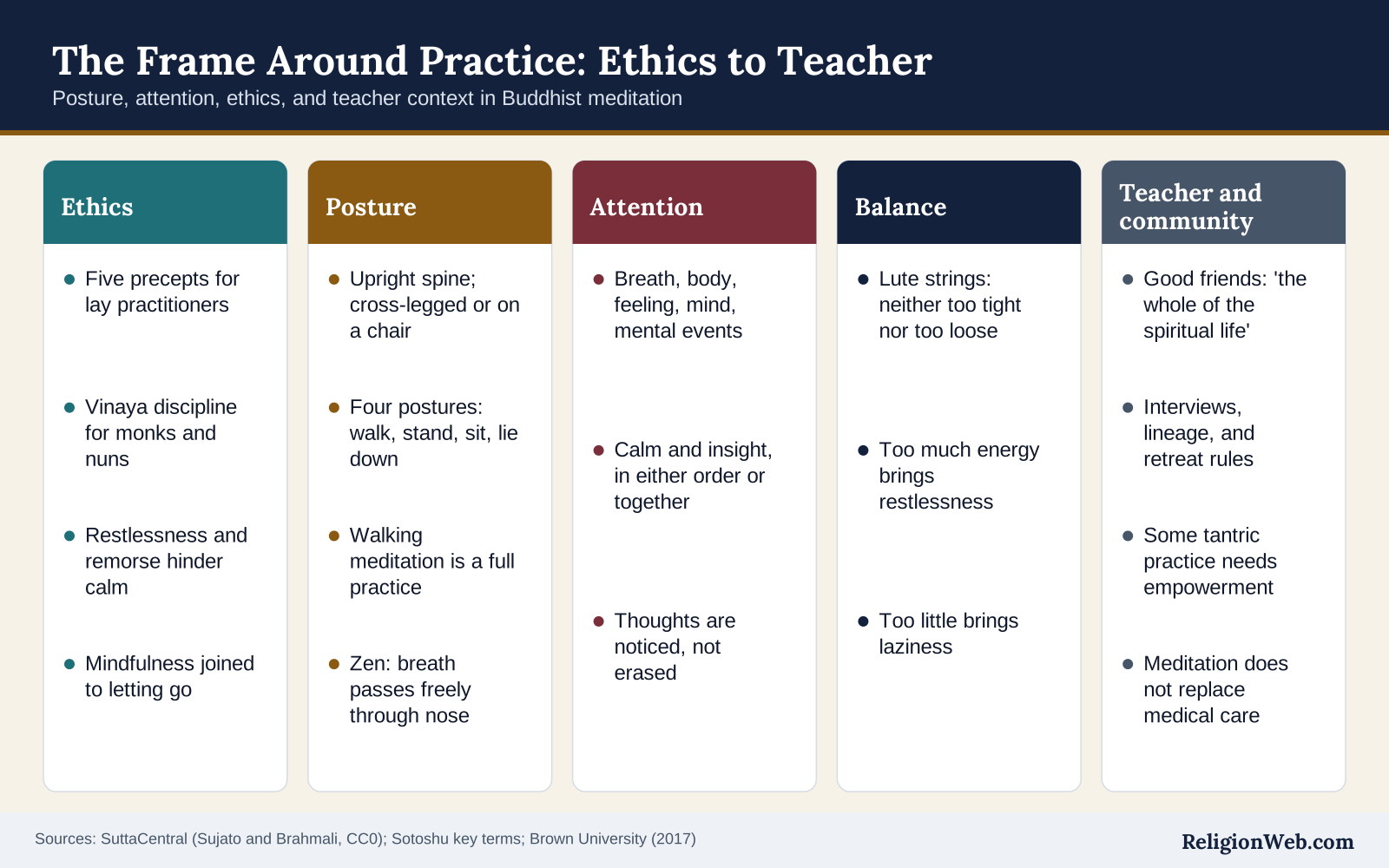
Ethics, Posture, Walking, and Teachers: The Frame Around the Practice
Buddhist traditions rarely present meditation as a technique that stands alone. Instruction almost always arrives together with an ethical commitment, a bodily setting, a teacher, and a community, and many teachers say the practice cannot be understood apart from them. This section looks at those four elements in turn, including the case of walking meditation, which the sources treat as a full practice in its own right.
Ethics as the Ground of Meditation
Virtue, restraint, and the threefold training
Pali tradition arranges the eight factors of the path into three trainings: ethical conduct (sīla), immersion (samādhi), and wisdom (paññā). Meditation belongs to the second, and the arrangement presumes the first. For lay Buddhists the basic ethical commitments are the five precepts: to refrain from killing, stealing, sexual misconduct, false speech, and intoxicating drink and drugs. Monks and nuns follow a far more detailed code of discipline, the Vinaya, which shapes the daily conditions under which they meditate and is described in the article on Buddhist monastic life. Many retreat centers ask participants to keep a set of precepts for the duration of a course.
The tradition’s explanation is practical as well as moral. One of the five hindrances to concentration is restlessness and remorse, and teachers have long taught that a conscience at ease is a basis for a settled mind. The ethical frame also guards against using a powerful tool for harmful ends. In this view a person might become calm and concentrated while remaining greedy or cruel, which is why the texts insist that wisdom and virtue accompany concentration. The phrase “rid of covetousness and displeasure for the world,” which appears in every exercise of the foundations of mindfulness, builds the ethical direction into the practice itself.
View, intention, and the purpose of practice
A second part of the frame is what the tradition calls right view and right intention, the understanding of why one practices. A practitioner who has absorbed the Four Noble Truths, and who sees the practice as a way to loosen craving, approaches the cushion differently from one who is seeking only relaxation. Mahāyāna traditions add the aspiration to awaken for the sake of all beings, so that the merit of a sitting is dedicated to others at its close. Tibetan and East Asian teachers commonly begin and end a session with such an intention.
Buddhist teachers do not all draw the line in the same place. Some welcome the use of mindfulness for stress reduction as a skillful door to the teaching; others worry that practice cut off from ethical and doctrinal context loses its purpose. These positions are discussed further in the section on secular mindfulness. What the sources agree on is that purpose belongs to the practice, and that the instructions on this page describe a path with a direction rather than a set of neutral exercises.
Posture, Setting, and Attention
Sitting and the other postures
The earliest instructions describe a simple posture. A practitioner goes to a wilderness, the root of a tree, or an empty hut, and “sits down cross-legged, sets their body straight, and brings mindfulness to the present.” Later traditions elaborated this. The Sōtō Zen institution’s own explanation of zazen says that posture follows the instructions in Dōgen’s Fukanzazengi and his Zazen Yōjinki, and that the breath is allowed to pass freely through the nose. Common sitting positions in Zen centers are full lotus, half lotus, and the Burmese posture, with the back upright. Tibetan teachers describe a “seven-point” posture associated with the buddha Vairocana. In practice many centers also offer kneeling benches and chairs, and teachers emphasize an alert upright spine, not any one arrangement of the legs.
Sitting is not the only recognized posture. The Discourse on the Foundations of Mindfulness lists four, observing that when a mendicant is walking they know “I am walking,” when standing “I am standing,” when sitting “I am sitting,” and when lying down “I am lying down.” The text adds that “whatever posture their body is in, they know it.” Teachers commonly adapt the posture for people with injuries or illness. The eyes may be closed, as in many insight and retreat settings, or open with a lowered gaze, as in Zen practice, and teachers explain the reasons for their own method.
Effort, balance, and the lute
A recurring theme in the texts is that effort should be balanced. The Vinaya tells the story of Soṇa, a monk of great energy who practiced walking meditation until his feet cracked. In a passage that has become a standard reference for meditation teachers, the Buddha questions him about his earlier life as a lute player and draws the lesson.
“Just so, Soṇa, too much energy leads to restlessness and too little to laziness. So apply a balanced energy and bring about an evenness in the spiritual faculties. And that is where you should take up the meditation object.”
Vinaya, Mahāvagga (Khandhaka 5), segments 1.16.5 to 1.17.1, trans. Bhikkhu Brahmali, SuttaCentral (CC0)
In the narrative, the Buddha asks whether a lute was easy to play when its strings were too tight or too loose, and Soṇa agrees that it was in tune only when they were set to a balanced tension. The teaching is usually read as the middle way applied to the effort of practice, a caution for beginners who strain and for veterans who coast. The “spiritual faculties” in the passage are faith, energy, mindfulness, concentration, and wisdom, which the Pali tradition says should be kept in balance. Modern teachers often cite the story when students push through pain or sleeplessness in the belief that suffering proves seriousness.
Walking Meditation as a Formal Practice
Walking in the early texts
Walking meditation (Pali caṅkama) has a well-defined place in the sources, and its role is more than a break from sitting. A short discourse in the Numbered Discourses (Aṅguttara Nikāya 5.29) states that “there are five benefits of walking meditation”: a person becomes “fit for traveling, fit for striving in meditation, and healthy,” food and drink are “properly digested,” and “immersion gained while walking lasts long.” The list combines bodily, practical, and contemplative reasons, and it implies that a practice that builds endurance and stable concentration deserves to be taught in its own right. The Discourse on the Foundations of Mindfulness likewise places walking among the four postures in which the body is a foundation of mindfulness.
Narratives also place walking meditation in the Buddha’s life. A UNESCO description of the Mahabodhi Temple Complex at Bodh Gaya states that the Buddha walked back and forth during the third week after awakening in an area called Ratnachakrama, the Jewelled Ambulatory, where raised stone lotuses on a platform mark his steps. Whether or not a visitor shares the tradition, the site shows how deeply walking practice is woven into the memory of the Buddha. Monastic buildings in Buddhist countries commonly include a walking path or covered walkway for the same reason.
How walking meditation is practiced
In many Theravāda monasteries and forest hermitages, a meditator walks slowly along a short, straight, level path, turning at each end, and attends to the sensations of the feet and legs. Mahāsi-style retreats alternate periods of sitting and walking and sometimes ask the practitioner to note the stages of each step, and other lineages simply ask for awareness of the foot touching the ground. Zen centers use kinhin, a slow walk, usually in a circuit, between rounds of sitting, with the hands held in front of the body and the attention remaining in the practice. In the tradition of the Vietnamese teacher Thich Nhat Hanh, walking meditation matches steps with the breath and is often practiced outdoors and in groups.
The reasons teachers give for treating walking as a formal practice are consistent across these settings. It trains mindfulness in movement, which carries more easily into daily life than stillness. It counters sleepiness and stiffness, as the early discourse suggests with its mention of health and endurance. And it removes the assumption that meditation is something that happens only on a cushion, an assumption the texts do not share when they list walking, standing, sitting, and lying down as equal postures for the foundation of mindfulness. Traditions differ on details, such as the length of a path, the pace of steps, or whether to use mental labels, and a student normally follows the instructions of the teacher in the lineage that is taught.
Teachers, Community, and Retreat
Why a teacher matters
The sources give an unusually strong place to good company. In a short discourse (Saṃyutta Nikāya 45.2), Ānanda tells the Buddha that good friends, companions, and associates are half of the spiritual life. The Buddha replies, “Not so, Ānanda!” and says they are “the whole of the spiritual life.” The Pali term is kalyāṇamitta, “admirable friend,” and later tradition applies it to the meditation teacher. In Theravāda retreats a teacher usually meets each student for brief interviews to check progress and correct mistakes. Zen lineages emphasize the personal relationship of student and teacher, with formal interviews in Rinzai practice, and Tibetan traditions place the lama at the center of the path.
The role of a teacher varies, and so do the risks of it. Teachers are expected to be ethical, to know the lineage, and to guide without exploiting students. Researchers who interviewed meditators in Western Buddhist communities reported that the relationship with a teacher was a source of support for some meditators and of distress for others, a finding discussed in the section on safety and context. A cautious student asks about lineage, training, and accountability before committing to a group or a long retreat.
Monastic, lay, and retreat settings
Meditation occurs in monasteries, temples, homes, and retreat centers. Monks and nuns structure the day around sitting, chanting, work, and alms or meals, and in the Pali tradition they observe the three-month rains residence, mentioned in the discourses themselves as the time when the Buddha stayed in one place. Lay people commonly attend evening or weekend sessions, take part in observance days, and join intensive retreats. A standard Goenka course lasts ten days; Zen communities hold week-long intensives called sesshin; and in Tibetan traditions a practitioner may undertake a retreat of three years. Retreat rules vary but commonly include silence, simple meals, and the ethical precepts.
These settings show how much the context shapes the experience. The same sitting posture is learned in a quiet forest hermitage in Thailand, a city temple in Taiwan, a Burmese lay center, and an American weekend retreat, and the surrounding customs, such as the bow, the chant, the robe, and the donation, change the meaning of the practice for those who take part.
Meditation in East Asian Buddhism: Zen, Tiantai, and Pure Land
Chan, Seon, Thiền, and Zen
Zazen and shikantaza in Sōtō
The Sōtō school, the larger of the two main schools of Japanese Zen, takes the sitting practice called zazen as the heart of its teaching. The Sōtōshū, the school’s administrative body, names shikantaza, “just sitting,” as a core doctrine alongside the teaching that the mind itself is buddha. According to its own explanation, the term is colloquial Chinese: shikan means being solely concerned with something, and taza means sitting, so the whole phrase points to devoted, single-minded sitting. The school ties its emphasis to Dōgen (1200-1253) and to his Chinese teacher, whom Dōgen quotes describing zazen as “body-mind dropping off” (shinjin datsuraku).
A feature of this teaching, as the school explains it, is that zazen is not a means to an end. Practice and realization are understood as one, so a practitioner does not sit in order to reach a goal. The school’s explanation notes that Dōgen taught that Shakyamuni and Bodhidharma sat for years even though they were already awakened, and that claimed experiences of great awakening can become obstacles if practice declines because of them. The practical instruction that follows is to sit simply, without seeking a result and without clinging to views, and to approach each sitting with a beginner’s mind. Sōtō monasteries and lay groups also practice chanting, work, bowing, and formal meals, so that zazen is the center of a daily rhythm and not the whole of it.
Kōan practice in Rinzai and Seon
Other Zen and Chan lineages use a different focus. In Rinzai Zen in Japan, and in the Seon tradition of Korea, practitioners may work on a kōan, a short case drawn from the sayings and encounters of the Chan masters. The word means something like “public case.” Students contemplate the case, often a single critical phrase, and present their understanding to the teacher in private interviews. The Japanese teacher Hakuin (1686-1768) is widely credited with shaping the Rinzai kōan curriculum, and the Korean tradition has its own phrase-focused method. The exact shape of kōan training differs among teachers and lineages, and a teacher may adapt the form for lay students.
Historically there was a Chinese debate between teachers who emphasized silent sitting and teachers who emphasized work on phrases, and later Japanese schools inherited both emphases. Many teachers in each school now speak of the other emphasis with respect, and some Zen centers teach both sitting and kōan work. The point for a reader is that “Zen meditation” is not one technique, and a student at a Sōtō temple and a student at a Rinzai temple may be doing quite different things on the same cushion.
Tiantai and the Chinese Systems of Calming and Contemplation
Zhiyi and zhiguan
One of the most influential systems of meditation in East Asia was developed by Zhiyi (538-597), the founding systematizer of the Tiantai school in China. His writings organize practice around the pair zhi (“calming,” corresponding to the Indian śamatha) and guan (“contemplation” or “insight,” corresponding to vipaśyanā). In this system the two are treated as complementary and ideally practiced together, within a larger scheme of ethics, study, and repentance rituals. His best-known meditation manual is usually called the Mohe zhiguan, “Great Calming and Contemplation.” The Tiantai school passed to Japan as Tendai, where it became the base for several later Japanese schools.
The importance of Zhiyi for a general reader lies in what he shows about continuity. The Indian pairing of calm and insight, found in the Pali discourses, was recast in Chinese terms and then in Japanese ones, and the same pairing appears in Tibetan books with Tibetan vocabulary. Each tradition adds its own philosophy and rituals, but the basic design of settling the mind and then seeing clearly remains recognizable across them.
Chan and Pure Land together
In China, Korea, and Vietnam, monastic and lay life often combines practices that Western books treat as separate schools. A temple may hold Chan sitting periods in the morning, recite Amitābha’s name in the afternoon, and chant sutras in the evening. Chinese writers such as the monk Yongming Yanshou (904-975) are traditionally associated with the harmonizing of Chan and Pure Land practice. Because of such combinations, a person who asks “What kind of meditation do Chinese Buddhists do?” may receive several answers, each correct for a particular temple or teacher.
Pure Land Recitation: Nianfo and Nembutsu
What recitation is
Pure Land traditions center on the buddha Amitābha and his pure land, a realm in which conditions are favorable for awakening. The central practice is the recitation or recollection of Amitābha’s name, called nianfo in Chinese, nenbutsu or nembutsu in Japanese, yeombul in Korean, and niệm Phật in Vietnamese. The Chinese verb nian carries the senses of “to think of,” “to recollect,” and “to recite,” so the practice joins mindful recollection with audible or silent repetition. It may be done alone or in groups, aloud, in a whisper, silently, or in song, often with prayer beads, and it can fill a short daily period or a long retreat.
The same idea of recollecting the Buddha has early roots. In a discourse in the Numbered Discourses (Aṅguttara Nikāya 11.11) the Buddha advises a lay follower, Mahānāma, to recollect the Buddha, the teaching, and the community. The text says that when a noble disciple recollects the Buddha, joy arises, then rapture, then a tranquil body, then bliss, and then the mind “becomes immersed in samādhi.” Pure Land practice builds on this principle within a Mahāyāna setting that centers on Amitābha, whose vows are described in sutras that the article on Mahayana Buddhism discusses.
Contemplative and devotional readings
Whether recitation counts as meditation is a question on which Pure Land teachers themselves differ. Chinese traditions have treated recitation as a concentration practice that can lead to a “recitation samādhi,” and an important Pure Land sutra also describes sequences of visualization of the pure land and of Amitābha. In Japan, Hōnen (1133-1212) taught the exclusive recitation of the name as the practice suited to all people, and his student Shinran (1173-1263), the founder of the Jōdo Shinshū tradition, taught that recitation arises from gratitude for Amitābha’s vow and is not an effort by which one earns birth in the pure land. Shinshū teachers therefore often decline to describe the nembutsu as a meditation technique at all, and a description that does so reflects an outside perspective.
A related practice of recitation appears in Nichiren Buddhism, where practitioners chant Nam-myōhō-renge-kyō, the title of the Lotus Sutra, as daimoku, often before an inscribed scroll. Nichiren traditions hold that this chanting expresses devotion to the Lotus Sutra and is a complete practice; here too the term “meditation” is an outsider’s label that members may or may not accept. These cases show why the family of Buddhist meditation includes practices whose own practitioners place them in categories such as devotion, faith, or chanting.
Tibetan and Vajrayana Practice: Calm Abiding, Visualization, and Mantra
Calm Abiding and Special Insight in Tibetan Traditions
Zhiné and lhaktong
Tibetan Buddhism inherited the Indian pairing of calm and insight and gave it Tibetan names: zhiné for calm abiding (Sanskrit śamatha) and lhaktong for special insight (vipaśyanā). Tibetan manuals commonly describe nine stages of calm abiding, from the first effort to place the mind on an object through to a state of steady, effortless concentration marked by physical and mental pliancy. Teachers in different schools use varying images and instructions, and commentaries often cite Indian sources such as the writings of Kamalaśīla. After calm is established, insight practice investigates the nature of mind and phenomena in light of the Mahāyāna teaching of emptiness (śūnyatā), a subject for the article on Mahayana Buddhism.
Mahāmudrā and Dzogchen
Some Tibetan lineages teach contemplative systems that take the nature of mind itself as the object. In the Kagyu school, the tradition is called Mahāmudrā, “the great seal”; in the Nyingma school, a comparable system is called Dzogchen, “the great perfection.” Teachers in these lineages commonly stress that such practices are transmitted through direct instruction from a qualified teacher, often in the form of “pointing-out instructions,” and that written descriptions are no substitute. Because lineages differ in how they present these teachings, scholars and practitioners both caution against treating a single description as the whole.
Deity Yoga, Visualization, and Mantra
General features of tantric practice
The distinctive methods of Vajrayana, sometimes called tantric or esoteric Buddhism, combine meditation with ritual. In a typical session, a practitioner takes refuge and awakens the aspiration to benefit all beings, visualizes a deity such as Avalokiteśvara (the embodiment of compassion) or Tārā, recites a mantra associated with that deity, often with hand gestures (mudrā) and with a string of 108 prayer beads, and concludes by dissolving the visualization and dedicating the merit. The mantra of Avalokiteśvara, oṃ maṇi padme hūṃ, is among the most widely recited in Tibetan communities and can be seen on prayer wheels and carved stones. Tibetan teachers commonly explain such practices as a transformation of ordinary perception into the pure appearance of enlightened qualities, and not as a request addressed to an outside power alone.
In Japan, the Shingon school, founded by Kūkai (774-835), and the esoteric strand of Tendai teach related practices that Shingon summarizes as the “three mysteries” of body, speech, and mind, expressed through mudrā, mantra, and mandala. Tantric practice also appears in Newar Buddhism in Nepal, and its history is covered more fully in the article on Vajrayana Buddhism.
Empowerment, transmission, and what this article leaves out
Many Vajrayana practices are taught within a structure of authorization. A student typically receives an empowerment or initiation (wang in Tibetan, abhiṣeka in Sanskrit), a reading transmission (lung), and oral instruction from a qualified teacher before undertaking a particular deity practice, and the student often accepts commitments (samaya) to keep with the practice. Not every practice carries the same restriction: reciting the mantra of Avalokiteśvara is open to anyone, and some teachers offer public empowerments to large audiences. Others hold that more advanced practices should be received only after preliminary training and a sustained relationship with a teacher.
For this reason the present article describes the categories of Vajrayana practice, its purposes, and its general shape, and does not give instructions for specific deity practices or the content of restricted teachings. A reader who wants to take up such practices will find that the traditions themselves direct the student to a lineage teacher. This is consistent with the general theme of the previous sections, namely that Buddhist meditation is learned in a relationship and a community and not from a text alone.

| Tradition or setting | Typical settings | Characteristic practices | Teacher and authorization context |
|---|---|---|---|
| Theravāda forest and village monasteries | Monasteries in Thailand, Myanmar, Sri Lanka, Cambodia, Laos | Breath awareness; walking; loving-kindness; recollections; chanting | Preceptor and meditation teacher; Vinaya discipline |
| Burmese and Thai lay insight movements | Retreat centers; city meditation halls | Noting (Mahāsi); body-sensation practice (Goenka); concentration-based methods (Pa Auk) | Teacher interviews on retreat; course rules and precepts |
| Sōtō Zen | Japanese temples; Zen centers abroad | Zazen; shikantaza; kinhin; chanting; work practice | Teacher-student relationship and lineage transmission |
| Rinzai Zen and Korean Seon | Monasteries; meditation halls; retreats | Kōan or phrase contemplation; sitting; intensive retreats | Private interviews with the teacher |
| Chinese, Korean, and Vietnamese monastic practice | Temples with combined Chan, Pure Land, and sutra chanting | Sitting; nianfo recitation; sutra chanting | Monastic teacher; lay devotional groups |
| Pure Land schools | Temples and home altars | Recitation of Amitābha’s name | Priests and lay groups; no initiation required |
| Tibetan Buddhism | Monasteries; retreat huts; lay communities and diaspora centers | Calm abiding; insight; Mahāmudrā; Dzogchen; deity yoga; mantra | Lama; empowerment, reading transmission, and instruction for many practices |
| Japanese esoteric schools (Shingon, Tendai) | Temples and mountain centers | Mudra, mantra, and mandala practices | Ordained teachers; initiation within the school |
| Secular mindfulness programs | Clinics, schools, workplaces | Breath, body scan, mindful movement | Trained instructors; program curriculum; no religious commitment |
Meditation Today: Lay Practice, Secular Mindfulness, and Safety
Lay Practice and the Buddhist Year
Short daily practice and group sittings
For most lay Buddhists who meditate, practice is modest in length and fits into a household routine. A typical pattern might include a short sitting in the morning or evening, the recitation of a verse or chant, an offering at a home altar, and a weekly gathering at a temple or meditation group. In Theravāda countries lay people also keep observance days (uposatha), tied to the phases of the moon, by taking additional precepts and spending time at the monastery. The balance between meditation, chanting, and giving differs from country to country, and between generations, which is why the American survey data cited earlier cannot be applied to Asian communities.
Group sittings are common in the West and in Asian cities, where a hall or home is set aside for evening sessions led by a lay teacher or a monastic. Participants often combine sitting with a short talk on the teachings and a period of questions. The group, or sangha, is itself regarded as one of the “three jewels” along with the Buddha and the teaching, and many practitioners say that regular company keeps the practice alive when personal motivation flags.
Retreats and annual cycles
Intensive retreats form the second pole of lay practice. Retreat periods vary from a single day to weeks, and the daily schedule alternates sitting and walking with meals, rest, and brief talks. Zen centers observe a retreat in early December that commemorates the Buddha’s awakening, known in Japanese as Rōhatsu, in many places on or around December 8. In Theravāda monasteries the annual rains residence, which lasts about three months, is a time when lay people often take extra precepts and spend more time on meditation. Observances such as Vesak, which commemorates the birth, awakening, and passing away of the Buddha, include vigils, chanting, and meditation at many temples, although the pattern differs by country and temple. Because most of these observances follow lunar calendars, their dates change from year to year, and a reader should check the local calendar for a specific date.
Secular Mindfulness and Buddhist Practice
From Buddhist practice to clinical program
The best-known adaptation of Buddhist practice outside religious settings is mindfulness-based stress reduction, which began in 1979 at the University of Massachusetts in Worcester under Jon Kabat-Zinn. A profile in Lion’s Roar reports that he conceived the idea during a meditation retreat and that he avoided explicit Buddhist terms such as dukkha at first so that the program would be accessible to people who might otherwise feel alienated. He has said that he does not identify as a Buddhist but is trained in Buddhist practice, and he argues that meditation is “a way of being” that belongs to no group. Programs derived from MBSR and from related approaches are now offered in hospitals, schools, and workplaces in many countries.
The effects of such programs on health and well-being are a matter for clinical research, and this article does not evaluate them. Anyone considering a program for a medical or psychological condition should talk with a qualified health professional about whether it is suitable. What is relevant for readers of a religious reference is the relationship between the two: secular programs are modeled on practices drawn from Buddhist sources, particularly the breath awareness and the body-based practices of the foundations of mindfulness, but they set aside most of the doctrinal and ritual framework within which those practices developed.
How Buddhists and scholars assess the relationship
Buddhist teachers and scholars have not reached a single view. Some welcome secular programs as a skillful means that brings the benefits of attention training to people who would never enter a temple, and they point out that Buddhist teaching has always adapted to new cultures. Others raise concerns. Critics such as the author Ron Purser, in his 2019 book McMindfulness, argue that detaching mindfulness from ethics and from the analysis of suffering can turn it into a tool for adjusting individuals to stressful institutions. Defenders of the programs respond that the programs are intentionally limited in scope and do not claim to be Buddhism.
A third perspective comes from historians who note that Buddhist meditation has been reshaped repeatedly. Lay insight movements in nineteenth- and twentieth-century Burma, described earlier, already altered a practice that had been the work of monks. Seen in this long view, the modern secular program is the latest in a series of adaptations, and the debate is about what is gained and lost in each. The sources reviewed here support the narrow claim that the foundations of mindfulness include an ethical orientation and a goal of liberation, and that a program that omits them is a different thing from the tradition’s own practice, whatever its value in other respects.
Safety, Well-Being, and Choosing a Context
Challenging experiences reported by practitioners
Meditation can be demanding, and Buddhist communities have started to document the difficulties. In 2017 a team at Brown University, including the researchers Willoughby Britton and Jared Lindahl, published an interview study of nearly 100 meditators and meditation teachers from Theravāda, Zen, and Tibetan Buddhist traditions in the West. The researchers built a taxonomy of 59 experiences in seven domains: cognitive, perceptual, affective, somatic, conative, sense of self, and social. Examples include hypersensitivity to light or sound, insomnia, involuntary body movements, fear, anxiety, and a loss of emotion. Some experiences that seemed desirable, such as feelings of oneness, became problematic when they went too far or persisted after retreats.
The study reported that effects lasted from a few days to months and, in some cases, more than a decade. The researchers identified a range of influencing factors, including practice intensity, a person’s psychiatric or trauma history, and the quality of supervision, though they described these as hypotheses to be tested rather than established causes. They also stressed that the study was not designed to estimate how common such experiences are, so it cannot be used to claim that meditation is usually harmful or usually harmless. The relationship with a teacher could be a source of support for some meditators and of distress for others.
Practical cautions and the limits of meditation
Buddhist meditation is a religious and ethical practice and not a medical treatment. It should not be used in place of medical, psychiatric, or emergency care, and a person in crisis should contact local emergency services or a crisis line. People who have a history of trauma, psychosis, severe depression, or similar conditions are often advised by clinicians and by experienced teachers to approach intensive retreats with care, to tell the teacher beforehand, and to choose a format that allows support. Many teachers encourage a student who feels distressed to stop, to rest, and to seek professional help, and the early texts themselves suggest balance and moderation, as the story of the lute illustrates.
The table below collects some common beginner assumptions and the context that Buddhist sources and teachers supply for each. It is a reading aid, not advice for any individual, and it is not a substitute for a conversation with a teacher or a health professional.
| Assumption | Tradition-informed context | Care note |
|---|---|---|
| Meditation is mainly relaxation | The texts describe calm as a basis for insight and ethical transformation; relaxation may result but is not the stated goal | Expect alertness and effort, not only comfort; difficult emotions can arise |
| More effort and longer sessions are always better | The lute story in the Vinaya recommends balanced energy; extremes lead to restlessness or laziness | Increase duration gradually and rest when strained |
| Unusual experiences prove progress | Zen and other teachers caution that claimed experiences of awakening can become obstacles if practice declines | Report striking experiences to a teacher, and do not treat them as a measure of success |
| Anyone can take up any practice from a book | Many tantric practices are taught only after empowerment and with a qualified teacher | Learn restricted practices only from a lineage teacher |
| A free app or video is the same as a Buddhist course | Buddhist teaching places practice inside ethics, community, and guidance | Choose an app or class that states its aims; ask about the teacher’s training |
| Meditation can replace treatment | Monastic law itself devotes a chapter (Mahāvagga 6) to medicines and the care of the sick, and does not treat illness as a failure of practice | Do not stop medical or psychiatric care to meditate; consult a clinician first |
Common Misconceptions About Buddhist Meditation
Misconception 1: All Buddhist meditation is silent, seated mindfulness
Where the misunderstanding comes from
The image is easy to explain. Photographs and films of Buddhist meditation usually show a still figure in a silent room, and the most visible exports of Buddhist practice to the West have been Zen sitting, Theravāda insight retreats, and secular mindfulness courses, all of which place heavy emphasis on silent sitting. Phone applications and popular books reinforce the picture by presenting meditation as a single skill of sitting still and watching the breath.
What the evidence and tradition actually show
The texts and traditions describe a wider range. The early discourses list walking, standing, and lying down alongside sitting, and a separate discourse gives five benefits of walking meditation. Loving-kindness is practiced with phrases and images of goodwill. Pure Land Buddhists recite a name aloud, Nichiren Buddhists chant the title of a sutra, and Tibetan practitioners combine spoken mantra with visualization and gesture. Zen monasteries combine silent sitting with chanting, work, and formal meals. Group practice, sound, and movement are therefore not departures from Buddhist meditation but ordinary parts of it, and a person who sits silently is practicing one of several established forms.
Misconception 2: Meditation requires completely stopping thoughts
Where the misunderstanding comes from
Phrases such as “empty your mind,” “no-mind,” and “non-thinking” circulate widely, and a beginner whose mind is busy may conclude that the practice has failed. Some of this comes from translation. A well-known line in Dōgen’s instructions on zazen is rendered in many books as “think of not-thinking,” and the Sōtō school’s explanation of the key term, hishiryō, notes that it is one of the most important words used to describe zazen and then adds an important qualification: it names a state of mind during zazen and not a state with no thoughts.
What the evidence and tradition actually show
The Sōtō explanation describes the process this way: a thought arises and is noticed, and then it disappears on its own. It also notes that the famous “think of not-thinking” wording is absent from Dōgen’s signed manuscript of the instructions (the Tenpuku manuscript), which instead tells the practitioner to be aware when a thought arises, and that it is unclear whether Dōgen himself made the change. The early Pali texts take a similar line. In the exercise on the mind, a meditator knows a mind with greed as “mind with greed” and a mind without greed as “mind without greed,” which means observing the content of thought and not erasing it. Another discourse (Majjhima Nikāya 20) offers a graduated set of methods for handling unskillful thoughts, from turning to a different wholesome subject to examining the thoughts’ drawbacks, ignoring them, calming their formation, and, as a last resort, pressing the teeth together and subduing the mind with the mind.
The texts do describe states in which applied thinking is stilled, such as the second absorption, but these are deep attainments and not a requirement for a beginner. A related misunderstanding is that meditation means shutting off the senses. In the discourse on the development of the faculties (Majjhima Nikāya 152), a student reports that his teacher trains his pupils so that the eye sees no sight and the ear hears no sound.
“In that case, Uttara, a blind person and a deaf person will have developed faculties according to what Pārāsariya says. For a blind person sees no sight with their eyes and a deaf person hears no sound with their ears.”
Majjhima Nikāya 152 (Indriyabhāvanā Sutta), segments 2.8 to 2.10, trans. Bhikkhu Sujato, SuttaCentral (CC0)
In the discourse, the Buddha then teaches that when a mendicant sees something, the agreeable, the disagreeable, or a mix arises, and the mendicant understands that it is conditioned and cultivates equanimity. The passage is an early Buddhist argument about what it means to train the senses, and it places the aim in the way one responds to experience, not in the absence of experience.
Misconception 3: Every Buddhist tradition teaches the same meditation method
Where the misunderstanding comes from
The word “Buddhism” suggests unity, and books that promise “the Buddhist method of meditation” or “the Buddha’s meditation” encourage readers to expect one procedure. Retreat centers in the West often present a single style, such as noting, body-sensation practice, or zazen, under a general label, and a newcomer who has seen only one center may reasonably assume it represents the whole.
What the evidence and tradition actually show
Differences within a single tradition are substantial. Anālayo’s comparison of three modern Burmese methods shows that they differ on how much formal calm is needed, from none in the Mahāsi method to extensive absorption practice in the Pa Auk method. The early discourse in which Ānanda describes four paths, beginning with serenity before discernment, discernment before serenity, both together, or a mind that settles after restlessness, suggests that the tradition has long recognized different temperaments. Across traditions the differences are larger still: Sōtō shikantaza, Rinzai kōan work, Pure Land recitation, and Tibetan deity visualization have different objects, different aims in their own accounts, and different teacher relationships.
What the traditions share is a framework more than a technique: an ethical foundation, a teacher or community, a goal of reducing craving and suffering, and an expectation that practice will be sustained over time. Even that shared framework is understood differently in different schools, which is why readers who want to compare practices benefit from naming the lineage, as this article tries to do.
Misconception 4: Secular mindfulness is the whole of Buddhist meditation
Where the misunderstanding comes from
Since the 1980s, “mindfulness” has become a household word through clinical programs, workplace courses, and apps. Because these programs draw on Buddhist practices and are sometimes introduced as “ancient,” many people assume that mindfulness is the essence of Buddhist meditation, and that what Buddhists do in temples is simply the same practice with extra ritual. The programs’ founders have sometimes encouraged the secular framing; Jon Kabat-Zinn, for example, avoided explicit Buddhist vocabulary at first and does not identify as a Buddhist.
What the evidence and tradition actually show
The relationship is real but partial. The Buddhist sources include mindfulness as one of eight path factors and as the subject of the foundations of mindfulness, but they also teach calm and absorption, insight into impermanence and not-self, loving-kindness, recollection, and, in other traditions, recitation, visualization, and kōan work. The foundations-of-mindfulness formula itself joins awareness to effort and to the letting go of covetousness and displeasure, and the discourse states a goal of purification and the realization of nirvana. A secular program can be described as an adaptation of one strand of that material for a different purpose.
That description neither disparages the programs nor inflates them. Many participants find them useful, and their founders and instructors usually say so modestly. The narrower point is historical and doctrinal: mindfulness as taught in a clinic and Buddhist meditation as understood by Buddhist traditions overlap but are not the same, and treating them as identical hides most of the tradition’s practices and aims.
Frequently Asked Questions About Buddhist Meditation
Questions About the Basics
What is the difference between samatha and vipassana?
Samatha is calming: it settles and unifies the mind, usually on a single object such as the breath. Vipassanā is seeing clearly: it examines experience in order to understand its impermanent, unsatisfactory, and not-self character. The Pali discourses do not set them against each other. They describe practitioners who develop calm first, insight first, or both together, and Tibetan, Chinese, and Zen traditions work with the same pairing in their own vocabulary.
Do all Buddhists meditate?
No. In the 2023-24 Pew Religious Landscape Study of the United States, 38 percent of Buddhists said they meditate for spiritual reasons at least weekly. In Asian countries, historians and anthropologists have often observed that many lay Buddhists focus on giving, chanting, taking the precepts, and honoring images and relics, with intensive meditation concentrated among monastics and a minority of lay practitioners. There are significant exceptions, such as lay meditation movements in Myanmar and temple sitting groups in Japan, so a single rule cannot be applied.
Is chanting a form of meditation?
It depends on the tradition and the purpose. Early texts treat recollection of the Buddha as a practice that can lead to joy, tranquility, and concentration, and Pure Land recitation is often understood in that light. Practitioners of the Jōdo Shinshū and Nichiren traditions generally describe their own recitation as devotion and faith, and they may not accept the word “meditation” for it. Chanting the Mettā Sutta or a sutra in a temple can serve as ritual, protection, or study, and may become meditative for the chanter.
Questions About Practice and Safety
Can someone who is not Buddhist practice Buddhist meditation?
Many Buddhist centers and monasteries welcome visitors regardless of their religious background, and secular programs exist for those who want practice without religious commitment. Retreat courses may ask participants to follow certain rules, such as precepts, silence, or a code of conduct, for their duration. Some practices, especially tantric deity practices in Tibetan and Japanese esoteric lineages, are taught only after an empowerment and with commitments to a teacher, so openness varies by tradition and by practice.
How long do Buddhists meditate?
The texts do not set a single duration, and the practice varies widely. A lay sitting group may meet for a period of roughly twenty to sixty minutes, a monastery may hold several sittings per day, and retreats range from a day to a standard ten-day course in the Goenka tradition or a week-long Zen intensive. The story of the monk Soṇa and the lute is often cited to remind students that more is not always better and that balanced effort matters more than endurance.
Is Buddhist meditation safe for everyone?
Not necessarily. Interview research reported in 2017 documented a range of challenging experiences among Western practitioners of Theravāda, Zen, and Tibetan Buddhism, lasting from days to more than a decade in some cases, although the study did not estimate how common they are. Meditation is not a substitute for medical, psychiatric, or emergency care. A person with a history of trauma or serious mental illness, or who feels distressed in practice, should consult a qualified clinician and tell the teacher, and a person in crisis should contact local emergency services.
Conclusion: What Buddhist Meditation Shows
What the Practices Share
A path with a purpose
Buddhist meditation is a collection of methods that developed over twenty-five centuries and across many cultures, and its forms range from silent sitting to recitation, walking, and visualization. What gives these practices a family resemblance is less a technique than a frame: they are taught within an ethical life, they aim at reducing craving and suffering, and each tradition describes an aim, whether nirvana, awakening for the sake of all beings, birth in a pure land, or buddhahood. The early texts present that aim modestly and practically, with similes of lutes, lathes, and lakes.
Learning in relationship
The sources also agree that the practice is learned with others. The Buddha is reported to have called good friends the whole of the spiritual life, and every tradition surveyed here relies on teachers, companions, and a community. That feature distinguishes the Buddhist material from the single-technique image that circulates in popular culture, and it explains why a well-informed reader will ask, of any description of meditation, which tradition it comes from and who teaches it.
Where to Continue
Within the teaching
Readers who want to see how meditation fits the larger structure of Buddhist thought can turn to the Noble Eightfold Path and the Four Noble Truths, to the treatment of nirvana, and to the account of karma and rebirth. The biography of the Buddha gives the narrative setting for the early texts quoted here.
Within the traditions
The traditions have their own chapters: Theravada Buddhism for the Pali practices, Mahayana Buddhism for Zen, Tiantai, and Pure Land, and Vajrayana Buddhism for the Tibetan and esoteric methods. The article on Buddhist monastic life describes the setting in which much of this practice is carried out, and the article on Vesak shows how meditation fits into the annual cycle of observance.
Sources
The table below lists the principal external sources behind this article. Facts, dates and figures were checked against these and related primary, institutional and academic materials.
| # | Source | Publisher and type | Used for | Link |
|---|---|---|---|---|
| 1 | Bilara Data (SuttaCentral): translations by Bhikkhu Sujato and Bhikkhu Brahmali dedicated to the public domain (CC0); texts quoted: MN 10, MN 36, MN 152, AN 4.170, AN 5.29, Snp 1.8, Vinaya Mahavagga (Kd 5); also consulted MN 20, MN 39, MN 118, AN 11.11, AN 11.16, SN 45.2 | SuttaCentral (Bilara Data repository) · Primary text | CC0 licensing; source of every quoted Pali discourse and Vinaya passage | raw.githubusercontent.com |
| 2 | How the Global Religious Landscape Changed From 2010 to 2020: Buddhist population change | Pew Research Center · Demographic data | 324 million Buddhists in 2020; Thailand 68 million, China 53 million; majority-Buddhist countries | pewresearch.org |
| 3 | Spiritual Activities (2023-24 Religious Landscape Study) | Pew Research Center · Demographic data | 38% of U.S. Buddhists and 23% of U.S. adults meditate for spiritual reasons at least weekly | pewresearch.org |
| 4 | Key Terms of Sōtō Zen: Hishiryō (non-thinking), key terms no. 8 | Sōtōshū Shūmuchō (Sōtō Zen Buddhism) · Institutional | Zazen posture and breath; hishiryo is not a state with no thoughts; Tenpuku manuscript wording | sotozen.com |
| 5 | Key Terms of Sōtō Zen: Shikantaza (just sitting), key terms no. 1 | Sōtōshū Shūmuchō (Sōtō Zen Buddhism) · Institutional | Meaning of shikantaza; practice and realization as one; body-mind dropping off | sotozen.com |
| 6 | The Dynamics of Theravāda Insight Meditation (Anālayo) | University of Hamburg, Center for Buddhist Studies · Academic reference | Ledi Sayadaw, Mahasi, U Ba Khin, Goenka, Pa Auk; differing views on calm and insight | buddhismuskunde.uni-hamburg.de |
| 7 | Study documents range of challenging meditation experiences | Brown University News · Academic reference | 2017 interview study: 59 challenging experiences in seven domains; duration and teacher relationship | brown.edu |
| 8 | Jon Kabat-Zinn: The Man Who Prescribes the Medicine of the Moment | Lion's Roar · Educational explainer | MBSR founded in 1979 at the University of Massachusetts in Worcester; Kabat-Zinn's training and stance | lionsroar.com |
| 9 | Mahabodhi Temple Complex at Bodh Gaya (World Heritage List, ref. 1056) | UNESCO World Heritage Centre · Institutional | Vajrasana, Bodhi tree, and the Ratnachakrama walking platform of the third week | whc.unesco.org |
| 10 | Zen (Britannica; article by William M. Bodiford) | Encyclopaedia Britannica · Encyclopedia | Zen as mainstream monastic Mahayana in China, Korea, Vietnam; about 20% of Japanese temples | britannica.com |
Last fact-check date: 2026-10-21.