Sikhism, known in Punjabi as Sikhi, is a religion that began in the Punjab region of South Asia in the late fifteenth century with the teaching of Guru Nanak (1469–1539). Its followers are called Sikhs, a word usually understood to mean “learners” or “disciples,” and the Sikh community as a whole is called the Panth, the “path.” Sikhs trace their faith through ten human Gurus, from Guru Nanak to Guru Gobind Singh, and teach that the Guru’s spiritual authority now rests permanently in the scripture called the Guru Granth Sahib. Most estimates place the worldwide Sikh population at somewhere between 25 and 30 million, with the largest community in the Indian state of Punjab and large communities in Canada, the United Kingdom, the United States, Australia, East Africa, Southeast Asia and the Gulf.
At the center of Sikh belief is one God, written in the opening symbol of the scripture as Ik Onkar, who is described as without form, fear or enmity, beyond birth and death, and known through grace. Sikh teaching asks people to remember God’s Name (Naam), to earn an honest living, to share what they have, and to serve others (seva) without regard to caste, gender or social rank. The Gurus did not ask their followers to withdraw from the world. They taught that liberation is reached by a person who lives in a household, works, raises a family and takes part in public life while keeping the mind turned toward God.
Sikhism also has a strongly communal and historical character that shapes how Sikhs practice today. The gurdwara (the Sikh house of worship), the free community kitchen called langar, the Khalsa order founded in 1699, the Five Ks that initiated Sikhs wear, and the memory of martyrdom under Mughal rule all belong to a continuous story that runs through the Sikh Empire of the early nineteenth century, the Partition of Punjab in 1947, the events of 1984, and a worldwide diaspora. Understanding Sikhism means holding together personal devotion, communal discipline and a long and sometimes painful history.
This article begins with Sikh self-description and Sikh terminology, then adds the perspective of historians and scholars of religion where it helps. Where Sikh tradition, historical evidence and internal debate point in different directions, the text says so and names the source of each view. Dates use the Gregorian calendar and BCE/CE, but Sikh observances follow other calendars as well, a point that matters for understanding Gurpurabs and Vaisakhi and is explained in the section on holy days. Honorifics such as “Ji” and “Sahib” are normal in Sikh speech and writing, and they are left out here only for readability, not from any lack of respect.
Sikhism at a Glance: Definition, Origins, Geography and Vocabulary
What Sikhism Is and What Sikhs Call It
Sikhi, Sikhism and Gurmat
Sikhs most often speak of their religion as Sikhi, a Punjabi word, and the English-language label Sikhism is a later convenience that became standard in the nineteenth and twentieth centuries. A third term, Gurmat, means “the Guru’s teaching” or “the Guru’s counsel,” and it appears in Sikh writing when the emphasis falls on doctrine and right living rather than on institutions. Encyclopedias such as Britannica list Gurmat as an alternative name for the religion. All three words point to the same tradition, but each stresses a different aspect: Sikhi the way of life that Sikhs follow, Sikhism the religion as an outside observer names it, and Gurmat the content of what the Gurus taught.
The word Panth is equally important. It refers to the community of Sikhs as a living body, and Sikh writers often use it where English speakers would say “the community” or “the church.” The phrase Guru Panth, discussed later, expresses the belief that the collective body of committed Sikhs carries authority under the guidance of the Guru Granth Sahib. Reading Sikh sources with these four terms in mind (Sikhi, Gurmat, Panth, Guru) makes much of the vocabulary fall into place.
Who counts as a Sikh
The Sikh Rehat Maryada, the code of conduct issued by the Shiromani Gurdwara Parbandhak Committee (SGPC) in Amritsar, gives the most widely cited definition. In its first article, a Sikh is a person who faithfully believes in one Immortal Being, in the ten Gurus from Guru Nanak to Guru Gobind Singh, in the Guru Granth Sahib, in the teachings of the ten Gurus, and in the initiation (baptism) bequeathed by the tenth Guru, and who owes allegiance to no other religion. The definition is broad in one sense, because it names belief and loyalty rather than ancestry or dress, and it is demanding in another, because it names the Khalsa initiation as part of what a Sikh believes in.
In everyday life the community is more varied than this single sentence suggests. Many people who call themselves Sikh have not taken Khalsa initiation, some do not keep their hair uncut, and a smaller group, often called Sahajdhari, hold to the Gurus’ teaching without adopting the full discipline of the Khalsa. Britannica’s discussion by the historian W. H. McLeod distinguishes initiated Sikhs (Amritdhari), Sikhs who keep uncut hair without initiation (Kesdhari) and Sahajdhari Sikhs, and it notes that the number of Sahajdhari Sikhs in particular cannot be determined precisely. Census takers and survey researchers rely on self-identification, which is why published counts of Sikhs and the number who follow the Khalsa discipline are different things.
How scholars classify Sikhism
Historians of religion generally treat Sikhism as an independent religion that arose in the devotional and reformist environment of sixteenth-century North India, where the poet-saints of the bhakti and Sant traditions, the Nath yogis and the Sufi orders all shaped the religious vocabulary of Punjab. Sikh tradition, for its part, holds that Guru Nanak’s teaching was a direct divine revelation and not a synthesis of earlier teachings, and that the Gurus all spoke with one light. These two accounts answer slightly different questions, one about historical setting and the other about the source of authority, and they are not necessarily in conflict.
The question of classification has a political and legal side in modern India. Late nineteenth-century Sikh reformers argued, in a pamphlet whose title is usually translated “We Are Not Hindus” (1898), that Sikhs form a distinct community, while some Hindu organizations and some provisions of Indian law have grouped Sikhs with Hindu society for certain purposes. The legal side is taken up in the section on the modern global presence of Sikhism. For present purposes it is enough to say that Sikhs overwhelmingly describe Sikhi as a religion in its own right, with its own scripture, institutions, calendar, rites of passage and identity.
Key Facts in Brief
The essentials in one table
The table below gathers the basic facts that the rest of the article explains. Dates for the founding period are traditional or approximate where the evidence does not support more precision, and the table gives years rather than days, because Sikh sources and modern reference works sometimes differ by days or even weeks depending on the calendar they use.
| Topic | Summary |
|---|---|
| Self-description | Sikhi (Sikhism); also Gurmat, “the Guru’s teaching”; the community is the Panth |
| Founder | Guru Nanak (1469–1539), first of ten human Gurus |
| Place of origin | Punjab, today divided between India and Pakistan |
| Concept of God | One God, formless and beyond birth and death; names include Ik Onkar, Waheguru, Akal Purakh |
| Central scripture | Guru Granth Sahib, compiled in 1604 as the Adi Granth and recognized as the eternal Guru after 1708 |
| Foundational practices | Remembering the Name (Naam), honest work (kirat), sharing (vand chhakna), service (seva) |
| Community order | The Khalsa, instituted by Guru Gobind Singh at Vaisakhi in 1699 |
| House of worship | Gurdwara (“door of the Guru”), with a langar attached |
| Code of conduct | Sikh Rehat Maryada (SGPC, ratified 1936, final form 1945) |
| Language and script of scripture | Gurmukhi script; a range of North Indian literary languages |
| Main population centers | Punjab (India), the United Kingdom, Canada, the United States, Australia and other diaspora communities |
| Population | About 25 million in 2010 (World Religion Database, cited by Pew); 20.8 million in India in the 2011 census |
Numbers and what they cover
No single source gives a fully reliable global count of Sikhs, because many countries do not collect religious data and Sikhs are a small share of the population wherever they live. The Pew Research Center’s 2012 global study did not publish a separate Sikh estimate but noted in a footnote that Sikhs number about 25 million according to the World Religion Database, a figure for 2010. Pew’s 2025 update on religious change from 2010 to 2020 groups Sikhs inside a combined category of smaller religions, so it does not provide a Sikh-only total either. The most solid anchors are national censuses: the 2011 census of India counted 20,833,116 Sikhs, about 1.7 percent of the population, and the largest diaspora counts come from the 2021 censuses of Canada and of England and Wales, discussed in the section on modern presence.
Where Sikhs Live
Punjab and South Asia
Punjab is the historic homeland of Sikhism and the only Indian state with a Sikh majority. According to the 2011 census, Sikhs made up about 58 percent of the population of Punjab, and the Pew Research Center’s 2019–20 survey of India reported that about 77 percent of Indian Sikhs live there. Sizable Sikh populations also live in Haryana, Rajasthan, Delhi, Uttar Pradesh and other states, and Takht Sri Hazur Sahib at Nanded in Maharashtra and Takht Sri Patna Sahib in Bihar are among the five seats of Sikh religious authority that lie outside Punjab. A small Sikh community remains in Pakistan, where some of the most important sites in Sikh history stand, including Nankana Sahib, the birthplace of Guru Nanak, and Kartarpur, where he died.
The global diaspora
Sikh emigration began in the nineteenth century, when Sikh soldiers and police served the British Empire in Malaya, Hong Kong and Africa and when Sikh laborers and artisans took work on railways in East Africa. Migration to North America began in the early twentieth century, and large movements to the United Kingdom followed after the Second World War, as well as the expulsion of South Asians from Uganda in 1972. Today the diaspora is a central part of Sikh life, with institutions, gurdwaras and political voices of its own. Canada has the second-largest Sikh community in the world after India, according to Statistics Canada, and the United Kingdom, the United States, Australia, New Zealand, Malaysia, Singapore, Italy and the Gulf states all host established congregations.
Essential Vocabulary
Words for God, scripture and community
A few terms recur on every page of Sikh writing. Ik Onkar, “One Creator” or “One Being,” opens the scripture and sums up Sikh monotheism. Waheguru, “Wondrous Teacher” in its common gloss, is the most widely used name of God in modern Sikh prayer. Naam is the Divine Name and, more broadly, the reality of God as present in creation, the thing the believer is asked to remember. Shabad means the divine Word, and also a hymn of the Gurus. Gurbani, the Guru’s utterance, is the collective term for the hymns in the Guru Granth Sahib. Sangat is the holy congregation, and Panth the wider community, as noted above.
Words for practice and service
Practice has its own vocabulary. A gurdwara is a Sikh house of worship, and langar is the communal kitchen and meal attached to it. Seva is selfless service, kirtan is the singing of Gurbani, ardas is the formal prayer that ends a service, and karah prashad is the sweet sacramental food shared at the end of worship. Hukam, “divine order” or “command,” also names the practice of opening the Guru Granth Sahib at random for a hukamnama, the day’s guidance. Amrit is the sweetened water used in Khalsa initiation, rehat means the discipline or code of conduct, and the Five Ks (kesh, kangha, kara, kirpan, kachera) are the articles of faith worn by initiated Sikhs. Each of these terms receives a fuller explanation in later sections.

Origins and Historical Development of Sikhism
The Punjab and Its Devotional World Before Guru Nanak
Political and social setting
Guru Nanak was born into a Punjab ruled by the Lodi dynasty of the Delhi Sultanate, a region of river plains, caravan routes and farming villages whose society was divided by caste and by the line between rulers and ruled. Persian was the language of administration, Punjabi the language of daily life, and Hindu, Muslim and ascetic religious teachers all competed for the loyalty of ordinary people. The old order was unsettled during the Guru’s adult life. Babur, the Timurid ruler of Kabul, led several expeditions into Punjab and defeated the Lodi sultan at Panipat in 1526, founding the Mughal dynasty. Hymns in the Guru Granth Sahib that lament the violence of an invading army are widely read by Sikhs and by scholars as Guru Nanak’s response to these campaigns.
Sikh tradition places Guru Nanak’s birth in a Khatri family, the trading and clerical caste group, at Rai Bhoi di Talwandi, the village now called Nankana Sahib in Pakistan. That background matters because it placed him in a literate, commercially connected milieu rather than in a priestly or ascetic one, and because his later teaching addressed merchants, farmers, artisans and the poor in their own language.
Bhakti, Sant and Sufi currents
Nanak’s religious world was crowded with other voices. Devotional poets known as the Sants, among them Kabir, Ravidas and Namdev, sang of a God without form, reachable through the Name rather than through ritual or birth. Their roots lay in the wider Vaishnava devotional movement of the medieval period, though many of them rejected image worship and caste privilege. Nath yogis, whose practices belonged to the yogic currents of Shaiva asceticism, taught disciplined meditation and renunciation. Sufi orders, especially the Chishti lineage of Sheikh Farid, were well established in the towns of Punjab, and their teachers moved easily among Muslims and non-Muslims. Readers who want background on these traditions can explore the articles on Sufism and on Islam.
The Sikh scripture preserves the evidence of this shared environment. The Guru Granth Sahib includes hymns by Kabir, Ravidas, Namdev, Sheikh Farid and other poets from many regions and social backgrounds, placed alongside the Gurus’ own compositions. Historians point to the shared vocabulary of Name, Guru, grace and the Word as a sign that the Gurus were speaking inside a common devotional conversation. Sikh theology adds that the Gurus’ teaching came by revelation and that the verses of other saints were included because they agreed with it.
Guru Nanak and the First Community
Life as the sources preserve it
Most of what Sikhs know about Guru Nanak’s life comes from the janam-sakhis, narrative “life-stories” composed decades after his death. Britannica’s article on Nanak notes that they were written some fifty to eighty years later and that only a small part of their content can be confirmed as history. The Puratan (“ancient”) tradition is generally regarded as more sober than the Bala tradition, which is richer in miracle stories. Devout readers treat the janam-sakhis as sacred memory that conveys the meaning of the Guru’s mission, and historians treat them as sources to be read critically, with the Guru’s own hymns being the most reliable evidence of what he taught.
According to the janam-sakhis, Nanak worked in the household of the governor at Sultanpur Lodhi and married and had two sons, and one morning he went to bathe in the nearby Bein stream and disappeared for three days. He returned, the stories say, with a divine commission to teach and with words that are often paraphrased as the declaration that, in the eyes of God, there is no Hindu and no Muslim, only human beings called to remember the Name. Scholars debate how literally the story should be taken and what the declaration meant in its original setting. Sikhs treat the episode as the moment at which the Guru’s mission began, usually dated to about 1499.
The tradition describes long journeys (udasis) made with his companion Mardana, a Muslim musician who played the rabab, to places across South Asia and beyond. Sikh sources commonly speak of four such journeys, and Britannica’s account counts five, including a final tour within Punjab. Stories of encounters with yogis on Himalayan peaks, with scholars in pilgrimage cities and with pilgrims at Mecca belong to this tradition. The routes and dates are uncertain, but the emphasis is consistent: the Guru traveled to speak with people, not to found a school of ascetics.
Kartarpur and the shape of the early community
After his travels, Guru Nanak settled at Kartarpur, on the right bank of the Ravi River, and lived there until his death in 1539. The community that gathered around him farmed the land, sang hymns each morning and evening, and ate together. Those three habits (work, devotional singing and the shared meal) were the seeds of the later Sikh institutions of kirat, kirtan and langar. In this early community, people of different castes and backgrounds sat together, which was already a visible departure from the social expectations of the time.
Before he died, Nanak chose a disciple named Lehna as his successor and gave him the name Angad, “my own limb.” That act established the principle that the Guru’s authority passes by appointment and not by birth, even though the Gurus who followed were mostly drawn from the Guru’s extended family. The hymns of Guru Nanak, which the SGPC’s description of the Guru Granth Sahib counts at 974, and the written pothi (manuscript) he is said to have handed to Angad became the first core of what would later be the Sikh scripture.
The Guru Period After Nanak (1539–1708)
Consolidation: institutions from Angad to Arjan
The next four Gurus built the institutions that turned a circle of disciples into a recognizable religious community. Guru Angad (Guru from 1539 to 1552) is credited by Sikh tradition with standardizing the Gurmukhi script, which later became the script of the scripture. Guru Amar Das (1552–1574), according to Sikh sources, expanded the system of regional preaching seats known as manjis, made the langar a requirement for every visitor to the Guru, and spoke against practices such as the seclusion of women. Guru Ram Das (1574–1581) began the digging of the sacred pool that became the city of Amritsar, according to the Sikh sources collected on the sikhs.org site, and composed the hymns used in the Sikh marriage ceremony.
Guru Arjan (1581–1606) completed the central shrine at Amritsar, Harmandir Sahib, which was finished in 1601 and became the spiritual center of the Panth. In 1604 he compiled the Adi Granth, the first edition of the scripture, and installed it in the new shrine. He also organized a system of community offerings that financed the growing institutions and linked distant Sikh communities to the Guru. These steps gave the Panth a sacred center, a sacred text and a shared economic life, and they are one reason historians describe the early seventeenth century as a turning point.
Martyrdom, the sword and the Khalsa
The relationship between the Sikh Gurus and the Mughal state varied from one reign to the next. Sikh tradition remembers cordial relations with Emperor Akbar, but under his son Jahangir, Guru Arjan was arrested and died in custody at Lahore in 1606. Jahangir’s own memoir, the Tuzuk-i-Jahangiri, presents the Guru’s influence, and his blessing of a rebel prince, as a political danger, while Sikh accounts emphasize the Guru’s torture and his steadfast acceptance of God’s will. Guru Arjan is remembered as the first great martyr of the Panth. His son and successor, Guru Hargobind, responded by building the Akal Takht (“Throne of the Timeless One”) opposite Harmandir Sahib, where the community came to treat temporal and spiritual matters together. Sikh tradition expresses this as miri-piri, worldly and spiritual sovereignty, symbolized by the two swords the Guru is said to have worn.
The ninth Guru, Tegh Bahadur, was executed in Delhi in 1675 on the orders of Emperor Aurangzeb. Sikh tradition remembers him as a martyr for freedom of conscience, who accepted death rather than abandon his principles or surrender the right of others to practice theirs. His son, Gobind Rai, became the tenth Guru as a boy and grew up amid growing conflict with the hill rajas of the Shivalik foothills and with Mughal officials. At the spring festival of Vaisakhi in 1699 at Anandpur, according to Sikh tradition, he created the Khalsa, a body of initiated Sikhs whose members took the name Singh (with Kaur used for women in later practice) and committed to a common discipline. The section on the Khalsa later in this article gives the details, including the question of how the date of the event is calculated.
Guru Gobind Singh left Anandpur in 1704 after a long siege and lost all four of his sons, two in battle and two executed at Sirhind. He was attacked at Nanded, in the Deccan, in 1708 and died of his wounds. According to Sikh tradition, before his death he declared that there would be no further human Guru and that the Guru Granth Sahib would be the Guru of the Sikhs. Britannica’s article on him says he was assassinated at Nanded in 1708 by agents of the governor of Sirhind, and Sikh tradition remembers the attack as the cause of his death.
From Banda Singh Bahadur to the Sikh Empire (1708–1849)
The eighteenth century: war, misls and the Dal Khalsa
Banda Singh Bahadur, a former ascetic who met Guru Gobind Singh at Nanded shortly before the Guru’s death, led a peasant-based uprising in the Punjab plains from 1709, took the city of Sirhind and was cornered and executed in Delhi in 1716. In the decades that followed, the Mughal governors of Lahore tried to suppress the Khalsa, and Afghan invasions under Ahmad Shah Durrani began in 1747 and continued for two decades. Many Sikhs took to the countryside in mobile bands, and Sikh memory preserves the ghallugharas, or great massacres, of 1746 and 1762, in which thousands of Sikhs were killed.
The Sikhs organized themselves through the Sarbat Khalsa, the general assembly of the Panth, which met at the Akal Takht, and through resolutions called gurmatas. According to the Encyclopaedia of Sikhism, a gurmata of 1748 formed the Dal Khalsa, a federation of war bands that later grouped into about a dozen misls, each led by a sardar. By 1769, the end of Ahmad Shah’s invasions, the misls held most of Punjab and began to fight one another. Harmandir Sahib, damaged during the Afghan campaigns, was rebuilt, and the foundation of the present structure was laid in 1764 under Jassa Singh Ahluwalia, a leading misl commander.
Ranjit Singh and the Lahore Darbar
Ranjit Singh, leader of the Sukerchakia misl, entered Lahore in 1799 and was proclaimed Maharaja of the Punjab in April 1801. Over the next four decades he united most of the misls under one government, extended his rule to Multan, Kashmir and Peshawar, and built a disciplined army with European-trained officers. The Lahore Darbar, as the court was called, was officially a Sikh state, but its administration relied on Persian and its ministers and generals included Sikhs, Hindus, Muslims and Europeans. Under Ranjit Singh, the upper stories of Harmandir Sahib were covered with gold leaf, the origin of the name “Golden Temple.”
The empire did not survive its founder. Ranjit Singh died in 1839, and succession struggles weakened the court. The First Anglo-Sikh War (1845–1846) and the Second (1848–1849) ended with the annexation of the Punjab by the British East India Company in 1849, and the young Maharaja Duleep Singh was removed from Lahore and later sent to England. The Sikh Empire thus lasted a half-century. It remains a powerful memory in Sikh and Punjabi culture, as the only time in modern history that Sikhs held sovereign political power.
Colonial Reform, Partition and the Modern Panth (1849–present)
Singh Sabha, Gurdwara reform and the Akali movement
Under British rule, Sikhs were recruited in large numbers into the Indian Army, and the Punjab became an arena of competing missionary and reform movements, including Christian missions, the Hindu Arya Samaj and Muslim reform groups. Reports in 1873 that students at a Christian mission school in Amritsar intended to convert are commonly cited as one of the immediate pressures that led Sikh leaders to ask what made their own tradition distinct. The first Singh Sabha was founded in Amritsar in 1873, and a more radical branch, the Tat Khalsa, formed in Lahore in 1879. The movement built schools, such as Khalsa College in Amritsar in 1892, published Sikh literature in Punjabi and standardized practice. Many of the features of modern Sikh public life, including the standard form of the code of conduct, grew out of the Singh Sabha reforms.
In the early twentieth century, Sikhs campaigned to take control of historic gurdwaras from hereditary custodians, called mahants, who were in many cases supported by the colonial authorities. The Gurdwara Reform Movement, led by the Akali reformers, was marked by nonviolent protest and by violent episodes, including the killing of a group of reformist Sikh volunteers (an Akali jatha) at Nankana Sahib on 20 February 1921 by men hired by the shrine’s custodian, for which estimates of the dead range from the official figure of about 86 to more than 200. The SGPC was set up in November 1920 as the representative body for managing Sikh shrines, and the Sikh Gurdwaras Act of 1925 gave it legal authority over the major historic gurdwaras.
Partition and the Punjabi Suba, 1947 to 1966
The Partition of British India in August 1947 divided the Punjab between India and Pakistan along a line drawn by a boundary commission, running through the center of the Sikh homeland. Britannica notes that about 15 million Hindus, Sikhs and Muslims crossed the new borders, and almost all Sikhs from western Punjab relocated to the Indian side. Communal violence in the months surrounding Partition killed a very large number of people from every community, with estimates ranging from several hundred thousand to around two million. The Sikh community lost homes, farmland and many historic gurdwaras, including the birthplace of Guru Nanak at Nankana Sahib, which are now in Pakistan.
After independence, Sikh political leaders pressed for a state in which Punjabi-speakers would form the majority. The Punjabi Suba, a reorganized Punjab with a Sikh majority, came into being in 1966 when the old state was divided along linguistic lines. Disputes over water, the status of Chandigarh and the autonomy of the states were then folded into a longer argument between Sikh political parties and the central government, including the Anandpur Sahib Resolution adopted by the Akali Dal in 1973.
1984 and its aftermath
The early 1980s brought a period of political militancy in Punjab. In 1982 the preacher Jarnail Singh Bhindranwale and armed followers made the Golden Temple complex in Amritsar their base. In the first days of June 1984 the Indian Army, acting on the orders of Prime Minister Indira Gandhi, carried out Operation Blue Star, an assault on the complex that lasted several days and damaged the Akal Takht and the Sikh Reference Library. The Indian government’s White Paper of July 1984 reported 83 soldiers killed. Sikh organizations and independent researchers have given much higher figures for civilian deaths, and the full toll remains disputed.
On 31 October 1984 Indira Gandhi was assassinated by two of her Sikh bodyguards. In the days that followed, beginning on the evening of 31 October and peaking on 1 and 2 November, mobs attacked Sikhs in Delhi and other cities. The Ahuja Committee counted 2,733 Sikhs killed in Delhi, a figure the Nanavati Commission later regarded as more or less correct, while Sikh organizations have put the total higher. Commissions of inquiry and human rights organizations, including Human Rights Watch, have documented the failure of police to protect victims and the long delay in prosecutions. Courts have convicted individual political figures in some cases, among them a former Congress member of Parliament who was sentenced to life imprisonment in December 2018. The violence of 1984 was carried out by particular groups and individuals, and it is not the responsibility of any entire community. Sikh remembrance of June and November 1984 shapes communal memory and politics to this day, and armed conflict in Punjab continued into the early 1990s.
A Chronology at a Glance
How to read the dates
Sikh history uses several calendars at once. Many of the older events in the table below were recorded in the Bikrami (Vikrami) calendar, which is lunisolar, and then converted by later writers to the Julian or Gregorian calendar, sometimes with different results. For that reason the table gives years, with a month or day only where sources agree. The founding of the Khalsa, for example, is given as 30 March 1699 in Britannica and in many reference works, a date that appears to follow the Julian calendar then still used in Britain, whose Gregorian equivalent would fall about ten days later, in early April. Other works give 13 or 14 April, simply because Vaisakhi falls on those dates in the modern calendar.
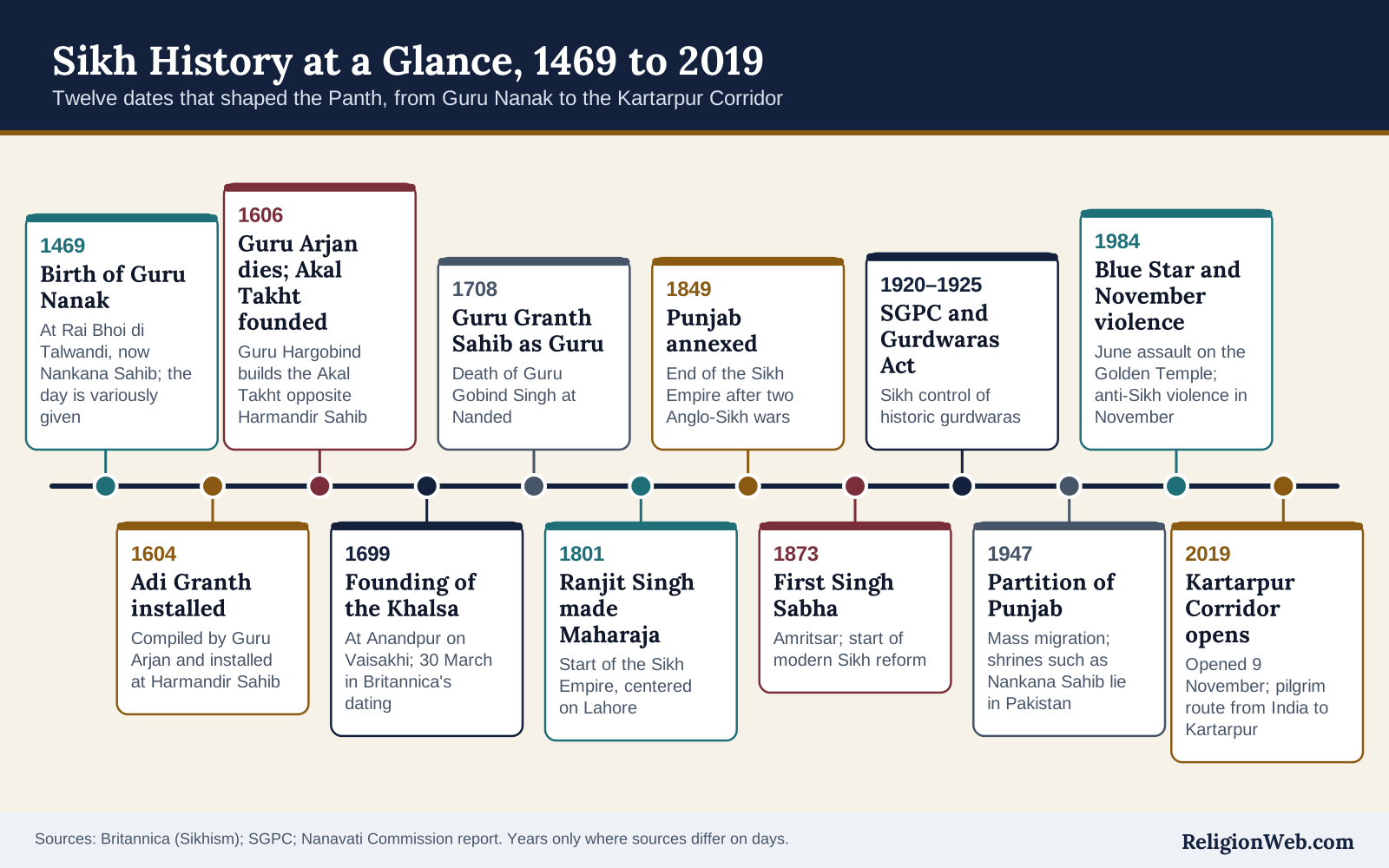
Key dates in Sikh history
| Date | Event | Why it matters |
|---|---|---|
| 1469 | Birth of Guru Nanak at Rai Bhoi di Talwandi (Nankana Sahib) | Traditional founding date of Sikhi |
| c. 1499 | Guru Nanak’s call and the beginning of his teaching | Date from tradition; the sources are not exact |
| 1539 | Death of Guru Nanak; Guru Angad succeeds | Principle of succession by appointment |
| 1552–1574 | Guruship of Guru Amar Das | Langar and regional preaching seats organized |
| 1604 | Adi Granth compiled and installed at Harmandir Sahib | First edition of the scripture |
| 1606 | Guru Arjan dies in Mughal custody; Guru Hargobind builds the Akal Takht | Beginning of the miri-piri tradition |
| 1675 | Guru Tegh Bahadur executed in Delhi | Remembered as a martyrdom for freedom of conscience |
| 1699 | Founding of the Khalsa at Anandpur | Creation of the initiated order and the Five Ks tradition |
| 1708 | Death of Guru Gobind Singh at Nanded | Guruship passes to the Guru Granth Sahib and the Guru Panth |
| 1716 | Execution of Banda Singh Bahadur in Delhi | End of the first Sikh uprising |
| 1748 | Dal Khalsa formed | Federation of Sikh war bands that led to the misls |
| 1801 | Ranjit Singh proclaimed Maharaja of the Punjab | Start of the Sikh Empire |
| 1849 | Annexation of the Punjab by the East India Company | End of the Sikh Empire |
| 1873 | First Singh Sabha founded in Amritsar | Start of the modern Sikh reform movement |
| 1920–1925 | SGPC founded (1920); Sikh Gurdwaras Act passed (1925) | Sikh control of historic gurdwaras |
| 1947 | Partition of the Punjab | Mass migration and loss of shrines in Pakistan |
| 1966 | Creation of the Punjabi Suba | Punjab becomes a Sikh-majority state |
| 1984 | Operation Blue Star (June); assassination of Indira Gandhi (31 October); anti-Sikh violence (November) | Defining events of modern Sikh memory |
| 2019 | Kartarpur Corridor opened (9 November) | Pilgrim route from India to Kartarpur in Pakistan without a visa |
The Ten Gurus and Other Central Figures
The Ten Gurus in Sequence
The Gurus at a glance
Sikh tradition counts ten human Gurus, who held the office in unbroken succession from Guru Nanak to Guru Gobind Singh. The table gives the lifespans and the years of guruship as they appear in standard reference works. Days of the month are omitted deliberately, since the lunisolar Bikrami dates used in Sikh sources and the Julian or Gregorian dates in modern books do not always match.
| Guru | Lifespan | Years as Guru | Associated places | Best-known contribution |
|---|---|---|---|---|
| Guru Nanak | 1469–1539 | to 1539 | Nankana Sahib, Kartarpur | Founding teaching; Japji; the first sangat at Kartarpur |
| Guru Angad | 1504–1552 | 1539–1552 | Khadur | Tradition of standardizing Gurmukhi script; care for the langar |
| Guru Amar Das | 1479–1574 | 1552–1574 | Goindval | Regional preaching seats (manjis); Anand Sahib |
| Guru Ram Das | 1534–1581 | 1574–1581 | Amritsar | Founding of the pool and city; the Lavan hymns for marriage |
| Guru Arjan | 1563–1606 | 1581–1606 | Amritsar | Harmandir Sahib; the Adi Granth; Sukhmani; first great martyr |
| Guru Hargobind | 1595–1644 | 1606–1644 | Amritsar, Kiratpur | Akal Takht; miri-piri; imprisonment at Gwalior |
| Guru Har Rai | 1630–1661 | 1644–1661 | Kiratpur | Reputation for gentleness and care for the sick |
| Guru Har Krishan | 1656–1664 | 1661–1664 | Delhi | Child Guru who died of smallpox in Delhi |
| Guru Tegh Bahadur | 1621–1675 | 1664–1675 | Anandpur, Delhi | About 115 hymns in the scripture; martyrdom in Delhi |
| Guru Gobind Singh | 1666–1708 | 1675–1708 | Patna, Anandpur, Nanded | Founding of the Khalsa; final form of the scripture |
What the word “Guru” means in Sikhi
In Sikh usage, Guru means the divine teacher who removes spiritual darkness, and it names at least three realities that Sikhs hold to be connected: God as the ultimate Guru, the ten Gurus who were the human vehicles of divine teaching, and the Shabad, the divine Word, which is now embodied in the Guru Granth Sahib. A well-known Sikh teaching is that the ten Gurus shared a single light (jot) passed from one body to the next, like a flame passed from one lamp to another. All the Gurus signed their compositions with the name “Nanak,” distinguishing them in the scripture by the numbered headings known as Mahala, so that “Mahala 5” means the work of the fifth Guru. Sikh teaching also insists that the Gurus were human teachers and not incarnations of God, which is why worship is directed to God alone and the Rehat Maryada rules out the worship of any god, goddess, incarnation or prophet.
Portraits of the First Five Gurus
Guru Nanak and Guru Angad
Guru Nanak’s own compositions, preserved in the Guru Granth Sahib, include the Japji, the long morning meditation that opens the scripture, and Asa di Var, a ballad-form work sung in the morning at many gurdwaras. His voice is direct, questioning and often poetic, using images of farming, trade and weaving drawn from everyday Punjabi life. Guru Angad, his chosen successor, led the Kartarpur community and then moved it to Khadur. Sikh sources remember him as a modest and disciplined leader who encouraged physical exercise alongside devotion, set up the wrestling arena, and gave the Gurmukhi script a standard form.
Guru Amar Das and Guru Ram Das
Guru Amar Das became Guru in old age, at Goindval, and the Sikh community grew significantly under him. Sikh sources credit him with the Anand Sahib, a hymn of joy now recited at nearly every Sikh ceremony, and with a social message that opposed caste distinctions and the seclusion of women. Guru Ram Das, his son-in-law, wrote the four stanzas of the Lavan, which are sung at weddings, and he laid out the settlement that became Amritsar. The scripture records hymns by both Gurus on the themes of the Name, humility and the community of the faithful.
Guru Arjan
Guru Arjan, the youngest son of Guru Ram Das, was the most prolific author of the Gurus, with more than 2,000 hymns in the scripture by the SGPC’s count, and the compiler of the Adi Granth. His Sukhmani, the “Psalm of Peace,” is among the most widely recited Sikh compositions. By raising Harmandir Sahib, building a system of financial support and compiling the scripture, he gave the Panth a durable structure. His death in Mughal custody at Lahore in 1606 is remembered by Sikhs as the first great martyrdom, and the memory of how he met it has shaped Sikh ideas about steadfastness.
Portraits of the Later Gurus
Guru Hargobind, Guru Har Rai and Guru Har Krishan
Guru Hargobind became Guru as an eleven-year-old in 1606, after his father’s death. He took the two swords of miri and piri, kept a small army, hunted, and was held for a period in the fort of Gwalior by Jahangir. The date and length of that imprisonment are debated by historians, though Sikh tradition gives a clear account of his release, which is observed at Bandi Chhor Divas. After a series of skirmishes with Mughal forces, he withdrew to Kiratpur in the Shivalik foothills, where his grandson Guru Har Rai succeeded him in 1644. Guru Har Rai is remembered as a gentle ruler who kept a large retinue yet cared for the sick, and Sikh tradition credits his Kiratpur center with a dispensary of herbal medicine. His successor, Guru Har Krishan, became Guru as a small child and died of smallpox in Delhi in 1664 while ministering, according to tradition, to those stricken by the epidemic. Gurdwara Bangla Sahib in Delhi is associated with his stay.
Guru Tegh Bahadur and Guru Gobind Singh
Guru Tegh Bahadur, the youngest son of Guru Hargobind, spent years in meditation before becoming Guru in 1664 and then traveled widely, including to eastern India. His 115 or so hymns in the Guru Granth Sahib, which Guru Gobind Singh added to the scripture, speak of detachment, steadiness and facing death without fear. His execution in Delhi in 1675 is commemorated at Gurdwara Sis Ganj Sahib, which stands in Chandni Chowk. His son Guru Gobind Singh was a poet and soldier-saint. The tradition attributes to him the Jaap Sahib and other hymns collected in the Dasam Granth, the Zafarnama, a letter in Persian verse addressed to Aurangzeb, and the final form of the Guru Granth Sahib. Sikhs remember the “four Sahibzade,” his four sons, who all died young in 1704, as models of courage.
Other Figures Sikhs Remember
Companions, scribes and scholars
Guru Nanak’s companion Mardana, a Muslim rabab player, is honored as the first Sikh musician, and three of his verses are in the scripture, according to Sikh tradition. Baba Buddha, who lived through the guruship of six Gurus according to Sikh tradition, was the first granthi (keeper and reader) of the Guru Granth Sahib. Bhai Gurdas, a relative of the Gurus and scribe of the first edition of the scripture, wrote Punjabi poems called Varan, which Sikhs regard as a key to the scripture, though they are not themselves part of it. Mata Khivi, wife of Guru Angad, is remembered for her role in the early langar. In the nineteenth and twentieth centuries scholars such as Bhai Kahn Singh Nabha produced the first modern encyclopedias and reference works in Punjabi.
Warriors, martyrs and reformers
Banda Singh Bahadur, the leader of the first Sikh uprising, is remembered as a brave commander and sometimes criticized by tradition for departures from Khalsa norms. Mai Bhago, a woman who rallied Sikh fighters and fought at Muktsar in 1705, according to tradition, is a model for Sikh women. Baba Deep Singh, an eighteenth-century scholar and fighter, is remembered for his stand to defend Harmandir Sahib. Bhai Mani Singh, who according to Sikh tradition wrote down the Damdama version of the scripture at Guru Gobind Singh’s dictation, was executed at Lahore in the 1730s. Maharaja Ranjit Singh, the Sikh Empire’s founder, holds a place in Sikh and Punjabi memory as a ruler who united the region. Each figure has been interpreted in different ways, and Sikh historians continue to debate details, but many of them are remembered in the daily Ardas or in public commemoration.
Core Beliefs and Teachings of Sikhism
One God and the Nature of the Divine
Ik Onkar and the Mul Mantar
The scripture opens with a short creed called the Mul Mantar, the “root formula,” which begins with the symbol Ik Onkar, “One Creator” or “One Being.” In the 1909 English rendering of the Japji by Max Arthur Macauliffe, an Irish-born official who spent years translating Sikh scripture with the help of Sikh scholars, the statement reads:
There is but one God whose name is true, the Creator, devoid of fear and enmity, immortal, unborn, self-existent
Japji, Mul Mantar, Guru Granth Sahib ang 1, trans. M. A. Macauliffe, The Sikh Religion, vol. 1
The formula closes with the phrase Gur prasad, which Macauliffe renders as a reference to the Guru’s grace and which Sikh exegesis usually understands as pointing to the grace by which God is known. Sikh commentators emphasize three things in the creed. God is one and is the sole Creator. God is beyond fear and enmity, meaning that God has no rival and no hatred, and the believer who lives in that awareness is meant to carry the same freedom from fear and hostility. And God is beyond birth and death, which is the Sikh reason for rejecting the idea that God takes human form. The creed is not a list of doctrines to be accepted but a description meant to be repeated and absorbed, and a shortened form of it heads each raga section of the scripture.
Names of God, and God beyond gender and image
Sikh prayer uses many names for the one God. Waheguru is the most common today, while the scripture itself uses Akal Purakh (“Timeless Being”), Karta Purakh (“Creator”), Sat Naam (“True Name”), and also names such as Hari and Ram from Indian devotional language and Allah and Rahim from Arabic. Sikh teachers read the use of these many names as an affirmation that God cannot be limited to one vocabulary. God is addressed with images of father, mother, beloved and husband without being assigned a gender, and Sikh worship uses no icons. A line from the Japji, again in Macauliffe’s translation, speaks of the timeless character of God:
The True One was in the beginning; the True One was in the primal age. The True One is now also, O Nanak; the True One also shall be.
Japji, opening verse (Jap), Guru Granth Sahib ang 1, trans. M. A. Macauliffe, The Sikh Religion, vol. 1
In Sikh interpretation this verse expresses the eternity of Sat, the Truth, a reality that does not begin or end and that is as present now as at any other time. Commentators often add that the verse presents God less as an object of inquiry than as a reality to be encountered.
The Human Condition and the Path to Liberation
Haumai, the five vices and the manmukh
Sikh teaching names the root of human suffering as haumai, usually translated as “ego” or “I-ness,” the habit of seeing oneself as the center and the owner of one’s life. It is understood as a barrier between the person and God, not as a sin in the sense of a legal offense. Five dispositions that feed it are named in Sikh sources as the five vices or “thieves”: lust (kam), anger (krodh), greed (lobh), attachment (moh) and pride (ahankar). A person led by the self is called manmukh, “facing the mind,” while the person oriented toward the Guru and the Word is called gurmukh, “facing the Guru.” The teaching is that the manmukh and the gurmukh may live in the same household and do the same work, and that the difference is one of orientation.
Sikh teachers generally affirm that the world is real, being the creation of God, and that the problem is not the world but a mistaken attachment to it. That is the usual Sikh reading of maya, the power by which the mind clings to what passes. The remedy is practice, not rejection: remembering the Name, hearing the Word, serving others, and living with the awareness of mortality.
Naam, shabad, grace and liberation
The scripture takes for granted the cycle of birth and death and the law that actions have consequences, which Sikh sources call karma, and it is in this setting that the Gurus’ teaching about liberation (mukti) is set. Ideas of karma and rebirth were shared across the Hindu, Buddhist and Jain traditions of the Indian subcontinent, and the Gurus used the common language of these ideas while giving them a Sikh meaning. What ends the cycle, in Sikh teaching, is not ritual or birth in a particular caste but union with God, reached through the Name (Naam) and through the Guru’s Word (Shabad) and made possible by God’s gracious glance (nadar or kirpa). Human birth is described as a rare opportunity for this union.
Sikh theologians also speak of jivan mukti, liberation while alive: a person who has realized the Name is freed from the grip of fear and ego in this life, and continues to live and work in the world. The final state is described in the scripture as sach khand, the “realm of truth,” but its language is poetic rather than descriptive, and Sikh teaching does not center on heaven and hell as destinations. The emphasis is on the quality of present life.
Living the Teaching: Naam, Work and Sharing
Naam japna, kirat karni, vand chhakna
A popular summary of Sikh practice, widely taught in gurdwaras and schools, has three parts: naam japna (remembering and meditating on the Name), kirat karni (earning a living by honest work) and vand chhakna (sharing one’s earnings and resources with others). The formula in this three-part form is a teaching summary widely used in modern times and does not appear in exactly this form in the scripture, but it condenses the way of life the community at Kartarpur followed, in which people farmed, sang hymns and shared their food. Many Sikhs add a fourth habit, seva, selfless service, and the practice of giving a tenth of income (dasvandh) to the community or to charity is widely encouraged.
Equality, the householder and the critique of empty ritual
Sikh teaching holds that all human beings, whatever their caste, gender or origin, are equally the creatures of God and equally capable of union with God. The Gurus rejected the claim that birth confers spiritual rank, and the scripture includes verses by poet-saints from low-status communities. They also rejected the idea that the best life is the ascetic one. A Sikh is expected to be a householder, raising a family, and most of the Gurus themselves married and had children. The later Rehat Maryada rejects the belief in ritual pollution after childbirth, the use of horoscopes to choose wedding dates, and the worship of idols, all of which the Gurus criticized as distractions from the inner work of devotion.
A passage near the end of the Japji describes the inner discipline of a seeker in the language of a goldsmith’s workshop. In Macauliffe’s translation it reads:
Make continence thy furnace, resignation thy goldsmith, Understanding thine anvil, divine knowledge thy tools, The fear of God thy bellows, austerities thy fire, Divine love thy crucible, and melt God’s name therein.
Japji, Pauri 38, Guru Granth Sahib ang 8, trans. M. A. Macauliffe, The Sikh Religion, vol. 1
Many Sikh commentators read this as an account of the inner discipline of a person who lives in the world: self-restraint, contentment, understanding, reverence, effort and love are the working materials in which the Word is “coined.” The “austerities” in this reading refer to the effort of self-discipline and not to bodily mortification, which the Gurus did not recommend.
Hukam, Miri-Piri and Social Responsibility
Divine order and acceptance
Hukam, the divine order or command, is one of the most important and most difficult concepts in the Japji. The second stanza of the poem begins with it, again in Macauliffe’s rendering:
By His order bodies are produced; His order cannot be described. By His order Souls are infused into them; by His order greatness is obtained.
Japji, Pauri 2, Guru Granth Sahib ang 1, trans. M. A. Macauliffe, The Sikh Religion, vol. 1
Sikh theologians read hukam on two levels. At one level it is the order of creation itself, the law by which the universe exists. At another it is the will of God as it is lived in particular events. The stanza ends with the teaching that those who understand hukam are freed from ego. Sikh thinkers differ on how this fits with human freedom. Some stress that people choose how to respond to what happens, even if they cannot control it, and the idea of accepting the divine will (bhana) is not meant as a call to passivity, since the same tradition calls for resisting injustice.
Creation, nature and the shared world
Sikh scripture treats the natural world with reverence. A well-known verse at the end of the Japji, which Macauliffe’s footnote says is generally believed to be the composition of Guru Angad, describes the elements as members of a family:
The air is the guru, water our father, and the great earth our mother; Day and night are our two nurses, male and female, who set the whole world a-playing.
Japji, closing Slok, Guru Granth Sahib ang 8, trans. M. A. Macauliffe, The Sikh Religion, vol. 1
In its immediate setting the verse leads to the statement that actions will be weighed in God’s court. In recent decades some Sikh environmental organizations have taken the verse as a basis for a Sikh ethic of care for air, water and soil, reading it as a reminder that human beings depend on a creation that is not theirs to exhaust.
Spiritual and temporal authority, justice and the sword
The idea of miri-piri, associated with Guru Hargobind, holds that spiritual authority (piri) and worldly responsibility (miri) belong together in a Sikh’s life and in the Panth’s institutions, and the Akal Takht stands as its symbol. Guru Gobind Singh gave the idea a further form in his picture of the sant-sipahi, the “saint-soldier,” a person trained to combine devotion with readiness to defend others. In the Zafarnama, as Britannica summarizes it, he expressed the belief that the Sikhs were justified in taking up the sword to restore justice against oppression, and Sikh tradition often cites the verse saying that when all other means have failed, it is right to draw the sword. Sikh teachers generally treat armed force as a last resort, bound by the protection of the weak and by freedom from hatred toward opponents, and the memory of the Gurus’ martyrdoms is as important as the memory of battles.
The Guru Granth Sahib, Sacred Texts and Authority
The Guru Granth Sahib as Eternal Guru
From Adi Granth to Guru Granth
Sikhs do not regard the Guru Granth Sahib as a book about the Guru. They regard it as the Guru, the continuing presence of the divine teaching. The story of how it came to hold that place begins with Guru Nanak’s hymns, which he passed to Guru Angad in manuscript form, and with later collections, including the Goindval pothis prepared under Guru Amar Das. In 1604 Guru Arjan compiled the Adi Granth, the “first volume,” drawing on these earlier collections and adding his own hymns and those of other holy men. Bhai Gurdas wrote it down, and it was installed at Harmandir Sahib with Baba Buddha as its first granthi, or reader and keeper, according to the SGPC.
The text reached its present form in the following century. According to Sikh tradition, Guru Gobind Singh dictated a revised version to Bhai Mani Singh at Damdama Sahib in about 1705 and 1706, and added the hymns of his father, Guru Tegh Bahadur, which Guru Arjan’s edition could not have included. In 1708, shortly before his death at Nanded, he is said to have declared that the line of human Gurus had ended and that the Guru Granth Sahib was the Guru of the Sikhs. Since then the volume has been called the Guru Granth Sahib. The anniversary of the first installation in 1604 is marked in early September, and calendar listings for 2026 give 1 September.
What it means to call a book the Guru
The Sikh teaching behind this status is that the Guru is the Shabad, the divine Word, and not the physical body of any person. The ten human Gurus were its vehicles, and after 1708 the Word itself is the Guru. For this reason the text is never altered, it is handled with ritual care, and Sikhs bow before it as they would before a teacher. It is installed each morning in a ceremony called prakash (“revealing” or “light”) and put to rest in the evening in sukhasan. The Rehat Maryada describes it as installed on a cot or throne with clean bedding, a canopy overhead, a cloth covering and a whisk (chaur) waved over it, and says that people must stand when it is brought into a room and cover their heads and remove their shoes in its presence.
Sikhs distinguish this reverence from idol worship. The volume is honored as the embodiment of the teaching and not worshiped as an image of God, and it is read, heard and sung, not merely venerated. The Pew Research Center’s 2019–20 survey of India found that 94 percent of Sikhs there regard the Guru Granth Sahib as the word of God, and 37 percent said they read it or listen to recitations of it every day. A second concept supplements this one. The Rehat Maryada also describes the Guru Panth, the collective body of committed Sikhs, as carrying the Guru’s authority in matters of community decision, which Sikh tradition expresses in the gathering of the Sarbat Khalsa in the presence of the Guru Granth Sahib.
Contents and Arrangement
Structure, ragas and language
The standard printed edition has 1,430 pages, called angs (“limbs”), and Sikhs use the ang number as the universal reference system for any passage. It opens with the Mul Mantar and the Japji, which occupy the first eight angs, followed by the evening prayers So Dar and So Purakh and the bedtime Sohila. The main body is arranged by raga, the musical modes of North Indian classical tradition, with thirty-one in the SGPC’s count. Within each raga the hymns are ordered by poetic form and then by author, with the Gurus’ compositions numbered by Mahala and followed by the bhagats’ verses. Near the end come longer works, the Slokas of Kabir and Farid among them, and the closing Mundawani.
The Rag Mala, a list of musical measures that follows the Mundawani, is read at the end of a complete reading in many gurdwaras and left out in others, a difference of practice that has been discussed within the Panth for more than a century. The script is Gurmukhi, which Sikh tradition associates with Guru Angad, and the languages are a range of North Indian literary registers, with Punjabi at the base and a large admixture of Sanskrit-derived, Persian and Arabic vocabulary. The text is meant to be sung, and its musical structure is as much a part of its meaning as its words.
| Feature | Detail |
|---|---|
| Name | Guru Granth Sahib; earlier called the Adi Granth (“first volume”) |
| First compilation | 1604, by Guru Arjan, written by Bhai Gurdas, installed at Harmandir Sahib |
| Final recension | Damdama Sahib, about 1705–06, adding the hymns of Guru Tegh Bahadur |
| Status as Guru | Eternal Guru of the Sikhs from 1708, according to Sikh tradition |
| Length | 1,430 angs (pages) in the standard printed edition |
| Arrangement | By raga (31 in the SGPC’s count), then by poetic form and author (Mahala) |
| Contributors | Six Gurus (Nanak, Angad, Amar Das, Ram Das, Arjan, Tegh Bahadur), 15 bhagats and 11 bhatts, by the SGPC’s count |
| Opening | Mul Mantar and Japji, angs 1 to 8 |
| Script and language | Gurmukhi script; Punjabi and other North Indian literary registers |
| Daily care | Prakash each morning, sukhasan at night; head covered, shoes removed |
Voices from many backgrounds
Guru Arjan’s edition included a remarkable range of voices. Most of the text is the work of the Sikh Gurus, with Guru Arjan the largest contributor by the SGPC’s count (2,218 hymns), followed by Guru Nanak (974) and Guru Amar Das (907). The remaining portion contains the compositions of fifteen bhagats, devotional poets who were not Sikhs of the Guru lineage, and eleven bhatts, bards who praised the Gurus. Counting conventions differ among scholars, and some count slightly different numbers of bhagats and bhatts. The bhagats include Kabir, who has the largest number of verses in the SGPC’s tally, along with Ravidas, Namdev and the Punjabi Sufi Sheikh Farid, and they came from different regions, castes and religious backgrounds.
Sikh teaching treats the inclusion of these voices as a statement about the unity of divine truth, and compositions by minstrels and devotees connected with the Gurus’ households, such as Satta and Balvand, are included as well. Sikh theology holds that the bhagats were included because their verses agreed with the Gurus’ teaching, which is not the same thing as saying that their traditions were accepted. Historians see the same inclusion as evidence of the shared devotional culture of the period. The question of how Sikhs relate to the wider traditions of these poets continues to be discussed within the Panth and in Sikh studies.
Other Texts and the Question of Authority
The Dasam Granth
The Dasam Granth, the “Book of the Tenth,” is a collection of compositions traditionally associated with Guru Gobind Singh. It includes the Jaap Sahib, the Akal Ustat, the autobiographical Bachittar Natak, the Zafarnama in Persian, and long narrative poems on stories drawn from Indian epic and Puranic literature. The collection took its present form in the decades after the Guru’s death, and Sikh scholars disagree on how much of it can be attributed to the Guru himself. Some Sikhs regard the entire collection as his work. Others accept devotional compositions such as the Jaap Sahib and the Zafarnama as his while questioning the authorship of the long narrative poems, which they attribute in whole or in part to other writers.
What Sikhs agree on is that the Dasam Granth is not the Guru. Three of its compositions, the Jaap Sahib, the Ten Savaiyye and the Benti Chaupai, are part of the daily prayers prescribed by the Rehat Maryada, and some Sikh groups, especially among the Nihang orders, give the work a place near the Guru Granth Sahib in their worship. The SGPC and mainstream gurdwaras install only the Guru Granth Sahib as the Guru. The matter remains a subject of active discussion among Sikh scholars and institutions.
Rahit-namas, janam-sakhis and the Sikh code of conduct
Alongside the scripture, Sikhs preserve a wide literature that helps explain the tradition but does not carry the Guru’s authority. The janam-sakhis, discussed above, recount Guru Nanak’s life. The rahit-namas, “manuals of conduct,” attributed to disciples of the tenth Guru, set out the discipline of the Khalsa and vary widely in content and date. The Varan of Bhai Gurdas, written in the early seventeenth century, are poems in Punjabi that are valued as a key to the scripture’s meaning, and the Gurbilas literature and later chronicles narrate the lives of the Gurus in a heroic style.
The present Sikh Rehat Maryada was drafted by committees appointed by the SGPC beginning in 1927, ratified in 1936, and accepted in a final form in 1945, building on the revised rahit-namas of the Singh Sabha period. It is the only version of the code recognized by the Akal Takht, according to its English edition, and it defines the Sikh, the conduct of worship, the ceremonies of birth, marriage, death and initiation, and the discipline of the Khalsa. Like any code, it has been interpreted and debated, and some Sikh groups follow their own rahit traditions.
Worship, Prayer, Rituals and Customs in Sikh Life
Gurdwara Worship
Entering the gurdwara and the presence of the Guru
The word gurdwara means “door of the Guru.” In Sikh practice any place where the Guru Granth Sahib is properly installed can serve as a gurdwara, whether it is a famous historic shrine or a room in a house, although most communities build a dedicated hall with a langar attached. A tall flagpole carrying the saffron or blue Nishan Sahib flag usually marks the building from outside, and the Rehat Maryada says that each gurdwara should have such a flag. Visitors remove their shoes, wash their hands and feet where facilities exist, and cover their heads, men and women alike, using a scarf or turban. Tobacco and intoxicants are not permitted anywhere on the premises.
The Guru Granth Sahib sits on a raised throne (takht or palki) beneath a canopy, wrapped in clean cloths called rumalas, with an attendant waving a chaur above it. As they enter, Sikhs approach it, bow until the forehead touches the floor, a gesture called matha tekna, and often make a small offering of money or food. Everyone then sits on the floor, and no one may sit on a seat higher than the scripture. The Rehat Maryada states that distinctions of caste or status have no place among those gathered, and that sitting on a raised or distinctive seat near the Guru Granth Sahib is improper. Visitors who are not Sikhs are welcome and may follow the same courtesies.
A typical congregational service
Britannica’s account of Sikh practice notes that worship consists largely of singing hymns from the scripture, and this is accurate for most gurdwara services. The sangat gathers for kirtan, the singing of Gurbani in the ragas assigned to each hymn, usually led by trained singers called ragis who play the harmonium and the tabla. According to the Rehat Maryada, kirtan is drawn from the Guru Granth Sahib, with the works of Bhai Gurdas and Bhai Nand Lal as the only permitted additions, and the code says that it must be performed by Sikhs and without improvised refrains. Explanation of a hymn (katha) by a scholar or granthi, and lectures on Sikh history, often follow. In many gurdwaras the morning service includes Asa di Var, Guru Nanak’s ballad, and the evening service includes Rehras.
The service closes with a fixed sequence. The congregation recites the first five stanzas and the last stanza of the Anand Sahib. A leader then offers the Ardas, the formal prayer, as the congregation stands with folded hands. The sequence ends with the taking of the hukamnama, in which the scripture is opened at random and the verse at the top of the left-hand page is read as the day’s guidance, and with the distribution of karah prashad. Prashad is a sweet food made of equal parts flour, ghee and sugar, which the Rehat Maryada says is prepared while hymns are recited and given to all without distinction of caste or status. In the diaspora the main weekly congregation usually takes place on Sunday, when many families can attend.
Akhand Path and other readings
Complete readings of the Guru Granth Sahib are a central form of Sikh devotion. In the Akhand Path (the “unbroken reading”), a team of trained readers takes turns reading the entire text without pause, usually in about forty-eight hours, and the Rehat Maryada requires that the reading be clear and unhurried so that listeners can follow, and that a reader should never continue alone without listeners. The reading begins and ends with the Anand Sahib, Ardas and karah prashad, and the conclusion includes the closing verses of the scripture. Families commission an Akhand Path on occasions such as moving into a new house, birth, a wedding, a bereavement or a thanksgiving.
The Sehaj Path is a paced reading that may take days, weeks or months and can be done by a family in the home, with no requirement of continuous reading, and the Saptahik Path is a reading completed within a week. In all cases the reading takes place in the presence of the Guru Granth Sahib and with the respect that belongs to it. Reading from a gutka, a small anthology of daily prayers, and reciting the banis from memory are also common.
Langar and Seva
How langar works
Langar is the free vegetarian meal served from the kitchen of every gurdwara, and it is available to every visitor whatever their religion, caste, nationality or gender. The Rehat Maryada states that the Guru’s kitchen has two purposes: to train Sikhs in voluntary service and to erase from their minds the distinctions of high and low, touchable and untouchable. People of any origin may sit and eat together, and the seating must not distinguish between them. Britannica adds that in the langar everyone sits in a single straight line, with no one placed ahead to claim higher status or behind to signal inferiority. The food, typically roti, lentils, vegetables, yogurt and a sweet such as kheer, is vegetarian, which Britannica notes keeps the meal open to guests with dietary restrictions as well as to Sikhs.
The work is done by volunteers, who cook, serve, wash dishes and clean the hall, and the supplies come from donations from the sangat. In a small gurdwara in the diaspora, a few families may cook for a few dozen people on a Sunday. At Harmandir Sahib in Amritsar, the kitchen operates through the day and the night. The meal is also served outside the gurdwara, at festivals, protests, disaster relief sites and refugee camps, wherever Sikh organizations set up a temporary kitchen.
Origins and the principle of pangat
Sikh tradition traces langar to Guru Nanak, who is said as a young man to have spent money his father gave him for trade on feeding hungry holy men, a story called the “true bargain” (sacha sauda), and who later organized the shared meal at Kartarpur. Guru Amar Das is credited with making it a requirement for every visitor: the saying attributed to him, “first pangat, then sangat,” means that one must first sit in the row (pangat) and eat before meeting the Guru in the congregation. One widely told tradition adds that even the Emperor Akbar sat in the row to eat before being received by the Guru, although historians treat this episode as tradition and not as a documented event.
The principle behind the practice is that the shared meal makes equality concrete. In a society of rank, people who would not ordinarily eat together, or who would eat only with those of their own caste, sit side by side. It is also a form of worship in the sense that the Sikh understanding of seva is service to God through service to people.
Seva beyond the kitchen
Seva, selfless service, is wider than langar. The Rehat Maryada lists tasks such as cleaning and plastering the gurdwara floors, serving water, fanning the congregation, helping in the common kitchen and cleaning visitors’ shoes, and it describes the gurdwara as a place of training in voluntary service. Sikhs speak of three kinds: physical service (tan), service with one’s wealth (dhan) and service with one’s mind (man). Many Sikh communities extend seva to hospitals, blood drives, food banks and disaster relief, and the shared meal has become one of the most visible public expressions of the tradition worldwide.
Daily Prayer and Meditation
Nitnem: morning, evening and night
Nitnem, the “daily rule,” is the set of prayers that Sikhs recite each day. According to the Rehat Maryada, a Sikh should rise in the hours before dawn, bathe, and meditate on the One Immortal Being while repeating Waheguru, then recite the Japji, the Jaap Sahib and the Ten Savaiyye. In the evening, after sunset, the Rehras is recited, a sequence that includes selected hymns from the Guru Granth Sahib, the Benti Chaupai attributed to Guru Gobind Singh and the first five and last stanzas of the Anand Sahib. Before sleep, a Sikh recites the Sohila, a short night prayer that also forms part of the funeral service. The code says that the day’s prayers end with the Ardas.
Many Sikhs recite five banis in the morning, adding the Chaupai Sahib and the Anand Sahib to the Japji, Jaap and Savaiyye, and others recite only the Japji or the Rehras as time allows. Sikhs who have not taken Khalsa initiation are expected to hold to the same practice in principle, and the Pew Research Center’s survey of India found that 40 percent of Sikhs said they go to the gurdwara daily, although self-reported frequency is not the same as the quality of observance.
Naam simran and the Ardas
Alongside the recited prayers, Sikhs practice naam simran, the silent or spoken remembrance of the Name by repeating Waheguru, often with the rhythm of the breath. The scripture presents it as the central discipline of devotion and as available to anyone at any time, regardless of place, language or formal training. Some Sikh groups, including the Akhand Kirtani Jatha, emphasize all-night kirtan as a form of the same practice.
The Ardas is the formal prayer of petition used at the end of every service and at the beginning of any important undertaking. It has three parts. The first is an invocation recalling the ten Gurus. The second recounts the sufferings and achievements of the Khalsa, naming martyrs and historic events, with the congregation responding to each cluster by calling out Waheguru. The third is the specific petition for which the Ardas is being offered, whether thanksgiving, a blessing on a new business, a prayer for a sick person or a petition on behalf of the Panth. It ends with a prayer for the well-being of all, and the cry “Bole so nihal, Sat Sri Akal.” Prayer for a sick person accompanies medical care and is not offered as a substitute for it.
Daily practice outside the gurdwara
For most Sikhs the household, not the gurdwara, is where daily religion is lived. Many homes keep a copy of the Guru Granth Sahib in a dedicated room, or a smaller book of prayers, and families recite the morning and evening banis together. Children learn Gurmukhi and the Japji at home or in weekend classes. The Gurus’ teaching on earning an honest living means that work itself, done carefully, is part of practice, and many Sikhs begin a journey, a business or an exam with a brief Ardas and a hukamnama.
Life-Cycle Rites
Birth and naming
According to the Rehat Maryada, when the mother has recovered enough to move and bathe, the family goes to the gurdwara with karah prashad, hymns of joy are sung and a hukam is taken from the Guru Granth Sahib. The child’s name begins with the first letter of the first word of the hymn that is read, and the granthi proposes a name that the congregation accepts. The suffix Singh is added for a boy and Kaur for a girl. The ceremony ends with the Anand Sahib, the Ardas and prashad. The Maryada specifically rejects the belief that childbirth leaves the family ritually impure, since for Sikhs all food and water are clean.
Anand Karaj: the Sikh wedding
The Sikh marriage ceremony, Anand Karaj, “the ceremony of bliss,” is held before the Guru Granth Sahib in the presence of the sangat, usually in the morning at a gurdwara. The Rehat Maryada says that caste and ancestry should not be considered in choosing a spouse, that horoscopes should not be used to fix the date, that child marriage is forbidden, and that a marriage should not be arranged for payment. The officiant explains the couple’s duties, and the couple bow before the scripture. Four times the couple walk around the Guru Granth Sahib while the Lavan, four stanzas composed by Guru Ram Das, are sung, with the bride following the groom and bowing before the scripture after each round. Sikh teachers read the four rounds as four stages in the soul’s journey toward union with God.
Legally, the Anand Marriage Act of 1909 gave recognition to marriages performed in this way in British India, and an amendment in 2012 made it possible to register them under the Act itself and no longer under the Hindu Marriage Act. The Rehat Maryada describes Anand Karaj as the ceremony for Sikhs, and the question of whether and how a Sikh marrying a person who does not follow the Sikh path may marry in a gurdwara has been debated in the diaspora, with local practice differing among gurdwaras and communities.
Death and remembrance
Funeral customs reflect the Sikh teaching that the soul continues and the body is only its instrument. The Rehat Maryada calls for the body to be bathed and dressed in clean clothes with the Sikh symbols still on it, for cremation (or immersion in flowing water if cremation is not possible), and for relatives to recite Gurbani or Waheguru and avoid loud lament. At the pyre the Kirtan Sohila is recited and the Ardas offered. Afterward the family holds a reading of the Guru Granth Sahib, which the Maryada says should be completed on the tenth day or another convenient day, ending with the Anand Sahib, Ardas and prashad. The Maryada rejects rituals such as pind and kirya, forbids raising a monument at the cremation site, and says that the ashes are immersed in flowing water or buried. These customs vary in practice among families, but a commemorative reading and a shared langar afterward are common.
The Khalsa, the Five Ks and Sikh Identity
The Founding of the Khalsa in 1699
What the sources say and the question of the date
Sikh tradition describes the founding of the Khalsa, the “pure” order of initiated Sikhs, as a dramatic scene at Anandpur in the foothills of the Shivalik range. At the festival of Vaisakhi, in the spring of 1699, Guru Gobind Singh is said to have stood before a large gathering, drawn his sword and asked for a man willing to give his head. Five men came forward in turn: Daya Ram, Dharam Das, Mohkam Chand, Himmat Rai and Sahib Chand. Traditional accounts say that they came from different castes and different parts of India, and that the Guru took each into a tent before bringing all five out in new dress. He prepared amrit, a sweetened water stirred with a double-edged sword, gave it to the five, and then asked them to initiate him in turn. The five became known as the Panj Pyare, the “five beloved ones,” and were given the shared surname Singh.
Historians take the event seriously while noting the limits of the evidence. Britannica’s account says the founding was “probably” in 1699 and that, according to Sikh tradition, the Guru created the Khalsa to end the power of the masands, the regional agents who had grown corrupt, and to bind all Sikhs directly to the Guru. Scholars such as W. H. McLeod and Louis Fenech have argued that the Khalsa discipline took shape over several decades and that the standard picture of a single founding day was filled in by later narratives. Sikh scholars and most Sikhs regard the 1699 gathering as a decisive historical event. As noted earlier, the date is variously given as 30 March (the Julian date in Britannica) or as 13 or 14 April, according to the calendar used.
The Panj Pyare and the meaning of the Khalsa
The word Khalsa, from an Arabic-Persian term meaning “pure” and, in Mughal administration, land held directly by the crown, implied that its members belonged directly to the Guru, without intermediaries. The Guru’s new name for men, Singh (“lion”), and the name Kaur (“princess”) that came to be used for women, were meant to mark a common identity that replaced caste surnames, and Sikh tradition regards the reciprocal initiation, in which the Guru received amrit from his own disciples, as a statement about the equality of the Guru and the Panth. The Rehat Maryada’s article on initiation preserves this model. Five initiated Sikhs of good character administer amrit, a sixth attends the Guru Granth Sahib, and anyone of any country, religion or caste who sincerely accepts Sikh principles and is mature enough may be initiated.
The Panj Pyare today are not a permanent office. They are five initiated Sikhs chosen when needed and recognized by the congregation, who administer amrit, lead the procession called Nagar Kirtan, lay the foundation of a new gurdwara, and sometimes help to resolve disputes in the community. The Rehat Maryada also speaks of five “beloved ones” chosen by the congregation to consider cases of breaches of discipline.
Amrit Sanchar and Khalsa Discipline
The initiation ceremony
The ceremony of Amrit Sanchar (“the infusion of nectar”) is described in the Rehat Maryada’s article on initiation. It takes place in a quiet place, with the Guru Granth Sahib installed, one initiated Sikh attending the scripture and five serving as the Panj Pyare. Candidates bathe and wash their hair beforehand and wear the Five Ks, with no emblem of another religion, no uncovered head and no body piercings, and they stand with folded hands facing the scripture. One of the five explains the teaching: devotion to the One Creator, rejection of the worship of created things and service to others. After asking the candidates whether they accept this willingly, the Panj Pyare prepare the amrit in a steel bowl with water and sugar crystals, stirring it with a double-edged sword (khanda) while reciting the Japji, Jaap, the Ten Savaiyye, part of the Benti Chaupai and selected stanzas of the Anand Sahib.
Each candidate drinks the amrit from cupped hands five times and has it sprinkled into the eyes and hair five times, with the greeting “Waheguru ji ka Khalsa, Waheguru ji ki Fateh” repeated each time. The new Khalsa recite the Mul Mantar, are instructed in their duties and discipline, receive a name, and share karah prashad from the same bowl. The ceremony is a commitment to a code of conduct and, in Sikh teaching, a spiritual rebirth. Initiation is open to men and women alike, and the Maryada does not set a fixed age, only maturity sufficient to understand the commitment.
The four prohibitions and the discipline of the Khalsa
The Rehat Maryada lists four transgressions (kurahits) that initiated Sikhs must avoid: dishonoring the hair, eating meat from an animal slaughtered by the slow ritual method (kutha, described in the English edition as the Muslim manner), sexual relations outside marriage, and the use of tobacco. Another article of the code calls for avoiding intoxicants of all kinds. A breach of one of the four requires renewed initiation, after the person has confessed to the congregation and accepted a penalty, which the Maryada says should be some form of service. Unintentional lapses are not punished.
The prohibition on kutha meat should not be read as a settled position on diet generally. Britannica notes that Sikh practice ranges from strict lacto-vegetarianism to the eating of meat from animals killed by a single stroke (jhatka), and that a ruling of the Akal Takht in 1980 allowed jhatka meat, though not all Sikh groups accept that ruling. Langar food is vegetarian. The Pew Research Center’s survey found that 59 percent of Sikhs in India described themselves as vegetarian.
The Five Ks
What each K is and what it is said to mean
The Five Ks are five articles beginning with the letter K in Punjabi that initiated Sikhs wear at all times, and they are the most visible marker of Khalsa identity. The Rehat Maryada requires them of initiated Sikhs, and many Sikhs who have not taken initiation keep some of them. Their meanings are explained in Sikh teaching and preaching, rather than set out in a single authoritative statement, and the table gives the explanations that are most often repeated. Britannica observes that the full set of five became a standard definition of the orthodox Sikh largely through the Singh Sabha reforms of the late nineteenth and early twentieth centuries, building on earlier practice.
| Practice | What it is | Commonly cited meaning |
|---|---|---|
| Kesh | Uncut hair, kept covered with a turban or a smaller keski | Living in harmony with God’s creation; dignity and spiritual discipline |
| Kangha | A small wooden comb worn in the hair | Cleanliness, order and care of the body |
| Kara | A steel bracelet worn on the wrist | Restraint and an unbroken bond with God and the Guru |
| Kirpan | A sword or dagger carried in a sheath, often small and worn under clothing | Duty to defend justice and protect the vulnerable |
| Kachhera | A specific undergarment, a short cotton trouser | Modesty, self-control and readiness to act |
| Amrit initiation | Ceremony conducted by the Panj Pyare | Entry into the Khalsa and commitment to the code |
| Four kurahits | Prohibited acts for initiated Sikhs | Protection of the discipline of the Khalsa |
Turbans, hair and Sikh dress
The turban (dastar) is not one of the Five Ks, but it is the usual covering for uncut hair and, for many Sikhs, the most recognizable sign of Sikh identity. There is no single required style. Men and boys wear a variety of turbans, from a simple small patka worn by young boys to larger wrapped forms, and women, who may also keep their hair uncut, wear turbans, a smaller keski, or a scarf. Nihang orders wear tall conical turbans in blue, Namdhari Sikhs wear white turbans tied horizontally across the forehead, and members of the Akhand Kirtani Jatha wear a keski beneath the main turban. Colors, fabrics and styles vary with region, occasion and personal choice. The Pew Research Center’s India survey found that about three-quarters (76 percent) of Sikh men and women keep their hair long.
The kirpan has legal significance. The Constitution of India states in Explanation I to Article 25 that the wearing and carrying of kirpans is deemed to be included in the profession of the Sikh religion. In 2006 the Supreme Court of Canada, in a case involving a Montreal student named Gurbaj Singh Multani, ruled that a total ban on the kirpan in a school violated religious freedom, while allowing safety conditions such as securing the kirpan in a sewn cloth sheath. Other countries and institutions make their own provisions, and the treatment of Sikh articles of faith at airports, workplaces and schools remains a recurring subject of public discussion.
Degrees of Observance Within the Panth
Amritdhari, Kesdhari and Sahajdhari Sikhs
Sikh terminology recognizes several levels of observance. An Amritdhari Sikh has taken amrit and keeps the Five Ks and the code of conduct. A Kesdhari Sikh keeps uncut hair and the usual dress but has not taken initiation, and in practice such Sikhs regard themselves, and are regarded, as part of the Khalsa community. A Sahajdhari Sikh follows the Gurus’ teaching without adopting the Khalsa discipline, and Britannica notes that the term probably derives from Guru Nanak’s use of sahaj, the ineffable ease of liberation, rather than from the older gloss “slow adopter.” Britannica’s discussion of the question estimates that initiated Sikhs make up around 15 to 18 percent of all Sikhs, though that estimate is a general one and not a census figure.
Most Sikhs do not regard these categories as ranks of worth, and all are welcome in the gurdwara and the langar. Sikh teaching presents initiation as the ideal commitment for those who feel ready, and many Sikhs describe their relationship to it as something that grows over the years, with the choice made at a time of their own. Some who cut their hair, particularly outside India, still attend the gurdwara and identify strongly as Sikh.
Women and the Khalsa
Sikh teaching affirms the spiritual equality of women and men. Guru Nanak’s hymns criticize the denigration of women, women are among the Sikh martyrs and leaders remembered in Sikh tradition, and women read the scripture, lead kirtan, serve in the langar and take amrit, although at Harmandir Sahib women have not traditionally performed kirtan in the inner sanctum, a restriction that Sikh women and others have questioned. The history of women’s place in the early Khalsa is a subject of scholarly discussion. W. H. McLeod regarded the early Khalsa as primarily male, and Doris Jakobsh has argued that women’s initiation developed later, while Nikky-Guninder Kaur Singh reads egalitarian intent into the original founding, and other scholars, including J. S. Grewal and Gurinder Singh Mann, have in turn criticized these readings as one-sided. In practice, whether women may serve as Panj Pyare is debated, and the Rehat Maryada’s text on initiation does not exclude women from the group of six initiated Sikhs, while practice at some institutions has traditionally been limited to men.
Sacred Spaces, Symbols and Material Culture
Places of Pilgrimage and Authority
Harmandir Sahib and the Akal Takht
Harmandir Sahib, “the Temple of God,” also called Darbar Sahib and known in English as the Golden Temple, stands in the center of a square pool in Amritsar. According to the account published on the sikhs.org site, Guru Ram Das began the excavation of the pool in 1577, Guru Arjan completed it in 1588 and finished the shrine in 1601, and the first edition of the scripture was installed there in 1604. Sikh tradition says that the shrine was given doors on all four sides to show that it is open to people of all castes and creeds, and that the Sufi saint Mian Mir of Lahore laid the foundation stone, a detail that historians discuss. The present structure was begun in 1764 after earlier damage, and a causeway links the shrine to the surrounding walkway.
Facing the shrine across the causeway is the Akal Takht, the “Throne of the Timeless One,” established by Guru Hargobind in 1606 as the seat of worldly authority and justice, a counterpart to the spiritual center of Harmandir Sahib. According to the sikhs.org account the Guru Granth Sahib is kept in Harmandir Sahib by day and at the Akal Takht at night. The Akal Takht issues edicts (hukamnamas) and is the place where the Sarbat Khalsa has traditionally been summoned. The building was heavily damaged in 1984. According to the Encyclopaedia of Sikhism, the government rebuilt it, the Sikh community did not accept that reconstruction, and it was taken down in 1986 and replaced with a building funded by voluntary labor and donations (kar seva).
The five Takhts and sites in Pakistan
Sikhs recognize five Takhts, seats of religious authority, of which the Akal Takht is the first. Takht Sri Keshgarh Sahib at Anandpur is associated with the founding of the Khalsa in 1699, and Takht Sri Damdama Sahib at Talwandi Sabo with the time Guru Gobind Singh spent preparing the final version of the scripture. Takht Sri Patna Sahib in Bihar marks the Guru’s birthplace, and Takht Sri Hazur Sahib at Nanded in Maharashtra marks the place of his death and cremation in 1708.
Several of the most revered sites lie in Pakistan. These include Gurdwara Janam Asthan at Nankana Sahib, the birthplace of Guru Nanak, Gurdwara Panja Sahib at Hasan Abdal, and Gurdwara Darbar Sahib Kartarpur beside the Ravi River, where Guru Nanak lived and died. Sikh pilgrims from India and elsewhere visit them on Gurpurabs under arrangements made between the governments. The Kartarpur Corridor, opened on 9 November 2019, a few days before the 550th anniversary of Guru Nanak’s birth, allows pilgrims from India to travel to Kartarpur without a visa.
Symbols and Material Culture
Ik Onkar, the Khanda and the Nishan Sahib
Three symbols appear throughout Sikh life. Ik Onkar, a numeral one followed by the Gurmukhi letter that begins Onkar, opens the scripture and expresses the unity of God, and it is often seen on gurdwaras, in homes, on pendants and at the head of letters. The Khanda emblem consists of a double-edged sword in the center, a circle (chakkar) around it and two curved swords flanking it, and it is widely understood as representing God’s oneness, the unbroken community and the combined sovereignty of spiritual and worldly power (miri and piri). The Nishan Sahib is the flag flown at gurdwaras, usually saffron or ochre, and in Nihang orders, blue, and it often carries the Khanda. Sikhs treat the flag with respect, and it is draped in cloth and replaced during a special ceremony.
Gurmukhi, music and manuscripts
The Gurmukhi script, “from the Guru’s mouth,” is the script of the scripture and of modern Punjabi as written in India. Reading Gurmukhi is part of Sikh religious education, and many diaspora gurdwaras run Punjabi classes for children. Music is equally central. Kirtan is sung in ragas of North Indian classical tradition, and Sikh musical traditions include the rabab associated with Mardana, string instruments such as the taus and dilruba, and, in modern practice, the harmonium and tabla. Manuscripts of the scripture and of other texts have been illuminated with decorated borders, and Sikh arts include calligraphy, painting and the decoration of gurdwaras and manuscripts. The Sikh Reference Library in Amritsar, which held rare books and manuscripts, burned in June 1984 and much of its collection was lost, although accounts differ on exactly what was destroyed and what was removed.
Holy Days and the Sikh Calendar
How the Sikh Calendar Works
Bikrami months, sangrand and lunar days
For several centuries Sikhs have reckoned time with the Bikrami (Vikrami) calendar, the lunisolar calendar widely used in North India, and its rules explain why the dates of Sikh festivals shift from year to year in the Gregorian calendar. The first day of each solar month, called sangrand, is marked in the gurdwara by reading the Barah Maha, the “Twelve Months” hymn, which describes the seasons and the soul’s longing for God. The lunar side of the calendar supplies the full moon (puranmashi), the new moon (masya) and the lunar day (tithi) on which an event is remembered. A Gurpurab that is tied to a lunar date, such as the birth anniversary of Guru Nanak on the full moon of Kartik, therefore falls on a different Gregorian date each year, while one tied to a solar date, such as Vaisakhi, stays within a day of 13 or 14 April.
This system worked for generations, but it had a problem that modern Sikh calendar reformers wanted to solve. Because lunar and solar months drift apart, the Bikrami calendar needs an extra month at intervals, and some Sikh anniversaries have fallen twice in one Gregorian year and others not at all, an observation that motivated the calendar scholar Pal Singh Purewal. Dates also differ because the Julian calendar, the Gregorian calendar and the Bikrami calendar were mixed in historical writing. That is why the birth of Guru Gobind Singh, for example, is given as 22 December 1666 in Britannica but is observed on a fixed date of 5 January in the original Nanakshahi calendar and on a lunar date in the revised one.
The Nanakshahi calendar and its revisions
The Nanakshahi calendar was designed by Pal Singh Purewal, a Sikh scholar of calendars (1933–2022), who proposed a fixed solar calendar after decades of work. After a committee process in the 1990s, the SGPC approved it in January 2003, and it was launched on Vaisakhi, 14 April 2003, at Takht Sri Damdama Sahib. It is a tropical solar calendar that counts years from 1469, the birth year of Guru Nanak, and begins each year on 1 Chet, which falls on 14 March. Its months take their names from the Barah Maha in the Guru Granth Sahib. Because it is fixed, most Gurpurabs and festivals fall on the same Gregorian date every year, and the original version kept a few observances, including Guru Nanak’s birth anniversary, Hola Mohalla and Bandi Chhor Divas, tied to the lunar Bikrami calendar as a compromise.
The calendar became a matter of dispute. In 2010 the SGPC issued a revised version that returned many observances to Bikrami lunar dating, and it has continued to publish a calendar called Nanakshahi that differs from Purewal’s original. The Akal Takht, which had approved the original calendar in 2003, later backed the amended version, and in 2018 its jathedar urged Sikhs to unite behind it. Purewal publicly criticized the changes as arbitrary, and supporters of the original, now often called the Mool (original) Nanakshahi calendar, argue that the revision abandoned the principle of independent Sikh reckoning. A convention in Chicago in 2017 resolved to fix several dates according to the 1999 original. Reports indicate that the Pakistan Sikh Gurdwara Parbandhak Committee and many diaspora gurdwaras follow versions that differ from the SGPC’s. Dates used by different gurdwaras can therefore differ by days or even weeks, and the safest practice is to check with the local gurdwara.
Gurpurabs and Commemorations
Guru Nanak’s Gurpurab
A Gurpurab is a day that commemorates a Guru, most often the Guru’s birth (Prakash Purab) or martyrdom (Shaheedi Purab). The most widely observed is the birth anniversary of Guru Nanak, which most Sikhs observe on Kartik Puranmashi, the full moon of the lunar month of Kartik, in November. Some of the earliest janam-sakhi traditions place the birth in the spring month of Vaisakh, and the Bala tradition is associated with the Kartik date, a difference that the calendar dispute has reopened. In 2026 the Punjab government’s holiday listings place the occasion on Tuesday, 24 November.
Observance begins well before the day itself. Many gurdwaras hold an Akhand Path that ends on the morning of the Gurpurab, pre-dawn processions with hymn singing called prabhat pheris move through neighborhoods, and a Nagar Kirtan, a procession led by the Panj Pyare with the Guru Granth Sahib carried on a decorated float, winds through town. The day itself includes kirtan, katha and a large langar, and gurdwaras and homes are lit at night. At Nankana Sahib in Pakistan, pilgrims from India and other countries gather for the occasion each year.
Other Gurpurabs and martyrdom days
Sikhs also mark the birth anniversary of Guru Gobind Singh, which falls in the lunar month of Poh, in December or January, and the martyrdom days of Guru Arjan and Guru Tegh Bahadur. The martyrdom of Guru Arjan is remembered in early summer, when many communities serve cool sweet drinks (chhabeel) to passersby. The sacrifice of Guru Gobind Singh’s four sons and of his mother, Mata Gujri, in December 1704 is remembered with particular solemnity in the last weeks of December. The anniversary of the first installation of the Guru Granth Sahib in 1604, Pehla Prakash Divas, is observed in early September, and the installation of the Guru Granth Sahib as the eternal Guru at Nanded is recalled in October. Because the Julian and Gregorian dates of these events are not always agreed upon, and because of the two calendar traditions, Sikh institutions publish specific dates each year.
Seasonal and Khalsa Festivals
Vaisakhi
Vaisakhi marks the first day of the month of Vaisakh, in the mid-April spring, and it carries three meanings that overlap. In Punjab it is a harvest festival, when the wheat crop ripens and farmers celebrate with fairs and folk dances such as bhangra. It is the solar new year in several South Asian calendars, observed by other communities as well. For Sikhs it is above all Khalsa Sajna Divas, the day on which Guru Gobind Singh founded the Khalsa in 1699. The date falls on 13 or 14 April, and in 2026 it fell on 14 April.
In gurdwaras the day begins with an Akhand Path concluding in the morning, extra kirtan and the replacement of the cloth and, in some places, the pole of the Nishan Sahib. Many communities hold Amrit Sanchar ceremonies on Vaisakhi, and large Nagar Kirtan parades, notably in Canada and the United Kingdom, draw tens of thousands of participants, including many who are not Sikhs. Vaisakhi in Amritsar also recalls the massacre at Jallianwala Bagh on 13 April 1919, when British Indian troops fired on a crowd gathered in the city on the festival day, an event remembered across Punjab. Statistics Canada has described Vaisakhi as the holiest day of the year in the Sikh faith.
Bandi Chhor Divas, Hola Mohalla and Maghi
Bandi Chhor Divas, “the day of the release of prisoners,” recalls Guru Hargobind’s release from the fort at Gwalior, where he had been held by the Mughal emperor Jahangir. Sikh tradition says that he refused to leave unless the other imprisoned princes were released with him, and that when he came to Amritsar the city was lit with lamps. The day coincides with Diwali, and Harmandir Sahib is illuminated. In 2026 Diwali and Bandi Chhor Divas fall on 8 November. Sikhs give the occasion their own meaning, linking it to freedom and justice.
Hola Mohalla is a gathering held at Anandpur Sahib on the day after the spring festival of Holi. Britannica says that it was established by Guru Gobind Singh and originally featured martial displays and mock battles, and the event today includes processions, kirtan, and displays of horsemanship and swordsmanship by Nihang orders. Maghi, in mid-January, commemorates the forty Sikhs who, according to tradition, died fighting at Muktsar in 1705 after having abandoned the Guru and then returned, and who are remembered as the Forty Liberated Ones (Chali Mukte). Fairs and large gatherings are held at Muktsar.
Major observances at a glance
| Observance | What it commemorates | Typical practice | Date rule |
|---|---|---|---|
| Guru Nanak’s Gurpurab | Birth of Guru Nanak | Akhand Path, prabhat pheris, Nagar Kirtan, langar | Kartik full moon (24 November in 2026 in Punjab holiday listings); fixed in the original Nanakshahi version |
| Guru Gobind Singh’s Gurpurab | Birth of the tenth Guru | Kirtan, katha, processions, langar | Lunar date in Poh (December or January); fixed 5 January in the original Nanakshahi |
| Martyrdom of Guru Arjan | Death of the fifth Guru in 1606 | Kirtan, chhabeel, langar | Observed in late May or June; varies by calendar |
| Martyrdom of Guru Tegh Bahadur | Execution of the ninth Guru in Delhi in 1675 | Kirtan, special programs at Gurdwara Sis Ganj | Observed in November or December; varies by calendar |
| Pehla Prakash Divas | First installation of the scripture in 1604 | Special services at Harmandir Sahib | Early September |
| Vaisakhi | Founding of the Khalsa in 1699; harvest and solar new year | Akhand Path, Amrit Sanchar, Nagar Kirtan, fairs | Solar; 13 or 14 April (14 April in 2026) |
| Bandi Chhor Divas | Release of Guru Hargobind from Gwalior | Illumination of gurdwaras, kirtan, langar | Same day as Diwali (8 November in 2026) |
| Hola Mohalla | Martial and communal gathering | Processions, martial arts displays, kirtan | Day after Holi, at Anandpur Sahib |
| Maghi | The forty at Muktsar | Fairs and kirtan, especially at Muktsar | First day of Magh, mid-January |
| Sangrand and Puranmashi | Month beginnings and full moons | Barah Maha recited, extra diwan | Sangrand is solar; Puranmashi is lunar |
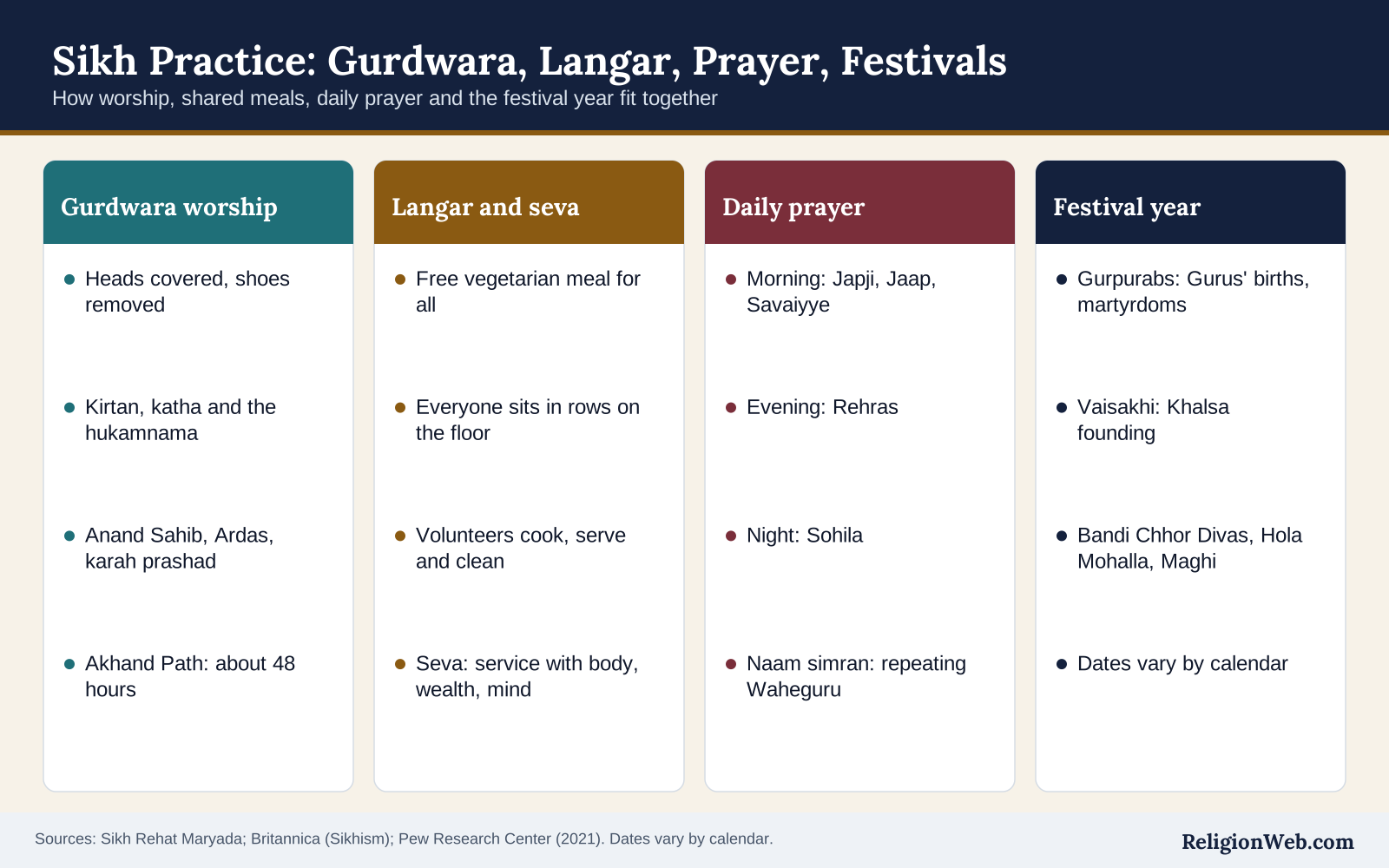
Branches, Movements and Internal Diversity in Sikhism
Streams Within the Panth
Differences of observance more than of doctrine
Sikhism is not divided into large doctrinal denominations. Sikhs of all kinds recognize the same ten Gurus, the same Guru Granth Sahib and the same basic theology, and most look to the Rehat Maryada as a common reference. The differences that matter in practice are of observance, of lineage and of organization: whether a person has taken Khalsa initiation, how closely they follow the dress and dietary rules, which teachers and institutions they follow, and how they view certain texts and customs. The earlier discussion of Amritdhari, Kesdhari and Sahajdhari Sikhs describes the main spectrum.
Within that unity, a number of traditions have their own institutional histories. Some are long-standing schools and lineages, others emerged in particular periods of reform or revival, and a few have such different beliefs from those of the mainstream Panth that Sikh institutions do not count their members as Sikhs. The following sections describe them with the self-descriptions of each group first and distinctions noted carefully, since the boundaries are sometimes contested.
Older ascetic and scholarly lineages
The Udasi tradition, which traces itself to Baba Sri Chand, a son of Guru Nanak, is an ascetic lineage that preserved and served many Sikh shrines through the seventeenth and eighteenth centuries. Its custodians, called mahants, controlled many historic gurdwaras until the Gurdwara Reform Movement of the 1920s, and the mahant of Nankana Sahib in 1921 was an Udasi. The Nirmala tradition, a lineage of scholar-ascetics, grew up in the eighteenth and nineteenth centuries and is known for its work in preserving and interpreting Sikh texts. The Damdami Taksal is a traditional school of Sikh learning that teaches the recitation and interpretation of the scripture and claims a lineage reaching back to Guru Gobind Singh’s time. Its leader in the early 1980s, Jarnail Singh Bhindranwale, became a central figure in the events leading to 1984.
Movements and Groups, Carefully Distinguished
Orders and revival groups within the Panth
The Nihang orders, also called the Akali Nihangs or Budha Dal and Taruna Dal in their main divisions, describe themselves as the original form of the Khalsa and as the successors of the Guru’s armed Sikhs. Scholars find their origins obscure, with competing explanations in Sikh historical writing, and note that they came into prominence in the eighteenth and early nineteenth centuries. They wear distinctive blue dress and tall turbans, practice traditional martial arts and horsemanship, and give the Dasam Granth and the Sarbloh Granth a standing close to the Guru Granth Sahib, which most other Sikh institutions do not. They are an accepted part of the Panth, and relations with the SGPC have at times been strained over specific practices.
The Akhand Kirtani Jatha, which emerged in the early twentieth century around Bhai Randhir Singh, stresses all-night hymn singing and the wearing of the keski beneath the turban by both men and women. Sikh Dharma of the Western Hemisphere, widely known by the name of its educational branch, 3HO, was founded in the United States in 1971 by Harbhajan Singh, known as Yogi Bhajan. Its members are mostly Western converts who emphasize meditation and kundalini yoga, and they adopt Sikh names and dress. Britannica notes that relations with the wider Khalsa are mixed, though its members’ observance of the code of conduct is generally regarded as very strict.
Groups that recognize living Gurus, and groups sometimes confused with Sikhs
Mainstream Sikh institutions teach that the line of human Gurus ended in 1708 and that the Guru Granth Sahib is the only Guru. A small number of movements that arose in nineteenth-century Punjab hold differently. The Namdhari or Kuka movement, centered at Bhaini Sahib and led by Satguru Ram Singh in the 1860s and 1870s, believes in a continuing line of living Gurus, with Balak Singh as its first. Its members, who wear white homespun turbans tied horizontally, were active in opposing British rule, and Ram Singh was exiled to Burma. The Nirankari movement of Baba Dayal, also from nineteenth-century Punjab, stressed remembrance of the Name and likewise recognized a continuing line of Gurus, as Britannica notes. A later organization with a similar name, the Sant Nirankari Mission, is a separate movement.
Other modern movements centered on living spiritual teachers draw many followers in Punjab, including some from Sikh families, but they are not Sikh movements by the standard of Sikh institutions, which hold that Sikhs recognize only the ten Gurus and the Guru Granth Sahib. The Ravidassia community, many of whose members are Dalits and who revere the fifteenth-century poet-saint Ravidas, forty of whose hymns are in the Guru Granth Sahib, is a special case. After a deadly attack on two Ravidassia leaders at a temple in Vienna on 24 May 2009, in which Sant Ramanand later died, the movement increasingly asserted a separate religious identity, and many members say explicitly that they are not Sikhs, while others retain close devotional and family ties to the Sikh community.
| Group | Origin and self-description | Relationship to the wider Panth |
|---|---|---|
| Khalsa (Amritdhari) Sikhs | Initiated Sikhs under the code of 1699 and the Rehat Maryada | The reference group for the Rehat Maryada; estimated at 15 to 18 percent of Sikhs in Britannica’s discussion |
| Sahajdhari Sikhs | Follow the Gurus’ teaching without adopting the full Khalsa discipline | Regarded by many Sikhs as part of the community; Britannica notes that their numbers cannot be determined precisely |
| Nihang orders | Armed Khalsa orders with traditions of origin in the Guru’s time; prominent from the eighteenth century | Accepted within the Panth; distinct dress and a high regard for the Dasam Granth and Sarbloh Granth |
| Udasi tradition | Ascetic lineage tracing itself to Baba Sri Chand, son of Guru Nanak | Historically custodians of many gurdwaras until the reform movement of the 1920s |
| Damdami Taksal | Traditional school of scripture and recitation | Within the Panth; influential in religious education and politics |
| Akhand Kirtani Jatha | Early twentieth-century devotional group stressing kirtan and the keski | Within the Panth; some differences of practice from the SGPC |
| Namdhari (Kuka) | Nineteenth-century Punjab movement; recognizes a continuing line of living Gurus | Not counted within the Panth by mainstream Sikh institutions on this point |
| 3HO / Sikh Dharma | Founded in the United States in 1971 by Yogi Bhajan | Mostly Western converts; relations with the wider Khalsa are mixed |
| Ravidassia community | Devotional movement around Ravidas, strong among Dalit communities in Punjab | Many members identify as a separate religion; ties to Sikh devotion and families remain |
Contested Boundaries and Internal Debates
Authority: the Akal Takht, the SGPC and the Panth
Who speaks for the Panth is itself a subject of debate. The SGPC, whose members are elected by Sikh voters, manages the major historic gurdwaras in Punjab and calls itself the Parliament of the Sikhs. It works under the directives of the Akal Takht, whose jathedar, the head of the Takht, issues edicts that apply to all Sikhs. Other bodies, including the Delhi Sikh Gurdwara Management Committee and regional committees, manage gurdwaras elsewhere, and Sikhs in the diaspora run their own congregations. Disputes about the role of political parties in the SGPC, about who should appoint the jathedars, and about the use of the Sarbat Khalsa as a general assembly of the Panth have recurred throughout the modern period.
Caste, Dalit Sikh identity and separate gurdwaras
Sikh scripture and the Rehat Maryada reject caste hierarchy, and in the langar and the congregation, equality is practiced in public. Yet caste has persisted in Sikh society as a social fact. Britannica notes that many Sikhs are still expected to marry within their caste and that some caste groups, such as the Ramgarhias and Dalit Sikhs, have at times established their own gurdwaras. Pew’s 2019–20 survey found that 46 percent of Sikhs in India identify with a General Category caste, with the rest identifying with other categories. Dalit Sikh communities such as the Mazhabi and Ramdasia Sikhs have played a prominent part in Sikh history, including its military tradition, and members of these communities and others continue to press for the Panth to make its egalitarian ideals a lived reality.
Community, Ethics and Daily Life
Ethical Life and Social Teaching
Honest work, sharing and dasvandh
Sikh ethics begin with the idea that spiritual life is lived through ordinary activity. Kirat karni, earning a living honestly, is a duty and a form of devotion, and Sikh teaching condemns gain by fraud, exploitation or gambling. Vand chhakna, sharing, extends this: the Sikh is expected to give a portion of income and time to others. Dasvandh, the practice of giving a tenth of one’s earnings, is widely encouraged and is often directed to the gurdwara, to the langar or to charitable causes, and it supports a large part of the community’s institutions. The Rehat Maryada also names forms of conduct that violate this ethic, including giving a son or daughter in marriage for payment.
The virtues Sikh teaching praises are humility (nimrata), contentment (santokh), truthfulness, compassion and service. The five vices of lust, anger, greed, attachment and pride are seen as the forces that turn a person away from these virtues. The scripture often describes the ideal person as one who remains engaged with the world while being inwardly free, a householder who gives without counting and is not shaken by praise or blame.
Equality, gender and caste in lived practice
Equality is the principle most often cited in descriptions of Sikh ethics. The scripture states that all human beings come from one source, and the langar, the shared congregation and the common surnames Singh and Kaur are meant to make that principle visible. In the Rehat Maryada, the congregation is to be treated equally whatever a person’s caste, touchability or status in the Sikh community, and the killing of female infants is named among practices that put a person outside the community’s discipline. Sikh women have served as soldiers, scholars, political leaders and heads of institutions, and Sikh teaching presents men and women as equally able to pursue liberation.
Practice and ideal do not always coincide. As discussed in the section on internal diversity, caste identity persists in some areas of Sikh life, including in marriage preferences and in some caste-specific gurdwaras, and discrimination against women remains a problem in parts of South Asian society, including among Sikhs. Sikh leaders, scholars and organizations have long argued that these facts are departures from Sikh teaching and not expressions of it, and many campaigns within the community work to close the gap between the two.
Family, Diet and Health
Household and family life
The household is the center of Sikh life, and family occasions are marked by readings, prayers and langar. Names are chosen at birth through the hymn read in the gurdwara, and boys and girls receive the names Singh and Kaur respectively, usually in addition to a family name. The Rehat Maryada states that a marriage is to be arranged without regard to caste, without payment and without consulting horoscopes. Elders play an important role in passing on the language, the prayers and the stories of the Gurus, and in many families several generations share a household or live close together. Punjabi remains the main language of Sikh religious life, and in the diaspora children typically learn the Gurmukhi script and the basics of the Japji at the gurdwara or at home.
Food, intoxicants and health
Sikh dietary practice is varied. Langar is always vegetarian, and many Sikh families are as well, with the Pew Research Center’s survey finding 59 percent of Sikhs in India describing themselves as vegetarian. Others eat meat, and the Rehat Maryada’s prohibition applies specifically to kutha meat, from animals slaughtered by the ritual method, as discussed above. Initiated Sikhs are forbidden tobacco, and Sikh teaching discourages the use of alcohol and other intoxicants, which are generally not permitted in the gurdwara.
Sikh tradition places a positive value on healing and care of the sick. Tradition remembers Guru Har Rai for caring for the ill and Guru Har Krishan for his service during a smallpox epidemic. The teaching does not set prayer against medicine. A Sikh who is ill may ask for an Ardas or listen to Gurbani for comfort, and it is entirely consistent with Sikh practice to seek a doctor’s help at the same time. Many Sikh organizations run hospitals, clinics and blood drives as an extension of seva, and anyone facing a medical or mental-health crisis should seek qualified professional help.
Modern Global Presence of Sikhism
Population and Distribution
India and Pakistan
The 2011 census of India counted 20,833,116 Sikhs, about 1.7 percent of the population, and about 77 percent of them lived in Punjab, where they made up 57.69 percent of the population. Substantial communities lived in Haryana (about 1.24 million), Rajasthan (about 873,000), Uttar Pradesh (about 644,000) and Delhi (about 571,000). These 2011 figures remain the latest published census counts of religion in India. The Sikh community in Pakistan is much smaller, with members living mainly in the provinces of Punjab and Khyber Pakhtunkhwa, and the historic shrines there draw pilgrims from around the world.
The diaspora in the United Kingdom, Canada, the United States and beyond
The 2021 census of England and Wales recorded about 524,000 people who identified as Sikh in the religion question, and about 525,900 including people who identified as Sikh only through the ethnic group question, which is 0.9 percent of the population. That is an increase of 22.3 percent from 430,020 in 2011. The largest concentrations are in the West Midlands, in Outer London boroughs such as Ealing and Hounslow, and in Slough, and the Office for National Statistics found that 56.5 percent of Sikhs in England and Wales were born in England and 34.1 percent in India. Statistics Canada’s 2021 census counted 771,790 Sikhs, with 300,435 in Ontario, 290,870 in British Columbia and 103,600 in Alberta, which makes Canada’s Sikh community the second largest in the world after India.
The United States does not ask about religion in its federal census, so estimates of the American Sikh population are uncertain and range from about 200,000 to 500,000, depending on the source and the method. Australia, New Zealand, Malaysia, Singapore, Italy, Kenya and the Gulf states also have established Sikh communities. The global total is commonly put at 25 to 30 million, but there is no single authoritative count.
Institutions and Public Life
The SGPC, the Akal Takht and gurdwara governance
The SGPC, founded in 1920 and given legal status by the Sikh Gurdwaras Act of 1925, describes itself as the apex body managing the historic gurdwaras of Punjab and elsewhere. According to its own account it has 191 members, 170 of them elected by Sikh voters aged 18 and older, along with six ex officio members, including the jathedars of the five Takhts and the head granthi of Harmandir Sahib. It also runs schools, colleges, a research board and the Sikh Reference Library in Amritsar. Gurdwara management elsewhere, from Delhi to Pakistan to the diaspora, is organized through other committees, and many diaspora gurdwaras are run by local boards elected by their congregations. Questions about political influence on gurdwara governance and about the authority of the Akal Takht are debated within the community.
Rights, accommodation and discrimination
Sikhs in many countries have had to negotiate the public recognition of their articles of faith. In India, Explanation I to Article 25 of the Constitution deems the wearing and carrying of the kirpan to be part of the profession of the Sikh religion, while Explanation II to the same article states that for the purposes of one provision, the reference to Hindus includes persons professing the Sikh, Jaina or Buddhist religion. Many Sikh organizations have objected to that classification and have asked for it to be amended, since they read it as treating Sikhs as part of Hindu society. The Anand Marriage Act of 1909 and its 2012 amendment were enacted in part to give Sikh marriages separate legal recognition. Related traditions are discussed in the articles on Jainism and on Buddhism.
In Canada, the Supreme Court ruled in 2006 that a total ban on the kirpan in a school violated religious freedom. In the United Kingdom, the House of Lords decided in Mandla v Dowell-Lee in 1983 that Sikhs constitute an ethnic group under the Race Relations Act 1976, in a case that began when a school refused to admit a boy who wore a turban. In the United States, Sikhs have faced hate crimes, in a number of cases because attackers mistook them for members of other groups. Balbir Singh Sodhi, a gas station owner in Arizona, was murdered on 15 September 2001, and on 5 August 2012 a gunman killed six worshipers at the Sikh Temple of Wisconsin in Oak Creek. The perpetrator was a white supremacist, and the FBI later concluded that he died of a self-inflicted gunshot. Sikh organizations responded with education and advocacy efforts to make their faith better understood.
Memory, Pilgrimage and Identity Today
Remembering 1947 and 1984
Historical memory remains a living part of Sikh identity. The Partition of 1947 is remembered as the loss of homes and shrines, and the events of June and November 1984 are commemorated each year in gurdwaras and public gatherings. Debate continues about the term used for November 1984. In April 2017 the Legislative Assembly of Ontario passed a motion that described the anti-Sikh violence as genocide, and the Government of India rejected the characterization. Many Sikh organizations use the term, while Indian courts and commissions have addressed the killings through criminal law and inquiry. The disagreement concerns the legal and historical label, and the underlying facts of the killings in November 1984 are documented by commissions of inquiry.
Kartarpur, language and the next generation
Pilgrimage has taken new forms. The Kartarpur Corridor, opened on 9 November 2019, allows Indian pilgrims to visit the shrine where Guru Nanak spent his last years without a visa, and it has become a symbol of the shared heritage of Punjab on both sides of the border, although access has at times been suspended, as during the COVID-19 pandemic, or affected by political tensions between the two countries. Younger Sikhs in the diaspora, including many born in Canada, the United Kingdom and the United States, are building their own forms of religious life, with English-language kirtan and katha, online learning, Sikh studies courses in universities, and community organizations that address civil rights, food security and environmental concerns. Questions about language, identity and the balance between tradition and change are active topics within the community.
Common Misconceptions About Sikhism
Misconception 1: The turban is worn in exactly the same way by every Sikh
Where the misunderstanding comes from
For many people outside the community, the turban is the first thing they notice about a Sikh, and the image they carry in their minds is often a single style: a tightly wrapped, rounded turban on an adult man with a full beard. News photographs, film and stock images tend to repeat that picture, and in the years after 2001 the turban was widely and wrongly connected with other identities, which added to the sense that there is one fixed “Sikh look.” Some visitors also assume that the turban is an obligation for every person who calls themselves Sikh, or that it is a uniform prescribed in detail by Sikh law.
The Five Ks are an explicit list, and the turban is not on it, which can make the matter more confusing. People who hear that Sikhs wear “religious symbols” may combine the Five Ks and the turban into one thing, and then assume that all of its details are fixed.
What the evidence and tradition actually show
The turban (dastar) is a covering for the uncut hair (kesh), which is itself the first of the Five Ks. Sikh teaching treats the turban as a mark of dignity and commitment and also as practical protection for the hair, but the Rehat Maryada does not prescribe one required style. In practice there is a wide range. Young boys often wear a small patka or a topknot covered with a cloth. Adult men wear turbans of different sizes, wrapping methods and colors. Nihang orders wear tall conical turbans, usually blue, often with steel quoits and other emblems, while Namdhari Sikhs wear white turbans tied horizontally across the forehead, and members of the Akhand Kirtani Jatha wear a keski, a small turban, under the main one. Women who keep their hair uncut may wear turbans, a keski or a scarf, and some women wear full turbans as a mark of Khalsa identity. A turban’s style can reflect region, family custom, occasion or personal taste.
It is also not the case that every Sikh wears a turban. The Pew Research Center’s 2019–20 survey of India found that about 76 percent of Sikh men and women keep their hair long, which implies that a sizeable minority do not, and many Sikhs who do not keep uncut hair identify as Sikh, take part in the gurdwara and follow the Gurus’ teaching. Everyone entering a gurdwara covers the head, but a visitor can use a scarf or a handkerchief. The turban is best understood as a widespread but varied expression of Sikh identity and not a single standardized garment.
Misconception 2: Langar is only for Sikhs
Where the misunderstanding comes from
Langar is served inside a gurdwara, which is a religious building with its own customs, and many people outside the community assume that a meal in such a place is reserved for members, much as some religious gatherings are limited to the faithful. A first-time visitor may also be unsure how to behave, what to wear or whether a donation is expected, and the unfamiliarity can make the invitation seem conditional. A second source of confusion is a line in the Sikh Rehat Maryada’s article on voluntary service stating that only baptized Sikhs may eat from one plate, which can be misread as a restriction on who may be fed.
What the evidence and tradition actually show
The same article of the Rehat Maryada states that the Guru’s kitchen exists to train Sikhs in voluntary service and to erase distinctions of high and low from their minds, and that people of any origin, color, caste or religion may sit and eat together, with seating that does not discriminate on those grounds. The rule about eating from one plate concerns a specific custom among initiated Sikhs and does not limit who may receive the meal. Britannica describes langar as originating as a protest against caste divisions and as a meal in which everyone sits in a single line.
In practice, gurdwaras around the world serve langar to visitors of every background, and large gurdwaras often receive many guests who are not Sikhs. The kitchen at Harmandir Sahib, according to a 2023 report in The National, is open to everyone regardless of religion, caste, creed or gender. Langar is vegetarian so that the meal can be shared by guests with dietary restrictions. Visitors are asked to follow the customs of the hall, such as covering the head, removing shoes and sitting on the floor, and a donation is welcome but is never required. The meal is an act of service, not an occasion for persuading anyone to join the faith.
Misconception 3: Every Sikh has the same relationship to Khalsa initiation
Where the misunderstanding comes from
Public images of Sikhs often show people who keep the Five Ks, and the Khalsa, founded in 1699, has been so important to Sikh history that it is easy to treat it as the whole of the community. The first article of the Sikh Rehat Maryada, which defines a Sikh partly as someone who believes in the initiation bequeathed by the tenth Guru, can also create the impression that every Sikh has taken it. Media reporting on Sikh issues tends to feature initiated Sikhs, Nihang orders or political leaders, who are not representative of every household.
What the evidence and tradition actually show
Sikhs relate to the Khalsa in different ways. Initiated (Amritdhari) Sikhs have taken amrit and keep the Five Ks and the code of conduct. Many others, sometimes called Kesdhari, keep uncut hair and the Sikh way of dress without having been initiated, and Sahajdhari Sikhs follow the Gurus’ teaching without adopting the Khalsa discipline. Britannica’s discussion estimates that initiated Sikhs make up around 15 to 18 percent of the Sikh population, a general estimate and not a census count. Sikh teaching presents initiation as an ideal, which some people take up as adults after considering the commitment carefully, and the Rehat Maryada’s article on the ceremony makes it open to any person who sincerely accepts the principles and is mature enough to understand them.
The categories are not a ladder of worth, and all people can take part in the gurdwara and in the langar. Sikh scholars have long discussed the place of those who do not keep the full Khalsa discipline, and Britannica notes that the Five Ks became the standard for the orthodox Sikh only through the Singh Sabha reforms of the late nineteenth and early twentieth centuries, which suggests that earlier understandings of Sikh identity were more varied. The Khalsa remains central in the Sikh tradition, but it is not the same as the whole Panth.
Misconception 4: Sikhism is simply a blend of Hinduism and Islam
Where the misunderstanding comes from
The idea has a long history in outside descriptions of Sikhism. Colonial-era writers, and some modern reference summaries, have described the religion as combining Hindu and Muslim influences, and the idea suits a simple story in which a Punjabi Guru was born between two traditions and decided to join them. The Guru Granth Sahib includes verses by poets from various backgrounds and uses names for God drawn from Sanskritic, Persian and Arabic vocabulary, which looks like blending to a casual reader. A popular story in the janam-sakhis, in which Guru Nanak is said to have proclaimed that there is no Hindu and no Muslim, is also sometimes read as a call for a merged faith.
What the evidence and tradition actually show
Historians agree that Guru Nanak lived within a shared devotional world. The poet-saints of the Sant movement, the Nath yogis and the Sufi orders of Punjab used a common religious vocabulary, and the language of the Name, the Guru and grace appears across them. W. H. McLeod and other scholars have emphasized the Sant background of Guru Nanak’s teaching, while other scholars have stressed the originality and coherence of the Gurus’ own theology. The relationship between Sikhi and its surroundings is a legitimate subject of academic discussion, and the article on Hinduism and the one on Islam describe the neighboring traditions on their own terms.
Sikhs understand their religion as an independent revelation, with its own scripture, institutions, rites of passage and calendar, and the Rehat Maryada’s definition of a Sikh specifies a person who owes allegiance to no other religion. “Blend” implies that the Gurus assembled the teaching from existing parts, while Sikh teaching holds that the Gurus spoke from direct experience of the One God and used the languages their listeners understood. A more accurate description is that Sikhi arose in conversation with its environment and developed a distinct identity, doctrine and community.
Misconception 5: Sikhs worship the Gurus or the Guru Granth Sahib as an idol
Where the misunderstanding comes from
Visitors to a gurdwara see people bowing before the Guru Granth Sahib, offering money and food, and treating the volume with ceremonial care, with a canopy over it, a whisk waved above it and a daily ceremony to open and close it. To an observer this can resemble the veneration of an image. The word Guru is also used in English for teachers of various kinds and in some contexts for figures of devotion, which blurs the distinction. Because the ten Gurus are deeply revered, some outsiders assume that Sikhs regard them as gods.
What the evidence and tradition actually show
Sikh worship is directed to God alone, whom Sikhs address as Waheguru and Akal Purakh. The Rehat Maryada states that initiated Sikhs must worship only the One Timeless Being and not any god, goddess, incarnation or prophet, and it rejects idols and the ritual waving of lamps before images. The Gurus are remembered as human teachers who were vehicles of divine truth, and Sikh teaching explicitly denies that they were incarnations of God.
The honor given to the Guru Granth Sahib is the honor given to the Guru as teacher. The volume is the embodiment of the Shabad, the divine Word, and Sikh explanations of the bow describe it as a sign of humility and of readiness to follow its teaching, in the way that a student might bow to a teacher. For that reason the volume is read, sung, studied and lived by, and not merely venerated, and the scripture itself gives priority to the inner life over outward ritual. Sikhs themselves distinguish carefully between respect for the Guru, which is the heart of their practice, and worship of any created thing, which their code prohibits.
Frequently Asked Questions About Sikhism
Questions About Sikh Beliefs
What is Sikhism in simple terms?
Sikhism, or Sikhi, is a religion founded by Guru Nanak in the Punjab in the late fifteenth century and developed under nine more Gurus. Its central teaching is that there is one God, who can be known through remembering the Divine Name, honest work, sharing with others and selfless service. Sikhs hold that all people are equal before God, and they live in the world as householders. The Guru Granth Sahib, a collection of hymns by the Gurus and other devout poets, is their scripture and eternal Guru, and the Khalsa, an order of initiated Sikhs founded in 1699, is the community’s disciplined core.
Do Sikhs believe in karma and reincarnation?
Sikh scripture assumes the framework of karma and rebirth and speaks of the cycle of birth and death. Britannica’s account of Guru Nanak’s teaching states that liberation from the cycle comes through meditation on the divine Name. The Gurus taught that what ultimately frees a person is not ritual or birth in a certain group but God’s grace, experienced through the Name and the Guru’s Word. Sikh thinkers also speak of liberation while alive (jivan mukti), a state of freedom from ego that a person can reach in this life. Sikh believers differ in how much attention they give to questions about what happens after death, and the teaching places most of its emphasis on how one lives now.
Questions About the Gurus and Scripture
Why do Sikhs call the Guru Granth Sahib a living Guru?
According to Sikh tradition, Guru Gobind Singh declared in 1708 that the line of human Gurus would end and that the Guru Granth Sahib would be the Guru of the Sikhs. In Sikh understanding the Guru is the divine Word (Shabad), which spoke through the ten human Gurus and now speaks through the scripture. For that reason the volume is installed each morning, honored in the congregation and consulted for guidance, and it is described as living because its teaching is understood to remain present and active in the community.
Is there a Sikh priesthood?
Sikhism has no ordained priesthood with exclusive authority to perform rites. Sikh teaching rejects a hereditary priestly class, and in practice any Sikh who knows the proper procedure may read the scripture, lead prayers and officiate at ceremonies. A granthi is a trained reader and custodian of the scripture in a gurdwara, and a ragi is a trained singer, but neither is a priest in the sense of a mediator between worshipers and God. Collective decisions are made through the congregation, the Panj Pyare and the institutions of the Panth such as the Akal Takht and the SGPC.
Questions About Practice and Visiting a Gurdwara
Can anyone visit a gurdwara, and how should a visitor behave?
Gurdwaras welcome visitors of every background. A visitor should remove shoes, cover the head with a scarf or a provided cloth, avoid bringing tobacco, alcohol or meat onto the premises, and sit on the floor without pointing the feet toward the Guru Granth Sahib. Bowing before the scripture is a custom for Sikhs, and visitors who prefer not to bow can simply sit quietly. Visitors are invited to share karah prashad and the langar meal, and gurdwara volunteers are generally glad to answer questions. A donation is welcome but not required.
How are the dates of Vaisakhi and Guru Nanak’s Gurpurab decided?
Vaisakhi follows the solar calendar and falls on 13 or 14 April, with 14 April in 2026. Guru Nanak’s Gurpurab follows the lunar calendar and is observed on the full moon of the month of Kartik, which in 2026 falls on 24 November according to Punjab holiday listings. The Nanakshahi calendar introduced by the SGPC in 2003 was designed to fix dates according to the solar year, but a revision in 2010 returned many observances to lunar dating, and Sikh institutions and congregations do not all follow the same version. Checking with the local gurdwara is the most reliable way to know the date of an observance.
Questions About Identity and Numbers
Are all Punjabis Sikh, and are all Sikhs Punjabi?
No. Punjabi is a language and a regional identity shared by people of several religions, including Hindus, Muslims, Christians and Sikhs, and the Punjab region is divided between India and Pakistan. Most Sikhs trace their roots to Punjab, but Sikhs also live in many other parts of India and the world, and some Sikhs, including converts, have no Punjabi ancestry. In 1983 the House of Lords held that Sikhs are an ethnic group within the meaning of British race-relations law, but Sikhism as a religion is open to any person who accepts the Gurus’ teaching.
How many Sikhs are there, and where do they live?
Estimates generally fall between 25 and 30 million worldwide, but there is no single authoritative count. The 2011 census of India recorded 20.8 million Sikhs, and about 77 percent of Indian Sikhs live in Punjab. The 2021 census of Canada counted 771,790 Sikhs, and the 2021 census of England and Wales found about 524,000 people who identified as Sikh by religion. Large communities also live in the United States, Australia, New Zealand, Southeast Asia, East Africa and the Gulf.
How does someone become a Sikh?
Sikhism does not require a formal conversion ceremony to identify with the Gurus’ teaching, and the Rehat Maryada’s definition of a Sikh is based on belief in the One Being, the ten Gurus, the Guru Granth Sahib and their teachings, along with the initiation, and on not owing allegiance to another religion. Khalsa initiation (Amrit Sanchar) is open to any person of any country, religion or caste who sincerely accepts Sikh principles and is mature enough to understand the commitment. Many people begin by attending the gurdwara, learning the daily prayers and talking with members of the community, and then decide whether to take the further commitment of amrit.
Conclusion: Sikhism as a Living and Historical Tradition
What the History Shows
A tradition built in stages
Sikhism took shape over nearly two and a half centuries, from Guru Nanak’s teaching at Kartarpur to the declaration of the Guru Granth Sahib as the eternal Guru in 1708. Each stage added something: the shared meal and the congregation, the scripture and its sacred center at Amritsar, the principle of spiritual and worldly responsibility, and the Khalsa. Later centuries added the experience of sovereignty under Ranjit Singh, the reform work of the Singh Sabha, and the trauma and resilience of Partition and 1984. A reader who wants to understand a Sikh practice, from the langar to the turban, will often find that it has a source in one of these stages.
Memory and the present
Sikh religious life draws on history in a way that gives it unusual continuity. The Ardas recalls martyrs and events from the seventeenth and eighteenth centuries as part of the daily prayer, and festivals such as Vaisakhi, Bandi Chhor Divas and Hola Mohalla connect present gatherings to remembered events. At the same time, Sikhs today are a global, mobile and diverse community who differ in their observance and are discussing questions of calendar, authority, caste, gender and identity. Both the continuity and the debates are part of the living tradition.
How to Keep Exploring
Reading and visiting
A good way to learn about Sikhism is to read some of the scripture in translation, beginning with the Japji, and to visit a gurdwara during a regular service and share the langar meal. Sikh scholarship, including academic work in Sikh studies and the publications of Sikh institutions, offers different perspectives, and readers will find that Sikh and academic accounts sometimes emphasize different things. Translations of the scripture differ in wording and in interpretive choices, and Sikhs generally treat the original Gurmukhi text as the authoritative form.
Related articles on ReligionWeb.com
Readers interested in the wider setting in which Sikhism arose can turn to the articles on Hinduism, Sufism and Vaishnavism, which describe the devotional traditions of North India on their own terms. Each tradition has its own history, vocabulary and self-understanding, and each is best understood in its own sources.
Sources
The table below lists the principal external sources behind this article. Facts, dates and figures were checked against these and related primary, institutional and academic materials.
| # | Source | Publisher and type | Used for | Link |
|---|---|---|---|---|
| 1 | Sikh Rehat Maryada (English translation) | SGPC / sikhs.org · primary | Definition of a Sikh, langar, initiation, conduct rules | sikhs.org |
| 2 | The Sikh Religion, vol. 1: Japji (Macauliffe, 1909) | Sacred-Texts.com · primary | Public-domain Japji translation used for the five quotations | sacred-texts.com |
| 3 | Sikhism | Encyclopaedia Britannica · reference | Overview, Gurus, Khalsa, Five Ks, Sikh categories | britannica.com |
| 4 | Guru Granth Sahib | SGPC (old site) · institutional | Compilation and structure of the Guru Granth Sahib | old.sgpc.net |
| 5 | About SGPC | Shiromani Gurdwara Parbandhak Committee · institutional | SGPC founding, membership and functions | sgpc.net |
| 6 | Religion in India: Tolerance and Segregation | Pew Research Center · survey | 2019-20 survey: Sikh hair, diet, residence in Punjab | pewresearch.org |
| 7 | The Global Religious Landscape | Pew Research Center · survey | Footnote citing about 25 million Sikhs (WRD, 2010) | pewresearch.org |
| 8 | Sikh identity, England and Wales: Census 2021 | Office for National Statistics · statistics | UK Sikh population, growth and birthplace data | ons.gov.uk |
| 9 | Sikh strong | Statistics Canada · statistics | Canada 2021 census Sikh counts by province | statcan.gc.ca |
| 10 | Nanavati Commission report, part I | Delhi High Court (hosted report) · official report | Inquiry into the November 1984 Delhi killings | delhihighcourt.nic.in |
Last fact-check date: 2026-10-21.