Judaism is the religious tradition of the Jewish people. It centers on the worship of one God, on a covenant that Jews understand to bind God and Israel together, and on a body of teaching and law that begins with the Torah and grows through centuries of rabbinic study. Judaism took shape in ancient Israel and Judah, in the southern Levant, and its scriptures, the Hebrew Bible or Tanakh, record the story its adherents tell about their origins. After the Romans destroyed the Second Temple in Jerusalem in 70 CE, the tradition reorganized itself around the synagogue, the prayer service, the home and the study of texts, and that rabbinic form of Judaism is the ancestor of nearly every Jewish community alive today.
What makes Judaism harder to define than many religions is that the word names both a religion and a people. A person can be born Jewish, can join the Jewish people through conversion, and can remain Jewish while holding very little belief or practicing very few rituals. Many Jews describe their Jewishness mainly through family, history, language, food, politics or ethical commitment rather than through theology. Other Jews understand their lives as shaped, day by day, by halakha, the body of Jewish religious law. Both descriptions are authentically Jewish, and any reliable account has to hold them together without forcing everyone into a single pattern, particularly one borrowed from the denominational life of the United States.
By the best recent counts the Jewish population of the world is small in global terms. The Pew Research Center estimated nearly 15 million Jews in 2020, about 0.2 percent of humanity, and the demographer Sergio DellaPergola calculated a core Jewish population of roughly 15.7 million at the start of 2024. About 87 percent of them live either in the Middle East and North Africa region, nearly all in Israel, or in North America. Yet Jewish texts, ideas and institutions have had a historical reach far larger than those numbers suggest, and Judaism remains a living, internally argumentative tradition with ancient and modern expressions.
This article is a reference guide to that tradition. It begins with definitions and vocabulary, then follows the texts, beliefs and history, and then turns to worship, Shabbat, the holidays, the life cycle, the major movements and the communities of today. A note on terms: the article uses “Hebrew Bible” and “Tanakh” for the Jewish scriptures, and it explains where Christian usage, such as “Old Testament,” names a differently arranged collection. Dates are given in BCE and CE, and Jewish festival dates follow the Hebrew calendar, whose rules are explained in the section on holy days.
Judaism at a Glance: Definition, Peoplehood, Geography and Vocabulary
What Judaism Is: A Religion, a Tradition and a People
Judaism as a body of belief and practice
As a religion, Judaism is monotheistic: it teaches that there is one God, who created the world, who is not a physical being, and who entered into a covenant with the people of Israel. The central statement of that conviction is the Shema, a short declaration drawn from the book of Deuteronomy and recited in morning and evening prayer. The covenant is expressed through mitzvot (singular mitzvah), commandments or religious obligations, which cover worship, ethics, family life, food, the calendar and the treatment of strangers, the poor and the land. The traditional count is 613 mitzvot, and the interpretation and application of them is the work of halakha.
Jewish religious life is therefore unusually concerned with what people do. Questions that other traditions might answer mainly through creeds, Judaism often answers through study of texts and through disputed rulings about conduct. That emphasis on practice does not mean belief is unimportant, and medieval philosophers such as Moses Maimonides wrote systematic statements of what a Jew should hold true. It means that the tradition’s characteristic literature is a conversation among teachers about what the Torah requires in a given situation.
Judaism as peoplehood and shared history
Jewish self-understanding also begins with a people. The Torah presents the ancestors of Israel as a family that becomes a nation, and the biblical term for the Jewish people, Am Yisrael, “the people of Israel,” remains in everyday use. The word “Jew” itself comes from Yehudi, which originally designated a member of the tribe or kingdom of Judah and was gradually extended to all the descendants of the ancient Israelites and to those who joined them. The Greek term Ioudaismos, the source of the English “Judaism,” appears in 2 Maccabees, a Greek-language book from the Second Temple period, where it describes the way of the Judeans in contrast to Hellenizing influences.
Peoplehood explains features that a purely doctrinal account would miss. Jews who do not believe in God, or who rarely enter a synagogue, may still regard themselves as fully Jewish, and the Jewish community, including the traditional rabbinic one, generally agrees that a Jew who stops practicing remains a Jew. It also explains why Jewish history, from the exile after 586 BCE to the Holocaust and the founding of the State of Israel in 1948, is experienced as a shared story and not merely as events that happened to members of a church or congregation.
Why one word covers so much
Jewish thinkers have long debated how to name this combination. In the twentieth century the American rabbi and teacher Mordecai Kaplan described Judaism as “an evolving religious civilization,” arguing in Judaism as a Civilization (1934) that religion was one element, alongside language, land, art and law, of a larger culture. Orthodox thinkers generally answer that the Jewish people exists because of the Torah revealed at Sinai, so that peoplehood and religion cannot be pulled apart. Secular Zionists, Yiddishists and cultural Jews have put the emphasis on nationhood or culture. Scholars who study Jewish life, whatever their own commitments, now usually describe Judaism as an ethnoreligious or ethnocultural tradition: a religion that is also the inheritance of a people.
That is why the same word can be used accurately in several ways. “Judaism” can mean the religious system; “Jewish” can describe a person, a culture, a political identity or a legal status in Israel; and surveys that ask whether someone is Jewish by religion, by ancestry or by upbringing arrive at different numbers depending on which question is asked. The sections below separate those meanings whenever the difference matters.
Who Counts as Jewish: Descent, Conversion and Communal Definitions
The traditional halakhic definition
According to halakha as developed in the rabbinic period, a person is Jewish if their mother is Jewish or if they have converted to Judaism in accordance with Jewish law. This matrilineal rule is stated in rabbinic sources of the Mishnaic and Talmudic era and is maintained by Orthodox and Conservative authorities and by the Chief Rabbinate of Israel. A person born Jewish remains Jewish in the eyes of halakha even if they adopt no practice at all. A Jew who formally takes up another religion is regarded by the community as having left it, yet halakha generally continues to treat such a person as Jewish by birth, whereas Israel’s Law of Return, in its 1970 form, does not extend its benefits to a Jew who has adopted another religion.
Patrilineal descent, Israeli law and communal self-definition
Not every Jewish institution follows the matrilineal principle alone. In 1983 the Central Conference of American Rabbis, the rabbinical body of Reform Judaism, resolved that a child of one Jewish parent, mother or father, is presumed to be Jewish if raised with public acts of Jewish identification such as study, ritual and, where appropriate, a bar or bat mitzvah ceremony. Orthodox and Conservative authorities do not accept that standard, and the difference sometimes creates real problems for families whose status is recognized in one community and questioned in another.
The State of Israel adds a further layer. Its Law of Return (1950), as amended in 1970, grants the right to immigrate to a person who was born to a Jewish mother or who has converted, and extends that right to the child, grandchild and spouse of a Jew. Matters of marriage and divorce between Jews in Israel, however, are handled by religious courts under the authority of the Chief Rabbinate. The result is that someone eligible to become an Israeli citizen under the Law of Return may nonetheless face questions about whether the rabbinate recognizes them as Jewish for the purposes of a wedding.
Survey researchers face the same complexity. The Pew Research Center counts Jews outside Israel chiefly by religious self-identification and publishes separate figures for “Jews by religion” and “Jews of no religion,” meaning people who describe themselves as atheist, agnostic or nothing in particular but have a Jewish parent or upbringing and still consider themselves Jewish. DellaPergola’s “core Jewish population” is defined more broadly, as people who consider Judaism their mutually exclusive identification framework, whether or not they see religion as relevant to it.
Conversion
Judaism has never been a missionary tradition in the sense of actively seeking converts, yet it has always accepted sincere ones. The biblical model is Ruth the Moabite, who in the book that bears her name pledges to her Israelite mother-in-law Naomi that Naomi’s people will be her people and Naomi’s God her God, and who becomes the great-grandmother of King David in the biblical narrative. In Orthodox and Conservative practice, conversion (giyur) is supervised by a court of three, the beit din, and requires study, acceptance of the commandments, immersion in a ritual bath (mikveh) and, for men, circumcision. Reform and Reconstructionist rabbis also require study and a sincere commitment, with varying expectations about ritual immersion and circumcision. A convert is considered fully Jewish; the tradition cautions Jews not to remind a convert of their earlier life.
Basic Facts and the Size of the Jewish World
Core facts
The table below gathers the basic facts that the rest of the article explains in detail. Dates and counts are given with their sources in the text that follows.
| Feature | Summary |
|---|---|
| Self-description | The religion and heritage of the Jewish people: monotheistic, covenantal and centered on Torah study and observance of mitzvot |
| Origins | Ancient Israel and Judah in the southern Levant; the earliest known extra-biblical mention of “Israel” is the Merneptah Stele, dated to about 1208 BCE |
| Foundational scripture | The Tanakh (Hebrew Bible) of 24 books in three parts: Torah, Nevi’im (Prophets) and Ketuvim (Writings) |
| Rabbinic literature | The Oral Torah as recorded in the Mishnah (c. 200 CE), the Talmuds, the midrashim and later legal codes |
| Law | Halakha, traditionally organized around 613 mitzvot |
| Religious leadership | Rabbis (teachers and legal authorities), cantors and lay leaders; ordination (semikhah) differs by movement |
| Place of worship and study | The synagogue (beit knesset), with a separate study hall (beit midrash) in many communities; the Jerusalem Temple stood until 70 CE |
| Weekly holy day | Shabbat, from shortly before sunset on Friday until nightfall on Saturday |
| Calendar | Lunisolar; the Hebrew year 5787 began at sunset on September 11, 2026 |
| Main movements | Orthodox (including Haredi and Modern Orthodox), Conservative or Masorti, Reform or Progressive, Reconstructionist and others |
| Population | Nearly 15 million in 2020 (Pew); about 15.7 million core Jewish population on January 1, 2024 (DellaPergola) |
| Main concentrations | Israel and the United States, together about 85 percent of the world’s Jews in 2020 (Pew) |
How many Jews are there, and where?
Pew’s 2025 study of changes in the global religious landscape estimated that the number of Jews rose about 6 percent between 2010 and 2020, from roughly 14 million to nearly 15 million, while remaining at about 0.2 percent of the world’s population because the global total grew about twice as fast. Israel held 46 percent of the world’s Jews in 2020 and the United States about four in ten, so that the two countries together accounted for about 85 percent; Europe, with about 1.3 million, had shrunk by 8 percent over the decade, and Latin America and sub-Saharan Africa also declined. Israel alone added more than a million Jews in those ten years.
DellaPergola’s annual survey of world Jewish population, in the 2024 edition hosted by Israel’s Central Bureau of Statistics, gives a core Jewish population of 15,736,800 on January 1, 2024, including about 7.15 million in Israel, 6.3 million in the United States, and between about 117,000 and 440,000 each in France, Canada, the United Kingdom, Argentina, Germany, Russia and Australia. The two sets of figures differ because they define “Jewish” differently. For the United States, for example, Pew’s survey of 2020 found 5.8 million adult Jews and about 7.5 million Jews including children, with 27 percent of adults being Jews of no religion. The global total, on the DellaPergola estimate, remains slightly below the roughly 16.5 million Jews estimated for 1939, before the Holocaust.
Essential Vocabulary and Names for Jewish Communities
Core terms
Judaism uses Hebrew and Aramaic terms that appear throughout this article, and a short glossary makes the later sections easier to follow. Each term is explained more fully where it first matters.
| Term | Meaning |
|---|---|
| Tanakh | The Hebrew Bible, named from the initials of Torah, Nevi’im and Ketuvim |
| Torah | Narrowly, the Five Books of Moses; broadly, the whole body of Jewish teaching, written and oral |
| Mishnah and Talmud | The Mishnah is the early rabbinic code compiled around 200 CE; the Talmud is the Mishnah together with the later Gemara discussion of it |
| Halakha | Jewish religious law, from the Hebrew for “walking” or “going” |
| Mitzvah (plural mitzvot) | A commandment or religious obligation; in everyday speech also a good deed |
| Aggadah | The nonlegal side of rabbinic literature: stories, ethics, theology and legend |
| Shabbat | The seventh-day rest, observed weekly from Friday evening to Saturday night |
| Kashrut | The dietary laws; food that is permitted is kosher |
| Minyan | The quorum of ten adults traditionally required for certain prayers |
| Rabbi | “My teacher”; a scholar ordained to teach and rule on Jewish law |
| Beit knesset | “House of assembly,” the synagogue |
| Diaspora | Jewish communities outside the land of Israel; in Hebrew, galut or tefutzot |
Ashkenazi, Sephardi, Mizrahi and other Jewish communities
Jews also speak of the communities they come from. Ashkenazi Jews descend from communities that formed in the Rhineland and northern France in the early Middle Ages and later spread east into Poland, Lithuania and Russia; their historic vernacular was Yiddish. Sephardi Jews trace their heritage to Spain and Portugal, many of them after the expulsions of the 1490s, and often to Ottoman, North African and Italian communities where Ladino and other Jewish languages were spoken. Mizrahi (“Eastern”) Jews are those from the long-established communities of Iraq, Iran, Yemen, Syria, Egypt, Central Asia and the wider Middle East. Beyond these broad categories are distinct groups with their own histories, including the Bene Israel and Cochin Jews of India, the Beta Israel of Ethiopia, the Romaniote Jews of Greece and the Jews of Georgia, Bukhara and Kaifeng, China.
These labels describe ancestry and ritual custom, not belief. In Israel, where Jews from all of these backgrounds live together, ethnic origin and religious orientation intersect in intricate ways, and the American pattern of dividing Jews mainly by synagogue movement describes only part of the global picture. The article returns to this point in the sections on movements and modern communities.
Sacred Texts, Canon and Authority: Torah, Tanakh, Mishnah and Talmud
The Tanakh: Torah, Prophets and Writings
The Five Books of Moses
The foundation of Jewish scripture is the Torah, a Hebrew word usually translated “teaching” or “instruction” rather than “law.” In its narrow sense Torah means the first five books of the Hebrew Bible: Genesis, Exodus, Leviticus, Numbers and Deuteronomy, known together as the Pentateuch or the Five Books of Moses. Genesis tells of creation, the flood, and the families of Abraham, Isaac and Jacob; Exodus recounts the departure from Egypt and the covenant at Mount Sinai; Leviticus and Numbers contain priestly regulations, laws and wilderness narratives; and Deuteronomy presents Moses’ farewell addresses, including the Shema. These books also contain the commandments that Jewish tradition counts as 613.
How the Torah came to be is understood differently across Jewish communities. Orthodox Judaism holds, as a principle of faith, that the entire Torah comes from God and was given to Moses; the phrase Torah min ha-shamayim, “Torah from heaven,” names that conviction. Academic biblical scholarship generally describes the Pentateuch as a composite work assembled from earlier traditions and sources over several centuries and reaching something close to its present form in the Persian period. Conservative, Reconstructionist and Reform thinkers vary in how they relate those findings to belief, some speaking of divinely inspired human authorship and others of the Torah as the record of a people’s encounter with God. These are descriptions of different positions, and the article does not treat any one of them as the only Jewish view.
In worship the Torah is encountered as a scroll. A sefer Torah is written by hand in Hebrew by a trained scribe, a sofer, on parchment in accordance with detailed rules, and is read aloud in the synagogue on a fixed weekly schedule. The text is divided into 54 weekly portions, each called a parashah, which are read in sequence through the year; the annual cycle concludes and begins again at the festival of Simchat Torah.
Nevi’im and Ketuvim
The second division of the Tanakh, Nevi’im or “Prophets,” contains eight books by Jewish counting. The Former Prophets (Joshua, Judges, Samuel and Kings) narrate the history of Israel from the entry into Canaan to the Babylonian exile, and the Latter Prophets consist of Isaiah, Jeremiah, Ezekiel and the Book of the Twelve, a collection of shorter prophetic books from Hosea to Malachi. The prophets speak about justice, idolatry, kingship, exile and consolation, and their language is quoted throughout Jewish liturgy. In the synagogue a passage from the Prophets, the haftarah, is read after the Torah portion on Shabbat and festivals.
The third division, Ketuvim or “Writings,” holds eleven books of varied character: Psalms, Proverbs and Job; the five scrolls known as the Megillot (Song of Songs, Ruth, Lamentations, Ecclesiastes and Esther); and Daniel, Ezra-Nehemiah and Chronicles. Several of these are read on particular holidays, such as Ruth on Shavuot, Esther on Purim and Lamentations on Tisha B’Av. The name Tanakh is an acronym formed from the first letters of Torah, Nevi’im and Ketuvim, and the traditional count of 24 books arises because the twelve shorter prophets are counted as one book and Samuel, Kings, Chronicles and Ezra-Nehemiah are each counted as one.
The Hebrew Bible and the Christian “Old Testament”
Terminology matters here. “Tanakh” is the Jewish name for the scriptures. “Old Testament” is the Christian name for a closely related collection, arranged in a different order and, in many Christian churches, enlarged by additional books known as the deuterocanonical or apocryphal works. Protestant Old Testaments contain the same writings as the Tanakh, counted and ordered differently, while Catholic, Orthodox and other churches include further books that were preserved in Greek. Because “Old Testament” carries a theological perspective of its own, many scholars of religion use “Hebrew Bible” as a neutral term, and this article uses “Hebrew Bible” and “Tanakh” interchangeably. The relationship between the Jewish scriptures and Christian reading is explored from the Christian side in the article on Christianity.
From Written to Oral Torah: Mishnah, Talmud and Midrash
The Oral Torah and why it matters
Rabbinic Judaism holds that God gave Moses not only the written Torah but also an oral explanation of it, transmitted from teacher to student. The Mishnah tractate Pirkei Avot opens by tracing that chain of transmission from Moses to Joshua, then to the elders, the prophets and the Men of the Great Assembly, and onward through the sages of the Second Temple period. In the rabbinic view, the written text cannot be applied without interpretation: the Torah says to keep the Sabbath and not to work, for instance, but it does not define “work.” The Oral Torah supplies the definitions, procedures and reasoning that make a life of observance possible.
Not every Jewish group has accepted this framework. The Sadducees of the Second Temple period are reported to have rejected the authority of the Pharisaic oral tradition, and the Karaite movement, which emerged in the eighth and ninth centuries CE, accepted only the written scripture and its own reasoned interpretation. Within the main body of Jewish life, however, the Oral Torah became inseparable from the Torah itself, and the phrase “Torah and Talmud” is a poor guide to the relationship, a point returned to in the discussion of common misconceptions.
The Mishnah
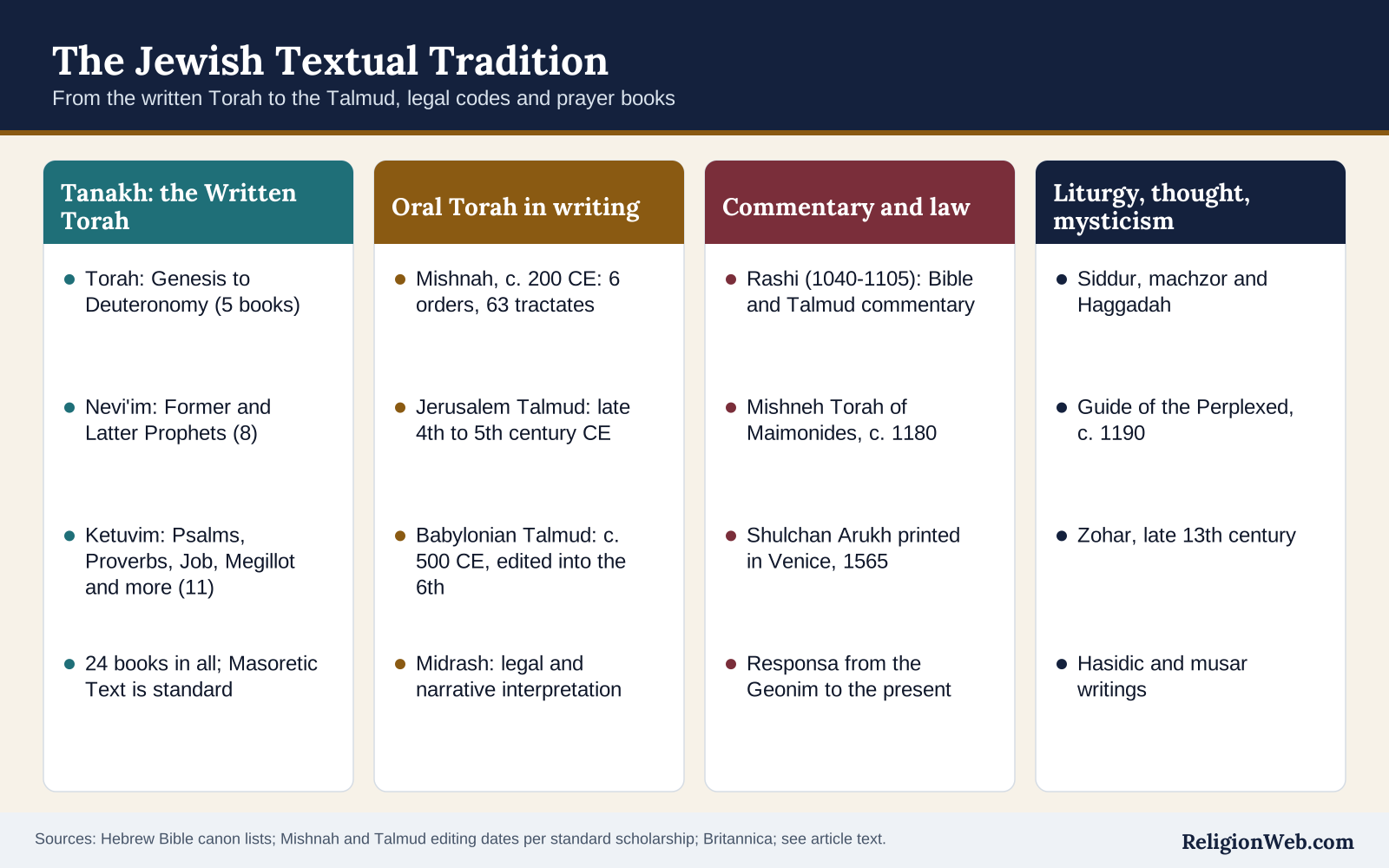
The earliest great book of the Oral Torah is the Mishnah, the Hebrew word for “repetition” or “study by repeating.” Tradition credits it to Rabbi Judah ha-Nasi (Judah the Prince), who is understood to have edited it in the Galilee around 200 CE, building on the work of earlier teachers known as the Tannaim. The Mishnah is organized into six orders (sedarim) comprising 63 tractates: Zeraim (“Seeds”) on agriculture and blessings, Moed (“Festival”) on Shabbat and the holidays, Nashim (“Women”) on marriage and divorce, Nezikin (“Damages”) on civil and criminal law, Kodashim (“Holy Things”) on sacrifices and the Temple, and Tohorot (“Purities”) on ritual purity. It is written in a terse Hebrew style, records the opinions of named rabbis, and often preserves minority views beside the majority ruling.
The two Talmuds
The Talmud, from a Hebrew root meaning “to study,” grew from generations of discussion about the Mishnah. A Talmud consists of the Mishnah together with the Gemara, the Aramaic-and-Hebrew record of the later teachers, the Amoraim, who analyzed it. Two Talmuds exist. The Jerusalem Talmud (Yerushalmi) was compiled in the Land of Israel and is generally dated to the late fourth or fifth century CE. The Babylonian Talmud (Bavli), produced in the rabbinic academies of Mesopotamia, was shaped over a longer period: traditional accounts name the sages Rav Ashi and Ravina as its principal editors around 500 CE, while many historians place its final editing in the sixth century CE. The Babylonian Talmud became by far the more influential and is the text meant when people say simply “the Talmud.”
The Babylonian Talmud comments on 37 of the Mishnah’s 63 tractates and runs to 2,711 double-sided folio pages in the standard Vilna edition printed in the late nineteenth century. Its pages have a characteristic design, inherited from the first complete printing by Daniel Bomberg in Venice in the early 1520s: the central text is surrounded by the commentary of Rashi and the additions of the Tosafists. Study is traditionally done in pairs, called chavruta, who read aloud and argue with each other. The Talmud records disagreement faithfully, including minority opinions and unresolved questions, and its argumentative form is one reason Jewish legal reasoning is often described as dialogical.
Midrash and Targum
Alongside the two Talmuds stands midrash, a term for rabbinic interpretation of scripture that draws out meaning from the wording of the biblical text. Halakhic midrash such as the Mekhilta, Sifra and Sifre derives law from the Torah’s verses; aggadic or homiletical midrash, such as the collections called Midrash Rabbah, expands on narrative and ethics through stories and parables. Targumim, Aramaic translations of the Bible such as Targum Onkelos on the Torah, were read aloud in ancient synagogues so that listeners could follow Hebrew readings in the language they spoke.
Codes, Commentaries and Later Literature
Commentaries and responsa
Because the Talmud is dense, medieval teachers wrote commentaries that are now studied with it. Rabbi Shlomo Yitzchaki, known as Rashi (1040-1105) of Troyes in northern France, produced running commentaries on both the Bible and the Talmud that remain the standard first guides. His successors and descendants, the Tosafists, added probing analytical glosses. Another major genre is the responsum (sheelot u-teshuvot, “questions and answers”), in which a rabbinic authority replies to a practical or legal query. Responsa have been written from the era of the Geonim, the heads of the Babylonian academies, to the present, and they record how halakha has responded to new circumstances such as printing, electricity, medicine and the internet.
Codes of law
To make the vast discussion usable, scholars wrote codes. Moses Maimonides completed his Mishneh Torah, a systematic code in fourteen books, around 1180 in Egypt. Jacob ben Asher produced the Arba’ah Turim in the fourteenth century. The best known later code is the Shulchan Arukh (“Set Table”) by Rabbi Joseph Karo (1488-1575), first printed in Venice in 1565 as a digest of his larger work, the Beit Yosef. Karo reflected primarily Sephardic custom, and Rabbi Moses Isserles of Kraków added glosses, called the Mappah (“Tablecloth”), that recorded Ashkenazi practice; the combined text became the standard reference for Orthodox observance. Later works such as the Mishnah Berurah, completed in the early twentieth century, continue to apply it to modern life.
Liturgical, philosophical and mystical works
Other genres shape practice and thought. The siddur (prayer book) and machzor (holiday prayer book) contain the liturgy, while the Haggadah guides the Passover seder. Medieval philosophy is represented by works such as Maimonides’ Guide of the Perplexed (written in Judeo-Arabic around 1190), and mystical literature by the Zohar, a commentary on the Torah that appeared in Spain in the late thirteenth century. Tradition attributes the Zohar to the second-century sage Shimon bar Yochai; most modern scholars, following Gershom Scholem, have attributed it largely to Moses de León, though the question remains debated. Many modern Jews also draw on works of Hasidic teaching, musar (ethical) literature and contemporary theology.
| Corpus | Contents | Approximate date | Role in Jewish life |
|---|---|---|---|
| Torah (Pentateuch) | Genesis through Deuteronomy: creation, patriarchs, Exodus, Sinai, commandments | Traditionally Mosaic; critical scholarship sees composition over several centuries before the Persian period | Read weekly in the synagogue; basis of mitzvot |
| Nevi’im (Prophets) | Joshua to Kings; Isaiah, Jeremiah, Ezekiel and the Twelve | Roughly 8th to 5th centuries BCE; canonical by the 2nd century BCE | Haftarah readings; ethical and national teaching |
| Ketuvim (Writings) | Psalms, Proverbs, Job, the five Megillot, Daniel, Ezra-Nehemiah, Chronicles | Varied; collection settled by the 2nd century CE | Psalms in daily prayer; Megillot at festivals |
| Mishnah | Six orders and 63 tractates of Oral Torah law | c. 200 CE, edited by Judah ha-Nasi | Foundation of rabbinic law; studied daily by many |
| Jerusalem Talmud | Gemara on much of the Mishnah, compiled in the Land of Israel | Late 4th to 5th century CE | Authoritative on Land-of-Israel questions |
| Babylonian Talmud | Gemara on 37 tractates; about 2,711 folios in the Vilna edition | c. 500 CE, with final editing in the 6th century | Central text of rabbinic study and halakhic reasoning |
| Midrash collections | Interpretation of scripture, legal and narrative | Roughly 3rd to 12th centuries CE | Sermons, study, source of stories and ethical teaching |
| Mishneh Torah and Shulchan Arukh | Systematic law codes | c. 1180 and 1565 | Practical reference for observance |
| Zohar | Mystical commentary on the Torah | Late 13th century | Central text of Kabbalah and a source of customs |
Canon, Manuscripts and Textual History
How the canon took shape
The Hebrew Bible did not appear as a finished book on a single date. Scholars generally think the Torah reached canonical standing first, perhaps by the fifth century BCE, followed by the Prophets, which were treated as a fixed collection by about the second century BCE; the Writings were the last to be settled, and the process was probably complete only by the second century CE. Older textbooks credited a “Council of Jamnia” at Yavneh around 90 CE with closing the canon, but most specialists now regard that account as unsupported by the evidence. Rabbinic literature itself records continued debate about whether Ecclesiastes, Song of Songs and Esther belonged among the sacred books, before their status was affirmed.
Masoretic Text, ancient translations and the Dead Sea Scrolls
The standard Hebrew text of the Tanakh is the Masoretic Text, preserved and annotated by scribal scholars called Masoretes who worked mainly in Tiberias between roughly the sixth and tenth centuries CE, adding vowel signs and cantillation marks to the consonantal text. The Aleppo Codex, written in the tenth century, and the Leningrad Codex, completed in 1009 CE or about then, are the great surviving manuscripts of that tradition. The Greek translation known as the Septuagint, made by Jews in Alexandria beginning in the third century BCE, sometimes differs from the Masoretic wording and shows that more than one form of some books circulated in antiquity.
The discovery of the Dead Sea Scrolls near Qumran between 1947 and 1956 added a new layer. About 981 manuscripts were assembled from eleven caves and are dated from the third century BCE to the first century CE; they include fragments of every book of the Hebrew Bible except Esther. Some of these biblical texts agree closely with the Masoretic tradition, while others, such as certain copies of Exodus and Samuel, differ noticeably, which suggests a stable core accompanied by considerable textual variety before the rabbinic period. Most scholars therefore see the scrolls as evidence of both remarkable continuity and a diversity that later tradition narrowed.
Core Beliefs and Theology: God, Covenant, Commandments and the World to Come
One God and the Shema
Monotheism and the nature of God
The first conviction of Judaism is that God is one. In Jewish teaching God is the creator of the universe, is not a body and has no image, and is both beyond the world and intimately concerned with it. Biblical and rabbinic writers speak of God with many names and images: the four-letter Name written in Hebrew as YHWH, which traditional Jews do not pronounce and replace in reading with Adonai (“my Lord”) or HaShem (“the Name”); the title Elohim; and images of God as king, shepherd, parent, judge and rescuer. Rabbinic literature also speaks of the Shekhinah, the divine presence dwelling among the people, and later Kabbalistic writers described God’s unknowable essence as Ein Sof, “without end.”
Medieval philosophers emphasized how carefully language about God has to be used. Moses Maimonides argued that because God has no body or limits, the Bible’s physical descriptions are figures of speech, and that human beings can say more reliably what God is not than what God is. Others in the tradition, especially mystics and Hasidic teachers, stressed the nearness of God and the sense in which the world is filled with divine presence. These approaches coexist, and they illustrate a general feature of Jewish thought: central convictions are held together with a long habit of questioning.
The Shema and the love of God
The best-known statement of Jewish monotheism is a single verse from Deuteronomy, spoken twice daily and, by tradition, at the hour of death.
HEAR, O ISRAEL: THE LORD OUR GOD, THE LORD IS ONE. And thou shalt love the LORD thy God with all thy heart, and with all thy soul, and with all thy might.
Deuteronomy 6:4-5, The Holy Scriptures: A New Translation (Jewish Publication Society, 1917)
Classical commentators read the first verse in two ways. The rendering above takes it as a proclamation that the LORD, Israel’s God, is a single God; Rashi, drawing on a verse in the prophet Zechariah, understood it as saying that the LORD, who is our God now, will in time be acknowledged as the only God by all humanity, while Rashbam and Abraham ibn Ezra preferred a rendering close to “the LORD is our God, the LORD alone.” Rabbinic tradition also interpreted the love of God broadly. A teaching in the Mishnah applies the phrase “with all your heart” to loving God with both the good and the evil inclination, and reads “with all your soul” as including readiness to give up one’s life, a reading that the Talmud connects with the death of Rabbi Akiva and that shaped how Jews later remembered martyrs. The Shema is not only recited but also written: its words are placed inside tefillin and mezuzot, discussed in later sections.
Covenant, Chosenness and Responsibility
Covenant from Noah to Sinai
The idea of a covenant, a binding relationship with obligations on both sides, organizes the entire biblical story. Genesis describes a covenant with Noah after the flood, which rabbinic tradition understands to apply to all humanity, and a covenant with Abraham, who is promised descendants and land and whose male descendants are to be circumcised. The decisive moment for Judaism is the covenant at Mount Sinai in the book of Exodus, where the people hear the Ten Commandments and accept the Torah. Before the revelation, the text records the terms in which God offers the relationship.
and ye shall be unto Me a kingdom of priests, and a holy nation.
Exodus 19:6, The Holy Scriptures: A New Translation (Jewish Publication Society, 1917)
Rabbinic interpretation reads “kingdom of priests” as a call to the entire people to live under a discipline of holiness. The Jewish liturgy returns to the Sinai covenant constantly, and the festival of Shavuot commemorates it. A further biblical covenant is made with King David, whose line is the basis of Jewish messianic hope, and the prophets repeatedly describe the relationship in the language of marriage or of a legal suit when the people fail their obligations.
What “chosen people” means
The idea that Israel is a chosen people is among the most widely discussed, and most often misunderstood, Jewish concepts. In the Torah and prophets, chosenness is tied to responsibility: the prophet Amos, speaking for God, says in effect that because Israel alone has been singled out, it will be held to a higher standard of accountability. Rabbinic texts speak of Israel being chosen to receive the commandments, not of Jews being innately superior, and a position recorded in the Tosefta holds that righteous people of every nation have a place in the World to Come. Maimonides ruled that this is so for those who observe the seven Noahide laws, which the Talmud describes as a universal moral code: prohibitions of idolatry, blasphemy, murder, sexual immorality, theft and eating flesh torn from a living animal, together with the obligation to establish courts of justice.
Modern Jewish movements have interpreted chosenness differently. Many Orthodox thinkers affirm it as a real divine selection for a particular task. Mordecai Kaplan, the founder of Reconstructionist Judaism, rejected the doctrine as untenable and removed it from the liturgy of his movement. Reform and Conservative thinkers have often reframed it as a mission or vocation of service and moral example. These are internal Jewish debates, and they show that the concept has no single authoritative modern meaning.
Commandments, Halakha and the Ethical Life
Mitzvot and the structure of halakha
Covenant becomes concrete in the mitzvot. A statement in the Talmud attributed to Rabbi Simlai says that 613 commandments were given to Moses: 365 prohibitions, corresponding to the days of the solar year, and 248 positive commandments, corresponding to the limbs of the human body. Later scholars, most famously Maimonides in his Book of the Commandments, drew up lists, and the traditional count is now standard even though lists differ in details. Many commandments, such as those concerning the Temple sacrifices, cannot be performed without a Temple, so halakha distinguishes what is practicable now from what is not.
Rabbinic tradition divides mitzvot into those between a person and God, such as prayer and Shabbat, and those between one person and another, such as honesty and charity. It also distinguishes decrees whose reasons are given from those, often called chukim, whose rationale is not stated, and it encourages Jews to observe both. The discussion in the Talmud continues with a famous passage that records how the prophets reduced the commandments to a few principles. One of them is the verse from Micah that many Jews cite as a summary of the ethical task.
It hath been told thee, O man, what is good, And what the LORD doth require of thee: Only to do justly, and to love mercy, and to walk humbly with thy God.
Micah 6:8, The Holy Scriptures: A New Translation (Jewish Publication Society, 1917)
Reading this verse as a summary does not cancel the rest of the law. The rabbinic principle is that such summaries identify the spirit of the whole while the detailed commandments remain binding, and the same story is told of the sage Hillel, who, when asked by a prospective convert to explain the Torah while standing on one foot, answered that what is hateful to you should not be done to another, adding that the rest is commentary and that he should go and study it.
How halakha is interpreted and changed
Halakha is not a static code but a legal tradition. Rabbis reason from the Torah, the Mishnah and the Talmud and from the precedents set in codes and responsa, and they adjust practice using tools the tradition itself recognizes: interpretation of a text, communal decrees (takkanot), recognition of custom (minhag), and the principle of pikuach nefesh, according to which saving a life overrides nearly every other commandment. Orthodox authorities hold that this process operates within boundaries fixed by the Written and Oral Torah and that the content of the law is binding. Conservative Judaism describes halakha as binding but historically evolving, and its Committee on Jewish Law and Standards issues rulings accordingly. Reform Judaism treats the ethical commandments as binding and regards ritual practice as a matter of informed personal choice and communal guidance. Details on the movements appear in a later section and in the articles on Orthodox Judaism, Conservative Judaism and Reform Judaism.
Human Nature, Messiah and the World to Come
Human nature, sin and repentance
Judaism does not teach original sin. Rabbinic thought describes every person as having two inclinations, the yetzer ha-tov (good) and the yetzer ha-ra (evil or self-serving), and holds that the second, properly channeled, is also a source of ambition, family and creativity. Human beings are held to have free will, and the tradition teaches that sin can be remedied through teshuvah, literally “return.” Repentance involves acknowledging the wrong, expressing regret, making restitution to the person wronged where possible, and resolving not to repeat it. The Days of Awe from Rosh Hashanah to Yom Kippur are devoted to this process.
Messiah and the messianic age
The Hebrew word mashiach means “anointed” and in the Bible refers to kings and priests. Over time it came to denote an ideal king of the line of David who will restore justice and peace. In Maimonides’ classic account, the Messiah will be a human leader who gathers the Jewish exiles, rebuilds the Temple, and leads the world toward knowledge of God, and the age will unfold within nature rather than by overturning it. Reform Judaism in the nineteenth century reinterpreted the hope as a universal messianic age without a personal Messiah, while Orthodox communities retain the traditional belief and pray for the Messiah daily. Within Orthodoxy, some adherents of Chabad Hasidism regarded the late Lubavitcher Rebbe, Menachem Mendel Schneerson (1902-1994), as the Messiah, a view that other Orthodox authorities reject.
The afterlife, resurrection and the World to Come
The Hebrew Bible says relatively little about life after death; the dead descend to Sheol, a shadowy place. Belief in resurrection appears in the book of Daniel and was affirmed by the Pharisees, and it entered the daily prayer called the Amidah. The Mishnah teaches that all Israel has a share in the World to Come (Olam Ha-Ba) and lists exceptions that include those who deny the doctrine of resurrection or that the Torah comes from heaven. Rabbinic literature also describes Gehinnom as a place of purification and judgment, usually for a limited time, rather than eternal punishment.
Modern Jews hold a wide range of views. Orthodox teaching affirms bodily resurrection in the messianic era. The 1885 Pittsburgh Platform of Reform rabbis rejected bodily resurrection in favor of belief in the immortality of the soul, and many Reform and Conservative prayer books alter the traditional wording. Many contemporary Jews, including the religiously committed, give the question less attention than the demands of this life, in keeping with a tradition that has always emphasized how to live.
Thinkers and Systems of Belief
Maimonides and the Thirteen Principles
No official creed binds all Jews, but the closest approach is the set of Thirteen Principles of Faith that Maimonides included in his commentary on the Mishnah in the twelfth century. They affirm God’s existence, unity, incorporeality and eternity; that God alone should be worshiped; prophecy and Moses’ preeminence among the prophets; that the Torah is from heaven and will not be replaced; God’s knowledge of human deeds and reward and punishment; and the coming of the Messiah and the resurrection of the dead. A hymn based on them, Yigdal, appears in many prayer books. Other medieval thinkers, including Hasdai Crescas and Joseph Albo, proposed fewer or different principles, and the tradition has not treated Maimonides’ list as binding in the way creeds are binding elsewhere.
Kabbalah, Hasidism and modern theology
Kabbalah, the Jewish mystical tradition, describes the divine as manifesting through ten sefirot, or emanations, and presents human actions as having cosmic effects. In the sixteenth century the Safed teacher Isaac Luria developed the idea that the world’s brokenness can be repaired through human deeds, a concept later associated with the phrase tikkun olam. Hasidism, founded in eighteenth-century eastern Europe, popularized mystical themes through joyous prayer and devotion to charismatic teachers. In the twentieth century, Abraham Joshua Heschel wrote about prophetic ethics and the sanctity of time, Joseph B. Soloveitchik developed a philosophy of halakhic life, and Martin Buber and Franz Rosenzweig explored relationship with God as dialogue. After the Holocaust, thinkers such as Emil Fackenheim and Richard Rubenstein asked whether and how Jews could continue to speak about divine presence, producing the most searching Jewish theological debate of recent decades.
Origins and Ancient History: From Ancient Israel to the Second Temple
Israel and Judah in the Biblical Period
Ancestors, Exodus and the question of sources
The Hebrew Bible narrates Jewish origins as a sequence of family stories and national events: the call of Abraham, the lives of Isaac and Jacob, the descent of Jacob’s family into Egypt, the Exodus under Moses, the revelation at Sinai and the wandering that ends at the edge of the promised land. For believing Jews these accounts are sacred history and the basis of identity; the Passover seder asks each participant to see themselves as having personally come out of Egypt. Historians approach the same material with different tools. Many find that the patriarchal and Exodus narratives cannot be confirmed by external records in the form the Bible tells them, and some see the stories as preserving memories of smaller movements of people or of Egyptian influence in Canaan that were later expanded into a national epic. Others argue for a historical core. The present article reports the traditional narrative as tradition and the scholarly debate as debate, and it does not claim more certainty than the evidence allows.
Settlement, monarchy and the two kingdoms
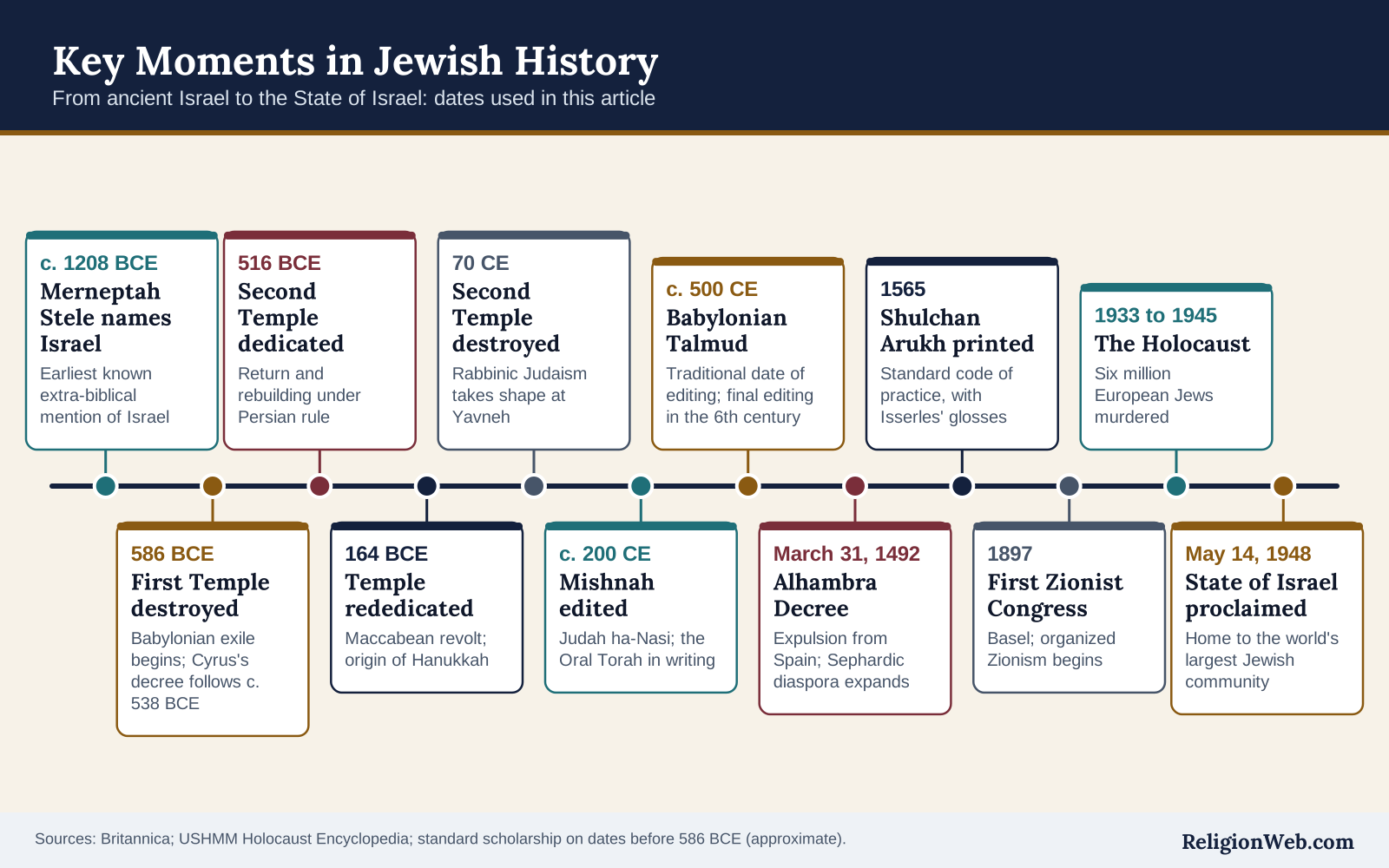
The earliest outside reference to Israel is the Merneptah Stele, an Egyptian victory inscription from about 1208 BCE that lists a people called Israel among those defeated in Canaan; most Egyptologists read the name this way and take it to mean a population group rather than an established state. Archaeologists associate the central highlands of Canaan in the early Iron Age, roughly 1200 to 1000 BCE, with the emergence of a distinct Israelite culture. The Bible places the establishment of a monarchy under Saul, David and Solomon in the tenth century BCE, and Solomon is credited with building the First Temple in Jerusalem. Historians disagree about the size and power of this united kingdom, and the debate over its scale continues.
After Solomon the Bible reports a division into the northern Kingdom of Israel and the southern Kingdom of Judah, traditionally around 930 BCE. A ninth-century stele found at Tel Dan refers to a “House of David,” and Assyrian and Moabite inscriptions mention Israelite kings, giving independent support for the period of the two kingdoms. In 722 BCE the Assyrian Empire destroyed Samaria, the northern capital, and deported many of its people; Judah survived for more than a century longer. This was also the age of the classical prophets, such as Isaiah and Amos, who criticized injustice and warned of the consequences of abandoning the covenant, and whose words became part of Jewish scripture and liturgy.
The Babylonian exile and the return
In 597 BCE the Babylonian king Nebuchadnezzar II captured Jerusalem and deported King Jehoiachin and part of the elite, and in 586 BCE (some sources give 587) his army destroyed the city and the First Temple. The exile in Babylonia, along with settlement in Egypt and elsewhere, marked a turning point. Without a Temple, the community in exile preserved its identity through study, prayer and the writing and editing of texts that became the Torah and the historical books. When Cyrus the Great of Persia conquered Babylon in 539 BCE, he allowed communities to return to their homelands; historical sources and the Hebrew Bible associate a decree of about 538 BCE with permission for Judeans to go back to Jerusalem. The Second Temple was completed and dedicated in 516 BCE, according to the generally accepted chronology, and the books of Ezra and Nehemiah describe the reforms and the rebuilding of Jerusalem’s walls in the fifth century BCE.
The Persian period set patterns that endured. Judah became a province with a religious center in the Temple, and Torah observance was strengthened under leaders such as Ezra the scribe. Large Jewish communities remained in Babylonia and began to flourish there. Because Judeans lived for generations under Achaemenid Persian rule, scholars have asked whether Iranian religious ideas influenced later Jewish thinking about angels, the end of days and the afterlife; the question is debated, and some see evidence of such influence while others emphasize independent development within Israelite tradition. Readers who want to learn about Iranian religious tradition can consult the article on Zoroastrianism.
The Second Temple Period
Hellenistic rule and the Maccabean revolt
Alexander the Great conquered the region in 332 BCE, and after his death Judea came under the Ptolemies of Egypt and then, from about 200 BCE, the Seleucid Empire. Greek language, city life and philosophy attracted some Jews and alarmed others. In 167 BCE the Seleucid king Antiochus IV Epiphanes, in a crisis whose causes historians still debate, banned Jewish practices such as Torah observance and circumcision and installed an altar to a foreign deity in the Jerusalem Temple. A rebellion led by the priestly Hasmonean family, among them Judah Maccabee, recaptured and rededicated the Temple in 164 BCE, the event commemorated at Hanukkah. The Hasmoneans later established an independent kingdom, which lasted from about 140 BCE until 63 BCE.
The story of the revolt is told in the books of 1 and 2 Maccabees, which are not part of the Hebrew Bible but are preserved in Catholic and Orthodox Christian canons, and in the writings of the historian Josephus. The Talmud’s account of Hanukkah emphasizes a miracle of lights rather than the military victory, a shift whose meaning is discussed in the section on holidays.
Pharisees, Sadducees, Essenes and other groups
Judaism in the late Second Temple period was not uniform. Josephus describes several schools: the Pharisees, who emphasized study, oral tradition and extending holiness to daily life; the Sadducees, linked to the priestly aristocracy, who held to the written Torah and the Temple service; and the Essenes, who withdrew from mainstream society, some in communities that scholars associate with the Dead Sea Scrolls. There were also revolutionary movements, apocalyptic writers and teachers who attracted followers. The early Jesus movement arose in this environment, among Jews in Judea and Galilee, and only gradually became a separate religion, a story told in the article on Christianity. After 70 CE the Pharisaic and scribal tradition was the one that survived and shaped what became rabbinic Judaism.
Roman rule and the destruction of the Temple
The Roman general Pompey took Jerusalem in 63 BCE, ending Hasmonean independence. Herod, who took Jerusalem with Roman backing in 37 BCE and ruled as king, rebuilt and enlarged the Temple on a monumental scale beginning around 20 BCE, creating the great platform whose western retaining wall still stands. In 6 CE Judea became a Roman province. Tension between Jews and Roman authorities grew into the Great Revolt of 66 CE, and in 70 CE the Roman army under Titus captured Jerusalem and destroyed the Temple; Jewish tradition marks the day as the ninth of Av. The last rebel stronghold, Masada, fell in 73 or 74 CE. A later uprising led by Simon bar Kokhba in 132 to 135 CE was crushed by the Emperor Hadrian, after which Jews were barred from Jerusalem, which was refounded as the Roman colony Aelia Capitolina. These events dispersed many Jews and broke the connection between worship and the sacrificial system, forcing a radical reorganization of Jewish religious life.
From Rabbinic Judaism to the Present: Medieval, Early Modern and Modern History
The Rabbinic Revolution, 70 to About 640 CE
Yavneh and the rise of the rabbis
The loss of the Temple in 70 CE could have ended Jewish religious life. Instead a remarkable reorganization occurred. According to rabbinic tradition, the Pharisaic scholar Yohanan ben Zakkai left besieged Jerusalem and obtained permission from the Romans to establish a center of learning at Yavneh (Jamnia) on the coastal plain. There, and later in Galilean towns such as Usha, Sepphoris and Tiberias, scholars known as Tannaim collected and discussed teachings. Prayer, charity and the study of Torah took on the roles once associated with the sacrificial service, and the synagogue became the central communal institution. The rabbis did not abandon the hope of a restored Temple, and the liturgy has asked for it ever since, but they built a form of Judaism that could continue without one.
The work of the Tannaim culminated around 200 CE in the Mishnah. The Roman Empire became officially Christian in the fourth century, and Jewish life in the Land of Israel declined under increasing restrictions, but the schools of Tiberias continued to produce the Jerusalem Talmud. A tradition preserved by later authorities holds that a patriarch named Hillel II established a fixed calendar in 358 or 359 CE, a claim discussed in the section on the calendar.
Babylonia, the Talmud and the Geonim
The larger Jewish population lived in Babylonia, in what is now Iraq, under the Parthian and then the Sasanian Empire. The academies at Sura and Pumbedita developed the Babylonian Talmud over several centuries. After the Arab conquests of the seventh century brought Babylonia, Palestine and Egypt under Muslim rule, the heads of these academies, called Geonim, served as the leading legal authorities for Jews across the Islamic world and beyond. They answered questions by letter, compiled the first complete prayer books and, in the case of Saadia Gaon (882 to 942), wrote philosophical works and translated the Bible into Arabic. Their responsa are among the first great sources for the way the Talmud was applied in daily life.
Medieval Jewish Worlds
Jews in the Islamic world and Christian Europe
From the seventh century, most Jews lived under Islamic rule, where they were treated as a protected minority, subject to certain taxes and restrictions but generally permitted to practice their religion. Jewish culture flourished in many places, most famously in al-Andalus, the Muslim-ruled Iberian peninsula, between roughly the tenth and twelfth centuries, where poets such as Solomon ibn Gabirol and Judah Halevi, grammarians, physicians and statesmen created a literature in Hebrew and Arabic. The documents of the Cairo Genizah, a storeroom of manuscripts discovered in the Ben Ezra Synagogue in the late nineteenth century, give an unusually detailed picture of Mediterranean Jewish life in the same period. Conditions varied by place and ruler, and periods of tolerance were interrupted by episodes of persecution, such as the Almohad conquests of the twelfth century, which prompted Moses Maimonides’ family to leave Spain. The perspective of the Muslim world on this shared history is introduced in the article on Islam.
In Christian Europe, Jewish communities settled from the early Middle Ages in the Rhineland, northern France, Italy and Spain, and later in Poland and Lithuania. They worked in trade, finance, medicine and crafts under privileges granted by kings, bishops and cities that could be withdrawn. Jewish life in these regions was marked by deep scholarship, including that of Rashi, and by recurring violence. In 1096, bands of crusaders attacked Jewish communities in the Rhineland cities of Speyer, Worms and Mainz. The first known accusation that Jews murdered a Christian child for ritual purposes, the so-called blood libel, was made in Norwich, England, in 1144, and similar accusations spread. During the Black Death of 1348 to 1351, rumors that Jews had poisoned wells led to massacres in many towns. In 1215 the Fourth Lateran Council required Jews to wear distinguishing marks. Rulers expelled Jews from England in 1290 and from France in 1306, and the Alhambra Decree of March 31, 1492, ordered Jews to convert or leave the Spanish kingdoms; Portugal followed with forced conversion in 1497. Many exiles resettled in the Ottoman Empire, North Africa, Italy and the Netherlands, forming the core of the Sephardic diaspora. Historians use “antisemitism” for the hostility directed at Jews as Jews, and they distinguish its medieval religious forms from the racial ideology that developed in the nineteenth century.
Kabbalah, Safed and the early modern centers
The sixteenth century brought new centers of learning. In Safed in Galilee, then in the Ottoman Empire, Joseph Karo wrote the Shulchan Arukh, Isaac Luria taught his kabbalistic system, and Solomon Alkabetz composed the hymn Lecha Dodi that is sung on Friday evenings. The Jewish community of Poland-Lithuania became the largest in Europe, governed in part through a national council, and was devastated by the Cossack uprising of 1648 to 1649. In 1665 and 1666 a charismatic claimant to the messianic role, Sabbatai Zevi, drew widespread support before converting to Islam under pressure from the Ottoman sultan, a disappointment that led many rabbis to suspect mystical enthusiasm for decades. In the eighteenth century, Israel ben Eliezer, the Baal Shem Tov (about 1700 to 1760), initiated Hasidism, a revival movement centered on heartfelt prayer and devotion to charismatic teachers, while the scholar Elijah ben Solomon, the Vilna Gaon (1720 to 1797), became the leading figure of the opposing tradition of rigorous Talmudic study.
Emancipation, Reform and the Rise of Modern Movements
The Haskalah and legal emancipation
In the eighteenth century, a movement of Jewish intellectuals known as the Haskalah, or Jewish Enlightenment, urged Jews to engage with European languages and sciences. Its best-known figure was Moses Mendelssohn (1729 to 1786), a philosopher in Berlin who translated the Torah into German. Meanwhile European states began to grant Jews civil rights. The French National Assembly emancipated the Jews of France in 1791, and during the nineteenth century legal equality spread across much of western and central Europe, though often unevenly and with setbacks. In the Russian Empire, most Jews were confined to the Pale of Settlement, and violent pogroms after 1881 led about two million Jews to emigrate over the next three decades, most to the United States.
New movements and Zionism
Emancipation raised the question of how to be both Jewish and a citizen, and Jews answered in several ways. Reform Judaism arose in Germany, with an early service in Seesen in 1810 and a Reform temple in Hamburg in 1818, and in America adopted the Pittsburgh Platform in 1885. The Positive-Historical school of Zecharias Frankel, from which Conservative Judaism developed, and the Orthodox movement associated with Samson Raphael Hirsch, emerged in the 1840s and 1850s as responses to Reform. Hasidism and the Lithuanian yeshiva movement continued as forms of traditional life, and Mordecai Kaplan’s Reconstructionism took shape in the United States in the 1920s and 1930s. These movements are described in the section on branches.
Zionism, a national movement for Jewish self-determination in the Land of Israel, grew from Eastern European Hibbat Zion societies and from Theodor Herzl’s writings after the Dreyfus Affair in France. The first Zionist Congress met in Basel in August 1897. Zionists included religious and secular Jews, and many Orthodox and Reform authorities of the time opposed the movement, each for different reasons. The Balfour Declaration of November 2, 1917, in which the British government expressed support for a Jewish national home in Palestine, shaped the later history of the region.
Catastrophe and Renewal in the Twentieth Century
The Holocaust
The Holocaust was the systematic, state-sponsored persecution and murder of six million European Jews by Nazi Germany and its allies and collaborators between 1933 and 1945. About nine million Jews lived in Europe in 1933, and nearly two of every three were killed. Adolf Hitler became chancellor of Germany in January 1933. The Nuremberg Laws announced on September 15, 1935, stripped Jews of citizenship and banned marriages between Jews and other Germans; they defined Jewishness by the religious affiliation of a person’s grandparents, not by anything a person believed. On the night of November 9 to 10, 1938, called Kristallnacht, Nazis and their supporters destroyed more than 1,400 synagogues, ransacked thousands of Jewish-owned businesses and sent about 26,000 Jewish men to concentration camps. After the German invasion of the Soviet Union in 1941, mass shootings and the use of gas vans in the occupied territories killed as many as two million Jews. On January 20, 1942, senior Nazi officials met at Wannsee near Berlin to coordinate what they called the “Final Solution,” the annihilation of the roughly eleven million Jews they listed across Europe. Nearly 2.7 million Jews were murdered at the five killing centers of Chelmno, Belzec, Sobibor, Treblinka and Auschwitz-Birkenau. Soviet forces liberated Auschwitz on January 27, 1945, and the war in Europe ended in May 1945. The Nazi regime also persecuted and murdered Roma, people with disabilities, Poles, Soviet prisoners of war and others, and many non-Jews risked their lives to rescue Jews.
The Holocaust ended thousands of years of Jewish life in many European towns and destroyed the great centers of Yiddish-speaking and Talmudic learning in Poland and Lithuania. It also reshaped Jewish religious thought and commemoration. The memory of the Shoah, the Hebrew term for the catastrophe, is observed in Israel and abroad on Yom HaShoah, the 27th of Nisan, and some communities add Holocaust readings to the Tisha B’Av liturgy. Postwar relations between Jews and Christians also changed: in the declaration Nostra Aetate of October 1965, the Second Vatican Council rejected the charge of collective Jewish guilt for the death of Jesus, a development described in the article on Catholic Christianity.
The State of Israel and postwar Jewish communities
The United Nations General Assembly voted on November 29, 1947, to recommend partitioning Mandatory Palestine into Jewish and Arab states, and on May 14, 1948, David Ben-Gurion proclaimed the establishment of the State of Israel. The war that followed also displaced hundreds of thousands of Palestinian Arabs, an event Palestinians remember as the Nakba, and the political questions arising from these events remain contested; this article concerns Jewish religious history and does not take positions on them. In the following decades, hundreds of thousands of Jews left Arab countries and Iran, many for Israel, and about a million Jews and their families left the former Soviet Union for Israel after 1989. The United States became home to the largest diaspora, where Jews built a variety of synagogues, schools and organizations.
Chronology and Continuity
Key dates in Jewish history
The table gathers the main dates discussed above. Early dates are approximate and rest on a mixture of biblical, archaeological and documentary evidence.
| Date | Event | Significance |
|---|---|---|
| c. 1208 BCE | Merneptah Stele names Israel | Earliest known extra-biblical mention of Israel |
| c. 10th century BCE | Monarchy of David and Solomon (traditional dating) | First Temple in Jerusalem; scale of the kingdom debated |
| 722 BCE | Assyria destroys Samaria | End of the northern Kingdom of Israel |
| 586 BCE | Babylonians destroy Jerusalem and the First Temple | Exile in Babylonia begins; some sources date this 587 BCE |
| 538 BCE and 516 BCE | Cyrus’s decree; Second Temple dedicated | Return and rebuilding under Persian rule |
| 167 to 164 BCE | Maccabean revolt and rededication of the Temple | Origin of Hanukkah; Hasmonean dynasty follows |
| 70 CE | Romans destroy the Second Temple | Beginning of rabbinic Judaism at Yavneh |
| 132 to 135 CE | Bar Kokhba revolt | Failed uprising; Jews barred from Jerusalem |
| c. 200 CE | Mishnah edited | Foundation of the Oral Torah in writing |
| c. 500 to 6th century CE | Babylonian Talmud completed | Central text of rabbinic study |
| 1096 to 1306 | Rhineland massacres, blood libel, expulsions from England and France | Persecution in medieval Christian Europe |
| c. 1180 and 1565 | Mishneh Torah; Shulchan Arukh printed | Major law codes |
| March 31, 1492 | Alhambra Decree | Expulsion from Spain; Sephardic diaspora expands |
| 1791 and 1885 | Emancipation in France; Pittsburgh Platform | Modern citizenship and the first Reform platform |
| 1897 and 1917 | First Zionist Congress; Balfour Declaration | Organized Zionism and a British statement of support |
| 1933 to 1945 | The Holocaust | Six million Jews murdered |
| May 14, 1948 | State of Israel proclaimed | Jewish sovereignty restored; largest Jewish community today |
Patterns across the centuries
Several threads recur through this history. Jewish communities repeatedly adapted their institutions when a center was lost, from the Temple to the synagogue, from Babylonia to Spain to Poland to North America. Learning was cultivated even in conditions of insecurity, so that texts such as the Talmud served as a portable homeland. And Jews lived not as a single bloc but as many communities shaped by the societies around them, as the distinct histories of Ashkenazi, Sephardi and Mizrahi Jews, among others, demonstrate. The sections that follow describe how those developments appear in belief, worship and daily life.
Central Figures, Teachers and Sources of Religious Authority
Biblical Founders and Leaders
The patriarchs, matriarchs and the people of Israel
Jewish tradition begins its human story with Abraham and Sarah, followed by Isaac and Rebecca, and Jacob with Leah and Rachel. Abraham is remembered as the first to recognize one God and as the recipient of the covenant of circumcision; Jacob receives the name Israel after wrestling with a mysterious figure, and his twelve sons are the ancestors of the tribes of Israel. In prayer, the opening blessing of the Amidah invokes God as the God of Abraham, Isaac and Jacob, and many liberal congregations add the matriarchs. Jews do not generally venerate these figures as saints or intermediaries. They are examples and ancestors, honored for what the tradition says about their trust, hospitality and moral struggles.
Moses, the prophets and the kings
Moses is the central human figure of the Hebrew Bible. He leads the Israelites out of Egypt, receives the Torah at Sinai and guides the people through the wilderness. Rabbinic tradition calls him Moshe Rabbenu, “Moses our teacher,” and the seventh principle in Maimonides’ list affirms that he was the greatest of the prophets. He is not worshiped, and the Bible says he was not permitted to enter the land. His sister Miriam and his brother Aaron, the first high priest, share leadership, and the later prophets, from Samuel and Elijah to Isaiah, Jeremiah and Ezekiel, are remembered as messengers who challenged kings and communities in the name of justice. The Talmud also names seven women prophets, including Sarah, Miriam, Deborah and Esther. David, the shepherd who became king and the traditional author of many Psalms, is the ancestor of the Messiah in Jewish expectation, and Solomon is remembered as the builder of the First Temple and the sage associated with Proverbs.
Rabbinic and Medieval Teachers
The sages of the Mishnah and Talmud
The founders of rabbinic Judaism are called “the Sages” (Chazal). Hillel and Shammai, leaders of rival schools around the turn of the era, shaped rabbinic debate; the school of Hillel is the one whose rulings usually became law, and the Talmud explains that this was because its students were gracious and taught the opinions of their opponents along with their own. Yohanan ben Zakkai reestablished study at Yavneh after 70 CE. Rabbi Akiva (about 50 to 135 CE) organized the oral traditions, taught that the commandment to love one’s neighbor as oneself is a great principle of the Torah, and was martyred by the Romans, and Judah ha-Nasi compiled the Mishnah. Later generations of Amoraim, including Rav Ashi, shaped the Talmud. The rabbis are honored as teachers, not as divine or semi-divine beings, and their disagreements are preserved with respect.
Medieval and early modern authorities
Among later authorities, Rashi (1040 to 1105) is the beloved commentator whose notes accompany nearly every printed Bible and Talmud. Moses Maimonides (1138 to 1204), physician, philosopher and jurist, wrote the Mishneh Torah and the Guide of the Perplexed and remains one of the most influential Jewish thinkers. Moses Nachmanides (1194 to 1270) was a Spanish Talmudist and Bible commentator with kabbalistic leanings. Joseph Karo (1488 to 1575) and Moses Isserles (about 1525 to 1572) produced the standard legal code. Isaac Luria (1534 to 1572) transformed Kabbalah, and Israel ben Eliezer, the Baal Shem Tov (about 1700 to 1760), inspired Hasidism. A short list cannot do justice to the many other scholars, women and men, who shaped Jewish thought.
| Figure | Period | Role and significance |
|---|---|---|
| Abraham | Traditionally the second millennium BCE | First patriarch; recipient of the covenant |
| Moses | Traditionally the Exodus era | Leader and lawgiver; the Torah is traditionally attributed to him |
| Hillel the Elder | Late 1st century BCE to early 1st century CE | Sage whose school’s rulings usually prevailed; famed for his ethical teaching |
| Yohanan ben Zakkai | 1st century CE | Founded the academy at Yavneh after 70 CE |
| Judah ha-Nasi | c. 200 CE | Compiled the Mishnah |
| Rashi | 1040 to 1105 | Commentator on the Bible and Talmud |
| Moses Maimonides | 1138 to 1204 | Jurist and philosopher; author of the Mishneh Torah |
| Joseph Karo | 1488 to 1575 | Author of the Shulchan Arukh |
| Israel ben Eliezer (Baal Shem Tov) | c. 1700 to 1760 | Founder of Hasidism |
| Abraham Joshua Heschel | 1907 to 1972 | Theologian of prophetic ethics and sacred time |
Religious Authority Today
Rabbis, cantors, scholars and others
A rabbi is a teacher and legal decisor, not a priest. Traditional ordination, semikhah, certifies that a person has mastered Jewish law and may rule on it; non-Orthodox seminaries ordain rabbis after a different course of study that includes pastoral training. The hazzan or cantor leads the singing of the prayers, a mohel performs circumcision, a sofer writes scrolls, and a dayan serves on a rabbinic court. Descendants of the biblical priests, the kohanim, and of the Levites keep a ceremonial status in some Orthodox and Conservative synagogues, such as receiving the first two Torah honors and reciting the priestly blessing on festivals; many Reform congregations do not distinguish them. In Hasidic communities the central figure is the rebbe, a charismatic spiritual leader, and in Sephardic and Middle Eastern communities the title hakham (“sage”) is used for rabbis.
The role of women has changed considerably. Regina Jonas was ordained as a rabbi in Germany in 1935 and was murdered at Auschwitz in 1944. Sally Priesand became the first woman ordained by a rabbinical seminary in the United States, at Hebrew Union College in 1972. Reconstructionist and Reform movements ordain women, the Jewish Theological Seminary voted in 1983 to admit women to the Conservative rabbinate, with the first ordination in 1985, and in Orthodox circles Yeshivat Maharat in New York began consecrating women as clergy in 2013, a development that other Orthodox bodies have opposed.
Authority without a central hierarchy
Judaism has no pope, council or single body that speaks for all Jews. In antiquity the Sanhedrin, a rabbinic high court, performed that role, but it ceased to function in late antiquity. Since then, authority has rested with rabbinic scholars whom communities recognize, with local courts, with movements and their rabbinical assemblies, and in Israel with the state-recognized Chief Rabbinate, established in 1921 under the British Mandate. This arrangement explains why Jewish law and practice show wide variation and why disputes can remain unresolved for generations: the tradition treats debate as a legitimate method rather than as a failure of order.
Worship, Prayer and the Rhythm of Daily Observance
The Daily Prayer Cycle
Shacharit, Mincha and Maariv
Traditional Jewish prayer takes place three times a day: Shacharit in the morning, Mincha in the afternoon and Maariv in the evening. According to the Talmud, these services correspond to the daily Temple offerings and also to prayers attributed to the patriarchs. After the destruction of the Temple, the rabbis taught that prayer had taken the place of sacrifice. On Shabbat, festivals and the new moon, an additional service called Musaf is added in remembrance of additional Temple offerings. Liturgy is gathered in the siddur and follows regional rites such as the Ashkenazi, Sephardi and Yemenite traditions, which differ in wording, melodies and customs but share a common structure.
The ideal is to pray with a minyan, a quorum of ten adults, because certain parts of the service, including the Kaddish and the public Torah reading, are said only in a community. A tradition attributed to the sage Rabbi Meir encourages the recitation of one hundred blessings each day, and observant Jews say blessings before and after eating and on many other occasions. Prayer is understood as a duty, a form of service (“service of the heart,” in rabbinic phrasing), and a means of expressing gratitude, petition and praise.
The Shema and the Amidah
Two units stand at the center of each service. The Shema, with its surrounding blessings, is the declaration of God’s unity and the acceptance of the commandments; it consists of three biblical passages (Deuteronomy 6:4-9, Deuteronomy 11:13-21 and Numbers 15:37-41) read in the morning and the evening. The Amidah, “the standing prayer,” also called the Shemoneh Esrei (“eighteen”), is recited silently while standing and facing Jerusalem. On weekdays it contains nineteen blessings that praise God, petition for knowledge, forgiveness, healing and redemption, and give thanks; on Shabbat and festivals the petitions are replaced by a blessing about the holiness of the day. Most services close with the Aleinu prayer and the mourners’ Kaddish, an Aramaic doxology that praises God and does not mention death.
Garments, Objects and Practices of Prayer
Tzitzit, tallit, tefillin and head coverings
Prayer is accompanied by physical objects. The Torah commands the Israelites to place fringes (tzitzit) on the corners of their garments as a reminder of the commandments, and the prayer shawl, the tallit, carries them; many Orthodox men also wear a smaller four-cornered undergarment with fringes through the day. Tefillin, small leather boxes containing handwritten parchment passages from Exodus and Deuteronomy, are bound on the arm and head during weekday morning prayer, fulfilling the verses that instruct Israelites to bind the words as a sign on the hand and between the eyes. They are not worn on Shabbat or festivals. Covering the head with a kippah or yarmulke is a custom that became nearly universal among Orthodox men and is also common among Conservative and many Reform Jews. In Orthodox practice, tallit and tefillin are worn by men, while Conservative, Reform and Reconstructionist women increasingly wear them as well.
Gender, language and variation in the service
Practices differ among movements. Orthodox synagogues seat men and women separately, count only men toward the minyan, and use traditional Hebrew liturgy with little change. Conservative synagogues have mostly adopted egalitarian practice, beginning with a 1973 decision of the Committee on Jewish Law and Standards that women could be counted in a minyan. Reform and Reconstructionist congregations include women fully, often add English readings and may use instrumental music on Shabbat, which Orthodox communities do not. These differences are explained in the sections on movements, and the Hebrew core of the prayers remains the shared ground across most communities worldwide.
Shabbat, Dietary Laws and Daily Observance
Shabbat: The Weekly Day of Rest
Origins and meaning
Shabbat is the seventh day of the week, set apart in the Torah as a day of rest and holiness. The Torah’s first account of it comes at the end of the creation story.
And on the seventh day God finished His work which He had made; and He rested on the seventh day from all His work which He had made. And God blessed the seventh day, and hallowed it; because that in it He rested from all His work which God in creating had made.
Genesis 2:2-3, The Holy Scriptures: A New Translation (Jewish Publication Society, 1917)
The Ten Commandments in Exodus ground Shabbat in creation, while the version in Deuteronomy grounds it in the liberation from slavery in Egypt, and rabbinic interpretation combines these themes: the day affirms God as creator and human freedom from endless labor. The Hebrew verbs for “remember” and “observe” the Sabbath are understood to point to positive celebration, such as kiddush and festive meals, and to prohibitions on certain kinds of work. Twentieth-century writers such as Abraham Joshua Heschel described Shabbat as “a palace in time,” a sanctuary built of hours rather than space, and the liturgy calls Shabbat a bride or queen who is welcomed each week.
Friday evening: candles, welcome and the first meal
Preparations begin during the week, since food, cleaning and clothing should be ready before Shabbat. Shortly before sunset on Friday the household lights at least two candles, traditionally done by the woman of the house though any member may do so, and recites a blessing, after which work ceases. The most common custom is to light eighteen minutes before sunset; in Jerusalem the practice is forty minutes before, and some communities use fifteen. Many congregations then hold Kabbalat Shabbat (“receiving the Sabbath”), a service of psalms and the hymn Lecha Dodi, written by Solomon Alkabetz in sixteenth-century Safed, that welcomes Shabbat as a bride, followed by the evening service.
At home the meal begins with songs, including a greeting to the Sabbath “angels,” a tribute to the woman of the house drawn from Proverbs, and a blessing of the children. The head of household or any participant recites kiddush, the sanctification over a cup of wine, and the family says the blessing over two loaves of challah, usually braided, covered in a cloth, which recall the double portion of manna that fell in the wilderness on the sixth day. The meal usually includes several courses, songs called zemirot, words of Torah and the grace after meals.
Saturday: worship, rest and the thirty-nine categories of work
On Saturday morning the community gathers for the longest service of the week, which includes the public reading of the weekly Torah portion, the haftarah reading from the Prophets, a sermon in many communities and the additional Musaf prayer. A festive lunch follows, and in the late afternoon a third meal, seudah shlishit, completes the day. Shabbat is also a time for study, rest, walks and visiting.
The Torah forbids “work” on Shabbat but does not define it. The Mishnah (tractate Shabbat, chapter 7) lists thirty-nine categories of creative labor, derived from the activities needed to build the Tabernacle, including sowing, baking, spinning, writing, building, kindling a fire and carrying objects from one domain to another. Rabbis have applied these categories to modern life. Orthodox authorities understand turning electric devices on or off, driving and using phones as prohibited, though they disagree about the reasoning; a Sabbath timer lets lights and appliances operate automatically, and a communal enclosure called an eruv symbolically extends the private domain so that residents can carry keys or push strollers within it. The principle of pikuach nefesh requires violating Shabbat to save a life, as in taking a woman in labor to a hospital.
Havdalah and the variety of Shabbat practice
Shabbat ends after nightfall, when three stars are visible, with the ceremony of Havdalah (“separation”). Participants recite blessings over a cup of wine, fragrant spices and a braided candle with several wicks, marking the separation between the holy and the ordinary. It is often accompanied by songs invoking the prophet Elijah and wishes for a good week.
Observance varies widely. Orthodox Jews observe the thirty-nine categories in detail. The Conservative movement’s Committee on Jewish Law and Standards permitted driving to synagogue in 1950, though many Conservative rabbis encourage walking, and Reform Judaism leaves the choice of observance largely to the individual. In the Pew Research Center’s 2014 to 2015 survey of Israel, nearly all Haredi and Dati Jews said they do not travel on the Sabbath, and about half of Masorti Jews and 95 percent of secular Jews do. In the United States in 2020, one in five Jews said they often mark Shabbat in a personally meaningful way, though not necessarily by following Jewish law.
Kashrut: Jewish Dietary Law
Biblical sources and basic rules
The dietary laws, called kashrut, are derived from chapters in Leviticus (11) and Deuteronomy (14) and elaborated in the Mishnah and Talmud. Food that is permitted is kosher, meaning fit or proper. Among land animals, only those that both chew the cud and have cloven hooves may be eaten, which permits cattle, sheep and goats and excludes pigs and camels. Fish must have fins and scales, which excludes shellfish, and the Torah lists forbidden birds, mostly predatory species. The Torah also forbids eating blood, so kosher meat comes from animals slaughtered by a trained shochet using a single cut and then soaked and salted or broiled to remove blood.
A second principle separates meat and dairy. Three verses in the Torah forbid boiling a kid in its mother’s milk, and the rabbis understood this as a prohibition on cooking or eating meat and milk together. Observant households thus keep separate sets of dishes, wait a period after eating meat before consuming dairy, and treat foods that are neither, such as vegetables, eggs and most fish, as pareve. Packaged foods and restaurants are certified by supervising agencies, indicated by a symbol known as a hechsher. During Passover, an additional set of rules removes chametz, leavened grain products, from the home.
Reasons and the range of practice
The Torah does not explain most dietary laws, and Jewish thinkers have offered a range of reasons: obedience to a divine command, a discipline of self-restraint, the sanctification of everyday life, compassion toward animals and the preservation of Jewish distinctiveness. Maimonides suggested both moral and health reasons, while other medieval authorities, such as Nachmanides, preferred spiritual ones. Modern scholars generally doubt that health was the principal rationale.
Practice varies. In the Pew Research Center’s 2020 survey, 17 percent of American Jews said they keep kosher at home, including 95 percent of Orthodox Jews, 24 percent of Conservative Jews, 5 percent of Reform Jews and 6 percent of those with no particular branch. Some Jews follow a “kosher-style” diet that avoids pork and shellfish without full observance, and others practice “ethical kashrut,” extending the idea of fitness to labor and environmental standards. In Israel, kosher certification is widespread in public institutions, reflecting both religious commitment and national custom.
Daily Practice in the Jewish Home
Blessings, mezuzah and study
Observant homes are marked by a mezuzah, a small case containing a parchment scroll with the Shema and the following passage from Deuteronomy, affixed to the right side of doorposts in accordance with the biblical command to write these words on the doorposts of the house. Blessings (berakhot) accompany eating, seeing natural wonders, hearing good news and many other moments. The practice of daily study is regarded as a mitzvah in itself, and many Jews take part in regular classes. A widespread program called Daf Yomi, initiated by Rabbi Meir Shapiro in 1923, studies one page of the Babylonian Talmud a day and completes the cycle in about seven and a half years.
Purity, mikveh and family life
Traditional halakha includes laws of family purity (taharat ha-mishpacha), which regulate marital relations in relation to the woman’s menstrual cycle and conclude with immersion in a mikveh, a ritual bath fed by natural water. Observant Orthodox and some Conservative couples keep these laws and describe them as a rhythm of closeness and separation that renews the marriage, while other Jews do not observe them or regard them as no longer applicable. The mikveh is also used by converts and, in some communities, by brides, grooms and others before holidays. Modesty (tzniut) in dress and conduct is a significant value in Orthodox communities, with norms that differ between Modern Orthodox, Haredi and Sephardic settings.
Holy Days and the Jewish Calendar
How the Hebrew Calendar Works
A lunisolar calendar
The Hebrew calendar is lunisolar: months follow the moon, while the year is kept in step with the sun. Each month begins at the new moon (Rosh Chodesh, “head of the month”) and has 29 or 30 days. Twelve lunar months add up to about 354 days, roughly eleven days short of a solar year, so a thirteenth month, a second Adar, is added in seven years out of every nineteen, specifically the 3rd, 6th, 8th, 11th, 14th, 17th and 19th years of the cycle. This arrangement keeps the festivals in their seasons. The Torah commands that Passover be kept in the spring, and without an inserted month it would drift backward through the year. Hebrew year 5787, which began at sunset on September 11, 2026, is a leap year, so the month before Passover in 2027 is doubled and Purim falls in Adar II.
In ancient times the start of each month was announced when witnesses reported seeing the new crescent to the court in Jerusalem, and messengers or signal fires spread the news. Over time the calendar was set by calculation. Tradition, as reported by Hai Gaon in the eleventh century, attributes the fixed calendar to the patriarch Hillel II in 358 or 359 CE; modern historians question that attribution and see the arithmetic rules reaching their present form gradually, with the dispute between the Babylonian leader Saadia Gaon and Aaron ben Meir over the dating of the festivals around 921 and 922 CE showing that calculated rules were by then in use but not yet accepted everywhere. The calculated calendar uses rules of postponement so that Rosh Hashanah never falls on Sunday, Wednesday or Friday; as a result Yom Kippur never falls on a Friday or Sunday, days that would complicate preparing for or following Shabbat.
Counting years and the start of the day
The Hebrew calendar counts years from the creation of the world according to rabbinic chronology, so that the autumn of 2026 begins the year 5787. The Torah speaks of Nisan, the spring month of the Exodus, as the first month.
This month shall be unto you the beginning of months; it shall be the first month of the year to you.
Exodus 12:2, The Holy Scriptures: A New Translation (Jewish Publication Society, 1917)
Yet the new year is observed in autumn, on 1 Tishrei. The Mishnah (Rosh Hashanah, chapter 1) lists four “new years” for different purposes, including 1 Nisan for the reckoning of the reigns of kings and festivals and 1 Tishrei for the counting of years, which is why Rosh Hashanah, the festival of the new year, is celebrated in the seventh month. The day itself, in Jewish law, runs from evening to evening, a pattern the Torah establishes in its first chapter.
And God called the light Day, and the darkness He called Night. And there was evening and there was morning, one day.
Genesis 1:5, The Holy Scriptures: A New Translation (Jewish Publication Society, 1917)
Because the day begins at sunset, every festival begins at nightfall of the previous Gregorian day. Israel’s civil calendar is the Gregorian one, and Hebrew dates are used for religious purposes, holidays and official events.
Why dates move and why the diaspora keeps extra days
Because the Hebrew year and the Gregorian year have different structures, a Jewish holiday shifts on the civil calendar from one year to the next but stays within a window of about a month. Rosh Hashanah, for example, can occur between early September and early October. In the Diaspora, Orthodox and many Conservative Jews observe a second day of most festivals (yom tov sheni shel galuyot), a practice that began when distant communities could not know with certainty which day the court in Jerusalem had declared the new month. The custom was retained even after the calendar was fixed. In Israel, one day is observed for each festival except Rosh Hashanah, and Reform communities worldwide generally keep one.
| Holiday | Hebrew date | Central observances | Diaspora dates (begin at sunset) |
|---|---|---|---|
| Rosh Hashanah | 1-2 Tishrei | Shofar, festive meals, prayers of judgment and kingship | September 11 to 13, 2026 |
| Yom Kippur | 10 Tishrei | Fast of about 25 hours, confession, five services | September 20 to 21, 2026 |
| Sukkot | 15-21 Tishrei | Living in the sukkah, lulav and etrog | September 25 to October 2, 2026 |
| Shemini Atzeret and Simchat Torah | 22-23 Tishrei | Memorial prayer for rain; completing and restarting the Torah cycle | October 2 to 4, 2026 |
| Hanukkah | 25 Kislev to 2 Tevet | Lighting the menorah for eight nights | December 4 to 12, 2026 |
| Tu BiShvat | 15 Shevat | New year of the trees; fruit and planting | January 22 to 23, 2027 |
| Purim | 14 Adar II | Reading of the Book of Esther, gifts, a festive meal | March 22 to 23, 2027 |
| Passover (Pesach) | 15-22 Nisan | Seder, matzah, no chametz | April 21 to 29, 2027 |
| Shavuot | 6-7 Sivan | Commemorating the giving of the Torah; night of study | June 10 to 12, 2027 |
| Tisha B’Av | 9 Av | Fast; Book of Lamentations | August 11 to 12, 2027 |
The Days of Awe and the Pilgrimage Festivals
Rosh Hashanah and Yom Kippur
Rosh Hashanah, the Jewish new year, opens ten days of reflection and repentance known as the Days of Awe. The Torah calls the day a time of remembrance marked by the blowing of horns, and the central ritual is the sounding of the shofar, a ram’s horn, whose calls are traditionally blown a hundred times during the morning service. The prayers speak of God as king and judge, and the liturgy refers to a divine accounting of every person. Families eat festive meals, dipping apples in honey as a wish for a sweet year, and many go to a flowing body of water for tashlich, a custom of symbolically casting off sins. The festival is observed for two days by traditional communities, and its themes are creation, kingship and repentance.
Yom Kippur, the Day of Atonement on 10 Tishrei, is the most solemn day of the Jewish year. Leviticus 16 describes the ancient high priest’s service for the atonement of the people, and the Mishnah lists the traditional abstentions: eating and drinking, bathing, anointing with oil, wearing leather shoes and marital relations. Observant Jews fast for about 25 hours, wear white in many communities and spend most of the day in the synagogue, beginning with the Kol Nidre prayer on the eve, continuing through five services, including the concluding Neilah, and often ending with a single long blast of the shofar. Confession of sins, in the plural, is recited communally. Jewish law holds that the day atones for wrongs against God but that wrongs against other people must first be put right by reconciling with them. The same law forbids fasting for anyone whose life or health would be endangered, including the seriously ill and pregnant women who are advised by a physician not to fast, and such people are required to eat as the law’s expression of the priority of life; individuals should consult both a physician and a rabbi.
Sukkot, Shemini Atzeret and Simchat Torah
Sukkot, the Feast of Booths, begins five days after Yom Kippur, on 15 Tishrei, and lasts seven days. It is both a harvest festival and a commemoration of the huts in which the Israelites lived in the wilderness. Families build a sukkah, a temporary shelter with a roof of branches through which the stars are visible, eat meals in it and, in many places, sleep there. Each day of the festival, except on Shabbat, Jews take up the lulav, a bundle of palm, myrtle and willow branches, together with the etrog, or citron, and wave them in the six directions, in fulfillment of a commandment in Leviticus. The seventh day, Hoshana Rabbah, features processions around the synagogue. The festival is followed by Shemini Atzeret, the “eighth day of assembly,” and Simchat Torah, “rejoicing in the Torah,” when the annual cycle of weekly readings ends with the last verses of Deuteronomy and begins again with Genesis. Congregants dance with the scrolls in seven circuits called hakafot. Simchat Torah is a medieval development of this day and is observed on the day after Shemini Atzeret in the Diaspora but on the same day in Israel.
Passover and Shavuot
Passover (Pesach) begins on 15 Nisan and commemorates the Exodus from Egypt as told in the book of Exodus. Observant households spend weeks removing chametz, leavened foods, from their homes, search for it by candlelight on the night before, and eat unleavened bread, matzah, for seven days in Israel and eight in the Diaspora. The high point is the seder (“order”), a ritual meal held on the first night, or the first two nights in the Diaspora, that follows the text of the Haggadah. Participants drink four cups of wine, eat matzah and bitter herbs, taste symbolic foods such as the green vegetable and the sweet paste called charoset, and answer the questions of the youngest child about why this night differs from all others. The telling of the story is the central obligation, framed by the instruction that each person should regard themselves as having personally gone out of Egypt.
Seven weeks after Passover comes Shavuot, the Feast of Weeks, on 6 Sivan, which was originally a grain harvest festival and which rabbinic tradition identifies with the giving of the Torah at Sinai. The 49 days between the two festivals are counted aloud each night, a practice called the counting of the Omer. Many Jews stay up through the night of Shavuot studying Torah, a custom linked to the mystics of Safed, eat dairy foods and read the Book of Ruth.
Later Festivals, Fasts and Commemorations
Hanukkah and Purim
Hanukkah, the Festival of Lights, begins on 25 Kislev and lasts eight days. It commemorates the rededication of the Jerusalem Temple by the Maccabees in 164 BCE. The Talmud (tractate Shabbat 21b) tells of a small flask of oil that lasted eight days, and families kindle one additional light each night on a nine-branched menorah, the chanukiah, usually placed in a window. They sing, say additional praises, play with the spinning top known as a dreidel and eat foods fried in oil. Hanukkah is a post-biblical festival with fewer restrictions than the biblical holy days.
Purim, on 14 Adar, recalls the deliverance of the Jews of the Persian Empire from a plot by the courtier Haman, as told in the Book of Esther. The scroll (megillah) is read aloud in the evening and morning, and listeners drown out Haman’s name with noisemakers. Jews are commanded to send gifts of food to friends, give gifts to the poor and hold a festive meal; costumes and plays are later customs. The Fast of Esther precedes it, and in Jerusalem and other walled cities the holiday is celebrated a day later as Shushan Purim.
Fasts, Tisha B’Av and modern commemorations
Tisha B’Av, the ninth of Av, is the fast day on which the destruction of the First and Second Temples is mourned, and tradition links other calamities to the same date. It is observed with a fast of about 25 hours, sitting on low stools in the synagogue and reading the Book of Lamentations. The three weeks before it are a period of mourning. Other minor fasts include the Fast of Gedaliah and the tenth of Tevet. Tu BiShvat, the fifteenth of Shevat, is the new year for trees, and many Jews mark it by eating fruit and planting. In the twentieth century, the Jewish calendar acquired new days: Yom HaShoah, remembering victims of the Holocaust, on 27 Nisan; Yom HaZikaron, Israel’s memorial day for fallen soldiers and victims of terror; and Yom HaAtzmaut, Israel Independence Day, on 5 Iyar, with Yom Yerushalayim in late Iyar. Their religious status is debated, and they are observed to different degrees by different communities.
Life-Cycle Rites: Birth, Coming of Age, Marriage and Mourning
Birth, Naming and Coming of Age
Brit milah and the naming of daughters
The covenant with Abraham in Genesis includes the circumcision of males, and Leviticus specifies that a newborn boy is to be circumcised on the eighth day. This rite, brit milah (“covenant of circumcision”), is performed by a trained mohel in the presence of family and friends, usually at home or in a synagogue, followed by a festive meal; the baby is given his Hebrew name at this ceremony. The eighth day is observed even if it falls on Shabbat, but Jewish law requires postponement when a physician says the infant’s health requires it, which reflects the principle that life takes precedence. Some non-Orthodox families choose a non-surgical welcoming ceremony, a choice that traditional authorities do not accept as fulfilling the commandment.
Daughters are welcomed through ceremonies that developed more recently and vary by community, called simchat bat (“joy of a daughter”), zeved ha-bat or a naming at the Torah reading in the synagogue. For a first-born son of an Israelite mother, tradition adds the pidyon ha-ben, the “redemption of the firstborn,” on the thirty-first day, when a symbolic payment is made to a descendant of the priests, recalling the biblical consecration of the firstborn; certain families, such as those of priests and Levites, are exempt.
Bar and bat mitzvah
The term bar mitzvah, “one subject to the commandments,” refers to the stage at which a Jewish child becomes responsible for observing the mitzvot, traditionally at age thirteen for boys and, in Orthodox practice, twelve for girls. The status arrives automatically with age, but since the Middle Ages communities have marked it with a ceremony in which the young person is called to read from the Torah, chants the haftarah or leads parts of the service, delivers a talk on the weekly portion and, for boys, begins to wear tefillin. A festive meal follows. The first widely recognized public bat mitzvah in modern times was held on March 18, 1922, in New York City, for Judith Kaplan, the daughter of Rabbi Mordecai Kaplan. Today girls receive an equivalent ceremony in Reform, Reconstructionist and Conservative congregations, and Orthodox communities have developed varied forms that do not involve reading the Torah in a men’s service. Many Reform congregations also hold a Confirmation ceremony in the teenage years.
Marriage and Divorce
Kiddushin and the wedding ceremony
Jewish law calls the act of marriage kiddushin, “sanctification,” because it sets two people apart for each other. The traditional wedding takes place under a canopy, the chuppah, a symbol of the home the couple will build. A marriage contract, the ketubah, written in Aramaic and signed by two witnesses, records the husband’s obligations to his wife. The groom gives the bride a ring and recites a formula of betrothal, seven blessings (sheva berakhot) over wine are recited, and at the end the groom breaks a glass, recalling the destruction of the Temple even at moments of joy. Reform, Reconstructionist and many Conservative couples use egalitarian versions of the ring exchange and the ketubah. Jewish tradition regards marriage as a mitzvah of the highest order, and the commandment to have children traditionally applies to married couples. Rabbis of the Reform and Reconstructionist movements officiate at same-sex weddings, and the Conservative movement has approved a wedding rite for them; Orthodox authorities do not endorse same-sex marriage. Whether a rabbi will officiate at a marriage in which one partner is not Jewish also depends on the movement: Orthodox and Conservative rabbis do not, while some Reform and Reconstructionist rabbis do.
Divorce and the get
Jewish law recognizes divorce, which is completed by a document called a get issued before a rabbinical court. In traditional halakha the husband gives the get and the wife must accept it. If a husband refuses or has disappeared, the wife may be left unable to remarry within the community, a woman known as an agunah, “chained,” and this problem has led rabbis and organizations to develop prenuptial agreements, court procedures and legislative remedies. In Israel, marriage and divorce between Jews are governed by rabbinical courts, and the country does not offer civil marriage within its borders, so couples who prefer not to marry through the rabbinate often marry abroad, and Israel registers those marriages. Reform Judaism historically treated civil divorce as sufficient, though many Reform rabbis today offer a get on request, while Orthodox and Conservative communities require one.
Death, Burial and Mourning
Preparation and burial
Jewish traditions about death emphasize respect for the dead (kavod ha-met) and consolation of the living. A community burial society, the chevra kadisha, washes the body in a ritual purification, tahara, and dresses it in simple white linen shrouds; the dead are not left alone, and a watcher, a shomer, recites psalms. Burial in the ground follows as soon as possible, ideally within a day, in a plain coffin. Embalming and public viewing are not customary. Orthodox and Conservative authorities prohibit cremation, while some Reform Jews accept it. At the funeral, mourners tear a garment or ribbon as a sign of grief (kriah), and at the grave participants take turns shoveling earth.
Shiva, shloshim, Kaddish and yahrzeit
The mourning period for a parent, spouse, sibling or child is structured in stages. Immediately after burial, the immediate mourners observe seven days of shiva (“seven”), sitting in the home on low seats while visitors bring food and offer comfort with the traditional words that God should console them among the other mourners of Zion and Jerusalem. Services are held at the house so that mourners can say Kaddish with a minyan. The next stage is shloshim, thirty days from the burial, during which some restrictions continue. For a parent, the mourning continues for eleven months, during which the child recites the Kaddish at daily services. Each year on the anniversary of death, the yahrzeit, relatives light a candle and say Kaddish, and a memorial prayer called Yizkor is recited on Yom Kippur and three other festivals. These customs provide a communal framework for grief and are not a substitute for professional help; people who are struggling with bereavement are encouraged by both clergy and doctors to seek counseling and support.
| Stage | Rite | Usual timing | Core elements |
|---|---|---|---|
| Birth | Brit milah (boys); naming ceremony (girls) | Eighth day for boys; varies for girls | Mohel, blessings, Hebrew name, communal meal |
| Firstborn | Pidyon ha-ben | Thirty-first day | Symbolic redemption of a firstborn son from a kohen |
| Coming of age | Bar mitzvah, bat mitzvah | Age 13 (12 for girls in Orthodox practice) | Torah or haftarah reading, tefillin for boys, teaching, meal |
| Marriage | Kiddushin and nisuin | By agreement; not on Shabbat or festivals | Ketubah, chuppah, ring, seven blessings, breaking a glass |
| Divorce | Get | When a marriage ends | Document delivered before a beit din |
| Conversion | Giyur | After a period of study | Beit din, mikveh, circumcision for men (varies by movement) |
| Death | Tahara, burial, shiva, shloshim, Kaddish | Burial soon after death; mourning for seven days, thirty days, eleven months | Chevra kadisha, shrouds, Kaddish, consolation meal, yahrzeit |
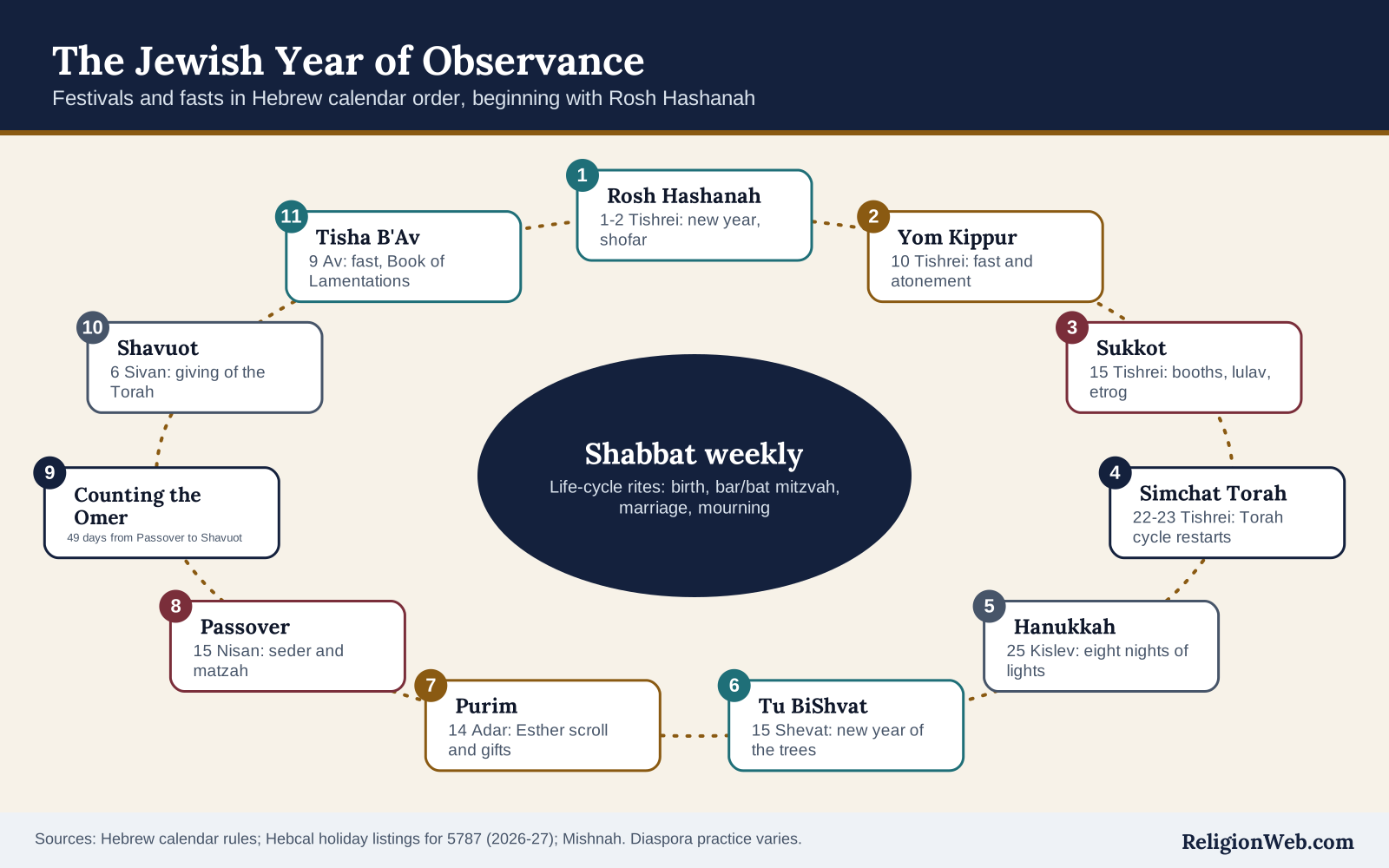
Branches, Movements and Internal Diversity
Orthodox Judaism
Modern Orthodox, Haredi and Hasidic communities
Orthodox Judaism holds that the Torah, written and oral, was revealed by God and that halakha remains binding in all its parts. The word “Orthodox” was originally applied to traditionalists by their critics in nineteenth-century Germany and was later adopted by the communities themselves, and many of them prefer to say they simply practice Judaism. The movement includes a spectrum. Modern Orthodox Jews affirm halakha while participating in secular education, the professions and civic life. Haredi Jews, a term derived from a verse in Isaiah about those who “tremble” at God’s word and often rendered in English as “ultra-Orthodox,” a label many of them dislike, emphasize separation from secular culture and intensive Torah study. Haredi life includes Lithuanian-style yeshiva communities, Sephardic and Mizrahi Haredi communities, and Hasidic courts centered on rebbes, such as Chabad-Lubavitch, which also conducts extensive outreach to other Jews. The full range is described in the article on Orthodox Judaism.
Orthodox belief and practice in daily life
In practice, Orthodox Jews observe Shabbat and kashrut strictly, pray three times a day in separate-seating synagogues, observe the laws of family purity and send children to Jewish day schools and yeshivas. Positions on questions such as women’s ritual roles, secular study and the relationship to the State of Israel differ among Orthodox groups, and debates inside the Orthodox world are lively. Orthodoxy is the dominant form of Judaism in Israel’s public religious institutions, although most Israeli Jews do not identify as Orthodox.
Conservative and Reform Judaism
Conservative or Masorti Judaism
Conservative Judaism, called Masorti (“traditional”) in Israel and much of Europe, grew out of the nineteenth-century Positive-Historical school of Zecharias Frankel, who argued that Jewish law should be studied historically and developed with respect for its tradition. In the United States the Jewish Theological Seminary was founded in 1886, and the movement’s Committee on Jewish Law and Standards issues rulings. Conservative Judaism regards halakha as binding but evolving, accepts modern critical scholarship, permits some changes, such as counting women in the minyan and ordaining women as rabbis, and generally maintains observance of Shabbat and kashrut. See the article on Conservative Judaism for the movement’s beliefs and institutions.
Reform, Liberal and Progressive Judaism
Reform Judaism arose in Germany in the early nineteenth century, with the first Reform service in 1810 and the Hamburg Temple of 1818, and became the largest movement in the United States. It holds that Judaism has evolved throughout history and should continue to do so, emphasizing ethical teachings, individual autonomy in ritual observance, equality of women and men and engagement with modern life. The Pittsburgh Platform of 1885 declared that the movement considers binding only the moral laws, a position later modified; the 1937 Columbus Platform and later statements affirmed more ritual and Zionism. Outside North America the movement is often called Liberal or Progressive Judaism, with the World Union for Progressive Judaism founded in London in 1926. For more detail, see Reform Judaism.
Other Movements and Communities
Reconstructionist, Renewal and Humanistic Judaism
Reconstructionist Judaism, which developed from Mordecai Kaplan’s ideas in the 1920s and 1930s, defines Judaism as an evolving religious civilization and encourages a democratic approach to practice. Jewish Renewal, inspired by Rabbi Zalman Schachter-Shalomi in the 1960s and 1970s, emphasizes spirituality, mysticism and ecological awareness. Humanistic Judaism, founded by Rabbi Sherwin Wine in Detroit in 1963, celebrates Jewish culture and history without reference to belief in a God. Each is small compared with the major movements, but their ideas have influenced wider Jewish life.
Karaites, Samaritans and other traditions
Some communities stand outside the rabbinic mainstream. Karaite Judaism, which crystallized in the eighth and ninth centuries CE under the leadership of Anan ben David and others, accepts only the written Tanakh and rejects the authority of the Oral Torah, relying instead on individual interpretation. Karaite communities survive in Israel and elsewhere in small numbers. The Samaritans, a community of under a thousand people, mainly in Israel and the West Bank, trace themselves to the ancient Israelites, hold the Samaritan Pentateuch sacred and consider Mount Gerizim holy; they are a distinct tradition and not a Jewish movement in the ordinary sense. The Beta Israel of Ethiopia maintained a tradition of Torah-based Judaism for many centuries before most of the community moved to Israel in the late twentieth century.
| Movement | Origins | Approach to halakha | Characteristic features |
|---|---|---|---|
| Orthodox (Modern Orthodox and Haredi, including Hasidic) | 19th-century response to emancipation and Reform; roots in traditional rabbinic Judaism | Halakha binding and divinely revealed; developed by rabbinic authorities | Separate seating, men-only minyan, strict Shabbat and kashrut |
| Conservative (Masorti) | Positive-Historical school, 1840s; Jewish Theological Seminary, 1886 | Binding but historically developing | Egalitarian services in most congregations, observance of Shabbat and kashrut encouraged |
| Reform (Liberal, Progressive) | Germany, early 19th century; Pittsburgh Platform, 1885 | Ethical commandments binding; ritual a matter of informed choice | Vernacular prayer, instrumental music, patrilineal descent accepted in North America since 1983 |
| Reconstructionist | Mordecai Kaplan; 1920s to 1930s in the United States | Tradition is given a voice but not a veto; community-based decision making | Judaism as an evolving civilization; egalitarian |
| Jewish Renewal | Zalman Schachter-Shalomi; 1960s to 1970s | Open to halakha in a spiritual framework | Mysticism, meditation, environmental concern |
| Humanistic Judaism | Sherwin Wine; Detroit, 1963 | Culture and ethics without theistic belief | Secular celebrations of festivals and life-cycle events |
| Karaite Judaism | 8th to 9th centuries CE, Middle East | Written Torah only; rejects the Oral Torah | Own calendar traditions and legal reasoning |
Patterns Beyond the Denominations
Israel’s categories: Haredi, Dati, Masorti and Hiloni
The denominational labels familiar in the United States do not describe Israeli Jewish society well. Israelis commonly describe themselves as Haredi (strictly Orthodox), Dati (religious, often Modern Orthodox), Masorti (traditional) or Hiloni (secular). In the Pew Research Center’s 2014 to 2015 survey of Israel, published in 2016, 9 percent of Israeli Jews identified as Haredi, 13 percent as Dati, 29 percent as Masorti and 49 percent as Hiloni. “Masorti” in this Israeli sense means traditional observance without strict adherence and is not the same as membership in the Masorti movement. Differences within Israel also follow ethnic lines, such as Ashkenazi, Mizrahi and Sephardi, with distinct customs and prayer rites.
The United States and other communities
In the Pew Research Center’s 2020 survey of American Jews, 37 percent of adults identified with Reform Judaism, 17 percent with Conservative Judaism, 9 percent with Orthodoxy, about 4 percent with Reconstructionist, Humanistic or other movements, and 32 percent with no particular branch. Other countries differ. In the United Kingdom, for example, the main Orthodox body, the United Synagogue, historically includes many members whose own practice is more moderate than the movement’s standards, alongside Masorti, Reform and Liberal congregations. In France, Sephardic Jews from North Africa form a large part of the community, and in Latin America and Eastern Europe, patterns have been shaped by migration, Soviet history and local institutions. Any account of “how Jews practice” has to specify the community and the time.
Sacred Spaces, Symbols and Material Culture
The Synagogue and Its Furnishings
From the Temple to the synagogue
Until 70 CE, the Temple in Jerusalem was the central sanctuary, where priests offered sacrifices and where Jews went on pilgrimage on the three festivals of Passover, Shavuot and Sukkot. The synagogue, whose name comes from a Greek word meaning “assembly,” has Hebrew names including beit knesset (“house of assembly”), beit tefillah (“house of prayer”) and beit midrash (“house of study”). The earliest evidence for synagogues is from Egypt in the third century BCE, and first-century buildings have been found at Gamla, Masada and Herodium. One of the best-preserved ancient synagogues, at Dura-Europos in Syria, was rebuilt in 244 CE and decorated with wall paintings of biblical scenes, evidence that figurative art was not alien to ancient Jewish communities.
Inside the synagogue
Synagogues look different in different places but share key features. The Torah scrolls are kept in the ark (aron kodesh), behind a curtain, on the wall facing Jerusalem. A lamp, the ner tamid or eternal light, burns before it. The scrolls are read from a raised platform, the bimah, which stands in the center of the room in traditional Ashkenazi synagogues and at the front in many modern ones. A scroll is typically dressed in a fabric mantle or a hard case, a breastplate and a crown, and the reader follows the text with a pointer called a yad. Orthodox synagogues separate men and women with a partition (mechitza) or a gallery, while others have mixed seating. A community may use a modest room or a monumental building, and no particular architecture is required.
Jerusalem, the Land and Holy Places
Jerusalem and the Western Wall
Jerusalem is the center of Jewish sacred geography. Jews face it in prayer, and the liturgy speaks constantly of Zion. The Temple Mount, the site of both ancient Temples, is also sacred in Islam, and access arrangements there are governed by a long-standing status quo that is politically sensitive. The Western Wall, a section of the retaining wall of the platform Herod enlarged for the Second Temple, is a site of prayer where visitors place written petitions in the cracks of the stones.
The Land of Israel and other places of pilgrimage
Judaism attaches sanctity to the Land of Israel as a whole. Some commandments, such as the agricultural laws of the sabbatical year and certain tithes, apply only there, and the Hebrew term aliyah, “going up,” names both a call to the Torah and immigration to the land. Pilgrimage in the ancient period centered on the Temple at the three festivals. Today many Jews visit the Western Wall, the Cave of the Patriarchs in Hebron, which is also sacred to Muslims and is a site of political tension, and the tombs of sages in Galilee. On Lag BaOmer large crowds gather at Meron, at the grave traditionally associated with the second-century sage Shimon bar Yochai. In the Diaspora, the graves of Hasidic rebbes and other revered teachers are visited for prayer, though Jewish teaching holds that prayer is directed to God alone and not to those buried there.
Symbols and Ritual Objects
The menorah, the Star of David and other emblems
The best-known Jewish symbols are the menorah, the seven-branched lamp of the Temple, and the six-pointed Star of David or Magen David. The menorah is an ancient emblem, depicted on the Arch of Titus in Rome and chosen for the state emblem of Israel. The star appears in medieval Jewish settings, was adopted by the Jewish community of Prague, and became a general emblem in the nineteenth and twentieth centuries; it appears on the flag of Israel. Because the Nazi regime forced Jews to wear a yellow star, it also carries memories of persecution. Other familiar signs include the Hebrew letters spelling chai, “life,” which have the numerical value eighteen and are often given as a gift in multiples of eighteen, and the hand-shaped hamsa amulet popular in Sephardic and Mizrahi communities.
Ritual objects and Jewish art
Jewish ritual life produced a material culture of objects made to beautify commandments, an idea called hiddur mitzvah. Familiar examples include the kiddush cup, Shabbat candlesticks, the spice box and braided candle for Havdalah, the Hanukkah menorah, the Passover seder plate, the mezuzah case and the silver crowns and breastplates that adorn Torah scrolls. Illuminated manuscripts and marriage contracts decorated with floral and geometric designs show the artistry of communities from Spain to Persia, and the Hebrew letters themselves became a decorative art through the calligraphy of scribes. Jewish tradition has been cautious about making images of God or of holy objects used in worship, but it has not avoided figurative art, as the ancient paintings at Dura-Europos indicate.
Community, Ethics and Daily Life
Ethical Teaching and Social Responsibility
Tzedakah, kindness and justice
Jewish ethics is rooted in the commandments of the Torah and in the rabbinic elaboration of them. The word tzedakah is often translated “charity,” but it comes from a root meaning righteousness or justice, and in Jewish law giving to the poor is an obligation, not an optional kindness. The Torah instructs farmers to leave the corners of their fields and the gleanings of the harvest for the poor and the stranger, and the rabbis built on this a system of communal funds and personal giving, with a tenth of income a widely cited standard among observant families. Maimonides described eight levels of giving, ranking highest the act of helping a person become self-sufficient, such as through a loan, a partnership or a job. Alongside tzedakah, tradition places gemilut chasadim, acts of loving-kindness: visiting the sick (bikkur cholim), welcoming guests, comforting mourners, accompanying the dead and caring for orphans and widows. Rabbinic ethics also stresses the careful use of speech (shmirat ha-lashon), including the avoidance of gossip.
The phrase tikkun olam, “repair of the world,” occurs in several layers of Jewish literature. In the Mishnah it describes legal ordinances adopted for the good order of society, in Lurianic Kabbalah it names the restoration of a shattered cosmos, and in modern usage, especially in North America, it has become a broad term for social action and justice work. Some Jewish thinkers welcome that usage as a continuation of the prophetic tradition, while others caution that it can detach ethics from the commandments that give Jewish life its structure.
Life, health and the natural world
The preservation of life is among the highest values in Jewish law. The principle of pikuach nefesh permits and often requires the violation of nearly every commandment to save a life, and Jewish tradition regards seeking medical care as a duty, not a lack of faith. Rabbinic authorities have developed a detailed literature on medical ethics, including questions of end-of-life care, organ donation and reproductive technology, and answers differ by movement and by rabbi. The tradition also teaches kindness to animals, summarized in the term tza’ar ba’alei chayim, and a prohibition on needless destruction (bal tashchit) that has been invoked in modern environmental thinking. Individuals facing medical or legal decisions are expected to consult doctors and qualified rabbis, not to treat a general principle as a substitute for either.
Community, Education and Family
The community as an institution
Many commandments are fulfilled communally, and the traditional ideal of a Jewish community (kehillah) includes a synagogue, a school, a ritual bath, a cemetery and a charity fund. The Talmud states that all Jews are responsible for one another, a principle that underlies mutual aid and the collective support of Jews in distress across borders. In the modern era Jewish communities built a vast network of voluntary organizations: day schools and seminaries, community centers, social service agencies, federations, museums, and international groups that assist Jewish communities in need. The institutions differ greatly from place to place, and in Israel many of these functions are performed by the state.
Learning, language and family
Education has long been regarded as a duty for all Jews, women and men, and the study of Torah is counted as equal in weight to many other commandments. Hebrew is the language of the Bible and the prayer book and, since its revival as a spoken language in the late nineteenth and twentieth centuries, of the State of Israel. Jewish communities also developed languages of their own, among them Yiddish, Ladino and Judeo-Arabic. The family is the main setting of Jewish ritual life, with the Shabbat table and the Passover seder as signature occasions. Patterns of family life are changing: in the Pew Research Center’s 2020 survey, about six in ten American Jews who had married in the previous decade had a non-Jewish spouse, including 72 percent of non-Orthodox Jews who married in that period, whereas intermarriage was rare among Orthodox Jews. Communities and movements respond in different ways, ranging from outreach and inclusion to firm endorsement of marriage within the faith.
Modern Global Presence: Communities, Numbers and Contemporary Issues
Where Jews Live Today
Israel
Israel is home to the largest Jewish community in the world. According to Pew’s analysis of 2020 data, 46 percent of the world’s Jews lived in Israel, where Jews made up 77 percent of the population, and DellaPergola estimated about 7.15 million core Jews in Israel at the start of 2024. The country has Jews of every background: Ashkenazi, Sephardi, Mizrahi, Ethiopian and immigrants from the former Soviet Union, with religious identities ranging from Haredi to secular. State institutions give Orthodox rabbinical authority control over Jewish marriage, divorce, conversion and burial, which many Israelis and non-Orthodox Jews contest, and Israel’s Arab citizens, who are mostly Muslim, together with Christian and Druze communities, form a substantial minority of the population. Judaism in Israel is therefore both a matter of private conviction and a subject of public debate.
North America, Europe and other regions
The United States hosts the second-largest community. The Pew Research Center’s 2020 survey estimated about 5.8 million Jewish adults and 7.5 million Jewish people including children, where the larger figure includes Jews of no religion and children, and DellaPergola’s estimate of the core population was 6.3 million for 2024. Canada, France, the United Kingdom, Argentina, Germany, Russia and Australia each have communities of roughly 100,000 to 440,000. Pew found that between 2010 and 2020 Europe’s Jewish population fell 8 percent to about 1.3 million and Latin America’s fell 12 percent to roughly 390,000. Smaller communities exist in Asia, Africa and elsewhere, from the Jews of India to the small communities of Tunisia, Morocco, Iran and Turkey. All of the numbers depend on how “Jewish” is defined, as explained earlier.
Contemporary Issues and Developments
Antisemitism and security
Antisemitism, hostility toward Jews as Jews, has taken different forms over the centuries, from religious accusations in medieval Europe to the racial ideology of the Nazi regime and to conspiracy theories that circulate today. In recent years monitoring organizations in several countries have reported sharply higher numbers of incidents. The Anti-Defamation League, for example, reported more than 10,000 incidents in the United States between October 7, 2023, and September 24, 2024, in preliminary figures, compared with 3,325 in the same period a year earlier. The rise followed the attack on southern Israel of October 7, 2023, and the war that followed, and such counts depend on each organization’s definitions and methods. Definitions of antisemitism, including how to distinguish it from criticism of the policies of the Israeli government, are debated by scholars, governments and Jewish organizations. Many Jewish communities have increased security around synagogues and schools.
Renewal, innovation and interfaith relations
Jewish life is also marked by creativity. Digital libraries make texts such as the Talmud searchable in many languages, new prayer books and rituals respond to contemporary concerns, and women’s leadership has expanded in nearly all movements. After the Second Vatican Council’s Nostra Aetate, many Christian churches and Jewish organizations began structured dialogue, and similar conversations take place with Muslim leaders and others. Questions of identity, belonging and continuity, including how to include interfaith families, converts, Jews of color and LGBTQ Jews, are active subjects of debate across the movements.
Common Misconceptions About Judaism
Misconception 1: Judaism is only a private religion, a set of beliefs and rituals like a personal faith
Where the misunderstanding comes from
In many modern societies, religion is understood as a matter of personal belief and voluntary membership, and the word “Judaism” suggests a parallel to other faiths defined mainly by creed. The way modern states emancipated Jews also encouraged this framing: in nineteenth-century Western Europe and the United States, Jews gained equal citizenship partly by being counted as members of a religious denomination. Labels such as “citizens of the Jewish faith” followed from that bargain, and they left an impression that being Jewish is mainly a religious affiliation like church membership.
What the evidence and tradition actually show
Jewish self-understanding has always combined religion with peoplehood. The Hebrew Bible speaks of Israel as a nation with a shared ancestry, land, language and law, and the rabbinic tradition treats Jewish status as inherited or acquired by conversion, not as something that depends on belief. Contemporary data confirm the point. In the Pew Research Center’s 2020 survey of American Jews, only 11 percent said that being Jewish is mainly a matter of religion, while 21 percent named ancestry, 22 percent culture and 19 percent a combination of all three; among the 27 percent of Jewish adults classified as Jews of no religion, being Jewish was mainly ancestry, culture or both. The same survey found that 76 percent of American Jews considered remembering the Holocaust essential to being Jewish and 72 percent considered leading an ethical life essential, compared with 15 percent who named observing Jewish law.
At the same time, the claim that Judaism is only an ethnicity is equally inaccurate. Religious practice, texts and law remain central to millions of Jews, and for Orthodox Jews the religion is inseparable from peoplehood. The accurate statement is that Judaism is a religion and also the heritage of a people, and that individual Jews place the emphasis in different places. It is also not identical with a political position: Jews are citizens of many countries, hold a range of views about Israel, and are not represented by any single organization.
Misconception 2: The Torah and the Talmud are the same thing
Where the misunderstanding comes from
Both words are used loosely in everyday English, and each can refer to more than one thing. “Torah” can mean a scroll in the synagogue, the Five Books of Moses, the whole Hebrew Bible, or Jewish teaching in general. “Talmud” is sometimes used for any rabbinic text, and in some popular writing the two terms are treated as interchangeable. Because Jews study both in religious schools and cite them together, outsiders often assume they are two names for one book.
What the evidence and tradition actually show
The two are distinct in content, date and role. The Torah in its narrow sense consists of Genesis, Exodus, Leviticus, Numbers and Deuteronomy. It is the first part of the Tanakh, read in scroll form every week in the synagogue. The Talmud is a much later body of rabbinic discussion: it combines the Mishnah, a law code compiled around 200 CE, with the Gemara, the analysis of the Mishnah by later teachers, and it exists in two versions, the Jerusalem Talmud and the larger and more influential Babylonian Talmud, completed around 500 CE and given its final editing in the sixth century. The Talmud quotes the Torah constantly and interprets it, but it is not a part of it.
The relationship is better understood in the rabbinic idea of a Written Torah and an Oral Torah. In the rabbinic view the Talmud is the record of the continuing interpretation of the Torah and in a broad sense belongs to “Torah” as teaching. Orthodox Jews hold that this oral tradition goes back to Sinai, while other movements describe it as a human development of Jewish law over time. Karaite Jews accept the Written Torah and not the Talmud. Whatever the view, the two are not confused within Jewish study: reading the weekly Torah portion and studying a page of Talmud are different activities with different texts.
Misconception 3: All Jews follow the same level of halakhic observance
Where the misunderstanding comes from
Public images of Jewish life tend to focus on the most visible forms of observance, such as Hasidic dress or the Western Wall, or on the opposite, a Jewish identity expressed through food, humor or politics. Both pictures miss the middle and compress a wide range into one. People unfamiliar with Jewish communities also sometimes assume that “Jewish” automatically implies a particular denomination or set of practices.
What the evidence and tradition actually show
Observance of halakha ranges from comprehensive to minimal, both between and within movements. Orthodox Jews hold that halakha is binding and aim to follow it in detail. Conservative Jews regard it as binding but evolving, Reform Jews emphasize ethics and individual choice, and a large number of Jews do not identify with any movement. In Israel, Pew’s 2014 to 2015 survey found that 9 percent of Jews identified as Haredi, 13 percent as Dati, 29 percent as Masorti and 49 percent as Hiloni, categories that reflect different relationships to tradition. In the United States in 2020, 17 percent of Jews kept kosher at home, including 95 percent of Orthodox Jews, 24 percent of Conservative Jews and 5 percent of Reform Jews. Fasting on Yom Kippur was reported by 46 percent of American Jews, who said they fasted all or part of the day, with Orthodox Jews the most likely to do so.
The range does not make some Jews less Jewish in the eyes of the main traditions: within halakha, a Jew who does not observe remains Jewish. The existence of this spectrum also does not imply that Jewish law is optional for those who accept it. It means that the Jewish community includes people who relate to the commandments as a binding system, others as guidance, others as heritage and others not at all, and a reliable description needs to name which group it is describing.
Misconception 4: Judaism has no real teaching about an afterlife
Where the misunderstanding comes from
The Hebrew Bible says very little about what follows death, and its emphasis is on righteous living in this world, on the community and on the covenant with the land and the people. Jewish teachers often say that the tradition focuses more on how to live than on what happens after death. These features lead many readers to conclude that Judaism has no afterlife doctrine at all.
What the evidence and tradition actually show
Rabbinic Judaism developed a substantial body of teaching on the afterlife, drawing on late biblical hints such as the book of Daniel. The Mishnah in Sanhedrin chapter 10 states that all Israel has a share in the World to Come and lists a few exceptions, including those who deny that resurrection is taught in the Torah. The daily Amidah praises God as one who revives the dead, and Maimonides listed the resurrection of the dead as the thirteenth of his principles. Rabbinic sources also describe Gehinnom as a place of purification, usually temporary, and they teach that righteous non-Jews have a share in the World to Come.
Jewish opinions are diverse. Orthodox teaching affirms bodily resurrection in a messianic era and the survival of the soul. The Reform movement’s 1885 Pittsburgh Platform affirmed the immortality of the soul and rejected bodily resurrection, and later Reform liturgies reflect various choices. Some modern Jews, including religious ones, hold that questions of the afterlife are mysteries and concentrate on the commandments of this life. It would be accurate to say that Judaism has an afterlife tradition that is diverse and generally secondary to the emphasis on ethical and communal life.
Misconception 5: “An eye for an eye” shows that Jewish law demands literal physical revenge
Where the misunderstanding comes from
The phrase comes from the Torah, in passages in Exodus, Leviticus and Deuteronomy that set penalties for injury, and it has long been used in English as shorthand for harsh retaliation. Because the phrase appears in the Hebrew Bible, it is sometimes assumed to describe how Jewish courts actually operated, or to capture the ethical spirit of Jewish law.
What the evidence and tradition actually show
The formula appears in Exodus 21:24, Leviticus 24:20 and Deuteronomy 19:21. Many historians of ancient law read such formulas in ancient Near Eastern legal codes as statements of proportion, meant to limit retaliation by tying the penalty to the injury. In rabbinic law the principle was understood as a rule of monetary compensation. The Mishnah (tractate Bava Kamma, chapter 8) sets out five categories of payment owed to a person who has been injured: damage, pain, healing costs, loss of time, and indignity. A person who blinds another is not blinded in return but pays the injured party according to these categories. The Talmud discusses the reasoning behind this reading in the same tractate, and Maimonides codified it in the Mishneh Torah.
This interpretation also fits the wider ethics of the Torah, which commands against vengeance and grudges toward fellow members of the people and commands love of neighbor. It does not mean that Jewish tradition is free of harsh texts or that all historical punishments were gentle: biblical law includes capital offenses, and the rabbis hedged these with such strict procedural requirements that executions were rare according to the rabbinic sources. The reasonable conclusion is that “an eye for an eye” is a biblical phrase understood within the Jewish tradition as a rule of just compensation, not a mandate for physical retaliation.
Frequently Asked Questions About Judaism
Questions about Identity and Belief
Is Judaism a religion, an ethnicity or a culture?
It is best described as a religion that is also the heritage of a people. Jewish tradition treats Jewish status as something received by birth to a Jewish mother or acquired through conversion, and the Hebrew term for the Jewish people, Am Yisrael, expresses the national dimension. Reform Judaism in North America also accepts descent through a Jewish father under certain conditions. Many Jews describe their Jewishness through culture, history and family more than through belief, while others regard religion as its core, and scholars therefore often call Judaism an ethnoreligious tradition.
What do Jews believe about God and the Messiah?
Traditional Jewish teaching holds that there is one God, who is not physical, who created the world and who made a covenant with Israel. Beliefs about how God acts in the world differ among thinkers and movements. The Messiah in traditional belief is a future human king descended from David who will bring an age of peace and justice; Reform Judaism usually speaks of a messianic age without a personal Messiah. Within Judaism these are views held with different degrees of emphasis, and the tradition places greater weight on practice than on a fixed creed.
Can a person convert to Judaism?
Yes. Judaism does not actively seek converts, but it accepts sincere ones, and a convert is fully Jewish. Orthodox and Conservative procedure involves a period of study, acceptance of the commandments, appearance before a court of three rabbis, immersion in a mikveh and, for men, circumcision. Reform and Reconstructionist rabbis require study and commitment, with differing ritual expectations. Conversions performed by one movement are not always accepted by another, and in Israel the state rabbinate’s standards govern recognition for purposes such as marriage.
Questions about Texts and Practice
What is a rabbi, and is a rabbi like a priest?
A rabbi is a teacher and judge of Jewish law, trained through years of study and ordained by a recognized authority or seminary. Unlike a priest in a sacrificial system, a rabbi is not required for most Jewish rituals, which can be led by any knowledgeable adult. The biblical priests, the kohanim, were a hereditary class who served in the Temple, and their descendants retain a few ceremonial roles today. Rabbis in non-Orthodox movements often serve as pastoral leaders, educators and community figures as well as legal scholars.
Why do observant Jews keep kosher and rest on Shabbat?
Observant Jews understand both practices as commandments of the Torah. Kashrut, derived from Leviticus and Deuteronomy, shapes the daily act of eating and is often explained as a discipline of holiness and awareness, while Shabbat commemorates creation and the exodus from Egypt and creates a weekly rhythm of rest, worship and family life. Jewish thinkers have offered many reasons, but the central motivation is obedience to the covenant. Practice varies by community, as the earlier sections show.
What is a minyan, and why does it matter?
A minyan is a quorum of ten adults required for communal prayers such as the Kaddish, the public Torah reading and the repetition of the Amidah. Orthodox communities count ten Jewish men; Conservative, Reform and Reconstructionist communities count women as well. The requirement expresses the idea that some forms of worship belong to the community, and it is the reason mourners often seek out a minyan when saying Kaddish. In small or remote communities, people may pray without one, omitting those specific parts.
Questions about History, Holidays and the Present
Why do Jewish holidays fall on different dates each year?
Jewish holidays follow the Hebrew lunisolar calendar, in which months follow the moon and the year is kept in step with the seasons by adding a leap month seven times in nineteen years. The Gregorian calendar uses a solar year, so a Hebrew date moves across it from year to year within a window of about a month. Festivals also begin at sunset, so the first evening falls on the previous Gregorian date.
How are Rosh Hashanah and Yom Kippur related?
Rosh Hashanah, the new year on 1 and 2 Tishrei, and Yom Kippur, the Day of Atonement on 10 Tishrei, are the bookends of the Ten Days of Repentance. The first focuses on God’s kingship and the judgment of the world, with the sounding of the shofar. The second is a day of fasting, confession and prayer for forgiveness. Together they form a period in which Jews examine their conduct, seek reconciliation with others and ask for a good year.
Is Zionism the same as Judaism?
No. Zionism is a modern political movement that sought a Jewish national home in the Land of Israel, and the State of Israel was established in 1948. Jewish religious texts and liturgy have always expressed attachment to Zion and Jerusalem, and many Jews today feel a strong connection to Israel. Yet Jewish views of the movement and of Israeli policies differ widely: some religious and secular Jews support Zionism, some critique particular policies and some have objected to political Zionism on religious or ideological grounds. Judaism as a religion and Israeli politics are distinct subjects, and Jews around the world do not speak with one voice on the latter.
Conclusion: Understanding Judaism on Its Own Terms
What the History and Practice Show
A tradition of continuity and argument
Judaism developed over more than two thousand years through crises that would have ended many traditions: exile, the loss of the Temple, dispersion, expulsion and genocide. At each stage the community responded by reinterpreting its texts, building new institutions and continuing to study and argue. The result is a tradition that contains both fixed commitments, such as one God, the Torah and the covenant, and active debate about how those commitments apply.
Religion and peoplehood together
The key to accurate understanding is to hold two things together. Judaism is a religion with beliefs, texts, law and worship, and it is also the heritage of a people with shared history, languages and customs. Jews express this in many ways, from the daily observance of Orthodox communities to the cultural and ethical commitments of secular Jews, and no single pattern describes everyone.
How to Keep Exploring
Next steps within the Jewish movements
Readers who want to go deeper into the main contemporary streams can continue with the articles on Orthodox Judaism, Conservative Judaism and Reform Judaism, each of which describes its own beliefs, history and practice in more detail.
Learning from primary sources and communities
The best way to understand Judaism is to read its texts in good translations, such as the Tanakh, the Mishnah and selections from the Talmud, with the commentaries that Jewish readers use, and to learn from Jewish teachers and communities who can speak for their own traditions. Museums, university programs and synagogue open houses offer additional opportunities, and visitors are generally welcome when they respect local customs.
Sources
The table below lists the principal external sources behind this article. Facts, dates and figures were checked against these and related primary, institutional and academic materials.
| # | Source | Publisher and type | Used for | Link |
|---|---|---|---|---|
| 1 | Jewish Population Change, 2010-2020 (How the Global Religious Landscape Changed From 2010 to 2020) | Pew Research Center · Demographic data | Global Jewish population 2010-2020, regional shares, Israel and US shares, Pew definition of Jews | pewresearch.org |
| 2 | Jewish Americans in 2020 | Pew Research Center · Demographic data | US Jewish population, denominations, identity, kosher, Yom Kippur and intermarriage figures (2020 survey) | pewresearch.org |
| 3 | Israel’s Religiously Divided Society | Pew Research Center · Demographic data | Haredi, Dati, Masorti and Hiloni shares among Israeli Jews; Shabbat travel (survey 2014-2015) | pewresearch.org |
| 4 | World Jewish Population, 2024 (DellaPergola) | Israel Central Bureau of Statistics (hosting S. DellaPergola’s estimates) · Demographic data | Core Jewish population of 15.7 million on January 1, 2024; country figures; 1939 comparison | cbs.gov.il |
| 5 | Introduction to the Holocaust (with USHMM entries on the Nuremberg Race Laws, Kristallnacht and the Wannsee Conference) | United States Holocaust Memorial Museum · Institutional | Holocaust definition, years, victim numbers, killing centers; dates of 1935, 1938 and 1942 events | encyclopedia.ushmm.org |
| 6 | The Holy Scriptures: A New Translation (JPS 1917), Deuteronomy 6:4-5 (public domain edition as hosted on Sefaria) | Jewish Publication Society / Sefaria · Primary text | Edition and public-domain status of all Hebrew Bible quotations (Deut. 6:4-5; Gen. 1:5, 2:2-3; Ex. 12:2, 19:6; Micah 6:8) | sefaria.org |
| 7 | Mishnah Shabbat 7:2 (William Davidson Edition; also consulted: Yoma 8:1, Sanhedrin 10:1, Bava Kamma 8:1, Makkot 23b) | Sefaria / Koren-Steinsaltz · Primary text | Paraphrased rabbinic passages: 39 categories of work, Yom Kippur prohibitions, World to Come, compensation, 613 | sefaria.org |
| 8 | Jewish Holidays 2026-2027 | Hebcal · Reference calendar | Gregorian dates of Jewish holidays and fasts in Hebrew year 5787; candle-lighting and havdalah defaults | hebcal.com |
| 9 | Babylonian Exile | Encyclopaedia Britannica · Encyclopedia | Dates of the Babylonian conquest, exile, Cyrus’s decree (538 BCE) and the Second Temple (516 BCE) | britannica.com |
| 10 | Over 10,000 Antisemitic Incidents Recorded in U.S. Since Oct. 7, 2023, According to ADL | Anti-Defamation League · Institutional | Preliminary count of US antisemitic incidents, October 7, 2023 to September 24, 2024 | adl.org |
Last fact-check date: 2026-10-21.