Hanukkah (also spelled Chanukah) is an eight-day Jewish festival that begins on the 25th of the Hebrew month of Kislev and is marked above all by kindling lights, one more each night, in a special lamp called a hanukkiah. The name means “dedication” in Hebrew and recalls the rededication of the Jerusalem Temple’s altar in the second century BCE, after a period in which the Seleucid king Antiochus IV Epiphanes had suppressed Jewish worship and the Maccabees, a priestly family, had led a successful revolt. The lights, the prayers of thanksgiving and the foods fried in oil are the festival’s best-known features, and each has its own history.
Several things about Hanukkah are easy to miss. It is a rabbinic festival, not one of the biblical pilgrimage festivals, and the books that tell its original story, 1 and 2 Maccabees, are not part of the Hebrew Bible as Judaism has defined it. The familiar tale of a single day’s worth of oil that burned for eight days appears for the first time in the Talmud, several centuries after the events. The dreidel, the gifts and the potato pancakes are later customs that grew up in particular regions and periods, and they are not requirements of Jewish law. The one practice every authority treats as the heart of the festival is the lighting of the lamp.
This article explains Hanukkah on its own terms and in historical context. It begins with the name, the calendar rule and the vocabulary, then follows the historical background, the early sources and the way rabbinic tradition reshaped the story. It describes in detail how the lights are kindled, which blessings and prayers accompany them, what the main symbols and foods are, how customs differ among Jewish communities, and how the holiday is observed today. A section on common misconceptions and a set of frequently asked questions close the article.
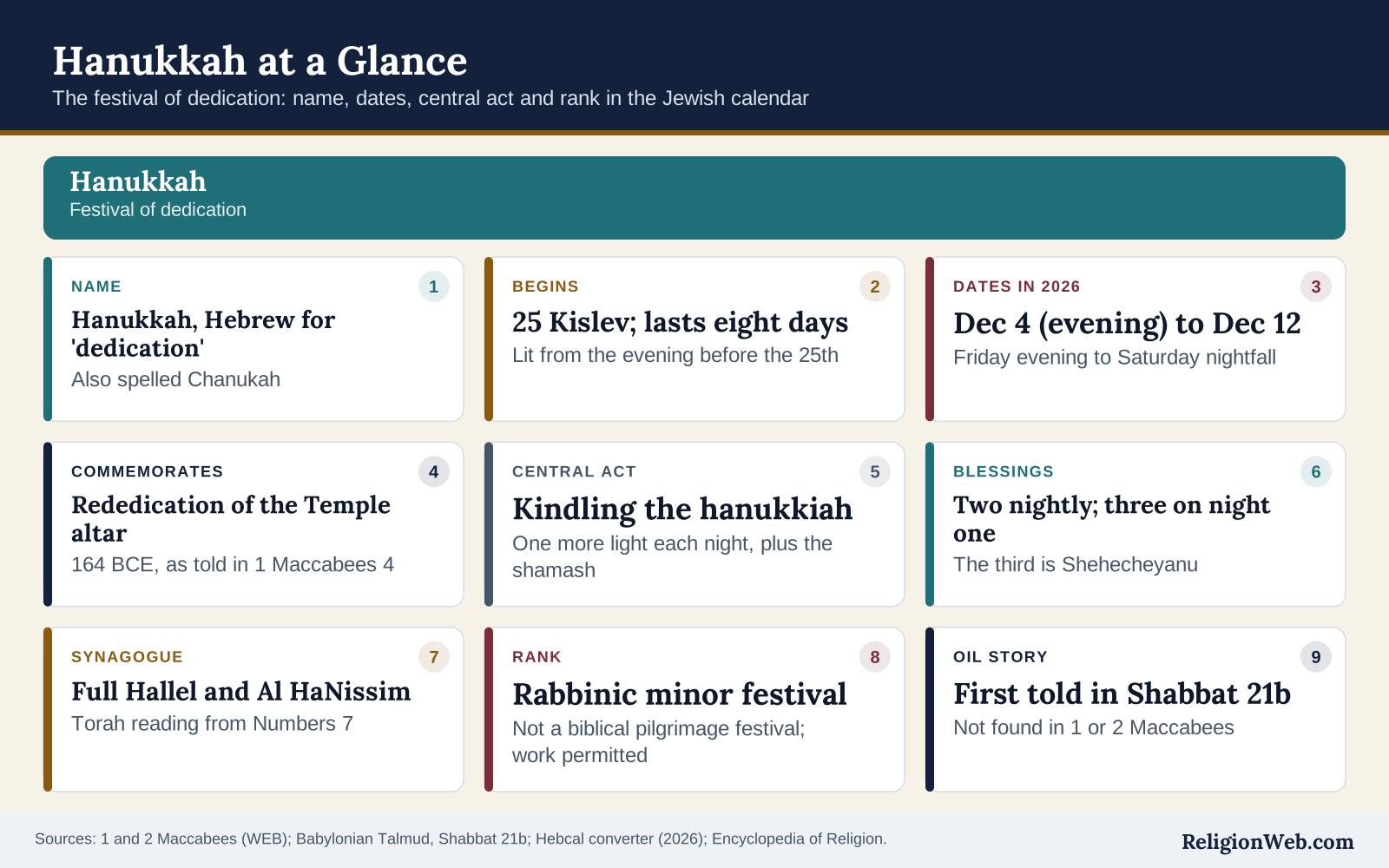
Hanukkah at a Glance: Name, Dates, and Core Facts
What Hanukkah Is and What It Commemorates
A winter festival of dedication and light
In the way Jewish tradition understands it, Hanukkah commemorates the recovery and rededication of the Temple in Jerusalem in the year 164 BCE by most historians’ reckoning, three years after Antiochus IV had turned the sanctuary to the service of another form of worship. The earliest account, in 1 Maccabees, says that the people offered sacrifice on a new altar and kept the dedication for eight days. The rabbinic sources that came later emphasize a second dimension: the relighting of the Temple’s lamp and the thanksgiving that the sages attached to the days. Both strands remain visible in the festival today, one in its name and its liturgy of praise, the other in the nightly lights.
Observance centers on the home. Each evening a lamp is lit after dark, a small number of blessings are said, hymns are sung and the family spends some time with the lights burning. Synagogues add the full Hallel (a series of psalms of praise) and a special insertion to the daily prayers, and the Torah reading each day recalls the dedication of the desert Tabernacle. Everything else, from fried food to games to gifts, belongs to custom and varies widely from place to place. The festival also falls at the darkest time of the year in the Northern Hemisphere, a coincidence that later commentators and modern observers have often noticed, although the sources themselves do not tie the festival to the seasons.
Where Hanukkah sits in the Jewish calendar
The Torah names three pilgrimage festivals, Passover, Shavuot and Sukkot, on which pilgrims once went up to the Temple, and the Torah also commands the solemn days of Rosh Hashanah and Yom Kippur. Hanukkah is not among these. It is a post-biblical festival established by the rabbinic sages, and in Jewish law it ranks as a minor festival: unlike Passover, Rosh Hashanah or Yom Kippur, it carries no prohibition on ordinary work, and observant Jews go to their jobs and schools as usual.
The sages did, however, make the days into a time of thanksgiving. The Talmud‘s discussion in tractate Shabbat 21b records that eulogies and fasting are not permitted on the eight days, and that Hallel and thanksgiving were established. Rabbinic sources therefore treat Hanukkah as a real festival with legal consequences for prayer and mourning customs, even though it is less central than the biblical holy days. Where the weekly Shabbat rests on a commandment of the Torah and the pilgrimage festivals on an even broader set of commandments, Hanukkah depends on the authority of the sages, a distinction that explains its place in the calendar and many of the questions in the misconceptions section below.
Names, Spellings, and Key Terms
Why there are so many English spellings
Hanukkah is a transliteration of the Hebrew word ḥanukkah (חֲנֻכָּה). The first letter, ḥet, is a throat sound that English lacks, so some writers render it with “Ch” (as in “Chanukah,” which mimics the guttural sound) and others with a plain “H”. The doubled “k” represents a letter that is stressed in Hebrew. Dozens of spellings circulate, among them Hanukah, Chanukkah and Hanuka, and none is more correct than another. This article uses Hanukkah, the form most common in American usage, and reserves the Hebrew spelling for the lamp (hanukkiah) and technical terms.
The word ḥanukkah means “dedication” and comes from the root used in Hebrew for dedicating a house or training a child; the same root underlies ḥinukh, education. The Bible uses related words for the dedication of the altar and Temple. The festival is also called “the Feast of Dedication” in English, and Jewish writers over the centuries have used other names such as “the days of the Hasmoneans” and, in the Talmud, a phrase for the days on which lamps are lit. The first-century historian Josephus, writing in Greek, said that people called the festival “Lights,” a detail discussed with the early sources below. A well-known piece of wordplay breaks the Hebrew name into two words, ḥanu (they rested) and kaf-heh (the numerical value of the letters, 25), meaning “they rested on the 25th”; it is a homiletic pun, not a scholarly etymology.
A short glossary
Learning a few Hebrew terms makes the rest of this article easier to follow. The following table sets out the words that recur most often, with the meaning each carries in the context of the festival.
| Term | Meaning | Role in Hanukkah |
|---|---|---|
| Ḥanukkah | “Dedication” | Name of the eight-day festival beginning on 25 Kislev |
| Hanukkiah (ḥanukkiyah) | Hanukkah lamp | The nine-branched stand (eight lights plus the attendant light) used for the festival |
| Menorah | “Lamp” or “lampstand” | Originally the seven-lamp lampstand of the Tabernacle and Temple; in everyday English also used for the hanukkiah |
| Shamash | “Attendant” or “servant” | The extra light used to kindle the others |
| Kislev | Third month of the civil year, ninth of the religious year | The month in which the festival begins |
| Maccabees | Name given to Judah and, by extension, his family and followers | The leaders of the revolt remembered in the festival |
| Hasmoneans | Descendants of the priest Hasmon’s family | The dynasty that grew out of the revolt |
| Pirsumei nisa | “Publicizing the miracle” | The rabbinic reason for lighting where passersby can see |
| Al HaNissim | “For the miracles” | A thanksgiving added to daily prayer and the grace after meals |
| Sevivon / dreidel | Hebrew and Yiddish names for the spinning top | The traditional game of the festival |
| Sufganiyah, latke | Jelly doughnut; potato pancake | Fried foods linked to the oil theme |
When Hanukkah Is Observed
The calendar rule
Hanukkah begins on the 25th day of Kislev and lasts eight days. Because the traditional Jewish calendar is lunisolar, with months that follow the moon and an extra month added in certain years to keep the festivals in their seasons, the 25th of Kislev falls on different Gregorian dates from year to year. It always lands in late November or December in the common calendar. Since Jewish days begin at nightfall, the first candle is lit on the evening before the 25th, and the eighth and last night is the eve of the eighth day. The month of Kislev has either 29 or 30 days depending on the year, which means that the final day of Hanukkah is either the 2nd or the 3rd of the following month, Tevet.
The eight-day length is one of the oldest fixed points in the tradition: 1 Maccabees and 2 Maccabees both say that the dedication lasted eight days, and the later explanation about the oil gives a separate reason for the same number. Because every Jewish month begins with the new moon, the 25th of Kislev falls in the waning part of the lunar cycle, and the last nights of Hanukkah come when the moon is at its thinnest or absent. That is a calendar observation and not a doctrine, but it helps to explain why modern retellings so often link the festival with the theme of light in darkness.
Hanukkah in 2026
In 2026 Hanukkah begins on the evening of Friday, December 4, and ends at nightfall on Saturday, December 12. Using the Hebrew calendar converter published by Hebcal, December 4 is 24 Kislev 5787 and December 12 is 2 Tevet 5787, which confirms that Kislev has 30 days in this Hebrew year and that the eighth day is the second of Tevet. The first night therefore falls on a Friday, so in 2026 the first light is kindled just before Shabbat begins, and the eighth night again falls on a Friday evening. Both Saturdays of the festival, December 5 and December 12, are Shabbat Hanukkah, with a Torah reading for the week and a special Hanukkah reading as well.
Readers using this article in later years should note that the dates above apply only to 2026 and that the festival always runs from the evening before 25 Kislev through the nightfall that ends the eighth day. A synagogue calendar or a published Jewish calendar gives local candle-lighting times, which depend on sunset and therefore differ by city and by date. Because a Jewish day starts at nightfall, a statement such as “Hanukkah starts on December 4” in a secular calendar refers to the evening, and the first full day of the festival is December 5.
Historical Background: Judea Under Seleucid Rule
The World of the Second Temple
From Persian to Greek rule
The story begins well before the revolt. After the Babylonian exile ended in the sixth century BCE, a community centered on Jerusalem and a rebuilt Temple lived as a province inside the Persian empire, with a high priest at the head of local life. In 332 BCE, according to the usual dating, Alexander the Great swept through the region, and after his death in 323 BCE his generals divided his conquests. For roughly a century Judea belonged to the Ptolemaic kingdom in Egypt, and around 200 BCE it passed to the Seleucid kingdom, whose center lay in Syria and whose rulers governed a large territory from Anatolia to Mesopotamia.
Under both Ptolemaic and early Seleucid rule, Jews in Judea were generally allowed to follow their ancestral laws, and many individuals took part in the Greek-speaking world around them. The period, often called Hellenistic, was not a clash between two sealed civilizations. Greek language, names, education, athletics and civic institutions spread through the region, and Jewish communities from Alexandria to Jerusalem negotiated what to adopt and what to resist. The question was never whether Jews would encounter Greek culture, only how far to adapt to it, and that question divided Jerusalem’s elite in the decades before the revolt.
Hellenization, the high priesthood, and internal division
The situation turned acute under Antiochus IV Epiphanes, who became Seleucid king in 175 BCE. The books of Maccabees report that a faction of Jerusalem Jews petitioned him to establish a Greek-style city, and that the office of high priest, which had been hereditary, became a prize to be bought. Two men named in 2 Maccabees, Jason and later Menelaus, obtained the office through payments to the king. Historians read these developments differently. Some emphasize an internal conflict between Hellenizing and traditional Jews, which the king then exploited. Others stress Seleucid fiscal and political pressures and the king’s wars against Ptolemaic Egypt. Most scholars today see a combination, and the question of how much of the crisis originated within the Jewish community remains a live subject of research.
What is clear from every source is that Jerusalem was already sharply divided before the king issued any decree. The sources written by supporters of the revolt describe the Hellenizers as lawbreakers, while the Hellenizers themselves left no surviving account, so the modern reader sees them only through hostile eyes. This is a caution for reading the festival’s origin story: the accounts that shaped the tradition were composed by one side of an internal Jewish conflict as well as a conflict with a foreign ruler.
Persecution, Revolt, and Rededication
The decrees and the desecration of the Temple
In 167 BCE, according to 1 and 2 Maccabees, Antiochus IV ordered measures that made central Jewish practices a punishable offense: possessing Torah scrolls, circumcising sons and keeping the Sabbath were forbidden, and the Temple was converted to the worship of a Greek deity, with an altar built over the old altar. First Maccabees dates the desecration to the 15th of Kislev in the year 145 of the Seleucid era and reports that sacrifices were offered on the new altar ten days later, on the 25th. These details come from sources sympathetic to the revolt, and scholars debate the king’s motives and the exact content of the decrees. Still, the picture of a sustained attack on Temple worship and Jewish observance in the mid-160s BCE is accepted by most historians.
The Book of Daniel, which scholars generally date to the same crisis, alludes to an abomination that desolates the sanctuary, and Jewish and Christian readers later took that image as a way of naming the desecration. The authors of the Maccabean books likewise describe martyrs who died rather than break the law, such as the mother and seven sons of 2 Maccabees 7. These accounts shaped later Jewish memory of the period, and in the modern era they have also become a reference point in debates about religious freedom.
Mattathias, Judah Maccabee, and the recapture of Jerusalem
The revolt began in the town of Modein, northwest of Jerusalem, where an elderly priest named Mattathias refused to sacrifice at the royal command and killed a Jew who stepped forward to do so, along with a royal officer. He and his five sons took to the hills. After his death, his son Judah, called Maccabee (a nickname usually explained as “hammer” or “hammerer,” though the meaning is debated), took command and fought a series of battles against Seleucid armies. By late 164 BCE his forces controlled the Temple Mount, though not the citadel that the Seleucid garrison held, and they could begin the work of purification.
The account in 1 Maccabees 4 says that the priests tore down the defiled altar, stored its stones until a prophet should appear to say what to do with them, built a new altar of uncut stones, and made new Temple vessels. On the 25th of Kislev, in the year 148 of the Seleucid era, three years to the day after the first sacrifices on the foreign altar, sacrifices were offered on the new altar. Most historians place that date in December 164 BCE. The celebration lasted eight days, and the assembly decreed that it be repeated annually. The passage also reports the lighting of the lamps on the Temple lampstand, the item that eventually became the principal symbol of the festival.
The Hasmonean Aftermath
Independence, dynasty, and decline
The rededication did not end the fighting. Judah died in battle around 160 BCE, and his brothers Jonathan and then Simon led the movement through years of negotiation and war with competing Seleucid claimants. Around 142 to 140 BCE the Seleucid ruler and then a Jewish assembly recognized Simon as high priest and leader, an arrangement that effectively made Judea a self-governing state. His descendants, known as the Hasmoneans, ruled as high priests and, from about 104 BCE, as kings. The dynasty expanded its territory, and its later rulers made forced conversions of some neighboring peoples, a fact that complicates simple pictures of the revolt as a purely defensive struggle.
The Hasmonean state lasted until the Roman general Pompey entered Jerusalem in 63 BCE, ending the period of independence and beginning a time of Roman influence that eventually produced the client kingdom of Herod. Later still came the destruction of the Second Temple in 70 CE, after which the Temple could not be the center of Jewish worship, and the home and the synagogue became the main settings for observing the festival.
Rabbinic distance from the Hasmoneans
The rabbis who shaped the festival after 70 CE were descendants of the Pharisaic tradition, which had clashed with some of the later Hasmonean rulers over the combination of the priesthood and the kingship. Scholars have long noted that rabbinic literature tells the Hanukkah story in a way that moves attention from the Hasmoneans’ political and military achievements to God’s miracle. The Jewish Encyclopedia of 1906 observed that Pharisaic tradition tended to downplay the dynasty’s political achievements, and Louis Jacobs, in the Encyclopedia of Religion, notes that the earliest accounts do not present Hanukkah as a festival of lights at all. The Hanukkah prayers still speak of victory, but they credit it to God and give the Hasmoneans a limited role.
The following table collects the main dates discussed in this section and the next two. Dates in the second century BCE are those most often given in modern scholarship, and dates for the rabbinic texts are approximate. The table does not include every event, only those that help place the festival in a longer timeline.
| Date | Event | Why it matters for Hanukkah |
|---|---|---|
| c. 332 BCE | Alexander the Great takes control of the region | Opens the Hellenistic era in which the revolt later occurs |
| c. 200 BCE | Judea passes from Ptolemaic to Seleucid rule | Puts Jerusalem under the dynasty of Antiochus IV |
| 175 BCE | Antiochus IV Epiphanes becomes Seleucid king | Start of the reign during which the crisis unfolds |
| 167 BCE | Decrees against Jewish practice; the Temple converted to other worship; revolt begins at Modein | The persecution and uprising behind the festival story |
| 164 BCE (25 Kislev) | Judah Maccabee’s forces rededicate the altar | The event commemorated by the festival; the eight-day celebration is ordained |
| c. 160 BCE | Judah dies in battle | Leadership passes to his brothers |
| c. 142 to 140 BCE | Simon is recognized as high priest and leader | Beginning of Hasmonean self-rule |
| 63 BCE | Pompey enters Jerusalem | End of Hasmonean independence |
| 70 CE | The Second Temple is destroyed | Observance moves fully to home and synagogue |
| c. 1st century BCE to 1st century CE | The schools of Hillel and Shammai debate how to light | Sets the pattern of adding one light each night |
| c. 200 CE | The Mishnah is compiled | Brief references to Hanukkah in rules on fasting and readings |
| c. 500 CE | The Babylonian Talmud reaches its final form | First appearance of the oil story in Shabbat 21b |
| 1322 | Rabbi Kalonymus ben Kalonymus writes a poem mentioning fried pancakes at Hanukkah | Earliest written mention of the festival’s fried-pancake tradition |
| 1979 to 1982 | A large menorah is placed on the White House grounds and later designated the National Menorah | Part of the modern history of public lighting in the United States |
What the Early Sources Say: Maccabees, Josephus, and the Talmud
The Books of Maccabees
First Maccabees and the eight-day dedication
The oldest narrative of the rededication is 1 Maccabees, a history of the revolt that was composed in Hebrew, probably in the later second century BCE, and that survives in Greek. The book is not part of the Hebrew Bible as Jews define it. Catholic and Eastern Orthodox Christians include it among the books of their Old Testament, while most Protestant churches place it in a separate group often called the Apocrypha, a point explained in the article on the Bible. For the history of Hanukkah the book matters because it reports the founding decision. After the sanctuary was purified and the altar rebuilt, it says, the community decided to keep the days annually. The World English Bible, a public-domain translation, renders the decree this way:
Judas and his kindred and the whole congregation of Israel ordained that the days of the dedication of the altar should be kept in their seasons from year to year for eight days, from the twenty-fifth day of the month Chislev, with gladness and joy.
1 Maccabees 4:59, World English Bible (public domain)
Three features of this sentence stand out. The festival is a dedication of the altar, not a celebration of lights. It is a human decision made by the leaders and the assembly, not a commandment given at Sinai. And it is fixed to a calendar date, the 25th of Chislev (the book’s spelling of Kislev). The book is a work of a supporter of the Hasmonean family, and it presents the family as the instruments of Israel’s deliverance. Nothing in the passage mentions an oil miracle, and the lamps of the lampstand appear in the narrative only as part of the restoration of the Temple furnishings.
Second Maccabees and the link to Sukkot
Second Maccabees is a different kind of work. It presents itself as an abridgment of a five-volume history by an author named Jason of Cyrene, it was composed in Greek, and it concentrates on the Temple, martyrdom and divine intervention. It opens with two letters urging the Jews of Egypt to keep the days of Tabernacles in the month of Chislev, which suggests that the festival was being promoted to Jewish communities outside Judea within a few decades of the events. Its account of the rededication in chapter 10 makes an explicit connection to another festival, one that the Torah commands.
They observed eight days with gladness in the manner of the feast of tabernacles, remembering how not long before, during the feast of tabernacles, they were wandering in the mountains and in the caves like wild animals.
2 Maccabees 10:6, World English Bible (public domain)
According to this explanation, the fighters had missed the autumn festival of Sukkot, which with its closing day extends to eight days, and made up for it with a belated celebration. Louis Jacobs, writing in the Encyclopedia of Religion, summarizes the passage as saying that the eight-day festival was introduced because the Jews could not celebrate the eight days of Sukkot during the war. Many modern scholars take this as a significant clue to the festival’s character: the first Hanukkah was modeled on a pilgrimage festival of rejoicing, with palm branches and hymns in some descriptions, and its lights came later. The passage also shows that the festival was understood from the start as a Temple celebration with a legal basis in biblical practice, even though no biblical verse commands it.
Josephus and Other Early Testimony
Josephus and the name “Lights”
The Jewish historian Josephus, writing in Greek in Rome in the 90s CE, retells the story of the rededication in his Antiquities of the Jews. According to the translation of Whiston as revised for The Posen Library of Jewish Culture and Civilization, Josephus says that the restored sacrifices were kept for eight days and that the observance became annual, and that the festival was called “Lights.” He offers his own explanation for the name: the liberty to worship had come to the people beyond all their hopes. The explanation is Josephus’s own, offered to a Greek-speaking readership, and it does not mention the oil story or the practice of lighting lamps in homes.
Josephus is important because he shows that the name “Lights” was in use by the first century CE, even if its basis is disputed. Some scholars think that lighting lamps was already a custom of the festival, perhaps drawing on the lamps associated with Sukkot in the Second Temple period, as the Jewish Encyclopedia of 1906 suggested. Others consider his name a metaphor for deliverance, with the lamps added by later tradition. The evidence does not permit certainty, and both views appear in scholarship.
Early rabbinic and other references
The New Testament does not use the word Hanukkah, but the Gospel of John places Jesus in Jerusalem during a winter festival of the Dedication (John 10:22), a reference that shows the festival was known to the Gospel’s author and first readers. Early rabbinic texts mention Hanukkah briefly. The Mishnah, compiled around 200 CE, refers to the days in discussions of fasting, public Torah readings and the lamp that a shopkeeper might leave outside. Megillat Ta’anit, an Aramaic list of days on which fasting is forbidden, includes the eight days from the 25th of Kislev, and the Talmud cites it; a later commentary on that list, known as the scholion, elaborates on the festival.
Taken together, these early sources agree on four points: the festival began in a rededication, it lasted eight days, it was held annually from 164 BCE, and it was already regarded as a time of joy. They do not agree about many details, and they do not mention the single jar of oil. That story appears only in the Talmud.
The Rabbinic Oil Story and Scholarly Debate
The account in Shabbat 21b
The passage that most directly shaped Hanukkah as it is known is in the Babylonian Talmud, tractate Shabbat, page 21b. It begins with a question, “What is Hanukkah?”, and answers by citing Megillat Ta’anit: from the 25th of Kislev there are eight days on which eulogies and fasting are forbidden. The Talmud then tells the story, in paraphrase, that when the Greeks entered the Temple they defiled all the oils in it. When the Hasmonean dynasty gained the upper hand, the sages found only one flask with the seal of the high priest intact, enough to burn for one day. A miracle occurred and it burned for eight days. In the following year the sages established these days as a festival with Hallel and thanksgiving.
This is the first known appearance of the oil story, and it is the reason the lamp became the central symbol of the festival. The passage is also notable for what it does not say. It does not name Judah Maccabee, and it compresses the war into a single sentence. The text moves attention from military events to the Temple’s lamp and a divine sign. The Talmud’s editors worked several centuries after the revolt, under different political conditions and in a different land, and their account reflects the concerns of that setting. Traditional readers take the passage as an authentic memory preserved through oral tradition, while academic historians treat it as a rabbinic reframing of an older event. Both views describe the same text, and which one a reader adopts depends on what authority they give to rabbinic tradition.
How scholars and commentators explain the shift
Commentators noticed early that the story has a puzzle: if the oil sufficed for one day, only seven of the eight days were miraculous. Medieval and early modern authors proposed several answers, including that the oil was divided into eight portions, or that the miracle was the gathering of the oil itself. These discussions illustrate how the tradition treats a narrative as a text to be questioned and interpreted, not as a closed statement.
Modern scholars have proposed other explanations for how a festival of altar dedication became a festival of lights. The Jewish Encyclopedia of 1906 reports that the nineteenth-century scholars Heinrich Ewald and Julius Wellhausen held that the 25th of Kislev was already a winter-solstice celebration among Jews before it became associated with the Maccabees, and Jacobs mentions that some historians link the festival’s origin with midwinter light festivals. A second line of thought emphasizes the Sukkot connection already described, since lights and lamp-lighting were associated with Sukkot in the Second Temple period. A third line of argument emphasizes the rabbis’ own priorities: after the failure of later revolts against Rome and the loss of the Temple, an emphasis on divine action and on a lamp that any household could light suited a community without a state. None of these proposals is proven, and they are not mutually exclusive.
The Meaning of Hanukkah: Light, Dedication, and Miracle
Themes in Jewish Tradition
Dedication, thanksgiving, and the Temple
The festival’s name, “dedication,” points to a central theme: the act of setting something apart for sacred use after it has been profaned. In the account of 1 Maccabees, the priests purify the sanctuary stone by stone and build a new altar, and the festival marks the moment that worship resumed. The liturgy keeps this focus on thanksgiving. The prayer added to the daily service and to the blessing after meals, known as Al HaNissim (“for the miracles”), thanks God for delivering the strong into the hands of the weak, the many into the hands of the few, the impure into the hands of the pure and the wicked into the hands of the righteous, as Jacobs summarizes it.
The liturgy also keeps the Temple in view. On each day of the festival the Torah reading in the synagogue comes from Numbers 7, the account of the offerings brought by the tribal leaders at the dedication of the Tabernacle. The choice links the second-century rededication with the first dedication of a sacred place in the wilderness, and it expresses a sense that Hanukkah belongs to a series of dedications rather than standing alone. The home lamp then carries that memory forward into a world without a Temple.
Light and the public proclamation of a miracle
The second theme is light. The rabbinic idea of pirsumei nisa, “publicizing the miracle,” explains why the lamp is placed where others can see it. The Talmud’s baraita in Shabbat 21b says that the lamp belongs at the entrance of the house, on the outside, and that someone who lives upstairs puts it in the window facing the street. In time of danger, when lighting openly is forbidden, it is enough to place it on a table inside. The Talmud adds that the lights are not to be used for ordinary purposes, such as counting money by their glow, because they are meant for seeing and for giving thanks. Jacobs adds that the lights were moved indoors in later centuries, partly because of the risk of misunderstanding by non-Jewish neighbors.
Medieval and modern Jewish thinkers have read the lights symbolically. Some saw them as an image of spiritual illumination, of the Torah as a light, or of hope in a dark season. Later teachers drew a moral from the school of Hillel’s rule of adding one light each night, which the Talmud itself justifies by the principle that one raises the level of holiness and does not lower it: a person’s practice of goodness is meant to grow, not shrink. These readings belong to the tradition’s interpretive layer and not to its historical sources, but they are part of what the lamp means to those who light it.
Modern Readings of the Festival
Religious freedom, continuity, and the question of assimilation
Modern Jewish writers have found different lessons in the story. For many, it is a story of a community defending its right to practice its religion, and it has been read as a precedent for religious liberty. Others emphasize the internal conflict it contains: the Maccabees fought against fellow Jews who had adopted Greek ways, and some modern readers, noting this, treat the festival as an occasion to ask what a minority community should preserve and what it may adapt. The question is as old as the revolt and appears in modern discussions of intermarriage, education and integration.
These readings differ across the Jewish spectrum. Writers in the Orthodox world often stress fidelity to the Torah and the divine miracle, while writers in Reform and Conservative circles have often dwelt on religious freedom, pluralism and the difficulties of a struggle that was partly a civil war, and secular and cultural writers have drawn out national and historical themes. A number of writers have also pointed out that the Hasmonean state eventually did things that sit uneasily with the story, such as the forced conversions mentioned above. The tradition has not settled on a single reading, and the variety of views is itself a feature of how the festival is discussed today.
Heroism, memory, and modern Israel
In the twentieth century, the Zionist movement and then the State of Israel gave the Maccabees new prominence. The image of Jewish fighters who took up arms to defend their people had a strong appeal in a movement concerned with Jewish self-defense and national revival, and Hanukkah in Israel is often a celebration of courage as well as of miracle. Schools stage Maccabean stories, and large lamps are displayed on public buildings during the festival. Not all Israelis or all Jews agree with the emphasis, and some religious voices have argued that the traditional focus on the divine miracle should not be overshadowed by a heroic narrative of arms.
For most observers, in Israel and elsewhere, the two emphases coexist. The prayers give thanks for victory and miracle in the same breath, children learn the stories of Judah and his brothers, and families kindle the lamp as an act of religious practice whatever view they take of the history. The festival continues to be a meeting point of religious law, collective memory and family custom.

Lighting the Hanukkiah: Law and Practice
The Basic Obligation
One light per household, and the more careful ways to fulfill it
The core rules of the Hanukkah lamp are set out in a baraita, a teaching from the period of the Mishnah that is quoted in Shabbat 21b. In paraphrase, it describes three levels of observance. The basic requirement is one lamp for each household each night, kindled on behalf of everyone in it. Those who are more scrupulous, the text calls them mehadrin, light a lamp for each person in the household. Those who are most scrupulous, the mehadrin min ha-mehadrin, also vary the number of lights from night to night. This three-tiered structure explains much of the variety in how Jewish families light today, since a household can fulfill the obligation with one lamp or many.
Within the most scrupulous level, the baraita records a disagreement between the two great Pharisaic schools of the first century BCE and first century CE. The school of Shammai held that one should light eight lights on the first night and decrease by one each night, ending with a single light, on the logic that the number should match the days still to come. The school of Hillel held that one should light one on the first night and add one each night, on the principle that matters of holiness go up and not down. The Talmud preserves the reasons given by later sages, including one that ties the Shammaite count to the diminishing number of bulls offered on Sukkot. Jewish law follows the school of Hillel, which is why the number of lights rises from one to eight.
Who lights, and how households divide the practice
The Jewish Encyclopedia of 1906 notes that the lamp was traditionally lit by or for every member of the household, and that women are obligated to light, a point that Jewish law treats as settled. Practice, however, varies. In many Ashkenazi families, historically from central and eastern Europe, each household member, or at least each married adult, lights a separate hanukkiah, and in families that follow the more common modern pattern, children light their own as well. In many Sephardi and Middle Eastern households, one hanukkiah is lit by the head of the household on behalf of everyone, which satisfies the basic level of the baraita. These patterns describe tendencies and not rules, and many families now blend them.
The family setting matters to the practice. Children are often given the honor of kindling a light, and the evening is traditionally a time when no other task takes priority, so that the household sits near the lamp for a time. A person who lives alone lights for himself or herself, and a guest in someone else’s home may either contribute to the host’s lighting or kindle a separate lamp, depending on custom. The table below shows the full schedule for 2026, with the number of lights and the total number of flames burning each night, including the attendant light described next.
| Night | Evening of (2026) | Hanukkah lights | Flames including the shamash | Notes |
|---|---|---|---|---|
| 1 | Friday, December 4 | 1 | 2 | Lit before Shabbat begins; three blessings |
| 2 | Saturday, December 5 | 2 | 3 | Lit after Shabbat ends |
| 3 | Sunday, December 6 | 3 | 4 | Two blessings from this night on |
| 4 | Monday, December 7 | 4 | 5 | The halfway point of the festival |
| 5 | Tuesday, December 8 | 5 | 6 | Ordinary weekday lighting |
| 6 | Wednesday, December 9 | 6 | 7 | Rosh Chodesh Tevet begins this evening (calculated from the Hebcal dates) |
| 7 | Thursday, December 10 | 7 | 8 | The second day of Rosh Chodesh Tevet begins this evening |
| 8 | Friday, December 11 | 8 | 9 | Lit before Shabbat begins; the final night |
Over the eight nights, a household using one hanukkiah kindles 36 lights in total (1 + 2 + 3 + 4 + 5 + 6 + 7 + 8), plus the attendant light each night, for 44 flames. Dates are those for 2026 based on the Hebcal calendar converter, and local lighting times depend on the city.
How the Lights Are Kindled
Fuel, arrangement, and the shamash
The classic form of the lamp used oil, and olive oil has the strongest claim to tradition, since it recalls the oil of the Temple. Candles of wax or paraffin became the common choice in many places, and most families use them today. Opinions differ on electric lights. Jacobs states that rabbinic authorities generally permit them, but in practice many Orthodox authorities require an actual flame for fulfilling the household obligation, and accept electric lamps only in particular settings such as public displays or places where open flames are forbidden. Readers who want a ruling for their own situation should ask their rabbi, since the communities that apply Jewish law differ in how strictly they read the sources.
The lights are set in a row, at the same height, and distinct from one another, so that each night’s number can be counted. A ninth light, the shamash, stands apart, often higher or lower or set to the side. Its role comes from a legal rule in Shabbat 21b and 22a. The lights of Hanukkah are sacred in the sense that they are meant to be looked at and not used: one may not count money by them or read by them, and the Talmud says that if one wants practical light, an additional lamp is needed. The shamash provides that light, and in many households it also serves to kindle the other flames, since the Talmud records a debate about whether one Hanukkah lamp may be used to light another. Jacobs adds that the attendant light is used so that the Hanukkah lights are not lit from one another.
The order of lighting
By widely observed custom, the new light is placed at the right end of the row (from the point of view of the person standing in front of the lamp) and each added light goes to the left of the previous ones. The person then kindles the newest light first and moves to the left, so the newest light is honored first. Before kindling, the blessings are said. The shamash is lit first, and with it the person lights the Hanukkah lights in order. After the lights are lit, a short declaration and one or more songs follow, discussed in the liturgy section below.
Many families make this a moment of attention. Children recite or sing, and some households wait to start the meal or open gifts until the lights are kindled. In the Talmudic period the lights burned in the doorway for as long as there were people in the street. Later authorities set a minimum burning time of about a half hour after nightfall, so the oil or candles used on a given night have to be large enough to last that long.
Time, Place, and Special Circumstances
Time of day and the Friday and Saturday cases
The standard time for lighting is at nightfall, shortly after sunset in most communities. Some traditions light at sunset and others slightly later, and the earliest permitted time, according to many authorities, is a bit before sunset. This variation is why a local synagogue’s schedule is a better guide than a general rule. For Hanukkah lighting on weekdays, families usually gather in the evening after work or school, and the festival may be taken as an occasion for a family meal.
Friday night requires special attention. Because kindling a new flame is not permitted once Shabbat starts, the Hanukkah lights are lit on Friday afternoon before the Shabbat candles, and they must be large enough to burn until at least a half hour after nightfall. In 2026, this applies to both the first and the eighth night of the festival, and in many communities the Hanukkah lamp is lit just before Shabbat candles. On Saturday night the Hanukkah lamp is lit after Shabbat ends, and in the common Ashkenazi custom after the Havdalah ceremony that marks the end of Shabbat. More background on that weekly cycle is in the article on Shabbat.
Placement, height, danger, and modern settings
The baraita in Shabbat 21b prescribes that the lamp be set at the door of the house on the outside, and that someone who lives in an upper story place it in the window facing the street. The Talmud adds that it should be on the left side of the entrance, so the Hanukkah lamp is on the left and the mezuzah on the right, a pairing that the sages describe as surrounding the person with commandments on entering. The lamp should be within ten handbreadths of the ground, which is roughly three feet, and a lamp placed higher than twenty cubits is not valid, because people do not usually look so high.
The same sources provide for danger: when lighting openly is forbidden, it suffices to set the lamp on a table inside. Over the centuries, as many Jewish communities lived in cities where public displays were unwise, the practice of lighting inside near a window or a door became the norm. In modern apartment buildings, many people set the lamp in a window, and communities in cold climates sometimes use a glass case. Fire safety is also a part of the practice: open flames should be kept away from curtains and children and should not be left unattended, and where a building, hospital or dormitory prohibits flames, rabbinic authorities generally allow alternatives or a lighting by an appropriate representative. Observing the festival is never a reason to ignore fire regulations or medical advice in such settings.
Blessings, Prayers, and Synagogue Liturgy
At Home: Blessings and Songs
The blessings over the lights
The home ritual opens with blessings that are recited before the lights are kindled. On the first night three blessings are said. The first praises God who commanded the lighting of the Hanukkah light. The second praises God who performed miracles for the ancestors in those days at this season. The third is the Shehecheyanu, the blessing that thanks God for sustaining the community to reach a new season, which is said on the first night only. On the other seven nights only the first two are said. The wording is in Hebrew in all traditions, and a person who does not read Hebrew may say the blessings from a transliteration, which is common practice.
The structure shows how the tradition understands the act. The first blessing frames the lighting as a commandment, even though the Torah does not command it: in the rabbinic understanding, the authority of the sages to institute observances is itself part of the Torah’s system. The second blessing links the present observance to the events of the past, and the Shehecheyanu marks the festival as an annual occasion to be welcomed. Together they turn a household act into a prayer.
Hanerot Halalu and Ma’oz Tzur
After the lights are kindled, many families recite a short declaration beginning with the words Hanerot halalu, “these lights,” which states that the lights are sacred and are to be looked at and not used. The text is post-Talmudic in origin and, like the blessings, is a feature of the home ritual in most communities. It is often followed by the hymn Ma’oz Tzur, “Rock of Ages” in its common English title, a medieval Hebrew poem that praises God as the deliverer of Israel through successive persecutions and ends with a request for redemption. Jacobs reports that its familiar melody is said to derive from a German tune.
Other songs and customs vary by community. Children’s songs about the festival in Yiddish, Hebrew, Ladino and other languages are sung in different homes, and in Israel modern Hebrew songs about the Maccabees are common. Some families read a short passage about the miracle, and others tell the story of the revolt. The shape of the evening, therefore, is partly fixed by law and partly built by each household.
In the Synagogue and Daily Prayer
Hallel, Al HaNissim, and the rules of mourning and fasting
In the synagogue, the central addition to the weekday service is the recitation of the full Hallel, a group of psalms of praise, in the morning service on each of the eight days. This is the liturgical expression of the Talmud’s statement that the sages established the days for Hallel and thanksgiving. The festival also adds the Al HaNissim paragraph to the Amidah, the central standing prayer, and to the blessing after meals. The 1906 Jewish Encyclopedia lists both prayers among the customs of the festival, and Jacobs describes the paragraph as a thanksgiving for deliverance of the weak and the few.
The days also carry restrictions on public mourning. Eulogies and fasting are not permitted, as the Talmud’s citation of Megillat Ta’anit states, and the days are not set aside for somber observances. Synagogues usually kindle a lamp during the evening service, and in many communities a communal lighting follows the morning service as well. The lighting in the synagogue is a public expression of the festival and does not replace the household obligation.
Torah readings and the Shabbat reading from the prophets
Each day of Hanukkah has a Torah reading in the synagogue, drawn from Numbers 7 (the offerings of the tribal leaders at the dedication of the Tabernacle) and from the beginning of Numbers 8 (the instructions for kindling the lamps), as Jacobs outlines. On the Shabbat during the festival, the usual weekly portion of the Torah is read, with a section from Numbers 7 added from a second scroll, and the reading from the prophets, the haftarah, comes from Zechariah 2, which contains a vision of the lampstand. In 2026, both Saturdays of the festival are Shabbat Hanukkah, with the weekly portions Vayeshev on December 5 and Miketz on December 12, according to Hebcal’s calendar. The weekly Torah cycle itself is described in the article on the Torah.
The table below summarizes how the ritual elements divide between the home and the synagogue. It should be read as a general outline of the common practice in many communities, since particular congregations and movements vary in details, and it does not replace the guidance of a local rabbi.
| Element | Where | What happens | Source or basis |
|---|---|---|---|
| Kindling the lights | Home, and in the synagogue | One light on the first night, one more each night, plus the shamash | Baraita in Shabbat 21b; school of Hillel |
| Blessings over the lights | Home | Two blessings nightly, with Shehecheyanu added on the first night | Rabbinic liturgy |
| Hanerot Halalu | Home | A declaration that the lights are sacred and are for seeing | Post-Talmudic custom |
| Ma’oz Tzur | Home, often synagogue | A medieval hymn of deliverance sung after lighting | Medieval custom; tune described by Jacobs |
| Full Hallel | Synagogue, morning prayer | Psalms of praise on all eight days | Shabbat 21b: days established for Hallel and thanksgiving |
| Al HaNissim | Daily prayer and blessing after meals | A thanksgiving paragraph for deliverance | Rabbinic liturgy |
| Torah reading | Synagogue | Daily readings from Numbers 7 and the start of Numbers 8 | Described by Jacobs |
| Prophetic reading on Shabbat | Synagogue | Zechariah’s vision of the lampstand | Described by Jacobs |
| No eulogies or fasting | Community | Public mourning customs are suspended | Megillat Ta’anit as cited in Shabbat 21b |
Symbols and Material Culture: Hanukkiah, Dreidel, and Gelt
The Hanukkiah and the Temple Menorah
Two words and two lamps
In Hebrew, menorah simply means a lamp or lampstand, and the word in the Torah names the seven-lamp stand of the Tabernacle and later of the Temple. The lamp used at Hanukkah is called a hanukkiah (ḥanukkiyah) in modern Hebrew, a term that distinguishes it from the Temple lampstand, but in everyday English both are called a menorah and the usage is understood. This article uses hanukkiah for the festival lamp and menorah for the Temple lampstand, with the caution that Jewish speakers themselves use the words interchangeably.
The form of a hanukkiah is simple: eight lights in a row at the same height and a ninth, the shamash, set apart. Within that framework, there is great variety. Early lamps were often small oil cups set in a row on a bar or a wall-mounted back plate, and examples from Europe, North Africa and the Middle East show regional styles in silver, brass, clay and stone. Contemporary hanukkiyot appear in glass, ceramic, wood and recycled materials, and some children make their own from clay. Artists have also made hanukkiyot in the shapes of animals and buildings. The law cares about the arrangement and not the design, so long as the lights are in line and distinct.
Seven branches and nine
The Temple lampstand was a very different object. The Torah describes it as made of pure gold, beaten work, with a shaft and six branches, three on each side, bearing seven lamps. Jewish tradition values the lampstand as a symbol of the Temple, and the seven-branched form is also well known as a general emblem of Judaism, found in ancient art, in synagogues and in the emblem of the State of Israel. The hanukkiah is not the same object, and the difference between seven and nine is both historical and legal. The fun fact above explains the Talmud’s rule against seven-branched replicas, and the table below places this difference among the main symbols of the festival.
| Symbol | What it is | Meaning and origin | Status |
|---|---|---|---|
| Hanukkiah | Lamp with eight lights in a row plus a ninth attendant light | The vessel for the central ritual of the festival | Required in the sense that the lights must be kindled; the design is free |
| Shamash | The attendant light, set apart from the others | Provides ordinary light and kindles the others, since the Hanukkah lights are not to be used | Customary and widely held to be required in practice |
| Temple menorah | Seven-lamp golden lampstand of the Tabernacle and Temple | Described in Exodus 25; the Talmud forbids private seven-branch replicas | Historical and symbolic, not used at the festival |
| Olive oil | Traditional fuel for the lamps | Recalls the Temple oil in the Talmud’s story | Preferred, not required |
| Dreidel (sevivon) | Four-sided spinning top with Hebrew letters | Letters read as “a great miracle happened there”; in Israel, “here” | Custom; a game |
| Gelt | Coins, now often chocolate coins | Money given to children, a custom of later centuries | Custom; not required |
| Window or doorway | The place the lamp is set | Publicizes the miracle to passersby (pirsumei nisa) | Rabbinic requirement, adapted in times of danger |
The Dreidel and Hanukkah Gelt
The dreidel: letters and history
The dreidel (Yiddish, from a word meaning “to turn”; sevivon in Hebrew) is a four-sided top with a Hebrew letter on each side: nun, gimel, hey and shin. The letters are read as the initials of the phrase “nes gadol hayah sham,” “a great miracle happened there.” In Israel the shin is often replaced by a pe, so that the phrase ends “po,” “here.” Children play for small stakes such as nuts, raisins or chocolate, and the rules assign each letter an action: nun means nothing happens, gimel means taking the whole pot, hey means taking half, and shin means putting a piece in.
According to a historical essay published by the National Library of Israel, most scholars think the dreidel evolved from the English and Irish spinning top called the teetotum, which was marked with letters that gave directions in a gambling game. The letters were later changed to the German equivalents and then to Hebrew ones, each keeping its original meaning in the game. Only after this development, as the essay explains, was the Hanukkah meaning attached: because Hanukkah overlaps with the Christmas season in many places, a gambling game became a children’s game for the festival and its letters were reinterpreted as an acronym. The same essay mentions a nineteenth-century rabbinic story that Jewish children played with tops to hide Torah study from Greek authorities. Nothing in the early sources mentions it, and it is best understood as a later story told about the game.
Gelt, gifts, and how a custom develops
Gelt, the Yiddish word for money, refers to the coins that children receive at Hanukkah. In the form most familiar in North America it is chocolate wrapped in gold foil, a twentieth-century commercial version of an older practice of giving small sums to children and, in some places, to teachers. The details of the origin of the custom are not well documented in the sources consulted for this article, and what can be said is limited to its general character. It is a gift given in a spirit of celebration and often tied to teaching children the habit of charity.
Gift-giving as it is practiced today is a modern phenomenon in many communities, especially in North America. Jacobs observes in the Encyclopedia of Religion that giving presents to children is now customary but is absent from the early sources, and he suggests it may have arisen in response to the gift-giving of the surrounding December season. Other writers see it as a development of the older gelt custom, shaped by the commercial life of modern societies. Whatever its origin, the law does not require gifts, and many families give a small gift each night, a larger gift on one night, or no gifts at all. The central requirement remains the lighting of the lamp.
Foods, Games, and Home Customs
Foods Fried in Oil
Latkes and their older cousins
The foods most associated with Hanukkah are fried in oil, which links them to the oil story. The best known in North America is the latke, a pancake of grated potato and onion fried in oil or, in older practice, in rendered fat. According to an essay by Susannah Brodnitz for The Nosher, drawing on the food historian Gil Marks and the scholar Susan Weingarten, the earliest written mention of fried pancakes at Hanukkah is a poem of 1322 by Rabbi Kalonymus ben Kalonymus that describes them as large and round, filling the frying pan. Cheese pancakes spread from Italy across Europe, and in eastern Europe cooks replaced cheese with root vegetables or grain flours, particularly when the pancakes were made with meat fat.
The potato became the standard ingredient later. Brodnitz reports that crop failures in Ukraine and Poland in 1839 and 1840 led people to plant potatoes widely, that potatoes became cheaper than flour, and that potato latkes then became the default. Jewish immigrants to North America in the early twentieth century made vegetable oil the usual frying fat. The latke is therefore an Ashkenazi food whose present form is only about two centuries old, even though the practice of frying something for Hanukkah is much older.
Sufganiyot and fried dough around the Jewish world
In Israel, the characteristic Hanukkah food is the sufganiyah (plural sufganiyot), a jam-filled doughnut. A summary on the Tikvah Ideas site, citing Gil Marks, notes that the sufganiyah has Ashkenazi roots, since jam-filled pastries first arose in Germany and spread eastward, contrary to a common impression that it is a native Israeli food. Its identification with Hanukkah in Israel developed in the twentieth century, and today bakeries across the country offer many varieties in the weeks before the festival. Sephardi, North African and Middle Eastern communities have their own traditions of fried dough and pastries soaked in syrup, such as bimuelos among Spanish-descended Jews, sfenj in Morocco and zalabia in parts of the Middle East, though local names and recipes vary widely.
| Food or custom | Region or community | Link to the festival | What the sources say |
|---|---|---|---|
| Latkes (potato pancakes) | Ashkenazi communities of eastern and central Europe, now widespread in North America | Fried in oil | Potato became standard after the famines of 1839 and 1840, according to Brodnitz |
| Cheese pancakes (levivot) | Italy and medieval Europe | Oil and the story of Judith | A poem of 1322 describes fried pancakes at Hanukkah |
| Sufganiyot (jelly doughnuts) | Israel, with Ashkenazi roots | Fried in oil | Jam-filled pastries first arose in Germany, per Marks as cited by Tikvah Ideas |
| Bimuelos, zalabia, sfenj and similar | Sephardi, North African and Middle Eastern communities | Fried dough with syrup or sugar | Local traditions that vary by community |
| Dairy dishes | Medieval and later European communities | Judith and the cheese she served Holofernes | Linked to Judith from at least the 14th century |
| Dreidel games | Ashkenazi origin, now widespread | Letters read as “a great miracle happened there” | Evolved from the teetotum, per the National Library of Israel |
| Gelt and gifts | Eastern Europe, North America and elsewhere | Gifts to children and teachers | Absent from early sources, per Jacobs |
Dairy, Games, Learning, and Charity
Cheese and the story of Judith
A second strand of Hanukkah food custom has a different origin. From at least the fourteenth century, according to Brodnitz, medieval Jews linked the festival to the Book of Judith, which tells how the heroine fed the general Holofernes salty cheese and wine before killing him and saving her town. The Book of Judith is not part of the Jewish canon, and the story it tells is set in a different period, but medieval writers connected it to the festival, and the commentator Rashbam credited Judith with a role in the Hanukkah miracle similar to Esther’s in Purim. The result is the custom, in some communities, of eating cheese or dairy dishes during the festival.
Observant families keep the rules of kashrut in preparing these foods, including the separation of meat and dairy, and that is why traditions of cheese pancakes and of pancakes fried in meat fat developed side by side. More about these rules can be found in the article on kosher food and kashrut.
Games, cards, learning, and charity
Games have long been part of the evening. Because the lamp is not to be used for work, families traditionally spent the time of its burning together, and games, riddles and storytelling filled it. Jacobs notes that card-playing is common at Hanukkah, though some rabbis disapprove, and the 1906 Jewish Encyclopedia describes evening games and riddles. Many families also devote time to study and to charity, themes that Jacobs highlights, and give to the needy during the festival as in the rest of the year.
The festival does not call for a special meal in the way that Passover, Rosh Hashanah or Shabbat do, and the sources do not prescribe a menu. Jacobs contrasts the festival with the more boisterous Purim and notes that Hanukkah has no required feast. What families eat is therefore a matter of local custom, and for some it is a latke supper, for some a table of doughnuts, and for others an ordinary meal with the lamp at the center. Younger children often experience the festival through its games and treats, and for many adults the lasting memory is of the family gathered around the light.
Community, Regional, and Denominational Variations
Across Jewish Communities
Ashkenazi, Sephardi, and Middle Eastern customs
Differences in Hanukkah practice among Jewish communities are real but mostly concern details. As noted above, in many Ashkenazi households each adult lights a separate lamp, while in many Sephardi and Middle Eastern households one lamp is lit by the head of the household. Foods differ with the local cuisine, from latkes in eastern Europe to fried pastries soaked in syrup in North Africa and the Middle East. Songs vary by language, and communities of Yemenite, Iraqi, Moroccan and other origins have their own melodies and customs, many of them handed down in families more than in texts.
The late Hebrew text known as the Scroll of Antiochus (Megillat Antiyokhus), mentioned by the Jewish Encyclopedia, retells the story with names and dates that the encyclopedia describes as jumbled. In some Jewish communities it has been read or sung at Hanukkah, though it is far less known than the Scroll of Esther at Purim. Its existence shows that the festival has generated its own folk literature, as well as legal and liturgical rules.
Hasidic and Chabad practice
Hasidic movements, which arose in eastern Europe in the eighteenth century, generally follow Ashkenazi custom in their households. The Chabad-Lubavitch movement has made public lighting a signature activity. According to Janet Bordelon’s account on My Jewish Learning, in 1974 the Lubavitch leader Rabbi Menachem M. Schneerson instructed his local emissaries to set up menorahs in town squares where holiday displays were already standing. Some liberal Jewish groups criticized the effort and others supported it, and public menorahs then spread across the United States and beyond, an episode discussed in the section on Hanukkah today.
Across Religious Movements
Orthodox, Conservative, and Reform observance
All three of the largest movements in North America, Orthodox, Conservative and Reform, observe Hanukkah, with the central ritual of lighting the lamp in common. Orthodox communities follow the details of the Talmudic and later legal sources and generally require an actual flame. Conservative Judaism also follows the traditional structure of blessings and liturgy while applying its own approach to Jewish law. Reform communities have long embraced the festival, and their synagogues commonly hold family services and lighting ceremonies. Practice within each movement varies by congregation and by household, and observance often depends more on family tradition than on a movement’s official position.
These differences in emphasis do not mean that any movement disregards the central act, and survey data suggest how widely the lamp is kept. According to the Pew Research Center’s 2020 survey of U.S. Jews, published in 2021, about eight in ten say they own a menorah, with ownership higher among those with Jewish spouses and among those who identify with a movement, especially Orthodox Jews.
Communities that do not observe the festival
Not every Jewish community treats Hanukkah as a festival. Karaite Judaism, a movement that accepts the written Bible as its authority and does not regard rabbinic tradition as binding, has traditionally not observed Hanukkah as a festival, since the holiday is not commanded in the Hebrew Bible. Readers who want a precise statement of current Karaite practice should consult Karaite sources directly. The point illustrates once more how Hanukkah depends on the authority of the rabbinic tradition, which is the same point made in the section above on the festival’s place in the calendar.

Hanukkah Today: Public Lighting, Israel, and the Diaspora
Public Lighting and Civic Life
Public menorahs and the debates around them
One of the most visible modern changes is the public lighting of large hanukkiyot in town squares, parks and government grounds. The history is relatively recent. According to the account by Janet Bordelon published by My Jewish Learning in 2014, the Lubavitch leader Rabbi Menachem M. Schneerson told his emissaries in 1974 to set up menorahs in town squares where holiday displays already stood. The Carter administration arranged for a very large menorah on the White House lawn in 1979, and in 1982 President Reagan designated it the National Menorah. Chabad emissaries now organize public lightings in many countries.
The practice has also been debated. Bordelon reports that organizations such as the ACLU, the American Jewish Congress and the Anti-Defamation League argued that religious symbols on government property raise concerns under the Establishment Clause of the U.S. Constitution, while Orthodox organizations worked to keep the displays. In County of Allegheny v. ACLU (1989), the Supreme Court considered two Pittsburgh displays. In a divided decision with several separate opinions, it allowed a menorah placed beside a Christmas tree and a “Salute to Liberty” sign, treating the combined display as secular in that setting, and ruled that a nativity scene inside the courthouse was unconstitutional. The case is still cited in discussions of religion in public space. Jewish opinion about public displays has ranged from enthusiastic support to concern, and the question continues to be debated in different countries.
Large lamps and community events
Public lighting is not only an American phenomenon. Jacobs notes that in modern Israel large Hanukkah candelabra are often displayed on public buildings and in synagogues, and similar ceremonies take place in many cities with Jewish communities. They are usually accompanied by blessings, songs and the distribution of doughnuts or latkes. Such events fit the rabbinic idea of publicizing the miracle, though they extend it from the doorway of a single home to the center of a town.
The Talmud’s concern for safety shapes the modern practice as well. Very large outdoor lamps raise practical questions of weather and fire safety, and some use electric bulbs in place of flame. Whether an electric hanukkiah fulfills the religious obligation is a question for rabbinic authorities, who differ, and a public lighting is better understood as an expression of the festival’s spirit than as a substitute for the household obligation.
Israel and the Diaspora
Hanukkah in Israel
In Israel, the festival is part of the national calendar as well as the religious one. Lamps in windows and on balconies are a common sight in Israeli neighborhoods during the festival. The dreidel there carries the letter pe in place of shin, and bakeries stock sufganiyot for weeks. The Hasmonean revolt is taught in schools as part of the history of the land, and the Hanukkah story is told as a story of courage as well as of faith. Israelis who are not religiously observant often light the lamp and sing the traditional song, and the festival serves as a point of contact between secular and religious Jews.
Practice in Israel also shows the variety of the Jewish population. Families of Ashkenazi, Sephardi, Mizrahi and other backgrounds bring different foods and melodies, and the customs described earlier in this article exist side by side. The festival is also observed by Jewish communities in other places with their own variations, as in Europe, Latin America and Australia.
Diaspora life and what survey data show
In the Diaspora, Hanukkah falls in the same weeks as the broader December holiday season in many countries, and that proximity has shaped how it is experienced. Families balance the festival with school schedules and secular celebrations, and some Jewish families include relatives of other faiths, for whom the lamp is a point of welcome. The overlap of dates is a coincidence of two calendars. The Jewish calendar fixes the festival on the 25th of Kislev regardless of what surrounds it.
Survey data offer a partial picture of how widely the practice is kept. In the Pew Research Center’s 2020 survey of U.S. Jews, published in 2021, about eight in ten respondents said they own a menorah, meaning a candelabra used to mark the eight days of Hanukkah. The page reporting this finding notes that ownership is higher among Jews who are married to Jewish spouses and among those who identify with an institutional stream of Judaism, especially Orthodox Jews. Ownership of a lamp is not the same as lighting it, and the survey data cited here do not measure how many households kindle the lights each night.
Common Misconceptions About Hanukkah
Misconception 1: Hanukkah is the Jewish equivalent of Christmas
Where the misunderstanding comes from
The idea is understandable. Hanukkah usually falls in December, it features lights and family meals, and in the United States and some other countries it is often presented in stores, schools and media alongside the December holiday season. Greeting cards, decorations and gift-focused advertising have encouraged the impression that Hanukkah is the Jewish counterpart of that season. Families who celebrate both, or who live in mixed households, may also experience the festivals as parallel events in their own calendar.
What the evidence and tradition actually show
Within Jewish tradition, Hanukkah has its own origin, purpose and rank. It commemorates the rededication of the Temple altar in the second century BCE, it was established by the rabbinic sages, and it is a minor festival in Jewish law, with no prohibition on work and much less legal weight than Passover, Rosh Hashanah, Yom Kippur or the weekly Shabbat. In the calendar of Jewish law, the most solemn and legally weighty days fall in the autumn (Rosh Hashanah, Yom Kippur and Sukkot) and the spring (Passover and Shavuot), not in the winter. The religious content of each festival is its own, and the article on Christmas explains the Christian festival on its own terms.
The prominence of Hanukkah in modern North America is largely a development of recent history. Jacobs suggests that the custom of giving presents to children may have arisen in response to the gift-giving of the surrounding season, and the dreidel’s Hanukkah meaning, as the National Library of Israel essay explains, was attached to the game partly because the festival overlapped with Christmas in Europe. These are examples of Jewish customs being shaped by a shared calendar, not evidence that the festivals are the same kind of observance.
It also helps to look at what each festival asks of the participants on its own terms. At Hanukkah the defining act is a legal and liturgical one: kindling a lamp after nightfall with blessings, in a way that the Talmud regulates in detail. The foods are tied to the oil story or to the story of Judith, the games to a particular history of the dreidel, and the readings to the dedication of the Tabernacle. Understanding those internal reasons makes it clear that the resemblances in season and in family warmth are surface features of a festival whose meaning comes from a different history.
Misconception 2: The Hanukkah lamp has seven branches
Where the misunderstanding comes from
The seven-branched menorah is the best-known Jewish symbol in art and public life. It appears on ancient reliefs, on synagogue windows and in the emblem of the State of Israel, and it is often the picture that accompanies the word “menorah.” Because English uses the same word for the festival lamp, many people assume that the Hanukkah lamp is a seven-branched candelabrum with a candle for each of the seven branches.
What the evidence and tradition actually show
The Torah describes the Tabernacle lampstand as having a central shaft and six branches, bearing seven lamps (Exodus 25:32, 37). The Hanukkah lamp is a different object, with eight lights for the eight days of the festival and a ninth, the shamash, as an attendant. The Talmud’s own rule, in Rosh Hashanah 24b, forbids private replicas of the Temple lampstand with seven lamps, while permitting five, six or eight. A seven-branched candelabrum is therefore a symbol of the Temple and not the proper form of the Hanukkah lamp, and a lamp with eight lights in a row plus a separate attendant fulfills the requirement.
The confusion has a simple practical remedy. Whether the lamp is a handmade clay one or an ornate silver one, the key features are eight lights of equal height, in a line, and a ninth that stands apart. The Hebrew term hanukkiah has come into wide use partly to keep the two objects apart.
Artistic traditions have kept both forms alive, which is part of why the question arises. The seven-branched lampstand became the standard emblem of the Temple and of Jewish identity in ancient art, and the festival lamp developed alongside it as a household object, with its own regional designs. Someone who sees a seven-branched candelabrum in a synagogue is looking at the Temple’s symbol, while the lamp on a family’s windowsill during Hanukkah is the eight-light form. A shop that sells a seven-branched piece as a Hanukkah menorah is selling a decorative object that does not match the traditional form of the festival lamp.
Misconception 3: Gifts are the central ritual requirement of Hanukkah
Where the misunderstanding comes from
In many homes in North America, the festival is associated with gifts, sometimes one for each of the eight nights, and commercial marketing reinforces that picture. A person who sees a display of Hanukkah presents may reasonably conclude that giving them is a requirement, or that the eight nights exist so that eight gifts can be given.
What the evidence and tradition actually show
The ritual requirement of Hanukkah is the lighting of the lamp, with the blessings, and the liturgical additions of Hallel and Al HaNissim. The Talmud’s discussion of the festival in Shabbat 21b says nothing about presents. Jacobs states that the custom of giving children presents is absent from the early sources and is now widespread, and the older and more specific custom is the giving of gelt, small sums of money, to children and teachers. Giving gifts may express the joy that the festival calls for and may encourage children’s enthusiasm, but it is a custom, and families differ widely in how much they give, when, and whether at all.
The eight nights have their own reasons: the eight days of the original dedication, according to 1 and 2 Maccabees, and the eight days of burning oil in the Talmud’s account. Some Jewish educators encourage families to emphasize charity, study or shared activities over gifts, in keeping with the themes that Jacobs identifies as central to the festival.
A practical consequence follows from this. Families who prefer to focus on the lamp itself are following the tradition’s priorities, and families who give gifts are following a custom that the tradition tolerates and that has its own history. Neither practice is wrong. Parents sometimes use the festival to introduce children to giving as well as receiving, and in that sense the old custom of tzedakah (charitable giving) and the modern custom of gifts can be combined, so long as the central act of lighting is not displaced.
Misconception 4: The oil miracle is recorded in the Bible, and Hanukkah is a biblical festival
Where the misunderstanding comes from
Because Hanukkah is widely known and the story of the oil is told as the heart of the festival, it is natural to assume that both come from the Hebrew Bible. Popular retellings often combine the history of the Maccabees with the oil story as if they came from one source, and Hanukkah appears alongside Passover and Sukkot in most lists of Jewish holidays, which can suggest that all share the same standing.
What the evidence and tradition actually show
The books that tell the story of the revolt, 1 and 2 Maccabees, are not part of the Hebrew Bible as Jews define it, and the festival is not commanded in the Torah. Neither of those books mentions the single jar of oil. The oil story first appears in the Talmud, in Shabbat 21b, which was edited several centuries after the events. Jewish tradition treats the Talmud as an authoritative record of the sages’ teachings, and traditional readers regard the oil story as a memory preserved in that tradition, while historians describe it as a rabbinic account that emphasizes the miraculous side of the events. In both approaches, the point is the same: the festival depends on the books of Maccabees for history and on the Talmud for the oil.
The historical record is clearer than the popular version suggests. First Maccabees tells that the priests lit the lamps on the new lampstand as part of restoring the Temple, but it says nothing about a shortage of oil. The Talmud does not claim to be reporting an eyewitness account and begins its discussion by citing Megillat Ta’anit, which lists the eight days as days when eulogies and fasting are forbidden. Reading the sources in order, a reader can see how a festival of dedication, recorded in Maccabees, was joined to a story of oil in the Talmud, and how the rabbinic sages made that combined festival part of Jewish practice.
Frequently Asked Questions About Hanukkah
Questions About History and Meaning
Why does Hanukkah last eight nights?
The earliest sources give one reason and the Talmud gives another. First and Second Maccabees say that the dedication of the altar was kept for eight days, and Second Maccabees compares it to the feast of Tabernacles. The Talmud in Shabbat 21b says that the sages found one flask of oil, enough for a day, and that it burned for eight. Both explanations are part of the tradition, and the legal practice follows the second by lighting the lamp on each of the eight nights.
Is Hanukkah mentioned in the Bible?
Not in the Hebrew Bible. The story is told in the books of Maccabees, which Catholic and Eastern Orthodox Christians include in their Old Testament but which are not part of the Jewish canon, and the oil story appears in the Talmud. The Gospel of John mentions a winter festival of the Dedication, which scholars generally identify as Hanukkah under a Greek name meaning dedication. The Talmud’s passages on the festival are discussed further in the article on the Talmud.
When is Hanukkah in 2026?
Hanukkah 2026 begins at sundown on Friday, December 4, and ends at nightfall on Saturday, December 12. The first day is December 5, which is 25 Kislev 5787, and the eighth day, December 12, is 2 Tevet 5787, according to the Hebcal calendar converter. The dates move in the common calendar each year because the Jewish calendar follows the moon, with leap months added to keep the festivals in their seasons.
Questions About Lighting and Prayer
Which light is kindled first, and why is there a ninth light?
On the first night a single light is placed at the right end of the row. On each following night, a new light is added to the left, and the newest light is kindled first. The ninth light, the shamash, is the attendant that kindles the others. It exists because the Hanukkah lights are not to be used for ordinary purposes, so if a person wants practical light a separate lamp is needed, as Shabbat 21b and 22a describe.
Can a hanukkiah use electric bulbs?
Authorities differ. Jacobs writes that rabbinic authorities generally permit electric lights, while many Orthodox authorities require a flame for the household obligation, and accept electric lamps in settings such as public displays or places where fire is not allowed. A person who needs a ruling should ask a rabbi from their own community. Safety rules in a building should always be followed.
Do children and women take part in the lighting?
Yes. The 1906 Jewish Encyclopedia notes that women are obligated to light, and in many households children light their own lamp or take part in singing. Young people who have not yet reached the age of religious obligation, which is marked by a bar or bat mitzvah, are customarily included as part of their education.
Questions About Customs and Food
What do the letters on the dreidel mean?
The letters nun, gimel, hey and shin are read as the first letters of the Hebrew phrase meaning “a great miracle happened there.” In Israel the shin is replaced by a pe, to read “here.” The letters were originally instructions in a gambling game, as the National Library of Israel explains, and the festival meaning was attached to them later.
Why are foods fried in oil?
The frying recalls the oil of the Talmud’s story. The earliest written mention of fried pancakes at Hanukkah is a poem of 1322, and the potato latke became standard only after the 1839 and 1840 crop failures in eastern Europe, according to Susannah Brodnitz. In Israel the equivalent is the sufganiyah, and other communities have their own fried pastries.
Is Hanukkah a major holiday in Judaism?
It is a minor festival in terms of Jewish law, with no prohibition on work. It is, however, widely observed, and its practices are an important part of Jewish family life. The relative weight of the holidays follows the Torah’s own list of festivals and solemn days, a structure explained in the article on Judaism.
Conclusion: What Hanukkah Shows and Where to Read Next
What the History Shows
A festival with layered origins
Hanukkah is the product of several layers. The earliest layer is the rededication of the Temple altar in 164 BCE after a period of persecution, as told in 1 and 2 Maccabees. The second layer is the rabbinic one: the sages of the Talmud fixed the days as a time of Hallel and thanksgiving, added the oil story, and built the practice of lighting a lamp at the door. The third layer is the history of custom, in which dreidels, latkes, doughnuts and gelt arrived at different times in different places. Distinguishing the layers allows a reader to say what the sources show and what the tradition has added.
Why the lamp stays at the center
Through all these layers, one thing has remained fixed: the lamp, lit a little more each night and placed where it can be seen. Everything else can vary with place and family. The Talmud’s own tiered approach, in which one light per household satisfies the obligation and a lamp for each person is more careful, shows that the practice was designed to be adaptable, and it has proved so across more than two thousand years.
How to Keep Exploring
Related festivals and sources
Readers who want to place Hanukkah in the Jewish year can continue with the articles on Rosh Hashanah, Yom Kippur, Passover and Shabbat, and with the broader overview of Judaism. The scriptural and legal background appears in the articles on the Torah and the Talmud.
Local practice and primary sources
Because observance varies by community, the most reliable guide to how to light and when is a local rabbi or synagogue, along with a published calendar that gives local lighting times. For those who want to read the sources directly, the books of Maccabees, the Talmud’s discussion in tractate Shabbat, and the Jewish Encyclopedia and Encyclopedia of Religion entries on the festival are the places to begin, and the sources table at the end of this article lists the editions and references used here.
Sources
The table below lists the principal external sources behind this article. Facts, dates and figures were checked against these and related primary, institutional and academic materials.
| # | Source | Publisher and type | Used for | Link |
|---|---|---|---|---|
| 1 | 1 Maccabees 4, World English Bible (public domain) | eBible.org · Primary text | Rededication on 25 Chislev and the eight-day annual decree (4:52-59); quoted at 4:59 | ebible.org |
| 2 | 2 Maccabees 10, World English Bible (public domain) | eBible.org · Primary text | Eight-day celebration in the manner of Tabernacles (10:6-8); quoted at 10:6 | ebible.org |
| 3 | Babylonian Talmud, Shabbat 21b (Sefaria) | Sefaria · Primary text | The oil story, Megillat Ta'anit, Hillel and Shammai, placement of the lamp (paraphrased) | sefaria.org |
| 4 | Babylonian Talmud, Rosh Hashanah 24b (Sefaria) | Sefaria · Primary text | Rule on replicas of the Temple lampstand: five, six or eight lamps but not seven (paraphrased) | sefaria.org |
| 5 | Hanukkah, Encyclopedia of Religion (Louis Jacobs) | Encyclopedia.com / Macmillan Reference · Academic reference | History, rabbinic story, lighting rules, liturgy, customs and modern developments | encyclopedia.com |
| 6 | Hanukkah, The Jewish Encyclopedia (1906), Kaufmann Kohler | Jewish Encyclopedia · Encyclopedia | Names, Hillel and Shammai, Scroll of Antiochus, theories of origin, Pharisaic view of the Hasmoneans | jewishencyclopedia.com |
| 7 | Hebcal Jewish calendar date converter | Hebcal · Calendar data | 2026 dates: 24 Kislev 5787 on Dec 4; day 8 and 2 Tevet 5787 on Dec 12; weekly portions | hebcal.com |
| 8 | A Great Miracle Happened Where? The Origin of the Dreidel | National Library of Israel · Institutional | Teetotum origin of the dreidel, letters, and the Israeli pe variant | blog.nli.org.il |
| 9 | The Real History of Potato Latkes Will Surprise You (Susannah Brodnitz) | My Jewish Learning / The Nosher · Educational explainer | 1322 pancake poem, Judith and cheese, potatoes after 1839-40 (drawing on Marks and Weingarten) | myjewishlearning.com |
| 10 | Jewish Practices and Customs (Pew Research Center, 2021) | Pew Research Center · Demographic data | About eight in ten U.S. Jews say they own a menorah (2020 survey of U.S. Jews) | pewresearch.org |
Last fact-check date: 2026-10-21.