Jesus Christ is the central figure of Christianity: a Jewish teacher from Galilee who was crucified in Jerusalem under the Roman prefect Pontius Pilate, probably in 30 or 33 CE, and whom Christians confess as the Christ, the Son of God, and Lord. His life is described most fully in the four Gospels of the New Testament, and his death and resurrection stand at the heart of Christian worship, preaching, and hope. In 2020 Pew Research Center counted about 2.3 billion Christians, 28.8 percent of the world’s population, and nearly all of them trace their faith to him.
A question about Jesus can mean three different things, and this article keeps them apart. One is historical: what can scholars reconstruct from ancient sources about a man who lived in Roman-ruled Galilee and Judea two thousand years ago? A second is literary: how do the Gospels tell his story, and why do their accounts differ in sequence and detail? A third is doctrinal: what do the churches teach about who he is and what his death and resurrection accomplish? Historians can examine the first, readers of scripture work with the second, and the creeds and confessions answer the third. None of the three cancels the others, but they are not the same kind of claim.
The name itself shows why the distinction matters. “Jesus” is the personal name of a first-century Galilean. “Christ” is not a surname but a title, the Greek Christos, which translates the Hebrew mashiach (“Messiah”) and means “anointed one.” To call him Jesus Christ is already to make a statement of faith, which is why historians often write “Jesus of Nazareth” and Christians often write “Jesus Christ” or simply “Christ.”
What follows moves from evidence to belief: the sources, the world of first-century Judea and Galilee, the Gospel narratives of birth, ministry, trial, and crucifixion, the Christian understanding of the resurrection, the titles given to Jesus, and the doctrines the churches built on them. It then turns to how Christians remember him in worship and through the year. For the wider tradition, see the overview of Christianity, and for the books in which Jesus is described, the guide to the Bible.
Jesus Christ at a Glance: Who He Was and Why He Matters
Who Jesus Was in Brief
A Jewish teacher from Galilee
Historians of many backgrounds agree on a core outline. Jesus was a Jew who grew up in Galilee, in the northern part of the Roman-ruled land of Israel, and whose home village was Nazareth. He was baptized by John the Baptist, gathered a group of disciples, and spoke publicly about the coming of the “Kingdom of God” in the villages around the Sea of Galilee. He traveled to Jerusalem near Passover, was arrested, and was executed by crucifixion on the authority of Pontius Pilate, who governed Judea from about 26 to 36 or 37 CE. His followers continued as a movement after his death, convinced that he had been raised from the dead.
Beyond that outline, the picture becomes more complicated. Scholars debate the exact years of his birth and death, how long his public activity lasted, which sayings go back to him, and how far the Gospel narratives preserve what happened and how far they reflect the later faith of the communities that wrote them. These are questions of method and evidence, and the disagreements are real, but they take place inside a shared recognition that Jesus was a historical person and that the Gospels, whatever their purposes, are among the sources that must be weighed.
The Christian confession
For Christians, Jesus is far more than an admired teacher. Catholic, Eastern Orthodox, Oriental Orthodox, and most Protestant churches confess him as the eternal Son of God who became human, taught, suffered, died on the cross, and rose on the third day. Most also hold that he will come again. These statements are articulated in the Nicene Creed, which grew out of the councils of 325 and 381 CE, and in the Apostles’ Creed, which says he “suffered under Pontius Pilate.” Christians who use the language of personal faith often say that they know Jesus as Lord and Savior, and those who worship in liturgical churches encounter him in scripture readings, in the Eucharist, and in the cycle of feasts that retells his life each year.
This is a statement of Christian belief, not a historical finding, and the article presents it as such. It is also not uniform. Churches agree on much but differ in how they explain the union of divine and human in Jesus, how they understand the saving effect of his death, and how they use images, titles, and devotions. Those differences are traced in the section on Christology below.
Names, Language, and Key Terms
Jesus, Yeshua, and Christ
In the Aramaic and Hebrew of his own time, Jesus would have been called Yeshua, a shortened form of Yehoshua, the name that English renders as Joshua. The Gospel of Matthew connects the name with the verb “to save” when an angel tells Joseph to give the child that name because he will save his people from their sins (Matthew 1:21). The Greek New Testament writes the name Iesous, Latin writes Iesus, and the English spelling with a “J” is a relatively recent development of the letter itself, which was not clearly distinguished from “I” in print until the sixteenth and seventeenth centuries. Contemporaries often identified him by his home village or family, as Jesus of Nazareth or “son of Joseph.”
“Christ” entered his name later and gradually. The earliest Christian writings, Paul’s letters from the 50s CE, already use “Christ” so freely that it functions almost as a second name, yet the title sense remains audible. The section on titles below follows the word from the Hebrew Bible through Greek to English.
Terms used throughout this article
A few specialized words recur. The Gospels are the four New Testament books attributed to Matthew, Mark, Luke, and John, and the first three are called the Synoptic Gospels because they share so much material that they can be read side by side. Christology means the teaching about the person and nature of Christ. The Incarnation is the Christian teaching that the Son of God took human nature. Atonement refers to the saving work of Christ, especially in his death, and the canon is the list of books a church recognizes as scripture. The word apostle, from the Greek for “sent one,” names those commissioned by the risen Christ, while disciple means a student or follower and is used for a larger circle.
Life and Setting at a Glance
The essential facts
| Topic | Summary | Basis and degree of certainty |
|---|---|---|
| Birth | Probably between about 6 and 4 BCE, in the reign of Herod the Great; Matthew and Luke name Bethlehem, and all the Gospels connect him with Nazareth | The range rests on Herod’s death in 4 BCE; the Bethlehem setting is stated only in the infancy narratives |
| Home region | Nazareth and Capernaum in Galilee, then ruled by Herod Antipas | Strong; reflected in all four Gospels |
| Languages | Aramaic in daily speech; Hebrew for scripture; some Greek was probably known in Galilee | Scholarly inference; a few Aramaic phrases survive in the Gospels |
| Public activity | Began after John the Baptist, perhaps around 28 or 29 CE; lasted one to three years depending on how the Gospels are read | Luke 3:1 gives a date; the Synoptic Gospels and John imply different lengths |
| Rulers | Tiberius, emperor 14 to 37 CE; Herod Antipas in Galilee; Pontius Pilate, prefect of Judea; Caiaphas, high priest | Strong; confirmed by Josephus, other writers, and an inscription naming Pilate |
| Death | Crucified in Jerusalem near Passover, probably in 30 or 33 CE | Very strong for crucifixion under Pilate; the year is debated |
| Earliest writings | Paul’s letters about the 50s CE; Mark about 70; Matthew and Luke about 80 to 90; John about 90 to 100 | Broad scholarly consensus, with individual dates debated |
| Followers’ belief | Raised from the dead and exalted as Lord; called “Christian” first at Antioch | The belief is attested in the earliest writings; its truth is a matter of faith |
How to read the dates
Dates in this article use BCE and CE, and many are given as ranges because ancient evidence rarely supports more. The calendar that counts years from Jesus’s birth was devised in 525 CE by the monk Dionysius Exiguus, who was calculating Easter tables in Rome. His count did not match the reign of Herod the Great, so Jesus was almost certainly born a few years “before Christ,” a point developed in the section on the birth narratives. Where a date comes from a Gospel, the article says so, and where scholars disagree, it names the competing views rather than choosing one.
The same caution applies to numbers of followers and to claims about reach. When this page cites population data, it names the source and the year, and when it cites the Gospels, it names the book and chapter so that readers can check the text for themselves.
Sources for Jesus: What Historians Can and Cannot Reconstruct
Christian and Non-Christian Writings About Jesus
Paul’s letters: the earliest witness
The oldest surviving Christian writings are not the Gospels but the letters of Paul, a Greek-speaking Jew from Tarsus who had opposed the new movement before he joined it. His authentic letters are generally dated to the 50s CE, within about twenty to thirty years of the crucifixion. Paul says little about the details of Jesus’s ministry, but he refers to Jesus as born of a woman and living under the Jewish law (Galatians 4:4), mentions a meal on the night of his betrayal (1 Corinthians 11:23-25), speaks of his crucifixion, and says he met Peter and James, “the Lord’s brother,” in Jerusalem (Galatians 1:18-19).
In 1 Corinthians 15, Paul passes on a short summary that he says he himself received. Many scholars regard the formula as one of the earliest pieces of Christian tradition, and they date it to within a few years of the events it describes, though the exact interval is debated.
For I delivered to you first of all that which I also received: that Christ died for our sins according to the Scriptures, that he was buried, that he was raised on the third day according to the Scriptures, and that he appeared to Cephas, then to the twelve.
1 Corinthians 15:3-5, World English Bible (public domain)
The passage matters for two reasons. It shows that the core claims of death, burial, resurrection, and appearances were already in circulation as a fixed message well before any Gospel was written. It also shows that, from the beginning, the story was told as the fulfillment of scripture, which is how Christians would continue to read the Hebrew Bible. Paul’s use of “Cephas,” the Aramaic name that Greek renders as Peter, preserves a trace of the Aramaic-speaking church in Jerusalem.
Roman and Jewish writers
Outside the Christian writings, a handful of ancient authors mention Jesus briefly. The Roman historian Tacitus, writing around 116 CE, explains that Nero blamed Christians for the fire of 64 CE in Rome and gives a short account of how the name arose.
Christus, from whom the name had its origin, suffered the extreme penalty during the reign of Tiberius at the hands of one of our procurators, Pontius Pilatus
Tacitus, Annals 15.44, Church and Brodribb translation (nineteenth century; public domain)
Tacitus calls Pilate a “procurator,” which was the title of provincial governors in his own day, while an inscription found at Caesarea in 1961 shows that in Pilate’s time the title was “prefect.” That difference is a small reminder that Tacitus wrote decades later and from a Roman perspective hostile to the movement, which he describes as a “mischievous superstition.” Most historians treat the passage as independent evidence that Jesus was executed under Pilate, although some argue that Tacitus may be relying on what Christians themselves said.
The Jewish historian Flavius Josephus, who wrote in Rome in the 90s CE, mentions Jesus twice. In the later passage, he records how the high priest Ananus had James put on trial in 62 CE.
so he assembled the sanhedrim of judges, and brought before them the brother of Jesus, who was called Christ, whose name was James, and some others, [or, some of his companions]; and when he had formed an accusation against them as breakers of the law, he delivered them to be stoned:
Josephus, Antiquities of the Jews 20.200, William Whiston translation (eighteenth century; public domain)
Most scholars accept this reference as authentic. The earlier passage in book 18, known as the Testimonium Flavianum, is more contested: in the form that survives it calls Jesus the Messiah and says he appeared alive on the third day, which Josephus, a Jew who did not become a Christian, is unlikely to have written. A common scholarly view, advanced for example by John P. Meier, is that Josephus wrote a shorter statement about a wise teacher who was condemned by Pilate and that Christian copyists later expanded it. Other writers, such as Pliny the Younger in a letter to the emperor Trajan from about 112 CE, describe Christians who sing hymns to Christ as though to a god, but they add little about Jesus himself.
The Gospels as Historical Sources
Four narratives, four purposes
The Gospels of Mark, Matthew, Luke, and John are anonymous in their own text and were attributed to their traditional authors in the second century. Most scholars date Mark to about 70 CE, Matthew and Luke to about 80 or 90 CE, and John to about 90 to 100 CE. Mark is widely regarded as the earliest, and many scholars think Matthew and Luke each used Mark along with a body of sayings material often called Q, a hypothetical source; a minority explains the shared material differently, without Q. Because the three Synoptic Gospels so often overlap, comparing them shows how each author arranged, edited, and supplemented inherited material.
Scholars now commonly describe the Gospels as a form of ancient biography, a genre that combined real memories with moral instruction and persuasion. Each Gospel has its own purpose. Mark moves quickly toward the cross and presents a Jesus whose identity is only gradually understood. Matthew arranges Jesus’s teaching into large discourses and stresses fulfillment of Hebrew scripture. Luke writes a two-volume work, Gospel and Acts, that follows the story from Galilee to Rome and gives particular attention to the poor, women, and outsiders. John is the most distinct: it has a different structure, long discourses, and a series of “I am” sayings, and it opens with a prologue that identifies Jesus with the eternal Word of God (John 1:1, 1:14).
Gospels outside the canon
Other early writings also tell of Jesus, including the Gospel of Thomas, a collection of sayings that survives in Coptic and Greek, and the Gospel of Peter, which preserves a version of the passion. Scholars generally date these texts, and the infancy gospels such as the Protoevangelium of James, to the second century or later, although some argue that portions of Thomas may preserve older sayings. The churches did not receive them into the canon, the list of books recognized as scripture, but they are used by historians as evidence of how Christians in different places imagined Jesus. The history of how the four Gospels came to be gathered into the New Testament, and how Christians in different traditions understand that canon, is covered in the article on the Bible.
Manuscript study also bears on the Gospel text. Mark’s Gospel in the oldest manuscripts ends at 16:8 with the women fleeing the empty tomb, and the longer ending found in many later copies is widely regarded as an addition. The story of the woman caught in adultery (John 7:53-8:11) is absent from the earliest manuscripts and appears in different places in later ones. Modern Bibles generally mark both passages, and Catholic, Orthodox, and Protestant churches continue to read them in worship as part of the received text.
The Modern Quest for the Historical Jesus
Three waves of scholarship
Scholars often describe the modern study of Jesus as a series of “quests.” The first is usually traced to Hermann Samuel Reimarus, whose work, published after his death in the late eighteenth century, sought to separate the Jesus of history from the Christ of church teaching. It ended with Albert Schweitzer’s The Quest of the Historical Jesus (1906), which argued that many portraits of Jesus had reflected their authors’ own ideals and that the evidence pointed to a Jewish preacher expecting the imminent arrival of God’s rule. A second phase began in the 1950s, and a third, beginning in the 1980s, drew on archaeology, social-scientific methods, and a firmer recognition that Jesus must be understood within Second Temple Judaism, the Jewish world before the destruction of the Temple in 70 CE.
Jewish scholars have contributed prominently to the last phase. Géza Vermes’s Jesus the Jew (1973) and E. P. Sanders’s Jesus and Judaism (1985) are often cited as turning points because they placed Jesus firmly among the Galilean Jewish teachers and healers of his time and challenged older portraits that set him against Judaism.
Where most historians agree and where they differ
Almost all historians accept that Jesus was baptized by John the Baptist and that he was crucified under Pontius Pilate. Most also accept that he was a Galilean Jew who spoke of the Kingdom of God, gathered a group of twelve close disciples, and came into conflict with powerful figures in Jerusalem. Beyond these points, portraits diverge. Some, following Schweitzer, Sanders, and Dale Allison, emphasize an apocalyptic prophet who expected a decisive divine intervention. Others, including Ben Witherington, stress a teacher of wisdom, and still others describe a charismatic healer or a social reformer. N. T. Wright argues that Jesus understood himself as Israel’s Messiah, while John Dominic Crossan’s portrait of an itinerant peasant sage has drawn criticism from many scholars. The portraits are not simply opposed, and a single historian may combine several of them.
Historians also use criteria to judge whether a saying or event is likely to be authentic, such as whether it appears in several independent sources or would have embarrassed the early church. The usefulness of these criteria is itself debated, and many scholars now prefer to ask which overall portrait best explains the evidence, including the movement that followed. The historical method also has natural limits. It can ask what people believed and what is plausible given the sources, but it cannot decide whether a miracle occurred, whether Jesus is the Son of God, or whether he rose from the dead. Those are questions that scholars, believers, and nonbelievers answer on other grounds, and they are treated in the sections on doctrine and resurrection.

The World of Jesus: Roman Rule, Jewish Life, and Galilee
Roman Power and Local Rulers
Herod’s kingdom and its division
Rome had been the dominant power in the Eastern Mediterranean since the general Pompey took Jerusalem in 63 BCE. For several decades afterward the Romans governed the region through a client king, Herod the Great, who ruled from 37 BCE until his death in 4 BCE. Herod was a ruthless politician and a prodigious builder. He rebuilt the Temple in Jerusalem on a monumental scale, founded the port city of Caesarea, and constructed fortresses across the territory. Both Matthew and Luke set the birth of Jesus in Herod’s reign.
When Herod died, Rome divided his realm among his sons. Archelaus received Judea, Samaria, and Idumea; Herod Antipas received Galilee and Perea, east of the Jordan; and Philip received lands northeast of the Sea of Galilee. Antipas ruled Galilee until 39 CE and is the “Herod” who appears in the Gospel accounts of John the Baptist’s execution and of Jesus’s trial in Luke. He founded the city of Tiberias on the lake around 20 CE and rebuilt Sepphoris, a short distance from Nazareth. These new cities placed Roman-style government, taxation, and commerce at the edge of the villages where Jesus grew up.
Judea under prefects
Archelaus was removed by the emperor in 6 CE, and Judea became a Roman province governed by prefects, military officials who answered to the legate of Syria. Pontius Pilate held the post for about a decade, from about 26 to 36 or 37 CE. The only contemporary physical record of him is a limestone block found at Caesarea in 1961, reused in a later staircase, which preserves part of a dedication and gives Pilate’s title as prefect of Judea. It is now in the Israel Museum in Jerusalem. The Jewish writers Philo of Alexandria and Josephus portray him as insensitive to Jewish customs and sometimes harsh, a picture that fits with Roman provincial attitudes of the time and that has been weighed against the Gospels’ account of a governor who hesitates before condemning Jesus.
The Roman prefect also controlled the appointment of the Jewish high priest, who presided over the Temple and served as the chief native authority. Joseph Caiaphas held the office from about 18 to 36 CE and is named in the Gospels of Matthew, Luke, and John. A decorated burial box found in Jerusalem in 1990 bears an inscription that many read as “Joseph son of Caiaphas,” though some scholars have questioned the identification. The arrangement meant that the leading priests depended on Rome for their positions while remaining responsible for order among pilgrims, which helps explain why the Gospels describe both groups as involved when Jesus came to Jerusalem at Passover.
Jewish Religious Life and Expectations
Temple, synagogue, and Torah
Jesus lived and taught within Judaism of the Second Temple period. The Temple in Jerusalem was the center of sacrifice and of pilgrimage at the three great festivals of Passover, Weeks, and Booths, when Jews from Galilee, Judea, and the diaspora traveled to the city. In towns and villages, communities gathered on the Sabbath in assemblies, often called synagogues, to hear the Torah and the Prophets read and explained. Obedience to the law of Moses, including Sabbath rest, dietary rules, and purity practices, shaped daily life, though communities differed over how these were to be applied.
Those differences gave rise to recognizable groups. The Pharisees emphasized careful interpretation of the law and the oral traditions that surrounded it, and they were influential among the people. The Sadducees were associated with the priestly aristocracy and the Temple. The Essenes, generally linked with the community whose library was found at Qumran near the Dead Sea, withdrew from the Temple and followed their own strict calendar and rules. John the Baptist and Jesus belong to a world of competing movements that argued, sometimes sharply, about what faithfulness required. The Gospels’ portraits of the Pharisees were shaped by later disputes between early Christian communities and their neighbors, and many historians caution against reading them as a neutral description of all Pharisaic teaching.
Hopes for a coming deliverer
Many Jews of the period hoped for a time when God would end foreign rule, restore the Temple’s purity, and fulfill the promises made to Israel, but they imagined that future in different ways. The Hebrew word mashiach, “anointed one,” had been used for kings, priests, and occasionally prophets, and later writers applied it to a hoped-for ruler from the line of David. Some texts from Qumran look for two anointed figures, one priestly and one royal. Josephus describes several would-be leaders who gathered followers in the decades before the revolt of 66 CE, and the later rebel Simon bar Kokhba, who led an uprising in 132 CE, was hailed by some as a messiah. There was no single “Messiah doctrine” for Jesus’s followers to adopt or reject, and that variety is part of why the title took on new shape when it was applied to him.
Galilee and Nazareth
A village in a farming and fishing region
Galilee was a fertile region of farms, olive groves, and fishing villages around a freshwater lake, then called the Sea of Galilee or Lake Gennesaret. Its population was largely Jewish, with a long history of ties to Jerusalem, and its people paid taxes both to Antipas and to the Temple. Nazareth lay in the hills to the west of the lake, in an area of small farms. Archaeological work shows that it was a small agricultural village in the early Roman period. Estimates of its population range from a few hundred people to somewhat more, and in 2009 the Israel Antiquities Authority announced the excavation of a house from the period, which its excavator described as the first known dwelling from the Jewish village.
The Gospels call Jesus a tekton (Mark 6:3), a word that is usually translated as “carpenter” but can refer more broadly to a builder or craftsman working in wood or stone. After he began to teach, he made his base in Capernaum, a fishing town on the northwest shore of the lake, where the Gospels place the calling of several of his first disciples. Most of the Synoptic ministry is set in these villages rather than in the larger cities.
Languages and learning
Everyday speech in Galilee was Aramaic, and the Gospels preserve a few Aramaic phrases from Jesus, among them talitha cum (“little girl, get up,” Mark 5:41) and abba, a familial word for “father” (Mark 14:36). Hebrew was the language of scripture and liturgy, and Greek was widely used for trade and administration. Scholars debate how much Greek Jesus knew and whether he could read; Luke 4:16-20 depicts him reading in the synagogue at Nazareth, and many historians regard literacy in the sense of reading scripture as plausible for a teacher whose arguments rely on it. Whatever his training, his teaching shows close knowledge of the Torah, the Prophets, and the Psalms.
| Date | Event | Why it matters |
|---|---|---|
| 63 BCE | Pompey takes Jerusalem | Begins direct Roman involvement in Judea |
| 37 to 4 BCE | Reign of Herod the Great | Matthew and Luke place Jesus’s birth in his reign |
| About 6 to 4 BCE | Probable birth of Jesus | The date follows from the date of Herod’s death |
| 6 CE | Archelaus removed; Judea becomes a province under prefects | Sets the political frame for Jesus’s adult life |
| 14 CE | Tiberius becomes emperor | Luke 3:1 dates John the Baptist’s work to his fifteenth year |
| About 26 to 36 or 37 CE | Pontius Pilate is prefect of Judea | Jesus is crucified during his term |
| About 28 to 29 CE | Baptism by John and start of Jesus’s public activity | Based on Luke’s date; scholars give a range |
| 30 or 33 CE | Crucifixion in Jerusalem near Passover | The two years most often defended by scholars |
| About 33 to 36 CE | Paul’s call to follow Christ | Paul later becomes the earliest Christian author whose letters survive |
| 50s CE | Paul’s letters | Earliest surviving Christian writings |
| 70 CE | Romans destroy the Temple; Mark’s Gospel is traditionally dated about this time | Changes the setting in which Jews and Christians read their traditions |
| About 80 to 100 CE | Matthew, Luke, and John are written | Completes the four canonical Gospels |
| 325 and 381 CE | Councils of Nicaea and Constantinople | Define the Son as of one being with the Father |
| 451 CE | Council of Chalcedon | Defines Christ in two natures; some churches decline to accept it |
| 525 CE | Dionysius Exiguus proposes counting years from the Incarnation | Origin of the “Anno Domini” system and, later, of BCE and CE |
Birth and Early Life: The Infancy Narratives
Two Accounts of the Birth
Matthew: Joseph, the magi, and the flight to Egypt
Only two of the four Gospels describe Jesus’s birth, and they do so independently. Matthew begins with a genealogy that traces Jesus through Joseph to Abraham and David, then tells the story from Joseph’s perspective: an angel explains the pregnancy of his betrothed, Mary, in a dream; magi from the east follow a star to Jerusalem and then to Bethlehem; King Herod, alarmed, orders the killing of infant boys; and the family flees to Egypt before settling in Nazareth. Each stage is presented as the fulfillment of a verse in Hebrew scripture, which reflects Matthew’s interest in showing Jesus as the one Israel awaited. No source outside Matthew mentions the killing of the infants, and historians differ over how to read it, though it fits what Josephus reports of Herod’s brutality late in life.
Luke: Mary, the census, and the shepherds
Luke tells the story from the viewpoint of Mary and of the families around her. The angel Gabriel announces to Mary that she will bear a son, and she visits her kinswoman Elizabeth, who is expecting John the Baptist. A census ordered by Caesar Augustus brings Joseph and Mary to Bethlehem, where Jesus is born and laid in a manger. Shepherds receive the news, and the infant is presented in the Temple, where the aged Simeon and the prophet Anna recognize him. Luke’s narrative closes with a scene of Jesus at age twelve, discussing scripture with teachers in the Temple. The two accounts differ in setting, persons, and sequence, and they differ on the genealogy as well, yet they agree on several points: the birth took place in the reign of Herod, Mary and Joseph were its human parents, the conception is attributed to the Holy Spirit, and Jesus grew up in Nazareth. Mark and John say nothing about his birth, and Paul refers only to him as “born of a woman” (Galatians 4:4).
Dating the Birth and Understanding the Family
Why Jesus was probably born before 4 BCE
Because Herod the Great died in 4 BCE, according to the dating most historians accept, and because Matthew has Herod alive at Jesus’s birth, the birth is generally placed between about 6 and 4 BCE. Luke complicates the picture by linking the birth to a census under Quirinius, the Roman governor of Syria. Josephus records a census under Quirinius in 6 CE, which is ten years or more after Herod’s death, so scholars have proposed several explanations: that Luke is mistaken about the date, that there was an earlier registration, or that Luke’s wording is being read too narrowly. The question remains open among historians and has been discussed by Christians without any consensus on the answer.
The year number in the modern calendar goes back to Dionysius Exiguus, who in 525 CE proposed counting from the Incarnation, probably aiming to fix the birth at what he called year one. His count was too late by a few years, but it spread through the Western church and became the standard. No Gospel gives the day or month of the birth. The December date that most Christians observe developed in the fourth century, and its history is treated in the article on Christmas.
Mary, Joseph, and Jesus’s brothers
In Mark 6:3, people in Jesus’s hometown ask, “Isn’t this the carpenter, the son of Mary and brother of James, Joses, Judah, and Simon?” (World English Bible), and Matthew 13:55-56 repeats the names and mentions sisters. Traditions differ on how to understand these relatives. Catholic and Orthodox teaching holds that Mary remained a virgin throughout her life. Eastern Orthodox tradition has often explained the brothers as sons of Joseph from an earlier marriage, an account found in the second-century Protoevangelium of James, while Catholic tradition has more often read the Greek word for “brother” as a broader term for close kin. Many Protestants understand the brothers and sisters as younger children of Mary and Joseph, since the Gospels do not say otherwise. James became a leader of the Jerusalem church, as Paul and Josephus both confirm.
The virginal conception is an element of Matthew 1:18-25 and Luke 1:26-38, and the Apostles’ and Nicene creeds say that Jesus was conceived by the Holy Spirit and born of the Virgin Mary. Catholic, Orthodox, and most Protestant churches affirm it as a doctrine. Matthew connects the story with Isaiah 7:14, quoting the Greek Septuagint version, which uses the word parthenos, “virgin,” where the Hebrew word almah is usually translated “young woman.” Some modern theologians and biblical scholars treat the stories as theological expressions of Jesus’s divine origin and not as biological reports, while others defend their historical sense, so the topic marks a real divide within the modern churches.
The Ministry of Jesus in the Gospels
Baptism, Wilderness, and the Call of Disciples
Baptism by John
All four Gospels begin the public ministry of Jesus with John the Baptist, a preacher who called Israelites to repentance and baptized them in the Jordan River. Josephus also describes John, calling him a good man who urged his hearers to practice virtue and be baptized. That Jesus came to John for baptism is one of the facts that scholars regard as most secure, since the early church had reason to be uneasy about the sinless Son of God seeking a baptism of repentance. In Mark’s account, a voice from the sky says, “You are my beloved Son, in whom I am well pleased,” and the Spirit descends like a dove (Mark 1:9-11, World English Bible). Christian baptism has drawn on this scene ever since, as described in the article on baptism. Mark, Matthew, and Luke then report that the Spirit drove Jesus into the wilderness, where he fasted for forty days and was tested, an account that shapes the season of Lent.
The Twelve and other followers
Jesus gathered a circle of disciples, and from them he chose twelve, a number that many historians read as a symbolic reference to the twelve tribes of Israel (Mark 3:13-19). The first called were fishermen from the Galilean lake, Simon (renamed Peter) and his brother Andrew, and James and John, sons of Zebedee. The lists also include Matthew, whom Matthew’s Gospel identifies as a tax collector, and Judas Iscariot, who would hand Jesus over. Luke 8:1-3 notes that women, among them Mary Magdalene, Joanna, and Susanna, traveled with Jesus and supported his work from their own resources. Mary Magdalene is named at the empty tomb in all four Gospels and at the crucifixion in Mark, Matthew, and John. The Christian term “apostle” came to refer especially to the Twelve and to others sent out after the resurrection, including Paul.
Healing, Meals, and Conflict
Healings and exorcisms in the Gospels
The Gospels portray Jesus as a healer and exorcist, and in Mark’s narrative a day in Capernaum features both (Mark 1:21-34). A feeding of a crowd of five thousand is told in all four Gospels, and John selects seven “signs,” beginning with the changing of water to wine at Cana. Christians in different traditions understand these acts as signs of God’s Kingdom breaking in, as expressions of compassion, and, in John, as pointers to who Jesus is. Historians generally agree that Jesus had a reputation as a healer and exorcist among his contemporaries, as even critics in the Gospels do not deny that he acted this way. Whether any particular event was miraculous is a question that historical method cannot settle, and it is answered by faith or by skepticism rather than by research.
Table fellowship and disputes over the law
Jesus’s meals mattered in the Gospels as much as his miracles. He dined with tax collectors and others regarded as sinners (Mark 2:15-17), a practice that the Gospels present as a sign that the Kingdom was open to those on the margins. He also took part in debates about Sabbath observance, ritual purity, and the interpretation of the law, as in Mark 2:23-3:6 and Mark 7. Scholars debate how far his positions departed from those of his contemporaries. Many note that arguments about the Sabbath and purity were common among Jewish teachers, and that Jesus’s pointed replies, such as the claim that the Sabbath was made for humanity, belong in that conversation. The conflicts the Gospels narrate led, in their telling, to opposition from some religious leaders, and the passion narratives connect that opposition with the events in Jerusalem.
Turning Points on the Way to Jerusalem
Peter’s confession and the Transfiguration
In Mark, the story turns at Caesarea Philippi, where Jesus asks his disciples who people say he is and who they say he is. Peter answers, “You are the Christ” (Mark 8:29, World English Bible), and Jesus responds by speaking for the first time of his coming suffering, rejection, and death. Six days later, on a mountain, Peter, James, and John see Jesus’s appearance changed, with Moses and Elijah beside him (Mark 9:2-8). The Orthodox, Catholic, and many other churches keep this event as the feast of the Transfiguration, and Eastern Orthodox theology has treated it as a revelation of the divine light of Christ.
Differences between the Synoptic Gospels and John
The Synoptic Gospels set Jesus’s ministry largely in Galilee, with one journey to Jerusalem at the end. John places much of the action in Jerusalem and Judea, mentions three Passovers (2:13, 6:4, 11:55), and therefore implies a ministry of about two to three years, whereas the Synoptics could be read as spanning a single year. John also puts the cleansing of the Temple near the beginning of the ministry (2:13-22), where the other Gospels place it in the last week. The tone differs too: in the Synoptics Jesus teaches in short sayings and parables, and in John in long discourses built around the “I am” statements (“I am the bread of life,” “I am the good shepherd”). Readers have long sought to harmonize the accounts, and many scholars regard the differences as the result of each author’s theological purpose and sources rather than as errors to be solved.
| Episode | Where it is told | What happens | Place in Christian tradition |
|---|---|---|---|
| Baptism | Mark 1, Matthew 3, Luke 3, John 1 | John baptizes Jesus in the Jordan; the Spirit descends and a voice speaks | Model for Christian baptism; feast of Theophany or the Baptism of the Lord |
| Temptation | Mark 1, Matthew 4, Luke 4 | Forty days of fasting in the wilderness and testing | Pattern for Lent |
| Calling the first disciples | Mark 1, Matthew 4, Luke 5, John 1 | Fishermen leave their nets to follow him | Foundation of discipleship and later apostolic ministry |
| Sermon on the Mount (Plain) | Matthew 5 to 7, Luke 6 | Beatitudes and teaching on love, prayer, and justice | Central ethical text; includes the Lord’s Prayer in Matthew |
| Feeding of the five thousand | Mark 6, Matthew 14, Luke 9, John 6 | Bread and fish multiplied for a crowd | Read as a sign of divine provision and linked with the Eucharist |
| Peter’s confession | Mark 8, Matthew 16, Luke 9 | Peter names Jesus as the Christ | Turning point toward the passion; important in discussions of Peter’s role |
| Transfiguration | Mark 9, Matthew 17, Luke 9 | Jesus appears in radiance with Moses and Elijah | Feast on August 6 in many churches |
| Raising of Lazarus | John 11 | Jesus calls Lazarus out of the tomb | Anticipates the resurrection; kept before Holy Week in Eastern churches |
| Entry into Jerusalem | All four Gospels | Crowds greet him with branches and shouts | Palm Sunday |
| Last Supper | Mark 14, Matthew 26, Luke 22, John 13 | A final meal with bread, wine, and farewell teaching | Origin of the Eucharist; Maundy Thursday |
| Crucifixion | All four Gospels | Condemned by Pilate and crucified at Golgotha | Good Friday; the center of atonement teaching |
| Empty tomb and appearances | Mark 16, Matthew 28, Luke 24, John 20 to 21 | Women find the tomb empty; Jesus appears to disciples | Easter; basis of the Christian claim of resurrection |
The Teachings of Jesus: Kingdom, Parables, and the Way of Life
Proclaiming the Kingdom of God
The central announcement
In the Gospel of Mark, the first words of Jesus are a proclamation about the Kingdom of God, and many historians regard this theme as the center of his public teaching. Mark introduces it just after John the Baptist’s arrest.
Now after John was taken into custody, Jesus came into Galilee, preaching the Good News of God’s Kingdom, and saying, “The time is fulfilled, and God’s Kingdom is at hand! Repent, and believe in the Good News.”
Mark 1:14-15, World English Bible (public domain)
“Kingdom of God” does not refer mainly to a territory. It means God’s active rule, the hope that the Hebrew prophets had expressed for a time when God would set right what was wrong in Israel and the world. Matthew often writes “kingdom of heaven,” which most interpreters read as a reverent way of avoiding the divine name rather than as a different idea. Jesus’s call to “repent” echoes the language of John the Baptist and the prophets, and it meant a turning back to God, not only regret for wrongdoing.
Present and future
The Gospels speak of the Kingdom both as arriving now and as awaiting completion. Jesus’s healings and exorcisms are described as signs that it is already at work (Luke 11:20), yet he also teaches his followers to pray for its coming and speaks of a future judgment and a final gathering of the people of God. Luke 17:21 says the Kingdom is “within” or “among” its hearers, depending on how the Greek is translated. Scholars who follow Albert Schweitzer emphasize the future, imminent side, and others, such as C. H. Dodd in the twentieth century, emphasized a “realized” Kingdom already present. Many contemporary interpreters hold that Jesus spoke of the Kingdom as both begun and still to come, an approach that Christian churches have usually adopted in their teaching about the church and the end of history.
Parables and Ethical Teaching
How the parables work
Parables are short stories drawn from the world of farmers, fishermen, households, and local courts. The sower scattering seed on different kinds of ground, the mustard seed that grows into a large plant, the woman who hides leaven in dough, and the shepherd who leaves ninety-nine sheep to look for one all appear in the Synoptic Gospels. Luke alone preserves the parables of the Good Samaritan (10:25-37) and of the father with two sons, often called the prodigal son (15:11-32), and Matthew alone has the parable of the talents (25:14-30) and the sheep and the goats (25:31-46). Many historians regard parables as the most characteristic form of Jesus’s teaching, although individual parables were adapted by the evangelists, and John P. Meier has argued that only a few can be confidently traced to Jesus himself.
The parables do not offer simple morals. They often end with a question, a reversal, or an unresolved tension, inviting hearers to see themselves within the story. Traditional Christian interpretation has read some as allegories, in which each element stands for something in the life of faith, while modern scholars have stressed their single, provocative point. Both approaches continue in sermons and scholarship.
Love of God and neighbor
When asked which commandment is the greatest, Jesus in Matthew’s Gospel joins two commands from the Torah, the first from Deuteronomy 6:5 and the second from Leviticus 19:18. Parallel versions appear in Mark 12:28-34 and Luke 10:25-28.
Jesus said to him, “ ‘You shall love the Lord your God with all your heart, with all your soul, and with all your mind.’ This is the first and great commandment. A second likewise is this, ‘You shall love your neighbor as yourself.’ The whole law and the prophets depend on these two commandments.”
Matthew 22:37-40, World English Bible (public domain)
Within Judaism the linking of the two commands was not unique to Jesus, and historians generally place his teaching within the debates of Jewish interpreters about the center of the law. What Christians have drawn from this passage is the claim that every ethical rule serves love of God and of others. The Sermon on the Mount (Matthew 5-7) develops the theme at greater length. It opens with the Beatitudes, which bless the poor in spirit, the mourners, the meek, and the peacemakers, then sets traditional teaching beside a more demanding standard, calls for love of enemies, and instructs the hearers on almsgiving, prayer, and trust in God. It also includes the prayer that Christians call the Lord’s Prayer, discussed in the article on the Lord’s Prayer. Luke’s shorter Sermon on the Plain (Luke 6:17-49) pairs its blessings with warnings to the wealthy.
How Traditions Have Read Jesus’s Teaching
Commands, counsels, and the shape of discipleship
Christians agree that Jesus’s teaching is authoritative and disagree about how it applies. Catholic moral theology has traditionally distinguished commandments binding on all from “evangelical counsels” such as poverty, chastity, and obedience, which some people take up in religious life. Eastern Orthodox writers place the teaching within a path of spiritual growth that leads toward union with God, often called theosis. Martin Luther’s followers distinguished between the law, which shows the need for grace, and the gospel, which offers it, and Luther was wary of making the Sermon on the Mount a program for government. Anabaptist traditions, including Mennonites and the Amish, read its teachings on oaths and nonviolence as binding on the church, and the broader peace church tradition has made the commands on love of enemies a basis for pacifism.
Other movements have stressed different themes. The Social Gospel of the early twentieth century and Latin American liberation theology emphasized Jesus’s attention to the poor and his critique of unjust power, and leaders of nonviolent movements, including Martin Luther King Jr., drew on the Gospel ethic of love. These approaches overlap, and they illustrate why one set of sayings has supported a wide range of Christian lives.
Teaching in the Gospel of John
John records a different kind of teaching. Its Jesus speaks at length about his relationship to the Father, about eternal life, and about himself in a series of “I am” statements: the bread of life, the light of the world, the gate, the good shepherd, the resurrection and the life, the way and the truth and the life, and the true vine. At the final meal, he gives a “new commandment” that his disciples love one another (John 13:34) and promises the Spirit, called the Paraclete, to guide them. Many scholars regard John’s presentation as a theological interpretation of Jesus that develops over decades of reflection in a particular community, while Christian tradition has valued it as the Gospel that most explicitly expresses faith in his divinity.

Titles of Jesus: Christ, Son of God, Lord, and Others
Titles Rooted in Jewish Scripture
Christ and Son of David
“Christ” is the most common title for Jesus in the New Testament. It comes from the Greek Christos, a translation of the Hebrew mashiach, and designates an anointed person: a king, priest, or occasionally prophet set apart by pouring oil on the head. Early Christians applied it to Jesus because they believed he was the promised deliverer. In Mark’s Gospel, Peter’s confession “You are the Christ” is a turning point, and Jesus then speaks of suffering and death, which suggests that he understood the title in an unexpected way. Scholars since William Wrede in 1901 have used the phrase “messianic secret” for Mark’s pattern of Jesus asking others not to speak about him, and they continue to debate whether it reflects history or the evangelist’s theology.
“Son of David” connects Jesus with the royal line from which many Jews expected an anointed ruler. Matthew opens his Gospel with it (1:1), the blind man at Jericho calls out to him by it (Mark 10:47), and the crowd at his entry into Jerusalem echoes it. Because David was Israel’s great king, the title carries political overtones, and that point helps explain why a charge of claiming kingship was plausible when Jesus came before Pilate.
Son of Man and Son of God
“Son of Man” appears in the Gospels almost exclusively on the lips of Jesus. In Aramaic and Hebrew the phrase can mean simply “a human being,” and in the book of Daniel (7:13-14) it names a figure who receives authority from God. The Gospels use it for his suffering, for his earthly activity, and for his future coming in glory, and scholars disagree about which uses go back to Jesus and whether it was a self-designation, a general expression, or an allusion to Daniel.
“Son of God” had a range of meanings in the Hebrew scriptures, where it could describe Israel as a people, the Davidic king, or members of the heavenly court. In the Gospels, the voice at the baptism calls Jesus beloved Son, and a Roman centurion at the cross declares him Son of God (Mark 15:39), a confession whose Greek can be read as either “a son of God” or “the Son of God.” In the later writings the title increasingly expresses a unique relationship to the Father, and in the creeds it became the confession of the eternal Son, “of one being with the Father.” The difference between the earlier and later senses of the title is one reason scholars separate what the words might have meant in the first century from what the councils defined in the fourth and fifth.
Titles That Shaped Worship and Doctrine
Lord, Savior, and Lamb of God
The simplest early Christian confession was “Jesus is Lord” (Romans 10:9; 1 Corinthians 12:3). In Greek, Kyrios could mean “master” or “sir,” but it was also the word Greek-speaking Jews used in the Septuagint to render the divine name. Paul’s use of the title, including a hymn that says every tongue will confess “Jesus Christ is Lord” (Philippians 2:11), therefore carried great weight, and an early Aramaic prayer preserved in 1 Corinthians 16:22, maranatha, appears to mean “Our Lord, come.” “Savior” (Soter) emphasizes rescue and healing and is linked in Matthew with the name Jesus itself, and “Lamb of God” in John 1:29 and 1:36 draws on sacrificial imagery of Passover and the Temple. Many liturgies, including the Roman Mass, still address Christ in the chant Agnus Dei, “Lamb of God.”
Word, High Priest, and Good Shepherd
John’s prologue calls Jesus the Logos, “the Word,” who “was with God, and the Word was God” and who “became flesh and lived among us” (John 1:1, 1:14, World English Bible). The Letter to the Hebrews presents him as a great high priest who offers himself once for all (Hebrews 4:14-5:10), and Paul speaks of Christ as the “last Adam” (1 Corinthians 15:45), the founder of a new humanity. “Emmanuel,” “God with us,” appears in Matthew 1:23. The image of the Good Shepherd (John 10) became one of the oldest subjects of Christian art, appearing in Roman catacombs, and “Rabbi” or “Teacher” shows how his disciples addressed him during his life. No single title is complete, and the New Testament uses them side by side because each reveals a different aspect of the claim being made.
| Title | Meaning of the word | Where it appears | How it is used in Christian tradition |
|---|---|---|---|
| Christ | Greek Christos, “anointed”; Hebrew mashiach | Mark 8:29; Acts 2:36; Paul’s letters | Confessed in all major traditions as Jesus’s office; used almost as a name |
| Son of David | Descendant of King David | Matthew 1:1; Mark 10:47 | Shows Jesus as heir to Israel’s royal hope |
| Son of Man | “Human being”; also the figure in Daniel 7 | All four Gospels, on Jesus’s lips | Read as both lowly humanity and future glory |
| Son of God | Royal and, later, unique divine Sonship | Mark 1:11; Mark 15:39; John | Basis of the doctrine of the eternal Son in the creeds |
| Lord | Greek Kyrios; also used for the divine name | Romans 10:9; Philippians 2:11 | Earliest confession of faith; recited in worship |
| Savior | Greek Soter, “rescuer” | Luke 2:11; Matthew 1:21 | Central in preaching about salvation |
| Lamb of God | Sacrificial lamb imagery | John 1:29, 1:36 | Chanted in the Eucharistic liturgy |
| Word | Greek Logos | John 1:1, 1:14 | Foundation of the doctrine of the Incarnation |
| Emmanuel | Hebrew, “God with us” | Matthew 1:23 | Prominent in Christmas and Advent texts |
| High Priest | Priest who mediates between God and people | Hebrews 4 to 5 | Used in teaching on Christ’s sacrifice and intercession |
| Good Shepherd | Shepherd who protects the flock | John 10 | Early subject of Christian art; common in hymns |
| Rabbi or Teacher | “My master” or teacher | John 1:38; Mark 9:5 | Reminds readers that disciples first knew Jesus as a teacher |
The Last Week, Trial, and Crucifixion of Jesus
From the Entry into Jerusalem to the Arrest
Entry, Temple, and the Last Supper
All four Gospels devote a disproportionate share of their length to the last week of Jesus’s life, and Mark’s account, the earliest, gives more than a third of the book to it. Jesus travels to Jerusalem at Passover, the pilgrimage festival that commemorates the exodus from Egypt, and enters the city to the acclamation of crowds who wave branches and call out from the Psalms. In the Temple he overturns the tables of the money changers and those who sold animals for sacrifice (Mark 11:15-19), an action that many historians regard as a decisive provocation, because the Temple was both the religious center of Israel and the economic base of the priestly leadership. He teaches in the Temple courts, is questioned by various groups, and tells his disciples that the Temple will be destroyed.
On the night before his death he shares a final meal with the Twelve. In Mark, Matthew, and Luke, he takes bread and a cup and speaks over them words that Christians understand as the institution of the Eucharist; Paul gives the earliest version of the same tradition in 1 Corinthians 11:23-26. John does not narrate the bread and wine but describes Jesus washing his disciples’ feet and giving the new commandment of love. The Synoptic Gospels present the meal as a Passover supper, whereas John places the crucifixion on the day of preparation, before the festival meal (John 18:28; 19:14). Scholars have proposed several explanations, from differing Jewish calendars to John’s wish to present Jesus as the Passover lamb. How churches ritualize the Last Supper is discussed in the article on the Eucharist.
Gethsemane and the arrest
After supper, Jesus goes with his disciples to the Garden of Gethsemane on the Mount of Olives, where, in the Synoptic accounts, he prays in distress and asks that the cup of suffering pass from him while accepting the will of God (Mark 14:32-42). Judas arrives with an armed group sent by the chief priests and identifies Jesus with a kiss. One disciple draws a sword, the others flee, and Jesus is led away. The scene is important in Christian devotion because it shows Jesus as fully human in fear and prayer, and it is a regular subject in the Holy Week readings of Catholic, Orthodox, Anglican, and Lutheran churches.
Trial, Sentence, and Execution
The hearings before priests and Pilate
The Gospels describe a hearing before the high priest and the council that night or early the next morning, followed by a trial before Pilate. In Mark, witnesses claim that Jesus said he would destroy the Temple, and the high priest asks him whether he is the Christ, the Son of the Blessed (Mark 14:53-65). The council then delivers him to Pilate with the charge that he claimed to be king, and Pilate asks, “Are you the King of the Jews?” (Mark 15:2, World English Bible). Matthew and Luke follow Mark in outline, and John tells the story in a more extended form that includes a hearing before Annas, the former high priest, and a longer dialogue with Pilate. Pilate offers to release Barabbas, a prisoner, and the crowd calls for Jesus’s crucifixion, after which he is flogged, mocked as a king with a crown of thorns, and sent to be crucified.
Historians treat the details with care. Crucifixion was a Roman penalty used against rebels and slaves, and the inscription over the cross, “the King of the Jews,” indicates that the charge on which Jesus died was political in Roman terms. Many scholars think a hearing before the priestly authorities probably occurred, since the Temple leaders had a stake in public order, but they question parts of the trial narratives, such as the nighttime session, because the legal procedures described do not match later rabbinic rules. There is no independent evidence of a custom of releasing a prisoner at Passover. Some historians, drawing on Philo and Josephus, regard Pilate as more severe than the Gospels suggest, while the Gospels may have softened his role and emphasized the priests’ part for reasons tied to the later relationship between Christians and Rome.
Responsibility, and why it matters
How the Gospels assign responsibility for the death of Jesus has had grave consequences. For centuries some Christians read passages such as Matthew 27:25 as a judgment on the Jewish people as a whole, and that reading was used to justify contempt, expulsions, and violence against Jewish communities. The historical record does not support it. The execution was carried out by Roman soldiers under a Roman governor, and the Gospels themselves name particular individuals and groups in Jerusalem, not the Jews of all places and times. Jesus and his earliest followers were themselves Jews.
Christian churches have addressed the matter in official teaching. The Second Vatican Council’s declaration Nostra Aetate (1965) said that although some Jewish authorities and those who followed them pressed for the death of Christ, what happened in his passion “cannot be charged against all the Jews, without distinction, then alive, nor against the Jews of today” (Vatican English text, section 4). Other churches have issued statements of their own on the subject. The article on Judaism describes the Jewish tradition in its own terms.
Crucifixion and burial
Roman crucifixion was designed to be slow, public, and degrading. A prisoner was usually flogged, made to carry the crossbeam to the place of execution, and fastened to a post or tree by nails or ropes. In 1968, workers at Giv’at ha-Mivtar north of Jerusalem uncovered the remains of a man named Yehohanan, whose heel bone still held an iron nail, which remains the best archaeological evidence of the practice in the first century. In the Gospels, Jesus is led to Golgotha, “the place of a skull” (Mark 15:22), where he is crucified between two others, with soldiers dividing his clothes. In Mark he is placed on the cross at about the third hour and dies at the ninth, after darkness covers the land, and his last words are an Aramaic cry drawn from Psalm 22, Eloi, Eloi, lema sabachthani, “My God, my God, why have you forsaken me?” (Mark 15:34). Luke gives a prayer of trust and a plea for forgiveness, while John records “It is finished.”
Joseph of Arimathea, a member of the council, asks Pilate for the body and lays it in a rock-cut tomb before the Sabbath begins, with women from Galilee watching (Mark 15:42-47). The year of the death is debated. The Gospels agree that it happened on a Friday at Passover time during Pilate’s rule, and astronomical studies of the Jewish lunar calendar, notably by Colin Humphreys and W. G. Waddington, have found two dates feasible: April 7, 30 CE and April 3, 33 CE. Other scholars weigh the length of Jesus’s ministry and the dating of Paul’s career, and they, too, usually settle on one of those two years.
The Meaning of the Cross
How the earliest writers explained the death
For his earliest followers the crucifixion was a scandal. Crucifixion was a shameful death, and Jewish hopes for a Messiah did not obviously include one who would be executed. Paul acknowledges that a crucified Christ was “a stumbling block to Jews and foolishness to Greeks” (1 Corinthians 1:23, World English Bible). The first Christians therefore turned to their scriptures, especially Psalm 22 and the suffering servant passages of Isaiah, to understand why the Messiah had died. The Gospels preserve sayings in which Jesus speaks of giving his life “as a ransom for many” (Mark 10:45) and, at the Last Supper, of a covenant sealed in his blood. The Letter to the Hebrews describes his death as the one sacrifice that makes further sacrifice unnecessary.
Observances of the Passion
The death of Jesus is recalled each year on Good Friday and weekly in the Eucharist. Many Catholic parishes also keep the Stations of the Cross, a devotion that developed from pilgrims’ practice of walking the route in Jerusalem now called the Via Dolorosa and was standardized in fourteen stations in the eighteenth century. The ways in which the churches have understood the saving significance of the cross, from ransom to satisfaction to the victory over death, are described in the section on doctrine below.
The Resurrection: Accounts, Belief, and Interpretation
The Earliest Testimony and the Four Gospel Accounts
Paul’s list and the third day
The earliest statement of resurrection faith is the summary Paul quoted in 1 Corinthians 15, which says that Christ “was raised on the third day according to the Scriptures” and appeared to Cephas, the Twelve, more than five hundred believers at once, James, and “all the apostles,” and finally to Paul himself (1 Corinthians 15:4-8). Paul adds that most of the five hundred were still alive when he wrote, an assertion that invites hearers to check the claim. The words “third day” are used in the creeds and have been linked by Christians with passages such as Hosea 6:2, though the New Testament itself does not cite a single passage. Paul does not describe an empty tomb, and he speaks of a transformed, “spiritual” body (1 Corinthians 15:44), a phrase that scholars interpret in various ways.
The empty tomb and the appearances
The four Gospels agree that women followers, among them Mary Magdalene, found the tomb of Jesus empty early on the first day of the week, but they differ in many details. In Mark 16:1-8 the women are told by a young man in white that Jesus has been raised and will meet the disciples in Galilee, and in the oldest manuscripts the Gospel closes with their fear and silence. Matthew adds an earthquake, an angel, guards at the tomb, and an appearance to the eleven on a mountain in Galilee, where Jesus gives a commission to make disciples of all nations and to baptize them in the name of the Father, the Son, and the Holy Spirit. Luke places the appearances in and around Jerusalem, including the walk to Emmaus, where two disciples recognize Jesus when he breaks bread. In John, Mary Magdalene meets Jesus in the garden and hears him speak her name, and Thomas, who had doubted, answers “My Lord and my God!” (John 20:28, World English Bible).
The differences among these accounts have been discussed since antiquity. Some Christian writers harmonize them into a single sequence, while many modern scholars read them as independent traditions with a shared core: the tomb was found empty by women, and Jesus appeared to his followers in a way that convinced them that he had been raised. The Gospel according to Luke and its companion Acts add that the appearances continued for forty days before Jesus was taken up into heaven (Acts 1:3-11), an event commemorated as the Ascension, followed by the coming of the Spirit at Pentecost, as described in the article on Pentecost.
Reading the Resurrection
What historians can say
Historians can establish that belief in the resurrection arose very early, that it was central to the preaching of the first Christians, and that people who knew Jesus claimed to have experienced him alive after his death. They disagree about how to explain these facts. N. T. Wright argues in a major study that the best historical explanation for the rise of the movement is that the tomb was empty and that Jesus was bodily raised. Gerd Lüdemann and others argue that the disciples had visionary experiences, shaped by grief and expectation. Dale Allison has weighed the evidence on both sides with considerable caution and has not claimed that historical argument alone can settle the matter. The limits of historical method are the same as for miracles in general: it can weigh testimony but not settle metaphysical claims.
Whether the resurrection occurred is therefore a question of faith or of the philosophical convictions a reader brings. Christians affirm it, and non-Christian readers, including other traditions and nonreligious historians, assess it in their own terms. The article attributes the claim to the churches that hold it and does not assert or deny it.
What Christian traditions teach
All the major Christian traditions confess that Jesus rose from the dead, and the Nicene Creed says that on the third day he rose again in accordance with the Scriptures. Catholic, Orthodox, and most Protestant teaching holds that the resurrection was a real event in which the crucified Jesus was raised in a transformed body, and that it is the foundation of hope for the resurrection of the dead (1 Corinthians 15:20). Orthodox worship places the resurrection at the center of the year and portrays it in the icon of the Anastasis, in which Christ raises Adam and Eve from the realm of death. Protestant preaching tends to stress that the resurrection vindicates Jesus and assures believers that sin and death are defeated.
Some twentieth-century theologians, for example Rudolf Bultmann, emphasized the resurrection as an event of faith and proclamation rather than as a historical occurrence that could be examined, a view that many churches and theologians have criticized. Within the churches, the resurrection is not only a doctrine but the reason for Sunday worship, the date of Easter, and the practice of baptism as sharing in Christ’s death and new life. These observances are treated in the article on Easter.
Christology and Salvation: How the Churches Understand Who Jesus Is
The Early Debates and the Councils
Nicaea and Constantinople: the Son and the Father
Christology is the part of Christian theology that asks who Jesus is and how divinity and humanity are related in him. The New Testament speaks of him as Son, Lord, Word, and Savior but does not set out a formal doctrine, so Christian thinkers in the second and third centuries worked out answers in debate. Some, whom later writers called Docetists, taught that his human body was only an appearance. Others stressed his humanity so strongly that he seemed to become God’s Son only at his baptism or resurrection, a view often called adoptionism. In the early fourth century, a priest of Alexandria named Arius taught that the Son was the first and greatest of God’s creatures but not eternal in the way the Father is.
The emperor Constantine summoned bishops to Nicaea in 325 CE, and the council declared that the Son is “of the same being” (Greek homoousios) as the Father, which means that he shares fully in the divine nature. Disputes continued for decades, and the creed recited in most churches today is generally called the Nicene or Niceno-Constantinopolitan Creed because it reflects both the council of 325 and that of Constantinople in 381, which also affirmed the divinity of the Holy Spirit. These councils are the basis of the Trinitarian faith described in the article on Christianity.
Ephesus, Chalcedon, and the separation of churches
The next controversies concerned how the divine and human relate in the one Christ. At Ephesus in 431, the council supported Cyril of Alexandria against Nestorius, the patriarch of Constantinople, and affirmed that Mary can be called Theotokos, “God-bearer,” because the child she bore was the divine Son. At Chalcedon in 451, the bishops issued a definition that Christ is one person in two natures, divine and human.
one and the same Christ, Son, Lord, Only-begotten, to be acknowledged in two natures, inconfusedly, unchangeably, indivisibly, inseparably
Definition of Chalcedon (451 CE), English text as reproduced in a University of Cincinnati course reader; translator not named on the page
The definition became the standard of Catholic, Eastern Orthodox, Anglican, Lutheran, and Reformed Christianity, but not of every church. The Oriental Orthodox churches, which include the Coptic, Ethiopian, Eritrean, Syriac, Armenian, and Malankara Indian churches, follow Cyril’s formula of “one incarnate nature of God the Word” and are called miaphysite. They reject the position of Eutyches, who taught that Christ’s humanity was absorbed into his divinity, and they affirm that the divinity and humanity are united without mixture or change. The Church of the East, centered in the Persian Empire, did not accept the condemnation of Nestorius at Ephesus. Outsiders long called it “Nestorian,” a label that the church rejects as misleading, and its theologians describe two natures united in one person. The churches’ own differences in wording are discussed in the articles on Oriental Orthodox Christianity and Eastern Orthodox Christianity.
In the twentieth century, a number of churches concluded that earlier disputes were partly about language. In 1973 Pope Paul VI and the Coptic Orthodox Pope Shenouda III signed a common declaration affirming that Christ is “perfect God with respect to His divinity, perfect man with respect to His humanity,” united without confusion, change, or separation. In 1994 Pope John Paul II and Patriarch Dinkha IV of the Assyrian Church of the East signed a Common Christological Declaration. These texts do not resolve every question, and they leave open how the councils themselves are to be received.
| Council | Main question | Statement | Reception |
|---|---|---|---|
| Nicaea (325 CE) | Is the Son fully divine, or the highest creature? | The Son is of the same being as the Father | Accepted by Catholic, Eastern and Oriental Orthodox, Church of the East, and nearly all Protestant churches |
| Constantinople I (381 CE) | Completing the creed, including the Holy Spirit | The Nicene Creed in its later form | Same churches as Nicaea |
| Ephesus (431 CE) | Can Mary be called Theotokos? | Christ is one divine subject; Mary is God-bearer | Accepted by Catholic, Eastern and Oriental Orthodox; not accepted by the Church of the East |
| Chalcedon (451 CE) | How are Christ’s divinity and humanity related? | One person in two natures, without confusion or separation | Accepted by Catholic, Eastern Orthodox, and most Protestant churches; not by Oriental Orthodox |
| Constantinople II (553 CE) | Interpreting Chalcedon in light of Cyril | Clarified how the two natures subsist in one person | Catholic and Eastern Orthodox |
| Constantinople III (680 to 681 CE) | Does Christ have one will or two? | Two natural wills, divine and human, in harmony | Catholic and Eastern Orthodox |
| Nicaea II (787 CE) | May Christ be depicted in images? | Honor given to images is justified by the Incarnation | Catholic and Eastern Orthodox; Protestant views vary |
Salvation Through Christ
Ransom, satisfaction, example, and union with God
The councils defined who Christ is; they did not define a single theory of how his death and resurrection save. In the early centuries many Christian writers described the cross as a victory over the powers of sin and death, in which Christ ransomed humanity, an approach that the Swedish theologian Gustaf Aulén revived in the early 1930s under the name Christus Victor. In the eleventh century, Anselm of Canterbury argued in Cur Deus Homo that the death of the God-man offered a satisfaction for human sin that no human could offer alone. The Reformers of the sixteenth century developed this into the doctrine often called penal substitution, in which Christ bears the penalty owed by sinners. Peter Abelard, a contemporary of Anselm, stressed that Christ’s death reveals God’s love and calls people to love in return, and this “moral influence” view appears in much modern preaching.
Eastern Orthodox theology gives particular weight to the idea that God became human so that humanity might share in the divine life, a teaching called theosis that early writers such as Athanasius of Alexandria developed from the doctrine of the Incarnation. Catholic teaching draws on several of these images and does not make any one of them the sole definition. Many Christians combine them, and none of the great churches treats a theory of atonement as a creed.
Faith, grace, and the sacraments
Churches also differ on how the saving work of Christ becomes effective for a person. Catholic and Orthodox teaching emphasizes that grace comes through participation in the life of the church, especially the sacraments of baptism and the Eucharist. Lutheran and Reformed churches teach justification by grace through faith, a doctrine at the heart of the sixteenth-century Reformation, and Baptist, Pentecostal, and other evangelical traditions place particular stress on a personal act of trust in Christ. These emphases are explained in the articles on Catholic Christianity and Protestant Christianity.
Christologies Beyond the Nicene Consensus
Groups that identify as Christian
Several communities honor Jesus as central but do not accept the Nicene formulation, and they describe themselves as Christian. The Church of Jesus Christ of Latter-day Saints teaches that Jesus Christ is the Son of God and Savior and that the Father, the Son, and the Holy Ghost are distinct beings united in purpose. Jehovah’s Witnesses teach that Jesus is God’s Son, the first of his creation, subordinate to the one God, whom they call Jehovah. Unitarian Christians, in traditions that go back to the sixteenth century, regard Jesus as the Son of God but not as God in the Trinitarian sense, and Oneness Pentecostals teach that Jesus is the one God revealed in the person of the Son. Many Nicene churches, including the Catholic Church and most Protestant and Orthodox bodies, classify these groups outside historic orthodox Christianity because they do not hold the Trinitarian faith defined by the councils. The question of boundary is contested, and this article records both the groups’ self-description and the classification of the larger churches.
Modern theological approaches
In the modern period, theologians in many settings have asked how to speak of Christ in new contexts. Historical-critical scholarship has asked how the Gospels shaped their portraits of Jesus. Liberation theologians in Latin America, notably Gustavo Gutiérrez, have read the Gospels from the standpoint of the poor, and Black, feminist, and Asian and African theologians have emphasized Jesus as companion in suffering, as liberator, or, in some African theologies, as healer and elder brother. These writers, who work within a range of churches, usually affirm the traditional creeds while adding new images, and their work is part of why the picture of Christology today is varied.
Jesus in Worship and the Christian Year
Jesus in Weekly Worship and Prayer
Sunday, Scripture, and the Eucharist
Christians gather on Sunday, which they call the Lord’s Day, to commemorate the day on which, in the Gospels, Jesus was found risen. A second-century description by Justin Martyr, written about 155 CE, already portrays a Sunday assembly with readings from the “memoirs of the apostles,” a sermon, prayers, and the sharing of bread and wine. Many liturgical churches still organize the service in that pattern, with the reading of the Gospel treated as the high point of the liturgy, accompanied by standing, singing, and sometimes incense. In the Eucharist, whether called the Mass, the Divine Liturgy, Holy Communion, or the Lord’s Supper, Christians remember the Last Supper and understand themselves to be in communion with the risen Christ, though they differ about how Christ is present. Free-church Protestant services give more time to preaching and to congregational singing.
Baptism in the name of the Father, the Son, and the Holy Spirit, as in Matthew 28:19, is the rite of entry into the Christian community. Christians understand it as sharing in Christ’s death and resurrection, as described in the article on baptism. Oneness Pentecostals baptize in the name of Jesus alone, which reflects their different doctrine.
Prayer addressed to and through Jesus
Christians pray in several ways that center on Jesus. The Lord’s Prayer is the prayer that the Gospels say he taught, and many Christians recite it daily. Most liturgical prayers conclude “through Jesus Christ our Lord,” and the ancient cry Kyrie eleison, “Lord, have mercy,” is addressed to him. In Eastern Christianity the Jesus Prayer, in its widely used form “Lord Jesus Christ, Son of God, have mercy on me, a sinner,” is repeated silently or aloud, often with the help of a prayer rope, as a practice of continual prayer that originated among monastic communities of the early centuries and developed in the Orthodox hesychast tradition. Catholics pray the rosary, whose groups of meditations, called mysteries, follow events in the lives of Jesus and Mary, and in 2002 Pope John Paul II added a set called the Luminous Mysteries that cover Jesus’s public ministry. Evangelical and Pentecostal piety often stresses speaking to Jesus directly in personal prayer and song, and many hymns, from ancient Greek and Latin chants to modern gospel music, are addressed to him.
The Christian Year: Jesus’s Life Retold
Advent, Christmas, and Epiphany
Many churches arrange the year to retell the life of Christ, from his coming to his return. In Western churches the year begins with Advent, the four Sundays before Christmas, a time of preparation and expectation; in 2026 it begins on November 29. Christmas is celebrated on December 25 by Western churches and by Orthodox churches that use the Revised Julian calendar for fixed feasts, such as the churches of Greece and Romania, and it will fall on a Friday in 2026. Orthodox churches that keep the older Julian calendar, including the Russian, Serbian, and Georgian churches and the Patriarchate of Jerusalem, observe December 25 on that calendar, which corresponds to January 7 on the civil calendar, and the Coptic and Ethiopian churches also keep January 7. The Armenian Apostolic Church celebrates the Nativity together with the Epiphany on January 6. The history and customs of the feast are described in the article on Christmas.
Epiphany on January 6 marks the visit of the magi in Western churches, while Eastern churches keep the same day as Theophany, the baptism of Jesus, and bless water. In Ethiopia and Eritrea the baptism is celebrated as Timkat, usually on January 19. In the Catholic calendar the Baptism of the Lord, observed on a Sunday soon after, closes the Christmas season; in 2026 it fell on January 11.
Lent, Holy Week, and Easter
The center of the year is the cycle of Lent, Holy Week, and Easter. Western churches that keep Lent begin with Ash Wednesday, which in 2026 fell on February 18, and count forty days of fasting, prayer, and almsgiving, not counting Sundays, to prepare for Easter; the article on Lent describes the season. Holy Week begins on Palm Sunday, which in 2026 was March 29, when congregations carry palm or olive branches to recall Jesus’s entry into Jerusalem. On Maundy Thursday, Catholic, Anglican, and Lutheran churches remember the Last Supper, often with foot washing, and Orthodox churches serve a Liturgy of the Last Supper and, in the evening, a service of twelve Gospel readings on the passion. On Good Friday, Catholic churches hold a service with the reading of John’s passion account and the veneration of the cross, and Orthodox churches lay a cloth image of the dead Christ, the epitaphios, in a flower-decked tomb for veneration.
Easter is the feast of the resurrection. Its date follows a rule decided in the early church: the Sunday after the first full moon on or after the spring equinox, as defined by the church’s tables and not by astronomical observation. Because Western churches use the Gregorian calendar and most Orthodox churches use the older Julian calendar to calculate Easter, the dates usually differ. In 2026, Western Easter fell on April 5 and Orthodox Pascha on April 12. In 2027, Western Easter falls on March 28 and Orthodox Pascha on May 2. At the Easter Vigil in Western churches, a new fire is kindled, the Paschal candle is lit, and new Christians are baptized. In Orthodox churches, the Paschal service begins near midnight; the congregation receives light from a single candle, and people greet one another with “Christ is risen!” and the reply “Truly he is risen!” The season is the subject of the article on Easter.
Ascension, Pentecost, and Christ the King
Forty days after Easter the Ascension recalls the departure of the risen Jesus described in Luke and Acts. It fell on Thursday, May 14, in 2026, although many Catholic provinces transfer the celebration to the following Sunday. Pentecost, fifty days after Easter, commemorates the coming of the Holy Spirit and is described in the article on Pentecost. The Western year ends with the feast of Christ the King, established by Pope Pius XI in 1925 and moved by Paul VI in 1969 to the last Sunday before Advent, November 22 in 2026. Many Protestant churches keep it as Reign of Christ Sunday, and it affirms the belief in the final kingship of Christ that the church year then begins again to anticipate.
Other Feasts of Christ
Presentation, Annunciation, Transfiguration, and the Cross
Several other days recall episodes from Jesus’s life. The Presentation of the Lord on February 2 commemorates the infant Jesus brought to the Temple, and many parishes bless candles on that day, which is why it is also called Candlemas. The Annunciation on March 25 falls nine months before Christmas and recalls the angel’s message to Mary. The Transfiguration on August 6 celebrates Jesus’s radiance on the mountain, and the Exaltation of the Holy Cross on September 14, traditionally linked with the dedication of Constantine’s church at the site of the crucifixion and tomb in 335, honors the cross itself. For Orthodox churches, these feasts, together with Easter and a few others, form the Twelve Great Feasts around which the liturgical year turns.
How observance differs among churches
Not every Christian community keeps the same calendar. Roman Catholic, Orthodox, Anglican, and Lutheran churches follow a full liturgical year, while some Reformed and later Protestant traditions have historically kept only Sunday and a few special days because they saw no scriptural command for others. Today most evangelical congregations celebrate Christmas and Easter, and many have added Advent, Lent, or Good Friday services. The differences reflect varying views on the authority of tradition and the best ways to remember the life of Christ.
| Observance | What it recalls | Usual date or rule | Typical practices |
|---|---|---|---|
| Advent | Expectation of Christ’s coming | Four Sundays before December 25; begins November 29, 2026 in Western churches | Wreath, readings from the prophets, a fast in Eastern churches |
| Christmas | Birth of Jesus | December 25 (January 7 in many Julian-calendar churches); Armenian Apostolic on January 6 | Midnight or morning Mass or liturgy, carols, nativity scenes |
| Epiphany and Theophany | Visit of the magi; baptism of Jesus | January 6; Timkat on about January 19 in Ethiopia and Eritrea | Blessing of water, processions, house blessings |
| Presentation of the Lord | Jesus brought to the Temple | February 2 | Blessing of candles |
| Ash Wednesday and Lent | Jesus’s forty days in the wilderness; preparation for Easter | Forty days before Easter, not counting Sundays (February 18 to April 2 in 2026) | Fasting, prayer, almsgiving, ashes in Western churches |
| Palm Sunday | Entry into Jerusalem | Sunday before Easter (March 29, 2026) | Blessing and carrying of branches, reading of the passion |
| Maundy Thursday | Last Supper and footwashing | Thursday before Easter (April 2, 2026) | Eucharist, foot washing, stripping of the altar |
| Good Friday | Crucifixion and death | Friday before Easter (April 3, 2026) | Veneration of the cross, Stations, fasting, epitaphios |
| Easter or Pascha | Resurrection | Sunday after the first full moon on or after the spring equinox (April 5 Western and April 12 Orthodox in 2026) | Vigil, baptisms, paschal greeting, festive meals |
| Ascension | Jesus taken up into heaven | Forty days after Easter (May 14, 2026) | Special Eucharist or liturgy; procession in some places |
| Pentecost | Coming of the Holy Spirit | Fifty days after Easter (May 24, 2026) | Red vestments in the West, kneeling prayers in the East |
| Transfiguration | Jesus’s radiance on the mountain | August 6 | Blessing of fruit in some Orthodox churches |
| Christ the King | Final reign of Christ | Last Sunday before Advent (November 22, 2026) | Processions and hymns of kingship |
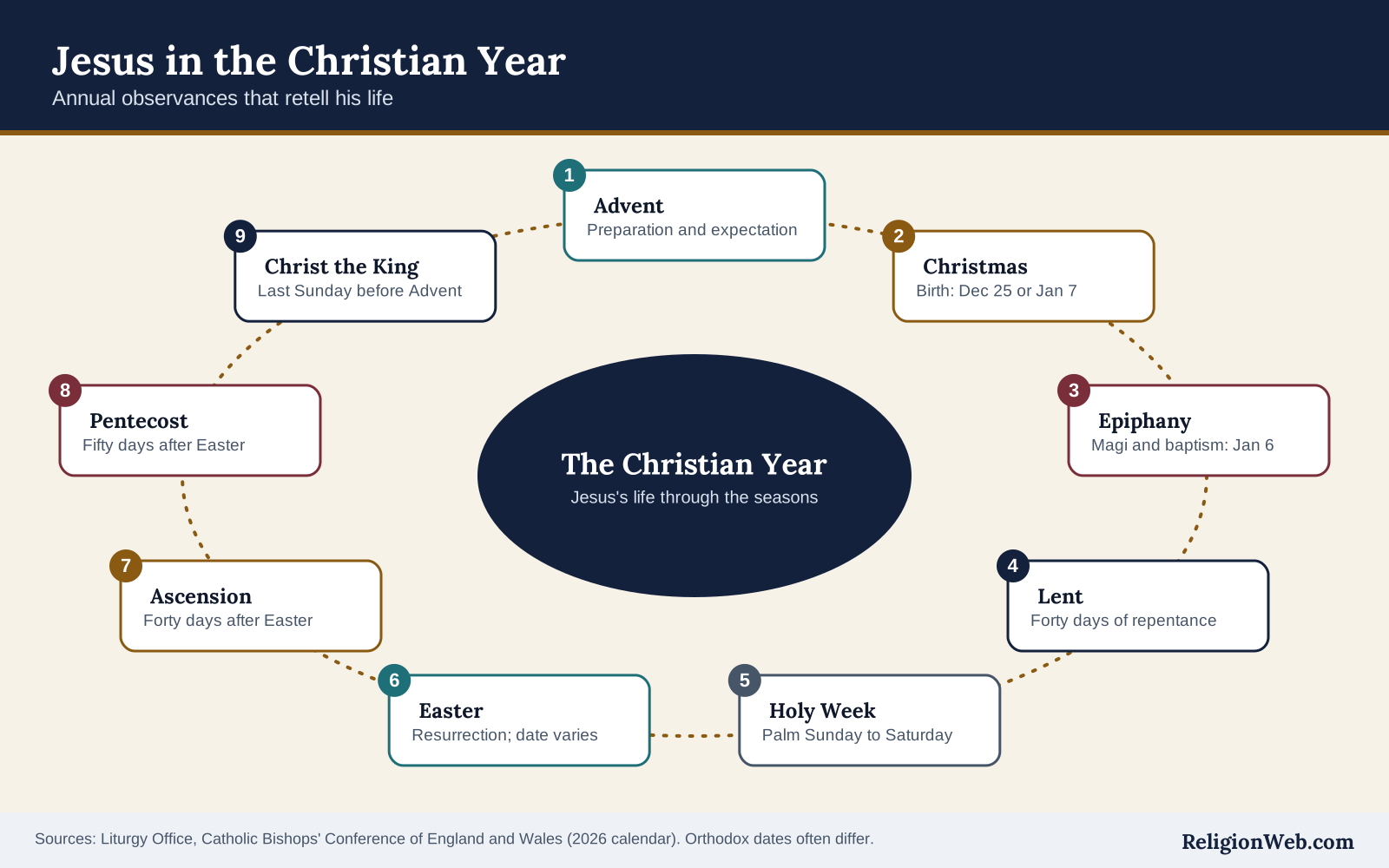
Sacred Places, Images, and Symbols of Christ
Places Associated with Jesus
Bethlehem, Nazareth, and Galilee
Christian pilgrims have visited the places linked with Jesus since at least the fourth century. In Bethlehem the Church of the Nativity stands over a cave traditionally identified as the birthplace. Emperor Constantine commissioned the first basilica in the 320s and 330s, and the emperor Justinian rebuilt it in the sixth century, preserving much of the earlier plan. It was inscribed on the UNESCO World Heritage List in 2012. The Greek Orthodox, Armenian Apostolic, and Catholic churches share responsibility for it under a long-standing agreement known as the Status Quo, and a silver star set in the grotto floor marks the traditional spot. In Nazareth, the Franciscan-run Basilica of the Annunciation commemorates the angel’s message to Mary, and around the Sea of Galilee, sites such as Capernaum and the Mount of Beatitudes draw visitors who read the Gospels where they were set. Churches built on these sites reflect later tradition, and archaeologists and historians evaluate the identifications case by case.
Jerusalem, the Via Dolorosa, and the Holy Sepulchre
In Jerusalem, pilgrims follow the Via Dolorosa, the “Way of Sorrows,” which winds through the Old City to the Church of the Holy Sepulchre. Constantine’s basilica on the site was consecrated on September 13, 335, and tradition holds that the church covers both Golgotha and the tomb. It was destroyed in 1009 and rebuilt, and today the Greek Orthodox, Catholic (Franciscan), and Armenian Apostolic churches hold the main rights, with the Coptic, Ethiopian, and Syriac Orthodox churches holding lesser ones. A series of Ottoman rulings, particularly those of 1757 and 1852 to 1853, froze many arrangements so that even minor changes require agreement among the communities. The small shrine enclosing the tomb, the Aedicule, was restored between 2016 and 2017. Archaeologists generally regard the location as plausible, since first-century Jerusalem had burial grounds outside the city walls and the early Christian community appears to have remembered the area.
Images and Symbols of Christ
The cross, the crucifix, and monograms
The cross has become the best-known symbol of Christianity, although the earliest Christian art emphasizes other images. Before the fifth century, depictions of the crucifixion are rare, and Christians instead used signs such as the fish, the anchor, and the Good Shepherd. The fish was a Greek acrostic, Ichthys, formed from the first letters of the phrase “Jesus Christ, Son of God, Savior.” The Chi-Rho monogram combines the first two Greek letters of Christos, and the letters IHS derive from the first letters of the Greek name Jesus. The letters INRI, seen on many crucifixes, abbreviate the Latin of the inscription over the cross, “Jesus of Nazareth, King of the Jews.”
Catholic, Orthodox, and many Anglican and Lutheran churches display crucifixes, which show Christ’s body on the cross and call attention to his suffering. Many Protestant churches prefer an empty cross, which points to the resurrection or avoids images of Christ. Making the sign of the cross is a common gesture of prayer in Catholic, Orthodox, and Oriental Orthodox traditions and in some Protestant ones. Each choice carries a meaning for the community that makes it, and none is a universal standard.
Icons and the question of images
The New Testament gives no description of Jesus’s appearance, and the earliest images show him as a youthful shepherd or a teacher. The oldest surviving icon of Christ as Pantocrator, “ruler of all,” is a sixth-century painting in wax at Saint Catherine’s Monastery on Mount Sinai, and the art historian Kurt Weitzmann read the face’s slight asymmetry as a way of suggesting both divine and human nature. In the Byzantine world, controversy over images erupted in the eighth century, and the Second Council of Nicaea in 787 affirmed that icons may be venerated because the Word became visible by becoming human. Orthodox churches today treat the icon as a form of theology in color, and Catholics honor images and statues with similar reasoning. Reformed Protestant tradition, following John Calvin, was wary of religious imagery and removed it from many churches, while Lutherans kept crucifixes and altar paintings. As a result, the way a congregation represents Christ often tells visitors something about its history and doctrine.
Jesus Christ in the Modern World
Christians and Their Confession Today
Numbers and regions
Pew Research Center’s 2025 study of the global religious landscape counts about 2.3 billion Christians in 2020, or 28.8 percent of the world’s population, a number that grew by 122 million since 2010 even as the share fell by 1.8 percentage points. Christianity remains the largest religion by this measure, ahead of Muslims at 25.6 percent and the religiously unaffiliated at 24.2 percent. About 31 percent of the world’s Christians live in sub-Saharan Africa, now the largest Christian region, about 24 percent in Latin America and the Caribbean, and about 22 percent in Europe. These figures count people who identify as Christian, so they include many who attend services rarely, and they say nothing about the content of belief. They should be read as self-identification data, not as a measure of devotion.
A shared confession across divisions
The ecumenical movement of the twentieth century grew in part from the conviction that Christians share a confession of Christ despite their divisions. The World Council of Churches, a fellowship of 356 member churches, describes itself in its basis as a fellowship of churches which “confess the Lord Jesus Christ as God and Saviour according to the scriptures.” Its members include Orthodox, Oriental Orthodox, Anglican, and many Protestant bodies, and the Catholic Church cooperates with it without being a full member. The language of that basis, like the confession “Jesus is Lord” in the New Testament, shows how a short statement about Christ can serve as common ground even when churches differ on authority, worship, and doctrine. The Anglican communion, one of the larger traditions in the council, is described in the article on Anglicanism.
Jesus in Scholarship and Public Life
Research today
The academic study of Jesus continues to change. Since the late twentieth century scholars have given more attention to the social history of Galilee, to archaeology, and to the Jewish background of the Gospels, and they have drawn on perspectives from Jewish, Catholic, Orthodox, Protestant, and nonreligious scholars. Some, such as James Crossley, have argued that the field is moving toward questions about class, culture, and memory rather than toward a single reconstructed portrait. Digital projects have made early manuscripts, including the fourth-century Codex Sinaiticus, available for study online, and Jewish and Christian scholars now publish together on the first-century setting of the Gospels. These developments do not replace faith commitments, but they give believers and nonbelievers a shared body of evidence to discuss.
Influence beyond the church
The figure of Jesus has shaped far more than worship. The numbering of years from the Incarnation became the standard way of dating events across much of the world, and the secular abbreviations BCE and CE reuse that numbering. His parables entered everyday speech, so that “good Samaritan” and “prodigal” are common words. Composers such as Johann Sebastian Bach in his St. Matthew Passion and George Frideric Handel in Messiah set the Gospel story to music, and painters and sculptors in every region have portrayed him in local dress and features. Churches and religious orders founded many schools and hospitals in Europe and later in missionary regions, often citing the Gospel accounts of Jesus teaching and healing. His name has also been invoked on behalf of conflicting political causes, and the appeal to the Gospels in public debate is itself something that scholars and churches continue to discuss critically.
Other religious traditions, among them Judaism and Islam, have their own ways of understanding Jesus, which are described in their own terms in the articles on Judaism and Islam.
Common Misconceptions About Jesus Christ
Misconception 1: “Christ” was Jesus’s family name
Where the misunderstanding comes from
In English, “Jesus Christ” reads like a first and last name, and phrases such as “Mr. and Mrs. Smith” make the pattern feel familiar. The New Testament encourages the habit, since Paul’s letters use “Christ” so frequently, and often so freely with “Jesus,” that it begins to function as a second name. Children who hear the phrase in prayers and songs before they learn Greek or Hebrew have little reason to suspect that it means something.
The confusion is reinforced by the fact that many cultures give people a given name and a family name, whereas first-century Jews in Galilee typically identified people by a father’s name or a hometown, as in “Jesus of Nazareth” or “Jesus son of Joseph.”
What the evidence and tradition actually show
“Christ” is the Greek Christos, “anointed one,” a translation of the Hebrew mashiach. It is a title, and to say “Jesus Christ” is to say “Jesus, the Messiah.” Acts and the Gospels describe early preachers arguing that “Jesus is the Christ,” which makes sense only if the word still carried its meaning. In ordinary Christian use, the two words have fused, and many Christians say “Christ” as a simple name of reverence. That usage is natural in worship, but it is the end of a development and not the beginning.
The title also shows how much the word meant in its first setting. When the Gospels have people ask whether Jesus is the Christ, they are asking whether he is the long-awaited anointed deliverer, a question that would be meaningless if the word were a surname. Later Christians in Greek-speaking and Latin-speaking lands kept the word as a title even when they no longer spoke Hebrew, and the English “Christ,” like the German Christus or the Spanish Cristo, preserves that Greek root.
Historians, who seek to avoid assuming that Jesus was the Messiah, often write “Jesus of Nazareth” for that reason. Christians who write “Jesus Christ” are making a statement of faith that this man is the anointed one, and the choice of words is not a mistake in either case.
Misconception 2: All the details of Jesus’s life are preserved in one continuous ancient biography
Where the misunderstanding comes from
Illustrated children’s Bibles, films, and Christmas and Easter pageants combine the Gospels into one smooth story, so people come to assume that an ancient “Life of Jesus” exists from birth to death. The impression has a long history. In the second century, Tatian compiled the four Gospels into a single continuous narrative called the Diatessaron, which was widely used in Syriac-speaking churches, and many later harmonies followed.
The New Testament itself invites a sequential reading, since the Gospels come first in the Christian Bible and each tells a story that appears to be complete.
What the evidence and tradition actually show
There is no single continuous biography. The New Testament contains four Gospels, written by different authors decades after the events, with different purposes and sometimes different sequences. Only Matthew and Luke describe his birth, and nothing in the canonical Gospels except Luke’s story of the boy in the Temple covers his life between infancy and baptism. The ministry is shaped differently in the Synoptic Gospels and in John, and the accounts of the last days differ on points such as the day of the Last Supper and the details of the resurrection appearances. John’s Gospel itself says that Jesus did many other things that are not recorded (John 21:25).
Christian tradition has not treated these differences as a flaw. The early church kept four Gospels instead of one harmony, and churches read them as complementary witnesses, each with its own emphasis. Historians use the Gospels critically, comparing them with one another and with outside evidence to decide what can be said with confidence. Reading them as a single seamless biography hides the character of each.
Misconception 3: Every Christian tradition explains every Christological question in identical language
Where the misunderstanding comes from
Many Christians recite the same creed, and most churches use the name of Jesus Christ in common prayers and hymns. Public statements about “what Christians believe” usually summarize a shared core. The Nicene Creed is recited in Catholic, Orthodox, Anglican, Lutheran, and many other services, so it is natural to assume that all Christians would answer any question about Christ in the same words.
Popular media also tend to speak of “the Christian view,” which can hide the diversity of the tradition.
What the evidence and tradition actually show
Christians share the confession of Jesus as Lord and Savior, and most hold the Nicene faith, but they diverge in how they describe it. The Oriental Orthodox churches speak of a single incarnate nature of the Word and reject the language of Chalcedon, while Catholic, Eastern Orthodox, and most Protestant churches use the language of two natures in one person. The Assyrian Church of the East has its own formulations. Churches differ on whether and how Mary is the Mother of God, on the sense in which Christ is present in the Eucharist, and on which interpretation of the atonement to emphasize. Groups such as the Latter-day Saints, Jehovah’s Witnesses, Unitarian Christians, and Oneness Pentecostals describe Jesus in ways that differ from the Nicene creed while identifying as Christian.
Churches that once condemned each other’s formulas have in some cases concluded that their differences were partly verbal, as in the 1973 and 1994 common declarations. Even then, they do not claim that they speak identically. A responsible account therefore names the tradition each time, as this article tries to do.
Misconception 4: Jesus was born on December 25 in the year 1
Where the misunderstanding comes from
The calendar numbers years from the supposed year of Jesus’s birth, and Christmas is celebrated on December 25, so it seems natural to combine them. Nativity scenes and carols present the birth as happening on a particular winter night, and many people suppose that the Gospels say so.
The calendar also has no year zero, which makes the year “1” appear to be the moment of birth.
What the evidence and tradition actually show
No Gospel gives the day, month, or year of Jesus’s birth. Matthew and Luke place it in the reign of Herod the Great, who died in 4 BCE, so most historians put the birth between about 6 and 4 BCE. The year numbering was proposed by Dionysius Exiguus in 525 CE, and its starting point appears to have been miscalculated by a few years. The observance of December 25 is attested in the fourth century, and its origins are discussed by historians; the Armenian church keeps the Nativity on January 6, and several Orthodox churches keep it on a date corresponding to January 7 in the civil calendar. Christians hold that the date of the celebration is a matter of tradition, and the feast is about the meaning of the birth, not a claim about the day. There was also no year zero in the system Dionysius introduced, so the year after 1 BCE is 1 CE, and the “turn of the era” does not mark a birthday in any strict sense. Even among historians who accept the Gospel stories as reliable in outline, few argue for a precise date, because the evidence does not allow one. The history of the feast is described in the article on Christmas.
Misconception 5: Jesus founded a new religion called Christianity, separate from Judaism
Where the misunderstanding comes from
Christianity today is a distinct religion with its own scriptures, institutions, and worship, and it is natural to project that separation back onto its beginning. Later centuries of Christian art and preaching often portrayed Jesus as standing against Judaism, sometimes with hostile consequences, and the word “Christian” is rarely used for Jesus himself in careful speech.
The Gospels also depict disputes between Jesus and other Jewish teachers, which readers can take as a rejection of the tradition and not as an argument within it.
What the evidence and tradition actually show
Historians agree that Jesus was a Jew who lived and taught within Jewish life, observing festivals and arguing about the interpretation of the Torah. His first followers were Jews who continued to worship in the Temple after his death, according to the book of Acts. The question of whether non-Jews must keep the law of Moses was debated in the first generation, as Acts 15 and Paul’s letters show. The name “Christian” was first used in Antioch, probably some years after Jesus’s death, and a recognizably separate religion emerged gradually over decades and, in some regions, centuries. Scholars still discuss when and how that parting occurred.
Christian teaching holds that Jesus gathered a community and commissioned his followers to continue his work, and Catholic and Orthodox teaching in particular speaks of his founding the church. This is a belief about the community’s origin, and it does not conflict with the historians’ observation that Jesus was a Jew and that the movement took on a separate identity afterward. The history of that development is told in the article on Christianity.
Frequently Asked Questions About Jesus Christ
Questions About History
Did Jesus really exist?
Yes, according to nearly all historians and scholars of the ancient world, whether or not they are Christians. The evidence includes Paul’s letters from the 50s CE, the Gospels, and short references by Josephus and Tacitus. Theories that Jesus never existed, often called mythicism, are rejected by almost all specialists in the field. The debate among historians concerns which details are reliable, not whether he lived.
What language did Jesus speak?
Jesus most likely spoke Aramaic in daily life, and he would have known the Hebrew of scripture. Greek was widely spoken in the region, and he may have known some, but the Gospels were composed in Greek and give his words in translation, with a few Aramaic phrases preserved. The Aramaic words in the Gospels, such as talitha cum and abba, are among the closest we come to his speech.
How old was Jesus when he died?
No source gives his age at death. Luke 3:23 says he was “about thirty” when he began his public activity, and the Gospels imply a ministry of between one and three years. If he was born around 6 to 4 BCE and died in 30 or 33 CE, he would have been in his mid-thirties or somewhat older. The common statement that he died at thirty-three comes from combining the year 33 CE with a birth in year 1, and it is a tradition more than a finding.
Questions About Belief
Why do Christians say Jesus is both God and human?
The New Testament describes Jesus as truly human, who hungered, grew tired, and died, and also uses language of divinity, such as calling him the Word who was God and Thomas’s cry “My Lord and my God.” The councils from Nicaea to Chalcedon tried to hold these together by stating that the Son is of one being with the Father and that he became fully human, without ceasing to be God. Churches differ in vocabulary, but Catholic, Orthodox, Oriental Orthodox, and most Protestant churches affirm both, while some other groups do not.
What do Christians mean when they say Jesus saves?
Christians generally mean that through Christ people are reconciled with God, forgiven, and given a share in new life that death does not end. The details vary. Orthodox teaching speaks of healing and union with God, Catholic teaching of grace given through the church and its sacraments, and many Protestants of forgiveness received by faith. All connect salvation with the cross and resurrection, as described in the section on salvation above.
Questions About Practice
Why do Christians worship on Sunday?
Sunday is the day on which, in the Gospels, Jesus was found risen, so Christians came to call it the Lord’s Day. The New Testament mentions the disciples gathering on the first day of the week, and the second-century writer Justin Martyr describes a Sunday assembly with readings, prayers, and the Eucharist. Some Christians, such as Seventh-day Adventists and Seventh Day Baptists, worship on Saturday, the Sabbath, for reasons based on their reading of scripture.
Do all Christians pray to Jesus?
Most do, though not in the same way. Many liturgical prayers are addressed to God the Father through Jesus Christ, and the Lord’s Prayer is addressed to the Father. Orthodox and Catholic worship also include prayers directly to Jesus, such as the Jesus Prayer and the Kyrie eleison, and evangelical and Pentecostal believers commonly speak to Jesus personally. Christians who confess the Trinity understand prayer to be offered to God in the three persons, and the emphasis varies from one tradition to another.
Conclusion: Reading the Story of Jesus with Care
What the Evidence and the Traditions Show
Three kinds of knowledge
The story of Jesus of Nazareth can be approached as history, as narrative, and as faith, and each approach gives a different kind of knowledge. Historians can say with confidence that he was a Galilean Jew, baptized by John, who spoke of God’s Kingdom, gathered disciples, and was crucified under Pontius Pilate. The Gospels tell the story with artistry and purpose, and they differ from one another in ways that reveal how early communities remembered him. The churches teach that he is the Christ, the Son of God, and the risen Lord, and they have defined that teaching in creeds, prayers, and festivals that millions of people practice today.
Where agreement and difference lie
Christians agree on the center of the confession and disagree about important details of its meaning. Historians agree on a broad outline and differ on dates, sayings, and portraits. Neither kind of difference erases the other, and the sections above have tried to say who holds which view. The result is a figure who can be studied from many directions without being reduced to any one of them.
How to Keep Exploring
Next steps on this site
Readers who want to follow a theme further can turn to the articles on Easter and Lent for the passion and resurrection in worship, to Christmas for the birth, to baptism and the Eucharist for the sacraments, and to the Lord’s Prayer for the prayer Jesus taught. The articles on Catholic, Eastern Orthodox, and Protestant Christianity describe how each family of churches lives out its faith in Christ.
Reading the Gospels themselves
There is no substitute for reading the sources. A reader new to the Gospels might begin with Mark, the shortest and earliest, and then read Matthew and Luke for parallels and differences before turning to John. A good study Bible will explain the dates, the manuscripts, and the scholarly debates, and reading with a Jewish or Christian commentary can reveal the interpretive traditions that have grown around the texts. The article on the Bible explains how these books were collected and how different churches use them.
Sources
The table below lists the principal external sources behind this article. Facts, dates and figures were checked against these and related primary, institutional and academic materials.
| # | Source | Publisher and type | Used for | Link |
|---|---|---|---|---|
| 1 | World English Bible (Classic): Mark 1, 6, 8, 10, 15; Matthew 22; John 1, 4, 20; 1 Corinthians 1 and 15; Philippians 2; Isaiah 45 | eBible.org · Primary text | Public-domain Bible text for all scriptural quotations (Mark 1:14-15, Matthew 22:37-40, 1 Corinthians 15:3-5) | ebible.org |
| 2 | Annals, Book 15, chapter 44 (Tacitus on Christus and Pontius Pilatus) | Internet Sacred Text Archive · Primary text | Tacitus's statement that Christus was executed under Tiberius by Pilate | sacred-texts.com |
| 3 | The Antiquities of the Jews 20.197-20.203 (William Whiston translation) | Lexundria · Primary text | Josephus on James, the brother of Jesus who was called Christ (Antiquities 20.200) | lexundria.com |
| 4 | Definition of Chalcedon (451 CE), English text | University of Cincinnati (course reader PDF) · Primary text | Chalcedonian formula of two natures in one Christ | homepages.uc.edu |
| 5 | How the Global Religious Landscape Changed From 2010 to 2020 | Pew Research Center · Demographic data | 2.3 billion Christians (28.8%) in 2020; regional shares; comparison with other groups | pewresearch.org |
| 6 | Nostra Aetate: Declaration on the Relation of the Church to Non-Christian Religions (1965) | Holy See (Vatican) · Institutional | Catholic teaching that the passion cannot be charged against all Jews then living or today | vatican.va |
| 7 | Calendar 2026 (liturgical calendar for England and Wales) | Liturgy Office, Catholic Bishops' Conference of England and Wales · Institutional | 2026 dates for Ash Wednesday, Holy Week, Easter, Ascension, Pentecost, Christ the King, Advent, Christmas | liturgyoffice.org.uk |
| 8 | Christ | Bible Odyssey (Society of Biblical Literature) · Academic reference | Christos and mashiach; diversity of messianic expectation; Christ as title and not a surname | bibleodyssey.org |
| 9 | Pontius Pilate | Bible Odyssey (Society of Biblical Literature) · Academic reference | Pilate's years (26-37 CE), sources (Philo, Josephus, 1961 inscription), differing views of his role | bibleodyssey.org |
| 10 | About the WCC | World Council of Churches · Institutional | Basis confessing the Lord Jesus Christ as God and Saviour; 356 member churches | oikoumene.org |
Last fact-check date: 2026-10-21.