Mahavira, born Vardhamana, is revered in Jainism as the twenty-fourth and most recent Tirthankara, one of the “ford-makers” who attain perfect knowledge and then restore the path to liberation for their age. Jain tradition dates his life to 599 to 527 BCE. He was born into a ruling clan in the eastern Gangetic plain, in what is now Bihar, left home at about the age of thirty, and, after roughly twelve years of silence, fasting, and wandering, is said to have attained kevala jnana, an unlimited and direct knowledge of everything. He then taught for some three decades and died at Pava at the age of seventy-two. For the roughly 4.5 million Jains counted in India’s 2011 census, and for Jain communities abroad, he is the teacher whose life and words are closest to hand. A fuller account of the tradition he belongs to appears in the article on Jainism.
Many popular summaries call Mahavira the founder of Jainism. Jains themselves do not usually say so, and the reason is theological before it is historical. In Jain teaching, the path of non-violence and self-conquest is not launched by a single person at a single moment. It is rediscovered and proclaimed in every age by a succession of Tirthankaras, and Mahavira is the twenty-fourth in the line of the present descending half of time. Jains therefore describe him as a restorer and a teacher of an eternal dharma, not as the originator of a new religion. The difference between “founder” and “twenty-fourth Tirthankara” is the central point of this article, and it affects how his life, his teaching, and his place in history should be read.
Historians approach the question from another direction and reach a related conclusion. Early Buddhist texts speak of a rival teacher called Nigantha Nataputta, whose community of “Niganthas” (those free of bonds) already existed in the Buddha’s lifetime, and Jain scripture describes Mahavira’s own parents as followers of an earlier teacher, Parshva. The evidence suggests that Mahavira reshaped, systematized, and gave lasting institutional form to an ascetic movement that was already part of the religious life of eastern India. Mahavira is therefore best understood as the decisive figure of Jain history, without being treated as its absolute beginning.
The sections below separate three kinds of material that are easy to blend. The first is what Jain scriptures and later narratives say about his life, with the differences between the Shvetambara and Digambara accounts kept visible. The second is what historians can reasonably say from early Jain and Buddhist sources, including honest uncertainty about dates. The third is the teaching and practice that Jains attribute to him, from the five great vows to the fourfold community of monks, nuns, laymen, and laywomen. Throughout, claims are attributed to the tradition, text, or scholar that makes them.
Mahavira at a Glance: Who He Was and Why the Title “Founder” Needs Care
The short answer in plain terms
Names, titles, and the meaning of “Mahavira”
The man known as Mahavira bore the personal name Vardhamana, which means “the increasing one.” The Kalpa Sutra, the Shvetambara scripture that tells his life, explains that the name was chosen by his parents because their family’s prosperity grew from the time he was conceived. “Mahavira” means “great hero” and is an honorific. The same text states that the gods gave him the title, an episode discussed below, because he remained steadfast through fear and hardship. Jain sources also call him Vira, Sanmati, and Ativira, and refer to him as a jina (“conqueror”), an arihant (“worthy one”), and a Tirthankara (“ford-maker”). Early Buddhist texts call him Nigantha Nataputta, which scholars read as “the Nigantha, son of Nata,” with Nata referring to his clan (Sanskrit Jnatri).
The clan name matters because it locates him socially. Jain tradition says his father, Siddhartha, belonged to the Jnatrika (Nata) clan, a Kshatriya or warrior-ruler lineage, and his mother, Trishala, was also of a ruling family. Mahavira was thus born into the world of small republics and kingdoms of the Videha and Magadha region, and not into a priestly or merchant household. That background is repeated in the tradition’s narrative of renunciation, in which a prince gives up rank, family, and property.
Where and when he lived, in brief
Mahavira lived in the eastern Gangetic plain, in the area of present-day Bihar, in the age that also produced the Buddha. The Jain tradition’s own dates, which both major communities accept, place his birth in 599 BCE and his death in 527 BCE, and Jains count the Vira Nirvana era from the latter date. Many modern historians believe the traditional dates are too early, and proposals for his death range from the traditional 527 BCE to about 425 BCE or a few years later. The section on sources and dating explains the arguments. For general orientation, it is enough to say that he lived in the middle of the first millennium BCE, in the kingdoms of Magadha and Videha, during the reigns that Jain and Buddhist texts connect with Bimbisara (Shrenika) and Ajatashatru (Kunika).
Why “founder of Jainism” can mislead
The Jain understanding of a lineage of Tirthankaras
In Jain cosmology, time moves in enormous cycles, each divided into an ascending and a descending half. In every half-cycle that includes a period of religious teaching, twenty-four Tirthankaras appear in succession, and each recovers the same truths and re-establishes the same fourfold community of monks, nuns, and lay men and women. In the present descending half, the first Tirthankara is Rishabhanatha (also called Adinatha), and the twenty-fourth is Mahavira. Jains therefore say the teaching is without a beginning in time. This does not mean that the institutions or texts are unchanging. It means that the knowledge claimed by every Tirthankara is the same knowledge, and that Mahavira’s role was to renew it for his own era rather than to invent it.
The article on Jainism sets out the longer cosmology and the history of the community. The point for this biography is narrower. When Jains say “Mahavira was not the founder,” they are making a statement about doctrine, not denying his importance. In devotional practice, in monastic memory, and in the calendar, his life is the most vividly remembered of the twenty-four.
What historians add to the picture
Scholars of South Asian religions, writing in a different register, observe that the Jain tradition has deep roots in the wandering ascetic (shramana) culture of eastern India, which developed alongside, and partly in dialogue with, the Brahmanical ritual world described in the Vedas and Upanishads. Hermann Jacobi, the German Indologist who translated the Jain scriptures in the 1880s and 1890s, argued that Jainism was an independent movement and not an offshoot of Buddhism, and he thought the tradition’s account of Parshva, the twenty-third Tirthankara, likely had a historical core. Later scholars have refined or questioned particular points, but the broad consensus is that Mahavira belonged to an existing ascetic community and became its great organizer.
| Term | Meaning | Where it matters in Mahavira’s story |
|---|---|---|
| Tirthankara | “Ford-maker”; a human teacher who attains omniscience and re-establishes the fourfold community | Mahavira is the twenty-fourth of the present half-cycle |
| Jina | “Conqueror”; one who has overcome passions; the root of the word “Jain” | A title for Mahavira and for all liberated teachers |
| Kevala jnana | Perfect, unlimited knowledge of all substances and their states | Attained, in tradition, after about twelve and a half years of austerity |
| Nirvana (also moksha) | Final liberation of the soul from the cycle of rebirth | Reached at Pava at the end of his life |
| Ganadhara | Chief disciple who preserves a Tirthankara’s teaching | Eleven are named for Mahavira, led by Indrabhuti Gautama |
| Sangha | The fourfold community of monks, nuns, laymen, and laywomen | Organized and extended by Mahavira according to tradition |
| Mahavrata | The five “great vows” of the ascetic: non-violence, truthfulness, non-stealing, celibacy, non-possession | Traditionally taught by Mahavira as five vows, where Parshva is remembered as teaching four |
| Agama | Canonical scripture, traditionally traced to the Tirthankara’s teaching | Preserved differently by the Shvetambara and Digambara traditions |
| Shramana | Wandering renunciant; the broader culture of ascetic movements | The social setting in which Mahavira taught |
| Digambara and Shvetambara | “Sky-clad” and “white-clad” traditions, the two principal Jain communities | Their narratives of Mahavira’s life differ on several points |
How to read the sources behind this article
Three layers: scripture, later narrative, and historical inquiry
Every statement about Mahavira falls into one of three layers. The first is scriptural: passages in canonical texts such as the Acaranga Sutra and the Kalpa Sutra, which Jains regard as authoritative and which are the oldest sources for his life. The second is later narrative and commentary, which expands the scriptural outline into the full biography many Jains know from sermons and illustrated manuscripts. The third is critical history, which compares Jain sources with Buddhist texts, inscriptions, and archaeology. This article tries to say which layer a statement comes from, because conflating them would misrepresent both the tradition and the historical method.
Respectful wording and what this article does not do
The article uses the vocabulary Jains use, including “Venerable” and “Lord” where it quotes a translation, and it describes the omniscience and heavenly events in the tradition’s accounts as what the sources say or what Jains believe. It does not rank Mahavira against the founders of other religions, and it does not treat any single narrative as the only authentic one. Where the Shvetambara and Digambara communities tell the story differently, both versions are given.
The World of Mahavira: Eastern India in the Age of the Shramanas
Kingdoms, republics, and towns of the middle Ganges plain
Magadha, Videha, and Vaishali
The accounts of Mahavira’s life are set in a small and well-defined part of South Asia: the lands north and south of the middle Ganges, in the area of modern Bihar. Jain and Buddhist texts both describe this region as a patchwork of monarchies and tribal republics. To the south of the river lay the kingdom of Magadha, with its capital at Rajagriha (modern Rajgir), ruled according to both traditions by Bimbisara (called Shrenika in Jain sources) and then by his son Ajatashatru (Kunika in Jain sources). To the north lay the lands of the Vrijis, a confederation that included the Licchavis of Vaishali and the Videhas, whose territory was centered on Mithila. Jain tradition places Mahavira’s birth in Kundagrama, a settlement associated with the neighborhood of Vaishali, and Colette Caillat, the author of the entry on Mahavira in the Encyclopedia of Religion, notes that his mother Trishala is described in the tradition as closely related to the ruler of Vaishali.
These political facts shape the biography in three ways. Mahavira’s family belonged to the ruling or landholding class of a republic, so the story of renunciation is one of a person giving up political standing as well as comfort. His teaching career took place in the cities and rest-houses of the region, and the tradition remembers kings and republican leaders as his patrons and listeners. And the end of his life, at Pava, takes place in the region of the neighboring republics, which is why the Kalpa Sutra lists eighteen confederate kings of Kashi and Kosala, together with nine Mallakis and nine Lichchhavis, among those who held an illumination on the night of his death.
Towns, trade, and a changing society
Historians describe the sixth and fifth centuries BCE as a time of urban growth in the middle Ganges valley. Towns expanded, trade routes lengthened, and territorial states began to absorb older tribal polities. The result was a society in which merchants and householders held growing wealth, kings claimed new kinds of authority, and the older village-based ritual world, centered on sacrifices performed by Brahmin priests, coexisted with many other ways of seeking religious meaning. Jain scripture names kings, merchants, and householders among Mahavira’s lay listeners, and the lay ethic of limiting possessions, avoiding harmful trades, and giving charity took shape in dialogue with that world. The later association of Jain communities with trade and finance in western and southern India developed over many centuries and should not be read back into the earliest period.
The shramana movements and the Nirgrantha community
Wandering teachers and their schools
The religious landscape of eastern India in Mahavira’s time was crowded. Alongside the Vedic tradition of sacrifice and the speculative teaching of the early Upanishads, which the article on the Vedas and Upanishads describes, there were wandering renunciants known as shramanas, “strivers,” who left household life to pursue liberation through meditation, austerity, or philosophical inquiry. They disagreed on fundamental questions. Some taught that actions bear fruit in rebirth; others held that all events are fated, or that nothing persists after death. The early Buddhist text called the Samannaphala Sutta (Digha Nikaya 2) lists six such teachers who were well known to the king of Magadha: Purana Kassapa, Makkhali Gosala, Ajita Kesakambali, Pakudha Kaccayana, Sanjaya Belatthiputta, and Nigantha Nataputta. The last of these is the Pali Buddhist name for Mahavira.
The list is useful, with a caution. It is drawn from a Buddhist text, so the portrayal of each teacher serves the text’s own aims, and the summaries of their doctrines are not necessarily how their followers would have described them. Still, the list establishes that a teacher recognized by that name headed a community of ascetics in the territory of Magadha in the age of the Buddha, and that the king of Magadha knew of him. In the same passage, the text reports the Nigantha as teaching a “fourfold restraint,” a detail that scholars, beginning with Jacobi, have connected with the Jain tradition’s account of the four vows ascribed to the earlier teacher Parshva. Elsewhere in the Pali canon, the Majjhima Nikaya reports a claim made by Niganthas about their teacher’s knowledge, and the Digha Nikaya records that Nigantha Nataputta had died at Pava, details that are discussed in the next section.
The Jain scripture called the Bhagavati Sutra gives a different perspective by describing an encounter between Mahavira and Makkhali Gosala, the leader of the Ajivika community. Caillat’s entry notes that the Jain tradition presents Gosala as a former associate of Mahavira who later broke away and headed his own group. The Ajivikas have not survived as a separate community, and their story survives chiefly in Jain, Buddhist, and Brahmanical sources that describe them from outside. For the study of Mahavira, the main significance of such passages is that they show how closely the religious communities of the region were in dialogue, and sometimes in dispute, with one another. Readers interested in the Buddha’s own life and in the movement associated with him will find it in the article on the Buddha.
Parshva and the earlier Nirgrantha community
Jain tradition does not present Mahavira as arriving in an empty field. The Acaranga Sutra, in its second book, describes his parents as devotees of Parshva, the twenty-third Tirthankara, and the Uttaradhyayana Sutra preserves a dialogue between a pupil of Parshva named Keshi and Mahavira’s disciple Indrabhuti Gautama, in which the two monks discuss why one lineage taught four vows and the other five. Tradition places Parshva about 250 years before Mahavira, though the sources do not agree on the figure. The Kalpa Sutra gives his lifespan as one hundred years and says he died on Mount Sammeta, a site later known as Sammed Shikhar.
Modern scholars take this tradition seriously without treating every detail as history. Jacobi argued in the introductions to his translations that Parshva was probably a real teacher and that the Nirgrantha (“free from bonds”) community existed before Mahavira. Many later historians accept that Mahavira reorganized an existing ascetic group, but they note that the evidence for Parshva consists almost entirely of Jain tradition and a few indirect references. The sections below on the Tirthankara tradition return to this point, because it bears directly on the claim that Mahavira “founded” Jainism.

Sources and Dates: What Can Be Known About Mahavira
The Jain scriptural sources
The Acaranga and Kalpa Sutras: the oldest accounts
The two earliest Jain sources for Mahavira’s life are both Shvetambara canonical texts, translated into English by Hermann Jacobi in the nineteenth century. The first book of the Acaranga Sutra (a manual of monastic conduct) includes a lecture called the “Pillow of Righteousness,” which describes Mahavira’s years of wandering in vivid, unadorned verse. Scholars have long regarded it as one of the oldest passages in the Jain canon. It gives few names, places, or dates, and it contains little of the miraculous detail found in later accounts; it speaks of cold, hunger, insects, beatings, and silence. The second source is the Kalpa Sutra, which in its first section gives the formal biography of Mahavira, followed by shorter lives of Parshva, Arishtanemi, and Rishabha, a list of the early teachers, and rules for the rainy-season retreat. This text is recited in Shvetambara communities during the festival of Paryushana, which is the subject of the article on Paryushana.
These texts are older than the full biographies, but they were still fixed in writing long after Mahavira’s death. Shvetambara tradition holds that the canon was committed to writing at a council at Valabhi, in Gujarat, which tradition dates to 980 or 993 years after the nirvana, that is, in the fifth century CE. The Kalpa Sutra itself ends its account by stating the number of years elapsed since Mahavira’s death. Readers should treat the text as a source that crystallized the memories and the liturgy of a community, not as a day-by-day chronicle. Its structure, with fixed lists of dreams, signs, and followers, resembles the formulaic biographies of other great figures in Indian literature, a point that Caillat also makes.
Later narratives and the Digambara accounts
Later writers expanded the outline into full narratives. Among Shvetambara authors, later narrative added episodes such as the one, familiar from manuscript paintings, in which men drive spikes into the ascetic’s ears, and the twelfth-century scholar Hemachandra retold the whole story in Sanskrit in the Trishashtishalakapurushacharita, along with a history of the early Jain order, the Parishishtaparvan. The Digambara tradition does not accept the Shvetambara canon as preserved, because it holds that the original scriptures were lost over time. It relies instead on texts such as the Tiloyapannatti, the Dhavala and Jayadhavala commentaries, the Harivamsha Purana of Jinasena, and the Uttarapurana of Gunabhadra. These narratives agree with the Shvetambara ones on the main arc of his life: birth in Kundagrama, renunciation, twelve years of austerity, omniscience on the bank of the Rijupalika, thirty years of teaching, and liberation at Pava. They differ on the matters set out in the table of narrative variations later in this article.
Evidence from outside the Jain tradition
What the Pali Buddhist texts say
The early Buddhist texts are the most important outside witness. They refer to Nigantha Nataputta as the leader of an ascetic community, and the references are not friendly: they are addressed to Buddhist audiences and written to show the superiority of the Buddha’s path. For a historian that makes the evidence more useful, because it reports details that a Buddhist author had no reason to invent. In the Majjhima Nikaya, for example, a discourse reports what the Niganthas say about their teacher. In the English of Bhikkhu Sujato’s translation on SuttaCentral, the Niganthas say that their teacher “claims to be all-knowing and all-seeing, to know and see everything without exception,” and they quote his own words. The claim reflects the same ideal of omniscience that Jain texts call kevala jnana.
Knowledge and vision are constantly and continually present to me, while walking, standing, sleeping, and waking.
Majjhima Nikaya 14, trans. Bhikkhu Sujato (SuttaCentral), segment 17.3, the Niganthas quoting Nigantha Nataputta
The Digha Nikaya adds a second, more consequential detail. At the opening of the Pasadika Sutta (Digha Nikaya 29), the Pali text says that Nigantha Nataputta had recently died at Pava and that, after his death, the Niganthas had split into quarreling factions. This agrees with Jain tradition on the place of his death, and it shows that a dispute over succession followed his passing. The Pali evidence therefore supports three points independently of Jain sources: that Nigantha Nataputta was a real teacher with a following, that he was credited with omniscience, and that he died at Pava while the Buddha was still alive.
Inscriptions, images, and archaeology
Material evidence for Mahavira himself is thin. The earliest Jain images and inscriptions that survive come from Mathura, in northern India, and belong to the period from about the first century BCE to the second century CE, several centuries after his lifetime. They show that Tirthankara images, a fourfold community with active nuns and laywomen, and the lists of teachers preserved in the Kalpa Sutra were established by that time. No inscription from Mahavira’s own century is known to name him, and the sites associated with his life, from Kundagrama to Pava, are identified by tradition rather than by excavation. A historian can therefore say that his existence is attested by early, independent Buddhist testimony and by a Jain community whose organization goes back to the early centuries, while the details of his biography rest almost entirely on Jain narrative.
The question of dates
The traditional chronology and how it was calculated
Jains calculate the Vira Nirvana era from Mahavira’s liberation, which both the Shvetambara and Digambara traditions place in the middle of the sixth century BCE, with a gap of a few years between them. The Shvetambara figure of 527 BCE, with a birth in 599 BCE and a lifespan of seventy-two years, is the one used in most Jain calendars and publications. The Digambara tradition, according to John Bowker’s entry in the Concise Oxford Dictionary of World Religions and the Jainpedia article on Diwali, places the liberation in 510 BCE. Reckonings of this kind were passed down within the community and written down centuries later, and historians do not treat them as contemporary records.
How historians reassess the dates
Historians have proposed later dates for two main reasons. The first is a chronological anchor in a Jain text. The twelfth-century Parishishtaparvan of Hemachandra, as discussed in reference works such as Bowker’s, states that the Nanda dynasty ruled after Mahavira’s death and that Chandragupta Maurya came to power 155 years after it. If Chandragupta’s accession is placed around 322 BCE, the calculation gives a death in the later fifth century BCE, around 477 BCE, and scholars have worked out variants of about 468 BCE. The second reason is the revised dating of the Buddha. Because Pali texts present the Buddha and Nigantha Nataputta as contemporaries, scholars who prefer a “short chronology” for the Buddha, with his death around 400 BCE rather than 483 BCE, also move Mahavira later. Paul Dundas, in The Jains, is reported to have argued for a death around 425 BCE or a few years after. Caillat’s summary in the Encyclopedia of Religion is more cautious: it says Western scholars place the birth about fifty years later than the Jain tradition and propose death dates such as 467 or 477 to 476 BCE, or later.
| Source or view | Birth | Death or nirvana | Basis |
|---|---|---|---|
| Shvetambara tradition | 599 BCE | 527 BCE, aged 72 | Jain chronology; the Vira Nirvana era counts from 527 BCE |
| Digambara tradition | Varies by source | 510 BCE | Digambara reckoning noted by Bowker and Jainpedia |
| Hemachandra-based calculation | About 549 BCE | About 477 BCE (variants near 468 BCE) | 155 years from the nirvana to Chandragupta Maurya, as stated in the Parishishtaparvan |
| Caillat, summarizing Western scholarship | About fifty years after 599 BCE | 467, 477 to 476 BCE, or later | Comparison of Jain, Buddhist, and Maurya chronology |
| “Short chronology” scholars such as Dundas | Not fixed | Around 425 BCE or a few years later | Later dating of the Buddha, who is portrayed as a contemporary |
The honest conclusion is that no date can be called certain. Nearly all scholars agree that Mahavira lived in the fifth century BCE or close to it, that he was a near contemporary of the Buddha, and that the Jain traditional dates fall somewhat earlier than most current estimates. This article uses 599 to 527 BCE only as “the traditional dates,” as Jains do, and flags other estimates where they matter.
The Life of Mahavira: A Step-by-Step Account From Jain Sources
Descent, conception, and birth
The descent from heaven and the fourteen dreams
The Kalpa Sutra opens the story of Mahavira before his birth. It says that he descended from a heavenly abode called the Pushpottara vimana, where he had lived for twenty sagaropamas, enormous spans of time, and took the form of an embryo in the womb of Devananda, a Brahmin woman, at midnight when the moon stood in the lunar mansion Uttaraphalguni. Devananda was the wife of the Brahmin Rishabhadatta, and the text locates the event in Kundagrama. She saw fourteen auspicious dreams, and the text lists them in order: an elephant, a bull, a lion, the goddess Shri, a garland, the moon, the sun, a flag, a full vase, a lotus lake, an ocean of milk, a celestial palace, a heap of jewels, and a smokeless fire.
The dreams are not peculiar to Mahavira. After the same list appears a second time, in the account of the dreams of Trishala, the text states a general rule, quoted below, that every Tirthankara’s mother sees the same fourteen dreams. The dreams are a sign and a convention, a way for the tradition to mark every Tirthankara’s conception as an extraordinary event of the same kind. The fourteen symbols are a familiar part of Jain visual culture, and at the festival of Mahavira’s birthday, as the scholar Nalini Balbir describes it for Jainpedia, silver or golden plaques depicting the mother’s dreams hang in the temple. Digambara tradition counts sixteen dreams rather than fourteen.
Every mother of a Tîrthakara sees these fourteen dreams in that night in which the famous Arhat enters her womb.
Kalpa Sutra, section 46 (end of Lecture 3), trans. Hermann Jacobi, Sacred Books of the East vol. 22 (1884)
The embryo transfer and why the traditions differ
The Shvetambara account contains an episode that the Digambara tradition does not accept. In it, Shakra, the king of the gods, perceives through his clairvoyant knowledge that a Tirthankara has been conceived in a Brahmin family. The Kalpa Sutra then explains, in a passage that reads like a doctrinal argument, that Arhats, universal emperors, and certain other great beings are never born into low, mean, poor, beggar, or Brahmin families. Their karma may cause them to enter such a womb, but they are not brought to birth in one, and it is the custom of Shakra to move them to a noble family. Shakra therefore orders his commander Harinegameshin, depicted in manuscript paintings with the head of an antelope, to move the embryo to Trishala, a Kshatriya woman. On the eighty-third day after conception, the text says, he does so, and also moves Trishala’s own embryo to Devananda. Both women are put into a deep sleep during the exchange.
For the Shvetambara tradition, the story answers a real question about why a prince-born Jina could have been conceived in a Brahmin family. It also bears on a broader point of the tradition, that the highest religious status is not conferred by priestly birth. Digambara sources, which treat Mahavira as born to Trishala from the start, do not accept the episode. The disagreement shows that the two communities preserve different biographical traditions, and not only different practices. Later Shvetambara writers list the transfer among ten extraordinary events, called “wonders” (acchera), said to have occurred in the present age.
Birth, naming, and childhood
Jain tradition says Mahavira was born on the thirteenth day of the bright half of the month of Chaitra, a date that falls in March or April and is observed today as Mahavir Jayanti. His father, Siddhartha, and his mother, Trishala, were of the Jnatri clan, a Kshatriya lineage. The Kalpa Sutra reports that their wealth and prosperity increased from the time of his conception, and for that reason they named him Vardhamana, “the increasing one.” The same text explains that he was called Shramana because he was free from love and hate, and that the gods gave him the name Mahavira. In Jacobi’s translation of section 108, “the name Venerable Ascetic Mahâvîra has been given him by the gods.” The Kalpa Sutra attributes the title to his steadfastness in the face of danger and hardship, his patient endurance of suffering, and his wisdom, self-control, and fortitude. Later retellings attach the name to a childhood test in which a god appeared in a terrifying form and the boy was unafraid.
Later Shvetambara narrative also traces his path through earlier lives. It tells of a long sequence of births, traditionally counted as twenty-seven, in which the soul that became Mahavira gradually acquired right faith, performed good and bad deeds, and prepared for its final embodiment. These stories belong to the narrative layer of the tradition rather than to the earliest scripture, but they are important for understanding its teaching: even a Tirthankara’s last life is the result of a long moral history, and the doctrine of karma applies to him as to all souls.
Household life and the decision to renounce
Family, marriage, and the traditions’ disagreement
The Jain sources give Mahavira an unusually well-defined family. The second book of the Acaranga Sutra, in a lecture called “The Clauses,” names his clan as Kashyapa, his elder brother as Nandivardhana, and his elder sister as Sudarshana. The two major communities part ways on the question of marriage. The same Acaranga lecture names his wife as Yashoda and his daughter by two names, Anojja and Priyadarshana, and Colette Caillat and John Bowker summarize the Shvetambara tradition in the same way in their reference-work entries. Digambara tradition denies that he married and holds that he refused when his parents proposed it, remaining celibate from youth. The disagreement does not concern the content of his teaching. It reflects two ways of imagining a perfect ascetic: one in which a householder completes his duties before he renounces, and one in which the Tirthankara is exempt from that stage.
The Kalpa Sutra says he lived thirty years in Videha, the region of his birth, and that he renounced after his parents had died, with the permission of his elder brother and of the authorities of the kingdom. The same Acaranga lecture says that his parents were devotees of Parshva and followers of the shramanas, and that they ended their lives by fasting to death on a bed of kusha grass, after which they were reborn as gods and, according to the text, will reach liberation in a later birth. The detail shows how Jain narrative places Mahavira inside an existing religious family and not outside it.
The great renunciation
The Kalpa Sutra gives a precise account of the day he left. In the dark half of the month of Margashirsha, on its tenth day, he went to a park called the Shandavana of the Jnatris, where he approached an ashoka tree. There, the text says, he “with his own hands plucked out his hair in five handfuls.” The act of pulling out the hair, called keshalochana, is still performed by Jain monks and nuns, who do it by hand rather than with a razor, as a sign of detachment from the body and as an expression of non-violence. According to the Shvetambara account, he wore a cloth for a year and a month and then walked naked; Digambara tradition holds that he discarded clothing from the start of his renunciation.
The break with household life was not a sudden gesture but the culmination of his earlier years. In the Jain understanding, a Tirthankara is born already possessing three kinds of knowledge, sensory, scriptural, and clairvoyant, and needs no teacher; the teaching he gave after his enlightenment was the same one he had practiced in the years before. He left his family and set out without a home, entering a life in which he owned nothing, took his food only as alms, and avoided harming any creature he met.
Twelve and a half years of wandering and austerity
What the oldest account describes
The most direct portrait of these years is in the Acaranga Sutra, which in Hermann Jacobi’s nineteenth-century translation is entitled the “Pillow of Righteousness.” The text describes a man who walks without comfort or companions, and whose life is shaped by endurance. It says that many sorts of living beings gathered on his body, crawled about it, and caused pain, and that people who saw him were shocked, struck him, and cried out. It also tells that he gave no answer when asked a question and went on without leaving the right path. The Acaranga confirms the Shvetambara account of his clothing: a robe was kept for a limited time and then given up.
For a year and a month he did not leave off his robe. Since that time the Venerable One, giving up his robe, was a naked, world-relinquishing, houseless (sage).
Acaranga Sutra, Book I, “The Pillow of Righteousness” (Lecture 8 in Jacobi’s numbering), first lesson, verse 3, trans. Hermann Jacobi, Sacred Books of the East vol. 22 (1884)
The Acaranga also describes where he lived: in workshops, near wells, in travelers’ rest-houses and in burial grounds, and in whatever shelter was available, enduring heat, cold, and the hostility of animals and people. Readers have often noted its restrained tone. It does not present the suffering as a spectacle or as a model for ordinary people to copy. In the Jain reading, it shows a method at work: a mind that remains calm and acts without attachment shakes off karma and moves toward omniscience. The oldest layer of the tradition thus presents Mahavira as a practitioner who proves a path through his own body before he teaches it.
Trials, encounters, and later episodes
The Kalpa Sutra summarizes the period by saying that for twelve years he neglected his body and patiently bore the calamities caused by gods, men, and animals. Later narrative adds episodes. Among the best known are the test by a god named Sangama, who is said to have inflicted a night of torments on Mahavira and failed to disturb him; the encounter with a venomous snake that Mahavira calmed by looking at it with compassion; and the incident, familiar from Shvetambara manuscript paintings, in which men drove spikes into his ears. Shvetambara retellings also describe a long fast ended by a captive woman named Chandana, who offered him a bowl of boiled beans, and who in tradition later became the head of the nuns. These stories vary between sources, and historians treat them as part of the devotional narrative, not as eyewitness records.
The same period brought Mahavira into contact with Makkhali Gosala, the leader of the Ajivika community. The Bhagavati Sutra describes the two as having traveled together for a time before they parted, and the tradition holds that Gosala later claimed to be a Jina himself. Caillat’s entry in the Encyclopedia of Religion mentions this account and notes that Gosala is described as a former associate who turned against Mahavira. Only the Jain version of the relationship survives in detail, since the Ajivika texts have been lost.
Omniscience under the sal tree
The turning point of the biography comes in the thirteenth year of his wandering, in the second month of summer. The Kalpa Sutra says that outside the town of Jrimbhikagrama, on the bank of the Rijupalika river, in a field near a sal tree, he sat in a squatting position with joined heels, exposed to the heat of the sun. After fasting two and a half days without drinking water, he attained kevala jnana, “the highest knowledge and intuition.” Jain tradition teaches that this is the moment at which the soul has destroyed the four obscuring (ghati) types of karma, and a being who has attained it, called an arihant or jina, knows all substances and all their modifications at once, without the senses.
The moment is celebrated in the tradition as the fourth of five auspicious events (kalyanakas) in the life of every Tirthankara: conception, birth, renunciation, omniscience, and liberation. Mahavira was then about forty-two years old. From this point he is an arihant, a liberated teacher who still has a body and has nothing left to learn.
Teaching, community, and liberation
The first assemblies and the chief disciples
The two major communities tell the opening of his teaching differently. Shvetambara tradition holds that the first assembly, which the gods arranged near the place of his enlightenment, produced no one willing to take vows, an outcome the later tradition remembers as one of the unusual events of the age, and that he then traveled to Madhyama Pava, where eleven learned Brahmins led by Indrabhuti Gautama came to the assembly, each troubled by a doubt about a basic question such as whether the soul exists or whether karma is real. Mahavira is said to have named each doubt before it was spoken and resolved it, and all eleven, with their pupils, became monks. Digambara tradition holds that his teaching began after a delay of sixty-six days, when Indrabhuti Gautama joined him, and that it issued as a divine sound (divya dhvani) heard in his assembly hall. Digambaras commemorate that first sermon at Rajagriha as Vira Shasana Jayanti.
These eleven are the ganadharas, the chief disciples who are said to have compiled his teaching into a body of scripture. Their names, as preserved in the later tradition, are Indrabhuti Gautama, Agnibhuti, Vayubhuti, Vyakta, Sudharman, Mandita, Mauryaputra, Akampita, Achalabhrata, Metarya, and Prabhasa. Tradition adds that all but two of them died during Mahavira’s lifetime, and that Indrabhuti Gautama and Sudharman survived him. Gautama is said to have attained omniscience on the night of Mahavira’s liberation, and Sudharman became the leader of the community, which is why the Shvetambara canon is traditionally said to descend through him.
Thirty years on the road
The Kalpa Sutra gives a surprising amount of geographic detail about his teaching years, because it organizes them around the four-month rainy-season retreat that Jain mendicants observe. It says that he stayed his first rainy season at Asthikagrama, three in Champa and Prishtichampa, twelve in Vaishali and Vanijagrama, fourteen in Rajagriha and the suburb of Nalanda, six in Mithila, two in Bhadrika, and one each in Alabhika, Panitabhumi, Shravasti, and finally Papa. The list adds up to forty-two retreats, roughly one for each year of his ascetic life. It maps his teaching onto the heart of the Magadha and Videha region: the cities in which Jain and Buddhist texts alike place their kings, merchants, and monks.
The same text gives the size of the community at the end of his life: 14,000 monks led by Indrabhuti, 36,000 nuns led by a woman the text calls Kandana, 159,000 laymen led by Shankhashataka, and 318,000 laywomen led by Sulasa and Revati, together with 300 monks who knew the fourteen Purvas, the oldest body of teaching, and 700 who had attained omniscience. These numbers are stylized, and no historian would treat them as a census. They do show something important about how the tradition wished to remember him: as the head of a community in which women stood alongside men, and in which lay people were counted as part of the order and not as spectators of it.
Final teaching and nirvana at Pava
According to the Kalpa Sutra, Mahavira spent his last rainy-season retreat at Pava, in the office of the writers belonging to King Hastipala. He died in the fourth month of the rainy season, on the fifteenth day of the dark fortnight, in the last night, at the age of seventy-two. At the end, the text says, he was reciting fifty-five lectures on the results of karma, together with thirty-six lectures on unasked questions. Shvetambara tradition identifies the last group with the Uttaradhyayana Sutra, a collection of verses that Jains regard as his last discourse.
That night the confederate kings of Kashi and Kosala, together with the Mallakis and the Lichchhavis, are said to have lit lamps, saying that the light of intelligence had gone out and that they would replace it with a material light. Jains observe the night as the festival of Diwali; the practices are described in the section on commemoration below. The tradition also holds that Mahavira, at his death, became a siddha, a liberated soul without a body, who rests at the top of the universe and is free from karma forever. The next sections look at the lineage he belongs to and at what he is said to have taught.
| Stage | Traditional date or age | Place | Event according to the Jain sources |
|---|---|---|---|
| Descent and conception | Before birth; 83 days before the transfer in Shvetambara accounts | Kundagrama | Enters the womb of Devananda; in Shvetambara sources the embryo is moved to Trishala |
| Birth | 13th day of bright Chaitra; 599 BCE in the traditional chronology | Kundagrama, Videha | Born to Siddhartha and Trishala and named Vardhamana |
| Household years | About thirty years | Videha | Lives as a prince; Shvetambara sources add marriage and a daughter |
| Renunciation | Age thirty; 10th day of dark Margashirsha | Shandavana park of the Jnatris | Plucks out his hair in five handfuls and takes up the wandering life |
| Years of austerity | About twelve and a half years | Eastern Gangetic plain | Fasting, silence, meditation; endures cold, insects, and abuse |
| Omniscience | Age about forty-two | Bank of the Rijupalika, near Jrimbhikagrama | Attains kevala jnana beneath a sal tree after a fast of two and a half days |
| Founding of the community | Soon after omniscience | Madhyama Pava or Rajagriha, by tradition | Eleven chief disciples are initiated; the fourfold order takes shape |
| Teaching years | About thirty years | Magadha, Videha, Kosala, and neighboring regions | Spends forty-two rainy seasons in towns such as Vaishali, Rajagriha, and Mithila |
| Nirvana | Age seventy-two; new-moon night; 527 BCE in the traditional chronology | Pava, in King Hastipala’s office of the writers | Final liberation; kings light lamps; Indrabhuti Gautama attains omniscience |
| Episode or question | Shvetambara account | Digambara account |
|---|---|---|
| Conception | Embryo moved from Devananda to Trishala on the eighty-third day by Harinegameshin, at Shakra’s order | No transfer; Mahavira is conceived in Trishala’s womb |
| Auspicious dreams of the mother | Fourteen | Sixteen |
| Marriage | Married Yashoda and had a daughter, Priyadarshana | Declined marriage and remained celibate |
| Clothing after renunciation | Wore a cloth for a year and a month, then went naked | Gave up clothing from the start |
| Food after omniscience | A kevalin still takes food | A Jina no longer eats |
| Beginning of the teaching | First assembly without vows; chief disciples initiated at Madhyama Pava | Teaching begins after sixty-six days when Indrabhuti Gautama joins; commemorated as Vira Shasana Jayanti |
| Date of nirvana | 527 BCE | 510 BCE |
| Scriptures | Canon (Agamas) partly preserved, redacted at Valabhi | Original canon regarded as lost; later texts such as the Shatkhandagama hold authority |
The Tirthankara Tradition: Why Mahavira Is the Twenty-Fourth, Not the First
What a Tirthankara is
The “ford-maker” and the five auspicious events
The word Tirthankara joins tirtha, a ford or crossing place, with kara, “maker.” The image is of a teacher who finds a safe crossing over the river of rebirth, called samsara, and then shows others where to cross. The Tirthankara is also called a jina, a “conqueror” who has overcome the inner passions, which is the origin of the word “Jain” for those who follow the path of the Jinas. Not every liberated being is a Tirthankara. In Jain teaching, a very large number of souls attain omniscience and final liberation, but only twenty-four in each half of a cosmic cycle also found a community and re-teach the path in a form fitted to their time. Jain tradition says a soul becomes a Tirthankara by having earned a special kind of karma, tirthankara-nama-karma, in an earlier life through practices such as reverence for the Jinas and compassion for all beings, which then ripens in the last birth.
Each Tirthankara’s life is organized around five auspicious events, the panch kalyanaka: descent or conception, birth, renunciation, omniscience, and liberation. These five events structure the Kalpa Sutra’s account of Mahavira, and they shape Jain temple ritual, where the consecration of an image reenacts them, and the calendar, where the dates are festivals. After omniscience, tradition says, the gods build a circular assembly hall called a samavasarana, in which the Tirthankara sits at the center and teaches, and every living being present, including animals, understands the sermon in its own language. Manuscript paintings and temple sculptures regularly show this assembly.
What Jains do not claim about Tirthankaras
Because Tirthankaras are so revered, it is important to say what Jain doctrine does not say about them. They are not creators, since Jainism teaches that the universe has no beginning and no creator. They are not rulers of the world or dispensers of grace, since a Tirthankara who has become a siddha has left all activity and cannot intervene in the lives of others. They are not incarnations of a deity: each is a human soul that has traveled the same path every soul can travel. Jains pray to and before images of Tirthankaras, make offerings, and recite their names, but the aim is to honor, to remember, and to aspire to their qualities, not to ask for favors. For the daily practices that follow from this, see the article on ahimsa in Jainism.
The same understanding explains the central Jain prayer, the Navkar Mantra, which salutes the arihants, siddhas, teachers, preceptors, and all monks without naming a single individual or asking for anything. A Tirthankara is, from the Jain point of view, both a person and a role: Mahavira, Parshva, and Rishabha were different individuals with different life stories, yet each filled the same office and taught the same underlying truth. That view is the basis on which Jains find nothing paradoxical in revering Mahavira intensely and also saying he was not the first.
Cosmic time and the twenty-four
Half-cycles and the present age
Jain cosmology describes time as a wheel without beginning or end. It turns through an ascending half (utsarpini) in which happiness, life span, and virtue increase, and a descending half (avasarpini) in which they decline. Each half is divided into six eras, called aras. Tirthankaras appear in the middle eras of each half, when conditions allow a teaching of renunciation, and in each such half there are exactly twenty-four. We now live in the descending half. According to tradition, the first Tirthankara of this half, Rishabhanatha, was born near the end of the third era, and Mahavira, the last, attained liberation shortly before the end of the fourth. The present era is therefore the fifth, a period of decline in which no further Tirthankara will appear and in which knowledge of the original teaching is said to diminish gradually.
This scheme has a practical result. In a world without a living Tirthankara, the community relies on the scriptures, on the example of the ascetic lineage, and on its own discipline. The Jain understanding of the present as a period of decline helps explain the seriousness with which monastics and lay people alike treat the preservation of texts, vows, and rules. It also explains why the future is not left blank: tradition teaches that, in the next ascending half, a new series of twenty-four Tirthankaras will appear, and Jain sources name Padmanabha, a soul identified with King Shrenika (Bimbisara) of Magadha, as the first of them.
The twenty-four of the present half-cycle
The list of twenty-four is standardized in both major traditions, although small differences exist in a few emblems and a few iconographic details. Each Tirthankara has a distinguishing emblem (lanchhana) displayed below the image, which allows worshipers to tell apart figures who are otherwise shown in almost identical postures. Twenty of the twenty-four are said to have attained liberation on Mount Sammeta, known today as Sammed Shikhar in Jharkhand. The exceptions are Rishabhanatha at Mount Ashtapada, Vasupujya at Champapuri, Neminatha on Mount Girnar in Gujarat, and Mahavira at Pavapuri.
| No. | Name (alternate name) | Emblem on common lists | Traditional place of liberation |
|---|---|---|---|
| 1 | Rishabhanatha (Adinatha) | Bull | Mount Ashtapada |
| 2 | Ajitanatha | Elephant | Sammed Shikhar |
| 3 | Sambhavanatha | Horse | Sammed Shikhar |
| 4 | Abhinandananatha | Monkey | Sammed Shikhar |
| 5 | Sumatinatha | Heron or goose, by source | Sammed Shikhar |
| 6 | Padmaprabha | Red lotus | Sammed Shikhar |
| 7 | Suparshvanatha | Swastika | Sammed Shikhar |
| 8 | Chandraprabha | Crescent moon | Sammed Shikhar |
| 9 | Suvidhinatha (Pushpadanta) | Crocodile | Sammed Shikhar |
| 10 | Shitalanatha | Wishing tree or shrivatsa, by tradition | Sammed Shikhar |
| 11 | Shreyamsanatha | Rhinoceros | Sammed Shikhar |
| 12 | Vasupujya | Buffalo | Champapuri |
| 13 | Vimalanatha | Boar | Sammed Shikhar |
| 14 | Anantanatha | Porcupine or falcon, by source | Sammed Shikhar |
| 15 | Dharmanatha | Vajra (thunderbolt) | Sammed Shikhar |
| 16 | Shantinatha | Deer | Sammed Shikhar |
| 17 | Kunthunatha | Goat | Sammed Shikhar |
| 18 | Aranatha | Fish or nandyavarta, by tradition | Sammed Shikhar |
| 19 | Mallinatha | Water pot (kalasha) | Sammed Shikhar |
| 20 | Munisuvrata | Tortoise | Sammed Shikhar |
| 21 | Naminatha | Blue water lily | Sammed Shikhar |
| 22 | Neminatha (Arishtanemi) | Conch | Mount Girnar |
| 23 | Parshvanatha | Serpent | Sammed Shikhar |
| 24 | Mahavira (Vardhamana) | Lion | Pavapuri |

Parshva, Mahavira, and the problem of a “founder”
Parshva in tradition and in scholarship
The twenty-third Tirthankara, Parshva, is the figure through whom the question of origins becomes concrete. Jain tradition describes him as a prince of Varanasi who renounced the world, attained omniscience, and taught a community of monks and nuns. The Kalpa Sutra gives his life span as one hundred years, and says he died on Mount Sammeta. His images are recognized by the serpent whose hoods form a canopy over his head. The same text, in the passages on Parshva and the Tirthankara who preceded him, Arishtanemi, counts the years that have elapsed since each death, and the intervals can be subtracted to produce the tradition’s figure of about 250 years between Parshva and Mahavira.
Whether Parshva can be treated as a historical teacher is a question on which scholars hold a measured position. Hermann Jacobi concluded tentatively, in the 1880s and 1890s, that Parshva was a real predecessor, pointing to the Jain scriptures’ own record of followers of Parshva living in Mahavira’s time and to Buddhist references that treat the Niganthas as an established community. Later writers accept the possibility, though they note that the surviving evidence for Parshva is almost entirely Jain tradition. The cautious conclusion is that Mahavira inherited a community and not an empty field, and that the details of its earlier history cannot be recovered with the precision of the Jain chronology.
Four vows and five vows
One of the most revealing episodes in the tradition concerns the difference between what Parshva and Mahavira taught. Jain sources say that Parshva’s community followed four restraints: non-violence, truthfulness, not taking what is not given, and non-possession, with sexual restraint included in the last. Mahavira is credited with making celibacy a separate fifth vow, producing the five great vows (mahavratas) that all Jain monks and nuns still take. The Pali text that reports the “fourfold restraint” of the Niganthas is consistent with the older formulation, a point that scholars have used to support the idea of an earlier layer in the community.
The Uttaradhyayana Sutra preserves a dialogue between Keshi, a pupil of Parshva, and Gautama, the leading disciple of Mahavira, who meet in a park in Shravasti and discuss why the two teachers gave differing rules about vows and about clothing. Gautama’s answer is that outward marks, such as the number of vows or the type of dress, are tools for recognizing monks, while the true path lies in knowledge, faith, and right conduct. The two sides agree, and Keshi’s community joins Mahavira’s order. In Jain reading, the story shows that a Tirthankara adjusts the form of the teaching to the capacity of his age while the content remains the same. A historian can read the same text as a memory of the merging of two ascetic groups.
What it means to call Mahavira a restorer
The tradition’s language of restoration therefore reflects both doctrine and memory. Doctrinally, it affirms that the path of non-violence and self-conquest is eternal, so that Mahavira’s role is to proclaim it afresh. In terms of memory, it records a lineage of teachers, an inherited community, and a revision of its rules. Many older English-language handbooks nevertheless called Mahavira the founder of Jainism, reflecting nineteenth-century debates in which some European scholars assumed that Jainism was an offshoot of Buddhism, an assumption Jacobi’s translations helped to dispel. Jainpedia’s article on Mahavira notes that early Western scholars thought he founded Jainism but that he is now widely understood to have reformed an established tradition.
It would be wrong, though, to say that the Jain view and the historian’s view are identical. Jains hold that all twenty-four taught the same truths, whereas historians see a development in which Mahavira’s reforms, his organization of the order, and his community’s literature gave Jainism its distinct historical shape. Both perspectives can be held together. Mahavira is the last Tirthankara of the present age and the figure whose life is best remembered, and Jainism, as a recorded historical community, is inconceivable without him.
What Mahavira Taught: Core Teachings and How They Are Understood
Souls, karma, and the path to liberation
Living and nonliving substance
Jain tradition attributes to Mahavira the teaching that reality consists of two fundamental categories. The first is the jiva, the soul or living principle, which is conscious, eternal, and present in every living being. The second is the ajiva, everything that is not a soul, including matter, space, time, and the principles of motion and rest. Souls are many, not one: each living being is a distinct soul, and all souls are equal in their intrinsic nature, with unlimited knowledge, perception, bliss, and energy that are obscured by karma. The Acaranga Sutra begins its first lecture, “The Knowledge of the Weapon,” with the claim that souls inhabit not only humans and animals but also bodies of earth, water, fire, air, and plants. This teaching is the intellectual basis for the Jain ethics of non-violence, because a world full of souls requires a conduct of constant care.
Because the soul is not created and is not governed by a creator, the doctrine places the burden of liberation on each person. No god forgives sins or confers release. The Tirthankara shows the path, and the soul must walk it. Later Jain philosophers, working from the sermons attributed to Mahavira, organized these ideas into lists of seven or nine “fundamentals” (tattvas): the soul, the nonsoul, the inflow of karma, its bondage, its stopping, its shedding, and final liberation, with merit and demerit counted separately in the nine-fold list. The classic Sanskrit summary, the Tattvartha Sutra of Umasvati (a work that both the Shvetambara and Digambara traditions accept), dates from several centuries after Mahavira and gave the system its standard form.
Karma and the three jewels
In Jain doctrine, karma is not simply a record of moral debts. It is a fine form of matter that adheres to the soul through activity of mind, speech, and body, especially when that activity is driven by anger, pride, deceit, and greed. Karma then colors the soul’s experience, its length of life, its body, and its knowledge, in eight categories. The path to liberation consists of stopping the inflow of new karma (samvara) and shedding what has been accumulated (nirjara). The central practices for doing so are summed up as the “three jewels” (ratnatraya): right faith or perception (samyag-darshana), right knowledge (samyag-jnana), and right conduct (samyak-charitra). The three belong together; knowledge without conduct, or conduct without understanding, does not liberate. Jains generally see the life of Mahavira as a demonstration of all three.
Austerity (tapas) belongs to the third jewel. Jain texts list twelve forms, six external and six internal. The external forms include fasting, eating less than one’s fill, restricting kinds of food, giving up favorite flavors, sleeping in solitary places, and enduring bodily discomfort. The internal forms are confession and atonement, humility, service to teachers and fellow monks, study, meditation, and abandoning attachment to the body. The Acaranga’s account of Mahavira’s wandering is the model on which monastic discipline is built, but for most Jains the practice is carried out in measured form, through fasting on certain days, limiting food, and regular reflection. Anyone considering a fast should consult a physician if health is a concern, because the tradition itself exempts the sick, the elderly, and the very young.
The five great vows and the ethics of non-violence
The five mahavratas
The most distinctive element of Mahavira’s teaching in tradition is the set of five great vows that monks and nuns take for life: ahimsa (non-violence, in thought, speech, and action), satya (truthfulness), asteya (not taking what is not given), brahmacharya (celibacy), and aparigraha (non-possession, including detachment from people and ideas). Ahimsa is understood as the root of the others, and the longer treatment of its meaning and daily practice is given in the article on ahimsa in Jainism. The vows are “great” because they are taken without exceptions, whereas lay people take smaller vows (anuvratas) that apply the same principles within the realities of work and family life. The monk or nun promises to avoid harm by all three means, doing, causing, and approving, while the layperson accepts limits suited to a household.
The standard accounts explain Mahavira’s contribution as the formulation of five vows where Parshva had taught four. Because Parshva’s rule, according to the tradition, treated non-possession as including sexual restraint, Mahavira’s separate fifth vow made celibacy explicit. Whatever the original reasons, the five-vow structure has remained the ethical backbone of the monastic order for more than two thousand years. The lay ethic built around it shapes occupations, diet, and travel: many Jains avoid trades that involve large-scale harm, observe strict vegetarianism and often avoid root vegetables, a custom explained by the view that uprooting a plant destroys many tiny life forms as well as the plant itself.
Equality, conduct, and the rejection of birth as a measure of worth
A recurring theme in the sermons attributed to Mahavira is that religious worth is determined by conduct and not by birth, caste, or ritual status. The Uttaradhyayana Sutra, which Shvetambara tradition links to Mahavira’s last discourse, includes a lecture in which two brothers of Brahmin birth, one a Jain monk and the other a priest, discuss what makes a true sacrifice and a true Brahmin. The lecture sums up its argument in a verse that redefines the traditional titles by moral qualities.
One becomes a Śramaṇa by equanimity, a Brâhmaṇa by chastity, a Muni by knowledge, and a Tâpasa by penance.
Uttaradhyayana Sutra, Lecture 25 (“The True Sacrifice”), verse 32, trans. Hermann Jacobi, Sacred Books of the East vol. 45 (1895)
Within the Jain tradition, this verse is read as a statement of principle rather than an attack on Brahmins as people. Titles that society confers by birth or ritual are replaced by titles earned by character. The verse reflects the broader shramana movement’s criticism of the idea that priestly sacrifice alone secures spiritual benefit. In the Jain interpretation, it also fits the teaching that every soul has the same capacity for liberation, so that monks and nuns can come from any social background, and that women, as well as men, can belong to the order as nuns. The Shvetambara and Digambara communities differ on one consequence of this principle, namely whether a woman can attain final liberation in a female body. Shvetambaras say yes, and point to Malli, whom they count as the nineteenth Tirthankara. Digambaras say that liberation requires rebirth as a man. The disagreement is an internal debate within the tradition and is treated respectfully by Jain scholars on both sides.
Many-sidedness and the Jain approach to knowledge
Anekantavada and the “perhaps” of syadvada
Jains also trace to Mahavira a way of thinking about truth that came to be called anekantavada, “the doctrine of many-sidedness.” Its core idea is that reality has infinite aspects, and that any single statement describes it from one standpoint only. The method of qualifying a statement by its standpoint is called syadvada, from syat, “in some respect.” In the dialogues of the Bhagavati Sutra, Mahavira answers questions from his disciples in a style that distinguishes aspects of a thing, saying, for example, that something is permanent from one point of view and changing from another. Scholars note that the full philosophical systems of anekantavada and syadvada were developed several centuries later by authors such as Siddhasena Divakara, Samantabhadra, and Haribhadra, so the tradition’s attribution to Mahavira is best read as attributing the seed of the idea to him.
Anekantavada is sometimes summarized in modern speech as tolerance, and Jain writers have encouraged that reading. Some scholars caution that the doctrine began as a technical tool in debates about the nature of substance and knowledge, and that its use as a general ethic of dialogue belongs to later and modern interpretation. Both readings appear in Jain communities today, and the article on Jainism gives the philosophical background in more detail.
Why these teachings are attributed to a line and not to one person
The Jain tradition does not claim that Mahavira personally composed a system out of his own insight. It teaches that a Tirthankara, having attained omniscience, simply speaks what he knows, and that the chief disciples gather his words into scripture. Because that knowledge is the same for all Tirthankaras, the content of Mahavira’s teaching is the content of the entire line, adjusted in form. The question of what he taught is therefore also a question of how the community remembers and transmits the teaching, which the next section addresses.
| Teaching | Meaning | Where it is found | How it is lived |
|---|---|---|---|
| Soul and nonsoul (jiva, ajiva) | Each living being has an eternal, conscious soul; everything else is nonliving substance | Acaranga Sutra, lecture 1; later systematized in the Tattvartha Sutra | Care for beings of every kind, including the smallest |
| Karma and liberation | Karma is subtle matter bound to the soul by passion and activity; liberation comes by stopping and shedding it | Agamas; Tattvartha Sutra | Self-discipline, confession, fasting, meditation |
| Three jewels | Right faith, right knowledge, and right conduct together form the path | Uttaradhyayana Sutra, lecture 28; Tattvartha Sutra 1.1 | Study, reflection, and a life of vows |
| Five great vows | Non-violence, truthfulness, non-stealing, celibacy, and non-possession for monks and nuns | Acaranga Sutra; Uttaradhyayana Sutra, lecture 23 | Monastic initiation; the lay vows (anuvratas) for householders |
| Many-sidedness (anekantavada) | Truth has many aspects; statements are true from a standpoint | Seed in the Bhagavati Sutra; developed by later philosophers | Qualified speech and respectful disagreement |
| Worth by conduct, not birth | Titles such as shramana and brahmana are earned by character | Uttaradhyayana Sutra, lecture 25 | An order open to people of every background, including women |
| Austerity (tapas) | Six external and six internal practices that burn away karma | Acaranga Sutra; later manuals | Fasting, study, service, meditation, and detachment |
How the Teaching Was Preserved: Chief Disciples, Scriptures, and Two Canons
From spoken word to scripture
The ganadharas and the “twelve-limbed” teaching
Jain tradition holds that a Tirthankara speaks in a form that every listener can grasp, and that his chief disciples, the ganadharas, perfectly understand and recall what they hear. According to the Shvetambara account, the eleven ganadharas of Mahavira then arranged his teaching into a structured body of knowledge, the “twelve-limbed” (dvadashanga) collection. The oldest layer is said to be the fourteen Purvas, the “ancient” texts that were gathered into the twelfth limb, the Drishtivada. The other eleven limbs, called the Angas, include the Acaranga, a manual of monastic conduct; the Sutrakritanga, which discusses rival doctrines; and the Bhagavati, a long collection of questions and answers between Mahavira and his disciples, especially Gautama. The Jain community regards these as Mahavira’s teaching, even though the texts as we have them were put into final form long after his lifetime.
The oral phase was long. Jain monks memorized the teaching and recited it in groups, and the tradition reports that knowledge diminished with each generation. The story is organized around two figures. Bhadrabahu is remembered as the last master to know the whole canon, and, according to Shvetambara tradition, his disciple Sthulabhadra learned only part of the Purvas from him. The twelfth limb is considered lost; the Shvetambara tradition dates the loss to about a thousand years after Mahavira. For historians, the story reflects a real phenomenon: as the community spread over a large territory and memorization weakened, the need to write down the canon grew pressing.
Language, councils, and writing
The Shvetambara canon is composed mainly in a Prakrit language called Ardhamagadhi, which tradition identifies with the speech of Mahavira’s own region, and the community regards it as the language in which the Tirthankara taught. The canon was said to have been gathered at councils. The first, at Pataliputra, is traditionally dated to about 300 BCE, and its monks pooled their memory to compile the eleven Angas, though the Drishtivada was incomplete. The last, at Valabhi in Gujarat, presided over by Devardhigani Kshamashramana, is dated to 454 or 466 CE and is said to have committed the remembered canon to writing. The year count at the end of the Kalpa Sutra, 980 or 993 years after the nirvana, falls in this same period. Scholars regard these councils as traditional accounts that reflect real efforts at collection and standardization, while the details of date and attendance remain uncertain.
Two traditions, two canons
The Shvetambara Agamas
The Shvetambara canon, known as the Agamas, is organized into the Angas, twelve auxiliary texts (Upangas), six texts on monastic discipline (Chedasutras), four basic texts (Mulasutras), two appendices, and a group of miscellaneous works called Prakirnakas. Counted one way, the collection comprises forty-five texts, the number accepted by the image-worshiping Murtipujaka Shvetambaras. The Sthanakavasi and Terapanth communities, which reject image worship and emerged from the fifteenth century onward, accept thirty-two. The Kalpa Sutra belongs to the Chedasutras, as part of a longer work on monastic conduct, and is the text read aloud during the rainy-season festival of Paryushana, which the article on Paryushana describes in detail. In many Murtipujaka communities, the reading of Mahavira’s birth narrative, with its fourteen dreams, is a high point of that festival, so that the life of the Tirthankara is recited into the lay community’s calendar every year.
The Digambara scriptures
The Digambara tradition holds that the original Angas and Purvas were lost by about the second century CE and that the Shvetambara compilations are therefore incomplete. It regards as authoritative a body of texts compiled from what was remembered. The Shatkhandagama, ascribed to the monks Pushpadanta and Bhutabali, and the Kashayaprabhrita of Gunadhara, both dated to roughly the second or third century CE, deal with the theory of karma and the soul, and Virasena’s commentary, the Dhavala, written in the late eighth century, is the principal exposition. The works of Kundakunda, including the Samayasara, are the most revered Digambara statements of the nature of the soul. Digambaras also use the Tattvartha Sutra, shared with the Shvetambaras, and narrative works such as the Harivamsha Purana and the Uttarapurana, which tell Mahavira’s life in a form that does not include the embryo transfer. These differences do not mean the two communities disagree about the basic doctrine of karma, the three jewels, or the five vows, on which their texts largely agree.
The Fourfold Community: Monks, Nuns, Laymen, and Laywomen
The order Mahavira is said to have organized
Monks and nuns
Jain sources attribute to Mahavira the organization of the Nirgrantha community into four parts: sadhus (monks), sadhvis (nuns), shravakas (laymen), and shravikas (laywomen). The Kalpa Sutra assigns a leader to each of the four: Indrabhuti for the monks, Chandana (written Kandana in Jacobi’s translation) for the nuns, Shankhashataka for the laymen, and Sulasa and Revati for the laywomen. That women appear as leaders of two of the four parts is a structural feature of the early tradition. The Shvetambara tradition identifies Chandana with the captive woman who ended Mahavira’s long fast, in the later story told earlier. Digambara nuns exist as well, though the Digambara tradition differs on the rank they can attain, and the question has long been debated within the community.
The monks and nuns of this order share an unusual set of rules. They own nothing beyond a few permitted items, beg their food from lay households, pluck out their hair rather than cut it, and walk from place to place except during the four months of the monsoon, when travel would kill many small creatures and they remain in one place. The rainy-season retreat gave the Kalpa Sutra its principal subject, and its list of Mahavira’s forty-two retreats is the oldest record of the pattern. Shvetambara monks and nuns wear plain white cloth, whereas Digambara monks, who follow the example of Mahavira as they understand it, go without clothing.
Lay followers
The lay members of the order are not spectators. According to the Jain texts, they take a graded set of vows, the twelve lay vows, consisting of five small vows (anuvratas), three supplementary vows, and four disciplinary vows that include a daily period of meditation (samayika) and periodic days of fasting and retreat (poshadha). The Kalpa Sutra reflects the importance of the latter practice by saying that the confederate kings and clan leaders who gathered at Mahavira’s death had observed the Poshadha fast that day. Lay Jains support monks and nuns with food and shelter, and the monastic community in turn guides the laity in study and discipline. This mutual dependence is a distinctive feature of Jain social life and is the practical meaning of calling the order “fourfold.”
Patrons, rivals, and disagreements within the order
Kings and republics
The Jain scriptures present many of the rulers of the region as admirers or followers of Mahavira. They name Shrenika (Bimbisara) of Magadha and his son Kunika (Ajatashatru), and they connect the Licchavi leader Chetaka of Vaishali with Mahavira’s family. The Buddhist texts also treat Bimbisara and Ajatashatru as patrons of the Buddha and as figures known to the other teachers. Modern historians generally take such claims as evidence that rulers in the area offered support to several ascetic groups at once and that each tradition later remembered the connections that mattered to it. They do not consider them proof that any single king belonged to one community only.
Early schisms and the separation of Digambaras and Shvetambaras
The Shvetambara tradition remembers that disagreements arose within the order early, and it counts seven schisms called nihnavas in which a teacher advanced a doctrine that the main body rejected. The first is associated with Jamali, a monk who, according to the tradition, was a relative of Mahavira and who broke with him over a point of doctrine about when an action can be said to be complete. The separation of the two major communities is told in two versions. Shvetambara texts date the origin of the Digambara order to 609 years after Mahavira’s nirvana, while the Digambara tradition tells of a famine in Magadha in which Bhadrabahu led a group of monks to the south, and of a later break over the question of clothing. Historians are cautious about both narratives. The Pali text noted earlier says the Niganthas divided into factions after the death of their teacher, and the Jain tradition’s own record of early disputes suggests that the process of separation was gradual and extended over several centuries.
Remembering Mahavira: Festivals, Pilgrimage, and Images
The festivals of Mahavira’s life
Mahavir Jayanti: the birth day
Jains observe Mahavira’s birth on the thirteenth day of the bright half of the lunar month of Chaitra, which falls in March or April of the Gregorian calendar. The scholar Nalini Balbir, in her Jainpedia article on the festival, cites the Kalpa Sutra as the early source for the date. Jacobi’s older English rendering of the relevant sentence words the fortnight and day differently, a reminder that lunar-month terms can be translated in more than one way and that a critical edition of the Prakrit text is the place to settle the point. Because the day is fixed by the lunar calendar and not by the solar year, it moves from year to year. In 2026, for example, Indian calendar sources place it on March 31, and calendars computed for North American locations can list March 30, because the lunar day begins and ends at different clock times in different time zones. Mahavir Jayanti is a public holiday in India, and Jains of every community observe it.
The central act of observance in the temple is a ritual bathing. As Balbir describes it, lay devotees, often a husband and wife who won the privilege at a temple auction (boli), pour perfumed water over a small image of the Jina that represents Mount Meru, the mountain on which, in the tradition’s narrative, Indra bathes each newborn Tirthankara, and apply sandalwood paste. Congregations sing hymns of praise, throw flowers on the image, and wave small lamps. Silver or golden plaques depicting the fourteen dreams of Mahavira’s mother hang in the temple, linking the day to the Kalpa Sutra’s narrative. In many cities the day also includes a public procession (yatra) in which an image of Mahavira is carried through the streets with music and dance, and some towns stage reenactments of the birth. Gifts to charity and to the temple, and the feeding of the needy, are traditional expressions of the day’s meaning. Practice varies: a large procession with civic speeches is a feature of Ahmedabad, for example, while the day has a lower profile in some other Gujarati towns, and some Jain communities do not use images in worship at all, so their observance takes a different form. Diaspora communities hold celebrations in rented halls and temples abroad, often adapted to the working calendar of the host country.
Diwali: the night of liberation
The festival of lights that many South Asians associate with Lakshmi and Rama has a second significance for Jains, who regard it as the anniversary of Mahavira’s nirvana. The Kalpa Sutra’s account is the source of the custom: the confederate kings, upon learning that the light of intelligence had gone out of the world, lit lamps in its place. In Balbir’s Jainpedia article, the festival extends from the thirteenth day of the dark half of the month to the first day of the bright half of the next. The liberation itself is observed on the new-moon day, the fifteenth of the dark half. The name of the month depends on the way months are counted. In the system that ends a month at the new moon, as in Gujarat, the new-moon day closes the month of Ashvina, while in the system that ends it at the full moon, it falls in Karttika, the name that appears in Jacobi’s translation. Both describe the same night. For the wider festival and its meanings for Hindus and others, see the article on Diwali.
What Jains do on this night differs from the festival’s more familiar forms. Devout lay people may fast for twenty-four hours and stay awake through the night, often in the temple, and the night ends with hymns to the liberated souls. Digambaras light lamps before the Tirthankara’s image. Monks and nuns preach on the origins of the festival, and they honor both Mahavira and his disciple Gautama, who is remembered as having attained omniscience that same night. At sunrise on the first day of the bright half, lay Jains visit temples and hear verses honoring Gautama, and that day begins the new year in the Jain calendar. Merchants open new account books whose first page invokes Mahavira and Gautama, and many communities also perform a Lakshmi puja, a custom that varies from one community to another. Some Jains argue that fireworks should be limited or avoided because they harm small creatures, a position that follows from the principle of non-violence. In 2026 widely used Indian calendars place the main Diwali day on November 8, although local panchangs can differ by a day, and the Jain new year, Vira Nirvana Samvat 2553 on the Shvetambara count, begins on the day after the new-moon night.
Vira Shasana Jayanti, Paryushana, and the five auspicious events
Other observances connect to Mahavira’s career. Digambaras mark the day on which, in their account, his teaching began at Rajagriha as Vira Shasana Jayanti, the “day of Mahavira’s rule or teaching.” Shvetambaras recite the Kalpa Sutra during the eight-day festival of Paryushana, and many Digambaras observe Das Lakshana, the ten days of the virtues, around the same time of year. The five auspicious events of any Tirthankara’s life (kalyanakas) are also marked on their own anniversaries, especially in temples dedicated to Mahavira, where devotees may hold a special worship on the days of his conception, renunciation, and omniscience.
Places associated with Mahavira’s life
Birth and early life
The place of Mahavira’s birth is one of the questions on which tradition is plural. The Kalpa Sutra names Kundagrama, and ancient and modern sources connect it with the area around Vaishali in north Bihar. Different pilgrim circuits revere different sites. The state tourism department’s Jain circuit lists a Jain temple at Kundalpur in Nalanda district, which Digambara tradition reveres as the birthplace, and a temple at Lachhuar in Jamui district, which Shvetambara pilgrims connect with the tradition of Kshatriyakund. Some scholars identify Kundagrama with a suburb of Vaishali. The multiple identifications are a reminder that the Jain landscape of pilgrimage was shaped over centuries by communities that preserved their own memories of the places.
Rajagriha, Vaishali, and the teaching region
The Kalpa Sutra’s list of rainy-season retreats makes the geography of his teaching concrete. Rajagriha (modern Rajgir) and nearby Nalanda account for fourteen retreats and Vaishali with Vanijagrama for twelve, followed by Mithila with six. Rajgir is thus a natural center of pilgrimage for Jains who wish to see the places where Mahavira taught, and the hills around it, including Vipulachala, are linked in Digambara tradition to the first sermon. A Jain visitor to Bihar today encounters a mix of ancient sites and modern temples built by Jain communities, some of them in the style of the samavasarana, the assembly hall of the Tirthankara.
Pawapuri and the Jal Mandir
The most important site of commemoration is Pava, today Pawapuri in Nalanda district, where the Kalpa Sutra says he died. The best-known shrine there is the Jal Mandir, the “water temple,” which stands in the middle of a lotus pond and is reached by a causeway. Jain tradition holds that it marks the place where Mahavira was cremated. Pilgrims visit throughout the year, and the site is a natural focus of remembrance at Diwali. The Pali text noted earlier also places the death of the Nigantha teacher at a town called Pava, a town of the Mallas in Buddhist texts. Some scholars have pointed out that the Buddhist Pava has often been sought near Kushinagar in Uttar Pradesh, so the identification of the Jain Pava with Pawapuri in Bihar rests on Jain tradition and not on independent proof.
| Observance or place | Timing or location | What takes place | Notes on variation |
|---|---|---|---|
| Mahavir Jayanti (birth) | 13th day of bright Chaitra (March or April) | Ritual bathing of an image, hymns, processions, charity | Observed by all communities; image-free Sthanakavasi groups mark it without image rites; 14 dreams (Shvetambara) or 16 (Digambara) |
| Diwali (nirvana) | New-moon day at the end of the lunar month (October or November) | Fasting, night vigil, lamps, hymns to the liberated; sermons on the origin of the festival | Lakshmi worship varies by community; some Jains oppose fireworks |
| New year and Gautama’s omniscience | Day after the Diwali new moon | Temple visits at sunrise, verses honoring Gautama, new account books | Vira Nirvana Samvat counts from 527 BCE (Shvetambara) and 510 BCE (Digambara) |
| Vira Shasana Jayanti | Anniversary of the first sermon, in the rainy season | Commemoration of the teaching at Rajagriha | Mainly Digambara |
| Paryushana and Das Lakshana | Late summer rainy season | Reading of the Kalpa Sutra (Shvetambara); ten virtues (Digambara) | The Kalpa Sutra’s life of Mahavira is read in Shvetambara communities |
| Pawapuri (Jal Mandir) | Nalanda district, Bihar | Visit to the site of the nirvana; Diwali gatherings | Tradition of cremation site; pilgrimage open to all |
| Kundalpur and Lachhuar | Nalanda and Jamui districts, Bihar | Visits to temples at traditional birthplace sites | Different traditions favor different sites |
| Rajgir | Rajgir hills, Bihar | Visits to hill temples and teaching sites | Fourteen of the forty-two retreats were here according to the Kalpa Sutra |
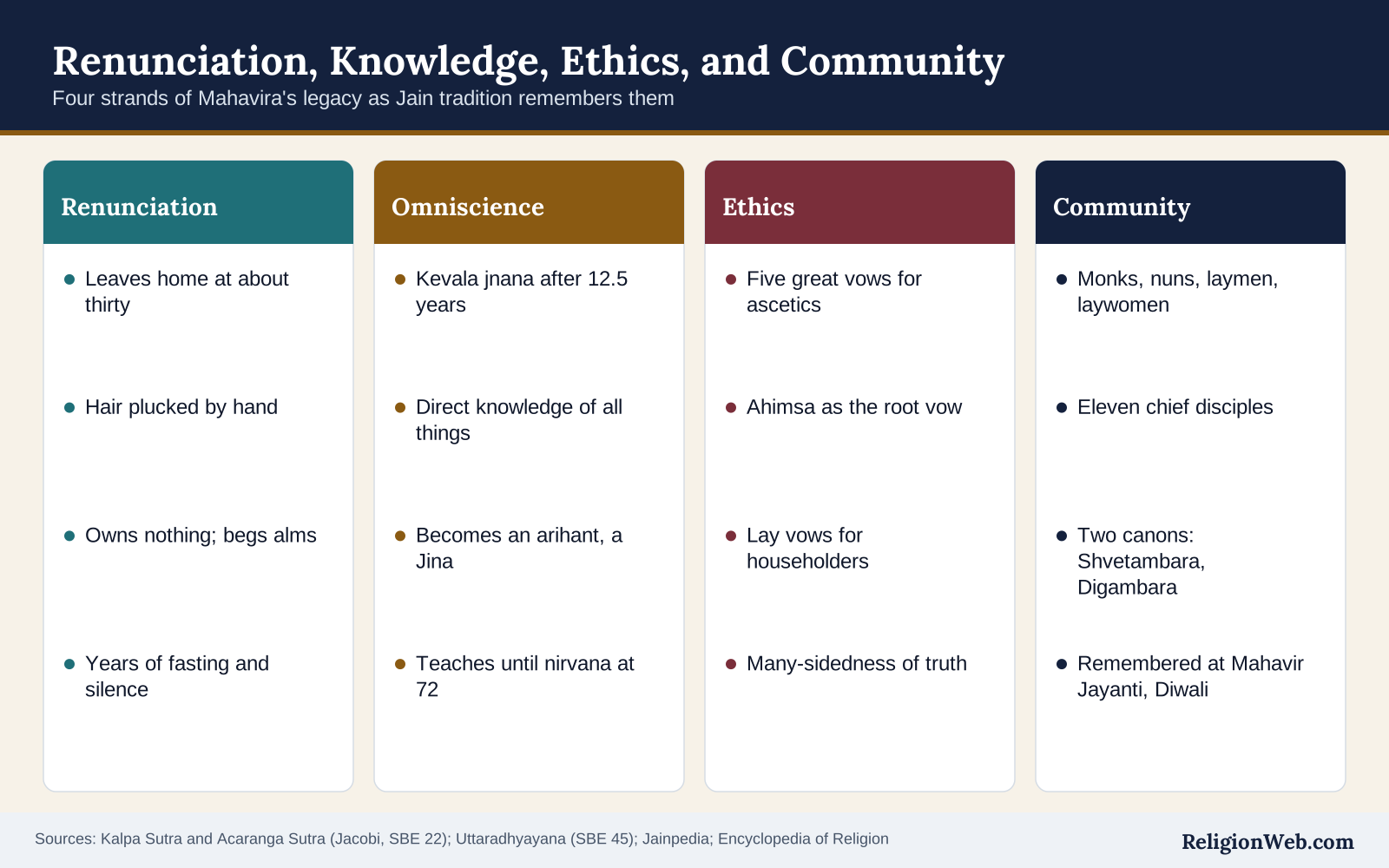
Images and iconography
How Mahavira is recognized
Jain images of the twenty-four Tirthankaras are deliberately similar, so that worshipers must recognize each one by his emblem. Mahavira’s emblem is a lion, carved or painted on the pedestal. According to Jainpedia, his attendant spirits, the yaksha and yakshi who accompany every Tirthankara as guardians, are Matanga and Siddhayika, and his color is yellow. Digambara images are unclothed and unadorned, with downcast or closed eyes, in standing or seated meditation, while Shvetambara images are decorated with crowns, jewelry, and prominent painted or inlaid eyes. In both traditions the Tirthankara is shown calm and withdrawn from the world, a form of the ideal rather than a portrait.
Mahavira in painting and sculpture
The earliest surviving Jain images come from Mathura and belong to the period from roughly the first century BCE to the second century CE. Later artists developed the story in manuscript paintings, especially illustrated copies of the Kalpa Sutra, which show scenes such as the fourteen dreams, the transfer of the embryo by the antelope-headed Harinegameshin, the plucking of the hair, and the ascetic standing in the kayotsarga posture, in which the body is held motionless in meditation, while animals and men torment him. Jainpedia describes a sixteenth-century Shvetambara painting of the embryo transfer and a Digambara statue of Mahavira seated in meditation with the lion emblem and royal symbols, the parasol and the pedestal, which signal his noble birth. These images show how the tradition has used visual art to hold together two aspects of the Tirthankara: the prince who gave up a kingdom, and the ascetic who needed nothing.
Mahavira’s Legacy: Ethics, Community, and Public Memory
An ethic that traveled beyond the monastery
Non-violence as a living tradition
The most durable legacy of the teacher remembered as Mahavira is an ethic: the conviction that every living being has a soul and that the first duty of anyone seeking liberation is to avoid causing harm. The conduct that follows from it, such as vegetarianism, the careful filtering of water, restraint in trade and consumption, and fasting, shapes the daily life of Jain households as well as monasteries. The details of that daily practice are the subject of the article on ahimsa in Jainism, and they show how a teaching that sounds abstract becomes a set of ordinary decisions about food, work, travel, and speech.
The ethic has also been heard outside Jain circles. In the early twentieth century, a Jain layman and poet from Gujarat, Shrimad Rajchandra, corresponded with the young Mohandas Gandhi, who later wrote of the lasting impression Rajchandra made on him, and Gandhi’s own understanding of non-violence was shaped by Indian traditions to which Jain thought was one of several contributors. Historians of the Indian independence movement are careful to describe this as one influence among many, and Jain writers are equally careful not to claim Gandhi as a Jain. The point to retain is that the principle of ahimsa has a long history in the religious thought of the subcontinent, and Mahavira’s order gave it an unusually systematic and rigorous form.
Charity, learning, and care for animals
Because the lay Jain vows include giving and limiting possessions, Jain communities have built a notable record of charitable institutions, including schools, libraries, hospitals, and shelters for animals. The animal shelters called panjrapoles are among the most distinctive of these, and they reflect the belief that compassion extends to all creatures. Jain scholars and monks also built some of the most important manuscript libraries in western India. Such institutions were possible because Jain teaching treats generosity (dana) as a practice that shapes the soul, and because the mutual dependence of monks and laity made patronage a religious duty.
Memory and community in the modern era
The 2,500th anniversary and the Jain emblem
The traditional date of Mahavira’s liberation gave Indian Jains an occasion for shared commemoration in the mid-1970s. The 2,500th anniversary of the nirvana, counted from the traditional date of 527 BCE, was marked in 1974 and 1975 by publications and public events. One of the books published for that anniversary, Religion and Culture of the Jains by Jyoti Prasad Jain, is still cited in Jainpedia. The Pluralism Project at Harvard University notes that the present Jain emblem was chosen in 1975 as part of the commemoration. The emblem combines the outline of the universe as described in Jain texts, a hand with the word ahimsa on its palm, a swastika representing the four realms of rebirth, a crescent with a dot for the abode of the liberated, and three dots for the three jewels of right faith, right knowledge, and right conduct. The design gave Jains of different traditions a symbol that did not belong to one lineage alone, and it expresses, in compact form, the teaching this article has described.
Jains today
India’s 2011 census counted about 4.45 million Jains, roughly 0.37 percent of the population, as tabulated by the Pew Research Center, with large communities in Maharashtra, Rajasthan, Gujarat, Madhya Pradesh, and Karnataka. Pew’s survey in India, conducted between November 2019 and March 2020 with a Jain sample of 109 respondents, found that 92 percent of Jains described themselves as vegetarian and 67 percent also avoided root vegetables, and that Jains were more likely than the general population to hold a college degree. Smaller Jain communities exist in the United Kingdom, East Africa, and North America. For these communities, the memory of Mahavira is carried less by large institutions than by temple festivals, family practice, and the annual rhythm of Paryushana and Diwali. The relationship of the tradition to the wider society is covered in more detail in the article on Jainism.
Common Misconceptions About Mahavira
Misconception 1: Mahavira was the first Tirthankara
Where the misunderstanding comes from
The belief is understandable. Mahavira is the Tirthankara whose life is best documented in scripture, whose festivals are most widely observed, and whose name appears most often in English-language introductions to Jainism. A reader who meets him first, and meets him described as the teacher of a religion, could reasonably conclude that he began the line. Older handbooks that called him the founder strengthened that impression.
What the evidence and tradition actually show
In Jain tradition the first Tirthankara of the present half-cycle is Rishabhanatha, also called Adinatha, and Mahavira is the twenty-fourth and last. The Kalpa Sutra tells the lives of Mahavira, Parshva, Arishtanemi, and Rishabha in that order, working backward from the most recent teacher, and it gives the number of years that have passed since each death. The earlier Tirthankaras are said to have lived for immense periods of time, far beyond ordinary human experience, and the tradition treats those accounts as belonging to cosmic time. Historians do not consider Rishabha or most of the early figures historically recoverable, but they regard Parshva as a plausible predecessor and Mahavira as the first Tirthankara for whom early evidence exists outside Jain tradition. That is the sense in which Mahavira is “the first” in the historical record, and it is a different matter from his rank in the tradition’s own sequence.
The practical consequence is a difference of emphasis. A Jain who recites the names of the twenty-four, as many do in daily devotion, is not ranking them. Each is understood to have taught the same truth in a form suited to his time, and the sequence matters mostly as a record of the cosmic cycle. The temple visitor who sees twenty-four nearly identical images in a Jain shrine, distinguished mainly by their emblems, is looking at the same idea in stone.
Misconception 2: Jainism began with Mahavira as its single founder
Where the misunderstanding comes from
Reference works and textbooks often present each religion through the person associated with its beginnings, and Mahavira’s prominence made him an easy fit for that pattern. Early European scholarship, which sometimes treated Jainism as an offshoot of Buddhism, added further confusion because it looked for a founder who could be placed alongside a famous contemporary. When Hermann Jacobi’s translations and arguments in the 1880s and 1890s showed that Jainism was an independent tradition, the idea of Mahavira as its founder survived in popular summaries.
What the evidence and tradition actually show
Two considerations apply, one theological and one historical. Theologically, Jain teaching holds that the path of liberation is eternal and is recovered in each age by a Tirthankara, so that the tradition itself does not locate its origin in any one person. Historically, Jain sources describe Mahavira’s parents as devotees of Parshva, and the early Buddhist texts describe a community of Niganthas that was already established when they were written. Scholars such as those who contributed to Jainpedia and to the Encyclopedia of Religion now generally describe Mahavira as the reformer and organizer of an existing ascetic community. This does not diminish his importance: the five vows, the structure of the fourfold community, and the body of teaching preserved in the scriptures are closely identified with him. It means only that “founder” is a word that fits the evidence poorly and that the Jain concept of renewal fits it better.
The question also has a regional dimension. The religious world of the middle Ganges plain included many wandering teachers and their communities, and the older ritual tradition described in the article on Hinduism coexisted with them. Jain and Buddhist texts both speak of one another’s communities, each from its own standpoint, and neither presents the other as an offshoot. The nineteenth-century idea that Jainism was a branch of Buddhism is no longer held by scholars, and Jacobi’s evidence is a large part of the reason.
Misconception 3: All traditional biographies of Mahavira agree on every detail
Where the misunderstanding comes from
Many brief biographies, including those in popular articles and devotional booklets, present a single smooth story: royal birth, renunciation, enlightenment, teaching, and liberation. The smoothness comes from the fact that the main outline is shared by all Jains. A reader can easily assume that the details are shared as well, and that disagreements, where they exist, reflect error or later invention.
What the evidence and tradition actually show
The Shvetambara and Digambara traditions agree on the main arc but differ on specific points that are significant to each community. The Shvetambara scripture describes the transfer of the embryo from a Brahmin woman to a Kshatriya woman, fourteen dreams, a marriage and a daughter, and a robe worn for thirteen months, and the Digambara texts omit or reject each of these, count sixteen dreams, and place the nirvana in 510 BCE instead of 527 BCE. Even within one tradition, the place of his birth is identified in more than one way, and retellings vary in the details of the early assemblies. Historians add a third layer by noting that many episodes follow patterns found in the biographies of other great figures, and that dates in the traditional chronology are not confirmed by outside evidence. The sources, in short, agree on the shape of the life and differ on the details, and a careful account says so.
None of this means the biographies are unreliable as religious texts. Jains read them as accounts of what a Tirthankara’s life must contain, and the variations are part of how each community has remembered its own teachers. For readers who want a single sentence that holds up under scrutiny, the safest is that Mahavira was born in the Videha region, renounced household life, taught a community of monks, nuns, laymen, and laywomen, and died at a place called Pava, all of which the Jain and Buddhist sources support, and that most other details belong to one tradition or another.
Misconception 4: Jains worship Mahavira as a god who grants wishes
Where the misunderstanding comes from
Visitors to a Jain temple see people bowing before an image, making offerings, singing hymns, and waving lamps. These are the gestures of devotion in many South Asian traditions, and observers often assume that the one being honored is a deity who can answer prayers. The word “worship” in English reinforces the assumption, since it implies a relationship with a powerful being.
What the evidence and tradition actually show
Jain teaching holds that there is no creator god and that a Tirthankara who has been liberated has left the world for good and does not hear or answer requests. Jains honor Mahavira as a perfected human teacher: they bow, recite his name, and contemplate his qualities as models for their own effort. The central prayer, the Navkar Mantra, salutes the liberated teachers without asking for anything, and the temple rites are described by Jain authors as expressions of reverence and aspiration. Some Jains also honor guardian spirits and goddesses, a practice that varies by community and is distinct from the veneration of the Tirthankaras. Not all Jains use images at all, as the Sthanakavasi and Terapanth traditions illustrate. The practice that looks most like a plea for favors is therefore, in the tradition’s own understanding, a discipline of remembering a path.
A related point concerns what Jains seek when they visit a shrine. The ritual acts, such as bathing an image on Mahavir Jayanti or lighting lamps at Diwali, are described by Jain scholars as ways of rehearsing the five auspicious events of a Tirthankara’s life and of cultivating detachment and gratitude. Jain teachers often explain that offerings made in this spirit lessen the hold of passion by turning attention to the qualities of liberated souls. Whether a given worshiper also hopes for worldly benefit is a separate question about individual belief, and Jain teachers on the whole do not encourage it.
Misconception 5: Mahavira and the Buddha were the same person, or one taught the other
Where the misunderstanding comes from
The two teachers lived in the same region and period, belonged to the Kshatriya class, taught renunciation, and are honored with similar titles. Several names add to the confusion: Siddhartha is the name of Mahavira’s father in Jain tradition and the personal name of the Buddha, Gautama is the clan name of the Buddha and also the name of Mahavira’s chief disciple, and both traditions use the word jina, “conqueror,” as an epithet. Casual summaries that mention them together can make them sound like variants of one story.
What the evidence and tradition actually show
The sources treat them as distinct teachers with separate communities, doctrines, and scriptures. The Pali texts mention Nigantha Nataputta as the head of a separate order, and they record that he died at Pava. Jain texts, for their part, describe their own order and its internal history. The teachings differ in substance, for example in the Jain doctrine of karma as subtle matter bound to a permanent soul. Historians generally treat the two as near contemporaries who shared a religious environment and sometimes engaged with one another’s ideas, with Mahavira usually described as the slightly older of the two, though the dates of both are uncertain. For the life of the Buddha and the history of the tradition that followed him, see the article on the Buddha; the present article concerns the Jain teacher alone.
Frequently Asked Questions About Mahavira
Questions about identity, dates, and sources
Who was Mahavira?
Mahavira, born Vardhamana, is the twenty-fourth and last Tirthankara of the present half-cycle in Jain tradition. He was born into a Kshatriya family of the Jnatri clan in the Videha region of eastern India, renounced household life at about thirty, attained omniscience after roughly twelve and a half years of austerity, and taught for about thirty years before his liberation at Pava at the age of seventy-two. Early Buddhist texts refer to him as Nigantha Nataputta, and they confirm that he led a community of ascetics and was credited with omniscience.
When did Mahavira live?
The Jain traditional dates are 599 to 527 BCE, used by the Shvetambara community and in most Jain calendars, while the Digambara tradition places his nirvana in 510 BCE. Many modern historians favor later dates, in the fifth century BCE, with a death somewhere between about 477 and 425 BCE depending on how the Buddha is dated. No method yet in use settles the question, and a careful writer gives the traditional dates as traditional.
Was Mahavira the founder of Jainism?
Jains generally do not describe him that way, because their teaching holds that the path is eternal and is restored in each age by a series of twenty-four Tirthankaras, of whom he is the last. Historians agree that he was not working from nothing: the Jain texts describe his parents as followers of the earlier teacher Parshva, and the Buddhist texts treat the Niganthas as an established community. He is best described as the Tirthankara who reorganized and consolidated the order that survives today.
What are the oldest sources about his life?
The oldest Jain sources are the first book of the Acaranga Sutra, which describes his years of wandering, and the Kalpa Sutra, which gives his formal biography. Outside the Jain tradition, the Pali Buddhist scriptures mention Nigantha Nataputta in several discourses, including the report that he had died at Pava. Jacobi’s nineteenth-century translations of the Acaranga and Kalpa Sutras in the Sacred Books of the East remain the standard English public-domain versions.
Questions about teaching, practice, and observance
What did Mahavira teach?
Jain tradition attributes to him the teaching that every living being has an eternal soul, that karma binds the soul through passion and harmful action, and that liberation comes through right faith, right knowledge, and right conduct. For monks and nuns the conduct is summarized in five great vows: non-violence, truthfulness, not taking what is not given, celibacy, and non-possession. Lay Jains take lighter versions of the same vows. His approach to knowledge, later called many-sidedness, holds that statements about reality are true from a particular standpoint.
Do Jains worship Mahavira as a god?
No. Jains honor him as a perfected human teacher who found the path to liberation, and not as a creator or as a being who answers requests. They bow before his image, recite his name, and keep his festivals, but the aim is to remember and to emulate. The Navkar Mantra, the central prayer, salutes the liberated teachers without requesting anything.
What is Mahavir Jayanti and when is it?
Mahavir Jayanti commemorates his birth on the thirteenth day of the bright half of Chaitra, a lunar date that falls in March or April. In 2026 it was observed on March 31 in India. Because the date follows the lunar calendar it changes each year, and Jains in other countries may observe it a day earlier or later depending on local time. The nirvana is remembered separately at Diwali, which is the Jain new-moon commemoration in autumn.
Where can someone learn more from Jain sources?
Jainpedia, an online reference with signed articles by scholars such as Nalini Balbir, covers Mahavira, the festivals, and Jain art. For the tradition as a whole, the article on Jainism on this site gives the wider context, and the article on Paryushana explains how the Kalpa Sutra’s life of Mahavira is heard each year.
Conclusion: What the Life of Mahavira Shows
What the history and the tradition show
A restorer inside a lineage
Mahavira appears in the sources as a prince who gave up rank, a wanderer who endured, and a teacher who organized a community. Jain tradition places him as the twenty-fourth in a line that has no beginning, and the evidence from early Buddhist texts and from Jain scripture suggests that this lineage had human roots before him. Both views can be held at once. He is the last Tirthankara of the present age and also the figure through whom the community’s ethics, structure, and scripture took the form they have today.
Why the details matter
The differences between Shvetambara and Digambara biographies, the uncertainty over his dates, and the plurality of birthplaces are not embarrassments for the tradition. They show a community that has handed down its memory in more than one form. A reader who keeps those differences in view understands both the faith and the historical method better than one who relies on a single smooth account.
How to keep exploring
Reading the primary texts
Anyone who wants to move from this overview to the sources can begin with Jacobi’s translations of the Acaranga and Kalpa Sutras, which are public domain, and read them with a modern introduction that explains their place in the Shvetambara canon. The Acaranga’s account of the wandering years and the Kalpa Sutra’s list of rainy-season retreats are short and repay slow reading.
Following the tradition through its practice
The other route is through practice. The ethic of non-violence described in the article on ahimsa in Jainism is the living form of what the sources report, and the annual cycle of Mahavir Jayanti, Paryushana, and Diwali is the way Jain communities keep his life present. Seen this way, the question “Who was Mahavira?” has two answers, one in the texts and one in the calendar, and they complement each other.
Sources
The table below lists the principal external sources behind this article. Facts, dates and figures were checked against these and related primary, institutional and academic materials.
| # | Source | Publisher and type | Used for | Link |
|---|---|---|---|---|
| 1 | Jaina Sutras, Part I (Akaranga Sutra and Kalpa Sutra), tr. Hermann Jacobi, Sacred Books of the East vol. 22 (1884) | Internet Sacred Text Archive (sacred-texts.com) · Primary text | Quotations and details from the Kalpa Sutra and Acaranga Sutra: life of Mahavira, community, nirvana, year counts | sacred-texts.com |
| 2 | Jaina Sutras, Part II (Uttaradhyayana), Lecture 25 'The True Sacrifice', tr. Hermann Jacobi, Sacred Books of the East vol. 45 (1895) | Internet Sacred Text Archive (sacred-texts.com) · Primary text | Quotation on what makes a shramana, brahmana, muni, and tapasa; the Keshi-Gautama dialogue context | sacred-texts.com |
| 3 | Majjhima Nikaya 14 (Cula-dukkhakkhandha Sutta), tr. Bhikkhu Sujato, SuttaCentral; Dīgha Nikāya 29 opening | SuttaCentral · Primary text | Pali evidence: the Niganthas' claim about Nigantha Nataputta's knowledge; DN 29 report of his death at Pava | suttacentral.net |
| 4 | Mahavira (entries by Colette Caillat, Encyclopedia of Religion, and John Bowker, Concise Oxford Dictionary of World Religions) | Encyclopedia.com · Academic reference | Traditional and scholarly dates, Shvetambara and Digambara differences, Gosala, historicity | encyclopedia.com |
| 5 | Article: Mahavira (Jainpedia) | Jainpedia · Academic reference | Embryo transfer, emblem, attendants, art examples, view that Mahavira reformed an existing tradition | jainpedia.org |
| 6 | Article: Mahavir Jayanti, by Nalini Balbir (Jainpedia) | Jainpedia · Academic reference | Date rule and observance of Mahavir Jayanti; dreams plaques; sectarian and regional variation | jainpedia.org |
| 7 | Article: Divali, by Nalini Balbir (Jainpedia) | Jainpedia · Academic reference | Jain Diwali as the nirvana observance: calendar rule, Gautama, new year, customs, era dates | jainpedia.org |
| 8 | The Jain Symbol | The Pluralism Project, Harvard University · Institutional | Adoption of the Jain emblem in 1975 for the 2,500th anniversary of Mahavira's nirvana; its elements | pluralism.org |
| 9 | 6 facts about Jains in India (Pew Research Center, August 17, 2021; survey Nov. 2019 to Mar. 2020) | Pew Research Center · Demographic data | Jain share of India's population, vegetarian diet, education; sample of 109 Jain respondents | pewresearch.org |
| 10 | Mahavir Jayanti 2026 (31 March 2026) | Drishti IAS · Calendar reference | Observed date of Mahavir Jayanti in India in 2026 and the Chaitra Shukla Trayodashi rule | drishtiias.com |
Last fact-check date: 2026-10-21.